Use bowel distribution, wall depth, and objective inflammation to distinguish Crohn disease from UC, predict complications, and choose safer treatment.
Crohn disease and ulcerative colitis (UC) are both inflammatory bowel diseases. Start with the bowel map, then ask how deep the injury reaches. Those two questions predict complications better than a single symptom, biopsy feature, or drug name.
Decision to make: Is this continuous colitis beginning at the rectum, or a potentially discontinuous process that can cross the bowel wall? Keep exceptions and mimics in view.
1. Depth predicts the complication
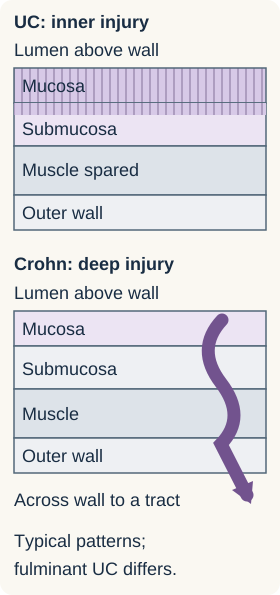
Misconception: All inflamed bowel walls are equally likely to form fistulas. Compare the layers below: Crohn inflammation can be transmural; UC usually involves mucosa and superficial submucosa. In fulminant UC, inflammation can extend deeper, so depth is a useful pattern, not an absolute rule. [1][2][3]
The outward Crohn tract represents the route to an abscess or fistula, not an inevitable outcome.
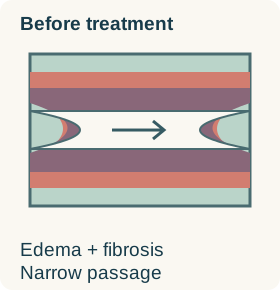
Predict: A patient with ileal Crohn disease has a narrowed segment containing both inflammatory edema and fixed fibrosis. If treatment resolves the edema, will the obstruction necessarily disappear? Compare the two views below. Point to the part that changes and the part that remains narrowed, then predict what happens to passage.
Before: edema plus fibrosis both reduce the lumen.
Consequence: Removing edema can widen the lumen somewhat, but fixed scar can leave clinically important obstruction. Steroids treat inflammation, not established fibrosis; persistent mechanical narrowing may require endoscopic dilation in selected short accessible strictures, strictureplasty, or resection after assessment. [1]
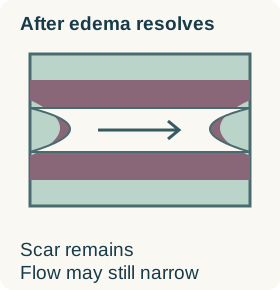
After: less edema, persistent fibrotic narrowing. Compare the residual lumen with the before-view.Check your prediction: what still limits passage?
The swollen component shrinks, but the scar still narrows the lumen. If vomiting and upstream dilation persist after inflammation improves, assess the fixed component instead of assuming that more steroids will restore passage. [1][3]
Transfer: A draining perianal tract or intra-abdominal abscess points toward penetrating Crohn disease and demands assessment for an undrained collection before escalating immunosuppression. Severe colitis with colonic dilation and systemic toxicity suggests toxic megacolon, classically associated with UC but possible in other severe colitides; involve medicine and surgery promptly. [1][2]
2. Map distribution before reading a crypt
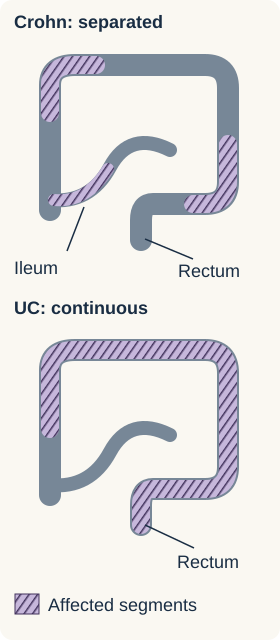
Misconception: One crypt abscess identifies UC. Instead, compare the whole map. Crohn disease can affect mouth to anus, often terminal ileum and colon, with intervening relatively normal segments, deep linear ulcers, cobblestoning, and sometimes rectal sparing. UC generally starts in the rectum, extends proximally in a continuous colonic pattern, and produces diffuse friability, superficial ulceration, loss of vascular pattern, and pseudopolyps. [1][2][3]
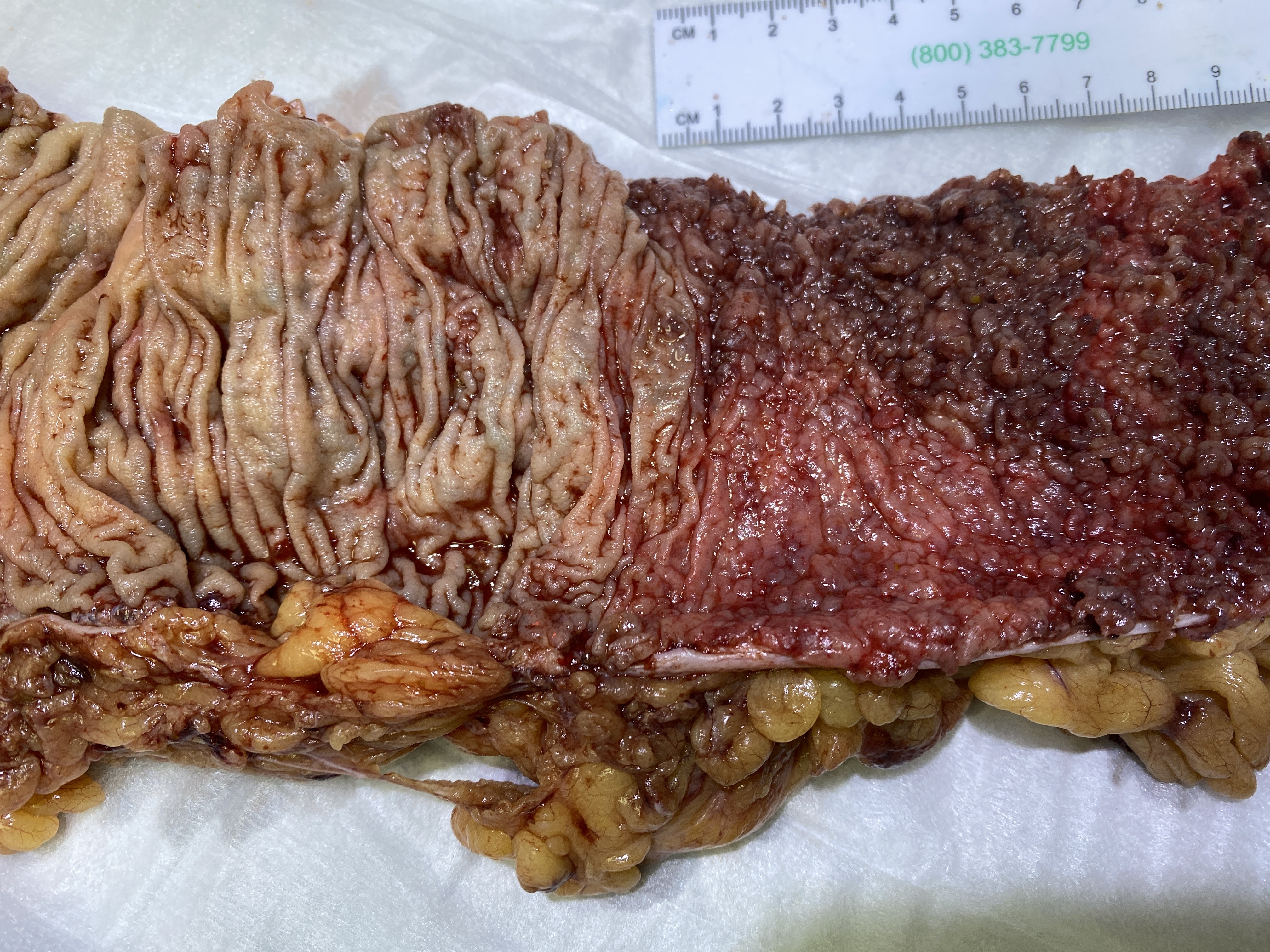
Inspect the specimen: Before reading the caption, compare the folds on the left with the irregular projections on the right. Which side has preserved folds, and which shows post-inflammatory mucosal remnants? This is a gross opened, formalin-fixed colon, not an endoscopic view.
The left retains normal folds; the right contains pseudopolyps, residual or regenerating mucosal islands after ulceration. Their presence alone does not establish dysplasia. Image: Mikael Häggström, Wikimedia Commons, CC0 1.0; A single specimen field is not a whole-bowel map. [8].
Stripes identify affected segments as well as color;
Compare: A treated patient with otherwise convincing UC has a small spared rectal area, and another with extensive UC has mild contiguous terminal ileitis. Neither finding alone converts the diagnosis to Crohn disease: treatment may alter UC continuity or spare the rectum, and mild associated ileitis may accompany extensive UC. Reassess the complete endoscopic, histologic, imaging, and clinical pattern. [2][3]
Visible explanation: Chronic crypt architectural distortion establishes chronic mucosal injury; crypt abscesses indicate active inflammation but are not subtype-specific. Well-formed noncaseating granulomas away from ruptured crypts favor Crohn disease when alternative granulomatous causes are considered; absent granulomas do not exclude it. [1][4]
Transfer: A photograph showing normal folds on the left and a pseudopolyp-bearing inflamed surface on the right can teach gross mucosal contrast, but a single specimen image cannot establish the distribution throughout the bowel. Use a documented ileocolonic map rather than extrapolating from one field.
3. Risk is a gradient, not a universal calendar
Misconception: Quiet bowel symptoms mean every extraintestinal manifestation and cancer risk is quiet too. Imagine two patients: one has transient type 1 peripheral arthritis during a bowel flare; the other has primary sclerosing cholangitis (PSC) despite controlled intestinal symptoms. Type 1 peripheral arthritis often parallels bowel activity; type 2 peripheral polyarthritis can persist independently. Erythema nodosum and episcleritis often parallel bowel activity, whereas PSC and axial spondyloarthritis may follow independent courses. Do not use symptom remission to dismiss them. [5]
Predict: Who needs more intensive colorectal surveillance: a newly diagnosed patient with isolated proctitis, or a patient with years of extensive colitis and PSC? The latter has multiple risk modifiers. Colonic extent, duration, cumulative inflammatory burden, family history, and PSC inform individual intervals; substantial Crohn colitis also carries elevated colorectal neoplasia risk. [1][2][7]
Consequence: Colonic IBD is usually risk assessed for surveillance around eight years after symptom onset, with later intervals adjusted to risk. Once PSC and colonic IBD coexist, begin the surveillance program from diagnosis of that combination and generally repeat annually. A high-quality diagnostic colonoscopy can serve as the baseline. An inadequately prepared examination is not a negative baseline; the BSG pathway considers repeating failed preparation within three to six months rather than waiting a full year. Isolated proctitis or isolated small-bowel Crohn disease does not have the same colitis-associated schedule; ordinary population screening still applies. [7]
Transfer: A patient feels well but has PSC and longstanding extensive UC. Continue risk-based surveillance even if diarrhea and bleeding resolve; symptoms do not measure dysplasia.
A painful red eye with photophobia or blurred vision is a separate urgent problem, even with quiet bowel symptoms. Arrange ophthalmologic assessment for possible uveitis or another serious ocular disorder; do not label it uncomplicated episcleritis without evaluation. [5]
4. Read the symptom from the affected segment
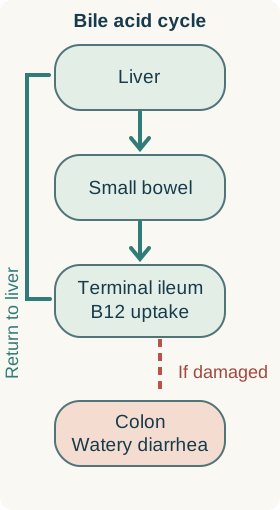
Misconception: Diarrhea has the same mechanism wherever disease lies. Trace the terminal ileum below: bile acids are normally reclaimed for reuse, while vitamin B12 bound to intrinsic factor is absorbed there. Sufficient ileal disease or resection can cause bile acid spill into colon and watery diarrhea, and substantial loss of absorptive ileum can cause B12 deficiency. [6]
Original ileal-recycling schematic. The dashed route shows bile acids reaching colon when ileal reclamation fails.
Predict: One patient has right lower quadrant cramps, weight loss, and episodic obstruction; another has frequent bloody stools, urgency, and tenesmus. Ileal inflammation or stenosis better explains the first pattern, while rectal inflammation explains the second. Increasing colonic extent increases inflammatory burden and long-term neoplasia considerations. [1][2]
Visible explanation: A perianal opening with drainage prompts examination for fissures, skin tags, abscess, and fistula; deep or branching tracts call for pelvic MRI and coordinated surgical assessment. A distended patient with severe colitis, fever, tachycardia, anemia, or metabolic disturbance needs urgent assessment for toxic megacolon rather than routine outpatient colonoscopy. [1][2]
Transfer: After a limited ileal resection, watery diarrhea with a healed anastomosis may reflect bile-acid malabsorption rather than recurrent inflammation. Once inflammatory and other causes are assessed, a bile-acid sequestrant may help selected patients. Extensive ileal loss can instead deplete the bile-acid pool and produce fat malabsorption, so treatment depends on remaining anatomy. Monitor B12 and other nutritional consequences when clinically indicated. [3][6]
5. Diagnose in layers, not by a single threshold
Misconception: A positive fecal calprotectin diagnoses IBD, and a low value rules it out everywhere. In persistent diarrhea, first consider infection and other mimics. CBC, metabolic panel, CRP, and fecal calprotectin assess activity and consequences, but infection and NSAIDs can also raise calprotectin. A low value is most reassuring when pretest risk is low; alarm features or suspected limited small-bowel disease still warrant evaluation. Calprotectin can also monitor activity over time. [1][2][3]
Action: Choose the appropriate map for each question: mucosal distribution, proximal small-bowel/transmural complications, or branching perianal tract. Compare these complementary layers rather than ordering one test as a substitute for all others.
Exclude mimics and assess severity: Obtain stool pathogen testing when indicated, including Clostridioides difficile during a suspected flare. Assess anemia, hydration, electrolytes, albumin, inflammatory markers, and medication exposure. [1][2]
Define mucosa: Ileocolonoscopy with terminal ileal inspection and biopsies of involved and uninvolved segments maps extent, activity, and histology. Consider upper endoscopy when upper gastrointestinal symptoms or diagnostic concern warrant it. Acute severe colitis calls for appropriately limited sigmoidoscopy, usually within 24 to 72 hours, not routine full preparation and colonoscopy. In fulminant toxicity, individualize any procedure with the treating team. [1][2][3]
Define depth and tracts: MR or CT enterography assesses bowel beyond endoscopic reach, wall thickening, upstream dilation, creeping fat, interloop fistulas, and abscesses. Pelvic MRI answers the separate question of perianal tract anatomy. If obstructive symptoms suggest a stricture, assess the small bowel before capsule endoscopy because retention is possible; further patency assessment may still be needed. [1][3]
Consequence: Endoscopy samples mucosa, enterography evaluates bowel beyond the endoscope and extraluminal disease, and MRI pelvis answers a distinct perianal anatomy question. Record location; inflammatory, stricturing, or penetrating behavior; perianal involvement; severity; and surveillance modifiers before choosing treatment. [1][2]
Transfer: Normal calprotectin in a low-risk patient without bleeding, anemia, weight loss, nocturnal symptoms, or fever lowers the likelihood of active inflammation; it does not permanently rule out Crohn disease. A high value after an NSAID course or infectious diarrhea does not subtype the disease.
6. Separate induction, maintenance, and rescue
Misconception: If a steroid stops a flare, continuing it maintains remission. For mild to moderate ileocecal Crohn disease, ileal-release budesonide can induce remission; systemic corticosteroids may induce remission in more active disease. Neither is maintenance therapy. Repeated relapse on taper calls for objective reassessment and steroid-sparing treatment. [1][2]
Compare: Mesalamine has a role in mild to moderate UC, particularly rectal therapy for proctitis, but is not an effective treatment for luminal Crohn disease. Moderate to severe disease may justify early advanced treatment rather than repeated steroid cycles. Anti-TNF agents, vedolizumab, ustekinumab, selective IL-23 agents, and appropriate small molecules such as upadacitinib in indicated patients are among phenotype- and indication-dependent options; prior exposure, comorbidity, safety, and patient preference shape selection. For UC, selected sphingosine-1-phosphate receptor modulators are additional advanced options. Continue an effective maintenance strategy instead of chronic steroids. [1][2]
When symptoms recur during otherwise effective maintenance, compare them with objective activity before escalating immune treatment. Normal inflammatory testing and healed biopsies can point toward dietary, functional, or other noninflammatory causes; investigate those causes while preserving a tolerated maintenance therapy that is controlling UC. [2][3]
Predict: A patient with penetrating Crohn disease has fever and a collection beside a fistula. Giving immune suppression alone risks missing the source. Drain an abscess and coordinate perianal fistula management with colorectal surgery. A fixed symptomatic stenosis may require a mechanical intervention rather than more anti-inflammatory medication. Resection or strictureplasty treats selected Crohn complications but does not cure Crohn disease; postoperative recurrence remains possible; ileocolonoscopy around 6 to 12 months after ileocolic resection can detect early endoscopic recurrence and guide prevention or treatment, even before symptoms return. [1]
Consequence: Proctocolectomy eliminates UC colitis in the removed organs, but does not cure PSC or guarantee remission of independent extraintestinal disease. A pouch or retained rectal cuff can have later inflammatory or neoplastic problems. After surgery for colitis-associated dysplasia or cancer, BSG suggests annual pouch/cuff surveillance, including inspection and sampling of the pre-pouch ileum, pouch body, and anal transition zone or retained cuff. Other risk profiles use individualized follow-up. [2][5][7]
Acute severe UC is a different clock
A hospitalized patient with frequent bloody stools plus systemic illness needs C. difficile testing, fluid and electrolyte support, pharmacologic venous thromboembolism prophylaxis unless contraindicated, IV corticosteroids, and early colorectal surgical involvement. Stable small-volume hematochezia alone is not an automatic contraindication to prophylaxis. Assess response by about day 3; inadequate response calls for rescue infliximab or cyclosporine assessment alongside a surgical plan. [2]
Dilation plus systemic toxicity raises concern for toxic megacolon. Avoid antimotility drugs, opioids when possible, and routine full bowel preparation or colonoscopy in this setting. Perforation, uncontrolled hemorrhage, worsening toxicity, or failure of appropriate medical therapy can require surgery. A routine broad-spectrum antibiotic course or parenteral nutrition solely for bowel rest is not a substitute for indicated treatment. [2][3]
Transfer: Improvement on IV steroids demonstrates induction responsiveness, not a durable maintenance plan. Conversely, deterioration despite three days of IV treatment calls for prompt reassessment of infection and complications and a rescue-or-surgery decision, not an indefinite steroid trial.
Apply the maps
Case 1
Show answer and explanations for case 1
A. Ulcerative colitis with associated ileitis (Why this does not fit)
Extensive UC can be accompanied by limited terminal ileal inflammation. Deep segmental ileal disease with a fistula and a normal rectum does not fit that pattern. Interpret ileitis with its distribution and complications.
Reasoning steps for option A
For the option 'Ulcerative colitis with associated ileitis', why is this case-specific premise relevant: Extensive UC can be accompanied by limited terminal ileal inflammation?
Extensive UC can be accompanied by limited terminal ileal inflammation.
How does this case-specific finding change the plausibility of 'Ulcerative colitis with associated ileitis': Deep segmental ileal disease with a fistula and a normal rectum does not fit that pattern?
Deep segmental ileal disease with a fistula and a normal rectum does not fit that pattern.
What transferable rule should you apply after testing 'Ulcerative colitis with associated ileitis' against this point: Interpret ileitis with its distribution and complications?
Interpret ileitis with its distribution and complications.
B. Fibrostenotic Crohn disease without penetration (Why this does not fit)
The narrowing and proximal dilation support stricturing disease. An interloop fistula additionally demonstrates penetrating behavior. A patient may have more than one complication phenotype.
Reasoning steps for option B
For the option 'Fibrostenotic Crohn disease without penetration', why is this case-specific premise relevant: The narrowing and proximal dilation support stricturing disease?
The narrowing and proximal dilation support stricturing disease.
How does this case-specific finding change the plausibility of 'Fibrostenotic Crohn disease without penetration': An interloop fistula additionally demonstrates penetrating behavior?
An interloop fistula additionally demonstrates penetrating behavior.
What transferable rule should you apply after testing 'Fibrostenotic Crohn disease without penetration' against this point: A patient may have more than one complication phenotype?
A patient may have more than one complication phenotype.
C. Stricturing and penetrating Crohn disease (Best answer)
Crohn disease can affect the full thickness of the bowel wall. The narrowed ileum explains dilation, and an interloop fistula explains the connecting tract. Absent granulomas do not exclude Crohn disease.
Reasoning steps for option C
For the option 'Stricturing and penetrating Crohn disease', why is this case-specific premise relevant: Crohn disease can affect the full thickness of the bowel wall?
Crohn disease can affect the full thickness of the bowel wall.
How does this case-specific finding change the plausibility of 'Stricturing and penetrating Crohn disease': The narrowed ileum explains dilation, and an interloop fistula explains the connecting tract?
The narrowed ileum explains dilation, and an interloop fistula explains the connecting tract.
What transferable rule should you apply after testing 'Stricturing and penetrating Crohn disease' against this point: Absent granulomas do not exclude Crohn disease?
Absent granulomas do not exclude Crohn disease.
D. Inflammatory Crohn disease without structural complications (Why this does not fit)
Active ileal ulcers can occur before structural complications develop. The fistula and mechanically significant narrowing already establish structural disease. Symptoms and imaging together define behavior.
Reasoning steps for option D
For the option 'Inflammatory Crohn disease without structural complications', why is this case-specific premise relevant: Active ileal ulcers can occur before structural complications develop?
Active ileal ulcers can occur before structural complications develop.
How does this case-specific finding change the plausibility of 'Inflammatory Crohn disease without structural complications': The fistula and mechanically significant narrowing already establish structural disease?
The fistula and mechanically significant narrowing already establish structural disease.
What transferable rule should you apply after testing 'Inflammatory Crohn disease without structural complications' against this point: Symptoms and imaging together define behavior?
Symptoms and imaging together define behavior.
Takeaway: A stricture limits passage; a fistula crosses tissue planes. Both can occur without a granuloma.
A. Active chronic colitis with a UC-pattern distribution (Best answer)
Distorted crypts support chronic mucosal injury, while luminal neutrophils form crypt abscesses. The continuous rectal-to-left-colon pattern makes UC the best fit. Histology gains specificity when combined with the bowel map.
Reasoning steps for option A
For the option 'Active chronic colitis with a UC-pattern distribution', why is this case-specific premise relevant: Distorted crypts support chronic mucosal injury, while luminal neutrophils form crypt abscesses?
Distorted crypts support chronic mucosal injury, while luminal neutrophils form crypt abscesses.
How does this case-specific finding change the plausibility of 'Active chronic colitis with a UC-pattern distribution': The continuous rectal-to-left-colon pattern makes UC the best fit?
The continuous rectal-to-left-colon pattern makes UC the best fit.
What transferable rule should you apply after testing 'Active chronic colitis with a UC-pattern distribution' against this point: Histology gains specificity when combined with the bowel map?
Histology gains specificity when combined with the bowel map.
B. Active chronic colitis with a Crohn-pattern distribution (Why this does not fit)
Crohn colitis may also show crypt distortion and crypt abscesses. Neither finding overrides the continuous distal distribution supplied here. Crypt abscesses are not specific for either IBD subtype.
Reasoning steps for option B
For the option 'Active chronic colitis with a Crohn-pattern distribution', why is this case-specific premise relevant: Crohn colitis may also show crypt distortion and crypt abscesses?
Crohn colitis may also show crypt distortion and crypt abscesses.
How does this case-specific finding change the plausibility of 'Active chronic colitis with a Crohn-pattern distribution': Neither finding overrides the continuous distal distribution supplied here?
Neither finding overrides the continuous distal distribution supplied here.
What transferable rule should you apply after testing 'Active chronic colitis with a Crohn-pattern distribution' against this point: Crypt abscesses are not specific for either IBD subtype?
Crypt abscesses are not specific for either IBD subtype.
C. Acute self-limited colitis without underlying chronic mucosal injury (Why this does not fit)
Infectious colitis can produce crypt neutrophils. Architectural distortion and recurrent symptoms support chronic injury rather than activity alone. Separate evidence of activity from evidence of chronicity.
Reasoning steps for option C
For the option 'Acute self-limited colitis without underlying chronic mucosal injury', why is this case-specific premise relevant: Infectious colitis can produce crypt neutrophils?
Infectious colitis can produce crypt neutrophils.
How does this case-specific finding change the plausibility of 'Acute self-limited colitis without underlying chronic mucosal injury': Architectural distortion and recurrent symptoms support chronic injury rather than activity alone?
Architectural distortion and recurrent symptoms support chronic injury rather than activity alone.
What transferable rule should you apply after testing 'Acute self-limited colitis without underlying chronic mucosal injury' against this point: Separate evidence of activity from evidence of chronicity?
Separate evidence of activity from evidence of chronicity.
D. Inactive chronic colitis with residual crypt architectural distortion (Why this does not fit)
Crypt distortion can remain during inactive disease. Neutrophils within crypt lumens establish active inflammation. Persistent structure and current activity are different biopsy observations.
Reasoning steps for option D
For the option 'Inactive chronic colitis with residual crypt architectural distortion', why is this case-specific premise relevant: Crypt distortion can remain during inactive disease?
Crypt distortion can remain during inactive disease.
How does this case-specific finding change the plausibility of 'Inactive chronic colitis with residual crypt architectural distortion': Neutrophils within crypt lumens establish active inflammation?
Neutrophils within crypt lumens establish active inflammation.
What transferable rule should you apply after testing 'Inactive chronic colitis with residual crypt architectural distortion' against this point: Persistent structure and current activity are different biopsy observations?
Persistent structure and current activity are different biopsy observations.
Takeaway: Crypt abscesses indicate activity; crypt distortion supports chronicity; distribution helps identify the disease.
A. Reclassify as Crohn disease and start biologic induction (Why this does not fit)
Patchy inflammation can reflect Crohn disease. The discontinuity appeared only after therapy; there is no independent Crohn evidence. Reclassification needs convergent untreated distribution and disease-specific evidence.
Reasoning steps for option A
For the option 'Reclassify as Crohn disease and start biologic induction', why is this case-specific premise relevant: Patchy inflammation can reflect Crohn disease?
Patchy inflammation can reflect Crohn disease.
How does this case-specific finding change the plausibility of 'Reclassify as Crohn disease and start biologic induction': The discontinuity appeared only after therapy; there is no independent Crohn evidence?
The discontinuity appeared only after therapy; there is no independent Crohn evidence.
What transferable rule should you apply after testing 'Reclassify as Crohn disease and start biologic induction' against this point: Reclassification needs convergent untreated distribution and disease-specific evidence?
Reclassification needs convergent untreated distribution and disease-specific evidence.
B. Retain UC and start a biologic for patchy inflammation (Why this does not fit)
Persistent histologic inflammation may warrant treatment optimization. Mild patches despite symptom control merit follow-up but do not alone mandate biologic induction. Escalation depends on activity, risk, and optimized treatment, not map appearance alone.
Reasoning steps for option B
For the option 'Retain UC and start a biologic for patchy inflammation', why is this case-specific premise relevant: Persistent histologic inflammation may warrant treatment optimization?
Persistent histologic inflammation may warrant treatment optimization.
How does this case-specific finding change the plausibility of 'Retain UC and start a biologic for patchy inflammation': Mild patches despite symptom control merit follow-up but do not alone mandate biologic induction?
Mild patches despite symptom control merit follow-up but do not alone mandate biologic induction.
What transferable rule should you apply after testing 'Retain UC and start a biologic for patchy inflammation' against this point: Escalation depends on activity, risk, and optimized treatment, not map appearance alone?
Escalation depends on activity, risk, and optimized treatment, not map appearance alone.
C. Reclassify as infectious colitis and discontinue maintenance mesalamine (Why this does not fit)
Infection can cause patchy colitis. Chronic pretreatment architectural change and negative stool tests argue against a new infection replacing UC. An acute mimic does not erase documented chronic inflammatory bowel disease.
Reasoning steps for option C
For the option 'Reclassify as infectious colitis and discontinue maintenance mesalamine', why is this case-specific premise relevant: Infection can cause patchy colitis?
Infection can cause patchy colitis.
How does this case-specific finding change the plausibility of 'Reclassify as infectious colitis and discontinue maintenance mesalamine': Chronic pretreatment architectural change and negative stool tests argue against a new infection replacing UC?
Chronic pretreatment architectural change and negative stool tests argue against a new infection replacing UC.
What transferable rule should you apply after testing 'Reclassify as infectious colitis and discontinue maintenance mesalamine' against this point: An acute mimic does not erase documented chronic inflammatory bowel disease?
An acute mimic does not erase documented chronic inflammatory bowel disease.
D. Retain UC and optimize mesalamine with objective monitoring (Best answer)
The pretreatment chronic continuous pattern remains relevant despite later patchy healing. Mild residual activity warrants assessment and optimization, but this map alone does not demand Crohn reclassification or biologic induction. Separate diagnostic reclassification from the degree of treatment adjustment needed for residual inflammation.
Reasoning steps for option D
For the option 'Retain UC and optimize mesalamine with objective monitoring', why is this case-specific premise relevant: The pretreatment chronic continuous pattern remains relevant despite later patchy healing?
The pretreatment chronic continuous pattern remains relevant despite later patchy healing.
How does this case-specific finding change the plausibility of 'Retain UC and optimize mesalamine with objective monitoring': Mild residual activity warrants assessment and optimization, but this map alone does not demand Crohn reclassification or biologic induction?
Mild residual activity warrants assessment and optimization, but this map alone does not demand Crohn reclassification or biologic induction.
What transferable rule should you apply after testing 'Retain UC and optimize mesalamine with objective monitoring' against this point: Separate diagnostic reclassification from the degree of treatment adjustment needed for residual inflammation?
Separate diagnostic reclassification from the degree of treatment adjustment needed for residual inflammation.
Takeaway: Treatment may alter the apparent UC map; original chronic distribution and objective disease burden govern reclassification and escalation.
A. Crohn disease involving the ileum and colon (Why this does not fit)
The ileum is a common location for Crohn disease. This short superficial adjacent ileitis lacks the separated deep lesions or structural complications that would favor Crohn disease. An anatomic location is not a diagnosis by itself.
Reasoning steps for option A
For the option 'Crohn disease involving the ileum and colon', why is this case-specific premise relevant: The ileum is a common location for Crohn disease?
The ileum is a common location for Crohn disease.
How does this case-specific finding change the plausibility of 'Crohn disease involving the ileum and colon': This short superficial adjacent ileitis lacks the separated deep lesions or structural complications that would favor Crohn disease?
This short superficial adjacent ileitis lacks the separated deep lesions or structural complications that would favor Crohn disease.
What transferable rule should you apply after testing 'Crohn disease involving the ileum and colon' against this point: An anatomic location is not a diagnosis by itself?
An anatomic location is not a diagnosis by itself.
B. Ulcerative pancolitis with limited associated terminal ileitis (Best answer)
Limited ileitis can accompany extensive UC. The mild distal ileitis sits beside a severely inflamed cecum within otherwise continuous pancolitis. Small-bowel findings need distribution and depth context.
Reasoning steps for option B
For the option 'Ulcerative pancolitis with limited associated terminal ileitis', why is this case-specific premise relevant: Limited ileitis can accompany extensive UC?
Limited ileitis can accompany extensive UC.
How does this case-specific finding change the plausibility of 'Ulcerative pancolitis with limited associated terminal ileitis': The mild distal ileitis sits beside a severely inflamed cecum within otherwise continuous pancolitis?
The mild distal ileitis sits beside a severely inflamed cecum within otherwise continuous pancolitis.
What transferable rule should you apply after testing 'Ulcerative pancolitis with limited associated terminal ileitis' against this point: Small-bowel findings need distribution and depth context?
Small-bowel findings need distribution and depth context.
C. Infectious ileocolitis with secondary chronic mucosal injury (Why this does not fit)
An enteric infection can affect both ileum and colon. Negative infection testing, established colonic architectural change, and continuous rectum-involving disease with only short superficial adjacent ileitis favor UC in this case. Integrate chronicity, distribution, and the infection assessment rather than counting involved regions.
Reasoning steps for option C
For the option 'Infectious ileocolitis with secondary chronic mucosal injury', why is this case-specific premise relevant: An enteric infection can affect both ileum and colon?
An enteric infection can affect both ileum and colon.
How does this case-specific finding change the plausibility of 'Infectious ileocolitis with secondary chronic mucosal injury': Negative infection testing, established colonic architectural change, and continuous rectum-involving disease with only short superficial adjacent ileitis favor UC in this case?
Negative infection testing, established colonic architectural change, and continuous rectum-involving disease with only short superficial adjacent ileitis favor UC in this case.
What transferable rule should you apply after testing 'Infectious ileocolitis with secondary chronic mucosal injury' against this point: Integrate chronicity, distribution, and the infection assessment rather than counting involved regions?
Integrate chronicity, distribution, and the infection assessment rather than counting involved regions.
D. Inflammatory bowel disease of currently unclassified subtype (Why this does not fit)
IBD-unclassified is appropriate when available evidence cannot distinguish major IBD patterns. Mild short contiguous ileitis can accompany extensive UC, and the remaining findings strongly support that pattern. Do not discard an interpretable overall pattern because it has a recognized exception.
Reasoning steps for option D
For the option 'Inflammatory bowel disease of currently unclassified subtype', why is this case-specific premise relevant: IBD-unclassified is appropriate when available evidence cannot distinguish major IBD patterns?
IBD-unclassified is appropriate when available evidence cannot distinguish major IBD patterns.
How does this case-specific finding change the plausibility of 'Inflammatory bowel disease of currently unclassified subtype': Mild short contiguous ileitis can accompany extensive UC, and the remaining findings strongly support that pattern?
Mild short contiguous ileitis can accompany extensive UC, and the remaining findings strongly support that pattern.
What transferable rule should you apply after testing 'Inflammatory bowel disease of currently unclassified subtype' against this point: Do not discard an interpretable overall pattern because it has a recognized exception?
Do not discard an interpretable overall pattern because it has a recognized exception.
Takeaway: Limited terminal ileitis beside pancolitis is not equivalent to fistulizing ileal Crohn disease.
A. Drain the collection and lay open the entire tract with fistulotomy (Why this does not fit)
Drainage treats the abscess, and fistulotomy can suit selected simple low tracts. This tract crosses much of the sphincter and is accompanied by active proctitis, making complete division a poor choice. A correct source-control decision does not make every tract operation appropriate.
Reasoning steps for option A
For the option 'Drain the collection and lay open the entire tract with fistulotomy', why is this case-specific premise relevant: Drainage treats the abscess, and fistulotomy can suit selected simple low tracts?
Drainage treats the abscess, and fistulotomy can suit selected simple low tracts.
How does this case-specific finding change the plausibility of 'Drain the collection and lay open the entire tract with fistulotomy': This tract crosses much of the sphincter and is accompanied by active proctitis, making complete division a poor choice?
This tract crosses much of the sphincter and is accompanied by active proctitis, making complete division a poor choice.
What transferable rule should you apply after testing 'Drain the collection and lay open the entire tract with fistulotomy' against this point: A correct source-control decision does not make every tract operation appropriate?
A correct source-control decision does not make every tract operation appropriate.
B. Drain the collection and immediately close the tract with an advancement flap (Why this does not fit)
An advancement flap is a sphincter-preserving option in selected fistulas. Active sepsis and proctitis make immediate definitive closure inappropriate; drainage and disease control come first. Distinguish a possible later repair from the safe initial operation.
Reasoning steps for option B
For the option 'Drain the collection and immediately close the tract with an advancement flap', why is this case-specific premise relevant: An advancement flap is a sphincter-preserving option in selected fistulas?
An advancement flap is a sphincter-preserving option in selected fistulas.
How does this case-specific finding change the plausibility of 'Drain the collection and immediately close the tract with an advancement flap': Active sepsis and proctitis make immediate definitive closure inappropriate; drainage and disease control come first?
Active sepsis and proctitis make immediate definitive closure inappropriate; drainage and disease control come first.
What transferable rule should you apply after testing 'Drain the collection and immediately close the tract with an advancement flap' against this point: Distinguish a possible later repair from the safe initial operation?
Distinguish a possible later repair from the safe initial operation.
C. Drain the collection and use a loose draining seton with specialist care (Best answer)
The febrile collection requires source control. A high branching tract and active proctitis favor sphincter-preserving drainage rather than dividing the sphincter or closing the tract now. Treat sepsis first while protecting continence and planning medical fistula therapy.
Reasoning steps for option C
For the option 'Drain the collection and use a loose draining seton with specialist care', why is this case-specific premise relevant: The febrile collection requires source control?
The febrile collection requires source control.
How does this case-specific finding change the plausibility of 'Drain the collection and use a loose draining seton with specialist care': A high branching tract and active proctitis favor sphincter-preserving drainage rather than dividing the sphincter or closing the tract now?
A high branching tract and active proctitis favor sphincter-preserving drainage rather than dividing the sphincter or closing the tract now.
What transferable rule should you apply after testing 'Drain the collection and use a loose draining seton with specialist care' against this point: Treat sepsis first while protecting continence and planning medical fistula therapy?
Treat sepsis first while protecting continence and planning medical fistula therapy.
D. Treat with antibiotics and biologic escalation while observing the closed opening (Why this does not fit)
Antibiotics and advanced treatment have roles in perianal Crohn disease. Reduced external drainage has concealed a symptomatic collection that requires source control rather than observation. A closing external opening is not proof that a fistula has healed.
Reasoning steps for option D
For the option 'Treat with antibiotics and biologic escalation while observing the closed opening', why is this case-specific premise relevant: Antibiotics and advanced treatment have roles in perianal Crohn disease?
Antibiotics and advanced treatment have roles in perianal Crohn disease.
How does this case-specific finding change the plausibility of 'Treat with antibiotics and biologic escalation while observing the closed opening': Reduced external drainage has concealed a symptomatic collection that requires source control rather than observation?
Reduced external drainage has concealed a symptomatic collection that requires source control rather than observation.
What transferable rule should you apply after testing 'Treat with antibiotics and biologic escalation while observing the closed opening' against this point: A closing external opening is not proof that a fistula has healed?
A closing external opening is not proof that a fistula has healed.
Takeaway: Drain perianal sepsis while preserving the sphincter; complex tract anatomy changes the operative plan.
A. Repeat systemic steroid induction for residual inflammatory narrowing (Why this does not fit)
Steroids can reduce an inflammatory component of a mixed stricture. The remaining stenosis persists after edema and CRP improve. Anti-inflammatory response does not guarantee restored luminal caliber.
Reasoning steps for option A
For the option 'Repeat systemic steroid induction for residual inflammatory narrowing', why is this case-specific premise relevant: Steroids can reduce an inflammatory component of a mixed stricture?
Steroids can reduce an inflammatory component of a mixed stricture.
How does this case-specific finding change the plausibility of 'Repeat systemic steroid induction for residual inflammatory narrowing': The remaining stenosis persists after edema and CRP improve?
The remaining stenosis persists after edema and CRP improve.
What transferable rule should you apply after testing 'Repeat systemic steroid induction for residual inflammatory narrowing' against this point: Anti-inflammatory response does not guarantee restored luminal caliber?
Anti-inflammatory response does not guarantee restored luminal caliber.
B. Treat presumed rapid transit with scheduled oral loperamide (Why this does not fit)
Antimotility treatment can reduce some forms of diarrhea. Cramping, vomiting, and upstream dilation point to obstruction rather than a rapid-transit problem. Evaluate obstruction before slowing intestinal transit.
Reasoning steps for option B
For the option 'Treat presumed rapid transit with scheduled oral loperamide', why is this case-specific premise relevant: Antimotility treatment can reduce some forms of diarrhea?
Antimotility treatment can reduce some forms of diarrhea.
How does this case-specific finding change the plausibility of 'Treat presumed rapid transit with scheduled oral loperamide': Cramping, vomiting, and upstream dilation point to obstruction rather than a rapid-transit problem?
Cramping, vomiting, and upstream dilation point to obstruction rather than a rapid-transit problem.
What transferable rule should you apply after testing 'Treat presumed rapid transit with scheduled oral loperamide' against this point: Evaluate obstruction before slowing intestinal transit?
Evaluate obstruction before slowing intestinal transit.
C. Intensify biologic treatment for presumed persistent mural inflammation (Why this does not fit)
Persistent symptoms can reflect undertreated inflammatory Crohn disease. Here edema and CRP have improved while narrowing and upstream dilation remain, favoring a clinically important fixed component. Distinguish structural symptoms from objective inflammatory activity before escalating immune treatment.
Reasoning steps for option C
For the option 'Intensify biologic treatment for presumed persistent mural inflammation', why is this case-specific premise relevant: Persistent symptoms can reflect undertreated inflammatory Crohn disease?
Persistent symptoms can reflect undertreated inflammatory Crohn disease.
How does this case-specific finding change the plausibility of 'Intensify biologic treatment for presumed persistent mural inflammation': Here edema and CRP have improved while narrowing and upstream dilation remain, favoring a clinically important fixed component?
Here edema and CRP have improved while narrowing and upstream dilation remain, favoring a clinically important fixed component.
What transferable rule should you apply after testing 'Intensify biologic treatment for presumed persistent mural inflammation' against this point: Distinguish structural symptoms from objective inflammatory activity before escalating immune treatment?
Distinguish structural symptoms from objective inflammatory activity before escalating immune treatment.
D. Assess residual stricture for mechanical treatment (Best answer)
Fibrotic narrowing may remain after inflammation responds. Persistent obstructive symptoms and upstream dilation identify a mechanical problem despite lower inflammatory activity. Reassess fixed narrowing rather than repeatedly prescribing steroids.
Reasoning steps for option D
For the option 'Assess residual stricture for mechanical treatment', why is this case-specific premise relevant: Fibrotic narrowing may remain after inflammation responds?
Fibrotic narrowing may remain after inflammation responds.
How does this case-specific finding change the plausibility of 'Assess residual stricture for mechanical treatment': Persistent obstructive symptoms and upstream dilation identify a mechanical problem despite lower inflammatory activity?
Persistent obstructive symptoms and upstream dilation identify a mechanical problem despite lower inflammatory activity.
What transferable rule should you apply after testing 'Assess residual stricture for mechanical treatment' against this point: Reassess fixed narrowing rather than repeatedly prescribing steroids?
Reassess fixed narrowing rather than repeatedly prescribing steroids.
Takeaway: Improved inflammatory activity and persistent obstruction can coexist in a mixed stricture.
A. Begin monitored resuscitation and medical treatment with early surgical involvement (Best answer)
Systemic toxicity with nonmechanical colonic dilation indicates toxic megacolon physiology. The 7-cm colon, fever, tachycardia, leukocytosis, and anemia require monitored resuscitation, prompt infection assessment, cause-directed treatment, and early surgical involvement. Infection treatment and the colitis plan must be coordinated; do not delay stabilization while awaiting stool results.
Reasoning steps for option A
For the option 'Begin monitored resuscitation and medical treatment with early surgical involvement', why is this case-specific premise relevant: Systemic toxicity with nonmechanical colonic dilation indicates toxic megacolon physiology?
Systemic toxicity with nonmechanical colonic dilation indicates toxic megacolon physiology.
How does this case-specific finding change the plausibility of 'Begin monitored resuscitation and medical treatment with early surgical involvement': The 7-cm colon, fever, tachycardia, leukocytosis, and anemia require monitored resuscitation, prompt infection assessment, cause-directed treatment, and early surgical involvement?
The 7-cm colon, fever, tachycardia, leukocytosis, and anemia require monitored resuscitation, prompt infection assessment, cause-directed treatment, and early surgical involvement.
What transferable rule should you apply after testing 'Begin monitored resuscitation and medical treatment with early surgical involvement' against this point: Infection treatment and the colitis plan must be coordinated; do not delay stabilization while awaiting stool results?
Infection treatment and the colitis plan must be coordinated; do not delay stabilization while awaiting stool results.
B. Begin bowel preparation and decompressive colonoscopy for presumed mechanical obstruction (Why this does not fit)
Endoscopic decompression has a role in selected uncomplicated sigmoid volvulus. This patient instead has a toxic inflamed colon without a mechanical transition point; full preparation and decompressive colonoscopy add perforation risk. Distinguish toxic dilation from an appropriate endoscopic decompression indication.
Reasoning steps for option B
For the option 'Begin bowel preparation and decompressive colonoscopy for presumed mechanical obstruction', why is this case-specific premise relevant: Endoscopic decompression has a role in selected uncomplicated sigmoid volvulus?
Endoscopic decompression has a role in selected uncomplicated sigmoid volvulus.
How does this case-specific finding change the plausibility of 'Begin bowel preparation and decompressive colonoscopy for presumed mechanical obstruction': This patient instead has a toxic inflamed colon without a mechanical transition point; full preparation and decompressive colonoscopy add perforation risk?
This patient instead has a toxic inflamed colon without a mechanical transition point; full preparation and decompressive colonoscopy add perforation risk.
What transferable rule should you apply after testing 'Begin bowel preparation and decompressive colonoscopy for presumed mechanical obstruction' against this point: Distinguish toxic dilation from an appropriate endoscopic decompression indication?
Distinguish toxic dilation from an appropriate endoscopic decompression indication.
C. Obtain complete colonoscopy before selecting treatment for the underlying colitis (Why this does not fit)
Endoscopy can characterize colitis in stable patients. Full colonoscopy and preparation are hazardous during toxic dilation; limited unprepped sigmoidoscopy may be considered only when safe. Use the least invasive safe diagnostic approach in acute severe colitis.
Reasoning steps for option C
For the option 'Obtain complete colonoscopy before selecting treatment for the underlying colitis', why is this case-specific premise relevant: Endoscopy can characterize colitis in stable patients?
Endoscopy can characterize colitis in stable patients.
How does this case-specific finding change the plausibility of 'Obtain complete colonoscopy before selecting treatment for the underlying colitis': Full colonoscopy and preparation are hazardous during toxic dilation; limited unprepped sigmoidoscopy may be considered only when safe?
Full colonoscopy and preparation are hazardous during toxic dilation; limited unprepped sigmoidoscopy may be considered only when safe.
What transferable rule should you apply after testing 'Obtain complete colonoscopy before selecting treatment for the underlying colitis' against this point: Use the least invasive safe diagnostic approach in acute severe colitis?
Use the least invasive safe diagnostic approach in acute severe colitis.
D. Begin antimotility treatment and serial films for presumed functional distention (Why this does not fit)
Motility suppression may relieve uncomplicated diarrhea. Antimotility drugs can aggravate dilation and delay escalation. Avoid agents that worsen colonic stasis in toxic megacolon.
Reasoning steps for option D
For the option 'Begin antimotility treatment and serial films for presumed functional distention', why is this case-specific premise relevant: Motility suppression may relieve uncomplicated diarrhea?
Motility suppression may relieve uncomplicated diarrhea.
How does this case-specific finding change the plausibility of 'Begin antimotility treatment and serial films for presumed functional distention': Antimotility drugs can aggravate dilation and delay escalation?
Antimotility drugs can aggravate dilation and delay escalation.
What transferable rule should you apply after testing 'Begin antimotility treatment and serial films for presumed functional distention' against this point: Avoid agents that worsen colonic stasis in toxic megacolon?
Avoid agents that worsen colonic stasis in toxic megacolon.
Takeaway: Systemic toxicity plus nonmechanical colonic dilation requires urgent monitored medical-surgical care; avoid full prep and colonoscopy in the unstable dilated colon.
A. Begin a diagnostic course of prednisone and assess symptom response (Why this does not fit)
Inflammatory diarrhea may respond to steroids. There is no objective inflammatory syndrome here, and symptom response would not establish IBD. Do not use immunosuppression as an unselected diagnostic test.
Reasoning steps for option A
For the option 'Begin a diagnostic course of prednisone and assess symptom response', why is this case-specific premise relevant: Inflammatory diarrhea may respond to steroids?
Inflammatory diarrhea may respond to steroids.
How does this case-specific finding change the plausibility of 'Begin a diagnostic course of prednisone and assess symptom response': There is no objective inflammatory syndrome here, and symptom response would not establish IBD?
There is no objective inflammatory syndrome here, and symptom response would not establish IBD.
What transferable rule should you apply after testing 'Begin a diagnostic course of prednisone and assess symptom response' against this point: Do not use immunosuppression as an unselected diagnostic test?
Do not use immunosuppression as an unselected diagnostic test.
B. Begin symptom-directed functional care with alarm-feature safety-netting (Best answer)
A low fecal calprotectin supports a low probability of active IBD when the clinical context is low risk. Defecation-related pain, normal initial testing and absence of alarm features make an initial functional-care pathway reasonable. Reassess if the clinical course changes; a reassuring probability is not permanent exclusion.
Reasoning steps for option B
For the option 'Begin symptom-directed functional care with alarm-feature safety-netting', why is this case-specific premise relevant: A low fecal calprotectin supports a low probability of active IBD when the clinical context is low risk?
A low fecal calprotectin supports a low probability of active IBD when the clinical context is low risk.
How does this case-specific finding change the plausibility of 'Begin symptom-directed functional care with alarm-feature safety-netting': Defecation-related pain, normal initial testing and absence of alarm features make an initial functional-care pathway reasonable?
Defecation-related pain, normal initial testing and absence of alarm features make an initial functional-care pathway reasonable.
What transferable rule should you apply after testing 'Begin symptom-directed functional care with alarm-feature safety-netting' against this point: Reassess if the clinical course changes; a reassuring probability is not permanent exclusion?
Reassess if the clinical course changes; a reassuring probability is not permanent exclusion.
C. Arrange urgent MR enterography for a suspected obstructing ileal stricture (Why this does not fit)
Enterography is useful for suspected small-bowel or structural disease. No obstructive symptoms, weight loss, or objective abnormalities are supplied. Match test intensity to clinical probability.
Reasoning steps for option C
For the option 'Arrange urgent MR enterography for a suspected obstructing ileal stricture', why is this case-specific premise relevant: Enterography is useful for suspected small-bowel or structural disease?
Enterography is useful for suspected small-bowel or structural disease.
How does this case-specific finding change the plausibility of 'Arrange urgent MR enterography for a suspected obstructing ileal stricture': No obstructive symptoms, weight loss, or objective abnormalities are supplied?
No obstructive symptoms, weight loss, or objective abnormalities are supplied.
What transferable rule should you apply after testing 'Arrange urgent MR enterography for a suspected obstructing ileal stricture' against this point: Match test intensity to clinical probability?
Match test intensity to clinical probability.
D. Perform ileocolonoscopy with segmental biopsies as the immediate next step (Why this does not fit)
Endoscopy can establish chronic inflammatory or microscopic disease when the clinical context warrants it. At age 28, the defecation-related pattern, absent alarm features and reassuring initial evaluation support an initial functional-care pathway rather than immediate invasive testing. Escalate evaluation if the course changes or the initial management fails, rather than treating all chronic loose stools identically.
Reasoning steps for option D
For the option 'Perform ileocolonoscopy with segmental biopsies as the immediate next step', why is this case-specific premise relevant: Endoscopy can establish chronic inflammatory or microscopic disease when the clinical context warrants it?
Endoscopy can establish chronic inflammatory or microscopic disease when the clinical context warrants it.
How does this case-specific finding change the plausibility of 'Perform ileocolonoscopy with segmental biopsies as the immediate next step': At age 28, the defecation-related pattern, absent alarm features and reassuring initial evaluation support an initial functional-care pathway rather than immediate invasive testing?
At age 28, the defecation-related pattern, absent alarm features and reassuring initial evaluation support an initial functional-care pathway rather than immediate invasive testing.
What transferable rule should you apply after testing 'Perform ileocolonoscopy with segmental biopsies as the immediate next step' against this point: Escalate evaluation if the course changes or the initial management fails, rather than treating all chronic loose stools identically?
Escalate evaluation if the course changes or the initial management fails, rather than treating all chronic loose stools identically.
Takeaway: A low calprotectin result is most reassuring when the clinical probability is already low.
A. Interval fecal calprotectin measurement (Why this does not fit)
Repeat markers can help with equivocal low-risk symptoms. Weight loss and iron deficiency require timely investigation of the unexamined bowel. A marker cannot substitute for an incomplete anatomic evaluation.
Reasoning steps for option A
For the option 'Interval fecal calprotectin measurement', why is this case-specific premise relevant: Repeat markers can help with equivocal low-risk symptoms?
Repeat markers can help with equivocal low-risk symptoms.
How does this case-specific finding change the plausibility of 'Interval fecal calprotectin measurement': Weight loss and iron deficiency require timely investigation of the unexamined bowel?
Weight loss and iron deficiency require timely investigation of the unexamined bowel.
What transferable rule should you apply after testing 'Interval fecal calprotectin measurement' against this point: A marker cannot substitute for an incomplete anatomic evaluation?
A marker cannot substitute for an incomplete anatomic evaluation.
B. Dedicated pelvic MRI examination (Why this does not fit)
Pelvic MRI is valuable for perianal fistula mapping. The current gap is luminal and mural small-bowel assessment rather than perianal anatomy. Choose the imaging field that matches the unresolved localization.
Reasoning steps for option B
For the option 'Dedicated pelvic MRI examination', why is this case-specific premise relevant: Pelvic MRI is valuable for perianal fistula mapping?
Pelvic MRI is valuable for perianal fistula mapping.
How does this case-specific finding change the plausibility of 'Dedicated pelvic MRI examination': The current gap is luminal and mural small-bowel assessment rather than perianal anatomy?
The current gap is luminal and mural small-bowel assessment rather than perianal anatomy.
What transferable rule should you apply after testing 'Dedicated pelvic MRI examination' against this point: Choose the imaging field that matches the unresolved localization?
Choose the imaging field that matches the unresolved localization.
C. IBD subtype antibody panel (Why this does not fit)
Serological patterns sometimes correlate with IBD phenotypes. They cannot establish or exclude the cause of these alarm symptoms or depict the ileum. Do not substitute subtype serology for direct diagnostic evaluation.
Reasoning steps for option C
For the option 'IBD subtype antibody panel', why is this case-specific premise relevant: Serological patterns sometimes correlate with IBD phenotypes?
Serological patterns sometimes correlate with IBD phenotypes.
How does this case-specific finding change the plausibility of 'IBD subtype antibody panel': They cannot establish or exclude the cause of these alarm symptoms or depict the ileum?
They cannot establish or exclude the cause of these alarm symptoms or depict the ileum.
What transferable rule should you apply after testing 'IBD subtype antibody panel' against this point: Do not substitute subtype serology for direct diagnostic evaluation?
Do not substitute subtype serology for direct diagnostic evaluation.
D. Small-bowel MR enterography examination (Best answer)
Small-bowel Crohn disease can be missed by an incomplete ileocolonoscopy and a low stool marker. Enterography examines the ileum and more proximal bowel while assessing mural and extraluminal disease. Investigate persistent alarm features even when a screening marker is normal.
Reasoning steps for option D
For the option 'Small-bowel MR enterography examination', why is this case-specific premise relevant: Small-bowel Crohn disease can be missed by an incomplete ileocolonoscopy and a low stool marker?
Small-bowel Crohn disease can be missed by an incomplete ileocolonoscopy and a low stool marker.
How does this case-specific finding change the plausibility of 'Small-bowel MR enterography examination': Enterography examines the ileum and more proximal bowel while assessing mural and extraluminal disease?
Enterography examines the ileum and more proximal bowel while assessing mural and extraluminal disease.
What transferable rule should you apply after testing 'Small-bowel MR enterography examination' against this point: Investigate persistent alarm features even when a screening marker is normal?
Investigate persistent alarm features even when a screening marker is normal.
Takeaway: Normal screening tests do not complete an unfinished small-bowel assessment in a patient with alarm features.
A. C. difficile stool testing; monitored outpatient evaluation (Why this does not fit)
C. difficile testing addresses a plausible infectious contributor after antibiotics. Frequent bloody stools with fever, tachycardia, and anemia require hospital care despite the preserved blood pressure and absence of dilation. Selecting the appropriate test does not settle the safe care setting.
Reasoning steps for option A
For the option 'C. difficile stool testing; monitored outpatient evaluation', why is this case-specific premise relevant: C?
C. difficile testing addresses a plausible infectious contributor after antibiotics.
How does this case-specific finding change the plausibility of 'C. difficile stool testing; monitored outpatient evaluation': Frequent bloody stools with fever, tachycardia, and anemia require hospital care despite the preserved blood pressure and absence of dilation?
Frequent bloody stools with fever, tachycardia, and anemia require hospital care despite the preserved blood pressure and absence of dilation.
What transferable rule should you apply after testing 'C. difficile stool testing; monitored outpatient evaluation' against this point: Selecting the appropriate test does not settle the safe care setting?
Selecting the appropriate test does not settle the safe care setting.
B. Repeat fecal calprotectin testing; monitored inpatient evaluation (Why this does not fit)
Hospital assessment is appropriate for the stool frequency and systemic findings. Calprotectin is already markedly abnormal and cannot distinguish infection from an immune-mediated flare, so repeating it does not address the unresolved cause. Match each test to a question it can answer.
Reasoning steps for option B
For the option 'Repeat fecal calprotectin testing; monitored inpatient evaluation', why is this case-specific premise relevant: Hospital assessment is appropriate for the stool frequency and systemic findings?
Hospital assessment is appropriate for the stool frequency and systemic findings.
How does this case-specific finding change the plausibility of 'Repeat fecal calprotectin testing; monitored inpatient evaluation': Calprotectin is already markedly abnormal and cannot distinguish infection from an immune-mediated flare, so repeating it does not address the unresolved cause?
Calprotectin is already markedly abnormal and cannot distinguish infection from an immune-mediated flare, so repeating it does not address the unresolved cause.
What transferable rule should you apply after testing 'Repeat fecal calprotectin testing; monitored inpatient evaluation' against this point: Match each test to a question it can answer?
Match each test to a question it can answer.
C. C. difficile stool testing; monitored inpatient evaluation (Best answer)
The presentation meets an acute severe colitis pattern and also requires assessment for C. difficile. Nine bloody stools with systemic findings justify admission, while the antibiotic exposure and nonspecific inflammatory marker support pathogen testing rather than simply repeating calprotectin. Send stool tests while stabilization and the supervised colitis treatment plan proceed.
Reasoning steps for option C
For the option 'C. difficile stool testing; monitored inpatient evaluation', why is this case-specific premise relevant: The presentation meets an acute severe colitis pattern and also requires assessment for C?
The presentation meets an acute severe colitis pattern and also requires assessment for C. difficile.
How does this case-specific finding change the plausibility of 'C. difficile stool testing; monitored inpatient evaluation': Nine bloody stools with systemic findings justify admission, while the antibiotic exposure and nonspecific inflammatory marker support pathogen testing rather than simply repeating calprotectin?
Nine bloody stools with systemic findings justify admission, while the antibiotic exposure and nonspecific inflammatory marker support pathogen testing rather than simply repeating calprotectin.
What transferable rule should you apply after testing 'C. difficile stool testing; monitored inpatient evaluation' against this point: Send stool tests while stabilization and the supervised colitis treatment plan proceed?
Send stool tests while stabilization and the supervised colitis treatment plan proceed.
D. Repeat fecal calprotectin testing; monitored outpatient evaluation (Why this does not fit)
Calprotectin can help monitor intestinal inflammation in stable follow-up. Repeating it neither evaluates the important infectious alternative nor makes outpatient care safe for this frequent bloody diarrhea with systemic illness. Assess etiology and severity as separate decisions.
Reasoning steps for option D
For the option 'Repeat fecal calprotectin testing; monitored outpatient evaluation', why is this case-specific premise relevant: Calprotectin can help monitor intestinal inflammation in stable follow-up?
Calprotectin can help monitor intestinal inflammation in stable follow-up.
How does this case-specific finding change the plausibility of 'Repeat fecal calprotectin testing; monitored outpatient evaluation': Repeating it neither evaluates the important infectious alternative nor makes outpatient care safe for this frequent bloody diarrhea with systemic illness?
Repeating it neither evaluates the important infectious alternative nor makes outpatient care safe for this frequent bloody diarrhea with systemic illness.
What transferable rule should you apply after testing 'Repeat fecal calprotectin testing; monitored outpatient evaluation' against this point: Assess etiology and severity as separate decisions?
Assess etiology and severity as separate decisions.
Takeaway: A high inflammatory marker does not establish the cause, and normal blood pressure does not make severe colitis an outpatient problem.
A. A: oral mesalamine; B: mesalamine suppositories (Why this does not fit)
The rectal mesalamine selection fits the second patient. Oral mesalamine is not recommended for induction of luminal Crohn disease, even though it treats some forms of UC. One appropriate drug choice does not justify transferring UC efficacy to Crohn disease.
Reasoning steps for option A
For the option 'A: oral mesalamine; B: mesalamine suppositories', why is this case-specific premise relevant: The rectal mesalamine selection fits the second patient?
The rectal mesalamine selection fits the second patient.
How does this case-specific finding change the plausibility of 'A: oral mesalamine; B: mesalamine suppositories': Oral mesalamine is not recommended for induction of luminal Crohn disease, even though it treats some forms of UC?
Oral mesalamine is not recommended for induction of luminal Crohn disease, even though it treats some forms of UC.
What transferable rule should you apply after testing 'A: oral mesalamine; B: mesalamine suppositories' against this point: One appropriate drug choice does not justify transferring UC efficacy to Crohn disease?
One appropriate drug choice does not justify transferring UC efficacy to Crohn disease.
B. A: ileal-release budesonide; B: mesalamine suppositories (Best answer)
Selected localized ileocecal Crohn disease can respond to controlled-release budesonide induction. The second patient has isolated mild proctitis, for which rectal mesalamine provides effective local therapy. Match both disease-specific efficacy and formulation to the affected bowel.
Reasoning steps for option B
For the option 'A: ileal-release budesonide; B: mesalamine suppositories', why is this case-specific premise relevant: Selected localized ileocecal Crohn disease can respond to controlled-release budesonide induction?
Selected localized ileocecal Crohn disease can respond to controlled-release budesonide induction.
How does this case-specific finding change the plausibility of 'A: ileal-release budesonide; B: mesalamine suppositories': The second patient has isolated mild proctitis, for which rectal mesalamine provides effective local therapy?
The second patient has isolated mild proctitis, for which rectal mesalamine provides effective local therapy.
What transferable rule should you apply after testing 'A: ileal-release budesonide; B: mesalamine suppositories' against this point: Match both disease-specific efficacy and formulation to the affected bowel?
Match both disease-specific efficacy and formulation to the affected bowel.
C. A: ileal-release budesonide; B: ileal-release budesonide (Why this does not fit)
The first patient has a location appropriate for ileal-release budesonide. That same release formulation does not target isolated distal rectal UC. A formulation effective in one bowel region is not automatically appropriate elsewhere.
Reasoning steps for option C
For the option 'A: ileal-release budesonide; B: ileal-release budesonide', why is this case-specific premise relevant: The first patient has a location appropriate for ileal-release budesonide?
The first patient has a location appropriate for ileal-release budesonide.
How does this case-specific finding change the plausibility of 'A: ileal-release budesonide; B: ileal-release budesonide': That same release formulation does not target isolated distal rectal UC?
That same release formulation does not target isolated distal rectal UC.
What transferable rule should you apply after testing 'A: ileal-release budesonide; B: ileal-release budesonide' against this point: A formulation effective in one bowel region is not automatically appropriate elsewhere?
A formulation effective in one bowel region is not automatically appropriate elsewhere.
D. A: oral mesalamine; B: ileal-release budesonide (Why this does not fit)
Both drugs are used in selected inflammatory bowel disease settings. Mesalamine lacks appropriate luminal Crohn efficacy, while ileal-release budesonide is mismatched to distal rectal disease. Identify both the disease and the delivery site before choosing induction.
Reasoning steps for option D
For the option 'A: oral mesalamine; B: ileal-release budesonide', why is this case-specific premise relevant: Both drugs are used in selected inflammatory bowel disease settings?
Both drugs are used in selected inflammatory bowel disease settings.
How does this case-specific finding change the plausibility of 'A: oral mesalamine; B: ileal-release budesonide': Mesalamine lacks appropriate luminal Crohn efficacy, while ileal-release budesonide is mismatched to distal rectal disease?
Mesalamine lacks appropriate luminal Crohn efficacy, while ileal-release budesonide is mismatched to distal rectal disease.
What transferable rule should you apply after testing 'A: oral mesalamine; B: ileal-release budesonide' against this point: Identify both the disease and the delivery site before choosing induction?
Identify both the disease and the delivery site before choosing induction.
Takeaway: The correct IBD label and release location are both necessary for an effective induction choice.
A. Continue oral mesalamine and add a mesalamine enema (Best answer)
Combined routes cover proximal and distal inflamed mucosa. The enema reaches left-sided disease while oral therapy continues to cover the full extent. Optimize both oral and rectal coverage for left-sided UC.
Reasoning steps for option A
For the option 'Continue oral mesalamine and add a mesalamine enema', why is this case-specific premise relevant: Combined routes cover proximal and distal inflamed mucosa?
Combined routes cover proximal and distal inflamed mucosa.
How does this case-specific finding change the plausibility of 'Continue oral mesalamine and add a mesalamine enema': The enema reaches left-sided disease while oral therapy continues to cover the full extent?
The enema reaches left-sided disease while oral therapy continues to cover the full extent.
What transferable rule should you apply after testing 'Continue oral mesalamine and add a mesalamine enema' against this point: Optimize both oral and rectal coverage for left-sided UC?
Optimize both oral and rectal coverage for left-sided UC.
B. Replace oral mesalamine with a rectal mesalamine suppository (Why this does not fit)
Suppositories offer concentrated delivery to the rectum. Suppositories alone do not adequately cover inflammation to the splenic flexure. Formulation reach matters when substituting topical treatments.
Reasoning steps for option B
For the option 'Replace oral mesalamine with a rectal mesalamine suppository', why is this case-specific premise relevant: Suppositories offer concentrated delivery to the rectum?
Suppositories offer concentrated delivery to the rectum.
How does this case-specific finding change the plausibility of 'Replace oral mesalamine with a rectal mesalamine suppository': Suppositories alone do not adequately cover inflammation to the splenic flexure?
Suppositories alone do not adequately cover inflammation to the splenic flexure.
What transferable rule should you apply after testing 'Replace oral mesalamine with a rectal mesalamine suppository' against this point: Formulation reach matters when substituting topical treatments?
Formulation reach matters when substituting topical treatments.
C. Replace oral mesalamine with an oral budesonide MMX course (Why this does not fit)
Budesonide MMX delivers a corticosteroid to the colon with reduced systemic exposure; it can induce remission when mesalamine treatment is insufficient. This patient has not tried feasible rectal mesalamine, so adding an enema to oral therapy is the better next optimization among these choices. MMX is not a maintenance treatment, and reduced systemic exposure is not absence of steroid adverse effects.
Reasoning steps for option C
For the option 'Replace oral mesalamine with an oral budesonide MMX course', why is this case-specific premise relevant: Budesonide MMX delivers a corticosteroid to the colon with reduced systemic exposure; it can induce remission when mesalamine treatment is insufficient?
Budesonide MMX delivers a corticosteroid to the colon with reduced systemic exposure; it can induce remission when mesalamine treatment is insufficient.
How does this case-specific finding change the plausibility of 'Replace oral mesalamine with an oral budesonide MMX course': This patient has not tried feasible rectal mesalamine, so adding an enema to oral therapy is the better next optimization among these choices?
This patient has not tried feasible rectal mesalamine, so adding an enema to oral therapy is the better next optimization among these choices.
What transferable rule should you apply after testing 'Replace oral mesalamine with an oral budesonide MMX course' against this point: MMX is not a maintenance treatment, and reduced systemic exposure is not absence of steroid adverse effects?
MMX is not a maintenance treatment, and reduced systemic exposure is not absence of steroid adverse effects.
D. Replace oral mesalamine with an oral systemic prednisone course (Why this does not fit)
Systemic prednisone can induce remission when disease is more severe or other induction fails. The stable nonsevere presentation and untried topical combination do not justify immediate systemic prednisone alone. Match steroid exposure to severity and prior treatment response.
Reasoning steps for option D
For the option 'Replace oral mesalamine with an oral systemic prednisone course', why is this case-specific premise relevant: Systemic prednisone can induce remission when disease is more severe or other induction fails?
Systemic prednisone can induce remission when disease is more severe or other induction fails.
How does this case-specific finding change the plausibility of 'Replace oral mesalamine with an oral systemic prednisone course': The stable nonsevere presentation and untried topical combination do not justify immediate systemic prednisone alone?
The stable nonsevere presentation and untried topical combination do not justify immediate systemic prednisone alone.
What transferable rule should you apply after testing 'Replace oral mesalamine with an oral systemic prednisone course' against this point: Match steroid exposure to severity and prior treatment response?
Match steroid exposure to severity and prior treatment response.
Takeaway: Stable mild-to-moderate left-sided activity on oral 5-ASA is not yet optimized if distal topical delivery has never been tried.
A. Continue repeated budesonide courses as the long-term treatment plan (Why this does not fit)
Budesonide can induce improvement in mild ileocecal Crohn disease. It is not reliable maintenance and repeated courses prolong corticosteroid exposure. Avoid chronic steroid maintenance in Crohn disease.
Reasoning steps for option A
For the option 'Continue repeated budesonide courses as the long-term treatment plan', why is this case-specific premise relevant: Budesonide can induce improvement in mild ileocecal Crohn disease?
Budesonide can induce improvement in mild ileocecal Crohn disease.
How does this case-specific finding change the plausibility of 'Continue repeated budesonide courses as the long-term treatment plan': It is not reliable maintenance and repeated courses prolong corticosteroid exposure?
It is not reliable maintenance and repeated courses prolong corticosteroid exposure.
What transferable rule should you apply after testing 'Continue repeated budesonide courses as the long-term treatment plan' against this point: Avoid chronic steroid maintenance in Crohn disease?
Avoid chronic steroid maintenance in Crohn disease.
B. Arrange elective ileocecal resection as the next treatment step (Why this does not fit)
Localized ileocecal surgery is a legitimate shared-decision option in selected Crohn disease. The patient prefers a durable medical attempt, has objective inflammatory activity, and lacks a fixed obstructive or septic indication requiring surgery now. Respect informed preference while distinguishing a reasonable surgical alternative from the best next plan here.
Reasoning steps for option B
For the option 'Arrange elective ileocecal resection as the next treatment step', why is this case-specific premise relevant: Localized ileocecal surgery is a legitimate shared-decision option in selected Crohn disease?
Localized ileocecal surgery is a legitimate shared-decision option in selected Crohn disease.
How does this case-specific finding change the plausibility of 'Arrange elective ileocecal resection as the next treatment step': The patient prefers a durable medical attempt, has objective inflammatory activity, and lacks a fixed obstructive or septic indication requiring surgery now?
The patient prefers a durable medical attempt, has objective inflammatory activity, and lacks a fixed obstructive or septic indication requiring surgery now.
What transferable rule should you apply after testing 'Arrange elective ileocecal resection as the next treatment step' against this point: Respect informed preference while distinguishing a reasonable surgical alternative from the best next plan here?
Respect informed preference while distinguishing a reasonable surgical alternative from the best next plan here.
C. Plan steroid-sparing induction and maintenance with objective reassessment (Best answer)
Objective relapse despite two courses implies a need for durable control. Enhancement and calprotectin support activity, while absent obstruction and patient preference favor medical escalation now. Reassess mechanism and select induction with a sustainable maintenance plan.
Reasoning steps for option C
For the option 'Plan steroid-sparing induction and maintenance with objective reassessment', why is this case-specific premise relevant: Objective relapse despite two courses implies a need for durable control?
Objective relapse despite two courses implies a need for durable control.
How does this case-specific finding change the plausibility of 'Plan steroid-sparing induction and maintenance with objective reassessment': Enhancement and calprotectin support activity, while absent obstruction and patient preference favor medical escalation now?
Enhancement and calprotectin support activity, while absent obstruction and patient preference favor medical escalation now.
What transferable rule should you apply after testing 'Plan steroid-sparing induction and maintenance with objective reassessment' against this point: Reassess mechanism and select induction with a sustainable maintenance plan?
Reassess mechanism and select induction with a sustainable maintenance plan.
D. Arrange endoscopic dilation of the affected terminal ileal segment (Why this does not fit)
Balloon dilation can treat selected short fibrotic strictures. There is no fixed narrowing or upstream dilation to target with dilation. Only dilate a demonstrable suitable stricture, not inflammatory pain alone.
Reasoning steps for option D
For the option 'Arrange endoscopic dilation of the affected terminal ileal segment', why is this case-specific premise relevant: Balloon dilation can treat selected short fibrotic strictures?
Balloon dilation can treat selected short fibrotic strictures.
How does this case-specific finding change the plausibility of 'Arrange endoscopic dilation of the affected terminal ileal segment': There is no fixed narrowing or upstream dilation to target with dilation?
There is no fixed narrowing or upstream dilation to target with dilation.
What transferable rule should you apply after testing 'Arrange endoscopic dilation of the affected terminal ileal segment' against this point: Only dilate a demonstrable suitable stricture, not inflammatory pain alone?
Only dilate a demonstrable suitable stricture, not inflammatory pain alone.
Takeaway: Repeated steroid-responsive objective inflammation without a fixed obstructive lesion calls for durable steroid-sparing control; elective surgery remains a reasonable individualized alternative for localized ileocecal disease.
A. Drain the abscess, then use infliximab for fistula treatment (Best answer)
The undrained collection needs source control before advanced immune treatment. After sepsis is controlled, infliximab has particularly strong direct evidence for fistulizing Crohn disease and also treats luminal inflammation. Treatment sequence and agent selection are separate decisions.
Reasoning steps for option A
For the option 'Drain the abscess, then use infliximab for fistula treatment', why is this case-specific premise relevant: The undrained collection needs source control before advanced immune treatment?
The undrained collection needs source control before advanced immune treatment.
How does this case-specific finding change the plausibility of 'Drain the abscess, then use infliximab for fistula treatment': After sepsis is controlled, infliximab has particularly strong direct evidence for fistulizing Crohn disease and also treats luminal inflammation?
After sepsis is controlled, infliximab has particularly strong direct evidence for fistulizing Crohn disease and also treats luminal inflammation.
What transferable rule should you apply after testing 'Drain the abscess, then use infliximab for fistula treatment' against this point: Treatment sequence and agent selection are separate decisions?
Treatment sequence and agent selection are separate decisions.
B. Drain the abscess, then use vedolizumab for fistula treatment (Why this does not fit)
This sequence correctly prioritizes source control, and vedolizumab can treat luminal Crohn disease. For the question’s direct complex-fistula evidence comparison, infliximab is better supported in a patient without an anti-TNF contraindication. Appropriate timing does not make all advanced agents equally supported for every phenotype.
Reasoning steps for option B
For the option 'Drain the abscess, then use vedolizumab for fistula treatment', why is this case-specific premise relevant: This sequence correctly prioritizes source control, and vedolizumab can treat luminal Crohn disease?
This sequence correctly prioritizes source control, and vedolizumab can treat luminal Crohn disease.
How does this case-specific finding change the plausibility of 'Drain the abscess, then use vedolizumab for fistula treatment': For the question’s direct complex-fistula evidence comparison, infliximab is better supported in a patient without an anti-TNF contraindication?
For the question’s direct complex-fistula evidence comparison, infliximab is better supported in a patient without an anti-TNF contraindication.
What transferable rule should you apply after testing 'Drain the abscess, then use vedolizumab for fistula treatment' against this point: Appropriate timing does not make all advanced agents equally supported for every phenotype?
Appropriate timing does not make all advanced agents equally supported for every phenotype.
C. Begin infliximab with antibiotics, reserving drainage for persistent fever (Why this does not fit)
Infliximab has strong fistula-specific evidence and antibiotics address infection. That evidence does not justify delaying drainage of the identified symptomatic collection. An appropriate eventual drug can still be unsafe in the wrong sequence.
Reasoning steps for option C
For the option 'Begin infliximab with antibiotics, reserving drainage for persistent fever', why is this case-specific premise relevant: Infliximab has strong fistula-specific evidence and antibiotics address infection?
Infliximab has strong fistula-specific evidence and antibiotics address infection.
How does this case-specific finding change the plausibility of 'Begin infliximab with antibiotics, reserving drainage for persistent fever': That evidence does not justify delaying drainage of the identified symptomatic collection?
That evidence does not justify delaying drainage of the identified symptomatic collection.
What transferable rule should you apply after testing 'Begin infliximab with antibiotics, reserving drainage for persistent fever' against this point: An appropriate eventual drug can still be unsafe in the wrong sequence?
An appropriate eventual drug can still be unsafe in the wrong sequence.
D. Begin vedolizumab with antibiotics, reserving drainage for persistent fever (Why this does not fit)
Vedolizumab is an advanced option for luminal Crohn disease. This plan both delays necessary source control and chooses an agent with less direct complex-fistula evidence than infliximab. Evaluate current sepsis and the intended disease target independently.
Reasoning steps for option D
For the option 'Begin vedolizumab with antibiotics, reserving drainage for persistent fever', why is this case-specific premise relevant: Vedolizumab is an advanced option for luminal Crohn disease?
Vedolizumab is an advanced option for luminal Crohn disease.
How does this case-specific finding change the plausibility of 'Begin vedolizumab with antibiotics, reserving drainage for persistent fever': This plan both delays necessary source control and chooses an agent with less direct complex-fistula evidence than infliximab?
This plan both delays necessary source control and chooses an agent with less direct complex-fistula evidence than infliximab.
What transferable rule should you apply after testing 'Begin vedolizumab with antibiotics, reserving drainage for persistent fever' against this point: Evaluate current sepsis and the intended disease target independently?
Evaluate current sepsis and the intended disease target independently.
Takeaway: Control the collection first, then select advanced therapy for both luminal and fistulizing disease.
A. Continue vedolizumab and restart prednisone for recurrent loose stools (Why this does not fit)
Maintaining an effective biologic preserves the remission achieved after prior steroid dependence. The current marker, biopsies, and absence of inflammatory warning symptoms do not establish a relapse needing prednisone. Separate maintenance of control from treatment of a new symptom mechanism.
Reasoning steps for option A
For the option 'Continue vedolizumab and restart prednisone for recurrent loose stools', why is this case-specific premise relevant: Maintaining an effective biologic preserves the remission achieved after prior steroid dependence?
Maintaining an effective biologic preserves the remission achieved after prior steroid dependence.
How does this case-specific finding change the plausibility of 'Continue vedolizumab and restart prednisone for recurrent loose stools': The current marker, biopsies, and absence of inflammatory warning symptoms do not establish a relapse needing prednisone?
The current marker, biopsies, and absence of inflammatory warning symptoms do not establish a relapse needing prednisone.
What transferable rule should you apply after testing 'Continue vedolizumab and restart prednisone for recurrent loose stools' against this point: Separate maintenance of control from treatment of a new symptom mechanism?
Separate maintenance of control from treatment of a new symptom mechanism.
B. Continue vedolizumab and evaluate noninflammatory causes of loose stools (Best answer)
The objective evaluation supports intestinal remission despite recurrent bowel symptoms. Her established response favors continuing vedolizumab while assessing dietary, functional, and other noninflammatory contributors rather than restarting steroids. Symptom recurrence is not automatically inflammatory treatment failure.
Reasoning steps for option B
For the option 'Continue vedolizumab and evaluate noninflammatory causes of loose stools', why is this case-specific premise relevant: The objective evaluation supports intestinal remission despite recurrent bowel symptoms?
The objective evaluation supports intestinal remission despite recurrent bowel symptoms.
How does this case-specific finding change the plausibility of 'Continue vedolizumab and evaluate noninflammatory causes of loose stools': Her established response favors continuing vedolizumab while assessing dietary, functional, and other noninflammatory contributors rather than restarting steroids?
Her established response favors continuing vedolizumab while assessing dietary, functional, and other noninflammatory contributors rather than restarting steroids.
What transferable rule should you apply after testing 'Continue vedolizumab and evaluate noninflammatory causes of loose stools' against this point: Symptom recurrence is not automatically inflammatory treatment failure?
Symptom recurrence is not automatically inflammatory treatment failure.
C. Withdraw vedolizumab and evaluate noninflammatory causes of loose stools (Why this does not fit)
The normal inflammatory assessment supports investigating a noninflammatory symptom mechanism. It does not remove the need for maintenance after previously steroid-dependent UC responded to vedolizumab, and no new intolerance is supplied. Current remission is a treatment success rather than evidence that treatment is unnecessary.
Reasoning steps for option C
For the option 'Withdraw vedolizumab and evaluate noninflammatory causes of loose stools', why is this case-specific premise relevant: The normal inflammatory assessment supports investigating a noninflammatory symptom mechanism?
The normal inflammatory assessment supports investigating a noninflammatory symptom mechanism.
How does this case-specific finding change the plausibility of 'Withdraw vedolizumab and evaluate noninflammatory causes of loose stools': It does not remove the need for maintenance after previously steroid-dependent UC responded to vedolizumab, and no new intolerance is supplied?
It does not remove the need for maintenance after previously steroid-dependent UC responded to vedolizumab, and no new intolerance is supplied.
What transferable rule should you apply after testing 'Withdraw vedolizumab and evaluate noninflammatory causes of loose stools' against this point: Current remission is a treatment success rather than evidence that treatment is unnecessary?
Current remission is a treatment success rather than evidence that treatment is unnecessary.
D. Switch vedolizumab to methotrexate and restart prednisone for loose stools (Why this does not fit)
A different inflammatory treatment could be considered after confirmed loss of response or intolerance. Neither is demonstrated, methotrexate is not an effective UC maintenance substitute, and prednisone adds risk without evidence of a flare. Establish active disease before changing the anti-inflammatory strategy.
Reasoning steps for option D
For the option 'Switch vedolizumab to methotrexate and restart prednisone for loose stools', why is this case-specific premise relevant: A different inflammatory treatment could be considered after confirmed loss of response or intolerance?
A different inflammatory treatment could be considered after confirmed loss of response or intolerance.
How does this case-specific finding change the plausibility of 'Switch vedolizumab to methotrexate and restart prednisone for loose stools': Neither is demonstrated, methotrexate is not an effective UC maintenance substitute, and prednisone adds risk without evidence of a flare?
Neither is demonstrated, methotrexate is not an effective UC maintenance substitute, and prednisone adds risk without evidence of a flare.
What transferable rule should you apply after testing 'Switch vedolizumab to methotrexate and restart prednisone for loose stools' against this point: Establish active disease before changing the anti-inflammatory strategy?
Establish active disease before changing the anti-inflammatory strategy.
Takeaway: Preserve effective maintenance therapy while evaluating symptoms that occur during objectively inactive IBD.
A. Continue IV steroids and reassess for rescue on day seven (Why this does not fit)
Some patients improve during initial IV corticosteroid treatment. Persistent ten bloody stools daily and high CRP after three days indicate inadequate response and need timely rescue/surgical assessment. A day-3 reassessment should change the plan when severe activity persists.
Reasoning steps for option A
For the option 'Continue IV steroids and reassess for rescue on day seven', why is this case-specific premise relevant: Some patients improve during initial IV corticosteroid treatment?
Some patients improve during initial IV corticosteroid treatment.
How does this case-specific finding change the plausibility of 'Continue IV steroids and reassess for rescue on day seven': Persistent ten bloody stools daily and high CRP after three days indicate inadequate response and need timely rescue/surgical assessment?
Persistent ten bloody stools daily and high CRP after three days indicate inadequate response and need timely rescue/surgical assessment.
What transferable rule should you apply after testing 'Continue IV steroids and reassess for rescue on day seven' against this point: A day-3 reassessment should change the plan when severe activity persists?
A day-3 reassessment should change the plan when severe activity persists.
B. Replace IV steroids with rectal mesalamine for rescue treatment (Why this does not fit)
Rectal mesalamine is effective in mild distal UC. It is not adequate rescue for steroid-refractory acute severe colitis. Match rescue intensity to the hospitalized disease severity.
Reasoning steps for option B
For the option 'Replace IV steroids with rectal mesalamine for rescue treatment', why is this case-specific premise relevant: Rectal mesalamine is effective in mild distal UC?
Rectal mesalamine is effective in mild distal UC.
How does this case-specific finding change the plausibility of 'Replace IV steroids with rectal mesalamine for rescue treatment': It is not adequate rescue for steroid-refractory acute severe colitis?
It is not adequate rescue for steroid-refractory acute severe colitis.
What transferable rule should you apply after testing 'Replace IV steroids with rectal mesalamine for rescue treatment' against this point: Match rescue intensity to the hospitalized disease severity?
Match rescue intensity to the hospitalized disease severity.
C. Replace IV steroids with oral azathioprine for rescue treatment (Why this does not fit)
Thiopurines may be useful for maintenance after selected induction strategies. Their delayed onset makes them unsuitable as sole rescue for ongoing acute severe UC. Time to effect is part of choosing an induction treatment.
Reasoning steps for option C
For the option 'Replace IV steroids with oral azathioprine for rescue treatment', why is this case-specific premise relevant: Thiopurines may be useful for maintenance after selected induction strategies?
Thiopurines may be useful for maintenance after selected induction strategies.
How does this case-specific finding change the plausibility of 'Replace IV steroids with oral azathioprine for rescue treatment': Their delayed onset makes them unsuitable as sole rescue for ongoing acute severe UC?
Their delayed onset makes them unsuitable as sole rescue for ongoing acute severe UC.
What transferable rule should you apply after testing 'Replace IV steroids with oral azathioprine for rescue treatment' against this point: Time to effect is part of choosing an induction treatment?
Time to effect is part of choosing an induction treatment.
D. Assess infliximab or cyclosporine rescue with the surgical team (Best answer)
Failure to improve by about day 3 prompts medical rescue assessment and surgical planning. The patient remains severely active without a complication that requires immediate operative treatment in the stem. Do not extend ineffective IV steroids without an escalation decision.
Reasoning steps for option D
For the option 'Assess infliximab or cyclosporine rescue with the surgical team', why is this case-specific premise relevant: Failure to improve by about day 3 prompts medical rescue assessment and surgical planning?
Failure to improve by about day 3 prompts medical rescue assessment and surgical planning.
How does this case-specific finding change the plausibility of 'Assess infliximab or cyclosporine rescue with the surgical team': The patient remains severely active without a complication that requires immediate operative treatment in the stem?
The patient remains severely active without a complication that requires immediate operative treatment in the stem.
What transferable rule should you apply after testing 'Assess infliximab or cyclosporine rescue with the surgical team' against this point: Do not extend ineffective IV steroids without an escalation decision?
Do not extend ineffective IV steroids without an escalation decision.
Takeaway: Day-3 nonresponse calls for rescue assessment and surgery planning, not indefinite IV steroids.
A. Give treatment-dose low-molecular-weight heparin during the hospital admission (Why this does not fit)
Therapeutic anticoagulation treats confirmed or strongly suspected thrombosis. There is no established or strongly suspected thrombosis warranting treatment dosing. Distinguish prevention from treatment dosing.
Reasoning steps for option A
For the option 'Give treatment-dose low-molecular-weight heparin during the hospital admission', why is this case-specific premise relevant: Therapeutic anticoagulation treats confirmed or strongly suspected thrombosis?
Therapeutic anticoagulation treats confirmed or strongly suspected thrombosis.
How does this case-specific finding change the plausibility of 'Give treatment-dose low-molecular-weight heparin during the hospital admission': There is no established or strongly suspected thrombosis warranting treatment dosing?
There is no established or strongly suspected thrombosis warranting treatment dosing.
What transferable rule should you apply after testing 'Give treatment-dose low-molecular-weight heparin during the hospital admission' against this point: Distinguish prevention from treatment dosing?
Distinguish prevention from treatment dosing.
B. Give prevention-dose low-molecular-weight heparin during the hospital admission (Best answer)
Prophylactic anticoagulation addresses inpatient VTE risk. Minor blood with stable hemoglobin does not outweigh the indicated prophylaxis. Reassess bleeding severity while protecting hospitalized IBD patients from VTE.
Reasoning steps for option B
For the option 'Give prevention-dose low-molecular-weight heparin during the hospital admission', why is this case-specific premise relevant: Prophylactic anticoagulation addresses inpatient VTE risk?
How does this case-specific finding change the plausibility of 'Give prevention-dose low-molecular-weight heparin during the hospital admission': Minor blood with stable hemoglobin does not outweigh the indicated prophylaxis?
Minor blood with stable hemoglobin does not outweigh the indicated prophylaxis.
What transferable rule should you apply after testing 'Give prevention-dose low-molecular-weight heparin during the hospital admission' against this point: Reassess bleeding severity while protecting hospitalized IBD patients from VTE?
Reassess bleeding severity while protecting hospitalized IBD patients from VTE.
C. Use pneumatic compression and defer heparin until visible bleeding resolves (Why this does not fit)
Mechanical prophylaxis is appropriate when anticoagulation is contraindicated. No major hemorrhage or other contraindication justifies substituting compression alone. Use mechanical methods alone when pharmacologic agents truly cannot be given.
Reasoning steps for option C
For the option 'Use pneumatic compression and defer heparin until visible bleeding resolves', why is this case-specific premise relevant: Mechanical prophylaxis is appropriate when anticoagulation is contraindicated?
Mechanical prophylaxis is appropriate when anticoagulation is contraindicated.
How does this case-specific finding change the plausibility of 'Use pneumatic compression and defer heparin until visible bleeding resolves': No major hemorrhage or other contraindication justifies substituting compression alone?
No major hemorrhage or other contraindication justifies substituting compression alone.
What transferable rule should you apply after testing 'Use pneumatic compression and defer heparin until visible bleeding resolves' against this point: Use mechanical methods alone when pharmacologic agents truly cannot be given?
Use mechanical methods alone when pharmacologic agents truly cannot be given.
D. Use supervised mobilization and defer heparin until the hospital discharge (Why this does not fit)
Mobilization reduces immobility-related risk. Mobility is limited and mobilization alone is insufficient for this high-risk admission. Mobilization complements, rather than replaces, indicated prophylaxis.
Reasoning steps for option D
For the option 'Use supervised mobilization and defer heparin until the hospital discharge', why is this case-specific premise relevant: Mobilization reduces immobility-related risk?
Mobilization reduces immobility-related risk.
How does this case-specific finding change the plausibility of 'Use supervised mobilization and defer heparin until the hospital discharge': Mobility is limited and mobilization alone is insufficient for this high-risk admission?
Mobility is limited and mobilization alone is insufficient for this high-risk admission.
What transferable rule should you apply after testing 'Use supervised mobilization and defer heparin until the hospital discharge' against this point: Mobilization complements, rather than replaces, indicated prophylaxis?
Mobilization complements, rather than replaces, indicated prophylaxis.
Takeaway: Active hospitalized colitis and immobility raise VTE risk; minor stable hematochezia without a true contraindication does not preclude pharmacologic prophylaxis.
A. Continuous active UC newly involving the colon (Why this does not fit)
UC can cause diarrhea and rectal bleeding. The colon is normal on the supplied examination and there is no inflammatory signal. Demonstrate new inflammation before assigning a second IBD phenotype.
Reasoning steps for option A
For the option 'Continuous active UC newly involving the colon', why is this case-specific premise relevant: UC can cause diarrhea and rectal bleeding?
UC can cause diarrhea and rectal bleeding.
How does this case-specific finding change the plausibility of 'Continuous active UC newly involving the colon': The colon is normal on the supplied examination and there is no inflammatory signal?
The colon is normal on the supplied examination and there is no inflammatory signal.
What transferable rule should you apply after testing 'Continuous active UC newly involving the colon' against this point: Demonstrate new inflammation before assigning a second IBD phenotype?
Demonstrate new inflammation before assigning a second IBD phenotype.
B. Neutrophil-rich Crohn relapse at the anastomosis (Why this does not fit)
Crohn disease often recurs near an ileocolonic anastomosis. Direct examination shows healing, and the low marker supports considering a non-inflammatory cause. Use objective recurrence assessment rather than symptoms alone.
Reasoning steps for option B
For the option 'Neutrophil-rich Crohn relapse at the anastomosis', why is this case-specific premise relevant: Crohn disease often recurs near an ileocolonic anastomosis?
Crohn disease often recurs near an ileocolonic anastomosis.
How does this case-specific finding change the plausibility of 'Neutrophil-rich Crohn relapse at the anastomosis': Direct examination shows healing, and the low marker supports considering a non-inflammatory cause?
Direct examination shows healing, and the low marker supports considering a non-inflammatory cause.
What transferable rule should you apply after testing 'Neutrophil-rich Crohn relapse at the anastomosis' against this point: Use objective recurrence assessment rather than symptoms alone?
Use objective recurrence assessment rather than symptoms alone.
C. Colonic bile-acid spill after ileal resection (Best answer)
The terminal ileum normally retrieves bile acids. After ileal resection, bile acids reaching the colon can provoke secretion even when inflammation is controlled. Postoperative diarrhea does not necessarily mean recurrent Crohn disease.
Reasoning steps for option C
For the option 'Colonic bile-acid spill after ileal resection', why is this case-specific premise relevant: The terminal ileum normally retrieves bile acids?
The terminal ileum normally retrieves bile acids.
How does this case-specific finding change the plausibility of 'Colonic bile-acid spill after ileal resection': After ileal resection, bile acids reaching the colon can provoke secretion even when inflammation is controlled?
After ileal resection, bile acids reaching the colon can provoke secretion even when inflammation is controlled.
What transferable rule should you apply after testing 'Colonic bile-acid spill after ileal resection' against this point: Postoperative diarrhea does not necessarily mean recurrent Crohn disease?
Postoperative diarrhea does not necessarily mean recurrent Crohn disease.
D. Fixed anastomotic obstruction causing retained intestinal contents (Why this does not fit)
Anastomotic strictures can cause symptoms after resection. The healed examination and absence of pain or vomiting argue against obstruction as the best explanation. Match the symptom pattern to impaired absorption versus impaired passage.
Reasoning steps for option D
For the option 'Fixed anastomotic obstruction causing retained intestinal contents', why is this case-specific premise relevant: Anastomotic strictures can cause symptoms after resection?
Anastomotic strictures can cause symptoms after resection.
How does this case-specific finding change the plausibility of 'Fixed anastomotic obstruction causing retained intestinal contents': The healed examination and absence of pain or vomiting argue against obstruction as the best explanation?
The healed examination and absence of pain or vomiting argue against obstruction as the best explanation.
What transferable rule should you apply after testing 'Fixed anastomotic obstruction causing retained intestinal contents' against this point: Match the symptom pattern to impaired absorption versus impaired passage?
Match the symptom pattern to impaired absorption versus impaired passage.
Takeaway: With a retained colon, impaired ileal bile-acid retrieval can cause secretory diarrhea.
Macrocytic anemia with loss of vibration sense suggests B12 deficiency after exclusion of important competing causes. Resection of distal ileum disrupts uptake of intrinsic factor-bound B12, and depletion of stores can take years. Use both the deficiency phenotype and the resected anatomy rather than assuming all IBD anemia is blood loss.
Reasoning steps for option A
For the option 'Ileal absorption of vitamin B12', why is this case-specific premise relevant: Macrocytic anemia with loss of vibration sense suggests B12 deficiency after exclusion of important competing causes?
Macrocytic anemia with loss of vibration sense suggests B12 deficiency after exclusion of important competing causes.
How does this case-specific finding change the plausibility of 'Ileal absorption of vitamin B12': Resection of distal ileum disrupts uptake of intrinsic factor-bound B12, and depletion of stores can take years?
Resection of distal ileum disrupts uptake of intrinsic factor-bound B12, and depletion of stores can take years.
What transferable rule should you apply after testing 'Ileal absorption of vitamin B12' against this point: Use both the deficiency phenotype and the resected anatomy rather than assuming all IBD anemia is blood loss?
Use both the deficiency phenotype and the resected anatomy rather than assuming all IBD anemia is blood loss.
B. Duodenal absorption of dietary iron (Why this does not fit)
Iron deficiency is common in IBD and can follow bleeding or poor intake. Preserved ferritin, macrocytosis and neurologic dysfunction favor another nutrient deficit after ileal rather than duodenal surgery. Anemia phenotype and absorptive location should agree.
Reasoning steps for option B
For the option 'Duodenal absorption of dietary iron', why is this case-specific premise relevant: Iron deficiency is common in IBD and can follow bleeding or poor intake?
Iron deficiency is common in IBD and can follow bleeding or poor intake.
How does this case-specific finding change the plausibility of 'Duodenal absorption of dietary iron': Preserved ferritin, macrocytosis and neurologic dysfunction favor another nutrient deficit after ileal rather than duodenal surgery?
Preserved ferritin, macrocytosis and neurologic dysfunction favor another nutrient deficit after ileal rather than duodenal surgery.
What transferable rule should you apply after testing 'Duodenal absorption of dietary iron' against this point: Anemia phenotype and absorptive location should agree?
Anemia phenotype and absorptive location should agree.
C. Colonic absorption of water and sodium (Why this does not fit)
Loss of colonic fluid salvage can cause dehydration after bowel surgery. This does not explain macrocytosis with sensory dysfunction, and the resection involved the distal ileum. Separate fluid deficits from nutrient-specific syndromes.
Reasoning steps for option C
For the option 'Colonic absorption of water and sodium', why is this case-specific premise relevant: Loss of colonic fluid salvage can cause dehydration after bowel surgery?
Loss of colonic fluid salvage can cause dehydration after bowel surgery.
How does this case-specific finding change the plausibility of 'Colonic absorption of water and sodium': This does not explain macrocytosis with sensory dysfunction, and the resection involved the distal ileum?
This does not explain macrocytosis with sensory dysfunction, and the resection involved the distal ileum.
What transferable rule should you apply after testing 'Colonic absorption of water and sodium' against this point: Separate fluid deficits from nutrient-specific syndromes?
Separate fluid deficits from nutrient-specific syndromes.
D. Proximal small-bowel absorption of folate (Why this does not fit)
Folate deficiency can produce macrocytic anemia. Normal folate and the characteristic neurologic findings favor B12 deficiency, whose uptake site was resected. Use discriminating systemic findings before assigning an absorption mechanism.
Reasoning steps for option D
For the option 'Proximal small-bowel absorption of folate', why is this case-specific premise relevant: Folate deficiency can produce macrocytic anemia?
Folate deficiency can produce macrocytic anemia.
How does this case-specific finding change the plausibility of 'Proximal small-bowel absorption of folate': Normal folate and the characteristic neurologic findings favor B12 deficiency, whose uptake site was resected?
Normal folate and the characteristic neurologic findings favor B12 deficiency, whose uptake site was resected.
What transferable rule should you apply after testing 'Proximal small-bowel absorption of folate' against this point: Use discriminating systemic findings before assigning an absorption mechanism?
Use discriminating systemic findings before assigning an absorption mechanism.
Takeaway: Terminal ileal loss creates a specific B12 risk even when bleeding and inflammation are absent.
A. Schedule colonoscopy at three-year intervals (Why this does not fit)
A three-year interval can suit some lower-risk colonic IBD profiles. The cholestatic tests and multifocal duct strictures with intervening dilation support PSC, which changes this patient to an annual surveillance pathway. Reclassify risk when a new organ-specific diagnosis appears.
Reasoning steps for option A
For the option 'Schedule colonoscopy at three-year intervals', why is this case-specific premise relevant: A three-year interval can suit some lower-risk colonic IBD profiles?
A three-year interval can suit some lower-risk colonic IBD profiles.
How does this case-specific finding change the plausibility of 'Schedule colonoscopy at three-year intervals': The cholestatic tests and multifocal duct strictures with intervening dilation support PSC, which changes this patient to an annual surveillance pathway?
The cholestatic tests and multifocal duct strictures with intervening dilation support PSC, which changes this patient to an annual surveillance pathway.
What transferable rule should you apply after testing 'Schedule colonoscopy at three-year intervals' against this point: Reclassify risk when a new organ-specific diagnosis appears?
Reclassify risk when a new organ-specific diagnosis appears.
B. Schedule colonoscopy at ten-year intervals (Why this does not fit)
A ten-year interval can apply to ordinary average-risk colorectal screening. Extensive colitis with newly recognized PSC does not fit that category even after a negative examination. A prior normal test does not erase a continuing high-risk condition.
Reasoning steps for option B
For the option 'Schedule colonoscopy at ten-year intervals', why is this case-specific premise relevant: A ten-year interval can apply to ordinary average-risk colorectal screening?
A ten-year interval can apply to ordinary average-risk colorectal screening.
How does this case-specific finding change the plausibility of 'Schedule colonoscopy at ten-year intervals': Extensive colitis with newly recognized PSC does not fit that category even after a negative examination?
Extensive colitis with newly recognized PSC does not fit that category even after a negative examination.
What transferable rule should you apply after testing 'Schedule colonoscopy at ten-year intervals' against this point: A prior normal test does not erase a continuing high-risk condition?
A prior normal test does not erase a continuing high-risk condition.
C. Schedule colonoscopy at five-year intervals (Why this does not fit)
Longer intervals are considered for selected patients without major continuing risk factors. The bile-duct findings support PSC rather than a resolved obstructing stone, so this patient should not remain in a less intensive colitis surveillance category. Use current risk modifiers, not symptoms, to set the interval.
Reasoning steps for option C
For the option 'Schedule colonoscopy at five-year intervals', why is this case-specific premise relevant: Longer intervals are considered for selected patients without major continuing risk factors?
Longer intervals are considered for selected patients without major continuing risk factors.
How does this case-specific finding change the plausibility of 'Schedule colonoscopy at five-year intervals': The bile-duct findings support PSC rather than a resolved obstructing stone, so this patient should not remain in a less intensive colitis surveillance category?
The bile-duct findings support PSC rather than a resolved obstructing stone, so this patient should not remain in a less intensive colitis surveillance category.
What transferable rule should you apply after testing 'Schedule colonoscopy at five-year intervals' against this point: Use current risk modifiers, not symptoms, to set the interval?
Use current risk modifiers, not symptoms, to set the interval.
D. Schedule colonoscopy at one-year intervals (Best answer)
The cholestatic pattern and multifocal intrahepatic and extrahepatic duct abnormalities support PSC. PSC-associated colitis warrants annual surveillance despite quiet bowel symptoms and low calprotectin; the last examination was one year ago, so reassessment is due. Distinguish present inflammatory activity from persistent neoplasia risk.
Reasoning steps for option D
For the option 'Schedule colonoscopy at one-year intervals', why is this case-specific premise relevant: The cholestatic pattern and multifocal intrahepatic and extrahepatic duct abnormalities support PSC?
The cholestatic pattern and multifocal intrahepatic and extrahepatic duct abnormalities support PSC.
How does this case-specific finding change the plausibility of 'Schedule colonoscopy at one-year intervals': PSC-associated colitis warrants annual surveillance despite quiet bowel symptoms and low calprotectin; the last examination was one year ago, so reassessment is due?
PSC-associated colitis warrants annual surveillance despite quiet bowel symptoms and low calprotectin; the last examination was one year ago, so reassessment is due.
What transferable rule should you apply after testing 'Schedule colonoscopy at one-year intervals' against this point: Distinguish present inflammatory activity from persistent neoplasia risk?
Distinguish present inflammatory activity from persistent neoplasia risk.
Takeaway: PSC-associated colitis retains its surveillance requirement during remission.
A. Accept this baseline and repeat colonoscopy in one year (Why this does not fit)
Annual surveillance fits PSC-associated colitis even when disease duration is short. The inadequately visualized right colon prevents this examination from serving as a reassuring complete baseline. Correct the inadequate examination before relying on the routine interval.
Reasoning steps for option A
For the option 'Accept this baseline and repeat colonoscopy in one year', why is this case-specific premise relevant: Annual surveillance fits PSC-associated colitis even when disease duration is short?
Annual surveillance fits PSC-associated colitis even when disease duration is short.
How does this case-specific finding change the plausibility of 'Accept this baseline and repeat colonoscopy in one year': The inadequately visualized right colon prevents this examination from serving as a reassuring complete baseline?
The inadequately visualized right colon prevents this examination from serving as a reassuring complete baseline.
What transferable rule should you apply after testing 'Accept this baseline and repeat colonoscopy in one year' against this point: Correct the inadequate examination before relying on the routine interval?
Correct the inadequate examination before relying on the routine interval.
B. Repeat colonoscopy within six months, then defer surveillance until year eight (Why this does not fit)
An early repeat addresses the inadequate preparation. PSC-associated colitis does not use the usual eight-year delay, even after a negative high-quality repeat examination. Test quality and the underlying surveillance schedule must both be addressed.
Reasoning steps for option B
For the option 'Repeat colonoscopy within six months, then defer surveillance until year eight', why is this case-specific premise relevant: An early repeat addresses the inadequate preparation?
An early repeat addresses the inadequate preparation.
How does this case-specific finding change the plausibility of 'Repeat colonoscopy within six months, then defer surveillance until year eight': PSC-associated colitis does not use the usual eight-year delay, even after a negative high-quality repeat examination?
PSC-associated colitis does not use the usual eight-year delay, even after a negative high-quality repeat examination.
What transferable rule should you apply after testing 'Repeat colonoscopy within six months, then defer surveillance until year eight' against this point: Test quality and the underlying surveillance schedule must both be addressed?
Test quality and the underlying surveillance schedule must both be addressed.
C. Repeat colonoscopy within six months, then enter annual surveillance (Best answer)
PSC places colonic IBD in an early annual surveillance pathway, while obscured mucosa leaves the current baseline incomplete. BSG considers a shorter repeat interval of three to six months after failed preparation; after an adequate negative examination, annual surveillance fits this risk profile. A technically completed insertion is not the same as an adequately inspected colon.
Reasoning steps for option C
For the option 'Repeat colonoscopy within six months, then enter annual surveillance', why is this case-specific premise relevant: PSC places colonic IBD in an early annual surveillance pathway, while obscured mucosa leaves the current baseline incomplete?
PSC places colonic IBD in an early annual surveillance pathway, while obscured mucosa leaves the current baseline incomplete.
How does this case-specific finding change the plausibility of 'Repeat colonoscopy within six months, then enter annual surveillance': BSG considers a shorter repeat interval of three to six months after failed preparation; after an adequate negative examination, annual surveillance fits this risk profile?
BSG considers a shorter repeat interval of three to six months after failed preparation; after an adequate negative examination, annual surveillance fits this risk profile.
What transferable rule should you apply after testing 'Repeat colonoscopy within six months, then enter annual surveillance' against this point: A technically completed insertion is not the same as an adequately inspected colon?
A technically completed insertion is not the same as an adequately inspected colon.
D. Accept this baseline and defer surveillance until year eight (Why this does not fit)
A standard-duration threshold can apply to other colonic IBD risk assessments. Here PSC changes the starting schedule, and the poor view of the right colon leaves lesions unassessed despite negative left-colon biopsies. A negative sample does not establish a negative whole-colon examination.
Reasoning steps for option D
For the option 'Accept this baseline and defer surveillance until year eight', why is this case-specific premise relevant: A standard-duration threshold can apply to other colonic IBD risk assessments?
A standard-duration threshold can apply to other colonic IBD risk assessments.
How does this case-specific finding change the plausibility of 'Accept this baseline and defer surveillance until year eight': Here PSC changes the starting schedule, and the poor view of the right colon leaves lesions unassessed despite negative left-colon biopsies?
Here PSC changes the starting schedule, and the poor view of the right colon leaves lesions unassessed despite negative left-colon biopsies.
What transferable rule should you apply after testing 'Accept this baseline and defer surveillance until year eight' against this point: A negative sample does not establish a negative whole-colon examination?
A negative sample does not establish a negative whole-colon examination.
Takeaway: For PSC-associated colitis, establish an adequate surveillance baseline promptly and then continue annual assessment.
A. Examine pouch body and rectal cuff every three years (Why this does not fit)
A one-to-three-year interval is used for some postoperative risk factors other than prior neoplasia. Confirmed colitis-associated dysplasia before surgery places this patient in the annual surveillance group. Use the highest relevant risk feature rather than the absence of symptoms.
Reasoning steps for option A
For the option 'Examine pouch body and rectal cuff every three years', why is this case-specific premise relevant: A one-to-three-year interval is used for some postoperative risk factors other than prior neoplasia?
A one-to-three-year interval is used for some postoperative risk factors other than prior neoplasia.
How does this case-specific finding change the plausibility of 'Examine pouch body and rectal cuff every three years': Confirmed colitis-associated dysplasia before surgery places this patient in the annual surveillance group?
Confirmed colitis-associated dysplasia before surgery places this patient in the annual surveillance group.
What transferable rule should you apply after testing 'Examine pouch body and rectal cuff every three years' against this point: Use the highest relevant risk feature rather than the absence of symptoms?
Use the highest relevant risk feature rather than the absence of symptoms.
B. Examine pouch body and rectal cuff every year (Best answer)
Prior colorectal dysplasia identifies a high-risk postoperative patient, and both the pouch and retained cuff require surveillance. Annual pouchoscopy fits this history despite quiet pouch function; the full examination includes the pre-pouch ileum, pouch body, and anal transition zone or cuff, with sampling of visible lesions. Removing colitis does not erase every future neoplasia concern.
Reasoning steps for option B
For the option 'Examine pouch body and rectal cuff every year', why is this case-specific premise relevant: Prior colorectal dysplasia identifies a high-risk postoperative patient, and both the pouch and retained cuff require surveillance?
Prior colorectal dysplasia identifies a high-risk postoperative patient, and both the pouch and retained cuff require surveillance.
How does this case-specific finding change the plausibility of 'Examine pouch body and rectal cuff every year': Annual pouchoscopy fits this history despite quiet pouch function; the full examination includes the pre-pouch ileum, pouch body, and anal transition zone or cuff, with sampling of visible lesions?
Annual pouchoscopy fits this history despite quiet pouch function; the full examination includes the pre-pouch ileum, pouch body, and anal transition zone or cuff, with sampling of visible lesions.
What transferable rule should you apply after testing 'Examine pouch body and rectal cuff every year' against this point: Removing colitis does not erase every future neoplasia concern?
Removing colitis does not erase every future neoplasia concern.
C. Examine the rectal cuff without pouch sampling every year (Why this does not fit)
Retained rectal mucosa is relevant after a stapled anastomosis. Prior colorectal neoplasia also increases concern for pouch neoplasia, so limiting sampling to the cuff leaves part of the relevant examination incomplete. Read the operative anatomy before defining the surveillance field.
Reasoning steps for option C
For the option 'Examine the rectal cuff without pouch sampling every year', why is this case-specific premise relevant: Retained rectal mucosa is relevant after a stapled anastomosis?
Retained rectal mucosa is relevant after a stapled anastomosis.
How does this case-specific finding change the plausibility of 'Examine the rectal cuff without pouch sampling every year': Prior colorectal neoplasia also increases concern for pouch neoplasia, so limiting sampling to the cuff leaves part of the relevant examination incomplete?
Prior colorectal neoplasia also increases concern for pouch neoplasia, so limiting sampling to the cuff leaves part of the relevant examination incomplete.
What transferable rule should you apply after testing 'Examine the rectal cuff without pouch sampling every year' against this point: Read the operative anatomy before defining the surveillance field?
Read the operative anatomy before defining the surveillance field.
D. Examine the pouch body without cuff sampling every year (Why this does not fit)
The pouch requires assessment in this high-risk setting. The documented rectal cuff is also retained mucosa and should not be omitted from the surveillance examination. Pouch surveillance includes the relevant anastomotic and cuff anatomy, not just the ileal reservoir.
Reasoning steps for option D
For the option 'Examine the pouch body without cuff sampling every year', why is this case-specific premise relevant: The pouch requires assessment in this high-risk setting?
The pouch requires assessment in this high-risk setting.
How does this case-specific finding change the plausibility of 'Examine the pouch body without cuff sampling every year': The documented rectal cuff is also retained mucosa and should not be omitted from the surveillance examination?
The documented rectal cuff is also retained mucosa and should not be omitted from the surveillance examination.
What transferable rule should you apply after testing 'Examine the pouch body without cuff sampling every year' against this point: Pouch surveillance includes the relevant anastomotic and cuff anatomy, not just the ileal reservoir?
Pouch surveillance includes the relevant anastomotic and cuff anatomy, not just the ileal reservoir.
Takeaway: Prior dysplasia determines surveillance intensity; the postoperative anatomy determines what must be examined.
A. Equal surveillance for both because their Crohn disease duration is similar (Why this does not fit)
Duration of inflammation is an important cancer-risk dimension. Equal duration does not erase the distinction between repeated colonic injury and isolated ileal disease. Consider location and cumulative burden with duration, not separately.
Reasoning steps for option A
For the option 'Equal surveillance for both because their Crohn disease duration is similar', why is this case-specific premise relevant: Duration of inflammation is an important cancer-risk dimension?
Duration of inflammation is an important cancer-risk dimension.
How does this case-specific finding change the plausibility of 'Equal surveillance for both because their Crohn disease duration is similar': Equal duration does not erase the distinction between repeated colonic injury and isolated ileal disease?
Equal duration does not erase the distinction between repeated colonic injury and isolated ileal disease.
What transferable rule should you apply after testing 'Equal surveillance for both because their Crohn disease duration is similar' against this point: Consider location and cumulative burden with duration, not separately?
Consider location and cumulative burden with duration, not separately.
B. More intensive surveillance for B because ileal inflammation involves deeper layers (Why this does not fit)
Crohn inflammation may be transmural and cause structural complications. Depth in a different organ segment does not create the same chronic inflammatory exposure of the colon. Complication-specific risk assessment must identify the tissue at risk.
Reasoning steps for option B
For the option 'More intensive surveillance for B because ileal inflammation involves deeper layers', why is this case-specific premise relevant: Crohn inflammation may be transmural and cause structural complications?
Crohn inflammation may be transmural and cause structural complications.
How does this case-specific finding change the plausibility of 'More intensive surveillance for B because ileal inflammation involves deeper layers': Depth in a different organ segment does not create the same chronic inflammatory exposure of the colon?
Depth in a different organ segment does not create the same chronic inflammatory exposure of the colon.
What transferable rule should you apply after testing 'More intensive surveillance for B because ileal inflammation involves deeper layers' against this point: Complication-specific risk assessment must identify the tissue at risk?
Complication-specific risk assessment must identify the tissue at risk.
C. Less intensive surveillance for both because their present inflammation is controlled (Why this does not fit)
CRP can contribute to current inflammatory activity assessment. A low current CRP does not erase years of colonic inflammatory exposure or detect dysplasia. Current inflammation monitoring cannot substitute for accumulated neoplasia risk assessment.
Reasoning steps for option C
For the option 'Less intensive surveillance for both because their present inflammation is controlled', why is this case-specific premise relevant: CRP can contribute to current inflammatory activity assessment?
CRP can contribute to current inflammatory activity assessment.
How does this case-specific finding change the plausibility of 'Less intensive surveillance for both because their present inflammation is controlled': A low current CRP does not erase years of colonic inflammatory exposure or detect dysplasia?
A low current CRP does not erase years of colonic inflammatory exposure or detect dysplasia.
What transferable rule should you apply after testing 'Less intensive surveillance for both because their present inflammation is controlled' against this point: Current inflammation monitoring cannot substitute for accumulated neoplasia risk assessment?
Current inflammation monitoring cannot substitute for accumulated neoplasia risk assessment.
D. More intensive surveillance for A because chronic inflammation involves the colon (Best answer)
Chronic colonic inflammatory exposure affects colorectal neoplasia risk. The four repeatedly affected colonic segments identify a substantially different risk pattern from isolated ileitis, even though both patients now feel well. Use extent and historical burden when planning surveillance; patient B still needs ordinary population screening.
Reasoning steps for option D
For the option 'More intensive surveillance for A because chronic inflammation involves the colon', why is this case-specific premise relevant: Chronic colonic inflammatory exposure affects colorectal neoplasia risk?
How does this case-specific finding change the plausibility of 'More intensive surveillance for A because chronic inflammation involves the colon': The four repeatedly affected colonic segments identify a substantially different risk pattern from isolated ileitis, even though both patients now feel well?
The four repeatedly affected colonic segments identify a substantially different risk pattern from isolated ileitis, even though both patients now feel well.
What transferable rule should you apply after testing 'More intensive surveillance for A because chronic inflammation involves the colon' against this point: Use extent and historical burden when planning surveillance; patient B still needs ordinary population screening?
Use extent and historical burden when planning surveillance; patient B still needs ordinary population screening.
Takeaway: Colonic location and cumulative inflammation matter more than the diagnostic label alone.
A. Skin and knee improve; axial symptoms persist (Best answer)
Erythema nodosum and type 1 large-joint peripheral arthritis often parallel intestinal activity. Axial spondyloarthritis can follow an independent course despite bowel remission. Assess each extraintestinal manifestation rather than assuming uniform responses.
Reasoning steps for option A
For the option 'Skin and knee improve; axial symptoms persist', why is this case-specific premise relevant: Erythema nodosum and type 1 large-joint peripheral arthritis often parallel intestinal activity?
Erythema nodosum and type 1 large-joint peripheral arthritis often parallel intestinal activity.
How does this case-specific finding change the plausibility of 'Skin and knee improve; axial symptoms persist': Axial spondyloarthritis can follow an independent course despite bowel remission?
Axial spondyloarthritis can follow an independent course despite bowel remission.
What transferable rule should you apply after testing 'Skin and knee improve; axial symptoms persist' against this point: Assess each extraintestinal manifestation rather than assuming uniform responses?
Assess each extraintestinal manifestation rather than assuming uniform responses.
B. Skin improves; knee and axial symptoms persist (Why this does not fit)
Some forms of peripheral polyarthritis and axial disease can be independent of intestinal activity. This acute large-joint episode during a flare fits type 1 peripheral arthritis, which more often parallels bowel activity. Distinguish the peripheral pattern before generalizing from independent type 2 or axial disease.
Reasoning steps for option B
For the option 'Skin improves; knee and axial symptoms persist', why is this case-specific premise relevant: Some forms of peripheral polyarthritis and axial disease can be independent of intestinal activity?
Some forms of peripheral polyarthritis and axial disease can be independent of intestinal activity.
How does this case-specific finding change the plausibility of 'Skin improves; knee and axial symptoms persist': This acute large-joint episode during a flare fits type 1 peripheral arthritis, which more often parallels bowel activity?
This acute large-joint episode during a flare fits type 1 peripheral arthritis, which more often parallels bowel activity.
What transferable rule should you apply after testing 'Skin improves; knee and axial symptoms persist' against this point: Distinguish the peripheral pattern before generalizing from independent type 2 or axial disease?
Distinguish the peripheral pattern before generalizing from independent type 2 or axial disease.
C. Knee improves; skin and axial symptoms persist (Why this does not fit)
The acute knee arthritis can parallel a bowel flare. Erythema nodosum also commonly tracks intestinal activity, so assigning the skin findings an independent course misses that association. Identify each manifestation rather than generalizing from the involved organ.
Reasoning steps for option C
For the option 'Knee improves; skin and axial symptoms persist', why is this case-specific premise relevant: The acute knee arthritis can parallel a bowel flare?
The acute knee arthritis can parallel a bowel flare.
How does this case-specific finding change the plausibility of 'Knee improves; skin and axial symptoms persist': Erythema nodosum also commonly tracks intestinal activity, so assigning the skin findings an independent course misses that association?
Erythema nodosum also commonly tracks intestinal activity, so assigning the skin findings an independent course misses that association.
What transferable rule should you apply after testing 'Knee improves; skin and axial symptoms persist' against this point: Identify each manifestation rather than generalizing from the involved organ?
Identify each manifestation rather than generalizing from the involved organ.
D. Axial symptoms improve; skin and knee persist (Why this does not fit)
Some extraintestinal symptoms can improve during effective therapy. This grouping reverses the usual relationships: erythema nodosum and type 1 peripheral arthritis more often parallel intestinal activity, whereas axial disease can remain independent. These are typical associations, not a guarantee about an individual response.
Reasoning steps for option D
For the option 'Axial symptoms improve; skin and knee persist', why is this case-specific premise relevant: Some extraintestinal symptoms can improve during effective therapy?
Some extraintestinal symptoms can improve during effective therapy.
How does this case-specific finding change the plausibility of 'Axial symptoms improve; skin and knee persist': This grouping reverses the usual relationships: erythema nodosum and type 1 peripheral arthritis more often parallel intestinal activity, whereas axial disease can remain independent?
This grouping reverses the usual relationships: erythema nodosum and type 1 peripheral arthritis more often parallel intestinal activity, whereas axial disease can remain independent.
What transferable rule should you apply after testing 'Axial symptoms improve; skin and knee persist' against this point: These are typical associations, not a guarantee about an individual response?
These are typical associations, not a guarantee about an individual response.
Takeaway: Bowel remission does not guarantee remission of axial disease or PSC.
A. Treat as uncomplicated episcleritis; continue the bowel regimen without eye assessment (Why this does not fit)
Episcleritis can accompany IBD and may be less threatening to vision. The pain, photophobia and visual change require assessment for a more serious ocular process despite controlled bowel disease. Bowel remission cannot make vision-threatening symptoms benign.
Reasoning steps for option A
For the option 'Treat as uncomplicated episcleritis; continue the bowel regimen without eye assessment', why is this case-specific premise relevant: Episcleritis can accompany IBD and may be less threatening to vision?
Episcleritis can accompany IBD and may be less threatening to vision.
How does this case-specific finding change the plausibility of 'Treat as uncomplicated episcleritis; continue the bowel regimen without eye assessment': The pain, photophobia and visual change require assessment for a more serious ocular process despite controlled bowel disease?
The pain, photophobia and visual change require assessment for a more serious ocular process despite controlled bowel disease.
What transferable rule should you apply after testing 'Treat as uncomplicated episcleritis; continue the bowel regimen without eye assessment' against this point: Bowel remission cannot make vision-threatening symptoms benign?
Bowel remission cannot make vision-threatening symptoms benign.
The eye symptoms require urgent direct assessment. The recent objective intestinal healing supports continuing effective bowel treatment while ophthalmic findings guide any coordinated change. Organ-specific inflammation can require new care without proving intestinal treatment failure.
Reasoning steps for option B
For the option 'Seek urgent ophthalmic assessment; retain bowel maintenance pending coordinated review', why is this case-specific premise relevant: The eye symptoms require urgent direct assessment?
The eye symptoms require urgent direct assessment.
How does this case-specific finding change the plausibility of 'Seek urgent ophthalmic assessment; retain bowel maintenance pending coordinated review': The recent objective intestinal healing supports continuing effective bowel treatment while ophthalmic findings guide any coordinated change?
The recent objective intestinal healing supports continuing effective bowel treatment while ophthalmic findings guide any coordinated change.
What transferable rule should you apply after testing 'Seek urgent ophthalmic assessment; retain bowel maintenance pending coordinated review' against this point: Organ-specific inflammation can require new care without proving intestinal treatment failure?
Organ-specific inflammation can require new care without proving intestinal treatment failure.
C. Repeat calprotectin first; base eye referral on whether the result increases (Why this does not fit)
Calprotectin can detect intestinal inflammatory activity. It cannot exclude or establish intraocular disease, so awaiting a result would delay the needed evaluation. The threatened organ determines the immediate assessment.
Reasoning steps for option C
For the option 'Repeat calprotectin first; base eye referral on whether the result increases', why is this case-specific premise relevant: Calprotectin can detect intestinal inflammatory activity?
Calprotectin can detect intestinal inflammatory activity.
How does this case-specific finding change the plausibility of 'Repeat calprotectin first; base eye referral on whether the result increases': It cannot exclude or establish intraocular disease, so awaiting a result would delay the needed evaluation?
It cannot exclude or establish intraocular disease, so awaiting a result would delay the needed evaluation.
What transferable rule should you apply after testing 'Repeat calprotectin first; base eye referral on whether the result increases' against this point: The threatened organ determines the immediate assessment?
The threatened organ determines the immediate assessment.
D. Seek urgent ophthalmic assessment; stop maintenance and induce presumed bowel relapse (Why this does not fit)
Urgent assessment is appropriate for these visual symptoms. Recent mucosal healing and low calprotectin do not support diagnosing bowel relapse from the eye alone or abandoning effective maintenance before coordinated assessment. A correct referral does not establish that a separate organ’s maintenance treatment has failed.
Reasoning steps for option D
For the option 'Seek urgent ophthalmic assessment; stop maintenance and induce presumed bowel relapse', why is this case-specific premise relevant: Urgent assessment is appropriate for these visual symptoms?
Urgent assessment is appropriate for these visual symptoms.
How does this case-specific finding change the plausibility of 'Seek urgent ophthalmic assessment; stop maintenance and induce presumed bowel relapse': Recent mucosal healing and low calprotectin do not support diagnosing bowel relapse from the eye alone or abandoning effective maintenance before coordinated assessment?
Recent mucosal healing and low calprotectin do not support diagnosing bowel relapse from the eye alone or abandoning effective maintenance before coordinated assessment.
What transferable rule should you apply after testing 'Seek urgent ophthalmic assessment; stop maintenance and induce presumed bowel relapse' against this point: A correct referral does not establish that a separate organ’s maintenance treatment has failed?
A correct referral does not establish that a separate organ’s maintenance treatment has failed.
Takeaway: Ocular urgency is determined by the eye symptoms, not the current bowel pattern.
A. Proceed to capsule endoscopy without prior patency assessment (Why this does not fit)
Capsule endoscopy can examine mucosa beyond a conventional endoscope. Cramping, distention and vomiting suggest narrowing that could trap the capsule. Diagnostic reach does not eliminate a procedure-specific retention risk.
Reasoning steps for option A
For the option 'Proceed to capsule endoscopy without prior patency assessment', why is this case-specific premise relevant: Capsule endoscopy can examine mucosa beyond a conventional endoscope?
Capsule endoscopy can examine mucosa beyond a conventional endoscope.
How does this case-specific finding change the plausibility of 'Proceed to capsule endoscopy without prior patency assessment': Cramping, distention and vomiting suggest narrowing that could trap the capsule?
Cramping, distention and vomiting suggest narrowing that could trap the capsule.
What transferable rule should you apply after testing 'Proceed to capsule endoscopy without prior patency assessment' against this point: Diagnostic reach does not eliminate a procedure-specific retention risk?
Diagnostic reach does not eliminate a procedure-specific retention risk.
B. Repeat ileocolonoscopy before obtaining small-bowel imaging (Why this does not fit)
Ileocolonoscopy is central to mucosal diagnosis and biopsy. The previous examination was nondiagnostic, while the unresolved symptoms suggest an obstructive lesion that cross-sectional imaging can localize beyond endoscopic reach. Choose the next test to close the actual anatomic and safety gap.
Reasoning steps for option B
For the option 'Repeat ileocolonoscopy before obtaining small-bowel imaging', why is this case-specific premise relevant: Ileocolonoscopy is central to mucosal diagnosis and biopsy?
Ileocolonoscopy is central to mucosal diagnosis and biopsy.
How does this case-specific finding change the plausibility of 'Repeat ileocolonoscopy before obtaining small-bowel imaging': The previous examination was nondiagnostic, while the unresolved symptoms suggest an obstructive lesion that cross-sectional imaging can localize beyond endoscopic reach?
The previous examination was nondiagnostic, while the unresolved symptoms suggest an obstructive lesion that cross-sectional imaging can localize beyond endoscopic reach.
What transferable rule should you apply after testing 'Repeat ileocolonoscopy before obtaining small-bowel imaging' against this point: Choose the next test to close the actual anatomic and safety gap?
Choose the next test to close the actual anatomic and safety gap.
C. Use serum CRP to decide whether capsule passage is safe (Why this does not fit)
CRP can contribute to inflammatory activity assessment. A fixed stricture may remain despite little systemic inflammation, so CRP does not establish intestinal patency. Biochemical activity and mechanical passage are different questions.
Reasoning steps for option C
For the option 'Use serum CRP to decide whether capsule passage is safe', why is this case-specific premise relevant: CRP can contribute to inflammatory activity assessment?
CRP can contribute to inflammatory activity assessment.
How does this case-specific finding change the plausibility of 'Use serum CRP to decide whether capsule passage is safe': A fixed stricture may remain despite little systemic inflammation, so CRP does not establish intestinal patency?
A fixed stricture may remain despite little systemic inflammation, so CRP does not establish intestinal patency.
What transferable rule should you apply after testing 'Use serum CRP to decide whether capsule passage is safe' against this point: Biochemical activity and mechanical passage are different questions?
Biochemical activity and mechanical passage are different questions.
D. Obtain MR enterography before considering capsule endoscopy (Best answer)
Intermittent obstructive symptoms raise concern for a small-bowel stricture. Cross-sectional imaging evaluates narrowing and complications before a capsule that could be retained; later patency assessment may still be necessary. A useful mucosal test can be unsafe until luminal passage has been assessed.
Reasoning steps for option D
For the option 'Obtain MR enterography before considering capsule endoscopy', why is this case-specific premise relevant: Intermittent obstructive symptoms raise concern for a small-bowel stricture?
Intermittent obstructive symptoms raise concern for a small-bowel stricture.
How does this case-specific finding change the plausibility of 'Obtain MR enterography before considering capsule endoscopy': Cross-sectional imaging evaluates narrowing and complications before a capsule that could be retained; later patency assessment may still be necessary?
Cross-sectional imaging evaluates narrowing and complications before a capsule that could be retained; later patency assessment may still be necessary.
What transferable rule should you apply after testing 'Obtain MR enterography before considering capsule endoscopy' against this point: A useful mucosal test can be unsafe until luminal passage has been assessed?
A useful mucosal test can be unsafe until luminal passage has been assessed.
Takeaway: Assess possible strictures before capsule examination; normal biomarkers do not establish patency.
A. Penetrating complications: B; colitis-associated surveillance: A (Best answer)
Patient B’s deep ileal pattern and non-crypt-associated granuloma support Crohn disease with potential transmural complications. Patient A has the longstanding extensively inflamed colon that creates the stronger colitis-associated colorectal risk, despite a less specific granulomatous reaction. The best predictor of penetration is not necessarily the best predictor of colorectal neoplasia.
Reasoning steps for option A
For the option 'Penetrating complications: B; colitis-associated surveillance: A', why is this case-specific premise relevant: Patient B’s deep ileal pattern and non-crypt-associated granuloma support Crohn disease with potential transmural complications?
Patient B’s deep ileal pattern and non-crypt-associated granuloma support Crohn disease with potential transmural complications.
How does this case-specific finding change the plausibility of 'Penetrating complications: B; colitis-associated surveillance: A': Patient A has the longstanding extensively inflamed colon that creates the stronger colitis-associated colorectal risk, despite a less specific granulomatous reaction?
Patient A has the longstanding extensively inflamed colon that creates the stronger colitis-associated colorectal risk, despite a less specific granulomatous reaction.
What transferable rule should you apply after testing 'Penetrating complications: B; colitis-associated surveillance: A' against this point: The best predictor of penetration is not necessarily the best predictor of colorectal neoplasia?
The best predictor of penetration is not necessarily the best predictor of colorectal neoplasia.
B. Penetrating complications: B; colitis-associated surveillance: B (Why this does not fit)
Patient B has the stronger Crohn pattern and associated penetrating potential. Repeatedly normal colon and isolated ileal disease do not create patient A’s chronic colonic inflammatory exposure. Do not transfer a small-bowel complication risk to colorectal surveillance without colonic involvement.
Reasoning steps for option B
For the option 'Penetrating complications: B; colitis-associated surveillance: B', why is this case-specific premise relevant: Patient B has the stronger Crohn pattern and associated penetrating potential?
Patient B has the stronger Crohn pattern and associated penetrating potential.
How does this case-specific finding change the plausibility of 'Penetrating complications: B; colitis-associated surveillance: B': Repeatedly normal colon and isolated ileal disease do not create patient A’s chronic colonic inflammatory exposure?
Repeatedly normal colon and isolated ileal disease do not create patient A’s chronic colonic inflammatory exposure.
What transferable rule should you apply after testing 'Penetrating complications: B; colitis-associated surveillance: B' against this point: Do not transfer a small-bowel complication risk to colorectal surveillance without colonic involvement?
Do not transfer a small-bowel complication risk to colorectal surveillance without colonic involvement.
C. Penetrating complications: A; colitis-associated surveillance: A (Why this does not fit)
Patient A has longstanding extensive colitis that supports the surveillance selection. A mucosal crypt rupture reaction is not equivalent to transmural penetration, whereas patient B has the stronger Crohn pattern. Distinguish local microscopic crypt injury from disease capable of crossing the entire bowel wall.
Reasoning steps for option C
For the option 'Penetrating complications: A; colitis-associated surveillance: A', why is this case-specific premise relevant: Patient A has longstanding extensive colitis that supports the surveillance selection?
Patient A has longstanding extensive colitis that supports the surveillance selection.
How does this case-specific finding change the plausibility of 'Penetrating complications: A; colitis-associated surveillance: A': A mucosal crypt rupture reaction is not equivalent to transmural penetration, whereas patient B has the stronger Crohn pattern?
A mucosal crypt rupture reaction is not equivalent to transmural penetration, whereas patient B has the stronger Crohn pattern.
What transferable rule should you apply after testing 'Penetrating complications: A; colitis-associated surveillance: A' against this point: Distinguish local microscopic crypt injury from disease capable of crossing the entire bowel wall?
Distinguish local microscopic crypt injury from disease capable of crossing the entire bowel wall.
D. Penetrating complications: A; colitis-associated surveillance: B (Why this does not fit)
Granulomatous reactions and duration can appear in different IBD settings. This reverses both comparisons: the stronger Crohn pattern is ileal in B, and the sustained colonic inflammatory burden is in A. Assess histologic context and at-risk organ location separately.
Reasoning steps for option D
For the option 'Penetrating complications: A; colitis-associated surveillance: B', why is this case-specific premise relevant: Granulomatous reactions and duration can appear in different IBD settings?
Granulomatous reactions and duration can appear in different IBD settings.
How does this case-specific finding change the plausibility of 'Penetrating complications: A; colitis-associated surveillance: B': This reverses both comparisons: the stronger Crohn pattern is ileal in B, and the sustained colonic inflammatory burden is in A?
This reverses both comparisons: the stronger Crohn pattern is ileal in B, and the sustained colonic inflammatory burden is in A.
What transferable rule should you apply after testing 'Penetrating complications: A; colitis-associated surveillance: B' against this point: Assess histologic context and at-risk organ location separately?
Assess histologic context and at-risk organ location separately.
Takeaway: Penetrating risk and colitis-associated neoplasia risk require different uses of the bowel map.
A. Postoperative healing; continue observation guided by symptoms (Why this does not fit)
Limited anastomotic abnormalities can create uncertainty during postoperative assessment. Numerous ulcers beyond the surgical line with chronic active ileitis support disease recurrence rather than simple wound healing. Localize the lesions before explaining them by surgery.
Reasoning steps for option A
For the option 'Postoperative healing; continue observation guided by symptoms', why is this case-specific premise relevant: Limited anastomotic abnormalities can create uncertainty during postoperative assessment?
Limited anastomotic abnormalities can create uncertainty during postoperative assessment.
How does this case-specific finding change the plausibility of 'Postoperative healing; continue observation guided by symptoms': Numerous ulcers beyond the surgical line with chronic active ileitis support disease recurrence rather than simple wound healing?
Numerous ulcers beyond the surgical line with chronic active ileitis support disease recurrence rather than simple wound healing.
What transferable rule should you apply after testing 'Postoperative healing; continue observation guided by symptoms' against this point: Localize the lesions before explaining them by surgery?
Localize the lesions before explaining them by surgery.
B. Recurrent Crohn inflammation; continue observation guided by symptoms (Why this does not fit)
The ileal findings support recurrent Crohn inflammation. Waiting for symptoms would leave demonstrated disease untreated merely because CRP and daily function are reassuring. Objective postoperative recurrence can require treatment before a symptomatic relapse.
Reasoning steps for option B
For the option 'Recurrent Crohn inflammation; continue observation guided by symptoms', why is this case-specific premise relevant: The ileal findings support recurrent Crohn inflammation?
The ileal findings support recurrent Crohn inflammation.
How does this case-specific finding change the plausibility of 'Recurrent Crohn inflammation; continue observation guided by symptoms': Waiting for symptoms would leave demonstrated disease untreated merely because CRP and daily function are reassuring?
Waiting for symptoms would leave demonstrated disease untreated merely because CRP and daily function are reassuring.
What transferable rule should you apply after testing 'Recurrent Crohn inflammation; continue observation guided by symptoms' against this point: Objective postoperative recurrence can require treatment before a symptomatic relapse?
Objective postoperative recurrence can require treatment before a symptomatic relapse.
C. Recurrent Crohn inflammation; institute steroid-sparing treatment (Best answer)
The distribution and chronic active biopsy pattern support postoperative Crohn recurrence rather than localized healing at the anastomosis. The objective recurrence warrants a specialist steroid-sparing treatment plan despite a low CRP and few symptoms. Postoperative assessment detects disease that symptom monitoring can miss.
Reasoning steps for option C
For the option 'Recurrent Crohn inflammation; institute steroid-sparing treatment', why is this case-specific premise relevant: The distribution and chronic active biopsy pattern support postoperative Crohn recurrence rather than localized healing at the anastomosis?
The distribution and chronic active biopsy pattern support postoperative Crohn recurrence rather than localized healing at the anastomosis.
How does this case-specific finding change the plausibility of 'Recurrent Crohn inflammation; institute steroid-sparing treatment': The objective recurrence warrants a specialist steroid-sparing treatment plan despite a low CRP and few symptoms?
The objective recurrence warrants a specialist steroid-sparing treatment plan despite a low CRP and few symptoms.
What transferable rule should you apply after testing 'Recurrent Crohn inflammation; institute steroid-sparing treatment' against this point: Postoperative assessment detects disease that symptom monitoring can miss?
Postoperative assessment detects disease that symptom monitoring can miss.
D. Postoperative healing; institute steroid-sparing treatment (Why this does not fit)
Steroid-sparing treatment is appropriate when recurrent inflammation warrants therapy. Calling these lesions uncomplicated healing contradicts the multiple remote ileal ulcers and chronic active histology. Connect the treatment decision to the demonstrated disease process rather than to surgery alone.
Reasoning steps for option D
For the option 'Postoperative healing; institute steroid-sparing treatment', why is this case-specific premise relevant: Steroid-sparing treatment is appropriate when recurrent inflammation warrants therapy?
Steroid-sparing treatment is appropriate when recurrent inflammation warrants therapy.
How does this case-specific finding change the plausibility of 'Postoperative healing; institute steroid-sparing treatment': Calling these lesions uncomplicated healing contradicts the multiple remote ileal ulcers and chronic active histology?
Calling these lesions uncomplicated healing contradicts the multiple remote ileal ulcers and chronic active histology.
What transferable rule should you apply after testing 'Postoperative healing; institute steroid-sparing treatment' against this point: Connect the treatment decision to the demonstrated disease process rather than to surgery alone?
Connect the treatment decision to the demonstrated disease process rather than to surgery alone.
Takeaway: After Crohn resection, objective ileal recurrence can change treatment before symptoms or CRP become abnormal.