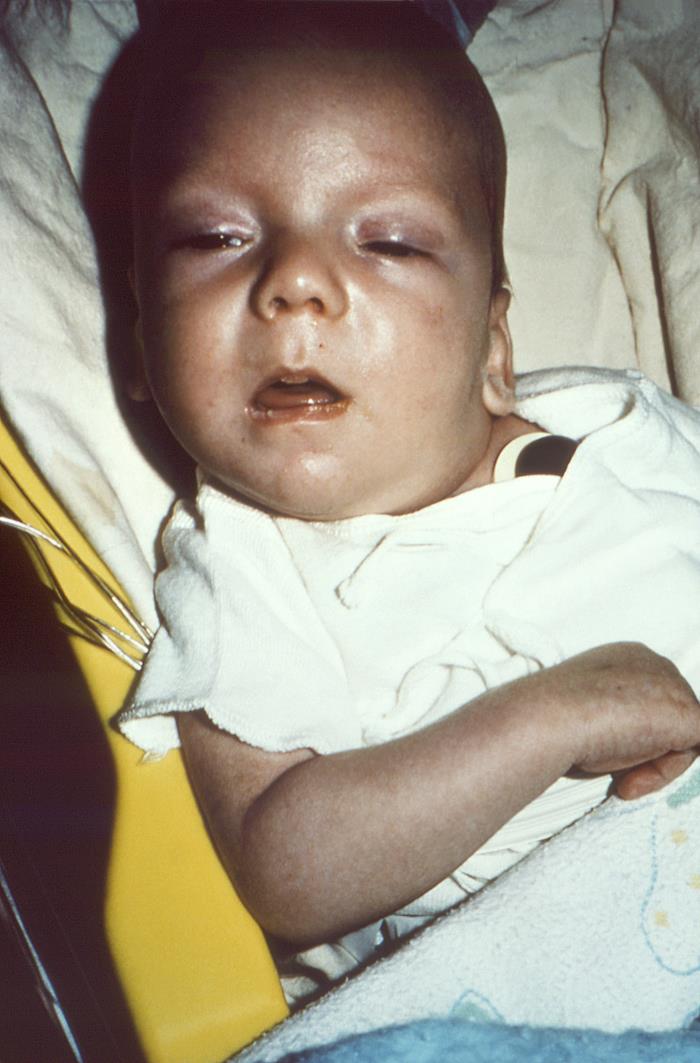
Botulism interrupts communication between a nerve and its target. Think of an alert patient whose eyes, swallowing muscles and breathing muscles are becoming weak. The urgent task is to protect breathing while arranging toxin-specific treatment, not to wait until every limb is paralyzed. [1] [3]
Recognize weakness before breathing fails Historical clinical example from 1980: ptosis and reduced facial expression in an infant documented as having botulism. The photograph alone does not establish a diagnosis. CDC / V. R.Image: Dowell, Jr.. Image source . Public domain, U.S. federal government work . None; original image Select the photograph to open it at full size. An adult develops double vision, a quiet or slurred voice, difficulty swallowing and then symmetric weakness. Ptosis means a drooping eyelid. Bulbar weakness means impaired speech or swallowing from weakness of muscles supplied by lower cranial nerves. These findings put botulism on the differential even before an exposure is identified. [1] [3]
Eye and swallowing weakness can precede limb weakness. Respiratory or upper-airway failure can occur before widespread paralysis.Image: Bone Wizardry.
The usual pattern is cranial-nerve involvement followed by descending flaccid weakness. Flaccid means reduced muscle tone, not painful rigidity. Pupils may be sluggish or dilated, and dry mouth, constipation or urinary retention may accompany motor weakness because autonomic cholinergic transmission is affected too. [1]
Sensation and awareness are usually preserved. A patient who cannot open their eyes or speak may still hear and understand. This is not an absolute exclusion rule: hypoxia, infection, sedating medicines or another simultaneous illness can alter mental status. Evaluate the whole presentation. [1]
A normal oxygen saturation does not guarantee adequate ventilation. Carbon dioxide retention and aspiration risk can develop despite an initially reassuring saturation. Follow the clinical examination, swallowing and cough, respiratory effort and serial respiratory measurements. Upper-airway weakness can be dangerous before widespread limb paralysis. [1] [6]
Predict the consequence Make a prediction, then open the explanation. Earlier answers stay available.
The eyelids and swallowing muscles fail first. Where does the usual pattern begin? Cranial and bulbar muscles often show the first weakness.
The arms still work. Could breathing already be threatened? Respiratory or upper-airway weakness can precede widespread limb paralysis.
Oxygen saturation looks normal. What else must be assessed? Ventilation and the ability to protect the airway still need assessment.
Case 1
Show answer and explanations for case 1
A. Congenital hypothyroidism (Why this does not fit)
Hypothyroidism can cause hypotonia and constipation, but the acute bulbar and ocular pattern favors botulism.
Connect the reasoning Make a prediction, then open the explanation. Earlier answers stay available.
Which distinction matters in this patient? Constipation plus new bulbar weakness in an infant requires urgent assessment.
Does Congenital hypothyroidism fit this presentation? Hypothyroidism can cause hypotonia and constipation, but the acute bulbar and ocular pattern favors botulism.
B. Infant botulism (Best answer)
Intestinal toxin production can cause constipation followed by bulbar weakness and hypotonia in an infant.
Connect the reasoning Make a prediction, then open the explanation. Earlier answers stay available.
Which distinction matters in this patient? Constipation plus new bulbar weakness in an infant requires urgent assessment.
Does Infant botulism fit this presentation? Intestinal toxin production can cause constipation followed by bulbar weakness and hypotonia in an infant.
C. Tetanus (Why this does not fit)
Generalized tetanus characteristically produces rigidity and painful spasms rather than this flaccid pattern.
Connect the reasoning Make a prediction, then open the explanation. Earlier answers stay available.
Which distinction matters in this patient? Constipation plus new bulbar weakness in an infant requires urgent assessment.
Does Tetanus fit this presentation? Generalized tetanus characteristically produces rigidity and painful spasms rather than this flaccid pattern.
D. Spinal muscular atrophy (Why this does not fit)
Progressive motor-neuron weakness can cause hypotonia, but the acute ocular and autonomic findings are a stronger fit for botulism.
Connect the reasoning Make a prediction, then open the explanation. Earlier answers stay available.
Which distinction matters in this patient? Constipation plus new bulbar weakness in an infant requires urgent assessment.
Does Spinal muscular atrophy fit this presentation? Progressive motor-neuron weakness can cause hypotonia, but the acute ocular and autonomic findings are a stronger fit for botulism.
Takeaway: Constipation plus new bulbar weakness in an infant requires urgent assessment.
Case sources: [1] [2]
Save this spot
Try another question from this subject A 14-month-old child has had 4 days of fever as high as 40.2 °C without cough or a focal examination finding. During the second day of fever, a generalized seizure lasted 50 seconds; he returned promptly to baseline and has had no further seizures. Today his temperature is normal without antipyretics, and a blanching pink maculopapular eruption has appeared on his trunk and spread to his neck. He is alert and drinking normally. The child was born at term and has met developmental milestones. On arrival, he has no neck stiffness, persistent confusion, or focal weakness. The eruption consists of discrete pale-pink lesions that blanch with pressure, and there are no oral lesions or enlarged posterior auricular nodes. His parents report that a cousin had a mild illness with a similar fever-and-rash sequence last month. He has received routine immunizations, including measles, mumps, and rubella vaccine. There has been no recent travel, new medication, or known exposure to a child with cough. The family asks whether this seizure indicates an epilepsy diagnosis.
Which pathogen most likely caused the illness associated with his seizure and rash?
A. HHV-7 B. Parvovirus B19 C. Measles virus D. HHV-6B E. Rubella virus
Choose an answer before revealing the reasoning.
Get one of these every morning · Practice more in the QBank
Separate the toxin from the spores Foodborne disease is intoxication; infant disease is intestinal colonization. In foodborne botulism, toxin was already present in the food. Several people becoming weak after the same meal is an important epidemiologic finding. Nausea or vomiting may precede neurologic symptoms, but a gastrointestinal prodrome is not required. [1] [3]
In infant botulism, swallowed spores can temporarily colonize the intestine and produce toxin there. Constipation, weak crying, poor suck, reduced facial expression, ptosis and loss of head control can be early findings. Honey is a recognized preventable source, but its absence does not exclude disease. Environmental spores also matter. [1] [2]
Wound botulism involves toxin production in a colonized wound rather than toxin swallowed in food. Ask about wounds and injection exposures without assuming that a patient must have eaten suspicious food. Absence of gastrointestinal symptoms is compatible with this form. [1] [3]
Rare additional forms include adult intestinal colonization and iatrogenic disease after botulinum-toxin exposure. New generalized, bulbar or respiratory weakness after a procedure needs urgent evaluation. These categories describe where the exposure begins; the final neuromuscular blockade is similar. [1] [3]
Inhalational botulism is rare. It belongs in exposure assessment when an unusual occupational event is credible, rather than being treated as an ordinary respiratory infection. Suspected cases still need urgent public-health consultation and respiratory assessment. [10]
The usual organism is an anaerobic, spore-forming, gram-positive rod. The bacterial organism, its environmentally persistent spores and the neurotoxin are distinct. The clinical syndrome results from toxin effects at nerve terminals, not direct invasion of muscle. [1]
Predict the consequence Make a prediction, then open the explanation. Earlier answers stay available.
Foodborne toxin is already in the food. What does an infant usually swallow instead? Spores can enter the infant intestine.
Where is toxin produced in infant disease? Toxin is produced in the colonized intestine.
No honey was given. Is the diagnosis excluded? Environmental spores remain a possible source.
Save this spot
Follow the failed release step Calcium entry triggers vesicle fusion. Released acetylcholine activates nicotinic receptors on muscle.Image: Bone Wizardry.
Normally, an arriving nerve signal opens presynaptic voltage-gated calcium channels. Calcium entry promotes fusion of acetylcholine-containing vesicles with the nerve membrane. Acetylcholine then crosses the synaptic cleft and activates nicotinic receptors on muscle. [1] [5]
Botulinum toxin is a protease that cleaves SNARE proteins used for vesicle fusion. Depending on toxin type, affected proteins include SNAP-25, synaptobrevin and syntaxin. The core problem is reduced acetylcholine release, not primary destruction of the muscle receptor. [1]
This explains flaccid weakness and the limits of treatment. Raising acetylcholine availability cannot simply rebuild damaged fusion machinery. Antitoxin neutralizes toxin that has not yet entered a nerve ending; it cannot immediately restore a terminal already affected. The visual model below keeps those two locations separate. [1]
Predict the consequence Make a prediction, then open the explanation. Earlier answers stay available.
The nerve signal arrives. What must enter before release normally occurs? Calcium enters the presynaptic terminal.
Calcium is available but fusion machinery is damaged. Which step fails? Acetylcholine-containing vesicles cannot fuse normally.
The muscle receptors are intact. Why can the muscle still be weak? Too little acetylcholine reaches those receptors.
Separate prevention from recovery Compare an affected terminal before and after antitoxin. Notice what changes and what still needs recovery.
Worked comparison: antitoxin can neutralize free toxin while existing fusion impairment remains. Support breathing immediately when needed.
Choose the comparison Before Toxin Antitoxin Support Reset model
Scroll the diagram horizontally to inspect every part.
Normal transmission The reference state has intact transmission. Symbols show relative activity only, not percentages, measured strength or diagnostic cutoffs. This is a simplified teaching model.
Save this spot
Compare mechanisms, not a single buzzword Localize the defect LEMS reduces calcium entry. Botulinum toxin disrupts vesicle fusion. MG reduces effective postsynaptic receptor function. Three different failures LEMS: calcium entry Signal reduced Botulism: fusion Signal reduced MG: muscle receptors Signal reduced
LEMS reduces calcium entry. Botulinum toxin disrupts vesicle fusion. MG reduces effective postsynaptic receptor function.Image: Bone Wizardry.
Myasthenia gravis (MG) is usually postsynaptic. Ocular or bulbar weakness fluctuates and often worsens with repeated activity. Sensation, pupils and reflexes are generally preserved. An abrupt shared-meal illness with autonomic findings is a different pattern; ptosis alone cannot choose between diagnoses. [1] [5]
Lambert-Eaton myasthenic syndrome (LEMS) is presynaptic. Reduced calcium entry limits acetylcholine release. Proximal leg weakness, reduced reflexes and autonomic symptoms are typical. Brief exertion may facilitate a response. Botulism can also show an electrophysiologic increment, so facilitation by itself is not a diagnosis. [1] [5]
Guillain-Barre syndrome commonly produces areflexia and progressive weakness, often beginning in the legs; variants can involve the face and eyes. Cerebrospinal-fluid protein can still be normal early. Neither the direction of weakness nor one early normal test safely excludes these competing emergencies. [1]
Generalized tetanus causes rigidity, trismus and painful, sometimes stimulus-triggered spasms because inhibitory neurotransmission is impaired. Do not memorize it as simply an upward version of botulism. Cholinergic excess, such as organophosphate poisoning, instead favors wet secretions, miosis and fasciculations; airway support remains essential. [1] [4]
In a hypotonic infant, also consider systemic illness, congenital hypothyroidism and spinal muscular atrophy. Persistent developmental weakness, tongue fasciculations, macroglossia or prolonged jaundice redirects evaluation. Do not assign an unsupported universal ranking to the causes of a floppy infant. [1] [2]
For tetanus, specific immune globulin neutralizes available tetanus toxin; wound care, appropriate antibiotics, spasm management and respiratory support address the other problems. Vaccination is still needed because tetanus illness does not reliably confer immunity. Tetanus immune globulin and botulinum antitoxin are not interchangeable. [12]
Macroglossia, prolonged jaundice and constipation support consideration of congenital hypothyroidism in a hypotonic infant. Thyroid testing, rather than the weakness pattern alone, establishes the endocrine abnormality. [8]
Predict the consequence Make a prediction, then open the explanation. Earlier answers stay available.
Ptosis occurs in MG and botulism. Can it choose the diagnosis alone? Ptosis alone does not distinguish them.
What does brief facilitation suggest about the junction? It supports impaired presynaptic transmission.
Does an increment exclude botulism? Botulism can also produce an electrophysiologic increment.
Case 22
Show answer and explanations for case 22
A. The finding proves a sensory neuropathy (Why this does not fit)
The abnormality concerns motor neuromuscular transmission, not a sensory localization.
Connect the reasoning Make a prediction, then open the explanation. Earlier answers stay available.
Which distinction matters in this patient? Interpret electrophysiology in the clinical context.
Does The finding proves a sensory neuropathy fit this presentation? The abnormality concerns motor neuromuscular transmission, not a sensory localization.
B. The increment rules out botulism (Why this does not fit)
Facilitation can occur in botulism.
Connect the reasoning Make a prediction, then open the explanation. Earlier answers stay available.
Which distinction matters in this patient? Interpret electrophysiology in the clinical context.
Does The increment rules out botulism fit this presentation? Facilitation can occur in botulism.
C. The finding supports presynaptic dysfunction but does not uniquely diagnose LEMS (Best answer)
Botulism can show facilitation. Exposure, timing and the examination remain essential.
Connect the reasoning Make a prediction, then open the explanation. Earlier answers stay available.
Which distinction matters in this patient? Interpret electrophysiology in the clinical context.
Does The finding supports presynaptic dysfunction but does not uniquely diagnose LEMS fit this presentation? Botulism can show facilitation. Exposure, timing and the examination remain essential.
D. Any increment proves LEMS (Why this does not fit)
The waveform is not unique to LEMS.
Connect the reasoning Make a prediction, then open the explanation. Earlier answers stay available.
Which distinction matters in this patient? Interpret electrophysiology in the clinical context.
Does Any increment proves LEMS fit this presentation? The waveform is not unique to LEMS.
Takeaway: Interpret electrophysiology in the clinical context.
Case sources: [1] [5]
Save this spot
Protect breathing and neutralize circulating toxin Antitoxin neutralizes toxin outside nerve endings. It does not repair fusion machinery already affected inside a terminal.Image: Bone Wizardry.
Airway and ventilation support must not wait for antitoxin. If ventilation or airway protection is failing, arrange experienced airway management immediately while the team obtains antitoxin and specialist consultation. These are parallel tasks. Antitoxin cannot rescue an already failing respiratory system by instantly reversing paralysis. [1] [6]
For suspected non-infant botulism, contact public health urgently for expert consultation and equine heptavalent botulinum antitoxin. Treat on the clinical assessment when indicated, without waiting for toxin results. Collect recommended specimens promptly, preferably before treatment when that does not delay essential care. [1] [3]
Suspected infant botulism needs immediate consultation with the Infant Botulism Treatment and Prevention Program. Human botulism immune globulin (BabyBIG) is the usual specific therapy for infant disease. It is not simply an interchangeable miniature adult treatment. Specialist advice determines the appropriate product in unusual presentations or toxin types. [2] [7]
Routine antibiotics do not treat toxin already affecting nerve terminals and are not given solely to eradicate intestinal colonization in infant disease. Wound botulism additionally requires source control and appropriate antibiotics under specialist direction. A genuine secondary infection still needs treatment, with drug selection mindful of neuromuscular effects. [1]
Aminoglycosides and magnesium can worsen neuromuscular transmission. Review medicines carefully rather than treating all antibiotics as interchangeable. Pregnancy is not a reason to withhold indicated antitoxin. Priorities remain maternal respiratory support, rapid consultation and treatment. [1]
In infant botulism, reserve antibiotics for a genuine secondary infection, not routine eradication of intestinal colonization. Drug choice should account for neuromuscular effects; an infection associated with prolonged intubation may still require treatment. [9]
Predict the consequence Make a prediction, then open the explanation. Earlier answers stay available.
Breathing is failing and antitoxin is being delivered. Which task can wait? Emergency breathing support cannot wait.
Where does antitoxin neutralize toxin? It acts on toxin outside affected nerve endings.
Can it instantly repair a terminal already affected? Established blockade needs time to recover.
Case 17
Show answer and explanations for case 17
A. Wait for antitoxin before any airway intervention (Why this does not fit)
Antitoxin does not rapidly reverse established paralysis and must not delay breathing support.
Connect the reasoning Make a prediction, then open the explanation. Earlier answers stay available.
Which distinction matters in this patient? Do not make breathing wait for toxin-specific treatment.
Does Wait for antitoxin before any airway intervention fit this presentation? Antitoxin does not rapidly reverse established paralysis and must not delay breathing support.
B. Wait for stool testing (Why this does not fit)
Laboratory confirmation cannot justify delaying emergency support.
Connect the reasoning Make a prediction, then open the explanation. Earlier answers stay available.
Which distinction matters in this patient? Do not make breathing wait for toxin-specific treatment.
Does Wait for stool testing fit this presentation? Laboratory confirmation cannot justify delaying emergency support.
C. Give pyridostigmine and reassess the next day (Why this does not fit)
This does not address an immediately failing respiratory system.
Connect the reasoning Make a prediction, then open the explanation. Earlier answers stay available.
Which distinction matters in this patient? Do not make breathing wait for toxin-specific treatment.
Does Give pyridostigmine and reassess the next day fit this presentation? This does not address an immediately failing respiratory system.
D. Support ventilation and secure the airway when indicated (Best answer)
Respiratory failure is immediately dangerous. Airway support proceeds while specific treatment is arranged.
Connect the reasoning Make a prediction, then open the explanation. Earlier answers stay available.
Which distinction matters in this patient? Do not make breathing wait for toxin-specific treatment.
Does Support ventilation and secure the airway when indicated fit this presentation? Respiratory failure is immediately dangerous. Airway support proceeds while specific treatment is arranged.
Takeaway: Do not make breathing wait for toxin-specific treatment.
Case sources: [1] [6]
Save this spot
Explain testing, recovery and prevention Confirmation can involve toxin detection in appropriate specimens or identification of toxin-producing organisms through public-health laboratories. Infant evaluation commonly uses stool. A negative or delayed result does not justify withholding treatment from a clinically convincing case; timing and specimen quality affect interpretation. [1] [2]
Antitoxin limits additional injury; recovery takes longer. Regeneration of functional neuromuscular connections can take weeks to months. Continued weakness after antitoxin is not proof that treatment failed. Patients may need ventilation, nutrition support, rehabilitation and careful communication during recovery. [1] [3]
Prevent aspiration and the complications of prolonged immobility. Reassess speech, swallowing, strength and respiratory function over time. Preserve the person's ability to communicate even when facial and limb movements are very limited. [1]
For prevention, avoid honey in infants younger than one year and follow established food-preservation safety guidance. Do not taste suspect preserved food to decide whether it is safe. A spore and a toxin are different biological forms; a general statement that heating makes every food safe is not an adequate prevention rule. [1] [2]
An asymptomatic exposure is not the same as a clinical diagnosis. Public-health or pediatric advice guides observation and further assessment. New swallowing difficulty, weak crying or progressive weakness changes that assessment immediately. There is no routine botulism vaccine for general clinical prevention. [1] [2]
Spores and toxin respond differently to heat. Spores are relatively heat-resistant; the toxin is heat-labile. This microbiologic distinction explains why killing toxin is not equivalent to eliminating spores. For actual food handling, use validated public-health guidance rather than improvising from a classroom rule. [11]
Predict the consequence Make a prediction, then open the explanation. Earlier answers stay available.
Weakness persists after antitoxin. Does that automatically mean failure? Existing paralysis can persist despite appropriate antitoxin.
What must gradually recover? Functional neuromuscular transmission must recover.
What remains important while strength returns? Supportive care protects function during recovery.
Save this spot
Clinical practice
Case 2
Show answer and explanations for case 2
A. Wait for a positive toxin assay (Why this does not fit)
Confirmation can take days; delay can permit further neuromuscular blockade.
Connect the reasoning Make a prediction, then open the explanation. Earlier answers stay available.
Which distinction matters in this patient? Arrange specific treatment promptly while continuously reassessing breathing.
Does Wait for a positive toxin assay fit this presentation? Confirmation can take days; delay can permit further neuromuscular blockade.
B. Pyridostigmine alone (Why this does not fit)
Increasing acetylcholine persistence does not repair toxin-damaged vesicle-fusion machinery.
Connect the reasoning Make a prediction, then open the explanation. Earlier answers stay available.
Which distinction matters in this patient? Arrange specific treatment promptly while continuously reassessing breathing.
Does Pyridostigmine alone fit this presentation? Increasing acetylcholine persistence does not repair toxin-damaged vesicle-fusion machinery.
C. Botulinum antitoxin after immediate public-health consultation (Best answer)
Clinically suspected botulism warrants urgent consultation and indicated antitoxin without waiting for laboratory confirmation.
Connect the reasoning Make a prediction, then open the explanation. Earlier answers stay available.
Which distinction matters in this patient? Arrange specific treatment promptly while continuously reassessing breathing.
Does Botulinum antitoxin after immediate public-health consultation fit this presentation? Clinically suspected botulism warrants urgent consultation and indicated antitoxin without waiting for laboratory confirmation.
D. Antibiotics alone (Why this does not fit)
Antibiotics do not neutralize toxin already affecting neuromuscular transmission.
Connect the reasoning Make a prediction, then open the explanation. Earlier answers stay available.
Which distinction matters in this patient? Arrange specific treatment promptly while continuously reassessing breathing.
Does Antibiotics alone fit this presentation? Antibiotics do not neutralize toxin already affecting neuromuscular transmission.
Takeaway: Arrange specific treatment promptly while continuously reassessing breathing.
Case sources: [1] [3]
Case 3
Show answer and explanations for case 3
A. Toxin must have been swallowed (Why this does not fit)
That describes foodborne disease, not every route of botulism exposure.
Connect the reasoning Make a prediction, then open the explanation. Earlier answers stay available.
Which distinction matters in this patient? A relevant wound can supply the source even without gastrointestinal symptoms.
Does Toxin must have been swallowed fit this presentation? That describes foodborne disease, not every route of botulism exposure.
B. Isolated damage to a single cranial nerve (Why this does not fit)
Multiple cranial and limb muscles are affected, which exceeds one nerve territory.
Connect the reasoning Make a prediction, then open the explanation. Earlier answers stay available.
Which distinction matters in this patient? A relevant wound can supply the source even without gastrointestinal symptoms.
Does Isolated damage to a single cranial nerve fit this presentation? Multiple cranial and limb muscles are affected, which exceeds one nerve territory.
C. Toxin production in a colonized wound (Best answer)
Wound botulism starts with colonization at a wound and does not require ingestion of toxin.
Connect the reasoning Make a prediction, then open the explanation. Earlier answers stay available.
Which distinction matters in this patient? A relevant wound can supply the source even without gastrointestinal symptoms.
Does Toxin production in a colonized wound fit this presentation? Wound botulism starts with colonization at a wound and does not require ingestion of toxin.
D. Antibodies destroying muscle receptors (Why this does not fit)
This is the usual autoimmune mechanism of MG, not the most likely explanation for this wound-associated acute syndrome.
Connect the reasoning Make a prediction, then open the explanation. Earlier answers stay available.
Which distinction matters in this patient? A relevant wound can supply the source even without gastrointestinal symptoms.
Does Antibodies destroying muscle receptors fit this presentation? This is the usual autoimmune mechanism of MG, not the most likely explanation for this wound-associated acute syndrome.
Takeaway: A relevant wound can supply the source even without gastrointestinal symptoms.
Case sources: [1] [3]
Case 4
Show answer and explanations for case 4
A. SNARE-dependent vesicle fusion (Best answer)
Botulinum toxin cleaves proteins needed for presynaptic acetylcholine-vesicle fusion.
Connect the reasoning Make a prediction, then open the explanation. Earlier answers stay available.
Which distinction matters in this patient? Botulism impairs transmitter release upstream of the muscle receptor.
Does SNARE-dependent vesicle fusion fit this presentation? Botulinum toxin cleaves proteins needed for presynaptic acetylcholine-vesicle fusion.
B. Destruction of postsynaptic receptors (Why this does not fit)
That is the principal mechanism of AChR-antibody-positive MG, not botulism.
Connect the reasoning Make a prediction, then open the explanation. Earlier answers stay available.
Which distinction matters in this patient? Botulism impairs transmitter release upstream of the muscle receptor.
Does Destruction of postsynaptic receptors fit this presentation? That is the principal mechanism of AChR-antibody-positive MG, not botulism.
C. Acetylcholinesterase inhibition (Why this does not fit)
This increases acetylcholine persistence and can produce cholinergic excess.
Connect the reasoning Make a prediction, then open the explanation. Earlier answers stay available.
Which distinction matters in this patient? Botulism impairs transmitter release upstream of the muscle receptor.
Does Acetylcholinesterase inhibition fit this presentation? This increases acetylcholine persistence and can produce cholinergic excess.
D. Antibody binding to P/Q-type calcium channels (Why this does not fit)
That is characteristic of LEMS rather than toxin-mediated fusion failure.
Connect the reasoning Make a prediction, then open the explanation. Earlier answers stay available.
Which distinction matters in this patient? Botulism impairs transmitter release upstream of the muscle receptor.
Does Antibody binding to P/Q-type calcium channels fit this presentation? That is characteristic of LEMS rather than toxin-mediated fusion failure.
Takeaway: Botulism impairs transmitter release upstream of the muscle receptor.
Case sources: [1]
Case 5
Show answer and explanations for case 5
A. Postsynaptic neuromuscular transmission (Best answer)
The pattern and antibody support MG, in which the postsynaptic safety margin is impaired.
Connect the reasoning Make a prediction, then open the explanation. Earlier answers stay available.
Which distinction matters in this patient? Identify the anatomical side of the junction before selecting a treatment.
Does Postsynaptic neuromuscular transmission fit this presentation? The pattern and antibody support MG, in which the postsynaptic safety margin is impaired.
B. Spinal inhibitory neurotransmission (Why this does not fit)
This is relevant to tetanus-related rigidity and spasms.
Connect the reasoning Make a prediction, then open the explanation. Earlier answers stay available.
Which distinction matters in this patient? Identify the anatomical side of the junction before selecting a treatment.
Does Spinal inhibitory neurotransmission fit this presentation? This is relevant to tetanus-related rigidity and spasms.
C. Presynaptic SNARE cleavage (Why this does not fit)
This is the mechanism of botulinum toxin, not AChR-antibody-positive MG.
Connect the reasoning Make a prediction, then open the explanation. Earlier answers stay available.
Which distinction matters in this patient? Identify the anatomical side of the junction before selecting a treatment.
Does Presynaptic SNARE cleavage fit this presentation? This is the mechanism of botulinum toxin, not AChR-antibody-positive MG.
D. Sensory axon conduction (Why this does not fit)
Her symptoms are motor and ocular, with preserved sensation.
Connect the reasoning Make a prediction, then open the explanation. Earlier answers stay available.
Which distinction matters in this patient? Identify the anatomical side of the junction before selecting a treatment.
Does Sensory axon conduction fit this presentation? Her symptoms are motor and ocular, with preserved sensation.
Takeaway: Identify the anatomical side of the junction before selecting a treatment.
Case sources: [5]
Case 6
Show answer and explanations for case 6
A. Elevated cerebrospinal-fluid protein with few cells (Best answer)
This pattern supports GBS in the appropriate setting, although early CSF can still be normal.
Connect the reasoning Make a prediction, then open the explanation. Earlier answers stay available.
Which distinction matters in this patient? Timing and the whole examination matter more than a direction mnemonic.
Does Elevated cerebrospinal-fluid protein with few cells fit this presentation? This pattern supports GBS in the appropriate setting, although early CSF can still be normal.
B. A shared meal followed by diplopia in several people (Why this does not fit)
A food cluster with cranial weakness is more suggestive of foodborne botulism.
Connect the reasoning Make a prediction, then open the explanation. Earlier answers stay available.
Which distinction matters in this patient? Timing and the whole examination matter more than a direction mnemonic.
Does A shared meal followed by diplopia in several people fit this presentation? A food cluster with cranial weakness is more suggestive of foodborne botulism.
C. Toxin detected in an appropriate clinical specimen (Why this does not fit)
That supports botulism rather than GBS.
Connect the reasoning Make a prediction, then open the explanation. Earlier answers stay available.
Which distinction matters in this patient? Timing and the whole examination matter more than a direction mnemonic.
Does Toxin detected in an appropriate clinical specimen fit this presentation? That supports botulism rather than GBS.
D. Constipation with an infant weak cry (Why this does not fit)
That is an important infant-botulism presentation, not this postinfectious adult pattern.
Connect the reasoning Make a prediction, then open the explanation. Earlier answers stay available.
Which distinction matters in this patient? Timing and the whole examination matter more than a direction mnemonic.
Does Constipation with an infant weak cry fit this presentation? That is an important infant-botulism presentation, not this postinfectious adult pattern.
Takeaway: Timing and the whole examination matter more than a direction mnemonic.
Case sources: [1]
Case 7
Show answer and explanations for case 7
A. Presynaptic P/Q-type calcium channels (Best answer)
LEMS commonly involves antibodies to these channels, reducing acetylcholine release.
Connect the reasoning Make a prediction, then open the explanation. Earlier answers stay available.
Which distinction matters in this patient? Brief facilitation plus autonomic signs and reduced reflexes points toward LEMS.
Does Presynaptic P/Q-type calcium channels fit this presentation? LEMS commonly involves antibodies to these channels, reducing acetylcholine release.
B. Central glycine receptors (Why this does not fit)
This would not explain the classic paraneoplastic presynaptic syndrome.
Connect the reasoning Make a prediction, then open the explanation. Earlier answers stay available.
Which distinction matters in this patient? Brief facilitation plus autonomic signs and reduced reflexes points toward LEMS.
Does Central glycine receptors fit this presentation? This would not explain the classic paraneoplastic presynaptic syndrome.
C. Postsynaptic acetylcholine receptors (Why this does not fit)
AChR autoimmunity usually produces fatigable MG without this characteristic autonomic and reflex pattern.
Connect the reasoning Make a prediction, then open the explanation. Earlier answers stay available.
Which distinction matters in this patient? Brief facilitation plus autonomic signs and reduced reflexes points toward LEMS.
Does Postsynaptic acetylcholine receptors fit this presentation? AChR autoimmunity usually produces fatigable MG without this characteristic autonomic and reflex pattern.
D. Acetylcholinesterase in the cleft (Why this does not fit)
Inhibition of this enzyme causes increased acetylcholine activity, not typical LEMS.
Connect the reasoning Make a prediction, then open the explanation. Earlier answers stay available.
Which distinction matters in this patient? Brief facilitation plus autonomic signs and reduced reflexes points toward LEMS.
Does Acetylcholinesterase in the cleft fit this presentation? Inhibition of this enzyme causes increased acetylcholine activity, not typical LEMS.
Takeaway: Brief facilitation plus autonomic signs and reduced reflexes points toward LEMS.
Case sources: [5]
Case 8
Show answer and explanations for case 8
A. Infant botulism (Why this does not fit)
Botulism does not explain this thyroid laboratory pattern or the characteristic systemic findings.
Connect the reasoning Make a prediction, then open the explanation. Earlier answers stay available.
Which distinction matters in this patient? Do not label every hypotonic infant as botulism.
Does Infant botulism fit this presentation? Botulism does not explain this thyroid laboratory pattern or the characteristic systemic findings.
B. Generalized tetanus (Why this does not fit)
Tetanus causes rigidity and spasms, not this endocrine pattern.
Connect the reasoning Make a prediction, then open the explanation. Earlier answers stay available.
Which distinction matters in this patient? Do not label every hypotonic infant as botulism.
Does Generalized tetanus fit this presentation? Tetanus causes rigidity and spasms, not this endocrine pattern.
C. Congenital hypothyroidism (Best answer)
The physical findings and thyroid tests identify hypothyroidism rather than a toxin-mediated junctional disorder.
Connect the reasoning Make a prediction, then open the explanation. Earlier answers stay available.
Which distinction matters in this patient? Do not label every hypotonic infant as botulism.
Does Congenital hypothyroidism fit this presentation? The physical findings and thyroid tests identify hypothyroidism rather than a toxin-mediated junctional disorder.
D. LEMS (Why this does not fit)
This is not the usual age or pattern for acquired paraneoplastic presynaptic autoimmunity.
Connect the reasoning Make a prediction, then open the explanation. Earlier answers stay available.
Which distinction matters in this patient? Do not label every hypotonic infant as botulism.
Does LEMS fit this presentation? This is not the usual age or pattern for acquired paraneoplastic presynaptic autoimmunity.
Takeaway: Do not label every hypotonic infant as botulism.
Case sources: [8]
Case 9
Show answer and explanations for case 9
A. Normal temperature excludes tetanus (Why this does not fit)
Diagnosis is clinical; one normal vital sign does not exclude it.
Connect the reasoning Make a prediction, then open the explanation. Earlier answers stay available.
Which distinction matters in this patient? Tetanus removes inhibition; botulism reduces cholinergic output.
Does Normal temperature excludes tetanus fit this presentation? Diagnosis is clinical; one normal vital sign does not exclude it.
B. The diagnosis requires ascending paralysis (Why this does not fit)
A simple ascending-versus-descending rule is not a reliable description of tetanus.
Connect the reasoning Make a prediction, then open the explanation. Earlier answers stay available.
Which distinction matters in this patient? Tetanus removes inhibition; botulism reduces cholinergic output.
Does The diagnosis requires ascending paralysis fit this presentation? A simple ascending-versus-descending rule is not a reliable description of tetanus.
C. Acetylcholine release at muscle is the main blocked step (Why this does not fit)
That explains botulism, not tetanus-related disinhibition.
Connect the reasoning Make a prediction, then open the explanation. Earlier answers stay available.
Which distinction matters in this patient? Tetanus removes inhibition; botulism reduces cholinergic output.
Does Acetylcholine release at muscle is the main blocked step fit this presentation? That explains botulism, not tetanus-related disinhibition.
D. Loss of inhibitory neurotransmission produces spasms (Best answer)
Tetanus-related disinhibition produces rigidity and painful spasms, unlike the flaccid weakness of botulism.
Connect the reasoning Make a prediction, then open the explanation. Earlier answers stay available.
Which distinction matters in this patient? Tetanus removes inhibition; botulism reduces cholinergic output.
Does Loss of inhibitory neurotransmission produces spasms fit this presentation? Tetanus-related disinhibition produces rigidity and painful spasms, unlike the flaccid weakness of botulism.
Takeaway: Tetanus removes inhibition; botulism reduces cholinergic output.
Case sources: [1] [4]
Case 10
Show answer and explanations for case 10
A. Expected local cosmetic effect only (Why this does not fit)
Generalized and respiratory symptoms extend beyond an isolated local effect.
Connect the reasoning Make a prediction, then open the explanation. Earlier answers stay available.
Which distinction matters in this patient? New generalized weakness after a toxin procedure is not merely a local effect.
Does Expected local cosmetic effect only fit this presentation? Generalized and respiratory symptoms extend beyond an isolated local effect.
B. A normal pupil examination rules out toxin effects (Why this does not fit)
Pupillary findings are not sufficiently sensitive to exclude botulism.
Connect the reasoning Make a prediction, then open the explanation. Earlier answers stay available.
Which distinction matters in this patient? New generalized weakness after a toxin procedure is not merely a local effect.
Does A normal pupil examination rules out toxin effects fit this presentation? Pupillary findings are not sufficiently sensitive to exclude botulism.
C. Wait until all limbs are paralyzed (Why this does not fit)
Airway compromise can precede widespread extremity paralysis.
Connect the reasoning Make a prediction, then open the explanation. Earlier answers stay available.
Which distinction matters in this patient? New generalized weakness after a toxin procedure is not merely a local effect.
Does Wait until all limbs are paralyzed fit this presentation? Airway compromise can precede widespread extremity paralysis.
D. Possible systemic toxin effects with respiratory risk (Best answer)
Generalized bulbar or respiratory weakness after toxin exposure can represent iatrogenic botulism.
Connect the reasoning Make a prediction, then open the explanation. Earlier answers stay available.
Which distinction matters in this patient? New generalized weakness after a toxin procedure is not merely a local effect.
Does Possible systemic toxin effects with respiratory risk fit this presentation? Generalized bulbar or respiratory weakness after toxin exposure can represent iatrogenic botulism.
Takeaway: New generalized weakness after a toxin procedure is not merely a local effect.
Case sources: [1] [3]
Case 11
Show answer and explanations for case 11
A. A gram-positive, spore-forming anaerobic rod (Best answer)
This describes C. botulinum; rare related species can also produce botulinum neurotoxin.
Connect the reasoning Make a prediction, then open the explanation. Earlier answers stay available.
Which distinction matters in this patient? Distinguish the bacterial organism from the toxin it produces.
Does A gram-positive, spore-forming anaerobic rod fit this presentation? This describes C. botulinum; rare related species can also produce botulinum neurotoxin.
B. An enveloped RNA virus (Why this does not fit)
Botulism is toxin-mediated bacterial disease, not a primary viral infection.
Connect the reasoning Make a prediction, then open the explanation. Earlier answers stay available.
Which distinction matters in this patient? Distinguish the bacterial organism from the toxin it produces.
Does An enveloped RNA virus fit this presentation? Botulism is toxin-mediated bacterial disease, not a primary viral infection.
C. An acid-fast intracellular bacillus (Why this does not fit)
That description is not the characteristic organism in botulism.
Connect the reasoning Make a prediction, then open the explanation. Earlier answers stay available.
Which distinction matters in this patient? Distinguish the bacterial organism from the toxin it produces.
Does An acid-fast intracellular bacillus fit this presentation? That description is not the characteristic organism in botulism.
D. A budding yeast (Why this does not fit)
This is not a fungal disorder.
Connect the reasoning Make a prediction, then open the explanation. Earlier answers stay available.
Which distinction matters in this patient? Distinguish the bacterial organism from the toxin it produces.
Does A budding yeast fit this presentation? This is not a fungal disorder.
Takeaway: Distinguish the bacterial organism from the toxin it produces.
Case sources: [1]
Case 12
Show answer and explanations for case 12
A. Diagnose botulism based on honey alone (Why this does not fit)
A source history does not establish symptomatic toxin-mediated disease.
Connect the reasoning Make a prediction, then open the explanation. Earlier answers stay available.
Which distinction matters in this patient? Exposure history and clinical illness are different things.
Does Diagnose botulism based on honey alone fit this presentation? A source history does not establish symptomatic toxin-mediated disease.
B. Give BabyBIG to every child exposed to honey (Why this does not fit)
BabyBIG is specific treatment for clinically suspected infant botulism, not universal exposure prophylaxis.
Connect the reasoning Make a prediction, then open the explanation. Earlier answers stay available.
Which distinction matters in this patient? Exposure history and clinical illness are different things.
Does Give BabyBIG to every child exposed to honey fit this presentation? BabyBIG is specific treatment for clinically suspected infant botulism, not universal exposure prophylaxis.
C. Clinical advice and observation rather than automatic antitoxin (Best answer)
Asymptomatic exposure alone is not an indication for antitoxin, and the classic honey restriction applies to infants younger than one year.
Connect the reasoning Make a prediction, then open the explanation. Earlier answers stay available.
Which distinction matters in this patient? Exposure history and clinical illness are different things.
Does Clinical advice and observation rather than automatic antitoxin fit this presentation? Asymptomatic exposure alone is not an indication for antitoxin, and the classic honey restriction applies to infants younger than one year.
D. Start antibiotics to eradicate all intestinal spores (Why this does not fit)
Routine eradication treatment is not recommended for this exposure.
Connect the reasoning Make a prediction, then open the explanation. Earlier answers stay available.
Which distinction matters in this patient? Exposure history and clinical illness are different things.
Does Start antibiotics to eradicate all intestinal spores fit this presentation? Routine eradication treatment is not recommended for this exposure.
Takeaway: Exposure history and clinical illness are different things.
Case sources: [1] [2]
Case 13
Show answer and explanations for case 13
A. Manage each case without investigating a common source (Why this does not fit)
A shared source may put additional people at risk.
Connect the reasoning Make a prediction, then open the explanation. Earlier answers stay available.
Which distinction matters in this patient? Treat the patient and address the common-source risk in parallel.
Does Manage each case without investigating a common source fit this presentation? A shared source may put additional people at risk.
B. Assume all attendees require antitoxin regardless of symptoms (Why this does not fit)
Treatment decisions are clinical and expert-guided, not automatic for all exposures.
Connect the reasoning Make a prediction, then open the explanation. Earlier answers stay available.
Which distinction matters in this patient? Treat the patient and address the common-source risk in parallel.
Does Assume all attendees require antitoxin regardless of symptoms fit this presentation? Treatment decisions are clinical and expert-guided, not automatic for all exposures.
C. Immediate public-health consultation and reporting (Best answer)
A possible botulism cluster requires rapid coordination of antitoxin, testing and prevention of further cases.
Connect the reasoning Make a prediction, then open the explanation. Earlier answers stay available.
Which distinction matters in this patient? Treat the patient and address the common-source risk in parallel.
Does Immediate public-health consultation and reporting fit this presentation? A possible botulism cluster requires rapid coordination of antitoxin, testing and prevention of further cases.
D. Wait until every toxin assay is positive (Why this does not fit)
Reporting and consultation should not be delayed for laboratory confirmation.
Connect the reasoning Make a prediction, then open the explanation. Earlier answers stay available.
Which distinction matters in this patient? Treat the patient and address the common-source risk in parallel.
Does Wait until every toxin assay is positive fit this presentation? Reporting and consultation should not be delayed for laboratory confirmation.
Takeaway: Treat the patient and address the common-source risk in parallel.
Case sources: [1] [3]
Case 14
Show answer and explanations for case 14
A. Symptoms resolving completely within a few hours (Why this does not fit)
Rapid complete resolution without neurologic findings is less consistent with progressive botulism.
Connect the reasoning Make a prediction, then open the explanation. Earlier answers stay available.
Which distinction matters in this patient? Look for the neurologic syndrome, not food exposure alone.
Does Symptoms resolving completely within a few hours fit this presentation? Rapid complete resolution without neurologic findings is less consistent with progressive botulism.
B. Preserved awareness by itself (Why this does not fit)
Awareness may remain normal in many illnesses and is not a specific test.
Connect the reasoning Make a prediction, then open the explanation. Earlier answers stay available.
Which distinction matters in this patient? Look for the neurologic syndrome, not food exposure alone.
Does Preserved awareness by itself fit this presentation? Awareness may remain normal in many illnesses and is not a specific test.
C. A single episode of nausea (Why this does not fit)
Nausea alone is nonspecific and does not establish botulism.
Connect the reasoning Make a prediction, then open the explanation. Earlier answers stay available.
Which distinction matters in this patient? Look for the neurologic syndrome, not food exposure alone.
Does A single episode of nausea fit this presentation? Nausea alone is nonspecific and does not establish botulism.
D. New symmetric cranial and bulbar weakness (Best answer)
Progressive neuroparalytic findings distinguish suspected botulism from many self-limited gastrointestinal illnesses.
Connect the reasoning Make a prediction, then open the explanation. Earlier answers stay available.
Which distinction matters in this patient? Look for the neurologic syndrome, not food exposure alone.
Does New symmetric cranial and bulbar weakness fit this presentation? Progressive neuroparalytic findings distinguish suspected botulism from many self-limited gastrointestinal illnesses.
Takeaway: Look for the neurologic syndrome, not food exposure alone.
Case sources: [1] [3]
Case 15
Show answer and explanations for case 15
A. It creates a durable vaccine response immediately (Why this does not fit)
Passive antibody delivery is not the same as stimulating an active immune response.
Connect the reasoning Make a prediction, then open the explanation. Earlier answers stay available.
Which distinction matters in this patient? Antitoxin supplies antibodies; it does not function as a routine vaccine.
Does It creates a durable vaccine response immediately fit this presentation? Passive antibody delivery is not the same as stimulating an active immune response.
B. It supplies preformed antibodies that neutralize available toxin (Best answer)
Antitoxin provides passive immunity and limits additional toxin effects; it is not a routine vaccination.
Connect the reasoning Make a prediction, then open the explanation. Earlier answers stay available.
Which distinction matters in this patient? Antitoxin supplies antibodies; it does not function as a routine vaccine.
Does It supplies preformed antibodies that neutralize available toxin fit this presentation? Antitoxin provides passive immunity and limits additional toxin effects; it is not a routine vaccination.
C. It kills all bacteria in a colonized wound (Why this does not fit)
Antitoxin targets toxin rather than providing source control.
Connect the reasoning Make a prediction, then open the explanation. Earlier answers stay available.
Which distinction matters in this patient? Antitoxin supplies antibodies; it does not function as a routine vaccine.
Does It kills all bacteria in a colonized wound fit this presentation? Antitoxin targets toxin rather than providing source control.
D. It repairs every affected nerve ending directly (Why this does not fit)
Antitoxin does not reverse paralysis already established inside nerve terminals.
Connect the reasoning Make a prediction, then open the explanation. Earlier answers stay available.
Which distinction matters in this patient? Antitoxin supplies antibodies; it does not function as a routine vaccine.
Does It repairs every affected nerve ending directly fit this presentation? Antitoxin does not reverse paralysis already established inside nerve terminals.
Takeaway: Antitoxin supplies antibodies; it does not function as a routine vaccine.
Case sources: [1]
Case 16
Show answer and explanations for case 16
A. The main concern is activation of postsynaptic antibodies (Why this does not fit)
Botulism is toxin-mediated, and aminoglycoside-associated blockade does not require AChR antibodies.
Connect the reasoning Make a prediction, then open the explanation. Earlier answers stay available.
Which distinction matters in this patient? Treat infection while avoiding unnecessary additional neuromuscular blockade.
Does The main concern is activation of postsynaptic antibodies fit this presentation? Botulism is toxin-mediated, and aminoglycoside-associated blockade does not require AChR antibodies.
B. It can further impair neuromuscular transmission (Best answer)
Aminoglycosides can potentiate blockade and worsen weakness in a patient whose transmission is already impaired.
Connect the reasoning Make a prediction, then open the explanation. Earlier answers stay available.
Which distinction matters in this patient? Treat infection while avoiding unnecessary additional neuromuscular blockade.
Does It can further impair neuromuscular transmission fit this presentation? Aminoglycosides can potentiate blockade and worsen weakness in a patient whose transmission is already impaired.
C. Every antibiotic destroys antitoxin (Why this does not fit)
This is not the reason for the specific concern about aminoglycosides.
Connect the reasoning Make a prediction, then open the explanation. Earlier answers stay available.
Which distinction matters in this patient? Treat infection while avoiding unnecessary additional neuromuscular blockade.
Does Every antibiotic destroys antitoxin fit this presentation? This is not the reason for the specific concern about aminoglycosides.
D. Antibiotics are forbidden for all secondary infections (Why this does not fit)
A genuine secondary infection still needs appropriate treatment.
Connect the reasoning Make a prediction, then open the explanation. Earlier answers stay available.
Which distinction matters in this patient? Treat infection while avoiding unnecessary additional neuromuscular blockade.
Does Antibiotics are forbidden for all secondary infections fit this presentation? A genuine secondary infection still needs appropriate treatment.
Takeaway: Treat infection while avoiding unnecessary additional neuromuscular blockade.
Case sources: [1]
Case 18
Show answer and explanations for case 18
A. All toxin types destroy the same muscle receptor (Why this does not fit)
The principal target is presynaptic fusion machinery, not muscle receptors.
Connect the reasoning Make a prediction, then open the explanation. Earlier answers stay available.
Which distinction matters in this patient? Different molecular targets can disrupt the same release step.
Does All toxin types destroy the same muscle receptor fit this presentation? The principal target is presynaptic fusion machinery, not muscle receptors.
B. Every toxin type stimulates acetylcholinesterase (Why this does not fit)
This is not the toxin mechanism.
Connect the reasoning Make a prediction, then open the explanation. Earlier answers stay available.
Which distinction matters in this patient? Different molecular targets can disrupt the same release step.
Does Every toxin type stimulates acetylcholinesterase fit this presentation? This is not the toxin mechanism.
C. Impaired acetylcholine-vesicle fusion and release (Best answer)
Different SNARE targets converge on impaired presynaptic transmitter release.
Connect the reasoning Make a prediction, then open the explanation. Earlier answers stay available.
Which distinction matters in this patient? Different molecular targets can disrupt the same release step.
Does Impaired acetylcholine-vesicle fusion and release fit this presentation? Different SNARE targets converge on impaired presynaptic transmitter release.
D. Every toxin type must cleave SNAP-25 alone (Why this does not fit)
SNARE targets differ by toxin type; the functional endpoint is shared.
Connect the reasoning Make a prediction, then open the explanation. Earlier answers stay available.
Which distinction matters in this patient? Different molecular targets can disrupt the same release step.
Does Every toxin type must cleave SNAP-25 alone fit this presentation? SNARE targets differ by toxin type; the functional endpoint is shared.
Takeaway: Different molecular targets can disrupt the same release step.
Case sources: [1]
Case 19
Show answer and explanations for case 19
A. Tetanus impairs inhibitory signaling; botulism impairs cholinergic release (Best answer)
The location and neurotransmitter effects explain why one syndrome is rigid and the other flaccid.
Connect the reasoning Make a prediction, then open the explanation. Earlier answers stay available.
Which distinction matters in this patient? The neurotransmitter system affected predicts the motor pattern.
Does Tetanus impairs inhibitory signaling; botulism impairs cholinergic release fit this presentation? The location and neurotransmitter effects explain why one syndrome is rigid and the other flaccid.
B. Both illnesses are diagnosed only by a positive toxin assay (Why this does not fit)
Tetanus is a clinical diagnosis; treatment of suspected botulism also cannot wait for confirmation.
Connect the reasoning Make a prediction, then open the explanation. Earlier answers stay available.
Which distinction matters in this patient? The neurotransmitter system affected predicts the motor pattern.
Does Both illnesses are diagnosed only by a positive toxin assay fit this presentation? Tetanus is a clinical diagnosis; treatment of suspected botulism also cannot wait for confirmation.
C. Antibiotics are never used in either illness (Why this does not fit)
Wound-associated infection may need antimicrobial therapy and source control.
Connect the reasoning Make a prediction, then open the explanation. Earlier answers stay available.
Which distinction matters in this patient? The neurotransmitter system affected predicts the motor pattern.
Does Antibiotics are never used in either illness fit this presentation? Wound-associated infection may need antimicrobial therapy and source control.
D. Both syndromes require the same antitoxin product (Why this does not fit)
Specific therapies are not interchangeable simply because both illnesses involve toxins.
Connect the reasoning Make a prediction, then open the explanation. Earlier answers stay available.
Which distinction matters in this patient? The neurotransmitter system affected predicts the motor pattern.
Does Both syndromes require the same antitoxin product fit this presentation? Specific therapies are not interchangeable simply because both illnesses involve toxins.
Takeaway: The neurotransmitter system affected predicts the motor pattern.
Case sources: [1] [4]
Case 20
Show answer and explanations for case 20
A. All confusion would definitively exclude botulism (Why this does not fit)
Hypoxia, medicines or concurrent illness may also affect mental status.
Connect the reasoning Make a prediction, then open the explanation. Earlier answers stay available.
Which distinction matters in this patient? Motor silence is not the same as loss of awareness.
Does All confusion would definitively exclude botulism fit this presentation? Hypoxia, medicines or concurrent illness may also affect mental status.
B. The patient may be fully aware despite severe motor impairment (Best answer)
Botulism often spares awareness; inability to move or speak must not be confused with inability to understand.
Connect the reasoning Make a prediction, then open the explanation. Earlier answers stay available.
Which distinction matters in this patient? Motor silence is not the same as loss of awareness.
Does The patient may be fully aware despite severe motor impairment fit this presentation? Botulism often spares awareness; inability to move or speak must not be confused with inability to understand.
C. Communication can wait until muscle strength returns (Why this does not fit)
Maintaining communication is important during prolonged weakness.
Connect the reasoning Make a prediction, then open the explanation. Earlier answers stay available.
Which distinction matters in this patient? Motor silence is not the same as loss of awareness.
Does Communication can wait until muscle strength returns fit this presentation? Maintaining communication is important during prolonged weakness.
D. The inability to speak proves loss of consciousness (Why this does not fit)
Bulbar motor weakness can prevent speech while awareness is intact.
Connect the reasoning Make a prediction, then open the explanation. Earlier answers stay available.
Which distinction matters in this patient? Motor silence is not the same as loss of awareness.
Does The inability to speak proves loss of consciousness fit this presentation? Bulbar motor weakness can prevent speech while awareness is intact.
Takeaway: Motor silence is not the same as loss of awareness.
Case sources: [1]
Case 21
Show answer and explanations for case 21
A. Assume ordinary reheating makes every suspect product safe (Why this does not fit)
A generic heating rule is not a substitute for validated preservation and public-health guidance.
Connect the reasoning Make a prediction, then open the explanation. Earlier answers stay available.
Which distinction matters in this patient? Food safety cannot be established by a taste test.
Does Assume ordinary reheating makes every suspect product safe fit this presentation? A generic heating rule is not a substitute for validated preservation and public-health guidance.
B. Do not taste suspect food; follow public-health handling advice (Best answer)
Taste and appearance cannot establish safety, and suspected sources need appropriate investigation.
Connect the reasoning Make a prediction, then open the explanation. Earlier answers stay available.
Which distinction matters in this patient? Food safety cannot be established by a taste test.
Does Do not taste suspect food; follow public-health handling advice fit this presentation? Taste and appearance cannot establish safety, and suspected sources need appropriate investigation.
C. Ignore the food if the container looks normal (Why this does not fit)
Normal appearance does not exclude a hazardous source.
Connect the reasoning Make a prediction, then open the explanation. Earlier answers stay available.
Which distinction matters in this patient? Food safety cannot be established by a taste test.
Does Ignore the food if the container looks normal fit this presentation? Normal appearance does not exclude a hazardous source.
D. Taste a small amount to confirm the source (Why this does not fit)
Tasting is not an acceptable safety test.
Connect the reasoning Make a prediction, then open the explanation. Earlier answers stay available.
Which distinction matters in this patient? Food safety cannot be established by a taste test.
Does Taste a small amount to confirm the source fit this presentation? Tasting is not an acceptable safety test.
Takeaway: Food safety cannot be established by a taste test.
Case sources: [1] [3]
Case 23
Show answer and explanations for case 23
A. Antitoxin should reverse every affected terminal within minutes (Why this does not fit)
It does not repair toxin effects already established within nerve endings.
Connect the reasoning Make a prediction, then open the explanation. Earlier answers stay available.
Which distinction matters in this patient? Preventing additional blockade and recovering strength occur on different timelines.
Does Antitoxin should reverse every affected terminal within minutes fit this presentation? It does not repair toxin effects already established within nerve endings.
B. Recovery depends mainly on replacing destroyed muscle acetylcholine receptors (Why this does not fit)
The principal defect is presynaptic release, not primary postsynaptic receptor destruction.
Connect the reasoning Make a prediction, then open the explanation. Earlier answers stay available.
Which distinction matters in this patient? Preventing additional blockade and recovering strength occur on different timelines.
Does Recovery depends mainly on replacing destroyed muscle acetylcholine receptors fit this presentation? The principal defect is presynaptic release, not primary postsynaptic receptor destruction.
C. Persistent weakness always means another diagnosis (Why this does not fit)
Prolonged weakness is compatible with treated botulism.
Connect the reasoning Make a prediction, then open the explanation. Earlier answers stay available.
Which distinction matters in this patient? Preventing additional blockade and recovering strength occur on different timelines.
Does Persistent weakness always means another diagnosis fit this presentation? Prolonged weakness is compatible with treated botulism.
D. Existing blockade resolves through gradual neuromuscular recovery (Best answer)
Antitoxin limits further toxin effects; regeneration of functional connections takes time.
Connect the reasoning Make a prediction, then open the explanation. Earlier answers stay available.
Which distinction matters in this patient? Preventing additional blockade and recovering strength occur on different timelines.
Does Existing blockade resolves through gradual neuromuscular recovery fit this presentation? Antitoxin limits further toxin effects; regeneration of functional connections takes time.
Takeaway: Preventing additional blockade and recovering strength occur on different timelines.
Case sources: [1] [3]
Case 24
Show answer and explanations for case 24
A. Weakness alone proves botulism (Why this does not fit)
Many toxic, metabolic and neurologic disorders cause weakness.
Connect the reasoning Make a prediction, then open the explanation. Earlier answers stay available.
Which distinction matters in this patient? Read pupils and secretions alongside muscle weakness.
Does Weakness alone proves botulism fit this presentation? Many toxic, metabolic and neurologic disorders cause weakness.
B. Cholinergic excess rather than reduced cholinergic output (Best answer)
Wet secretions and miosis support excess acetylcholine activity rather than the usual autonomic pattern of botulism.
Connect the reasoning Make a prediction, then open the explanation. Earlier answers stay available.
Which distinction matters in this patient? Read pupils and secretions alongside muscle weakness.
Does Cholinergic excess rather than reduced cholinergic output fit this presentation? Wet secretions and miosis support excess acetylcholine activity rather than the usual autonomic pattern of botulism.
C. Diarrhea makes all neuromuscular causes impossible (Why this does not fit)
Cholinergic toxicity can combine gastrointestinal and neuromuscular findings.
Connect the reasoning Make a prediction, then open the explanation. Earlier answers stay available.
Which distinction matters in this patient? Read pupils and secretions alongside muscle weakness.
Does Diarrhea makes all neuromuscular causes impossible fit this presentation? Cholinergic toxicity can combine gastrointestinal and neuromuscular findings.
D. Normal sensation rules out poisoning (Why this does not fit)
Sensation is not the key discriminator for cholinergic toxicity.
Connect the reasoning Make a prediction, then open the explanation. Earlier answers stay available.
Which distinction matters in this patient? Read pupils and secretions alongside muscle weakness.
Does Normal sensation rules out poisoning fit this presentation? Sensation is not the key discriminator for cholinergic toxicity.
Takeaway: Read pupils and secretions alongside muscle weakness.
Case sources: [1]
Case 25
Show answer and explanations for case 25
A. Toxin produced in a colonized skin wound (Why this does not fit)
That describes wound botulism; the question specifies intestinal colonization and no wound.
Connect the reasoning Make a prediction, then open the explanation. Earlier answers stay available.
Which distinction matters in this patient? Do not require a memorable exposure to recognize a compatible syndrome.
Does Toxin produced in a colonized skin wound fit this presentation? That describes wound botulism; the question specifies intestinal colonization and no wound.
B. Maternal acetylcholine-receptor antibodies crossing the placenta (Why this does not fit)
Maternal antibodies can cause transient neonatal myasthenia but do not explain botulinum toxin in the infant intestine.
Connect the reasoning Make a prediction, then open the explanation. Earlier answers stay available.
Which distinction matters in this patient? Do not require a memorable exposure to recognize a compatible syndrome.
Does Maternal acetylcholine-receptor antibodies crossing the placenta fit this presentation? Maternal antibodies can cause transient neonatal myasthenia but do not explain botulinum toxin in the infant intestine.
C. Preformed toxin absorbed from a preserved-food meal (Why this does not fit)
That describes foodborne intoxication, not the infant intestinal-colonization mechanism in this feeding history.
Connect the reasoning Make a prediction, then open the explanation. Earlier answers stay available.
Which distinction matters in this patient? Do not require a memorable exposure to recognize a compatible syndrome.
Does Preformed toxin absorbed from a preserved-food meal fit this presentation? That describes foodborne intoxication, not the infant intestinal-colonization mechanism in this feeding history.
D. Environmental spores swallowed with soil or dust (Best answer)
Environmental spores are another source of infant intestinal colonization; honey is not required.
Connect the reasoning Make a prediction, then open the explanation. Earlier answers stay available.
Which distinction matters in this patient? Do not require a memorable exposure to recognize a compatible syndrome.
Does Environmental spores swallowed with soil or dust fit this presentation? Environmental spores are another source of infant intestinal colonization; honey is not required.
Takeaway: Do not require a memorable exposure to recognize a compatible syndrome.
Case sources: [2] [13]
Case 26
Show answer and explanations for case 26
A. A creatine kinase level as definitive confirmation (Why this does not fit)
CK does not establish autoimmune MG.
Connect the reasoning Make a prediction, then open the explanation. Earlier answers stay available.
Which distinction matters in this patient? Choose a test that matches the suspected localization.
Does A creatine kinase level as definitive confirmation fit this presentation? CK does not establish autoimmune MG.
B. A thyroid test as definitive proof of a junctional defect (Why this does not fit)
Thyroid assessment can be relevant, but it does not directly confirm this junctional autoimmune mechanism.
Connect the reasoning Make a prediction, then open the explanation. Earlier answers stay available.
Which distinction matters in this patient? Choose a test that matches the suspected localization.
Does A thyroid test as definitive proof of a junctional defect fit this presentation? Thyroid assessment can be relevant, but it does not directly confirm this junctional autoimmune mechanism.
C. Acetylcholine-receptor antibodies (Best answer)
The fluctuating ocular and bulbar pattern supports evaluation for MG.
Connect the reasoning Make a prediction, then open the explanation. Earlier answers stay available.
Which distinction matters in this patient? Choose a test that matches the suspected localization.
Does Acetylcholine-receptor antibodies fit this presentation? The fluctuating ocular and bulbar pattern supports evaluation for MG.
D. Botulinum toxin testing alone (Why this does not fit)
The chronic fluctuating pattern is less characteristic of botulism; testing must follow the clinical differential.
Connect the reasoning Make a prediction, then open the explanation. Earlier answers stay available.
Which distinction matters in this patient? Choose a test that matches the suspected localization.
Does Botulinum toxin testing alone fit this presentation? The chronic fluctuating pattern is less characteristic of botulism; testing must follow the clinical differential.
Takeaway: Choose a test that matches the suspected localization.
Case sources: [5]
Case 27
Show answer and explanations for case 27
A. Never give antibiotics to any infant with botulism (Why this does not fit)
This ignores the need to treat a genuine secondary infection.
Connect the reasoning Make a prediction, then open the explanation. Earlier answers stay available.
Which distinction matters in this patient? Avoid a blanket rule that prevents treatment of a separate infection.
Does Never give antibiotics to any infant with botulism fit this presentation? This ignores the need to treat a genuine secondary infection.
B. Use antibiotics as a replacement for all supportive care (Why this does not fit)
Infection treatment does not replace respiratory support or other botulism care.
Connect the reasoning Make a prediction, then open the explanation. Earlier answers stay available.
Which distinction matters in this patient? Avoid a blanket rule that prevents treatment of a separate infection.
Does Use antibiotics as a replacement for all supportive care fit this presentation? Infection treatment does not replace respiratory support or other botulism care.
C. Treat the pneumonia with appropriate therapy while considering neuromuscular effects (Best answer)
The caution against routine intestinal eradication does not mean a secondary infection should go untreated.
Connect the reasoning Make a prediction, then open the explanation. Earlier answers stay available.
Which distinction matters in this patient? Avoid a blanket rule that prevents treatment of a separate infection.
Does Treat the pneumonia with appropriate therapy while considering neuromuscular effects fit this presentation? The caution against routine intestinal eradication does not mean a secondary infection should go untreated.
D. Give any aminoglycoside without concern (Why this does not fit)
These medicines can worsen transmission and need careful consideration.
Connect the reasoning Make a prediction, then open the explanation. Earlier answers stay available.
Which distinction matters in this patient? Avoid a blanket rule that prevents treatment of a separate infection.
Does Give any aminoglycoside without concern fit this presentation? These medicines can worsen transmission and need careful consideration.
Takeaway: Avoid a blanket rule that prevents treatment of a separate infection.
Case sources: [9]
Case 28
Show answer and explanations for case 28
A. Prompt indicated antitoxin and respiratory support with specialist consultation (Best answer)
Pregnancy is not a reason to withhold appropriate treatment for suspected botulism.
Connect the reasoning Make a prediction, then open the explanation. Earlier answers stay available.
Which distinction matters in this patient? Protect maternal breathing and treat the suspected toxin-mediated illness promptly.
Does Prompt indicated antitoxin and respiratory support with specialist consultation fit this presentation? Pregnancy is not a reason to withhold appropriate treatment for suspected botulism.
B. Use magnesium to improve neuromuscular transmission (Why this does not fit)
Magnesium can aggravate blockade and is not a botulism treatment.
Connect the reasoning Make a prediction, then open the explanation. Earlier answers stay available.
Which distinction matters in this patient? Protect maternal breathing and treat the suspected toxin-mediated illness promptly.
Does Use magnesium to improve neuromuscular transmission fit this presentation? Magnesium can aggravate blockade and is not a botulism treatment.
C. Replace adult antitoxin automatically with BabyBIG (Why this does not fit)
Infant-specific therapy is not selected merely because the adult patient is pregnant.
Connect the reasoning Make a prediction, then open the explanation. Earlier answers stay available.
Which distinction matters in this patient? Protect maternal breathing and treat the suspected toxin-mediated illness promptly.
Does Replace adult antitoxin automatically with BabyBIG fit this presentation? Infant-specific therapy is not selected merely because the adult patient is pregnant.
D. Withhold antitoxin until after delivery (Why this does not fit)
This leaves a potentially life-threatening illness untreated.
Connect the reasoning Make a prediction, then open the explanation. Earlier answers stay available.
Which distinction matters in this patient? Protect maternal breathing and treat the suspected toxin-mediated illness promptly.
Does Withhold antitoxin until after delivery fit this presentation? This leaves a potentially life-threatening illness untreated.
Takeaway: Protect maternal breathing and treat the suspected toxin-mediated illness promptly.
Case sources: [1]