Connect infant vomiting to pyloric anatomy, ultrasound, acid-base physiology and safe treatment, then apply the concepts in 30 original clinical cases.
A five-week-old infant cannot keep feeds down. Ultrasound can identify a narrow pyloric outlet, but a positive scan does not answer the next question: is the infant ready for anesthesia? Learn to connect anatomy, fluid losses and clinical trajectory before choosing the next action.
When does spit-up become a different problem?
A five-week-old infant has changed from small spit-ups to increasingly forceful vomiting after feeds. Weight has fallen and wet diapers are fewer. The abdomen is soft and no mass is felt. The important change is not a single dramatic episode: intake is repeatedly failing to reach the intestine. Infantile hypertrophic pyloric stenosis is a progressively narrowed gastric outlet caused by thickened pyloric muscle. It commonly presents at two to six weeks, but this is a pattern, not an exclusion rule. [1]
Compare two feeding histories
Infant A: effortless small regurgitations, steady weight gain, normal urine output.
Choose which infant needs an obstruction assessment, then name the two findings that changed your decision.
Consequence: Infant B needs evaluation because progressive feeding failure and dehydration cannot be explained away as uncomplicated reflux. A hungry infant can still be unwell. Hunger after vomiting supports the history but is not diagnostic. [1][11]
An experienced examiner may feel a firm, olive-shaped pylorus in the epigastrium or right upper abdomen. Strong gastric peristalsis may be visible across the upper abdomen, usually from the infant's left toward the right. These are useful findings, not required admission tickets: early disease may have neither. Check hydration, growth, glucose and electrolytes; initially normal chloride and bicarbonate do not exclude evolving obstruction. [1]
Male sex, family history and first birth increase prior probability. Females and preterm infants still develop the condition. Observational studies also report associations with maternal smoking, bottle-feeding and direct infant exposure to oral erythromycin or azithromycin, especially during the first two weeks. Maternal medication use is not interchangeable with documented administration to the infant. Associations do not establish the cause in an individual child or justify blaming a feeding choice. [6][8][17]
Familial susceptibility is substantial and multifactorial, not a simple X-linked inheritance pattern. A Danish study estimated 87% heritability; that is neither 87% twin concordance nor an 87% recurrence risk for a family. The historical sex-modified threshold model, sometimes called the Carter effect, is a teaching model, not a license to promise fixed maternal-versus-paternal percentages. That cohort did not detect the proposed relative-risk differences by parental side. High cord testosterone did not explain the male predominance in a separate study. [7][16]
Apply it: A girl with worsening vomiting and a normal electrolyte panel still warrants assessment. Demographics and early normal tests should modify probability, not veto the clinical trajectory.
Find the narrow segment before predicting the vomit
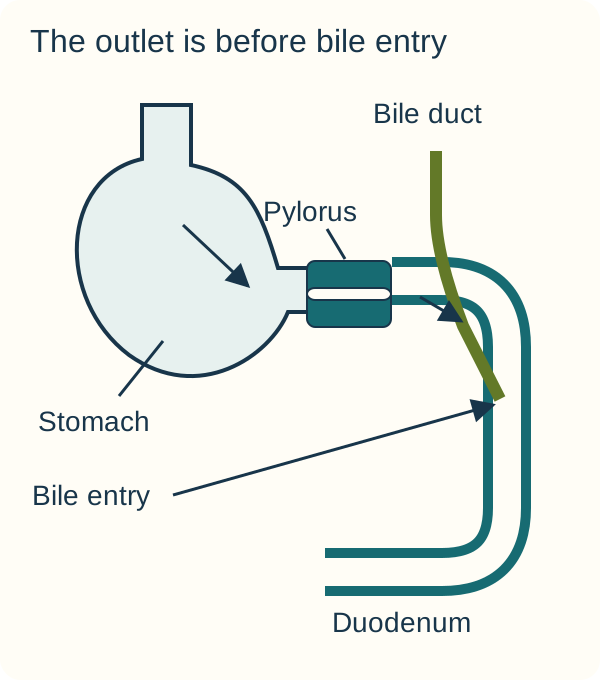
Follow a feed from the stomach into the duodenum. The pylorus is the outlet between them. Bile enters farther downstream, at the major duodenal papilla in the second part of the duodenum. An isolated pyloric obstruction therefore usually produces nonbilious vomit. This anatomical relationship explains the color; it does not make every nonbilious episode an obstruction. [1][9]
Not to scale. Trace the feed route and then the separate bile route. The two do not meet until after the pylorus.
Point to the narrow outlet. Now trace backward toward the mouth: does this route cross the bile entry site?
Consequence: It does not. Typical pyloric emesis lacks bile. New dark-green vomit demands urgent reconsideration, not an explanation that the same pyloric muscle has simply become thicker. Color cannot by itself identify the precise obstruction level. [9]
The normal pyloric sphincter contracts to narrow its lumen and relaxes to allow passage. In hypertrophic stenosis, the thickened muscle creates a persistently long, narrow outlet. Gastric contractions push against resistance, producing the visible waves and forceful vomiting. The pylorus is not a membrane, a twisted bowel loop or a failure of acid production. Its typical progressive presentation explains why an earlier normal study does not permanently exclude later disease. [1][3]
Nitric oxide from enteric inhibitory nerves normally contributes to smooth-muscle relaxation. A small tissue study found reduced nitric oxide synthase activity in the circular muscle nerve fibers of affected pylori, supporting impaired relaxation as one proposed contributor. This is not evidence that every case is caused by one NOS1 mutation. Erythromycin also stimulates motilin receptors and gastrointestinal contractility. That biological effect helps explain why its epidemiological association is plausible, but does not prove why an individual infant developed stenosis. [21][22][6]
Apply it: A fixed mucosal ring in the antrum is also before bile entry and can also cause nonbilious emesis. The shared color localizes broadly; imaging must distinguish a membrane from thick muscle. Partial antral webs can present well after birth. [12][13]
Measure the muscle, then watch the outlet
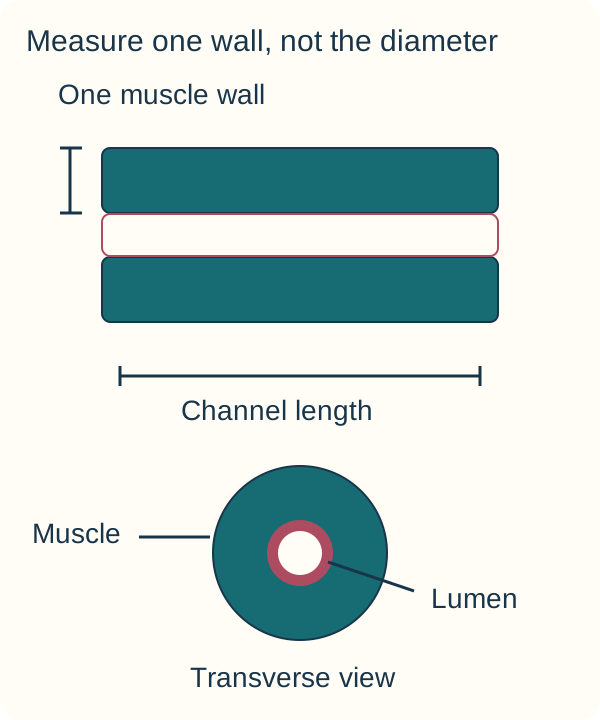
Ultrasound is the preferred initial test for suspected pyloric stenosis. It can show muscle thickness, channel length and passage through the outlet without ionizing radiation. A transverse ring and a longitudinal elongated channel are complementary views, not interchangeable measurements. Measure one muscle layer, not the entire diameter including the lumen and the opposite wall. [1][3]
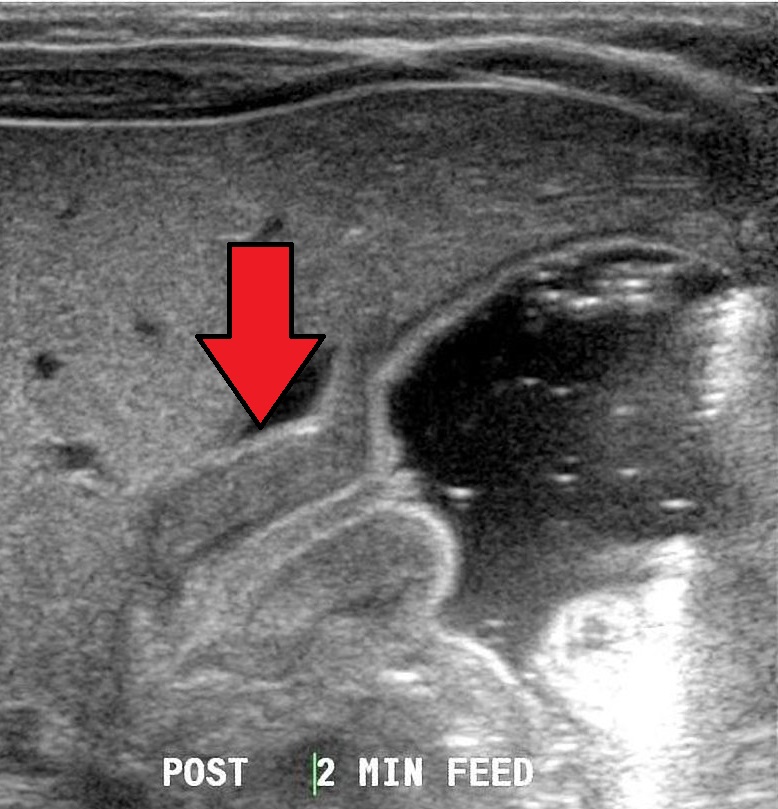
Clinical ultrasound by Dr Laughlin Dawes, Wikimedia Commons, CC BY-SA 4.0. Image unchanged. The red arrow and POST 2 MIN FEED annotation were already present. This still illustrates anatomy; it cannot establish a millimeter measurement or demonstrate ongoing failure of passage by itself. [15]
Locate the elongated pyloric region and the adjacent stomach. Decide which additional information a radiologist needs before calling a borderline study positive.
Consequence: Caliper measurements, technique and observation of relaxation and fluid passage matter. A single attractive ring or a single still is not the whole examination.
The thickness bracket crosses one muscle wall only. The length bracket runs along the pyloric channel.
The Johns Hopkins March 2026 pathway uses muscle thickness greater than 3 mm, channel length at least 15 mm and absent passage. Treat these as a named pathway, not immutable biological borders. A 2022 retrospective series reported surgically confirmed disease with smaller measurements and emphasized technique. Young or small infants, pylorospasm and measurement error can complicate interpretation. Do not alternate between incompatible memorized cutoff pairs. [2][3]
When symptoms persist and ultrasound is equivocal, maintain hydration assessment and arrange timely repeat expert ultrasound. Prolonged observation may reveal a relaxing pylorus with passage, favoring spasm rather than fixed obstruction. Persistently uncertain findings or concern for another anatomical lesion may require an upper gastrointestinal contrast examination. A string-like contrast column through a long narrow channel and an antral shoulder impression are classic contrast findings, but contrast is not routinely needed after a clear ultrasound diagnosis. CT is not the next routine test. [1][2]
Apply it: A symptomatic small infant with 2.6 mm muscle and a poorly seen channel is not safely dismissed by a cutoff alone. A separate infant whose pylorus repeatedly opens with normal passage needs a different interpretation, with follow-up driven by the clinical course.
Try it here · Checkpoint 1 of 3
Make your prediction before reading the choices. A first attempt is just a starting point.
Case 4
Show answer and explanations for case 4
A. Obtain contrast imaging before repeating the limited ultrasound (Why this does not fit)
Contrast imaging can investigate another anatomical obstruction or unresolved ultrasound uncertainty. This first examination did not adequately visualize the channel or document its dynamics, so an expert repeat can answer the immediate pyloric question without radiation. A technically limited initial ultrasound should not be treated as an exhausted diagnostic method.
Reasoning steps for option A
How does the case test the choice 'Obtain contrast imaging before repeating the limited ultrasound'?
Contrast imaging can investigate another anatomical obstruction or unresolved ultrasound uncertainty.
Which stated finding most directly changes the appeal of 'Obtain contrast imaging before repeating the limited ultrasound'?
This first examination did not adequately visualize the channel or document its dynamics, so an expert repeat can answer the immediate pyloric question without radiation.
What clinical principle distinguishes 'Obtain contrast imaging before repeating the limited ultrasound' in this patient?
A technically limited initial ultrasound should not be treated as an exhausted diagnostic method.
B. Repeat expert ultrasound to observe relaxation and fluid passage (Best answer)
Dynamic ultrasound distinguishes sustained muscular narrowing from temporary contraction and measurement error. The small symptomatic infant has an incompletely measured channel and no documented reassuring opening. Repeat the study promptly while continuing clinical and hydration assessment.
Reasoning steps for option B
How does the case test the choice 'Repeat expert ultrasound to observe relaxation and fluid passage'?
Dynamic ultrasound distinguishes sustained muscular narrowing from temporary contraction and measurement error.
Which stated finding most directly changes the appeal of 'Repeat expert ultrasound to observe relaxation and fluid passage'?
The small symptomatic infant has an incompletely measured channel and no documented reassuring opening.
What clinical principle distinguishes 'Repeat expert ultrasound to observe relaxation and fluid passage' in this patient?
Repeat the study promptly while continuing clinical and hydration assessment.
C. Arrange endoscopy to inspect for an antral membrane (Why this does not fit)
Endoscopy can identify an antral web when imaging supports a mucosal obstruction. The current evidence is an unresolved pyloric examination rather than a demonstrated antral lesion. Resolve the limited noninvasive study before selecting an invasive test for another tissue defect.
Reasoning steps for option C
How does the case test the choice 'Arrange endoscopy to inspect for an antral membrane'?
Endoscopy can identify an antral web when imaging supports a mucosal obstruction.
Which stated finding most directly changes the appeal of 'Arrange endoscopy to inspect for an antral membrane'?
The current evidence is an unresolved pyloric examination rather than a demonstrated antral lesion.
What clinical principle distinguishes 'Arrange endoscopy to inspect for an antral membrane' in this patient?
Resolve the limited noninvasive study before selecting an invasive test for another tissue defect.
D. Arrange reflux testing after completion of intravenous rehydration (Why this does not fit)
Reflux can coexist with vomiting in a young infant. Declining weight and an equivocal outlet study require anatomical clarification even after dehydration improves. Correcting hydration does not convert an unresolved obstruction assessment into a reflux diagnosis.
Reasoning steps for option D
How does the case test the choice 'Arrange reflux testing after completion of intravenous rehydration'?
Reflux can coexist with vomiting in a young infant.
Which stated finding most directly changes the appeal of 'Arrange reflux testing after completion of intravenous rehydration'?
Declining weight and an equivocal outlet study require anatomical clarification even after dehydration improves.
What clinical principle distinguishes 'Arrange reflux testing after completion of intravenous rehydration' in this patient?
Correcting hydration does not convert an unresolved obstruction assessment into a reflux diagnosis.
Takeaway: Borderline measurements require interpretation of technique, size, dynamic findings and the clinical course.
Separate the acid lost from the alkalosis maintained
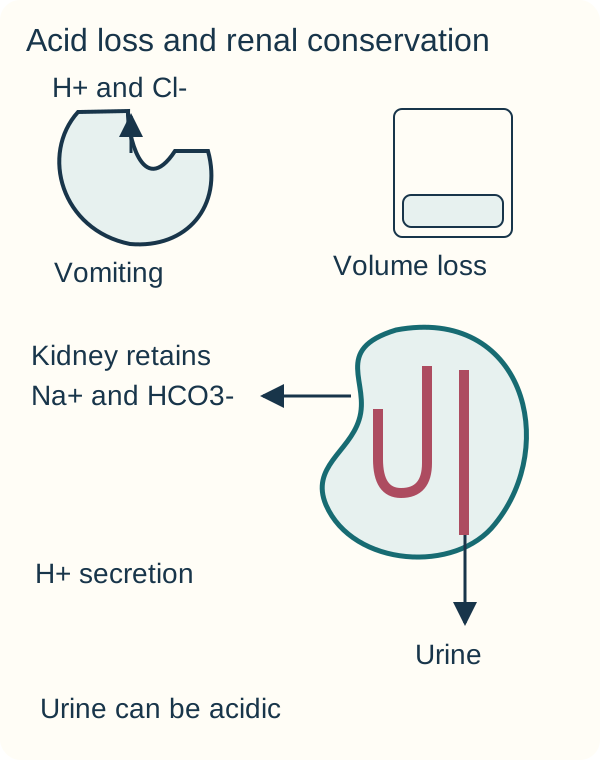
Why can an infant with alkaline blood make acidic urine? Start with the stomach, then ask what the kidney is being asked to conserve. Vomiting gastric hydrochloric acid loses hydrogen and chloride. Net hydrogen loss generates metabolic alkalosis. Continued fluid loss, chloride depletion and potassium deficiency then impair the kidney's ability to excrete the excess bicarbonate. The familiar hypochloremic, hypokalemic metabolic alkalosis is a consequence of sustained losses, not a required early diagnostic finding. [1][4]
Original physiological schematic. Generation begins with acid loss. Renal conservation during volume, chloride and potassium depletion sustains the disturbance.
Low circulating volume activates renin, angiotensin and aldosterone. Proximal sodium and bicarbonate reclamation increases; distal sodium absorption can favor potassium and hydrogen secretion. Chloride depletion limits bicarbonate secretion through chloride-dependent exchange in the collecting duct. Potassium depletion further favors renal hydrogen secretion and bicarbonate retention. Gastric potassium loss contributes, but the renal response is important. This is not a kidney attempting to retain hydrogen by discarding potassium. [4]
Predict the direction of urine pH when a markedly depleted infant continues to secrete hydrogen into the urine, despite already having alkaline blood.
Consequence: Urine can become acidic: paradoxical aciduria. Earlier bicarbonate excretion can instead make urine alkaline. Neither urine pattern alone diagnoses or excludes pyloric stenosis. In uncomplicated chloride-depleted vomiting, urine chloride is often low; recent diuretics can make that discriminator unreliable. [4]
Read a complete blood gas
For an educational example, pH 7.50, PaCO2 50 mmHg and bicarbonate 38 mmol/L fit primary metabolic alkalosis with compensatory carbon dioxide retention. The commonly used approximation is expected PaCO2 = 40 + 0.7 x (bicarbonate - 24), with a clinical tolerance around the estimate. Here it predicts about 50. Compensation trends toward normal pH; it does not erase the primary disorder. A disproportionately low PaCO2 suggests an additional respiratory alkalosis rather than compensation. [4]
Hypokalemia creates cardiac risk. Marked alkalosis can depress respiratory drive, which matters before and after anesthesia. Perioperative apnea has several contributors, and correction of blood tests does not eliminate every respiratory risk; the exact contribution of alkalosis in affected infants remains incompletely quantified. [20] Do not assess safety from the potassium value alone. Dehydration can reduce renal perfusion and increase urea, but an adult blood urea nitrogen-to-creatinine ratio cutoff cannot establish the absence of kidney injury in a small infant with a low baseline creatinine. Track urine output, perfusion and serial renal measurements. [1][2]
Apply it: After adequate chloride and volume replacement, bicarbonate can fall even though the pyloric muscle remains thick. Corrected chemistry is evidence of successful stabilization, not proof that the obstruction has disappeared.
Try it here · Checkpoint 2 of 3
Make your prediction before reading the choices. A first attempt is just a starting point.
Case 15
Show answer and explanations for case 15
A. Reduced distal hydrogen secretion with increased bicarbonate excretion (Why this does not fit)
Excreting bicarbonate and reducing acid secretion would help correct systemic alkalosis. The markedly acidic urine in this depleted infant points in the opposite direction from predominant bicarbonate excretion. Distinguish the response that would correct alkalosis from the depleted-state response actually observed.
Reasoning steps for option A
How does the case test the choice 'Reduced distal hydrogen secretion with increased bicarbonate excretion'?
Excreting bicarbonate and reducing acid secretion would help correct systemic alkalosis.
Which stated finding most directly changes the appeal of 'Reduced distal hydrogen secretion with increased bicarbonate excretion'?
The markedly acidic urine in this depleted infant points in the opposite direction from predominant bicarbonate excretion.
What clinical principle distinguishes 'Reduced distal hydrogen secretion with increased bicarbonate excretion' in this patient?
Distinguish the response that would correct alkalosis from the depleted-state response actually observed.
B. Increased distal bicarbonate secretion with ongoing urinary chloride loss (Why this does not fit)
Distal bicarbonate secretion can lower systemic bicarbonate when renal conditions permit. Urine pH 5.0 and urine chloride 6 support acid secretion and chloride conservation rather than this loss pattern. Use urine pH and chloride together instead of interpreting either value alone.
Reasoning steps for option B
How does the case test the choice 'Increased distal bicarbonate secretion with ongoing urinary chloride loss'?
Distal bicarbonate secretion can lower systemic bicarbonate when renal conditions permit.
Which stated finding most directly changes the appeal of 'Increased distal bicarbonate secretion with ongoing urinary chloride loss'?
Urine pH 5.0 and urine chloride 6 support acid secretion and chloride conservation rather than this loss pattern.
What clinical principle distinguishes 'Increased distal bicarbonate secretion with ongoing urinary chloride loss' in this patient?
Use urine pH and chloride together instead of interpreting either value alone.
C. Reduced renal sodium reabsorption with continued renal chloride wasting (Why this does not fit)
Renal salt-wasting processes can contribute to hypokalemic metabolic alkalosis. Low urine chloride during poor perfusion and without diuretic exposure favors conservation after extrarenal loss, not continued renal wasting. Interpret urinary electrolyte findings in the medication and volume context.
Reasoning steps for option C
How does the case test the choice 'Reduced renal sodium reabsorption with continued renal chloride wasting'?
Renal salt-wasting processes can contribute to hypokalemic metabolic alkalosis.
Which stated finding most directly changes the appeal of 'Reduced renal sodium reabsorption with continued renal chloride wasting'?
Low urine chloride during poor perfusion and without diuretic exposure favors conservation after extrarenal loss, not continued renal wasting.
What clinical principle distinguishes 'Reduced renal sodium reabsorption with continued renal chloride wasting' in this patient?
Interpret urinary electrolyte findings in the medication and volume context.
D. Increased distal sodium uptake with ongoing urinary hydrogen secretion (Best answer)
Volume depletion favors distal sodium reabsorption that can increase urinary acid excretion. The urine pH of 5.0 shows ongoing acid excretion, while urine chloride of 6 mmol/L supports chloride conservation despite systemic alkalemia. This paradoxical aciduria reflects depletion physiology, not resolution of the metabolic alkalosis.
Reasoning steps for option D
How does the case test the choice 'Increased distal sodium uptake with ongoing urinary hydrogen secretion'?
Depletion stimulates sodium-conserving responses that can favor distal hydrogen secretion.
Which stated finding most directly changes the appeal of 'Increased distal sodium uptake with ongoing urinary hydrogen secretion'?
Hydrogen secretion explains the acidic urine, while the low urine chloride supports renal chloride conservation despite alkaline blood.
What clinical principle distinguishes 'Increased distal sodium uptake with ongoing urinary hydrogen secretion' in this patient?
Paradoxical aciduria does not mean systemic alkalosis has resolved.
Takeaway: Acidic urine can coexist with alkaline blood when depletion drives renal hydrogen secretion.
Ask two separate questions: is this intestinal obstruction, and could intestinal blood supply be threatened? A well-appearing infant between episodes is not necessarily safe, and absence of green vomit does not exclude every serious cause. Dark-green emesis requires urgent surgical assessment. Yellow milk or gastric fluid is not automatically bile; clarify the observed color without delaying care for an ill infant. [9]
Progressive gastric outlet failure
Usually several weeks old, increasingly forceful nonbilious emesis, poor growth and dehydration. Ultrasound assesses the pylorus. Correct the metabolic consequences before definitive pyloromyotomy. [1]
Possible twisted midgut
Green emesis, with or without distension, raises concern for malrotation with volvulus. Compromised mesenteric blood flow can rapidly cause ischemia. A normal plain radiograph does not clear the diagnosis. Resuscitation and surgical discussion take priority; definitive imaging in a stable infant follows the urgent local pathway, commonly an upper gastrointestinal contrast study. Shock or peritonitis must not wait for elective imaging. [9]
Episodic bowel obstruction
Intussusception is commonest later in infancy and early childhood but is not impossible outside that range. Recurrent pain, pallor or lethargy with quiet intervals warrants ultrasound. Bloody stool is a late finding, not a prerequisite. Stable eligible children may undergo pneumatic or contrast reduction with surgical support; shock, perforation or peritonitis changes that approach. [10]
Effortless regurgitation with growth
Physiological reflux usually permits adequate intake and growth. Reflux disease means troublesome symptoms or complications. Arching is neither required for reflux nor a dependable exclusion of pyloric disease. Assess feeding and avoid unnecessary acid suppression; maintain flat, supine sleep. [11]
Compare a six-week-old losing weight after progressively forceful milk-colored emesis with a six-day-old who suddenly vomits green. Which needs an urgent intestinal-obstruction pathway rather than a routine pyloric workup?
Consequence: The green-emesis infant requires urgent assessment for a distal obstruction, including volvulus. The other infant still needs prompt care, but correction of dehydration and alkalosis precedes pyloric surgery.
Duodenal atresia is congenital duodenal closure, often recognized with feeding soon after birth and associated with trisomy 21. Radiography may show dilated stomach and proximal duodenum, the double-bubble pattern. Emesis depends on the relation to bile entry. Treatment restores intestinal continuity after decompression and stabilization; it is not a pyloric muscle split. A gastric antral web is a different congenital narrowing before the pylorus; partial webs may present later, so age alone does not separate these lesions. [18][12][13]
Diarrhea and fever can suggest infection, but vomiting without diarrhea deserves a broader assessment than automatic gastroenteritis treatment. Fever, lethargy, neurological abnormalities or a bulging fontanelle should prompt evaluation beyond the gastrointestinal tract. Severe dehydration with low sodium, high potassium, low glucose and acidosis suggests adrenal crisis, including salt-wasting congenital adrenal hyperplasia, rather than the usual gastric acid-loss pattern. [9][14]
Apply it: Do not wait for a palpable mass, bloody stool or every textbook feature before acting on progressive feeding failure, poor perfusion or green emesis.
Correct the physiology, then relieve the outlet
The diagnosis answers what must eventually be repaired. Hydration and laboratory findings answer whether anesthesia is appropriate now. Stop oral feeding, obtain intravenous access and involve pediatric surgery early. Use isotonic saline resuscitation when needed for poor perfusion, with reassessment rather than automatic repeated boluses. Replace ongoing losses, maintenance needs and glucose under a pediatric protocol. Chloride-containing fluid addresses both depletion and the renal persistence of alkalosis. [1][2]
Normal saline supplies more chloride than lactated Ringer solution. That is a useful reason for its usual role here, not a claim that every balanced-fluid exposure necessarily worsens alkalosis. Add potassium only after adequate urine output and renal assessment, with repeat electrolytes and monitored prescribing. Nasogastric decompression may be needed for persistent vomiting and perioperative gastric management; it is a bridge, not definitive therapy. [1][2][4]
Verify restored hydration, adequate urine output, corrected potassium and improvement of the chloride and bicarbonate disturbance to the treating team's preoperative targets. RCH emphasizes bicarbonate normalization; institutional pathways use somewhat different numerical criteria. A clock reading of 24 or 48 hours, a better pulse, or a single potassium threshold cannot establish readiness. The anesthesia assessment also addresses residual gastric contents: fasting and vomiting do not reliably empty an obstructed stomach. [1][2][19]
Predict the two treatment targets
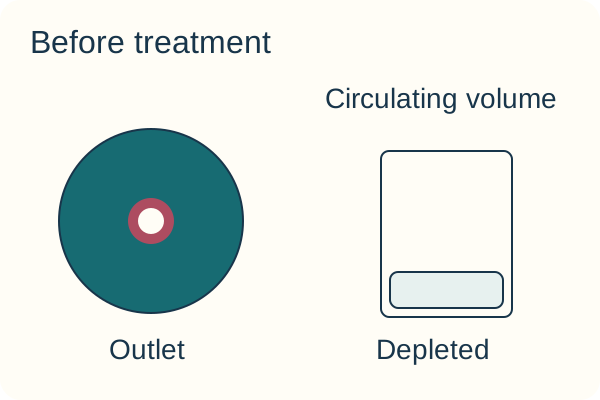
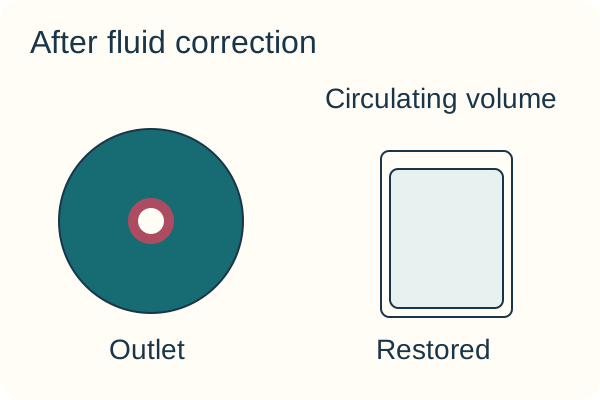
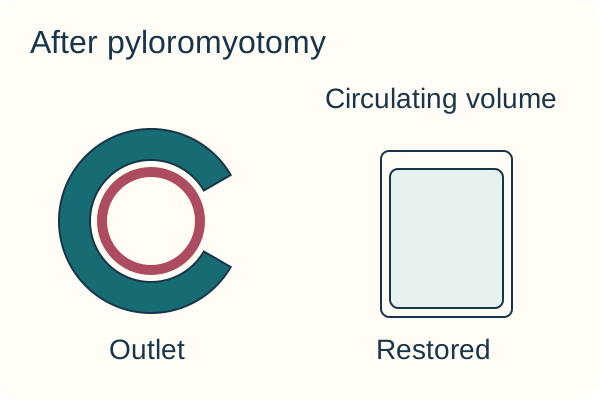
Trace the outlet and the circulating-volume column in the starting diagram. Before opening either optional answer, predict which shape changes after fluid correction and which changes after pyloromyotomy. These are qualitative completed states, not doses, a timetable or a risk calculator.
Starting state: a narrow outlet and depleted circulating volume.After fluid correction: check your predicted geometry
The volume column fills; the outlet ring does not widen. Fluids address depletion, not the thick muscular obstruction.After pyloromyotomy: check your predicted geometry
The muscle is separated and the lumen widens. The intact lining still contains gastric contents.
Before treatment: outlet resistance prevents reliable feeding, and ongoing losses deplete fluid and electrolytes.
After fluid correction: circulation and chemistry improve, but the thick muscle still obstructs. Intravenous fluid does not cure the structural narrowing.
After pyloromyotomy: the muscle is separated to enlarge the outlet. The intact mucosal lining continues to contain gastric contents.
Consequence: Restoring circulation and opening the lumen solve different problems. Stabilization permits safer definitive treatment; it is not a reason to discharge an infant with unresolved obstruction.
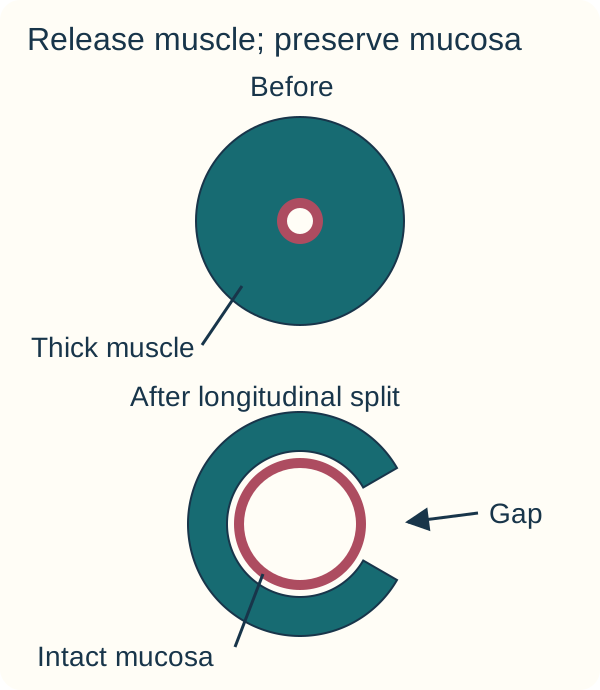
Ramstedt pyloromyotomy splits the hypertrophied muscle longitudinally while preserving mucosa. The cross-sectional comparison illustrates the result, not the incision direction.
Open and laparoscopic pyloromyotomy can both provide definitive treatment. An incomplete split can leave obstruction; a mucosal perforation permits leakage and requires recognition and repair. These are different complications. Pyloromyotomy does not require routine resection and anastomosis of the pyloric segment. Ladd surgery treats malrotation, and Heller myotomy addresses the lower esophageal sphincter rather than the pylorus. [2][5]
Feeding usually resumes early according to the surgical protocol once the infant has recovered sufficiently. A little initial nonbilious vomiting can occur; it does not by itself prove failure. Repeated forceful emesis, inability to maintain hydration, green emesis, fever or abdominal tenderness warrants reassessment. A small serial ultrasound study documented transient early muscle thickening after successful surgery. Do not label every early episode harmless or use persisting postoperative muscle thickness alone to diagnose an incomplete myotomy. [23] Follow feeding tolerance, clinical findings and specialist assessment. [2]
Apply it: An infant whose circulation looks better but whose bicarbonate remains high still needs correction. An infant with restored chemistry still needs an aspiration-aware anesthetic plan and definitive relief of the outlet.
Try it here · Checkpoint 3 of 3
Make your prediction before reading the choices. A first attempt is just a starting point.
Case 21
Show answer and explanations for case 21
A. Proceed to surgery using current perfusion and potassium results (Why this does not fit)
Restored perfusion and potassium are important components of preoperative preparation. Bicarbonate remains 34 and chloride 96, so other relevant metabolic abnormalities have not resolved. One normalized component does not establish complete anesthetic readiness.
Reasoning steps for option A
How does the case test the choice 'Proceed to surgery using current perfusion and potassium results'?
Restored perfusion and potassium are important components of preoperative preparation.
Which stated finding most directly changes the appeal of 'Proceed to surgery using current perfusion and potassium results'?
Bicarbonate remains 34 and chloride 96, so other relevant metabolic abnormalities have not resolved.
What clinical principle distinguishes 'Proceed to surgery using current perfusion and potassium results' in this patient?
One normalized component does not establish complete anesthetic readiness.
B. Give additional potassium to complete preoperative electrolyte correction (Why this does not fit)
Potassium deficiency requires monitored replacement before anesthesia. Potassium is now 3.8, while the remaining abnormalities involve chloride and bicarbonate. Target the unresolved deficit instead of increasing a corrected electrolyte to an arbitrary value.
Reasoning steps for option B
How does the case test the choice 'Give additional potassium to complete preoperative electrolyte correction'?
Potassium deficiency requires monitored replacement before anesthesia.
Which stated finding most directly changes the appeal of 'Give additional potassium to complete preoperative electrolyte correction'?
Potassium is now 3.8, while the remaining abnormalities involve chloride and bicarbonate.
What clinical principle distinguishes 'Give additional potassium to complete preoperative electrolyte correction' in this patient?
Target the unresolved deficit instead of increasing a corrected electrolyte to an arbitrary value.
C. Repeat pyloric imaging before deciding whether fluids should continue (Why this does not fit)
Imaging can clarify an uncertain anatomical diagnosis. The obstruction is already confirmed and the current chemistry independently demonstrates incomplete correction. A repeat structural measurement does not answer whether the remaining alkalosis needs treatment.
Reasoning steps for option C
How does the case test the choice 'Repeat pyloric imaging before deciding whether fluids should continue'?
Imaging can clarify an uncertain anatomical diagnosis.
Which stated finding most directly changes the appeal of 'Repeat pyloric imaging before deciding whether fluids should continue'?
The obstruction is already confirmed and the current chemistry independently demonstrates incomplete correction.
What clinical principle distinguishes 'Repeat pyloric imaging before deciding whether fluids should continue' in this patient?
A repeat structural measurement does not answer whether the remaining alkalosis needs treatment.
D. Continue chloride replacement and reassess bicarbonate before anesthesia (Best answer)
Chloride-containing replacement addresses an important maintenance factor of vomiting-related alkalosis. Persistent hypochloremia and increased bicarbonate remain despite improved circulation, potassium and a full day of treatment. Use physiological response and the treating team's targets, not an elapsed-time rule.
Reasoning steps for option D
How does the case test the choice 'Continue chloride replacement and reassess bicarbonate before anesthesia'?
Chloride-containing replacement addresses an important maintenance factor of vomiting-related alkalosis.
Which stated finding most directly changes the appeal of 'Continue chloride replacement and reassess bicarbonate before anesthesia'?
Persistent hypochloremia and increased bicarbonate remain despite improved circulation, potassium and a full day of treatment.
What clinical principle distinguishes 'Continue chloride replacement and reassess bicarbonate before anesthesia' in this patient?
Use physiological response and the treating team's targets, not an elapsed-time rule.
Takeaway: Improvement in one component of resuscitation does not establish complete anesthetic readiness.
Ultrasound evaluates the muscular gastric outlet without radiation. Progressive loss of retained feeds, weight and urine output warrants anatomical evaluation despite normal early electrolytes and an absent mass. Normal chemistry does not exclude evolving pyloric stenosis.
Reasoning steps for option A
How does the case test the choice 'Targeted pyloric ultrasonography'?
Ultrasound evaluates the muscular gastric outlet without radiation.
Which stated finding most directly changes the appeal of 'Targeted pyloric ultrasonography'?
Progressive loss of retained feeds, weight and urine output warrants anatomical evaluation despite normal early electrolytes and an absent mass.
What clinical principle distinguishes 'Targeted pyloric ultrasonography' in this patient?
Normal chemistry does not exclude evolving pyloric stenosis.
B. Upper gastrointestinal contrast study (Why this does not fit)
Contrast imaging can identify rotational abnormalities or another structural cause of vomiting. The current nonbilious progressive outlet pattern can first be assessed directly with ultrasound, which avoids radiation. Reserve contrast assessment for the clinical question it best answers or for persistent uncertainty after ultrasound.
Reasoning steps for option B
How does the case test the choice 'Upper gastrointestinal contrast study'?
Contrast imaging can identify rotational abnormalities or another structural cause of vomiting.
Which stated finding most directly changes the appeal of 'Upper gastrointestinal contrast study'?
The current nonbilious progressive outlet pattern can first be assessed directly with ultrasound, which avoids radiation.
What clinical principle distinguishes 'Upper gastrointestinal contrast study' in this patient?
Reserve contrast assessment for the clinical question it best answers or for persistent uncertainty after ultrasound.
C. Upper gastrointestinal endoscopy (Why this does not fit)
Endoscopy can demonstrate mucosal disease or an antral membrane. There is not yet imaging evidence of a membrane or a mucosal process to justify making an invasive study the first test. Start with the least invasive suitable anatomical investigation.
Reasoning steps for option C
How does the case test the choice 'Upper gastrointestinal endoscopy'?
Endoscopy can demonstrate mucosal disease or an antral membrane.
Which stated finding most directly changes the appeal of 'Upper gastrointestinal endoscopy'?
There is not yet imaging evidence of a membrane or a mucosal process to justify making an invasive study the first test.
What clinical principle distinguishes 'Upper gastrointestinal endoscopy' in this patient?
Start with the least invasive suitable anatomical investigation.
D. Esophageal pH-impedance monitoring (Why this does not fit)
Reflux testing can characterize selected troublesome reflux presentations. Falling weight and progressively forceful feeding failure require exclusion of an outlet lesion before attributing the problem to reflux. Investigate the concerning trajectory rather than the shared post-feed timing.
Reasoning steps for option D
How does the case test the choice 'Esophageal pH-impedance monitoring'?
Reflux testing can characterize selected troublesome reflux presentations.
Which stated finding most directly changes the appeal of 'Esophageal pH-impedance monitoring'?
Falling weight and progressively forceful feeding failure require exclusion of an outlet lesion before attributing the problem to reflux.
What clinical principle distinguishes 'Esophageal pH-impedance monitoring' in this patient?
Investigate the concerning trajectory rather than the shared post-feed timing.
Takeaway: Progressive vomiting with poor growth warrants imaging even before the classic laboratory pattern appears.
A. Give small oral rehydration feeds with intake monitoring (Why this does not fit)
Oral replacement can correct dehydration when fluid reaches the intestine. A persistently closed pyloric outlet and delayed capillary refill make reliable oral resuscitation unlikely here. Poorly perfused infants with outlet obstruction need intravenous stabilization.
Reasoning steps for option A
How does the case test the choice 'Give small oral rehydration feeds with intake monitoring'?
Oral replacement can correct dehydration when fluid reaches the intestine.
Which stated finding most directly changes the appeal of 'Give small oral rehydration feeds with intake monitoring'?
A persistently closed pyloric outlet and delayed capillary refill make reliable oral resuscitation unlikely here.
What clinical principle distinguishes 'Give small oral rehydration feeds with intake monitoring' in this patient?
Poorly perfused infants with outlet obstruction need intravenous stabilization.
B. Give intravenous isotonic saline with perfusion reassessment (Best answer)
Isotonic saline restores circulating volume and supplies chloride. Delayed refill and eight hours without urine identify an immediate perfusion problem in addition to severe electrolyte depletion. Restore perfusion, assess renal output and correct the metabolic disturbance before anesthesia.
Reasoning steps for option B
How does the case test the choice 'Give intravenous isotonic saline with perfusion reassessment'?
Isotonic saline restores circulating volume and supplies chloride.
Which stated finding most directly changes the appeal of 'Give intravenous isotonic saline with perfusion reassessment'?
Delayed refill and eight hours without urine identify an immediate perfusion problem in addition to severe electrolyte depletion.
What clinical principle distinguishes 'Give intravenous isotonic saline with perfusion reassessment' in this patient?
Restore perfusion, assess renal output and correct the metabolic disturbance before anesthesia.
C. Give potassium-containing maintenance fluid with electrolyte monitoring (Why this does not fit)
Maintenance replacement and potassium are important later components of treatment. Maintenance delivery does not address current poor perfusion, and renal potassium excretion is uncertain while urine is absent. Establish adequate urine output and renal assessment before prescribed potassium supplementation.
Reasoning steps for option C
How does the case test the choice 'Give potassium-containing maintenance fluid with electrolyte monitoring'?
Maintenance replacement and potassium are important later components of treatment.
Which stated finding most directly changes the appeal of 'Give potassium-containing maintenance fluid with electrolyte monitoring'?
Maintenance delivery does not address current poor perfusion, and renal potassium excretion is uncertain while urine is absent.
What clinical principle distinguishes 'Give potassium-containing maintenance fluid with electrolyte monitoring' in this patient?
Establish adequate urine output and renal assessment before prescribed potassium supplementation.
D. Perform pyloromyotomy with fluid replacement during anesthesia (Why this does not fit)
Pyloromyotomy definitively relieves the demonstrated muscular obstruction. Poor perfusion, potassium 2.8 and bicarbonate 39 mean that the infant is not metabolically prepared for this operation. A confirmed diagnosis does not establish readiness for anesthesia.
Reasoning steps for option D
How does the case test the choice 'Perform pyloromyotomy with fluid replacement during anesthesia'?
Pyloromyotomy definitively relieves the demonstrated muscular obstruction.
Which stated finding most directly changes the appeal of 'Perform pyloromyotomy with fluid replacement during anesthesia'?
Poor perfusion, potassium 2.8 and bicarbonate 39 mean that the infant is not metabolically prepared for this operation.
What clinical principle distinguishes 'Perform pyloromyotomy with fluid replacement during anesthesia' in this patient?
A confirmed diagnosis does not establish readiness for anesthesia.
Takeaway: Confirmed pyloric stenosis with dehydration is stabilized before pyloromyotomy.
A. Repeat pyloric ultrasound to evaluate progressive muscular outlet narrowing (Why this does not fit)
Progressive nonbilious emesis and an equivocal initial study can justify repeat pyloric imaging. The new dark-green emesis changes the anatomical question because bile enters downstream of the pylorus. Do not keep a new bilious presentation confined to the previous pyloric hypothesis.
Reasoning steps for option A
How does the case test the choice 'Repeat pyloric ultrasound to evaluate progressive muscular outlet narrowing'?
Progressive nonbilious emesis and an equivocal initial study can justify repeat pyloric imaging.
Which stated finding most directly changes the appeal of 'Repeat pyloric ultrasound to evaluate progressive muscular outlet narrowing'?
The new dark-green emesis changes the anatomical question because bile enters downstream of the pylorus.
What clinical principle distinguishes 'Repeat pyloric ultrasound to evaluate progressive muscular outlet narrowing' in this patient?
Do not keep a new bilious presentation confined to the previous pyloric hypothesis.
B. Obtain urgent upper gastrointestinal contrast imaging for malrotation (Best answer)
An urgent upper gastrointestinal examination can evaluate the duodenal course in suspected malrotation. New green emesis with discomfort requires an intestinal-obstruction assessment, while current stability permits targeted imaging with surgical involvement. The changed vomit color changes diagnostic scope; shock or peritonitis would change the sequence again.
Reasoning steps for option B
How does the case test the choice 'Obtain urgent upper gastrointestinal contrast imaging for malrotation'?
An urgent upper gastrointestinal examination can evaluate the duodenal course in suspected malrotation.
Which stated finding most directly changes the appeal of 'Obtain urgent upper gastrointestinal contrast imaging for malrotation'?
New green emesis with discomfort requires an intestinal-obstruction assessment, while current stability permits targeted imaging with surgical involvement.
What clinical principle distinguishes 'Obtain urgent upper gastrointestinal contrast imaging for malrotation' in this patient?
The changed vomit color changes diagnostic scope; shock or peritonitis would change the sequence again.
C. Obtain an abdominal ultrasound to evaluate ileocolic bowel telescoping (Why this does not fit)
Ileocolic intussusception can cause vomiting and discomfort, including outside its common age range. This neonate has new green emesis without the episodic pallor and pain pattern that would make ileocolic telescoping the leading target. Prioritize exclusion of malrotation with threatened bowel in this clinical setting.
Reasoning steps for option C
How does the case test the choice 'Obtain an abdominal ultrasound to evaluate ileocolic bowel telescoping'?
Ileocolic intussusception can cause vomiting and discomfort, including outside its common age range.
Which stated finding most directly changes the appeal of 'Obtain an abdominal ultrasound to evaluate ileocolic bowel telescoping'?
This neonate has new green emesis without the episodic pallor and pain pattern that would make ileocolic telescoping the leading target.
What clinical principle distinguishes 'Obtain an abdominal ultrasound to evaluate ileocolic bowel telescoping' in this patient?
Prioritize exclusion of malrotation with threatened bowel in this clinical setting.
D. Perform urgent endoscopy to evaluate an obstructing antral membrane (Why this does not fit)
An antral web can cause gastric outlet obstruction despite a normal pyloric muscle. It lies before bile entry and does not adequately explain the new bilious pattern. Choose imaging of the relevant intestinal anatomy rather than an invasive examination of the wrong level.
Reasoning steps for option D
How does the case test the choice 'Perform urgent endoscopy to evaluate an obstructing antral membrane'?
An antral web can cause gastric outlet obstruction despite a normal pyloric muscle.
Which stated finding most directly changes the appeal of 'Perform urgent endoscopy to evaluate an obstructing antral membrane'?
It lies before bile entry and does not adequately explain the new bilious pattern.
What clinical principle distinguishes 'Perform urgent endoscopy to evaluate an obstructing antral membrane' in this patient?
Choose imaging of the relevant intestinal anatomy rather than an invasive examination of the wrong level.
Takeaway: New green emesis is not simply a more advanced version of isolated pyloric obstruction.
A. Obtain esophageal pH-impedance monitoring to investigate reflux (Why this does not fit)
A dynamically opening pylorus can make fixed obstruction unlikely at the time of examination. The subsequent progression to forceful vomiting, weight loss and reduced urine is new evidence that a reflux-focused test would not explain. An earlier reassuring study does not replace assessment of a changed feeding trajectory.
Reasoning steps for option A
How does the case test the choice 'Obtain esophageal pH-impedance monitoring to investigate reflux'?
A dynamically opening pylorus can make fixed obstruction unlikely at the time of examination.
Which stated finding most directly changes the appeal of 'Obtain esophageal pH-impedance monitoring to investigate reflux'?
The subsequent progression to forceful vomiting, weight loss and reduced urine is new evidence that a reflux-focused test would not explain.
What clinical principle distinguishes 'Obtain esophageal pH-impedance monitoring to investigate reflux' in this patient?
An earlier reassuring study does not replace assessment of a changed feeding trajectory.
B. Repeat expert pyloric ultrasound to assess the current outlet (Best answer)
Repeated relaxation and free passage argued against fixed obstruction during the earlier examination. New feeding failure and dehydration require renewed assessment because the anatomy and symptoms may evolve after that study. Interpret a negative dynamic study at its own time, not as permanent exclusion.
Reasoning steps for option B
How does the case test the choice 'Repeat expert pyloric ultrasound to assess the current outlet'?
Repeated relaxation and free passage argued against fixed obstruction during the earlier examination.
Which stated finding most directly changes the appeal of 'Repeat expert pyloric ultrasound to assess the current outlet'?
New feeding failure and dehydration require renewed assessment because the anatomy and symptoms may evolve after that study.
What clinical principle distinguishes 'Repeat expert pyloric ultrasound to assess the current outlet' in this patient?
Interpret a negative dynamic study at its own time, not as permanent exclusion.
C. Arrange upper endoscopy to evaluate an obstructing antral web (Why this does not fit)
Antral membranes can cause persistent nonbilious feeding failure despite a normal pylorus. No current imaging has established a membrane, and the previously normal pylorus needs reassessment after the new progression. Reassess the evolving common outlet disorder before choosing an invasive test for a different lesion.
Reasoning steps for option C
How does the case test the choice 'Arrange upper endoscopy to evaluate an obstructing antral web'?
Antral membranes can cause persistent nonbilious feeding failure despite a normal pylorus.
Which stated finding most directly changes the appeal of 'Arrange upper endoscopy to evaluate an obstructing antral web'?
No current imaging has established a membrane, and the previously normal pylorus needs reassessment after the new progression.
What clinical principle distinguishes 'Arrange upper endoscopy to evaluate an obstructing antral web' in this patient?
Reassess the evolving common outlet disorder before choosing an invasive test for a different lesion.
D. Arrange pyloromyotomy on the basis of the first contracted view (Why this does not fit)
Persistently thick pyloric muscle with impaired passage can justify definitive muscular release after stabilization. The first prominent view relaxed repeatedly, and there is no current confirmation of fixed narrowing. Neither one contracted view nor a worsening history alone establishes the anatomy for surgery.
Reasoning steps for option D
How does the case test the choice 'Arrange pyloromyotomy on the basis of the first contracted view'?
Persistently thick pyloric muscle with impaired passage can justify definitive muscular release after stabilization.
Which stated finding most directly changes the appeal of 'Arrange pyloromyotomy on the basis of the first contracted view'?
The first prominent view relaxed repeatedly, and there is no current confirmation of fixed narrowing.
What clinical principle distinguishes 'Arrange pyloromyotomy on the basis of the first contracted view' in this patient?
Neither one contracted view nor a worsening history alone establishes the anatomy for surgery.
Takeaway: A dynamically reassuring examination describes that time; a subsequently worsening feeding trajectory requires current imaging.
A. Repeat ultrasound after feeding to distinguish temporary pyloric contraction (Why this does not fit)
A feeding observation can clarify a borderline or incompletely observed pylorus. The technically adequate study already showed a markedly elongated thick channel that remained closed during prolonged observation. Do not treat a conclusive dynamic examination as though only one transient contracted view had been obtained.
Reasoning steps for option A
How does the case test the choice 'Repeat ultrasound after feeding to distinguish temporary pyloric contraction'?
A feeding observation can clarify a borderline or incompletely observed pylorus.
Which stated finding most directly changes the appeal of 'Repeat ultrasound after feeding to distinguish temporary pyloric contraction'?
The technically adequate study already showed a markedly elongated thick channel that remained closed during prolonged observation.
What clinical principle distinguishes 'Repeat ultrasound after feeding to distinguish temporary pyloric contraction' in this patient?
Do not treat a conclusive dynamic examination as though only one transient contracted view had been obtained.
B. Obtain endoscopy to determine whether an antral membrane needs division (Why this does not fit)
Antral webs are mucosal rather than muscular causes of outlet obstruction. The abnormal tissue is a thick pyloric muscle surrounding a persistently closed elongated channel, not an identified antral diaphragm. Definitive treatment must match the demonstrated tissue and level of obstruction.
Reasoning steps for option B
How does the case test the choice 'Obtain endoscopy to determine whether an antral membrane needs division'?
Antral webs are mucosal rather than muscular causes of outlet obstruction.
Which stated finding most directly changes the appeal of 'Obtain endoscopy to determine whether an antral membrane needs division'?
The abnormal tissue is a thick pyloric muscle surrounding a persistently closed elongated channel, not an identified antral diaphragm.
What clinical principle distinguishes 'Obtain endoscopy to determine whether an antral membrane needs division' in this patient?
Definitive treatment must match the demonstrated tissue and level of obstruction.
C. Prepare for pyloromyotomy with anesthesia and gastric-content assessment (Best answer)
Longitudinal muscular release treats a persistently obstructing hypertrophied pylorus. The ultrasound establishes the lesion and the restored perfusion, urine output and normalized chemistry support advancing from resuscitation to operative preparation. Anatomical confirmation and physiological recovery are separate decisions; aspiration-aware anesthesia assessment still remains.
Reasoning steps for option C
How does the case test the choice 'Prepare for pyloromyotomy with anesthesia and gastric-content assessment'?
Longitudinal muscular release treats a persistently obstructing hypertrophied pylorus.
Which stated finding most directly changes the appeal of 'Prepare for pyloromyotomy with anesthesia and gastric-content assessment'?
The ultrasound establishes the lesion and the restored perfusion, urine output and normalized chemistry support advancing from resuscitation to operative preparation.
What clinical principle distinguishes 'Prepare for pyloromyotomy with anesthesia and gastric-content assessment' in this patient?
Anatomical confirmation and physiological recovery are separate decisions; aspiration-aware anesthesia assessment still remains.
D. Continue chloride correction until another scan shows a thinner pyloric muscle (Why this does not fit)
Chloride and volume replacement correct the renal maintenance of vomiting-related alkalosis. The biochemical and perfusion abnormalities have resolved, but fluid therapy is not expected to reverse the thick muscular obstruction. Do not require anatomical normalization as an endpoint of successful intravenous stabilization.
Reasoning steps for option D
How does the case test the choice 'Continue chloride correction until another scan shows a thinner pyloric muscle'?
Chloride and volume replacement correct the renal maintenance of vomiting-related alkalosis.
Which stated finding most directly changes the appeal of 'Continue chloride correction until another scan shows a thinner pyloric muscle'?
The biochemical and perfusion abnormalities have resolved, but fluid therapy is not expected to reverse the thick muscular obstruction.
What clinical principle distinguishes 'Continue chloride correction until another scan shows a thinner pyloric muscle' in this patient?
Do not require anatomical normalization as an endpoint of successful intravenous stabilization.
Takeaway: A fixed muscular outlet lesion requires release once physiology is corrected; improving chemistry does not require the muscle to become thin.
A. Upper gastrointestinal contrast study (Best answer)
An upper gastrointestinal study assesses the duodenal course and position when malrotation is suspected. Green emesis remains concerning despite a soft abdomen, normal perfusion and a nondiagnostic plain radiograph. A stable infant can undergo urgent targeted imaging; a normal plain film does not exclude malrotation with volvulus.
Reasoning steps for option A
How does a 12-day-old infant with green emesis test upper gastrointestinal contrast imaging?
An upper gastrointestinal study assesses the duodenal course and position when malrotation is suspected.
Which stated finding in this 12-day-old infant most directly supports upper gastrointestinal contrast imaging?
Green emesis remains concerning despite a soft abdomen, normal perfusion and a nondiagnostic plain radiograph.
What clinical principle distinguishes upper gastrointestinal contrast imaging in this neonate?
A stable infant can undergo urgent targeted imaging; a normal plain film does not exclude malrotation with volvulus.
B. Targeted pyloric muscle ultrasonography (Why this does not fit)
Pyloric ultrasound directly evaluates a muscular gastric outlet lesion. An isolated prepyloric lesion does not adequately explain bile-containing vomit, and measuring its muscle does not establish normal intestinal rotation. Match the imaging field to the dangerous alternative that remains unexcluded.
Reasoning steps for option B
How does the case test the choice 'Targeted pyloric muscle ultrasonography'?
Pyloric ultrasound directly evaluates a muscular gastric outlet lesion.
Which stated finding most directly changes the appeal of 'Targeted pyloric muscle ultrasonography'?
An isolated prepyloric lesion does not adequately explain bile-containing vomit, and measuring its muscle does not establish normal intestinal rotation.
What clinical principle distinguishes 'Targeted pyloric muscle ultrasonography' in this patient?
Match the imaging field to the dangerous alternative that remains unexcluded.
C. Repeat plain abdominal radiography (Why this does not fit)
Abdominal radiographs can demonstrate obstruction patterns or perforation. The first film is already nondiagnostic, and repeating the same limited test does not directly establish the duodenal anatomy. Do not postpone targeted rotational assessment while waiting for a plain film to become diagnostic.
Reasoning steps for option C
How does the case test the choice 'Repeat plain abdominal radiography'?
Abdominal radiographs can demonstrate obstruction patterns or perforation.
Which stated finding most directly changes the appeal of 'Repeat plain abdominal radiography'?
The first film is already nondiagnostic, and repeating the same limited test does not directly establish the duodenal anatomy.
What clinical principle distinguishes 'Repeat plain abdominal radiography' in this patient?
Do not postpone targeted rotational assessment while waiting for a plain film to become diagnostic.
D. Contrast enema assessing cecal position (Why this does not fit)
A contrast enema can show colonic anatomy and the position of the cecum. A reassuring cecal position cannot reliably establish a normal duodenal course or exclude the suspected rotational abnormality. Use the study that directly evaluates the relevant upper intestinal anatomy.
Reasoning steps for option D
How does the case test the choice 'Contrast enema assessing cecal position'?
A contrast enema can show colonic anatomy and the position of the cecum.
Which stated finding most directly changes the appeal of 'Contrast enema assessing cecal position'?
A reassuring cecal position cannot reliably establish a normal duodenal course or exclude the suspected rotational abnormality.
What clinical principle distinguishes 'Contrast enema assessing cecal position' in this patient?
Use the study that directly evaluates the relevant upper intestinal anatomy.
Takeaway: Green emesis with a normal plain film still requires urgent assessment of intestinal rotation.
A. Continue resuscitation while obtaining an upper gastrointestinal contrast study (Why this does not fit)
Contrast imaging is valuable in a stable infant with suspected malrotation. A rigid abdomen, weak pulses and markedly delayed refill suggest threatened bowel in an unstable infant. Do not delay emergency surgical management to complete a study intended for a stable presentation.
Reasoning steps for option A
How does the case test the choice 'Continue resuscitation while obtaining an upper gastrointestinal contrast study'?
Contrast imaging is valuable in a stable infant with suspected malrotation.
Which stated finding most directly changes the appeal of 'Continue resuscitation while obtaining an upper gastrointestinal contrast study'?
A rigid abdomen, weak pulses and markedly delayed refill suggest threatened bowel in an unstable infant.
What clinical principle distinguishes 'Continue resuscitation while obtaining an upper gastrointestinal contrast study' in this patient?
Do not delay emergency surgical management to complete a study intended for a stable presentation.
B. Continue resuscitation while preparing for emergency surgical management (Best answer)
Surgical assessment and treatment can address bowel whose blood supply is threatened. Green emesis with shock and peritoneal findings requires both circulatory support and urgent operative decisions. Resuscitation and emergency surgical care proceed in parallel rather than as separate completed phases.
Reasoning steps for option B
How does the case test the choice 'Continue resuscitation while preparing for emergency surgical management'?
Surgical assessment and treatment can address bowel whose blood supply is threatened.
Which stated finding most directly changes the appeal of 'Continue resuscitation while preparing for emergency surgical management'?
Green emesis with shock and peritoneal findings requires both circulatory support and urgent operative decisions.
What clinical principle distinguishes 'Continue resuscitation while preparing for emergency surgical management' in this patient?
Resuscitation and emergency surgical care proceed in parallel rather than as separate completed phases.
C. Continue resuscitation while arranging an image-guided reduction enema (Why this does not fit)
An enema can treat selected ileocolic intussusceptions. The suspected anatomy is volvulus, and shock with rigidity also makes this infant unsuitable for routine enema reduction. Both anatomical diagnosis and current stability determine eligibility for an intervention.
Reasoning steps for option C
How does the case test the choice 'Continue resuscitation while arranging an image-guided reduction enema'?
An enema can treat selected ileocolic intussusceptions.
Which stated finding most directly changes the appeal of 'Continue resuscitation while arranging an image-guided reduction enema'?
The suspected anatomy is volvulus, and shock with rigidity also makes this infant unsuitable for routine enema reduction.
What clinical principle distinguishes 'Continue resuscitation while arranging an image-guided reduction enema' in this patient?
Both anatomical diagnosis and current stability determine eligibility for an intervention.
D. Continue resuscitation until electrolytes normalize before operative preparation (Why this does not fit)
Correcting electrolytes before non-time-critical pyloric surgery is important. Possible ischemic bowel with shock and peritonitis is a different situation in which waiting for complete normalization can worsen injury. Do not transfer the pyloric stabilization sequence unchanged to threatened bowel.
Reasoning steps for option D
How does the case test the choice 'Continue resuscitation until electrolytes normalize before operative preparation'?
Correcting electrolytes before non-time-critical pyloric surgery is important.
Which stated finding most directly changes the appeal of 'Continue resuscitation until electrolytes normalize before operative preparation'?
Possible ischemic bowel with shock and peritonitis is a different situation in which waiting for complete normalization can worsen injury.
What clinical principle distinguishes 'Continue resuscitation until electrolytes normalize before operative preparation' in this patient?
Do not transfer the pyloric stabilization sequence unchanged to threatened bowel.
Takeaway: Possible ischemic volvulus requires simultaneous resuscitation and emergency surgical involvement.
A. Continue resuscitation and arrange operative reduction with bowel assessment (Best answer)
Surgery can reduce an intussusception and assess compromised bowel. New rigidity and persistent poor perfusion indicate a complicated presentation despite earlier eligibility for an enema. Reassess treatment eligibility when the child deteriorates; resuscitation and urgent surgical care proceed together.
Reasoning steps for option A
How does the case test the choice 'Continue resuscitation and arrange operative reduction with bowel assessment'?
Surgery can reduce an intussusception and assess compromised bowel.
Which stated finding most directly changes the appeal of 'Continue resuscitation and arrange operative reduction with bowel assessment'?
New rigidity and persistent poor perfusion indicate a complicated presentation despite earlier eligibility for an enema.
What clinical principle distinguishes 'Continue resuscitation and arrange operative reduction with bowel assessment' in this patient?
Reassess treatment eligibility when the child deteriorates; resuscitation and urgent surgical care proceed together.
B. Continue resuscitation and attempt pneumatic reduction at lower pressure (Why this does not fit)
Pneumatic reduction is effective in eligible stable children with ileocolic intussusception. Reducing the pressure does not remove the contraindication created by new peritonitis and circulatory instability. A previously reasonable intervention may become inappropriate after a change in examination.
Reasoning steps for option B
How does the case test the choice 'Continue resuscitation and attempt pneumatic reduction at lower pressure'?
Pneumatic reduction is effective in eligible stable children with ileocolic intussusception.
Which stated finding most directly changes the appeal of 'Continue resuscitation and attempt pneumatic reduction at lower pressure'?
Reducing the pressure does not remove the contraindication created by new peritonitis and circulatory instability.
What clinical principle distinguishes 'Continue resuscitation and attempt pneumatic reduction at lower pressure' in this patient?
A previously reasonable intervention may become inappropriate after a change in examination.
C. Continue resuscitation and repeat ultrasound before choosing a reduction method (Why this does not fit)
Repeat ultrasound can be useful when the diagnosis or persistence of a lesion is uncertain. Ileocolic intussusception is already established and the current peritoneal findings require urgent surgical decisions. Do not delay management of clinical deterioration to reconfirm an already identified lesion.
Reasoning steps for option C
How does the case test the choice 'Continue resuscitation and repeat ultrasound before choosing a reduction method'?
Repeat ultrasound can be useful when the diagnosis or persistence of a lesion is uncertain.
Which stated finding most directly changes the appeal of 'Continue resuscitation and repeat ultrasound before choosing a reduction method'?
Ileocolic intussusception is already established and the current peritoneal findings require urgent surgical decisions.
What clinical principle distinguishes 'Continue resuscitation and repeat ultrasound before choosing a reduction method' in this patient?
Do not delay management of clinical deterioration to reconfirm an already identified lesion.
D. Continue resuscitation and change to ultrasound-guided hydrostatic reduction (Why this does not fit)
Hydrostatic reduction is another nonoperative approach for an eligible uncomplicated intussusception. Changing from air to fluid does not make enema reduction suitable in a child with shock and peritonitis. Contraindications arise from the clinical state, not simply the selected enema medium.
Reasoning steps for option D
How does the case test the choice 'Continue resuscitation and change to ultrasound-guided hydrostatic reduction'?
Hydrostatic reduction is another nonoperative approach for an eligible uncomplicated intussusception.
Which stated finding most directly changes the appeal of 'Continue resuscitation and change to ultrasound-guided hydrostatic reduction'?
Changing from air to fluid does not make enema reduction suitable in a child with shock and peritonitis.
What clinical principle distinguishes 'Continue resuscitation and change to ultrasound-guided hydrostatic reduction' in this patient?
Contraindications arise from the clinical state, not simply the selected enema medium.
Takeaway: An infant initially eligible for enema reduction needs a different plan after developing shock or peritonitis, even without demonstrated free air.
A. Infant A: pyloric muscle release; infant B: pyloric muscle release (Why this does not fit)
Muscle release is appropriate for a hypertrophied pyloric outlet. It fits infant B, but infant A has a neonatal obstruction involving the duodenum rather than an elongated muscular pylorus. A shared symptom of vomiting does not imply a shared tissue repair.
Reasoning steps for option A
How does the case test the choice 'Infant A: pyloric muscle release; infant B: pyloric muscle release'?
Muscle release is appropriate for a hypertrophied pyloric outlet.
Which stated finding most directly changes the appeal of 'Infant A: pyloric muscle release; infant B: pyloric muscle release'?
It fits infant B, but infant A has a neonatal obstruction involving the duodenum rather than an elongated muscular pylorus.
What clinical principle distinguishes 'Infant A: pyloric muscle release; infant B: pyloric muscle release' in this patient?
A shared symptom of vomiting does not imply a shared tissue repair.
B. Infant A: pyloric muscle release; infant B: duodenal continuity restoration (Why this does not fit)
Both procedures relieve obstruction when matched to the correct lesion. The two infants have been assigned the opposite repairs: proximal duodenal closure in A and muscular pyloric narrowing in B. Localize each lesion before pairing it with an operation.
Reasoning steps for option B
How does the case test the choice 'Infant A: pyloric muscle release; infant B: duodenal continuity restoration'?
Both procedures relieve obstruction when matched to the correct lesion.
Which stated finding most directly changes the appeal of 'Infant A: pyloric muscle release; infant B: duodenal continuity restoration'?
The two infants have been assigned the opposite repairs: proximal duodenal closure in A and muscular pyloric narrowing in B.
What clinical principle distinguishes 'Infant A: pyloric muscle release; infant B: duodenal continuity restoration' in this patient?
Localize each lesion before pairing it with an operation.
C. Infant A: duodenal continuity restoration; infant B: duodenal continuity restoration (Why this does not fit)
Restoration of continuity addresses an atretic duodenal segment. That repair fits the first-feed double-bubble presentation in A, but B has a continuous lumen constricted by thick pyloric muscle. Do not require an intestinal anastomosis for a muscular outlet obstruction.
Reasoning steps for option C
How does the case test the choice 'Infant A: duodenal continuity restoration; infant B: duodenal continuity restoration'?
Restoration of continuity addresses an atretic duodenal segment.
Which stated finding most directly changes the appeal of 'Infant A: duodenal continuity restoration; infant B: duodenal continuity restoration'?
That repair fits the first-feed double-bubble presentation in A, but B has a continuous lumen constricted by thick pyloric muscle.
What clinical principle distinguishes 'Infant A: duodenal continuity restoration; infant B: duodenal continuity restoration' in this patient?
Do not require an intestinal anastomosis for a muscular outlet obstruction.
Duodenal atresia requires a patent connection across a closed segment, while pyloric stenosis requires muscular release. Infant A has a neonatal double-bubble pattern without distal gas; infant B has a long, thick, persistently closed pyloric channel. Interpret both anatomical patterns and choose the different repairs after stabilization.
Reasoning steps for option D
How does the case test the choice 'Infant A: duodenal continuity restoration; infant B: pyloric muscle release'?
Duodenal atresia requires a patent connection across a closed segment, while pyloric stenosis requires muscular release.
Which stated finding most directly changes the appeal of 'Infant A: duodenal continuity restoration; infant B: pyloric muscle release'?
Infant A has a neonatal double-bubble pattern without distal gas; infant B has a long, thick, persistently closed pyloric channel.
What clinical principle distinguishes 'Infant A: duodenal continuity restoration; infant B: pyloric muscle release' in this patient?
Interpret both anatomical patterns and choose the different repairs after stabilization.
Takeaway: Compare the tissue defects: duodenal closure requires restoration of continuity, whereas muscular pyloric constriction requires release with preservation of the mucosal lining.
A. Arrange longitudinal muscle release at the pyloric outlet (Why this does not fit)
Pyloromyotomy treats an obstructing hypertrophied pyloric muscle. Repeated opening of a normal pylorus and direct visualization of an antral diaphragm identify a different obstruction. Select an intervention for the abnormal tissue actually demonstrated.
Reasoning steps for option A
How does the case test the choice 'Arrange longitudinal muscle release at the pyloric outlet'?
Pyloromyotomy treats an obstructing hypertrophied pyloric muscle.
Which stated finding most directly changes the appeal of 'Arrange longitudinal muscle release at the pyloric outlet'?
Repeated opening of a normal pylorus and direct visualization of an antral diaphragm identify a different obstruction.
What clinical principle distinguishes 'Arrange longitudinal muscle release at the pyloric outlet' in this patient?
Select an intervention for the abnormal tissue actually demonstrated.
B. Start acid suppression and follow the feeding response (Why this does not fit)
Acid treatment can help selected accompanying acid-related disease. It cannot remove a fixed membrane in an infant whose effective intake and growth continue to fail. Treat a clinically significant mechanical obstruction rather than substituting symptom treatment.
Reasoning steps for option B
How does the case test the choice 'Start acid suppression and follow the feeding response'?
Acid treatment can help selected accompanying acid-related disease.
Which stated finding most directly changes the appeal of 'Start acid suppression and follow the feeding response'?
It cannot remove a fixed membrane in an infant whose effective intake and growth continue to fail.
What clinical principle distinguishes 'Start acid suppression and follow the feeding response' in this patient?
Treat a clinically significant mechanical obstruction rather than substituting symptom treatment.
C. Continue observation with a revised oral feeding schedule (Why this does not fit)
Observation can be reasonable for a partial web when nutrition and growth remain adequate. This infant still cannot retain adequate feeds after hydration correction and already has faltering growth. The consequences of a partial obstruction determine whether observation remains suitable.
Reasoning steps for option C
How does the case test the choice 'Continue observation with a revised oral feeding schedule'?
Observation can be reasonable for a partial web when nutrition and growth remain adequate.
Which stated finding most directly changes the appeal of 'Continue observation with a revised oral feeding schedule'?
This infant still cannot retain adequate feeds after hydration correction and already has faltering growth.
What clinical principle distinguishes 'Continue observation with a revised oral feeding schedule' in this patient?
The consequences of a partial obstruction determine whether observation remains suitable.
D. Arrange relief of the obstructing antral mucosal membrane (Best answer)
Relief of an antral web addresses its fixed mucosal narrowing. The normal opening pylorus localizes the problem elsewhere, while persistent feeding failure favors intervention over observation. The pediatric gastrointestinal and surgical teams select the appropriate technique for the demonstrated membrane.
Reasoning steps for option D
How does the case test the choice 'Arrange relief of the obstructing antral mucosal membrane'?
Relief of an antral web addresses its fixed mucosal narrowing.
Which stated finding most directly changes the appeal of 'Arrange relief of the obstructing antral mucosal membrane'?
The normal opening pylorus localizes the problem elsewhere, while persistent feeding failure favors intervention over observation.
What clinical principle distinguishes 'Arrange relief of the obstructing antral mucosal membrane' in this patient?
The pediatric gastrointestinal and surgical teams select the appropriate technique for the demonstrated membrane.
Takeaway: A partial antral web with persistent feeding failure and faltering growth requires a different treatment plan from a normal-growth incidental web or muscular pyloric stenosis.
A. About 267 mL/kg/day; reduce excessive feeding volumes (Best answer)
Excessive feeding volumes can increase otherwise uncomplicated regurgitation. Eight daily feeds provide 1200 mL, or about 267 mL/kg, and the infant is growing without features of acid injury. Review age-appropriate intake and smaller feeds with the feeding team while maintaining flat supine sleep.
Reasoning steps for option A
How does the case test the choice 'About 267 mL/kg/day; reduce excessive feeding volumes'?
Excessive feeding volumes can increase otherwise uncomplicated regurgitation.
Which stated finding most directly changes the appeal of 'About 267 mL/kg/day; reduce excessive feeding volumes'?
Eight daily feeds provide 1200 mL, or about 267 mL/kg, and the infant is growing without features of acid injury.
What clinical principle distinguishes 'About 267 mL/kg/day; reduce excessive feeding volumes' in this patient?
Review age-appropriate intake and smaller feeds with the feeding team while maintaining flat supine sleep.
B. About 267 mL/kg/day; begin an acid-suppression trial (Why this does not fit)
The calculated daily intake is correctly identified as 1200 mL divided by 4.5 kg. Effortless regurgitation with normal growth and hydration does not establish acid-mediated disease requiring a medication trial. A correct calculation must still lead to treatment of the relevant feeding problem.
Reasoning steps for option B
How does the case test the choice 'About 267 mL/kg/day; begin an acid-suppression trial'?
The calculated daily intake is correctly identified as 1200 mL divided by 4.5 kg.
Which stated finding most directly changes the appeal of 'About 267 mL/kg/day; begin an acid-suppression trial'?
Effortless regurgitation with normal growth and hydration does not establish acid-mediated disease requiring a medication trial.
What clinical principle distinguishes 'About 267 mL/kg/day; begin an acid-suppression trial' in this patient?
A correct calculation must still lead to treatment of the relevant feeding problem.
C. About 167 mL/kg/day; reduce excessive feeding volumes (Why this does not fit)
Feeding-volume review is a reasonable first approach to uncomplicated regurgitation. Eight feeds of 150 mL total 1200 mL, not the 750 mL daily that would approximate this option at 4.5 kg. Calculate the actual daily intake before revising the feeding plan.
Reasoning steps for option C
How does the case test the choice 'About 167 mL/kg/day; reduce excessive feeding volumes'?
Feeding-volume review is a reasonable first approach to uncomplicated regurgitation.
Which stated finding most directly changes the appeal of 'About 167 mL/kg/day; reduce excessive feeding volumes'?
Eight feeds of 150 mL total 1200 mL, not the 750 mL daily that would approximate this option at 4.5 kg.
What clinical principle distinguishes 'About 167 mL/kg/day; reduce excessive feeding volumes' in this patient?
Calculate the actual daily intake before revising the feeding plan.
D. About 167 mL/kg/day; begin an acid-suppression trial (Why this does not fit)
Acid suppression can be indicated in selected reflux disease with troublesome complications. This option both undercounts the daily intake and assigns acid disease despite reassuring growth and effortless episodes. Distinguish excessive intake and physiological reflux from an indication for medication.
Reasoning steps for option D
How does the case test the choice 'About 167 mL/kg/day; begin an acid-suppression trial'?
Acid suppression can be indicated in selected reflux disease with troublesome complications.
Which stated finding most directly changes the appeal of 'About 167 mL/kg/day; begin an acid-suppression trial'?
This option both undercounts the daily intake and assigns acid disease despite reassuring growth and effortless episodes.
What clinical principle distinguishes 'About 167 mL/kg/day; begin an acid-suppression trial' in this patient?
Distinguish excessive intake and physiological reflux from an indication for medication.
Takeaway: Calculate total intake before changing feeds; uncomplicated regurgitation with adequate growth favors feeding review rather than acid suppression, and sleep remains flat and supine.
A. Respiratory acidosis plus expected renal compensation (Why this does not fit)
Respiratory acidosis can produce a high PaCO2 and a secondary bicarbonate rise. The blood is alkalemic, and bicarbonate is disproportionately high for a PaCO2 of 50 in a primary respiratory process. Identify the process that explains the direction of pH before naming compensation.
Reasoning steps for option A
How does the case test the choice 'Respiratory acidosis plus expected renal compensation'?
Respiratory acidosis can produce a high PaCO2 and a secondary bicarbonate rise.
Which stated finding most directly changes the appeal of 'Respiratory acidosis plus expected renal compensation'?
The blood is alkalemic, and bicarbonate is disproportionately high for a PaCO2 of 50 in a primary respiratory process.
What clinical principle distinguishes 'Respiratory acidosis plus expected renal compensation' in this patient?
Identify the process that explains the direction of pH before naming compensation.
B. Metabolic acidosis plus expected respiratory compensation (Why this does not fit)
Metabolic acidosis should cause low bicarbonate and a compensatory fall in PaCO2. This infant has high bicarbonate, alkalemia and increased PaCO2. The observed directions are the opposite of a primary metabolic acidosis.
Reasoning steps for option B
How does the case test the choice 'Metabolic acidosis plus expected respiratory compensation'?
Metabolic acidosis should cause low bicarbonate and a compensatory fall in PaCO2.
Which stated finding most directly changes the appeal of 'Metabolic acidosis plus expected respiratory compensation'?
This infant has high bicarbonate, alkalemia and increased PaCO2.
What clinical principle distinguishes 'Metabolic acidosis plus expected respiratory compensation' in this patient?
The observed directions are the opposite of a primary metabolic acidosis.
C. Metabolic alkalosis plus primary respiratory alkalosis (Why this does not fit)
Two alkalinizing processes can coexist in a vomiting, tachypneic infant. Here PaCO2 is increased to the expected compensatory range rather than lower than expected. Do not label a mixed respiratory alkalosis without a carbon dioxide mismatch.
Reasoning steps for option C
How does the case test the choice 'Metabolic alkalosis plus primary respiratory alkalosis'?
Two alkalinizing processes can coexist in a vomiting, tachypneic infant.
Which stated finding most directly changes the appeal of 'Metabolic alkalosis plus primary respiratory alkalosis'?
Here PaCO2 is increased to the expected compensatory range rather than lower than expected.
What clinical principle distinguishes 'Metabolic alkalosis plus primary respiratory alkalosis' in this patient?
Do not label a mixed respiratory alkalosis without a carbon dioxide mismatch.
D. Metabolic alkalosis plus expected respiratory compensation (Best answer)
A high bicarbonate with alkalemia indicates a primary metabolic alkalosis. The expected PaCO2 is approximately 40 + 0.7 x (38 - 24), or 50 mmHg, matching the observed value. Gastric acid loss explains the primary process; carbon dioxide retention is compensation rather than its cause.
Reasoning steps for option D
How does the case test the choice 'Metabolic alkalosis plus expected respiratory compensation'?
A high bicarbonate with alkalemia indicates a primary metabolic alkalosis.
Which stated finding most directly changes the appeal of 'Metabolic alkalosis plus expected respiratory compensation'?
The expected PaCO2 is approximately 40 + 0.7 x (38 - 24), or 50 mmHg, matching the observed value.
What clinical principle distinguishes 'Metabolic alkalosis plus expected respiratory compensation' in this patient?
Gastric acid loss explains the primary process; carbon dioxide retention is compensation rather than its cause.
Takeaway: Name the primary disorder from pH and bicarbonate, then check whether PaCO2 fits compensation.
A. Metabolic acidosis with an additional primary respiratory alkalosis (Why this does not fit)
A respiratory response can partially offset the pH effect of a metabolic disorder. There is no low bicarbonate to support the proposed primary metabolic acidosis; both observed directions promote alkalemia. Use the actual bicarbonate and PaCO2 rather than assuming fever determines the acid-base diagnosis.
Reasoning steps for option A
How does the case test the choice 'Metabolic acidosis with an additional primary respiratory alkalosis'?
A respiratory response can partially offset the pH effect of a metabolic disorder.
Which stated finding most directly changes the appeal of 'Metabolic acidosis with an additional primary respiratory alkalosis'?
There is no low bicarbonate to support the proposed primary metabolic acidosis; both observed directions promote alkalemia.
What clinical principle distinguishes 'Metabolic acidosis with an additional primary respiratory alkalosis' in this patient?
Use the actual bicarbonate and PaCO2 rather than assuming fever determines the acid-base diagnosis.
B. Metabolic alkalosis with an additional primary respiratory alkalosis (Best answer)
A bicarbonate of 32 contributes to alkalemia. Compensation for that bicarbonate would raise PaCO2 to about 46, whereas the measured PaCO2 is 30; tachypnea and fever fit an added respiratory process. Investigate the new illness instead of attributing this gas entirely to expected compensation.
Reasoning steps for option B
How does the case test the choice 'Metabolic alkalosis with an additional primary respiratory alkalosis'?
A bicarbonate of 32 contributes to alkalemia.
Which stated finding most directly changes the appeal of 'Metabolic alkalosis with an additional primary respiratory alkalosis'?
Compensation for that bicarbonate would raise PaCO2 to about 46, whereas the measured PaCO2 is 30; tachypnea and fever fit an added respiratory process.
What clinical principle distinguishes 'Metabolic alkalosis with an additional primary respiratory alkalosis' in this patient?
Investigate the new illness instead of attributing this gas entirely to expected compensation.
C. Respiratory acidosis with expected renal bicarbonate compensation (Why this does not fit)
Chronic carbon dioxide retention can increase bicarbonate. PaCO2 is low, not high, and the infant has new tachypnea with extreme alkalemia. Do not infer respiratory acidosis merely because bicarbonate is increased.
Reasoning steps for option C
How does the case test the choice 'Respiratory acidosis with expected renal bicarbonate compensation'?
Chronic carbon dioxide retention can increase bicarbonate.
Which stated finding most directly changes the appeal of 'Respiratory acidosis with expected renal bicarbonate compensation'?
PaCO2 is low, not high, and the infant has new tachypnea with extreme alkalemia.
What clinical principle distinguishes 'Respiratory acidosis with expected renal bicarbonate compensation' in this patient?
Do not infer respiratory acidosis merely because bicarbonate is increased.
D. Metabolic alkalosis with expected respiratory carbon dioxide compensation (Why this does not fit)
The original vomiting can explain an increased bicarbonate. Appropriate respiratory compensation would retain carbon dioxide, not lower it to 30. A PaCO2 well below the expected range signals a second alkalinizing process.
Reasoning steps for option D
How does the case test the choice 'Metabolic alkalosis with expected respiratory carbon dioxide compensation'?
The original vomiting can explain an increased bicarbonate.
Which stated finding most directly changes the appeal of 'Metabolic alkalosis with expected respiratory carbon dioxide compensation'?
Appropriate respiratory compensation would retain carbon dioxide, not lower it to 30.
What clinical principle distinguishes 'Metabolic alkalosis with expected respiratory carbon dioxide compensation' in this patient?
A PaCO2 well below the expected range signals a second alkalinizing process.
Takeaway: A fall in PaCO2 is not the expected compensation for metabolic alkalosis.
A. A has renal chloride wasting; B has extrarenal chloride depletion (Why this does not fit)
Renal and gastrointestinal losses can both produce hypochloremic metabolic alkalosis. The proposed assignments conflict with low urinary chloride after vomiting in A and recent furosemide-associated chloride loss in B. Match each source of loss to the kidney response rather than the shared serum pattern.
Reasoning steps for option A
How does the case test the choice 'A has renal chloride wasting; B has extrarenal chloride depletion'?
Renal and gastrointestinal losses can both produce hypochloremic metabolic alkalosis.
Which stated finding most directly changes the appeal of 'A has renal chloride wasting; B has extrarenal chloride depletion'?
The proposed assignments conflict with low urinary chloride after vomiting in A and recent furosemide-associated chloride loss in B.
What clinical principle distinguishes 'A has renal chloride wasting; B has extrarenal chloride depletion' in this patient?
Match each source of loss to the kidney response rather than the shared serum pattern.
B. A has chloride conservation; B has primary mineralocorticoid excess (Why this does not fit)
Low urinary chloride is consistent with conservation in A, and some mineralocorticoid disorders produce high urinary chloride. B has a recent administered loop diuretic that directly explains the elevated urine chloride without needing an unreported endocrine disorder. Interpret a medication-sensitive test in relation to dose timing.
Reasoning steps for option B
How does the case test the choice 'A has chloride conservation; B has primary mineralocorticoid excess'?
Low urinary chloride is consistent with conservation in A, and some mineralocorticoid disorders produce high urinary chloride.
Which stated finding most directly changes the appeal of 'A has chloride conservation; B has primary mineralocorticoid excess'?
B has a recent administered loop diuretic that directly explains the elevated urine chloride without needing an unreported endocrine disorder.
What clinical principle distinguishes 'A has chloride conservation; B has primary mineralocorticoid excess' in this patient?
Interpret a medication-sensitive test in relation to dose timing.
C. A has chloride conservation; B has active diuretic-associated chloride loss (Best answer)
Kidneys conserve chloride after gastrointestinal loss, whereas active furosemide promotes urinary salt loss. A has repeated vomiting without medication exposure and urine chloride 5; B received furosemide two hours before urine chloride 52. Similar bicarbonate values do not establish the same source of loss.
Reasoning steps for option C
How does the case test the choice 'A has chloride conservation; B has active diuretic-associated chloride loss'?
Kidneys conserve chloride after gastrointestinal loss, whereas active furosemide promotes urinary salt loss.
Which stated finding most directly changes the appeal of 'A has chloride conservation; B has active diuretic-associated chloride loss'?
A has repeated vomiting without medication exposure and urine chloride 5; B received furosemide two hours before urine chloride 52.
What clinical principle distinguishes 'A has chloride conservation; B has active diuretic-associated chloride loss' in this patient?
Similar bicarbonate values do not establish the same source of loss.
D. A has chloride conservation; B has inherited renal chloride wasting (Why this does not fit)
Inherited renal salt-wasting disorders can produce hypokalemic metabolic alkalosis and elevated urinary chloride. B has a recent furosemide dose that explains the urine finding, without a supplied history of persistent renal salt wasting. Account for an active drug effect before assigning an inherited tubular disorder.
Reasoning steps for option D
How does the case test the choice 'A has chloride conservation; B has inherited renal chloride wasting'?
Inherited renal salt-wasting disorders can produce hypokalemic metabolic alkalosis and elevated urinary chloride.
Which stated finding most directly changes the appeal of 'A has chloride conservation; B has inherited renal chloride wasting'?
B has a recent furosemide dose that explains the urine finding, without a supplied history of persistent renal salt wasting.
What clinical principle distinguishes 'A has chloride conservation; B has inherited renal chloride wasting' in this patient?
Account for an active drug effect before assigning an inherited tubular disorder.
Takeaway: Urine chloride is useful only when interpreted with recent medications and the source of loss.
A. Increased renal bicarbonate retention during compensation for respiratory acidosis (Why this does not fit)
Respiratory acidosis can stimulate renal bicarbonate retention. Increased retention would not explain the measured bicarbonate fall, and no new respiratory disorder is described. Do not invoke an unobserved process that predicts the opposite biochemical direction.
Reasoning steps for option A
How does the case test the choice 'Increased renal bicarbonate retention during compensation for respiratory acidosis'?
Respiratory acidosis can stimulate renal bicarbonate retention.
Which stated finding most directly changes the appeal of 'Increased renal bicarbonate retention during compensation for respiratory acidosis'?
Increased retention would not explain the measured bicarbonate fall, and no new respiratory disorder is described.
What clinical principle distinguishes 'Increased renal bicarbonate retention during compensation for respiratory acidosis' in this patient?
Do not invoke an unobserved process that predicts the opposite biochemical direction.
B. Increased gastric hydrogen loss during continuing obstruction of the outlet (Why this does not fit)
Gastric hydrogen loss is the initiating process in vomiting-related alkalosis. Further acid loss would favor persistence or worsening of alkalosis, not the observed return of bicarbonate toward normal. Separate the initiating loss from the effect of correcting its renal maintenance factors.
Reasoning steps for option B
How does the case test the choice 'Increased gastric hydrogen loss during continuing obstruction of the outlet'?
Gastric hydrogen loss is the initiating process in vomiting-related alkalosis.
Which stated finding most directly changes the appeal of 'Increased gastric hydrogen loss during continuing obstruction of the outlet'?
Further acid loss would favor persistence or worsening of alkalosis, not the observed return of bicarbonate toward normal.
What clinical principle distinguishes 'Increased gastric hydrogen loss during continuing obstruction of the outlet' in this patient?
Separate the initiating loss from the effect of correcting its renal maintenance factors.
C. Increased aldosterone-driven hydrogen secretion during continued circulating-volume depletion (Why this does not fit)
Aldosterone-sensitive transport during depletion can favor hydrogen secretion and sustain alkalosis. Generating additional bicarbonate does not explain its fall from 38 to 25 during restoration of volume and chloride. The observed change reflects reduced maintenance of alkalosis, not intensification of the depleted-state response.
Reasoning steps for option C
How does the case test the choice 'Increased aldosterone-driven hydrogen secretion during continued circulating-volume depletion'?
Aldosterone-sensitive transport during depletion can favor hydrogen secretion and sustain alkalosis.
Which stated finding most directly changes the appeal of 'Increased aldosterone-driven hydrogen secretion during continued circulating-volume depletion'?
Generating additional bicarbonate does not explain its fall from 38 to 25 during restoration of volume and chloride.
What clinical principle distinguishes 'Increased aldosterone-driven hydrogen secretion during continued circulating-volume depletion' in this patient?
The observed change reflects reduced maintenance of alkalosis, not intensification of the depleted-state response.
D. Increased renal bicarbonate excretion after restoration of chloride and volume (Best answer)
Volume and chloride restoration reduce the conditions maintaining metabolic alkalosis. Bicarbonate can fall while the anatomical outlet remains abnormal, as the repeat ultrasound demonstrates. Successful resuscitation corrects physiology without proving that pyloric stenosis has resolved.
Reasoning steps for option D
How does the case test the choice 'Increased renal bicarbonate excretion after restoration of chloride and volume'?
Volume and chloride restoration reduce the conditions maintaining metabolic alkalosis.
Which stated finding most directly changes the appeal of 'Increased renal bicarbonate excretion after restoration of chloride and volume'?
Bicarbonate can fall while the anatomical outlet remains abnormal, as the repeat ultrasound demonstrates.
What clinical principle distinguishes 'Increased renal bicarbonate excretion after restoration of chloride and volume' in this patient?
Successful resuscitation corrects physiology without proving that pyloric stenosis has resolved.
Takeaway: Treating the renal maintenance of alkalosis does not mechanically repair the pylorus.
A. Continue potassium-free saline and reassess potassium after the operation (Why this does not fit)
Potassium is initially withheld when renal excretion is uncertain. Urine output and renal assessment are now reassuring, while substantial hypokalemia persists before anesthesia. Update the replacement plan when the reason for withholding potassium has resolved.
Reasoning steps for option A
How does the case test the choice 'Continue potassium-free saline and reassess potassium after the operation'?
Potassium is initially withheld when renal excretion is uncertain.
Which stated finding most directly changes the appeal of 'Continue potassium-free saline and reassess potassium after the operation'?
Urine output and renal assessment are now reassuring, while substantial hypokalemia persists before anesthesia.
What clinical principle distinguishes 'Continue potassium-free saline and reassess potassium after the operation' in this patient?
Update the replacement plan when the reason for withholding potassium has resolved.
B. Increase saline replacement and recheck potassium after another fluid bolus (Why this does not fit)
A fluid bolus can restore perfusion in a volume-depleted infant. Perfusion and urine output have recovered, and additional sodium chloride does not supply the persistent potassium deficit. Match the next replacement step to the remaining abnormality rather than repeating the initial resuscitation.
Reasoning steps for option B
How does the case test the choice 'Increase saline replacement and recheck potassium after another fluid bolus'?
A fluid bolus can restore perfusion in a volume-depleted infant.
Which stated finding most directly changes the appeal of 'Increase saline replacement and recheck potassium after another fluid bolus'?
Perfusion and urine output have recovered, and additional sodium chloride does not supply the persistent potassium deficit.
What clinical principle distinguishes 'Increase saline replacement and recheck potassium after another fluid bolus' in this patient?
Match the next replacement step to the remaining abnormality rather than repeating the initial resuscitation.
C. Add prescribed intravenous potassium and follow serial electrolyte measurements (Best answer)
Controlled potassium supplementation corrects the remaining deficit. Adequate documented urine output and stable creatinine now support monitored replacement of potassium 2.9. Establish renal excretion before supplementation, then monitor the response rather than leaving hypokalemia untreated.
Reasoning steps for option C
How does the case test the choice 'Add prescribed intravenous potassium and follow serial electrolyte measurements'?
Controlled potassium supplementation corrects the remaining deficit.
Which stated finding most directly changes the appeal of 'Add prescribed intravenous potassium and follow serial electrolyte measurements'?
Adequate documented urine output and stable creatinine now support monitored replacement of potassium 2.9.
What clinical principle distinguishes 'Add prescribed intravenous potassium and follow serial electrolyte measurements' in this patient?
Establish renal excretion before supplementation, then monitor the response rather than leaving hypokalemia untreated.
D. Begin oral potassium replacement and assess retention with observed feeds (Why this does not fit)
Oral replacement is useful when intake and gastrointestinal delivery are reliable. The outlet is still obstructed and the infant is undergoing preoperative intravenous correction. Choose a replacement route that does not depend on passage through the unresolved obstruction.
Reasoning steps for option D
How does the case test the choice 'Begin oral potassium replacement and assess retention with observed feeds'?
Oral replacement is useful when intake and gastrointestinal delivery are reliable.
Which stated finding most directly changes the appeal of 'Begin oral potassium replacement and assess retention with observed feeds'?
The outlet is still obstructed and the infant is undergoing preoperative intravenous correction.
What clinical principle distinguishes 'Begin oral potassium replacement and assess retention with observed feeds' in this patient?
Choose a replacement route that does not depend on passage through the unresolved obstruction.
Takeaway: After urine output is established, controlled potassium replacement becomes part of stabilization.
A. Classify renal injury as intrinsic using the elevated urea-to-creatinine ratio (Why this does not fit)
Severe dehydration can coexist with intrinsic kidney injury. The ratio does not distinguish that possibility from a volume-related urea rise, particularly with low infant creatinine. Do not replace one unsupported categorical interpretation of the ratio with another.
Reasoning steps for option A
How does the case test the choice 'Classify renal injury as intrinsic using the elevated urea-to-creatinine ratio'?
Severe dehydration can coexist with intrinsic kidney injury.
Which stated finding most directly changes the appeal of 'Classify renal injury as intrinsic using the elevated urea-to-creatinine ratio'?
The ratio does not distinguish that possibility from a volume-related urea rise, particularly with low infant creatinine.
What clinical principle distinguishes 'Classify renal injury as intrinsic using the elevated urea-to-creatinine ratio' in this patient?
Do not replace one unsupported categorical interpretation of the ratio with another.
B. Authorize potassium replacement using the low measured serum creatinine value (Why this does not fit)
Creatinine contributes to renal assessment and appears numerically low here. There is no baseline and urine output is reduced, so this value does not establish adequate potassium excretion. Potassium decisions require urine output and renal assessment rather than an isolated reassuring number.
Reasoning steps for option B
How does the case test the choice 'Authorize potassium replacement using the low measured serum creatinine value'?
Creatinine contributes to renal assessment and appears numerically low here.
Which stated finding most directly changes the appeal of 'Authorize potassium replacement using the low measured serum creatinine value'?
There is no baseline and urine output is reduced, so this value does not establish adequate potassium excretion.
What clinical principle distinguishes 'Authorize potassium replacement using the low measured serum creatinine value' in this patient?
Potassium decisions require urine output and renal assessment rather than an isolated reassuring number.
C. Evaluate renal function using perfusion, urine output and serial creatinine (Best answer)
Clinical response and serial measurements help distinguish transient perfusion changes from persistent renal dysfunction. Dehydration can raise urea, while a low infant creatinine magnifies the ratio without proving absence of injury. Interpret age, baseline uncertainty and the response to resuscitation together.
Reasoning steps for option C
How does the case test the choice 'Evaluate renal function using perfusion, urine output and serial creatinine'?
Clinical response and serial measurements help distinguish transient perfusion changes from persistent renal dysfunction.
Which stated finding most directly changes the appeal of 'Evaluate renal function using perfusion, urine output and serial creatinine'?
Dehydration can raise urea, while a low infant creatinine magnifies the ratio without proving absence of injury.
What clinical principle distinguishes 'Evaluate renal function using perfusion, urine output and serial creatinine' in this patient?
Interpret age, baseline uncertainty and the response to resuscitation together.
D. Attribute oliguria to reduced intake using the low serum creatinine value (Why this does not fit)
Reduced intake can contribute to fewer wet diapers during vomiting. Dry mucosa and low urine output also raise concern for impaired renal perfusion, which a single low creatinine cannot dismiss. A plausible intake explanation does not remove the need to assess renal function.
Reasoning steps for option D
How does the case test the choice 'Attribute oliguria to reduced intake using the low serum creatinine value'?
Reduced intake can contribute to fewer wet diapers during vomiting.
Which stated finding most directly changes the appeal of 'Attribute oliguria to reduced intake using the low serum creatinine value'?
Dry mucosa and low urine output also raise concern for impaired renal perfusion, which a single low creatinine cannot dismiss.
What clinical principle distinguishes 'Attribute oliguria to reduced intake using the low serum creatinine value' in this patient?
A plausible intake explanation does not remove the need to assess renal function.
Takeaway: One high blood urea nitrogen-to-creatinine ratio neither proves a purely prerenal cause nor excludes kidney injury.
A. Greater chloride delivery promotes renal excretion of retained bicarbonate (Best answer)
Chloride availability helps the kidney excrete bicarbonate retained during depletion. The infant is markedly chloride-depleted, and saline supplies more chloride per liter than the comparison fluid. Replace the physiological deficit rather than interpreting fluid choice as direct acid titration.
Reasoning steps for option A
How does the case test the choice 'Greater chloride delivery promotes renal excretion of retained bicarbonate'?
Chloride availability helps the kidney excrete bicarbonate retained during depletion.
Which stated finding most directly changes the appeal of 'Greater chloride delivery promotes renal excretion of retained bicarbonate'?
The infant is markedly chloride-depleted, and saline supplies more chloride per liter than the comparison fluid.
What clinical principle distinguishes 'Greater chloride delivery promotes renal excretion of retained bicarbonate' in this patient?
Replace the physiological deficit rather than interpreting fluid choice as direct acid titration.
B. Greater sodium delivery suppresses production of gastric hydrochloric acid (Why this does not fit)
Sodium-containing fluid supports circulating-volume replacement. Suppressing gastric acid production is not the mechanism by which the higher chloride content corrects established depletion-related alkalosis. Separate replacement of renal maintenance factors from an unestablished gastric antisecretory effect.
Reasoning steps for option B
How does the case test the choice 'Greater sodium delivery suppresses production of gastric hydrochloric acid'?
Which stated finding most directly changes the appeal of 'Greater sodium delivery suppresses production of gastric hydrochloric acid'?
Suppressing gastric acid production is not the mechanism by which the higher chloride content corrects established depletion-related alkalosis.
What clinical principle distinguishes 'Greater sodium delivery suppresses production of gastric hydrochloric acid' in this patient?
Separate replacement of renal maintenance factors from an unestablished gastric antisecretory effect.
C. Lower solution pH directly neutralizes the excess circulating bicarbonate (Why this does not fit)
An infusion bag has a measurable pH. Its systemic acid-base effect cannot be inferred as direct acid neutralization from that pH; volume and chloride replacement are the relevant processes here. The acidity printed for a solution is not a substitute for its electrolyte composition.
Reasoning steps for option C
How does the case test the choice 'Lower solution pH directly neutralizes the excess circulating bicarbonate'?
An infusion bag has a measurable pH.
Which stated finding most directly changes the appeal of 'Lower solution pH directly neutralizes the excess circulating bicarbonate'?
Its systemic acid-base effect cannot be inferred as direct acid neutralization from that pH; volume and chloride replacement are the relevant processes here.
What clinical principle distinguishes 'Lower solution pH directly neutralizes the excess circulating bicarbonate' in this patient?
The acidity printed for a solution is not a substitute for its electrolyte composition.
D. Restored circulating volume stimulates aldosterone-dependent urinary hydrogen loss (Why this does not fit)
Aldosterone can promote distal hydrogen secretion during volume depletion. Restoration of volume should reduce that stimulus, and continued hydrogen loss would maintain rather than correct the alkalosis. Check both the direction of the hormonal response and its acid-base consequence.
Reasoning steps for option D
How does the case test the choice 'Restored circulating volume stimulates aldosterone-dependent urinary hydrogen loss'?
Aldosterone can promote distal hydrogen secretion during volume depletion.
Which stated finding most directly changes the appeal of 'Restored circulating volume stimulates aldosterone-dependent urinary hydrogen loss'?
Restoration of volume should reduce that stimulus, and continued hydrogen loss would maintain rather than correct the alkalosis.
What clinical principle distinguishes 'Restored circulating volume stimulates aldosterone-dependent urinary hydrogen loss' in this patient?
Check both the direction of the hormonal response and its acid-base consequence.
Takeaway: Chloride delivery explains the usual saline preference more accurately than a blanket claim about balanced fluids.
A. Assess retained gastric contents and arrange evacuation before induction (Best answer)
Impaired outlet emptying can leave gastric contents available for aspiration. The structural obstruction remains despite corrected chemistry and ten hours without feeding. Use an obstruction-aware gastric and airway plan rather than assuming an empty stomach from fasting.
Reasoning steps for option A
How does the case test the choice 'Assess retained gastric contents and arrange evacuation before induction'?
Impaired outlet emptying can leave gastric contents available for aspiration.
Which stated finding most directly changes the appeal of 'Assess retained gastric contents and arrange evacuation before induction'?
The structural obstruction remains despite corrected chemistry and ten hours without feeding.
What clinical principle distinguishes 'Assess retained gastric contents and arrange evacuation before induction' in this patient?
Use an obstruction-aware gastric and airway plan rather than assuming an empty stomach from fasting.
B. Extend the fasting interval before applying routine fasting precautions (Why this does not fit)
Longer fasting allows emptying when gastric transit is functioning normally. The outlet remains obstructed and gastric secretions can accumulate even without new feeds. More elapsed time does not establish gastric emptiness in an obstructed infant.
Reasoning steps for option B
How does the case test the choice 'Extend the fasting interval before applying routine fasting precautions'?
Longer fasting allows emptying when gastric transit is functioning normally.
Which stated finding most directly changes the appeal of 'Extend the fasting interval before applying routine fasting precautions'?
The outlet remains obstructed and gastric secretions can accumulate even without new feeds.
What clinical principle distinguishes 'Extend the fasting interval before applying routine fasting precautions' in this patient?
More elapsed time does not establish gastric emptiness in an obstructed infant.
C. Repeat serum bicarbonate before assigning the gastric aspiration risk (Why this does not fit)
Bicarbonate helps assess metabolic preparation for anesthesia. Renal correction of alkalosis neither measures retained gastric volume nor restores pyloric passage. Metabolic readiness and gastric-content risk require separate assessments.
Reasoning steps for option C
How does the case test the choice 'Repeat serum bicarbonate before assigning the gastric aspiration risk'?
Bicarbonate helps assess metabolic preparation for anesthesia.
Which stated finding most directly changes the appeal of 'Repeat serum bicarbonate before assigning the gastric aspiration risk'?
Renal correction of alkalosis neither measures retained gastric volume nor restores pyloric passage.
What clinical principle distinguishes 'Repeat serum bicarbonate before assigning the gastric aspiration risk' in this patient?
Metabolic readiness and gastric-content risk require separate assessments.
D. Use the recent emesis history to estimate adequate gastric evacuation (Why this does not fit)
Vomiting can expel retained gastric material. A vomiting episode does not document complete evacuation or prevent additional secretion into the obstructed stomach. An emesis history cannot replace the anesthesia team's assessment and management of retained contents.
Reasoning steps for option D
How does the case test the choice 'Use the recent emesis history to estimate adequate gastric evacuation'?
Vomiting can expel retained gastric material.
Which stated finding most directly changes the appeal of 'Use the recent emesis history to estimate adequate gastric evacuation'?
A vomiting episode does not document complete evacuation or prevent additional secretion into the obstructed stomach.
What clinical principle distinguishes 'Use the recent emesis history to estimate adequate gastric evacuation' in this patient?
An emesis history cannot replace the anesthesia team's assessment and management of retained contents.
Takeaway: Fasting does not guarantee an empty stomach when the outlet is obstructed.
A. Risk of luminal leakage; repair the underlying mucosal layer (Why this does not fit)
Repair is required when a mucosal injury creates a route for contents to escape. The lining is intact and the leak test is negative, while a remaining muscular band continues to constrict the outlet. Distinguish a mucosal defect from an incomplete muscular release.
Reasoning steps for option A
How does the case test the choice 'Risk of luminal leakage; repair the underlying mucosal layer'?
Repair is required when a mucosal injury creates a route for contents to escape.
Which stated finding most directly changes the appeal of 'Risk of luminal leakage; repair the underlying mucosal layer'?
The lining is intact and the leak test is negative, while a remaining muscular band continues to constrict the outlet.
What clinical principle distinguishes 'Risk of luminal leakage; repair the underlying mucosal layer' in this patient?
Distinguish a mucosal defect from an incomplete muscular release.
B. Risk of persistent obstruction; resect the entire pyloric segment (Why this does not fit)
Resection with reconstruction can relieve some structural gastrointestinal obstructions. The described problem is residual constricting muscle around an intact lining, not a destroyed segment needing replacement. Correct the residual muscular defect without automatically escalating to intestinal resection.
Reasoning steps for option B
How does the case test the choice 'Risk of persistent obstruction; resect the entire pyloric segment'?
Resection with reconstruction can relieve some structural gastrointestinal obstructions.
Which stated finding most directly changes the appeal of 'Risk of persistent obstruction; resect the entire pyloric segment'?
The described problem is residual constricting muscle around an intact lining, not a destroyed segment needing replacement.
What clinical principle distinguishes 'Risk of persistent obstruction; resect the entire pyloric segment' in this patient?
Correct the residual muscular defect without automatically escalating to intestinal resection.
C. Risk of persistent obstruction; finish the pyloric muscle release (Best answer)
An undivided constricting band can leave an incomplete myotomy. The residual distal constriction explains continued obstruction risk, while an intact mucosa permits completion of the intended muscular release. Release the remaining muscular constriction while preserving the mucosal barrier.
Reasoning steps for option C
How does the case test the choice 'Risk of persistent obstruction; finish the pyloric muscle release'?
An undivided constricting band can leave an incomplete myotomy.
Which stated finding most directly changes the appeal of 'Risk of persistent obstruction; finish the pyloric muscle release'?
The residual distal constriction explains continued obstruction risk, while an intact mucosa permits completion of the intended muscular release.
What clinical principle distinguishes 'Risk of persistent obstruction; finish the pyloric muscle release' in this patient?
Release the remaining muscular constriction while preserving the mucosal barrier.
D. Risk of transient edema; finish the operation and observe feeds (Why this does not fit)
Postoperative swelling can cause temporary feeding intolerance. A directly visible intact constricting band is an incomplete release rather than an inference from postoperative thickness alone. Do not label a demonstrated residual mechanical defect as expected postoperative swelling.
Reasoning steps for option D
How does the case test the choice 'Risk of transient edema; finish the operation and observe feeds'?
Postoperative swelling can cause temporary feeding intolerance.
Which stated finding most directly changes the appeal of 'Risk of transient edema; finish the operation and observe feeds'?
A directly visible intact constricting band is an incomplete release rather than an inference from postoperative thickness alone.
What clinical principle distinguishes 'Risk of transient edema; finish the operation and observe feeds' in this patient?
Do not label a demonstrated residual mechanical defect as expected postoperative swelling.
Takeaway: A residual constricting muscular band threatens persistent obstruction; completing muscle release is different from repairing a mucosal perforation.
A. Continue protocol-based feeding and follow tolerance and hydration (Best answer)
Some small nonbilious emesis can occur during early postoperative feeding. Most feeds are retained and hydration, perfusion, temperature and abdominal examination remain reassuring. Follow the trajectory rather than treating isolated early episodes as proof of failure.
Reasoning steps for option A
How does the case test the choice 'Continue protocol-based feeding and follow tolerance and hydration'?
Some small nonbilious emesis can occur during early postoperative feeding.
Which stated finding most directly changes the appeal of 'Continue protocol-based feeding and follow tolerance and hydration'?
Most feeds are retained and hydration, perfusion, temperature and abdominal examination remain reassuring.
What clinical principle distinguishes 'Continue protocol-based feeding and follow tolerance and hydration' in this patient?
Follow the trajectory rather than treating isolated early episodes as proof of failure.
B. Withhold feeds and arrange repeat myotomy for residual obstruction (Why this does not fit)
An incomplete myotomy can cause continuing outlet obstruction. Two small episodes with most feeds retained do not establish a persisting obstructive lesion. Another operation requires evidence of an unresolved problem rather than the presence of any emesis.
Reasoning steps for option B
How does the case test the choice 'Withhold feeds and arrange repeat myotomy for residual obstruction'?
An incomplete myotomy can cause continuing outlet obstruction.
Which stated finding most directly changes the appeal of 'Withhold feeds and arrange repeat myotomy for residual obstruction'?
Two small episodes with most feeds retained do not establish a persisting obstructive lesion.
What clinical principle distinguishes 'Withhold feeds and arrange repeat myotomy for residual obstruction' in this patient?
Another operation requires evidence of an unresolved problem rather than the presence of any emesis.
C. Withhold feeds and obtain urgent imaging of pyloric passage (Why this does not fit)
Functional imaging can investigate persistent postoperative feeding failure. The infant is retaining intake and has no concerning hydration or abdominal findings to require an urgent study now. Escalate investigation when the severity, persistence or accompanying findings warrant it.
Reasoning steps for option C
How does the case test the choice 'Withhold feeds and obtain urgent imaging of pyloric passage'?
Functional imaging can investigate persistent postoperative feeding failure.
Which stated finding most directly changes the appeal of 'Withhold feeds and obtain urgent imaging of pyloric passage'?
The infant is retaining intake and has no concerning hydration or abdominal findings to require an urgent study now.
What clinical principle distinguishes 'Withhold feeds and obtain urgent imaging of pyloric passage' in this patient?
Escalate investigation when the severity, persistence or accompanying findings warrant it.
D. Arrange surgical exploration and repair for an unrecognized mucosal leak (Why this does not fit)
A missed mucosal injury can require urgent surgical treatment. Normal temperature and perfusion with a soft nontender abdomen do not support a leak as the explanation for these small episodes. Distinguish isolated early feeding intolerance from a deteriorating postoperative examination.
Reasoning steps for option D
How does the case test the choice 'Arrange surgical exploration and repair for an unrecognized mucosal leak'?
A missed mucosal injury can require urgent surgical treatment.
Which stated finding most directly changes the appeal of 'Arrange surgical exploration and repair for an unrecognized mucosal leak'?
Normal temperature and perfusion with a soft nontender abdomen do not support a leak as the explanation for these small episodes.
What clinical principle distinguishes 'Arrange surgical exploration and repair for an unrecognized mucosal leak' in this patient?
Distinguish isolated early feeding intolerance from a deteriorating postoperative examination.
Takeaway: Early small-volume emesis can be observed when feeding, hydration and examination are otherwise reassuring.
A. Begin reflux treatment and follow feeding tolerance before repeating imaging (Why this does not fit)
Reflux can contribute to vomiting after an operation. Forceful emesis after nearly every feed with weight loss and fewer wet diapers requires renewed assessment of passage, not a presumptive reflux trial. A possible reflux contribution does not explain away objective postoperative feeding failure.
Reasoning steps for option A
How does the case test the choice 'Begin reflux treatment and follow feeding tolerance before repeating imaging'?
Reflux can contribute to vomiting after an operation.
Which stated finding most directly changes the appeal of 'Begin reflux treatment and follow feeding tolerance before repeating imaging'?
Forceful emesis after nearly every feed with weight loss and fewer wet diapers requires renewed assessment of passage, not a presumptive reflux trial.
What clinical principle distinguishes 'Begin reflux treatment and follow feeding tolerance before repeating imaging' in this patient?
A possible reflux contribution does not explain away objective postoperative feeding failure.
B. Treat presumed edema and advance feeds before repeating functional assessment (Why this does not fit)
Early postoperative swelling can produce some feeding intolerance. Five days of repeated forceful vomiting with dehydration is not adequately characterized by the thickness measurement as uncomplicated swelling. Evaluate persistent clinical consequences rather than assigning a benign mechanism from postoperative timing.
Reasoning steps for option B
How does the case test the choice 'Treat presumed edema and advance feeds before repeating functional assessment'?
Early postoperative swelling can produce some feeding intolerance.
Which stated finding most directly changes the appeal of 'Treat presumed edema and advance feeds before repeating functional assessment'?
Five days of repeated forceful vomiting with dehydration is not adequately characterized by the thickness measurement as uncomplicated swelling.
What clinical principle distinguishes 'Treat presumed edema and advance feeds before repeating functional assessment' in this patient?
Evaluate persistent clinical consequences rather than assigning a benign mechanism from postoperative timing.
C. Obtain surgical reassessment with evaluation of passage and alternative causes (Best answer)
Functional and anatomical reassessment can distinguish persistent obstruction from other postoperative causes. Weight loss and reduced urine demonstrate important feeding failure, while the current ultrasound has not established whether the outlet transmits contents. Correct dehydration and identify the cause before deciding whether another operation is necessary.
Reasoning steps for option C
How does the case test the choice 'Obtain surgical reassessment with evaluation of passage and alternative causes'?
Functional and anatomical reassessment can distinguish persistent obstruction from other postoperative causes.
Which stated finding most directly changes the appeal of 'Obtain surgical reassessment with evaluation of passage and alternative causes'?
Weight loss and reduced urine demonstrate important feeding failure, while the current ultrasound has not established whether the outlet transmits contents.
What clinical principle distinguishes 'Obtain surgical reassessment with evaluation of passage and alternative causes' in this patient?
Correct dehydration and identify the cause before deciding whether another operation is necessary.
D. Arrange repeat myotomy based on the persistent muscular thickness measurement (Why this does not fit)
An incomplete release may require another myotomy when residual obstruction is established. Pyloric muscle can remain thick after successful surgery, and this report does not demonstrate persistent nonpassage. Do not equate postoperative thickness alone with an indication for repeat surgery.
Reasoning steps for option D
How does the case test the choice 'Arrange repeat myotomy based on the persistent muscular thickness measurement'?
An incomplete release may require another myotomy when residual obstruction is established.
Which stated finding most directly changes the appeal of 'Arrange repeat myotomy based on the persistent muscular thickness measurement'?
Pyloric muscle can remain thick after successful surgery, and this report does not demonstrate persistent nonpassage.
What clinical principle distinguishes 'Arrange repeat myotomy based on the persistent muscular thickness measurement' in this patient?
Do not equate postoperative thickness alone with an indication for repeat surgery.
Takeaway: Persistent postoperative feeding failure deserves reassessment; a thick muscle measurement alone does not specify the complication.
A. Arrange emergency exploration and repair of a suspected mucosal leak (Best answer)
Escaping luminal contrast indicates loss of the barrier containing gastrointestinal contents. The contrast finding together with new guarding and circulatory deterioration suggests a leak with peritoneal contamination rather than isolated feed intolerance. Continue resuscitation and urgent surgical treatment in parallel when a postoperative leak is accompanied by instability.
Reasoning steps for option A
How does the case test the choice 'Arrange emergency exploration and repair of a suspected mucosal leak'?
Escaping luminal contrast indicates loss of the barrier containing gastrointestinal contents.
Which stated finding most directly changes the appeal of 'Arrange emergency exploration and repair of a suspected mucosal leak'?
The contrast finding together with new guarding and circulatory deterioration suggests a leak with peritoneal contamination rather than isolated feed intolerance.
What clinical principle distinguishes 'Arrange emergency exploration and repair of a suspected mucosal leak' in this patient?
Continue resuscitation and urgent surgical treatment in parallel when a postoperative leak is accompanied by instability.
B. Use gastric decompression and antibiotics while observing a contained leak (Why this does not fit)
Gastric decompression and antibiotics can support treatment of a gastrointestinal leak. They do not replace urgent surgical treatment in an infant who has developed diffuse guarding and poor perfusion. Current stability and peritoneal findings determine whether observation is appropriate.
Reasoning steps for option B
How does the case test the choice 'Use gastric decompression and antibiotics while observing a contained leak'?
Gastric decompression and antibiotics can support treatment of a gastrointestinal leak.
Which stated finding most directly changes the appeal of 'Use gastric decompression and antibiotics while observing a contained leak'?
They do not replace urgent surgical treatment in an infant who has developed diffuse guarding and poor perfusion.
What clinical principle distinguishes 'Use gastric decompression and antibiotics while observing a contained leak' in this patient?
Current stability and peritoneal findings determine whether observation is appropriate.
C. Arrange repeat muscle release for an incompletely divided pyloric outlet (Why this does not fit)
A residual muscular constriction can cause postoperative feeding failure. Incomplete release does not account for contrast outside the gastrointestinal lumen and the new peritoneal examination. Identify loss of mucosal integrity rather than treating each postoperative vomiting episode as residual muscular obstruction.
Reasoning steps for option C
How does the case test the choice 'Arrange repeat muscle release for an incompletely divided pyloric outlet'?
A residual muscular constriction can cause postoperative feeding failure.
Which stated finding most directly changes the appeal of 'Arrange repeat muscle release for an incompletely divided pyloric outlet'?
Incomplete release does not account for contrast outside the gastrointestinal lumen and the new peritoneal examination.
What clinical principle distinguishes 'Arrange repeat muscle release for an incompletely divided pyloric outlet' in this patient?
Identify loss of mucosal integrity rather than treating each postoperative vomiting episode as residual muscular obstruction.
D. Continue resuscitation and repeat contrast imaging after the perfusion improves (Why this does not fit)
Additional imaging can resolve uncertain anatomy in a sufficiently stable patient. The prior examination already shows extraluminal contrast and the infant has since developed peritoneal signs and shock. Do not delay urgent surgical care to repeat a diagnostic finding already relevant to the deterioration.
Reasoning steps for option D
How does the case test the choice 'Continue resuscitation and repeat contrast imaging after the perfusion improves'?
Additional imaging can resolve uncertain anatomy in a sufficiently stable patient.
Which stated finding most directly changes the appeal of 'Continue resuscitation and repeat contrast imaging after the perfusion improves'?
The prior examination already shows extraluminal contrast and the infant has since developed peritoneal signs and shock.
What clinical principle distinguishes 'Continue resuscitation and repeat contrast imaging after the perfusion improves' in this patient?
Do not delay urgent surgical care to repeat a diagnostic finding already relevant to the deterioration.
Takeaway: Extraluminal contrast indicates a leak; subsequent peritonitis and poor perfusion make urgent surgical treatment necessary alongside resuscitation.
A. Early exposure carries an 82.6% disease risk; later exposure carries a 29.8% risk (Why this does not fit)
An odds ratio measures an association relative to a comparison group. The reported values are not percentages of exposed infants, and the data supplied do not give the absolute risks needed for that conversion. Do not turn a relative odds estimate into an individual probability by shifting a decimal point.
Reasoning steps for option A
How does the case test the choice 'Early exposure carries an 82.6% disease risk; later exposure carries a 29.8% risk'?
An odds ratio measures an association relative to a comparison group.
Which stated finding most directly changes the appeal of 'Early exposure carries an 82.6% disease risk; later exposure carries a 29.8% risk'?
The reported values are not percentages of exposed infants, and the data supplied do not give the absolute risks needed for that conversion.
What clinical principle distinguishes 'Early exposure carries an 82.6% disease risk; later exposure carries a 29.8% risk' in this patient?
Do not turn a relative odds estimate into an individual probability by shifting a decimal point.
B. Both age groups show an association; the estimates also apply to maternal exposure (Why this does not fit)
The reported confidence intervals support associations in the studied infant exposure groups. The study defined direct oral administration to infants, not treatment of the mother. Keep the exposure route and recipient fixed when interpreting a reported association.
Reasoning steps for option B
How does the case test the choice 'Both age groups show an association; the estimates also apply to maternal exposure'?
The reported confidence intervals support associations in the studied infant exposure groups.
Which stated finding most directly changes the appeal of 'Both age groups show an association; the estimates also apply to maternal exposure'?
The study defined direct oral administration to infants, not treatment of the mother.
What clinical principle distinguishes 'Both age groups show an association; the estimates also apply to maternal exposure' in this patient?
Keep the exposure route and recipient fixed when interpreting a reported association.
C. Early exposure shows an association; the later interval is compatible with no association (Why this does not fit)
An odds ratio confidence interval containing 1 would be compatible with the null association. The later interval is 1.24 to 7.20 and excludes 1 even though its point estimate is smaller. Judge each interval against the null value rather than against the other point estimate.
Reasoning steps for option C
How does the case test the choice 'Early exposure shows an association; the later interval is compatible with no association'?
An odds ratio confidence interval containing 1 would be compatible with the null association.
Which stated finding most directly changes the appeal of 'Early exposure shows an association; the later interval is compatible with no association'?
The later interval is 1.24 to 7.20 and excludes 1 even though its point estimate is smaller.
What clinical principle distinguishes 'Early exposure shows an association; the later interval is compatible with no association' in this patient?
Judge each interval against the null value rather than against the other point estimate.
D. Both age groups show an association; the individual cause remains undetermined (Best answer)
Both confidence intervals exclude an odds ratio of 1 in this cohort. An observational association and a compatible exposure history do not identify the cause of this particular infant's disease. Preserve the distinction between relative association, absolute risk and individual causation.
Reasoning steps for option D
How does the case test the choice 'Both age groups show an association; the individual cause remains undetermined'?
Both confidence intervals exclude an odds ratio of 1 in this cohort.
Which stated finding most directly changes the appeal of 'Both age groups show an association; the individual cause remains undetermined'?
An observational association and a compatible exposure history do not identify the cause of this particular infant's disease.
What clinical principle distinguishes 'Both age groups show an association; the individual cause remains undetermined' in this patient?
Preserve the distinction between relative association, absolute risk and individual causation.
Takeaway: Interpret relative estimates, timing and exposure definition without turning association into individual causation.
A. Sibling risk 4%; risk ratio 20; 87% describes family recurrence (Why this does not fit)
The hypothetical sibling risk and relative risk are calculated correctly. The published 87% is a heritability estimate, not the proportion of future children affected in a family. Separate calculated event frequencies from a population estimate of inherited susceptibility.
Reasoning steps for option A
How does the case test the choice 'Sibling risk 4%; risk ratio 20; 87% describes family recurrence'?
The hypothetical sibling risk and relative risk are calculated correctly.
Which stated finding most directly changes the appeal of 'Sibling risk 4%; risk ratio 20; 87% describes family recurrence'?
The published 87% is a heritability estimate, not the proportion of future children affected in a family.
What clinical principle distinguishes 'Sibling risk 4%; risk ratio 20; 87% describes family recurrence' in this patient?
Separate calculated event frequencies from a population estimate of inherited susceptibility.
B. Sibling risk 0.2%; risk ratio 20; 87% describes population heritability (Why this does not fit)
The comparison group has a risk of 3 divided by 1500, or 0.2%. The requested sibling group has 12 events among 300 children, which is 4%, not the comparison-group frequency. Keep each numerator paired with its own denominator.
Reasoning steps for option B
How does the case test the choice 'Sibling risk 0.2%; risk ratio 20; 87% describes population heritability'?
The comparison group has a risk of 3 divided by 1500, or 0.2%.
Which stated finding most directly changes the appeal of 'Sibling risk 0.2%; risk ratio 20; 87% describes population heritability'?
The requested sibling group has 12 events among 300 children, which is 4%, not the comparison-group frequency.
What clinical principle distinguishes 'Sibling risk 0.2%; risk ratio 20; 87% describes population heritability' in this patient?
Keep each numerator paired with its own denominator.
C. Sibling risk 4%; risk ratio 20; 87% describes population heritability (Best answer)
The hypothetical risks are 12/300 = 4% and 3/1500 = 0.2%, giving a risk ratio of 20. Those event risks are different quantities from the published population heritability estimate of 87%. Neither that heritability estimate nor the invented teaching cohort supplies a personalized recurrence forecast.
Reasoning steps for option C
How does the case test the choice 'Sibling risk 4%; risk ratio 20; 87% describes population heritability'?
The hypothetical risks are 12/300 = 4% and 3/1500 = 0.2%, giving a risk ratio of 20.
Which stated finding most directly changes the appeal of 'Sibling risk 4%; risk ratio 20; 87% describes population heritability'?
Those event risks are different quantities from the published population heritability estimate of 87%.
What clinical principle distinguishes 'Sibling risk 4%; risk ratio 20; 87% describes population heritability' in this patient?
Neither that heritability estimate nor the invented teaching cohort supplies a personalized recurrence forecast.
D. Sibling risk 4%; risk ratio 2; 87% describes population heritability (Why this does not fit)
The hypothetical sibling frequency is correctly calculated as 4%. Dividing 4% by the comparison risk of 0.2% gives 20 rather than 2. Calculate absolute and relative risk separately before relating them to a different statistic.
Reasoning steps for option D
How does the case test the choice 'Sibling risk 4%; risk ratio 2; 87% describes population heritability'?
The hypothetical sibling frequency is correctly calculated as 4%.
Which stated finding most directly changes the appeal of 'Sibling risk 4%; risk ratio 2; 87% describes population heritability'?
Dividing 4% by the comparison risk of 0.2% gives 20 rather than 2.
What clinical principle distinguishes 'Sibling risk 4%; risk ratio 2; 87% describes population heritability' in this patient?
Calculate absolute and relative risk separately before relating them to a different statistic.
Takeaway: Event risk, relative risk and heritability require different calculations and interpretations; the hypothetical numbers are not family counseling estimates.
A. Perform ACTH stimulation testing before administering parenteral glucocorticoid replacement (Why this does not fit)
Dynamic testing can help characterize adrenal reserve after the immediate emergency is addressed. Severe dehydration with hyperkalemic acidosis and hypoglycemia already warrants treatment, and baseline diagnostic samples have been drawn. Do not postpone emergency hormone replacement to complete confirmatory testing.
Reasoning steps for option A
How does the case test the choice 'Perform ACTH stimulation testing before administering parenteral glucocorticoid replacement'?
Dynamic testing can help characterize adrenal reserve after the immediate emergency is addressed.
Which stated finding most directly changes the appeal of 'Perform ACTH stimulation testing before administering parenteral glucocorticoid replacement'?
Severe dehydration with hyperkalemic acidosis and hypoglycemia already warrants treatment, and baseline diagnostic samples have been drawn.
What clinical principle distinguishes 'Perform ACTH stimulation testing before administering parenteral glucocorticoid replacement' in this patient?
Do not postpone emergency hormone replacement to complete confirmatory testing.
B. Administer oral fludrocortisone as the initial adrenal hormone replacement (Why this does not fit)
Fludrocortisone can provide mineralocorticoid replacement in established primary adrenal insufficiency. It does not supply the needed glucocorticoid response to this crisis, and severe vomiting makes oral delivery unreliable. Initial crisis treatment uses parenteral hydrocortisone with fluid, glucose and electrolyte management.
Reasoning steps for option B
How does the case test the choice 'Administer oral fludrocortisone as the initial adrenal hormone replacement'?
Fludrocortisone can provide mineralocorticoid replacement in established primary adrenal insufficiency.
Which stated finding most directly changes the appeal of 'Administer oral fludrocortisone as the initial adrenal hormone replacement'?
It does not supply the needed glucocorticoid response to this crisis, and severe vomiting makes oral delivery unreliable.
What clinical principle distinguishes 'Administer oral fludrocortisone as the initial adrenal hormone replacement' in this patient?
Initial crisis treatment uses parenteral hydrocortisone with fluid, glucose and electrolyte management.
C. Administer intravenous hydrocortisone as the initial adrenal hormone replacement (Best answer)
Hydrocortisone supplies glucocorticoid replacement and, at stress dosing, contributes mineralocorticoid activity. Hyponatremia, hyperkalemic acidosis and hypoglycemia suggest primary adrenal hormone deficiency rather than isolated gastric acid loss. Treat the suspected crisis promptly after obtainable baseline samples, without awaiting the results.
Reasoning steps for option C
How does the case test the choice 'Administer intravenous hydrocortisone as the initial adrenal hormone replacement'?
Which stated finding most directly changes the appeal of 'Administer intravenous hydrocortisone as the initial adrenal hormone replacement'?
Hyponatremia, hyperkalemic acidosis and hypoglycemia suggest primary adrenal hormone deficiency rather than isolated gastric acid loss.
What clinical principle distinguishes 'Administer intravenous hydrocortisone as the initial adrenal hormone replacement' in this patient?
Treat the suspected crisis promptly after obtainable baseline samples, without awaiting the results.
D. Administer oral hydrocortisone as the initial adrenal hormone replacement (Why this does not fit)
Oral hydrocortisone is useful when a stable patient can reliably absorb medication. This lethargic, severely dehydrated infant is vomiting and needs a dependable parenteral route during the crisis. Match the hormone and its delivery route to the urgency and clinical state.
Reasoning steps for option D
How does the case test the choice 'Administer oral hydrocortisone as the initial adrenal hormone replacement'?
Oral hydrocortisone is useful when a stable patient can reliably absorb medication.
Which stated finding most directly changes the appeal of 'Administer oral hydrocortisone as the initial adrenal hormone replacement'?
This lethargic, severely dehydrated infant is vomiting and needs a dependable parenteral route during the crisis.
What clinical principle distinguishes 'Administer oral hydrocortisone as the initial adrenal hormone replacement' in this patient?
Match the hormone and its delivery route to the urgency and clinical state.
Takeaway: Recognize the salt-wasting adrenal pattern rather than gastric acid-loss alkalosis, then provide prompt parenteral crisis treatment without waiting for confirmatory results.
A. Arrange esophageal pH-impedance monitoring for reflux-associated vomiting (Why this does not fit)
A previous normal outlet study can make reflux appear a reasonable explanation of early regurgitation. The later course now includes progressively forceful emesis and objective weight loss that require renewed structural assessment. Do not extend an earlier reassuring result to a new pathological feeding trajectory.
Reasoning steps for option A
How does the case test the choice 'Arrange esophageal pH-impedance monitoring for reflux-associated vomiting'?
A previous normal outlet study can make reflux appear a reasonable explanation of early regurgitation.
Which stated finding most directly changes the appeal of 'Arrange esophageal pH-impedance monitoring for reflux-associated vomiting'?
The later course now includes progressively forceful emesis and objective weight loss that require renewed structural assessment.
What clinical principle distinguishes 'Arrange esophageal pH-impedance monitoring for reflux-associated vomiting' in this patient?
Do not extend an earlier reassuring result to a new pathological feeding trajectory.
B. Obtain a current dynamic ultrasound of the pyloric outlet (Best answer)
A new ultrasound assesses the outlet at the time of the current symptoms. The earlier study was performed weeks before progressive feeding failure developed, and family history adds concern without establishing the lesion. Evaluate current symptoms with current imaging rather than either permanent exclusion or a family-history diagnosis.
Reasoning steps for option B
How does the case test the choice 'Obtain a current dynamic ultrasound of the pyloric outlet'?
A new ultrasound assesses the outlet at the time of the current symptoms.
Which stated finding most directly changes the appeal of 'Obtain a current dynamic ultrasound of the pyloric outlet'?
The earlier study was performed weeks before progressive feeding failure developed, and family history adds concern without establishing the lesion.
What clinical principle distinguishes 'Obtain a current dynamic ultrasound of the pyloric outlet' in this patient?
Evaluate current symptoms with current imaging rather than either permanent exclusion or a family-history diagnosis.
C. Arrange upper gastrointestinal contrast imaging for an antral membrane (Why this does not fit)
A partial antral web can cause later nonbilious vomiting. The infant has not had a pyloric study during the current progressive illness, and there is no current evidence directing the first test toward a membrane. Use ultrasound for the present pyloric question before selecting tests for persistent uncertainty or another lesion.
Reasoning steps for option C
How does the case test the choice 'Arrange upper gastrointestinal contrast imaging for an antral membrane'?
A partial antral web can cause later nonbilious vomiting.
Which stated finding most directly changes the appeal of 'Arrange upper gastrointestinal contrast imaging for an antral membrane'?
The infant has not had a pyloric study during the current progressive illness, and there is no current evidence directing the first test toward a membrane.
What clinical principle distinguishes 'Arrange upper gastrointestinal contrast imaging for an antral membrane' in this patient?
Use ultrasound for the present pyloric question before selecting tests for persistent uncertainty or another lesion.
D. Arrange upper gastrointestinal endoscopy to assess mucosal disease (Why this does not fit)
Endoscopy can investigate selected mucosal causes of feeding problems. An invasive mucosal investigation is not the first response to this new obstructive trajectory with no current anatomical assessment. Let the current presentation, not the age of a previous negative test, determine the diagnostic sequence.
Reasoning steps for option D
How does the case test the choice 'Arrange upper gastrointestinal endoscopy to assess mucosal disease'?
Endoscopy can investigate selected mucosal causes of feeding problems.
Which stated finding most directly changes the appeal of 'Arrange upper gastrointestinal endoscopy to assess mucosal disease'?
An invasive mucosal investigation is not the first response to this new obstructive trajectory with no current anatomical assessment.
What clinical principle distinguishes 'Arrange upper gastrointestinal endoscopy to assess mucosal disease' in this patient?
Let the current presentation, not the age of a previous negative test, determine the diagnostic sequence.
Takeaway: An earlier normal ultrasound and a later pathological feeding trajectory must be interpreted at their respective times.