Fragile X Syndrome: Repeat Size, Expression and Family Risk
Explain how FMR1 repeat size and expression shape fragile X disorders, trace family risk, interpret genetic tests, and choose individualized developmental support.
A preschooler with language delay, a woman with early ovarian insufficiency, and an older man with tremor can belong to the same family. How can one gene produce such different problems? The answer depends on repeat size, gene expression, and which parent transmits the allele, not on a single facial feature.
By the end, you should be able to interpret an FMR1 report, trace risk through a pedigree, choose a test that can detect the suspected variant, and plan support without confusing a molecular explanation with a proven treatment.
Why a longer repeat can silence a gene
Start with two results: a child has 320 CGG repeats with promoter methylation; his grandfather has 90 repeats without methylation. Predict which person makes less FMRP before reading the diagram. A repeat count is not simply a scale from mild to severe disease.
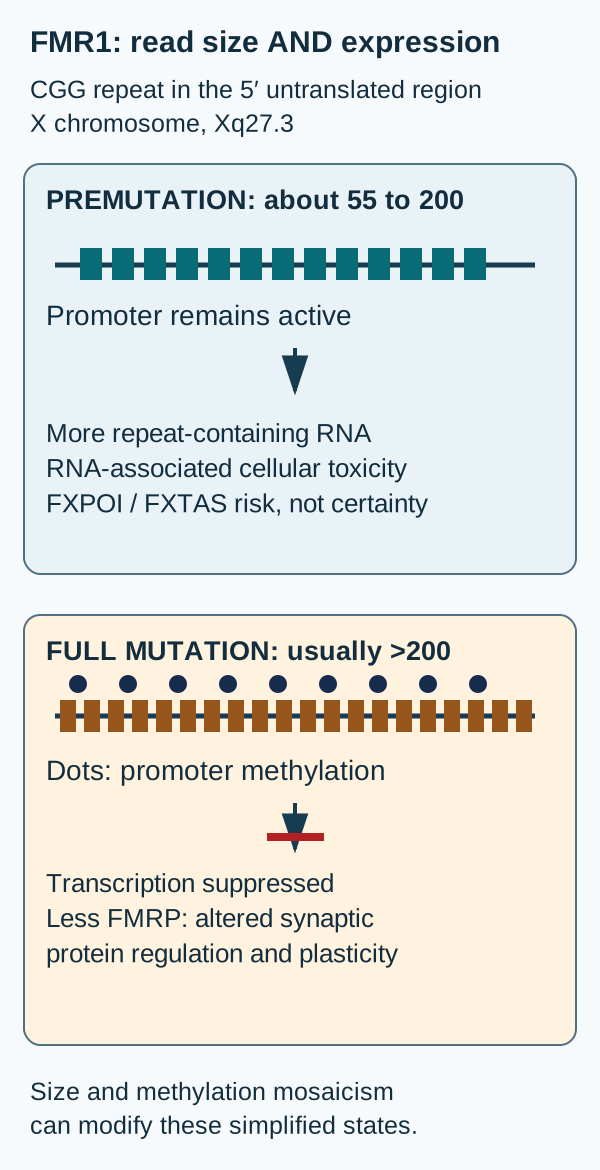
FMR1, at Xq27.3, contains a CGG repeat in its 5′ untranslated region. The repeat is not translated into an abnormally long protein. In a typical full mutation, expansion is associated with promoter hypermethylation and reduced transcription. Less fragile X messenger ribonucleoprotein, or FMRP, is produced. [1][2]
Interpret size together with methylation and the laboratory's precision
CGG repeats
Category
Interpretation
CGG repeatsAbout 5 to 44
CategoryNormal
InterpretationUsual repeat range.
CGG repeats45 to 54
CategoryIntermediate
InterpretationNot a cause of fragile X syndrome. Some alleles are unstable, but direct expansion to a full mutation in one generation is not established.
CGG repeatsAbout 55 to 200
CategoryPremutation
InterpretationUsually transcriptionally active; associated with reproductive and later neurologic risks.
CGG repeatsUsually more than 200
CategoryFull mutation
InterpretationUsually methylated, with reduced FMRP; expression can vary with mosaicism.
Near a category boundary, review sizing uncertainty and methylation rather than assigning certainty from a rounded number alone. [1][2]
The same gene can be overtranscribed or silenced. These are simplified typical states; mosaic results need separate interpretation. [1][2]
FMRP is an RNA-binding regulator of translation, including local protein synthesis at synapses. Its loss disrupts the timing and regulation of synaptic proteins, maturation of dendritic spines, and plasticity. Altered signaling downstream of metabotropic glutamate receptors and changes in excitatory and inhibitory function are studied mechanisms, not a claim that every synaptic protein is uniformly increased. [8]
The child therefore has a loss-of-expression disorder. A premutation usually produces increased repeat-containing RNA, contributing to a distinct toxicity-related process rather than ordinary full-mutation fragile X syndrome. Neither model supplies a drug prescription by itself. A treatment that normalizes a laboratory signal still needs evidence of useful, safe outcomes in people. [1][4]
Try it here · Checkpoint 1 of 3
Make your prediction before reading the choices. A first attempt is just a starting point.
Case 2
Show answer and explanations for case 2
A. FMR1 transcription: increased in the boy; increased in the grandfather (Why this does not fit)
Increased transcription fits the grandfather's unmethylated 90-repeat premutation but contradicts the boy's extensively methylated 320-repeat allele. Their different promoter states prevent assigning increased transcription to both.
Reasoning steps for option A
Which relative's 90-CGG result supports the proposed increase in FMR1 transcription?
The grandfather's unmethylated 90-repeat allele is a transcriptionally active premutation, typically associated with increased FMR1 RNA.
What feature of the boy's 320-CGG report contradicts increased transcription in him?
Why does having an expanded CGG repeat in both relatives not support increased transcription in both?
The methylated full mutation and the unmethylated premutation have different expression effects; expansion alone does not specify the direction.
B. FMR1 transcription: decreased in the boy; decreased in the grandfather (Why this does not fit)
Decreased transcription fits the boy's methylated full mutation but not the grandfather's unmethylated premutation. The latter typically increases repeat-containing RNA and is associated with a distinct late neurologic process.
Reasoning steps for option B
Why is decreased transcription plausible for the boy with 320 repeats and childhood delay?
His full-mutation allele has extensive promoter methylation, which reduces FMR1 transcription and FMRP expression.
Does the grandfather's unmethylated 90-repeat allele provide the same basis for transcriptional silencing?
No. A typical unmethylated premutation remains active and produces increased repeat-containing FMR1 RNA.
What distinction is lost by attributing both childhood delay and late tremor to reduced transcription?
It conflates full-mutation loss of expression with the premutation-associated RNA process implicated in later neurologic disease.
C. FMR1 transcription: decreased in the boy; increased in the grandfather (Best answer)
The boy's methylated 320-repeat full mutation reduces FMR1 transcription and FMRP expression. The grandfather's unmethylated 90-repeat premutation typically increases repeat-containing RNA, supporting a different mechanism for his late tremor.
Reasoning steps for option C
How should the boy's methylated 320-repeat allele and the grandfather's unmethylated 90-repeat allele be classified?
The boy has a methylated full mutation; the grandfather has an unmethylated premutation.
Which transcriptional direction follows from each relative's reported promoter state?
Transcription is reduced from the boy's methylated allele and typically increased from the grandfather's active premutation allele.
How does this opposite-expression pairing explain childhood developmental delay versus tremor at 70?
Reduced FMRP supports the boy's developmental disorder, whereas increased premutation RNA contributes to a distinct late toxicity-associated process.
D. FMR1 transcription: increased in the boy; decreased in the grandfather (Why this does not fit)
This reverses both molecular predictions. The boy's methylated promoter supports decreased transcription, while the grandfather's unmethylated premutation supports increased transcription rather than silencing.
Reasoning steps for option D
Does the boy's larger repeat count justify placing him in the increased-transcription group?
No. His extensive promoter methylation is the decisive evidence for reduced transcription.
Why is decreased transcription the wrong typical prediction for the grandfather's 90 repeats?
The allele is an unmethylated premutation, which generally remains active with increased FMR1 RNA.
Which measurements must be reversed to repair this proposed boy-grandfather comparison?
The boy should be assigned decreased transcription and the grandfather increased transcription; their methylation states determine that correction.
Takeaway: Full mutation and premutation can produce opposite transcriptional states.
Recognize a developmental pattern, not a required face
Would normal testicular size and an ordinary-looking face exclude fragile X syndrome in a 3-year-old? No. Language and motor delay, learning difficulties, attention problems, anxiety, sensory sensitivity, repetitive behavior, and autism-associated features can precede a distinctive physical appearance. Fragile X syndrome is among the common inherited causes of intellectual disability, but an unsupported ranking against all other causes does not help evaluate a child. [1][4]
This photograph shows a child with fragile X syndrome. Notice what the photograph cannot establish: repeat size, cognition, behavior, or diagnostic specificity. Appearance varies; molecular testing establishes the suspected diagnosis. Image: Peter Saxon, CC BY-SA 4.0, shown unchanged.
A long, narrow face, a prominent forehead, ears or jaw, a high-arched palate, joint laxity, and flat feet may become more apparent with age. Macroorchidism is especially useful after puberty, although enlargement can occur earlier. It is neither required in a preschooler nor sufficient on its own for diagnosis. Large testes do not measure fertility, and a specific Sertoli-cell or FSH-receptor explanation should not be presented as established clinical fact. Connective tissue findings can include mitral valve prolapse and aortic root dilatation; assess the person rather than diagnosing either from joint laxity alone. [1][10]
Many males have substantial intellectual disability, but ability and support needs vary. Females can have specific learning or emotional difficulties, normal general cognitive testing, or significant intellectual disability. Their second X chromosome does not guarantee a mild outcome. Gaze avoidance, hand flapping, echolalia, perseverative speech, and hyperactivity can occur, but none determines an individual's intelligence or replaces an autism assessment when indicated. [1]
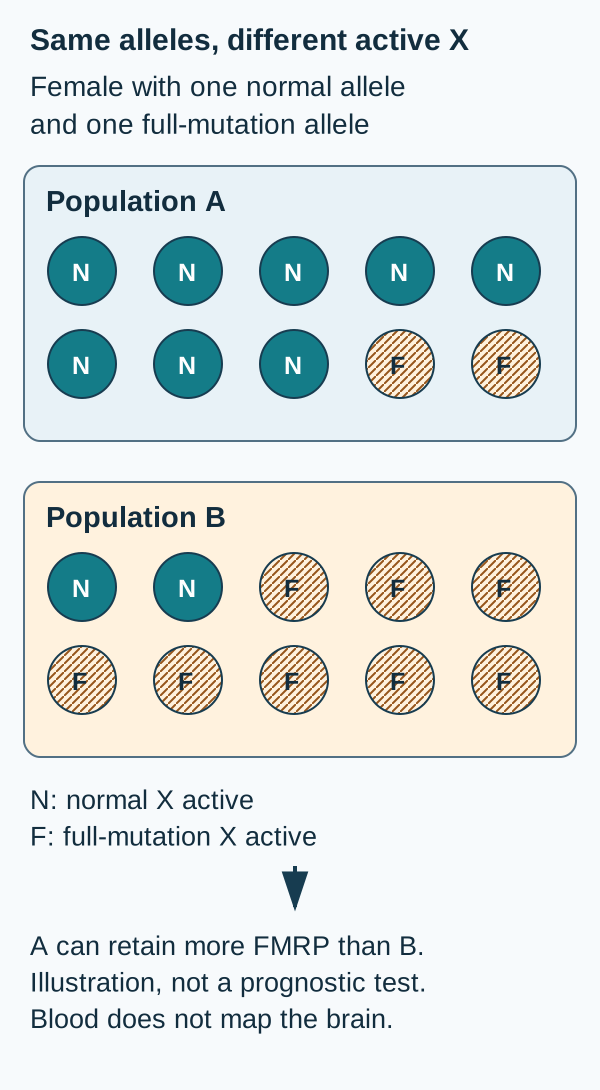
Count the N cells before comparing the two populations. More cells expressing the normal allele can preserve more FMRP. These invented proportions illustrate X-inactivation, not a cognitive prediction tool. [1]
Keep two sources of variation separate. X-inactivation influences which allele is active in a female cell. Repeat-size or methylation mosaicism means that different cells carry different sizes or methylation states; it can occur in males too. Residual expression can modify phenotype, but blood is not a direct map of expression in the brain. Transfer this reasoning to two children with similar repeat counts: a matching number does not imply identical development. [1][2]
Separate inheritance from expansion
A grandfather with a premutation, his daughter with ovarian insufficiency, and her son with a full mutation make a coherent pedigree. A father does not pass his X chromosome to his son. Draw the chromosome route first; only then ask whether the repeat can expand. FMR1 disorders have X-linked inheritance with variable expression and age-dependent risks, not a dependable rule that every generation is more severely affected. [1][2]
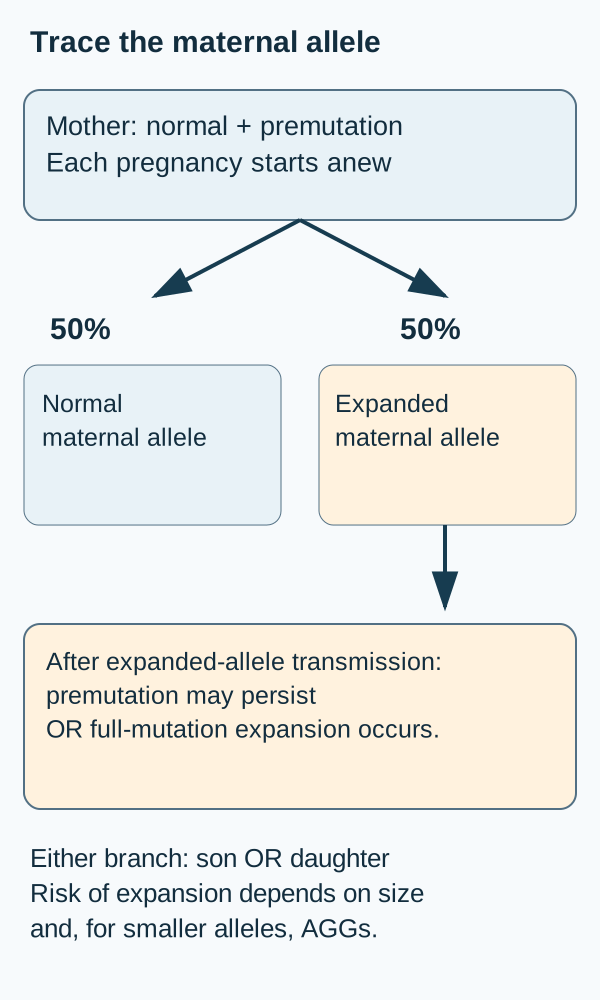
A woman with one expanded and one normal allele has a 50% chance of transmitting the expanded allele in each pregnancy, to a child of either sex. If she transmits a premutation, its chance of expanding to a full mutation depends strongly on repeat length. AGG interruptions help stabilize smaller premutations, especially in the range where repeat structure adds useful counseling information. They change stability, not the 50% chance of transmitting that X chromosome. [1][3]
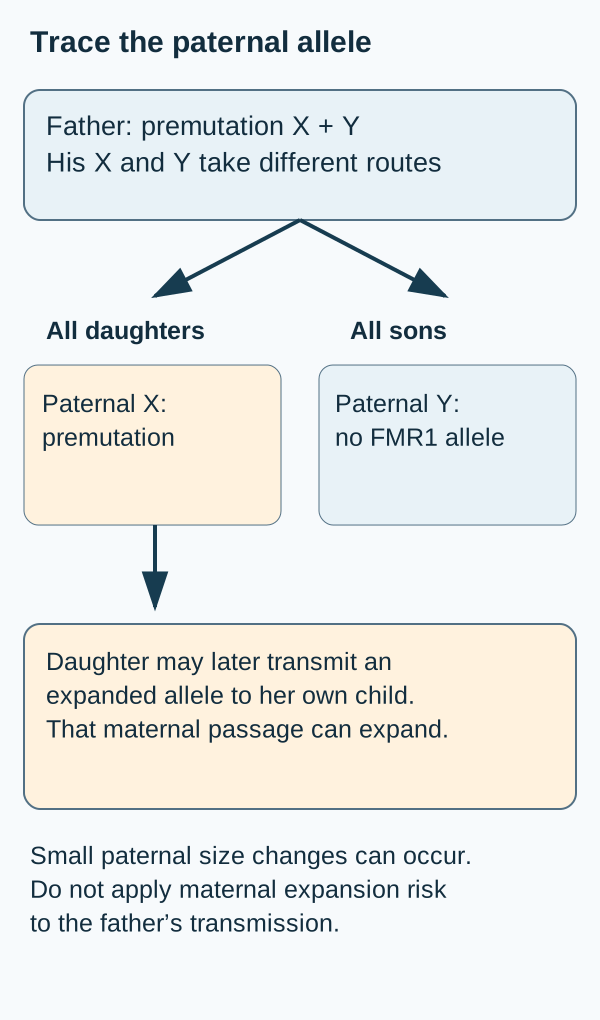
A man with a premutation transmits his X to all daughters and his Y to all sons. His daughters inherit a premutation, sometimes with a small size change; full-mutation expansion is not expected through paternal transmission. A daughter can subsequently transmit an allele that expands through her own maternal transmission. This distinction helps explain the historical Sherman paradox and anticipation without promising a fixed generational increase. [1][2]
Try the chromosome routes. Predict where the expanded allele goes, then open either branch. Compare the arrows, not just the repeat labels. Both branches can stay open for comparison; close them to reset.
What changes when the mother carries the premutation?The split occurs before the expansion question. The diagram does not assign one expansion percentage to every premutation. [1][3]What changes when the father carries the premutation?The paternal route sorts by chromosome, not by a universal 50% carrier probability. [1][2]
For a numerical check, suppose a counseling exercise supplies a 60% probability of expansion conditional on transmitting the premutation. The probability per pregnancy of a child inheriting a full mutation is 0.50 × 0.60 = 30%. If the question also specifies a son and assumes equal sex probability, it is 15%. These are hypothetical inputs, not risk estimates for a particular repeat count. Large premutations can have high conditional expansion risk; do not recycle an unsupported percentage for a 120-repeat allele. [1][3]
Try it here · Checkpoint 2 of 3
Make your prediction before reading the choices. A first attempt is just a starting point.
Case 8
Show answer and explanations for case 8
A. 40% and 10%; different probabilities of transmitting the expanded X (Why this does not fit)
The supplied probabilities are conditional on expanded-allele transmission. Each woman still has a 50% chance of transmitting that X.
Reasoning steps for option A
Why are the supplied 40% and 10% not yet risks per pregnancy for these two women?
They describe expansion conditional on transmitting the premutation, not all pregnancies.
Does having zero versus two AGG interruptions change either woman's 50% chance of passing on her expanded X?
No. Both women have one normal and one expanded allele, so their Mendelian transmission probability is the same.
What numerical and biological corrections are required for this proposed answer?
The per-pregnancy risks become 20% and 5%; their difference reflects repeat stability and conditional expansion rather than X-chromosome segregation.
B. 20% and 5%; different repeat stability after transmission (Best answer)
Multiplying each conditional probability by 0.5 gives 20% and 5%. AGG interruptions affect expansion stability rather than Mendelian segregation; the supplied values illustrate the calculation only.
Reasoning steps for option B
How do the equal 50% transmission probabilities convert the two supplied conditional risks?
For no AGG interruptions, 0.50 times 0.40 gives 20%; for two interruptions, 0.50 times 0.10 gives 5%.
What feature differs between the two 75-repeat alleles and explains the modeled stability difference?
One allele has no AGG interruptions and the other has two; interruptions can stabilize the repeat during maternal transmission.
Can these modeled 20% and 5% values be assigned automatically to two patients with 75 repeats?
No. They use deliberately supplied teaching probabilities and are not individualized clinical expansion estimates.
C. 20% and 5%; different probabilities of transmitting the expanded X (Why this does not fit)
The calculations are correct, but both women have the same 50% expanded-X transmission probability. The difference lies in conditional expansion.
Reasoning steps for option C
Are 20% and 5% arithmetically consistent with the women's supplied 40% and 10% conditional risks?
Yes. Each is the corresponding conditional probability multiplied by the one-half expanded-X transmission probability.
What is wrong with attributing that correct numerical difference to different expanded-X transmission probabilities?
Both women transmit their expanded X with 50% probability because each is heterozygous.
Which process should replace 'transmitting the expanded X' in the biological explanation?
Conditional expansion of the transmitted repeat differs because AGG interruptions influence repeat stability.
D. 40% and 10%; different repeat stability after transmission (Why this does not fit)
The stability interpretation is correct, but the per-pregnancy calculation must also include the 50% probability of transmitting the premutation.
Reasoning steps for option D
Which part of pairing 40% and 10% with repeat stability is biologically appropriate?
The differing AGG structures affect repeat stability and the chance of full-mutation expansion during maternal transmission.
Which half of pregnancies is omitted when those conditional risks are reported as per-pregnancy risks?
The calculation neglects pregnancies that receive the mother's normal allele instead of her premutation.
After accounting for transmission, what values should accompany the stability explanation?
The modeled per-pregnancy risks are 20% and 5%, obtained by multiplying 40% and 10% by one-half.
A premutation is not simply an unaffected carrier state
A 32-year-old has amenorrhea, repeatedly high FSH, and low estradiol. An older relative has intention tremor and gait ataxia. Localize each problem before naming the family disorder: the first pattern is ovarian insufficiency, and the second is a progressive neurologic syndrome.
Fragile X-associated primary ovarian insufficiency (FXPOI) affects a subset of women with premutations, approximately 20%, and occurs before age 40. Loss of ovarian negative feedback produces high pituitary FSH; the hypothalamus does not secrete FSH. Intermittent ovarian activity and spontaneous pregnancy remain possible, so amenorrhea is not reliable contraception. A full mutation should not automatically be assigned the same FXPOI risk. Hormonal evaluation, reproductive counseling, and care for the consequences of estrogen deficiency are individualized. [1]
Fragile X-associated tremor/ataxia syndrome (FXTAS) usually begins in later adulthood, often around the sixth or seventh decade. Intention tremor and cerebellar gait ataxia can accompany executive or cognitive decline, peripheral neuropathy, or parkinsonian features. T2 hyperintensity in the middle cerebellar peduncles supports the diagnosis in context but is not independently diagnostic. Men are affected more often, yet women can develop FXTAS too. A premutation establishes susceptibility, not certainty of future disease. [1]
Do not let the phrase “repeat disorder” erase the differential. Compare phenotype, inheritance, and the molecular consequence together:
Different expansions, different disease processes
Disorder and repeat
Molecular effect
Useful clinical contrast
Disorder and repeatFragile X syndrome: FMR1 CGG
Molecular effectUsually methylation-mediated reduction of FMRP
Disorder and repeatHuntington disease: HTT CAG (4p)
Molecular effectAbnormal expanded huntingtin protein
Useful clinical contrastProgressive chorea and cognitive-behavioral changes, usually adult onset; autosomal dominant
Disorder and repeatMyotonic dystrophy type 1: DMPK CTG (chromosome 19)
Molecular effectAbnormal RNA disrupts other RNA processing
Useful clinical contrastMyotonia, cataracts, balding and conduction disease; autosomal dominant; congenital disease can follow maternal transmission
Disorder and repeatFriedreich ataxia: FXN GAA (9q)
Molecular effectReduced frataxin
Useful clinical contrastProgressive ataxia, sensory loss and cardiomyopathy; usually biallelic expansions, autosomal recessive
The protein reduced in Friedreich ataxia is frataxin, not ataxin. A teenager with areflexia, impaired vibration sense and cardiomyopathy should not be assigned FXTAS merely because both involve ataxia. A mother with grip myotonia and a hypotonic newborn directs attention toward DMPK, not toward the FMR1 promoter. [5][6][7][9][11][12]
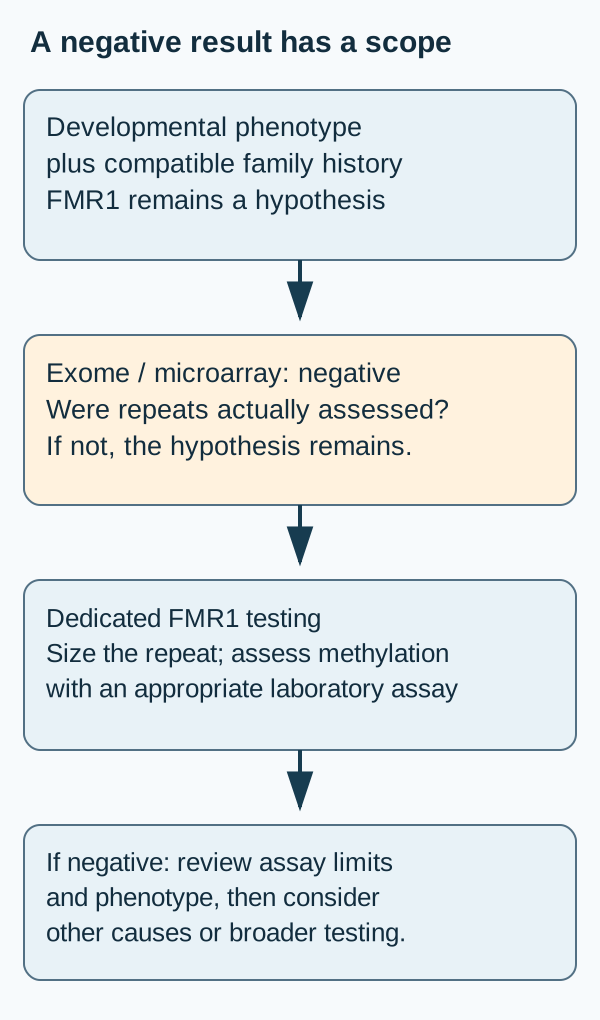
A negative test excludes only what it can detect
A child has developmental delay and a compatible family history, but a microarray and exome are negative. Before rejecting fragile X syndrome, read the methods. Did either test reliably assess this repeat expansion and its methylation state?
Follow the test's scope rather than treating “genetic testing negative” as a diagnosis. [1][2]
Dedicated FMR1 testing uses validated repeat-sizing methods and appropriate methylation analysis. Modern PCR approaches can detect a wide range of expansions; methylation-specific methods and Southern blotting have roles according to the laboratory's assay and the clinical question. It is inaccurate to insist that every patient needs one fixed PCR-plus-Southern sequence, or that ordinary karyotyping, microarray, or exome sequencing automatically excludes an expansion. [1][2]
Ask whether the report addresses full-range expansions, mosaicism, and boundary uncertainty. If a well-chosen assay is negative despite strong suspicion, discuss its limits with the laboratory and genetics team. Rare FMR1 sequence variants or deletions and other developmental disorders may require different testing. In selected suspected mosaic cases, another tissue may be informative; this is not a routine response to every negative result. [1]
Use targeted evaluation and family testing when indicated; universal routine newborn screening is not established standard practice. Once an expansion is identified, offer genetic counseling about relatives, prenatal diagnosis, and preimplantation testing options. Chorionic villus methylation can be tissue- and developmental-stage dependent. A fetal expansion result, especially in a female, cannot predict an exact cognitive outcome. Reproductive decisions require clear limits and patient preferences, not deterministic promises. [1][2]
Treat the person's barriers to function
A child who performs well in a quiet, predictable setting may struggle with the same task in noise. A child with new agitation may instead have otitis, constipation, poor sleep, or another painful problem. First ask what changed and what is treatable; do not attribute every difficulty to the chromosome.
Early intervention, speech and language services, occupational or physical therapy, and individualized educational planning should address observed needs, even while diagnostic testing is pending. Communication aids, predictable routines, adjusted sensory demands and positive behavioral support can increase participation. Support should enable learning with others rather than assume isolation is necessary. Speech, adaptive skills, and independence are heterogeneous; no single feature determines the future. Adults may benefit from supported education, employment and living arrangements, with goals revisited over time. [1][4]
Recurrent otitis media and conductive hearing loss can compound language difficulties. An air-bone gap with preserved bone-conduction thresholds indicates a conductive component worth evaluating, not evidence that the repeat has enlarged. [13] Review vision, sleep, seizures, musculoskeletal needs and cardiovascular findings as appropriate. New events concerning for seizures need clinical assessment, not automatic attribution to stereotyped behavior. [1]
Medication targets a defined problem and needs monitoring. Stimulants are not categorically contraindicated for ADHD in fragile X syndrome. Dose, age, benefit, appetite, sleep, anxiety and irritability matter; alternatives may be considered when tolerability is poor. Anxiety may be treated with behavioral approaches and, when appropriate, an SSRI while monitoring activation. Severe persistent aggression or self-injury may require specialist-guided medication after medical and environmental contributors are addressed. Anticonvulsants treat appropriate indications such as epilepsy; a theory about inhibitory signaling alone is not a reason to prescribe one for agitation. [1]
There is no established cure that follows from a folate supplement, a proposed signaling target, or a gene-directed research program. This does not mean nothing helps. The practical test is whether a plan improves communication, participation, safety and quality of life with acceptable harms. Reassess against the person's baseline rather than a stereotype or an assumed fixed IQ. [1][4]
Try it here · Checkpoint 3 of 3
Make your prediction before reading the choices. A first attempt is just a starting point.
Case 15
Show answer and explanations for case 15
A. The initial deficit was cochlear; persistent language difficulty requires cochlear-directed treatment (Why this does not fit)
An air-bone gap with normal bone thresholds indicates conductive rather than primary cochlear loss. Both thresholds normalized after ear treatment.
Reasoning steps for option A
Do initial bone thresholds of 10 dB HL support the proposed primary cochlear hearing deficit?
No. Bone thresholds are within the stated normal range, while air thresholds are elevated at 35 dB HL.
Where does the resulting 25 dB air-bone gap localize the acquired hearing problem?
It identifies a conductive component, consistent with the bilateral middle-ear effusions.
Why is persistent language difficulty after both thresholds reach 10 dB HL not evidence for cochlear-directed treatment?
The hearing thresholds normalized, whereas receptive-language testing still identifies developmental needs requiring separate support.
B. The initial deficit was central; improved thresholds show no clinically important hearing contribution (Why this does not fit)
The initial air-bone gap documents a peripheral conductive contribution. Improved responsiveness after its correction is consistent with a clinically relevant effect.
Reasoning steps for option B
What objective audiometric finding contradicts treating the original deterioration as entirely central?
The initial 35 dB air and 10 dB bone thresholds show a conductive air-bone gap.
How does improved classroom responsiveness after the effusions were treated bear on the hearing contribution?
It supports a clinically meaningful effect from correcting the acquired conductive burden.
Does residual receptive-language impairment erase the importance of that corrected hearing deficit?
No. A treatable hearing contribution and an underlying developmental language disorder can coexist.
C. The initial deficit was conductive; normalized thresholds mean language support is no longer needed (Why this does not fit)
Correcting sound conduction improves access to speech but does not necessarily resolve the underlying developmental language disorder. The residual measured difficulty supports continued services.
Reasoning steps for option C
Which component of this answer is supported by the initial air-bone gap and later threshold normalization?
The initial deficit was conductive, and it resolved after middle-ear treatment.
What measured result contradicts stopping language support after hearing normalizes?
Standardized receptive-language performance remains below age expectations despite both hearing thresholds being 10 dB HL.
Why should normal hearing access not be equated with normal language development in this child?
Removing a conductive barrier improves access to speech but does not automatically resolve the existing developmental language impairment.
D. The initial deficit was conductive; persistent developmental language needs still require support (Best answer)
The initial gap localizes a conductive problem, which resolved after treatment. Persistent receptive-language impairment despite normal thresholds indicates continuing developmental needs rather than proof of ongoing conductive loss.
Reasoning steps for option D
How does comparing air 35 dB HL with bone 10 dB HL identify the initial hearing burden?
The 25 dB gap with normal bone conduction localizes a conductive hearing deficit.
What does a repeat audiogram showing both thresholds at 10 dB HL indicate after ear treatment?
The previously measured conductive component has resolved and hearing thresholds are now within the stated normal range.
What ongoing need is demonstrated by low receptive-language scores despite improved responsiveness?
Developmental language support remains indicated; normalized hearing does not eliminate the independently documented communication difficulty.
Takeaway: Correct a treatable sensory burden and then reassess the developmental needs that remain.
A. FMR1 repeat sizing with methylation analysis (Best answer)
Language delay in the boy, ovarian insufficiency at 32 in his aunt, and late gait imbalance in his grandfather suggest different manifestations of an FMR1 expansion family. Repeat sizing and methylation analysis assess the variant class that a nondiagnostic microarray does not exclude.
Reasoning steps for option A
How do the aunt's ovarian insufficiency at 32 and the grandfather's gait imbalance at 67 change the interpretation of the boy's language delay?
The combination suggests childhood fragile X syndrome alongside adult premutation-associated disorders in the maternal family.
What abnormality would FMR1 repeat sizing investigate that the boy's microarray may not detect?
It directly measures the CGG expansion rather than relying on detection of a chromosome copy-number change.
What does methylation analysis add to the repeat measurement in this developmentally delayed boy?
It assesses whether an expanded FMR1 allele has the promoter methylation associated with reduced transcription and FMRP expression.
B. Methylation analysis of chromosome 15q11-q13 (Why this does not fit)
A chromosome 15 imprinting disorder can explain developmental impairment, but it does not unify ovarian insufficiency at 32 and late ataxia in this maternal family. FMR1 expansion testing addresses that combined pattern more directly.
Reasoning steps for option B
Why could a chromosome 15 methylation assay initially seem relevant to this 4-year-old?
Imprinting disorders involving chromosome 15 can cause developmental and language impairment.
Which two relatives' findings make chromosome 15 imprinting a weaker unifying explanation?
The aunt's early ovarian insufficiency and the grandfather's late gait imbalance point toward the adult FMR1 premutation spectrum.
Would a normal chromosome 15 methylation result resolve the family's suspected CGG expansion?
No. That assay addresses a different locus and would leave the FMR1 repeat and its methylation untested.
C. Conventional karyotyping for sex chromosome number (Why this does not fit)
Conventional karyotyping evaluates chromosome number, not the CGG repeat expansion suggested by this family's developmental, ovarian, and late neurologic findings. A nondiagnostic microarray does not turn karyotyping into a dedicated FMR1 assay.
Reasoning steps for option C
What proposed cause of the boy's developmental delay does sex-chromosome karyotyping examine?
It examines chromosome-number abnormalities such as sex-chromosome aneuploidy.
Why does the combination of an affected preschooler, an aunt with early ovarian insufficiency, and an older ataxic grandfather argue against a chromosome-count explanation?
Those age-dependent manifestations form a coherent FMR1 expansion pattern rather than a single shared chromosome-number phenotype.
What genetic question would remain after a normal sex-chromosome karyotype in this boy?
Whether he carries an FMR1 CGG expansion with abnormal methylation would remain unresolved.
D. Coding-sequence analysis of MECP2 (Why this does not fit)
MECP2 coding variants can cause developmental disability, but that test neither evaluates FMR1 repeats nor unifies the adult ovarian and ataxic phenotypes in this family. The relatives' findings favor a repeat-specific FMR1 study.
Reasoning steps for option D
Which part of the boy's presentation could make MECP2 coding analysis appear plausible?
A coding-variant neurodevelopmental disorder can account for language and developmental impairment.
Why do ovarian insufficiency at 32 and gait imbalance at 67 weaken MECP2 as the single familial explanation?
Those adult phenotypes fit the FMR1 premutation spectrum rather than the childhood impairment alone that motivates MECP2 testing.
Does sequencing MECP2 coding regions examine the expansion implicated by this maternal pedigree?
No. MECP2 coding analysis does not size the noncoding CGG repeat in FMR1.
Takeaway: A normal copy-number study does not exclude an FMR1 repeat expansion.
A. A full mutation is established; additional etiologic testing is unnecessary (Why this does not fit)
The reported 52-repeat allele is intermediate, far below the usual full-mutation range above 200 repeats. The assay assessed full-range expansions and detected no size mosaicism, so this result does not establish fragile X syndrome or justify stopping the etiologic evaluation.
Reasoning steps for option A
How does the boy's reported 52-CGG allele compare with the usual full-mutation threshold?
It is in the intermediate range of about 45 to 54 repeats, not the full-mutation range usually above 200.
Does this report leave the same untested full-range expansion gap as an assay that cannot amplify large repeats?
No. The stated assay can detect full-range expansions and found no size mosaicism.
Why would ending etiologic testing after this 52-repeat finding leave the developmental delay unexplained?
An intermediate allele does not establish fragile X syndrome, so another cause of the delay still needs evaluation.
B. A premutation explains the delay; assess only for later FXTAS (Why this does not fit)
Fifty-two repeats falls in the intermediate range rather than the usual premutation range beginning around 55. Restricting care to later FXTAS would neither correctly classify the allele nor investigate the boy's present developmental delay.
Reasoning steps for option B
Does a reported 52-repeat allele meet the usual premutation range used to interpret FXTAS susceptibility?
No. The usual premutation range is about 55 to 200 repeats; 52 is intermediate on the supplied report.
Why does later FXTAS surveillance not explain this 9-year-old's current developmental presentation?
FXTAS is a later neurologic syndrome associated with premutations, not an established explanation for childhood delay from this intermediate allele.
What current diagnostic need is missed by assessing only for future tremor and ataxia?
The cause of his developmental delay remains undetermined and requires continued developmental and genetic evaluation.
C. An intermediate allele is present; continue evaluation for another explanation (Best answer)
The detected 52-repeat allele is intermediate and is not an established cause of fragile X syndrome. With a full-range assay and no detected size mosaicism, the developmental delay should prompt further etiologic evaluation rather than attribution to this repeat finding.
Reasoning steps for option C
Which repeat category matches the same 52-CGG allele found in this boy and his mother?
The reported 52-repeat allele is intermediate, within the usual 45 to 54 range.
Does sharing that intermediate allele establish the molecular cause of the boy's delay?
No. Its presence in both relatives does not make an intermediate allele a cause of fragile X syndrome.
What follows for evaluation when the full-range assay finds only this intermediate allele and no size mosaicism?
Continue looking for another explanation for the developmental delay instead of anchoring on the repeat result.
D. Methylation-negative fragile X syndrome is established; use repeat size to predict severity (Why this does not fit)
Absent methylation does not convert an intermediate 52-repeat allele into an unmethylated full mutation. Neither fragile X syndrome nor a severity forecast is established by the supplied result.
Reasoning steps for option D
What size evidence would be needed before discussing an unmethylated full mutation in this boy?
An allele in the full-mutation range would need to be demonstrated; the reported allele contains only 52 repeats.
Can the absence of abnormal methylation override the 52-repeat measurement to establish fragile X syndrome?
No. Methylation and repeat size are separate measurements, and this allele remains intermediate.
Why is using this repeat count to predict his developmental severity unsupported?
The result has not established fragile X syndrome, and repeat count alone does not determine an individual's cognitive outcome.
Takeaway: A detected repeat variant is not necessarily the cause of a developmental phenotype.
A. A: size mosaicism; B: size and methylation mosaicism (Why this does not fit)
B is correctly classified because its populations differ in both size category and methylation. A has differing methylation states but no detected repeat-size-category mosaicism, so its first label is unsupported.
Reasoning steps for option A
Does boy A's report demonstrate two different repeat-size categories to support the proposed size-mosaic label?
No. All detected alleles in A are above 300 CGGs and belong to the full-mutation category.
What variation does A's report actually demonstrate between his full-mutation fractions?
Some fractions are methylated and others unmethylated, establishing methylation mosaicism.
Why does correctly labeling B as both size and methylation mosaic not rescue this pair?
B has 80-repeat unmethylated and 320-repeat methylated populations, but A's proposed size-category label remains unsupported.
B. A: methylation mosaicism without detected size-category mosaicism; B: size and methylation mosaicism (Best answer)
A can retain expression from unmethylated full-mutation cells despite one size category. B has separate premutation and full-mutation populations with differing methylation states, leaving the premutation population transcriptionally active.
Reasoning steps for option B
Which measurement differs between boy A's cell fractions when every reported allele is full-mutation sized?
Methylation differs; his report does not show a premutation/full-mutation size-category mixture.
How do B's 80-repeat and 320-repeat populations establish two kinds of mosaicism?
They differ in repeat-size category and in methylation: the 80-repeat population is unmethylated and the 320-repeat population methylated.
Which fractions can account for residual FMR1 expression in A and B under this classification?
A's unmethylated full-mutation fraction can retain expression, while B's unmethylated premutation fraction remains transcriptionally active.
C. A: size and methylation mosaicism; B: methylation mosaicism without size differences (Why this does not fit)
A's report does not demonstrate different repeat-size categories, whereas B's 80-repeat and 320-repeat populations clearly differ in size.
Reasoning steps for option C
Do methylated and unmethylated fractions in A by themselves establish repeat-size-category mosaicism?
No. Methylation differences do not demonstrate different repeat-size categories; all his detected alleles are full-mutation sized.
What reported numbers contradict the claim that B has no size differences?
B has distinct 80-repeat and 320-repeat populations, spanning premutation and full-mutation categories.
How must the two classifications change to reflect both boys' actual results?
A has methylation mosaicism without detected size-category mosaicism; B has both size and methylation mosaicism.
D. A: methylation mosaicism without detected size-category mosaicism; B: size mosaicism without methylation differences (Why this does not fit)
A is classified correctly. B is not merely size mosaic: its reported populations differ in methylation as well as repeat length.
Reasoning steps for option D
Which part of the proposed A classification is supported by his alleles above 300 CGGs?
They remain within one full-mutation size category while showing mixed methylation, supporting the stated A classification.
What finding directly contradicts 'without methylation differences' for B?
His 80-repeat population is unmethylated, whereas his 320-repeat population is methylated.
Why is B's methylation distinction relevant to residual expression rather than merely an extra label?
The unmethylated premutation population can remain active while the methylated full-mutation population has suppressed expression.
Takeaway: Distinguish what varies between cells: repeat size, methylation, or both.
A. A should retain more FMRP in both sampled tissues; blood establishes the systemic direction (Why this does not fit)
A has the higher normal-active fraction in blood but the lower fraction in fibroblasts. A blood result cannot be generalized to all tissues.
Reasoning steps for option A
Why does sister A's 80% normal-active fraction support more FMRP in her blood than in B's blood?
A has more blood cells expressing the normal FMR1 allele than B, whose normal-active fraction is 20%.
Which fibroblast measurements contradict the prediction that A has more FMRP in both tissues?
A has only 30% normal-active fibroblasts compared with B's 70%, predicting the opposite ranking there.
Can A's favorable blood result establish a single expression direction across her body?
No. The reversed fibroblast ranking shows that blood X-inactivation cannot be generalized to other tissues.
B. B should retain more FMRP in both sampled tissues; fibroblasts establish the systemic direction (Why this does not fit)
B has the higher normal-active fraction in fibroblasts but not in blood. Fibroblasts are not a systemic reference for all tissues.
Reasoning steps for option B
What feature of B's fibroblast result supports the proposed higher FMRP in that tissue?
Her normal X is active in 70% of fibroblasts compared with 30% in A.
Why does B's 20% normal-active blood fraction defeat the claim that she leads in both tissues?
A's corresponding blood fraction is 80%, so blood predicts more retained FMRP in A rather than B.
Do B's fibroblasts provide a better systemic reference than A's blood sample?
Neither sample establishes systemic expression; the two tissues give opposite sister-to-sister rankings.
C. A should retain more FMRP in blood and B in fibroblasts; neither ranking establishes brain expression (Best answer)
Normal-allele activity predicts the direction of retained FMRP within each sampled tissue: A in blood and B in fibroblasts. The discordance demonstrates why neither tissue directly ranks brain expression or cognitive outcome.
Reasoning steps for option C
Which sister has the larger normal-active fraction in each sampled tissue?
A leads in blood at 80% versus 20%; B leads in fibroblasts at 70% versus 30%.
How do those normal-active fractions translate into the predicted tissue-specific FMRP ranking?
More normal-allele-active cells support more FMRP, predicting A above B in blood and B above A in fibroblasts.
Why can the crossed blood and fibroblast rankings not select the sister with higher brain expression?
Brain expression was not measured, and the observed tissue discordance prevents treating either peripheral sample as its direct proxy.
D. B should retain more FMRP in blood and A in fibroblasts; neither ranking establishes brain expression (Why this does not fit)
This correctly avoids a brain forecast but reverses both tissue-specific predictions. More cells with the normal X active generally support more FMRP.
Reasoning steps for option D
Does the normal-active blood comparison favor B, as this answer proposes?
No. A's 80% exceeds B's 20%, predicting more FMRP in A's blood.
Does the normal-active fibroblast comparison favor A, as this answer proposes?
No. B's 70% exceeds A's 30%, predicting more FMRP in B's fibroblasts.
Is the caution about brain expression enough to make these reversed tissue predictions correct?
No. Avoiding a brain forecast is appropriate, but both measured-tissue rankings must still follow the normal-active fractions.
Takeaway: Tissue-specific X-inactivation can reverse an expression comparison without changing inherited repeat sizes.
This is the chance of a child of either sex inheriting a full mutation: 0.5 times 0.6. The question additionally specifies a son.
Reasoning steps for option A
Which event has probability 30% after multiplying maternal transmission by the supplied expansion risk?
A child of either sex inheriting a full mutation has probability 0.50 times 0.60, or 0.30.
What additional requirement in the question is missing from the 30% result?
The child must also be male, and fetal sex is not yet known.
How does applying the supplied equal-sex assumption change the proposed 30% answer?
Multiplying 30% by 0.50 gives 15% for the joint event of a male child carrying a full mutation.
B. 15% (Best answer)
The joint probability is 0.5 for transmission times 0.6 for expansion times 0.5 for male sex, or 0.15. The 60% is a supplied hypothetical value, not a counseling estimate for all premutations.
Reasoning steps for option B
What chance does this heterozygous mother have of transmitting her premutation rather than her normal allele?
Each pregnancy has a 50% probability of receiving her expanded allele.
After including the supplied 60% conditional expansion probability, what full-mutation risk remains before restricting sex?
The risk is 0.50 times 0.60, or 30%, for a child of either sex.
Why does the unknown fetal sex make 15% the requested joint probability?
Male sex adds a factor of 0.50, giving 0.50 times 0.60 times 0.50 equals 0.15. The 60% input is hypothetical, not a universal premutation risk.
C. 50% (Why this does not fit)
Fifty percent describes transmission of the maternal expanded allele, not simultaneous transmission, expansion and male sex.
Reasoning steps for option C
What genetic event is described by the proposed 50% in this woman's pregnancy?
It is the chance of transmitting her expanded maternal X rather than her normal X.
Would receiving that expanded X alone establish that the child is male with a full mutation?
No. The transmitted allele must expand, and the child must also be male.
Which two factors must be applied to 50% to answer this specific question?
Apply the supplied 60% conditional expansion probability and the 50% male probability, giving 15%.
D. 60% (Why this does not fit)
Sixty percent applies only after the expanded maternal allele is transmitted. It omits both the transmission and sex probabilities.
Reasoning steps for option D
To which subgroup of pregnancies does the supplied 60% expansion probability apply?
It applies only when the maternal premutation allele has been transmitted.
Why can 60% not be used directly for all pregnancies of this heterozygous mother?
Half of pregnancies receive her normal allele, so transmission must first be included as a 0.50 factor.
What final adjustment distinguishes 'a full mutation' from 'a male child with a full mutation' here?
After obtaining 30% from transmission and expansion, multiply by the stated 50% male probability to obtain 15%.
Takeaway: Keep allele transmission, conditional expansion and sex probabilities separate.
The daughter's per-pregnancy full-mutation risk is 0.5 times 0.4, or 20%, but the father passes his X to every daughter, not half.
Reasoning steps for option A
Why is 50% not the chance that this man's future daughter receives his premutation?
A daughter necessarily receives her father's X chromosome, and his X carries the premutation.
Does the proposed 20% correctly combine the current daughter's transmission and supplied expansion probabilities?
Yes. Her 50% chance of transmitting the expanded X multiplied by 40% conditional expansion gives 20%.
Which entry must change in the proposed 50%; 20% pair?
The first entry must become 100%; the daughter's per-pregnancy full-mutation risk remains 20%.
B. 100%; 40% (Why this does not fit)
The paternal probability is correct. The second figure omits the daughter's 50% probability of transmitting her expanded rather than normal X.
Reasoning steps for option B
What makes 100% appropriate for transmission from this father to a future daughter?
All daughters receive his X, so all inherit the paternal premutation under the stated scenario.
What event is conditioned on in the daughter's supplied 40% expansion figure?
It assumes she has transmitted her premutation rather than her normal FMR1 allele.
Why must the second entry be 20% instead of 40% for her next pregnancy?
Only half of pregnancies receive her expanded allele, so the per-pregnancy risk is 0.50 times 0.40 equals 20%.
C. 100%; 20% (Best answer)
Every daughter receives the father's X. In the next generation, the heterozygous daughter has a 0.5 transmission probability times the supplied 0.4 expansion probability, or 20%.
Reasoning steps for option C
Which paternal chromosome carries the premutation and reaches every daughter in this pedigree?
His X carries the premutation and is transmitted to every daughter; sons receive his Y.
What two events must occur for the current daughter's child to inherit a full mutation?
She must transmit her premutation with probability 0.50, and that allele must expand with the supplied conditional probability 0.40.
Why is 100%; 20% the correct pair without adding another factor for fetal sex?
The first event already specifies a daughter, and the second includes a child of either sex; its risk is 0.50 times 0.40 equals 20%.
D. 50%; 40% (Why this does not fit)
This both applies maternal segregation to a father-daughter event and treats conditional expansion as a per-pregnancy probability.
Reasoning steps for option D
Which maternal segregation rule is incorrectly applied to the father in the proposed 50%; 40% pair?
A heterozygous mother's one-half expanded-X transmission probability is incorrectly substituted for a father's obligatory X transmission to daughters.
Which missing factor makes 40% too high for the current daughter's per-pregnancy risk?
The calculation omits her 50% chance of transmitting the premutation rather than her normal allele.
How are both errors corrected while retaining the exercise's 40% conditional input?
Use 100% for father-to-daughter transmission and 0.50 times 0.40 equals 20% for the daughter's child of either sex.
Takeaway: Trace the paternal X first, then apply maternal segregation and conditional expansion in the next generation.
Repeated FSH values of 48 and 51 IU/L with low estradiol localize the problem to ovarian insufficiency before age 40. The nephew's lifelong intellectual disability and the father's late ataxia make FMR1 premutation testing the best study for a unifying inherited cause.
Reasoning steps for option A
How do FSH values of 48 and 51 IU/L together with estradiol of 18 pg/mL localize this woman's amenorrhea?
Low ovarian estrogen with a compensatory high pituitary FSH supports primary ovarian insufficiency rather than deficient pituitary stimulation.
Which family findings connect ovarian insufficiency at 30 with the FMR1 spectrum?
Her sister's son has lifelong intellectual disability, and her father has late-onset ataxia, matching different age-dependent FMR1 presentations.
Why does CGG repeat analysis answer this inherited-cause question more directly than another hormone measurement?
It tests for the FMR1 premutation that can unify her ovarian findings with the developmental and neurologic phenotypes in relatives.
B. Serum testosterone measurement (Why this does not fit)
Androgen testing can help evaluate hyperandrogenic anovulation, but low estradiol with repeatedly high FSH indicates ovarian insufficiency, not typical polycystic ovary syndrome.
Reasoning steps for option B
What alternative mechanism of menstrual dysfunction would serum testosterone help investigate?
It can help assess hyperandrogenic anovulation, such as that associated with polycystic ovary syndrome.
Which of this woman's hormone results favors ovarian insufficiency rather than that hyperandrogenic explanation?
Repeatedly elevated FSH with estradiol below the supplied reference range indicates loss of ovarian function and negative feedback.
Would measuring testosterone identify the inherited link to the nephew's disability and the father's late ataxia?
No. It does not test the FMR1 expansion suggested by the combined family phenotype.
C. Pituitary MRI (Why this does not fit)
A pituitary cause of hypogonadism generally produces low or inappropriately normal gonadotropins. Her high FSH and normal prolactin argue against that as the best unifying explanation.
Reasoning steps for option C
What gonadotropin pattern would make deficient pituitary stimulation a stronger explanation for her low estradiol?
Low or inappropriately normal gonadotropins would fit central hypogonadism better than the observed high FSH.
How do FSH values near 50 IU/L and normal prolactin weaken pituitary MRI as the leading study?
The pituitary is producing a strong FSH response, and prolactin does not supply an alternative pituitary explanation for the amenorrhea.
Which inherited ovarian explanation would remain untested after pituitary imaging?
An FMR1 premutation linking early ovarian insufficiency with the relatives' developmental and late ataxic disorders would remain untested.
D. HTT CAG repeat analysis (Why this does not fit)
HTT expansion causes progressive neurologic disease, not this combination of primary ovarian insufficiency and lifelong developmental disability. The family pattern is more consistent with FMR1 disorders.
Reasoning steps for option D
Which relative's late neurologic illness could initially draw attention to HTT repeat testing?
The father's late-onset neurologic symptoms could prompt consideration of another inherited repeat disorder.
Why is HTT a poor unifying explanation for this woman's high-FSH ovarian insufficiency and her nephew's lifelong disability?
That combined ovarian and developmental pattern fits FMR1-associated disorders better than Huntington disease.
Which repeat test better connects all three generations' supplied phenotypes?
FMR1 CGG analysis can identify a premutation family with ovarian insufficiency, late ataxia, and childhood fragile X syndrome.
Takeaway: Before selecting a genetic test for amenorrhea, localize the endocrine defect.
A. Explain that the earlier ovarian diagnosis is reversed; use routine contraception without discussing the premutation (Why this does not fit)
Intermittent ovulation does not invalidate prior primary ovarian insufficiency and does not eliminate premutation-associated reproductive implications.
Reasoning steps for option A
Does the new ovulatory cycle negate eight months of amenorrhea with repeatedly high FSH and low estradiol?
No. Primary ovarian insufficiency can include intermittent ovarian activity, so the prior diagnosis is not reversed by one ovulatory cycle.
Which part of this plan remains appropriate despite its incorrect diagnostic reversal?
Contraception counseling fits her current wish to avoid pregnancy because intermittent ovulation can permit conception.
Why is omitting discussion of her premutation still a problem if routine contraception is provided?
She may want pregnancy later, and the inherited expansion remains relevant to preconception genetic counseling.
B. Explain that the earlier diagnosis excludes conception; reserve genetic counseling for relatives (Why this does not fit)
The new ovulatory evidence contradicts an assumption of sterility. POI can include intermittent ovarian function.
Reasoning steps for option B
What new evidence directly challenges the claim that her ovarian diagnosis excludes conception?
She has resumed a spontaneous cycle, with progesterone interpreted as evidence of recent ovulation.
How can a patient with established primary ovarian insufficiency still need contraception?
Ovarian activity can be intermittent rather than permanently absent, allowing pregnancy during ovulatory intervals.
Why should genetic counseling not be reserved for relatives in this situation?
The woman herself carries the premutation and may pursue a future pregnancy involving transmission and expansion risks.
C. Use physiologic hormone replacement alone for contraception and defer reproductive counseling (Why this does not fit)
Hormone replacement may be indicated for consequences of ovarian insufficiency, but it is not reliable contraception. Intermittent ovulation and the premutation both remain relevant to her reproductive preferences.
Reasoning steps for option C
What purpose can physiologic hormone replacement serve in a woman with high FSH and low estradiol?
It can treat consequences of estrogen deficiency associated with ovarian insufficiency.
Does that replacement role make it reliable contraception after evidence of renewed ovulation?
No. Physiologic hormone replacement does not reliably prevent conception when intermittent ovulation occurs.
Which two stated reproductive preferences are left inadequately addressed by this plan?
Her desire to avoid pregnancy now requires contraception counseling, and possible future pregnancy warrants premutation-related reproductive genetics counseling.
D. Explain intermittent ovarian activity; discuss contraception now and preconception genetic counseling (Best answer)
Primary ovarian insufficiency and intermittent ovulation can coexist. She may conceive, so her current pregnancy preference requires contraception counseling; a future pregnancy also raises expanded-allele transmission and expansion questions.
Reasoning steps for option D
How can the earlier ovarian insufficiency results and the later ovulatory evidence both be true?
Primary ovarian insufficiency can involve intermittent ovarian function rather than permanent loss of every ovulatory cycle.
What does recent ovulation change about counseling when she does not want pregnancy now?
Conception remains possible, so she needs discussion of reliable contraception consistent with her preferences.
Why should a future pregnancy discussion still include genetics even after ovarian activity returns?
Ovulation does not remove the FMR1 premutation, whose transmission and possible expansion remain relevant to a future child.
Takeaway: An intermittent ovulatory cycle changes immediate pregnancy possibility, not the underlying premutation.
A. About 88 repeats without promoter methylation; increased FMR1 transcription is expected (Best answer)
The late neurologic phenotype and daughter's ovarian insufficiency favor a premutation family. An unmethylated premutation is generally transcriptionally active with increased FMR1 RNA rather than full-mutation silencing.
Reasoning steps for option A
Which repeat category best links this man's late tremor and ataxia with his daughter's ovarian insufficiency at 34?
An FMR1 premutation can link FXTAS-like neurologic disease in the father with FXPOI in the daughter.
Does an unmethylated allele with about 88 repeats fit that category and its usual transcriptional state?
Yes. It is a premutation, generally active with increased FMR1 transcription rather than full-mutation silencing.
How does typical earlier cognition strengthen this molecular pairing over a methylated 420-repeat allele?
It fits the later-onset premutation phenotype better than the usual childhood developmental presentation of a methylated full mutation.
B. About 88 repeats without promoter methylation; suppressed FMR1 transcription (Why this does not fit)
The repeat category fits, but the proposed suppressed transcription does not fit the typical unmethylated premutation state.
Reasoning steps for option B
Which component of '88 repeats without methylation; suppressed transcription' fits the family phenotype?
The 88-repeat premutation category fits late tremor and ataxia in the man and early ovarian insufficiency in his daughter.
What usual expression behavior contradicts suppressed transcription from that unmethylated premutation?
Premutation alleles typically remain transcriptionally active and produce increased FMR1 RNA.
What single change would align this otherwise appropriate repeat category with its expected expression?
Replace suppressed transcription with increased transcription while retaining the unmethylated 88-repeat allele.
C. About 420 repeats with promoter methylation; increased FMR1 transcription (Why this does not fit)
The childhood phenotype typical of a methylated full mutation does not fit this presentation as well, and promoter methylation usually suppresses rather than increases transcription.
Reasoning steps for option C
What transcriptional effect is usually expected from the proposed methylated 420-repeat FMR1 allele?
Promoter methylation usually suppresses transcription, so pairing it with increased transcription is internally inconsistent.
Which aspect of the man's developmental history also weakens a typical methylated full mutation?
His cognition was previously typical, whereas a methylated full mutation usually presents with childhood developmental difficulties.
How does the daughter's ovarian insufficiency further shift the interpretation away from this 420-repeat pairing?
It supports a premutation-associated family spectrum rather than automatically assigning full-mutation disease and its silencing mechanism.
D. About 420 repeats with promoter methylation; suppressed FMR1 transcription (Why this does not fit)
The molecular expression relationship is valid for a methylated full mutation, but that category is less consistent with typical earlier cognition, late FXTAS-like findings and familial ovarian insufficiency.
Reasoning steps for option D
Is suppressed transcription a coherent prediction for a methylated allele with 420 repeats?
Yes. That is the usual molecular relationship for a methylated full mutation.
Why is this coherent molecular result still not the best match for the 71-year-old man's overall history?
Typical earlier cognition followed by intention tremor, gait ataxia, and executive decline more strongly fits the premutation-associated FXTAS spectrum.
Which molecular category better joins his MRI-supported neurologic pattern to his daughter's early ovarian insufficiency?
An unmethylated premutation with increased transcription better unifies the two adult phenotypes.
Takeaway: After identifying the premutation-associated clinical spectrum, predict its expression state rather than importing full-mutation silencing.
A. Consider FXTAS; assess cerebellar and sensory findings and alternative causes in context (Best answer)
The age and cerebellar findings are compatible with FXTAS in a woman. The premutation is not sufficient by itself, and absent classic MRI findings do not end the differential; examine the sensory component and other causes.
Reasoning steps for option A
Why should FXTAS remain a consideration in a 67-year-old woman with 84 repeats and progressive intention tremor?
The allele is a premutation, and late intention tremor with gait ataxia is compatible with FXTAS in women as well as men.
Does the absent middle cerebellar peduncle signal make the compatible clinical pattern irrelevant?
No. The characteristic MRI finding is supportive but is not present in every affected individual.
Why must her distal sensory loss and other causes still be evaluated rather than attributing everything to FMR1?
The premutation establishes susceptibility, not proof of the cause of every sign; sensory and competing neurologic contributions require assessment.
B. The premutation establishes FXTAS; no additional etiologic evaluation is needed (Why this does not fit)
A susceptibility allele is not proof that every neurologic symptom results from it. Clinical assessment and exclusion of competing causes remain important.
Reasoning steps for option B
What does an 84-repeat FMR1 result establish about this woman's neurologic risk?
It establishes a premutation associated with susceptibility to FXTAS, not certainty that every neurologic symptom is due to it.
Why do compatible tremor and gait ataxia not justify ending etiologic evaluation immediately?
Other causes can produce or contribute to these findings, and the complete clinical pattern still needs evaluation.
Which additional examination finding makes broad assessment particularly relevant despite the premutation?
Distal sensory loss may contribute to imbalance and must be considered alongside the cerebellar signs.
C. The absent peduncle finding excludes FXTAS; evaluate only peripheral neuropathy (Why this does not fit)
Middle cerebellar peduncle changes are supportive, not universally present. Neuropathy may contribute but does not explain away all cerebellar signs.
Reasoning steps for option C
Can absence of middle cerebellar peduncle hyperintensity alone exclude FXTAS in this premutation carrier?
No. The MRI sign supports FXTAS when present but is not universal.
Which finding makes evaluating peripheral neuropathy reasonable without making it the only diagnosis to consider?
Distal sensory loss supports a peripheral sensory contribution to her symptoms.
What would be neglected by evaluating only neuropathy after dismissing the MRI-negative FXTAS hypothesis?
Her progressive intention tremor and cerebellar gait findings still warrant assessment, including consideration of FXTAS.
D. Investigate an acquired ataxia without retaining an FMR1-associated hypothesis (Why this does not fit)
Acquired causes deserve evaluation, but neither female sex nor absent middle cerebellar peduncle signal justifies dropping FXTAS from the differential in a premutation carrier with compatible signs.
Reasoning steps for option D
Why is an acquired cause of ataxia still a reasonable part of this woman's workup?
A premutation does not exclude other neurologic disorders or prove that the ataxia is FMR1-associated.
Do her sex and absent peduncle MRI sign justify removing FMR1-associated disease from the differential?
No. Women can develop FXTAS, and the classic MRI sign is not required in every presentation.
How should an acquired-ataxia evaluation coexist with her 84-repeat result and compatible symptoms?
Investigate competing causes while retaining FXTAS as a possible explanation for the late tremor and ataxia.
Takeaway: Neither sex nor one absent MRI feature can replace a full clinical assessment.
A. The mother has no increased carrier risk because she is well; begin with another hearing test (Why this does not fit)
A premutation father passes his X to every daughter regardless of her symptoms. Normal hearing has already been documented and does not resolve the genetic hypothesis.
Reasoning steps for option A
Under the stated inheritance assumptions, which X did the boy's mother receive from her premutation-carrying father?
She received his expanded X because a father transmits his X chromosome to every daughter.
Can the mother's lack of symptoms remove the carrier implication of that father-to-daughter transmission?
No. Clinical well-being does not negate inheritance of the paternal expanded allele.
Why would another hearing test alone fail to address the boy's unresolved developmental question?
Hearing is already documented as normal, and repeating it does not assess the FMR1 expansion suggested by the pedigree.
B. The boy necessarily has the grandfather's premutation; defer testing until adult neurologic symptoms (Why this does not fit)
The mother's paternal inheritance does not mean her son necessarily inherits her expanded X or that its size remains a premutation during maternal transmission. His own result is needed.
Reasoning steps for option B
Does the mother's inheritance of the grandfather's expanded X guarantee that her son also inherited it?
No. The mother can transmit either her expanded X or her other X; the boy's own allele must be tested.
If the boy receives her premutation, must its repeat category remain identical to the grandfather's?
No. A premutation can expand during maternal transmission, so the grandfather's result does not establish the boy's repeat size.
Why is waiting for adult neurologic symptoms inappropriate for this proposed presumed premutation?
The boy already has substantial language delay, and his possible full-mutation status needs evaluation during childhood.
C. The mother inherited the grandfather's expanded X; evaluate the boy with dedicated FMR1 testing at this visit (Best answer)
The mother receives her father's expanded X. She can transmit an allele that expands, and a young boy need not have adult physical features to warrant testing for a developmental phenotype.
Reasoning steps for option C
What does the grandfather's confirmed premutation establish about the mother's paternal X?
Under the stated ordinary transmission assumptions, she inherited her father's expanded X.
How does maternal transmission create a possible explanation for the 3-year-old's developmental delay?
She may transmit the expanded allele, which can expand further into the full-mutation range.
Why is dedicated FMR1 testing warranted now despite age-appropriate testes and an ordinary-looking face?
Developmental delay and a known family expansion justify molecular evaluation before age-dependent physical features become prominent.
D. Defer genetic testing because the physical phenotype is not distinctive; reassess after puberty (Why this does not fit)
At age 3, absent postpubertal physical features do not outweigh substantial language delay and a confirmed expansion in the maternal family. FMR1 testing should not be deferred until macroorchidism or a distinctive facial appearance develops.
Reasoning steps for option D
Are prominent postpubertal physical features expected to be required in a 3-year-old before considering fragile X syndrome?
No. Developmental and language difficulties can appear before a distinctive face or testicular enlargement.
What known family result gives this preschooler a testing indication beyond his appearance?
His maternal grandfather has a confirmed premutation, implying an expanded paternal X in the boy's mother.
What opportunity is lost by postponing genetic testing until puberty in this case?
The current developmental phenotype and familial expansion remain unexplained despite an available dedicated FMR1 evaluation.
Takeaway: Combine the chromosome route with age-sensitive recognition rather than waiting for an adult phenotype.
A. Serum inhibin B as a diagnostic test for the developmental disorder (Why this does not fit)
Inhibin B may help assess gonadal function in another context, but it does not test the genetic explanation for this combined phenotype. Large testes do not establish fertility.
Reasoning steps for option A
Which conspicuous finding might lead someone to choose serum inhibin B in this 17-year-old?
Both testes are enlarged at 34 mL, directing attention toward gonadal function.
Can an inhibin B measurement diagnose the cause of his longstanding intellectual disability and joint laxity?
No. A gonadal-function marker does not test the FMR1 expansion suggested by the combined developmental and physical phenotype.
Does testicular enlargement itself establish fertility or make inhibin B the syndrome-confirming test?
No. Testicular volume is neither a fertility assay nor molecular confirmation of fragile X syndrome.
B. FMR1 repeat sizing with methylation assessment (Best answer)
Postpubertal testicular enlargement with longstanding developmental and connective tissue findings supports testing for fragile X syndrome. Molecular analysis is required; testicular volume alone is not diagnostic.
Reasoning steps for option B
How do bilateral volumes of 34 mL compare with the supplied adult range, and what other findings make them diagnostically useful?
They exceed the approximate 15 to 25 mL range; longstanding intellectual disability, prominent ears, and joint laxity provide a compatible combined phenotype.
Which FMR1 measurements directly evaluate that developmental and postpubertal pattern?
Repeat sizing investigates a CGG expansion, and methylation assessment evaluates the expression-related state of the expanded allele.
Why does the boy still need molecular testing rather than diagnosis from testicular size alone?
Enlargement is a supportive physical finding, not a specific or sufficient confirmation of fragile X syndrome.
C. A gonadotropin and inhibin B panel before genetic testing (Why this does not fit)
An endocrine panel may address a separate gonadal question, but normal pubertal progression and testosterone do not explain the longstanding combined developmental and connective tissue phenotype. Dedicated FMR1 testing addresses that hypothesis more directly.
Reasoning steps for option C
What do age-appropriate testosterone and pubertal progression say about prioritizing a gonadotropin panel?
They do not identify an endocrine abnormality that explains the entire developmental and connective tissue presentation.
Which longstanding findings would remain etiologically unresolved by a gonadotropin and inhibin B panel?
Intellectual disability, prominent ears, and joint laxity would still lack a unifying genetic explanation.
Why should endocrine profiling not delay the more direct genetic study in this question?
Dedicated FMR1 testing assesses the suspected repeat disorder, while an endocrine panel addresses a separate gonadal-function question.
D. Karyotyping alone to confirm an extra X chromosome (Why this does not fit)
Karyotyping can identify sex-chromosome aneuploidy, but it does not evaluate an FMR1 repeat expansion. Large rather than small testes and the other findings favor dedicated FMR1 testing.
Reasoning steps for option D
What type of genetic abnormality could karyotyping alone confirm in this adolescent?
It could identify an extra X chromosome or another chromosome-number abnormality.
How do large testes rather than small testes affect the proposed extra-X explanation?
The enlarged testes and the other supplied findings favor fragile X evaluation over an extra-X explanation.
Would a normal chromosome count exclude the FMR1 variant suggested by his developmental phenotype?
No. Karyotyping alone does not evaluate the CGG repeat expansion or its methylation.
Takeaway: The combined phenotype selects a molecular test; testicular volume is not a fertility assay.
A. Resume the higher dose and add an SSRI to suppress the new anxiety (Why this does not fit)
Adding another medication to counter a dose-related adverse effect is not the most direct response when a lower dose remains effective and tolerated.
Reasoning steps for option A
What timing links the new anxiety to the higher methylphenidate dose rather than an established separate anxiety disorder?
Anxiety and irritability began after escalation, occurred at peak effect, and subsided when the prior dose was restored.
What retained benefit makes adding an SSRI to tolerate the higher dose unnecessary as the next step?
Work completion remains improved at the lower dose without the new anxiety.
Why is returning to the higher dose and treating its adverse effect less direct than maintaining the prior dose?
The prior dose already provides functional benefit with better tolerability, avoiding medication escalation to counter an exposure-related problem.
B. Continue the tolerated dose with monitoring and existing school supports (Best answer)
Benefit at the lower dose and adverse effects that follow and reverse with higher exposure support individualized dosing. Continue to assess attention, anxiety, appetite, sleep and function.
Reasoning steps for option B
How does symptom resolution on return to the prior dose help interpret the anxiety and irritability?
It supports an exposure-related adverse effect from the higher dose rather than a reason to abandon all stimulant treatment.
What evidence supports continuing the prior dose instead of increasing it again?
Work completion remains improved at that dose, while the higher-dose anxiety has resolved.
What should be followed while maintaining this effective dose and the school accommodations?
Monitor attention and daily function together with anxiety, irritability, appetite, and sleep to reassess benefit and tolerability.
C. Discontinue all ADHD medication because fragile X makes stimulants contraindicated (Why this does not fit)
Fragile X syndrome is not a categorical contraindication to stimulants. The supplied lower-dose benefit and tolerability support a monitored individual plan.
Reasoning steps for option C
Does a fragile X diagnosis by itself make stimulants contraindicated for this child's ADHD?
No. Stimulants may be used with individualized dosing and monitoring when clinically appropriate.
Which observed lower-dose response argues against discontinuing all ADHD medication?
The lower dose improves work completion without anxiety and retains that benefit after the supervised reduction.
What distinction is missed by treating an adverse response to escalation as a class-wide prohibition?
The adverse effects were dose-dependent in this child; a better-tolerated effective dose remains available.
D. Increase the dose again because the irritability represents end-of-dose rebound (Why this does not fit)
Symptoms occur at peak effect, not specifically when the dose wears off. Improvement on dose reduction argues against treating this pattern by further dose escalation.
Reasoning steps for option D
When would irritability need to occur to support the proposed end-of-dose rebound explanation?
It would be expected as medication effect wears off, rather than during the stated peak effect.
How does improvement after dose reduction bear on the proposal to increase methylphenidate again?
It supports a higher-exposure adverse effect, making renewed escalation a poor response to this pattern.
Which successful part of the current lower-dose response would be disregarded by escalating for presumed rebound?
The child still completes more work at the prior dose without the higher-dose anxiety and irritability.
Takeaway: Timing, dose response and retained benefit help distinguish adverse effects from rebound or undertreatment.
A. Begin an SSRI and reassess self-biting after several weeks (Why this does not fit)
A delayed-onset anxiety treatment does not address the acute febrile change with ear symptoms. Assess possible pain and illness first.
Reasoning steps for option A
Which features distinguish this child's new self-biting from a stable chronic anxiety-related behavior?
It began abruptly over two days with fever, ear pulling, and nighttime waking after previously stable participation.
Why would waiting several weeks for an SSRI response fail to address the immediate concern?
A delayed medication response would not evaluate possible acute pain or infection accompanying the behavioral change.
What must precede attributing the self-biting to an anxiety problem requiring long-term medication?
Assess the febrile illness and possible pain while providing immediate protection from self-injury.
B. Begin a GABA-enhancing antiseizure drug for the synaptic disorder (Why this does not fit)
A proposed inhibitory-signaling mechanism is not an indication for an antiseizure drug here. The stem supplies an acute medical signal, not evidence of epilepsy.
Reasoning steps for option B
Does the stem describe a seizure indication for a GABA-enhancing antiseizure medication?
No. It describes an abrupt behavioral change with fever and ear symptoms, not evidence of epilepsy.
Why is a synaptic inhibitory-signaling theory insufficient to choose an antiseizure drug here?
A proposed mechanism does not establish a clinical indication or benefit for this acute episode of self-biting.
Which concrete findings should redirect attention from the synaptic theory to a medical examination?
Temperature of 38.1 degrees Celsius, ear pulling, and new nighttime waking support assessment for painful acute illness.
C. Assess acute painful illness and provide immediate safety support (Best answer)
The abrupt change, fever and ear pulling warrant assessment for pain or infection. Maintain safety while identifying treatable contributors; established disability does not explain every new behavior.
Reasoning steps for option C
What makes pain or acute illness a priority in a child who was stable until two days ago?
The abrupt self-biting coincides with fever, ear pulling, and disrupted sleep, suggesting a new medical contributor.
How does limited speech affect interpretation of the new behavior?
Self-injury and sleep disruption may communicate distress that the child cannot describe clearly, so pain must be investigated.
How should the initial examination and protection from further self-biting be coordinated?
Provide immediate safety support while examining for pain or infection rather than waiting to choose a long-term behavioral drug.
D. Begin long-term antipsychotic treatment for syndrome-associated self-injury (Why this does not fit)
Specialist-guided medication can have a role in severe persistent self-injury, but a two-day change with fever and ear symptoms first requires assessment of acute pain or illness while maintaining safety.
Reasoning steps for option D
Why might syndrome-associated self-injury initially make an antipsychotic seem relevant?
Specialist-guided medication can have a role in severe persistent self-injury after contributing factors are addressed.
Which aspects of this episode argue against beginning a chronic antipsychotic plan as the first response?
The behavior is a two-day change from baseline accompanied by fever, ear pulling, and new sleep disturbance.
What preliminary assessment could identify a treatable cause that a long-term antipsychotic would not address?
A medical examination for acute pain or illness, with concurrent safety support, directly addresses the supplied warning signs.
Takeaway: An acute behavioral change can communicate pain and requires medical assessment.
A. Reduce noise and omit the preview because accuracy is already high in quiet conditions (Why this does not fit)
Reducing noise addresses the accuracy pattern, but omitting the preview ignores the persistent transition distress seen in quiet conditions without it.
Reasoning steps for option A
Which accuracy comparison makes reducing noise a reasonable part of this proposed trial?
Without a preview, accuracy is 80% in low noise versus 25% in high noise; quiet conditions are associated with better performance.
What low-noise distress result argues against omitting the transition preview?
Distress occurs in 7 of 10 quiet transitions without a preview but only 1 of 10 with a preview.
Why is high accuracy in quiet conditions insufficient evidence to remove the preview?
Accuracy and transition distress are different outcomes; omitting the preview leaves the observed distress problem largely unaddressed.
B. Retain high noise and add the preview because distress improves with it (Why this does not fit)
The preview addresses distress, but accuracy remains low in the noisy setting even when a preview is given.
Reasoning steps for option B
What high-noise comparison supports adding the preview to address distress?
In high noise, distress occurs in 8 of 10 transitions without a preview and 1 of 10 with a preview.
What happens to matching accuracy when high noise is retained despite the preview?
Accuracy remains only 30%, compared with 85% when the preview is paired with low noise.
Why is reducing distress alone an incomplete response to the school's two measured outcomes?
The preview addresses transitions, but the separate noise-associated accuracy deficit also needs a trial of lower noise.
C. Reduce noise, add the preview, and track accuracy and distress separately (Best answer)
The noise comparison predicts an accuracy benefit, whereas the preview comparison predicts less transition distress. Both supports should be tested together and each outcome reassessed; these observations are not proof of a universal treatment effect.
Reasoning steps for option C
How does the accuracy pattern isolate low noise as a promising support across both preview conditions?
Accuracy is 85% versus 30% with a preview and 80% versus 25% without one, consistently favoring low noise.
How does the distress pattern independently support retaining the visual preview?
With a preview, distress occurs in 1 of 10 transitions at either noise level; without it, distress occurs in 7 or 8 of 10.
Why should both accuracy and transition distress be reassessed after combining the supports?
Each support targets a different observed problem, and a monitored individual trial is needed rather than assuming a universal treatment effect.
D. Retain high noise and omit the preview, then increase spoken directions (Why this does not fit)
This retains both conditions associated with poorer outcomes. More spoken directions do not directly test either observed environmental difference.
Reasoning steps for option D
What outcomes were observed under the proposed high-noise, no-preview starting condition?
Accuracy was 25%, and distress occurred in 8 of 10 transitions, the poorest combined pattern described.
Which measured environmental differences would remain unchanged by adding more spoken directions?
High noise and absence of a visual transition preview would both remain, despite their associations with the two difficulties.
Why is increased spoken prompting a weaker next trial than testing the observed supports?
The observations support lower noise for accuracy and a preview for distress; they provide no comparable evidence that more spoken directions address either problem.
Takeaway: Different supports can address different outcomes; evaluate both rather than using one score as a proxy for all participation.
A. The cellular effect establishes benefit; the communication outcome need not improve (Why this does not fit)
A corrected cellular signal is not equivalent to meaningful patient benefit. The trial did not meet its specified functional outcome.
Reasoning steps for option A
What did the investigational drug improve in the cultured neurons, as opposed to the children?
It normalized excessive stimulus-induced protein synthesis in cells lacking FMRP, a laboratory response rather than a communication outcome.
What prespecified patient outcome prevents the cellular result from establishing routine benefit?
The randomized pediatric trial did not demonstrate improvement in its prespecified communication outcome.
Why cannot normalization of protein synthesis substitute for the missing functional benefit?
The cell measurement has not established meaningful improvement in patients; biological activity alone is not proof of clinical efficacy.
B. The prespecified result rules out any future value of the molecular target (Why this does not fit)
One small study can fail for several reasons. It does not logically prove that the biological target can never yield benefit, although it limits current treatment claims.
Reasoning steps for option B
What treatment claim is limited by the negative prespecified communication result?
The trial does not establish clinical benefit sufficient to justify routine disease-modifying use.
Does one small trial logically exclude every future useful treatment directed at this molecular target?
No. Failure of one drug or study to show benefit does not prove the biological target can never be useful.
How should the cellular signal be interpreted after rejecting both routine use and permanent dismissal of the target?
It preserves a research rationale that requires stronger clinical testing rather than proving either current efficacy or permanent futility.
C. The post hoc subgroup is sufficient to establish routine benefit for similar children (Why this does not fit)
An exploratory subgroup can generate a hypothesis but does not override a negative prespecified outcome or establish routine benefit without confirmation.
Reasoning steps for option C
Was the favorable caregiver subgroup the trial's prespecified communication analysis?
No. It was a post hoc subgroup reported after the prespecified outcome failed to show benefit.
Why does this exploratory subgroup not establish routine treatment benefit for apparently similar children?
An exploratory finding can generate a hypothesis but needs confirmation and does not override the negative prespecified result.
What type of evidence would be needed before converting that subgroup observation into routine disease-modifying care?
Stronger prospective evidence of clinically meaningful efficacy and acceptable safety would be needed.
D. Keep the target investigational pending stronger efficacy and safety evidence (Best answer)
The cellular result supports biological plausibility, not standard treatment. The negative prespecified outcome and exploratory subgroup call for further rigorous evaluation while established supportive care continues.
Reasoning steps for option D
What level of support comes from correcting stimulus-induced protein synthesis in FMRP-deficient cells?
It supports biological plausibility and further investigation, not demonstrated patient benefit.
How should the negative prespecified outcome be weighed against the favorable post hoc subgroup?
The prespecified clinical result remains negative, while the subgroup is an exploratory signal requiring confirmation.
Why does this evidence favor continued investigation rather than routine disease-modifying treatment now?
Clinical efficacy and safety remain insufficiently established; rigorous evaluation is needed while established supportive care continues.
Takeaway: Distinguish a research hypothesis and exploratory signals from demonstrated clinical benefit.
A. FMR1 CGG expansion; promoter methylation reducing FMRP (Why this does not fit)
The loss-of-FMRP mechanism is appropriate for typical fragile X syndrome, but maternal myotonia, cataracts and conduction disease with congenital weakness favor DM1.
Reasoning steps for option A
Is promoter methylation with reduced FMRP a coherent mechanism for an FMR1 CGG full mutation?
Yes. It describes the typical loss-of-expression mechanism of fragile X syndrome.
Which maternal findings argue against FMR1 as the unifying explanation for the newborn's hypotonia?
Delayed handgrip release, early cataracts, and conduction disease form a myotonic dystrophy type 1 pattern.
Why does a valid fragile X mechanism still fail to explain this mother-newborn pair as well as DMPK?
The maternal myotonia and severe congenital neuromuscular presentation point toward congenital DM1, not typical fragile X syndrome.
The maternal multisystem phenotype and severe congenital presentation support myotonic dystrophy type 1. Expanded DMPK RNA disrupts RNA processing; recognition of the gene alone is not enough to select the correct mechanism.
Reasoning steps for option B
How does the mother's delayed handgrip release clarify the newborn's severe hypotonia and respiratory difficulty?
Handgrip myotonia with cataracts and conduction disease supports maternal DM1, which can have a severe congenital presentation in her child.
Which repeat locus matches that maternal and congenital neuromuscular pattern?
A CTG expansion in DMPK is the appropriate locus for myotonic dystrophy type 1.
What molecular consequence distinguishes the correct DMPK option from the competing DMPK silencing option?
Expanded repeat-containing RNA disrupts RNA processing rather than causing disease solely through absent kinase protein.
C. DMPK CTG expansion; promoter methylation causing disease solely through absent kinase protein (Why this does not fit)
The locus fits DM1, but its key repeat-associated mechanism is abnormal RNA function rather than a simple promoter-silencing loss of kinase protein.
Reasoning steps for option C
Which part of the DMPK promoter-silencing option matches the clinical phenotype?
The DMPK CTG locus matches maternal myotonia, cataracts, conduction disease, and congenital weakness.
Why is a mechanism based solely on absent kinase protein the wrong pairing for that locus?
The key repeat-associated DM1 mechanism involves abnormal RNA that interferes with RNA processing.
What molecular analogy is being inappropriately transferred from fragile X to this DM1 presentation?
It imports a simple promoter-methylation and loss-of-expression explanation instead of the DMPK RNA mechanism.
D. HTT CAG expansion; toxic expanded huntingtin protein (Why this does not fit)
This describes Huntington disease, which does not fit maternal myotonia, cataracts and the congenital neuromuscular presentation.
Reasoning steps for option D
What disorder is represented by an HTT CAG expansion producing toxic expanded huntingtin?
That molecular pairing describes Huntington disease.
Which maternal neuromuscular sign is a stronger discriminator for DMPK than for HTT?
Delayed handgrip release indicates myotonia, especially informative alongside cataracts and cardiac conduction disease.
How does the newborn's severe congenital hypotonia further favor the alternative repeat disorder?
Congenital DM1 can accompany maternal myotonic disease and fits this early respiratory and neuromuscular presentation better than Huntington disease.
Takeaway: Identify the repeat disorder and then distinguish its RNA mechanism from promoter silencing or toxic protein expansion.
A. FMR1 CGG testing; the paternal allele would go to all daughters and no sons (Why this does not fit)
The X-linked transmission pattern is correct for a male FMR1 carrier, but his midlife chorea and paternal family illness favor Huntington disease rather than the uncle's distinct late ataxic syndrome.
Reasoning steps for option A
Why might the maternal uncle's documented premutation draw attention to FMR1 testing for this man?
It is an established familial repeat disorder associated with the uncle's late intention tremor and gait ataxia.
Which features of the patient's own branch favor a different repeat disorder?
The man and his father have midlife chorea and cognitive decline, supporting Huntington disease rather than the uncle's late ataxic syndrome.
Is the daughter-only transmission statement itself wrong, or is it paired with the less fitting test?
It is correct for a paternal FMR1 allele but does not make FMR1 the leading explanation for this man's distinct phenotype.
B. HTT CAG testing; the paternal allele would have a 50% chance of transmission to a child of either sex (Best answer)
Chorea and midlife cognitive change with an affected father favor Huntington disease despite the separate maternal FMR1 history. A heterozygous HTT expansion follows autosomal dominant transmission to either sex.
Reasoning steps for option B
What features link the 46-year-old's presentation more closely to his father than to his maternal uncle?
Both he and his father developed a similar midlife choreic illness; the uncle instead developed late intention tremor and ataxia.
Which molecular test follows from that chorea and executive-decline pattern?
HTT CAG repeat testing evaluates the leading Huntington disease hypothesis.
Why would either a son or a daughter have a 50% transmission chance from a heterozygous HTT carrier?
HTT is autosomal, so either sex can inherit the expanded allele with a one-half probability rather than following paternal-X transmission.
C. HTT CAG testing; the paternal allele would go to all daughters and no sons (Why this does not fit)
The test fits his phenotype, but an autosomal HTT allele does not follow paternal-X transmission. Both sons and daughters can inherit it.
Reasoning steps for option C
Why is HTT CAG testing a reasonable first component of this proposed pair?
Midlife chorea and executive decline with a similarly affected father fit Huntington disease.
What chromosome assumption makes 'all daughters and no sons' incorrect for an HTT allele?
That pattern belongs to a father's X chromosome, whereas HTT is autosomal.
What sex-specific counseling replaces the proposed daughter-only rule for a heterozygous HTT expansion?
Sons and daughters each have a 50% chance of inheriting the paternal disease allele.
D. FMR1 CGG testing; the paternal allele would have a 50% chance of transmission to either sex (Why this does not fit)
This selects the less fitting molecular hypothesis and assigns an autosomal transmission pattern to a paternal X-linked allele.
Reasoning steps for option D
What clinical contrast weakens FMR1 as the leading test despite the uncle's known result?
The patient has midlife chorea like his father, not the uncle's late intention tremor and gait ataxia.
Would a man carrying an FMR1 expansion pass that paternal allele to either sex with 50% probability?
No. He passes his X to every daughter and his Y to every son.
Which alternative correctly matches both this man's phenotype and the proposed one-half risk to either sex?
HTT CAG testing with autosomal dominant transmission fits the choreic family branch and the equal one-half risk.
Takeaway: A documented diagnosis in one family branch should not override a different phenotype and inheritance pattern in another.
A. Biallelic FXN GAA expansions; 50% risk for a child of either sex (Why this does not fit)
The molecular diagnosis fits, but two heterozygous parents have a 25% chance of a child inheriting both disease alleles, not 50%. Fifty percent is the chance of inheriting exactly one.
Reasoning steps for option A
Which findings support the FXN component of this answer in the affected teenager and his sister?
Progressive ataxia with sensory loss, absent ankle reflexes, and cardiomyopathy is characteristic of the Friedreich ataxia pattern.
Under the two-carrier-parent assumption, what offspring genotype has a 50% probability?
Exactly one inherited disease allele, making the child a heterozygous carrier, has probability 50%.
Why is the proposed 50% disease recurrence wrong despite the correct biallelic FXN diagnosis?
Disease requires both alleles; one-half transmission from each parent gives one-quarter, or 25%, independent of sex.
B. One HTT CAG expansion; 25% risk for a child of either sex (Why this does not fit)
The progressive sensory ataxia and cardiomyopathy favor Friedreich ataxia, and the proposed recessive recurrence does not match a single dominant HTT expansion.
Reasoning steps for option B
How do impaired vibration, areflexia, and cardiomyopathy weaken HTT as the proposed diagnosis?
The combination favors Friedreich ataxia rather than the usual Huntington disease pattern of chorea and cognitive-behavioral change.
Does one dominant HTT expansion naturally fit the stipulated recessive calculation involving two carrier parents?
No. A single dominant expansion does not use the one-half times one-half calculation for biallelic recessive disease.
Which molecular result makes the proposed 25% recurrence appropriate under this family's assumptions?
Biallelic FXN disease with each parent carrying one disease allele fits the 25% next-pregnancy risk.
C. An FMR1 full mutation; 25% risk limited to sons (Why this does not fit)
The phenotype and affected siblings of both sexes favor recessive FXN disease. The explicitly heterozygous parental model is not a paternal-X transmission pattern.
Reasoning steps for option C
Why is the teenager's ataxia not enough by itself to choose an FMR1 full mutation?
His sensory loss, areflexia, cardiomyopathy, and similarly affected sister support a different multisystem repeat disorder.
What is inconsistent about restricting recurrence to sons when the affected sister shares this phenotype?
The supplied family pattern involves both sexes, consistent with autosomal recessive disease rather than a sons-only risk.
Which inheritance calculation correctly uses the assumption that each parent carries one disease allele?
Each contributes that allele with probability one-half, giving a 25% chance of biallelic FXN disease in a child of either sex.
D. Biallelic FXN GAA expansions; 25% risk for a child of either sex per pregnancy (Best answer)
The neurologic and cardiac pattern supports Friedreich ataxia due to biallelic FXN expansions. Under the supplied carrier-parent assumption, each contributes the disease allele with probability one-half, giving one-quarter in either sex.
Reasoning steps for option D
Which diagnosis connects adolescent sensory ataxia and areflexia with hypertrophic cardiomyopathy?
Friedreich ataxia provides the best fit for the neurologic and cardiac combination.
What does biallelic FXN disease require from the two stipulated carrier parents?
The child must inherit a disease allele from each parent, with a one-half probability for each transmission.
Why is the recurrence 25% for a child of either sex rather than 50% or a sons-only risk?
One-half times one-half equals one-quarter; FXN is autosomal, so sex does not restrict the biallelic disease risk.
Takeaway: Combine phenotype-based molecular selection with the appropriate recurrence model.
A. Two normal alleles are established; repeat the limited PCR for confirmation (Why this does not fit)
A single amplified allele can reflect equal-sized normal alleles, but this limited assay cannot exclude a larger unamplified second allele. Repeating the same limitation is not sufficient.
Reasoning steps for option A
What are two possible explanations for seeing only a 30-repeat product in this girl's limited PCR assay?
She could have equal-sized normal alleles, or the assay could amplify a normal allele while missing a larger second allele.
Which stated assay limit prevents interpreting that single product as proof of two normal alleles?
The older assay may not amplify alleles above 150 repeats and did not assess methylation.
Why would repeating the same limited PCR not settle the concern raised by her grandfather's premutation?
The same amplification gap would remain; a full-range repeat assay with appropriate methylation analysis is needed.
B. A full mutation is established; add methylation testing for prognosis (Why this does not fit)
The family history and assay gap justify further testing, not a confirmed full-mutation diagnosis. Even a full result would not support exact cognitive forecasting from blood methylation.
Reasoning steps for option B
Do the family history and a single normal PCR product demonstrate that a full mutation is present?
No. They establish an unresolved possibility because a large second allele may have been missed.
What measurement is missing before calling the girl's result a full mutation?
A validated assay must detect and size the suspected expanded allele across the full repeat range.
Why is adding methylation solely for prognosis not enough to repair the premature diagnosis?
The expansion itself has not been established, and methylation from one tissue cannot precisely forecast the girl's cognitive outcome.
C. Possible second expansion; obtain full-range repeat and methylation testing (Best answer)
In a female, preferential detection of the normal allele can conceal a larger allele beyond assay capability. A method that assesses full-range expansions and relevant methylation addresses the unresolved hypothesis.
Reasoning steps for option C
Why can the girl's 30-repeat PCR product coexist with an undetected FMR1 expansion?
Her second allele could be larger than the assay's amplification capability while the normal allele is preferentially detected.
Does her nondiagnostic exome close the gap left by a PCR method limited above 150 repeats?
No. The exome explicitly did not assess repeats and therefore provides no exclusion of that variant class.
What must the next FMR1 study assess to resolve the suspected second allele?
It must cover full-range repeat expansions and appropriate methylation analysis rather than repeat the same limited assay.
D. A genetic cause is excluded; proceed with environmental assessment alone (Why this does not fit)
The exome explicitly did not assess repeats. It cannot close the gap left by the limited PCR assay or exclude a genetic cause.
Reasoning steps for option D
What variant class was explicitly outside the scope of this girl's negative exome?
The exome did not assess repeat expansions, including the suspected FMR1 CGG expansion.
Did the subsequent PCR and methylation testing fully cover that missing variant class?
No. The PCR may miss alleles above 150 repeats, and no methylation assessment was performed.
Why is environmental assessment alone insufficient after these two incomplete genetic studies?
An inherited FMR1 expansion remains plausible from the family history and unresolved assay limitations, so genetic evaluation is not finished.
Takeaway: An apparently normal amplified allele can be incomplete information when the second allele lies outside assay capability.
A. Significant full mutation; sex and placental methylation cannot predict exact severity (Best answer)
Repeat size supports the full-mutation finding, while placental methylation can differ by developmental stage and tissue. Variable female expression adds another limit to precise outcome prediction; genetics and the laboratory should guide any further clarification.
Reasoning steps for option A
What establishes the significance of the fetal repeat result independently of the low villus methylation?
A validated assay identifies an allele well into the full-mutation range, and maternal contamination has been excluded.
Why does low methylation in chorionic villi at 12 weeks not establish normal later brain expression?
Methylation can vary with tissue and developmental stage; placental sampling is not a direct measure of later brain expression.
How should female sex affect counseling without becoming a precise severity forecast?
Variable female expression adds uncertainty; genetics and the laboratory should explain the result and any needed clarification without promising a particular cognitive outcome.
B. Reclassify the allele as a premutation because placental methylation is low (Why this does not fit)
Low methylation in this prenatal tissue does not shorten the repeat or automatically change its size category. Separate the two measurements.
Reasoning steps for option B
Which laboratory measurement determines whether the reported fetal allele lies in the premutation or full-mutation size range?
The repeat-sizing result places this allele well into the full-mutation range.
Does low methylation in the villus sample reduce the number of CGG repeats already measured?
No. Methylation state does not shorten the repeat or automatically change its size category.
How should the apparently discordant large expansion and low prenatal methylation be handled instead of relabeling the allele?
Retain the full-mutation size finding and interpret methylation with its tissue and developmental limitations through genetics and laboratory review.
C. Treat low methylation as evidence of normal brain expression despite the repeat result (Why this does not fit)
Placental methylation is not a direct measurement of later brain expression and cannot guarantee an unaffected outcome.
Reasoning steps for option C
What tissue supplied the low methylation result being used to infer normal brain expression?
The measurement came from chorionic villi, not fetal or later brain tissue.
Why is moving directly from this placental result to normal brain expression unjustified?
Methylation depends on tissue and developmental stage, so a low villus value does not establish the brain's expression state.
What clinically significant finding remains despite the proposed reassurance from methylation?
The fetal allele is confirmed to be full-mutation sized, and neither low placental methylation nor female sex guarantees an unaffected outcome.
D. Use the outcome of a male full-mutation relative as the expected cognitive severity (Why this does not fit)
A male relative can illustrate the family diagnosis but cannot provide an exact prognosis for a female fetus with different expression and X-inactivation patterns.
Reasoning steps for option D
What can an affected male relative's history contribute to counseling about this fetal result?
It can illustrate manifestations within the family but does not measure this fetus's future expression or development.
Why is a female fetus not expected to reproduce a male relative's exact cognitive severity?
Female expression can differ with X-inactivation and other expression variation, so shared full-mutation status is not an exact prognosis.
Does the low villus methylation resolve those individual differences enough to use the male relative as a forecast?
No. Placental methylation is also tissue- and stage-dependent, leaving precise cognitive prediction unsupported.
Takeaway: Prenatal repeat identification and individual severity prediction are different questions.
A. The mother must have a full mutation; her daughter needs support only if overall IQ falls (Why this does not fit)
A daughter's full mutation does not establish the mother's exact repeat category. Maternal premutation expansion is possible, and specific difficulties merit support even with normal overall IQ.
Reasoning steps for option A
Does the daughter's confirmed full mutation establish that her mother must also have a full mutation?
No. Maternal transmission of a premutation that expands is possible, so the daughter's result does not define the mother's exact repeat category.
What does the grandfather's premutation establish about the mother's inherited paternal allele?
Under the stated transmission assumptions, she inherited his expanded X, regardless of her lack of learning problems.
Why is waiting for the girl's overall IQ to fall the wrong threshold for support?
Her reading difficulties and anxiety already create specific needs despite normal-range overall IQ.
B. The mother may have a premutation; test her only if ovarian insufficiency develops (Why this does not fit)
A maternal premutation is possible, but waiting for symptoms misses reproductive and family implications. The grandfather's result already establishes paternal expanded-X transmission to her.
Reasoning steps for option B
Is a premutation a plausible maternal result despite the daughter's full mutation?
Yes. A premutation may expand during maternal transmission, so the mother's own laboratory result is needed.
Which family fact already justifies evaluating the mother before ovarian symptoms appear?
Her father has a confirmed premutation, implying inheritance of his expanded X under the supplied assumptions.
Why would waiting for ovarian insufficiency miss important reasons for testing this clinically well mother?
Her result has reproductive and family implications that do not depend on developing symptoms first.
C. The mother's normal function excludes the expanded allele; provide supports without family testing (Why this does not fit)
The mother's clinical function does not exclude a premutation or variably expressed full mutation. Her father passes his expanded X to all daughters.
Reasoning steps for option C
Can normal maternal learning and daily function exclude inheritance of the grandfather's expanded X?
No. Her father's X is transmitted to his daughters regardless of their apparent clinical function.
Why can an expanded allele be present without the mother's obvious learning impairment?
Premutations can occur without childhood intellectual disability, and FMR1-associated expression varies; symptoms alone cannot define her genotype.
What is incomplete about providing the girl's supports while declining all family testing?
The supports are appropriate, but the mother's inherited expansion still requires definition and relevant genetic counseling.
D. The mother inherited an expansion; test her and tailor the girl's current supports (Best answer)
The pedigree establishes an expanded paternal X in the mother, but her repeat and methylation result should be defined rather than inferred from her daughter. The girl's reading and anxiety needs deserve support regardless of overall IQ.
Reasoning steps for option D
Which inherited allele can be inferred for the untested mother from her father's confirmed premutation?
She inherited an expanded paternal X under the stated ordinary sex-chromosome transmission assumptions.
Why should her own repeat and methylation result be defined instead of copied from her daughter's report?
The daughter's full mutation does not establish the mother's exact laboratory result; expansion during maternal transmission can change repeat category.
Which features of the 14-year-old should guide her support plan despite normal-range overall IQ?
Her significant reading difficulties and anxiety justify individualized support directed at current function rather than a global IQ threshold.
Takeaway: Combine pedigree certainty with laboratory uncertainty and individualized developmental planning.