Trace how allergen-specific antibodies and regulatory responses reduce allergy, then apply treatment selection, monitoring and safety principles.
How can pollen cause fewer symptoms when a patient’s pollen-specific IgE is still present? Follow what happens to the allergen, then distinguish that binding effect from longer-term immune adaptation. By the end, you should be able to interpret treatment-response data, choose a relevant allergen and route, and recognize when a scheduled dose is unsafe.
Less activation does not require less IgE
An allergen is an antigen that triggers an allergic response in a sensitized person. During sensitization, antigen-presenting cells promote a type 2 response. IL-4 and IL-13 support B-cell switching to IgE; IL-5 principally supports eosinophilic inflammation. IgE attaches to the high-affinity receptor Fc epsilon RI on mast cells and basophils. On re-exposure, a suitable multivalent allergen can bridge adjacent receptor-bound IgE molecules and initiate activation. Histamine is released from granules; lipid mediators, including leukotrienes and prostaglandins, are also generated. [10]
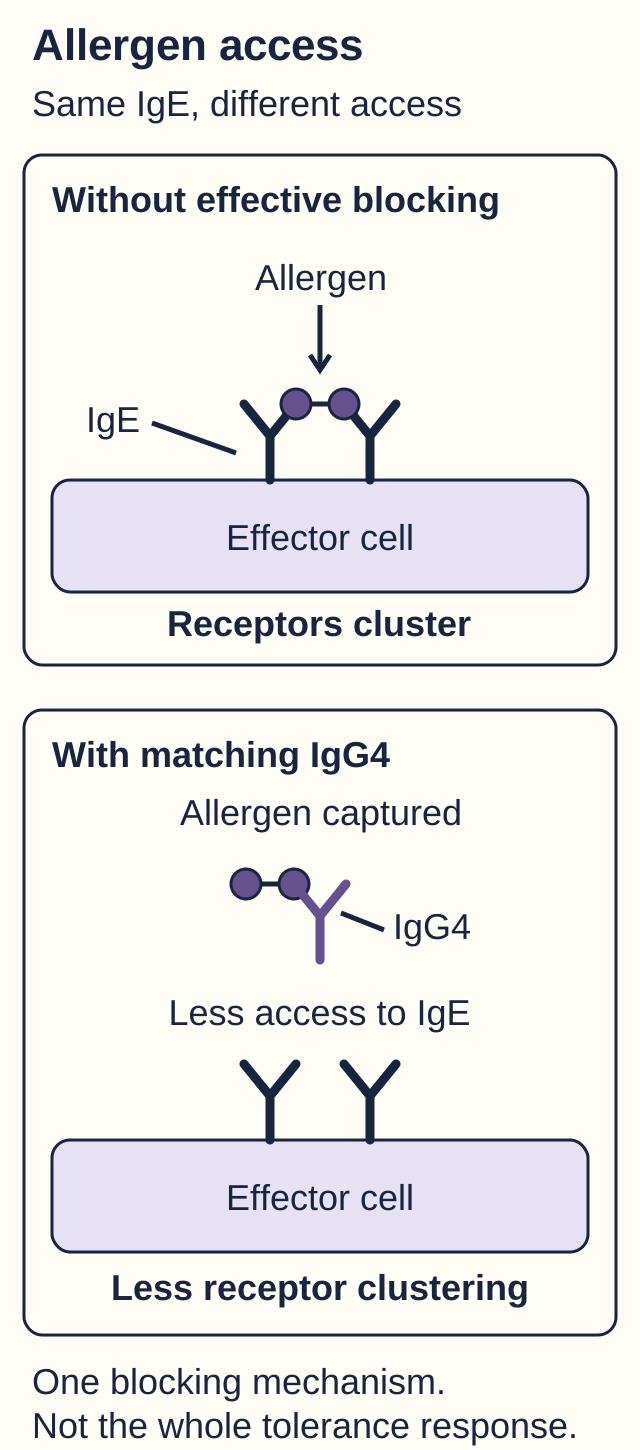
Allergen-specific IgG4 can bind the allergen before it bridges surface IgE. The target being intercepted is allergen, not the IgE receptor. Blocking does not require stripping existing IgE off a mast cell. Other antibody responses and cellular regulation also contribute, so IgG4 is one participant rather than a complete definition of tolerance. Its benefit depends on relevant specificity and effective interference with allergen-IgE binding, not simply on having more total IgG4. [3][4][8]
Use the adjacent binding diagram to compare two otherwise identical sensitized cells. Trace the allergen to either two IgE molecules or a matching blocking antibody. Then predict the outcome when the blocking antibody is absent. These drawings isolate one extracellular relationship; they are not patient-specific measurements.
Trace the allergen, not a change in IgE abundance. The paired states isolate extracellular interception; they do not imply complete protection or depict all cellular effects. [2][3][4]Prediction: the same sensitized cells receive allergen with inhibitory post-treatment serum. What changes first?
Less allergen is available to bridge surface IgE. The cell’s IgE count need not change.
Counterfactual: selective IgG4 depletion abolishes that serum effect. What has the comparison identified?
A contribution from the depleted IgG4 fraction, provided a sham depletion leaves the effect intact and other assay conditions are unchanged.
The complete comparison is: matching antibody captures allergen, less receptor clustering occurs, and activation falls. An unrelated IgG4 antibody is not a substitute for one that blocks this allergen. In a patient sensitized to both grass and cat, improved grass tolerance therefore does not demonstrate cat protection. Serum-transfer experiments test a soluble contribution; they do not establish that the patient’s mast cells or T cells have permanently changed. [3][4]
IgG4 has two antigen-binding arms. Exchange of antibody half-molecules, conventionally called Fab-arm exchange, can produce a molecule whose two arms recognize different antigens. It is then functionally monovalent for a particular antigen and less able to build large same-antigen networks. It has not lost an arm. IgG4 also has weak classical complement-activating activity compared with IgG1 or IgG3. Do not translate these properties into an assertion that IgG4 cannot bind antigen, cannot form any complex, or is harmless in every disease. Its Fc portion is not an IgE Fc portion and does not replace IgE at Fc epsilon RI. [2][10]
Transfer question: When symptoms improve but specific IgE is unchanged, ask whether allergen access and immune responsiveness changed, rather than declaring that the test disproves benefit.
Immune adaptation has overlapping components
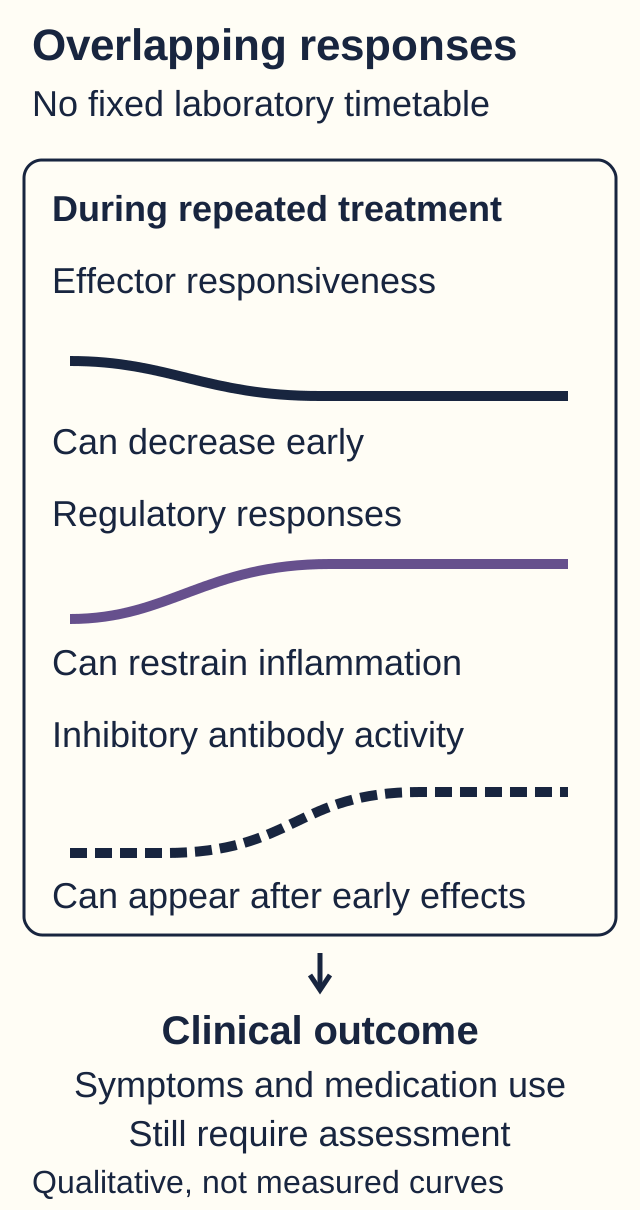
Does every patient pass through the same set of laboratory milestones on fixed dates? No. Allergen immunotherapy, abbreviated AIT, changes interacting cellular and antibody responses. Effector-cell responsiveness can decrease early, and regulatory activity may appear before substantial inhibitory antibody activity. The timing varies with allergen, route, dose schedule and measurement. A study of grass immunotherapy found early IL-10 induction and suppression of late skin responses before substantial IgG4 inhibitory activity. That observation does not set a universal calendar for all patients. [8][10][11]
Regulatory T-cell responses, including FoxP3-expressing populations and IL-10-producing cells, can restrain allergen-specific type 2 responses. IL-10 and TGF-beta participate in regulation; B-cell responses can favor blocking antibodies rather than escalating allergic activation. IL-10 is not produced exclusively by one T-cell subtype. Nasal-tissue studies support local as well as circulating regulatory changes. Reduced late inflammatory recruitment, including eosinophilic inflammation, complements a reduction in immediate effector activation. [4][10]
The response diagram shows overlapping tracks, not successive appointments. The antibody track can rise while IgE remains measurable. Allergen-specific IgE may initially rise, later stabilize, and eventually decline in some patients. None of those isolated patterns proves benefit or failure. Clinical improvement is not required to wait for a particular IgG4 peak, and a high peak is not a certificate of durable remission. [1][3][8]
Compare the tracks, then predict what an early tissue response can establish before serum inhibition is detectable. Vertical positions, slopes and spacing are not quantities or fixed onset times. These are conceptual directions, not clinical measurements or a universal sequence. [3][8][11]Prediction: a late skin response shrinks before inhibitory IgG4 activity becomes detectable. Must the measurement be wrong?
No. Regulatory and cellular effects can precede a measurable inhibitory antibody response.
Comparison: serum inhibition persists after stopping treatment, but symptoms return. Which conclusion is too strong?
It is too strong to conclude that a persisting antibody effect guarantees persisting clinical protection.
For a worked comparison, hold exposure and the symptom diary constant while considering three different questions: how reactive the effector cells are, how much allergen the serum can block, and how the patient feels and functions. A change in one does not mathematically determine the other two. Some findings are associated with response in groups but cannot determine an individual patient’s dose or stopping date. [3][8]
Apply it: An early IgE rise alongside better symptoms is not a reason by itself to accelerate, reduce or abandon treatment. Reassess the clinical course and safety. Conversely, worsening respiratory symptoms during treatment require assessment even when an antibody result appears favorable. [1]
Different entry sites require different safety plans
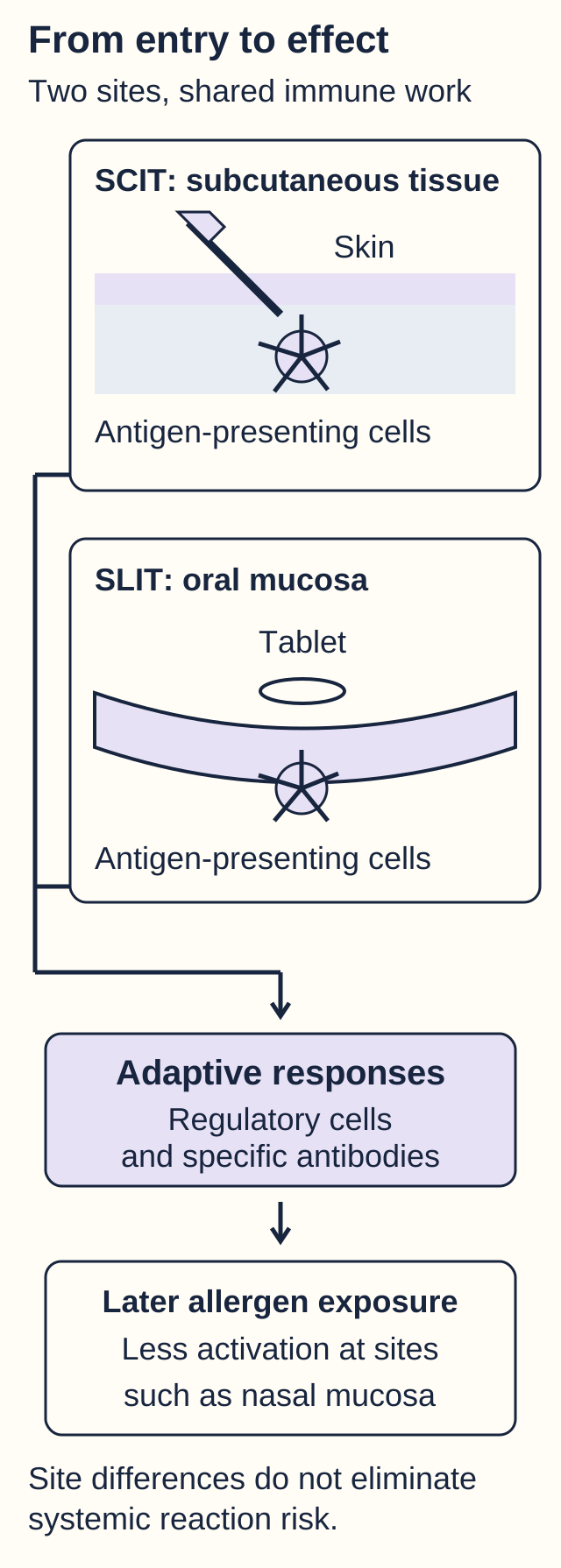
Why can an injection or an under-the-tongue tablet affect a reaction in the nose? Antigen handling at the entry site influences adaptive responses that extend beyond that site. In subcutaneous immunotherapy, or SCIT, injected allergen encounters cells in subcutaneous tissue and draining lymphoid pathways. Sublingual immunotherapy, or SLIT, exposes oral mucosal antigen-presenting cells before downstream immune responses develop. Neither route is a direct injection of protective IgG4. [10]
Trace both entry paths in the route diagram toward antigen presentation, regulatory responses and allergen-specific antibody production. Then follow the consequences to a later allergen exposure at an effector site. This is a simplified spatial model, not a claim that all immune events occur in one node. Not every SCIT formulation forms a long-lived depot, and oral antigen-presenting cells are not unconditionally tolerogenic. SLIT’s lower systemic-reaction risk should not be attributed to a guarantee of zero absorption or zero mast cells. [10]
Follow each entry site to antigen-presenting cells and downstream adaptive responses. Compare delivery to antigen-presenting cells across the two entry routes. Delivery is of allergen, not protective IgG4. [10]
Conventional SCIT generally uses frequent build-up injections over several months, often approximately 3 to 6 months, followed by less frequent maintenance injections, commonly every 2 to 4 weeks. Actual schedules, extract potency and dose adjustments are product- and patient-specific. Standardized and nonstandardized extracts are not interchangeable by volume. Clinicians must select relevant allergens and account for formulation compatibility rather than treat every positive skin test with one undifferentiated mixture. [1][10]
SCIT requires a setting prepared to treat anaphylaxis and observation for at least 30 minutes after each injection. Previous uneventful maintenance injections do not eliminate risk, and some systemic reactions begin later than the observation period. Provide an emergency plan rather than treating 30 minutes as the end of biological risk. [1]
SLIT tablets usually involve a supervised first dose followed by prescribed daily home treatment, with epinephrine availability and training. United States tablet approvals are allergen- and product-specific; custom liquid drops are not interchangeable with approved tablets. As one current example, the ODACTRA label covers house dust mite allergic rhinitis, with or without conjunctivitis, in ages 5 through 65 with relevant sensitization. It is not acute symptom rescue. Follow its own instructions: place under the tongue, avoid swallowing for at least one minute, and avoid food or drink for five minutes. The first dose requires at least 30 minutes of observation. [1][5]
Trace task: after a home SLIT dose, progressive throat tightness replaces brief oral itching. Does the home route make this a local nuisance?
No. Progressive airway symptoms require the prescribed emergency response, not reassurance based on the route.
Brief mild mouth or ear itching can occur with SLIT. Progressive swelling, breathing difficulty or faintness must be treated differently. Persistent dysphagia or chest pain warrants stopping the tablet and evaluating for eosinophilic esophagitis. The ODACTRA label contraindicates a history of that disorder, severe uncontrolled or unstable asthma, and specified severe allergic-reaction histories. Oral wounds or surgery require a treatment interruption until healing; after missed doses, contact the prescriber rather than improvise extra doses. These are product instructions, not a universal dosing recipe for every SLIT preparation. [5]
Apply it: Choose a route using the relevant allergen, evidence for that product, contraindications, adherence and the patient’s ability to follow its safety plan. Convenience alone does not establish eligibility.
Measure benefit before deciding duration
A rising IgG4 result is not the same outcome as fewer troublesome allergy days. Follow symptoms, rescue-medication needs, sleep, activities and quality of life; assess asthma exacerbations when relevant. Compare reasonably similar exposure periods and check adherence. A mild pollen season or increased medication use can improve a symptom diary without proving a treatment effect. [1][3]
Clinical benefit may emerge over months or during a treated season. There is no universal month at which every patient reaches maximum benefit. If improvement is absent after an adequate treatment opportunity, reassess the diagnosis, relevant allergen exposure, dose, adherence and duration. Do not continue indefinitely because IgG4 rose, and do not declare failure simply because occasional medication is still needed. [1][10]
Comparison: symptoms and medication use fall during similar pollen exposure, but skin testing remains positive. Which observation guides benefit assessment?
The symptom and medication improvement is clinically meaningful; persistent sensitization does not negate it.
A successful course is usually discussed in years, not weeks. Current inhalant guidance recommends at least three years for patients benefiting from AIT, with maintenance treatment and total duration individualized. Three to five years is a common clinical discussion range, not a guarantee of cure or a mandatory stopping date. The literature uses different treatment schedules and durations; do not convert this into a universal requirement for exactly three additional years after an arbitrary laboratory milestone. [1][10]
Distinguish protection during treatment from benefit that persists after treatment stops. Some sufficiently long courses produce sustained benefit, but relapse remains possible. In the GRASS trial, two years of grass SLIT did not establish a sustained nasal-challenge benefit one year after withdrawal. This supports caution about short courses; it does not predict the outcome of every patient or every product. [7]
Apply it: A person doing well after four years can discuss stopping despite a positive skin test. Review clinical response, treatment burden, allergen, relapse concerns and preferences, with a follow-up plan. No routine skin test, IgE concentration or IgG4 threshold can certify permanent tolerance. Repeat sensitization testing is reserved for a clinical reason, such as changed exposures or loss of control, rather than routine proof of success. [1][3]
Treat clinically relevant allergy, not a test result
Which allergen deserves treatment when several tests are positive? A positive skin test or specific IgE demonstrates sensitization. The history must connect that sensitization to symptoms during relevant exposure. For inhalant AIT, consider allergic rhinitis with or without appropriately controlled allergic asthma when medication and avoidance leave important symptoms, or when the patient prefers immunomodulatory treatment after an informed discussion. There is no requirement to fail every available drug before referral. [1]
Compare a patient whose symptoms reliably appear during grass season with an asymptomatic person who has the same positive grass test. The test is identical, but the indication is not. Likewise, a positive mite test should not automatically add mite extract when the history instead identifies a different driver. For polysensitized patients, a limited set of clinically relevant allergens may be appropriate. [1]
Selection task: spring symptoms match grass exposure; cat contact causes no symptoms despite a positive cat test. Which result requires more clinical justification before inclusion?
The cat result. Sensitization alone does not establish that treating cat allergy will improve this patient’s burden.
Discuss the likely benefit, burdens of repeated dosing, adverse reactions, cost and ability to attend visits or follow home instructions. Mild infrequent symptoms without meaningful impairment do not automatically justify years of treatment. Irritant-triggered nasal symptoms without a matching sensitization history need diagnostic reassessment, not empiric injection of a panel of allergens. [1][10]
Keep other allergic diseases in their own pathways. A systemic sting reaction with relevant venom sensitization can justify venom immunotherapy even without rhinitis or failure of nasal medications. A large local sting reaction alone is a different risk profile. Food allergy assessment and any food immunotherapy require separate specialist protocols; a food-triggered episode is not an indication to substitute routine respiratory SCIT. [9][10]
Apply it: First establish the disease and relevant exposure, then assess whether the patient can safely receive the specific treatment. A good indication does not override poor asthma control or a product contraindication.
Recheck safety at the dose, not just at enrollment
A patient was a good candidate last month. Is today’s injection automatically appropriate? No. Assess current asthma symptoms before SCIT dosing, with objective airflow assessment when indicated. No isolated FEV1 percentage substitutes for control status. New nocturnal symptoms, frequent rescue use or worsening airflow should prompt withholding the dose, assessment and restoration of control. Do not merely administer a smaller dose during an active loss of control. Severe or uncontrolled asthma also conflicts with SLIT tablet labeling. [1][5]
Do not initiate inhalant AIT during pregnancy. A patient already tolerating effective maintenance treatment may continue after an individualized discussion, without dose escalation. A pregnancy discovered during early, subtherapeutic build-up requires reassessment rather than an automatic escalation schedule. Nonselective beta-blockers can complicate epinephrine treatment; coordinate with the prescribing clinician rather than abruptly stopping a cardiovascular drug or assuming SLIT eliminates the issue. Cardiovascular disease, systemic immunosuppression, malignancy and autoimmune disease require assessment of active disease, treatment and risks, not a universal interchangeable exclusion list. Active malignancy or uncontrolled systemic autoimmune disease may preclude AIT under applicable guidance; a remote diagnosis is not equivalent to active disease. Ability to tolerate the treatment’s emergency plan is part of candidacy. [1][10]
Contrast an itchy swelling confined to an injection site with generalized hives plus wheeze. Local reactions do not routinely require reduction or interruption of otherwise appropriate SCIT escalation or maintenance. Review discomfort, frequent large reactions, dosing errors and any systemic features individually. A previous isolated local reaction is not a reliable forecast of the next systemic reaction. The assessment changes immediately when symptoms extend to the airway, circulation or multiple organ systems. [1]
Safety comparison: yesterday’s arm swelling has resolved, but today the patient reports nightly wheeze and frequent rescue use. Which finding changes today’s dose decision?
The loss of asthma control. Withhold the injection and assess the respiratory deterioration, irrespective of the resolved local swelling.
Anaphylaxis requires prompt intramuscular epinephrine. Acute bronchospasm, laryngeal symptoms or hypotension after a likely allergen can establish the emergency without hives. Do not wait for a rash or a laboratory test. Give epinephrine into the anterolateral thigh and activate emergency support. A healthcare-professional dose is 0.01 mg/kg using 1 mg/mL solution, with a maximum of 0.5 mg under WAO guidance; adult emergency doses commonly use 0.3 to 0.5 mg. Repeat after 5 to 15 minutes if needed. Use age- and weight-appropriate local protocols and devices. [6]
Support airway and breathing, provide oxygen when indicated, establish intravenous access and give crystalloid for circulatory compromise without delaying epinephrine. Most patients with circulatory symptoms should be supine; position for respiratory distress or pregnancy as clinically appropriate and do not let an unstable patient stand. Inhaled bronchodilators can supplement treatment for wheeze. Antihistamines address skin symptoms but not shock or dangerous airway compromise; corticosteroids do not replace immediate epinephrine. Routine intravenous epinephrine boluses are not the initial treatment. Severe or recurrent reactions need monitored reassessment and observation for recurrence. [6]
Emergency prediction: wheeze and hypotension develop after a maintenance injection, but the skin is clear. What must not be delayed?
Intramuscular epinephrine and emergency support. Anaphylaxis does not require visible skin involvement.
Apply it: Identify the exposure, classify the current reaction or asthma status, and act on the immediate risk. A favorable IgG4 result, a home treatment route or years of previously tolerated injections cannot overrule a new dangerous clinical finding.
Apply the lesson
Case 1
Show answer and explanations for case 1
A. Decreased production of IgE by donor B cells (Why this does not fit)
Activated B cells and plasma cells produce antibodies. The assay uses the same already sensitized basophils, not antibody-producing cultures. Distinguish a soluble blocking effect from altered antibody synthesis.
Reasoning steps for option A
Which cells produce IgE?
Activated B cells and plasma cells produce antibodies.
Can altered antibody production explain this immediate assay?
The assay uses the same already sensitized basophils, not antibody-producing cultures.
Why does changing serum not demonstrate reduced donor IgE synthesis?
The donor basophils are already sensitized and their surface IgE is unchanged; inhibition transfers with serum rather than a change in antibody production.
B. Reduced allergen access to receptor-bound IgE (Best answer)
It must bring suitable receptor-bound IgE molecules together. Serum antibodies can intercept allergen before it bridges the unchanged surface IgE. Clinical benefit can accompany unchanged IgE when allergen access is reduced.
Reasoning steps for option B
What must allergen do to activate a sensitized basophil?
It must bring suitable receptor-bound IgE molecules together.
What can change when serum changes but cell-bound IgE does not?
Serum antibodies can intercept allergen before it bridges the unchanged surface IgE.
How can post-SCIT serum reduce grass activation while surface IgE persists?
Blocking serum antibodies can reduce grass allergen access to receptor-bound IgE without removing that IgE.
C. Decreased survival of the sensitized basophils (Why this does not fit)
Fewer viable cells can reduce the number available to respond. Viability is unchanged, while the serum source determines the activation difference. Check viability before attributing a reduced assay signal to tolerance.
Reasoning steps for option C
How could cell loss lower an activation signal?
Fewer viable cells can reduce the number available to respond.
What finding excludes that explanation here?
Viability is unchanged, while the serum source determines the activation difference.
Why is lower basophil survival inconsistent with the serum-transfer result?
Viability is unchanged between aliquots, so the lower activation cannot be attributed to loss of viable donor basophils.
D. Reduced Fc epsilon RI abundance on donor cells (Why this does not fit)
Fewer functional receptors can reduce receptor clustering and signaling. The same sensitized cells retain their surface IgE; the demonstrated alteration is in the added serum. Localize an effect to the component changed by the experiment.
Reasoning steps for option D
How can fewer IgE receptors affect activation?
Fewer functional receptors can reduce receptor clustering and signaling.
Is that cellular alteration shown by this comparison?
The same sensitized cells retain their surface IgE; the demonstrated alteration is in the added serum.
Which controlled features favor serum blocking over reduced Fc epsilon RI abundance?
The same sensitized donor cells retain their surface IgE while only serum source changes; receptor downregulation is not the demonstrated alteration.
Takeaway: Clinical benefit can accompany unchanged IgE when allergen access is reduced.
A. Total IgG4 concentration determines inhibition regardless of specificity (Why this does not fit)
Increasing antibody abundance can increase antigen binding when the antibody has suitable specificity. An equal quantity of unrelated IgG4 fails to restore inhibition. Relevant binding specificity matters more than a total subclass concentration.
Reasoning steps for option A
Why could concentration appear important?
Increasing antibody abundance can increase antigen binding when the antibody has suitable specificity.
What does the unrelated add-back show?
An equal quantity of unrelated IgG4 fails to restore inhibition.
How does unrelated IgG4 add-back challenge a concentration-only explanation?
An equal amount of unrelated IgG4 fails to restore inhibition, showing that the relevant grass-binding specificity matters.
B. Complement activation is necessary for the inhibitory effect (Why this does not fit)
Some antibody complexes activate classical complement and alter inflammatory responses. Inhibition returns with matching IgG4 despite complement being inactive in every condition. An effect that persists without complement does not require complement activation.
Reasoning steps for option B
What can complement do downstream of antibodies?
Some antibody complexes activate classical complement and alter inflammatory responses.
Can that pathway explain these aliquots?
Inhibition returns with matching IgG4 despite complement being inactive in every condition.
What does restored inhibition with inactive complement imply about complement necessity?
Grass-binding IgG4 restores inhibition despite inactive complement, so complement activation is not required for this assay effect.
C. IgG4 depletion permanently desensitizes the donor cells (Why this does not fit)
The cells themselves would become less responsive under comparable challenge conditions. Activation increased after depletion and fell again after matching antibody add-back. A reversible serum-dependent effect is not proof of permanent cellular desensitization.
Reasoning steps for option C
What would intrinsic desensitization imply?
The cells themselves would become less responsive under comparable challenge conditions.
What happened after depletion?
Activation increased after depletion and fell again after matching antibody add-back.
Why does the depletion and rescue sequence argue against permanent donor-cell desensitization?
Activation returns after IgG4 depletion and falls after matching add-back, identifying a reversible serum-dependent effect rather than permanent cellular suppression.
D. Matching IgG4 contributes causally to inhibition in this assay (Best answer)
It checks whether the processing step itself accounts for loss of inhibition. Loss and restoration of inhibition identify a contribution from the relevant IgG4 fraction. A controlled assay can establish a contribution without proving that one pathway explains all clinical tolerance.
Reasoning steps for option D
Why is the sham-depletion control important?
It checks whether the processing step itself accounts for loss of inhibition.
What do specific depletion and selective add-back establish?
Loss and restoration of inhibition identify a contribution from the relevant IgG4 fraction.
How far can the grass-specific IgG4 rescue establish causation?
It establishes that matching IgG4 contributes to inhibition in this controlled assay, not that IgG4 alone explains all clinical tolerance.
Takeaway: A controlled assay can establish a contribution without proving that one pathway explains all clinical tolerance.
A. Adding antibodies that block the relevant cat allergen-IgE interaction (Best answer)
Its binding properties must interfere with that allergen interacting with the relevant IgE. The serum inhibits grass challenge but leaves the cat challenge and cat symptoms unaffected. Do not generalize protection against one allergen to an unrelated allergen.
Reasoning steps for option A
What determines whether a blocking antibody intercepts an allergen?
Its binding properties must interfere with that allergen interacting with the relevant IgE.
Which specificity is missing from the observed protection?
The serum inhibits grass challenge but leaves the cat challenge and cat symptoms unaffected.
Why must the added antibodies block cat rather than merely strengthen grass protection?
Cat-driven activation persists despite grass inhibition; extending protection requires interference with the relevant cat allergen-IgE interaction.
B. Increasing grass-specific IgG4 without changing cat binding (Why this does not fit)
It can capture additional matching grass allergen. More grass binding does not supply the missing cat-allergen interference. More antibody is useful only for an interaction it can affect.
Reasoning steps for option B
Why might more grass-specific antibody improve one assay?
It can capture additional matching grass allergen.
Would that correct the demonstrated gap?
More grass binding does not supply the missing cat-allergen interference.
Why does raising grass-specific IgG4 leave the cat assay unprotected?
Without changing cat binding, additional grass-specific antibody cannot intercept the cat allergen interaction that still activates the cells.
C. Increasing IL-5 during the immediate cat challenge (Why this does not fit)
IL-5 supports eosinophilic responses. It does not provide cat-specific allergen interception and would favor allergic inflammation. Distinguish an inflammatory cytokine effect from antigen-specific blocking.
Reasoning steps for option C
Which inflammatory population does IL-5 support?
IL-5 supports eosinophilic responses.
Would this reproduce the transferred serum effect?
It does not provide cat-specific allergen interception and would favor allergic inflammation.
Why would increasing IL-5 not reproduce cat-specific serum protection?
IL-5 supports eosinophilic inflammation rather than supplying antibodies that block cat allergen access to IgE.
D. Increasing the number of IgE receptors on donor cells (Why this does not fit)
More available sensitizing receptors can support allergen-induced activation. It supplies no cat-specific inhibition and can increase the opportunity for activation. Changing effector sensitivity is not the same as adding protective specificity.
Reasoning steps for option D
How could additional receptor-bound IgE affect challenge sensitivity?
More available sensitizing receptors can support allergen-induced activation.
Does that substitute for missing cat-blocking activity?
It supplies no cat-specific inhibition and can increase the opportunity for activation.
Why is adding IgE receptors not equivalent to adding cat-blocking antibodies?
More sensitizing receptors can increase activation opportunities but do not supply the missing cat-specific inhibitory interaction.
Takeaway: Do not generalize protection against one allergen to an unrelated allergen.
A. Loss of antigen A binding; greater classical complement activation (Why this does not fit)
It would reduce binding to antigen A. The intact product retains one A-binding arm; exchange does not create an IgG1-like complement function. Bispecificity does not mean absence of antigen binding.
Reasoning steps for option A
What would loss of the A-binding arm do?
It would reduce binding to antigen A.
Was that arm lost in the stated product?
The intact product retains one A-binding arm; exchange does not create an IgG1-like complement function.
What retained feature contradicts loss of A binding after half-molecule exchange?
Each intact exchanged antibody still has an A-specific arm; bispecificity does not eliminate A recognition or confer greater classical complement activity.
B. Preserved bivalent A binding; greater same-antigen network formation (Why this does not fit)
It needs two arms capable of binding A under the assay conditions. Only one, so bivalent A binding and stronger A-only networks do not follow. Count relevant specificities rather than total physical arms.
Reasoning steps for option B
When can one antibody bridge two copies of A?
It needs two arms capable of binding A under the assay conditions.
How many A-specific arms does the exchanged product have?
Only one, so bivalent A binding and stronger A-only networks do not follow.
Why do two physical arms not ensure bivalent A binding in the A-only assay?
Only one arm recognizes A and the other recognizes B, so the molecule cannot use both arms to bridge copies of A.
C. Preserved A binding; reduced same-antigen network formation (Best answer)
Yes, one A-specific arm retains antigen recognition. Bridging two A molecules is reduced because the other arm recognizes B. Functionally monovalent for A does not mean physically one-armed.
Reasoning steps for option C
Can one matching arm still recognize A?
Yes, one A-specific arm retains antigen recognition.
What additional task becomes less efficient?
Bridging two A molecules is reduced because the other arm recognizes B.
How does an intact A/B antibody retain A recognition but form fewer A-only networks?
One A-binding arm preserves recognition, while the B-binding arm cannot bridge a second A molecule in this system.
D. Loss of both binding arms; reduced mast-cell IgE receptor expression (Why this does not fit)
Fragmentation could alter binding architecture and Fc-associated functions. The antibody remains intact and the described event is exchange, not a change in mast-cell receptors. Infer the effect of the observed structural change, not an unmeasured cellular change.
Reasoning steps for option D
What could antibody fragmentation change?
Fragmentation could alter binding architecture and Fc-associated functions.
Does the observation show fragmentation or receptor regulation?
The antibody remains intact and the described event is exchange, not a change in mast-cell receptors.
Why does the observed exchange not support loss of both arms or fewer mast-cell receptors?
The products remain intact with A- and B-binding arms; the experiment describes antibody exchange, not mast-cell receptor regulation.
Takeaway: Functionally monovalent for A does not mean physically one-armed.
A. The early skin response proves that all allergen-specific IgE has disappeared (Why this does not fit)
Less functional IgE can reduce immediate activation in some settings. No; the observed early changes are late swelling and IL-10 activity, before serum inhibition. A clinical or tissue response does not establish unmeasured elimination of IgE.
Reasoning steps for option A
How could less IgE affect a skin challenge?
Less functional IgE can reduce immediate activation in some settings.
Was disappearance of IgE measured here?
No; the observed early changes are late swelling and IL-10 activity, before serum inhibition.
Why does reduced week-4 swelling not prove disappearance of grass-specific IgE?
The early observations concern late swelling and IL-10 production, not measured elimination of IgE.
B. Regulatory effects can precede a detectable inhibitory antibody response (Best answer)
It can restrain allergen-specific cellular inflammatory responses. Late skin swelling is reduced before measurable IgG4 inhibitory activity appears. AIT has overlapping effects rather than a compulsory antibody-first sequence.
Reasoning steps for option B
What can IL-10-associated regulation influence?
It can restrain allergen-specific cellular inflammatory responses.
What timing relationship is supplied?
Late skin swelling is reduced before measurable IgG4 inhibitory activity appears.
What does the sequence of week-4 IL-10 and later IgG4 inhibition show?
Regulatory and tissue effects can appear before detectable serum inhibitory IgG4 activity; the response need not follow an antibody-first sequence.
C. IgG4 assay negativity establishes absence of any treatment effect (Why this does not fit)
It assesses detectable inhibitory antibody activity under its assay conditions. No; reduced late swelling and increased IL-10 describe effects outside that single serum measurement. The absence of one measured component does not exclude another observed effect.
Reasoning steps for option C
Which component does the serum assay assess?
It assesses detectable inhibitory antibody activity under its assay conditions.
Does that cover the observed tissue and cytokine changes?
No; reduced late swelling and increased IL-10 describe effects outside that single serum measurement.
Which week-4 findings contradict the claim that a negative IgG4 assay means no effect?
Late swelling is reduced and allergen-stimulated IL-10 production is increased despite no detectable inhibitory IgG4 activity at that visit.
D. Reduced allergen delivery explains the smaller late skin response (Why this does not fit)
Less delivered allergen can provoke a smaller response. The challenge technique and dose are standardized, while regulatory activity changes. Use controlled exposure conditions when interpreting immune-response timing.
Reasoning steps for option D
How could a smaller challenge dose affect swelling?
Less delivered allergen can provoke a smaller response.
What constrains that explanation in this study?
The challenge technique and dose are standardized, while regulatory activity changes.
Why does standardized challenge weaken reduced allergen delivery as the explanation?
The challenge dose and technique are controlled, so smaller late swelling is interpreted alongside changing regulatory activity rather than a smaller exposure.
Takeaway: AIT has overlapping effects rather than a compulsory antibody-first sequence.
A. Reduced IL-5 activity; reduced late inflammation without requiring IgE loss (Best answer)
IL-5 supports their production, survival and activation. No; regulation of late inflammatory recruitment can change while surface IgE remains. Separate late cellular inflammation from the amount of sensitizing IgE.
Reasoning steps for option A
Which cytokine strongly supports eosinophils?
IL-5 supports their production, survival and activation.
Must reduced eosinophilic inflammation require less surface IgE?
No; regulation of late inflammatory recruitment can change while surface IgE remains.
How can reduced IL-5 explain fewer nasal eosinophils without IgE loss?
Less IL-5 support can reduce eosinophilic late inflammation while the measured surface-bound IgE remains unchanged.
B. Reduced IL-4 activity; reduced new IgE class switching (Why this does not fit)
IL-4 supports type 2 differentiation and IgE class switching. No; the decreasing eosinophil-supporting signal points to IL-5, not to new antibody switching. Identify the affected cell function before selecting its cytokine.
Reasoning steps for option B
Which allergic function does IL-4 support?
IL-4 supports type 2 differentiation and IgE class switching.
Is that the eosinophil-survival signal specified in the question?
No; the decreasing eosinophil-supporting signal points to IL-5, not to new antibody switching.
Why is IL-4-dependent class switching not the specified survival change?
The measured function is eosinophil survival, which points to IL-5 rather than IL-4 support of new IgE class switching.
C. Increased IL-10 activity; reduced type 2 inflammatory signaling (Why this does not fit)
IL-10 can contribute to suppression of allergen-specific inflammatory responses. No; increased regulation is plausible in AIT but the measured decreasing survival signal is IL-5. Distinguish a regulatory influence from the specific downstream cytokine measured.
Reasoning steps for option C
Why is IL-10 relevant to tolerance?
IL-10 can contribute to suppression of allergen-specific inflammatory responses.
Is that the decreasing eosinophil-supporting cytokine specified here?
No; increased regulation is plausible in AIT but the measured decreasing survival signal is IL-5.
Why does plausible IL-10 regulation not identify the decreasing cytokine here?
IL-10 can suppress inflammatory responses, but the measured decrease is in an eosinophil-supporting signal, identifying IL-5.
D. Reduced IL-13 activity; reduced airway mucus production (Why this does not fit)
IL-13 can contribute to mucus production and type 2 airway responses. The described survival function points most directly to IL-5, not to an inference about mucus production. Select the cytokine using the affected cell function, while keeping existing IgE separate.
Reasoning steps for option D
What is an airway effect of IL-13?
IL-13 can contribute to mucus production and type 2 airway responses.
Does that identify the principal eosinophil-survival signal asked for?
The described survival function points most directly to IL-5, not to an inference about mucus production.
Why is an IL-13 mucus effect less fitting than an IL-5 survival effect?
The findings specify fewer eosinophils and reduced survival support, not reduced mucus production; unchanged IgE does not alter that discriminator.
Takeaway: Separate late cellular inflammation from the amount of sensitizing IgE.
A. Increase SCIT until the specific IgG4 concentration doubles again (Why this does not fit)
It can document an immunologic response to exposure and treatment. No; exposure and medication changed concurrently, and no validated individual IgG4 target is supplied. Do not titrate AIT to an arbitrary antibody concentration.
Reasoning steps for option A
Why might IgG4 be measured in a study?
It can document an immunologic response to exposure and treatment.
Does its rise isolate the cause of improved symptoms?
No; exposure and medication changed concurrently, and no validated individual IgG4 target is supplied.
Why would doubling IgG4 again fail to resolve this patient's response attribution?
An arbitrary IgG4 target cannot separate SCIT benefit from the added nasal corticosteroid and lower pollen exposure.
B. Classify the lower symptom score as proof of a durable SCIT effect (Why this does not fit)
The patient reports fewer symptoms during the observed period. Two other symptom-reducing factors changed, and the patient has not been assessed after withdrawal. Observed improvement, treatment attribution and durability are different questions.
Reasoning steps for option B
What does the symptom score establish?
The patient reports fewer symptoms during the observed period.
What prevents attributing durability and causation to SCIT?
Two other symptom-reducing factors changed, and the patient has not been assessed after withdrawal.
Why does the fall from 8 to 3 not establish durable SCIT benefit?
Medication and pollen exposure also changed, and no post-withdrawal assessment establishes durability.
C. Stop SCIT because a response appearing within a year is too early (Why this does not fit)
AIT can produce clinical improvement during the first year. No; the uncertainty arises from simultaneous changes, not an impossible response time. Investigate confounding rather than impose an unsupported minimum time to benefit.
Reasoning steps for option C
When can benefit become apparent?
AIT can produce clinical improvement during the first year.
Does the timing justify excluding a treatment contribution?
No; the uncertainty arises from simultaneous changes, not an impossible response time.
Why is stopping for an allegedly too-early response unjustified at one year?
AIT benefit can emerge within the first year; the uncertainty here comes from concurrent medication and exposure changes, not impossible timing.
D. Review symptoms and medication use during comparable allergen exposure (Best answer)
Lower exposure and added effective medication can each improve symptoms. Follow symptoms and medication requirements alongside comparable exposure and adherence. Clinical benefit assessment must account for exposure and concurrent treatment.
Reasoning steps for option D
What other changes can reduce a symptom score?
Lower exposure and added effective medication can each improve symptoms.
What comparison would better assess a SCIT contribution?
Follow symptoms and medication requirements alongside comparable exposure and adherence.
What must a comparable-exposure review track to assess SCIT benefit here?
Symptoms and medication use should be followed under comparable pollen exposure, accounting for the added nasal corticosteroid and adherence.
Takeaway: Clinical benefit assessment must account for exposure and concurrent treatment.
A. Sample A establishes that its donor can safely discontinue treatment (Why this does not fit)
It would need validated individual prediction of sustained clinical benefit after withdrawal. It establishes a functional difference, not the donor-specific future course. Do not turn a research assay into an unvalidated stopping rule.
Reasoning steps for option A
What would a stopping biomarker need to predict?
It would need validated individual prediction of sustained clinical benefit after withdrawal.
Does this single assay provide that validation?
It establishes a functional difference, not the donor-specific future course.
Why does sample A not establish a safe stopping point for its donor?
Greater inhibition in a research assay is not validated individual prediction of sustained benefit after withdrawal.
B. Equal IgG4 concentrations establish equal inhibitory capacity (Why this does not fit)
It quantifies antibody recognized by that assay, not every functional binding property. The matched binding assay shows different inhibition despite equal measured concentrations. Quantity and function are distinct antibody measurements.
Reasoning steps for option B
What does the concentration assay quantify?
It quantifies antibody recognized by that assay, not every functional binding property.
What directly contradicts equal inhibitory function?
The matched binding assay shows different inhibition despite equal measured concentrations.
Which A-versus-B result separates IgG4 quantity from inhibitory function?
Equal measured grass-specific IgG4 concentrations coexist with greater inhibition by A in the matched CD23-bearing cell assay.
C. Sample A has greater inhibitory function in the tested system (Best answer)
It tests interference with IgE-facilitated allergen binding under defined conditions. A inhibits more in this system, but different exposure histories prevent a direct clinical efficacy ranking. State the demonstrated functional effect without promising an individual clinical outcome.
Reasoning steps for option C
What is measured by the CD23-bearing cell assay?
It tests interference with IgE-facilitated allergen binding under defined conditions.
How should its scope be limited?
A inhibits more in this system, but different exposure histories prevent a direct clinical efficacy ranking.
Why should the conclusion about sample A remain limited to the tested system?
A blocks IgE-facilitated binding more strongly under matched laboratory conditions, but differing donor exposures prevent a direct clinical efficacy ranking.
D. Sample B indicates that its donor needs a higher maintenance dose (Why this does not fit)
Clinical failure, poor adherence or an inadequate regimen can prompt reassessment. No; the donor improves and the assay is not a validated individual dose-selection test. A lower research signal is not by itself a prescription to increase exposure.
Reasoning steps for option D
When would a dose reassessment be reasonable?
Clinical failure, poor adherence or an inadequate regimen can prompt reassessment.
Does lower inhibition alone establish a dose deficiency?
No; the donor improves and the assay is not a validated individual dose-selection test.
Why does sample B's lower inhibition not mandate a higher maintenance dose?
Its donor reports improvement, and this research assay has no validated individual dose-selection rule.
Takeaway: State the demonstrated functional effect without promising an individual clinical outcome.
A. Offer a shared decision about ragweed-directed immunotherapy (Best answer)
The seasonal exposure pattern and sensitization agree with the symptoms. Yes; symptoms remain important despite treatment and no stated safety barrier prevents consideration. AIT candidacy combines clinical relevance, burden or preference, and treatment safety.
Reasoning steps for option A
What makes ragweed clinically relevant?
The seasonal exposure pattern and sensitization agree with the symptoms.
Do persistent burden and the safety assessment support discussion?
Yes; symptoms remain important despite treatment and no stated safety barrier prevents consideration.
Which combined findings support discussing ragweed AIT now?
Exposure-linked symptoms, matching IgE and substantial residual burden support the indication; controlled asthma and emergency readiness support safe consideration.
B. Add all positive screening allergens to the initial injection mixture (Why this does not fit)
Several independently relevant exposures can warrant a tailored selection. Only ragweed is linked to the described symptom pattern; extra screening results are not supplied. Prescribe for supported clinical relevance, not an undifferentiated test panel.
Reasoning steps for option B
When can several allergens deserve treatment?
Several independently relevant exposures can warrant a tailored selection.
What has actually been established here?
Only ragweed is linked to the described symptom pattern; extra screening results are not supplied.
Why is ragweed supported while a broad screening-based mixture is not?
Only ragweed has an established matching exposure-symptom pattern; positive screening results alone would not establish relevance of additional allergens.
C. Require failure of every oral and nasal drug before referral (Why this does not fit)
It helps define symptom burden, adherence and alternatives. No; substantial residual symptoms with relevant sensitization already justify discussing AIT. Avoid inventing an exhaustive medication-failure requirement.
Reasoning steps for option C
Why is medication history considered?
It helps define symptom burden, adherence and alternatives.
Why need this patient not fail every oral and nasal medication before referral?
Substantial ragweed-related symptoms persist despite appropriate nasal corticosteroid use and exposure reduction, already supporting an AIT discussion.
D. Delay immunotherapy until asthma control deteriorates (Why this does not fit)
Poor control increases the risk of severe reactions during AIT. It would create a safety barrier rather than improve candidacy. Consider AIT when indicated and safe, not after asthma becomes uncontrolled.
Reasoning steps for option D
Why does asthma status matter?
Poor control increases the risk of severe reactions during AIT.
Would deterioration strengthen readiness to start?
It would create a safety barrier rather than improve candidacy.
Why would waiting for asthma deterioration worsen readiness for ragweed AIT?
Current asthma control favors safe consideration, whereas deterioration would introduce a safety barrier rather than strengthen the indication.
Takeaway: AIT candidacy combines clinical relevance, burden or preference, and treatment safety.
A. Treat cat because exposure occurs every day (Why this does not fit)
Frequent exposure matters when it causes clinically relevant symptoms. Daily cat contact is asymptomatic, whereas the grass season consistently produces symptoms. Exposure frequency alone does not establish treatment relevance.
Reasoning steps for option A
How can frequent exposure matter?
Frequent exposure matters when it causes clinically relevant symptoms.
What does this history say about cat contact?
Daily cat contact is asymptomatic, whereas the grass season consistently produces symptoms.
Why does daily cat contact not outweigh the grass-season diary?
Cat contact is asymptomatic, while disabling symptoms recur during grass season even away from home; frequency alone does not establish cat relevance.
B. Target grass while reassessing other allergens only if the history changes (Best answer)
Symptoms recur during grass season across different locations. Cat and mite exposure lack corresponding symptoms in the supplied history. A positive test can remain outside the prescription when clinical relevance is absent.
Reasoning steps for option B
What supports grass as the driver?
Symptoms recur during grass season across different locations.
What limits the role of the other positive tests?
Cat and mite exposure lack corresponding symptoms in the supplied history.
Why can cat and mite tests remain outside the initial grass prescription?
The diary supports grass as the symptom driver and shows no corresponding cat or mite symptoms; those allergens can be reassessed if the history changes.
C. Treat mite because indoor exposure lasts throughout the year (Why this does not fit)
Mite exposure can contribute to year-round symptoms in sensitized patients. Winter and bed-making are asymptomatic; the disabling pattern is seasonal. Match allergen selection to the demonstrated exposure-response pattern.
Reasoning steps for option C
Why might mite be considered in perennial rhinitis?
Mite exposure can contribute to year-round symptoms in sensitized patients.
Does the observed temporal pattern fit that assumption?
Winter and bed-making are asymptomatic; the disabling pattern is seasonal.
What makes perennial mite exposure a poor match for this diary?
Winter and bed-making are asymptomatic, whereas the disabling pattern is confined to grass season across locations.
D. Treat grass, cat and mite in equal amounts (Why this does not fit)
Several positive tests can suggest several possible sensitivities. No; the history supports one major driver rather than three equivalent clinical allergies. Do not equate the number of positive tests with the number of allergens requiring AIT.
Reasoning steps for option D
Why might a multi-allergen prescription appear appealing?
Several positive tests can suggest several possible sensitivities.
Does equal test positivity establish equal benefit from treatment?
No; the history supports one major driver rather than three equivalent clinical allergies.
Why do three positive tests not justify equal grass, cat and mite treatment?
Only grass has demonstrated clinical relevance; test positivity alone does not establish equivalent benefit from all three allergens.
Takeaway: A positive test can remain outside the prescription when clinical relevance is absent.
A. Begin empiric injections containing the common regional pollens (Why this does not fit)
A relevant pollen exposure pattern and evidence of sensitization would support it. Neither a matching seasonal history nor sensitization is demonstrated. Do not use empiric AIT to replace diagnostic assessment.
Reasoning steps for option A
What would support pollen-directed AIT?
A relevant pollen exposure pattern and evidence of sensitization would support it.
Are those requirements supplied?
Neither a matching seasonal history nor sensitization is demonstrated.
Why would empiric regional pollen injections bypass the missing diagnostic evidence?
There is neither seasonal symptom linkage nor demonstrated aeroallergen sensitization to support a pollen treatment target.
B. Select a mite preparation because the symptoms are persistent (Why this does not fit)
Yes, in patients with clinically relevant mite sensitization. A supporting mite exposure-response relationship and sensitization are absent. Persistence alone does not identify an allergic cause.
Reasoning steps for option B
Can mites cause persistent rhinitis?
Yes, in patients with clinically relevant mite sensitization.
What is missing from this patient’s history and testing?
A supporting mite exposure-response relationship and sensitization are absent.
Why do persistent symptoms not identify mite as the treatment target?
Mite sensitization and a matching exposure-response pattern are absent; persistence despite moving does not supply either.
C. Reassess for nonallergic rhinitis and other nasal causes (Best answer)
Irritant-associated symptoms can reflect nonallergic nasal hyperreactivity. They leave no established allergen target, favoring diagnostic reassessment over injections. Establish an allergic target before selecting allergen-specific treatment.
Reasoning steps for option C
What phenotype do irritant triggers suggest?
Irritant-associated symptoms can reflect nonallergic nasal hyperreactivity.
How do the negative evaluation and lack of seasonality affect AIT?
They leave no established allergen target, favoring diagnostic reassessment over injections.
How do perfume and fume triggers guide reassessment instead of injections?
Irritant-linked symptoms, little itching and negative sensitization testing favor evaluation for nonallergic and other nasal causes before selecting any allergen target.
D. Measure total IgG4 to identify an extract for treatment (Why this does not fit)
It measures a subclass concentration without identifying a symptom-causing aeroallergen. No; total IgG4 does not establish the cause of this irritant-linked rhinitis. Neither total IgG4 nor symptom persistence determines which allergen to inject.
Reasoning steps for option D
What does total IgG4 measure?
It measures a subclass concentration without identifying a symptom-causing aeroallergen.
Can it supply the missing allergic target?
No; total IgG4 does not establish the cause of this irritant-linked rhinitis.
Why cannot total IgG4 select an extract for this irritant-linked rhinitis?
Total subclass concentration does not identify a symptom-causing aeroallergen or resolve the absent evidence for an allergic target.
Takeaway: Establish an allergic target before selecting allergen-specific treatment.
A. First dose at home; epinephrine training and remote follow-up (Why this does not fit)
Subsequent prescribed doses can generally be taken at home. No; the initial dose requires supervision and at least 30 minutes of observation. Differentiate initiation requirements from maintenance convenience.
Reasoning steps for option A
What makes ongoing tablet treatment convenient?
Subsequent prescribed doses can generally be taken at home.
May the first ODACTRA dose use that arrangement?
No; the initial dose requires supervision and at least 30 minutes of observation.
Why is home-dose convenience insufficient to justify the first ODACTRA dose at home?
Subsequent dosing can occur at home, but the first dose requires clinical supervision and at least 30 minutes of observation.
B. First dose observed; antihistamine supply and daily home dosing (Why this does not fit)
It may reduce minor itching or skin symptoms. No; prescribed epinephrine and training are required for potentially serious reactions. A symptom-relief medicine does not substitute for emergency epinephrine readiness.
Reasoning steps for option B
Which minor ODACTRA symptoms might an antihistamine relieve?
It may reduce minor itching or skin symptoms, but this symptom relief is separate from the required epinephrine emergency plan.
Does an antihistamine supply meet the emergency requirement?
No; prescribed epinephrine and training are required for potentially serious reactions.
What emergency gap remains with antihistamines but no epinephrine plan for ODACTRA?
Antihistamines may ease minor symptoms but do not replace prescribed epinephrine and training for a potentially serious reaction.
C. First dose observed; epinephrine training and weekly home dosing (Why this does not fit)
Conventional SCIT commonly uses weekly visits during build-up. No; ODACTRA uses prescribed daily dosing, not a transferred injection schedule. Follow the selected product rather than borrowing another route schedule.
Reasoning steps for option C
Where might a weekly schedule seem familiar?
Conventional SCIT commonly uses weekly visits during build-up.
Does that schedule apply to this tablet?
No; ODACTRA uses prescribed daily dosing, not a transferred injection schedule.
Why cannot a weekly injection schedule be transferred to this mite tablet?
ODACTRA uses prescribed daily dosing; a weekly SCIT build-up pattern is not its home maintenance schedule.
D. First dose observed; epinephrine training and daily home dosing (Best answer)
The first dose is supervised with at least 30 minutes of observation. Prescribed daily home dosing requires administration counseling and epinephrine availability and training. Route convenience depends on product-specific initiation and emergency planning.
Reasoning steps for option D
What does the product require initially?
The first dose is supervised with at least 30 minutes of observation.
How is subsequent treatment organized?
Prescribed daily home dosing requires administration counseling and epinephrine availability and training.
How does the correct ODACTRA plan combine home feasibility with safety?
A supervised first dose with at least 30 minutes of observation precedes daily home dosing, with epinephrine availability, training and administration counseling.
Takeaway: Route convenience depends on product-specific initiation and emergency planning.
A. Start the mite tablet because the esophageal disease is currently controlled (Why this does not fit)
It suggests the esophageal condition is being treated effectively. No; a history of eosinophilic esophagitis is a contraindication. A historical product contraindication is not erased by present symptom control.
Reasoning steps for option A
Why might current symptom control seem reassuring?
It suggests the esophageal condition is being treated effectively.
Does the ODACTRA contraindication require currently active symptoms?
No; a history of eosinophilic esophagitis is a contraindication.
Why does controlled esophagitis not remove the mite tablet contraindication?
The labeled contraindication includes a history of eosinophilic esophagitis, so current symptom control does not erase the prior biopsy-confirmed diagnosis.
B. Avoid the mite tablet and assess suitability for supervised SCIT (Best answer)
It excludes ODACTRA under its prescribing information. No; SCIT suitability can be assessed separately using its own risks and indications. Distinguish a SLIT-specific contraindication from a blanket ban on AIT.
Reasoning steps for option B
Which route-specific concern does the esophageal history raise?
It excludes ODACTRA under its prescribing information.
Does that automatically exclude every form of AIT?
No; SCIT suitability can be assessed separately using its own risks and indications.
Why can supervised SCIT be assessed after ruling out the mite tablet?
The esophageal history excludes ODACTRA but is not automatically a prohibition of all AIT; SCIT requires its own indication and risk assessment.
C. Use a lower tablet dose while continuing esophageal treatment (Why this does not fit)
Some treatment problems can be addressed with an authorized individualized regimen. No; the history remains a labeled exclusion and the tablet has product-specific dosing. Do not substitute an unvalidated dose modification for respecting a contraindication.
Reasoning steps for option C
When are dose adjustments useful?
Some treatment problems can be addressed with an authorized individualized regimen.
Does an improvised lower dose overcome this contraindication?
No; the history remains a labeled exclusion and the tablet has product-specific dosing.
Why is lowering the tablet dose not an acceptable solution to this esophageal history?
An improvised dose reduction does not remove the historical contraindication and is not a validated substitute for product-specific prescribing requirements.
D. Use liquid mite drops to avoid the tablet contraindication (Why this does not fit)
A patient may assume the tablet itself is responsible for the risk. Custom sublingual drops are not a validated workaround for the esophageal history. Changing formulation does not automatically remove a route-related safety concern.
Reasoning steps for option D
Why might a different formulation appear attractive?
A patient may assume the tablet itself is responsible for the risk.
Does the alternative route of mucosal allergen exposure resolve the concern?
Custom sublingual drops are not a validated workaround for the esophageal history.
Why do liquid mite drops not establish a safe workaround for prior esophagitis?
Changing the sublingual formulation does not resolve the esophageal safety concern; custom drops are not a validated workaround for this history.
Takeaway: Distinguish a SLIT-specific contraindication from a blanket ban on AIT.
A. Stop the tablet and arrange evaluation for esophageal inflammation (Best answer)
Persistent solid-food dysphagia and substernal pain suggest an esophageal process. It is persistent and anatomically different, requiring tablet cessation and evaluation for eosinophilic esophagitis. Do not normalize persistent dysphagia as a routine local SLIT reaction.
Reasoning steps for option A
What new organ pattern is present?
Persistent solid-food dysphagia and substernal pain suggest an esophageal process.
How does it differ from expected brief oral itching?
It is persistent and anatomically different, requiring tablet cessation and evaluation for eosinophilic esophagitis.
Why should new persistent dysphagia trigger tablet cessation rather than reassurance?
Solid-food dysphagia and substernal pain suggest esophageal inflammation, unlike the resolved brief oral itching, and require evaluation for eosinophilic esophagitis.
B. Continue the tablet and add an antihistamine for routine oral irritation (Why this does not fit)
It can reduce some mild allergic itching. Persistent swallowing difficulty and substernal pain are not merely brief local oral itching. Reassess a new symptom pattern rather than treating it as the previous minor reaction.
Reasoning steps for option B
Which earlier SLIT symptom could antihistamine treatment relieve, unlike persistent dysphagia?
It can reduce mild allergic oral itching such as the initial brief symptom, but does not address the new persistent swallowing difficulty and substernal pain.
Does that address the dominant symptoms here?
Persistent swallowing difficulty and substernal pain are not merely brief local oral itching.
Why is treating the new swallowing problem as the earlier oral itching unsafe?
Persistent dysphagia and substernal pain are anatomically and temporally different from brief local itching; antihistamine relief does not address the esophageal concern.
C. Increase the interval between tablets and resume daily dosing after a week (Why this does not fit)
It may appear to offer time for a minor local effect to settle. No; an esophageal adverse effect must be evaluated rather than managed by an improvised schedule. Potential organ injury requires investigation, not unsupervised schedule adjustment.
Reasoning steps for option C
Why might spacing doses seem reasonable?
It may appear to offer time for a minor local effect to settle.
Does spacing substitute for assessment of persistent dysphagia?
No; an esophageal adverse effect must be evaluated rather than managed by an improvised schedule.
Why does spacing tablets fail to address the persistent solid-food dysphagia?
Possible treatment-associated esophageal disease requires stopping the tablet and evaluation, not an improvised interval followed by automatic resumption.
D. Repeat aeroallergen testing before changing treatment (Why this does not fit)
Changed exposures or loss of allergy control may warrant reassessing sensitization. It describes possible treatment-associated esophageal disease, which testing would not resolve. Choose an evaluation directed at the affected organ and current safety issue.
Reasoning steps for option D
When can repeat testing be useful?
Changed exposures or loss of allergy control may warrant reassessing sensitization.
Does this presentation primarily describe a new allergen problem?
It describes possible treatment-associated esophageal disease, which testing would not resolve.
Why is esophageal evaluation more relevant than repeat aeroallergen testing now?
The new safety issue is persistent swallowing difficulty and substernal pain after SLIT, not evidence of a newly relevant aeroallergen.
Takeaway: Do not normalize persistent dysphagia as a routine local SLIT reaction.
A. Take an oral antihistamine and reassess after the itching improves (Why this does not fit)
It can lessen cutaneous itching and hives. Progressive airway symptoms and dizziness suggest a systemic emergency rather than isolated itching. Skin-symptom relief must not delay treatment of anaphylaxis.
Reasoning steps for option A
What symptom might an antihistamine reduce?
It can lessen cutaneous itching and hives.
Which current findings make it insufficient?
Progressive airway symptoms and dizziness suggest a systemic emergency rather than isolated itching.
Why must antihistamine relief of hives not delay epinephrine in this episode?
Progressive throat tightness and dizziness accompanying generalized hives indicate anaphylaxis rather than isolated skin symptoms.
B. Skip the next tablet and contact the clinic the following day (Why this does not fit)
A nonurgent tolerability problem may permit planned clinician review. Progressive throat symptoms with generalized hives and dizziness require immediate action. Dose planning for tomorrow does not treat a dangerous reaction today.
Reasoning steps for option B
When could a routine treatment review be appropriate?
A nonurgent tolerability problem may permit planned clinician review.
Is this a nonurgent pattern?
Progressive throat symptoms with generalized hives and dizziness require immediate action.
Why is skipping tomorrow's tablet inadequate for today's reaction?
The patient has a rapidly progressive systemic reaction requiring immediate epinephrine and emergency services, not next-day routine review.
C. Use prescribed epinephrine and activate emergency services now (Best answer)
Rapid skin involvement with airway and circulatory symptoms is consistent with anaphylaxis. No; give the prescribed epinephrine and obtain emergency assistance without waiting. A route with lower systemic risk still requires immediate treatment when a systemic reaction occurs.
Reasoning steps for option C
What does the combination of symptoms indicate?
Rapid skin involvement with airway and circulatory symptoms is consistent with anaphylaxis.
Does the SLIT route change the emergency response?
No; give the prescribed epinephrine and obtain emergency assistance without waiting.
Why does the prior mild mouth itching not change the emergency response today?
Today's generalized hives, progressive throat symptoms and dizziness indicate a systemic reaction; prescribed epinephrine and emergency activation are needed now.
D. Use an inhaled bronchodilator and wait for the dizziness to settle (Why this does not fit)
It may improve lower-airway bronchospasm. It does not replace epinephrine for upper-airway compromise or circulatory involvement. Bronchodilation is an adjunct, not the primary treatment of anaphylaxis.
Reasoning steps for option D
Which component can a bronchodilator address?
It may improve lower-airway bronchospasm.
What important problems does it not adequately treat?
It does not replace epinephrine for upper-airway compromise or circulatory involvement.
Which features make an inhaled bronchodilator alone inadequate after this SLIT dose?
Throat tightness and dizziness raise upper-airway and circulatory concerns that bronchodilation does not treat adequately; it cannot replace epinephrine.
Takeaway: A route with lower systemic risk still requires immediate treatment when a systemic reaction occurs.
A. Administer the usual dose because FEV1 is above 70% predicted (Why this does not fit)
It can contribute objective information about airflow and stability. No; frequent rescue use and nocturnal wheeze indicate loss of control despite that number. A numerical threshold is not a substitute for current asthma control.
Reasoning steps for option A
Why is spirometry useful before dosing?
It can contribute objective information about airflow and stability.
Does one percentage override the current symptom history?
No; frequent rescue use and nocturnal wheeze indicate loss of control despite that number.
Why does an FEV1 of 78% not authorize the usual injection today?
Nocturnal wheeze and rescue use several times daily indicate loss of asthma control despite an FEV1 above 70% and similar to enrollment.
B. Administer a reduced dose because the previous arm reaction predicts anaphylaxis (Why this does not fit)
Systemic reactions and other individual risks warrant careful reassessment. The active loss of asthma control, not the resolved isolated local swelling, requires withholding. Do not use a smaller injection to bypass an active respiratory safety problem.
Reasoning steps for option B
When can reaction history influence a dosing review?
Systemic reactions and other individual risks warrant careful reassessment.
Which finding actually makes this visit unsafe?
The active loss of asthma control, not the resolved isolated local swelling, requires withholding.
Why is a reduced injection not the solution to the resolved arm swelling in this visit?
The active safety problem is uncontrolled asthma, requiring withholding the injection; the isolated resolved swelling does not establish impending anaphylaxis.
C. Change immediately to a home SLIT regimen to avoid asthma assessment (Why this does not fit)
Its dosing setting and systemic risk profile differ from SCIT. No; severe or uncontrolled asthma is also a major SLIT tablet safety issue. Changing routes does not neutralize a contraindicating clinical state.
Reasoning steps for option C
Why might SLIT be considered in route selection?
Its dosing setting and systemic risk profile differ from SCIT.
Does it bypass uncontrolled-asthma concerns?
No; severe or uncontrolled asthma is also a major SLIT tablet safety issue.
Why would immediate home SLIT not bypass the current wheeze and rescue-use concern?
Uncontrolled asthma remains a major SLIT tablet safety issue, so switching routes cannot replace assessment and restoration of control.
D. Withhold the injection and assess and restore asthma control (Best answer)
Repeated nocturnal wheeze and frequent rescue use indicate poor current control. Postpone the allergen dose and evaluate respiratory deterioration before resuming treatment. Reassess control before each injection, not only at enrollment.
Reasoning steps for option D
Which symptoms identify current instability?
Repeated nocturnal wheeze and frequent rescue use indicate poor current control.
What follows even with a familiar FEV1 percentage?
Postpone the allergen dose and evaluate respiratory deterioration before resuming treatment.
Why must today's asthma control be reassessed despite a familiar enrollment FEV1?
New nocturnal wheeze and frequent rescue use show deterioration since the earlier assessment; withhold SCIT and restore control before resuming.
Takeaway: Reassess control before each injection, not only at enrollment.
A. Discuss continuing the tolerated maintenance dose without escalation (Best answer)
She already tolerates effective maintenance treatment with controlled asthma. Continue only after an individualized benefit-risk discussion and avoid escalation. Existing tolerated maintenance is not the same decision as starting or increasing AIT during pregnancy.
Reasoning steps for option A
What features support consideration of continuation?
She already tolerates effective maintenance treatment with controlled asthma.
How does pregnancy modify that discussion?
Continue only after an individualized benefit-risk discussion and avoid escalation.
What distinguishes this pregnancy decision from initiating or escalating AIT?
Two years of effective, tolerated maintenance with controlled asthma support an individualized continuation discussion at the unchanged dose, without escalation.
B. Stop all allergen immunotherapy because pregnancy precludes any continuation (Why this does not fit)
A serious systemic reaction can threaten maternal and fetal health. No; guidance distinguishes individualized continuation from starting treatment. Avoid extending a restriction on initiation into an automatic ban on continuation.
Reasoning steps for option B
Why is pregnancy relevant to AIT safety?
A serious systemic reaction can threaten maternal and fetal health.
Does that make established tolerated maintenance universally prohibited?
No; guidance distinguishes individualized continuation from starting treatment.
Why does pregnancy not automatically require stopping this established maintenance regimen?
Guidance separates initiation during pregnancy from individualized continuation of a previously effective and tolerated maintenance dose.
C. Increase the maintenance dose to prevent a pregnancy-related loss of tolerance (Why this does not fit)
Good symptom control can reduce illness burden and treatment needs. No; pregnancy is not a reason to increase the allergen dose. Preserve an effective tolerated regimen rather than invent an escalation indication.
Reasoning steps for option C
Why might preserving symptom control matter?
Good symptom control can reduce illness burden and treatment needs.
Is preventive dose escalation supported during pregnancy?
No; pregnancy is not a reason to increase the allergen dose.
Why is preventive dose escalation unsupported despite the wish to preserve symptom benefit?
The current maintenance regimen already provides substantial benefit; pregnancy supplies no indication to increase allergen exposure.
D. Switch to a newly initiated SLIT product for the remainder of pregnancy (Why this does not fit)
Home dosing may be more convenient and systemic reactions are less frequent. No; starting a new allergen product during pregnancy is not equivalent to continuing established maintenance. Lower average reaction risk does not erase the distinction between initiation and continuation.
Reasoning steps for option D
Why might a patient consider SLIT?
Home dosing may be more convenient and systemic reactions are less frequent.
Does starting a new route avoid the initiation concern?
No; starting a new allergen product during pregnancy is not equivalent to continuing established maintenance.
Why is a newly started SLIT product not equivalent to continuing her SCIT dose?
It introduces a new treatment during pregnancy rather than preserving established tolerated maintenance, even if SLIT has lower average systemic reaction risk.
Takeaway: Existing tolerated maintenance is not the same decision as starting or increasing AIT during pregnancy.
A. Continue weekly increases because three tolerated injections establish safety (Why this does not fit)
Those particular doses did not produce a recognized systemic reaction. No; dose escalation creates a new exposure situation. Prior low-dose tolerance does not authorize escalation during pregnancy.
Reasoning steps for option A
What does tolerance of previous injections show?
Those particular doses did not produce a recognized systemic reaction.
Does it establish the safety of subsequent higher doses in pregnancy?
No; dose escalation creates a new exposure situation.
Why do three tolerated low-dose injections not justify the planned weekly increases?
Tolerance applies to those low doses, not future higher exposures during pregnancy; early tolerance does not authorize escalation.
B. Switch immediately to an approved tablet and begin its full daily dose (Why this does not fit)
It may provide a supported home-dosing option for a matching allergen. No; starting the tablet would introduce a new treatment during pregnancy. A new formulation is still a new initiation decision.
Reasoning steps for option B
What benefit might a tablet offer outside pregnancy?
It may provide a supported home-dosing option for a matching allergen.
Does that solve the current initiation problem?
No; starting the tablet would introduce a new treatment during pregnancy.
Why would an approved tablet still represent an initiation problem in this pregnancy?
Beginning its full daily dose would start a new treatment rather than continue an already effective maintenance regimen.
C. Pause escalation and reassess whether to discontinue the low-benefit course (Best answer)
The current regimen has not reached an effective maintenance dose or demonstrated benefit. Do not escalate; review whether the limited current benefit justifies continued exposure. Early subtherapeutic build-up does not inherit the rationale for continuing effective maintenance.
Reasoning steps for option C
Why is this different from established maintenance?
The current regimen has not reached an effective maintenance dose or demonstrated benefit.
How should pregnancy affect the planned increases?
Do not escalate; review whether the limited current benefit justifies continued exposure.
Why does this early build-up lack the benefit rationale for continuing established maintenance?
The dose remains far below effective maintenance and no improvement has occurred; pause escalation and reassess whether continued low-benefit exposure is justified.
D. Accelerate build-up so maintenance is reached before the second trimester (Why this does not fit)
It provides the intended ongoing allergen exposure once safely reached. No; reaching the target faster does not remove the systemic-reaction concern. A desired treatment endpoint is not a reason to accelerate exposure during a higher-risk circumstance.
Reasoning steps for option D
Why could maintenance be a treatment goal?
It provides the intended ongoing allergen exposure once safely reached.
Is rapid escalation justified by pregnancy?
No; reaching the target faster does not remove the systemic-reaction concern.
Why does reaching maintenance before the second trimester not justify accelerated build-up?
Faster dose increases do not remove systemic-reaction risk during pregnancy; the desired maintenance endpoint does not justify escalation.
Takeaway: Early subtherapeutic build-up does not inherit the rationale for continuing effective maintenance.
A. Start injections unchanged because the asthma history is reassuring (Why this does not fit)
It avoids one important risk factor for severe treatment reactions. No; nonselective beta-blockade can still complicate treatment of anaphylaxis. A favorable assessment in one risk domain does not replace review of another.
Reasoning steps for option A
Why does controlled respiratory status matter?
It avoids one important risk factor for severe treatment reactions.
Does it resolve the propranolol concern?
No; nonselective beta-blockade can still complicate treatment of anaphylaxis.
Why does reassuring respiratory status not resolve the propranolol issue before SCIT?
Nonselective beta-blockade can complicate anaphylaxis treatment independently of respiratory stability, so that medication risk still requires review.
B. Coordinate a medication and AIT benefit-risk review with the cardiac prescriber (Best answer)
Nonselective beta-blockade can impair aspects of the response to epinephrine. Its cardiac indication may carry important risk, so alternatives and AIT candidacy require coordinated assessment. Treat beta-blocker use as an individualized risk decision rather than an instruction for abrupt withdrawal.
Reasoning steps for option B
Why can propranolol affect AIT planning?
Nonselective beta-blockade can impair aspects of the response to epinephrine.
Why not stop it without consultation?
Its cardiac indication may carry important risk, so alternatives and AIT candidacy require coordinated assessment.
Why must the cardiac prescriber participate before changing propranolol or starting SCIT?
Propranolol can impair aspects of the epinephrine response, but abrupt withdrawal may create cardiac risk; both medication alternatives and AIT benefit-risk need coordinated review.
C. Stop propranolol immediately and use extra pre-injection antihistamine (Why this does not fit)
It may reduce some allergic symptoms or local reactions. No; it neither makes abrupt withdrawal appropriate nor substitutes for epinephrine readiness. Premedication does not neutralize an unresolved systemic safety concern.
Reasoning steps for option C
What might antihistamine pretreatment reduce?
It may reduce some allergic symptoms or local reactions.
Does it replace cardiac assessment or ensure effective anaphylaxis treatment?
No; it neither makes abrupt withdrawal appropriate nor substitutes for epinephrine readiness.
Why does extra pre-injection antihistamine not make abrupt propranolol withdrawal appropriate?
Antihistamines neither address the cardiac risk of withdrawal nor substitute for effective emergency anaphylaxis treatment and coordinated assessment.
D. Use home SLIT because beta-blockers cannot affect that route (Why this does not fit)
It generally has fewer systemic reactions than SCIT. No; beta-blockers remain a concern in SLIT labeling because serious reactions can still occur. Lower average event frequency does not remove the consequences of an event.
Reasoning steps for option D
Why might SLIT seem preferable?
It generally has fewer systemic reactions than SCIT.
Would a systemic reaction under beta-blockade become irrelevant?
No; beta-blockers remain a concern in SLIT labeling because serious reactions can still occur.
Why can beta-blockade still matter if the patient uses home SLIT instead?
Serious systemic reactions remain possible with SLIT, and beta-blockade can complicate their treatment despite the route's lower average reaction frequency.
Takeaway: Treat beta-blocker use as an individualized risk decision rather than an instruction for abrupt withdrawal.
A. Permanently stop SCIT because local swelling predicts the next systemic reaction (Why this does not fit)
It can reveal tolerability problems or systemic risk requiring reassessment. No; this history does not establish a systemic reaction or reliable individual prediction. Do not turn an isolated local reaction into proof of impending anaphylaxis.
Reasoning steps for option A
What makes reaction history important?
It can reveal tolerability problems or systemic risk requiring reassessment.
Does one isolated local swelling reliably predict the next systemic event?
No; this history does not establish a systemic reaction or reliable individual prediction.
Why does the isolated 6-cm swelling not establish a need to stop SCIT permanently?
The reaction stayed at the injection site and resolved without systemic features; it does not reliably predict the next systemic reaction.
B. Reduce all future doses by half regardless of subsequent tolerance (Why this does not fit)
Dose errors, systemic reactions and other specific circumstances can justify changes. No; routine dose reduction for local reactions is not recommended. Make dose changes for demonstrated clinical reasons rather than an automatic local-reaction rule.
Reasoning steps for option B
When can individualized dose review be appropriate?
Dose errors, systemic reactions and other specific circumstances can justify changes.
Does this isolated local reaction mandate that fixed reduction?
No; routine dose reduction for local reactions is not recommended.
Why is halving every future dose unsupported after this single local reaction?
Routine reduction is not recommended for isolated local reactions, and today's assessment identifies no dosing error, illness or uncontrolled asthma requiring that change.
C. Premedicate and shorten the next post-injection observation period (Why this does not fit)
Local itching or swelling may warrant comfort measures. No; the usual observation requirement remains despite local symptom relief. Comfort measures do not replace systemic-reaction monitoring.
Reasoning steps for option C
Why might symptom treatment be reasonable?
Local itching or swelling may warrant comfort measures.
Does treatment of local symptoms justify shorter monitoring?
No; the usual observation requirement remains despite local symptom relief.
Why must routine observation continue even if premedication relieves local itching?
Comfort measures for a local reaction do not replace monitoring for systemic reactions after the next injection.
D. Continue the planned regimen with routine safety screening and observation (Best answer)
Swelling stayed at the injection site without airway, circulatory or generalized involvement. The patient is well with controlled asthma and no dosing concern, supporting continued planned treatment. An isolated local reaction does not routinely require dose reduction or discontinuation.
Reasoning steps for option D
What distinguishes this event from anaphylaxis?
Swelling stayed at the injection site without airway, circulatory or generalized involvement.
What does the current assessment add?
The patient is well with controlled asthma and no dosing concern, supporting continued planned treatment.
Which findings support continuing the planned SCIT regimen after this swelling?
The swelling was isolated and self-limited, and the patient is now well with controlled asthma and no dosing concern; routine screening and observation remain necessary.
Takeaway: An isolated local reaction does not routinely require dose reduction or discontinuation.
A. Give inhaled albuterol and reserve epinephrine for the appearance of hives (Why this does not fit)
It can relieve lower-airway bronchospasm. Hypotension and hoarseness indicate systemic and upper-airway involvement; hives are not required. Do not wait for skin findings to treat anaphylaxis.
Reasoning steps for option A
What problem can albuterol improve?
It can relieve lower-airway bronchospasm.
Why is it insufficient as the first response here?
Hypotension and hoarseness indicate systemic and upper-airway involvement; hives are not required.
Why must epinephrine not wait for hives in this hypotensive patient?
Wheeze, hoarseness and blood pressure of 78/44 after SCIT indicate anaphylaxis without requiring skin findings; albuterol alone is insufficient.
B. Give intravenous corticosteroid before deciding on epinephrine (Why this does not fit)
They can affect inflammatory processes over a slower time course. They do not replace prompt epinephrine for this reaction. A delayed anti-inflammatory action is not rescue for acute anaphylaxis.
Reasoning steps for option B
Why are corticosteroids sometimes considered?
They can affect inflammatory processes over a slower time course.
Can they reverse the immediate airway and circulatory emergency?
They do not replace prompt epinephrine for this reaction.
Why is intravenous corticosteroid not the immediate rescue for this post-SCIT collapse?
Its slower anti-inflammatory action cannot replace prompt epinephrine for acute airway compromise and severe hypotension.
C. Give 0.5 mg intramuscular epinephrine into the anterolateral thigh (Best answer)
Acute airway symptoms and marked hypotension after allergen exposure indicate anaphylaxis even without rash. Give 0.5 mg intramuscular epinephrine using the appropriate preparation, alongside emergency support. Treat the reaction present; maintenance history and elapsed observation time do not exclude anaphylaxis.
Reasoning steps for option C
What does the exposure-linked clinical pattern indicate?
Acute airway symptoms and marked hypotension after allergen exposure indicate anaphylaxis even without rash.
What adult dose and route address it promptly?
Give 0.5 mg intramuscular epinephrine using the appropriate preparation, alongside emergency support.
Why is 0.5 mg intramuscular epinephrine indicated despite prior maintenance tolerance and 40 minutes elapsed?
Current airway symptoms and marked hypotension establish anaphylaxis; neither prior tolerance nor elapsed observation excludes it, and the listed adult thigh dose is appropriate.
D. Give a rapid intravenous epinephrine bolus as the initial dose (Why this does not fit)
A direct vascular route produces a rapid drug effect. Unmonitored bolus dosing risks dangerous arrhythmias; intramuscular treatment is the initial route while support is organized. Reserve advanced intravenous regimens for appropriately monitored expert management.
Reasoning steps for option D
Why might intravenous treatment seem attractive in shock?
A direct vascular route produces a rapid drug effect.
Why is it not the routine initial epinephrine approach?
Unmonitored bolus dosing risks dangerous arrhythmias; intramuscular treatment is the initial route while support is organized.
Why is a rapid intravenous bolus not the routine first epinephrine dose here?
Bolus dosing risks dangerous arrhythmias; intramuscular epinephrine is the initial route while support is organized, with advanced intravenous regimens reserved for monitored expert care.
Takeaway: Treat the reaction present; maintenance history and elapsed observation time do not exclude anaphylaxis.
24 kg multiplied by 0.01 mg/kg is 0.24 mg. 0.24 mg divided by 1 mg/mL is 0.24 mL. Recognize anaphylaxis and keep milligrams separate from milliliters when preparing epinephrine.
Reasoning steps for option A
What mass follows from the weight-based instruction?
24 kg multiplied by 0.01 mg/kg is 0.24 mg.
What volume contains that mass at 1 mg/mL?
0.24 mg divided by 1 mg/mL is 0.24 mL.
How do the child's reaction and vial label support drawing up 0.24 mL?
Hives with cough and wheeze after injection warrant epinephrine; 24 kg times 0.01 mg/kg gives 0.24 mg, which occupies 0.24 mL at 1 mg/mL.
B. 0.024 mL (Why this does not fit)
At 1 mg/mL, 0.024 mL supplies 0.024 mg. It is one tenth of the calculated 0.24-mg dose. Check both weight multiplication and the decimal position.
Reasoning steps for option B
What mass would this volume deliver?
At 1 mg/mL, 0.024 mL supplies 0.024 mg.
How does that compare with the requested dose?
It is one tenth of the calculated 0.24-mg dose.
What decimal error is revealed by comparing 0.024 mL with the child's calculated dose?
At 1 mg/mL, 0.024 mL delivers 0.024 mg, only one tenth of the required 0.24 mg for 24 kg.
C. 0.48 mL (Why this does not fit)
The 1 mg/mL solution would deliver 0.48 mg. No; it is twice the calculated 0.24-mg dose. An adult dose range does not replace a supplied pediatric weight calculation.
Reasoning steps for option C
What mass would 0.48 mL provide?
The 1 mg/mL solution would deliver 0.48 mg.
Does that match 0.01 mg/kg for 24 kg?
No; it is twice the calculated 0.24-mg dose.
Why is 0.48 mL too much under the stated pediatric dosing instruction?
It supplies 0.48 mg at 1 mg/mL, twice the 0.24 mg calculated from 24 kg and 0.01 mg/kg; an adult range does not replace this instruction.
D. 2.4 mL (Why this does not fit)
At 1 mg/mL, 2.4 mL contains 2.4 mg. It is ten times the intended 0.24 mg and represents a dangerous concentration or decimal error. Verify the labeled concentration before converting an epinephrine dose to volume.
Reasoning steps for option D
What mass would this volume deliver from the supplied vial?
At 1 mg/mL, 2.4 mL contains 2.4 mg.
How far is that from the requested dose?
It is ten times the intended 0.24 mg and represents a dangerous concentration or decimal error.
How does checking the 1 mg/mL label expose the error in drawing up 2.4 mL?
That volume contains 2.4 mg, ten times the calculated 0.24-mg dose; the correct conversion is 0.24 mg divided by 1 mg/mL.
Takeaway: Recognize anaphylaxis and keep milligrams separate from milliliters when preparing epinephrine.
A. Continue until the grass skin test becomes negative (Why this does not fit)
It demonstrates persisting sensitization under the test conditions. No; repeat test positivity is not a validated duration endpoint. Do not require test negativity before discussing completion of an effective course.
Reasoning steps for option A
What does a positive skin test indicate?
It demonstrates persisting sensitization under the test conditions.
Does it require continuing despite sustained clinical control?
No; repeat test positivity is not a validated duration endpoint.
Why does persistent grass skin positivity not require treatment beyond this effective four-year course?
The test documents sensitization, not a validated duration endpoint; sustained symptom control supports discussing completion despite positivity.
B. Stop and assure the patient that relapse cannot occur (Why this does not fit)
Some patients retain benefit after treatment ends. No; sustained remission and relapse are both possible, and no routine biomarker certifies the outcome. Discuss durable benefit as a possibility, not a promise.
Reasoning steps for option B
What benefit can a sufficiently long course provide?
Some patients retain benefit after treatment ends.
Can this patient’s future course be guaranteed?
No; sustained remission and relapse are both possible, and no routine biomarker certifies the outcome.
Why cannot two good seasons guarantee freedom from relapse after stopping?
Benefit may persist after an adequate course, but individual relapse remains possible and no routine biomarker certifies permanent remission.
C. Double the dose for a final month to make remission permanent (Why this does not fit)
A supported effective regimen matters for treatment response. No; it adds exposure without supplying evidence of guaranteed durable tolerance. Do not invent a terminal escalation to replace a duration decision.
Reasoning steps for option C
Why is adequate dose important during treatment?
A supported effective regimen matters for treatment response.
Is a final high-dose month an established way to guarantee permanence?
No; it adds exposure without supplying evidence of guaranteed durable tolerance.
Why does a final doubled-dose month not establish permanent grass tolerance?
It adds allergen exposure without evidence that terminal escalation guarantees durability; the decision should concern course duration and clinical benefit.
D. Discuss stopping with follow-up based on benefit, burden and relapse risk (Best answer)
Four years of treatment and sustained clinical benefit support reassessing continued need. Test positivity does not veto the discussion; weigh benefit, burden, preferences and possible relapse. Use clinical response and shared decision-making, not sensitization testing alone, to decide duration.
Reasoning steps for option D
Which findings make a duration discussion reasonable?
Four years of treatment and sustained clinical benefit support reassessing continued need.
How should the persistent test and patient preference be used?
Test positivity does not veto the discussion; weigh benefit, burden, preferences and possible relapse.
How should the four-year response and difficult visits shape the stopping discussion?
Sustained benefit under comparable exposure supports considering cessation, while visit burden, patient preference and possible relapse guide shared planning and follow-up.
Takeaway: Use clinical response and shared decision-making, not sensitization testing alone, to decide duration.
A. Increase the dose until IgG4 is at least ten times baseline (Why this does not fit)
AIT commonly induces allergen-specific antibody responses. No; the patient already demonstrates clinical benefit and no validated threshold supports that escalation. Dose to an appropriate clinical regimen, not an arbitrary antibody multiplier.
Reasoning steps for option A
Why can IgG4 rise during treatment?
AIT commonly induces allergen-specific antibody responses.
Is a tenfold rise an established individual treatment target?
No; the patient already demonstrates clinical benefit and no validated threshold supports that escalation.
Why does a fourfold IgG4 rise not justify escalation to a tenfold target?
The patient already has clinical benefit during stable cat exposure, and no validated individual antibody multiplier supports increasing the dose.
B. Continue the tolerated course while tracking clinical benefit and treatment burden (Best answer)
Symptoms and rescue-medication use have fallen during comparable exposure with good adherence. No; incomplete symptom elimination can coexist with meaningful benefit during an ongoing course. Judge progress by meaningful clinical improvement rather than complete symptom elimination or IgG4 targets.
Reasoning steps for option B
What clinical findings support benefit?
Symptoms and rescue-medication use have fallen during comparable exposure with good adherence.
Does residual occasional rhinitis establish failure at 18 months?
No; incomplete symptom elimination can coexist with meaningful benefit during an ongoing course.
Why is continued clinical tracking appropriate despite occasional symptoms at 18 months?
Symptoms and antihistamine use have fallen with good adherence and unchanged cat exposure, supporting meaningful benefit during an ongoing tolerated course.
C. Stop the course because residual symptoms establish treatment failure (Why this does not fit)
Absent meaningful improvement after an adequate treatment opportunity warrants review. No; two clinical outcomes improve under stable exposure despite occasional remaining symptoms. Residual symptoms are not equivalent to lack of benefit.
Reasoning steps for option C
What would make reassessment for failure important?
Absent meaningful improvement after an adequate treatment opportunity warrants review.
Is that the pattern described here?
No; two clinical outcomes improve under stable exposure despite occasional remaining symptoms.
Why do residual cat symptoms not establish failure in this maintenance course?
Both symptom burden and medication use have substantially improved under unchanged exposure; incomplete elimination of symptoms is not absence of benefit.
D. Replace SCIT with an approved cat tablet to complete treatment at home (Why this does not fit)
Convenient dosing may improve adherence when an appropriate supported product exists. No; United States SLIT tablet approvals are limited to particular allergens, not cat. Do not infer an available approved product from the general existence of SLIT.
Reasoning steps for option D
Why could a home product appeal to a patient?
Convenient dosing may improve adherence when an appropriate supported product exists.
Does the case establish an approved interchangeable cat tablet?
No; United States SLIT tablet approvals are limited to particular allergens, not cat.
Why cannot a general preference for home SLIT justify an approved cat tablet switch?
United States SLIT tablet approvals cover specific allergens, not cat; the existence of other approved tablets does not supply this replacement.
Takeaway: Judge progress by meaningful clinical improvement rather than complete symptom elimination or IgG4 targets.
A. Continue unchanged until IgG4 reaches a higher concentration (Why this does not fit)
It shows an immune response consistent with repeated allergen exposure. No; there is no clinical improvement and the exposure pattern challenges mite as the main driver. An immunologic response is not proof that the treated allergen causes the illness.
Reasoning steps for option A
Why might the antibody rise initially seem encouraging?
It shows an immune response consistent with repeated allergen exposure.
Does it establish benefit for this patient’s actual symptoms?
No; there is no clinical improvement and the exposure pattern challenges mite as the main driver.
Why does rising mite-specific IgG4 not justify unchanged treatment despite the diaries?
The antibody rise shows an immune response, but symptoms and medication use have not improved and their workplace pattern challenges mite as the cause.
B. Increase the mite dose because reliable attendance excludes treatment mismatch (Why this does not fit)
It makes missed treatment a less likely explanation for failure. No; adherence cannot correct an inappropriate target. Review the cause of nonresponse even when dosing attendance is excellent.
Reasoning steps for option B
What does reliable attendance establish?
It makes missed treatment a less likely explanation for failure.
Does it establish that the diagnosis and allergen selection were correct?
No; adherence cannot correct an inappropriate target.
Why does confirmed attendance not rule out an incorrect mite target?
Adherence makes missed treatment less likely, but cannot correct a diagnosis or allergen mismatch suggested by fume-linked symptoms.
C. Reassess the rhinitis phenotype and clinical relevance of mite sensitization (Best answer)
Symptoms follow cleaning fumes and improve away from work despite ongoing home mite exposure. It warrants reassessing the diagnosis and allergen relevance rather than using IgG4 to justify unchanged treatment. Nonresponse calls for review of diagnosis, target, dose, adherence and adequate duration.
Reasoning steps for option C
What alternative exposure pattern is supplied?
Symptoms follow cleaning fumes and improve away from work despite ongoing home mite exposure.
How should that be integrated with absent benefit?
It warrants reassessing the diagnosis and allergen relevance rather than using IgG4 to justify unchanged treatment.
How does vacation improvement despite home mite exposure prioritize diagnostic reassessment?
Symptoms track workplace fumes rather than ongoing mite exposure; with an adequate intended regimen and adherence already documented, the rhinitis phenotype and mite relevance need review.
D. Add grass and cat extracts to cover unrecognized sensitizations (Why this does not fit)
A clinically relevant additional allergy could justify a revised prescription. No; the supplied pattern points to an irritant-associated workplace exposure rather than an uncovered sensitization. Do not compensate for uncertain diagnosis by expanding an unsupported mixture.
Reasoning steps for option D
When would adding another allergen be reasonable?
A clinically relevant additional allergy could justify a revised prescription.
Is such an additional allergy established here?
No; the supplied pattern points to an irritant-associated workplace exposure rather than an uncovered sensitization.
Why does this nonresponse not support adding grass and cat extracts?
No additional clinically relevant allergy is established; the fume-linked pattern favors reassessing the diagnosis rather than expanding an unsupported mixture.
Takeaway: Nonresponse calls for review of diagnosis, target, dose, adherence and adequate duration.
A. Discuss venom immunotherapy and maintain an emergency epinephrine plan (Best answer)
There was respiratory and circulatory involvement beyond the sting site. It supports venom immunotherapy assessment independent of rhinitis medication history. Venom immunotherapy has its own indication after an appropriate systemic sting reaction.
Reasoning steps for option A
What separates this history from a large local sting reaction?
There was respiratory and circulatory involvement beyond the sting site.
How does confirmed relevant venom sensitization affect prevention?
It supports venom immunotherapy assessment independent of rhinitis medication history.
Why is venom immunotherapy assessment warranted without prior nasal medication failure?
The sting caused systemic skin, respiratory and circulatory involvement with confirmed relevant venom sensitization, supporting its own prevention pathway and continued emergency epinephrine planning.
B. Use sting avoidance alone because there is no allergic rhinitis (Why this does not fit)
Reducing future sting exposure can lower opportunities for another reaction. No; systemic sting allergy is a separate disease pathway. Do not apply inhalant-rhinitis entry criteria to venom allergy.
Reasoning steps for option B
Why is avoidance still useful?
Reducing future sting exposure can lower opportunities for another reaction.
Does absence of rhinitis negate this venom indication?
No; systemic sting allergy is a separate disease pathway.
Why is sting avoidance alone not selected merely because rhinitis is absent?
Absence of rhinitis does not negate the systemic venom allergy indication; avoidance remains useful but does not replace venom immunotherapy assessment.
C. Require recurrent reactions despite daily antihistamines before immunotherapy (Why this does not fit)
They can reduce some skin symptoms in allergic reactions. No; antihistamines do not reliably prevent dangerous systemic reactions, and the current history already warrants assessment. Do not require another severe reaction to justify appropriate preventive evaluation.
Reasoning steps for option C
What can antihistamines help with?
They can reduce some skin symptoms in allergic reactions.
Would waiting for repeated hypotensive sting reactions be justified?
No; antihistamines do not reliably prevent dangerous systemic reactions, and the current history already warrants assessment.
Why should another reaction despite antihistamines not be required before venom assessment?
The prior hypotensive sting reaction already warrants preventive assessment, and antihistamines do not reliably prevent dangerous systemic reactions.
D. Use environmental pollen SCIT because both reactions involve IgE (Why this does not fit)
Both can involve allergen-specific IgE and immediate effector activation. No; protection requires the relevant venom target rather than unrelated pollen exposure. Shared antibody class does not substitute for allergen specificity.
Reasoning steps for option D
What do inhalant and venom allergy share?
Both can involve allergen-specific IgE and immediate effector activation.
Does shared immune architecture make the allergens interchangeable?
No; protection requires the relevant venom target rather than unrelated pollen exposure.