Separate infection, mucosal injury and drug timing to recognize RIME, assess dangerous mimics and protect hydration, vision and urinary function.
A child has a mild cough but can no longer swallow water because of mouth pain. Both eyes are red, yet there are only a few skin spots. Which process best explains the pattern, and which organs need protection before its name is certain? Follow three separate questions: what triggered the illness, where tissue is injured, and what function is failing. By the end, you should be able to compare infectious and drug-associated eruptions, interpret testing, and prioritize support without waiting for a diagnostic label.
Why can a mild respiratory illness precede severe mucositis?
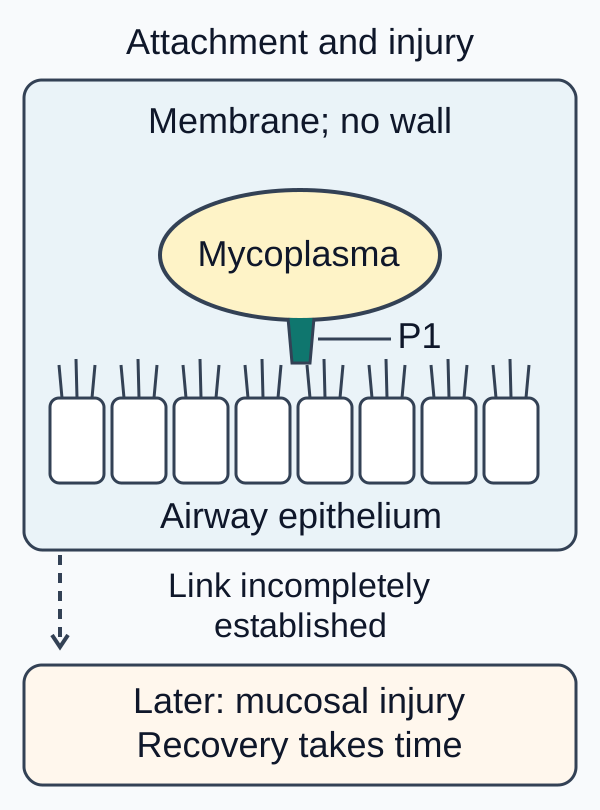
Mycoplasma pneumoniae attaches closely to respiratory epithelium using an attachment apparatus that includes P1 adhesin. Attachment helps establish infection; it is not the same as bacterial growth or tissue destruction. The bacterium has a cell membrane but lacks a peptidoglycan cell wall. A drug that blocks wall construction therefore lacks its usual target. Keep that structural fact separate from acquired resistance to a drug that does have a target. [2][11]
In some patients, a respiratory infection is followed by disproportionate inflammation of mucous membranes. Mucositis means inflammation of these lining surfaces. MIRM, Mycoplasma-induced rash and mucositis, describes the Mycoplasma-associated form. RIME, reactive infectious mucocutaneous eruption, is the broader category because other infectious triggers can produce a similar pattern. Severe oral, ocular and sometimes genital disease can coexist with very little skin involvement. The terms describe a clinical syndrome, not a positive laboratory result. [1][9]
The proposed RIME framework combines evidence of infection with at least two of three features: a noncontributory medication history, erosive involvement of two or more mucosal sites, and limited vesiculobullous or atypical target lesions involving less than 10% of the skin surface. These are proposed clinical criteria, not a validated exclusion test for a dangerous alternative. Children and adolescents are common in reported cohorts, but age and sex do not establish or exclude the diagnosis. [1][8][9]
The exact tissue-injury mechanism remains incompletely established. Infection-associated immune activation is a useful model, but a specific cross-reactive T-cell pathway, immune-complex pathway or direct-invasion explanation is not proven by the appearance of the mouth. The attached schematic distinguishes the demonstrated attachment step from the less certain link to mucosal injury. Do not turn a plausible immunologic explanation into a confirmatory test. [8][9][11]
P1-associated attachment is experimentally supported. The dashed connection marks incomplete knowledge of the path from infection to mucosal injury, not a proven direct invasion or cross-reactive-cell sequence. [8][9][11][8][9][11]
Predict: if an antibiotic reduces the respiratory infection today, must the mouth heal today? No. Microbial control and recovery of injured epithelium are different processes. In reported cases, mucosal disease can persist while respiratory findings improve. Cough and fever often precede the eruption by several days, commonly around a week, but the interval and respiratory severity vary. A quiet lung examination or a nonspecific radiograph neither rules out a respiratory trigger nor proves it. [8][9]
Apply the distinction: a comparable mucosal pattern after a documented respiratory viral infection can still prompt assessment for RIME. Conversely, a positive Mycoplasma test without a compatible clinical course is not enough to assign that diagnosis. [1][4]
Does little skin disease mean little danger?
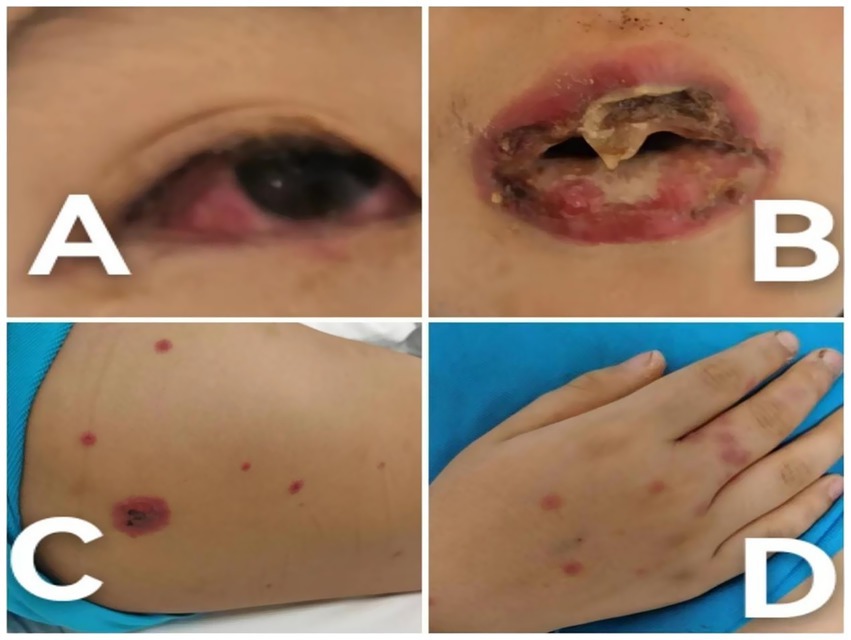
Compare the four panels of the clinical photograph. The ocular surface is red, the lips have thick crusting and erosions, and the other panels show scattered skin lesions. First describe those visible findings, then ask what the photograph cannot tell you: visual acuity, corneal integrity, fluid intake, urinary emptying, medication timing and the cause. Appearance is a starting observation, not a complete assessment. [10]
Compare ocular redness and crusted lip erosions in panels A and B with the scattered skin lesions in C and D. Assess the eyes and hydration directly; these photographs cannot establish corneal integrity or drug timing. Image: Mo X, Wang M, Jiang X and Jin L, Figure 1 (2025); original source; CC BY 4.0. [10]
Oral disease may include diffuse painful stomatitis, erosions or ulcers, bleeding lip crusts and a gray-white surface coating. Pain can prevent drinking even when oxygenation and breathing are normal. A coating is not automatically candidiasis, and crusted lips do not exclude herpes. Examine the lesion distribution, gingiva, associated surfaces and host context rather than choosing a pathogen from color alone. [8][16]
Ocular disease ranges from conjunctival inflammation to pseudomembranes and epithelial injury. Photophobia, pain or reduced vision require urgent assessment, but normal initial acuity does not make an inflamed ocular surface harmless. Early ophthalmology involvement is appropriate for ocular disease. Opposing injured conjunctival surfaces can adhere during healing, producing symblepharon; eyelid and corneal complications can also persist after other symptoms improve. Eye drops, membrane treatment and possible surface-protective procedures require ophthalmic assessment rather than an automatic regimen. [6][9]
Genital involvement can produce erosions or ulcers, meatitis, balanitis or vulvovaginal inflammation. Dysuria may reflect contact with an inflamed surface, while inability to pass urine may represent retention. Ask about output and examine for a full bladder rather than assuming every low-output episode is dehydration. Respectful history, examination and testing still need to consider other relevant causes; the presence of another inflamed mucosal surface is not proof against an unrelated infection. [8][9]
Make a functional map: beside mouth, write drinking and nutrition; beside eyes, write surface integrity and vision; beside genital mucosa, write pain and urinary emptying. Skin extent belongs on a separate line. Sparse papules, atypical targets, vesicles or bullae can occur in RIME, so neither an absent rash nor a small blister count establishes safety. [6][8][9]
Visible consequence: a child who cannot drink and has scant urine needs hydration and pain assessment now, not after convalescent blood sampling. A patient with a full painful bladder needs assessment for retention, not simply additional fluid. Apply the same organ-first approach when the respiratory illness is mild or already improving. [9]
Change the history, then reconsider the eruption
Imagine keeping severe mouth and eye inflammation constant while changing two other observations. In one patient, a respiratory illness precedes the mucositis and the skin has a few stable lesions. In another, a recently introduced medicine precedes an increasingly painful, dusky eruption. The second patient needs urgent evaluation for epidermal necrolysis even before visible skin separation develops. Early disease can evolve; a negative Nikolsky sign or initially intact skin does not rule out Stevens-Johnson syndrome. [5]
Compare the whole pattern, not one negative sign
Observation
What it changes
ObservationMucosal injury dominates after infection, with sparse skin lesions
What it changesSupports a RIME pattern in a compatible history; still assess medication exposure and evolution.
ObservationSkin pain, progressive dusky macules and a plausible new drug
What it changesRaises concern for SJS/TEN; urgent assessment and withdrawal of suspected culprit medication cannot await extensive detachment.
ObservationNumerous raised, three-zone targets on acral surfaces
What it changesFavors erythema multiforme, often associated with HSV; severe mucositis can occur in EM major.
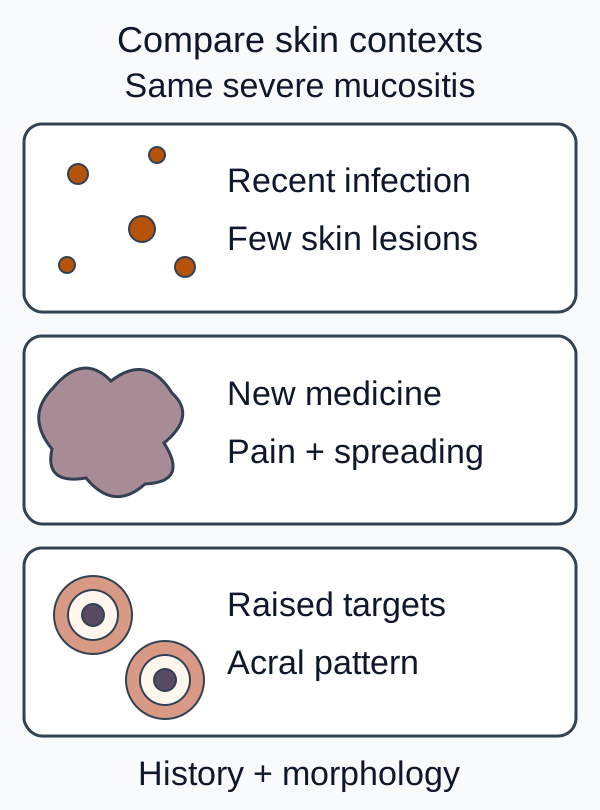
Commit to a comparison: take the first patient and add lamotrigine started three weeks earlier plus new painful purpuric macules. Does the earlier cough still justify reassurance? It does not. Both infection and drug exposure need appraisal, and the changing skin findings increase urgency. The comparison diagram shows observations that shift concern, not mutually exclusive diagnostic boxes. [1][5]
Compare each skin pattern and exposure history while keeping mucosal severity constant. Sparse lesions support a RIME pattern in context; progressive painful dusky lesions raise concern for epidermal necrolysis; raised acral targets favor erythema multiforme. None is a stand-alone exclusion test. [1][5][1][5]Check a second timing problem: the first antibiotic dose came after the mouth lesions
A medication first given after the original lesions cannot have initiated those lesions. Worsening after that dose does not by itself establish allergy or resistance. Document the order of infection symptoms, mucosal findings and every medication exposure; reassess any new phenotype rather than automatically assigning or dismissing drug causality. [5]
Once an epidermal-necrolysis syndrome is established, its SJS/TEN category uses detached or detachable skin, not all red skin: less than 10% is SJS, 10% through 30% is overlap, and more than 30% is TEN. Four percent already detached plus a separate eight percent detachable totals twelve percent and lies in the overlap category. A small area of separation can also occur in other eruptions, so the percentage is not an etiologic test. [5]
Other patterns deserve their own evidence. Fixed drug eruption returns to the same well-defined sites after re-exposure and may leave pigmentation. HSV can cause vesicles, ulcers and bleeding crusts; a lesion PCR can help when confirmation is important. Recurrent oral and genital ulcers with uveitis or retinal vascular inflammation suggest a systemic process such as Behcet disease rather than repeated acute conjunctivitis. [16][17][18]
A child with oral sores and an outbreak-associated eruption on palms and soles may have hand, foot and mouth disease. Fever, facial edema, eosinophilia and hepatitis after weeks of medication exposure raise a different concern, DRESS. Viral infections can themselves trigger reactive eruptions, so identifying a virus does not automatically settle whether mucosal injury is direct or reactive. Apply morphology, timing, organ findings and targeted testing together. [1][14][19]
What does a positive respiratory test establish?
A test can detect an organism without proving that it caused every current symptom. For suspected Mycoplasma respiratory infection, a nucleic acid amplification test, often reported as PCR, is the preferred timely method. Culture requires specialized methods and is too slow for most immediate decisions. Serology has specificity and timing limitations. None of these tests independently confirms RIME. [3]
Compare two results: one child has a compatible new respiratory illness followed by mucositis; a well sibling has the same positive upper-airway assay. The molecular result can be analytically correct in both, while the clinical interpretations differ. A primary pediatric study found upper-airway detection in symptomatic and asymptomatic children, sometimes persisting for months. Its local carriage frequency is not a universal prevalence estimate. The lesson is to combine detection with the current illness, not to declare every positive a cause or a laboratory error. [4]
An early negative IgM can precede an antibody response, and responses may be weaker or less predictable in adults or immunosuppressed patients. Conversely, a single positive IgM is not a precise clock for infection. With an appropriate assay and sampling interval, IgG seroconversion or a fourfold rise supports recent infection retrospectively. A rise from 1:40 to 1:160 is fourfold; a stable 1:160 on both samples is not. Even a genuine recent infection does not independently establish the cause of mucosal injury. [3][12]
Cold agglutinin testing asks whether antibodies react with red blood cells at low temperature. The classical response involves IgM; it is not a direct assay for Mycoplasma in the respiratory tract. The traditional manual test has limited sensitivity and is not specific enough to replace contemporary organism testing. A cold-reactive antibody finding must therefore be interpreted separately from the organism and mucosal diagnoses. [15]
Biopsy is selective, especially when a competing blistering disorder or epidermal necrolysis is being considered. Interface injury, apoptotic keratinocytes and even extensive epidermal necrosis can overlap across clinical syndromes. Histology describes the injury pattern but may not separate RIME from SJS/TEN. Direct immunofluorescence can help assess an autoimmune blistering alternative; a negative result is not a positive RIME test. Clinical correlation and correctly selected tissue remain essential. [5][9]
Apply the distinction: a negative early antibody result should not overrule a compatible syndrome plus timely organism testing. Equally, a positive respiratory result should not overrule a concerning drug timeline and progressive skin pain. Use each test to answer the question it actually measures.
Treat the failing function and assess the trigger separately
Ask what each intervention is intended to accomplish. Fluids address inadequate hydration. Analgesia and gentle oral care make drinking more feasible. Nutritional support may be needed when pain or epithelial injury prevents adequate intake; selected patients need enteral feeding or intravenous hydration. Respiratory support, urgent airway assessment for difficulty managing secretions or breathing, and systemic stabilization take priority over completing a diagnostic checklist. [9]
Use age-appropriate analgesic and mucosal-care regimens. Avoid presenting a topical anesthetic as permission to force food or fluid into a numb, painful mouth. Protect affected lips and skin with gentle care; genital symptoms need assessment of pain, erosions and urinary function. Early eye assessment is separate from the hydration decision. Urinary retention warrants prompt evaluation and, when needed, specialist-assisted drainage. [6][9][16]
Antibiotics are directed at an indicated active infection, especially Mycoplasma pneumonia, not at a laboratory label alone. Macrolides are common options in children and adults; tetracyclines are alternatives for appropriate older children and adults, and fluoroquinolones have selected adult uses. Age, pregnancy, adverse effects, local resistance and the clinical syndrome guide selection. Beta-lactams cannot solve the absence of a cell-wall target. [2]
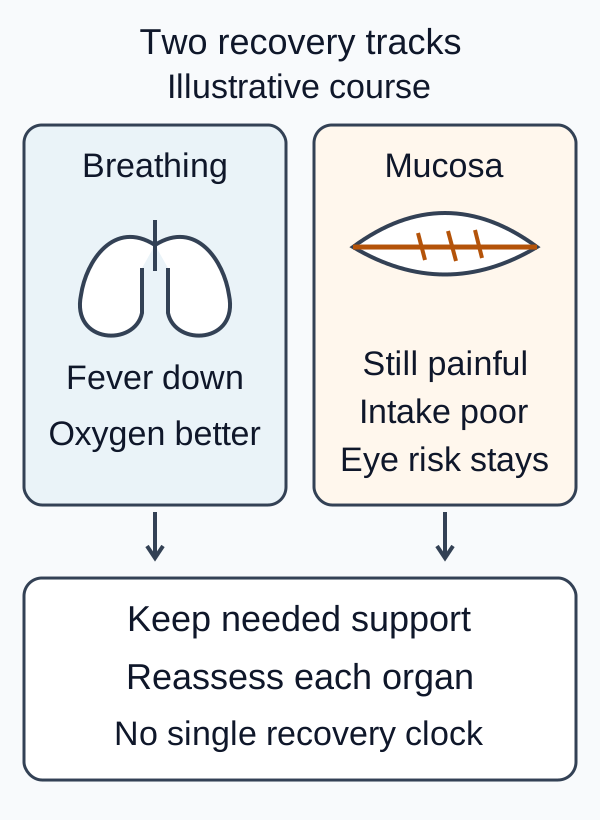
Track two trajectories: respiratory fever and oxygen need may improve while oral pain remains severe. Persistent mucositis alone does not demonstrate macrolide resistance. Persistent or worsening pneumonia instead warrants reassessment of diagnosis, complications, adherence and resistance. An antibiotic's effect on the duration of reactive mucosal disease is not reliably established; neither promise immediate healing nor claim that a drug can never affect its course. [2][8][9]
Original qualitative illustration, not patient data or a fixed time course. Improving respiratory infection does not establish recovery of drinking, eye surfaces or urinary function. Persistent mucosal impairment alone does not establish macrolide resistance. [2][6][9][2][6][9]
Systemic corticosteroids, intravenous immunoglobulin, cyclosporine and etanercept have been used for selected severe or refractory presentations. The evidence is limited and often consists of uncontrolled series with concurrent treatments. Dermatology and the involved organ specialists should individualize therapy after reviewing competing diagnoses, infection and patient-specific risks. There is no single proven regimen for every RIME presentation. [8][9][13]
The opposite absolute is also unsafe: corticosteroids are not universally prohibited when SJS/TEN is suspected. The S3 guideline permits consideration of systemic therapies in selected patients while emphasizing uncertain evidence and risks. This is not an instruction to begin high-dose treatment before assessment. Suspected culprit-drug withdrawal and supportive, multidisciplinary care remain time-sensitive. [5]
Evidence exercise: several patients improve after an added immunomodulator, but all also receive supportive care and there is no comparison group. The observation supports further evaluation, not proof of superior efficacy. Apply this distinction when discussing a rescue option: a treatment can be reasonable to consider without its benefit being established by a randomized comparison. [13]
Judge recovery by function, not a fixed calendar
Healing commonly occurs over days to weeks, often within several weeks, but there is no compulsory peak day or order in which mouth, eyes and genital surfaces recover. Some patients need prolonged support. A fixed early plateau is not a safe discriminator from SJS/TEN, and new lesions or deteriorating function demand reassessment rather than an assumption that the expected course is continuing. [8][9]
Compare: one patient has fading skin spots but still cannot drink; another eats normally but has new photophobia. Name the unmet need in each before deciding that either has recovered. The first still needs a hydration and nutrition plan. The second needs urgent ocular assessment, even though oral healing is encouraging. RIME often has a more favorable overall course than epidermal necrolysis, but that comparison does not eliminate scarring or visual risk. [6][9]
Before discharge, reassess oral intake, urine output and emptying, pain control, respiratory stability, skin evolution and the eye-care plan. Follow-up should address the involved organs. Return promptly for breathing difficulty, inability to drink or pass urine, new eye pain or visual change, or an increasingly painful blistering eruption. Clinical deterioration is more informative than reaching a predicted recovery date.
Recurrence is recognized, and later episodes may differ in trigger, severity or number of affected surfaces. Do not teach that recurrence requires a proven new Mycoplasma infection or is necessarily mild. In one referral cohort, five of thirteen patients had recurrent episodes; that proportion describes the cohort, not an individualized population risk. The value of preventive treatment remains uncertain. [1][7]
Transfer: when a previously affected patient returns, reconstruct the new infection and medication timelines, examine each symptomatic organ, and reconsider alternatives. Prior RIME is useful history, not permission to skip a fresh assessment.
Apply the lesson
Case 1
Show answer and explanations for case 1
A. Observe until convalescent serology returns before arranging admission (Why this does not fit)
It can retrospectively support a recent infection. The inability to drink and low output already justify support without waiting for antibody evolution. [6] [9]
Reasoning steps for option A
What can paired serology contribute?
It can retrospectively support a recent infection.
Can that delayed result determine the immediate fluid requirement?
The inability to drink and low output already justify support without waiting for antibody evolution.
B. Admit for hydration and analgesia with early ophthalmology assessment (Best answer)
The child cannot maintain hydration despite initial pain treatment. Reduced urine output and tachycardia support a hydration problem, while inflamed eyes require a separate assessment. [6] [9]
Reasoning steps for option B
What function remains impaired after the drinking attempt?
The child cannot maintain hydration despite initial pain treatment.
Why does this require more than treating the cough?
Reduced urine output and tachycardia support a hydration problem, while inflamed eyes require a separate assessment.
C. Discharge with oral azithromycin and an outpatient eye appointment (Why this does not fit)
An indicated Mycoplasma respiratory infection may merit antibiotic treatment. It does not provide immediate hydration or assess the active ocular surface disease in a child unable to drink. [6] [9]
Reasoning steps for option C
What problem could azithromycin address?
An indicated Mycoplasma respiratory infection may merit antibiotic treatment.
Can a prescription address the demonstrated failed oral challenge?
It does not provide immediate hydration or assess the active ocular surface disease in a child unable to drink.
D. Discharge with oral analgesia and a repeat skin examination tomorrow (Why this does not fit)
It can be appropriate when oral intake and other involved organs are adequately supported. A drinking attempt after analgesia has failed and urinary output has fallen. [6] [9]
Reasoning steps for option D
When can outpatient pain management be sufficient?
It can be appropriate when oral intake and other involved organs are adequately supported.
Which supplied observation makes that plan insufficient here?
A drinking attempt after analgesia has failed and urinary output has fallen.
Takeaway: Normal oxygenation and little rash do not establish that mucosal disease is safe for outpatient care. [6] [9]
A. Preserved initial airway attachment; reduced injury follows lower bacterial growth (Why this does not fit)
It would change organism expansion rather than selectively explain fewer attached organisms. Attachment decreased while viability was preserved; no growth-mediated tissue effect is demonstrated. [8] [9] [11]
Reasoning steps for option A
Which process would reduced bacterial growth affect?
It would change organism expansion rather than selectively explain fewer attached organisms.
Which supplied measurements contradict that account?
Attachment decreased while viability was preserved; no growth-mediated tissue effect is demonstrated.
B. Reduced initial airway attachment; mucosal healing time remains undetermined (Best answer)
Attachment fell, whereas viability did not. No tissue-healing experiment is supplied, so rapid mucosal recovery cannot be inferred. [8] [9] [11]
Reasoning steps for option B
Which measured bacterial property changed?
Attachment fell, whereas viability did not.
Does that result measure repair of existing oral or ocular erosions?
No tissue-healing experiment is supplied, so rapid mucosal recovery cannot be inferred.
C. Increased initial airway attachment; mucosal healing follows reduced inflammation (Why this does not fit)
More adherent organisms would be needed to establish an attachment increase. Fewer organisms attach, and the experiment does not measure the inflammatory course of the erosions. [8] [9] [11]
Reasoning steps for option C
What observation would support increased attachment?
More adherent organisms would be needed to establish an attachment increase.
Do the attachment and tissue data support that prediction?
Fewer organisms attach, and the experiment does not measure the inflammatory course of the erosions.
D. Reduced bacterial viability; prompt mucosal healing follows the viability loss (Why this does not fit)
A decrease in viability would support direct bacterial killing. Viability is unchanged, and healing was not measured. [8] [9] [11]
Reasoning steps for option D
What would a bactericidal effect require in this experiment?
A decrease in viability would support direct bacterial killing.
Is such a decrease present?
Viability is unchanged, and healing was not measured.
Takeaway: Changing bacterial attachment does not directly demonstrate bacterial killing or immediate healing of established mucositis. [8] [9] [11]
A. Reduced passage through a gram-negative outer membrane (Why this does not fit)
Its permeability can limit access to targets in some gram-negative bacteria. Mycoplasma is not a conventional gram-negative organism with the described wall and outer-membrane arrangement. [2]
Reasoning steps for option A
How can an outer membrane affect antimicrobial entry?
Its permeability can limit access to targets in some gram-negative bacteria.
Does it explain the central structural feature of Mycoplasma?
Mycoplasma is not a conventional gram-negative organism with the described wall and outer-membrane arrangement.
B. Absence of a peptidoglycan cell wall (Best answer)
It interferes with peptidoglycan cell-wall synthesis. Mycoplasma lacks a peptidoglycan wall, so the expected target is absent. [2]
Reasoning steps for option B
Which bacterial structure does amoxicillin normally affect?
It interferes with peptidoglycan cell-wall synthesis.
Does the identified organism possess that structure?
Mycoplasma lacks a peptidoglycan wall, so the expected target is absent.
C. Enzymatic hydrolysis of the beta-lactam ring (Why this does not fit)
It can inactivate a beta-lactam by hydrolyzing its ring. The assay finds no such activity, and Mycoplasma already lacks the cell-wall target. [2]
Reasoning steps for option C
What does beta-lactamase do?
It can inactivate a beta-lactam by hydrolyzing its ring.
Why does it not best explain this organism and assay result?
The assay finds no such activity, and Mycoplasma already lacks the cell-wall target.
D. Alteration of a wall-building penicillin-binding protein (Why this does not fit)
It operates in organisms that use those proteins to build a peptidoglycan wall. The structural problem is the absence of that wall, not a demonstrated alteration of its construction machinery. [2]
Reasoning steps for option D
Where does altered penicillin-binding protein resistance operate?
It operates in organisms that use those proteins to build a peptidoglycan wall.
What makes that explanation less appropriate here?
The structural problem is the absence of that wall, not a demonstrated alteration of its construction machinery.
Takeaway: Mycoplasma lacks the cell-wall target of beta-lactams; this is distinct from acquired enzymatic resistance. [2]
A. Continue lamotrigine while repeating Mycoplasma IgM in one week (Why this does not fit)
It might contribute evidence about timing of infection. It leaves a plausible culprit in place while the painful eruption progresses. [4] [5]
Reasoning steps for option A
What could another antibody measurement add?
It might contribute evidence about timing of infection.
Why is waiting with lamotrigine inappropriate in this presentation?
It leaves a plausible culprit in place while the painful eruption progresses.
B. Continue lamotrigine and treat the eruption with oral azithromycin (Why this does not fit)
It could treat an indicated active Mycoplasma respiratory infection. The new drug timing, spreading dusky skin and tenderness remain concerning for epidermal necrolysis. [4] [5]
Reasoning steps for option B
What diagnosis would azithromycin target?
It could treat an indicated active Mycoplasma respiratory infection.
Which supplied features does that plan fail to address?
The new drug timing, spreading dusky skin and tenderness remain concerning for epidermal necrolysis.
C. Withhold specialist referral until repeat examination demonstrates skin separation (Why this does not fit)
It identifies evolution and helps characterize the extent of injury. No; progressive skin pain and dusky macules after a plausible drug already warrant escalation. [4] [5]
Reasoning steps for option C
Why is repeated skin examination useful?
It identifies evolution and helps characterize the extent of injury.
Must separation appear before urgent evaluation is warranted?
No; progressive skin pain and dusky macules after a plausible drug already warrant escalation.
D. Stop lamotrigine and obtain urgent dermatology and ophthalmology assessment (Best answer)
Progressive dusky macules and marked skin pain follow a plausible drug exposure. Early epidermal necrolysis can precede separation; the old respiratory illness and positive airway test do not neutralize the warning pattern. [4] [5]
Reasoning steps for option D
Which current observations raise concern beyond isolated mucositis?
Progressive dusky macules and marked skin pain follow a plausible drug exposure.
Why act before detachment or another infection test?
Early epidermal necrolysis can precede separation; the old respiratory illness and positive airway test do not neutralize the warning pattern.
Takeaway: A negative early Nikolsky sign and a positive Mycoplasma assay do not justify continuing a plausible culprit drug during a progressive painful eruption. [4] [5]
A. Mycoplasma-associated RIME with predominantly cutaneous disease (Why this does not fit)
Marked mucosal disease relative to limited skin findings supports the syndrome in an infectious context. Numerous classic acral targets dominate while only two oral erosions are described. [1] [5] [16]
Reasoning steps for option A
What pattern usually supports RIME?
Marked mucosal disease relative to limited skin findings supports the syndrome in an infectious context.
Which balance and morphology are actually supplied?
Numerous classic acral targets dominate while only two oral erosions are described.
B. Medication-associated epidermal necrolysis in its early phase (Why this does not fit)
Progressive skin pain, dusky macules and a plausible medication exposure would increase concern. The lesions are raised classic targets without a new drug or progressive painful skin injury. [1] [5] [16]
Reasoning steps for option B
Which early findings would increase concern for epidermal necrolysis?
Progressive skin pain, dusky macules and a plausible medication exposure would increase concern.
Which supplied features favor a different process?
The lesions are raised classic targets without a new drug or progressive painful skin injury.
C. Disseminated HSV replication producing the new target lesions (Why this does not fit)
Grouped vesicles and erosions can support active herpes, especially with relevant host risks. Symmetric raised three-zone acral targets appear after the original vesicles have healed. [1] [5] [16]
Reasoning steps for option C
What would active HSV typically contribute morphologically?
Grouped vesicles and erosions can support active herpes, especially with relevant host risks.
What instead dominates this new eruption?
Symmetric raised three-zone acral targets appear after the original vesicles have healed.
D. HSV-associated erythema multiforme following the earlier infection (Best answer)
The raised, three-zone targets are numerous and predominantly acral. It can precede a reactive erythema multiforme eruption rather than represent ongoing viral replication in each target. [1] [5] [16]
Reasoning steps for option D
Which part of the eruption is most discriminating?
The raised, three-zone targets are numerous and predominantly acral.
How does the healed herpes episode fit that pattern?
It can precede a reactive erythema multiforme eruption rather than represent ongoing viral replication in each target.
Takeaway: Typical raised acral targets after HSV favor erythema multiforme; mucosal involvement can coexist. [1] [5] [16]
A. Reactivation of drug-responsive resident memory T cells at prior sites (Best answer)
The same well-defined sites recur after the same medicine and retain pigmentation between episodes. Resident memory T cells can react again at previously affected sites after drug re-exposure. [17]
Reasoning steps for option A
What makes the location pattern distinctive?
The same well-defined sites recur after the same medicine and retain pigmentation between episodes.
How can immune memory explain that localization?
Resident memory T cells can react again at previously affected sites after drug re-exposure.
B. Repeated hematogenous seeding of mucosa by a respiratory bacterium (Why this does not fit)
A compatible infection temporally related to the eruption would support that possibility. The same medicine repeatedly precedes lesions at identical locations without a respiratory prodrome. [17]
Reasoning steps for option B
What evidence would make a new respiratory-triggered event more plausible?
A compatible infection temporally related to the eruption would support that possibility.
What reproducible association instead organizes these episodes?
The same medicine repeatedly precedes lesions at identical locations without a respiratory prodrome.
C. Direct HSV replication causing each medication-associated recurrence (Why this does not fit)
Recurrent oral or genital lesions can arise from HSV. Sharply outlined plaques at two fixed sites repeatedly follow ibuprofen and leave pigmentation. [17]
Reasoning steps for option C
Why can herpes initially seem plausible?
Recurrent oral or genital lesions can arise from HSV.
Which additional observations better fit fixed drug eruption?
Sharply outlined plaques at two fixed sites repeatedly follow ibuprofen and leave pigmentation.
D. Diffuse keratinocyte destruction from an evolving generalized drug reaction (Why this does not fit)
Expanding painful dusky skin lesions and widespread tissue injury would raise concern. The episodes repeatedly affect the same discrete sites rather than evolving into generalized separation. [17]
Reasoning steps for option D
What course would suggest a generalized epidermal-necrolysis process?
Expanding painful dusky skin lesions and widespread tissue injury would raise concern.
Does the repeated localized pattern demonstrate that course?
The episodes repeatedly affect the same discrete sites rather than evolving into generalized separation.
Takeaway: A reproducible same-site eruption after drug re-exposure points toward fixed drug eruption rather than a newly acquired infectious trigger. [17]
A. Oral azithromycin while continuing hydration and analgesia (Why this does not fit)
It targets susceptible Mycoplasma respiratory infection rather than HSV. The respiratory illness is remote, whereas active HSV is demonstrated in a fresh symptomatic lesion. [4] [16]
Reasoning steps for option A
Which infection would azithromycin target?
It targets susceptible Mycoplasma respiratory infection rather than HSV.
Why does the positive respiratory panel not make it the best oral-lesion treatment?
The respiratory illness is remote, whereas active HSV is demonstrated in a fresh symptomatic lesion.
B. Systemic corticosteroids while continuing hydration and analgesia (Why this does not fit)
Selected severe reactive presentations may prompt specialist-directed immunomodulation. A compatible active HSV infection is established in an immunocompromised child and needs antiviral treatment. [4] [16]
Reasoning steps for option B
When might anti-inflammatory treatment be considered for reactive mucositis?
Selected severe reactive presentations may prompt specialist-directed immunomodulation.
What makes that attribution unsafe as the first added treatment here?
A compatible active HSV infection is established in an immunocompromised child and needs antiviral treatment.
C. Intravenous fluconazole while continuing hydration and analgesia (Why this does not fit)
It treats susceptible fungal disease such as significant candidiasis. Fresh vesicles and positive lesion HSV PCR support herpes rather than an unproven fungal cause. [4] [16]
Reasoning steps for option C
What oral process can fluconazole treat?
It treats susceptible fungal disease such as significant candidiasis.
Which evidence instead identifies the current lesion process?
Fresh vesicles and positive lesion HSV PCR support herpes rather than an unproven fungal cause.
D. Intravenous acyclovir while continuing hydration and analgesia (Best answer)
HSV-1 PCR is positive from a fresh oral vesicle in a compatible eruption. Immunocompromised children with HSV gingivostomatitis warrant intravenous antiviral therapy alongside support. [4] [16]
Reasoning steps for option D
Which assay samples the current symptomatic lesion?
HSV-1 PCR is positive from a fresh oral vesicle in a compatible eruption.
How does chemotherapy affect the treatment decision?
Immunocompromised children with HSV gingivostomatitis warrant intravenous antiviral therapy alongside support.
Takeaway: A positive upper-airway assay should not displace compatible lesion-specific HSV evidence in an immunocompromised patient. [4] [16]
A. Behcet disease with multisystem inflammatory involvement (Best answer)
No; uveitis and retinal vascular inflammation involve deeper ocular structures. Repeated oral and genital ulceration with scarring over many months supports evaluation for Behcet disease. [4] [18]
Reasoning steps for option A
Is the ocular finding confined to the conjunctival surface?
No; uveitis and retinal vascular inflammation involve deeper ocular structures.
Which time course unifies those findings with the mucosal history?
Repeated oral and genital ulceration with scarring over many months supports evaluation for Behcet disease.
B. Medication-associated fixed drug eruption (Why this does not fit)
Re-exposure to a medicine followed by lesions at the same sites supports it. No reproducible medication association is given, and uveitis with retinal vascular inflammation points beyond a localized fixed eruption. [4] [18]
Reasoning steps for option B
What repeated association supports fixed drug eruption?
Re-exposure to a medicine followed by lesions at the same sites supports it.
Is such an exposure pattern supplied, and does it explain the eye findings?
No reproducible medication association is given, and uveitis with retinal vascular inflammation points beyond a localized fixed eruption.
C. A first episode of Mycoplasma-associated RIME (Why this does not fit)
Mucosal inflammation is interpreted in relation to a recent infection. It does not explain repeated earlier genital scarring and prior intraocular disease. [4] [18]
Reasoning steps for option C
What timing is expected for a single reactive infectious episode?
Mucosal inflammation is interpreted in relation to a recent infection.
Can this new cough explain the preceding 18-month course?
It does not explain repeated earlier genital scarring and prior intraocular disease.
D. HSV-associated erythema multiforme major (Why this does not fit)
Typical raised targets, often acral, would strengthen that diagnosis. Repeated genital scarring and retinal vascular inflammation are not explained by the described target-free presentation. [4] [18]
Reasoning steps for option D
What skin finding would support erythema multiforme?
Typical raised targets, often acral, would strengthen that diagnosis.
Which supplied features require a broader unifying explanation?
Repeated genital scarring and retinal vascular inflammation are not explained by the described target-free presentation.
Takeaway: Recurrent oral and genital ulcers with intraocular inflammation require a systemic differential even when a respiratory test is positive. [4] [18]
A. Remote exposure is supported; the unchanged titer argues against recent infection (Why this does not fit)
Both samples would have the same reported titer. No; the later reciprocal value is four times the earlier value. [5] [12]
Reasoning steps for option A
What would an unchanged paired titer look like?
Both samples would have the same reported titer.
Are 1:40 and 1:160 unchanged?
No; the later reciprocal value is four times the earlier value.
B. Recent infection is supported; the mucosal cause still needs clinical attribution (Best answer)
The reciprocal titer rose from 40 to 160, a fourfold increase. No; it supports a recent infection but does not independently identify the cause of epithelial injury. [5] [12]
Reasoning steps for option B
How much did the titer increase?
The reciprocal titer rose from 40 to 160, a fourfold increase.
Does that eliminate the competing medication explanation?
No; it supports a recent infection but does not independently identify the cause of epithelial injury.
C. Recent infection is supported; a medication contribution is thereby excluded (Why this does not fit)
It supports a recent Mycoplasma infection in the appropriate testing context. It does not test whether the new medication contributed to the eruption. [5] [12]
Reasoning steps for option C
What does a fourfold rise support?
It supports a recent Mycoplasma infection in the appropriate testing context.
What does it not test?
It does not test whether the new medication contributed to the eruption.
D. Recent infection is unsupported; the antibody increase is only twofold (Why this does not fit)
Divide the reciprocal convalescent titer, 160, by the acute value, 40. It equals four, not two. [5] [12]
Reasoning steps for option D
Which values form the fold-change calculation?
Divide the reciprocal convalescent titer, 160, by the acute value, 40.
What does that quotient equal?
It equals four, not two.
Takeaway: A fourfold paired IgG rise supports recent infection retrospectively; it does not assign the mucosal eruption to that infection by itself. [5] [12]
A. The assay detects its target in both; disease attribution depends on the clinical course (Best answer)
Its target nucleic acid is present in both tested upper-airway samples. Carriage or persistence can occur, whereas only one child has the described compatible new illness. [3] [4]
Reasoning steps for option A
What common observation does the assay establish?
Its target nucleic acid is present in both tested upper-airway samples.
Why need that not produce identical diagnoses?
Carriage or persistence can occur, whereas only one child has the described compatible new illness.
B. The assay establishes the same mucosal complication in both before lesions appear (Why this does not fit)
Clinical involvement of mucosal and skin surfaces in the relevant context is needed. The assay does not establish future mucosal injury in an asymptomatic child. [3] [4]
Reasoning steps for option B
What findings establish a mucocutaneous syndrome?
Clinical involvement of mucosal and skin surfaces in the relevant context is needed.
Does an airway result predict that those lesions must develop?
The assay does not establish future mucosal injury in an asymptomatic child.
C. The assay is analytically false-positive in the well sibling because symptoms are absent (Why this does not fit)
Yes, asymptomatic detection has been documented. No; a true detection can lack evidence of current attributable disease. [3] [4]
Reasoning steps for option C
Can a well child carry detectable Mycoplasma in the upper airway?
Yes, asymptomatic detection has been documented.
Does absence of symptoms itself prove analytic assay failure?
No; a true detection can lack evidence of current attributable disease.
D. The assay establishes active pneumonia in both; symptoms determine its severity (Why this does not fit)
A compatible lower-respiratory clinical assessment is needed in addition to organism detection. No pneumonia syndrome is described in the sibling. [3] [4]
Reasoning steps for option D
What else is needed to diagnose pneumonia?
A compatible lower-respiratory clinical assessment is needed in addition to organism detection.
Does the asymptomatic sibling supply that assessment?
No pneumonia syndrome is described in the sibling.
Takeaway: A technically valid positive NAAT detects its target; current disease and mucosal causation still require clinical interpretation. [3] [4]
A. Negative immunofluorescence establishes Mycoplasma as the mucosal pathogen (Why this does not fit)
It evaluates patterns of tissue-bound immune reactants relevant to blistering differentials. No; it is not an organism assay or a positive test for RIME. [5] [9]
Reasoning steps for option A
What is direct immunofluorescence designed to evaluate?
It evaluates patterns of tissue-bound immune reactants relevant to blistering differentials.
Does a negative result detect Mycoplasma in the tissue?
No; it is not an organism assay or a positive test for RIME.
B. Interface injury excludes an evolving epidermal-necrolysis syndrome (Why this does not fit)
Yes; epithelial interface injury and keratinocyte death are not restricted to mild disease. The bullae, mucosal injury and uncertain medication timeline remain clinically important. [5] [9]
Reasoning steps for option B
Can interface injury appear in a serious cytotoxic eruption?
Yes; epithelial interface injury and keratinocyte death are not restricted to mild disease.
Which part of the presentation still requires reassessment?
The bullae, mucosal injury and uncertain medication timeline remain clinically important.
C. Full-thickness necrosis identifies a drug as the cause of the eruption (Why this does not fit)
Substantial keratinocyte death is compatible with that injury pattern. No; the clinical syndromes can overlap histologically and the medication history remains unresolved. [5] [9]
Reasoning steps for option C
Why might necrosis initially raise concern for epidermal necrolysis?
Substantial keratinocyte death is compatible with that injury pattern.
Can the tissue pattern itself identify a medication trigger?
No; the clinical syndromes can overlap histologically and the medication history remains unresolved.
D. The injury pattern overlaps; infection and medication timing remain important (Best answer)
It describes epithelial injury with keratinocyte death. No; overlapping syndromes still require correlation with exposures and clinical evolution. [5] [9]
Reasoning steps for option D
What does the biopsy directly describe?
It describes epithelial injury with keratinocyte death.
Does that pattern plus negative immunofluorescence identify a unique trigger?
No; overlapping syndromes still require correlation with exposures and clinical evolution.
Takeaway: Biopsy can characterize injury and evaluate alternatives, but it does not reliably separate RIME from SJS/TEN on its own. [5] [9]
A. Restrict fluid to correct presumed inappropriate antidiuretic hormone secretion (Why this does not fit)
Serum and urine chemistry and the volume context would be needed. Ultrasound demonstrates urinary retention, not a supplied hyponatremic water-balance disorder. [9]
Reasoning steps for option A
What data would support an antidiuretic-hormone-related water disorder?
Serum and urine chemistry and the volume context would be needed.
What direct abnormality is already established?
Ultrasound demonstrates urinary retention, not a supplied hyponatremic water-balance disorder.
B. Begin a glomerulonephritis evaluation before addressing the urinary symptoms (Why this does not fit)
Hematuria, proteinuria, renal dysfunction or an appropriate systemic context would help. A painful distended bladder with retained urine already identifies an urgent emptying problem. [9]
Reasoning steps for option B
What findings would direct attention toward glomerular inflammation?
Hematuria, proteinuria, renal dysfunction or an appropriate systemic context would help.
Why is that not the immediate priority in this case?
A painful distended bladder with retained urine already identifies an urgent emptying problem.
C. Arrange prompt assessment and relief of urinary retention (Best answer)
The large full bladder shows that urine has been produced but not emptied. Prompt evaluation and appropriate relief of retention, with urologic assistance as needed, addresses the immediate problem. [9]
Reasoning steps for option C
Is urine production or bladder emptying the demonstrated problem?
The large full bladder shows that urine has been produced but not emptied.
Which intervention target follows from that localization?
Prompt evaluation and appropriate relief of retention, with urologic assistance as needed, addresses the immediate problem.
D. Repeat a fluid bolus to increase renal urine production (Why this does not fit)
It may help selected patients with continuing hypoperfusion and inadequate intravascular volume. Perfusion has improved and a large painful bladder contains retained urine. [9]
Reasoning steps for option D
When might another fluid bolus improve urine output?
It may help selected patients with continuing hypoperfusion and inadequate intravascular volume.
What points to a different problem after resuscitation here?
Perfusion has improved and a large painful bladder contains retained urine.
Takeaway: Low output with a full painful bladder is a retention problem; giving more fluid alone does not restore emptying. [9]
A. Epidermal necrolysis is established; persistent pain proves a new drug reaction (Why this does not fit)
A changing painful skin phenotype, plausible drug timing and new tissue injury would be concerning. No; the supplied discordance alone does not prove a new drug reaction. [2] [8] [9]
Reasoning steps for option A
Which new observations would heighten concern for a drug-associated eruption?
A changing painful skin phenotype, plausible drug timing and new tissue injury would be concerning.
Does unchanged oral pain with stable skin establish that diagnosis?
No; the supplied discordance alone does not prove a new drug reaction.
B. Macrolide resistance is established; change antibiotic class for the oral pain (Why this does not fit)
Persisting or worsening active respiratory infection despite appropriate treatment would prompt reassessment. Respiratory physiology has improved while only the mucosal endpoint remains unchanged. [2] [8] [9]
Reasoning steps for option B
What would make antimicrobial failure more concerning?
Persisting or worsening active respiratory infection despite appropriate treatment would prompt reassessment.
Which supplied response argues against declaring failure from pain alone?
Respiratory physiology has improved while only the mucosal endpoint remains unchanged.
C. The mucosal syndrome has resolved; end fluid support because fever has cleared (Why this does not fit)
Adequate oral intake and stable hydration would support reducing that assistance. No; the patient still cannot meet fluid needs. [2] [8] [9]
Reasoning steps for option C
What would show that hydration support is no longer needed?
Adequate oral intake and stable hydration would support reducing that assistance.
Has the patient met that functional condition?
No; the patient still cannot meet fluid needs.
D. Respiratory illness is improving; mucosal support remains necessary (Best answer)
Fever, oxygenation and respiratory effort have improved. No; epithelial recovery can lag and the ongoing inability to drink still requires support. [2] [8] [9]
Reasoning steps for option D
Which measures show improvement?
Fever, oxygenation and respiratory effort have improved.
Does unchanged oral pain negate those respiratory observations?
No; epithelial recovery can lag and the ongoing inability to drink still requires support.
Takeaway: Mucosal recovery can lag behind respiratory improvement; persistent oral pain alone does not demonstrate antimicrobial failure. [2] [8] [9]
A. The series reports improvement but cannot establish a faster healing effect (Best answer)
Patients improved after receiving a package of treatments that included etanercept. The course under comparable supportive care without etanercept is unknown. [13]
Reasoning steps for option A
What outcome was actually observed?
Patients improved after receiving a package of treatments that included etanercept.
What comparison is missing for the claim about speed?
The course under comparable supportive care without etanercept is unknown.
B. The series establishes the same benefit across all infectious mucosal eruptions (Why this does not fit)
A credible treatment effect and evidence that it applies across the proposed populations are needed. The uncontrolled observations do not establish a causal benefit even within the reported cohort. [13]
Reasoning steps for option B
What evidence is needed to generalize a treatment effect?
A credible treatment effect and evidence that it applies across the proposed populations are needed.
Which prerequisite is absent here?
The uncontrolled observations do not establish a causal benefit even within the reported cohort.
C. The series establishes equal healing rates between etanercept and supportive care (Why this does not fit)
A suitable comparative design and an appropriate equivalence analysis are needed. No; it has no group from which to estimate a supportive-care healing rate. [13]
Reasoning steps for option C
What is needed to establish equivalence?
A suitable comparative design and an appropriate equivalence analysis are needed.
Does an uncontrolled series provide that evidence?
No; it has no group from which to estimate a supportive-care healing rate.
D. The series establishes faster healing because improvement followed the first dose (Why this does not fit)
Improvement after treatment can motivate further investigation. Natural recovery and other treatments are competing explanations without a comparison group. [13]
Reasoning steps for option D
Why is the temporal sequence clinically interesting?
Improvement after treatment can motivate further investigation.
Why does timing alone not establish causation?
Natural recovery and other treatments are competing explanations without a comparison group.
Takeaway: Improvement in an uncontrolled treatment series does not establish that the added drug caused faster recovery. [13]
A. Use a fixed immunoglobulin regimen because it has established superiority (Why this does not fit)
A credible comparative treatment study would be needed. No; reported treatments are heterogeneous and much of the evidence is uncontrolled. [8] [9] [13]
Reasoning steps for option A
What type of evidence would establish one regimen as superior?
A credible comparative treatment study would be needed.
Does the current RIME evidence establish a universal superior regimen?
No; reported treatments are heterogeneous and much of the evidence is uncontrolled.
B. Discuss individualized immunomodulation with the involved specialists (Best answer)
The mucosal injury still prevents adequate nutrition and requires tube feeding. An individualized specialist discussion of adjunctive therapy, not a mandatory regimen or abandonment of support. [8] [9] [13]
Reasoning steps for option B
Which problem remains severe despite the supplied care?
The mucosal injury still prevents adequate nutrition and requires tube feeding.
What does the limited treatment evidence support in that setting?
An individualized specialist discussion of adjunctive therapy, not a mandatory regimen or abandonment of support.
C. Defer further evaluation until oral healing reaches a predetermined third-week deadline (Why this does not fit)
Many patients improve over days to weeks with support. Persistent feeding dependence and ocular injury require ongoing individualized assessment rather than waiting for an arbitrary date. [8] [9] [13]
Reasoning steps for option C
Why can time sometimes be useful during mucosal recovery?
Many patients improve over days to weeks with support.
Why is a fixed calendar deadline inadequate here?
Persistent feeding dependence and ocular injury require ongoing individualized assessment rather than waiting for an arbitrary date.
D. Change antibiotics because feeding dependence indicates macrolide resistance (Why this does not fit)
Persistent or worsening pneumonia would prompt an antimicrobial reassessment. Respiratory infection has improved while the mucosal injury remains functionally severe. [8] [9] [13]
Reasoning steps for option D
Which clinical trajectory would be relevant to respiratory antibiotic failure?
Persistent or worsening pneumonia would prompt an antimicrobial reassessment.
What trajectory is actually supplied?
Respiratory infection has improved while the mucosal injury remains functionally severe.
Takeaway: Severe persistent mucosal impairment can justify specialist consideration of immunomodulation; no universal regimen is established. [8] [9] [13]
A. Medication-associated epidermal necrolysis established by the vesicles (Why this does not fit)
Yes; limited vesiculobullous lesions can occur in RIME. No medication preceded the eruption, and the current pattern is mucosal-dominant after infection. [1] [7] [9]
Reasoning steps for option A
Can small vesicles occur outside epidermal necrolysis?
Yes; limited vesiculobullous lesions can occur in RIME.
What makes the proposed drug attribution unsupported here?
No medication preceded the eruption, and the current pattern is mucosal-dominant after infection.
B. Fixed drug eruption established by the history of earlier mucosal disease (Why this does not fit)
Recurrence at the same sites after the same medication is characteristic. A new infection precedes this episode without medication exposure or a documented fixed-site drug pattern. [1] [7] [9]
Reasoning steps for option B
What repeat relationship supports fixed drug eruption?
Recurrence at the same sites after the same medication is characteristic.
What relationship is supplied instead?
A new infection precedes this episode without medication exposure or a documented fixed-site drug pattern.
C. Reactive infectious mucocutaneous eruption associated with the new infection (Best answer)
Severe multisite mucositis dominates a sparse cutaneous eruption after infection. No; other infectious triggers can produce a compatible clinical syndrome. [1] [7] [9]
Reasoning steps for option C
What defines the current pattern beyond the pathogen name?
Severe multisite mucositis dominates a sparse cutaneous eruption after infection.
Does the broader RIME category require Mycoplasma every time?
No; other infectious triggers can produce a compatible clinical syndrome.
D. Recurrent Mycoplasma-induced rash and mucositis established by the prior episode (Why this does not fit)
It establishes a relevant history, not the pathogen causing the new illness. A new respiratory virus is documented and current Mycoplasma testing is negative. [1] [7] [9]
Reasoning steps for option D
What does the prior episode establish about this episode?
It establishes a relevant history, not the pathogen causing the new illness.
Which current evidence supports a different attribution?
A new respiratory virus is documented and current Mycoplasma testing is negative.
Takeaway: MIRM is the Mycoplasma-associated form of a broader reactive infectious syndrome; a later episode need not have the same documented trigger. [1] [7] [9]
A. A repeat single IgM measurement on a same-day second sample (Why this does not fit)
Antibody production may not yet be detectable early in illness. It does not provide the interval needed for a changing antibody response and is less useful than timely respiratory NAAT. [3] [12] [15]
Reasoning steps for option A
Why can the first IgM be negative?
Antibody production may not yet be detectable early in illness.
Would another sample on the same day resolve that biological timing issue?
It does not provide the interval needed for a changing antibody response and is less useful than timely respiratory NAAT.
B. A routine bacterial sputum culture on standard media (Why this does not fit)
It requires specialized methods and can take too long for immediate decisions. It is not the preferred method for detecting the suspected organism in this clinical time window. [3] [12] [15]
Reasoning steps for option B
What does Mycoplasma culture require?
It requires specialized methods and can take too long for immediate decisions.
Why is standard routine culture not the appropriate timely approach?
It is not the preferred method for detecting the suspected organism in this clinical time window.
C. A respiratory nucleic acid amplification test for Mycoplasma (Best answer)
A respiratory NAAT detects Mycoplasma nucleic acid in the sampled respiratory tract. It provides a timely preferred diagnostic approach while early antibody responses and culture timing are limiting. [3] [12] [15]
Reasoning steps for option C
Which test directly assesses the suspected organism in a relevant compartment?
A respiratory NAAT detects Mycoplasma nucleic acid in the sampled respiratory tract.
Why is it preferable to waiting for antibodies or culture here?
It provides a timely preferred diagnostic approach while early antibody responses and culture timing are limiting.
D. A cold agglutinin assay on a cooled blood sample (Why this does not fit)
It detects cold-reactive red-cell antibodies, not the respiratory organism directly. Its limited performance and indirect target make it inferior to available respiratory NAAT for this question. [3] [12] [15]
Reasoning steps for option D
What does a cold agglutinin assay detect?
It detects cold-reactive red-cell antibodies, not the respiratory organism directly.
Why is it not the preferred next test?
Its limited performance and indirect target make it inferior to available respiratory NAAT for this question.
Takeaway: Use timely respiratory NAAT when evaluating suspected Mycoplasma infection; negative early IgM does not make it redundant. [3] [12] [15]
A. Recent Mycoplasma infection is confirmed; this assay measures pathogen-specific IgM (Why this does not fit)
Cold-reactive red-cell agglutinins are commonly IgM antibodies. No; the antigenic target and diagnostic meaning differ. [3] [15]
Reasoning steps for option A
Why is IgM relevant to the result?
Cold-reactive red-cell agglutinins are commonly IgM antibodies.
Is their red-cell reactivity equivalent to a pathogen-specific IgM assay?
No; the antigenic target and diagnostic meaning differ.
B. Mycoplasma organisms are demonstrated; warming disperses the bacterial colonies (Why this does not fit)
Reagent red blood cells were used. The observed event is temperature-dependent red-cell agglutination, not organism growth or visualization. [3] [15]
Reasoning steps for option B
What was placed in the assay as the visible cellular target?
Reagent red blood cells were used.
Why are the reversible clumps not evidence of bacterial colonies?
The observed event is temperature-dependent red-cell agglutination, not organism growth or visualization.
C. Cold-reactive red-cell antibodies are demonstrated; the respiratory cause needs separate assessment (Best answer)
The reagent red blood cells are agglutinating in the presence of the patient's serum at low temperature. No; it supports cold-reactive antibodies, classically IgM, and requires separate clinical and organism assessment. [3] [15]
Reasoning steps for option C
What structure is visibly binding into clumps in this test?
The reagent red blood cells are agglutinating in the presence of the patient's serum at low temperature.
Does that establish a specific respiratory organism?
No; it supports cold-reactive antibodies, classically IgM, and requires separate clinical and organism assessment.
D. Drug-triggered epidermal necrolysis is excluded; the cold response identifies reactive mucositis (Why this does not fit)
Yes; it is one laboratory finding rather than a complete eruption diagnosis. No; those questions remain dependent on clinical assessment. [3] [15]
Reasoning steps for option D
Can a cold-reactive antibody result coexist with another clinical process?
Yes; it is one laboratory finding rather than a complete eruption diagnosis.
Does it evaluate a drug timeline or epidermal injury directly?
No; those questions remain dependent on clinical assessment.
Takeaway: Cold agglutinins are an indirect red-cell antibody finding, not a stand-alone diagnosis of Mycoplasma infection or RIME. [3] [15]
A. Mycoplasma-associated reactive infectious mucocutaneous eruption (Why this does not fit)
Prominent mucosal inflammation with a compatible infectious course and limited skin disease supports it. Only one minor oral lesion accompanies a diffuse drug-timed eruption, eosinophilia and hepatitis. [4] [19]
Reasoning steps for option A
What pattern would usually support reactive infectious mucositis?
Prominent mucosal inflammation with a compatible infectious course and limited skin disease supports it.
Which supplied findings favor a different explanation?
Only one minor oral lesion accompanies a diffuse drug-timed eruption, eosinophilia and hepatitis.
B. Generalized fixed drug eruption (Why this does not fit)
A reproducible same-site recurrence after re-exposure is especially useful. No; the first delayed systemic episode includes eosinophilia and hepatitis rather than a documented fixed-site recurrence. [4] [19]
Reasoning steps for option B
What history usually supports fixed drug eruption?
A reproducible same-site recurrence after re-exposure is especially useful.
Is that the organizing feature here?
No; the first delayed systemic episode includes eosinophilia and hepatitis rather than a documented fixed-site recurrence.
C. Drug reaction with eosinophilia and systemic symptoms (Best answer)
Marked eosinophilia and hepatitis accompany facial edema and fever. Five weeks of carbamazepine exposure fits a delayed severe drug-reaction pattern requiring culprit withdrawal and organ assessment. [4] [19]
Reasoning steps for option C
Which abnormalities extend beyond a mucosal eruption?
Marked eosinophilia and hepatitis accompany facial edema and fever.
How does the medication timeline affect the interpretation?
Five weeks of carbamazepine exposure fits a delayed severe drug-reaction pattern requiring culprit withdrawal and organ assessment.
D. HSV-associated erythema multiforme major (Why this does not fit)
Typical raised targets, often acral, would strengthen that diagnosis. A morbilliform eruption with facial edema, eosinophilia and hepatic injury follows a new medicine. [4] [19]
Reasoning steps for option D
What cutaneous finding would support erythema multiforme?
Typical raised targets, often acral, would strengthen that diagnosis.
Which pattern is described instead?
A morbilliform eruption with facial edema, eosinophilia and hepatic injury follows a new medicine.
Takeaway: A delayed eruption with facial edema, eosinophilia and hepatitis warrants urgent drug-reaction assessment despite a positive respiratory test. [4] [19]
A. Begin systemic immunomodulation and admit for multisite reactive mucositis (Why this does not fit)
Marked mucosal functional impairment or organ injury would increase that concern. No; there is one affected mucosal region, adequate drinking and a characteristic acral infectious eruption. [14]
Reasoning steps for option A
What would support severe reactive mucositis requiring escalation?
Marked mucosal functional impairment or organ injury would increase that concern.
Does this child have those supplied findings?
No; there is one affected mucosal region, adequate drinking and a characteristic acral infectious eruption.
B. Provide supportive care with hydration advice and return precautions (Best answer)
An outbreak-associated oral and acral vesicular eruption supports hand, foot and mouth disease. The child drinks after analgesia and has normal urine output without the stated organ warning signs. [14]
Reasoning steps for option B
Which pattern links the affected children and lesion distribution?
An outbreak-associated oral and acral vesicular eruption supports hand, foot and mouth disease.
What allows supportive outpatient care in the supplied case?
The child drinks after analgesia and has normal urine output without the stated organ warning signs.
C. Begin intravenous acyclovir and admit for presumed disseminated herpes (Why this does not fit)
Severe or high-risk HSV disease with appropriate clinical evidence would support it. The outbreak-associated acral eruption and preserved intake fit uncomplicated hand, foot and mouth disease. [14]
Reasoning steps for option C
When would intravenous acyclovir become more compelling?
Severe or high-risk HSV disease with appropriate clinical evidence would support it.
Which supplied features favor another cause and lower current care requirement?
The outbreak-associated acral eruption and preserved intake fit uncomplicated hand, foot and mouth disease.
D. Treat Mycoplasma pneumonia with a macrolide and repeat chest imaging (Why this does not fit)
A compatible respiratory syndrome and supporting assessment would be needed. The daycare cluster and oral, palmar and plantar vesicles fit an enteroviral pattern without pneumonia findings. [14]
Reasoning steps for option D
What evidence would justify treatment for Mycoplasma pneumonia?
A compatible respiratory syndrome and supporting assessment would be needed.
What instead dominates the supplied illness?
The daycare cluster and oral, palmar and plantar vesicles fit an enteroviral pattern without pneumonia findings.
Takeaway: Pattern recognition and functional assessment both matter: an uncomplicated enteroviral eruption with adequate intake usually needs supportive care. [14]
A. The delayed eye involvement establishes failure of macrolide respiratory treatment (Why this does not fit)
Respiratory symptoms, physiology and other evidence of active infection guide that judgment. No; mucosal inflammation can evolve independently of respiratory response. [5] [8] [9]
Reasoning steps for option A
Which trajectory is relevant to respiratory treatment response?
Respiratory symptoms, physiology and other evidence of active infection guide that judgment.
Do later eye findings alone establish antimicrobial failure?
No; mucosal inflammation can evolve independently of respiratory response.
B. The first azithromycin dose did not initiate the Tuesday oral lesions (Best answer)
The oral erosions were documented before the first-ever azithromycin dose. That first dose cannot have initiated lesions already present, although subsequent new findings still deserve reassessment. [5] [8] [9]
Reasoning steps for option B
Which event happened first?
The oral erosions were documented before the first-ever azithromycin dose.
What causal claim does that ordering exclude?
That first dose cannot have initiated lesions already present, although subsequent new findings still deserve reassessment.
C. The Friday eye findings establish azithromycin as the initial oral trigger (Why this does not fit)
New manifestations during treatment appropriately lead to reassessment of the entire clinical course. No; the original oral lesions still preceded the first dose. [5] [8] [9]
Reasoning steps for option C
Why might the later eye findings prompt medication review?
New manifestations during treatment appropriately lead to reassessment of the entire clinical course.
Can their timing reverse the onset order of the oral lesions?
No; the original oral lesions still preceded the first dose.
D. The sparse skin involvement establishes that no medication review is needed (Why this does not fit)
No; early or atypical severe eruptions still require exposure review. The documented timing, not the small skin-lesion burden, rejects that specific causal claim. [5] [8] [9]
Reasoning steps for option D
Does limited skin involvement eliminate a medication differential?
No; early or atypical severe eruptions still require exposure review.
What is the valid reason to reject azithromycin as the initial oral trigger here?
The documented timing, not the small skin-lesion burden, rejects that specific causal claim.
Takeaway: Document symptom and medication timing: a first drug dose cannot initiate lesions that were already present. [5] [8] [9]
A. A negative IgM demonstrates that the respiratory nucleic acid result is analytically false (Why this does not fit)
No; one detects an antibody response and the other detects nucleic acid. No; different targets, early timing and impaired antibody production can explain discordance. [3] [4] [12]
Reasoning steps for option A
Do the two assays measure identical biological material?
No; one detects an antibody response and the other detects nucleic acid.
Must discordant results mean the NAAT is analytically wrong?
No; different targets, early timing and impaired antibody production can explain discordance.
B. A positive NAAT demonstrates that the negative IgM sample was collected after immune recovery (Why this does not fit)
It does not directly measure B-cell number or immune reconstitution. No; B-cell-depleting treatment and early sampling instead make impaired antibody detection plausible. [3] [4] [12]
Reasoning steps for option B
What information does an airway NAAT provide about B-cell recovery?
It does not directly measure B-cell number or immune reconstitution.
Is immune recovery supplied anywhere in the vignette?
No; B-cell-depleting treatment and early sampling instead make impaired antibody detection plausible.
C. Early or impaired antibody production can coexist with detectable respiratory nucleic acid (Best answer)
It depends on a detectable humoral response and adequate time for that response. Early sampling and B-cell-depleting treatment can make a negative IgM unsurprising despite a positive respiratory NAAT. [3] [4] [12]
Reasoning steps for option C
What does the IgM result depend on beyond the organism being present?
It depends on a detectable humoral response and adequate time for that response.
Which two supplied features can limit that response?
Early sampling and B-cell-depleting treatment can make a negative IgM unsurprising despite a positive respiratory NAAT.
D. The negative IgM demonstrates remote resolved infection despite the new respiratory syndrome (Why this does not fit)
Respiratory nucleic acid can persist after prior infection. No; the new compatible illness and impaired humoral response require contextual interpretation rather than a remote-infection conclusion from IgM alone. [3] [4] [12]
Reasoning steps for option D
Why can remote infection remain in the molecular differential?
Respiratory nucleic acid can persist after prior infection.
Does a negative early IgM establish that interpretation here?
No; the new compatible illness and impaired humoral response require contextual interpretation rather than a remote-infection conclusion from IgM alone.
Takeaway: An early negative IgM can coexist with organism detection, especially when the humoral response is impaired. [3] [4] [12]
A. Arrange urgent ophthalmic reassessment of the ocular surface (Best answer)
The eye has developed pain and photophobia. No; ocular epithelial injury can require treatment independently of mouth and skin recovery. [6]
Reasoning steps for option A
Which organ has a new concerning symptom?
The eye has developed pain and photophobia.
Do improvements elsewhere make that symptom safe to defer?
No; ocular epithelial injury can require treatment independently of mouth and skin recovery.
B. Begin leftover corticosteroid eye drops before an eye examination (Why this does not fit)
Specialists may prescribe it for selected assessed ocular disease. The new symptoms require examination to identify the ocular lesion and appropriate regimen. [6]
Reasoning steps for option B
Why might ocular anti-inflammatory treatment sometimes be used?
Specialists may prescribe it for selected assessed ocular disease.
Why is unsupervised treatment not the best first step here?
The new symptoms require examination to identify the ocular lesion and appropriate regimen.
C. Restart azithromycin because the eye symptoms indicate recurrent pneumonia (Why this does not fit)
A new compatible respiratory syndrome would be needed. The new problem is ocular pain without fever or respiratory distress. [6]
Reasoning steps for option C
What evidence would support recurrent pneumonia?
A new compatible respiratory syndrome would be needed.
What is supplied instead?
The new problem is ocular pain without fever or respiratory distress.
D. Continue routine follow-up because mucosal recovery follows oral healing (Why this does not fit)
No; one site can improve while another remains affected or develops complications. New eye pain and photophobia require prompt assessment. [6]
Reasoning steps for option D
Is a fixed order of mucosal recovery established?
No; one site can improve while another remains affected or develops complications.
Which current symptom makes routine deferral inadequate?
New eye pain and photophobia require prompt assessment.
Takeaway: A new painful or light-sensitive eye needs prompt assessment even when the mouth and skin are improving. [6]
A. Recurrence occurred in about 38% of this cohort, not an established risk for every new patient (Best answer)
All 13 followed patients form the denominator, so 5/13 is approximately 38%. Referral selection and the study follow-up limit how directly the proportion generalizes to an unselected new patient. [7]
Reasoning steps for option A
What denominator answers the observed recurrence proportion?
All 13 followed patients form the denominator, so 5/13 is approximately 38%.
Why not present that as a universal individual risk?
Referral selection and the study follow-up limit how directly the proportion generalizes to an unselected new patient.
B. Recurrence occurred in about 63% of this cohort, establishing that risk for every new patient (Why this does not fit)
The proportion requires 5/13 rather than 5/8. Even the correct cohort proportion would not establish a universal individual risk. [7]
Reasoning steps for option B
What is the arithmetic problem?
The proportion requires 5/13 rather than 5/8.
What is the separate inference problem?
Even the correct cohort proportion would not establish a universal individual risk.
C. Recurrence occurred in about 38% of this cohort, establishing that risk for every new patient (Why this does not fit)
Yes; five of thirteen is approximately 38%. A selected referral cohort does not establish an identical risk for all new patients. [7]
Reasoning steps for option C
Is the numerical calculation itself appropriate?
Yes; five of thirteen is approximately 38%.
What additional claim is unsupported?
A selected referral cohort does not establish an identical risk for all new patients.
D. Recurrence occurred in about 63% of this cohort, not an established risk for every new patient (Why this does not fit)
Five divided by eight compares recurrent with nonrecurrent patients. No; the full denominator is thirteen, yielding approximately 38%. [7]
Reasoning steps for option D
Which calculation produces approximately 63%?
Five divided by eight compares recurrent with nonrecurrent patients.
Is that the proportion among all followed patients?
No; the full denominator is thirteen, yielding approximately 38%.
Takeaway: A referral-cohort proportion is not automatically the recurrence probability for every newly diagnosed patient. [7]