Recognize Lewy body patterns, interpret timing and biomarkers, and balance cognition, hallucination, sleep and motor care against treatment risks.
When attention varies, unfamiliar people appear in an empty room, and walking becomes slow, which pattern explains the whole history? Dementia with Lewy bodies (DLB) links cognition, perception, sleep and motor function. First establish whether cognitive decline has impaired daily independence. Then combine the clinical pattern, its timing and appropriately chosen tests. Treatment must protect function without making cognition, mobility or blood pressure worse.
By the end, you should be able to distinguish dementia from mild impairment, apply the DLB versus Parkinson disease dementia timing convention, interpret the three established indicative biomarkers, and choose a safer response to hallucinations, falls and dream enactment.
First establish dementia, then recognize the pattern
DLB is a clinical dementia syndrome associated with neuronal alpha-synuclein pathology. The word dementia matters: acquired, progressive cognitive decline must interfere with usual daily activities. A person who repeatedly mismanages medicines because of impaired planning may meet that threshold. A person who completes the same tasks independently, but needs more time, may instead have mild cognitive impairment. Dependence caused solely by arthritis or weakness does not establish cognitive loss of independence. [1][2][10]
Fluctuation means pronounced variation in attention or alertness, not merely a poor memory every day. Ask a care partner for concrete examples: daytime staring, disorganized conversation, or periods when the person cannot follow an activity they handled earlier. A good performance during a brief appointment does not erase months of observed impairment.
Recurrent visual hallucinations are often detailed people or animals. Insight can be present, absent or variable; recognizing an image as unreal is neither required for DLB nor a reliable distinction from every psychiatric or visual disorder. Ask what was seen, how often it happens, whether vision is impaired, and whether the experience causes distress.
REM sleep behavior disorder (RBD) involves dream enactment associated with loss of normal REM muscle suppression. It may precede cognitive symptoms by years. A convincing history is a core feature; sleep apnea, confusional awakenings and other nocturnal behaviors must not be mislabeled as RBD.
Spontaneous parkinsonism includes bradykinesia, rest tremor or rigidity. For the DLB core feature, one cardinal sign can be enough; all three are not required. A stiff, slow gait can be important even without a prominent tremor. Drug-induced findings, stroke effects, arthritis and difficulty following the examination need separate consideration. These four clinical features are distinct from the essential dementia requirement. Falls, constipation, orthostatic symptoms and severe antipsychotic sensitivity are supportive, not additional core features. [1]
Compare two observations. At breakfast, a person follows a conversation. By lunch, the same person repeatedly loses its thread despite hearing the speaker. Decide whether that contrast primarily tests storage of a memory or stability of attention.
Check the attention comparison
The changing ability to follow an ongoing conversation concerns attention and alertness. It does not by itself establish dementia, a particular cause, or a normal memory system.
A new change over hours still requires an acute assessment. DLB does not protect against delirium from infection, pain, urinary retention, dehydration or medication effects. Compare the current state with the person's own baseline rather than explaining every deterioration as a familiar fluctuation. A first episode also needs consideration of other neurologic and medical causes. [1]
Transfer: if a person now needs help with medicines, ask whether the difficulty comes from planning the doses or opening the container. The answer changes whether the dementia threshold has been crossed.
Place dementia and motor onset on the same timeline
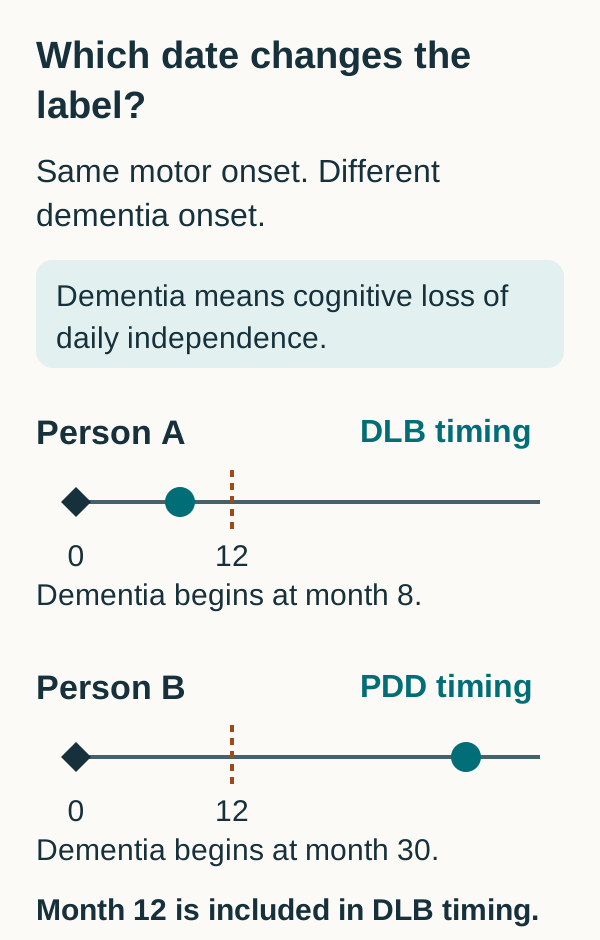
The one-year rule distinguishes two clinical descriptions within the Lewy body disease spectrum. When dementia precedes parkinsonism or begins with it or within one year, the DLB designation is used. When dementia develops after more than one year of well-established Parkinson disease, Parkinson disease dementia (PDD) is used. Count from motor onset, not the prescription date, first specialist visit or first vague complaint of forgetfulness. [1]
Both conditions share alpha-synuclein-related biology. The calendar boundary is a useful clinical convention, not evidence that a different protein appears at month thirteen. Nor does it prove a sharply different anatomic distribution in an individual. A late cognitive syndrome in someone with any kind of parkinsonism is not automatically PDD; the preceding motor diagnosis must actually be Parkinson disease. [1][10]
Change one date. On the paired timeline, both people develop established Parkinson disease motor symptoms at month zero. Person A loses independence from cognitive decline at month eight; person B remains cognitively independent until month thirty. Assign a label to each before reading the comparison.
Purpose: apply the same calendar convention to two histories, then change functional independence as described in the text. Diamonds indicate motor onset; circles indicate dementia onset. The comparison assumes established Parkinson disease in the later-dementia example. Compare motor and dementia onset against loss of functional independence. [1][2]Compare the two timelines
A is within the one-year interval and fits DLB timing. B develops dementia after established Parkinson disease and fits PDD timing. Both examples require actual dementia, not merely a low screening score.
Now change the functional detail instead of the date: at month eight, A makes occasional mistakes but independently corrects them and manages daily tasks. That does not establish dementia. A prodromal Lewy body presentation may warrant specialist assessment and follow-up; the 2020 MCI-LB framework is a research classification, not permission to call every at-risk person demented. [2]
Transfer: when motor symptoms began years before treatment, use the symptom history. When cognitive onset is uncertain, acknowledge the uncertainty instead of creating a precise date from the appointment calendar.
Compare cognitive processes, not just total scores
Typical early DLB disproportionately affects attention, executive function and visual processing. Executive function organizes a multistep task; visuospatial function judges locations and spatial relationships. Errors copying a figure, orienting lines, assembling shapes or recognizing incomplete objects can reveal problems that a word-recall score misses. Naming and memory may be relatively less affected, but neither has to be normal. [1]
Typical amnestic Alzheimer disease often begins with impaired acquisition and retention of new episodic information. In contrast, an individual with inconsistent attention may never register all the material during learning, or may struggle to retrieve it later. Better recognition than free recall suggests some information remains accessible, but it is not a disease-specific test. Assess learning, retrieval, perception, alertness and function together.
Predict a testing error. A person hears instructions clearly but loses track halfway through copying a complex shape. Later, when fully alert, the person recognizes material that could not be recalled freely. Would a single low recall total justify describing this as an isolated memory-storage disorder?
Check the cognitive interpretation
No. Variable attention and impaired construction indicate a broader profile. Recognition helps separate retrieval difficulty from storage failure, but neither pattern alone supplies an etiologic diagnosis.
Do not turn this comparison into an absolute rule that memory is spared in DLB or that visual processing is always intact in Alzheimer disease. Coexisting Alzheimer pathology can make a Lewy body presentation strongly amnestic. Amyloid positivity or medial temporal atrophy may therefore indicate additional pathology rather than erase convincing early fluctuations, hallucinations and spontaneous parkinsonism. Language symptoms also require assessment rather than a fixed assumption that they occur only late. [1][2]
Transfer: two people with the same total cognitive score may have very different patterns. Ask which tasks failed, whether alertness changed, and what happens during ordinary daily activities before choosing a unifying diagnosis.
Use biomarkers to answer a defined question
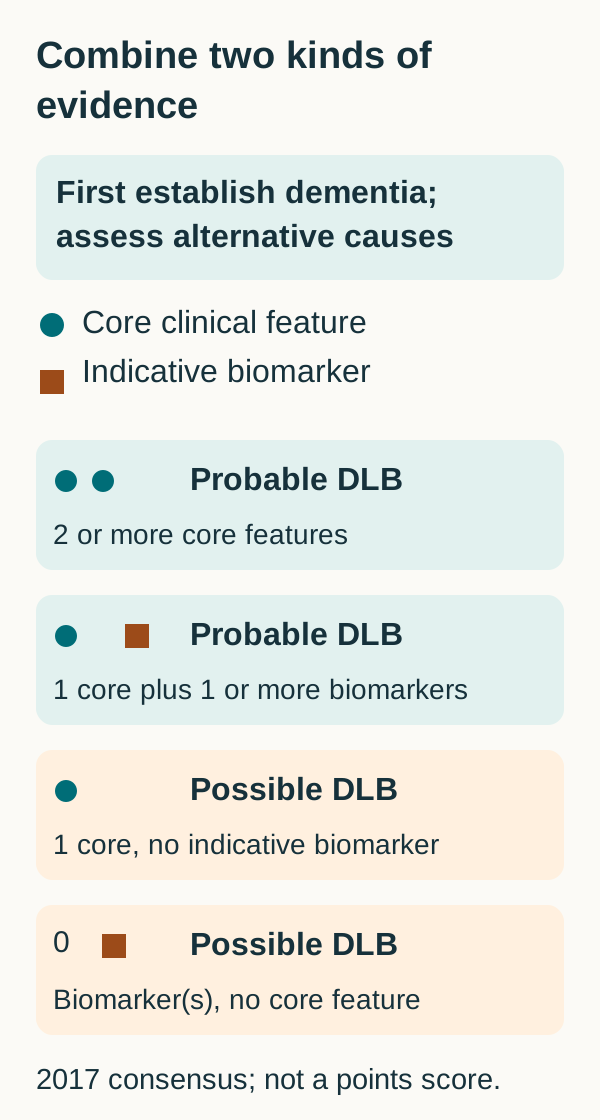
After establishing dementia and considering competing explanations, combine two types of evidence: core clinical features and indicative biomarkers. Under the 2017 consensus framework, two or more core features support probable DLB. One core feature plus at least one indicative biomarker also supports probable DLB. One core feature without an indicative biomarker supports possible DLB; one or more indicative biomarkers without any core feature also supports possible DLB. Several abnormal biomarkers without a core feature do not by themselves establish probable DLB. [1]
Purpose: compare the clinical-plus-biomarker pathways without counting every abnormality as a core feature. Repeated squares without a circle do not establish probable DLB. The displayed criteria assume appropriate interpretation of each finding and assessment of competing causes. [1]
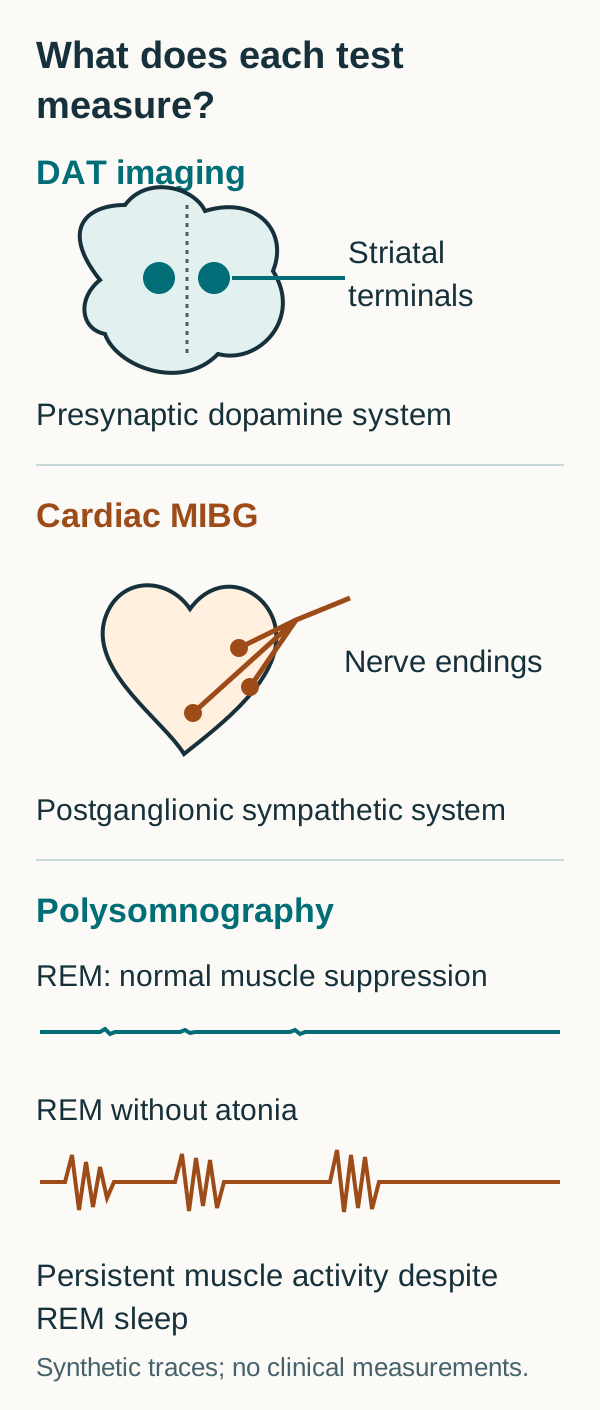
Striatal dopamine transporter imaging assesses presynaptic dopaminergic terminals. Reduced uptake on SPECT or PET is indicative in the appropriate dementia presentation and can help distinguish DLB from typical Alzheimer disease. It is not a direct image of Lewy bodies. Parkinson disease and several other degenerative parkinsonian disorders can also have reduced uptake; a normal study does not completely exclude DLB. Interpret the phenotype, medicines and technical quality with the report.
Cardiac MIBG scintigraphy assesses postganglionic sympathetic cardiac innervation. Reduced uptake can support a Lewy body disorder, but ischemic heart disease, heart failure, diabetes, peripheral neuropathy and relevant medicines can reduce its specificity. A low cardiac signal does not demonstrate a striatal dopamine defect. These tests sample different parts of the nervous system.
Purpose: localize the process sampled before interpreting an abnormal result. Brain and heart proportions are simplified. The traces are invented conceptual examples without units, sleep-stage scoring or diagnostic thresholds; they are not clinical recordings. No test in this diagram is a direct picture of a Lewy body. [1]
Polysomnography can demonstrate REM sleep without atonia. In a person with dementia and a convincing RBD history, this physiological finding supports probable DLB. Dream enactment and its sleep-study confirmation have different roles in the framework: clinical feature and indicative biomarker. The sleep report must establish that the motor activity occurs in REM, rather than simply describing any restless night. [1]
Sort the evidence. Imagine dementia with recurrent formed visual hallucinations but no other core feature. First classify it without a biomarker. Then add a technically valid reduced DAT result after assessment for competing parkinsonian disorders. State what changes.
Check the evidence combination
The category changes from possible to probable DLB: one core feature is now accompanied by an indicative biomarker. The image strengthens the clinical interpretation; it does not replace the dementia assessment.
There is no compulsory DAT-then-PSG-then-MIBG sequence. Choose the test that resolves the remaining uncertainty and is suitable locally. Structural imaging and routine medical evaluation still address alternative causes. Relative medial temporal preservation and certain metabolic or EEG patterns are supportive findings, not interchangeable with the three indicative tests described above. Newer biological assays require interpretation within their validated setting rather than automatic insertion into this named framework. [1]
Transfer: before counting an abnormal result, name what tissue or physiological process was measured and one plausible competing explanation for that result.
Hallucinations require a safety decision, not an automatic prescription
Begin with the person's experience. A recurrent image that is recognized as unreal and causes no distress may need reassurance, improved lighting, vision or hearing support, and observation rather than an antipsychotic. New fear or agitation calls for assessment of pain, infection, constipation, urinary retention, sleep disruption and medication effects. Provide a calm setting and practical support for the care partner. A dangerous situation needs immediate safety assistance, not simply a routine outpatient prescription. [1]
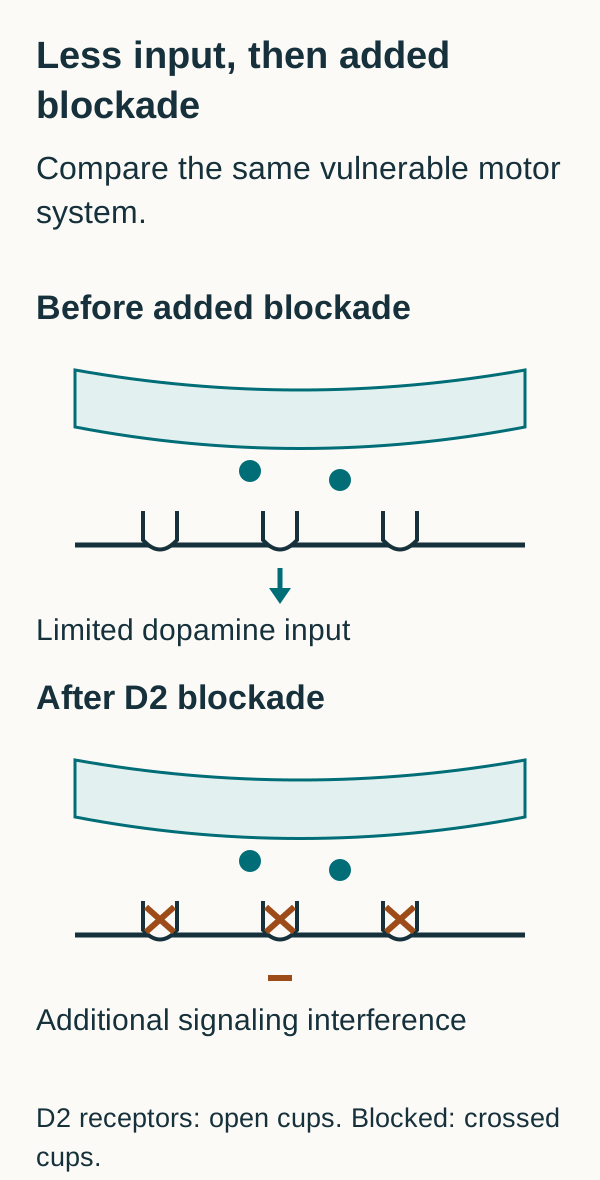
The dopamine system helps explain a particularly important hazard. Nigrostriatal dysfunction already limits motor signaling; adding strong dopamine D2 receptor blockade can worsen rigidity and mobility. DLB can also produce disproportionate sedation, confusion, autonomic instability and potentially life-threatening neuroleptic malignant syndrome after antipsychotic exposure. The receptor diagram illustrates a vulnerability, not a formula predicting how an individual will respond.
Purpose: predict why a dopamine antagonist can worsen rigidity in a vulnerable motor system. The model isolates one motor contribution; it does not quantify receptor numbers, explain every component of DLB sensitivity, or predict the severity of an individual response. Sedation, cognition and circulation still require assessment. [1]
Avoid typical antipsychotics such as haloperidol and generally avoid potent dopamine-blocking agents such as risperidone and olanzapine in DLB. Abrupt marked rigidity, reduced responsiveness, fever or unstable circulation after exposure requires stopping the suspected offending medicine and urgent medical assessment with supportive care. Do not give another dose merely because the patient appears quieter. PDD is not a guarantee against similar harm. [1]
Persistent severe distress or dangerous psychosis despite assessment and nonpharmacologic care can justify specialist-led consideration of medication. Quetiapine is sometimes selected cautiously because of relatively less motor toxicity, but its DLB efficacy evidence is limited and it is not universally safe. A small randomized trial in dementia with parkinsonism did not demonstrate an efficacy advantage; its imprecision does not prove that nobody benefits. Antipsychotic treatment in dementia carries mortality risk and requires an explicit goal, close reassessment and the lowest effective exposure. [1][5]
Clozapine has evidence in Parkinson disease psychosis, but that does not establish equivalent efficacy and tolerability specifically in DLB. Specialist selection must account for neutropenia and other adverse effects. In the United States, the clozapine REMS program ended on June 13, 2025; label-directed absolute neutrophil count (ANC) monitoring remains necessary. Ending a reporting program did not end the biological risk. [1][6]
Compare benefit with harm. After a new antipsychotic, a person stops shouting but becomes very drowsy and cannot stand. Decide whether the visible quietness establishes successful treatment.
Check the treatment interpretation
Quietness caused by sedation and motor deterioration is an adverse outcome, not proof that psychosis improved. Assess responsiveness, airway, vital signs and rigidity urgently, withhold the suspected offending medicine, and evaluate other acute causes.
Transfer: judge an intervention by the intended symptom and by cognition, mobility, alertness and circulation. A lower number of disturbing behaviors is not enough if overall function deteriorates.
Match each treatment to a functional goal
DLB has no established cure. Care aims to improve symptoms, preserve meaningful activities and reduce preventable injury. Arrange follow-up and care-partner support, discuss driving and medication-management safety, and consider physical, occupational and swallowing assessments when the presentation warrants them. Avoid both premature loss of autonomy and unrealistic expectations of independent function. [10]
Cognition and perception: donepezil or rivastigmine may improve cognition and some hallucinations or behavioral symptoms. Rivastigmine trial findings support symptomatic benefit, not elimination of alpha-synuclein deposits or proven disease reversal. Monitor appetite, weight, nausea, vomiting, pulse and syncope; cholinergic medicines are not simply "safe." Donepezil can slow sinoatrial or atrioventricular conduction, including in people without previously recognized conduction disease. A new faint after titration deserves medical review rather than attribution to a cognitive fluctuation. [1][3][4]
Motor function: levodopa may help selected patients, although benefit is often less consistent than in typical Parkinson disease. Define a practical goal such as transfers or walking, introduce it cautiously, and reassess hallucinations and blood pressure along with motor performance. More dopamine can improve mobility while worsening psychosis or orthostatic symptoms. It is not a treatment for delusions or aggression. [1]
Dream enactment: make the bedroom safer before relying on medication. Place a soft mat beside a suitably low bed, pad sharp furniture edges, keep dangerous objects out of reach, and consider separate sleeping arrangements when a partner is at risk. Routine addition of bed rails is not a universal safety solution; cognitive impairment increases entrapment and injury risk, so any device needs an individualized assessment. [7][8]
Immediate-release melatonin and clonazepam have conditional recommendations for RBD. Selection depends on symptoms, comorbidity and patient priorities. Clonazepam can worsen daytime sedation, cognition, gait stability and sleep-disordered breathing, which matters particularly in a person who already falls or has sleep apnea. Neither drug substitutes for bedroom safety, and a sleep specialist can clarify uncertain events. [7]
Falls and faintness: measure blood pressure and pulse supine and after standing, review medicines, hydration and comorbid illness, and distinguish orthostatic symptoms from a primary attentional fluctuation. A sustained fall of at least 20 mmHg systolic or 10 mmHg diastolic within three minutes supports orthostatic hypotension. A small pulse rise can support an autonomic contribution, but rate-limiting drugs, rhythm disease and other causes must be considered. Treatment is individualized, including the risk of high supine pressure. [9]
Predict the tradeoff. A person with RBD has untreated sleep apnea, daytime drowsiness and two recent falls. Which matters more when considering a sedating treatment: reducing nocturnal activity alone, or improving sleep safety without worsening breathing and daytime function?
Check the functional goal
The goal is safer sleep and daytime function together. Address apnea and environmental hazards, then select and monitor treatment with the sedation, breathing and fall risks in view.
Transfer: before adding any medicine, write one observable benefit to reassess and one adverse effect that would make you reconsider it. The care partner's account can expose changes a brief office visit misses.
Apply the pattern to new patients
Choose the best-supported answer from the information supplied. After committing to a choice, compare the explanation with the competing interpretations. These original cases are educational exercises, not a prediction of examination performance.
Case 1
Show answer and explanations for case 1
A. Probable dementia with Lewy bodies (Why this does not fit)
The patient must have dementia that interferes with usual daily activities. He remains accurate and independent, so clinical features and a biomarker cannot establish dementia here. Establish the cognitive syndrome before applying its etiologic certainty criteria.
Reasoning steps for option A
What prerequisite accompanies the DLB certainty rules?
The patient must have dementia that interferes with usual daily activities.
Does the supplied functional history meet that prerequisite?
He remains accurate and independent, so clinical features and a biomarker cannot establish dementia here.
Why does the probable DLB label fail despite REM without atonia?
Probable DLB presupposes dementia; his independent billing, meals and medicines leave that threshold unmet.
B. Parkinson disease dementia with preserved motor function (Why this does not fit)
Dementia must arise in the setting of well-established Parkinson disease. Neither established Parkinson disease nor cognitive loss of independence is described. A sleep disorder alone does not establish preceding Parkinson disease.
Reasoning steps for option B
What history supports Parkinson disease dementia?
Dementia must arise in the setting of well-established Parkinson disease.
Which essential findings are absent here?
Neither established Parkinson disease nor cognitive loss of independence is described.
Why does dream enactment not make this Parkinson disease dementia?
REM sleep behavior disorder is not established Parkinson disease, and he has neither preceding Parkinson disease nor dementia-level dependence.
C. Mild cognitive impairment with Lewy body features (Best answer)
Slower but accurate independent task completion can occur in mild cognitive impairment. They support a Lewy body prodromal phenotype without supplying the missing dementia threshold. The MCI-LB framework is a research classification; do not equate risk features with established dementia.
Reasoning steps for option C
Does taking longer establish loss of independence?
Slower but accurate independent task completion can occur in mild cognitive impairment.
What do dream enactment and REM without atonia add?
They support a Lewy body prodromal phenotype without supplying the missing dementia threshold.
How should REM without atonia be interpreted in the selected MCI formulation?
It strengthens a prodromal Lewy body research classification alongside objective deficits, without converting independent function into dementia.
D. Normal aging with an isolated sleep disorder (Why this does not fit)
RBD can occur while cognitive testing remains normal. Objective impairment in two cognitive domains is already documented. Preserved independence does not mean that formal cognitive testing is normal.
Reasoning steps for option D
Can isolated RBD occur without cognitive impairment?
RBD can occur while cognitive testing remains normal.
What makes this more than that presentation?
Objective impairment in two cognitive domains is already documented.
Why is normal aging not rescued by intact daily independence?
His measured attention and figure-copying deficits exceed normal aging even though he completes tasks independently.
Takeaway: Objective impairment plus preserved independence is not dementia, even when Lewy body features are convincing.
The documented motor syndrome began in 2018, not when levodopa was prescribed. Cognitive loss of independence began more than seven years later, fitting Parkinson disease dementia. Hallucinations can occur in PDD and do not reset the timing rule.
Reasoning steps for option A
Which date starts the motor interval?
The documented motor syndrome began in 2018, not when levodopa was prescribed.
How long before dementia was Parkinson disease established?
Cognitive loss of independence began more than seven years later, fitting Parkinson disease dementia.
Do hallucinations later in 2025 overturn the PDD timing established in 2018?
No. Hallucinations can accompany PDD; motor Parkinson disease preceded dementia-level account errors by over seven years.
B. Dementia with Lewy bodies (Why this does not fit)
Dementia before or within one year of parkinsonism favors DLB timing. No; the established motor illness preceded dementia by years. Use disease onset rather than the date treatment became necessary.
Reasoning steps for option B
When does dementia timing favor the DLB designation?
Dementia before or within one year of parkinsonism favors DLB timing.
Does the late prescription date change this history?
No; the established motor illness preceded dementia by years.
Why is June 2025 the wrong anchor for choosing DLB over PDD?
Levodopa initiation is not motor disease onset; documented Parkinson disease began in January 2018.
C. Drug-induced cognitive impairment (Why this does not fit)
They can contribute to hallucinations or confusion. The supplied history establishes a gradual dementia syndrome after years of Parkinson disease, without an acute dose-related change. Assess medication effects without substituting them for the longitudinal diagnosis.
Reasoning steps for option C
Can dopaminergic medicines affect cognition and perception?
They can contribute to hallucinations or confusion.
Does medication exposure alone explain this progressive syndrome?
The supplied history establishes a gradual dementia syndrome after years of Parkinson disease, without an acute dose-related change.
Why should a medication contribution not replace the longitudinal diagnosis here?
A gradual loss of account independence after years of Parkinson disease is documented, with no acute dose-linked change establishing drug-induced cognitive impairment.
D. Mild cognitive impairment (Why this does not fit)
Mild impairment generally preserves independence in usual activities. Progressive cognitive errors required another person to take over, supporting dementia. Functional consequences matter more than whether memory loss sounds mild.
Reasoning steps for option D
What separates mild impairment from dementia?
Mild impairment generally preserves independence in usual activities.
What happened to account management?
Progressive cognitive errors required another person to take over, supporting dementia.
Why do the daughter-managed accounts rule out MCI?
Progressive errors required her daughter to take over finances, demonstrating loss of independence rather than mild impairment.
Takeaway: Date the established motor disease and actual dementia separately before assigning a Lewy body dementia label.
A. Parkinson disease dementia (Why this does not fit)
Dementia after more than one year of established Parkinson disease supports PDD. The documented interval is exactly one year, not more than one year. Do not change an inclusive boundary into a strict less-than rule.
Reasoning steps for option A
Which interval supports PDD timing?
Dementia after more than one year of established Parkinson disease supports PDD.
Is this interval longer than one year?
The documented interval is exactly one year, not more than one year.
Why does March 2025 to March 2026 not qualify as PDD timing?
Exactly one year is inside the DLB boundary; PDD convention requires dementia more than one year after motor onset.
B. Possible dementia with Lewy bodies (Why this does not fit)
One core feature without an indicative biomarker supports possible DLB. Both spontaneous parkinsonism and recurrent formed visual hallucinations are present. Count distinct clinical features rather than counting only the first symptom.
Reasoning steps for option B
What clinical pattern can support possible DLB?
One core feature without an indicative biomarker supports possible DLB.
How many core features are documented?
Both spontaneous parkinsonism and recurrent formed visual hallucinations are present.
Why is possible DLB too conservative in this March 2026 presentation?
Dementia plus spontaneous parkinsonism and recurrent formed hallucinations gives two distinct core features, supporting probable DLB.
C. Mild cognitive impairment with parkinsonism (Why this does not fit)
Yes, while daily independence remains preserved. Planning errors now require daily medication supervision. The need for cognitive assistance distinguishes this from mild impairment.
Reasoning steps for option C
Can cognitive complaints accompany parkinsonism before dementia?
Yes, while daily independence remains preserved.
What supplied functional change exceeds that threshold?
Planning errors now require daily medication supervision.
Why does medication supervision preclude MCI with parkinsonism?
Daily supervision for progressive planning errors establishes dementia-level functional loss, despite independent medication management in December.
D. Probable dementia with Lewy bodies (Best answer)
Yes; dementia at or within one year of parkinsonism fits DLB timing. Dementia is accompanied by spontaneous parkinsonism and recurrent visual hallucinations, two core features. Use the dementia onset date and the inclusive boundary together.
Reasoning steps for option D
Is an interval of exactly one year inside the DLB convention?
Yes; dementia at or within one year of parkinsonism fits DLB timing.
What supports probable rather than possible DLB?
Dementia is accompanied by spontaneous parkinsonism and recurrent visual hallucinations, two core features.
How do the March dates and January hallucinations support probable DLB?
Dementia arose exactly one year after spontaneous parkinsonism and accompanies recurrent formed hallucinations, satisfying the inclusive DLB timing and two-core-feature pathway.
Takeaway: Exactly one year belongs to the DLB side of the timing convention when dementia is established.
A. Alzheimer disease replaces the DLB diagnosis (Why this does not fit)
Typical Alzheimer disease often has relatively preserved striatal DAT uptake. It does not outweigh the specified early fluctuations and recurrent formed hallucinations by itself. Integrate a negative test with the phenotype rather than replacing it automatically.
Reasoning steps for option A
What would normal DAT uptake commonly fit?
Typical Alzheimer disease often has relatively preserved striatal DAT uptake.
Does that result explain the full phenotype better?
It does not outweigh the specified early fluctuations and recurrent formed hallucinations by itself.
Why does normal DAT-SPECT not make Alzheimer disease the preferred replacement?
Preserved DAT uptake does not erase her early fluctuations and recurrent detailed visual hallucinations, two DLB core features.
B. Probable DLB remains clinically supported (Best answer)
Marked attention fluctuations and recurrent formed visual hallucinations supply two core features. No; normal DAT uptake can occur in DLB, so it does not cancel the clinical evidence. An imperfectly sensitive biomarker is not an absolute exclusion test.
Reasoning steps for option B
How many core features accompany dementia?
Marked attention fluctuations and recurrent formed visual hallucinations supply two core features.
Does normal DAT uptake exclude this diagnosis?
No; normal DAT uptake can occur in DLB, so it does not cancel the clinical evidence.
What does the normal DAT result change about clinically probable DLB?
It supplies no indicative biomarker, but does not exclude DLB or undo probable status from two clinical core features.
C. Possible DLB is the highest supported category (Why this does not fit)
One core feature without an indicative biomarker supports possible DLB. No; two core features are already present in a patient with dementia. A biomarker is not mandatory when the clinical probable criteria are met.
Reasoning steps for option C
When does the possible category fit one clinical feature?
One core feature without an indicative biomarker supports possible DLB.
Is this patient limited to one core feature?
No; two core features are already present in a patient with dementia.
Why is possible DLB not the ceiling with a normal DAT scan?
Her fluctuations and formed hallucinations are two core features in dementia, sufficient for probable DLB without abnormal DAT imaging.
D. Neurodegenerative dementia is effectively excluded (Why this does not fit)
DAT imaging evaluates presynaptic dopaminergic terminal integrity. No; dementia is demonstrated by the progressive cognitive and functional history. A regional biomarker cannot exclude every neurodegenerative process.
Reasoning steps for option D
What system does DAT imaging assess?
DAT imaging evaluates presynaptic dopaminergic terminal integrity.
Does a normal result establish normal cognition?
No; dementia is demonstrated by the progressive cognitive and functional history.
Why can a normal striatal DAT study not exclude her dementia?
The scan measures presynaptic dopaminergic terminals, not the established cognitive and functional decline requiring shopping and finance help.
Takeaway: Two core features with dementia can support probable DLB despite a normal DAT study.
A. Probable dementia with Lewy bodies (Why this does not fit)
Two core features, or one core feature plus an indicative biomarker, support probable DLB. No core clinical feature is documented. Do not count an imaging abnormality as a clinical feature.
Reasoning steps for option A
What evidence combinations support probable DLB?
Two core features, or one core feature plus an indicative biomarker, support probable DLB.
Which part is missing from both pathways here?
No core clinical feature is documented.
Why do abnormal DAT and MIBG scans not establish probable DLB here?
Both are indicative biomarkers, but no core clinical feature is present; two biomarkers do not replace the required core feature for probable DLB.
B. Definite dementia with Lewy bodies (Why this does not fit)
DAT and MIBG studies assess terminal systems rather than directly establishing all Lewy-related pathology. With no core feature, the named clinical framework supports only possible DLB. Clinical probability is not the same as definitive tissue classification.
Reasoning steps for option B
Do these indirect tests identify the complete neuropathology?
DAT and MIBG studies assess terminal systems rather than directly establishing all Lewy-related pathology.
What confidence can their combination support here?
With no core feature, the named clinical framework supports only possible DLB.
Why is definite DLB unjustified by these two abnormal terminal-system studies?
DAT and MIBG are indirect biomarkers, not tissue confirmation of Lewy pathology; the clinical evidence permits only possible DLB.
C. Parkinson disease dementia (Why this does not fit)
PDD occurs when dementia develops after established Parkinson disease. No spontaneous parkinsonism or established Parkinson disease history is supplied. An abnormal DAT study alone does not retrospectively establish years of Parkinson disease.
Reasoning steps for option C
What temporal history supports PDD?
PDD occurs when dementia develops after established Parkinson disease.
Is a preceding clinical Parkinson disease syndrome present?
No spontaneous parkinsonism or established Parkinson disease history is supplied.
Why does reduced DAT uptake not establish preceding Parkinson disease dementia?
An abnormal terminal scan does not establish a prior clinical Parkinson disease syndrome, and no spontaneous parkinsonism is documented.
D. Mild cognitive impairment with Lewy body features (Why this does not fit)
Usual independence is relatively preserved in MCI. The patient has established progressive dementia, so an MCI formulation understates the functional syndrome. Use both the syndrome level and etiologic evidence.
Reasoning steps for option D
What functional status belongs to mild cognitive impairment?
Usual independence is relatively preserved in MCI.
What cognitive syndrome is specified in this stem?
The patient has established progressive dementia, so an MCI formulation understates the functional syndrome.
Why does the MCI label understate this biomarker-positive case?
The stem already establishes progressive dementia; biomarkers inform possible etiology, not a reversal of syndrome severity.
E. Possible dementia with Lewy bodies (Best answer)
At least one indicative biomarker can support possible DLB when dementia is present. No; probable DLB is not assigned from biomarkers alone in this framework. More results of one evidence type do not supply a missing clinical requirement.
Reasoning steps for option E
Can indicative biomarkers support DLB without a core feature?
At least one indicative biomarker can support possible DLB when dementia is present.
Does a second indicative biomarker establish probable DLB?
No; probable DLB is not assigned from biomarkers alone in this framework.
Why does adding reduced MIBG uptake to abnormal DAT leave the category possible?
With dementia but no core clinical feature, indicative biomarkers support possible DLB; their number alone cannot satisfy probable criteria.
Takeaway: Multiple indicative biomarkers without a core clinical feature support possible, not probable, DLB.
A. Probable DLB based on two core features (Why this does not fit)
They can do so when the motor findings are spontaneous and dementia is present. They began after dopamine blockade and improved after withdrawal. Medication-induced examination findings must not inflate the clinical feature count.
Reasoning steps for option A
When can hallucinations and parkinsonism support probable DLB?
They can do so when the motor findings are spontaneous and dementia is present.
What makes the motor findings different here?
They began after dopamine blockade and improved after withdrawal.
Why must risperidone-associated rigidity be excluded from the probable DLB feature count?
Normal pretreatment motor examinations and improvement after withdrawal favor drug-induced, not spontaneous, parkinsonism; hallucinations remain the sole core feature.
B. PDD based on the treated motor syndrome (Why this does not fit)
Dementia must follow established Parkinson disease rather than a transient drug-induced syndrome. No; the motor signs developed after treatment of hallucinations in a person already living with dementia. Motor symptom treatment does not establish Parkinson disease chronology.
Reasoning steps for option B
What history is required for PDD?
Dementia must follow established Parkinson disease rather than a transient drug-induced syndrome.
Did idiopathic Parkinson disease precede dementia?
No; the motor signs developed after treatment of hallucinations in a person already living with dementia.
Why does the treated motor syndrome not establish PDD chronology?
Motor signs appeared after risperidone in a person already living with dementia, not after years of established Parkinson disease.
C. Possible DLB based on the hallucination history (Best answer)
Rigidity and slowness tracked risperidone exposure, supporting drug-induced parkinsonism. Recurrent visual hallucinations remain the one documented core feature, supporting possible DLB without a biomarker. Only spontaneous parkinsonism qualifies as this DLB core feature.
Reasoning steps for option C
What does the motor time course suggest?
Rigidity and slowness tracked risperidone exposure, supporting drug-induced parkinsonism.
How many independent core clinical features remain?
Recurrent visual hallucinations remain the one documented core feature, supporting possible DLB without a biomarker.
Why do hallucinations support possible rather than probable DLB here?
Recurrent visual hallucinations are one core feature; reversible risperidone-associated motor signs are not spontaneous parkinsonism, and no indicative biomarker is available.
D. Alzheimer disease based on motor reversibility (Why this does not fit)
Yes; dopamine antagonists can cause motor toxicity in several dementia syndromes. No; it identifies the motor confounder without determining the sole cause of dementia. Eliminating one misleading feature does not prove a different disease.
Reasoning steps for option D
Can Alzheimer disease coexist with drug-induced parkinsonism?
Yes; dopamine antagonists can cause motor toxicity in several dementia syndromes.
Does reversibility erase the hallucination evidence?
No; it identifies the motor confounder without determining the sole cause of dementia.
Why does motor improvement after stopping risperidone not prove Alzheimer disease?
It identifies a drug-induced motor confounder but leaves the recurrent formed hallucinations and dementia etiologically unresolved.
Takeaway: A drug-related motor syndrome is not the spontaneous parkinsonism core feature.
A. Probable DLB from multiple supportive clinical features (Why this does not fit)
Several autonomic and sleepiness symptoms can accompany Lewy body disease. They are supportive symptoms rather than multiple core clinical features. Classification depends on the type of evidence, not just its count.
Reasoning steps for option A
Why might the symptom cluster raise suspicion?
Several autonomic and sleepiness symptoms can accompany Lewy body disease.
Why does their number not establish probable DLB?
They are supportive symptoms rather than multiple core clinical features.
Why cannot constipation, falls, orthostasis and sleepiness be counted as probable DLB core features?
They are supportive clues, not fluctuations, formed hallucinations, RBD or spontaneous parkinsonism; no indicative biomarker is available.
B. Dementia without a supported DLB certainty category (Best answer)
They can support suspicion of DLB but lack the specificity of core clinical features. No core feature or indicative biomarker is supplied, so neither category is established from this evidence alone. Use supportive symptoms to guide further evaluation, not as replacements for required evidence.
Reasoning steps for option B
What role do falls and autonomic symptoms play?
They can support suspicion of DLB but lack the specificity of core clinical features.
Do the supplied findings meet a possible or probable pathway?
No core feature or indicative biomarker is supplied, so neither category is established from this evidence alone.
Why is no DLB certainty category established despite these symptoms?
The dementia is established, but only supportive findings are supplied, with neither a core feature nor an indicative biomarker.
C. Possible DLB from a single supportive clinical feature (Why this does not fit)
Falls are a supportive feature and merit assessment of motor, autonomic and environmental causes. No, so they do not by themselves meet the possible DLB pathway. A clinically important finding need not be diagnostically specific.
Reasoning steps for option C
What can recurrent falls suggest?
Falls are a supportive feature and merit assessment of motor, autonomic and environmental causes.
Are falls alone a core feature or indicative biomarker?
No, so they do not by themselves meet the possible DLB pathway.
Why do recurrent falls not suffice for possible DLB?
Falls merit evaluation but are supportive rather than a core clinical feature or indicative biomarker.
D. Dementia caused by an established non-Lewy-body process (Why this does not fit)
No; DLB can be supported by other combinations of core features and biomarkers. No; it establishes insufficient current evidence, not biological exclusion. Distinguish failure to meet criteria from proof that a disease is absent.
Reasoning steps for option D
Are hallucinations required in every DLB presentation?
No; DLB can be supported by other combinations of core features and biomarkers.
Does this assessment prove that no Lewy body disease exists?
No; it establishes insufficient current evidence, not biological exclusion.
Why does insufficient DLB evidence not establish a non-Lewy cause?
Absence of current core features and biomarkers leaves DLB unclassified; it does not identify another etiology or biologically exclude Lewy pathology.
Takeaway: Supportive symptoms justify further assessment but do not substitute for core features or indicative biomarkers.
A. Retrieval and attention contribute to a broader cognitive disorder (Best answer)
Much of the learned information remains accessible despite poor spontaneous retrieval. They indicate a broader cognitive profile rather than isolated memory storage failure. Recognition benefit informs mechanism but is not a disease-specific diagnostic test.
Reasoning steps for option A
What does recognition of nine words suggest?
Much of the learned information remains accessible despite poor spontaneous retrieval.
What do the construction and attention deficits add?
They indicate a broader cognitive profile rather than isolated memory storage failure.
Does recognizing 9 of 10 words identify a specific disease causing her retrieval difficulty?
The recognition benefit supports accessible information despite poor free recall, but it is not disease-specific; her attention, construction and functional deficits must be interpreted together.
B. Isolated hippocampal storage failure accounts for the deficits (Why this does not fit)
It can impair retention and later recognition as well as free recall. Strong recognition and substantial attention and construction deficits argue against that isolated formulation. Interpret memory performance alongside encoding conditions and other cognitive domains.
Reasoning steps for option B
What pattern can hippocampal storage dysfunction produce?
It can impair retention and later recognition as well as free recall.
Which findings are poorly explained by an isolated storage account?
Strong recognition and substantial attention and construction deficits argue against that isolated formulation.
Why is an isolated hippocampal storage account discordant with this test profile?
Recognition of 9 of 10 words and major alternating-attention and figure-copy deficits are not well explained by isolated loss of stored memories.
C. A primary naming disorder accounts for the low recall (Why this does not fit)
It impairs access to names for otherwise recognized objects or concepts. The supplied abnormalities involve attention, construction, free recall and daily planning, not an isolated naming deficit. Do not assign a language mechanism without corresponding language findings.
Reasoning steps for option C
What does a naming disorder primarily affect?
It impairs access to names for otherwise recognized objects or concepts.
What information instead dominates this profile?
The supplied abnormalities involve attention, construction, free recall and daily planning, not an isolated naming deficit.
Why does the low free recall not identify a primary naming disorder?
There is no reported naming deficit; impaired attention, construction and daily planning accompany low free recall.
D. Normal cognition explains the recognition performance (Why this does not fit)
Yes; one task can remain relatively preserved while other domains are impaired. No; attention, visual construction and daily independence are already affected. A single relative strength does not establish globally normal cognition.
Reasoning steps for option D
Can a preserved score occur within a cognitive disorder?
Yes; one task can remain relatively preserved while other domains are impaired.
Does recognition erase the functional and testing deficits?
No; attention, visual construction and daily independence are already affected.
Why does near-intact recognition not mean globally normal cognition?
Recognition is a relative strength, while free recall, attention, figure copying and financial independence are impaired.
Takeaway: Better recognition than recall suggests retained information, but the full cognitive and functional profile determines interpretation.
A. An Alzheimer process without a Lewy body contribution (Why this does not fit)
They support consideration of Alzheimer-related pathology. No; the two pathological processes can coexist. A positive test for one process does not necessarily exclude another.
Reasoning steps for option A
What do amyloid positivity and medial temporal atrophy support?
They support consideration of Alzheimer-related pathology.
Do they negate the early DLB phenotype?
No; the two pathological processes can coexist.
Why does positive amyloid PET not eliminate Lewy body contribution?
Early formed hallucinations, marked fluctuations and spontaneous rigidity support DLB even when amyloid and medial temporal atrophy indicate possible Alzheimer copathology.
B. A Lewy body process without an Alzheimer contribution (Why this does not fit)
Yes, the supplied clinical features support probable DLB. No; the amyloid and medial temporal findings still warrant consideration of copathology. Clinical confidence in DLB does not prove pathological purity.
Reasoning steps for option B
Can multiple core features establish a strong DLB phenotype?
Yes, the supplied clinical features support probable DLB.
Do those features make Alzheimer biomarkers irrelevant?
No; the amyloid and medial temporal findings still warrant consideration of copathology.
Why should a pure Lewy body explanation not dismiss the Alzheimer findings?
Probable DLB features do not establish pathological purity; positive amyloid PET and substantial medial temporal atrophy support considering copathology.
C. A nondegenerative process with incidental imaging findings (Why this does not fit)
A test result must always be interpreted in its clinical context. No; progressive dementia with persistent core features provides a coherent neurodegenerative syndrome. Avoid dismissing convergent clinical and biomarker information as unrelated.
Reasoning steps for option C
Can imaging abnormalities be incidental in some patients?
A test result must always be interpreted in its clinical context.
Does this presentation lack evidence of progressive neurodegeneration?
No; progressive dementia with persistent core features provides a coherent neurodegenerative syndrome.
Why is incidental imaging with a nondegenerative explanation inadequate?
Progressive dementia with persistent DLB core features and Alzheimer-associated tests provides convergent evidence of neurodegenerative processes.
D. Combined Lewy body and Alzheimer-related processes (Best answer)
Early hallucinations, marked fluctuations and spontaneous rigidity strongly support that phenotype. They can indicate coexisting Alzheimer pathology rather than exclude Lewy body disease. A mixed pathological process can produce both attentional and amnestic deficits.
Reasoning steps for option D
Does the clinical syndrome have multiple DLB core features?
Early hallucinations, marked fluctuations and spontaneous rigidity strongly support that phenotype.
What can amyloid positivity and medial temporal atrophy add?
They can indicate coexisting Alzheimer pathology rather than exclude Lewy body disease.
How can the two processes jointly account for this dementia?
DLB core features explain attentional and perceptual changes, while amyloid positivity and medial temporal atrophy suggest coexisting Alzheimer-related contribution.
Takeaway: Alzheimer-type biomarkers can coexist with a convincing Lewy body clinical syndrome.
A. DLB with presynaptic dopaminergic degeneration (Why this does not fit)
Reduced striatal uptake is an indicative biomarker in the appropriate dementia presentation. Early backward falls and vertical supranuclear gaze limitation favor PSP. Executive impairment is not itself one of the four DLB core features.
Reasoning steps for option A
Why can an abnormal DAT study raise concern for DLB?
Reduced striatal uptake is an indicative biomarker in the appropriate dementia presentation.
Which supplied findings create a stronger competing phenotype?
Early backward falls and vertical supranuclear gaze limitation favor PSP.
Can executive impairment and reduced DAT uptake outweigh the gaze and fall pattern in favor of DLB?
Executive impairment is not a DLB core feature, and reduced DAT uptake is not specific to DLB; early backward falls and supranuclear vertical gaze limitation favor PSP.
B. PDD with presynaptic dopaminergic degeneration (Why this does not fit)
Typical Parkinson disease would need to precede dementia by more than one year. No; the atypical early postural and gaze findings instead require a different parkinsonian assessment. A DAT result cannot establish the clinical subtype or its chronology.
Reasoning steps for option B
What prior history would support PDD?
Typical Parkinson disease would need to precede dementia by more than one year.
Is that history demonstrated by this scan and examination?
No; the atypical early postural and gaze findings instead require a different parkinsonian assessment.
Why does the DAT scan not establish Parkinson disease dementia?
It shows presynaptic loss but neither typical antecedent Parkinson disease nor its dementia chronology; early falls and gaze impairment suggest atypical parkinsonism.
C. PSP with presynaptic dopaminergic degeneration (Best answer)
It supports a supranuclear eye-control disorder, which with early falls and axial rigidity favors PSP. No; presynaptic dopaminergic loss can occur in both conditions. A compatible alternative parkinsonian phenotype must be assessed before applying a DLB biomarker pathway.
Reasoning steps for option C
What does preserved reflex excursion with limited voluntary gaze suggest?
It supports a supranuclear eye-control disorder, which with early falls and axial rigidity favors PSP.
Does reduced DAT uptake distinguish DLB from PSP?
No; presynaptic dopaminergic loss can occur in both conditions.
Why is reduced DAT uptake compatible with the PSP interpretation?
PSP can cause presynaptic dopaminergic loss; supranuclear gaze limitation with preserved reflex excursion and early falls localizes the clinical phenotype.
D. Drug-induced parkinsonism from dopamine receptor blockade (Why this does not fit)
They can block postsynaptic dopamine receptors without necessarily causing presynaptic terminal loss. The progressive gaze and postural syndrome with reduced DAT uptake supports a degenerative process. Separate presynaptic imaging findings from postsynaptic receptor blockade.
Reasoning steps for option D
How can dopamine antagonists cause parkinsonism?
They can block postsynaptic dopamine receptors without necessarily causing presynaptic terminal loss.
What favors degeneration rather than an isolated drug effect here?
The progressive gaze and postural syndrome with reduced DAT uptake supports a degenerative process.
Why does isolated dopamine receptor blockade poorly explain this case?
Postsynaptic blockade alone need not reduce presynaptic DAT uptake and does not account well for progressive supranuclear gaze dysfunction and early backward falls.
Takeaway: DAT imaging supports dopaminergic degeneration, not a unique diagnosis of DLB.
A. Reduced postganglionic sympathetic cardiac innervation (Best answer)
MIBG assesses the sympathetic nerve terminals supplying the heart. The relevant measurement concerns postganglionic sympathetic cardiac innervation. Name the organ and nerve segment sampled before interpreting an imaging biomarker.
Reasoning steps for option A
Which neuronal system retains cardiac MIBG?
MIBG assesses the sympathetic nerve terminals supplying the heart.
Which segment of that pathway does reduced myocardial uptake implicate?
The relevant measurement concerns postganglionic sympathetic cardiac innervation.
Why does reduced myocardial MIBG retention favor the cardiac sympathetic option here?
The tracer samples postganglionic sympathetic terminals in the heart, and relevant cardiac and medication confounders were assessed.
B. Reduced presynaptic striatal dopaminergic innervation (Why this does not fit)
Striatal DAT imaging evaluates presynaptic dopaminergic terminal integrity. No; tracer retention was measured in the myocardium with MIBG. Different indicative biomarkers sample different neuronal systems.
Reasoning steps for option B
Which test assesses this system?
Striatal DAT imaging evaluates presynaptic dopaminergic terminal integrity.
Is the reported image a striatal DAT study?
No; tracer retention was measured in the myocardium with MIBG.
Why does this MIBG result not directly establish striatal dopaminergic loss?
The measured uptake is myocardial; presynaptic striatal terminals would be assessed with DAT imaging instead.
C. Reduced postsynaptic striatal dopamine receptor density (Why this does not fit)
Postsynaptic dopamine receptors receive signals from presynaptic terminals. No; neither the organ nor the measured target matches this option. Do not infer receptor density from a cardiac terminal-uptake study.
Reasoning steps for option C
What structure receives dopamine signaling in the striatum?
Postsynaptic dopamine receptors receive signals from presynaptic terminals.
Does cardiac MIBG directly measure those receptors?
No; neither the organ nor the measured target matches this option.
Why is postsynaptic striatal receptor density not measured by this scan?
MIBG retention in cardiac sympathetic terminals neither images striatal tissue nor quantifies postsynaptic dopamine receptors.
D. Reduced cortical cholinergic receptor responsiveness (Why this does not fit)
Cholinergic deficits can contribute to cognitive and perceptual symptoms. No; the result concerns sympathetic cardiac innervation. A plausible disease mechanism is not necessarily the mechanism measured by a particular test.
Reasoning steps for option D
Which symptoms can cholinergic dysfunction contribute to?
Cholinergic deficits can contribute to cognitive and perceptual symptoms.
Does this cardiac tracer measure cortical cholinergic function?
No; the result concerns sympathetic cardiac innervation.
Why do the hallucinations not turn MIBG into a cortical cholinergic assay?
Hallucinations may accompany cholinergic dysfunction, but this scan measures myocardial sympathetic tracer retention, not cortical receptor responsiveness.
A. Low MIBG uptake with high etiologic specificity (Why this does not fit)
It can do so when the imaging finding is appropriately interpreted as indicative evidence. Documented diabetic neuropathy offers a relevant competing cause of reduced uptake. An abnormal result is not automatically disease-specific evidence.
Reasoning steps for option A
When can one core feature plus MIBG support probable DLB?
It can do so when the imaging finding is appropriately interpreted as indicative evidence.
What weakens that interpretation here?
Documented diabetic neuropathy offers a relevant competing cause of reduced uptake.
Why is high etiologic specificity unwarranted for this low MIBG result?
Documented diabetic autonomic neuropathy can reduce cardiac sympathetic uptake independently of Lewy body disease.
B. Low MIBG uptake arguing against Lewy body disease (Why this does not fit)
Yes; neuropathy can account for reduced myocardial tracer retention. No; a confounder limits specificity but does not exclude coexistence. A competing explanation creates uncertainty rather than a definitive negative result.
Reasoning steps for option B
Can a competing disease explain an abnormal biomarker?
Yes; neuropathy can account for reduced myocardial tracer retention.
Does that prove Lewy body disease is absent?
No; a confounder limits specificity but does not exclude coexistence.
Why does diabetic neuropathy not make the low MIBG result evidence against DLB?
It offers an alternative explanation for low uptake but cannot rule out coexisting Lewy body disease in this patient with hallucinations.
C. Low MIBG uptake reflecting striatal dopaminergic loss (Why this does not fit)
A DAT study can provide evidence of presynaptic dopaminergic degeneration. The MIBG study measured cardiac sympathetic tracer retention instead. Do not substitute one biomarker target for another.
Reasoning steps for option C
What would establish evidence about striatal terminals?
A DAT study can provide evidence of presynaptic dopaminergic degeneration.
What was measured in this case?
The MIBG study measured cardiac sympathetic tracer retention instead.
Why cannot this cardiac MIBG result be labeled striatal dopaminergic loss?
The scan measures cardiac sympathetic retention; a striatal DAT study would interrogate presynaptic dopaminergic terminals.
D. Low MIBG uptake reflecting abnormal REM physiology (Why this does not fit)
Polysomnography can document REM sleep without atonia. No; the cardiac result provides no direct recording of REM muscle activity. Select evidence that actually samples the physiological process being claimed.
Reasoning steps for option D
Which test evaluates REM muscle suppression?
Polysomnography can document REM sleep without atonia.
Does reduced myocardial tracer retention measure sleep physiology?
No; the cardiac result provides no direct recording of REM muscle activity.
Why does low cardiac uptake not demonstrate abnormal REM physiology?
Only a sleep recording can document REM without atonia; myocardial tracer retention contains no REM muscle measurement.
E. Low MIBG uptake with reduced etiologic specificity (Best answer)
Yes; it can reduce MIBG uptake and overlap with the proposed Lewy body mechanism. No; the competing explanation limits how much it adds to the clinical evidence. Interpret biomarker specificity in the actual patient rather than the ideal study population.
Reasoning steps for option E
Can diabetic neuropathy affect cardiac sympathetic terminals?
Yes; it can reduce MIBG uptake and overlap with the proposed Lewy body mechanism.
Can this result be treated as unconfounded confirmation of DLB?
No; the competing explanation limits how much it adds to the clinical evidence.
How does the documented neuropathy change the value of MIBG alongside one core feature?
It reduces the specificity of low cardiac uptake, so the result cannot be counted uncritically as independent confirmation of probable DLB.
Takeaway: A confounded indicative test should not automatically increase diagnostic certainty.
A. The behaviors establish RBD despite preserved REM muscle suppression (Why this does not fit)
RBD is associated with loss of normal REM muscle suppression and dream enactment. They accompany apneic arousals with preserved REM suppression and respond to apnea treatment. Not every nocturnal motor event is an RBD event.
Reasoning steps for option A
What physiological feature characterizes RBD?
RBD is associated with loss of normal REM muscle suppression and dream enactment.
What do the captured events demonstrate instead?
They accompany apneic arousals with preserved REM suppression and respond to apnea treatment.
Why should punching after apneas not establish RBD in this study?
The captured behaviors follow obstructive arousals, REM muscle suppression is preserved, and apnea treatment resolves the events.
B. Respiratory arousals explain the behaviors without establishing RBD (Best answer)
The punching follows obstructive apneas rather than occurring with demonstrated REM atonia loss. It supports a respiratory-arousal explanation for the captured behavior. Dream-like behavior requires physiological and clinical context before it is labeled RBD.
Reasoning steps for option B
What is the observed trigger for the episodes?
The punching follows obstructive apneas rather than occurring with demonstrated REM atonia loss.
What does resolution with apnea treatment add?
It supports a respiratory-arousal explanation for the captured behavior.
Why is a respiratory-arousal explanation favored over RBD for these captured episodes?
Their temporal association with apneas and disappearance after effective treatment fit arousal-related movements without demonstrated REM atonia loss.
C. The normal REM finding excludes every future synucleinopathy (Why this does not fit)
It can clarify the physiology underlying the events recorded that night. No; explaining these behaviors does not establish lifelong absence of Lewy body or other disease. Limit a test conclusion to the clinical question it can answer.
Reasoning steps for option C
What uncertainty can a sleep study reduce?
It can clarify the physiology underlying the events recorded that night.
Does it determine every future neurodegenerative outcome?
No; explaining these behaviors does not establish lifelong absence of Lewy body or other disease.
What does preserved REM suppression fail to prove about this patient’s future?
It helps characterize recorded sleep but cannot exclude a later synucleinopathy or every future episode of RBD.
D. The observed response establishes Parkinson disease dementia (Why this does not fit)
Dementia must develop after well-established Parkinson disease. No; the response identifies a sleep-related contributor, not preceding Parkinson disease. Improvement after treatment does not supply unrelated diagnostic prerequisites.
Reasoning steps for option D
What is required to diagnose PDD?
Dementia must develop after well-established Parkinson disease.
Does treating apneas provide that motor chronology?
No; the response identifies a sleep-related contributor, not preceding Parkinson disease.
Why does improvement with apnea treatment not establish Parkinson disease dementia?
A response of nocturnal behavior to respiratory treatment supplies neither established preceding Parkinson disease nor the requisite motor-to-dementia chronology.
Takeaway: Sleep apnea can mimic dream enactment; establish the sleep physiology before counting RBD.
A. Possible dementia with Lewy bodies (Why this does not fit)
One core feature with dementia and no indicative biomarker can support possible DLB. The PSG documents REM without atonia in the appropriate clinical setting. Clinical history and physiological confirmation occupy different roles in the criteria.
Reasoning steps for option A
When would an RBD history alone support possible DLB?
One core feature with dementia and no indicative biomarker can support possible DLB.
Which additional evidence is present here?
The PSG documents REM without atonia in the appropriate clinical setting.
Why does the PSG move this patient beyond possible DLB?
Dementia and clinical RBD supply one core feature, while REM without atonia on PSG supplies an indicative biomarker, supporting probable DLB.
B. Mild cognitive impairment with Lewy body features (Why this does not fit)
Daily independence is largely preserved despite objective cognitive deficits. No; cognitive failures now require help with medicines and finances. Do not downgrade established dementia merely because the motor examination is normal.
Reasoning steps for option B
What functional status is expected in MCI?
Daily independence is largely preserved despite objective cognitive deficits.
Does this person retain that independence?
No; cognitive failures now require help with medicines and finances.
Which functional facts exclude the proposed mild cognitive impairment label?
He needs help managing medicines and finances because of progressive cognitive decline, so independence is no longer preserved. A normal motor examination does not downgrade this established dementia to MCI.
C. Parkinson disease dementia (Why this does not fit)
Established Parkinson disease must precede the dementia syndrome by more than one year. No spontaneous parkinsonism or preceding Parkinson disease is present. A normal motor examination does not prevent DLB, but it does not establish PDD.
Reasoning steps for option C
Which disease must precede dementia for PDD?
Established Parkinson disease must precede the dementia syndrome by more than one year.
What motor chronology is supplied here?
No spontaneous parkinsonism or preceding Parkinson disease is present.
Why is Parkinson disease dementia unsupported despite a Lewy body sleep feature?
There is no history of established Parkinson disease preceding dementia by more than one year. Absent parkinsonism does not prevent a DLB diagnosis when the other criteria are met.
D. Probable dementia with Lewy bodies (Best answer)
Yes; progressive cognitive impairment prevents independent medication and financial management. Clinical RBD plus PSG-confirmed REM without atonia supplies one core feature and an indicative biomarker. The named framework allows this combination to support probable DLB even without a second core feature.
Reasoning steps for option D
Is dementia established by the functional history?
Yes; progressive cognitive impairment prevents independent medication and financial management.
What combination accompanies dementia?
Clinical RBD plus PSG-confirmed REM without atonia supplies one core feature and an indicative biomarker.
Why is probable DLB supported despite absent hallucinations and parkinsonism?
The dementia threshold is met and clinical RBD plus PSG-confirmed REM without atonia meet the one-core-plus-one-indicative-biomarker pathway.
Takeaway: Dementia plus clinical RBD and PSG-confirmed REM without atonia can support probable DLB.
A. RBD establishes probable DLB, although cognitive deficits may remain undetectable for several years (Why this does not fit)
Yes; RBD may precede other clinical manifestations by years. No; a person without cognitive impairment cannot meet dementia-level DLB criteria. Prodromal risk and an established dementia diagnosis are not interchangeable.
Reasoning steps for option A
Can sleep symptoms precede a Lewy body dementia syndrome?
Yes; RBD may precede other clinical manifestations by years.
Does that timing remove the essential dementia requirement?
No; a person without cognitive impairment cannot meet dementia-level DLB criteria.
Why does confirmed isolated RBD not establish current probable DLB?
Normal cognition and independent daily function fail the essential dementia requirement despite a potential prodromal sleep feature.
B. RBD establishes future Parkinson disease, so a dementia syndrome is not a relevant concern (Why this does not fit)
Yes, Parkinson disease is one possible later synucleinopathy presentation. No; other syndromes, including DLB, may emerge, and individual outcomes remain uncertain. Do not turn an association with several disorders into a prediction of only one.
Reasoning steps for option B
Can Parkinson disease follow isolated RBD?
Yes, Parkinson disease is one possible later synucleinopathy presentation.
Does RBD select Parkinson disease to the exclusion of other outcomes?
No; other syndromes, including DLB, may emerge, and individual outcomes remain uncertain.
Why can this sleep study not guarantee future Parkinson disease alone?
Isolated RBD is associated with several possible synucleinopathy outcomes, including DLB, and cannot predict this individual’s diagnosis.
C. RBD raises future synucleinopathy risk, but does not establish dementia or a fixed outcome (Best answer)
No; cognition and daily independence are normal. It raises concern for a future synucleinopathy but does not determine whether, when or which syndrome will emerge. Offer individualized counseling and follow-up rather than a guaranteed diagnosis or timetable.
Reasoning steps for option C
Does this patient currently have dementia?
No; cognition and daily independence are normal.
What does isolated RBD imply about the future?
It raises concern for a future synucleinopathy but does not determine whether, when or which syndrome will emerge.
How should the normal present examination shape counseling about future risk?
He has no current dementia, but confirmed isolated RBD warrants discussion of uncertain future synucleinopathy risk and follow-up.
D. RBD carries no neurologic implication while the current cognitive examination remains within normal limits (Why this does not fit)
It argues against current measurable cognitive impairment on the assessment performed. No; RBD can precede later neurologic disease despite a normal current examination. A normal present assessment is not a guarantee about future risk.
Reasoning steps for option D
What does normal testing tell us about the present?
It argues against current measurable cognitive impairment on the assessment performed.
Does it erase the prospective association of isolated RBD?
No; RBD can precede later neurologic disease despite a normal current examination.
Why is it incorrect to say normal cognitive testing removes all neurologic implication of RBD?
An isolated REM atonia disorder can precede later neurologic disease even while current cognition and function are normal.
Takeaway: Isolated RBD can precede synucleinopathy but does not establish current dementia or a predetermined future diagnosis.
A. Assess acute delirium, withhold oxybutynin and address urinary retention (Best answer)
The persistent deterioration is new and temporally linked to a medication change. Anticholinergic exposure and substantial urinary retention can contribute to acute cognitive worsening. Investigate delirium and treat its precipitants rather than attributing every change to DLB.
Reasoning steps for option A
How does this episode differ from the baseline pattern?
The persistent deterioration is new and temporally linked to a medication change.
Which reversible contributors are demonstrated?
Anticholinergic exposure and substantial urinary retention can contribute to acute cognitive worsening.
Why must this persistent change be investigated rather than called a routine DLB fluctuation?
Disorientation persists after new oxybutynin, with dry mouth and 850 mL urinary retention indicating actionable delirium precipitants.
B. Increase donepezil and reassess after the next routine clinic visit (Why this does not fit)
It can help cognition in selected patients with DLB. No; acute deterioration and marked urinary retention require prompt medical assessment. A chronic cognitive therapy is not a substitute for treating an acute precipitant.
Reasoning steps for option B
Can donepezil provide symptomatic cognitive benefit?
It can help cognition in selected patients with DLB.
Does routine titration address the immediate problem?
No; acute deterioration and marked urinary retention require prompt medical assessment.
Why should donepezil titration not replace immediate assessment?
A chronic symptomatic cognitive treatment cannot relieve 850 mL retention or promptly address acute anticholinergic-associated delirium.
C. Add risperidone and continue the current bladder medication (Why this does not fit)
Sedation can reduce visible agitation without correcting its cause. It leaves retention and anticholinergic toxicity untreated and adds dopamine-blockade risk in DLB. Treat a reversible cause before suppressing its behavioral expression.
Reasoning steps for option C
Why might an antipsychotic appear attractive in a restless patient?
Sedation can reduce visible agitation without correcting its cause.
What would this plan leave unresolved or worsen?
It leaves retention and anticholinergic toxicity untreated and adds dopamine-blockade risk in DLB.
Why is risperidone while continuing oxybutynin an unsafe initial response?
It leaves urinary retention and anticholinergic exposure in place while adding dopamine-blockade sensitivity risk in DLB.
D. Observe the episode as a usual fluctuation without changing treatment (Why this does not fit)
Yes; recurrent spontaneous fluctuations are a core feature. A new drug, persistent disorientation and a distended bladder provide acute reversible concerns. The patient’s baseline pattern helps identify a superimposed illness.
Reasoning steps for option D
Can DLB cause pronounced changes in attention?
Yes; recurrent spontaneous fluctuations are a core feature.
Which new findings argue against assuming that explanation?
A new drug, persistent disorientation and a distended bladder provide acute reversible concerns.
What distinguishes this episode from the usual brief attentional lapses?
The new sustained disorientation and bladder distension two days after oxybutynin began demand assessment for superimposed delirium.
Takeaway: A new sustained deterioration in DLB requires a search for delirium and reversible triggers.
A. Begin scheduled risperidone to prevent future behavioral symptoms (Why this does not fit)
A family may worry that a benign hallucination will later become frightening. No demonstrated current benefit offsets the particular sensitivity risk in DLB. Do not expose a stable patient to substantial harm for an unproven preventive aim.
Reasoning steps for option A
Why might prevention seem attractive to a care partner?
A family may worry that a benign hallucination will later become frightening.
Does that concern justify preventive dopamine blockade here?
No demonstrated current benefit offsets the particular sensitivity risk in DLB.
Why is scheduled risperidone an unjustified preventive response to the dog image?
He enjoys and recognizes the harmless image, with no danger or interference, while risperidone exposes him to substantial DLB sensitivity risk.
B. Continue reassurance and environmental support with follow-up (Best answer)
There is no distress, danger or functional interference from these experiences. Potential drug harms outweigh an unestablished need to suppress a benign hallucination. Treat the impact on the person, not the mere existence of a perceptual symptom.
Reasoning steps for option B
What problem would a new antipsychotic be intended to solve?
There is no distress, danger or functional interference from these experiences.
How does that affect the benefit-risk balance?
Potential drug harms outweigh an unestablished need to suppress a benign hallucination.
Why is reassurance with follow-up preferable for this particular hallucination?
He remains comfortable and active, and vision, medicines and surroundings were reviewed; monitoring preserves safety without unnecessary dopamine blockade.
C. Increase levodopa to correct the visual experience (Why this does not fit)
It can improve selected parkinsonian motor symptoms. It can worsen hallucinations rather than treat this benign experience. Match each medicine to its intended symptom domain.
Reasoning steps for option C
What functional target can levodopa address?
It can improve selected parkinsonian motor symptoms.
What can additional dopaminergic exposure do to perception?
It can worsen hallucinations rather than treat this benign experience.
Why would raising levodopa not correct this visual experience?
Levodopa targets motor impairment and can worsen hallucinations; this pleasant waking image is not a motor treatment target.
D. Begin nightly clonazepam to suppress waking hallucinations (Why this does not fit)
It is conditionally used for selected RBD presentations. No; these are waking hallucinations, and sedation could add harm without treating an indicated sleep disorder. A drug used for one DLB symptom is not automatically appropriate for another.
Reasoning steps for option D
What sleep-related indication can clonazepam address?
It is conditionally used for selected RBD presentations.
Does the current problem occur during dream enactment?
No; these are waking hallucinations, and sedation could add harm without treating an indicated sleep disorder.
Why is nightly clonazepam mismatched to this presentation?
The dog appears during wakefulness, not dream enactment; clonazepam can cause sedation without treating the reported hallucination.
Takeaway: Stable, non-distressing hallucinations do not automatically require an antipsychotic.
A. Treat isolated dystonia with benztropine and routine observation (Why this does not fit)
It causes focal or sustained abnormal muscle contractions after dopamine blockade. Hyperthermia, autonomic instability, reduced responsiveness and muscle injury indicate a systemic emergency. Distinguish a limited motor adverse effect from a malignant systemic syndrome.
Reasoning steps for option A
What can an isolated acute dystonic reaction look like?
It causes focal or sustained abnormal muscle contractions after dopamine blockade.
Which findings exceed an isolated dystonic reaction?
Hyperthermia, autonomic instability, reduced responsiveness and muscle injury indicate a systemic emergency.
Why is benztropine with routine observation insufficient for this reaction?
Fever of 39.5 C, labile pressure, poor responsiveness and CK 3600 U/L after haloperidol indicate systemic toxicity beyond isolated dystonia.
B. Treat serotonin toxicity with cyproheptadine as the sole intervention (Why this does not fit)
Recent serotonergic exposure with the characteristic neuromuscular findings would support that diagnosis. A new dopamine antagonist with marked rigidity and high creatine kinase instead favors neuroleptic malignant syndrome. Supportive emergency care is essential even while the differential is assessed.
Reasoning steps for option B
What exposure pattern would favor serotonin toxicity?
Recent serotonergic exposure with the characteristic neuromuscular findings would support that diagnosis.
Which exposure and syndrome are actually supplied?
A new dopamine antagonist with marked rigidity and high creatine kinase instead favors neuroleptic malignant syndrome.
Why is cyproheptadine alone an inadequate answer here?
No new serotonergic exposure is reported; profound rigidity and fever after haloperidol suggest neuroleptic malignant syndrome needing drug cessation and emergency support.
C. Stop haloperidol and provide emergency monitored supportive care (Best answer)
Fever, severe rigidity, impaired responsiveness, autonomic instability and high creatine kinase raise concern for neuroleptic malignant syndrome. This is a potentially life-threatening systemic reaction requiring drug cessation and emergency monitored assessment and support. Do not equate profound sedation or immobility with successful agitation control.
Reasoning steps for option C
What pattern accompanies the new dopamine antagonist?
Fever, severe rigidity, impaired responsiveness, autonomic instability and high creatine kinase raise concern for neuroleptic malignant syndrome.
How urgent is the resulting treatment requirement?
This is a potentially life-threatening systemic reaction requiring drug cessation and emergency monitored assessment and support.
Why is the reduced responsiveness after haloperidol not successful control of agitation?
Poor responsiveness with fever, rigidity, autonomic instability and elevated CK signals a potentially fatal systemic reaction, not a therapeutic sedative effect; stop haloperidol and provide emergency monitored support.
D. Withhold the next dose and arrange routine outpatient reassessment (Why this does not fit)
Yes; stopping the suspected antagonist is necessary. Poor responsiveness, fever and circulatory instability require immediate monitored care rather than outpatient delay. Recognizing a cause does not remove the need to respond to physiological severity.
Reasoning steps for option D
Can withholding an offending medicine be part of the response?
Yes; stopping the suspected antagonist is necessary.
Why is routine reassessment insufficient here?
Poor responsiveness, fever and circulatory instability require immediate monitored care rather than outpatient delay.
Why is withholding only the next dose with outpatient review unsafe?
Poor responsiveness, 39.5 C fever, unstable pressure and muscle injury require immediate monitored assessment, not delayed follow-up.
Takeaway: Severe rigidity, fever and autonomic instability after dopamine blockade require an emergency response.
A. Routine high-potency dopamine blockade with standard dose escalation (Why this does not fit)
It can suppress psychotic symptoms or agitation in some settings. DLB carries a risk of severe motor, cognitive and autonomic sensitivity to dopamine antagonists. The severity of psychosis does not erase diagnosis-specific adverse-effect risk.
Reasoning steps for option A
What does a potent dopamine blocker aim to reduce?
It can suppress psychotic symptoms or agitation in some settings.
What makes routine escalation particularly hazardous here?
DLB carries a risk of severe motor, cognitive and autonomic sensitivity to dopamine antagonists.
Why should standard high-potency dopamine blockade not be escalated routinely?
Even with dangerous delusions, DLB confers marked motor, cognitive and autonomic sensitivity to potent D2 antagonism.
B. Observation alone because antipsychotic risk rules out every medication trial (Why this does not fit)
These medicines have important mortality and sensitivity risks in dementia, particularly DLB. No; individualized specialist assessment can consider a carefully monitored trial when the burden warrants it. Avoid both reflex prescribing and an absolute refusal to weigh treatment options.
Reasoning steps for option B
Why is caution about antipsychotics appropriate?
These medicines have important mortality and sensitivity risks in dementia, particularly DLB.
Does caution justify leaving persistent severe distress and danger untreated?
No; individualized specialist assessment can consider a carefully monitored trial when the burden warrants it.
Why is observation alone inadequate despite antipsychotic risks?
Delusions persistently cause assaults and refusal of essential care despite trigger assessment and environmental and cognitive interventions.
C. Levodopa escalation directed at the delusions and refusal of care (Why this does not fit)
Its purpose is improvement of selected motor symptoms. Additional dopaminergic exposure can aggravate hallucinations or delusions. A treatment that helps motor function can worsen a different DLB symptom domain.
Reasoning steps for option C
Which symptom domain is levodopa primarily intended to help?
Its purpose is improvement of selected motor symptoms.
Would increasing it be a suitable psychosis strategy?
Additional dopaminergic exposure can aggravate hallucinations or delusions.
Why would levodopa escalation be poorly directed at these delusions?
Levodopa targets mobility and may worsen psychosis, whereas the immediate problem is dangerous refusal of care and aggression.
D. Specialist-led cautious medication trial with explicit targets and reassessment (Best answer)
Severe distress and danger persist despite assessment and appropriate initial care. A specialist should weigh limited evidence and sensitivity risk, choose the lowest effective exposure and monitor the intended benefit and adverse effects. A necessary treatment decision does not make the treatment risk-free.
Reasoning steps for option D
Has the presentation established a serious treatment need?
Severe distress and danger persist despite assessment and appropriate initial care.
How should DLB change medication selection and follow-up?
A specialist should weigh limited evidence and sensitivity risk, choose the lowest effective exposure and monitor the intended benefit and adverse effects.
What must a specialist-led trial explicitly monitor in this inpatient case?
Set targets for distress, assaults and accepting essential care, use cautious exposure and reassess sedation, rigidity, cognition and circulation.
Takeaway: Persistent severe distress or danger can warrant specialist medication assessment, with sensitivity precautions maintained.
A. Efficacy was not demonstrated; individual safety still requires assessment (Best answer)
It did not demonstrate a significant advantage for quetiapine in the studied group. Limited precision and a mixed sample prevent broad efficacy claims, while sensitivity and other drug risks still require individual assessment. A small negative trial proves neither universal benefit nor universal absence of benefit.
Reasoning steps for option A
What did the trial establish about its primary efficacy comparison?
It did not demonstrate a significant advantage for quetiapine in the studied group.
What remains unresolved for a particular patient?
Limited precision and a mixed sample prevent broad efficacy claims, while sensitivity and other drug risks still require individual assessment.
Why does this trial not settle the family’s claim of universal safety and efficacy?
The mixed, underpowered trial found no significant advantage; it proves neither universal benefit nor universal absence of benefit, and individual safety remains unestablished.
B. Efficacy was established; the negative result reflects equivalence to placebo (Why this does not fit)
An equivalence conclusion requires an appropriate design and a prespecified margin. No; failure to show superiority is not evidence of therapeutic equivalence or benefit. Interpret the actual design rather than converting a negative result into a positive one.
Reasoning steps for option B
What design is needed to establish equivalence?
An equivalence conclusion requires an appropriate design and a prespecified margin.
Does a nonsignificant superiority result establish efficacy?
No; failure to show superiority is not evidence of therapeutic equivalence or benefit.
Why is equivalence to placebo not a positive quetiapine efficacy finding?
This was a superiority comparison without a prespecified equivalence margin; nonsignificance establishes neither equivalence nor efficacy.
C. Individual benefit was excluded; further symptom monitoring is unnecessary (Why this does not fit)
It limits the strength of a claim about the average treatment effect. No; limited power and heterogeneity prevent that deterministic conclusion. Uncertainty should prompt careful goals and monitoring rather than categorical predictions.
Reasoning steps for option C
What can an imprecise group comparison tell us?
It limits the strength of a claim about the average treatment effect.
Does it prove that no individual could benefit?
No; limited power and heterogeneity prevent that deterministic conclusion.
What follow-up is warranted despite the negative group result?
Set individual symptom goals and monitor benefit and adverse effects because limited power cannot exclude every individual response.
D. Motor tolerability established overall safety; efficacy follows from that finding (Why this does not fit)
No; a medicine can be tolerated without relieving the target symptom. No; sedation, orthostasis, cognitive effects and mortality concerns are separate considerations. Measure benefit and multiple harms rather than inferring one from another.
Reasoning steps for option D
Are tolerability and efficacy the same outcome?
No; a medicine can be tolerated without relieving the target symptom.
Can motor tolerability alone establish overall safety in DLB?
No; sedation, orthostasis, cognitive effects and mortality concerns are separate considerations.
Which risks remain despite any apparent motor tolerability?
Sedation, orthostasis, cognition and mortality concerns remain distinct from both motor tolerance and antipsychotic efficacy.
Takeaway: Quetiapine is not proven universally effective or safe in DLB; a small negative trial also does not prove zero individual benefit.
A. A typical attention fluctuation without a relevant cardiac abnormality (Why this does not fit)
Yes; attention and alertness can vary substantially. Documented new bradycardia and conduction delay provide an objective cardiac concern associated with syncope. New physiological abnormalities must not be dismissed as the usual dementia pattern.
Reasoning steps for option A
Can DLB cause reduced responsiveness?
Yes; attention and alertness can vary substantially.
Why does that explanation fail to address this event?
Documented new bradycardia and conduction delay provide an objective cardiac concern associated with syncope.
Which findings make the faint more than a routine DLB attention fluctuation?
Pulse fell from 72 to 42/min and PR lengthened from 180 to 280 ms after donepezil titration, indicating a new cardiac concern.
B. Insufficient cholinergic treatment requiring a further dose increase (Why this does not fit)
It may improve cognition in selected patients with DLB. It could worsen vagotonic rate and conduction effects rather than treat the faint. A possible cognitive benefit does not justify escalation during suspected cardiac toxicity.
Reasoning steps for option B
What symptomatic benefit can donepezil provide?
It may improve cognition in selected patients with DLB.
Would additional exposure address these measured abnormalities?
It could worsen vagotonic rate and conduction effects rather than treat the faint.
Why should donepezil not be increased after this syncopal event?
A further dose could exacerbate vagotonic bradycardia and atrioventricular delay already temporally linked to titration.
C. Cholinergic conduction slowing requiring cardiac assessment (Best answer)
New bradycardia and PR prolongation indicate slowed rate and atrioventricular conduction. Its vagotonic effects can cause bradycardia, heart block and syncope, so the recent titration is a plausible contributor. Withhold the suspected offending medicine during urgent clinical evaluation rather than assuming a cognitive fluctuation.
Reasoning steps for option C
What changed in the cardiac measurements?
New bradycardia and PR prolongation indicate slowed rate and atrioventricular conduction.
How does donepezil fit the timing and mechanism?
Its vagotonic effects can cause bradycardia, heart block and syncope, so the recent titration is a plausible contributor.
What immediate action follows from suspected donepezil-related conduction slowing?
Urgently assess syncope and ECG changes and withhold suspected donepezil during evaluation rather than assuming an attention fluctuation.
D. A parkinsonian motor fluctuation best treated with additional levodopa (Why this does not fit)
It targets selected parkinsonian motor symptoms. No; the supplied ECG abnormality and syncope require cardiac and medication assessment. Use the organ-specific findings to identify the immediate problem.
Reasoning steps for option D
What does levodopa primarily target?
It targets selected parkinsonian motor symptoms.
Do motor fluctuations explain the new PR prolongation?
No; the supplied ECG abnormality and syncope require cardiac and medication assessment.
Why would extra levodopa miss the cause of this event?
Levodopa treats motor parkinsonism, not new bradycardia and PR prolongation associated with fainting.
Takeaway: New syncope with bradycardia or conduction delay after a cholinesterase inhibitor requires prompt medical assessment.
A. Alpha-synuclein deposits were eliminated and rapidly reaccumulated (Why this does not fit)
A clinical symptom change alone does not directly measure alpha-synuclein deposits. No; the supplied observations concern attention, hallucinations and medication exposure. Do not convert a clinical response into an unsupported pathological claim.
Reasoning steps for option A
What evidence would be needed to claim clearance of pathology?
A clinical symptom change alone does not directly measure alpha-synuclein deposits.
Was such clearance demonstrated in this patient?
No; the supplied observations concern attention, hallucinations and medication exposure.
Why cannot the rivastigmine response prove alpha-synuclein clearance?
Attention and hallucinations improved on treatment and worsened after withdrawal, but deposits were never measured.
B. Enhanced cholinergic signaling provided symptomatic benefit (Best answer)
Cholinesterase inhibition increases the availability of acetylcholine for signaling. It is consistent with a treatment-dependent symptomatic effect, not proof that neuronal pathology was reversed. Improved function during treatment does not by itself establish disease modification.
Reasoning steps for option B
Which neurotransmitter effect is intended with rivastigmine?
Cholinesterase inhibition increases the availability of acetylcholine for signaling.
What does loss of benefit after withdrawal support?
It is consistent with a treatment-dependent symptomatic effect, not proof that neuronal pathology was reversed.
Why is symptomatic cholinergic benefit a better inference than disease modification?
Rivastigmine increases acetylcholine signaling, and benefit faded after discontinuation; neither neuronal recovery nor disease modification was measured.
C. Nigrostriatal dopamine replacement corrected the cognitive syndrome (Why this does not fit)
Levodopa supplies a dopamine precursor for selected motor symptoms. No; rivastigmine is a cholinesterase inhibitor, and the observed targets are cognitive and behavioral. Distinguish cholinergic symptomatic treatment from dopaminergic motor treatment.
Reasoning steps for option C
Which treatment strategy replaces dopamine function more directly?
Levodopa supplies a dopamine precursor for selected motor symptoms.
Is that rivastigmine's principal mechanism?
No; rivastigmine is a cholinesterase inhibitor, and the observed targets are cognitive and behavioral.
Why does dopamine replacement not explain this response?
The administered drug was rivastigmine, not levodopa, and the measured benefits were attention and hallucinations rather than motor function.
D. A permanent cure was achieved despite the recurrence of symptoms (Why this does not fit)
It would require evidence that the underlying disorder had been resolved rather than transiently controlled. No; the recurrence instead supports dependence of the benefit on ongoing symptomatic treatment. Describe the observed benefit without claiming an unmeasured cure.
Reasoning steps for option D
What would a durable cure imply?
It would require evidence that the underlying disorder had been resolved rather than transiently controlled.
Do recurring symptoms after withdrawal provide that evidence?
No; the recurrence instead supports dependence of the benefit on ongoing symptomatic treatment.
What observation contradicts a permanent cure?
Attention and hallucination benefits faded after rivastigmine stopped, consistent with reversible symptom control.
Takeaway: A reversible response to rivastigmine supports symptomatic benefit, not proven clearance of Lewy pathology.
A. Increase levodopa further because improved transfers show overall benefit (Why this does not fit)
It demonstrates benefit in the motor symptom domain. No; the same treatment can aggravate hallucinations or other nonmotor symptoms. A favorable motor response does not justify ignoring worsening psychosis.
Reasoning steps for option A
What does improved transfer ability demonstrate?
It demonstrates benefit in the motor symptom domain.
Does that establish benefit across all symptom domains?
No; the same treatment can aggravate hallucinations or other nonmotor symptoms.
Why is escalating levodopa on transfer benefit alone unsound?
Transfers improved, but frightening hallucinations became frequent after titration, so the overall benefit-harm balance may worsen.
B. Keep the dose unchanged and routinely add haloperidol for hallucinations (Why this does not fit)
It may reduce some psychotic behavior while also blocking motor dopamine signaling. DLB sensitivity and the possibility of medication-induced hallucinations favor reassessment before adding high-risk blockade. Review a potentially causative medicine before creating a second medication problem.
Reasoning steps for option B
What might a dopamine antagonist suppress?
It may reduce some psychotic behavior while also blocking motor dopamine signaling.
Why is routine haloperidol addition hazardous here?
DLB sensitivity and the possibility of medication-induced hallucinations favor reassessment before adding high-risk blockade.
Why reassess levodopa before routinely adding haloperidol?
Hallucinations followed levodopa titration and haloperidol dopamine blockade poses particular sensitivity and motor risks in DLB.
C. Dismiss the hallucinations as unrelated because motor symptoms improved (Why this does not fit)
Yes; effects can differ across motor and cognitive-perceptual systems. No; the new hallucinations followed dose titration after other common triggers were assessed. Interpret adverse effects independently of whether another target improved.
Reasoning steps for option C
Can a single medicine produce both benefit and harm?
Yes; effects can differ across motor and cognitive-perceptual systems.
Does the temporal relation support dismissing causation?
No; the new hallucinations followed dose titration after other common triggers were assessed.
Why are these hallucinations plausibly treatment related?
They arose after levodopa escalation despite assessment for infection, pain, sleep disruption and other medication changes.
D. Review levodopa exposure against the motor goal and psychosis burden (Best answer)
Transfers have improved, so the motor benefit is clinically meaningful. Frequent frightening hallucinations after titration suggest a dopaminergic contribution requiring prescriber-led reassessment. Adjust therapy with monitoring rather than judging success by motor function alone.
Reasoning steps for option D
What benefit has the medicine provided?
Transfers have improved, so the motor benefit is clinically meaningful.
What new cost changes the treatment balance?
Frequent frightening hallucinations after titration suggest a dopaminergic contribution requiring prescriber-led reassessment.
What should the prescriber balance when reviewing levodopa?
Balance the meaningful improvement in chair transfers against frequent frightening hallucinations emerging after titration, with prescriber-led adjustment and monitoring rather than judging success by motor function alone.
Takeaway: Levodopa can help transfers while worsening hallucinations; reassess the combined functional outcome.
Immediate-release melatonin is a conditionally recommended option for adults with RBD. It avoids adding a benzodiazepine in a person with prominent breathing, sedation and fall vulnerabilities. Continue apnea treatment, bedroom safety and adverse-effect monitoring rather than describing any medicine as universally safe.
Reasoning steps for option A
Which alternative has a conditional RBD recommendation?
Immediate-release melatonin is a conditionally recommended option for adults with RBD.
Why is it a more suitable option to consider in this comparison?
It avoids adding a benzodiazepine in a person with prominent breathing, sedation and fall vulnerabilities.
What must accompany a melatonin trial in this patient?
Continue injury-prevention measures, arrange apnea treatment and monitor adverse effects; conditional support for melatonin does not guarantee safety.
B. Clonazepam (Why this does not fit)
It is conditionally recommended for selected RBD patients. It can worsen sedation, gait instability, cognitive impairment and sleep-disordered breathing. Patient-specific risks can change the preferred choice between conditionally supported options.
Reasoning steps for option B
Can clonazepam reduce RBD symptoms?
It is conditionally recommended for selected RBD patients.
What makes it less attractive in this particular patient?
It can worsen sedation, gait instability, cognitive impairment and sleep-disordered breathing.
Which existing vulnerabilities weigh against clonazepam here?
Untreated obstructive apnea, marked daytime drowsiness and recurrent falls could all be worsened by benzodiazepine effects.
C. Diphenhydramine (Why this does not fit)
Its sedating effect can make a person drowsy. Anticholinergic and sedating effects can worsen cognition and falls, and it is not an established RBD treatment. A medicine that promotes drowsiness is not necessarily appropriate for dream enactment.
Reasoning steps for option C
Why might an over-the-counter antihistamine be considered for sleep?
Its sedating effect can make a person drowsy.
Why does sedation not solve this RBD problem safely?
Anticholinergic and sedating effects can worsen cognition and falls, and it is not an established RBD treatment.
Why is diphenhydramine a poor substitute for RBD therapy?
Its sedation does not specifically treat dream enactment, while anticholinergic cognitive effects and falls are concerning in this drowsy DLB patient.
D. Risperidone (Why this does not fit)
It can suppress some behavioral symptoms in selected settings. Dopamine-blockade sensitivity in DLB adds risk, and RBD is a sleep motor disorder rather than waking psychosis. Match treatment to the sleep diagnosis rather than to the apparent intensity of the behavior.
Reasoning steps for option D
Why might an antipsychotic be considered for disruptive behavior?
It can suppress some behavioral symptoms in selected settings.
Why is it poorly matched to this patient and indication?
Dopamine-blockade sensitivity in DLB adds risk, and RBD is a sleep motor disorder rather than waking psychosis.
Why does risperidone target the wrong problem?
Dream enactment is an REM sleep behavior disorder, not waking psychosis, and dopamine blockade carries DLB sensitivity risk.
Takeaway: In RBD with apnea, drowsiness and falls, avoid treating sedation as safety; use individualized sleep-specialist care.
A. Attach a portable rail and retain the current furniture arrangement (Why this does not fit)
Some devices can assist repositioning or bed access for selected people. The device has not been assessed for this patient or mattress, and sharp furniture still poses an impact hazard. An assistive device is not a substitute for assessing entrapment and environmental hazards.
Reasoning steps for option A
What benefit might a correctly selected rail offer?
Some devices can assist repositioning or bed access for selected people.
What risks remain unaddressed in this plan?
The device has not been assessed for this patient or mattress, and sharp furniture still poses an impact hazard.
What must be assessed before considering a portable rail?
The device and mattress fit, entrapment risk in a disoriented person and the still-sharp table require individual assessment.
B. Raise the bed and leave the floor beside it uncovered (Why this does not fit)
Bed height can affect transfers and should be individualized. It can increase the fall distance, while an uncovered hard floor provides no impact cushioning. Match environmental changes to the actual mechanism of injury.
Reasoning steps for option B
Why might bed height matter in routine mobility care?
Bed height can affect transfers and should be individualized.
What does raising it do to a fall during dream enactment?
It can increase the fall distance, while an uncovered hard floor provides no impact cushioning.
Why is raising this bed counterproductive?
He has already rolled out during RBD; a higher fall onto an uncovered floor increases potential impact injury.
C. Place the bedside table closer to block rolling from the mattress (Why this does not fit)
A barrier may appear to prevent a person from leaving the bed. The sharp table is already the object struck during an episode and can cause further impact injury. Do not convert a demonstrated hazard into a restraint or barrier.
Reasoning steps for option C
Why might a barrier appear protective?
A barrier may appear to prevent a person from leaving the bed.
Why is this particular barrier unsafe?
The sharp table is already the object struck during an episode and can cause further impact injury.
Why must the bedside table be moved or padded instead of used as a barrier?
He already struck its sharp edge during an episode, so placing it closer increases the demonstrated injury hazard.
D. Rely on the care partner to restrain each nocturnal episode (Why this does not fit)
The partner may want to stop an ongoing episode and prevent a fall. Physical intervention can injure either person and does not provide a reliable environmental safety plan. Protect the partner too, including separate sleeping arrangements when the risk warrants it.
Reasoning steps for option D
Why might a partner try to intervene physically?
The partner may want to stop an ongoing episode and prevent a fall.
What additional risk does this create?
Physical intervention can injure either person and does not provide a reliable environmental safety plan.
How should partner safety be addressed rather than relying on restraint?
Physical intervention risks injury to both people; environmental safeguards and potentially separate sleeping arrangements protect the partner.
E. Lower the bed, pad nearby hazards and use a bedside safety mat (Best answer)
A lower bed, padded furniture and a soft mat reduce fall height and impact hazards. Dementia and disorientation increase entrapment and injury risk, so rails require individualized evaluation. Include bed-partner protection and professional assessment rather than assuming a device is universally protective.
Reasoning steps for option E
What injuries does the proposed plan target?
A lower bed, padded furniture and a soft mat reduce fall height and impact hazards.
Why not add an unassessed rail automatically?
Dementia and disorientation increase entrapment and injury risk, so rails require individualized evaluation.
Why combine a low bed, padding and mat without automatically adding rails?
The plan reduces fall height and impact while avoiding unassessed rail entrapment risk in nighttime disorientation; include partner safety and professional assessment.
Takeaway: Reduce fall height and impact hazards; assess devices individually because dementia increases bed-rail entrapment risk.
A. Effective sympathetic compensation with a normal standing response (Why this does not fit)
Autonomic compensation limits the fall in pressure when a person stands. No; pressure falls markedly with symptoms and little pulse acceleration. A reproducible symptomatic pressure drop is not a normal adaptation.
Reasoning steps for option A
What should effective compensation help maintain?
Autonomic compensation limits the fall in pressure when a person stands.
Do these measurements show preserved pressure regulation?
No; pressure falls markedly with symptoms and little pulse acceleration.
Why is this not effective upright sympathetic compensation?
Standing pressure drops from 148/84 to 108/66 mmHg with lightheadedness while pulse rises only from 67 to 70/min.
B. Impaired autonomic compensation for upright venous pooling (Best answer)
The 40 mmHg systolic and 18 mmHg diastolic falls exceed the usual 20 or 10 mmHg thresholds within three minutes. Without the listed confounders, it supports impaired autonomic compensation as a contributor. Interpret blood pressure, pulse, medicines and volume status together rather than using one number alone.
Reasoning steps for option B
Does the blood pressure change meet orthostatic hypotension criteria?
The 40 mmHg systolic and 18 mmHg diastolic falls exceed the usual 20 or 10 mmHg thresholds within three minutes.
What does the small pulse rise add in this context?
Without the listed confounders, it supports impaired autonomic compensation as a contributor.
Which paired measurements support an autonomic contribution?
At three minutes upright, pressure falls 40/18 mmHg beyond orthostatic thresholds while pulse rises only 3/min; assess medicines, volume and chronotropic confounders before attributing this to dysautonomia.
C. Volume depletion with a robust compensatory pulse increase (Why this does not fit)
Reduced circulating volume can lower pressure when upright, often with a compensatory pulse increase. There is no fluid-loss history and the pulse increases by only three per minute. A limited pulse response should prompt assessment for autonomic or chronotropic constraints.
Reasoning steps for option C
How can volume depletion cause orthostatic symptoms?
Reduced circulating volume can lower pressure when upright, often with a compensatory pulse increase.
Which supplied findings weaken that specific explanation?
There is no fluid-loss history and the pulse increases by only three per minute.
Why is robust volume-depletion tachycardia unsupported?
No fluid loss or bleeding is described, and pulse changes only from 67 to 70/min despite a 40 mmHg systolic decline. This limited response warrants assessment for autonomic or chronotropic constraints.
D. A cognitive fluctuation without a hemodynamic contribution (Why this does not fit)
Yes; spontaneous attention fluctuations can occur. Standing reproduces lightheadedness with a substantial measured pressure fall. Separate cognitive fluctuations from orthostatic events when objective hemodynamic evidence is available.
Reasoning steps for option D
Can DLB cause variable attention independent of blood pressure?
Yes; spontaneous attention fluctuations can occur.
What directly links this episode to posture and circulation?
Standing reproduces lightheadedness with a substantial measured pressure fall.
Why cannot a cognitive fluctuation explain the entire event?
Lightheadedness appears on standing alongside a measured 40/18 mmHg pressure drop, directly implicating circulation.
Takeaway: A large orthostatic pressure fall with little pulse compensation supports an autonomic contribution after confounders are considered.
A. REMS ended, so clinical monitoring is needed only after fever develops (Why this does not fit)
Yes; fever or infection symptoms warrant prompt assessment. No; label-directed monitoring remains recommended despite the end of the REMS program. Do not wait for symptoms to replace an indicated laboratory monitoring plan.
Reasoning steps for option A
Can fever be an important warning symptom during clozapine treatment?
Yes; fever or infection symptoms warrant prompt assessment.
Is symptom-triggered assessment a replacement for recommended ANC surveillance?
No; label-directed monitoring remains recommended despite the end of the REMS program.
Why does waiting for fever fail the clozapine safety plan?
Fever or infection symptoms require prompt assessment, but they do not replace label-directed ANC monitoring; severe neutropenia risk persists after REMS ended.
B. REMS ended, so a normal total leukocyte count permanently removes risk (Why this does not fit)
It describes the measurement at that time, not every future value. No; severe neutropenia remains possible and monitoring should follow the label. A single normal result is not a lifetime safety guarantee.
Reasoning steps for option B
Can a normal current blood count be reassuring?
It describes the measurement at that time, not every future value.
Does it eliminate the need for ANC-focused monitoring?
No; severe neutropenia remains possible and monitoring should follow the label.
Why is one normal total leukocyte count insufficient?
It cannot predict future severe neutropenia or replace ongoing label-directed absolute neutrophil count monitoring.
C. REMS ended, but label-directed absolute neutrophil count monitoring continues (Best answer)
The dedicated REMS enrollment and reporting requirements ended, effective June 13, 2025. No; clinicians should continue ANC monitoring according to the prescribing information. Administrative requirements and biological adverse-effect risks are separate.
Reasoning steps for option C
What changed when the REMS program ended?
The dedicated REMS enrollment and reporting requirements ended, effective June 13, 2025.
Did the risk of severe neutropenia end with that change?
No; clinicians should continue ANC monitoring according to the prescribing information.
What distinguishes the June 2025 REMS change from drug safety guidance?
Enrollment and reporting obligations ended, but clozapine still carries severe neutropenia risk and prescribing information recommends ANC monitoring.
D. REMS ended, but monitoring can stop when hallucinations first improve (Why this does not fit)
It measures a possible treatment benefit in the target symptom. No; symptom response and neutropenia risk are independent considerations. Continue indicated safety monitoring even when the treatment appears helpful.
Reasoning steps for option D
What does improvement in hallucinations measure?
It measures a possible treatment benefit in the target symptom.
Does benefit establish absence of hematologic toxicity?
No; symptom response and neutropenia risk are independent considerations.
Why should improved hallucinations not end blood monitoring?
Psychosis response measures benefit, not whether clozapine has caused or may later cause severe neutropenia.
Takeaway: Ending the clozapine REMS program did not eliminate severe neutropenia risk or label-directed ANC monitoring.
A. A fits PDD and B fits DLB; neuronal alpha-synuclein pathology can underlie both (Why this does not fit)
Yes; the two clinical syndromes belong to the Lewy body disease spectrum. The timing labels are reversed: early dementia favors DLB and late dementia after established Parkinson disease favors PDD. Shared biology does not make the clinical timing convention interchangeable.
Reasoning steps for option A
Is shared alpha-synuclein biology a reasonable expectation?
Yes; the two clinical syndromes belong to the Lewy body disease spectrum.
Which part of this statement is reversed?
The timing labels are reversed: early dementia favors DLB and late dementia after established Parkinson disease favors PDD.
What timing error reverses the labels despite shared pathology?
A developed dementia six months after motor onset, fitting DLB, while B developed it after seven years of established Parkinson disease, fitting PDD.
B. A fits DLB and B fits PDD; only A is associated with neuronal alpha-synuclein pathology (Why this does not fit)
Yes; A has early dementia and B has dementia after established Parkinson disease. No; it is also associated with Parkinson disease and PDD. Correct clinical labels do not justify a false biological separation.
Reasoning steps for option B
Are the timing labels assigned correctly?
Yes; A has early dementia and B has dementia after established Parkinson disease.
Is neuronal alpha-synuclein pathology restricted to DLB?
No; it is also associated with Parkinson disease and PDD.
Why is alpha-synuclein not exclusive to patient A?
Both early-dementia DLB and later-dementia PDD lie on the Lewy body spectrum with neuronal alpha-synuclein pathology.
C. A fits DLB and B fits PDD; the interval determines whether inclusions contain tau (Why this does not fit)
Additional pathologies may coexist and influence the phenotype. No; it is not a pathological switch from alpha-synuclein to tau. Do not infer tissue composition from a clinical calendar convention alone.
Reasoning steps for option C
Can tau pathology coexist with a Lewy body disorder?
Additional pathologies may coexist and influence the phenotype.
Does a one-year timing boundary determine the inclusion protein?
No; it is not a pathological switch from alpha-synuclein to tau.
Why does the A-versus-B timing interval not imply a tau switch?
The one-year designation separates clinical timing, not inclusion protein; tau co-pathology can coexist but is not determined by the interval.
D. A fits DLB and B fits PDD; neuronal alpha-synuclein pathology can underlie both (Best answer)
A fits DLB timing, whereas B develops dementia after established Parkinson disease and fits PDD. No; neuronal alpha-synuclein-related pathology is shared across the Lewy body disease spectrum. The one-year convention describes clinical timing rather than a protein switch.
Reasoning steps for option D
Which timing label fits each patient?
A fits DLB timing, whereas B develops dementia after established Parkinson disease and fits PDD.
Does that calendar distinction require different inclusion proteins?
No; neuronal alpha-synuclein-related pathology is shared across the Lewy body disease spectrum.
How do clinical timing and protein pathology fit together for A and B?
A fits DLB at six months and B fits PDD after seven years, while both can have neuronal alpha-synuclein pathology.
Takeaway: DLB and PDD have different timing labels but share alpha-synuclein-related biology.