Dementias: Timing, Networks, and Treatable Contributors
Connect dementia pathology to tempo, function and network patterns, then choose diagnostic workup, stage-based care, longitudinal management and specialist monitoring.
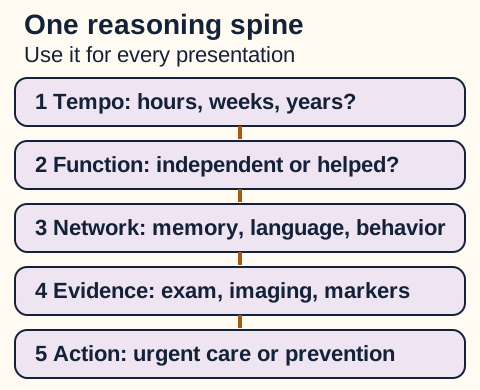
Dementia is a syndrome, not one disease. This lesson uses one reasoning spine: establish tempo and loss of independence, localize the first failing cognitive system, identify the biological or structural process, then choose stage-appropriate care. Step 1/Level 1 emphasizes mechanisms and pathology; Step 2 CK/Level 2 emphasizes recognition, workup and first-line decisions; Step 3/Level 3 emphasizes complications, longitudinal care and competing risks; Beyond covers specialist thresholds, current-label dosing and referral. [1][20]
What changed, and how quickly?
Use the same sequence for every presentation: tempo, function, network, evidence and action. Original Bone Wizardry diagram. [1][20]
Tempo sets urgency. Compare someone who gradually needs help paying bills over two years with someone who already needed that help and becomes unable to sustain attention over two days. The second pattern suggests delirium superimposed on chronic impairment. Acute inattention, altered arousal, fever, new focal deficits or a seizure requires an urgent search for a new medical problem rather than attribution to ordinary dementia progression. [1]
Function sets syndrome severity. A person who takes longer to organize medicines but still does so accurately using a written system may have mild cognitive impairment. Repeated errors that require supervision indicate loss of independence and support a dementia-level syndrome when cognitive decline explains them. A screening score alone does not settle either diagnosis. Account for education, language, hearing, vision and the person's previous abilities. [7]
Build a usable baseline
History needs an informed observer. Ask about memory, attention, language, spatial navigation, judgment, behavior and daily function. Examine gait, eye movements, strength, reflexes and parkinsonian signs. Review prescribed and nonprescription medicines, alcohol, sleep and mood. Anticholinergic drugs such as diphenhydramine, some bladder medicines and tricyclic antidepressants can worsen cognition; benzodiazepines and opioids may add sedation. A new exposure can worsen an existing dementia rather than replace its diagnosis. [1][17]
Targeted testing searches for contributors. Initial investigations commonly include a blood count, electrolytes, glucose, renal and liver function, thyroid testing and B12, selected for the clinical context. Structural MRI, or CT when appropriate, can identify vascular injury, hydrocephalus, tumor or subdural collections. HIV and syphilis testing depend on risk and presentation. Depression, sleep apnea, nutritional deficiency and sensory impairment deserve attention; finding a treatable contributor does not promise complete reversal of a coexisting degenerative disease. [1][17]
Longitudinal evidence outranks a stereotype. When mood improves but navigation and medication errors persist, continue the cognitive evaluation while maintaining effective mood care. Saying "I do not know," variable effort or confabulation cannot reliably separate depression from dementia. Use the course and functional consequences. Arrange practical support for medicines, cooking, finances and driving, and discuss future preferences while the person can participate. [1]
Is the problem storing new experience?
Early storage failure localizes to medial temporal memory systems. Someone can describe childhood vividly but cannot retain a conversation from this morning. In typical Alzheimer disease, early injury involves entorhinal cortex and hippocampus; later impairment may involve language, navigation and other cortical functions. Alzheimer disease is the commonest dementia cause, but not every presentation begins with memory loss, and medial temporal atrophy alone is not molecular proof. [2][20]
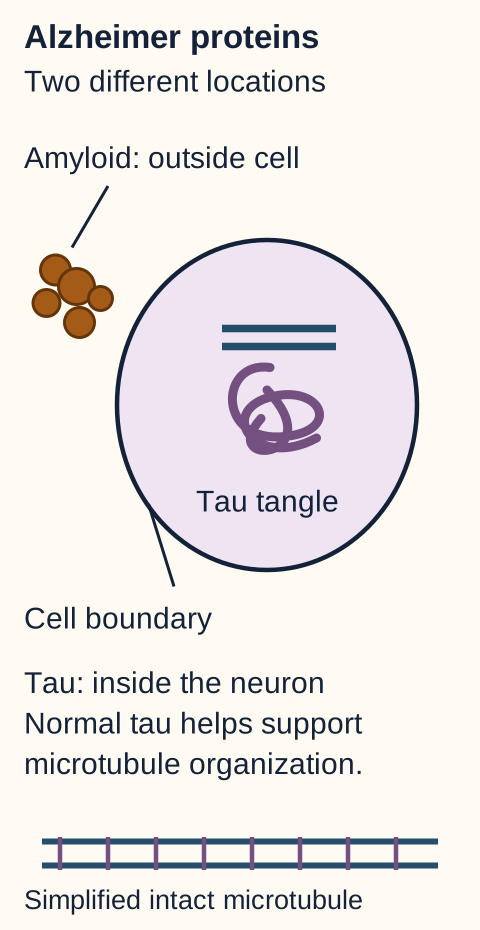
Separate the two protein compartments. Put amyloid outside the neuron and abnormal tau inside it before reading the labels below.
Two locations, two lesions. The drawing explains compartments, not an actual histology specimen. Original Bone Wizardry diagram. [2]
Amyloid precursor protein processing determines the peptide pathway. Nonamyloidogenic alpha-secretase cleavage occurs within the amyloid-beta sequence. In the amyloidogenic route, beta-secretase cleavage followed by gamma-secretase cleavage releases amyloid-beta peptides; presenilins are components of the gamma-secretase complex. Aggregation-prone Aβ42 contributes to extracellular plaques. Hyperphosphorylated tau forms intracellular neurofibrillary tangles and disrupts the microtubule system that normal tau helps stabilize. [2][3]
Histology confirms material, not the whole clinical story. Amyloid binds Congo red and shows apple-green birefringence under polarized light because of its ordered beta-sheet structure. Amyloid in cortical and leptomeningeal vessel walls defines cerebral amyloid angiopathy, which is associated with lobar microbleeds and intracerebral hemorrhage. Plaque amyloid, vascular amyloid and a patient's current syndrome must still be distinguished. [33][34]
Cholinergic loss explains a symptomatic treatment target. Synaptic failure, neuronal loss and atrophy follow a complex process rather than a one-step protein switch. Loss of basal forebrain cholinergic input, including nucleus basalis of Meynert projections to cortex, helps explain why acetylcholinesterase inhibitors can support remaining signaling without restoring dead neurons. [23][27]
Distinguish susceptibility, biology and symptoms
Risk genes are not diagnostic tests. Age is the major overall risk factor. APOE ε4 on chromosome 19 increases susceptibility but does not establish Alzheimer disease. Some dominantly inherited cases involve APP on chromosome 21, PSEN1 on chromosome 14 or PSEN2 on chromosome 1. PSEN1 is the most frequent of these monogenic causes; PSEN2 can have more variable onset. A strong young-onset pedigree warrants genetic counseling. In trisomy 21, additional APP dosage increases Alzheimer pathology risk but does not make clinical dementia inevitable at one birthday. [3][22][24]
Biomarkers answer a biological question. A low CSF Aβ42/40 ratio, or appropriately interpreted low Aβ42, with elevated phosphorylated tau supports Alzheimer biology. Total tau is a less specific injury marker. Amyloid PET and validated specialist pathways can help when results change diagnosis or treatment. Positive biomarkers do not determine how much impairment is due to concurrent vascular or Lewy pathology. [20]
Choose the treatment goal
Symptomatic medicines preserve signaling rather than reverse pathology. Donepezil, rivastigmine and galantamine inhibit acetylcholinesterase. Memantine is an NMDA receptor antagonist used in moderate or severe Alzheimer dementia, including as an adjunct when appropriate. Nausea, weight loss, syncope and bradycardia matter with cholinesterase inhibitors, especially when conduction disease or other rate-slowing drugs are present. [1][27]
Amyloid-targeting antibodies require early-stage selection and surveillance. Selected people with mild cognitive impairment or mild dementia due to amyloid-confirmed Alzheimer disease may be considered for lecanemab or donanemab. These treatments slow decline on average; they are not cures or automatic choices for every positive biomarker. Amyloid-related imaging abnormalities include edema and hemorrhagic changes. Eligibility, APOE-related risk, antithrombotic exposure, baseline MRI and subsequent surveillance require specialist review under the current product label. New neurological symptoms require urgent assessment. [31][32]
Stage changes the therapeutic question. Moderate dementia may prompt discussion of memantine with continued practical support. Independent function with amyloid-confirmed mild impairment may prompt an antibody eligibility and safety assessment. Neither decision follows from the diagnosis name alone.
Try it here · Checkpoint 1 of 3
Make your prediction before reading the choices. A first attempt is just a starting point.
Case 3
Show answer and explanations for case 3
A. Increased cholinergic activity slows sinoatrial and atrioventricular conduction (Best answer)
Donepezil inhibits acetylcholinesterase. Increased vagal effects can produce bradycardia or heart block even without known prior conduction disease, making the medication a plausible contributor to this new symptomatic abnormality.
Reasoning steps for option A
For dem-03 option A, which evidence domains should be tested against the proposal "Increased cholinergic activity slows sinoatrial and atrioventricular conduction"?
In dem-03 option A, compare tempo, the earliest impaired domain, independence, examination findings and objective test meaning before assigning the diagnosis or action.
For dem-03 option A, what final consistency check determines whether this proposal survives?
In dem-03 option A, retain the proposal only because it accounts for the major positive findings together without contradicting the chronology or requested task.
B. Reduced muscarinic signaling accelerates atrial conduction (Why this does not fit)
Muscarinic blockade affects autonomic cardiac control. Donepezil increases rather than blocks cholinergic signaling, and this patient has slowing rather than acceleration. Keep the direction of the receptor effect consistent with the ECG.
Reasoning steps for option B
For dem-03 option B, which evidence domains should be tested against the proposal "Reduced muscarinic signaling accelerates atrial conduction"?
In dem-03 option B, compare tempo, the earliest impaired domain, independence, examination findings and objective test meaning before assigning the diagnosis or action.
For dem-03 option B, what final consistency check determines whether this proposal survives?
In dem-03 option B, reject the proposal because one familiar association does not compensate for conflict with the combined chronology, localization or test interpretation.
C. Dopamine receptor blockade impairs nigrostriatal motor output (Why this does not fit)
Dopamine blockade can cause rigidity and bradykinesia. Donepezil is not a dopamine antagonist, and atrioventricular block is not a nigrostriatal manifestation. Localize the adverse effect before assigning a neurotransmitter pathway.
Reasoning steps for option C
For dem-03 option C, which evidence domains should be tested against the proposal "Dopamine receptor blockade impairs nigrostriatal motor output"?
In dem-03 option C, compare tempo, the earliest impaired domain, independence, examination findings and objective test meaning before assigning the diagnosis or action.
For dem-03 option C, what final consistency check determines whether this proposal survives?
In dem-03 option C, reject the proposal because one familiar association does not compensate for conflict with the combined chronology, localization or test interpretation.
D. NMDA receptor antagonism produces a primary ventricular conduction defect (Why this does not fit)
Memantine is an NMDA receptor antagonist used in Alzheimer dementia. The new medicine is donepezil; its labeled vagotonic action directly accounts for nodal slowing. Distinguish the two symptomatic drug mechanisms.
Reasoning steps for option D
For dem-03 option D, which evidence domains should be tested against the proposal "NMDA receptor antagonism produces a primary ventricular conduction defect"?
In dem-03 option D, compare tempo, the earliest impaired domain, independence, examination findings and objective test meaning before assigning the diagnosis or action.
For dem-03 option D, what final consistency check determines whether this proposal survives?
In dem-03 option D, reject the proposal because one familiar association does not compensate for conflict with the combined chronology, localization or test interpretation.
Takeaway: A cognitive medicine can affect peripheral autonomic pathways; new syncope or conduction disease needs urgent assessment.
When did cognition change relative to parkinsonism?
The core DLB pattern combines cognition, perception, sleep and movement. Recurrent well-formed visual hallucinations, varying attention and spontaneous bradykinesia suggest a Lewy disorder, but chronology and dream enactment refine the syndrome. The four core DLB features are cognitive fluctuations, recurrent visual hallucinations, spontaneous parkinsonism and REM sleep behavior disorder. Early attention, executive or visuospatial problems may exceed memory difficulty. Dream enactment can precede other features by years but is not by itself a dementia diagnosis. [4]
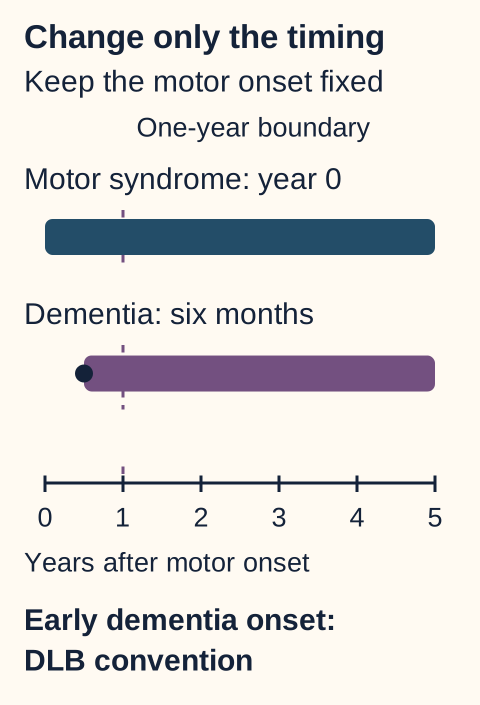
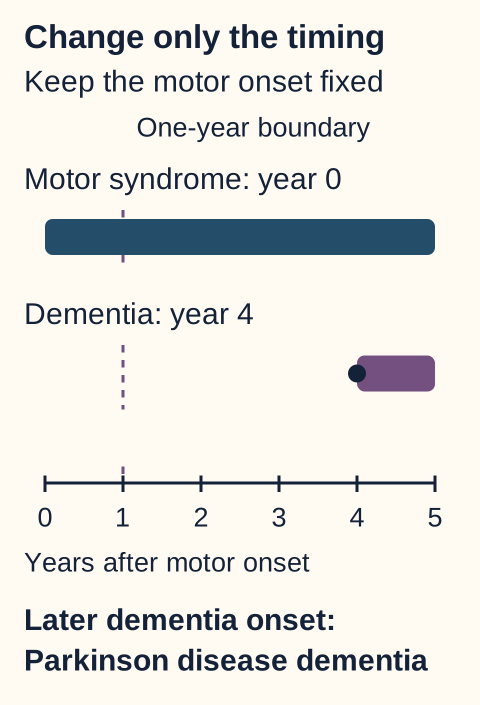
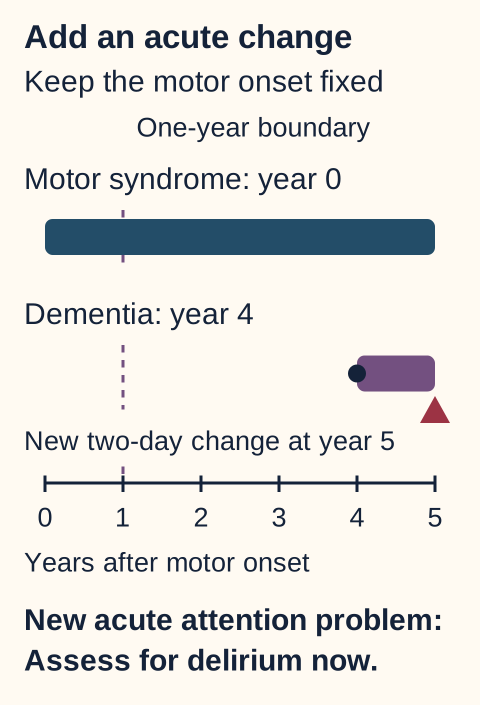
The one-year convention names the chronology. Dementia before or within one year of parkinsonism favors DLB; dementia after established Parkinson disease favors Parkinson disease dementia. Both belong to an alpha-synuclein spectrum and can have medication sensitivity. The boundary organizes clinical naming; it is not proof of completely different diseases. [4]
Change the chronology, not the protein
Motor onset stays fixed at year zero. The chronic cognitive impairment in each example interferes with independence and qualifies as dementia. Predict the classification, then select an onset. Compare the cognitive bar with the one-year line. The last selection adds a new acute problem without erasing the established disorder.
Dementia starts at six months
Six months falls before one year, so this chronology favors DLB. Original Bone Wizardry timeline.Dementia starts at four years
The later cognitive onset favors Parkinson disease dementia. The relevant protein spectrum has not changed.Add a new two-day attention decline at year five
The new acute change requires assessment for delirium and its causes. It does not reset the original motor-to-dementia interval.
The worked comparison remains visible without script. Six months supports the DLB convention; four years after established Parkinson disease supports Parkinson disease dementia; two days of new inattention requires urgent evaluation for a superimposed problem. [1][4]
Probable DLB can combine clinical and biomarker evidence. Two core features, or one core feature plus an indicative biomarker, can support probable DLB. Reduced striatal dopamine-transporter binding is an indicative biomarker, not a direct measure of dopamine concentration or a unique fingerprint. Alternative degenerative parkinsonian disorders can reduce binding, and normal binding does not invariably exclude DLB. Relative medial temporal preservation may support the pattern but does not establish it. [4]
Neuroleptic sensitivity changes the risk calculation. Donepezil or rivastigmine may help cognitive symptoms. For hallucinations, first address distress, environment and reversible triggers. Non-distressing visions with retained insight need not prompt an antipsychotic. Haloperidol is contraindicated in DLB and Parkinson disease in its US label. Selected specialist use of alternatives such as quetiapine or clozapine still requires risk assessment. Fever, profound rigidity, autonomic instability and muscle injury after dopamine blockade can represent neuroleptic malignant syndrome: stop the offending drug and obtain emergency medical care. [1][4][15]
The current problem determines the response. An identical hallucination may require observation in someone comfortable and safe, but urgent assessment when accompanied by a sudden decline, fever or dangerous behavior.
Which network failed first?
Behavior-first decline points toward frontal and anterior temporal systems. A previously considerate person becomes disinhibited, loses empathy, repeats rituals and overeats sweets while retaining many recent memories. This pattern suggests behavioral-variant frontotemporal dementia, especially with progressive functional loss and frontal or anterior temporal atrophy. Apathy and executive dysfunction may be prominent. Onset is often younger than typical Alzheimer disease, but age and relatively preserved memory are tendencies, not requirements. [5]
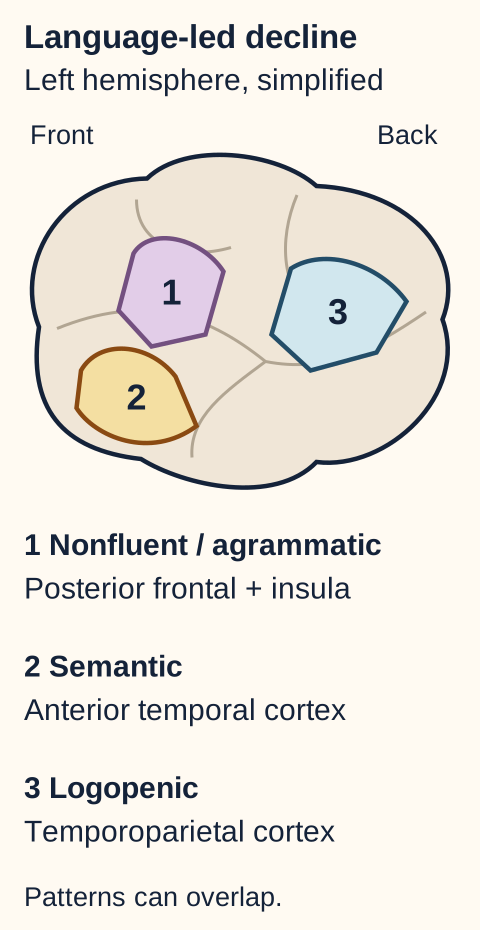
Language anatomy separates production, meaning and repetition. Compare effortful, grammatically incomplete speech with fluent speech that has lost word meaning. Identify the matching numbered area in the diagram, then contrast both with impaired sentence repetition.
Regional associations support localization but do not establish a unique molecular diagnosis. Original Bone Wizardry diagram. [6]
Primary progressive aphasia is a syndrome family. Nonfluent or agrammatic PPA affects speech production and grammar, often with left posterior frontal-insular involvement. Semantic PPA affects word and object meaning, often with anterior temporal involvement; speech can remain fluent. Logopenic PPA features word-finding pauses and impaired sentence repetition with relatively preserved grammar and word meaning, often with left temporoparietal involvement. A language-led syndrome is not automatically FTLD because logopenic PPA is frequently associated with Alzheimer pathology. [6]
Frontotemporal syndromes do not map one-to-one onto proteins. FTLD includes tau, TDP-43 and less common protein pathologies. Some forms have FUS-immunoreactive inclusions; structural research identified TAF15 filaments in studied cases previously classified as FTLD-FUS. Tau-positive Pick bodies and ballooned neurons describe a pathological subtype, not every FTD case. Relevant inherited causes include MAPT, GRN and C9orf72.
Combined upper and lower motor neuron signs suggest an ALS overlap, particularly with C9orf72 disease. Structured routines, caregiver support and speech or occupational therapy are important. Selected behavioral symptoms may warrant an SSRI; routine Alzheimer medicines are not recommended for FTD. [1][17][21][25][26]
When the connections are vascular
Small-vessel injury disconnects frontal-subcortical circuits. Slowed planning, impaired task switching and gait difficulty with confluent white-matter hyperintensities and deep lacunes support vascular network dysfunction. Repeated strokes may produce stepwise decline, but small-vessel disease can progress gradually; a strategic infarct such as a thalamic lesion can also matter. Ischemic white-matter injury reflects vascular damage and axonal disconnection, not the immune-mediated demyelination pattern of multiple sclerosis. Lesion burden and location must fit the clinical problem. A few incidental spots do not establish the cause. [7]
Mixed pathology requires additive care. New executive deficits after a thalamic infarct do not erase years of preceding Alzheimer-type amnesia. Treat relevant vascular risks, including hypertension, diabetes, smoking and dyslipidemia, and use stroke-mechanism-specific prevention. Atrial fibrillation may justify anticoagulation after individual assessment; vascular cognitive impairment alone is not an anticoagulation indication. [1][7]
What does the gait add to the explanation?
Gait-first decline raises the possibility of normal-pressure hydrocephalus. Difficulty initiating steps, short stride length and troublesome turns with urinary urgency and slowed thinking should prompt consideration of NPH. Gait impairment often appears first or is most prominent; the entire gait-cognition-incontinence triad need not be present. Diagnosis requires clinical and imaging integration, not just a normal lumbar opening pressure or large ventricles. [8]
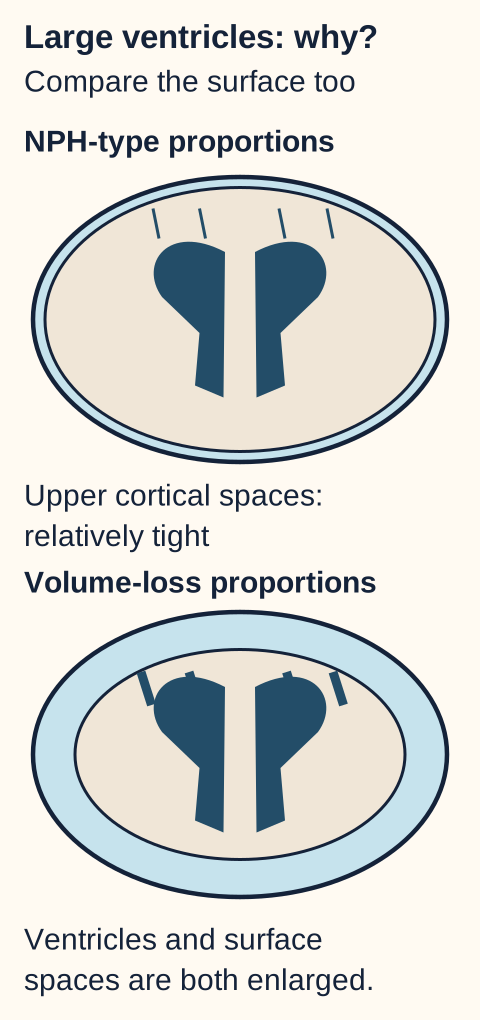
Ventricles must be interpreted with surrounding spaces. NPH may show ventricular enlargement disproportionate to atrophy, with tight high-convexity sulci and widened Sylvian fissures, a pattern termed DESH. In ex vacuo enlargement, lost tissue can leave both enlarged ventricles and broadly widened cortical spaces. These are useful patterns, not perfectly exclusive rules. [8]
Compare ventricular and surface spaces together. These simplified silhouettes are not scan slices or diagnostic thresholds. Original Bone Wizardry diagram. [8]
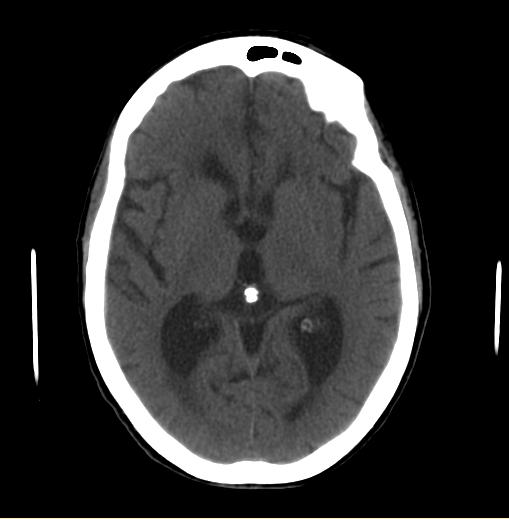
Actual clinical CT: first identify the enlarged central ventricles. This single slice cannot establish DESH, opening pressure, cause or shunt responsiveness. Image: RadsWiki (radswiki.net), 2008, via Wikimedia Commons, CC BY-SA 3.0; unchanged. Source and attribution [19].
Objective gait change is more useful than impression alone. A specialist drainage assessment commonly removes 30 to 50 mL of CSF and compares standardized gait measures before and after the procedure, including suitable delayed reassessment. Reproducible improvement supports potential benefit from shunting. A negative tap test does not reliably exclude response, particularly if assessment was too early. Selected patients may benefit from ventriculoperitoneal shunting; gait often responds more than cognition, and comorbidity affects outcome. [8]
Quantify the prediction. If the same walking task improves from 24 seconds before drainage to 16 seconds afterward, time has decreased by eight seconds, or one third. That supports a gait response, not guaranteed memory recovery or proof that no Alzheimer pathology is present. A normal-range opening pressure does not cancel the clinical response.
A different gait: loss of position sense
Sensory ataxia redirects the mechanism toward cobalamin deficiency. Reduced vibration and position sense, imbalance worse in the dark and corticospinal signs suggest B12-related subacute combined degeneration rather than NPH alone. Peripheral neuropathy may coexist, and anemia or macrocytosis may be absent. B12 deficiency increases methylmalonic acid and homocysteine; folate deficiency typically increases homocysteine without the same methylmalonic acid pattern. Kidney dysfunction can raise methylmalonic acid and must be considered. [9][16]
Replacement strategy follows the cause. Ask about diet, metformin or acid-suppressing treatment, autoimmune gastritis, and gastric or terminal ileal surgery. Neurological presentations need prompt replacement assessment. NICE recommends lifelong intramuscular B12 for autoimmune gastritis, total gastrectomy or complete terminal ileal resection. Other causes may permit different routes. Normal MCV should not end the evaluation when proprioception, reflexes and metabolites support deficiency. [9]
When infection changes the differential
HIV-associated neurocognitive disorder often has a subcortical profile. Slowed processing, impaired attention and executive function, memory difficulty and motor slowing can occur, especially with advanced or uncontrolled infection, but milder patterns persist in the antiretroviral era. Evaluation includes current HIV status, treatment history, immune and viral measures, medicines, substance exposure, mood, opportunistic disease and other neurological causes. Antiretroviral treatment and management of competing contributors are central; HIV status does not make every cognitive symptom HIV-mediated. [35]
Try it here · Checkpoint 2 of 3
Make your prediction before reading the choices. A first attempt is just a starting point.
Case 21
Show answer and explanations for case 21
A. End NPH evaluation because the immediate test was negative (Why this does not fit)
A clear drainage response is useful positive evidence. An early negative assessment has limited exclusion value and may miss delayed improvement. A test can be more useful for supporting a diagnosis than for excluding it.
Reasoning steps for option A
For dem-21 option A, which evidence domains should be tested against the proposal "End NPH evaluation because the immediate test was negative"?
In dem-21 option A, compare tempo, the earliest impaired domain, independence, examination findings and objective test meaning before assigning the diagnosis or action.
For dem-21 option A, what final consistency check determines whether this proposal survives?
In dem-21 option A, reject the proposal because one familiar association does not compensate for conflict with the combined chronology, localization or test interpretation.
B. Arrange immediate shunt surgery based only on the patient's next-morning report (Why this does not fit)
Perceived delayed improvement is relevant to follow-up. Objective reassessment and integrated specialist selection remain necessary before an invasive decision. Subjective response should inform, not replace, standardized evaluation.
Reasoning steps for option B
For dem-21 option B, which evidence domains should be tested against the proposal "Arrange immediate shunt surgery based only on the patient's next-morning report"?
In dem-21 option B, compare tempo, the earliest impaired domain, independence, examination findings and objective test meaning before assigning the diagnosis or action.
For dem-21 option B, what final consistency check determines whether this proposal survives?
In dem-21 option B, reject the proposal because one familiar association does not compensate for conflict with the combined chronology, localization or test interpretation.
C. Arrange repeat objective gait assessment over the appropriate post-tap interval and specialist review (Best answer)
A single 30-minute measurement does not adequately assess a potentially delayed response. Repeat standardized observation and integrate the clinical and imaging findings; a negative tap test does not by itself exclude later shunt benefit.
Reasoning steps for option C
For dem-21 option C, which evidence domains should be tested against the proposal "Arrange repeat objective gait assessment over the appropriate post-tap interval and specialist review"?
In dem-21 option C, compare tempo, the earliest impaired domain, independence, examination findings and objective test meaning before assigning the diagnosis or action.
For dem-21 option C, what final consistency check determines whether this proposal survives?
In dem-21 option C, retain the proposal only because it accounts for the major positive findings together without contradicting the chronology or requested task.
D. Replace gait reassessment with repeat opening-pressure measurement as the decisive test without delayed timed reassessment or specialist review (Why this does not fit)
Opening pressure is part of the lumbar puncture assessment. A single pressure value does not answer whether gait improves after drainage or whether shunting may help. Measure the outcome relevant to the treatment decision.
Reasoning steps for option D
For dem-21 option D, which evidence domains should be tested against the proposal "Replace gait reassessment with repeat opening-pressure measurement as the decisive test without delayed timed reassessment or specialist review"?
In dem-21 option D, compare tempo, the earliest impaired domain, independence, examination findings and objective test meaning before assigning the diagnosis or action.
For dem-21 option D, what final consistency check determines whether this proposal survives?
In dem-21 option D, reject the proposal because one familiar association does not compensate for conflict with the combined chronology, localization or test interpretation.
Takeaway: A negative early tap assessment is not a definitive NPH exclusion; timing and standardized follow-up matter.
Weeks to months defines an urgent pathway. A person who recently managed daily life now has cognitive decline, ataxia and stimulus-sensitive jerks. That tempo demands specialist assessment for rapidly progressive dementia or encephalopathy rather than routine attribution to Alzheimer disease. Infectious, autoimmune, toxic, metabolic and seizure-related causes can be treatable. Tests should proceed in parallel with indicated emergency treatment. [1][11]
Prions propagate abnormal protein conformation. In Creutzfeldt-Jakob disease, misfolded prion protein promotes abnormal folding of other prion protein, with spongiform vacuolation, neuronal loss and gliosis. Most classic cases are sporadic. The syndrome may combine rapidly progressive cognition, myoclonus, visual or cerebellar signs, pyramidal or extrapyramidal findings and later akinetic mutism. [10]
Injury markers and seeding assays answer different questions. CSF 14-3-3 and total tau can rise with seizures, encephalitis and other neuronal injuries. RT-QuIC detects abnormal prion-seeding activity and is much more specific, but sensitivity is imperfect. A negative result does not invariably exclude CJD; a positive result still belongs in the clinical context. [11]
MRI and EEG support a syndrome rather than independently prove it. MRI may show cortical ribbon-like diffusion abnormalities and caudate or putaminal involvement. Seizure activity, hypoxic injury and encephalitis can overlap. EEG periodic sharp-wave complexes are supportive; diffuse slowing is nonspecific. Appropriate clinical and laboratory combinations can support a probable diagnosis; definite confirmation is neuropathological, usually at autopsy rather than routine brain biopsy. [10][11]
Inflammation and seizures keep encephalitis high on the list. Rapid memory loss with focal seizures, medial temporal abnormalities and inflammatory CSF remains an urgent infectious and autoimmune encephalitis evaluation even when 14-3-3 is positive. Do not assume an injury marker establishes prion disease. Let the full assessment determine empiric therapy and further testing. [11]
Localization prevents false equivalence. Contrast myoclonus with the chronic chorea of Huntington disease; cortical dysfunction with isolated cerebellar degeneration; and sensory ataxia with the position-sense deficits of B12 deficiency or tabes dorsalis. Variant CJD is a distinct acquired prion disease linked to bovine spongiform encephalopathy exposure. It tends to affect younger people and may begin with psychiatric or sensory symptoms; a pulvinar sign can support it in the right context. [17][18]
Supportive care is active care. No established treatment reverses CJD, but treatment of distressing myoclonus, sleep problems, swallowing difficulties and caregiver needs can improve comfort. A medicine that reduces jerks does not imply disease modification. Communicate what is known, what remains uncertain and which immediate goals are achievable. [10]
What must be reassessed after the diagnosis?
A dementia label never ends diagnostic attention. At each meaningful change, reconsider delirium, pain, infection, constipation, urinary retention, dehydration, sleep disruption, sensory loss, depression and recent medicines. A sudden decline can be treatable even when the underlying neurodegenerative disorder is not. Document the prior cognitive and functional baseline so a new syndrome can be recognized. [1]
Safety planning should match observed function. Ask directly about medication errors, missed meals, wandering, falls, driving incidents, financial exploitation, unsafe appliances and access to dangerous items. Replace vague advice with a concrete plan: who supervises medicines, who checks food and utilities, what triggers driving cessation, and whom the caregiver calls during a crisis. Capacity is decision-specific and can fluctuate; diagnosis alone does not prove incapacity for every choice. [1]
Behavior is first assessed as communication and context. Search for pain, fear, overstimulation, unmet needs and caregiver interaction before adding a sedating medicine. Predictable routine, lighting, hearing and visual support, meaningful daytime activity and sleep regularity may reduce distress. When medication is considered, define the target symptom, expected benefit, major harm, monitoring interval and stopping rule. [1]
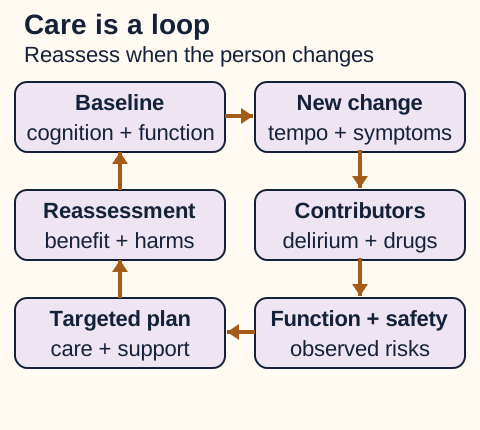
Caregiver health changes patient outcomes. Ask about sleep loss, depression, physical strain and whether the plan is sustainable. Respite, social work, occupational therapy, speech-language support and community services are treatments for the care system, not optional extras. Advance care planning is most useful while the person can express values about living arrangements, surrogate decision-making and future medical treatment. [1]
The plan is a loop because cognition, function, risk and caregiver capacity change over time. Original Bone Wizardry diagram. [1]
Prevention remains disease-specific. Control hypertension, diabetes and dyslipidemia; support smoking cessation, physical activity, hearing care and sleep treatment; and use indicated stroke prevention. Avoid promising that any single lifestyle intervention reverses established dementia. The goal is to reduce additional injury and preserve function while treating the actual syndrome. [1][7]
Beyond: dosing, thresholds and specialist decisions
These are typical adult regimens, not individual prescribing instructions. Verify the current product label, formulation, kidney and liver function, interactions, pulse or ECG findings, swallowing ability and local protocol before prescribing. Reassess benefit and adverse effects after titration rather than continuing automatically.
Cholinesterase inhibitors are titrated slowly. Current US labeling supports donepezil 5 mg nightly, increasing to 10 mg only after 4 to 6 weeks. A rivastigmine patch typically starts at 4.6 mg per 24 hours, increases after at least four weeks to 9.5 mg per 24 hours, and may increase after another four weeks to 13.3 mg per 24 hours; interruption longer than three days requires restarting at the low patch dose.
Galantamine extended release starts at 8 mg each morning, increases after at least four weeks to 16 mg, and may increase after another four weeks to 24 mg; renal or hepatic impairment can lower the maximum or make treatment unsuitable. [27][28][29]
Memantine titration follows tolerance and renal function. Immediate-release memantine typically starts at 5 mg daily and increases in 5 mg weekly steps to 10 mg twice daily. Severe renal impairment requires a lower target under the current label. Confusion, dizziness and constipation can complicate interpretation of a new decline, so timing matters. [30]
Lecanemab has route-specific starting and maintenance regimens. Current US labeling permits either 10 mg/kg intravenously every two weeks or 500 mg subcutaneously once weekly as the starting regimen. After 18 months, treatment may continue on the starting regimen or transition to maintenance with 10 mg/kg intravenously every four weeks or 360 mg subcutaneously once weekly.
Amyloid must be confirmed, a recent baseline magnetic resonance imaging (MRI) study obtained, APOE ε4 testing and counseling completed, and MRIs obtained after 1, 2, 3 and 6 months of treatment. Treatment interruption for amyloid-related imaging abnormalities (ARIA) follows symptoms, MRI severity and the current label. [31]
Donanemab uses a staged four-week infusion titration. Current US labeling gives 350 mg for the first infusion, 700 mg for the second, 1050 mg for the third and 1400 mg every four weeks from the fourth infusion. Amyloid confirmation, baseline MRI and label-specified MRIs before the second, third, fourth and seventh infusions are required. Specialist teams may consider stopping after reduction to minimal amyloid plaque levels on amyloid PET, as described in the label. [32]
Referral is triggered by uncertainty, atypical phenotype or high-risk treatment. Refer for onset before age 65, a strong family history, prominent language or behavior change, movement-disorder overlap, rapidly progressive decline, seizures or inflammatory findings, possible NPH, complex capacity or safety questions, or consideration of an amyloid-targeting antibody. Emergency assessment is needed for abrupt attention change, focal deficit, seizure, severe rigidity with fever, symptomatic bradycardia, or new neurological symptoms during antibody therapy.
Specialist precision still respects mixed disease. Biomarkers can establish Alzheimer biology, dopamine-transporter imaging can support a Lewy syndrome, and vascular imaging can document causative injury, yet more than one process may contribute. Name each supported contributor, state what remains uncertain and connect every test to a management decision. [4][7][20]
Try it here · Checkpoint 3 of 3
Make your prediction before reading the choices. A first attempt is just a starting point.
Case 5
Show answer and explanations for case 5
A. Wait until moderate dementia develops before assessing antibody eligibility (Why this does not fit)
Some symptomatic medicines are introduced at later disease stages. Amyloid-targeting antibodies are intended for selected early symptomatic disease, not first initiation in moderate dementia. Do not transfer the memantine stage rule to antibody treatment.
Reasoning steps for option A
For dem-05 option A, which evidence domains should be tested against the proposal "Wait until moderate dementia develops before assessing antibody eligibility"?
In dem-05 option A, compare tempo, the earliest impaired domain, independence, examination findings and objective test meaning before assigning the diagnosis or action.
For dem-05 option A, what final consistency check determines whether this proposal survives?
In dem-05 option A, reject the proposal because one familiar association does not compensate for conflict with the combined chronology, localization or test interpretation.
B. Assess early-treatment eligibility now, including baseline MRI and hemorrhage-risk counseling (Best answer)
Mild cognitive impairment due to Alzheimer disease is within the early symptomatic population considered for these antibodies. Confirmed amyloid is necessary but insufficient: MRI findings, APOE-related risk, antithrombotic exposure and the current product label also matter.
Reasoning steps for option B
For dem-05 option B, which evidence domains should be tested against the proposal "Assess early-treatment eligibility now, including baseline MRI and hemorrhage-risk counseling"?
In dem-05 option B, compare tempo, the earliest impaired domain, independence, examination findings and objective test meaning before assigning the diagnosis or action.
For dem-05 option B, what final consistency check determines whether this proposal survives?
In dem-05 option B, retain the proposal only because it accounts for the major positive findings together without contradicting the chronology or requested task.
C. Begin antibody treatment using the amyloid result without further safety assessment (Why this does not fit)
Amyloid confirmation establishes the target relevant to antibody selection. It does not assess pre-existing hemorrhagic lesions or the risk of amyloid-related imaging abnormalities. Target confirmation and treatment safety answer different questions.
Reasoning steps for option C
For dem-05 option C, which evidence domains should be tested against the proposal "Begin antibody treatment using the amyloid result without further safety assessment"?
In dem-05 option C, compare tempo, the earliest impaired domain, independence, examination findings and objective test meaning before assigning the diagnosis or action.
For dem-05 option C, what final consistency check determines whether this proposal survives?
In dem-05 option C, reject the proposal because one familiar association does not compensate for conflict with the combined chronology, localization or test interpretation.
D. Use APOE testing instead of the amyloid result to decide whether Alzheimer disease is present (Why this does not fit)
APOE status informs risk counseling, including antibody-associated imaging risk. It is not a stand-alone diagnostic replacement for the clinical assessment and accepted amyloid testing. Separate susceptibility and treatment risk from biological confirmation.
Reasoning steps for option D
For dem-05 option D, which evidence domains should be tested against the proposal "Use APOE testing instead of the amyloid result to decide whether Alzheimer disease is present"?
In dem-05 option D, compare tempo, the earliest impaired domain, independence, examination findings and objective test meaning before assigning the diagnosis or action.
For dem-05 option D, what final consistency check determines whether this proposal survives?
In dem-05 option D, reject the proposal because one familiar association does not compensate for conflict with the combined chronology, localization or test interpretation.
Takeaway: Early clinical stage and confirmed amyloid permit consideration, not automatic initiation, of an amyloid-targeting antibody.
Use the full reasoning spine in every case. Read the complete stem, establish tempo and function, localize the dominant network, interpret what each test actually measures, and choose the action that fits the current stage. Each case has one best answer and a rationale for every option.
Case 1
Show answer and explanations for case 1
A. Intraneuronal alpha-synuclein and loss of nigrostriatal neurons (Why this does not fit)
Synuclein disease can impair cognition and motor function. The dominant progressive storage deficit and medial temporal loss favor Alzheimer pathology; no characteristic Lewy clinical features are supplied. Match the earliest affected cognitive system to the whole syndrome.
Reasoning steps for option A
For dem-01 option A, which evidence domains should be tested against the proposal "Intraneuronal alpha-synuclein and loss of nigrostriatal neurons"?
In dem-01 option A, compare tempo, the earliest impaired domain, independence, examination findings and objective test meaning before assigning the diagnosis or action.
For dem-01 option A, what final consistency check determines whether this proposal survives?
In dem-01 option A, reject the proposal because one familiar association does not compensate for conflict with the combined chronology, localization or test interpretation.
B. Extracellular amyloid-beta deposits and intraneuronal hyperphosphorylated tau (Best answer)
Progressive failure to retain newly learned information, functional dependence and medial temporal atrophy support an Alzheimer syndrome. Amyloid accumulates outside neurons, while abnormal tau aggregates inside them; neither location should be reversed.
Reasoning steps for option B
For dem-01 option B, which evidence domains should be tested against the proposal "Extracellular amyloid-beta deposits and intraneuronal hyperphosphorylated tau"?
In dem-01 option B, compare tempo, the earliest impaired domain, independence, examination findings and objective test meaning before assigning the diagnosis or action.
For dem-01 option B, what final consistency check determines whether this proposal survives?
In dem-01 option B, retain the proposal only because it accounts for the major positive findings together without contradicting the chronology or requested task.
C. Cortical spongiform vacuolation and abnormal prion protein (Why this does not fit)
Prion disease can damage cortex and memory. A three-year amnestic course differs from the usual rapidly progressive, multifocal prion syndrome. Tempo helps select the pathological process.
Reasoning steps for option C
For dem-01 option C, which evidence domains should be tested against the proposal "Cortical spongiform vacuolation and abnormal prion protein"?
In dem-01 option C, compare tempo, the earliest impaired domain, independence, examination findings and objective test meaning before assigning the diagnosis or action.
For dem-01 option C, what final consistency check determines whether this proposal survives?
In dem-01 option C, reject the proposal because one familiar association does not compensate for conflict with the combined chronology, localization or test interpretation.
D. Predominant subcortical myelin injury and multiple lacunar infarcts (Why this does not fit)
Small-vessel disease can disrupt cognition through white-matter networks. The provided imaging instead localizes disproportionate injury to medial temporal structures without a major vascular pattern. Do not substitute vascular risk associated with age for evidence of vascular injury.
Reasoning steps for option D
For dem-01 option D, which evidence domains should be tested against the proposal "Predominant subcortical myelin injury and multiple lacunar infarcts"?
In dem-01 option D, compare tempo, the earliest impaired domain, independence, examination findings and objective test meaning before assigning the diagnosis or action.
For dem-01 option D, what final consistency check determines whether this proposal survives?
In dem-01 option D, reject the proposal because one familiar association does not compensate for conflict with the combined chronology, localization or test interpretation.
Takeaway: Typical Alzheimer disease links impaired new-memory storage to medial temporal injury and two differently located protein lesions.
A. The CSF profile establishes Alzheimer disease as the sole cause of every symptom (Why this does not fit)
The amyloid and tau profile supports Alzheimer biology. It does not erase the prominent Lewy-type clinical syndrome or quantify each pathology contribution. A biological marker is not proof of a single clinical cause.
Reasoning steps for option A
For dem-02 option A, which evidence domains should be tested against the proposal "The CSF profile establishes Alzheimer disease as the sole cause of every symptom"?
In dem-02 option A, compare tempo, the earliest impaired domain, independence, examination findings and objective test meaning before assigning the diagnosis or action.
For dem-02 option A, what final consistency check determines whether this proposal survives?
In dem-02 option A, reject the proposal because one familiar association does not compensate for conflict with the combined chronology, localization or test interpretation.
B. The clinical features make the Alzheimer biomarker result uninterpretable (Why this does not fit)
Fluctuations, hallucinations and parkinsonism strongly support Lewy disease. Alzheimer and Lewy pathology can coexist; that syndrome does not invalidate an otherwise interpretable assay. Consider co-pathology rather than forcing mutually exclusive labels.
Reasoning steps for option B
For dem-02 option B, which evidence domains should be tested against the proposal "The clinical features make the Alzheimer biomarker result uninterpretable"?
In dem-02 option B, compare tempo, the earliest impaired domain, independence, examination findings and objective test meaning before assigning the diagnosis or action.
For dem-02 option B, what final consistency check determines whether this proposal survives?
In dem-02 option B, reject the proposal because one familiar association does not compensate for conflict with the combined chronology, localization or test interpretation.
C. The abnormal CSF markers identify a prion disorder causing the fluctuations (Why this does not fit)
Neuronal injury markers may be abnormal in rapidly progressive disease. This is an Alzheimer amyloid/phosphorylated-tau pattern, not a prion-seeding assay, and the clinical course is chronic. Know what the measured biomarker actually detects.
Reasoning steps for option C
For dem-02 option C, which evidence domains should be tested against the proposal "The abnormal CSF markers identify a prion disorder causing the fluctuations"?
In dem-02 option C, compare tempo, the earliest impaired domain, independence, examination findings and objective test meaning before assigning the diagnosis or action.
For dem-02 option C, what final consistency check determines whether this proposal survives?
In dem-02 option C, reject the proposal because one familiar association does not compensate for conflict with the combined chronology, localization or test interpretation.
D. Alzheimer pathology may coexist with a clinically prominent Lewy body syndrome (Best answer)
The hallucinations, fluctuations and spontaneous parkinsonism support a Lewy syndrome. The separate amyloid/tau findings support concomitant Alzheimer biology rather than proving that it explains every deficit.
Reasoning steps for option D
For dem-02 option D, which evidence domains should be tested against the proposal "Alzheimer pathology may coexist with a clinically prominent Lewy body syndrome"?
In dem-02 option D, compare tempo, the earliest impaired domain, independence, examination findings and objective test meaning before assigning the diagnosis or action.
For dem-02 option D, what final consistency check determines whether this proposal survives?
In dem-02 option D, retain the proposal only because it accounts for the major positive findings together without contradicting the chronology or requested task.
Takeaway: Combine clinical phenotype with biomarker meaning; mixed pathology is not a contradiction.
A. Add rivastigmine to provide a second cholinesterase inhibitor (Why this does not fit)
Rivastigmine is a symptomatic Alzheimer treatment. Combining two drugs from this class duplicates the mechanism rather than providing the requested adjunct. Choose a complementary treatment rather than duplicate cholinergic adverse effects.
Reasoning steps for option A
For dem-04 option A, which evidence domains should be tested against the proposal "Add rivastigmine to provide a second cholinesterase inhibitor"?
In dem-04 option A, compare tempo, the earliest impaired domain, independence, examination findings and objective test meaning before assigning the diagnosis or action.
For dem-04 option A, what final consistency check determines whether this proposal survives?
In dem-04 option A, reject the proposal because one familiar association does not compensate for conflict with the combined chronology, localization or test interpretation.
B. Switch from donepezil to galantamine (Why this does not fit)
Galantamine is an accepted symptomatic Alzheimer medicine. It is another cholinesterase inhibitor, not the different-mechanism adjunct requested for this patient already tolerating donepezil. A different drug name does not necessarily supply a different pharmacological mechanism.
Reasoning steps for option B
For dem-04 option B, which evidence domains should be tested against the proposal "Switch from donepezil to galantamine"?
In dem-04 option B, compare tempo, the earliest impaired domain, independence, examination findings and objective test meaning before assigning the diagnosis or action.
For dem-04 option B, what final consistency check determines whether this proposal survives?
In dem-04 option B, reject the proposal because one familiar association does not compensate for conflict with the combined chronology, localization or test interpretation.
C. Consider adding memantine for NMDA receptor antagonism (Best answer)
For moderate Alzheimer dementia already treated with an acetylcholinesterase inhibitor, adding memantine is an appropriate symptomatic option. Expectations remain limited: it does not restore lost neurons or cure the disease.
Reasoning steps for option C
For dem-04 option C, which evidence domains should be tested against the proposal "Consider adding memantine for NMDA receptor antagonism"?
In dem-04 option C, compare tempo, the earliest impaired domain, independence, examination findings and objective test meaning before assigning the diagnosis or action.
For dem-04 option C, what final consistency check determines whether this proposal survives?
In dem-04 option C, retain the proposal only because it accounts for the major positive findings together without contradicting the chronology or requested task.
D. Continue donepezil alone with additional daily-function support (Why this does not fit)
Continuing tolerated therapy and strengthening practical support are appropriate parts of care. This does not answer the caregiver's request for an additional stage-appropriate medicine with a different mechanism; memantine may be considered here. Support remains important even when a complementary symptomatic drug is discussed.
Reasoning steps for option D
For dem-04 option D, which evidence domains should be tested against the proposal "Continue donepezil alone with additional daily-function support"?
In dem-04 option D, compare tempo, the earliest impaired domain, independence, examination findings and objective test meaning before assigning the diagnosis or action.
For dem-04 option D, what final consistency check determines whether this proposal survives?
In dem-04 option D, reject the proposal because one familiar association does not compensate for conflict with the combined chronology, localization or test interpretation.
Takeaway: Moderate Alzheimer dementia may justify adding memantine to a tolerated cholinesterase inhibitor.
A. Progressive hippocampal atrophy from the underlying disorder (Why this does not fit)
Alzheimer disease produces progressive regional volume loss. New edema with small hemorrhages during antibody treatment is a different pattern and tempo. Do not attribute a new imaging abnormality automatically to baseline degeneration.
Reasoning steps for option A
For dem-06 option A, which evidence domains should be tested against the proposal "Progressive hippocampal atrophy from the underlying disorder"?
In dem-06 option A, compare tempo, the earliest impaired domain, independence, examination findings and objective test meaning before assigning the diagnosis or action.
For dem-06 option A, what final consistency check determines whether this proposal survives?
In dem-06 option A, reject the proposal because one familiar association does not compensate for conflict with the combined chronology, localization or test interpretation.
B. Obstructive hydrocephalus from ventricular amyloid deposition (Why this does not fit)
Hydrocephalus can cause cognitive symptoms and headache. The described abnormalities are edema and microhemorrhages rather than an obstructed ventricular system. Match the proposed mechanism to the actual imaging compartment.
Reasoning steps for option B
For dem-06 option B, which evidence domains should be tested against the proposal "Obstructive hydrocephalus from ventricular amyloid deposition"?
In dem-06 option B, compare tempo, the earliest impaired domain, independence, examination findings and objective test meaning before assigning the diagnosis or action.
For dem-06 option B, what final consistency check determines whether this proposal survives?
In dem-06 option B, reject the proposal because one familiar association does not compensate for conflict with the combined chronology, localization or test interpretation.
C. Acute cerebral infarction from a large embolic arterial occlusion (Why this does not fit)
Acute vascular disease remains important in emergency neurologic assessment. The supplied study shows vasogenic edema and microhemorrhages without a territorial infarct. Use the imaging pattern, not symptoms alone, to interpret the completed assessment.
Reasoning steps for option C
For dem-06 option C, which evidence domains should be tested against the proposal "Acute cerebral infarction from a large embolic arterial occlusion"?
In dem-06 option C, compare tempo, the earliest impaired domain, independence, examination findings and objective test meaning before assigning the diagnosis or action.
For dem-06 option C, what final consistency check determines whether this proposal survives?
In dem-06 option C, reject the proposal because one familiar association does not compensate for conflict with the combined chronology, localization or test interpretation.
D. Amyloid-related imaging abnormalities with edema and hemorrhagic features (Best answer)
ARIA-E includes edema or effusion, and ARIA-H includes microhemorrhage or superficial siderosis. The new MRI combination during amyloid-targeting treatment fits ARIA; clinical severity and imaging findings guide interruption and follow-up under the current label.
Reasoning steps for option D
For dem-06 option D, which evidence domains should be tested against the proposal "Amyloid-related imaging abnormalities with edema and hemorrhagic features"?
In dem-06 option D, compare tempo, the earliest impaired domain, independence, examination findings and objective test meaning before assigning the diagnosis or action.
For dem-06 option D, what final consistency check determines whether this proposal survives?
In dem-06 option D, retain the proposal only because it accounts for the major positive findings together without contradicting the chronology or requested task.
Takeaway: New neurologic symptoms during amyloid-targeting treatment require urgent assessment; ARIA is not simply faster Alzheimer progression.
A. Use the daughter's APOE genotype as the diagnostic test for the familial disorder (Why this does not fit)
APOE alleles alter Alzheimer susceptibility. They do not establish a highly penetrant familial cause in this early-onset pedigree. A risk allele and a pathogenic familial variant answer different questions.
Reasoning steps for option A
For dem-07 option A, which evidence domains should be tested against the proposal "Use the daughter's APOE genotype as the diagnostic test for the familial disorder"?
In dem-07 option A, compare tempo, the earliest impaired domain, independence, examination findings and objective test meaning before assigning the diagnosis or action.
For dem-07 option A, what final consistency check determines whether this proposal survives?
In dem-07 option A, reject the proposal because one familiar association does not compensate for conflict with the combined chronology, localization or test interpretation.
B. Begin surveillance imaging of the daughter before discussing genetic testing in her father (Why this does not fit)
Imaging may be useful for selected clinical evaluations. The symptomatic relative is the most informative initial person for establishing a familial molecular diagnosis. Establish the affected family member's diagnosis before predictive testing.
Reasoning steps for option B
For dem-07 option B, which evidence domains should be tested against the proposal "Begin surveillance imaging of the daughter before discussing genetic testing in her father"?
In dem-07 option B, compare tempo, the earliest impaired domain, independence, examination findings and objective test meaning before assigning the diagnosis or action.
For dem-07 option B, what final consistency check determines whether this proposal survives?
In dem-07 option B, reject the proposal because one familiar association does not compensate for conflict with the combined chronology, localization or test interpretation.
C. Arrange genetic counseling and consider pathogenic-variant testing first in an affected relative (Best answer)
Multiple affected relatives across generations with young onset justify evaluation for a monogenic syndrome. Testing an affected relative for relevant genes such as APP, PSEN1 or PSEN2 can establish a familial variant; predictive testing then requires separate informed counseling.
Reasoning steps for option C
For dem-07 option C, which evidence domains should be tested against the proposal "Arrange genetic counseling and consider pathogenic-variant testing first in an affected relative"?
In dem-07 option C, compare tempo, the earliest impaired domain, independence, examination findings and objective test meaning before assigning the diagnosis or action.
For dem-07 option C, what final consistency check determines whether this proposal survives?
In dem-07 option C, retain the proposal only because it accounts for the major positive findings together without contradicting the chronology or requested task.
D. Use a normal cognitive screen in the daughter to decide whether she inherited a familial variant (Why this does not fit)
A cognitive screen describes current performance. An unaffected young adult can carry a disease-associated variant before symptoms develop. Current clinical state is not a genetic test.
Reasoning steps for option D
For dem-07 option D, which evidence domains should be tested against the proposal "Use a normal cognitive screen in the daughter to decide whether she inherited a familial variant"?
In dem-07 option D, compare tempo, the earliest impaired domain, independence, examination findings and objective test meaning before assigning the diagnosis or action.
For dem-07 option D, what final consistency check determines whether this proposal survives?
In dem-07 option D, reject the proposal because one familiar association does not compensate for conflict with the combined chronology, localization or test interpretation.
Takeaway: A strong early-onset pedigree calls for genetic counseling and an informative affected-relative evaluation, not diagnostic use of APOE.
A. Additional APP gene dosage can promote amyloid accumulation without establishing current clinical dementia (Best answer)
APP is on chromosome 21, and extra gene dosage increases Alzheimer pathology risk in trisomy 21. A positive amyloid study does not by itself demonstrate a new clinical dementia syndrome; change from the person's own baseline still matters.
Reasoning steps for option A
For dem-08 option A, which evidence domains should be tested against the proposal "Additional APP gene dosage can promote amyloid accumulation without establishing current clinical dementia"?
In dem-08 option A, compare tempo, the earliest impaired domain, independence, examination findings and objective test meaning before assigning the diagnosis or action.
For dem-08 option A, what final consistency check determines whether this proposal survives?
In dem-08 option A, retain the proposal only because it accounts for the major positive findings together without contradicting the chronology or requested task.
B. The scan establishes new clinical dementia despite unchanged function (Why this does not fit)
Amyloid positivity supports Alzheimer biological pathology. Clinical dementia requires a demonstrated syndrome rather than the imaging result alone. Separate pathological presence from the degree of clinical impairment.
Reasoning steps for option B
For dem-08 option B, which evidence domains should be tested against the proposal "The scan establishes new clinical dementia despite unchanged function"?
In dem-08 option B, compare tempo, the earliest impaired domain, independence, examination findings and objective test meaning before assigning the diagnosis or action.
For dem-08 option B, what final consistency check determines whether this proposal survives?
In dem-08 option B, reject the proposal because one familiar association does not compensate for conflict with the combined chronology, localization or test interpretation.
C. The unchanged baseline makes the positive amyloid scan a probable false-positive result (Why this does not fit)
Stable function argues against newly established clinical dementia. Alzheimer biological changes may precede overt decline, particularly with increased APP dosage. A normal trajectory over this interval does not invalidate preclinical biology.
Reasoning steps for option C
For dem-08 option C, which evidence domains should be tested against the proposal "The unchanged baseline makes the positive amyloid scan a probable false-positive result"?
In dem-08 option C, compare tempo, the earliest impaired domain, independence, examination findings and objective test meaning before assigning the diagnosis or action.
For dem-08 option C, what final consistency check determines whether this proposal survives?
In dem-08 option C, reject the proposal because one familiar association does not compensate for conflict with the combined chronology, localization or test interpretation.
D. The scan primarily reflects a chromosome 21 increase in alpha-synuclein production (Why this does not fit)
Alpha-synuclein aggregates are relevant to Lewy disorders. The chromosome 21 dosage mechanism discussed here concerns APP and amyloid, not alpha-synuclein. Match the chromosomal mechanism to the protein measured.
Reasoning steps for option D
For dem-08 option D, which evidence domains should be tested against the proposal "The scan primarily reflects a chromosome 21 increase in alpha-synuclein production"?
In dem-08 option D, compare tempo, the earliest impaired domain, independence, examination findings and objective test meaning before assigning the diagnosis or action.
For dem-08 option D, what final consistency check determines whether this proposal survives?
In dem-08 option D, reject the proposal because one familiar association does not compensate for conflict with the combined chronology, localization or test interpretation.
Takeaway: In Down syndrome, judge new cognitive decline against the individual baseline; amyloid accumulation does not set a universal age of dementia onset.
A. Possible DLB because all four core clinical features are required for probable disease (Why this does not fit)
A single core feature without an indicative biomarker can support possible DLB. Here, recurrent well-formed hallucinations are accompanied by an indicative biomarker; all four core features are not required. Count clinical features and indicative biomarkers separately.
Reasoning steps for option A
For dem-09 option A, which evidence domains should be tested against the proposal "Possible DLB because all four core clinical features are required for probable disease"?
In dem-09 option A, compare tempo, the earliest impaired domain, independence, examination findings and objective test meaning before assigning the diagnosis or action.
For dem-09 option A, what final consistency check determines whether this proposal survives?
In dem-09 option A, reject the proposal because one familiar association does not compensate for conflict with the combined chronology, localization or test interpretation.
B. Parkinson disease dementia because transporter binding is reduced (Why this does not fit)
Reduced transporter binding can accompany nigrostriatal degeneration. There is no established Parkinson disease preceding dementia by more than a year. A scan cannot replace the clinical chronology.
Reasoning steps for option B
For dem-09 option B, which evidence domains should be tested against the proposal "Parkinson disease dementia because transporter binding is reduced"?
In dem-09 option B, compare tempo, the earliest impaired domain, independence, examination findings and objective test meaning before assigning the diagnosis or action.
For dem-09 option B, what final consistency check determines whether this proposal survives?
In dem-09 option B, reject the proposal because one familiar association does not compensate for conflict with the combined chronology, localization or test interpretation.
C. Alzheimer dementia because memory impairment need not be the first symptom (Why this does not fit)
Atypical Alzheimer syndromes can affect visuospatial function. The hallucinations plus an indicative Lewy biomarker support a probable DLB classification in this setting. Use positive syndrome-specific evidence rather than age alone.
Reasoning steps for option C
For dem-09 option C, which evidence domains should be tested against the proposal "Alzheimer dementia because memory impairment need not be the first symptom"?
In dem-09 option C, compare tempo, the earliest impaired domain, independence, examination findings and objective test meaning before assigning the diagnosis or action.
For dem-09 option C, what final consistency check determines whether this proposal survives?
In dem-09 option C, reject the proposal because one familiar association does not compensate for conflict with the combined chronology, localization or test interpretation.
D. Probable DLB based on dementia, one core feature and an indicative biomarker (Best answer)
Recurrent well-formed visual hallucinations provide one core DLB feature. Reduced striatal dopamine-transporter binding is an indicative biomarker; together they support probable DLB after appropriate consideration of other causes.
Reasoning steps for option D
For dem-09 option D, which evidence domains should be tested against the proposal "Probable DLB based on dementia, one core feature and an indicative biomarker"?
In dem-09 option D, compare tempo, the earliest impaired domain, independence, examination findings and objective test meaning before assigning the diagnosis or action.
For dem-09 option D, what final consistency check determines whether this proposal survives?
In dem-09 option D, retain the proposal only because it accounts for the major positive findings together without contradicting the chronology or requested task.
Takeaway: Probable DLB can be supported by one core feature plus an indicative biomarker; the entire clinical quartet is not mandatory.
A. Dementia with Lewy bodies associated with extracellular amyloid alone (Why this does not fit)
Lewy dementia can combine cognitive changes and parkinsonism. The long motor-first interval favors Parkinson disease dementia, and Lewy pathology involves alpha-synuclein rather than amyloid alone. Both the chronology and protein identity must fit.
Reasoning steps for option A
For dem-10 option A, which evidence domains should be tested against the proposal "Dementia with Lewy bodies associated with extracellular amyloid alone"?
In dem-10 option A, compare tempo, the earliest impaired domain, independence, examination findings and objective test meaning before assigning the diagnosis or action.
For dem-10 option A, what final consistency check determines whether this proposal survives?
In dem-10 option A, reject the proposal because one familiar association does not compensate for conflict with the combined chronology, localization or test interpretation.
B. Parkinson disease dementia associated with alpha-synuclein pathology (Best answer)
A well-established Parkinson motor syndrome precedes dementia by several years. The conventional one-year distinction therefore favors Parkinson disease dementia; it shares alpha-synuclein pathology and important treatment sensitivities with DLB.
Reasoning steps for option B
For dem-10 option B, which evidence domains should be tested against the proposal "Parkinson disease dementia associated with alpha-synuclein pathology"?
In dem-10 option B, compare tempo, the earliest impaired domain, independence, examination findings and objective test meaning before assigning the diagnosis or action.
For dem-10 option B, what final consistency check determines whether this proposal survives?
In dem-10 option B, retain the proposal only because it accounts for the major positive findings together without contradicting the chronology or requested task.
C. Vascular dementia associated with strategic lacunar infarction (Why this does not fit)
Vascular lesions can cause executive dysfunction and gait impairment. The longstanding levodopa-responsive syndrome and subsequent cognitive decline fit Parkinson disease dementia; no causative infarct is supplied. Do not infer vascular injury from a cognitive-motor combination alone.
Reasoning steps for option C
For dem-10 option C, which evidence domains should be tested against the proposal "Vascular dementia associated with strategic lacunar infarction"?
In dem-10 option C, compare tempo, the earliest impaired domain, independence, examination findings and objective test meaning before assigning the diagnosis or action.
For dem-10 option C, what final consistency check determines whether this proposal survives?
In dem-10 option C, reject the proposal because one familiar association does not compensate for conflict with the combined chronology, localization or test interpretation.
D. Behavioral-variant frontotemporal dementia associated with a tau inclusion disorder (Why this does not fit)
Some frontotemporal syndromes overlap with parkinsonism. The supplied sequence begins with established Parkinson disease, not early disinhibition, loss of empathy or a primary language syndrome. Use the initial syndrome and its evolution, not a single late symptom.
Reasoning steps for option D
For dem-10 option D, which evidence domains should be tested against the proposal "Behavioral-variant frontotemporal dementia associated with a tau inclusion disorder"?
In dem-10 option D, compare tempo, the earliest impaired domain, independence, examination findings and objective test meaning before assigning the diagnosis or action.
For dem-10 option D, what final consistency check determines whether this proposal survives?
In dem-10 option D, reject the proposal because one familiar association does not compensate for conflict with the combined chronology, localization or test interpretation.
Takeaway: Dementia developing after years of established Parkinson disease is conventionally classified as Parkinson disease dementia.
A. Treat isolated acute dystonia with benztropine and observe on the ward (Why this does not fit)
Antipsychotics can cause acute dystonia. Hyperthermia, autonomic instability, obtundation and marked muscle injury indicate a systemic emergency rather than isolated dystonia. Do not minimize systemic toxicity as a routine extrapyramidal adverse effect.
Reasoning steps for option A
For dem-11 option A, which evidence domains should be tested against the proposal "Treat isolated acute dystonia with benztropine and observe on the ward"?
In dem-11 option A, compare tempo, the earliest impaired domain, independence, examination findings and objective test meaning before assigning the diagnosis or action.
For dem-11 option A, what final consistency check determines whether this proposal survives?
In dem-11 option A, reject the proposal because one familiar association does not compensate for conflict with the combined chronology, localization or test interpretation.
B. Increase levodopa and reassess cognition at the next scheduled visit (Why this does not fit)
Levodopa can improve selected Parkinson motor symptoms. This acute febrile, unstable presentation after dopamine blockade requires immediate emergency treatment, not routine motor adjustment. A chronic motor diagnosis does not explain away an acute drug emergency.
Reasoning steps for option B
For dem-11 option B, which evidence domains should be tested against the proposal "Increase levodopa and reassess cognition at the next scheduled visit"?
In dem-11 option B, compare tempo, the earliest impaired domain, independence, examination findings and objective test meaning before assigning the diagnosis or action.
For dem-11 option B, what final consistency check determines whether this proposal survives?
In dem-11 option B, reject the proposal because one familiar association does not compensate for conflict with the combined chronology, localization or test interpretation.
C. Stop haloperidol and institute intensive supportive treatment and medical monitoring (Best answer)
The timing, severe rigidity, hyperthermia, autonomic instability and high CK support neuroleptic malignant syndrome. The likely Lewy disorder increases concern for sensitivity but does not make true NMS impossible. Stop the offending drug and urgently address temperature, circulation, renal risk and other causes.
Reasoning steps for option C
For dem-11 option C, which evidence domains should be tested against the proposal "Stop haloperidol and institute intensive supportive treatment and medical monitoring"?
In dem-11 option C, compare tempo, the earliest impaired domain, independence, examination findings and objective test meaning before assigning the diagnosis or action.
For dem-11 option C, what final consistency check determines whether this proposal survives?
In dem-11 option C, retain the proposal only because it accounts for the major positive findings together without contradicting the chronology or requested task.
D. Give a smaller haloperidol dose while treating presumed infection alone (Why this does not fit)
Infection can precipitate delirium and fever. It does not justify continued exposure when the medication timing and neuromuscular findings strongly suggest NMS. Evaluate concurrent illness while stopping a suspected causative drug.
Reasoning steps for option D
For dem-11 option D, which evidence domains should be tested against the proposal "Give a smaller haloperidol dose while treating presumed infection alone"?
In dem-11 option D, compare tempo, the earliest impaired domain, independence, examination findings and objective test meaning before assigning the diagnosis or action.
For dem-11 option D, what final consistency check determines whether this proposal survives?
In dem-11 option D, reject the proposal because one familiar association does not compensate for conflict with the combined chronology, localization or test interpretation.
Takeaway: Severe antipsychotic sensitivity and neuroleptic malignant syndrome are not mutually exclusive; systemic toxicity requires emergency care.
A. Continue environmental measures, explanation and monitoring rather than adding an antipsychotic (Best answer)
The hallucinations are non-distressing, insight is retained and lighting helps. Antipsychotic risk is not justified simply because a hallucination exists; review changing distress, function and safety over time.
Reasoning steps for option A
For dem-12 option A, which evidence domains should be tested against the proposal "Continue environmental measures, explanation and monitoring rather than adding an antipsychotic"?
In dem-12 option A, compare tempo, the earliest impaired domain, independence, examination findings and objective test meaning before assigning the diagnosis or action.
For dem-12 option A, what final consistency check determines whether this proposal survives?
In dem-12 option A, retain the proposal only because it accounts for the major positive findings together without contradicting the chronology or requested task.
B. Start low-dose quetiapine now to prevent loss of insight (Why this does not fit)
Quetiapine is sometimes selected when psychosis requires medication despite Lewy-related risk. No distress or danger currently justifies that exposure, and preventive benefit for future loss of insight is not established. Treat a defined clinical need rather than the mere presence of a symptom.
Reasoning steps for option B
For dem-12 option B, which evidence domains should be tested against the proposal "Start low-dose quetiapine now to prevent loss of insight"?
In dem-12 option B, compare tempo, the earliest impaired domain, independence, examination findings and objective test meaning before assigning the diagnosis or action.
For dem-12 option B, what final consistency check determines whether this proposal survives?
In dem-12 option B, reject the proposal because one familiar association does not compensate for conflict with the combined chronology, localization or test interpretation.
C. Use intermittent haloperidol only on evenings when a hallucination occurs despite known Lewy-body neuroleptic sensitivity (Why this does not fit)
Haloperidol suppresses psychotic symptoms in some settings. DLB carries substantial sensitivity, and this symptom does not require such a high-risk intervention. Intermittent dosing does not remove a disease-specific drug hazard.
Reasoning steps for option C
For dem-12 option C, which evidence domains should be tested against the proposal "Use intermittent haloperidol only on evenings when a hallucination occurs despite known Lewy-body neuroleptic sensitivity"?
In dem-12 option C, compare tempo, the earliest impaired domain, independence, examination findings and objective test meaning before assigning the diagnosis or action.
For dem-12 option C, what final consistency check determines whether this proposal survives?
In dem-12 option C, reject the proposal because one familiar association does not compensate for conflict with the combined chronology, localization or test interpretation.
D. Add a bedtime benzodiazepine to suppress the visual experiences (Why this does not fit)
Benzodiazepines can be appropriate for selected indications, including specialist management of some sleep disorders. These are awake, non-distressing hallucinations rather than dream enactment, and sedation adds cognitive and fall risks. Distinguish waking perception from REM sleep behavior.
Reasoning steps for option D
For dem-12 option D, which evidence domains should be tested against the proposal "Add a bedtime benzodiazepine to suppress the visual experiences"?
In dem-12 option D, compare tempo, the earliest impaired domain, independence, examination findings and objective test meaning before assigning the diagnosis or action.
For dem-12 option D, what final consistency check determines whether this proposal survives?
In dem-12 option D, reject the proposal because one familiar association does not compensate for conflict with the combined chronology, localization or test interpretation.
Takeaway: In DLB, the need to treat hallucinations depends on distress and safety, not their existence alone.
Huntington disease can combine behavioral change and an inherited motor syndrome. The examination combines lower and upper motor neuron findings rather than chorea. Differentiate motor neuron degeneration from involuntary choreiform activity.
Reasoning steps for option A
For dem-13 option A, which evidence domains should be tested against the proposal "CAG expansion in HTT"?
In dem-13 option A, compare tempo, the earliest impaired domain, independence, examination findings and objective test meaning before assigning the diagnosis or action.
For dem-13 option A, what final consistency check determines whether this proposal survives?
In dem-13 option A, reject the proposal because one familiar association does not compensate for conflict with the combined chronology, localization or test interpretation.
B. Hexanucleotide repeat expansion in C9orf72 (Best answer)
The initial syndrome supports behavioral-variant FTD, and the subsequent combined upper and lower motor neuron findings support ALS. C9orf72 repeat expansions can produce this familial FTD-ALS spectrum.
Reasoning steps for option B
For dem-13 option B, which evidence domains should be tested against the proposal "Hexanucleotide repeat expansion in C9orf72"?
In dem-13 option B, compare tempo, the earliest impaired domain, independence, examination findings and objective test meaning before assigning the diagnosis or action.
For dem-13 option B, what final consistency check determines whether this proposal survives?
In dem-13 option B, retain the proposal only because it accounts for the major positive findings together without contradicting the chronology or requested task.
C. An APOE epsilon4 susceptibility allele (Why this does not fit)
APOE epsilon4 is associated with Alzheimer risk. It does not provide the characteristic familial explanation for behavior-first decline with an ALS phenotype. A common dementia risk allele does not explain every inherited cognitive-motor syndrome.
Reasoning steps for option C
For dem-13 option C, which evidence domains should be tested against the proposal "An APOE epsilon4 susceptibility allele"?
In dem-13 option C, compare tempo, the earliest impaired domain, independence, examination findings and objective test meaning before assigning the diagnosis or action.
For dem-13 option C, what final consistency check determines whether this proposal survives?
In dem-13 option C, reject the proposal because one familiar association does not compensate for conflict with the combined chronology, localization or test interpretation.
D. A pathogenic APP variant increasing amyloid-related disease (Why this does not fit)
APP variants can cause dominantly inherited Alzheimer disease. The prominent behavior-first and motor-neuron combination is better unified by the FTD-ALS spectrum. Use the associated neurological phenotype to guide genetic reasoning.
Reasoning steps for option D
For dem-13 option D, which evidence domains should be tested against the proposal "A pathogenic APP variant increasing amyloid-related disease"?
In dem-13 option D, compare tempo, the earliest impaired domain, independence, examination findings and objective test meaning before assigning the diagnosis or action.
For dem-13 option D, what final consistency check determines whether this proposal survives?
In dem-13 option D, reject the proposal because one familiar association does not compensate for conflict with the combined chronology, localization or test interpretation.
Takeaway: Behavior-first decline plus upper and lower motor neuron signs should raise the possibility of a C9orf72-related FTD-ALS spectrum.
A. Left posterior frontal and insular cortex (Why this does not fit)
This region is associated with nonfluent or agrammatic primary progressive aphasia. Speech here is fluent and grammatical; loss of word and object meaning is the dominant deficit. Separate speech production from semantic knowledge.
Reasoning steps for option A
For dem-14 option A, which evidence domains should be tested against the proposal "Left posterior frontal and insular cortex"?
In dem-14 option A, compare tempo, the earliest impaired domain, independence, examination findings and objective test meaning before assigning the diagnosis or action.
For dem-14 option A, what final consistency check determines whether this proposal survives?
In dem-14 option A, reject the proposal because one familiar association does not compensate for conflict with the combined chronology, localization or test interpretation.
B. Left temporoparietal junction (Why this does not fit)
This region is often involved in logopenic primary progressive aphasia. Preserved sentence repetition with impaired single-word and object meaning favors a semantic rather than logopenic profile. Repetition and word comprehension distinguish these language syndromes.
Reasoning steps for option B
For dem-14 option B, which evidence domains should be tested against the proposal "Left temporoparietal junction"?
In dem-14 option B, compare tempo, the earliest impaired domain, independence, examination findings and objective test meaning before assigning the diagnosis or action.
For dem-14 option B, what final consistency check determines whether this proposal survives?
In dem-14 option B, reject the proposal because one familiar association does not compensate for conflict with the combined chronology, localization or test interpretation.
C. Anterior temporal cortex, often more prominent on the left (Best answer)
Progressive loss of word and object knowledge with fluent grammatical speech and preserved repetition supports semantic-variant PPA. Predominant anterior temporal degeneration fits that network.
Reasoning steps for option C
For dem-14 option C, which evidence domains should be tested against the proposal "Anterior temporal cortex, often more prominent on the left"?
In dem-14 option C, compare tempo, the earliest impaired domain, independence, examination findings and objective test meaning before assigning the diagnosis or action.
For dem-14 option C, what final consistency check determines whether this proposal survives?
In dem-14 option C, retain the proposal only because it accounts for the major positive findings together without contradicting the chronology or requested task.
D. Medial temporal cortex centered on the hippocampus (Why this does not fit)
Hippocampal injury commonly impairs episodic memory. The patient retains recent events relatively well while losing conceptual meaning. Language knowledge and episodic storage are different cognitive systems.
Reasoning steps for option D
For dem-14 option D, which evidence domains should be tested against the proposal "Medial temporal cortex centered on the hippocampus"?
In dem-14 option D, compare tempo, the earliest impaired domain, independence, examination findings and objective test meaning before assigning the diagnosis or action.
For dem-14 option D, what final consistency check determines whether this proposal survives?
In dem-14 option D, reject the proposal because one familiar association does not compensate for conflict with the combined chronology, localization or test interpretation.
Takeaway: Fluent speech can conceal severe semantic loss; poor word meaning with preserved repetition points toward anterior temporal degeneration.
A. FTLD with TDP-43 pathology typical of semantic-variant PPA (Why this does not fit)
TDP-43 pathology is strongly associated with many semantic PPA cases. Single-word comprehension and object knowledge remain intact here, while sentence repetition is impaired. Do not assign all progressive aphasia to the same pathological association.
Reasoning steps for option A
For dem-15 option A, which evidence domains should be tested against the proposal "FTLD with TDP-43 pathology typical of semantic-variant PPA"?
In dem-15 option A, compare tempo, the earliest impaired domain, independence, examination findings and objective test meaning before assigning the diagnosis or action.
For dem-15 option A, what final consistency check determines whether this proposal survives?
In dem-15 option A, reject the proposal because one familiar association does not compensate for conflict with the combined chronology, localization or test interpretation.
B. FTLD-tau pathology associated with nonfluent or agrammatic PPA (Why this does not fit)
Tau pathology is common in the nonfluent spectrum. The patient lacks agrammatism or effortful distorted articulation, and the regional pattern is temporoparietal. Match the language phenotype before inferring the most likely biology.
Reasoning steps for option B
For dem-15 option B, which evidence domains should be tested against the proposal "FTLD-tau pathology associated with nonfluent or agrammatic PPA"?
In dem-15 option B, compare tempo, the earliest impaired domain, independence, examination findings and objective test meaning before assigning the diagnosis or action.
For dem-15 option B, what final consistency check determines whether this proposal survives?
In dem-15 option B, reject the proposal because one familiar association does not compensate for conflict with the combined chronology, localization or test interpretation.
C. A focal vascular lesion of the dominant language cortex (Why this does not fit)
A dominant-hemisphere infarct can impair language and repetition. Gradual progression with regional atrophy rather than abrupt onset favors a degenerative syndrome. Tempo remains important even when localization is clear.
Reasoning steps for option C
For dem-15 option C, which evidence domains should be tested against the proposal "A focal vascular lesion of the dominant language cortex"?
In dem-15 option C, compare tempo, the earliest impaired domain, independence, examination findings and objective test meaning before assigning the diagnosis or action.
For dem-15 option C, what final consistency check determines whether this proposal survives?
In dem-15 option C, reject the proposal because one familiar association does not compensate for conflict with the combined chronology, localization or test interpretation.
D. Alzheimer pathology associated with logopenic-variant PPA (Best answer)
Word retrieval pauses and poor sentence repetition with preserved grammar, articulation and single-word comprehension support logopenic PPA. Its frequent underlying association is Alzheimer disease, although a clinical syndrome does not guarantee a particular protein pathology.
Reasoning steps for option D
For dem-15 option D, which evidence domains should be tested against the proposal "Alzheimer pathology associated with logopenic-variant PPA"?
In dem-15 option D, compare tempo, the earliest impaired domain, independence, examination findings and objective test meaning before assigning the diagnosis or action.
For dem-15 option D, what final consistency check determines whether this proposal survives?
In dem-15 option D, retain the proposal only because it accounts for the major positive findings together without contradicting the chronology or requested task.
Takeaway: Logopenic PPA is often associated with Alzheimer disease; language-led onset does not automatically imply FTLD.
A. Predominant left posterior frontal and insular degeneration (Best answer)
Agrammatism and apraxic, effortful speech with relatively preserved word meaning support nonfluent or agrammatic PPA. The characteristic network is left posterior frontal and insular rather than anterior temporal semantic cortex.
Reasoning steps for option A
For dem-16 option A, which evidence domains should be tested against the proposal "Predominant left posterior frontal and insular degeneration"?
In dem-16 option A, compare tempo, the earliest impaired domain, independence, examination findings and objective test meaning before assigning the diagnosis or action.
For dem-16 option A, what final consistency check determines whether this proposal survives?
In dem-16 option A, retain the proposal only because it accounts for the major positive findings together without contradicting the chronology or requested task.
B. Predominant anterior temporal degeneration (Why this does not fit)
Anterior temporal degeneration often produces semantic loss. Preserved object and single-word knowledge contrasts with the agrammatic, effortful speech described. Distinguish knowing a word from constructing and articulating a sentence.
Reasoning steps for option B
For dem-16 option B, which evidence domains should be tested against the proposal "Predominant anterior temporal degeneration"?
In dem-16 option B, compare tempo, the earliest impaired domain, independence, examination findings and objective test meaning before assigning the diagnosis or action.
For dem-16 option B, what final consistency check determines whether this proposal survives?
In dem-16 option B, reject the proposal because one familiar association does not compensate for conflict with the combined chronology, localization or test interpretation.
C. Predominant bilateral hippocampal degeneration with early storage failure (Why this does not fit)
Hippocampal degeneration commonly affects episodic learning. The supplied disabling deficit concerns grammar and speech programming rather than new-event storage. Localize the demonstrated function instead of defaulting to the commonest dementia.
Reasoning steps for option C
For dem-16 option C, which evidence domains should be tested against the proposal "Predominant bilateral hippocampal degeneration with early storage failure"?
In dem-16 option C, compare tempo, the earliest impaired domain, independence, examination findings and objective test meaning before assigning the diagnosis or action.
For dem-16 option C, what final consistency check determines whether this proposal survives?
In dem-16 option C, reject the proposal because one familiar association does not compensate for conflict with the combined chronology, localization or test interpretation.
D. Predominant right occipital degeneration (Why this does not fit)
Occipital injury can impair visual processing. No primary visual-recognition deficit explains the grammatical omissions and distorted speech sounds. Use the impaired cognitive operation to select the relevant network.
Reasoning steps for option D
For dem-16 option D, which evidence domains should be tested against the proposal "Predominant right occipital degeneration"?
In dem-16 option D, compare tempo, the earliest impaired domain, independence, examination findings and objective test meaning before assigning the diagnosis or action.
For dem-16 option D, what final consistency check determines whether this proposal survives?
In dem-16 option D, reject the proposal because one familiar association does not compensate for conflict with the combined chronology, localization or test interpretation.
Takeaway: Effortful, agrammatic speech with preserved word meaning favors the left posterior frontal-insular language network.
A. The similar MRI distributions establish the same molecular diagnosis in both patients (Why this does not fit)
Regional atrophy helps support a clinical frontotemporal syndrome. The supplied tissue findings demonstrate different proteins despite similar anatomical involvement. An imaging phenotype is not a protein assay.
Reasoning steps for option A
For dem-17 option A, which evidence domains should be tested against the proposal "The similar MRI distributions establish the same molecular diagnosis in both patients"?
In dem-17 option A, compare tempo, the earliest impaired domain, independence, examination findings and objective test meaning before assigning the diagnosis or action.
For dem-17 option A, what final consistency check determines whether this proposal survives?
In dem-17 option A, reject the proposal because one familiar association does not compensate for conflict with the combined chronology, localization or test interpretation.
B. TDP-43 inclusions require replacing the second patient's clinical syndrome with Alzheimer dementia (Why this does not fit)
TDP-43 abnormalities can occur in several neurodegenerative settings. TDP-43 is a recognized basis of FTLD and does not invalidate a behavior-first FTD syndrome. Keep clinical syndromes distinct from their molecular subtypes.
Reasoning steps for option B
For dem-17 option B, which evidence domains should be tested against the proposal "TDP-43 inclusions require replacing the second patient's clinical syndrome with Alzheimer dementia"?
In dem-17 option B, compare tempo, the earliest impaired domain, independence, examination findings and objective test meaning before assigning the diagnosis or action.
For dem-17 option B, what final consistency check determines whether this proposal survives?
In dem-17 option B, reject the proposal because one familiar association does not compensate for conflict with the combined chronology, localization or test interpretation.
C. A frontotemporal clinical syndrome can result from different protein pathologies (Best answer)
FTLD is pathologically heterogeneous. Tau-positive Pick disease is one subtype, whereas TDP-43 pathology can produce a similar clinical FTD presentation; frontal atrophy alone does not establish Pick disease.
Reasoning steps for option C
For dem-17 option C, which evidence domains should be tested against the proposal "A frontotemporal clinical syndrome can result from different protein pathologies"?
In dem-17 option C, compare tempo, the earliest impaired domain, independence, examination findings and objective test meaning before assigning the diagnosis or action.
For dem-17 option C, what final consistency check determines whether this proposal survives?
In dem-17 option C, retain the proposal only because it accounts for the major positive findings together without contradicting the chronology or requested task.
D. Tau-positive Pick bodies demonstrate the typical lesion combination of Alzheimer disease (Why this does not fit)
Abnormal tau is also a major component of Alzheimer pathology. The named Pick-body pattern is an FTLD-tau subtype; shared use of tau does not make the diseases identical. Protein identity must be interpreted with its pathological pattern.
Reasoning steps for option D
For dem-17 option D, which evidence domains should be tested against the proposal "Tau-positive Pick bodies demonstrate the typical lesion combination of Alzheimer disease"?
In dem-17 option D, compare tempo, the earliest impaired domain, independence, examination findings and objective test meaning before assigning the diagnosis or action.
For dem-17 option D, what final consistency check determines whether this proposal survives?
In dem-17 option D, reject the proposal because one familiar association does not compensate for conflict with the combined chronology, localization or test interpretation.
Takeaway: Pick disease is a tau-positive pathological subset, not a synonym for every clinical frontotemporal dementia.
A. Predominant hippocampal failure to store new information (Why this does not fit)
Hippocampal injury can cause progressive memory impairment. The dominant slowing and executive dysfunction with extensive subcortical vascular injury better fit disrupted network connections. Memory complaints do not always imply a primary storage deficit.
Reasoning steps for option A
For dem-18 option A, which evidence domains should be tested against the proposal "Predominant hippocampal failure to store new information"?
In dem-18 option A, compare tempo, the earliest impaired domain, independence, examination findings and objective test meaning before assigning the diagnosis or action.
For dem-18 option A, what final consistency check determines whether this proposal survives?
In dem-18 option A, reject the proposal because one familiar association does not compensate for conflict with the combined chronology, localization or test interpretation.
B. Small-vessel injury disrupting frontal-subcortical networks (Best answer)
The executive, processing-speed and gait pattern aligns with widespread white-matter and deep nuclear vascular injury. A gradual course without a recognized major stroke does not exclude vascular cognitive impairment.
Reasoning steps for option B
For dem-18 option B, which evidence domains should be tested against the proposal "Small-vessel injury disrupting frontal-subcortical networks"?
In dem-18 option B, compare tempo, the earliest impaired domain, independence, examination findings and objective test meaning before assigning the diagnosis or action.
For dem-18 option B, what final consistency check determines whether this proposal survives?
In dem-18 option B, retain the proposal only because it accounts for the major positive findings together without contradicting the chronology or requested task.
C. Primary anterior temporal loss of semantic knowledge (Why this does not fit)
Anterior temporal degeneration impairs conceptual and word meaning. The patient's main deficits are task organization and speed, with vascular rather than focal anterior temporal imaging abnormalities. Match both function and lesion distribution.
Reasoning steps for option C
For dem-18 option C, which evidence domains should be tested against the proposal "Primary anterior temporal loss of semantic knowledge"?
In dem-18 option C, compare tempo, the earliest impaired domain, independence, examination findings and objective test meaning before assigning the diagnosis or action.
For dem-18 option C, what final consistency check determines whether this proposal survives?
In dem-18 option C, reject the proposal because one familiar association does not compensate for conflict with the combined chronology, localization or test interpretation.
D. CSF accumulation producing disproportionate ventricular enlargement (Why this does not fit)
NPH can produce gait and frontal-subcortical cognitive problems. The supplied structural evidence instead emphasizes confluent vascular injury and lacunes, without disproportionate ventriculomegaly. Use the imaging mechanism to distinguish clinically overlapping gait syndromes.
Reasoning steps for option D
For dem-18 option D, which evidence domains should be tested against the proposal "CSF accumulation producing disproportionate ventricular enlargement"?
In dem-18 option D, compare tempo, the earliest impaired domain, independence, examination findings and objective test meaning before assigning the diagnosis or action.
For dem-18 option D, what final consistency check determines whether this proposal survives?
In dem-18 option D, reject the proposal because one familiar association does not compensate for conflict with the combined chronology, localization or test interpretation.
Takeaway: Small-vessel vascular cognitive impairment may be gradual and executive-predominant; a stepwise course is not mandatory.
A. Attribute the entire course to the recent infarct and discontinue Alzheimer-directed care (Why this does not fit)
A thalamic infarct can cause substantial cognitive dysfunction. It does not explain the preceding four-year amnestic course with independent Alzheimer evidence. A new lesion does not erase a pre-existing cause.
Reasoning steps for option A
For dem-19 option A, which evidence domains should be tested against the proposal "Attribute the entire course to the recent infarct and discontinue Alzheimer-directed care"?
In dem-19 option A, compare tempo, the earliest impaired domain, independence, examination findings and objective test meaning before assigning the diagnosis or action.
For dem-19 option A, what final consistency check determines whether this proposal survives?
In dem-19 option A, reject the proposal because one familiar association does not compensate for conflict with the combined chronology, localization or test interpretation.
B. Attribute the new deficits to Alzheimer progression and leave vascular prevention unchanged (Why this does not fit)
Alzheimer disease can progressively impair additional cognitive domains. The abrupt persistent change after a relevant infarct supplies separate causal vascular evidence. Temporal association and anatomical relevance can identify an additional contributor.
Reasoning steps for option B
For dem-19 option B, which evidence domains should be tested against the proposal "Attribute the new deficits to Alzheimer progression and leave vascular prevention unchanged"?
In dem-19 option B, compare tempo, the earliest impaired domain, independence, examination findings and objective test meaning before assigning the diagnosis or action.
For dem-19 option B, what final consistency check determines whether this proposal survives?
In dem-19 option B, reject the proposal because one familiar association does not compensate for conflict with the combined chronology, localization or test interpretation.
C. Treat the episode as continuing delirium solely because dementia was present beforehand (Why this does not fit)
Dementia increases vulnerability to acute delirium. The supplied persistent domain-specific change follows a documented strategic infarct, without an ongoing acute fluctuating illness. Do not use one common comorbidity as a substitute for the observed lesion and timeline.
Reasoning steps for option C
For dem-19 option C, which evidence domains should be tested against the proposal "Treat the episode as continuing delirium solely because dementia was present beforehand"?
In dem-19 option C, compare tempo, the earliest impaired domain, independence, examination findings and objective test meaning before assigning the diagnosis or action.
For dem-19 option C, what final consistency check determines whether this proposal survives?
In dem-19 option C, reject the proposal because one familiar association does not compensate for conflict with the combined chronology, localization or test interpretation.
D. Address both Alzheimer-related impairment and a superimposed vascular contribution (Best answer)
The long amnestic course supports Alzheimer disease, while the strategically located infarct plausibly explains an added persistent decline. Continue appropriate cognitive care and individualize secondary vascular prevention rather than force a single-cause diagnosis.
Reasoning steps for option D
For dem-19 option D, which evidence domains should be tested against the proposal "Address both Alzheimer-related impairment and a superimposed vascular contribution"?
In dem-19 option D, compare tempo, the earliest impaired domain, independence, examination findings and objective test meaning before assigning the diagnosis or action.
For dem-19 option D, what final consistency check determines whether this proposal survives?
In dem-19 option D, retain the proposal only because it accounts for the major positive findings together without contradicting the chronology or requested task.
Takeaway: A temporally relevant infarct can add to existing Alzheimer impairment; treatment should address both contributions.
A. The reproducible gait response supports specialist assessment for shunting, without guaranteeing cognitive recovery (Best answer)
The clinical and imaging pattern is compatible with NPH, and objective improvement after CSF drainage strengthens the likelihood of a useful shunt response. The eight-second improvement is a one-third reduction in task time, not proof that all symptoms will reverse.
Reasoning steps for option A
For dem-20 option A, which evidence domains should be tested against the proposal "The reproducible gait response supports specialist assessment for shunting, without guaranteeing cognitive recovery"?
In dem-20 option A, compare tempo, the earliest impaired domain, independence, examination findings and objective test meaning before assigning the diagnosis or action.
For dem-20 option A, what final consistency check determines whether this proposal survives?
In dem-20 option A, retain the proposal only because it accounts for the major positive findings together without contradicting the chronology or requested task.
B. The normal opening pressure makes a CSF-related gait disorder unlikely (Why this does not fit)
Markedly high pressure can occur in other hydrocephalus settings. A normal-range lumbar opening pressure does not exclude NPH, whose assessment integrates symptoms, imaging and response. Do not use one pressure measurement to override a coherent NPH evaluation.
Reasoning steps for option B
For dem-20 option B, which evidence domains should be tested against the proposal "The normal opening pressure makes a CSF-related gait disorder unlikely"?
In dem-20 option B, compare tempo, the earliest impaired domain, independence, examination findings and objective test meaning before assigning the diagnosis or action.
For dem-20 option B, what final consistency check determines whether this proposal survives?
In dem-20 option B, reject the proposal because one familiar association does not compensate for conflict with the combined chronology, localization or test interpretation.
C. The gait result establishes that Alzheimer disease cannot also be present (Why this does not fit)
CSF-responsive gait supports an NPH contribution. A response does not exclude concurrent neurodegenerative pathology or predict complete cognitive recovery. Treatment responsiveness in one domain does not prove a single etiology.
Reasoning steps for option C
For dem-20 option C, which evidence domains should be tested against the proposal "The gait result establishes that Alzheimer disease cannot also be present"?
In dem-20 option C, compare tempo, the earliest impaired domain, independence, examination findings and objective test meaning before assigning the diagnosis or action.
For dem-20 option C, what final consistency check determines whether this proposal survives?
In dem-20 option C, reject the proposal because one familiar association does not compensate for conflict with the combined chronology, localization or test interpretation.
D. Ignore the response because the full urinary-incontinence triad is absent and normal opening pressure excludes shunt-responsive disease (Why this does not fit)
The traditional triad includes gait, urinary and cognitive symptoms. Urinary urgency can precede incontinence, and the complete triad is not required before evaluation. Treat the triad as a recognition aid rather than an all-or-none gate.
Reasoning steps for option D
For dem-20 option D, which evidence domains should be tested against the proposal "Ignore the response because the full urinary-incontinence triad is absent and normal opening pressure excludes shunt-responsive disease"?
In dem-20 option D, compare tempo, the earliest impaired domain, independence, examination findings and objective test meaning before assigning the diagnosis or action.
For dem-20 option D, what final consistency check determines whether this proposal survives?
In dem-20 option D, reject the proposal because one familiar association does not compensate for conflict with the combined chronology, localization or test interpretation.
Takeaway: Objective improvement after CSF drainage supports shunt evaluation; it does not promise reversal of every cognitive deficit.
A. Ventricular enlargement demonstrates elevated intracranial pressure (Why this does not fit)
Enlarged ventricles can occur with disturbed CSF circulation. Size alone neither measures pressure nor distinguishes hydrocephalus from compensatory enlargement after tissue loss. Interpret surrounding brain and CSF spaces, not ventricular dimensions in isolation.
Reasoning steps for option A
For dem-22 option A, which evidence domains should be tested against the proposal "Ventricular enlargement demonstrates elevated intracranial pressure"?
In dem-22 option A, compare tempo, the earliest impaired domain, independence, examination findings and objective test meaning before assigning the diagnosis or action.
For dem-22 option A, what final consistency check determines whether this proposal survives?
In dem-22 option A, reject the proposal because one familiar association does not compensate for conflict with the combined chronology, localization or test interpretation.
B. Normal-pressure hydrocephalus is established by any ventriculomegaly in an older adult (Why this does not fit)
Ventriculomegaly is an important NPH imaging feature. The surrounding widened sulci and memory-led course provide a different explanation in this case. An imaging feature needs a compatible clinical and anatomical pattern.
Reasoning steps for option B
For dem-22 option B, which evidence domains should be tested against the proposal "Normal-pressure hydrocephalus is established by any ventriculomegaly in an older adult"?
In dem-22 option B, compare tempo, the earliest impaired domain, independence, examination findings and objective test meaning before assigning the diagnosis or action.
For dem-22 option B, what final consistency check determines whether this proposal survives?
In dem-22 option B, reject the proposal because one familiar association does not compensate for conflict with the combined chronology, localization or test interpretation.
C. The MRI pattern is sufficient to identify the exact abnormal protein in the cortex (Why this does not fit)
Regional atrophy can support a clinical diagnosis. MRI does not directly establish the molecular substrate, even when a pattern favors degeneration. Structural anatomy and protein confirmation are different levels of evidence.
Reasoning steps for option C
For dem-22 option C, which evidence domains should be tested against the proposal "The MRI pattern is sufficient to identify the exact abnormal protein in the cortex"?
In dem-22 option C, compare tempo, the earliest impaired domain, independence, examination findings and objective test meaning before assigning the diagnosis or action.
For dem-22 option C, what final consistency check determines whether this proposal survives?
In dem-22 option C, reject the proposal because one familiar association does not compensate for conflict with the combined chronology, localization or test interpretation.
D. Loss of brain volume can produce ex vacuo ventricular enlargement (Best answer)
Proportionate sulcal widening and hippocampal atrophy with a memory-led course favor volume-loss-related enlargement rather than the disproportionate CSF-space pattern that would support NPH. The conclusion concerns this combined pattern, not a blanket exclusion from a single feature.
Reasoning steps for option D
For dem-22 option D, which evidence domains should be tested against the proposal "Loss of brain volume can produce ex vacuo ventricular enlargement"?
In dem-22 option D, compare tempo, the earliest impaired domain, independence, examination findings and objective test meaning before assigning the diagnosis or action.
For dem-22 option D, what final consistency check determines whether this proposal survives?
In dem-22 option D, retain the proposal only because it accounts for the major positive findings together without contradicting the chronology or requested task.
Takeaway: Large ventricles are not synonymous with NPH; compare them with cortical spaces and the clinical course.
A. Normal hemoglobin and MCV make nutritional neurological injury unlikely (Why this does not fit)
Macrocytosis and anemia can accompany B12 deficiency. Neurological manifestations can occur without either, and the examination plus metabolites warrant action. Blood-count normality does not exclude a neurological B12 presentation.
Reasoning steps for option A
For dem-23 option A, which evidence domains should be tested against the proposal "Normal hemoglobin and MCV make nutritional neurological injury unlikely"?
In dem-23 option A, compare tempo, the earliest impaired domain, independence, examination findings and objective test meaning before assigning the diagnosis or action.
For dem-23 option A, what final consistency check determines whether this proposal survives?
In dem-23 option A, reject the proposal because one familiar association does not compensate for conflict with the combined chronology, localization or test interpretation.
B. The neurological pattern and metabolites support B12 deficiency requiring prompt replacement evaluation (Best answer)
Posterior-column and corticospinal findings are compatible with subacute combined degeneration. An indeterminate B12 level with elevated MMA and homocysteine, without renal dysfunction, supports functional deficiency despite a normal CBC.
Reasoning steps for option B
For dem-23 option B, which evidence domains should be tested against the proposal "The neurological pattern and metabolites support B12 deficiency requiring prompt replacement evaluation"?
In dem-23 option B, compare tempo, the earliest impaired domain, independence, examination findings and objective test meaning before assigning the diagnosis or action.
For dem-23 option B, what final consistency check determines whether this proposal survives?
In dem-23 option B, retain the proposal only because it accounts for the major positive findings together without contradicting the chronology or requested task.
C. Folate deficiency best explains the raised methylmalonic acid (Why this does not fit)
Folate deficiency can increase homocysteine. It does not account for the characteristic MMA abnormality, and folate is normal here. MMA helps distinguish B12 from folate-related biochemical patterns.
Reasoning steps for option C
For dem-23 option C, which evidence domains should be tested against the proposal "Folate deficiency best explains the raised methylmalonic acid"?
In dem-23 option C, compare tempo, the earliest impaired domain, independence, examination findings and objective test meaning before assigning the diagnosis or action.
For dem-23 option C, what final consistency check determines whether this proposal survives?
In dem-23 option C, reject the proposal because one familiar association does not compensate for conflict with the combined chronology, localization or test interpretation.
D. Uremia is the most likely explanation for the metabolite elevation (Why this does not fit)
Renal impairment can raise MMA independently of B12 deficiency. Renal function is normal, while clinical and treatment-risk findings support B12 deficiency. Apply a known confounder only when it is present.
Reasoning steps for option D
For dem-23 option D, which evidence domains should be tested against the proposal "Uremia is the most likely explanation for the metabolite elevation"?
In dem-23 option D, compare tempo, the earliest impaired domain, independence, examination findings and objective test meaning before assigning the diagnosis or action.
For dem-23 option D, what final consistency check determines whether this proposal survives?
In dem-23 option D, reject the proposal because one familiar association does not compensate for conflict with the combined chronology, localization or test interpretation.
Takeaway: B12-related neurological injury may occur without anemia; interpret MMA with kidney function and the neurological examination.
A. Continue lifelong intramuscular B12 replacement for autoimmune gastritis (Best answer)
Autoimmune gastritis causes a continuing absorption problem rather than a temporary dietary gap. NICE recommends lifelong intramuscular replacement for this cause, even after symptoms improve; local preparations and schedules still require individual prescribing.
Reasoning steps for option A
For dem-24 option A, which evidence domains should be tested against the proposal "Continue lifelong intramuscular B12 replacement for autoimmune gastritis"?
In dem-24 option A, compare tempo, the earliest impaired domain, independence, examination findings and objective test meaning before assigning the diagnosis or action.
For dem-24 option A, what final consistency check determines whether this proposal survives?
In dem-24 option A, retain the proposal only because it accounts for the major positive findings together without contradicting the chronology or requested task.
B. Stop replacement once serum B12 and gait return to normal (Why this does not fit)
Clinical improvement confirms benefit from treatment. It does not remove the persistent autoimmune absorption defect. Correction of the consequence is not correction of the cause.
Reasoning steps for option B
For dem-24 option B, which evidence domains should be tested against the proposal "Stop replacement once serum B12 and gait return to normal"?
In dem-24 option B, compare tempo, the earliest impaired domain, independence, examination findings and objective test meaning before assigning the diagnosis or action.
For dem-24 option B, what final consistency check determines whether this proposal survives?
In dem-24 option B, reject the proposal because one familiar association does not compensate for conflict with the combined chronology, localization or test interpretation.
C. Use dietary advice alone because intake can compensate for the demonstrated cause (Why this does not fit)
Dietary advice helps when inadequate intake is responsible. The supplied cause is autoimmune gastritis despite adequate intake, so food advice alone is not the indicated maintenance strategy. Match maintenance to absorption as well as intake.
Reasoning steps for option C
For dem-24 option C, which evidence domains should be tested against the proposal "Use dietary advice alone because intake can compensate for the demonstrated cause"?
In dem-24 option C, compare tempo, the earliest impaired domain, independence, examination findings and objective test meaning before assigning the diagnosis or action.
For dem-24 option C, what final consistency check determines whether this proposal survives?
In dem-24 option C, reject the proposal because one familiar association does not compensate for conflict with the combined chronology, localization or test interpretation.
D. Give folate alone as maintenance once the anemia resolves (Why this does not fit)
Folate can correct folate deficiency and some hematological abnormalities. It does not replace B12 or address the ongoing neurological risk from B12 malabsorption. A normalized blood count is not a substitute for cause-specific replacement.
Reasoning steps for option D
For dem-24 option D, which evidence domains should be tested against the proposal "Give folate alone as maintenance once the anemia resolves"?
In dem-24 option D, compare tempo, the earliest impaired domain, independence, examination findings and objective test meaning before assigning the diagnosis or action.
For dem-24 option D, what final consistency check determines whether this proposal survives?
In dem-24 option D, reject the proposal because one familiar association does not compensate for conflict with the combined chronology, localization or test interpretation.
Takeaway: Persistent autoimmune malabsorption needs continuing B12 replacement; improvement does not remove the long-term indication.
A. The initial response style establishes a purely mood-related cognitive disorder (Why this does not fit)
Depression can impair concentration, effort and performance. Persistent functional impairment after substantial mood improvement prevents that initial response style from settling the diagnosis. Response style is not a reliable stand-alone diagnostic rule.
Reasoning steps for option A
For dem-25 option A, which evidence domains should be tested against the proposal "The initial response style establishes a purely mood-related cognitive disorder"?
In dem-25 option A, compare tempo, the earliest impaired domain, independence, examination findings and objective test meaning before assigning the diagnosis or action.
For dem-25 option A, what final consistency check determines whether this proposal survives?
In dem-25 option A, reject the proposal because one familiar association does not compensate for conflict with the combined chronology, localization or test interpretation.
B. Replace effective depression treatment with dementia medication before further assessment (Why this does not fit)
Persistent amnestic and functional problems may indicate an additional neurocognitive disorder. They do not erase the documented benefit from depression treatment or establish a specific dementia diagnosis without further evaluation. Treat coexisting problems rather than making mood and cognitive disease mutually exclusive.
Reasoning steps for option B
For dem-25 option B, which evidence domains should be tested against the proposal "Replace effective depression treatment with dementia medication before further assessment"?
In dem-25 option B, compare tempo, the earliest impaired domain, independence, examination findings and objective test meaning before assigning the diagnosis or action.
For dem-25 option B, what final consistency check determines whether this proposal survives?
In dem-25 option B, reject the proposal because one familiar association does not compensate for conflict with the combined chronology, localization or test interpretation.
C. Defer further evaluation until another year of mood remission has elapsed (Why this does not fit)
Longitudinal follow-up helps distinguish contributors. Ongoing navigation and medication-safety problems already justify cognitive assessment and support. Functional risk can make further assessment necessary now.
Reasoning steps for option C
For dem-25 option C, which evidence domains should be tested against the proposal "Defer further evaluation until another year of mood remission has elapsed"?
In dem-25 option C, compare tempo, the earliest impaired domain, independence, examination findings and objective test meaning before assigning the diagnosis or action.
For dem-25 option C, what final consistency check determines whether this proposal survives?
In dem-25 option C, reject the proposal because one familiar association does not compensate for conflict with the combined chronology, localization or test interpretation.
D. Continue evaluating a cognitive disorder while maintaining effective depression treatment (Best answer)
The improvement in mood helps separate one contributor, but sustained memory and daily-function problems remain. Depression and a neurocognitive disorder can coexist; reassess cognition, collateral history, medical contributors and safety rather than choose a single label from response style.
Reasoning steps for option D
For dem-25 option D, which evidence domains should be tested against the proposal "Continue evaluating a cognitive disorder while maintaining effective depression treatment"?
In dem-25 option D, compare tempo, the earliest impaired domain, independence, examination findings and objective test meaning before assigning the diagnosis or action.
For dem-25 option D, what final consistency check determines whether this proposal survives?
In dem-25 option D, retain the proposal only because it accounts for the major positive findings together without contradicting the chronology or requested task.
Takeaway: Treat depression and reassess the trajectory; persistent functional cognitive deficits deserve their own evaluation.
A. Expected Alzheimer progression requiring routine dose escalation (Why this does not fit)
Alzheimer disease causes progressive cognitive impairment. A one-day change in attention and arousal is disproportionate to the usual chronic trajectory and requires assessment for a superimposed problem. Always compare a new change with the established time course.
Reasoning steps for option A
For dem-26 option A, which evidence domains should be tested against the proposal "Expected Alzheimer progression requiring routine dose escalation"?
In dem-26 option A, compare tempo, the earliest impaired domain, independence, examination findings and objective test meaning before assigning the diagnosis or action.
For dem-26 option A, what final consistency check determines whether this proposal survives?
In dem-26 option A, reject the proposal because one familiar association does not compensate for conflict with the combined chronology, localization or test interpretation.
B. New DLB inferred from fluctuation alone (Why this does not fit)
Cognitive fluctuations are a DLB feature. An acute change after an anticholinergic exposure with retention favors delirium rather than establishing a new chronic dementia subtype. Timing separates an acute syndrome from a longstanding phenotype.
Reasoning steps for option B
For dem-26 option B, which evidence domains should be tested against the proposal "New DLB inferred from fluctuation alone"?
In dem-26 option B, compare tempo, the earliest impaired domain, independence, examination findings and objective test meaning before assigning the diagnosis or action.
For dem-26 option B, what final consistency check determines whether this proposal survives?
In dem-26 option B, reject the proposal because one familiar association does not compensate for conflict with the combined chronology, localization or test interpretation.
C. Delirium superimposed on dementia, with medication burden and urinary retention as possible contributors (Best answer)
The acute inattention and altered arousal indicate delirium on top of baseline dementia. Review and stop inappropriate anticholinergic exposure, assess and relieve retention safely, and investigate other medical precipitants rather than assume a single sufficient cause.
Reasoning steps for option C
For dem-26 option C, which evidence domains should be tested against the proposal "Delirium superimposed on dementia, with medication burden and urinary retention as possible contributors"?
In dem-26 option C, compare tempo, the earliest impaired domain, independence, examination findings and objective test meaning before assigning the diagnosis or action.
For dem-26 option C, what final consistency check determines whether this proposal survives?
In dem-26 option C, retain the proposal only because it accounts for the major positive findings together without contradicting the chronology or requested task.
D. A primary depressive episode causing the abrupt attention changes despite new anticholinergic exposure and urinary retention (Why this does not fit)
Depression may worsen cognitive performance. The abrupt fluctuation in arousal after a medication change with a physical precipitant is not well explained by a new depressive episode. Evaluate urgent physiological causes of acute attention changes.
Reasoning steps for option D
For dem-26 option D, which evidence domains should be tested against the proposal "A primary depressive episode causing the abrupt attention changes despite new anticholinergic exposure and urinary retention"?
In dem-26 option D, compare tempo, the earliest impaired domain, independence, examination findings and objective test meaning before assigning the diagnosis or action.
For dem-26 option D, what final consistency check determines whether this proposal survives?
In dem-26 option D, reject the proposal because one familiar association does not compensate for conflict with the combined chronology, localization or test interpretation.
Takeaway: Acute inattention on a chronic dementia baseline is a new medical problem, not simply more of the same disease.
A. Spongiform vacuolation with neuronal loss and abnormal prion protein (Best answer)
The rapid multifocal decline, myoclonus, diffusion pattern and positive prion-seeding assay strongly support probable CJD. The corresponding pathology is spongiform vacuolation with neuronal loss and gliosis associated with abnormal prion protein.
Reasoning steps for option A
For dem-27 option A, which evidence domains should be tested against the proposal "Spongiform vacuolation with neuronal loss and abnormal prion protein"?
In dem-27 option A, compare tempo, the earliest impaired domain, independence, examination findings and objective test meaning before assigning the diagnosis or action.
For dem-27 option A, what final consistency check determines whether this proposal survives?
In dem-27 option A, retain the proposal only because it accounts for the major positive findings together without contradicting the chronology or requested task.
B. Predominant caudate neuronal loss associated with a CAG repeat disorder (Why this does not fit)
Huntington disease can affect the caudate and cognition. Its usual chronic choreiform syndrome differs from the rapidly progressive, stimulus-sensitive myoclonus and positive prion assay described. Separate chorea from myoclonus and integrate the molecular test.
Reasoning steps for option B
For dem-27 option B, which evidence domains should be tested against the proposal "Predominant caudate neuronal loss associated with a CAG repeat disorder"?
In dem-27 option B, compare tempo, the earliest impaired domain, independence, examination findings and objective test meaning before assigning the diagnosis or action.
For dem-27 option B, what final consistency check determines whether this proposal survives?
In dem-27 option B, reject the proposal because one familiar association does not compensate for conflict with the combined chronology, localization or test interpretation.
C. Posterior-column and lateral corticospinal demyelination from cobalamin deficiency (Why this does not fit)
B12 deficiency can combine cognitive and gait abnormalities. It does not account for this cortical diffusion pattern and positive prion-seeding assay as well as CJD. A gait abnormality must be localized within the whole neurological syndrome.
Reasoning steps for option C
For dem-27 option C, which evidence domains should be tested against the proposal "Posterior-column and lateral corticospinal demyelination from cobalamin deficiency"?
In dem-27 option C, compare tempo, the earliest impaired domain, independence, examination findings and objective test meaning before assigning the diagnosis or action.
For dem-27 option C, what final consistency check determines whether this proposal survives?
In dem-27 option C, reject the proposal because one familiar association does not compensate for conflict with the combined chronology, localization or test interpretation.
D. Isolated cerebellar Purkinje-cell loss without cortical injury (Why this does not fit)
Cerebellar degeneration can explain ataxia. Isolated cerebellar disease does not explain the rapid cortical cognitive decline and cortical MRI abnormalities. One matching symptom is insufficient when the remaining findings require additional anatomy.
Reasoning steps for option D
For dem-27 option D, which evidence domains should be tested against the proposal "Isolated cerebellar Purkinje-cell loss without cortical injury"?
In dem-27 option D, compare tempo, the earliest impaired domain, independence, examination findings and objective test meaning before assigning the diagnosis or action.
For dem-27 option D, what final consistency check determines whether this proposal survives?
In dem-27 option D, reject the proposal because one familiar association does not compensate for conflict with the combined chronology, localization or test interpretation.
Takeaway: Rapid multifocal decline with supporting prion studies predicts spongiform pathology, not merely a generic cause of gait impairment.
A. Use 14-3-3 positivity to establish prion disease and end the search for treatable causes despite inflammatory CSF and focal seizures (Why this does not fit)
14-3-3 can be detected in CJD. It reflects neuronal injury and may also be positive with seizures or encephalitis; the inflammatory CSF and seizure phenotype demand broader assessment. An injury marker does not identify one etiology.
Reasoning steps for option A
For dem-28 option A, which evidence domains should be tested against the proposal "Use 14-3-3 positivity to establish prion disease and end the search for treatable causes despite inflammatory CSF and focal seizures"?
In dem-28 option A, compare tempo, the earliest impaired domain, independence, examination findings and objective test meaning before assigning the diagnosis or action.
For dem-28 option A, what final consistency check determines whether this proposal survives?
In dem-28 option A, reject the proposal because one familiar association does not compensate for conflict with the combined chronology, localization or test interpretation.
B. Urgently evaluate infectious and autoimmune encephalitis while treating the seizure and medical risks (Best answer)
The rapid course raises concern for CJD but is not specific. Focal seizures, medial temporal abnormalities and CSF pleocytosis make treatable inflammatory or infectious mimics especially important; pending prion tests should not delay indicated empiric care.
Reasoning steps for option B
For dem-28 option B, which evidence domains should be tested against the proposal "Urgently evaluate infectious and autoimmune encephalitis while treating the seizure and medical risks"?
In dem-28 option B, compare tempo, the earliest impaired domain, independence, examination findings and objective test meaning before assigning the diagnosis or action.
For dem-28 option B, what final consistency check determines whether this proposal survives?
In dem-28 option B, retain the proposal only because it accounts for the major positive findings together without contradicting the chronology or requested task.
C. Schedule routine outpatient Alzheimer biomarker testing as the main next step (Why this does not fit)
Alzheimer testing can clarify selected progressive cognitive syndromes. This subacute seizure-associated inflammatory presentation requires urgent evaluation rather than a routine chronic-dementia pathway. Choose urgency from the clinical trajectory and associated abnormalities.
Reasoning steps for option C
For dem-28 option C, which evidence domains should be tested against the proposal "Schedule routine outpatient Alzheimer biomarker testing as the main next step"?
In dem-28 option C, compare tempo, the earliest impaired domain, independence, examination findings and objective test meaning before assigning the diagnosis or action.
For dem-28 option C, what final consistency check determines whether this proposal survives?
In dem-28 option C, reject the proposal because one familiar association does not compensate for conflict with the combined chronology, localization or test interpretation.
D. Wait for RT-QuIC before beginning any cause-directed evaluation (Why this does not fit)
RT-QuIC contributes valuable prion-specific evidence. Waiting leaves potentially treatable encephalitis and active seizures insufficiently addressed. Parallel evaluation is appropriate when delay can harm a patient.
Reasoning steps for option D
For dem-28 option D, which evidence domains should be tested against the proposal "Wait for RT-QuIC before beginning any cause-directed evaluation"?
In dem-28 option D, compare tempo, the earliest impaired domain, independence, examination findings and objective test meaning before assigning the diagnosis or action.
For dem-28 option D, what final consistency check determines whether this proposal survives?
In dem-28 option D, reject the proposal because one familiar association does not compensate for conflict with the combined chronology, localization or test interpretation.
Takeaway: A positive 14-3-3 result signals neuronal injury; it must not halt an urgent search for treatable rapidly progressive mimics.
A. Exclude CJD and classify the illness as Alzheimer dementia (Why this does not fit)
A negative RT-QuIC lowers the likelihood of prion disease. Sensitivity is imperfect, and the rapid multifocal syndrome is not adequately explained by assigning typical Alzheimer disease. A negative result changes probability without necessarily reducing it to zero.
Reasoning steps for option A
For dem-29 option A, which evidence domains should be tested against the proposal "Exclude CJD and classify the illness as Alzheimer dementia"?
In dem-29 option A, compare tempo, the earliest impaired domain, independence, examination findings and objective test meaning before assigning the diagnosis or action.
For dem-29 option A, what final consistency check determines whether this proposal survives?
In dem-29 option A, reject the proposal because one familiar association does not compensate for conflict with the combined chronology, localization or test interpretation.
B. Arrange routine brain biopsy as the immediate next diagnostic test (Why this does not fit)
Tissue can establish a definite pathological diagnosis. Brain biopsy is not a routine first response to discordant tests; specialist review and a complete mimic evaluation are safer initial steps. Definitive pathology does not make an invasive test the default next action.
Reasoning steps for option B
For dem-29 option B, which evidence domains should be tested against the proposal "Arrange routine brain biopsy as the immediate next diagnostic test"?
In dem-29 option B, compare tempo, the earliest impaired domain, independence, examination findings and objective test meaning before assigning the diagnosis or action.
For dem-29 option B, what final consistency check determines whether this proposal survives?
In dem-29 option B, reject the proposal because one familiar association does not compensate for conflict with the combined chronology, localization or test interpretation.
C. Seek specialist prion review while continuing evaluation for treatable mimics and test limitations (Best answer)
The clinical and MRI pattern remains concerning despite a negative assay. Review sample and disease-subtype limitations, consider appropriate repeat or alternative investigations with specialists, and continue evaluating seizure, inflammatory, infectious and other causes.
Reasoning steps for option C
For dem-29 option C, which evidence domains should be tested against the proposal "Seek specialist prion review while continuing evaluation for treatable mimics and test limitations"?
In dem-29 option C, compare tempo, the earliest impaired domain, independence, examination findings and objective test meaning before assigning the diagnosis or action.
For dem-29 option C, what final consistency check determines whether this proposal survives?
In dem-29 option C, retain the proposal only because it accounts for the major positive findings together without contradicting the chronology or requested task.
D. Treat the diffusion pattern alone as definitive proof of prion disease without specialist review or continued assessment for mimics (Why this does not fit)
Cortical and deep gray diffusion abnormalities can support CJD. Seizures, hypoxic injury and other illnesses can produce overlapping patterns; imaging is not definitive protein identification. Neither one negative assay nor one suggestive image should end contextual reasoning.
Reasoning steps for option D
For dem-29 option D, which evidence domains should be tested against the proposal "Treat the diffusion pattern alone as definitive proof of prion disease without specialist review or continued assessment for mimics"?
In dem-29 option D, compare tempo, the earliest impaired domain, independence, examination findings and objective test meaning before assigning the diagnosis or action.
For dem-29 option D, what final consistency check determines whether this proposal survives?
In dem-29 option D, reject the proposal because one familiar association does not compensate for conflict with the combined chronology, localization or test interpretation.
Takeaway: Negative RT-QuIC does not invariably exclude CJD, and suggestive MRI does not prove it; discordance requires expert, cause-conscious review.
A. Avoid symptom medication because a noncurative drug cannot provide meaningful benefit (Why this does not fit)
No established treatment reverses the underlying prion disease. Relieving painful or disruptive symptoms can still improve comfort and is part of supportive care. Disease modification and symptom benefit are separate treatment goals.
Reasoning steps for option A
For dem-30 option A, which evidence domains should be tested against the proposal "Avoid symptom medication because a noncurative drug cannot provide meaningful benefit"?
In dem-30 option A, compare tempo, the earliest impaired domain, independence, examination findings and objective test meaning before assigning the diagnosis or action.
For dem-30 option A, what final consistency check determines whether this proposal survives?
In dem-30 option A, reject the proposal because one familiar association does not compensate for conflict with the combined chronology, localization or test interpretation.
B. Start an antiseizure medicine and present it as a treatment that slows prion replication (Why this does not fit)
Selected medicines can reduce myoclonus or seizures. A symptomatic response does not demonstrate an effect on the prion process or survival. Describe the treatment goal accurately.
Reasoning steps for option B
For dem-30 option B, which evidence domains should be tested against the proposal "Start an antiseizure medicine and present it as a treatment that slows prion replication"?
In dem-30 option B, compare tempo, the earliest impaired domain, independence, examination findings and objective test meaning before assigning the diagnosis or action.
For dem-30 option B, what final consistency check determines whether this proposal survives?
In dem-30 option B, reject the proposal because one familiar association does not compensate for conflict with the combined chronology, localization or test interpretation.
C. Require a brain biopsy before treating the distressing myoclonus (Why this does not fit)
Definite pathological confirmation can matter for selected diagnostic questions. Symptom relief does not require routine invasive confirmation when the working diagnosis and distress have been assessed. Do not make comfort contingent on an unnecessary diagnostic procedure.
Reasoning steps for option C
For dem-30 option C, which evidence domains should be tested against the proposal "Require a brain biopsy before treating the distressing myoclonus"?
In dem-30 option C, compare tempo, the earliest impaired domain, independence, examination findings and objective test meaning before assigning the diagnosis or action.
For dem-30 option C, what final consistency check determines whether this proposal survives?
In dem-30 option C, reject the proposal because one familiar association does not compensate for conflict with the combined chronology, localization or test interpretation.
D. Offer individualized symptom treatment together with palliative and caregiver support (Best answer)
Supportive care includes active treatment of distressing symptoms, assessment of sedation and swallowing risks, and planning with the patient and family. A medicine for myoclonus may be appropriate without implying a cure or disease-modifying effect.
Reasoning steps for option D
For dem-30 option D, which evidence domains should be tested against the proposal "Offer individualized symptom treatment together with palliative and caregiver support"?
In dem-30 option D, compare tempo, the earliest impaired domain, independence, examination findings and objective test meaning before assigning the diagnosis or action.
For dem-30 option D, what final consistency check determines whether this proposal survives?
In dem-30 option D, retain the proposal only because it accounts for the major positive findings together without contradicting the chronology or requested task.
Takeaway: Supportive care is active care: treating myoclonus and supporting caregivers is compatible with an honest discussion of prognosis.