

Neuro · Movement / Sleep

Restless Leg Syndrome

Willis-Ekbom disease. Creepy-crawly legs that scream at rest, quiet the second you walk, and own the evening. Iron is the cofactor. Dopamine is the messenger. Pramipexole is the rescue, until it turns into the problem.

URGE Iron Dopamine Augmentation
Opening case · 56 yo Woman

A 56-year-old woman presents with months of an uncomfortable, creepy-crawly sensation deep in both calves that hits as soon as she sits down to read at night and worsens once she lies in bed. The only thing that quiets it is getting up and walking laps around the kitchen. She is exhausted at work. Exam is unremarkable. Labs return a hemoglobin of 12.1 g/dL and a ferritin of 18 ng/mL.

What is the single best diagnosis?

Lock it in: restless leg syndrome. The four pillars are all here. Urge to move legs, Rest makes it worse, Gets better with movement, Evening and night are when it fires. Tack on the ferritin of 18 (low iron is the most common modifiable driver) and you have the textbook stem. Periodic limb movements are jerks during sleep that the patient does not feel. Neuropathy burns or numbs constantly and does not care if she walks. Akathisia is a whole-body restlessness from a dopamine blocker (antipsychotic, metoclopramide), not a leg-only symptom in someone on no such drug. Cramps are sudden painful knots, not a creepy-crawly urge that calms with walking.

URGE, one letter at a time

Four boxes. Tap each letter. All four = clinical RLS, no labs needed.

U · Urge to move legs
A deep, uncomfortable sensation in the legs that drives the patient to need to move. Patients describe it as creepy-crawly, pulling, tugging, fizzing, ants under the skin. The discomfort and the urge ride together; one cannot exist without the other. Stem giveaway: "creepy-crawly," "pulling deep in the calves," "she has to move her legs to get any relief."

Iron, tyrosine hydroxylase, dopamine

One pathway. Toggle iron on and off. Watch where the chain breaks.

Fe IRON · COFACTOR TYR TYROSINE TYROSINE HYDROXYLASE RATE-LIMITING · NEEDS Fe L-DOPA INTERMEDIATE DA DOPAMINE CNS MESSENGER CNS NEURON · CYTOSOL

Iron replete. Tyrosine hydroxylase has its iron cofactor, so it converts tyrosine to L-DOPA at full speed. L-DOPA is decarboxylated to dopamine. Central dopamine signaling is normal. The patient's legs are quiet at night.

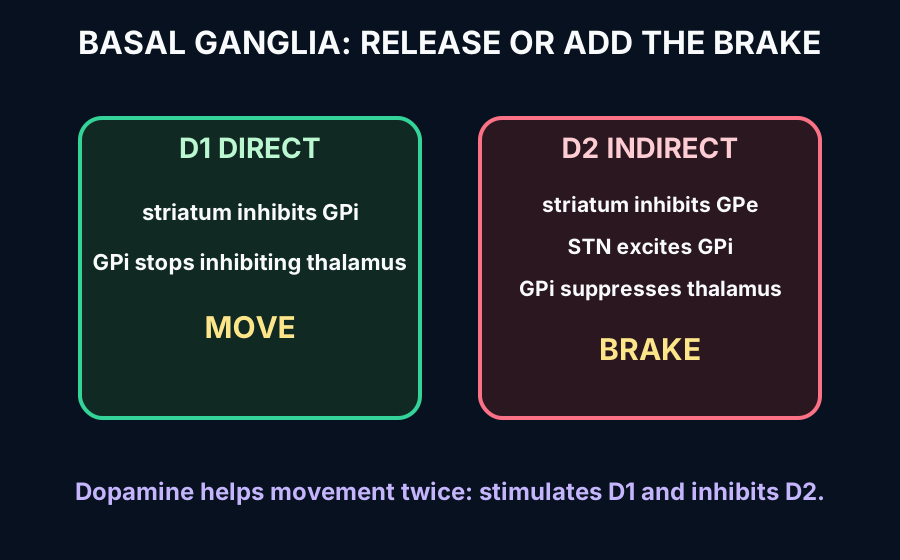
Basal ganglia dopamine circuit schematic
Central dopamine signaling is the board-level mechanism behind the motor urge.
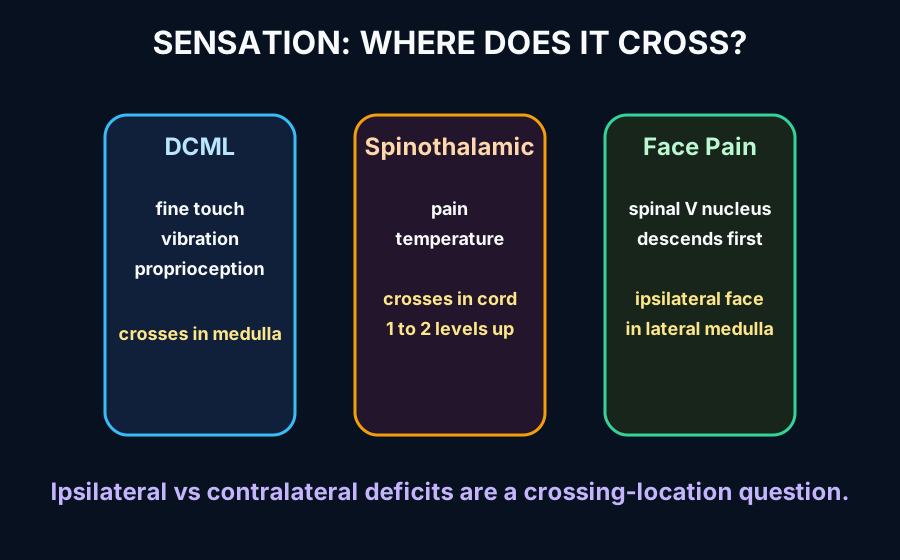
Sensory pathway schematic for leg discomfort localization
The complaint is sensory discomfort plus motor relief, not weakness or fixed numbness.
Iron deficiency and dopamine synthesis visual placeholder
Iron supports tyrosine hydroxylase, the rate-limiting dopamine synthesis step.

Treatment, rung by rung

Start cheap and reversible. Earn the next rung only if the last one fails.

Sleep hygiene, leg massage, warm baths, stretching, walking before bed. Stop offending drugs when you can: SSRIs, antipsychotics, sedating antihistamines (diphenhydramine), metoclopramide, and dopamine blockers all aggravate RLS.

Check ferritin on every patient. Treat with oral iron if ferritin is below 75 ng/mL, even when the hemoglobin is normal. The brain runs out of iron long before the bone marrow does.

Pearl: the most common reversible cause is low iron. A ferritin of 30 in a patient with normal hemoglobin is still treatable iron deficiency for RLS purposes. IV iron is reasonable in pregnancy, ESRD, or when oral fails.

Examples: pramipexole, ropinirole, rotigotine patch. They bind D2 receptors in the central nervous system and substitute for the dopamine signal that low iron starved out.

Side effects: nausea, daytime somnolence, sleep attacks, impulse-control disorders (gambling, hypersexuality, binge eating). Counsel every patient before the first dose.

Pearl: these were the first-line drugs for years. Long-term use causes augmentation (next section). Many guidelines now favor a gabapentinoid up front when symptoms are mild to moderate, especially with neuropathic pain, to avoid the augmentation trap entirely.

Examples: gabapentin, gabapentin enacarbil, pregabalin. They bind the alpha-2-delta subunit of voltage-gated calcium channels and damp down sensory firing.

Best when the patient also has a neuropathic pain component, insomnia, or anxiety. Side effects: sedation, dizziness, leg edema, weight gain.

Pearl: the right answer when a patient on long-term pramipexole develops augmentation. Switching to a gabapentinoid resets the dopaminergic system without further whipping it.

For patients who fail iron repletion, dopamine agonists, and gabapentinoids. Low-dose oxycodone, methadone, or tramadol for daytime breakthrough; clonazepam at bedtime for the sleep-fragmentation piece.

Reserved for refractory disease because of dependence and respiratory risk. Specialist territory: refer.

Pearl: clinical questions almost never make this the right answer. If the stem says "started on pramipexole, then symptoms got worse," the move is gabapentin (Step 3), not opioids.

Augmentation: when the rescue becomes the disease

Long-term pramipexole drives D1 stimulation over time. Symptoms march earlier, harder, and out of the legs.

MONTH 0 MONTH 18+ AM PM NIGHT LEGS NIGHT ONLY D2 PRAMIPEXOLE LEGS ARMS D1 DRIFT EARLIER · SPREAD · INTENSE AUGMENTATION RECEPTOR DRIFT · OVER MONTHS

The pattern

A patient does great on pramipexole for months. Then symptoms appear earlier in the day. They get more intense. They spread to the arms. Bumping the dose helps for a week, then it gets worse again.

That is augmentation, not the disease progressing. Mechanism: long-term D2 agonist binding drifts onto D1 receptors over time, paradoxically pushing the wakeful arousal pathway and amplifying the urge.

The move: taper pramipexole, switch to a gabapentinoid (gabapentin or pregabalin). Re-check ferritin. Do not chase symptoms with more dopamine agonist.

Tell it apart from the imitators

Four conditions that share one feature with RLS but break the URGE rule somewhere.

The diagnosis
Restless leg syndrome
SensationCreepy-crawly, urge to move
WhenRest, evening, night
ReliefMovement helps
Awake?Patient is awake and aware
LockAll four URGE letters present
Imitator 1
Periodic limb movements of sleep
SensationRepetitive leg jerks during sleep
WhenAsleep (bed partner notices)
ReliefPatient is asleep, does not feel it
Awake?Asleep, polysomnogram diagnosis
OverlapCo-occurs with RLS in 80%
Imitator 2
Peripheral neuropathy
SensationBurning, tingling, numbness
WhenConstant, day and night
ReliefMovement does not change it
ExamSock-distribution sensory loss, decreased reflexes
LockNo urge, no movement relief
Imitator 3
Akathisia
SensationWhole-body restlessness, cannot sit still
WhenContinuous, all day
ReliefPacing, never fully quiet
TriggerAntipsychotic, metoclopramide in last weeks
LockWhole body, dopamine blocker on the med list
Imitator 4
Nocturnal leg cramps
SensationSudden painful muscle knot
WhenBrief episodes, typically calf, in bed
ReliefStretching, massage, then resolves
Sensation typePain, not creepy-crawly urge
LockPainful spasm, not a need to move

Choose before the answer shows itself

Two forks. Do the bedside discrimination first, then pick the management trap.

A patient says both calves feel crawling at 10pm while sitting. Walking quiets it. Exam and nerve conduction testing are normal. What diagnosis fits best?
Yes. Urge, rest trigger, movement relief, evening peak. Normal exam and normal nerve conduction make neuropathy the wrong lane.
Not that fork. Cramps are painful muscle knots. Neuropathy is constant burning or numbness with sensory loss. This stem is the URGE pattern.
The same patient has ferritin 24 ng/mL and hemoglobin 13.0 g/dL. Which first step changes the mechanism?
Yes. Ferritin can be low enough to treat even when hemoglobin is normal. Iron feeds tyrosine hydroxylase, then dopamine signaling.
Wrong fork. Sleep study is for periodic limb movements of sleep, not classic awake RLS. Diphenhydramine worsens RLS.

Five vignettes, all original

No question is lifted from any qbank. Pure board logic, written for this page.

Five questions. Read the stem, tap your pick. Each wrong choice gets its own elimination rule so you walk away smarter than you came.
Medically reviewed by Kaitlyn Cocuzzo, MD and Fatima Ali, DO · Last updated June 30, 2026 at 10:26 AM ET
Bone Wizardry is an independent educational resource for visual learning in the medical sciences. It is not affiliated with, endorsed by, or sponsored by any licensing or examination board, contains no real or recalled examination questions, and does not guarantee any educational or examination outcome.