Recognize thiamine deficiency before the full triad appears, connect energy failure to brain injury, and choose treatment that protects memory and function.
A person who has barely eaten is confused and cannot walk steadily. Do you need the complete eye, gait and mental-status triad before treating? No. Suspected Wernicke encephalopathy requires urgent parenteral thiamine; symptomatic hypoglycemia requires immediate glucose, not a wait for the vitamin. [2][3]
The central question is how to recognize a treatable energy problem before it leaves persistent memory disability. By the end, connect nutritional risk to the examination, explain the relevant biochemical reactions, distinguish supportive imaging from an exclusion test, and plan acute treatment and recovery.
Recognize the risk before the complete triad
Does the absence of one classic feature make treatment unnecessary? Consider someone with weeks of vomiting, a normal conversation yesterday, and new disorientation today. Poor intake supplies the risk; a new neurological finding supplies the urgency. Alcohol exposure is not required. Small thiamine stores can be depleted by inadequate intake, impaired absorption or sustained demand, including after bariatric surgery, during hyperemesis gravidarum, or during parenteral nutrition without adequate vitamins. There is no dependable calendar day on which deficiency suddenly begins. [2][5][13]
Wernicke encephalopathy is an acute brain syndrome caused by thiamine deficiency. The familiar triad comprises altered mental status, ocular abnormalities and gait or balance impairment. Confusion can instead look like apathy, poor attention or unusual drowsiness. Nystagmus and impaired abduction can occur, but no fixed ocular sequence is required. A wide-based, unstable gait may be more striking than finger-to-nose inaccuracy. Do not dismiss these findings as intoxication. [2]
Four clinical domains in the Caine framework
Domain
A concrete example
DomainDietary deficiency
A concrete exampleVery limited food intake with weight loss
DomainOcular abnormality
A concrete exampleNew gaze-evoked nystagmus
DomainCerebellar dysfunction
A concrete exampleNew gait or truncal ataxia
DomainAltered mental state or memory
A concrete exampleInattention or impaired recent recall
Try it: Count the domains in a malnourished patient with new ataxia but normal eye examination and intact orientation. There are two: dietary deficiency and cerebellar dysfunction. The original Caine framework supports recognition with two of four domains in its studied alcohol-related population. It is not a universal rule-out score, and concurrent hepatic encephalopathy can obscure the diagnosis. [1]
Apply it elsewhere: Replace alcohol exposure with prolonged vomiting after gastric bypass. The nutritional mechanism and need for prompt clinical assessment remain. Obtain relevant blood samples when feasible, but do not wait for a vitamin result, the complete triad or an MRI appointment before treating suspected disease. Simultaneously assess airway, breathing, circulation, bedside glucose and alternative emergencies. [2][3]
Try it here · Checkpoint 1 of 3
Make your prediction before reading the choices. A first attempt is just a starting point.
Case 2
Show answer and explanations for case 2
A. Begin withdrawal treatment and reassess after the tremor resolves. (Why this does not fit)
Alcohol withdrawal can require urgent medication when its clinical features are present. No tremor or autonomic overactivity is described, and withdrawal treatment does not replace thiamine. Base concurrent treatments on the observed syndromes rather than alcohol history alone.
Reasoning steps for option A
Why might alcohol withdrawal treatment be considered?
Alcohol use can coexist with withdrawal, which needs treatment when its symptoms are present.
Do his gait findings establish withdrawal as the explanation?
No tremor or autonomic overactivity is described; marked truncal instability follows two months of replacing meals with alcohol.
What would waiting for tremor resolution miss?
Possible thiamine-deficient neurological disease needs prompt parenteral thiamine even while other causes of ataxia are evaluated.
B. Begin parenteral thiamine and evaluate other causes of ataxia. (Best answer)
Dietary deficiency and cerebellar dysfunction are two relevant clinical domains. Normal orientation and eye findings do not remove the combination of nutritional risk and new ataxia. Do not require the complete triad before treating suspected Wernicke encephalopathy.
Reasoning steps for option B
Which examination and diet findings support this plan?
Eight kilograms of weight loss and poor diet accompany new broad-based gait and truncal ataxia.
Do intact orientation and eye movements rule out Wernicke encephalopathy?
No. A complete ocular, gait and mental-status triad is not needed to suspect disease.
Why evaluate other causes while starting parenteral thiamine?
Preserved toe position sense supports a central gait problem, but ataxia has other causes that can be investigated without delaying treatment.
C. Begin oral vitamin replacement and reassess gait in a week. (Why this does not fit)
Oral replacement can serve selected prevention and maintenance needs. New substantial gait dysfunction in a nutritionally depleted patient raises concern for active neurological disease. Distinguish prevention in an asymptomatic patient from treatment of suspected encephalopathy.
Reasoning steps for option C
Where can oral vitamins have a role?
Oral replacement can serve selected prevention or maintenance needs after acute treatment.
Why is a week of observation unsafe for this patient?
His new need to hold a wall and marked truncal instability suggest an active neurological syndrome in the setting of dietary deficiency.
What route and timing better match this presentation?
Start parenteral thiamine now rather than relying on oral prophylaxis and delayed reassessment.
D. Arrange elective cerebellar imaging and observe without vitamins. (Why this does not fit)
Structural cerebellar disease belongs in the differential for gait ataxia. Imaging does not need to precede treatment of a plausible acute nutritional syndrome. Investigate alternatives without leaving suspected thiamine deficiency untreated.
Reasoning steps for option D
Why is cerebellar imaging a plausible consideration?
A structural cerebellar lesion can cause a broad-based gait and truncal instability.
Why should elective imaging not be the only initial action?
He has major nutritional risk and new ataxia despite normal orientation and eye movements, so Wernicke encephalopathy remains possible.
How should investigation and treatment be sequenced?
Give parenteral thiamine promptly while evaluating structural and other causes of ataxia.
Takeaway: Do not require the complete triad before treating suspected Wernicke encephalopathy.
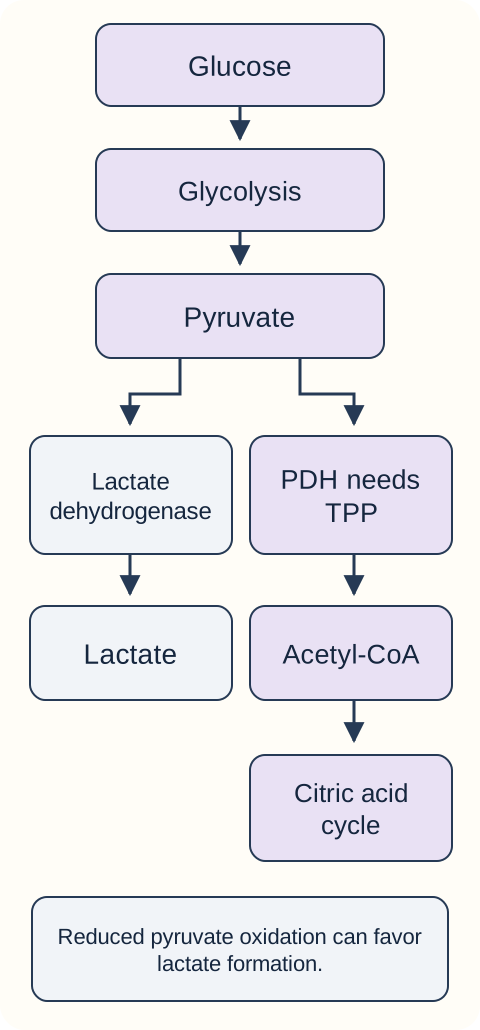
Why can calories fail to correct an energy deficit? Glucose is substrate; thiamine supplies a cofactor needed to process that substrate efficiently. Its active diphosphate form is called TDP or TPP. These names refer to the same cofactor. Adding glucose does not directly destroy thiamine, and pyruvate dehydrogenase is not itself a glycolytic enzyme. [5][6]
Trace pyruvate toward oxidation or lactate. The diagram separates glycolysis from the TPP-dependent PDH reaction; it is a qualitative pathway model. [5][6]Open full-size diagram.
Follow the route from glucose through glycolysis to pyruvate. The pyruvate dehydrogenase complex uses TPP to support conversion of pyruvate to acetyl-CoA. With impaired oxidative processing, more pyruvate can be directed toward lactate. This helps explain lactate accumulation and reduced energy availability even when oxygen delivery is adequate. A raised lactate still requires assessment for shock, sepsis and other causes; it is not a specific thiamine test.
Four TPP-dependent enzyme systems worth distinguishing
System
Relevant reaction
SystemPyruvate dehydrogenase
Relevant reactionPyruvate to acetyl-CoA, linking glycolysis to mitochondrial oxidation
SystemAlpha-ketoglutarate dehydrogenase
Relevant reactionAlpha-ketoglutarate to succinyl-CoA within the citric acid cycle
SystemBCKDH
Relevant reactionOxidative processing of ketoacids derived from leucine, isoleucine and valine
SystemTransketolase
Relevant reactionTwo-carbon transfers between sugar phosphates in the nonoxidative pentose phosphate pathway
Alpha-ketoglutarate dehydrogenase is a regulated cycle step, not the sole universal rate-limiting enzyme. BCKDH acts after amino-acid transamination; inherited BCKDH dysfunction causes maple syrup urine disease, a different clinical problem from acquired adult nutritional deficiency. [6][23]
Keep the two pentose phosphate functions separate. Transketolase rearranges carbon skeletons and helps connect pentoses with glycolytic intermediates. G6PD and 6-phosphogluconate dehydrogenase directly generate NADPH in the oxidative branch. Transketolase does not directly produce NADPH, and its reduced activity does not prove that every pentose concentration must fall. [7][8][9]
Change the cofactor state
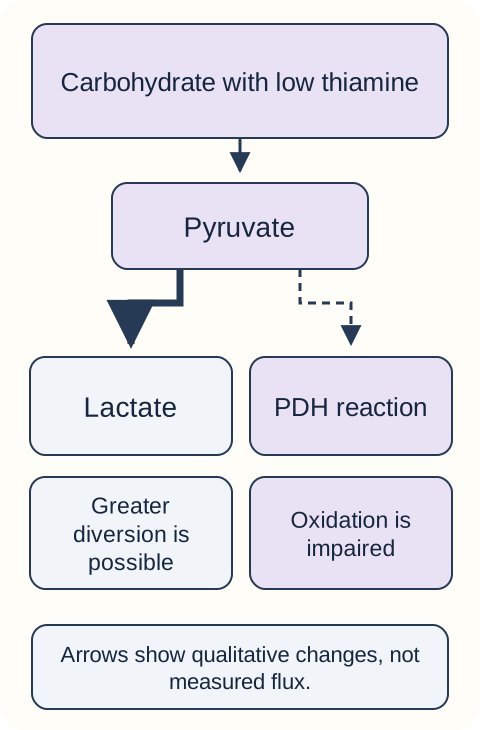
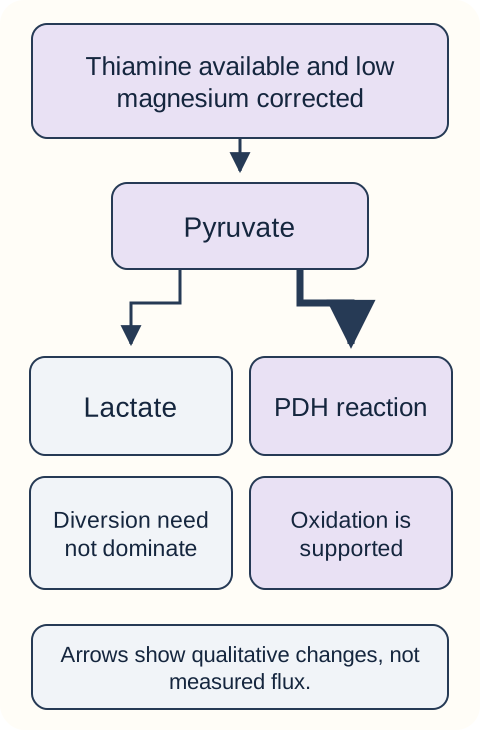
Before choosing a state below, point to the pyruvate branch you expect to become more important. Compare the arrows, then describe what changed. These are qualitative comparisons, not a calculator of an individual lactate level.
Compare carbohydrate delivery while thiamine remains lowPredict the consequence of adding carbohydrate while the cofactor remains inadequate: oxidative processing is impaired and lactate diversion can increase. Arrow widths are not measured fluxes. [5][6]Open full-size diagram.Compare replacement of thiamine and correction of low magnesiumCompare the same branch point after supplying thiamine and correcting deficient magnesium. Better biochemical support is not a promise of complete neurological recovery. [4][5][6]Open full-size diagram.
What changes: Added substrate does not repair a cofactor deficit. Replacing thiamine and correcting deficient magnesium can support oxidative processing; it cannot guarantee recovery of established tissue injury. Close the comparison to reset, or choose the other state. [4][6]
Try a new situation: A well-oxygenated patient has received calorie-rich nutrition without vitamins and develops elevated lactate. Explain why checking blood pressure alone misses a possible fuel-processing problem.
Try a laboratory prediction: If adding TPP to a red-cell sample substantially increases transketolase activity, the enzyme was functioning below its cofactor-supported capacity. For activity rising from 40 to 54 units, the increase is 14/40, or 35%. This supports poor thiamine status under the assay's reference method, not a stand-alone diagnosis of brain injury. A sample drawn after treatment cannot reconstruct the pretreatment state. [5]
Transfer: In someone receiving calorie-rich nutrition without vitamins, the calorie total alone does not establish nutritional adequacy. Review the micronutrient prescription and neurological examination. The brain has substantial energy requirements and vulnerable regional networks; selective injury is not explained by an absolute inability to use any fuel other than glucose.
Try it here · Checkpoint 2 of 3
Make your prediction before reading the choices. A first attempt is just a starting point.
Case 5
Show answer and explanations for case 5
A. Reduced pyruvate oxidation with increased lactate formation. (Best answer)
Thiamine supports the pyruvate dehydrogenase complex. Reduced pyruvate entry into oxidative metabolism can divert more substrate toward lactate despite adequate oxygen delivery. A nutritional defect can impair fuel processing without a primary oxygen-delivery failure.
Reasoning steps for option A
Which deficiency links the omitted parenteral vitamins to nystagmus and inattention?
Thiamine deficiency can connect the nutrition error to the new neurological findings.
What happens to pyruvate oxidation when TPP-dependent pyruvate dehydrogenase is limited?
Less pyruvate enters oxidative metabolism as acetyl-CoA.
How does this explain lactate 5.8 mmol/L without demonstrated hypoperfusion?
More pyruvate can be converted to lactate despite preserved oxygenation and blood pressure.
Does the lactate alone prove thiamine deficiency?
No. Other lactate causes still merit assessment, although the omitted vitamins support this mechanism.
B. Increased pyruvate oxidation with reduced lactate clearance. (Why this does not fit)
Raised lactate can result from reduced clearance in selected illnesses. No new clearance problem is supplied, whereas thiamine deficiency impairs rather than accelerates pyruvate oxidation. Use the demonstrated nutritional defect to predict the affected reaction.
Reasoning steps for option B
When might impaired lactate clearance matter?
A separate illness that reduces clearance could contribute to elevated lactate.
Does missing parenteral vitamins predict increased pyruvate oxidation?
No. Thiamine shortage limits the TPP-dependent pyruvate dehydrogenase reaction instead.
Which direction better fits his lactate and neurological changes?
Reduced oxidation diverts pyruvate toward lactate; no clearance defect is supplied.
C. Reduced pyruvate carboxylation with increased oxaloacetate formation. (Why this does not fit)
Pyruvate carboxylase participates in pyruvate metabolism. It uses biotin, and reduced carboxylation would not increase formation of its oxaloacetate product. Check both the cofactor and the direction of a proposed reaction.
Reasoning steps for option C
What pyruvate reaction does this option invoke?
Pyruvate carboxylase converts pyruvate to oxaloacetate.
Is that enzyme dependent on the omitted thiamine cofactor?
Does reduced carboxylation increase oxaloacetate formation?
No. Reduced activity would decrease its product and does not explain this proposed directional change.
D. Increased pentose oxidation with reduced pyruvate availability. (Why this does not fit)
The pentose phosphate pathway handles glucose-derived carbon. A vitamin omission affecting TPP-dependent reactions does not establish increased oxidative pentose flux or explain lactate by substrate reduction. Do not substitute a different glucose pathway for the directly affected mitochondrial step.
Reasoning steps for option D
What is the pentose pathway's apparent relevance?
It processes glucose-derived carbon, so it might seem related to altered fuel metabolism.
Does vitamin omission establish increased oxidative pentose flux?
No. The thiamine-sensitive mitochondrial pyruvate dehydrogenase step is a closer link to his lactate rise.
Why does reduced pyruvate availability not fit the observed lactate?
Increased lactate is better explained by diverting pyruvate away from oxidation, not by asserting less pyruvate substrate.
Takeaway: A nutritional defect can impair fuel processing without a primary oxygen-delivery failure.
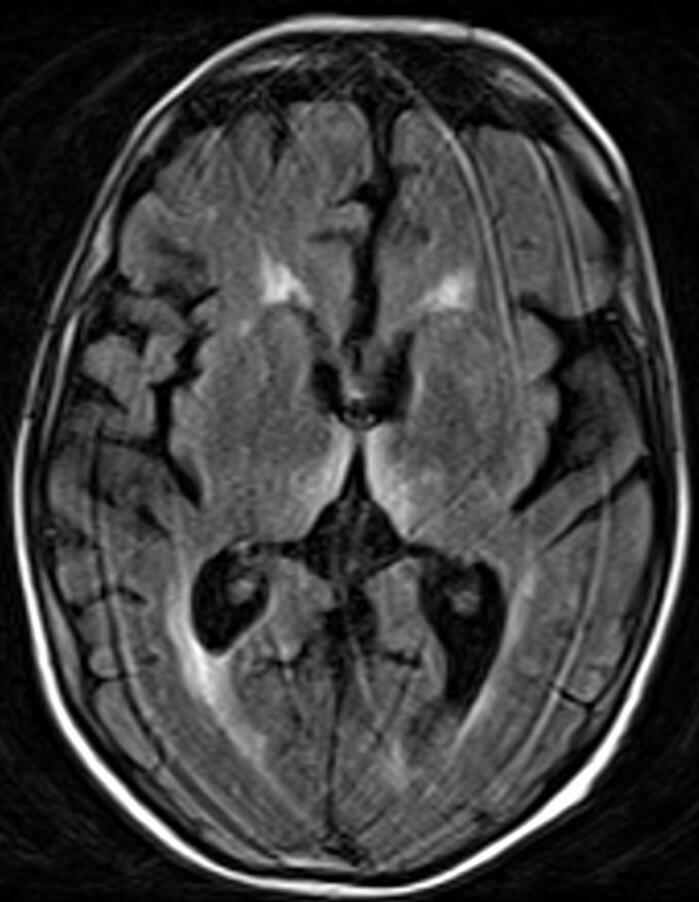
Can one scan establish the diagnosis, severity and future memory outcome? No. Imaging can support a clinical pattern, but it cannot replace the examination or an urgent treatment decision. Compare the real axial image below with its central fluid spaces: the abnormal bright signal is in paired deep structures, not a large patch of lateral cortex. [10]
Find the paired medial thalamic signal beside the third ventricle. This example supports pattern recognition, but a normal scan cannot exclude Wernicke encephalopathy and this image alone cannot establish the diagnosis. Image: Jto410; current Commons crop by Doc James. Image source and history. CC BY-SA 3.0. [10][22].
Try it: Locate the two medial thalami beside the third ventricle. Describe the finding as bilateral medial thalamic FLAIR hyperintensity. Hyperintensity on T2/FLAIR is not synonymous with contrast enhancement; enhancement requires comparison on an appropriate post-contrast sequence. This single slice does not demonstrate every region that can be affected.
Typical acute abnormalities may involve the medial thalami, mammillary bodies, periaqueductal gray and other periventricular structures. Those regions help explain why attention, memory, ocular control and balance can be affected together. Mammillary and thalamic injury involves memory networks; ocular findings reflect brainstem ocular and vestibular circuitry. The oculomotor nucleus is in the midbrain, whereas the abducens nucleus lies in the pons near the fourth ventricle. Do not place both nuclei beside the midbrain aqueduct. Vermian and vestibular dysfunction can contribute to gait or truncal ataxia. [2][10][14]
A normal MRI does not exclude Wernicke encephalopathy. An older small diagnostic study found limited MRI sensitivity despite useful specificity; its percentage is not a universal performance guarantee for every scanner, sequence or population. Conversely, mammillary atrophy can be present without the current acute syndrome and does not prove that a specific patient will develop persistent amnesia. [10]
Apply the distinction: New disorientation and ataxia after severe food restriction still warrant empiric treatment when the MRI is reported normal. Abrupt unilateral weakness or another focal emergency warrants its own urgent diagnostic pathway in parallel. Neither a reassuring scan nor a nutritional risk factor gives permission to ignore a competing explanation. [24]
Treat the emergency and the nutritional deficit together
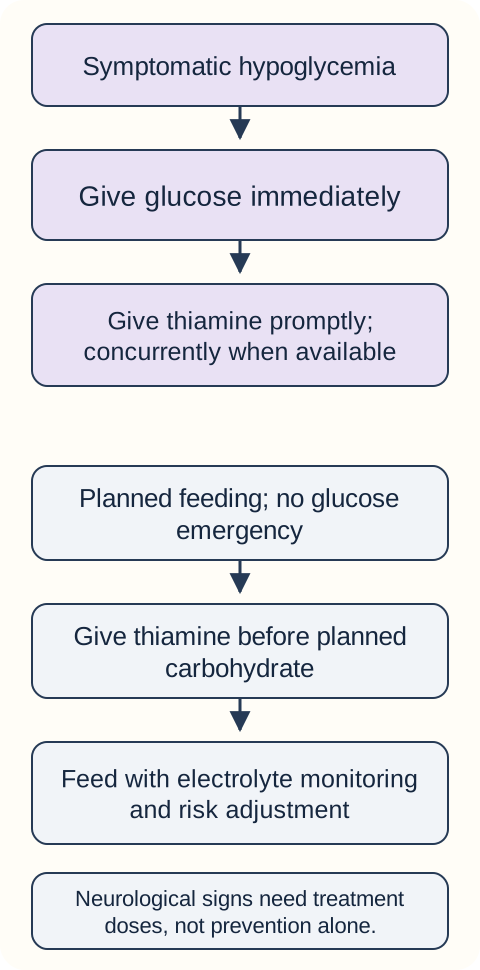
Should glucose wait until thiamine arrives? In symptomatic hypoglycemia, no. Give glucose immediately and thiamine as soon as possible, concurrently when available. If thiamine is already at hand, giving it first need not cause a delay. For planned carbohydrate administration or feeding in a nutritionally depleted patient, provide thiamine beforehand. These are different decisions, not contradictory rules. [3][12][13]
Compare an emergency glucose rescue with planned feeding. Prompt thiamine belongs in both settings, but rescue glucose must not wait for it. [3][4][12][13]Open full-size diagram.
Try the distinction: One patient is unresponsive with glucose 31 mg/dL and IV dextrose ready; another is alert, glucose 94 mg/dL, and awaiting a nutrition infusion. In the first, emergency glucose cannot wait. In the second, there is time to give preventive thiamine before planned calories. In either patient, neurological signs suggestive of Wernicke encephalopathy require a therapeutic parenteral regimen rather than a routine multivitamin order.
Suspected Wernicke encephalopathy is treated in hospital with parenteral thiamine, preferably IV. Oral absorption may be inadequate in severe nutritional deficiency, ongoing vomiting or malabsorption. A multivitamin infusion, sometimes called a banana bag, is not a substitute unless its actual thiamine dose and schedule meet the chosen treatment protocol. [2][3][4]
A named treatment example: Current UK alcohol-treatment guidance recommends 300 to 500 mg IV three times daily for 3 to 5 days, with daily review. If symptoms remain after the initial 5 days, it recommends 300 to 500 mg IV once daily for a further 3 to 5 days, continuing while clinical improvement occurs. Oral treatment follows, with duration based on ongoing risk and recovery. Its high-risk prevention regimen, 200 to 300 mg parenterally once daily, is a separate indication. [4]
Regimens differ: EFNS recommends 200 mg IV three times daily. A randomized dose-comparison trial did not establish a clear advantage for the highest studied dose, but limitations prevent treating its null result as proof of equivalence. Follow an appropriate local protocol; do not substitute prevention dosing for active neurological disease or present one schedule as universally settled. [2][11]
Check magnesium and correct deficiency, with renal function and monitoring guiding replacement. Magnesium supports thiamine activation and enzyme function; low magnesium can impair the response to thiamine. Also assess potassium and phosphate and introduce nutrition under a risk-adjusted refeeding plan. Low phosphate, arrhythmia, weakness or edema after feeding requires urgent reassessment. Vitamins alone do not prevent every electrolyte complication. [4][12]
Transfer: Persistent vomiting after surgery changes the reliability of oral replacement even when the tablet dose looks large. Correct the cause of vomiting and involve nutrition specialists while treating the neurological syndrome, rather than waiting for food tolerance to return.
Try it here · Checkpoint 3 of 3
Make your prediction before reading the choices. A first attempt is just a starting point.
Case 1
Show answer and explanations for case 1
A. Give IV dextrose now, then thiamine when available. (Best answer)
Severe symptomatic hypoglycemia needs immediate correction. The nutritional and neurological history also warrants prompt parenteral thiamine, which is not yet available. Give emergency glucose without delay and provide thiamine promptly, concurrently when possible.
Reasoning steps for option A
What makes glucose the first intervention in this unresponsive man?
His glucose is 31 mg/dL and IV dextrose is ready, so severe symptomatic hypoglycemia needs immediate correction.
Why is thiamine still indicated after dextrose?
Weeks of restricted intake and recent unsteadiness raise concern for thiamine deficiency and possible Wernicke encephalopathy.
How should the 15-minute vitamin delay affect treatment?
Do not delay dextrose; give parenteral thiamine promptly when it arrives, or concurrently if both become available.
If thiamine and glucose become available at the same moment, must glucose wait?
No. Administer them concurrently without delaying treatment of the glucose of 31 mg/dL.
B. Give thiamine on arrival, then administer IV dextrose. (Why this does not fit)
Providing thiamine before planned carbohydrate intake is appropriate in a depleted patient. This patient has severe symptomatic hypoglycemia and would wait 15 minutes for glucose. Do not turn preventive vitamin sequencing into a delay in emergency glucose treatment.
Reasoning steps for option B
When might giving thiamine before carbohydrate be useful?
Before planned carbohydrate support in a nutritionally depleted patient, thiamine can be given first.
What makes waiting for thiamine unsafe here?
He is unresponsive with glucose 31 mg/dL, and the vitamin will not arrive for about 15 minutes.
Which part of this sequence must change?
Give bedside IV dextrose now rather than delaying rescue glucose; follow promptly with parenteral thiamine.
C. Give IM glucagon now, then dextrose after thiamine. (Why this does not fit)
Glucagon can be useful when access for glucose administration is unavailable. IV access and dextrose are already available, and poor nutrition may limit glycogen-dependent glucagon effectiveness. Use available direct glucose treatment rather than an indirect substitute to preserve a vitamin sequence.
Reasoning steps for option C
When would IM glucagon be a reasonable glucose rescue?
It can be useful when direct glucose administration is unavailable.
Why is glucagon a poor substitute in this man?
IV access and dextrose are ready, while weeks of poor intake may leave too little hepatic glycogen for reliable glucagon action.
How should the two immediate needs be met?
Use IV dextrose directly now and give parenteral thiamine as soon as available, without waiting to give glucose.
D. Give IV dextrose now, then thiamine after testing. (Why this does not fit)
Correcting the low glucose is immediately appropriate. Waiting for a vitamin assay leaves the suspected nutritional brain syndrome untreated. A laboratory confirmation is not required before empiric treatment of suspected Wernicke encephalopathy.
Reasoning steps for option D
Which half of the proposed sequence addresses the glucose of 31 mg/dL?
Immediate IV dextrose appropriately treats his symptomatic hypoglycemia.
What makes waiting for thiamine testing inappropriate?
Limited food intake and new gait symptoms already justify empiric parenteral thiamine; a vitamin assay would delay it.
When should thiamine follow emergency glucose?
As soon as it arrives, without requiring laboratory confirmation of Wernicke encephalopathy.
Takeaway: Give emergency glucose without delay and provide thiamine promptly, concurrently when possible.
Reassess an incomplete response without missing a second problem
Does persistent ataxia prove that thiamine failed? Not by itself. Ocular findings can improve relatively early; gait, attention and memory may recover at different rates, and some deficits persist. A published postoperative case documented rapid improvement, but one patient's timeline cannot define an obligatory response for everyone. Lack of improvement requires a review of delivery, magnesium, diagnosis and coexisting disease, not an automatic declaration of irreversible injury. [4][21]
Separate the residual finding from the original syndrome
New or persistent evidence
What it adds
New or persistent evidenceLoss of toe position sense, impaired vibration and macrocytosis
What it addsConsider coexisting B12 deficiency and spinal sensory pathway disease
New or persistent evidenceBurning distal feet, reduced ankle reflexes and stocking sensory loss
What it addsAssess peripheral neuropathy rather than attributing everything to the cerebellum
New or persistent evidenceCirrhosis, gastrointestinal bleeding and asterixis
What it addsEvaluate hepatic encephalopathy and its precipitant as a concurrent problem
New or persistent evidenceTremor, autonomic overactivity and agitation after alcohol reduction
What it addsTreat alcohol withdrawal while still assessing nutritional brain injury
Try the localization: If the eyes improve but the patient cannot sense toe position, identify the persistent abnormal sensory input before labeling the gait problem persistent Wernicke disease. B12 deficiency can coexist after malabsorption; neurological treatment should not be delayed in a suggestive presentation while awaiting confirmatory results. Peripheral neuropathy associated with alcohol can also have causes beyond thiamine deficiency. [16][20]
In a patient with cirrhosis, look for infection, bleeding, dehydration, constipation and sedating medicines as potential contributors to encephalopathy. Treat supported hepatic encephalopathy alongside suspected Wernicke disease. Thiamine is not an established precipitant of ammonia-mediated encephalopathy, and cirrhosis alone does not authorize an improvised higher or lower thiamine dose. [4][17]
Two separate treatment hazards: Urticaria with wheeze or hypotension during an infusion requires stopping the suspected trigger, emergency help and immediate anaphylaxis treatment, including IM epinephrine according to protocol. Simply changing to IM thiamine is not a safe response to a suspected serious allergy. Separately, excessive correction of chronic hyponatremia can cause osmotic demyelination, particularly in vulnerable malnourished patients. New dysarthria, dysphagia or quadriparesis after sodium correction is not evidence of thiamine toxicity. [18][19]
Transfer: A new deficit deserves a new assessment even if the initial diagnosis was correct. Track the neurological examination and treatment response, and investigate additional nutritional deficiencies, electrolyte disorders, structural disease and infection when indicated.
Distinguish recovered attention from recovered memory
Does fluent conversation mean new memories are being stored? A patient may discuss childhood accurately, follow a short conversation and still forget that a visitor arrived ten minutes earlier. After the acute illness has stabilized, a disproportionate persistent episodic memory deficit suggests Korsakoff syndrome. Severe anterograde amnesia means difficulty forming lasting new memories; variable retrograde amnesia affects events from before the illness. It is not simply reduced immediate attention. [15]
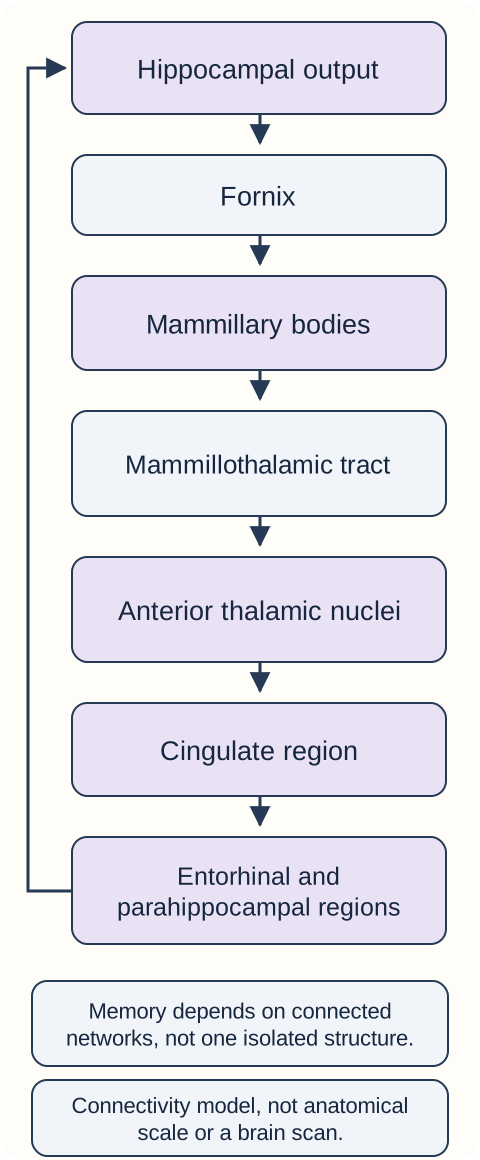
Trace the direction through the fornix and mammillothalamic tract. The incoming hippocampal fibers and anterior thalamic relay follow distinct connections; trace the relay between the mammillary bodies and anterior thalamus. [14][25]Open full-size diagram.
Trace the pathway: Follow hippocampal output through the fornix to the mammillary bodies, then through the mammillothalamic tract to the anterior thalamic nuclei and onward to cingulate and entorhinal regions. This simplified circuit shows how diencephalic injury can disrupt memory without a large primary hippocampal lesion. Mediodorsal thalamic and broader frontal-memory connections also matter; they are not interchangeable labels for the anterior thalamic relay. [14][25]
Chronic tissue injury can include neuronal loss, gliosis and mammillary or thalamic atrophy. These are consequences of injury, not direct measurements of the current vitamin concentration. A small mammillary body is not, by itself, a complete diagnosis or a forecast of inevitable disability. Thiamine can correct deficiency and prevent additional injury, but it does not instantly replace lost neurons. [10][14]
Confabulation means producing inaccurate memories without deliberate deception. It may occur with impaired memory and contextual monitoring, but it is not necessary for diagnosis. Apathy, impaired insight and executive difficulties can accompany the amnesia; a specific personality change is not required. Do not infer an intact frontal system simply because a patient gives a fluent but inaccurate explanation. [15]
Try a functional check: Ask the patient to demonstrate how tomorrow's medication will be taken, then revisit the plan later rather than accepting an immediate verbal repetition. Persistent inability to retain the plan may require supervised medicines, external reminders and caregiver involvement. Rehabilitation should use predictable routines, supported practice and individualized assessment of safety and decision-making.
Transfer to prognosis: Persistent amnesia does not make rehabilitation futile. Nutrition, continued vitamin replacement when needed, treatment of the underlying cause and support for alcohol abstinence can prevent further injury and support variable functional improvement over months or longer. Neither complete recovery nor permanent total incapacity can be promised from one early examination. Reassess memory, daily function and support needs over time. [15]
Apply the distinctions to new patients
For each independent case, identify the finding that changes the decision before comparing the options. Explain why the closest competing answer does not fit. Return to the relevant section when a distinction remains uncertain.
Case 3
Show answer and explanations for case 3
A. Wait for the thiamine result while providing IV hydration. (Why this does not fit)
A pretreatment vitamin sample can support assessment of nutritional status. The delayed result cannot safely guide whether to treat the neurological presentation now. Obtain useful samples without making their turnaround time a treatment delay.
Reasoning steps for option A
What could the pretreatment whole-blood sample contribute?
It can support assessment of her thiamine status.
Why cannot its turnaround determine whether to treat now?
The result takes several days, while post-bypass vomiting and new inattention with nystagmus indicate a possible acute nutritional brain syndrome.
What should accompany hydration while results are pending?
Start IV thiamine now and investigate the persistent vomiting rather than waiting for the assay.
B. Repeat MRI with contrast before deciding on thiamine. (Why this does not fit)
Additional imaging can answer unresolved structural questions. A second scan is not required to begin treatment when the clinical suspicion is already substantial. Do not use an imaging sequence as a prerequisite for empiric thiamine.
Reasoning steps for option B
What might repeat contrast imaging investigate?
It could address a separate unresolved structural concern.
Does her normal initial MRI exclude Wernicke encephalopathy?
No. MRI has limited sensitivity, and prolonged vomiting plus new ocular and attention findings already support clinical suspicion.
Should a second scan precede thiamine in this patient?
No. Begin IV thiamine while any indicated imaging or other evaluation proceeds.
C. Start IV thiamine while investigating the vomiting. (Best answer)
Severe nutritional restriction with new ocular and cognitive abnormalities supports suspected Wernicke encephalopathy. Neither preserved walking nor a normal MRI excludes the syndrome, and the vitamin result is delayed. Treat the clinical syndrome promptly while correcting the source of nutritional depletion.
Reasoning steps for option C
How does gastric bypass connect to her neurological findings?
Five weeks of vomiting after bypass increase thiamine-deficiency risk, followed by inattention and gaze-evoked nystagmus.
Do independent walking and a normal MRI justify waiting?
No. Neither preserved gait nor negative imaging excludes Wernicke encephalopathy, and the thiamine result is delayed.
Why use IV rather than oral thiamine initially?
Persistent vomiting makes oral delivery unreliable during suspected active neurological disease.
What else must be addressed alongside IV treatment?
Investigate and correct the vomiting and resulting nutritional deficit.
D. Use oral thiamine while awaiting the neurological consultation. (Why this does not fit)
Oral thiamine is useful after stabilization and in selected preventive settings. Ongoing vomiting and suspected acute neurological disease make oral delivery unreliable here. Choose a reliable parenteral route for suspected active encephalopathy.
Reasoning steps for option D
When could oral thiamine be useful?
It can be used for selected prevention or after stabilization.
What undermines oral replacement in this case?
Five weeks of ongoing vomiting may prevent reliable absorption, while inattention and nystagmus suggest active encephalopathy.
What should happen instead of waiting for consultation?
Start reliable parenteral thiamine now and investigate the cause of vomiting.
Takeaway: Treat the clinical syndrome promptly while correcting the source of nutritional depletion.
A. Give folate before feeding and reserve thiamine for confusion. (Why this does not fit)
Folate has important roles in pregnancy and nutritional care. Its use does not replace thiamine prevention during prolonged vomiting. Prevent neurological deficiency rather than waiting for its manifestations.
Reasoning steps for option A
Why does folate have an apparent role here?
Folate remains important during pregnancy and nutritional support.
Why does folate alone fail before planned feeding?
Four weeks of vomiting and weight loss create thiamine-deficiency risk that folate cannot correct.
Must confusion appear before giving thiamine?
No. Her normal neurological exam calls for prevention before carbohydrate support, not waiting for neurological injury.
B. Begin calories now and add thiamine after the first feed. (Why this does not fit)
Nutrition needs to be restored in a patient with prolonged inadequate intake. The feeding is planned rather than an emergency glucose rescue, allowing thiamine beforehand. Use the opportunity to give thiamine before planned carbohydrate exposure.
Reasoning steps for option B
What is appropriate about starting nutrition?
Her oral intake remains inadequate after prolonged vomiting, so a feeding plan is needed.
What distinguishes this carbohydrate delivery from emergency dextrose?
Glucose is 88 mg/dL and no rescue dextrose is indicated; support is planned and permits vitamin prophylaxis first.
What should precede the first feed?
Give thiamine beforehand and monitor electrolytes during refeeding rather than adding the vitamin afterward.
C. Give thiamine after MRI confirms a nutritional brain lesion. (Why this does not fit)
MRI can support evaluation when a neurological syndrome is suspected. No neurological lesion is needed to justify prevention in this high-risk nutritional setting. The threshold for nutritional prophylaxis is not an imaging diagnosis.
Reasoning steps for option C
When could brain MRI help?
It may support evaluation of a suspected neurological syndrome.
Why is waiting for an MRI lesion misplaced here?
Her gait, eye examination and alertness are normal, but prolonged hyperemesis still warrants nutritional prophylaxis.
What triggers the vitamin decision instead?
Give thiamine before planned carbohydrate feeding because of poor intake, without requiring imaging confirmation.
D. Give thiamine before feeding and monitor refeeding electrolytes. (Best answer)
Prolonged vomiting with poor intake warrants preventive thiamine in pregnancy. The normal neurological examination favors prevention, while planned feeding requires electrolyte risk management as well. Pair thiamine prevention with a monitored nutrition plan rather than treating calories alone.
Reasoning steps for option D
Is this an emergency glucose-rescue situation?
No. Glucose is 88 mg/dL and carbohydrate support is planned.
Why give thiamine despite the normal neurological examination?
Four weeks of vomiting and substantial weight loss put her at risk before symptoms of Wernicke encephalopathy develop.
What additional hazard accompanies restarting nutrition?
Monitor refeeding electrolytes while providing thiamine before planned carbohydrate support.
Takeaway: Pair thiamine prevention with a monitored nutrition plan rather than treating calories alone.
A. A 35% rise establishes irreversible diencephalic injury. (Why this does not fit)
The calculated activation increase exceeds the supplied deficiency threshold. A red-cell functional assay does not measure brain structure or determine whether neurological injury will persist. Separate evidence of vitamin status from evidence about brain injury and prognosis.
Reasoning steps for option A
What calculation makes a 35% activation plausible?
Adding TPP increases activity by 14 units, and 14 divided by the starting 40 is 35%.
What does exceeding the laboratory's 25% threshold support?
It supports deficient cofactor availability in this pretreatment red-cell assay.
Why does the result not establish irreversible diencephalic damage?
Erythrocyte enzyme activation measures functional vitamin status, not brain injury or its prognosis.
B. A 35% rise supports inadequate cofactor availability. (Best answer)
A substantial response to added TPP indicates cofactor-limited enzyme activity under the assay conditions. The increase is 14/40, or 35%, above this laboratory threshold. The assay supports poor thiamine status but does not by itself diagnose Wernicke encephalopathy.
Reasoning steps for option B
How many assay units are gained after adding TPP?
Activity rises from 40 to 54, a gain of 14 units.
Which activity belongs in the percent-change denominator?
The baseline, pretreatment activity of 40 units; 14/40 equals 35%.
How does 35% compare with the stated threshold?
It exceeds the laboratory's greater-than-25% criterion and supports inadequate cofactor availability.
What does this functional assay not diagnose alone?
It cannot establish Wernicke encephalopathy or irreversible neurological injury.
C. A 14% rise indicates adequate tissue thiamine stores. (Why this does not fit)
The difference between the measured activities is 14 assay units. An absolute difference is not a percentage; 14 divided by 40 is 35%. Convert the change relative to the starting activity before applying assay thresholds.
Reasoning steps for option C
What is the number 14 in these measurements?
It is the absolute difference of 54 minus 40 assay units, not a percentage.
What percent rise follows from the baseline denominator?
Fourteen divided by 40 yields 35%, above the supplied greater-than-25% deficiency threshold.
Why is adequate thiamine status not the supported inference?
The strong response to added TPP suggests cofactor-limited transketolase activity instead.
D. A 26% rise indicates reduced direct NADPH production. (Why this does not fit)
Comparing the two measurements can reveal a cofactor-related limitation. The percent increase uses the starting value of 40, not the final value of 54, and transketolase does not directly generate NADPH. Use the correct denominator and identify the actual enzyme reaction.
Reasoning steps for option D
How might someone obtain a number near 26%?
Dividing the 14-unit gain by the final activity of 54 gives about 26%, using the wrong denominator.
What is the correct activation increase?
Relative to starting activity of 40, the increase is 35% and exceeds the laboratory threshold.
Does transketolase directly produce NADPH?
No. It transfers sugar carbons; the assay does not indicate reduced direct NADPH production.
Takeaway: The assay supports poor thiamine status but does not by itself diagnose Wernicke encephalopathy.
A. Oxidation of glucose-6-phosphate with reduction of NADP+. (Best answer)
G6PD catalyzes an oxidative pentose phosphate reaction that produces NADPH. The described TPP-responsive carbon transfer is transketolase, not the NADPH-generating reaction. Distinguish rearranging sugar carbon from directly generating NADPH.
Reasoning steps for option A
What does the TPP-responsive two-carbon transfer identify?
Transketolase rearranges pentose phosphate sugars into three-carbon and seven-carbon products.
Does this transfer itself reduce NADP+?
No. Sugar-carbon transfer is distinct from the pathway's oxidative NADPH-generating reactions.
Which listed oxidation directly supplies glutathione-regenerating NADPH?
G6PD oxidizes glucose-6-phosphate while reducing NADP+ to NADPH.
B. Reduction of pyruvate to lactate using NADH. (Why this does not fit)
Lactate formation is linked to pyruvate metabolism and cellular redox balance. This reaction consumes NADH and regenerates NAD+, rather than producing NADPH. Follow the reaction direction and the specific nicotinamide cofactor.
Reasoning steps for option B
Why might lactate formation seem related to a redox question?
Pyruvate reduction involves a nicotinamide cofactor and cellular redox balance.
What happens to that cofactor when pyruvate becomes lactate?
NADH is consumed and NAD+ regenerated, not NADPH produced.
Why does this fail the glutathione question?
It does not directly supply the NADPH needed for glutathione regeneration.
C. Oxidative conversion of pyruvate to acetyl-CoA. (Why this does not fit)
The pyruvate dehydrogenase complex requires TPP and supports energy metabolism. Its reducing output is NADH rather than the NADPH used for glutathione regeneration. Keep cofactor dependence and reducing-equivalent identity separate.
Reasoning steps for option C
Why is pyruvate dehydrogenase a tempting TPP-linked answer?
Oxidative conversion of pyruvate to acetyl-CoA uses a TPP-dependent complex.
Which reducing equivalent does that complex generate?
It produces NADH rather than NADPH.
What separate listed reaction supplies the requested reducing equivalent?
D. Transfer of two carbons between pentose phosphate substrates. (Why this does not fit)
Transketolase participates in the pentose phosphate pathway. Its two-carbon transfer does not directly reduce NADP+ to NADPH. Sharing a pathway does not imply sharing every product of that pathway.
Reasoning steps for option D
Which enzyme matches the stem's pentose-to-three-and-seven-carbon transfer?
TPP-dependent transketolase performs that two-carbon transfer.
What does this transfer do to NADP+?
It does not directly reduce NADP+ or generate NADPH.
Why is sharing the pentose pathway insufficient?
The separate oxidative G6PD reaction, not transketolase sugar rearrangement, directly supplies NADPH.
Takeaway: Distinguish rearranging sugar carbon from directly generating NADPH.
A. Methionine formation from homocysteine. (Why this does not fit)
Methionine synthesis can be impaired in other nutritional deficiencies. This reaction uses a B12-dependent methyl-transfer system rather than TPP. A nutritional context does not make B vitamins interchangeable.
Reasoning steps for option A
What kind of nutritional defect might affect methionine formation?
Impaired B12-dependent methyl transfer can limit conversion of homocysteine to methionine.
Does the TPP rescue of leucine ketoacid processing point to that reaction?
No. The rescued post-transamination oxidative step uses thiamine, not the B12 methyl-transfer system.
Which alternative reaction shares the implicated cofactor?
Alpha-ketoglutarate dehydrogenase uses TPP to form succinyl-CoA.
B. Succinyl-CoA formation from alpha-ketoglutarate. (Best answer)
Alpha-ketoglutarate dehydrogenase requires TPP for oxidative decarboxylation. The impaired post-transamination reaction implicates the same cofactor used by this citric acid cycle enzyme. Map the cofactor to the reaction type rather than to every step in amino-acid metabolism.
Reasoning steps for option B
Which leucine-processing stage is impaired in the assay?
Oxidative processing of the ketoacid after preserved transamination responds to added TPP.
What cofactor requirement does that response identify?
The branched-chain ketoacid dehydrogenase step depends on thiamine-derived TPP.
Which citric acid cycle reaction uses the same cofactor?
Alpha-ketoglutarate dehydrogenase converts alpha-ketoglutarate to succinyl-CoA using TPP.
C. Glutamate formation during amino-acid transamination. (Why this does not fit)
Transamination precedes oxidative breakdown of the ketoacid in this pathway. The stem specifies that transamination is preserved; it is not the TPP-dependent step. Identify which of two successive reactions is actually impaired.
Reasoning steps for option C
Where does transamination fall relative to the defective reaction?
It forms the leucine ketoacid before the oxidative processing step.
What does preserved ketoacid formation show?
The transamination step is intact; adding TPP improves a later reaction instead.
Why is glutamate formation not the shared TPP-dependent target?
A transamination product does not identify the post-transamination oxidative decarboxylation defect.
D. Oxaloacetate formation from pyruvate. (Why this does not fit)
Pyruvate carboxylase connects carbohydrate metabolism with the citric acid cycle. Its characteristic cofactor is biotin, not the TPP used for ketoacid oxidative processing. Carboxylation and oxidative decarboxylation use different cofactor systems.
Reasoning steps for option D
Which enzyme forms oxaloacetate from pyruvate?
Pyruvate carboxylase connects pyruvate to oxaloacetate.
Does this enzyme share the TPP dependence revealed by the leucine assay?
A. Increase carbohydrate delivery to overcome cofactor-limited metabolism. (Why this does not fit)
Calories are necessary for nutritional recovery. Additional substrate does not repair a cofactor deficit and needs a monitored refeeding plan. Adequate nutrition requires both substrate and the capacity to process it.
Reasoning steps for option A
Why does this undernourished patient still need calories during recovery?
Calories matter for nutritional recovery after poor intake.
What does magnesium 0.8 mg/dL imply before increasing substrate?
A severe cofactor deficit may limit thiamine activation and metabolic enzyme function despite correct IV delivery.
What should accompany monitored nutrition instead of carbohydrate escalation alone?
Replace magnesium, continue thiamine and monitor the clinical response and refeeding risks.
B. Add folate as the principal treatment for the ocular findings. (Why this does not fit)
Folate deficiency can coexist with poor nutrition. It does not explain or correct the demonstrated magnesium-related impairment of thiamine function. Treat additional deficiencies without substituting them for the identified problem.
Reasoning steps for option B
Why consider folate in this patient?
Poor nutrition and alcohol use can coexist with folate deficiency.
Does folate address the measured barrier to thiamine action?
No. Magnesium is 0.8 mg/dL, and folate does not replace its role in thiamine activation and enzyme function.
What remains the most direct adjustment for the limited response?
Replace magnesium while continuing IV thiamine and reassessing neurological findings.
C. Replace magnesium while continuing thiamine and reassessment. (Best answer)
Magnesium supports thiamine activation and enzyme function. The severe documented deficit can contribute to an incomplete response despite correct thiamine delivery. Correct relevant cofactors while continuing evaluation of persistent neurological findings.
Reasoning steps for option C
Which reversible deficit is documented despite verified thiamine delivery?
Magnesium is 0.8 mg/dL, far below the stated 1.7 to 2.4 reference range.
How might it blunt neurological improvement?
Magnesium supports thiamine activation and enzyme function, so a severe shortage can limit treatment response.
How should treatment change with creatinine 0.9 mg/dL?
Replace magnesium with appropriate monitoring while continuing IV thiamine and reassessing persistent symptoms.
D. Substitute oral thiamine to improve intracellular vitamin access. (Why this does not fit)
Oral thiamine can support ongoing replacement after the acute phase. Changing from reliable IV delivery does not correct the documented magnesium deficiency. Address the measured impediment rather than replacing an appropriate route.
Reasoning steps for option D
When may oral thiamine be appropriate?
It can support maintenance after the acute treatment phase.
Why is switching routes unlikely to address his two-day incomplete response?
Correct IV thiamine delivery is verified, whereas severe magnesium deficiency remains uncorrected.
What measured problem should be targeted instead?
Replete magnesium with monitoring and continue thiamine rather than substituting oral vitamin.
Takeaway: Correct relevant cofactors while continuing evaluation of persistent neurological findings.
A. Thiamine 300 to 500 mg IV once daily as follow-on therapy. (Why this does not fit)
Once-daily high-dose IV treatment can follow the initial course when symptoms persist. The initial multidose treatment phase has not yet been given in this patient. Distinguish the initial treatment phase from a later response-guided course.
Reasoning steps for option A
When does once-daily 300 to 500 mg IV fit the named guidance?
It can be a response-guided follow-on phase after an initial multidose treatment course.
Has this patient completed that initial phase?
No. He has only an admission order for oral thiamine despite active ocular, gait and attention abnormalities.
Which initial regimen should replace the oral order?
Use 300 to 500 mg IV three times daily initially for suspected Wernicke encephalopathy.
B. Thiamine 100 mg orally once daily with a multivitamin. (Why this does not fit)
An oral regimen can be used for selected preventive or follow-on care. The patient already has a neurological syndrome and oral delivery is not the guideline treatment regimen. Match the indication before selecting a dose and route.
Reasoning steps for option B
When can 100 mg oral thiamine be considered?
Oral replacement may serve selected preventive or follow-on care.
What makes his existing oral order inadequate?
Inattention, bilateral abduction weakness and inability to walk unaided indicate a symptomatic neurological syndrome, not prevention alone.
Which route and phase does the named guideline require now?
Initial therapeutic IV thiamine at 300 to 500 mg three times daily, with reassessment.
C. Thiamine 300 to 500 mg IV three times daily initially. (Best answer)
This is the named guidance regimen for suspected or established Wernicke encephalopathy. The supplied neurological findings fit active treatment, with daily reassessment and subsequent duration guided by response. Use a therapeutic parenteral regimen for the symptomatic syndrome rather than a routine vitamin order.
Reasoning steps for option C
Which findings make this active Wernicke treatment rather than prevention?
Weeks of poor intake accompany inattention, bilateral abduction weakness and severe gait instability.
Why must the 100 mg daily oral admission order be changed?
It is not the named guideline's initial parenteral regimen for suspected symptomatic disease.
What order matches the initial treatment phase?
Give 300 to 500 mg thiamine IV three times daily initially, reassessing response and subsequent duration.
D. Thiamine 200 to 300 mg IV once daily for prevention. (Why this does not fit)
This is the named guidance range for high-risk parenteral prevention. His ocular, gait and cognitive abnormalities require active treatment, not prevention alone. A high-risk preventive regimen is not automatically adequate for symptomatic disease.
Reasoning steps for option D
For whom is 200 to 300 mg IV once daily intended in this guidance?
It is a high-risk parenteral prevention regimen, before established neurological symptoms.
Which findings put him beyond prevention?
He is inattentive, has bilateral abduction weakness and cannot walk without support.
Which regimen corresponds to these active findings instead?
The initial suspected-Wernicke course is 300 to 500 mg IV three times daily, not once-daily prophylaxis.
Takeaway: Use a therapeutic parenteral regimen for the symptomatic syndrome rather than a routine vitamin order.
A. Persistent vitamin deficiency requires increasing calories before electrolyte replacement. (Why this does not fit)
Energy and micronutrient deficits can coexist during nutritional rehabilitation. Rapid feeding has already coincided with severe electrolyte changes and electrical instability. Correct the immediate metabolic hazard and reassess nutrition delivery.
Reasoning steps for option A
Why might persistent thiamine deficiency still be considered?
Severe undernutrition can involve both vitamin and energy deficits.
What makes increasing calories first hazardous here?
Rapid feeding preceded phosphate of 0.7 mg/dL, potassium of 2.8 mmol/L and ventricular ectopy.
What takes priority over this calorie-first proposal?
Correct the severe electrolyte disturbance and reassess feeding delivery.
B. An infusion allergy requires replacement of the thiamine formulation. (Why this does not fit)
An allergic reaction can occur during parenteral treatment. Delayed multielectrolyte depletion after feeding, without an acute allergic syndrome, supports a different mechanism. Use the timing and observed physiology rather than attributing all deterioration to the vitamin.
Reasoning steps for option B
What timing would favor an infusion allergy?
An acute reaction temporally linked to parenteral thiamine would raise concern.
Does the observed deterioration follow that pattern?
No acute allergic syndrome is described; weakness and ectopy arose two days after rapid feeding with multiple low electrolytes.
What explains the decline better than changing thiamine formulation?
A postfeeding metabolic complication requiring electrolyte correction.
C. A refeeding electrolyte disturbance requires correction and feeding reassessment. (Best answer)
Insulin-driven electrolyte redistribution can follow nutrition in a depleted patient. The temporal fall in phosphate, potassium and magnesium with weakness and ectopy supports this complication despite prior thiamine. Vitamin administration does not replace electrolyte monitoring and a risk-adjusted feeding plan.
Reasoning steps for option C
What exposure triggered the new metabolic risk?
Enteral feeding was advanced rapidly after severe undernutrition despite prior thiamine.
How do the laboratory changes relate to the new symptoms?
Profound phosphate and potassium falls with low magnesium can cause weakness and cardiac ectopy.
Why is thiamine administration insufficient by itself?
It does not prevent all refeeding electrolyte shifts; replace deficits and adjust nutrition delivery.
D. Progressive diencephalic injury requires stopping nutritional rehabilitation. (Why this does not fit)
Persistent neurological injury can cause disability after thiamine deficiency. New generalized weakness and ectopy with severe electrolyte depletion are not explained by isolated memory-network injury. Identify treatable systemic complications instead of abandoning rehabilitation.
Reasoning steps for option D
Could prior nutritional brain injury produce lasting disability?
Yes, persistent neurological dysfunction can follow thiamine deficiency.
Which findings resist an isolated diencephalic explanation?
New ventricular ectopy and generalized weakness coincide with profound phosphate, potassium and magnesium depletion.
Does this justify stopping rehabilitation?
No. Treat the systemic refeeding complication and reassess nutritional advancement.
Takeaway: Vitamin administration does not replace electrolyte monitoring and a risk-adjusted feeding plan.
A. The result excludes a nutritional cause for the pretreatment symptoms. (Why this does not fit)
A vitamin measurement can contribute to assessment of current nutritional status. This sample was obtained after replacement, so it cannot exclude pretreatment deficiency. Interpret laboratory values in relation to treatment timing.
Reasoning steps for option A
When was the thiamine diphosphate sample drawn relative to IV replacement?
The blood was collected the following morning, after treatment began.
Can a reference-range value then rule out deficiency during vomiting and nystagmus?
No. Supplementation can alter the measured level after the symptomatic baseline.
How should the normal result be used?
Interpret it as a post-treatment measurement alongside the pretreatment examination and evolving response.
B. The result identifies thiamine toxicity as the cause of persistent ataxia. (Why this does not fit)
Treatment-related adverse effects should be considered when supported by the presentation. A value within the reference interval does not diagnose toxicity or explain the residual gait finding. Do not infer an adverse mechanism from treatment exposure alone.
Reasoning steps for option B
What finding would be needed to implicate treatment toxicity?
A supported adverse-effect syndrome, not merely exposure to IV thiamine.
Does a reference-range diphosphate value explain her residual unsteadiness?
No. The level neither diagnoses toxicity nor accounts for persistent gait dysfunction.
What should guide assessment of ataxia instead?
Follow the neurological course and evaluate other contributors if it persists.
C. The result establishes complete recovery of affected memory networks. (Why this does not fit)
Replacement can normalize a biochemical measurement. A circulating vitamin measurement does not establish recovery of neurological function. Follow the examination and daily function rather than substituting a level for recovery.
Reasoning steps for option C
Can a circulating thiamine value measure recovery of memory networks?
No. Biochemical status and neurological function are different outcomes.
What in this examination contradicts a claim of complete recovery?
She remains unsteady even though attention is improving.
How should functional recovery be assessed?
Repeat clinical and daily-function evaluation rather than infer it from a post-treatment level.
D. The result reflects post-treatment status and cannot reconstruct baseline deficiency. (Best answer)
Recent replacement changes the interpretation of a thiamine measurement. The compatible pretreatment presentation remains relevant despite a later normal value. Continue response-guided care while reassessing persistent symptoms and competing diagnoses.
Reasoning steps for option D
What makes this reference-range result temporally limited?
The specimen was obtained the morning after immediate IV thiamine.
Which pretreatment evidence remains important?
Prolonged vomiting with disorientation and gaze-evoked nystagmus supported suspected deficiency.
How should the result affect continuing care?
It cannot reconstruct baseline status; continue response-guided treatment and reassess persistent unsteadiness and alternatives.
Takeaway: Continue response-guided care while reassessing persistent symptoms and competing diagnoses.
A. Bilateral medial thalamic enhancement establishes a vascular lesion. (Why this does not fit)
A bilateral thalamic lesion can have vascular as well as metabolic causes. Enhancement has not been measured, and the nutritional presentation does not establish a vascular cause. A distribution can narrow the differential without proving one etiology.
Reasoning steps for option A
Can the precontrast T2-FLAIR images demonstrate enhancement?
No. Contrast has not yet been administered or imaged.
Does paired third-ventricle-bordering signal establish a vascular lesion?
No. Medial thalamic abnormalities have metabolic as well as vascular possibilities.
What wording avoids the two unsupported claims?
Report bilateral medial thalamic FLAIR hyperintensity and correlate with the nutritional and ocular presentation.
B. Bilateral mammillary body enhancement supports chronic memory injury. (Why this does not fit)
Mammillary abnormalities can be associated with thiamine-related injury. The described tissue borders the third ventricle at the medial thalami, and precontrast FLAIR does not demonstrate enhancement. Localize the structure and identify the sequence before labeling the abnormality.
Reasoning steps for option B
Where are the paired bright regions relative to the third ventricle?
They border it at the medial thalami rather than depicting the mammillary bodies.
Can this precontrast sequence show mammillary enhancement?
No post-contrast images have been obtained.
Why is chronic memory injury not the demonstrated finding?
The supplied images show medial thalamic FLAIR signal, not enhancement or an established chronic memory deficit.
C. Bilateral medial thalamic hyperintensity supports the clinical suspicion. (Best answer)
Paired medial thalamic FLAIR hyperintensity is a recognized supportive pattern. The image description and clinical nutritional syndrome fit, but neither imaging nor the pattern alone establishes the full diagnosis. Describe T2-FLAIR signal separately from post-contrast enhancement.
Reasoning steps for option C
Which anatomy is indicated by paired lesions beside the third ventricle?
The bilateral medial thalami.
What imaging property is actually shown before contrast?
T2-FLAIR hyperintensity, not enhancement.
How does the vomiting with inattention and impaired abduction affect interpretation?
It makes a nutritional encephalopathy plausible, while the signal pattern remains supportive rather than diagnostic by itself.
D. Bilateral hippocampal hyperintensity identifies primary temporal injury. (Why this does not fit)
Hippocampal lesions can produce memory dysfunction. The supplied central periventricular location is not the medial temporal hippocampus. Use anatomical position rather than the symptom of memory difficulty alone.
Reasoning steps for option D
What anatomical distribution would support hippocampal injury?
Medial temporal lesions, not paired tissue bordering the third ventricle.
What distribution was actually described on axial FLAIR?
Bilateral central periventricular medial thalamic signal.
Should cognitive symptoms override the imaged anatomy?
No. Localize the reported lesions before assigning a temporal-lobe cause.
Takeaway: Describe T2-FLAIR signal separately from post-contrast enhancement.
A. The scan establishes persistent amnesia despite the bedside performance. (Why this does not fit)
Mammillary atrophy can be present in patients with an amnestic syndrome. The scan alone does not override evidence of retained recent memory and independent function. Diagnose a memory syndrome from clinical and functional assessment, not one volume finding.
Reasoning steps for option A
What association makes mammillary atrophy relevant to amnesia?
It can accompany injury of memory circuitry.
What observed function challenges established persistent amnesia here?
He accurately recalls a recent visit and manages medications independently.
What evidence would be needed before diagnosing an amnestic syndrome?
Clinical and functional memory assessment rather than mammillary volume alone.
B. The scan warrants correlation with nutritional and cognitive assessment. (Best answer)
Mammillary atrophy may reflect prior injury and deserves relevant clinical correlation. This structural finding neither establishes active encephalopathy nor predicts inevitable future amnesia. Assess nutritional risk and cognition without converting an incidental abnormality into a definitive syndrome.
Reasoning steps for option B
What does the headache MRI establish directly?
Small mammillary bodies, a structural volume finding.
What does the current examination fail to establish?
Neither active encephalopathy nor inevitable amnesia is shown with normal eyes, gait and retained recent memory.
Which missing context warrants follow-up?
Review diet, prior vitamin treatment and cognition to interpret the finding.
C. The scan establishes nutritional adequacy because acute swelling is absent. (Why this does not fit)
Acute and chronic imaging abnormalities can differ. Absence of swelling does not measure current thiamine supply or exclude nutritional risk. Do not infer current vitamin status from the absence of a different imaging pattern.
Reasoning steps for option C
Does absence of acute swelling reveal current thiamine intake?
No. Imaging morphology is not a measurement of vitamin supply.
What nutritional information is missing in this patient?
His current diet and previous vitamin treatment have not yet been assessed.
How should the absent swelling affect conclusions?
It cannot establish nutritional adequacy or remove the need to assess risk.
D. The scan establishes current symptomatic Wernicke encephalopathy. (Why this does not fit)
Mammillary abnormalities can occur with Wernicke-related injury. The finding does not establish a current acute syndrome in a person without the supplied clinical features. Interpret structural imaging alongside the present examination and nutritional history.
Reasoning steps for option D
Can mammillary body abnormalities occur after Wernicke-related injury?
Yes, but a structural finding alone does not date or diagnose an active syndrome.
Which current findings oppose symptomatic encephalopathy?
Normal ocular and gait examinations and preserved recent recall and independent medication use.
What remains appropriate despite that reassuring examination?
Correlate the scan with nutritional history and cognitive assessment.
Takeaway: Assess nutritional risk and cognition without converting an incidental abnormality into a definitive syndrome.
A. Bilateral occipital injury affecting primary visual processing. (Why this does not fit)
Visual processing disease can impair performance on visually presented tasks. Accurate copying and preserved visuospatial performance argue against this as the cause of the episodic deficit. Use spared functions to narrow localization of the disabling deficit.
Reasoning steps for option A
What deficit might occipital visual processing injury cause?
It could impair visually mediated tasks or copying.
Which preserved ability argues against this localization?
He accurately copies a complex figure and has preserved visuospatial performance.
What is the dominant unexplained deficit?
Forgetting same-morning conversations and poor delayed episodic recall, not primary vision.
B. Bilateral diencephalic memory-network injury involving thalamic relays. (Best answer)
Diencephalic injury can impair episodic memory after severe thiamine deficiency. The prior nutritional encephalopathy and disproportionate persistent new-learning deficit fit this network-level explanation. Fluent speech and preserved copying do not establish recovery of episodic memory.
Reasoning steps for option B
Which cognitive function remains disproportionately impaired four months later?
New episodic learning and delayed retention of recent conversations.
How does the prior malnutrition with confusion and gaze weakness inform localization?
It supports residual thiamine-related injury to a memory network.
Why do thalamic relays fit despite fluent speech and accurate copying?
Diencephalic memory circuitry can be impaired while language and visuospatial skills are spared.
C. Dominant perisylvian injury affecting language comprehension. (Why this does not fit)
Language comprehension deficits can interfere with verbal learning tests. Fluent effective conversation and the broader recent-event memory failure do not support aphasia as the primary explanation. Distinguish failure to understand information from failure to retain it.
Reasoning steps for option C
How could dominant perisylvian injury affect apparent verbal learning?
Impaired language comprehension could interfere with understanding test material.
What argues against comprehension as the principal problem?
He converses fluently and repeatedly forgets recent events beyond a single verbal test.
What distinction guides localization?
He fails to retain episodes, rather than primarily failing to understand speech.
D. Bilateral superior vermian injury affecting axial coordination. (Why this does not fit)
Vermian dysfunction can produce gait and truncal ataxia. It does not account for the disproportionate inability to retain recent conversations described here. Localize the impaired cognitive function rather than reusing the site of a prior gait deficit.
Reasoning steps for option D
What syndrome would superior vermian injury more typically produce?
Axial or gait incoordination.
What deficit actually persists in this patient?
Marked delayed episodic recall failure despite accurate figure copying and fluent conversation.
Why not infer vermian injury from the earlier encephalopathy?
The currently disabling new-learning deficit localizes to memory circuitry, not axial coordination.
Takeaway: Fluent speech and preserved copying do not establish recovery of episodic memory.
A. Reduced sustained attention during every immediate task. (Why this does not fit)
Attention problems can prevent successful registration of information. Her stable alertness and accurate immediate tasks make a disproportionate delayed retention problem more fitting. Compare immediate registration with later recall instead of treating them as the same function.
Reasoning steps for option A
What would a sustained-attention deficit impair?
Immediate registration and performance across ongoing tasks.
What does six-digit repetition with stable alertness indicate instead?
She can attend and register information over a short interval.
Which later observation contradicts attention as the sole target?
Ten minutes later she forgets the discussion and repeats the same question.
B. Impaired word retrieval during otherwise preserved episodic recall. (Why this does not fit)
Naming and retrieval difficulties may occur in cognitive illness. She names objects correctly but forgets the entire recent discussion. Language retrieval and episodic event retention are distinct assessment targets.
Reasoning steps for option B
What bedside task probes the proposed word-retrieval deficit?
Naming common objects.
What did she do on that task and after the discussion?
She named objects correctly but could not remember the event ten minutes later.
Which rehabilitation domain should take precedence?
Delayed episodic retention rather than lexical retrieval.
C. Impaired formation of lasting memories despite immediate registration. (Best answer)
Anterograde episodic amnesia can coexist with preserved immediate attention and conversation. The delay between intact registration and failure to recall the discussion is the central distinction. Test retention over time before assuming that a patient can independently remember instructions.
Reasoning steps for option C
What does accurate six-digit repetition demonstrate?
Immediate attention and short-interval registration are relatively preserved.
What fails across the ten-minute delay?
Formation or retention of the new episodic memory of the discussion.
What practical capacity must rehabilitation evaluate?
Whether instructions and recent events remain available for independent daily tasks.
D. Loss of established motor routines during familiar activities. (Why this does not fit)
Procedural deficits can compromise daily function in some neurological disorders. The supplied evidence concerns episodic retention, not loss of practiced motor routines. Measure the demonstrated memory domain rather than assuming all learning systems are equally affected.
Reasoning steps for option D
What evidence would support lost procedural routines?
Failure of familiar practiced motor activities.
What type of learning failure is actually demonstrated?
She cannot retain a recent discussion despite intact immediate repetition and naming.
Should motor routine loss be assumed from this amnesia?
No. Assess the demonstrated episodic memory deficit separately from procedural skills.
Takeaway: Test retention over time before assuming that a patient can independently remember instructions.
A. Intentional deception used to obtain a concrete external reward. (Why this does not fit)
Deliberate deception can occur when a person knowingly gives false information for a goal. The unrecognized error, surprise at correction and lack of an apparent incentive favor a memory-related account instead. Do not equate inaccurate recollection with purposeful lying.
Reasoning steps for option A
What would make an external-reward explanation plausible?
Evidence that he knew the graduation account was false and used it for a concrete gain.
How does his reaction to the calendar weigh against deliberate lying?
He is surprised, accepts correction and has no apparent incentive.
Why does the repeated false account point elsewhere?
Persistent amnesia can produce sincerely held errors in the timing of remembered events.
B. Inaccurate recollection with impaired contextual monitoring of memory. (Best answer)
Confabulation can occur when episodic memory and monitoring of context are impaired. A real older event is assigned to yesterday and repeatedly experienced as accurate despite correction. Confabulation is a memory phenomenon and is not required in every patient with Korsakoff syndrome.
Reasoning steps for option B
What part of the graduation account is wrong?
The real event occurred years ago, not yesterday.
Does surprise at correction suggest intentional fabrication?
No. He appears to experience the misdated recollection as accurate.
What mechanism best explains repetition after accepting correction?
Confabulation with impaired episodic memory and contextual monitoring; the correction is not retained.
C. Loss of word meaning with substitution of familiar vocabulary. (Why this does not fit)
Semantic language disorders can produce imprecise or inappropriate verbal descriptions. The patient understands the events but places them in the wrong recent context. Separate impaired meaning from impaired episodic memory and temporal context.
Reasoning steps for option C
What would a semantic language impairment alter?
Understanding or use of word meanings.
Does he misunderstand what a graduation is?
No. He describes a real event but assigns it to the wrong day.
Which memory operation is impaired instead?
Placing an episodic recollection in its correct temporal context.
D. Fluctuating global attention caused by an acute delirious state. (Why this does not fit)
Delirium can produce disorganized accounts during an acute fluctuating illness. The persistent amnestic pattern with calm stable interaction is more consistent with a chronic memory disturbance. Assess attention and time course before labeling an inaccurate account delirium.
Reasoning steps for option D
What would an acute delirious account usually require?
An acute fluctuating disturbance of attention and cognition.
What course and behavior are described here instead?
Persistent episodic amnesia with a calm interaction and a repeated misdated memory.
What should distinguish this from delirium?
Assess attention and time course; neither a fluctuating state nor an acute global deficit is supplied.
Takeaway: Confabulation is a memory phenomenon and is not required in every patient with Korsakoff syndrome.
A. The mixed response warrants continued treatment and gait reassessment. (Best answer)
Different neurological functions can improve at different rates after treatment. Early ocular improvement with residual gait dysfunction does not prove either treatment failure or permanent disability. Continue response-guided care and investigate persistent deficits as clinically indicated.
Reasoning steps for option A
Which two functions have improved by hospital day two?
Ocular abduction and attention after IV thiamine and magnesium correction.
Does the persistent broad-based gait negate those gains?
No. Gait recovery can lag ocular and cognitive improvement.
What response-guided plan follows without new emergency signs?
Continue indicated treatment, reassess gait and investigate other contributors when warranted.
B. The residual ataxia establishes irreversible cerebellar injury by day two. (Why this does not fit)
Some gait deficits can persist because of structural injury or coexisting disease. Two days of incomplete improvement cannot determine irreversibility in this otherwise improving patient. Avoid a fixed early deadline for deciding that rehabilitation has no further value.
Reasoning steps for option B
Can some gait deficits persist after nutritional encephalopathy?
Yes. Structural injury or another condition may contribute.
Does day-two ataxia prove permanent cerebellar injury?
No. Ocular and attentional improvement is already present and recovery timelines differ.
What should be avoided in rehabilitation planning?
Declaring irreversible gait disability on an arbitrary early deadline.
C. Persistent gait dysfunction makes a nutritional diagnosis less likely than initially. (Why this does not fit)
An absent response can prompt reconsideration of the diagnosis. Improved ocular and cognitive findings support a treatment response, and recovery can differ across functions. Interpret each neurological domain over time rather than requiring simultaneous recovery.
Reasoning steps for option C
What would prompt a stronger diagnostic reconsideration?
A lack of expected response or new discordant findings.
Which responses still support the initial nutritional diagnosis?
Abduction weakness and attention improved after thiamine and magnesium correction.
How should the remaining gait symptom be interpreted?
Assess it longitudinally and for other causes, not as proof that the original diagnosis was wrong.
D. Improved ocular findings establish completion of the treatment course. (Why this does not fit)
Ocular improvement is useful evidence during reassessment. It does not establish that the remaining syndrome has resolved or that a response-guided course should stop. Use the full clinical course rather than one early improvement to set treatment duration.
Reasoning steps for option D
What does improving abduction weakness establish?
One neurological domain has responded to treatment.
What unresolved finding prevents declaring completion?
Broad-based gait persists on hospital day two.
How should treatment duration be determined?
Use the entire clinical course and indicated regimen rather than ocular improvement alone.
Takeaway: Continue response-guided care and investigate persistent deficits as clinically indicated.
A. B12-related posterior and lateral spinal pathway injury. (Best answer)
B12 deficiency can affect proprioceptive and corticospinal pathways. The sensory examination, plantar responses and macrocytosis support an additional deficiency after the initial ocular syndrome improves. Treat suspected neurological B12 deficiency alongside the original nutritional problem.
Reasoning steps for option A
Which pathways are implicated by toe position and vibration loss plus extensor plantar responses?
Posterior column proprioception and corticospinal function.
How does MCV 114 fL change the nutritional differential?
Macrocytosis strengthens concern for concurrent B12 deficiency.
What should be addressed despite ocular improvement after thiamine?
Suspected neurological B12 deficiency alongside the original thiamine-related illness.
B. Isolated vermian injury impairing axial coordination. (Why this does not fit)
Vermian dysfunction can cause a broad-based unstable gait. Loss of position and vibration sense with pyramidal signs and macrocytosis points beyond an isolated cerebellar lesion. Use sensory and long-tract findings to detect coexisting disease.
Reasoning steps for option B
What finding could an isolated vermian lesion explain?
A broad-based unstable gait.
Which findings go beyond isolated cerebellar dysfunction?
Eyes-closed worsening, reduced toe position and ankle vibration, extensor plantar responses and macrocytosis.
What additional process merits evaluation?
A concurrent sensory and long-tract disorder such as B12 deficiency.
C. Distal vestibular injury impairing gaze stabilization. (Why this does not fit)
Vestibular disease can produce imbalance and ocular symptoms. It does not explain the combination of proprioceptive loss, extensor plantar responses and macrocytosis. An improving ocular finding does not localize every persistent gait deficit.
Reasoning steps for option C
Why might vestibular injury be considered initially?
Imbalance can accompany ocular symptoms.
Which findings are not accounted for by distal vestibular injury?
Proprioceptive and vibration loss, bilateral extensor plantar responses and MCV 114 fL.
Where should the residual gait deficit be localized?
Sensory and corticospinal pathways rather than gaze stabilization alone.
D. Persistent medial thalamic injury impairing episodic recall. (Why this does not fit)
Thalamic memory-network injury can persist after nutritional encephalopathy. It does not explain spinal sensory and pyramidal findings. Separate residual amnesia from a treatable cause of sensory gait dysfunction.
Reasoning steps for option D
What deficit would medial thalamic memory-network injury primarily suggest?
Impaired episodic learning or recall.
Which present signs indicate a different localization?
Lost distal position and vibration sense with extensor plantar responses.
Why assess another nutritional process?
Macrocytosis and spinal pathway signs support possible B12 deficiency, not isolated residual amnesia.
Takeaway: Treat suspected neurological B12 deficiency alongside the original nutritional problem.
A. A spinal corticospinal process requiring assessment of spasticity as the main workup. (Why this does not fit)
Spinal motor pathway injury can produce distal weakness. Reduced ankle reflexes and stocking sensory loss favor a peripheral process rather than an upper motor-neuron pattern. Use reflex direction and the sensory distribution to distinguish central from peripheral disease.
Reasoning steps for option A
What signs would favor a corticospinal spinal lesion?
Upper motor-neuron findings such as spasticity or increased reflexes.
A peripheral nerve process rather than spasticity-focused spinal assessment.
B. A midline cerebellar process requiring balance testing as the main workup. (Why this does not fit)
Cerebellar dysfunction can contribute to gait instability after prolonged alcohol exposure. It does not account for the length-dependent sensory and reflex abnormalities. Differentiate incoordination from loss of peripheral sensory input.
Reasoning steps for option B
Why could chronic alcohol exposure suggest cerebellar disease?
It can contribute to gait incoordination.
Can a midline cerebellar lesion explain burning feet and reduced ankle reflexes?
No. Those distal sensory and reflex findings follow a length-dependent peripheral pattern.
What should the main assessment target instead?
Peripheral neuropathy and its possible nutritional and nonnutritional causes.
C. A mammillary memory-network process requiring delayed recall testing as the main workup. (Why this does not fit)
Persistent memory dysfunction can follow severe thiamine-related injury. The demonstrated findings are distal sensory loss and areflexia rather than new-learning failure. Let the current neurological examination determine the primary localization.
Reasoning steps for option C
What clinical deficit would mammillary network injury predict?
A persistent memory or new-learning impairment.
What is the unresolved complaint after attention and ocular recovery?
Eight months of bilateral burning feet with stocking pinprick loss and reduced ankle reflexes.
Why is delayed recall testing not the primary workup?
The current signs localize to peripheral nerves rather than the diencephalic memory network.
D. A peripheral nerve process requiring evaluation of nutritional and nonnutritional causes. (Best answer)
Length-dependent sensory loss with reduced distal reflexes localizes to peripheral nerves. The chronic burning symptoms persist outside the resolved acute cognitive and ocular syndrome. Do not assume that every neurological problem in an alcohol-exposed patient is the same thiamine-related brain syndrome.
Reasoning steps for option D
What pattern do burning feet with stocking pinprick loss and low ankle reflexes form?
A chronic, symmetric length-dependent distal neuropathic pattern.
Why does this differ from the treated acute syndrome?
Attention and ocular abnormalities resolved, while peripheral sensory symptoms persist.
Does longstanding alcohol use settle the etiology?
No. Evaluate nutritional and nonnutritional causes of peripheral neuropathy.
Takeaway: Do not assume that every neurological problem in an alcohol-exposed patient is the same thiamine-related brain syndrome.
A. The new findings show the initial nutritional diagnosis was incorrect. (Why this does not fit)
Hepatic encephalopathy can cause altered mental status in cirrhosis. A new hepatic contributor can coexist with a treated ocular nutritional syndrome. A second diagnosis does not require discarding a supported first diagnosis.
Reasoning steps for option A
Does melena negate the earlier ocular nutritional syndrome?
No. Gaze weakness improved on IV thiamine, supporting the earlier syndrome even as another problem emerges.
What explains the new asterixis and drowsiness in cirrhosis?
A gastrointestinal bleed can precipitate hepatic encephalopathy.
Why is rejecting the first diagnosis unsafe?
It would ignore coexistence and could interrupt indicated thiamine while the bleed needs care.
B. Persistent nutritional encephalopathy requires thiamine escalation as the main intervention. (Why this does not fit)
Persistent nutritional neurological symptoms can require ongoing treatment and review. A major hemoglobin fall with melena requires urgent evaluation and treatment beyond vitamin escalation. Address new evidence rather than treating every decline as persistent deficiency.
Reasoning steps for option B
Could residual nutritional symptoms warrant further thiamine care?
Yes, but gaze weakness has improved rather than explaining the new deterioration.
Which new data demand a different immediate intervention?
Melena and a hemoglobin fall from 10.1 to 7.6 g/dL call for bleeding evaluation and stabilization.
Why is dose escalation alone inadequate?
It does not address the bleeding trigger or possible hepatic encephalopathy signaled by asterixis.
C. The vitamin infusion has generated ammonia and should be stopped. (Why this does not fit)
The timing of new illness during a treatment course warrants reassessment. Thiamine is not an established ammonia-generating precipitant, whereas gastrointestinal bleeding supplies a plausible hepatic trigger. Do not assign causation to a vitamin merely because deterioration follows its administration.
Reasoning steps for option C
Does deterioration during IV thiamine prove an infusion effect?
No. Temporal overlap alone cannot establish thiamine as the cause of new drowsiness.
Which proposed ammonia mechanism fits the evidence?
Thiamine is not an established ammonia-generating trigger; gastrointestinal bleeding in cirrhosis is plausible.
Should thiamine be stopped instead of addressing the bleed?
No. Evaluate and treat the concurrent hepatic and bleeding problems while continuing indicated vitamin therapy.
D. Bleeding-associated hepatic encephalopathy needs concurrent treatment and stabilization. (Best answer)
Gastrointestinal bleeding can precipitate hepatic encephalopathy in cirrhosis. The new bleeding, drowsiness and asterixis fit a concurrent problem despite improvement of the ocular syndrome. Stabilize the bleeding and treat supported hepatic encephalopathy while continuing indicated thiamine.
Reasoning steps for option D
What new precipitant appears on day three?
Melena with a 2.5 g/dL hemoglobin decline indicates substantial gastrointestinal bleeding.
How do cirrhosis and asterixis change the interpretation?
The bleed may precipitate hepatic encephalopathy causing new drowsiness despite ocular improvement.
What care must proceed together?
Stabilize and evaluate the bleed, treat supported hepatic encephalopathy, and continue indicated thiamine.
Takeaway: Stabilize the bleeding and treat supported hepatic encephalopathy while continuing indicated thiamine.
A. Treat withdrawal first and defer vitamin treatment until agitation resolves. (Why this does not fit)
The autonomic and behavioral findings support alcohol withdrawal treatment. The nutritional risk and earlier ocular and gait symptoms support a concurrent problem that should not wait. Withdrawal care and empiric thiamine can proceed together.
Reasoning steps for option A
Which features require withdrawal management?
Tremor, sweating, agitation and tachycardia follow abrupt reduction of heavy alcohol intake.
Why cannot thiamine wait for agitation to resolve?
Weeks of poor intake and nystagmus with severe gait instability predated withdrawal.
What does deferring the vitamin miss?
Concurrent suspected nutritional neurological disease requires therapeutic parenteral thiamine while withdrawal is treated.
B. Treat withdrawal and provide therapeutic parenteral thiamine concurrently. (Best answer)
Withdrawal and nutritional encephalopathy can coexist. The timing of autonomic symptoms differs from the preexisting ocular and gait abnormalities, supporting parallel assessment and treatment. Do not force all neurological findings into one alcohol-related diagnosis.
Reasoning steps for option B
What syndrome follows the alcohol reduction?
The acute autonomic and behavioral symptoms support withdrawal.
What predates withdrawal and suggests another syndrome?
Gaze-evoked nystagmus and severe gait instability began earlier amid minimal eating.
How should the two indications be handled?
Treat withdrawal and give therapeutic parenteral thiamine concurrently, without waiting for one response.
C. Give thiamine alone and use its response to decide about withdrawal therapy. (Why this does not fit)
Thiamine is indicated for suspected nutritional neurological disease. It does not replace treatment of a supported withdrawal syndrome with autonomic overactivity. A vitamin response is not a prerequisite for managing a second urgent syndrome.
Reasoning steps for option C
Why is thiamine appropriate here?
Poor intake with earlier ocular and gait deficits warrants empiric parenteral thiamine.
What would vitamin-only treatment leave untreated?
Tremor, diaphoresis, agitation and tachycardia from supported alcohol withdrawal.
Why not use thiamine response as a gate?
Improvement in nutritional signs cannot determine whether urgent withdrawal therapy is needed.
D. Obtain an ethanol concentration before deciding whether to treat either syndrome. (Why this does not fit)
An ethanol concentration can contribute to the clinical history. It does not replace the observed examination or justify delaying treatment of the supported syndromes. Base urgent care on the clinical presentation rather than a single alcohol measurement.
Reasoning steps for option D
What might an ethanol concentration add?
It may contribute to the alcohol history but does not replace clinical assessment.
Which observed findings already justify action?
Autonomic overactivity after reduction and preexisting nystagmus and gait instability with poor intake.
Why not await the laboratory result?
A single ethanol value cannot exclude either clinical syndrome or justify delaying either treatment.
Takeaway: Do not force all neurological findings into one alcohol-related diagnosis.
A. Slow the infusion and administer IV glucose for the blood pressure. (Why this does not fit)
Infusion-related symptoms require reassessment of delivery and the patient. Urticaria with wheeze and shock indicates a serious allergic syndrome, not a demonstrated glucose deficit. Treat the observed emergency mechanism rather than using an unrelated substrate infusion.
Reasoning steps for option A
Could a slower infusion address mild infusion discomfort?
Delivery might be reassessed for minor symptoms, but this patient has a severe systemic reaction.
What do hives, wheeze and 76/42 mmHg signify?
Acute skin, airway and circulatory involvement indicates anaphylaxis, not proven hypoglycemia.
Why is IV glucose not the priority?
No low glucose is supplied; stop the suspected infusion and treat anaphylaxis with IM epinephrine and emergency support.
B. Stop the infusion and administer IM epinephrine with emergency support. (Best answer)
Acute skin, respiratory and circulatory involvement supports anaphylaxis. The immediate threat is airway and circulatory compromise during exposure to a suspected trigger. Treat the emergency reaction before considering specialist-guided future vitamin delivery.
Reasoning steps for option B
Which pattern emerged within minutes of IV thiamine?
Generalized urticaria, wheezing and hypotension indicate anaphylaxis.
What happens to the suspected trigger?
Stop the thiamine infusion and call for emergency support.
Which immediate drug treats airway and circulatory compromise?
Give IM epinephrine under the emergency protocol rather than waiting for a skin-only therapy.
C. Stop the infusion and administer the same thiamine dose intramuscularly. (Why this does not fit)
IM thiamine is an alternative delivery route in selected nonallergic circumstances. Changing the route does not treat anaphylaxis and can re-expose the patient to the suspected trigger. An alternative injection route is not an emergency allergy treatment.
Reasoning steps for option C
When might IM thiamine be an alternative?
It can be a route in selected patients without suspected allergy to thiamine.
What makes a route switch dangerous here?
The same suspected substance would be reintroduced during wheezing and shock.
What must precede any future vitamin-delivery decision?
Stop exposure and treat anaphylaxis immediately; consider subsequent delivery only with specialist guidance.
D. Continue the infusion and administer an antihistamine for the skin findings. (Why this does not fit)
Antihistamines may be used for selected residual skin symptoms after stabilization. They do not replace first-line treatment of respiratory and circulatory compromise, and the suspected trigger should be stopped. Prioritize airway and circulation over the rash.
Reasoning steps for option D
What role could an antihistamine have?
It may help residual urticaria after the patient is stabilized.
What makes continued infusion unsafe?
Wheezing and blood pressure 76/42 mmHg during exposure indicate ongoing respiratory and circulatory danger.
What takes priority over rash treatment?
Stop the trigger and administer IM epinephrine with emergency airway and circulatory support.
Takeaway: Treat the emergency reaction before considering specialist-guided future vitamin delivery.
A. Peripheral demyelination after an inflammatory trigger. (Why this does not fit)
An inflammatory neuropathy can cause progressive weakness and bulbar symptoms. No antecedent inflammatory illness is supplied, whereas the biphasic course follows a documented substantial correction of chronic hyponatremia. Use the demonstrated physiological event and time course to prioritize the differential.
Reasoning steps for option A
What symptoms might peripheral inflammatory neuropathy explain?
Weakness and bulbar symptoms can occur with inflammatory neuropathy.
Which measured event favors another mechanism?
Chronic sodium rose from 110 to 122 mmol/L within 18 hours in a severely malnourished patient.
What timing argues against this option as the best explanation?
Initial improvement followed days later by dysarthria, dysphagia and quadriparesis fits delayed osmotic injury.
B. An acute allergic reaction to thiamine affecting peripheral perfusion. (Why this does not fit)
Serious allergic reactions can occur during drug administration. The delayed neurological syndrome without urticaria, wheeze or acute shock does not fit that presentation. Match the adverse-event hypothesis to its timing and physiological pattern.
Reasoning steps for option B
When would thiamine allergy become likely?
An acute exposure-linked reaction with skin, respiratory or circulatory findings would support it.
Does the supplied course match acute allergy?
No. Neurological deficits began three days after rapid sodium correction without urticaria, wheeze or shock.
Which mechanism better links the delay and deficits?
Osmotic demyelination following correction of chronic hyponatremia, not an acute infusion reaction.
C. Continued low sodium causing unchanged symptoms from the initial presentation. (Why this does not fit)
Severe hyponatremia can impair consciousness and neurological function. The patient first improved and then developed a different syndrome after a substantial sodium increase. A biphasic course after treatment requires a new mechanistic assessment.
Reasoning steps for option C
Could sodium 110 mmol/L account for initial drowsiness?
Yes. Severe hyponatremia can impair consciousness.
Why are the later deficits not simply unchanged low-sodium symptoms?
Drowsiness improved as sodium climbed 12 mmol/L, before a distinct bulbar and limb syndrome appeared three days later.
What does the biphasic trajectory suggest?
A complication of correction, especially osmotic injury in this vulnerable patient.
D. Osmotic injury after correction of chronic hyponatremia. (Best answer)
An excessive rise in sodium can contribute to osmotic demyelination in a vulnerable patient. The 12 mmol/L increase in 18 hours and delayed bulbar and limb deficits fit this complication. Do not attribute delayed post-correction neurological injury to thiamine simply because it was also administered.
Reasoning steps for option D
What was the sodium change in the first 18 hours?
It increased by 12 mmol/L, from 110 to 122 mmol/L.
Why does severe malnutrition matter to this trajectory?
It heightens vulnerability to osmotic demyelination after a substantial correction of chronic hyponatremia.
How do delayed dysarthria, dysphagia and quadriparesis fit?
A new syndrome after initial improvement is consistent with osmotic injury rather than thiamine toxicity.
Takeaway: Do not attribute delayed post-correction neurological injury to thiamine simply because it was also administered.
A. Delay rehabilitation until repeat MRI shows restored mammillary volume. (Why this does not fit)
Imaging can characterize structural injury when clinically indicated. Functional support need not wait for an anatomical reversal that may not occur. Rehabilitation addresses present abilities and needs rather than a requirement for normal imaging.
Reasoning steps for option A
What could MRI contribute to persistent amnesia?
Imaging may characterize structural damage if clinically indicated.
Must mammillary volume recover before medication support begins?
No. His inability to recall dosing after twenty minutes creates a current safety need regardless of imaging.
Why is waiting for anatomical restoration inappropriate?
Volume recovery may never occur; functional rehabilitation and supervision should address observed impairment now.
B. Increase oral thiamine and use immediate repetition to confirm independence. (Why this does not fit)
Continued vitamin replacement may remain important for nutritional care. Immediate repetition does not demonstrate safe retention across the dosing interval. Vitamin adequacy and functional independence require different forms of assessment.
Reasoning steps for option B
Is ongoing vitamin replacement relevant after nutritional encephalopathy?
Yes, adequate nutritional care remains important, but replacement is already documented.
What does correct immediate repetition fail to demonstrate?
He cannot recall twenty minutes later whether he took his morning tablets.
Why does an increased dose not prove independent dosing is safe?
A larger oral dose cannot substitute for assessment and support of persistent new-learning difficulty.
C. Provide a written medication list and rely on independent dosing. (Why this does not fit)
Written information can support memory when a person can reliably use it. The demonstrated inability to recall dosing creates a risk of omissions or repeated doses without additional support. Test the actual medication task rather than assuming that written instructions alone solve it.
Reasoning steps for option C
When would a written medication list suffice?
Only if the patient reliably checks and uses it to manage doses.
What task fails despite accurate instructions at the visit?
Twenty minutes later he cannot tell whether the morning tablets were taken.
What additional risk follows from relying on the list alone?
He may repeat or omit doses without a reliable routine and supervised confirmation.
D. Practice a stable routine with external reminders and supervised dosing. (Best answer)
Structured practice, external memory aids and supervision can support function despite episodic amnesia. He can participate in the interaction but cannot reliably retain the dosing history needed for independent medication management. Match support to observed everyday performance and reassess function over time.
Reasoning steps for option D
What discrepancy defines the medication problem?
He repeats instructions immediately but cannot retain his recent dosing history for twenty minutes.
Which tools address the observed gap?
Practice a stable dosing routine with external reminders and supervised administration.
How should support be adjusted later?
Reassess actual medication performance and the level of supervision needed, not immediate repetition alone.
Takeaway: Match support to observed everyday performance and reassess function over time.
A. Persistent network injury that supplementation cannot immediately reverse. (Best answer)
Neuronal loss and gliosis can disrupt memory networks after the deficiency is corrected. The chronic structural findings explain why nutritional adequacy need not restore normal memory immediately. Continue prevention and rehabilitation without promising that vitamin replacement will replace lost neurons.
Reasoning steps for option A
Has the presumed deficiency been addressed?
Reliable thiamine and nutritional replacement are documented, and ocular abnormalities resolved.
What structural evidence explains persistent amnesia?
Chronic mammillary and thalamic volume loss with gliosis implicates damaged memory networks.
Why does continued vitamin therapy not promptly restore memory?
Replacing a cofactor cannot immediately reverse established neuronal loss and gliotic injury.
B. An ongoing glucose reaction that chemically destroys thiamine. (Why this does not fit)
Carbohydrate metabolism increases the need for functioning thiamine-dependent pathways. Glucose does not directly destroy thiamine, and this proposed reaction does not explain chronic structural changes. Demand for a cofactor is not the same as chemical destruction by substrate.
Reasoning steps for option B
How is glucose related to thiamine need?
Carbohydrate metabolism depends on thiamine-dependent pathways.
Does glucose chemically destroy thiamine in this patient?
No. That proposed reaction does not explain MRI-documented mammillary and thalamic atrophy.
What better accounts for amnesia despite reliable replacement?
Established network injury can persist after the original deficiency is corrected.
C. An isolated transient imbalance in peripheral vestibular signaling. (Why this does not fit)
Vestibular dysfunction can impair balance and contribute to ocular symptoms. It does not account for persistent episodic amnesia with diencephalic structural injury. Localize the enduring deficit rather than the previously improved symptom.
Reasoning steps for option C
What might a peripheral vestibular deficit affect?
Balance and some ocular symptoms, rather than primarily the formation of new memories.
Which symptoms persist after the ocular signs resolve?
Severe episodic amnesia persists for months despite replacement.
Which MRI findings defeat a purely peripheral account?
Mammillary and thalamic volume loss and gliosis localize lasting injury to central memory networks.
D. Continued cofactor scarcity despite proven nutritional replacement. (Why this does not fit)
Deficiency can cause impaired thiamine-dependent enzyme function. Documented reliable replacement and structural injury make persistent tissue damage more fitting than unproven ongoing scarcity. Distinguish the reversible biochemical deficit from established consequences of injury.
Reasoning steps for option D
Can thiamine shortage impair enzyme function?
Yes, deficiency can disrupt thiamine-dependent metabolism during the acute illness.
What evidence weakens continued scarcity here?
Nutrition and replacement are reliable, while prior ocular signs have resolved.
What distinguishes the persistent deficit?
Chronic mammillary and thalamic injury can leave amnesia despite restored vitamin availability.
Takeaway: Continue prevention and rehabilitation without promising that vitamin replacement will replace lost neurons.
This tract links the mammillary bodies with anterior thalamic nuclei. The requested projection is downstream of hippocampal input through the fornix. Follow each connection by its endpoints rather than treating all memory fibers as interchangeable.
Reasoning steps for option A
Where does the specified projection originate?
It starts in the mammillary bodies.
Which target distinguishes it from incoming hippocampal fibers?
It projects to the anterior thalamic nuclei, downstream of fornix input.
What tract connects this exact pair?
The mammillothalamic tract carries mammillary output to the anterior thalamus.
B. The cingulum. (Why this does not fit)
The cingulum connects cortical regions involved in memory networks. It is not the direct mammillary-to-anterior-thalamic projection specified. A structure can belong to a memory network without connecting the requested pair.
Reasoning steps for option B
What sort of fibers run in the cingulum?
They connect cortical regions within broader memory circuits.
Does that identify the mammillary-to-thalamic link?
No. The requested projection has mammillary origin and anterior thalamic termination.
Why is network membership insufficient?
A tract must match both specified endpoints; the cingulum does not.
C. The anterior commissure. (Why this does not fit)
The anterior commissure connects structures across the cerebral hemispheres. The requested projection is a diencephalic relay rather than an interhemispheric commissure. Distinguish a local relay projection from a commissural connection.
Reasoning steps for option C
What does the anterior commissure connect?
It links structures across the two cerebral hemispheres.
Is the reconstruction asking for a cross-hemisphere route?
No. It traces output from mammillary bodies to anterior thalamic nuclei.
Which anatomical distinction excludes this option?
A commissure is not the specified diencephalic relay projection.
D. The fornix. (Why this does not fit)
The fornix carries important hippocampal output toward the mammillary region. The question asks for the subsequent projection from mammillary bodies to anterior thalamus. Identify the direction and endpoints of a memory-circuit connection.
Reasoning steps for option D
What input travels toward the mammillary region through the fornix?
Hippocampal output reaches the mammillary region via the fornix.
Which direction does this reconstruction instead follow?
From the mammillary bodies onward to anterior thalamic nuclei.
Which tract carries that subsequent projection?
The mammillothalamic tract, not the incoming fornix.
Takeaway: Follow each connection by its endpoints rather than treating all memory fibers as interchangeable.
A. Peripheral motor axons supplying distal lower-limb muscles. (Why this does not fit)
Distal motor neuropathy can alter gait. Normal strength and a dominant truncal coordination problem do not support motor weakness as the cause. Differentiate weakness from impaired coordination.
Reasoning steps for option A
How might distal motor axon disease alter gait?
Weakness of lower-limb muscles could impair walking.
What examination finding undercuts a motor explanation?
Limb strength is normal despite marked standing and truncal instability.
Where does the dominant deficit localize instead?
Axial balance systems, including midline cerebellar and related vestibular pathways.
B. Posterior spinal columns carrying lower-limb position sense. (Why this does not fit)
Posterior column disease can cause sensory ataxia. Preserved position and vibration sense with instability despite visual input argues against a primary sensory explanation. Sensory ataxia should be supported by abnormalities of sensory input.
Reasoning steps for option B
What kind of gait problem follows posterior column dysfunction?
Loss of position input can cause sensory ataxia, often relieved by vision.
What does the sensory examination show?
Toe position and vibration remain intact, and the broad-based gait persists with eyes open.
Why is this not primarily posterior column ataxia?
Preserved proprioceptive input with truncal instability despite open eyes favors axial coordination pathways.
C. Lateral cerebellar hemisphere supporting ipsilateral limb coordination. (Why this does not fit)
Lateral cerebellar dysfunction can produce appendicular dysmetria. Truncal and gait impairment are much more pronounced than finger-to-nose impairment in the supplied examination. Compare the distribution of incoordination rather than treating every cerebellar region as equivalent.
Reasoning steps for option C
What would lateral cerebellar damage emphasize?
Ipsilateral appendicular incoordination such as marked finger-to-nose dysmetria.
Which distribution is actually dominant?
Standing and gait are much more impaired than finger-to-nose testing.
Which localization better matches that imbalance?
Midline cerebellar and related vestibular systems governing trunk and gait.
D. Midline cerebellar and related vestibular systems. (Best answer)
These systems contribute strongly to axial balance and gait control. Disproportionate truncal and gait impairment with preserved sensory input and strength fits this localization. Compare axial coordination with limb coordination and proprioception before classifying ataxia.
Reasoning steps for option D
Does missing proprioception explain the broad gait?
No. Toe position and vibration are intact, and instability remains with eyes open.
Could weakness account for unstable standing?
No. Limb strength is normal, while trunk and gait coordination are prominently affected.
Which system best fits nystagmus and disproportionate axial ataxia?
Midline cerebellar and related vestibular systems.
Takeaway: Compare axial coordination with limb coordination and proprioception before classifying ataxia.
A. The number of IV doses as the deciding reason for indefinite parenteral therapy. (Why this does not fit)
The completed treatment course is relevant to review. A prior IV course alone does not establish that oral delivery will remain unsuitable after vomiting resolves. Match ongoing route and duration to current risk and clinical response.
Reasoning steps for option A
What does the completed IV course tell us?
It documents past parenteral treatment when prolonged vomiting made oral delivery unreliable.
Does prior IV dose count prove a permanent need for injections?
No. Vomiting has resolved and a nutritionally complete oral diet is now tolerated.
What should determine continued route and duration?
Current intake, absorption, recurrence risk and neurological status rather than IV dose count alone.
B. The absence of alcohol exposure as the deciding reason to stop replacement. (Why this does not fit)
Alcohol exposure is an important risk factor in many patients. This patient became nutritionally vulnerable through vomiting, so absence of alcohol does not establish absence of risk. Assess the actual nutritional mechanism rather than using alcohol history as the gatekeeper.
Reasoning steps for option B
Is alcohol the only cause of thiamine vulnerability?
No. Prolonged postoperative vomiting created nutritional risk in this patient.
Does absent alcohol use establish that replacement can stop?
No. It does not measure current intake, absorption or the likelihood of vomiting recurring.
Which risk should guide the oral plan?
The actual nutritional cause and reliability of sustained vitamin delivery.
C. Current intake, absorption and the likelihood that nutritional risk will recur. (Best answer)
Follow-on replacement depends on whether adequate vitamin delivery can be sustained. Resolution of vomiting and reliable oral nutrition change route feasibility, while recurrence risk still matters. Reassess the cause and reliability of intake when transitioning from parenteral to oral care.
Reasoning steps for option C
What changed after parenteral treatment?
Vomiting resolved, oral nutrition is tolerated and serial neurological examinations remain normal.
What must be checked before relying on oral replacement?
Whether intake and absorption are adequate and whether nutritional risk is likely to recur.
What determines the follow-on plan?
Current nutritional reliability and clinical status, with reassessment if risk changes.
D. A normal screening MRI as the deciding reason to stop replacement. (Why this does not fit)
MRI may help evaluate a suspected neurological syndrome. It does not determine whether oral nutrient delivery is reliable or whether preventive supplementation remains useful. Use nutritional assessment rather than normal imaging to plan replacement.
Reasoning steps for option D
What might MRI assess in another clinical setting?
It may aid investigation of a suspected neurological syndrome.
What cannot a normal MRI establish here?
It cannot show that oral intake and absorption will stay adequate or that nutritional risk will not recur.
Which evidence is more useful for oral replacement planning?
Resolved vomiting, reliable complete diet, absorption and recurrence risk, rather than imaging alone.
Takeaway: Reassess the cause and reliability of intake when transitioning from parenteral to oral care.
A. Activate an acute stroke evaluation while continuing indicated nutritional treatment. (Best answer)
Sudden focal weakness and language impairment require urgent stroke assessment. The recent onset, normal glucose and new localization distinguish this event from the preceding diffuse nutritional symptoms. Treat suspected nutritional disease without overlooking a concurrent time-critical focal event.
Reasoning steps for option A
How does the new deficit differ from days of confusion and unsteadiness?
Right face and arm weakness with impaired speech appeared abruptly and localizes focally.
What do the glucose and last-known-well time add?
Glucose 99 mg/dL does not demonstrate hypoglycemia, and the focal deficit began within twenty minutes.
Which urgent parallel actions follow?
Activate acute stroke evaluation immediately while continuing indicated nutritional treatment.
B. Attribute the focal findings to established Korsakoff syndrome and observe. (Why this does not fit)
Persistent memory problems can follow nutritional brain injury. Abrupt unilateral weakness and a new language deficit are not explained by a stable amnestic syndrome. Time course and localization can identify a second process.
Reasoning steps for option B
What deficit would stable Korsakoff syndrome chiefly explain?
Persistent memory impairment, not sudden unilateral motor and speech deficits.
Which examination change makes observation unsafe?
New right facial and arm weakness with impaired speech began twenty minutes ago.
What alternative must be assessed now?
A time-critical acute stroke, rather than attributing a focal event to preexisting nutritional disease.
C. Give thiamine and wait for its neurological effect before obtaining brain imaging. (Why this does not fit)
Thiamine is appropriate for the suspected nutritional syndrome. A sudden new focal deficit requires a time-sensitive emergency assessment that should not wait for a vitamin response. Empiric nutritional treatment does not replace evaluation of an additional acute neurological emergency.
Reasoning steps for option C
Why is thiamine still appropriate?
Poor intake with several days of confusion and unsteadiness supports nutritional treatment.
What cannot wait for thiamine response?
Sudden focal weakness and impaired speech with a known onset twenty minutes earlier.
What must be done alongside vitamin therapy?
Urgent stroke assessment, including indicated brain imaging, without delaying for vitamin response.
D. Arrange routine cognitive testing after the nutritional rehabilitation course. (Why this does not fit)
Cognitive testing can guide rehabilitation after stabilization. It is not the appropriate response to a neurological deficit that appeared twenty minutes earlier. Do not use a future rehabilitation plan to defer an acute assessment.
Reasoning steps for option D
When might routine cognitive testing be useful?
After stabilization, it could help plan rehabilitation for persistent cognitive symptoms.
Why is routine follow-up the wrong response now?
The focal weakness and speech deficit began abruptly only twenty minutes earlier.
What priority does that time course impose?
Immediate acute stroke evaluation while nutritional treatment continues.
Takeaway: Treat suspected nutritional disease without overlooking a concurrent time-critical focal event.