Compare vaginal, cervical and upper-tract infections using microscopy, anatomy and test timing to choose treatment, partner care and follow-up.
Discharge is a starting symptom, not an organism name. First locate the problem: vaginal surface, cervix, upper reproductive tract, or an ulcer. Then ask which observation actually distinguishes the competing explanations.
What can one sample really tell you?
A 24-year-old has irritation and a vaginal pH of 5.5. Before choosing an antibiotic, name two explanations that still fit. Bacterial vaginosis (BV) and trichomoniasis both often increase pH. Blood, semen and low estrogen can also affect the measurement. A number cannot identify an organism or exclude infection higher in the reproductive tract. [1]
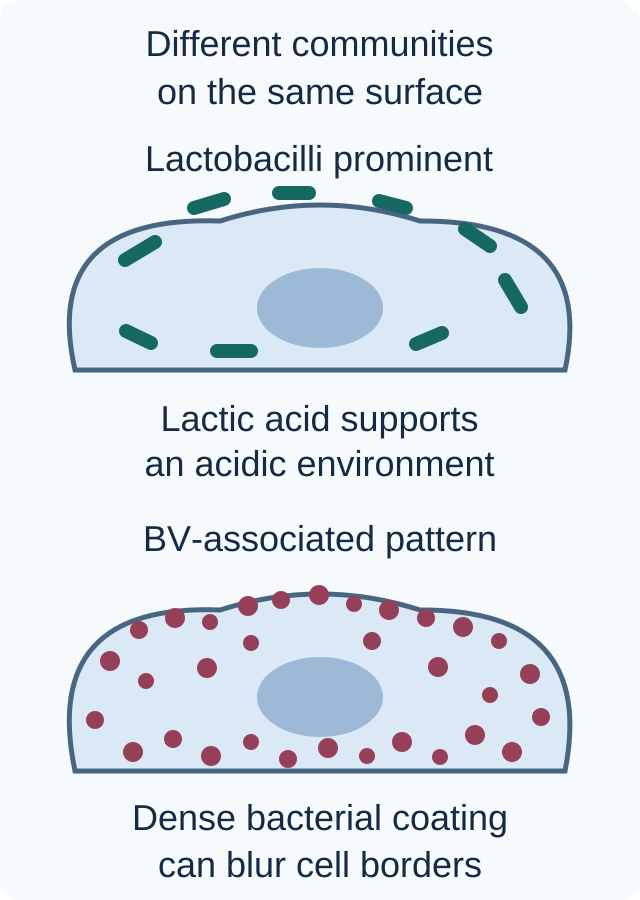
Lactobacilli commonly support an acidic vaginal environment through lactic acid production. BV is a community shift toward multiple anaerobic organisms and an adherent bacterial biofilm, not simply invasion by one species. Gardnerella, Prevotella, Atopobium and Mobiluncus are associated organisms. Amines help explain odor. Douching and new partners are relevant risks; neither odor nor a microbiome result proves a partner was unfaithful. [2]
Compare the community, not one bacterium. Compare the surface coating. This conceptual drawing does not set a bacterial-count threshold or replace clinical diagnostic criteria. [1][2]
Trace the bacterial coating in the lower drawing. The altered surface explains the bacteria-coated epithelial cell used in Amsel assessment. BV requires at least three of four Amsel findings: homogeneous thin discharge, pH above 4.5, this microscopy finding, and an amine odor with potassium hydroxide (KOH). A Nugent score assesses bacterial morphotypes on Gram stain; culture of Gardnerella alone is not diagnostic. [2]
What it supportsBV when the diagnostic criteria fit
What it cannot establishOne responsible bacterium or absence of another infection
FindingMotile flagellated organisms in fresh saline
What it supportsTrichomonas vaginalis
What it cannot establishA negative slide cannot exclude it
FindingBudding yeast or pseudohyphae with irritation
What it supportsVulvovaginal candidiasis
What it cannot establishYeast without symptoms may be colonization
Trichomonas is a protozoan. Frothy yellow-green discharge and punctate cervical redness are possible, not required. Inspect a saline wet mount promptly because detection deteriorates as motility is lost. A sensitive nucleic acid amplification test (NAAT) is appropriate when suspicion persists despite negative microscopy. Normal pH does not fully exclude trichomoniasis. [1][3]
Trichomonas under phase contrast. Observe the outline and projecting structures. This is phase-contrast microscopy, not a KOH yeast preparation. A still image does not establish motility; assess a fresh wet preparation in real time. Image: Dr Graham Beards; CC BY-SA 3.0; original file and attribution. [22].
Candidiasis often causes marked itch, erythema, external burning with urination and sometimes thick discharge. The pH usually remains below 4.5. KOH clears obscuring material and helps reveal fungal forms; it does not turn a negative slide into an exclusion test. Recent antibiotics, poorly controlled diabetes and immunosuppression can predispose to symptomatic overgrowth. Many patients have none of these factors. [4]
Change the sample, then change the location
This educational model assumes a stable, nonpregnant patient with no identified surgical emergency. Change one observation while holding the others constant. Watch which microscopic form and anatomic region are highlighted; explain why the test pathway changes.
A result and a site are different observations. Change the sample and the pelvic findings independently. A static drawing cannot reproduce live microscopic motion or replace examination. [1][2][3][4][10]
At pH 5.5 with no organism seen, the slide is nondiagnostic. Consider BV criteria and a sensitive trichomonas test rather than identifying the cause from pH.
Worked comparison: Keep pH 5.5 but add visible motile organisms: trichomoniasis is supported. Instead add pelvic pain and uterine tenderness: assess for upper-tract infection even if the vaginal result is unchanged. Vaginal findings and pelvic localization answer different questions. [1][3][10]
Now transfer the distinction: a delayed negative slide in a symptomatic patient is weaker evidence than a properly performed sensitive negative test. Do not let an insensitive test create false reassurance.
Try it here · Checkpoint 1 of 3
Make your prediction before reading the choices. A first attempt is just a starting point.
Case 1
Show answer and explanations for case 1
A. Vaginal NAAT for Trichomonas vaginalis (Best answer)
The long delay reduces the sensitivity of microscopy for motile trichomonads. No. Increased pH occurs with both BV and trichomoniasis and does not identify the organism. A sensitive vaginal trichomonas NAAT is appropriate rather than accepting the negative delayed slide.
Reasoning steps for option A
What happened to the specimen before examination?
The long delay reduces the sensitivity of microscopy for motile trichomonads.
Does the pH establish BV instead?
No. Increased pH occurs with both BV and trichomoniasis and does not identify the organism.
Which test addresses the remaining concern?
A sensitive vaginal trichomonas NAAT is appropriate rather than accepting the negative delayed slide.
B. Culture of vaginal fluid for Gardnerella vaginalis (Why this does not fit)
BV can produce odor or discharge with increased pH. Gardnerella can be present without BV, so its culture is not a specific diagnostic test. Use validated syndrome criteria or tests rather than one nonspecific bacterial isolate.
Reasoning steps for option B
Why might Gardnerella be considered?
BV can produce odor or discharge with increased pH.
Would this culture diagnose the syndrome?
Gardnerella can be present without BV, so its culture is not a specific diagnostic test.
What distinction matters in another sample?
Use validated syndrome criteria or tests rather than one nonspecific bacterial isolate.
C. Repeat pH after one week without additional testing (Why this does not fit)
pH can help describe the vaginal environment. A repeated pH still cannot recover organisms missed by delayed microscopy or identify their species. Address the sensitivity of the failed diagnostic method, not merely repeat a nonspecific observation.
Reasoning steps for option C
Why does repeating pH seem useful?
pH can help describe the vaginal environment.
What remains unmeasured?
A repeated pH still cannot recover organisms missed by delayed microscopy or identify their species.
What should guide testing?
Address the sensitivity of the failed diagnostic method, not merely repeat a nonspecific observation.
D. Cervical cytology for a trichomonas diagnosis (Why this does not fit)
An incidental cytologic finding can raise suspicion. Cervical cytology is not a diagnostic test for trichomoniasis and would require sensitive confirmation. Separate cervical screening from organism-specific infection testing.
Reasoning steps for option D
Could cytology incidentally suggest trichomonads?
An incidental cytologic finding can raise suspicion.
Is it the appropriate diagnostic replacement?
Cervical cytology is not a diagnostic test for trichomoniasis and would require sensitive confirmation.
What test role should be preserved?
Separate cervical screening from organism-specific infection testing.
Takeaway: A negative delayed wet mount leaves trichomoniasis unresolved; pH cannot settle the distinction.
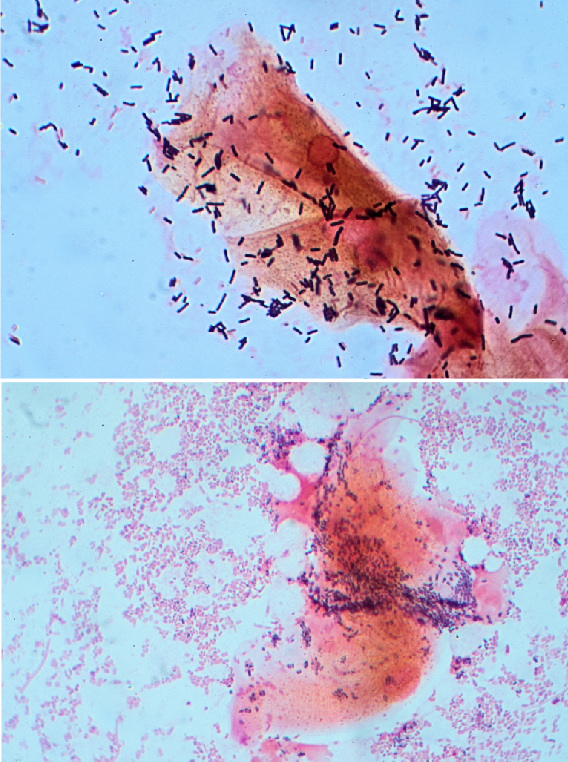
First ask whether the original diagnosis was demonstrated, whether treatment was completed, and whether reexposure occurred. Recurrence is not automatically drug resistance. Compare the real microscopy panels below: identify the larger rods above and the dense smaller bacterial forms below before reading the caption. [2][3]
Clinical microscopy comparison. Identify the different community patterns. The upper panel shows normal vaginal flora and the lower panel BV-associated flora; interpret a clinical sample with the full diagnostic assessment. Image: Dr Graham Beards; CC BY-SA 4.0; original file and attribution. [21].
BV: treat symptoms and reconsider the recurrence pathway
Recommended symptomatic BV options include metronidazole 500 mg orally twice daily for 7 days, metronidazole 0.75% gel 5 g vaginally daily for 5 days, or clindamycin 2% cream 5 g vaginally at bedtime for 7 days. These are alternatives, not a three-drug prescription. Intravaginal clindamycin is useful when nitroimidazoles cannot be used. Oil-based vaginal clindamycin can weaken latex barriers for several days; follow the formulation instructions. [2]
For multiple recurrences, a clinician may use suppressive metronidazole gel twice weekly for more than 3 months after treatment of the current episode. Benefit may not persist after suppression stops. Selected specialist regimens include a vaginal boric-acid phase before suppression, but evidence is limited. TOL-463 remains an investigational strategy in the cited guidance, not a routine prescription. Copper IUD use is associated with BV; that association does not mandate device extraction for every episode. [2]
Partner advice changed: the 2025 StepUp trial found fewer recurrences with concurrent treatment of regular male partners using oral metronidazole plus topical penile clindamycin. ACOG now advises considering combined partner therapy for adult patients with recurrent symptomatic BV. For a first symptomatic episode or same-sex partners, discuss the evidence and preferences rather than imposing a universal rule. This is clinician-coordinated care, not medication sharing, and it does not establish who introduced particular bacteria. [5][6]
Treat symptomatic BV in pregnancy. Recommended oral and vaginal regimens can be used; oral treatment has not proved superior for preventing adverse pregnancy outcomes, and older blanket warnings against vaginal clindamycin are outdated. Routine BV screening solely to prevent preterm birth is not recommended in asymptomatic pregnant patients. Evidence in high-risk asymptomatic patients is mixed. CDC also does not support the old claim that metronidazole necessarily causes an alcohol-related disulfiram reaction through aldehyde dehydrogenase inhibition; use current medication counseling rather than teaching that as established physiology. [2]
Trichomoniasis: treatment includes the exposure network
For women, use metronidazole 500 mg orally twice daily for 7 days; the routine male regimen is 2 g orally once. Vaginal metronidazole gel does not achieve adequate concentrations at all infected sites. Arrange presumptive treatment of current partners and avoid sex until everyone has completed therapy and symptoms have resolved. Retest sexually active women at about 3 months. Symptomatic pregnant patients should be tested and treated regardless of trimester; tinidazole should be avoided in pregnancy. [3]
Imagine a recurrence after sex with an untreated partner. The same 7-day regimen can be repeated for the woman while addressing the untreated partner. With completed therapy and no reexposure, investigate persistent infection and consider a higher-dose regimen with specialist support. Do not use a NAAT before 3 weeks after treatment completion to diagnose persistence: residual nucleic acid may still be detected. True nitroimidazole allergy requires specialist assessment, often desensitization, not substitution with ineffective vaginal antifungal treatment. [3]
Candidiasis: the species and host change the plan
Fluconazole inhibits fungal lanosterol 14-alpha-demethylase, disrupting ergosterol synthesis and membrane sterol composition. Predict the consequence: altering the target or increasing drug efflux can reduce susceptibility, so repeated symptoms do not justify indefinite blind dosing. [24]
Uncomplicated symptomatic disease in a nonpregnant patient can be treated with a recommended topical azole or fluconazole 150 mg orally once. During pregnancy, use a topical azole for 7 days, not oral fluconazole. Severe inflammation and compromised host defenses often require 7 to 14 days of topical treatment and attention to modifiable host factors. A positive yeast culture without compatible symptoms does not require antifungal treatment. Routine treatment of an asymptomatic partner is not indicated for uncomplicated candidiasis; symptomatic balanitis warrants its own care. [4]
Recurrent candidiasis means at least three symptomatic episodes in less than a year in current CDC guidance. Confirm the diagnosis and species. For recurrent susceptible C. albicans in a nonpregnant patient, achieve remission with 7 to 14 days of topical therapy or fluconazole on days 1, 4 and 7, then use weekly fluconazole for 6 months when appropriate. This controls recurrence rather than guaranteeing permanent cure. Check pregnancy status, drug interactions and relevant adverse-effect risks. [4]
C. glabrata does not form the usual hyphae and may be missed on microscopy. Persistent symptoms justify culture and, when indicated, susceptibility testing. First exclude another cause in a patient with non-albicans yeast. CDC suggests 7 to 14 days of a nonfluconazole azole; recurrent non-albicans disease may receive vaginal boric acid 600 mg daily for 3 weeks under clinical supervision. Boric acid is not an oral medication or a pregnancy treatment. Refractory disease needs specialist care; IDSA describes compounded topical 17% flucytosine, sometimes with amphotericin, and intravaginal nystatin as selected alternatives, not routine self-treatment. [4][18]
Try a different explanation: if sensitive infection testing is negative and symptoms began with fragranced wipes, stop the irritant and reassess rather than cycle through antimicrobials. Consider dermatologic disease, low-estrogen states including lactation, and other noninfectious causes. Low pH alone does not establish proposed cytolytic vaginosis or justify alkalinizing douches. Persistent discharge, bleeding or visible lesions deserve reassessment; neither a normal Pap test nor young age closes the differential. Physiologic discharge remains possible even when someone seeks care. [1][7]
Transfer the rule: identical recurrent symptoms can arise from reexposure, an insensitive first test, a different yeast species, or an irritant. Identify the failed assumption before selecting another course.
Is the discharge coming from the cervix?
Compare two patients: one has superficial itch and visible yeast; the other has bleeding after intercourse and mucopus emerging from a friable cervix. The second needs a cervical infection assessment even if vaginal pH is normal. Identify the location before interpreting the sample. Cervicitis can also be asymptomatic. [7]
Test for gonorrhea and chlamydia with an appropriate vaginal, cervical or urine NAAT, assess for PID, and evaluate BV and trichomoniasis when indicated. Vaginal microscopy does not replace these tests. Cervical Gram stain is not sufficiently sensitive to exclude gonorrhea. Persistent cervicitis after adherence and reexposure are addressed may warrant Mycoplasma genitalium testing and assessment for noninfectious cervical disease rather than repeated empirical courses. [7]
Make the treatment comparison: in a nonpregnant patient weighing 70 kg, confirmed uncomplicated cervical gonorrhea receives ceftriaxone 500 mg intramuscularly once. At 160 kg, the dose becomes 1 g. Add doxycycline 100 mg orally twice daily for 7 days if chlamydia has not been excluded. Do not add azithromycin automatically to every gonorrhea regimen. Suspected treatment failure without reexposure calls for culture, susceptibility testing and expert/public-health coordination, not repeated uninvestigated doses. [9]
For chlamydia in nonpregnant patients, doxycycline 100 mg twice daily for 7 days is preferred; azithromycin 1 g once is an alternative when adherence concerns matter. In pregnancy, azithromycin 1 g orally once is recommended. Chlamydia's intracellular location does not justify the claim that all beta-lactams are categorically useless: amoxicillin is an alternative during pregnancy. [8]
Higher STI risk, unavailable testing or unreliable follow-up may justify presumptive cervicitis treatment while results are pending. Lower-risk patients with reliable follow-up can sometimes await results. Offer annual chlamydia and gonorrhea screening to sexually active women younger than 25 and older women with increased risk. Choose additional sampled sites from the exposure history; offer HIV and syphilis testing in the relevant STI assessment. [7][8][9]
For gonorrhea or chlamydia, arrange evaluation and presumptive treatment of partners from the preceding 60 days, including the most recent partner even when contact was earlier. Expedited partner therapy depends on local rules and clinical suitability. Avoid sex until 7 days after single-dose treatment or completion of a 7-day regimen, symptoms have resolved, and partners are treated. Retest at about 3 months. Pregnancy adds a chlamydia test of cure at approximately 4 weeks after treatment completion; that is different from later testing for reinfection. [7][8][9]
Now change the timeline: testing 48 hours after an exposure cannot certify that no new infection occurred. Establish an organism-specific follow-up plan. A substantial-risk HIV exposure within 72 hours requires immediate prophylaxis assessment; a negative baseline HIV test does not erase that indication. When indicated, start promptly and complete a 28-day course under clinical supervision. [17]
What changes when infection reaches the upper tract?
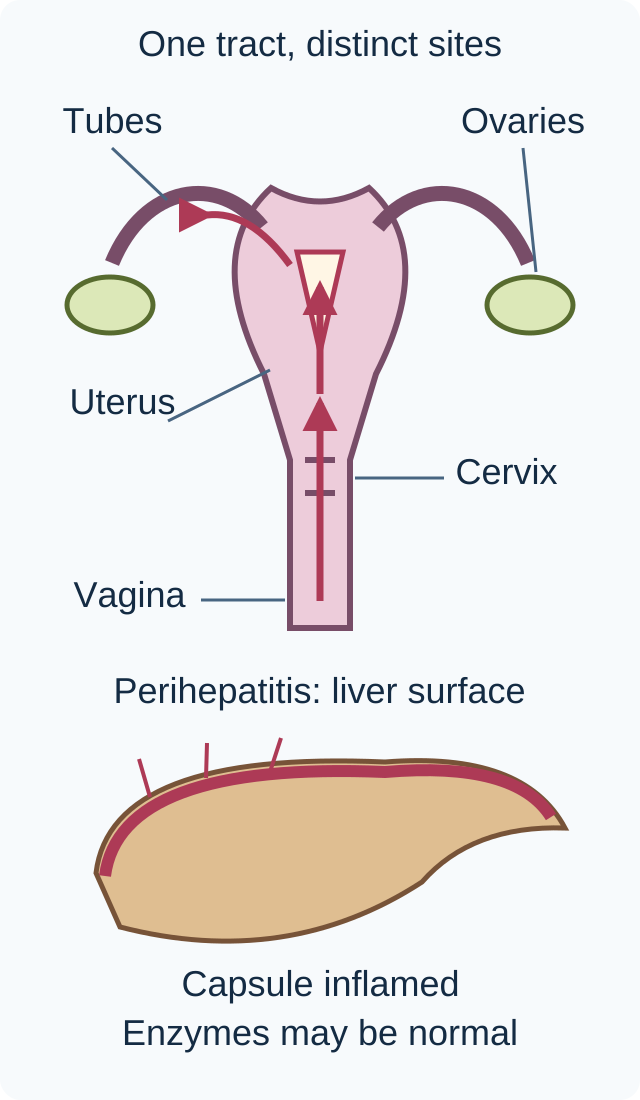
Trace the route from cervix to endometrium and tubes in the diagram. Inflammation can involve the ovary, produce a tubo-ovarian abscess (TOA), or extend to the peritoneal surface. Later tubal scarring can impair fertility, increase ectopic-pregnancy risk and contribute to chronic pelvic pain. Antibiotics treat infection but cannot promise reversal of established scarring. [10]
Localize before selecting urgency. Trace the cervix, uterus and tubes, then distinguish hepatic-surface inflammation from liver-parenchymal injury. The schematic does not assert one proven route of spread to the liver. [10][19]
Try this comparison: a sexually active patient has pelvic pain, uterine tenderness and no better explanation, but no fever and no cervical motion tenderness. PID remains a reasonable clinical diagnosis. CDC's low threshold requires pelvic or lower abdominal pain with relevant risk, no better explanation, and at least one of cervical motion, uterine or adnexal tenderness. Requiring all three misses disease. Conversely, tenderness is not specific for PID. Obtain a pregnancy test and assess ectopic pregnancy, torsion, appendicitis and other emergencies. [10]
A normal white-cell count does not exclude PID. ESR, CRP, fever and inflammatory discharge add support but are not compulsory. A negative cervical gonorrhea/chlamydia NAAT does not exclude upper-tract infection. PID is often polymicrobial. Ultrasound can identify a complex adnexal collection or another cause, but imaging is not a prerequisite for empirical treatment when the clinical threshold is met. [10]
For a stable nonpregnant patient able to take oral treatment, one recommended regimen is ceftriaxone 500 mg intramuscularly once plus doxycycline 100 mg orally twice daily for 14 days plus metronidazole 500 mg orally twice daily for 14 days. Metronidazole provides anaerobic coverage even without separately diagnosed BV. CDC specifies 1 g ceftriaxone for PID patients above 150 kg with documented gonorrhea. Reassess by 72 hours, sooner if deterioration occurs. [10]
Pregnancy, TOA, severe illness, vomiting, inability to use outpatient therapy, lack of response, or an unexcluded surgical emergency favors admission. A recommended inpatient regimen is ceftriaxone 1 g intravenously every 24 hours plus doxycycline 100 mg every 12 hours plus metronidazole 500 mg every 12 hours, with route tailored to the clinical setting. After improvement, oral doxycycline and metronidazole complete 14 days in total. Cefoxitin plus doxycycline and clindamycin plus gentamicin are alternative inpatient approaches; a reported penicillin allergy requires characterization, not an automatic assumption that every cephalosporin is prohibited. [10]
A complex adnexal collection and persistent illness require gynecologic consultation for TOA management and possible drainage. Shock or suspected rupture requires emergency resuscitation, broad antibiotics and urgent source control; waiting for a routine follow-up interval is unsafe. Fertility-preserving treatment is considered when clinically feasible, not at the cost of delaying lifesaving care. [10][23]
If an IUD is present, treat PID and arrange close reassessment rather than automatically extracting it. Consider extraction if there is no improvement within 48 to 72 hours. Partners in the preceding 60 days should be evaluated and presumptively treated for gonorrhea and chlamydia, regardless of the organism identified in the patient. Avoid sex until therapy is complete, symptoms resolve and partners are treated. [10]
Finally, follow the peritoneal connection toward the liver. Fitz-Hugh-Curtis syndrome is perihepatitis associated with genital tract infection: sharp right-upper-quadrant pain can coexist with normal liver enzymes because the capsule, rather than liver parenchyma, is the principal site. Thin adhesions may be seen at laparoscopy. Biliary disease and other causes still require consideration; young age does not exclude them. Treat the associated infection, not an assumed primary hepatitis. [19][10]
Transfer the localization: superficial vaginal findings cannot explain away shock, a positive pregnancy test with abdominal pain, or a tender upper tract. Those observations change urgency even when the discharge seems familiar.
Try it here · Checkpoint 2 of 3
Make your prediction before reading the choices. A first attempt is just a starting point.
Case 17
Show answer and explanations for case 17
A. Begin an outpatient PID regimen with ceftriaxone, doxycycline and metronidazole and reassess by 72 hours (Best answer)
Yes. Uterine tenderness is sufficient when pelvic pain, relevant risk and no better explanation are present. No. Neither rules out the clinical syndrome or its polymicrobial causes. A stable patient able to take medication and return can receive outpatient combination treatment with prompt reassessment.
Reasoning steps for option A
Does the pelvic examination meet a minimum tenderness criterion?
Yes. Uterine tenderness is sufficient when pelvic pain, relevant risk and no better explanation are present.
Do the normal count and negative cervical tests exclude upper-tract infection?
No. Neither rules out the clinical syndrome or its polymicrobial causes.
Which setting fits the current severity?
A stable patient able to take medication and return can receive outpatient combination treatment with prompt reassessment.
B. Await pelvic imaging before offering any antimicrobial treatment (Why this does not fit)
Ultrasound can identify a collection or an alternative pelvic diagnosis. No. The supplied clinical findings meet a presumptive treatment threshold without an admission or emergency feature. Use imaging when indicated without making it a universal prerequisite for empirical PID treatment.
Reasoning steps for option B
What can imaging contribute?
Ultrasound can identify a collection or an alternative pelvic diagnosis.
Is it required to begin therapy in this presentation?
No. The supplied clinical findings meet a presumptive treatment threshold without an admission or emergency feature.
What avoids unnecessary delay?
Use imaging when indicated without making it a universal prerequisite for empirical PID treatment.
C. Treat uncomplicated cervicitis with doxycycline for 7 days only (Why this does not fit)
It is a recommended cervicitis or chlamydia regimen in suitable nonpregnant patients. Pelvic pain with uterine tenderness supports upper-tract involvement. Use a PID regimen with broader coverage and a 14-day oral course rather than cervicitis treatment alone.
Reasoning steps for option C
When can a 7-day doxycycline course be appropriate?
It is a recommended cervicitis or chlamydia regimen in suitable nonpregnant patients.
What localizes this problem beyond the cervix?
Pelvic pain with uterine tenderness supports upper-tract involvement.
What changes with that localization?
Use a PID regimen with broader coverage and a 14-day oral course rather than cervicitis treatment alone.
D. Give ceftriaxone and doxycycline for PID but omit metronidazole because BV was not diagnosed (Why this does not fit)
They address important gonococcal and chlamydial treatment targets. Anaerobic coverage is part of the recommended outpatient PID combination and does not require a separate BV diagnosis. Treat the upper-tract syndrome rather than selecting anaerobic coverage only from vaginal findings.
Reasoning steps for option D
What do ceftriaxone and doxycycline cover?
They address important gonococcal and chlamydial treatment targets.
Why is the proposed omission inappropriate?
Anaerobic coverage is part of the recommended outpatient PID combination and does not require a separate BV diagnosis.
What should govern the combination?
Treat the upper-tract syndrome rather than selecting anaerobic coverage only from vaginal findings.
Takeaway: One qualifying pelvic tenderness finding can justify presumptive PID treatment; negative cervical tests do not exclude it.
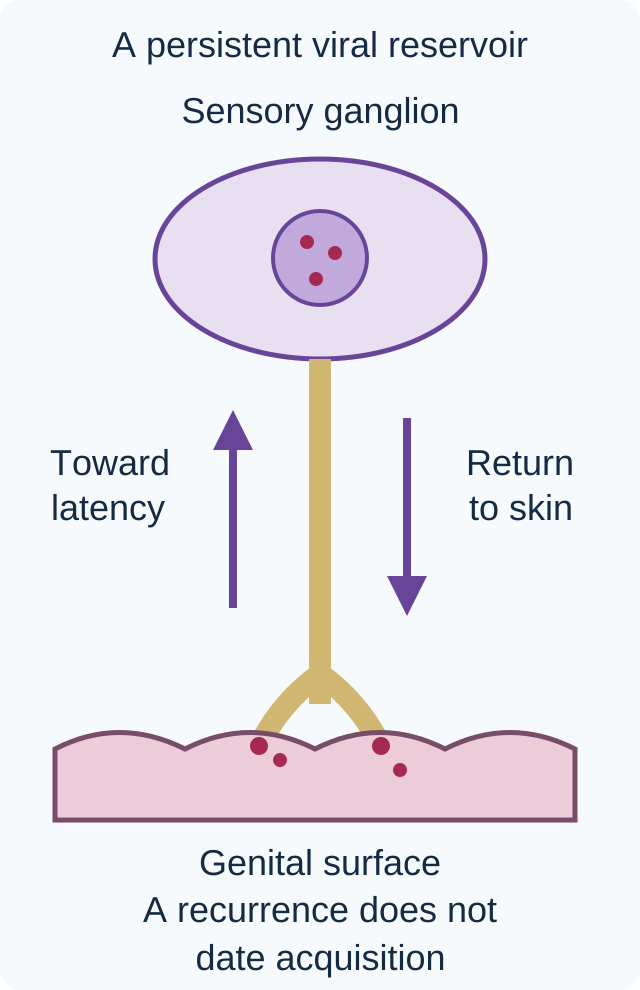
A first recognized outbreak does not date acquisition. HSV can persist in sensory ganglia and later reactivate. HSV-1 and HSV-2 both cause genital disease; genital HSV-1 generally recurs and sheds less often than HSV-2. Trace the return path in the diagram, then explain why a patient may first notice symptoms long after acquisition. [11]
A reservoir can outlast a visible lesion. Explain how a later visible outbreak can occur without identifying the date of original acquisition. [11]
Prodromal burning, grouped vesicles and painful erosions suggest herpes, but presentations vary. A painless firm ulcer suggests primary syphilis, yet syphilis can be painful or atypical and coinfection occurs. Test a fresh lesion with a typed HSV NAAT when available and obtain appropriate syphilis testing. Persistent unusual ulcers may require biopsy or evaluation for trauma, aphthae, drug reactions or other disease. [11][20]
Now compare the tests: a positive HSV-1 NAAT from a genital lesion establishes the virus and sampled site. A partner's negative HSV-2 antibody result does not exclude HSV-1 or very recent HSV-2 acquisition. It does not identify who transmitted an infection. Culture loses sensitivity as lesions heal; a negative test from an old lesion cannot reliably exclude herpes. Tzanck cytology is insensitive and nonspecific and should not replace virologic testing. [11]
Type-specific serology has selected uses, not a role as universal screening. A low-positive HSV-2 enzyme immunoassay needs confirmation with a second method such as Biokit or Western blot before interpretation. HSV IgM is not recommended. HSV-1 antibody alone cannot localize infection to the mouth or genital tract. When recent acquisition is suspected, timing affects repeat testing. [11]
Treat a first clinical episode, for example with valacyclovir 1 g orally twice daily for 7 to 10 days or acyclovir 400 mg orally three times daily for 7 to 10 days; extend if healing is incomplete. Recurrent episodes benefit from treatment at the prodrome or within a day of lesion onset; one option is valacyclovir 500 mg twice daily for 3 days. Severe, disseminated or central nervous system disease can require intravenous acyclovir and specialist care. An uncomplicated first episode does not automatically require admission. [11]
Discuss daily suppression according to recurrence burden, preferences and transmission concerns, not an inflexible six-episode threshold. Valacyclovir 500 mg daily is one option for suitable patients, but can be less effective with very frequent recurrences, at least ten yearly. Suppression and condoms reduce, but do not eliminate, transmission. Avoid sex during prodrome or lesions; asymptomatic shedding remains possible. Giving antiviral medication to an uninfected partner is not established prevention. [11]
In pregnancy, acquisition near delivery creates the greatest neonatal risk. New infection in the second half of pregnancy needs specialist involvement. Suppression from 36 weeks can reduce recurrences at term. Active genital lesions or a compatible prodrome at labor require obstetric assessment for cesarean delivery; a remote history without symptoms or signs does not itself require cesarean. Suppression does not guarantee prevention of neonatal infection, which can involve skin, eyes, the nervous system or disseminated organs. [11]
Transfer the distinction: separate evidence about viral type, anatomic site, current shedding and time of acquisition. No single test answers all four questions.
Which test changes when treatment works?
Syphilis is caused by the spirochete Treponema pallidum. Its clinical stage and involved organs matter as much as a positive test. [12]
A primary chancre can heal without treatment while infection persists. Secondary syphilis may cause a generalized rash, including palms and soles, mucosal lesions and lymphadenopathy. Latency means no clinical manifestations, not proof of cure. Neurologic, ocular and auditory disease can occur at any stage; they are not restricted to late infection. [12]
Diagnosis usually combines a nontreponemal test such as RPR or VDRL with a treponemal test. Nontreponemal reactivity is not organism-specific; pregnancy, autoimmune disease and other conditions can yield biological false positives. Treponemal tests often remain reactive after treatment and therefore cannot independently track response. [12]
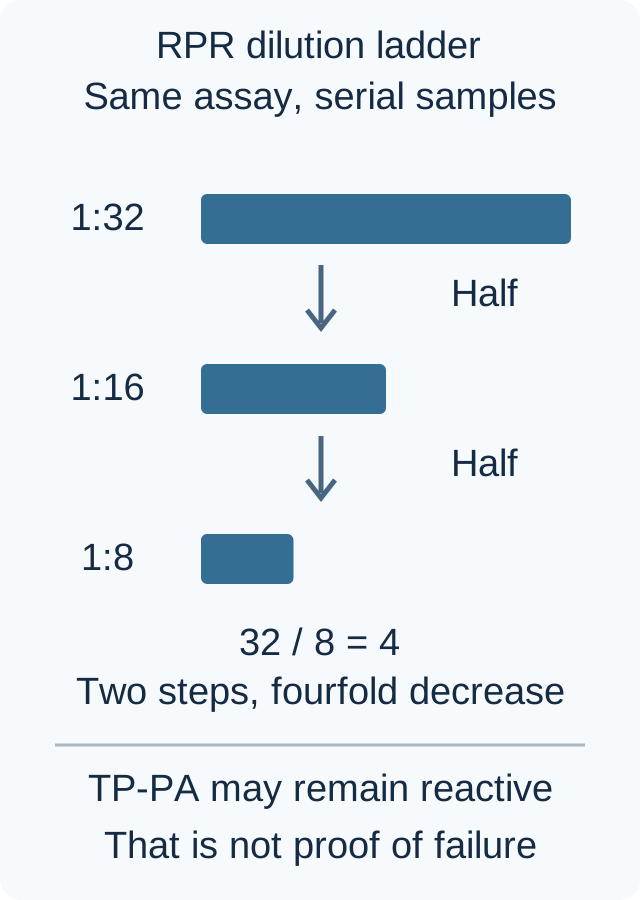
Two dilution steps. Calculate the fourfold decrease. Bar lengths encode the displayed denominators only, not antibody mass. This arithmetic example is not a promised response timeline. [12]
Cover the lower interpretation, then calculate 32 divided by 8. RPR falling from 1:32 to 1:8 is a fourfold decrease, or two dilution steps. Persistent TP-PA reactivity does not cancel that response. Compare serial titers using the same method, preferably the same laboratory; an RPR titer and a VDRL titer are not directly interchangeable. Interpret the change with stage, treatment, symptoms and timing rather than treating the graph as a universal cure timetable. [12]
In the traditional sequence, a reactive RPR is followed by a treponemal test. In a reverse sequence, a reactive treponemal screen is followed by quantitative RPR; a nonreactive RPR is adjudicated with a different treponemal test, often TP-PA. If both treponemal tests are reactive, review previous treatment and exposure. A previously untreated asymptomatic person without evidence of recent acquisition needs treatment for late latent or unknown-duration infection. A previously adequately treated person without reexposure may need none. [12][14]
Early primary infection can precede positive serology. A suspicious lesion and credible exposure can justify presumptive treatment after appropriate sampling despite an initially negative blood test. Where available, darkfield examination or a locally validated lesion molecular assay can add evidence; arrange repeat serology as clinically appropriate. Contacts exposed within 90 days of a partner's diagnosis of primary, secondary or early latent syphilis should receive presumptive early-syphilis treatment even if their serology is negative. [12][20]
Primary, secondary and early latent syphilis generally receive benzathine penicillin G 2.4 million units intramuscularly once. Late latent or unknown-duration infection receives 2.4 million units weekly for three doses. Ocular, otic or neurosyphilis requires an appropriate central nervous system regimen, usually aqueous crystalline penicillin G intravenously for 10 to 14 days, not substitution with weekly benzathine injections. Confirmed ocular disease needs urgent ophthalmologic care and that regimen even when CSF is normal. [13][14][16]
Pregnancy requires stage-appropriate penicillin because it is the proven therapy for preventing congenital syphilis. With genuine penicillin allergy, arrange monitored desensitization followed by penicillin; a graded diagnostic challenge is not the same procedure. Do not postpone treatment until a later gestational age. Maternal titers need obstetric follow-up, and failure to achieve a fourfold decline before delivery does not alone prove treatment failure. [15]
Fever and myalgia during the first day after treatment can represent a Jarisch-Herxheimer reaction rather than penicillin allergy. Pregnancy-specific warnings about contractions or reduced fetal activity require prompt obstetric attention, but concern about the reaction should not delay necessary treatment. A sustained fourfold titer rise after prior response calls for evaluation of reinfection or failure. [12][15]
Apply the same logic to the next patient: first establish what the assay measures, then place it on the exposure and treatment timeline, and only then choose the management consequence.
Try it here · Checkpoint 3 of 3
Make your prediction before reading the choices. A first attempt is just a starting point.
Case 27
Show answer and explanations for case 27
A. Withhold treatment until the RPR becomes reactive (Why this does not fit)
Paired serologic tests are central to syphilis diagnosis. Early infection can precede seroreactivity, and the recent contact independently meets a presumptive treatment indication. Do not postpone indicated treatment solely to await seroconversion.
Reasoning steps for option A
Why is serology useful?
Paired serologic tests are central to syphilis diagnosis.
Why does the negative result not settle this case?
Early infection can precede seroreactivity, and the recent contact independently meets a presumptive treatment indication.
What should not be delayed?
Do not postpone indicated treatment solely to await seroconversion.
B. Treat genital herpes only because syphilis ulcers cannot occur with negative RPR (Why this does not fit)
Genital ulcers can have overlapping causes and appearances. Serology can be negative early in primary syphilis, and the documented exposure is clinically important. Investigate competing ulcer causes without omitting indicated presumptive syphilis treatment.
Reasoning steps for option B
Why should HSV remain in the differential?
Genital ulcers can have overlapping causes and appearances.
What makes the proposed exclusion incorrect?
Serology can be negative early in primary syphilis, and the documented exposure is clinically important.
How should testing and treatment be coordinated?
Investigate competing ulcer causes without omitting indicated presumptive syphilis treatment.
C. Provide presumptive early-syphilis treatment with benzathine penicillin while completing testing and follow-up (Best answer)
Five weeks is within 90 days of exposure to a partner with primary syphilis. No. Such contacts should receive presumptive early-syphilis treatment even when serology is negative. Complete appropriate lesion and serologic evaluation and arrange follow-up.
Reasoning steps for option C
How recent was the contact?
Five weeks is within 90 days of exposure to a partner with primary syphilis.
Does negative serology cancel the contact-management indication?
No. Such contacts should receive presumptive early-syphilis treatment even when serology is negative.
What remains important after treatment?
Complete appropriate lesion and serologic evaluation and arrange follow-up.
D. Automatically give three weekly benzathine penicillin doses because a negative RPR proves unknown duration (Why this does not fit)
Late latent or unknown-duration syphilis generally requires that regimen. It does not prove late or unknown-duration disease, and the supplied recent exposure supports an early-contact pathway. Use stage and exposure information rather than assigning duration from a nonreactive RPR alone.
Reasoning steps for option D
When are three weekly doses used?
Late latent or unknown-duration syphilis generally requires that regimen.
What does this negative test fail to establish?
It does not prove late or unknown-duration disease, and the supplied recent exposure supports an early-contact pathway.
What should determine the regimen?
Use stage and exposure information rather than assigning duration from a nonreactive RPR alone.
Takeaway: Exposure within 90 days to early syphilis can justify presumptive treatment despite negative initial serology.
Decide before viewing the options. After checking an answer, explain which observation would have made a competing choice better. These original cases exercise clinical reasoning; they are not calibrated to a particular examination.
Case 2
Show answer and explanations for case 2
A. BV alone, with the yeast finding clinically irrelevant (Why this does not fit)
Thin discharge, increased pH and bacteria-coated epithelial cells satisfy three Amsel findings. Marked itch and erythema with visible fungal forms also support symptomatic candidiasis. A supported diagnosis does not make all additional positive findings irrelevant.
Reasoning steps for option A
Which observations support BV?
Thin discharge, increased pH and bacteria-coated epithelial cells satisfy three Amsel findings.
Which observation remains unexplained?
Marked itch and erythema with visible fungal forms also support symptomatic candidiasis.
What prevents premature closure?
A supported diagnosis does not make all additional positive findings irrelevant.
B. Candidiasis alone, with pH excluding BV (Why this does not fit)
Itch, erythema and yeast with pseudohyphae support symptomatic candidiasis. The pH is increased, and two other Amsel findings are present; this supports rather than excludes BV. Interpret each supported syndrome instead of forcing all observations into one diagnosis.
Reasoning steps for option B
Which observations support candidiasis?
Itch, erythema and yeast with pseudohyphae support symptomatic candidiasis.
Does the pH exclude BV?
The pH is increased, and two other Amsel findings are present; this supports rather than excludes BV.
What should be integrated?
Interpret each supported syndrome instead of forcing all observations into one diagnosis.
C. Concurrent BV and symptomatic candidiasis (Best answer)
Homogeneous discharge, pH above 4.5 and bacterial coating meet Amsel criteria. The patient also has compatible inflammation and itching with fungal forms on microscopy. Both conditions can coexist; treatment should address each demonstrated symptomatic process.
Why is the yeast not merely an incidental culture result?
The patient also has compatible inflammation and itching with fungal forms on microscopy.
What interpretation follows?
Both conditions can coexist; treatment should address each demonstrated symptomatic process.
D. Trichomoniasis without another vaginal condition (Why this does not fit)
Trichomoniasis can cause inflammation and increased pH. The sample directly supplies BV criteria and fungal forms, without evidence identifying trichomonads. A nonspecific compatible finding should not displace the more specific demonstrated findings.
Reasoning steps for option D
Why could trichomoniasis enter the differential?
Trichomoniasis can cause inflammation and increased pH.
What specifically supports other explanations here?
The sample directly supplies BV criteria and fungal forms, without evidence identifying trichomonads.
What does a shared pH pattern mean?
A nonspecific compatible finding should not displace the more specific demonstrated findings.
Takeaway: Mixed disease can produce a pattern that neither diagnosis explains alone.
A. Screen now and prescribe oral metronidazole for any positive result (Why this does not fit)
BV is associated with adverse pregnancy outcomes. Routine screening of asymptomatic pregnant patients to prevent preterm birth is not recommended. An association does not establish that screening and treatment improve the desired outcome.
Reasoning steps for option A
Why might screening appear helpful?
BV is associated with adverse pregnancy outcomes.
Does that association establish benefit from this strategy?
Routine screening of asymptomatic pregnant patients to prevent preterm birth is not recommended.
What distinction should guide prevention?
An association does not establish that screening and treatment improve the desired outcome.
B. Do not add routine BV screening for this purpose; evaluate new symptoms if they occur (Best answer)
No. The patient is asymptomatic and is requesting screening for prevention. Routine BV screening solely to prevent preterm birth has not demonstrated the required benefit in low-risk asymptomatic pregnancy. Continue appropriate prenatal care and investigate vaginal symptoms if they develop.
Reasoning steps for option B
Is this a symptomatic BV treatment decision?
No. The patient is asymptomatic and is requesting screening for prevention.
What does the evidence support in this setting?
Routine BV screening solely to prevent preterm birth has not demonstrated the required benefit in low-risk asymptomatic pregnancy.
What plan follows?
Continue appropriate prenatal care and investigate vaginal symptoms if they develop.
C. Screen now and use only vaginal clindamycin because oral therapy is unsafe (Why this does not fit)
Vaginal clindamycin can be used for symptomatic BV during pregnancy. No. The patient has no symptomatic BV, and oral metronidazole is not categorically unsafe in pregnancy. First establish an indication to treat; then choose a suitable regimen.
Reasoning steps for option C
Why consider a vaginal regimen?
Vaginal clindamycin can be used for symptomatic BV during pregnancy.
Does changing route establish a screening indication?
No. The patient has no symptomatic BV, and oral metronidazole is not categorically unsafe in pregnancy.
What are separate decisions?
First establish an indication to treat; then choose a suitable regimen.
D. Prescribe suppressive metronidazole gel without screening (Why this does not fit)
Suppressive gel can help selected patients with multiple symptomatic recurrences. She has no symptoms or recurrent BV history. Recurrence treatment does not become primary prevention for all pregnancies.
Reasoning steps for option D
When can suppression be useful?
Suppressive gel can help selected patients with multiple symptomatic recurrences.
Does this patient have that history?
She has no symptoms or recurrent BV history.
What should not be extrapolated?
Recurrence treatment does not become primary prevention for all pregnancies.
Takeaway: Treat symptomatic BV in pregnancy; do not infer a universal screening indication from an association.
A. Treat the partner with oral metronidazole alone as a proven permanent cure (Why this does not fit)
Sexual exchange of BV-associated bacteria can contribute to recurrence. The studied concurrent strategy combined oral metronidazole with topical penile clindamycin and did not establish permanent cure. Preserve the tested intervention and its outcome limits.
Reasoning steps for option A
Why might partner treatment be considered?
Sexual exchange of BV-associated bacteria can contribute to recurrence.
What differs from the supportive trial strategy?
The studied concurrent strategy combined oral metronidazole with topical penile clindamycin and did not establish permanent cure.
What should be carried into counseling?
Preserve the tested intervention and its outcome limits.
B. Avoid discussing partner therapy because BV cannot involve sexual bacterial exchange (Why this does not fit)
Earlier guidance did not recommend routine partner treatment. Newer combined-treatment evidence and the focused ACOG update support considering therapy for male partners in recurrent symptomatic BV. Older blanket exclusion of partner therapy no longer captures the available evidence.
Reasoning steps for option B
Why might older advice suggest this?
Earlier guidance did not recommend routine partner treatment.
What changed?
Newer combined-treatment evidence and the focused ACOG update support considering therapy for male partners in recurrent symptomatic BV.
What must current counseling acknowledge?
Older blanket exclusion of partner therapy no longer captures the available evidence.
C. Treat every past partner regardless of symptoms, timing or preferences (Why this does not fit)
Partner-associated bacterial exchange is relevant to recurrence. The evidence concerns concurrent regular partners and does not establish universal treatment of every past partner. Match the treated population and clinical situation rather than expanding beyond the supporting evidence.
Reasoning steps for option C
Why consider the exposure network?
Partner-associated bacterial exchange is relevant to recurrence.
Does this evidence establish that broad strategy?
The evidence concerns concurrent regular partners and does not establish universal treatment of every past partner.
What limits generalization?
Match the treated population and clinical situation rather than expanding beyond the supporting evidence.
D. Discuss concurrent oral and topical treatment for the ongoing male partner through his clinician (Best answer)
This is recurrent symptomatic BV despite completed treatment, not incidental colonization. Combined concurrent male-partner therapy can be considered alongside treatment of the patient. Discuss benefits, harms and applicability without promising a permanent cure or assigning blame.
Reasoning steps for option D
What clinical problem is being addressed?
This is recurrent symptomatic BV despite completed treatment, not incidental colonization.
What additional approach now has supportive evidence?
Combined concurrent male-partner therapy can be considered alongside treatment of the patient.
What qualification belongs in the decision?
Discuss benefits, harms and applicability without promising a permanent cure or assigning blame.
Takeaway: For recurrent symptomatic BV, discuss the newer combined partner approach rather than repeating an obsolete blanket rule.
A. Suppression can control recurrence without establishing a durable cure after discontinuation (Best answer)
Symptoms were controlled throughout the suppressive period. The benefit did not persist, which can occur after BV suppression ends. Reassess and manage recurrent BV rather than equating temporary suppression with permanent eradication.
Reasoning steps for option A
What happened while medication was being used?
Symptoms were controlled throughout the suppressive period.
What does recurrence after stopping show?
The benefit did not persist, which can occur after BV suppression ends.
What should the result prompt?
Reassess and manage recurrent BV rather than equating temporary suppression with permanent eradication.
B. The recurrence by itself proves metronidazole resistance (Why this does not fit)
Persistent or recurrent symptoms can prompt review of treatment efficacy. Symptoms were controlled on therapy, and recurrence after stopping does not identify a resistance mechanism. Separate relapse, recurrence and exposure factors from an unproven resistance diagnosis.
Reasoning steps for option B
Why might resistance be considered after treatment?
Persistent or recurrent symptoms can prompt review of treatment efficacy.
What does the time course fail to establish?
Symptoms were controlled on therapy, and recurrence after stopping does not identify a resistance mechanism.
What evidence is needed first?
Separate relapse, recurrence and exposure factors from an unproven resistance diagnosis.
C. The absence of symptoms during treatment proves no further follow-up can help (Why this does not fit)
It demonstrated clinical benefit while the regimen was used. Symptomatic BV has now returned and is again documented. New symptoms deserve reassessment even after an earlier response.
Reasoning steps for option C
Why was the symptom-free interval meaningful?
It demonstrated clinical benefit while the regimen was used.
What current finding changes the assessment?
Symptomatic BV has now returned and is again documented.
What should follow-up address?
New symptoms deserve reassessment even after an earlier response.
D. Recurrent odor establishes trichomoniasis despite the new BV findings (Why this does not fit)
It can also produce discharge or odor and can coexist with BV. No trichomonas result is supplied, while the current examination satisfies BV criteria. Use sensitive testing when indicated rather than diagnosing another organism from odor alone.
Reasoning steps for option D
Why might trichomoniasis cause concern?
It can also produce discharge or odor and can coexist with BV.
What evidence identifies it in this case?
No trichomonas result is supplied, while the current examination satisfies BV criteria.
What avoids misclassification?
Use sensitive testing when indicated rather than diagnosing another organism from odor alone.
Takeaway: An on-treatment response and a lasting off-treatment cure are different outcomes.
A. Metronidazole vaginal gel for 5 days, with partner care only if symptoms appear (Why this does not fit)
It treats BV locally and the presenting symptoms are vaginal. Vaginal gel does not reliably reach all sites involved in trichomoniasis, and asymptomatic partners can remain infected. Use an effective systemic regimen and address current partners.
Reasoning steps for option A
Why might vaginal gel seem attractive?
It treats BV locally and the presenting symptoms are vaginal.
Why is it inadequate for this organism?
Vaginal gel does not reliably reach all sites involved in trichomoniasis, and asymptomatic partners can remain infected.
What distinguishes the plan?
Use an effective systemic regimen and address current partners.
B. Metronidazole 500 mg orally twice daily for 7 days, with presumptive treatment of the current partner (Best answer)
It identifies trichomoniasis as a treatment target. Oral metronidazole 500 mg twice daily for 7 days is preferred. Arrange current-partner treatment and avoid sex until therapy is complete and symptoms resolve.
Reasoning steps for option B
What does the NAAT establish in this symptomatic patient?
It identifies trichomoniasis as a treatment target.
Which regimen is recommended for women?
Oral metronidazole 500 mg twice daily for 7 days is preferred.
How is reinfection risk addressed?
Arrange current-partner treatment and avoid sex until therapy is complete and symptoms resolve.
C. Metronidazole 2 g orally once for her, with no partner treatment after a normal examination (Why this does not fit)
Metronidazole 2 g once is the standard initial regimen for men. The recommended regimen for women is multidose, and a normal partner examination does not exclude infection. Sex-specific treatment recommendations and partner symptoms are not interchangeable.
Reasoning steps for option C
Where is the single-dose regimen routinely recommended?
Metronidazole 2 g once is the standard initial regimen for men.
Why does the proposed plan not fit her situation?
The recommended regimen for women is multidose, and a normal partner examination does not exclude infection.
What must be kept separate?
Sex-specific treatment recommendations and partner symptoms are not interchangeable.
D. Tinidazole 2 g once for her, while deferring partner treatment unless his test is positive (Why this does not fit)
It is an alternative systemic regimen for trichomoniasis in an appropriate nonpregnant patient. Current partners should receive presumptive therapy rather than waiting for symptoms or a positive test. Use a recommended regimen for the woman and address the current partner at the same time.
Reasoning steps for option D
What role can tinidazole have?
It is an alternative systemic regimen for trichomoniasis in an appropriate nonpregnant patient.
What is incomplete in this plan?
Current partners should receive presumptive therapy rather than waiting for symptoms or a positive test.
What makes the preferred plan more complete?
Use a recommended regimen for the woman and address the current partner at the same time.
Takeaway: Women receive a 7-day oral regimen, and asymptomatic current partners still need treatment.
A. The result proves resistance; start a prolonged high-dose regimen immediately (Why this does not fit)
Documented persistent infection without reexposure can require escalation. The NAAT was obtained before the recommended interval for evaluating persistence and may detect residual nucleic acid. Confirm that testing timing and the clinical course support actual persistent infection.
Reasoning steps for option A
When might higher-dose treatment be needed?
Documented persistent infection without reexposure can require escalation.
What undermines that conclusion here?
The NAAT was obtained before the recommended interval for evaluating persistence and may detect residual nucleic acid.
What should precede escalation?
Confirm that testing timing and the clinical course support actual persistent infection.
B. Repeat the NAAT tomorrow to distinguish living from dead organisms (Why this does not fit)
A second result can sometimes resolve sampling uncertainty. Another very early NAAT still cannot establish organism viability or eliminate residual nucleic acid detection. Use an appropriate post-treatment interval.
Reasoning steps for option B
Why might a repeat test seem reassuring?
A second result can sometimes resolve sampling uncertainty.
Would one more day solve this limitation?
Another very early NAAT still cannot establish organism viability or eliminate residual nucleic acid detection.
What matters more than immediate repetition?
Use an appropriate post-treatment interval.
C. Do not label failure from this result; retest at an appropriate interval and retain routine follow-up (Best answer)
Symptoms resolved and neither nonadherence nor reexposure is supplied. Residual nucleic acid can yield a positive NAAT before 3 weeks after treatment completion. Avoid unnecessary immediate retreatment, use later testing if persistence is being assessed, and retain the approximately 3-month retest for women.
Reasoning steps for option C
What is the clinical trajectory?
Symptoms resolved and neither nonadherence nor reexposure is supplied.
How does the 10-day interval affect interpretation?
Residual nucleic acid can yield a positive NAAT before 3 weeks after treatment completion.
What is the appropriate consequence?
Avoid unnecessary immediate retreatment, use later testing if persistence is being assessed, and retain the approximately 3-month retest for women.
D. The result establishes harmless permanent colonization, so no future testing is needed (Why this does not fit)
Symptoms can disappear before every laboratory signal becomes negative. No. This early result is timing-limited, and reinfection surveillance is still recommended. Appropriate later assessment and retesting remain important.
Reasoning steps for option D
Why might an asymptomatic positive result be misread?
Symptoms can disappear before every laboratory signal becomes negative.
Does that make trichomoniasis normal permanent flora?
No. This early result is timing-limited, and reinfection surveillance is still recommended.
What must not be discarded?
Appropriate later assessment and retesting remain important.
Takeaway: A positive NAAT before 3 weeks cannot by itself diagnose persistent trichomoniasis.
A. Escalate immediately to metronidazole 2 g daily for 7 days and arrange partner treatment (Why this does not fit)
It can be used after failure of a recommended multidose regimen without reexposure. She had sex with an untreated partner after an initial response, so reinfection is supported. Repeat the standard 7-day regimen while ensuring partner treatment before assuming a need for escalation.
Reasoning steps for option A
When is this higher-dose strategy considered?
It can be used after failure of a recommended multidose regimen without reexposure.
Which feature points to a different explanation here?
She had sex with an untreated partner after an initial response, so reinfection is supported.
What fits that history?
Repeat the standard 7-day regimen while ensuring partner treatment before assuming a need for escalation.
B. Give metronidazole 2 g orally once to both partners and stop after that dose (Why this does not fit)
A single 2-g dose is the routine initial metronidazole regimen for men. Repeat metronidazole 500 mg twice daily for 7 days rather than substituting the male single-dose regimen. Partner management does not make the recommended regimens identical for everyone.
Reasoning steps for option B
Why might a single-dose strategy seem convenient?
A single 2-g dose is the routine initial metronidazole regimen for men.
What recommendation applies to this woman after reexposure?
Repeat metronidazole 500 mg twice daily for 7 days rather than substituting the male single-dose regimen.
What remains patient-specific?
Partner management does not make the recommended regimens identical for everyone.
C. Refer directly for resistance testing without addressing the untreated partner (Why this does not fit)
Persistence without reexposure after adequate therapy can justify expert resistance assessment. Sex with an untreated partner provides a clear opportunity for reinfection. Treat the exposure network rather than attributing every recurrence to resistance.
Reasoning steps for option C
When is resistance assessment appropriate?
Persistence without reexposure after adequate therapy can justify expert resistance assessment.
Which competing explanation is explicitly present?
Sex with an untreated partner provides a clear opportunity for reinfection.
What must be addressed first?
Treat the exposure network rather than attributing every recurrence to resistance.
D. Repeat metronidazole 500 mg orally twice daily for 7 days and arrange partner treatment (Best answer)
Yes, and symptoms initially resolved. Subsequent sex with an untreated partner supports reinfection. Repeat the recommended 7-day regimen for her, treat the partner, and avoid sex until treatment and symptom resolution.
Reasoning steps for option D
Was the earlier regimen completed?
Yes, and symptoms initially resolved.
What explains the renewed risk?
Subsequent sex with an untreated partner supports reinfection.
What plan follows?
Repeat the recommended 7-day regimen for her, treat the partner, and avoid sex until treatment and symptom resolution.
Takeaway: Reexposure changes the interpretation of recurrence and must be addressed along with treatment.
It supports vulvovaginal candidiasis rather than incidental colonization. Pregnancy favors topical azole treatment and avoidance of oral fluconazole. Use a topical azole for 7 days during pregnancy.
Reasoning steps for option A
What does the symptomatic microscopy pattern support?
It supports vulvovaginal candidiasis rather than incidental colonization.
Which patient characteristic changes treatment?
Pregnancy favors topical azole treatment and avoidance of oral fluconazole.
What duration is recommended?
Use a topical azole for 7 days during pregnancy.
B. Fluconazole 150 mg orally once (Why this does not fit)
A single oral dose is an option for uncomplicated candidiasis in a nonpregnant patient. She is pregnant, and CDC advises against oral fluconazole during pregnancy. Select the recommended 7-day topical azole regimen.
Reasoning steps for option B
When is this regimen appropriate?
A single oral dose is an option for uncomplicated candidiasis in a nonpregnant patient.
What makes it inappropriate here?
She is pregnant, and CDC advises against oral fluconazole during pregnancy.
What should replace it?
Select the recommended 7-day topical azole regimen.
C. A one-day intravaginal azole regimen (Why this does not fit)
Some short topical courses are effective for uncomplicated disease outside pregnancy. Pregnant patients should receive topical azoles for 7 days. A nonpregnant short-course regimen is not the pregnancy recommendation.
Reasoning steps for option C
Why might a short topical course seem suitable?
Some short topical courses are effective for uncomplicated disease outside pregnancy.
Which recommendation is being missed?
Pregnant patients should receive topical azoles for 7 days.
What must not be transferred unchanged?
A nonpregnant short-course regimen is not the pregnancy recommendation.
D. Vaginal boric acid 600 mg daily for 3 weeks (Why this does not fit)
Selected recurrent non-albicans disease may warrant supervised vaginal boric acid. She has a first uncomplicated episode in pregnancy, without evidence of refractory non-albicans disease. Use a recommended pregnancy azole regimen rather than a specialist alternative.
Reasoning steps for option D
When might this agent enter a treatment discussion?
Selected recurrent non-albicans disease may warrant supervised vaginal boric acid.
Does this patient have that indication?
She has a first uncomplicated episode in pregnancy, without evidence of refractory non-albicans disease.
What is the safer appropriate choice?
Use a recommended pregnancy azole regimen rather than a specialist alternative.
Takeaway: Pregnancy changes both the route and the recommended duration of candidiasis treatment.
A. Begin weekly fluconazole immediately without a remission-induction phase (Why this does not fit)
It can suppress recurrent susceptible C. albicans disease. A longer initial course is recommended to achieve remission before maintenance. Control the active episode before beginning suppression.
Reasoning steps for option A
What role does weekly fluconazole have?
It can suppress recurrent susceptible C. albicans disease.
What is omitted in this symptomatic patient?
A longer initial course is recommended to achieve remission before maintenance.
What is the treatment sequence?
Control the active episode before beginning suppression.
B. Use fluconazole on days 1, 4 and 7, then weekly for 6 months (Best answer)
Four symptomatic episodes in 9 months exceeds the current CDC threshold. Susceptible C. albicans and no stated contraindication support fluconazole-based therapy. Induce remission with the three-dose course, then use weekly maintenance for 6 months.
Reasoning steps for option B
Does this history meet a recurrent-disease definition?
Four symptomatic episodes in 9 months exceeds the current CDC threshold.
What does the culture allow?
Susceptible C. albicans and no stated contraindication support fluconazole-based therapy.
Which sequence addresses active and recurrent disease?
Induce remission with the three-dose course, then use weekly maintenance for 6 months.
C. Use vaginal boric acid as the initial maintenance strategy without additional azole therapy (Why this does not fit)
It is an option for selected recurrent non-albicans disease. The patient has susceptible C. albicans, not the refractory non-albicans pattern prompting this alternative. Use the confirmed organism and susceptibility rather than recurrence alone.
Reasoning steps for option C
Why might boric acid be considered in recurrent symptoms?
It is an option for selected recurrent non-albicans disease.
Which organism and susceptibility are documented?
The patient has susceptible C. albicans, not the refractory non-albicans pattern prompting this alternative.
What determines the initial strategy?
Use the confirmed organism and susceptibility rather than recurrence alone.
D. Repeat one fluconazole dose for each episode and treat the asymptomatic partner (Why this does not fit)
A single dose previously relieved each acute episode. Repeated recurrence warrants a structured induction and suppression approach, and asymptomatic partner treatment lacks a supporting indication. Choose evidence-based maintenance for recurrent candidiasis instead of unsupported partner treatment.
Reasoning steps for option D
Why might episode treatment seem sufficient?
A single dose previously relieved each acute episode.
Which problem remains unaddressed?
Repeated recurrence warrants a structured induction and suppression approach, and asymptomatic partner treatment lacks a supporting indication.
What should drive prevention?
Choose evidence-based maintenance for recurrent candidiasis instead of unsupported partner treatment.
Takeaway: Recurrent susceptible C. albicans calls for induction followed by suppression, not suppression alone.
A. Repeat cervical cytology to detect a missed vaginal yeast species (Why this does not fit)
It may report organisms during cervical screening. Cervical cytology does not replace vaginal culture with species identification for this purpose. Investigate the symptomatic vaginal process using an appropriate fungal test.
Reasoning steps for option A
What can cytology sometimes show incidentally?
It may report organisms during cervical screening.
Does it resolve persistent suspected non-albicans disease?
Cervical cytology does not replace vaginal culture with species identification for this purpose.
Which specimen and method fit?
Investigate the symptomatic vaginal process using an appropriate fungal test.
B. Culture the urine for routine bacterial cystitis (Why this does not fit)
Patients may describe discomfort with urination in either condition. Persistent vulvar erythema and vaginal symptoms dominate; the case does not describe frequency or other evidence selecting cystitis. Localize symptoms before choosing urinary rather than vaginal testing.
Reasoning steps for option B
Why can urinary infection enter a burning-symptom differential?
Patients may describe discomfort with urination in either condition.
Where are the supplied findings localized?
Persistent vulvar erythema and vaginal symptoms dominate; the case does not describe frequency or other evidence selecting cystitis.
What should direct the specimen?
Localize symptoms before choosing urinary rather than vaginal testing.
C. Obtain vaginal yeast culture with species identification and consider susceptibility testing (Best answer)
No. C. glabrata may not form the hyphae expected on routine microscopy. Persistent symptoms after repeated azole exposure warrant confirmation and assessment for a less susceptible species or another cause. Obtain culture and species identification, with susceptibility assessment when indicated, rather than repeat blind dosing.
Reasoning steps for option C
Can absent hyphae exclude every Candida species?
No. C. glabrata may not form the hyphae expected on routine microscopy.
Why does treatment history matter?
Persistent symptoms after repeated azole exposure warrant confirmation and assessment for a less susceptible species or another cause.
What testing follows?
Obtain culture and species identification, with susceptibility assessment when indicated, rather than repeat blind dosing.
D. Measure vaginal pH again as the definitive exclusion test for Candida (Why this does not fit)
Candidiasis commonly occurs with pH below 4.5. No. It would remain compatible with candidiasis and would not identify a species. Use an organism-directed test rather than asking pH to answer a species question.
Reasoning steps for option D
What does pH contribute?
Candidiasis commonly occurs with pH below 4.5.
Would another normal value exclude yeast?
No. It would remain compatible with candidiasis and would not identify a species.
What is the remaining task?
Use an organism-directed test rather than asking pH to answer a species question.
Takeaway: Absent hyphae does not exclude non-albicans yeast; persistent disease needs confirmation and speciation.
A. Fluconazole 150 mg orally once to eradicate the positive culture (Why this does not fit)
It is an option for uncomplicated symptomatic candidiasis. She has no compatible current symptoms or examination findings. A positive culture alone does not establish disease requiring eradication.
Reasoning steps for option A
When would this dose be reasonable?
It is an option for uncomplicated symptomatic candidiasis.
What indication is missing?
She has no compatible current symptoms or examination findings.
How should the culture be used?
A positive culture alone does not establish disease requiring eradication.
B. Topical azole treatment for 14 days because any persistent growth is complicated disease (Why this does not fit)
Severe disease or a compromised host may need a longer course. No. She is asymptomatic with a normal examination and no stated high-risk host condition. Use clinical disease rather than growth alone.
Reasoning steps for option B
When is longer treatment considered?
Severe disease or a compromised host may need a longer course.
Does positive growth alone establish either condition?
No. She is asymptomatic with a normal examination and no stated high-risk host condition.
What defines the treatment need?
Use clinical disease rather than growth alone.
C. Weekly fluconazole for 6 months because the culture proves recurrence (Why this does not fit)
It can control recurrent symptomatic candidiasis. No. A positive culture without symptoms can reflect colonization. Do not convert an incidental culture into a recurrent-disease diagnosis.
Reasoning steps for option C
What is the purpose of maintenance therapy?
It can control recurrent symptomatic candidiasis.
Does this patient have a recurrent symptomatic episode?
No. A positive culture without symptoms can reflect colonization.
What should not trigger suppression?
Do not convert an incidental culture into a recurrent-disease diagnosis.
D. No antifungal treatment now; reassess if compatible symptoms return (Best answer)
No. Symptoms resolved and examination is normal. Candida can be present as colonizing flora without causing disease. Do not treat the culture alone; evaluate new symptoms if they occur.
Reasoning steps for option D
Is there current symptomatic vaginitis?
No. Symptoms resolved and examination is normal.
What can positive vaginal Candida culture represent?
Candida can be present as colonizing flora without causing disease.
What action fits?
Do not treat the culture alone; evaluate new symptoms if they occur.
Takeaway: The treatment target is symptomatic candidiasis, not every positive vaginal yeast culture.
A. Stop the fragranced product and reassess for irritant or other vulvar disease (Best answer)
External irritation began after repeated exposure to a new fragranced product. Negative appropriate testing and absent treatment response weaken the presumed infectious explanation. Stop the suspected irritant and arrange reassessment for persistent or alternative vulvar disease.
Reasoning steps for option A
Where and when did the symptoms begin?
External irritation began after repeated exposure to a new fragranced product.
How does the completed testing affect the differential?
Negative appropriate testing and absent treatment response weaken the presumed infectious explanation.
What follows without overclaiming the diagnosis?
Stop the suspected irritant and arrange reassessment for persistent or alternative vulvar disease.
B. Start weekly fluconazole suppression after the failed empirical courses (Why this does not fit)
It can help confirmed recurrent susceptible candidiasis. There is no positive fungal test or response supporting recurrent Candida disease. Reestablish the diagnosis rather than escalating an unsupported one.
Reasoning steps for option B
When could suppression help?
It can help confirmed recurrent susceptible candidiasis.
What evidence is absent here?
There is no positive fungal test or response supporting recurrent Candida disease.
What should precede long-term treatment?
Reestablish the diagnosis rather than escalating an unsupported one.
C. Start alkalinizing douches based on the vaginal pH (Why this does not fit)
Some proposed cytolytic-vaginosis approaches focus on an acidic environment. It is within a common vaginal range and does not establish a specific symptomatic disorder. Do not prescribe douching from pH alone when an irritant exposure and external findings warrant assessment.
Reasoning steps for option C
Why might low pH prompt that proposal?
Some proposed cytolytic-vaginosis approaches focus on an acidic environment.
What does pH 4.1 actually establish?
It is within a common vaginal range and does not establish a specific symptomatic disorder.
What is the safer diagnostic response?
Do not prescribe douching from pH alone when an irritant exposure and external findings warrant assessment.
D. Treat presumed non-albicans candidiasis with vaginal boric acid (Why this does not fit)
Some species are less responsive to standard azole therapy. The yeast culture is negative, and the exposure timing supports a noninfectious alternative. Confirm compatible disease before using a treatment intended for selected refractory yeast infections.
Reasoning steps for option D
Why might non-albicans yeast be considered after azole nonresponse?
Some species are less responsive to standard azole therapy.
Which finding argues against that inference here?
The yeast culture is negative, and the exposure timing supports a noninfectious alternative.
What should guide a specialist alternative?
Confirm compatible disease before using a treatment intended for selected refractory yeast infections.
Takeaway: When the evidence weakens infection, reassess the diagnosis instead of escalating empirical antimicrobials.
A. Ceftriaxone 500 mg intramuscularly once plus doxycycline for 7 days (Why this does not fit)
Doxycycline provides chlamydia treatment while infection has not been excluded. At 160 kg she should receive 1 g, rather than 500 mg, of ceftriaxone for uncomplicated gonorrhea. Apply the weight threshold as well as coinfection coverage.
Reasoning steps for option A
What part of this regimen addresses the pending test?
Doxycycline provides chlamydia treatment while infection has not been excluded.
Which patient-specific adjustment is missing?
At 160 kg she should receive 1 g, rather than 500 mg, of ceftriaxone for uncomplicated gonorrhea.
What must be checked before selecting the dose?
Apply the weight threshold as well as coinfection coverage.
B. Ceftriaxone 1 g intramuscularly once plus doxycycline 100 mg twice daily for 7 days (Best answer)
The findings support uncomplicated cervical infection without a demonstrated upper-tract syndrome. Weight at least 150 kg requires a 1-g ceftriaxone dose. Chlamydia has not been excluded, so a 7-day course is indicated in this nonpregnant patient.
Reasoning steps for option B
What extent of disease is supplied?
The findings support uncomplicated cervical infection without a demonstrated upper-tract syndrome.
What does the weight change?
Weight at least 150 kg requires a 1-g ceftriaxone dose.
Why is doxycycline included?
Chlamydia has not been excluded, so a 7-day course is indicated in this nonpregnant patient.
C. Ceftriaxone 1 g intramuscularly once without chlamydia coverage (Why this does not fit)
The 1-g ceftriaxone dose accounts for her weight. Chlamydia testing is still pending, and ceftriaxone alone is not the indicated treatment for possible chlamydia. Weight-adjusted gonorrhea treatment does not replace coinfection coverage.
Reasoning steps for option C
Which component is appropriate?
The 1-g ceftriaxone dose accounts for her weight.
What remains unresolved?
Chlamydia testing is still pending, and ceftriaxone alone is not the indicated treatment for possible chlamydia.
What additional decision matters?
Weight-adjusted gonorrhea treatment does not replace coinfection coverage.
D. Ceftriaxone 1 g intramuscularly once plus doxycycline and metronidazole for 14 days (Why this does not fit)
A doxycycline and metronidazole combination is part of an outpatient PID regimen. The supplied assessment lacks pelvic pain or upper-tract tenderness supporting PID. Treat the demonstrated anatomic syndrome rather than importing a PID regimen into uncomplicated cervicitis.
Reasoning steps for option D
When is a 14-day combination appropriate?
A doxycycline and metronidazole combination is part of an outpatient PID regimen.
What would justify that longer upper-tract treatment here?
The supplied assessment lacks pelvic pain or upper-tract tenderness supporting PID.
How should duration be selected?
Treat the demonstrated anatomic syndrome rather than importing a PID regimen into uncomplicated cervicitis.
Takeaway: For uncomplicated gonorrhea, combine the weight-based ceftriaxone dose with chlamydia coverage when needed.
A test of cure aims to document eradication. Testing too early can detect residual nucleic acid, and a single early test omits later reinfection surveillance. Use the pregnancy-appropriate test-of-cure interval and a separate later retest.
Reasoning steps for option A
What is the intended purpose of an early test?
A test of cure aims to document eradication.
Why is this timing and endpoint inadequate?
Testing too early can detect residual nucleic acid, and a single early test omits later reinfection surveillance.
What must the schedule include?
Use the pregnancy-appropriate test-of-cure interval and a separate later retest.
B. No test of cure, with a single test at 3 months (Why this does not fit)
It detects recurrent infection after treatment. Pregnancy warrants a test of cure at approximately 4 weeks after therapy completion. Maternal and neonatal consequences justify confirming eradication as well as monitoring recurrence.
Reasoning steps for option B
What purpose does the 3-month test serve?
It detects recurrent infection after treatment.
Which pregnancy-specific step is missing?
Pregnancy warrants a test of cure at approximately 4 weeks after therapy completion.
What makes this population different?
Maternal and neonatal consequences justify confirming eradication as well as monitoring recurrence.
C. NAAT at approximately 4 weeks after treatment, then retesting at about 3 months (Best answer)
Chlamydia in pregnancy warrants confirmation of eradication. That timing reduces misleading detection of residual nucleic acid soon after treatment. The approximately 3-month retest addresses reinfection rather than merely confirming the original treatment response.
Reasoning steps for option C
Why is a test of cure indicated?
Chlamydia in pregnancy warrants confirmation of eradication.
Why wait approximately 4 weeks?
That timing reduces misleading detection of residual nucleic acid soon after treatment.
What does the later test add?
The approximately 3-month retest addresses reinfection rather than merely confirming the original treatment response.
D. NAAT at delivery only, unless discharge develops (Why this does not fit)
Risk-based prenatal and delivery screening can identify later infection. It delays confirmation of eradication and does not replace the recommended post-treatment follow-up. Recommended pregnancy follow-up remains necessary because chlamydia can be asymptomatic.
Reasoning steps for option D
Why might delivery testing be relevant?
Risk-based prenatal and delivery screening can identify later infection.
Why is it insufficient after this positive result?
It delays confirmation of eradication and does not replace the recommended post-treatment follow-up.
What should not depend on symptoms?
Recommended pregnancy follow-up remains necessary because chlamydia can be asymptomatic.
Takeaway: Pregnancy adds a roughly 4-week test of cure; the 3-month retest answers a different question.
A. Await a second HIV test before prescribing prophylaxis (Why this does not fit)
It helps identify infection that existed before the recent exposure. Delay consumes the limited interval in which nPEP should be initiated. Begin promptly without waiting for pending laboratory results.
Reasoning steps for option A
Why is baseline testing useful?
It helps identify infection that existed before the recent exposure.
Can waiting for another result improve the prevention window?
Delay consumes the limited interval in which nPEP should be initiated.
What should happen when nPEP is indicated?
Begin promptly without waiting for pending laboratory results.
B. Schedule HIV testing in 6 weeks without offering prophylaxis (Why this does not fit)
Baseline testing cannot exclude acquisition from the exposure 48 hours earlier. She is still within 72 hours of a substantial-risk exposure from a source without suppression. Offer time-sensitive prophylaxis now rather than follow-up testing alone.
Reasoning steps for option B
Why is later testing needed?
Baseline testing cannot exclude acquisition from the exposure 48 hours earlier.
What opportunity is missed?
She is still within 72 hours of a substantial-risk exposure from a source without suppression.
What must accompany follow-up?
Offer time-sensitive prophylaxis now rather than follow-up testing alone.
C. Begin an ongoing PrEP regimen without an acute postexposure assessment (Why this does not fit)
It can reduce risk from future exposures when appropriately prescribed. A recent substantial-risk exposure calls for nPEP evaluation and treatment, not substitution with a routine future-prevention plan. Address the current exposure and then discuss transition to ongoing prevention.
Reasoning steps for option C
What role can PrEP play?
It can reduce risk from future exposures when appropriately prescribed.
What is the immediate problem?
A recent substantial-risk exposure calls for nPEP evaluation and treatment, not substitution with a routine future-prevention plan.
How can prevention be sequenced?
Address the current exposure and then discuss transition to ongoing prevention.
D. Start an appropriate 28-day nPEP course now and arrange follow-up testing (Best answer)
Condomless vaginal exposure to a partner with HIV without suppression warrants nPEP assessment. Yes. Forty-eight hours is within the 72-hour limit. No. It cannot exclude acquisition from this recent exposure; start promptly and arrange follow-up.
Reasoning steps for option D
Does the exposure meet a substantial-risk context?
Condomless vaginal exposure to a partner with HIV without suppression warrants nPEP assessment.
Is the patient within the recommended initiation interval?
Yes. Forty-eight hours is within the 72-hour limit.
Does the negative baseline result eliminate the indication?
No. It cannot exclude acquisition from this recent exposure; start promptly and arrange follow-up.
Takeaway: Baseline testing and time-sensitive prevention address different parts of the exposure timeline.
A. Begin outpatient PID treatment and repeat the examination in 72 hours (Why this does not fit)
Pelvic pain and cervical motion tenderness can occur with PID. Hypotension, pregnancy and substantial free fluid suggest an acute hemorrhagic emergency. Stabilize and address a possible ruptured ectopic pregnancy rather than treating tenderness as a specific infection sign.
Reasoning steps for option A
Why could PID initially enter the differential?
Pelvic pain and cervical motion tenderness can occur with PID.
Which findings make outpatient treatment unsafe?
Hypotension, pregnancy and substantial free fluid suggest an acute hemorrhagic emergency.
What controls urgency?
Stabilize and address a possible ruptured ectopic pregnancy rather than treating tenderness as a specific infection sign.
B. Resuscitate and obtain immediate gynecologic surgical evaluation for suspected ruptured ectopic pregnancy (Best answer)
Pregnancy-related causes, especially ectopic pregnancy, must be considered. The combination raises urgent concern for intra-abdominal bleeding from rupture. Immediate resuscitation and gynecologic surgical assessment are required.
Reasoning steps for option B
What does the positive pregnancy test change?
Pregnancy-related causes, especially ectopic pregnancy, must be considered.
What do shock and free fluid suggest together?
The combination raises urgent concern for intra-abdominal bleeding from rupture.
What takes priority over serial outpatient testing?
Immediate resuscitation and gynecologic surgical assessment are required.
C. Administer methotrexate and arrange serial hCG measurements as an outpatient (Why this does not fit)
Selected stable patients with unruptured ectopic pregnancy may qualify for methotrexate. No. Shock and substantial intraperitoneal fluid raise concern for active bleeding or rupture. Hemodynamic instability requires emergency management rather than a routine medical-treatment pathway.
Reasoning steps for option C
When can medical management be considered?
Selected stable patients with unruptured ectopic pregnancy may qualify for methotrexate.
Does this patient fit that stability requirement?
No. Shock and substantial intraperitoneal fluid raise concern for active bleeding or rupture.
What separates the pathways?
Hemodynamic instability requires emergency management rather than a routine medical-treatment pathway.
D. Repeat quantitative hCG in 48 hours before requesting a gynecologic assessment (Why this does not fit)
It helps assess selected stable pregnancies of uncertain location. The patient is hypotensive with a mass and free fluid, so the emergency cannot safely await a trend. Clinical instability determines the need for immediate evaluation and intervention.
Reasoning steps for option D
When can serial hCG be useful?
It helps assess selected stable pregnancies of uncertain location.
What makes waiting inappropriate?
The patient is hypotensive with a mass and free fluid, so the emergency cannot safely await a trend.
What should supersede the serial-test algorithm?
Clinical instability determines the need for immediate evaluation and intervention.
Takeaway: Cervical motion tenderness is not specific for PID; pregnancy with shock and free fluid changes the priority.
A. Continue the same oral regimen without reassessment for another week (Why this does not fit)
The oral course is ordinarily completed over 14 days. Lack of improvement by 72 hours, inability to retain medication and a collection all require escalation. A planned total treatment duration does not authorize ignoring early clinical failure.
Reasoning steps for option A
Why might continuation initially seem reasonable?
The oral course is ordinarily completed over 14 days.
What changes the setting of care here?
Lack of improvement by 72 hours, inability to retain medication and a collection all require escalation.
What should not be confused?
A planned total treatment duration does not authorize ignoring early clinical failure.
B. Stop metronidazole and replace doxycycline with single-dose azithromycin (Why this does not fit)
It has a role in selected lower-tract chlamydia treatment settings. A probable tubo-ovarian abscess requires broad therapy including anaerobic coverage, not a narrowed single-dose approach. The complicated upper-tract syndrome takes precedence over a lower-tract regimen.
Reasoning steps for option B
When can azithromycin be useful?
It has a role in selected lower-tract chlamydia treatment settings.
Does it address this presentation adequately?
A probable tubo-ovarian abscess requires broad therapy including anaerobic coverage, not a narrowed single-dose approach.
What determines coverage?
The complicated upper-tract syndrome takes precedence over a lower-tract regimen.
C. Admit for parenteral antibiotics and gynecologic assessment of the abscess, including drainage needs (Best answer)
It supports a tubo-ovarian abscess, a complication requiring inpatient assessment. Vomiting and failed early response undermine safe outpatient therapy. Use parenteral broad-spectrum treatment and gynecologic assessment for drainage or other source control.
Reasoning steps for option C
What does the collection add to persistent PID symptoms?
It supports a tubo-ovarian abscess, a complication requiring inpatient assessment.
Why is oral continuation unsuitable?
Vomiting and failed early response undermine safe outpatient therapy.
What combined approach is needed?
Use parenteral broad-spectrum treatment and gynecologic assessment for drainage or other source control.
D. Give another intramuscular ceftriaxone dose and discharge with unchanged follow-up (Why this does not fit)
It provides additional parenteral coverage for some relevant bacteria. The abscess, severe illness and inability to tolerate oral treatment remain. Escalate the setting and assess source control rather than simply repeating one component.
Reasoning steps for option D
Why might another ceftriaxone dose be proposed?
It provides additional parenteral coverage for some relevant bacteria.
What does a single extra dose fail to address?
The abscess, severe illness and inability to tolerate oral treatment remain.
What should be changed?
Escalate the setting and assess source control rather than simply repeating one component.
Takeaway: A collection, vomiting and absent improvement by 72 hours require inpatient reassessment rather than longer unmodified outpatient care.
A. Continue the current antibiotics and wait for the scheduled 72-hour reassessment (Why this does not fit)
The first several days help determine whether treatment is controlling uncomplicated clinical progression. Abrupt shock and peritonitis suggest rupture rather than a stable response-assessment interval. Deterioration requires immediate emergency action.
Reasoning steps for option A
Why is early response usually reassessed?
The first several days help determine whether treatment is controlling uncomplicated clinical progression.
What invalidates waiting in this patient?
Abrupt shock and peritonitis suggest rupture rather than a stable response-assessment interval.
B. Change antibiotics and defer gynecologic intervention until cultures return (Why this does not fit)
It can refine antimicrobial selection. A ruptured abscess can continue contaminating the peritoneal cavity and requires urgent source control. Resuscitation, antibiotics and source-control evaluation occur urgently rather than sequentially after culture results.
Reasoning steps for option B
What can culture information improve?
It can refine antimicrobial selection.
What would antibiotics alone leave unresolved?
A ruptured abscess can continue contaminating the peritoneal cavity and requires urgent source control.
How should treatment proceed?
Resuscitation, antibiotics and source-control evaluation occur urgently rather than sequentially after culture results.
C. Arrange elective image-guided drainage after blood pressure normalizes without further intervention (Why this does not fit)
It can be appropriate for selected stable patients with an accessible unruptured abscess. Shock and generalized peritoneal signs imply a time-critical complication. An emergency rupture pathway is different from planned drainage of a stable collection.
Reasoning steps for option C
When can image-guided drainage be suitable?
It can be appropriate for selected stable patients with an accessible unruptured abscess.
Why is an elective plan inadequate here?
Shock and generalized peritoneal signs imply a time-critical complication.
What distinction matters?
An emergency rupture pathway is different from planned drainage of a stable collection.
D. Resuscitate, continue broad intravenous antibiotics and obtain emergency gynecologic source control (Best answer)
Rupture with peritoneal contamination is a major concern in a patient with a known abscess. They demand immediate resuscitation and emergency surgical assessment. Infected material and ongoing contamination may require urgent source control in addition to antimicrobial treatment.
Reasoning steps for option D
What new process best explains the abrupt change?
Rupture with peritoneal contamination is a major concern in a patient with a known abscess.
What do hypotension and rigidity require?
They demand immediate resuscitation and emergency surgical assessment.
Why are antibiotics not the whole response?
Infected material and ongoing contamination may require urgent source control in addition to antimicrobial treatment.
Takeaway: Shock and peritoneal findings during abscess treatment require an emergency source-control response.
A. Inflammation of the hepatic capsule associated with genital tract infection (Best answer)
Enhancement along the hepatic surface points to a capsular or perihepatic process. Capsular inflammation can cause substantial pain without prominent parenchymal injury, and associated pelvic infection supports Fitz-Hugh-Curtis syndrome. Separate the liver surface from the hepatocyte compartment when interpreting pain and laboratory findings.
Reasoning steps for option A
Which imaging finding localizes the upper abdominal process?
Enhancement along the hepatic surface points to a capsular or perihepatic process.
How do the normal enzymes and pelvic findings fit?
Capsular inflammation can cause substantial pain without prominent parenchymal injury, and associated pelvic infection supports Fitz-Hugh-Curtis syndrome.
What is the transferable distinction?
Separate the liver surface from the hepatocyte compartment when interpreting pain and laboratory findings.
B. Diffuse hepatocellular injury caused by acute viral hepatitis (Why this does not fit)
Liver inflammation can cause right-upper-quadrant symptoms. Normal aminotransferases and isolated capsular enhancement favor a surface process rather than diffuse hepatocellular injury. Match imaging and biochemical evidence to the involved tissue.
Reasoning steps for option B
Why could hepatitis be considered?
Liver inflammation can cause right-upper-quadrant symptoms.
Which findings favor a different compartment?
Normal aminotransferases and isolated capsular enhancement favor a surface process rather than diffuse hepatocellular injury.
What should localize the diagnosis?
Match imaging and biochemical evidence to the involved tissue.
C. Obstruction of the common bile duct by a migrating stone (Why this does not fit)
Biliary disease commonly causes right-upper-quadrant pain. No stone, ductal dilation or bilirubin abnormality is supplied, while capsular and pelvic inflammation are demonstrated. Use the observed findings rather than excluding or diagnosing biliary disease from age alone.
No stone, ductal dilation or bilirubin abnormality is supplied, while capsular and pelvic inflammation are demonstrated.
What avoids a demographic shortcut?
Use the observed findings rather than excluding or diagnosing biliary disease from age alone.
D. Suppurative infection within a focal hepatic parenchymal cavity (Why this does not fit)
A focal infected collection within the liver can cause pain and systemic illness. It describes surface enhancement rather than a parenchymal cavity. An abscess within an organ and inflammation around its surface are different anatomic findings.
Reasoning steps for option D
What would a hepatic abscess produce?
A focal infected collection within the liver can cause pain and systemic illness.
What does the scan actually show?
It describes surface enhancement rather than a parenchymal cavity.
What distinction matters?
An abscess within an organ and inflammation around its surface are different anatomic findings.
Takeaway: Capsular inflammation can cause right-upper-quadrant pain without prominent liver-enzyme abnormalities.
A. Extract the IUD now despite improvement, then continue the antibiotics (Why this does not fit)
An IUD can prompt questions about whether a foreign body affects infection management. No. Routine extraction is not required when PID is improving with treatment. Use clinical response, preferences and follow-up rather than device presence alone.
Reasoning steps for option A
Why might the device raise concern?
An IUD can prompt questions about whether a foreign body affects infection management.
Does current guidance require routine extraction?
No. Routine extraction is not required when PID is improving with treatment.
What should guide the decision?
Use clinical response, preferences and follow-up rather than device presence alone.
B. Keep the IUD, complete the prescribed course and continue follow-up (Best answer)
The current treatment is producing clinical improvement. No pregnancy, abscess or failure to improve is present. Retain the IUD if desired, complete therapy and reassess if improvement stops or symptoms worsen.
Reasoning steps for option B
What does the 48-hour response show?
The current treatment is producing clinical improvement.
Is there a supplied complication requiring a different plan?
No pregnancy, abscess or failure to improve is present.
What follows?
Retain the IUD if desired, complete therapy and reassess if improvement stops or symptoms worsen.
C. Keep the IUD but stop doxycycline and metronidazole now that pain has improved (Why this does not fit)
It suggests early response to the prescribed regimen. No. The recommended oral course is completed over 14 days. It supports continued outpatient care, not premature cessation of treatment.
Reasoning steps for option C
Why is improvement encouraging?
It suggests early response to the prescribed regimen.
Does early improvement replace the planned course?
No. The recommended oral course is completed over 14 days.
What does response change?
It supports continued outpatient care, not premature cessation of treatment.
D. Keep the IUD and begin indefinite suppressive antibiotics (Why this does not fit)
Concern about recurrent infection can lead to a desire for prevention. None is supplied; the current episode is responding to standard therapy. Complete the established course and address partner care rather than prescribing unindicated chronic antibiotics.
Reasoning steps for option D
Why might prolonged treatment be proposed?
Concern about recurrent infection can lead to a desire for prevention.
What evidence supports indefinite suppression here?
None is supplied; the current episode is responding to standard therapy.
What is the appropriate duration principle?
Complete the established course and address partner care rather than prescribing unindicated chronic antibiotics.
Takeaway: An improving PID patient does not require routine IUD extraction; lack of improvement would prompt reassessment.
A. The partner result excludes either HSV type as a possible infection in that partner (Why this does not fit)
It measured type-specific antibodies to HSV-2. It does not exclude HSV-1 and can miss very recent HSV-2 acquisition. Do not extend a type-specific negative result to unmeasured viral types or all exposure dates.
Reasoning steps for option A
What did the partner test measure?
It measured type-specific antibodies to HSV-2.
What does it not address?
It does not exclude HSV-1 and can miss very recent HSV-2 acquisition.
What is the test interpretation rule?
Do not extend a type-specific negative result to unmeasured viral types or all exposure dates.
B. The genital lesion result establishes acquisition during the preceding month (Why this does not fit)
It establishes HSV-1 at the sampled genital lesion. No. Prior infection can be unrecognized before a later symptomatic episode. A current lesion diagnosis does not identify when infection began.
Reasoning steps for option B
What does the lesion result establish?
It establishes HSV-1 at the sampled genital lesion.
Does a first recognized outbreak date acquisition?
No. Prior infection can be unrecognized before a later symptomatic episode.
What must remain separate?
A current lesion diagnosis does not identify when infection began.
C. Genital HSV-1 is established, but these results do not determine the acquisition date or transmitting partner (Best answer)
The positive NAAT came directly from a genital lesion. That NAAT detected HSV-1. The first recognized episode and the partner HSV-2 antibody result do not establish the acquisition date or source.
Reasoning steps for option C
Which sample identifies the anatomic site?
The positive NAAT came directly from a genital lesion.
Which result identifies the type?
That NAAT detected HSV-1.
What remains unresolved?
The first recognized episode and the partner HSV-2 antibody result do not establish the acquisition date or source.
D. The positive HSV-1 result establishes both oral and genital infection in the patient (Why this does not fit)
HSV-1 often causes oral infection but can also cause genital infection. Only the genital lesion was tested in the supplied assessment. Do not infer infection at a second site solely from viral type.
Reasoning steps for option D
Why might HSV-1 be associated with oral disease?
HSV-1 often causes oral infection but can also cause genital infection.
Which site was actually sampled?
Only the genital lesion was tested in the supplied assessment.
What inference is unsupported?
Do not infer infection at a second site solely from viral type.
Takeaway: A typed lesion test identifies the virus at that site, not the time or source of acquisition.
A. Accept the EIA as definitive and start indefinite suppressive therapy (Why this does not fit)
The laboratory has placed the result above its positive cutoff. Low-positive HSV-2 EIA results have poor specificity and need confirmation before interpretation. Confirm the result with an appropriate second method.
Reasoning steps for option A
Why might the report look conclusive?
The laboratory has placed the result above its positive cutoff.
What limitation matters at this index?
Low-positive HSV-2 EIA results have poor specificity and need confirmation before interpretation.
What should precede a lasting diagnosis?
Confirm the result with an appropriate second method.
B. Order HSV IgM to decide whether the positive EIA represents recent infection (Why this does not fit)
The patient is asking whether the result establishes a true infection and possibly its recency. No. HSV IgM is not type-specific and can be positive in recurrent episodes. Use a recommended confirmatory type-specific method, not IgM.
Reasoning steps for option B
What timing question is being asked?
The patient is asking whether the result establishes a true infection and possibly its recency.
Can HSV IgM settle that question?
No. HSV IgM is not type-specific and can be positive in recurrent episodes.
What should replace it?
Use a recommended confirmatory type-specific method, not IgM.
C. Obtain a random genital swab and exclude infection if the swab is negative (Why this does not fit)
NAAT from an active genital lesion is highly useful for a compatible lesion. No lesion is present, and intermittent shedding makes a blind negative swab insufficient to exclude infection. Confirm the low-positive serologic result rather than relying on an insensitive sampling situation.
Reasoning steps for option C
When are lesion swabs useful?
NAAT from an active genital lesion is highly useful for a compatible lesion.
Why is this proposed swab different?
No lesion is present, and intermittent shedding makes a blind negative swab insufficient to exclude infection.
What method addresses this uncertainty?
Confirm the low-positive serologic result rather than relying on an insensitive sampling situation.
D. Confirm with a second method such as Biokit or Western blot before interpreting the result (Best answer)
An index of 1.6 is in the low-positive range associated with false-positive HSV-2 EIA results. A recommended second method, such as Biokit or Western blot, can confirm specificity. Do not assign a definitive diagnosis or routine lifelong treatment solely from the low-positive screening result.
Reasoning steps for option D
What makes this result uncertain?
An index of 1.6 is in the low-positive range associated with false-positive HSV-2 EIA results.
What additional evidence improves interpretation?
A recommended second method, such as Biokit or Western blot, can confirm specificity.
What should be deferred?
Do not assign a definitive diagnosis or routine lifelong treatment solely from the low-positive screening result.
Takeaway: A low-positive HSV-2 EIA requires a second-method confirmation, not IgM or a blind swab.
A. Obstetric management for cesarean delivery because a compatible genital prodrome is present (Best answer)
No. Suppression reduces recurrences but does not guarantee the absence of shedding. A compatible genital prodrome can indicate impending active herpes even before a lesion is visible. A compatible prodrome at labor supports cesarean delivery rather than relying on the absence of visible vesicles.
Reasoning steps for option A
Does suppression eliminate the possibility of shedding at delivery?
No. Suppression reduces recurrences but does not guarantee the absence of shedding.
What does the new characteristic burning represent?
A compatible genital prodrome can indicate impending active herpes even before a lesion is visible.
What delivery consideration follows?
A compatible prodrome at labor supports cesarean delivery rather than relying on the absence of visible vesicles.
B. Proceed with vaginal delivery because no vesicle is visible (Why this does not fit)
A patient without genital signs or prodromal symptoms can generally deliver vaginally. She has a characteristic new genital prodrome. Ask about compatible prodromal symptoms as well as examining for lesions.
Reasoning steps for option B
Why does the absence of lesions matter?
A patient without genital signs or prodromal symptoms can generally deliver vaginally.
Which part of that condition is not met?
She has a characteristic new genital prodrome.
What must be assessed with inspection?
Ask about compatible prodromal symptoms as well as examining for lesions.
C. Proceed with vaginal delivery because taking suppression proves noninfectiousness (Why this does not fit)
It reduces recurrences at term and related cesarean deliveries. No. The new prodrome remains clinically relevant despite adherence. Use the current symptoms and examination rather than medication use alone.
Reasoning steps for option C
What benefit does suppression provide?
It reduces recurrences at term and related cesarean deliveries.
Does it certify noninfectiousness for this delivery?
No. The new prodrome remains clinically relevant despite adherence.
What should guide the delivery decision?
Use the current symptoms and examination rather than medication use alone.
D. Delay all delivery decisions until a maternal HSV antibody result returns (Why this does not fit)
It can provide information about prior type-specific infection in selected contexts. It does not determine current genital shedding or replace assessment of an active prodrome. Timely obstetric decisions should use the present clinical findings.
Reasoning steps for option D
What can antibody testing show?
It can provide information about prior type-specific infection in selected contexts.
What question does it not resolve at labor?
It does not determine current genital shedding or replace assessment of an active prodrome.
What should not be delayed?
Timely obstetric decisions should use the present clinical findings.
Takeaway: At labor, current lesions or a compatible prodrome matter even when suppression has been taken.
A. Continue episodic treatment only because daily therapy requires at least six outbreaks yearly (Why this does not fit)
Recurrence frequency helps describe disease burden. No. Suppression can benefit people with less frequent but burdensome recurrences. Consider impact, preferences and transmission concerns rather than a rigid count.
Reasoning steps for option A
Why might frequency enter the discussion?
Recurrence frequency helps describe disease burden.
Is six episodes an absolute eligibility requirement?
No. Suppression can benefit people with less frequent but burdensome recurrences.
What should guide the decision?
Consider impact, preferences and transmission concerns rather than a rigid count.
B. Discuss daily suppressive therapy with continued barrier use and avoidance of sex during prodrome or lesions (Best answer)
The episodes are relatively infrequent but have substantial personal impact. It can reduce recurrences and lower, but not eliminate, transmission risk in a discordant heterosexual partnership. Offer suppression as an option while maintaining other risk-reduction measures and periodic reassessment.
Reasoning steps for option B
What does the recurrence history demonstrate?
The episodes are relatively infrequent but have substantial personal impact.
What additional benefit may suppression provide in this context?
It can reduce recurrences and lower, but not eliminate, transmission risk in a discordant heterosexual partnership.
What shared decision follows?
Offer suppression as an option while maintaining other risk-reduction measures and periodic reassessment.
C. Prescribe daily valacyclovir to the uninfected partner instead of the patient (Why this does not fit)
The partner is susceptible and the couple wants to reduce transmission. No. This is not a supported prevention strategy. Treat the infected symptomatic patient and counsel both partners on risk reduction.
Reasoning steps for option C
Why might partner medication seem protective?
The partner is susceptible and the couple wants to reduce transmission.
Is antiviral prophylaxis for the uninfected partner established?
No. This is not a supported prevention strategy.
Where is the evidence-based treatment directed?
Treat the infected symptomatic patient and counsel both partners on risk reduction.
D. Offer suppression only after the partner becomes HSV-2 antibody positive (Why this does not fit)
It would change the assessment of that partner susceptibility. No. Symptom burden already supports discussion, and preventing transmission is an additional reason to consider it. Do not require a preventable outcome before discussing a useful treatment option.
Reasoning steps for option D
What would a positive partner result change?
It would change the assessment of that partner susceptibility.
Does suppression require transmission to have occurred?
No. Symptom burden already supports discussion, and preventing transmission is an additional reason to consider it.
What should not be a prerequisite?
Do not require a preventable outcome before discussing a useful treatment option.
Takeaway: Recurrence burden and patient preference matter more than an inflexible annual-count threshold.
A. The change is only one dilution step and therefore has no clinical significance (Why this does not fit)
Each twofold change is one dilution step. Two steps separate them, producing a fourfold increase. Compare the titer denominators rather than treating every numerical increase as one step.
Reasoning steps for option A
How is a dilution step counted?
Each twofold change is one dilution step.
How many steps separate 1:4 and 1:16?
Two steps separate them, producing a fourfold increase.
What should be calculated first?
Compare the titer denominators rather than treating every numerical increase as one step.
B. Persistent TP-PA reactivity alone proves the original treatment failed (Why this does not fit)
It supports a history of treponemal infection. Treponemal tests often remain reactive after successful treatment and cannot independently track response. Interpret serial nontreponemal titers with the clinical and exposure history.
Reasoning steps for option B
Why does TP-PA remain relevant diagnostically?
It supports a history of treponemal infection.
Does persistence identify treatment failure?
Treponemal tests often remain reactive after successful treatment and cannot independently track response.
Which result should be followed quantitatively?
Interpret serial nontreponemal titers with the clinical and exposure history.
C. The prior fall to 1:4 excludes any possibility of later reinfection (Why this does not fit)
It supported an appropriate response at that time. No. A new exposure can lead to reinfection after an earlier response. Use the current sustained rise and new exposure rather than treating past response as immunity.
Reasoning steps for option C
What did the earlier decline support?
It supported an appropriate response at that time.
Does it prevent another acquisition?
No. A new exposure can lead to reinfection after an earlier response.
What must be reassessed?
Use the current sustained rise and new exposure rather than treating past response as immunity.
D. The sustained fourfold rise warrants assessment for reinfection or treatment failure, with reinfection favored by the new exposure (Best answer)
The increase from 1:4 to 1:16 is fourfold. Persistence for more than two weeks makes the rise clinically significant rather than a single small assay fluctuation. A new partner makes reinfection plausible; reassess, treat as indicated and arrange follow-up rather than dismissing the rise.
Reasoning steps for option D
What is the magnitude of the rise from the prior low value?
The increase from 1:4 to 1:16 is fourfold.
Why do the repeated same-method values matter?
Persistence for more than two weeks makes the rise clinically significant rather than a single small assay fluctuation.
How does the exposure history affect interpretation?
A new partner makes reinfection plausible; reassess, treat as indicated and arrange follow-up rather than dismissing the rise.
Takeaway: A sustained fourfold nontreponemal-titer rise after prior response requires renewed clinical assessment.