Understand AV nodal rate control, compare drugs by perfusion and ventricular function, and connect activity, rhythm decisions, and stroke prevention.
Rate control slows the ventricular response; it does not necessarily restore sinus rhythm. First assess stability, conduction route, and ventricular function. Then judge symptoms during activity while keeping rhythm and stroke-prevention decisions in parallel. This educational lesson does not replace monitored clinical assessment.
Where does the ventricular rate come from?
Can the ventricles slow down while the atria keep fibrillating? Inspect the ECG before deciding.
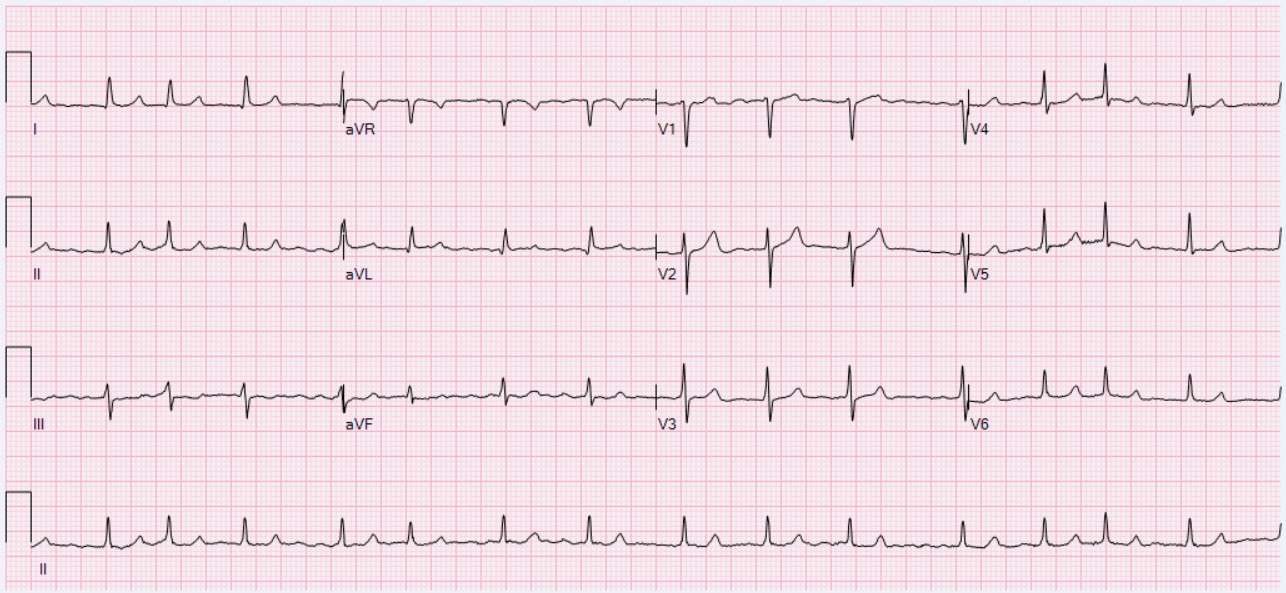
Follow the continuous lead II strip and compare consecutive R-R intervals. Irregular spacing persists at the reported rate of 90 bpm; rate control is not conversion to sinus rhythm. Image: Ewingdo; source image; CC BY-SA 4.0.
Inspect before naming the response. Along the bottom ECG strip, compare several consecutive R-R intervals and look for a consistent P wave before each QRS. The unequal intervals and absent consistent sinus P waves support AF. A ventricular rate near 90 bpm does not prove sinus rhythm. A slower response may improve filling and symptoms without restoring coordinated atrial contraction. [1]
AF produces rapid, disorganized atrial activation. The ventricular response is not a one-to-one copy. The AV node conducts some arriving impulses while others encounter tissue that is still recovering. Autonomic input changes this filtering. In ordinary AF, the AV node is the principal rate-control target, rather than the sinus node or the His-Purkinje network. [1][2]
Try the recovery-window model
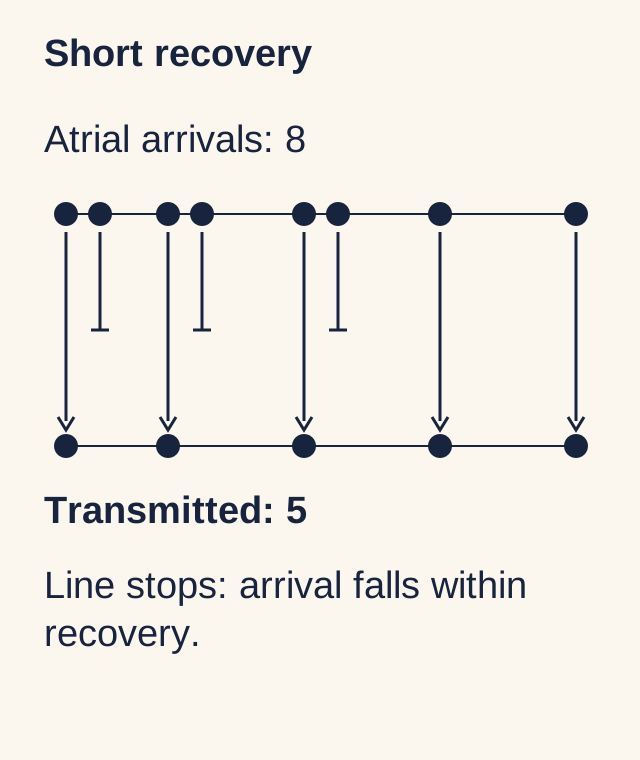
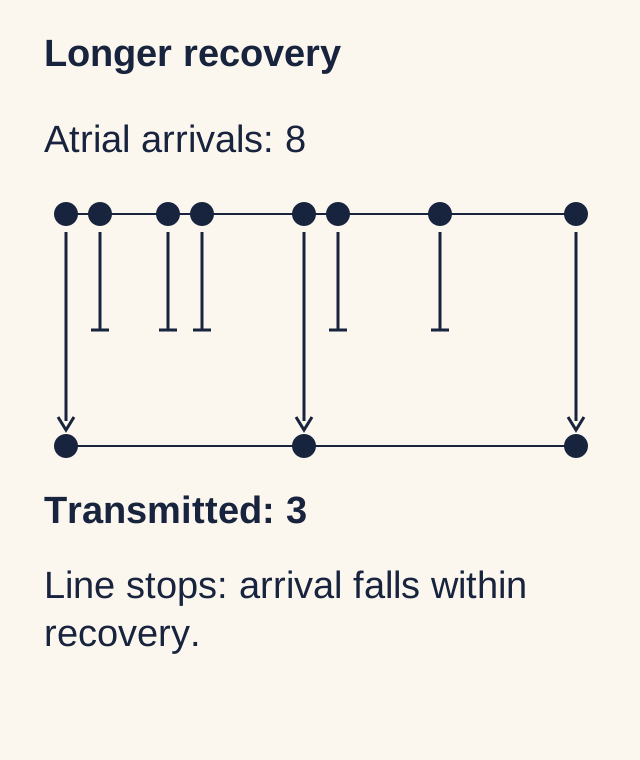
Eight irregular arrivals are held constant below. Count the lines that reach the output. Predict what happens if the node needs longer to recover after a transmitted event. This deliberately simple model omits concealed conduction, autonomic feedback, and drug pharmacokinetics; it is not a heart-rate or dose calculator.
Identical input, different filtering. Marks represent model events, not measured heart rates or a predicted drug response. Compare a longer recovery interval
Identical input, different filtering. Marks represent model events, not measured heart rates or a predicted drug response.
The output falls from five model events to three while the eight input events stay unchanged.
The important consequence: more arrivals encounter recovering tissue, so fewer reach the ventricles. The atrial source has not been corrected. In real patients the exact response varies; predict the direction, then measure the actual rhythm, rate, pressure, and symptoms. [1][2]
Two safety questions come before a routine drug choice
Is AF causing hemodynamic instability? New shock, altered mentation, ongoing ischemia, or acute pulmonary edema attributable to AF calls for immediate synchronized electrical cardioversion. Do not delay rescue for elective imaging or weeks of anticoagulation. Conversely, sepsis or another emergency may precede and trigger AF. Treat that cause while assessing how much the arrhythmia contributes; a fast rate alone does not establish causality. [1][2]
Could this be preexcited AF? An irregular, very rapid wide-complex rhythm with variable QRS shape, especially with prior short PR intervals and delta waves, raises concern for an accessory connection. Avoid ordinary nodal drugs, including beta blockers, diltiazem, verapamil, digoxin, adenosine, and amiodarone. Stable preexcited AF needs expert-guided conversion, such as IV procainamide or ibutilide; instability requires electrical cardioversion. [1][2]
Transfer: if a drug lowers ventricular rate but the atrial tracing stays disorganized, describe successful rate control, not restoration of sinus rhythm.
Beta blockers: reduce adrenergic support of conduction
Why might the same patient accelerate during exertion? Sympathetic stimulation helps the AV node transmit more rapidly. Beta blockers reduce that adrenergic influence. Less nodal conduction can lower the ventricular response, particularly when sympathetic activity contributes to rapid AF. They do not primarily solve AF by slowing a sinus pacemaker that is no longer organizing the atria. [1][2]
Adrenergic stimulation increases nodal conduction. Beta-receptor blockade reduces that stimulation. Fewer atrial impulses may then reach the ventricles.
Metoprolol and atenolol are beta-1 selective examples; carvedilol also blocks beta-2 and alpha-1 receptors. Selection depends on the setting, formulation, and comorbidities. Coexisting hypertension, angina, or prior myocardial infarction may influence the choice, but the specific cardiac indication still matters. For chronic HFrEF care, metoprolol succinate, carvedilol, and bisoprolol have established roles. That does not make every beta blocker or every formulation interchangeable, nor does a useful rate response prove a mortality benefit for every AF subgroup. [1][2]
Compare two otherwise similar patients. One has compensated HFrEF, adequate pressure, and stable COPD without wheezing. The other has acute decompensation and became hypotensive after IV beta blockade. Predict whether the same escalation fits both. The first may tolerate cautious cardioselective beta blockade; the second needs reassessment rather than automatic additional suppression of contractility and pressure. [1][2]
Stable COPD is not an automatic contraindication to a cardioselective beta blocker, especially with another cardiac indication. Asthma with active bronchospasm or a reproducible severe beta-blocker reaction is different. Likewise, monitor for bradycardia, conduction block, fatigue, and hypotension instead of assuming that a lower rate is always beneficial. [1][2]
Transfer: name the actual constraint: active bronchospasm, prior drug reaction, low perfusion, or dose-limiting bradycardia. A broad label such as lung disease or heart failure is not enough to choose or reject the class.
Diltiazem and verapamil: slow the node, but assess the pump
Why can an effective nodal drug still be the wrong choice? Diltiazem and verapamil block L-type calcium channels. Calcium-dependent AV nodal conduction slows, but ventricular contractility and blood pressure can also fall. IV formulations can provide prompt rate control in stable, nonpreexcited AF when ventricular function permits; oral formulations can provide maintenance treatment. Amlodipine is predominantly vascular and is not an equivalent nodal rate-control drug. [1][2]
Apply ventricular function together with clinical stability
Finding
Consequence
FindingStable ordinary AF; LVEF above 40%
ConsequenceDiltiazem or verapamil may be suitable, with pressure and rhythm monitoring.
FindingModerate or severe LV systolic dysfunction
ConsequenceAvoid IV diltiazem and verapamil, even without current congestion.
FindingShock or deterioration attributable to AF
ConsequenceUse the emergency cardioversion pathway rather than routine drug titration.
Make the distinction. A dry examination does not make an EF of 30% normal. Conversely, an EF of 46% is above the acute guideline threshold; it does not automatically prohibit a monitored trial in an otherwise suitable patient. For chronic treatment, avoid these drugs in clear HFrEF. The US long-term harm recommendation specifies LVEF below 40%; ESC guidance uses 40% or below. Do not treat an exact boundary as a substitute for the full clinical assessment. [1][2]
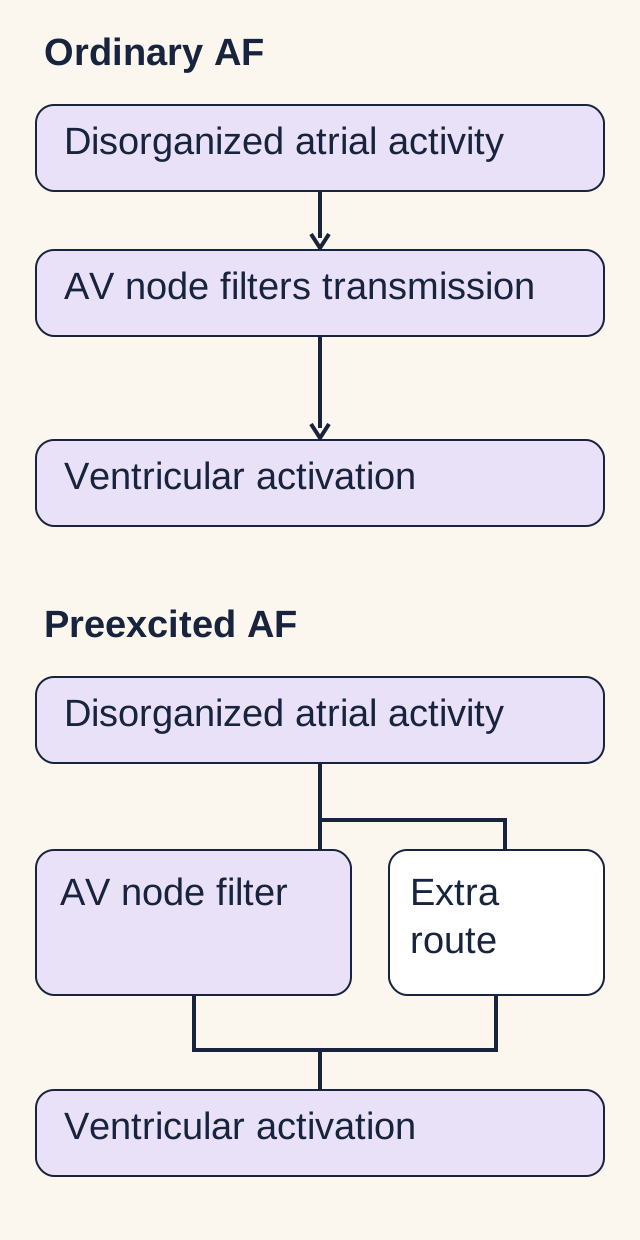
The extra route explains why ordinary nodal rate-control drugs can be dangerous in preexcited AF. This is a functional route map, not anatomical scale.
Trace the extra route. In the lower diagram, follow the connection that does not pass through the AV node. Blocking the node does not reliably protect the ventricle when rapid atrial activity can use that alternative route. This explains the preexcited-AF exception; a wide complex alone is not proof of preexcitation, but a suspicious rhythm needs expert assessment before routine nodal treatment. [1][2]
Combining a beta blocker with diltiazem or verapamil can produce additive bradycardia, AV block, and hypotension. Selected combination treatment requires careful specialist supervision and monitoring, not unstructured drug stacking. A rate of 62 without symptoms is different from 44 with presyncope and pauses. [1][2]
Transfer: predict both the desired nodal effect and the possible cost to ventricular pumping and perfusion.
Digoxin and amiodarone: different reasons for an alternative
Digoxin works best when its limitations are visible
Why can resting control coexist with exertional symptoms? Digoxin increases parasympathetic influence on the AV node. It also inhibits the sodium-potassium ATPase, increasing intracellular calcium availability and contractile force. Its vagal contribution makes resting rate control more reliable than control during strong sympathetic activation. An acceptable resting pulse or serum level therefore does not establish adequate activity-related control. Its acute effect is generally less rapid and predictable than suitable IV beta blockade or diltiazem. [1][2][5]
Digoxin can be considered when usual acute nodal drugs are ineffective or contraindicated. For longer-term AF with HF symptoms, it may supplement other agents, or be used alone when alternatives are unsuitable. It is not automatically required for every person with reduced EF, and a mildly high number without symptoms or a treatment constraint is not enough to select it. [1][2]
Predict the response: a patient is comfortable at 78 bpm while seated, but symptomatic at 146 during monitored walking. Increasing digoxin solely to raise its concentration may add toxicity without resolving the adrenergic limitation. Compare the actual activity, rate, pressure, ventricular function, and other causes of symptoms before selecting an adjunct or a different strategy. [1][2][5]
Renal impairment can increase digoxin exposure. Older age, low body mass, low potassium or magnesium, and interacting drugs increase concern. New anorexia, nausea, visual symptoms, bradycardia, or other arrhythmias deserve toxicity assessment. When levels are indicated, the AF guideline recommends a target below 1.2 ng/mL, but toxicity can occur below a laboratory upper limit. Sample just before the next dose or at least six hours after the last dose; an early postdose value can mislead. [1][5]
Amiodarone is a selected option, not a safety shortcut
Amiodarone has several ion-channel and antiadrenergic effects. In critically ill patients or decompensated HF, monitored IV use may be considered when beta blockers and nondihydropyridine calcium channel blockers are ineffective or contraindicated. Hypotension and bradycardia remain possible. AF use is supported by clinical guidelines but is not the labeled ventricular-arrhythmia indication of the cited US products. [1][2][6][7]
Check the consequence beyond the intended goal. Amiodarone can convert AF to sinus rhythm even when prescribed for rate control. Prolonged or uncertain-duration AF requires thromboembolic planning; calling the infusion rate control does not eliminate that risk. It is also not a safe exception for preexcited AF. [1][2]
Long-term exposure needs a separate benefit-risk decision because pulmonary, thyroid, hepatic, ocular, and skin effects can occur. New cough or dyspnea, biochemical thyroid dysfunction, visual complaints, or liver abnormalities deserve evaluation. Review interactions: amiodarone can increase digoxin exposure and potentiate warfarin, requiring anticipatory dose and monitoring plans. IV magnesium can be a useful adjunct to standard acute rate-control measures, but it does not replace emergency cardioversion or the assessment of contraindications. [1][5][6][7]
Transfer: before adding a second drug, state which limitation it addresses and which new monitoring obligation it creates.
Choose a target that explains how the patient is doing
Is 85 always better than 105? Not necessarily. Rate control aims to improve symptoms and function and avoid adverse ventricular effects without excessive bradycardia or hypotension. RACE II compared a lenient resting target below 110 bpm with a strict target below 80 at rest and below 110 during moderate exercise in permanent AF. Lenient control met the trial's noninferiority criterion. That does not establish equality at every rate, superiority of doing less, or safety in an unstable patient. [1][2][3]
In stable AF without HF, US guidance generally uses a symptom-guided resting target below about 100-110 bpm. Persistent symptoms, suspected arrhythmia-induced cardiomyopathy, or problematic activity-related rates can justify a different strategy. Reassess the clinical setting rather than importing one number into shock, acute decompensation, or every HF presentation. [1][2]
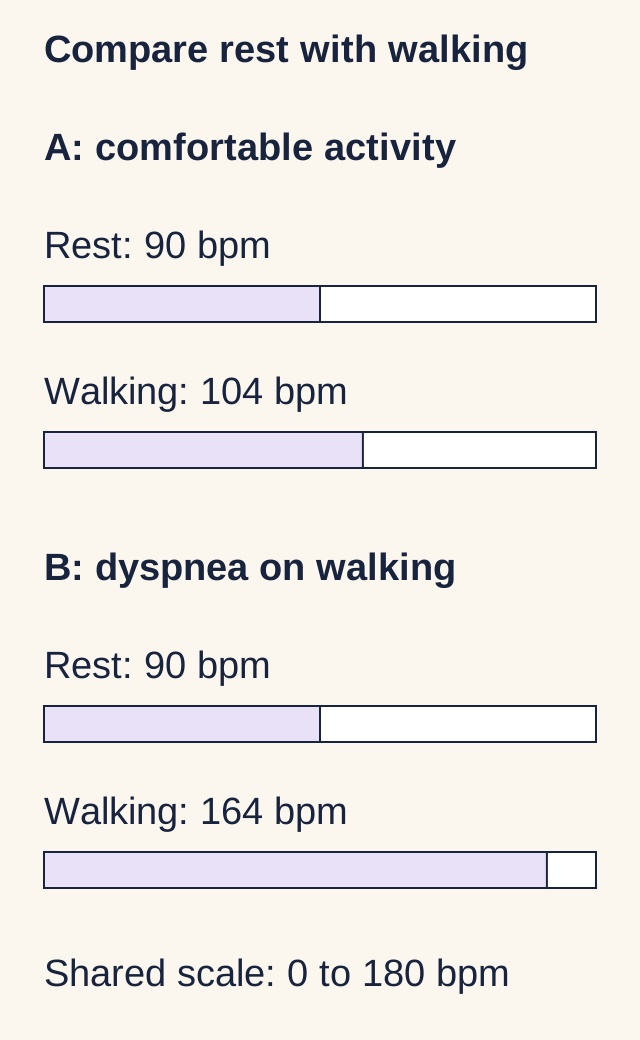
At the stated resting and walking rates, Compare the same activity, symptoms, blood pressure, and ventricular function before changing treatment.
Compare the two people before changing a dose. Both rest at 90 bpm, but their walking responses differ. The second person has symptomatic rapid AF during the activity that matters. A resting target has concealed an unresolved problem. At the stated walking rates, assess symptoms, pressure, activity level, and the actual rhythm together. [1][2]
Four observations, four different next questions
Observation
Question to answer
Observation95 bpm, comfortable activity
Question to answerAre pressure and ventricular function also satisfactory?
Observation85 bpm, persistent dyspnea
Question to answerWhat happens during activity, and is another condition causing symptoms?
Observation115 bpm despite a beta blocker
Question to answerAre adherence, triggers, tolerability, and the intended target adequately assessed?
Observation62 bpm on two nodal drugs
Question to answerIs this tolerated, or accompanied by dizziness, pauses, or low pressure?
Each row describes a different clinical situation, not a quantity to add to the others. Monitor the relevant rest-and-activity pattern, assess medication exposure, and address contributors such as infection, hypoxia, thyroid disease, or volume disturbance. Successful management may mean preserving a tolerated regimen, investigating symptoms, reducing a harmful combination, or discussing rhythm control when safe rate suppression is insufficient. [1][2]
Transfer: complete the sentence, the rate is acceptable because the patient can do the needed activity with acceptable symptoms, perfusion, and ventricular function. A number alone cannot complete it.
Keep rhythm decisions and stroke prevention in parallel
Does a comfortable pulse finish AF care? No. Rate control changes ventricular response; rhythm control aims to restore or maintain sinus rhythm. Anticoagulation addresses thromboembolism, while comorbidity and risk-factor care address the wider disease context. These are parallel decisions, not a sequence in which stroke prevention waits for a successful rate-control trial. [1][2]
Persistent symptoms despite tolerated rate therapy are a reason to discuss rhythm control. New LV dysfunction with a high AF rate burden raises concern for potentially reversible arrhythmia-induced cardiomyopathy and warrants early rhythm assessment alongside HF treatment. Catheter ablation is an option in selected patients and does not universally require prior failure of every antiarrhythmic drug. Suitability, procedural risk, expected benefit, and preferences still matter. [1][2]
What about someone without palpitations? EAST-AFNET 4 studied early rhythm control in selected patients with recently diagnosed AF and cardiovascular conditions. Its findings support a discussion beyond symptom relief alone. They do not mandate immediate cardioversion for every asymptomatic person. A recent diagnosis, comorbidities, and the goals of care should inform shared planning. [1][2][4]
Try the stroke-risk calculation separately. Under the US CHA2DS2-VASc approach, a 66-year-old man with hypertension and diabetes has three points: one for age 65-74, one for hypertension, and one for diabetes. An otherwise suitable patient should be offered oral anticoagulation after assessment. A controlled rate, absence of palpitations, or a sinus-rhythm ECG does not subtract those factors. Aspirin is not an equivalent replacement for AF anticoagulation. Drug selection requires its own valve, renal, bleeding, and interaction review. [1]
Conversion changes the immediate anticoagulation question
For elective cardioversion after prolonged or uncertain-duration AF, use a complete guideline-specific thromboembolic pathway: established therapeutic anticoagulation beforehand or appropriate imaging to exclude atrial thrombus, with therapeutic protection in place for the procedure. A negative image does not eliminate postconversion risk because atrial mechanical function may recover later than electrical rhythm. Continue anticoagulation for at least four weeks after cardioversion in this prolonged-duration setting, then according to long-term stroke risk. [1][2]
The US elective preprocedure recommendation uses AF lasting at least 48 hours or uncertain duration; ESC 2024 adopts a more cautious threshold beyond 24 hours. Neither should be taught as a universal unprotected safe period. Emergency cardioversion for AF-related instability must not be delayed for these elective preparations; address anticoagulation as soon as feasible. [1][2]
If medication and appropriate rhythm strategies do not control a symptomatic rapid response, specialist-selected AV node ablation with permanent pacing can control ventricular timing. It does not eliminate atrial AF or its risk-based anticoagulation indication, and it creates pacing dependence. Pacing strategy and ventricular function require advance planning. [1][2]
Transfer: after a successful rhythm intervention, reassess symptoms, ventricular recovery, and recurrence, while retaining a separate stroke-prevention decision.
Practice clinical decisions
Choose the best response from the supplied findings, then compare the reasoning for every option. These original educational cases are not calibrated to an examination.
Case 1
Show answer and explanations for case 1
A. Longer AV nodal refractoriness (Best answer)
Diltiazem reduces calcium-dependent conduction through the AV node. The ventricular rate changes while the atrial rhythm does not, localizing the useful effect between atria and ventricles. A lower ventricular rate does not establish restoration of sinus rhythm.
Reasoning steps for option A
Did the atrial rhythm become organized?
No. Atrial activity remains disorganized after treatment.
Which response did change?
The ventricular rate fell from 154 to 94 bpm.
Where can transmission be reduced without terminating atrial AF?
At the AV node, through longer refractoriness and slower calcium-dependent conduction.
What principle transfers to the next patient?
A lower ventricular rate does not establish restoration of sinus rhythm.
B. Longer sinoatrial recovery time (Why this does not fit)
Slower sinus-node activity can lower the rate during sinus rhythm. This tracing has no consistent sinus P waves, and ongoing atrial fibrillation is not paced by the sinus node. Identify the rhythm before assigning its rate to the sinus node.
Reasoning steps for option B
What is the clinical idea behind longer sinoatrial recovery time?
Slower sinus-node activity can lower the rate during sinus rhythm.
Which supplied finding distinguishes this option from the better response?
This tracing has no consistent sinus P waves, and ongoing atrial fibrillation is not paced by the sinus node.
What distinction should guide a similar decision?
Identify the rhythm before assigning its rate to the sinus node.
C. Slower His-Purkinje propagation (Why this does not fit)
The His-Purkinje network carries ventricular excitation. Slowing propagation there primarily affects intraventricular conduction and does not explain selective filtering of fibrillatory atrial impulses. Separate ventricular activation duration from the frequency of ventricular activation.
Reasoning steps for option C
What is the clinical idea behind slower his-purkinje propagation?
The His-Purkinje network carries ventricular excitation.
Which supplied finding distinguishes this option from the better response?
Slowing propagation there primarily affects intraventricular conduction and does not explain selective filtering of fibrillatory atrial impulses.
What distinction should guide a similar decision?
Separate ventricular activation duration from the frequency of ventricular activation.
D. Longer atrial refractory period (Why this does not fit)
An atrial refractory-period change can contribute to rhythm control. The described treatment response leaves the atrial arrhythmia present and primarily reflects nodal filtering. Rate control can succeed while the atrial arrhythmia persists.
Reasoning steps for option D
What is the clinical idea behind longer atrial refractory period?
An atrial refractory-period change can contribute to rhythm control.
Which supplied finding distinguishes this option from the better response?
The described treatment response leaves the atrial arrhythmia present and primarily reflects nodal filtering.
What distinction should guide a similar decision?
Rate control can succeed while the atrial arrhythmia persists.
E. Shorter accessory-pathway refractoriness (Why this does not fit)
An accessory connection can transmit atrial activity to the ventricles. Shortening its refractory period would permit faster conduction, not explain the observed slowing in ordinary narrow-complex AF. An accessory pathway changes the safety of AV nodal drugs.
Reasoning steps for option E
What is the clinical idea behind shorter accessory-pathway refractoriness?
An accessory connection can transmit atrial activity to the ventricles.
Which supplied finding distinguishes this option from the better response?
Shortening its refractory period would permit faster conduction, not explain the observed slowing in ordinary narrow-complex AF.
What distinction should guide a similar decision?
An accessory pathway changes the safety of AV nodal drugs.
Takeaway: A lower ventricular rate does not establish restoration of sinus rhythm.
A. Transesophageal echocardiography first (Why this does not fit)
Transesophageal imaging can exclude atrial thrombus before selected elective cardioversions. The patient cannot safely wait for an elective imaging sequence while perfusion is failing. Thromboembolic precautions must not delay life-saving cardioversion.
Reasoning steps for option A
What is the clinical idea behind transesophageal echocardiography first?
Transesophageal imaging can exclude atrial thrombus before selected elective cardioversions.
Which supplied finding distinguishes this option from the better response?
The patient cannot safely wait for an elective imaging sequence while perfusion is failing.
What distinction should guide a similar decision?
Thromboembolic precautions must not delay life-saving cardioversion.
B. IV digoxin loading (Why this does not fit)
Digoxin may help rate control when other nodal drugs cannot be used. Its onset and response are insufficiently predictable for this immediately unstable presentation. An appropriate chronic agent is not necessarily an emergency intervention.
Reasoning steps for option B
What is the clinical idea behind iv digoxin loading?
Digoxin may help rate control when other nodal drugs cannot be used.
Which supplied finding distinguishes this option from the better response?
Its onset and response are insufficiently predictable for this immediately unstable presentation.
What distinction should guide a similar decision?
An appropriate chronic agent is not necessarily an emergency intervention.
C. Three weeks of anticoagulation first (Why this does not fit)
Therapeutic anticoagulation before elective cardioversion reduces thromboembolic risk. A multiweek delay does not address shock developing during this arrhythmia. Distinguish emergency stabilization from elective cardioversion preparation.
Reasoning steps for option C
What is the clinical idea behind three weeks of anticoagulation first?
Therapeutic anticoagulation before elective cardioversion reduces thromboembolic risk.
Which supplied finding distinguishes this option from the better response?
A multiweek delay does not address shock developing during this arrhythmia.
What distinction should guide a similar decision?
Distinguish emergency stabilization from elective cardioversion preparation.
D. IV diltiazem infusion (Why this does not fit)
Diltiazem can rapidly control ordinary AF in stable patients with suitable ventricular function. This patient has severe circulatory compromise, and a vasodilating negative inotrope could worsen it while delaying definitive treatment. Stable-patient drug choices do not replace rescue cardioversion.
Reasoning steps for option D
What is the clinical idea behind iv diltiazem infusion?
Diltiazem can rapidly control ordinary AF in stable patients with suitable ventricular function.
Which supplied finding distinguishes this option from the better response?
This patient has severe circulatory compromise, and a vasodilating negative inotrope could worsen it while delaying definitive treatment.
What distinction should guide a similar decision?
Stable-patient drug choices do not replace rescue cardioversion.
E. Synchronized electrical cardioversion (Best answer)
Electrical cardioversion can promptly terminate an arrhythmia causing hemodynamic compromise. New hypotension, confusion, and pulmonary edema follow the rapid AF, so waiting for medication or elective preparation is unsafe. AF-related instability requires immediate synchronized cardioversion; address anticoagulation as soon as feasible without delaying rescue.
Reasoning steps for option E
When did perfusion deteriorate?
At the onset of rapid AF.
Which findings establish more than palpitations?
Hypotension, confusion, and pulmonary edema indicate hemodynamic compromise.
Which intervention addresses an arrhythmia causing this instability?
Immediate synchronized electrical cardioversion.
What principle transfers to the next patient?
AF-related instability requires immediate synchronized cardioversion; address anticoagulation as soon as feasible without delaying rescue.
Takeaway: AF-related instability requires immediate synchronized cardioversion; address anticoagulation as soon as feasible without delaying rescue.
Verapamil can reduce AV nodal conduction in ordinary AF. Its negative inotropic effects make it unsuitable in this severe LV dysfunction, even though the patient is presently perfused. Preserved blood pressure does not erase a ventricular-function contraindication.
Reasoning steps for option A
What is the clinical idea behind verapamil?
Verapamil can reduce AV nodal conduction in ordinary AF.
Which supplied finding distinguishes this option from the better response?
Its negative inotropic effects make it unsuitable in this severe LV dysfunction, even though the patient is presently perfused.
What distinction should guide a similar decision?
Preserved blood pressure does not erase a ventricular-function contraindication.
B. Diltiazem (Why this does not fit)
Diltiazem is an effective acute nodal rate-control drug with appropriate ventricular function. An LVEF of 24% creates a serious negative-inotropy concern regardless of the current pressure reading. Avoid IV nondihydropyridine calcium channel blockers in moderate or severe LV systolic dysfunction.
Reasoning steps for option B
What is the clinical idea behind diltiazem?
Diltiazem is an effective acute nodal rate-control drug with appropriate ventricular function.
Which supplied finding distinguishes this option from the better response?
An LVEF of 24% creates a serious negative-inotropy concern regardless of the current pressure reading.
What distinction should guide a similar decision?
Avoid IV nondihydropyridine calcium channel blockers in moderate or severe LV systolic dysfunction.
C. Amiodarone (Best answer)
IV amiodarone can provide rate control in selected critically ill patients when usual nodal drugs are unsuitable or ineffective. Severe LV dysfunction, intolerance of IV beta blockade, and inadequate digoxin response define that restricted setting here. Amiodarone is a monitored alternative, not an intrinsically safe default for every patient with heart failure.
Reasoning steps for option C
What prevents routine IV calcium channel blockade?
Severe LV systolic dysfunction with LVEF 24%.
What happened with the usual alternatives?
IV beta blockade caused marked hypotension and adjusted digoxin did not adequately control the rate.
Which monitored alternative fits this selected critical-care setting?
IV amiodarone may be considered, with pressure, rhythm, and conversion-risk assessment.
What principle transfers to the next patient?
Amiodarone is a monitored alternative, not an intrinsically safe default for every patient with heart failure.
D. Flecainide (Why this does not fit)
Flecainide can be used for rhythm control in selected patients without important structural heart disease. Severe LV systolic dysfunction makes this sodium-channel drug an inappropriate substitute here. A rhythm-control option for a normal heart cannot be generalized to HFrEF.
Reasoning steps for option D
What is the clinical idea behind flecainide?
Flecainide can be used for rhythm control in selected patients without important structural heart disease.
Which supplied finding distinguishes this option from the better response?
Severe LV systolic dysfunction makes this sodium-channel drug an inappropriate substitute here.
What distinction should guide a similar decision?
A rhythm-control option for a normal heart cannot be generalized to HFrEF.
E. Adenosine (Why this does not fit)
Adenosine transiently blocks the AV node and treats selected regular reentrant tachycardias. It does not provide sustained ventricular rate control for ongoing AF. Match a drug to the rhythm and the required duration of effect.
Reasoning steps for option E
What is the clinical idea behind adenosine?
Adenosine transiently blocks the AV node and treats selected regular reentrant tachycardias.
Which supplied finding distinguishes this option from the better response?
It does not provide sustained ventricular rate control for ongoing AF.
What distinction should guide a similar decision?
Match a drug to the rhythm and the required duration of effect.
Takeaway: Amiodarone is a monitored alternative, not an intrinsically safe default for every patient with heart failure.
Digoxin can slow AV nodal transmission at rest. In preexcited AF its unequal effect on nodal and accessory conduction can permit a dangerously rapid ventricular response. Do not treat preexcited AF as ordinary resting-rate excess.
Reasoning steps for option A
What is the clinical idea behind digoxin?
Digoxin can slow AV nodal transmission at rest.
Which supplied finding distinguishes this option from the better response?
In preexcited AF its unequal effect on nodal and accessory conduction can permit a dangerously rapid ventricular response.
What distinction should guide a similar decision?
Do not treat preexcited AF as ordinary resting-rate excess.
B. Metoprolol (Why this does not fit)
Metoprolol reduces sympathetic support of AV nodal conduction. It does not make the accessory route safe and is contraindicated in preexcited AF. A useful drug for ordinary AF can be harmful when conduction bypasses the node.
Reasoning steps for option B
What is the clinical idea behind metoprolol?
Metoprolol reduces sympathetic support of AV nodal conduction.
Which supplied finding distinguishes this option from the better response?
It does not make the accessory route safe and is contraindicated in preexcited AF.
What distinction should guide a similar decision?
A useful drug for ordinary AF can be harmful when conduction bypasses the node.
C. Amiodarone (Why this does not fit)
Amiodarone treats several atrial and ventricular arrhythmias. Despite that broad use, it is not recommended for preexcited AF because of potential deterioration and ventricular fibrillation. Amiodarone is not an exception to the nodal-drug prohibition in preexcited AF.
Reasoning steps for option C
What is the clinical idea behind amiodarone?
Amiodarone treats several atrial and ventricular arrhythmias.
Which supplied finding distinguishes this option from the better response?
Despite that broad use, it is not recommended for preexcited AF because of potential deterioration and ventricular fibrillation.
What distinction should guide a similar decision?
Amiodarone is not an exception to the nodal-drug prohibition in preexcited AF.
D. Procainamide (Best answer)
Procainamide acts on conduction and refractoriness outside the AV node, including an accessory pathway. The prior preexcitation pattern and current irregular wide complexes identify preexcited AF in a presently stable patient. Stable preexcited AF requires a pathway-appropriate conversion strategy, not ordinary nodal rate control.
Reasoning steps for option D
What does the previous short PR and slurred QRS onset suggest?
An accessory atrioventricular connection.
How does the current irregular wide rhythm fit that substrate?
It supports preexcited AF rather than ordinary narrow-complex AF.
What conversion option fits current stable perfusion?
IV procainamide is appropriate to consider with monitoring and cardioversion readiness.
What principle transfers to the next patient?
Stable preexcited AF requires a pathway-appropriate conversion strategy, not ordinary nodal rate control.
E. Diltiazem (Why this does not fit)
Diltiazem is familiar for rapid AF conducted through the AV node. This patient has evidence of an accessory connection, so nodal blockade can promote dangerous ventricular conduction. Check for preexcitation before using routine AF rate-control drugs.
Reasoning steps for option E
What is the clinical idea behind diltiazem?
Diltiazem is familiar for rapid AF conducted through the AV node.
Which supplied finding distinguishes this option from the better response?
This patient has evidence of an accessory connection, so nodal blockade can promote dangerous ventricular conduction.
What distinction should guide a similar decision?
Check for preexcitation before using routine AF rate-control drugs.
Takeaway: Stable preexcited AF requires a pathway-appropriate conversion strategy, not ordinary nodal rate control.
A. Prolonged ventricular repolarization (Why this does not fit)
Repolarization delay can create susceptibility to particular ventricular arrhythmias. The supplied pattern is shorter R-R intervals during preexcited AF after nodal blockade, not a described torsades sequence. Use the rhythm pattern and treatment exposure to distinguish conduction from repolarization problems.
Reasoning steps for option A
What is the clinical idea behind prolonged ventricular repolarization?
Repolarization delay can create susceptibility to particular ventricular arrhythmias.
Which supplied finding distinguishes this option from the better response?
The supplied pattern is shorter R-R intervals during preexcited AF after nodal blockade, not a described torsades sequence.
What distinction should guide a similar decision?
Use the rhythm pattern and treatment exposure to distinguish conduction from repolarization problems.
B. Greater reliance on accessory conduction (Best answer)
The accessory connection can transmit atrial impulses without normal AV nodal filtering. Nodal suppression in this preexcited rhythm can permit dangerously rapid conduction over that alternative route. The safety of nodal rate control depends on the available atrioventricular pathways.
Reasoning steps for option B
Which alternate route is already demonstrated?
An accessory atrioventricular pathway is supported by the previous preexcitation ECG.
What changed after nodal blockade?
The ventricular intervals became still shorter during preexcited AF.
How does the alternate route explain that response?
Suppressing the node can permit dangerous ventricular conduction over the accessory connection.
What principle transfers to the next patient?
The safety of nodal rate control depends on the available atrioventricular pathways.
C. Increased organized atrial contraction (Why this does not fit)
Restoring atrial coordination may improve ventricular filling. No conversion to organized atrial activity is described, and this explanation does not account for accelerating preexcited conduction. Do not infer mechanical atrial recovery from a drug-induced ventricular rate change.
Reasoning steps for option C
What is the clinical idea behind increased organized atrial contraction?
Restoring atrial coordination may improve ventricular filling.
Which supplied finding distinguishes this option from the better response?
No conversion to organized atrial activity is described, and this explanation does not account for accelerating preexcited conduction.
What distinction should guide a similar decision?
Do not infer mechanical atrial recovery from a drug-induced ventricular rate change.
D. Increased sinus-node automaticity (Why this does not fit)
Increased sinus automaticity can produce a faster regular sinus rhythm. The patient has disorganized atrial activity and preexcitation, not newly organized sinus tachycardia. A rapid ventricular response during AF need not originate in the sinus node.
Reasoning steps for option D
What is the clinical idea behind increased sinus-node automaticity?
Increased sinus automaticity can produce a faster regular sinus rhythm.
Which supplied finding distinguishes this option from the better response?
The patient has disorganized atrial activity and preexcitation, not newly organized sinus tachycardia.
What distinction should guide a similar decision?
A rapid ventricular response during AF need not originate in the sinus node.
E. Reduced His-Purkinje conduction speed (Why this does not fit)
Slower ventricular conduction can widen a QRS complex. It does not account for more frequent ventricular activation over an established accessory route. QRS width and ventricular activation frequency answer different questions.
Reasoning steps for option E
What is the clinical idea behind reduced his-purkinje conduction speed?
Slower ventricular conduction can widen a QRS complex.
Which supplied finding distinguishes this option from the better response?
It does not account for more frequent ventricular activation over an established accessory route.
What distinction should guide a similar decision?
QRS width and ventricular activation frequency answer different questions.
Takeaway: The safety of nodal rate control depends on the available atrioventricular pathways.
A. Verapamil extended-release (Why this does not fit)
Verapamil can slow AV nodal conduction. The requested HFrEF-compatible beta blocker is not a nondihydropyridine calcium channel blocker. A rate-lowering effect does not establish suitability in systolic heart failure.
Reasoning steps for option A
What is the clinical idea behind verapamil extended-release?
Verapamil can slow AV nodal conduction.
Which supplied finding distinguishes this option from the better response?
The requested HFrEF-compatible beta blocker is not a nondihydropyridine calcium channel blocker.
What distinction should guide a similar decision?
A rate-lowering effect does not establish suitability in systolic heart failure.
B. Metoprolol tartrate (Why this does not fit)
Immediate-release metoprolol can control ventricular rate. The stated long-term HFrEF formulation choice is extended-release succinate rather than assuming formulations have identical outcome evidence. Distinguish an acute rate-control option from the evidence-based chronic HF formulation.
Reasoning steps for option B
What is the clinical idea behind metoprolol tartrate?
Immediate-release metoprolol can control ventricular rate.
Which supplied finding distinguishes this option from the better response?
The stated long-term HFrEF formulation choice is extended-release succinate rather than assuming formulations have identical outcome evidence.
What distinction should guide a similar decision?
Distinguish an acute rate-control option from the evidence-based chronic HF formulation.
C. Diltiazem extended-release (Why this does not fit)
Diltiazem is effective for long-term AF rate control in suitable patients. It is not a beta blocker and its negative inotropy is unsuitable at LVEF 30%. Use both ventricular function and drug class when matching chronic treatment.
Reasoning steps for option C
What is the clinical idea behind diltiazem extended-release?
Diltiazem is effective for long-term AF rate control in suitable patients.
Which supplied finding distinguishes this option from the better response?
It is not a beta blocker and its negative inotropy is unsuitable at LVEF 30%.
What distinction should guide a similar decision?
Use both ventricular function and drug class when matching chronic treatment.
D. Atenolol tablets (Why this does not fit)
Atenolol is beta-1 selective and can lower heart rate. It is not the established chronic HFrEF beta-blocker choice requested in this plan. Cardioselectivity alone does not establish the same HFrEF evidence base.
Reasoning steps for option D
What is the clinical idea behind atenolol tablets?
Atenolol is beta-1 selective and can lower heart rate.
Which supplied finding distinguishes this option from the better response?
It is not the established chronic HFrEF beta-blocker choice requested in this plan.
What distinction should guide a similar decision?
Cardioselectivity alone does not establish the same HFrEF evidence base.
E. Metoprolol succinate (Best answer)
This beta-1 selective formulation is used in chronic HFrEF and can slow AF conduction through the AV node. Stable perfusion and absence of active bronchospasm support cautious initiation rather than excluding the class because of COPD alone. Stable COPD is not an automatic contraindication to cardioselective beta blockade for AF.
Reasoning steps for option E
Does stable COPD alone exclude cardioselective beta blockade?
No, especially when another cardiac indication is present.
Which chronic treatment context is specifically requested?
A maintenance beta blocker established in HFrEF care.
Which listed formulation meets that request?
Metoprolol succinate rather than treating all metoprolol formulations as interchangeable.
What principle transfers to the next patient?
Stable COPD is not an automatic contraindication to cardioselective beta blockade for AF.
Takeaway: Stable COPD is not an automatic contraindication to cardioselective beta blockade for AF.
Adenosine interrupts selected AV node-dependent regular tachycardias. Confirmed ongoing AF is not sustained by that reentrant circuit and will not receive durable rate control from a brief nodal block. Identify the rhythm before choosing a familiar tachycardia drug.
Reasoning steps for option A
What is the clinical idea behind adenosine?
Adenosine interrupts selected AV node-dependent regular tachycardias.
Which supplied finding distinguishes this option from the better response?
Confirmed ongoing AF is not sustained by that reentrant circuit and will not receive durable rate control from a brief nodal block.
What distinction should guide a similar decision?
Identify the rhythm before choosing a familiar tachycardia drug.
B. Metoprolol (Why this does not fit)
Cardioselective beta blockers can be appropriate in many patients with stable COPD. This patient instead has asthma with reproducible severe bronchospasm during exposure to this medication. Do not generalize COPD reassurance to a demonstrated severe drug reaction.
Reasoning steps for option B
What is the clinical idea behind metoprolol?
Cardioselective beta blockers can be appropriate in many patients with stable COPD.
Which supplied finding distinguishes this option from the better response?
This patient instead has asthma with reproducible severe bronchospasm during exposure to this medication.
What distinction should guide a similar decision?
Do not generalize COPD reassurance to a demonstrated severe drug reaction.
C. Diltiazem (Best answer)
Diltiazem slows AV nodal conduction without beta-receptor blockade. Preserved LV function and adequate perfusion permit its use, while documented severe beta-blocker bronchospasm favors this alternative. Actual drug-associated bronchospasm matters more than an undifferentiated lung-disease label.
Reasoning steps for option C
What is the actual pulmonary constraint?
A reproducible severe bronchospastic reaction to metoprolol in a patient with asthma.
Does ventricular function permit a nodal calcium channel blocker?
LVEF is 58% with adequate pressure and no congestion.
Which listed IV drug fits those constraints?
Diltiazem for monitored acute rate control.
What principle transfers to the next patient?
Actual drug-associated bronchospasm matters more than an undifferentiated lung-disease label.
D. Amiodarone (Why this does not fit)
Amiodarone can lower ventricular rate in selected difficult acute settings. There is no critical illness or ventricular dysfunction requiring that broader and potentially converting drug here. Use an appropriate simpler nodal agent before accepting unnecessary amiodarone exposure.
Reasoning steps for option D
What is the clinical idea behind amiodarone?
Amiodarone can lower ventricular rate in selected difficult acute settings.
Which supplied finding distinguishes this option from the better response?
There is no critical illness or ventricular dysfunction requiring that broader and potentially converting drug here.
What distinction should guide a similar decision?
Use an appropriate simpler nodal agent before accepting unnecessary amiodarone exposure.
E. Digoxin (Why this does not fit)
Digoxin can control ventricular rate when other agents are unsuitable. Here an effective faster-onset nodal agent is suitable, so digoxin is not the best initial choice for prompt control. Reserve slower or less reliable acute options for a clinical reason.
Reasoning steps for option E
What is the clinical idea behind digoxin?
Digoxin can control ventricular rate when other agents are unsuitable.
Which supplied finding distinguishes this option from the better response?
Here an effective faster-onset nodal agent is suitable, so digoxin is not the best initial choice for prompt control.
What distinction should guide a similar decision?
Reserve slower or less reliable acute options for a clinical reason.
Takeaway: Actual drug-associated bronchospasm matters more than an undifferentiated lung-disease label.
A. Reduced ventricular contractile force (Best answer)
Verapamil blocks calcium entry in cardiac tissue as well as slowing the AV node. At LVEF 32%, its negative inotropic effect can worsen systolic performance even when the examination is currently dry. Known significant LV systolic dysfunction is sufficient reason to avoid IV verapamil or diltiazem.
Reasoning steps for option A
What does the EF show despite the dry examination?
Reduced myocardial contractile force through calcium channel blockade.
Why is that effect important here?
Further negative inotropy can worsen the already impaired ventricle.
What principle transfers to the next patient?
Known significant LV systolic dysfunction is sufficient reason to avoid IV verapamil or diltiazem.
B. Increased sinus-node firing (Why this does not fit)
Faster sinus-node firing can raise heart rate in sinus rhythm. Verapamil does not principally increase sinus automaticity, and sinus pacing is not governing this AF rhythm. Apply the drug action to the demonstrated rhythm and vulnerable organ.
Reasoning steps for option B
What is the clinical idea behind increased sinus-node firing?
Faster sinus-node firing can raise heart rate in sinus rhythm.
Which supplied finding distinguishes this option from the better response?
Verapamil does not principally increase sinus automaticity, and sinus pacing is not governing this AF rhythm.
What distinction should guide a similar decision?
Apply the drug action to the demonstrated rhythm and vulnerable organ.
C. Reduced platelet aggregation (Why this does not fit)
Platelet inhibition can alter bleeding risk in cardiovascular care. It neither describes the principal verapamil effect nor explains deterioration in ventricular pumping here. Rate-control drug selection is not a substitute for the separate antithrombotic decision.
Reasoning steps for option C
What is the clinical idea behind reduced platelet aggregation?
Platelet inhibition can alter bleeding risk in cardiovascular care.
Which supplied finding distinguishes this option from the better response?
It neither describes the principal verapamil effect nor explains deterioration in ventricular pumping here.
What distinction should guide a similar decision?
Rate-control drug selection is not a substitute for the separate antithrombotic decision.
D. Increased accessory-pathway conduction (Why this does not fit)
An accessory pathway changes the safety of AV nodal drugs. No preexcitation is supplied, whereas substantial LV systolic impairment is documented. A real contraindication need not depend on an additional unprovided diagnosis.
Reasoning steps for option D
What is the clinical idea behind increased accessory-pathway conduction?
An accessory pathway changes the safety of AV nodal drugs.
Which supplied finding distinguishes this option from the better response?
No preexcitation is supplied, whereas substantial LV systolic impairment is documented.
What distinction should guide a similar decision?
A real contraindication need not depend on an additional unprovided diagnosis.
E. Increased renal potassium loss (Why this does not fit)
Potassium depletion can aggravate arrhythmias and alter digoxin safety. Direct renal potassium wasting is not the main reason for the verapamil restriction at this EF. Do not substitute a general arrhythmia risk for a drug-specific ventricular effect.
Reasoning steps for option E
What is the clinical idea behind increased renal potassium loss?
Potassium depletion can aggravate arrhythmias and alter digoxin safety.
Which supplied finding distinguishes this option from the better response?
Direct renal potassium wasting is not the main reason for the verapamil restriction at this EF.
What distinction should guide a similar decision?
Do not substitute a general arrhythmia risk for a drug-specific ventricular effect.
Takeaway: Known significant LV systolic dysfunction is sufficient reason to avoid IV verapamil or diltiazem.
A. Use synchronized electrical cardioversion as the initial strategy (Why this does not fit)
Electrical cardioversion treats AF causing instability and is also an elective rhythm option. The supplied pressure, mentation, and absence of congestion do not establish emergency instability. A fast rate alone does not mandate emergency cardioversion.
Reasoning steps for option A
What is the clinical idea behind use synchronized electrical cardioversion as the initial strategy?
Electrical cardioversion treats AF causing instability and is also an elective rhythm option.
Which supplied finding distinguishes this option from the better response?
The supplied pressure, mentation, and absence of congestion do not establish emergency instability.
What distinction should guide a similar decision?
A fast rate alone does not mandate emergency cardioversion.
B. Use monitored IV diltiazem for initial rate control (Best answer)
Acute diltiazem rate control is an option in stable ordinary AF when EF is above 40%. An EF of 46%, preserved perfusion, and beta-blocker intolerance support considering this drug rather than excluding it because EF is below a typical normal value. Use the actual EF threshold and clinical state, then monitor the response.
Reasoning steps for option B
Does 46% cross the acute EF-above-40 eligibility boundary?
It remains above that boundary.
What other findings favor a monitored alternative to beta blockade?
Adequate perfusion, no congestion or preexcitation, and previous severe beta-blocker bronchospasm.
What conclusion follows without making a blanket safety claim?
A monitored diltiazem trial is reasonable in the supplied stable setting.
What principle transfers to the next patient?
Use the actual EF threshold and clinical state, then monitor the response.
C. Use monitored IV digoxin for initial rate control (Why this does not fit)
Digoxin can be useful when usual nodal drugs are unsuitable. Mildly reduced EF above 40% does not by itself establish a contraindication to acute diltiazem in this otherwise stable patient. A mildly abnormal measurement does not necessarily cross a drug-safety boundary.
Reasoning steps for option C
What is the clinical idea behind use monitored iv digoxin for initial rate control?
Digoxin can be useful when usual nodal drugs are unsuitable.
Which supplied finding distinguishes this option from the better response?
Mildly reduced EF above 40% does not by itself establish a contraindication to acute diltiazem in this otherwise stable patient.
What distinction should guide a similar decision?
A mildly abnormal measurement does not necessarily cross a drug-safety boundary.
D. Use monitored IV amiodarone for initial rate control (Why this does not fit)
Amiodarone can provide rate control in selected critically ill or decompensated patients. Prior beta-blocker bronchospasm does not eliminate a suitable calcium channel blocker in this stable setting. Choose the least complex appropriate strategy rather than treating one intolerance as failure of every nodal option.
Reasoning steps for option D
What is the clinical idea behind use monitored iv amiodarone for initial rate control?
Amiodarone can provide rate control in selected critically ill or decompensated patients.
Which supplied finding distinguishes this option from the better response?
Prior beta-blocker bronchospasm does not eliminate a suitable calcium channel blocker in this stable setting.
What distinction should guide a similar decision?
Choose the least complex appropriate strategy rather than treating one intolerance as failure of every nodal option.
Takeaway: Use the actual EF threshold and clinical state, then monitor the response.
A. Conversion from AF to sinus tachycardia during activity (Why this does not fit)
Sinus tachycardia can accompany exertion in a patient who has converted out of AF. The monitored rhythm remains AF; a ventricular rate threshold does not establish atrial organization. Rate and rhythm are separate observations.
Reasoning steps for option A
What is the clinical idea behind conversion from af to sinus tachycardia during activity?
Sinus tachycardia can accompany exertion in a patient who has converted out of AF.
Which supplied finding distinguishes this option from the better response?
The monitored rhythm remains AF; a ventricular rate threshold does not establish atrial organization.
What distinction should guide a similar decision?
Rate and rhythm are separate observations.
B. Exercise-associated acceleration of renal digoxin clearance (Why this does not fit)
Renal clearance determines digoxin exposure over a much longer interval. A reproducible immediate activity-linked rate change with stable kidney function is not explained by rapid elimination of the drug. Distinguish autonomic changes over minutes from drug accumulation or clearance over days.
Reasoning steps for option B
What is the clinical idea behind exercise-associated acceleration of renal digoxin clearance?
Renal clearance determines digoxin exposure over a much longer interval.
Which supplied finding distinguishes this option from the better response?
A reproducible immediate activity-linked rate change with stable kidney function is not explained by rapid elimination of the drug.
What distinction should guide a similar decision?
Distinguish autonomic changes over minutes from drug accumulation or clearance over days.
C. Accessory-pathway conduction during sympathetic activation (Why this does not fit)
An accessory connection can change atrioventricular conduction and drug safety. No preexcitation is supplied, while the rest-exercise contrast is the expected limitation of predominantly vagal rate control. Use the demonstrated physiology rather than introduce an unprovided accessory pathway.
Reasoning steps for option C
What is the clinical idea behind accessory-pathway conduction during sympathetic activation?
An accessory connection can change atrioventricular conduction and drug safety.
Which supplied finding distinguishes this option from the better response?
No preexcitation is supplied, while the rest-exercise contrast is the expected limitation of predominantly vagal rate control.
What distinction should guide a similar decision?
Use the demonstrated physiology rather than introduce an unprovided accessory pathway.
D. Sympathetic activation offsets vagal nodal slowing (Best answer)
Digoxin slows AV nodal conduction partly by increasing parasympathetic influence. Exercise raises sympathetic activity, so an acceptable resting response can coexist with poor exertional control despite a plausible serum concentration. Assess ventricular rate during the activity that produces symptoms.
Reasoning steps for option D
Is resting rate adequate in this example?
The seated rate is 78 bpm.
What changes when symptoms occur?
Walking raises the ventricular rate to 146 bpm despite stable measured exposure.
Why can this happen with digoxin?
Sympathetic activation reduces the relative effectiveness of vagally mediated nodal slowing.
What principle transfers to the next patient?
Assess ventricular rate during the activity that produces symptoms.
Takeaway: Assess ventricular rate during the activity that produces symptoms.
Atenolol can reduce sympathetic AV nodal conduction. Adding another beta blocker does not address the documented class-related dose limitation and creates overlapping blockade. Repeated intolerance should shape the next drug choice.
Reasoning steps for option A
What is the clinical idea behind atenolol?
Atenolol can reduce sympathetic AV nodal conduction.
Which supplied finding distinguishes this option from the better response?
Adding another beta blocker does not address the documented class-related dose limitation and creates overlapping blockade.
What distinction should guide a similar decision?
Repeated intolerance should shape the next drug choice.
B. Verapamil (Why this does not fit)
Verapamil provides AV nodal slowing and can reduce ventricular rate. Its negative inotropic effect is unsuitable in this degree of systolic dysfunction. Do not solve inadequate rate control by worsening the ventricular pump.
Reasoning steps for option B
What is the clinical idea behind verapamil?
Verapamil provides AV nodal slowing and can reduce ventricular rate.
Which supplied finding distinguishes this option from the better response?
Its negative inotropic effect is unsuitable in this degree of systolic dysfunction.
What distinction should guide a similar decision?
Do not solve inadequate rate control by worsening the ventricular pump.
C. Amlodipine (Why this does not fit)
Amlodipine may be used for blood pressure or angina in suitable patients. Its predominantly vascular calcium channel effect does not provide meaningful AV nodal rate control. Not every calcium channel blocker treats the same cardiovascular target.
Reasoning steps for option C
What is the clinical idea behind amlodipine?
Amlodipine may be used for blood pressure or angina in suitable patients.
Which supplied finding distinguishes this option from the better response?
Its predominantly vascular calcium channel effect does not provide meaningful AV nodal rate control.
What distinction should guide a similar decision?
Not every calcium channel blocker treats the same cardiovascular target.
D. Diltiazem (Why this does not fit)
Diltiazem is effective for rate control when ventricular function permits. LVEF 30% makes its negative inotropic effect an important reason not to add it here. A second nodal drug must still meet the ventricular-function constraint.
Reasoning steps for option D
What is the clinical idea behind diltiazem?
Diltiazem is effective for rate control when ventricular function permits.
Which supplied finding distinguishes this option from the better response?
LVEF 30% makes its negative inotropic effect an important reason not to add it here.
What distinction should guide a similar decision?
A second nodal drug must still meet the ventricular-function constraint.
E. Digoxin (Best answer)
Digoxin can supplement ventricular rate control in AF with HF symptoms when other rate-lowering agents are limited. Persistent rapid rate despite tolerated beta blockade, together with low EF and dose-limiting hypotension, makes it a reasonable adjunct with renal and electrolyte monitoring. Choose an adjunct from the remaining safe options, not from the heart-rate number alone.
A. Increase digoxin because the level is below the laboratory upper limit (Why this does not fit)
Increasing exposure can sometimes improve inadequate rate control. The ventricular rate is already 42 bpm with symptoms, and clearance has worsened rather than improved. Dose changes must follow the clinical effect and clearance, not pursuit of an upper laboratory boundary.
Reasoning steps for option A
What is the clinical idea behind increase digoxin because the level is below the laboratory upper limit?
Increasing exposure can sometimes improve inadequate rate control.
Which supplied finding distinguishes this option from the better response?
The ventricular rate is already 42 bpm with symptoms, and clearance has worsened rather than improved.
What distinction should guide a similar decision?
Dose changes must follow the clinical effect and clearance, not pursuit of an upper laboratory boundary.
B. Replace digoxin immediately with verapamil (Why this does not fit)
Verapamil can provide chronic rate control in suitable patients. It is another nodal suppressant and is not the immediate answer to symptomatic pauses while toxicity is being assessed. Stabilize an adverse drug effect before choosing replacement maintenance therapy.
Reasoning steps for option B
What is the clinical idea behind replace digoxin immediately with verapamil?
Verapamil can provide chronic rate control in suitable patients.
Which supplied finding distinguishes this option from the better response?
It is another nodal suppressant and is not the immediate answer to symptomatic pauses while toxicity is being assessed.
What distinction should guide a similar decision?
Stabilize an adverse drug effect before choosing replacement maintenance therapy.
C. Continue digoxin and repeat the level at routine follow-up (Why this does not fit)
Routine follow-up can be appropriate for stable asymptomatic maintenance treatment. Symptomatic bradycardia, pauses, and acute renal impairment require prompt action rather than an outpatient laboratory interval. Clinical deterioration overrides reassurance from a single drug concentration.
Reasoning steps for option C
What is the clinical idea behind continue digoxin and repeat the level at routine follow-up?
Routine follow-up can be appropriate for stable asymptomatic maintenance treatment.
Which supplied finding distinguishes this option from the better response?
Symptomatic bradycardia, pauses, and acute renal impairment require prompt action rather than an outpatient laboratory interval.
What distinction should guide a similar decision?
Clinical deterioration overrides reassurance from a single drug concentration.
D. Withhold digoxin and urgently assess toxicity and electrolyte depletion (Best answer)
Digoxin toxicity is a clinical assessment influenced by kidney function, electrolytes, symptoms, and rhythm. New renal impairment, hypokalemia, gastrointestinal symptoms, and severe slowing are concerning despite a concentration below 1.2 ng/mL. A concentration target is not a guarantee against toxicity.
Reasoning steps for option D
What changed the susceptibility to digoxin harm?
Acute renal impairment and marked hypokalemia developed.
What observed effects are concerning?
Gastrointestinal symptoms, ventricular rate 42 bpm, and pauses.
Does a predose level of 1.1 rule out toxicity?
No. The clinical pattern requires withholding digoxin and urgent monitored assessment.
What principle transfers to the next patient?
A concentration target is not a guarantee against toxicity.
E. Add metoprolol to regularize the ventricular rhythm (Why this does not fit)
Beta blockers can slow a rapid ventricular response. Further nodal suppression can worsen this already slow symptomatic rhythm and does not make AF regular by restoring atrial organization. Do not add rate suppression to a bradycardic toxicity presentation.
Reasoning steps for option E
What is the clinical idea behind add metoprolol to regularize the ventricular rhythm?
Beta blockers can slow a rapid ventricular response.
Which supplied finding distinguishes this option from the better response?
Further nodal suppression can worsen this already slow symptomatic rhythm and does not make AF regular by restoring atrial organization.
What distinction should guide a similar decision?
Do not add rate suppression to a bradycardic toxicity presentation.
Takeaway: A concentration target is not a guarantee against toxicity.
A. Obtain a correctly timed level before routine dose adjustment (Best answer)
Serum digoxin is not reliably interpreted during its early distribution phase after a dose. This asymptomatic patient was sampled at one hour; a predose sample or one obtained at least six hours after dosing better reflects an interpretable concentration. Check sample timing as well as symptoms, rhythm, and kidney function.
Reasoning steps for option A
When was the concentration measured?
Only one hour after the oral dose.
Why is that interval difficult to interpret?
Early postdose distribution can produce a concentration that does not represent an interpretable maintenance level.
What timing should the reassessment use?
A predose sample or a sample at least six hours after dosing, interpreted with the clinical findings.
What principle transfers to the next patient?
Check sample timing as well as symptoms, rhythm, and kidney function.
B. Adjust dosing to achieve a lower ventricular rate (Why this does not fit)
Some patients need tighter rate control when symptoms or ventricular dysfunction persist. This patient is well at 82 bpm, and the unresolved issue is an improperly timed measurement rather than documented inadequate control. Do not adjust therapy to an arbitrary rate threshold while ignoring measurement validity.
Reasoning steps for option B
What is the clinical idea behind adjust dosing to achieve a lower ventricular rate?
Some patients need tighter rate control when symptoms or ventricular dysfunction persist.
Which supplied finding distinguishes this option from the better response?
This patient is well at 82 bpm, and the unresolved issue is an improperly timed measurement rather than documented inadequate control.
What distinction should guide a similar decision?
Do not adjust therapy to an arbitrary rate threshold while ignoring measurement validity.
C. Repeat the sample one hour after the next dose (Why this does not fit)
Repeated measurements can help establish a trend when sampling conditions are appropriate. Repeating the same early sampling interval reproduces the interpretive problem instead of resolving it. Standardize a valid sampling interval before comparing drug concentrations.
Reasoning steps for option C
What is the clinical idea behind repeat the sample one hour after the next dose?
Repeated measurements can help establish a trend when sampling conditions are appropriate.
Which supplied finding distinguishes this option from the better response?
Repeating the same early sampling interval reproduces the interpretive problem instead of resolving it.
What distinction should guide a similar decision?
Standardize a valid sampling interval before comparing drug concentrations.
D. Diagnose toxicity based on the elevated concentration (Why this does not fit)
An elevated digoxin concentration can support toxicity when interpreted in context. The sample was drawn during early distribution, and the supplied clinical assessment lacks a new toxic effect. An isolated early postdose concentration does not establish severe poisoning.
Reasoning steps for option D
What is the clinical idea behind diagnose toxicity based on the elevated concentration?
An elevated digoxin concentration can support toxicity when interpreted in context.
Which supplied finding distinguishes this option from the better response?
The sample was drawn during early distribution, and the supplied clinical assessment lacks a new toxic effect.
What distinction should guide a similar decision?
An isolated early postdose concentration does not establish severe poisoning.
Takeaway: Check sample timing as well as symptoms, rhythm, and kidney function.
A. Digoxin concentration falls; INR rises (Why this does not fit)
Amiodarone can enhance the anticoagulant response to warfarin. Its interaction with digoxin tends to increase, not decrease, digoxin exposure. A correct prediction for one drug does not validate the paired prediction for another.
Reasoning steps for option A
What is the clinical idea behind digoxin concentration falls; inr rises?
Amiodarone can enhance the anticoagulant response to warfarin.
Which supplied finding distinguishes this option from the better response?
Its interaction with digoxin tends to increase, not decrease, digoxin exposure.
What distinction should guide a similar decision?
A correct prediction for one drug does not validate the paired prediction for another.
B. Digoxin concentration rises; INR rises (Best answer)
Amiodarone can increase exposure to digoxin and enhance the anticoagulant effect of warfarin. The new drug is the supplied change affecting two previously stable treatments. Review both digoxin exposure and INR when amiodarone is started; one laboratory check does not cover both interactions.
Reasoning steps for option B
Which newly added drug affects both existing treatments?
Amiodarone.
What happens to digoxin exposure?
Its concentration can rise.
What happens to the warfarin response?
The anticoagulant effect can increase, raising INR.
What principle transfers to the next patient?
Review both digoxin exposure and INR when amiodarone is started; one laboratory check does not cover both interactions.
C. Digoxin concentration falls; INR falls (Why this does not fit)
Lower exposure could follow missed doses or an inducing interaction. Adherence is unchanged, and amiodarone has the opposite relevant effects on these drugs. Identify the direction of the actual interaction before altering monitoring or doses.
Reasoning steps for option C
What is the clinical idea behind digoxin concentration falls; inr falls?
Lower exposure could follow missed doses or an inducing interaction.
Which supplied finding distinguishes this option from the better response?
Adherence is unchanged, and amiodarone has the opposite relevant effects on these drugs.
What distinction should guide a similar decision?
Identify the direction of the actual interaction before altering monitoring or doses.
D. Digoxin concentration rises; INR falls (Why this does not fit)
The digoxin interaction can increase its serum concentration. Amiodarone also potentiates warfarin rather than reducing its effect under the stated stable conditions. Predict each interaction separately instead of assuming the two effects oppose one another.
Reasoning steps for option D
What is the clinical idea behind digoxin concentration rises; inr falls?
The digoxin interaction can increase its serum concentration.
Which supplied finding distinguishes this option from the better response?
Amiodarone also potentiates warfarin rather than reducing its effect under the stated stable conditions.
What distinction should guide a similar decision?
Predict each interaction separately instead of assuming the two effects oppose one another.
Takeaway: Review both digoxin exposure and INR when amiodarone is started; one laboratory check does not cover both interactions.
A. Loss of all anticoagulant effect from a drug interaction (Why this does not fit)
Drug interactions can substantially affect anticoagulant exposure. Therapeutic anticoagulation has not yet been established, and amiodarone does not generically eliminate anticoagulant activity. Separate absent protection from a hypothesized interaction with an unspecified drug.
Reasoning steps for option A
What is the clinical idea behind loss of all anticoagulant effect from a drug interaction?
Drug interactions can substantially affect anticoagulant exposure.
Which supplied finding distinguishes this option from the better response?
Therapeutic anticoagulation has not yet been established, and amiodarone does not generically eliminate anticoagulant activity.
What distinction should guide a similar decision?
Separate absent protection from a hypothesized interaction with an unspecified drug.
B. Immediate dependence on a permanent ventricular pacemaker (Why this does not fit)
AV node ablation can create pacing dependence, and drugs can sometimes produce significant bradycardia. A pharmacologic rate-control trial does not intentionally ablate AV conduction; the stem instead highlights prolonged AF without thromboembolic preparation. Do not equate a drug trial with an irreversible ablation procedure.
Reasoning steps for option B
What is the clinical idea behind immediate dependence on a permanent ventricular pacemaker?
AV node ablation can create pacing dependence, and drugs can sometimes produce significant bradycardia.
Which supplied finding distinguishes this option from the better response?
A pharmacologic rate-control trial does not intentionally ablate AV conduction; the stem instead highlights prolonged AF without thromboembolic preparation.
What distinction should guide a similar decision?
Do not equate a drug trial with an irreversible ablation procedure.
C. Conversion to sinus rhythm with associated thromboembolism (Best answer)
Amiodarone may restore sinus rhythm even when the intended goal is ventricular rate control. Five days of AF without established anticoagulation makes conversion-related thromboembolic planning relevant rather than optional. The intended label of rate control does not remove the consequences of a drug that can cardiovert.
Reasoning steps for option C
Can amiodarone alter more than ventricular rate?
Yes. It can cardiovert AF to sinus rhythm.
What makes conversion-related planning important here?
AF has persisted for five days without established therapeutic anticoagulation.
What must accompany the nonemergency drug decision?
Assessment of thromboembolic risk and an appropriate anticoagulation or conversion pathway.
What principle transfers to the next patient?
The intended label of rate control does not remove the consequences of a drug that can cardiovert.
D. Ventricular acceleration through a documented accessory pathway (Why this does not fit)
Accessory conduction makes nodal agents dangerous in preexcited AF. The supplied ECG assessment specifically finds no preexcitation; the documented unresolved risk is AF duration without established anticoagulation. Use the demonstrated safety constraints rather than invent an accessory pathway.
Reasoning steps for option D
What is the clinical idea behind ventricular acceleration through a documented accessory pathway?
Accessory conduction makes nodal agents dangerous in preexcited AF.
Which supplied finding distinguishes this option from the better response?
The supplied ECG assessment specifically finds no preexcitation; the documented unresolved risk is AF duration without established anticoagulation.
What distinction should guide a similar decision?
Use the demonstrated safety constraints rather than invent an accessory pathway.
Takeaway: The intended label of rate control does not remove the consequences of a drug that can cardiovert.
A. Amiodarone-associated pulmonary toxicity (Best answer)
Amiodarone exposure can cause clinically important pulmonary injury. The temporal exposure, progressive respiratory symptoms, and new interstitial abnormalities require evaluation even without a new decline in LV function. New respiratory symptoms during amiodarone treatment deserve drug-toxicity assessment, not automatic escalation of cardiac treatment.
Reasoning steps for option A
What new organ problem is demonstrated?
Progressive respiratory symptoms with hypoxemia and new interstitial lung opacities.
What makes simple worsening systolic HF less directly supported?
There is no new congestion or measured EF decline.
What treatment exposure requires targeted investigation?
Eight months of amiodarone exposure raises concern for pulmonary toxicity.
What principle transfers to the next patient?
New respiratory symptoms during amiodarone treatment deserve drug-toxicity assessment, not automatic escalation of cardiac treatment.
B. Acute recurrent pulmonary embolism (Why this does not fit)
Pulmonary embolism can cause new hypoxemia and dyspnea. A gradually progressive cough with newly diffuse interstitial disease during a pulmonary-toxic exposure is a closer match to the described complication. Match the proposed cause to both the trajectory and the demonstrated pulmonary pattern.
Reasoning steps for option B
What is the clinical idea behind acute recurrent pulmonary embolism?
Pulmonary embolism can cause new hypoxemia and dyspnea.
Which supplied finding distinguishes this option from the better response?
A gradually progressive cough with newly diffuse interstitial disease during a pulmonary-toxic exposure is a closer match to the described complication.
What distinction should guide a similar decision?
Match the proposed cause to both the trajectory and the demonstrated pulmonary pattern.
C. Bacterial lobar pneumonia (Why this does not fit)
Infection is an important cause of new cough and hypoxemia and still requires appropriate consideration. The progressive afebrile course and diffuse interstitial pattern do not provide the focal infectious pattern proposed here. Imaging distribution and time course help prioritize, but do not independently exclude, infection.
Reasoning steps for option C
What is the clinical idea behind bacterial lobar pneumonia?
Infection is an important cause of new cough and hypoxemia and still requires appropriate consideration.
Which supplied finding distinguishes this option from the better response?
The progressive afebrile course and diffuse interstitial pattern do not provide the focal infectious pattern proposed here.
What distinction should guide a similar decision?
Imaging distribution and time course help prioritize, but do not independently exclude, infection.
D. Hydrostatic pulmonary edema from worsening systolic failure (Why this does not fit)
Heart failure can produce dyspnea, hypoxemia, and bilateral pulmonary opacities. Unchanged ventricular function and lack of new congestion make this less directly supported than the supplied medication-associated lung concern. Assess volume and ventricular findings rather than assign every bilateral opacity to heart failure.
Reasoning steps for option D
What is the clinical idea behind hydrostatic pulmonary edema from worsening systolic failure?
Heart failure can produce dyspnea, hypoxemia, and bilateral pulmonary opacities.
Which supplied finding distinguishes this option from the better response?
Unchanged ventricular function and lack of new congestion make this less directly supported than the supplied medication-associated lung concern.
What distinction should guide a similar decision?
Assess volume and ventricular findings rather than assign every bilateral opacity to heart failure.
Takeaway: New respiratory symptoms during amiodarone treatment deserve drug-toxicity assessment, not automatic escalation of cardiac treatment.
A. Stop rate-control treatment because daily activity is comfortable (Why this does not fit)
Treatment response can justify maintaining or sometimes adjusting a regimen. Comfortable activity is occurring on the current medication; it does not establish that untreated ventricular rates would remain acceptable. Distinguish successful treated physiology from proof that treatment is unnecessary.
Reasoning steps for option A
What is the clinical idea behind stop rate-control treatment because daily activity is comfortable?
Treatment response can justify maintaining or sometimes adjusting a regimen.
Which supplied finding distinguishes this option from the better response?
Comfortable activity is occurring on the current medication; it does not establish that untreated ventricular rates would remain acceptable.
What distinction should guide a similar decision?
Distinguish successful treated physiology from proof that treatment is unnecessary.
B. Increase nodal suppression until the resting rate is below 80 bpm (Why this does not fit)
A tighter target may help selected patients with persistent symptoms or ventricular dysfunction. Neither problem is supplied, and additional suppression can create bradycardia or hypotension without a demonstrated benefit here. A strict target is not a universal treatment requirement.
Reasoning steps for option B
What is the clinical idea behind increase nodal suppression until the resting rate is below 80 bpm?
A tighter target may help selected patients with persistent symptoms or ventricular dysfunction.
Which supplied finding distinguishes this option from the better response?
Neither problem is supplied, and additional suppression can create bradycardia or hypotension without a demonstrated benefit here.
What distinction should guide a similar decision?
A strict target is not a universal treatment requirement.
C. Add digoxin until the resting rate is below 60 bpm (Why this does not fit)
Digoxin may supplement inadequate ventricular rate control in selected patients. The current patient is functioning well, and a below-60 target is not established by the stated evidence. Do not treat progressively lower rates as progressively better control.
Reasoning steps for option C
What is the clinical idea behind add digoxin until the resting rate is below 60 bpm?
Digoxin may supplement inadequate ventricular rate control in selected patients.
Which supplied finding distinguishes this option from the better response?
The current patient is functioning well, and a below-60 target is not established by the stated evidence.
What distinction should guide a similar decision?
Do not treat progressively lower rates as progressively better control.
D. Continue the current regimen with symptom and function reassessment (Best answer)
A symptom-guided lenient target can be appropriate in stable AF without HF. The resting rate is below 110 bpm and activity, ventricular function, and perfusion are satisfactory, so the number alone does not justify escalation. Judge rate control by the patient response as well as the resting rate.
Reasoning steps for option D
Does the rate fit a lenient resting target?
The rate of 102 bpm is below 110.
Are symptoms and ventricular function acceptable?
Daily activity is comfortable and LVEF is preserved without congestion.
What is justified by those combined findings?
Continue the tolerated regimen while periodically reassessing symptoms and function.
What principle transfers to the next patient?
Judge rate control by the patient response as well as the resting rate.
Takeaway: Judge rate control by the patient response as well as the resting rate.
A. Immediate AV node ablation without evaluating rhythm-control options (Why this does not fit)
AV node ablation with pacing can help selected refractory cases. The supplied patient has not yet had the requested broader rhythm-control assessment, and the procedure creates pacing dependence. Discuss reversible and rhythm-directed options before choosing an irreversible rate-control procedure.
Reasoning steps for option A
What is the clinical idea behind immediate av node ablation without evaluating rhythm-control options?
AV node ablation with pacing can help selected refractory cases.
Which supplied finding distinguishes this option from the better response?
The supplied patient has not yet had the requested broader rhythm-control assessment, and the procedure creates pacing dependence.
What distinction should guide a similar decision?
Discuss reversible and rhythm-directed options before choosing an irreversible rate-control procedure.
B. Rhythm-control options after reassessing the symptom-rate relationship (Best answer)
Rhythm control may help when AF remains symptomatic despite a tolerated rate-control strategy. Documented exertional rapid AF and intolerance of further nodal suppression make a specialist discussion of cardioversion, medication, or ablation appropriate. A satisfactory resting rate does not establish satisfactory exertional control.
Reasoning steps for option B
What does the resting value fail to show?
Rapid symptomatic AF during walking.
Why is additional nodal suppression problematic?
Current therapy is at the tolerated limit and an added beta blocker caused hypotension.
Which next discussion fits the unresolved problem?
A shared specialist discussion of rhythm-control options.
What principle transfers to the next patient?
A satisfactory resting rate does not establish satisfactory exertional control.
C. Continuation without change because resting rate is below 110 bpm (Why this does not fit)
A lenient resting target can fit stable patients whose symptoms and function are acceptable. This patient has reproducible exertional symptoms with rapid AF despite tolerated therapy. Apply a resting-rate target within the activity and symptom context.
Reasoning steps for option C
What is the clinical idea behind continuation without change because resting rate is below 110 bpm?
A lenient resting target can fit stable patients whose symptoms and function are acceptable.
Which supplied finding distinguishes this option from the better response?
This patient has reproducible exertional symptoms with rapid AF despite tolerated therapy.
What distinction should guide a similar decision?
Apply a resting-rate target within the activity and symptom context.
D. Addition of verapamil to the existing diltiazem regimen (Why this does not fit)
Both drugs can slow AV nodal conduction. Combining two drugs from the same nodal calcium channel blocker class adds overlapping adverse effects without resolving the documented intolerance of further suppression. Do not substitute unstructured drug stacking for reassessment of the treatment strategy.
Reasoning steps for option D
What is the clinical idea behind addition of verapamil to the existing diltiazem regimen?
Both drugs can slow AV nodal conduction.
Which supplied finding distinguishes this option from the better response?
Combining two drugs from the same nodal calcium channel blocker class adds overlapping adverse effects without resolving the documented intolerance of further suppression.
What distinction should guide a similar decision?
Do not substitute unstructured drug stacking for reassessment of the treatment strategy.
Takeaway: A satisfactory resting rate does not establish satisfactory exertional control.
A. Increase metoprolol to prevent compensatory rate acceleration (Why this does not fit)
Beta blockade can prevent excessive adrenergic rate responses in appropriate circumstances. The present hazard is impaired perfusion during marked bradycardia, not a documented rapid response. Treat the physiology actually present before anticipating an opposite problem.
Reasoning steps for option A
What is the clinical idea behind increase metoprolol to prevent compensatory rate acceleration?
Beta blockade can prevent excessive adrenergic rate responses in appropriate circumstances.
Which supplied finding distinguishes this option from the better response?
The present hazard is impaired perfusion during marked bradycardia, not a documented rapid response.
What distinction should guide a similar decision?
Treat the physiology actually present before anticipating an opposite problem.
B. Maintain both drugs and reassess at the next scheduled visit (Why this does not fit)
Combination therapy can be used in carefully selected patients with monitoring. Current presyncope, hypotension, and pauses are already adverse findings, not simply an asymptomatic low rate. Combination therapy requires a response to harm, not just a plan to monitor later.
Reasoning steps for option B
What is the clinical idea behind maintain both drugs and reassess at the next scheduled visit?
Combination therapy can be used in carefully selected patients with monitoring.
Which supplied finding distinguishes this option from the better response?
Current presyncope, hypotension, and pauses are already adverse findings, not simply an asymptomatic low rate.
What distinction should guide a similar decision?
Combination therapy requires a response to harm, not just a plan to monitor later.
C. Withhold nodal suppressants and obtain urgent monitored assessment (Best answer)
Beta blockade and nondihydropyridine calcium channel blockade can have additive nodal and hemodynamic effects. The new combination is followed by symptomatic bradycardia, pauses, and hypotension, requiring urgent assessment rather than routine target adjustment. A lower ventricular rate is not a treatment success when perfusion and symptoms worsen.
Reasoning steps for option C
What exposure changed before deterioration?
Diltiazem was added to metoprolol.
Does the new low rate represent good control?
No. Presyncope, hypotension, and pauses show clinically important harm.
What should occur before maintenance decisions?
Withhold nodal suppressants and obtain urgent monitored assessment.
What principle transfers to the next patient?
A lower ventricular rate is not a treatment success when perfusion and symptoms worsen.
D. Add digoxin to reduce variability in ventricular intervals (Why this does not fit)
Digoxin can supplement treatment of an inadequately controlled rapid ventricular response. It adds nodal suppression to a patient with an already dangerously slow response. Irregularity alone is not an indication for more rate-lowering medication.
Reasoning steps for option D
What is the clinical idea behind add digoxin to reduce variability in ventricular intervals?
Digoxin can supplement treatment of an inadequately controlled rapid ventricular response.
Which supplied finding distinguishes this option from the better response?
It adds nodal suppression to a patient with an already dangerously slow response.
What distinction should guide a similar decision?
Irregularity alone is not an indication for more rate-lowering medication.
Takeaway: A lower ventricular rate is not a treatment success when perfusion and symptoms worsen.
A. Oxygen requirements are increasing during pneumonia treatment (Why this does not fit)
Respiratory deterioration supports clinically important pulmonary illness. It is relevant to the overall illness, but the documented presence of shock before AF more directly answers the question about initiation. Select the finding that directly discriminates the causal sequence being asked about.
Reasoning steps for option A
What is the clinical idea behind oxygen requirements are increasing during pneumonia treatment?
Respiratory deterioration supports clinically important pulmonary illness.
Which supplied finding distinguishes this option from the better response?
It is relevant to the overall illness, but the documented presence of shock before AF more directly answers the question about initiation.
What distinction should guide a similar decision?
Select the finding that directly discriminates the causal sequence being asked about.
B. The initial sinus rate is greater than 100 bpm (Why this does not fit)
Sinus tachycardia can accompany systemic stress and impaired circulation. The rate alone does not establish shock; the documented hypotension during that rhythm provides the decisive temporal evidence. A stress response is not interchangeable with an observed perfusion failure.
Reasoning steps for option B
What is the clinical idea behind the initial sinus rate is greater than 100 bpm?
Sinus tachycardia can accompany systemic stress and impaired circulation.
Which supplied finding distinguishes this option from the better response?
The rate alone does not establish shock; the documented hypotension during that rhythm provides the decisive temporal evidence.
What distinction should guide a similar decision?
A stress response is not interchangeable with an observed perfusion failure.
C. The ventricular complexes are narrow during the arrhythmia (Why this does not fit)
QRS width helps assess ventricular conduction and possible preexcitation. A narrow complex does not establish whether an arrhythmia began before or after the shock. Conduction morphology and temporal causality answer different clinical questions.
Reasoning steps for option C
What is the clinical idea behind the ventricular complexes are narrow during the arrhythmia?
QRS width helps assess ventricular conduction and possible preexcitation.
Which supplied finding distinguishes this option from the better response?
A narrow complex does not establish whether an arrhythmia began before or after the shock.
What distinction should guide a similar decision?
Conduction morphology and temporal causality answer different clinical questions.
D. The ventricular rate is 126 after the rhythm transition (Why this does not fit)
The ventricular rate influences how an arrhythmia may affect filling and perfusion. This value alone cannot establish when the shock began or exclude an arrhythmia contribution. Interpret a rate within its hemodynamic and temporal context.
Reasoning steps for option D
What is the clinical idea behind the ventricular rate is 126 after the rhythm transition?
The ventricular rate influences how an arrhythmia may affect filling and perfusion.
Which supplied finding distinguishes this option from the better response?
This value alone cannot establish when the shock began or exclude an arrhythmia contribution.
What distinction should guide a similar decision?
Interpret a rate within its hemodynamic and temporal context.
E. Hypotension was present during the preceding sinus rhythm (Best answer)
The timing of circulatory failure helps identify which process could have initiated it. Shock was already present before AF, directly arguing against AF as its initiating cause even though the arrhythmia may contribute later. Use the temporal sequence to distinguish a trigger, a consequence, and a contributor.
Reasoning steps for option E
Was AF present when shock began?
No. Pneumonia-associated shock was present during sinus rhythm.
Did AF onset produce additional abrupt deterioration?
No additional pressure or mentation change is described.
What causal interpretation follows?
Treat the established shock source while assessing, rather than assuming, the contribution from AF.
What principle transfers to the next patient?
Use the temporal sequence to distinguish a trigger, a consequence, and a contributor.
Takeaway: Use the temporal sequence to distinguish a trigger, a consequence, and a contributor.
A. The results determine the preferred target in severe systolic HF (Why this does not fit)
Rate-target evidence can inform care when the relevant patient population is represented adequately. The supplied comparison does not establish a severe-HFrEF-specific result, and extrapolation requires more than the overall trial conclusion. Do not infer a subgroup treatment rule from an overall result without relevant supporting evidence.
Reasoning steps for option A
What is the clinical idea behind the results determine the preferred target in severe systolic hf?
Rate-target evidence can inform care when the relevant patient population is represented adequately.
Which supplied finding distinguishes this option from the better response?
The supplied comparison does not establish a severe-HFrEF-specific result, and extrapolation requires more than the overall trial conclusion.
What distinction should guide a similar decision?
Do not infer a subgroup treatment rule from an overall result without relevant supporting evidence.
B. Noninferiority in the studied setting does not establish safety during shock (Best answer)
A noninferiority result addresses a prespecified outcome and margin in the enrolled population. The patient in shock at 178 bpm does not match a stable permanent-AF rate-target comparison or meet its lenient target. Use trial design and population before applying a rate-control target to an emergency.
Reasoning steps for option B
What hypothesis did the trial establish?
Noninferiority within its prespecified outcome, margin, and population.
Does the patient in shock resemble that rate-target setting?
No. Acute shock at 178 bpm is not a stable permanent-AF target comparison.
What extrapolation should be rejected?
The result does not establish that lenient outpatient targets determine emergency management.
What principle transfers to the next patient?
Use trial design and population before applying a rate-control target to an emergency.
C. The event-rate difference establishes superiority of lenient control (Why this does not fit)
A numerically lower event rate can suggest a possible direction of effect. Meeting a noninferiority criterion does not itself establish superiority in the supplied trial analysis. Separate the observed numerical difference from the statistical hypothesis actually established.
Reasoning steps for option C
What is the clinical idea behind the event-rate difference establishes superiority of lenient control?
A numerically lower event rate can suggest a possible direction of effect.
Which supplied finding distinguishes this option from the better response?
Meeting a noninferiority criterion does not itself establish superiority in the supplied trial analysis.
What distinction should guide a similar decision?
Separate the observed numerical difference from the statistical hypothesis actually established.
D. The similar event rates establish statistical equivalence of both strategies (Why this does not fit)
Similar observed outcomes can motivate a question about equivalence. Equivalence requires an appropriate prespecified design and margins; the described noninferiority result does not establish equality. Read the study question and uncertainty before naming its conclusion.
Reasoning steps for option D
What is the clinical idea behind the similar event rates establish statistical equivalence of both strategies?
Similar observed outcomes can motivate a question about equivalence.
Which supplied finding distinguishes this option from the better response?
Equivalence requires an appropriate prespecified design and margins; the described noninferiority result does not establish equality.
What distinction should guide a similar decision?
Read the study question and uncertainty before naming its conclusion.
Takeaway: Use trial design and population before applying a rate-control target to an emergency.
A. Rhythm control together with guideline-directed HF treatment (Best answer)
Persistent rapid AF can contribute to a potentially reversible arrhythmia-induced cardiomyopathy. New systolic dysfunction, high sustained rate burden, and no identified alternative dominant cause support an early rhythm strategy rather than accepting the present rate. Suspected AF-mediated cardiomyopathy changes the urgency and purpose of rhythm control.
Reasoning steps for option A
What changed together over time?
Persistent rapid AF and new substantial LV systolic dysfunction developed.
What do the negative alternative-cause assessments add?
They strengthen suspicion that the arrhythmia contributes to ventricular impairment.
What strategy deserves early assessment?
Rhythm control alongside guideline-directed HF care for possible AF-mediated cardiomyopathy.
What principle transfers to the next patient?
Suspected AF-mediated cardiomyopathy changes the urgency and purpose of rhythm control.
B. Rate-control therapy followed by delayed reassessment of LVEF (Why this does not fit)
A monitored period of rate control can be part of management in selected stable AF presentations. New severe ventricular dysfunction, sustained rapid AF, and intolerance of further rate-drug escalation support early rhythm assessment rather than a rate-only delay here. Suspected arrhythmia-mediated ventricular dysfunction should change the timing of specialist assessment.
Reasoning steps for option B
What is the clinical idea behind rate-control therapy followed by delayed reassessment of lvef?
A monitored period of rate control can be part of management in selected stable AF presentations.
Which supplied finding distinguishes this option from the better response?
New severe ventricular dysfunction, sustained rapid AF, and intolerance of further rate-drug escalation support early rhythm assessment rather than a rate-only delay here.
What distinction should guide a similar decision?
Suspected arrhythmia-mediated ventricular dysfunction should change the timing of specialist assessment.
C. A lenient resting target without reassessing ventricular function (Why this does not fit)
Lenient control can fit selected stable patients with acceptable symptoms and function. The patient has new severe systolic impairment and a high ambulatory rate, so that uncomplicated target assumption does not fit. Do not extrapolate reassuring rate-target evidence to suspected arrhythmia-mediated ventricular injury.
Reasoning steps for option C
What is the clinical idea behind a lenient resting target without reassessing ventricular function?
Lenient control can fit selected stable patients with acceptable symptoms and function.
Which supplied finding distinguishes this option from the better response?
The patient has new severe systolic impairment and a high ambulatory rate, so that uncomplicated target assumption does not fit.
What distinction should guide a similar decision?
Do not extrapolate reassuring rate-target evidence to suspected arrhythmia-mediated ventricular injury.
D. Verapamil escalation until the ambulatory rate is below 110 bpm (Why this does not fit)
Verapamil can control AV conduction when ventricular function permits. LVEF 29% makes its negative inotropic effect unsuitable for this escalation. A rate goal does not authorize a drug that conflicts with the measured ventricular function.
Reasoning steps for option D
What is the clinical idea behind verapamil escalation until the ambulatory rate is below 110 bpm?
Verapamil can control AV conduction when ventricular function permits.
Which supplied finding distinguishes this option from the better response?
LVEF 29% makes its negative inotropic effect unsuitable for this escalation.
What distinction should guide a similar decision?
A rate goal does not authorize a drug that conflicts with the measured ventricular function.
Takeaway: Suspected AF-mediated cardiomyopathy changes the urgency and purpose of rhythm control.
A. Continue rate control because preserved EF predicts no rhythm benefit (Why this does not fit)
Preserved ventricular function may improve tolerance of an arrhythmia. It does not exclude potential benefit from early rhythm control in a selected recently diagnosed AF population with cardiovascular conditions. Selection for an early rhythm discussion requires more than the EF alone.
Reasoning steps for option A
What is the clinical idea behind continue rate control because preserved ef predicts no rhythm benefit?
Preserved ventricular function may improve tolerance of an arrhythmia.
Which supplied finding distinguishes this option from the better response?
It does not exclude potential benefit from early rhythm control in a selected recently diagnosed AF population with cardiovascular conditions.
What distinction should guide a similar decision?
Selection for an early rhythm discussion requires more than the EF alone.
B. Recommend cardioversion without a shared treatment assessment (Why this does not fit)
Cardioversion can form part of an appropriate rhythm-control strategy. The patient is stable and asymptomatic, so trial evidence supports planned assessment rather than an emergency procedure for everyone. Potential long-term benefit does not create an immediate resuscitation indication.
Reasoning steps for option B
What is the clinical idea behind recommend cardioversion without a shared treatment assessment?
Cardioversion can form part of an appropriate rhythm-control strategy.
Which supplied finding distinguishes this option from the better response?
The patient is stable and asymptomatic, so trial evidence supports planned assessment rather than an emergency procedure for everyone.
What distinction should guide a similar decision?
Potential long-term benefit does not create an immediate resuscitation indication.
C. Continue rate control until AF-related symptoms develop (Why this does not fit)
Symptom relief remains an important reason to consider rhythm control. Evidence in selected early AF populations extends beyond symptom relief alone, so waiting for palpitations is unnecessarily restrictive. Do not make symptoms the sole gateway to discussion of rhythm control.
Reasoning steps for option C
What is the clinical idea behind continue rate control until af-related symptoms develop?
Symptom relief remains an important reason to consider rhythm control.
Which supplied finding distinguishes this option from the better response?
Evidence in selected early AF populations extends beyond symptom relief alone, so waiting for palpitations is unnecessarily restrictive.
What distinction should guide a similar decision?
Do not make symptoms the sole gateway to discussion of rhythm control.
D. Discuss early rhythm control despite the absence of palpitations (Best answer)
Early rhythm control can benefit selected patients with recently diagnosed AF and cardiovascular conditions. Recent diagnosis plus age and comorbidities make a shared discussion appropriate; absence of symptoms does not automatically end that discussion. Rate and symptom control do not exhaust the reasons to consider an early rhythm strategy.
Reasoning steps for option D
How recent is the AF diagnosis?
Six weeks.
What other features match a selected early-rhythm discussion?
Older age with hypertension and diabetes establishes relevant cardiovascular conditions.
Do absent palpitations rule out that discussion?
No. Potential reasons for early rhythm control extend beyond symptom relief alone.
What principle transfers to the next patient?
Rate and symptom control do not exhaust the reasons to consider an early rhythm strategy.
Takeaway: Rate and symptom control do not exhaust the reasons to consider an early rhythm strategy.
A. Score 1; omit oral anticoagulation (Why this does not fit)
A lower estimated risk can lead to a different individualized prevention discussion. Counting age alone omits the documented hypertension and diabetes, so a score of 1 does not describe this patient. Include all supplied score components before choosing prevention.
Reasoning steps for option A
What is the clinical idea behind score 1; omit oral anticoagulation?
A lower estimated risk can lead to a different individualized prevention discussion.
Which supplied finding distinguishes this option from the better response?
Counting age alone omits the documented hypertension and diabetes, so a score of 1 does not describe this patient.
What distinction should guide a similar decision?
Include all supplied score components before choosing prevention.
B. Score 3; use aspirin for stroke prevention (Why this does not fit)
The three-point calculation recognizes all supplied score components. Aspirin is not an equivalent substitute for oral anticoagulation for this AF risk profile in a suitable patient. Match the prevention method to the actual thromboembolic indication.
Reasoning steps for option B
What is the clinical idea behind score 3; use aspirin for stroke prevention?
The three-point calculation recognizes all supplied score components.
Which supplied finding distinguishes this option from the better response?
Aspirin is not an equivalent substitute for oral anticoagulation for this AF risk profile in a suitable patient.
What distinction should guide a similar decision?
Match the prevention method to the actual thromboembolic indication.
C. Score 3; offer oral anticoagulation (Best answer)
Age 65-74, hypertension, and diabetes each contribute one point to the specified US score. The total is 3, and a controlled ventricular rate does not subtract any of those stroke-risk factors. Calculate thromboembolic risk independently of the success of rate control.
Reasoning steps for option C
What does age 66 contribute to the US score?
One point for age 65-74.
What do hypertension and diabetes add?
One point each, for a total of 3.
Does a ventricular rate of 82 subtract those factors?
No. Anticoagulation should be offered after appropriate assessment of this risk profile.
What principle transfers to the next patient?
Calculate thromboembolic risk independently of the success of rate control.
D. Score 2; offer oral anticoagulation (Why this does not fit)
Hypertension and diabetes together account for two points. The patient is also 66 years old, adding one point for age 65-74; the proposed score is incomplete even though anticoagulation is appropriate. A correct treatment direction does not make an incorrect risk calculation correct.
Reasoning steps for option D
What is the clinical idea behind score 2; offer oral anticoagulation?
Hypertension and diabetes together account for two points.
Which supplied finding distinguishes this option from the better response?
The patient is also 66 years old, adding one point for age 65-74; the proposed score is incomplete even though anticoagulation is appropriate.
What distinction should guide a similar decision?
A correct treatment direction does not make an incorrect risk calculation correct.
E. Score 4; offer oral anticoagulation (Why this does not fit)
Age can contribute two points when a patient is at least 75 years old. This patient is 66, so age contributes one point and the total is 3 rather than 4. Apply the stated age category rather than treating all older adults as the same score group.
Reasoning steps for option E
What is the clinical idea behind score 4; offer oral anticoagulation?
Age can contribute two points when a patient is at least 75 years old.
Which supplied finding distinguishes this option from the better response?
This patient is 66, so age contributes one point and the total is 3 rather than 4.
What distinction should guide a similar decision?
Apply the stated age category rather than treating all older adults as the same score group.
Takeaway: Calculate thromboembolic risk independently of the success of rate control.
A. Continue anticoagulation according to the persistent stroke-risk profile (Best answer)
Long-term AF stroke prevention is determined by thromboembolic risk rather than a reassuring rhythm snapshot. Age, hypertension, and previous TIA remain important risk factors despite successful cardioversion. Successful rhythm treatment does not by itself eliminate the indication for anticoagulation.
Reasoning steps for option A
Which stroke-risk factors persist after cardioversion?
Age, hypertension, and previous TIA.
What does a sinus ECG establish?
The rhythm at the sampled time, not elimination of long-term thromboembolic risk.
Does completion of the procedural minimum end treatment here?
No. Continue according to the substantial persistent risk profile.
What principle transfers to the next patient?
Successful rhythm treatment does not by itself eliminate the indication for anticoagulation.
B. Use anticoagulation only when palpitations recur (Why this does not fit)
Symptoms can prompt rhythm reassessment. AF can recur without palpitations, and the substantial clinical stroke-risk profile is not defined by symptoms alone. Symptom reporting is not a reliable schedule for anticoagulant coverage.
Reasoning steps for option B
What is the clinical idea behind use anticoagulation only when palpitations recur?
Symptoms can prompt rhythm reassessment.
Which supplied finding distinguishes this option from the better response?
AF can recur without palpitations, and the substantial clinical stroke-risk profile is not defined by symptoms alone.
What distinction should guide a similar decision?
Symptom reporting is not a reliable schedule for anticoagulant coverage.
C. Stop anticoagulation because the four-week postprocedure interval is complete (Why this does not fit)
At least four weeks of protection is generally required after cardioversion. Completion of that minimum interval does not cancel a separate long-term indication in a patient with previous TIA and other risk factors. Distinguish a procedural minimum from ongoing stroke prevention.
Reasoning steps for option C
What is the clinical idea behind stop anticoagulation because the four-week postprocedure interval is complete?
At least four weeks of protection is generally required after cardioversion.
Which supplied finding distinguishes this option from the better response?
Completion of that minimum interval does not cancel a separate long-term indication in a patient with previous TIA and other risk factors.
What distinction should guide a similar decision?
Distinguish a procedural minimum from ongoing stroke prevention.
D. Replace anticoagulation with aspirin while ECGs show sinus rhythm (Why this does not fit)
Aspirin can have an antiplatelet indication in selected vascular disease. Sinus ECGs do not make aspirin an equivalent alternative for the established AF-related risk profile. Do not infer equivalent embolic protection from a less intensive drug.
Reasoning steps for option D
What is the clinical idea behind replace anticoagulation with aspirin while ecgs show sinus rhythm?
Aspirin can have an antiplatelet indication in selected vascular disease.
Which supplied finding distinguishes this option from the better response?
Sinus ECGs do not make aspirin an equivalent alternative for the established AF-related risk profile.
What distinction should guide a similar decision?
Do not infer equivalent embolic protection from a less intensive drug.
Takeaway: Successful rhythm treatment does not by itself eliminate the indication for anticoagulation.
A. Proceed with cardioversion and omit anticoagulation because imaging is negative (Why this does not fit)
Imaging can detect an existing atrial thrombus that would change the plan. The negative study addresses existing thrombus, not all embolic risk after conversion. Distinguish exclusion of current thrombus from prevention of subsequent thromboembolism.
Reasoning steps for option A
What is the clinical idea behind proceed with cardioversion and omit anticoagulation because imaging is negative?
Imaging can detect an existing atrial thrombus that would change the plan.
Which supplied finding distinguishes this option from the better response?
The negative study addresses existing thrombus, not all embolic risk after conversion.
What distinction should guide a similar decision?
Distinguish exclusion of current thrombus from prevention of subsequent thromboembolism.
B. Require three more weeks before cardioversion despite an appropriate imaging pathway (Why this does not fit)
Three weeks of uninterrupted therapeutic anticoagulation is an accepted preparation pathway for prolonged AF. An appropriate thrombus-exclusion strategy can be an alternative; the important remaining step is therapeutic periprocedural protection, not an obligatory additional delay in every patient. Apply one complete valid cardioversion pathway rather than combining its alternatives as compulsory steps.
Reasoning steps for option B
What is the clinical idea behind require three more weeks before cardioversion despite an appropriate imaging pathway?
Three weeks of uninterrupted therapeutic anticoagulation is an accepted preparation pathway for prolonged AF.
Which supplied finding distinguishes this option from the better response?
An appropriate thrombus-exclusion strategy can be an alternative; the important remaining step is therapeutic periprocedural protection, not an obligatory additional delay in every patient.
What distinction should guide a similar decision?
Apply one complete valid cardioversion pathway rather than combining its alternatives as compulsory steps.
C. Use aspirin before cardioversion and reassess anticoagulation if AF returns (Why this does not fit)
Antiplatelet treatment can address selected non-AF indications. It does not supply the therapeutic anticoagulation needed for this prolonged-AF cardioversion pathway. Atrial rhythm conversion does not make antiplatelet and anticoagulant protection interchangeable.
Reasoning steps for option C
What is the clinical idea behind use aspirin before cardioversion and reassess anticoagulation if af returns?
Antiplatelet treatment can address selected non-AF indications.
Which supplied finding distinguishes this option from the better response?
It does not supply the therapeutic anticoagulation needed for this prolonged-AF cardioversion pathway.
What distinction should guide a similar decision?
Atrial rhythm conversion does not make antiplatelet and anticoagulant protection interchangeable.
D. Establish therapeutic anticoagulation before cardioversion and continue it afterward (Best answer)
A negative thrombus study can support an imaging-guided elective cardioversion pathway. It does not prevent thrombus formation during postconversion atrial mechanical dysfunction, so therapeutic anticoagulation is still needed before the procedure and for at least four weeks afterward, then according to ongoing risk. A negative preprocedure image does not replace periprocedural anticoagulation.
Reasoning steps for option D
What does the negative TEE address?
No existing atrial or appendage thrombus was identified.
What risk remains after electrical conversion?
Atrial mechanical function may recover later, leaving postconversion thromboembolic risk.
What protection is required in this prolonged-duration pathway?
Establish therapeutic anticoagulation before cardioversion and continue for at least four weeks afterward, then according to ongoing risk.
What principle transfers to the next patient?
A negative preprocedure image does not replace periprocedural anticoagulation.
Takeaway: A negative preprocedure image does not replace periprocedural anticoagulation.
A. Ventricular rhythm requires pacing; atrial rhythm becomes sinus (Why this does not fit)
Intentional AV conduction interruption makes the pacing component appropriate. The atrial rhythm does not become sinus merely because the AV node is ablated; the procedure does not target the atrial sources of AF. Localize the ablation target before predicting which rhythm changes.
Reasoning steps for option A
What is the clinical idea behind ventricular rhythm requires pacing; atrial rhythm becomes sinus?
Intentional AV conduction interruption makes the pacing component appropriate.
Which supplied finding distinguishes this option from the better response?
The atrial rhythm does not become sinus merely because the AV node is ablated; the procedure does not target the atrial sources of AF.
What distinction should guide a similar decision?
Localize the ablation target before predicting which rhythm changes.
B. Ventricular rhythm follows atrial activity; atrial rhythm becomes sinus (Why this does not fit)
A successful atrial rhythm intervention may restore sinus activation with ordinary downstream conduction. This procedure instead interrupts AV conduction and is not an atrial AF ablation. Distinguish interruption of atrioventricular transmission from elimination of the atrial arrhythmia.
Reasoning steps for option B
What is the clinical idea behind ventricular rhythm follows atrial activity; atrial rhythm becomes sinus?
A successful atrial rhythm intervention may restore sinus activation with ordinary downstream conduction.
Which supplied finding distinguishes this option from the better response?
This procedure instead interrupts AV conduction and is not an atrial AF ablation.
What distinction should guide a similar decision?
Distinguish interruption of atrioventricular transmission from elimination of the atrial arrhythmia.
AV node ablation interrupts atrial transmission to the ventricles but does not eliminate the atrial arrhythmia. The planned pacemaker provides ventricular activation after the interruption, while the fibrillatory atrial process is not ablated by this procedure. AV node ablation controls ventricular timing through pacing dependence; AF and risk-based stroke prevention remain separate.
Reasoning steps for option C
What connection does AV node ablation interrupt?
Transmission of atrial activity to the ventricles through the AV node.
How are ventricular activations then provided?
By the planned permanent pacing system.
Does the atrial arrhythmia necessarily end?
No. AF and its risk-based anticoagulation indication can persist.
What principle transfers to the next patient?
AV node ablation controls ventricular timing through pacing dependence; AF and risk-based stroke prevention remain separate.
D. Ventricular rhythm follows atrial activity; atrial rhythm remains fibrillatory (Why this does not fit)
The atrial arrhythmia can remain present after this procedure. Successful AV node ablation prevents that atrial activity from governing ventricular activation through the node. Persistent atrial AF does not imply continued atrial control of ventricular timing.
Reasoning steps for option D
What is the clinical idea behind ventricular rhythm follows atrial activity; atrial rhythm remains fibrillatory?
The atrial arrhythmia can remain present after this procedure.
Which supplied finding distinguishes this option from the better response?
Successful AV node ablation prevents that atrial activity from governing ventricular activation through the node.
What distinction should guide a similar decision?
Persistent atrial AF does not imply continued atrial control of ventricular timing.
Takeaway: AV node ablation controls ventricular timing through pacing dependence; AF and risk-based stroke prevention remain separate.
A. Amiodarone-associated hypothyroidism (Why this does not fit)
Amiodarone can also produce thyroid hormone deficiency. This patient has elevated free T4, suppressed TSH, and heat intolerance rather than the laboratory pattern of primary hypothyroidism. Identify the direction of thyroid dysfunction before choosing a treatment pathway.
Reasoning steps for option A
What is the clinical idea behind amiodarone-associated hypothyroidism?
Amiodarone can also produce thyroid hormone deficiency.
Which supplied finding distinguishes this option from the better response?
This patient has elevated free T4, suppressed TSH, and heat intolerance rather than the laboratory pattern of primary hypothyroidism.
What distinction should guide a similar decision?
Identify the direction of thyroid dysfunction before choosing a treatment pathway.
B. Amiodarone-associated thyrotoxicosis (Best answer)
Amiodarone can cause thyroid dysfunction, including excess thyroid hormone. Suppressed TSH with elevated free T4 and an adrenergic symptom pattern provides an explanation for renewed rate acceleration during exposure. When control worsens, investigate a treatable driver rather than assume simple underdosing.
Reasoning steps for option B
What do suppressed TSH and elevated free T4 indicate?
Thyrotoxicosis rather than primary hypothyroidism.
What relevant exposure can cause thyroid dysfunction?
Amiodarone.
How does this help explain the rate change?
Excess thyroid hormone can drive renewed ventricular rate acceleration, requiring treatment of the driver as well as rate reassessment.
What principle transfers to the next patient?
When control worsens, investigate a treatable driver rather than assume simple underdosing.
C. Progressive AV nodal conduction block (Why this does not fit)
Amiodarone can slow conduction enough to produce clinically important bradycardia. The ventricular response accelerates and the thyroid studies identify a plausible systemic driver, rather than an observed slow conduction pattern. Do not attribute every treatment complication to the same electrophysiologic effect.
Reasoning steps for option C
What is the clinical idea behind progressive av nodal conduction block?
Amiodarone can slow conduction enough to produce clinically important bradycardia.
Which supplied finding distinguishes this option from the better response?
The ventricular response accelerates and the thyroid studies identify a plausible systemic driver, rather than an observed slow conduction pattern.
What distinction should guide a similar decision?
Do not attribute every treatment complication to the same electrophysiologic effect.
D. Digoxin toxicity due to impaired renal clearance (Why this does not fit)
Digoxin toxicity can produce gastrointestinal symptoms and arrhythmias, particularly when clearance declines. No digoxin exposure or renal deterioration is supplied, while a coherent thyroid abnormality is directly demonstrated. Prefer the mechanism supported by the actual exposure and laboratory pattern.
Reasoning steps for option D
What is the clinical idea behind digoxin toxicity due to impaired renal clearance?
Digoxin toxicity can produce gastrointestinal symptoms and arrhythmias, particularly when clearance declines.
Which supplied finding distinguishes this option from the better response?
No digoxin exposure or renal deterioration is supplied, while a coherent thyroid abnormality is directly demonstrated.
What distinction should guide a similar decision?
Prefer the mechanism supported by the actual exposure and laboratory pattern.
Takeaway: When control worsens, investigate a treatable driver rather than assume simple underdosing.