
Choose an answer, then open any option to work its reasoning.
Ethics and Communication
Medical Ethics Principles and Informed Refusal
When the medically safest plan conflicts with a capable patient's values, the board answer begins with authority, not outcome.
What this page makes you able to do
- Apply autonomy, beneficence, nonmaleficence, and justice to clinical conflicts.
- Use CURV to evaluate informed consent and informed refusal.
- Distinguish the emergency exception from a capable patient's refusal.
- Recognize the narrow limits of therapeutic privilege.
- Defend a capable pregnant adult's authority to refuse recommended treatment.
- Dr. Fatima Ali, DOPsychiatry residentPhysician reviewed
Reviewed
From the Attending.
Shortest route. Capable adult plus informed voluntary refusal means respect, document, and keep caring.
Prove it
Opening question
Elena Ruiz is a capable pregnant adult with a condition for which the obstetric team recommends an urgent intervention. She accurately explains the expected maternal benefit, the procedure risks, the fetal risks of declining, and the alternatives. She says the intervention conflicts with her personal values and refuses without pressure from anyone.What is the most appropriate next step?
- Why this is rightA capable adult retains authority over treatment decisions during pregnancy. The clinician should verify informed refusal, document it, and continue supportive care without coercion.
- Why this failsPregnancy does not remove a capable adult patient's decisional authority, and coercive legal action is not the routine ethical response to informed refusal.
- Why this failsA partner cannot replace the decision of a capable adult. Surrogate authority applies when the patient lacks decision-making capacity.
- Why this failsThe emergency exception does not override a contemporaneous informed refusal by a capable patient who can decide.
Work the reasoning
Elena does because she is an adult with decision-making capacity.
Yes. She understands the recommendation, risks, alternatives, and consequences, and she is free of coercion.
Document informed refusal, respect it, and keep offering noncoercive care.
Prove it
Five Ethics Walkthroughs
'Use the shortest route. Authority, CURV, narrow exception, then the least coercive care plan.'
Name the Four Principles Before Solving the Conflict
Name each ethical force before you solve anything. The stem gets easy once every concern has a label.
Autonomy protects a capable patient's authority to choose among medically reasonable options, refusal included. Beneficence pulls you toward the patient's welfare. Nonmaleficence taps you on the shoulder about avoidable harm. Justice insists treatment and distribution stay fair. Four forces, and a board stem is just them colliding.
Keep the mnemonic. A Benevolent Nonmaleficent Judge. Autonomy, beneficence, nonmaleficence, justice. The stem stops being a muddle the moment you tag each concern with its principle before reaching for an action.
Reveal the governing principle behind each fact.
The capable patient accepts or refuses after adequate disclosure.
Recommend care expected to advance the patient's interests.
Reduce preventable injury and weigh burdens against benefits.
Apply relevant standards consistently and distribute burdens fairly.
Pearl. Board trap. Beneficence supports a strong recommendation, but it does not automatically authorize treatment over a capable refusal.
Separate Recommendation From Authorization
What should happen and who gets to decide are two different questions. Mix them and the stem will bury you.
Beneficence and nonmaleficence tell you what to recommend. Autonomy decides whether the patient says yes after real disclosure. Strong recommendation, no permission. Two different jobs.
Justice does not mean everyone gets the identical plan. It means treatment that is fair, relevant, and consistent, with the same decisional standards for patients in the same situation.
Compare the ethical job of each principle.
Pearl. Pattern recognition. Words such as best outcome point to beneficence; words such as refuses after understanding point to autonomy.
Run CURV for Consent and Refusal
Yes and no get the same respect. One process, same rigor.
Informed decision-making stacks five things. Capacity, disclosure the patient can actually understand, material risks and expected benefits, reasonable alternatives including no treatment, and a choice free of coercion.
CURV packs the stack into four letters. Capacity, Understanding, Risks and alternatives, Voluntariness. A refusal gets the same assessment and the same documentation as a consent. The signature is not the shortcut.
Place the informed decision steps in order.
Confirm the patient can make this decision.
Describe the proposed intervention in understandable language.
Cover benefits, material risks, alternatives, and no treatment.
Ask the patient to explain the choice and likely consequences.
Make sure the decision is free of coercion.
Record the discussion and proceed according to the informed choice.
Pearl. Shortest route. CURV before paperwork. A signature cannot rescue missing capacity, disclosure, understanding, or voluntariness.
Recognize the Emergency Exception
Emergency treatment without consent is a narrow door, not a universal override.
Walk through it when urgent treatment is needed, the patient cannot participate, and no surrogate or advance directive can be found in time. Then, and only then, immediately necessary treatment is allowed.
The door slams shut the moment a capable patient is present and refuses after an informed discussion. A valid refusal or directive does not vanish just because the consequences are serious.
Select the single scenario that supports the emergency exception.
Unconscious and no surrogate. Immediate treatment is necessary, preferences are unknown, and delay threatens serious harm. Capable refusal. The patient understands and refuses despite serious risk. Family disagrees. The capable patient consents but relatives object. Clinician prefers speed. Consent would take time, but the patient can participate.
Pearl. Board trap. Urgency alone is insufficient. Look for inability to decide, no available representative, unknown preferences, and no time.
Do Not Turn Capacity Into a Score
Capacity is decision-specific and clinical, not a number on a form.
Capacity is a clinical assessment of four abilities. Understand the relevant information, appreciate the consequences, reason about the options, and communicate a choice. It varies with the decision and with the day.
Disagreeing with you is not incapacity. Look at the process, not the outcome. Disagreement, a diagnosis, pregnancy, or high risk tolerance do not, by themselves, erase capacity.
Rate how many core capacity abilities are demonstrated.
Score 0 capacity abilities
Pearl. The numeric activity counts demonstrated abilities for recall. It is not a validated capacity scale or a substitute for clinical assessment.
Stage Elena's Informed Refusal
Pregnancy raises the emotions but does not change the rule. A capable, informed, voluntary refusal stays authoritative.
A capable pregnant adult holds the same authority as any capable adult to refuse recommended treatment, even when the refusal raises fetal or maternal risk. Coercion does not fix that; it fractures the trust the care plan runs on.
The job is steady and humane. Communicate respectfully, explore her values and concerns, restate consequences and alternatives, document the informed refusal, and keep offering noncoercive care.
Reveal the stage signals that lock the board rule.
'Setup: Elena is offered treatment. Signal: she understands risks. Consequence: refusal may harm her and fetus. Locked rule: respect, document, continue care.'1 / 5
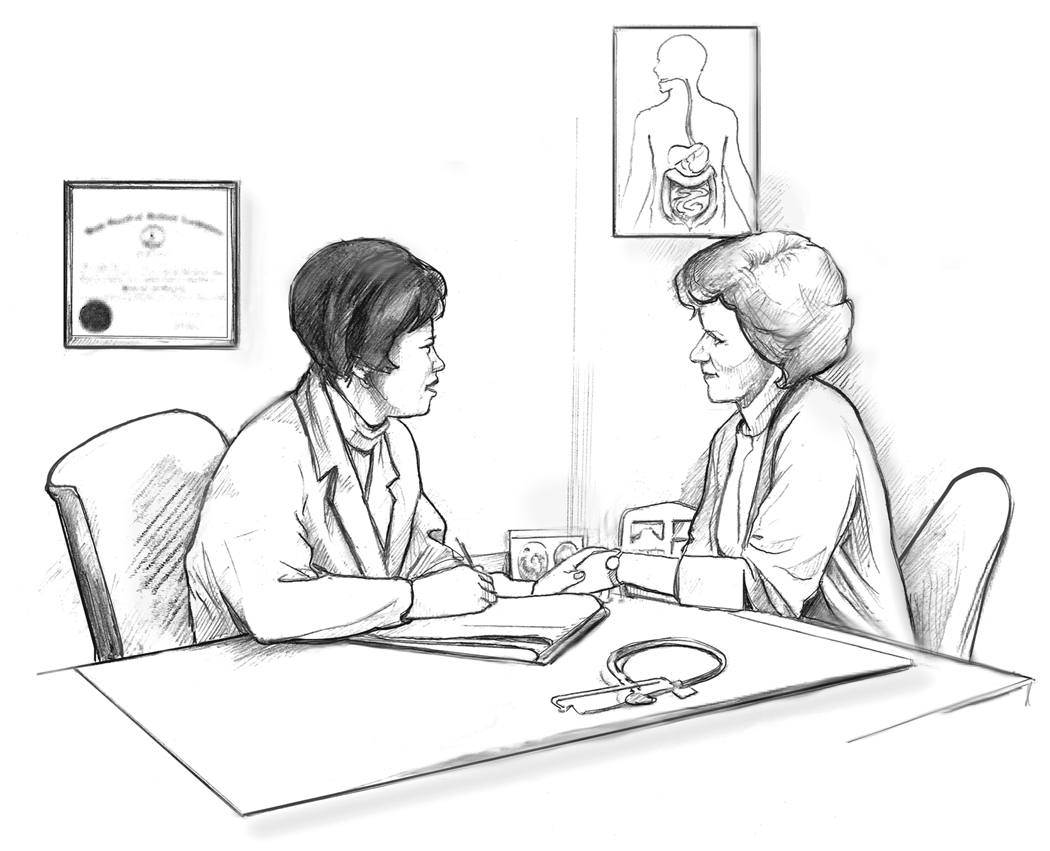 Shared decision-making begins with clear information, patient values, and voluntary choice. Public-domain image: NIDDK, NIH.
Elena Ruiz · Capable adult declining recommended treatment
A clear proposal
The team explains the recommended intervention and expected benefit.
A strong recommendation is appropriate.
Board pattern. Recommendation to disclosure
Teach-back confirms comprehension
Elena explains maternal risk, fetal risk, and alternatives in her own words.
Serious consequences do not erase capacity.
Board pattern. Disclosure to understanding
Her reason is her own
She identifies a value-based reason for declining.
The reason need not match the clinician's values.
Board pattern. Understanding to authentic choice
No coercion controls the choice
Elena communicates a stable refusal without external pressure.
Continue dialogue without threats or manipulation.
Board pattern. Authentic choice to refusal
Respect and continue care
The team documents informed refusal and offers ongoing noncoercive care.
Pregnancy does not transfer authority to clinicians, relatives, or courts.
Board pattern. Refusal to respectful care
Pattern card. Capable adult plus understanding plus voluntary refusal equals respect, document, and continue care.
Pearl. If the stem highlights both fetal danger and intact capacity, the fetal danger is usually the emotional distractor and capacity is the decisive signal.
Use Therapeutic Privilege Only Narrowly
Withholding information is a rare exception, never a way to dodge a hard conversation.
Therapeutic privilege allows delayed or limited disclosure only when disclosure itself is expected to cause serious harm. Upset is not serious harm. Refusal is not serious harm. A choice you dislike is not serious harm.
When information is withheld at all, keep it narrow. Smallest scope, reassess, disclose as soon as feasible. And know the difference. A patient asking not to hear details or delegating decisions is her choice, not your withholding.
Reveal why each proposed use succeeds or fails.
Ordinary distress does not justify withholding material information.
Preventing an autonomous refusal is not a valid use of privilege.
A rare, evidence-based risk of serious harm may justify limited temporary withholding.
Honor an informed request about receiving information or designating another decision-maker.
Pearl. Board trap. Emotional upset is not serious harm, and predicted nonadherence is not therapeutic privilege.
Lock the Board Algorithm
Decide who holds authority before arguing about the best outcome. Order matters.
The direct route. Identify capacity and authority, verify disclosure and voluntariness, check for a real exception, then pick the least coercive action that keeps care alive.
When principles collide, nobody gets deleted. State the beneficent recommendation plainly, minimize harm where you can, apply fair standards, and still honor the capable patient's informed choice.
Choose the single best board algorithm.
Authority, CURV, exception, least coercive care. Identify the decision-maker, verify the informed process, test narrow exceptions, then preserve care. Best outcome, then obtain permission. This makes beneficence decide before autonomy is assessed. Family preference, then patient preference. This wrongly places relatives ahead of a capable adult. Risk level alone decides. High risk strengthens counseling but does not by itself transfer authority.
Pearl. Final mnemonic. A Benevolent Nonmaleficent Judge names the principles; CURV tests whether the patient's choice should control.
Clinical walkthrough