
Gastrointestinal physiology
Acid suppression physiology
Can acid fall while gastrin rises? Follow the signal, then change the point where it is interrupted.
Trace gastric cells, receptor signals and acid pumps to explain drug timing, mucosal defense, feedback, absorption and evidence-based treatment decisions.
An H2 blocker interrupts one signal to the parietal cell. A proton pump inhibitor acts where several signals converge. That distinction explains why histamine can still stimulate acid after atropine, why meal timing matters for most conventional PPIs, and why less acid can produce more circulating gastrin.
Do not treat every rise in gastrin as evidence of an acid-producing tumor. First ask whether the stomach is acidic, whether the parietal cells are intact, and which medication the patient takes.
Place each signal in its gastric compartment
The body and fundus contain oxyntic glands with acid-secreting parietal cells, pepsinogen-secreting chief cells and enterochromaffin-like cells, usually abbreviated ECL cells. ECL histamine acts locally on neighboring parietal cells. Antral G cells release gastrin into the circulation, allowing an antral meal signal to affect the acid-producing stomach upstream. D cells provide somatostatin inhibition in both antral and oxyntic regions. These are regional distributions, not an assertion that each cell type occupies only one isolated spot. [1]
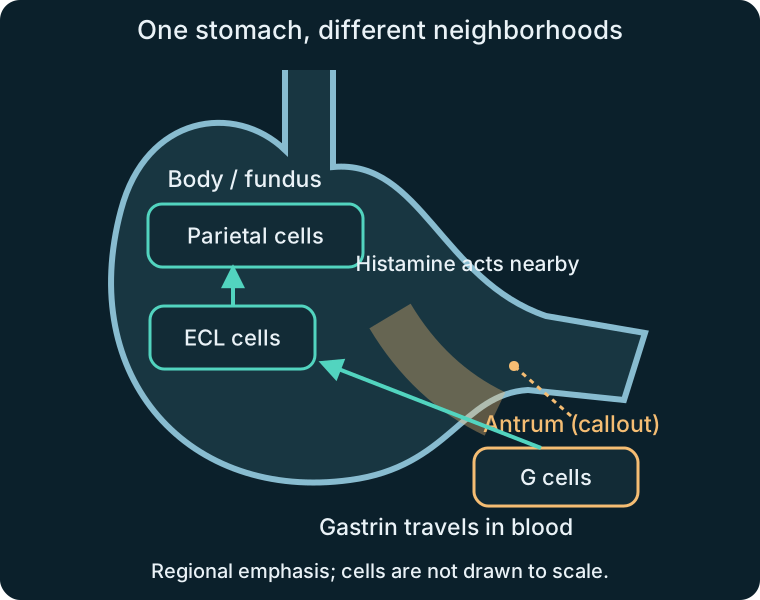
Follow a distant hormone signal versus a local mediator before naming its receptor.
Tap or click the diagram to open the full-size version. Original Bone Wizardry schematic; not to scale. Physiology reference.
- Antrum: meal sensing
- Peptides and neural gastrin-releasing peptide stimulate G cells. Gastrin enters blood. Antral D-cell somatostatin restrains G-cell secretion.
- Body and fundus: acid production
- Circulating gastrin stimulates ECL histamine release and parietal signaling. Local histamine reaches parietal H2 receptors. Parietal cells deliver hydrogen ions into the gland lumen.
- Surface: tissue protection
- Mucus and bicarbonate preserve a less acidic environment beside epithelial cells even while the bulk gastric contents remain acidic.
Read this as a map of compartments, not a scale drawing. Hormone in blood, local mediator and luminal acid occupy different spaces.
Vagal activity reaches the stomach through enteric neurons. Acetylcholine stimulates parietal muscarinic receptors, while gastrin-releasing peptide, or GRP, stimulates G cells. Calling the G-cell transmitter acetylcholine erases a useful distinction: muscarinic blockade does not block every component of vagal stimulation. Vagal activity also reduces somatostatin restraint. A meal can therefore recruit excitation and withdraw inhibition together. [1]
Gastrin also provides a trophic signal to oxyntic mucosa, including ECL cells. This growth effect is distinct from the immediate acid response and does not mean every compensatory gastrin rise indicates a tumor. [1]
Transfer: which neural transmitter directly stimulates the G cell—GRP or acetylcholine?
GRP. Acetylcholine directly stimulates parietal muscarinic receptors; these are different neural targets.
Follow a meal from receptor to luminal acid
Seeing, smelling and anticipating food can initiate neural secretion before food reaches the stomach. Gastric distension recruits reflexes, while peptides and amino acids encourage gastrin secretion. Food initially buffers luminal acid. As digestion proceeds and buffering declines, increasing acidity strengthens feedback inhibition. The named cephalic, gastric and intestinal phases overlap; they are not independent switches with universal fixed percentages.
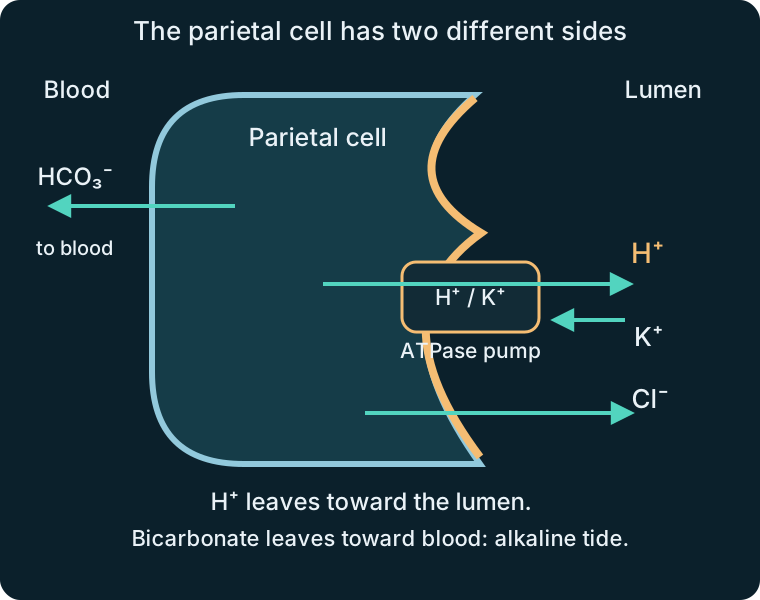
Distinguish the final secretion step from its upstream control signals and orient the alkaline tide.
Tap or click the diagram to open the full-size version. Original Bone Wizardry schematic; not to scale. Physiology reference.
Change one point in the pathway
Stop a signal, stop a pump, or neutralize acid?
H2 receives histamine. M3 receives acetylcholine. CCK2 receives gastrin. All can help stimulate the final acid pump. The dots below represent existing luminal acid, not a measured concentration.
Predict first: which intervention can change acid already in the lumen while leaving the pump available to secrete?
Initial state: signals and pump available; acid already present.
Start with the worked comparison below, or choose a mechanism and reveal one causal step at a time.
Model limit: this is a qualitative target map. It does not calculate pH, drug onset, dose, or the fraction of secretion remaining. The pathways amplify one another.
Worked comparison — always available
- No intervention: histamine and calcium-linked inputs support pump activity; existing acid remains in the lumen.
- H2 blockade: histamine signaling is interrupted. This also reduces the gastrin–ECL–histamine relay. Other receptors remain present; the residual acid response is not a fixed independent percentage.
- Conventional PPI: after absorption and acid activation, available active pumps are inhibited covalently. An upstream signal cannot bypass an inhibited pump. This does not instantly remove every active pump or neutralize existing acid.
- P-CAB: potassium competition inhibits the pump noncovalently without acid activation. This is not an H2 block or a luminal neutralization reaction.
- Antacid: existing luminal acid is neutralized. The pump is still available to secrete more acid later. The demonstration simplifies the chemical reaction; it is not a dose or time simulation.
Rule: locate the intervention before predicting its consequence.
- Histamine: H2 receptor
- Gs signaling increases adenylyl cyclase activity and cyclic AMP. Famotidine competitively blocks this receptor.
- Acetylcholine: M3 receptor
- Gq signaling engages phospholipase C and intracellular calcium. Atropine blocks muscarinic signaling rather than directly blocking H2 receptors.
- Gastrin: CCK2 receptor
- Calcium-linked signaling includes direct parietal stimulation and an important ECL histamine relay. H2 blockade can consequently blunt much of a gastrin response without antagonizing the gastrin receptor.
These inputs potentiate one another. Do not expect the acid response remaining after one receptor is blocked to equal a simple subtraction of an independent fixed percentage. Histamine and calcium-linked pathways converge on the secretory apparatus. This explains why blocking the histamine relay can reduce responses to a stimulus that began elsewhere. [1] [4]
Inside the parietal cell, carbonic anhydrase supports formation of hydrogen ions and bicarbonate from carbon dioxide and water. The apical H+/K+-ATPase uses energy to exchange intracellular hydrogen for luminal potassium. Potassium recycling and chloride secretion support continued hydrochloric acid secretion. At the blood-facing membrane, bicarbonate exits in exchange for chloride, contributing to the transient postmeal alkaline tide. The hydrogen ion goes toward the lumen; the bicarbonate goes toward blood. Confusing these surfaces reverses the physiology. [1]
Stimulation recruits proton pumps to the expanded secretory canalicular membrane. The final pump is distinct from a basolateral receptor and from the sodium-potassium pump used broadly by cells. A medication acting at this final acid pump can suppress output driven by multiple upstream secretagogues. [3]
Transfer: when hydrogen enters the lumen, which product leaves toward blood?
Bicarbonate. The two membrane directions explain the postmeal alkaline tide.