Diverticular disease: anatomy, inflammation and the next decision
Separate diverticulosis, hemorrhage and diverticulitis; interpret CT alongside host risk; choose support, antibiotics or source control; and plan evidence-based recovery.
A patient can have a colonic pouch, a bleeding vessel beside that pouch, or inflammation extending beyond it. The urgent decision is not simply whether diverticula are present. Identify the abnormal structure, check how far the process extends, then ask whether this patient can safely manage the illness outside the hospital.
A pouch, a vessel, or inflammation?
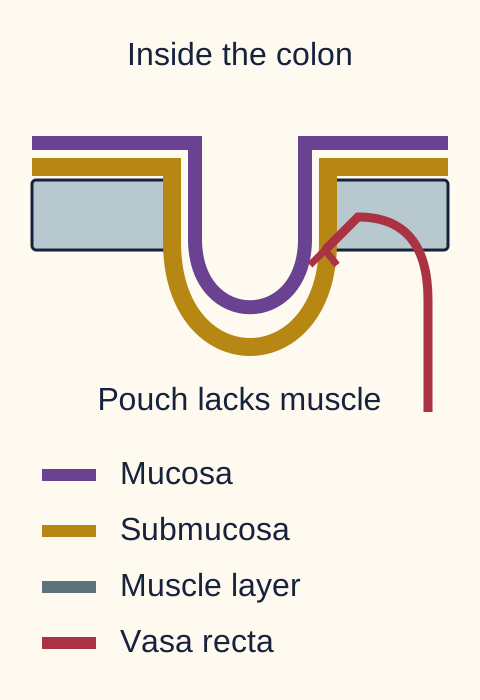
A colonoscopy report says diverticula. Does that explain today's symptom? Start with the structure that is failing, not the report's label. Most acquired colonic diverticula contain mucosa and submucosa protruding through the muscular layer. They are called false diverticula because the pouch does not contain the complete muscular wall. Penetrating vasa recta create vulnerable sites and lie closely beside the pouch. [5]
Follow the purple lining into the pouch, then locate the red vessel. The lining and the artery explain different presentations. Image: Original Bone Wizardry schematic, CC BY 4.0.
Diverticulosis means that the pouches are present; many are incidental. Diverticular hemorrhage is usually sudden, painless, sometimes substantial red or maroon rectal bleeding from an injured vasa recta. Acute inflammation is not required for that vessel to bleed. Diverticulitis instead produces inflammation in and around a diverticulum, usually with focal lower abdominal pain and tenderness. Fever and altered bowel habits can occur, but neither is required. Left-sided pain is common in sigmoid disease; location varies with the affected colon. [1][5]
Trace the symptom to the structure
Place a finger on the vessel. Predict whether its rupture needs inflamed surrounding fat. Then trace the pouch wall and predict what nearby inflammation would do to the examination.
Result: vessel injury can produce brisk blood without tenderness; inflammation makes focal tenderness and pericolic changes more likely. These patterns guide the differential, not an absolute diagnostic rule. Substantial bleeding still needs prompt assessment and stabilization. [5]
Apply it: an asymptomatic patient with incidental diverticula does not need an acute diverticulitis antibiotic course. A patient with new focal pain needs evaluation even if the last colonoscopy was normal. [1]
Read beyond the bowel wall
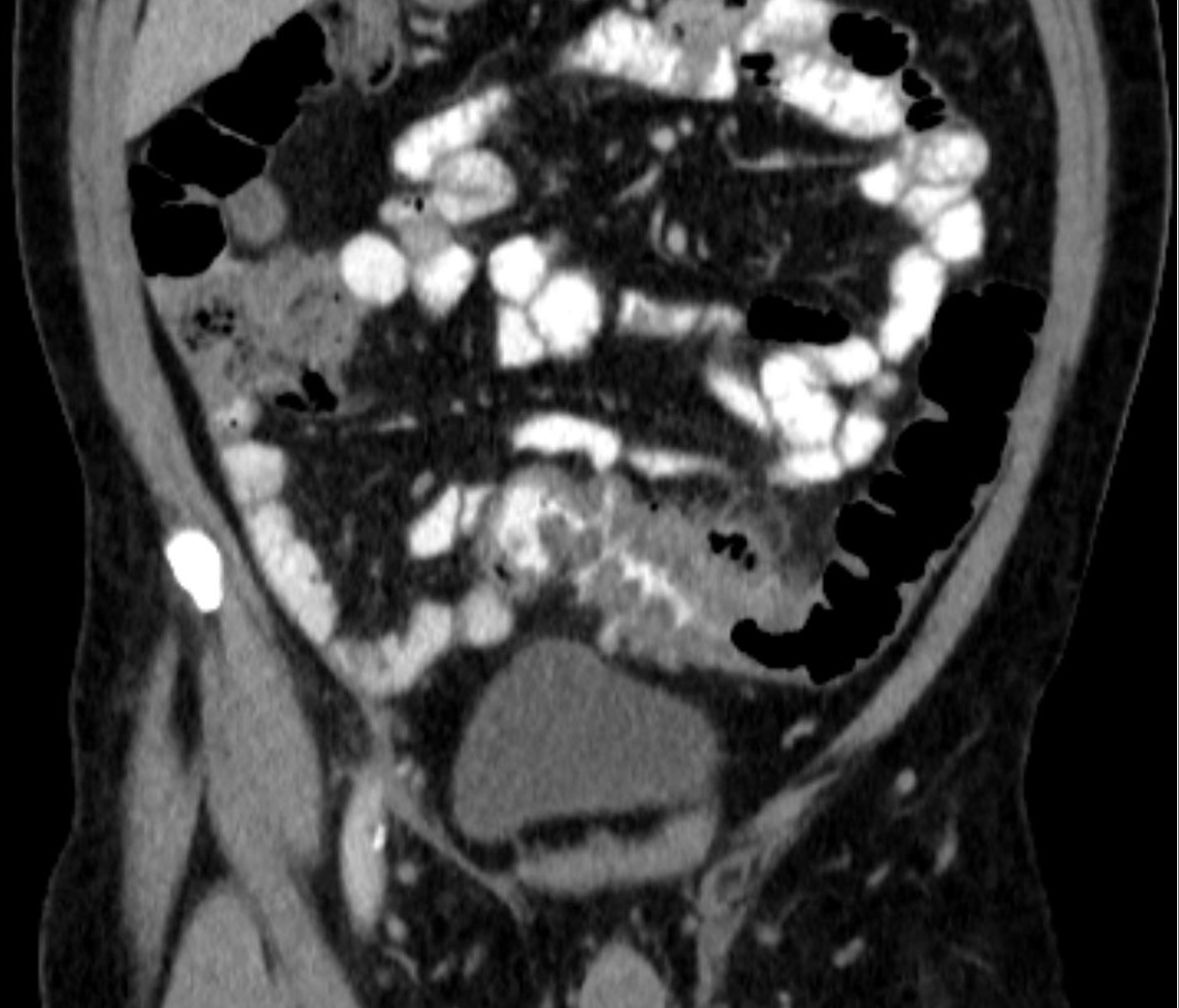
Why does the same painful segment sometimes need only supportive care and sometimes need drainage? The surrounding tissues answer that question. CT of the abdomen and pelvis is particularly useful at a first presentation without previous imaging confirmation, with severe illness, in immunocompromise, or when symptoms fail to improve. It confirms the location, tests alternatives and looks for complications. Contrast and alternative imaging choices depend on contraindications and the clinical setting. A previous diagnosis does not make every new pain an identical recurrence. [1][2][4]
Find the thickened bowel above the bladder and compare nearby fat with more distant fat. This single image cannot reliably settle whether all adjacent gas is inside or outside the bowel; the original author explicitly notes that uncertainty. Image: Hellerhoff, 2014, source, CC BY-SA 4.0. , no annotations or cropping. [6].
Follow five neighborhoods: wall, fat, collection, cavity, connections. Segmental wall thickening and pericolic fat stranding support inflammation. A rim-enhancing fluid pocket is an abscess. Distant extraluminal air and free fluid are concerning for perforation, especially with generalized tenderness or instability. Assess the bladder interface for a tract, and the upstream bowel for dilation across a narrowed segment. Read the full CT study and report, not one attractive slice. [3][4]
Compare two reports
Report A describes wall thickening and fat stranding. Report B adds a 6 cm rim-enhancing collection. Identify the new treatment target before choosing a drug.
Result: B adds an infected cavity that may need drainage; A does not supply a drainable target. This distinction is anatomical, not a judgment based only on pain intensity. [4]
Transfer: persistent fever during treatment warrants reassessment for a collection or another cause. It does not prove resistant bacteria, and a new antibiotic cannot substitute for finding an uncontrolled source. [2][3]
The scan and the patient make the plan together
Would identical CT findings justify identical treatment in a healthy adult and a transplant recipient? No. First assess perfusion, mental status, peritoneal signs and systemic illness. Then consider immune status, frailty, significant comorbidity, oral intake and dependable follow-up. Immunosuppression can blunt fever and tenderness while increasing the danger of complications. A mild examination is not reassuring by itself in that setting. [1][2]
For selected immunocompetent, nonfrail adults with mild CT-confirmed uncomplicated diverticulitis, no systemic inflammatory response, adequate oral intake and reliable reassessment, outpatient care without routine antibiotics is reasonable. Provide hydration, appropriate analgesia and a diet adjusted for comfort. Brief clear liquids can help some patients, but prolonged fasting is not the treatment goal. Advance food as symptoms improve. [1][2]
Antibiotics are appropriate with immunocompromise, frailty, significant comorbidity, refractory symptoms, vomiting or a higher-risk clinical or imaging pattern. CRP above 140 mg/L and a white-cell count above 15 × 109/L are examples of risk markers, not independent proof of an abscess or a surgical indication. A longer inflamed segment also increases concern. If oral treatment is appropriate, amoxicillin-clavulanate is one option providing enteric gram-negative and anaerobic coverage. Regimen, duration, allergies, renal function and local resistance require clinical review. Do not extrapolate trials in low-risk patients to sepsis or an infected collection. [1][2]
Change only the host
Two patients have local wall and fat inflammation without a collection. Both can drink. One is otherwise healthy; the other takes prednisone and a transplant immunosuppressant. Predict which assumption about observation changes.
Result: an intact host response is part of the evidence supporting selective observation. The transplant recipient needs antibiotics, close assessment and a low threshold for imaging and surgical consultation, even with a normal temperature. [2]
Reassessment is part of treatment. Worsening or spreading pain, persistent vomiting, inability to hydrate, increasing fever, faintness or confusion need urgent reassessment. New generalized tenderness or instability calls for emergency care. An inability to advance the diet after several days also deserves review. A reassuring initial scan cannot guarantee a reassuring course. Inability to maintain safe outpatient care can justify admission even without an abscess. [1][2]
Containment determines the treatment target
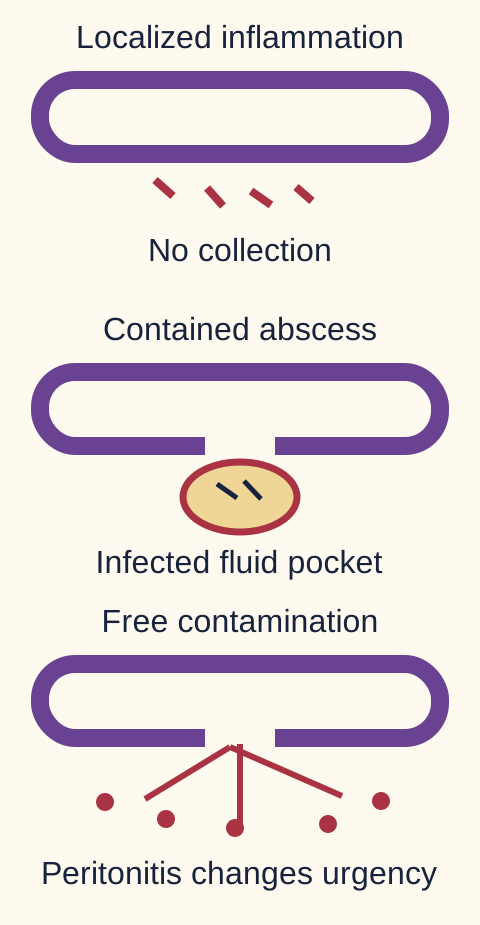
Does any gas outside the colon mean an emergency colectomy? No. Describe the actual anatomy and physiology rather than relying on one severity label. Uncomplicated disease is localized wall and surrounding fat inflammation without an abscess, fistula, stricture or obstruction. Terminology differs at the edges: ACG 2026 includes phlegmon and any perforation among complicated presentations; ASCRS 2020 does not classify tiny contained gas without a systemic inflammatory response the same way. Neither terminology makes every small gas focus an automatic operation. [1][4]
Compare three possible presentations. They are not inevitable stages that every pouch must pass through. Image: Original Bone Wizardry schematic, CC BY 4.0.
A localized abscess needs antimicrobial treatment. A small collection, such as 2 cm, can often be treated with antibiotics and careful follow-up. Larger accessible collections commonly need image-guided drainage plus antibiotics. ASCRS generally uses a threshold above 3 cm; WSES uses about 4 to 5 cm. These are guideline-dependent decision aids, not biological cutoffs. Size, accessibility, clinical response and host risk matter together. A persistent 6 cm accessible abscess is a stronger drainage case than an improving 2 cm pocket. [3][4]
If there is no safe drainage route, selected stable patients can receive antibiotics with close monitoring and surgical involvement. Deterioration or failure to control the source warrants operative consideration. Isolated pericolic gas in a stable patient without diffuse peritonitis can be managed nonoperatively with careful surveillance; WSES suggests antibiotics in this setting. This is not permission for unattended observation. [3]
Diffuse peritonitis or uncontrolled sepsis changes the priority. Resuscitation, intravenous broad-spectrum antibiotics and urgent surgical source control proceed together. A drainage catheter cannot address widespread contamination without a localized target. The operation and whether to reconnect or divert the bowel depend on stability, comorbidity and operative findings, not simply the number of previous episodes. [3][4]
Containment explorer
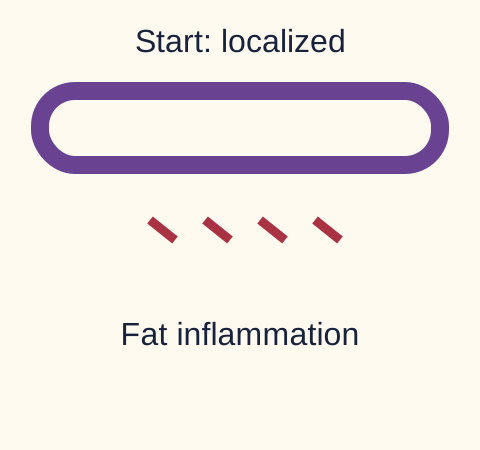
Start with the local pattern below. Predict where bowel contents would go after each change, then open that scenario to see the altered route. Each scenario starts independently from local inflammation. Close a scenario to reset it, or keep two open to compare. The treatment reference above remains available throughout.
Starting pattern: inflammation stays beside the colon, without a collection. Image: Original Bone Wizardry schematic, CC BY 4.0.Add a fluid pocket beside the colon
Changed result: fluid collects in a bounded cavity. Image: Original Bone Wizardry schematic, CC BY 4.0.
The new cavity creates a potential drainage target. Its dimensions and a safe access route decide whether a catheter is useful; antibiotics still treat the infection. [3]
Connect the inflamed segment to the bladder
Changed result: the tract gives gas and bacteria access to the urinary tract. Image: Original Bone Wizardry schematic, CC BY 4.0.
A tract explains why urinary infections can recur after temporary antibiotic improvement. Treatment must address the structural connection as well as active infection. [4]
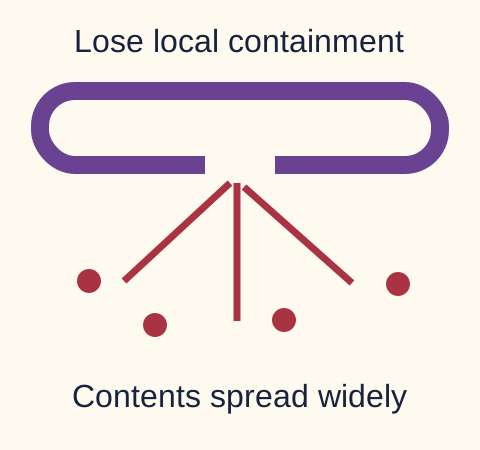
Let contents spread into the peritoneal cavity
Changed result: dispersed contents are not confined in one drainable pocket. Image: Original Bone Wizardry schematic, CC BY 4.0.
With diffuse peritonitis, the new distribution requires urgent surgical assessment and source control. A quiet small collection and widespread contamination are not interchangeable findings. [3]
Apply it: explain why the same word, perforation, can accompany either close nonoperative surveillance or an emergency operation. Include the distribution of gas or fluid and the patient's examination in your explanation.
Later symptoms can reveal a structural complication
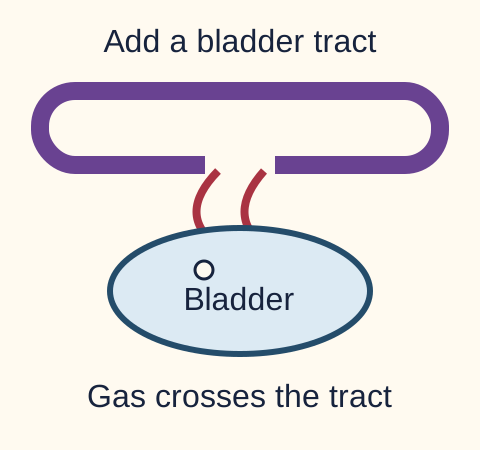
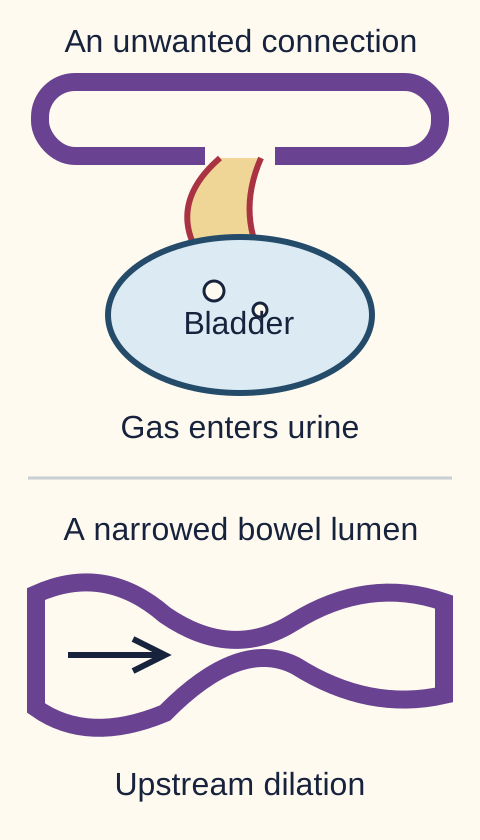
Why can urinary symptoms matter more than abdominal pain after sigmoid inflammation? Adjacent organs can become connected. A colovesical fistula allows colonic gas and organisms into the bladder. Pneumaturia, fecaluria and recurrent enteric urinary infections raise suspicion, particularly without recent catheterization. Gas in the bladder alone is not specific: instrumentation and gas-forming infection are alternatives. Combine the history with the bowel-bladder interface on imaging. [4][7]
Follow the upper tract from bowel to bladder. In the lower drawing, compare the narrow segment with the dilated bowel before it. Image: Original Bone Wizardry schematic, CC BY 4.0.
A stricture creates the opposite problem: instead of an extra route, it limits the normal route. Progressive distention, constipation or obstipation and upstream colonic dilation suggest obstruction. Inflammation can narrow the lumen during an acute episode; fibrosis can produce a persistent narrowing. Malignancy remains an important alternative, so a narrowed segment should not simply be assumed benign because diverticula are nearby. [1][4]
Predict what recurs
Antibiotics temporarily improve an enteric urinary infection, but a bowel-bladder tract remains. Predict the symptom that could return. Then imagine antibiotics settling inflammation around a fixed scar: predict whether stool passage must normalize.
Result: urinary gas or infection can recur through an untreated tract; a fixed narrowing can continue to obstruct despite less inflammation. Fistulas, symptomatic strictures and obstruction merit colorectal surgical assessment. Stable fistulizing disease is not automatically the same emergency as diffuse peritonitis, but current sepsis or complete obstruction changes urgency. [4]
Transfer: when follow-up symptoms change organ systems or persist without recovery, revisit anatomy rather than prescribing repeated courses for presumed uncomplicated recurrence.
Recovery: exclude a missed diagnosis, then reduce future burden
Does every recovered patient need the same colonoscopy appointment? The purpose is to detect a malignancy or other lesion that mimicked diverticulitis, not to prove that diverticulitis turns into cancer. ACG 2026 recommends colonoscopy after complicated disease has resolved. Following uncomplicated disease, it suggests colonoscopy for alarm symptoms or patients not current with colorectal cancer screening. Otherwise routine screening and surveillance intervals apply. [1]
Plan a routine post-episode examination after about 6 to 8 weeks and clinical resolution, not through an actively inflamed segment. Persistent pain, bleeding, iron-deficiency anemia, weight loss or a changed bowel habit require reassessment and appropriate diagnostic planning rather than passive waiting. The older AGA 2021 advice was broader after a first uncomplicated episode, unless a high-quality colonoscopy had been performed within one year. State the guideline being applied when that difference affects a case; this lesson's routine follow-up decisions use ACG 2026. [1][2]
Change the recovery finding
A patient has recovered from uncomplicated disease and had a normal, high-quality colonoscopy two years ago. First assume no alarm features. Then add new iron-deficiency anemia. Decide which finding creates a diagnostic indication beyond routine screening.
Result: the anemia changes the plan even though screening was current. A previous normal examination is not protection from evaluating a new alarm feature. [1]
Persistent symptoms also need classification. Ongoing CT inflammation suggests chronic or smoldering disease; separate episodes require a recovery interval. If appropriate imaging and lower endoscopy exclude ongoing inflammation and structural disease, visceral hypersensitivity may explain persistent discomfort. Repeated antibiotics or surgery should not be assumed to cure pain without establishing its cause. [1][2]
After recovery, favor a high-quality, fiber-rich pattern with fruits, vegetables, whole grains and legumes, regular activity, a healthy weight, smoking cessation and avoidance of heavy alcohol intake. Nuts, seeds, corn and popcorn do not require routine exclusion. Much lifestyle evidence concerns a first episode; recurrence benefit is plausible but less certain, so do not promise prevention. Review frequent NSAID use without stopping a drug that has a compelling indication; prescribed aspirin for secondary cardiovascular prevention is an important exception. Mesalamine, rifaximin and probiotics are not recommended to prevent recurrent diverticulitis. [1][2]
Elective surgery is a shared decision, not an episode counter. Recurrent, imaging-confirmed disease that substantially disrupts life warrants discussion of resection, operative risks and patient preferences. Surgery reduces recurrence but does not abolish it or guarantee pain relief. Recurrence does not mean inevitable free perforation; complications frequently occur at the initial presentation. Structural complications and chronic immunosuppression deserve their own surgical discussion. [1][2][4]
Apply the full clinical picture
Use the patient, the imaging and the time course together. Each answer has an explanation, including why a competing choice might be tempting and which supplied finding changes the decision.
Case 1
Show answer and explanations for case 1
A. Venous congestion from increased portal pressure (Why this does not fit)
Portal hypertension can produce gastrointestinal bleeding through venous pathways. A visible vessel in a diverticulum with otherwise noninflamed mucosa instead supports a local diverticular arterial source. Localize the lesion before attributing bleeding to systemic venous pressure.
Reasoning steps for option A
For 'Venous congestion from increased portal pressure', what mechanism or clinical role makes it plausible in this presentation: A 73-year-old develops abrupt, large-volume maroon stool without abdominal pain?
Portal hypertension can produce gastrointestinal bleeding through venous pathways.
Which supplied finding in this case most directly tests whether 'Venous congestion from increased portal pressure' fits the presentation?
A visible vessel in a diverticulum with otherwise noninflamed mucosa instead supports a local diverticular arterial source.
What discriminator should control the decision before choosing 'Venous congestion from increased portal pressure' for this patient?
Localize the lesion before attributing bleeding to systemic venous pressure.
B. Mucosal ulceration from active segmental colitis (Why this does not fit)
Inflamed colonic mucosa can bleed and produce bowel symptoms. The examination and endoscopic mucosa do not show the inflammatory pattern required to explain this episode. A noninflamed diverticulum can bleed through a vascular mechanism.
Reasoning steps for option B
For 'Mucosal ulceration from active segmental colitis', what mechanism or clinical role makes it plausible in this presentation: A 73-year-old develops abrupt, large-volume maroon stool without abdominal pain?
Inflamed colonic mucosa can bleed and produce bowel symptoms.
Which supplied finding in this case most directly tests whether 'Mucosal ulceration from active segmental colitis' fits the presentation?
The examination and endoscopic mucosa do not show the inflammatory pattern required to explain this episode.
What discriminator should control the decision before choosing 'Mucosal ulceration from active segmental colitis' for this patient?
A noninflamed diverticulum can bleed through a vascular mechanism.
C. Arterial injury involving an adjacent penetrating vasa recta (Best answer)
Vasa recta penetrate the muscular wall near acquired colonic diverticula. A visible bleeding vessel in the pouch and painless onset identify diverticular arterial hemorrhage. Diverticular bleeding does not require diverticulitis.
Reasoning steps for option C
For 'Arterial injury involving an adjacent penetrating vasa recta', what mechanism or clinical role makes it plausible in this presentation: A 73-year-old develops abrupt, large-volume maroon stool without abdominal pain?
Vasa recta penetrate the muscular wall near acquired colonic diverticula.
Which supplied finding in this case most directly tests whether 'Arterial injury involving an adjacent penetrating vasa recta' fits the presentation?
A visible bleeding vessel in the pouch and painless onset identify diverticular arterial hemorrhage.
What discriminator should control the decision before choosing 'Arterial injury involving an adjacent penetrating vasa recta' for this patient?
Diverticular bleeding does not require diverticulitis.
D. Transmural inflammation with local bowel perforation (Why this does not fit)
Perforation can accompany destructive diverticular inflammation. That process would not best explain an isolated visible bleeding vessel without pain or inflammatory mucosal findings. Separate a bleeding vessel from an inflamed or perforated bowel segment.
Reasoning steps for option D
For 'Transmural inflammation with local bowel perforation', what mechanism or clinical role makes it plausible in this presentation: A 73-year-old develops abrupt, large-volume maroon stool without abdominal pain?
Perforation can accompany destructive diverticular inflammation.
Which supplied finding in this case most directly tests whether 'Transmural inflammation with local bowel perforation' fits the presentation?
That process would not best explain an isolated visible bleeding vessel without pain or inflammatory mucosal findings.
What discriminator should control the decision before choosing 'Transmural inflammation with local bowel perforation' for this patient?
Separate a bleeding vessel from an inflamed or perforated bowel segment.
E. Submucosal dilation of ectatic vascular channels (Why this does not fit)
Angioectatic vessels are another cause of painless lower gastrointestinal bleeding. Endoscopy specifically localizes the bleeding vessel to a diverticulum rather than an ectatic mucosal lesion. Painless bleeding requires lesion localization because several vascular causes are possible.
Reasoning steps for option E
For 'Submucosal dilation of ectatic vascular channels', what mechanism or clinical role makes it plausible in this presentation: A 73-year-old develops abrupt, large-volume maroon stool without abdominal pain?
Angioectatic vessels are another cause of painless lower gastrointestinal bleeding.
Which supplied finding in this case most directly tests whether 'Submucosal dilation of ectatic vascular channels' fits the presentation?
Endoscopy specifically localizes the bleeding vessel to a diverticulum rather than an ectatic mucosal lesion.
What discriminator should control the decision before choosing 'Submucosal dilation of ectatic vascular channels' for this patient?
Painless bleeding requires lesion localization because several vascular causes are possible.
Takeaway: A diverticular vasa recta can bleed briskly without acute diverticulitis.
Penetrating vessels create sites where the muscular wall is interrupted. Herniation of mucosa and submucosa at those sites accounts for the incomplete wall of these acquired pouches. False colonic diverticula do not contain every normal bowel-wall layer.
Reasoning steps for option A
For 'A site of penetrating vasa recta', what mechanism or clinical role makes it plausible in this presentation: A sigmoid specimen from an adult with recurrent diverticular disease contains multiple outpouchings?
Penetrating vessels create sites where the muscular wall is interrupted.
Which supplied finding in this case most directly tests whether 'A site of penetrating vasa recta' fits the presentation?
Herniation of mucosa and submucosa at those sites accounts for the incomplete wall of these acquired pouches.
What discriminator should control the decision before choosing 'A site of penetrating vasa recta' for this patient?
False colonic diverticula do not contain every normal bowel-wall layer.
B. An attachment of a mesenteric lymph node (Why this does not fit)
Mesenteric lymph nodes drain tissues outside the bowel wall. They do not normally create the muscular penetration site described in this specimen. Match the missing wall layer to a structure that traverses it.
Reasoning steps for option B
For 'An attachment of a mesenteric lymph node', what mechanism or clinical role makes it plausible in this presentation: A sigmoid specimen from an adult with recurrent diverticular disease contains multiple outpouchings?
Mesenteric lymph nodes drain tissues outside the bowel wall.
Which supplied finding in this case most directly tests whether 'An attachment of a mesenteric lymph node' fits the presentation?
They do not normally create the muscular penetration site described in this specimen.
What discriminator should control the decision before choosing 'An attachment of a mesenteric lymph node' for this patient?
Match the missing wall layer to a structure that traverses it.
C. A junction between adjacent haustral folds (Why this does not fit)
Haustra describe the external sacculations of the colon. Their boundaries do not explain a pouch made specifically of mucosa and submucosa through a muscular defect. Normal colonic contour is not itself a false diverticulum.
Reasoning steps for option C
For 'A junction between adjacent haustral folds', what mechanism or clinical role makes it plausible in this presentation: A sigmoid specimen from an adult with recurrent diverticular disease contains multiple outpouchings?
Haustra describe the external sacculations of the colon.
Which supplied finding in this case most directly tests whether 'A junction between adjacent haustral folds' fits the presentation?
Their boundaries do not explain a pouch made specifically of mucosa and submucosa through a muscular defect.
What discriminator should control the decision before choosing 'A junction between adjacent haustral folds' for this patient?
Normal colonic contour is not itself a false diverticulum.
D. A remnant of the vitelline duct (Why this does not fit)
An embryologic duct remnant can produce a true intestinal diverticulum. Multiple acquired sigmoid pouches lacking a complete muscular coat do not fit that mechanism. Distinguish acquired colonic pseudodiverticula from embryologic true diverticula.
Reasoning steps for option D
For 'A remnant of the vitelline duct', what mechanism or clinical role makes it plausible in this presentation: A sigmoid specimen from an adult with recurrent diverticular disease contains multiple outpouchings?
An embryologic duct remnant can produce a true intestinal diverticulum.
Which supplied finding in this case most directly tests whether 'A remnant of the vitelline duct' fits the presentation?
Multiple acquired sigmoid pouches lacking a complete muscular coat do not fit that mechanism.
What discriminator should control the decision before choosing 'A remnant of the vitelline duct' for this patient?
Distinguish acquired colonic pseudodiverticula from embryologic true diverticula.
Takeaway: Mucosa and submucosa can herniate through vascular entry sites in the colonic muscle.
A. Colonoscopy with examination of the sigmoid (Why this does not fit)
Colonoscopy can detect mucosal disease or a malignancy that mimics diverticular disease. An acutely inflamed segment is not the setting for routine diagnostic colonoscopy, and the test does not fully assess surrounding collections. Use cross-sectional imaging for acute anatomy and endoscopy for an appropriate later indication.
Reasoning steps for option A
For 'Colonoscopy with examination of the sigmoid', what mechanism or clinical role makes it plausible in this presentation: A 57-year-old has 36 hours of focal left lower quadrant pain, a temperature of 38?
Colonoscopy can detect mucosal disease or a malignancy that mimics diverticular disease.
Which supplied finding in this case most directly tests whether 'Colonoscopy with examination of the sigmoid' fits the presentation?
An acutely inflamed segment is not the setting for routine diagnostic colonoscopy, and the test does not fully assess surrounding collections.
What discriminator should control the decision before choosing 'Colonoscopy with examination of the sigmoid' for this patient?
Use cross-sectional imaging for acute anatomy and endoscopy for an appropriate later indication.
B. Plain abdominal radiography without contrast (Why this does not fit)
Radiographs can sometimes show obstruction or free intraperitoneal gas. They cannot reliably confirm focal diverticular inflammation or map a small abscess. A test for a complication alone is not a full assessment of suspected diverticulitis.
Reasoning steps for option B
For 'Plain abdominal radiography without contrast', what mechanism or clinical role makes it plausible in this presentation: A 57-year-old has 36 hours of focal left lower quadrant pain, a temperature of 38?
Radiographs can sometimes show obstruction or free intraperitoneal gas.
Which supplied finding in this case most directly tests whether 'Plain abdominal radiography without contrast' fits the presentation?
They cannot reliably confirm focal diverticular inflammation or map a small abscess.
What discriminator should control the decision before choosing 'Plain abdominal radiography without contrast' for this patient?
A test for a complication alone is not a full assessment of suspected diverticulitis.
C. Abdominal ultrasonography focused on the colon (Why this does not fit)
Ultrasound can diagnose diverticulitis in experienced hands and avoids radiation. With CT available and no contraindication, CT better fits this comprehensive initial assessment, including complications and alternatives. Choose the modality suited to the needed anatomy and the local clinical setting.
Reasoning steps for option C
For 'Abdominal ultrasonography focused on the colon', what mechanism or clinical role makes it plausible in this presentation: A 57-year-old has 36 hours of focal left lower quadrant pain, a temperature of 38?
Ultrasound can diagnose diverticulitis in experienced hands and avoids radiation.
Which supplied finding in this case most directly tests whether 'Abdominal ultrasonography focused on the colon' fits the presentation?
With CT available and no contraindication, CT better fits this comprehensive initial assessment, including complications and alternatives.
What discriminator should control the decision before choosing 'Abdominal ultrasonography focused on the colon' for this patient?
Choose the modality suited to the needed anatomy and the local clinical setting.
D. CT of the abdomen and pelvis (Best answer)
CT evaluates both the colonic wall and extraluminal tissues. This first unconfirmed episode needs diagnostic confirmation, localization and assessment for complications or another cause. A familiar symptom pattern is not a substitute for establishing the acute diagnosis.
Reasoning steps for option D
For 'CT of the abdomen and pelvis', what mechanism or clinical role makes it plausible in this presentation: A 57-year-old has 36 hours of focal left lower quadrant pain, a temperature of 38?
CT evaluates both the colonic wall and extraluminal tissues.
Which supplied finding in this case most directly tests whether 'CT of the abdomen and pelvis' fits the presentation?
This first unconfirmed episode needs diagnostic confirmation, localization and assessment for complications or another cause.
What discriminator should control the decision before choosing 'CT of the abdomen and pelvis' for this patient?
A familiar symptom pattern is not a substitute for establishing the acute diagnosis.
E. MRI of the abdomen and pelvis (Why this does not fit)
MRI can be an alternative when CT is unavailable or contraindicated. This first acute presentation has neither limitation, so CT remains the preferred initial study in the stated setting. An appropriate alternative is not necessarily the first choice when the preferred test is available.
Reasoning steps for option E
For 'MRI of the abdomen and pelvis', what mechanism or clinical role makes it plausible in this presentation: A 57-year-old has 36 hours of focal left lower quadrant pain, a temperature of 38?
MRI can be an alternative when CT is unavailable or contraindicated.
Which supplied finding in this case most directly tests whether 'MRI of the abdomen and pelvis' fits the presentation?
This first acute presentation has neither limitation, so CT remains the preferred initial study in the stated setting.
What discriminator should control the decision before choosing 'MRI of the abdomen and pelvis' for this patient?
An appropriate alternative is not necessarily the first choice when the preferred test is available.
Takeaway: CT is especially useful when diverticulitis has not previously been confirmed by imaging.
A. Use a plain radiograph to count visible gas foci (Why this does not fit)
Radiographs can show large amounts of free gas or obstruction. Counting foci does not establish their CT distribution or assess the peritoneal examination. The location and clinical effect of gas matter more than its visible count.
Reasoning steps for option A
For 'Use a plain radiograph to count visible gas foci', what mechanism or clinical role makes it plausible in this presentation: A stable patient has focal lower abdominal tenderness?
Radiographs can show large amounts of free gas or obstruction.
Which supplied finding in this case most directly tests whether 'Use a plain radiograph to count visible gas foci' fits the presentation?
Counting foci does not establish their CT distribution or assess the peritoneal examination.
What discriminator should control the decision before choosing 'Use a plain radiograph to count visible gas foci' for this patient?
The location and clinical effect of gas matter more than its visible count.
B. Review the full CT study together with the peritoneal examination (Best answer)
The full study defines the anatomical distribution, while examination assesses its clinical effect. Both are missing from the information needed to judge a nonoperative approach. Combine anatomy and physiology before assigning treatment urgency.
Reasoning steps for option B
For 'Review the full CT study together with the peritoneal examination', what mechanism or clinical role makes it plausible in this presentation: A stable patient has focal lower abdominal tenderness?
The full study defines the anatomical distribution, while examination assesses its clinical effect.
Which supplied finding in this case most directly tests whether 'Review the full CT study together with the peritoneal examination' fits the presentation?
Both are missing from the information needed to judge a nonoperative approach.
What discriminator should control the decision before choosing 'Review the full CT study together with the peritoneal examination' for this patient?
Combine anatomy and physiology before assigning treatment urgency.
C. Use the white-cell count to classify the perforation (Why this does not fit)
Leukocyte measurements contribute to an assessment of systemic inflammation. They do not localize gas or establish diffuse peritonitis by themselves. Inflammatory markers cannot replace the anatomical and clinical assessment.
Reasoning steps for option C
For 'Use the white-cell count to classify the perforation', what mechanism or clinical role makes it plausible in this presentation: A stable patient has focal lower abdominal tenderness?
Leukocyte measurements contribute to an assessment of systemic inflammation.
Which supplied finding in this case most directly tests whether 'Use the white-cell count to classify the perforation' fits the presentation?
They do not localize gas or establish diffuse peritonitis by themselves.
What discriminator should control the decision before choosing 'Use the white-cell count to classify the perforation' for this patient?
Inflammatory markers cannot replace the anatomical and clinical assessment.
D. Use colonoscopy to identify the suspected wall defect (Why this does not fit)
Endoscopy can identify mucosal pathology at an appropriate time. It is not the first step for classifying possible acute perforation in an inflamed segment. Use the acute test that addresses the relevant extraluminal anatomy.
Reasoning steps for option D
For 'Use colonoscopy to identify the suspected wall defect', what mechanism or clinical role makes it plausible in this presentation: A stable patient has focal lower abdominal tenderness?
Endoscopy can identify mucosal pathology at an appropriate time.
Which supplied finding in this case most directly tests whether 'Use colonoscopy to identify the suspected wall defect' fits the presentation?
It is not the first step for classifying possible acute perforation in an inflamed segment.
What discriminator should control the decision before choosing 'Use colonoscopy to identify the suspected wall defect' for this patient?
Use the acute test that addresses the relevant extraluminal anatomy.
Takeaway: An isolated CT slice cannot replace full-study interpretation and the patient's physiology.
A. Oral antibiotics with an extended preventive course (Why this does not fit)
Antibiotics are appropriate in higher-risk or complicated disease. This patient's low-risk features do not justify routine treatment or an extended course to prevent future episodes. Use antibiotics for a current indication, not as unproven recurrence prevention.
Reasoning steps for option A
For 'Oral antibiotics with an extended preventive course', what mechanism or clinical role makes it plausible in this presentation: A 46-year-old has mild focal pain with CT-confirmed sigmoid wall thickening and pericolic fat stranding?
Antibiotics are appropriate in higher-risk or complicated disease.
Which supplied finding in this case most directly tests whether 'Oral antibiotics with an extended preventive course' fits the presentation?
This patient's low-risk features do not justify routine treatment or an extended course to prevent future episodes.
What discriminator should control the decision before choosing 'Oral antibiotics with an extended preventive course' for this patient?
Use antibiotics for a current indication, not as unproven recurrence prevention.
B. Supportive outpatient care with explicit and timely reassessment (Best answer)
Selected mild uncomplicated episodes can improve without routine antibiotics. The CT pattern, intact host response, oral intake and reliable follow-up satisfy the relevant safety conditions. Observation is an active plan with return precautions, not abandonment of care.
Reasoning steps for option B
For 'Supportive outpatient care with explicit and timely reassessment', what mechanism or clinical role makes it plausible in this presentation: A 46-year-old has mild focal pain with CT-confirmed sigmoid wall thickening and pericolic fat stranding?
Selected mild uncomplicated episodes can improve without routine antibiotics.
Which supplied finding in this case most directly tests whether 'Supportive outpatient care with explicit and timely reassessment' fits the presentation?
The CT pattern, intact host response, oral intake and reliable follow-up satisfy the relevant safety conditions.
What discriminator should control the decision before choosing 'Supportive outpatient care with explicit and timely reassessment' for this patient?
Observation is an active plan with return precautions, not abandonment of care.
C. Admission for intravenous antibiotics and bowel rest (Why this does not fit)
Admission can be necessary for systemic illness, oral failure or an unsafe outpatient setting. None of those features is supplied in this stable, orally tolerant patient. The label diverticulitis does not by itself determine the care setting.
Reasoning steps for option C
For 'Admission for intravenous antibiotics and bowel rest', what mechanism or clinical role makes it plausible in this presentation: A 46-year-old has mild focal pain with CT-confirmed sigmoid wall thickening and pericolic fat stranding?
Admission can be necessary for systemic illness, oral failure or an unsafe outpatient setting.
Which supplied finding in this case most directly tests whether 'Admission for intravenous antibiotics and bowel rest' fits the presentation?
None of those features is supplied in this stable, orally tolerant patient.
What discriminator should control the decision before choosing 'Admission for intravenous antibiotics and bowel rest' for this patient?
The label diverticulitis does not by itself determine the care setting.
D. Surgical consultation for resection during this episode (Why this does not fit)
Resection can address uncontrolled infection or selected recurrent and structural disease. A first low-risk localized episode provides no such target or burden. Distinguish acute supportive care from a later individualized surgical decision.
Reasoning steps for option D
For 'Surgical consultation for resection during this episode', what mechanism or clinical role makes it plausible in this presentation: A 46-year-old has mild focal pain with CT-confirmed sigmoid wall thickening and pericolic fat stranding?
Resection can address uncontrolled infection or selected recurrent and structural disease.
Which supplied finding in this case most directly tests whether 'Surgical consultation for resection during this episode' fits the presentation?
A first low-risk localized episode provides no such target or burden.
What discriminator should control the decision before choosing 'Surgical consultation for resection during this episode' for this patient?
Distinguish acute supportive care from a later individualized surgical decision.
Takeaway: Omitting routine antibiotics is reasonable only after both disease and patient risk have been assessed.
A. Use diet adjustment without antimicrobial treatment (Why this does not fit)
Diet adjustment can improve comfort during uncomplicated disease. Oral tolerance does not erase the higher risk associated with transplant immunosuppression. Patient risk is separate from whether a collection is currently visible.
Reasoning steps for option A
For 'Use diet adjustment without antimicrobial treatment', what mechanism or clinical role makes it plausible in this presentation: A kidney transplant recipient taking tacrolimus and prednisone reports mild left lower quadrant discomfort?
Diet adjustment can improve comfort during uncomplicated disease.
Which supplied finding in this case most directly tests whether 'Use diet adjustment without antimicrobial treatment' fits the presentation?
Oral tolerance does not erase the higher risk associated with transplant immunosuppression.
What discriminator should control the decision before choosing 'Use diet adjustment without antimicrobial treatment' for this patient?
Patient risk is separate from whether a collection is currently visible.
B. Delay treatment until a fever is documented (Why this does not fit)
Fever can help identify a systemic inflammatory response. Immune suppression can reduce fever despite clinically important diverticulitis. An absent fever is not a reliable treatment threshold in an immunocompromised host.
Reasoning steps for option B
For 'Delay treatment until a fever is documented', what mechanism or clinical role makes it plausible in this presentation: A kidney transplant recipient taking tacrolimus and prednisone reports mild left lower quadrant discomfort?
Fever can help identify a systemic inflammatory response.
Which supplied finding in this case most directly tests whether 'Delay treatment until a fever is documented' fits the presentation?
Immune suppression can reduce fever despite clinically important diverticulitis.
What discriminator should control the decision before choosing 'Delay treatment until a fever is documented' for this patient?
An absent fever is not a reliable treatment threshold in an immunocompromised host.
C. Arrange immediate colectomy based on transplant status (Why this does not fit)
Immunosuppression warrants a low threshold for surgical involvement. It does not independently mandate an emergency operation in a stable patient without uncontrolled infection or a structural target. Surgical assessment and mandatory emergency resection are different decisions.
Reasoning steps for option C
For 'Arrange immediate colectomy based on transplant status', what mechanism or clinical role makes it plausible in this presentation: A kidney transplant recipient taking tacrolimus and prednisone reports mild left lower quadrant discomfort?
Immunosuppression warrants a low threshold for surgical involvement.
Which supplied finding in this case most directly tests whether 'Arrange immediate colectomy based on transplant status' fits the presentation?
It does not independently mandate an emergency operation in a stable patient without uncontrolled infection or a structural target.
What discriminator should control the decision before choosing 'Arrange immediate colectomy based on transplant status' for this patient?
Surgical assessment and mandatory emergency resection are different decisions.
D. Add antibiotics and lower the threshold for escalation (Best answer)
Immunocompromised patients have increased complication risk and may appear less ill. The transplant regimen makes antibiotic treatment and close reassessment appropriate despite the mild examination. Do not transfer low-risk observation evidence to a substantially different host.
Reasoning steps for option D
For 'Add antibiotics and lower the threshold for escalation', what mechanism or clinical role makes it plausible in this presentation: A kidney transplant recipient taking tacrolimus and prednisone reports mild left lower quadrant discomfort?
Immunocompromised patients have increased complication risk and may appear less ill.
Which supplied finding in this case most directly tests whether 'Add antibiotics and lower the threshold for escalation' fits the presentation?
The transplant regimen makes antibiotic treatment and close reassessment appropriate despite the mild examination.
What discriminator should control the decision before choosing 'Add antibiotics and lower the threshold for escalation' for this patient?
Do not transfer low-risk observation evidence to a substantially different host.
Takeaway: Mild symptoms do not justify withholding antibiotics from an immunocompromised patient with diverticulitis.
A. Admission, intravenous fluids and antibiotics (Best answer)
Antibiotics are appropriate for higher-risk presentations even without a current abscess. Prolonged symptoms, vomiting, significant comorbidity, high inflammatory markers and oral failure make unsupported outpatient observation unsuitable. Uncomplicated anatomy does not necessarily mean low-risk outpatient disease.
Reasoning steps for option A
For 'Admission, intravenous fluids and antibiotics', what mechanism or clinical role makes it plausible in this presentation: A 69-year-old with chronic cardiopulmonary disease has seven days of left lower quadrant pain and repeated vomiting?
Antibiotics are appropriate for higher-risk presentations even without a current abscess.
Which supplied finding in this case most directly tests whether 'Admission, intravenous fluids and antibiotics' fits the presentation?
Prolonged symptoms, vomiting, significant comorbidity, high inflammatory markers and oral failure make unsupported outpatient observation unsuitable.
What discriminator should control the decision before choosing 'Admission, intravenous fluids and antibiotics' for this patient?
Uncomplicated anatomy does not necessarily mean low-risk outpatient disease.
B. Discharge with diet adjustment and no antibiotics (Why this does not fit)
Observation can fit mild disease in an otherwise low-risk patient. The supplied duration, laboratory pattern and inability to hydrate violate those selection conditions. Check the patient as carefully as the scan before omitting antibiotics.
Reasoning steps for option B
For 'Discharge with diet adjustment and no antibiotics', what mechanism or clinical role makes it plausible in this presentation: A 69-year-old with chronic cardiopulmonary disease has seven days of left lower quadrant pain and repeated vomiting?
Observation can fit mild disease in an otherwise low-risk patient.
Which supplied finding in this case most directly tests whether 'Discharge with diet adjustment and no antibiotics' fits the presentation?
The supplied duration, laboratory pattern and inability to hydrate violate those selection conditions.
What discriminator should control the decision before choosing 'Discharge with diet adjustment and no antibiotics' for this patient?
Check the patient as carefully as the scan before omitting antibiotics.
C. Image-guided drainage with intravenous antibiotics (Why this does not fit)
Drainage treats an accessible infected fluid cavity. The CT reports no abscess; the current problems are host risk and inability to maintain oral treatment. A high CRP does not create a drainable target.
Reasoning steps for option C
For 'Image-guided drainage with intravenous antibiotics', what mechanism or clinical role makes it plausible in this presentation: A 69-year-old with chronic cardiopulmonary disease has seven days of left lower quadrant pain and repeated vomiting?
Drainage treats an accessible infected fluid cavity.
Which supplied finding in this case most directly tests whether 'Image-guided drainage with intravenous antibiotics' fits the presentation?
The CT reports no abscess; the current problems are host risk and inability to maintain oral treatment.
What discriminator should control the decision before choosing 'Image-guided drainage with intravenous antibiotics' for this patient?
A high CRP does not create a drainable target.
D. Urgent resection after brief fluid resuscitation (Why this does not fit)
Urgent surgery is appropriate for uncontrolled sepsis, diffuse peritonitis or failure of source control. No such structural or peritoneal indication is supplied; high markers alone do not determine an operation. Escalate medical care without equating inflammatory risk with mandatory resection.
Reasoning steps for option D
For 'Urgent resection after brief fluid resuscitation', what mechanism or clinical role makes it plausible in this presentation: A 69-year-old with chronic cardiopulmonary disease has seven days of left lower quadrant pain and repeated vomiting?
Urgent surgery is appropriate for uncontrolled sepsis, diffuse peritonitis or failure of source control.
Which supplied finding in this case most directly tests whether 'Urgent resection after brief fluid resuscitation' fits the presentation?
No such structural or peritoneal indication is supplied; high markers alone do not determine an operation.
What discriminator should control the decision before choosing 'Urgent resection after brief fluid resuscitation' for this patient?
Escalate medical care without equating inflammatory risk with mandatory resection.
Takeaway: High-risk physiology and oral failure can require inpatient care despite an uncomplicated scan.
A. Continue clear liquids for another week before review (Why this does not fit)
Brief dietary modification may improve comfort during an acute episode. Persistent pain and difficulty advancing intake after several days require assessment rather than a longer unexamined restriction. Dietary advice cannot substitute for reviewing a patient who is not improving.
Reasoning steps for option A
For 'Continue clear liquids for another week before review', what mechanism or clinical role makes it plausible in this presentation: A 51-year-old was treated as an outpatient for CT-confirmed uncomplicated sigmoid diverticulitis?
Brief dietary modification may improve comfort during an acute episode.
Which supplied finding in this case most directly tests whether 'Continue clear liquids for another week before review' fits the presentation?
Persistent pain and difficulty advancing intake after several days require assessment rather than a longer unexamined restriction.
What discriminator should control the decision before choosing 'Continue clear liquids for another week before review' for this patient?
Dietary advice cannot substitute for reviewing a patient who is not improving.
B. Begin a high-fiber supplement before reviewing symptoms (Why this does not fit)
Fiber-rich dietary patterns are useful after recovery. This patient has unresolved acute symptoms and poor intake, not a routine prevention question. Separate acute tolerance and hydration from long-term dietary counseling.
Reasoning steps for option B
For 'Begin a high-fiber supplement before reviewing symptoms', what mechanism or clinical role makes it plausible in this presentation: A 51-year-old was treated as an outpatient for CT-confirmed uncomplicated sigmoid diverticulitis?
Fiber-rich dietary patterns are useful after recovery.
Which supplied finding in this case most directly tests whether 'Begin a high-fiber supplement before reviewing symptoms' fits the presentation?
This patient has unresolved acute symptoms and poor intake, not a routine prevention question.
What discriminator should control the decision before choosing 'Begin a high-fiber supplement before reviewing symptoms' for this patient?
Separate acute tolerance and hydration from long-term dietary counseling.
C. Arrange prompt reassessment of hydration status and disease course (Best answer)
Failure to improve can reflect dehydration, a developing complication or an alternative diagnosis. Ongoing pain and inability to advance intake are reasons to reassess despite the initially uncomplicated CT. Return precautions should respond to the current trajectory, not only the first scan.
Reasoning steps for option C
For 'Arrange prompt reassessment of hydration status and disease course', what mechanism or clinical role makes it plausible in this presentation: A 51-year-old was treated as an outpatient for CT-confirmed uncomplicated sigmoid diverticulitis?
Failure to improve can reflect dehydration, a developing complication or an alternative diagnosis.
Which supplied finding in this case most directly tests whether 'Arrange prompt reassessment of hydration status and disease course' fits the presentation?
Ongoing pain and inability to advance intake are reasons to reassess despite the initially uncomplicated CT.
What discriminator should control the decision before choosing 'Arrange prompt reassessment of hydration status and disease course' for this patient?
Return precautions should respond to the current trajectory, not only the first scan.
D. Schedule interval colonoscopy as the immediate reassessment (Why this does not fit)
Colonoscopy may be indicated after recovery or for specific diagnostic concerns. It does not first address oral failure during ongoing acute inflammation. Choose a reassessment that addresses today's problem before arranging recovery testing.
Reasoning steps for option D
For 'Schedule interval colonoscopy as the immediate reassessment', what mechanism or clinical role makes it plausible in this presentation: A 51-year-old was treated as an outpatient for CT-confirmed uncomplicated sigmoid diverticulitis?
Colonoscopy may be indicated after recovery or for specific diagnostic concerns.
Which supplied finding in this case most directly tests whether 'Schedule interval colonoscopy as the immediate reassessment' fits the presentation?
It does not first address oral failure during ongoing acute inflammation.
What discriminator should control the decision before choosing 'Schedule interval colonoscopy as the immediate reassessment' for this patient?
Choose a reassessment that addresses today's problem before arranging recovery testing.
Takeaway: Persistent pain and inability to advance intake after several days warrant reassessment.
A. Extend the same antibiotic course without new imaging (Why this does not fit)
Antibiotic duration can be individualized to the illness. New fever, fullness and rising leukocytes raise concern for a complication that a longer course alone may not control. A worsening trajectory requires reassessment of the source, not only treatment duration.
Reasoning steps for option A
For 'Extend the same antibiotic course without new imaging', what mechanism or clinical role makes it plausible in this presentation: A 63-year-old receiving antibiotics for sigmoid diverticulitis develops increasing fever and focal left lower...?
Antibiotic duration can be individualized to the illness.
Which supplied finding in this case most directly tests whether 'Extend the same antibiotic course without new imaging' fits the presentation?
New fever, fullness and rising leukocytes raise concern for a complication that a longer course alone may not control.
What discriminator should control the decision before choosing 'Extend the same antibiotic course without new imaging' for this patient?
A worsening trajectory requires reassessment of the source, not only treatment duration.
B. Repeat abdominal and pelvic CT now to assess for complications (Best answer)
Cross-sectional imaging can identify a newly formed collection or another cause of deterioration. The new focal findings during treatment make the original absence of an abscess insufficient reassurance. Find the anatomical reason for treatment failure before choosing definitive escalation.
Reasoning steps for option B
For 'Repeat abdominal and pelvic CT now to assess for complications', what mechanism or clinical role makes it plausible in this presentation: A 63-year-old receiving antibiotics for sigmoid diverticulitis develops increasing fever and focal left lower...?
Cross-sectional imaging can identify a newly formed collection or another cause of deterioration.
Which supplied finding in this case most directly tests whether 'Repeat abdominal and pelvic CT now to assess for complications' fits the presentation?
The new focal findings during treatment make the original absence of an abscess insufficient reassurance.
What discriminator should control the decision before choosing 'Repeat abdominal and pelvic CT now to assess for complications' for this patient?
Find the anatomical reason for treatment failure before choosing definitive escalation.
C. Obtain colonoscopy to inspect the inflamed segment (Why this does not fit)
Endoscopy can evaluate an underlying lesion after the acute phase. During worsening acute inflammation, CT better addresses possible extraluminal complications. The diagnostic question determines both the test and its timing.
Reasoning steps for option C
For 'Obtain colonoscopy to inspect the inflamed segment', what mechanism or clinical role makes it plausible in this presentation: A 63-year-old receiving antibiotics for sigmoid diverticulitis develops increasing fever and focal left lower...?
Endoscopy can evaluate an underlying lesion after the acute phase.
Which supplied finding in this case most directly tests whether 'Obtain colonoscopy to inspect the inflamed segment' fits the presentation?
During worsening acute inflammation, CT better addresses possible extraluminal complications.
What discriminator should control the decision before choosing 'Obtain colonoscopy to inspect the inflamed segment' for this patient?
The diagnostic question determines both the test and its timing.
D. Broaden antimicrobial treatment without repeat imaging (Why this does not fit)
A resistant organism or inadequate spectrum can cause treatment failure. No such finding is supplied, while new focal fullness raises the possibility of a new collection. Establish whether an anatomical source requires control rather than assuming resistance.
Reasoning steps for option D
For 'Broaden antimicrobial treatment without repeat imaging', what mechanism or clinical role makes it plausible in this presentation: A 63-year-old receiving antibiotics for sigmoid diverticulitis develops increasing fever and focal left lower...?
A resistant organism or inadequate spectrum can cause treatment failure.
Which supplied finding in this case most directly tests whether 'Broaden antimicrobial treatment without repeat imaging' fits the presentation?
No such finding is supplied, while new focal fullness raises the possibility of a new collection.
What discriminator should control the decision before choosing 'Broaden antimicrobial treatment without repeat imaging' for this patient?
Establish whether an anatomical source requires control rather than assuming resistance.
Takeaway: Persistent or worsening systemic findings can signal a new collection despite a previously uncomplicated scan.
A. Percutaneous drainage with antibiotic treatment (Why this does not fit)
Drainage is important for many larger abscesses or failed medical treatment. A stable 2 cm collection can often respond to antibiotics without immediate catheter placement. Consider size, accessibility and clinical response together.
Reasoning steps for option A
For 'Percutaneous drainage with antibiotic treatment', what mechanism or clinical role makes it plausible in this presentation: A 59-year-old has CT-confirmed sigmoid inflammation with a 2 cm rim-enhancing pericolic collection?
Drainage is important for many larger abscesses or failed medical treatment.
Which supplied finding in this case most directly tests whether 'Percutaneous drainage with antibiotic treatment' fits the presentation?
A stable 2 cm collection can often respond to antibiotics without immediate catheter placement.
What discriminator should control the decision before choosing 'Percutaneous drainage with antibiotic treatment' for this patient?
Consider size, accessibility and clinical response together.
B. Supportive observation without antimicrobial treatment (Why this does not fit)
Some low-risk episodes without complications can be observed without antibiotics. A rim-enhancing infected collection is an abscess and is outside that uncomplicated selection group. Do not apply an antibiotic-sparing pathway to an abscess.
Reasoning steps for option B
For 'Supportive observation without antimicrobial treatment', what mechanism or clinical role makes it plausible in this presentation: A 59-year-old has CT-confirmed sigmoid inflammation with a 2 cm rim-enhancing pericolic collection?
Some low-risk episodes without complications can be observed without antibiotics.
Which supplied finding in this case most directly tests whether 'Supportive observation without antimicrobial treatment' fits the presentation?
A rim-enhancing infected collection is an abscess and is outside that uncomplicated selection group.
What discriminator should control the decision before choosing 'Supportive observation without antimicrobial treatment' for this patient?
Do not apply an antibiotic-sparing pathway to an abscess.
C. Urgent sigmoid resection with antibiotic treatment (Why this does not fit)
Resection may be needed for failed source control or generalized peritonitis. The patient is stable with a small localized collection and no supplied indication for immediate resection. Small contained infection is not automatically a surgical emergency.
Reasoning steps for option C
For 'Urgent sigmoid resection with antibiotic treatment', what mechanism or clinical role makes it plausible in this presentation: A 59-year-old has CT-confirmed sigmoid inflammation with a 2 cm rim-enhancing pericolic collection?
Resection may be needed for failed source control or generalized peritonitis.
Which supplied finding in this case most directly tests whether 'Urgent sigmoid resection with antibiotic treatment' fits the presentation?
The patient is stable with a small localized collection and no supplied indication for immediate resection.
What discriminator should control the decision before choosing 'Urgent sigmoid resection with antibiotic treatment' for this patient?
Small contained infection is not automatically a surgical emergency.
D. Antibiotic treatment with close clinical monitoring (Best answer)
Small diverticular abscesses can often be treated initially without drainage. The 2 cm cavity, stable physiology and available follow-up favor antibiotics with reassessment for failure. Treat the infection and monitor the response even when a catheter is unnecessary.
Reasoning steps for option D
For 'Antibiotic treatment with close clinical monitoring', what mechanism or clinical role makes it plausible in this presentation: A 59-year-old has CT-confirmed sigmoid inflammation with a 2 cm rim-enhancing pericolic collection?
Small diverticular abscesses can often be treated initially without drainage.
Which supplied finding in this case most directly tests whether 'Antibiotic treatment with close clinical monitoring' fits the presentation?
The 2 cm cavity, stable physiology and available follow-up favor antibiotics with reassessment for failure.
What discriminator should control the decision before choosing 'Antibiotic treatment with close clinical monitoring' for this patient?
Treat the infection and monitor the response even when a catheter is unnecessary.
Takeaway: A stable small abscess generally needs antibiotics, not the low-risk no-antibiotic pathway.
A. Image-guided drainage while continuing antibiotics (Best answer)
A large abscess can persist because an infected cavity remains undrained. The 6 cm collection, ongoing fever and safe access route favor percutaneous source control with antimicrobial treatment. Use the least invasive effective source-control option that matches the anatomy and patient.
Reasoning steps for option A
For 'Image-guided drainage while continuing antibiotics', what mechanism or clinical role makes it plausible in this presentation: A 66-year-old remains febrile after 48 hours of intravenous antibiotics for sigmoid diverticulitis?
A large abscess can persist because an infected cavity remains undrained.
Which supplied finding in this case most directly tests whether 'Image-guided drainage while continuing antibiotics' fits the presentation?
The 6 cm collection, ongoing fever and safe access route favor percutaneous source control with antimicrobial treatment.
What discriminator should control the decision before choosing 'Image-guided drainage while continuing antibiotics' for this patient?
Use the least invasive effective source-control option that matches the anatomy and patient.
B. Broader antibiotics while deferring source control (Why this does not fit)
Antibiotic adjustment is useful when spectrum or culture results require it. The supplied problem is a large accessible cavity persisting during appropriate treatment, not evidence of inadequate spectrum. Broader medication is not a substitute for drainage of a suitable uncontrolled abscess.
Reasoning steps for option B
For 'Broader antibiotics while deferring source control', what mechanism or clinical role makes it plausible in this presentation: A 66-year-old remains febrile after 48 hours of intravenous antibiotics for sigmoid diverticulitis?
Antibiotic adjustment is useful when spectrum or culture results require it.
Which supplied finding in this case most directly tests whether 'Broader antibiotics while deferring source control' fits the presentation?
The supplied problem is a large accessible cavity persisting during appropriate treatment, not evidence of inadequate spectrum.
What discriminator should control the decision before choosing 'Broader antibiotics while deferring source control' for this patient?
Broader medication is not a substitute for drainage of a suitable uncontrolled abscess.
C. Urgent sigmoid resection while continuing antibiotics (Why this does not fit)
Resection may be necessary for uncontrolled infection or failed nonoperative treatment. A stable patient with an accessible localized abscess has an effective less invasive source-control option. Do not equate a large abscess with mandatory immediate resection.
Reasoning steps for option C
For 'Urgent sigmoid resection while continuing antibiotics', what mechanism or clinical role makes it plausible in this presentation: A 66-year-old remains febrile after 48 hours of intravenous antibiotics for sigmoid diverticulitis?
Resection may be necessary for uncontrolled infection or failed nonoperative treatment.
Which supplied finding in this case most directly tests whether 'Urgent sigmoid resection while continuing antibiotics' fits the presentation?
A stable patient with an accessible localized abscess has an effective less invasive source-control option.
What discriminator should control the decision before choosing 'Urgent sigmoid resection while continuing antibiotics' for this patient?
Do not equate a large abscess with mandatory immediate resection.
D. Laparoscopic lavage while continuing antibiotics (Why this does not fit)
Lavage has been studied in selected patients with diffuse purulent contamination. This patient instead has a discrete safely accessible collection, favoring image-guided drainage. Choose source control suited to the distribution of infected material.
Reasoning steps for option D
For 'Laparoscopic lavage while continuing antibiotics', what mechanism or clinical role makes it plausible in this presentation: A 66-year-old remains febrile after 48 hours of intravenous antibiotics for sigmoid diverticulitis?
Lavage has been studied in selected patients with diffuse purulent contamination.
Which supplied finding in this case most directly tests whether 'Laparoscopic lavage while continuing antibiotics' fits the presentation?
This patient instead has a discrete safely accessible collection, favoring image-guided drainage.
What discriminator should control the decision before choosing 'Laparoscopic lavage while continuing antibiotics' for this patient?
Choose source control suited to the distribution of infected material.
Takeaway: A large accessible abscess with persistent infection needs source control as well as antibiotics.
A. Continue antibiotics alone with routine ward reassessment (Why this does not fit)
Antibiotics alone can be considered for selected stable patients when drainage is not feasible. This patient is becoming unstable despite treatment and no longer fits that monitored conservative option. Technical inability to drain does not justify persisting with failed medical care.
Reasoning steps for option A
For 'Continue antibiotics alone with routine ward reassessment', what mechanism or clinical role makes it plausible in this presentation: A 70-year-old has a 6 cm diverticular abscess with intervening bowel preventing a safe drainage route?
Antibiotics alone can be considered for selected stable patients when drainage is not feasible.
Which supplied finding in this case most directly tests whether 'Continue antibiotics alone with routine ward reassessment' fits the presentation?
This patient is becoming unstable despite treatment and no longer fits that monitored conservative option.
What discriminator should control the decision before choosing 'Continue antibiotics alone with routine ward reassessment' for this patient?
Technical inability to drain does not justify persisting with failed medical care.
B. Attempt drainage through the intervening bowel segment (Why this does not fit)
Percutaneous drainage can provide source control when a safe route exists. The stated bowel interposition makes the proposed route unsafe. An anatomical access limitation must be respected while another source-control strategy is arranged.
Reasoning steps for option B
For 'Attempt drainage through the intervening bowel segment', what mechanism or clinical role makes it plausible in this presentation: A 70-year-old has a 6 cm diverticular abscess with intervening bowel preventing a safe drainage route?
Percutaneous drainage can provide source control when a safe route exists.
Which supplied finding in this case most directly tests whether 'Attempt drainage through the intervening bowel segment' fits the presentation?
The stated bowel interposition makes the proposed route unsafe.
What discriminator should control the decision before choosing 'Attempt drainage through the intervening bowel segment' for this patient?
An anatomical access limitation must be respected while another source-control strategy is arranged.
C. Resuscitate and obtain urgent operative source control (Best answer)
Failed source control with instability requires emergency surgical involvement. Worsening physiology during antibiotics plus absence of a safe catheter route makes operative assessment urgent. Deterioration overrides an earlier plan for conservative treatment.
Reasoning steps for option C
For 'Resuscitate and obtain urgent operative source control', what mechanism or clinical role makes it plausible in this presentation: A 70-year-old has a 6 cm diverticular abscess with intervening bowel preventing a safe drainage route?
Failed source control with instability requires emergency surgical involvement.
Which supplied finding in this case most directly tests whether 'Resuscitate and obtain urgent operative source control' fits the presentation?
Worsening physiology during antibiotics plus absence of a safe catheter route makes operative assessment urgent.
What discriminator should control the decision before choosing 'Resuscitate and obtain urgent operative source control' for this patient?
Deterioration overrides an earlier plan for conservative treatment.
D. Await culture results before reassessing source control (Why this does not fit)
Cultures can help narrow or adjust antimicrobial therapy. They should not delay control of an infected source in a patient developing shock. Microbiologic refinement and emergency source control can proceed in parallel.
Reasoning steps for option D
For 'Await culture results before reassessing source control', what mechanism or clinical role makes it plausible in this presentation: A 70-year-old has a 6 cm diverticular abscess with intervening bowel preventing a safe drainage route?
Cultures can help narrow or adjust antimicrobial therapy.
Which supplied finding in this case most directly tests whether 'Await culture results before reassessing source control' fits the presentation?
They should not delay control of an infected source in a patient developing shock.
What discriminator should control the decision before choosing 'Await culture results before reassessing source control' for this patient?
Microbiologic refinement and emergency source control can proceed in parallel.
Takeaway: An inaccessible abscess with clinical deterioration needs urgent operative assessment and continued resuscitation.
A. Urgent resection with primary colorectal anastomosis (Why this does not fit)
Free perforation with diffuse peritonitis can require urgent resection. The supplied distribution is isolated and pericolic, with stable physiology and no diffuse peritoneal findings. Distribution and clinical status matter more than the word gas alone.
Reasoning steps for option A
For 'Urgent resection with primary colorectal anastomosis', what mechanism or clinical role makes it plausible in this presentation: A 54-year-old has a few tiny extraluminal gas foci immediately beside an inflamed sigmoid segment?
Free perforation with diffuse peritonitis can require urgent resection.
Which supplied finding in this case most directly tests whether 'Urgent resection with primary colorectal anastomosis' fits the presentation?
The supplied distribution is isolated and pericolic, with stable physiology and no diffuse peritoneal findings.
What discriminator should control the decision before choosing 'Urgent resection with primary colorectal anastomosis' for this patient?
Distribution and clinical status matter more than the word gas alone.
B. Antibiotics with a closely monitored nonoperative management trial (Best answer)
WSES suggests antibiotics and nonoperative treatment for selected patients with pericolic gas. The localized gas and reassuring physiology support that trial with surveillance for deterioration. A nonoperative trial is conditional on continued clinical stability.
Reasoning steps for option B
For 'Antibiotics with a closely monitored nonoperative management trial', what mechanism or clinical role makes it plausible in this presentation: A 54-year-old has a few tiny extraluminal gas foci immediately beside an inflamed sigmoid segment?
WSES suggests antibiotics and nonoperative treatment for selected patients with pericolic gas.
Which supplied finding in this case most directly tests whether 'Antibiotics with a closely monitored nonoperative management trial' fits the presentation?
The localized gas and reassuring physiology support that trial with surveillance for deterioration.
What discriminator should control the decision before choosing 'Antibiotics with a closely monitored nonoperative management trial' for this patient?
A nonoperative trial is conditional on continued clinical stability.
C. Percutaneous drainage with concurrent antibiotic therapy (Why this does not fit)
A localized abscess can be treated with drainage and antibiotics. There is no fluid cavity identified as a drainage target. Extraluminal gas is not itself a drainable abscess.
Reasoning steps for option C
For 'Percutaneous drainage with concurrent antibiotic therapy', what mechanism or clinical role makes it plausible in this presentation: A 54-year-old has a few tiny extraluminal gas foci immediately beside an inflamed sigmoid segment?
A localized abscess can be treated with drainage and antibiotics.
Which supplied finding in this case most directly tests whether 'Percutaneous drainage with concurrent antibiotic therapy' fits the presentation?
There is no fluid cavity identified as a drainage target.
What discriminator should control the decision before choosing 'Percutaneous drainage with concurrent antibiotic therapy' for this patient?
Extraluminal gas is not itself a drainable abscess.
D. Urgent resection with an end colostomy (Why this does not fit)
Resection without an immediate anastomosis is useful for some critically ill patients with generalized peritonitis. This patient has localized gas and stable physiology, not the critical illness that would favor this emergency strategy. A severe-disease operation should not be selected from the word perforation alone.
Reasoning steps for option D
For 'Urgent resection with an end colostomy', what mechanism or clinical role makes it plausible in this presentation: A 54-year-old has a few tiny extraluminal gas foci immediately beside an inflamed sigmoid segment?
Resection without an immediate anastomosis is useful for some critically ill patients with generalized peritonitis.
Which supplied finding in this case most directly tests whether 'Urgent resection with an end colostomy' fits the presentation?
This patient has localized gas and stable physiology, not the critical illness that would favor this emergency strategy.
What discriminator should control the decision before choosing 'Urgent resection with an end colostomy' for this patient?
A severe-disease operation should not be selected from the word perforation alone.
Takeaway: Tiny contained gas without diffuse peritonitis is not automatically an indication for colectomy.
A. Repeat CT after the antibiotic response is assessed (Why this does not fit)
Repeat imaging can help when anatomy or treatment response is uncertain in a stable patient. Widespread contamination and clinical peritonitis are already established, while shock makes delay unsafe. Do not repeat confirmation at the expense of controlling an established emergency.
Reasoning steps for option A
For 'Repeat CT after the antibiotic response is assessed', what mechanism or clinical role makes it plausible in this presentation: A patient transferred with sigmoid diverticulitis has distant free intraperitoneal gas and diffuse free fluid on CT?
Repeat imaging can help when anatomy or treatment response is uncertain in a stable patient.
Which supplied finding in this case most directly tests whether 'Repeat CT after the antibiotic response is assessed' fits the presentation?
Widespread contamination and clinical peritonitis are already established, while shock makes delay unsafe.
What discriminator should control the decision before choosing 'Repeat CT after the antibiotic response is assessed' for this patient?
Do not repeat confirmation at the expense of controlling an established emergency.
B. Drain the largest fluid area without surgical assessment (Why this does not fit)
Percutaneous drainage can control a discrete accessible abscess. Diffuse free fluid with a rigid abdomen is not a single walled-off source that a catheter can adequately address. Localized drainage and control of generalized contamination are different tasks.
Reasoning steps for option B
For 'Drain the largest fluid area without surgical assessment', what mechanism or clinical role makes it plausible in this presentation: A patient transferred with sigmoid diverticulitis has distant free intraperitoneal gas and diffuse free fluid on CT?
Percutaneous drainage can control a discrete accessible abscess.
Which supplied finding in this case most directly tests whether 'Drain the largest fluid area without surgical assessment' fits the presentation?
Diffuse free fluid with a rigid abdomen is not a single walled-off source that a catheter can adequately address.
What discriminator should control the decision before choosing 'Drain the largest fluid area without surgical assessment' for this patient?
Localized drainage and control of generalized contamination are different tasks.
C. Continue medical therapy until inflammatory markers fall (Why this does not fit)
Antibiotics and fluids are necessary components of care. They do not replace urgent source control in diffuse peritonitis with shock. Response to medication should not be awaited when an uncontrolled surgical source is evident.
Reasoning steps for option C
For 'Continue medical therapy until inflammatory markers fall', what mechanism or clinical role makes it plausible in this presentation: A patient transferred with sigmoid diverticulitis has distant free intraperitoneal gas and diffuse free fluid on CT?
Antibiotics and fluids are necessary components of care.
Which supplied finding in this case most directly tests whether 'Continue medical therapy until inflammatory markers fall' fits the presentation?
They do not replace urgent source control in diffuse peritonitis with shock.
What discriminator should control the decision before choosing 'Continue medical therapy until inflammatory markers fall' for this patient?
Response to medication should not be awaited when an uncontrolled surgical source is evident.
D. Continue resuscitation with operative source control (Best answer)
Generalized peritonitis and instability require urgent surgical treatment alongside supportive care. The CT distribution, rigid abdomen and shock demonstrate failure of containment rather than a stable localized process. Resuscitation, antibiotics and source control are parallel priorities.
Reasoning steps for option D
For 'Continue resuscitation with operative source control', what mechanism or clinical role makes it plausible in this presentation: A patient transferred with sigmoid diverticulitis has distant free intraperitoneal gas and diffuse free fluid on CT?
A. Resection with unprotected primary anastomosis (Why this does not fit)
Primary anastomosis can be appropriate in selected stable patients. Ongoing critical illness and major comorbidity make immediate unprotected reconnection a poor match to this scenario. Reconstruction decisions depend on physiology as well as the resected anatomy.
Reasoning steps for option A
For 'Resection with unprotected primary anastomosis', what mechanism or clinical role makes it plausible in this presentation: At emergency operation for perforated sigmoid diverticulitis, a 78-year-old has diffuse peritonitis?
Primary anastomosis can be appropriate in selected stable patients.
Which supplied finding in this case most directly tests whether 'Resection with unprotected primary anastomosis' fits the presentation?
Ongoing critical illness and major comorbidity make immediate unprotected reconnection a poor match to this scenario.
What discriminator should control the decision before choosing 'Resection with unprotected primary anastomosis' for this patient?
Reconstruction decisions depend on physiology as well as the resected anatomy.
B. Resection with primary anastomosis and loop ileostomy (Why this does not fit)
Diversion can protect an anastomosis in selected patients undergoing primary reconstruction. The continuing vasopressor dependence and major comorbidity instead support the more conservative WSES option for a critically ill patient. A protective stoma does not erase the risks of creating an anastomosis in a poor host.
Reasoning steps for option B
For 'Resection with primary anastomosis and loop ileostomy', what mechanism or clinical role makes it plausible in this presentation: At emergency operation for perforated sigmoid diverticulitis, a 78-year-old has diffuse peritonitis?
Diversion can protect an anastomosis in selected patients undergoing primary reconstruction.
Which supplied finding in this case most directly tests whether 'Resection with primary anastomosis and loop ileostomy' fits the presentation?
The continuing vasopressor dependence and major comorbidity instead support the more conservative WSES option for a critically ill patient.
What discriminator should control the decision before choosing 'Resection with primary anastomosis and loop ileostomy' for this patient?
A protective stoma does not erase the risks of creating an anastomosis in a poor host.
C. Resection with end colostomy and rectal stump closure (Best answer)
A Hartmann procedure avoids an immediate colorectal anastomosis. WSES recommends this approach for critically ill patients with diffuse peritonitis and selected patients with major comorbidity. Do not apply a stable-patient reconstruction strategy to ongoing shock.
Reasoning steps for option C
For 'Resection with end colostomy and rectal stump closure', what mechanism or clinical role makes it plausible in this presentation: At emergency operation for perforated sigmoid diverticulitis, a 78-year-old has diffuse peritonitis?
A Hartmann procedure avoids an immediate colorectal anastomosis.
Which supplied finding in this case most directly tests whether 'Resection with end colostomy and rectal stump closure' fits the presentation?
WSES recommends this approach for critically ill patients with diffuse peritonitis and selected patients with major comorbidity.
What discriminator should control the decision before choosing 'Resection with end colostomy and rectal stump closure' for this patient?
Do not apply a stable-patient reconstruction strategy to ongoing shock.
D. Laparoscopic lavage without resection of the segment (Why this does not fit)
Lavage has been studied in selected patients with generalized purulent peritonitis. It is not first-line treatment here, and the stem establishes a segment requiring resection in a critically ill patient. An approach that leaves the operative source untreated does not satisfy the stated surgical need.
Reasoning steps for option D
For 'Laparoscopic lavage without resection of the segment', what mechanism or clinical role makes it plausible in this presentation: At emergency operation for perforated sigmoid diverticulitis, a 78-year-old has diffuse peritonitis?
Lavage has been studied in selected patients with generalized purulent peritonitis.
Which supplied finding in this case most directly tests whether 'Laparoscopic lavage without resection of the segment' fits the presentation?
It is not first-line treatment here, and the stem establishes a segment requiring resection in a critically ill patient.
What discriminator should control the decision before choosing 'Laparoscopic lavage without resection of the segment' for this patient?
An approach that leaves the operative source untreated does not satisfy the stated surgical need.
Takeaway: Critical illness and major comorbidity can favor avoiding an immediate anastomosis during emergency source control.
A. Recurrent urinary contamination from the colon (Best answer)
A colovesical tract provides an ongoing route for bowel gas and organisms to enter the bladder. Clearing the current culture does not close the demonstrated communication. Treat infection while also assessing the structural cause of recurrence.
Reasoning steps for option A
For 'Recurrent urinary contamination from the colon', what mechanism or clinical role makes it plausible in this presentation: A 62-year-old has recurrent urinary infections containing enteric organisms and bubbles during urination?
A colovesical tract provides an ongoing route for bowel gas and organisms to enter the bladder.
Which supplied finding in this case most directly tests whether 'Recurrent urinary contamination from the colon' fits the presentation?
Clearing the current culture does not close the demonstrated communication.
What discriminator should control the decision before choosing 'Recurrent urinary contamination from the colon' for this patient?
Treat infection while also assessing the structural cause of recurrence.
B. Progressive urinary obstruction from a ureteral stone (Why this does not fit)
Ureteral stones can obstruct urinary drainage and predispose to infection. The supplied lesion connects colon to bladder rather than obstructing a ureter. Predict consequences from the demonstrated route, not from infection alone.
Reasoning steps for option B
For 'Progressive urinary obstruction from a ureteral stone', what mechanism or clinical role makes it plausible in this presentation: A 62-year-old has recurrent urinary infections containing enteric organisms and bubbles during urination?
Ureteral stones can obstruct urinary drainage and predispose to infection.
Which supplied finding in this case most directly tests whether 'Progressive urinary obstruction from a ureteral stone' fits the presentation?
The supplied lesion connects colon to bladder rather than obstructing a ureter.
What discriminator should control the decision before choosing 'Progressive urinary obstruction from a ureteral stone' for this patient?
Predict consequences from the demonstrated route, not from infection alone.
C. Recurrent rectal bleeding from the same tract (Why this does not fit)
Diverticular hemorrhage can recur through an injured arterial branch. This anatomy instead provides a route into the bladder and explains urinary gas and enteric cultures. A fistula and a bleeding diverticular vessel are distinct complications.
Reasoning steps for option C
For 'Recurrent rectal bleeding from the same tract', what mechanism or clinical role makes it plausible in this presentation: A 62-year-old has recurrent urinary infections containing enteric organisms and bubbles during urination?
Diverticular hemorrhage can recur through an injured arterial branch.
Which supplied finding in this case most directly tests whether 'Recurrent rectal bleeding from the same tract' fits the presentation?
This anatomy instead provides a route into the bladder and explains urinary gas and enteric cultures.
What discriminator should control the decision before choosing 'Recurrent rectal bleeding from the same tract' for this patient?
A fistula and a bleeding diverticular vessel are distinct complications.
D. Resolution of urinary gas after bacterial clearance (Why this does not fit)
Treating a gas-forming urinary infection can reduce gas production. Here a visible colon-bladder tract can continue to transmit gas even when a urine culture temporarily clears. A microbiologic response does not prove anatomical healing.
Reasoning steps for option D
For 'Resolution of urinary gas after bacterial clearance', what mechanism or clinical role makes it plausible in this presentation: A 62-year-old has recurrent urinary infections containing enteric organisms and bubbles during urination?
Treating a gas-forming urinary infection can reduce gas production.
Which supplied finding in this case most directly tests whether 'Resolution of urinary gas after bacterial clearance' fits the presentation?
Here a visible colon-bladder tract can continue to transmit gas even when a urine culture temporarily clears.
What discriminator should control the decision before choosing 'Resolution of urinary gas after bacterial clearance' for this patient?
A microbiologic response does not prove anatomical healing.
Takeaway: A persistent colovesical fistula can continue to cause urinary gas or infection after temporary antibiotic improvement.
A. Repeat outpatient antibiotics for presumed local inflammation (Why this does not fit)
Antibiotics can treat active diverticular infection. Obstipation, vomiting and upstream dilation identify an obstructing structural problem that antibiotics alone may not correct. Do not assume every post-diverticulitis symptom is another uncomplicated episode.
Reasoning steps for option A
For 'Repeat outpatient antibiotics for presumed local inflammation', what mechanism or clinical role makes it plausible in this presentation: Two months after treatment for sigmoid diverticulitis, a 67-year-old develops progressive abdominal distention,...?
Antibiotics can treat active diverticular infection.
Which supplied finding in this case most directly tests whether 'Repeat outpatient antibiotics for presumed local inflammation' fits the presentation?
Obstipation, vomiting and upstream dilation identify an obstructing structural problem that antibiotics alone may not correct.
What discriminator should control the decision before choosing 'Repeat outpatient antibiotics for presumed local inflammation' for this patient?
Do not assume every post-diverticulitis symptom is another uncomplicated episode.
B. Add bulk fiber while waiting for the narrowing to settle (Why this does not fit)
Fiber-rich intake is useful in routine recovery counseling. It is not appropriate management of an established obstructing pattern with vomiting and obstipation. Prevention advice does not treat a current mechanical obstruction.
Reasoning steps for option B
For 'Add bulk fiber while waiting for the narrowing to settle', what mechanism or clinical role makes it plausible in this presentation: Two months after treatment for sigmoid diverticulitis, a 67-year-old develops progressive abdominal distention,...?
Fiber-rich intake is useful in routine recovery counseling.
Which supplied finding in this case most directly tests whether 'Add bulk fiber while waiting for the narrowing to settle' fits the presentation?
It is not appropriate management of an established obstructing pattern with vomiting and obstipation.
What discriminator should control the decision before choosing 'Add bulk fiber while waiting for the narrowing to settle' for this patient?
Prevention advice does not treat a current mechanical obstruction.
C. Endoscopic dilation before characterizing the narrowing (Why this does not fit)
Dilation can be considered for selected established benign strictures. The patient has an obstructing segment of uncertain cause, including possible malignancy, requiring urgent structural assessment. Do not assume a new narrowing is a benign scar before evaluating it.
Reasoning steps for option C
For 'Endoscopic dilation before characterizing the narrowing', what mechanism or clinical role makes it plausible in this presentation: Two months after treatment for sigmoid diverticulitis, a 67-year-old develops progressive abdominal distention,...?
Dilation can be considered for selected established benign strictures.
Which supplied finding in this case most directly tests whether 'Endoscopic dilation before characterizing the narrowing' fits the presentation?
The patient has an obstructing segment of uncertain cause, including possible malignancy, requiring urgent structural assessment.
What discriminator should control the decision before choosing 'Endoscopic dilation before characterizing the narrowing' for this patient?
Do not assume a new narrowing is a benign scar before evaluating it.
D. Arrange urgent surgical evaluation of the obstructing segment (Best answer)
Diverticular strictures and other obstructing lesions require structural assessment. The progressive obstructive symptoms and CT dilation warrant urgent evaluation, including consideration of malignancy rather than assuming a benign scar. Prior diverticulitis does not establish the cause of a new narrowed segment.
Reasoning steps for option D
For 'Arrange urgent surgical evaluation of the obstructing segment', what mechanism or clinical role makes it plausible in this presentation: Two months after treatment for sigmoid diverticulitis, a 67-year-old develops progressive abdominal distention,...?
Diverticular strictures and other obstructing lesions require structural assessment.
Which supplied finding in this case most directly tests whether 'Arrange urgent surgical evaluation of the obstructing segment' fits the presentation?
The progressive obstructive symptoms and CT dilation warrant urgent evaluation, including consideration of malignancy rather than assuming a benign scar.
What discriminator should control the decision before choosing 'Arrange urgent surgical evaluation of the obstructing segment' for this patient?
Prior diverticulitis does not establish the cause of a new narrowed segment.
Takeaway: Obstructive symptoms with proximal dilation require assessment of the narrowing, including possible malignancy.
A. Colonoscopy during the current week to inspect the painful segment (Why this does not fit)
Endoscopy can identify a lesion that was mistaken for diverticulitis. The patient remains in the acute inflammatory period without a supplied reason for an urgent endoscopic exception. A valid colonoscopy indication does not make every timing choice appropriate.
Reasoning steps for option A
For 'Colonoscopy during the current week to inspect the painful segment', what mechanism or clinical role makes it plausible in this presentation: A 60-year-old is improving after drainage of a diverticular abscess?
Endoscopy can identify a lesion that was mistaken for diverticulitis.
Which supplied finding in this case most directly tests whether 'Colonoscopy during the current week to inspect the painful segment' fits the presentation?
The patient remains in the acute inflammatory period without a supplied reason for an urgent endoscopic exception.
What discriminator should control the decision before choosing 'Colonoscopy during the current week to inspect the painful segment' for this patient?
A valid colonoscopy indication does not make every timing choice appropriate.
B. Colonoscopy after roughly 6 to 8 weeks and clinical resolution (Best answer)
Complicated diverticulitis warrants evaluation for a missed malignancy or premalignant lesion. The abscess history and lack of a recent examination justify colonoscopy after the inflammation has settled. Match both the indication and timing of post-diverticulitis colonoscopy.
Reasoning steps for option B
For 'Colonoscopy after roughly 6 to 8 weeks and clinical resolution', what mechanism or clinical role makes it plausible in this presentation: A 60-year-old is improving after drainage of a diverticular abscess?
Complicated diverticulitis warrants evaluation for a missed malignancy or premalignant lesion.
Which supplied finding in this case most directly tests whether 'Colonoscopy after roughly 6 to 8 weeks and clinical resolution' fits the presentation?
The abscess history and lack of a recent examination justify colonoscopy after the inflammation has settled.
What discriminator should control the decision before choosing 'Colonoscopy after roughly 6 to 8 weeks and clinical resolution' for this patient?
Match both the indication and timing of post-diverticulitis colonoscopy.
C. Wait until symptoms recur before arranging colonoscopy (Why this does not fit)
A new symptom can create an additional diagnostic indication. This abscess was already a complicated presentation with no recent examination, so recovery still requires planned colon evaluation. A current indication need not wait for another episode.
Reasoning steps for option C
For 'Wait until symptoms recur before arranging colonoscopy', what mechanism or clinical role makes it plausible in this presentation: A 60-year-old is improving after drainage of a diverticular abscess?
A new symptom can create an additional diagnostic indication.
Which supplied finding in this case most directly tests whether 'Wait until symptoms recur before arranging colonoscopy' fits the presentation?
This abscess was already a complicated presentation with no recent examination, so recovery still requires planned colon evaluation.
What discriminator should control the decision before choosing 'Wait until symptoms recur before arranging colonoscopy' for this patient?
A current indication need not wait for another episode.
D. Use a stool blood test instead of examining the colon (Why this does not fit)
Stool-based testing has a role in selected screening settings. It does not replace the indicated diagnostic colon evaluation after this complicated episode. Match a screening test to screening and a diagnostic examination to the unresolved clinical question.
Reasoning steps for option D
For 'Use a stool blood test instead of examining the colon', what mechanism or clinical role makes it plausible in this presentation: A 60-year-old is improving after drainage of a diverticular abscess?
Stool-based testing has a role in selected screening settings.
Which supplied finding in this case most directly tests whether 'Use a stool blood test instead of examining the colon' fits the presentation?
It does not replace the indicated diagnostic colon evaluation after this complicated episode.
What discriminator should control the decision before choosing 'Use a stool blood test instead of examining the colon' for this patient?
Match a screening test to screening and a diagnostic examination to the unresolved clinical question.
Takeaway: After complicated diverticulitis, evaluate the colon once acute inflammation has resolved, commonly at 6 to 8 weeks.
A. Arrange diagnostic colon evaluation for the new alarm findings (Best answer)
Iron-deficiency anemia and weight loss warrant evaluation for an underlying lesion. Current screening status does not explain or neutralize new alarm features after recovery. Distinguish routine screening intervals from a new diagnostic indication.
Reasoning steps for option A
For 'Arrange diagnostic colon evaluation for the new alarm findings', what mechanism or clinical role makes it plausible in this presentation: Eight weeks after CT-confirmed uncomplicated diverticulitis, a 58-year-old has no fever or acute tenderness but...?
Iron-deficiency anemia and weight loss warrant evaluation for an underlying lesion.
Which supplied finding in this case most directly tests whether 'Arrange diagnostic colon evaluation for the new alarm findings' fits the presentation?
Current screening status does not explain or neutralize new alarm features after recovery.
What discriminator should control the decision before choosing 'Arrange diagnostic colon evaluation for the new alarm findings' for this patient?
Distinguish routine screening intervals from a new diagnostic indication.
B. Resume the prior screening interval without diagnostic evaluation (Why this does not fit)
Routine intervals can be appropriate after uncomplicated recovery without alarm features. This patient has laboratory-confirmed iron deficiency and unintentional weight loss. The uncomplicated label does not override new concerning findings.
Reasoning steps for option B
For 'Resume the prior screening interval without diagnostic evaluation', what mechanism or clinical role makes it plausible in this presentation: Eight weeks after CT-confirmed uncomplicated diverticulitis, a 58-year-old has no fever or acute tenderness but...?
Routine intervals can be appropriate after uncomplicated recovery without alarm features.
Which supplied finding in this case most directly tests whether 'Resume the prior screening interval without diagnostic evaluation' fits the presentation?
This patient has laboratory-confirmed iron deficiency and unintentional weight loss.
What discriminator should control the decision before choosing 'Resume the prior screening interval without diagnostic evaluation' for this patient?
The uncomplicated label does not override new concerning findings.
C. Repeat abdominal CT as the sole diagnostic follow-up (Why this does not fit)
CT is useful for persistent inflammation or suspected extraluminal complications. The patient is now recovered but has alarm findings requiring colon evaluation; CT alone is not a substitute for assessing a mucosal lesion. Select testing for the current diagnostic question rather than reproducing the acute work-up.
Reasoning steps for option C
For 'Repeat abdominal CT as the sole diagnostic follow-up', what mechanism or clinical role makes it plausible in this presentation: Eight weeks after CT-confirmed uncomplicated diverticulitis, a 58-year-old has no fever or acute tenderness but...?
CT is useful for persistent inflammation or suspected extraluminal complications.
Which supplied finding in this case most directly tests whether 'Repeat abdominal CT as the sole diagnostic follow-up' fits the presentation?
The patient is now recovered but has alarm findings requiring colon evaluation; CT alone is not a substitute for assessing a mucosal lesion.
What discriminator should control the decision before choosing 'Repeat abdominal CT as the sole diagnostic follow-up' for this patient?
Select testing for the current diagnostic question rather than reproducing the acute work-up.
D. Use a negative stool blood test to defer colon evaluation (Why this does not fit)
Stool blood testing can be used in some screening strategies. New iron-deficiency anemia and weight loss call for diagnostic evaluation even if a stool test is negative. A screening result does not neutralize an established alarm finding.
Reasoning steps for option D
For 'Use a negative stool blood test to defer colon evaluation', what mechanism or clinical role makes it plausible in this presentation: Eight weeks after CT-confirmed uncomplicated diverticulitis, a 58-year-old has no fever or acute tenderness but...?
Stool blood testing can be used in some screening strategies.
Which supplied finding in this case most directly tests whether 'Use a negative stool blood test to defer colon evaluation' fits the presentation?
New iron-deficiency anemia and weight loss call for diagnostic evaluation even if a stool test is negative.
What discriminator should control the decision before choosing 'Use a negative stool blood test to defer colon evaluation' for this patient?
A screening result does not neutralize an established alarm finding.
E. Treat iron deficiency while deferring assessment of its source (Why this does not fit)
Iron replacement can be part of care for iron deficiency. Correction of the deficit alone would leave the concerning cause of anemia and weight loss unexamined. Treat a consequence while also investigating the condition that produced it.
Reasoning steps for option E
For 'Treat iron deficiency while deferring assessment of its source', what mechanism or clinical role makes it plausible in this presentation: Eight weeks after CT-confirmed uncomplicated diverticulitis, a 58-year-old has no fever or acute tenderness but...?
Iron replacement can be part of care for iron deficiency.
Which supplied finding in this case most directly tests whether 'Treat iron deficiency while deferring assessment of its source' fits the presentation?
Correction of the deficit alone would leave the concerning cause of anemia and weight loss unexamined.
What discriminator should control the decision before choosing 'Treat iron deficiency while deferring assessment of its source' for this patient?
Treat a consequence while also investigating the condition that produced it.
Takeaway: A recent normal colonoscopy does not eliminate the need to evaluate new iron-deficiency anemia or other alarm features.
A. Schedule colonoscopy at six weeks because this was a first episode (Why this does not fit)
Older guidance was broader about colonoscopy after a first uncomplicated episode. The specified ACG 2026 approach does not require automatic repeat colonoscopy in a screening-current patient without alarm features. Keep a guideline-specific question tied to the recommendation actually named.
Reasoning steps for option A
For 'Schedule colonoscopy at six weeks because this was a first episode', what mechanism or clinical role makes it plausible in this presentation: A 52-year-old has fully recovered from a first CT-confirmed uncomplicated episode?
Older guidance was broader about colonoscopy after a first uncomplicated episode.
Which supplied finding in this case most directly tests whether 'Schedule colonoscopy at six weeks because this was a first episode' fits the presentation?
The specified ACG 2026 approach does not require automatic repeat colonoscopy in a screening-current patient without alarm features.
What discriminator should control the decision before choosing 'Schedule colonoscopy at six weeks because this was a first episode' for this patient?
Keep a guideline-specific question tied to the recommendation actually named.
B. Obtain a stool blood test now to set a new screening interval (Why this does not fit)
Stool-based testing is an option within selected screening programs. This patient already has an appropriate high-quality colonoscopy interval and no new diagnostic indication. An uncomplicated episode does not require restarting screening with another modality.
Reasoning steps for option B
For 'Obtain a stool blood test now to set a new screening interval', what mechanism or clinical role makes it plausible in this presentation: A 52-year-old has fully recovered from a first CT-confirmed uncomplicated episode?
Stool-based testing is an option within selected screening programs.
Which supplied finding in this case most directly tests whether 'Obtain a stool blood test now to set a new screening interval' fits the presentation?
This patient already has an appropriate high-quality colonoscopy interval and no new diagnostic indication.
What discriminator should control the decision before choosing 'Obtain a stool blood test now to set a new screening interval' for this patient?
An uncomplicated episode does not require restarting screening with another modality.
C. Continue routine colorectal screening and surveillance intervals (Best answer)
ACG 2026 targets post-uncomplicated colonoscopy to alarm findings or overdue screening. This patient is current and has no supplied alarm feature or ongoing symptom requiring diagnostic evaluation. Do not add an automatic examination solely because uncomplicated diverticulitis occurred.
Reasoning steps for option C
For 'Continue routine colorectal screening and surveillance intervals', what mechanism or clinical role makes it plausible in this presentation: A 52-year-old has fully recovered from a first CT-confirmed uncomplicated episode?
ACG 2026 targets post-uncomplicated colonoscopy to alarm findings or overdue screening.
Which supplied finding in this case most directly tests whether 'Continue routine colorectal screening and surveillance intervals' fits the presentation?
This patient is current and has no supplied alarm feature or ongoing symptom requiring diagnostic evaluation.
What discriminator should control the decision before choosing 'Continue routine colorectal screening and surveillance intervals' for this patient?
Do not add an automatic examination solely because uncomplicated diverticulitis occurred.
D. Repeat colonoscopy in one year because screening risk has increased (Why this does not fit)
Shorter surveillance may be appropriate after specific findings or risk changes. No such finding is supplied, and uncomplicated diverticulitis alone does not establish a new shortened interval under ACG 2026. Do not convert an uncomplicated episode into an unsupported surveillance schedule.
Reasoning steps for option D
For 'Repeat colonoscopy in one year because screening risk has increased', what mechanism or clinical role makes it plausible in this presentation: A 52-year-old has fully recovered from a first CT-confirmed uncomplicated episode?
Shorter surveillance may be appropriate after specific findings or risk changes.
Which supplied finding in this case most directly tests whether 'Repeat colonoscopy in one year because screening risk has increased' fits the presentation?
No such finding is supplied, and uncomplicated diverticulitis alone does not establish a new shortened interval under ACG 2026.
What discriminator should control the decision before choosing 'Repeat colonoscopy in one year because screening risk has increased' for this patient?
Do not convert an uncomplicated episode into an unsupported surveillance schedule.
Takeaway: Under ACG 2026, uncomplicated recovery with current screening and no alarm features does not require automatic early colonoscopy.
A. Persistent infection within a pericolic abscess (Why this does not fit)
A persistent abscess can cause ongoing symptoms and systemic inflammation. The appropriate CT evaluation shows no collection and the clinical and laboratory pattern lacks ongoing infection. Do not infer an infected cavity when the relevant evaluation is negative.
Reasoning steps for option A
For 'Persistent infection within a pericolic abscess', what mechanism or clinical role makes it plausible in this presentation: Four months after an episode of diverticulitis, a patient has intermittent abdominal discomfort without fever,...?
A persistent abscess can cause ongoing symptoms and systemic inflammation.
Which supplied finding in this case most directly tests whether 'Persistent infection within a pericolic abscess' fits the presentation?
The appropriate CT evaluation shows no collection and the clinical and laboratory pattern lacks ongoing infection.
What discriminator should control the decision before choosing 'Persistent infection within a pericolic abscess' for this patient?
Do not infer an infected cavity when the relevant evaluation is negative.
B. Mechanical obstruction from a fibrotic stricture (Why this does not fit)
A stricture can cause persistent symptoms and obstructive changes. Both the structural evaluation and the supplied symptom pattern argue against an obstructing narrowed segment. Separate intermittent discomfort from documented mechanical obstruction.
Reasoning steps for option B
For 'Mechanical obstruction from a fibrotic stricture', what mechanism or clinical role makes it plausible in this presentation: Four months after an episode of diverticulitis, a patient has intermittent abdominal discomfort without fever,...?
A stricture can cause persistent symptoms and obstructive changes.
Which supplied finding in this case most directly tests whether 'Mechanical obstruction from a fibrotic stricture' fits the presentation?
Both the structural evaluation and the supplied symptom pattern argue against an obstructing narrowed segment.
What discriminator should control the decision before choosing 'Mechanical obstruction from a fibrotic stricture' for this patient?
Separate intermittent discomfort from documented mechanical obstruction.
C. Persistent smoldering inflammation of the colon (Why this does not fit)
Smoldering disease has persistent objective inflammation without a clear recovery interval. The current CT, endoscopic and laboratory evaluation does not show that inflammatory pattern. Persistent pain and persistent inflammation are not synonymous.
Reasoning steps for option C
For 'Persistent smoldering inflammation of the colon', what mechanism or clinical role makes it plausible in this presentation: Four months after an episode of diverticulitis, a patient has intermittent abdominal discomfort without fever,...?
Smoldering disease has persistent objective inflammation without a clear recovery interval.
Which supplied finding in this case most directly tests whether 'Persistent smoldering inflammation of the colon' fits the presentation?
The current CT, endoscopic and laboratory evaluation does not show that inflammatory pattern.
What discriminator should control the decision before choosing 'Persistent smoldering inflammation of the colon' for this patient?
Persistent pain and persistent inflammation are not synonymous.
D. Post-inflammatory visceral hypersensitivity (Best answer)
Visceral hypersensitivity can sustain discomfort after acute inflammation resolves. It becomes a reasonable explanation once the relevant inflammatory and structural alternatives have been evaluated and excluded. Do not promise that further antibiotics or resection will cure pain without active disease.
Reasoning steps for option D
For 'Post-inflammatory visceral hypersensitivity', what mechanism or clinical role makes it plausible in this presentation: Four months after an episode of diverticulitis, a patient has intermittent abdominal discomfort without fever,...?
Visceral hypersensitivity can sustain discomfort after acute inflammation resolves.
Which supplied finding in this case most directly tests whether 'Post-inflammatory visceral hypersensitivity' fits the presentation?
It becomes a reasonable explanation once the relevant inflammatory and structural alternatives have been evaluated and excluded.
What discriminator should control the decision before choosing 'Post-inflammatory visceral hypersensitivity' for this patient?
Do not promise that further antibiotics or resection will cure pain without active disease.
Takeaway: Persistent discomfort after a negative inflammatory and structural evaluation may reflect visceral hypersensitivity.
A. Several discrete episodes of recurrent diverticulitis (Why this does not fit)
Recurrent episodes are separated by recovery from the earlier episode. This patient never had a clear symptom-free interval and still has inflammation in the same segment. Use the interval and objective findings to distinguish recurrence from persistence.
Reasoning steps for option A
For 'Several discrete episodes of recurrent diverticulitis', what mechanism or clinical role makes it plausible in this presentation: A patient has persistent left lower quadrant pain for ten weeks after an initial diverticulitis diagnosis?
Recurrent episodes are separated by recovery from the earlier episode.
Which supplied finding in this case most directly tests whether 'Several discrete episodes of recurrent diverticulitis' fits the presentation?
This patient never had a clear symptom-free interval and still has inflammation in the same segment.
What discriminator should control the decision before choosing 'Several discrete episodes of recurrent diverticulitis' for this patient?
Use the interval and objective findings to distinguish recurrence from persistence.
B. Chronic or smoldering diverticulitis (Best answer)
Smoldering disease involves persistent symptoms with continuing objective inflammation. The ten-week course, lack of recovery and serial CT findings support ongoing disease rather than separate episodes. Persistent inflammation requires reassessment rather than assuming another routine recurrence.
Reasoning steps for option B
For 'Chronic or smoldering diverticulitis', what mechanism or clinical role makes it plausible in this presentation: A patient has persistent left lower quadrant pain for ten weeks after an initial diverticulitis diagnosis?
Smoldering disease involves persistent symptoms with continuing objective inflammation.
Which supplied finding in this case most directly tests whether 'Chronic or smoldering diverticulitis' fits the presentation?
The ten-week course, lack of recovery and serial CT findings support ongoing disease rather than separate episodes.
What discriminator should control the decision before choosing 'Chronic or smoldering diverticulitis' for this patient?
Persistent inflammation requires reassessment rather than assuming another routine recurrence.
C. Visceral hypersensitivity after resolved inflammation (Why this does not fit)
Post-inflammatory hypersensitivity can explain pain when relevant evaluation is negative. Repeat CT still documents active inflammation, so a purely noninflammatory explanation is insufficient. Do not diagnose a post-inflammatory pain syndrome before assessing ongoing disease.
Reasoning steps for option C
For 'Visceral hypersensitivity after resolved inflammation', what mechanism or clinical role makes it plausible in this presentation: A patient has persistent left lower quadrant pain for ten weeks after an initial diverticulitis diagnosis?
Post-inflammatory hypersensitivity can explain pain when relevant evaluation is negative.
Which supplied finding in this case most directly tests whether 'Visceral hypersensitivity after resolved inflammation' fits the presentation?
Repeat CT still documents active inflammation, so a purely noninflammatory explanation is insufficient.
What discriminator should control the decision before choosing 'Visceral hypersensitivity after resolved inflammation' for this patient?
Do not diagnose a post-inflammatory pain syndrome before assessing ongoing disease.
D. Symptomatic diverticulosis without active inflammation (Why this does not fit)
Diverticulosis can coexist with chronic symptoms without acute inflammatory evidence. This patient has persistent inflammatory changes on CT rather than quiet pouches alone. Keep objective inflammation distinct from the presence of diverticula.
Reasoning steps for option D
For 'Symptomatic diverticulosis without active inflammation', what mechanism or clinical role makes it plausible in this presentation: A patient has persistent left lower quadrant pain for ten weeks after an initial diverticulitis diagnosis?
Diverticulosis can coexist with chronic symptoms without acute inflammatory evidence.
Which supplied finding in this case most directly tests whether 'Symptomatic diverticulosis without active inflammation' fits the presentation?
This patient has persistent inflammatory changes on CT rather than quiet pouches alone.
What discriminator should control the decision before choosing 'Symptomatic diverticulosis without active inflammation' for this patient?
Keep objective inflammation distinct from the presence of diverticula.
Takeaway: Persistent symptoms with persistent CT inflammation and no recovery interval suggest smoldering disease.
A. Compare recurrence reduction with operative harms and persistent pain (Best answer)
Elective resection can reduce future episodes and help selected patients with substantial disease burden. This patient's repeated disruption justifies consultation, but recurrence and pain are not guaranteed to disappear after surgery. Use individualized benefits, risks and preferences rather than a mandatory episode count.
Reasoning steps for option A
For 'Compare recurrence reduction with operative harms and persistent pain', what mechanism or clinical role makes it plausible in this presentation: A 48-year-old has had four imaging-confirmed uncomplicated episodes over two years with recovery between them?
Elective resection can reduce future episodes and help selected patients with substantial disease burden.
Which supplied finding in this case most directly tests whether 'Compare recurrence reduction with operative harms and persistent pain' fits the presentation?
This patient's repeated disruption justifies consultation, but recurrence and pain are not guaranteed to disappear after surgery.
What discriminator should control the decision before choosing 'Compare recurrence reduction with operative harms and persistent pain' for this patient?
Use individualized benefits, risks and preferences rather than a mandatory episode count.
B. Recommend resection chiefly to prevent a more dangerous next episode (Why this does not fit)
Fear of severe future disease can motivate requests for surgery. Recurrent uncomplicated disease does not establish inevitable progression to free perforation. Do not substitute an unsupported prediction of catastrophic progression for shared decision-making.
Reasoning steps for option B
For 'Recommend resection chiefly to prevent a more dangerous next episode', what mechanism or clinical role makes it plausible in this presentation: A 48-year-old has had four imaging-confirmed uncomplicated episodes over two years with recovery between them?
Fear of severe future disease can motivate requests for surgery.
Which supplied finding in this case most directly tests whether 'Recommend resection chiefly to prevent a more dangerous next episode' fits the presentation?
Recurrent uncomplicated disease does not establish inevitable progression to free perforation.
What discriminator should control the decision before choosing 'Recommend resection chiefly to prevent a more dangerous next episode' for this patient?
Do not substitute an unsupported prediction of catastrophic progression for shared decision-making.
C. Defer discussion until a fistula or obstructing stricture develops (Why this does not fit)
Structural complications are important indications for surgical assessment. Substantial recurrent quality-of-life burden can justify consultation before either structural complication occurs. Avoid an overly narrow indication that ignores the patient's actual burden.
Reasoning steps for option C
For 'Defer discussion until a fistula or obstructing stricture develops', what mechanism or clinical role makes it plausible in this presentation: A 48-year-old has had four imaging-confirmed uncomplicated episodes over two years with recovery between them?
Structural complications are important indications for surgical assessment.
Which supplied finding in this case most directly tests whether 'Defer discussion until a fistula or obstructing stricture develops' fits the presentation?
Substantial recurrent quality-of-life burden can justify consultation before either structural complication occurs.
What discriminator should control the decision before choosing 'Defer discussion until a fistula or obstructing stricture develops' for this patient?
Avoid an overly narrow indication that ignores the patient's actual burden.
D. Try preventive antibiotics before arranging any elective surgical consultation (Why this does not fit)
A preventive drug could appear less burdensome than an operation. Routine prophylactic antibiotics are not an established prerequisite or effective substitute for this discussion. Do not delay a valid consultation behind an unsupported preventive treatment.
Reasoning steps for option D
For 'Try preventive antibiotics before arranging any elective surgical...', what mechanism or clinical role makes it plausible in this presentation: A 48-year-old has had four imaging-confirmed uncomplicated episodes over two years with recovery between them?
A preventive drug could appear less burdensome than an operation.
Which supplied finding in this case most directly tests whether 'Try preventive antibiotics before arranging any elective surgical...' fits the presentation?
Routine prophylactic antibiotics are not an established prerequisite or effective substitute for this discussion.
What discriminator should control the decision before choosing 'Try preventive antibiotics before arranging any elective surgical...' for this patient?
Do not delay a valid consultation behind an unsupported preventive treatment.
Takeaway: Recurrent disease that substantially affects life warrants individualized surgical discussion, not automatic resection.
A. Young age supports early resection despite the low symptom burden (Why this does not fit)
Younger patients have more years in which another episode could occur. Young age alone is not an indication for elective surgery, especially without significant burden or complications. Age is part of overall assessment, not an automatic operative trigger.
Reasoning steps for option A
For 'Young age supports early resection despite the low symptom burden', what mechanism or clinical role makes it plausible in this presentation: A healthy 39-year-old has recovered fully after a second CT-confirmed uncomplicated episode?
Younger patients have more years in which another episode could occur.
Which supplied finding in this case most directly tests whether 'Young age supports early resection despite the low symptom burden' fits the presentation?
Young age alone is not an indication for elective surgery, especially without significant burden or complications.
What discriminator should control the decision before choosing 'Young age supports early resection despite the low symptom burden' for this patient?
Age is part of overall assessment, not an automatic operative trigger.
B. Repeated episodes indicate progressively worsening bowel-wall containment (Why this does not fit)
It is intuitive to imagine repeated inflammation as progression toward perforation. The clinical course is not an inevitable sequence of increasingly severe complications. Do not equate recurrence count with loss of containment.
Reasoning steps for option B
For 'Repeated episodes indicate progressively worsening bowel-wall containment', what mechanism or clinical role makes it plausible in this presentation: A healthy 39-year-old has recovered fully after a second CT-confirmed uncomplicated episode?
It is intuitive to imagine repeated inflammation as progression toward perforation.
Which supplied finding in this case most directly tests whether 'Repeated episodes indicate progressively worsening bowel-wall containment' fits the presentation?
The clinical course is not an inevitable sequence of increasingly severe complications.
What discriminator should control the decision before choosing 'Repeated episodes indicate progressively worsening bowel-wall containment' for this patient?
Do not equate recurrence count with loss of containment.
C. Complete recovery makes subsequent recurrence a minor clinical concern (Why this does not fit)
Full recovery helps distinguish discrete episodes from persistent inflammation. It does not eliminate the chance that future recurrences could become burdensome. Discuss uncertainty without dismissing recurrence or the patient's concerns.
Reasoning steps for option C
For 'Complete recovery makes subsequent recurrence a minor clinical concern', what mechanism or clinical role makes it plausible in this presentation: A healthy 39-year-old has recovered fully after a second CT-confirmed uncomplicated episode?
Full recovery helps distinguish discrete episodes from persistent inflammation.
Which supplied finding in this case most directly tests whether 'Complete recovery makes subsequent recurrence a minor clinical concern' fits the presentation?
It does not eliminate the chance that future recurrences could become burdensome.
What discriminator should control the decision before choosing 'Complete recovery makes subsequent recurrence a minor clinical concern' for this patient?
Discuss uncertainty without dismissing recurrence or the patient's concerns.
D. Elective surgery provides reliable elimination of future diverticular symptoms (Why this does not fit)
Resection can reduce the risk of another episode. It does not eliminate all recurrence or ensure relief from every chronic gastrointestinal symptom. Explain benefits without promising outcomes surgery cannot guarantee.
Reasoning steps for option D
For 'Elective surgery provides reliable elimination of future diverticular...', what mechanism or clinical role makes it plausible in this presentation: A healthy 39-year-old has recovered fully after a second CT-confirmed uncomplicated episode?
Resection can reduce the risk of another episode.
Which supplied finding in this case most directly tests whether 'Elective surgery provides reliable elimination of future diverticular...' fits the presentation?
It does not eliminate all recurrence or ensure relief from every chronic gastrointestinal symptom.
What discriminator should control the decision before choosing 'Elective surgery provides reliable elimination of future diverticular...' for this patient?
Explain benefits without promising outcomes surgery cannot guarantee.
E. Recurrence frequency does not determine complication severity (Best answer)
The chance of another episode can rise with recurrent disease. That does not mean the next episode must be more complicated, so episode number alone does not dictate surgery. Base elective decisions on the patient's course, anatomy, risk and preferences.
Reasoning steps for option E
For 'Recurrence frequency does not determine complication severity', what mechanism or clinical role makes it plausible in this presentation: A healthy 39-year-old has recovered fully after a second CT-confirmed uncomplicated episode?
The chance of another episode can rise with recurrent disease.
Which supplied finding in this case most directly tests whether 'Recurrence frequency does not determine complication severity' fits the presentation?
That does not mean the next episode must be more complicated, so episode number alone does not dictate surgery.
What discriminator should control the decision before choosing 'Recurrence frequency does not determine complication severity' for this patient?
Base elective decisions on the patient's course, anatomy, risk and preferences.
Takeaway: More recurrent episodes do not imply inevitable progression to complicated diverticulitis.
A. Schedule routine resection after this first episode (Why this does not fit)
Immunosuppression increases concern about complicated disease. Risk warrants individualized discussion; it does not establish that every recovered patient must undergo an operation. Consultation should weigh patient-specific benefits and operative harms.
Reasoning steps for option A
For 'Schedule routine resection after this first episode', what mechanism or clinical role makes it plausible in this presentation: A liver transplant recipient has fully recovered after nonoperative treatment of CT-confirmed diverticulitis?
Immunosuppression increases concern about complicated disease.
Which supplied finding in this case most directly tests whether 'Schedule routine resection after this first episode' fits the presentation?
Risk warrants individualized discussion; it does not establish that every recovered patient must undergo an operation.
What discriminator should control the decision before choosing 'Schedule routine resection after this first episode' for this patient?
Consultation should weigh patient-specific benefits and operative harms.
B. Use maintenance antibiotics instead of surgical assessment (Why this does not fit)
Antibiotics treat current infection in an immunocompromised host. Long-term prevention is not a substitute for assessing the risks and options after recovery. Separate acute antimicrobial treatment from future risk-management decisions.
Reasoning steps for option B
For 'Use maintenance antibiotics instead of surgical assessment', what mechanism or clinical role makes it plausible in this presentation: A liver transplant recipient has fully recovered after nonoperative treatment of CT-confirmed diverticulitis?
Antibiotics treat current infection in an immunocompromised host.
Which supplied finding in this case most directly tests whether 'Use maintenance antibiotics instead of surgical assessment' fits the presentation?
Long-term prevention is not a substitute for assessing the risks and options after recovery.
What discriminator should control the decision before choosing 'Use maintenance antibiotics instead of surgical assessment' for this patient?
Separate acute antimicrobial treatment from future risk-management decisions.
C. Arrange colorectal review of individual benefits and risks (Best answer)
Persistently immunosuppressed patients merit discussion with a colorectal surgeon after recovery. The continuing transplant regimen remains relevant even though the current episode resolved without surgery. Resolution of the episode does not erase future host-related risk.
Reasoning steps for option C
For 'Arrange colorectal review of individual benefits and risks', what mechanism or clinical role makes it plausible in this presentation: A liver transplant recipient has fully recovered after nonoperative treatment of CT-confirmed diverticulitis?
Persistently immunosuppressed patients merit discussion with a colorectal surgeon after recovery.
Which supplied finding in this case most directly tests whether 'Arrange colorectal review of individual benefits and risks' fits the presentation?
The continuing transplant regimen remains relevant even though the current episode resolved without surgery.
What discriminator should control the decision before choosing 'Arrange colorectal review of individual benefits and risks' for this patient?
Resolution of the episode does not erase future host-related risk.
D. Defer surgical assessment until an obstructing lesion appears (Why this does not fit)
Obstruction is one reason for surgical assessment. Waiting for a structural complication ignores the existing need to discuss risk in a chronically immunosuppressed patient. Do not make a future complication the prerequisite for appropriate risk counseling.
Reasoning steps for option D
For 'Defer surgical assessment until an obstructing lesion appears', what mechanism or clinical role makes it plausible in this presentation: A liver transplant recipient has fully recovered after nonoperative treatment of CT-confirmed diverticulitis?
Obstruction is one reason for surgical assessment.
Which supplied finding in this case most directly tests whether 'Defer surgical assessment until an obstructing lesion appears' fits the presentation?
Waiting for a structural complication ignores the existing need to discuss risk in a chronically immunosuppressed patient.
What discriminator should control the decision before choosing 'Defer surgical assessment until an obstructing lesion appears' for this patient?
Do not make a future complication the prerequisite for appropriate risk counseling.
A. Prioritize stopping aspirin rather than reviewing ibuprofen (Why this does not fit)
Aspirin is part of the broader NSAID family and can contribute to bleeding risk. The prescribed aspirin has a secondary cardiovascular prevention indication, while frequent discretionary ibuprofen is the exposure to review first. Do not discard a compelling indication when counseling about population-level risk.
Reasoning steps for option A
For 'Prioritize stopping aspirin rather than reviewing ibuprofen', what mechanism or clinical role makes it plausible in this presentation: A 65-year-old recovering from diverticulitis takes ibuprofen most days for knee discomfort and low-dose aspirin...?
Aspirin is part of the broader NSAID family and can contribute to bleeding risk.
Which supplied finding in this case most directly tests whether 'Prioritize stopping aspirin rather than reviewing ibuprofen' fits the presentation?
The prescribed aspirin has a secondary cardiovascular prevention indication, while frequent discretionary ibuprofen is the exposure to review first.
What discriminator should control the decision before choosing 'Prioritize stopping aspirin rather than reviewing ibuprofen' for this patient?
Do not discard a compelling indication when counseling about population-level risk.
B. Review ibuprofen while continuing indicated aspirin (Best answer)
Frequent nonaspirin NSAID use is a modifiable exposure associated with diverticular risk. Clinician review of analgesic alternatives addresses that exposure without casually stopping prescribed secondary-prevention aspirin. Medication counseling must weigh the reason each drug is being used.
Reasoning steps for option B
For 'Review ibuprofen while continuing indicated aspirin', what mechanism or clinical role makes it plausible in this presentation: A 65-year-old recovering from diverticulitis takes ibuprofen most days for knee discomfort and low-dose aspirin...?
Frequent nonaspirin NSAID use is a modifiable exposure associated with diverticular risk.
Which supplied finding in this case most directly tests whether 'Review ibuprofen while continuing indicated aspirin' fits the presentation?
Clinician review of analgesic alternatives addresses that exposure without casually stopping prescribed secondary-prevention aspirin.
What discriminator should control the decision before choosing 'Review ibuprofen while continuing indicated aspirin' for this patient?
Medication counseling must weigh the reason each drug is being used.
C. Treat both drugs as interchangeable anti-inflammatory therapy (Why this does not fit)
Medications can belong to the same broad pharmacologic family. They do not have interchangeable roles in this patient's pain management and cardiovascular prevention. A shared drug family does not make indications interchangeable.
Reasoning steps for option C
For 'Treat both drugs as interchangeable anti-inflammatory therapy', what mechanism or clinical role makes it plausible in this presentation: A 65-year-old recovering from diverticulitis takes ibuprofen most days for knee discomfort and low-dose aspirin...?
Medications can belong to the same broad pharmacologic family.
Which supplied finding in this case most directly tests whether 'Treat both drugs as interchangeable anti-inflammatory therapy' fits the presentation?
They do not have interchangeable roles in this patient's pain management and cardiovascular prevention.
What discriminator should control the decision before choosing 'Treat both drugs as interchangeable anti-inflammatory therapy' for this patient?
A shared drug family does not make indications interchangeable.
D. Defer medication review because the acute episode has resolved (Why this does not fit)
Recovery ends the immediate acute treatment period. It does not eliminate the value of reviewing frequent discretionary NSAID use during longer-term risk counseling. Use recovery to reassess avoidable exposure while preserving necessary treatment.
Reasoning steps for option D
For 'Defer medication review because the acute episode has resolved', what mechanism or clinical role makes it plausible in this presentation: A 65-year-old recovering from diverticulitis takes ibuprofen most days for knee discomfort and low-dose aspirin...?
Recovery ends the immediate acute treatment period.
Which supplied finding in this case most directly tests whether 'Defer medication review because the acute episode has resolved' fits the presentation?
It does not eliminate the value of reviewing frequent discretionary NSAID use during longer-term risk counseling.
What discriminator should control the decision before choosing 'Defer medication review because the acute episode has resolved' for this patient?
Use recovery to reassess avoidable exposure while preserving necessary treatment.
Takeaway: Review avoidable frequent NSAID use without reflexively stopping aspirin prescribed for secondary cardiovascular prevention.
A. The lower incidence supports a causal reduction in subsequent recurrence. (Why this does not fit)
A lower risk estimate can suggest a protective association worth studying. An observational first-episode study does not establish a causal effect on recurrence in patients who already had disease. Keep the study design and measured outcome attached to the conclusion.
Reasoning steps for option A
For 'The lower incidence supports a causal reduction in subsequent recurrence.', what mechanism or clinical role makes it plausible in this presentation: After recovering from diverticulitis, a patient attributes the episode to nuts eaten the previous day and plans...?
A lower risk estimate can suggest a protective association worth studying.
Which supplied finding in this case most directly tests whether 'The lower incidence supports a causal reduction in subsequent recurrence.' fits the presentation?
An observational first-episode study does not establish a causal effect on recurrence in patients who already had disease.
What discriminator should control the decision before choosing 'The lower incidence supports a causal reduction in subsequent recurrence.' for this patient?
Keep the study design and measured outcome attached to the conclusion.
B. The interval excludes an association, so the meal history should guide restriction. (Why this does not fit)
Confidence intervals help judge the precision of an estimated association. This interval is below one and therefore does not exclude an association; one meal preceding symptoms still does not establish causation. Interpret the numerical estimate before using an isolated temporal sequence as a trigger.
Reasoning steps for option B
For 'The interval excludes an association, so the meal history should guide...', what mechanism or clinical role makes it plausible in this presentation: After recovering from diverticulitis, a patient attributes the episode to nuts eaten the previous day and plans...?
Confidence intervals help judge the precision of an estimated association.
Which supplied finding in this case most directly tests whether 'The interval excludes an association, so the meal history should guide...' fits the presentation?
This interval is below one and therefore does not exclude an association; one meal preceding symptoms still does not establish causation.
What discriminator should control the decision before choosing 'The interval excludes an association, so the meal history should guide...' for this patient?
Interpret the numerical estimate before using an isolated temporal sequence as a trigger.
C. The recent meal provides stronger causal evidence than the cohort for avoidance. (Why this does not fit)
The meal occurred before symptoms, which can make it feel like the immediate cause. Temporal order alone cannot identify the trigger, particularly without a reproducible pattern or other causal evidence. An event preceding illness is not automatically the cause of that illness.
Reasoning steps for option C
For 'The recent meal provides stronger causal evidence than the cohort for...', what mechanism or clinical role makes it plausible in this presentation: After recovering from diverticulitis, a patient attributes the episode to nuts eaten the previous day and plans...?
The meal occurred before symptoms, which can make it feel like the immediate cause.
Which supplied finding in this case most directly tests whether 'The recent meal provides stronger causal evidence than the cohort for...' fits the presentation?
Temporal order alone cannot identify the trigger, particularly without a reproducible pattern or other causal evidence.
What discriminator should control the decision before choosing 'The recent meal provides stronger causal evidence than the cohort for...' for this patient?
An event preceding illness is not automatically the cause of that illness.
D. The cohort does not support nut restriction or test recurrence prevention (Best answer)
The association does not support the assumption that nut exposure increases first-episode risk. Its observational design and incident-disease endpoint do not show that any food change prevents recurrence after recovery. Correct an unsupported restriction without promising preventive benefit the study did not measure.
Reasoning steps for option D
For 'The cohort does not support nut restriction or test recurrence prevention', what mechanism or clinical role makes it plausible in this presentation: After recovering from diverticulitis, a patient attributes the episode to nuts eaten the previous day and plans...?
The association does not support the assumption that nut exposure increases first-episode risk.
Which supplied finding in this case most directly tests whether 'The cohort does not support nut restriction or test recurrence prevention' fits the presentation?
Its observational design and incident-disease endpoint do not show that any food change prevents recurrence after recovery.
What discriminator should control the decision before choosing 'The cohort does not support nut restriction or test recurrence prevention' for this patient?
Correct an unsupported restriction without promising preventive benefit the study did not measure.
Takeaway: Do not turn a temporal food association into a restriction, or an incident-disease cohort into proof of recurrence prevention.
The combination provides an established oral option covering the relevant enteric gram-negative and anaerobic spectrum. It fits the supplied need for outpatient antibiotics without a beta-lactam contraindication. After deciding that antibiotics are indicated, match the regimen to the organisms and patient.
Reasoning steps for option A
For 'Amoxicillin-clavulanate', what mechanism or clinical role makes it plausible in this presentation: A clinician recommends antibiotics for a frail adult with CT-confirmed diverticulitis?
The combination provides an established oral option covering the relevant enteric gram-negative and anaerobic spectrum.
Which supplied finding in this case most directly tests whether 'Amoxicillin-clavulanate' fits the presentation?
It fits the supplied need for outpatient antibiotics without a beta-lactam contraindication.
What discriminator should control the decision before choosing 'Amoxicillin-clavulanate' for this patient?
After deciding that antibiotics are indicated, match the regimen to the organisms and patient.
B. Trimethoprim-sulfamethoxazole (Why this does not fit)
This drug can contribute gram-negative coverage in selected combination regimens. By itself it does not provide the intended anaerobic coverage for this case. A component of a combination is not automatically adequate monotherapy.
Reasoning steps for option B
For 'Trimethoprim-sulfamethoxazole', what mechanism or clinical role makes it plausible in this presentation: A clinician recommends antibiotics for a frail adult with CT-confirmed diverticulitis?
This drug can contribute gram-negative coverage in selected combination regimens.
Which supplied finding in this case most directly tests whether 'Trimethoprim-sulfamethoxazole' fits the presentation?
By itself it does not provide the intended anaerobic coverage for this case.
What discriminator should control the decision before choosing 'Trimethoprim-sulfamethoxazole' for this patient?
A component of a combination is not automatically adequate monotherapy.
C. Metronidazole monotherapy (Why this does not fit)
Metronidazole supplies useful anaerobic activity. It does not independently supply the needed enteric gram-negative coverage. Cover both major microbial groups when treating diverticular infection.
Reasoning steps for option C
For 'Metronidazole monotherapy', what mechanism or clinical role makes it plausible in this presentation: A clinician recommends antibiotics for a frail adult with CT-confirmed diverticulitis?
Metronidazole supplies useful anaerobic activity.
Which supplied finding in this case most directly tests whether 'Metronidazole monotherapy' fits the presentation?
It does not independently supply the needed enteric gram-negative coverage.
What discriminator should control the decision before choosing 'Metronidazole monotherapy' for this patient?
Cover both major microbial groups when treating diverticular infection.
D. Ciprofloxacin monotherapy (Why this does not fit)
Ciprofloxacin has been used as part of an outpatient combination regimen. Alone it does not provide the intended anaerobic component. A familiar antibiotic name does not guarantee complete regimen coverage.
Reasoning steps for option D
For 'Ciprofloxacin monotherapy', what mechanism or clinical role makes it plausible in this presentation: A clinician recommends antibiotics for a frail adult with CT-confirmed diverticulitis?
Ciprofloxacin has been used as part of an outpatient combination regimen.
Which supplied finding in this case most directly tests whether 'Ciprofloxacin monotherapy' fits the presentation?
Alone it does not provide the intended anaerobic component.
What discriminator should control the decision before choosing 'Ciprofloxacin monotherapy' for this patient?
A familiar antibiotic name does not guarantee complete regimen coverage.
E. Amoxicillin monotherapy (Why this does not fit)
Amoxicillin is an oral beta-lactam antibiotic. Without clavulanate it is not the recommended monotherapy option for the mixed enteric spectrum specified here. Distinguish an established combination product from one of its components.
Reasoning steps for option E
For 'Amoxicillin monotherapy', what mechanism or clinical role makes it plausible in this presentation: A clinician recommends antibiotics for a frail adult with CT-confirmed diverticulitis?
Amoxicillin is an oral beta-lactam antibiotic.
Which supplied finding in this case most directly tests whether 'Amoxicillin monotherapy' fits the presentation?
Without clavulanate it is not the recommended monotherapy option for the mixed enteric spectrum specified here.
What discriminator should control the decision before choosing 'Amoxicillin monotherapy' for this patient?
Distinguish an established combination product from one of its components.
Takeaway: When oral antibiotics are indicated, amoxicillin-clavulanate is one option that supplies gram-negative and anaerobic coverage.