Proton pump inhibitors: target, timing and the reason to continue
Connect pump inhibition to dosing, preserve necessary acid suppression, and distinguish safe deprescribing from drug interactions and serious adverse reactions.
Why should one patient continue a proton pump inhibitor for years while another safely stops after a short course? Follow the drug from its protected formulation to its active pump target, then use the indication, dose, interactions and observed safety findings to decide what treatment is still needed. By the end, you should be able to explain an apparent dosing failure and distinguish maintenance, dose reduction and an appropriate cessation trial.
Why does a short-lived drug suppress acid for longer?
The central distinction is between drug in blood and drug bound to a pump. A proton pump inhibitor, or PPI, reduces secretion by acting on the final H+/K+-ATPase at the secretory surface of a gastric parietal cell. Histamine, gastrin and acetylcholine stimulate acid production through different upstream signals, but those signals converge on this pump. A PPI is not an antacid that neutralizes acid already in the lumen. [1][3]
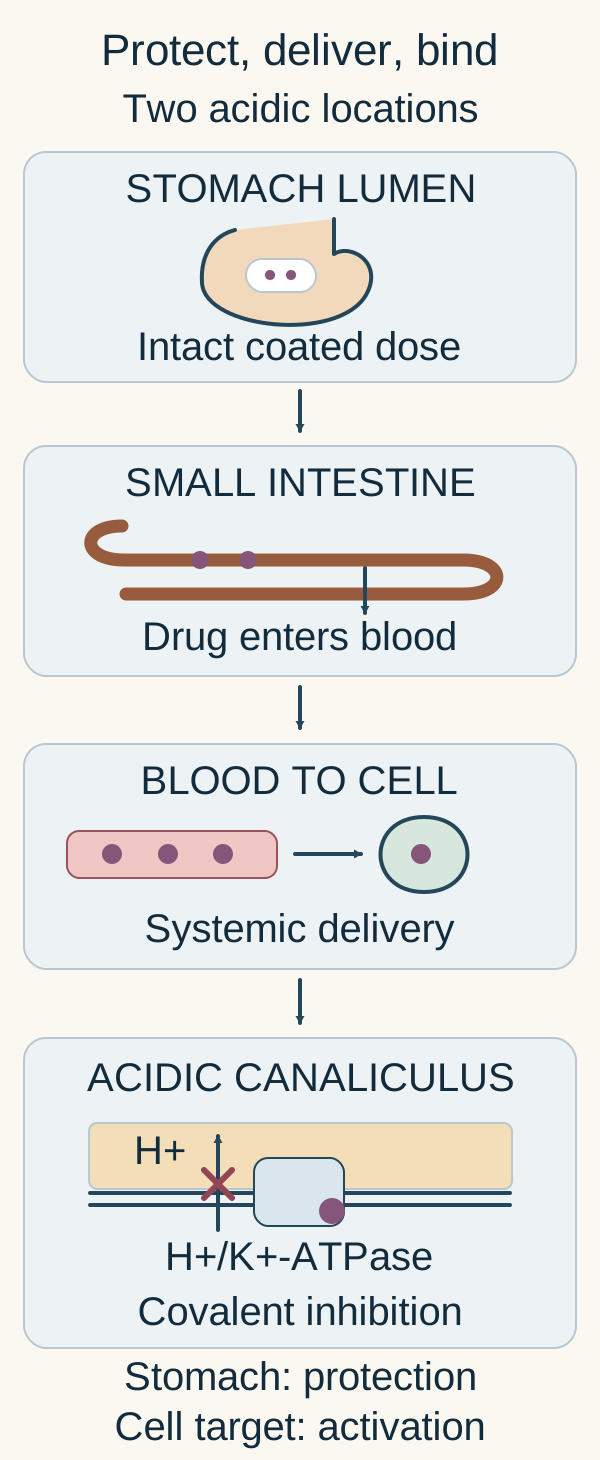
Conventional delayed-release PPIs are acid-labile prodrugs. Their protective formulation carries them through the stomach so drug can be absorbed from the small intestine. Blood then delivers the prodrug to parietal cells. Concentration and chemical activation in the acidic secretory canaliculus permit covalent binding to the pump. Protecting the swallowed drug from gastric acid and activating it at its target are different events in different compartments. [1][3]
Trace the route in the delivery diagram: stomach, intestine, blood, parietal cell, then secretory canaliculus. Point to where destroying an enteric coating would interrupt delivery. Next point to where activation is useful. The visible route distinguishes premature breakdown in the lumen from productive activation at the cellular target.
Trace the drug route. Premature breakdown in the stomach differs from useful activation at the secretory target. [1][3]Predict: which delivery step fails after inappropriate crushing?
Protection through the stomach fails. More unprotected drug can break down before intestinal absorption; crushing does not deliver an extra effective dose to the pump. [3]
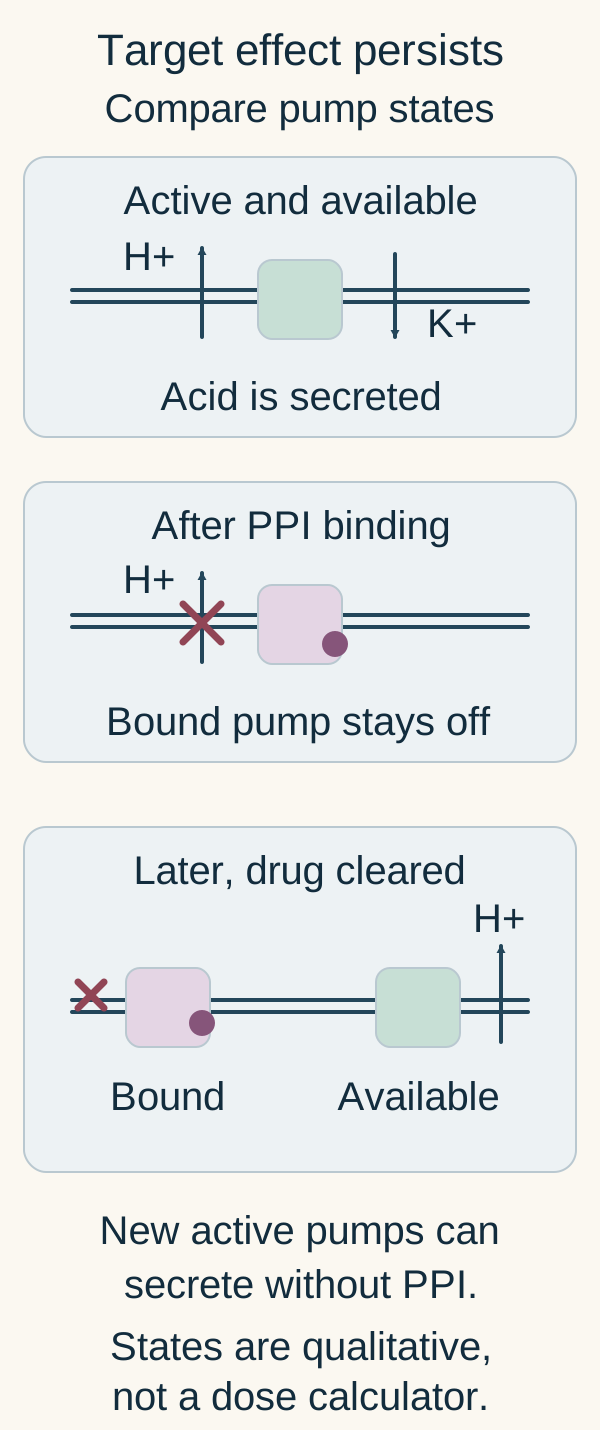
PPIs preferentially inhibit pumps that are actively secreting. Once a pump is covalently inhibited, disappearance of free drug from plasma does not immediately restore that pump's function. Secretion recovers as new pumps become available and previously uninhibited pumps are recruited. Repeated correctly timed doses reach additional active pumps. Irreversible binding is not permanent loss of the parietal cell.[1][3]
For transfer, consider a patient whose acid output remains low when the plasma drug concentration has fallen markedly. That observation fits a persistent effect on the target. It does not require a long plasma half-life or continuous drug neutralization in the stomach. The exact time course differs with product, dosing and the patient. [3]
First decide what would be lost by stopping
Does a patient who feels well still need treatment? Symptom control can mean either that a temporary problem has resolved or that maintenance treatment is successfully preventing recurrence. Recover the original diagnosis, endoscopic findings, dose, duration, treatment response and relevant medication exposures before deciding. Record a current reason to continue or a supervised plan to reassess. [1][2]
Severe reflux esophagitis, particularly Los Angeles grade C or D, has a substantial recurrence risk after withdrawal. ACG recommends long-term PPI maintenance or an appropriate antireflux procedure for this group. A history of reflux-related esophageal ulcer or peptic stricture also argues against routine discontinuation. A healed examination while receiving treatment does not erase that history. Use the lowest dose that maintains healing and adequate control, not the lowest dose regardless of outcome. [1][2]
Known Barrett esophagus and eosinophilic esophagitis require disease-specific plans rather than routine deprescribing. For eosinophilic esophagitis, preserve an effective prescribed maintenance strategy; the diagnosis alone does not mean that every patient must receive a PPI instead of other effective treatments. Do not withdraw successful therapy merely because dysphagia has improved. Barrett management also includes appropriate surveillance and is not reduced to symptom control or dose escalation. [1][2]
Next assess upper gastrointestinal bleeding risk. A previous ulcer bleed plus ongoing NSAID or antithrombotic treatment is very different from uncomplicated heartburn in a person with no such exposures. Review NSAIDs, antiplatelet drugs, anticoagulants and interacting risk factors, including corticosteroids in context. Gastroprotection does not make an unnecessary NSAID safe and does not prevent all bleeding at other sites. [2][4]
Compare two records: one patient has a healed peptic stricture and another has completed an empiric reflux course without erosive disease or bleeding risk. Predict which record makes complete withdrawal more concerning. The first retains a complication-prevention indication; the second supports a trial of less treatment. An absent indication and an undocumented indication are not identical: first reconstruct missing records when clinically important. [1][2]
What changes if the first patient develops a suspected serious drug reaction?
The safety problem requires prompt action and an alternative disease-control plan. Advice against routine deprescribing is not an instruction to continue a drug suspected of causing acute tubulointerstitial nephritis or another serious reaction. [3]
Apply the same comparison to a patient whose prior bleeding ulcer has healed but whose antithrombotic treatment remains essential. Healing and absence of pain do not, by themselves, establish low future bleeding risk. [2]
Match the product and dose to the active pumps
Before declaring PPI failure, ask whether the drug reaches its target when enough pumps are active. For most conventional enteric-coated PPIs used for reflux, dose 30 to 60 minutes before breakfast when prescribed once daily. For twice-daily regimens, dose before breakfast and before dinner. Taking both doses together or taking the evening dose long after dinner is not equivalent. A meal activates pumps; premeal administration makes absorbed drug available during that activation. [1]
The pump-state diagram distinguishes three states: active and uninhibited, drug-bound, and newly available. Compare the first dose with a later correctly timed dose. Identify which pumps can still secrete when free drug is gone. Predict what a subsequent meal does to an uninhibited pump, then check the answer. This is a qualitative model, not a dose calculator or a claim that a fixed number of pumps is blocked. [1][3]
Predict secretion from each pump state, then compare the native answers. The states are qualitative and do not calculate an individual dose. [1][3]After drug clearance, which illustrated pump can secrete?
An uninhibited pump that becomes active can secrete. A drug-bound pump does not recover merely because the plasma concentration falls. [1][3]
Why can another premeal dose add suppression?
It can reach active pumps that escaped the earlier exposure or became available afterward. Repeated dosing is not evidence that previously bound drug becomes reversible overnight. [1][3]
Formulation instructions still matter. The PROTONIX delayed-release tablet label permits swallowing the intact tablet with or without food, whereas its delayed-release oral suspension is given approximately 30 minutes before a meal. The granules use the label-specified applesauce or apple juice preparation and must not be crushed or chewed. Do not generalize those instructions to every capsule, feeding tube or liquid. Dexlansoprazole has a dual delayed-release design with less dependence on meal timing. Product-specific instructions and the general premeal strategy answer related but different questions. [1][3]
Locate the interaction before choosing a substitute
Enzyme inhibition: clopidogrel requires CYP2C19-mediated bioactivation. Its label advises avoiding omeprazole and esomeprazole; pantoprazole has less effect on clopidogrel's antiplatelet activity. Separating omeprazole and clopidogrel by 12 hours does not reliably solve the interaction. Preserve indicated antiplatelet therapy and necessary gastroprotection while coordinating a suitable agent, rather than stopping either reflexively. [4]
Absorption altered by gastric pH: some medicines need an acidic environment for adequate exposure. Oral rilpivirine is an important example: concomitant PPI therapy is contraindicated. Switching to another PPI still suppresses acid, so it does not solve this interaction. Review the full regimen with the treating team; do not interrupt antiretroviral therapy independently. [3]
Delayed elimination: PPIs can increase or prolong methotrexate exposure, particularly with high-dose treatment. A temporary PPI interruption may be considered within the oncology protocol. This warning is not a declaration that every low-dose weekly regimen must be stopped, nor does changing PPI timing replace methotrexate-level and renal-function monitoring. [3]
For transfer, decide whether a drug interaction follows the individual agent's enzyme effect or the shared acid-suppression effect. Substitution can help the first and fail the second. If reflux symptoms persist despite an appropriate regimen, reassess the diagnosis rather than adding medicines indefinitely. With objectively established GERD and persistent symptoms despite optimized twice-daily therapy, impedance-pH monitoring on therapy can assess ongoing reflux and symptom association. The testing strategy differs when GERD has never been objectively established. [1]
A treatment course needs an endpoint and a cause
Does healing mean the cause has been treated? PPIs support ulcer healing and provide acid control in hypersecretory conditions, but they do not eliminate an ongoing NSAID exposure or eradicate Helicobacter pylori by themselves. Separate the healing course from treatment of the cause and from a later maintenance decision. Pathological hypersecretion, including Zollinger-Ellison syndrome, may require individualized long-term acid suppression rather than a standard short reflux course. [2][3][6]
For treatment-naive H. pylori infection with unknown antibiotic susceptibility, the 2024 ACG guideline favors 14 days of optimized bismuth quadruple therapy: a PPI twice daily, bismuth, tetracycline and metronidazole. Alternative evidence-based regimens exist. Empiric clarithromycin triple therapy is not the default when susceptibility is unknown. The PPI is one component of a multidrug eradication plan, not the antibiotic portion. [6]
Plan proof of eradication even when pain has resolved. Use an appropriate urea breath test, stool antigen test or indicated biopsy-based assessment. Test at least four weeks after antibiotics are completed and after at least two weeks without a PPI or potassium-competitive acid blocker. A temporary H2 blocker or antacid bridge can be considered, following local test instructions. Continuing potent acid suppression can produce a false-negative result. The pause must be safe for the patient's other indications. [6][7]
Inspect this timeline: antibiotics finish on day 0; a breath test on day 42 is negative, but the patient took pantoprazole every day. Predict which condition for interpretation is missing. The elapsed antibiotic interval is adequate; the medication washout is not. Repeat appropriately rather than treating a symptom response or a compromised negative test as proof of cure. [7]
What would an additional two weeks on pantoprazole fix?
It would add time after antibiotics but would not establish the required period off the PPI. Both timing conditions must be satisfied. [7]
For an uncomplicated ulcer after documented eradication, completed healing treatment and no continuing NSAID exposure, bleeding risk or separate indication, reassess the need for maintenance. In contrast, a patient with continuing major bleeding risk needs a prevention plan even after healing. Neither conclusion follows from the number of old refills. [2]
A high fasting gastrin concentration during PPI therapy also needs context. Reduced acidity relaxes acid-mediated feedback and can increase gastrin. A high value with a less acidic gastric environment during treatment does not by itself establish gastrinoma. Interpret the acid state, medication exposure and clinical setting together. Suspected pathological hypersecretion warrants specialist-directed testing; abrupt unsupervised withdrawal can be hazardous when acid output is high. [3]
Separate less treatment from no treatment
What is the smallest effective regimen for this indication now? Dose reduction and complete discontinuation are different decisions. Most patients taking twice-daily PPIs for a chronic indication should be considered for a once-daily regimen, but the clinical reason for the higher dose and prior responses still matter. A patient with difficult pathological hypersecretion is not interchangeable with someone whose dose was doubled during an old short-term illness. [2][3]
When typical uncomplicated reflux has responded to an initial course and there is no erosive disease, Barrett esophagus or another continuing indication, consider a trial of discontinuation. Selected patients with nonerosive reflux can use on-demand or intermittent PPI treatment; this means a planned symptom-guided strategy, not instant acid neutralization from one tablet. Persistently troublesome recurrence can justify renewed treatment after reassessment. [1][2]
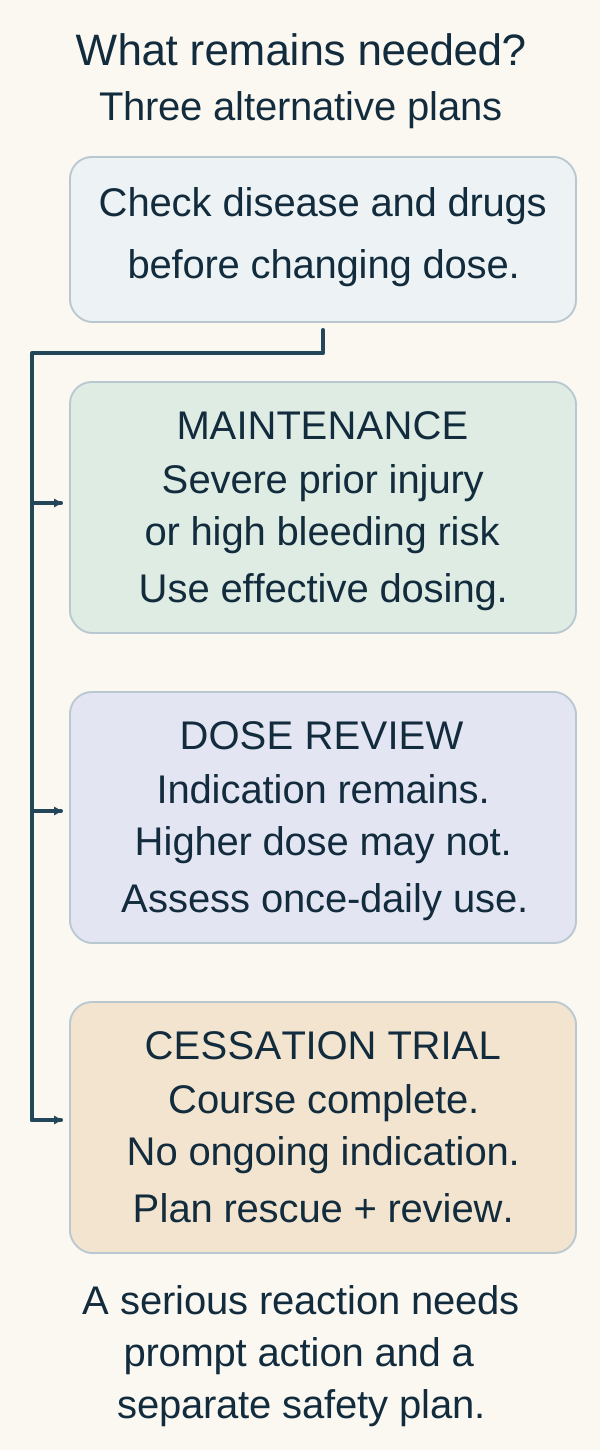
Sort the three decisions: a healed severe reflux lesion supports maintenance; a continuing indication on unnecessarily high dosing supports dose reduction; a completed finite course with no remaining indication supports a cessation trial. The continuation diagram makes those branches visible together. Do not assign all three records the same priority merely because each patient has taken a PPI. [1][2]
Compare alternative plans after indication and risk review. These are not compulsory sequential stages. A serious suspected reaction requires a separate safety response. [1][2][3]Which record requires proof of persistent severe disease before any dose reduction?
None requires a newly injured esophagus simply to discuss the dose. Use the documented indication and treatment response to choose an effective maintenance regimen. Complete withdrawal after severe disease is a different, higher-risk decision. [1][2]
Either dose tapering or abrupt discontinuation can be considered when deprescribing is appropriate. No single taper is established as best for everyone. Explain that transient acid-related symptoms can occur after stopping long-term suppression. A short rescue plan and planned follow-up can prevent interpreting every early symptom as evidence for lifelong high-dose therapy. Rebound is possible, not inevitable, and persistent symptoms still deserve assessment. [1][2]
For transfer, compare brief heartburn after withdrawal that settles with short-term rescue against progressive dysphagia, gastrointestinal bleeding, unexplained weight loss or anemia. The latter findings require evaluation rather than a reassurance label. Symptom improvement on a PPI does not exclude malignancy. [1][3]
Respond to the event, not just the headline
Is there a suspected drug reaction in this patient, or a population association in a report? Those are different problems. Headache, nausea or mild abdominal symptoms may permit a tolerability review. A serious suspected reaction requires prompt evaluation, sometimes immediate cessation, even when acid suppression has a strong indication. Arrange an alternative plan rather than ignoring either problem. [3]
Findings that require action
Acute tubulointerstitial nephritis: this can occur during PPI treatment and may lack fever, rash or joint symptoms. New acute kidney injury with compatible findings warrants stopping the suspected PPI and evaluation; the classical allergic triad is not required. Do not reinterpret a new injury as harmless simply because long-term kidney associations are debated. Severe cutaneous reactions and suspected drug-induced lupus also require product-specific safety action. [3]
Hypomagnesemia: prolonged therapy can contribute, particularly with other risks such as diuretics. Tremor, cramps, arrhythmia or seizures deserve urgent assessment. Low magnesium can accompany hypokalemia and hypocalcemia. Clinically significant deficiency may need replacement and PPI discontinuation, not replacement alone while the exposure continues unchanged. Consider baseline and periodic magnesium testing when prolonged treatment is anticipated or when digoxin or magnesium-lowering medicines increase the risk. [3]
Persistent diarrhea: consider enteric infection, including Clostridioides difficile when the clinical setting fits, rather than automatically labeling all diarrhea a mild medication effect. Acid suppression reduces an infection barrier, but exposure history and appropriate testing still matter. PPI use alone does not diagnose an infection. [3][5]
Risk assessment without indiscriminate testing
Long-term acid suppression can impair release of food-bound vitamin B12 and can affect iron absorption. Investigate compatible anemia or neurologic symptoms and consider diet, blood loss and other causes; do not attribute every deficiency to the PPI. Fracture warnings particularly concern prolonged or multiple-daily-dose exposure, with much of the evidence observational. Follow usual osteoporosis care when the patient has bone risks. For otherwise low-risk asymptomatic reflux patients, ACG does not recommend routine bone-density, B12 or creatinine testing solely because a PPI is prescribed. Magnesium decisions require their own risk assessment. [1][3]
Observational links with dementia, fractures and chronic kidney disease can reflect differences between treated and untreated patients. They do not alone establish that the drug caused an individual outcome. Conversely, a nonsignificant trial result cannot prove zero risk for every outcome, duration and patient group. [1][5]
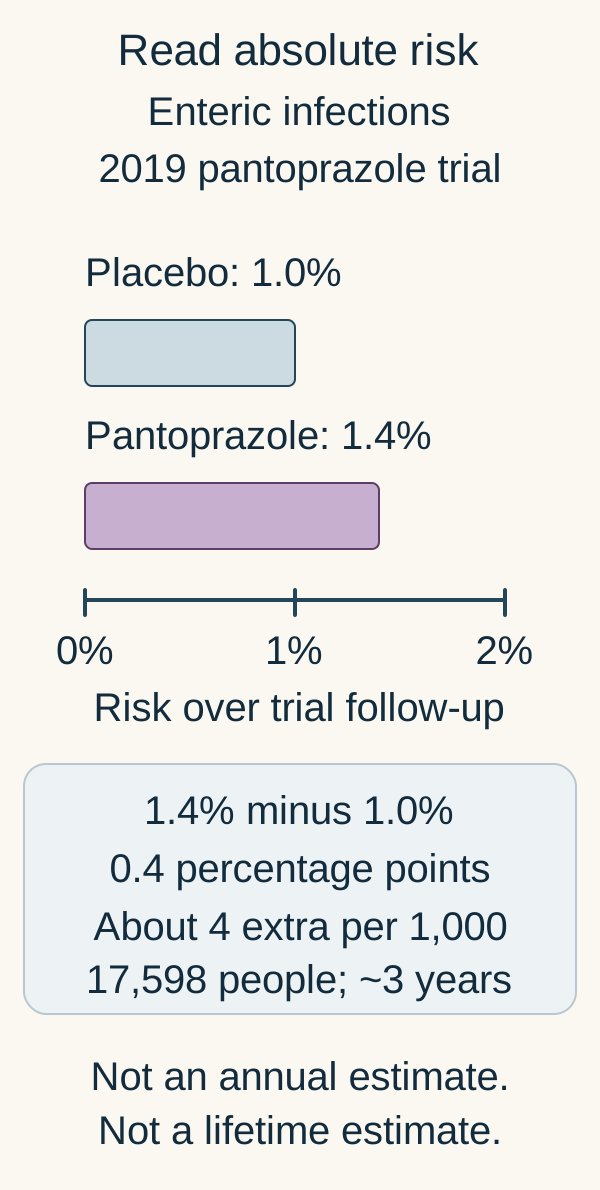
In the 2019 randomized pantoprazole safety report involving 17,598 participants with stable vascular disease, median follow-up was approximately three years. Most prespecified safety outcomes did not differ significantly. Enteric infections occurred in 1.4% of pantoprazole recipients versus 1.0% with placebo. That is an absolute difference of 0.4 percentage points, approximately four additional events per 1,000 participants over that follow-up, not a 40-percentage-point increase. The estimate is not a lifetime forecast. [5]
Compare the infection bars: read both from zero, subtract the two risks, then identify the population and duration. The same result can be described by an absolute difference or a relative comparison, but those are not interchangeable. For transfer, a patient with a prior ulcer bleed and essential antithrombotic therapy needs an individualized benefit-risk decision, not automatic withdrawal based on that average. [2][5]
Subtract the risks and keep the population and approximately three-year follow-up attached: about four extra events per thousand, not an annual or lifetime prediction. [5]What would change the decision more directly than a cohort headline?
A specific new adverse event, such as suspected interstitial nephritis or symptomatic severe hypomagnesemia, requires direct assessment and medication action. A vague association alone does not cancel an established benefit. [2][3]
Apply the lesson
Case 1
Show answer and explanations for case 1
A. Add bedtime famotidine while retaining the current schedule. (Why this does not fit)
An H2 blocker can reduce some nocturnal acid secretion. Her conventional PPI is taken long after food; correcting its administration is the initial intervention before adding another medicine. [1]
Reasoning steps for option A
What can bedtime H2 blockade suppress?
An H2 blocker can reduce some nocturnal acid secretion.
Which administration problem remains uncorrected?
Her conventional PPI is taken long after food; correcting its administration is the initial intervention before adding another medicine.
B. Give omeprazole 30 to 60 minutes before breakfast. (Best answer)
Premeal dosing aligns absorbed drug with meal-activated pumps. Daily adherence does not correct the supplied late-night timing; optimize the same dose before deciding that the drug has failed. [1]
Reasoning steps for option B
Why is premeal administration useful?
Premeal dosing aligns absorbed drug with meal-activated pumps.
What does the late-night dosing history explain?
Daily adherence does not correct the supplied late-night timing; optimize the same dose before deciding that the drug has failed.
C. Increase omeprazole to 40 mg at the same bedtime. (Why this does not fit)
A greater dose can help selected patients with persistent acid-mediated symptoms. The timing problem has not been corrected, so dose escalation is premature. [1]
Reasoning steps for option C
When can a larger PPI dose help?
A greater dose can help selected patients with persistent acid-mediated symptoms.
What should be optimized before escalation here?
The timing problem has not been corrected, so dose escalation is premature.
D. Replace scheduled omeprazole with doses after painful meals. (Why this does not fit)
Selected nonerosive reflux patients can use a planned on-demand strategy. This patient is still being treated for documented erosive disease, and conventional PPIs do not provide immediate neutralization after pain starts. [1]
Reasoning steps for option D
Who may use symptom-guided PPI treatment?
Selected nonerosive reflux patients can use a planned on-demand strategy.
Why is that not the initial change for this patient?
This patient is still being treated for documented erosive disease, and conventional PPIs do not provide immediate neutralization after pain starts.
Takeaway: Correct administration before interpreting an incomplete response as pharmacologic failure.
A. Reactivation of each bound pump as plasma drug is cleared. (Why this does not fit)
A reversible inhibitor can dissociate as its concentration falls. Pantoprazole binds covalently, so clearance does not immediately reactivate the already inhibited pump. [1] [3]
Reasoning steps for option A
How does a reversible inhibitor stop acting?
A reversible inhibitor can dissociate as its concentration falls.
Does pantoprazole clearance reverse its covalent binding?
Pantoprazole binds covalently, so clearance does not immediately reactivate the already inhibited pump.
B. Progressive secretion of bicarbonate by gastric surface cells. (Why this does not fit)
Bicarbonate can neutralize acid locally near the mucosal surface. The study measures recovery of stimulated acid secretion, not disappearance of a luminal neutralizer. [1] [3]
Reasoning steps for option B
What does mucosal bicarbonate do to existing acid?
Bicarbonate can neutralize acid locally near the mucosal surface.
Is this study measuring neutralization or secretory recovery?
The study measures recovery of stimulated acid secretion, not disappearance of a luminal neutralizer.
C. Reversal of histamine H2 receptor occupancy on parietal cells. (Why this does not fit)
Histamine receptor blockade reduces one upstream signal for acid production. The administered drug acts at the final proton pump rather than by reversible H2 occupancy. [1] [3]
Reasoning steps for option C
Where does histamine signaling act?
Histamine receptor blockade reduces one upstream signal for acid production.
Is that the administered drug target?
The administered drug acts at the final proton pump rather than by reversible H2 occupancy.
D. Availability of new or previously uninhibited proton pumps. (Best answer)
Acid output depends on the population of functioning active pumps. As new pumps become available or uninhibited pumps are recruited, secretion can recover even though previously drug-bound pumps remain inhibited. [1] [3]
Reasoning steps for option D
What determines whether acid can be secreted?
Acid output depends on the population of functioning active pumps.
Which pumps become available during drug-free recovery?
As new pumps become available or uninhibited pumps are recruited, secretion can recover even though previously drug-bound pumps remain inhibited.
Takeaway: Drug clearance and target recovery occur on different time courses.
A. Give intact granules in applesauce about 30 minutes before food. (Best answer)
The labeled oral suspension can be administered using applesauce or apple juice without crushing the granules. This preserves delayed release while following the suspension-specific premeal schedule. [3]
Reasoning steps for option A
Which vehicle preserves the labeled granule preparation?
The labeled oral suspension can be administered using applesauce or apple juice without crushing the granules.
Does this plan also satisfy the suspension timing instruction?
This preserves delayed release while following the suspension-specific premeal schedule.
B. Dissolve crushed granules in water about 30 minutes before food. (Why this does not fit)
Using a liquid can help patients who cannot swallow large tablets. Crushing defeats the protective granules, and water is not the specified preparation vehicle. [3]
Reasoning steps for option B
Why might a liquid preparation be useful?
Using a liquid can help patients who cannot swallow large tablets.
What is lost when protected granules are crushed?
Crushing defeats the protective granules, and water is not the specified preparation vehicle.
C. Give intact granules in plain water together with the meal. (Why this does not fit)
An intact protective coating is important for acid-labile drug delivery. The product specifies applesauce or apple juice and approximately premeal administration, not this water-and-meal plan. [3]
Reasoning steps for option C
Why keep the granules intact?
An intact protective coating is important for acid-labile drug delivery.
Are plain water and mealtime the specified administration plan?
The product specifies applesauce or apple juice and approximately premeal administration, not this water-and-meal plan.
D. Give crushed tablet powder in applesauce together with the meal. (Why this does not fit)
Applesauce is an approved vehicle for the commercial granule formulation. It does not make crushing a delayed-release tablet appropriate; the formulations are not interchangeable preparations. [3]
Reasoning steps for option D
For which formulation is applesauce an approved vehicle?
Applesauce is an approved vehicle for the commercial granule formulation.
Does that permission extend to crushed delayed-release tablets?
It does not make crushing a delayed-release tablet appropriate; the formulations are not interchangeable preparations.
Takeaway: Check the exact product and vehicle rather than applying one instruction to every PPI formulation.
A. Ambulatory impedance-pH monitoring after stopping the PPI. (Why this does not fit)
Off-treatment impedance-pH testing can establish abnormal reflux when the diagnosis is uncertain. Her GERD is already objectively established; stopping therapy does not directly assess why symptoms persist during the optimized regimen. [1]
Reasoning steps for option A
What question can off-treatment impedance-pH testing answer?
Off-treatment impedance-pH testing can establish abnormal reflux when the diagnosis is uncertain.
Which diagnostic uncertainty has already been resolved here?
Her GERD is already objectively established; stopping therapy does not directly assess why symptoms persist during the optimized regimen.
B. Repeat endoscopy while taking the same PPI regimen. (Why this does not fit)
Endoscopy evaluates mucosal injury and alternative structural disease. A recently healed examination does not measure reflux-symptom association or detect every nonacid reflux event. [1]
Reasoning steps for option B
What can endoscopy evaluate?
Endoscopy evaluates mucosal injury and alternative structural disease.
Does a healed examination measure reflux-symptom association?
A recently healed examination does not measure reflux-symptom association or detect every nonacid reflux event.
C. Ambulatory impedance-pH monitoring while continuing the PPI. (Best answer)
Impedance detects reflux events even when the refluxate is not strongly acidic. Testing on the optimized regimen evaluates persistent symptoms in objectively established GERD. [1]
Reasoning steps for option C
What does impedance add to acid measurement?
Impedance detects reflux events even when the refluxate is not strongly acidic.
Why should this established-GERD evaluation occur on therapy?
Testing on the optimized regimen evaluates persistent symptoms in objectively established GERD.
D. Esophageal manometry after stopping the PPI regimen. (Why this does not fit)
Manometry evaluates motor function and can inform selected reflux investigations. It does not directly establish the requested association between symptoms and acid or nonacid reflux events. [1]
Reasoning steps for option D
What does manometry measure?
Manometry evaluates motor function and can inform selected reflux investigations.
Does that directly answer the persistent-reflux question?
It does not directly establish the requested association between symptoms and acid or nonacid reflux events.
Takeaway: Choose reflux testing according to whether the diagnosis or the response during therapy is uncertain.
A. Stop the PPI and restart only if daily heartburn returns. (Why this does not fit)
Symptom-guided discontinuation is reasonable for selected uncomplicated nonerosive reflux. A history of severe erosive disease supports maintenance even while symptoms are controlled. [1] [2]
Reasoning steps for option A
When can symptom-guided cessation be reasonable?
Symptom-guided discontinuation is reasonable for selected uncomplicated nonerosive reflux.
How does the previous grade C injury change the decision?
A history of severe erosive disease supports maintenance even while symptoms are controlled.
B. Continue the lowest PPI dose that maintains healing. (Best answer)
Severe erosive esophagitis has a meaningful recurrence risk after withdrawal. Healing on therapy and an observational kidney concern do not erase his maintenance indication; there is no supplied acute safety event. [1] [2]
Reasoning steps for option B
Why does severe esophagitis support maintenance?
Severe erosive esophagitis has a meaningful recurrence risk after withdrawal.
Is there a supplied safety event that outweighs that indication?
Healing on therapy and an observational kidney concern do not erase his maintenance indication; there is no supplied acute safety event.
C. Replace daily PPI therapy with antacid treatment as needed. (Why this does not fit)
Antacids can offer brief symptom relief by neutralizing existing acid. Brief relief is not equivalent maintenance protection for previously severe erosive injury. [1] [2]
Reasoning steps for option C
What does an antacid accomplish?
Antacids can offer brief symptom relief by neutralizing existing acid.
Is its brief effect equivalent to maintenance of healed severe disease?
Brief relief is not equivalent maintenance protection for previously severe erosive injury.
D. Increase the PPI to twice daily to prevent recurrence. (Why this does not fit)
Some patients require greater acid suppression for adequate disease control. His disease healed and symptoms are controlled on once-daily therapy, so the supplied findings do not justify escalation. [1] [2]
Reasoning steps for option D
When might a higher PPI dose be needed?
Some patients require greater acid suppression for adequate disease control.
What current failure justifies escalation in this case?
His disease healed and symptoms are controlled on once-daily therapy, so the supplied findings do not justify escalation.
Takeaway: Maintenance is based on the prior complication and current effective dose, not symptoms alone.
A. The normal examination shows that the previous narrowing was unrelated to acid. (Why this does not fit)
A normal examination can occur when a transient disorder has resolved. Here it was obtained after dilation and acid suppression for a documented peptic complication, so it does not refute the original diagnosis. [1] [2]
Reasoning steps for option A
When can a normal examination reflect resolution?
A normal examination can occur when a transient disorder has resolved.
Under what treatment conditions was this examination obtained?
Here it was obtained after dilation and acid suppression for a documented peptic complication, so it does not refute the original diagnosis.
B. The PPI maintains lumen size by directly relaxing the esophageal muscle. (Why this does not fit)
Motor disorders can cause dysphagia and sometimes respond to smooth-muscle treatment. The documented problem was a peptic scar, and a PPI reduces acid secretion rather than directly relaxing muscle. [1] [2]
Reasoning steps for option B
Which dysphagia mechanism involves abnormal muscle function?
Motor disorders can cause dysphagia and sometimes respond to smooth-muscle treatment.
Did the PPI directly correct that mechanism in a peptic stricture?
The documented problem was a peptic scar, and a PPI reduces acid secretion rather than directly relaxing muscle.
C. The prior scar identifies a risk of recurrent injury despite current healing. (Best answer)
Dilation treats the narrowing, while acid suppression addresses continued acid-mediated injury. Her normal lumen on treatment does not erase the history of a peptic stricture, an indication against routine withdrawal. [1] [2]
Reasoning steps for option C
What does dilation correct compared with acid suppression?
Dilation treats the narrowing, while acid suppression addresses continued acid-mediated injury.
Does current patency erase a peptic complication history?
Her normal lumen on treatment does not erase the history of a peptic stricture, an indication against routine withdrawal.
D. The dilation establishes a need for permanently maximal PPI dosing. (Why this does not fit)
Patients with a complicated reflux history often need sustained acid suppression. That history supports maintenance but does not determine an unnecessarily maximal dose when once-daily treatment is effective. [1] [2]
Reasoning steps for option D
Why can complicated reflux require sustained treatment?
Patients with a complicated reflux history often need sustained acid suppression.
Does that determine a permanently maximal dose?
That history supports maintenance but does not determine an unnecessarily maximal dose when once-daily treatment is effective.
Takeaway: Treat the cause of recurrent injury as well as the mechanical consequence.
A. Adjustment makes the treated and untreated groups equivalent to randomized groups. (Why this does not fit)
Statistical adjustment can reduce measured differences between groups. It cannot guarantee removal of residual or unmeasured confounding from this nonrandomized comparison. [1] [2] [5]
Reasoning steps for option A
What can statistical adjustment improve?
Statistical adjustment can reduce measured differences between groups.
Does adjustment guarantee randomized comparability?
It cannot guarantee removal of residual or unmeasured confounding from this nonrandomized comparison.
B. A significant association establishes that pantoprazole caused neuronal injury. (Why this does not fit)
Statistical significance addresses compatibility with a null model under its assumptions. It does not itself identify a biological cause or overcome the cohort design and baseline differences. [1] [2] [5]
Reasoning steps for option B
What does statistical significance address?
Statistical significance addresses compatibility with a null model under its assumptions.
Does it establish a biological cause in this cohort?
It does not itself identify a biological cause or overcome the cohort design and baseline differences.
C. The report excludes a drug effect because its groups differed at baseline. (Why this does not fit)
Confounding is a credible explanation when exposure groups differ. That limitation prevents a definitive causal conclusion but does not establish that a drug effect is impossible. [1] [2] [5]
Reasoning steps for option C
Why is confounding a credible explanation?
Confounding is a credible explanation when exposure groups differ.
Does possible confounding establish absence of a drug effect?
That limitation prevents a definitive causal conclusion but does not establish that a drug effect is impossible.
D. Residual confounding remains possible; her established indication still matters. (Best answer)
Nonrandomized treatment groups may differ in determinants of dementia beyond recorded variables. The association alone does not establish causality or cancel Barrett-related management in this asymptomatic patient. [1] [2] [5]
Reasoning steps for option D
What differences can remain between treatment groups?
Nonrandomized treatment groups may differ in determinants of dementia beyond recorded variables.
How should that uncertainty affect an established indication?
The association alone does not establish causality or cancel Barrett-related management in this asymptomatic patient.
Takeaway: Neither an observational association nor its limitations prove an individual causal effect.
A. A 46-year-old after an empiric reflux course, with no erosions, Barrett esophagus or bleeding risks. (Best answer)
Resolved uncomplicated symptoms without another indication permit consideration of deprescribing. The completed course and absence of mucosal or bleeding-risk reasons distinguish this record from the others. [1] [2]
Reasoning steps for option A
Which uncomplicated patients can consider cessation?
Resolved uncomplicated symptoms without another indication permit consideration of deprescribing.
What ongoing indications are absent from this record?
The completed course and absence of mucosal or bleeding-risk reasons distinguish this record from the others.
B. A 73-year-old after an ulcer bleed, with ongoing necessary NSAID and anticoagulant treatment. (Why this does not fit)
Ulcer healing can end one treatment phase. Previous bleeding plus continued high-risk exposure preserves a gastroprotection concern even without pain. [1] [2]
Reasoning steps for option B
Which phase ends when an ulcer heals?
Ulcer healing can end one treatment phase.
What continuing exposures preserve bleeding risk?
Previous bleeding plus continued high-risk exposure preserves a gastroprotection concern even without pain.
C. A 61-year-old after dilation of a peptic stricture, with a patent lumen on current treatment. (Why this does not fit)
Successful dilation relieves a mechanical obstruction. A previous peptic stricture remains a reason against routine withdrawal of effective acid suppression. [1] [2]
Reasoning steps for option C
What does successful dilation relieve?
Successful dilation relieves a mechanical obstruction.
Which prior complication still matters after dilation?
A previous peptic stricture remains a reason against routine withdrawal of effective acid suppression.
D. A 57-year-old after grade D esophagitis, with mucosal healing on the current daily regimen. (Why this does not fit)
Severe esophagitis can heal with effective treatment. The grade D history predicts a maintenance need despite current symptom control and healing. [1] [2]
Reasoning steps for option D
Can severe esophagitis heal during treatment?
Severe esophagitis can heal with effective treatment.
Does the previous grade D finding still support maintenance?
The grade D history predicts a maintenance need despite current symptom control and healing.
Takeaway: Completed treatment plus absence of an ongoing indication matters more than a symptom-free visit alone.
A. Take clopidogrel in the morning and omeprazole twelve hours later. (Why this does not fit)
Dose separation can resolve some interactions involving simultaneous intestinal contact. The omeprazole-clopidogrel interaction involves bioactivation; twelve-hour separation has not reliably prevented reduced antiplatelet activity. [2] [4]
Reasoning steps for option A
Which interaction type can sometimes be addressed by spacing doses?
Dose separation can resolve some interactions involving simultaneous intestinal contact.
Does twelve-hour separation reliably protect clopidogrel activation?
The omeprazole-clopidogrel interaction involves bioactivation; twelve-hour separation has not reliably prevented reduced antiplatelet activity.
B. Continue the prescribed antiplatelets and substitute pantoprazole for omeprazole. (Best answer)
Pantoprazole has less effect on clopidogrel antiplatelet activity than omeprazole or esomeprazole. This preserves the necessary antiplatelet regimen and the high-risk patient's gastroprotection while avoiding the specifically discouraged combination. [2] [4]
Reasoning steps for option B
How does pantoprazole compare with omeprazole for clopidogrel activity?
Pantoprazole has less effect on clopidogrel antiplatelet activity than omeprazole or esomeprazole.
Which two treatment goals does substitution preserve?
This preserves the necessary antiplatelet regimen and the high-risk patient's gastroprotection while avoiding the specifically discouraged combination.
C. Continue the prescribed antiplatelets and substitute esomeprazole for omeprazole. (Why this does not fit)
Different PPIs need not have identical interaction profiles. Esomeprazole is also specifically discouraged with clopidogrel because it can impair CYP2C19-mediated bioactivation. [2] [4]
Reasoning steps for option C
Can interaction profiles differ among PPIs?
Different PPIs need not have identical interaction profiles.
Is esomeprazole outside the discouraged group?
Esomeprazole is also specifically discouraged with clopidogrel because it can impair CYP2C19-mediated bioactivation.
D. Continue the prescribed antiplatelets and withhold acid-suppressive therapy. (Why this does not fit)
Avoiding an interacting exposure can protect antiplatelet efficacy. His previous ulcer bleed and current antithrombotic treatment support necessary gastroprotection; a suitable alternative PPI can address both goals. [2] [4]
Reasoning steps for option D
Why can avoiding an interacting exposure be useful?
Avoiding an interacting exposure can protect antiplatelet efficacy.
Why is withholding gastroprotection an incomplete solution here?
His previous ulcer bleed and current antithrombotic treatment support necessary gastroprotection; a suitable alternative PPI can address both goals.
Takeaway: Match PPI selection to clopidogrel bioactivation while preserving necessary treatment.
A. Both drugs form an insoluble complex with rilpivirine in the intestinal lumen. (Why this does not fit)
Direct binding can impair the absorption of certain medicines. The relevant PPI effect is sustained suppression of gastric acidity, not a demonstrated insoluble binding complex with rilpivirine. [3]
Reasoning steps for option A
How can direct drug binding reduce absorption?
Direct binding can impair the absorption of certain medicines.
Is that the specified PPI-rilpivirine interaction?
The relevant PPI effect is sustained suppression of gastric acidity, not a demonstrated insoluble binding complex with rilpivirine.
B. Both drugs prevent renal filtration of the rilpivirine active metabolite. (Why this does not fit)
Reduced elimination can raise concentrations and toxicity for some interacting drugs. The clinically important concern here is reduced oral rilpivirine exposure related to gastric pH, not blocked renal elimination. [3]
Reasoning steps for option B
What can reduced renal elimination do to exposure?
Reduced elimination can raise concentrations and toxicity for some interacting drugs.
Is impaired elimination the concern with oral rilpivirine and a PPI?
The clinically important concern here is reduced oral rilpivirine exposure related to gastric pH, not blocked renal elimination.
C. Both drugs suppress the acidity needed for adequate oral rilpivirine exposure. (Best answer)
Oral rilpivirine exposure is sensitive to acid-suppressive changes in gastric pH. Pantoprazole still has that shared PPI effect; coordinate an alternative treatment plan instead of merely changing PPI agents. [3]
Reasoning steps for option C
How does gastric acidity affect oral rilpivirine exposure?
Oral rilpivirine exposure is sensitive to acid-suppressive changes in gastric pH.
Does switching to pantoprazole restore the needed acidity?
Pantoprazole still has that shared PPI effect; coordinate an alternative treatment plan instead of merely changing PPI agents.
D. Both drugs induce CYP3A-mediated metabolism of oral rilpivirine. (Why this does not fit)
Potent enzyme induction can lower exposure to some antiretroviral drugs. That is not the mechanism of this PPI interaction; shared reduction of gastric acidity impairs oral rilpivirine exposure. [3]
Reasoning steps for option D
How can enzyme induction affect antiretroviral exposure?
Potent enzyme induction can lower exposure to some antiretroviral drugs.
Is induction the mechanism that this PPI substitution must address?
That is not the mechanism of this PPI interaction; shared reduction of gastric acidity impairs oral rilpivirine exposure.
Takeaway: A shared pH-dependent interaction can persist after a within-class PPI substitution.
A. Substitute an equal acid-suppressive dose of esomeprazole. (Why this does not fit)
Changing PPI agents can address some agent-specific interactions. The methotrexate warning concerns PPI exposure and is not reliably solved by choosing another member of the class. [3]
Reasoning steps for option A
When can changing PPI agents help an interaction?
Changing PPI agents can address some agent-specific interactions.
Is the methotrexate warning confined to pantoprazole?
The methotrexate warning concerns PPI exposure and is not reliably solved by choosing another member of the class.
B. Take pantoprazole twelve hours after each methotrexate dose. (Why this does not fit)
Spacing medications can help selected absorption interactions. Potentially prolonged methotrexate exposure is not reliably prevented by a simple within-day timing change. [3]
Reasoning steps for option B
When does dose spacing help?
Spacing medications can help selected absorption interactions.
Does spacing reliably prevent prolonged methotrexate exposure?
Potentially prolonged methotrexate exposure is not reliably prevented by a simple within-day timing change.
C. Retain pantoprazole because the baseline creatinine is normal. (Why this does not fit)
Baseline kidney function contributes to methotrexate risk assessment. A normal baseline does not eliminate a preventable medication interaction during high-dose treatment. [3]
Reasoning steps for option C
Why assess baseline renal function?
Baseline kidney function contributes to methotrexate risk assessment.
Does a normal baseline eliminate the avoidable interaction?
A normal baseline does not eliminate a preventable medication interaction during high-dose treatment.
D. Coordinate temporary PPI withdrawal with the oncology protocol. (Best answer)
PPI labeling warns of increased or prolonged methotrexate exposure, particularly at high doses. She lacks a continuing acid-suppression indication, so temporary withdrawal is reasonable alongside the protocol's drug-level and renal monitoring. [3]
Reasoning steps for option D
Which methotrexate setting has a prominent PPI warning?
PPI labeling warns of increased or prolonged methotrexate exposure, particularly at high doses.
What makes temporary withdrawal reasonable in this record?
She lacks a continuing acid-suppression indication, so temporary withdrawal is reasonable alongside the protocol's drug-level and renal monitoring.
Takeaway: High-dose methotrexate requires regimen-level coordination; normal baseline renal function does not cancel an interaction.
A. Fourteen days of PPI, bismuth, tetracycline and metronidazole. (Best answer)
Optimized bismuth quadruple therapy is the preferred empiric regimen when susceptibility is unknown. This treatment-naive patient fits that setting; acid suppression must be combined with an effective eradication regimen. [6]
Reasoning steps for option A
Which empiric regimen is preferred when susceptibility is unknown?
Optimized bismuth quadruple therapy is the preferred empiric regimen when susceptibility is unknown.
Does the patient fit that treatment setting?
This treatment-naive patient fits that setting; acid suppression must be combined with an effective eradication regimen.
B. Fourteen days of PPI, amoxicillin and clarithromycin. (Why this does not fit)
Clarithromycin triple therapy can work when the infecting organism is susceptible. No susceptibility result is available, so its empiric use is not the preferred guideline strategy. [6]
Reasoning steps for option B
When can clarithromycin triple therapy work?
Clarithromycin triple therapy can work when the infecting organism is susceptible.
Is that susceptibility information available here?
No susceptibility result is available, so its empiric use is not the preferred guideline strategy.
C. Fourteen days of PPI, amoxicillin and levofloxacin. (Why this does not fit)
Levofloxacin-containing therapy can be useful in selected susceptible infections. Unknown susceptibility and treatment-naive status do not support it over optimized bismuth quadruple therapy. [6]
Reasoning steps for option C
When can a levofloxacin regimen be useful?
Levofloxacin-containing therapy can be useful in selected susceptible infections.
Why is it not preferred in this treatment-naive patient?
Unknown susceptibility and treatment-naive status do not support it over optimized bismuth quadruple therapy.
D. Fourteen days of PPI with amoxicillin dual therapy. (Why this does not fit)
Dual therapy is an important concept in H. pylori treatment. The guideline's empiric acid-blocker dual alternative uses a potassium-competitive acid blocker; this option does not describe the preferred PPI-based regimen. [6]
Reasoning steps for option D
Where does dual therapy fit in eradication treatment?
Dual therapy is an important concept in H. pylori treatment.
Does this option specify the empiric acid-blocker dual alternative?
The guideline's empiric acid-blocker dual alternative uses a potassium-competitive acid blocker; this option does not describe the preferred PPI-based regimen.
Takeaway: Effective ulcer acid control and eradication of its infectious cause are separate treatment requirements.
A. Accept the negative test because more than four weeks have elapsed. (Why this does not fit)
Waiting at least four weeks after antibiotics is necessary for post-treatment confirmation. That interval does not compensate for continued PPI exposure, which can produce a false-negative test. [6] [7]
Reasoning steps for option A
Why wait after antibiotics before confirming cure?
Waiting at least four weeks after antibiotics is necessary for post-treatment confirmation.
Does an adequate antibiotic interval eliminate PPI interference?
That interval does not compensate for continued PPI exposure, which can produce a false-negative test.
B. Repeat the breath test after at least two weeks without the PPI. (Best answer)
Reliable confirmation requires both adequate time after antibiotics and an appropriate acid-suppressant washout. The antibiotic interval is already satisfied; repeating after the PPI pause corrects the remaining limitation. [6] [7]
Reasoning steps for option B
Which two timing conditions support reliable confirmation?
Reliable confirmation requires both adequate time after antibiotics and an appropriate acid-suppressant washout.
Which condition remains unsatisfied in this patient?
The antibiotic interval is already satisfied; repeating after the PPI pause corrects the remaining limitation.
C. Obtain an H. pylori antibody titer while continuing the PPI. (Why this does not fit)
Serology may indicate prior exposure to H. pylori. Antibodies can persist after eradication and do not reliably establish cure of this treated infection. [6] [7]
Reasoning steps for option C
What can an antibody titer indicate?
Serology may indicate prior exposure to H. pylori.
Does antibody detection reliably distinguish persistence from cured infection?
Antibodies can persist after eradication and do not reliably establish cure of this treated infection.
D. Repeat the same breath test after two more weeks on the PPI. (Why this does not fit)
Additional elapsed time can address testing performed too soon after antibiotics. She already waited six weeks; continued PPI use preserves the interference that compromises interpretation. [6] [7]
Reasoning steps for option D
When would more elapsed time help a cure test?
Additional elapsed time can address testing performed too soon after antibiotics.
Would continued pantoprazole correct the identified limitation?
She already waited six weeks; continued PPI use preserves the interference that compromises interpretation.
Takeaway: Check both the post-antibiotic interval and acid-suppression washout before accepting a negative cure test.
A. Maintain twice-daily pantoprazole until a second annual breath test. (Why this does not fit)
Repeat assessment can be warranted when there is concern for persistent infection. Cure has already been appropriately documented, and this record provides no reason for a year of high-dose suppression. [2] [6] [7]
Reasoning steps for option A
When might repeat infection assessment be justified?
Repeat assessment can be warranted when there is concern for persistent infection.
What supports a year of high-dose treatment here?
Cure has already been appropriately documented, and this record provides no reason for a year of high-dose suppression.
B. Replace daily pantoprazole with indefinite bedtime famotidine. (Why this does not fit)
An H2 blocker can provide acid suppression when an indication remains. Substitution does not address the lack of an ongoing treatment indication after completed healing and confirmed eradication. [2] [6] [7]
Reasoning steps for option B
When is another acid suppressant useful?
An H2 blocker can provide acid suppression when an indication remains.
Does changing drug class supply a missing indication?
Substitution does not address the lack of an ongoing treatment indication after completed healing and confirmed eradication.
C. Continue daily pantoprazole because the healed ulcer predicts recurrent infection. (Why this does not fit)
Past ulcer disease merits review of its original cause and future risk. PPI maintenance does not prevent reinfection, and no ongoing medication or esophageal indication is supplied. [2] [6] [7]
Reasoning steps for option C
What future risks should an old ulcer prompt clinicians to assess?
Past ulcer disease merits review of its original cause and future risk.
Does maintenance PPI prevent reinfection in this setting?
PPI maintenance does not prevent reinfection, and no ongoing medication or esophageal indication is supplied.
D. Plan PPI discontinuation with advice about symptoms and follow-up. (Best answer)
A completed finite course without a remaining indication permits a deprescribing trial. Confirmed eradication, completed healing and absence of continuing risks support cessation rather than automatic refills. [2] [6] [7]
Reasoning steps for option D
When can a finite course be ended?
A completed finite course without a remaining indication permits a deprescribing trial.
Which findings show that healing and cause treatment are complete?
Confirmed eradication, completed healing and absence of continuing risks support cessation rather than automatic refills.
Takeaway: After treating the cause and completing healing, reassess whether any prevention or symptom indication remains.
A. Direct stimulation of acid production by covalently activated pumps. (Why this does not fit)
Gastrin can stimulate acid secretion when functioning pumps are available. Her gastric pH indicates less acid during therapy, and the drug inhibits rather than activates the pump. [3]
Reasoning steps for option A
How can gastrin stimulate acid output?
Gastrin can stimulate acid secretion when functioning pumps are available.
Do the pH and PPI target support pump activation?
Her gastric pH indicates less acid during therapy, and the drug inhibits rather than activates the pump.
B. Reduced renal excretion of gastrin during treatment-related renal failure. (Why this does not fit)
Impaired clearance can contribute to increased circulating hormone concentrations. Kidney function is unchanged, while the measured loss of gastric acidity directly supports feedback-mediated gastrin secretion. [3]
Reasoning steps for option B
How can impaired clearance increase hormone concentration?
Impaired clearance can contribute to increased circulating hormone concentrations.
What renal and gastric findings argue for a different explanation?
Kidney function is unchanged, while the measured loss of gastric acidity directly supports feedback-mediated gastrin secretion.
C. Reduced acid-mediated feedback restraint on gastrin secretion. (Best answer)
A less acidic gastric environment weakens feedback that restrains gastrin release. The paired increase in gastric pH and gastrin during PPI exposure fits that response; the gastrin value alone is not a gastrinoma diagnosis. [3]
Reasoning steps for option C
How does reduced gastric acidity affect gastrin feedback?
A less acidic gastric environment weakens feedback that restrains gastrin release.
Which paired measurements fit that expected response?
The paired increase in gastric pH and gastrin during PPI exposure fits that response; the gastrin value alone is not a gastrinoma diagnosis.
D. Direct stimulation of gastrin-producing cells independent of gastric acidity. (Why this does not fit)
A direct secretagogue could increase hormone release without changing the feedback signal. Here the drug suppresses acid, and the measured higher gastric pH provides a feedback explanation rather than evidence for direct stimulation of gastrin-producing cells. [3]
Reasoning steps for option D
What would direct stimulation do independently of feedback?
A direct secretagogue could increase hormone release without changing the feedback signal.
Which measured feedback signal changed during this treatment?
Here the drug suppresses acid, and the measured higher gastric pH provides a feedback explanation rather than evidence for direct stimulation of gastrin-producing cells.
Takeaway: Interpret gastrin beside the gastric acid state and the medication exposure.
A. Test for C. difficile using the local diagnostic pathway and review medication indications. (Best answer)
Recent antibiotic exposure with new frequent watery diarrhea supports evaluation for C. difficile infection. Prior PPI tolerance does not exclude a new infection; PPI exposure is a risk consideration, not proof of causation. [3] [5]
Reasoning steps for option A
Which exposure pattern supports C. difficile evaluation?
Recent antibiotic exposure with new frequent watery diarrhea supports evaluation for C. difficile infection.
Does prior PPI tolerance exclude a newly acquired infection?
Prior PPI tolerance does not exclude a new infection; PPI exposure is a risk consideration, not proof of causation.
B. Reduce the PPI dose and assess the stool frequency after several more weeks. (Why this does not fit)
Mild diarrhea can occur as a medication adverse effect. The abrupt illness after antibiotics merits timely infection evaluation rather than a prolonged trial based only on PPI dose. [3] [5]
Reasoning steps for option B
Can diarrhea be a medication adverse effect?
Mild diarrhea can occur as a medication adverse effect.
Which new exposure argues against delaying infection assessment?
The abrupt illness after antibiotics merits timely infection evaluation rather than a prolonged trial based only on PPI dose.
C. Arrange colonic biopsies before obtaining infection-directed stool testing. (Why this does not fit)
Microscopic inflammatory disorders can cause persistent watery diarrhea. The supplied antibiotic-linked acute presentation makes infection-directed stool assessment the appropriate earlier evaluation. [3] [5]
Reasoning steps for option C
What type of disorder can require colonic biopsy for watery diarrhea?
Microscopic inflammatory disorders can cause persistent watery diarrhea.
Which features favor earlier infection-directed stool evaluation?
The supplied antibiotic-linked acute presentation makes infection-directed stool assessment the appropriate earlier evaluation.
D. Obtain routine enteric bacterial culture without testing for C. difficile. (Why this does not fit)
Some enteric pathogens can produce acute watery diarrhea. The recent hospital and antibiotic exposures specifically support C. difficile assessment, which routine culture alone does not replace. [3] [5]
Reasoning steps for option D
Can other enteric bacteria cause watery diarrhea?
Some enteric pathogens can produce acute watery diarrhea.
What does routine bacterial culture fail to address here?
The recent hospital and antibiotic exposures specifically support C. difficile assessment, which routine culture alone does not replace.
Takeaway: A familiar drug exposure must not distract from a newly supported infectious explanation.
A. Continue the refills because prior intensive care predicts a permanent ulcer risk. (Why this does not fit)
Critical illness can justify short-term stress-ulcer prophylaxis in selected settings. The acute setting has resolved, and the supplied records identify no continuing outpatient indication. [2]
Reasoning steps for option A
When can critical illness justify prophylaxis?
Critical illness can justify short-term stress-ulcer prophylaxis in selected settings.
Does the current recovered state preserve that temporary indication?
The acute setting has resolved, and the supplied records identify no continuing outpatient indication.
B. Replace pantoprazole with nightly famotidine for the duration of the refills. (Why this does not fit)
An H2 blocker is another acid-suppressive option when prevention or treatment is needed. Changing the class does not justify continued therapy after the reason for prophylaxis has ended. [2]
Reasoning steps for option B
When is H2 blockade an alternative?
An H2 blocker is another acid-suppressive option when prevention or treatment is needed.
Does substitution address the absence of a present treatment need?
Changing the class does not justify continued therapy after the reason for prophylaxis has ended.
C. Document the resolved indication and plan discontinuation with counseling. (Best answer)
Regular medication review should distinguish temporary prophylaxis from continuing treatment. Recovered physiology and a verified absence of another indication support deprescribing despite the automatic refill count. [2]
Reasoning steps for option C
What should medication review distinguish?
Regular medication review should distinguish temporary prophylaxis from continuing treatment.
Which current findings support ending the inherited prescription?
Recovered physiology and a verified absence of another indication support deprescribing despite the automatic refill count.
D. Continue pantoprazole until endoscopy confirms that the stomach is normal. (Why this does not fit)
Endoscopy can evaluate alarm symptoms or suspected structural disease. There is no supplied symptom, bleeding history or unresolved diagnosis that requires endoscopy solely to end this temporary prescription. [2]
Reasoning steps for option D
When does endoscopy add useful information?
Endoscopy can evaluate alarm symptoms or suspected structural disease.
What indication for endoscopy is actually supplied here?
There is no supplied symptom, bleeding history or unresolved diagnosis that requires endoscopy solely to end this temporary prescription.
Takeaway: A discharge medication is not a lifelong indication.
A. Maintain twice-daily scheduled PPI to prevent severe mucosal recurrence. (Why this does not fit)
Intensive maintenance can be appropriate for selected complicated or poorly controlled disease. Her record shows nonerosive, mildly intermittent symptoms rather than a severe complication requiring that regimen. [1] [2]
Reasoning steps for option A
Who may need intensive scheduled maintenance?
Intensive maintenance can be appropriate for selected complicated or poorly controlled disease.
Does this patient have complicated or uncontrolled disease?
Her record shows nonerosive, mildly intermittent symptoms rather than a severe complication requiring that regimen.
B. Use a planned on-demand or intermittent PPI strategy with reassessment. (Best answer)
Selected patients with nonerosive reflux can manage recurrence with less continuous treatment. Her mild intermittent symptoms and absence of complications support this approach, while recognizing that a PPI is not an instant antacid. [1] [2]
Reasoning steps for option B
How can selected nonerosive reflux be treated?
Selected patients with nonerosive reflux can manage recurrence with less continuous treatment.
What about the symptom pattern permits less-continuous treatment?
Her mild intermittent symptoms and absence of complications support this approach, while recognizing that a PPI is not an instant antacid.
C. Continue scheduled PPI because symptom recurrence establishes a peptic stricture. (Why this does not fit)
Reflux complications can support maintenance treatment. Occasional heartburn without dysphagia and without a documented stricture does not establish that structural diagnosis. [1] [2]
Reasoning steps for option C
Why can reflux complications support maintenance?
Reflux complications can support maintenance treatment.
Does intermittent heartburn establish a stricture?
Occasional heartburn without dysphagia and without a documented stricture does not establish that structural diagnosis.
D. Arrange antireflux surgery before another medical treatment trial. (Why this does not fit)
Antireflux procedures can be appropriate for selected objectively assessed patients. Mild intermittent symptoms after an effective course do not establish a need to proceed directly to an invasive strategy. [1] [2]
Reasoning steps for option D
When can an antireflux procedure be appropriate?
Antireflux procedures can be appropriate for selected objectively assessed patients.
Why is an immediate invasive strategy disproportionate here?
Mild intermittent symptoms after an effective course do not establish a need to proceed directly to an invasive strategy.
Takeaway: The absence of erosive complications permits individualized less-continuous treatment when symptoms allow.
A. Continue twice daily indefinitely because a prior severe grade fixes the dose. (Why this does not fit)
Prior severe esophagitis supports a continuing maintenance indication. It does not establish that the higher initial frequency is permanently necessary when a lower maintenance dose has not been tested. [1] [2]
Reasoning steps for option A
What does a prior severe grade establish?
Prior severe esophagitis supports a continuing maintenance indication.
Does it establish the permanently necessary dosing frequency?
It does not establish that the higher initial frequency is permanently necessary when a lower maintenance dose has not been tested.
B. Stop scheduled acid suppression because the follow-up endoscopy is normal. (Why this does not fit)
Healing confirms a favorable treatment response. It does not erase the previous severe injury or justify routine complete withdrawal. [1] [2]
Reasoning steps for option B
What does the healed examination demonstrate?
Healing confirms a favorable treatment response.
Does successful healing eliminate the maintenance indication?
It does not erase the previous severe injury or justify routine complete withdrawal.
C. Replace daily PPI with brief antacid courses whenever symptoms recur. (Why this does not fit)
Antacids can relieve some intermittent symptoms. They do not provide equivalent maintenance of healed severe esophagitis. [1] [2]
Reasoning steps for option C
What can intermittent antacids relieve?
Antacids can relieve some intermittent symptoms.
Do they offer equivalent maintenance protection after severe esophagitis?
They do not provide equivalent maintenance of healed severe esophagitis.
D. Trial once-daily maintenance and reassess symptoms and disease control. (Best answer)
Most chronic twice-daily PPI users should be considered for dose reduction when appropriate. His continuing indication remains, but sustained healing and absence of a demonstrated higher-dose requirement support a monitored step-down trial. [1] [2]
Reasoning steps for option D
What dose review is advised for many chronic twice-daily users?
Most chronic twice-daily PPI users should be considered for dose reduction when appropriate.
What supports testing a lower frequency while retaining maintenance?
His continuing indication remains, but sustained healing and absence of a demonstrated higher-dose requirement support a monitored step-down trial.
Takeaway: Preserve a maintenance indication while testing whether the current dose exceeds what is needed.
A. Use temporary rescue treatment and reassess the symptom trajectory. (Best answer)
Transient acid-related symptoms can follow withdrawal of long-term suppression. The timing, improving trajectory and absence of alarm features support planned observation rather than declaring a permanent need immediately. [1] [2]
Reasoning steps for option A
What can follow withdrawal of chronic acid suppression?
Transient acid-related symptoms can follow withdrawal of long-term suppression.
Which trajectory and safety findings support planned observation?
The timing, improving trajectory and absence of alarm features support planned observation rather than declaring a permanent need immediately.
B. Resume indefinite twice-daily PPI because recurrence proves severe reflux injury. (Why this does not fit)
Recurrent troublesome symptoms can justify renewed treatment after assessment. A brief improving episode does not establish severe erosive disease or a permanent high-dose requirement. [1] [2]
Reasoning steps for option B
When can symptom recurrence justify renewed therapy?
Recurrent troublesome symptoms can justify renewed treatment after assessment.
Does this brief improving course prove a permanent high-dose need?
A brief improving episode does not establish severe erosive disease or a permanent high-dose requirement.
C. Obtain urgent upper endoscopy because every post-withdrawal recurrence is an alarm symptom. (Why this does not fit)
Endoscopy is important when symptoms suggest a structural or malignant process. The supplied symptoms are improving and lack the alarm findings that would support urgent endoscopy on this basis. [1] [2]
Reasoning steps for option C
When should upper endoscopy be prioritized?
Endoscopy is important when symptoms suggest a structural or malignant process.
Which alarm findings are absent from the supplied course?
The supplied symptoms are improving and lack the alarm findings that would support urgent endoscopy on this basis.
D. Avoid symptom relief to preserve the diagnostic value of withdrawal. (Why this does not fit)
Observing the course after cessation can clarify whether maintenance is needed. A rescue plan does not negate appropriate reassessment, and withholding relief is not required to prove the indication. [1] [2]
Reasoning steps for option D
What can observing a withdrawal trial clarify?
Observing the course after cessation can clarify whether maintenance is needed.
Must symptom relief be withheld to obtain that information?
A rescue plan does not negate appropriate reassessment, and withholding relief is not required to prove the indication.
Takeaway: Early recurrence can be transient; its course and alarm features determine reassessment, not timing alone.
A. Increase omeprazole and reassess swallowing after another eight weeks. (Why this does not fit)
More acid suppression can help inadequately controlled acid-mediated symptoms. Progressive dysphagia and weight loss require diagnostic evaluation rather than a prolonged empiric dose trial. [1] [3]
Reasoning steps for option A
When can intensified acid suppression help?
More acid suppression can help inadequately controlled acid-mediated symptoms.
Why should the swallowing symptoms not wait through another empiric course?
Progressive dysphagia and weight loss require diagnostic evaluation rather than a prolonged empiric dose trial.
B. Treat the episode as rebound because burning improved when omeprazole resumed. (Why this does not fit)
Rebound symptoms can occur after PPI withdrawal and may respond to acid suppression. That response does not explain away progressive dysphagia or weight loss and does not exclude malignancy. [1] [3]
Reasoning steps for option B
Can rebound symptoms respond to restarting a PPI?
Rebound symptoms can occur after PPI withdrawal and may respond to acid suppression.
What alarm findings remain unexplained by relief of burning?
That response does not explain away progressive dysphagia or weight loss and does not exclude malignancy.
C. Arrange prompt upper endoscopy to evaluate the alarm findings. (Best answer)
Endoscopy evaluates structural and mucosal causes of dysphagia and permits biopsy when indicated. Progression and weight loss warrant evaluation even though the burning symptom improved on treatment. [1] [3]
Reasoning steps for option C
What can upper endoscopy evaluate in dysphagia?
Endoscopy evaluates structural and mucosal causes of dysphagia and permits biopsy when indicated.
Why do these findings require evaluation despite partial symptom relief?
Progression and weight loss warrant evaluation even though the burning symptom improved on treatment.
D. Perform ambulatory pH testing before evaluating the swallowing difficulty. (Why this does not fit)
Reflux monitoring can clarify uncertain GERD or persistent reflux-related symptoms. The priority here is assessment of structural or malignant disease suggested by alarm findings, not quantifying reflux first. [1] [3]
Reasoning steps for option D
What uncertainty can reflux monitoring address?
Reflux monitoring can clarify uncertain GERD or persistent reflux-related symptoms.
What diagnostic priority comes first with these alarm findings?
The priority here is assessment of structural or malignant disease suggested by alarm findings, not quantifying reflux first.
Takeaway: Response to acid suppression does not neutralize an alarm symptom.
A. Withhold the PPI and arrange prompt assessment of the kidney injury. (Best answer)
PPI-associated acute tubulointerstitial nephritis can present without fever or rash. The new exposure and otherwise unexplained acute kidney injury with sterile pyuria support that suspicion, although clinical assessment is still needed to establish the cause. [3]
Reasoning steps for option A
Can PPI-associated interstitial nephritis lack fever or rash?
PPI-associated acute tubulointerstitial nephritis can present without fever or rash.
Which renal findings and exposure pattern support suspicion here?
The new exposure and otherwise unexplained acute kidney injury with sterile pyuria support that suspicion, although clinical assessment is still needed to establish the cause.
B. Continue the PPI until fever or eosinophilia establishes a hypersensitivity syndrome. (Why this does not fit)
Allergic features can accompany some drug-induced interstitial nephritis. Their absence does not exclude the reaction, so waiting for a classical pattern can prolong a harmful exposure. [3]
Reasoning steps for option B
Which allergic features may accompany drug-induced nephritis?
Allergic features can accompany some drug-induced interstitial nephritis.
Are those features required before acting on a suspected reaction?
Their absence does not exclude the reaction, so waiting for a classical pattern can prolong a harmful exposure.
C. Reduce the PPI dose and treat the creatinine change as a chronic association. (Why this does not fit)
Long-term kidney associations require cautious causal interpretation. This is a new acute injury with compatible clinical findings, not merely a population-level association or an established dose-dependent effect. [3]
Reasoning steps for option C
How should population kidney associations be interpreted?
Why is this an acute clinical event rather than only an association?
This is a new acute injury with compatible clinical findings, not merely a population-level association or an established dose-dependent effect.
D. Continue the PPI and prescribe fluid replacement as the sole response. (Why this does not fit)
Volume depletion can cause acute kidney injury and needs correction when present. The supplied history lacks a volume-loss or hypotensive trigger, while the medication timing and urine findings require a broader evaluation. [3]
Reasoning steps for option D
When does fluid replacement address acute kidney injury?
Volume depletion can cause acute kidney injury and needs correction when present.
Which absent triggers and present findings require a broader assessment?
The supplied history lacks a volume-loss or hypotensive trigger, while the medication timing and urine findings require a broader evaluation.
Takeaway: A specific suspected renal reaction warrants action even when the classical allergic features are absent.
A. Give potassium replacement alone and repeat magnesium at the next routine visit. (Why this does not fit)
Potassium deficiency deserves correction and can increase arrhythmia risk. Marked symptomatic magnesium deficiency with a prolonged QT interval also requires prompt treatment; potassium alone leaves an important hazard untreated. [3]
Reasoning steps for option A
Why does low potassium deserve correction?
Potassium deficiency deserves correction and can increase arrhythmia risk.
Which simultaneous electrolyte hazard would potassium alone leave untreated?
Marked symptomatic magnesium deficiency with a prolonged QT interval also requires prompt treatment; potassium alone leaves an important hazard untreated.
B. Provide monitored magnesium correction, potassium reassessment and review of both medicines. (Best answer)
Significant hypomagnesemia can cause neuromuscular symptoms and arrhythmias and accompany hypokalemia. The symptoms, values and QT prolongation justify prompt monitored care; PPI continuation and the diuretic contribution must be reassessed rather than assuming supplementation alone is sufficient. [3]
Reasoning steps for option B
What can significant magnesium deficiency cause?
Significant hypomagnesemia can cause neuromuscular symptoms and arrhythmias and accompany hypokalemia.
Which findings set the urgency and require medication review?
The symptoms, values and QT prolongation justify prompt monitored care; PPI continuation and the diuretic contribution must be reassessed rather than assuming supplementation alone is sufficient.
C. Continue both medicines and begin outpatient oral magnesium with routine follow-up. (Why this does not fit)
Oral supplementation may be used for selected less urgent deficiencies. The marked reduction, symptoms and QT prolongation make a delayed routine outpatient response inadequate. [3]
Reasoning steps for option C
When can oral supplementation be reasonable?
Oral supplementation may be used for selected less urgent deficiencies.
Why is routine delayed follow-up insufficient for these findings?
The marked reduction, symptoms and QT prolongation make a delayed routine outpatient response inadequate.
D. Substitute another PPI and defer electrolyte replacement until symptoms are reassessed. (Why this does not fit)
Switching drugs can address some tolerability problems. A within-class substitution does not correct the current electrolyte hazard and may not prevent recurrence of PPI-associated hypomagnesemia. [3]
Reasoning steps for option D
When can a drug substitution improve tolerability?
Switching drugs can address some tolerability problems.
Does substitution correct the present deficiency or eliminate a class-associated risk?
A within-class substitution does not correct the current electrolyte hazard and may not prevent recurrence of PPI-associated hypomagnesemia.
Takeaway: Treat symptomatic electrolyte danger promptly and assess whether continuing the contributing exposure is safe.
A. About 40 additional infections per 1,000 participants during the trial follow-up. (Why this does not fit)
An absolute risk difference compares the two group percentages. The subtraction is 0.4 percentage points, not 4 percentage points; forty per thousand is ten times the observed absolute difference. [5]
Reasoning steps for option A
How is an absolute percentage-point difference calculated?
An absolute risk difference compares the two group percentages.
Does the subtraction give forty or four events per thousand?
The subtraction is 0.4 percentage points, not 4 percentage points; forty per thousand is ten times the observed absolute difference.
B. About four additional infections per 1,000 participants during each treatment year. (Why this does not fit)
Four per thousand is the approximate absolute difference obtained from the reported percentages. The reported risks cover roughly three years of follow-up and do not establish that difference for each individual year. [5]
Reasoning steps for option B
What is the correct per-thousand arithmetic?
Four per thousand is the approximate absolute difference obtained from the reported percentages.
Does the reported follow-up support an annual estimate?
The reported risks cover roughly three years of follow-up and do not establish that difference for each individual year.
C. About four additional infections per 1,000 participants during their remaining lifetime. (Why this does not fit)
The arithmetic conversion from 0.4 percentage points to four per thousand is correct. A trial with approximately three years of follow-up does not estimate remaining lifetime risk. [5]
Reasoning steps for option C
Is four per thousand the correct numerical conversion?
The arithmetic conversion from 0.4 percentage points to four per thousand is correct.
What prevents interpreting it as remaining lifetime risk?
A trial with approximately three years of follow-up does not estimate remaining lifetime risk.
D. About four additional infections per 1,000 participants during the trial follow-up. (Best answer)
Subtracting 1.0% from 1.4% gives 0.4 percentage points, or 0.004 as a proportion. Multiplying by 1,000 gives approximately four additional events within the studied population and follow-up, not an annual or lifetime forecast. [5]
Reasoning steps for option D
What is 1.4% minus 1.0% as a proportion?
Subtracting 1.0% from 1.4% gives 0.4 percentage points, or 0.004 as a proportion.
Which denominator and observation window preserve that meaning?
Multiplying by 1,000 gives approximately four additional events within the studied population and follow-up, not an annual or lifetime forecast.
Takeaway: Report the denominator, absolute difference, population and follow-up together.
A. Serum vitamin B12 concentration. (Why this does not fit)
Long-term acid suppression can contribute to B12 deficiency in susceptible patients. No compatible symptoms or other B12 risks are supplied; the particular loop-diuretic and digoxin combination instead focuses attention on magnesium. [1] [3]
Reasoning steps for option A
When can B12 deficiency become relevant during long-term treatment?
Long-term acid suppression can contribute to B12 deficiency in susceptible patients.
Do the particular medicines in this record make B12 the priority test?
No compatible symptoms or other B12 risks are supplied; the particular loop-diuretic and digoxin combination instead focuses attention on magnesium.
B. Bone mineral density. (Why this does not fit)
Patients with standard osteoporosis risk factors should receive appropriate bone-health assessment. Routine density testing solely for PPI use is not recommended in otherwise low-risk patients, and it does not address the immediate medication-related electrolyte concern. [1] [3]
Reasoning steps for option B
Who should receive bone-health assessment?
Patients with standard osteoporosis risk factors should receive appropriate bone-health assessment.
Does routine density testing address the electrolyte susceptibility?
Routine density testing solely for PPI use is not recommended in otherwise low-risk patients, and it does not address the immediate medication-related electrolyte concern.
C. Serum magnesium concentration. (Best answer)
Diuretics can lower magnesium, and hypomagnesemia increases concern in a patient receiving digoxin. Expected prolonged PPI exposure adds a labeled reason to consider baseline and periodic magnesium assessment. [1] [3]
Reasoning steps for option C
How do a diuretic and digoxin focus the risk assessment?
Diuretics can lower magnesium, and hypomagnesemia increases concern in a patient receiving digoxin.
What additional monitoring rationale comes from prolonged PPI exposure?
Expected prolonged PPI exposure adds a labeled reason to consider baseline and periodic magnesium assessment.
D. Fasting serum gastrin concentration. (Why this does not fit)
Acid suppression can increase gastrin as a physiological feedback response. Routine gastrin measurement does not assess the clinically relevant electrolyte risk created by this medication combination. [1] [3]
Reasoning steps for option D
Why can gastrin increase during treatment?
Acid suppression can increase gastrin as a physiological feedback response.
Would gastrin testing assess the clinically relevant risk from this combination?
Routine gastrin measurement does not assess the clinically relevant electrolyte risk created by this medication combination.
Takeaway: Monitoring should follow a specific susceptibility or symptom, not an undifferentiated list of possible associations.