A bulging tympanic membrane can establish acute otitis media, but it cannot reveal whether the fluid contains pneumococcus. Keep two questions separate throughout this lesson. Does the child have an acute middle-ear infection, and what does actual microbiology establish about its cause?
Find the infection behind the membrane Locate fluid before naming infection Read the question, predict, then check the reasoning.
Where does the external canal stop?
Reveal this step It ends at the tympanic membrane.
Which space lies behind that membrane?
Reveal this step The middle-ear cavity lies on the opposite side.
How does that cavity communicate with the nasopharynx?
Reveal this step The auditory tube provides the connecting route.
What can respiratory inflammation do to that route?
Reveal this step It can impair ventilation and secretion clearance, allowing fluid to accumulate.
What does fluid alone fail to establish?
Reveal this step Effusion alone does not establish acute infection or a specific organism.
Start this reasoning again Sources [1] [2] [3] [12]
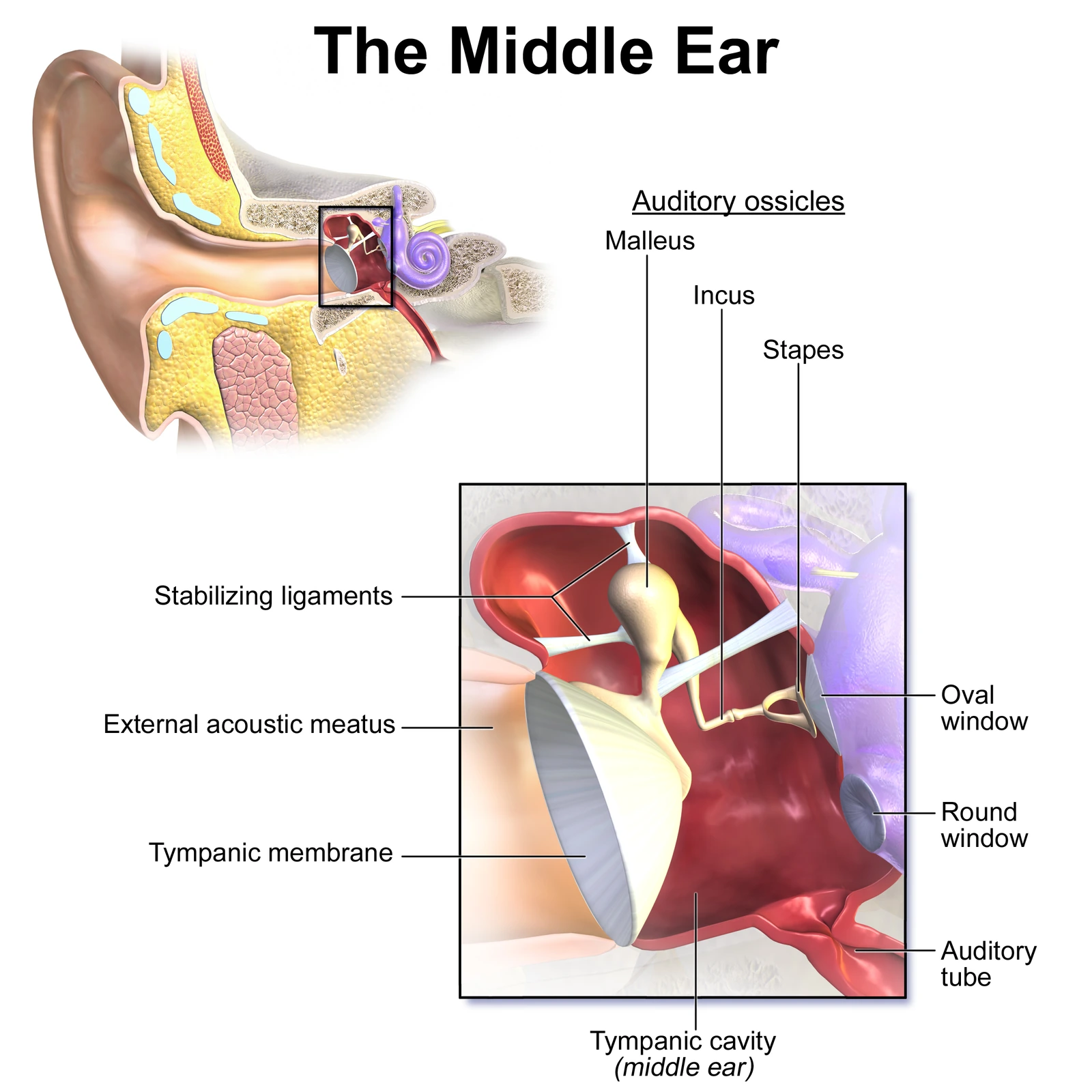
The external auditory canal ends at the tympanic membrane. The middle ear lies on the other side and communicates with the nasopharynx through the auditory, or eustachian, tube. A respiratory viral illness can inflame this tube, impair ventilation and secretion clearance, and permit nasopharyngeal organisms to reach retained middle-ear fluid. Children have a shorter, more horizontal tube and less mature function, which helps explain their susceptibility. The anatomy establishes a route of infection, not a guarantee of bacterial growth after every cold. [2]
Open whole image The eardrum separates the outer canal from the middle-ear cavity and its drainage route. Image: Blausen.com staff / BruceBlaus (2014). CC BY 3.0 . Original source . Image resized and converted to WebP.
Whole image Close
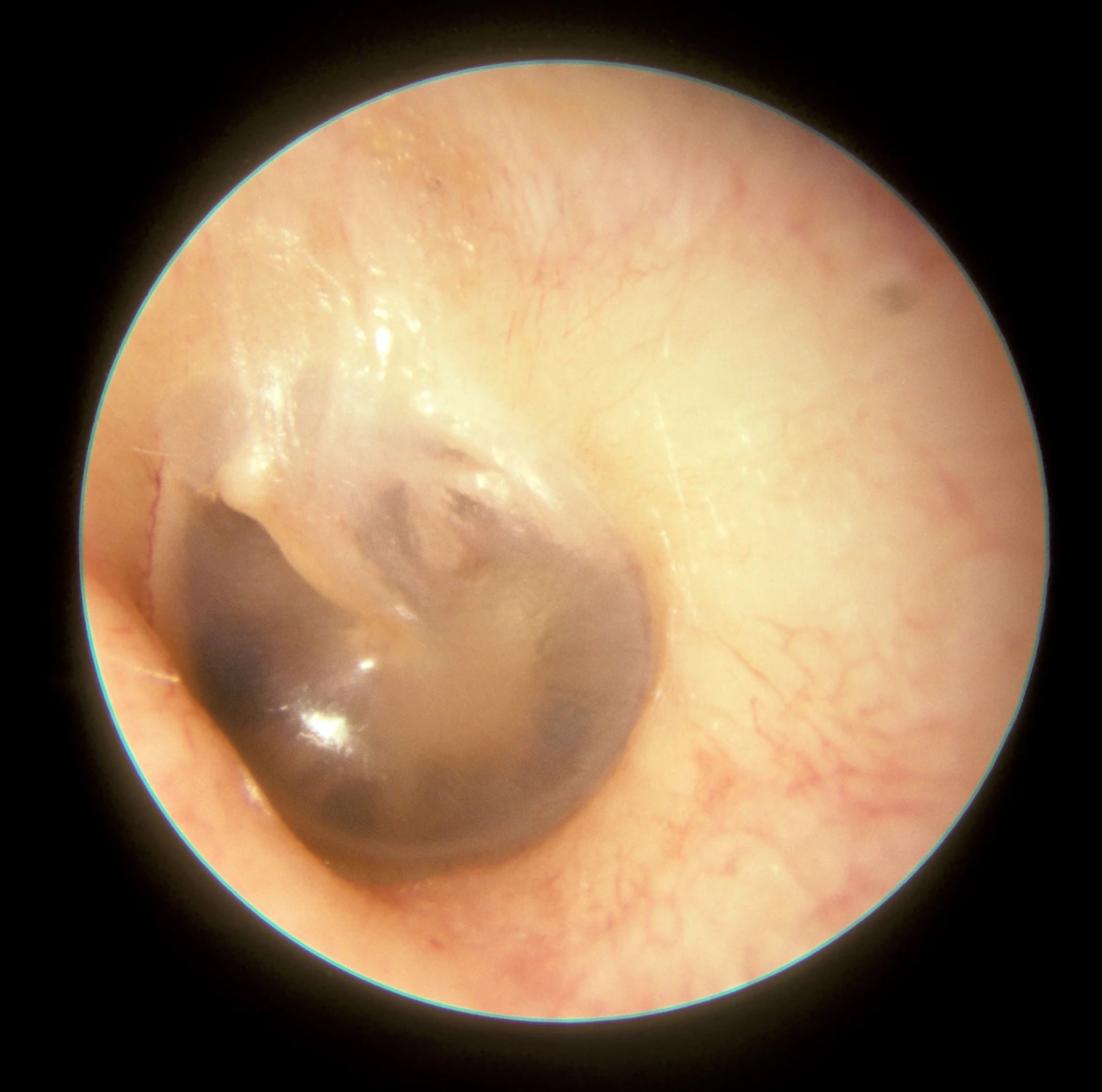
Open whole image Use this normal membrane as a reference when comparing an inflamed ear; lighting alone cannot establish a diagnosis. Image: Michael Hawke MD. CC BY-SA 4.0 . Original source . Image resized and converted to WebP.
Whole image Close
Ear exam detective Match the examination pattern to the space or syndrome it supports. The membrane separates two compartments; a red color alone does not identify the cause.
Bulging membrane with middle-ear fluid and new pain Canal edema with pain on tragus pressure Middle-ear fluid after pain and fever have resolved A red membrane after crying without documented fluid
This is insufficient evidence for AOM. Establish effusion and the appropriate inflammatory findings. This can be residual effusion rather than a new acute bacterial episode. This supports external canal inflammation, not automatic infection in the middle-ear space. This supports acute otitis media behind the tympanic membrane; it does not identify a bacterial species.
Try again Read the worked solution Bulging membrane with middle-ear fluid and new pain This supports acute otitis media behind the tympanic membrane; it does not identify a bacterial species. [1] [2]
Canal edema with pain on tragus pressure This supports external canal inflammation, not automatic infection in the middle-ear space. [12]
Middle-ear fluid after pain and fever have resolved This can be residual effusion rather than a new acute bacterial episode. [1] [2]
A red membrane after crying without documented fluid This is insufficient evidence for AOM. Establish effusion and the appropriate inflammatory findings. [1]
Two routes to ear symptoms occupy different spaces Outside the membrane External canal skin inflammation can follow moisture or local trauma. Canal tenderness, pain with tragus pressure and canal edema support otitis externa.
Behind the membrane Nasopharyngeal inflammation can obstruct the auditory tube. Middle-ear fluid and acute inflammation can then produce a bulging membrane and AOM.
The tympanic membrane is the separating boundary. A middle-ear tube creates a drainage and medication route across it; ordinary canal drops do not reliably treat infection behind an intact membrane. [2] [3] [12]
Diagnose AOM with moderate or severe membrane bulging or new otorrhea not attributable to otitis externa. Mild bulging can qualify when paired with recent ear pain or intense membrane erythema. Middle-ear effusion must be present. Pneumatic otoscopy or tympanometry can help establish fluid and impaired membrane mobility. A red membrane after crying, ear tugging alone or fever without an adequate ear examination is insufficient. [1]
Otitis media with effusion means fluid without the acute inflammatory syndrome. It can persist after an infection and can impair hearing, but it is not automatically another bacterial episode. Record the symptom duration, membrane position and mobility, fever, laterality and severity. These findings determine management more reliably than an assumed organism.
Try it here · Checkpoint 1 of 3
Make your prediction before reading the choices. A first attempt is just a starting point.
Case 1
Show answer and explanations for case 1
A. The membrane proves an alpha-hemolytic pneumococcal isolate (Why this does not fit)
Reason through this option Read the question, predict, then check the reasoning.
What can otoscopy show in this child?
Reveal this step It can show middle-ear fluid and acute membrane inflammation.
Can an ear examination reveal bacterial hemolysis?
Reveal this step No. Hemolysis is observed from a cultured isolate.
Start this reasoning again Sources [1] [7]
Read the complete explanation Hemolysis is a culture characteristic and cannot be inferred from otoscopy alone.
B. Pneumococcal vaccination excludes bacterial AOM (Why this does not fit)
Reason through this option Read the question, predict, then check the reasoning.
What does pneumococcal vaccination target?
Reveal this step It targets selected pneumococcal capsular serotypes.
Can vaccinated children still develop bacterial AOM?
Reveal this step Yes. Other pathogens and nonvaccine pneumococcal types remain possible.
Start this reasoning again Sources [1] [7]
Read the complete explanation Other pathogens and nonvaccine pneumococcal serotypes can still cause disease.
C. The findings establish otitis media with effusion without acute infection (Why this does not fit)
Reason through this option Read the question, predict, then check the reasoning.
What separates AOM from fluid without acute infection?
Reveal this step AOM requires middle-ear effusion plus acute inflammatory findings.
Which acute findings are present here?
Reveal this step New pain and moderate membrane bulging support AOM.
Start this reasoning again Sources [1] [7]
Read the complete explanation New pain and moderate membrane bulging support acute inflammation, not only an asymptomatic fluid collection.
D. The findings establish AOM but not a specific bacterial species (Best answer)
Reason through this option Read the question, predict, then check the reasoning.
Does moderate bulging with effusion meet AOM criteria?
Reveal this step Yes. The examination supports acute otitis media.
Can several bacterial species produce this appearance?
Reveal this step Yes. Clinical AOM does not identify one organism.
What conclusion preserves both facts?
Reveal this step This is AOM without a proven bacterial species.
Start this reasoning again Sources [1] [7]
Read the complete explanation The examination meets clinical criteria, while several otopathogens can produce the same appearance.
Takeaway: A clinical diagnosis is not a laboratory species identification.
Case sources: [1] [7]
Save this spot
Try another question from this subject A 14-month-old child has had 4 days of fever as high as 40.2 °C without cough or a focal examination finding. During the second day of fever, a generalized seizure lasted 50 seconds; he returned promptly to baseline and has had no further seizures. Today his temperature is normal without antipyretics, and a blanching pink maculopapular eruption has appeared on his trunk and spread to his neck. He is alert and drinking normally. The child was born at term and has met developmental milestones. On arrival, he has no neck stiffness, persistent confusion, or focal weakness. The eruption consists of discrete pale-pink lesions that blanch with pressure, and there are no oral lesions or enlarged posterior auricular nodes. His parents report that a cousin had a mild illness with a similar fever-and-rash sequence last month. He has received routine immunizations, including measles, mumps, and rubella vaccine. There has been no recent travel, new medication, or known exposure to a child with cough. The family asks whether this seizure indicates an epilepsy diagnosis.
Which pathogen most likely caused the illness associated with his seizure and rash?
A. HHV-7 B. Parvovirus B19 C. Measles virus D. HHV-6B E. Rubella virus
Choose an answer before revealing the reasoning.
Get one of these every morning · Practice more in the QBank
Identify pneumococcus from an isolate Require isolate evidence before naming pneumococcus Read the question, predict, then check the reasoning.
Can a bulging membrane identify pneumococcus?
Reveal this step No. The ear examination establishes AOM, not a bacterial species.
What morphology supports pneumococcus in an isolate?
Reveal this step Lancet-shaped gram-positive pairs support the identification.
What does alpha hemolysis add?
Reveal this step It describes partial greenish hemolysis, but viridans streptococci can share it.
Which classic tests help separate those alpha-hemolytic groups?
Reveal this step Optochin susceptibility and bile solubility support pneumococcus.
What structure does the Quellung reaction examine?
Reveal this step Type-specific antibody makes the pneumococcal capsule more conspicuous.
Start this reasoning again Sources [4] [5] [6]
Streptococcus pneumoniae is an encapsulated gram-positive coccus commonly appearing as lancet-shaped pairs. It is catalase-negative and usually alpha-hemolytic on blood agar. Alpha hemolysis produces a greenish partial-hemolysis pattern around growth, in contrast to the clearing of beta hemolysis. The green appearance is a laboratory observation, not a clinical feature visible through an otoscope. [4] [5]
Open whole image An identified pneumococcal isolate shows gram-positive pairs; an ear examination alone cannot supply this laboratory result. Image: Arnold Kaufman. CC0 . Original source . Image resized and converted to WebP.
Whole image Close
Build the laboratory argument Reconstruct this teaching sequence from a cultured isolate to a supported identification. This is an evidence exercise, not a required order for laboratory work or a way to diagnose the organism by otoscopy.
Identify pneumococcus from the combined isolate evidence Combine optochin susceptibility with bile solubility Add negative catalase and alpha hemolysis Start with lancet-shaped gram-positive pairs
Try again Read the worked solution Start with lancet-shaped gram-positive pairs The Gram reaction and morphology narrow the comparison. Gram-negative diplococci belong in a different branch of the identification problem. [4] [5]
Add negative catalase and alpha hemolysis These findings support a streptococcal comparison but do not alone separate pneumococcus from viridans streptococci. [5] [6]
Combine optochin susceptibility with bile solubility Together these are classic presumptive evidence for pneumococcus; unusual findings need validated confirmation. [5]
Identify pneumococcus from the combined isolate evidence The conclusion comes from microbiology. A bulging tympanic membrane alone establishes neither this species nor its hemolysis pattern. [4] [5]
Use complementary tests to separate similar cocci Finding Pneumococcus Common comparison Finding Gram stainPneumococcus Gram-positive, often lancet-shaped pairsCommon comparison Staphylococci often cluster; meningococci are gram-negative pairsFinding CatalasePneumococcus NegativeCommon comparison Staphylococci are usually positiveFinding Blood agarPneumococcus Usually alpha hemolysisCommon comparison Viridans streptococci can also be alpha-hemolyticFinding Optochin and bilePneumococcus Usually optochin-susceptible and bile-solubleCommon comparison Viridans isolates are generally resistant and insolubleFinding Capsular reactionPneumococcus Type-specific antibody can produce a positive Quellung reactionCommon comparison This examines capsule rather than hemolysis
Optochin susceptibility and bile solubility are classic presumptive distinctions, with exceptions that may require confirmation using a validated modern identification method. Do not use one atypical disk result to overrule every other finding. Pneumococcus is not classified as Lancefield group A simply because it belongs to the genus Streptococcus. Lancefield grouping and hemolysis ask different questions. [5] [6]
The organism is not an obligate aerobe. It obtains energy largely through fermentation and can tolerate oxygen under appropriate growth conditions. A positive Quellung reaction means specific antibody makes the capsule more conspicuous, traditionally described as capsular swelling. It does not show a new bacterial wall forming in response to an antibiotic.
Most uncomplicated AOM is managed without middle-ear culture. Nasopharyngeal colonization does not prove that a particular organism caused the ear episode. If a case asks for pneumococcal hemolysis, it should supply a confirmed isolate or enough identification data. Clinical AOM alone is insufficient evidence for that laboratory answer.
Save this spot
Explain invasion and compare the neighboring organisms Assign each mechanism to its real job Read the question, predict, then check the reasoning.
What does the pneumococcal capsule resist?
Reveal this step It impairs phagocytic clearance after invasion.
What does IgA1 protease disrupt instead?
Reveal this step It disrupts an antibody-mediated defense at the mucosal surface.
What commonly causes reduced penicillin susceptibility in pneumococcus?
Reveal this step Altered penicillin-binding proteins change the antibiotic target.
Why does clavulanate not directly reverse that resistance?
Reveal this step Clavulanate inhibits susceptible beta-lactamases rather than repairing altered binding proteins.
Which neighbor is favored by AOM with purulent conjunctivitis?
Reveal this step Nontypeable Haemophilus influenzae becomes more likely.
Start this reasoning again Sources [2] [4] [5] [7] [8]
The pneumococcal polysaccharide capsule impairs phagocytic clearance. Antibody, complement and splenic function work together to contain encapsulated organisms. Functional asplenia in sickle cell disease and surgical asplenia therefore raise concern for severe pneumococcal infection. This does not mean an asplenic person cannot make antibodies or that all opsonization stops. Pneumococcus can cause pneumonia, bacteremia and meningitis as well as otitis media. [4]
Match the microbial strategy Pair each microbial feature with its specific advantage. Avoid treating every surface structure as an interchangeable explanation.
Pneumococcal polysaccharide capsule Pneumococcal IgA1 protease Altered pneumococcal penicillin-binding proteins Beta-lactamase in a neighboring otopathogen
Drug breakdown is the mechanism that adding a beta-lactamase inhibitor is intended to address. The antibiotic target changes. Clavulanate does not directly reverse that altered-target mechanism. Disrupting mucosal antibody defense supports colonization; this is different from resisting phagocytosis after invasion. Impaired phagocytic clearance helps explain severe infection risk when splenic function is poor.
Try again Read the worked solution Pneumococcal polysaccharide capsule Impaired phagocytic clearance helps explain severe infection risk when splenic function is poor. [4]
Pneumococcal IgA1 protease Disrupting mucosal antibody defense supports colonization; this is different from resisting phagocytosis after invasion. [8]
Altered pneumococcal penicillin-binding proteins The antibiotic target changes. Clavulanate does not directly reverse that altered-target mechanism. [2]
Beta-lactamase in a neighboring otopathogen Drug breakdown is the mechanism that adding a beta-lactamase inhibitor is intended to address. [1] [2]
At the mucosal surface, IgA1 protease can disrupt an antibody-mediated defense and support colonization. That is different from the capsule’s resistance to phagocytosis after invasion. Penicillin resistance in pneumococcus mainly reflects altered penicillin-binding proteins, not a beta-lactamase that clavulanate simply neutralizes. High-dose amoxicillin increases drug exposure against susceptible or some less-susceptible isolates; the actual susceptibility and infection site still matter. [8] [2]
Pneumococcus, nontypeable Haemophilus influenzae and Moraxella catarrhalis are major bacterial otopathogens. Their relative frequency varies with setting, vaccination, prior antibiotics and how samples are collected. H. influenzae is a small gram-negative coccobacillus requiring X and V factors. Purulent conjunctivitis accompanying AOM favors nontypeable H. influenzae and affects antibiotic selection. Hib vaccination targets type b capsule and does not provide equivalent protection against nontypeable strains. [1] [5] [7]
Moraxella is an oxidase-positive gram-negative diplococcus and commonly produces beta-lactamase. The word diplococcus therefore does not identify pneumococcus without the Gram reaction and other findings. Likewise, viridans streptococci share alpha hemolysis but classically enter the bloodstream from oral sites and can infect damaged valves. Their usual optochin resistance and bile insolubility distinguish them from pneumococcus. [2] [6]
Keep the original comparison organisms in their own clinical settings
Group A S. pyogenes is commonly beta-hemolytic and has group A antigen. Bacitracin susceptibility is a traditional presumptive teaching test, not a definitive species identification standard. Group B S. agalactiae is associated with neonatal invasive disease and a positive CAMP reaction. Enterococci often hydrolyze esculin in bile and grow in 6.5% salt; hemolysis varies and does not identify them by itself. [6]
A firmly adherent pharyngeal pseudomembrane and club-shaped gram-positive rods raise diphtheria, not pneumococcal AOM. Gonococcal pilin antigenic variation changes an exposed adherence structure through genetic recombination. Salmonella type III secretion delivers bacterial effectors into host cells. These are different mechanisms from pneumococcal capsule and IgA protease; naming any surface structure is not enough to explain a particular disease. [9] [10] [11]
Save this spot
Choose treatment from severity, age and follow-up Decide severity before selecting an antibiotic Read the question, predict, then check the reasoning.
What treatment belongs in every AOM plan?
Reveal this step Provide age-appropriate pain relief whether antibiotics or observation are selected.
What does observation require besides mild disease?
Reveal this step It requires reliable reassessment within 48 to 72 hours.
When is amoxicillin generally the first antibiotic choice?
Reveal this step Use it when treatment is indicated without recent exposure, purulent conjunctivitis, or relevant allergy.
What does purulent conjunctivitis change?
Reveal this step It raises beta-lactamase concern and supports amoxicillin-clavulanate.
Why is treatment duration not identical for every child?
Reveal this step Age and illness severity determine the guideline duration.
Start this reasoning again Sources [1] [2]
Explore the reasoning
Why observation is still active care
Work through the reasoning
Why does this patient differ from a young child with bilateral disease?
Age, severity, laterality and follow-up are all part of the decision. Nonsevere bilateral AOM at 6 through 23 months generally supports antibiotics.
Show all answers
Focus on one step
Earlier step Following step
Does the examination establish AOM? The scenario specifies confirmed AOM; observation should not substitute for obtaining an adequate examination.
Is the child within an observation-eligible group? A child at least two years old with nonsevere disease can be eligible when follow-up is reliable.
What makes the plan active? Analgesia now, reassessment if symptoms persist or worsen, and timely antibiotics when indicated.
Observation is a scheduled check-in with a backup plan, not closing the case.
Where the comparison stops. This describes selected uncomplicated AOM; younger infants, severe disease and major comorbidity require different assessment.
Confirm the diagnosis. Check eligibility and pain. Set the reassessment plan. No antibiotic today does not mean no care today.
Sources [1] [2]
Compare both answers Use pain relief with a clear reassessment and rescue plan
Why it fits. This child can be an observation candidate, but symptoms still need treatment and a way to reassess within 48 to 72 hours or sooner if worsening.
Observation is not abandonment; it is a bounded plan with action if the illness changes.
Eligibility, analgesia and reliable follow-up belong together.
Ignore the pain and return only after a week
Why it is tempting. This omits both current symptom control and timely reassessment. It is not the observation plan described by the guideline.
A 48- to 72-hour safety net is different from waiting indefinitely without a plan.
An observation decision must include the conditions for changing it.
Provide pain relief whether antibiotics are prescribed or observation is selected. Age-appropriate acetaminophen or ibuprofen, when suitable, addresses the symptom the child is experiencing now. Antibiotics do not supply immediate analgesia. Severe illness, defined in the AAP framework by moderate or severe otalgia, otalgia for at least 48 hours or temperature at least 39°C, supports antibiotic treatment. Bilateral AOM in a child 6 through 23 months also supports treatment even when nonsevere. [2]
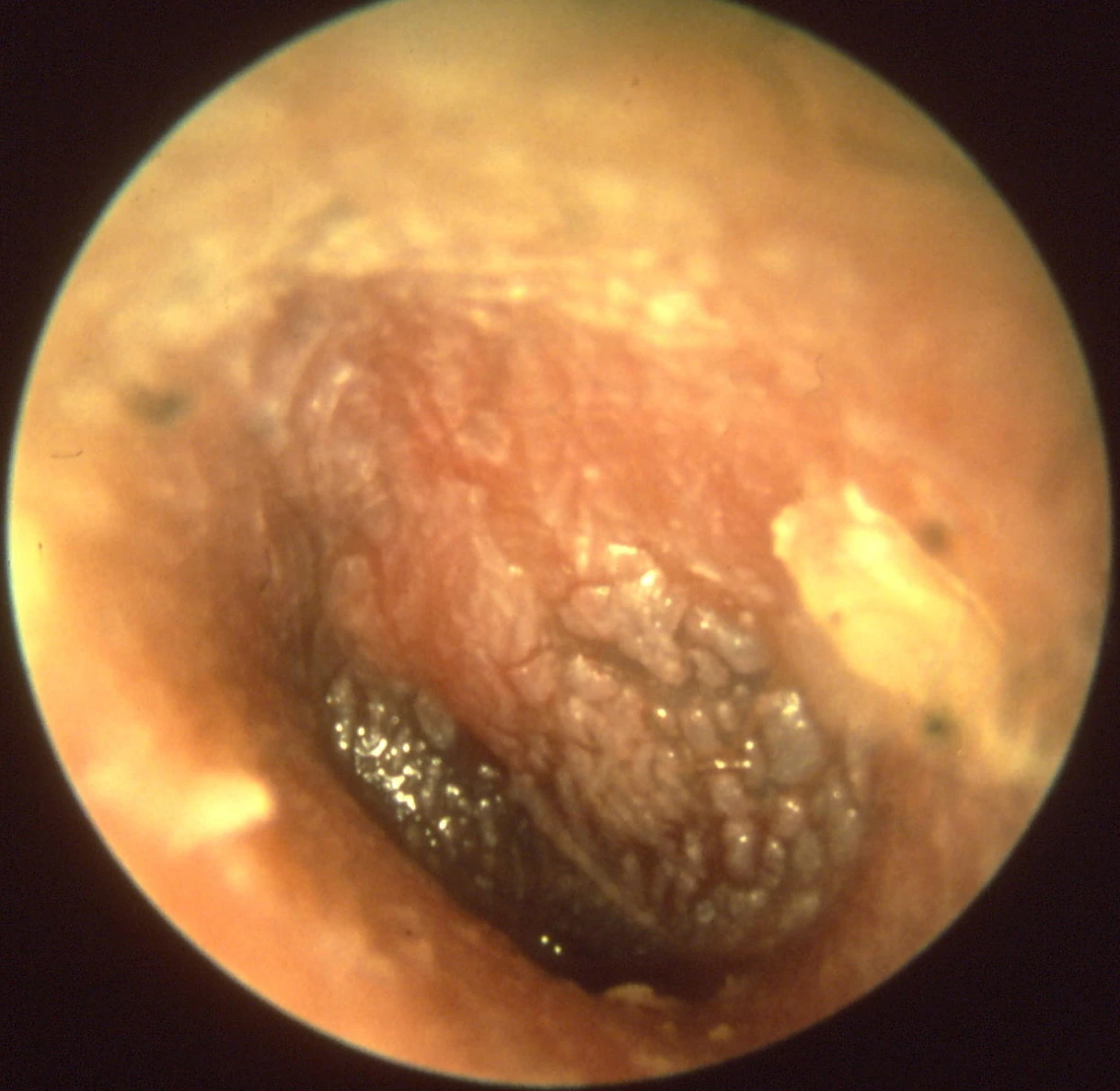
Open whole image Compare this inflamed membrane with the normal reference; the clinical findings establish AOM, not the bacterial species. Image: B. Welleschik. CC BY-SA 3.0 . Original source . Image converted to WebP without resizing.
Whole image Close
Match the child to the plan Each child has confirmed AOM and no relevant drug allergy. Match the stated age, severity and history to the appropriate initial plan. Pain relief belongs in every plan.
4 years, mild unilateral AOM, reliable reassessment 16 months, bilateral AOM, no recent amoxicillin or conjunctivitis Antibiotics are indicated and purulent conjunctivitis is present
Amoxicillin-clavulanate addresses the added concern for beta-lactamase-producing bacteria. Antibiotic treatment is supported; amoxicillin is generally the first choice with this history. Analgesia and observation with a 48- to 72-hour safety-net plan is a reasonable option.
Try again Read the worked solution 4 years, mild unilateral AOM, reliable reassessment Analgesia and observation with a 48- to 72-hour safety-net plan is a reasonable option. [1] [2]
16 months, bilateral AOM, no recent amoxicillin or conjunctivitis Antibiotic treatment is supported; amoxicillin is generally the first choice with this history. [1] [2]
Antibiotics are indicated and purulent conjunctivitis is present Amoxicillin-clavulanate addresses the added concern for beta-lactamase-producing bacteria. [1] [2]
Observation is an option for selected nonsevere unilateral AOM at 6 through 23 months, or nonsevere unilateral or bilateral AOM from age two years onward. It requires a reliable way to reassess and start antibiotics if symptoms worsen or fail to improve over 48 to 72 hours. Observation is an active care plan with analgesia and follow-up, not a decision to dismiss the illness. Infants younger than six months and children with major comorbidity require separate clinical assessment rather than automatic use of these observation criteria. [1] [2]
When an antibiotic is indicated, amoxicillin is generally first choice if the child has not received it in the preceding 30 days, lacks purulent conjunctivitis and has no relevant allergy. A common AAP dose is 80 to 90 mg/kg/day in two divided doses. Amoxicillin-clavulanate addresses the additional beta-lactamase concern when there is purulent conjunctivitis, recent amoxicillin exposure or selected recurrent or unresponsive disease. Clavulanate does not reverse pneumococcal altered binding proteins. [1] [2]
Duration is not identical for every child. The AAP guideline recommends ten days for children younger than two years or severe disease, seven days for ages two through five with mild or moderate illness, and five to seven days for older children with mild or moderate illness. Local stewardship guidance may refine the plan. Allergy assessment should identify the actual reaction. Selected cephalosporins can be appropriate for nonsevere reactions; a history of anaphylaxis or severe delayed reaction requires a different individualized assessment. [2]
Try it here · Checkpoint 2 of 3
Make your prediction before reading the choices. A first attempt is just a starting point.
Case 21
Show answer and explanations for case 21
A. Mandatory immediate broad intravenous antibiotics (Why this does not fit)
Reason through this option Read the question, predict, then check the reasoning.
Are severe or invasive findings present?
Reveal this step No. The illness is nonsevere and unilateral.
Do those findings require broad intravenous treatment?
Reveal this step No. Structured observation is reasonable.
Start this reasoning again Sources [1] [2]
Read the complete explanation The stem lacks severe or complicated disease requiring that approach.
B. No pain relief because observation means no treatment (Why this does not fit)
Reason through this option Read the question, predict, then check the reasoning.
What symptom needs treatment during observation?
Reveal this step The child's ear pain needs relief.
Does observation mean withholding all care?
Reveal this step No. It includes analgesia and planned reassessment.
Start this reasoning again Sources [1] [2]
Read the complete explanation Observation still includes symptom control and a defined reassessment plan.
C. Routine tympanostomy that day (Why this does not fit)
Reason through this option Read the question, predict, then check the reasoning.
How many uncomplicated episodes are described?
Reveal this step Only one current episode is described.
Does one episode require immediate tubes?
Reveal this step No. Tympanostomy is not indicated from this presentation.
Start this reasoning again Sources [1] [2]
Read the complete explanation One uncomplicated episode is not an indication for immediate tube surgery.
D. Analgesia and observation with a 48- to 72-hour follow-up plan (Best answer)
Reason through this option Read the question, predict, then check the reasoning.
Which features permit observation at age four?
Reveal this step The episode is nonsevere, unilateral, and reliably followed.
What must observation include?
Reveal this step It includes pain control and a plan to reassess.
When should antibiotics begin if needed?
Reveal this step Start them for worsening or failure to improve within 48 to 72 hours.
Start this reasoning again Sources [1] [2]
Read the complete explanation Age, severity and reliable follow-up support observation with antibiotics if worsening or failure to improve occurs.
Takeaway: Observation is a structured treatment decision for eligible children.
Case sources: [1] [2]
Save this spot
Reassess persistent symptoms and recognize extension Re-examine symptoms before broadening therapy Read the question, predict, then check the reasoning.
What should persistent fever or worsening pain trigger?
Reveal this step Repeat the examination after 48 to 72 hours.
What should that reassessment verify?
Reveal this step Confirm diagnosis, adherence, dose, and absence of complications.
Does comfortable residual effusion prove antibiotic failure?
Reveal this step No. Fluid can persist after acute symptoms resolve.
Which postauricular findings raise concern for mastoiditis?
Reveal this step Tender swelling, erythema, or outward pinna displacement require urgent assessment.
Start this reasoning again Sources [2] [12] [13]
Explore the reasoning
Fluid is not automatically treatment failure
Work through the reasoning
Which two timelines can separate?
Pain and fever may resolve before the middle-ear effusion and hearing change fully settle.
Show all answers
Focus on one step
Earlier step Following step
What improved? The acute symptoms resolved, which differs from ongoing fever or worsening ear pain.
What still needs assessment? The fluid duration and its hearing or developmental consequences, rather than automatic escalation.
What would change urgency? Postauricular swelling, pinna displacement, neurologic findings or severe persistent symptoms require prompt evaluation.
The remaining sign is like a room that is still drying after the leak is repaired. It needs follow-up, not proof that the leak continues.
Where the comparison stops. An ear is not a drying room: new symptoms or concerning examination findings require direct reassessment, and the comparison cannot diagnose resolution.
Acute symptoms resolved. Assess fluid and hearing. Watch for new warning findings. Persistent fluid and persistent infection are not interchangeable.
Sources [2]
Compare both answers Residual effusion can outlast acute inflammation
Why it fits. Fluid and temporary hearing effects can persist after the acute infection resolves. Assess hearing and duration rather than assuming ongoing bacterial failure.
Persistent fever, worsening pain or new postauricular swelling would require a different reassessment.
Distinguish remaining fluid from continuing or extending infection.
Every remaining effusion proves resistant infection
Why it is tempting. Effusion alone is not a microbiologic resistance test. This child no longer has the acute symptoms used to judge treatment response.
Resistance concerns arise from the whole course, examination and appropriate testing, not fluid alone.
Do not infer resistance from an isolated residual finding.
If pain or fever persists or worsens after 48 to 72 hours, repeat the examination. Confirm that the original diagnosis was correct, medication was taken, the dose was appropriate and no complication developed. Persistent effusion alone after the acute symptoms resolve is not antibiotic failure. A child who is comfortable with residual fluid needs hearing and duration assessment rather than automatic broader antibiotics. [2]
Spot the escalation A child recently treated for AOM has new fever, tender swelling behind the ear and outward displacement of the pinna. Choose the response to these new findings.
Arrange urgent assessment for possible mastoiditis Treat it as harmless residual fluid without examining the child Wait another week because symptoms followed an ear infection
Try again Read the worked solution Arrange urgent assessment for possible mastoiditis Best fit. Postauricular swelling with pinna displacement suggests spread beyond an uncomplicated middle-ear episode. Reassess urgently rather than simply extending routine treatment. [2]
Treat it as harmless residual fluid without examining the child Compare this alternative. Residual effusion may persist after symptoms resolve, but new fever and postauricular swelling are not that reassuring pattern. [2]
Wait another week because symptoms followed an ear infection Compare this alternative. The new localizing findings warrant urgent assessment now; the preceding infection increases rather than removes the concern. [2]
Postauricular swelling or erythema, tenderness over the mastoid and displacement of the pinna raise concern for mastoiditis and require urgent evaluation. Facial weakness, severe headache, meningismus or neurologic abnormalities raise additional concern for extension. A diabetic adult with severe persistent canal pain, granulation tissue and cranial nerve findings instead raises necrotizing otitis externa, often associated with Pseudomonas and skull-base involvement. Neither problem should be treated as another routine uncomplicated childhood AOM episode. [2] [12] [13]
Try it here · Checkpoint 3 of 3
Make your prediction before reading the choices. A first attempt is just a starting point.
Case 28
Show answer and explanations for case 28
A. Acute mastoiditis (Best answer)
Reason through this option Read the question, predict, then check the reasoning.
Where is the new swelling located?
Reveal this step It is tender and located behind the ear.
What structural change accompanies it?
Reveal this step The pinna is displaced outward.
Which AOM complication produces this pattern?
Reveal this step Acute mastoiditis requires urgent assessment.
Start this reasoning again Sources [2]
Read the complete explanation Postauricular inflammatory findings with pinna displacement suggest mastoid extension.
B. Uncomplicated otitis media with effusion (Why this does not fit)
Reason through this option Read the question, predict, then check the reasoning.
Does uncomplicated effusion cause tender postauricular swelling?
Reveal this step No. Effusion is fluid behind the membrane without this extension pattern.
What do fever and pinna displacement suggest instead?
Reveal this step They suggest mastoid extension.
Start this reasoning again Sources [2]
Read the complete explanation Residual fluid alone does not account for these external inflammatory findings.
C. Uncomplicated diffuse otitis externa (Why this does not fit)
Reason through this option Read the question, predict, then check the reasoning.
Where is uncomplicated otitis externa centered?
Reveal this step It is centered in the external ear canal.
What does postauricular swelling after AOM suggest?
Reveal this step It suggests mastoiditis rather than isolated canal inflammation.
Start this reasoning again Sources [2]
Read the complete explanation Postauricular swelling and pinna displacement after AOM raise concern for mastoid extension rather than isolated canal inflammation.
D. Persistent sterile middle-ear fluid after successful treatment (Why this does not fit)
Reason through this option Read the question, predict, then check the reasoning.
Would sterile residual fluid cause new fever?
Reveal this step No. It should not cause systemic inflammatory deterioration.
Can it explain tender swelling behind the ear?
Reveal this step No. That finding signals a complication.
Start this reasoning again Sources [2]
Read the complete explanation A sterile residual effusion would not account for the new fever and tender postauricular inflammation.
Takeaway: Recognize extension beyond the middle ear.
Case sources: [2]
Save this spot
Try these without looking Which three elements make an AOM observation plan active? Appropriate eligibility, pain relief, and reliable reassessment with a plan to start antibiotics if the illness persists or worsens.
Revisit this explanation [1] [2]
Why does residual middle-ear fluid not prove resistant infection? Fluid can persist after pain and fever resolve. Judge the symptoms, examination, duration and hearing effects together.
Revisit this explanation [2]
Which new postauricular findings change the urgency after AOM? Swelling, tenderness and pinna displacement raise concern for mastoiditis and require urgent assessment.
Revisit this explanation [2]
Preserve hearing and prevent avoidable disease Use the present ear examination for referral Read the question, predict, then check the reasoning.
What finding matters when recurrent AOM tube candidacy is assessed?
Reveal this step Current middle-ear effusion changes the recommendation.
What supports tubes for chronic bilateral effusion?
Reveal this step At least three months of effusion with documented hearing difficulty supports offering tubes.
Why can uncomplicated tube otorrhea use topical drops?
Reveal this step The tube provides direct medication access to the middle ear.
Does pneumococcal vaccination prevent every future AOM episode?
Reveal this step No. Vaccines cover selected targets rather than the entire otopathogen differential.
Start this reasoning again Sources [2] [3] [4]
Recurrent AOM and chronic effusion are related but different referral questions. For recurrent AOM, the presence of middle-ear effusion when tube candidacy is assessed matters. The AAO-HNS guideline recommends against tubes for recurrent AOM without effusion at that assessment and recommends offering them when effusion is present. Chronic bilateral effusion lasting at least three months with documented hearing difficulty supports offering tubes. Consider developmental risk and obtain age-appropriate hearing assessment. [3]
Tube clinic decisions Match each follow-up situation to the relevant decision. A history of infection, current effusion and a functioning tube are different pieces of information.
Recurrent AOM but no effusion at candidacy assessment Bilateral effusion for at least three months with hearing difficulty Uncomplicated acute otorrhea through a functioning tube AOM occurs after pneumococcal vaccination
Vaccines target selected serotypes and pathogens, so continued ear infection alone does not establish vaccine failure. Topical antibiotic drops are generally preferred; the tube provides a route into the infected space. Offer tube evaluation using documented hearing findings and the broader developmental assessment. Do not insert tubes solely for this infection history without current effusion, absent exceptional circumstances.
Try again Read the worked solution Recurrent AOM but no effusion at candidacy assessment Do not insert tubes solely for this infection history without current effusion, absent exceptional circumstances. [3]
Bilateral effusion for at least three months with hearing difficulty Offer tube evaluation using documented hearing findings and the broader developmental assessment. [3]
Uncomplicated acute otorrhea through a functioning tube Topical antibiotic drops are generally preferred; the tube provides a route into the infected space. [3]
AOM occurs after pneumococcal vaccination Vaccines target selected serotypes and pathogens, so continued ear infection alone does not establish vaccine failure. [2] [4]
For uncomplicated acute otorrhea through existing tubes, topical antibiotic drops are generally preferred over oral antibiotics. The tube changes access to the infected space. Pneumococcal and influenza vaccination, avoidance of tobacco smoke exposure and supportive feeding practices reduce relevant risks, but no intervention eliminates every AOM episode. Pneumococcal vaccines cover selected capsular serotypes; continued AOM after vaccination does not by itself imply vaccine failure. [2] [3] [4]
Save this spot
Practice from ear examination to microbiology
Case 2
Show answer and explanations for case 2
A. Staphylococcus aureus (Why this does not fit)
Reason through this option Read the question, predict, then check the reasoning.
How do staphylococci usually appear and test?
Reveal this step They usually cluster and are catalase-positive.
Does that match this catalase-negative lancet-shaped isolate?
Reveal this step No. The profile points away from Staphylococcus aureus.
Start this reasoning again Sources [4] [5]
Read the complete explanation Staphylococci are usually catalase-positive and cluster rather than matching this profile.
B. Haemophilus influenzae (Why this does not fit)
Reason through this option Read the question, predict, then check the reasoning.
What is the morphology of Haemophilus influenzae?
Reveal this step It is a small gram-negative coccobacillus.
Does it match gram-positive diplococci with streptococcal tests?
Reveal this step No. Its morphology and growth requirements differ.
Start this reasoning again Sources [4] [5]
Read the complete explanation Haemophilus is a gram-negative coccobacillus with different growth requirements.
C. Streptococcus pneumoniae (Best answer)
Reason through this option Read the question, predict, then check the reasoning.
Which organism forms lancet-shaped gram-positive pairs?
Reveal this step Streptococcus pneumoniae has that classic morphology.
Which two tests separate it from viridans streptococci?
Reveal this step Typical pneumococcus is optochin-susceptible and bile-soluble.
What identification fits the complete isolate profile?
Reveal this step The organism is Streptococcus pneumoniae.
Start this reasoning again Sources [4] [5]
Read the complete explanation The complementary morphology and biochemical findings strongly support pneumococcus.
D. Moraxella catarrhalis (Why this does not fit)
Reason through this option Read the question, predict, then check the reasoning.
What Gram reaction does Moraxella have?
Reveal this step Moraxella is a gram-negative diplococcus.
Can it match this gram-positive catalase-negative isolate?
Reveal this step No. The supplied laboratory profile excludes it.
Start this reasoning again Sources [4] [5]
Read the complete explanation Moraxella is a gram-negative diplococcus and does not fit these streptococcal tests.
Takeaway: Combine Gram reaction, shape and confirmatory characteristics.
Case sources: [4] [5]
Case 3
Show answer and explanations for case 3
A. Positive catalase activity (Why this does not fit)
Reason through this option Read the question, predict, then check the reasoning.
What sample is used for a catalase test?
Reveal this step Hydrogen peroxide is applied to assess bubble formation.
Is a green blood-agar zone a catalase result?
Reveal this step No. It describes hemolysis on blood agar.
Start this reasoning again Sources [5] [6]
Read the complete explanation Catalase is a separate peroxide reaction, not the blood agar color pattern.
B. Alpha hemolysis (Best answer)
Reason through this option Read the question, predict, then check the reasoning.
What does alpha hemolysis look like?
Reveal this step It creates a greenish partial-hemolysis zone around growth.
What appearance surrounds this confirmed isolate?
Reveal this step A greenish zone is present.
How should the laboratory report it?
Reveal this step Start this reasoning again Sources [5] [6]
Read the complete explanation The greenish partial-hemolysis appearance is the alpha pattern.
C. Beta hemolysis (Why this does not fit)
Reason through this option Read the question, predict, then check the reasoning.
What does beta hemolysis look like?
Reveal this step It produces clear complete hemolysis around colonies.
Does a green zone match complete clearing?
Reveal this step No. It matches alpha rather than beta hemolysis.
Start this reasoning again Sources [5] [6]
Read the complete explanation Beta hemolysis produces a clear zone rather than the green appearance described.
D. No hemolysis (Why this does not fit)
Reason through this option Read the question, predict, then check the reasoning.
What would no hemolysis leave around colonies?
Reveal this step The surrounding blood agar would remain unchanged.
Is the agar unchanged in this case?
Reveal this step No. A green color change is visible.
Start this reasoning again Sources [5] [6]
Read the complete explanation The surrounding color change is a hemolytic reaction rather than an unchanged plate.
Takeaway: Hemolysis and catalase measure different bacterial properties.
Case sources: [5] [6]
Case 4
Show answer and explanations for case 4
A. Its antiphagocytic polysaccharide capsule (Best answer)
Reason through this option Read the question, predict, then check the reasoning.
Which pneumococcal structure resists phagocytic clearance?
Reveal this step Its polysaccharide capsule impairs clearance.
Which organ helps clear encapsulated bacteria?
Reveal this step The spleen is especially important for that defense.
Why is sickle cell disease relevant?
Reveal this step Functional asplenia increases danger from encapsulated pneumococcus.
Start this reasoning again Sources [4]
Read the complete explanation Splenic clearance and opsonization are important defenses against encapsulated pneumococcus.
B. A requirement for intracellular replication in neurons (Why this does not fit)
Reason through this option Read the question, predict, then check the reasoning.
Does pneumococcus require replication inside neurons?
Reveal this step No. It is not an obligate intracellular neurotropic organism.
What feature actually interacts with impaired splenic function?
Reveal this step Its antiphagocytic capsule does.
Start this reasoning again Sources [4]
Read the complete explanation Pneumococcus is not an obligate intracellular neurotropic pathogen.
C. A lipopolysaccharide outer membrane (Why this does not fit)
Reason through this option Read the question, predict, then check the reasoning.
Does a gram-positive organism have lipopolysaccharide outer membrane?
Reveal this step No. That is a gram-negative structure.
Which pneumococcal surface feature explains this risk?
Reveal this step The polysaccharide capsule explains it.
Start this reasoning again Sources [4]
Read the complete explanation This gram-positive organism lacks the gram-negative outer membrane described.
D. Production of resistant bacterial spores (Why this does not fit)
Reason through this option Read the question, predict, then check the reasoning.
Does pneumococcus form resistant endospores?
Reveal this step No. It is a non-spore-forming coccus.
What makes clearance difficult instead?
Reveal this step Its capsule interferes with phagocytosis.
Start this reasoning again Sources [4]
Read the complete explanation Pneumococcus does not form endospores.
Takeaway: Functional asplenia increases susceptibility to encapsulated invasive organisms.
Case sources: [4]
Case 5
Show answer and explanations for case 5
A. Streptococcus pneumoniae with a fully typical profile (Why this does not fit)
Reason through this option Read the question, predict, then check the reasoning.
What optochin and bile pattern is typical for pneumococcus?
Reveal this step It is usually optochin-susceptible and bile-soluble.
Does this resistant, insoluble isolate show that profile?
Reveal this step No. It points away from typical pneumococcus.
Start this reasoning again Sources [5] [6]
Read the complete explanation Pneumococcus is usually susceptible to optochin and bile-soluble; this is not its typical profile.
B. Group B streptococcus identified by CAMP (Why this does not fit)
Reason through this option Read the question, predict, then check the reasoning.
What findings would support group B streptococcus?
Reveal this step Group B antigen or a positive CAMP reaction would support it.
Are those findings supplied here?
Reveal this step No. The stem gives an oral-associated alpha-hemolytic isolate.
Start this reasoning again Sources [5] [6]
Read the complete explanation The stem does not supply a CAMP reaction or group B antigen and describes a different typical pattern.
C. Moraxella catarrhalis (Why this does not fit)
Reason through this option Read the question, predict, then check the reasoning.
What Gram reaction does Moraxella have?
Reveal this step Can it be the alpha-hemolytic streptococcus described?
Reveal this step No. It is not a streptococcus.
Start this reasoning again Sources [5] [6]
Read the complete explanation Moraxella is gram-negative and is not an alpha-hemolytic streptococcus.
D. Viridans streptococci (Best answer)
Reason through this option Read the question, predict, then check the reasoning.
Which streptococci are associated with oral sources and damaged valves?
Reveal this step Viridans streptococci classically have that association.
What laboratory pattern usually supports viridans streptococci?
Reveal this step Optochin resistance and bile insolubility support them.
Which group best fits this isolate?
Reveal this step Viridans streptococci fit the combined findings.
Start this reasoning again Sources [5] [6]
Read the complete explanation The oral association and usual optochin-resistant, bile-insoluble profile favor this group.
Takeaway: Shared alpha hemolysis does not erase other discriminating tests.
Case sources: [5] [6]
Case 6
Show answer and explanations for case 6
A. Moraxella catarrhalis (Why this does not fit)
Reason through this option Read the question, predict, then check the reasoning.
What bacterial shape is Moraxella?
Reveal this step It is a gram-negative diplococcus.
Does that match an X- and V-dependent coccobacillus?
Reveal this step No. Those findings indicate Haemophilus.
Start this reasoning again Sources [1] [5]
Read the complete explanation Moraxella is a gram-negative diplococcus rather than an X- and V-dependent coccobacillus.
B. Streptococcus pyogenes (Why this does not fit)
Reason through this option Read the question, predict, then check the reasoning.
What profile is typical of Streptococcus pyogenes?
Reveal this step It is a gram-positive beta-hemolytic coccus.
Does that fit this gram-negative coccobacillus?
Reveal this step No. The morphology is incompatible.
Start this reasoning again Sources [1] [5]
Read the complete explanation Group A streptococcus is gram-positive and usually beta-hemolytic.
C. Haemophilus influenzae (Best answer)
Reason through this option Read the question, predict, then check the reasoning.
Which organism requires X and V growth factors?
Reveal this step Haemophilus influenzae requires both factors.
What clinical pairing raises its probability?
Reveal this step Purulent conjunctivitis accompanying AOM favors nontypeable Haemophilus.
What identification joins the culture and clinical clues?
Reveal this step The isolate is Haemophilus influenzae.
Start this reasoning again Sources [1] [5]
Read the complete explanation The growth requirements and morphology fit Haemophilus; the conjunctivitis-otitis syndrome often involves nontypeable strains.
D. Streptococcus pneumoniae (Why this does not fit)
Reason through this option Read the question, predict, then check the reasoning.
What morphology does pneumococcus have?
Reveal this step It is a gram-positive lancet-shaped coccus.
Does it require X and V factors?
Reveal this step No. The supplied growth requirements point away from pneumococcus.
Start this reasoning again Sources [1] [5]
Read the complete explanation Pneumococcus is a gram-positive coccus without these X and V requirements.
Takeaway: Conjunctivitis informs probability; supplied isolate data establish the microbiologic distinction.
Case sources: [1] [5]
Case 7
Show answer and explanations for case 7
A. Obligate growth inside human erythrocytes (Why this does not fit)
Reason through this option Read the question, predict, then check the reasoning.
Where does Moraxella normally grow?
Reveal this step It colonizes the human respiratory tract.
Must it grow inside red blood cells?
Reveal this step No. It is not an intraerythrocytic organism.
Start this reasoning again Sources [2]
Read the complete explanation This respiratory bacterium does not require intraerythrocytic growth.
B. Beta-lactamase production (Best answer)
Reason through this option Read the question, predict, then check the reasoning.
Which resistance enzyme is common in Moraxella?
Reveal this step Moraxella commonly produces beta-lactamase.
What does that enzyme do to aminopenicillins?
Reveal this step It can make unprotected aminopenicillins unreliable.
Which characteristic therefore affects drug selection?
Reveal this step Beta-lactamase production does.
Start this reasoning again Sources [2]
Read the complete explanation Moraxella commonly produces beta-lactamase, making unprotected aminopenicillins less reliable.
C. Bile solubility as an alpha-hemolytic streptococcus (Why this does not fit)
Reason through this option Read the question, predict, then check the reasoning.
Which organism is classically tested for bile solubility?
Reveal this step Pneumococcus is classically assessed with that test.
Does this gram-negative Moraxella isolate fit that category?
Reveal this step No. It is not an alpha-hemolytic streptococcus.
Start this reasoning again Sources [2]
Read the complete explanation Those are pneumococcal identification concepts, not this gram-negative isolate.
D. A group A Lancefield antigen (Why this does not fit)
Reason through this option Read the question, predict, then check the reasoning.
What organisms receive Lancefield group labels?
Reveal this step Selected streptococci receive those carbohydrate antigen labels.
Is Moraxella a group A streptococcus?
Reveal this step No. It is a gram-negative diplococcus.
Start this reasoning again Sources [2]
Read the complete explanation Moraxella is not a group A streptococcus.
Takeaway: Do not equate all diplococci or all beta-lactam resistance mechanisms.
Case sources: [2]
Case 8
Show answer and explanations for case 8
A. Corynebacterium diphtheriae (Best answer)
Reason through this option Read the question, predict, then check the reasoning.
Which lesion defines the pharyngeal syndrome?
Reveal this step A firmly adherent pseudomembrane is characteristic.
Which morphology accompanies that syndrome here?
Reveal this step Club-shaped gram-positive rods are present.
Which organism fits both findings?
Reveal this step Corynebacterium diphtheriae requires urgent consideration.
Start this reasoning again Sources [11]
Read the complete explanation The pseudomembrane syndrome and rod morphology fit diphtheria.
B. Streptococcus pneumoniae (Why this does not fit)
Reason through this option Read the question, predict, then check the reasoning.
What shape is Streptococcus pneumoniae?
Reveal this step It is a coccus, often seen in lancet-shaped pairs.
Can it match club-shaped rods and a pseudomembrane?
Reveal this step No. Those findings redirect away from pneumococcus.
Start this reasoning again Sources [11]
Read the complete explanation Pneumococcus is a coccus and does not explain this characteristic pharyngeal syndrome.
C. Moraxella catarrhalis (Why this does not fit)
Reason through this option Read the question, predict, then check the reasoning.
What morphology is expected for Moraxella?
Reveal this step It is a gram-negative diplococcus.
Does that match club-shaped gram-positive rods?
Reveal this step No. Both shape and Gram reaction differ.
Start this reasoning again Sources [11]
Read the complete explanation It is a gram-negative diplococcus rather than the rods described.
D. Haemophilus influenzae (Why this does not fit)
Reason through this option Read the question, predict, then check the reasoning.
What Gram reaction does Haemophilus have?
Reveal this step It is a gram-negative coccobacillus.
Does that explain these club-shaped gram-positive rods?
Reveal this step No. The culture morphology conflicts.
Start this reasoning again Sources [11]
Read the complete explanation A gram-negative coccobacillus does not fit the stated Gram stain.
Takeaway: Let the involved tissue and actual morphology redirect the differential.
Case sources: [11]
Case 9
Show answer and explanations for case 9
A. Pneumococcal capsule swelling in a Quellung test (Why this does not fit)
Reason through this option Read the question, predict, then check the reasoning.
What does the Quellung reaction make visible?
Reveal this step It makes a bacterial capsule more conspicuous with specific antibody.
Does it replace an expressed pilin gene sequence?
Reveal this step No. It is an antibody-based laboratory reaction.
Start this reasoning again Sources [9]
Read the complete explanation That is an antibody-based laboratory reaction, not the genetic process described.
B. Cleavage of IgA1 by a secreted protease (Why this does not fit)
Reason through this option Read the question, predict, then check the reasoning.
What does IgA1 protease change?
Reveal this step It cleaves a host mucosal antibody.
Is that the pilin gene recombination observed here?
Reveal this step No. The measured event changes the bacterial antigen sequence.
Start this reasoning again Sources [9]
Read the complete explanation That changes a host defense molecule rather than replacing the expressed pilin sequence.
C. Beta-lactamase hydrolysis (Why this does not fit)
Reason through this option Read the question, predict, then check the reasoning.
What does beta-lactamase act upon?
Reveal this step It hydrolyzes susceptible beta-lactam antibiotics.
Can that explain a newly expressed pilin sequence?
Reveal this step No. Drug hydrolysis does not alter pilin antigen identity.
Start this reasoning again Sources [9]
Read the complete explanation That is a drug-resistance mechanism and does not explain the altered pilin protein.
D. Pilin antigenic variation (Best answer)
Reason through this option Read the question, predict, then check the reasoning.
What changes in the research assay?
Reveal this step Silent pilin sequences recombine into the expressed gene.
What happens to the exposed bacterial protein?
Reveal this step Its antigenic identity changes.
What mechanism is this?
Reveal this step This is pilin antigenic variation.
Start this reasoning again Sources [9]
Read the complete explanation The expressed antigen changes through gene conversion, helping the organism evade existing recognition.
Takeaway: Match the mechanism to the observed molecular event.
Case sources: [9]
Case 10
Show answer and explanations for case 10
A. A flagellum acting only as a motility structure (Why this does not fit)
Reason through this option Read the question, predict, then check the reasoning.
What basic function does a flagellum provide?
Reveal this step A flagellum primarily supports bacterial motility.
Does motility describe direct effector injection?
Reveal this step No. The needle-like translocation system is different.
Start this reasoning again Sources [10]
Read the complete explanation Motility alone does not describe this directed effector-translocation apparatus.
B. An IgA protease secreted onto the mucosal surface (Why this does not fit)
Reason through this option Read the question, predict, then check the reasoning.
Where does IgA protease act?
Reveal this step It cleaves antibody at the mucosal surface.
Does it inject proteins into epithelial cells?
Reveal this step No. That requires a secretion apparatus.
Start this reasoning again Sources [10]
Read the complete explanation Cleaving extracellular antibody is different from directly translocating effectors into epithelial cells.
C. A type III secretion system (Best answer)
Reason through this option Read the question, predict, then check the reasoning.
What is the observed apparatus doing?
Reveal this step It transfers bacterial effector proteins into host cells.
Which system has a needle-like delivery structure?
Reveal this step A type III secretion system has that structure.
What structure best explains the experiment?
Reveal this step The type III secretion system does.
Start this reasoning again Sources [10]
Read the complete explanation The described apparatus transfers bacterial effectors into host cells.
D. A polysaccharide capsule (Why this does not fit)
Reason through this option Read the question, predict, then check the reasoning.
What does a polysaccharide capsule mainly help resist?
Reveal this step It helps resist host immune clearance.
Can a capsule inject effectors into cells?
Reveal this step No. It is not a protein translocation apparatus.
Start this reasoning again Sources [10]
Read the complete explanation A capsule can resist host defenses but does not inject effector proteins.
Takeaway: A direct experimental observation supports a specific virulence mechanism.
Case sources: [10]
Case 11
Show answer and explanations for case 11
A. Acute diffuse otitis externa suitable for routine topical care alone (Why this does not fit)
Reason through this option Read the question, predict, then check the reasoning.
Which findings exceed uncomplicated canal inflammation?
Reveal this step Facial weakness and relentless pain indicate possible invasive extension.
Is routine topical care alone adequate for that risk?
Reveal this step No. Urgent evaluation is required.
Start this reasoning again Sources [12] [13]
Read the complete explanation Cranial neuropathy and severe persistent disease in diabetes raise concern for extension beyond an uncomplicated canal infection.
B. Necrotizing otitis externa with possible skull-base involvement (Best answer)
Reason through this option Read the question, predict, then check the reasoning.
Which host factor raises risk for invasive external-ear infection?
Reveal this step Diabetes is an important risk factor.
What findings suggest extension toward the skull base?
Reveal this step Canal granulation and a cranial nerve deficit suggest extension.
What diagnosis best fits?
Reveal this step Necrotizing otitis externa is most concerning.
Start this reasoning again Sources [12] [13]
Read the complete explanation Diabetes, severe canal disease and cranial neuropathy are warning findings for invasive external-ear infection.
C. Uncomplicated childhood-pattern AOM (Why this does not fit)
Reason through this option Read the question, predict, then check the reasoning.
Where are this patient's main examination findings?
Reveal this step They are in the external canal with facial nerve involvement.
Does that match routine childhood-pattern middle-ear AOM?
Reveal this step No. The age and invasive canal findings do not fit.
Start this reasoning again Sources [12] [13]
Read the complete explanation The age, external canal findings and facial weakness do not fit a routine middle-ear episode.
D. Asymptomatic middle-ear effusion (Why this does not fit)
Reason through this option Read the question, predict, then check the reasoning.
What symptoms usually define asymptomatic effusion?
Reveal this step It is middle-ear fluid without an acute inflammatory syndrome.
Can it explain severe pain, granulation, and facial weakness?
Reveal this step No. Those findings signal an invasive external process.
Start this reasoning again Sources [12] [13]
Read the complete explanation That would not explain severe pain, granulation and a cranial nerve deficit.
Takeaway: Recognize the dangerous external-canal syndrome separately from AOM.
Case sources: [12] [13]
Case 12
Show answer and explanations for case 12
A. Streptococcus agalactiae (Best answer)
Reason through this option Read the question, predict, then check the reasoning.
Which streptococcus carries group B antigen?
Reveal this step Streptococcus agalactiae is group B streptococcus.
Which supporting assay is positive here?
Reveal this step The CAMP reaction is positive.
What organism is identified?
Reveal this step The isolate is Streptococcus agalactiae.
Start this reasoning again Sources [6]
Read the complete explanation The antigen and CAMP result support group B streptococcus.
B. Streptococcus pneumoniae (Why this does not fit)
Reason through this option Read the question, predict, then check the reasoning.
What hemolysis is usual for pneumococcus?
Reveal this step Pneumococcus is usually alpha-hemolytic.
Is pneumococcus a group B organism?
Reveal this step No. The antigen and CAMP result indicate GBS.
Start this reasoning again Sources [6]
Read the complete explanation Pneumococcus is usually alpha-hemolytic and is not a group B organism.
C. Streptococcus pyogenes (Why this does not fit)
Reason through this option Read the question, predict, then check the reasoning.
Which Lancefield antigen defines Streptococcus pyogenes?
Reveal this step It carries group A antigen.
Does that match the supplied group B antigen?
Reveal this step No. The groups are distinct.
Start this reasoning again Sources [6]
Read the complete explanation S. pyogenes has group A antigen rather than the supplied group B result.
D. Enterococcus faecalis (Why this does not fit)
Reason through this option Read the question, predict, then check the reasoning.
Do enterococci have the classic group B CAMP profile?
Reveal this step No. That is not their standard identification pattern.
Which organism fits both supplied tests?
Reveal this step Group B Streptococcus agalactiae fits them.
Start this reasoning again Sources [6]
Read the complete explanation The group B antigen and CAMP profile are not the standard enterococcal identification.
Takeaway: Group antigens and CAMP supplement hemolysis in streptococcal identification.
Case sources: [6]
Case 13
Show answer and explanations for case 13
A. S. pneumoniae; all streptococci carry group A antigen (Why this does not fit)
Reason through this option Read the question, predict, then check the reasoning.
Does pneumococcus carry Lancefield group A antigen?
Reveal this step No. Pneumococcus is not classified as group A.
What organism does confirmed group A antigen support?
Reveal this step It supports Streptococcus pyogenes.
Start this reasoning again Sources [6]
Read the complete explanation Pneumococcus is not assigned to Lancefield group A.
B. S. agalactiae; group A and group B are interchangeable (Why this does not fit)
Reason through this option Read the question, predict, then check the reasoning.
Which antigen group belongs to Streptococcus agalactiae?
Reveal this step Can group A and group B be interchanged?
Reveal this step No. They identify different carbohydrate antigens.
Start this reasoning again Sources [6]
Read the complete explanation The distinct antigen groups are not interchangeable.
C. Moraxella; bacitracin establishes any respiratory bacterium (Why this does not fit)
Reason through this option Read the question, predict, then check the reasoning.
Is Moraxella a streptococcus?
Reveal this step No. It is a gram-negative diplococcus.
Can bacitracin identify any respiratory bacterium?
Reveal this step No. It is only a traditional presumptive streptococcal test.
Start this reasoning again Sources [6]
Read the complete explanation Moraxella is not a streptococcus and cannot be identified by that inference.
D. S. pyogenes; bacitracin is a presumptive rather than definitive test (Best answer)
Reason through this option Read the question, predict, then check the reasoning.
Which organism has group A carbohydrate antigen?
Reveal this step Streptococcus pyogenes does.
What does a traditional bacitracin result provide?
Reveal this step It provides presumptive support rather than definitive identification.
Which interpretation respects both facts?
Reveal this step Identify S. pyogenes from group A evidence and treat bacitracin as presumptive.
Start this reasoning again Sources [6]
Read the complete explanation The group A identification is relevant, while bacitracin susceptibility alone has limitations.
Takeaway: Do not substitute a traditional screening test for confirmed identification.
Case sources: [6]
Case 14
Show answer and explanations for case 14
A. Haemophilus (Why this does not fit)
Reason through this option Read the question, predict, then check the reasoning.
What morphology does Haemophilus have?
Reveal this step It is a gram-negative coccobacillus.
Does that match catalase-negative gram-positive cocci?
Reveal this step No. The isolate is incompatible.
Start this reasoning again Sources [6]
Read the complete explanation Haemophilus is a gram-negative coccobacillus requiring different growth factors.
B. Staphylococcus based solely on salt tolerance (Why this does not fit)
Reason through this option Read the question, predict, then check the reasoning.
What catalase result is typical for staphylococci?
Reveal this step Staphylococci are usually catalase-positive.
Can salt growth alone override this negative catalase result?
Reveal this step No. The full pattern must be interpreted together.
Start this reasoning again Sources [6]
Read the complete explanation Salt growth alone cannot override the catalase-negative profile and other identification findings.
C. Enterococcus (Best answer)
Reason through this option Read the question, predict, then check the reasoning.
Which organisms hydrolyze esculin in bile?
Reveal this step Enterococci commonly do so.
What additional feature supports enterococci?
Reveal this step Growth in 6.5 percent sodium chloride supports them.
Which group fits the combined results?
Reveal this step Start this reasoning again Sources [6]
Read the complete explanation The combined bile-esculin and salt-tolerance pattern supports enterococci.
D. Pneumococcus (Why this does not fit)
Reason through this option Read the question, predict, then check the reasoning.
What does pneumococcal bile solubility assess?
Reveal this step It assesses lysis of the organism in bile salts.
Is that the same as bile-esculin growth and hydrolysis?
Reveal this step No. They are different laboratory tests.
Start this reasoning again Sources [6]
Read the complete explanation Pneumococcal bile solubility is a different test from growth with bile and esculin hydrolysis.
Takeaway: Distinguish bile solubility from bile-esculin testing.
Case sources: [6]
Case 15
Show answer and explanations for case 15
A. An external canal that normally drains directly into the nasopharynx (Why this does not fit)
Reason through this option Read the question, predict, then check the reasoning.
Which passage connects the middle ear to the nasopharynx?
Reveal this step The auditory tube provides that connection.
Does the external canal drain there directly?
Reveal this step No. The tympanic membrane separates the canal from the middle ear.
Start this reasoning again Sources [2]
Read the complete explanation The auditory tube connects the middle ear to the nasopharynx; the external canal lies across the tympanic membrane.
B. A shorter, more horizontal auditory tube with less mature function (Best answer)
Reason through this option Read the question, predict, then check the reasoning.
How does a young child's auditory tube differ?
Reveal this step It is shorter, more horizontal, and functionally less mature.
What does that anatomy do to drainage?
Reveal this step It favors impaired ventilation and retained middle-ear secretions.
How does this explain greater susceptibility?
Reveal this step Nasopharyngeal inflammation more easily contributes to middle-ear infection.
Start this reasoning again Sources [2]
Read the complete explanation This favors impaired drainage and nasopharyngeal access to the middle ear during respiratory inflammation.
C. Direct continuity between the external canal and middle ear without a membrane (Why this does not fit)
Reason through this option Read the question, predict, then check the reasoning.
What structure separates the external canal from middle ear?
Reveal this step The tympanic membrane separates them.
Are the two spaces normally continuous?
Reveal this step No. Direct continuity would require a perforation or tube.
Start this reasoning again Sources [2]
Read the complete explanation The tympanic membrane normally separates those spaces.
D. A longer, steeper auditory tube that prevents nasopharyngeal reflux (Why this does not fit)
Reason through this option Read the question, predict, then check the reasoning.
Which tube orientation offers greater adult protection?
Reveal this step A longer, steeper auditory tube improves drainage.
Is that the anatomy of this 15-month-old?
Reveal this step No. Young children have shorter, more horizontal tubes.
Start this reasoning again Sources [2]
Read the complete explanation This describes the direction of greater adult protection rather than the shorter, more horizontal infant anatomy.
Takeaway: Use the real auditory tube relationship to explain childhood susceptibility.
Case sources: [2]
Case 16
Show answer and explanations for case 16
A. Auditory tube inflammation impairs ventilation and secretion clearance (Best answer)
Reason through this option Read the question, predict, then check the reasoning.
What does a viral cold do to the auditory tube?
Reveal this step It can inflame the tube and impair its function.
What follows impaired ventilation and clearance?
Reveal this step Middle-ear fluid can become retained.
How does that connect the cold to AOM?
Reveal this step Retained fluid permits an acute middle-ear infection.
Start this reasoning again Sources [2]
Read the complete explanation Retained fluid permits an acute middle-ear infection after nasopharyngeal inflammation.
B. Direct passage of nasopharyngeal secretions through the intact tympanic membrane (Why this does not fit)
Reason through this option Read the question, predict, then check the reasoning.
Is the tympanic membrane intact in ordinary AOM development?
Reveal this step Yes. The infection usually develops behind an intact membrane.
What route reaches the middle ear instead?
Reveal this step The auditory tube connects it to the nasopharynx.
Start this reasoning again Sources [2]
Read the complete explanation The usual pathway is through the auditory tube, not across an intact membrane from outside.
C. All infections enter through a perforated outer membrane (Why this does not fit)
Reason through this option Read the question, predict, then check the reasoning.
Does AOM require a perforated membrane?
Reveal this step No. Many episodes occur behind an intact membrane.
Which pathway is typical after a cold?
Reveal this step The inflamed auditory tube is the typical pathway.
Start this reasoning again Sources [2]
Read the complete explanation Many AOM episodes develop behind an intact tympanic membrane through the auditory tube route.
D. Primary hematogenous seeding as the usual route after an uncomplicated cold (Why this does not fit)
Reason through this option Read the question, predict, then check the reasoning.
What event immediately precedes the ear symptoms?
Reveal this step A viral upper respiratory illness precedes them.
What is the usual link, rather than bloodstream spread?
Reveal this step Auditory tube dysfunction connects the nasopharynx to retained middle-ear fluid.
Start this reasoning again Sources [2]
Read the complete explanation Bloodstream spread is not the usual explanation for the common post-URI middle-ear sequence.
Takeaway: A viral respiratory infection can prepare the middle-ear environment for AOM.
Case sources: [2]
Case 17
Show answer and explanations for case 17
A. The antiphagocytic effect of the bacterial capsule (Why this does not fit)
Reason through this option Read the question, predict, then check the reasoning.
What structure gives pneumococcus antiphagocytic protection?
Reveal this step Its capsule provides that separate virulence function.
What did this experiment directly manipulate?
Reveal this step It examined loss of protection from human mucosal IgA1.
Start this reasoning again Sources [8]
Read the complete explanation The capsule is a distinct virulence feature. The measured loss of IgA1 protection specifically concerns mucosal antibody cleavage.
B. The binding of beta-lactam antibiotics to altered bacterial targets (Why this does not fit)
Reason through this option Read the question, predict, then check the reasoning.
What do altered penicillin-binding proteins affect?
Reveal this step They affect antibiotic binding to bacterial targets.
Is that the host defense measured here?
Reveal this step No. The experiment measures mucosal antibody protection.
Start this reasoning again Sources [8]
Read the complete explanation That describes a resistance mechanism, not the host IgA1 defense directly tested by this experiment.
C. The entire production of systemic IgG by B cells (Why this does not fit)
Reason through this option Read the question, predict, then check the reasoning.
Which antibody class does IgA1 protease cleave?
Reveal this step It specifically cleaves IgA1.
Does that abolish all systemic IgG production?
Reveal this step No. The effect is narrower and local.
Start this reasoning again Sources [8]
Read the complete explanation IgA1 protease cleaves a specific antibody class; it does not abolish all systemic IgG production.
D. Antibody-mediated mucosal exclusion and clearance (Best answer)
Reason through this option Read the question, predict, then check the reasoning.
What molecule does this enzyme cut?
Reveal this step IgA1, an antibody at mucosal surfaces.
What can IgA1 help immune cells do?
Reveal this step Recognize and kill pneumococci.
What happens when its protective function is disrupted?
Reveal this step Antibody-assisted killing and clearance become less effective.
Start this reasoning again Sources [8]
Read the complete explanation Cleavage disrupts a local antibody defense involved in controlling colonization.
Takeaway: Mucosal IgA protease and antiphagocytic capsule have different roles.
Case sources: [8]
Case 18
Show answer and explanations for case 18
A. It can show alpha hemolysis (Why this does not fit)
Reason through this option Read the question, predict, then check the reasoning.
Can pneumococcus produce alpha hemolysis?
Reveal this step Yes. It commonly creates a greenish partial-hemolysis pattern.
Is that description incorrect?
Reveal this step No. It is compatible with pneumococcus.
Start this reasoning again Sources [6] [14]
Read the complete explanation That is a typical blood agar characteristic.
B. Its capsule contributes to invasive disease (Why this does not fit)
Reason through this option Read the question, predict, then check the reasoning.
Which pneumococcal structure supports invasive disease?
Reveal this step Its polysaccharide capsule does.
Is this feature consistent with the organism?
Reveal this step Yes. The capsule is an established virulence factor.
Start this reasoning again Sources [6] [14]
Read the complete explanation The capsule is an established virulence feature.
C. It is an obligate aerobe (Best answer)
Reason through this option Read the question, predict, then check the reasoning.
What does obligate aerobic growth require?
Reveal this step Oxygen is essential for growth.
Can pneumococcus grow without oxygen under suitable conditions?
Reveal this step Yes. Pneumococcus is a facultative anaerobe.
Why does the offered description fail?
Reveal this step Oxygen is not obligatory for pneumococcal growth.
Start this reasoning again Sources [6] [14]
Read the complete explanation Pneumococcus is not dependent on oxygen in the manner of an obligate aerobe.
D. It is commonly catalase-negative (Why this does not fit)
Reason through this option Read the question, predict, then check the reasoning.
What catalase result is common for streptococci?
Reveal this step They are generally catalase-negative.
Does pneumococcus fit that broad pattern?
Reveal this step Yes. Catalase negativity is expected.
Start this reasoning again Sources [6] [14]
Read the complete explanation That is consistent with pneumococcal identification.
Takeaway: Separate oxygen requirement from familiar colony appearance.
Case sources: [6]
Case 19
Show answer and explanations for case 19
A. Bile-esculin test (Why this does not fit)
Reason through this option Read the question, predict, then check the reasoning.
What does a bile-esculin test detect?
Reveal this step It detects esculin hydrolysis in a bile-containing medium.
Does it use type-specific antibody to outline a capsule?
Reveal this step No. That describes a different test.
Start this reasoning again Sources [4] [5]
Read the complete explanation That detects esculin hydrolysis in a bile-containing medium.
B. Quellung reaction (Best answer)
Reason through this option Read the question, predict, then check the reasoning.
What bacterial structure becomes more conspicuous?
Reveal this step The pneumococcal capsule becomes more conspicuous.
What reagent causes the capsular reaction?
Reveal this step Type-specific anticapsular antibody causes it.
Which test is described?
Reveal this step This is the Quellung reaction.
Start this reasoning again Sources [4] [5]
Read the complete explanation Antibody binding creates the characteristic capsular reaction.
C. CAMP reaction (Why this does not fit)
Reason through this option Read the question, predict, then check the reasoning.
What does the CAMP reaction assess?
Reveal this step It assesses enhanced hemolysis, classically for group B streptococcus.
Is capsular visibility its endpoint?
Reveal this step No. Capsule appearance is not the CAMP endpoint.
Start this reasoning again Sources [4] [5]
Read the complete explanation CAMP evaluates enhanced hemolysis, classically for GBS, rather than capsule appearance.
D. Catalase test (Why this does not fit)
Reason through this option Read the question, predict, then check the reasoning.
What reagent is used in catalase testing?
Reveal this step Hydrogen peroxide is used.
Does catalase testing involve anticapsular antibody?
Reveal this step No. It looks for bubble formation.
Start this reasoning again Sources [4] [5]
Read the complete explanation Catalase testing uses hydrogen peroxide and observes gas formation.
Takeaway: Identify what substrate or structure a laboratory test actually examines.
Case sources: [4] [5]
Case 20
Show answer and explanations for case 20
A. A negative catalase test (Best answer)
Reason through this option Read the question, predict, then check the reasoning.
What catalase pattern broadly separates streptococci from staphylococci?
Reveal this step Streptococci are generally catalase-negative.
Which group contains pneumococcus?
Reveal this step Pneumococcus is a streptococcus.
What result should therefore occur?
Reveal this step The pneumococcal isolate should test catalase-negative.
Start this reasoning again Sources [6]
Read the complete explanation Streptococci are generally catalase-negative, separating them from typical staphylococci.
B. A strong positive catalase result because all cocci contain catalase (Why this does not fit)
Reason through this option Read the question, predict, then check the reasoning.
Does coccal shape determine catalase activity?
Reveal this step No. Cocci can be catalase-positive or catalase-negative.
What result is expected for pneumococcus?
Reveal this step A negative catalase test is expected.
Start this reasoning again Sources [6]
Read the complete explanation Coccal shape does not determine catalase activity.
C. A positive CAMP reaction identifying group B streptococcus (Why this does not fit)
Reason through this option Read the question, predict, then check the reasoning.
Which organism is classically CAMP-positive?
Reveal this step Group B Streptococcus agalactiae is classically positive.
Is the confirmed isolate group B streptococcus?
Reveal this step Start this reasoning again Sources [6]
Read the complete explanation CAMP is a different assay, and the isolate has already been identified as pneumococcus rather than GBS.
D. A positive group A antigen solely because catalase is absent (Why this does not fit)
Reason through this option Read the question, predict, then check the reasoning.
What does catalase negativity tell us broadly?
Reveal this step It supports a streptococcal rather than typical staphylococcal profile.
Can it assign Lancefield group A by itself?
Reveal this step No. A separate antigen test is required.
Start this reasoning again Sources [6]
Read the complete explanation Catalase negativity does not assign a Lancefield group.
Takeaway: Use catalase for a broad comparison, then perform organism-specific identification.
Case sources: [6]
Case 22
Show answer and explanations for case 22
A. Ciprofloxacin ear drops through intact membranes (Why this does not fit)
Reason through this option Read the question, predict, then check the reasoning.
Is there a tube or perforation into the middle ear?
Reveal this step No. The membranes are intact and bulging.
Can canal drops reliably reach both infected spaces?
Reveal this step No. Topical ciprofloxacin is not the preferred route.
Start this reasoning again Sources [1] [2]
Read the complete explanation Topical canal treatment does not reliably reach the infected middle-ear spaces here.
B. Azithromycin as a preferred substitute despite no beta-lactam allergy (Why this does not fit)
Reason through this option Read the question, predict, then check the reasoning.
Does this child have a beta-lactam allergy?
Reveal this step No relevant allergy is present.
Why avoid routine azithromycin substitution?
Reveal this step First-line amoxicillin is supported and remains preferred.
Start this reasoning again Sources [1] [2]
Read the complete explanation The given history supports first-line amoxicillin; a macrolide is not the preferred routine substitute.
C. Amoxicillin (Best answer)
Reason through this option Read the question, predict, then check the reasoning.
Does bilateral AOM at 16 months support antibiotics?
Reveal this step Yes. Bilateral disease at this age supports treatment.
Which broader-coverage triggers are absent?
Reveal this step There is no conjunctivitis or recent amoxicillin exposure.
What is the preferred initial antibiotic?
Reveal this step Amoxicillin is preferred.
Start this reasoning again Sources [1] [2]
Read the complete explanation Bilateral disease at this age supports antibiotics, and the stated history supports first-line amoxicillin.
D. Amoxicillin-clavulanate solely because every AOM pathogen produces beta-lactamase (Why this does not fit)
Reason through this option Read the question, predict, then check the reasoning.
Do all AOM pathogens produce beta-lactamase?
Reveal this step No. Their resistance mechanisms differ.
Is a broader initial agent required in this history?
Reveal this step No. The listed clavulanate triggers are absent.
Start this reasoning again Sources [1] [2]
Read the complete explanation Not every pathogen does, and this child lacks the listed reasons for broader initial coverage.
Takeaway: First decide whether antibiotics are indicated, then select the narrow appropriate agent.
Case sources: [1] [2]
Case 23
Show answer and explanations for case 23
A. Vancomycin as routine outpatient monotherapy (Why this does not fit)
Reason through this option Read the question, predict, then check the reasoning.
Which organism is favored by conjunctivitis with AOM?
Reveal this step Nontypeable Haemophilus influenzae is favored.
Is outpatient vancomycin the targeted response?
Reveal this step No. It is unnecessarily invasive and mismatched to the concern.
Start this reasoning again Sources [1] [2]
Read the complete explanation This is unnecessarily invasive and does not appropriately cover the common gram-negative concern.
B. Amoxicillin-clavulanate (Best answer)
Reason through this option Read the question, predict, then check the reasoning.
What does purulent conjunctivitis add to the AOM picture?
Reveal this step It raises concern for beta-lactamase-producing nontypeable Haemophilus.
What does clavulanate contribute?
Reveal this step It inhibits susceptible beta-lactamases.
Which regimen addresses that concern?
Reveal this step Amoxicillin-clavulanate is preferred.
Start this reasoning again Sources [1] [2]
Read the complete explanation Conjunctivitis raises concern for beta-lactamase-producing nontypeable H. influenzae.
C. Amoxicillin without considering the conjunctivitis (Why this does not fit)
Reason through this option Read the question, predict, then check the reasoning.
Would amoxicillin cover every beta-lactamase producer reliably?
Reveal this step No. Beta-lactamase can inactivate unprotected amoxicillin.
Why does the eye finding matter?
Reveal this step It is a stated reason to include beta-lactamase coverage.
Start this reasoning again Sources [1] [2]
Read the complete explanation The accompanying purulent conjunctivitis is a stated reason to include beta-lactamase coverage.
D. Trimethoprim-sulfamethoxazole as the preferred empiric oral drug (Why this does not fit)
Reason through this option Read the question, predict, then check the reasoning.
Is trimethoprim-sulfamethoxazole the guideline-preferred drug here?
Reveal this step No. It is not the preferred empiric selection for this syndrome.
Which regimen directly follows the conjunctivitis guidance?
Reveal this step Amoxicillin-clavulanate does.
Start this reasoning again Sources [1] [2]
Read the complete explanation This is not the guideline-preferred regimen for the stated conjunctivitis-AOM syndrome.
Takeaway: Purulent conjunctivitis changes empiric AOM antibiotic selection.
Case sources: [1] [2]
Case 24
Show answer and explanations for case 24
A. Amoxicillin-clavulanate (Best answer)
Reason through this option Read the question, predict, then check the reasoning.
How recently was amoxicillin completed?
Reveal this step It was completed only 12 days ago.
What cutoff makes that exposure relevant?
Reveal this step Amoxicillin within the prior 30 days changes empiric selection.
Which regimen is generally favored now?
Reveal this step Amoxicillin-clavulanate is favored.
Start this reasoning again Sources [1] [2]
Read the complete explanation Recent amoxicillin within 30 days is a reason to select additional beta-lactamase coverage.
B. Repeat amoxicillin without considering recent exposure (Why this does not fit)
Reason through this option Read the question, predict, then check the reasoning.
Is the recent amoxicillin course clinically relevant?
Reveal this step Yes. It occurred within the prior 30 days.
Should the same drug be repeated without considering that exposure?
Reveal this step No. Additional beta-lactamase coverage is generally selected.
Start this reasoning again Sources [1] [2]
Read the complete explanation The recent course is specifically relevant to initial selection for this episode.
C. No antibiotics because recurrence proves a viral cause (Why this does not fit)
Reason through this option Read the question, predict, then check the reasoning.
Does recurrence prove a viral cause?
Reveal this step No. Recurrence does not identify the pathogen.
What does this documented episode still require?
Reveal this step It requires treatment based on its current clinical indication.
Start this reasoning again Sources [1] [2]
Read the complete explanation Recurrence does not identify etiology or negate a documented treatment indication.
D. Long-term prophylactic azithromycin for every subsequent month (Why this does not fit)
Reason through this option Read the question, predict, then check the reasoning.
How many recurrent episodes are established here?
Reveal this step Only one new episode after recent treatment is described.
Does that justify monthly chronic azithromycin?
Reveal this step No. Routine long-term prophylaxis is not the preferred response.
Start this reasoning again Sources [1] [2]
Read the complete explanation Routine chronic antibiotic prophylaxis is not the preferred response to this single recurrence.
Takeaway: Recent antibiotic exposure changes the empiric choice.
Case sources: [1] [2]
Case 25
Show answer and explanations for case 25
A. Three days of the selected oral amoxicillin regimen (Why this does not fit)
Reason through this option Read the question, predict, then check the reasoning.
Which age group is this child in?
Reveal this step The child is older than six years.
Is three days the recommended course in this framework?
Reveal this step No. It is shorter than the recommended duration.
Start this reasoning again Sources [2]
Read the complete explanation That is shorter than the guideline course for the stated older-child AOM presentation.
B. Ten days for every child regardless of age or severity (Why this does not fit)
Reason through this option Read the question, predict, then check the reasoning.
Who generally needs a ten-day course?
Reveal this step Younger children and those with severe disease generally do.
Does every older nonsevere child require ten days?
Reveal this step No. Duration varies with age and severity.
Start this reasoning again Sources [2]
Read the complete explanation Ten days is important for younger children and severe disease, but not required universally.
C. Continue until all middle-ear fluid disappears (Why this does not fit)
Reason through this option Read the question, predict, then check the reasoning.
Can middle-ear fluid persist after infection improves?
Reveal this step Yes. Residual effusion can outlast acute symptoms.
Should antibiotics continue until all fluid disappears?
Reveal this step No. Fluid clearance is not the treatment-duration endpoint.
Start this reasoning again Sources [2]
Read the complete explanation Effusion can outlast the acute infection and is not the endpoint for antibiotic duration.
D. Five to seven days (Best answer)
Reason through this option Read the question, predict, then check the reasoning.
What severity is described?
Reveal this step How old is the child?
Reveal this step The child is seven years old.
Which duration matches both facts?
Reveal this step Five to seven days matches the AAP framework.
Start this reasoning again Sources [2]
Read the complete explanation An older child with mild or moderate disease can receive this shorter course.
Takeaway: Duration depends on age and severity rather than residual fluid alone.
Case sources: [2]
Case 26
Show answer and explanations for case 26
A. Wait several weeks despite worsening pain (Why this does not fit)
Reason through this option Read the question, predict, then check the reasoning.
Has the reassessment interval already passed?
Reveal this step Yes. Symptoms are worse after 72 hours.
Can worsening safely wait several more weeks?
Reveal this step No. Timely repeat examination is needed.
Start this reasoning again Sources [2]
Read the complete explanation Worsening at the reassessment interval requires timely review.
B. Assume pneumococcal resistance must be beta-lactamase-mediated (Why this does not fit)
Reason through this option Read the question, predict, then check the reasoning.
Has pneumococcus been identified in this child?
Reveal this step No organism has been established.
Is pneumococcal resistance usually beta-lactamase-mediated?
Reveal this step No. Altered penicillin-binding proteins are the main mechanism.
Start this reasoning again Sources [2]
Read the complete explanation Pneumococcal resistance usually involves altered binding proteins, and the pathogen has not been established.
C. Repeat the examination and assess adherence, diagnosis and complications (Best answer)
Reason through this option Read the question, predict, then check the reasoning.
What must be confirmed before changing therapy?
Reveal this step The original diagnosis and current ear findings must be confirmed.
What treatment factors can mimic failure?
Reveal this step Poor adherence or an inadequate dose can mimic it.
What is the next best step?
Reveal this step Repeat the examination and assess adherence, dosing, and complications.
Start this reasoning again Sources [2]
Read the complete explanation Persistent symptoms need confirmation of the problem before a revised regimen is selected.
D. Escalate antibiotics solely from the presence of fluid (Why this does not fit)
Reason through this option Read the question, predict, then check the reasoning.
Does persistent fluid alone prove active infection?
Reveal this step No. Effusion may persist after acute infection.
What makes this case require reassessment?
Reveal this step Ongoing fever and worsening pain require it.
Start this reasoning again Sources [2]
Read the complete explanation Fluid alone is insufficient; the active symptoms and repeat examination determine failure.
Takeaway: Treatment failure is a clinical reassessment problem before it is a drug-selection problem.
Case sources: [2]
Case 27
Show answer and explanations for case 27
A. The child necessarily has mastoiditis (Why this does not fit)
Reason through this option Read the question, predict, then check the reasoning.
Which findings would raise concern for mastoiditis?
Reveal this step Postauricular inflammation, tenderness, and pinna displacement would raise concern.
Are those findings present?
Reveal this step No. The child is afebrile and comfortable.
Start this reasoning again Sources [2] [3]
Read the complete explanation There is no postauricular inflammation or systemic deterioration in this stem.
B. Residual effusion can persist after the acute infection resolves (Best answer)
Reason through this option Read the question, predict, then check the reasoning.
Can middle-ear effusion outlast acute AOM?
Reveal this step Yes. Residual fluid may persist after symptoms resolve.
Does residual fluid automatically mean antibiotic failure?
Reveal this step No. Duration and hearing effects should be assessed.
How should this comfortable child be interpreted?
Reveal this step The child has likely residual effusion needing follow-up, not automatic retreatment.
Start this reasoning again Sources [2] [3]
Read the complete explanation Assess duration and hearing; fluid alone does not establish ongoing antibiotic failure.
C. Every persistent effusion requires immediate broader antibiotics (Why this does not fit)
Reason through this option Read the question, predict, then check the reasoning.
What clinical signs of active acute infection remain?
Reveal this step No fever or pain remains.
Does fluid alone require broader antibiotics?
Reveal this step No. It may represent postinfectious effusion.
Start this reasoning again Sources [2] [3]
Read the complete explanation This would treat a finding that may not represent active infection.
D. The absence of pain proves hearing is normal (Why this does not fit)
Reason through this option Read the question, predict, then check the reasoning.
Can effusion affect sound conduction?
Reveal this step Yes. Middle-ear fluid can muffle hearing.
Does absence of pain prove hearing is normal?
Reveal this step No. Hearing difficulty can persist without acute pain.
Start this reasoning again Sources [2] [3]
Read the complete explanation Effusion can affect hearing without causing acute pain.
Takeaway: Separate persistent fluid from persistent acute infection.
Case sources: [2] [3]
Case 29
Show answer and explanations for case 29
A. Insert tubes regardless of the current ear findings (Why this does not fit)
Reason through this option Read the question, predict, then check the reasoning.
What ear finding is absent at candidacy assessment?
Reveal this step There is no middle-ear effusion in either ear.
Can episode count alone override that finding?
Reveal this step No. Current effusion status is central to the recommendation.
Start this reasoning again Sources [3]
Read the complete explanation Current effusion status is a central part of this guideline decision.
B. Use chronic antibiotics indefinitely instead (Why this does not fit)
Reason through this option Read the question, predict, then check the reasoning.
Are indefinite antibiotics the recommended substitute for tubes?
Reveal this step No. Routine prolonged prophylaxis is not recommended here.
What should guide future care instead?
Reveal this step Clinical follow-up and reassessment if episodes recur.
Start this reasoning again Sources [3]
Read the complete explanation Routine prolonged antibiotic prophylaxis is not the recommended substitute.
C. Declare that future AOM is impossible (Why this does not fit)
Reason through this option Read the question, predict, then check the reasoning.
What does absent effusion describe?
Reveal this step It describes the ears only at the current examination.
Does it guarantee no future AOM?
Reveal this step No. Future episodes can still occur.
Start this reasoning again Sources [3]
Read the complete explanation The present absence of effusion does not prevent future episodes and reassessment may be needed.
D. Do not insert tubes solely for this recurrent-AOM history without current effusion (Best answer)
Reason through this option Read the question, predict, then check the reasoning.
What history does the child meet?
Reveal this step The child meets a recurrent AOM frequency history.
What required examination feature is missing?
Reveal this step Middle-ear effusion is absent at tube assessment.
What recommendation follows?
Reveal this step Do not insert tubes solely for recurrent history without current effusion.
Start this reasoning again Sources [3]
Read the complete explanation The absence of effusion at candidacy assessment weighs against tube placement for this indication.
Takeaway: Tube candidacy depends on the examination as well as the episode count.
Case sources: [3]
Case 30
Show answer and explanations for case 30
A. No treatment because tubes make infection impossible (Why this does not fit)
Reason through this option Read the question, predict, then check the reasoning.
What do tympanostomy tubes change?
Reveal this step They provide drainage and medication access to the middle ear.
Do they prevent every future infection?
Reveal this step No. Acute otorrhea can still occur.
Start this reasoning again Sources [3]
Read the complete explanation Tubes facilitate drainage but do not eliminate infection.
B. Oral amoxicillin-clavulanate as mandatory first-line therapy (Why this does not fit)
Reason through this option Read the question, predict, then check the reasoning.
Is there cellulitis or systemic illness?
Reveal this step No. The otorrhea is uncomplicated.
Must every such episode receive systemic therapy?
Reveal this step No. Topical treatment is generally preferred.
Start this reasoning again Sources [3]
Read the complete explanation Uncomplicated tube otorrhea generally permits topical treatment; systemic therapy is reserved for additional indications.
C. Topical antibiotic ear drops (Best answer)
Reason through this option Read the question, predict, then check the reasoning.
What route does the functioning tube create?
Reveal this step It creates direct access from the canal to the middle ear.
Which treatment can use that route?
Reveal this step Topical antibiotic ear drops can use it.
What is generally preferred for uncomplicated tube otorrhea?
Reveal this step Topical antibiotic drops are preferred.
Start this reasoning again Sources [3]
Read the complete explanation The tube provides access to the middle ear, and uncomplicated tube otorrhea is usually treated topically.
D. Routine oral antibiotics for every episode (Why this does not fit)
Reason through this option Read the question, predict, then check the reasoning.
When might systemic antibiotics be needed?
Reveal this step Additional findings such as cellulitis or systemic illness can justify them.
Are those findings present here?
Reveal this step No. Routine oral treatment is not the default.
Start this reasoning again Sources [3]
Read the complete explanation Systemic therapy is not the default for the uncomplicated presentation described.
Takeaway: A tube changes drug access and the preferred treatment route.
Case sources: [3]
Case 31
Show answer and explanations for case 31
A. It independently provides the required higher beta-lactam exposure (Why this does not fit)
Reason through this option Read the question, predict, then check the reasoning.
Which component provides beta-lactam exposure?
Reveal this step The amoxicillin component provides the antibacterial exposure.
Can clavulanate replace adequate amoxicillin dosing?
Reveal this step No. It is not the active beta-lactam substitute.
Start this reasoning again Sources [2]
Read the complete explanation The amoxicillin component and its dosing determine exposure; clavulanate is not a substitute for an appropriate active-drug regimen.
B. It does not directly reverse the altered binding-protein mechanism (Best answer)
Reason through this option Read the question, predict, then check the reasoning.
What causes the reduced penicillin susceptibility?
Reveal this step The bacterial penicillin-binding proteins are altered.
What enzyme does clavulanate inhibit?
Reveal this step It inhibits susceptible beta-lactamases.
Will that repair an altered binding target?
Reveal this step No. Clavulanate does not reverse this mechanism.
Start this reasoning again Sources [2]
Read the complete explanation Clavulanate inhibits susceptible beta-lactamases, not modified antibiotic targets.
C. It repairs the altered bacterial target (Why this does not fit)
Reason through this option Read the question, predict, then check the reasoning.
Where is the resistance change located?
Reveal this step It is in the bacterial antibiotic-binding target.
Does clavulanate repair that target?
Reveal this step No. It acts on beta-lactamase enzymes instead.
Start this reasoning again Sources [2]
Read the complete explanation That is not the mechanism of a beta-lactamase inhibitor.
D. It increases amoxicillin concentration by reducing renal clearance (Why this does not fit)
Reason through this option Read the question, predict, then check the reasoning.
What is clavulanate's relevant action?
Reveal this step It blocks susceptible bacterial beta-lactamases.
Does it raise amoxicillin by reducing renal clearance?
Reveal this step No. That is not its mechanism.
Start this reasoning again Sources [2]
Read the complete explanation Clavulanate acts on susceptible beta-lactamases, not by creating the proposed renal pharmacokinetic effect.
Takeaway: Know whether resistance changes the drug or the drug’s target.
Case sources: [2]
Case 32
Show answer and explanations for case 32
A. Hib vaccine targets type b capsular disease, not all nontypeable H. influenzae infection (Best answer)
Reason through this option Read the question, predict, then check the reasoning.
What antigenic target does Hib vaccine cover?
Reveal this step It targets the type b polysaccharide capsule.
Does a nontypeable strain carry that same capsular target?
Reveal this step No. Nontypeable strains are outside that specific target.
Why can this AOM occur after Hib vaccination?
Reveal this step The recovered strain is nontypeable rather than type b.
Start this reasoning again Sources [5] [7]
Read the complete explanation The recovered strain category is outside the specific type b capsular target.
B. The culture proves the vaccine was administered incorrectly (Why this does not fit)
Reason through this option Read the question, predict, then check the reasoning.
Which organism category grew from the ear?
Reveal this step Culture found nontypeable Haemophilus influenzae.
Does that result prove a vaccine administration error?
Reveal this step No. The vaccine does not target all nontypeable strains.
Start this reasoning again Sources [5] [7]
Read the complete explanation A nontypeable infection does not establish a vaccination error.
C. All respiratory vaccines prevent every bacterial ear infection (Why this does not fit)
Reason through this option Read the question, predict, then check the reasoning.
Are respiratory vaccines universal against all ear bacteria?
Reveal this step No. Vaccine protection is antigen-specific.
What remains possible after vaccination?
Reveal this step AOM from unrelated pathogens or untargeted strains remains possible.
Start this reasoning again Sources [5] [7]
Read the complete explanation Vaccine protection is organism- and antigen-specific.
D. The child should receive an extra Hib dose as treatment for the current AOM (Why this does not fit)
Reason through this option Read the question, predict, then check the reasoning.
Can a vaccine dose treat an infection already present?
Reveal this step No. Vaccination is preventive rather than acute treatment.
Would another Hib dose target this nontypeable strain?
Reveal this step No. It would not create a type b capsule target.
Start this reasoning again Sources [5] [7]
Read the complete explanation Vaccination does not treat an established episode and does not change nontypeable strains into type b targets.
Takeaway: Vaccine targets are specific and do not eliminate the entire otopathogen differential.
Case sources: [5] [7]