Connect craniopharyngioma anatomy, visual fields and hormone findings, compare tumor types, and practice diagnosis and function-preserving decisions.
Why can a slow-growing epithelial tumor affect growth, sight and thirst at the same time? Craniopharyngioma develops in the crowded sellar and suprasellar region, where the pituitary, optic pathways and hypothalamus sit close together. Its location explains the combination; its tissue and molecular features help distinguish it from neighboring lesions.
A familiar childhood presentation is not the whole diagnosis. Calcification is supportive, not mandatory; hormone loss has no guaranteed order; and a low-grade tumor can still cause major disability.
What does Rathke pouch normally become?
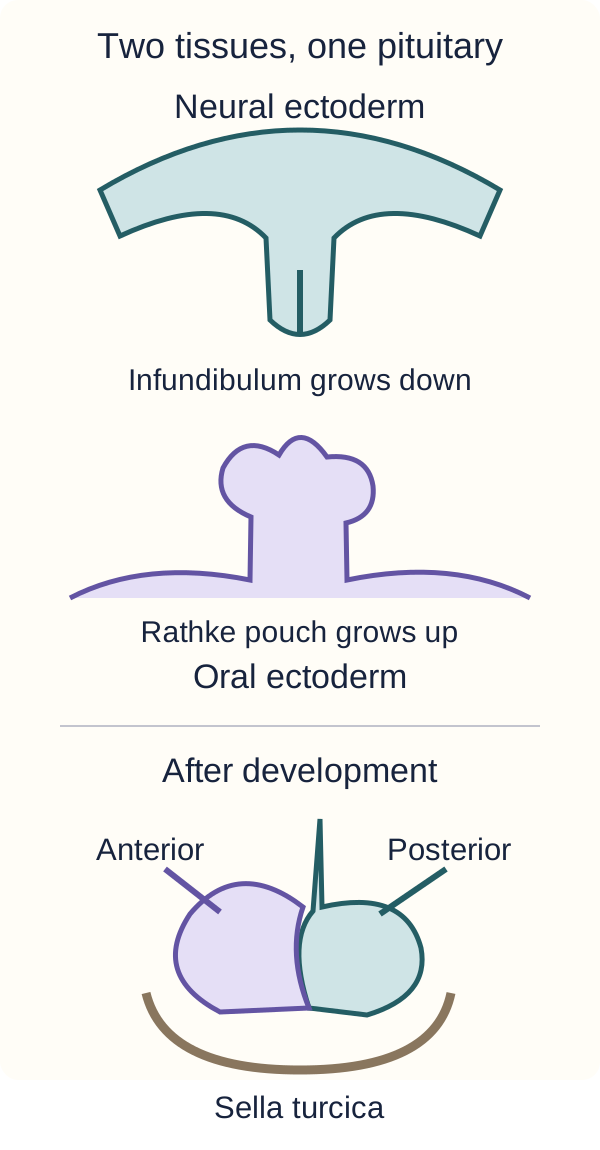
Rathke pouch does not normally vanish without leaving a gland. Oral ectoderm grows upward and contributes the anterior pituitary, while an extension of neural ectoderm, the infundibulum, contributes the posterior pituitary. The classic embryologic association of craniopharyngioma is epithelial tissue along the Rathke pouch developmental pathway, not a tumor arising from a mature hormone-secreting pituitary cell.
Trace the two tissue origins in the diagram before naming either adult lobe. The upward oral component becomes anterior pituitary; the downward neural component becomes posterior pituitary. Persistent epithelial tissue is an association with tumor origin, not a prediction that every developmental remnant must form a tumor. [1][2][15]
Rathke pouch contributes the anterior pituitary. The posterior pituitary develops from the infundibulum. The tumor association does not mean that the normal anterior pituitary should disappear. Open full-size diagram
Modern classification distinguishes adamantinomatous and papillary craniopharyngioma as separate tumor types. Adamantinomatous tumors occur in children and adults. Epithelial nests may have peripheral palisading, stellate reticulum-like tissue, calcification and nodules of anucleate eosinophilic material called wet keratin. Their cyst fluid can contain cholesterol and appear oily, yellow-brown or dark. Color alone does not diagnose the tumor.
Papillary tumors occur predominantly in adults. They typically contain mature squamous epithelium over fibrovascular cores, without the characteristic wet keratin of adamantinomatous tumors. Activating CTNNB1 alterations and abnormal beta-catenin signaling are associated with adamantinomatous tumors; BRAF V600E is characteristic of most papillary tumors. Age and imaging guide suspicion, but tissue and molecular findings resolve the classification. [1][2][15]
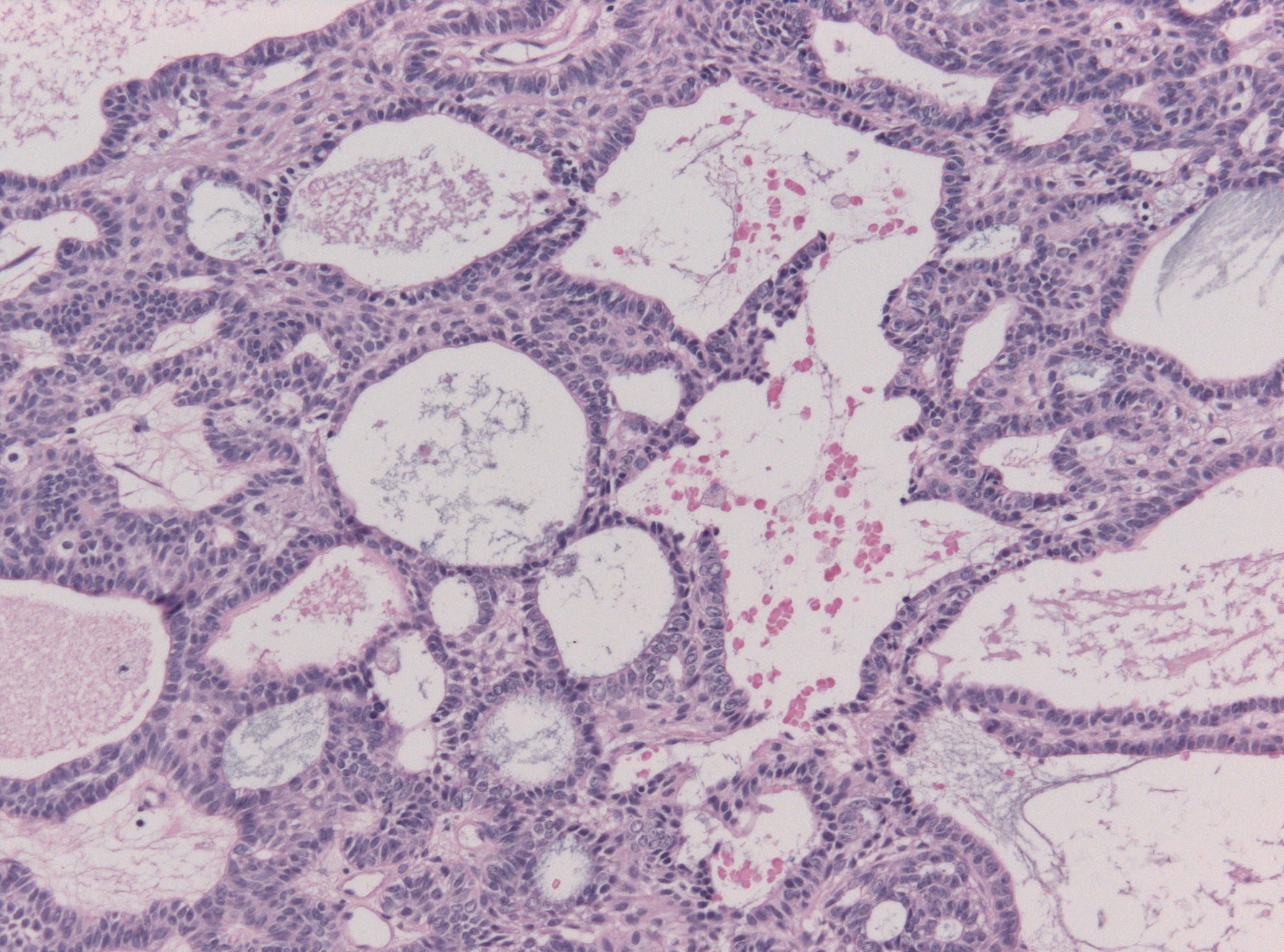
Follow a curved epithelial rim. Its dark nuclei line up at the edge. This field supports recognition of epithelial architecture and palisading; do not label every pale space as wet keratin or assume that every diagnostic feature appears in this one photograph. Jensflorian, CC BY-SA 3.0 Germany. Unmodified original. Open full-size image
Look, then name the structure. Follow a curved tissue border in the photograph. Which cells make the dark rim? The peripheral epithelial nuclei form a palisaded arrangement. The photograph is useful for that architecture, but it does not justify calling every pale region wet keratin.
Apply the distinction. An adult with a noncalcified suprasellar tumor is not excluded from this diagnosis. If tissue instead shows papillary squamous architecture, BRAF testing becomes relevant. In a childhood lesion with wet keratin, the expected molecular association changes to CTNNB1. Neither association replaces pathological assessment. [2]
Which part of the visual pathway is affected?
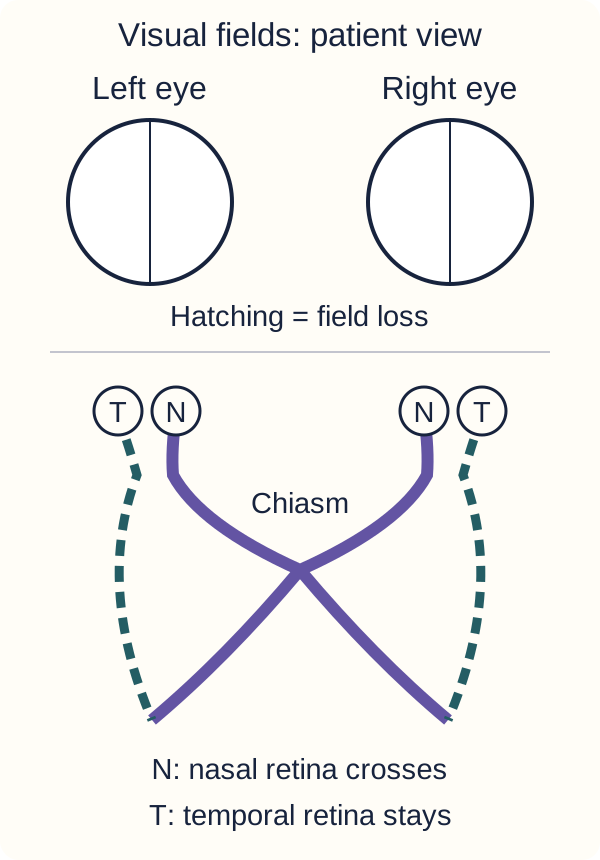
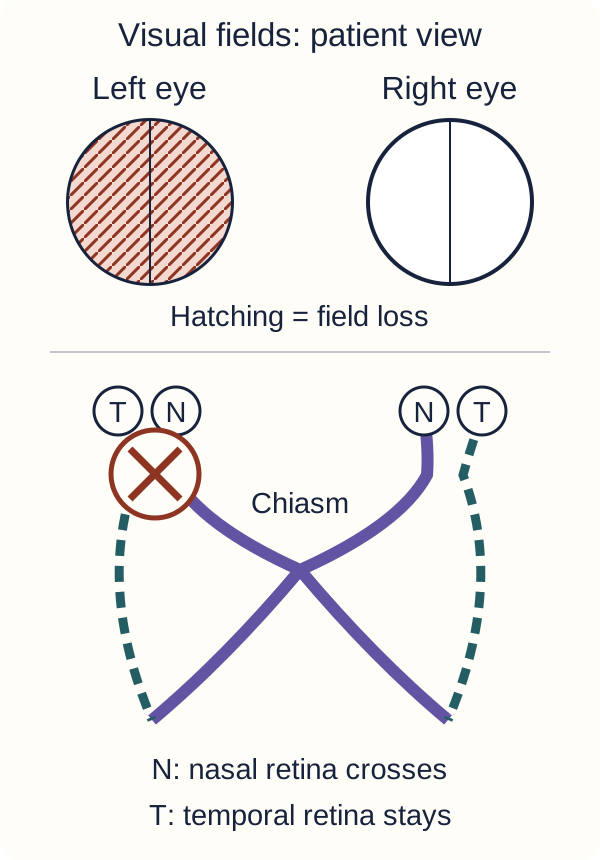
Loss of the outer field in each eye is different from loss of the left field in both eyes. Temporal visual fields project onto nasal retina. Nasal retinal axons cross at the optic chiasm; temporal retinal axons remain on their own side. Injury to the central chiasm can therefore impair the temporal field of both eyes: bitemporal hemianopia.
Craniopharyngioma is often suprasellar, with a variable relationship to the chiasm, stalk and third ventricle. Do not picture every tumor starting inside the sella and growing in one predetermined direction. Asymmetric compression, optic nerve involvement and extension behind the chiasm can produce other patterns. Formal perimetry and visual acuity testing measure the consequence rather than assuming it from the tumor name. [1][11]
Both visual fields are intact. Solid nasal retinal paths cross at the chiasm; dashed temporal retinal paths remain on their own side. Open full-size diagram
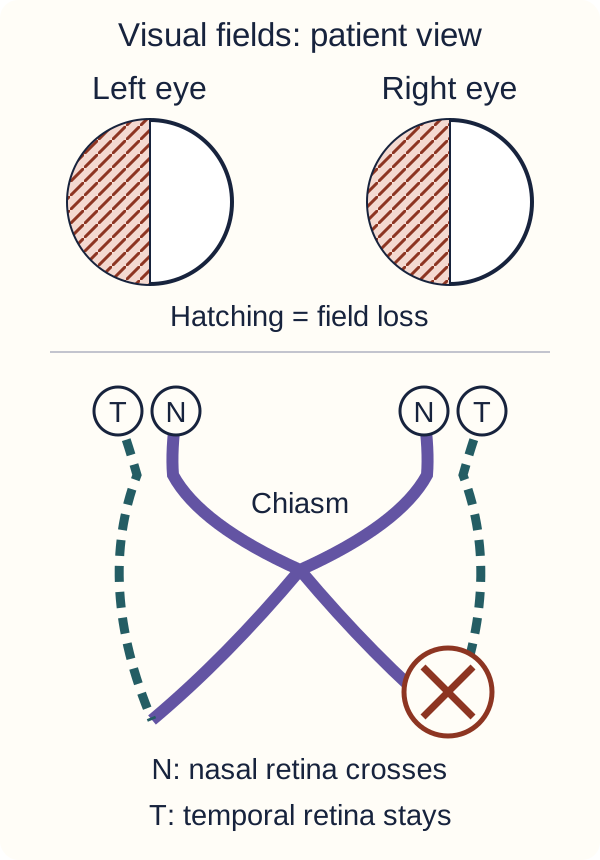
Choose a site of injury. First predict the affected field in each eye, then open its comparison. Each selection changes the marked injury and the hatched field pattern; it does not advance the lesson. Close the comparison to reset, or keep two open to compare them. All essential localization rules are stated below, even without opening a panel.
Central chiasm injury: which fields change?
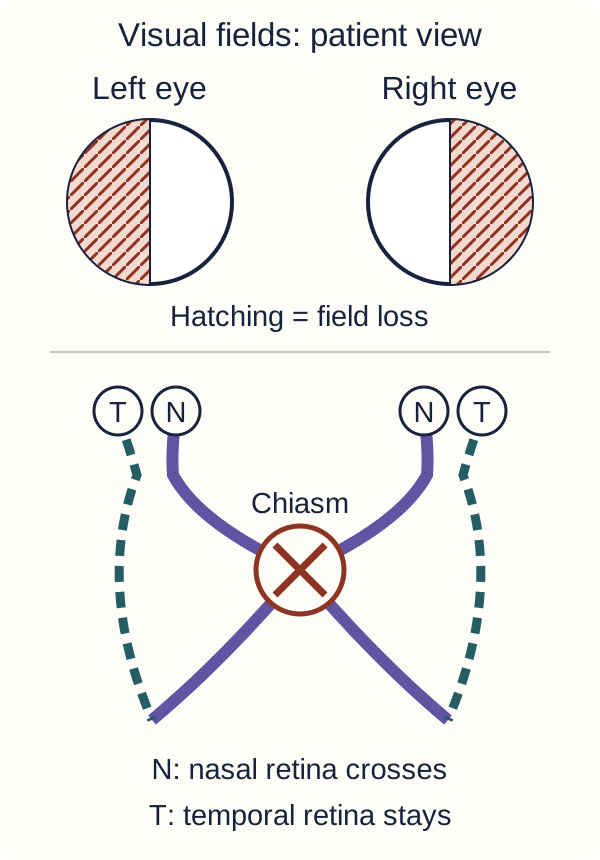
A central chiasm injury interrupts crossing nasal retinal paths. The left half of the left-eye field and right half of the right-eye field are hatched: bitemporal loss. Open full-size diagram
The injury intersects the crossing nasal retinal paths. The outer half of each field is affected, producing a bitemporal pattern.
Left optic nerve injury: which eye is affected?
An injury before the chiasm affects the left optic nerve. The entire left-eye visual field is hatched while the right-eye field remains intact. Open full-size diagram
The injury occurs before fibers from the two eyes have mixed. The left eye is affected, not the left half of both eyes.
Right optic tract injury: which side is lost?
An injury after the chiasm affects the right optic tract. The left half of both visual fields is hatched: left homonymous loss. Open full-size diagram
The right tract carries left-field information from both eyes. Its injury produces a left homonymous pattern.
Carry this to a new patient: monocular loss suggests a prechiasmal problem; bitemporal loss suggests chiasmal involvement; matching left-sided or right-sided loss in both eyes suggests a contralateral postchiasmal problem. The schematic uses complete field defects to make the relationships visible, not to promise that every clinical lesion produces a complete defect. [11]
Vertical gaze difficulty points instead toward dorsal midbrain involvement, often from a pineal-region mass. Truncal ataxia with a posterior fossa lesion raises a different anatomical concern. Neither finding is interchangeable with a measured chiasmal field defect. [16][21]
Try it here · Checkpoint 1 of 3
Make your prediction before reading the choices. A first attempt is just a starting point.
Case 4
Show answer and explanations for case 4
A. Crossing nasal retinal fibers at the optic chiasm (Best answer)
Temporal visual fields project onto nasal retina, whose axons cross at the chiasm. Both temporal fields are affected, localizing the shared vulnerable crossing rather than one eye or one cerebral hemisphere. Name the missing visual field first, then identify the retina and crossing it depends on.
Reasoning steps for option A
Why consider "Crossing nasal retinal fibers at the optic chiasm" after the clue "A 12-year-old girl with declining growth velocity"?
Temporal visual fields project onto nasal retina, whose axons cross at the chiasm. This establishes the first discriminator.
What second discriminator matters for alternative A after "Perimetry shows loss of the temporal half"?
The separate datum is perimetry shows loss of the temporal half of the visual field in each eye, while the nasal halves remain relatively preserved. For the Crossing nasal alternative, this supplies a different discriminator.
B. Right-sided postchiasmal fibers carrying the left hemifield (Why this does not fit)
Right postchiasmal pathways carry left-field information from both eyes. That pattern is left homonymous loss, not loss of the two outer halves. Homonymous defects affect the same side of both visual fields.
Reasoning steps for option B
Why consider "Right-sided postchiasmal fibers carrying the left hemifield" after the clue "A 12-year-old girl with declining growth velocity"?
Right postchiasmal pathways carry left-field information from both eyes. This establishes the first discriminator.
What second discriminator matters for alternative B after "Perimetry shows loss of the temporal half"?
The separate datum is a 12-year-old girl with declining growth velocity is found to have a suprasellar mass. For the Right-sided postchiasmal alternative, this supplies a different discriminator.
C. Temporal retinal axons that remain uncrossed (Why this does not fit)
Temporal retinal axons carry nasal-field information and remain uncrossed. Selective injury to these axons does not explain preferential loss of both temporal fields. A visual field and the retinal region that receives it have opposite horizontal labels.
Reasoning steps for option C
Why consider "Temporal retinal axons that remain uncrossed" after the clue "A 12-year-old girl with declining growth velocity"?
Temporal retinal axons carry nasal-field information and remain uncrossed. This establishes the first discriminator.
What second discriminator matters for alternative C after "Perimetry shows loss of the temporal half"?
The separate datum is perimetry shows loss of the temporal half of the visual field in each eye, while the nasal halves remain relatively preserved. For the Temporal retinal alternative, this supplies a different discriminator.
D. All axons within the left optic nerve (Why this does not fit)
The left optic nerve carries visual information from the left eye before the chiasm. An isolated left nerve injury cannot account for a matching temporal defect in the right eye. A prechiasmal lesion generally produces a monocular rather than heteronymous defect.
Reasoning steps for option D
Why consider "All axons within the left optic nerve" after the clue "A 12-year-old girl with declining growth velocity"?
The left optic nerve carries visual information from the left eye before the chiasm. This establishes the first discriminator.
What second discriminator matters for alternative D after "Perimetry shows loss of the temporal half"?
The separate datum is a 12-year-old girl with declining growth velocity is found to have a suprasellar mass. For the All axons alternative, this supplies a different discriminator.
Takeaway: Name the missing visual field first, then identify the retina and crossing it depends on.
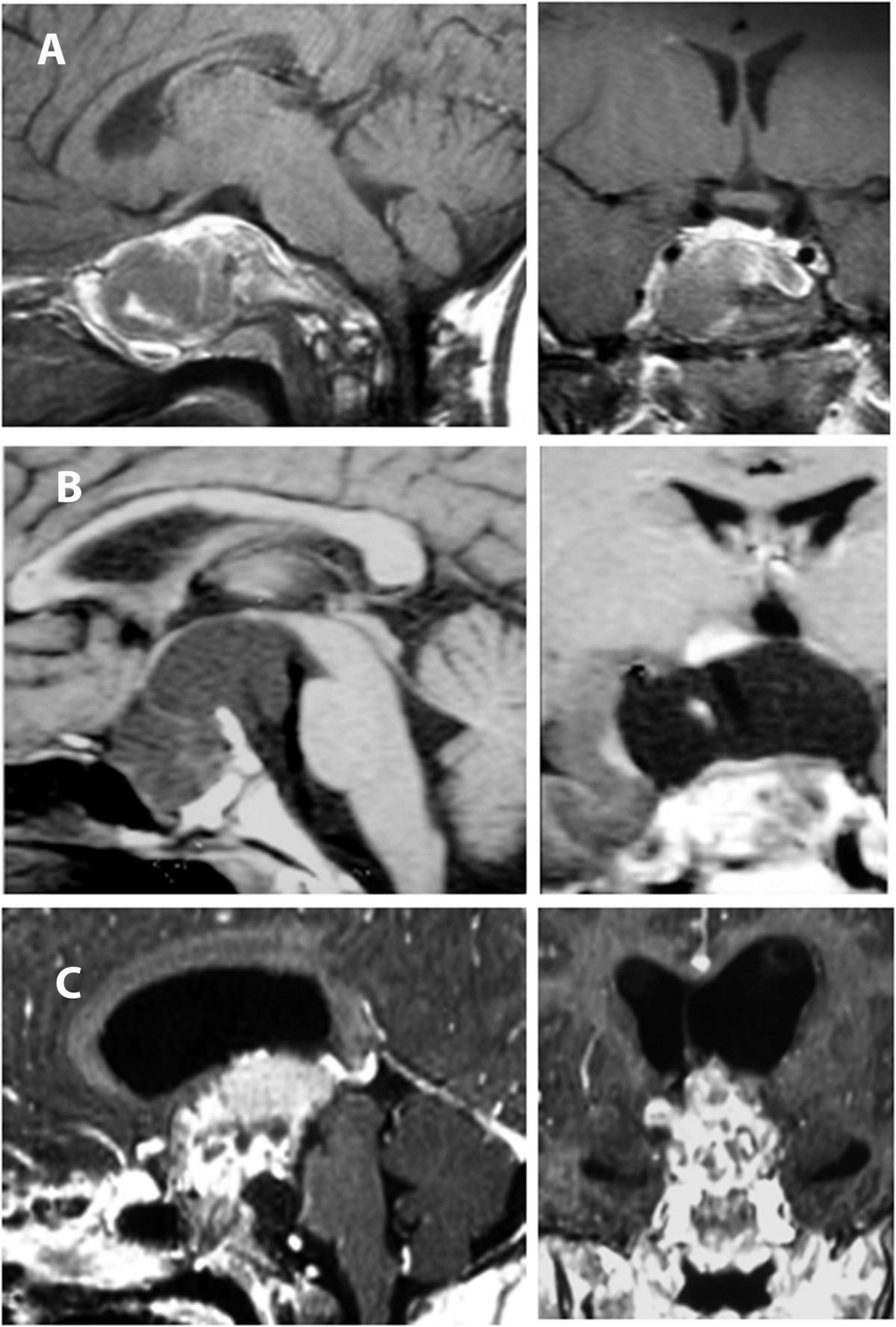
What does the image show, and what does it not prove?
A mixed cystic and solid suprasellar mass with calcification strongly supports an adamantinomatous craniopharyngioma in the appropriate clinical setting. CT is useful for calcium; MRI better defines cysts, enhancing tissue and relationships to the optic pathways, hypothalamus and vessels. Bright T1 signal can reflect cyst contents and is not itself proof of calcium. Cyst signal and calcification vary, particularly across adult tumors. [1][9]
Inspect row B before row C. Find the large dark cystic compartment in B, then compare the tissue above the tumor in the coronal views. The source describes displacement in B and an indistinguishable hypothalamus in C. C also shows enlarged ventricles. These are examples from different patients, not sequential stages in one patient.
Predict a consequence. A poorly separable hypothalamic interface raises concern for injury during aggressive surgery. It does not tell you the patient's cortisol concentration or prove that a particular surgical approach is safe. Anatomy and function need separate assessments. [7][13]
Build the differential from the actual compartment, imaging and laboratory pattern. Several lesions can affect the chiasm or hormones. Childhood age does not exclude a pituitary adenoma, and hormone deficits do not exclude a prolactinoma. Conversely, a modest prolactin increase is not sufficient evidence of a prolactinoma. [1][5]
Competing explanations for a sellar or nearby mass
Alternative
What changes the interpretation?
AlternativeRathke cleft cyst
What changes the interpretation?Usually a nonneoplastic epithelial cyst. A simple ciliated cuboidal or columnar lining with mucin supports it. Content can be protein-rich; it is not always clear water. Squamous metaplasia can complicate the distinction. [12]
AlternativePituitary adenoma
What changes the interpretation?May cause hormone excess, deficiencies or both. A large lesion with unexpectedly modest prolactin requires consideration of assay interference before a definitive nonsecretory label. [5]
AlternativeGerminoma or stalk disease
What changes the interpretation?Suprasellar germinoma and infiltrative lesions can present with AVP deficiency. Germinoma is not confined to the pineal region. [16]
AlternativeOptic pathway glioma
What changes the interpretation?A lesion expanding the optic pathway, especially with neurofibromatosis type 1, favors a glial process. Hypothalamic extension can also affect endocrine function. [19]
AlternativeMeningioma
What changes the interpretation?Dural attachment and an enhancing solid mass favor this diagnosis. A meningioma near the tuberculum sellae can also affect vision and can calcify. [20]
For the remaining distant alternatives, check the location first: an oligodendroglioma presenting with adult cortical seizures is a different setting from a suprasellar cyst; a medulloblastoma, a posterior fossa pilocytic astrocytoma or a fourth-ventricular ependymoma can cause ataxia and obstructive hydrocephalus. Calcium anywhere in the brain does not identify its cell of origin. Histology showing epithelial nests is also different from a cerebellar embryonal tumor or an ependymal tumor. [1][9][15][19][21][22][23]
Is the target gland failing, or is its signal missing?
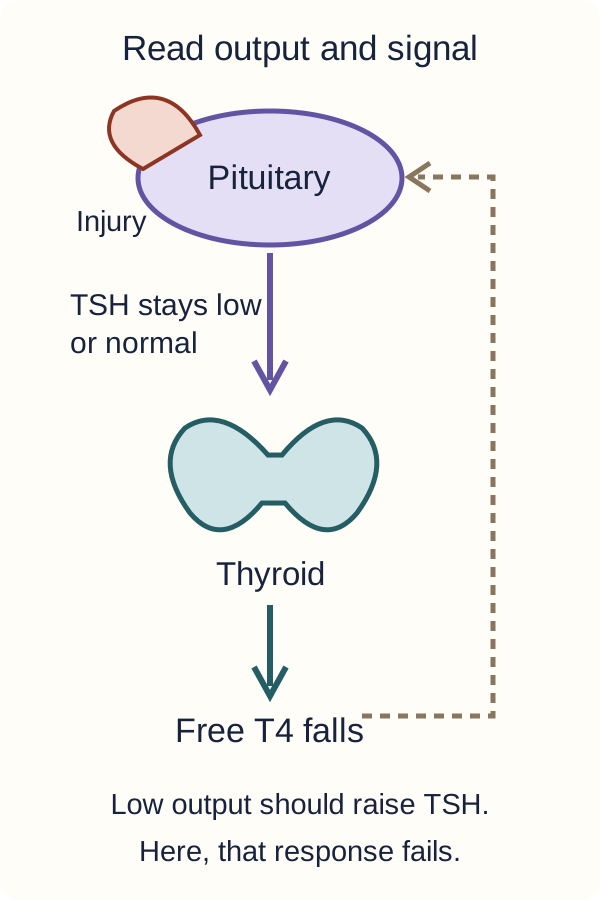
A low hormone value must be interpreted alongside the signal that should stimulate it. With primary thyroid failure, low free T4 should provoke increased TSH. With central hypothyroidism, free T4 is low but TSH is inappropriately low, normal or occasionally only mildly increased. A laboratory flag is not the same as an appropriate physiological response. [3]
Compare the gland output with the pituitary response. A reference-range TSH does not establish normal thyroid function when free T4 is low in a patient with pituitary disease. Open full-size diagram
Compare output with response. A stable adult with a suprasellar mass has free T4 of 0.5 ng/dL (0.8-1.8) and TSH of 1.4 mIU/L (0.4-4.0). Predict what an intact pituitary should do. It should increase TSH substantially in response to low thyroid hormone. The reference-range TSH is therefore inappropriate here. When treating confirmed central hypothyroidism, free T4 and clinical context guide dosing, not normalization of TSH alone.
The same comparison applies to other axes. Low cortisol with a low or inappropriately normal ACTH suggests central adrenal insufficiency, whereas primary adrenal failure usually has increased ACTH. Aldosterone is largely regulated by the renin-angiotensin system, so central adrenal insufficiency does not require hyperkalemia. Low estradiol or testosterone with inadequate gonadotropins supports central hypogonadism when interpreted for age, pubertal stage and physiological context. [3]
In children, slowing growth velocity and crossing height percentiles can precede a dramatic neurological complaint. Delayed bone age can accompany growth hormone deficiency, but skeletal delay alone is not diagnostic. Low IGF-1 supports concern but is not a stand-alone diagnosis of growth hormone deficiency: nutrition, systemic illness, thyroid status and age matter. A random growth hormone concentration is especially unhelpful because secretion is pulsatile.
Specialist assessment determines whether stimulation testing is needed. Pubertal development may be delayed; precocious puberty has also been reported rarely with hypothalamic involvement. There is no mandatory sequence in which GH, gonadotropins, TSH, ACTH and AVP must fail. [1][3][8][17][18][24][25]
Prolactin behaves differently because dopamine normally inhibits lactotroph secretion. Interference with hypothalamic dopamine delivery through the stalk can increase prolactin while other axes fail. In a very large pituitary mass, an unexpectedly modest prolactin result also warrants discussion of serial sample dilution with the laboratory: antibody saturation in a high-dose hook effect can conceal a much higher concentration. Imaging, medication history and biochemical context matter more than a rigid cutoff. [5]
Protect cortisol availability before starting thyroid replacement. Evaluate adrenal function first; when adrenal insufficiency is present or cannot promptly be excluded, glucocorticoid coverage takes priority. Suspected adrenal crisis requires urgent treatment, not waiting for the entire outpatient hormone panel. Adult guidance is not a pediatric dosing protocol. [3]
Try it here · Checkpoint 2 of 3
Make your prediction before reading the choices. A first attempt is just a starting point.
Case 12
Show answer and explanations for case 12
A. Thyroid hormone resistance with an unsuppressed TSH (Why this does not fit)
Resistance can produce increased thyroid hormone levels with nonsuppressed TSH. The free T4 here is low, not increased. Do not call every discordant TSH and free T4 pair hormone resistance.
Reasoning steps for option A
Why consider "Thyroid hormone resistance with an unsuppressed TSH" after the clue "A 35-year-old woman with a recently diagnosed"?
Resistance can produce increased thyroid hormone levels with nonsuppressed TSH. This establishes the first discriminator.
What second discriminator matters for alternative A after "There is no acute systemic illness"?
The separate datum is there is no acute systemic illness. For the Thyroid hormone alternative, this supplies a different discriminator.
B. Primary thyroid failure with an appropriate pituitary response (Why this does not fit)
Primary thyroid failure usually provokes increased TSH in response to low free T4. The expected compensatory increase is absent despite repeatedly low free T4. The direction of the pituitary response distinguishes primary from central gland dysfunction.
Reasoning steps for option B
Why consider "Primary thyroid failure with an appropriate pituitary response" after the clue "A 35-year-old woman with a recently diagnosed"?
Primary thyroid failure usually provokes increased TSH in response to low free T4. This establishes the first discriminator.
What second discriminator matters for alternative B after "There is no acute systemic illness"?
The separate datum is free t4 is repeatedly 0.5 ng/dl (0.8-1.8), while tsh is 1.6 miu/l (0.4-4.0). For the Primary thyroid alternative, this supplies a different discriminator.
C. Normal thyroid function because TSH lies within its interval (Why this does not fit)
TSH is useful as a screening test when the hypothalamic-pituitary axis is intact. Known suprasellar disease and a low free T4 invalidate that isolated reassurance. A normal-range regulatory hormone may be abnormal for the physiological situation.
Reasoning steps for option C
Why consider "Normal thyroid function because TSH lies within its interval" after the clue "A 35-year-old woman with a recently diagnosed"?
TSH is useful as a screening test when the hypothalamic-pituitary axis is intact. This establishes the first discriminator.
What second discriminator matters for alternative C after "There is no acute systemic illness"?
The separate datum is the patient is not taking thyroid hormone, glucocorticoids or biotin. For the Normal thyroid alternative, this supplies a different discriminator.
D. Central hypothyroidism with an inadequate TSH response (Best answer)
When thyroid hormone falls, an intact pituitary should increase TSH. Repeatedly low free T4 with a reference-range TSH in pituitary-region disease is an inappropriate response, supporting central hypothyroidism. Assess pituitary signals relative to target-gland output, not only the laboratory reference flag.
Reasoning steps for option D
Why consider "Central hypothyroidism with an inadequate TSH response" after the clue "A 35-year-old woman with a recently diagnosed"?
When thyroid hormone falls, an intact pituitary should increase TSH. This establishes the first discriminator.
What second discriminator matters for alternative D after "There is no acute systemic illness"?
The separate datum is a 35-year-old woman with a recently diagnosed suprasellar mass reports fatigue and cold intolerance. For the Central hypothyroidism alternative, this supplies a different discriminator.
Takeaway: Assess pituitary signals relative to target-gland output, not only the laboratory reference flag.
Why can dilute urine coexist with concentrated blood?
Arginine vasopressin, also called AVP or ADH, is synthesized in the hypothalamus and transported down axons for release from the posterior pituitary. Its absence impairs collecting-duct water conservation. A suprasellar lesion can disrupt this pathway, producing central diabetes insipidus, also termed AVP deficiency. The kidney may still respond normally when the missing signal is supplied. [3][4]
Predict the response before calculating it. A patient passes large volumes of urine at 90 mOsm/kg while serum sodium is 151 mmol/L (135-145). After supervised desmopressin, urine concentration rises to 630 mOsm/kg. That is a sevenfold concentration increase: the renal response is present, supporting deficient AVP rather than severe renal AVP resistance.
Change one finding. Would sodium of 140 mmol/L exclude AVP deficiency? No. Intact thirst and unrestricted drinking can replace the water being lost. High sodium becomes more likely when water access, consciousness or thirst is impaired. Persistent polyuria still deserves paired blood and urine assessment. [3][4]
New nocturia or enuresis can prompt investigation of high urine output. Do not call every thirsty patient AVP-deficient. Glucose-driven osmotic diuresis, primary polydipsia and renal AVP resistance are alternatives. Hyperosmolar blood with inappropriately dilute urine supports a water-conservation problem; normal glucose and absent glucosuria argue against glucose-driven diuresis. Primary polydipsia often has low or normal sodium rather than hypernatremia. Partial disorders can overlap, so difficult cases require specialist testing rather than unsupervised fluid restriction.
After surgery, the pattern can change. Early AVP deficiency may be followed by release of stored AVP and a period of water retention, sometimes followed by persistent deficiency. Not every patient passes through all three phases. Falling sodium and increasingly concentrated urine should prompt reassessment of fluid intake, desmopressin exposure, cortisol status and postoperative physiology instead of blindly repeating an earlier prescription. [3]
Hypothalamic injury can impair thirst itself. A patient with adipsic AVP deficiency cannot safely rely on drinking to thirst and needs an individualized fluid and desmopressin plan with monitoring. Cortisol deficiency can also mask polyuria by impairing free-water excretion; glucocorticoid replacement may reveal previously hidden AVP deficiency. This is a reason to monitor urine output and sodium, not to withhold needed cortisol replacement. [3][4]
Try it here · Checkpoint 3 of 3
Make your prediction before reading the choices. A first attempt is just a starting point.
Case 18
Show answer and explanations for case 18
A. Deficient AVP release with preserved renal responsiveness (Best answer)
AVP deficiency produces inappropriately dilute urine despite a need to conserve water. Marked concentration after desmopressin demonstrates that the kidney can respond when the missing signal is supplied. Interpret blood concentration, urine concentration and response to replacement together.
Reasoning steps for option A
Why consider "Deficient AVP release with preserved renal responsiveness" after the clue "A 24-year-old woman with a suprasellar mass"?
AVP deficiency produces inappropriately dilute urine despite a need to conserve water. This establishes the first discriminator.
What second discriminator matters for alternative A after "Sodium is 152 mmol/L (135-145), measured serum"?
The separate datum is sodium is 152 mmol/l (135-145), measured serum osmolality is 310 mosm/kg (275-295) and urine osmolality is 90 mosm/kg. For the Deficient AVP alternative, this supplies a different discriminator.
B. Severe renal resistance to AVP (Why this does not fit)
Renal AVP resistance can cause hypernatremia and hypotonic polyuria. A sevenfold concentration increase after desmopressin is inconsistent with severe renal resistance as the principal explanation. A substantial response to the hormone separates deficient supply from a severely unresponsive target.
Reasoning steps for option B
Why consider "Severe renal resistance to AVP" after the clue "A 24-year-old woman with a suprasellar mass"?
Renal AVP resistance can cause hypernatremia and hypotonic polyuria. This establishes the first discriminator.
What second discriminator matters for alternative B after "Sodium is 152 mmol/L (135-145), measured serum"?
The separate datum is glucose, calcium, potassium and kidney function are normal; there is no glucosuria. For the Severe renal alternative, this supplies a different discriminator.
C. Glucose-driven osmotic diuresis (Why this does not fit)
Glucose in urine can retain water in the tubular lumen and increase urine volume. Normal glucose and absent glucosuria argue against this mechanism, while the urine is profoundly dilute. Check for an osmotic solute before labeling high urine volume osmotic diuresis.
Reasoning steps for option C
Why consider "Glucose-driven osmotic diuresis" after the clue "A 24-year-old woman with a suprasellar mass"?
Glucose in urine can retain water in the tubular lumen and increase urine volume. This establishes the first discriminator.
What second discriminator matters for alternative C after "Sodium is 152 mmol/L (135-145), measured serum"?
The separate datum is during supervised assessment, desmopressin increases urine osmolality to 630 mosm/kg. For the Glucose-driven osmotic alternative, this supplies a different discriminator.
D. Excess water intake suppressing otherwise normal AVP release (Why this does not fit)
Primary polydipsia can cause dilute urine through appropriate suppression of AVP. Concentrated blood and hypernatremia are not the expected effect of excess water intake alone. Ask whether dilute urine is appropriate for the simultaneous blood concentration.
Reasoning steps for option D
Why consider "Excess water intake suppressing otherwise normal AVP release" after the clue "A 24-year-old woman with a suprasellar mass"?
Primary polydipsia can cause dilute urine through appropriate suppression of AVP. This establishes the first discriminator.
What second discriminator matters for alternative D after "Sodium is 152 mmol/L (135-145), measured serum"?
The separate datum is a 24-year-old woman with a suprasellar mass passes 7 l of urine per day. For the Excess water alternative, this supplies a different discriminator.
Takeaway: Interpret blood concentration, urine concentration and response to replacement together.
How do you control the tumor without sacrificing function?
The first priority is the patient's condition, not memorizing a surgical label. Worsening vision, reduced consciousness, repeated vomiting with papilledema, suspected obstructive hydrocephalus, severe sodium disturbance or possible adrenal crisis require urgent assessment. A known intracranial mass with significant mass effect is not an invitation to perform lumbar puncture for an opening pressure; a dangerous pressure gradient can make that procedure unsafe. [1][3][4][10]
For a stable patient, combine detailed MRI, CT when calcium characterization is useful, visual acuity and field assessment, and evaluation of anterior pituitary and water-balance function. Growth and pubertal history are part of that assessment in children. Tissue diagnosis and appropriate molecular testing establish what imaging only suggests. Treat deficiencies and plan perioperative endocrine support rather than assuming that tumor treatment alone will restore every axis. [1][3][8]
Choose the outcome that matters. Imagine a tumor tightly adherent to the hypothalamus, with useful vision still present. Would a radiologically complete resection necessarily be the best outcome if it caused major hypothalamic injury? No. Tumor control must be weighed against sight, cognition, endocrine function and daily independence. The MRI interface helps frame that risk; it does not dictate a single operation.
Experienced multidisciplinary teams individualize surgery, cyst-directed procedures, radiation and surveillance. Complete resection may be appropriate when safe separation is possible. Planned limited resection with consideration of radiation can be preferable when further dissection threatens critical structures. Radiation timing and technique depend on age, anatomy, residual disease and prior treatment. Comparative cohorts support function-preserving strategies but do not establish that one operation is best for every patient. [1][7][8]
Molecular results can create a different treatment discussion. In a 2023 single-group trial of selected adults with BRAF-mutant papillary craniopharyngioma, 15 of 16 patients had a partial response or better with combined BRAF and MEK inhibition. Serious adverse events occurred, and the design did not establish superiority to surgery or radiation. This is not evidence that a childhood CTNNB1-associated tumor should receive the same regimen, or that tumor shrinkage proves permanent cure. [2][6]
Long-term follow-up has two separate jobs: detect recurrence and detect or treat disability. Serial imaging can remain necessary after apparently complete resection. Endocrine replacement, visual follow-up, learning and cognitive support, sleep assessment and metabolic care may still be needed when imaging looks reassuring. Rapid weight gain after hypothalamic injury is not proof of poor effort or simply undertreated hypothyroidism; abnormal satiety and energy regulation need multidisciplinary care. [1][7][8]
Apply the complete model. Ask where the lesion is, which signals or visual pathways it disrupts, what tissue type is present, and which intervention protects the person's function. A familiar tumor name is the beginning of those decisions, not the end.
Apply the findings to a new patient
Answer the clinical question before inspecting the choices. Then compare the explanation for the option you selected with the explanation for the strongest alternative.
Case 1
Show answer and explanations for case 1
A. Neural crest and Schwann cells (Why this does not fit)
Neural crest contributes Schwann cells, so this pairing fits a peripheral nerve-sheath lineage. The specimen has epithelial nests and wet keratin, not a nerve-sheath tumor pattern. Use tissue architecture rather than a generic head-and-neck embryology association.
Reasoning steps for option A
Why consider "Neural crest and Schwann cells" after the clue "A 9-year-old boy has crossed downward through"?
Neural crest contributes Schwann cells, so this pairing fits a peripheral nerve-sheath lineage. This establishes the first discriminator.
What second discriminator matters for alternative A after "CT shows a partly cystic, calcified suprasellar"?
The separate datum is ct shows a partly cystic, calcified suprasellar lesion. For the Neural crest alternative, this supplies a different discriminator.
B. Surface ectoderm and epidermis (Why this does not fit)
Surface ectoderm forms epidermis, and keratin can suggest an epidermoid lesion. The organized suprasellar epithelial neoplasm with growth and chiasmal effects is better explained by the Rathke developmental association. Keratin is interpreted with the tumor architecture and anatomical compartment.
Reasoning steps for option B
Why consider "Surface ectoderm and epidermis" after the clue "A 9-year-old boy has crossed downward through"?
Surface ectoderm forms epidermis, and keratin can suggest an epidermoid lesion. This establishes the first discriminator.
What second discriminator matters for alternative B after "CT shows a partly cystic, calcified suprasellar"?
The separate datum is tissue obtained during treatment contains palisaded squamous epithelial nests and compact anucleate keratin nodules. For the Surface ectoderm alternative, this supplies a different discriminator.
C. Oral ectoderm and anterior pituitary (Best answer)
Oral ectoderm forms Rathke pouch, which contributes the anterior pituitary. The suprasellar epithelial tumor with wet keratin supports adamantinomatous craniopharyngioma. Identify the tumor from location and tissue before assigning its developmental association.
Reasoning steps for option C
Why consider "Oral ectoderm and anterior pituitary" after the clue "A 9-year-old boy has crossed downward through"?
Oral ectoderm forms Rathke pouch, which contributes the anterior pituitary. This establishes the first discriminator.
What second discriminator matters for alternative C after "CT shows a partly cystic, calcified suprasellar"?
The separate datum is a 9-year-old boy has crossed downward through three height percentiles over 18 months and has difficulty seeing classmates approaching from the sides. For the Oral ectoderm alternative, this supplies a different discriminator.
D. Neural ectoderm and posterior pituitary (Why this does not fit)
The infundibulum develops from neural ectoderm and contributes the posterior pituitary. Proximity to the posterior lobe does not give this keratin-containing epithelial tumor its classic origin. An adjacent structure can explain symptoms without being the tumor's tissue of origin.
Reasoning steps for option D
Why consider "Neural ectoderm and posterior pituitary" after the clue "A 9-year-old boy has crossed downward through"?
The infundibulum develops from neural ectoderm and contributes the posterior pituitary. This establishes the first discriminator.
What second discriminator matters for alternative D after "CT shows a partly cystic, calcified suprasellar"?
The separate datum is ct shows a partly cystic, calcified suprasellar lesion. For the Neural ectoderm alternative, this supplies a different discriminator.
Takeaway: Identify the tumor from location and tissue before assigning its developmental association.
Hedgehog-pathway alterations are relevant to selected other CNS tumors. No such tumor phenotype is supplied, while papillary craniopharyngioma has a specific BRAF association. A target used in one CNS tumor cannot be transferred solely because another tumor is nearby.
Reasoning steps for option A
Why consider "SMO activation" after the clue "A 56-year-old man develops progressive visual difficulty"?
Hedgehog-pathway alterations are relevant to selected other CNS tumors. This establishes the first discriminator.
What second discriminator matters for alternative A after "Biopsy shows well-differentiated squamous epithelium covering fibrovascular"?
The separate datum is biopsy shows well-differentiated squamous epithelium covering fibrovascular cores, without wet keratin. For the SMO activation alternative, this supplies a different discriminator.
B. IDH1 R132H (Why this does not fit)
IDH alterations help classify diffuse gliomas. This specimen is a papillary squamous epithelial tumor rather than a diffuse glial tumor. Molecular testing should answer the question raised by the actual histology.
Reasoning steps for option B
Why consider "IDH1 R132H" after the clue "A 56-year-old man develops progressive visual difficulty"?
IDH alterations help classify diffuse gliomas. This establishes the first discriminator.
What second discriminator matters for alternative B after "Biopsy shows well-differentiated squamous epithelium covering fibrovascular"?
The separate datum is residual tumor remains close to the hypothalamus after limited surgery. For the IDH1 R132H alternative, this supplies a different discriminator.
C. BRAF V600E (Best answer)
BRAF V600E is characteristic of most papillary craniopharyngiomas. The adult presentation and papillary squamous architecture fit the tumor type studied with combined BRAF and MEK inhibition. Establish tumor type and the actual molecular alteration before discussing genotype-directed treatment.
Reasoning steps for option C
Why consider "BRAF V600E" after the clue "A 56-year-old man develops progressive visual difficulty"?
BRAF V600E is characteristic of most papillary craniopharyngiomas. This establishes the first discriminator.
What second discriminator matters for alternative C after "Biopsy shows well-differentiated squamous epithelium covering fibrovascular"?
The separate datum is a 56-year-old man develops progressive visual difficulty from a noncalcified suprasellar mass. For the BRAF V600E alternative, this supplies a different discriminator.
D. CTNNB1 activation (Why this does not fit)
CTNNB1 alterations are strongly associated with adamantinomatous craniopharyngioma. The supplied architecture is papillary and lacks characteristic wet keratin. Do not assign the childhood-associated molecular pattern to every suprasellar epithelial tumor.
Reasoning steps for option D
Why consider "CTNNB1 activation" after the clue "A 56-year-old man develops progressive visual difficulty"?
CTNNB1 alterations are strongly associated with adamantinomatous craniopharyngioma. This establishes the first discriminator.
What second discriminator matters for alternative D after "Biopsy shows well-differentiated squamous epithelium covering fibrovascular"?
The separate datum is biopsy shows well-differentiated squamous epithelium covering fibrovascular cores, without wet keratin. For the CTNNB1 activation alternative, this supplies a different discriminator.
Takeaway: Establish tumor type and the actual molecular alteration before discussing genotype-directed treatment.
A. Diffuse glial fibrillary acidic protein expression in the neoplastic cells (Why this does not fit)
A glial tumor can show glial fibrillary acidic protein expression. The supplied epithelial and keratinizing architecture does not favor a primary glial neoplasm. Classify the tissue before selecting the confirmatory marker.
Reasoning steps for option A
Why consider "Diffuse glial fibrillary acidic protein expression in the neoplastic cells" after the clue "A 42-year-old woman has a recurrent cystic"?
A glial tumor can show glial fibrillary acidic protein expression. This establishes the first discriminator.
What second discriminator matters for alternative A after "Archived tissue shows palisaded epithelial islands, stellate"?
The separate datum is archived tissue shows palisaded epithelial islands, stellate reticulum-like areas and wet keratin. For the Diffuse glial alternative, this supplies a different discriminator.
B. Nuclear accumulation of beta-catenin in tumor cell clusters (Best answer)
CTNNB1-associated signaling can produce abnormal nuclear beta-catenin in adamantinomatous craniopharyngioma. Wet keratin and palisaded epithelial architecture favor that tumor type even in an adult. Age modifies probability; tissue architecture determines which molecular association is most appropriate.
Reasoning steps for option B
Why consider "Nuclear accumulation of beta-catenin in tumor cell clusters" after the clue "A 42-year-old woman has a recurrent cystic"?
CTNNB1-associated signaling can produce abnormal nuclear beta-catenin in adamantinomatous craniopharyngioma. This establishes the first discriminator.
What second discriminator matters for alternative B after "Archived tissue shows palisaded epithelial islands, stellate"?
The separate datum is ct also shows focal calcification. For the Nuclear accumulation alternative, this supplies a different discriminator.
C. Strong prolactin expression throughout a monomorphic endocrine tumor (Why this does not fit)
A lactotroph pituitary tumor can stain for prolactin. The specimen instead contains squamous epithelial islands with wet keratin. A mass next to the pituitary is not necessarily a pituitary hormone-secreting neoplasm.
Reasoning steps for option C
Why consider "Strong prolactin expression throughout a monomorphic endocrine tumor" after the clue "A 42-year-old woman has a recurrent cystic"?
A lactotroph pituitary tumor can stain for prolactin. This establishes the first discriminator.
What second discriminator matters for alternative C after "Archived tissue shows palisaded epithelial islands, stellate"?
The separate datum is the team requests an immunohistochemical finding that would support the likely molecular pathway, despite the patient's adult age. For the Strong prolactin alternative, this supplies a different discriminator.
D. Uniform restriction of beta-catenin to normal cell junctions (Why this does not fit)
Beta-catenin normally participates in cell adhesion at the membrane. Exclusive normal junctional localization would not supply the expected support for the abnormal pathway in this specimen. Distinguish the protein's normal location from a diagnostically abnormal accumulation.
Reasoning steps for option D
Why consider "Uniform restriction of beta-catenin to normal cell junctions" after the clue "A 42-year-old woman has a recurrent cystic"?
Beta-catenin normally participates in cell adhesion at the membrane. This establishes the first discriminator.
What second discriminator matters for alternative D after "Archived tissue shows palisaded epithelial islands, stellate"?
The separate datum is a 42-year-old woman has a recurrent cystic suprasellar tumor. For the Uniform restriction alternative, this supplies a different discriminator.
Takeaway: Age modifies probability; tissue architecture determines which molecular association is most appropriate.
The right optic tract carries the left visual hemifield from both eyes. Matching left-sided loss is homonymous, unlike the earlier bitemporal pattern. Re-localize a changed field defect instead of assigning every visual change to the original lesion site.
Reasoning steps for option A
Why consider "Right optic tract" after the clue "A 45-year-old woman under surveillance for a"?
The right optic tract carries the left visual hemifield from both eyes. This establishes the first discriminator.
What second discriminator matters for alternative A after "Perimetry now shows loss of the left"?
The separate datum is perimetry now shows loss of the left half of the visual field in both eyes, rather than the prior defect of the two outer halves. For the Right optic alternative, this supplies a different discriminator.
B. Left optic nerve (Why this does not fit)
The left optic nerve contains signals from the left eye before the chiasm. An isolated nerve injury cannot explain a left-field defect in the right eye. A lesion before fibers from both eyes have mixed is a monocular explanation.
Reasoning steps for option B
Why consider "Left optic nerve" after the clue "A 45-year-old woman under surveillance for a"?
The left optic nerve contains signals from the left eye before the chiasm. This establishes the first discriminator.
What second discriminator matters for alternative B after "Perimetry now shows loss of the left"?
The separate datum is the team considers extension along one of the optic tracts. For the Left optic alternative, this supplies a different discriminator.
C. Central optic chiasm (Why this does not fit)
Central chiasmal injury affects crossing nasal retinal fibers. That predicts preferential temporal-field loss in each eye, not the same left half in both. Distinguish a heteronymous pattern from a homonymous pattern before selecting the site.
Reasoning steps for option C
Why consider "Central optic chiasm" after the clue "A 45-year-old woman under surveillance for a"?
Central chiasmal injury affects crossing nasal retinal fibers. This establishes the first discriminator.
What second discriminator matters for alternative C after "Perimetry now shows loss of the left"?
The separate datum is a 45-year-old woman under surveillance for a suprasellar tumor reports a new visual problem. For the Central optic alternative, this supplies a different discriminator.
D. Left optic tract (Why this does not fit)
The left optic tract carries right-field information from both eyes. Its injury predicts right homonymous loss, opposite to the supplied perimetry. Postchiasmal defects are named for the missing field and localize to the opposite side.
Reasoning steps for option D
Why consider "Left optic tract" after the clue "A 45-year-old woman under surveillance for a"?
The left optic tract carries right-field information from both eyes. This establishes the first discriminator.
What second discriminator matters for alternative D after "Perimetry now shows loss of the left"?
The separate datum is perimetry now shows loss of the left half of the visual field in both eyes, rather than the prior defect of the two outer halves. For the Left optic alternative, this supplies a different discriminator.
Takeaway: Re-localize a changed field defect instead of assigning every visual change to the original lesion site.
A. Left homonymous loss with equal acuity in both eyes (Why this does not fit)
A right postchiasmal lesion can produce left homonymous loss. The supplied extension is in the left optic nerve, and the tracts are spared. A same-sided field defect in both eyes requires localization beyond an isolated optic nerve.
Reasoning steps for option A
Why consider "Left homonymous loss with equal acuity in both eyes" after the clue "A 31-year-old man with a suprasellar lesion"?
A right postchiasmal lesion can produce left homonymous loss. This establishes the first discriminator.
What second discriminator matters for alternative A after "Earlier perimetry showed a symmetric temporal-field defect"?
The separate datum is earlier perimetry showed a symmetric temporal-field defect. For the Left homonymous alternative, this supplies a different discriminator.
B. Left monocular optic neuropathy with a left afferent pupillary defect (Best answer)
Asymmetric optic nerve dysfunction can impair acuity, color perception and the afferent pupil response in the affected eye. The lesion is anterior to the chiasm and involves the left nerve rather than pathways carrying one hemifield from both eyes. Use the actual extension and examination rather than expecting a stereotyped field pattern from the tumor name.
Reasoning steps for option B
Why consider "Left monocular optic neuropathy with a left afferent pupillary defect" after the clue "A 31-year-old man with a suprasellar lesion"?
Asymmetric optic nerve dysfunction can impair acuity, color perception and the afferent pupil response in the affected eye. This establishes the first discriminator.
What second discriminator matters for alternative B after "Earlier perimetry showed a symmetric temporal-field defect"?
The separate datum is mri now shows asymmetric extension along the left optic nerve anterior to the chiasm. For the Left monocular alternative, this supplies a different discriminator.
C. Isolated right monocular loss with a right afferent defect (Why this does not fit)
An isolated right optic nerve lesion can produce this pattern. The abnormal nerve and symptoms are both on the left. Match laterality between the imaging, symptoms and pupil examination.
Reasoning steps for option C
Why consider "Isolated right monocular loss with a right afferent defect" after the clue "A 31-year-old man with a suprasellar lesion"?
An isolated right optic nerve lesion can produce this pattern. This establishes the first discriminator.
What second discriminator matters for alternative C after "Earlier perimetry showed a symmetric temporal-field defect"?
The separate datum is the right optic nerve and both optic tracts are spared. For the Isolated right alternative, this supplies a different discriminator.
D. Symmetric bitemporal loss with preserved central acuity (Why this does not fit)
Central chiasmal compression can preferentially affect the two temporal fields. This new deficit is markedly asymmetric and maps to anterior left optic nerve extension. A suprasellar tumor can affect more than the central chiasm.
Reasoning steps for option D
Why consider "Symmetric bitemporal loss with preserved central acuity" after the clue "A 31-year-old man with a suprasellar lesion"?
Central chiasmal compression can preferentially affect the two temporal fields. This establishes the first discriminator.
What second discriminator matters for alternative D after "Earlier perimetry showed a symmetric temporal-field defect"?
The separate datum is a 31-year-old man with a suprasellar lesion develops markedly reduced visual acuity and color perception in the left eye. For the Symmetric bitemporal alternative, this supplies a different discriminator.
Takeaway: Use the actual extension and examination rather than expecting a stereotyped field pattern from the tumor name.
A. Optic chiasm involvement with obstruction of the fourth ventricular outlets (Why this does not fit)
Chiasmal involvement can impair temporal fields, while distal ventricular obstruction can cause hydrocephalus. It does not explain the focal upgaze deficit and pineal-aqueduct relationship supplied here. Headache and vomiting are pressure symptoms, not proof that the lesion is sellar.
Reasoning steps for option A
Why consider "Optic chiasm involvement with obstruction of the fourth ventricular outlets" after the clue "A 16-year-old boy has headaches, vomiting and"?
Chiasmal involvement can impair temporal fields, while distal ventricular obstruction can cause hydrocephalus. This establishes the first discriminator.
What second discriminator matters for alternative A after "Horizontal eye movements are preserved, and perimetry"?
The separate datum is horizontal eye movements are preserved, and perimetry does not show loss of the two temporal fields. For the Optic chiasm alternative, this supplies a different discriminator.
B. Cerebellar vermis involvement with fourth ventricle compression (Why this does not fit)
A posterior fossa tumor can impair truncal coordination and obstruct the fourth ventricle. The demonstrated lesion is pineal and the defining neurological sign is impaired upgaze rather than ataxia. Localize with examination and imaging together rather than grouping all childhood brain tumors.
Reasoning steps for option B
Why consider "Cerebellar vermis involvement with fourth ventricle compression" after the clue "A 16-year-old boy has headaches, vomiting and"?
A posterior fossa tumor can impair truncal coordination and obstruct the fourth ventricle. This establishes the first discriminator.
What second discriminator matters for alternative B after "Horizontal eye movements are preserved, and perimetry"?
The separate datum is mri identifies a pineal-region mass impinging on the dorsal midbrain with enlargement of the lateral and third ventricles. For the Cerebellar vermis alternative, this supplies a different discriminator.
C. Left optic nerve involvement with pituitary stalk compression (Why this does not fit)
Optic nerve and stalk disease can cause visual and endocrine abnormalities. Neither accounts for preserved temporal fields, impaired upgaze and a dorsal midbrain mass. Different structures near the brain base produce different combinations of findings.
Reasoning steps for option C
Why consider "Left optic nerve involvement with pituitary stalk compression" after the clue "A 16-year-old boy has headaches, vomiting and"?
Optic nerve and stalk disease can cause visual and endocrine abnormalities. This establishes the first discriminator.
What second discriminator matters for alternative C after "Horizontal eye movements are preserved, and perimetry"?
The separate datum is a 16-year-old boy has headaches, vomiting and difficulty looking upward. For the Left optic alternative, this supplies a different discriminator.
D. Tectal involvement with obstruction near the cerebral aqueduct (Best answer)
The dorsal midbrain participates in vertical gaze, and the nearby aqueduct connects the third and fourth ventricles. A pineal-region mass can affect both structures, explaining upgaze difficulty and upstream ventricular enlargement. Use the specific neurological deficit and ventricular anatomy to localize a mass.
Reasoning steps for option D
Why consider "Tectal involvement with obstruction near the cerebral aqueduct" after the clue "A 16-year-old boy has headaches, vomiting and"?
The dorsal midbrain participates in vertical gaze, and the nearby aqueduct connects the third and fourth ventricles. This establishes the first discriminator.
What second discriminator matters for alternative D after "Horizontal eye movements are preserved, and perimetry"?
The separate datum is horizontal eye movements are preserved, and perimetry does not show loss of the two temporal fields. For the Tectal involvement alternative, this supplies a different discriminator.
Takeaway: Use the specific neurological deficit and ventricular anatomy to localize a mass.
A. Pineal region and dorsal midbrain (Why this does not fit)
Pineal lesions can cause headache and ventricular obstruction. The supplied localizing findings are endocrine and bitemporal rather than a vertical gaze syndrome. A young age and headache do not identify the pineal compartment.
Reasoning steps for option A
Why consider "Pineal region and dorsal midbrain" after the clue "A 10-year-old girl has progressive morning headaches"?
Pineal lesions can cause headache and ventricular obstruction. This establishes the first discriminator.
What second discriminator matters for alternative A after "The initial differential includes a posterior fossa"?
The separate datum is the initial differential includes a posterior fossa tumor. For the Pineal region alternative, this supplies a different discriminator.
B. Sellar and suprasellar region (Best answer)
The pituitary region and adjacent chiasm can explain central thyroid dysfunction, growth change and a bitemporal field defect together. Headache and vomiting are nonspecific, but the paired endocrine and visual findings localize to this region. Prefer the location that explains the combination rather than the most memorable nonspecific symptom.
Reasoning steps for option B
Why consider "Sellar and suprasellar region" after the clue "A 10-year-old girl has progressive morning headaches"?
The pituitary region and adjacent chiasm can explain central thyroid dysfunction, growth change and a bitemporal field defect together. This establishes the first discriminator.
What second discriminator matters for alternative B after "The initial differential includes a posterior fossa"?
The separate datum is further assessment shows preserved truncal coordination, slowed linear growth, loss of the temporal field in each eye, free t4 of 0.5 ng/dl (0.8-1.8) and tsh of 1.1 miu/l (0.4-4.0). For the Sellar and alternative, this supplies a different discriminator.
C. Frontal cortex (Why this does not fit)
A cortical lesion can cause headaches and neurological symptoms. A frontal cortical location does not unify the specific visual crossing defect with pituitary hormone dysfunction. A familiar calcifying cortical tumor should not displace a better anatomical explanation.
Reasoning steps for option C
Why consider "Frontal cortex" after the clue "A 10-year-old girl has progressive morning headaches"?
A cortical lesion can cause headaches and neurological symptoms. This establishes the first discriminator.
What second discriminator matters for alternative C after "The initial differential includes a posterior fossa"?
The separate datum is a 10-year-old girl has progressive morning headaches and vomiting. For the Frontal cortex alternative, this supplies a different discriminator.
D. Cerebellar vermis and fourth ventricle (Why this does not fit)
A posterior fossa lesion can cause morning vomiting and obstructive hydrocephalus. It does not directly account for the measured chiasmal field pattern and inadequate TSH response. Pressure symptoms alone do not distinguish a posterior fossa tumor from a suprasellar mass.
Reasoning steps for option D
Why consider "Cerebellar vermis and fourth ventricle" after the clue "A 10-year-old girl has progressive morning headaches"?
A posterior fossa lesion can cause morning vomiting and obstructive hydrocephalus. This establishes the first discriminator.
What second discriminator matters for alternative D after "The initial differential includes a posterior fossa"?
The separate datum is the initial differential includes a posterior fossa tumor. For the Cerebellar vermis alternative, this supplies a different discriminator.
Takeaway: Prefer the location that explains the combination rather than the most memorable nonspecific symptom.
A. Repeat T1 MRI without changing the protocol (Why this does not fit)
T1 imaging can characterize cyst signal. Repeating the same sequence does not specifically resolve whether the signal represents calcium. Cyst contents and calcium are different imaging questions.
Reasoning steps for option A
Why consider "Repeat T1 MRI without changing the protocol" after the clue "A 47-year-old man who is clinically stable"?
T1 imaging can characterize cyst signal. This establishes the first discriminator.
What second discriminator matters for alternative A after "Part of the cyst is bright on"?
The separate datum is part of the cyst is bright on t1 imaging, and the report states that the presence of mineralization remains uncertain. For the Repeat T1 alternative, this supplies a different discriminator.
B. Noncontrast CT of the sellar region (Best answer)
CT is well suited to demonstrating calcium. MRI has already characterized the soft-tissue relationships, but T1 brightness does not establish mineralization. Select the modality for the unresolved tissue property rather than equating every bright signal with calcium.
Reasoning steps for option B
Why consider "Noncontrast CT of the sellar region" after the clue "A 47-year-old man who is clinically stable"?
CT is well suited to demonstrating calcium. This establishes the first discriminator.
What second discriminator matters for alternative B after "Part of the cyst is bright on"?
The separate datum is the team is distinguishing a mineralizing epithelial tumor from noncalcified sellar lesions. For the Noncontrast CT alternative, this supplies a different discriminator.
C. MR angiography alone (Why this does not fit)
Angiography can assess vascular anatomy or a suspected vascular lesion. The unresolved question is mineralization, not blood flow or an aneurysmal lumen. Match an additional test to the precise uncertainty that remains.
Reasoning steps for option C
Why consider "MR angiography alone" after the clue "A 47-year-old man who is clinically stable"?
Angiography can assess vascular anatomy or a suspected vascular lesion. This establishes the first discriminator.
What second discriminator matters for alternative C after "Part of the cyst is bright on"?
The separate datum is the multidisciplinary team specifically needs to characterize calcium before finalizing the differential. For the MR angiography alternative, this supplies a different discriminator.
D. Routine skull radiographs (Why this does not fit)
Plain radiographs may show some coarse intracranial calcium. They provide less useful localization and sensitivity than targeted CT in this setting. Use cross-sectional characterization rather than a less informative projection study when CT is available.
Reasoning steps for option D
Why consider "Routine skull radiographs" after the clue "A 47-year-old man who is clinically stable"?
Plain radiographs may show some coarse intracranial calcium. This establishes the first discriminator.
What second discriminator matters for alternative D after "Part of the cyst is bright on"?
The separate datum is a 47-year-old man who is clinically stable has a cystic suprasellar lesion with an enhancing mural component on mri. For the Routine skull alternative, this supplies a different discriminator.
Takeaway: Select the modality for the unresolved tissue property rather than equating every bright signal with calcium.
Arachnoid cysts can occur in the suprasellar region and contain CSF-like fluid. A ciliated glandular epithelial lining with mucin is not the expected arachnoid cyst wall. The lining of a cyst can discriminate lesions whose location overlaps.
Reasoning steps for option A
Why consider "Arachnoid cyst" after the clue "A 38-year-old woman undergoes treatment of a"?
Arachnoid cysts can occur in the suprasellar region and contain CSF-like fluid. This establishes the first discriminator.
What second discriminator matters for alternative A after "Imaging shows no mineralization or enhancing solid"?
The separate datum is imaging shows no mineralization or enhancing solid nodule. For the Arachnoid cyst alternative, this supplies a different discriminator.
B. Adamantinomatous craniopharyngioma (Why this does not fit)
This tumor can be cystic and share the Rathke developmental region. The specimen lacks the epithelial tumor nests and wet keratin that would support that diagnosis. Shared location or embryologic association does not make two lesions identical.
Reasoning steps for option B
Why consider "Adamantinomatous craniopharyngioma" after the clue "A 38-year-old woman undergoes treatment of a"?
This tumor can be cystic and share the Rathke developmental region. This establishes the first discriminator.
What second discriminator matters for alternative B after "Imaging shows no mineralization or enhancing solid"?
The separate datum is the sampled cyst wall has a simple ciliated columnar lining with goblet cells and mucin; there are no tumor nests, wet keratin nodules or fibrovascular papillae in the examined tissue. For the Adamantinomatous craniopharyngioma alternative, this supplies a different discriminator.
C. Papillary craniopharyngioma (Why this does not fit)
Papillary craniopharyngioma is commoner in adults and can be noncalcified. Mature squamous papillae with fibrovascular cores are not present in the sampled tissue. Adult age and absent calcium do not substitute for the required tissue pattern.
Reasoning steps for option C
Why consider "Papillary craniopharyngioma" after the clue "A 38-year-old woman undergoes treatment of a"?
Papillary craniopharyngioma is commoner in adults and can be noncalcified. This establishes the first discriminator.
What second discriminator matters for alternative C after "Imaging shows no mineralization or enhancing solid"?
The separate datum is a 38-year-old woman undergoes treatment of a symptomatic midline sellar cyst. For the Papillary craniopharyngioma alternative, this supplies a different discriminator.
D. Rathke cleft cyst (Best answer)
A simple ciliated epithelial lining with mucin is characteristic of a Rathke cleft cyst. The combined simple cyst appearance and absence of neoplastic architecture favor it over craniopharyngioma. Interpret cyst contents, wall architecture and imaging together; ciliation alone is not an absolute diagnostic rule.
Reasoning steps for option D
Why consider "Rathke cleft cyst" after the clue "A 38-year-old woman undergoes treatment of a"?
A simple ciliated epithelial lining with mucin is characteristic of a Rathke cleft cyst. This establishes the first discriminator.
What second discriminator matters for alternative D after "Imaging shows no mineralization or enhancing solid"?
The separate datum is imaging shows no mineralization or enhancing solid nodule. For the Rathke cleft alternative, this supplies a different discriminator.
Takeaway: Interpret cyst contents, wall architecture and imaging together; ciliation alone is not an absolute diagnostic rule.
A. Repeat prolactin measurement after serial sample dilution (Best answer)
Excess antigen can saturate a sandwich immunoassay and produce an artifactually modest result. The very large mass and disproportionate prolactin result raise the high-dose hook-effect concern that dilution can address. Do not make a definitive nonsecretory diagnosis from a discordant undiluted prolactin assay.
Reasoning steps for option A
Why consider "Repeat prolactin measurement after serial sample dilution" after the clue "A 44-year-old man has reduced libido and"?
Excess antigen can saturate a sandwich immunoassay and produce an artifactually modest result. This establishes the first discriminator.
What second discriminator matters for alternative A after "Prolactin is 48 ng/mL (4-20), lower than"?
The separate datum is prolactin is 48 ng/ml (4-20), lower than expected for a lactotroph tumor of this size. For the Repeat prolactin alternative, this supplies a different discriminator.
B. Measure prolactin only after polyethylene glycol precipitation (Why this does not fit)
Polyethylene glycol precipitation helps assess macroprolactin, which can cause measured hyperprolactinemia with limited biological activity. The key concern here is a potentially underestimated concentration in a very large symptomatic tumor, not simply an inactive high-molecular-weight fraction. Match the laboratory method to the suspected assay problem.
Reasoning steps for option B
Why consider "Measure prolactin only after polyethylene glycol precipitation" after the clue "A 44-year-old man has reduced libido and"?
Polyethylene glycol precipitation helps assess macroprolactin, which can cause measured hyperprolactinemia with limited biological activity. This establishes the first discriminator.
What second discriminator matters for alternative B after "Prolactin is 48 ng/mL (4-20), lower than"?
The separate datum is the patient takes no dopamine-blocking drugs or biotin supplements. For the Measure prolactin alternative, this supplies a different discriminator.
C. Measure prolactin only after a biotin washout interval (Why this does not fit)
Biotin exposure can interfere with some immunoassays. No biotin use is supplied, whereas tumor size and the unexpectedly modest result specifically raise a dilution-related concern. Investigate the interference supported by the history and clinical discordance.
Reasoning steps for option C
Why consider "Measure prolactin only after a biotin washout interval" after the clue "A 44-year-old man has reduced libido and"?
Biotin exposure can interfere with some immunoassays. This establishes the first discriminator.
What second discriminator matters for alternative C after "Prolactin is 48 ng/mL (4-20), lower than"?
The separate datum is a 44-year-old man has reduced libido and a 4.8-cm predominantly solid pituitary mass with suprasellar extension. For the Measure prolactin alternative, this supplies a different discriminator.
D. Repeat an undiluted sample after quiet rest (Why this does not fit)
Stress can cause a modest prolactin increase, so a rested sample can help in selected mild elevations. Rest does not correct antigen saturation when a very high true concentration is being underestimated. A new sample under calmer conditions is not a substitute for testing a specific assay interference.
Reasoning steps for option D
Why consider "Repeat an undiluted sample after quiet rest" after the clue "A 44-year-old man has reduced libido and"?
Stress can cause a modest prolactin increase, so a rested sample can help in selected mild elevations. This establishes the first discriminator.
What second discriminator matters for alternative D after "Prolactin is 48 ng/mL (4-20), lower than"?
The separate datum is prolactin is 48 ng/ml (4-20), lower than expected for a lactotroph tumor of this size. For the Repeat an alternative, this supplies a different discriminator.
Takeaway: Do not make a definitive nonsecretory diagnosis from a discordant undiluted prolactin assay.
A. Increased ACTH maintains mineralocorticoid synthesis (Why this does not fit)
ACTH can influence adrenal steroid secretion, and increased ACTH accompanies primary adrenal failure. ACTH is low here, so increased ACTH cannot explain the preserved potassium. Read the measured upstream signal before assigning it a compensatory role.
Reasoning steps for option A
Why consider "Increased ACTH maintains mineralocorticoid synthesis" after the clue "A 40-year-old man with a suprasellar tumor"?
ACTH can influence adrenal steroid secretion, and increased ACTH accompanies primary adrenal failure. This establishes the first discriminator.
What second discriminator matters for alternative A after "Two 8 AM cortisol measurements are below"?
The separate datum is two 8 am cortisol measurements are below 2 micrograms/dl (laboratory morning interval 5-25), with acth of 5 pg/ml (10-60). For the Increased ACTH alternative, this supplies a different discriminator.
B. The low cortisol reflects complete failure of every adrenal cortical zone (Why this does not fit)
Destruction of the adrenal cortex can impair both cortisol and aldosterone. That primary process would usually produce increased ACTH, unlike the repeatedly low ACTH supplied here. A low gland output does not by itself establish primary gland destruction.
Reasoning steps for option B
Why consider "The low cortisol reflects complete failure of every adrenal cortical zone" after the clue "A 40-year-old man with a suprasellar tumor"?
Destruction of the adrenal cortex can impair both cortisol and aldosterone. This establishes the first discriminator.
What second discriminator matters for alternative B after "Two 8 AM cortisol measurements are below"?
The separate datum is there is no exogenous glucocorticoid exposure. For the The low alternative, this supplies a different discriminator.
C. Increased AVP directly replaces aldosterone action in the distal nephron (Why this does not fit)
AVP affects water conservation and can contribute to sodium dilution in cortisol deficiency. It does not replace the mineralocorticoid regulation of potassium that explains the distinction between central and primary adrenal failure. Separate water balance from mineralocorticoid-dependent potassium handling.
Reasoning steps for option C
Why consider "Increased AVP directly replaces aldosterone action in the distal nephron" after the clue "A 40-year-old man with a suprasellar tumor"?
AVP affects water conservation and can contribute to sodium dilution in cortisol deficiency. This establishes the first discriminator.
What second discriminator matters for alternative C after "Two 8 AM cortisol measurements are below"?
The separate datum is a 40-year-old man with a suprasellar tumor has fatigue, sodium of 130 mmol/l (135-145) and potassium of 4.2 mmol/l (3.5-5.0). For the Increased AVP alternative, this supplies a different discriminator.
D. Renin-angiotensin regulation largely preserves aldosterone secretion (Best answer)
Central ACTH deficiency primarily impairs cortisol rather than abolishing renin-angiotensin-driven aldosterone secretion. Low cortisol with low ACTH localizes the major problem centrally, making normal potassium compatible with the diagnosis. Normal potassium does not exclude central adrenal insufficiency.
Reasoning steps for option D
Why consider "Renin-angiotensin regulation largely preserves aldosterone secretion" after the clue "A 40-year-old man with a suprasellar tumor"?
Central ACTH deficiency primarily impairs cortisol rather than abolishing renin-angiotensin-driven aldosterone secretion. This establishes the first discriminator.
What second discriminator matters for alternative D after "Two 8 AM cortisol measurements are below"?
The separate datum is two 8 am cortisol measurements are below 2 micrograms/dl (laboratory morning interval 5-25), with acth of 5 pg/ml (10-60). For the Renin-angiotensin regulation alternative, this supplies a different discriminator.
Takeaway: Normal potassium does not exclude central adrenal insufficiency.
A. Defer both treatments because TSH is within the laboratory interval (Why this does not fit)
An isolated reference-range TSH can be reassuring when pituitary function is intact. It cannot explain away a very low free T4, and it has no value for dismissing the low cortisol result. A normal-range regulatory result must not overrule deficient target hormones in pituitary disease.
Reasoning steps for option A
Why consider "Defer both treatments because TSH is within the laboratory interval" after the clue "A 29-year-old woman with a stable suprasellar"?
An isolated reference-range TSH can be reassuring when pituitary function is intact. This establishes the first discriminator.
What second discriminator matters for alternative A after "Before treatment, free T4 is 0.4 ng/dL"?
The separate datum is before treatment, free t4 is 0.4 ng/dl (0.8-1.8), tsh is 1.0 miu/l (0.4-4.0), 8 am cortisol is 1.7 micrograms/dl (5-25) and acth is 6 pg/ml (10-60). For the Defer both alternative, this supplies a different discriminator.
B. Use fludrocortisone alone before thyroid replacement (Why this does not fit)
Fludrocortisone replaces mineralocorticoid action when needed. It is not an adequate substitute for glucocorticoid replacement in central cortisol deficiency. Distinguish cortisol replacement from aldosterone replacement.
Reasoning steps for option B
Why consider "Use fludrocortisone alone before thyroid replacement" after the clue "A 29-year-old woman with a stable suprasellar"?
Fludrocortisone replaces mineralocorticoid action when needed. This establishes the first discriminator.
What second discriminator matters for alternative B after "Before treatment, free T4 is 0.4 ng/dL"?
The separate datum is the patient has not received steroids. For the Use fludrocortisone alternative, this supplies a different discriminator.
C. Start levothyroxine first and reassess cortisol after thyroid symptoms improve (Why this does not fit)
Levothyroxine treats central hypothyroidism. It does not correct the coexisting cortisol deficit and can increase the risk from leaving that deficit untreated. Treatment of one deficient axis must account for its interaction with another.
Reasoning steps for option C
Why consider "Start levothyroxine first and reassess cortisol after thyroid symptoms improve" after the clue "A 29-year-old woman with a stable suprasellar"?
Levothyroxine treats central hypothyroidism. This establishes the first discriminator.
What second discriminator matters for alternative C after "Before treatment, free T4 is 0.4 ng/dL"?
The separate datum is a 29-year-old woman with a stable suprasellar tumor with a suprasellar tumor has central hypothyroidism and is about to start replacement. For the Start levothyroxine alternative, this supplies a different discriminator.
D. Provide glucocorticoid replacement before initiating levothyroxine (Best answer)
Thyroid replacement can worsen an unrecognized or untreated cortisol deficit. The low morning cortisol and inadequate ACTH already support central adrenal insufficiency alongside central hypothyroidism. Evaluate and cover adrenal insufficiency before thyroid hormone replacement when both axes may be deficient.
Reasoning steps for option D
Why consider "Provide glucocorticoid replacement before initiating levothyroxine" after the clue "A 29-year-old woman with a stable suprasellar"?
Thyroid replacement can worsen an unrecognized or untreated cortisol deficit. This establishes the first discriminator.
What second discriminator matters for alternative D after "Before treatment, free T4 is 0.4 ng/dL"?
The separate datum is before treatment, free t4 is 0.4 ng/dl (0.8-1.8), tsh is 1.0 miu/l (0.4-4.0), 8 am cortisol is 1.7 micrograms/dl (5-25) and acth is 6 pg/ml (10-60). For the Provide glucocorticoid alternative, this supplies a different discriminator.
Takeaway: Evaluate and cover adrenal insufficiency before thyroid hormone replacement when both axes may be deficient.
A. Replace the stimulation test with another random GH measurement (Why this does not fit)
A repeat measurement can resolve some laboratory errors. Another isolated random GH sample still does not address pulsatile secretion or untreated thyroid deficiency. Repeating the wrong type of measurement does not correct its physiological limitation.
Reasoning steps for option A
Why consider "Replace the stimulation test with another random GH measurement" after the clue "A 33-year-old man after treatment of craniopharyngioma"?
A repeat measurement can resolve some laboratory errors. This establishes the first discriminator.
What second discriminator matters for alternative A after "A single random GH level is low"?
The separate datum is a single random gh level is low. For the Replace the alternative, this supplies a different discriminator.
B. Diagnose permanent GH deficiency from the single low GH value (Why this does not fit)
GH deficiency can follow pituitary-region disease. Pulsatile secretion makes a random low value insufficient, and untreated hypothyroidism further complicates interpretation. The risk of a disorder does not make an unreliable diagnostic test reliable.
Reasoning steps for option B
Why consider "Diagnose permanent GH deficiency from the single low GH value" after the clue "A 33-year-old man after treatment of craniopharyngioma"?
GH deficiency can follow pituitary-region disease. This establishes the first discriminator.
What second discriminator matters for alternative B after "A single random GH level is low"?
The separate datum is adrenal replacement is adequate, but untreated free t4 is 0.5 ng/dl (0.8-1.8) with tsh of 1.2 miu/l (0.4-4.0). For the Diagnose permanent alternative, this supplies a different discriminator.
C. Correct central hypothyroidism before testing GH reserve (Best answer)
Untreated central hypothyroidism can impair interpretation of GH assessment. The low free T4 identifies a relevant untreated deficit, while the random GH level cannot establish GH deficiency. Correct important confounders and use appropriate dynamic testing rather than diagnosing GH deficiency from one random sample.
Reasoning steps for option C
Why consider "Correct central hypothyroidism before testing GH reserve" after the clue "A 33-year-old man after treatment of craniopharyngioma"?
Untreated central hypothyroidism can impair interpretation of GH assessment. This establishes the first discriminator.
What second discriminator matters for alternative C after "A single random GH level is low"?
The separate datum is gonadal function is intact. For the Correct central alternative, this supplies a different discriminator.
D. Raise glucocorticoid replacement above physiological needs before testing (Why this does not fit)
Adequate cortisol coverage is essential in pituitary disease. Coverage is already adequate, and unnecessary glucocorticoid excess does not resolve the untreated thyroid confounder. Treat demonstrated deficiencies without introducing avoidable over-replacement.
Reasoning steps for option D
Why consider "Raise glucocorticoid replacement above physiological needs before testing" after the clue "A 33-year-old man after treatment of craniopharyngioma"?
Adequate cortisol coverage is essential in pituitary disease. This establishes the first discriminator.
What second discriminator matters for alternative D after "A single random GH level is low"?
The separate datum is a 33-year-old man after treatment of craniopharyngioma has fatigue and an igf-1 below the age-adjusted interval. For the Raise glucocorticoid alternative, this supplies a different discriminator.
Takeaway: Correct important confounders and use appropriate dynamic testing rather than diagnosing GH deficiency from one random sample.
A. LH is increased with androgen excess and preserved estrogenization (Why this does not fit)
An androgen-excess ovulatory disorder can alter gonadotropin patterns. Preserved estrogenization and androgen excess would not match absent breast development with low estradiol. Match the phenotype as well as the laboratory pattern before choosing an endocrine diagnosis.
Reasoning steps for option A
Why consider "LH is increased with androgen excess and preserved estrogenization" after the clue "A 15-year-old girl with no breast development"?
An androgen-excess ovulatory disorder can alter gonadotropin patterns. This establishes the first discriminator.
What second discriminator matters for alternative A after "MRI shows a suprasellar mass contacting the"?
The separate datum is mri shows a suprasellar mass contacting the pituitary stalk. For the LH is alternative, this supplies a different discriminator.
B. FSH is markedly increased while ovarian reserve markers are profoundly reduced (Why this does not fit)
This combination can support impaired ovarian reserve. It points toward a primary ovarian contribution, not the central pattern being tested. Do not attribute every endocrine result to a known brain lesion when the feedback pattern indicates another site.
Reasoning steps for option B
Why consider "FSH is markedly increased while ovarian reserve markers are profoundly reduced" after the clue "A 15-year-old girl with no breast development"?
This combination can support impaired ovarian reserve. This establishes the first discriminator.
What second discriminator matters for alternative B after "MRI shows a suprasellar mass contacting the"?
The separate datum is pregnancy testing is negative. For the FSH is alternative, this supplies a different discriminator.
C. FSH and LH remain inappropriately low for the low estradiol (Best answer)
Central hypogonadism involves insufficient gonadotropin stimulation of otherwise potentially responsive gonads. With low estradiol, failure of the expected gonadotropin response supports central dysfunction in the setting of the mass. Interpret sex steroids and gonadotropins together using age and pubertal context.
Reasoning steps for option C
Why consider "FSH and LH remain inappropriately low for the low estradiol" after the clue "A 15-year-old girl with no breast development"?
Central hypogonadism involves insufficient gonadotropin stimulation of otherwise potentially responsive gonads. This establishes the first discriminator.
What second discriminator matters for alternative C after "MRI shows a suprasellar mass contacting the"?
The separate datum is estradiol is low for the expected pubertal stage. For the FSH and alternative, this supplies a different discriminator.
D. FSH and LH are markedly increased despite low estradiol (Why this does not fit)
Primary ovarian dysfunction reduces feedback and usually increases gonadotropins. That response would favor a primary gonadal problem rather than inadequate central stimulation. High upstream signals with low gland output suggest failure at the target gland.
Reasoning steps for option D
Why consider "FSH and LH are markedly increased despite low estradiol" after the clue "A 15-year-old girl with no breast development"?
Primary ovarian dysfunction reduces feedback and usually increases gonadotropins. This establishes the first discriminator.
What second discriminator matters for alternative D after "MRI shows a suprasellar mass contacting the"?
The separate datum is a 15-year-old girl with no breast development is evaluated for progressive headaches and slowing height velocity. For the FSH and alternative, this supplies a different discriminator.
Takeaway: Interpret sex steroids and gonadotropins together using age and pubertal context.
A. Autonomous prolactin secretion by the documented epithelial tumor (Why this does not fit)
A lactotroph adenoma can autonomously secrete prolactin. The tissue diagnosis is an adamantinomatous epithelial neoplasm, and stalk distortion supplies a better explanation for the modest result. Do not infer a second secretory identity from one modest hormone increase.
Reasoning steps for option A
Why consider "Autonomous prolactin secretion by the documented epithelial tumor" after the clue "A 46-year-old man with a tissue-confirmed adamantinomatous"?
A lactotroph adenoma can autonomously secrete prolactin. This establishes the first discriminator.
What second discriminator matters for alternative A after "The tumor distorts the stalk, and MRI"?
The separate datum is the tumor distorts the stalk, and mri shows no separate lactotroph adenoma. For the Autonomous prolactin alternative, this supplies a different discriminator.
B. Loss of prolactin synthesis throughout the anterior pituitary (Why this does not fit)
Extensive pituitary damage can reduce prolactin production. Reduced synthesis does not explain the increased measured concentration in this patient. Different pituitary hormones can change in opposite directions because their regulation differs.
Reasoning steps for option B
Why consider "Loss of prolactin synthesis throughout the anterior pituitary" after the clue "A 46-year-old man with a tissue-confirmed adamantinomatous"?
Extensive pituitary damage can reduce prolactin production. This establishes the first discriminator.
What second discriminator matters for alternative B after "The tumor distorts the stalk, and MRI"?
The separate datum is medication review finds no prolactin-raising drug, and laboratory assessment excludes an assay artifact. For the Loss of alternative, this supplies a different discriminator.
C. Reduced delivery of inhibitory hypothalamic dopamine to lactotrophs (Best answer)
Dopamine normally restrains prolactin secretion. Stalk distortion can interrupt that inhibition, allowing prolactin to increase while other axes lose stimulation. Prolactin can rise after a loss of inhibition; an increased value need not imply a secreting pituitary tumor.
Reasoning steps for option C
Why consider "Reduced delivery of inhibitory hypothalamic dopamine to lactotrophs" after the clue "A 46-year-old man with a tissue-confirmed adamantinomatous"?
Dopamine normally restrains prolactin secretion. This establishes the first discriminator.
What second discriminator matters for alternative C after "The tumor distorts the stalk, and MRI"?
The separate datum is a 46-year-old man with a tissue-confirmed adamantinomatous suprasellar tumor has low free t4, an inadequate tsh response and prolactin of 42 ng/ml (4-20). For the Reduced delivery alternative, this supplies a different discriminator.
D. Increased hypothalamic dopamine delivery to lactotrophs (Why this does not fit)
Dopamine acts directly on lactotroph regulation. Increasing its inhibitory delivery would suppress prolactin rather than explain this increase. Distinguish the direction of an inhibitory signal from the direction of its target hormone.
Reasoning steps for option D
Why consider "Increased hypothalamic dopamine delivery to lactotrophs" after the clue "A 46-year-old man with a tissue-confirmed adamantinomatous"?
Dopamine acts directly on lactotroph regulation. This establishes the first discriminator.
What second discriminator matters for alternative D after "The tumor distorts the stalk, and MRI"?
The separate datum is the tumor distorts the stalk, and mri shows no separate lactotroph adenoma. For the Increased hypothalamic alternative, this supplies a different discriminator.
Takeaway: Prolactin can rise after a loss of inhibition; an increased value need not imply a secreting pituitary tumor.
A. Serum sodium rises while urine remains inappropriately dilute (Best answer)
Thirst-driven replacement can preserve sodium despite deficient AVP-dependent water conservation. Removing access to replacement water exposes the continuing urinary water loss, while the hormonal defect still prevents appropriate concentration. Normal sodium before fasting does not establish safe water balance during fasting in AVP deficiency.
Reasoning steps for option A
Why consider "Serum sodium rises while urine remains inappropriately dilute" after the clue "A 28-year-old man with untreated AVP deficiency"?
Thirst-driven replacement can preserve sodium despite deficient AVP-dependent water conservation. This establishes the first discriminator.
What second discriminator matters for alternative A after "While alert and drinking a similar volume"?
The separate datum is while alert and drinking a similar volume in response to thirst, sodium is 140 mmol/l (135-145). For the Serum sodium alternative, this supplies a different discriminator.
B. Serum sodium rises and urine becomes appropriately concentrated (Why this does not fit)
An intact AVP system normally concentrates urine as plasma becomes hyperosmolar. The established AVP deficiency prevents relying on that normal response when oral replacement stops. Distinguish a normal compensatory response from a pathway already known to be impaired.
Reasoning steps for option B
Why consider "Serum sodium rises and urine becomes appropriately concentrated" after the clue "A 28-year-old man with untreated AVP deficiency"?
An intact AVP system normally concentrates urine as plasma becomes hyperosmolar. This establishes the first discriminator.
What second discriminator matters for alternative B after "While alert and drinking a similar volume"?
The separate datum is before a planned procedure, oral intake is stopped. For the Serum sodium alternative, this supplies a different discriminator.
C. Serum sodium falls while urine remains dilute (Why this does not fit)
An excess of water relative to solute can lower sodium and suppress urine concentration. Water intake has been stopped while a large urinary water loss continues, so the expected imbalance is water deficit. Determine the direction of net water balance before predicting sodium.
Reasoning steps for option C
Why consider "Serum sodium falls while urine remains dilute" after the clue "A 28-year-old man with untreated AVP deficiency"?
An excess of water relative to solute can lower sodium and suppress urine concentration. This establishes the first discriminator.
What second discriminator matters for alternative C after "While alert and drinking a similar volume"?
The separate datum is no replacement fluid or desmopressin order has yet been written. For the Serum sodium alternative, this supplies a different discriminator.
D. Serum sodium falls and urine becomes concentrated (Why this does not fit)
Inappropriate antidiuresis with continued water intake can cause hypotonic hyponatremia and concentrated urine. The current setting supplies persistent AVP-deficient water loss without replacement, not a water-retaining phase. Postoperative labels do not replace the current intake, output and hormonal physiology.
Reasoning steps for option D
Why consider "Serum sodium falls and urine becomes concentrated" after the clue "A 28-year-old man with untreated AVP deficiency"?
Inappropriate antidiuresis with continued water intake can cause hypotonic hyponatremia and concentrated urine. This establishes the first discriminator.
What second discriminator matters for alternative D after "While alert and drinking a similar volume"?
The separate datum is a 28-year-old man with untreated avp deficiency after suprasellar surgery passes 5.5 l of dilute urine each day. For the Serum sodium alternative, this supplies a different discriminator.
Takeaway: Normal sodium before fasting does not establish safe water balance during fasting in AVP deficiency.
A. Increase desmopressin until fluid intake no longer needs attention (Why this does not fit)
Desmopressin can reduce inappropriate urinary water loss. It does not restore thirst or eliminate the need to balance intake, and excessive antidiuresis can cause hyponatremia. Medication adjustment cannot replace monitoring of water intake and serum sodium.
Reasoning steps for option A
Why consider "Increase desmopressin until fluid intake no longer needs attention" after the clue "A 37-year-old woman has persistent AVP deficiency"?
Desmopressin can reduce inappropriate urinary water loss. This establishes the first discriminator.
What second discriminator matters for alternative A after "Renal responsiveness to desmopressin has been documented"?
The separate datum is renal responsiveness to desmopressin has been documented. For the Increase desmopressin alternative, this supplies a different discriminator.
B. Base all fluid intake on thirst while keeping the same prescription (Why this does not fit)
Drinking to thirst can be effective when thirst perception is intact. The supplied hypothalamic deficit has made that signal unreliable. Check the integrity of the compensating mechanism before using it to guide treatment.
Reasoning steps for option B
Why consider "Base all fluid intake on thirst while keeping the same prescription" after the clue "A 37-year-old woman has persistent AVP deficiency"?
Drinking to thirst can be effective when thirst perception is intact. This establishes the first discriminator.
What second discriminator matters for alternative B after "Renal responsiveness to desmopressin has been documented"?
The separate datum is at follow-up, sodium is 153 mmol/l (135-145). For the Base all alternative, this supplies a different discriminator.
C. Restrict fluids to reduce the reported endocrine treatment burden (Why this does not fit)
Fluid restriction can be relevant to selected water-retaining states. This patient has hypernatremia with inadequate intake, not a demonstrated water-excess state. Determine the direction of the water imbalance before selecting a fluid strategy.
Reasoning steps for option C
Why consider "Restrict fluids to reduce the reported endocrine treatment burden" after the clue "A 37-year-old woman has persistent AVP deficiency"?
Fluid restriction can be relevant to selected water-retaining states. This establishes the first discriminator.
What second discriminator matters for alternative C after "Renal responsiveness to desmopressin has been documented"?
The separate datum is the patient has access to water but reports no thirst and routinely drinks very little unless prompted. For the Restrict fluids alternative, this supplies a different discriminator.
D. Scheduled fluids with individualized desmopressin and sodium monitoring (Best answer)
Adipsia impairs the behavioral compensation that normally replaces urinary water loss. Water access alone is insufficient when the patient does not experience thirst. AVP deficiency with impaired thirst requires a monitored fluid plan rather than reliance on thirst alone.
Reasoning steps for option D
Why consider "Scheduled fluids with individualized desmopressin and sodium monitoring" after the clue "A 37-year-old woman has persistent AVP deficiency"?
Adipsia impairs the behavioral compensation that normally replaces urinary water loss. This establishes the first discriminator.
What second discriminator matters for alternative D after "Renal responsiveness to desmopressin has been documented"?
The separate datum is a 37-year-old woman has persistent avp deficiency after treatment of a hypothalamic-suprasellar tumor. For the Scheduled fluids alternative, this supplies a different discriminator.
Takeaway: AVP deficiency with impaired thirst requires a monitored fluid plan rather than reliance on thirst alone.
A. Persistent complete AVP deficiency as the sole current process (Why this does not fit)
Complete AVP deficiency causes failure to concentrate urine appropriately. It does not explain low urine volume and urine osmolality of 610 during hypotonic hyponatremia without recent desmopressin. Interpret the current paired serum and urine values rather than retaining yesterday's diagnosis unchanged.
Reasoning steps for option A
Why consider "Persistent complete AVP deficiency as the sole current process" after the clue "A 41-year-old man has brief hypotonic polyuria"?
Complete AVP deficiency causes failure to concentrate urine appropriately. This establishes the first discriminator.
What second discriminator matters for alternative A after "No desmopressin has been given for the"?
The separate datum is no desmopressin has been given for the past 72 hours. For the Persistent complete alternative, this supplies a different discriminator.
B. Severe renal AVP resistance (Why this does not fit)
Renal resistance causes impaired water conservation despite AVP exposure. The kidney is producing highly concentrated urine, the opposite of the principal defect in severe resistance. Renal concentration behavior helps distinguish antidiuresis from a resistance state.
Reasoning steps for option B
Why consider "Severe renal AVP resistance" after the clue "A 41-year-old man has brief hypotonic polyuria"?
Renal resistance causes impaired water conservation despite AVP exposure. This establishes the first discriminator.
What second discriminator matters for alternative B after "No desmopressin has been given for the"?
The separate datum is on day 7, urine output is low, sodium is 125 mmol/l (135-145), measured serum osmolality is 263 mosm/kg (275-295) and urine osmolality is 610 mosm/kg. For the Severe renal alternative, this supplies a different discriminator.
C. Transient antidiuresis from release of stored AVP after pathway injury (Best answer)
Stored AVP can be released after hypothalamic-pituitary injury, producing a water-retaining phase. The change from dilute polyuria to concentrated urine with hypotonic hyponatremia fits that postoperative phase after the supplied confounders are addressed. Reassess postoperative water physiology; an earlier AVP-deficient phase does not justify automatic continuation of the same treatment.
Reasoning steps for option C
Why consider "Transient antidiuresis from release of stored AVP after pathway injury" after the clue "A 41-year-old man has brief hypotonic polyuria"?
Stored AVP can be released after hypothalamic-pituitary injury, producing a water-retaining phase. This establishes the first discriminator.
What second discriminator matters for alternative C after "No desmopressin has been given for the"?
The separate datum is examination is euvolemic, renal function is normal and adequate cortisol replacement is documented. For the Transient antidiuresis alternative, this supplies a different discriminator.
D. Unreplaced central adrenal insufficiency (Why this does not fit)
Cortisol deficiency can impair free-water excretion and contribute to hyponatremia. Adequate replacement is documented, while timing and the transition from early postoperative polyuria support a transient AVP-related phase. Check cortisol status before assigning postoperative hyponatremia to inappropriate antidiuresis.
Reasoning steps for option D
Why consider "Unreplaced central adrenal insufficiency" after the clue "A 41-year-old man has brief hypotonic polyuria"?
Cortisol deficiency can impair free-water excretion and contribute to hyponatremia. This establishes the first discriminator.
What second discriminator matters for alternative D after "No desmopressin has been given for the"?
The separate datum is a 41-year-old man has brief hypotonic polyuria on the first day after suprasellar surgery. For the Unreplaced central alternative, this supplies a different discriminator.
Takeaway: Reassess postoperative water physiology; an earlier AVP-deficient phase does not justify automatic continuation of the same treatment.
A. Hydrocortisone produced permanent renal AVP resistance (Why this does not fit)
A target-organ resistance state can cause dilute polyuria. The kidney responds to desmopressin, arguing against severe renal resistance as the principal defect. A response to hormone replacement helps distinguish hormone supply from target responsiveness.
Reasoning steps for option A
Why consider "Hydrocortisone produced permanent renal AVP resistance" after the clue "A 39-year-old woman with a suprasellar tumor"?
A target-organ resistance state can cause dilute polyuria. This establishes the first discriminator.
What second discriminator matters for alternative A after "After hydrocortisone replacement begins, urine output increases"?
The separate datum is after hydrocortisone replacement begins, urine output increases to 6 l per day, sodium rises to 150 mmol/l (135-145) and urine osmolality is 100 mosm/kg. For the Hydrocortisone produced alternative, this supplies a different discriminator.
B. Cortisol replacement unmasked preexisting AVP deficiency (Best answer)
Cortisol deficiency can limit free-water excretion and conceal AVP-related polyuria. After replacement, hypotonic polyuria and a desmopressin response reveal the coexisting AVP deficit. Monitor sodium and urine output when replacing cortisol in hypothalamic-pituitary disease; do not withhold needed glucocorticoids.
Reasoning steps for option B
Why consider "Cortisol replacement unmasked preexisting AVP deficiency" after the clue "A 39-year-old woman with a suprasellar tumor"?
Cortisol deficiency can limit free-water excretion and conceal AVP-related polyuria. This establishes the first discriminator.
What second discriminator matters for alternative B after "After hydrocortisone replacement begins, urine output increases"?
The separate datum is glucose remains normal. For the Cortisol replacement alternative, this supplies a different discriminator.
C. Treatment induced primary polydipsia with secondary suppression of AVP (Why this does not fit)
Excess water intake can suppress AVP and produce dilute urine. Hypernatremia indicates a relative water deficit rather than the expected water-excess physiology. Use simultaneous sodium and urine concentration to judge whether suppressed AVP is appropriate.
Reasoning steps for option C
Why consider "Treatment induced primary polydipsia with secondary suppression of AVP" after the clue "A 39-year-old woman with a suprasellar tumor"?
Excess water intake can suppress AVP and produce dilute urine. This establishes the first discriminator.
What second discriminator matters for alternative C after "After hydrocortisone replacement begins, urine output increases"?
The separate datum is urine subsequently concentrates after supervised desmopressin. For the Treatment induced alternative, this supplies a different discriminator.
D. Hydrocortisone caused glucose-mediated osmotic diuresis (Why this does not fit)
Glucocorticoid-related hyperglycemia can increase urinary glucose and water loss. Glucose is normal and urine concentration responds to desmopressin, favoring deficient AVP signaling rather than a glucose load. Check the responsible solute before attributing post-treatment polyuria to osmotic diuresis.
Reasoning steps for option D
Why consider "Hydrocortisone caused glucose-mediated osmotic diuresis" after the clue "A 39-year-old woman with a suprasellar tumor"?
Glucocorticoid-related hyperglycemia can increase urinary glucose and water loss. This establishes the first discriminator.
What second discriminator matters for alternative D after "After hydrocortisone replacement begins, urine output increases"?
The separate datum is a 39-year-old woman with a suprasellar tumor initially has very low morning cortisol, low acth and no obvious polyuria. For the Hydrocortisone caused alternative, this supplies a different discriminator.
Takeaway: Monitor sodium and urine output when replacing cortisol in hypothalamic-pituitary disease; do not withhold needed glucocorticoids.
A. Perform lumbar puncture to measure opening pressure (Why this does not fit)
Opening pressure can inform selected pressure disorders after appropriate safety assessment. A known mass with obstructive pressure gradients makes routine lumbar CSF removal unsafe and potentially precipitates herniation. An intracranial pressure question does not automatically make lumbar pressure measurement appropriate.
Reasoning steps for option A
Why consider "Perform lumbar puncture to measure opening pressure" after the clue "A 9-year-old boy has progressive visual difficulty,"?
Opening pressure can inform selected pressure disorders after appropriate safety assessment. This establishes the first discriminator.
What second discriminator matters for alternative A after "Examination shows papilledema"?
The separate datum is examination shows papilledema. For the Perform lumbar alternative, this supplies a different discriminator.
B. Perform lumbar CSF cytology to establish the tumor lineage (Why this does not fit)
CSF cytology can contribute to staging selected CNS tumors when it is safe and indicated. This patient has a mass-effect contraindication, and cytology does not take priority over the current neurological deterioration. Assess both indication and procedural safety before using a staging investigation.
Reasoning steps for option B
Why consider "Perform lumbar CSF cytology to establish the tumor lineage" after the clue "A 9-year-old boy has progressive visual difficulty,"?
CSF cytology can contribute to staging selected CNS tumors when it is safe and indicated. This establishes the first discriminator.
What second discriminator matters for alternative B after "Examination shows papilledema"?
The separate datum is mri demonstrates a suprasellar mass obstructing the third ventricular region, enlarged upstream ventricles and significant mass effect. For the Perform lumbar alternative, this supplies a different discriminator.
C. Complete formal perimetry before deciding whether intervention is needed (Why this does not fit)
Perimetry is important for documenting visual function and follow-up. It must not delay urgent assessment of drowsiness and demonstrated obstructive hydrocephalus. A useful baseline test can be deferred when a more immediate neurological threat is established.
Reasoning steps for option C
Why consider "Complete formal perimetry before deciding whether intervention is needed" after the clue "A 9-year-old boy has progressive visual difficulty,"?
Perimetry is important for documenting visual function and follow-up. This establishes the first discriminator.
What second discriminator matters for alternative C after "Examination shows papilledema"?
The separate datum is a 9-year-old boy has progressive visual difficulty, worsening vomiting and new drowsiness. For the Complete formal alternative, this supplies a different discriminator.
D. Urgent neurosurgical evaluation for intracranial pressure control (Best answer)
Deterioration with an obstructing intracranial mass requires urgent assessment of pressure and CSF pathways. The mass effect, hydrocephalus and new drowsiness create an immediate safety problem that elective characterization cannot resolve. Address neurological deterioration and obstructed CSF physiology before elective staging or additional functional tests.
Reasoning steps for option D
Why consider "Urgent neurosurgical evaluation for intracranial pressure control" after the clue "A 9-year-old boy has progressive visual difficulty,"?
Deterioration with an obstructing intracranial mass requires urgent assessment of pressure and CSF pathways. This establishes the first discriminator.
What second discriminator matters for alternative D after "Examination shows papilledema"?
The separate datum is examination shows papilledema. For the Urgent neurosurgical alternative, this supplies a different discriminator.
Takeaway: Address neurological deterioration and obstructed CSF physiology before elective staging or additional functional tests.
A. Function-preserving resection followed by radiation assessment (Best answer)
Craniopharyngioma management balances disease control against injury to critical structures. The documented high-risk interface makes a function-preserving plan with assessment of additional local control more appropriate than pursuing complete removal regardless of that interface. Extent of resection is a means to an outcome, not a substitute for preserving vision and hypothalamic function.
Reasoning steps for option A
Why consider "Function-preserving resection followed by radiation assessment" after the clue "An 11-year-old girl has tissue-confirmed adamantinomatous craniopharyngioma"?
Craniopharyngioma management balances disease control against injury to critical structures. This establishes the first discriminator.
What second discriminator matters for alternative A after "MRI and operative assessment show tumor tightly"?
The separate datum is mri and operative assessment show tumor tightly adherent to the hypothalamus and optic apparatus. For the Function-preserving resection alternative, this supplies a different discriminator.
B. Continue dissection to achieve complete removal as the principal endpoint (Why this does not fit)
Complete resection can provide local control when safe separation is possible. The stem explicitly predicts major functional injury from removing the adherent portion. The benefit of additional resection must be judged against the anatomy and expected disability.
Reasoning steps for option B
Why consider "Continue dissection to achieve complete removal as the principal endpoint" after the clue "An 11-year-old girl has tissue-confirmed adamantinomatous craniopharyngioma"?
Complete resection can provide local control when safe separation is possible. This establishes the first discriminator.
What second discriminator matters for alternative B after "MRI and operative assessment show tumor tightly"?
The separate datum is the surgeon expects major permanent functional injury if all adherent tissue is removed. For the Continue dissection alternative, this supplies a different discriminator.
C. Start BRAF-directed therapy without further tissue testing instead of local treatment (Why this does not fit)
BRAF-targeted treatment has shown activity in selected BRAF-mutant papillary tumors. This is an adamantinomatous tumor without a demonstrated BRAF target, and the evidence cannot be transferred by location alone. Confirm the tumor type and actionable alteration before selecting a molecularly targeted strategy.
Reasoning steps for option C
Why consider "Start BRAF-directed therapy without further tissue testing instead of local treatment" after the clue "An 11-year-old girl has tissue-confirmed adamantinomatous craniopharyngioma"?
BRAF-targeted treatment has shown activity in selected BRAF-mutant papillary tumors. This establishes the first discriminator.
What second discriminator matters for alternative C after "MRI and operative assessment show tumor tightly"?
The separate datum is endocrine deficiencies are being treated. For the Start BRAF-directed alternative, this supplies a different discriminator.
D. Use imaging surveillance alone while visual function continues to deteriorate (Why this does not fit)
Observation can be appropriate for selected stable patients or specific residual lesions. Progressive visual decline establishes a current functional problem that cannot be addressed by surveillance alone. A monitoring strategy must include a response to demonstrated deterioration.
Reasoning steps for option D
Why consider "Use imaging surveillance alone while visual function continues to deteriorate" after the clue "An 11-year-old girl has tissue-confirmed adamantinomatous craniopharyngioma"?
Observation can be appropriate for selected stable patients or specific residual lesions. This establishes the first discriminator.
What second discriminator matters for alternative D after "MRI and operative assessment show tumor tightly"?
The separate datum is an 11-year-old girl has tissue-confirmed adamantinomatous craniopharyngioma with declining vision. For the Use imaging alternative, this supplies a different discriminator.
Takeaway: Extent of resection is a means to an outcome, not a substitute for preserving vision and hypothalamic function.
A. Tumor recurrence causing a new mechanical obstruction (Why this does not fit)
Recurrent disease can produce new neurological or endocrine problems. Serial imaging is stable, and residual functional injury can persist without tumor growth. Keep surveillance for recurrence separate from assessment of lasting treatment-related or tumor-related disability.
Reasoning steps for option A
Why consider "Tumor recurrence causing a new mechanical obstruction" after the clue "A 17-year-old boy gains weight rapidly after"?
Recurrent disease can produce new neurological or endocrine problems. This establishes the first discriminator.
What second discriminator matters for alternative A after "Serial MRI shows no tumor progression"?
The separate datum is serial mri shows no tumor progression. For the Tumor recurrence alternative, this supplies a different discriminator.
B. Disrupted hypothalamic regulation of satiety and energy expenditure (Best answer)
Hypothalamic injury can disturb appetite, autonomic regulation and energy expenditure. Rapid weight gain with persistent hunger after documented hypothalamic involvement remains compatible with this process despite adequate hormone replacement and stable tumor imaging. Tumor control and replacement of peripheral hormones do not necessarily restore hypothalamic energy regulation.
Reasoning steps for option B
Why consider "Disrupted hypothalamic regulation of satiety and energy expenditure" after the clue "A 17-year-old boy gains weight rapidly after"?
Hypothalamic injury can disturb appetite, autonomic regulation and energy expenditure. This establishes the first discriminator.
What second discriminator matters for alternative B after "Serial MRI shows no tumor progression"?
The separate datum is review confirms appropriate thyroid and glucocorticoid replacement without evidence of glucocorticoid excess; gh treatment is being monitored by the endocrine team. For the Disrupted hypothalamic alternative, this supplies a different discriminator.
C. Untreated central hypothyroidism as the sole explanation (Why this does not fit)
Thyroid hormone deficiency can contribute to weight change and low energy. The supplied review confirms appropriate thyroid replacement, while hypothalamic involvement and persistent hunger provide a more complete explanation. Assess thyroid replacement with appropriate measures, but do not attribute every later weight change to that axis.
Reasoning steps for option C
Why consider "Untreated central hypothyroidism as the sole explanation" after the clue "A 17-year-old boy gains weight rapidly after"?
Thyroid hormone deficiency can contribute to weight change and low energy. This establishes the first discriminator.
What second discriminator matters for alternative C after "Serial MRI shows no tumor progression"?
The separate datum is the patient describes persistent hunger, and supervised assessment finds reduced energy expenditure. For the Untreated central alternative, this supplies a different discriminator.
D. Excess glucocorticoid replacement as the principal cause (Why this does not fit)
Glucocorticoid excess can promote weight gain. The replacement review found no evidence of excess, so this cannot be assumed instead of the demonstrated hypothalamic injury. Review doses and clinical evidence before blaming replacement therapy for all metabolic morbidity.
Reasoning steps for option D
Why consider "Excess glucocorticoid replacement as the principal cause" after the clue "A 17-year-old boy gains weight rapidly after"?
Glucocorticoid excess can promote weight gain. This establishes the first discriminator.
What second discriminator matters for alternative D after "Serial MRI shows no tumor progression"?
The separate datum is a 17-year-old boy gains weight rapidly after treatment of a craniopharyngioma that involved the hypothalamus. For the Excess glucocorticoid alternative, this supplies a different discriminator.
Takeaway: Tumor control and replacement of peripheral hormones do not necessarily restore hypothalamic energy regulation.
A. Continue endocrine visits but end further tumor and visual surveillance (Why this does not fit)
Endocrine care is necessary for the documented deficiencies. It does not address recurrence risk or ongoing visual needs, even after an apparently complete operation. One specialty follow-up stream does not replace the other demonstrated needs.
Reasoning steps for option A
Why consider "Continue endocrine visits but end further tumor and visual surveillance" after the clue "A 12-year-old girl is two years beyond"?
Endocrine care is necessary for the documented deficiencies. This establishes the first discriminator.
What second discriminator matters for alternative A after "Current MRI shows no recurrence"?
The separate datum is current mri shows no recurrence. For the Continue endocrine alternative, this supplies a different discriminator.
B. Multidisciplinary imaging, endocrine, visual, and learning follow-up (Best answer)
Absence of visible recurrence does not establish recovery of damaged endocrine, visual or cognitive systems. The child has persistent functional needs as well as a tumor history that warrants surveillance. Monitor tumor control and daily function as separate but equally important outcomes.
Reasoning steps for option B
Why consider "Multidisciplinary imaging, endocrine, visual, and learning follow-up" after the clue "A 12-year-old girl is two years beyond"?
Absence of visible recurrence does not establish recovery of damaged endocrine, visual or cognitive systems. This establishes the first discriminator.
What second discriminator matters for alternative B after "Current MRI shows no recurrence"?
The separate datum is the child still requires hydrocortisone and levothyroxine, has a stable visual deficit and is struggling with school work. For the Multidisciplinary imaging, alternative, this supplies a different discriminator.
C. Continue MRI surveillance while ending routine assessment of established functional deficits (Why this does not fit)
Imaging can detect recurrence. It does not measure replacement adequacy, visual adaptation or the cause of the current learning difficulty. A reassuring scan cannot substitute for assessment of the functions affected by the disease.
Reasoning steps for option C
Why consider "Continue MRI surveillance while ending routine assessment of established functional deficits" after the clue "A 12-year-old girl is two years beyond"?
Imaging can detect recurrence. This establishes the first discriminator.
What second discriminator matters for alternative C after "Current MRI shows no recurrence"?
The separate datum is a parent asks whether a normal scan means specialist follow-up can end. For the Continue MRI alternative, this supplies a different discriminator.
D. Withdraw replacement hormones because the lesion is no longer visible (Why this does not fit)
Some pituitary function may recover in selected patients and can be reassessed appropriately. A normal MRI alone does not demonstrate recovery or justify stopping necessary hydrocortisone and thyroid replacement. Changes to hormone replacement require physiological reassessment, not an imaging result alone.
Reasoning steps for option D
Why consider "Withdraw replacement hormones because the lesion is no longer visible" after the clue "A 12-year-old girl is two years beyond"?
Some pituitary function may recover in selected patients and can be reassessed appropriately. This establishes the first discriminator.
What second discriminator matters for alternative D after "Current MRI shows no recurrence"?
The separate datum is a 12-year-old girl is two years beyond radiologically complete resection of craniopharyngioma. For the Withdraw replacement alternative, this supplies a different discriminator.
Takeaway: Monitor tumor control and daily function as separate but equally important outcomes.
A. Offer mutation-directed BRAF-MEK therapy with counseling about toxicity and evidence limits (Best answer)
The prospective adult study demonstrated marked tumor responses in selected BRAF-mutant papillary disease. Because it was small and single group, it establishes activity but not comparative superiority or durable cure. Toxicity was clinically important and belongs in treatment counseling.
Reasoning steps for option A
Why consider "Offer mutation-directed BRAF-MEK therapy with counseling about toxicity and evidence limits" after the clue "A 54-year-old man with residual BRAF-mutant papillary"?
The prospective adult study demonstrated marked tumor responses in selected BRAF-mutant papillary disease. This establishes the first discriminator.
What second discriminator matters for alternative A after "The study enrolled 16 selected adults, reported"?
The separate datum is the study enrolled 16 selected adults, reported a partial response or better in 15, and documented substantial treatment toxicity. For the Offer mutation-directed alternative, this supplies a different discriminator.
B. Estimate survival benefit directly from the reported tumor-response proportion (Why this does not fit)
Tumor response is not the same endpoint as overall survival benefit. Without a randomized comparator, the reported response proportion cannot be converted into a survival advantage over surgery or radiation.
Reasoning steps for option B
Why consider "Estimate survival benefit directly from the reported tumor-response proportion" after the clue "A 54-year-old man with residual BRAF-mutant papillary"?
Tumor response is not the same endpoint as overall survival benefit. This establishes the first discriminator.
What second discriminator matters for alternative B after "The study enrolled 16 selected adults, reported"?
The separate datum is it did not include a randomized surgery or radiation comparison group. For the Estimate survival alternative, this supplies a different discriminator.
C. Dismiss BRAF-MEK therapy because a single-group study cannot show disease activity (Why this does not fit)
A single-group study can provide evidence of antitumor activity when objective responses are measured. The missing comparator limits comparative claims, not the observation that tumors shrank in the treated population.
Reasoning steps for option C
Why consider "Dismiss BRAF-MEK therapy because a single-group study cannot show disease activity" after the clue "A 54-year-old man with residual BRAF-mutant papillary"?
A single-group study can provide evidence of antitumor activity when objective responses are measured. This establishes the first discriminator.
What second discriminator matters for alternative C after "The study enrolled 16 selected adults, reported"?
The separate datum is a 54-year-old man with residual braf-mutant papillary craniopharyngioma asks about a prospective study of combined braf and mek inhibition. For the Dismiss BRAF-MEK alternative, this supplies a different discriminator.
D. Apply the same response expectation to childhood adamantinomatous disease (Why this does not fit)
The study population had adult BRAF-mutant papillary craniopharyngioma. Childhood adamantinomatous disease has different biology and was not tested in this trial.
Reasoning steps for option D
Why consider "Apply the same response expectation to childhood adamantinomatous disease" after the clue "A 54-year-old man with residual BRAF-mutant papillary"?
The study population had adult BRAF-mutant papillary craniopharyngioma. This establishes the first discriminator.
What second discriminator matters for alternative D after "The study enrolled 16 selected adults, reported"?
The separate datum is the study enrolled 16 selected adults, reported a partial response or better in 15, and documented substantial treatment toxicity. For the Apply the alternative, this supplies a different discriminator.
Takeaway: BRAF-MEK inhibition has demonstrated disease activity in selected BRAF-mutant papillary craniopharyngioma, but treatment decisions still require toxicity counseling and recognition of noncomparative evidence.
A. Papillary craniopharyngioma (Why this does not fit)
Papillary craniopharyngioma usually occurs in adults in the suprasellar region. The specimen lacks squamous epithelium over fibrovascular cores and instead shows a dural meningothelial tumor. Adult age and suprasellar location are insufficient without the matching tissue pattern.
Reasoning steps for option A
Why consider "Papillary craniopharyngioma" after the clue "A 52-year-old woman develops slowly progressive visual"?
Papillary craniopharyngioma usually occurs in adults in the suprasellar region. This establishes the first discriminator.
What second discriminator matters for alternative A after "MRI shows a solid enhancing mass attached"?
The separate datum is mri shows a solid enhancing mass attached to the dura at the tuberculum sellae, with the pituitary gland separately identifiable. For the Papillary craniopharyngioma alternative, this supplies a different discriminator.
B. Nonfunctioning pituitary adenoma (Why this does not fit)
A large nonfunctioning adenoma can produce visual field loss without a hormone-excess syndrome. The pituitary is separate from a dural-attached mass, and the histology is not that of a pituitary neuroendocrine tumor. Use the lesion center and cellular architecture before assigning every nearby mass to the pituitary.
Reasoning steps for option B
Why consider "Nonfunctioning pituitary adenoma" after the clue "A 52-year-old woman develops slowly progressive visual"?
A large nonfunctioning adenoma can produce visual field loss without a hormone-excess syndrome. This establishes the first discriminator.
What second discriminator matters for alternative B after "MRI shows a solid enhancing mass attached"?
The separate datum is ct shows focal calcification. For the Nonfunctioning pituitary alternative, this supplies a different discriminator.
C. Meningioma (Best answer)
A dural-based meningioma can arise near the tuberculum sellae and compromise vision. Whorled meningothelial cells and psammoma bodies support it, while the separate pituitary and dural attachment explain the compartment. Calcification near the sella is interpreted with attachment and tissue architecture, not used as a diagnosis by itself.
Reasoning steps for option C
Why consider "Meningioma" after the clue "A 52-year-old woman develops slowly progressive visual"?
A dural-based meningioma can arise near the tuberculum sellae and compromise vision. This establishes the first discriminator.
What second discriminator matters for alternative C after "MRI shows a solid enhancing mass attached"?
The separate datum is tissue contains whorled meningothelial cells and laminated psammoma bodies rather than epithelial cysts or wet keratin. For the Meningioma alternative, this supplies a different discriminator.
D. Adamantinomatous craniopharyngioma (Why this does not fit)
An adamantinomatous tumor can be calcified and affect the chiasm. The supplied tissue is meningothelial with whorls and psammoma bodies, not epithelial nests with wet keratin. Shared calcium and visual effects do not override a different tissue identity.
Reasoning steps for option D
Why consider "Adamantinomatous craniopharyngioma" after the clue "A 52-year-old woman develops slowly progressive visual"?
An adamantinomatous tumor can be calcified and affect the chiasm. This establishes the first discriminator.
What second discriminator matters for alternative D after "MRI shows a solid enhancing mass attached"?
The separate datum is a 52-year-old woman develops slowly progressive visual field impairment. For the Adamantinomatous craniopharyngioma alternative, this supplies a different discriminator.
Takeaway: Calcification near the sella is interpreted with attachment and tissue architecture, not used as a diagnosis by itself.