Visual neuro localizer

Gait Recognition

Stop memorizing labels. Watch the walk, name the pattern, then localize the broken circuit.

Watch the walk
The patient takes tiny shuffling steps. The trunk leans forward. Arm swing is reduced. Turning takes several little steps instead of one smooth pivot.
Small, shuffling, flexed, reduced arm swing. That is basal-ganglia dopamine loss until the stem gives another reason.

Diagnose the walk before you read the name.

Use the motion, stance width, arm swing, foot clearance, and pain behavior. Labels come after the choice.

Mystery walktap play to shuffle
Mystery stem

See it, name it, separate it.

Every gait gets a motion cue, a localization, a board-facing clue, and a contrast trap.
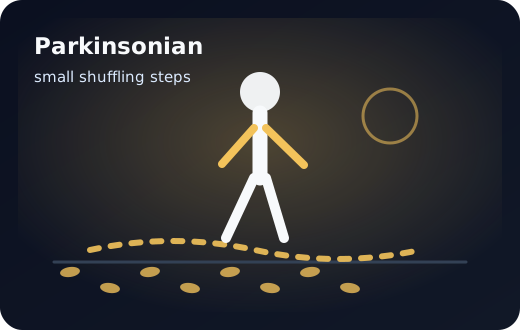
Parkinsoniantiny shuffling steps
Parkinsonian gait
Parkinsonian gait visual showing small shuffling steps
Small shuffling steps with reduced stride length. Think basal ganglia bradykinesia.
Watch for
Localize
Exam lock
Contrast
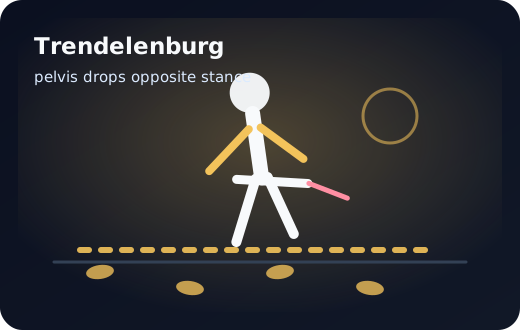
Trendelenburg gait visual showing opposite pelvic drop
Trendelenburg: pelvis drops away from the weak stance-side hip abductors.
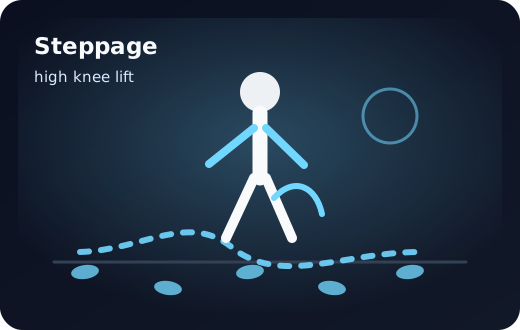
Steppage gait visual showing high knee lift from foot drop
Steppage: high knee lift clears a weak dorsiflexed foot.
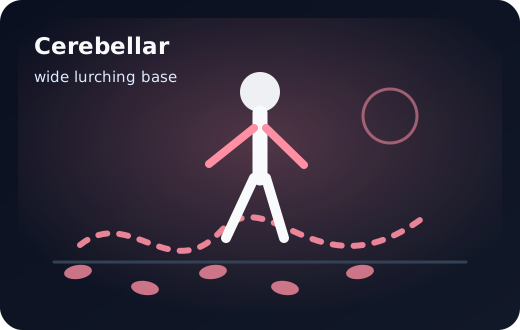
Cerebellar gait visual showing wide lurching path
Cerebellar: wide base and lurching path stay abnormal even with eyes open.

Make the gait point to the broken system.

The fastest localizer is not the disease name. It is the body problem the walk is solving.

Pick the circuit
Circuit map

Basal ganglia

Small steps, bradykinesia, reduced arm swing, freezing, flexed posture.

Cerebellum or proprioception

Wide base and imbalance. Eyes closed worsening points sensory. Nystagmus and dysarthria point cerebellar or vestibular.

UMN tract

Circumduction, scissoring, spasticity, hyperreflexia, Babinski.

Peripheral nerve or muscle

Foot drop means dorsiflexor failure. Pelvic drop means hip abductor failure. Waddling means proximal pelvic-girdle weakness.

Pain

Short stance time on the painful side. The patient is protecting the limb, not localizing to a single neurologic circuit.

The similar pairs are where the points live.

Do not ask what they share. Ask the single thing that splits them.

Find the gait when the stem hides it.

Right-click or long-press to cross out. Double-click to mark. Choice order and case order shuffle.

Case 1gait recognition bank
1 / 5
Medically reviewed by Kaitlyn Cocuzzo, MD and Fatima Ali, DO · Last updated July 8, 2026 at 12:27 AM ET
Bone Wizardry is an independent educational resource for visual learning in the medical sciences. It is not affiliated with, endorsed by, or sponsored by any licensing or examination board, contains no real or recalled examination questions, and does not guarantee any educational or examination outcome.