Locate the failure before naming the disease. A nerve must admit calcium, release acetylcholine and activate receptors on muscle. MG, LEMS and botulism interfere at different points. Their patterns of weakness are useful because they reveal those different mechanisms, not because a single symptom is infallible. [1] [3]
Build a normal signal, then interrupt it Calcium entry triggers vesicle fusion. Released acetylcholine activates nicotinic receptors on muscle.Image: Bone Wizardry.
An action potential reaches the nerve terminal and opens voltage-gated calcium channels. Calcium enters the terminal and helps trigger vesicle fusion. Released acetylcholine binds nicotinic acetylcholine receptors on the muscle endplate. If the endplate response reaches threshold, the muscle produces an action potential. [1] [3]
The normal junction has a safety margin. Its chemical signal usually exceeds what is needed to activate a muscle fiber. A disorder can shrink that margin before completely abolishing transmission. Weakness therefore does not require every channel, vesicle or receptor to stop working. [1]
In MG, antibody-mediated loss or dysfunction of the postsynaptic apparatus reduces that safety margin. During repeated activity, the usual variation in transmitter release exposes the impaired margin and transmission can fail. Receptors are not literally consumed one by one whenever the patient contracts a muscle. [1]
In LEMS, antibodies commonly target presynaptic P/Q-type calcium channels. Less calcium enters, so less acetylcholine is released. Brief repeated activation can increase residual calcium and temporarily improve transmission. This is facilitation, not elimination of the antibodies. [1]
Botulinum toxin instead damages proteins needed for vesicle fusion. The distinction is calcium entry, vesicle fusion, or postsynaptic response . Keeping these three locations separate makes the treatment mechanisms much easier to predict. [3]
Predict the consequence Make a prediction, then open the explanation. Earlier answers stay available.
Calcium enters a normal terminal. What follows? Acetylcholine-containing vesicles fuse with the nerve membrane.
After release, where must the transmitter act? It activates nicotinic receptors on muscle.
Why can losing only part of the system cause weakness? The safety margin for transmission becomes smaller.
Change the failed step Select a condition. Predict the effect of a single signal or brief repetition, then compare the visual response.
Worked comparison: brief repetition can improve release in LEMS through residual calcium. In MG, the postsynaptic safety margin remains impaired.
Choose the comparison Normal MG LEMS Botulism Single signal Brief repetition Reset model
Scroll the diagram horizontally to inspect every part.
Normal transmission The reference state has intact transmission. Symbols show relative activity only, not percentages, measured strength or diagnostic cutoffs. This is a simplified teaching model.
Save this spot
Try a question on this topic A 66-year-old man with a 50-pack-year smoking history reports several months of progressive weakness in his hips and thighs, making it hard to rise from a chair or climb stairs. He notices that his grip and his legs feel briefly stronger after a few seconds of repeated effort, then fatigue again. He also complains of a persistently dry mouth and has lost 15 pounds without trying. On examination his knee reflexes are difficult to elicit at rest but become detectable right after he exercises the muscle. Nerve conduction testing shows a low baseline muscle response amplitude that more than doubles immediately after brief maximal exercise.
Which underlying mechanism best explains this patient's presentation?
A. P/Q-channel antibodies B. AChR-directed autoantibodies C. MuSK-directed autoantibodies D. Botulinum-mediated ACh blockade E. Potassium-channel autoantibodies
Choose an answer before revealing the reasoning.
Get one of these every morning · Practice more in the QBank
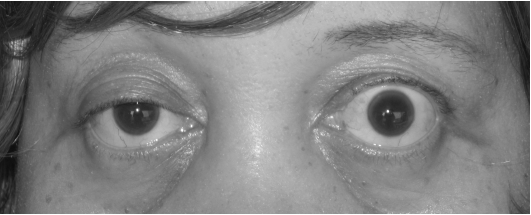
Read the pattern across the whole examination Historical clinical example from a 2008 case report: partial right ptosis. The image illustrates an examination finding, not a standalone diagnostic test. Mohankumar Kurukumbi, Roger L.Image: Weir, Janaki Kalyanam, Mansoor Nasim and Annapurni Jayam-Trouth. Image source . CC BY 2.0 . None; original image Select the photograph to open it at full size. Localize the defect LEMS reduces calcium entry. Botulinum toxin disrupts vesicle fusion. MG reduces effective postsynaptic receptor function. Three different failures LEMS: calcium entry Signal reduced Botulism: fusion Signal reduced MG: muscle receptors Signal reduced
LEMS reduces calcium entry. Botulinum toxin disrupts vesicle fusion. MG reduces effective postsynaptic receptor function.Image: Bone Wizardry.
MG often begins with fluctuating ptosis or diplopia. Chewing, speech, swallowing, neck strength and proximal limb strength may also be affected. Symptoms often worsen with sustained activity and improve with rest. Pupils and sensation are usually normal; tendon reflexes are generally preserved. [1]
LEMS commonly causes proximal leg weakness, reduced reflexes and autonomic complaints such as dry mouth or constipation. Reflexes or strength may briefly improve after exertion. Sustained exertion can still fatigue a patient, so the teaching rule is brief facilitation rather than an unlimited benefit from exercise. [1]
Botulism often develops over hours to days, beginning with cranial or bulbar findings before descending weakness. Pupillary or autonomic involvement and a relevant exposure support the diagnosis. A food cluster is helpful when present; its absence does not exclude wound or infant botulism. [3] [7]
Normal sensation supports a junctional disorder, but it does not prove one. Asymmetry, a sensory level, upper-motor-neuron signs, marked pain or ataxia should broaden the differential. Guillain-Barre variants and brainstem disease can overlap with some of these findings. [1] [3]
Predict the consequence Make a prediction, then open the explanation. Earlier answers stay available.
A patient is weak with dry mouth and reduced reflexes. Is this an ocular finding alone? The pattern includes motor and autonomic dysfunction.
A brief contraction restores a reflex. What mechanism could help? Residual presynaptic calcium can improve release.
Why is prolonged activity not an unlimited treatment? Brief facilitation does not eliminate the underlying disorder.
Case 2
Show answer and explanations for case 2
A. Lambert-Eaton myasthenic syndrome (Best answer)
Proximal weakness, autonomic symptoms and brief post-exercise facilitation are characteristic of LEMS.
Connect the reasoning Make a prediction, then open the explanation. Earlier answers stay available.
Which distinction matters in this patient? Use the combination of strength, reflexes and autonomic findings.
Does Lambert-Eaton myasthenic syndrome fit this presentation? Proximal weakness, autonomic symptoms and brief post-exercise facilitation are characteristic of LEMS.
B. Myasthenia gravis (Why this does not fit)
MG generally preserves reflexes and pupils and more often has prominent fatigable ocular symptoms.
Connect the reasoning Make a prediction, then open the explanation. Earlier answers stay available.
Which distinction matters in this patient? Use the combination of strength, reflexes and autonomic findings.
Does Myasthenia gravis fit this presentation? MG generally preserves reflexes and pupils and more often has prominent fatigable ocular symptoms.
C. A pure sensory neuropathy (Why this does not fit)
Sensory dysfunction alone does not account for this facilitated motor pattern.
Connect the reasoning Make a prediction, then open the explanation. Earlier answers stay available.
Which distinction matters in this patient? Use the combination of strength, reflexes and autonomic findings.
Does A pure sensory neuropathy fit this presentation? Sensory dysfunction alone does not account for this facilitated motor pattern.
D. Generalized tetanus (Why this does not fit)
Rigidity and painful spasms are different from this flaccid weakness.
Connect the reasoning Make a prediction, then open the explanation. Earlier answers stay available.
Which distinction matters in this patient? Use the combination of strength, reflexes and autonomic findings.
Does Generalized tetanus fit this presentation? Rigidity and painful spasms are different from this flaccid weakness.
Takeaway: Use the combination of strength, reflexes and autonomic findings.
Case sources: [1]
Save this spot
Use tests to support the localization Different patterns during repeated stimulation Conceptual traces, not patient measurements or diagnostic thresholds. Low-frequency decrement is not specific to MG; stimulation protocol matters. Response to repetition Normal MG: reduced safety margin LEMS: brief facilitation Successive nerve signals
Conceptual traces, not patient measurements or diagnostic thresholds. Low-frequency decrement is not specific to MG; stimulation protocol matters.Image: Bone Wizardry.
For suspected autoimmune MG, acetylcholine-receptor antibodies are commonly tested first. If these are absent and clinical suspicion remains, MuSK testing and appropriate specialist-directed testing can follow. Negative antibodies do not exclude MG; sensitivity differs between ocular and generalized disease. [1]
Low-frequency repetitive nerve stimulation may show a decrement in MG. Single-fiber testing can identify impaired neuromuscular transmission, but an abnormal result is not specific to one disease. Interpret the clinical pattern, antibody findings and electrophysiology together. [1]
LEMS may show both a low-frequency decrement and a post-exercise or high-frequency increment. A low resting compound muscle action potential adds context. Botulism can also produce facilitation. One waveform or a single arbitrary cutoff cannot substitute for the full interpretation. [1] [3]
An ice-pack test may support ocular MG when ptosis improves, but it is not a standalone confirmation. Edrophonium is mainly of historical teaching interest and has important cardiac risks. Do not delay crisis treatment to provoke a diagnostic drug response. [1] [8]
Chest imaging evaluates thymic pathology in MG. LEMS warrants assessment for an associated malignancy, especially small-cell lung cancer. Negative initial screening does not necessarily end surveillance; subsequent testing is tailored to individual risk and specialist guidance. [1] [2]
Predict the consequence Make a prediction, then open the explanation. Earlier answers stay available.
Low-frequency stimulation produces a decrement. Is that unique to MG? LEMS can also produce a low-frequency decrement.
A response rises after brief exercise. What location does this support? The pattern supports a presynaptic transmission defect.
Which other disorder can also facilitate? Botulism can also facilitate.
Case 4
Show answer and explanations for case 4
A. It is the defining response of a sensory neuropathy (Why this does not fit)
The test measures motor transmission, not sensory function.
Connect the reasoning Make a prediction, then open the explanation. Earlier answers stay available.
Which distinction matters in this patient? The stimulation protocol and the clinical pattern belong together.
Does It is the defining response of a sensory neuropathy fit this presentation? The test measures motor transmission, not sensory function.
B. It supports a presynaptic transmission disorder in the appropriate context (Best answer)
An increment supports LEMS or another presynaptic disorder; clinical context remains necessary.
Connect the reasoning Make a prediction, then open the explanation. Earlier answers stay available.
Which distinction matters in this patient? The stimulation protocol and the clinical pattern belong together.
Does It supports a presynaptic transmission disorder in the appropriate context fit this presentation? An increment supports LEMS or another presynaptic disorder; clinical context remains necessary.
C. A low-frequency decrement would exclude LEMS (Why this does not fit)
LEMS can also show low-frequency decrement.
Connect the reasoning Make a prediction, then open the explanation. Earlier answers stay available.
Which distinction matters in this patient? The stimulation protocol and the clinical pattern belong together.
Does A low-frequency decrement would exclude LEMS fit this presentation? LEMS can also show low-frequency decrement.
D. It independently proves LEMS in every patient (Why this does not fit)
Botulism can also facilitate, so the finding is not uniquely diagnostic.
Connect the reasoning Make a prediction, then open the explanation. Earlier answers stay available.
Which distinction matters in this patient? The stimulation protocol and the clinical pattern belong together.
Does It independently proves LEMS in every patient fit this presentation? Botulism can also facilitate, so the finding is not uniquely diagnostic.
Takeaway: The stimulation protocol and the clinical pattern belong together.
Case sources: [1] [3]
Save this spot
Match treatment to the part that failed Pyridostigmine slows acetylcholine breakdown. It can improve MG symptoms by giving available acetylcholine more opportunity to activate the remaining receptors. It does not remove pathogenic antibodies. Diarrhea, abdominal cramping, sweating, salivation and bradycardia are cholinergic adverse effects. [1] [8]
Disease-modifying MG care may require corticosteroids and steroid-sparing immunotherapy. Antibody status, severity, comorbidity and treatment response guide escalation. Complement-directed and FcRn-directed therapies are additional options for selected patients; a basic mechanism lesson is not a complete prescribing algorithm. [1]
Thymoma requires surgical evaluation. Thymectomy can also benefit selected adults with generalized AChR-antibody-positive MG without thymoma. Eligibility and expected benefit are not identical for ocular-only, MuSK-positive or other subgroups. It is not an immediate rescue treatment and does not guarantee remission. [2]
Amifampridine blocks potassium channels and prolongs presynaptic depolarization, helping calcium entry and acetylcholine release in LEMS. A history of seizures is a contraindication to FIRDAPSE. Treat an associated malignancy and consider immune-directed treatment when needed; tumor response does not guarantee complete resolution of weakness. [1] [5]
Botulism requires prompt specialist consultation, antitoxin when indicated and respiratory support when needed. An antitoxin works outside the nerve ending to prevent additional blockade. It does not immediately repair a terminal already affected by toxin. [3]
MG can increase sensitivity to nondepolarizing blockers such as vecuronium. MG can produce relative resistance to depolarizing succinylcholine, unlike its increased sensitivity to nondepolarizing blockade. The response is variable, so the rule is not that every paralytic behaves identically. Anesthesia planning requires individualized monitoring, not a fixed dose extrapolated from a teaching diagram. [11] [14] [15]
Predict the consequence Make a prediction, then open the explanation. Earlier answers stay available.
Pyridostigmine slows transmitter breakdown. Which part does it not repair? It does not remove the pathogenic MG antibodies.
Amifampridine prolongs the nerve signal. What can increase? Presynaptic calcium entry can increase.
Why is thymectomy not an emergency breathing treatment? Its potential benefit is a longer-term management effect.
Save this spot
Recognize a crisis without delaying support New respiratory or severe bulbar weakness is an emergency. In MG, declining ventilatory strength, ineffective cough and inability to handle secretions require close monitoring and experienced airway assessment. A reassuring oxygen saturation does not exclude dangerous hypoventilation. [1] [8]
A more negative inspiratory pressure represents a stronger effort. A value becoming less negative, for example from -50 to -15 cm H2O, indicates weakening. This example teaches direction, not a universal intubation threshold. Respiratory trends, swallowing, cough, fatigue and the entire examination determine urgency. [1] [8]
Acute MG rescue treatment commonly uses plasma exchange or intravenous immunoglobulin (IVIG), alongside airway and intensive-care support when indicated. Steroids or thymectomy alone do not provide immediate rescue. Pyridostigmine may be held in an intubated patient to reduce secretions, with subsequent treatment individualized. [1] [8]
Cholinergic toxicity can also cause weakness, but excessive secretions, diarrhea, sweating, bradycardia, miosis and fasciculations suggest excess cholinergic activity. A usual prescribed dose alone does not establish toxicity. Do not use an edrophonium challenge to settle the diagnosis during respiratory deterioration. [8]
Review new medicines and intercurrent infection. Aminoglycosides, fluoroquinolones, magnesium and some other medicines can aggravate MG. Hydroxychloroquine can worsen or precipitate MG and requires caution, rather than a blanket reassurance that it has no meaningful effect. Corticosteroids can transiently worsen weakness early in treatment. [4]
Organophosphate poisoning can produce muscarinic secretions and nicotinic weakness. Atropine blocks muscarinic effects; pralidoxime can reactivate susceptible organophosphate-inhibited acetylcholinesterase before the enzyme becomes nonreactivatable. Airway support and toxicology consultation remain essential. This mechanism comparison is not an automatic treatment instruction for pyridostigmine overdose or every carbamate exposure. [12]
Predict the consequence Make a prediction, then open the explanation. Earlier answers stay available.
Inspiratory pressure changes from -50 to -15. Has effort strengthened? The less negative pressure indicates weaker effort.
Saturation is normal. Can ventilation still be inadequate? A normal saturation does not exclude impaired ventilation.
Should an edrophonium challenge delay support? Provocative testing must not delay emergency treatment.
Case 26
Show answer and explanations for case 26
A. A weaker inspiratory effort (Best answer)
A less negative pressure indicates weaker inspiratory effort; airway decisions also require the whole clinical assessment.
Connect the reasoning Make a prediction, then open the explanation. Earlier answers stay available.
Which distinction matters in this patient? Less negative inspiratory pressure means less inspiratory strength.
Does A weaker inspiratory effort fit this presentation? A less negative pressure indicates weaker inspiratory effort; airway decisions also require the whole clinical assessment.
B. A stronger effort because -15 is numerically greater (Why this does not fit)
The magnitude of negative inspiratory pressure has decreased.
Connect the reasoning Make a prediction, then open the explanation. Earlier answers stay available.
Which distinction matters in this patient? Less negative inspiratory pressure means less inspiratory strength.
Does A stronger effort because -15 is numerically greater fit this presentation? The magnitude of negative inspiratory pressure has decreased.
C. A universal requirement to wait for one exact cutoff (Why this does not fit)
Respiratory trends, bulbar function and clinical deterioration matter beyond a single cutoff.
Connect the reasoning Make a prediction, then open the explanation. Earlier answers stay available.
Which distinction matters in this patient? Less negative inspiratory pressure means less inspiratory strength.
Does A universal requirement to wait for one exact cutoff fit this presentation? Respiratory trends, bulbar function and clinical deterioration matter beyond a single cutoff.
D. A measurement of sensory nerve recovery (Why this does not fit)
This assesses inspiratory muscle performance rather than sensation.
Connect the reasoning Make a prediction, then open the explanation. Earlier answers stay available.
Which distinction matters in this patient? Less negative inspiratory pressure means less inspiratory strength.
Does A measurement of sensory nerve recovery fit this presentation? This assesses inspiratory muscle performance rather than sensation.
Takeaway: Less negative inspiratory pressure means less inspiratory strength.
Case sources: [1] [8]
Save this spot
Keep the important exceptions in view MuSK-positive MG remains a postsynaptic autoimmune disorder. Bulbar and respiratory involvement can be prominent. Response to pyridostigmine may be limited, and rituximab is an important specialist-directed option when the response to initial immunotherapy is unsatisfactory. Negative AChR antibodies do not turn this into LEMS. [1] [2]
Double-seronegative presentations need careful specialist evaluation; neither a negative panel nor the distribution of weakness proves an alternative diagnosis. Consider electrophysiology, additional testing when appropriate, and competing causes before committing to long-term treatment. [1]
Congenital myasthenic syndromes are genetic transmission disorders, not simply infant versions of autoimmune MG. Age at onset and severity vary. Treatment depends on the molecular defect. COLQ-related disease impairs anchoring of endplate acetylcholinesterase; acetylcholinesterase inhibitors may be ineffective or worsen some congenital subtypes. [1] [6]
Pregnancy calls for coordinated neurologic and obstetric care. Maintaining disease control matters, but medication selection must be reviewed individually. Oral pyridostigmine is commonly used. Mycophenolate is avoided in pregnancy; other immune therapies require a specific risk-benefit discussion rather than stopping every medicine or declaring all drugs safe. [8]
Neuromuscular weakness after immune-checkpoint therapy may coexist with myositis or myocarditis. This can be rapidly serious and needs urgent specialist evaluation. The same basic discipline still works: localize the problem, assess respiratory risk and interpret the pattern rather than relying on one familiar label. [2]
After IVIG, a low reported sodium requires assessment of tonicity and measurement method. Increased serum protein can cause pseudohyponatremia with indirect measurement, while true hyponatremia can also occur in some settings. Do not label every post-infusion sodium result as the same mechanism. [9] [10]
Predict the consequence Make a prediction, then open the explanation. Earlier answers stay available.
AChR antibodies are absent. Is autoimmune MG excluded? MuSK-positive or seronegative MG remains possible.
A child has a genetic junctional defect. Is treatment identical for all subtypes? Treatment depends on the molecular defect.
A sodium value drops after IVIG. Must every case have the same mechanism? Tonicity and the measurement method need assessment.
Save this spot
Clinical practice
Case 1
Show answer and explanations for case 1
A. LRP4 antibodies (Why this does not fit)
LRP4 is a recognized target in a smaller MG subgroup, but AChR antibodies are the most likely association with this presentation and thymic mass.
Connect the reasoning Make a prediction, then open the explanation. Earlier answers stay available.
Which distinction matters in this patient? Fluctuating ocular and bulbar weakness fits MG.
Does LRP4 antibodies fit this presentation? LRP4 is a recognized target in a smaller MG subgroup, but AChR antibodies are the most likely association with this presentation and thymic mass.
B. P/Q-type calcium-channel antibodies (Why this does not fit)
These support presynaptic LEMS, more often with reduced reflexes and autonomic symptoms.
Connect the reasoning Make a prediction, then open the explanation. Earlier answers stay available.
Which distinction matters in this patient? Fluctuating ocular and bulbar weakness fits MG.
Does P/Q-type calcium-channel antibodies fit this presentation? These support presynaptic LEMS, more often with reduced reflexes and autonomic symptoms.
C. Acetylcholine-receptor antibodies (Best answer)
AChR-antibody-positive MG is the strongest fit for fluctuating ocular and bulbar weakness with a thymic mass.
Connect the reasoning Make a prediction, then open the explanation. Earlier answers stay available.
Which distinction matters in this patient? Fluctuating ocular and bulbar weakness fits MG.
Does Acetylcholine-receptor antibodies fit this presentation? AChR-antibody-positive MG is the strongest fit for fluctuating ocular and bulbar weakness with a thymic mass.
D. MuSK antibodies (Why this does not fit)
MuSK-positive MG can cause bulbar weakness, but thymic pathology is much more characteristic of AChR-positive disease.
Connect the reasoning Make a prediction, then open the explanation. Earlier answers stay available.
Which distinction matters in this patient? Fluctuating ocular and bulbar weakness fits MG.
Does MuSK antibodies fit this presentation? MuSK-positive MG can cause bulbar weakness, but thymic pathology is much more characteristic of AChR-positive disease.
Takeaway: Fluctuating ocular and bulbar weakness fits MG.
Case sources: [1] [2]
Case 3
Show answer and explanations for case 3
A. Gentamicin reliably improves the MG safety margin (Why this does not fit)
Its neuromuscular effects can worsen, not reliably improve, transmission.
Connect the reasoning Make a prediction, then open the explanation. Earlier answers stay available.
Which distinction matters in this patient? Check both new medications and intercurrent illness during deterioration.
Does Gentamicin reliably improves the MG safety margin fit this presentation? Its neuromuscular effects can worsen, not reliably improve, transmission.
B. This proves pyridostigmine overdose (Why this does not fit)
A new antibiotic exposure does not establish cholinergic toxicity.
Connect the reasoning Make a prediction, then open the explanation. Earlier answers stay available.
Which distinction matters in this patient? Check both new medications and intercurrent illness during deterioration.
Does This proves pyridostigmine overdose fit this presentation? A new antibiotic exposure does not establish cholinergic toxicity.
C. The worsening excludes MG (Why this does not fit)
Medication-associated exacerbation is compatible with MG.
Connect the reasoning Make a prediction, then open the explanation. Earlier answers stay available.
Which distinction matters in this patient? Check both new medications and intercurrent illness during deterioration.
Does The worsening excludes MG fit this presentation? Medication-associated exacerbation is compatible with MG.
D. Additional impairment of neuromuscular transmission (Best answer)
Aminoglycosides can aggravate MG; the infection itself also needs assessment as a precipitant.
Connect the reasoning Make a prediction, then open the explanation. Earlier answers stay available.
Which distinction matters in this patient? Check both new medications and intercurrent illness during deterioration.
Does Additional impairment of neuromuscular transmission fit this presentation? Aminoglycosides can aggravate MG; the infection itself also needs assessment as a precipitant.
Takeaway: Check both new medications and intercurrent illness during deterioration.
Case sources: [4]
Case 5
Show answer and explanations for case 5
A. SMN1-associated anterior horn cell degeneration (Why this does not fit)
Spinal muscular atrophy is a motor-neuron disorder, not a consequence of honey-associated spore exposure.
Connect the reasoning Make a prediction, then open the explanation. Earlier answers stay available.
Which distinction matters in this patient? Infant botulism involves spores and intestinal toxin production.
Does SMN1-associated anterior horn cell degeneration fit this presentation? Spinal muscular atrophy is a motor-neuron disorder, not a consequence of honey-associated spore exposure.
B. Intestinal colonization with local toxin production (Best answer)
Swallowed spores can colonize the infant intestine and produce toxin there.
Connect the reasoning Make a prediction, then open the explanation. Earlier answers stay available.
Which distinction matters in this patient? Infant botulism involves spores and intestinal toxin production.
Does Intestinal colonization with local toxin production fit this presentation? Swallowed spores can colonize the infant intestine and produce toxin there.
C. Preformed toxin absorbed from preserved food (Why this does not fit)
This is the foodborne-intoxication mechanism, not the usual mechanism of honey-associated infant botulism.
Connect the reasoning Make a prediction, then open the explanation. Earlier answers stay available.
Which distinction matters in this patient? Infant botulism involves spores and intestinal toxin production.
Does Preformed toxin absorbed from preserved food fit this presentation? This is the foodborne-intoxication mechanism, not the usual mechanism of honey-associated infant botulism.
D. Transplacental transfer of maternal AChR antibodies (Why this does not fit)
This can cause transient neonatal myasthenia but does not fit the toxin-associated constipation and exposure pattern.
Connect the reasoning Make a prediction, then open the explanation. Earlier answers stay available.
Which distinction matters in this patient? Infant botulism involves spores and intestinal toxin production.
Does Transplacental transfer of maternal AChR antibodies fit this presentation? This can cause transient neonatal myasthenia but does not fit the toxin-associated constipation and exposure pattern.
Takeaway: Infant botulism involves spores and intestinal toxin production.
Case sources: [3] [7]
Case 6
Show answer and explanations for case 6
A. P/Q-type calcium-channel antibodies (Why this does not fit)
These target presynaptic channels and support LEMS, not the postsynaptic kinase disorder.
Connect the reasoning Make a prediction, then open the explanation. Earlier answers stay available.
Which distinction matters in this patient? AChR-negative does not mean MG-negative.
Does P/Q-type calcium-channel antibodies fit this presentation? These target presynaptic channels and support LEMS, not the postsynaptic kinase disorder.
B. MuSK antibodies (Best answer)
MuSK is muscle-specific kinase, a postsynaptic receptor-clustering protein; its antibodies can cause MG despite negative AChR testing.
Connect the reasoning Make a prediction, then open the explanation. Earlier answers stay available.
Which distinction matters in this patient? AChR-negative does not mean MG-negative.
Does MuSK antibodies fit this presentation? MuSK is muscle-specific kinase, a postsynaptic receptor-clustering protein; its antibodies can cause MG despite negative AChR testing.
C. LRP4 antibodies (Why this does not fit)
LRP4 participates in the clustering pathway but is not the muscle-specific kinase named in the question.
Connect the reasoning Make a prediction, then open the explanation. Earlier answers stay available.
Which distinction matters in this patient? AChR-negative does not mean MG-negative.
Does LRP4 antibodies fit this presentation? LRP4 participates in the clustering pathway but is not the muscle-specific kinase named in the question.
D. Acetylcholine-receptor antibodies (Why this does not fit)
AChR antibodies target the receptor itself rather than MuSK; the existing assay is negative in this patient.
Connect the reasoning Make a prediction, then open the explanation. Earlier answers stay available.
Which distinction matters in this patient? AChR-negative does not mean MG-negative.
Does Acetylcholine-receptor antibodies fit this presentation? AChR antibodies target the receptor itself rather than MuSK; the existing assay is negative in this patient.
Takeaway: AChR-negative does not mean MG-negative.
Case sources: [1] [2]
Case 7
Show answer and explanations for case 7
A. Urgent thymectomy as the only intervention (Why this does not fit)
Thymectomy is not an immediate rescue for respiratory failure.
Connect the reasoning Make a prediction, then open the explanation. Earlier answers stay available.
Which distinction matters in this patient? Rescue treatment and breathing support proceed together.
Does Urgent thymectomy as the only intervention fit this presentation? Thymectomy is not an immediate rescue for respiratory failure.
B. Waiting several months for a steroid-sparing agent to work (Why this does not fit)
A delayed maintenance effect cannot address an acute crisis.
Connect the reasoning Make a prediction, then open the explanation. Earlier answers stay available.
Which distinction matters in this patient? Rescue treatment and breathing support proceed together.
Does Waiting several months for a steroid-sparing agent to work fit this presentation? A delayed maintenance effect cannot address an acute crisis.
C. Plasma exchange or intravenous immunoglobulin (Best answer)
Both are established rapid immunomodulatory treatments for myasthenic crisis alongside intensive supportive care.
Connect the reasoning Make a prediction, then open the explanation. Earlier answers stay available.
Which distinction matters in this patient? Rescue treatment and breathing support proceed together.
Does Plasma exchange or intravenous immunoglobulin fit this presentation? Both are established rapid immunomodulatory treatments for myasthenic crisis alongside intensive supportive care.
D. Escalating pyridostigmine alone (Why this does not fit)
This does not provide appropriate crisis rescue and can increase secretions.
Connect the reasoning Make a prediction, then open the explanation. Earlier answers stay available.
Which distinction matters in this patient? Rescue treatment and breathing support proceed together.
Does Escalating pyridostigmine alone fit this presentation? This does not provide appropriate crisis rescue and can increase secretions.
Takeaway: Rescue treatment and breathing support proceed together.
Case sources: [1] [8]
Case 8
Show answer and explanations for case 8
A. Lung adenocarcinoma (Why this does not fit)
A lung malignancy is relevant in a smoker, but small-cell histology is the classic LEMS association.
Connect the reasoning Make a prediction, then open the explanation. Earlier answers stay available.
Which distinction matters in this patient? LEMS can be the first indication of an underlying malignancy.
Does Lung adenocarcinoma fit this presentation? A lung malignancy is relevant in a smoker, but small-cell histology is the classic LEMS association.
B. Thymoma (Why this does not fit)
Thymoma is more characteristically associated with MG than LEMS.
Connect the reasoning Make a prediction, then open the explanation. Earlier answers stay available.
Which distinction matters in this patient? LEMS can be the first indication of an underlying malignancy.
Does Thymoma fit this presentation? Thymoma is more characteristically associated with MG than LEMS.
C. Pancreatic adenocarcinoma (Why this does not fit)
This is not the characteristic paraneoplastic association of LEMS.
Connect the reasoning Make a prediction, then open the explanation. Earlier answers stay available.
Which distinction matters in this patient? LEMS can be the first indication of an underlying malignancy.
Does Pancreatic adenocarcinoma fit this presentation? This is not the characteristic paraneoplastic association of LEMS.
D. Small-cell lung cancer (Best answer)
This is the characteristic malignancy associated with paraneoplastic LEMS.
Connect the reasoning Make a prediction, then open the explanation. Earlier answers stay available.
Which distinction matters in this patient? LEMS can be the first indication of an underlying malignancy.
Does Small-cell lung cancer fit this presentation? This is the characteristic malignancy associated with paraneoplastic LEMS.
Takeaway: LEMS can be the first indication of an underlying malignancy.
Case sources: [1]
Case 9
Show answer and explanations for case 9
A. Myelin on a single sensory nerve (Why this does not fit)
The distribution is cranial, bulbar and generalized motor rather than a single sensory territory.
Connect the reasoning Make a prediction, then open the explanation. Earlier answers stay available.
Which distinction matters in this patient? Botulism disrupts release, not primarily the muscle receptor.
Does Myelin on a single sensory nerve fit this presentation? The distribution is cranial, bulbar and generalized motor rather than a single sensory territory.
B. Postsynaptic receptors targeted by AChR antibodies (Why this does not fit)
That is characteristic of autoimmune MG rather than this acute food-associated syndrome.
Connect the reasoning Make a prediction, then open the explanation. Earlier answers stay available.
Which distinction matters in this patient? Botulism disrupts release, not primarily the muscle receptor.
Does Postsynaptic receptors targeted by AChR antibodies fit this presentation? That is characteristic of autoimmune MG rather than this acute food-associated syndrome.
C. Proteins required for presynaptic vesicle fusion (Best answer)
Botulinum toxin cleaves SNARE proteins and reduces acetylcholine release.
Connect the reasoning Make a prediction, then open the explanation. Earlier answers stay available.
Which distinction matters in this patient? Botulism disrupts release, not primarily the muscle receptor.
Does Proteins required for presynaptic vesicle fusion fit this presentation? Botulinum toxin cleaves SNARE proteins and reduces acetylcholine release.
D. Presynaptic channels targeted by LEMS antibodies (Why this does not fit)
LEMS is not the best explanation for an acute shared-food cluster.
Connect the reasoning Make a prediction, then open the explanation. Earlier answers stay available.
Which distinction matters in this patient? Botulism disrupts release, not primarily the muscle receptor.
Does Presynaptic channels targeted by LEMS antibodies fit this presentation? LEMS is not the best explanation for an acute shared-food cluster.
Takeaway: Botulism disrupts release, not primarily the muscle receptor.
Case sources: [3]
Case 10
Show answer and explanations for case 10
A. Stimulus-induced generalized spasms (Why this does not fit)
That pattern is unlike the usual fatigable weakness of MG.
Connect the reasoning Make a prediction, then open the explanation. Earlier answers stay available.
Which distinction matters in this patient? Ocular muscle weakness and pupillary dysfunction are different findings.
Does Stimulus-induced generalized spasms fit this presentation? That pattern is unlike the usual fatigable weakness of MG.
B. Normal pupillary responses (Best answer)
MG affects skeletal neuromuscular transmission and usually spares pupils.
Connect the reasoning Make a prediction, then open the explanation. Earlier answers stay available.
Which distinction matters in this patient? Ocular muscle weakness and pupillary dysfunction are different findings.
Does Normal pupillary responses fit this presentation? MG affects skeletal neuromuscular transmission and usually spares pupils.
C. Fixed dilated pupils as a defining requirement (Why this does not fit)
Pupillary dysfunction suggests another or additional process.
Connect the reasoning Make a prediction, then open the explanation. Earlier answers stay available.
Which distinction matters in this patient? Ocular muscle weakness and pupillary dysfunction are different findings.
Does Fixed dilated pupils as a defining requirement fit this presentation? Pupillary dysfunction suggests another or additional process.
D. A sensory level across the chest (Why this does not fit)
A sensory level suggests spinal cord localization rather than ocular MG.
Connect the reasoning Make a prediction, then open the explanation. Earlier answers stay available.
Which distinction matters in this patient? Ocular muscle weakness and pupillary dysfunction are different findings.
Does A sensory level across the chest fit this presentation? A sensory level suggests spinal cord localization rather than ocular MG.
Takeaway: Ocular muscle weakness and pupillary dysfunction are different findings.
Case sources: [1]
Case 11
Show answer and explanations for case 11
A. The response excludes all competing causes of ptosis (Why this does not fit)
Other findings and appropriate testing still matter.
Connect the reasoning Make a prediction, then open the explanation. Earlier answers stay available.
Which distinction matters in this patient? A supportive bedside test is not a standalone diagnosis.
Does The response excludes all competing causes of ptosis fit this presentation? Other findings and appropriate testing still matter.
B. The response proves LEMS (Why this does not fit)
This is not the defining bedside finding of LEMS.
Connect the reasoning Make a prediction, then open the explanation. Earlier answers stay available.
Which distinction matters in this patient? A supportive bedside test is not a standalone diagnosis.
Does The response proves LEMS fit this presentation? This is not the defining bedside finding of LEMS.
C. The result supports ocular MG but requires clinical correlation (Best answer)
A bedside response can support suspicion without independently confirming the diagnosis.
Connect the reasoning Make a prediction, then open the explanation. Earlier answers stay available.
Which distinction matters in this patient? A supportive bedside test is not a standalone diagnosis.
Does The result supports ocular MG but requires clinical correlation fit this presentation? A bedside response can support suspicion without independently confirming the diagnosis.
D. The response proves every case of MG (Why this does not fit)
No single bedside response should replace the broader diagnostic evaluation.
Connect the reasoning Make a prediction, then open the explanation. Earlier answers stay available.
Which distinction matters in this patient? A supportive bedside test is not a standalone diagnosis.
Does The response proves every case of MG fit this presentation? No single bedside response should replace the broader diagnostic evaluation.
Takeaway: A supportive bedside test is not a standalone diagnosis.
Case sources: [1]
Case 12
Show answer and explanations for case 12
A. Residual calcium accumulates within the presynaptic terminal (Best answer)
Brief repeated activation raises residual calcium and improves acetylcholine release.
Connect the reasoning Make a prediction, then open the explanation. Earlier answers stay available.
Which distinction matters in this patient? Brief repetition can improve transmitter release without curing the disorder.
Does Residual calcium accumulates within the presynaptic terminal fit this presentation? Brief repeated activation raises residual calcium and improves acetylcholine release.
B. Axonal conduction velocity increases (Why this does not fit)
The demonstrated facilitation concerns transmitter release at the junction, not a primary improvement in axonal conduction.
Connect the reasoning Make a prediction, then open the explanation. Earlier answers stay available.
Which distinction matters in this patient? Brief repetition can improve transmitter release without curing the disorder.
Does Axonal conduction velocity increases fit this presentation? The demonstrated facilitation concerns transmitter release at the junction, not a primary improvement in axonal conduction.
C. Acetylcholinesterase activity falls within the synaptic cleft (Why this does not fit)
Slowing acetylcholine breakdown is not the mechanism of post-exercise LEMS facilitation.
Connect the reasoning Make a prediction, then open the explanation. Earlier answers stay available.
Which distinction matters in this patient? Brief repetition can improve transmitter release without curing the disorder.
Does Acetylcholinesterase activity falls within the synaptic cleft fit this presentation? Slowing acetylcholine breakdown is not the mechanism of post-exercise LEMS facilitation.
D. Postsynaptic receptor expression increases (Why this does not fit)
The rapid facilitation is presynaptic and does not require new receptor expression.
Connect the reasoning Make a prediction, then open the explanation. Earlier answers stay available.
Which distinction matters in this patient? Brief repetition can improve transmitter release without curing the disorder.
Does Postsynaptic receptor expression increases fit this presentation? The rapid facilitation is presynaptic and does not require new receptor expression.
Takeaway: Brief repetition can improve transmitter release without curing the disorder.
Case sources: [1]
Case 13
Show answer and explanations for case 13
A. Relative resistance caused by depolarizing receptor activation (Why this does not fit)
Vecuronium is nondepolarizing; relative resistance to succinylcholine is a different drug-class response.
Connect the reasoning Make a prediction, then open the explanation. Earlier answers stay available.
Which distinction matters in this patient? Nondepolarizing blockade can be amplified by the impaired MG safety margin.
Does Relative resistance caused by depolarizing receptor activation fit this presentation? Vecuronium is nondepolarizing; relative resistance to succinylcholine is a different drug-class response.
B. Increased sensitivity at a junction with a reduced postsynaptic safety margin (Best answer)
Competitive nondepolarizing blockade can have an exaggerated effect when MG has already reduced effective transmission.
Connect the reasoning Make a prediction, then open the explanation. Earlier answers stay available.
Which distinction matters in this patient? Nondepolarizing blockade can be amplified by the impaired MG safety margin.
Does Increased sensitivity at a junction with a reduced postsynaptic safety margin fit this presentation? Competitive nondepolarizing blockade can have an exaggerated effect when MG has already reduced effective transmission.
C. Temporary facilitation caused by residual presynaptic calcium (Why this does not fit)
This explains a larger response after brief exertion in LEMS, not amplified nondepolarizing blockade in MG.
Connect the reasoning Make a prediction, then open the explanation. Earlier answers stay available.
Which distinction matters in this patient? Nondepolarizing blockade can be amplified by the impaired MG safety margin.
Does Temporary facilitation caused by residual presynaptic calcium fit this presentation? This explains a larger response after brief exertion in LEMS, not amplified nondepolarizing blockade in MG.
D. Prolonged block caused by reduced plasma cholinesterase activity (Why this does not fit)
Plasma cholinesterase chiefly matters for drugs such as succinylcholine; it does not explain the characteristic vecuronium sensitivity here.
Connect the reasoning Make a prediction, then open the explanation. Earlier answers stay available.
Which distinction matters in this patient? Nondepolarizing blockade can be amplified by the impaired MG safety margin.
Does Prolonged block caused by reduced plasma cholinesterase activity fit this presentation? Plasma cholinesterase chiefly matters for drugs such as succinylcholine; it does not explain the characteristic vecuronium sensitivity here.
Takeaway: Nondepolarizing blockade can be amplified by the impaired MG safety margin.
Case sources: [11] [14]
Case 14
Show answer and explanations for case 14
A. Toxin is produced at the wound versus ingested already formed (Best answer)
The entry mechanism differs even though both ultimately reduce presynaptic acetylcholine release.
Connect the reasoning Make a prediction, then open the explanation. Earlier answers stay available.
Which distinction matters in this patient? Different sources can produce the same transmission failure.
Does Toxin is produced at the wound versus ingested already formed fit this presentation? The entry mechanism differs even though both ultimately reduce presynaptic acetylcholine release.
B. Wound botulism is always an AChR-antibody disorder (Why this does not fit)
It remains toxin-mediated rather than autoimmune MG.
Connect the reasoning Make a prediction, then open the explanation. Earlier answers stay available.
Which distinction matters in this patient? Different sources can produce the same transmission failure.
Does Wound botulism is always an AChR-antibody disorder fit this presentation? It remains toxin-mediated rather than autoimmune MG.
C. Only foodborne botulism affects the junction (Why this does not fit)
Wound and foodborne disease can produce the same final neuromuscular syndrome.
Connect the reasoning Make a prediction, then open the explanation. Earlier answers stay available.
Which distinction matters in this patient? Different sources can produce the same transmission failure.
Does Only foodborne botulism affects the junction fit this presentation? Wound and foodborne disease can produce the same final neuromuscular syndrome.
D. Every wound case must also involve a suspect meal (Why this does not fit)
A food exposure is not required for wound botulism.
Connect the reasoning Make a prediction, then open the explanation. Earlier answers stay available.
Which distinction matters in this patient? Different sources can produce the same transmission failure.
Does Every wound case must also involve a suspect meal fit this presentation? A food exposure is not required for wound botulism.
Takeaway: Different sources can produce the same transmission failure.
Case sources: [3]
Case 15
Show answer and explanations for case 15
A. Hydroxychloroquine can worsen or precipitate MG and needs careful review (Best answer)
The MGFA identifies this medicine as requiring caution; the indication and alternatives should be considered.
Connect the reasoning Make a prediction, then open the explanation. Earlier answers stay available.
Which distinction matters in this patient? Review a medicine for its neuromuscular effects, not only its other indication.
Does Hydroxychloroquine can worsen or precipitate MG and needs careful review fit this presentation? The MGFA identifies this medicine as requiring caution; the indication and alternatives should be considered.
B. Every patient should stop all immune therapy immediately (Why this does not fit)
The appropriate plan is individualized medication review, not blanket withdrawal.
Connect the reasoning Make a prediction, then open the explanation. Earlier answers stay available.
Which distinction matters in this patient? Review a medicine for its neuromuscular effects, not only its other indication.
Does Every patient should stop all immune therapy immediately fit this presentation? The appropriate plan is individualized medication review, not blanket withdrawal.
C. It is the preferred symptomatic MG drug (Why this does not fit)
Pyridostigmine, not hydroxychloroquine, is commonly used for symptomatic MG treatment.
Connect the reasoning Make a prediction, then open the explanation. Earlier answers stay available.
Which distinction matters in this patient? Review a medicine for its neuromuscular effects, not only its other indication.
Does It is the preferred symptomatic MG drug fit this presentation? Pyridostigmine, not hydroxychloroquine, is commonly used for symptomatic MG treatment.
D. It has no meaningful effect on MG (Why this does not fit)
That reassurance conflicts with recognized medication-associated exacerbations.
Connect the reasoning Make a prediction, then open the explanation. Earlier answers stay available.
Which distinction matters in this patient? Review a medicine for its neuromuscular effects, not only its other indication.
Does It has no meaningful effect on MG fit this presentation? That reassurance conflicts with recognized medication-associated exacerbations.
Takeaway: Review a medicine for its neuromuscular effects, not only its other indication.
Case sources: [4]
Case 16
Show answer and explanations for case 16
A. Direct destruction of MuSK antibodies (Why this does not fit)
This is not antibody-depleting therapy.
Connect the reasoning Make a prediction, then open the explanation. Earlier answers stay available.
Which distinction matters in this patient? A historical test mechanism is not a current crisis-management instruction.
Does Direct destruction of MuSK antibodies fit this presentation? This is not antibody-depleting therapy.
B. Brief acetylcholinesterase inhibition with risk of bradycardia (Best answer)
Edrophonium increases acetylcholine persistence briefly; important cardiac effects limit this historical diagnostic approach.
Connect the reasoning Make a prediction, then open the explanation. Earlier answers stay available.
Which distinction matters in this patient? A historical test mechanism is not a current crisis-management instruction.
Does Brief acetylcholinesterase inhibition with risk of bradycardia fit this presentation? Edrophonium increases acetylcholine persistence briefly; important cardiac effects limit this historical diagnostic approach.
C. A reliable reason to delay treatment during respiratory failure (Why this does not fit)
Provocative testing must not delay emergency airway or crisis management.
Connect the reasoning Make a prediction, then open the explanation. Earlier answers stay available.
Which distinction matters in this patient? A historical test mechanism is not a current crisis-management instruction.
Does A reliable reason to delay treatment during respiratory failure fit this presentation? Provocative testing must not delay emergency airway or crisis management.
D. Permanent regeneration of postsynaptic receptors (Why this does not fit)
The brief effect does not regenerate receptors.
Connect the reasoning Make a prediction, then open the explanation. Earlier answers stay available.
Which distinction matters in this patient? A historical test mechanism is not a current crisis-management instruction.
Does Permanent regeneration of postsynaptic receptors fit this presentation? The brief effect does not regenerate receptors.
Takeaway: A historical test mechanism is not a current crisis-management instruction.
Case sources: [1] [8]
Case 17
Show answer and explanations for case 17
A. Thymectomy has identical evidence for every MG subtype (Why this does not fit)
Evidence and eligibility differ by antibody status and clinical subtype.
Connect the reasoning Make a prediction, then open the explanation. Earlier answers stay available.
Which distinction matters in this patient? Thymectomy is a subtype-specific long-term decision, not a universal cure.
Does Thymectomy has identical evidence for every MG subtype fit this presentation? Evidence and eligibility differ by antibody status and clinical subtype.
B. Whether thymectomy is appropriate as part of long-term management (Best answer)
Selected adults with this subtype may benefit even without a thymoma; the decision is individualized.
Connect the reasoning Make a prediction, then open the explanation. Earlier answers stay available.
Which distinction matters in this patient? Thymectomy is a subtype-specific long-term decision, not a universal cure.
Does Whether thymectomy is appropriate as part of long-term management fit this presentation? Selected adults with this subtype may benefit even without a thymoma; the decision is individualized.
C. Surgery replaces airway support during an acute crisis (Why this does not fit)
It is not an emergency substitute for respiratory support.
Connect the reasoning Make a prediction, then open the explanation. Earlier answers stay available.
Which distinction matters in this patient? Thymectomy is a subtype-specific long-term decision, not a universal cure.
Does Surgery replaces airway support during an acute crisis fit this presentation? It is not an emergency substitute for respiratory support.
D. Thymectomy guarantees immediate remission (Why this does not fit)
Benefit is not instantaneous or guaranteed.
Connect the reasoning Make a prediction, then open the explanation. Earlier answers stay available.
Which distinction matters in this patient? Thymectomy is a subtype-specific long-term decision, not a universal cure.
Does Thymectomy guarantees immediate remission fit this presentation? Benefit is not instantaneous or guaranteed.
Takeaway: Thymectomy is a subtype-specific long-term decision, not a universal cure.
Case sources: [2]
Case 18
Show answer and explanations for case 18
A. Neuromuscular symptoms may improve but can persist (Best answer)
Cancer treatment can help paraneoplastic disease without guaranteeing complete resolution of transmission dysfunction.
Connect the reasoning Make a prediction, then open the explanation. Earlier answers stay available.
Which distinction matters in this patient? Tumor control and neuromuscular recovery need separate assessment.
Does Neuromuscular symptoms may improve but can persist fit this presentation? Cancer treatment can help paraneoplastic disease without guaranteeing complete resolution of transmission dysfunction.
B. Cancer treatment can never affect LEMS (Why this does not fit)
Treating the malignancy is an important part of management.
Connect the reasoning Make a prediction, then open the explanation. Earlier answers stay available.
Which distinction matters in this patient? Tumor control and neuromuscular recovery need separate assessment.
Does Cancer treatment can never affect LEMS fit this presentation? Treating the malignancy is an important part of management.
C. Every symptom must resolve immediately after the first treatment (Why this does not fit)
That is not a reliable expectation.
Connect the reasoning Make a prediction, then open the explanation. Earlier answers stay available.
Which distinction matters in this patient? Tumor control and neuromuscular recovery need separate assessment.
Does Every symptom must resolve immediately after the first treatment fit this presentation? That is not a reliable expectation.
D. Persistent weakness proves the diagnosis was incorrect (Why this does not fit)
LEMS may persist despite tumor control.
Connect the reasoning Make a prediction, then open the explanation. Earlier answers stay available.
Which distinction matters in this patient? Tumor control and neuromuscular recovery need separate assessment.
Does Persistent weakness proves the diagnosis was incorrect fit this presentation? LEMS may persist despite tumor control.
Takeaway: Tumor control and neuromuscular recovery need separate assessment.
Case sources: [1]
Case 19
Show answer and explanations for case 19
A. It cleaves SNARE proteins (Why this does not fit)
SNARE cleavage is the harmful mechanism of botulinum toxin.
Connect the reasoning Make a prediction, then open the explanation. Earlier answers stay available.
Which distinction matters in this patient? Prolonging the nerve signal can improve presynaptic release.
Does It cleaves SNARE proteins fit this presentation? SNARE cleavage is the harmful mechanism of botulinum toxin.
B. It removes the underlying tumor directly (Why this does not fit)
It provides symptomatic treatment rather than cancer therapy.
Connect the reasoning Make a prediction, then open the explanation. Earlier answers stay available.
Which distinction matters in this patient? Prolonging the nerve signal can improve presynaptic release.
Does It removes the underlying tumor directly fit this presentation? It provides symptomatic treatment rather than cancer therapy.
C. It blocks potassium channels and prolongs presynaptic depolarization (Best answer)
Longer depolarization supports calcium entry and acetylcholine release through remaining functional channels.
Connect the reasoning Make a prediction, then open the explanation. Earlier answers stay available.
Which distinction matters in this patient? Prolonging the nerve signal can improve presynaptic release.
Does It blocks potassium channels and prolongs presynaptic depolarization fit this presentation? Longer depolarization supports calcium entry and acetylcholine release through remaining functional channels.
D. It replaces all destroyed muscle receptors (Why this does not fit)
Its primary symptomatic action is presynaptic rather than receptor replacement.
Connect the reasoning Make a prediction, then open the explanation. Earlier answers stay available.
Which distinction matters in this patient? Prolonging the nerve signal can improve presynaptic release.
Does It replaces all destroyed muscle receptors fit this presentation? Its primary symptomatic action is presynaptic rather than receptor replacement.
Takeaway: Prolonging the nerve signal can improve presynaptic release.
Case sources: [1] [5]
Case 20
Show answer and explanations for case 20
A. The patient cannot have MG (Why this does not fit)
Seronegative MG exists, although competing diagnoses must be assessed.
Connect the reasoning Make a prediction, then open the explanation. Earlier answers stay available.
Which distinction matters in this patient? A negative panel changes the evaluation, not the reality of the symptoms.
Does The patient cannot have MG fit this presentation? Seronegative MG exists, although competing diagnoses must be assessed.
B. Further specialist evaluation is needed; negative antibodies do not exclude MG (Best answer)
Clinical assessment, electrophysiology and evaluation for alternatives remain important.
Connect the reasoning Make a prediction, then open the explanation. Earlier answers stay available.
Which distinction matters in this patient? A negative panel changes the evaluation, not the reality of the symptoms.
Does Further specialist evaluation is needed; negative antibodies do not exclude MG fit this presentation? Clinical assessment, electrophysiology and evaluation for alternatives remain important.
C. Bulbar weakness alone proves an unidentified antibody (Why this does not fit)
Distribution alone does not establish a particular antibody or diagnosis.
Connect the reasoning Make a prediction, then open the explanation. Earlier answers stay available.
Which distinction matters in this patient? A negative panel changes the evaluation, not the reality of the symptoms.
Does Bulbar weakness alone proves an unidentified antibody fit this presentation? Distribution alone does not establish a particular antibody or diagnosis.
D. Any negative blood test proves a functional disorder (Why this does not fit)
That conclusion is not justified by antibody testing.
Connect the reasoning Make a prediction, then open the explanation. Earlier answers stay available.
Which distinction matters in this patient? A negative panel changes the evaluation, not the reality of the symptoms.
Does Any negative blood test proves a functional disorder fit this presentation? That conclusion is not justified by antibody testing.
Takeaway: A negative panel changes the evaluation, not the reality of the symptoms.
Case sources: [1]
Case 21
Show answer and explanations for case 21
A. DOK7 (Why this does not fit)
DOK7 supports postsynaptic signaling and receptor clustering; it is not the collagen-like anchoring tail of acetylcholinesterase.
Connect the reasoning Make a prediction, then open the explanation. Earlier answers stay available.
Which distinction matters in this patient? Congenital transmission disorders require molecularly specific reasoning.
Does DOK7 fit this presentation? DOK7 supports postsynaptic signaling and receptor clustering; it is not the collagen-like anchoring tail of acetylcholinesterase.
B. SMN1 (Why this does not fit)
SMN1 is associated with spinal muscular atrophy, a motor-neuron disorder rather than this anchoring defect.
Connect the reasoning Make a prediction, then open the explanation. Earlier answers stay available.
Which distinction matters in this patient? Congenital transmission disorders require molecularly specific reasoning.
Does SMN1 fit this presentation? SMN1 is associated with spinal muscular atrophy, a motor-neuron disorder rather than this anchoring defect.
C. CHAT (Why this does not fit)
CHAT encodes choline acetyltransferase and affects acetylcholine synthesis rather than endplate enzyme anchoring.
Connect the reasoning Make a prediction, then open the explanation. Earlier answers stay available.
Which distinction matters in this patient? Congenital transmission disorders require molecularly specific reasoning.
Does CHAT fit this presentation? CHAT encodes choline acetyltransferase and affects acetylcholine synthesis rather than endplate enzyme anchoring.
D. COLQ (Best answer)
COLQ encodes the collagen-like tail that anchors acetylcholinesterase at the endplate.
Connect the reasoning Make a prediction, then open the explanation. Earlier answers stay available.
Which distinction matters in this patient? Congenital transmission disorders require molecularly specific reasoning.
Does COLQ fit this presentation? COLQ encodes the collagen-like tail that anchors acetylcholinesterase at the endplate.
Takeaway: Congenital transmission disorders require molecularly specific reasoning.
Case sources: [6] [13]
Case 22
Show answer and explanations for case 22
A. A usual maintenance dose by itself proves overdose (Why this does not fit)
The dose error and clinical findings, not a usual dose in isolation, support this assessment.
Connect the reasoning Make a prediction, then open the explanation. Earlier answers stay available.
Which distinction matters in this patient? Excess secretions and gastrointestinal activity help distinguish toxicity from isolated worsening MG.
Does A usual maintenance dose by itself proves overdose fit this presentation? The dose error and clinical findings, not a usual dose in isolation, support this assessment.
B. Cholinergic toxicity (Best answer)
An excess-dose history together with muscarinic findings and weakness supports cholinergic toxicity.
Connect the reasoning Make a prediction, then open the explanation. Earlier answers stay available.
Which distinction matters in this patient? Excess secretions and gastrointestinal activity help distinguish toxicity from isolated worsening MG.
Does Cholinergic toxicity fit this presentation? An excess-dose history together with muscarinic findings and weakness supports cholinergic toxicity.
C. A pure sensory neuropathy (Why this does not fit)
That does not explain the cholinergic autonomic findings.
Connect the reasoning Make a prediction, then open the explanation. Earlier answers stay available.
Which distinction matters in this patient? Excess secretions and gastrointestinal activity help distinguish toxicity from isolated worsening MG.
Does A pure sensory neuropathy fit this presentation? That does not explain the cholinergic autonomic findings.
D. A reason to give additional pyridostigmine immediately (Why this does not fit)
More acetylcholinesterase inhibition could worsen suspected toxicity.
Connect the reasoning Make a prediction, then open the explanation. Earlier answers stay available.
Which distinction matters in this patient? Excess secretions and gastrointestinal activity help distinguish toxicity from isolated worsening MG.
Does A reason to give additional pyridostigmine immediately fit this presentation? More acetylcholinesterase inhibition could worsen suspected toxicity.
Takeaway: Excess secretions and gastrointestinal activity help distinguish toxicity from isolated worsening MG.
Case sources: [8]
Case 23
Show answer and explanations for case 23
A. Every immune therapy is equally safe throughout pregnancy (Why this does not fit)
Drug risks and clinical circumstances differ.
Connect the reasoning Make a prediction, then open the explanation. Earlier answers stay available.
Which distinction matters in this patient? Pregnancy requires an individualized treatment plan, not a blanket stop rule.
Does Every immune therapy is equally safe throughout pregnancy fit this presentation? Drug risks and clinical circumstances differ.
B. Stop every treatment regardless of respiratory or bulbar symptoms (Why this does not fit)
Uncontrolled MG can itself create serious maternal risks.
Connect the reasoning Make a prediction, then open the explanation. Earlier answers stay available.
Which distinction matters in this patient? Pregnancy requires an individualized treatment plan, not a blanket stop rule.
Does Stop every treatment regardless of respiratory or bulbar symptoms fit this presentation? Uncontrolled MG can itself create serious maternal risks.
C. Switch automatically to mycophenolate (Why this does not fit)
Mycophenolate is avoided in pregnancy because of fetal risk.
Connect the reasoning Make a prediction, then open the explanation. Earlier answers stay available.
Which distinction matters in this patient? Pregnancy requires an individualized treatment plan, not a blanket stop rule.
Does Switch automatically to mycophenolate fit this presentation? Mycophenolate is avoided in pregnancy because of fetal risk.
D. Coordinate medication review while maintaining disease control (Best answer)
Neurologic and obstetric review should assess each medicine; abrupt universal withdrawal can compromise disease control.
Connect the reasoning Make a prediction, then open the explanation. Earlier answers stay available.
Which distinction matters in this patient? Pregnancy requires an individualized treatment plan, not a blanket stop rule.
Does Coordinate medication review while maintaining disease control fit this presentation? Neurologic and obstetric review should assess each medicine; abrupt universal withdrawal can compromise disease control.
Takeaway: Pregnancy requires an individualized treatment plan, not a blanket stop rule.
Case sources: [8]
Case 24
Show answer and explanations for case 24
A. Immediate sodium correction regardless of confirmation (Why this does not fit)
Treatment based only on an artifactual value could be inappropriate.
Connect the reasoning Make a prediction, then open the explanation. Earlier answers stay available.
Which distinction matters in this patient? Confirm tonicity and the measurement method before attributing a post-infusion sodium result.
Does Immediate sodium correction regardless of confirmation fit this presentation? Treatment based only on an artifactual value could be inappropriate.
B. A normal direct measurement proves excess water in plasma (Why this does not fit)
It argues against a low sodium concentration in plasma water in this scenario.
Connect the reasoning Make a prediction, then open the explanation. Earlier answers stay available.
Which distinction matters in this patient? Confirm tonicity and the measurement method before attributing a post-infusion sodium result.
Does A normal direct measurement proves excess water in plasma fit this presentation? It argues against a low sodium concentration in plasma water in this scenario.
C. Hyperproteinemia-related pseudohyponatremia (Best answer)
The method discrepancy and preserved direct measurement support a measurement artifact from increased non-water plasma components.
Connect the reasoning Make a prediction, then open the explanation. Earlier answers stay available.
Which distinction matters in this patient? Confirm tonicity and the measurement method before attributing a post-infusion sodium result.
Does Hyperproteinemia-related pseudohyponatremia fit this presentation? The method discrepancy and preserved direct measurement support a measurement artifact from increased non-water plasma components.
D. Every low sodium result after IVIG is true hypotonic hyponatremia (Why this does not fit)
IVIG-associated laboratory changes have multiple possible mechanisms; this direct-versus-indirect discrepancy matters.
Connect the reasoning Make a prediction, then open the explanation. Earlier answers stay available.
Which distinction matters in this patient? Confirm tonicity and the measurement method before attributing a post-infusion sodium result.
Does Every low sodium result after IVIG is true hypotonic hyponatremia fit this presentation? IVIG-associated laboratory changes have multiple possible mechanisms; this direct-versus-indirect discrepancy matters.
Takeaway: Confirm tonicity and the measurement method before attributing a post-infusion sodium result.
Case sources: [9] [10]
Case 25
Show answer and explanations for case 25
A. This always proves steroid allergy (Why this does not fit)
Early worsening does not automatically indicate allergy.
Connect the reasoning Make a prediction, then open the explanation. Earlier answers stay available.
Which distinction matters in this patient? A treatment can help long term while creating an early monitoring need.
Does This always proves steroid allergy fit this presentation? Early worsening does not automatically indicate allergy.
B. Assess urgently for recognized transient early worsening and respiratory risk (Best answer)
Corticosteroids can initially worsen MG; severity and bulbar or respiratory involvement guide monitoring and treatment.
Connect the reasoning Make a prediction, then open the explanation. Earlier answers stay available.
Which distinction matters in this patient? A treatment can help long term while creating an early monitoring need.
Does Assess urgently for recognized transient early worsening and respiratory risk fit this presentation? Corticosteroids can initially worsen MG; severity and bulbar or respiratory involvement guide monitoring and treatment.
C. Ignore worsening because steroids eventually help (Why this does not fit)
Bulbar or respiratory deterioration still requires prompt assessment.
Connect the reasoning Make a prediction, then open the explanation. Earlier answers stay available.
Which distinction matters in this patient? A treatment can help long term while creating an early monitoring need.
Does Ignore worsening because steroids eventually help fit this presentation? Bulbar or respiratory deterioration still requires prompt assessment.
D. This is certainly muscle wasting from years of steroid exposure (Why this does not fit)
The time course does not establish chronic steroid myopathy.
Connect the reasoning Make a prediction, then open the explanation. Earlier answers stay available.
Which distinction matters in this patient? A treatment can help long term while creating an early monitoring need.
Does This is certainly muscle wasting from years of steroid exposure fit this presentation? The time course does not establish chronic steroid myopathy.
Takeaway: A treatment can help long term while creating an early monitoring need.
Case sources: [4]
Case 27
Show answer and explanations for case 27
A. Amifampridine as a direct replacement for all immune treatment (Why this does not fit)
Its usual indication is symptomatic treatment of LEMS, not this antibody-directed MG strategy.
Connect the reasoning Make a prediction, then open the explanation. Earlier answers stay available.
Which distinction matters in this patient? Antibody status helps guide immunotherapy.
Does Amifampridine as a direct replacement for all immune treatment fit this presentation? Its usual indication is symptomatic treatment of LEMS, not this antibody-directed MG strategy.
B. Assume negative AChR antibodies exclude the diagnosis (Why this does not fit)
MuSK-positive MG is a recognized subtype.
Connect the reasoning Make a prediction, then open the explanation. Earlier answers stay available.
Which distinction matters in this patient? Antibody status helps guide immunotherapy.
Does Assume negative AChR antibodies exclude the diagnosis fit this presentation? MuSK-positive MG is a recognized subtype.
C. Botulinum toxin to increase acetylcholine release (Why this does not fit)
The toxin reduces release and would not treat this autoimmune weakness.
Connect the reasoning Make a prediction, then open the explanation. Earlier answers stay available.
Which distinction matters in this patient? Antibody status helps guide immunotherapy.
Does Botulinum toxin to increase acetylcholine release fit this presentation? The toxin reduces release and would not treat this autoimmune weakness.
D. Rituximab (Best answer)
Consensus guidance identifies rituximab as an important option for MuSK MG with an unsatisfactory response to initial treatment.
Connect the reasoning Make a prediction, then open the explanation. Earlier answers stay available.
Which distinction matters in this patient? Antibody status helps guide immunotherapy.
Does Rituximab fit this presentation? Consensus guidance identifies rituximab as an important option for MuSK MG with an unsatisfactory response to initial treatment.
Takeaway: Antibody status helps guide immunotherapy.
Case sources: [1] [2]
Case 28
Show answer and explanations for case 28
A. A therapy that helps one subtype may be ineffective or harmful in another (Best answer)
Different presynaptic, synaptic and postsynaptic genetic defects do not respond identically.
Connect the reasoning Make a prediction, then open the explanation. Earlier answers stay available.
Which distinction matters in this patient? A shared symptom does not imply a shared treatment mechanism.
Does A therapy that helps one subtype may be ineffective or harmful in another fit this presentation? Different presynaptic, synaptic and postsynaptic genetic defects do not respond identically.
B. Every subtype must improve with more acetylcholinesterase inhibition (Why this does not fit)
Some congenital subtypes can worsen with these medicines.
Connect the reasoning Make a prediction, then open the explanation. Earlier answers stay available.
Which distinction matters in this patient? A shared symptom does not imply a shared treatment mechanism.
Does Every subtype must improve with more acetylcholinesterase inhibition fit this presentation? Some congenital subtypes can worsen with these medicines.
C. The genetic diagnosis makes respiratory assessment unnecessary (Why this does not fit)
Clinical severity and respiratory risk still require assessment.
Connect the reasoning Make a prediction, then open the explanation. Earlier answers stay available.
Which distinction matters in this patient? A shared symptom does not imply a shared treatment mechanism.
Does The genetic diagnosis makes respiratory assessment unnecessary fit this presentation? Clinical severity and respiratory risk still require assessment.
D. All congenital syndromes are caused by maternal AChR antibodies (Why this does not fit)
Inherited congenital syndromes differ from transient neonatal antibody-mediated weakness.
Connect the reasoning Make a prediction, then open the explanation. Earlier answers stay available.
Which distinction matters in this patient? A shared symptom does not imply a shared treatment mechanism.
Does All congenital syndromes are caused by maternal AChR antibodies fit this presentation? Inherited congenital syndromes differ from transient neonatal antibody-mediated weakness.
Takeaway: A shared symptom does not imply a shared treatment mechanism.
Case sources: [1] [6]
Case 29
Show answer and explanations for case 29
A. Evaluate another or additional cause of pupillary dysfunction (Best answer)
MG generally spares pupils, so a new pupillary abnormality deserves separate assessment.
Connect the reasoning Make a prediction, then open the explanation. Earlier answers stay available.
Which distinction matters in this patient? A finding outside the expected pattern should broaden evaluation.
Does Evaluate another or additional cause of pupillary dysfunction fit this presentation? MG generally spares pupils, so a new pupillary abnormality deserves separate assessment.
B. Diagnose botulism from the pupil alone (Why this does not fit)
One pupillary finding cannot establish a toxin-mediated syndrome.
Connect the reasoning Make a prediction, then open the explanation. Earlier answers stay available.
Which distinction matters in this patient? A finding outside the expected pattern should broaden evaluation.
Does Diagnose botulism from the pupil alone fit this presentation? One pupillary finding cannot establish a toxin-mediated syndrome.
C. Assume fixed dilation is a routine MG feature (Why this does not fit)
That is not typical of uncomplicated MG.
Connect the reasoning Make a prediction, then open the explanation. Earlier answers stay available.
Which distinction matters in this patient? A finding outside the expected pattern should broaden evaluation.
Does Assume fixed dilation is a routine MG feature fit this presentation? That is not typical of uncomplicated MG.
D. Use the pupil to quantify receptor antibody concentration (Why this does not fit)
Pupil size does not measure AChR antibody concentration.
Connect the reasoning Make a prediction, then open the explanation. Earlier answers stay available.
Which distinction matters in this patient? A finding outside the expected pattern should broaden evaluation.
Does Use the pupil to quantify receptor antibody concentration fit this presentation? Pupil size does not measure AChR antibody concentration.
Takeaway: A finding outside the expected pattern should broaden evaluation.
Case sources: [1] [3]
Case 30
Show answer and explanations for case 30
A. Persistent weakness automatically disproves botulism (Why this does not fit)
Prolonged weakness is compatible with the disease and its recovery.
Connect the reasoning Make a prediction, then open the explanation. Earlier answers stay available.
Which distinction matters in this patient? Support function while preventing further blockade.
Does Persistent weakness automatically disproves botulism fit this presentation? Prolonged weakness is compatible with the disease and its recovery.
B. Mechanical ventilation directly neutralizes the toxin (Why this does not fit)
Ventilation supports breathing without providing toxin neutralization.
Connect the reasoning Make a prediction, then open the explanation. Earlier answers stay available.
Which distinction matters in this patient? Support function while preventing further blockade.
Does Mechanical ventilation directly neutralizes the toxin fit this presentation? Ventilation supports breathing without providing toxin neutralization.
C. Antitoxin prevents additional toxin effects but does not repair already affected terminals (Best answer)
Established intraneural blockade takes time to recover even after circulating toxin is neutralized.
Connect the reasoning Make a prediction, then open the explanation. Earlier answers stay available.
Which distinction matters in this patient? Support function while preventing further blockade.
Does Antitoxin prevents additional toxin effects but does not repair already affected terminals fit this presentation? Established intraneural blockade takes time to recover even after circulating toxin is neutralized.
D. Antitoxin must immediately restore every damaged SNARE protein (Why this does not fit)
It does not enter the terminal to repair fusion machinery.
Connect the reasoning Make a prediction, then open the explanation. Earlier answers stay available.
Which distinction matters in this patient? Support function while preventing further blockade.
Does Antitoxin must immediately restore every damaged SNARE protein fit this presentation? It does not enter the terminal to repair fusion machinery.
Takeaway: Support function while preventing further blockade.
Case sources: [3]
Case 31
Show answer and explanations for case 31
A. Possible overlap with myositis or myocarditis (Best answer)
Checkpoint-associated myasthenic illness can coexist with muscle and cardiac inflammation.
Connect the reasoning Make a prediction, then open the explanation. Earlier answers stay available.
Which distinction matters in this patient? Assess more than the junction when treatment-related immune disease may overlap.
Does Possible overlap with myositis or myocarditis fit this presentation? Checkpoint-associated myasthenic illness can coexist with muscle and cardiac inflammation.
B. Chest pain proves the weakness is unrelated (Why this does not fit)
Both manifestations may belong to an overlapping immune complication.
Connect the reasoning Make a prediction, then open the explanation. Earlier answers stay available.
Which distinction matters in this patient? Assess more than the junction when treatment-related immune disease may overlap.
Does Chest pain proves the weakness is unrelated fit this presentation? Both manifestations may belong to an overlapping immune complication.
C. An immune-checkpoint exposure guarantees benign ocular-only disease (Why this does not fit)
Potential overlap and rapid progression can be serious.
Connect the reasoning Make a prediction, then open the explanation. Earlier answers stay available.
Which distinction matters in this patient? Assess more than the junction when treatment-related immune disease may overlap.
Does An immune-checkpoint exposure guarantees benign ocular-only disease fit this presentation? Potential overlap and rapid progression can be serious.
D. Wait for all antibody tests before assessing the heart (Why this does not fit)
Potential cardiac and respiratory complications need prompt evaluation.
Connect the reasoning Make a prediction, then open the explanation. Earlier answers stay available.
Which distinction matters in this patient? Assess more than the junction when treatment-related immune disease may overlap.
Does Wait for all antibody tests before assessing the heart fit this presentation? Potential cardiac and respiratory complications need prompt evaluation.
Takeaway: Assess more than the junction when treatment-related immune disease may overlap.
Case sources: [2]
Case 32
Show answer and explanations for case 32
A. A reduced baseline motor response (Why this does not fit)
That can be part of LEMS electrophysiology rather than a contraindication.
Connect the reasoning Make a prediction, then open the explanation. Earlier answers stay available.
Which distinction matters in this patient? Check the drug-specific contraindications before selecting a mechanistic treatment.
Does A reduced baseline motor response fit this presentation? That can be part of LEMS electrophysiology rather than a contraindication.
B. A history of seizures (Best answer)
FIRDAPSE is contraindicated in patients with a history of seizures.
Connect the reasoning Make a prediction, then open the explanation. Earlier answers stay available.
Which distinction matters in this patient? Check the drug-specific contraindications before selecting a mechanistic treatment.
Does A history of seizures fit this presentation? FIRDAPSE is contraindicated in patients with a history of seizures.
C. Proximal leg weakness (Why this does not fit)
This is part of the condition for which symptomatic treatment is considered.
Connect the reasoning Make a prediction, then open the explanation. Earlier answers stay available.
Which distinction matters in this patient? Check the drug-specific contraindications before selecting a mechanistic treatment.
Does Proximal leg weakness fit this presentation? This is part of the condition for which symptomatic treatment is considered.
D. Dry mouth caused by LEMS (Why this does not fit)
Dry mouth is a common autonomic feature of LEMS, not this specific contraindication.
Connect the reasoning Make a prediction, then open the explanation. Earlier answers stay available.
Which distinction matters in this patient? Check the drug-specific contraindications before selecting a mechanistic treatment.
Does Dry mouth caused by LEMS fit this presentation? Dry mouth is a common autonomic feature of LEMS, not this specific contraindication.
Takeaway: Check the drug-specific contraindications before selecting a mechanistic treatment.
Case sources: [5]
Case 33
Show answer and explanations for case 33
A. Direct antagonism of muscarinic acetylcholine receptors (Why this does not fit)
That describes atropine rather than the enzyme-reactivating action of pralidoxime.
Connect the reasoning Make a prediction, then open the explanation. Earlier answers stay available.
Which distinction matters in this patient? Match atropine to muscarinic effects and pralidoxime to susceptible inhibited enzyme.
Does Direct antagonism of muscarinic acetylcholine receptors fit this presentation? That describes atropine rather than the enzyme-reactivating action of pralidoxime.
B. Reactivation of susceptible organophosphate-inhibited acetylcholinesterase (Best answer)
Pralidoxime can restore enzyme activity before the phosphorylated enzyme becomes nonreactivatable; atropine addresses muscarinic receptor effects.
Connect the reasoning Make a prediction, then open the explanation. Earlier answers stay available.
Which distinction matters in this patient? Match atropine to muscarinic effects and pralidoxime to susceptible inhibited enzyme.
Does Reactivation of susceptible organophosphate-inhibited acetylcholinesterase fit this presentation? Pralidoxime can restore enzyme activity before the phosphorylated enzyme becomes nonreactivatable; atropine addresses muscarinic receptor effects.
C. Neutralization of botulinum toxin before nerve entry (Why this does not fit)
That is the role of botulinum antitoxin in a different toxic syndrome.
Connect the reasoning Make a prediction, then open the explanation. Earlier answers stay available.
Which distinction matters in this patient? Match atropine to muscarinic effects and pralidoxime to susceptible inhibited enzyme.
Does Neutralization of botulinum toxin before nerve entry fit this presentation? That is the role of botulinum antitoxin in a different toxic syndrome.
D. Further inhibition of acetylcholinesterase (Why this does not fit)
Additional inhibition would worsen the excess acetylcholine problem.
Connect the reasoning Make a prediction, then open the explanation. Earlier answers stay available.
Which distinction matters in this patient? Match atropine to muscarinic effects and pralidoxime to susceptible inhibited enzyme.
Does Further inhibition of acetylcholinesterase fit this presentation? Additional inhibition would worsen the excess acetylcholine problem.
Takeaway: Match atropine to muscarinic effects and pralidoxime to susceptible inhibited enzyme.
Case sources: [12]