Normal pressure hydrocephalus: from gait to a treatment decision
Level 1 links cerebrospinal fluid flow to network dysfunction; Level 2 builds diagnosis and tap testing; Level 3 and Beyond cover shunts and follow-up.
Normal pressure hydrocephalus (NPH) is a pattern, not a three-word checklist. An older adult may first take short hesitant steps, need several steps to turn, or feel as if the feet are stuck to the floor. Urgency and slower planning can follow, but all three domains do not need to appear together. The clinical question is whether altered cerebrospinal fluid circulation contributes meaningfully to the person’s function.
Use the lesson in four views. Step 1 and Level 1 connect cerebrospinal fluid flow, communicating hydrocephalus, ventricular enlargement, and frontal-subcortical network dysfunction. Step 2 and Level 2 recognize the gait-predominant syndrome, interpret the full imaging pattern, exclude stronger alternatives, and measure response to temporary drainage. Step 3 and Level 3 select patients for diversion, follow domain-specific benefit, and detect shunt complications. Beyond adds specialist referral details, device follow-up, counseling limits, and current evidence.
Must all three symptoms be present?
Gait is usually the first or most prominent signal. Idiopathic normal pressure hydrocephalus (iNPH) typically develops gradually in an older adult. Short steps, poor foot clearance, start hesitation, a broad base, unstable multistep turns, and falls may appear before obvious cognitive or urinary dysfunction. Waiting for the complete triad can delay evaluation, and there is no compulsory sequence for the other two domains. A preceding hemorrhage, meningitis, trauma, or intracranial operation instead supports secondary hydrocephalus. [1][2]
Three domains to measure, not three boxes required for suspicion
What to documentMedication use, finances, appointments, daily organization, formal screening
DomainBladder
Typical patternFrequency and urgency, sometimes followed by urge incontinence
What to documentUrgency awareness, leakage pattern, weak stream, residual urine, medications
The classic gait can look magnetic. The feet appear reluctant to leave the floor even when strength is preserved. Alternating leg actions while seated may look much better than standing and walking because the integrated walking task is harder than isolated leg actions. That contrast supports a higher-level gait disorder, but it is not unique to NPH and does not prove that the cortex, cerebellum, spinal cord, or sensory pathways are normal. [2][8]
The cognitive pattern often emphasizes executive and retrieval dysfunction. The person may be slow to begin a task, shift attention, organize steps, or retrieve information without prompts. Better recognition than free recall supports a frontal-subcortical pattern, while rapid forgetting with little recognition benefit raises concern for a coexisting amnestic disorder. Neither pattern is absolute, and neurodegenerative disease may coexist with a drainage-responsive gait component. [1][2]
Urgency reflects loss of normal central restraint on bladder contraction. The frontal system normally helps postpone voiding until the setting is appropriate. Disruption can produce frequency, urgency, and urge leakage. Retention is a different problem: hesitancy, weak stream, incomplete emptying, or a large postvoid residual should prompt evaluation for outlet obstruction, detrusor underactivity, medication effects, and other urologic disease rather than automatic attribution to NPH. [1][6]
Test the entry point. Ten months of worsening turns plus new urgency can justify brain imaging even when finances remain accurate. Urinary leakage alone with normal walking is far less persuasive and should first trigger evaluation of common urinary causes.
Compare the pattern judgment
Preserved cognition does not erase a gait-predominant syndrome. Two compatible domains can justify a structured evaluation, while one isolated domain should not be forced into the triad.
How can fluid circulation matter when pressure is normal?
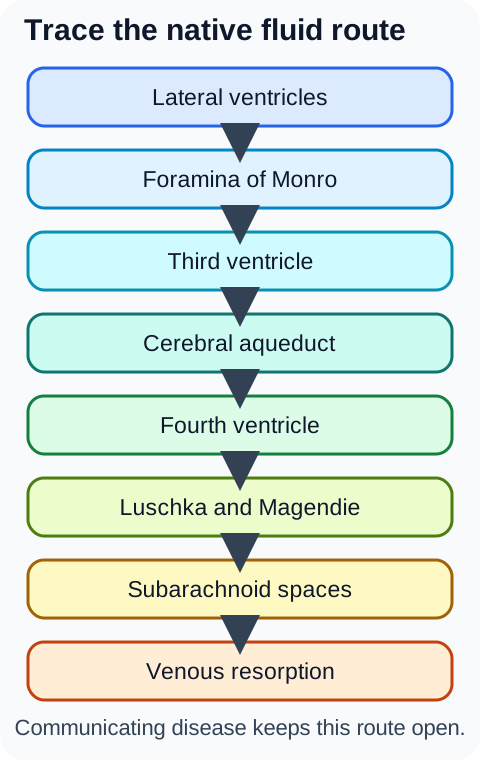
Cerebrospinal fluid follows a connected route. It is produced mainly by the choroid plexus, enters the lateral ventricles, passes through the foramina of Monro to the third ventricle, continues through the cerebral aqueduct to the fourth ventricle, exits through the foramina of Luschka and Magendie, circulates through subarachnoid spaces, and returns to the venous system through resorption pathways. A focal blockage enlarges the spaces upstream from that blockage. [1][2]
Trace the native route from production to venous return. The diagram teaches sequence, not exact anatomy or flow rate. [1][2]
Idiopathic NPH is usually communicating hydrocephalus. The ventricular passages remain open, so a blocked aqueduct is not required. Impaired resorption and altered pressure-volume behavior are involved, but the full pathogenesis remains unsettled. Ventricular expansion is associated with dysfunction of periventricular and frontal-subcortical networks that coordinate walking, executive function, and bladder control. Mechanical deformation, perfusion changes, and abnormal fluid dynamics may all contribute; a literal explanation involving only three isolated fiber bundles is too narrow. [1][2]
A single lumbar pressure is only a snapshot. A normal reading does not prove that pressure and pulsatility were normal at every earlier moment. The Japanese probable-iNPH category includes an opening pressure of 200 mm H2O or less, equivalent to 20 cm H2O, with normal cerebrospinal fluid content. A value above that limit should broaden the differential and prompt careful investigation rather than being converted into an absolute exclusion rule. [1][3]
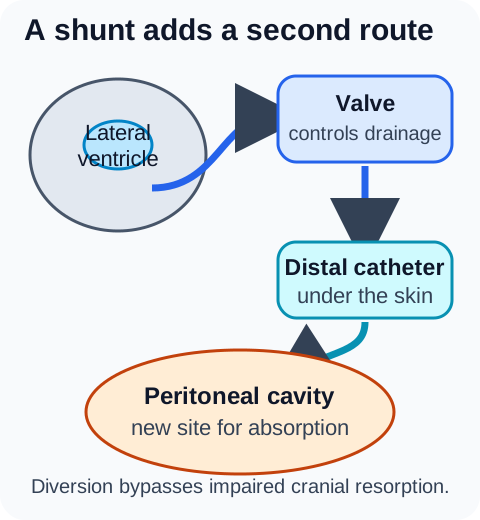
A ventriculoperitoneal shunt adds an extracranial drainage route. It bypasses impaired resorption; it does not regenerate injured tissue or prove that every symptom will improve. [1][2]
Mechanism predicts anatomy and safety. An aqueductal web with enlarged lateral and third ventricles but a spared fourth ventricle suggests noncommunicating obstruction. New headache, vomiting, or reduced alertness in that setting requires prompt assessment before elective lumbar drainage because a pressure gradient may make lumbar puncture unsafe. Slowly progressive panventricular enlargement with open passages after hemorrhage instead supports impaired downstream resorption. [1][7]
Trace before naming. When the aqueduct and fourth-ventricle outlets remain open, identify the downstream resorption problem first. Then explain why an extracranial shunt can help even though no focal ventricular blockage is found.
Check the route prediction
The shunt supplies a second destination for cerebrospinal fluid. Ventricular fluid travels through a valve to the peritoneal cavity, where it can be absorbed outside the impaired cranial resorption pathway.
Try it here · Checkpoint 1 of 3
Make your prediction before reading the choices. A first attempt is just a starting point.
Case 6
Show answer and explanations for case 6
A. Hippocampal storage failure is favored; the pressure rules out NPH despite the clinical and imaging pattern (Why this does not fit)
The cognitive profile does not favor dominant storage failure, and the pressure threshold is not an absolute disease-exclusion rule.
Reasoning steps for option A
In nph-06 option A, which supplied observation should be checked first?
nph-06 A: Recognition is substantially better than spontaneous recall alongside executive slowing and initiation difficulty.
What comparison resolves nph-06 option A?
nph-06 A: Localize the gait-executive and recognition-supported retrieval pattern to frontal-subcortical networks must fit the complete stem without adding an unstated assumption.
B. Hippocampal storage failure is favored; the pressure warrants evaluation for other causes without categorically excluding NPH even though the pressure criterion is not absolute (Why this does not fit)
The pressure interpretation is appropriate, but substantially better recognition together with executive and initiation deficits favors retrieval/network dysfunction over a dominant hippocampal storage disorder.
Reasoning steps for option B
In nph-06 option B, which supplied observation should be checked first?
nph-06 B: Opening pressure24 cm H2O exceeds the explicitly stated20 cm H2O probable-category limit.
What comparison resolves nph-06 option B?
nph-06 B: Interpret pressure above the stated probable-category limit as a reason for broader evaluation, not absolute exclusion must fit the complete stem without adding an unstated assumption.
C. Frontal-subcortical dysfunction is favored; the pressure warrants evaluation for other causes without categorically excluding NPH (Best answer)
The executive, retrieval and higher-level gait pattern favors frontal-subcortical dysfunction. The pressure is above the stated probable-category criterion and requires broader evaluation, but the guideline does not make it an absolute exclusion of normal pressure hydrocephalus.
Reasoning steps for option C
In nph-06 option C, which supplied observation should be checked first?
nph-06 C: Recognition is substantially better than spontaneous recall alongside executive slowing and initiation difficulty.
What comparison resolves nph-06 option C?
nph-06 C: Localize the gait-executive and recognition-supported retrieval pattern to frontal-subcortical networks must fit the complete stem without adding an unstated assumption.
D. Frontal-subcortical dysfunction is favored; the pressure rules out NPH despite the clinical and imaging pattern (Why this does not fit)
The localization fits, but a category threshold must not be converted into an absolute exclusion. Investigate the higher pressure and alternatives while reassessing the complete syndrome.
Reasoning steps for option D
In nph-06 option D, which supplied observation should be checked first?
nph-06 D: Opening pressure24 cm H2O exceeds the explicitly stated20 cm H2O probable-category limit.
What comparison resolves nph-06 option D?
nph-06 D: Interpret pressure above the stated probable-category limit as a reason for broader evaluation, not absolute exclusion must fit the complete stem without adding an unstated assumption.
Takeaway: Separate the clinical localization from the limits of a diagnostic-category pressure threshold.
Are large ventricles enough to diagnose the syndrome?
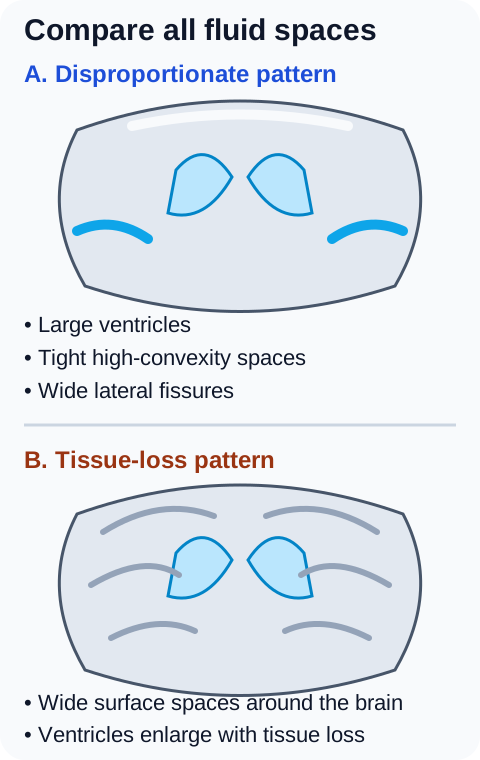
Read the ventricles together with the surrounding cerebrospinal fluid spaces. Computed tomography (CT) can identify ventriculomegaly and major competing pathology. Magnetic resonance imaging (MRI) provides better detail for obstruction, cortical atrophy, white matter disease, callosal configuration, and the distribution of subarachnoid spaces. Ventricular enlargement from tissue loss, called ex vacuo enlargement, usually accompanies broadly widened cortical sulci rather than tight high-convexity spaces. [1][2]
Compare the distribution of all fluid spaces. Pattern A supports disproportionately enlarged subarachnoid-space hydrocephalus; pattern B supports tissue-loss enlargement. Mixed patterns occur. [1][2]
The Evans index measures enlargement, not cause. Divide the maximum frontal horn width by the maximum internal skull width on the same axial slice. A value above 0.30 supports ventriculomegaly, but age-related change, atrophy, and other disorders can also enlarge the ventricles. An index of 0.35 therefore raises the imaging question without completing the diagnosis. [1]
Disproportionately enlarged subarachnoid-space hydrocephalus (DESH) adds a distribution pattern. Disproportionately enlarged subarachnoid-space hydrocephalus combines ventriculomegaly, enlarged Sylvian fissures, and tight high-convexity or midline sulci. A reduced callosal angle on a correctly oriented coronal image may support the pattern. No isolated angle, flow void, ventricular ratio, or white matter signal change independently establishes shunt responsiveness, and absence of DESH should not be used as a solitary exclusion. [1][2]
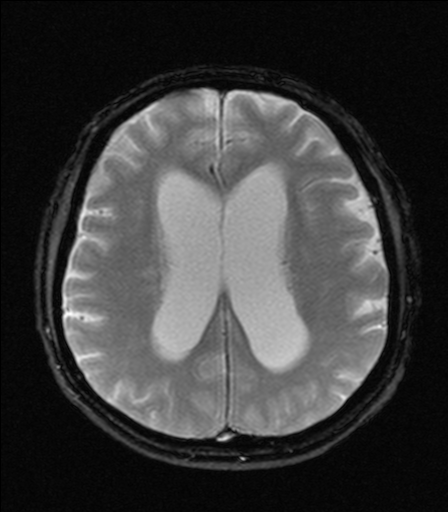
Clinical MRI by Nevit Dilmen, 2005, NPH MRI 007, CC BY-SA 3.0, unmodified. A single axial slice illustrates ventriculomegaly but cannot establish the full DESH pattern, exclude obstruction, or predict benefit. [5]
The workup starts with function and localization. Record symptom chronology, falls, gait aid, medication effects, cognition, urinary pattern, and daily independence. Observe rising, straight walking, turning, foot clearance, arm swing, strength, tone, reflexes, coordination, vibration, joint position, and eye movements. Review the full scan, address stronger alternative diagnoses, and stabilize acute illness before interpreting elective drainage response. [2][8]
Use the real image as a recognition task. Locate the lateral ventricles, then name what the single slice cannot tell you: high-convexity crowding, the complete callosal angle, the entire ventricular pathway, the longitudinal gait pattern, and shunt responsiveness.
Compare the imaging plan
Request the complete study and the clinical course. Imaging should support a functional syndrome and rule out competing anatomy; it should not replace examination or a measured response assessment.
Which competing process best explains the whole course?
A shuffling gait is not a diagnosis. Compare chronology, examination, imaging, treatment response, and daily function. Mixed disease is common, so ask whether another disorder explains the entire presentation or only one component. A patient can have parkinsonism plus a separate drainage-responsive gait problem, vascular lesions plus iNPH, or Alzheimer pathology plus a reversible mobility component. [2][3]
Findings that redirect localization
Alternative
Evidence favoring it
How it changes the NPH question
AlternativeAlzheimer disease
Evidence favoring itEarly rapid forgetting, little recognition benefit, hippocampal-predominant atrophy
How it changes the NPH questionMay limit cognitive recovery without erasing a measured gait response
How it changes the NPH questionConcordant acute signs and imaging deserve priority over incidental ventriculomegaly
AlternativeMyelopathy
Evidence favoring itHyperreflexia, Babinski or Hoffmann signs, spasticity, sensory level, cord signal change
How it changes the NPH questionProgressive cord dysfunction needs prompt assessment even when hydrocephalus remains possible
AlternativeSensory ataxia
Evidence favoring itLoss of vibration or joint position, areflexia, marked worsening without visual input
How it changes the NPH questionLocalizes imbalance outside the frontal gait system
Urinary symptoms require their own localization. Urgency with a small residual can fit loss of central inhibition. Weak stream, hesitancy, repeated large residuals, or an enlarged prostate point toward incomplete emptying and require urologic evaluation. A residual establishes retained urine, not the exact cause, and overflow incontinence should not be inferred without leakage. [6]
Acute illness can create a false baseline. Delirium, pneumonia, urinary infection, sedatives, orthostasis, pain, and deconditioning can worsen gait and cognition without any change in cerebrospinal fluid dynamics. Allow recovery to stabilize, then record the predrainage state under repeatable conditions. A return to the prior gait baseline removes the immediate target for invasive response testing even if incidental ventriculomegaly remains under surveillance. [2]
Let the examination outrank the memorable triad. Short steps plus urgency do not neutralize new hand clumsiness, brisk reflexes, bilateral Hoffmann signs, or cord signal change. The cervical cord needs assessment while the hydrocephalus question remains open.
Check the localization priority
Investigate the time-sensitive alternative first. Progressive upper motor neuron findings can represent cervical myelopathy, which may explain gait and bladder dysfunction and cannot be safely dismissed as part of uncomplicated iNPH.
Try it here · Checkpoint 2 of 3
Make your prediction before reading the choices. A first attempt is just a starting point.
Case 11
Show answer and explanations for case 11
A. Tap testing first, then spine evaluation if gait fails to improve (Why this does not fit)
A tap could later clarify a cerebrospinal fluid contribution but should not delay evaluation of progressive cord dysfunction.
Reasoning steps for option A
In nph-11 option A, which supplied observation should be checked first?
nph-11 A: Pathologic reflexes, proprioceptive impairment and cord signal change implicate the cervical cord.
What comparison resolves nph-11 option A?
nph-11 A: Link long-tract and proprioceptive signs to the compressive cervical lesion must fit the complete stem without adding an unstated assumption.
B. Attribute gait decline to ventriculomegaly and monitor the cord finding (Why this does not fit)
Ventricular size cannot explain the long-tract signs as directly as demonstrated cord pathology.
Reasoning steps for option B
In nph-11 option B, which supplied observation should be checked first?
nph-11 B: Walking deteriorated over two weeks with severe cervical narrowing and cord T2 signal.
What comparison resolves nph-11 option B?
nph-11 B: Use recent progression to prioritize its assessment before elective investigation of another possible gait contribution must fit the complete stem without adding an unstated assumption.
C. Prompt spine-specialist assessment of myelopathy while retaining hydrocephalus in the differential (Best answer)
The compressive cord lesion explains long-tract and proprioceptive signs; progressive deficits make its assessment time-sensitive even if a second gait disorder coexists.
Reasoning steps for option C
In nph-11 option C, which supplied observation should be checked first?
nph-11 C: Pathologic reflexes, proprioceptive impairment and cord signal change implicate the cervical cord.
What comparison resolves nph-11 option C?
nph-11 C: Link long-tract and proprioceptive signs to the compressive cervical lesion must fit the complete stem without adding an unstated assumption.
D. Concurrently schedule elective tap testing and routine spine follow-up (Why this does not fit)
Parallel workup sounds efficient, but routine rather than prompt evaluation underweights recent deterioration and cord signal change.
Reasoning steps for option D
In nph-11 option D, which supplied observation should be checked first?
nph-11 D: Walking deteriorated over two weeks with severe cervical narrowing and cord T2 signal.
What comparison resolves nph-11 option D?
nph-11 D: Use recent progression to prioritize its assessment before elective investigation of another possible gait contribution must fit the complete stem without adding an unstated assumption.
Takeaway: Allow coexistence rather than premature closure
What does a temporary drainage trial actually predict?
The tap test is a matched before-and-after functional experiment. Record the same timed walk, turning task, step count, gait aid, assistance, route, footwear, instructions, and assessor whenever possible. Video can document start hesitation, foot clearance, and turns. A number obtained with a cane cannot be compared confidently with a later number obtained using hands-on support. Appropriate imaging, anticoagulation planning, and lumbar puncture safety assessment come first. [1][2][7]
Typical tap protocols remove 30 to 50 mL. Assess gait around 2 to 4 hours and again at approximately 24 hours. Selected patients may show later change, so repeated observations over several days, up to one week, can be informative. The quality and timing of measurement matter more than choosing the largest volume in the usual range. Cognition and urinary function may change later than gait, and their ideal assessment timing is less certain. [1][12]
Compare early and delayed trajectories
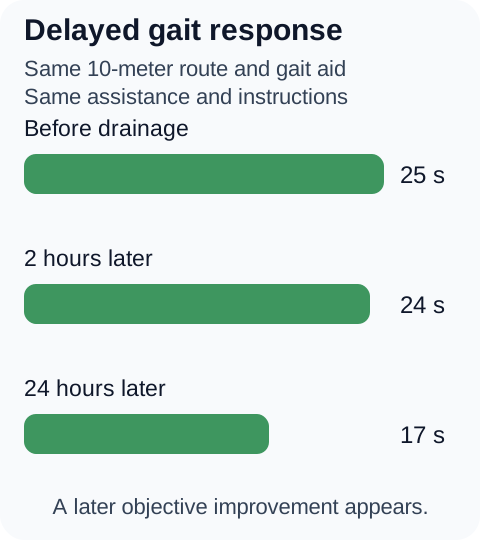
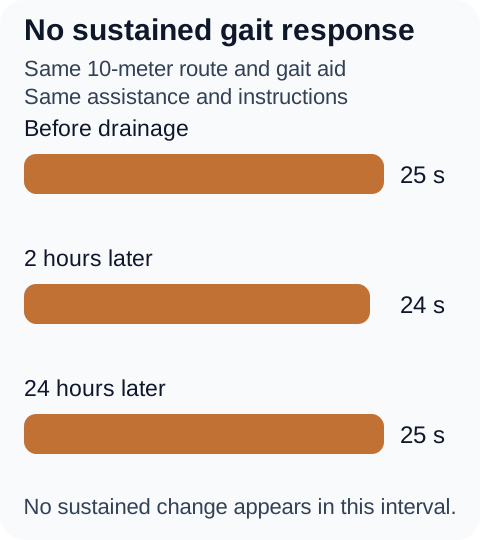
Both invented examples begin at 25 seconds for a 10-meter walk. At 2 hours both take 24 seconds. Predict whether the next-day result changes the interpretation while every testing condition remains the same.
Open patient A
Patient A shows a delayed objective gait response under matched conditions. Original data diagram.
The later result is the informative change. Speed rises from 0.40 m/s to about 0.59 m/s. This supports a responsive mobility component and specialist counseling, but it does not promise cognitive or urinary recovery.
Open patient B
Patient B has no sustained objective response in the observed interval. Original data diagram.
The unchanged result lowers confidence but does not exclude the disorder. Review pain, fatigue, testing quality, alternative diagnoses, imaging pattern, and whether specialist extended drainage or infusion testing is justified.
There is no universal gait cutoff that replaces clinical judgment. Report absolute time, speed, step count, turning quality, assistance, and relative change. A positive objective response generally strengthens prediction of shunt benefit. A negative tap has limited sensitivity, so it cannot prove absence of NPH or irreversible injury. External lumbar drainage or infusion testing can add information in selected uncertain cases but requires an experienced center and carries procedural risk. [1][3][12]
Post-puncture symptoms deserve separate interpretation. A new severe headache that is worse upright and relieved when supine suggests a low-pressure complication rather than evidence that the hydrocephalus has worsened. Assess the complication before further invasive testing. New focal deficits, reduced alertness, fever, or concern for a mass lesion require a different urgent pathway. [7]
Try it here · Checkpoint 3 of 3
Make your prediction before reading the choices. A first attempt is just a starting point.
Case 12
Show answer and explanations for case 12
A. Adjust the posttest time statistically for the different aid and accept a positive response (Why this does not fit)
No validated correction factor or matched trials are given; reassessment is more defensible than an invented adjustment.
Reasoning steps for option A
In nph-12 option A, which supplied observation should be checked first?
nph-12 A: Cane use was replaced by therapist hand support, so test assistance was not comparable.
What comparison resolves nph-12 option A?
nph-12 A: Recognize the numerical time improvement must fit the complete stem without adding an unstated assumption.
B. Infer worsened balance because hand support replaced the cane (Why this does not fit)
The support changed, but its cause and relative assistance cannot be inferred from the reported walk times.
Reasoning steps for option B
In nph-12 option B, which supplied observation should be checked first?
nph-12 B: Baseline cane use and posttest hand support are not comparable test conditions.
What comparison resolves nph-12 option B?
nph-12 B: Identify changed assistance as an alternative cause and select matched reassessment rather than a fabricated correction must fit the complete stem without adding an unstated assumption.
C. Repeat walking and turns under matched assistance and instructions (Best answer)
Matched conditions are necessary to interpret whether the numerical change reflects functional improvement.
Reasoning steps for option C
In nph-12 option C, which supplied observation should be checked first?
nph-12 C: Cane use was replaced by therapist hand support, so test assistance was not comparable.
What comparison resolves nph-12 option C?
nph-12 C: Recognize the numerical time improvement must fit the complete stem without adding an unstated assumption.
D. Count the four-second difference as a confirmed gait response (Why this does not fit)
The conditions differ, so the time difference alone cannot be attributed confidently to drainage.
Reasoning steps for option D
In nph-12 option D, which supplied observation should be checked first?
nph-12 D: Baseline cane use and posttest hand support are not comparable test conditions.
What comparison resolves nph-12 option D?
nph-12 D: Identify changed assistance as an alternative cause and select matched reassessment rather than a fabricated correction must fit the complete stem without adding an unstated assumption.
Who should be referred, and what counts as benefit?
Referral combines pattern, function, anatomy, and goals. A compatible gait-predominant syndrome, supportive imaging, reasonable exclusion or treatment of stronger alternatives, and an objective drainage response make neurosurgical assessment more persuasive. Age alone should not block referral. Pure ex vacuo enlargement lacks a fluid-dynamic target, but mixed atrophy or neurodegenerative disease does not automatically eliminate a treatable mobility component. [2][3]
Ventriculoperitoneal shunting is the usual diversion procedure for iNPH. A ventricular catheter, valve, and distal peritoneal catheter provide controlled drainage. Lumboperitoneal shunting is used in selected settings. Programmable valves allow nonoperative pressure adjustment, which can help balance underdrainage against overdrainage, although device choice and initial settings are specialist and device-specific decisions. Endoscopic third ventriculostomy is not the routine answer for a communicating resorption disorder. [1][10][11]
Gait has the strongest short-term randomized evidence. In the 2025 PENS trial, 99 drainage-responsive participants were randomized to open or placebo shunt settings. At 3 months, the adjusted gait-velocity difference favored open shunts by 0.21 m/s, while cognitive and urinary between-group differences were not statistically significant at that endpoint. Cerebral or subdural bleeding occurred in 14.3% with open settings and 2.0% with placebo settings. The trial excluded chronic anticoagulation, so its safety estimate should not be transferred directly to every patient. [4]
Broader randomized evidence supports gait and disability benefit but remains limited. A 2024 Cochrane review found moderate-certainty evidence for improved short-term gait speed and disability, with much less certain cognitive and adverse-event estimates and no robust long-term randomized quality-of-life data at the time of its search. Counseling should therefore be domain-specific: a measured walking response is not a guarantee that memory, continence, or every daily task will recover. [9]
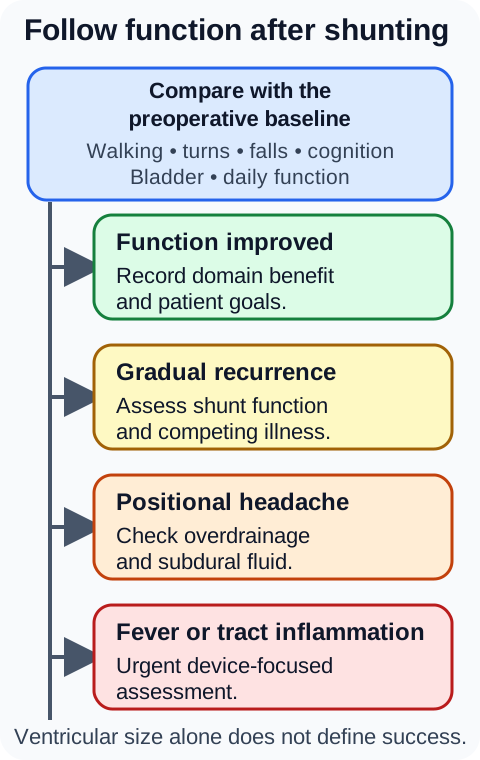
Follow the symptom pattern, not ventricular size alone. Benefit, underdrainage, overdrainage, infection, and unrelated disease require different responses. Original management diagram. [2][11]
Measure the same domains after surgery. Record walking speed, turns, falls, cognition, continence, and daily independence against the preoperative baseline. Gradual recurrence after initial improvement can reflect shunt obstruction, underdrainage, comorbidity, medication effects, or a new neurologic disorder. New orthostatic headache with subdural fluid suggests overdrainage and may be addressed initially by specialist valve adjustment when the patient is stable. Fever, wound erythema, tract tenderness, altered mental status, new focal deficits, or substantial mass effect requires urgent device-focused assessment. [2][11][13]
Bleeding and anticoagulation require individualized planning. A prior subdural hematoma or chronic anticoagulant use is not an automatic permanent exclusion, but it changes lumbar puncture planning, operative assessment, and counseling about subdural risk. The patient’s cardiovascular indication for anticoagulation must be balanced with procedural risk by the relevant specialists rather than stopped indefinitely from a generic rule. [4][7]
Judge benefit by the patient’s goal. Better turns and fewer falls can be a meaningful success even when longstanding rapid forgetting persists. That pattern can indicate a responsive mobility component plus a separate amnestic disorder rather than a failed operation.
Compare the outcome judgment
Separate domains before declaring success or failure. Reassess the unchanged cognitive problem on its own merits while preserving the measured mobility benefit.
Beyond: build a safe specialist handoff
A useful referral packet makes the response question reproducible. Include symptom chronology, falls, gait aid, assistance level, videos when appropriate, a timed 10-meter walk or Timed Up and Go, turn-step count, cognitive instrument, urinary pattern, postvoid residual when indicated, medication review, major comorbidities, the full imaging study, lumbar opening pressure and fluid results, tap volume, and the exact timing and conditions of every posttap assessment. Report what did not change as carefully as what did. [1][2]
Selection remains individualized after a positive test. Ask whether the target problem limits daily life, whether a shunt can plausibly address that target, whether another disorder sets a ceiling on recovery, and whether expected benefit justifies infection, hemorrhage, subdural collection, obstruction, revision, and anesthesia risks. A positive tap supports candidacy assessment; it is not an automatic consent decision. A negative tap should trigger review of protocol quality and alternatives rather than a reflexive label of irreversible disease. [1][3]
No routine medication dose substitutes for cerebrospinal fluid diversion. Drug therapy may treat coexisting parkinsonism, urinary disease, vascular risk, mood symptoms, pain, sleep problems, or delirium, but it does not replace shunting for established responsive iNPH. Valve settings, adjustment increments, magnetic resonance precautions, and postprocedure imaging protocols vary by device and center. Verify the implanted device card, current manufacturer labeling, and the treating neurosurgical protocol rather than copying a universal setting or schedule.
Longitudinal follow-up needs both routine comparison and symptom-triggered review. Document the valve type and setting, retain an accessible device record, compare function with the preoperative baseline, and confirm the setting after magnetic resonance imaging when required by that device. New orthostatic headache, sudden gait decline, cognitive change, fever, wound abnormality, abdominal symptoms along the distal catheter, or focal neurologic findings should prompt earlier assessment. Stable incidental ventriculomegaly without functional decline is monitored clinically rather than treated prophylactically. [2][11]
Evidence should be described with its population and time point. The PENS trial supports short-term gait benefit in drainage-responsive participants, not every person with ventriculomegaly. The 2024 Cochrane review supports short-term gait and disability improvement but found uncertainty around cognition, adverse events, and long-term outcomes. Observational meta-analysis estimates can describe broader practice but remain vulnerable to selection, protocol, and follow-up differences. Use these data for honest counseling, not a personal guarantee. [4][9][10]
High-value counseling contrasts
Avoid saying
Prefer saying
Avoid sayingThe triad proves NPH
Prefer sayingThe gait-predominant course, imaging distribution, alternatives, and measured response together determine confidence
Avoid sayingNormal pressure rules it in
Prefer sayingOne pressure reading is contextual and cannot describe the complete fluid system
Avoid sayingA negative tap rules it out
Prefer sayingA negative result lowers confidence but has limited exclusion value
Avoid sayingA positive tap guarantees recovery
Prefer sayingIt strengthens prediction for the measured domain and supports individualized surgical counseling
Avoid sayingSmaller ventricles mean success
Prefer sayingMeaningful benefit is measured in walking, safety, independence, cognition, continence, and the patient’s goals
Finish with one practical question. What exact function does the patient most want to regain, and was that same function measured before and after drainage? The answer keeps counseling anchored to evidence rather than the diagnosis label.
Apply the lesson
Case 1
Show answer and explanations for case 1
A. Measure matched walking and turns before and after temporary cerebrospinal fluid (CSF) drainage (Best answer)
Partial medication response separates the parkinsonian component from the persistent higher-level gait problem. The imaging supports testing a separate drainage-responsive contribution under comparable conditions.
Reasoning steps for option A
In nph-01 option A, which supplied observation should be checked first?
nph-01 A: Hand rigidity and tremor improve, while start hesitation and turning remain impaired at a stable dose.
What comparison resolves nph-01 option A?
nph-01 A: Separate levodopa-responsive hand signs from persistent gait disability must fit the complete stem without adding an unstated assumption.
B. Use dopamine-transporter imaging to determine whether the ventricular pattern is symptomatic while leaving the drainage question unresolved (Why this does not fit)
Such imaging may support a parkinsonian syndrome but does not determine whether a coexisting gait component responds to cerebrospinal fluid diversion.
Reasoning steps for option B
In nph-01 option B, which supplied observation should be checked first?
nph-01 B: DESH-like ventricular distribution persists despite improved hand signs on a stable levodopa dose.
What comparison resolves nph-01 option B?
nph-01 B: Use the independent gait/imaging pattern to select a matched CSF-response assessment rather than treating medication response as a complete causal explanation must fit the complete stem without adding an unstated assumption.
C. Repeat the medication trial with hand rigidity as the primary endpoint (Why this does not fit)
The hand signs responded while the gait disorder persisted. Repeating that endpoint would not test the independent cerebrospinal fluid-related contribution suggested by the gait and imaging.
Reasoning steps for option C
In nph-01 option C, which supplied observation should be checked first?
nph-01 C: Hand rigidity and tremor improve, while start hesitation and turning remain impaired at a stable dose.
What comparison resolves nph-01 option C?
nph-01 C: Separate levodopa-responsive hand signs from persistent gait disability must fit the complete stem without adding an unstated assumption.
D. Repeat ventricular-size measurements before obtaining additional functional measurements (Why this does not fit)
Ventricular size is already abnormal. Its change is less directly informative about the persistent functional problem than a standardized drainage assessment.
Reasoning steps for option D
In nph-01 option D, which supplied observation should be checked first?
nph-01 D: DESH-like ventricular distribution persists despite improved hand signs on a stable levodopa dose.
What comparison resolves nph-01 option D?
nph-01 D: Use the independent gait/imaging pattern to select a matched CSF-response assessment rather than treating medication response as a complete causal explanation must fit the complete stem without adding an unstated assumption.
Takeaway: A response in one motor domain need not explain a persistent gait disorder with independently supportive cerebrospinal fluid-space findings.
A. Repeat imaging before referral because ventricular pattern outweighs walking data (Why this does not fit)
Imaging supports suspicion but cannot replace a matched functional response in the decision.
Reasoning steps for option A
In nph-02 option A, which supplied observation should be checked first?
nph-02 A: The 10-meter time fell from 25 to 19 seconds with the same walker after drainage.
What comparison resolves nph-02 option A?
nph-02 A: Interpret the matched25-to19-second change as supportive drainage-associated improvement must fit the complete stem without adding an unstated assumption.
B. Repeat the drainage test before any referral because one response cannot establish durability (Why this does not fit)
A repeat may clarify uncertainty, but specialist counseling is reasonable after this measured response without claiming reproducibility.
Reasoning steps for option B
In nph-02 option B, which supplied observation should be checked first?
nph-02 B: Chronic vascular lesions coexist with disproportionate ventricular enlargement.
What comparison resolves nph-02 option B?
nph-02 B: Recognize that vascular disease can coexist and need not prevent benefit-risk referral must fit the complete stem without adding an unstated assumption.
C. Defer referral and repeat the walk after further vascular treatment (Why this does not fit)
Vascular care remains important, but it need not precede assessment of this observed drainage-associated change.
Reasoning steps for option C
In nph-02 option C, which supplied observation should be checked first?
nph-02 C: The 10-meter time fell from 25 to 19 seconds with the same walker after drainage.
What comparison resolves nph-02 option C?
nph-02 C: Interpret the matched25-to19-second change as supportive drainage-associated improvement must fit the complete stem without adding an unstated assumption.
D. Refer for shunt benefit-risk assessment while continuing vascular care (Best answer)
The matched functional improvement supports referral despite possible additional vascular contribution; one response does not guarantee benefit.
Reasoning steps for option D
In nph-02 option D, which supplied observation should be checked first?
nph-02 D: Chronic vascular lesions coexist with disproportionate ventricular enlargement.
What comparison resolves nph-02 option D?
nph-02 D: Recognize that vascular disease can coexist and need not prevent benefit-risk referral must fit the complete stem without adding an unstated assumption.
Takeaway: Discuss shunt benefit and risks without promising cure
A. Schedule shunt implantation from imaging and symptoms without reassessing gait (Why this does not fit)
Imaging raises suspicion but does not justify skipping available objective reassessment before an invasive decision.
Reasoning steps for option A
In nph-03 option A, which supplied observation should be checked first?
nph-03 A: There is no next-day gait assessment after the early unchanged test.
What comparison resolves nph-03 option A?
nph-03 A: Recognize that a two-hour measurement does not capture all delayed responses must fit the complete stem without adding an unstated assumption.
B. Begin prolonged drainage immediately instead of checking the current gait (Why this does not fit)
Prolonged drainage may help when uncertainty persists, but a matched 24-hour assessment is available first.
Reasoning steps for option B
In nph-03 option B, which supplied observation should be checked first?
nph-03 B: The patient is now available at approximately24 hours, with no intervening reassessment.
What comparison resolves nph-03 option B?
nph-03 B: Use the available24-hour interval before escalating to prolonged drainage or ending assessment must fit the complete stem without adding an unstated assumption.
C. Classify the tap as negative and use imaging surveillance instead (Why this does not fit)
The early null measurement alone cannot exclude a later response.
Reasoning steps for option C
In nph-03 option C, which supplied observation should be checked first?
nph-03 C: There is no next-day gait assessment after the early unchanged test.
What comparison resolves nph-03 option C?
nph-03 C: Recognize that a two-hour measurement does not capture all delayed responses must fit the complete stem without adding an unstated assumption.
D. Arrange a matched gait and turn assessment now, considering additional drainage testing if uncertainty persists (Best answer)
A two-hour null result misses delayed improvement; standardized assessment near 24 hours preserves the remaining informative window.
Reasoning steps for option D
In nph-03 option D, which supplied observation should be checked first?
nph-03 D: The patient is now available at approximately24 hours, with no intervening reassessment.
What comparison resolves nph-03 option D?
nph-03 D: Use the available24-hour interval before escalating to prolonged drainage or ending assessment must fit the complete stem without adding an unstated assumption.
Takeaway: Reassess objectively and discuss extended drainage
A. Perform lumbar drainage under observation to test for reversibility (Why this does not fit)
Observation does not eliminate the potential pressure-gradient hazard of lumbar cerebrospinal fluid removal in suspected obstruction.
Reasoning steps for option A
In nph-04 option A, which supplied observation should be checked first?
nph-04 A: The aqueductal web separates the enlarged upper ventricles from the normal-sized fourth ventricle.
What comparison resolves nph-04 option A?
nph-04 A: Infer upstream obstruction from lateral/third enlargement with a spared fourth and narrowed channel must fit the complete stem without adding an unstated assumption.
B. Request routine repeat ventricular imaging in several months (Why this does not fit)
The new headache and vomiting require prompt assessment rather than delayed surveillance.
Reasoning steps for option B
In nph-04 option B, which supplied observation should be checked first?
nph-04 B: New headache and vomiting accompany narrowing between the third and fourth ventricles.
What comparison resolves nph-04 option B?
nph-04 B: Combine that anatomy with headache/vomiting to prioritize safety assessment over elective lumbar drainage must fit the complete stem without adding an unstated assumption.
C. Arrange outpatient serial gait testing before deciding whether to drain cerebrospinal fluid (CSF) (Why this does not fit)
Serial gait measures matter in communicating disease but do not address new pressure symptoms with an obstructive distribution.
Reasoning steps for option C
In nph-04 option C, which supplied observation should be checked first?
nph-04 C: The aqueductal web separates the enlarged upper ventricles from the normal-sized fourth ventricle.
What comparison resolves nph-04 option C?
nph-04 C: Infer upstream obstruction from lateral/third enlargement with a spared fourth and narrowed channel must fit the complete stem without adding an unstated assumption.
D. Seek prompt neurosurgical assessment before elective lumbar drainage (Best answer)
The enlarged upstream ventricles and spared fourth suggest an obstruction and possible pressure gradient; removing lumbar cerebrospinal fluid before safety assessment may be hazardous.
Reasoning steps for option D
In nph-04 option D, which supplied observation should be checked first?
nph-04 D: New headache and vomiting accompany narrowing between the third and fourth ventricles.
What comparison resolves nph-04 option D?
nph-04 D: Combine that anatomy with headache/vomiting to prioritize safety assessment over elective lumbar drainage must fit the complete stem without adding an unstated assumption.
Takeaway: Seek urgent neurosurgical evaluation rather than tap
A. A disproportionately enlarged subarachnoid-space hydrocephalus (DESH) distribution is favored; the faster trial is confounded by changed assistance (Why this does not fit)
The testing limitation is correctly identified, but the supplied surface-space distribution favors atrophy rather than disproportionately enlarged subarachnoid-space hydrocephalus.
Reasoning steps for option A
In nph-05 option A, which supplied observation should be checked first?
nph-05 A: Diffuse proportionate cortical sulcal widening favors an atrophy-related pattern rather than high-convexity crowding.
What comparison resolves nph-05 option A?
nph-05 A: Favor atrophy-related enlargement from diffuse proportionate sulcal widening must fit the complete stem without adding an unstated assumption.
B. Atrophy-related enlargement is favored; the faster trial is confounded by changed assistance (Best answer)
Proportionate sulcal widening favors ex vacuo enlargement, while different physical support independently confounds the functional comparison. Neither a normal pressure nor this confounded trial settles the diagnosis.
Reasoning steps for option B
In nph-05 option B, which supplied observation should be checked first?
nph-05 B: The only faster post-tap trial uses hands-on assistance instead of the usual walker.
What comparison resolves nph-05 option B?
nph-05 B: Independently identify assistance change as a confounder rather than a valid drainage response must fit the complete stem without adding an unstated assumption.
C. A DESH distribution is favored; the faster trial provides interpretable drainage-response evidence (Why this does not fit)
Diffuse proportionate sulcal widening is not the high-convexity crowding with enlarged Sylvian fissures of disproportionately enlarged subarachnoid-space hydrocephalus. The assistance also changed.
Reasoning steps for option C
In nph-05 option C, which supplied observation should be checked first?
nph-05 C: Diffuse proportionate cortical sulcal widening favors an atrophy-related pattern rather than high-convexity crowding.
What comparison resolves nph-05 option C?
nph-05 C: Favor atrophy-related enlargement from diffuse proportionate sulcal widening must fit the complete stem without adding an unstated assumption.
D. Atrophy-related enlargement is favored; the faster trial provides interpretable drainage-response evidence (Why this does not fit)
The sulcal distribution supports this imaging interpretation, but the change in assistance prevents attribution of the faster walk to drainage.
Reasoning steps for option D
In nph-05 option D, which supplied observation should be checked first?
nph-05 D: The only faster post-tap trial uses hands-on assistance instead of the usual walker.
What comparison resolves nph-05 option D?
nph-05 D: Independently identify assistance change as a confounder rather than a valid drainage response must fit the complete stem without adding an unstated assumption.
Takeaway: Interpret anatomy and test comparability separately; concordance cannot be assumed from a faster assisted walk.
A. Counsel that the estimate applies to selected drainage responders and does not quantify this patient's benefit (Best answer)
Enrollment required an observed drainage response, which differs from this patient's current evidence. The trial supports benefit in its selected population without supplying an individual estimate for a nonresponder.
Reasoning steps for option A
In nph-07 option A, which supplied observation should be checked first?
nph-07 A: Participants were selected for gait improvement with temporary drainage, unlike the patient asking about applicability.
What comparison resolves nph-07 option A?
nph-07 A: Interpret the selected trial's group gait effect and confidence interval must fit the complete stem without adding an unstated assumption.
B. Discard the gait result because cognitive and urinary differences were not significant in the trial despite the responder-only trial enrollment (Why this does not fit)
Separate nonsignificant endpoints do not erase the randomized gait result in the population that was studied.
Reasoning steps for option B
In nph-07 option B, which supplied observation should be checked first?
nph-07 B: The asking patient has no observed drainage response, unlike enrolled participants.
What comparison resolves nph-07 option B?
nph-07 B: Recognize that nonresponse to drainage differs from eligibility and prevents direct individual extrapolation must fit the complete stem without adding an unstated assumption.
C. Apply the gait estimate directly because both populations have ventricular enlargement (Why this does not fit)
Shared ventricular enlargement does not remove the important eligibility difference created by drainage-response selection.
Reasoning steps for option C
In nph-07 option C, which supplied observation should be checked first?
nph-07 C: Participants were selected for gait improvement with temporary drainage, unlike the patient asking about applicability.
What comparison resolves nph-07 option C?
nph-07 C: Interpret the selected trial's group gait effect and confidence interval must fit the complete stem without adding an unstated assumption.
D. Promise a gait benefit because the confidence interval excluded no effect (Why this does not fit)
A confidence interval describes the selected trial population and cannot guarantee an outcome for an unstudied subgroup or an individual.
Reasoning steps for option D
In nph-07 option D, which supplied observation should be checked first?
nph-07 D: The asking patient has no observed drainage response, unlike enrolled participants.
What comparison resolves nph-07 option D?
nph-07 D: Recognize that nonresponse to drainage differs from eligibility and prevents direct individual extrapolation must fit the complete stem without adding an unstated assumption.
Takeaway: Interpret the endpoint and selected population before applying a treatment estimate.
A. Repeat ventricular imaging before addressing the documented cerebellar deficit (Why this does not fit)
Follow-up imaging may be appropriate clinically, but the concordant examination warrants attention without waiting for ventricular growth.
Reasoning steps for option A
In nph-08 option A, which supplied observation should be checked first?
nph-08 A: Abrupt onset, limb dysmetria, nystagmus and a recent cerebellar infarct support a cerebellar process.
What comparison resolves nph-08 option A?
nph-08 A: Use the acute course, cerebellar signs and concordant lesion to identify the dominant gait process must fit the complete stem without adding an unstated assumption.
B. Prioritize peripheral sensory testing as the sole explanation for imbalance (Why this does not fit)
Sensory disease can coexist, but it does not explain gaze-evoked nystagmus and bilateral limb dysmetria as well as cerebellar injury.
Reasoning steps for option B
In nph-08 option B, which supplied observation should be checked first?
nph-08 B: The lesion involves vermis and both cerebellar hemispheres; sulci and ventricles widen proportionately.
What comparison resolves nph-08 option B?
nph-08 B: Use the acute course, cerebellar signs and concordant lesion to identify the dominant gait process must fit the complete stem without adding an unstated assumption.
C. Refer for shunt selection because ventricular enlargement explains the broad gait (Why this does not fit)
Broad gait alone overlaps, but dysmetria, nystagmus and proportional sulcal widening argue against attributing this episode primarily to hydrocephalus.
Reasoning steps for option C
In nph-08 option C, which supplied observation should be checked first?
nph-08 C: Abrupt onset, limb dysmetria, nystagmus and a recent cerebellar infarct support a cerebellar process.
What comparison resolves nph-08 option C?
nph-08 C: Use the acute course, cerebellar signs and concordant lesion to identify the dominant gait process must fit the complete stem without adding an unstated assumption.
D. Pursue evaluation and rehabilitation of cerebellar impairment while treating ventricular enlargement as likely incidental (Best answer)
The acute onset and concordant bilateral cerebellar signs fit the documented injury; proportional ventricles and sulci favor atrophy-related enlargement rather than a primary cerebrospinal fluid-diversion target.
Reasoning steps for option D
In nph-08 option D, which supplied observation should be checked first?
nph-08 D: The lesion involves vermis and both cerebellar hemispheres; sulci and ventricles widen proportionately.
What comparison resolves nph-08 option D?
nph-08 D: Use the acute course, cerebellar signs and concordant lesion to identify the dominant gait process must fit the complete stem without adding an unstated assumption.
Takeaway: Prefer cerebellar pathology with atrophy-related enlargement
A. Primary idiopathic normal pressure hydrocephalus despite proportionate ventricular size (Why this does not fit)
Urinary symptoms are not mandatory, but proportionate ventricles and a lateralized parkinsonian examination favor another primary diagnosis.
Reasoning steps for option A
In nph-09 option A, which supplied observation should be checked first?
nph-09 A: Asymmetric rigidity, reduced arm swing and decrement occur with proportionate ventricular enlargement.
What comparison resolves nph-09 option A?
nph-09 A: Rank asymmetric rigidity/decrement with proportionate ventricles above nonspecific doorway freezing and preserved seated cycling must fit the complete stem without adding an unstated assumption.
B. A higher-level gait disorder established by preserved seated cycling (Why this does not fit)
Preserved seated cycling can occur in several gait disorders and is not diagnostic by itself.
Reasoning steps for option B
In nph-09 option B, which supplied observation should be checked first?
nph-09 B: Asymmetric rigidity and decrement accompany only mild proportionate ventricular enlargement.
What comparison resolves nph-09 option B?
nph-09 B: Rank asymmetric rigidity/decrement with proportionate ventricles above nonspecific doorway freezing and preserved seated cycling must fit the complete stem without adding an unstated assumption.
C. A parkinsonian gait disorder supported by asymmetric rigidity and decrement (Best answer)
Asymmetric rigidity, reduced arm swing, and decrement are positive parkinsonian findings, while the ventricular size is proportionate to age-related surface spaces.
Reasoning steps for option C
In nph-09 option C, which supplied observation should be checked first?
nph-09 C: Asymmetric rigidity, reduced arm swing and decrement occur with proportionate ventricular enlargement.
What comparison resolves nph-09 option C?
nph-09 C: Rank asymmetric rigidity/decrement with proportionate ventricles above nonspecific doorway freezing and preserved seated cycling must fit the complete stem without adding an unstated assumption.
D. A urinary-gait syndrome despite the absence of urinary symptoms (Why this does not fit)
The absent urinary features and positive lateralized motor findings do not support a urinary-gait syndrome as the best explanation.
Reasoning steps for option D
In nph-09 option D, which supplied observation should be checked first?
nph-09 D: Asymmetric rigidity and decrement accompany only mild proportionate ventricular enlargement.
What comparison resolves nph-09 option D?
nph-09 D: Rank asymmetric rigidity/decrement with proportionate ventricles above nonspecific doorway freezing and preserved seated cycling must fit the complete stem without adding an unstated assumption.
A. Overflow incontinence due to the enlarged prostate (Why this does not fit)
No leakage is reported, so overflow incontinence cannot be inferred; enlargement alone does not prove functional obstruction.
Reasoning steps for option A
In nph-10 option A, which supplied observation should be checked first?
nph-10 A: A large residual, weak stream and enlarged prostate favor impaired bladder emptying.
What comparison resolves nph-10 option A?
nph-10 A: Identify impaired emptying from repeated residuals, weak stream and small-volume voids while retaining uncertainty about obstruction versus underactivity must fit the complete stem without adding an unstated assumption.
Symptoms, enlarged prostate and repeatedly high residual make obstruction probable, not proven; detrusor underactivity remains possible without further evaluation.
Reasoning steps for option B
In nph-10 option B, which supplied observation should be checked first?
nph-10 B: Weak stream, prostate enlargement and repeated high residuals are present without reported leakage.
What comparison resolves nph-10 option B?
nph-10 B: Identify impaired emptying from repeated residuals, weak stream and small-volume voids while retaining uncertainty about obstruction versus underactivity must fit the complete stem without adding an unstated assumption.
C. Detrusor underactivity proven by the postvoid residual alone (Why this does not fit)
Underactivity can raise residual, but residual cannot distinguish it from obstruction and the weak stream with enlargement supports evaluating the outlet.
Reasoning steps for option C
In nph-10 option C, which supplied observation should be checked first?
nph-10 C: A large residual, weak stream and enlarged prostate favor impaired bladder emptying.
What comparison resolves nph-10 option C?
nph-10 C: Identify impaired emptying from repeated residuals, weak stream and small-volume voids while retaining uncertainty about obstruction versus underactivity must fit the complete stem without adding an unstated assumption.
D. Frontal detrusor overactivity; the residual establishes a cerebrospinal fluid (CSF)-related urinary syndrome (Why this does not fit)
Frequency can occur with overactivity, but repeated large postvoid residual and weak stream point to impaired emptying rather than isolated urgency.
Reasoning steps for option D
In nph-10 option D, which supplied observation should be checked first?
nph-10 D: Weak stream, prostate enlargement and repeated high residuals are present without reported leakage.
What comparison resolves nph-10 option D?
nph-10 D: Identify impaired emptying from repeated residuals, weak stream and small-volume voids while retaining uncertainty about obstruction versus underactivity must fit the complete stem without adding an unstated assumption.
Takeaway: Avoid attributing all symptoms to ventriculomegaly
A. Recognize a delayed gait response and assess a post-puncture low-pressure complication (Best answer)
A matched next-day gait improvement remains informative. The new orthostatic headache independently suggests a puncture-related low-pressure complication that needs assessment before further invasive management.
Reasoning steps for option A
In nph-13 option A, which supplied observation should be checked first?
nph-13 A: No. Repeated matched walks improve the next morning, within a clinically useful reassessment interval.
What comparison resolves nph-13 option A?
nph-13 A: Accept delayed matched gait improvement as informative despite an unchanged early reading must fit the complete stem without adding an unstated assumption.
B. Recognize a delayed gait response and treat the headache as persistent high-pressure obstruction (Why this does not fit)
The gait interpretation is reasonable, but a headache relieved by recumbency after puncture is more consistent with a low-pressure syndrome.
Reasoning steps for option B
In nph-13 option B, which supplied observation should be checked first?
nph-13 B: A new severe headache is worse upright and relieved supine after the puncture.
What comparison resolves nph-13 option B?
nph-13 B: Independently interpret new orthostatic headache after puncture as a low-pressure complication requiring assessment must fit the complete stem without adding an unstated assumption.
C. Dismiss the delayed gait change and assess a post-puncture low-pressure complication (Why this does not fit)
The headache interpretation fits, but a response appearing the next day remains within a useful assessment interval and should not be dismissed.
Reasoning steps for option C
In nph-13 option C, which supplied observation should be checked first?
nph-13 C: No. Repeated matched walks improve the next morning, within a clinically useful reassessment interval.
What comparison resolves nph-13 option C?
nph-13 C: Accept delayed matched gait improvement as informative despite an unchanged early reading must fit the complete stem without adding an unstated assumption.
D. Dismiss the delayed gait change and treat the headache as persistent high-pressure obstruction (Why this does not fit)
Both conclusions conflict with the supplied timing: later matched improvement can matter, and the positional headache supports a puncture-related low-pressure problem.
Reasoning steps for option D
In nph-13 option D, which supplied observation should be checked first?
nph-13 D: A new severe headache is worse upright and relieved supine after the puncture.
What comparison resolves nph-13 option D?
nph-13 D: Independently interpret new orthostatic headache after puncture as a low-pressure complication requiring assessment must fit the complete stem without adding an unstated assumption.
Takeaway: A functional benefit and an adverse effect can occur after the same procedure; each requires its own interpretation.
A. An aqueductal obstruction is favored; cisternal fenestration leaves the dominant defect downstream of the new opening despite the patent ventricular passages (Why this does not fit)
The imaging does not favor aqueductal obstruction. If an isolated aqueductal block were dominant, a third-ventricular opening into the cisterns would bypass it rather than leave it downstream of the new route.
Reasoning steps for option A
In nph-14 option A, which supplied observation should be checked first?
nph-14 A: The posthemorrhagic course and patent panventricular pathway favor impaired downstream CSF resorption.
What comparison resolves nph-14 option A?
nph-14 A: Infer acquired communicating physiology after hemorrhage with patent ventricular passages must fit the complete stem without adding an unstated assumption.
B. Impaired downstream resorption is favored; cisternal fenestration leaves the dominant defect downstream of the new opening (Best answer)
The preceding hemorrhage and open ventricular pathway support impaired resorption. Adding a route from the third ventricle into basal cisterns does not directly bypass a distal absorption deficit.
Reasoning steps for option B
In nph-14 option B, which supplied observation should be checked first?
nph-14 B: The proposed fenestration would connect the third ventricle to intracranial cisternal spaces.
What comparison resolves nph-14 option B?
nph-14 B: Trace third-ventricular fenestration into intracranial CSF spaces and recognize that it does not supply a new absorption site beyond the downstream defect must fit the complete stem without adding an unstated assumption.
C. An aqueductal obstruction is favored; cisternal fenestration directly bypasses the dominant defect (Why this does not fit)
This combination fits a patient with an isolated aqueductal block, but patent passages and enlargement of all ventricles after hemorrhage favor a downstream resorption problem here.
Reasoning steps for option C
In nph-14 option C, which supplied observation should be checked first?
nph-14 C: The posthemorrhagic course and patent panventricular pathway favor impaired downstream CSF resorption.
What comparison resolves nph-14 option C?
nph-14 C: Infer acquired communicating physiology after hemorrhage with patent ventricular passages must fit the complete stem without adding an unstated assumption.
D. Impaired downstream resorption is favored; cisternal fenestration directly bypasses the dominant defect (Why this does not fit)
The mechanism is supported, but delivering cerebrospinal fluid to basal cisterns does not provide a route beyond the impaired resorption pathway. This is different from diversion to the peritoneum.
Reasoning steps for option D
In nph-14 option D, which supplied observation should be checked first?
nph-14 D: The proposed fenestration would connect the third ventricle to intracranial cisternal spaces.
What comparison resolves nph-14 option D?
nph-14 D: Trace third-ventricular fenestration into intracranial CSF spaces and recognize that it does not supply a new absorption site beyond the downstream defect must fit the complete stem without adding an unstated assumption.
Takeaway: Select a diversion concept according to the location of the flow or absorption problem.
A. A CSF-related gait component may improve, while the focal deficit may remain even if the old focal weakness does not (Best answer)
The matched change suggests potential gait benefit, but neither permanent weakness nor individual shunt response can be guaranteed.
Reasoning steps for option A
In nph-15 option A, which supplied observation should be checked first?
nph-15 A: Turning improved after drainage while a longstanding focal weakness persisted.
What comparison resolves nph-15 option A?
nph-15 A: Identify a responsive turning component after matched drainage must fit the complete stem without adding an unstated assumption.
B. Mixed pathology warrants further evaluation before discussing any potential gait benefit (Why this does not fit)
Additional assessment may refine selection, but uncertainty about the focal deficit does not prevent qualified counseling about the observed response.
Reasoning steps for option B
In nph-15 option B, which supplied observation should be checked first?
nph-15 B: A pre-existing focal motor deficit remains unchanged despite improved turns.
What comparison resolves nph-15 option B?
nph-15 B: Avoid transferring that response to the previously documented unresponsive focal motor deficit must fit the complete stem without adding an unstated assumption.
C. Persistent focal weakness makes a gait benefit improbable despite improved turns (Why this does not fit)
The nonresponsive focal deficit does not erase a separate measured gait response.
Reasoning steps for option C
In nph-15 option C, which supplied observation should be checked first?
nph-15 C: Turning improved after drainage while a longstanding focal weakness persisted.
What comparison resolves nph-15 option C?
nph-15 C: Identify a responsive turning component after matched drainage must fit the complete stem without adding an unstated assumption.
D. Improved turns predict recovery of both gait and focal strength after diversion (Why this does not fit)
An observed gait response does not establish reversibility of the documented prior focal deficit.
Reasoning steps for option D
In nph-15 option D, which supplied observation should be checked first?
nph-15 D: A pre-existing focal motor deficit remains unchanged despite improved turns.
What comparison resolves nph-15 option D?
nph-15 D: Avoid transferring that response to the previously documented unresponsive focal motor deficit must fit the complete stem without adding an unstated assumption.
Takeaway: Separate responsive function from residual neurologic injury.
A. Defer invasive cerebrospinal fluid (CSF)-response testing now; prioritize distal entrapment neuropathy as the explanation for the hand signs (Why this does not fit)
Deferring drainage testing fits the recovered gait baseline. Distal entrapment can cause tingling, but it does not account for brisk reflexes and bilateral Hoffmann signs as well as a cord process.
Reasoning steps for option A
In nph-16 option A, which supplied observation should be checked first?
nph-16 A: It returned to the documented normal baseline without CSF drainage, leaving no persistent gait target for a response test now.
What comparison resolves nph-16 option A?
nph-16 A: Use the return to documented normal walking after infection to identify the absence of a persistent gait target for invasive testing must fit the complete stem without adding an unstated assumption.
B. Perform invasive CSF-response testing now; prioritize distal entrapment neuropathy as the explanation for the hand signs (Why this does not fit)
The recovered gait baseline does not establish a current drainage-testing target, and peripheral entrapment does not adequately explain the upper motor neuron findings.
Reasoning steps for option B
In nph-16 option B, which supplied observation should be checked first?
nph-16 B: New hand clumsiness and tingling coexist with brisk reflexes and bilateral Hoffmann signs.
What comparison resolves nph-16 option B?
nph-16 B: Independently localize new dexterity loss with upper motor neuron signs to a possible cervical cord process rather than peripheral entrapment and select its evaluation must fit the complete stem without adding an unstated assumption.
C. Defer invasive CSF-response testing now; investigate a cervical cord process while continuing gait surveillance (Best answer)
Walking returned to the documented normal baseline, so no persistent gait target for drainage testing is established. New dexterity problems with upper motor neuron signs independently warrant cervical cord evaluation; ventricular surveillance still matters.
Reasoning steps for option C
In nph-16 option C, which supplied observation should be checked first?
nph-16 C: It returned to the documented normal baseline without CSF drainage, leaving no persistent gait target for a response test now.
What comparison resolves nph-16 option C?
nph-16 C: Use the return to documented normal walking after infection to identify the absence of a persistent gait target for invasive testing must fit the complete stem without adding an unstated assumption.
D. Perform invasive CSF-response testing now; investigate a cervical cord process while continuing gait surveillance (Why this does not fit)
Cervical evaluation is warranted, but the transient illness-related gait decline resolved and does not itself justify invasive prognostic testing now.
Reasoning steps for option D
In nph-16 option D, which supplied observation should be checked first?
nph-16 D: New hand clumsiness and tingling coexist with brisk reflexes and bilateral Hoffmann signs.
What comparison resolves nph-16 option D?
nph-16 D: Independently localize new dexterity loss with upper motor neuron signs to a possible cervical cord process rather than peripheral entrapment and select its evaluation must fit the complete stem without adding an unstated assumption.
Takeaway: Recovery of the original functional baseline can coexist with a separate new localization that still requires assessment.
A. A responsive mobility component is plausible; the gait response makes a separate amnestic disorder unlikely (Why this does not fit)
The gait response supports that domain, not a conclusion that the amnesia has the same cause. The memory profile still warrants investigation.
Reasoning steps for option A
In nph-17 option A, which supplied observation should be checked first?
nph-17 A: Walking and turns improve repeatedly, while delayed recognition and severe amnesia remain unchanged.
What comparison resolves nph-17 option A?
nph-17 A: Interpret repeated matched gait gains as a plausible responsive mobility component must fit the complete stem without adding an unstated assumption.
B. A responsive mobility component is unlikely; the gait response makes a separate amnestic disorder unlikely (Why this does not fit)
This reverses both interpretations: the observed mobility response remains relevant, and it does not make coexisting amnestic disease unlikely.
Reasoning steps for option B
In nph-17 option B, which supplied observation should be checked first?
nph-17 B: Poor recognition and severe rapid forgetting persist despite repeatable gait gains.
What comparison resolves nph-17 option B?
nph-17 B: Recognize persistent storage-type amnesia as a separate etiologic question and avoid guaranteeing cross-domain recovery must fit the complete stem without adding an unstated assumption.
C. A responsive mobility component is plausible; the persistent storage-type amnesia deserves separate etiologic evaluation (Best answer)
Matched repeated mobility improvement supports a cerebrospinal fluid-responsive component. Poor recognition and persistent rapid forgetting raise a separate concern for an amnestic disorder; mobility response does not guarantee memory recovery.
Reasoning steps for option C
In nph-17 option C, which supplied observation should be checked first?
nph-17 C: Walking and turns improve repeatedly, while delayed recognition and severe amnesia remain unchanged.
What comparison resolves nph-17 option C?
nph-17 C: Interpret repeated matched gait gains as a plausible responsive mobility component must fit the complete stem without adding an unstated assumption.
D. A responsive mobility component is unlikely; the persistent storage-type amnesia deserves separate etiologic evaluation while ignoring the persistent storage-type amnesia (Why this does not fit)
The memory evaluation is justified, but the repeated matched gait response should not be dismissed because a different domain did not improve.
Reasoning steps for option D
In nph-17 option D, which supplied observation should be checked first?
nph-17 D: Poor recognition and severe rapid forgetting persist despite repeatable gait gains.
What comparison resolves nph-17 option D?
nph-17 D: Recognize persistent storage-type amnesia as a separate etiologic question and avoid guaranteeing cross-domain recovery must fit the complete stem without adding an unstated assumption.
Takeaway: Different response patterns can reveal coexisting causes rather than an all-or-none diagnosis.
A. Defer all benefit discussion until anticoagulation is discontinued indefinitely (Why this does not fit)
Discontinuation may be unsafe in atrial fibrillation and is not a prerequisite for explaining possible benefit and risks.
Reasoning steps for option A
In nph-18 option A, which supplied observation should be checked first?
nph-18 A: Anticoagulation and prior subdural bleeding require careful perioperative and drainage-risk assessment.
What comparison resolves nph-18 option A?
nph-18 A: Use drainage-associated improvement to identify potential mobility benefit must fit the complete stem without adding an unstated assumption.
B. Discuss possible gait benefit and arrange coordinated neurosurgical and anticoagulation-risk planning (Best answer)
The observed response supports evaluation, but prior bleeding and ongoing anticoagulation require individualized procedural and subdural-risk assessment.
Reasoning steps for option B
In nph-18 option B, which supplied observation should be checked first?
nph-18 B: Apixaban use and a prior subdural hematoma create a separate bleeding-risk question.
What comparison resolves nph-18 option B?
nph-18 B: Integrate separate anticoagulation and prior subdural bleeding risks before procedural commitment must fit the complete stem without adding an unstated assumption.
C. Offer shunt evaluation based on the gait response but defer bleeding review until after a procedure is scheduled (Why this does not fit)
Referral is reasonable, but bleeding history and medication planning belong in candidacy assessment before procedural commitment.
Reasoning steps for option C
In nph-18 option C, which supplied observation should be checked first?
nph-18 C: Anticoagulation and prior subdural bleeding require careful perioperative and drainage-risk assessment.
What comparison resolves nph-18 option C?
nph-18 C: Use drainage-associated improvement to identify potential mobility benefit must fit the complete stem without adding an unstated assumption.
D. Exclude shunting permanently because anticoagulation precludes a safe procedure (Why this does not fit)
Bleeding risk is substantial but anticoagulation alone does not establish permanent ineligibility; individualized planning is needed.
Reasoning steps for option D
In nph-18 option D, which supplied observation should be checked first?
nph-18 D: Apixaban use and a prior subdural hematoma create a separate bleeding-risk question.
What comparison resolves nph-18 option D?
nph-18 D: Integrate separate anticoagulation and prior subdural bleeding risks before procedural commitment must fit the complete stem without adding an unstated assumption.
A. Observe at the current setting with repeat imaging only (Why this does not fit)
Observation can be reasonable for minimally symptomatic stable collections, but new positional headache favors addressing the drainage mechanism.
Reasoning steps for option A
In nph-19 option A, which supplied observation should be checked first?
nph-19 A: Orthostatic headache and subdural collections after shunting suggest overdrainage.
What comparison resolves nph-19 option A?
nph-19 A: Identify overdrainage from orthostatic headache and new subdural collections must fit the complete stem without adding an unstated assumption.
B. Raise the valve opening pressure and monitor symptoms and collections (Best answer)
Reducing drainage addresses suspected overdrainage while allowing reassessment of stable small collections.
Reasoning steps for option B
In nph-19 option B, which supplied observation should be checked first?
nph-19 B: The patient is alert with small collections and no mass effect.
What comparison resolves nph-19 option B?
nph-19 B: Predict that increasing valve opening pressure reduces drainage, while severity determines need for additional intervention must fit the complete stem without adding an unstated assumption.
C. Lower the valve opening pressure and reassess headache (Why this does not fit)
A lower setting increases drainage, potentially worsening orthostatic symptoms and collections.
Reasoning steps for option C
In nph-19 option C, which supplied observation should be checked first?
nph-19 C: Orthostatic headache and subdural collections after shunting suggest overdrainage.
What comparison resolves nph-19 option C?
nph-19 C: Identify overdrainage from orthostatic headache and new subdural collections must fit the complete stem without adding an unstated assumption.
D. Proceed directly to operative evacuation of the collections (Why this does not fit)
Operative treatment may be necessary with deterioration or significant mass effect, neither of which is described.
Reasoning steps for option D
In nph-19 option D, which supplied observation should be checked first?
nph-19 D: The patient is alert with small collections and no mass effect.
What comparison resolves nph-19 option D?
nph-19 D: Predict that increasing valve opening pressure reduces drainage, while severity determines need for additional intervention must fit the complete stem without adding an unstated assumption.
Takeaway: Overdrainage can require less cerebrospinal fluid drainage, not more.
A. Arrange urgent neurosurgical assessment for possible device infection and dysfunction (Best answer)
Fever and tract inflammation make device infection a priority; recurrent gait decline also warrants evaluation of function.
Reasoning steps for option A
In nph-20 option A, which supplied observation should be checked first?
nph-20 A: Fever with erythema and tenderness raises concern for infection rather than isolated chronic gait decline.
What comparison resolves nph-20 option A?
nph-20 A: Recognize fever and an inflamed implanted tract as a device-infection concern needing prompt assessment must fit the complete stem without adding an unstated assumption.
B. Obtain outpatient cultures and reassess the shunt after results return (Why this does not fit)
Cultures may contribute to evaluation, but outpatient delay is inappropriate with fever and an inflamed implanted tract.
Reasoning steps for option B
In nph-20 option B, which supplied observation should be checked first?
nph-20 B: Recurrent gait slowing accompanies fever and tract erythema/tenderness.
What comparison resolves nph-20 option B?
nph-20 B: Recognize fever and an inflamed implanted tract as a device-infection concern needing prompt assessment must fit the complete stem without adding an unstated assumption.
C. Arrange urgent valve adjustment while concurrently checking inflammatory markers (Why this does not fit)
Altered drainage can explain gait decline, but adjustment before device-infection evaluation underweights tract inflammation.
Reasoning steps for option C
In nph-20 option C, which supplied observation should be checked first?
nph-20 C: Fever with erythema and tenderness raises concern for infection rather than isolated chronic gait decline.
What comparison resolves nph-20 option C?
nph-20 C: Recognize fever and an inflamed implanted tract as a device-infection concern needing prompt assessment must fit the complete stem without adding an unstated assumption.
D. Assess for another fever source and schedule routine device review if none is found despite local signs along the implanted tract (Why this does not fit)
Other sources can coexist, but local tract signs require immediate device-focused assessment rather than conditional routine follow-up.
Reasoning steps for option D
In nph-20 option D, which supplied observation should be checked first?
nph-20 D: Recurrent gait slowing accompanies fever and tract erythema/tenderness.
What comparison resolves nph-20 option D?
nph-20 D: Recognize fever and an inflamed implanted tract as a device-infection concern needing prompt assessment must fit the complete stem without adding an unstated assumption.
A. About 7 additional participants with bleeding per 100 treated; the clearest short-term efficacy evidence concerns gait while also claiming an unsupported cognitive benefit (Why this does not fit)
The ratio 14.3/2.0 is about 7, but a risk ratio is not an absolute count of additional participants with bleeding per 100. The absolute difference is 12.3 percentage points.
Reasoning steps for option A
In nph-21 option A, which supplied observation should be checked first?
nph-21 A: Subtract 2.0 percent from 14.3 percent to obtain 12.3 percentage points, approximately 12 additional affected participants per 100 treated.
What comparison resolves nph-21 option A?
nph-21 A: Calculate14.3 minus2.0 as12.3 percentage points rather than mistaking a risk ratio for absolute excess must fit the complete stem without adding an unstated assumption.
B. About 12 additional participants with bleeding per 100 treated; the results establish both gait and cognitive benefit (Why this does not fit)
The absolute harm calculation is appropriate, but the trial did not establish cognitive benefit at three months.
Reasoning steps for option B
In nph-21 option B, which supplied observation should be checked first?
nph-21 B: Gait showed a significant between-group difference; cognition did not.
What comparison resolves nph-21 option B?
nph-21 B: Distinguish demonstrated gait efficacy from a nonsignificant cognitive comparison must fit the complete stem without adding an unstated assumption.
C. About 12 additional participants with bleeding per 100 treated; the clearest short-term efficacy evidence concerns gait (Best answer)
Subtracting 2.0 from 14.3 yields 12.3 percentage points, or about 12 additional participants with bleeding per 100. The significant gait result and nonsignificant cognitive result support domain-specific counseling; these are trial estimates, not individual predictions.
Reasoning steps for option C
In nph-21 option C, which supplied observation should be checked first?
nph-21 C: Subtract 2.0 percent from 14.3 percent to obtain 12.3 percentage points, approximately 12 additional affected participants per 100 treated.
What comparison resolves nph-21 option C?
nph-21 C: Calculate14.3 minus2.0 as12.3 percentage points rather than mistaking a risk ratio for absolute excess must fit the complete stem without adding an unstated assumption.
D. About 7 additional participants with bleeding per 100 treated; the results establish both gait and cognitive benefit (Why this does not fit)
This substitutes a risk ratio for the absolute difference and also overstates the cognitive endpoint.
Reasoning steps for option D
In nph-21 option D, which supplied observation should be checked first?
nph-21 D: Gait showed a significant between-group difference; cognition did not.
What comparison resolves nph-21 option D?
nph-21 D: Distinguish demonstrated gait efficacy from a nonsignificant cognitive comparison must fit the complete stem without adding an unstated assumption.
Takeaway: Translate absolute harm correctly and keep each efficacy endpoint separate when discussing treatment.
A. Wait until attention and mobility have stabilized, then record matched pre- and postdrainage performance (Best answer)
A stable baseline separates chronic gait impairment from resolving acute illness before interpreting a drainage response.
Reasoning steps for option A
In nph-22 option A, which supplied observation should be checked first?
nph-22 A: Pneumonia and delirium are improving before any CSF intervention.
What comparison resolves nph-22 option A?
nph-22 A: Separate chronic walking decline from ongoing infection/delirium recovery must fit the complete stem without adding an unstated assumption.
B. Test as soon as fever resolves, even if mobility is still improving daily (Why this does not fit)
Afebrile status alone does not remove the functional confounder while mobility changes without drainage.
Reasoning steps for option B
In nph-22 option B, which supplied observation should be checked first?
nph-22 B: Mobility and attention are still changing independently of drainage.
What comparison resolves nph-22 option B?
nph-22 B: Require a stable comparable functional baseline rather than relying on fever resolution or a single best early walk must fit the complete stem without adding an unstated assumption.
C. Use the admission walk before recovery, then compare it with a posttap walk (Why this does not fit)
Recovery from pneumonia and delirium could be misattributed to drainage.
Reasoning steps for option C
In nph-22 option C, which supplied observation should be checked first?
nph-22 C: Pneumonia and delirium are improving before any CSF intervention.
What comparison resolves nph-22 option C?
nph-22 C: Separate chronic walking decline from ongoing infection/delirium recovery must fit the complete stem without adding an unstated assumption.
D. Use the best walk during early antibiotic treatment as baseline even if attention fluctuates even though the functional baseline is still changing (Why this does not fit)
Selecting one early walk does not establish stable comparable performance during delirium recovery.
Reasoning steps for option D
In nph-22 option D, which supplied observation should be checked first?
nph-22 D: Mobility and attention are still changing independently of drainage.
What comparison resolves nph-22 option D?
nph-22 D: Require a stable comparable functional baseline rather than relying on fever resolution or a single best early walk must fit the complete stem without adding an unstated assumption.
Takeaway: Clinical stabilization prevents illness recovery from masquerading as a drainage response.
A. Cerebellar dysfunction with an incidental distal neuropathy (Why this does not fit)
Cerebellar disease can coexist, but preserved eyes-open coordination and marked visual dependence favor the documented proprioceptive deficit.
Reasoning steps for option A
In nph-23 option A, which supplied observation should be checked first?
nph-23 A: Distal vibration and joint-position sense are lost, with absent ankle reflexes and visual dependence.
What comparison resolves nph-23 option A?
nph-23 A: Localize the dominant imbalance to large-fiber sensory function using position loss, visual dependence and examination context must fit the complete stem without adding an unstated assumption.
B. Frontal gait dysfunction with incidental distal neuropathy (Why this does not fit)
A frontal gait syndrome can coexist, but proportional ventricles and darkness-dependent imbalance with position loss favor sensory localization.
Reasoning steps for option B
In nph-23 option B, which supplied observation should be checked first?
nph-23 B: Eyes-open limb coordination is preserved and no gaze-evoked nystagmus is present.
What comparison resolves nph-23 option B?
nph-23 B: Localize the dominant imbalance to large-fiber sensory function using position loss, visual dependence and examination context must fit the complete stem without adding an unstated assumption.
C. Vestibular dysfunction with coincidental sensory loss (Why this does not fit)
Vestibular disease may cause imbalance, but profound position loss and areflexia more directly explain this pattern; coexistence remains possible.
Reasoning steps for option C
In nph-23 option C, which supplied observation should be checked first?
nph-23 C: Distal vibration and joint-position sense are lost, with absent ankle reflexes and visual dependence.
What comparison resolves nph-23 option C?
nph-23 C: Localize the dominant imbalance to large-fiber sensory function using position loss, visual dependence and examination context must fit the complete stem without adding an unstated assumption.
D. Large-fiber sensory pathway dysfunction (Best answer)
Lost position sense and visual dependence strongly favor sensory ataxia; the absent cerebellar signs and proportional ventricles reduce competing explanations.
Reasoning steps for option D
In nph-23 option D, which supplied observation should be checked first?
nph-23 D: Eyes-open limb coordination is preserved and no gaze-evoked nystagmus is present.
What comparison resolves nph-23 option D?
nph-23 D: Localize the dominant imbalance to large-fiber sensory function using position loss, visual dependence and examination context must fit the complete stem without adding an unstated assumption.
Takeaway: Use documented sensory findings to distinguish a dominant gait mechanism from incidental ventricular size.
A. Begin gait surveillance while arranging elective follow-up imaging of the lesion (Why this does not fit)
A new focal deficit makes prompt assessment preferable to surveillance regardless of whether the lesion causes mass effect.
Reasoning steps for option A
In nph-24 option A, which supplied observation should be checked first?
nph-24 A: The new focal deficits and enhancing lesion with edema require assessment for a mass-related process.
What comparison resolves nph-24 option A?
nph-24 A: Link new lateralized deficits to the contralateral focal lesion rather than ventricular size must fit the complete stem without adding an unstated assumption.
B. Perform a diagnostic tap before characterizing the focal lesion (Why this does not fit)
Ventriculomegaly might contribute to gait, but new focal signs and edema demand lesion-directed assessment and lumbar puncture safety review first.
Reasoning steps for option B
In nph-24 option B, which supplied observation should be checked first?
nph-24 B: The right frontoparietal lesion has edema but mass effect has not been established.
What comparison resolves nph-24 option B?
nph-24 B: Clarify mass effect and procedural safety before elective lumbar drainage without assuming a histologic diagnosis must fit the complete stem without adding an unstated assumption.
C. Prioritize lesion assessment and clarify lumbar puncture (LP) safety before elective tap testing (Best answer)
The new lateralized deficit and anatomically compatible lesion require evaluation; edema alone does not establish mass effect, so procedural safety must be assessed rather than assumed.
Reasoning steps for option C
In nph-24 option C, which supplied observation should be checked first?
nph-24 C: The new focal deficits and enhancing lesion with edema require assessment for a mass-related process.
What comparison resolves nph-24 option C?
nph-24 C: Link new lateralized deficits to the contralateral focal lesion rather than ventricular size must fit the complete stem without adding an unstated assumption.
D. Treat the finding as a confirmed neoplasm before discussing the ventricular pathway before clarifying the focal lesion and puncture safety (Why this does not fit)
Enhancement and edema are not histologic proof; other focal processes including subacute infarction need consideration.
Reasoning steps for option D
In nph-24 option D, which supplied observation should be checked first?
nph-24 D: The right frontoparietal lesion has edema but mass effect has not been established.
What comparison resolves nph-24 option D?
nph-24 D: Clarify mass effect and procedural safety before elective lumbar drainage without assuming a histologic diagnosis must fit the complete stem without adding an unstated assumption.
Takeaway: Defer elective lumbar drainage and seek urgent assessment
A. Speed increased by about 0.10 m/s; a mobility response does not establish recovery of medication memory (Why this does not fit)
The domain-specific caution is appropriate, but the speed gain is about 0.05 m/s. A roughly 10 percent reduction in time is not an absolute speed change of 0.10 m/s.
Reasoning steps for option A
In nph-25 option A, which supplied observation should be checked first?
nph-25 A: Mean times are 20.33 and 18.33 seconds. Ten meters divided by each mean gives about 0.492 and 0.545 m/s, a gain near 0.05 m/s.
What comparison resolves nph-25 option A?
nph-25 A: Convert mean walk times to velocities and calculate a gain of approximately0.05 m/s must fit the complete stem without adding an unstated assumption.
B. Speed increased by about 0.05 m/s; a mobility response does not establish recovery of medication memory (Best answer)
Mean times are about 20.3 and 18.3 seconds, giving speeds about 0.492 and 0.545 m/s: an increase near 0.05 m/s. Concordant turning gains support a mobility response, but unchanged memory and a memory-centered goal require separate counseling.
Reasoning steps for option B
In nph-25 option B, which supplied observation should be checked first?
nph-25 B: Memory testing is unchanged and the patient seeks independent medication memory.
What comparison resolves nph-25 option B?
nph-25 B: Interpret concordant mobility change separately from unchanged memory and the patient's memory-centered goal must fit the complete stem without adding an unstated assumption.
C. Speed increased by about 0.10 m/s; the measured gain supports a similar degree of recovery in medication memory (Why this does not fit)
A roughly 10 percent reduction in time is not a 0.10 m/s velocity gain, and mobility improvement does not establish a parallel memory benefit.
Reasoning steps for option C
In nph-25 option C, which supplied observation should be checked first?
nph-25 C: Mean times are 20.33 and 18.33 seconds. Ten meters divided by each mean gives about 0.492 and 0.545 m/s, a gain near 0.05 m/s.
What comparison resolves nph-25 option C?
nph-25 C: Convert mean walk times to velocities and calculate a gain of approximately0.05 m/s must fit the complete stem without adding an unstated assumption.
D. Speed increased by about 0.05 m/s; the measured gain supports a similar degree of recovery in medication memory (Why this does not fit)
The calculation is appropriate, but evidence for gait improvement cannot be transferred quantitatively to memory or medication independence.
Reasoning steps for option D
In nph-25 option D, which supplied observation should be checked first?
nph-25 D: Memory testing is unchanged and the patient seeks independent medication memory.
What comparison resolves nph-25 option D?
nph-25 D: Interpret concordant mobility change separately from unchanged memory and the patient's memory-centered goal must fit the complete stem without adding an unstated assumption.
Takeaway: Quantify the observed mobility change, then compare that domain with the patient's actual treatment goal.