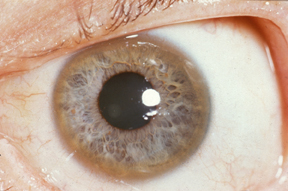
A 22-year-old college student is brought in for new hand tremor and slurred speech that has been worsening over six months. His roommate says he has been moody and snapping at people. On exam, his speech is slow and clumsy. Slit-lamp shows a golden-brown ring around the cornea at the periphery. Labs: AST 142, ALT 178, alkaline phosphatase mildly low, ceruloplasmin 8 mg/dL (low), 24-hour urinary copper sky-high.
What is the single best initial treatment?
Young patient with liver trouble plus a new movement disorder plus a ring in the cornea equals Wilson disease until proven otherwise.
The low ceruloplasmin with high urinary copper seals it. The defect is in ATP7B, the gene that lets the liver pump copper into bile and load it onto ceruloplasmin. When that pump fails, copper drowns the liver first, spills into blood, and lands in the brain (putamen), eye (Descemet membrane), kidney, and joints.
Treatment chelates the copper. D-penicillamine grabs free copper and pulls it out in urine. Levodopa treats Parkinson but does nothing for copper. Deferoxamine chelates iron, not copper. Steroids do not move metals. Transplant is reserved for fulminant liver failure, not a new diagnosis with treatable disease.
Four clue cards
The Four Tells
Tap each card. Front is the clue you spot on the stem; back is why it nails Wilson and nothing else.
👁
Kayser-Fleischer Ring
golden-brown corneal rim
tap to flip
Why this nails Wilson
Copper deposits in Descemet membrane, the deepest layer of the cornea. When you combine the ring with neuro or psych symptoms, it is essentially diagnostic. Seen on slit-lamp. The ring sits at the very periphery, not across the pupil.
🧪
Low Ceruloplasmin
copper carrier, empty
tap to flip
Why this nails Wilson
Ceruloplasmin is the bus copper rides in the blood. It needs ATP7B to load it inside the hepatocyte. Broken pump means no loading, so the bus rolls out empty. Lab reports low ceruloplasmin plus high free serum copper and high urinary copper.
🧬
ATP7B Defect
chromosome 13, recessive
tap to flip
Why this nails Wilson
Autosomal recessive, both parents carriers, child affected. ATP7B is the copper-transporting ATPase on chromosome 13. Two jobs: pump copper into bile, and load it onto ceruloplasmin. Broken pump means copper has nowhere to go but back into the body. Cousin gene ATP7A on the X chromosome causes Menkes (copper deficiency, kinky hair).
💊
Penicillamine
first-line chelator
tap to flip
Why this nails Wilson
Penicillamine grabs free copper and drags it out in urine. Stem says copper chelator or names the drug, think Wilson. Backups: trientine when penicillamine is not tolerated (rashes, blood dyscrasias), and zinc for maintenance, which blocks copper from absorbing in the gut.
Where the copper lands
The Copper Map
Free copper leaks out of the liver and deposits across the body. Tap each region to see what gets damaged and how it shows up on the stem.
Tap an organ
Where does the copper land?
The broken ATP7B pump means copper leaks back into the bloodstream. From there it deposits across the body. Each site gives a different clue on the stem.
six target sites
The plumbing
Copper Transport, Normal vs Wilson
Flip the switch. Normal pipes show copper moving out of the hepatocyte into bile and onto ceruloplasmin. Wilson pipes show ATP7B blocked, copper backing up, and free copper spilling into blood.
Normal: dietary copper enters the gut, gets taken up by the hepatocyte, and ATP7B ships it two ways: out the bile duct for fecal excretion, and into the Golgi where it loads onto ceruloplasmin for safe blood transport.
Pathognomonic
The Ring at Descemet
Real external eye photo on the left, a hand-drawn iris schematic on the right showing where the copper deposits sit. Tap the photo to expand.
External eye photo
Kayser-Fleischer ring · tap to expand
Golden-brown rim sitting at the very periphery of the cornea, not over the pupil. Best seen on slit-lamp; on the bare eye it can be subtle in pale irises and easy to miss in dark irises.
Iris schematic
Copper sits inside Descemet membrane, the basement membrane of the cornea right next to the endothelium. The ring is closest to the limbus, leaves the central cornea clear, and never touches vision unless extremely advanced.
Pull the copper out
Treatment Ladder
Lifelong copper removal. First-line chelator, alternative chelator, maintenance, and the bailout when the liver is gone. Diet supports every tier.
1
First-line chelator
D-Penicillamine
Grabs free copper and drags it out in urine. Watch for skin rash, kidney trouble, marrow suppression. Co-give pyridoxine (B6) because penicillamine antagonizes it.
2
Backup chelator
Trientine
Same idea, gentler side-effect profile. Use when penicillamine is not tolerated (rashes, cytopenias, proteinuria). Also urinary copper excretion.
3
Maintenance · gut blocker
Zinc
Induces metallothionein in enterocytes, which traps dietary copper inside cells that slough off in the stool. Stops new copper from absorbing. Best as long-term maintenance after chelation has pulled the load down.
🍽
Lifelong
Low-copper diet
Avoid the big copper foods: shellfish, liver, chocolate, nuts, mushrooms. Filter well water if it runs through copper pipes. Supports every tier above.
4
Bailout
Liver transplant
Reserved for fulminant liver failure or decompensated cirrhosis that no longer responds to chelation. The new liver carries normal ATP7B, so the disease is essentially cured at the hepatocyte level.
Five vignettes
Test Yourself
clinical cases. Read the stem, pick an answer, then read the breakdown. Each explanation walks through every wrong pick and ends with a one-line rule you can carry.
Medically reviewed by Kaitlyn Cocuzzo, MD and Fatima Ali, DO
Bone Wizardry is an independent educational resource for visual learning in the medical sciences. It is not affiliated with, endorsed by, or sponsored by any licensing or examination board, contains no real or recalled examination questions, and does not guarantee any educational or examination outcome.
 Bone WizardryMEDICAL EDUCATION