Use respiratory motion to identify a rib group, choose its key rib, distinguish treatment setups, and reassess safely after direct muscle energy.
A rib that stays high while the patient breathes out has a different problem from one that cannot rise during inspiration. The central question is which part of the respiratory cycle is restricted. Use that finding to name the dysfunction, select the key rib, choose the treatment direction, and judge the response.
These are supervised examination and treatment concepts, not instructions for self-manipulation. New or concerning chest symptoms require medical assessment before a rib finding is treated as their explanation. Acute pressure with breathlessness, sweating, or other concerning features belongs in an urgent evaluation pathway. [4]
Why do the anterior ends rise?
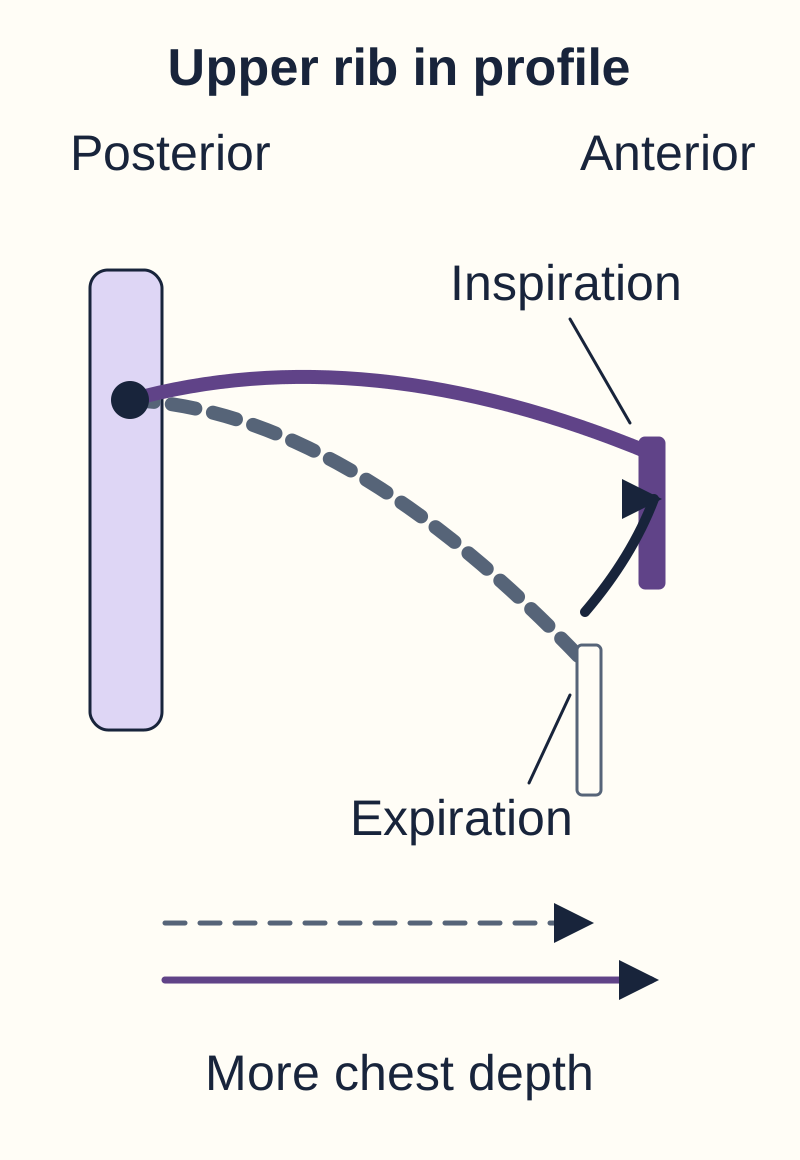
Picture an upper rib in profile. Its posterior articulations provide an axis around which the anterior portion rotates. As the anterior end rises and travels forward during inspiration, the sternum is carried forward through the costal cartilages. The chest becomes deeper from front to back. This is pump-handle motion, particularly useful when examining ribs 2 through 5. The posterior joints are articulations, not an immovable nail, and the drawing simplifies three-dimensional anatomy. [1][2]
The direction reverses during expiration: the anterior rib and sternum return downward and backward. An inhalation dysfunction is a rib or group that favors the inspiratory position and has restricted return during expiration. It is not a diagnosis of poor air entry, and it does not mean the person cannot breathe in.
Trace the return, not just the starting height
In the pump-handle figure, place a finger at the anterior end of the inspiratory arc. Trace its normal path back toward the expiratory position. Now stop halfway along that return path. That unfinished return is the relationship described by an inhaled rib. The diagnostic observation is the restricted phase, not a picture of one rib being higher than another.
Trace the anterior end back from the solid to the dashed arc. A rib that cannot complete this return has deficient expiratory excursion. [1][2]
Try this prediction: a patient's upper anterior rib ends can rise, but their descent ends earlier on the left than on the right. Which chest dimension is the pump-handle comparison assessing?
Check the dimension
The anteroposterior dimension. The anterior end travels up and forward during inspiration, then down and backward during expiration.
For transfer, compare a second patient whose lateral lower rib shafts have reduced outward excursion. That observation emphasizes the bucket-handle component rather than the same upper anterior arc. Both patients need examination through inspiration and expiration before a dysfunction is named.
Dominant motion models, not exclusive compartments
Region
Useful visual model
Change during inspiration
RegionUpper ribs, especially 2-5 here
Useful visual modelPump handle
Change during inspirationAnterior end rises and travels forward; chest depth increases.
RegionLower true and false ribs, especially 6-10 here
Useful visual modelBucket handle
Change during inspirationLateral shaft travels outward; transverse width increases.
RegionRibs 11-12
Useful visual modelCaliper or pincer
Change during inspirationFree anterior ends swing outward without a sternal attachment.
Real rib motion combines components, and teaching references place the transition around rib 5 or 6 differently. Do not turn the row boundaries into a claim that a rib has only one possible arc. For ribs 3-5, anterior respiratory excursion is the central examination example. [1][2]
Find the restricted phase, then the key rib
Does the word inhaled describe the restriction or the position of ease? It describes the position of ease. Inhaled means expiration is restricted; exhaled means inspiration is restricted. During bilateral palpation, compare each side through the full respiratory cycle and establish the upper and lower boundaries of the affected group. A resting asymmetry can direct attention, but it does not replace dynamic examination. [1][2]
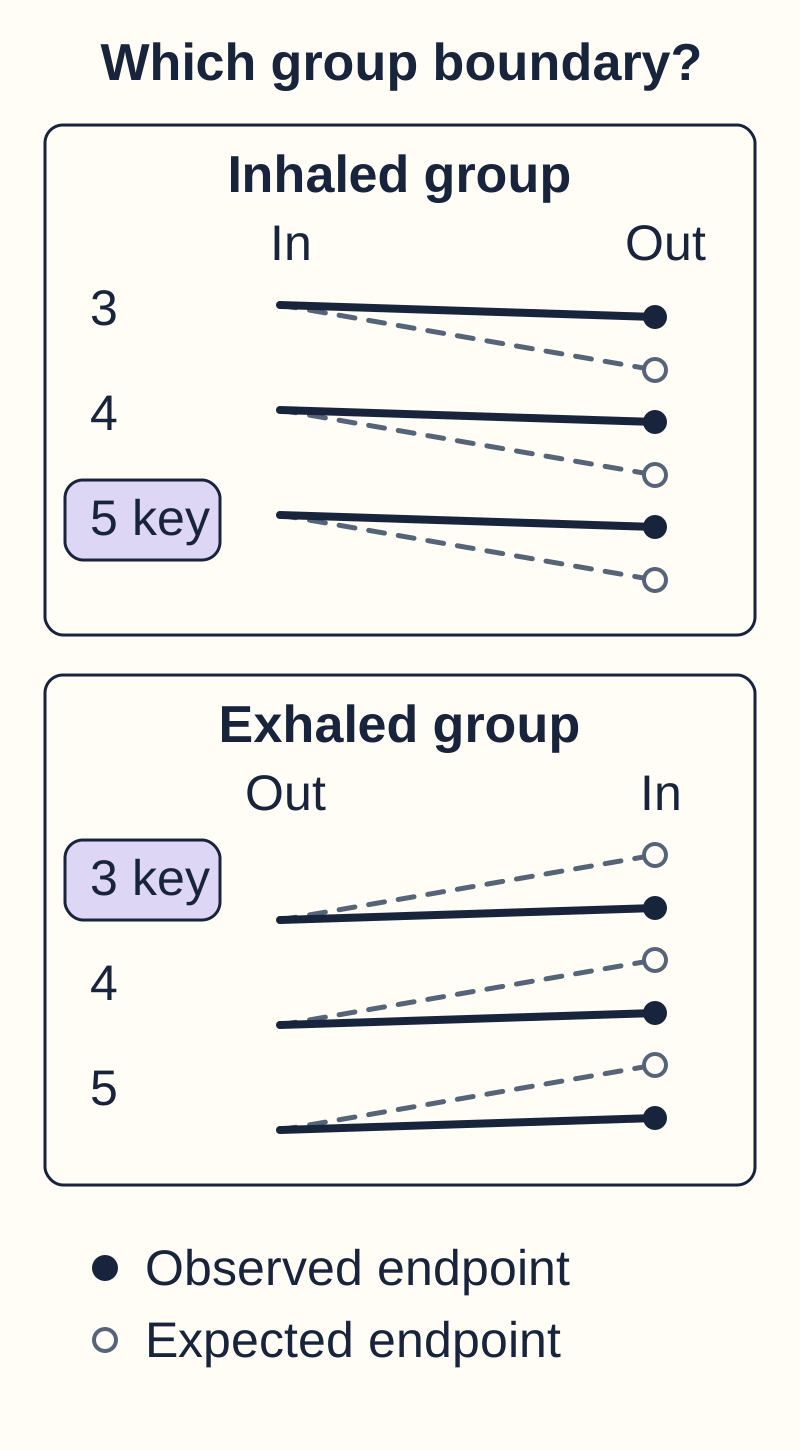
The conventional treatment target for a group is its bottom rib in an inhalation dysfunction and its top rib in an exhalation dysfunction. For left ribs 3-5 that rise but cannot descend fully, the key rib is left rib 5. If those same ribs descend freely but cannot rise fully, the key rib is left rib 3. This is a clinical group-selection convention, not proof that one rib mechanically controls every neighboring rib. [1][2]
Trace a group across two respiratory endpoints
Use the paired rib-group figure to compare the three rib lines first at inspiration and then at expiration. Follow the lower boundary of the group that fails to return downward. Next follow the upper boundary of the group that fails to rise. The selected boundary changes because the restricted phase changes, even though the rib numbers do not.
Read each panel from its left respiratory phase to its right phase. Filled endpoints show the restricted example; open endpoints show the expected direction of return or rise. Vertical spacing and slope are qualitative, not measured excursion or a severity scale. [1][2]
Before opening either check, decide: a right-sided group spans ribs 2-5, and its last part of descent is restricted. First name the dysfunctional phase relationship. Then select the rib.
Check the phase relationship
The group has an inhalation dysfunction because expiration is the restricted direction.
Check the group boundary
The bottom of this group is right rib 5. The upper boundary at rib 2 does not change the inhaled-group rule.
The worked result is right rib 5 in an inhalation dysfunction. Transfer the rule to ribs 3-6: if the same expiratory restriction affects all four ribs, the bottom target becomes rib 6. A lesson title must not override the boundaries found in the actual patient.
Tenderness answers a different question. The most tender rib may deserve closer investigation, but it is not automatically the key rib. If only rib 4 has an abnormal respiratory endpoint and ribs 3 and 5 have normal excursion, document a single-rib finding rather than inventing a three-rib group. Likewise, a normal opposite side is a comparison, not the treatment target. [1][2]
Keep the treatment position separate from patient effort
How can a direct treatment include effort toward the easier direction? Direct describes where the clinician positions the restricted tissue: at its barrier. Active describes the patient's participation. During a post-isometric muscle energy approach, the patient attempts a small contraction against matched resistance; after relaxation, the clinician reassesses and takes up available slack. The attempted direction and the treatment position are therefore not interchangeable. [1][2]
For an inhaled group, the relevant barrier is expiration. In the upper-rib respiratory-assisted variant described in the inhaled-rib reference, the patient lies supine. The clinician identifies the bottom key rib, contacts its superior aspect, and uses supported head and neck flexion to localize the upper-rib level. Positioning and pressure remain within comfort and the patient's available range. This description is a framework for supervised technique instruction, not a substitute for supervised hand-placement assessment. [1]
Establish the barrier. As the patient breathes out, follow the key rib toward its expiratory limit with gentle caudad contact. Caudad means toward the feet.
Maintain the gained position. In this cited respiratory-assisted variant, the patient pauses at expiration for 3-5 seconds if comfortable. The clinician maintains the localized barrier.
Permit the next breath with local resistance. The patient resumes inspiration while the clinician maintains caudad contact on the key rib. This resists that rib's return toward its preferred inspiratory position; it must not obstruct the person's ventilation.
Relax, reassess, and take up available slack. During the subsequent expiratory phase, follow only the newly available range. Repeat a limited number of gentle cycles as tolerated, then reassess both respiratory phases. Stop rather than pursue a painful endpoint.
The general post-isometric description and this respiratory-assisted sequence are related teaching approaches, but their contraction and breath-hold instructions are not identical. The reference places the 3-5 second pause at expiration in its inhaled upper-rib sequence. A stem specifying a different supervised protocol should be interpreted from its stated positioning, effort, and relaxation instructions, not from an assumed universal timer. [1]
Use the opposing arrows
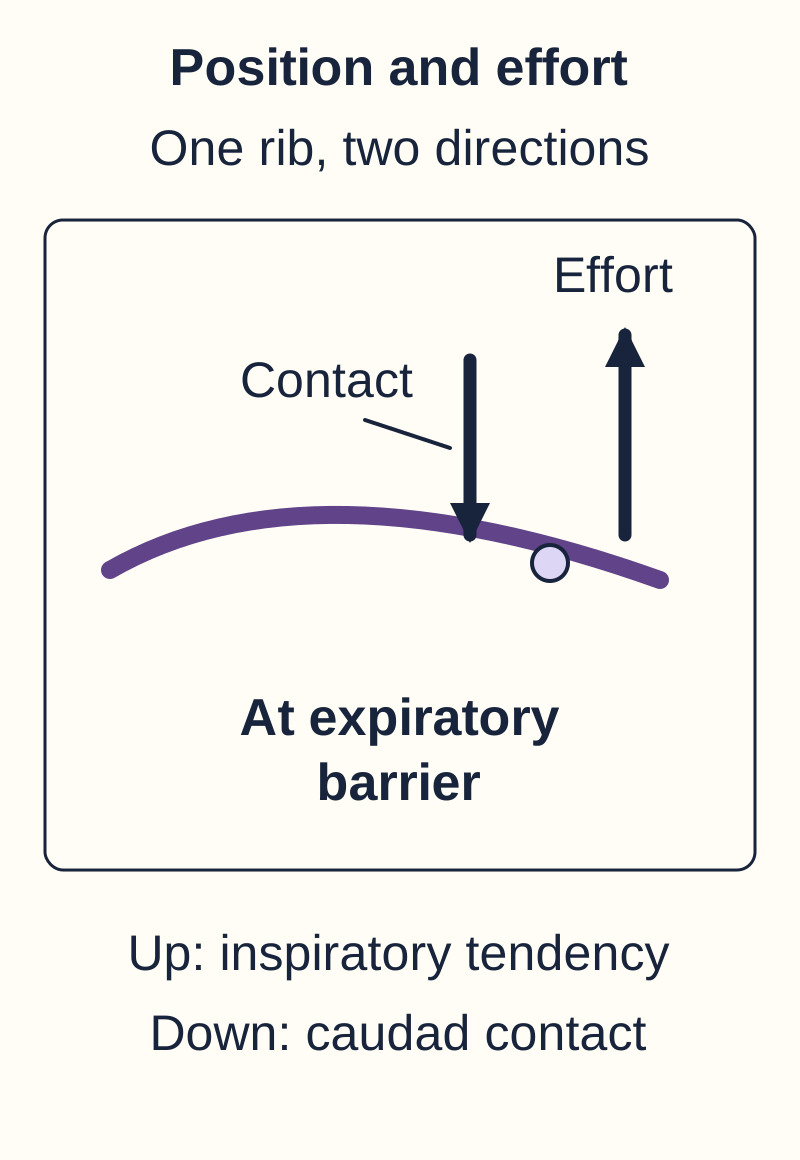
In the force-and-position figure, trace the caudad contact arrow first. It points toward the expiratory barrier. Then trace the patient's inspiratory tendency in the opposite direction. The rib can remain near the contacted position while the patient participates. A small or absent local excursion during a resisted effort does not, by itself, prove absent muscle activity.
Trace the contact arrow first, then the opposing inspiratory arrow. This is a directional model at the contacted rib, not a hand-placement guide, force prescription, or instruction to prevent breathing. The cited respiratory-assisted and post-isometric variants have distinct timing instructions. [1][2]
Predict what happens if contact is released during the return inspiration, before the next expiratory phase.
Check the immediate consequence
The local restraint is lost, allowing the key rib to return toward its preferred inspiratory position. That is different from maintaining the gained expiratory range.
For transfer, consider a patient who pushes hard enough to displace the clinician's hand during a specified isometric contraction. Matched resistance has been lost. Reduce the effort, restore a comfortable setup, and reassess rather than turning the exercise into a contest. The aim is controlled participation, not maximum force. [1][2]
Why does pectoralis minor belong in the opposite comparison?
Does an attachment to ribs 3-5 identify the treatment for every dysfunction of those ribs? No. Pectoralis minor runs from ribs 3-5 near their costochondral junctions to the coracoid process of the scapula. That attachment pattern explains its relevance, but neither attachment nor tenderness alone establishes the direction of rib restriction. The respiratory examination still comes first. [2]
With the scapular end stabilized, contraction can assist the inspiratory action of its rib attachments. The familiar pectoralis minor muscle energy setup is therefore taught for exhaled ribs 3-5, which are restricted in inspiration. In that setup, the top affected rib is selected; an arm effort toward the opposite hip is resisted while the clinician monitors the rib and encourages the inspiratory barrier. The Alabama College of Osteopathic Medicine's teaching index explicitly labels its pectoralis minor demonstration as muscle energy for exhaled ribs 3-5. [2][3]
This is not the same instruction as maintaining caudad contact on an inhaled group's bottom rib. A hand contacting a posterior rib angle also cannot be interpreted as if it were contacting the superior anterior aspect: contact site, rib arc, and intended barrier must be read together. Do not memorize a force direction without its setup.
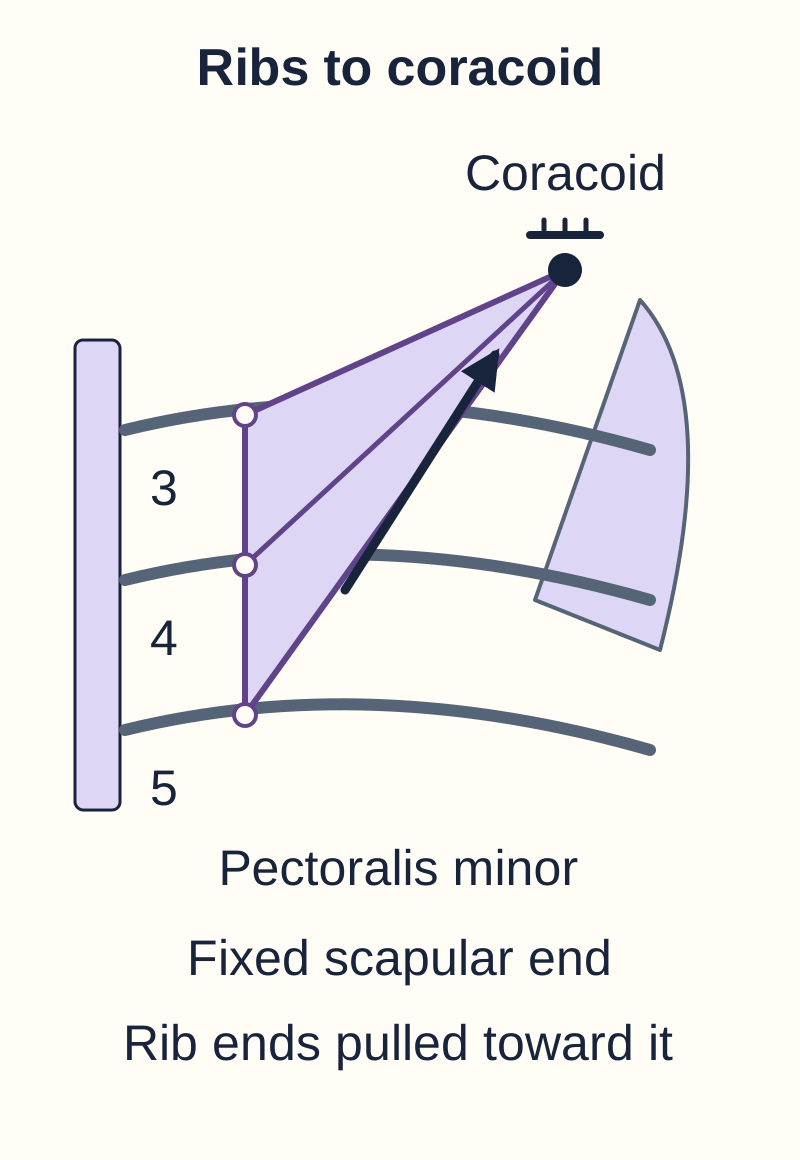
Follow an attachment, then choose its purpose
Trace the fan-shaped muscle in the attachment figure from the three anterior rib origins to the coracoid. Hold the coracoid end still in the model and imagine shortening the fan. The rib ends are drawn toward it. That predicts assistance with the deficient inspiratory direction of an exhaled group, not a diagnosis that the muscle is necessarily shortened in every inhaled group.
Trace ribs 3, 4 and 5 toward the fixed coracoid. The model explains inspiratory assistance and the conventional pectoralis minor setup for exhaled ribs 3-5. It does not diagnose muscle shortening in a patient. [2][3]
Two patients have right ribs 3-5 involved. Patient A lacks the last part of expiration. Patient B lacks the last part of inspiration. Which patient's pattern matches the conventional pectoralis minor activation setup?
Check the indication
Patient B. Restricted inspiration identifies an exhalation dysfunction, for which right rib 3 is the key rib in this group.
The complete comparison is A: inhaled group, bottom rib 5, expiratory barrier; B: exhaled group, top rib 3, inspiratory barrier. For transfer, new tenderness over pectoralis minor in Patient A does not reverse that phase finding or prove a particular muscular cause. Reassess the whole clinical picture instead of allowing a named muscle to substitute for diagnosis. [1][2]
Reassess the original restriction, not the repetition count
What would count as improvement if the original problem was incomplete descent on expiration? Repeat that same phase-specific examination. Compare the affected rib and its neighbors with the opposite side, using similar patient position and breathing effort. Record excursion, the quality of the endpoint, tenderness, and symptoms separately. A less painful rib is not automatically a freely mobile rib. [1][2]
A transparent before-and-after record
Finding
Before
After one tolerated cycle
FindingLeft ribs 3-5 during expiration
BeforeEarly endpoint; limited descent
After one tolerated cycleMore descent; residual early endpoint
FindingLeft ribs 3-5 during inspiration
BeforeAvailable excursion
After one tolerated cycleAvailable excursion
FindingPatient's report
BeforeLocalized ache
After one tolerated cycleLess ache; no new symptoms
Read the table as a paired observation: expiratory excursion has improved but remains restricted. The result is a partial mechanical response, not complete correction. There is no point total in this example and no validated numerical severity scale is being implied. Normal lower-rib excursion should not be subtracted from an upper-rib restriction, and restored excursion should not add severity points.
Cover the after-column, predict what full mechanical resolution would require, then compare your prediction with the actual result.
Check the reassessment target
The previously restricted expiratory endpoint would need to normalize on repeat examination without creating a new restriction. The table still describes a residual early endpoint.
Now transfer to a different result: if excursion becomes symmetric but chest discomfort persists, more force is not justified by the pain alone. Reconsider the pain's cause and the treatment plan. Conversely, a new sharp pain or new focal bony tenderness during treatment is a reason to stop and examine again, not evidence that a stronger contraction is needed. [1][2]
Persistent or recurrent findings also warrant review of related thoracic mechanics, posture, the reliability of localization, and ongoing clinical contributors. Treating the associated thoracic region may be relevant when its dysfunction is actually demonstrated. A fixed number of cycles does not establish success, and an immediate change in palpation does not prove a specific cellular mechanism or durable disease benefit. [2]
Decide whether treatment is appropriate before choosing a rib
Can a clear respiratory restriction make new chest symptoms safe? No. A somatic finding can coexist with another illness. History, vital signs, cardiopulmonary assessment, and the clinical setting determine what requires evaluation. Normal oxygen saturation, clear breath sounds, reproducible discomfort, or a familiar rib pattern must not be used alone to dismiss a concerning new presentation. Acute chest symptoms need a structured assessment directed at dangerous causes. [4]
After trauma, focal bony tenderness and painful breathing raise concern for injury rather than an uncomplicated mechanical finding. Assess for fracture and associated thoracic problems before applying force. For suspected rib fractures after minor blunt trauma confined to the ribs, ACR lists chest radiography as usually appropriate initial imaging. More extensive trauma requires its own assessment; this recommendation is not a rule that every chest injury needs the same test. [5]
Fever, cough, worsening breathlessness, an inflamed treatment site, or unexplained chest pain require reassessment before manipulation. Confirmed rib fracture, recent spinal injury, clinically important instability, active local infection, or inability to participate can make the proposed muscle energy technique inappropriate. A different technique is not a shortcut around an undiagnosed hazard. [1][2]
A restriction does not supply consent
Explain the purpose, expected participation, hand placement, alternatives, and relevant risks. Obtain consent before contact and preserve it throughout treatment. The patient must be willing and able to follow instructions and report discomfort. Drowsiness, confusion, severe distress, or inability to carry out the required effort should prompt deferral and assessment of the reason, not forced participation. [2]
An older patient has the same expiratory restriction as the worked example, but now reports a fall, focal rib tenderness, and a new cough with fever. Which part of the plan changes first?
Check the priority
The priority becomes medical assessment of injury and illness before manipulation. The key-rib rule remains a naming convention; it is not permission to treat.
For transfer, compare an alert, consenting patient whose localized symptoms have already been assessed and whose examination identifies no contraindication. A supervised gentle technique may be considered, with symptoms and motion reassessed afterward. The decisions are ordered: establish safety and consent, diagnose the respiratory pattern, select the appropriate rib and setup, then judge the response. The clinical cases below test these decisions without assuming that every patient on a rib lesson has a benign rib disorder. [1][2][4]
Apply the findings
Case 1
Show answer and explanations for case 1
A. Right rib 3; expiration (Why this does not fit)
Rib 3 is the top boundary of the demonstrated group. Expiration is correctly identified, but a top-rib target belongs to an exhaled rather than inhaled group. A correct barrier does not rescue an incorrect key rib.
Reasoning steps for option A
Why might the upper boundary at right rib 3 seem plausible for the rower?
It begins the abnormal 3-5 interval, but is its top boundary.
Does the rower lose inspiratory rise or expiratory descent despite selecting rib 3?
The right ribs rise on inspiration but stop descending early during expiration.
Does rib 3 match that barrier's group rule?
No. An inhaled group with an expiratory barrier uses its bottom rib, rib 5.
B. Right rib 5; expiration (Best answer)
An inhaled group has restricted expiration and uses its bottom rib as the key. The abnormal right-sided interval is ribs 3-5, so rib 5 is the target and expiration is the barrier. Identify the restricted phase before selecting a boundary.
Reasoning steps for option B
Which respiratory finding makes right rib 5 a possible inhaled-group key?
Right ribs 3-5 have incomplete expiratory descent despite normal inspiratory rise.
How do normal ribs 2 and 6 establish rib 5 as the lower abnormal boundary?
Rib 5 is its lower edge; ribs 2 and 6 move symmetrically.
Which direct barrier belongs with the rower's right rib 5 target?
Expiration, yielding right rib 5 with an expiratory barrier.
C. Right rib 5; inspiration (Why this does not fit)
Rib 5 is the bottom boundary of the demonstrated group. Inspiration is available here; the lost part of the cycle is descent during expiration. The direction of ease is not the direct treatment barrier.
Reasoning steps for option C
Does right rib 5 identify the correct boundary?
Yes, it is the bottom of the inhaled 3-5 group.
What does choosing inspiration imply about the barrier?
It treats the phase in which the right ribs already rise.
Which lost movement makes inspiration the wrong barrier at right rib 5?
The deficient downward return during expiration, not inspiration.
D. Right rib 3; inspiration (Why this does not fit)
An exhaled group would use its top rib and an inspiratory barrier. This group rises during inspiration and instead has restricted expiration. Do not reverse the dysfunction name and the restricted phase.
Reasoning steps for option D
When would right rib 3 and inspiration fit?
For an exhaled 3-5 group whose upper rib is keyed to restricted rise.
What does this rower's group do on inspiration?
It rises, while its expiratory descent stops early.
Why do both rib 3 and inspiration fail to match the rower's expiratory restriction?
Rib 3 is the wrong boundary and inspiration is not the restricted phase.
Takeaway: Identify the restricted phase before selecting a boundary.
A. Right rib 5; expiration (Why this does not fit)
This pair fits an inhaled group spanning right ribs 3-5. It matches the old description, not the current full descent and restricted rise. Historical findings cannot determine a current barrier.
Reasoning steps for option A
Which finding once supported rib 5 and expiration?
The earlier right 3-5 group could not descend fully.
What current motion contradicts the old rib 5 and expiration target?
Descent is now full, but inspiratory rise stops short.
Why must the old bottom-rib expiratory pair be replaced after full descent returns?
The current exhaled pattern requires the top rib and inspiratory barrier.
B. Right rib 3; expiration (Why this does not fit)
Rib 3 is the appropriate top boundary for the current group type. Expiration is already available and is not the current restrictive direction. Recheck the phase as well as the key rib.
Reasoning steps for option B
Does rib 3 match today's group boundary?
Yes. Restricted inspiration makes the top of right ribs 3-5 the key.
Does today's group resist expiration?
No, the reassessment documents full descent.
Which barrier should replace expiration while retaining today's rib 3 target?
Keep rib 3 but replace expiration with inspiration as the barrier.
C. Right rib 5; inspiration (Why this does not fit)
Inspiration is the currently restricted direction. That makes the group exhaled, so its top boundary rather than bottom boundary is selected. A change in phase changes the group-selection rule.
Reasoning steps for option C
Does today's limited rise support an inspiratory barrier even if rib 5 is proposed?
Yes, right ribs 3-5 stop rising before the opposite side.
Is rib 5 the key for this new restriction?
No, the bottom rib was keyed to the former expiratory restriction.
Which boundary replaces rib 5?
Right rib 3, the top rib of the currently exhaled group.
D. Right rib 3; inspiration (Best answer)
An exhaled group lacks inspiratory excursion and is keyed by the top rib. The current examination shows that pattern in right ribs 3-5, regardless of the earlier expiratory restriction. Treat the current phase finding rather than an old label.
Reasoning steps for option D
Which current observation supports rib 3 and inspiration instead of the earlier expiratory target?
Today's right group descends fully but has limited inspiratory rise.
Why does today's limited rise select the top of right ribs 3-5?
The top of the 3-5 group, right rib 3.
What barrier completes the updated right rib 3 pair?
Inspiration, the phase that currently stops short.
Takeaway: Treat the current phase finding rather than an old label.
A. Select rib 5 from the shared expiratory restriction (Best answer)
A shared expiratory restriction identifies an inhaled group. The bottom member is rib 5; rib 4 tenderness does not redefine that boundary. Tenderness and group localization answer different questions.
Reasoning steps for option A
What is shared by left ribs 3-5?
Each reaches an early expiratory endpoint, while inspiratory motion remains free.
Does rib 4 tenderness set the group boundary?
No, pressure tenderness identifies a painful site, not the lower edge of the moving group.
Which rib replaces the student's rib 4?
Left rib 5, the bottom key for the inhaled group.
B. Select rib 3 from the shared expiratory restriction (Why this does not fit)
The top rib is used for an exhaled group. The demonstrated loss is expiration, not inspiration, so this is the wrong boundary. Determine the group type before choosing top or bottom.
Reasoning steps for option B
Why is left rib 3 a tempting selection?
It is the upper edge of the demonstrably abnormal group.
Which deficit would make the upper edge the key?
Restricted inspiration in an exhaled group.
Does the violinist have the inspiratory restriction needed to key left rib 3?
No. The common restriction is expiration, so the lower rib 5 is keyed.
C. Retain rib 4 from its greater pressure tenderness (Why this does not fit)
A particularly tender site deserves attention during evaluation. The motion defect is shared across three ribs rather than isolated to the tender middle rib. Pain intensity does not determine the conventional key rib.
Reasoning steps for option C
What does the pressure examination establish at rib 4?
It is the most tender of the three affected ribs.
Is motion restriction isolated to rib 4?
No. Ribs 3, 4, and 5 share the early expiratory endpoint.
Why should a group-directed target move away from the most tender rib 4?
A group-directed inhaled treatment selects its bottom rib 5, not its most painful member.
D. Select rib 2 from its adjacency to the affected group (Why this does not fit)
An adjacent rib can help define the limits of a regional examination. No abnormal motion at rib 2 is supplied, and it is outside the demonstrated group. Use a documented abnormal boundary, not an adjacent landmark.
Reasoning steps for option D
What role could adjacent rib 2 play?
It could help delimit the upper border if examined.
Is rib 2 documented as sharing the early endpoint?
No; the repeated abnormal findings are confined to left ribs 3-5.
Can adjacency alone make rib 2 the key?
No. Select the demonstrated group's lower boundary, rib 5.
Takeaway: Tenderness and group localization answer different questions.
Rib 3 is the upper boundary of the group. A top-rib target would fit restricted inspiration, which is not the observed problem. Use the bottom boundary when expiration is restricted.
Reasoning steps for option A
Where does right rib 3 sit in the revised interval?
It is the top of ribs 3-6.
Which respiratory phase is restricted across the revised right rib 3-6 interval?
All four rise freely but stop early during expiration.
Why is rib 3 not the group target?
A top-rib key fits restricted inspiration; this inhaled group's bottom is rib 6.
B. Right rib 5 (Why this does not fit)
Rib 5 was the lower boundary in the trainee's initial record. The new evidence includes rib 6 in the same phase-specific abnormality. Revise a target when new localization changes the boundaries.
Reasoning steps for option B
Why did the trainee's original record suggest rib 5?
It initially placed the group's bottom at rib 5.
What did repeat palpation discover below rib 5?
Right rib 6 shares the early expiratory endpoint.
How does rib 6 sharing the expiratory restriction change the earlier rib 5 target?
The inhaled group now ends at rib 6, so rib 5 is no longer the bottom key.
C. Right rib 6 (Best answer)
The bottom rib is the key of a contiguous inhaled group. Repeat examination extends the affected interval through right rib 6 while rib 7 remains normal. The examination defines the group, not the lesson title.
Reasoning steps for option C
What revised abnormal interval makes rib 6 a candidate key?
Right ribs 3 through 6 rise freely but have restricted expiratory return.
What does normal right rib 7 establish?
It bounds the lower end of the affected group.
Which lowest abnormal rib replaces the earlier rib 5 target?
Right rib 6, the lowest abnormal rib, regardless of the earlier 3-5 record.
D. Right rib 7 (Why this does not fit)
Rib 7 is immediately below the abnormal group. It has full excursion and therefore marks the end of the abnormal interval rather than the key rib. The first normal neighbor is not a group member.
Reasoning steps for option D
Why examine right rib 7 at all?
Its normal excursion helps identify where the right-sided restriction ends.
Does rib 7 stop early on expiration?
No. It retains full excursion, unlike ribs 3-6.
Why does normal excursion exclude rib 7 from being the inhaled-group key?
The key must belong to the affected group; rib 6 is its bottom member.
Takeaway: The examination defines the group, not the lesson title.
A. Left rib 3 and right rib 5 (Why this does not fit)
This pair assigns top to the left and bottom to the right. That would fit the opposite respiratory restrictions from those actually supplied. Side and phase must be linked before selecting a rib.
Reasoning steps for option A
What does choosing left rib 3 imply?
It uses the top boundary appropriate to restricted inspiration.
What does choosing right rib 5 imply?
It uses the bottom boundary appropriate to restricted expiration.
How do left expiratory loss and right inspiratory loss contradict left rib 3 and right rib 5?
Left expiration and right inspiration are limited, so this pair reverses both choices.
B. Left rib 5 and right rib 5 (Why this does not fit)
A bottom target is appropriate for an inhaled group. Only the left side is inhaled; the right side is restricted in inspiration. Do not apply one group label to both sides automatically.
Reasoning steps for option B
Why is left rib 5 appropriate?
Left ribs 3-5 rise but cannot descend fully, an inhaled group keyed at the bottom.
Does the right side's limited rise justify applying the left side's bottom-rib rule?
No. Right ribs descend but cannot rise fully.
Which right rib replaces rib 5?
Right rib 3, the top of that exhaled group.
C. Left rib 5 and right rib 3 (Best answer)
The left pattern calls for a bottom target and the right for a top target. For a 3-5 interval, those boundaries are left rib 5 and right rib 3. The same rib numbers can require opposite boundary choices.
Reasoning steps for option C
Which side has an expiratory restriction?
The left 3-5 group, which needs its bottom rib 5.
Which side has an inspiratory restriction?
The right 3-5 group, which needs its top rib 3.
Why does a left rib 5 key coexist with a right rib 3 key in equal 3-5 intervals?
The two sides share boundaries but have opposite phase deficits.
D. Left rib 3 and right rib 3 (Why this does not fit)
A top target is appropriate for an exhaled group. Only the right side is exhaled; the left side has restricted expiration. Equal group boundaries do not establish equal dysfunction types.
Reasoning steps for option D
Why is right rib 3 defensible?
The right group is restricted on inspiratory rise and keyed at its top.
Does left rib 3 share that indication?
No. Left inspiratory rise is normal; expiratory descent is limited.
Which left key replaces rib 3 when left expiratory descent is restricted?
Rib 5, the lower boundary of the inhaled left group.
Takeaway: The same rib numbers can require opposite boundary choices.
A. Right rib 4 with an expiratory barrier (Best answer)
An isolated rib can have a phase-specific restriction without a contiguous abnormal group. Only right rib 4 lacks full descent, so its own expiratory barrier is the focal finding. Do not invent group boundaries around a single abnormal rib.
Reasoning steps for option A
What repeated seated and supine finding localizes the dancer's problem to right rib 4?
Right rib 4, both seated and supine.
Which phase is lost at the dancer's isolated right rib 4?
Descent ends early, although inspiratory rise remains normal.
What target and barrier follow from isolated incomplete descent of right rib 4?
Right rib 4 at its expiratory barrier, without inventing a 3-5 group.
B. Right rib 5 with an expiratory barrier (Why this does not fit)
Rib 5 would be the key of an inhaled group spanning ribs 3-5. Ribs 3 and 5 are normal in both examination positions, so that group has not been demonstrated. The group-selection convention requires a demonstrated group.
Reasoning steps for option B
When would right rib 5 be an expiratory key?
When an inhaled group actually spans ribs 3-5.
What do ribs 3 and 5 show in this dancer?
Both have symmetric inspiration and expiration in both positions.
Why cannot an inhaled-group rule make normal rib 5 the target for isolated rib 4 restriction?
Only rib 4 is abnormal, so there is no group whose bottom is rib 5.
C. Right rib 3 with an inspiratory barrier (Why this does not fit)
Rib 3 would be the key of an exhaled group spanning ribs 3-5. Neither a three-rib group nor restricted inspiration is described. Both the location and respiratory phase must fit.
Reasoning steps for option C
What pattern would key rib 3 at inspiration?
A 3-5 exhaled group restricted on inspiratory rise.
What repeated finding contradicts a rib 3 target at an inspiratory barrier?
Only right rib 4 has an early expiratory endpoint.
How do both rib 3 and an inspiratory barrier conflict with isolated rib 4 descent loss?
It selects an uninvolved rib and the wrong respiratory barrier.
D. Right rib 4 with an inspiratory barrier (Why this does not fit)
Rib 4 is the correctly localized abnormal segment. Its rise is available and its descent is restricted, so inspiration is the easier direction. Correct localization must be paired with the correct barrier.
Reasoning steps for option D
Is right rib 4 correctly localized?
Yes. Its abnormal motion persists seated and supine.
Does rib 4 lack inspiratory rise?
No, it rises normally; the lost movement is expiratory descent.
Which barrier must replace inspiration at the correctly localized right rib 4?
Use an expiratory rather than inspiratory barrier at rib 4.
Takeaway: Do not invent group boundaries around a single abnormal rib.
A. Improved upper transverse excursion with unchanged lower anteroposterior excursion (Why this does not fit)
Transverse and anteroposterior dimensions correspond to different dominant rib arcs. This option assigns the lateral model to the anterior measurement and the anterior model to the lateral measurement. Match the measured direction to the anatomical component.
Reasoning steps for option A
Which measured region would the proposed upper transverse improvement need to describe?
Anterior left ribs 3-5 show less asymmetry after treatment.
Which dimension does that anterior pump-handle arc emphasize?
Anteroposterior depth, not transverse width.
How does labeling the upper change transverse and the lower finding anteroposterior reverse the measured arcs?
It labels upper anterior change transverse and unchanged lower lateral motion anteroposterior.
B. Unchanged upper anteroposterior excursion with improved lower transverse excursion (Why this does not fit)
A lower-rib response could increase a previously restricted lateral excursion. The lower findings do not change; the upper anterior asymmetry is the observed improvement. Track the site that actually changes on paired examination.
Reasoning steps for option B
Did the upper anterior 3-5 finding stay unchanged?
No, its expiratory asymmetry decreases after treatment.
Did lateral ribs 7-9 improve?
No, their expansion and recoil were symmetric and remain unchanged.
Why does the observed upper improvement contradict a note claiming only lower transverse improvement?
It assigns improvement to the unchanged lower region and none to the improved upper region.
C. Unchanged upper transverse excursion with improved lower anteroposterior excursion (Why this does not fit)
Different regional components can respond differently to treatment. The supplied observations show neither a new lower anterior response nor an upper lateral measurement. Do not infer an unmeasured regional effect.
Reasoning steps for option C
Was upper lateral excursion measured in this reassessment?
No. The upper observation concerns anterior expiratory return.
Was lower anterior excursion shown to improve?
No. The measured lower lateral findings do not change.
Why is a lower anteroposterior gain with unchanged upper transverse motion unsupported by these measurements?
It invents measurements in two different arcs instead of describing the recorded ones.
D. Improved upper anteroposterior excursion with unchanged lower transverse excursion (Best answer)
Upper anterior rib excursion mainly displays the pump-handle component, while lower lateral excursion displays the bucket-handle component. The observed change is limited to the upper anterior comparison; the lower lateral comparison was already symmetric. Describe the regional response rather than claiming a global respiratory improvement.
Reasoning steps for option D
What does improved anterior motion of ribs 3-5 represent?
Improved upper pump-handle excursion in the anteroposterior dimension.
What do unchanged lateral ribs 7-9 represent?
Unchanged lower bucket-handle excursion in the transverse dimension.
Does upper anteroposterior improvement with unchanged lower transverse excursion establish global respiratory improvement?
No. It describes only the two region-specific observations supplied.
Takeaway: Describe the regional response rather than claiming a global respiratory improvement.
A. Rib 11 attaches directly to the sternum, so sternal excursion reflects its local anterior range (Why this does not fit)
The upper true ribs attach to the sternum through their costal cartilages. Rib 11 is a floating rib rather than a true rib with that anterior connection. Do not apply true-rib attachment assumptions to a floating rib.
Reasoning steps for option A
What anatomy does direct sternal attachment suggest?
A true rib has an anterior connection to the sternum via costal cartilage.
Does rib 11 have the direct anterior sternal connection proposed by this option?
No, its anterior tip is free and has no sternal attachment.
Can normal sternum motion certify rib 11 motion?
No. The palpated free-tip asymmetry needs its own assessment.
B. Rib 11 lacks an anterior sternal attachment, so its local arc needs separate assessment (Best answer)
A floating rib has no anterior attachment to the sternum. Normal sternal excursion therefore does not establish normal outward travel of the palpated rib 11 tip. Use a regional examination that matches the rib's attachments.
Reasoning steps for option B
Which free-tip finding needs assessment independently of normal sternal excursion?
At the outward travel of rib 11's lower free tip.
How does rib 11 connect anteriorly to the sternum?
It does not; rib 11 is floating.
Why can normal sternal excursion not exclude this rib 11 free-tip restriction?
Normal sternal excursion cannot rule out restricted motion in an unattached local tip.
C. Rib 11 attaches through adjacent costal cartilage, so sternal excursion reflects its costal-margin range (Why this does not fit)
Some false ribs have an indirect anterior connection through adjacent costal cartilage. Rib 11 instead lacks an anterior attachment, so this does not explain away the observed free-tip asymmetry. Distinguish an indirect anterior connection from no anterior connection.
Reasoning steps for option C
Which ribs can connect indirectly through costal cartilage?
Some lower false ribs join neighboring cartilage along the costal margin.
Does rib 11 share the indirect costal-margin attachment proposed here?
No. Its free anterior end lacks that indirect sternal connection.
Why is an indirect costal-cartilage attachment the wrong explanation for the rib 11 tip finding?
It substitutes false-rib costal-margin anatomy for the floating tip whose motion is asymmetric.
D. Rib 11 follows global chest expansion, so normal upper motion excludes an isolated lower restriction (Why this does not fit)
Different chest regions participate together in respiration. Participation in the same respiratory cycle does not make normal upper excursion a substitute for the abnormal local examination. Global expansion and each regional arc are not identical observations.
Reasoning steps for option D
Are upper and lower ribs part of one respiratory cycle?
Yes, but shared breathing does not force identical local excursion.
Which upper-region motions are normal despite the rib 11 free-tip asymmetry?
Sternal and anterior ribs 3-5 excursion are symmetric.
Does that negate the rib 11 finding?
No. The lower free tip has its own asymmetric outward travel despite normal upper motion.
Takeaway: Use a regional examination that matches the rib's attachments.
A. Right rib 3 with pectoralis minor recruitment (Best answer)
Restricted inspiration identifies an exhaled group and therefore a top-rib target. The conventional ribs 3-5 setup uses pectoralis minor activation through the stated resisted arm effort. Read the respiratory pattern before choosing a muscle-based setup.
Reasoning steps for option A
Why does the right rib 3 target fit reduced rise of ribs 3-5?
Free descent with limited rise identifies an exhaled group; its uppermost rib, right rib 3, is the key.
What does resisted arm effort toward the opposite hip recruit in this setup?
The conventional ribs 3-5 maneuver recruits pectoralis minor rather than the scalenes.
How do limited inspiratory rise and opposite-hip arm effort jointly support rib 3 with pectoralis minor?
The inspiratory deficit selects rib 3, while the stated arm maneuver selects pectoralis minor.
B. Right rib 5 with pectoralis minor recruitment (Why this does not fit)
Pectoralis minor is associated with the specified ribs 3-5 activation setup. The bottom target is incorrect because this group lacks inspiration rather than expiration. Correct muscle recall does not determine the key rib by itself.
Reasoning steps for option B
When would right rib 5 be the group key instead?
The bottom rib is the key for an inhaled group with limited expiration, not this group with limited rise.
Does pectoralis minor fit the resisted opposite-hip arm effort?
Yes; this maneuver uses pectoralis minor for the ribs 3-5 interval.
Why does appropriate pectoralis minor recruitment not justify a rib 5 target when descent is free?
Right rib 5 is the wrong boundary because right ribs 3-5 descend freely.
C. Right rib 3 with scalene recruitment (Why this does not fit)
The top boundary fits an exhaled group, and scalenes are relevant to the highest ribs. The supplied interval and arm effort fit the pectoralis minor setup, not the conventional first- or second-rib scalene setup. Pair the muscle with the actual rib interval and maneuver.
Reasoning steps for option C
Which part of the rib 3 and scalene pairing matches the examination?
Right rib 3 is the top key for the exhaled group whose inspiratory rise is restricted.
Why are scalenes not the intended recruitment here?
Scalene setups conventionally address the first or second rib, whereas the specified ribs 3-5 arm effort recruits pectoralis minor.
Why does selecting rib 3 not make scalene recruitment appropriate for the opposite-hip arm maneuver?
The key rib is correct but the proposed muscle does not match this interval and resisted maneuver.
D. Right rib 5 with scalene recruitment (Why this does not fit)
A bottom key and upper-rib muscle can sound compatible when rib details are ignored. Both the inspiratory restriction and the specific ribs 3-5 arm setup contradict this pair. Check phase and anatomical recruitment independently.
Reasoning steps for option D
What phase would justify selecting right rib 5 as the key?
A restriction of expiratory descent would make the bottom rib the key; descent here is free.
Why does scalene recruitment also miss the stated maneuver?
Scalenes are used for the highest ribs, not the conventional pectoralis minor activation of ribs 3-5 toward the opposite hip.
How do rib 5 and scalene recruitment each conflict with limited rise of ribs 3-5 and the arm maneuver?
Both its rib 5 key and its scalene recruitment conflict with the observed phase and chosen setup.
Takeaway: Read the respiratory pattern before choosing a muscle-based setup.
A. The tender muscle supports an exhaled group; respiratory descent is secondary to the muscle finding (Why this does not fit)
Tenderness can direct further musculoskeletal examination. It does not reverse the meaning of the directly observed restricted expiratory phase. Do not replace dynamic diagnosis with the name of a tender muscle.
Reasoning steps for option A
Can left pectoralis minor tenderness establish an exhaled rib group?
No; tenderness localizes discomfort but does not identify the restricted respiratory direction.
Which observed motion contradicts the proposed exhaled label?
Left ribs 3-5 rise freely yet fail to descend fully, the pattern of an inhaled group.
Why is prioritizing muscle tenderness over descent unsound here?
A tender muscle cannot overturn the direct dynamic finding or prove the exhaled-rib protocol is appropriate.
B. The normal opposite side excludes a rib disorder; isolated pectoralis tenderness explains the symptoms (Why this does not fit)
The opposite side provides a useful comparison during examination. Its normal excursion does not negate the reproducible phase-specific restriction on the left. A normal comparison side does not disprove a unilateral finding.
Reasoning steps for option B
What does normal excursion on the right contribute to this examination?
It provides a comparison for the restricted left ribs 3-5, not evidence that the left finding is absent.
Why cannot isolated tenderness explain away the left rib disorder?
The left group reproducibly fails to descend while the right moves normally.
What remains to be assessed despite the normal opposite side?
The unilateral left expiratory restriction remains a distinct mechanical finding alongside the tenderness.
C. The expiratory restriction supports an inhaled group; tenderness does not establish its muscular cause (Best answer)
A phase-specific restriction establishes the respiratory label more directly than tenderness does. The group lacks descent, and tenderness does not demonstrate that pectoralis minor shortening is the cause or that an exhaled-rib protocol fits. An anatomical association is not a complete causal diagnosis.
Reasoning steps for option C
Which phase defines the label for the left ribs 3-5?
They rise freely but have restricted expiratory descent, supporting an inhaled group.
Does tender pectoralis minor prove muscle shortening caused that restriction?
No; regional tenderness alone cannot establish shortening or a specific muscular cause.
What is wrong with the trainee choosing an exhaled-rib activation protocol?
That setup addresses deficient inspiration, while this patient has deficient expiration.
D. The ribs 3-5 attachment proves muscle shortening; the activation protocol fits either respiratory pattern (Why this does not fit)
Pectoralis minor attachment to ribs 3-5 explains its regional relevance. Attachment alone proves neither shortening nor equal applicability of opposite-direction treatment setups. Choose a setup from the actual deficit, not attachment recall alone.
Reasoning steps for option D
What does pectoralis minor attachment to ribs 3-5 actually establish?
It establishes anatomical relevance to that interval, not a diagnosis of shortening.
Can the same activation protocol be assumed suitable for both motion deficits?
No; left ribs 3-5 have an expiratory barrier, not the inspiratory restriction targeted by an exhaled-rib setup.
Why can attachment to ribs 3-5 establish neither shortening nor suitability for both respiratory patterns?
Neither shortening nor treatment of opposite respiratory patterns follows from attachment alone.
Takeaway: An anatomical association is not a complete causal diagnosis.
A. Assist rib descent toward expiration; address the deficient inspiratory direction (Why this does not fit)
Rib descent corresponds to the expiratory component of the cycle. That direction opposes the action predicted by the stabilized-coracoid model and does not supply the missing rise. Do not reverse a force vector merely because treatment is direct.
Reasoning steps for option A
What respiratory movement does rib descent represent?
Descending ribs move toward expiration, whereas this patient is limited in inspiratory rise.
What happens to the rib origins if the coracoid attachment stays fixed during shortening?
Pectoralis minor tends to lift its rib attachments, not pull them downward.
Why does the proposed descent fail the therapeutic purpose?
It predicts the wrong force direction and does not address the right-sided inspiratory deficit.
B. Assist rib rise toward inspiration; address the deficient inspiratory direction (Best answer)
With the coracoid end stabilized, shortening of the muscle can assist the inspiratory action of its rib attachments. The patient's deficit is inspiratory rise, so this modeled action supports the intended exhaled-rib setup. A fixed attachment lets you predict the direction of the other attachment.
Reasoning steps for option B
What action follows from shortening pectoralis minor with the coracoid fixed?
Its rib attachments can be assisted upward toward inspiration.
Which motion is deficient in the right ribs 3-5?
They descend fully but rise incompletely, so inspiratory rise is the intended target.
Why does the modeled muscle action fit this setup?
Upward assistance acts in the same direction as the missing rise of the exhaled rib group.
C. Assist rib rise toward inspiration; reinforce a deficient expiratory direction (Why this does not fit)
The attachment model predicts inspiratory assistance. The supplied deficit is inspiration rather than expiration, so the claimed treatment purpose is wrong. Separate a muscle's action from the deficit it is intended to address.
Reasoning steps for option C
Is inspiratory rib rise plausible under the fixed-coracoid model?
Yes; pectoralis minor shortening can elevate its rib attachments.
Is expiration the restricted phase in this patient?
No; right ribs 3-5 descend fully and have limited inspiratory rise.
Does the error lie in predicting rib rise or in claiming deficient expiration?
The action is plausible, but describing deficient expiration reverses the observed deficit.
D. Assist rib descent toward expiration; reinforce a deficient expiratory direction (Why this does not fit)
An expiratory barrier would be relevant to a group that cannot descend fully. This patient descends fully, and the specified muscle model does not predict downward traction of its rib origins. Match both the attachment vector and the clinical phase.
Reasoning steps for option D
When would an expiratory deficit be inferred from rib motion?
A group unable to descend fully would have an expiratory restriction, unlike this group.
Does fixed-coracoid pectoralis minor shortening pull these ribs down?
No; it predicts upward assistance at the rib attachments.
How do full expiratory descent and the fixed-coracoid model contradict both proposed clauses?
The patient has no deficient expiration and the modeled muscle does not assist rib descent.
Takeaway: A fixed attachment lets you predict the direction of the other attachment.
A. Indirect positioning with active participation (Why this does not fit)
An indirect technique positions tissue away from its restrictive barrier, while an active one uses patient effort. Patient participation fits, but the rib is explicitly positioned at rather than away from the barrier. The direction of patient effort does not define directness.
Reasoning steps for option A
What position would make this left rib treatment indirect?
The rib would need to be placed away from its restrictive expiratory barrier, not at it.
Does the resisted inspiratory attempt make the procedure active?
Yes; the patient voluntarily contracts against matched counterforce.
Why is indirect with active an incomplete classification?
Activity fits, but barrier engagement makes the positioning direct.
B. Direct positioning with passive participation (Why this does not fit)
Direct positioning matches the specified expiratory barrier. The patient is not passive: a voluntary inspiratory attempt is an essential part of the described cycle. A steady clinician contact does not make an active contraction passive.
Reasoning steps for option B
What makes the placement at the expiratory barrier direct?
The clinician engages the limited descent of the inhaled left ribs 3-5.
Can the patient be called passive while attempting inspiration against resistance?
No; that voluntary contraction constitutes active participation.
Which participation label fits voluntary resisted inspiration with direct barrier engagement?
Direct is correct, but passive must be replaced with active.
C. Indirect positioning with passive participation (Why this does not fit)
An indirect passive approach would rely on clinician positioning toward ease without the specified voluntary contraction. Neither feature fits this barrier-engaged, patient-assisted sequence. Read the initial position and the participant's role before labeling a technique.
Reasoning steps for option C
Would ease positioning without contraction describe the stated cycle?
No; the rib is held at the expiratory barrier and the patient supplies an inspiratory effort.
Which of the proposed indirect and passive features is actually present?
Neither: barrier engagement is direct and resisted patient effort is active.
Why does relaxation after the effort not make the full procedure passive?
The preceding voluntary contraction is an essential part of this muscle energy cycle.
D. Direct positioning with active participation (Best answer)
Direct treatment engages the restrictive barrier, and active treatment includes voluntary patient effort. The rib is at its expiratory barrier and the patient supplies a resisted contraction. Classify position and participation independently.
Reasoning steps for option D
Which restriction is engaged before the left rib contraction?
The key rib is positioned at its expiratory barrier, so the positioning is direct.
Who generates the resisted inspiratory effort?
The patient does, making the treatment active despite the clinician holding counterforce.
Why can the inspiratory effort coexist with direct positioning?
Directness refers to the rib at its barrier, not the direction of the patient's contraction.
Takeaway: Classify position and participation independently.
A. The resisted phase was passive, followed by spontaneous patient contraction (Why this does not fit)
A passive procedure does not require the patient's voluntary muscular effort. The stem explicitly describes voluntary effort during resistance and relaxation afterward. Use observed participation rather than displacement alone to identify activity.
Reasoning steps for option A
Was the resisted effort passive because the rib barely moved?
No; the patient deliberately generated inspiratory force against the clinician's hold.
When did the extra expiratory range appear?
It appeared after the instructed relaxation, following the active resisted phase.
What observation disproves the proposed spontaneous contraction?
The contraction was instructed and voluntary, not an event that began after passive treatment.
B. The resisted phase was isotonic, followed by persistent inspiratory restriction (Why this does not fit)
An isotonic description implies appreciable shortening or displacement against a load. Almost no displacement occurs during the resisted phase, and the original limitation is expiration. Match the force phase and the restricted direction to the observations.
Reasoning steps for option B
What displacement would support labeling the resisted phase isotonic?
Appreciable movement during muscular shortening would support isotonic action; almost none was detected.
Which respiratory endpoint was actually restricted in this case?
Incomplete expiratory descent of left ribs 3-5, not inspiratory rise.
Why are both the contraction and outcome labels wrong?
The near-static effort is approximately isometric and the later gain is in expiration.
C. The resisted phase failed, followed by evidence that stronger effort is required (Why this does not fit)
Failure to follow instructions could undermine a muscle energy cycle. The patient follows the instructions, and additional range appears without stronger force. A controlled contraction should not be judged by how far it displaces the clinician.
Reasoning steps for option C
Did the patient fail to perform the requested gentle inspiration?
No; the patient followed instructions and produced a resisted effort.
What expiratory gain appeared after relaxation without a stronger inspiratory effort?
After relaxation, a little more expiratory range became available.
Why is stronger effort not established as necessary?
Minimal movement during a held contraction is expected and does not indicate failure.
D. The resisted phase was approximately isometric, followed by additional available range (Best answer)
An isometric contraction can generate force with little local displacement. The patient participated against the hold, and new expiratory range became available after relaxation rather than during the contraction. Lack of displacement is not the same as lack of effort.
Reasoning steps for option D
What identifies the resisted phase as approximately isometric?
The patient exerted force against a steady hold with almost no local rib displacement.
At what point did expiratory descent improve?
Additional descent was available after relaxation, not while resisting.
Why is the tiny movement compatible with a successful cycle?
Isometric effort need not visibly move the rib to precede a gain at the expiratory barrier.
Takeaway: Lack of displacement is not the same as lack of effort.
A. Increase the inspiratory effort, then retain the deeper expiratory contact (Why this does not fit)
A clear voluntary contraction is needed for the specified technique. Effort is already present, and increasing it would intensify the opposition that is producing guarding. More effort does not correct an incorrectly timed barrier change.
Reasoning steps for option A
Is inspiratory patient effort missing in this cycle?
No; the patient is already maintaining a gentle inspiratory contraction.
What does deepening the expiratory barrier during that effort provoke?
It increases opposition and guarding before the relaxation phase.
Why would a stronger inspiratory contraction not fix the error?
The problem is premature barrier advancement, which greater effort could aggravate.
B. Ask for relaxation, then reassess the available expiratory range (Best answer)
Post-isometric work separates the resisted contraction from the subsequent reassessment and passive repositioning. The trainee is seeking extra range before relaxation, which explains the conflict with the ongoing effort. Take up newly available range after relaxation, not during a contest of force.
Reasoning steps for option B
When should the clinician seek further expiratory descent?
After the gentle resisted effort ends and the patient relaxes.
How did advancing the expiratory barrier before relaxation disrupt the intended order?
The trainee attempted a deeper expiratory barrier while the left rib group was still contracting inspiratorily.
Why reassess rather than force a new endpoint immediately?
Relaxation permits evaluation of newly available expiratory range without contesting active effort or increasing guarding.
C. Increase the caudad force, then wait for the contraction to end (Why this does not fit)
Caudad contact is relevant to the expiratory barrier of this group. The error is timing and excess opposition during contraction, not failure to supply a stronger force. Correct sequence before escalating pressure.
Reasoning steps for option C
Is caudad contact related to this left group's restricted phase?
Yes; caudad movement follows the incomplete expiratory descent.
Why is extra caudad force at this moment counterproductive?
The patient is still contracting inspiratorily and is already guarding against premature deepening.
What must precede taking up more caudad range?
The clinician should wait for relaxation and then reassess the expiratory barrier.
D. Change to an inspiratory barrier, then repeat the same contraction (Why this does not fit)
An inspiratory barrier belongs to a group restricted in inspiration. The observed restriction remains expiration; guarding during a poorly timed cycle does not reverse the diagnosis. A technique error is not evidence of a new opposite-phase dysfunction.
Reasoning steps for option D
What finding would support moving to an inspiratory barrier?
Limited rib rise on inspiration would support it, but this group has incomplete descent.
Does new guarding prove the respiratory diagnosis reversed?
No; guarding began when the trainee advanced the expiratory barrier during contraction.
Why would repeating at an inspiratory barrier miss the correction?
It treats the wrong phase instead of restoring the contraction-relaxation-reassessment sequence.
Takeaway: Take up newly available range after relaxation, not during a contest of force.
A. Maintain superior contact but direct it cephalad during inspiration (Why this does not fit)
A superior contact identifies where the clinician is monitoring the rib. Cephalad direction would favor return toward the preferred raised position rather than retain the gained expiratory range. Contact location and force direction must both match the intended barrier.
Reasoning steps for option A
Does maintaining a superior rib contact determine whether its force is caudad or cephalad?
A superior rib contact is a monitoring location, not by itself the intended direction of restraint.
What would cephalad force do as the patient inspires again?
It would favor the bottom rib returning toward its raised position.
Why does this fail to retain the newly gained descent?
Keeping contact is insufficient if its force points away from the caudad expiratory gain.
B. Follow each expiration without retaining the gained local position (Why this does not fit)
Following expiration can identify an available expiratory endpoint. The stated problem occurs when the gained position is not retained through the next inspiration. Following a respiratory phase is not the same as maintaining its gained range.
Reasoning steps for option B
What can following expiration accomplish for the bottom rib?
It can locate the newly available caudad endpoint at the end of expiration.
What specifically caused the observed loss on the next breath?
The clinician released the contact during inspiration, allowing a return toward the high position.
Why is tracking expiration alone not the correction?
The gained local position must be retained gently through the following inspiration.
C. Maintain gentle caudad contact during the next inspiration (Best answer)
The described respiratory-assisted variant retains caudad contact as the patient resumes inspiration. Releasing that contact permits return toward the preferred high position and loses the intended local restraint. Maintain the specified contact without obstructing the breathing cycle.
Reasoning steps for option C
Which movement is deficient in this right rib 3-5 group?
Expiratory descent is limited; the bottom rib is being followed caudad.
What change coincided with its return toward the high position?
The clinician let go of the caudad contact as inspiration began.
How does continued gentle caudad contact prevent losing the bottom rib's gained descent during inspiration?
It restrains return of the bottom rib toward its preferred high position while breathing continues.
D. Maintain an inspiratory position through the following expiration (Why this does not fit)
Maintaining a position can resist return in the opposite direction. The relevant deficit here is expiration, so holding the preferred inspiratory position reverses the intended barrier. Select the held position from the restricted phase.
Reasoning steps for option D
Which position is preferred but not the intended treatment endpoint?
The raised inspiratory position is preferred by this inhaled group, which lacks expiratory descent.
What should be retained after the observed gain at end expiration?
The small newly gained caudad position of the bottom rib, not its elevated position.
Why does holding inspiration through expiration reverse the goal?
It preserves the dysfunctional high position rather than the gained expiratory range.
Takeaway: Maintain the specified contact without obstructing the breathing cycle.
A. Compare both respiratory phases using effort similar to baseline (Best answer)
Serial comparisons are meaningful when the relevant examination conditions are comparable. Shallow breaths may conceal an endpoint difference that appeared with fuller excursion. Reassess the original finding under comparable conditions.
Reasoning steps for option A
What breathing condition revealed the original left-right difference?
Full breaths showed less expiratory descent of left ribs 3-5 than the right side.
Small excursions on both sides can mask the prior left expiratory endpoint deficit.
Which bilateral breathing comparison can retest the apparent resolution seen only with shallow breaths?
Assess inspiration and expiration bilaterally with effort comparable to baseline, focusing on left descent.
B. Compare resting rib height without a respiratory cycle (Why this does not fit)
Resting height can help identify a region for further examination. The original abnormality concerned expiratory excursion rather than height alone. A static observation cannot replace the relevant dynamic test.
Reasoning steps for option B
Can resting rib height substitute for the original dynamic finding?
No; the baseline difference concerned left-sided descent during full breathing.
What information is lost without a respiratory cycle?
The examiner cannot compare left and right expiratory endpoints or assess phase-specific excursion.
Why does a static height comparison not establish resolution?
Even similar resting levels could coexist with restricted left descent on full expiration.
C. Compare tenderness ratings without respiratory palpation (Why this does not fit)
Tenderness measures a symptom response. The recorded conclusion concerns excursion, which tenderness alone cannot establish. Keep symptom and mechanical outcomes separate.
Reasoning steps for option C
What does the unchanged localized ache indicate?
The symptom persists, but pain alone does not measure rib excursion.
Which left rib motion deficit did the examiner claim had resolved despite the unchanged ache?
A mechanical deficit in left expiratory descent relative to the right.
Why is tenderness comparison alone inadequate?
It cannot reveal whether full breaths still show the original left-right movement difference.
D. Compare the number of cycles with the planned number (Why this does not fit)
Cycle count documents the amount of treatment performed. It does not test whether the previously abnormal endpoint has normalized. Completing a protocol is not proof of its result.
Reasoning steps for option D
What does counting completed treatment cycles document?
It documents procedural dose, not the motion achieved afterward.
Which left-right expiratory endpoint comparison is needed instead of counting cycles?
The left rib 3-5 expiratory descent relative to right-sided motion under comparable breaths.
Why does meeting a planned cycle count not validate resolution?
A completed protocol may leave the original phase-specific restriction unchanged.
Takeaway: Reassess the original finding under comparable conditions.
A. Persistence of the original phase-specific restriction alone (Why this does not fit)
A documented phase-specific restriction can support considering an appropriate technique. It does not establish that the patient currently tolerates or agrees to that technique. An indication and current suitability are separate decisions.
Reasoning steps for option A
What does the still-present phase-specific rib restriction establish after lightheadedness interrupts the maneuver?
It remains a mechanical reason to consider treatment, not permission to resume the paused maneuver.
Does that restriction resolve the reported lightheadedness?
No. The new symptom requires reassessment before another breathing pause.
Why can persistent rib restriction not authorize restarting after the patient asks to breathe normally?
The patient also asked to breathe normally, so current tolerance and willingness cannot be inferred from rib motion.
B. Reassessment of the symptom and renewed willing participation (Best answer)
Muscle energy depends on tolerable, voluntary patient participation throughout the encounter. An ongoing rib restriction does not resolve a new symptom or restore agreement to the instruction. A mechanical indication does not override tolerance or ongoing consent.
Reasoning steps for option B
What changed during the supervised breathing pause?
The patient became lightheaded and withdrew from the instructed pause.
What must be reassessed before retrying the expiratory pause that caused lightheadedness?
Reassess the symptom and whether the patient can comfortably and willingly participate again.
Why do symptom reassessment and renewed willingness outrank the persistent rib finding?
An active technique needs ongoing consent and tolerability, even when the mechanical indication remains.
C. Completion of the previously planned respiratory duration (Why this does not fit)
A planned duration can describe the intended protocol. It cannot establish that a newly symptomatic patient is ready to resume it. A protocol duration is not a safety assessment.
Reasoning steps for option C
What does the planned pause duration actually specify?
It describes how long the maneuver was intended to last before the patient became symptomatic.
Can completing the interrupted expiratory pause establish readiness despite lightheadedness?
No. A predetermined time says nothing about resolution of lightheadedness or renewed agreement.
What replaces completion of the planned expiratory pause as the criterion after lightheadedness?
Current symptom assessment and willing participation, not completion of an interrupted protocol.
D. Identification of the same key rib by a second examiner (Why this does not fit)
Independent localization can improve confidence in the structural finding. Agreement about a rib does not assess the new symptom or the patient's willingness. Diagnostic agreement does not replace current consent.
Reasoning steps for option D
What could a second examiner confirm by identifying the same key rib?
Another examiner could corroborate the location of the restricted rib group.
Would agreement on the key rib address the interruption?
No. It would not evaluate lightheadedness or the request to resume normal breathing.
Why cannot confirmation of the key rib authorize restarting after lightheadedness?
Structural diagnostic confidence is distinct from present tolerance and consent.
Takeaway: A mechanical indication does not override tolerance or ongoing consent.
A. Partial expiratory improvement with residual inhalation dysfunction (Best answer)
An inhaled group has deficient expiratory return. Return has increased but remains incomplete on the matched comparison. Improvement and complete resolution are different observations.
Reasoning steps for option A
Which phase was abnormal in right ribs 3-5 before treatment?
Expiration ended early while inspiration was unrestricted, consistent with an inhaled group.
How did right rib descent change on matched testing despite a residual early endpoint?
Descent increased, but expiration still stopped before the opposite side.
How should increased right-sided descent with a residual early expiratory endpoint be recorded?
Record partial expiratory improvement with residual inhalation dysfunction, not full correction.
B. Complete correction with resolution of the respiratory restriction (Why this does not fit)
Complete mechanical correction would require normalization of the previously abnormal endpoint. The examiner still detects an early expiratory endpoint despite greater excursion. Greater excursion does not necessarily mean full excursion.
Reasoning steps for option B
What expiratory finding would justify documenting complete correction of right ribs 3-5?
The formerly early expiratory endpoint would need to become symmetric on matched reassessment.
Did one cycle normalize right-sided descent?
No. Descent improved but still ended before the contralateral side.
Why is less discomfort not proof of resolution?
Symptom relief and increased excursion do not erase the measured residual expiratory limit.
C. New exhalation dysfunction with restricted inspiratory excursion (Why this does not fit)
An exhaled group would have restricted inspiration. Inspiration remains unrestricted, so the improved descent does not establish an opposite-phase diagnosis. Do not infer a new opposite dysfunction from improvement alone.
Reasoning steps for option C
Which motion loss defines an exhaled rib group?
An exhaled group is restricted during inspiration rather than expiration.
Was inspiration restricted after this cycle?
No. Right ribs 3-5 retained unrestricted inspiratory motion.
Does improved but incomplete descent reverse the diagnosis?
No. Residual expiratory limitation supports persisting inhalation dysfunction, not a new exhalation dysfunction.
D. No mechanical response despite reduced symptom intensity (Why this does not fit)
Reduced symptoms alone would not prove a change in rib motion. Here the matched examination also documents greater descent, so there is a partial mechanical response. Document both the gain and the residual restriction.
Reasoning steps for option D
Could less discomfort alone establish a mechanical response?
No. Symptoms by themselves do not measure the respiratory endpoint.
What observed change in right rib descent contradicts a note claiming no mechanical response?
The right ribs descended farther during expiration than before treatment.
Why is a note of no mechanical response inaccurate when right rib descent increased?
The gain in descent is real, although the early endpoint shows incomplete correction.
Takeaway: Improvement and complete resolution are different observations.
A. The unchanged discomfort establishes that the original expiratory barrier remains present (Why this does not fit)
Pain can coexist with a restricted respiratory endpoint. Its persistence cannot override the matched examination showing symmetric excursion in both phases. Do not use pain as a substitute for the actual mechanical finding.
Reasoning steps for option A
What originally defined the left rib restriction?
Incomplete expiratory descent was the mechanical finding before treatment.
What does matched testing of left rib excursion show despite persistent discomfort?
Inspiration and expiration are symmetric despite unchanged familiar discomfort.
Can persistent pain prove the old barrier persists?
No. Pain does not supersede the observed normalization of both respiratory phases.
B. The symmetric excursion establishes that the remaining discomfort has no physical basis (Why this does not fit)
A normal respiratory examination can show that a specific restriction is no longer detectable. It does not exclude other physical causes of discomfort or establish that the symptom lacks a physical basis. A negative structural test answers a limited question.
Reasoning steps for option B
What limited conclusion follows from symmetric rib excursion?
The previously detected respiratory restriction is no longer evident on repeat examination.
Does that result rule out other physical causes of pain?
No. The familiar discomfort remains and may require assessment beyond rib excursion.
Why cannot symmetric rib excursion establish that persistent discomfort has no physical basis?
A normal measurement of one mechanical feature cannot determine every cause of persistent discomfort.
C. The unchanged discomfort establishes a new exhaled group despite symmetric inspiration (Why this does not fit)
An exhaled group requires restricted inspiratory excursion. Symmetric inspiration provides no evidence for that opposite-phase diagnosis. Persistent symptoms cannot create an unobserved phase restriction.
Reasoning steps for option C
What would demonstrate a new exhaled group?
A newly restricted inspiratory excursion would support that opposite-phase pattern.
Is the inspiratory restriction needed for a new exhaled group present on repeat testing?
No. Repeat inspiration is symmetric, as is expiration.
Can unchanged discomfort supply the missing motion finding?
No. Symptoms cannot establish an exhaled dysfunction without its defining inspiratory restriction.
D. The mechanical finding improved, while the cause of persistent discomfort still needs assessment (Best answer)
A mechanical response and a symptom response are separate outcomes. The original barrier is no longer demonstrated, but the persistent discomfort has not been explained by that change. Normal excursion does not invalidate a symptom or finish its evaluation.
Reasoning steps for option D
Which mechanical outcome changed after treatment of incomplete left rib 3-5 descent?
Matched testing now shows symmetric left rib inspiration and expiration.
Which symptom outcome stayed unchanged despite symmetric left rib excursion?
The patient still reports the familiar localized discomfort.
What follow-up is warranted when left rib excursion normalizes but familiar discomfort persists?
Document mechanical improvement and continue assessing the unexplained symptom without treating normal excursion as proof that pain is unreal.
Takeaway: Normal excursion does not invalidate a symptom or finish its evaluation.
A. The earlier expiratory restriction identifies the cause of the new focal tenderness (Why this does not fit)
The earlier examination established a phase-specific mechanical finding. That finding does not explain or exclude a new injury concern arising during the encounter. An old mechanical label is not a diagnosis of every new symptom.
Reasoning steps for option A
What did the initial right rib examination establish?
It identified an expiratory restriction before the gentle treatment cycle.
Does that prior finding explain the sudden bony tenderness?
No. Sharp focal pain and new focal tenderness arose after the initial assessment.
Why should the original expiratory label not determine the response to new focal bony tenderness?
A phase-specific dysfunction cannot exclude a newly emerging injury concern.
B. Comfortable breathing establishes that the focal bony finding is insignificant (Why this does not fit)
Comfortable breathing is reassuring about the current general respiratory state. It does not establish the cause or significance of newly localized bony tenderness. A normal global observation does not settle a new focal problem.
Reasoning steps for option B
Which observations might make comfortable breathing seem reassuring after the sharp pain?
The patient is alert and breathing comfortably.
Which newly localized bony finding remains concerning despite comfortable breathing?
Light reassessment detects focal bony tenderness absent before the maneuver.
Why does comfortable breathing not settle the concern?
General respiratory comfort cannot establish the cause or safety of a new localized bony finding.
C. The new focal pain and bony tenderness require fresh injury assessment (Best answer)
A new focal symptom during treatment warrants assessment before further force. The prior evaluation preceded this sharp pain and bony tenderness, so it cannot establish their cause or safety. New findings can change whether a previously appropriate plan remains appropriate.
Reasoning steps for option C
What new findings appeared during the gentle cycle?
Sharp focal pain developed, followed by previously absent focal bony tenderness.
Can the pre-treatment assessment clear focal pain and bony tenderness that appeared during the cycle?
No. It was performed before the pain and tenderness appeared.
What must precede further manual force after new sharp pain and focal bony tenderness?
Fresh assessment for possible injury because the treatment context has changed.
D. The original key-rib location establishes that the new tenderness is an expected endpoint (Why this does not fit)
The key-rib convention identifies a target within a demonstrated group. It does not define sharp new focal pain as a normal or required treatment response. A location rule is not an adverse-effect assessment.
Reasoning steps for option D
What does the original key-rib location identify, apart from any new pain?
It localizes a treatment target within the examined dysfunctional group.
Is sharp new pain at that location an expected endpoint?
No. New focal pain with bony tenderness is not established as a normal treatment goal.
Why must key-rib localization be separated from assessment of new focal pain at that location?
A localization convention cannot substitute for evaluation of a potential adverse event.
Takeaway: New findings can change whether a previously appropriate plan remains appropriate.
ACR lists chest radiography as usually appropriate for suspected rib fracture after minor blunt trauma confined to the ribs. The scenario is limited to that setting rather than a major multisystem injury. Match the imaging pathway to the assessed trauma context.
Reasoning steps for option A
What injury setting governs the initial imaging choice?
A low-energy impact produced focal rib tenderness without assessed major associated trauma.
Which initial study is usually appropriate for suspected isolated rib fracture after this minor impact?
ACR rates chest radiography as usually appropriate for suspected isolated rib fracture after minor blunt trauma.
Why not let palpable asymmetry drive imaging?
Rib-motion asymmetry does not remove the need to assess the suspected traumatic injury first.
B. Chest CT with intravenous contrast (Why this does not fit)
Contrast-enhanced CT can be relevant when associated thoracic or other major injury is suspected. The supplied clinical assessment identifies an isolated minor rib-injury setting, not that broader indication. Do not transfer a major-trauma imaging pathway to an isolated minor-injury scenario.
Reasoning steps for option B
When might contrast-enhanced chest CT be considered?
It may serve a broader evaluation when associated thoracic or major injury is suspected.
Does the isolated chair-arm impact assessment identify associated major injury that would support contrast CT?
No. The medical assessment describes a minor impact confined to the ribs without major associated trauma concern.
Why is CT with contrast not the best initial choice here?
It applies a more extensive injury pathway to an isolated minor-trauma presentation.
C. Whole-body bone scintigraphy (Why this does not fit)
Bone scintigraphy has a different role in some skeletal or pathologic-fracture evaluations. It is not the usual first study for the acute isolated minor-trauma scenario described. The mechanism and purpose of the study determine its priority.
Reasoning steps for option C
What different question can bone scintigraphy address?
It can have roles in selected skeletal or pathologic fracture evaluations.
Does this acute chair-arm impact call for that as first imaging?
No. The described concern is suspected isolated rib injury after minor blunt trauma.
Which initial study takes priority over bone scintigraphy after this isolated minor rib impact?
Chest radiography is the usually appropriate initial study for this clinical context.
D. Dedicated rib radiographs alone (Why this does not fit)
Dedicated rib views can be useful as additional targeted skeletal imaging. For the specified initial isolated-minor-trauma scenario, the ACR table rates chest radiography as usually appropriate and rib views as potentially appropriate rather than the preferred general first study. Distinguish an initial chest assessment from additional targeted views.
Reasoning steps for option D
What can dedicated rib views add?
They can provide targeted views of the ribs when additional skeletal detail is sought.
How does ACR distinguish rib views from chest radiography initially?
For isolated minor blunt trauma, rib radiographs are potentially appropriate, while chest radiography is usually appropriate.
Why not choose dedicated rib views alone first?
Targeted rib views do not replace the preferred initial chest assessment in this scenario.
Takeaway: Match the imaging pathway to the assessed trauma context.
A. The reproducible familiar ache establishes that the new pressure is musculoskeletal (Why this does not fit)
Reproduction of a local ache supports a musculoskeletal contributor to that ache. The stem describes an additional new exertional pressure pattern, which remains unexplained. Different symptom patterns in one patient may have different causes.
Reasoning steps for option A
What does palpation reproduce over ribs 3-5?
It reproduces a familiar localized ache, supporting a possible musculoskeletal component to that ache.
Which symptom remains separate from that reproduced ache?
New persistent pressure began with exertion while carrying groceries and is accompanied by nausea.
Why cannot reproduced familiar rib tenderness determine disposition for new pressure with nausea?
Reproducing the familiar ache does not establish that the distinct exertional pressure is benign.
B. The normal oxygen saturation establishes a low-risk cardiac presentation (Why this does not fit)
Oxygen saturation describes oxygenation at the time measured. It does not provide the structured cardiac risk assessment needed for new ongoing exertional pressure. Do not substitute a normal oxygen reading for a chest-pain assessment.
Reasoning steps for option B
What does the 98% oxygen saturation measure?
It indicates oxygenation at the office measurement.
Does that value assess the new pressure and nausea for cardiac risk?
No. Normal oxygenation cannot substitute for evaluation of ongoing exertional chest pressure.
Why is “low-risk cardiac presentation” unsupported?
No structured chest-pain risk assessment follows from a normal saturation reading alone.
C. The new symptom pattern requires urgent chest-pain assessment (Best answer)
New acute chest pressure with associated symptoms requires prompt evaluation for dangerous causes. Normal oxygenation and a reproducible familiar ache do not explain away the distinct new exertional pressure and nausea. A coexisting musculoskeletal finding does not provide cardiac clearance.
Reasoning steps for option C
Which features make this a changed chest-pain presentation?
The patient with hypertension has new exertional pressure, nausea, and continuing discomfort.
Do clear lungs and reproducible familiar tenderness explain those features?
No. They do not account for the separate pressure pattern or exclude dangerous causes.
What immediate disposition follows from ongoing new exertional pressure with nausea?
Arrange urgent chest-pain assessment rather than relying on the earlier rib diagnosis.
D. The earlier inhaled-group diagnosis explains the current symptoms without reassessment (Why this does not fit)
An earlier rib diagnosis can remain part of the history. It cannot establish the cause of newly persistent pressure with nausea. A new clinical pattern requires a fresh assessment.
Reasoning steps for option D
What did the earlier inhaled-rib diagnosis establish?
It documented a prior mechanical finding and may explain part of the familiar localized ache.
Does it account for current exertional pressure with nausea?
No. Those newly persistent symptoms differ from the earlier rib complaint.
Why must the earlier inhaled-rib label not settle the cause of new exertional pressure?
A prior structural diagnosis does not provide clearance for a new potentially cardiac pattern.
Takeaway: A coexisting musculoskeletal finding does not provide cardiac clearance.
A. The persistent rib restriction establishes the cause of the fever and cough (Why this does not fit)
Rib dysfunction can coexist with discomfort related to breathing or coughing. That association does not establish the origin of a new fever or a worsening productive cough. Coexistence is not evidence that one finding explains every symptom.
Reasoning steps for option A
What can the retained left rib restriction explain?
Incomplete expiratory descent can coexist with post-cough chest wall discomfort.
Which new fever and cough findings exceed the explanation supplied by incomplete rib descent?
Fever and a worsening productive cough developed since the earlier assessment.
Why is attributing everything to the rib unsupported?
Persistence of a mechanical finding does not identify the cause of systemic and respiratory symptoms.
B. A coexisting illness needs assessment before manual treatment is reconsidered (Best answer)
New systemic and respiratory symptoms require clinical reassessment even when a mechanical finding persists. The rib restriction does not account for the new fever and worsening productive cough, and preserved oxygenation does not establish their cause. Reassess a changed clinical presentation rather than extending an old diagnosis.
Reasoning steps for option B
How has the presentation changed since the localized discomfort visit?
The patient now has fever and a worsening productive cough in addition to incomplete rib descent.
Do 97% saturation and comfortable speech identify the cause?
No. They describe present function but do not explain or exclude a coexisting illness.
What assessment must precede reconsidering manual treatment after new fever and worsening productive cough?
Assess the new respiratory and systemic symptoms rather than extending the old rib diagnosis to them.
C. Comfortable speech excludes a clinically relevant respiratory illness (Why this does not fit)
Comfortable speech is an observation about the patient's current respiratory function. It does not explain or exclude an illness presenting with fever and a new productive-cough trajectory. The absence of severe distress does not eliminate the need for assessment.
Reasoning steps for option C
What does comfortable speech indicate?
The patient can speak without evident severe respiratory difficulty at this moment.
Does it rule out illness behind fever and productive cough?
No. Clinically relevant illness can occur without inability to speak comfortably.
What assessment remains necessary despite comfortable speech in a patient with new fever and worsening cough?
Assess the changed cough and fever even without obvious severe distress.
D. The retained expiratory restriction proves that the earlier treatment caused infection (Why this does not fit)
A persistent restriction may be found at a later visit. Temporal coexistence with new illness symptoms does not establish a treatment-related cause. Do not infer causation from persistence and sequence alone.
Reasoning steps for option D
What sequence links persistent restriction and new illness without proving treatment caused infection?
Rib restriction persists at a later visit when fever and worsening cough are present.
Is evidence given that the earlier treatment produced an infection?
No. Neither the persistent restriction nor the sequence demonstrates such a mechanism.
Why reject treatment causation as proven?
Co-occurrence after treatment is not evidence that treatment caused the new illness.
Takeaway: Reassess a changed clinical presentation rather than extending an old diagnosis.
A. The presence of a companion during the examination (Why this does not fit)
A companion can sometimes assist communication and support the patient. Their presence is not the reason the patient cannot reliably perform the active task or report symptoms. Identify the actual limitation rather than an incidental setting detail.
Reasoning steps for option A
What role can the companion have today?
A companion may support communication during the visit.
Can their presence make the drowsy patient follow instructions?
No. The patient cannot reliably perform a one-step breathing task or report discomfort.
What actually blocks active rib treatment when the companion is present but the patient is drowsy?
The patient’s present participation and symptom communication are unreliable, regardless of who accompanies them.
B. The use of a breathing instruction during a rib technique (Why this does not fit)
Voluntary respiratory participation can be part of the specified rib technique. The issue is the patient's current inability to follow the instruction, not the mere use of respiratory participation. A required task becomes unsuitable when the patient cannot carry it out.
Reasoning steps for option B
Is a breathing instruction inherently inappropriate for rib muscle energy?
No. Voluntary breathing can be part of this active technique.
What happens when this patient is asked to follow one step?
Marked drowsiness prevents reliable compliance with even that breathing instruction.
Why is inability to follow the breathing instruction, rather than the instruction itself, the limiting factor?
In current inability to perform and monitor the task, not in the instruction itself.
C. The fact that agreement was obtained on a previous day (Why this does not fit)
Prior agreement can provide context for discussing a planned procedure. The decisive problem here is the patient's current drowsiness and unreliable participation, not a calendar interval alone. Consent and functional participation must be adequate at the present encounter.
Reasoning steps for option C
What does yesterday’s agreement establish?
It records prior willingness to undertake the proposed procedure.
Does that agreement restore current capacity or active participation?
No. Sedation now prevents reliable instruction-following and symptom reporting.
Why is the calendar interval not itself the decisive factor?
Current willingness and functional ability must be assessed at the encounter, irrespective of the date of earlier agreement.
D. Current inability to participate reliably and communicate symptoms (Best answer)
The planned active technique requires a willing patient who can follow its instructions and report discomfort. Yesterday's agreement does not restore these abilities during the current drowsy state. Current suitability matters in addition to prior consent.
Reasoning steps for option D
Which participation abilities are required despite yesterday's agreement to muscle energy?
The patient must willingly follow instructions and communicate discomfort during treatment.
What is observed after the sedating medication?
The patient is markedly drowsy and cannot consistently follow one step or report symptoms.
Why should muscle energy be deferred when current drowsiness prevents instruction-following and symptom reporting?
Yesterday’s agreement cannot replace reliable present participation and symptom feedback.
Takeaway: Current suitability matters in addition to prior consent.
A. Reassess the rib pattern and the associated thoracic mechanics together (Best answer)
Rib and thoracic findings can be relevant to the same regional mechanical assessment. Recurrence plus a demonstrated associated restriction supports reviewing both, rather than assuming that the original rib target tells the whole story. A demonstrated contributor merits assessment without being declared the sole cause.
Reasoning steps for option A
Which recurrent rib and associated thoracic findings support examining both regions at follow-up?
Left ribs 3-5 again have limited expiratory descent, and associated thoracic motion is restricted.
Why examine both regions rather than only the original key rib?
Recurrence alongside a demonstrated thoracic finding warrants checking the rib pattern and linked regional mechanics.
Why does the associated thoracic restriction remain a possible contributor rather than the proven sole cause?
The thoracic finding may contribute, but its presence alone does not prove it is the sole source of recurrence.
B. Attribute recurrence entirely to the thoracic finding without rechecking the ribs (Why this does not fit)
Associated thoracic restriction can be relevant to persistent rib symptoms. Its presence alone does not prove sole causation or establish that the original rib localization remains unchanged. Association should broaden assessment, not replace it with certainty.
Reasoning steps for option B
What makes the thoracic restriction relevant?
It is a demonstrated regional finding accompanying recurrent left rib dysfunction.
Does it prove the thoracic region alone caused recurrence?
No. The rib restriction also requires rechecking, and association does not establish sole causation.
How should demonstrated thoracic restriction broaden reassessment without replacing rib examination?
Broaden examination to include both thoracic mechanics and the rib pattern, rather than replacing one assumption with another.
C. Attribute recurrence entirely to inadequate patient effort during the earlier treatment (Why this does not fit)
Participation is one component of a muscle energy procedure. No inadequate effort is described, and a regional mechanical finding is actually present now. Prefer demonstrated findings to an unsupported explanation of failure.
Reasoning steps for option C
What role does patient effort have in muscle energy?
Voluntary participation is part of the technique, but effort must be evaluated rather than presumed inadequate.
Is inadequate effort documented during the earlier treatment?
No. The current examination instead documents recurrent rib restriction and associated thoracic limitation.
Why is blaming earlier patient effort unsupported when recurrent rib and thoracic restrictions are demonstrated?
It substitutes an unsupported retrospective cause for the actual findings requiring reassessment.
D. Exclude the thoracic finding because the symptoms are felt anteriorly (Why this does not fit)
The location of symptoms is useful when planning an examination. Anterior symptoms do not make an associated posterior thoracic restriction irrelevant to regional mechanics. Symptom location and all potentially relevant structures are not identical.
Reasoning steps for option D
What information does anterior symptom location provide?
It identifies where discomfort is felt and can guide the examination.
Does that location invalidate the observed thoracic restriction?
No. A posterior regional mechanical finding may still be relevant to the rib assessment.
What should be assessed despite anterior symptoms?
Both the recurrent left rib expiratory pattern and the associated thoracic motion restriction.
Takeaway: A demonstrated contributor merits assessment without being declared the sole cause.