Adrenergic Receptors: Where They Live, What They Do
The same adrenaline surge. Six different receptors. Completely different outcomes depending on which tissue gets hit.
Opening Case
Bee sting. 10 seconds later: hives spreading, stridor developing, BP 74/40 mmHg. EMS gives IM epinephrine.
Which receptor array does epinephrine hit, and in what order of clinical benefit? Why is Epi irreplaceable here?
scroll to begin
Overview
Adrenergic Receptors at a Glance
Six receptors. One adrenal surge. Which tissue gets hit determines everything.
❤
Alpha-1 (Gq): Vascular smooth muscle, iris, prostate. Effect: vasoconstriction, mydriasis, urinary retention. Drug target: phenylephrine (agonist), prazosin (blocker in BPH/HTN).
🧠
Alpha-2 (Gi): Presynaptic autoreceptor + CNS brainstem. Effect: feedback brake on NE release, lowers sympathetic outflow. Drug target: clonidine (agonist) for HTN and opioid withdrawal.
Beta-3 (Gs, bladder + fat): Detrusor relaxation (bladder stores more), lipolysis. Drug: mirabegron (B3 agonist for overactive bladder, no anticholinergic side effects).
💡
D1 (Gs, renal vasculature): Renal and mesenteric vasodilation at low dopamine doses (1-3 mcg/kg/min). Clinical use: low-dose dopamine in renal protection (controversial but tested).
The Exam
Board-Style Questions
Cover the answers. Commit. Then click.
Question 1 of 8
A patient in anaphylactic shock receives IM epinephrine. Which receptor-mediated effect is MOST responsible for reversing the life-threatening hypotension?
Tempting to pick beta-1 (raises HR and contractility): when BP crashes, boosting the pump seems right. The trap is that anaphylaxis is not pump failure, it is pipe pressure failure. Think of the cardiovascular system as a water pressure system: the pump (heart, beta-1) is fine, but the pipes dilated all at once from histamine. Alpha-1 squeezes the pipes back. Running the pump harder without fixing the pipe pressure only wastes effort. C is correct. Anaphylactic shock = massive histamine-induced vasodilation → BP crashes because SVR (systemic vascular resistance) collapses. α1-mediated vasoconstriction directly reverses this: contracts vascular smooth muscle → raises SVR → raises BP. β2 bronchodilation is also critical (fixes the stridor) but the life-threatening hypotension is the vasodilation problem.
B (β1 cardiac): β1 raises HR and contractility, which helps cardiac output, but the primary problem is loss of vascular resistance (vasodilation), not primary cardiac failure. α1 vasoconstriction is the direct mechanism for BP recovery.
E (mast cell stabilization): β2 does stabilize mast cells · this prevents further degranulation. But the immediate hypotension reversal is from α1 vasoconstriction acting on existing vasodilation. Mast cell stabilization is secondary prevention, not acute reversal.
Break it down: Anaphylaxis hypotension = histamine vasodilation → α1 vasoconstriction from Epi = direct fix. β2 fixes the bronchoconstriction concurrently. Both needed, α1 is the BP answer.
Question 2 of 8
A patient with COPD and hypertension needs a beta-blocker after an MI. Which beta-blocker is safest?
Tempting to pick propranolol: it is the most famous beta-blocker with excellent post-MI data. The trap is that propranolol is non-selective and its B2 block in COPD bronchi triggers bronchospasm. Think of cardioselective beta-blockers as a precision screwdriver that fits only the B1 cardiac screws while leaving the B2 bronchodilator screws in the lung untouched. Non-selective agents hit both sets of screws. B is correct. Metoprolol, atenolol, and bisoprolol are cardioselective β1-blockers. Lung bronchi use β2 receptors. By preferentially blocking β1 (heart), cardioselective blockers have much less bronchospasm risk. Note: selectivity is dose-dependent · at high doses even metoprolol blocks β2. "Safer" not "safe."
A (Propranolol): Propranolol is NON-SELECTIVE · blocks both β1 AND β2. β2 block in COPD bronchi = bronchospasm. Specifically contraindicated in reactive airway disease. This is a classic board trap: propranolol is effective post-MI but dangerous in COPD.
C (Sotalol): Also non-selective β1 + β2 block, plus K+ channel block (Class III). The non-selectivity makes it dangerous in COPD. Its antiarrhythmic niche is ventricular arrhythmias, not routine post-MI rate control.
Low-dose dopamine infusion (2 mcg/kg/min) is started in a patient with early AKI to increase urine output. Which receptor mediates this effect?
Tempting to pick B1 (renin release): dopamine activates adrenergic receptors and renin is a classic B1 effect. The trap is that low-dose dopamine engages its own dedicated D1 receptor before adrenergic receptors activate. Think of a dopamine infusion as a volume dial sweeping through three radio stations: at low volume (1-3 mcg/kg/min) it plays D1 renal vasodilation, at medium volume (5-10) it switches to B1 cardiac, at high volume (over 10) it locks onto alpha-1 vasoconstriction. The dial position, not the drug, determines the receptor. C is correct. At low doses (1-3 mcg/kg/min), dopamine preferentially activates D1 receptors in renal and mesenteric vasculature → vasodilation → increased renal blood flow → increased GFR → more urine. Higher doses: β1 kicks in (5-10 mcg/kg/min). Very high doses: α1 dominates (>10 mcg/kg/min). Note: clinical trials have not confirmed mortality benefit from "renal-dose" dopamine.
B (β1 renin/RAAS): β1 stimulation increases renin → angiotensin II → aldosterone → Na+ retention and vasoconstriction. That is the OPPOSITE of what you want in AKI. This happens at medium doses. Low-dose D1 vasodilation is the mechanism.
A (α1 renal): α1 in the kidney CONSTRICTS renal vessels → reduced GFR → oliguria. This is the adverse effect of HIGH-dose dopamine. Low-dose D1 vasodilation is the opposite mechanism.
Break it down: Dopamine dose-response → Low (1-3 mcg/kg/min): D1 renal vasodilation → Medium (5-10): β1 cardiac → High (>10): α1 vasoconstriction. Dose determines receptor.
Question 4 of 8
A diabetic patient on insulin therapy is also prescribed propranolol for hypertension. He develops hypoglycemia. He is diaphoretic but lacks the usual tremor, tachycardia, and anxiety. Why are most warning signs missing but not sweating?
Tempting to pick A (alpha-1 block): propranolol is such a potent drug it seems to block everything. The trap is that propranolol is a pure beta-blocker with zero alpha activity. Think of hypoglycemia alarms as two separate systems on different fuse boxes: the adrenergic alarm (tachycardia, tremor, anxiety) and the cholinergic sweating alarm. Propranolol cuts only the adrenergic fuse box. The cholinergic sweating circuit is wired to a completely separate panel that beta-blockers cannot reach. B is correct. Hypoglycemia warning signs are adrenergic: tremor (β2 skeletal muscle), tachycardia (β1 cardiac), anxiety (CNS beta), glycogenolysis (β2 liver). Propranolol is non-selective → blocks ALL beta receptors → all these signs are blunted. BUT sweating is cholinergic (not adrenergic) → NOT blocked by propranolol → diaphoresis persists as the only warning. This is "masked hypoglycemia" · dangerous in insulin-dependent diabetics.
A (α1 block): Propranolol does NOT block α receptors. It is a pure beta-blocker. α1 mediates vasoconstriction and pupil dilation · not the tremor and tachycardia of hypoglycemia. The masked symptoms are beta-mediated, not alpha.
E (insulin block): β2 block can slightly impair insulin secretion (pancreatic β cells use β2 for glucose-stimulated insulin release). But the question asks why WARNING SIGNS are missing, not why glucose drops. Masked symptoms = blocked adrenergic signal.
Break it down: Non-selective β-blockers mask hypoglycemia symptoms (tachycardia, tremor, anxiety) but NOT sweating (cholinergic). Diaphoresis without tachycardia = β-blocker masking hypoglycemia.
Question 5 of 8
An older man prescribed tamsulosin for BPH returns with dizziness on standing. BP: 118/74 supine, 88/56 standing. What is the mechanism?
Tempting to pick B1 blockade: the heart slows when you stand and BP falls, so a cardiac mechanism seems right. The trap is tamsulosin has no B1 activity at all. Think of the standing vasoconstriction reflex as a hydraulic gate that normally squeezes blood upward when you rise: alpha-1 is the gate mechanism. Tamsulosin locks the gate open (blocks alpha-1 permanently), so gravity pools blood in the legs with no reflex squeeze to push it back up. A is correct. Tamsulosin is a selective α1 blocker. On standing, gravity pools blood in the legs. Normally: sympathetic system fires → NE → α1 activation → peripheral vasoconstriction → BP maintained. With α1 blocked: this reflex can't happen → BP drops → orthostatic hypotension. More pronounced with first dose and volume depletion. Non-uroselective α1 blockers (prazosin) have worse first-dose phenomenon.
B (β1 blockade): Tamsulosin is a selective α1 blocker, not a β-blocker. No significant β activity. If this were a β-blocker, you'd expect reduced HR and contractility · but the mechanism here is pure loss of vascular α1 tone on position change.
C (α2 blockade): α2 BLOCK would INCREASE NE release (removes the autoreceptor brake) → MORE vasoconstriction → BP would rise, not drop. Tamsulosin blocks α1, not α2. Completely opposite effect.
Break it down: α1 blockers → orthostatic hypotension because the standing reflex vasoconstriction can't fire. First-dose phenomenon = worst with prazosin. Tamsulosin (uroselective) has less BP effect but still causes it.
Question 6 of 8
A 38-year-old woman with a pheochromocytoma is being prepared for adrenalectomy. The surgeon asks for pharmacologic blockade. Which agent should be started FIRST and why?
Tempting to start with a beta-blocker: tachycardia is the visible threat and propranolol controls it quickly. The trap is that blocking beta before alpha removes B2-mediated vasodilation (the only partial counterbalance) while leaving alpha-1 vasoconstriction fully unopposed. Think of it like closing a pressure release valve before shutting off the main supply line: the pressure explodes. Shut off alpha first (the main line), then close the beta valve. C is correct. Pheochromocytoma dumps massive catecholamines. The clue: alpha activation drives extreme vasoconstriction and HTN crisis. The chain: if you block beta FIRST, you remove β2-mediated vasodilation in skeletal muscle while leaving α1 vasoconstriction unopposed → BP spikes higher. So you alpha-block first (phenoxybenzamine = irreversible non-selective alpha antagonist), wait several days for adequate blockade and volume expansion, THEN add beta-blocker for residual tachycardia.
A and B (beta first): Unopposed alpha effect. Catastrophic hypertensive emergency. Classic board landmine. NEVER beta-block before alpha-block in pheo.
E (labetalol mono): Labetalol has weak alpha blockade relative to its beta blockade (ratio about 1:7 oral). Unreliable as sole pheo prep. Phenoxybenzamine remains standard.
Break it down: Pheochromocytoma prep = ALPHA before BETA. Phenoxybenzamine first. Add beta-blocker only after adequate alpha blockade. "Beta-blocking a pheo first" kills patients.
Question 7 of 8
A 26-year-old asthmatic in the ED is given albuterol nebulizer. Twenty minutes later her FEV1 has improved but she now has fine tremor in both hands and her serum potassium is 3.1 mEq/L. What mechanism explains BOTH findings?
Tempting to pick B1 since albuterol causes tachycardia and is sometimes used in high-dose cardiac protocols. The trap is that tremor and hypokalemia are both B2 effects in non-pulmonary organs. Think of B2 receptors as the same lock on multiple doors in a building: the lung door (bronchodilation, intended), the skeletal muscle door (tremor, extra), and the Na/K pump door (K+ driven into cells, hypokalemia). One key opens all three simultaneously. D is correct. Albuterol is a β2 agonist. β2 receptors are NOT just in lungs. They are also in skeletal muscle (causing fine tremor) and on the Na/K-ATPase pump (driving potassium INTO cells, lowering serum K+). This is why high-dose albuterol can be used to treat hyperkalemia. Same receptor, different tissues, predictable side effects.
B (β1): Albuterol is β2-selective. Tachycardia at high doses is from spillover, but tremor and hypokalemia are not β1 effects. They are direct β2 actions.
C (D1 renal): Albuterol does not act on D1. Hypokalemia from albuterol is a transcellular shift (intracellular K+), not increased renal loss.
Break it down: β2 agonist side effects = tremor (skeletal muscle β2) + hypokalemia (Na/K-ATPase shift). Same drug, same receptor, different organ.
Question 8 of 8
A 71-year-old man with overactive bladder cannot tolerate oxybutynin (severe dry mouth, confusion). His physician switches him to a drug that relaxes the detrusor muscle WITHOUT antimuscarinic side effects. Which receptor does this drug target?
Tempting to pick alpha-1 antagonism: it relaxes the bladder neck (tamsulosin does exactly that for BPH). The trap is that alpha-1 block in the bladder neck reduces outflow resistance but does not relax the detrusor itself. Think of the bladder as a balloon with a drawstring at the bottom: alpha-1 antagonism loosens the drawstring, but B3 agonism makes the entire balloon wall more stretchy so it fills further before the urgency signal fires. D is correct. Mirabegron is a β3 agonist. β3 lives in adipose tissue (lipolysis) and the detrusor muscle. Stimulating β3 in detrusor → relaxation → bladder fills more before urgency → fewer urgency episodes. Because β3 is not muscarinic, it avoids dry mouth, urinary retention risk in BPH, and confusion (key wins in elderly patients who fail anticholinergics).
A (α1 antagonism): Used for BPH (relaxes prostate/bladder neck) and HTN. Tamsulosin, prazosin. Not the OAB mechanism.
B and C (β1, β2): β1 is cardiac (HR + contractility, renin). β2 is bronchial smooth muscle and skeletal muscle vasculature. Neither targets bladder detrusor.
Break it down: Overactive bladder + can't tolerate anticholinergic = mirabegron (β3 agonist). β3 = adipose lipolysis + detrusor relaxation. No antimuscarinic side effects.
🎯 Case Resolution: The Bee Sting
Epi hits the receptor array in order of clinical urgency:
1. α1 vasoconstriction → reverses histamine-induced vasodilation → BP recovers from 74/40
Select a drug. See which receptors it hits and how hard. Dose determines which receptor dominates.
⚡
Epi hits ALL receptors. At low doses β2 dominates (bronchodilation, vasodilation). At high doses α1 wins (vasoconstriction). Full profile is why Epi is first-line for anaphylaxis.
α1
Vasoconstriction
α2
NE feedback / BP
β1
⇧HR / ⇧Contractility
β2
Bronchodilation
β3
Lipolysis / Bladder
D1
Renal vasodilation
The Stakes
The SAM Axis: Why Epi Is a Hormone
The sympatho-adrenal-medullary axis explains why anaphylaxis gets epinephrine, not norepinephrine.
NE is primarily a neurotransmitter: released locally at synapses → causes vasoconstriction at specific tissue beds. Epi is primarily a hormone: released into the bloodstream from the adrenal medulla → hits every receptor-bearing tissue simultaneously.
Preganglionic sympathetic neuron (T1-L2)Acetylcholine → nicotinic receptor on chromaffin cells
↓
Adrenal Medulla (chromaffin cells)Modified postganglionic neurons, no axon → secrete directly into blood
↓
80% Epinephrine + 20% NorepinephrineReleased as hormones into systemic circulation
↓
Heart, Lungs, Vessels, Liver, AdiposeAll receptor-bearing tissues hit simultaneously
⚠️
Why Epi for Anaphylaxis: NE and Albuterol Can't Replace It
NE: fixes (1) but not (2). Albuterol: fixes (2) but not (1). Epi: fixes all three. Irreplaceable first-line.
Know Your Villains
Receptor Subtype Rogues' Gallery
Tap a card to flip. Front: who they are. Back: what they do and the drug that exploits them.
🧹
Alpha-1
The Constrictor
Tap to reveal →
What it does
Vasoconstriction → raises BP
Mydriasis (pupil dilation)
Urinary retention (internal sphincter contracts)
Ejaculation circuit
Drug: phenylephrine (agonist)
🔒
Alpha-2
The Brake
Tap to reveal →
What it does
Presynaptic autoreceptor on nerve terminals
Decreases NE release (negative feedback)
Decreases sympathetic outflow from CNS
Lower BP, lower HR via central action
Drug: clonidine (agonist)
💖
Beta-1
The Heart Driver
Tap to reveal →
What it does
Heart: increases HR (chronotropy)
Heart: increases contractility (inotropy)
Heart: increases AV conduction
Kidney JGA: increases renin release
Selective drug: metoprolol (antagonist)
🌍
Beta-2
The Smooth Muscle Relaxer
Tap to reveal →
What it does
Bronchodilation (asthma rescue)
Vasodilation in skeletal muscle vessels
Uterine relaxation (tocolysis)
Glycogenolysis in liver, lipolysis support
Drug: albuterol (agonist)
🔥
Beta-3
The Fat Burner
Tap to reveal →
What it does
Lipolysis in adipose tissue
Detrusor muscle relaxation in bladder
Bladder stores more urine (decreases urgency)
Minimal cardiac, no bronchial effect
Drug: mirabegron (overactive bladder)
Decision Tree
Picking the Right Drug at the Bedside
Two real scenarios. Tap a path to see what happens.
Scenario A: HTN patient needs BP control. Beta-blocker considered.
Does the patient have asthma or COPD?
Beta-blocker is safe. Choose based on indication. Cardioselective β1 (metoprolol, atenolol, bisoprolol) for routine HTN/post-MI. Non-selective (propranolol) acceptable when no airway concern.
Avoid non-selective. Propranolol → β2 block in lungs → bronchospasm. If a beta-blocker is required (post-MI, HF), choose β1-selective: metoprolol, atenolol, bisoprolol. NOT propranolol. Even cardioselectivity is dose-dependent; titrate carefully.
Scenario B: Acute anaphylactic reaction. Drug choice?
Patient: hives, stridor, BP 74/40. Pick the drug:
Wrong. NE fixes vasodilation via α1 but has minimal β2 effect. Stridor and bronchospasm stay. Patient still suffocates.
Wrong. Albuterol opens airways via β2, but does nothing for the histamine-driven hypotension. BP keeps falling. Cardiac arrest risk.
Correct. Epi hits ALL receptors at once: α1 (vasoconstriction → BP up), β1 (HR + contractility), β2 (bronchodilation + mast cell stabilization). No other drug does all three. IM is the standard route in anaphylaxis.
Visual Atlas
See It Once, Remember It
Tap any image to enlarge.
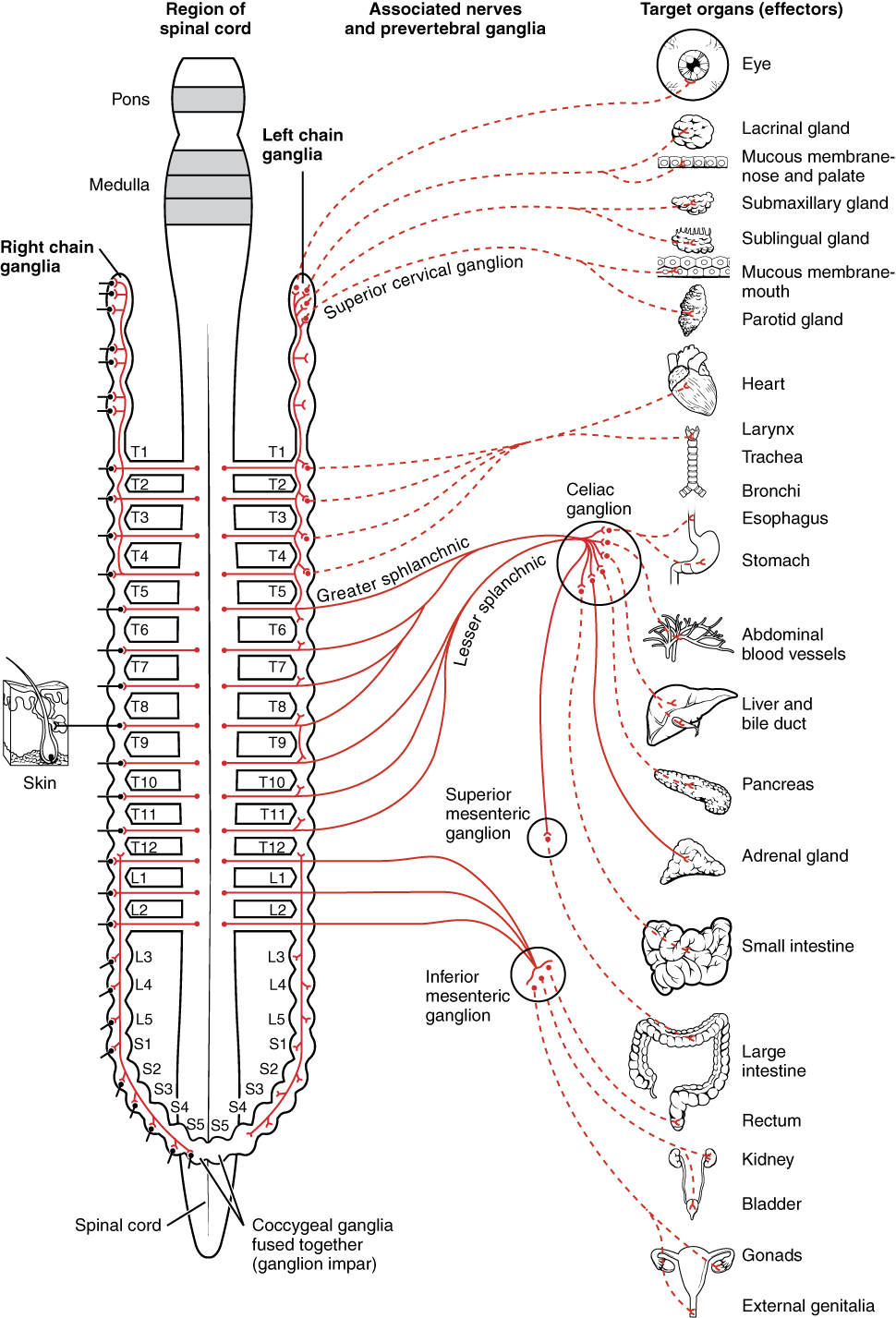
Sympathetic OutflowT1-L2 preganglionics, paravertebral chain, target organs receiving NE.
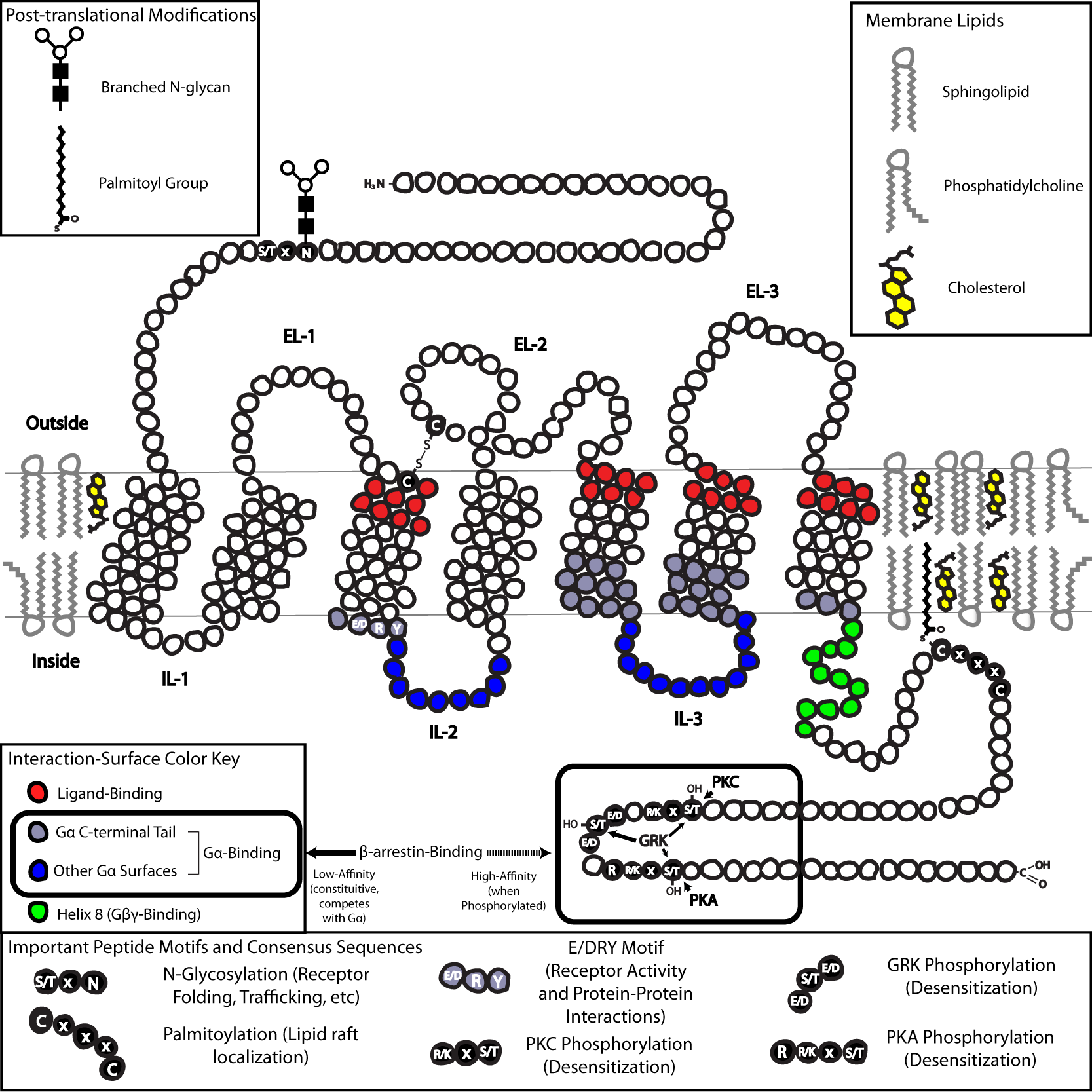
GPCR CouplingAdrenergic receptors are GPCRs. Alpha-1 = Gq. Alpha-2 = Gi. Beta-1/2/3 = Gs.
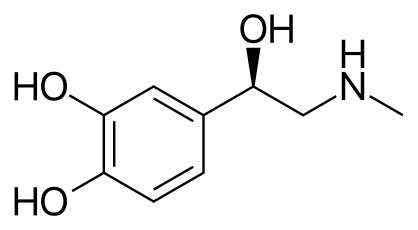
Epinephrine (Adrenaline)Has an N-methyl group on the amine nitrogen. That one methyl is why Epi has strong β2 activity.
Norepinephrine (Noradrenaline)No N-methyl group. Predominantly α1 and β1 activity. Minimal β2. One atom explains the whole clinical difference.
Board Pearl Recall
Tutor Drill: Instant-Recall Pearls
The four-line frame your tutor drills before every pharm question. Tap a card. Match the prototype drug. Then commit it cold.
The frame: α1 SQUEEZES. α2 INHIBITS NE release. β1 is the HEART. β2 RELAXES lungs and skeletal-muscle vessels. If you can answer "which receptor" in under 2 seconds, the rest of pharm collapses into a single-step problem.
PrototypeMirabegron (overactive bladder, no anticholinergic dry mouth)
⚡ Drug to Receptor
Tap a drug, then tap the receptor it primarily targets. Eight tiles, one match each. Stay under 8 wrong taps and you have it cold.
0 of 8 matched · 0 wrong taps
Pearl Drill 1
A 24-year-old in status asthmaticus is given continuous nebulized terbutaline. Within 30 minutes the wheezing has eased, but a routine BMP returns a serum potassium of 2.9 mEq/L. Which receptor mediates BOTH the bronchial relief and the potassium shift?
C is correct. Terbutaline is a β2 agonist. β2 is not just lungs · the same receptor lives on skeletal-muscle Na/K-ATPase pumps. Activating β2 simultaneously dilates bronchi and drives K⁺ INTO cells, dropping the serum level. This is the same mechanism used to rescue hyperkalemia with high-dose albuterol.
B (β1): β1 is the HEART. Tachycardia from terbutaline is spillover at high doses, but β1 does not relax bronchi or shift potassium.
Pearl: every β2 side effect (tremor, hypokalemia, hyperglycemia) is the SAME receptor doing its job in a different tissue.
Pearl Drill 2
A 58-year-old with PTSD and resistant hypertension is started on clonidine. Two weeks later her BP is well controlled. Which receptor and location best explain the antihypertensive effect?
B is correct. Clonidine is an α2 agonist that crosses into the CNS and stimulates brainstem α2 receptors. Stimulating that central autoreceptor tells the sympathetic nervous system to back off, so less norepinephrine reaches the periphery, vessels stay relaxed, and BP falls. This is why clonidine also works for ADHD, opioid withdrawal, and PTSD nightmares: it is a global sympathetic dimmer.
A (α1 block): Pure α1 blockers do exist (prazosin, tamsulosin), but clonidine is an α2 agonist, not an α1 antagonist. Different receptor, different mechanism.
C (β1 block): β1 blockers lower BP through cardiac output and renin, but clonidine has no β activity.
Pearl: α2 = INHIBITS NE release. Clonidine is the receptor's resume.
Pearl Drill 3
A 32-year-old in anaphylaxis from a peanut exposure receives 0.3 mg IM epinephrine. Within minutes her stridor improves and her oxygen saturation rises. Which receptor mediates the bronchodilation specifically?
D is correct. Epi hits every receptor at once, but the airway opening specifically belongs to β2. Bronchial smooth muscle relaxes when β2 fires (Gs, ↑ cAMP), the airway widens, and the stridor breaks. The α1 squeeze that fixes BP and the β2 relaxation that fixes airway are happening simultaneously, but they are two different receptor stories: keep them separate.
A (α1): α1 SQUEEZES, never relaxes. α1 in the airway would do the opposite of bronchodilation. α1 is doing the BP rescue, not the airway rescue.
C (β1): β1 is the HEART. It is supporting cardiac output during recovery, not opening airways.
Pearl: in anaphylaxis Epi is irreplaceable because no other single drug hits α1 (BP) AND β2 (airway) AND β2 (mast-cell stabilization) at once.
Pearl Drill 4 · The Confusion Trap
A patient is given a drug that selectively blocks the presynaptic adrenergic autoreceptor. What is the EXPECTED net effect on norepinephrine release at the synapse?
B is correct. The presynaptic autoreceptor is α2. Its job is to INHIBIT further NE release: when enough NE has spilled into the synapse, α2 fires and tells the nerve terminal to stop. Block that brake (mirtazapine does this) and NE release climbs because nothing is telling the nerve to quit. The trap is reading "blocks the autoreceptor" and assuming "less NE" · the autoreceptor itself is INHIBITORY, so blocking it removes inhibition and NE goes UP.
A: This is the most common wrong answer. It assumes "block receptor = block its action." But the receptor's action here is inhibition. Block an inhibitor and you UNLEASH the thing it was holding back. Same logic as taking your foot off the brake makes the car go faster.
C and D: Postsynaptic α1 and β1 are downstream effectors, not the presynaptic feedback loop. The autoreceptor lives at the nerve terminal and only α2 sits there.
Pearl: α2 = INHIBITS NE release. Blocking α2 = MORE NE. Activating α2 (clonidine) = LESS NE. Memorize the direction or the question gets you every time.
Walkthrough
Board-Style Walkthrough
Original board-style vignettes. Shuffled, never-repeat. Clues glow after you answer.