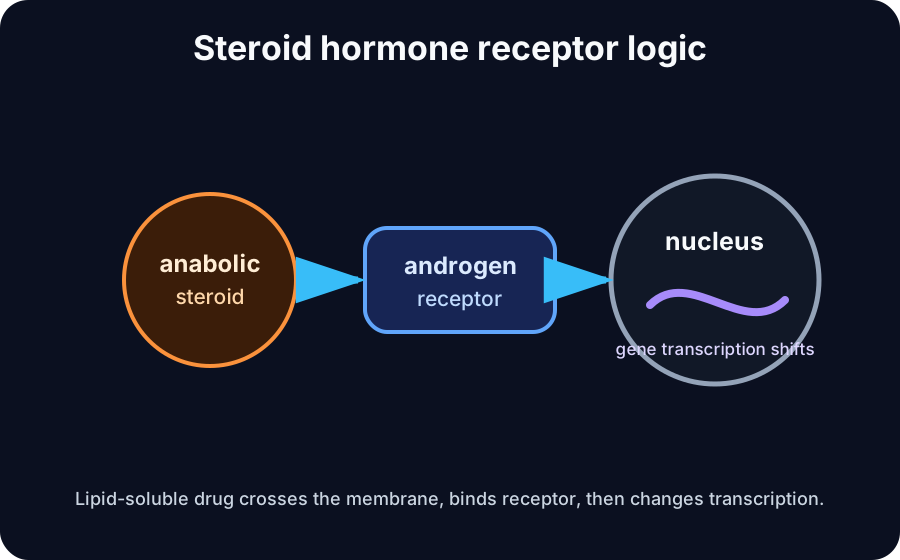
Lipophilic. Crosses the membrane. Finds the nuclear receptor. That one phrase separates AAS from every other doping agent on boards.
A 24-year-old competitive cyclist presents for a sports physical. He has hematocrit 58% and bilateral gynecomastia. His LH is 0.4 IU/L (ref 1.7-8.6). He admits taking performance supplements.
This drug acts by which mechanism?
Activates a nuclear receptor
Increases erythrocyte production directly via EPO receptor
Inhibits phosphodiesterase to increase cGMP
Stimulates hepatic IGF-1 secretion via JAK2-coupled surface receptor
Molecular chain
How the Drug Gets to the Nucleus
Steroids are lipophilic. That is the whole trick. Tap through the chain one step at a time.
Nuclear Receptor Chain
Tap Next to step through the mechanism. Each beat is board-testable.
Step 1 · Membrane crossing
Lipophilic steroid crosses the plasma membrane without a transporter or surface receptor. It diffuses directly into the cytoplasm. Contrast this with peptide hormones (insulin, GH, EPO), which cannot cross the membrane and must bind surface receptors.
Step 2 · Receptor binding in the cytoplasm
Inside the cytoplasm, the steroid binds the androgen receptor (AR), a member of the nuclear receptor superfamily. The same superfamily includes the glucocorticoid receptor, estrogen receptor, and thyroid hormone receptor. The AR sits inactive, held by heat shock proteins until the right ligand arrives.
Step 3 · Nuclear translocation
Ligand binding causes a conformational change. Heat shock proteins release. The hormone-receptor complex moves into the nucleus. This translocation step is why this entire drug class is called a nuclear receptor agonist, not a surface receptor agonist.
Step 4 · Gene transcription
The complex binds androgen response elements (AREs) in DNA. RNA polymerase is recruited. Muscle protein synthesis genes are upregulated. Erythropoietin expression in the kidney rises. This is why the effect takes hours, not seconds. Boards sometimes ask why the effect is delayed.
Step 5 · Board answer lock
The board stem asks: "What is this drug's mechanism?" The answer is "activates a nuclear receptor." Not "binds a surface receptor." Not "increases cAMP." Not "blocks an enzyme." Nuclear receptor activation → gene transcription → downstream protein production. Lock that chain.
Steroid nuclear receptor mechanism · tap to expand
Nuclear receptor superfamily: the receptor class context
Androgen receptor (AR) → AAS bind here → muscle protein synthesis, erythropoiesis, male secondary sex characteristics
Glucocorticoid receptor (GR) → AAS also bind GR weakly → inhibits muscle catabolism (secondary anabolic effect)
Estrogen receptor (ER) → AAS do not bind ER directly → but aromatase converts some AAS to estradiol → ER activation → gynecomastia
All nuclear receptors share the same logic: lipophilic ligand + cytoplasmic binding + nuclear translocation + gene transcription
⚠
The mechanism question tests receptor CLASS, not the downstream protein
Boards offer wrong answers like "increases myosin heavy chain synthesis" or "increases IGF-1 secretion." Both are downstream effects. The tested answer is the receptor class: activates a nuclear receptor. Every other doping agent on the distractor list works through a different receptor type. That distinction is exactly the point of the question.
Doping clues
The AAS Doping Fingerprint
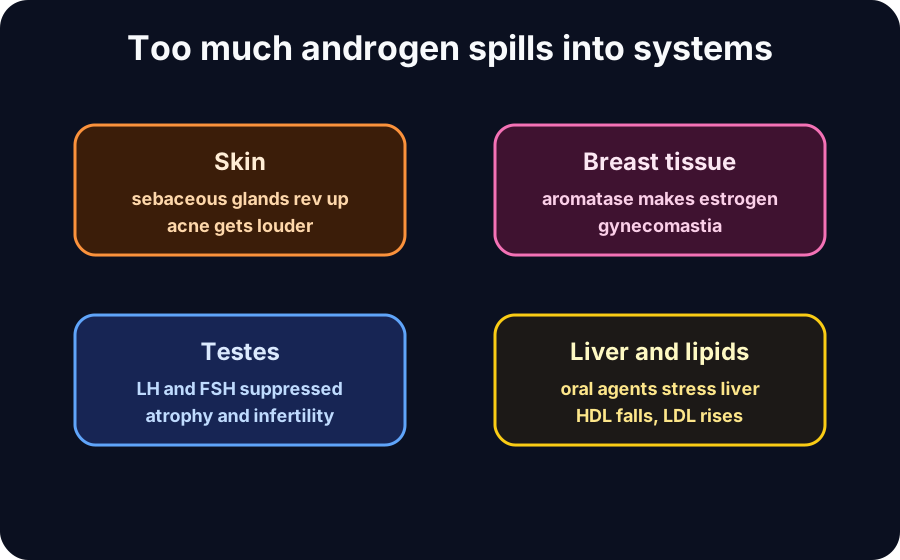
Six findings. Three from the HPG axis shutting down. Three from androgen excess at target tissues. Tap each card.
LH ↓
Suppressed pituitary
tap
HPG Feedback
Exogenous androgen triggers hypothalamic negative feedback. GnRH pulse frequency falls → pituitary stops releasing LH and FSH. Both fall to near zero. Endogenous testosterone production stops, but exogenous level stays high.
Testes ↓
Testicular atrophy
tap
Axis Impact
No LH → Leydig cells go quiet → no endogenous testosterone → testicular volume shrinks. No FSH → Sertoli cells lose support → azoospermia and infertility. Recovery after stopping is slow and may be incomplete.
Gynecomastia
Aromatization
tap
Aromatization Chain
Peripheral aromatase converts testosterone esters to estradiol. Estrogen activates breast tissue via ER. AAS do not bind ER directly. Aromatization is the bridge. Stanozolol does NOT aromatize, so it causes no gynecomastia.
Hct ↑
Polycythemia
tap
Erythropoietic Drive
AR activation in the kidney stimulates EPO production and erythroid progenitors → hematocrit rises. This is a primary AR-mediated effect. Contrast with doping via injected EPO, which acts directly on EPO receptors without touching the AR or HPG axis.
HDL ↓
Atherogenic shift
tap
Lipid Impact
Androgens suppress hepatic lipase activity → HDL falls. LDL rises. LDL/HDL ratio flips toward atherogenic. Dose-dependent. Cardiovascular consequence: early atherosclerosis, increased MI risk in young users.
Acne + Rage
Androgen excess
tap
Target Tissue Effect
High androgen activates sebaceous glands via AR → severe nodulocystic acne on the back and shoulders. CNS androgen receptors modulate mood and aggression → "roid rage," mania, withdrawal depression. These are direct AR-mediated central effects.
Gynecomastia from androgen aromatization to estradiol · tap to expand
HPG axis collapse: the full lab chain
One drug suppresses the entire axis from top to bottom:
Testes → endogenous T near zero, testicular atrophy, azoospermia
Peripheral tissue → aromatization to estradiol → gynecomastia
Kidney → EPO stimulated → hematocrit rises
⚠
High hematocrit alone does not name the agent. Low LH does.
EPO also raises hematocrit, but EPO has zero effect on the HPG axis. Low LH plus testicular atrophy plus gynecomastia is AAS, not EPO. The boards vignette will always hand you the HPG axis clue specifically to force that distinction. Do not answer "EPO" when LH is suppressed.
Interactive drill
Match the Doping Agent to Its Lab Fingerprint
Tap an agent on the left, then tap its lab pattern on the right. The answer lives in the receptor class.
Severe back acne · direct androgen receptor activation in sebaceous glands · tap to expand
Doping Lab Fingerprint Match
Tap left to select an agent, then tap the matching pattern on the right. Wrong pairs flash and reset.
Doping Agent
Lab / Clinical Pattern
Why PDE5 inhibitors appear in the doping distractor list
Some athletes use PDE5 inhibitors for pulmonary vasodilation at altitude or to partially counter EPO-related blood viscosity. They are on some banned substance lists. Boards love including sildenafil as a distractor in a doping vignette. Key distinction: PDE5 inhibitors act on an enzyme (phosphodiesterase 5), not a nuclear receptor. cGMP accumulates in smooth muscle. Completely different receptor and mechanism class from AAS.
Axis walkthrough
Trace the Negative Feedback
Step through the HPG axis consequences of chronic AAS. Pick the right answer to unlock each step.
1
Exogenous androgen arrives. Which signal falls first?
GnRH falls first. Hypothalamic GnRH neurons sense circulating androgen and reduce their pulse frequency. This is the very top of the axis. Without GnRH pulses, the pituitary stops responding.
2
GnRH is suppressed. What happens at the pituitary?
Both LH and FSH fall. GnRH drives the release of both gonadotropins. Without pulsatile GnRH, neither is secreted. Low LH means no Leydig cell stimulation. Low FSH means Sertoli cells lose support and spermatogenesis halts.
3
LH is near zero. What happens at the testes?
Leydig cells atrophy. No LH → no cAMP signaling → no StAR protein activation → no endogenous testosterone synthesis. The testes shrink. Blood androgen level stays high from the exogenous drug, but the gonads themselves are shutting down.
4
FSH is zero and Sertoli cells are unsupported. Clinical result?
Azoospermia. FSH supports Sertoli cell function. Without it, sperm maturation fails entirely. Young male athletes using AAS to compete are simultaneously making themselves infertile. Recovery after stopping is slow and incomplete in long-term users.
GnRH ↓ → LH/FSH ↓ → testicular atrophy + azoospermia. One drug collapses the entire reproductive axis.
Prove It
Board Walkthrough
6-vignette bank, 5 dealt per round, choices shuffled, never-repeat within a round.
Medically reviewed by Kaitlyn Cocuzzo, MD and Fatima Ali, DO
Bone Wizardry is an independent educational resource for visual learning in the medical sciences. It is not affiliated with, endorsed by, or sponsored by any licensing or examination board, contains no real or recalled examination questions, and does not guarantee any educational or examination outcome.
 Bone WizardryMEDICAL EDUCATION