
Pharmacology
Beta blockers: predict the tissue response
Connect beta-receptor signaling to drug selection, heart-failure timing, airway and glucose risks, and poisoning care through visual models and clinical cases.
A slower pulse can be useful, dangerous, or an incomplete description of the drug. Predict the receptor, tissue response and clinical time point before choosing a beta blocker.
One receptor family, several consequences
Catecholamines such as epinephrine and norepinephrine are natural adrenergic agonists. An agonist activates a receptor; an antagonist reduces agonist signaling. A partial agonist produces a lower maximal effect than a full agonist under matched conditions. [9] [17]
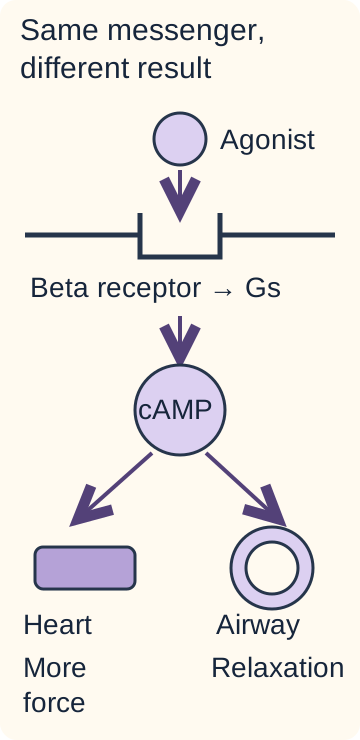
A patient takes metoprolol. Her pulse slows, but the kidney also responds. Why should a cardiac drug change renin? Start with the receptor rather than memorizing an organ list. Beta1 and beta2 receptors are G-protein-coupled receptors. In the simplified canonical pathway, an agonist activates Gs, which stimulates adenylyl cyclase to make cyclic AMP (cAMP). Protein kinase A (PKA) is one downstream effector. A blocker reduces the response to catecholamines; it does not reduce every cell's cAMP to zero. [17] [21]
 Enlarge diagram
One messenger, different downstream machinery. Beta blockade reduces the response to catecholamines; it does not set cellular cAMP to zero. [1] [3] [21]
Original teaching diagram, not traced from an image or clinical photograph. Not anatomical scale, a clinical recording, measured receptor occupancy or a dose-response plot.
In sinoatrial and atrioventricular nodal tissue, beta1 stimulation supports faster impulse generation and conduction. In ventricular muscle, adrenergic signaling increases calcium-dependent contraction. Beta1 antagonism therefore tends to slow pulse, slow AV conduction and reduce contractility. The word inotropy describes contraction strength; chronotropy describes rate; dromotropy describes conduction. A change in one is not a numerical prediction of the others.
Beta1 receptors on renal juxtaglomerular cells promote renin release. Blocking this input can reduce renin, which reduces one stimulus to the renin-angiotensin-aldosterone system. This is not direct inhibition of ACE or blockade of an angiotensin receptor. Blood pressure reflects cardiac output and vascular resistance, with multiple compensatory pathways, so receptor effects alone do not calculate a patient's pressure.
In airway smooth muscle, beta2 signaling favors relaxation. Reducing that signaling can narrow susceptible airways and oppose inhaled beta2 agonists. The same cAMP messenger has different downstream effects in cardiac versus smooth muscle. Beta2 blockade also matters in vascular beds and metabolic recovery. The receptor comparison models directions only, at a fixed imagined adrenergic background. Its shapes are symbols, not anatomy or a dose-response calculator. [1] [3]
In beta-blocker poisoning, atropine reduces vagal braking but does not remove beta blockade. Glucagon acts through a different receptor and may support cardiac signaling, but response is variable: it is an adjunct to comprehensive emergency care, not a guaranteed rescue. [5]
Selectivity is a preference, not a force field
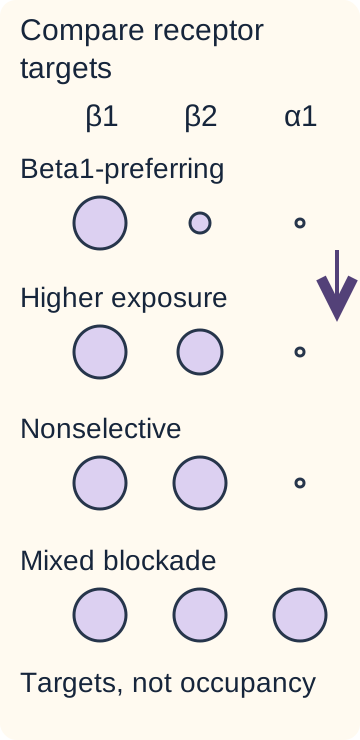
A person whose asthma was quiet develops wheezing after a beta-blocker dose increase. The relevant distinction is exposure, not just the name on the bottle. Metoprolol, atenolol, bisoprolol, esmolol and nebivolol have beta1 preference under suitable exposure conditions. Cardioselective does not mean beta1 only. Higher exposure can produce more beta2 antagonism; metabolism and drug interactions can matter as much as the prescribed dose. [1] [7] [16]
 Enlarge diagram
Symbol size is qualitative: larger circles mean more antagonism, tiny open circles mean no modeled target. Exposure can erode beta1 preference; it does not add alpha1 blockade. [1] [4] [15] [16]
Original teaching diagram, not traced from an image or clinical photograph. Not anatomical scale, a clinical recording, measured receptor occupancy or a dose-response plot.
Propranolol, nadolol, timolol and sotalol are nonselective beta blockers. Carvedilol and labetalol add alpha1 antagonism to nonselective beta blockade. Alpha1 normally supports vascular smooth-muscle contraction. Its blockade lowers vascular resistance and can add postural hypotension. Beta blockade may limit the expected reflex tachycardia, so a small pulse response does not rule out a clinically important standing pressure drop. Alpha1 antagonism does not cancel airway beta2 blockade. [3] [4] [6] [8] [15]
Intrinsic sympathomimetic activity (ISA) means partial agonism. Pindolol is nonselective with ISA; acebutolol has beta1 preference with mild ISA. When endogenous agonist drive is low, partial agonism can maintain some activity. During high catecholamine drive, a partial agonist competes with stronger agonists and reduces the net response. This can mean less resting bradycardia, but it does not guarantee normal perfusion or make these agents equivalent to proven HFrEF therapy. [9] [10] [2]
Esmolol is an IV option for closely monitored short-term control. Rapid hydrolysis by red-cell cytosolic esterases explains its short duration. Metoprolol is mainly metabolized by hepatic CYP2D6; inhibitors can raise exposure and reduce reliable beta1 preference. Sotalol requires renal dosing and QT assessment because it also prolongs repolarization. Do not infer half-life, metabolism, ISA or outcome evidence from a shared receptor label. [1] [6] [7]
Another selection concern is hypoglycemia: low blood glucose. Beta1 blockade can blunt the warning of a pounding heartbeat; nonselective blockade can also affect tremor and metabolic recovery. A quiet pulse does not establish a safe glucose level. [1] [3]
A neutral antagonist has no positive intrinsic efficacy of its own. An inverse agonist reduces receptor activity that exists without an agonist. These describe receptor behavior, not proof that drugs have equivalent clinical outcome benefits.
Separate chronic benefit from the present circulation
Left-ventricular ejection fraction (LVEF) is the fraction of the ventricle's filled blood volume ejected per beat. HFrEF means heart failure with reduced ejection fraction, 40% or less. Euvolemia means no clinically important fluid excess or depletion; it does not by itself prove adequate blood flow to organs. [2]
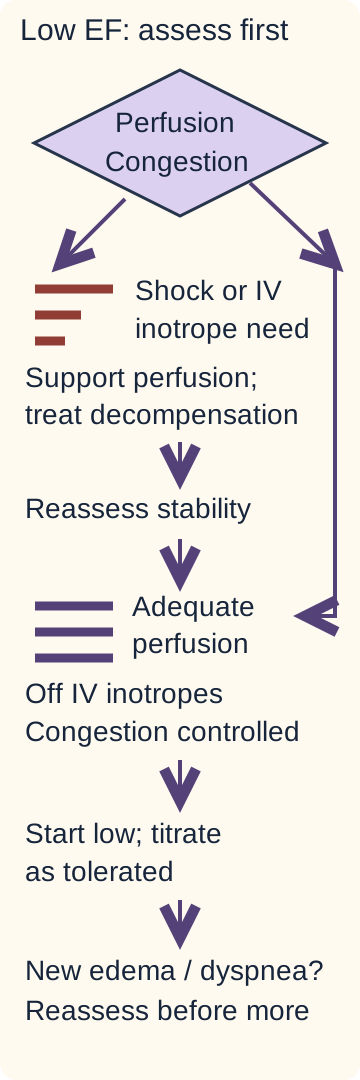
Two patients have LVEF 25%. One is warm and euvolemic at clinic; the other is cold, confused and receiving an IV inotrope. The ejection fraction alone does not answer whether to start a beta blocker. New blockade reduces adrenergic support of contraction immediately. In shock, that support may be necessary for perfusion. Long-term benefit cannot be used to justify new treatment during active cardiogenic shock. [2] [4]
 Enlarge diagram
Low EF alone does not determine timing. Assess perfusion, IV inotrope dependence and congestion. Initiate evidence-based therapy after stabilization; worsening congestion during titration requires reassessment before escalation. This is an initiation model, not an instruction to stop chronic therapy in every admission. [1] [2] [4]
Original teaching diagram, not traced from an image or clinical photograph. Not anatomical scale, a clinical recording, measured receptor occupancy or a dose-response plot.
For HFrEF with current or prior symptoms, the guideline-supported mortality-reducing agents are carvedilol, bisoprolol and sustained-release metoprolol succinate. MERIT-HF studied the sustained-release formulation in stabilized patients. [19] Start at a low dose once clinically stable and titrate according to tolerance. A class mechanism is not proof that atenolol, propranolol, pindolol or a different metoprolol schedule reproduces the same outcome evidence. [1] [2]
Chronic sympathetic activation contributes to maladaptive heart-failure physiology. Carefully titrated blockade can improve outcomes over time despite the immediate negative inotropic effect. The precise beneficial mechanism is not completely resolved. Avoid a promise that benefit starts at exactly three months, that everyone's EF initially falls, or that all landmark trials produced an identical mortality reduction. [1] [2]
New orthopnea, weight gain, edema, hypotension or symptomatic bradycardia requires reassessment. Treat congestion and restore stability before advancing the dose. A lower dose or temporary interruption may be necessary. Conversely, hospitalization or IV diuresis alone is not a universal instruction to stop established therapy; decisions depend on perfusion, shock, rhythm, congestion and the specific drug label. A transient titration problem does not automatically prevent later successful treatment. [1] [4]
Choose the indication and the time point
Reducing pulse and contractility lowers myocardial oxygen demand and can relieve exertional angina. Slowing AV conduction can help selected supraventricular tachyarrhythmias. These benefits do not make beta blockers interchangeable with every antiarrhythmic or appropriate for every wide-complex rhythm. Sotalol combines nonselective blockade with class III repolarization effects; initiation or reinitiation requires the label's monitored precautions, renal assessment and correction of potassium or magnesium deficits. [1] [6] [7]
After myocardial infarction, ventricular function, clinical stability and other indications determine treatment. Do not declare metoprolol succinate uniquely mandatory for every prior MI. The 2023 chronic coronary disease guideline permits reassessing use beyond one year when there is no history of or current LVEF at or below 50%, angina, arrhythmia or uncontrolled hypertension. Reassessment is not abrupt withdrawal. Proven vasospastic angina is a different problem from exertional demand ischemia; calcium-channel blockers address spasm, and nonselective beta blockers can aggravate it. [11] [1]
Propranolol can prevent migraine and reduce essential action-tremor amplitude; prevention is not rescue for an established migraine attack. Use for physical symptoms of performance anxiety is off label, not a guarantee of unaffected cognition. [20]
T4 (thyroxine) can be converted outside the thyroid into active T3 (triiodothyronine); reverse T3 is an inactive metabolite. Propranolol controls adrenergic symptoms of thyrotoxicosis. At higher doses it can also reduce peripheral T4-to-T3 conversion, which is distinct from thyroid synthesis inhibition and does not replace disease-directed therapy. [24] Thyroid storm with circulatory compromise requires particularly careful assessment before blockade. [3]
For portal hypertension, nonselective blockade lowers cardiac output through beta1 effects and reduces splanchnic inflow through beta2 effects. Carvedilol adds reduced intrahepatic resistance through alpha1 antagonism. Current AASLD guidance favors consideration of nonselective therapy in compensated cirrhosis with clinically significant portal hypertension, with selection and dosing constrained by blood pressure, renal function and tolerance. A cardioselective drug is not a mechanistically complete substitute. [12] [13]
Labetalol is one option for acute severe hypertension in pregnancy, alongside IV hydralazine or immediate-release oral nifedipine under appropriate protocols. Asthma, bradycardia and heart block still affect selection; pregnancy is not permission to ignore contraindications. Timolol eye drops reduce aqueous humor production for glaucoma, but systemic absorption can cause bradycardia or bronchospasm. In pheochromocytoma, establish alpha blockade before adding beta blockade for persistent tachycardia. A mixed-drug label is not a shortcut around that sequence. [14] [15] [8] [1]