Trace ovarian feedback, interpret FSH and estradiol, distinguish menopause from POI and central amenorrhea, and match treatment to symptoms and risk.
Start with the menstrual history, then interpret the feedback loop. Menopause is usually a clinical diagnosis; a hormone result explains ovarian function only when age, medications, and the reason for testing are understood.
Why does FSH rise when ovarian function falls?
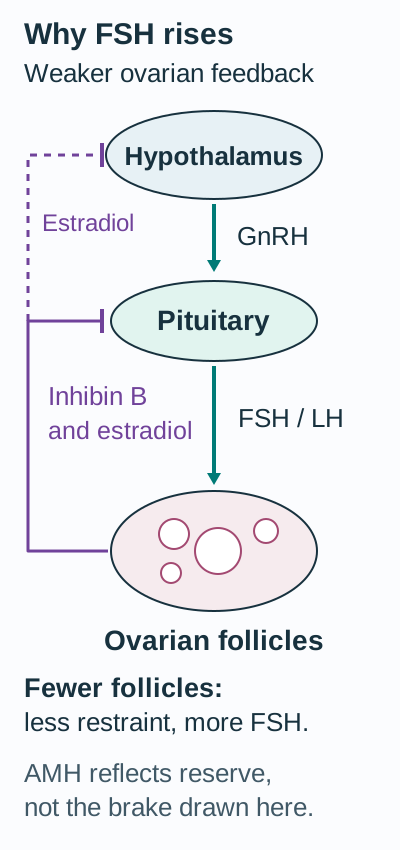
A higher stimulating hormone does not mean a more productive ovary. The hypothalamus supplies pulsatile gonadotropin-releasing hormone (GnRH), and the anterior pituitary supplies follicle-stimulating hormone (FSH) and luteinizing hormone (LH). Ovarian hormones feed back to restrain that stimulation. Think of the ovarian output and the pituitary response as two separate measurements, not two interchangeable measures of fertility. [1][4]
The ovarian follicle pool declines with reproductive aging. Fewer active follicles means less granulosa-cell production of inhibin B and lower antimullerian hormone (AMH), although individual measurements vary. Inhibin B particularly restrains FSH. When that restraint weakens, FSH can rise even while surviving follicles still produce substantial estradiol. AMH is primarily a marker of the remaining follicle pool, not the missing pituitary brake. [1]
Trace stimulation downward and feedback upward. A smaller follicle pool can reduce inhibin restraint before estradiol stays low. [1]
Predict before reading on: a midlife patient has fewer follicles and less inhibin B, but today's estradiol is within the laboratory's reproductive range. Should FSH necessarily be low? Compare the ovarian output with the feedback arrows in the first diagram.
No. Reduced inhibin feedback permits more FSH secretion. A temporarily active follicle can still supply estradiol, so a normal estradiol sample and a higher FSH sample can coexist during the transition. This does not establish a pituitary tumor or guarantee ovulation. [1]
Later, sustained low estradiol and low inhibin accompany higher gonadotropins. LH also rises, but FSH is the more useful conventional biochemical marker of ovarian insufficiency. The general pattern is low ovarian output with high pituitary stimulation, called hypergonadotropic hypogonadism. This label localizes the problem; it does not determine the person's age or explain its cause. [1][3]
Keep estradiol low, but change the problem to reduced hypothalamic stimulation. What happens to FSH?
FSH is low or inappropriately normal rather than appropriately high. Low estradiol therefore needs its paired gonadotropin result to distinguish an ovarian problem from a central one. [4]
Read the timeline before interpreting a snapshot
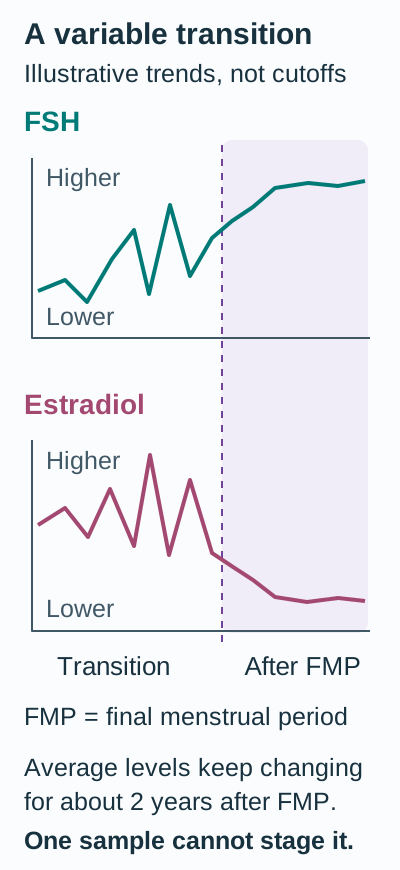
Does a normal FSH exclude the menopausal transition? No. The transition includes variable follicular activity, irregular ovulation, and sometimes substantial estradiol peaks. Values do not follow a smooth staircase from reproductive to postmenopausal concentrations. Increasingly anovulatory cycles help explain changing cycle lengths and longer gaps between periods. [1]
Consider a 48-year-old whose previously regular cycles now vary from 25 to 78 days. At one visit, FSH is 31 IU/L and estradiol is 35 pg/mL; six weeks later they are 8 IU/L and 145 pg/mL. These are invented teaching samples, not diagnostic thresholds. Compare both measurements at both visits: the later ovarian estradiol output is greater, and the accompanying pituitary stimulation is lower. That feedback response is compatible with intermittent ovarian activity, not proof that the transition has reversed. [1]
The second diagram separates the jagged transition from the later overall pattern. A gap of at least 60 days is a late-transition staging feature, whereas 12 consecutive months without spontaneous menstruation, with no other explanation, establishes natural menopause retrospectively. Eight months without a period does not become 12 because FSH is high. New bleeding during the transition still deserves assessment when its amount, duration, or pattern is abnormal. [1][2]
The jagged transition is followed by continued average hormonal change for about two years after the final menstrual period. Neither vertical scale supplies a diagnostic threshold. [1]
Even the final menstrual period is not an instantaneous laboratory switch. Average FSH continues to rise and average estradiol continues to fall for roughly two years afterward before settling into a more stable pattern. Postmenopausal values still differ across people, assays, medications, and time since the final period; no universal estradiol cutoff is required for routine diagnosis. [1]
Hormonal contraception and other exogenous hormones can suppress FSH or alter bleeding independently of ovarian reserve. Do not use FSH to identify menopause during combined hormonal contraception or high-dose progestogen use. AMH, inhibin assays, and follicle counts are not routine menopause-confirmation tests in a typical patient aged 45 or older. A reserve marker cannot promise an exact final-period date. [2]
A patient has hot flashes and nine months of amenorrhea, then a normal-flow period. What changes?
The previous interval did not complete the 12-month clinical definition. The new bleeding does not prove regular future ovulation, and unusually heavy, prolonged, or otherwise concerning bleeding needs evaluation rather than automatic reassurance. [1][2]
Pair estradiol with FSH to localize amenorrhea
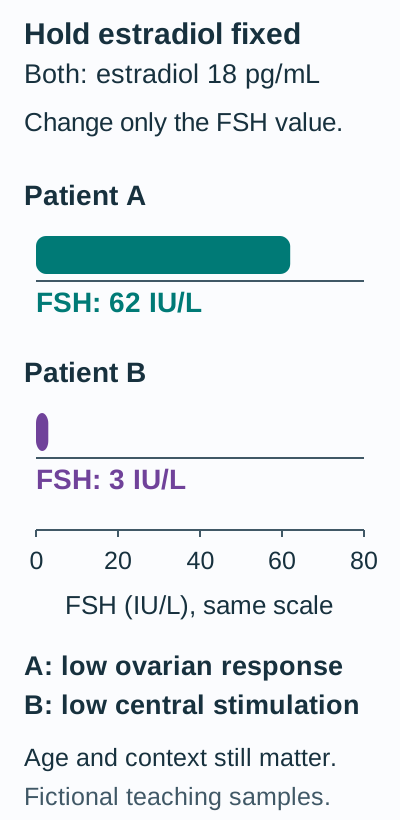
Two patients can have the same low estradiol but need different care. In the third diagram, patient A has estradiol 18 pg/mL and FSH 62 IU/L; patient B has estradiol 18 pg/mL and FSH 3 IU/L. For this worked example, the laboratory's early-follicular FSH interval is 3 to 10 IU/L. First identify the shared low ovarian output, then ask whether pituitary stimulation is appropriately increased.
Same low estradiol, different pituitary response. Use the paired pattern first, then use age, medications, and history to identify its cause. Samples are invented for teaching. [3][4][9]
Patient A: high FSH supports ovarian insufficiency. In a typical midlife menstrual history, this fits menopause physiology. Before age 40, consider primary ovarian insufficiency, also called premature ovarian insufficiency (POI), rather than assuming ordinary reproductive aging. Age 40 to 44 is commonly described as early menopause. Genetic factors, autoimmune disease, gonadotoxic treatment, and ovarian surgery may explain younger-onset insufficiency. [2][3]
Patient B: an FSH value within a printed range is still inappropriately low for the degree of estrogen deficiency. Low energy availability, major weight loss, intense exercise, or stress can suppress GnRH and cause functional hypothalamic amenorrhea. This is a diagnosis of exclusion, not a conclusion based on body size alone. Pregnancy, thyroid and prolactin disorders, and structural pituitary disease can also interrupt menstruation. Chronic hyperandrogenic anovulation is another cause of irregular cycles, but it does not by itself explain repeatedly high FSH with low estradiol. Persistent headaches or visual changes require attention to a possible central lesion. [4][9]
Change one variable in the comparison: keep estradiol at 18 but change FSH from 62 to 3. The likely level of dysfunction changes from the ovary to the hypothalamic-pituitary system. The low estradiol itself did not provide that distinction. Restoring energy availability is central to treatment of functional hypothalamic amenorrhea; ovarian replacement treatment does not correct an ongoing energy deficit. [4]
The 2024 international POI guideline uses disordered cycles for at least four months plus FSH above 25 IU/L. Exclude pregnancy and assess medication effects. Repeat FSH after four to six weeks when uncertainty remains; a particular cycle day is not required. Low estradiol supports the interpretation but is not the diagnostic test by itself. Guidelines differ: NICE NG23 retains two high FSH samples four to six weeks apart. Use the stated guideline rather than blending these protocols into one universal rule. [2][3]
Once POI is established, the evaluation is not finished. Non-iatrogenic POI warrants genetic counseling with chromosomal analysis and specific FMR1 premutation testing. Assess thyroid function; test for 21-hydroxylase antibodies when the cause is unknown, and pursue adrenal assessment when indicated. Discuss fertility, emotional support, bone health, and cardiovascular health. Ovarian activity can recur in nonsurgical POI, so infertility is not the same as assured contraception. [3]
Identify the affected tissue before choosing treatment
Why might one patient need treatment for hot flashes while another needs treatment only for vaginal pain? Estrogen-responsive tissues have different functions. Vasomotor symptoms reflect altered hypothalamic temperature regulation, not infection-induced fever. Severity and duration vary widely. Night sweats can interrupt sleep and impair daytime concentration or mood, but a new persistent fever or another atypical symptom still needs its own evaluation. [5][8]
Genitourinary syndrome of menopause (GSM) involves vulvovaginal and lower urinary tissues. Dryness, burning, painful intercourse, urgency, and recurrent urinary infections can occur. Unlike a brief vasomotor episode, tissue symptoms often persist or progress without treatment. Examination helps distinguish estrogen-related change from infection, vulvar dermatosis, trauma, and other causes of pain or bleeding. [2][5]
Make the tissue match: patient A wakes drenched several nights weekly but has no vaginal discomfort. Patient B has vaginal dryness and painful intercourse but no hot flashes. Patient A's treatment must address vasomotor symptoms; patient B can often be treated locally. Giving both the same systemic prescription ignores the different treatment targets. [2][5]
Bone is a third target. Estrogen deficiency increases remodeling, with resorption exceeding replacement, so bone mass can fall despite a normal serum calcium concentration. A normal calcium result does not establish normal bone density. Bone-risk assessment, appropriate exercise and nutrition, smoking cessation, and indicated density testing remain relevant even when hot flashes are mild. The severity of symptoms is not a measure of skeletal protection. [3][5]
Preventive care also includes cardiovascular risk assessment, weight, sleep, mood, sexual health, and age-appropriate cancer screening. Do not attribute every midlife complaint to estrogen or substitute a hormone prescription for this care. Apply the tissue distinction: bleeding after established menopause belongs on a diagnostic pathway, not on the list of symptoms to suppress empirically. [2][5][6]
Decide whether a hormone result would change the evaluation
A healthy 52-year-old has typical vasomotor symptoms and 14 months without spontaneous periods. There is no pregnancy possibility, hormonal medication, or competing explanation. Choose the evidence that establishes menopause: the compatible history supplies the diagnosis; routine FSH, estradiol, and AMH testing do not improve it. A high FSH would be compatible but redundant. [2]
After hysterectomy with retained ovaries, the bleeding calendar is absent, not ovarian function. A typical combination of symptoms at age 45 or older can still support a clinical diagnosis without routine hormone confirmation. Endometrial ablation also makes absent bleeding unreliable as a marker of ovarian activity. In a younger person, an atypical presentation, or consequential uncertainty, targeted testing can help; lack of a uterus alone is not an instruction to order an endocrine panel. [1][2][9]
For unexplained amenorrhea when pregnancy is possible, exclude pregnancy first. Then use history and appropriate thyroid, prolactin, FSH, and estradiol assessment to distinguish ovarian, central, and other causes. A new missed period in a 39-year-old is not managed as if a 12-month menopause definition were a reason to defer investigation. Testing has value when it resolves an actual differential diagnosis. [3][4][9]
Bleeding overrides the reassurance of a menopause hormone pattern. High FSH and low estradiol do not exclude endometrial or cervical disease. Prompt assessment of postmenopausal bleeding includes identifying its source and evaluating the endometrium. ACOG's April 2026 update recommends transvaginal ultrasonography together with endometrial tissue sampling for most patients at initial evaluation; a thin stripe is not a universal reason to omit sampling. Persistent or recurrent bleeding needs reassessment. [6]
Do not initiate systemic hormone therapy while unexplained vaginal bleeding is awaiting evaluation. Adding a progestogen is not a substitute for diagnosing an existing lesion. Similarly, unusually heavy or prolonged bleeding during the transition requires age- and risk-appropriate evaluation, rather than being dismissed because irregular ovulation is common. [2][5][6]
Change the first patient's history to new bleeding after four years without periods. Is FSH now the useful next test?
No. The question is the cause of bleeding, not whether ovarian aging has occurred. Pelvic and endometrial assessment address that question; another hormone sample does not. [6]
Match therapy to symptoms, the uterus, and individual risk
Begin with three decisions: what needs treatment, whether an endometrium is present, and whether systemic hormones are appropriate. Systemic menopausal hormone therapy is highly effective for bothersome vasomotor symptoms and prevents bone loss while used. In otherwise healthy patients younger than 60 or within 10 years of menopause, the benefit-risk balance is generally more favorable than with much later initiation. These are assessment considerations, not an automatic prescription or a mandatory stopping age. [5]
Compare two treatment plans: both patients have disruptive hot flashes and no contraindication. One has an intact uterus; the other had a total hysterectomy for fibroids and has no endometriosis history. Systemic estrogen reaches both patients' tissues, but only the first has an endometrium requiring protection. Provide an adequate progestogen regimen with systemic estrogen when a uterus is present; an approved estrogen-bazedoxifene combination is another protective strategy. Estrogen alone is generally appropriate after total hysterectomy when no special indication for combined treatment exists. Transdermal delivery does not eliminate the need for endometrial protection. [5]
For isolated GSM, start with appropriate lubricants or moisturizers and consider low-dose vaginal estrogen when symptoms persist or warrant prescription treatment. Vaginal DHEA (prasterone) and other selected alternatives can be considered according to symptoms and contraindications. Recommended low-dose vaginal estrogen generally does not require routine progestogen; this exception does not cover vaginal products designed to deliver systemic estrogen. New bleeding still requires evaluation. A history of hormone-sensitive cancer calls for individualized discussion, often involving oncology, rather than assuming local and systemic risks are identical. [2][5]
Unexplained vaginal bleeding, prior estrogen-sensitive cancer, coronary disease, myocardial infarction, stroke, venous thromboembolism, and significant liver disease are important reasons not to initiate routine systemic therapy. A patch is not an automatic workaround for prior thrombosis. Discuss appropriate nonhormonal options or specialist assessment. Do not start systemic therapy solely to prevent cardiovascular disease or dementia in usual-age menopause. [5]
Evidence-supported nonhormonal vasomotor options include selected SSRIs or SNRIs, gabapentin, and neurokinin-pathway treatment, with selection based on comorbidities, adverse effects, interactions, and preference. These are examples, not an exhaustive formulary. Menopause-specific cognitive behavioral therapy can also help. Fezolinetant requires baseline liver testing, then monthly tests for the first three months and at months six and nine. New jaundice, dark urine, or other liver-injury symptoms require stopping it and prompt medical assessment, not waiting for the next scheduled test. [7][8]
POI needs a different time horizon. In the absence of contraindications, hormone replacement is recommended until the usual age of menopause even when symptoms are mild, with endometrial protection if needed. Review bone and cardiovascular health, fertility goals, and emotional wellbeing. Menopausal hormone therapy is not contraception; nonsurgical POI may retain intermittent ovarian activity. Reassess treatment at the usual menopause age rather than extrapolating risks from older initiators to a 32-year-old. [3][5]
What changes when the patient with an intact uterus has isolated vaginal dryness instead of hot flashes?
The target and dose change. Recommended low-dose local vaginal therapy can address GSM without a routine systemic regimen or automatic progestogen. Uterine status still matters if systemic estrogen is later prescribed. [5]
Apply the hormone pattern to a new patient
Read the history and paired measurements before examining the options. Decide what the result localizes, then identify the diagnosis, prediction, or action the question actually requests.
Case 1
Show answer and explanations for case 1
A. Reduced hypothalamic secretion of pulsatile GnRH (Why this does not fit)
Reduced hypothalamic stimulation generally lowers gonadotropin output. FSH rose from 7 to 18 while inhibin B fell, favoring loss of ovarian restraint rather than reduced central drive. Interpret the direction of the pituitary response, not just the presence of a cycle change.
Reasoning steps for option A
What would reduced GnRH usually do to gonadotropin secretion?
Reduced hypothalamic stimulation generally lowers gonadotropin output.
How does that prediction compare with the serial FSH measurements?
FSH rose from 7 to 18 while inhibin B fell, favoring loss of ovarian restraint rather than reduced central drive.
B. Reduced granulosa-cell restraint of pituitary FSH (Best answer)
Inhibin B from granulosa cells suppresses FSH secretion. Residual follicles can maintain estradiol during the transition while reduced inhibin B permits a higher FSH concentration. Ovarian reserve and current estradiol output are not interchangeable.
Reasoning steps for option B
Which measured ovarian product particularly restrains FSH?
Inhibin B from granulosa cells suppresses FSH secretion.
Why does estradiol of 58 not contradict the rising FSH?
Residual follicles can maintain estradiol during the transition while reduced inhibin B permits a higher FSH concentration.
C. Increased ovarian estradiol feedback on the pituitary (Why this does not fit)
Greater estradiol feedback can restrain pituitary FSH secretion. Estradiol remains similar while FSH rises and inhibin B falls, the opposite of the proposed explanation. Identify the feedback signal that actually changed.
Reasoning steps for option C
What can a sustained rise in estradiol do in the usual negative-feedback setting?
Greater estradiol feedback can restrain pituitary FSH secretion.
Is that the observed hormonal change here?
Estradiol remains similar while FSH rises and inhibin B falls, the opposite of the proposed explanation.
D. Increased granulosa-cell inhibin secretion into blood (Why this does not fit)
Inhibin is an ovarian regulator that particularly suppresses FSH. Measured inhibin B fell; increased inhibin would predict more restraint rather than rising FSH. Loss of an inhibitor increases the regulated output.
Reasoning steps for option D
Why would inhibin production be relevant to this FSH result?
Inhibin is an ovarian regulator that particularly suppresses FSH.
Does increased inhibin fit either serial result?
Measured inhibin B fell; increased inhibin would predict more restraint rather than rising FSH.
Takeaway: FSH can rise early as inhibin restraint falls even when estradiol is temporarily preserved.
A. Recovery of stable ovulation after a completed menopause (Why this does not fit)
Intermittent follicular activity can increase estradiol and reduce FSH. She has irregular ongoing cycles, not a completed 12-month amenorrhea interval, and neither sample confirms sustained ovulation. A favorable-looking sample does not establish future cycle regularity.
Reasoning steps for option A
Could renewed follicular activity produce more estradiol?
Intermittent follicular activity can increase estradiol and reduce FSH.
Do the history and samples establish stable ovulation after menopause?
She has irregular ongoing cycles, not a completed 12-month amenorrhea interval, and neither sample confirms sustained ovulation.
B. Progressive pituitary failure causing sustained estrogen deficiency (Why this does not fit)
Insufficient gonadotropin stimulation can produce low FSH with low estradiol. Estradiol rose to 156 as FSH declined, showing ovarian activity rather than the proposed sustained low-output state. Interpret paired hormones together rather than diagnosing from FSH alone.
Reasoning steps for option B
How can pituitary failure affect FSH and estradiol?
Insufficient gonadotropin stimulation can produce low FSH with low estradiol.
Which later measurement conflicts with sustained estrogen deficiency?
Estradiol rose to 156 as FSH declined, showing ovarian activity rather than the proposed sustained low-output state.
C. Continuously exhausted follicular activity with fixed low estradiol (Why this does not fit)
Low estradiol with high FSH can accompany established ovarian insufficiency. The later estradiol concentration is substantially higher, compatible with variable remaining follicular activity. The transition is not a permanently low estradiol state.
Reasoning steps for option C
What pattern would sustained ovarian hypoactivity commonly produce?
Low estradiol with high FSH can accompany established ovarian insufficiency.
Which part of the serial data is not explained by a fixed pattern?
The later estradiol concentration is substantially higher, compatible with variable remaining follicular activity.
D. Intermittent follicular activity during the menopausal transition (Best answer)
A remaining follicle can produce substantial estradiol during an irregular cycle. Greater ovarian feedback can lower FSH; the variable cycles and paired changes fit the transition without proving stable ovulation. One normal FSH does not exclude the menopausal transition.
Reasoning steps for option D
What does the rise in estradiol indicate about current ovarian activity?
A remaining follicle can produce substantial estradiol during an irregular cycle.
How does that help explain the accompanying fall in FSH?
Greater ovarian feedback can lower FSH; the variable cycles and paired changes fit the transition without proving stable ovulation.
Takeaway: Read the paired change: higher estradiol and lower FSH can reflect intermittent activity during the transition.
A. Late menopausal transition; the final period is not yet established (Best answer)
The interval is a prolonged gap compatible with the late menopausal transition but is shorter than 12 months. They support reduced ovarian activity at sampling but do not establish that another spontaneous period will not occur. Use the menstrual definition rather than allowing a laboratory value to replace elapsed time.
Reasoning steps for option A
What does the eight-month interval establish about menstrual timing?
The interval is a prolonged gap compatible with the late menopausal transition but is shorter than 12 months.
Do high FSH and low estradiol supply the missing time interval?
They support reduced ovarian activity at sampling but do not establish that another spontaneous period will not occur.
B. Established natural menopause; the hormone values complete the definition (Why this does not fit)
High FSH with low estradiol reflects ovarian hypoactivity and reduced feedback. Similar samples occur in late transition, and only eight months without a period have elapsed. A compatible hormone pattern does not shorten the clinical amenorrhea interval.
Reasoning steps for option B
Why do these laboratory results resemble a postmenopausal pattern?
High FSH with low estradiol reflects ovarian hypoactivity and reduced feedback.
Why do they not establish the final menstrual period here?
Similar samples occur in late transition, and only eight months without a period have elapsed.
C. Central hypogonadism; the low estradiol localizes the disorder (Why this does not fit)
Reduced hypothalamic-pituitary stimulation can lower estradiol. The strong pituitary response supports ovarian rather than central hypoactivity. Low estradiol does not localize the disorder without its paired gonadotropin.
Reasoning steps for option C
Can central hypogonadism lower estradiol?
Reduced hypothalamic-pituitary stimulation can lower estradiol.
What does FSH of 72 indicate instead?
The strong pituitary response supports ovarian rather than central hypoactivity.
D. Early reproductive stage; the interval is explained by retained reserve (Why this does not fit)
Residual activity can persist well into the transition. Two years of increasing cycle gaps and an eight-month interval indicate advanced transition rather than early reproductive cyclicity. Residual ovarian activity and reproductive-aging stage are different judgments.
Reasoning steps for option D
Can some follicular activity remain during irregular cycles?
Residual activity can persist well into the transition.
Does possible residual activity make this an early reproductive-stage pattern?
Two years of increasing cycle gaps and an eight-month interval indicate advanced transition rather than early reproductive cyclicity.
Takeaway: High FSH explains ovarian hypoactivity; it cannot turn eight months of amenorrhea into twelve.
A. The absent bleeding establishes menopause despite the low FSH (Why this does not fit)
Twelve months of spontaneous amenorrhea can establish natural menopause in the appropriate setting. Continuous combined contraception can suppress bleeding, so this treatment-associated interval is not the required untreated menstrual history. Distinguish a medication effect on bleeding from the final spontaneous menstrual period.
Reasoning steps for option A
What menstrual interval is used for the usual clinical definition?
Twelve months of spontaneous amenorrhea can establish natural menopause in the appropriate setting.
Is this a spontaneous bleeding history?
Continuous combined contraception can suppress bleeding, so this treatment-associated interval is not the required untreated menstrual history.
B. The low FSH demonstrates preserved long-term ovarian reserve (Why this does not fit)
Outside confounding treatment, FSH is interpreted as part of ovarian feedback assessment. The combined hormonal contraceptive suppresses gonadotropins independently of how many follicles remain. A drug-suppressed FSH does not establish reserve or exclude transition.
Reasoning steps for option B
Why might a low FSH appear reassuring about ovarian function?
Outside confounding treatment, FSH is interpreted as part of ovarian feedback assessment.
What prevents that interpretation during this prescription?
The combined hormonal contraceptive suppresses gonadotropins independently of how many follicles remain.
C. The low FSH cannot stage ovarian aging during this treatment (Best answer)
Its hormonal feedback suppresses gonadotropin secretion. Continuous treatment also alters bleeding, so neither the low FSH nor the absent withdrawal bleeding stages natural ovarian aging here. Assess treatment effects before interpreting hormones or the menstrual calendar.
Reasoning steps for option C
How does combined hormonal contraception affect pituitary output?
Its hormonal feedback suppresses gonadotropin secretion.
How does the prescription affect the other available diagnostic marker?
Continuous treatment also alters bleeding, so neither the low FSH nor the absent withdrawal bleeding stages natural ovarian aging here.
D. The low FSH identifies a new hypothalamic-pituitary disorder (Why this does not fit)
Low or inappropriately normal FSH paired with endogenous estrogen deficiency can suggest a central cause. She is taking gonadotropin-suppressing hormones; this sample does not establish a new central disorder. Account for the medication before assigning an anatomic lesion.
Reasoning steps for option D
When can low FSH raise concern for central hypogonadism?
Low or inappropriately normal FSH paired with endogenous estrogen deficiency can suggest a central cause.
What competing explanation is directly present in this patient?
She is taking gonadotropin-suppressing hormones; this sample does not establish a new central disorder.
Takeaway: Combined hormonal contraception confounds both the bleeding calendar and FSH-based staging.
A. A retains cyclic ovarian output; B has low estradiol with high FSH (Best answer)
Patient A retains both ovaries, so ovarian cycling can continue despite the absence of uterine bleeding. Loss of ovarian estradiol and inhibin permits FSH to rise, producing low estradiol with high gonadotropins. Uterine bleeding and ovarian endocrine function depend on different organs.
Reasoning steps for option A
Which operation leaves the source of ovarian hormones in place?
Patient A retains both ovaries, so ovarian cycling can continue despite the absence of uterine bleeding.
What feedback response follows bilateral oophorectomy in patient B?
Loss of ovarian estradiol and inhibin permits FSH to rise, producing low estradiol with high gonadotropins.
B. A has low estradiol with high FSH; B retains cyclic ovarian output (Why this does not fit)
Without a uterus, patient A cannot use menstrual bleeding to demonstrate ongoing cycles. Bilateral oophorectomy in patient B, not hysterectomy with ovarian conservation, directly eliminates the ovarian source. Identify the organs retained rather than inferring endocrine status from bleeding.
Reasoning steps for option B
Why might the absence of bleeding after hysterectomy resemble menopause?
Without a uterus, patient A cannot use menstrual bleeding to demonstrate ongoing cycles.
Which operation actually ends ovarian hormone production?
Bilateral oophorectomy in patient B, not hysterectomy with ovarian conservation, directly eliminates the ovarian source.
C. A has low estradiol with low FSH; B has low estradiol with low FSH (Why this does not fit)
Insufficient central stimulation can lower both gonadotropins and ovarian output. No. In patient B, an intact pituitary responds to absent ovarian feedback by raising FSH rather than lowering it. Loss of an ovarian target has the opposite FSH direction from central suppression.
Reasoning steps for option C
What type of defect can produce low estradiol with low FSH?
Insufficient central stimulation can lower both gonadotropins and ovarian output.
Did either operation directly eliminate hypothalamic-pituitary stimulation?
No. In patient B, an intact pituitary responds to absent ovarian feedback by raising FSH rather than lowering it.
D. A retains cyclic ovarian output; B has low estradiol with low FSH (Why this does not fit)
Patient A can retain ovarian cycling because the ovaries are still present. Patient B should lose ovarian negative feedback and develop higher, not lower, FSH. Predict pituitary compensation after identifying the site of hormone loss.
Reasoning steps for option D
What part of this prediction fits ovarian conservation?
Patient A can retain ovarian cycling because the ovaries are still present.
What part misreads the response to bilateral oophorectomy?
Patient B should lose ovarian negative feedback and develop higher, not lower, FSH.
Takeaway: Hysterectomy ends uterine bleeding; bilateral oophorectomy causes ovarian hormone loss with higher gonadotropins.
A. Typical natural menopause; proceed without an etiologic evaluation (Why this does not fit)
High FSH with low estradiol indicates ovarian insufficiency in either setting. Ovarian insufficiency before 40 requires a POI evaluation and long-term planning, not assumptions about typical midlife aging. The same hormone pattern has different implications at different ages.
Reasoning steps for option A
Why does the laboratory pattern resemble usual-age menopause?
High FSH with low estradiol indicates ovarian insufficiency in either setting.
What makes the natural-menopause interpretation inadequate here?
Ovarian insufficiency before 40 requires a POI evaluation and long-term planning, not assumptions about typical midlife aging.
B. Central hypogonadism; investigate hypothalamic suppression first (Why this does not fit)
Reduced central stimulation can cause low estradiol and absent periods. FSH is high rather than low or inappropriately normal, supporting an ovarian site of dysfunction. Use the compensatory gonadotropin response to localize low estrogen.
Reasoning steps for option B
Why is central hypogonadism part of an amenorrhea differential?
Reduced central stimulation can cause low estradiol and absent periods.
Which paired measurement argues against that localization?
FSH is high rather than low or inappropriately normal, supporting an ovarian site of dysfunction.
C. Primary ovarian insufficiency; begin cause-directed evaluation and care (Best answer)
Six months of disordered cycles exceeds the required four months in a patient younger than 40. FSH above 25 supports POI under this guideline; with no stated diagnostic uncertainty, evaluation and care need not await a routine mandatory second sample. Repeat testing is appropriate when uncertain, not universally required by this named guideline.
Reasoning steps for option C
Does the history meet the international guideline clinical criterion?
Six months of disordered cycles exceeds the required four months in a patient younger than 40.
How does the medication-free FSH result affect the next action?
FSH above 25 supports POI under this guideline; with no stated diagnostic uncertainty, evaluation and care need not await a routine mandatory second sample.
D. Unclassified amenorrhea; wait until twelve months before evaluating (Why this does not fit)
Typical natural menopause is identified retrospectively after that interval. The duration and high FSH already satisfy the named POI criteria and justify evaluation rather than deferring care. Do not apply the typical-menopause calendar as a delay rule for younger amenorrhea.
Reasoning steps for option D
What condition uses twelve months of spontaneous amenorrhea as its clinical definition?
Typical natural menopause is identified retrospectively after that interval.
Why is waiting inappropriate for this 36-year-old?
The duration and high FSH already satisfy the named POI criteria and justify evaluation rather than deferring care.
Takeaway: Under the 2024 international guideline, clear POI can be diagnosed after at least four months of disordered cycles with FSH above 25 IU/L.
A. AMH measurement to establish the exact final-period date (Why this does not fit)
AMH reflects the remaining follicle pool and may occasionally assist an uncertain POI assessment. It cannot establish an exact final-period date and is not the primary diagnostic substitute for contextual FSH assessment. Reserve information and precise prediction of menopause are different tasks.
Reasoning steps for option A
What ovarian feature does AMH help describe?
AMH reflects the remaining follicle pool and may occasionally assist an uncertain POI assessment.
Would it establish the exact timing of menopause in this patient?
It cannot establish an exact final-period date and is not the primary diagnostic substitute for contextual FSH assessment.
B. Pituitary MRI to identify the source of excess FSH (Why this does not fit)
Central hormone abnormalities or neurological symptoms can justify pituitary assessment. No. Loss of ovarian feedback can raise FSH; the immediate uncertainty concerns the ovarian pattern, not demonstrated pituitary disease. A high stimulating hormone does not by itself identify a secreting tumor.
Reasoning steps for option B
When can pituitary imaging be important in amenorrhea?
Central hormone abnormalities or neurological symptoms can justify pituitary assessment.
Does a borderline high FSH without central symptoms localize a pituitary lesion?
No. Loss of ovarian feedback can raise FSH; the immediate uncertainty concerns the ovarian pattern, not demonstrated pituitary disease.
C. FSH measurement after twelve months of amenorrhea (Why this does not fit)
That interval belongs to the retrospective clinical definition of typical natural menopause. Suspected POI requires timely evaluation, and the named guideline does not require waiting for a full amenorrhea year. Do not delay evaluation of younger-onset ovarian insufficiency using a midlife definition.
Reasoning steps for option C
Why might a twelve-month interval appear relevant?
That interval belongs to the retrospective clinical definition of typical natural menopause.
Why is it not the appropriate timing rule in this younger patient?
Suspected POI requires timely evaluation, and the named guideline does not require waiting for a full amenorrhea year.
D. Repeat FSH assessment in four to six weeks (Best answer)
Near-threshold, variable results leave stated diagnostic uncertainty about ovarian insufficiency. Repeat FSH after four to six weeks, interpreted with the history and medication context, rather than making repeat testing mandatory for every patient. The need for a repeat result depends on uncertainty, not a universal two-test rule.
Reasoning steps for option D
What is unresolved despite the compatible age and cycle history?
Near-threshold, variable results leave stated diagnostic uncertainty about ovarian insufficiency.
What does the international guideline recommend in that circumstance?
Repeat FSH after four to six weeks, interpreted with the history and medication context, rather than making repeat testing mandatory for every patient.
Takeaway: When the POI assessment remains uncertain, repeat FSH in four to six weeks under the international guideline.
A. Begin ovarian hormone replacement without changing training or intake (Why this does not fit)
Low estrogen can contribute to symptoms and bone loss in prolonged amenorrhea. The low gonadotropins, weight loss, and increased training suggest energy-related central suppression that persists if intake and expenditure are unchanged. Treatment of a downstream hormone deficit does not replace correction of the energy deficit.
Reasoning steps for option A
Why might estrogen treatment appear relevant to this presentation?
Low estrogen can contribute to symptoms and bone loss in prolonged amenorrhea.
Would replacing estrogen alone correct the likely initiating problem?
The low gonadotropins, weight loss, and increased training suggest energy-related central suppression that persists if intake and expenditure are unchanged.
B. Increase energy availability and adjust training with coordinated support (Best answer)
No. FSH and LH are low or inappropriately normal despite low estradiol, indicating reduced central stimulation. Weight loss after increased training supports low energy availability; nutritional, exercise, and psychological support address that cause after other etiologies are excluded. Localize the pattern before selecting the intervention.
Reasoning steps for option B
Does the pituitary response fit primary ovarian insufficiency?
No. FSH and LH are low or inappropriately normal despite low estradiol, indicating reduced central stimulation.
How does the history guide the first treatment target?
Weight loss after increased training supports low energy availability; nutritional, exercise, and psychological support address that cause after other etiologies are excluded.
C. Start ovulation induction while maintaining the current energy balance (Why this does not fit)
It can be considered for fertility after appropriate evaluation and attempts to restore energy balance. The ongoing energy deficit needs treatment first, and the stem does not present an infertility-treatment goal. Correct the underlying condition before pursuing a downstream fertility intervention.
Reasoning steps for option C
When might ovulation induction be considered in hypothalamic amenorrhea?
It can be considered for fertility after appropriate evaluation and attempts to restore energy balance.
Why is it not the initial strategy requested here?
The ongoing energy deficit needs treatment first, and the stem does not present an infertility-treatment goal.
D. Investigate follicle depletion as the primary cause of the low estradiol (Why this does not fit)
Reduced ovarian feedback generally permits FSH to rise. Neither gonadotropin is appropriately increased, and the energy-history pattern favors central suppression rather than primary ovarian failure. A low estradiol value alone does not prove follicle depletion.
Reasoning steps for option D
What would follicle depletion usually do to FSH feedback?
Reduced ovarian feedback generally permits FSH to rise.
How do the paired FSH and LH values redirect the assessment?
Neither gonadotropin is appropriately increased, and the energy-history pattern favors central suppression rather than primary ovarian failure.
Takeaway: Low estradiol with insufficient gonadotropin stimulation and an energy deficit points toward functional hypothalamic amenorrhea.
A. Serial AMH concentrations and serial inhibin B concentrations (Why this does not fit)
AMH and inhibin B relate to follicular activity or reserve. They do not replace chromosomal analysis and specific FMR1 premutation testing in non-iatrogenic POI. Confirming reduced reserve is different from investigating why it occurred.
Reasoning steps for option A
What could these ovarian markers add to a reserve assessment?
AMH and inhibin B relate to follicular activity or reserve.
Do serial reserve measurements identify a heritable cause of established POI?
They do not replace chromosomal analysis and specific FMR1 premutation testing in non-iatrogenic POI.
B. Pituitary MRI and a GnRH stimulation assessment (Why this does not fit)
Hypothalamic-pituitary disease can disrupt gonadotropin stimulation and menstruation. It supports a responsive pituitary reacting to ovarian insufficiency, not the low-stimulation pattern these tests target. Let the hormone localization guide the etiologic investigation.
Reasoning steps for option B
What alternative level of dysfunction could motivate these tests?
Hypothalamic-pituitary disease can disrupt gonadotropin stimulation and menstruation.
What does the repeated high FSH indicate in this case?
It supports a responsive pituitary reacting to ovarian insufficiency, not the low-stimulation pattern these tests target.
C. Pelvic MRI and hysteroscopic endometrial assessment (Why this does not fit)
Anatomic or outflow problems can prevent bleeding despite ovarian hormone production. Repeated high FSH with low estradiol identifies ovarian insufficiency; uterine imaging does not test the requested heritable ovarian causes. A bleeding-organ investigation does not replace an ovarian etiologic evaluation.
Reasoning steps for option C
What kind of amenorrhea cause can uterine assessment investigate?
Anatomic or outflow problems can prevent bleeding despite ovarian hormone production.
Why does that not explain this established pattern?
Repeated high FSH with low estradiol identifies ovarian insufficiency; uterine imaging does not test the requested heritable ovarian causes.
D. Chromosomal analysis and FMR1 premutation testing (Best answer)
POI before 40 without a known treatment-related cause can have a chromosomal or inherited basis. Chromosomal analysis and a specific FMR1 premutation test are recommended for non-iatrogenic POI, with counseling about their implications. A normal family history does not eliminate the indication for this evaluation.
Reasoning steps for option D
Why is etiologic genetic testing relevant at this stage?
POI before 40 without a known treatment-related cause can have a chromosomal or inherited basis.
Which tests are specifically recommended in the international guideline?
Chromosomal analysis and a specific FMR1 premutation test are recommended for non-iatrogenic POI, with counseling about their implications.
Takeaway: Established non-iatrogenic POI warrants counseling and evaluation for chromosomal and FMR1-associated causes.
A. Repeat ovarian reserve testing with AMH and antral follicle count (Why this does not fit)
Reduced ovarian function can cause estrogen deficiency and missing periods. Low estradiol without high FSH, together with galactorrhea, repeatedly high prolactin, and headaches, favors a hypothalamic-pituitary problem. A reserve assessment does not explain the associated pituitary findings.
Reasoning steps for option A
Why could ovarian testing enter an amenorrhea evaluation?
Reduced ovarian function can cause estrogen deficiency and missing periods.
Which findings instead direct attention centrally in this patient?
Low estradiol without high FSH, together with galactorrhea, repeatedly high prolactin, and headaches, favors a hypothalamic-pituitary problem.
B. Obtain pituitary MRI with dedicated sellar imaging (Best answer)
No. FSH is inappropriately normal for the estrogen deficiency, supporting reduced central stimulation. Persistent hyperprolactinemia, galactorrhea, and headaches after common secondary causes are excluded warrant assessment for a pituitary lesion. Do not label younger amenorrhea as menopause when the paired hormones and associated symptoms localize centrally.
Reasoning steps for option B
Does low estradiol with FSH of 4 show appropriate ovarian compensation?
No. FSH is inappropriately normal for the estrogen deficiency, supporting reduced central stimulation.
What makes targeted pituitary imaging the appropriate investigation?
Persistent hyperprolactinemia, galactorrhea, and headaches after common secondary causes are excluded warrant assessment for a pituitary lesion.
C. Perform chromosomal analysis and FMR1 premutation testing (Why this does not fit)
They are recommended for established non-iatrogenic POI. Her FSH is not high despite low estradiol, while repeated hyperprolactinemia and headaches provide a more immediate central explanation. Establish the level of dysfunction before applying an ovarian etiologic protocol.
Reasoning steps for option C
When are these genetic tests recommended?
They are recommended for established non-iatrogenic POI.
Has this patient demonstrated the characteristic POI localization?
Her FSH is not high despite low estradiol, while repeated hyperprolactinemia and headaches provide a more immediate central explanation.
D. Arrange hysteroscopy to evaluate endometrial adhesions (Why this does not fit)
Adhesions can prevent bleeding despite retained ovarian endocrine function. They do not account for persistent hyperprolactinemia, galactorrhea, and headaches with insufficient gonadotropin stimulation. Select the investigation that explains the complete pattern rather than the absent period alone.
Reasoning steps for option D
How could uterine adhesions affect menstrual history?
Adhesions can prevent bleeding despite retained ovarian endocrine function.
Would they explain the hormone and neurological findings here?
They do not account for persistent hyperprolactinemia, galactorrhea, and headaches with insufficient gonadotropin stimulation.
Takeaway: Low estradiol with inadequate FSH plus persistent hyperprolactinemia and headaches warrants a central evaluation.
A. Stress-related reduction of hypothalamic GnRH stimulation (Why this does not fit)
Stress and low energy availability can suppress GnRH and lower ovarian output. FSH is markedly high rather than insufficiently stimulated, supporting ovarian dysfunction after the gonadotoxic exposure. Use the hormone response to distinguish competing consequences of serious illness.
Reasoning steps for option A
Why could major illness lead to central reproductive suppression?
Stress and low energy availability can suppress GnRH and lower ovarian output.
Which laboratory response favors a different mechanism here?
FSH is markedly high rather than insufficiently stimulated, supporting ovarian dysfunction after the gonadotoxic exposure.
B. Treatment-related loss of pituitary gonadotropin secretion (Why this does not fit)
Low gonadotropins with low estradiol would be expected from central hormone deficiency. FSH is 69, showing a strong response to inadequate ovarian feedback rather than loss of FSH secretion. Low ovarian output does not imply low pituitary output.
Reasoning steps for option B
What hormone combination would loss of pituitary stimulation favor?
Low gonadotropins with low estradiol would be expected from central hormone deficiency.
Is the pituitary failing to secrete FSH in this case?
FSH is 69, showing a strong response to inadequate ovarian feedback rather than loss of FSH secretion.
C. Treatment-related loss of ovarian follicular function (Best answer)
The pituitary is responding to inadequate ovarian feedback, localizing the main dysfunction to the ovary. New amenorrhea after gonadotoxic chemotherapy supports treatment-related ovarian insufficiency before age 40. The biochemical pattern localizes the disorder; the exposure helps explain its cause.
Reasoning steps for option C
What site does high FSH with low estradiol identify?
The pituitary is responding to inadequate ovarian feedback, localizing the main dysfunction to the ovary.
How does the temporal history identify a likely cause?
New amenorrhea after gonadotoxic chemotherapy supports treatment-related ovarian insufficiency before age 40.
D. Endometrial scarring with preserved ovarian hormone production (Why this does not fit)
An anatomic uterine problem can prevent bleeding while ovarian hormones remain cyclic. Very low estradiol, hot flashes, and high FSH indicate ovarian hypoactivity rather than an isolated bleeding-surface problem. Interpret systemic endocrine findings before attributing amenorrhea to the uterus.
Reasoning steps for option D
How can an endometrial problem cause amenorrhea?
An anatomic uterine problem can prevent bleeding while ovarian hormones remain cyclic.
Which findings are not explained by preserved ovarian production?
Very low estradiol, hot flashes, and high FSH indicate ovarian hypoactivity rather than an isolated bleeding-surface problem.
Takeaway: After gonadotoxic treatment, high FSH with low estradiol supports ovarian rather than central insufficiency.
A. Use the clinical history without a confirmatory hormone panel (Best answer)
The patient is older than 45 with typical symptoms and more than 12 months of spontaneous amenorrhea without another explanation. No. A reserve marker is not needed to establish menopause in this typical clinical presentation. Order a test to resolve uncertainty, not simply because it measures ovarian biology.
Reasoning steps for option A
Does the history satisfy the usual clinical definition in this age group?
The patient is older than 45 with typical symptoms and more than 12 months of spontaneous amenorrhea without another explanation.
Would AMH add necessary confirmation before discussing symptoms?
No. A reserve marker is not needed to establish menopause in this typical clinical presentation.
B. Measure AMH and interpret it against a menopause-specific threshold (Why this does not fit)
AMH relates to the remaining ovarian follicle pool. Routine menopause diagnosis at this age uses the compatible untreated history, and AMH is not recommended as a confirmatory test. Reserve testing is not required to name an already established clinical transition.
Reasoning steps for option B
What does AMH primarily reflect?
AMH relates to the remaining ovarian follicle pool.
Why is a menopause-specific AMH threshold not the diagnostic approach here?
Routine menopause diagnosis at this age uses the compatible untreated history, and AMH is not recommended as a confirmatory test.
C. Measure serial estradiol until a fixed diagnostic threshold is reached (Why this does not fit)
Low estradiol commonly accompanies sustained ovarian hypoactivity after menopause. No. The history already establishes it, and values depend on assays and other context. Compatibility of a laboratory pattern does not make that test mandatory.
Reasoning steps for option C
Why could low estradiol be compatible with the history?
Low estradiol commonly accompanies sustained ovarian hypoactivity after menopause.
Does the clinical diagnosis require a universal estradiol threshold?
No. The history already establishes it, and values depend on assays and other context.
D. Measure FSH twice before accepting the menstrual history as diagnostic (Why this does not fit)
Repeat assessment may be appropriate in uncertain or guideline-specific younger-onset ovarian insufficiency evaluation. No. The spontaneous amenorrhea interval and symptoms are sufficient without routine FSH testing. Do not transplant a POI testing protocol into typical natural menopause.
Reasoning steps for option D
When can repeat FSH testing have a useful role?
Repeat assessment may be appropriate in uncertain or guideline-specific younger-onset ovarian insufficiency evaluation.
Does that requirement apply to this typical 54-year-old presentation?
No. The spontaneous amenorrhea interval and symptoms are sufficient without routine FSH testing.
Takeaway: A typical history at age 45 or older can establish menopause without AMH, estradiol, or routine FSH confirmation.
A. Date menopause to the hysterectomy using the absence of subsequent bleeding (Why this does not fit)
Total hysterectomy eliminates uterine bleeding. No. Both ovaries were conserved, and the later onset of symptoms cannot be dated to the operation simply from absent bleeding. Lack of a uterus does not establish lack of ovarian function.
Reasoning steps for option A
Why is there no menstrual calendar after this operation?
Total hysterectomy eliminates uterine bleeding.
Does the operation establish when ovarian function declined?
No. Both ovaries were conserved, and the later onset of symptoms cannot be dated to the operation simply from absent bleeding.
B. Use AMH to calculate the date at which ovarian cycles permanently ended (Why this does not fit)
It supplies information about ovarian reserve rather than uterine bleeding. No. AMH is not a precise menopause-date test and is not routinely required for the typical symptom pattern described. A reserve measurement does not reconstruct a missing menstrual calendar.
Reasoning steps for option B
Why might AMH seem useful when bleeding history is unavailable?
It supplies information about ovarian reserve rather than uterine bleeding.
Can it calculate an individual final ovarian-cycle date?
No. AMH is not a precise menopause-date test and is not routinely required for the typical symptom pattern described.
C. Require two high FSH samples before considering the symptom pattern (Why this does not fit)
Testing can help when atypical features or meaningful uncertainty affect management. No. NICE supports identifying menopause clinically from a typical symptom combination at age 45 or older after hysterectomy. An absent menstrual marker does not automatically require laboratory confirmation.
Reasoning steps for option C
When could selective hormone testing be helpful after hysterectomy?
Testing can help when atypical features or meaningful uncertainty affect management.
Does typical-age hysterectomy alone make serial FSH mandatory?
No. NICE supports identifying menopause clinically from a typical symptom combination at age 45 or older after hysterectomy.
D. Use the typical symptom combination for a clinical assessment of menopause (Best answer)
Ovarian endocrine function could continue because both ovaries remained. The new typical symptom combination at age 50 can support clinical identification without routine hormone testing when alternative explanations are not suggested. Differentiate absence of a bleeding record from inability to make a clinical assessment.
Reasoning steps for option D
What did the prior operation preserve?
Ovarian endocrine function could continue because both ovaries remained.
What supports the present diagnosis despite the missing bleeding marker?
The new typical symptom combination at age 50 can support clinical identification without routine hormone testing when alternative explanations are not suggested.
Takeaway: After hysterectomy with ovarian conservation, typical-age symptoms can support a clinical diagnosis without routine FSH testing.
A. Ovarian hypoactivity is supported; the ablation does not date its onset (Best answer)
High FSH with low estradiol supports ovarian rather than central hypoactivity. Very little, because ablation can suppress bleeding independently of ovarian activity; it does not date the start of ovarian insufficiency. Separate current endocrine evidence from an uninterpretable menstrual timeline.
Reasoning steps for option A
How do the paired hormones localize the present endocrine pattern?
High FSH with low estradiol supports ovarian rather than central hypoactivity.
What does the three-year absence of bleeding establish about its duration?
Very little, because ablation can suppress bleeding independently of ovarian activity; it does not date the start of ovarian insufficiency.
B. Ovarian failure began at ablation; the amenorrhea dates the transition (Why this does not fit)
There has been no visible uterine bleeding for three years. Ablation affects the bleeding tissue, and both ovaries remained; absent bleeding after the procedure is not a spontaneous ovarian timeline. A procedure-related absence of bleeding is not a dated final menstrual period.
Reasoning steps for option B
Why could the post-ablation amenorrhea look like a long menopausal interval?
There has been no visible uterine bleeding for three years.
Why does that interval not establish when ovarian function declined?
Ablation affects the bleeding tissue, and both ovaries remained; absent bleeding after the procedure is not a spontaneous ovarian timeline.
C. Central hypoactivity is supported; low estradiol identifies its location (Why this does not fit)
Yes, insufficient gonadotropin stimulation can reduce ovarian estrogen production. FSH is high, showing compensatory stimulation rather than the inadequate stimulation expected from a central cause. Localize low estradiol by the accompanying gonadotropin response.
Reasoning steps for option C
Could central suppression produce low estradiol and amenorrhea?
Yes, insufficient gonadotropin stimulation can reduce ovarian estrogen production.
How does the FSH result change that interpretation?
FSH is high, showing compensatory stimulation rather than the inadequate stimulation expected from a central cause.
D. Preserved ovarian function is supported; the uterus explains all findings (Why this does not fit)
It can explain absent bleeding without requiring absent ovarian cycles. No. The present endocrine and symptom pattern supplies evidence of ovarian hypoactivity beyond the uterine bleeding effect. Do not let an anatomic explanation for amenorrhea erase new endocrine evidence.
Reasoning steps for option D
Which finding can ablation itself explain?
It can explain absent bleeding without requiring absent ovarian cycles.
Can it also explain hot flashes with low estradiol and high FSH?
No. The present endocrine and symptom pattern supplies evidence of ovarian hypoactivity beyond the uterine bleeding effect.
Takeaway: After ablation, hormones may support current ovarian hypoactivity, but the absent bleeding does not date its beginning.
A. Systemic estradiol with adequate progestogen (Why this does not fit)
Systemic therapy can treat vasomotor symptoms and may improve genitourinary symptoms, with protection needed for an intact uterus. Her symptoms are confined to local tissues and she explicitly prefers minimal systemic exposure after a nonprescription trial. An effective systemic treatment is not automatically the best route for an isolated local problem.
Reasoning steps for option A
What symptoms can a systemic estrogen regimen treat?
Systemic therapy can treat vasomotor symptoms and may improve genitourinary symptoms, with protection needed for an intact uterus.
Why is that exposure not the best match here?
Her symptoms are confined to local tissues and she explicitly prefers minimal systemic exposure after a nonprescription trial.
B. Oral venlafaxine for vasomotor control (Why this does not fit)
Selected SNRIs can reduce vasomotor symptoms. She has no hot flashes; dryness and dyspareunia from local tissue change call for local treatment. Select the affected tissue before selecting a menopause-associated medication.
Reasoning steps for option B
Which menopausal symptom domain can venlafaxine address?
Selected SNRIs can reduce vasomotor symptoms.
Does that target explain her persisting complaint?
She has no hot flashes; dryness and dyspareunia from local tissue change call for local treatment.
C. Low-dose vaginal estradiol for local symptoms (Best answer)
Persistent dryness and dyspareunia with thin vaginal tissue support GSM. It addresses the local estrogen-responsive tissue after moisturizer and lubricant failure while limiting systemic exposure. Isolated GSM does not by itself require whole-body estrogen treatment.
Reasoning steps for option C
Which symptom domain is supported by the examination and negative infection assessment?
Persistent dryness and dyspareunia with thin vaginal tissue support GSM.
Why does low-dose vaginal therapy fit better than a systemic regimen?
It addresses the local estrogen-responsive tissue after moisturizer and lubricant failure while limiting systemic exposure.
D. Oral fezolinetant for vasomotor control (Why this does not fit)
It is a nonhormonal treatment for moderate to severe vasomotor symptoms. She lacks hot flashes and instead has persistent local genitourinary symptoms. Nonhormonal treatment of temperature regulation is not local treatment of vaginal tissue.
Reasoning steps for option D
What is the principal menopausal indication for fezolinetant?
It is a nonhormonal treatment for moderate to severe vasomotor symptoms.
Why does it not address this patient's primary treatment target?
She lacks hot flashes and instead has persistent local genitourinary symptoms.
Takeaway: Persistent isolated GSM often calls for low-dose local therapy rather than systemic vasomotor treatment.
A. Adjust estrogen until FSH returns to its reproductive interval (Why this does not fit)
Exogenous estrogen can suppress pituitary FSH through feedback. No. Pituitary suppression does not establish opposition to estrogen-driven endometrial proliferation. Do not use a gonadotropin target as a substitute for protecting an estrogen-responsive organ.
Reasoning steps for option A
Why might FSH change after starting systemic estrogen?
Exogenous estrogen can suppress pituitary FSH through feedback.
Would a reproductive-range FSH demonstrate endometrial protection?
No. Pituitary suppression does not establish opposition to estrogen-driven endometrial proliferation.
B. Provide an adequate endometrial-protective progestogen regimen (Best answer)
The intact endometrium remained responsive to circulating estrogen despite the transdermal route. It opposes estrogen-driven endometrial proliferation and reduces hyperplasia risk. This prevention principle does not replace appropriate treatment and follow-up of an already diagnosed lesion.
Reasoning steps for option B
Which tissue remained exposed to unopposed systemic estrogen?
The intact endometrium remained responsive to circulating estrogen despite the transdermal route.
How would adequate progestogen have addressed that exposure?
It opposes estrogen-driven endometrial proliferation and reduces hyperplasia risk.
C. Change to an equivalent systemic oral estrogen regimen (Why this does not fit)
Route can alter pharmacokinetics and some systemic risks. No. Both systemic routes expose an intact endometrium to estrogen and require adequate protection. A route change alone does not oppose endometrial proliferation.
Reasoning steps for option C
What does changing between oral and transdermal routes alter?
Route can alter pharmacokinetics and some systemic risks.
Would oral estrogen alone address the cause of this biopsy finding?
No. Both systemic routes expose an intact endometrium to estrogen and require adequate protection.
D. Add low-dose vaginal estrogen for local tissue protection (Why this does not fit)
It treats local genitourinary symptoms such as dryness and dyspareunia. No. Local estrogen is not an endometrial-protective substitute for progestogen during systemic therapy. Distinguish treatment of vaginal symptoms from protection of uterine tissue.
Reasoning steps for option D
What is recommended low-dose vaginal estrogen used to treat?
It treats local genitourinary symptoms such as dryness and dyspareunia.
Would adding more estrogen oppose systemic estrogen at the endometrium?
No. Local estrogen is not an endometrial-protective substitute for progestogen during systemic therapy.
Takeaway: An intact uterus needs adequate protection during systemic estrogen exposure, including transdermal estrogen.
A. Systemic estrogen with routine daily progestogen (Why this does not fit)
It protects an intact endometrium from estrogen-driven proliferation. No. Total hysterectomy for fibroids leaves no endometrium, and no special indication for combined treatment is supplied. Do not add endometrial protection solely because systemic estrogen is prescribed.
Reasoning steps for option A
Why is a progestogen commonly paired with systemic estrogen?
It protects an intact endometrium from estrogen-driven proliferation.
Does this patient have the organ requiring that routine protection?
No. Total hysterectomy for fibroids leaves no endometrium, and no special indication for combined treatment is supplied.
B. Systemic estrogen without routine progestogen (Best answer)
Systemic estrogen can treat her disruptive vasomotor symptoms. With no endometrium after total hysterectomy and no special combined-treatment indication, routine progestogen is not required. Choose the symptom-appropriate route and then account for the organs present.
Reasoning steps for option B
Which route matches the bothersome symptom domain?
Systemic estrogen can treat her disruptive vasomotor symptoms.
How does the operative history affect the usual accompanying prescription?
With no endometrium after total hysterectomy and no special combined-treatment indication, routine progestogen is not required.
C. Low-dose vaginal estrogen without systemic treatment (Why this does not fit)
It primarily treats isolated genitourinary symptoms. No. Her principal problem is severe hot flashes, and she has chosen systemic treatment after counseling. Absence of a uterus does not make a local vaginal regimen a vasomotor treatment.
Reasoning steps for option C
What symptom target is best matched to low-dose vaginal estrogen?
It primarily treats isolated genitourinary symptoms.
Does that local target address the stated reason for treatment?
No. Her principal problem is severe hot flashes, and she has chosen systemic treatment after counseling.
D. Nonhormonal vasomotor treatment without estrogen (Why this does not fit)
A nonhormonal option can be appropriate when estrogen is declined or unsuitable. She has chosen systemic hormone therapy after counseling and has no contraindication; estrogen alone directly matches that preference and her absent endometrium. Account for the stated patient preference as well as treatment eligibility.
Reasoning steps for option D
When would a nonhormonal vasomotor treatment be a reasonable choice?
A nonhormonal option can be appropriate when estrogen is declined or unsuitable.
Why does it not best match the stated treatment decision?
She has chosen systemic hormone therapy after counseling and has no contraindication; estrogen alone directly matches that preference and her absent endometrium.
Takeaway: After total hysterectomy, systemic estrogen alone can treat vasomotor symptoms when otherwise appropriate.
A. Continue local treatment without routine progestogen (Best answer)
It is a recommended low-dose vaginal regimen directed at local GSM, not a systemic estrogen product. Routine progestogen is generally not indicated with recommended low-dose local vaginal estrogen; new bleeding would still need evaluation. The low-dose local exception is defined by the product and exposure, not simply by the vaginal route.
Reasoning steps for option A
What feature distinguishes this prescription from systemic estrogen therapy?
It is a recommended low-dose vaginal regimen directed at local GSM, not a systemic estrogen product.
Does an intact uterus automatically require progestogen in this setting?
Routine progestogen is generally not indicated with recommended low-dose local vaginal estrogen; new bleeding would still need evaluation.
B. Add systemic progestogen because the uterus is present (Why this does not fit)
An intact endometrium requires protection from unopposed systemic estrogen. Recommended low-dose local vaginal estrogen has a different exposure profile and generally does not require routine progestogen. Do not apply the systemic-estrogen rule to every local product.
Reasoning steps for option B
Why is uterine status important for systemic estrogen therapy?
An intact endometrium requires protection from unopposed systemic estrogen.
Why does that rule not automatically mandate progestogen here?
Recommended low-dose local vaginal estrogen has a different exposure profile and generally does not require routine progestogen.
C. Change to systemic estrogen to protect the endometrium (Why this does not fit)
It may improve GSM when systemic treatment is otherwise indicated. No. It would add systemic exposure and require adequate endometrial protection in this patient with a uterus. A systemic prescription would create the protection requirement rather than solve it.
Reasoning steps for option C
Could systemic estrogen help some genitourinary symptoms?
It may improve GSM when systemic treatment is otherwise indicated.
Would switching to systemic estrogen reduce the need for uterine protection?
No. It would add systemic exposure and require adequate endometrial protection in this patient with a uterus.
D. Stop estrogen because any uterine exposure is unsafe (Why this does not fit)
It can stimulate endometrial proliferation and increase hyperplasia risk. No. The symptoms have improved without bleeding, and recommended low-dose vaginal therapy can be used with appropriate counseling and follow-up. Differentiate a real systemic risk from a blanket prohibition on local treatment.
Reasoning steps for option D
Why is unopposed systemic estrogen a concern with a uterus?
It can stimulate endometrial proliferation and increase hyperplasia risk.
Does that establish that the current recommended local treatment must stop?
No. The symptoms have improved without bleeding, and recommended low-dose vaginal therapy can be used with appropriate counseling and follow-up.
Takeaway: Recommended low-dose local vaginal estrogen generally does not require routine progestogen, but bleeding must still be evaluated.
A. Repeat FSH and estradiol before choosing a bleeding evaluation (Why this does not fit)
High FSH and low estradiol fit the known postmenopausal endocrine state. No. They do not exclude endometrial disease or explain recurrent bleeding. A hormone pattern cannot serve as a cancer-exclusion test.
Reasoning steps for option A
What do the supplied hormone values support?
High FSH and low estradiol fit the known postmenopausal endocrine state.
Would repeating them evaluate the cause of new bleeding?
No. They do not exclude endometrial disease or explain recurrent bleeding.
B. Repeat ultrasonography next year if the hormone pattern persists (Why this does not fit)
A thin endometrium can be associated with a lower likelihood of some endometrial pathology. Bleeding has recurred without tissue assessment; a thin stripe is not a universal reason to omit sampling, particularly in this situation. Do not let one reassuring measurement override a recurrent clinical warning.
Reasoning steps for option B
Why might a 3-mm endometrium appear reassuring?
A thin endometrium can be associated with a lower likelihood of some endometrial pathology.
Why does that not justify a year-long delay here?
Bleeding has recurred without tissue assessment; a thin stripe is not a universal reason to omit sampling, particularly in this situation.
C. Arrange endometrial tissue sampling as part of prompt evaluation (Best answer)
The patient has recurrent bleeding after five years of spontaneous amenorrhea, with no external source identified. No. Current ACOG guidance favors combined ultrasound and sampling for most initial evaluations, and recurrent bleeding without sampling warrants endometrial assessment. Evaluate the bleeding rather than using low estradiol or a thin stripe as blanket reassurance.
Reasoning steps for option C
What makes the problem more than confirmation of menopause?
The patient has recurrent bleeding after five years of spontaneous amenorrhea, with no external source identified.
Does the prior thin endometrium eliminate the need for tissue assessment?
No. Current ACOG guidance favors combined ultrasound and sampling for most initial evaluations, and recurrent bleeding without sampling warrants endometrial assessment.
D. Use a progestogen challenge to distinguish atrophy from ovarian activity (Why this does not fit)
In selected amenorrhea evaluations it can help assess estrogen exposure and an intact outflow tract. Menopausal status is already established; recurrent postmenopausal bleeding requires evaluation for pathology rather than a challenge test. A diagnostic test from a different clinical pathway can delay the relevant evaluation.
Reasoning steps for option D
What is a progestogen challenge sometimes used to assess?
In selected amenorrhea evaluations it can help assess estrogen exposure and an intact outflow tract.
Why is that not the task in this patient?
Menopausal status is already established; recurrent postmenopausal bleeding requires evaluation for pathology rather than a challenge test.
Takeaway: Recurrent postmenopausal bleeding requires endometrial evaluation even with a low estradiol result and a thin ultrasound stripe.
A. Defer replacement until the usual age of menopause is reached (Why this does not fit)
Age and time since menopause affect the balance of benefit and risk in usual-age menopause. It would leave many years of premature estrogen deficiency and its bone-health implications unaddressed. Do not apply the timing logic of late initiation to a young patient with POI.
Reasoning steps for option A
Why are risks of treatment initiation considered in older patients?
Age and time since menopause affect the balance of benefit and risk in usual-age menopause.
What would waiting until around age 50 leave untreated here?
It would leave many years of premature estrogen deficiency and its bone-health implications unaddressed.
B. Offer treatment only if frequent hot flashes subsequently appear (Why this does not fit)
Relief of bothersome vasomotor symptoms is a major reason for systemic therapy in that setting. No. In the absence of contraindications, replacement is recommended until the usual age of menopause even when symptoms are absent. Mild symptoms do not establish protection from the consequences of early estrogen deficiency.
Reasoning steps for option B
Why are symptoms often central to treatment in usual-age menopause?
Relief of bothersome vasomotor symptoms is a major reason for systemic therapy in that setting.
Are symptoms the only reason for replacement in POI?
No. In the absence of contraindications, replacement is recommended until the usual age of menopause even when symptoms are absent.
C. Use a short course and stop when the measured FSH becomes normal (Why this does not fit)
Exogenous hormones can restore feedback and suppress pituitary FSH. No. A treatment-suppressed FSH does not establish lasting endogenous recovery or eliminate the age-related replacement indication. Do not use suppression of a feedback marker as the treatment endpoint.
Reasoning steps for option C
Why could replacement lower measured FSH?
Exogenous hormones can restore feedback and suppress pituitary FSH.
Would that prove recovery of the ovarian condition or completion of treatment?
No. A treatment-suppressed FSH does not establish lasting endogenous recovery or eliminate the age-related replacement indication.
D. Offer replacement with uterine protection until the usual menopause age (Best answer)
POI exposes a young patient to premature estrogen deficiency, so treatment considerations differ from initiation at age 70. Replacement is recommended when not contraindicated, with adequate endometrial protection and continuing bone-health care until reassessment at the usual menopause age. The indication is broader than current hot-flash severity.
Reasoning steps for option D
Why is the age at estrogen loss important to this decision?
POI exposes a young patient to premature estrogen deficiency, so treatment considerations differ from initiation at age 70.
How do the bone finding and intact uterus shape the plan?
Replacement is recommended when not contraindicated, with adequate endometrial protection and continuing bone-health care until reassessment at the usual menopause age.
Takeaway: POI replacement addresses premature estrogen deficiency, not only vasomotor symptoms, and requires protection of an intact endometrium.
A. Predictable withdrawal bleeding demonstrates regular ovulation during treatment (Why this does not fit)
Hormone withdrawal can produce uterine bleeding without establishing spontaneous ovulation. No. It reflects the regimen and an endometrial response, not proof of consistent endogenous ovarian activity. Distinguish withdrawal bleeding from evidence of ovulation.
Reasoning steps for option A
What can cause bleeding during a cyclic estrogen-progestogen regimen?
Hormone withdrawal can produce uterine bleeding without establishing spontaneous ovulation.
Does the bleeding pattern prove that each treated cycle was ovulatory?
No. It reflects the regimen and an endometrial response, not proof of consistent endogenous ovarian activity.
B. This replacement regimen does not ensure pregnancy prevention (Best answer)
No. Intermittent ovarian activity and spontaneous conception can occur. No. Discuss a separate appropriate contraceptive strategy when pregnancy is not desired. Reduced fertility and reliable pregnancy prevention are not the same outcome.
Reasoning steps for option B
Is nonsurgical POI equivalent to complete permanent absence of ovarian activity?
No. Intermittent ovarian activity and spontaneous conception can occur.
Does menopausal hormone replacement reliably prevent that conception?
No. Discuss a separate appropriate contraceptive strategy when pregnancy is not desired.
C. Replacement estrogen prevents pregnancy by fully suppressing gonadotropins (Why this does not fit)
It can reduce FSH through feedback. No. A menopausal replacement regimen is not designed or established to provide reliable ovulation suppression and pregnancy prevention. A hormone effect does not establish contraceptive efficacy.
Reasoning steps for option C
Can replacement estrogen reduce gonadotropin concentrations?
It can reduce FSH through feedback.
Does lower FSH make this regimen a reliable contraceptive?
No. A menopausal replacement regimen is not designed or established to provide reliable ovulation suppression and pregnancy prevention.
D. Stopping replacement is required before any spontaneous conception can occur (Why this does not fit)
Exogenous hormones can affect bleeding and the interpretation of hormone measurements. No. Nonsurgical POI can have intermittent ovarian activity, and replacement itself is not a contraceptive barrier. Do not counsel a patient that pregnancy is impossible merely because replacement continues.
Reasoning steps for option D
Why might someone associate treatment cessation with fertility assessment?
Exogenous hormones can affect bleeding and the interpretation of hormone measurements.
Does conception become possible only after replacement is stopped?
No. Nonsurgical POI can have intermittent ovarian activity, and replacement itself is not a contraceptive barrier.
Takeaway: Withdrawal bleeding does not prove ovulation, and menopausal replacement does not provide contraception in nonsurgical POI.
A. Oral estradiol with adequate progestogen (Why this does not fit)
It protects an intact endometrium during systemic estrogen treatment. No. Endometrial protection does not neutralize systemic thromboembolic risk. Separate organ-specific protection from a contraindication to systemic treatment.
Reasoning steps for option A
What risk does the progestogen component address?
It protects an intact endometrium during systemic estrogen treatment.
Does that protection eliminate the significance of a prior pulmonary embolism?
No. Endometrial protection does not neutralize systemic thromboembolic risk.
B. Transdermal estradiol with adequate progestogen (Why this does not fit)
It may have a lower thrombotic risk than oral estrogen in some settings. No. Prior VTE remains a contraindication to routine systemic therapy under the cited statement; a patch is not a substitute for an individualized specialist risk assessment. A relatively lower risk is not equivalent to absence of a contraindication.
Reasoning steps for option B
Why is a transdermal route sometimes considered in patients with risk factors?
It may have a lower thrombotic risk than oral estrogen in some settings.
Does that make it an automatic safe choice after an unprovoked embolism?
No. Prior VTE remains a contraindication to routine systemic therapy under the cited statement; a patch is not a substitute for an individualized specialist risk assessment.
C. Conjugated estrogens combined with bazedoxifene (Why this does not fit)
It supplies endometrial protection with conjugated estrogens without a progestogen. No. It is still a systemic estrogen-containing regimen, not a solution to prior unprovoked thromboembolism. An alternative uterine-protection strategy does not eliminate systemic risk.
Reasoning steps for option C
What therapeutic purpose does bazedoxifene serve in this combination?
It supplies endometrial protection with conjugated estrogens without a progestogen.
Does the combination avoid the systemic concern in this history?
No. It is still a systemic estrogen-containing regimen, not a solution to prior unprovoked thromboembolism.
D. Oral venlafaxine for vasomotor symptoms (Best answer)
A history of unprovoked pulmonary embolism makes routine systemic estrogen inappropriate despite her age and recent menopause. Venlafaxine is an evidence-supported nonhormonal vasomotor option, selected with attention to adverse effects and interactions. Use a suitable nonhormonal approach rather than assuming a patch eliminates the risk.
Reasoning steps for option D
Which feature most changes the usual early-menopause benefit-risk assessment?
A history of unprovoked pulmonary embolism makes routine systemic estrogen inappropriate despite her age and recent menopause.
Which listed option treats the symptom without systemic estrogen?
Venlafaxine is an evidence-supported nonhormonal vasomotor option, selected with attention to adverse effects and interactions.
Takeaway: Prior thromboembolism is not automatically bypassed by changing estrogen to a transdermal route.
A. Stop fezolinetant and obtain prompt hepatic assessment (Best answer)
Jaundice, dark urine, and substantially abnormal ALT and bilirubin suggest possible liver injury during treatment. No. FDA guidance requires stopping fezolinetant when liver-injury symptoms occur and arranging prompt medical assessment, including evaluation for other causes. Symptomatic safety concerns override the scheduled monitoring interval.
Reasoning steps for option A
What do the new symptoms and laboratory abnormalities suggest?
Jaundice, dark urine, and substantially abnormal ALT and bilirubin suggest possible liver injury during treatment.
Does the routine monitoring appointment permit waiting?
No. FDA guidance requires stopping fezolinetant when liver-injury symptoms occur and arranging prompt medical assessment, including evaluation for other causes.
B. Reduce fezolinetant and reassess at the scheduled visit (Why this does not fit)
It would preserve some treatment exposure while attempting to reduce adverse effects. No. Possible clinically important liver injury requires stopping the medication and prompt assessment rather than a lower-dose trial. Do not treat a serious safety signal as a minor tolerability problem.
Reasoning steps for option B
Why might a dose adjustment seem attractive after symptom benefit?
It would preserve some treatment exposure while attempting to reduce adverse effects.
Does that match the safety response to jaundice and these results?
No. Possible clinically important liver injury requires stopping the medication and prompt assessment rather than a lower-dose trial.
C. Continue fezolinetant and repeat testing at month three (Why this does not fit)
Regular tests help detect hepatic abnormalities during therapy. She already has liver-injury symptoms and marked abnormalities; continuing until a future test can expose her to further harm. Monitoring is not permission to continue a drug after a stopping indication appears.
Reasoning steps for option C
What role does planned laboratory monitoring have?
Regular tests help detect hepatic abnormalities during therapy.
What makes the routine schedule insufficient in this presentation?
She already has liver-injury symptoms and marked abnormalities; continuing until a future test can expose her to further harm.
D. Continue fezolinetant and obtain a confirmatory estradiol sample (Why this does not fit)
It can contribute to selected endocrine assessments when interpreted in context. No. It would not evaluate the liver injury or change the immediate need to stop treatment and investigate. Choose a test that addresses the new organ-specific safety problem.
Reasoning steps for option D
Could estradiol provide information about ovarian estrogen status?
It can contribute to selected endocrine assessments when interpreted in context.
Would an estradiol result resolve jaundice during fezolinetant therapy?
No. It would not evaluate the liver injury or change the immediate need to stop treatment and investigate.
Takeaway: Jaundice or other liver-injury symptoms during fezolinetant treatment require stopping it and prompt assessment.
A. Defective mineralization caused by sustained calcium depletion (Why this does not fit)
Mineralization defects can weaken bone and are assessed with the nutritional and biochemical context. Adequate intake, normal mineral and PTH results, and increased resorption point toward accelerated remodeling rather than sustained calcium depletion. Low bone density does not automatically identify a mineral supply problem.
Reasoning steps for option A
What broad disorder can impaired mineralization produce?
Mineralization defects can weaken bone and are assessed with the nutritional and biochemical context.
Which mechanism is better supported by the supplied pattern?
Adequate intake, normal mineral and PTH results, and increased resorption point toward accelerated remodeling rather than sustained calcium depletion.
B. Reduced osteoclast resorption with preserved bone formation (Why this does not fit)
Less osteoclast resorption would tend to preserve bone if formation were unchanged. No. The marker is increased and bone density is falling, which supports greater resorption rather than suppression. Check whether a proposed cellular effect predicts the observed direction of change.
Reasoning steps for option B
How would reducing resorption usually affect the remodeling balance?
Less osteoclast resorption would tend to preserve bone if formation were unchanged.
Does that match the measured resorption marker and falling density?
No. The marker is increased and bone density is falling, which supports greater resorption rather than suppression.
C. Increased osteoclast-mediated resorption exceeding replacement (Best answer)
Estrogen deficiency increases remodeling and favors osteoclast-mediated resorption. Serum calcium is regulated and does not measure the total skeletal store; resorption can exceed replacement without persistent hypercalcemia or hypocalcemia. A normal circulating calcium result does not establish preserved bone density.
Reasoning steps for option C
How does reduced estrogen affect skeletal remodeling?
Estrogen deficiency increases remodeling and favors osteoclast-mediated resorption.
Why can bone mass decline while serum calcium remains normal?
Serum calcium is regulated and does not measure the total skeletal store; resorption can exceed replacement without persistent hypercalcemia or hypocalcemia.
D. Increased osteoblast formation exceeding osteoclast resorption (Why this does not fit)
It would favor increasing rather than decreasing bone mass. The measured density decline with increased resorption supports the opposite balance. Identify the net direction of remodeling rather than naming any estrogen-responsive cell.
Reasoning steps for option D
What net skeletal effect would formation exceeding resorption predict?
It would favor increasing rather than decreasing bone mass.
How does that prediction compare with the clinical measurements?
The measured density decline with increased resorption supports the opposite balance.
Takeaway: Estrogen deficiency can increase bone resorption and reduce bone mass despite normal serum calcium.
A. Start systemic estrogen to restore estradiol to the reproductive interval (Why this does not fit)
Low estradiol is compatible with the established postmenopausal state. No. Therapy is not prescribed simply to normalize a postmenopausal laboratory value, especially without a symptom or other appropriate indication. Treat a clinical indication rather than an age-appropriate hormone pattern.
Reasoning steps for option A
Why is low estradiol expected in this history?
Low estradiol is compatible with the established postmenopausal state.
Does that expected value itself create a treatment indication?
No. Therapy is not prescribed simply to normalize a postmenopausal laboratory value, especially without a symptom or other appropriate indication.
B. Address cardiovascular and cognitive risk without preventive systemic estrogen (Best answer)
She seeks primary prevention of dementia and coronary disease, not relief of bothersome symptoms. Systemic therapy is not recommended solely for those preventive goals, and initiation 15 years after menopause has a less favorable risk profile than early initiation. Use established preventive care rather than prescribing estrogen to correct an expected laboratory result.
Reasoning steps for option B
What is the requested reason for starting systemic therapy?
She seeks primary prevention of dementia and coronary disease, not relief of bothersome symptoms.
How do the indication and elapsed time affect the decision?
Systemic therapy is not recommended solely for those preventive goals, and initiation 15 years after menopause has a less favorable risk profile than early initiation.
C. Start transdermal estrogen because the route eliminates late-initiation risk (Why this does not fit)
Route can affect some risks and pharmacokinetic features of therapy. No. A patch does not make estrogen a dementia or coronary prevention treatment or erase the concerns of much later initiation. Route selection cannot supply a missing indication.
Reasoning steps for option C
Why might a nonoral route enter an individualized treatment discussion?
Route can affect some risks and pharmacokinetic features of therapy.
Does that create a preventive indication or eliminate the timing concern?
No. A patch does not make estrogen a dementia or coronary prevention treatment or erase the concerns of much later initiation.
D. Start estrogen with progestogen because combined therapy prevents dementia (Why this does not fit)
Its principal role is protection against estrogen-driven endometrial proliferation. No. Endometrial protection is not evidence of cognitive protection and does not justify systemic treatment for this goal. Do not transfer a benefit at one organ into an unsupported prevention claim at another.
Reasoning steps for option D
Why is progestogen added to systemic estrogen when a uterus is present?
Its principal role is protection against estrogen-driven endometrial proliferation.
Does that protective role establish prevention of dementia?
No. Endometrial protection is not evidence of cognitive protection and does not justify systemic treatment for this goal.
Takeaway: An expected low estradiol result is not an indication for systemic therapy to prevent cardiovascular disease or dementia.