Understand PCOS through hormone binding, ovulation, and endometrial protection, then apply diagnostic criteria and choose treatment by patient goals.
How can infrequent periods, coarse facial hair, and an increased diabetes risk belong to the same syndrome? Follow the signals between the ovary, liver, and endometrium. By the end, you should be able to establish the diagnosis without demanding an abnormal ultrasound, recognize a competing endocrine disorder, and choose treatment for the patient's actual reproductive and metabolic goals.
A terminology update: in May 2026, ASRM endorsed polyendocrine metabolic ovarian syndrome (PMOS) as the new name for PCOS. This lesson retains PCOS in its title and address for continuity. The name emphasizes that the condition is neither just ovarian nor defined by cysts. [12]
Androgen production and androgen availability are different
Start with two ovarian cell populations. LH stimulates theca cells to produce androgens. FSH supports granulosa-cell aromatase, which converts androgen substrate to estrogen, and supports follicular development. In PCOS, altered ovarian steroid production, neuroendocrine signaling, and follicular regulation interact. Faster GnRH signaling and relatively greater LH activity are common patterns, not obligatory laboratory findings. A high LH-to-FSH ratio is neither required nor a diagnostic test. Follicular arrest cannot be reduced to a universally low FSH concentration. [2][4]
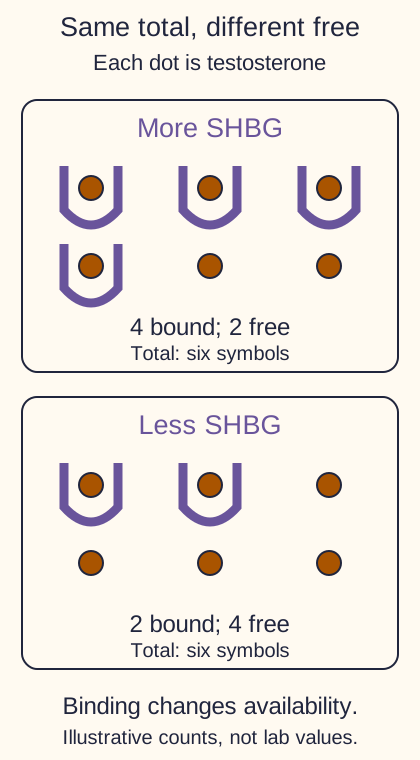
Insulin resistance is common but varies across phenotypes and body sizes. Compensatory hyperinsulinemia can reinforce ovarian androgen production and reduce hepatic production of sex hormone-binding globulin, or SHBG. Less SHBG can leave a larger free testosterone fraction even when total testosterone changes little. Androgens can affect terminal hair growth, sebaceous activity, and follicular development. Insulin resistance is an important contributor, not a mandatory criterion or the sole cause in every patient. [1][2]
Original conceptual binding model. Symbol counts explain availability, not measured hormone fractions. Less binding protein can increase the free fraction without an increase in the total amount. [2]
Predict, then count: keep the six testosterone symbols constant and compare the unbound symbols. What changes when SHBG falls? The free pool becomes larger. Transfer that relationship to a combined pill: an estrogen-related increase in SHBG can lower free testosterone even when the measured total changes little. Improvement in terminal hair growth takes months, not days.
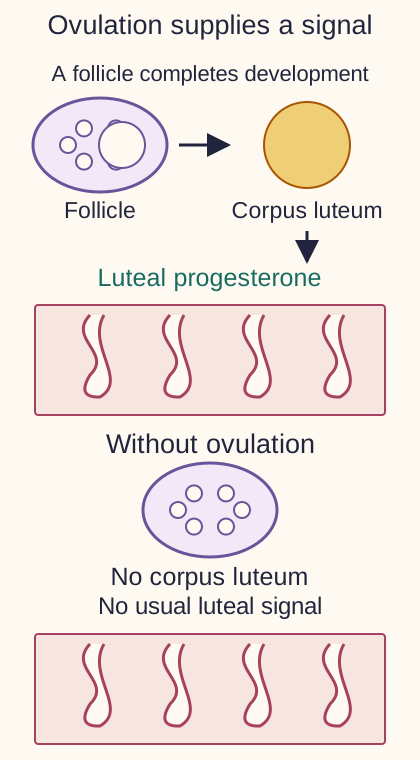
Many small follicles may accumulate without a normally selected dominant follicle completing development and ovulating. These are follicles, not a collection of pathological cysts that must be drained. The peripheral pattern sometimes called a string of pearls is neither necessary nor sufficient for the syndrome. Failure to ovulate also prevents the usual corpus luteum and luteal progesterone rise. That last link explains the endometrial problem. [1][2]
Try it here · Checkpoint 1 of 3
Make your prediction before reading the choices. A first attempt is just a starting point.
Case 1
Show answer and explanations for case 1
A. Reduced hepatic SHBG synthesis during hyperinsulinemia (Best answer)
Total testosterone includes bound hormone; free testosterone is the unbound fraction. Less binding protein can increase the free fraction, while acanthosis supports a possible insulin-resistant context. Low SHBG can explain excess free androgen without a high total value; insulin resistance itself is not a required PCOS criterion.
Reasoning steps for option A
What feature in this case makes "Reduced hepatic SHBG synthesis during hyperinsulinemia" initially plausible?
Total testosterone includes bound hormone; free testosterone is the unbound fraction.
Which finding most strongly separates "Reduced hepatic SHBG synthesis during hyperinsulinemia" from the best answer?
Less binding protein can increase the free fraction, while acanthosis supports a possible insulin-resistant context.
What decision rule resolves whether "Reduced hepatic SHBG synthesis during hyperinsulinemia" fits this case?
Low SHBG can explain excess free androgen without a high total value; insulin resistance itself is not a required PCOS criterion.
B. Reduced LH stimulation of ovarian androgen synthesis (Why this does not fit)
Reducing LH stimulation can reduce androgen production by ovarian theca cells. The discrepancy between a normal total value and a high free fraction points to the measured low binding protein. When the question asks about hormone availability, account for binding as well as synthesis.
Reasoning steps for option B
What feature in this case makes "Reduced LH stimulation of ovarian androgen synthesis" initially plausible?
Reducing LH stimulation can reduce androgen production by ovarian theca cells.
Which finding most strongly separates "Reduced LH stimulation of ovarian androgen synthesis" from the best answer?
The discrepancy between a normal total value and a high free fraction points to the measured low binding protein.
What decision rule resolves whether "Reduced LH stimulation of ovarian androgen synthesis" fits this case?
When the question asks about hormone availability, account for binding as well as synthesis.
C. Reduced androgen sensitivity in terminal hair follicles (Why this does not fit)
Less tissue responsiveness would tend to lessen androgen effects at a given hormone exposure. Reduced receptor sensitivity does not explain low circulating SHBG with high calculated free testosterone, and the patient has increasing terminal hair. Receptor responsiveness and plasma hormone binding are different physiological variables.
Reasoning steps for option C
What feature in this case makes "Reduced androgen sensitivity in terminal hair follicles" initially plausible?
Less tissue responsiveness would tend to lessen androgen effects at a given hormone exposure.
Which finding most strongly separates "Reduced androgen sensitivity in terminal hair follicles" from the best answer?
Reduced receptor sensitivity does not explain low circulating SHBG with high calculated free testosterone, and the patient has increasing terminal hair.
What decision rule resolves whether "Reduced androgen sensitivity in terminal hair follicles" fits this case?
Receptor responsiveness and plasma hormone binding are different physiological variables.
D. Increased hepatic SHBG synthesis during estrogen exposure (Why this does not fit)
More SHBG binds a greater proportion of testosterone and can reduce its free fraction. SHBG is low, not high, and the free testosterone is above its reference interval. Use the direction of the binding-protein change rather than total testosterone alone.
Reasoning steps for option D
What feature in this case makes "Increased hepatic SHBG synthesis during estrogen exposure" initially plausible?
More SHBG binds a greater proportion of testosterone and can reduce its free fraction.
Which finding most strongly separates "Increased hepatic SHBG synthesis during estrogen exposure" from the best answer?
SHBG is low, not high, and the free testosterone is above its reference interval.
What decision rule resolves whether "Increased hepatic SHBG synthesis during estrogen exposure" fits this case?
Use the direction of the binding-protein change rather than total testosterone alone.
Takeaway: A normal-range total testosterone does not exclude excess free androgen when SHBG is low.
Ask whether changes have developed gradually over years or rapidly over months. Infrequent cycles with progressive hirsutism support the usual PCOS pattern. Hirsutism means terminal hair in androgen-sensitive areas; patients may have already treated or concealed it. Acne and female-pattern scalp hair loss matter, but either finding alone is a relatively weak predictor of biochemical hyperandrogenism. Neither higher body weight nor acanthosis is required. [1]
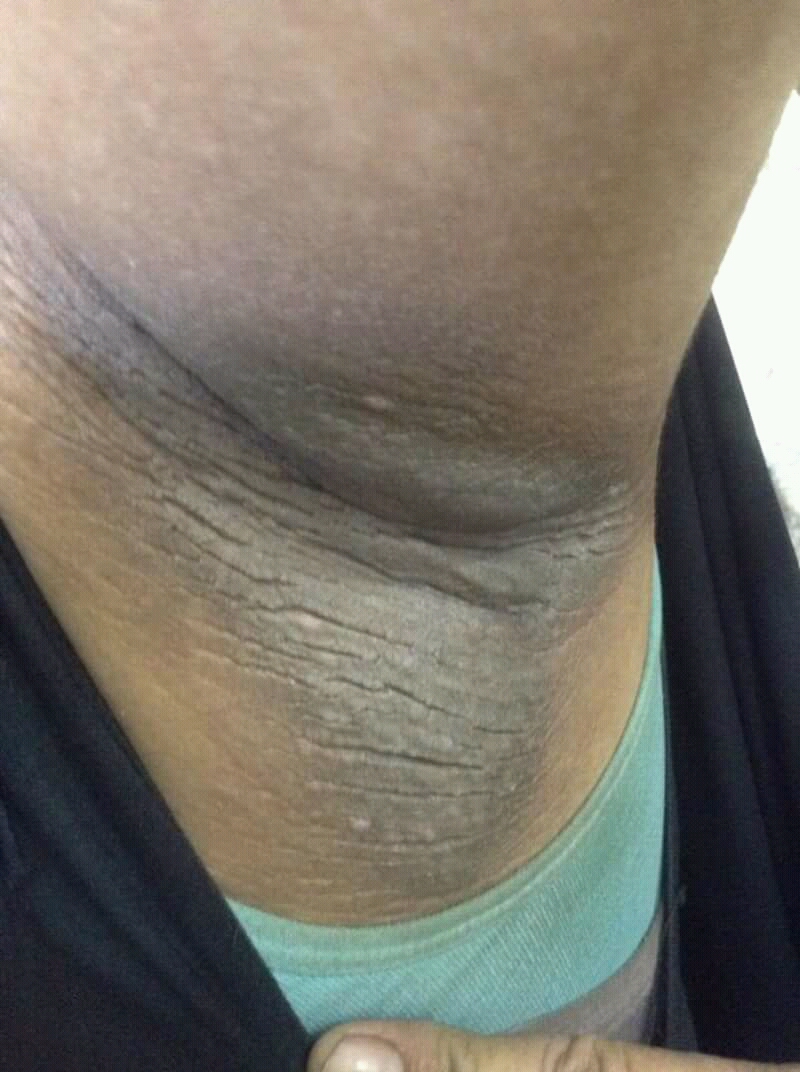
Acanthosis nigricans is a reason to assess metabolic risk, not proof of PCOS or of a particular glucose value. The photograph does not establish its subject's ovarian diagnosis. Photo: Masryyy, 2017, CC BY-SA 4.0; unchanged original. Source and attribution.
Look before naming the syndrome: identify texture as well as color in the photograph. The thickened folds suggest acanthosis, which should prompt metabolic assessment. Now add a different history: new voice deepening and clitoral enlargement over three months. That history requires an urgent androgen-excess assessment even if acanthosis is also present.
Rapid progression, virilization, or androgen values substantially above the assay's reference interval raise concern for an ovarian or adrenal tumor, hyperthecosis, or another non-PCOS cause. Some tumors produce only moderate biochemical abnormalities, so a numerical threshold must not overrule the clinical course. DHEAS predominantly reflects adrenal production; testosterone alone does not perfectly localize a source. Verify unexpected assays and arrange appropriate specialist assessment and imaging rather than masking symptoms and postponing investigation. [4]
Count independent features only after considering alternatives
For adults, the current Rotterdam-based approach requires two of three features after excluding other causes: ovulatory dysfunction; clinical or biochemical hyperandrogenism; and polycystic ovarian morphology. Adults with both irregular cycles and hyperandrogenism do not need ultrasound or AMH to establish the diagnosis. A normal scan cannot cancel those two features. Conversely, an incidental multifollicular ovary in someone without the other features does not establish PCOS. [1]
From three years after menarche to perimenopause, cycles shorter than 21 or longer than 35 days, or fewer than eight cycles yearly, warrant consideration of ovulatory dysfunction. Regular bleeding does not invariably prove ovulation; appropriately timed progesterone can help when that distinction matters. Total and free testosterone should be assessed with accurate methods and appropriate reference ranges. Combined pills alter SHBG and androgen production; when biochemical assessment is essential, the guideline advises at least three months off the pill with other contraception arranged. Do not stop effective treatment merely to repeat a test that will not change care. [1]
In adults, AMH may substitute for ultrasound to define the morphology component within the diagnostic algorithm. It is not a stand-alone test. AMH and ultrasound are alternative measures of the same morphology criterion, not two independent diagnostic features. Cutoffs depend on the assay and population. With adequate adult ultrasound technology, at least 20 follicles in one ovary supports polycystic morphology; older or limited imaging may use ovarian volume of at least 10 mL. Technique, follicle size, and dominant follicles affect interpretation. A sketch is not a diagnostic scan. [1]
Adolescents need both persistent menstrual irregularity appropriate to time since menarche and clinical or biochemical hyperandrogenism. Irregularity is common during the first postmenarchal year. Between one and three years, intervals outside 21 to 45 days warrant assessment; any interval longer than 90 days after the first year also warrants assessment. Ultrasound and AMH are not recommended for adolescent diagnosis. When only one required feature is present, address symptoms and arrange reassessment rather than forcing the adult two-of-three rule onto puberty. [1]
A missed period
Exclude pregnancy first. PCOS does not prevent intermittent ovulation or conception.
Irregular cycles with possible androgen excess
Assess TSH, prolactin, and early-morning 17-hydroxyprogesterone. A borderline 17-hydroxyprogesterone requires an appropriately interpreted cosyntropin assessment, not an automatic diagnosis of nonclassic 21-hydroxylase deficiency.
Galactorrhea, headache, or visual symptoms
Consider hyperprolactinemia and its causes, including medications and pituitary disease. Confirm and investigate an abnormal result.
Hot flashes, vaginal dryness, low estradiol
High FSH suggests primary ovarian insufficiency; low or inappropriately normal gonadotropins with energy deficit suggest hypothalamic suppression.
Assess glucocorticoid exposure and consider validated cortisol testing. A random cortisol is not an appropriate Cushing screening test.
When low estradiol is accompanied by high FSH before age 40, consider premature ovarian insufficiency rather than PCOS. After discussing genetic implications, non-iatrogenic cases warrant chromosomal analysis and FMR1 premutation testing as part of etiologic evaluation. A family history strengthens that concern but is not required for testing. [14]
Choose cortisol testing around confounders. Oral estrogen raises cortisol-binding globulin and can distort serum-cortisol suppression tests; rotating night shifts undermine fixed-clock late-night salivary sampling. Two complete 24-hour urinary free cortisol collections can be useful when renal function is adequate. An abnormal screen needs endocrine confirmation before localization imaging. [11]
Compare two people: an adult with five cycles yearly, hirsutism, and normal exclusion tests already has two diagnostic features without imaging. An adolescent with similar cycles but only mild acne has not necessarily met the hyperandrogenism requirement. Age since menarche changes how the same cycle history is interpreted. [1][3][9][10][11]
Try it here · Checkpoint 2 of 3
Make your prediction before reading the choices. A first attempt is just a starting point.
Case 3
Show answer and explanations for case 3
A. Use the LH-to-FSH ratio to decide whether to assign PCOS (Why this does not fit)
Relative LH excess can occur in PCOS, so an LH-to-FSH ratio may seem supportive. The ratio is not a diagnostic criterion, and this adult already has ovulatory dysfunction and hyperandrogenism after appropriate exclusions. Use the validated diagnostic features rather than a variable gonadotropin ratio.
Reasoning steps for option A
What feature in this case makes "Use the LH-to-FSH ratio to decide whether to assign PCOS" initially plausible?
Relative LH excess can occur in PCOS, so an LH-to-FSH ratio may seem supportive.
Which finding most strongly separates "Use the LH-to-FSH ratio to decide whether to assign PCOS" from the best answer?
The ratio is not a diagnostic criterion, and this adult already has ovulatory dysfunction and hyperandrogenism after appropriate exclusions.
What decision rule resolves whether "Use the LH-to-FSH ratio to decide whether to assign PCOS" fits this case?
Use the validated diagnostic features rather than a variable gonadotropin ratio.
B. Diagnose PCOS using the established non-imaging features (Best answer)
Infrequent cycles support ovulatory dysfunction, and the hair pattern with high testosterone supports hyperandrogenism. After the described exclusions, those two independent findings establish the adult diagnostic criteria without requiring polycystic morphology. Normal ovarian imaging cannot veto two other established adult diagnostic features.
Reasoning steps for option B
What feature in this case makes "Diagnose PCOS using the established non-imaging features" initially plausible?
Infrequent cycles support ovulatory dysfunction, and the hair pattern with high testosterone supports hyperandrogenism.
Which finding most strongly separates "Diagnose PCOS using the established non-imaging features" from the best answer?
After the described exclusions, those two independent findings establish the adult diagnostic criteria without requiring polycystic morphology.
What decision rule resolves whether "Diagnose PCOS using the established non-imaging features" fits this case?
Normal ovarian imaging cannot veto two other established adult diagnostic features.
C. Classify the hair growth as idiopathic after the normal scan (Why this does not fit)
Normal androgen evaluation and normal ovulatory function support that consideration. Five cycles yearly and testosterone above the laboratory range do not. A normal scan does not convert endocrine and ovulatory abnormalities into isolated hair growth.
Reasoning steps for option C
What feature in this case makes "Classify the hair growth as idiopathic after the normal scan" initially plausible?
Normal androgen evaluation and normal ovulatory function support that consideration.
Which finding most strongly separates "Classify the hair growth as idiopathic after the normal scan" from the best answer?
Five cycles yearly and testosterone above the laboratory range do not.
What decision rule resolves whether "Classify the hair growth as idiopathic after the normal scan" fits this case?
A normal scan does not convert endocrine and ovulatory abnormalities into isolated hair growth.
D. Use serum AMH to decide whether the required features are met (Why this does not fit)
AMH can substitute for ultrasound to assess the morphology component in adults. Ovulatory dysfunction and hyperandrogenism already provide two independent features, so AMH is not needed to determine whether the criteria are met. Do not require a morphology test when the other two adult features are established.
Reasoning steps for option D
What feature in this case makes "Use serum AMH to decide whether the required features are met" initially plausible?
AMH can substitute for ultrasound to assess the morphology component in adults.
Which finding most strongly separates "Use serum AMH to decide whether the required features are met" from the best answer?
Ovulatory dysfunction and hyperandrogenism already provide two independent features, so AMH is not needed to determine whether the criteria are met.
What decision rule resolves whether "Use serum AMH to decide whether the required features are met" fits this case?
Do not require a morphology test when the other two adult features are established.
Takeaway: In an adult, ovulatory dysfunction and hyperandrogenism can establish PCOS after appropriate exclusion without abnormal ovarian imaging.
A bleed, ovulation, and endometrial protection are not interchangeable
Why can someone who seldom menstruates still have estrogen-stimulated endometrium? In chronic anovulation, estrogen exposure can continue without the usual luteal progesterone response. The lining is not simply resting. Prolonged untreated amenorrhea, higher weight, type 2 diabetes, and persistently thickened endometrium add risk for hyperplasia and endometrial cancer. Relative risk is increased, but the absolute chance remains low; routine cancer screening is not recommended for everyone with PCOS. [1]
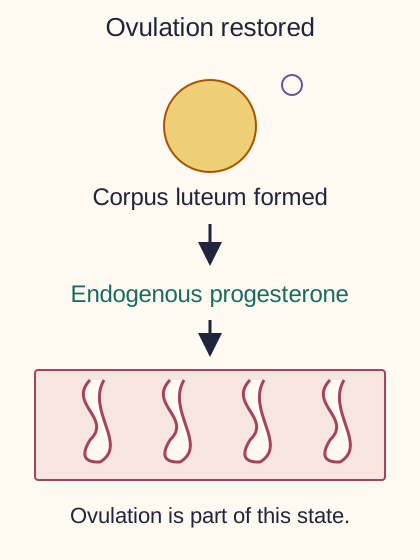
This schematic shows the missing luteal signal. The gland drawings are conceptual and do not diagnose hyperplasia. Lining thickness is not drawn to a numerical scale. [1][10]
When pregnancy is not being pursued and anovulation persists, discuss an appropriate progestogen strategy: a combined hormonal contraceptive when safe, a levonorgestrel intrauterine device, or regular cyclic oral progestogen. Regimen choice depends on preferences, contraindications, bleeding, and pregnancy plans. A withdrawal bleed after a prescribed progestin course does not prove that an egg was released.
A progestin-releasing IUD can keep the lining suppressed even when bleeding stops; a monthly bleed is not intrinsically necessary for protection. Cyclic oral progestogen used for the lining is not reliable contraception. Conversely, a copper IUD provides contraception without progestogen, so persistent anovulation still needs a separate lining-protection plan. [1][10][13]
Change the signal, then compare the tissues
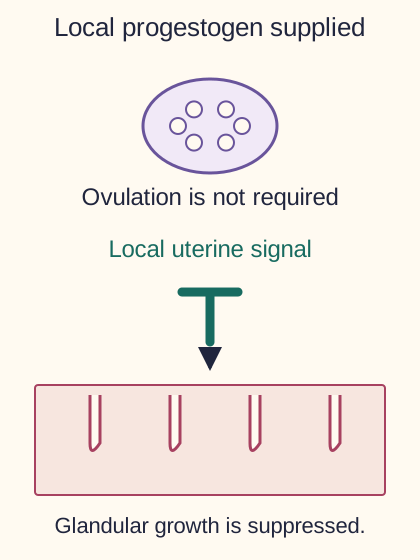
Begin with anovulation in the figure above. Predict which tissue will respond to each intervention. Select either intervention to inspect its corresponding ovarian and endometrial state. These are conditional teaching examples, not dose instructions or guaranteed treatment responses.
Apply a progestogen directly to the lining
The ovarian state has not been forced to ovulate. The endometrial state changes because progestogen acts on it directly. With a levonorgestrel IUD, endometrial suppression and contraception do not require uniform suppression of ovulation.
Compare the ovary first, then the lining. Endometrial protection can improve without restoring an ovulatory cycle. An absent bleed with a correctly functioning progestin IUD is different from prolonged untreated anovulation.
Restore ovulation and form a corpus luteum
Here the ovary changes first. Successful ovulation produces a corpus luteum and endogenous luteal progesterone. A fertility drug prescription alone does not establish that this response occurred.
Both examples supply a progesterone-like signal to the endometrium, but only this example includes documented ovulation. Transfer the comparison to a patient who bleeds after cyclic progestin: the bleed alone cannot tell you that fertility has been restored.
Persistent abnormal bleeding or concerning endometrial thickening requires evaluation rather than simply adding a metabolic drug. Consider biopsy according to the bleeding pattern and risk factors; there is no single universal premenopausal ultrasound thickness cutoff that safely answers every case. A patient with prolonged anovulation and persistent heavy or intermenstrual bleeding needs diagnostic assessment, not routine reassurance. [1]
Choose a target, then check the treatment's limits
Ask what matters most now: predictable bleeding, hair or acne symptoms, contraception, metabolic health, or pregnancy. Sustainable physical activity, nutrition, sleep, and behavioral support benefit health at any body size. Discuss weight goals without stigma when relevant, but do not require weight loss before providing care. Benefits can occur without weight loss, and improvement does not guarantee ovulation or eliminate future risk. [1]
For someone not seeking pregnancy, a combined oral contraceptive can address irregular bleeding and androgen-related symptoms while its progestin component protects the endometrium. Estrogen increases SHBG; gonadotropin suppression also reduces ovarian androgen production. The treatment is not an androgen-receptor blocker and does not destroy theca cells. Assess blood pressure, migraine history, thrombosis risk, smoking, drug interactions, and preferences. Migraine with aura is an unacceptable-risk setting for combined hormonal contraception under U.S. MEC. A progestin-only strategy can address the lining when estrogen is unsuitable. [1][5]
For persistent distressing hirsutism after at least six months of a combined pill and/or cosmetic treatment, consider an antiandrogen such as spironolactone with effective contraception when pregnancy is possible. Hair response is slow because hair growth cycles are slow. Spironolactone is neither a contraceptive nor an ovulation-induction drug and does not replace progestogen protection. Avoid exposure during pregnancy because antiandrogen activity and animal data raise concern about male fetal sexual differentiation; human data are limited, not proof of a quantified human malformation rate.
Review kidney function, potassium, and interacting medications. Before conception attempts, arrange withdrawal while contraception remains in place; mechanical hair removal can address recurrent symptoms without systemic antiandrogen exposure. [1][6]
Metformin is primarily a metabolic option, especially with BMI at least 25 kg/m² or important metabolic risk. It may help cycles, including when combined pills are unsuitable, but persistent anovulation still needs an explicit endometrial plan. It is not the preferred hirsutism treatment. Metformin and a combined pill can serve complementary goals, particularly with impaired glucose tolerance or BMI above 30. Discuss gastrointestinal effects, gradual titration, and possible vitamin B12 reduction with longer use. Improvement in glucose or hair does not demonstrate that the other treatment goals have been met. [1]
Change one constraint: a patient wants contraception and endometrial protection but has migraine with aura. A combined pill addresses the goals yet fails the safety check. A suitable progestin-releasing IUD addresses both goals without estrogen; cyclic oral progestogen addresses the lining but needs a separate contraception plan. The safest choice must satisfy both the goal and the constraint.
Assess glycemia at diagnosis and repeat every one to three years according to risk. A 75-g oral glucose tolerance test is the most accurate assessment in PCOS regardless of BMI; fasting glucose and HbA1c are alternatives with reduced accuracy when an OGTT is not possible. Routine insulin assays are not recommended to diagnose insulin resistance in ordinary care.
Obtain lipids at diagnosis and check blood pressure at least annually; repeat lipid testing according to risk. A normal fasting result or regular bleeding on treatment does not cancel metabolic surveillance. Offer an OGTT when planning pregnancy; a new preconception indication can precede the next routine screening date. [1]
Ask about snoring, unrefreshing sleep, and daytime sleepiness; suspected obstructive sleep apnea warrants appropriate assessment, including a sleep study when indicated. Metabolic dysfunction-associated steatotic liver disease, historically termed fatty liver, can coexist with metabolic risk, but its evaluation follows the clinical picture rather than an automatic annual liver ultrasound for every patient. Include depression, anxiety, eating concerns, and the burden of hair or fertility symptoms in care. PCOS is not merely cosmetic, and these concerns deserve treatment rather than dismissal. [1][2]
Try it here · Checkpoint 3 of 3
Make your prediction before reading the choices. A first attempt is just a starting point.
Case 15
Show answer and explanations for case 15
A. Copper-containing intrauterine contraceptive (Why this does not fit)
A copper IUD provides highly effective non-estrogen contraception. The copper device does not supply progestogen protection during persistent anovulation. Nonhormonal contraception does not automatically address endometrial risk.
Reasoning steps for option A
What feature in this case makes "Copper-containing intrauterine contraceptive" initially plausible?
A copper IUD provides highly effective non-estrogen contraception.
Which finding most strongly separates "Copper-containing intrauterine contraceptive" from the best answer?
The copper device does not supply progestogen protection during persistent anovulation.
What decision rule resolves whether "Copper-containing intrauterine contraceptive" fits this case?
Nonhormonal contraception does not automatically address endometrial risk.
B. 52-mg levonorgestrel intrauterine device (Best answer)
The recurrent spreading visual symptoms are consistent with migraine aura, making estrogen-containing combined contraception inappropriate even without smoking or hypertension. The levonorgestrel IUD provides effective contraception and a local progestogenic endometrial effect. Choose a method that satisfies the safety restriction and both requested goals.
Reasoning steps for option B
What feature in this case makes "52-mg levonorgestrel intrauterine device" initially plausible?
The recurrent spreading visual symptoms are consistent with migraine aura, making estrogen-containing combined contraception inappropriate even without smoking or hypertension.
Which finding most strongly separates "52-mg levonorgestrel intrauterine device" from the best answer?
The levonorgestrel IUD provides effective contraception and a local progestogenic endometrial effect.
What decision rule resolves whether "52-mg levonorgestrel intrauterine device" fits this case?
Choose a method that satisfies the safety restriction and both requested goals.
C. Intermittent oral medroxyprogesterone courses (Why this does not fit)
Cyclic oral progestogen can provide an endometrial protection strategy. These courses are not reliable ongoing contraception. Endometrial therapy and contraception must each be explicitly accounted for.
Reasoning steps for option C
What feature in this case makes "Intermittent oral medroxyprogesterone courses" initially plausible?
Cyclic oral progestogen can provide an endometrial protection strategy.
Which finding most strongly separates "Intermittent oral medroxyprogesterone courses" from the best answer?
These courses are not reliable ongoing contraception.
What decision rule resolves whether "Intermittent oral medroxyprogesterone courses" fits this case?
Endometrial therapy and contraception must each be explicitly accounted for.
D. Low-dose estrogen-progestin contraceptive (Why this does not fit)
A combined pill can provide contraception, cycle control, and endometrial protection. Migraine with aura is category 4 for combined hormonal contraception. Meeting treatment goals does not cancel an independent safety contraindication.
Reasoning steps for option D
What feature in this case makes "Low-dose estrogen-progestin contraceptive" initially plausible?
A combined pill can provide contraception, cycle control, and endometrial protection.
Which finding most strongly separates "Low-dose estrogen-progestin contraceptive" from the best answer?
Migraine with aura is category 4 for combined hormonal contraception.
What decision rule resolves whether "Low-dose estrogen-progestin contraceptive" fits this case?
Meeting treatment goals does not cancel an independent safety contraindication.
Takeaway: With migraine with aura, a suitable progestin-releasing IUD can meet contraceptive and endometrial goals without estrogen.
Restore ovulation without forgetting the rest of reproduction
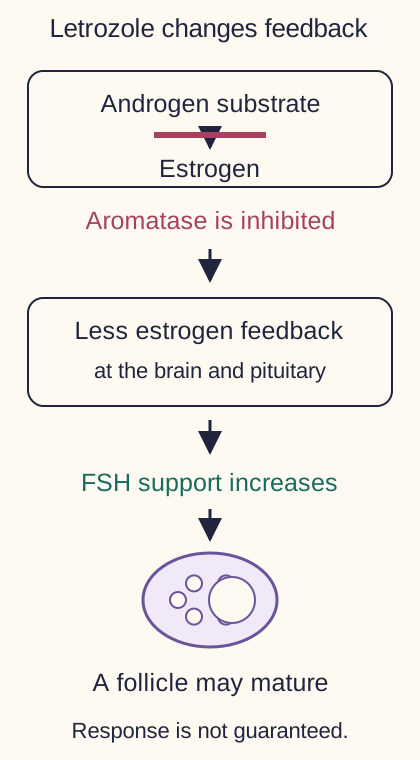
For anovulatory infertility due to PCOS with no other infertility factor, letrozole is first-line pharmacologic ovulation induction. Check pregnancy status, review semen assessment and the need for tubal evaluation, and optimize preconception blood pressure, glycemia, medications, and folate. PCOS does not explain every unsuccessful conception attempt. Prior pelvic inflammatory disease increases concern about tubal damage; semen and indicated tubal assessment should inform treatment instead of attributing infertility solely to infrequent ovulation. [15] Clomiphene is an alternative in appropriate settings; gonadotropins and assisted reproduction require specialist selection and monitoring. Local approvals and off-label use should be discussed. [1]
Original feedback diagram. Letrozole changes endogenous signaling; it does not bind an FSH receptor as an injected gonadotropin would. The follicle depicts a possible response, not guaranteed pregnancy. [1][7]
Predict the direction: temporarily reducing estrogen synthesis reduces its negative feedback, permitting increased FSH support. Clomiphene instead modifies estrogen-receptor signaling. Now change the goal to avoiding pregnancy: inducing ovulation no longer solves the patient's problem. A familiar drug name is not enough; its physiological effect must fit the goal.
In the major randomized comparison, live birth occurred in 103 of 374 participants assigned letrozole and 72 of 376 assigned clomiphene, approximately 27.5% versus 19.1%. That is about 8.4 percentage points higher, not 44 percentage points; the reported relative rate was 1.44. These are trial averages, not individual predictions. Letrozole's first-line role is not restricted to patients with obesity. Metformin may be used in selected fertility strategies, but more effective ovulation agents exist. Combined contraception and spironolactone are not treatments for conception. [7][1]
Ovarian hyperstimulation syndrome is especially associated with gonadotropin stimulation and hCG exposure, not ordinary untreated PCOS or a typical response to an oral agent alone. VEGF-mediated vascular permeability can shift fluid into the abdomen while depleting the circulation. Bilateral ovarian enlargement, rapid distension, ascites, hemoconcentration, breathlessness, or reduced urine output after stimulation require prompt specialist or emergency assessment. Thrombotic and renal complications can occur. Sudden focal severe pain also requires consideration of torsion; pain and bleeding in a pregnancy require evaluation for ectopic pregnancy. These alternatives can coexist with stimulated ovaries. [8]
Apply the lesson
Use the patient's findings and goals to choose one best answer. Optional help and explanations are available without requiring a wrong attempt. These original educational cases are not patient records or recalled examination items.
Case 2
Show answer and explanations for case 2
A. Increased ovarian androgen output; increased hepatic SHBG synthesis (Why this does not fit)
Greater ovarian androgen production would tend to raise rather than lower total testosterone. Increased binding can lower the free fraction, but it does not explain the proposed rise in ovarian output when LH and total testosterone have fallen. The ovarian component of this pair has the wrong direction.
Reasoning steps for option A
What feature in this case makes "Increased ovarian androgen output; increased hepatic SHBG synthesis" initially plausible?
Greater ovarian androgen production would tend to raise rather than lower total testosterone.
Which finding most strongly separates "Increased ovarian androgen output; increased hepatic SHBG synthesis" from the best answer?
Increased binding can lower the free fraction, but it does not explain the proposed rise in ovarian output when LH and total testosterone have fallen.
What decision rule resolves whether "Increased ovarian androgen output; increased hepatic SHBG synthesis" fits this case?
The ovarian component of this pair has the wrong direction.
Lower gonadotropin drive supports reduced theca-cell androgen production and contributes to the lower total testosterone. The free fraction falls from about 1% to 0.5% after converting total testosterone to pg/mL; increased hepatic SHBG provides the complementary binding effect. The combined pill can reduce ovarian androgen production and increase circulating androgen binding at the same time.
Reasoning steps for option B
What feature in this case makes "Reduced ovarian androgen output; increased hepatic SHBG synthesis" initially plausible?
Lower gonadotropin drive supports reduced theca-cell androgen production and contributes to the lower total testosterone.
Which finding most strongly separates "Reduced ovarian androgen output; increased hepatic SHBG synthesis" from the best answer?
The free fraction falls from about 1% to 0.5% after converting total testosterone to pg/mL; increased hepatic SHBG provides the complementary binding effect.
What decision rule resolves whether "Reduced ovarian androgen output; increased hepatic SHBG synthesis" fits this case?
The combined pill can reduce ovarian androgen production and increase circulating androgen binding at the same time.
C. Reduced ovarian androgen output; reduced hepatic SHBG synthesis (Why this does not fit)
Reduced ovarian androgen production fits lower gonadotropin drive and a lower total testosterone concentration. Less SHBG would tend to increase the free fraction, whereas free testosterone fell proportionally more than total testosterone with stable albumin. The binding component must increase, not decrease, to fit these data.
Reasoning steps for option C
What feature in this case makes "Reduced ovarian androgen output; reduced hepatic SHBG synthesis" initially plausible?
Reduced ovarian androgen production fits lower gonadotropin drive and a lower total testosterone concentration.
Which finding most strongly separates "Reduced ovarian androgen output; reduced hepatic SHBG synthesis" from the best answer?
Less SHBG would tend to increase the free fraction, whereas free testosterone fell proportionally more than total testosterone with stable albumin.
What decision rule resolves whether "Reduced ovarian androgen output; reduced hepatic SHBG synthesis" fits this case?
The binding component must increase, not decrease, to fit these data.
D. Increased ovarian androgen output; reduced hepatic SHBG synthesis (Why this does not fit)
Greater ovarian output and less binding would tend to increase the amount of unbound androgen. Both measured concentrations fall, and the free fraction also falls, the opposite of this combination. Distinguish reduced production from increased binding rather than treating total and free concentrations as interchangeable.
Reasoning steps for option D
What feature in this case makes "Increased ovarian androgen output; reduced hepatic SHBG synthesis" initially plausible?
Greater ovarian output and less binding would tend to increase the amount of unbound androgen.
Which finding most strongly separates "Increased ovarian androgen output; reduced hepatic SHBG synthesis" from the best answer?
Both measured concentrations fall, and the free fraction also falls, the opposite of this combination.
What decision rule resolves whether "Increased ovarian androgen output; reduced hepatic SHBG synthesis" fits this case?
Distinguish reduced production from increased binding rather than treating total and free concentrations as interchangeable.
Takeaway: A falling total androgen concentration and a disproportionately falling free fraction can reflect two treatment sites: reduced ovarian production and increased hepatic SHBG.
A. Two morphology criteria; recent ovulation supported (Why this does not fit)
Progesterone of 8.4 ng/mL one week before menses supports recent ovulation. AMH and ultrasound are alternative assessments of the same morphology criterion, not separate features. A correct assessment of ovarian function does not justify double-counting morphology.
Reasoning steps for option A
What feature in this case makes "Two morphology criteria; recent ovulation supported" initially plausible?
Progesterone of 8.4 ng/mL one week before menses supports recent ovulation.
Which finding most strongly separates "Two morphology criteria; recent ovulation supported" from the best answer?
AMH and ultrasound are alternative assessments of the same morphology criterion, not separate features.
What decision rule resolves whether "Two morphology criteria; recent ovulation supported" fits this case?
A correct assessment of ovarian function does not justify double-counting morphology.
B. One morphology criterion; recent ovulation unsupported (Why this does not fit)
The scan and AMH supply one morphology criterion. The appropriately timed endogenous progesterone result supports recent ovulation; a follicle-rich ovary can still ovulate. Interpret ovarian function from functional evidence rather than from morphology alone.
Reasoning steps for option B
What feature in this case makes "One morphology criterion; recent ovulation unsupported" initially plausible?
The scan and AMH supply one morphology criterion.
Which finding most strongly separates "One morphology criterion; recent ovulation unsupported" from the best answer?
The appropriately timed endogenous progesterone result supports recent ovulation; a follicle-rich ovary can still ovulate.
What decision rule resolves whether "One morphology criterion; recent ovulation unsupported" fits this case?
Interpret ovarian function from functional evidence rather than from morphology alone.
C. One morphology criterion; recent ovulation supported (Best answer)
Serum progesterone above 3 ng/mL approximately one week before menses supports recent ovulation; one measurement does not grade luteal quality or establish ovulation in every cycle. AMH and ultrasound describe the same morphology criterion. With no demonstrated hyperandrogenism or ovulatory dysfunction, these results do not establish PCOS. Count independent features, not positive tests; routinely obtaining both AMH and ultrasound can promote overdiagnosis.
Reasoning steps for option C
What feature in this case makes "One morphology criterion; recent ovulation supported" initially plausible?
Serum progesterone above 3 ng/mL approximately one week before menses supports recent ovulation; one measurement does not grade luteal quality or establish ovulation in every cycle.
Which finding most strongly separates "One morphology criterion; recent ovulation supported" from the best answer?
AMH and ultrasound describe the same morphology criterion. With no demonstrated hyperandrogenism or ovulatory dysfunction, these results do not establish PCOS.
What decision rule resolves whether "One morphology criterion; recent ovulation supported" fits this case?
Count independent features, not positive tests; routinely obtaining both AMH and ultrasound can promote overdiagnosis.
D. Two morphology criteria; recent ovulation unsupported (Why this does not fit)
The scan and AMH are separate tests, but they assess the same diagnostic component. Progesterone exceeds 3 ng/mL at the appropriate cycle time without exogenous hormones, supporting recent ovulation despite the follicle count. Neither double-counting morphology nor ignoring functional evidence establishes PCOS.
Reasoning steps for option D
What feature in this case makes "Two morphology criteria; recent ovulation unsupported" initially plausible?
The scan and AMH are separate tests, but they assess the same diagnostic component.
Which finding most strongly separates "Two morphology criteria; recent ovulation unsupported" from the best answer?
Progesterone exceeds 3 ng/mL at the appropriate cycle time without exogenous hormones, supporting recent ovulation despite the follicle count.
What decision rule resolves whether "Two morphology criteria; recent ovulation unsupported" fits this case?
Neither double-counting morphology nor ignoring functional evidence establishes PCOS.
Takeaway: Polycystic ovarian morphology alone is not PCOS.
A. Treat current symptoms and arrange diagnostic reassessment (Best answer)
Persistent 50-to-65-day intervals exceed the 45-day threshold for assessment between one and three years after menarche. The required hyperandrogenism is not demonstrated, and ultrasound cannot substitute for that adolescent diagnostic feature. Treat current concerns and follow the trajectory instead of forcing adult morphology criteria onto adolescence.
Reasoning steps for option A
What feature in this case makes "Treat current symptoms and arrange diagnostic reassessment" initially plausible?
Persistent 50-to-65-day intervals exceed the 45-day threshold for assessment between one and three years after menarche.
Which finding most strongly separates "Treat current symptoms and arrange diagnostic reassessment" from the best answer?
The required hyperandrogenism is not demonstrated, and ultrasound cannot substitute for that adolescent diagnostic feature.
What decision rule resolves whether "Treat current symptoms and arrange diagnostic reassessment" fits this case?
Treat current concerns and follow the trajectory instead of forcing adult morphology criteria onto adolescence.
B. Assign PCOS from prolonged cycles and the ovarian appearance (Why this does not fit)
The adult scheme allows ovulatory dysfunction plus morphology after excluding alternatives. Adolescent diagnosis requires hyperandrogenism and persistent cycle irregularity; morphology is not an accepted substitute. Use adolescent criteria when normal pubertal ovarian appearance limits imaging specificity.
Reasoning steps for option B
What feature in this case makes "Assign PCOS from prolonged cycles and the ovarian appearance" initially plausible?
The adult scheme allows ovulatory dysfunction plus morphology after excluding alternatives.
Which finding most strongly separates "Assign PCOS from prolonged cycles and the ovarian appearance" from the best answer?
Adolescent diagnosis requires hyperandrogenism and persistent cycle irregularity; morphology is not an accepted substitute.
What decision rule resolves whether "Assign PCOS from prolonged cycles and the ovarian appearance" fits this case?
Use adolescent criteria when normal pubertal ovarian appearance limits imaging specificity.
C. Measure AMH and apply the adult diagnostic morphology rule (Why this does not fit)
AMH could appear to provide a biochemical confirmation of the follicle-rich scan. AMH is not recommended for adolescent diagnosis, and adult cutoffs are not interchangeable across assays or ages. Do not replace a nonspecific adolescent scan with another nonrecommended morphology marker.
Reasoning steps for option C
What feature in this case makes "Measure AMH and apply the adult diagnostic morphology rule" initially plausible?
AMH could appear to provide a biochemical confirmation of the follicle-rich scan.
Which finding most strongly separates "Measure AMH and apply the adult diagnostic morphology rule" from the best answer?
AMH is not recommended for adolescent diagnosis, and adult cutoffs are not interchangeable across assays or ages.
What decision rule resolves whether "Measure AMH and apply the adult diagnostic morphology rule" fits this case?
Do not replace a nonspecific adolescent scan with another nonrecommended morphology marker.
D. Reassess cycle irregularity only after three years postmenarche (Why this does not fit)
Cycle irregularity is especially common during the first year after menarche. She is beyond the first year and repeatedly exceeds the 45-day interval used for assessment, so waiting until year three would delay indicated care. Avoid both premature labeling and dismissal of persistent menstrual concerns.
Reasoning steps for option D
What feature in this case makes "Reassess cycle irregularity only after three years postmenarche" initially plausible?
Cycle irregularity is especially common during the first year after menarche.
Which finding most strongly separates "Reassess cycle irregularity only after three years postmenarche" from the best answer?
She is beyond the first year and repeatedly exceeds the 45-day interval used for assessment, so waiting until year three would delay indicated care.
What decision rule resolves whether "Reassess cycle irregularity only after three years postmenarche" fits this case?
Avoid both premature labeling and dismissal of persistent menstrual concerns.
Takeaway: In adolescents, menstrual irregularity alone deserves care and follow-up but does not establish PCOS without hyperandrogenism.
A. Pelvic MRI to identify a testosterone-secreting ovarian mass (Why this does not fit)
Rapid virilization or marked androgen excess would raise that concern. The borderline 17-hydroxyprogesterone suggests an adrenal steroid-synthesis question that imaging will not resolve. Choose a test that interrogates the abnormal pathway already identified.
Reasoning steps for option A
What feature in this case makes "Pelvic MRI to identify a testosterone-secreting ovarian mass" initially plausible?
Rapid virilization or marked androgen excess would raise that concern.
Which finding most strongly separates "Pelvic MRI to identify a testosterone-secreting ovarian mass" from the best answer?
The borderline 17-hydroxyprogesterone suggests an adrenal steroid-synthesis question that imaging will not resolve.
What decision rule resolves whether "Pelvic MRI to identify a testosterone-secreting ovarian mass" fits this case?
Choose a test that interrogates the abnormal pathway already identified.
B. Cosyntropin stimulation with an adrenal steroid profile (Best answer)
The early-morning follicular LC-MS/MS result is above the local screening interval but below the stated diagnostic range; it is a borderline screen rather than a confirmed diagnosis. Cosyntropin stimulation with an adrenal steroid profile evaluates precursor accumulation using assay-appropriate stimulated thresholds. Do not automatically diagnose nonclassic congenital adrenal hyperplasia or dismiss the abnormal screen as PCOS; interpret stimulation results in the local assay context.
Reasoning steps for option B
What feature in this case makes "Cosyntropin stimulation with an adrenal steroid profile" initially plausible?
The early-morning follicular LC-MS/MS result is above the local screening interval but below the stated diagnostic range; it is a borderline screen rather than a confirmed diagnosis.
Which finding most strongly separates "Cosyntropin stimulation with an adrenal steroid profile" from the best answer?
Cosyntropin stimulation with an adrenal steroid profile evaluates precursor accumulation using assay-appropriate stimulated thresholds.
What decision rule resolves whether "Cosyntropin stimulation with an adrenal steroid profile" fits this case?
Do not automatically diagnose nonclassic congenital adrenal hyperplasia or dismiss the abnormal screen as PCOS; interpret stimulation results in the local assay context.
C. A repeat ovarian follicle count with higher-resolution ultrasound (Why this does not fit)
Higher-resolution follicle imaging can refine the adult morphology assessment. Ovarian morphology does not resolve the borderline adrenal precursor result or exclude a steroid-synthesis disorder. Morphology testing cannot substitute for evaluating a biochemical mimic.
Reasoning steps for option C
What feature in this case makes "A repeat ovarian follicle count with higher-resolution ultrasound" initially plausible?
Higher-resolution follicle imaging can refine the adult morphology assessment.
Which finding most strongly separates "A repeat ovarian follicle count with higher-resolution ultrasound" from the best answer?
Ovarian morphology does not resolve the borderline adrenal precursor result or exclude a steroid-synthesis disorder.
What decision rule resolves whether "A repeat ovarian follicle count with higher-resolution ultrasound" fits this case?
Morphology testing cannot substitute for evaluating a biochemical mimic.
D. A random serum cortisol concentration (Why this does not fit)
Selected validated cortisol tests investigate suspected Cushing syndrome. A random serum cortisol neither confirms nonclassic congenital adrenal hyperplasia nor appropriately screens for Cushing syndrome. A normal random cortisol does not settle an abnormal steroid precursor screen.
Reasoning steps for option D
What feature in this case makes "A random serum cortisol concentration" initially plausible?
Which finding most strongly separates "A random serum cortisol concentration" from the best answer?
A random serum cortisol neither confirms nonclassic congenital adrenal hyperplasia nor appropriately screens for Cushing syndrome.
What decision rule resolves whether "A random serum cortisol concentration" fits this case?
A normal random cortisol does not settle an abnormal steroid precursor screen.
Takeaway: Borderline early-morning 17-hydroxyprogesterone calls for appropriately interpreted cosyntropin testing, not an automatic PCOS or CAH diagnosis.
A. Obtain AMH to establish whether PCOS explains the androgen excess (Why this does not fit)
AMH can assess the adult morphology component within the PCOS diagnostic algorithm. A morphology marker cannot safely explain away rapid virilization and marked adrenal androgen excess. An ovarian reserve-related marker does not replace an urgent androgen source assessment.
Reasoning steps for option A
What feature in this case makes "Obtain AMH to establish whether PCOS explains the androgen excess" initially plausible?
AMH can assess the adult morphology component within the PCOS diagnostic algorithm.
Which finding most strongly separates "Obtain AMH to establish whether PCOS explains the androgen excess" from the best answer?
A morphology marker cannot safely explain away rapid virilization and marked adrenal androgen excess.
What decision rule resolves whether "Obtain AMH to establish whether PCOS explains the androgen excess" fits this case?
An ovarian reserve-related marker does not replace an urgent androgen source assessment.
B. Start a combined pill and use hair response to decide whether imaging is needed (Why this does not fit)
A combined pill can reduce free androgen exposure and improve routine PCOS cycle symptoms. Symptom suppression does not exclude an androgen-producing tumor and would delay source evaluation in this presentation. Do not use symptomatic treatment response to dismiss a dangerous alternative diagnosis.
Reasoning steps for option B
What feature in this case makes "Start a combined pill and use hair response to decide whether imaging is needed" initially plausible?
A combined pill can reduce free androgen exposure and improve routine PCOS cycle symptoms.
Which finding most strongly separates "Start a combined pill and use hair response to decide whether imaging is needed" from the best answer?
Symptom suppression does not exclude an androgen-producing tumor and would delay source evaluation in this presentation.
What decision rule resolves whether "Start a combined pill and use hair response to decide whether imaging is needed" fits this case?
Do not use symptomatic treatment response to dismiss a dangerous alternative diagnosis.
C. Urgent adrenal imaging and specialist assessment of ovarian sources (Best answer)
New voice deepening and clitoromegaly over three months are not the usual gradual PCOS presentation. DHEAS is produced predominantly by the adrenal glands; the marked DHEAS increase prioritizes adrenal imaging, while severe testosterone excess and virilization also warrant ovarian-source assessment. Prompt specialist evaluation should investigate a potentially neoplastic cause rather than defer investigation during an empiric pill trial.
Reasoning steps for option C
What feature in this case makes "Urgent adrenal imaging and specialist assessment of ovarian sources" initially plausible?
New voice deepening and clitoromegaly over three months are not the usual gradual PCOS presentation.
Which finding most strongly separates "Urgent adrenal imaging and specialist assessment of ovarian sources" from the best answer?
DHEAS is produced predominantly by the adrenal glands; the marked DHEAS increase prioritizes adrenal imaging, while severe testosterone excess and virilization also warrant ovarian-source assessment.
What decision rule resolves whether "Urgent adrenal imaging and specialist assessment of ovarian sources" fits this case?
Prompt specialist evaluation should investigate a potentially neoplastic cause rather than defer investigation during an empiric pill trial.
D. Repeat an ovarian follicle count after six months of cycle observation (Why this does not fit)
Cycle follow-up can help characterize uncertain, nonurgent ovulatory patterns. Rapid virilization and confirmed marked androgen excess raise concern for a serious source requiring prompt evaluation. A concerning tempo should accelerate evaluation even before a mass is demonstrated.
Reasoning steps for option D
What feature in this case makes "Repeat an ovarian follicle count after six months of cycle observation" initially plausible?
Cycle follow-up can help characterize uncertain, nonurgent ovulatory patterns.
Which finding most strongly separates "Repeat an ovarian follicle count after six months of cycle observation" from the best answer?
Rapid virilization and confirmed marked androgen excess raise concern for a serious source requiring prompt evaluation.
What decision rule resolves whether "Repeat an ovarian follicle count after six months of cycle observation" fits this case?
A concerning tempo should accelerate evaluation even before a mass is demonstrated.
Takeaway: Rapid virilization and marked androgen excess require urgent source evaluation, not a delayed trial of routine PCOS treatment.
A. Restore energy availability with multidisciplinary support (Best answer)
Low estradiol normally reduces negative feedback, permitting gonadotropin concentrations to increase. The gonadotropins are inappropriately low for the hypoestrogenic state; together with the energy deficit, they support functional hypothalamic suppression after other causes are excluded. Address energy availability with nutritional, exercise, and psychological support and assess associated health risks instead of diagnosing PCOS from follicle morphology.
Reasoning steps for option A
What feature in this case makes "Restore energy availability with multidisciplinary support" initially plausible?
Which finding most strongly separates "Restore energy availability with multidisciplinary support" from the best answer?
The gonadotropins are inappropriately low for the hypoestrogenic state; together with the energy deficit, they support functional hypothalamic suppression after other causes are excluded.
What decision rule resolves whether "Restore energy availability with multidisciplinary support" fits this case?
Address energy availability with nutritional, exercise, and psychological support and assess associated health risks instead of diagnosing PCOS from follicle morphology.
B. Initiate letrozole to stimulate a dominant follicle (Why this does not fit)
Letrozole is used for anovulatory infertility due to PCOS without another infertility factor. She has an energy-deficit pattern with low central drive and is not seeking pregnancy. An ovulation-induction drug is not a substitute for correcting an ongoing energy deficit.
Reasoning steps for option B
What feature in this case makes "Initiate letrozole to stimulate a dominant follicle" initially plausible?
Letrozole is used for anovulatory infertility due to PCOS without another infertility factor.
Which finding most strongly separates "Initiate letrozole to stimulate a dominant follicle" from the best answer?
She has an energy-deficit pattern with low central drive and is not seeking pregnancy.
What decision rule resolves whether "Initiate letrozole to stimulate a dominant follicle" fits this case?
An ovulation-induction drug is not a substitute for correcting an ongoing energy deficit.
C. Use pill-related bleeding to assess ovarian recovery (Why this does not fit)
A combined pill can produce scheduled withdrawal bleeding during its hormone-free interval. That treatment-related bleed does not establish restored endogenous ovulation and can obscure recovery assessment. Scheduled bleeding on exogenous hormones is not a marker of recovered hypothalamic function.
Reasoning steps for option C
What feature in this case makes "Use pill-related bleeding to assess ovarian recovery" initially plausible?
A combined pill can produce scheduled withdrawal bleeding during its hormone-free interval.
Which finding most strongly separates "Use pill-related bleeding to assess ovarian recovery" from the best answer?
That treatment-related bleed does not establish restored endogenous ovulation and can obscure recovery assessment.
What decision rule resolves whether "Use pill-related bleeding to assess ovarian recovery" fits this case?
Scheduled bleeding on exogenous hormones is not a marker of recovered hypothalamic function.
D. Treat the follicle-rich ovarian appearance with metformin (Why this does not fit)
Metformin primarily addresses metabolic features and may help cycle regulation in selected patients with PCOS. The temporal energy deficit and low-estrogen, low-gonadotropin pattern are more explanatory than the follicle count. Treat the demonstrated physiology rather than an isolated ovarian appearance.
Reasoning steps for option D
What feature in this case makes "Treat the follicle-rich ovarian appearance with metformin" initially plausible?
Metformin primarily addresses metabolic features and may help cycle regulation in selected patients with PCOS.
Which finding most strongly separates "Treat the follicle-rich ovarian appearance with metformin" from the best answer?
The temporal energy deficit and low-estrogen, low-gonadotropin pattern are more explanatory than the follicle count.
What decision rule resolves whether "Treat the follicle-rich ovarian appearance with metformin" fits this case?
Treat the demonstrated physiology rather than an isolated ovarian appearance.
Takeaway: Low estrogen with reduced central gonadotropin drive after energy deficit points toward hypothalamic amenorrhea, even with many ovarian follicles.
A. Pituitary MRI and pituitary hormone testing (Why this does not fit)
A central lesion is a consideration when gonadotropin production is deficient or other pituitary findings are present. FSH is markedly increased despite low estradiol, showing preserved pituitary drive rather than deficient gonadotropin production. Investigate an ovarian cause instead of starting with pituitary localization.
Reasoning steps for option A
What feature in this case makes "Pituitary MRI and pituitary hormone testing" initially plausible?
A central lesion is a consideration when gonadotropin production is deficient or other pituitary findings are present.
Which finding most strongly separates "Pituitary MRI and pituitary hormone testing" from the best answer?
FSH is markedly increased despite low estradiol, showing preserved pituitary drive rather than deficient gonadotropin production.
What decision rule resolves whether "Pituitary MRI and pituitary hormone testing" fits this case?
Investigate an ovarian cause instead of starting with pituitary localization.
B. Basal and stimulated adrenal steroid testing (Why this does not fit)
A steroid precursor abnormality can identify nonclassic congenital adrenal hyperplasia in an androgen-excess presentation. Normal androgens with high FSH and low estradiol indicate ovarian insufficiency rather than an androgen-producing adrenal disorder. Adrenal steroid stimulation does not establish the cause of this gonadotropin pattern.
Reasoning steps for option B
What feature in this case makes "Basal and stimulated adrenal steroid testing" initially plausible?
A steroid precursor abnormality can identify nonclassic congenital adrenal hyperplasia in an androgen-excess presentation.
Which finding most strongly separates "Basal and stimulated adrenal steroid testing" from the best answer?
Normal androgens with high FSH and low estradiol indicate ovarian insufficiency rather than an androgen-producing adrenal disorder.
What decision rule resolves whether "Basal and stimulated adrenal steroid testing" fits this case?
Adrenal steroid stimulation does not establish the cause of this gonadotropin pattern.
C. AMH measurement and ovarian follicle counting (Why this does not fit)
AMH and follicle assessment describe aspects of ovarian reserve or morphology. Prolonged amenorrhea before age 40 with FSH above 25 IU/L supports premature ovarian insufficiency; these tests would not identify a familial genetic cause. Use etiologic testing rather than repeating morphology to confirm an already clear functional pattern.
Reasoning steps for option C
What feature in this case makes "AMH measurement and ovarian follicle counting" initially plausible?
AMH and follicle assessment describe aspects of ovarian reserve or morphology.
Which finding most strongly separates "AMH measurement and ovarian follicle counting" from the best answer?
Prolonged amenorrhea before age 40 with FSH above 25 IU/L supports premature ovarian insufficiency; these tests would not identify a familial genetic cause.
What decision rule resolves whether "AMH measurement and ovarian follicle counting" fits this case?
Use etiologic testing rather than repeating morphology to confirm an already clear functional pattern.
D. Chromosomal analysis and FMR1 premutation testing (Best answer)
The ovary is not providing normal hormone output despite increased pituitary stimulation, supporting premature ovarian insufficiency. Chromosomal analysis and FMR1 premutation testing are recommended for non-iatrogenic ovarian insufficiency after counseling; the family history reinforces their relevance. Etiologic evaluation accompanies sensitive counseling about hormone health and fertility and does not replace that care.
Reasoning steps for option D
What feature in this case makes "Chromosomal analysis and FMR1 premutation testing" initially plausible?
The ovary is not providing normal hormone output despite increased pituitary stimulation, supporting premature ovarian insufficiency.
Which finding most strongly separates "Chromosomal analysis and FMR1 premutation testing" from the best answer?
Chromosomal analysis and FMR1 premutation testing are recommended for non-iatrogenic ovarian insufficiency after counseling; the family history reinforces their relevance.
What decision rule resolves whether "Chromosomal analysis and FMR1 premutation testing" fits this case?
Etiologic evaluation accompanies sensitive counseling about hormone health and fertility and does not replace that care.
Takeaway: High FSH with hypoestrogenism redirects an amenorrhea workup away from PCOS; non-iatrogenic ovarian insufficiency warrants genetic counseling and etiologic testing.
A. Start levothyroxine; reassess prolactin after thyroid correction (Best answer)
The combination indicates primary hypothyroidism rather than a primary ovarian explanation for amenorrhea. Thyroid dysfunction can raise prolactin and disturb cycles, so correcting the established thyroid disorder may resolve both findings. Reassess prolactin and menstrual function after thyroid correction and investigate persistent abnormalities or new concerning symptoms.
Reasoning steps for option A
What feature in this case makes "Start levothyroxine; reassess prolactin after thyroid correction" initially plausible?
The combination indicates primary hypothyroidism rather than a primary ovarian explanation for amenorrhea.
Which finding most strongly separates "Start levothyroxine; reassess prolactin after thyroid correction" from the best answer?
Thyroid dysfunction can raise prolactin and disturb cycles, so correcting the established thyroid disorder may resolve both findings.
What decision rule resolves whether "Start levothyroxine; reassess prolactin after thyroid correction" fits this case?
Reassess prolactin and menstrual function after thyroid correction and investigate persistent abnormalities or new concerning symptoms.
B. Start levothyroxine plus cabergoline for combined endocrine disease (Why this does not fit)
Cabergoline can lower prolactin when clinically indicated for a prolactinoma or another established persistent hyperprolactinemic disorder. The modest prolactin increase has a demonstrated alternative explanation in untreated primary hypothyroidism, with no mass-effect symptoms. Treat and reassess the established thyroid cause before adding prolactin-directed medication.
Reasoning steps for option B
What feature in this case makes "Start levothyroxine plus cabergoline for combined endocrine disease" initially plausible?
Cabergoline can lower prolactin when clinically indicated for a prolactinoma or another established persistent hyperprolactinemic disorder.
Which finding most strongly separates "Start levothyroxine plus cabergoline for combined endocrine disease" from the best answer?
The modest prolactin increase has a demonstrated alternative explanation in untreated primary hypothyroidism, with no mass-effect symptoms.
What decision rule resolves whether "Start levothyroxine plus cabergoline for combined endocrine disease" fits this case?
Treat and reassess the established thyroid cause before adding prolactin-directed medication.
C. Obtain pituitary MRI before starting thyroid or prolactin therapy (Why this does not fit)
Persistent unexplained hyperprolactinemia or mass-effect symptoms can justify pituitary imaging. The thyroid tests establish a treatable primary thyroid disorder that can explain the prolactin increase, and there are no headache or visual warning signs. Initial thyroid treatment and reassessment should not be postponed while pursuing an unestablished pituitary explanation.
Reasoning steps for option C
What feature in this case makes "Obtain pituitary MRI before starting thyroid or prolactin therapy" initially plausible?
Persistent unexplained hyperprolactinemia or mass-effect symptoms can justify pituitary imaging.
Which finding most strongly separates "Obtain pituitary MRI before starting thyroid or prolactin therapy" from the best answer?
The thyroid tests establish a treatable primary thyroid disorder that can explain the prolactin increase, and there are no headache or visual warning signs.
What decision rule resolves whether "Obtain pituitary MRI before starting thyroid or prolactin therapy" fits this case?
Initial thyroid treatment and reassessment should not be postponed while pursuing an unestablished pituitary explanation.
D. Begin a combined pill and repeat hormone tests in six months (Why this does not fit)
A combined pill could create scheduled withdrawal bleeding and provide contraception when otherwise appropriate. A combined pill would not correct the low free T4 or thyroid-related prolactin disturbance, so scheduled bleeding could obscure rather than resolve the problem. Do not defer treatment of overt hypothyroidism in favor of cycle control alone.
Reasoning steps for option D
What feature in this case makes "Begin a combined pill and repeat hormone tests in six months" initially plausible?
A combined pill could create scheduled withdrawal bleeding and provide contraception when otherwise appropriate.
Which finding most strongly separates "Begin a combined pill and repeat hormone tests in six months" from the best answer?
A combined pill would not correct the low free T4 or thyroid-related prolactin disturbance, so scheduled bleeding could obscure rather than resolve the problem.
What decision rule resolves whether "Begin a combined pill and repeat hormone tests in six months" fits this case?
Do not defer treatment of overt hypothyroidism in favor of cycle control alone.
Takeaway: Correct demonstrated thyroid dysfunction and reassess associated prolactin abnormalities rather than assuming every galactorrhea presentation is a prolactinoma.
A. An overnight 1-mg dexamethasone suppression test (Why this does not fit)
An overnight dexamethasone suppression test is a validated initial test for endogenous cortisol excess. Oral estrogen increases cortisol-binding globulin and can raise total serum cortisol, producing a false-positive suppression result while the pill is continued. Choose an initial method not distorted by the current estrogen-related binding effect.
Reasoning steps for option A
What feature in this case makes "An overnight 1-mg dexamethasone suppression test" initially plausible?
An overnight dexamethasone suppression test is a validated initial test for endogenous cortisol excess.
Which finding most strongly separates "An overnight 1-mg dexamethasone suppression test" from the best answer?
Oral estrogen increases cortisol-binding globulin and can raise total serum cortisol, producing a false-positive suppression result while the pill is continued.
What decision rule resolves whether "An overnight 1-mg dexamethasone suppression test" fits this case?
Choose an initial method not distorted by the current estrogen-related binding effect.
B. Two 24-hour urinary free cortisol collections (Best answer)
Progressive proximal weakness, bruising, broad violaceous striae, and hypertension warrant evaluation for cortisol excess. Urinary free cortisol is not affected by increased cortisol-binding globulin or dependent on a fixed bedtime; normal renal function permits its use here. Obtain two complete collections and interpret them with assay-specific limits; an abnormal screen requires further endocrine evaluation before localization.
Reasoning steps for option B
What feature in this case makes "Two 24-hour urinary free cortisol collections" initially plausible?
Progressive proximal weakness, bruising, broad violaceous striae, and hypertension warrant evaluation for cortisol excess.
Which finding most strongly separates "Two 24-hour urinary free cortisol collections" from the best answer?
Urinary free cortisol is not affected by increased cortisol-binding globulin or dependent on a fixed bedtime; normal renal function permits its use here.
What decision rule resolves whether "Two 24-hour urinary free cortisol collections" fits this case?
Obtain two complete collections and interpret them with assay-specific limits; an abnormal screen requires further endocrine evaluation before localization.
C. Two salivary cortisol samples collected at 23:00 (Why this does not fit)
Late-night sampling normally tests whether the expected circadian cortisol nadir is preserved. Alternating day and night shifts make a fixed 23:00 sample a poor proxy for the biological sleep-time nadir. The test is valid in a suitable circadian context, but this fixed-clock protocol is not the best initial choice for this patient.
Reasoning steps for option C
What feature in this case makes "Two salivary cortisol samples collected at 23:00" initially plausible?
Late-night sampling normally tests whether the expected circadian cortisol nadir is preserved.
Which finding most strongly separates "Two salivary cortisol samples collected at 23:00" from the best answer?
Alternating day and night shifts make a fixed 23:00 sample a poor proxy for the biological sleep-time nadir.
What decision rule resolves whether "Two salivary cortisol samples collected at 23:00" fits this case?
The test is valid in a suitable circadian context, but this fixed-clock protocol is not the best initial choice for this patient.
D. Pituitary MRI with plasma ACTH measurement (Why this does not fit)
After cortisol excess is established, ACTH and targeted imaging can help investigate its source. The clinical findings justify screening, but neither a pituitary image nor a single ACTH concentration establishes hypercortisolism. First document cortisol excess with an appropriate biochemical test, then pursue source localization.
Reasoning steps for option D
What feature in this case makes "Pituitary MRI with plasma ACTH measurement" initially plausible?
After cortisol excess is established, ACTH and targeted imaging can help investigate its source.
Which finding most strongly separates "Pituitary MRI with plasma ACTH measurement" from the best answer?
The clinical findings justify screening, but neither a pituitary image nor a single ACTH concentration establishes hypercortisolism.
What decision rule resolves whether "Pituitary MRI with plasma ACTH measurement" fits this case?
First document cortisol excess with an appropriate biochemical test, then pursue source localization.
Takeaway: Choose cortisol testing around the patient: oral estrogen distorts total-cortisol suppression testing, and rotating shifts undermine fixed-clock late-night sampling.
A. Insert copper IUD; discontinue cyclic oral progestin (Why this does not fit)
Stopping lining protection would presume that a medication-triggered bleed establishes restored spontaneous ovulation or that the copper IUD supplies progestogen. A withdrawal bleed reflects the endometrial response to stopping progestin, and a copper IUD does not provide hormonal endometrial protection. Pregnancy prevention alone does not resolve the ongoing lining risk of prolonged anovulation.
Reasoning steps for option A
What feature in this case makes "Insert copper IUD; discontinue cyclic oral progestin" initially plausible?
Stopping lining protection would presume that a medication-triggered bleed establishes restored spontaneous ovulation or that the copper IUD supplies progestogen.
Which finding most strongly separates "Insert copper IUD; discontinue cyclic oral progestin" from the best answer?
A withdrawal bleed reflects the endometrial response to stopping progestin, and a copper IUD does not provide hormonal endometrial protection.
What decision rule resolves whether "Insert copper IUD; discontinue cyclic oral progestin" fits this case?
Pregnancy prevention alone does not resolve the ongoing lining risk of prolonged anovulation.
B. Use cyclic oral progestin without copper IUD insertion (Why this does not fit)
Prescribed cyclic progestin can oppose estrogenic stimulation of the lining during anovulation. An intermittent withdrawal regimen is not a reliable contraceptive method, even when bleeding follows each course. The selected long-acting contraceptive should not be withheld on the assumption that withdrawal bleeding prevents pregnancy.
Reasoning steps for option B
What feature in this case makes "Use cyclic oral progestin without copper IUD insertion" initially plausible?
Prescribed cyclic progestin can oppose estrogenic stimulation of the lining during anovulation.
Which finding most strongly separates "Use cyclic oral progestin without copper IUD insertion" from the best answer?
An intermittent withdrawal regimen is not a reliable contraceptive method, even when bleeding follows each course.
What decision rule resolves whether "Use cyclic oral progestin without copper IUD insertion" fits this case?
The selected long-acting contraceptive should not be withheld on the assumption that withdrawal bleeding prevents pregnancy.
C. Insert copper IUD; replace oral progestin with metformin (Why this does not fit)
Metformin can address metabolic indications and may improve cycle frequency in some patients with PCOS. Ovulation and reliable cycle recovery are not established here, so metformin is not a substitute for the prescribed endometrial-protection plan. A possible metabolic or ovulatory benefit should not be treated as assured progestogen exposure.
Reasoning steps for option C
What feature in this case makes "Insert copper IUD; replace oral progestin with metformin" initially plausible?
Metformin can address metabolic indications and may improve cycle frequency in some patients with PCOS.
Which finding most strongly separates "Insert copper IUD; replace oral progestin with metformin" from the best answer?
Ovulation and reliable cycle recovery are not established here, so metformin is not a substitute for the prescribed endometrial-protection plan.
What decision rule resolves whether "Insert copper IUD; replace oral progestin with metformin" fits this case?
A possible metabolic or ovulatory benefit should not be treated as assured progestogen exposure.
D. Insert copper IUD; continue scheduled oral progestin (Best answer)
The lining responded to progestin withdrawal; the bleed does not demonstrate spontaneous ovulation or contraceptive protection. The copper IUD provides long-acting contraception but supplies no progestogen to oppose the endometrial effects of ongoing anovulation. Continue an individualized cyclic progestin plan for lining protection while using the copper IUD for pregnancy prevention.
Reasoning steps for option D
What feature in this case makes "Insert copper IUD; continue scheduled oral progestin" initially plausible?
The lining responded to progestin withdrawal; the bleed does not demonstrate spontaneous ovulation or contraceptive protection.
Which finding most strongly separates "Insert copper IUD; continue scheduled oral progestin" from the best answer?
The copper IUD provides long-acting contraception but supplies no progestogen to oppose the endometrial effects of ongoing anovulation.
What decision rule resolves whether "Insert copper IUD; continue scheduled oral progestin" fits this case?
Continue an individualized cyclic progestin plan for lining protection while using the copper IUD for pregnancy prevention.
Takeaway: A withdrawal bleed, endometrial protection, and contraception answer different questions; a copper IUD does not replace progestogen exposure during persistent anovulation.
A. Pituitary gonadotropin suppression with reduced ovarian estrogen output (Why this does not fit)
Insufficient gonadotropin drive can reduce ovarian hormone production and prevent normal cycling. A corpus luteum supports recent ovulation rather than explaining amenorrhea by complete central suppression of ovarian function. A local endometrial effect better reconciles preserved ovarian activity with absent bleeding.
Reasoning steps for option A
What feature in this case makes "Pituitary gonadotropin suppression with reduced ovarian estrogen output" initially plausible?
Insufficient gonadotropin drive can reduce ovarian hormone production and prevent normal cycling.
Which finding most strongly separates "Pituitary gonadotropin suppression with reduced ovarian estrogen output" from the best answer?
A corpus luteum supports recent ovulation rather than explaining amenorrhea by complete central suppression of ovarian function.
What decision rule resolves whether "Pituitary gonadotropin suppression with reduced ovarian estrogen output" fits this case?
A local endometrial effect better reconciles preserved ovarian activity with absent bleeding.
B. Restored luteal cycling with menstrual outflow blocked by the device (Why this does not fit)
The corpus luteum is consistent with recent ovulation and a subsequent luteal phase. A levonorgestrel IUD does not normally obstruct menstrual outflow; painless amenorrhea with normal position fits its endometrial pharmacologic effect instead. Do not explain a hormone-related bleeding change by inventing a mechanical obstruction.
Reasoning steps for option B
What feature in this case makes "Restored luteal cycling with menstrual outflow blocked by the device" initially plausible?
The corpus luteum is consistent with recent ovulation and a subsequent luteal phase.
Which finding most strongly separates "Restored luteal cycling with menstrual outflow blocked by the device" from the best answer?
A levonorgestrel IUD does not normally obstruct menstrual outflow; painless amenorrhea with normal position fits its endometrial pharmacologic effect instead.
What decision rule resolves whether "Restored luteal cycling with menstrual outflow blocked by the device" fits this case?
Do not explain a hormone-related bleeding change by inventing a mechanical obstruction.
C. Local endometrial suppression despite continued ovarian cycling (Best answer)
The corpus luteum supports recent ovulation, so absent bleeding need not mean that ovarian activity has stopped. Local levonorgestrel exposure suppresses endometrial glandular growth and can produce amenorrhea despite ongoing ovarian cycles. Endometrial protection depends on local progestogen action, not on producing a monthly bleed or suppressing every ovulation.
Reasoning steps for option C
What feature in this case makes "Local endometrial suppression despite continued ovarian cycling" initially plausible?
The corpus luteum supports recent ovulation, so absent bleeding need not mean that ovarian activity has stopped.
Which finding most strongly separates "Local endometrial suppression despite continued ovarian cycling" from the best answer?
Local levonorgestrel exposure suppresses endometrial glandular growth and can produce amenorrhea despite ongoing ovarian cycles.
What decision rule resolves whether "Local endometrial suppression despite continued ovarian cycling" fits this case?
Endometrial protection depends on local progestogen action, not on producing a monthly bleed or suppressing every ovulation.
D. Chronic anovulation with progressive estrogen-driven endometrial growth (Why this does not fit)
Without regular luteal progesterone or an exogenous progestogen plan, prolonged anovulation can leave estrogenic endometrial stimulation insufficiently opposed. The device supplies a local progestogen, and the corpus luteum supports recent ovulation; amenorrhea alone does not show an unprotected proliferating lining. Interpret bleeding in the context of both the contraceptive method and direct evidence of ovarian function.
Reasoning steps for option D
What feature in this case makes "Chronic anovulation with progressive estrogen-driven endometrial growth" initially plausible?
Without regular luteal progesterone or an exogenous progestogen plan, prolonged anovulation can leave estrogenic endometrial stimulation insufficiently opposed.
Which finding most strongly separates "Chronic anovulation with progressive estrogen-driven endometrial growth" from the best answer?
The device supplies a local progestogen, and the corpus luteum supports recent ovulation; amenorrhea alone does not show an unprotected proliferating lining.
What decision rule resolves whether "Chronic anovulation with progressive estrogen-driven endometrial growth" fits this case?
Interpret bleeding in the context of both the contraceptive method and direct evidence of ovarian function.
Takeaway: A levonorgestrel IUD can suppress the endometrium while ovulation continues; absent bleeding is not evidence that the lining is unprotected.
A. Endometrial biopsy for histologic assessment (Best answer)
Persistent heavy and intermenstrual bleeding despite treatment, prolonged untreated anovulation, diabetes, and higher body weight raise concern for endometrial pathology. No single universal endometrial-thickness cutoff establishes that decision in premenopausal PCOS; the bleeding pattern, risk factors, and treatment response justify histologic assessment here. Obtain endometrial tissue to investigate the unresolved risk rather than infer benignity from a medication trial or from nonspecific ultrasound thickness.
Reasoning steps for option A
What feature in this case makes "Endometrial biopsy for histologic assessment" initially plausible?
Persistent heavy and intermenstrual bleeding despite treatment, prolonged untreated anovulation, diabetes, and higher body weight raise concern for endometrial pathology.
Which finding most strongly separates "Endometrial biopsy for histologic assessment" from the best answer?
No single universal endometrial-thickness cutoff establishes that decision in premenopausal PCOS; the bleeding pattern, risk factors, and treatment response justify histologic assessment here.
What decision rule resolves whether "Endometrial biopsy for histologic assessment" fits this case?
Obtain endometrial tissue to investigate the unresolved risk rather than infer benignity from a medication trial or from nonspecific ultrasound thickness.
B. Metformin followed by bleeding reassessment (Why this does not fit)
Metformin can help metabolic management and sometimes cycle function. Persistent abnormal bleeding with this exposure history requires endometrial assessment rather than waiting for a metabolic response. Treating metabolic risk does not exclude existing endometrial pathology.
Reasoning steps for option B
What feature in this case makes "Metformin followed by bleeding reassessment" initially plausible?
Metformin can help metabolic management and sometimes cycle function.
Which finding most strongly separates "Metformin followed by bleeding reassessment" from the best answer?
Persistent abnormal bleeding with this exposure history requires endometrial assessment rather than waiting for a metabolic response.
What decision rule resolves whether "Metformin followed by bleeding reassessment" fits this case?
Treating metabolic risk does not exclude existing endometrial pathology.
C. Annual transvaginal ultrasound surveillance (Why this does not fit)
Absolute cancer risk is low and routine screening has not been recommended simply because PCOS is present. This patient has persistent heavy and intermenstrual bleeding despite treatment and additional endometrial risk factors. A recommendation against routine screening does not apply as reassurance for concerning symptoms.
Reasoning steps for option C
What feature in this case makes "Annual transvaginal ultrasound surveillance" initially plausible?
Absolute cancer risk is low and routine screening has not been recommended simply because PCOS is present.
Which finding most strongly separates "Annual transvaginal ultrasound surveillance" from the best answer?
This patient has persistent heavy and intermenstrual bleeding despite treatment and additional endometrial risk factors.
What decision rule resolves whether "Annual transvaginal ultrasound surveillance" fits this case?
A recommendation against routine screening does not apply as reassurance for concerning symptoms.
D. Levonorgestrel IUD without endometrial sampling (Why this does not fit)
After appropriate evaluation, a levonorgestrel IUD can provide contraception and strong local endometrial progestogenic effects. Persistent unexplained or uncharacteristic bleeding requires evaluation for endometrial pathology before device insertion. A useful long-term treatment cannot substitute for assessing a current diagnostic warning.
Reasoning steps for option D
What feature in this case makes "Levonorgestrel IUD without endometrial sampling" initially plausible?
After appropriate evaluation, a levonorgestrel IUD can provide contraception and strong local endometrial progestogenic effects.
Which finding most strongly separates "Levonorgestrel IUD without endometrial sampling" from the best answer?
Persistent unexplained or uncharacteristic bleeding requires evaluation for endometrial pathology before device insertion.
What decision rule resolves whether "Levonorgestrel IUD without endometrial sampling" fits this case?
A useful long-term treatment cannot substitute for assessing a current diagnostic warning.
Takeaway: Persistent abnormal bleeding with prolonged unopposed estrogen exposure requires diagnostic assessment; prophylaxis does not exclude established endometrial disease.
A. Replace metformin with spironolactone for hair control (Why this does not fit)
Spironolactone can reduce androgen action at hair follicles. The two-hour glucose indicates impaired glucose tolerance, and spironolactone supplies neither reliable contraception nor a complete lining-protection plan. Do not trade away metabolic care and contraception to treat hirsutism alone.
Reasoning steps for option A
What feature in this case makes "Replace metformin with spironolactone for hair control" initially plausible?
Spironolactone can reduce androgen action at hair follicles.
Which finding most strongly separates "Replace metformin with spironolactone for hair control" from the best answer?
The two-hour glucose indicates impaired glucose tolerance, and spironolactone supplies neither reliable contraception nor a complete lining-protection plan.
What decision rule resolves whether "Replace metformin with spironolactone for hair control" fits this case?
Do not trade away metabolic care and contraception to treat hirsutism alone.
B. Continue metformin and add a combined oral contraceptive (Best answer)
The two-hour value of 172 mg/dL is in the impaired-glucose-tolerance range, so a metabolic indication remains despite the normal fasting result. A combined pill can address irregular cycles, hirsutism, and contraception when estrogen is suitable; metformin can remain useful in this high-metabolic-risk setting. Use the treatments for their complementary indications rather than declaring one a replacement for the other.
Reasoning steps for option B
What feature in this case makes "Continue metformin and add a combined oral contraceptive" initially plausible?
The two-hour value of 172 mg/dL is in the impaired-glucose-tolerance range, so a metabolic indication remains despite the normal fasting result.
Which finding most strongly separates "Continue metformin and add a combined oral contraceptive" from the best answer?
A combined pill can address irregular cycles, hirsutism, and contraception when estrogen is suitable; metformin can remain useful in this high-metabolic-risk setting.
What decision rule resolves whether "Continue metformin and add a combined oral contraceptive" fits this case?
Use the treatments for their complementary indications rather than declaring one a replacement for the other.
C. Replace metformin with a combined oral contraceptive (Why this does not fit)
The combined pill is a reasonable option for contraception, cycle control, and androgen-related symptoms. The persistent impaired glucose tolerance and BMI above 30 identify a metabolic indication that the combined pill is not intended to treat. Improving cycle control does not substitute for a separate metabolic plan.
Reasoning steps for option C
What feature in this case makes "Replace metformin with a combined oral contraceptive" initially plausible?
The combined pill is a reasonable option for contraception, cycle control, and androgen-related symptoms.
Which finding most strongly separates "Replace metformin with a combined oral contraceptive" from the best answer?
The persistent impaired glucose tolerance and BMI above 30 identify a metabolic indication that the combined pill is not intended to treat.
What decision rule resolves whether "Replace metformin with a combined oral contraceptive" fits this case?
Improving cycle control does not substitute for a separate metabolic plan.
D. Continue metformin; add cyclic progestin and barriers (Why this does not fit)
Metformin addresses metabolic indications, while cyclic progestin and a barrier method can separately address the lining and pregnancy prevention. This regimen does not provide the requested oral contraceptive or the combined-pill benefit for persistent hirsutism, despite the absence of estrogen contraindications. An alternative plan can be reasonable for different preferences without being the best match to these stated goals.
Reasoning steps for option D
What feature in this case makes "Continue metformin; add cyclic progestin and barriers" initially plausible?
Metformin addresses metabolic indications, while cyclic progestin and a barrier method can separately address the lining and pregnancy prevention.
Which finding most strongly separates "Continue metformin; add cyclic progestin and barriers" from the best answer?
This regimen does not provide the requested oral contraceptive or the combined-pill benefit for persistent hirsutism, despite the absence of estrogen contraindications.
What decision rule resolves whether "Continue metformin; add cyclic progestin and barriers" fits this case?
An alternative plan can be reasonable for different preferences without being the best match to these stated goals.
Takeaway: Normal fasting glucose can coexist with impaired glucose tolerance; in a high-risk patient, metformin and a combined pill may serve different ongoing goals.
A. Replace the pill with metformin therapy (Why this does not fit)
Metformin can improve metabolic outcomes and sometimes cycles. Hirsutism is the unresolved problem, and the switch would also discard her chosen contraception. Do not substitute a metabolic drug for targeted hair treatment and contraception.
Reasoning steps for option A
What feature in this case makes "Replace the pill with metformin therapy" initially plausible?
Metformin can improve metabolic outcomes and sometimes cycles.
Which finding most strongly separates "Replace the pill with metformin therapy" from the best answer?
Hirsutism is the unresolved problem, and the switch would also discard her chosen contraception.
What decision rule resolves whether "Replace the pill with metformin therapy" fits this case?
Do not substitute a metabolic drug for targeted hair treatment and contraception.
B. Replace the pill with a levonorgestrel IUD (Why this does not fit)
A levonorgestrel IUD could preserve contraception and endometrial protection. A local uterine progestin method is not a replacement for targeted antiandrogen treatment of hirsutism. Keep the endometrial target separate from the androgen-sensitive hair target.
Reasoning steps for option B
What feature in this case makes "Replace the pill with a levonorgestrel IUD" initially plausible?
A levonorgestrel IUD could preserve contraception and endometrial protection.
Which finding most strongly separates "Replace the pill with a levonorgestrel IUD" from the best answer?
A local uterine progestin method is not a replacement for targeted antiandrogen treatment of hirsutism.
What decision rule resolves whether "Replace the pill with a levonorgestrel IUD" fits this case?
Keep the endometrial target separate from the androgen-sensitive hair target.
C. Add spironolactone while continuing the pill (Best answer)
Nine months exceeds the minimum six months used before considering additional antiandrogen treatment. Hirsutism remains distressing, while contraception, kidney function, potassium, and interacting medications have been considered. Add targeted antiandrogen treatment without abandoning contraceptive and endometrial care.
Reasoning steps for option C
What feature in this case makes "Add spironolactone while continuing the pill" initially plausible?
Nine months exceeds the minimum six months used before considering additional antiandrogen treatment.
Which finding most strongly separates "Add spironolactone while continuing the pill" from the best answer?
Hirsutism remains distressing, while contraception, kidney function, potassium, and interacting medications have been considered.
What decision rule resolves whether "Add spironolactone while continuing the pill" fits this case?
Add targeted antiandrogen treatment without abandoning contraceptive and endometrial care.
D. Continue the pill at a higher estrogen dose (Why this does not fit)
Estrogen can increase SHBG and reduce free androgen availability. Higher estrogen doses lack an established hirsutism advantage sufficient to justify added risk. A plausible dose mechanism does not establish a favorable clinical benefit-risk balance.
Reasoning steps for option D
What feature in this case makes "Continue the pill at a higher estrogen dose" initially plausible?
Estrogen can increase SHBG and reduce free androgen availability.
Which finding most strongly separates "Continue the pill at a higher estrogen dose" from the best answer?
Higher estrogen doses lack an established hirsutism advantage sufficient to justify added risk.
What decision rule resolves whether "Continue the pill at a higher estrogen dose" fits this case?
A plausible dose mechanism does not establish a favorable clinical benefit-risk balance.
Takeaway: Persistent hirsutism after an adequate first-line trial can justify an antiandrogen with contraception and safety assessment.
A. Reduced androgen binding; continue spironolactone until pregnancy is detected (Why this does not fit)
Total testosterone of 48 ng/dL equals 480 pg/mL; the free fraction rises from 0.5% to 1%, supporting reduced binding after combined-pill withdrawal. Waiting for a positive pregnancy test can expose an unrecognized pregnancy to spironolactone after IUD removal. Keep effective contraception during medication withdrawal and stop the antiandrogen before conception attempts; normal total testosterone does not remove the reproductive concern.
Reasoning steps for option A
What feature in this case makes "Reduced androgen binding; continue spironolactone until pregnancy is detected" initially plausible?
Total testosterone of 48 ng/dL equals 480 pg/mL; the free fraction rises from 0.5% to 1%, supporting reduced binding after combined-pill withdrawal.
Which finding most strongly separates "Reduced androgen binding; continue spironolactone until pregnancy is detected" from the best answer?
Waiting for a positive pregnancy test can expose an unrecognized pregnancy to spironolactone after IUD removal.
What decision rule resolves whether "Reduced androgen binding; continue spironolactone until pregnancy is detected" fits this case?
Keep effective contraception during medication withdrawal and stop the antiandrogen before conception attempts; normal total testosterone does not remove the reproductive concern.
B. Increased androgen binding; stop spironolactone before attempts and use shaving (Why this does not fit)
Increased binding would tend to lower the free fraction, opposite to the measured increase from 0.5% to 1% with stable albumin. Stopping spironolactone before attempts and using mechanical hair removal avoids systemic antiandrogen exposure during a possible pregnancy. A safe transition plan does not correct the reversed interpretation of the hormone-binding data.
Reasoning steps for option B
What feature in this case makes "Increased androgen binding; stop spironolactone before attempts and use shaving" initially plausible?
Increased binding would tend to lower the free fraction, opposite to the measured increase from 0.5% to 1% with stable albumin.
Which finding most strongly separates "Increased androgen binding; stop spironolactone before attempts and use shaving" from the best answer?
Stopping spironolactone before attempts and using mechanical hair removal avoids systemic antiandrogen exposure during a possible pregnancy.
What decision rule resolves whether "Increased androgen binding; stop spironolactone before attempts and use shaving" fits this case?
A safe transition plan does not correct the reversed interpretation of the hormone-binding data.
C. Increased androgen binding; continue spironolactone until pregnancy is detected (Why this does not fit)
A larger free fraction at an unchanged total testosterone concentration supports less binding, not more binding. Conception and early fetal exposure can precede a positive test, so stopping at recognition is not a safe preconception strategy. Interpret the circulating hormone fractions and the treatment timing separately; both components of this answer conflict with the case.
Reasoning steps for option C
What feature in this case makes "Increased androgen binding; continue spironolactone until pregnancy is detected" initially plausible?
A larger free fraction at an unchanged total testosterone concentration supports less binding, not more binding.
Which finding most strongly separates "Increased androgen binding; continue spironolactone until pregnancy is detected" from the best answer?
Conception and early fetal exposure can precede a positive test, so stopping at recognition is not a safe preconception strategy.
What decision rule resolves whether "Increased androgen binding; continue spironolactone until pregnancy is detected" fits this case?
Interpret the circulating hormone fractions and the treatment timing separately; both components of this answer conflict with the case.
D. Reduced androgen binding; stop spironolactone before attempts and use shaving (Best answer)
The free fraction doubles from 0.5% to 1% while total testosterone and albumin remain unchanged, favoring reduced SHBG-mediated binding after estrogen withdrawal. Spironolactone must be withdrawn before conception attempts while effective contraception remains in place; shaving can manage hair without systemic antiandrogen exposure. The gradual hair change can be explained without reversing pregnancy precautions; assess hormone availability and future exposure risk as separate decisions.
Reasoning steps for option D
What feature in this case makes "Reduced androgen binding; stop spironolactone before attempts and use shaving" initially plausible?
The free fraction doubles from 0.5% to 1% while total testosterone and albumin remain unchanged, favoring reduced SHBG-mediated binding after estrogen withdrawal.
Which finding most strongly separates "Reduced androgen binding; stop spironolactone before attempts and use shaving" from the best answer?
Spironolactone must be withdrawn before conception attempts while effective contraception remains in place; shaving can manage hair without systemic antiandrogen exposure.
What decision rule resolves whether "Reduced androgen binding; stop spironolactone before attempts and use shaving" fits this case?
The gradual hair change can be explained without reversing pregnancy precautions; assess hormone availability and future exposure risk as separate decisions.
Takeaway: Increased free androgen after combined-pill withdrawal can reflect reduced binding; that symptom change does not justify continuing spironolactone into conception attempts.
The two-hour value of 168 mg/dL indicates impaired glucose tolerance despite a normal fasting value. A metabolic indication and BMI above 25 are present, kidney function is suitable, and lifestyle support continues; metformin is an evidence-supported option for these metabolic goals. Treat the identified metabolic problem without assuming that metformin replaces the existing lining-protection plan.
Reasoning steps for option A
What feature in this case makes "Oral metformin therapy" initially plausible?
The two-hour value of 168 mg/dL indicates impaired glucose tolerance despite a normal fasting value.
Which finding most strongly separates "Oral metformin therapy" from the best answer?
A metabolic indication and BMI above 25 are present, kidney function is suitable, and lifestyle support continues; metformin is an evidence-supported option for these metabolic goals.
What decision rule resolves whether "Oral metformin therapy" fits this case?
Treat the identified metabolic problem without assuming that metformin replaces the existing lining-protection plan.
B. Myo-inositol supplement (Why this does not fit)
Inositol is discussed for PCOS because of potential metabolic effects and generally limited harm. Guideline evidence for meaningful clinical benefit from inositol is limited, and a particular formulation or dose cannot be recommended; metformin has a clearer guideline role for adults with this metabolic indication. Discuss uncertainty without treating a supplement as equivalent to the preferred pharmacologic option.
Reasoning steps for option B
What feature in this case makes "Myo-inositol supplement" initially plausible?
Inositol is discussed for PCOS because of potential metabolic effects and generally limited harm.
Which finding most strongly separates "Myo-inositol supplement" from the best answer?
Guideline evidence for meaningful clinical benefit from inositol is limited, and a particular formulation or dose cannot be recommended; metformin has a clearer guideline role for adults with this metabolic indication.
What decision rule resolves whether "Myo-inositol supplement" fits this case?
Discuss uncertainty without treating a supplement as equivalent to the preferred pharmacologic option.
C. Combined contraceptive pill (Why this does not fit)
A combined pill can provide cycle control, contraception, and improvement in androgen-related symptoms. Bleeding is already satisfactory and hair is not a priority; the new finding is impaired glucose tolerance. Choose a metabolic treatment rather than adding a reproductive treatment for a different clinical domain.
Reasoning steps for option C
What feature in this case makes "Combined contraceptive pill" initially plausible?
A combined pill can provide cycle control, contraception, and improvement in androgen-related symptoms.
Which finding most strongly separates "Combined contraceptive pill" from the best answer?
Bleeding is already satisfactory and hair is not a priority; the new finding is impaired glucose tolerance.
What decision rule resolves whether "Combined contraceptive pill" fits this case?
Choose a metabolic treatment rather than adding a reproductive treatment for a different clinical domain.
D. Spironolactone therapy (Why this does not fit)
Spironolactone treats androgen-related symptoms such as hirsutism. The OGTT shows impaired glucose tolerance while hair is not a major concern. An antiandrogen does not treat the newly demonstrated glucose abnormality.
Reasoning steps for option D
What feature in this case makes "Spironolactone therapy" initially plausible?
Spironolactone treats androgen-related symptoms such as hirsutism.
Which finding most strongly separates "Spironolactone therapy" from the best answer?
The OGTT shows impaired glucose tolerance while hair is not a major concern.
What decision rule resolves whether "Spironolactone therapy" fits this case?
An antiandrogen does not treat the newly demonstrated glucose abnormality.
Takeaway: A normal fasting glucose can coexist with impaired glucose tolerance; metabolic treatment does not replace every PCOS treatment.
A. Obtain a repeat 75-g OGTT during preconception assessment (Best answer)
Normal fasting glucose and HbA1c can miss impaired post-load glucose handling in PCOS, including at a lower BMI. The guideline recommends considering a 75-g OGTT when planning pregnancy; a previously normal test does not remove the current preconception indication. Use a current glucose-tolerance assessment rather than extend routine surveillance without accounting for the changed clinical context.
Reasoning steps for option A
What feature in this case makes "Obtain a repeat 75-g OGTT during preconception assessment" initially plausible?
Normal fasting glucose and HbA1c can miss impaired post-load glucose handling in PCOS, including at a lower BMI.
Which finding most strongly separates "Obtain a repeat 75-g OGTT during preconception assessment" from the best answer?
The guideline recommends considering a 75-g OGTT when planning pregnancy; a previously normal test does not remove the current preconception indication.
What decision rule resolves whether "Obtain a repeat 75-g OGTT during preconception assessment" fits this case?
Use a current glucose-tolerance assessment rather than extend routine surveillance without accounting for the changed clinical context.
B. Repeat HbA1c after conception as the next glycemic assessment (Why this does not fit)
An HbA1c of 5.2% does not suggest sustained average hyperglycemia. HbA1c has reduced accuracy for detecting dysglycemia in PCOS compared with OGTT and may miss post-load abnormalities relevant before pregnancy. A reassuring average-glucose marker should not replace the preferred preconception test.
Reasoning steps for option B
What feature in this case makes "Repeat HbA1c after conception as the next glycemic assessment" initially plausible?
An HbA1c of 5.2% does not suggest sustained average hyperglycemia.
Which finding most strongly separates "Repeat HbA1c after conception as the next glycemic assessment" from the best answer?
HbA1c has reduced accuracy for detecting dysglycemia in PCOS compared with OGTT and may miss post-load abnormalities relevant before pregnancy.
What decision rule resolves whether "Repeat HbA1c after conception as the next glycemic assessment" fits this case?
A reassuring average-glucose marker should not replace the preferred preconception test.
C. Repeat fasting glucose when conception attempts begin (Why this does not fit)
A repeat fasting sample would reassess fasting glycemia. Repeating a normal fasting value still would not assess the post-load response that an OGTT measures. The current concern is incomplete assessment, not simply the age of the fasting sample.
Reasoning steps for option C
What feature in this case makes "Repeat fasting glucose when conception attempts begin" initially plausible?
A repeat fasting sample would reassess fasting glycemia.
Which finding most strongly separates "Repeat fasting glucose when conception attempts begin" from the best answer?
Repeating a normal fasting value still would not assess the post-load response that an OGTT measures.
What decision rule resolves whether "Repeat fasting glucose when conception attempts begin" fits this case?
The current concern is incomplete assessment, not simply the age of the fasting sample.
D. Defer repeat OGTT until three years after the last test (Why this does not fit)
Routine glycemic reassessment in PCOS is generally individualized over a one- to three-year interval. Planning pregnancy creates a specific reason for an OGTT now rather than automatically using the longest routine interval. Risk-based surveillance intervals must be reconsidered when the patient enters a preconception setting.
Reasoning steps for option D
What feature in this case makes "Defer repeat OGTT until three years after the last test" initially plausible?
Routine glycemic reassessment in PCOS is generally individualized over a one- to three-year interval.
Which finding most strongly separates "Defer repeat OGTT until three years after the last test" from the best answer?
Planning pregnancy creates a specific reason for an OGTT now rather than automatically using the longest routine interval.
What decision rule resolves whether "Defer repeat OGTT until three years after the last test" fits this case?
Risk-based surveillance intervals must be reconsidered when the patient enters a preconception setting.
Takeaway: A current pregnancy plan can justify OGTT before the end of a routine screening interval, even with normal BMI, fasting glucose, and HbA1c.
A. Actigraphy and a sleep diary to assess circadian timing (Why this does not fit)
These tools can describe sleep timing, time in bed, and sleep-wake patterns. Repeated witnessed breathing pauses and loud snoring require respiratory sleep assessment, not a timing record alone. Investigate the reported breathing disturbance rather than assume that fatigue is caused by an irregular schedule.
Reasoning steps for option A
What feature in this case makes "Actigraphy and a sleep diary to assess circadian timing" initially plausible?
These tools can describe sleep timing, time in bed, and sleep-wake patterns.
Which finding most strongly separates "Actigraphy and a sleep diary to assess circadian timing" from the best answer?
Repeated witnessed breathing pauses and loud snoring require respiratory sleep assessment, not a timing record alone.
What decision rule resolves whether "Actigraphy and a sleep diary to assess circadian timing" fits this case?
Investigate the reported breathing disturbance rather than assume that fatigue is caused by an irregular schedule.
B. Respiratory sleep testing through a sleep-medicine service (Best answer)
Loud snoring, witnessed breathing pauses, and daytime sleepiness suggest sleep-disordered breathing. Normal BMI and reassuring routine blood tests do not exclude obstructive sleep apnea; the nocturnal respiratory symptoms warrant a formal assessment pathway and diagnostic sleep testing. Use the clinical sleep history to direct assessment rather than rely on body size or ovarian findings.
Reasoning steps for option B
What feature in this case makes "Respiratory sleep testing through a sleep-medicine service" initially plausible?
Which finding most strongly separates "Respiratory sleep testing through a sleep-medicine service" from the best answer?
Normal BMI and reassuring routine blood tests do not exclude obstructive sleep apnea; the nocturnal respiratory symptoms warrant a formal assessment pathway and diagnostic sleep testing.
What decision rule resolves whether "Respiratory sleep testing through a sleep-medicine service" fits this case?
Use the clinical sleep history to direct assessment rather than rely on body size or ovarian findings.
C. Multiple sleep latency testing for central hypersomnolence (Why this does not fit)
Excessive daytime sleepiness can arise from disorders of central sleep-wake regulation. Witnessed apneas and snoring point to a breathing-related sleep disorder that a daytime latency test does not diagnose. Evaluate the specific nocturnal respiratory findings before redirecting testing toward unexplained central sleepiness.
Reasoning steps for option C
What feature in this case makes "Multiple sleep latency testing for central hypersomnolence" initially plausible?
Excessive daytime sleepiness can arise from disorders of central sleep-wake regulation.
Which finding most strongly separates "Multiple sleep latency testing for central hypersomnolence" from the best answer?
Witnessed apneas and snoring point to a breathing-related sleep disorder that a daytime latency test does not diagnose.
What decision rule resolves whether "Multiple sleep latency testing for central hypersomnolence" fits this case?
Evaluate the specific nocturnal respiratory findings before redirecting testing toward unexplained central sleepiness.
D. An overnight oximetry trace as the definitive apnea assessment (Why this does not fit)
An oxygen trace can identify nocturnal desaturation patterns that support further assessment. Oximetry alone does not provide the full respiratory and sleep information needed to establish the cause and diagnostic pattern of the reported events. Use an appropriate diagnostic sleep study rather than treat a single indirect measure as a definitive diagnosis.
Reasoning steps for option D
What feature in this case makes "An overnight oximetry trace as the definitive apnea assessment" initially plausible?
An oxygen trace can identify nocturnal desaturation patterns that support further assessment.
Which finding most strongly separates "An overnight oximetry trace as the definitive apnea assessment" from the best answer?
Oximetry alone does not provide the full respiratory and sleep information needed to establish the cause and diagnostic pattern of the reported events.
What decision rule resolves whether "An overnight oximetry trace as the definitive apnea assessment" fits this case?
Use an appropriate diagnostic sleep study rather than treat a single indirect measure as a definitive diagnosis.
Takeaway: Symptoms of obstructive sleep apnea warrant assessment in PCOS even at normal BMI.
A. Begin clomiphene now; assess semen and tubes after three treatment cycles (Why this does not fit)
Infrequent spontaneous periods make ovulatory dysfunction a plausible contributor to infertility. Prior pelvic inflammatory disease raises concern about tubal damage, and a male factor has not been assessed; inducing ovulation does not establish that fertilization is feasible. Complete the relevant couple-level evaluation before treating this as isolated anovulation; letrozole is preferred when that condition is established.
Reasoning steps for option A
What feature in this case makes "Begin clomiphene now; assess semen and tubes after three treatment cycles" initially plausible?
Infrequent spontaneous periods make ovulatory dysfunction a plausible contributor to infertility.
Which finding most strongly separates "Begin clomiphene now; assess semen and tubes after three treatment cycles" from the best answer?
Prior pelvic inflammatory disease raises concern about tubal damage, and a male factor has not been assessed; inducing ovulation does not establish that fertilization is feasible.
What decision rule resolves whether "Begin clomiphene now; assess semen and tubes after three treatment cycles" fits this case?
Complete the relevant couple-level evaluation before treating this as isolated anovulation; letrozole is preferred when that condition is established.
B. Assess semen and tubal patency; use metformin as the initial ovulation agent (Why this does not fit)
Semen analysis and a history-informed tubal-patency assessment address important unexcluded infertility factors. Letrozole has better support as first-line ovulation induction for isolated anovulatory PCOS; metformin can help selected patients but is a less effective ovulation agent. The appropriate evaluation should be followed by the preferred treatment for the remaining cause.
Reasoning steps for option B
What feature in this case makes "Assess semen and tubal patency; use metformin as the initial ovulation agent" initially plausible?
Semen analysis and a history-informed tubal-patency assessment address important unexcluded infertility factors.
Which finding most strongly separates "Assess semen and tubal patency; use metformin as the initial ovulation agent" from the best answer?
Letrozole has better support as first-line ovulation induction for isolated anovulatory PCOS; metformin can help selected patients but is a less effective ovulation agent.
What decision rule resolves whether "Assess semen and tubal patency; use metformin as the initial ovulation agent" fits this case?
The appropriate evaluation should be followed by the preferred treatment for the remaining cause.
C. Assess semen and tubal patency; use letrozole for isolated anovulation (Best answer)
Ovulatory dysfunction can coexist with male or tubal factors, and the previous pelvic infection makes tubal assessment particularly relevant. When anovulatory PCOS is the remaining cause, letrozole is the preferred first-line pharmacologic ovulation-induction treatment after excluding pre-existing pregnancy. Match induction to an evaluated fertility problem rather than assuming every failure to conceive is caused only by PCOS.
Reasoning steps for option C
What feature in this case makes "Assess semen and tubal patency; use letrozole for isolated anovulation" initially plausible?
Ovulatory dysfunction can coexist with male or tubal factors, and the previous pelvic infection makes tubal assessment particularly relevant.
Which finding most strongly separates "Assess semen and tubal patency; use letrozole for isolated anovulation" from the best answer?
When anovulatory PCOS is the remaining cause, letrozole is the preferred first-line pharmacologic ovulation-induction treatment after excluding pre-existing pregnancy.
What decision rule resolves whether "Assess semen and tubal patency; use letrozole for isolated anovulation" fits this case?
Match induction to an evaluated fertility problem rather than assuming every failure to conceive is caused only by PCOS.
D. Begin letrozole now; assess semen and tubes after unsuccessful treatment cycles (Why this does not fit)
Letrozole is preferred when anovulatory PCOS is present without other infertility factors. There is an unassessed partner and a specific history of pelvic infection, so the no-other-factor condition has not been established. A correct drug used before addressing relevant missing information is not the best sequence for this patient.
Reasoning steps for option D
What feature in this case makes "Begin letrozole now; assess semen and tubes after unsuccessful treatment cycles" initially plausible?
Letrozole is preferred when anovulatory PCOS is present without other infertility factors.
Which finding most strongly separates "Begin letrozole now; assess semen and tubes after unsuccessful treatment cycles" from the best answer?
There is an unassessed partner and a specific history of pelvic infection, so the no-other-factor condition has not been established.
What decision rule resolves whether "Begin letrozole now; assess semen and tubes after unsuccessful treatment cycles" fits this case?
A correct drug used before addressing relevant missing information is not the best sequence for this patient.
Takeaway: Infrequent ovulation does not exclude male or tubal infertility; evaluate the couple and use letrozole when anovulatory PCOS is the appropriate treatment target.
A. Increase letrozole to recruit several follicles because pregnancy has not occurred (Why this does not fit)
Increasing letrozole would aim to increase or alter the ovarian follicular response. Ovulation is already documented, while repeated semen results demonstrate another potential limitation. Failure to conceive is not synonymous with failure to ovulate.
Reasoning steps for option A
What feature in this case makes "Increase letrozole to recruit several follicles because pregnancy has not occurred" initially plausible?
Increasing letrozole would aim to increase or alter the ovarian follicular response.
Which finding most strongly separates "Increase letrozole to recruit several follicles because pregnancy has not occurred" from the best answer?
Ovulation is already documented, while repeated semen results demonstrate another potential limitation.
What decision rule resolves whether "Increase letrozole to recruit several follicles because pregnancy has not occurred" fits this case?
Failure to conceive is not synonymous with failure to ovulate.
B. Switch from letrozole to clomiphene before addressing the semen results (Why this does not fit)
Switching oral ovulation agents can change the ovarian response when the current regimen has not met its target. Ovulation has already been documented, while repeated semen abnormalities identify a separate unresolved factor. Do not treat a demonstrated partner factor by changing an already effective ovulation regimen.
Reasoning steps for option B
What feature in this case makes "Switch from letrozole to clomiphene before addressing the semen results" initially plausible?
Switching oral ovulation agents can change the ovarian response when the current regimen has not met its target.
Which finding most strongly separates "Switch from letrozole to clomiphene before addressing the semen results" from the best answer?
Ovulation has already been documented, while repeated semen abnormalities identify a separate unresolved factor.
What decision rule resolves whether "Switch from letrozole to clomiphene before addressing the semen results" fits this case?
Do not treat a demonstrated partner factor by changing an already effective ovulation regimen.
C. Begin injectable gonadotropins before further partner assessment (Why this does not fit)
Gonadotropins can be considered as an appropriately monitored escalation in selected infertility circumstances. Immediate ovarian escalation neither evaluates the repeated semen abnormality nor addresses the demonstrated partner factor. Clarify the demonstrated infertility factor before increasing stimulation of a responding ovary.
Reasoning steps for option C
What feature in this case makes "Begin injectable gonadotropins before further partner assessment" initially plausible?
Gonadotropins can be considered as an appropriately monitored escalation in selected infertility circumstances.
Which finding most strongly separates "Begin injectable gonadotropins before further partner assessment" from the best answer?
Immediate ovarian escalation neither evaluates the repeated semen abnormality nor addresses the demonstrated partner factor.
What decision rule resolves whether "Begin injectable gonadotropins before further partner assessment" fits this case?
Clarify the demonstrated infertility factor before increasing stimulation of a responding ovary.
D. Arrange male-factor evaluation before escalating ovarian stimulation (Best answer)
The follicular response and appropriately timed progesterone measurements document ovulation. Repeated low sperm concentration with poor motility identifies a separate factor needing evaluation. Match further treatment to the couple's full infertility assessment rather than automatically escalating ovulation induction.
Reasoning steps for option D
What feature in this case makes "Arrange male-factor evaluation before escalating ovarian stimulation" initially plausible?
The follicular response and appropriately timed progesterone measurements document ovulation.
Which finding most strongly separates "Arrange male-factor evaluation before escalating ovarian stimulation" from the best answer?
Repeated low sperm concentration with poor motility identifies a separate factor needing evaluation.
What decision rule resolves whether "Arrange male-factor evaluation before escalating ovarian stimulation" fits this case?
Match further treatment to the couple's full infertility assessment rather than automatically escalating ovulation induction.
Takeaway: Successful ovulation does not guarantee conception; evaluate demonstrated nonovulatory infertility factors before escalating ovarian stimulation.
A. Decreased endogenous FSH; clomiphene citrate (Why this does not fit)
Reduced estrogen-receptor signaling with preserved steroid conversion describes drug Y, consistent with clomiphene. Reduced estrogen feedback initially permits FSH to rise rather than fall in an intact reproductive axis. Both the drug identity and the predicted pituitary direction are inconsistent with drug X.
Reasoning steps for option A
What feature in this case makes "Decreased endogenous FSH; clomiphene citrate" initially plausible?
Reduced estrogen-receptor signaling with preserved steroid conversion describes drug Y, consistent with clomiphene.
Which finding most strongly separates "Decreased endogenous FSH; clomiphene citrate" from the best answer?
Reduced estrogen feedback initially permits FSH to rise rather than fall in an intact reproductive axis.
What decision rule resolves whether "Decreased endogenous FSH; clomiphene citrate" fits this case?
Both the drug identity and the predicted pituitary direction are inconsistent with drug X.
B. Decreased endogenous FSH; letrozole treatment (Why this does not fit)
Suppression of androgen-to-estrogen conversion identifies aromatase inhibition, the action of letrozole. Less estradiol reduces negative feedback, allowing an endogenous FSH increase rather than a decrease. Correctly naming the drug does not resolve the feedback prediction unless the sign of the response is also correct.
Reasoning steps for option B
What feature in this case makes "Decreased endogenous FSH; letrozole treatment" initially plausible?
Suppression of androgen-to-estrogen conversion identifies aromatase inhibition, the action of letrozole.
Which finding most strongly separates "Decreased endogenous FSH; letrozole treatment" from the best answer?
Less estradiol reduces negative feedback, allowing an endogenous FSH increase rather than a decrease.
What decision rule resolves whether "Decreased endogenous FSH; letrozole treatment" fits this case?
Correctly naming the drug does not resolve the feedback prediction unless the sign of the response is also correct.
C. Increased endogenous FSH; letrozole treatment (Best answer)
Drug X inhibits estrogen synthesis while preserving receptor binding, identifying aromatase inhibition rather than clomiphene-type receptor modulation. Reduced negative feedback allows an initial rise in endogenous FSH, supporting follicular recruitment without direct FSH-receptor stimulation by the drug. Infer the molecular target first, then predict the feedback response; subsequent estradiol may rise as a follicle develops.
Reasoning steps for option C
What feature in this case makes "Increased endogenous FSH; letrozole treatment" initially plausible?
Drug X inhibits estrogen synthesis while preserving receptor binding, identifying aromatase inhibition rather than clomiphene-type receptor modulation.
Which finding most strongly separates "Increased endogenous FSH; letrozole treatment" from the best answer?
Reduced negative feedback allows an initial rise in endogenous FSH, supporting follicular recruitment without direct FSH-receptor stimulation by the drug.
What decision rule resolves whether "Increased endogenous FSH; letrozole treatment" fits this case?
Infer the molecular target first, then predict the feedback response; subsequent estradiol may rise as a follicle develops.
D. Increased endogenous FSH; clomiphene citrate (Why this does not fit)
Clomiphene can also increase endogenous gonadotropin drive by altering estrogen feedback at its receptors. Preserved receptor binding with reduced androgen conversion identifies an enzyme inhibitor, whereas the receptor-modulating profile belongs to drug Y. A shared downstream FSH response does not make the two pharmacologic targets interchangeable.
Reasoning steps for option D
What feature in this case makes "Increased endogenous FSH; clomiphene citrate" initially plausible?
Clomiphene can also increase endogenous gonadotropin drive by altering estrogen feedback at its receptors.
Which finding most strongly separates "Increased endogenous FSH; clomiphene citrate" from the best answer?
Preserved receptor binding with reduced androgen conversion identifies an enzyme inhibitor, whereas the receptor-modulating profile belongs to drug Y.
What decision rule resolves whether "Increased endogenous FSH; clomiphene citrate" fits this case?
A shared downstream FSH response does not make the two pharmacologic targets interchangeable.
Takeaway: Letrozole and clomiphene can both increase endogenous FSH, but one reduces estrogen synthesis and the other alters estrogen-receptor signaling.
A. About 8.4 additional live births per 100; her individual treatment benefit is established (Why this does not fit)
Subtracting 72/376 from 103/374 gives about 0.084, or 8.4 additional live births per 100 participants. The group comparison does not identify how the same individual would fare under both treatments, so it does not establish her individual treatment benefit. The arithmetic is correct, but the individual-benefit claim goes beyond the trial comparison.
Reasoning steps for option A
What feature in this case makes "About 8.4 additional live births per 100; her individual treatment benefit is established" initially plausible?
Subtracting 72/376 from 103/374 gives about 0.084, or 8.4 additional live births per 100 participants.
Which finding most strongly separates "About 8.4 additional live births per 100; her individual treatment benefit is established" from the best answer?
The group comparison does not identify how the same individual would fare under both treatments, so it does not establish her individual treatment benefit.
What decision rule resolves whether "About 8.4 additional live births per 100; her individual treatment benefit is established" fits this case?
The arithmetic is correct, but the individual-benefit claim goes beyond the trial comparison.
B. About 27.5 additional live births per 100; her individual treatment benefit is not established (Why this does not fit)
The fraction 103/374 is the letrozole-group live-birth proportion, about 27.5%, not the additional proportion relative to clomiphene. Subtract its approximately 19.1% live-birth proportion to obtain an absolute difference of about 8.4 percentage points. The caution about individual benefit is appropriate, but the treatment-group event rate is not the absolute treatment difference.
Reasoning steps for option B
What feature in this case makes "About 27.5 additional live births per 100; her individual treatment benefit is not established" initially plausible?
The fraction 103/374 is the letrozole-group live-birth proportion, about 27.5%, not the additional proportion relative to clomiphene.
Which finding most strongly separates "About 27.5 additional live births per 100; her individual treatment benefit is not established" from the best answer?
Subtract its approximately 19.1% live-birth proportion to obtain an absolute difference of about 8.4 percentage points.
What decision rule resolves whether "About 27.5 additional live births per 100; her individual treatment benefit is not established" fits this case?
The caution about individual benefit is appropriate, but the treatment-group event rate is not the absolute treatment difference.
C. About 27.5 additional live births per 100; her individual treatment benefit is established (Why this does not fit)
The value 27.5 per 100 includes all observed live births in the letrozole group without subtracting those in the comparison group. Random assignment supports the group comparison; it does not reveal the unobserved outcome each person would have had on the other treatment. This interpretation confuses an event rate with an absolute difference and then extends a group result into an individual benefit.
Reasoning steps for option C
What feature in this case makes "About 27.5 additional live births per 100; her individual treatment benefit is established" initially plausible?
The value 27.5 per 100 includes all observed live births in the letrozole group without subtracting those in the comparison group.
Which finding most strongly separates "About 27.5 additional live births per 100; her individual treatment benefit is established" from the best answer?
Random assignment supports the group comparison; it does not reveal the unobserved outcome each person would have had on the other treatment.
What decision rule resolves whether "About 27.5 additional live births per 100; her individual treatment benefit is established" fits this case?
This interpretation confuses an event rate with an absolute difference and then extends a group result into an individual benefit.
D. About 8.4 additional live births per 100; her individual treatment benefit is not established (Best answer)
The proportions are about 27.5% with letrozole and 19.1% with clomiphene; subtraction gives about 8.4 additional live births per 100 participants. Dividing the proportions gives about 1.44, a relative increase of roughly 44%, not a 44-percentage-point absolute increase. These results inform a population-level treatment comparison, not her individual causal benefit or a guaranteed pregnancy outcome.
Reasoning steps for option D
What feature in this case makes "About 8.4 additional live births per 100; her individual treatment benefit is not established" initially plausible?
The proportions are about 27.5% with letrozole and 19.1% with clomiphene; subtraction gives about 8.4 additional live births per 100 participants.
Which finding most strongly separates "About 8.4 additional live births per 100; her individual treatment benefit is not established" from the best answer?
Dividing the proportions gives about 1.44, a relative increase of roughly 44%, not a 44-percentage-point absolute increase.
What decision rule resolves whether "About 8.4 additional live births per 100; her individual treatment benefit is not established" fits this case?
These results inform a population-level treatment comparison, not her individual causal benefit or a guaranteed pregnancy outcome.
Takeaway: The trial difference is about 8.4 percentage points, with a relative rate around 1.44; neither number guarantees an individual's outcome.
A. Ureteral compression causing postrenal loss of filtration (Why this does not fit)
Urinary obstruction can cause oliguria in an appropriate anatomical setting. Ureteral compression does not account well for post-stimulation ascites, reduced albumin, and hemoconcentration together. Prefer a mechanism explaining the linked compartment changes rather than one isolated symptom.
Reasoning steps for option A
What feature in this case makes "Ureteral compression causing postrenal loss of filtration" initially plausible?
Urinary obstruction can cause oliguria in an appropriate anatomical setting.
Which finding most strongly separates "Ureteral compression causing postrenal loss of filtration" from the best answer?
Ureteral compression does not account well for post-stimulation ascites, reduced albumin, and hemoconcentration together.
What decision rule resolves whether "Ureteral compression causing postrenal loss of filtration" fits this case?
Prefer a mechanism explaining the linked compartment changes rather than one isolated symptom.
B. Follicular rupture causing ongoing intra-abdominal blood loss (Why this does not fit)
Intra-abdominal bleeding can produce abdominal fluid and hemodynamic compromise. The characteristic stimulated bilateral ovarian picture and hemoconcentration favor permeability-related fluid redistribution; hemorrhage does not explain the rising hematocrit as well. Distinguish plasma redistribution from blood loss using the exposure and hematologic direction, while evaluating competing emergencies clinically.
Reasoning steps for option B
What feature in this case makes "Follicular rupture causing ongoing intra-abdominal blood loss" initially plausible?
Intra-abdominal bleeding can produce abdominal fluid and hemodynamic compromise.
Which finding most strongly separates "Follicular rupture causing ongoing intra-abdominal blood loss" from the best answer?
The characteristic stimulated bilateral ovarian picture and hemoconcentration favor permeability-related fluid redistribution; hemorrhage does not explain the rising hematocrit as well.
What decision rule resolves whether "Follicular rupture causing ongoing intra-abdominal blood loss" fits this case?
Distinguish plasma redistribution from blood loss using the exposure and hematologic direction, while evaluating competing emergencies clinically.
C. Renal sodium retention causing intravascular volume expansion (Why this does not fit)
Primary sodium and water retention tends to expand the circulation unless other processes redistribute the retained fluid. Rising hematocrit with ascites and oliguria after stimulation supports loss of fluid from the vascular compartment. Visible extracellular fluid does not establish adequate circulating volume.
Reasoning steps for option C
What feature in this case makes "Renal sodium retention causing intravascular volume expansion" initially plausible?
Primary sodium and water retention tends to expand the circulation unless other processes redistribute the retained fluid.
Which finding most strongly separates "Renal sodium retention causing intravascular volume expansion" from the best answer?
Rising hematocrit with ascites and oliguria after stimulation supports loss of fluid from the vascular compartment.
What decision rule resolves whether "Renal sodium retention causing intravascular volume expansion" fits this case?
Visible extracellular fluid does not establish adequate circulating volume.
D. VEGF-mediated vascular leakage following ovarian stimulation (Best answer)
Gonadotropin stimulation and hCG followed by enlarged ovaries and ascites support OHSS. Plasma fluid and proteins leave the vascular compartment, concentrating blood cells while fluid accumulates outside the circulation. Recognize clinically important third-space losses and arrange urgent assessment rather than treating distension as simple fluid excess.
Reasoning steps for option D
What feature in this case makes "VEGF-mediated vascular leakage following ovarian stimulation" initially plausible?
Gonadotropin stimulation and hCG followed by enlarged ovaries and ascites support OHSS.
Which finding most strongly separates "VEGF-mediated vascular leakage following ovarian stimulation" from the best answer?
Plasma fluid and proteins leave the vascular compartment, concentrating blood cells while fluid accumulates outside the circulation.
What decision rule resolves whether "VEGF-mediated vascular leakage following ovarian stimulation" fits this case?
Recognize clinically important third-space losses and arrange urgent assessment rather than treating distension as simple fluid excess.
Takeaway: OHSS can cause VEGF-mediated vascular leakage, ascites and intravascular depletion; dyspnea or oliguria warrants urgent assessment.