Lung abscess: follow the route, locate the collection
Connect aspiration, cavity formation and imaging to choose appropriate treatment, interpret recovery, and recognize obstruction, pleural infection and bleeding.
A lung abscess is an infected cavity inside lung tissue.The important question is not simply, "Is there a hole?" It is, "How did this space form, what reaches it, and can its contents drain?" Those relationships connect aspiration, imaging, antimicrobial coverage and the need for a procedure.
A 46-year-old has three weeks of fever and productive cough after several episodes of impaired consciousness.CT shows a cavity containing gas and fluid. Aspiration is a strong possibility, but this image alone cannot establish the organism or exclude an obstructing tumor. Work through the lesson by following the material into the lung, locating the resulting collection, and then testing whether treatment addresses both infection and its cause.
What changed when pneumonia became a cavity?
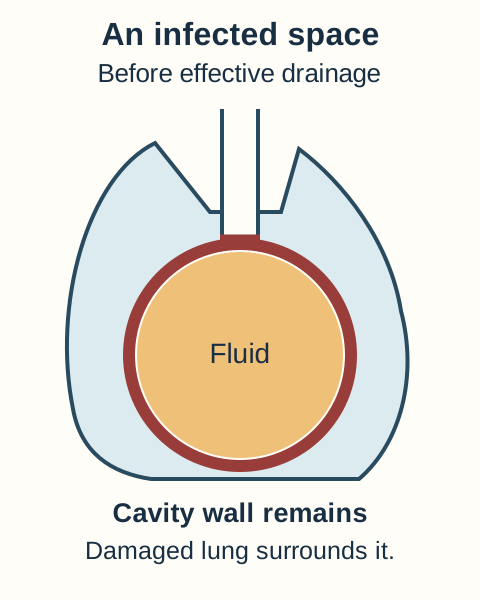
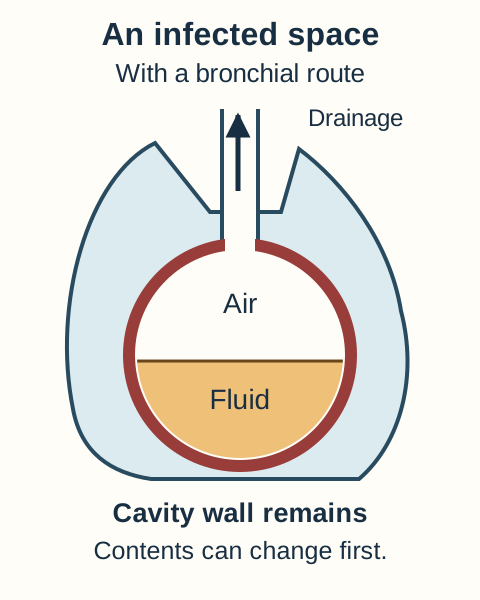
Consolidation fills existing airspaces; an abscess destroys tissue and creates a new infected space.Neutrophil-rich inflammation and tissue injury produce liquefactive necrosis: cellular material is broken down into fluid debris. If that collection communicates with a bronchus, some material can be expectorated and air can enter. Gas above fluid produces an air-fluid interface. Neither a visible interface nor foul sputum is required for every abscess. [3][4]
A cavity is a tissue space, not simply a mucus-filled bronchus. This schematic isolates drainage; real cavities vary in shape and may contain gas for other reasons.
Try the drainage comparison. Before opening the result, predict what becomes possible when a bronchial passage opens.Does the space have to disappear immediately?
Open the bronchial passage and inspect the result
The new route permits expectoration and replacement by air. A residual cavity can persist while treatment succeeds; this schematic is not a prediction of drainage volume or time.
Opening a route changes what can enter and leave.It does not instantly repair the cavity wall or sterilize the remaining material. Close and reopen this optional answer to compare the two states.
Why aspiration sometimes becomes infection
Swallowing, laryngeal closure and cough normally limit the burden entering the lower respiratory tract.Seizures, intoxication, sedation and anesthesia can reduce airway protection. Stroke, neuromuscular disease and esophageal disorders can impair swallowing or increase regurgitation. Poor dentition increases the bacterial burden available to be aspirated. These risks are additive, not prerequisites that every patient must have. Intubation and feeding tubes do not provide complete protection: secretions, reflux and microaspiration remain relevant. [1]
Keep three processes separate. Chemical pneumonitis follows gastric aspiration and may cause abrupt hypoxemia with improvement over 24 to 48 hours.Aspiration pneumonia is infection after bacteria reach the lung. Lung abscess adds tissue necrosis and a localized cavity. Early fever or an infiltrate alone does not establish bacterial infection, and aspiration pneumonia does not inevitably progress to abscess. [2][3]
Rapid improvement after witnessed vomiting and a new opacity points toward chemical injury.A later sustained febrile illness with purulent sputum and a new cavity requires a different explanation and treatment assessment. Time course changes the interpretation; the initial aspiration event is not enough.
Why can an aspiration-related cavity be in an upper lobe?
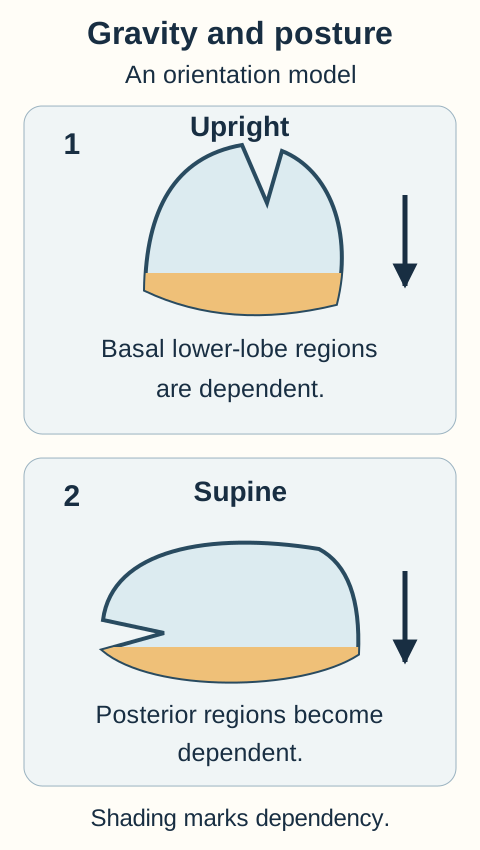
Dependent means lowest relative to gravity, not always the anatomical base of the lung.When a person sits upright, basal lower-lobe regions are dependent. When lying on the back, posterior upper-lobe segments and superior lower-lobe segments become important dependent regions. Side-lying changes which lung regions are lowest. Position changes probability, not a guaranteed destination.
Gravity follows the room, while anatomical names follow the person. The shaded regions are a simplified orientation map, not a precise bronchopulmonary segment atlas.
The adult right main bronchus is generally more vertical and wider than the left, helping explain a right-sided tendency.That tendency does not exclude a left-sided or bilateral aspiration process. The eventual distribution also reflects head position, airway anatomy, aspirated volume and events that may occur repeatedly. Do not reconstruct an exact sleeping position from a single cavity. [1]
A patient with swallowing impairment develops a posterior upper-lobe infiltrate while largely confined to bed.State why this location can still fit aspiration before checking.
Compare the anatomical explanation
Supine posture puts posterior upper-lobe regions low relative to gravity.The swallowing problem supplies a plausible route of entry; the location supports that route but does not prove it or exclude tuberculosis.
If the same patient usually lies on the left side, left-dependent involvement becomes plausible.The useful rule is dependency plus a credible aspiration history, not "right side equals aspiration" or "upper lobe equals tuberculosis."
Try it here · Checkpoint 1 of 3
Make your prediction before reading the choices. A first attempt is just a starting point.
Case 3
Show answer and explanations for case 3
A. Posterior upper-lobe and superior lower-lobe regions (Best answer)
The dependent surface shifts toward the posterior lung. Posterior upper-lobe and superior lower-lobe regions are common dependent sites when supine. Use gravity relative to body position rather than equating dependency with the lung base.
Reasoning steps for option A
In lung-abscess-03 choice A, which vignette finding is decisive?
The dependent surface shifts toward the posterior lung.
For lung-abscess-03 choice A, what clinical principle controls the decision?
Posterior upper-lobe and superior lower-lobe regions are common dependent sites when supine.
What competing explanation must be excluded before accepting lung-abscess-03 choice A?
Use gravity relative to body position rather than equating dependency with the lung base.
B. Anterior upper-lobe and anterior middle-lobe regions (Why this does not fit)
An anterior distribution can be relevant when the anterior chest is lowest. Lying on the back instead places posterior regions downward. Check the direction of gravity before selecting an anatomical label.
Reasoning steps for option B
In lung-abscess-03 choice B, which vignette finding is decisive?
An anterior distribution can be relevant when the anterior chest is lowest.
For lung-abscess-03 choice B, what clinical principle controls the decision?
Lying on the back instead places posterior regions downward.
What competing explanation must be excluded before accepting lung-abscess-03 choice B?
Check the direction of gravity before selecting an anatomical label.
C. Basal lower-lobe regions without a posterior shift (Why this does not fit)
Basal lower-lobe regions are important dependent sites when upright. The prolonged supine posture changes the relative dependency of the posterior lung. A prior aspiration pattern need not remain unchanged after posture changes.
Reasoning steps for option C
In lung-abscess-03 choice C, which vignette finding is decisive?
Basal lower-lobe regions are important dependent sites when upright.
For lung-abscess-03 choice C, what clinical principle controls the decision?
The prolonged supine posture changes the relative dependency of the posterior lung.
What competing explanation must be excluded before accepting lung-abscess-03 choice C?
A prior aspiration pattern need not remain unchanged after posture changes.
D. Apical upper-lobe regions without a posterior preference (Why this does not fit)
Several pulmonary diseases favor upper-lobe regions. It does not account for the posterior dependency produced by lying supine. A distribution hypothesis should explain the supplied positional change.
Reasoning steps for option D
In lung-abscess-03 choice D, which vignette finding is decisive?
Several pulmonary diseases favor upper-lobe regions.
For lung-abscess-03 choice D, what clinical principle controls the decision?
It does not account for the posterior dependency produced by lying supine.
What competing explanation must be excluded before accepting lung-abscess-03 choice D?
A distribution hypothesis should explain the supplied positional change.
Takeaway: An upper-lobe opacity can fit aspiration when the involved region is dependent.
Does an anaerobe in sputum identify the whole infection?
Start with the route of infection, then judge the sample.Aspiration-associated abscesses often contain a mixture of oral organisms. Anaerobic gram-negative rods such as Fusobacterium and Prevotella, and anaerobic gram-positive cocci including Peptostreptococcus, can coexist with oral streptococci such as the Streptococcus anginosus group. Older references may group some oral anaerobes under Bacteroides; B. fragilis is chiefly associated with gastrointestinal flora and should not be treated as a universal oral marker.
Putrid sputum supports anaerobic involvement but is neither sensitive enough to exclude infection when absent nor specific enough to identify an organism.Expectorated sputum passes through a colonized mouth. It can help identify aerobic pathogens, but mixed oral growth does not distinguish contamination from causation. Anaerobic recovery also depends on collection and oxygen-limiting transport. A negative routine sputum culture cannot establish an anaerobe-free cavity. Obtain useful respiratory samples and blood cultures when indicated, without delaying urgent treatment; protected sampling or bronchoscopy may be needed when the diagnosis is uncertain or response is poor. [1][2]
A beta-lactam/beta-lactamase inhibitor can cover susceptible oral streptococci and many oral anaerobes.Metronidazole alone lacks reliable coverage of the streptococcal part of this mixture. That is different from a regimen combining metronidazole with an agent active against the relevant aerobic or microaerophilic organisms. Clindamycin can be active, but susceptibility and adverse effects matter. [3][15]
One sample is expectorated sputum containing several oral species.Another is blood growing S. aureus in a patient with peripheral nodules and a tricuspid vegetation. Which provides stronger evidence for a specific route?
Check the comparison
The second set connects bloodstream infection, a right-sided source and the pulmonary arterial distribution.The sputum sample lacks that localization and may include mouth flora.
A patient whose fever persists despite an antibiotic active against one recovered anaerobe may have additional organisms, inadequate drainage, obstruction or a different diagnosis.Persistence alone does not identify which explanation is correct.
Is the abnormal space in the lung or beside it?
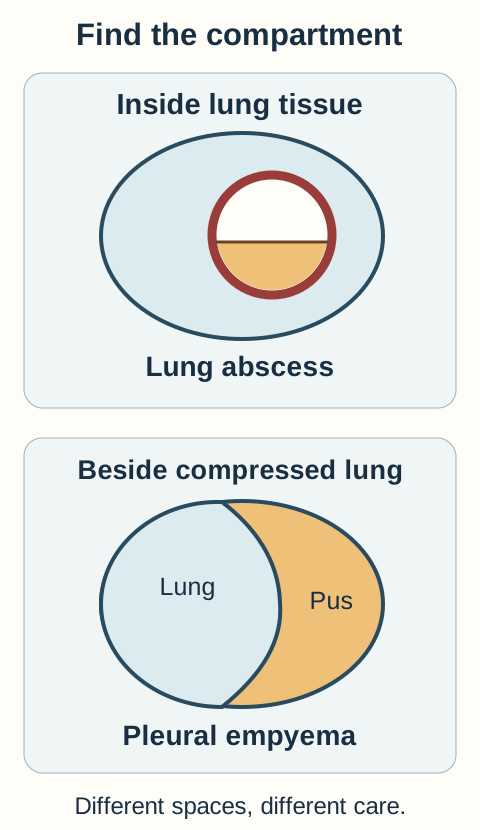
Locate the collection before naming its cause.A lung abscess is intraparenchymal: its wall lies within damaged lung. An empyema occupies the pleural space and can compress the adjacent lung. Contrast-enhanced CT can clarify the compartment, show separated enhancing pleural surfaces, identify airway obstruction and define additional collections. Wall thickness, an air-fluid level or an angle with the chest wall alone is insufficient. [5]
The compartment changes treatment. A pleural drain is not interchangeable with a catheter inserted into an intrapulmonary abscess.
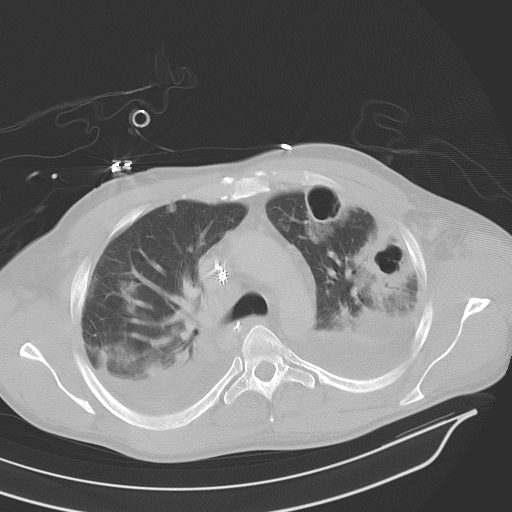
Find the dark gas-containing spaces inside the abnormal lung and then the smoother posterior fluid collections. This is bilateral pneumonia with abscesses and effusions, not proof of aspiration or any particular organism. The patient's left is on the image's right. Original anonymized image by Christaras A, 2006; source and archival history; CC BY 2.5. Full original frame, unchanged; no added markings. [13]
A radiograph may show a thick-walled cavity with an air-fluid level and surrounding consolidation.A horizontal beam helps display a fluid interface on radiography; CT can show gas and fluid even when the patient is supine. The interface reflects gravity and the imaging plane, not an absolute requirement to stand. Necrotizing pneumonia often contains several small cavities within consolidation; a more organized abscess is a localized collection. These patterns overlap. A thin-walled cyst, pneumatocele or dilated bronchus is not automatically an abscess, and variable wall thickness does not reliably separate infection from cancer.
What else explains cavitation?
Tuberculosis: upper-lobe cavitation and a prolonged constitutional illness raise suspicion, but other locations and atypical appearances occur, particularly with immune suppression.AFB-positive sputum identifies acid-fast organisms, not necessarily M. tuberculosis. A negative smear does not exclude TB. Use appropriate airborne precautions when pulmonary TB is suspected, respiratory nucleic acid testing and mycobacterial cultures. Do not let a dependent location substitute for this assessment. [7]
Cancer: squamous lung carcinoma can cavitate; a nodular cavity wall, smoking history, weight loss, hemoptysis or persistence merits investigation.Infection and an obstructing cancer can coexist, so fever, putrid sputum or partial antibiotic response does not exclude malignancy. Foreign bodies can also obstruct drainage. Bronchoscopy or tissue sampling depends on CT findings and the clinical question. In a person with cirrhosis, a high AFP value warrants liver evaluation, not an automatic diagnosis of hepatocellular carcinoma or proof that a lung cavity is metastatic. Appropriate multiphasic liver imaging and a separate assessment of the lung lesion are needed. [4][12]
Klebsiella and other necrotizing bacteria: rapidly progressive consolidation, bloody mucoid sputum and an expanded lobe can suggest Klebsiella, but "currant jelly" sputum and a bulging fissure are not organism-specific tests.Diabetes and alcohol-associated illness overlap with aspiration risk. S. aureus, including MRSA, can cause necrotizing pneumonia after influenza or hematogenous disease. Culture, acquisition setting, prior isolates and severity refine treatment rather than a single memorable description. [1][2]
Aspergillus: a mobile intracavitary mass in a long-standing cavity favors an aspergilloma, often without severe immune suppression.Newly developing nodules with surrounding ground-glass opacity in a profoundly neutropenic patient instead raise concern for angioinvasive mold infection. A later air crescent can occur during recovery from invasive disease; it does not always mean a harmless fungus ball. Narrow septate hyphae with acute-angle branching support an Aspergillus-like mold but are not species identification by themselves. [6]
Mucorales and Nocardia: uncontrolled diabetes or profound immune suppression with necrotic tissue and vascular invasion requires urgent assessment for invasive mold disease.Broad, irregular, sparsely septate hyphae with variable wide-angle branching support Mucorales; do not insist on perfect right angles. Sinus and pulmonary disease may occur separately or together. Prompt specialist antifungal care and appropriate tissue diagnosis are essential. Nocardia is a branching bacterium, often weakly acid-fast, that can cause lung and brain abscesses in immunocompromised patients. Cryptococcus and Histoplasma also belong in an exposure- and host-directed differential, not a diagnosis based on a cavity alone. [6][9][14]
Pneumocystis jirovecii pneumonia: subacute dry cough, dyspnea, hypoxemia and diffuse ground-glass opacity in advanced HIV, especially with a CD4 count below 200 cells/mm3, suggest a different pattern from a focal purulent abscess.Pneumocystis also occurs with substantial cellular immune suppression from glucocorticoids, transplantation or chemotherapy. An early radiograph may be unrevealing. LDH is nonspecific; appropriate induced-sputum or bronchoalveolar samples can be assessed with staining, immunofluorescence or molecular testing.
PCR results require context because colonization can also produce a positive result. Cysts and pneumothorax can occur; cavitation is unusual and prompts assessment for another or additional disease. Treat with TMP-SMX when appropriate. In HIV-associated moderate-to-severe disease, adjunctive corticosteroids are indicated for room-air PaO2 below 70 mmHg or an alveolar-arterial oxygen gradient of at least 35 mmHg. [8]
A cavity decreases after antibiotics, but a focal endobronchial lesion remains.Which finding needs its own explanation?
Check your interpretation
The persistent airway lesion may be the reason infection developed.Improvement in the infected component does not characterize the obstructing tissue. Continue appropriate infection care while arranging targeted investigation.
In the CT above, both lung cavities and pleural fluid are present.A single diagnostic label must not prevent assessment of a second compartment.
Try it here · Checkpoint 2 of 3
Make your prediction before reading the choices. A first attempt is just a starting point.
Case 9
Show answer and explanations for case 9
A. Image-guided pleural drainage with continued antibiotics (Best answer)
The fluid lies in the pleural space and compresses rather than replaces the adjacent lung. It establishes empyema, for which antibiotics and pleural source control are needed. Localize the collection before choosing a drainage route.
Reasoning steps for option A
In lung-abscess-09 choice A, which vignette finding is decisive?
The fluid lies in the pleural space and compresses rather than replaces the adjacent lung.
For lung-abscess-09 choice A, what clinical principle controls the decision?
It establishes empyema, for which antibiotics and pleural source control are needed.
What competing explanation must be excluded before accepting lung-abscess-09 choice A?
Localize the collection before choosing a drainage route.
B. Bronchoscopic opening of the bronchus adjacent to the collection (Why this does not fit)
An obstructed bronchus can prevent drainage of an intrapulmonary infection. The collection is between pleural surfaces, not a cavity that drains through the bronchial tree. Airway source control and pleural source control address different anatomy.
Reasoning steps for option B
In lung-abscess-09 choice B, which vignette finding is decisive?
An obstructed bronchus can prevent drainage of an intrapulmonary infection.
For lung-abscess-09 choice B, what clinical principle controls the decision?
The collection is between pleural surfaces, not a cavity that drains through the bronchial tree.
What competing explanation must be excluded before accepting lung-abscess-09 choice B?
Airway source control and pleural source control address different anatomy.
C. Antibiotics alone with imaging after the fever resolves (Why this does not fit)
Some uncomplicated parapneumonic effusions resolve as the pulmonary infection is treated. Frank pleural pus establishes an infected collection requiring drainage assessment now. Purulence is more decisive than waiting for an arbitrary duration of antibiotics.
Reasoning steps for option C
In lung-abscess-09 choice C, which vignette finding is decisive?
Some uncomplicated parapneumonic effusions resolve as the pulmonary infection is treated.
For lung-abscess-09 choice C, what clinical principle controls the decision?
Frank pleural pus establishes an infected collection requiring drainage assessment now.
What competing explanation must be excluded before accepting lung-abscess-09 choice C?
Purulence is more decisive than waiting for an arbitrary duration of antibiotics.
D. Catheter passage through aerated lung into the cavity (Why this does not fit)
Selected lung abscesses that fail appropriate treatment may require percutaneous drainage. The target is pleural fluid, and a pleural route avoids treating it as an intraparenchymal cavity. A lung abscess catheter and a pleural drain are not interchangeable.
Reasoning steps for option D
In lung-abscess-09 choice D, which vignette finding is decisive?
Selected lung abscesses that fail appropriate treatment may require percutaneous drainage.
For lung-abscess-09 choice D, what clinical principle controls the decision?
The target is pleural fluid, and a pleural route avoids treating it as an intraparenchymal cavity.
What competing explanation must be excluded before accepting lung-abscess-09 choice D?
A lung abscess catheter and a pleural drain are not interchangeable.
Takeaway: Separated pleural surfaces plus pus identify a pleural source that needs drainage.
Does the treatment cover the infection and permit recovery?
For a likely aspiration-associated abscess, cover the mixed infection, not just the most memorable organism.In an adult without a relevant allergy or resistant-pathogen indication, IV ampicillin-sulbactam is a common initial choice. Oral amoxicillin-clavulanate is a common step-down option when appropriate. Regimen selection also depends on severity, kidney function, microbiology and local susceptibility. This is not a dosing protocol for an individual patient. [1][3]
Clindamycin is an alternative in selected circumstances, not an automatic first choice for every abscess; resistance and C.difficile risk matter. New significant watery diarrhea during treatment warrants prompt assessment for antibiotic-associated illness, appropriate contact precautions, and testing of an unformed stool sample when indicated. [17] Metronidazole should not be used alone for a presumed mixed oral infection. It can be paired with a suitable agent when that combination covers the relevant organisms. Adding it to an already adequate anaerobic regimen is not routinely necessary. [2][3][15]
Broader treatment may be appropriate in severe illness or when MRSA, Pseudomonas or other resistant organisms are supported by prior cultures, recent healthcare and antibiotic exposure, or the current acquisition context.Do not equate every hospital encounter with resistant infection, and do not assume community onset excludes it. Obtain informative cultures and narrow treatment when clinically appropriate. [2]
Read the clinical trajectory, not one image
Observed course
Interpretation
Response
Observed courseFever and oxygen need fall; oral intake returns; cavity still visible
InterpretationClinical recovery can precede structural healing
ResponseContinue an adequate course; consider a suitable oral regimen and planned follow-up
Observed coursePersistent fever or worsening despite appropriate treatment
InterpretationCoverage, delivery, drainage or diagnosis may be wrong
ResponseReassess promptly; review CT, microbiology, obstruction and pleural complications
Observed courseLarge cavity is shrinking and the patient is stable
InterpretationSize increases concern but does not establish failure
ResponseSpecialist review and continued monitoring rather than automatic drainage
Observed coursePersistent sepsis with poor drainage or an obstructing lesion
InterpretationAntibiotics alone may not address the source
ResponseCoordinate bronchoscopic, percutaneous or surgical assessment as appropriate
Many patients begin to improve clinically within days, whereas radiographic resolution can take weeks or longer.Treatment commonly extends for several weeks and is individualized to response, organism, lesion burden and source control. Neither a fixed four-week endpoint nor six weeks of mandatory IV therapy fits every patient. Clinical stability, improving symptoms, safe oral intake and an active oral option guide IV-to-oral transition; complete cavity disappearance is not a prerequisite. Available studies vary in regimen and duration, and observational comparisons do not establish that all regimens are equivalent. [3][4]
Reassessment is active care, not waiting out a calendar.Deterioration needs urgent review. Lack of meaningful improvement over roughly the first week should prompt reassessment rather than simply extending an ineffective plan. Review administration, dose and adherence; reconsider copathogens, resistant organisms, an obstructed bronchus, empyema, cancer or an atypical infection. A susceptible isolate does not establish that all infected material is accessible or that every pathogen has been sampled.
Drainage of a lung abscess is selective. Large or poorly draining cavities and persistent sepsis warrant early specialist discussion, but size alone is not an instruction to insert a catheter.CT anatomy and airway access influence the choice between bronchoscopic drainage, a carefully planned percutaneous route and surgery. Procedures can cause bleeding, pleural contamination or a bronchopleural fistula. Resection is generally reserved for selected refractory disease, major complications or associated pathology such as malignancy, not every residual cavity. Extensive gangrenous destruction can also require surgical assessment. [4][5]
After a week, the temperature remains 39 C and CT shows an abrupt bronchial cutoff.Should the team ask only whether to prescribe another anaerobic antibiotic?
Inspect the consequence of obstruction
No. An obstructed airway can prevent drainage and may indicate tumor or a foreign body.Sampling and direct airway assessment can answer questions that repeated empiric antibiotic changes cannot.
Two equally large cavities can justify different plans if one is shrinking with clinical recovery and the other is associated with persistent sepsis and obstruction.
Try it here · Checkpoint 3 of 3
Make your prediction before reading the choices. A first attempt is just a starting point.
Case 14
Show answer and explanations for case 14
A. Switch to the appropriate oral agent and continue the planned course (Best answer)
Stability, improving illness, reliable oral intake and an active oral option support a transition. No; structural healing can lag clinical recovery and does not require continued IV delivery by itself. Choose the route using clinical readiness while maintaining an adequate total treatment course.
Reasoning steps for option A
In lung-abscess-14 choice A, which vignette finding is decisive?
Stability, improving illness, reliable oral intake and an active oral option support a transition.
For lung-abscess-14 choice A, what clinical principle controls the decision?
No; structural healing can lag clinical recovery and does not require continued IV delivery by itself.
What competing explanation must be excluded before accepting lung-abscess-14 choice A?
Choose the route using clinical readiness while maintaining an adequate total treatment course.
B. Continue IV treatment until the cavity disappears completely (Why this does not fit)
It may be needed for instability, inability to take oral medicine or lack of an adequate oral agent. They are not; the remaining cavity alone does not establish a need for prolonged IV treatment. Do not confuse the duration of anatomical repair with the required route of administration.
Reasoning steps for option B
In lung-abscess-14 choice B, which vignette finding is decisive?
It may be needed for instability, inability to take oral medicine or lack of an adequate oral agent.
For lung-abscess-14 choice B, what clinical principle controls the decision?
They are not; the remaining cavity alone does not establish a need for prolonged IV treatment.
What competing explanation must be excluded before accepting lung-abscess-14 choice B?
Do not confuse the duration of anatomical repair with the required route of administration.
C. Stop treatment because the fever has resolved (Why this does not fit)
It supports clinical response to treatment. It does not demonstrate eradication of a destructive infection that generally needs a longer individualized course. A criterion for changing route is not necessarily a criterion for stopping treatment.
Reasoning steps for option C
In lung-abscess-14 choice C, which vignette finding is decisive?
It supports clinical response to treatment.
For lung-abscess-14 choice C, what clinical principle controls the decision?
It does not demonstrate eradication of a destructive infection that generally needs a longer individualized course.
What competing explanation must be excluded before accepting lung-abscess-14 choice C?
A criterion for changing route is not necessarily a criterion for stopping treatment.
D. Require three negative sputum cultures before changing route (Why this does not fit)
A credible organism and susceptibility result can help select an active oral drug. They are not a validated requirement and may reflect sampling limitations or antibiotic exposure. Base route decisions on clinical readiness and appropriate spectrum rather than arbitrary culture counts.
Reasoning steps for option D
In lung-abscess-14 choice D, which vignette finding is decisive?
A credible organism and susceptibility result can help select an active oral drug.
For lung-abscess-14 choice D, what clinical principle controls the decision?
They are not a validated requirement and may reflect sampling limitations or antibiotic exposure.
What competing explanation must be excluded before accepting lung-abscess-14 choice D?
Base route decisions on clinical readiness and appropriate spectrum rather than arbitrary culture counts.
Takeaway: A residual cavity can coexist with readiness for oral therapy.
What needs urgent drainage, and what prevents the next infection?
Pus in the pleural space is empyema. A new effusion during treatment needs assessment rather than an assumption that it is a harmless reaction.Frankly purulent pleural fluid establishes empyema even without a pH result. In suspected pleural infection with nonpurulent fluid, a properly obtained pH at or below 7.2 supports chest drainage when ultrasound identifies a safely accessible collection. Low glucose, high LDH, septation and ongoing illness add context; pH above 7.2 does not by itself exclude an infection that needs drainage. Use antibiotics plus pleural source control, with respiratory or surgical escalation when drainage is inadequate. [11]
A bronchopleural fistula is a communication between the airway and pleural space.New pleural gas with a persistent air leak can signal that complication, including after tissue destruction or an intervention. Empyema and a fistula can coexist. The presence of infected pleural fluid does not, by itself, prove exactly how it reached the pleura.
Life-threatening hemoptysis is an airway emergency.Severe bleeding can kill by obstructing ventilation even before blood loss causes shock. Activate emergency airway and resuscitation support. When the bleeding side is known, placing that side down helps protect the other lung while definitive care is arranged. Bronchoscopy may be necessary immediately for airway control; CT angiography is useful when the patient is sufficiently stable. Bronchial artery embolization often provides definitive hemostasis, with surgery reserved for appropriate causes or failure of other measures. Antibiotics, observation or a hemostatic medicine alone are not adequate stabilization for airway-threatening bleeding. [10]
One patient has a shrinking lung cavity and no pleural collection.Another has new fever, pleural pus and an ongoing air leak. Name the two problems in the second patient before checking.
Check the two-compartment interpretation
The second patient has pleural infection and a possible airway-pleural communication.Treating only the original lung cavity would leave both source control and the air leak unaddressed.
Prevent recurrence by addressing the route
Ask why material entered the lung and why it could not clear.Arrange swallowing assessment after stroke or suspected silent aspiration; absence of coughing does not establish a safe swallow. Address dental infection and oral hygiene, regurgitation or esophageal obstruction, and medicines or conditions that impair alertness. Nutrition, feeding position and texture should be individualized with the swallowing team. A feeding tube does not eliminate aspiration of saliva or refluxed material. [1]
Recurrence after a good response can reflect new aspiration, unresolved obstruction, residual infection or an organism problem.Prior improvement makes an effective antibiotic response plausible; it does not prove reinoculation or rule out resistance. Persistent or recurrent disease deserves repeat clinical and imaging assessment, not an indefinitely repeated prescription.
Establish the route, identify the compartment, interpret the sample and follow the response.A cavity can remain during recovery; continuing sepsis, a pleural complication, major bleeding or a persistent obstructing lesion changes the plan.
Apply the relationships
Commit to one answer before reading the explanation.For each option, compare the process it describes with the findings that distinguish this patient.
Case 1
Show answer and explanations for case 1
A. Begin ampicillin-sulbactam for a prolonged course (Why this does not fit)
A bacterial lung abscess requires treatment of an established necrotizing infection. Immediate symptoms followed by rapid recovery without cavitation favor chemical injury instead. Aspiration alone does not establish an abscess.
Reasoning steps for option A
In lung-abscess-01 choice A, which vignette finding is decisive?
A bacterial lung abscess requires treatment of an established necrotizing infection.
For lung-abscess-01 choice A, what clinical principle controls the decision?
Immediate symptoms followed by rapid recovery without cavitation favor chemical injury instead.
What competing explanation must be excluded before accepting lung-abscess-01 choice A?
Aspiration alone does not establish an abscess.
B. Continue observation without starting an antibiotic (Best answer)
Gastric contents can directly injure lung tissue before a bacterial infection develops. Rapid recovery without purulent sputum or a collection supports resolving chemical pneumonitis. Reassess for secondary infection rather than prescribing an abscess course for every aspiration event.
Reasoning steps for option B
In lung-abscess-01 choice B, which vignette finding is decisive?
Gastric contents can directly injure lung tissue before a bacterial infection develops.
For lung-abscess-01 choice B, what clinical principle controls the decision?
Rapid recovery without purulent sputum or a collection supports resolving chemical pneumonitis.
What competing explanation must be excluded before accepting lung-abscess-01 choice B?
Reassess for secondary infection rather than prescribing an abscess course for every aspiration event.
C. Begin metronidazole for a short course (Why this does not fit)
Metronidazole treats susceptible anaerobic bacteria, not the chemical effects of gastric contents. The supplied course shows recovery rather than a sustained infectious syndrome. Do not use antimicrobial spectrum as a substitute for deciding whether infection is present.
Reasoning steps for option C
In lung-abscess-01 choice C, which vignette finding is decisive?
Metronidazole treats susceptible anaerobic bacteria, not the chemical effects of gastric contents.
For lung-abscess-01 choice C, what clinical principle controls the decision?
The supplied course shows recovery rather than a sustained infectious syndrome.
What competing explanation must be excluded before accepting lung-abscess-01 choice C?
Do not use antimicrobial spectrum as a substitute for deciding whether infection is present.
D. Begin ceftriaxone plus azithromycin for pneumonia (Why this does not fit)
Ceftriaxone plus azithromycin is a common inpatient community-acquired pneumonia regimen. Symptoms began at aspiration and substantially resolved within thirty-six hours without antibiotics. A new opacity after aspiration needs interpretation alongside its subsequent course.
Reasoning steps for option D
In lung-abscess-01 choice D, which vignette finding is decisive?
Ceftriaxone plus azithromycin is a common inpatient community-acquired pneumonia regimen.
For lung-abscess-01 choice D, what clinical principle controls the decision?
Symptoms began at aspiration and substantially resolved within thirty-six hours without antibiotics.
What competing explanation must be excluded before accepting lung-abscess-01 choice D?
A new opacity after aspiration needs interpretation alongside its subsequent course.
Takeaway: Immediate aspiration injury with rapid recovery does not establish a bacterial abscess.
A. IV ceftriaxone plus azithromycin (Why this does not fit)
This combination treats common community-acquired pneumonia pathogens. A cavity in this aspiration-risk setting warrants reliable coverage of oral anaerobes as well as oral streptococci. An abscess changes the spectrum assessment compared with uncomplicated pneumonia.
Reasoning steps for option A
In lung-abscess-02 choice A, which vignette finding is decisive?
This combination treats common community-acquired pneumonia pathogens.
For lung-abscess-02 choice A, what clinical principle controls the decision?
A cavity in this aspiration-risk setting warrants reliable coverage of oral anaerobes as well as oral streptococci.
What competing explanation must be excluded before accepting lung-abscess-02 choice A?
An abscess changes the spectrum assessment compared with uncomplicated pneumonia.
B. IV metronidazole alone (Why this does not fit)
Metronidazole is active against many strict anaerobes. Oral streptococci may participate and are not reliably covered by metronidazole alone. Cover the likely mixed infection rather than one bacterial category.
Reasoning steps for option B
In lung-abscess-02 choice B, which vignette finding is decisive?
Metronidazole is active against many strict anaerobes.
For lung-abscess-02 choice B, what clinical principle controls the decision?
Oral streptococci may participate and are not reliably covered by metronidazole alone.
What competing explanation must be excluded before accepting lung-abscess-02 choice B?
Cover the likely mixed infection rather than one bacterial category.
C. IV vancomycin alone (Why this does not fit)
Vancomycin treats susceptible gram-positive organisms, including MRSA. It does not provide the broad oral anaerobic coverage needed here, and the stem supplies no specific MRSA indication. A drug active against a resistant pathogen may still miss the expected flora.
Reasoning steps for option C
In lung-abscess-02 choice C, which vignette finding is decisive?
Vancomycin treats susceptible gram-positive organisms, including MRSA.
For lung-abscess-02 choice C, what clinical principle controls the decision?
It does not provide the broad oral anaerobic coverage needed here, and the stem supplies no specific MRSA indication.
What competing explanation must be excluded before accepting lung-abscess-02 choice C?
A drug active against a resistant pathogen may still miss the expected flora.
D. IV ampicillin-sulbactam (Best answer)
Impaired swallowing can deliver a heavy oral bacterial burden into the lower respiratory tract. Ampicillin-sulbactam covers susceptible oral streptococci and many oral anaerobes, fitting an aspiration-associated abscess. Select a regimen for the likely mixture and then refine it with clinical and microbiologic evidence.
Reasoning steps for option D
In lung-abscess-02 choice D, which vignette finding is decisive?
Impaired swallowing can deliver a heavy oral bacterial burden into the lower respiratory tract.
For lung-abscess-02 choice D, what clinical principle controls the decision?
Ampicillin-sulbactam covers susceptible oral streptococci and many oral anaerobes, fitting an aspiration-associated abscess.
What competing explanation must be excluded before accepting lung-abscess-02 choice D?
Select a regimen for the likely mixture and then refine it with clinical and microbiologic evidence.
Takeaway: An aspiration-associated abscess needs reliable coverage of the relevant oral mixture.
A. Hematogenous seeding into the pulmonary arterial bed (Why this does not fit)
Bacteremia and a source capable of releasing infected emboli can support multifocal pulmonary seeding. Documented aspiration and a left-dependent distribution support airway entry without a supplied endovascular source. Laterality alone does not establish hematogenous spread.
Reasoning steps for option A
In lung-abscess-04 choice A, which vignette finding is decisive?
Bacteremia and a source capable of releasing infected emboli can support multifocal pulmonary seeding.
For lung-abscess-04 choice A, what clinical principle controls the decision?
Documented aspiration and a left-dependent distribution support airway entry without a supplied endovascular source.
What competing explanation must be excluded before accepting lung-abscess-04 choice A?
Laterality alone does not establish hematogenous spread.
B. Retention of secretions distal to an obstructed lobar bronchus (Why this does not fit)
It can trap infected material and prevent effective drainage. The main and lobar bronchi are patent, while the swallowing study demonstrates an aspiration pathway. Assess the demonstrated airway anatomy rather than assume obstruction from cavitation.
Reasoning steps for option B
In lung-abscess-04 choice B, which vignette finding is decisive?
It can trap infected material and prevent effective drainage.
For lung-abscess-04 choice B, what clinical principle controls the decision?
The main and lobar bronchi are patent, while the swallowing study demonstrates an aspiration pathway.
What competing explanation must be excluded before accepting lung-abscess-04 choice B?
Assess the demonstrated airway anatomy rather than assume obstruction from cavitation.
C. Airway entry of oral material into a dependent lung region (Best answer)
It demonstrates a route by which oral material can enter the respiratory tract. It makes left-sided regions dependent, so a left-sided aspiration-associated infection remains plausible. The usual right-sided tendency does not exclude a left-dependent aspiration process.
Reasoning steps for option C
In lung-abscess-04 choice C, which vignette finding is decisive?
It demonstrates a route by which oral material can enter the respiratory tract.
For lung-abscess-04 choice C, what clinical principle controls the decision?
It makes left-sided regions dependent, so a left-sided aspiration-associated infection remains plausible.
What competing explanation must be excluded before accepting lung-abscess-04 choice C?
The usual right-sided tendency does not exclude a left-dependent aspiration process.
D. Contiguous spread from an infected pleural collection (Why this does not fit)
An adjacent infected compartment can extend into nearby tissue. There is no pleural collection, whereas a credible airway source and compatible dependency are present. An extension hypothesis needs evidence of the adjacent source.
Reasoning steps for option D
In lung-abscess-04 choice D, which vignette finding is decisive?
An adjacent infected compartment can extend into nearby tissue.
For lung-abscess-04 choice D, what clinical principle controls the decision?
There is no pleural collection, whereas a credible airway source and compatible dependency are present.
What competing explanation must be excluded before accepting lung-abscess-04 choice D?
An extension hypothesis needs evidence of the adjacent source.
Takeaway: A demonstrated aspiration pathway can explain left-dependent disease.
A. The recovered anaerobe must have become resistant during treatment (Why this does not fit)
Resistance can cause failure when the organism is no longer inhibited by the chosen agent. The recovered Prevotella remains susceptible, while a second relevant organism has been identified. Do not infer resistance when the demonstrated problem is incomplete spectrum.
Reasoning steps for option A
In lung-abscess-05 choice A, which vignette finding is decisive?
Resistance can cause failure when the organism is no longer inhibited by the chosen agent.
For lung-abscess-05 choice A, what clinical principle controls the decision?
The recovered Prevotella remains susceptible, while a second relevant organism has been identified.
What competing explanation must be excluded before accepting lung-abscess-05 choice A?
Do not infer resistance when the demonstrated problem is incomplete spectrum.
B. An oral-source infection requires two agents regardless of spectrum (Why this does not fit)
Two drugs may be combined when one does not cover the relevant mixture. A single suitable beta-lactam/beta-lactamase inhibitor can address susceptible organisms in both categories. Judge coverage rather than the number of medicines.
Reasoning steps for option B
In lung-abscess-05 choice B, which vignette finding is decisive?
Two drugs may be combined when one does not cover the relevant mixture.
For lung-abscess-05 choice B, what clinical principle controls the decision?
A single suitable beta-lactam/beta-lactamase inhibitor can address susceptible organisms in both categories.
What competing explanation must be excluded before accepting lung-abscess-05 choice B?
Judge coverage rather than the number of medicines.
C. The regimen leaves the accompanying oral streptococcus untreated (Best answer)
It identifies an oral streptococcus alongside an anaerobe in a compatible clinical infection. Streptococcus anginosus is outside the reliable spectrum of metronidazole monotherapy. Susceptibility of one isolate does not establish coverage of the whole infection.
Reasoning steps for option C
In lung-abscess-05 choice C, which vignette finding is decisive?
It identifies an oral streptococcus alongside an anaerobe in a compatible clinical infection.
For lung-abscess-05 choice C, what clinical principle controls the decision?
Streptococcus anginosus is outside the reliable spectrum of metronidazole monotherapy.
What competing explanation must be excluded before accepting lung-abscess-05 choice C?
Susceptibility of one isolate does not establish coverage of the whole infection.
D. Persistent fever is expected until the cavity completely closes (Why this does not fit)
Structural healing may lag behind clinical recovery. Persistent fever plus a documented uncovered organism requires reassessment before radiographic closure. Separate slow anatomical repair from evidence that infection remains active.
Reasoning steps for option D
In lung-abscess-05 choice D, which vignette finding is decisive?
Structural healing may lag behind clinical recovery.
For lung-abscess-05 choice D, what clinical principle controls the decision?
Persistent fever plus a documented uncovered organism requires reassessment before radiographic closure.
What competing explanation must be excluded before accepting lung-abscess-05 choice D?
Separate slow anatomical repair from evidence that infection remains active.
Takeaway: Coverage of the recovered anaerobe does not cover every member of a mixed oral infection.
A. The specimen does not establish an anaerobe-free infection (Best answer)
They suggest substantial contamination with material from the mouth. Routine sampling and transport may not recover anaerobes, so this result cannot define the complete causative flora. Judge de-escalation using specimen quality, clinical context and the spectrum still required.
Reasoning steps for option A
In lung-abscess-06 choice A, which vignette finding is decisive?
They suggest substantial contamination with material from the mouth.
For lung-abscess-06 choice A, what clinical principle controls the decision?
Routine sampling and transport may not recover anaerobes, so this result cannot define the complete causative flora.
What competing explanation must be excluded before accepting lung-abscess-06 choice A?
Judge de-escalation using specimen quality, clinical context and the spectrum still required.
B. The result identifies a purely aerobic infection requiring narrower coverage (Why this does not fit)
A representative specimen with a credible identified pathogen can guide targeted therapy. Oral contamination and routine culture methods prevent exclusion of uncultured anaerobic participants. A list of recovered organisms is not necessarily a list of every causative organism.
Reasoning steps for option B
In lung-abscess-06 choice B, which vignette finding is decisive?
A representative specimen with a credible identified pathogen can guide targeted therapy.
For lung-abscess-06 choice B, what clinical principle controls the decision?
Oral contamination and routine culture methods prevent exclusion of uncultured anaerobic participants.
What competing explanation must be excluded before accepting lung-abscess-06 choice B?
A list of recovered organisms is not necessarily a list of every causative organism.
C. The oral species establish contamination as the sole cause of the cavity (Why this does not fit)
It can explain organisms in expectorated sputum without proving that they caused lung disease. It limits interpretation of the sample but does not explain away a clinically improving cavitary infection. Separate a sampling problem from the existence of disease.
Reasoning steps for option C
In lung-abscess-06 choice C, which vignette finding is decisive?
It can explain organisms in expectorated sputum without proving that they caused lung disease.
For lung-abscess-06 choice C, what clinical principle controls the decision?
It limits interpretation of the sample but does not explain away a clinically improving cavitary infection.
What competing explanation must be excluded before accepting lung-abscess-06 choice C?
Separate a sampling problem from the existence of disease.
D. The absent anaerobic growth indicates that the cavity is already sterilized (Why this does not fit)
Antibiotics can reduce culture yield even before treatment is complete. Neither the sampling method nor the current improvement proves complete eradication of infection. Do not turn low culture yield into a treatment endpoint.
Reasoning steps for option D
In lung-abscess-06 choice D, which vignette finding is decisive?
Antibiotics can reduce culture yield even before treatment is complete.
For lung-abscess-06 choice D, what clinical principle controls the decision?
Neither the sampling method nor the current improvement proves complete eradication of infection.
What competing explanation must be excluded before accepting lung-abscess-06 choice D?
Do not turn low culture yield into a treatment endpoint.
Takeaway: A routine sputum report cannot exclude anaerobes from an aspiration-associated abscess.
A. Infected material enters the systemic arteries through the left ventricle (Why this does not fit)
The systemic arterial circulation carries them to organs such as the brain, spleen and kidneys. The tricuspid vegetation is upstream of the right ventricle and pulmonary arteries, not a direct systemic arterial source. Trace an embolus downstream from its actual origin.
Reasoning steps for option A
In lung-abscess-07 choice A, which vignette finding is decisive?
The systemic arterial circulation carries them to organs such as the brain, spleen and kidneys.
For lung-abscess-07 choice A, what clinical principle controls the decision?
The tricuspid vegetation is upstream of the right ventricle and pulmonary arteries, not a direct systemic arterial source.
What competing explanation must be excluded before accepting lung-abscess-07 choice A?
Trace an embolus downstream from its actual origin.
B. Oral secretions enter dependent bronchi during impaired consciousness (Why this does not fit)
Episodes of impaired consciousness can reduce airway protection. Persistent bacteremia and a tricuspid vegetation support infected emboli entering the pulmonary vasculature. Use the demonstrated source rather than a risk association alone.
Reasoning steps for option B
In lung-abscess-07 choice B, which vignette finding is decisive?
Episodes of impaired consciousness can reduce airway protection.
For lung-abscess-07 choice B, what clinical principle controls the decision?
Persistent bacteremia and a tricuspid vegetation support infected emboli entering the pulmonary vasculature.
What competing explanation must be excluded before accepting lung-abscess-07 choice B?
Use the demonstrated source rather than a risk association alone.
C. An infected pleural collection extends directly into adjacent lung (Why this does not fit)
Contiguous infection spreads from an adjacent focus into nearby structures. None is described; multiple peripheral lesions accompany a documented intravascular source. A distant multifocal pattern needs an explanation for delivery to multiple sites.
Reasoning steps for option C
In lung-abscess-07 choice C, which vignette finding is decisive?
Contiguous infection spreads from an adjacent focus into nearby structures.
For lung-abscess-07 choice C, what clinical principle controls the decision?
None is described; multiple peripheral lesions accompany a documented intravascular source.
What competing explanation must be excluded before accepting lung-abscess-07 choice C?
A distant multifocal pattern needs an explanation for delivery to multiple sites.
D. Vegetation fragments enter the pulmonary arteries through the right ventricle (Best answer)
It passes through the right ventricle into the pulmonary arterial circulation. Infected emboli lodge distally and cause localized infection and tissue destruction in multiple lung regions. A right-sided source plus compatible pulmonary lesions supports septic pulmonary embolization.
Reasoning steps for option D
In lung-abscess-07 choice D, which vignette finding is decisive?
It passes through the right ventricle into the pulmonary arterial circulation.
For lung-abscess-07 choice D, what clinical principle controls the decision?
Infected emboli lodge distally and cause localized infection and tissue destruction in multiple lung regions.
What competing explanation must be excluded before accepting lung-abscess-07 choice D?
A right-sided source plus compatible pulmonary lesions supports septic pulmonary embolization.
Takeaway: Follow the circulation from a demonstrated source before assigning the route of lung infection.
A. Repeated septic embolization from an occult tricuspid vegetation (Why this does not fit)
Septic pulmonary embolization is supported by an endovascular source and a compatible peripheral nodular pattern. Post-influenza airspace disease with a respiratory MRSA isolate is supplied, without bacteremia or a demonstrated vegetation. Cavitation from S. aureus does not automatically identify endocarditis.
Reasoning steps for option A
In lung-abscess-08 choice A, which vignette finding is decisive?
Septic pulmonary embolization is supported by an endovascular source and a compatible peripheral nodular pattern.
For lung-abscess-08 choice A, what clinical principle controls the decision?
Post-influenza airspace disease with a respiratory MRSA isolate is supplied, without bacteremia or a demonstrated vegetation.
What competing explanation must be excluded before accepting lung-abscess-08 choice A?
Cavitation from S. aureus does not automatically identify endocarditis.
B. Necrotizing staphylococcal pneumonia involving infected airspaces (Best answer)
S. aureus can cause severe secondary bacterial pneumonia with tissue necrosis. Cavities are embedded in extensive consolidation, and a representative respiratory specimen identifies MRSA. Integrate the acquisition course, anatomical pattern and specimen source.
Reasoning steps for option B
In lung-abscess-08 choice B, which vignette finding is decisive?
S. aureus can cause severe secondary bacterial pneumonia with tissue necrosis.
For lung-abscess-08 choice B, what clinical principle controls the decision?
Cavities are embedded in extensive consolidation, and a representative respiratory specimen identifies MRSA.
What competing explanation must be excluded before accepting lung-abscess-08 choice B?
Integrate the acquisition course, anatomical pattern and specimen source.
C. Anaerobic aspiration infection with incidental respiratory MRSA carriage (Why this does not fit)
Poor-quality or colonized specimens may contain organisms not responsible for the illness. The high-quality specimen and severe post-influenza necrotizing airspace illness form a coherent alternative to aspiration. Do not disregard a representative result solely because another organism can cause cavities.
Reasoning steps for option C
In lung-abscess-08 choice C, which vignette finding is decisive?
Poor-quality or colonized specimens may contain organisms not responsible for the illness.
For lung-abscess-08 choice C, what clinical principle controls the decision?
The high-quality specimen and severe post-influenza necrotizing airspace illness form a coherent alternative to aspiration.
What competing explanation must be excluded before accepting lung-abscess-08 choice C?
Do not disregard a representative result solely because another organism can cause cavities.
D. An aspergilloma occupying a cavity left by the viral illness (Why this does not fit)
It forms a fungal mass within a pre-existing cavity. The patient has newly necrotizing consolidation rather than a stable old cavity containing a discrete mass. Distinguish tissue destruction during pneumonia from colonization of an established space.
Reasoning steps for option D
In lung-abscess-08 choice D, which vignette finding is decisive?
It forms a fungal mass within a pre-existing cavity.
For lung-abscess-08 choice D, what clinical principle controls the decision?
The patient has newly necrotizing consolidation rather than a stable old cavity containing a discrete mass.
What competing explanation must be excluded before accepting lung-abscess-08 choice D?
Distinguish tissue destruction during pneumonia from colonization of an established space.
Takeaway: S. aureus can destroy lung tissue during pneumonia without a demonstrated right-sided cardiac source.
A. Observe the collection while waiting for the culture result (Why this does not fit)
Culture can identify an organism and guide antibiotic selection. The properly measured low pH and ongoing illness support pleural infection requiring drainage assessment despite a pending culture. Source-control decisions can precede microbiologic confirmation.
Reasoning steps for option A
In lung-abscess-10 choice A, which vignette finding is decisive?
Culture can identify an organism and guide antibiotic selection.
For lung-abscess-10 choice A, what clinical principle controls the decision?
The properly measured low pH and ongoing illness support pleural infection requiring drainage assessment despite a pending culture.
What competing explanation must be excluded before accepting lung-abscess-10 choice A?
Source-control decisions can precede microbiologic confirmation.
B. Repeat sampling only after the fluid becomes purulent (Why this does not fit)
It establishes empyema without requiring a pH threshold. No; a pH at or below 7.2 with this clinical context and accessible collection already supports drainage. A nonpurulent infected effusion can still require source control.
Reasoning steps for option B
In lung-abscess-10 choice B, which vignette finding is decisive?
It establishes empyema without requiring a pH threshold.
For lung-abscess-10 choice B, what clinical principle controls the decision?
No; a pH at or below 7.2 with this clinical context and accessible collection already supports drainage.
What competing explanation must be excluded before accepting lung-abscess-10 choice B?
A nonpurulent infected effusion can still require source control.
C. Arrange pleural drainage and continue appropriate antibiotics (Best answer)
It falls in the high-risk biochemical range for a complicated pleural infection. Ultrasound confirms a safely accessible collection in a patient with ongoing infection. Combine biochemical risk with clinical findings and procedural anatomy.
Reasoning steps for option C
In lung-abscess-10 choice C, which vignette finding is decisive?
It falls in the high-risk biochemical range for a complicated pleural infection.
For lung-abscess-10 choice C, what clinical principle controls the decision?
Ultrasound confirms a safely accessible collection in a patient with ongoing infection.
What competing explanation must be excluded before accepting lung-abscess-10 choice C?
Combine biochemical risk with clinical findings and procedural anatomy.
D. Broaden antibiotics while leaving the collection undrained (Why this does not fit)
It can help when the current regimen fails to cover the responsible pathogen. An infected pleural collection with this pH may not resolve without physical drainage. Changing antimicrobial spectrum does not substitute for indicated source control.
Reasoning steps for option D
In lung-abscess-10 choice D, which vignette finding is decisive?
It can help when the current regimen fails to cover the responsible pathogen.
For lung-abscess-10 choice D, what clinical principle controls the decision?
An infected pleural collection with this pH may not resolve without physical drainage.
What competing explanation must be excluded before accepting lung-abscess-10 choice D?
Changing antimicrobial spectrum does not substitute for indicated source control.
Takeaway: An accessible nonpurulent pleural infection can require drainage before cultures return.
A. Insert a percutaneous catheter because its diameter remains above 6 cm (Why this does not fit)
Large lesions can be harder to treat and may require intervention. The patient and imaging are improving, without a demonstrated obstructed airway or pleural complication. Use size as a reason for careful assessment, not an automatic procedural instruction.
Reasoning steps for option A
In lung-abscess-11 choice A, which vignette finding is decisive?
Large lesions can be harder to treat and may require intervention.
For lung-abscess-11 choice A, what clinical principle controls the decision?
The patient and imaging are improving, without a demonstrated obstructed airway or pleural complication.
What competing explanation must be excluded before accepting lung-abscess-11 choice A?
Use size as a reason for careful assessment, not an automatic procedural instruction.
B. Replace treatment with broader IV antibiotics because fluid remains (Why this does not fit)
It can accompany ongoing infection or inadequate source control. Fever, oxygen need, cavity diameter and surrounding inflammation have all improved. Residual abnormal anatomy is not by itself evidence that the antibiotic spectrum is wrong.
Reasoning steps for option B
In lung-abscess-11 choice B, which vignette finding is decisive?
It can accompany ongoing infection or inadequate source control.
For lung-abscess-11 choice B, what clinical principle controls the decision?
Fever, oxygen need, cavity diameter and surrounding inflammation have all improved.
What competing explanation must be excluded before accepting lung-abscess-11 choice B?
Residual abnormal anatomy is not by itself evidence that the antibiotic spectrum is wrong.
C. Stop antibiotics because the systemic symptoms have resolved (Why this does not fit)
It supports that treatment is working and can inform route and follow-up decisions. The large residual cavity still requires an individualized continued course and reassessment. Clinical improvement is not an automatic end date for treatment of a destructive lung infection.
Reasoning steps for option C
In lung-abscess-11 choice C, which vignette finding is decisive?
It supports that treatment is working and can inform route and follow-up decisions.
For lung-abscess-11 choice C, what clinical principle controls the decision?
The large residual cavity still requires an individualized continued course and reassessment.
What competing explanation must be excluded before accepting lung-abscess-11 choice C?
Clinical improvement is not an automatic end date for treatment of a destructive lung infection.
D. Continue the planned course with specialist follow-up and interval imaging (Best answer)
Both show recovery rather than a persistently uncontrolled infection. It warrants ongoing treatment and close review, with intervention considered if the trajectory or anatomy changes. A large improving abscess does not require drainage solely because it exceeds a size threshold.
Reasoning steps for option D
In lung-abscess-11 choice D, which vignette finding is decisive?
Both show recovery rather than a persistently uncontrolled infection.
For lung-abscess-11 choice D, what clinical principle controls the decision?
It warrants ongoing treatment and close review, with intervention considered if the trajectory or anatomy changes.
What competing explanation must be excluded before accepting lung-abscess-11 choice D?
A large improving abscess does not require drainage solely because it exceeds a size threshold.
Takeaway: Serial recovery and source anatomy matter more than an isolated diameter.
A. Add metronidazole to the existing ampicillin-sulbactam (Why this does not fit)
It would mainly duplicate anaerobic activity already provided by ampicillin-sulbactam. An abrupt bronchial cutoff with distal collapse suggests an obstruction rather than merely missing anaerobic coverage. Do not use redundant spectrum to avoid investigating structural disease.
Reasoning steps for option A
In lung-abscess-12 choice A, which vignette finding is decisive?
It would mainly duplicate anaerobic activity already provided by ampicillin-sulbactam.
For lung-abscess-12 choice A, what clinical principle controls the decision?
An abrupt bronchial cutoff with distal collapse suggests an obstruction rather than merely missing anaerobic coverage.
What competing explanation must be excluded before accepting lung-abscess-12 choice A?
Do not use redundant spectrum to avoid investigating structural disease.
B. Arrange bronchoscopy to inspect and sample the obstructed airway (Best answer)
It suggests obstruction that can trap infected secretions and prevent drainage. It can identify and sample an endobronchial lesion or foreign body, helping direct source-specific treatment. Persistent infection distal to obstruction requires assessment of the obstruction itself.
Reasoning steps for option B
In lung-abscess-12 choice B, which vignette finding is decisive?
It suggests obstruction that can trap infected secretions and prevent drainage.
For lung-abscess-12 choice B, what clinical principle controls the decision?
It can identify and sample an endobronchial lesion or foreign body, helping direct source-specific treatment.
What competing explanation must be excluded before accepting lung-abscess-12 choice B?
Persistent infection distal to obstruction requires assessment of the obstruction itself.
C. Switch to oral therapy because radiographic recovery is often delayed (Why this does not fit)
It can be compatible when the patient is clinically stable and improving with a suitable oral option. Fever persists and CT identifies an unresolved anatomical reason for treatment failure. Distinguish slow radiographic repair from ongoing active disease.
Reasoning steps for option C
In lung-abscess-12 choice C, which vignette finding is decisive?
It can be compatible when the patient is clinically stable and improving with a suitable oral option.
For lung-abscess-12 choice C, what clinical principle controls the decision?
Fever persists and CT identifies an unresolved anatomical reason for treatment failure.
What competing explanation must be excluded before accepting lung-abscess-12 choice C?
Distinguish slow radiographic repair from ongoing active disease.
D. Drain the pleural space under ultrasound guidance (Why this does not fit)
An infected pleural collection accessible to a drain would support it. The infection is distal to an obstructed bronchus, and no pleural collection is identified. Choose source control for the demonstrated compartment.
Reasoning steps for option D
In lung-abscess-12 choice D, which vignette finding is decisive?
An infected pleural collection accessible to a drain would support it.
For lung-abscess-12 choice D, what clinical principle controls the decision?
The infection is distal to an obstructed bronchus, and no pleural collection is identified.
What competing explanation must be excluded before accepting lung-abscess-12 choice D?
Choose source control for the demonstrated compartment.
Takeaway: An unexplained bronchial cutoff deserves investigation even while the infection is being treated.
A. Repeat chest CT to find an enlarging abscess (Why this does not fit)
Worsening respiratory symptoms or new chest findings can indicate failure of pulmonary source control. The lung findings remain improved while frequent new watery diarrhea and abdominal symptoms dominate. New fever during therapy can come from a treatment-associated illness outside the original organ.
Reasoning steps for option A
In lung-abscess-13 choice A, which vignette finding is decisive?
Worsening respiratory symptoms or new chest findings can indicate failure of pulmonary source control.
For lung-abscess-13 choice A, what clinical principle controls the decision?
The lung findings remain improved while frequent new watery diarrhea and abdominal symptoms dominate.
What competing explanation must be excluded before accepting lung-abscess-13 choice A?
New fever during therapy can come from a treatment-associated illness outside the original organ.
B. Repeat sputum anaerobic culture to identify acquired resistance (Why this does not fit)
It can help evaluate persistent or recurrent pulmonary infection when the respiratory course suggests failure. No; the respiratory response continues while a gastrointestinal syndrome develops during antibiotic exposure. Localize the new illness before assuming resistance in the original infection.
Reasoning steps for option B
In lung-abscess-13 choice B, which vignette finding is decisive?
It can help evaluate persistent or recurrent pulmonary infection when the respiratory course suggests failure.
For lung-abscess-13 choice B, what clinical principle controls the decision?
No; the respiratory response continues while a gastrointestinal syndrome develops during antibiotic exposure.
What competing explanation must be excluded before accepting lung-abscess-13 choice B?
Localize the new illness before assuming resistance in the original infection.
C. Test an unformed stool sample for C. difficile using the local diagnostic algorithm (Best answer)
Frequent acute watery diarrhea with fever and cramping during antibiotic treatment raises concern for antibiotic-associated colitis. Clindamycin exposure increases that concern, and the patient has symptomatic unformed stools without a supplied laxative explanation. Evaluate compatible new diarrhea rather than labeling every treatment-period fever as abscess failure.
Reasoning steps for option C
In lung-abscess-13 choice C, which vignette finding is decisive?
Frequent acute watery diarrhea with fever and cramping during antibiotic treatment raises concern for antibiotic-associated colitis.
For lung-abscess-13 choice C, what clinical principle controls the decision?
Clindamycin exposure increases that concern, and the patient has symptomatic unformed stools without a supplied laxative explanation.
What competing explanation must be excluded before accepting lung-abscess-13 choice C?
Evaluate compatible new diarrhea rather than labeling every treatment-period fever as abscess failure.
D. Obtain pleural fluid studies to identify secondary empyema (Why this does not fit)
A new effusion with compatible symptoms or imaging would prompt pleural assessment. The chest remains improved and the new symptoms are frequent diarrhea and abdominal cramping. Choose testing for the newly affected compartment.
Reasoning steps for option D
In lung-abscess-13 choice D, which vignette finding is decisive?
A new effusion with compatible symptoms or imaging would prompt pleural assessment.
For lung-abscess-13 choice D, what clinical principle controls the decision?
The chest remains improved and the new symptoms are frequent diarrhea and abdominal cramping.
What competing explanation must be excluded before accepting lung-abscess-13 choice D?
Choose testing for the newly affected compartment.
Takeaway: New fever with diarrhea during clindamycin treatment is not automatically recurrent lung infection.
A. Transfer to CT for angiographic localization of the vessel (Why this does not fit)
It can identify the bleeding territory and guide definitive intervention when the patient can safely undergo imaging. The patient is failing to clear his airway and is severely hypoxemic and hypotensive. Imaging must not delay airway and circulatory stabilization.
Reasoning steps for option A
In lung-abscess-15 choice A, which vignette finding is decisive?
It can identify the bleeding territory and guide definitive intervention when the patient can safely undergo imaging.
For lung-abscess-15 choice A, what clinical principle controls the decision?
The patient is failing to clear his airway and is severely hypoxemic and hypotensive.
What competing explanation must be excluded before accepting lung-abscess-15 choice A?
Imaging must not delay airway and circulatory stabilization.
B. Activate airway and resuscitation support with the right side down (Best answer)
Blood can obstruct ventilation and contaminate the other lung, causing asphyxia. Placing the bleeding side down can help protect the opposite lung while emergency airway control and resuscitation proceed. Stabilization and protection of the functioning lung precede transport for definitive hemostasis.
Reasoning steps for option B
In lung-abscess-15 choice B, which vignette finding is decisive?
Blood can obstruct ventilation and contaminate the other lung, causing asphyxia.
For lung-abscess-15 choice B, what clinical principle controls the decision?
Placing the bleeding side down can help protect the opposite lung while emergency airway control and resuscitation proceed.
What competing explanation must be excluded before accepting lung-abscess-15 choice B?
Stabilization and protection of the functioning lung precede transport for definitive hemostasis.
C. Administer an antifibrinolytic and reassess after the bleeding slows (Why this does not fit)
It may be an adjunct in selected bleeding situations. It does not secure an obstructed airway or correct the immediate respiratory and circulatory failure. An adjunct cannot replace resuscitation in life-threatening hemoptysis.
Reasoning steps for option C
In lung-abscess-15 choice C, which vignette finding is decisive?
It may be an adjunct in selected bleeding situations.
For lung-abscess-15 choice C, what clinical principle controls the decision?
It does not secure an obstructed airway or correct the immediate respiratory and circulatory failure.
What competing explanation must be excluded before accepting lung-abscess-15 choice C?
An adjunct cannot replace resuscitation in life-threatening hemoptysis.
D. Broaden antibiotics and prepare for repeat sputum sampling (Why this does not fit)
The underlying abscess still requires appropriate infection treatment. The immediate emergency is bleeding into the airway with hypoxemia and shock. Treat the immediate physiological threat while maintaining care for the underlying cause.
Reasoning steps for option D
In lung-abscess-15 choice D, which vignette finding is decisive?
The underlying abscess still requires appropriate infection treatment.
For lung-abscess-15 choice D, what clinical principle controls the decision?
The immediate emergency is bleeding into the airway with hypoxemia and shock.
What competing explanation must be excluded before accepting lung-abscess-15 choice D?
Treat the immediate physiological threat while maintaining care for the underlying cause.
Takeaway: Airway-threatening bleeding requires stabilization before diagnostic transport or an antibiotic change.
A. Percutaneous drainage of the abscess cavity (Why this does not fit)
It can provide source control for selected poorly resolving lung abscesses. It does not reliably stop active bronchial arterial bleeding and can add procedural bleeding risk. Match the intervention to the immediate cause of instability.
Reasoning steps for option A
In lung-abscess-16 choice A, which vignette finding is decisive?
It can provide source control for selected poorly resolving lung abscesses.
For lung-abscess-16 choice A, what clinical principle controls the decision?
It does not reliably stop active bronchial arterial bleeding and can add procedural bleeding risk.
What competing explanation must be excluded before accepting lung-abscess-16 choice A?
Match the intervention to the immediate cause of instability.
B. Escalation of anaerobic antibiotic coverage (Why this does not fit)
It treats susceptible organisms contributing to the underlying infection. It will not provide immediate mechanical hemostasis of the demonstrated vascular source. Infection treatment and hemorrhage control have different immediate targets.
Reasoning steps for option B
In lung-abscess-16 choice B, which vignette finding is decisive?
It treats susceptible organisms contributing to the underlying infection.
For lung-abscess-16 choice B, what clinical principle controls the decision?
It will not provide immediate mechanical hemostasis of the demonstrated vascular source.
What competing explanation must be excluded before accepting lung-abscess-16 choice B?
Infection treatment and hemorrhage control have different immediate targets.
C. Immediate lobectomy before a catheter-based approach (Why this does not fit)
Surgery may be needed for selected refractory bleeding, associated pathology or failure of less invasive measures. The bronchial arterial source has been localized and can be approached by embolization. An available definitive endovascular option can precede resection when clinically appropriate.
Reasoning steps for option C
In lung-abscess-16 choice C, which vignette finding is decisive?
Surgery may be needed for selected refractory bleeding, associated pathology or failure of less invasive measures.
For lung-abscess-16 choice C, what clinical principle controls the decision?
The bronchial arterial source has been localized and can be approached by embolization.
What competing explanation must be excluded before accepting lung-abscess-16 choice C?
An available definitive endovascular option can precede resection when clinically appropriate.
D. Selective bronchial artery embolization (Best answer)
It identifies a bronchial arterial source after airway and circulation have been stabilized. Selective embolization can control the bleeding while preserving more lung than immediate resection. After stabilization, use the localized vascular source to direct definitive hemostasis.
Reasoning steps for option D
In lung-abscess-16 choice D, which vignette finding is decisive?
It identifies a bronchial arterial source after airway and circulation have been stabilized.
For lung-abscess-16 choice D, what clinical principle controls the decision?
Selective embolization can control the bleeding while preserving more lung than immediate resection.
What competing explanation must be excluded before accepting lung-abscess-16 choice D?
After stabilization, use the localized vascular source to direct definitive hemostasis.
Takeaway: A localized bronchial arterial source can be treated by embolization after stabilization.
A. Sample the persistent airway or cavity-wall abnormality (Best answer)
It supports treatment of an infectious component. Persistent nodular tissue, bronchial narrowing and constitutional symptoms raise concern for an underlying lesion, including malignancy. An infection can coexist with cancer; response of one component does not characterize the other.
Reasoning steps for option A
In lung-abscess-17 choice A, which vignette finding is decisive?
It supports treatment of an infectious component.
For lung-abscess-17 choice A, what clinical principle controls the decision?
Persistent nodular tissue, bronchial narrowing and constitutional symptoms raise concern for an underlying lesion, including malignancy.
What competing explanation must be excluded before accepting lung-abscess-17 choice A?
An infection can coexist with cancer; response of one component does not characterize the other.
B. Extend the same antibiotic until the nodular wall disappears (Why this does not fit)
A slowly resolving abscess can need a longer individualized course. A persistent focal nodular component with bronchial narrowing and ongoing weight loss requires its own diagnostic assessment. Do not substitute repeated prescriptions for investigation of persistent structural abnormalities.
Reasoning steps for option B
In lung-abscess-17 choice B, which vignette finding is decisive?
A slowly resolving abscess can need a longer individualized course.
For lung-abscess-17 choice B, what clinical principle controls the decision?
A persistent focal nodular component with bronchial narrowing and ongoing weight loss requires its own diagnostic assessment.
What competing explanation must be excluded before accepting lung-abscess-17 choice B?
Do not substitute repeated prescriptions for investigation of persistent structural abnormalities.
C. Diagnose a healed cavity and schedule routine annual imaging (Why this does not fit)
A residual cavity or scar can persist after the infection improves. Ongoing hemoptysis, weight loss and nodular airway-associated tissue are not explained as uncomplicated healing. Evaluate concerning residual anatomy before assigning a benign recovery label.
Reasoning steps for option C
In lung-abscess-17 choice C, which vignette finding is decisive?
A residual cavity or scar can persist after the infection improves.
For lung-abscess-17 choice C, what clinical principle controls the decision?
Ongoing hemoptysis, weight loss and nodular airway-associated tissue are not explained as uncomplicated healing.
What competing explanation must be excluded before accepting lung-abscess-17 choice C?
Evaluate concerning residual anatomy before assigning a benign recovery label.
D. Begin tuberculosis treatment on the basis of cavitation (Why this does not fit)
It can cause chronic symptoms and cavities. It does not; targeted sampling can evaluate malignancy and obtain relevant microbiology rather than treating the cavity shape as a diagnosis. A retained differential should guide testing rather than an unsupported organism-specific treatment.
Reasoning steps for option D
In lung-abscess-17 choice D, which vignette finding is decisive?
It can cause chronic symptoms and cavities.
For lung-abscess-17 choice D, what clinical principle controls the decision?
It does not; targeted sampling can evaluate malignancy and obtain relevant microbiology rather than treating the cavity shape as a diagnosis.
What competing explanation must be excluded before accepting lung-abscess-17 choice D?
A retained differential should guide testing rather than an unsupported organism-specific treatment.
Takeaway: Improving infection does not exclude an underlying obstructing or cavitating malignancy.
A. Stop testing and diagnose M. tuberculosis from the smear alone (Why this does not fit)
It detects organisms retaining the acid-fast stain, not a complete species identity. Nontuberculous mycobacteria can also be acid-fast, and culture adds confirmation and susceptibility information. A stain result should not replace organism identification.
Reasoning steps for option A
In lung-abscess-18 choice A, which vignette finding is decisive?
It detects organisms retaining the acid-fast stain, not a complete species identity.
For lung-abscess-18 choice A, what clinical principle controls the decision?
Nontuberculous mycobacteria can also be acid-fast, and culture adds confirmation and susceptibility information.
What competing explanation must be excluded before accepting lung-abscess-18 choice A?
A stain result should not replace organism identification.
B. Treat anaerobic aspiration and disregard the acid-fast result (Why this does not fit)
It can produce a cavity in a compatible clinical setting. Acid-fast organisms require mycobacterial assessment rather than dismissal as oral anaerobes. Interpret unexpected laboratory evidence instead of forcing it into a prior diagnosis.
Reasoning steps for option B
In lung-abscess-18 choice B, which vignette finding is decisive?
It can produce a cavity in a compatible clinical setting.
For lung-abscess-18 choice B, what clinical principle controls the decision?
Acid-fast organisms require mycobacterial assessment rather than dismissal as oral anaerobes.
What competing explanation must be excluded before accepting lung-abscess-18 choice B?
Interpret unexpected laboratory evidence instead of forcing it into a prior diagnosis.
C. Continue nucleic acid testing and mycobacterial culture (Best answer)
Chronic cough, weight loss and cavitation make pulmonary tuberculosis a serious concern requiring appropriate precautions and evaluation. It supports acid-fast infection but does not distinguish M. tuberculosis from all other acid-fast organisms. Maintain appropriate precautions while pursuing nucleic acid testing, culture and susceptibility assessment.
Reasoning steps for option C
In lung-abscess-18 choice C, which vignette finding is decisive?
Chronic cough, weight loss and cavitation make pulmonary tuberculosis a serious concern requiring appropriate precautions and evaluation.
For lung-abscess-18 choice C, what clinical principle controls the decision?
It supports acid-fast infection but does not distinguish M. tuberculosis from all other acid-fast organisms.
What competing explanation must be excluded before accepting lung-abscess-18 choice C?
Maintain appropriate precautions while pursuing nucleic acid testing, culture and susceptibility assessment.
D. Use the smear alone to determine infectiousness (Why this does not fit)
In a compatible pulmonary syndrome it can indicate a substantial burden of organisms and prompt tuberculosis precautions. Different acid-fast organisms have different transmission implications, so the smear alone does not settle that question. Use precautionary management while the diagnostic identity remains unresolved.
Reasoning steps for option D
In lung-abscess-18 choice D, which vignette finding is decisive?
In a compatible pulmonary syndrome it can indicate a substantial burden of organisms and prompt tuberculosis precautions.
For lung-abscess-18 choice D, what clinical principle controls the decision?
Different acid-fast organisms have different transmission implications, so the smear alone does not settle that question.
What competing explanation must be excluded before accepting lung-abscess-18 choice D?
Use precautionary management while the diagnostic identity remains unresolved.
Takeaway: A positive acid-fast smear supports further mycobacterial evaluation rather than replacing it.
A. Treat aspiration alone because the cavity is below the upper lobes (Why this does not fit)
Aspiration-related disease can involve lower-lobe regions. It does not, especially with immune suppression, prolonged symptoms and a household exposure. Location adjusts a differential but cannot overrule strong epidemiologic and clinical evidence.
Reasoning steps for option A
In lung-abscess-19 choice A, which vignette finding is decisive?
Aspiration-related disease can involve lower-lobe regions.
For lung-abscess-19 choice A, what clinical principle controls the decision?
It does not, especially with immune suppression, prolonged symptoms and a household exposure.
What competing explanation must be excluded before accepting lung-abscess-19 choice A?
Location adjusts a differential but cannot overrule strong epidemiologic and clinical evidence.
B. End tuberculosis evaluation because the initial smear is negative (Why this does not fit)
It may reflect a low organism burden or limitations of the specimen and test. No; culture and nucleic acid testing can provide information beyond a single smear. Interpret a negative test in relation to pretest probability and test sensitivity.
Reasoning steps for option B
In lung-abscess-19 choice B, which vignette finding is decisive?
It may reflect a low organism burden or limitations of the specimen and test.
For lung-abscess-19 choice B, what clinical principle controls the decision?
No; culture and nucleic acid testing can provide information beyond a single smear.
What competing explanation must be excluded before accepting lung-abscess-19 choice B?
Interpret a negative test in relation to pretest probability and test sensitivity.
C. Diagnose Pneumocystis because the CD4 count is below 100 (Why this does not fit)
Advanced immune suppression raises its risk, particularly with compatible respiratory illness. The exposure history and cavitary pattern require tuberculosis assessment rather than assigning every pulmonary illness to Pneumocystis. A host risk identifies possibilities, not the diagnosis by itself.
Reasoning steps for option C
In lung-abscess-19 choice C, which vignette finding is decisive?
Advanced immune suppression raises its risk, particularly with compatible respiratory illness.
For lung-abscess-19 choice C, what clinical principle controls the decision?
The exposure history and cavitary pattern require tuberculosis assessment rather than assigning every pulmonary illness to Pneumocystis.
What competing explanation must be excluded before accepting lung-abscess-19 choice C?
A host risk identifies possibilities, not the diagnosis by itself.
D. Continue airborne isolation and complete respiratory TB testing (Best answer)
Together they sustain substantial concern for pulmonary tuberculosis despite atypical location. It does not exclude disease, so appropriate nucleic acid testing and additional specimens for smear and culture remain warranted. Do not let one negative smear or a lower-lobe lesion end a justified tuberculosis evaluation.
Reasoning steps for option D
In lung-abscess-19 choice D, which vignette finding is decisive?
Together they sustain substantial concern for pulmonary tuberculosis despite atypical location.
For lung-abscess-19 choice D, what clinical principle controls the decision?
It does not exclude disease, so appropriate nucleic acid testing and additional specimens for smear and culture remain warranted.
What competing explanation must be excluded before accepting lung-abscess-19 choice D?
Do not let one negative smear or a lower-lobe lesion end a justified tuberculosis evaluation.
Takeaway: Strong tuberculosis suspicion can persist after one negative smear and with a nonapical lesion.
A. Angioinvasive mold infection destroying previously normal lung (Why this does not fit)
Profound immune suppression with new nodules, hemorrhagic changes or progressive lung injury raises concern for invasion. The cavity is old and stable, while the discrete intracavitary mass changes position rather than representing newly destroyed lung. Differentiate invasion of tissue from material occupying a pre-existing space.
Reasoning steps for option A
In lung-abscess-20 choice A, which vignette finding is decisive?
Profound immune suppression with new nodules, hemorrhagic changes or progressive lung injury raises concern for invasion.
For lung-abscess-20 choice A, what clinical principle controls the decision?
The cavity is old and stable, while the discrete intracavitary mass changes position rather than representing newly destroyed lung.
What competing explanation must be excluded before accepting lung-abscess-20 choice A?
Differentiate invasion of tissue from material occupying a pre-existing space.
B. Aspergilloma within a preexisting cavity (Best answer)
A persistent cavity provides a space in which an intracavitary fungal mass can form. A mobile mass separated from the wall by air supports an aspergilloma rather than a fixed cavity-wall lesion. Combine a pre-existing cavity and mobile contents rather than treating every air crescent as invasive disease.
Reasoning steps for option B
In lung-abscess-20 choice B, which vignette finding is decisive?
A persistent cavity provides a space in which an intracavitary fungal mass can form.
For lung-abscess-20 choice B, what clinical principle controls the decision?
A mobile mass separated from the wall by air supports an aspergilloma rather than a fixed cavity-wall lesion.
What competing explanation must be excluded before accepting lung-abscess-20 choice B?
Combine a pre-existing cavity and mobile contents rather than treating every air crescent as invasive disease.
C. An acute aspiration abscess draining through a bronchus (Why this does not fit)
It can permit expectoration and gas entry above fluid. That finding favors intracavitary material such as a fungus ball rather than a new fluid-dominant abscess. Interpret the contents and time course, not simply the presence of air.
Reasoning steps for option C
In lung-abscess-20 choice C, which vignette finding is decisive?
It can permit expectoration and gas entry above fluid.
For lung-abscess-20 choice C, what clinical principle controls the decision?
That finding favors intracavitary material such as a fungus ball rather than a new fluid-dominant abscess.
What competing explanation must be excluded before accepting lung-abscess-20 choice C?
Interpret the contents and time course, not simply the presence of air.
D. A cavitating carcinoma growing from the wall of the lesion (Why this does not fit)
It can form thick or nodular abnormal tissue around a cavity. The separate intracavitary mass changes position rather than remaining attached as focal wall tissue. Mobility can distinguish cavity contents from a fixed wall lesion.
Reasoning steps for option D
In lung-abscess-20 choice D, which vignette finding is decisive?
It can form thick or nodular abnormal tissue around a cavity.
For lung-abscess-20 choice D, what clinical principle controls the decision?
The separate intracavitary mass changes position rather than remaining attached as focal wall tissue.
What competing explanation must be excluded before accepting lung-abscess-20 choice D?
Mobility can distinguish cavity contents from a fixed wall lesion.
Takeaway: A mobile mass in a stable old cavity favors an aspergilloma; host context and time course remain important.
A. New colonization of a cavity that preceded the current illness (Why this does not fit)
A pre-existing cavity can be colonized by a fungal ball. The prior CT had no cavity; the lesion began as a new nodule during profound neutropenia. Use the sequence of images to distinguish new tissue injury from colonization of an old space.
Reasoning steps for option A
In lung-abscess-21 choice A, which vignette finding is decisive?
A pre-existing cavity can be colonized by a fungal ball.
For lung-abscess-21 choice A, what clinical principle controls the decision?
The prior CT had no cavity; the lesion began as a new nodule during profound neutropenia.
What competing explanation must be excluded before accepting lung-abscess-21 choice A?
Use the sequence of images to distinguish new tissue injury from colonization of an old space.
B. Drainage of pleural pus through a newly patent main bronchus (Why this does not fit)
It would occupy the pleural space rather than the center of a pulmonary nodule. It surrounds central material within a previously documented intrapulmonary nodule. Localize the change before assigning a drainage pathway.
Reasoning steps for option B
In lung-abscess-21 choice B, which vignette finding is decisive?
It would occupy the pleural space rather than the center of a pulmonary nodule.
For lung-abscess-21 choice B, what clinical principle controls the decision?
It surrounds central material within a previously documented intrapulmonary nodule.
What competing explanation must be excluded before accepting lung-abscess-21 choice B?
Localize the change before assigning a drainage pathway.
C. Evolution of necrotic tissue during invasive aspergillosis (Best answer)
Profound neutropenia with new halo-associated nodules supports angioinvasive mold disease. Necrotic central tissue can separate from surrounding viable tissue, admitting air as the lesion evolves. An air crescent can be part of invasive disease and is not proof of a simple fungus ball.
Reasoning steps for option C
In lung-abscess-21 choice C, which vignette finding is decisive?
Profound neutropenia with new halo-associated nodules supports angioinvasive mold disease.
For lung-abscess-21 choice C, what clinical principle controls the decision?
Necrotic central tissue can separate from surrounding viable tissue, admitting air as the lesion evolves.
What competing explanation must be excluded before accepting lung-abscess-21 choice C?
An air crescent can be part of invasive disease and is not proof of a simple fungus ball.
D. Formation of a tumor nodule inside a healed bacterial abscess (Why this does not fit)
Persistent fixed tissue with an appropriate course would require malignancy assessment. The supplied sequence and fungal evidence favor evolution of the established invasive infection. Interpret interval findings within the documented clinical process rather than as an unrelated new diagnosis.
Reasoning steps for option D
In lung-abscess-21 choice D, which vignette finding is decisive?
Persistent fixed tissue with an appropriate course would require malignancy assessment.
For lung-abscess-21 choice D, what clinical principle controls the decision?
The supplied sequence and fungal evidence favor evolution of the established invasive infection.
What competing explanation must be excluded before accepting lung-abscess-21 choice D?
Interpret interval findings within the documented clinical process rather than as an unrelated new diagnosis.
Takeaway: An air crescent after neutropenic nodular disease can reflect evolving invasive infection.
A. Prompt specialist-directed liposomal amphotericin B (Best answer)
Mucorales are strongly supported by broad sparsely septate hyphae with vascular invasion in a patient with ketoacidosis. Liposomal amphotericin B is an important initial therapy while urgent diagnostic and source-control assessment continue. Treat suspected invasive mucormycosis promptly rather than waiting for exact species identification.
Reasoning steps for option A
In lung-abscess-22 choice A, which vignette finding is decisive?
Mucorales are strongly supported by broad sparsely septate hyphae with vascular invasion in a patient with ketoacidosis.
For lung-abscess-22 choice A, what clinical principle controls the decision?
Liposomal amphotericin B is an important initial therapy while urgent diagnostic and source-control assessment continue.
What competing explanation must be excluded before accepting lung-abscess-22 choice A?
Treat suspected invasive mucormycosis promptly rather than waiting for exact species identification.
B. Voriconazole as sole empiric antifungal treatment (Why this does not fit)
It is a major treatment option for invasive aspergillosis. Voriconazole lacks activity against Mucorales, making it an inadequate sole choice for this morphology and host context. An antifungal useful against Aspergillus does not necessarily cover Mucorales.
Reasoning steps for option B
In lung-abscess-22 choice B, which vignette finding is decisive?
It is a major treatment option for invasive aspergillosis.
For lung-abscess-22 choice B, what clinical principle controls the decision?
Voriconazole lacks activity against Mucorales, making it an inadequate sole choice for this morphology and host context.
What competing explanation must be excluded before accepting lung-abscess-22 choice B?
An antifungal useful against Aspergillus does not necessarily cover Mucorales.
C. Fluconazole as sole empiric antifungal treatment (Why this does not fit)
It treats susceptible yeasts in appropriate clinical settings. It does not provide appropriate Mucorales treatment. Match antifungal spectrum to the suspected organism group rather than to the word fungal.
Reasoning steps for option C
In lung-abscess-22 choice C, which vignette finding is decisive?
It treats susceptible yeasts in appropriate clinical settings.
For lung-abscess-22 choice C, what clinical principle controls the decision?
It does not provide appropriate Mucorales treatment.
What competing explanation must be excluded before accepting lung-abscess-22 choice C?
Match antifungal spectrum to the suspected organism group rather than to the word fungal.
D. An echinocandin as sole empiric antifungal treatment (Why this does not fit)
They are important agents for invasive Candida infection and selected other fungal treatment strategies. They do not provide reliable sole treatment of invasive mucormycosis. Tissue morphology and host risk can require a different antifungal strategy before culture is complete.
Reasoning steps for option D
In lung-abscess-22 choice D, which vignette finding is decisive?
They are important agents for invasive Candida infection and selected other fungal treatment strategies.
For lung-abscess-22 choice D, what clinical principle controls the decision?
They do not provide reliable sole treatment of invasive mucormycosis.
What competing explanation must be excluded before accepting lung-abscess-22 choice D?
Tissue morphology and host risk can require a different antifungal strategy before culture is complete.
Takeaway: Suspected angioinvasive mucormycosis needs urgent active therapy and specialist assessment.
A. Pulmonary tuberculosis with cerebral tuberculomas (Why this does not fit)
It can affect both the lungs and central nervous system in an immunocompromised person. Thin branching gram-positive filaments with weak modified acid-fast staining are characteristic of Nocardia rather than typical mycobacterial rods. Interpret the staining pattern together with bacterial morphology.
Reasoning steps for option A
In lung-abscess-23 choice A, which vignette finding is decisive?
It can affect both the lungs and central nervous system in an immunocompromised person.
For lung-abscess-23 choice A, what clinical principle controls the decision?
Thin branching gram-positive filaments with weak modified acid-fast staining are characteristic of Nocardia rather than typical mycobacterial rods.
What competing explanation must be excluded before accepting lung-abscess-23 choice A?
Interpret the staining pattern together with bacterial morphology.
B. Aspergillus invasion with hematogenous brain involvement (Why this does not fit)
Angioinvasive fungal disease can disseminate beyond the lung. The sample describes branching gram-positive bacterial filaments with weak acid-fast staining, not true septate fungal hyphae. Branching by itself does not establish a fungus.
Reasoning steps for option B
In lung-abscess-23 choice B, which vignette finding is decisive?
Angioinvasive fungal disease can disseminate beyond the lung.
For lung-abscess-23 choice B, what clinical principle controls the decision?
The sample describes branching gram-positive bacterial filaments with weak acid-fast staining, not true septate fungal hyphae.
What competing explanation must be excluded before accepting lung-abscess-23 choice B?
Branching by itself does not establish a fungus.
C. Anaerobic aspiration infection with unrelated neurological disease (Why this does not fit)
They can participate in aspiration-associated abscesses. The host state, brain lesions and distinctive branching weakly acid-fast bacteria support one organism affecting both sites. Use concordant organism and distribution evidence before assuming two unrelated diseases.
Reasoning steps for option C
In lung-abscess-23 choice C, which vignette finding is decisive?
They can participate in aspiration-associated abscesses.
For lung-abscess-23 choice C, what clinical principle controls the decision?
The host state, brain lesions and distinctive branching weakly acid-fast bacteria support one organism affecting both sites.
What competing explanation must be excluded before accepting lung-abscess-23 choice C?
Use concordant organism and distribution evidence before assuming two unrelated diseases.
D. Pulmonary nocardiosis with central nervous system dissemination (Best answer)
Nocardia can appear as thin branching gram-positive filaments with weak acid-fast staining. Nocardiosis can disseminate to the central nervous system, particularly in immunocompromised patients. Pulmonary Nocardia findings plus neurological abnormalities require assessment for disseminated disease.
Reasoning steps for option D
In lung-abscess-23 choice D, which vignette finding is decisive?
Nocardia can appear as thin branching gram-positive filaments with weak acid-fast staining.
For lung-abscess-23 choice D, what clinical principle controls the decision?
Nocardiosis can disseminate to the central nervous system, particularly in immunocompromised patients.
What competing explanation must be excluded before accepting lung-abscess-23 choice D?
Pulmonary Nocardia findings plus neurological abnormalities require assessment for disseminated disease.
Takeaway: Branching weakly acid-fast bacteria can explain a pulmonary and cerebral abscess syndrome.
A. Add metronidazole for an anaerobic pulmonary infection (Why this does not fit)
It can be needed for an aspiration-associated abscess or empyema. The patient has confirmed Pneumocystis with diffuse ground-glass disease and no focal infected collection. Treat the demonstrated process rather than importing abscess therapy into every pulmonary infection.
Reasoning steps for option A
In lung-abscess-24 choice A, which vignette finding is decisive?
It can be needed for an aspiration-associated abscess or empyema.
For lung-abscess-24 choice A, what clinical principle controls the decision?
The patient has confirmed Pneumocystis with diffuse ground-glass disease and no focal infected collection.
What competing explanation must be excluded before accepting lung-abscess-24 choice A?
Treat the demonstrated process rather than importing abscess therapy into every pulmonary infection.
B. Add adjunctive corticosteroids to the Pneumocystis regimen (Best answer)
The gradient is 110 minus 72, or 38 mmHg. No; in HIV-associated Pneumocystis, a room-air gradient of at least 35 mmHg independently meets the adjunctive corticosteroid criterion. Evaluate both accepted oxygenation criteria rather than only the arterial oxygen tension.
Reasoning steps for option B
In lung-abscess-24 choice B, which vignette finding is decisive?
The gradient is 110 minus 72, or 38 mmHg.
For lung-abscess-24 choice B, what clinical principle controls the decision?
No; in HIV-associated Pneumocystis, a room-air gradient of at least 35 mmHg independently meets the adjunctive corticosteroid criterion.
What competing explanation must be excluded before accepting lung-abscess-24 choice B?
Evaluate both accepted oxygenation criteria rather than only the arterial oxygen tension.
C. Add voriconazole for an invasive pulmonary mold infection (Why this does not fit)
A compatible invasive mold syndrome needs an active antifungal regimen. Pneumocystis is confirmed, and the gas measurements determine whether adjunctive corticosteroids are indicated. Do not substitute a different fungal treatment for severity-based care of the identified infection.
Reasoning steps for option C
In lung-abscess-24 choice C, which vignette finding is decisive?
A compatible invasive mold syndrome needs an active antifungal regimen.
For lung-abscess-24 choice C, what clinical principle controls the decision?
Pneumocystis is confirmed, and the gas measurements determine whether adjunctive corticosteroids are indicated.
What competing explanation must be excluded before accepting lung-abscess-24 choice C?
Do not substitute a different fungal treatment for severity-based care of the identified infection.
D. Add IV vancomycin for presumed necrotizing staphylococcal disease (Why this does not fit)
It would be considered with suitable severity, epidemiology or microbiologic evidence of MRSA pneumonia. They measure impaired oxygen transfer and do not establish staphylococcal infection. A gas-exchange abnormality can guide severity treatment without identifying a new pathogen.
Reasoning steps for option D
In lung-abscess-24 choice D, which vignette finding is decisive?
It would be considered with suitable severity, epidemiology or microbiologic evidence of MRSA pneumonia.
For lung-abscess-24 choice D, what clinical principle controls the decision?
They measure impaired oxygen transfer and do not establish staphylococcal infection.
What competing explanation must be excluded before accepting lung-abscess-24 choice D?
A gas-exchange abnormality can guide severity treatment without identifying a new pathogen.
Takeaway: Either qualifying room-air oxygen criterion can support adjunctive steroids in HIV-associated Pneumocystis.
A. Treat the concordant Klebsiella isolates as causative (Best answer)
It connects the identified organism to the site of pulmonary disease. Matching growth in the compatible invasive illness is stronger evidence of causation than descriptive sputum or imaging associations. Use microbiologic evidence in clinical context rather than memorable but nonspecific features alone.
Reasoning steps for option A
In lung-abscess-25 choice A, which vignette finding is decisive?
It connects the identified organism to the site of pulmonary disease.
For lung-abscess-25 choice A, what clinical principle controls the decision?
Matching growth in the compatible invasive illness is stronger evidence of causation than descriptive sputum or imaging associations.
What competing explanation must be excluded before accepting lung-abscess-25 choice A?
Use microbiologic evidence in clinical context rather than memorable but nonspecific features alone.
B. Assign causation from the bloody mucoid sputum alone (Why this does not fit)
Classic descriptions link thick bloody sputum with Klebsiella pneumonia. No; sputum character is not sufficiently specific to replace representative microbiologic evidence. A classic association is not a stand-alone diagnostic test.
Reasoning steps for option B
In lung-abscess-25 choice B, which vignette finding is decisive?
Classic descriptions link thick bloody sputum with Klebsiella pneumonia.
For lung-abscess-25 choice B, what clinical principle controls the decision?
No; sputum character is not sufficiently specific to replace representative microbiologic evidence.
What competing explanation must be excluded before accepting lung-abscess-25 choice B?
A classic association is not a stand-alone diagnostic test.
C. Assign causation from fissure displacement alone (Why this does not fit)
Extensive inflammatory exudate can expand a lobe and displace a fissure. It does not; several causes can produce this appearance. Anatomical effects of inflammation do not necessarily identify its microbial cause.
Reasoning steps for option C
In lung-abscess-25 choice C, which vignette finding is decisive?
Extensive inflammatory exudate can expand a lobe and displace a fissure.
For lung-abscess-25 choice C, what clinical principle controls the decision?
It does not; several causes can produce this appearance.
What competing explanation must be excluded before accepting lung-abscess-25 choice C?
Anatomical effects of inflammation do not necessarily identify its microbial cause.
D. Assign causation from diabetes and upper-lobe location alone (Why this does not fit)
Host factors and location can change the probability of particular infections. They overlap with several infectious processes and are weaker than the concordant representative cultures. Use risk factors to guide testing rather than treating them as organism confirmation.
Reasoning steps for option D
In lung-abscess-25 choice D, which vignette finding is decisive?
Host factors and location can change the probability of particular infections.
For lung-abscess-25 choice D, what clinical principle controls the decision?
They overlap with several infectious processes and are weaker than the concordant representative cultures.
What competing explanation must be excluded before accepting lung-abscess-25 choice D?
Use risk factors to guide testing rather than treating them as organism confirmation.
Takeaway: Sputum appearance and fissure displacement suggest possibilities; representative concordant cultures provide stronger etiologic evidence.
A. Assign the lung cavity to metastatic liver cancer and stage it as such (Why this does not fit)
A marked AFP increase in a patient at risk for liver cancer warrants focused investigation. AFP alone does not diagnose hepatocellular carcinoma or prove that a separate lung lesion is metastatic. A concerning tumor marker is a reason for diagnostic evaluation, not automatic tissue attribution.
Reasoning steps for option A
In lung-abscess-26 choice A, which vignette finding is decisive?
A marked AFP increase in a patient at risk for liver cancer warrants focused investigation.
For lung-abscess-26 choice A, what clinical principle controls the decision?
AFP alone does not diagnose hepatocellular carcinoma or prove that a separate lung lesion is metastatic.
What competing explanation must be excluded before accepting lung-abscess-26 choice A?
A concerning tumor marker is a reason for diagnostic evaluation, not automatic tissue attribution.
B. Defer liver assessment until the cavity disappears after antibiotics (Why this does not fit)
It helps determine whether the cavity has an infectious component and whether treatment is adequate. It would not settle the separate liver concern in this high-risk patient. Parallel abnormalities can require parallel evaluation rather than a single explanation.
Reasoning steps for option B
In lung-abscess-26 choice B, which vignette finding is decisive?
It helps determine whether the cavity has an infectious component and whether treatment is adequate.
For lung-abscess-26 choice B, what clinical principle controls the decision?
It would not settle the separate liver concern in this high-risk patient.
What competing explanation must be excluded before accepting lung-abscess-26 choice B?
Parallel abnormalities can require parallel evaluation rather than a single explanation.
C. Use serial AFP measurements as the sole test for liver cancer (Why this does not fit)
They can contribute to surveillance or raise concern that further investigation is needed. It cannot independently establish hepatocellular carcinoma or characterize the pulmonary lesion. Biomarker changes should guide definitive diagnostic assessment rather than replace it.
Reasoning steps for option C
In lung-abscess-26 choice C, which vignette finding is decisive?
They can contribute to surveillance or raise concern that further investigation is needed.
For lung-abscess-26 choice C, what clinical principle controls the decision?
It cannot independently establish hepatocellular carcinoma or characterize the pulmonary lesion.
What competing explanation must be excluded before accepting lung-abscess-26 choice C?
Biomarker changes should guide definitive diagnostic assessment rather than replace it.
D. Obtain multiphasic liver imaging and assess the lung cavity separately (Best answer)
It justifies diagnostic multiphasic imaging to evaluate for hepatocellular carcinoma. Its infection, structural features and subsequent course require independent assessment rather than presumed metastatic attribution. Investigate the liver signal without discarding the evidence for pulmonary infection or another lung process.
Reasoning steps for option D
In lung-abscess-26 choice D, which vignette finding is decisive?
It justifies diagnostic multiphasic imaging to evaluate for hepatocellular carcinoma.
For lung-abscess-26 choice D, what clinical principle controls the decision?
Its infection, structural features and subsequent course require independent assessment rather than presumed metastatic attribution.
What competing explanation must be excluded before accepting lung-abscess-26 choice D?
Investigate the liver signal without discarding the evidence for pulmonary infection or another lung process.
Takeaway: A high AFP result warrants liver evaluation but does not identify the cause of a pulmonary cavity.
A. Regurgitation of all delivered formula through an esophagorespiratory fistula (Why this does not fit)
An abnormal connection can allow alimentary contents to enter the respiratory tract. No; secretions are seen passing through the larynx via the normal airway entrance. A visible route can explain aspiration without inventing a fistula.
Reasoning steps for option A
In lung-abscess-27 choice A, which vignette finding is decisive?
An abnormal connection can allow alimentary contents to enter the respiratory tract.
For lung-abscess-27 choice A, what clinical principle controls the decision?
No; secretions are seen passing through the larynx via the normal airway entrance.
What competing explanation must be excluded before accepting lung-abscess-27 choice A?
A visible route can explain aspiration without inventing a fistula.
B. Infected thrombi entering the lungs through the venous circulation (Why this does not fit)
Septic emboli can produce pulmonary infection without material passing through the larynx. The swallowing assessment demonstrates secretions crossing the vocal folds. Use direct functional evidence when it identifies the entry pathway.
Reasoning steps for option B
In lung-abscess-27 choice B, which vignette finding is decisive?
Septic emboli can produce pulmonary infection without material passing through the larynx.
For lung-abscess-27 choice B, what clinical principle controls the decision?
The swallowing assessment demonstrates secretions crossing the vocal folds.
What competing explanation must be excluded before accepting lung-abscess-27 choice B?
Use direct functional evidence when it identifies the entry pathway.
C. Aspiration of colonized saliva despite bypassing oral nutrition (Best answer)
It bypasses the passage of food through the mouth and pharynx for nutritional delivery. Saliva still reaches the pharynx, and impaired airway protection permits it to pass below the vocal folds without a protective cough. A feeding tube does not eliminate aspiration of endogenous secretions.
Reasoning steps for option C
In lung-abscess-27 choice C, which vignette finding is decisive?
It bypasses the passage of food through the mouth and pharynx for nutritional delivery.
For lung-abscess-27 choice C, what clinical principle controls the decision?
Saliva still reaches the pharynx, and impaired airway protection permits it to pass below the vocal folds without a protective cough.
What competing explanation must be excluded before accepting lung-abscess-27 choice C?
A feeding tube does not eliminate aspiration of endogenous secretions.
D. Retention of gastric contents inside an obstructed main bronchus (Why this does not fit)
It can obstruct drainage and promote distal infection. Secretions enter through the larynx, rather than a demonstrated retained gastric plug obstructing a main bronchus. Distinguish an ongoing entry pathway from an unproven downstream obstruction.
Reasoning steps for option D
In lung-abscess-27 choice D, which vignette finding is decisive?
It can obstruct drainage and promote distal infection.
For lung-abscess-27 choice D, what clinical principle controls the decision?
Secretions enter through the larynx, rather than a demonstrated retained gastric plug obstructing a main bronchus.
What competing explanation must be excluded before accepting lung-abscess-27 choice D?
Distinguish an ongoing entry pathway from an unproven downstream obstruction.
Takeaway: Tube feeding does not prevent endogenous secretions from being aspirated.
A. Use progressively longer courses without investigating the esophagus (Why this does not fit)
A large or slowly resolving infection may require prolonged treatment. Retained food and regurgitation continue to provide material that can be aspirated. Treatment duration should not substitute for addressing a persisting route of inoculation.
Reasoning steps for option A
In lung-abscess-28 choice A, which vignette finding is decisive?
A large or slowly resolving infection may require prolonged treatment.
For lung-abscess-28 choice A, what clinical principle controls the decision?
Retained food and regurgitation continue to provide material that can be aspirated.
What competing explanation must be excluded before accepting lung-abscess-28 choice A?
Treatment duration should not substitute for addressing a persisting route of inoculation.
B. Coordinate treatment of the esophageal problem and aspiration risk (Best answer)
They supply a plausible ongoing route into dependent lung regions. Appropriate esophageal and swallowing evaluation can address the persisting source while infection therapy continues. A response to antibiotics does not eliminate the need to correct a continuing aspiration source.
Reasoning steps for option B
In lung-abscess-28 choice B, which vignette finding is decisive?
They supply a plausible ongoing route into dependent lung regions.
For lung-abscess-28 choice B, what clinical principle controls the decision?
Appropriate esophageal and swallowing evaluation can address the persisting source while infection therapy continues.
What competing explanation must be excluded before accepting lung-abscess-28 choice B?
A response to antibiotics does not eliminate the need to correct a continuing aspiration source.
C. Resect the currently affected lobe before source-directed assessment (Why this does not fit)
Selected refractory infection or major complications can require surgery. It would not correct the esophageal source of aspiration. Treat the cause of repeated exposure rather than only the current anatomical consequence.
Reasoning steps for option C
In lung-abscess-28 choice C, which vignette finding is decisive?
Selected refractory infection or major complications can require surgery.
For lung-abscess-28 choice C, what clinical principle controls the decision?
It would not correct the esophageal source of aspiration.
What competing explanation must be excluded before accepting lung-abscess-28 choice C?
Treat the cause of repeated exposure rather than only the current anatomical consequence.
D. Conclude that all recurrent episodes are caused by acquired resistance (Why this does not fit)
It can cause persistent or relapsing infection when therapy is inadequate. Repeated regurgitation from the stricture provides a documented ongoing aspiration source. Recurrence requires assessment of both microbiology and persisting exposure; it does not prove resistance.
Reasoning steps for option D
In lung-abscess-28 choice D, which vignette finding is decisive?
It can cause persistent or relapsing infection when therapy is inadequate.
For lung-abscess-28 choice D, what clinical principle controls the decision?
Repeated regurgitation from the stricture provides a documented ongoing aspiration source.
What competing explanation must be excluded before accepting lung-abscess-28 choice D?
Recurrence requires assessment of both microbiology and persisting exposure; it does not prove resistance.
Takeaway: Source-directed prevention is needed when a credible aspiration route persists between episodes.
A. An uncomplicated effusion with normal bronchial drainage (Why this does not fit)
It lacks the features that establish a pleural infection requiring source control. Pleural pus establishes infection, and a demonstrated airway-pleural communication explains the persistent air leak. Use the pleural contents and air pathway as separate diagnostic observations.
Reasoning steps for option A
In lung-abscess-29 choice A, which vignette finding is decisive?
It lacks the features that establish a pleural infection requiring source control.
For lung-abscess-29 choice A, what clinical principle controls the decision?
Pleural pus establishes infection, and a demonstrated airway-pleural communication explains the persistent air leak.
What competing explanation must be excluded before accepting lung-abscess-29 choice A?
Use the pleural contents and air pathway as separate diagnostic observations.
B. A sterile bronchopleural fistula without pleural infection (Why this does not fit)
It demonstrates an abnormal connection between the airway and pleural space. The drained pleural fluid is frankly purulent, indicating empyema. A fistula and an infected pleural collection can coexist.
Reasoning steps for option B
In lung-abscess-29 choice B, which vignette finding is decisive?
It demonstrates an abnormal connection between the airway and pleural space.
For lung-abscess-29 choice B, what clinical principle controls the decision?
The drained pleural fluid is frankly purulent, indicating empyema.
What competing explanation must be excluded before accepting lung-abscess-29 choice B?
A fistula and an infected pleural collection can coexist.
C. A confined lung abscess draining through its normal airway (Why this does not fit)
It can communicate with a bronchus while remaining within the lung parenchyma. It reaches the pleural space, which also contains pus. Bronchial drainage into the airway is different from leakage into the pleural compartment.
Reasoning steps for option C
In lung-abscess-29 choice C, which vignette finding is decisive?
It can communicate with a bronchus while remaining within the lung parenchyma.
For lung-abscess-29 choice C, what clinical principle controls the decision?
It reaches the pleural space, which also contains pus.
What competing explanation must be excluded before accepting lung-abscess-29 choice C?
Bronchial drainage into the airway is different from leakage into the pleural compartment.
D. Empyema complicated by a bronchopleural fistula (Best answer)
It establishes empyema. The CT-demonstrated airway-pleural connection is a bronchopleural fistula. Recognize and address both pleural infection and the abnormal air pathway.
Reasoning steps for option D
In lung-abscess-29 choice D, which vignette finding is decisive?
It establishes empyema.
For lung-abscess-29 choice D, what clinical principle controls the decision?
The CT-demonstrated airway-pleural connection is a bronchopleural fistula.
What competing explanation must be excluded before accepting lung-abscess-29 choice D?
Recognize and address both pleural infection and the abnormal air pathway.
Takeaway: Pleural infection and a bronchopleural fistula require attention as coexisting problems.
A. Bronchial drainage with air replacing some cavity fluid (Best answer)
The cavity now communicates with a segmental bronchus. Some cavity contents can enter the airway while air enters the residual space, without immediate repair of the outer wall. Improved drainage can alter cavity contents before the cavity itself contracts.
Reasoning steps for option A
In lung-abscess-30 choice A, which vignette finding is decisive?
The cavity now communicates with a segmental bronchus.
For lung-abscess-30 choice A, what clinical principle controls the decision?
Some cavity contents can enter the airway while air enters the residual space, without immediate repair of the outer wall.
What competing explanation must be excluded before accepting lung-abscess-30 choice A?
Improved drainage can alter cavity contents before the cavity itself contracts.
B. Pleural rupture causes a pneumothorax around the infected lung (Why this does not fit)
It could create pleural gas and possibly an infected pleural collection. There is no pleural gas or fluid, and the demonstrated communication leads to a bronchus. Follow the visible route rather than assuming every new gas space is pleural.
Reasoning steps for option B
In lung-abscess-30 choice B, which vignette finding is decisive?
It could create pleural gas and possibly an infected pleural collection.
For lung-abscess-30 choice B, what clinical principle controls the decision?
There is no pleural gas or fluid, and the demonstrated communication leads to a bronchus.
What competing explanation must be excluded before accepting lung-abscess-30 choice B?
Follow the visible route rather than assuming every new gas space is pleural.
C. A fungal ball develops as the previously infected fluid solidifies (Why this does not fit)
It can appear as a discrete intracavitary mass separated from the wall by air. A new bronchial connection with expectoration and gas above remaining fluid supports drainage, not solidification into fungal material. A fluid interface and a discrete intracavitary mass represent different physical findings.
Reasoning steps for option C
In lung-abscess-30 choice C, which vignette finding is decisive?
It can appear as a discrete intracavitary mass separated from the wall by air.
For lung-abscess-30 choice C, what clinical principle controls the decision?
A new bronchial connection with expectoration and gas above remaining fluid supports drainage, not solidification into fungal material.
What competing explanation must be excluded before accepting lung-abscess-30 choice C?
A fluid interface and a discrete intracavitary mass represent different physical findings.
D. The unchanged outer diameter establishes failure of antimicrobial treatment (Why this does not fit)
A nonshrinking cavity alongside persistent or worsening illness may require reassessment. The patient is improving and the cavity has acquired a drainage pathway despite little immediate change in its outer wall. Interpret serial contents, source anatomy and clinical response as well as diameter.
Reasoning steps for option D
In lung-abscess-30 choice D, which vignette finding is decisive?
A nonshrinking cavity alongside persistent or worsening illness may require reassessment.
For lung-abscess-30 choice D, what clinical principle controls the decision?
The patient is improving and the cavity has acquired a drainage pathway despite little immediate change in its outer wall.
What competing explanation must be excluded before accepting lung-abscess-30 choice D?
Interpret serial contents, source anatomy and clinical response as well as diameter.
Takeaway: Air entry and expectoration can change an abscess before its outer wall has time to contract.