Jod-Basedow: Iodine, Autonomy, and Thyroid Hormone Synthesis
Trace how iodine can trigger hyperthyroidism in autonomous thyroid tissue, interpret low uptake after exposure, and separate contrast and amiodarone pathways.
An iodine load can push thyroid physiology in opposite directions. A normal gland usually applies a temporary Wolff-Chaikoff brake, while thyroid tissue with functional autonomy can use the same new iodine supply to make too much hormone. Jod-Basedow is therefore a problem of context: exposure, thyroid background, hormone pattern, and the limits of uptake testing all have to agree. [1][4]
The central diagnostic question is whether excess circulating hormone reflects new synthesis versus release of stored hormone, followed by selection of tests and treatment that remain interpretable after recent iodine exposure. [1][3]
Start with the iodine switch
Iodide is raw material for thyroid hormone synthesis. When a large amount arrives suddenly, a normal thyroid transiently reduces iodide organification and hormone synthesis. This acute Wolff-Chaikoff response is short lived in most healthy glands. Adaptation follows as iodide transport falls, intrathyroidal iodine declines, and ordinary synthesis resumes. [4]
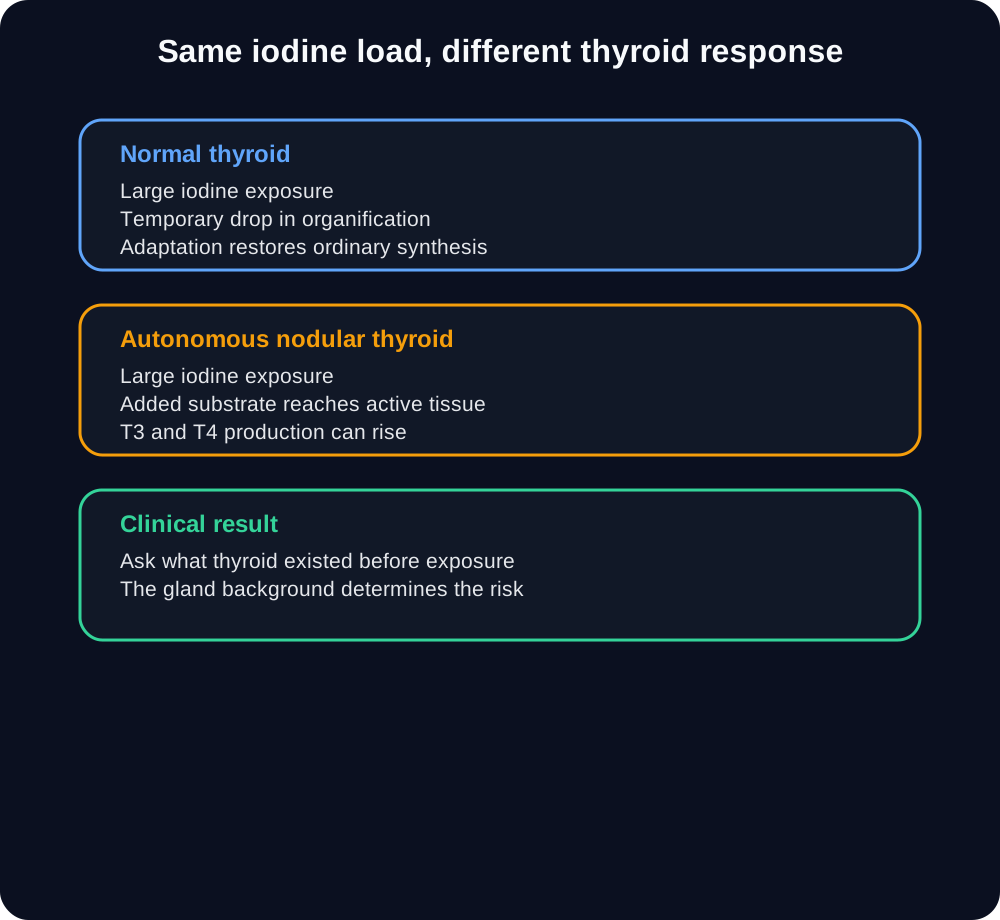
A normal thyroid temporarily suppresses organification, while autonomous tissue can use added iodine for excess hormone synthesis. The thyroid background determines the direction of risk. [1][4]
At the cellular level, acute excess iodine first raises the intrathyroidal iodide pool. The acute Wolff-Chaikoff effect then reduces organification and hormone synthesis. Escape is an adaptation rather than a reversal of feedback: reduced sodium-iodide symporter expression lowers iodide entry until organification can resume. A healthy gland can pass through this sequence without clinical thyroid disease, so normal timing must be separated from pathology. [4][5]
Jod-Basedow is the opposite clinical direction. A person with autonomous thyroid tissue, often within a multinodular goiter or latent Graves disease, receives an iodine load and develops excess hormone production. Long-standing iodine deficiency matters because it favors goiter and autonomous nodules, but iodine-induced hyperthyroidism can also occur in iodine-sufficient settings. [1][4]
Autonomous follicles do not require normal TSH stimulation to remain active. Once iodine becomes abundant, they can convert that substrate into additional triiodothyronine (T3) and thyroxine (T4) even as pituitary TSH falls. The resulting suppressed TSH is evidence of primary hormone excess, not protection against continued production. This explains why the same iodine load can be tolerated by one thyroid yet provoke hyperthyroidism in another. [1][4][5]
Use the companion iodine-switch diagram as a prediction exercise. Give both glands the same iodine exposure. Before reading on, decide which gland temporarily reduces synthesis and which gland can turn the added substrate into excess T3 and T4. The different outcomes come from the thyroid background, not from iodine being intrinsically a stimulant or suppressor. [4]
Predict first: an older adult with a multinodular goiter receives iodinated contrast. Which direction is the important risk?
The important risk is iodine-driven hyperthyroidism from functional autonomy. The same contrast exposure in a healthy gland is much more likely to be handled by normal autoregulation. Apply that distinction again when the iodine source is a supplement, medication, or abrupt dietary repletion. [1][4]
Try it here · Checkpoint 1 of 3
Make your prediction before reading the choices. A first attempt is just a starting point.
Case 1
Show answer and explanations for case 1
A. Iodine-fueled synthesis by autonomous thyroid tissue (Best answer)
The exposure supplied abundant iodine to a thyroid already capable of TSH-independent activity, producing Jod-Basedow hyperthyroidism.
Reasoning steps for option A
For jod-basedow-01, which baseline finding must be reconciled with Iodine-fueled synthesis by autonomous thyroid tissue?
Nodules can secrete despite pituitary suppression; prior iodine scarcity identifies the susceptible gland. This supports iodine-fueled synthesis by autonomous thyroid tissue.
When assessing Iodine-fueled synthesis by autonomous thyroid tissue in jod-basedow-01, how does the second, time-dependent observation change the comparison?
The delayed onset after coronary contrast links an iodine pulse to the new arrhythmia. Therefore this mechanism explains the decision better than the other listed pathways.
B. Follicular injury is releasing stored hormone without new synthesis (Why this does not fit)
Destructive thyroiditis can cause thyrotoxicosis, but the nodular autonomous background after a large iodine load favors increased synthesis.
Reasoning steps for option B
For jod-basedow-01, which baseline finding must be reconciled with Follicular injury is releasing stored hormone without new synthesis?
Nodules can secrete despite pituitary suppression; prior iodine scarcity identifies the susceptible gland. The proposed follicular injury is releasing stored hormone without new synthesis must account for this particular background, not merely the abnormal hormone result.
When assessing Follicular injury is releasing stored hormone without new synthesis in jod-basedow-01, how does the second, time-dependent observation change the comparison?
The delayed onset after coronary contrast links an iodine pulse to the new arrhythmia. That finding favors iodine-fueled synthesis by autonomous thyroid tissue over follicular injury is releasing stored hormone without new synthesis.
C. TSH-receptor antibodies are diffusely stimulating an otherwise smooth gland (Why this does not fit)
Graves disease can produce hyperthyroidism, but the long-standing nodular gland and iodine trigger support autonomy rather than a new diffuse antibody-driven process.
Reasoning steps for option C
For jod-basedow-01, which baseline finding must be reconciled with TSH-receptor antibodies are diffusely stimulating an otherwise smooth gland?
Nodules can secrete despite pituitary suppression; prior iodine scarcity identifies the susceptible gland. The proposed tsh-receptor antibodies are diffusely stimulating an otherwise smooth gland must account for this particular background, not merely the abnormal hormone result.
When assessing TSH-receptor antibodies are diffusely stimulating an otherwise smooth gland in jod-basedow-01, how does the second, time-dependent observation change the comparison?
The delayed onset after coronary contrast links an iodine pulse to the new arrhythmia. That finding favors iodine-fueled synthesis by autonomous thyroid tissue over tsh-receptor antibodies are diffusely stimulating an otherwise smooth gland.
D. Persistent Wolff-Chaikoff suppression is reducing organification (Why this does not fit)
Persistent Wolff-Chaikoff suppression would decrease hormone synthesis and tends toward hypothyroidism, the opposite biochemical direction.
Reasoning steps for option D
For jod-basedow-01, which baseline finding must be reconciled with Persistent Wolff-Chaikoff suppression is reducing organification?
Nodules can secrete despite pituitary suppression; prior iodine scarcity identifies the susceptible gland. The proposed persistent wolff-chaikoff suppression is reducing organification must account for this particular background, not merely the abnormal hormone result.
When assessing Persistent Wolff-Chaikoff suppression is reducing organification in jod-basedow-01, how does the second, time-dependent observation change the comparison?
The delayed onset after coronary contrast links an iodine pulse to the new arrhythmia. That finding favors iodine-fueled synthesis by autonomous thyroid tissue over persistent wolff-chaikoff suppression is reducing organification.
Takeaway: An iodine load can turn previously quiet autonomous thyroid tissue into a source of excess hormone.
Find the susceptible thyroid before blaming the exposure
Common large iodine exposures include iodinated contrast media, amiodarone, iodine-containing supplements, and high seaweed intake. The exposure establishes opportunity, not diagnosis. For contrast-related hyperthyroidism, the strongest recurring risk pattern is nodular thyroid disease, latent Graves disease, older age, and current or prior iodine deficiency. [1][4]
Contrast exposure can deliver grams of bound iodine plus a smaller bioavailable iodide fraction. Body iodine stores and urinary iodine can remain high for weeks, with slower clearance in some patients with impaired kidney function. Build an exposure timeline that includes computed tomography or angiography, amiodarone, kelp or seaweed products, iodine drops, and repeated topical antiseptics. Timing matters both for delayed symptoms and for tests distorted by residual iodine. [1][5]
A patient can be euthyroid before the exposure and still have an autonomous nodule. That is why a history of a long-standing goiter or a lumpy thyroid on examination is useful. In contrast, autoimmune thyroiditis is more strongly associated with iodine-induced hypothyroidism than with classic Jod-Basedow. [1]
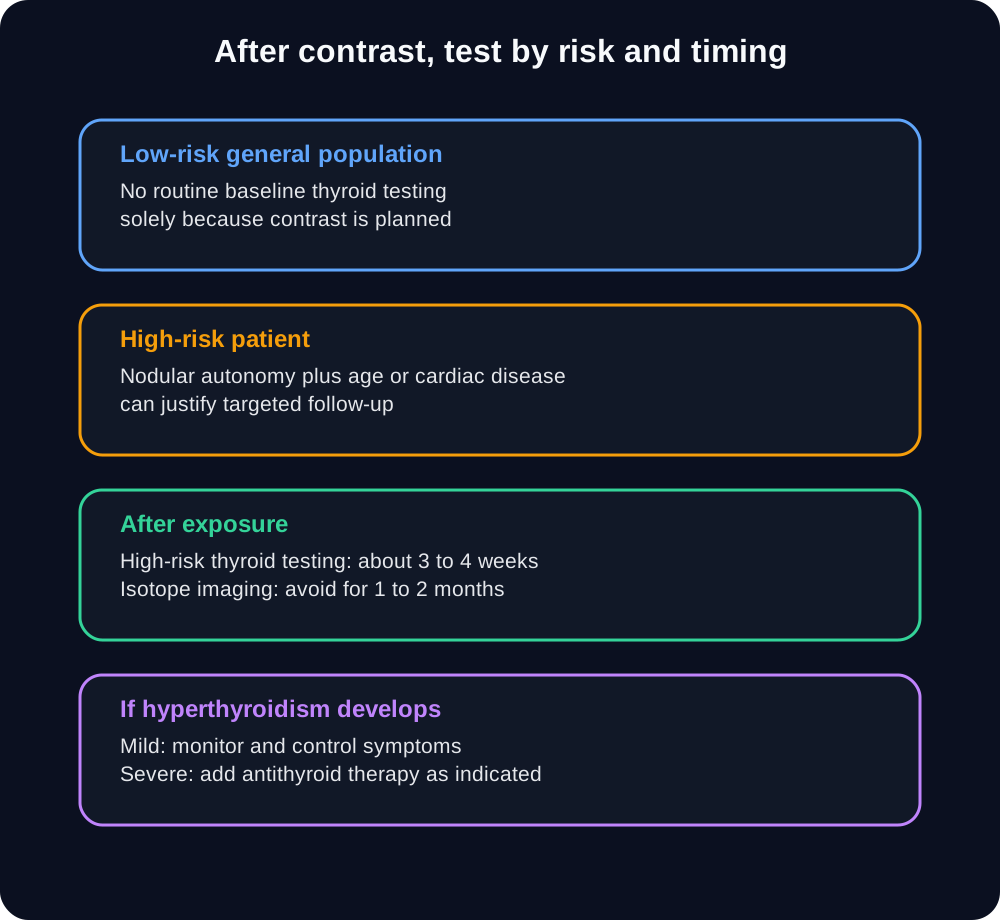
For the general population, the European Thyroid Association does not recommend routine thyroid testing before every contrast study. In a patient with persistent endogenous subclinical hyperthyroidism, however, the cause should be established before an elective iodine-based contrast examination because documented autonomy changes risk. Universal preventive medication for every high-risk patient is not recommended. Selected patients who would poorly tolerate hyperthyroidism may merit specialist-directed prevention before emergency contrast exposure. [1]
Apply the risk pattern: which history changes an iodine exposure from ordinary to concerning?
A prior or current nodular goiter with low TSH matters far more than the exposure by itself. The application is practical: first identify whether the thyroid was already capable of TSH-independent activity, then interpret what happened after iodine arrived. [1]
Read thyroid function before the uptake scan
Overt iodine-induced hyperthyroidism has the usual biochemical direction: TSH is suppressed and free T4 and/or T3 are high. Those values establish thyrotoxicosis, but they do not identify its cause. TSH-receptor antibodies, thyroid structure, blood-flow assessment, exposure history, and isotope studies can all contribute when the etiology is not obvious. [1][3]
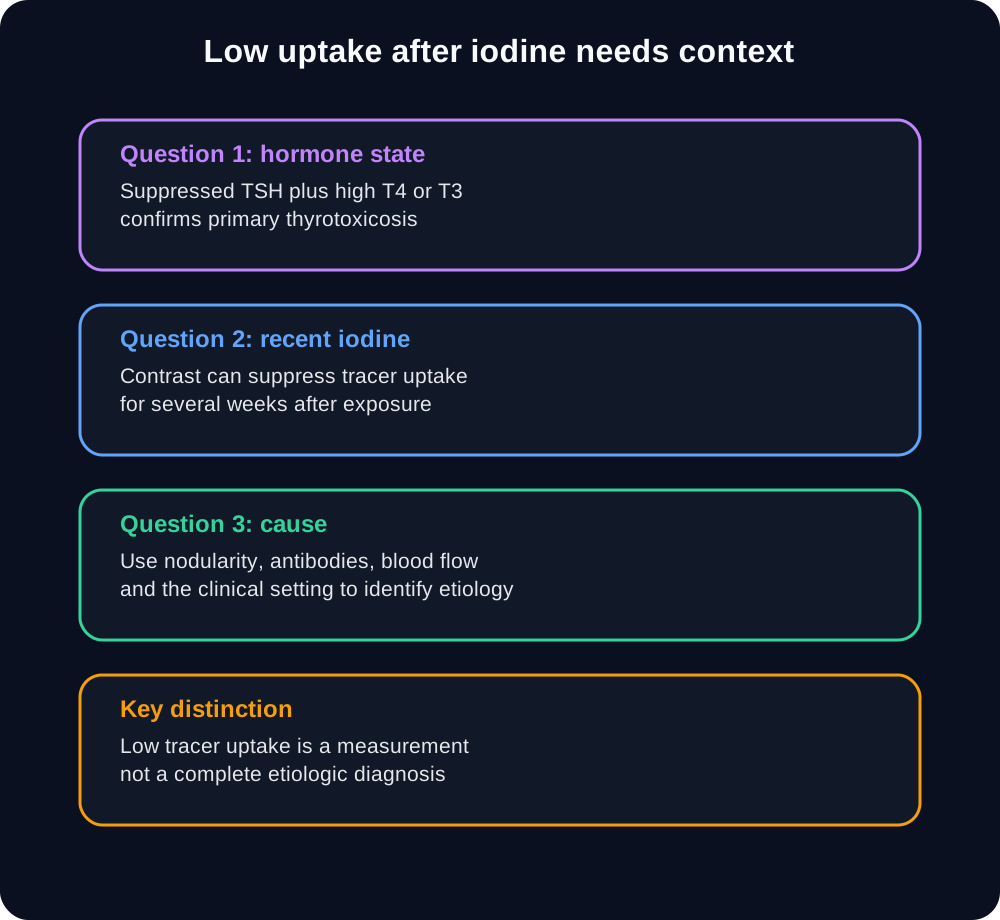
Recent contrast can suppress isotope uptake for weeks. Low uptake after iodine does not by itself prove destructive thyroiditis. [1][3]
Begin with TSH, free T4, and T3. Suppressed TSH with elevated hormones confirms a primary thyrotoxic state, but etiology still requires another layer. TSH-receptor antibodies support Graves disease; ultrasound defines nodularity; Doppler blood flow can support active synthesis. After recent contrast, these findings often deserve more weight than one uptake value because the scan may be measuring iodine saturation as much as gland activity. [1][3][5]
A low radioactive iodine uptake after recent contrast is easy to misread. Iodine-based contrast can suppress thyroidal tracer uptake for several weeks, so a low value does not automatically mean the gland is only leaking stored hormone. The 2021 European guideline recommends avoiding thyroid isotope imaging and radioactive iodine treatment for one to two months after contrast exposure. [1]
This creates an apparent paradox worth mastering: a gland can be making excess hormone while a tracer study looks quiet because the thyroid is already saturated with nonradioactive iodine. The companion uptake-context diagram separates the question of hormone production from the question of how much new tracer the gland can take up at that moment. [1]
Test the paradox: suppressed TSH, high T4, nodules, recent contrast, and low uptake. Does low uptake prove thyroiditis?
No. Recent iodine exposure itself can lower uptake, so the scan is context dependent. Reconstruct the timing, gland background, antibodies, and ultrasound findings instead of forcing one low number to answer the entire etiologic question. [1][3]
Try it here · Checkpoint 2 of 3
Make your prediction before reading the choices. A first attempt is just a starting point.
Case 2
Show answer and explanations for case 2
A. Complete arrest of new thyroid hormone synthesis (Why this does not fit)
Low uptake after recent contrast cannot establish that synthesis has stopped; the iodine load itself can suppress tracer entry.
Reasoning steps for option A
What does the free T4 elevation establish about circulating hormone?
Hormone excess is present, but it does not reveal whether new synthesis has ceased.
What recent event prevents the uptake value from proving synthesis arrest?
The contrast load left abundant stable iodine that competes with the radioactive tracer.
B. Competition from the recent nonradioactive iodine load (Best answer)
Correct. A recent nonradioactive iodine load reduces uptake of radioactive tracer even when autonomous thyroid tissue continues making hormone.
Reasoning steps for option B
Which exposure occurred two weeks before the scan?
She received iodinated contrast, a large source of nonradioactive iodine.
How does that exposure alter tracer entry into the gland?
The iodine-loaded gland takes up little new tracer even when autonomous follicles continue making hormone.
C. Diffuse stimulation by circulating TSH-receptor antibodies (Why this does not fit)
TSH-receptor antibody stimulation is not established by an uptake value obtained soon after contrast, and no antibody result supports Graves disease here.
Reasoning steps for option C
What structural background argues against a newly diffuse autoimmune process?
The gland is nodular rather than described as a smooth diffuse goiter.
Why cannot the uptake measurement establish antibody stimulation here?
Recent contrast suppresses tracer uptake, and no receptor-antibody result is provided.
D. Technical failure during the radioactive uptake measurement (Why this does not fit)
The result is physiologically plausible after contrast and does not by itself indicate a technical measurement failure.
Reasoning steps for option D
Which measurement is actually low in this item?
The radioactive iodine uptake, not the free T4 assay.
What makes technical failure less likely than physiology?
The result is expected soon after a large iodine exposure.
Takeaway: After iodinated contrast, low radioactive iodine uptake is context dependent and cannot by itself separate active synthesis from destructive release.
Separate new synthesis from stored-hormone release
Hyperthyroidism means the thyroid is actively synthesizing and secreting too much hormone. Thyrotoxicosis is broader and can also result when preformed hormone is released from injured follicles or taken from an external source. This distinction explains why an antithyroid drug can help an iodine-driven synthesis problem but is not the primary treatment for a purely destructive thyroiditis. [3]
When uptake is low without a recent iodine load, other discriminators become more useful. Thyroid pain with systemic inflammation favors subacute thyroiditis, while very low serum thyroglobulin can support exogenous hormone use. Diffuse hypervascularity with positive receptor antibodies favors Graves disease. These findings separate hormone synthesized by the gland, released from injured follicles, or taken from outside the body. [3]
Graves disease usually becomes more convincing with a diffuse gland, thyroid eye disease, and positive TSH-receptor antibodies. Toxic multinodular goiter becomes more convincing with a nodular gland and autonomy. Destructive thyroiditis becomes more convincing when the clinical setting supports follicular injury rather than synthesis. A recent iodine load can distort isotope uptake, so the whole pattern is more reliable than a scan interpreted in isolation. [1][3]
The original comparison with central hyperthyroidism still matters as a feedback check. Primary thyroid hormone excess should suppress TSH. When free T4 and T3 are high but TSH is not suppressed, the case no longer fits ordinary Jod-Basedow physiology and the differential must be redirected. [3]
Thionamides provide another useful contrast. Methimazole and propylthiouracil reduce new thyroid hormone synthesis through inhibition of thyroid peroxidase-dependent steps. That action points in the opposite direction from Jod-Basedow, where added iodine is being used by active tissue to support excess synthesis. [3]
Transfer the distinction: why can two patients with the same low uptake need different treatments?
One may have a destructive release process; the other may have iodine-saturated autonomous tissue that is still synthesizing hormone. Treatment follows the cause of hormone excess, so the same uptake number cannot safely substitute for etiologic reasoning after a large iodine exposure. [1][3]
Amiodarone creates two major paths
Amiodarone is iodine rich, but amiodarone-induced thyrotoxicosis is not one disease. Type 1 AIT is iodine-induced hyperthyroidism, usually in a gland with nodular autonomy or latent Graves disease. Type 2 AIT is a destructive thyroiditis that often occurs in a previously normal gland. Mixed or indefinite forms also occur. [2]
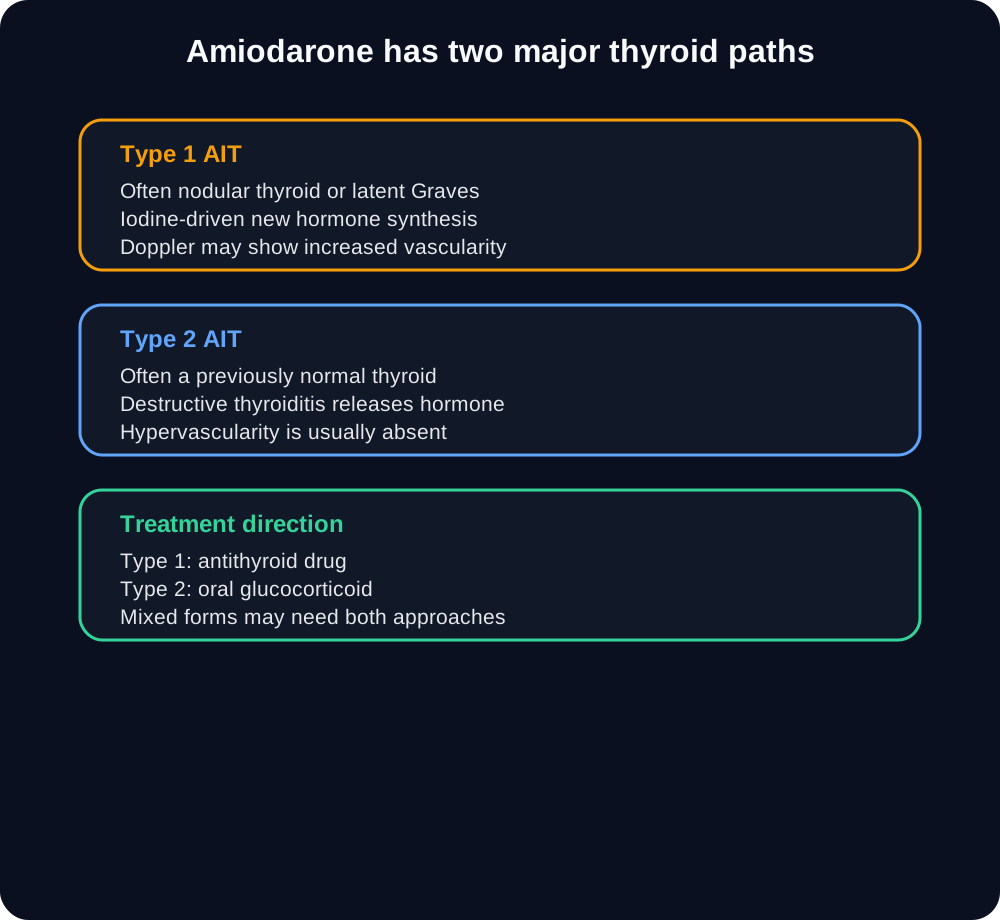
Type 1 AIT usually reflects iodine-driven synthesis in an abnormal gland. Type 2 AIT is destructive thyroiditis, and mixed forms can occur. [2]
Amiodarone also inhibits peripheral T4-to-T3 conversion, so free T4 can be disproportionately high and T3 may rise less than expected. That laboratory shape does not determine the AIT subtype. The subtype decision still depends on the pre-existing gland, Doppler flow, antibody results, and clinical course. Synthesis and destructive injury can coexist, so an indefinite pattern may need treatment directed at both processes. [2]
Color-flow Doppler can help when interpreted with the thyroid background. Increased vascularity supports type 1 AIT, while absent hypervascularity supports the destructive type 2 process. Radioactive iodine uptake has limited value for separating the two in iodine-replete areas because amiodarone can suppress uptake in both. [2]
The treatment direction follows the physiology. Type 1 AIT is generally treated with antithyroid drugs; a short course of perchlorate can be considered in selected cases under specialist care. Type 2 AIT is treated with oral glucocorticoids. If the mechanism remains uncertain, the guideline allows treatment for a mixed or indefinite form rather than pretending that one test always gives a clean answer. [2]
Predict treatment from the gland: nodular thyroid plus increased Doppler flow versus normal thyroid plus absent hypervascularity.
The first pattern favors type 1 AIT and synthesis-directed therapy. The second favors type 2 AIT and glucocorticoid treatment for destructive thyroiditis. The companion two-path diagram keeps the shared drug exposure from hiding the different thyroid processes. [2]
Match follow-up and treatment to risk
After iodinated contrast, routine TSH monitoring is not recommended for everyone. In high-risk patients, especially older adults or those with unstable cardiovascular disease, the European guideline suggests checking thyroid function about three to four weeks after exposure. Most symptomatic cases appear within weeks, although timing can vary. [1]
Risk and timing determine what to test after iodine-based contrast and whether mild disease can be observed or severe disease needs antithyroid therapy. [1]
Urgency follows the patient, not only the hormone concentration. Older adults with atrial fibrillation, angina, or heart failure can deteriorate quickly, so cardiovascular risk may justify prompt rate control and synthesis-directed therapy. Mild stable disease can be followed while repeat thyroid testing establishes the trajectory. After the iodine burden clears and the episode settles, persistent nodular autonomy still needs a durable plan rather than indefinite short-term monitoring. [1][3]
For mild contrast-induced hyperthyroidism, management often begins with avoiding further iodine excess, close follow-up, and a beta blocker when adrenergic symptoms need control. Thyroid function can be rechecked within two to eight weeks. Severe or persistent disease, particularly in an older patient with heart disease, may require an antithyroid drug in addition to symptom control. [1]
The iodine-loaded gland may respond more slowly to antithyroid drugs. That does not justify escalating every patient to aggressive therapy. The severity of thyrotoxicosis, age, cardiovascular status, thyroid cause, and clinical course determine treatment. After the acute episode settles, any underlying autonomous thyroid disease still deserves a long-term plan. [1]
Final application: what should you do with a quiet uptake scan one week after contrast?
Do not treat it as an independent verdict. Recent contrast can suppress isotope uptake, so the useful next step is to interpret the scan in exposure context and use thyroid history, antibodies, ultrasound, and follow-up testing as needed. [1]
Try it here · Checkpoint 3 of 3
Make your prediction before reading the choices. A first attempt is just a starting point.
Case 15
Show answer and explanations for case 15
A. Beta blockade plus an antithyroid drug (Best answer)
Severe contrast-induced hyperthyroidism in an older cardiac patient calls for symptom control with a beta blocker and synthesis-directed antithyroid therapy.
Reasoning steps for option A
For jod-basedow-15, which baseline finding must be reconciled with Beta blockade plus an antithyroid drug?
Rapid atrial fibrillation in heart failure requires prompt adrenergic control. This supports beta blockade plus an antithyroid drug.
When assessing Beta blockade plus an antithyroid drug in jod-basedow-15, how does the second, time-dependent observation change the comparison?
The nodular gland after angiography also warrants suppression of fresh hormone production. Therefore this mechanism explains the decision better than the other listed pathways.
B. Observation alone with repeat testing in six months (Why this does not fit)
Observation alone is inadequate when severe thyrotoxicosis is causing a major cardiac complication.
Reasoning steps for option B
For jod-basedow-15, which baseline finding must be reconciled with Observation alone with repeat testing in six months?
Rapid atrial fibrillation in heart failure requires prompt adrenergic control. The proposed observation alone with repeat testing in six months must account for this particular background, not merely the abnormal hormone result.
When assessing Observation alone with repeat testing in six months in jod-basedow-15, how does the second, time-dependent observation change the comparison?
The nodular gland after angiography also warrants suppression of fresh hormone production. That finding favors beta blockade plus an antithyroid drug over observation alone with repeat testing in six months.
C. Levothyroxine plus iodine supplementation (Why this does not fit)
Thyroid hormone replacement and more iodine would worsen the hyperthyroid state.
Reasoning steps for option C
For jod-basedow-15, which baseline finding must be reconciled with Levothyroxine plus iodine supplementation?
Rapid atrial fibrillation in heart failure requires prompt adrenergic control. The proposed levothyroxine plus iodine supplementation must account for this particular background, not merely the abnormal hormone result.
When assessing Levothyroxine plus iodine supplementation in jod-basedow-15, how does the second, time-dependent observation change the comparison?
The nodular gland after angiography also warrants suppression of fresh hormone production. That finding favors beta blockade plus an antithyroid drug over levothyroxine plus iodine supplementation.
D. Glucocorticoid alone for presumed destructive thyroiditis (Why this does not fit)
The nodular autonomous background favors iodine-driven synthesis rather than a pure destructive process that would be treated with glucocorticoid alone.
Reasoning steps for option D
For jod-basedow-15, which baseline finding must be reconciled with Glucocorticoid alone for presumed destructive thyroiditis?
Rapid atrial fibrillation in heart failure requires prompt adrenergic control. The proposed glucocorticoid alone for presumed destructive thyroiditis must account for this particular background, not merely the abnormal hormone result.
When assessing Glucocorticoid alone for presumed destructive thyroiditis in jod-basedow-15, how does the second, time-dependent observation change the comparison?
The nodular gland after angiography also warrants suppression of fresh hormone production. That finding favors beta blockade plus an antithyroid drug over glucocorticoid alone for presumed destructive thyroiditis.
Takeaway: Severe iodine-induced hyperthyroidism, especially with cardiac disease, is treated with beta blockade and antithyroid therapy.
A. A history of autoimmune hypothyroidism treated with levothyroxine (Why this does not fit)
Autoimmune hypothyroidism is more associated with iodine-related hypothyroidism than classic Jod-Basedow hyperthyroidism.
Reasoning steps for option A
For jod-basedow-03, which baseline finding must be reconciled with A history of autoimmune hypothyroidism treated with levothyroxine?
The irregular thyroid predates the scan, so the substrate is already present. The proposed a history of autoimmune hypothyroidism treated with levothyroxine must account for this particular background, not merely the abnormal hormone result.
When assessing A history of autoimmune hypothyroidism treated with levothyroxine in jod-basedow-03, how does the second, time-dependent observation change the comparison?
Repeated low baseline TSH suggests functioning nodules before any additional iodine arrives. That finding favors pre-existing thyroid functional autonomy within a nodular goiter over a history of autoimmune hypothyroidism treated with levothyroxine.
B. A remote hemithyroidectomy with stable replacement therapy (Why this does not fit)
Stable thyroid replacement after loss of functioning tissue does not create autonomous hormone-producing nodules.
Reasoning steps for option B
For jod-basedow-03, which baseline finding must be reconciled with A remote hemithyroidectomy with stable replacement therapy?
The irregular thyroid predates the scan, so the substrate is already present. The proposed a remote hemithyroidectomy with stable replacement therapy must account for this particular background, not merely the abnormal hormone result.
When assessing A remote hemithyroidectomy with stable replacement therapy in jod-basedow-03, how does the second, time-dependent observation change the comparison?
Repeated low baseline TSH suggests functioning nodules before any additional iodine arrives. That finding favors pre-existing thyroid functional autonomy within a nodular goiter over a remote hemithyroidectomy with stable replacement therapy.
C. Pre-existing thyroid functional autonomy within a nodular goiter (Best answer)
A nodular gland with intermittently low TSH suggests functional autonomy, the major substrate for contrast-induced Jod-Basedow hyperthyroidism.
Reasoning steps for option C
For jod-basedow-03, which baseline finding must be reconciled with Pre-existing thyroid functional autonomy within a nodular goiter?
The irregular thyroid predates the scan, so the substrate is already present. This supports pre-existing thyroid functional autonomy within a nodular goiter.
When assessing Pre-existing thyroid functional autonomy within a nodular goiter in jod-basedow-03, how does the second, time-dependent observation change the comparison?
Repeated low baseline TSH suggests functioning nodules before any additional iodine arrives. Therefore this mechanism explains the decision better than the other listed pathways.
D. Normal serum creatinine before the scan (Why this does not fit)
Kidney function can influence iodine clearance, but the central thyroid risk factor here is autonomous nodular tissue.
Reasoning steps for option D
For jod-basedow-03, which baseline finding must be reconciled with Normal serum creatinine before the scan?
The irregular thyroid predates the scan, so the substrate is already present. The proposed normal serum creatinine before the scan must account for this particular background, not merely the abnormal hormone result.
When assessing Normal serum creatinine before the scan in jod-basedow-03, how does the second, time-dependent observation change the comparison?
Repeated low baseline TSH suggests functioning nodules before any additional iodine arrives. That finding favors pre-existing thyroid functional autonomy within a nodular goiter over normal serum creatinine before the scan.
Takeaway: Functional autonomy in a nodular thyroid is a major risk state for Jod-Basedow after a large iodine exposure.
A. Iodine-induced hormone synthesis in autonomous nodules (Why this does not fit)
There is no iodine exposure or nodular background to support Jod-Basedow, and the painful inflammatory presentation points elsewhere.
Reasoning steps for option A
For jod-basedow-04, which baseline finding must be reconciled with Iodine-induced hormone synthesis in autonomous nodules?
Pain and fever with ESR 86 indicate an inflamed gland rather than silent autonomy. The proposed iodine-induced hormone synthesis in autonomous nodules must account for this particular background, not merely the abnormal hormone result.
When assessing Iodine-induced hormone synthesis in autonomous nodules in jod-basedow-04, how does the second, time-dependent observation change the comparison?
With no recent iodine load, near-zero tracer uptake supports release of stored hormone. That finding favors destructive thyroiditis releasing preformed hormone over iodine-induced hormone synthesis in autonomous nodules.
B. TSH-receptor antibody stimulation of Graves disease (Why this does not fit)
Graves disease usually lacks painful thyroid inflammation and would be supported by a different clinical and immunologic pattern.
Reasoning steps for option B
For jod-basedow-04, which baseline finding must be reconciled with TSH-receptor antibody stimulation of Graves disease?
Pain and fever with ESR 86 indicate an inflamed gland rather than silent autonomy. The proposed tsh-receptor antibody stimulation of graves disease must account for this particular background, not merely the abnormal hormone result.
When assessing TSH-receptor antibody stimulation of Graves disease in jod-basedow-04, how does the second, time-dependent observation change the comparison?
With no recent iodine load, near-zero tracer uptake supports release of stored hormone. That finding favors destructive thyroiditis releasing preformed hormone over tsh-receptor antibody stimulation of graves disease.
C. Excess pituitary TSH secretion (Why this does not fit)
A pituitary source would not usually suppress TSH and would not explain the painful inflammatory gland.
Reasoning steps for option C
For jod-basedow-04, which baseline finding must be reconciled with Excess pituitary TSH secretion?
Pain and fever with ESR 86 indicate an inflamed gland rather than silent autonomy. The proposed excess pituitary tsh secretion must account for this particular background, not merely the abnormal hormone result.
When assessing Excess pituitary TSH secretion in jod-basedow-04, how does the second, time-dependent observation change the comparison?
With no recent iodine load, near-zero tracer uptake supports release of stored hormone. That finding favors destructive thyroiditis releasing preformed hormone over excess pituitary tsh secretion.
D. Destructive thyroiditis releasing preformed hormone (Best answer)
Pain, systemic inflammation, suppressed TSH, and very low uptake without iodine exposure support destructive thyroiditis with release of stored hormone.
Reasoning steps for option D
For jod-basedow-04, which baseline finding must be reconciled with Destructive thyroiditis releasing preformed hormone?
Pain and fever with ESR 86 indicate an inflamed gland rather than silent autonomy. This supports destructive thyroiditis releasing preformed hormone.
When assessing Destructive thyroiditis releasing preformed hormone in jod-basedow-04, how does the second, time-dependent observation change the comparison?
With no recent iodine load, near-zero tracer uptake supports release of stored hormone. Therefore this mechanism explains the decision better than the other listed pathways.
Takeaway: Low uptake means something different when there was no recent iodine load and the gland is clinically inflamed.
A. Type 1 amiodarone-induced thyrotoxicosis (Best answer)
Type 1 AIT is iodine-induced hyperthyroidism that commonly arises in nodular autonomous tissue or latent Graves disease and can show increased vascularity.
Reasoning steps for option A
For jod-basedow-05, which baseline finding must be reconciled with Type 1 amiodarone-induced thyrotoxicosis?
A multinodular thyroid offers a pre-existing source of TSH-independent synthesis. This supports type 1 amiodarone-induced thyrotoxicosis.
When assessing Type 1 amiodarone-induced thyrotoxicosis in jod-basedow-05, how does the second, time-dependent observation change the comparison?
Flow on Doppler indicates active gland perfusion despite ongoing amiodarone exposure. Therefore this mechanism explains the decision better than the other listed pathways.
B. Type 2 amiodarone-induced thyrotoxicosis (Why this does not fit)
Type 2 AIT is destructive thyroiditis and is more often associated with a previously normal gland and absent hypervascularity.
Reasoning steps for option B
For jod-basedow-05, which baseline finding must be reconciled with Type 2 amiodarone-induced thyrotoxicosis?
A multinodular thyroid offers a pre-existing source of TSH-independent synthesis. The proposed type 2 amiodarone-induced thyrotoxicosis must account for this particular background, not merely the abnormal hormone result.
When assessing Type 2 amiodarone-induced thyrotoxicosis in jod-basedow-05, how does the second, time-dependent observation change the comparison?
Flow on Doppler indicates active gland perfusion despite ongoing amiodarone exposure. That finding favors type 1 amiodarone-induced thyrotoxicosis over type 2 amiodarone-induced thyrotoxicosis.
C. Painless thyroiditis unrelated to amiodarone (Why this does not fit)
A destructive thyroiditis does not explain the nodular autonomous background plus increased vascularity as well as type 1 AIT.
Reasoning steps for option C
For jod-basedow-05, which baseline finding must be reconciled with Painless thyroiditis unrelated to amiodarone?
A multinodular thyroid offers a pre-existing source of TSH-independent synthesis. The proposed painless thyroiditis unrelated to amiodarone must account for this particular background, not merely the abnormal hormone result.
When assessing Painless thyroiditis unrelated to amiodarone in jod-basedow-05, how does the second, time-dependent observation change the comparison?
Flow on Doppler indicates active gland perfusion despite ongoing amiodarone exposure. That finding favors type 1 amiodarone-induced thyrotoxicosis over painless thyroiditis unrelated to amiodarone.
D. Central hyperthyroidism (Why this does not fit)
Central hyperthyroidism would not fit the suppressed TSH and the thyroid findings.
Reasoning steps for option D
For jod-basedow-05, which baseline finding must be reconciled with Central hyperthyroidism?
A multinodular thyroid offers a pre-existing source of TSH-independent synthesis. The proposed central hyperthyroidism must account for this particular background, not merely the abnormal hormone result.
When assessing Central hyperthyroidism in jod-basedow-05, how does the second, time-dependent observation change the comparison?
Flow on Doppler indicates active gland perfusion despite ongoing amiodarone exposure. That finding favors type 1 amiodarone-induced thyrotoxicosis over central hyperthyroidism.
Takeaway: Amiodarone exposure plus nodular thyroid disease and increased vascularity favors type 1 AIT, an iodine-driven synthesis problem.
A. Iodine-driven synthesis from toxic multinodular goiter (Why this does not fit)
Toxic multinodular goiter requires a nodular autonomous substrate, which is not present here.
Reasoning steps for option A
For jod-basedow-06, which baseline finding must be reconciled with Iodine-driven synthesis from toxic multinodular goiter?
Previous normal imaging and absent nodules undermine a toxic nodular substrate. The proposed iodine-driven synthesis from toxic multinodular goiter must account for this particular background, not merely the abnormal hormone result.
When assessing Iodine-driven synthesis from toxic multinodular goiter in jod-basedow-06, how does the second, time-dependent observation change the comparison?
Lack of Doppler hypervascularity supports follicular destruction rather than active production. That finding favors type 2 amiodarone-induced destructive thyroiditis over iodine-driven synthesis from toxic multinodular goiter.
B. Type 2 amiodarone-induced destructive thyroiditis (Best answer)
Type 2 AIT is a destructive thyroiditis often occurring in a previously normal gland and is supported by absent hypervascularity despite high hormone levels.
Reasoning steps for option B
For jod-basedow-06, which baseline finding must be reconciled with Type 2 amiodarone-induced destructive thyroiditis?
Previous normal imaging and absent nodules undermine a toxic nodular substrate. This supports type 2 amiodarone-induced destructive thyroiditis.
When assessing Type 2 amiodarone-induced destructive thyroiditis in jod-basedow-06, how does the second, time-dependent observation change the comparison?
Lack of Doppler hypervascularity supports follicular destruction rather than active production. Therefore this mechanism explains the decision better than the other listed pathways.
C. New pituitary TSH secretion (Why this does not fit)
A pituitary source would give an inappropriately normal or high TSH rather than a suppressed value.
Reasoning steps for option C
For jod-basedow-06, which baseline finding must be reconciled with New pituitary TSH secretion?
Previous normal imaging and absent nodules undermine a toxic nodular substrate. The proposed new pituitary tsh secretion must account for this particular background, not merely the abnormal hormone result.
When assessing New pituitary TSH secretion in jod-basedow-06, how does the second, time-dependent observation change the comparison?
Lack of Doppler hypervascularity supports follicular destruction rather than active production. That finding favors type 2 amiodarone-induced destructive thyroiditis over new pituitary tsh secretion.
D. Persistent physiologic adaptation to iodine excess (Why this does not fit)
Normal adaptation to iodine excess maintains euthyroidism; it does not explain symptomatic thyrotoxicosis.
Reasoning steps for option D
For jod-basedow-06, which baseline finding must be reconciled with Persistent physiologic adaptation to iodine excess?
Previous normal imaging and absent nodules undermine a toxic nodular substrate. The proposed persistent physiologic adaptation to iodine excess must account for this particular background, not merely the abnormal hormone result.
When assessing Persistent physiologic adaptation to iodine excess in jod-basedow-06, how does the second, time-dependent observation change the comparison?
Lack of Doppler hypervascularity supports follicular destruction rather than active production. That finding favors type 2 amiodarone-induced destructive thyroiditis over persistent physiologic adaptation to iodine excess.
Takeaway: A previously normal gland with absent hypervascularity during amiodarone-associated thyrotoxicosis favors type 2 AIT.
A. Prednisone to suppress destructive inflammation (Why this does not fit)
Glucocorticoids are first-line for type 2 destructive AIT, not the synthesis-driven type 1 pattern shown here.
Reasoning steps for option A
For jod-basedow-07, which baseline finding must be reconciled with Prednisone to suppress destructive inflammation?
Nodules plus increased flow point toward an active synthetic process. The proposed prednisone to suppress destructive inflammation must account for this particular background, not merely the abnormal hormone result.
When assessing Prednisone to suppress destructive inflammation in jod-basedow-07, how does the second, time-dependent observation change the comparison?
Amiodarone delivers iodine to that gland, so blockade of new synthesis addresses type 1 physiology. That finding favors methimazole to inhibit new thyroid hormone synthesis over prednisone to suppress destructive inflammation.
B. Levothyroxine replacement to reduce TSH (Why this does not fit)
Thyroid hormone replacement would worsen a hyperthyroid state and does not target autonomous synthesis.
Reasoning steps for option B
For jod-basedow-07, which baseline finding must be reconciled with Levothyroxine replacement to reduce TSH?
Nodules plus increased flow point toward an active synthetic process. The proposed levothyroxine replacement to reduce tsh must account for this particular background, not merely the abnormal hormone result.
When assessing Levothyroxine replacement to reduce TSH in jod-basedow-07, how does the second, time-dependent observation change the comparison?
Amiodarone delivers iodine to that gland, so blockade of new synthesis addresses type 1 physiology. That finding favors methimazole to inhibit new thyroid hormone synthesis over levothyroxine replacement to reduce tsh.
C. Methimazole to inhibit new thyroid hormone synthesis (Best answer)
The findings support type 1 AIT, for which antithyroid drugs such as methimazole are the main medical treatment.
Reasoning steps for option C
For jod-basedow-07, which baseline finding must be reconciled with Methimazole to inhibit new thyroid hormone synthesis?
Nodules plus increased flow point toward an active synthetic process. This supports methimazole to inhibit new thyroid hormone synthesis.
When assessing Methimazole to inhibit new thyroid hormone synthesis in jod-basedow-07, how does the second, time-dependent observation change the comparison?
Amiodarone delivers iodine to that gland, so blockade of new synthesis addresses type 1 physiology. Therefore this mechanism explains the decision better than the other listed pathways.
D. Immediate radioactive iodine while the gland remains iodine loaded (Why this does not fit)
An iodine-loaded thyroid may have poor radioactive iodine uptake, so immediate radioiodine is not the direct first medical treatment.
Reasoning steps for option D
For jod-basedow-07, which baseline finding must be reconciled with Immediate radioactive iodine while the gland remains iodine loaded?
Nodules plus increased flow point toward an active synthetic process. The proposed immediate radioactive iodine while the gland remains iodine loaded must account for this particular background, not merely the abnormal hormone result.
When assessing Immediate radioactive iodine while the gland remains iodine loaded in jod-basedow-07, how does the second, time-dependent observation change the comparison?
Amiodarone delivers iodine to that gland, so blockade of new synthesis addresses type 1 physiology. That finding favors methimazole to inhibit new thyroid hormone synthesis over immediate radioactive iodine while the gland remains iodine loaded.
Takeaway: Type 1 AIT is treated as a synthesis problem, so antithyroid drugs directly target the active thyroid process.
A. Methimazole alone as treatment for autonomous hormone synthesis (Why this does not fit)
Antithyroid drugs target new synthesis and are the main therapy for type 1 AIT, not the destructive pattern shown.
Reasoning steps for option A
For jod-basedow-08, which baseline finding must be reconciled with Methimazole alone as treatment for autonomous hormone synthesis?
The previously normal nonhypervascular thyroid does not suggest autonomous synthesis. The proposed methimazole alone as treatment for autonomous hormone synthesis must account for this particular background, not merely the abnormal hormone result.
When assessing Methimazole alone as treatment for autonomous hormone synthesis in jod-basedow-08, how does the second, time-dependent observation change the comparison?
Ongoing amiodarone-associated injury calls for anti-inflammatory therapy rather than synthesis blockade alone. That finding favors oral glucocorticoid therapy for destructive thyroiditis over methimazole alone as treatment for autonomous hormone synthesis.
B. Radioactive iodine immediately despite iodine saturation (Why this does not fit)
Iodine saturation reduces isotope uptake and radioiodine does not directly treat an acute destructive process.
Reasoning steps for option B
For jod-basedow-08, which baseline finding must be reconciled with Radioactive iodine immediately despite iodine saturation?
The previously normal nonhypervascular thyroid does not suggest autonomous synthesis. The proposed radioactive iodine immediately despite iodine saturation must account for this particular background, not merely the abnormal hormone result.
When assessing Radioactive iodine immediately despite iodine saturation in jod-basedow-08, how does the second, time-dependent observation change the comparison?
Ongoing amiodarone-associated injury calls for anti-inflammatory therapy rather than synthesis blockade alone. That finding favors oral glucocorticoid therapy for destructive thyroiditis over radioactive iodine immediately despite iodine saturation.
C. Levothyroxine to suppress endogenous thyroid activity (Why this does not fit)
Levothyroxine would add thyroid hormone during thyrotoxicosis.
Reasoning steps for option C
For jod-basedow-08, which baseline finding must be reconciled with Levothyroxine to suppress endogenous thyroid activity?
The previously normal nonhypervascular thyroid does not suggest autonomous synthesis. The proposed levothyroxine to suppress endogenous thyroid activity must account for this particular background, not merely the abnormal hormone result.
When assessing Levothyroxine to suppress endogenous thyroid activity in jod-basedow-08, how does the second, time-dependent observation change the comparison?
Ongoing amiodarone-associated injury calls for anti-inflammatory therapy rather than synthesis blockade alone. That finding favors oral glucocorticoid therapy for destructive thyroiditis over levothyroxine to suppress endogenous thyroid activity.
D. Oral glucocorticoid therapy for destructive thyroiditis (Best answer)
The presentation supports type 2 AIT, for which oral glucocorticoids are the recommended treatment.
Reasoning steps for option D
For jod-basedow-08, which baseline finding must be reconciled with Oral glucocorticoid therapy for destructive thyroiditis?
The previously normal nonhypervascular thyroid does not suggest autonomous synthesis. This supports oral glucocorticoid therapy for destructive thyroiditis.
When assessing Oral glucocorticoid therapy for destructive thyroiditis in jod-basedow-08, how does the second, time-dependent observation change the comparison?
Ongoing amiodarone-associated injury calls for anti-inflammatory therapy rather than synthesis blockade alone. Therefore this mechanism explains the decision better than the other listed pathways.
Takeaway: Type 2 AIT is a destructive thyroiditis and is treated with glucocorticoids rather than synthesis-directed therapy alone.
The acute Wolff-Chaikoff response transiently reduces iodide organification and hormone synthesis after a large iodine exposure.
Reasoning steps for option A
For jod-basedow-09, which baseline finding must be reconciled with Acute Wolff-Chaikoff inhibition?
A healthy gland has feedback capacity and no evidence of an autonomous nodule. This supports acute wolff-chaikoff inhibition.
When assessing Acute Wolff-Chaikoff inhibition in jod-basedow-09, how does the second, time-dependent observation change the comparison?
A one-day fall in organification despite iodine excess is an inhibitory, not stimulatory, response. Therefore this mechanism explains the decision better than the other listed pathways.
B. Jod-Basedow hyperthyroidism (Why this does not fit)
Jod-Basedow produces iodine-induced hyperthyroidism in susceptible autonomous tissue, not transient suppression in a healthy gland.
Reasoning steps for option B
For jod-basedow-09, which baseline finding must be reconciled with Jod-Basedow hyperthyroidism?
A healthy gland has feedback capacity and no evidence of an autonomous nodule. The proposed jod-basedow hyperthyroidism must account for this particular background, not merely the abnormal hormone result.
When assessing Jod-Basedow hyperthyroidism in jod-basedow-09, how does the second, time-dependent observation change the comparison?
A one-day fall in organification despite iodine excess is an inhibitory, not stimulatory, response. That finding favors acute wolff-chaikoff inhibition over jod-basedow hyperthyroidism.
C. Type 1 amiodarone-induced thyrotoxicosis (Why this does not fit)
Type 1 AIT requires amiodarone-associated iodine-driven hyperthyroidism in a susceptible thyroid.
Reasoning steps for option C
For jod-basedow-09, which baseline finding must be reconciled with Type 1 amiodarone-induced thyrotoxicosis?
A healthy gland has feedback capacity and no evidence of an autonomous nodule. The proposed type 1 amiodarone-induced thyrotoxicosis must account for this particular background, not merely the abnormal hormone result.
When assessing Type 1 amiodarone-induced thyrotoxicosis in jod-basedow-09, how does the second, time-dependent observation change the comparison?
A one-day fall in organification despite iodine excess is an inhibitory, not stimulatory, response. That finding favors acute wolff-chaikoff inhibition over type 1 amiodarone-induced thyrotoxicosis.
D. TSH-independent toxic adenoma activation (Why this does not fit)
A toxic adenoma would create autonomy and can cause hormone excess rather than the normal transient inhibitory response described.
Reasoning steps for option D
For jod-basedow-09, which baseline finding must be reconciled with TSH-independent toxic adenoma activation?
A healthy gland has feedback capacity and no evidence of an autonomous nodule. The proposed tsh-independent toxic adenoma activation must account for this particular background, not merely the abnormal hormone result.
When assessing TSH-independent toxic adenoma activation in jod-basedow-09, how does the second, time-dependent observation change the comparison?
A one-day fall in organification despite iodine excess is an inhibitory, not stimulatory, response. That finding favors acute wolff-chaikoff inhibition over tsh-independent toxic adenoma activation.
Takeaway: The normal early response to excess iodine is transient inhibition of organification, not automatic hyperthyroidism.
A. Upregulation of thyroid-stimulating immunoglobulin production (Why this does not fit)
Thyroid-stimulating immunoglobulins are part of Graves disease, not normal adaptation to an iodine load.
Reasoning steps for option A
For jod-basedow-10, which baseline finding must be reconciled with Upregulation of thyroid-stimulating immunoglobulin production?
Continued excess iodide means recovery cannot require withdrawal of the external load. The proposed upregulation of thyroid-stimulating immunoglobulin production must account for this particular background, not merely the abnormal hormone result.
When assessing Upregulation of thyroid-stimulating immunoglobulin production in jod-basedow-10, how does the second, time-dependent observation change the comparison?
The gland must reduce intracellular iodide to escape transient organification inhibition. That finding favors reduced nis expression lowers intrathyroidal iodide over upregulation of thyroid-stimulating immunoglobulin production.
B. Reduced NIS expression lowers intrathyroidal iodide (Best answer)
Reduced NIS expression lowers iodide transport into the gland, allowing intrathyroidal iodide to fall and ordinary organification to resume.
Reasoning steps for option B
For jod-basedow-10, which baseline finding must be reconciled with Reduced NIS expression lowers intrathyroidal iodide?
Continued excess iodide means recovery cannot require withdrawal of the external load. This supports reduced nis expression lowers intrathyroidal iodide.
When assessing Reduced NIS expression lowers intrathyroidal iodide in jod-basedow-10, how does the second, time-dependent observation change the comparison?
The gland must reduce intracellular iodide to escape transient organification inhibition. Therefore this mechanism explains the decision better than the other listed pathways.
C. Permanent inhibition of thyroid peroxidase (Why this does not fit)
Permanent TPO inhibition would prevent recovery of normal hormone synthesis.
Reasoning steps for option C
For jod-basedow-10, which baseline finding must be reconciled with Permanent inhibition of thyroid peroxidase?
Continued excess iodide means recovery cannot require withdrawal of the external load. The proposed permanent inhibition of thyroid peroxidase must account for this particular background, not merely the abnormal hormone result.
When assessing Permanent inhibition of thyroid peroxidase in jod-basedow-10, how does the second, time-dependent observation change the comparison?
The gland must reduce intracellular iodide to escape transient organification inhibition. That finding favors reduced nis expression lowers intrathyroidal iodide over permanent inhibition of thyroid peroxidase.
D. New TSH-independent nodules forming over several days (Why this does not fit)
Autonomous nodules do not form within days as the normal mechanism of adaptation to an iodine load.
Reasoning steps for option D
For jod-basedow-10, which baseline finding must be reconciled with New TSH-independent nodules forming over several days?
Continued excess iodide means recovery cannot require withdrawal of the external load. The proposed new tsh-independent nodules forming over several days must account for this particular background, not merely the abnormal hormone result.
When assessing New TSH-independent nodules forming over several days in jod-basedow-10, how does the second, time-dependent observation change the comparison?
The gland must reduce intracellular iodide to escape transient organification inhibition. That finding favors reduced nis expression lowers intrathyroidal iodide over new tsh-independent nodules forming over several days.
Takeaway: Escape from the acute Wolff-Chaikoff response is associated with reduced iodide transport into the thyroid.
A. Give preventive methimazole to every patient with a nodular goiter (Why this does not fit)
Universal preventive medication is not recommended for every high-risk patient.
Reasoning steps for option A
For jod-basedow-11, which baseline finding must be reconciled with Give preventive methimazole to every patient with a nodular goiter?
The 0.08 TSH predates contrast and warrants etiologic assessment despite normal hormones. The proposed give preventive methimazole to every patient with a nodular goiter must account for this particular background, not merely the abnormal hormone result.
When assessing Give preventive methimazole to every patient with a nodular goiter in jod-basedow-11, how does the second, time-dependent observation change the comparison?
An elective scan permits workup for autonomy and endocrine advice before the iodine bolus. That finding favors establish the cause before contrast and seek endocrine guidance over give preventive methimazole to every patient with a nodular goiter.
B. Cancel all future contrast studies regardless of clinical need (Why this does not fit)
Contrast is not categorically forbidden in persistent subclinical hyperthyroidism; risk assessment and etiologic evaluation are needed.
Reasoning steps for option B
For jod-basedow-11, which baseline finding must be reconciled with Cancel all future contrast studies regardless of clinical need?
The 0.08 TSH predates contrast and warrants etiologic assessment despite normal hormones. The proposed cancel all future contrast studies regardless of clinical need must account for this particular background, not merely the abnormal hormone result.
When assessing Cancel all future contrast studies regardless of clinical need in jod-basedow-11, how does the second, time-dependent observation change the comparison?
An elective scan permits workup for autonomy and endocrine advice before the iodine bolus. That finding favors establish the cause before contrast and seek endocrine guidance over cancel all future contrast studies regardless of clinical need.
C. Establish the cause before contrast and seek endocrine guidance (Best answer)
Persistent low TSH with nodular disease can reflect autonomy, which changes risk. The guideline recommends establishing the cause before elective contrast and allows specialist input.
Reasoning steps for option C
For jod-basedow-11, which baseline finding must be reconciled with Establish the cause before contrast and seek endocrine guidance?
The 0.08 TSH predates contrast and warrants etiologic assessment despite normal hormones. This supports establish the cause before contrast and seek endocrine guidance.
When assessing Establish the cause before contrast and seek endocrine guidance in jod-basedow-11, how does the second, time-dependent observation change the comparison?
An elective scan permits workup for autonomy and endocrine advice before the iodine bolus. Therefore this mechanism explains the decision better than the other listed pathways.
D. Ignore the low TSH because free thyroxine (T4) is normal (Why this does not fit)
Normal free thyroxine (T4) does not erase persistent subclinical hyperthyroidism or its relevance to contrast-related risk.
Reasoning steps for option D
For jod-basedow-11, which baseline finding must be reconciled with Ignore the low TSH because free T4 is normal?
The 0.08 TSH predates contrast and warrants etiologic assessment despite normal hormones. The proposed ignore the low tsh because free t4 is normal must account for this particular background, not merely the abnormal hormone result.
When assessing Ignore the low TSH because free T4 is normal in jod-basedow-11, how does the second, time-dependent observation change the comparison?
An elective scan permits workup for autonomy and endocrine advice before the iodine bolus. That finding favors establish the cause before contrast and seek endocrine guidance over ignore the low tsh because free t4 is normal.
Takeaway: Persistent subclinical hyperthyroidism should be explained before elective iodinated contrast because functional autonomy changes risk.
A. Start methimazole for three days (Why this does not fit)
Preventive antithyroid medication is not indicated for a low-risk asymptomatic person.
Reasoning steps for option A
For jod-basedow-12, which baseline finding must be reconciled with Start methimazole for three days?
No symptoms, thyroid history, or abnormal examination indicate low pretest risk. The proposed start methimazole for three days must account for this particular background, not merely the abnormal hormone result.
When assessing Start methimazole for three days in jod-basedow-12, how does the second, time-dependent observation change the comparison?
Universal testing before a routine scan would expose many low-risk people to unnecessary testing. That finding favors no routine thyroid testing solely for contrast over start methimazole for three days.
B. Obtain a radioactive iodine uptake scan (Why this does not fit)
Radioactive iodine testing is not a routine screening step before contrast and would be affected by subsequent iodine exposure.
Reasoning steps for option B
For jod-basedow-12, which baseline finding must be reconciled with Obtain a radioactive iodine uptake scan?
No symptoms, thyroid history, or abnormal examination indicate low pretest risk. The proposed obtain a radioactive iodine uptake scan must account for this particular background, not merely the abnormal hormone result.
When assessing Obtain a radioactive iodine uptake scan in jod-basedow-12, how does the second, time-dependent observation change the comparison?
Universal testing before a routine scan would expose many low-risk people to unnecessary testing. That finding favors no routine thyroid testing solely for contrast over obtain a radioactive iodine uptake scan.
C. Measure TSH, free thyroxine (T4), triiodothyronine (T3), and thyroid antibodies in everyone (Why this does not fit)
Universal broad thyroid testing before every contrast study is not recommended.
Reasoning steps for option C
For jod-basedow-12, which baseline finding must be reconciled with Measure TSH, free T4, T3, and thyroid antibodies in everyone?
No symptoms, thyroid history, or abnormal examination indicate low pretest risk. The proposed measure tsh, free t4, t3, and thyroid antibodies in everyone must account for this particular background, not merely the abnormal hormone result.
When assessing Measure TSH, free T4, T3, and thyroid antibodies in everyone in jod-basedow-12, how does the second, time-dependent observation change the comparison?
Universal testing before a routine scan would expose many low-risk people to unnecessary testing. That finding favors no routine thyroid testing solely for contrast over measure tsh, free t4, t3, and thyroid antibodies in everyone.
D. No routine thyroid testing solely for contrast (Best answer)
The European guideline does not recommend baseline thyroid testing of the general population solely before iodine-based contrast.
Reasoning steps for option D
For jod-basedow-12, which baseline finding must be reconciled with No routine thyroid testing solely for contrast?
No symptoms, thyroid history, or abnormal examination indicate low pretest risk. This supports no routine thyroid testing solely for contrast.
When assessing No routine thyroid testing solely for contrast in jod-basedow-12, how does the second, time-dependent observation change the comparison?
Universal testing before a routine scan would expose many low-risk people to unnecessary testing. Therefore this mechanism explains the decision better than the other listed pathways.
Takeaway: Routine thyroid screening before iodinated contrast is not recommended for every low-risk patient.
A. Check thyroid function about 3 to 4 weeks after exposure (Best answer)
Older age, nodular thyroid disease, and unstable cardiovascular status make a 3- to 4-week thyroid function check reasonable after contrast.
Reasoning steps for option A
For jod-basedow-13, which baseline finding must be reconciled with Check thyroid function about 3 to 4 weeks after exposure?
Old age with nodules raises the possibility of occult functional autonomy. This supports check thyroid function about 3 to 4 weeks after exposure.
When assessing Check thyroid function about 3 to 4 weeks after exposure in jod-basedow-13, how does the second, time-dependent observation change the comparison?
Unstable angina makes even delayed modest hormone excess clinically consequential. Therefore this mechanism explains the decision better than the other listed pathways.
B. Perform radioactive iodine imaging the next morning (Why this does not fit)
Isotope imaging immediately after contrast can be suppressed by iodine saturation and is not the preferred surveillance test.
Reasoning steps for option B
For jod-basedow-13, which baseline finding must be reconciled with Perform radioactive iodine imaging the next morning?
Old age with nodules raises the possibility of occult functional autonomy. The proposed perform radioactive iodine imaging the next morning must account for this particular background, not merely the abnormal hormone result.
When assessing Perform radioactive iodine imaging the next morning in jod-basedow-13, how does the second, time-dependent observation change the comparison?
Unstable angina makes even delayed modest hormone excess clinically consequential. That finding favors check thyroid function about 3 to 4 weeks after exposure over perform radioactive iodine imaging the next morning.
C. Begin long-term levothyroxine before laboratory testing (Why this does not fit)
Levothyroxine is not preventive therapy for iodine-induced hyperthyroidism and could worsen hormone excess.
Reasoning steps for option C
For jod-basedow-13, which baseline finding must be reconciled with Begin long-term levothyroxine before laboratory testing?
Old age with nodules raises the possibility of occult functional autonomy. The proposed begin long-term levothyroxine before laboratory testing must account for this particular background, not merely the abnormal hormone result.
When assessing Begin long-term levothyroxine before laboratory testing in jod-basedow-13, how does the second, time-dependent observation change the comparison?
Unstable angina makes even delayed modest hormone excess clinically consequential. That finding favors check thyroid function about 3 to 4 weeks after exposure over begin long-term levothyroxine before laboratory testing.
D. Do not assess thyroid function unless symptoms persist for one year (Why this does not fit)
High-risk patients warrant earlier surveillance because even mild hyperthyroidism can have important cardiovascular consequences.
Reasoning steps for option D
For jod-basedow-13, which baseline finding must be reconciled with Do not assess thyroid function unless symptoms persist for one year?
Old age with nodules raises the possibility of occult functional autonomy. The proposed do not assess thyroid function unless symptoms persist for one year must account for this particular background, not merely the abnormal hormone result.
When assessing Do not assess thyroid function unless symptoms persist for one year in jod-basedow-13, how does the second, time-dependent observation change the comparison?
Unstable angina makes even delayed modest hormone excess clinically consequential. That finding favors check thyroid function about 3 to 4 weeks after exposure over do not assess thyroid function unless symptoms persist for one year.
Takeaway: High-risk older patients can merit thyroid function testing about 3 to 4 weeks after iodinated contrast.
A. Perform the uptake study now because contrast increases tracer accuracy (Why this does not fit)
Recent contrast can suppress tracer uptake and reduce the diagnostic value of immediate isotope imaging.
Reasoning steps for option A
For jod-basedow-14, which baseline finding must be reconciled with Perform the uptake study now because contrast increases tracer accuracy?
Hyperthyroidism appeared only three weeks after a substantial iodine load. The proposed perform the uptake study now because contrast increases tracer accuracy must account for this particular background, not merely the abnormal hormone result.
When assessing Perform the uptake study now because contrast increases tracer accuracy in jod-basedow-14, how does the second, time-dependent observation change the comparison?
Retained iodine can invalidate an immediate tracer-based localization study. That finding favors delay thyroid isotope imaging until roughly 1 to 2 months after contrast over perform the uptake study now because contrast increases tracer accuracy.
B. Delay thyroid isotope imaging until roughly 1 to 2 months after contrast (Best answer)
The 2021 European guideline recommends avoiding thyroid isotope imaging for one to two months after iodine-based contrast.
Reasoning steps for option B
For jod-basedow-14, which baseline finding must be reconciled with Delay thyroid isotope imaging until roughly 1 to 2 months after contrast?
Hyperthyroidism appeared only three weeks after a substantial iodine load. This supports delay thyroid isotope imaging until roughly 1 to 2 months after contrast.
When assessing Delay thyroid isotope imaging until roughly 1 to 2 months after contrast in jod-basedow-14, how does the second, time-dependent observation change the comparison?
Retained iodine can invalidate an immediate tracer-based localization study. Therefore this mechanism explains the decision better than the other listed pathways.
C. Use a low uptake result now as definitive proof of destructive thyroiditis (Why this does not fit)
A low uptake result soon after contrast can reflect iodine saturation and cannot definitively establish thyroiditis.
Reasoning steps for option C
For jod-basedow-14, which baseline finding must be reconciled with Use a low uptake result now as definitive proof of destructive thyroiditis?
Hyperthyroidism appeared only three weeks after a substantial iodine load. The proposed use a low uptake result now as definitive proof of destructive thyroiditis must account for this particular background, not merely the abnormal hormone result.
When assessing Use a low uptake result now as definitive proof of destructive thyroiditis in jod-basedow-14, how does the second, time-dependent observation change the comparison?
Retained iodine can invalidate an immediate tracer-based localization study. That finding favors delay thyroid isotope imaging until roughly 1 to 2 months after contrast over use a low uptake result now as definitive proof of destructive thyroiditis.
D. Give another iodine load before the scan to improve localization (Why this does not fit)
Additional iodine would further interfere with tracer uptake rather than improve the study.
Reasoning steps for option D
For jod-basedow-14, which baseline finding must be reconciled with Give another iodine load before the scan to improve localization?
Hyperthyroidism appeared only three weeks after a substantial iodine load. The proposed give another iodine load before the scan to improve localization must account for this particular background, not merely the abnormal hormone result.
When assessing Give another iodine load before the scan to improve localization in jod-basedow-14, how does the second, time-dependent observation change the comparison?
Retained iodine can invalidate an immediate tracer-based localization study. That finding favors delay thyroid isotope imaging until roughly 1 to 2 months after contrast over give another iodine load before the scan to improve localization.
Takeaway: Recent iodinated contrast can suppress isotope uptake for weeks, so timing matters before thyroid scintigraphy.
A. Immediate thyroidectomy (Why this does not fit)
Surgery is not the routine first response to a mild stable contrast-related episode.
Reasoning steps for option A
For jod-basedow-16, which baseline finding must be reconciled with Immediate thyroidectomy?
Only mild hormone elevation and no hemodynamic compromise allow serial testing. The proposed immediate thyroidectomy must account for this particular background, not merely the abnormal hormone result.
When assessing Immediate thyroidectomy in jod-basedow-16, how does the second, time-dependent observation change the comparison?
Absence of major cardiac disease makes initial supportive management reasonable. That finding favors monitor, avoid iodine, and add beta blockade if needed over immediate thyroidectomy.
B. High-dose glucocorticoids for all cases (Why this does not fit)
Glucocorticoids are not routine treatment for every iodine-induced hyperthyroid state.
Reasoning steps for option B
For jod-basedow-16, which baseline finding must be reconciled with High-dose glucocorticoids for all cases?
Only mild hormone elevation and no hemodynamic compromise allow serial testing. The proposed high-dose glucocorticoids for all cases must account for this particular background, not merely the abnormal hormone result.
When assessing High-dose glucocorticoids for all cases in jod-basedow-16, how does the second, time-dependent observation change the comparison?
Absence of major cardiac disease makes initial supportive management reasonable. That finding favors monitor, avoid iodine, and add beta blockade if needed over high-dose glucocorticoids for all cases.
C. Radioactive iodine treatment the same week (Why this does not fit)
Radioactive iodine is poorly suited immediately after a recent iodine load and is not needed for a mild stable case.
Reasoning steps for option C
For jod-basedow-16, which baseline finding must be reconciled with Radioactive iodine treatment the same week?
Only mild hormone elevation and no hemodynamic compromise allow serial testing. The proposed radioactive iodine treatment the same week must account for this particular background, not merely the abnormal hormone result.
When assessing Radioactive iodine treatment the same week in jod-basedow-16, how does the second, time-dependent observation change the comparison?
Absence of major cardiac disease makes initial supportive management reasonable. That finding favors monitor, avoid iodine, and add beta blockade if needed over radioactive iodine treatment the same week.
D. Monitor, avoid iodine, and add beta blockade if needed (Best answer)
Mild cases can often be managed with iodine avoidance, close follow-up, symptom control, and repeat thyroid testing within two to eight weeks.
Reasoning steps for option D
For jod-basedow-16, which baseline finding must be reconciled with Monitor, avoid iodine, and add beta blockade if needed?
Only mild hormone elevation and no hemodynamic compromise allow serial testing. This supports monitor, avoid iodine, and add beta blockade if needed.
When assessing Monitor, avoid iodine, and add beta blockade if needed in jod-basedow-16, how does the second, time-dependent observation change the comparison?
Absence of major cardiac disease makes initial supportive management reasonable. Therefore this mechanism explains the decision better than the other listed pathways.
Takeaway: Mild contrast-induced hyperthyroidism can often be followed with iodine avoidance, beta blockade when needed, and short-interval thyroid testing.
Diffuse thyroid enlargement, eye findings, positive TSH-receptor antibodies, and no iodine trigger strongly support Graves disease.
Reasoning steps for option A
For jod-basedow-17, which baseline finding must be reconciled with Graves disease?
Eye findings with a smooth diffuse gland favor receptor-mediated disease over nodular autonomy. This supports graves disease.
When assessing Graves disease in jod-basedow-17, how does the second, time-dependent observation change the comparison?
Positive receptor antibodies directly support Graves in the absence of iodine exposure. Therefore this mechanism explains the decision better than the other listed pathways.
B. Jod-Basedow after occult contrast exposure (Why this does not fit)
Jod-Basedow requires a plausible iodine exposure and often a susceptible autonomous or nodular thyroid background.
Reasoning steps for option B
For jod-basedow-17, which baseline finding must be reconciled with Jod-Basedow after occult contrast exposure?
Eye findings with a smooth diffuse gland favor receptor-mediated disease over nodular autonomy. The proposed jod-basedow after occult contrast exposure must account for this particular background, not merely the abnormal hormone result.
When assessing Jod-Basedow after occult contrast exposure in jod-basedow-17, how does the second, time-dependent observation change the comparison?
Positive receptor antibodies directly support Graves in the absence of iodine exposure. That finding favors graves disease over jod-basedow after occult contrast exposure.
C. Subacute thyroiditis (Why this does not fit)
Subacute thyroiditis usually presents with inflammatory thyroid pain and a destructive rather than receptor-antibody pattern.
Reasoning steps for option C
For jod-basedow-17, which baseline finding must be reconciled with Subacute thyroiditis?
Eye findings with a smooth diffuse gland favor receptor-mediated disease over nodular autonomy. The proposed subacute thyroiditis must account for this particular background, not merely the abnormal hormone result.
When assessing Subacute thyroiditis in jod-basedow-17, how does the second, time-dependent observation change the comparison?
Positive receptor antibodies directly support Graves in the absence of iodine exposure. That finding favors graves disease over subacute thyroiditis.
D. Type 2 amiodarone-induced thyrotoxicosis (Why this does not fit)
Type 2 AIT requires amiodarone exposure and a destructive thyroiditis context.
Reasoning steps for option D
For jod-basedow-17, which baseline finding must be reconciled with Type 2 amiodarone-induced thyrotoxicosis?
Eye findings with a smooth diffuse gland favor receptor-mediated disease over nodular autonomy. The proposed type 2 amiodarone-induced thyrotoxicosis must account for this particular background, not merely the abnormal hormone result.
When assessing Type 2 amiodarone-induced thyrotoxicosis in jod-basedow-17, how does the second, time-dependent observation change the comparison?
Positive receptor antibodies directly support Graves in the absence of iodine exposure. That finding favors graves disease over type 2 amiodarone-induced thyrotoxicosis.
Takeaway: Positive TSH-receptor antibodies with a diffuse gland and eye findings point to Graves disease rather than Jod-Basedow.
A. Jod-Basedow from autonomous thyroid tissue (Why this does not fit)
Jod-Basedow requires an iodine trigger and usually a susceptible thyroid substrate; neither is supplied.
Reasoning steps for option A
For jod-basedow-18, which baseline finding must be reconciled with Jod-Basedow from autonomous thyroid tissue?
Near-zero uptake indicates little current thyroidal tracer trapping but does not name the source. The proposed jod-basedow from autonomous thyroid tissue must account for this particular background, not merely the abnormal hormone result.
When assessing Jod-Basedow from autonomous thyroid tissue in jod-basedow-18, how does the second, time-dependent observation change the comparison?
Very low thyroglobulin implies the hormone is not leaking from follicular stores. That finding favors exogenous thyroid hormone ingestion over jod-basedow from autonomous thyroid tissue.
B. Exogenous thyroid hormone ingestion (Best answer)
Very low uptake plus very low thyroglobulin in a person using an outside regimen supports an exogenous thyroid hormone source rather than thyroid gland production.
Reasoning steps for option B
For jod-basedow-18, which baseline finding must be reconciled with Exogenous thyroid hormone ingestion?
Near-zero uptake indicates little current thyroidal tracer trapping but does not name the source. This supports exogenous thyroid hormone ingestion.
When assessing Exogenous thyroid hormone ingestion in jod-basedow-18, how does the second, time-dependent observation change the comparison?
Very low thyroglobulin implies the hormone is not leaking from follicular stores. Therefore this mechanism explains the decision better than the other listed pathways.
C. Graves disease (Why this does not fit)
Graves disease is a synthesis-driven process and would not fit the absent uptake and very low thyroglobulin pattern.
Reasoning steps for option C
For jod-basedow-18, which baseline finding must be reconciled with Graves disease?
Near-zero uptake indicates little current thyroidal tracer trapping but does not name the source. The proposed graves disease must account for this particular background, not merely the abnormal hormone result.
When assessing Graves disease in jod-basedow-18, how does the second, time-dependent observation change the comparison?
Very low thyroglobulin implies the hormone is not leaking from follicular stores. That finding favors exogenous thyroid hormone ingestion over graves disease.
D. Toxic multinodular goiter (Why this does not fit)
Toxic multinodular goiter would generally require nodular thyroid disease and endogenous hormone production.
Reasoning steps for option D
For jod-basedow-18, which baseline finding must be reconciled with Toxic multinodular goiter?
Near-zero uptake indicates little current thyroidal tracer trapping but does not name the source. The proposed toxic multinodular goiter must account for this particular background, not merely the abnormal hormone result.
When assessing Toxic multinodular goiter in jod-basedow-18, how does the second, time-dependent observation change the comparison?
Very low thyroglobulin implies the hormone is not leaking from follicular stores. That finding favors exogenous thyroid hormone ingestion over toxic multinodular goiter.
Takeaway: Low uptake is not one diagnosis; very low thyroglobulin can redirect the differential toward exogenous thyroid hormone.
A. Begin methimazole therapy for presumed iodine-induced hyperthyroidism (Why this does not fit)
Methimazole treats primary hormone synthesis, but the nonsuppressed TSH is discordant with primary hyperthyroidism and must be resolved first.
Reasoning steps for option A
What feedback response should high T4 and T3 produce in primary hyperthyroidism?
Pituitary TSH should fall below the reference range.
Which value makes immediate synthesis treatment premature?
TSH remains 3.8 mIU/L, so the laboratory pattern is internally discordant.
B. Begin glucocorticoid therapy for presumed destructive thyroiditis (Why this does not fit)
Destructive thyroiditis can raise thyroid hormones, but it should suppress TSH and no painful inflammatory pattern is supplied.
Reasoning steps for option B
Which clinical features would usually support painful destructive thyroiditis?
Neck pain, inflammation, or a characteristic exposure would be expected.
Does the TSH pattern fit release of stored hormone from the thyroid?
No. Destructive release is still a primary thyroid process and should suppress TSH.
C. Repeat tests and evaluate the nonsuppressed TSH (Best answer)
Correct. High thyroxine (T4) and triiodothyronine (T3) with TSH 3.8 mIU/L is discordant. Confirm the measurements and evaluate inappropriate TSH before labeling a primary thyroid process.
Reasoning steps for option C
What is the first problem to solve before naming an etiology?
The high thyroid hormones and nonsuppressed TSH must be confirmed as a coherent result.
What diagnostic direction follows if the discordance persists?
Evaluate assay interference or inappropriate TSH secretion rather than assuming iodine-driven disease.
D. Reassure without any further clinical thyroid evaluation (Why this does not fit)
A reference-range TSH is inappropriate when thyroid hormones are high, so this pattern still requires evaluation.
Reasoning steps for option D
Why is a value inside the TSH reference interval not reassuring here?
It is inappropriately normal when circulating thyroid hormones are high.
What risk comes from dismissing the mismatch?
A laboratory artifact or central source of hormone excess could be missed.
Takeaway: Jod-Basedow is a primary thyroid process, so TSH should be suppressed when circulating thyroid hormone is high.
A. Blocking beta-adrenergic receptors in peripheral tissues (Why this does not fit)
Beta blockade controls adrenergic symptoms but does not directly reduce thyroid hormone synthesis.
Reasoning steps for option A
For jod-basedow-20, which baseline finding must be reconciled with Blocking beta-adrenergic receptors in peripheral tissues?
Toxic nodules produce excess hormone in the thyroid rather than via peripheral beta receptors. The proposed blocking beta-adrenergic receptors in peripheral tissues must account for this particular background, not merely the abnormal hormone result.
When assessing Blocking beta-adrenergic receptors in peripheral tissues in jod-basedow-20, how does the second, time-dependent observation change the comparison?
Methimazole acts at organification and coupling, not pituitary feedback or follicular destruction. That finding favors inhibiting thyroid peroxidase-dependent organification and coupling over blocking beta-adrenergic receptors in peripheral tissues.
B. Reducing sodium-iodide symporter expression as the normal escape response (Why this does not fit)
Reduced NIS expression is part of adaptation to excess iodine, not the primary pharmacologic action of methimazole.
Reasoning steps for option B
For jod-basedow-20, which baseline finding must be reconciled with Reducing sodium-iodide symporter expression as the normal escape response?
Toxic nodules produce excess hormone in the thyroid rather than via peripheral beta receptors. The proposed reducing sodium-iodide symporter expression as the normal escape response must account for this particular background, not merely the abnormal hormone result.
When assessing Reducing sodium-iodide symporter expression as the normal escape response in jod-basedow-20, how does the second, time-dependent observation change the comparison?
Methimazole acts at organification and coupling, not pituitary feedback or follicular destruction. That finding favors inhibiting thyroid peroxidase-dependent organification and coupling over reducing sodium-iodide symporter expression as the normal escape response.
C. Destroying follicular cells so stored hormone leaks out (Why this does not fit)
Follicular destruction would cause release of stored hormone and is not how methimazole works.
Reasoning steps for option C
For jod-basedow-20, which baseline finding must be reconciled with Destroying follicular cells so stored hormone leaks out?
Toxic nodules produce excess hormone in the thyroid rather than via peripheral beta receptors. The proposed destroying follicular cells so stored hormone leaks out must account for this particular background, not merely the abnormal hormone result.
When assessing Destroying follicular cells so stored hormone leaks out in jod-basedow-20, how does the second, time-dependent observation change the comparison?
Methimazole acts at organification and coupling, not pituitary feedback or follicular destruction. That finding favors inhibiting thyroid peroxidase-dependent organification and coupling over destroying follicular cells so stored hormone leaks out.
D. Inhibiting thyroid peroxidase-dependent organification and coupling (Best answer)
Methimazole inhibits thyroid peroxidase-dependent steps, reducing organification and coupling required for new hormone synthesis.
Reasoning steps for option D
For jod-basedow-20, which baseline finding must be reconciled with Inhibiting thyroid peroxidase-dependent organification and coupling?
Toxic nodules produce excess hormone in the thyroid rather than via peripheral beta receptors. This supports inhibiting thyroid peroxidase-dependent organification and coupling.
When assessing Inhibiting thyroid peroxidase-dependent organification and coupling in jod-basedow-20, how does the second, time-dependent observation change the comparison?
Methimazole acts at organification and coupling, not pituitary feedback or follicular destruction. Therefore this mechanism explains the decision better than the other listed pathways.
Takeaway: Thionamides reduce new hormone synthesis by inhibiting thyroid peroxidase-dependent steps.
A. Jod-Basedow iodine-induced hyperthyroidism (Best answer)
Kelp can deliver a large iodine load, and the nodular autonomous thyroid provides the susceptible substrate for Jod-Basedow hyperthyroidism.
Reasoning steps for option A
For jod-basedow-21, which baseline finding must be reconciled with Jod-Basedow iodine-induced hyperthyroidism?
Kelp is an additional iodine source, not an amiodarone exposure. This supports jod-basedow iodine-induced hyperthyroidism.
When assessing Jod-Basedow iodine-induced hyperthyroidism in jod-basedow-21, how does the second, time-dependent observation change the comparison?
Six weeks after that supplement, suppressed TSH and high T3/T4 suggest increased output from old nodules. Therefore this mechanism explains the decision better than the other listed pathways.
B. Acute Wolff-Chaikoff suppression (Why this does not fit)
Wolff-Chaikoff suppression decreases synthesis rather than producing sustained high triiodothyronine (T3) and thyroxine (T4).
Reasoning steps for option B
For jod-basedow-21, which baseline finding must be reconciled with Acute Wolff-Chaikoff suppression?
Kelp is an additional iodine source, not an amiodarone exposure. The proposed acute wolff-chaikoff suppression must account for this particular background, not merely the abnormal hormone result.
When assessing Acute Wolff-Chaikoff suppression in jod-basedow-21, how does the second, time-dependent observation change the comparison?
Six weeks after that supplement, suppressed TSH and high T3/T4 suggest increased output from old nodules. That finding favors jod-basedow iodine-induced hyperthyroidism over acute wolff-chaikoff suppression.
C. Central hyperthyroidism (Why this does not fit)
Central hyperthyroidism would not typically present with a suppressed TSH.
Reasoning steps for option C
For jod-basedow-21, which baseline finding must be reconciled with Central hyperthyroidism?
Kelp is an additional iodine source, not an amiodarone exposure. The proposed central hyperthyroidism must account for this particular background, not merely the abnormal hormone result.
When assessing Central hyperthyroidism in jod-basedow-21, how does the second, time-dependent observation change the comparison?
Six weeks after that supplement, suppressed TSH and high T3/T4 suggest increased output from old nodules. That finding favors jod-basedow iodine-induced hyperthyroidism over central hyperthyroidism.
D. Type 2 amiodarone-induced thyrotoxicosis (Why this does not fit)
Type 2 AIT requires amiodarone exposure and is a destructive thyroiditis.
Reasoning steps for option D
For jod-basedow-21, which baseline finding must be reconciled with Type 2 amiodarone-induced thyrotoxicosis?
Kelp is an additional iodine source, not an amiodarone exposure. The proposed type 2 amiodarone-induced thyrotoxicosis must account for this particular background, not merely the abnormal hormone result.
When assessing Type 2 amiodarone-induced thyrotoxicosis in jod-basedow-21, how does the second, time-dependent observation change the comparison?
Six weeks after that supplement, suppressed TSH and high T3/T4 suggest increased output from old nodules. That finding favors jod-basedow iodine-induced hyperthyroidism over type 2 amiodarone-induced thyrotoxicosis.
Takeaway: Supplements can be clinically important iodine sources when autonomous thyroid tissue is present.
A. Iodine directly creates new autonomous nodules within days (Why this does not fit)
The nodules generally predate repletion; the short time course does not support new autonomous nodules forming from the intervention.
Reasoning steps for option A
For jod-basedow-22, which baseline finding must be reconciled with Iodine directly creates new autonomous nodules within days?
Older nodular glands developed during years of insufficient iodine. The proposed iodine directly creates new autonomous nodules within days must account for this particular background, not merely the abnormal hormone result.
When assessing Iodine directly creates new autonomous nodules within days in jod-basedow-22, how does the second, time-dependent observation change the comparison?
Population-wide iodine repletion supplies substrate to tissue that was already autonomous. That finding favors previously autonomous thyroid tissue gains abundant substrate for hormone synthesis over iodine directly creates new autonomous nodules within days.
B. Previously autonomous thyroid tissue gains abundant substrate for hormone synthesis (Best answer)
Iodine repletion supplies substrate to previously autonomous thyroid tissue, producing the population-level Jod-Basedow pattern described after repletion in iodine-deficient settings.
Reasoning steps for option B
For jod-basedow-22, which baseline finding must be reconciled with Previously autonomous thyroid tissue gains abundant substrate for hormone synthesis?
Older nodular glands developed during years of insufficient iodine. This supports previously autonomous thyroid tissue gains abundant substrate for hormone synthesis.
When assessing Previously autonomous thyroid tissue gains abundant substrate for hormone synthesis in jod-basedow-22, how does the second, time-dependent observation change the comparison?
Population-wide iodine repletion supplies substrate to tissue that was already autonomous. Therefore this mechanism explains the decision better than the other listed pathways.
C. Iodine permanently blocks thyroid peroxidase in all older adults (Why this does not fit)
Permanent TPO blockade would reduce hormone synthesis and does not explain the increase in hyperthyroidism.
Reasoning steps for option C
For jod-basedow-22, which baseline finding must be reconciled with Iodine permanently blocks thyroid peroxidase in all older adults?
Older nodular glands developed during years of insufficient iodine. The proposed iodine permanently blocks thyroid peroxidase in all older adults must account for this particular background, not merely the abnormal hormone result.
When assessing Iodine permanently blocks thyroid peroxidase in all older adults in jod-basedow-22, how does the second, time-dependent observation change the comparison?
Population-wide iodine repletion supplies substrate to tissue that was already autonomous. That finding favors previously autonomous thyroid tissue gains abundant substrate for hormone synthesis over iodine permanently blocks thyroid peroxidase in all older adults.
D. Iodized salt causes pituitary TSH secretion despite high thyroid hormone (Why this does not fit)
High thyroid hormone suppresses pituitary TSH in primary iodine-induced hyperthyroidism rather than stimulating it.
Reasoning steps for option D
For jod-basedow-22, which baseline finding must be reconciled with Iodized salt causes pituitary TSH secretion despite high thyroid hormone?
Older nodular glands developed during years of insufficient iodine. The proposed iodized salt causes pituitary tsh secretion despite high thyroid hormone must account for this particular background, not merely the abnormal hormone result.
When assessing Iodized salt causes pituitary TSH secretion despite high thyroid hormone in jod-basedow-22, how does the second, time-dependent observation change the comparison?
Population-wide iodine repletion supplies substrate to tissue that was already autonomous. That finding favors previously autonomous thyroid tissue gains abundant substrate for hormone synthesis over iodized salt causes pituitary tsh secretion despite high thyroid hormone.
Takeaway: Iodine repletion can expose previously silent thyroid autonomy in populations with a history of iodine deficiency.
A. Follicular destruction from type 2 AIT alone (Why this does not fit)
Type 2 AIT often has low uptake, but absent uptake can also occur in type 1 disease during amiodarone iodine saturation, so this result does not prove destruction.
Reasoning steps for option A
Which AIT subtype commonly has destructive follicular injury?
Type 2 AIT, often in a previously normal gland.
Why does absent uptake fail to prove that subtype in this setting?
Amiodarone's iodine load can suppress tracer uptake even when type 1 synthesis is active.
B. Autonomous synthesis from type 1 AIT alone (Why this does not fit)
Type 1 AIT can occur in a nodular gland, but absent uptake cannot prove active synthesis because amiodarone suppresses tracer uptake across subtypes.
Reasoning steps for option B
What gland background would strengthen a type 1 diagnosis?
Clear nodular autonomy, Graves evidence, or increased Doppler flow would help.
Can an absent scan alone establish active synthesis?
No. The suppressed tracer signal is shared across subtypes in iodine-replete regions.
C. Iodine saturation from chronic amiodarone exposure (Best answer)
Correct. Chronic amiodarone supplies a large iodine burden that can suppress radioactive iodine uptake in both type 1 and type 2 AIT.
Reasoning steps for option C
What chronic drug component directly alters the isotope study?
Amiodarone supplies a very large iodine burden.
What is the consequence for subtype discrimination?
Tracer uptake may be absent in either AIT pathway, so the scan adds little separation.
D. Persistent Wolff-Chaikoff inhibition from amiodarone iodine (Why this does not fit)
Persistent synthesis inhibition would tend toward hypothyroidism and does not explain the established thyrotoxic state.
Reasoning steps for option D
Which hormone direction would sustained Wolff-Chaikoff inhibition usually produce?
It would reduce synthesis and tend toward hypothyroidism.
How does that compare with this patient's laboratory state?
The patient has suppressed TSH with elevated thyroid hormone, the opposite direction.
Takeaway: Radioactive iodine uptake has limited value for distinguishing type 1 from type 2 AIT in iodine-replete settings.
A. Stop all thyroid treatment until the AIT subtype becomes certain (Why this does not fit)
Severe thyrotoxicosis should not remain untreated solely because the subtype is uncertain.
Reasoning steps for option A
For jod-basedow-24, which baseline finding must be reconciled with Stop all thyroid treatment until the AIT subtype becomes certain?
Nodules suggest potential autonomy, whereas absent clear hypervascularity weakens subtype certainty. The proposed stop all thyroid treatment until the ait subtype becomes certain must account for this particular background, not merely the abnormal hormone result.
When assessing Stop all thyroid treatment until the AIT subtype becomes certain in jod-basedow-24, how does the second, time-dependent observation change the comparison?
Severe hormone excess requires action despite an unresolved destructive component. That finding favors treat synthesis and inflammation in an indefinite ait pattern over stop all thyroid treatment until the ait subtype becomes certain.
B. Use radioactive iodine immediately because the scan is suppressed (Why this does not fit)
Radioactive iodine is often ineffective while the gland is iodine loaded and a suppressed scan does not settle the subtype.
Reasoning steps for option B
For jod-basedow-24, which baseline finding must be reconciled with Use radioactive iodine immediately because the scan is suppressed?
Nodules suggest potential autonomy, whereas absent clear hypervascularity weakens subtype certainty. The proposed use radioactive iodine immediately because the scan is suppressed must account for this particular background, not merely the abnormal hormone result.
When assessing Use radioactive iodine immediately because the scan is suppressed in jod-basedow-24, how does the second, time-dependent observation change the comparison?
Severe hormone excess requires action despite an unresolved destructive component. That finding favors treat synthesis and inflammation in an indefinite ait pattern over use radioactive iodine immediately because the scan is suppressed.
C. Treat only with levothyroxine because the diagnosis is mixed (Why this does not fit)
Levothyroxine adds thyroid hormone and does not treat either major AIT process.
Reasoning steps for option C
For jod-basedow-24, which baseline finding must be reconciled with Treat only with levothyroxine because the diagnosis is mixed?
Nodules suggest potential autonomy, whereas absent clear hypervascularity weakens subtype certainty. The proposed treat only with levothyroxine because the diagnosis is mixed must account for this particular background, not merely the abnormal hormone result.
When assessing Treat only with levothyroxine because the diagnosis is mixed in jod-basedow-24, how does the second, time-dependent observation change the comparison?
Severe hormone excess requires action despite an unresolved destructive component. That finding favors treat synthesis and inflammation in an indefinite ait pattern over treat only with levothyroxine because the diagnosis is mixed.
D. Treat synthesis and inflammation in an indefinite AIT pattern (Best answer)
Mixed or indefinite AIT can be managed with antithyroid therapy, with glucocorticoids added when uncertainty persists or response suggests a destructive component.
Reasoning steps for option D
For jod-basedow-24, which baseline finding must be reconciled with Treat synthesis and inflammation in an indefinite AIT pattern?
Nodules suggest potential autonomy, whereas absent clear hypervascularity weakens subtype certainty. This supports treat synthesis and inflammation in an indefinite ait pattern.
When assessing Treat synthesis and inflammation in an indefinite AIT pattern in jod-basedow-24, how does the second, time-dependent observation change the comparison?
Severe hormone excess requires action despite an unresolved destructive component. Therefore this mechanism explains the decision better than the other listed pathways.
Takeaway: Mixed or indefinite AIT is real, so treatment may need to address both synthesis and destructive inflammation rather than waiting for perfect classification.
A. Assume thyroiditis because uptake is low (Why this does not fit)
Low uptake soon after contrast is not sufficient to establish destructive thyroiditis.
Reasoning steps for option A
For jod-basedow-25, which baseline finding must be reconciled with Assume thyroiditis because uptake is low?
A nodular thyroid offers an autonomous substrate but does not exclude concomitant destruction. The proposed assume thyroiditis because uptake is low must account for this particular background, not merely the abnormal hormone result.
When assessing Assume thyroiditis because uptake is low in jod-basedow-25, how does the second, time-dependent observation change the comparison?
Contrast can suppress uptake independently of either mechanism; Doppler supplies a different signal. That finding favors thyroid ultrasound with assessment of nodularity and blood flow over assume thyroiditis because uptake is low.
B. Repeat radioactive iodine uptake the next morning (Why this does not fit)
Repeating uptake immediately does not solve the iodine-saturation problem that limits the first study.
Reasoning steps for option B
For jod-basedow-25, which baseline finding must be reconciled with Repeat radioactive iodine uptake the next morning?
A nodular thyroid offers an autonomous substrate but does not exclude concomitant destruction. The proposed repeat radioactive iodine uptake the next morning must account for this particular background, not merely the abnormal hormone result.
When assessing Repeat radioactive iodine uptake the next morning in jod-basedow-25, how does the second, time-dependent observation change the comparison?
Contrast can suppress uptake independently of either mechanism; Doppler supplies a different signal. That finding favors thyroid ultrasound with assessment of nodularity and blood flow over repeat radioactive iodine uptake the next morning.
C. Thyroid ultrasound with assessment of nodularity and blood flow (Best answer)
After recent contrast, ultrasound can assess the nodular substrate and blood flow without relying on tracer uptake that may still be suppressed by iodine.
Reasoning steps for option C
For jod-basedow-25, which baseline finding must be reconciled with Thyroid ultrasound with assessment of nodularity and blood flow?
A nodular thyroid offers an autonomous substrate but does not exclude concomitant destruction. This supports thyroid ultrasound with assessment of nodularity and blood flow.
When assessing Thyroid ultrasound with assessment of nodularity and blood flow in jod-basedow-25, how does the second, time-dependent observation change the comparison?
Contrast can suppress uptake independently of either mechanism; Doppler supplies a different signal. Therefore this mechanism explains the decision better than the other listed pathways.
D. Measure TSH alone and ignore thyroid structure (Why this does not fit)
TSH confirms the hormonal feedback state but does not by itself determine whether excess hormone comes from synthesis or destructive release.
Reasoning steps for option D
For jod-basedow-25, which baseline finding must be reconciled with Measure TSH alone and ignore thyroid structure?
A nodular thyroid offers an autonomous substrate but does not exclude concomitant destruction. The proposed measure tsh alone and ignore thyroid structure must account for this particular background, not merely the abnormal hormone result.
When assessing Measure TSH alone and ignore thyroid structure in jod-basedow-25, how does the second, time-dependent observation change the comparison?
Contrast can suppress uptake independently of either mechanism; Doppler supplies a different signal. That finding favors thyroid ultrasound with assessment of nodularity and blood flow over measure tsh alone and ignore thyroid structure.
Takeaway: After recent contrast, thyroid structure and blood-flow assessment can add etiologic information when isotope uptake is difficult to interpret.