Pheochromocytoma and paraganglioma: follow the catecholamine signal
Recognize catecholamine excess, interpret metanephrines, localize PPGL, prepare surgery with alpha before beta, and connect hereditary syndromes.
A patient has sudden spells of pounding headache, sweating, palpitations, pallor, and severe hypertension, then feels nearly normal between episodes. The central question is not merely whether the adrenal gland contains a mass. It is whether catecholamine excess is present, where the source is, and how to control its physiology safely before treatment. By the end, you should be able to recognize the pattern, choose the biochemical test, localize the tumor, and explain why alpha blockade comes before beta blockade.
Recognize a catecholamine signal before naming the tumor
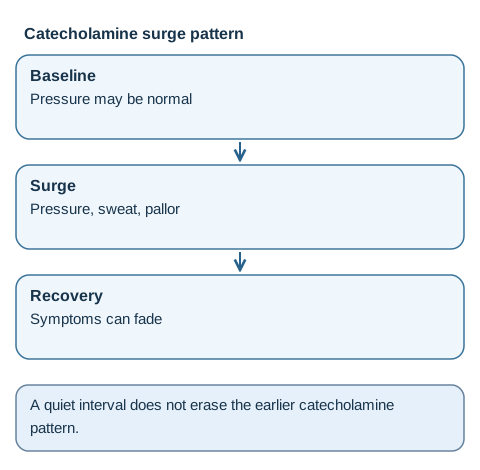
Imagine the surge-pattern figure as a timeline: a quiet baseline is interrupted by a short sympathetic storm, then the patient settles again. Headache, sweating, palpitations, tremor, anxiety, pallor, and marked blood-pressure variation can occur because catecholamines act on vascular and cardiac adrenergic receptors. Some patients have sustained hypertension rather than dramatic episodes, so a normal pressure between spells does not exclude the diagnosis. [1][2]
A quiet interval does not erase a prior spell; follow the episodic pattern and its physiology. [1][2]
The skin can help separate look-alikes. Strong alpha-1 vasoconstriction favors pallor and cool extremities. By contrast, flushing with diarrhea and bronchospasm points toward a serotonin-mediated carcinoid syndrome rather than a catecholamine-producing tumor. Hyperthyroidism can also cause tremor and palpitations, but it usually produces a more persistent hypermetabolic pattern rather than abrupt hypertensive spells.
Pheochromocytoma is a catecholamine-producing tumor arising from adrenal medullary chromaffin cells. A similar tumor outside the adrenal gland is a paraganglioma. Sympathetic paragangliomas in the chest, abdomen, or pelvis are often secretory. Many parasympathetic head and neck paragangliomas are not, so mass effect can dominate their presentation. [2][3]
Chromaffin tumors most often produce norepinephrine and/or epinephrine, while some have a dopaminergic phenotype. Catecholamine signaling can also raise glucose through effects on insulin secretion and counter-regulatory metabolism, which helps explain why hypoglycemia can appear after the tumor source is removed. [2][6]
The old "rule of 10s" is useful only as history. Modern series show a much larger hereditary fraction, and bilateral or multifocal disease should increase concern for a germline syndrome. More importantly, current classification does not divide these tumors into reliably benign versus malignant groups by histology. All PPGLs have metastatic potential, and metastatic disease is established by tumor at a site where chromaffin tissue is not normally present. [3][6]
Check the pattern
If a patient has episodic hypertension, pallor, sweating, and palpitations but no diarrhea or wheezing, catecholamine excess fits better than carcinoid syndrome. The same reasoning still applies if the hypertension is sustained rather than episodic.
Application: if the same symptoms occur only during urination, keep the physiology but change the anatomy. A functional bladder paraganglioma can discharge catecholamines when the bladder contracts, producing a voiding-associated spell. The trigger helps localize the source rather than arguing against PPGL.
Prove catecholamine production before chasing anatomy
A common misconception is that a random catecholamine level during a calm moment is the best test. Tumor cells continuously metabolize catecholamines inside the tumor, so their O-methylated metabolites provide a steadier biochemical signal. The recommended initial tests are plasma free metanephrines or urinary fractionated metanephrines. They are alternative initial strategies, not a simple screening-test versus confirmatory-test pair. [1][2]
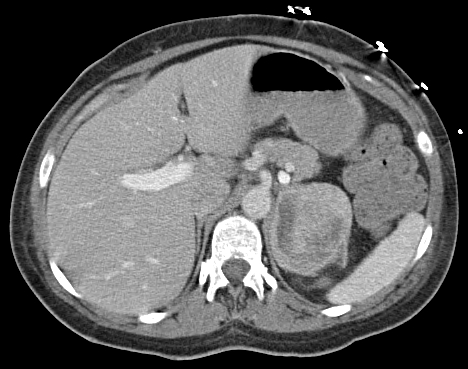
This axial CT demonstrates an adrenal-region mass in a known pheochromocytoma case. Imaging localizes a lesion, but the image itself does not establish catecholamine secretion.Use biochemistry to establish catecholamine production, anatomy to locate the source, and functional imaging for selected disease-map or therapy questions. [1][2][4]
Preanalytical conditions matter. For plasma testing, recumbent rest and appropriate reference intervals reduce false positives from posture and sympathetic activation. Caffeine, acute illness, stress, and some medications can complicate interpretation. A modest increase obtained under poor conditions should therefore prompt thoughtful repeat testing rather than immediate tumor labeling. A several-fold increase in a patient with a compatible syndrome is a different problem. [1][2]
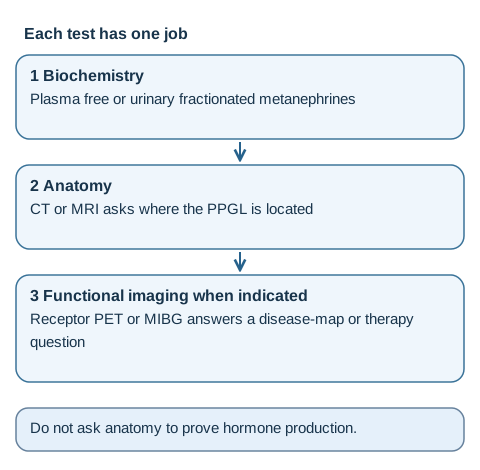
The diagnostic-route figure separates three questions. Biochemistry asks, "Is catecholamine production abnormal?" Cross-sectional imaging then asks, "Where is the lesion?" CT is commonly used first after biochemical evidence; MRI is especially useful when radiation should be limited or in selected metastatic or extra-adrenal settings. Functional imaging answers a later question about disease distribution, genotype-associated patterns, or treatment targeting. [1][4]
A useful learner action is to sort each test by job. Metanephrines belong under biochemical evidence. CT or MRI belongs under anatomic localization. Receptor-based PET or MIBG belongs under selected whole-body functional imaging. If an adrenal mass appears before biochemical testing, do not assume that the mass explains the spells simply because it is visible.
Try the test-sort
A patient with classic spells but no prior laboratory evidence needs metanephrine testing first. A patient with metanephrines six times the upper limit of normal is ready for localization. A patient with known metastatic SDHx-related disease may need functional imaging chosen for that setting.
Application: a strongly positive biochemical result with normal adrenal imaging should not end the search. The same physiology can originate from an extra-adrenal sympathetic paraganglioma, so localization must expand beyond the adrenal glands according to the clinical and genetic setting. [2]
Try it here · Checkpoint 1 of 3
Make your prediction before reading the choices. A first attempt is just a starting point.
Case 3
Show answer and explanations for case 3
A. Repeat TSH and free thyroxine (Why this does not fit)
Thyroid testing does not localize a biochemically supported catecholamine-producing tumor.
Reasoning steps for option A
How does "Typical hypertensive spells" bear specifically on the option "Repeat TSH and free thyroxine"?
Typical hypertensive spells. This finding does not establish that "Repeat TSH and free thyroxine" is the best next step or explanation. Thyroid testing does not localize a biochemically supported catecholamine-producing tumor.
After integrating "No pregnancy or contrast constraint", what conclusion should you reach about "Repeat TSH and free thyroxine"?
No pregnancy or contrast constraint. The integrated findings argue against "Repeat TSH and free thyroxine". Thyroid testing does not localize a biochemically supported catecholamine-producing tumor.
B. Twenty-four-hour ambulatory blood-pressure monitoring only (Why this does not fit)
Blood-pressure monitoring can characterize hypertension but cannot identify the source after strong biochemical evidence.
Reasoning steps for option B
Does "Twenty-four-hour ambulatory blood-pressure monitoring only" account for the supplied finding "Metanephrines six times the upper limit"?
Metanephrines six times the upper limit. This supports: Accept the biochemical evidence as convincing.
What clinical feature determines whether Twenty-four-hour ambulatory blood-pressure monitoring only fits this presentation?
An ambulatory pressure record could characterize episodicity, but the sixfold biochemical elevation has already shifted the unanswered question from physiology to location.
C. Cross-sectional CT of the abdomen and pelvis (Best answer)
After convincing biochemical evidence, cross-sectional imaging is used to localize the PPGL. CT is a common initial anatomic study in this setting.
Reasoning steps for option C
What inference follows from "No pregnancy or contrast constraint" when considering "Cross-sectional CT of the abdomen and pelvis"?
No pregnancy or contrast constraint. This supports: Accept the biochemical evidence as convincing.
After integrating "Metanephrines six times the upper limit", what conclusion should you reach about "Cross-sectional CT of the abdomen and pelvis"?
Metanephrines six times the upper limit. This is the best choice here. After convincing biochemical evidence of PPGL, use cross-sectional imaging to localize the source.
D. Bone marrow biopsy (Why this does not fit)
This does not localize an adrenal or extra-adrenal chromaffin tumor and has no role in this diagnostic sequence.
Reasoning steps for option D
If "Bone marrow biopsy" were chosen, how would you reconcile it with "Typical hypertensive spells"?
Typical hypertensive spells. Even with this finding, "Bone marrow biopsy" does not fit the complete case. This does not localize an adrenal or extra-adrenal chromaffin tumor and has no role in this diagnostic sequence.
After integrating "No pregnancy or contrast constraint", what conclusion should you reach about "Bone marrow biopsy"?
No pregnancy or contrast constraint. After combining the findings, reject "Bone marrow biopsy". This does not localize an adrenal or extra-adrenal chromaffin tumor and has no role in this diagnostic sequence.
Takeaway: After convincing biochemical evidence of PPGL, use cross-sectional imaging to localize the source.
The dangerous treatment error is to focus on tachycardia first. Catecholamines constrict resistance vessels through α₁ receptors while beta effects influence the heart and some vascular beds. If beta blockade is given before adequate alpha blockade, vascular alpha stimulation can remain dominant and severe hypertension can result. The safe sequence is alpha blockade first, then beta blockade only if tachycardia still requires treatment. [1]
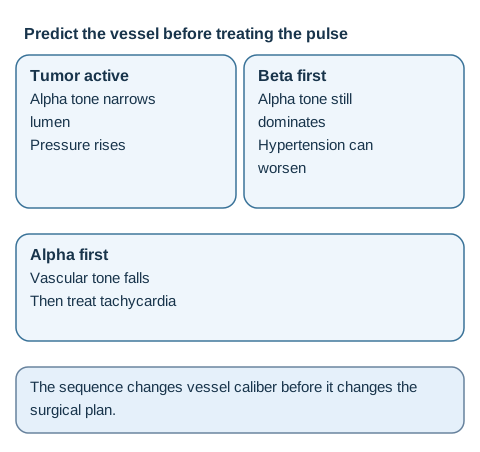
Predict vessel caliber before reading each panel. Alpha blockade first reduces vascular tone; beta blockade can then address persistent tachycardia. [1][5][6]
Use the receptor-order figure as a three-state comparator. In the tumor state, vascular tone is high. In the beta-first state, the heart may slow while alpha-mediated vasoconstriction remains inadequately opposed. In the alpha-first state, vascular tone falls, pressure control improves, and a beta blocker can then be added for persistent tachycardia. The meaningful learner action is to predict vessel caliber before reading the consequence.
Predict the beta-first state
The vessel remains markedly constricted because the essential vascular protection has not yet been established. Slowing the pulse does not solve the alpha-driven pressure problem.
Phenoxybenzamine is a nonselective irreversible alpha blocker, and selective alpha-1 blockers such as doxazosin are also used. In a randomized comparison, phenoxybenzamine reduced a composite hemodynamic-instability score, while the primary endpoint of time outside the blood-pressure target did not differ significantly. This supports teaching adequate alpha blockade rather than presenting one drug as the only acceptable preparation. [5]
Preoperative preparation usually includes alpha blockade for roughly 7 to 14 days, liberal salt and fluid intake when appropriate, and assessment for orthostatic symptoms and volume status. Chronic vasoconstriction can leave the intravascular space contracted. After adequate alpha blockade, a beta blocker can be added if tachycardia persists. Tumor resection then requires close anesthetic and surgical coordination because manipulation can provoke major hemodynamic swings. For most localized adrenal pheochromocytomas, minimally invasive adrenalectomy is commonly used; suspected invasive disease or anatomy that cannot be handled safely by that route may require an open approach. [1][6]
Application: once the tumor is resected, the source of catecholamine excess abruptly disappears. Hypotension can follow loss of vasoconstrictor tone, and hypoglycemia can occur as catecholamine-mediated inhibition of insulin secretion disappears. The physiology before surgery predicts the monitoring problem after surgery. [6]
Try it here · Checkpoint 2 of 3
Make your prediction before reading the choices. A first attempt is just a starting point.
Case 6
Show answer and explanations for case 6
A. Stop alpha blockade and observe (Why this does not fit)
The vascular protection is needed through the perioperative period; stopping it because tachycardia appeared would sacrifice the main protection.
Reasoning steps for option A
How does "Eleven days of adequate alpha blockade" bear specifically on the option "Stop alpha blockade and observe"?
Eleven days of adequate alpha blockade. This finding does not establish that "Stop alpha blockade and observe" is the best next step or explanation. The vascular protection is needed through the perioperative period; stopping it because tachycardia appeared would sacrifice the main protection.
After integrating "Persistent symptomatic heart rate 118 per minute", what conclusion should you reach about "Stop alpha blockade and observe"?
Persistent symptomatic heart rate 118 per minute. The integrated findings argue against "Stop alpha blockade and observe". The vascular protection is needed through the perioperative period; stopping it because tachycardia appeared would sacrifice the main protection.
B. Add a beta blocker while continuing alpha blockade (Best answer)
Persistent tachycardia can be treated with beta blockade after adequate alpha blockade has been established. The order, not merely the drug list, determines safety.
Reasoning steps for option B
Does "Add a beta blocker while continuing alpha blockade" account for the supplied finding "Controlled pressure with acceptable orthostatic change"?
Controlled pressure with acceptable orthostatic change. This supports: Confirm vascular protection is already established.
What clinical feature determines whether Add a beta blocker while continuing alpha blockade fits this presentation?
Here the standing pressure and duration of preparation support established vascular protection; persistent pulse elevation is now a separate cardiac target.
C. Add hydrochlorothiazide for additional volume loss (Why this does not fit)
Diuresis worsens the volume-contracted state that alpha blockade and salt/fluid preparation are intended to correct.
Reasoning steps for option C
What inference follows from "Persistent symptomatic heart rate 118 per minute" when considering "Add hydrochlorothiazide for additional volume loss"?
Persistent symptomatic heart rate 118 per minute. This supports: Confirm vascular protection is already established.
After integrating "Controlled pressure with acceptable orthostatic change", what conclusion should you reach about "Add hydrochlorothiazide for additional volume loss"?
Controlled pressure with acceptable orthostatic change. This is not the best choice here. Beta blockade is appropriate for persistent tachycardia only after adequate alpha blockade is established.
D. Switch to beta blockade alone before surgery (Why this does not fit)
Removing alpha blockade while continuing beta blockade recreates the unsafe sequence in a catecholamine-producing tumor.
Reasoning steps for option D
If "Switch to beta blockade alone before surgery" were chosen, how would you reconcile it with "Eleven days of adequate alpha blockade"?
Eleven days of adequate alpha blockade. Even with this finding, "Switch to beta blockade alone before surgery" does not fit the complete case. Removing alpha blockade while continuing beta blockade recreates the unsafe sequence in a catecholamine-producing tumor.
After integrating "Persistent symptomatic heart rate 118 per minute", what conclusion should you reach about "Switch to beta blockade alone before surgery"?
Persistent symptomatic heart rate 118 per minute. After combining the findings, reject "Switch to beta blockade alone before surgery". Removing alpha blockade while continuing beta blockade recreates the unsafe sequence in a catecholamine-producing tumor.
Takeaway: Beta blockade is appropriate for persistent tachycardia only after adequate alpha blockade is established.
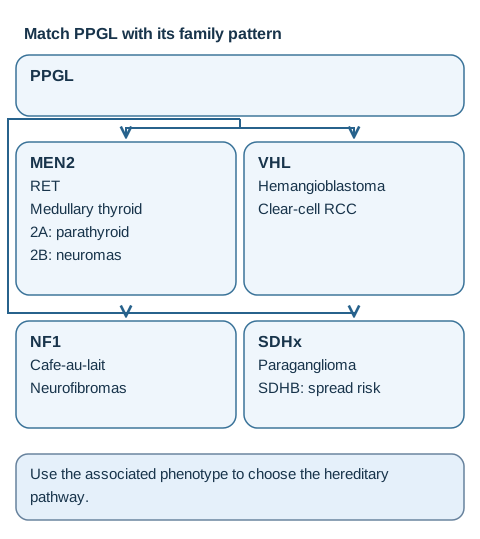
PPGL has one of the strongest hereditary components among human tumors. Germline variants are found in roughly a third of many contemporary cohorts, so genetic counseling and testing deserve broad consideration rather than being reserved for a tiny "familial 10%" group. Age, multifocal disease, tumor location, biochemical phenotype, family history, and metastatic behavior help prioritize testing. [1][6]
Use the non-PPGL phenotype to identify the hereditary pathway rather than relying on tumor location alone. [1][2][6]
The inherited-pattern figure is easiest to use by pairing each syndrome with its non-PPGL features. MEN2 is caused by RET variants and combines pheochromocytoma with medullary thyroid carcinoma. MEN2A adds primary hyperparathyroidism; MEN2B instead features mucosal neuromas and a marfanoid habitus and generally lacks the parathyroid pattern.
VHL disease combines PPGL with retinal or central nervous system hemangioblastomas, clear-cell renal cell carcinoma, renal and pancreatic cysts, and pancreatic neuroendocrine tumors. NF1 is suggested by cafe-au-lait macules, axillary or inguinal freckling, neurofibromas, and Lisch nodules. SDHx-related syndromes are especially important in paraganglioma, with SDHB variants carrying substantial metastatic risk. [2][6]
The management consequence matters. A patient with MEN2 who is heading to thyroid surgery should be assessed for pheochromocytoma first when clinically indicated, because an unrecognized catecholamine-producing tumor can make anesthesia dangerous. A germline result also changes surveillance and can guide testing of relatives through formal genetic counseling. [1]
Match the phenotype
Medullary thyroid carcinoma plus hyperparathyroidism points toward MEN2A. Medullary thyroid carcinoma plus mucosal neuromas and marfanoid habitus points toward MEN2B. Retinal hemangioblastoma plus clear-cell renal carcinoma points toward VHL.
Application: bilateral adrenal pheochromocytomas in a young patient should not be treated as two unrelated accidents. That pattern sharply raises the probability of hereditary disease and should trigger a syndromic history, examination, and genetic evaluation. [6]
Try it here · Checkpoint 3 of 3
Make your prediction before reading the choices. A first attempt is just a starting point.
Case 16
Show answer and explanations for case 16
A. The absence of family history makes a germline cause negligible (Why this does not fit)
De novo variants, unrecognized disease, small families, and variable expression mean family history alone cannot exclude hereditary PPGL.
Reasoning steps for option A
How does "Age 16 years" bear specifically on the option "The absence of family history makes a germline cause negligible"?
Age 16 years. This finding does not establish that "The absence of family history makes a germline cause negligible" is the best next step or explanation. De novo variants, unrecognized disease, small families, and variable expression mean family history alone cannot exclude hereditary PPGL.
What clinical feature determines whether The absence of family history makes a germline cause negligible fits this presentation?
An apparently sporadic pedigree can reflect de novo variation, incomplete penetrance or unrecognized affected relatives; bilateral disease remains an independent clue.
B. Genetic evaluation is unnecessary because both tumors are adrenal (Why this does not fit)
Bilateral disease at a young age is precisely the pattern that raises concern for a hereditary predisposition.
Reasoning steps for option B
Does "Genetic evaluation is unnecessary because both tumors are adrenal" account for the supplied finding "Bilateral adrenal pheochromocytomas"?
Bilateral adrenal pheochromocytomas. This supports: Do not use absent family history to exclude heredity.
What clinical feature determines whether Genetic evaluation is unnecessary because both tumors are adrenal fits this presentation?
Two separate adrenal chromaffin tumors in an adolescent substantially change pretest probability even without an extra-adrenal location.
C. Only tumor histology is needed to determine inherited risk (Why this does not fit)
Histology cannot substitute for germline evaluation or reliably establish the hereditary syndrome.
Reasoning steps for option C
What inference follows from "No known family history" when considering "Only tumor histology is needed to determine inherited risk"?
No known family history. This supports: Do not use absent family history to exclude heredity.
What clinical feature determines whether Only tumor histology is needed to determine inherited risk fits this presentation?
Morphology of a resected tumor cannot identify whether an unaffected relative carries the same constitutional variant.
D. Offer genetic counseling and germline testing (Best answer)
Young age and bilateral disease make hereditary PPGL particularly likely, and guidelines support broad consideration of genetic testing in PPGL.
Reasoning steps for option D
What clinical feature determines whether Offer genetic counseling and germline testing fits this presentation?
Bilateral tumors at this age support evaluation of inherited predisposition and potential cascade testing rather than relying on pedigree alone.
Does a negative family history cancel the significance of two adrenal primaries?
No. Bilateral disease in adolescence warrants evaluation for an inherited predisposition regardless of whether a parent is known to be affected.
Takeaway: Young age and bilateral or multifocal PPGL are strong reasons for genetic counseling and germline testing.
Paraganglioma is not merely "pheochromocytoma in the wrong place." Sympathetic tumors below the neck often produce catecholamines; parasympathetic head and neck tumors are commonly nonsecretory and may present with a painless neck mass, pulsatile tinnitus, or cranial-nerve dysfunction. Thus normal metanephrines do not exclude a nonsecretory head and neck paraganglioma. [2]
Sympathetic extra-adrenal tumors can arise along paravertebral pathways from the chest through the pelvis. A classic abdominal location is the organ of Zuckerkandl near the aortic bifurcation, while bladder-wall paragangliomas can produce voiding-triggered catecholamine spells. [2]
Functional imaging should be selected for the clinical problem rather than used as a universal final step. Somatostatin-receptor imaging with 68Ga-DOTA-SSA PET performs especially well in many extra-adrenal, metastatic, and SDHx-related settings. MIBG imaging remains important when norepinephrine-transporter avidity is relevant, including assessment for MIBG-targeted radionuclide therapy. [4]
The classification consequence is equally important. Pathology can confirm a PPGL and describe features that influence risk, but it cannot guarantee that a tumor will never metastasize. Current WHO framing treats every PPGL as having some metastatic potential. This replaces the older habit of calling an apparently localized tumor "benign" based on histology alone. [3]
Choose the imaging purpose
If the question is whether a known metastatic SDHB-related tumor expresses somatostatin receptors, receptor PET is highly useful. If the question is whether metastatic disease is suitable for MIBG-targeted therapy, MIBG imaging directly answers the treatment-selection question.
Application: when biochemistry is strongly positive but adrenal CT is negative, do not reinterpret the laboratory result as meaningless. Reassess the quality of testing, then search for extra-adrenal disease using anatomic and selected functional imaging that fits the biochemical phenotype, location, and genetic context. [2][4]
Pregnancy and the postoperative period require the same physiology, with different constraints
PPGL in pregnancy can resemble gestational hypertension or preeclampsia, but paroxysmal headache, palpitations, sweating, and unusual timing should raise suspicion. Biochemical testing still establishes catecholamine excess, while imaging choices are adapted to limit fetal radiation. Once diagnosed, alpha-adrenergic blockade and multidisciplinary planning are central. [7]
The older rule that every patient should receive phenoxybenzamine, cesarean delivery, and delayed tumor surgery is too rigid. Individualized planning is more accurate. Contemporary review data support medical therapy when PPGL is diagnosed during pregnancy; antepartum surgery has not shown a general maternal or fetal outcome advantage and is reserved for selected circumstances. Delivery route and timing are individualized by tumor features, gestational age, prior treatment, and obstetric considerations. [7]
A final transfer question links pregnancy back to the main lesson: what remains constant despite the special setting? Biochemistry identifies the functional tumor, alpha blockade protects against catecholamine-driven vasoconstriction, and anatomy guides definitive planning. What changes are the imaging constraints, timing decisions, and balance of maternal and fetal risk.
When a vignette seems crowded, reduce it to four questions: Is there a catecholamine pattern? Are metanephrines convincingly abnormal? Where is the PPGL? Has alpha-mediated vascular risk been controlled before beta blockade or surgery?
Apply the lesson
Case 1
Show answer and explanations for case 1
A. Plasma free metanephrines after controlled supine sampling (Best answer)
The episodic catecholamine pattern plus a family history suggestive of MEN2 makes PPGL plausible. Plasma free metanephrines are a recommended initial biochemical test when collected and interpreted appropriately.
Reasoning steps for option A
Does normal blood pressure between attacks rule out a catecholamine-secreting tumor?
No. A short burst of mediator release can produce profound hypertension during an attack while an office measurement remains normal.
What biochemical signal persists when secretion is episodic?
Intratumoral catecholamine metabolism generates free metanephrines even outside a symptomatic spell; resting supine collection reduces sympathetic false positives.
B. Contrast-enhanced adrenal CT before biochemical testing (Why this does not fit)
CT localizes a tumor but does not first establish that catecholamine production is abnormal. Imaging first can identify an unrelated adrenal incidentaloma.
Reasoning steps for option B
What question does an adrenal computed tomography scan answer?
It identifies a mass and its location, not whether that mass accounts for the paroxysmal adrenergic syndrome.
Why delay anatomical localization in this patient?
First establish excess catecholamine metabolism; otherwise a coincidental adrenal nodule may be incorrectly assigned as the source of her attacks.
C. Random plasma catecholamines between symptomatic episodes (Why this does not fit)
A random catecholamine value is less reliable because secretion can vary quickly. Metanephrine production provides a steadier biochemical signal.
Reasoning steps for option C
Why is an asymptomatic blood draw a poor time for measuring catecholamines directly?
Circulating parent hormones can fall quickly after a brief secretory burst, so an interictal sample may miss the abnormal release.
Which analytes avoid dependence on catching a spell?
Fractionated metabolites reflect ongoing processing inside the tumor and therefore provide a better screening signal than a single random parent-hormone value.
D. Overnight dexamethasone suppression testing (Why this does not fit)
This evaluates cortisol autonomy rather than catecholamine production and does not address the episodic sympathetic syndrome.
Reasoning steps for option D
What endocrine phenotype would support a cortisol suppression test?
Features of sustained glucocorticoid excess would make that pathway relevant, rather than abrupt pallor, diaphoresis and marked episodic pressure elevations.
How does the family history refine the biochemical target?
Maternal medullary thyroid carcinoma raises concern for a hereditary syndrome with adrenal chromaffin tumors, directing initial testing toward catecholamine metabolites.
Takeaway: Suspected PPGL is evaluated initially with plasma free or urinary fractionated metanephrines, with attention to sampling conditions.
A. Begin lifelong alpha blockade on the basis of this value (Why this does not fit)
A modest isolated increase under poor preanalytical conditions is not enough to establish PPGL or justify lifelong therapy.
Reasoning steps for option A
How does "Normetanephrine 1.4 times the upper limit" bear specifically on the option "Begin lifelong alpha blockade on the basis of this value"?
Normetanephrine 1.4 times the upper limit. This finding does not establish that "Begin lifelong alpha blockade on the basis of this value" is the best next step or explanation. A modest isolated increase under poor preanalytical conditions is not enough to establish PPGL or justify lifelong therapy.
After integrating "Recent coffee and no prior tumor localization", what conclusion should you reach about "Begin lifelong alpha blockade on the basis of this value"?
Recent coffee and no prior tumor localization. The integrated findings argue against "Begin lifelong alpha blockade on the basis of this value". A modest isolated increase under poor preanalytical conditions is not enough to establish PPGL or justify lifelong therapy.
B. Repeat metanephrines under controlled conditions (Best answer)
Posture and sympathetic activation can increase false-positive plasma results. Repeating testing after appropriate recumbent rest and avoiding avoidable confounders is appropriate before localization.
Reasoning steps for option B
Does "Repeat metanephrines under controlled conditions" account for the supplied finding "Seated sample immediately after exertion"?
Seated sample immediately after exertion. This supports: Recognize a borderline rather than strongly positive result.
What clinical feature determines whether Repeat metanephrines under controlled conditions fits this presentation?
For a small isolated elevation, a rested repeat sample using the appropriate posture-specific reference interval can separate sympathetic activation from persistent tumor-derived signal.
C. Proceed directly to MIBG imaging (Why this does not fit)
Functional imaging is not the usual response to a borderline biochemical result obtained under suboptimal conditions.
Reasoning steps for option C
What inference follows from "Recent coffee and no prior tumor localization" when considering "Proceed directly to MIBG imaging"?
Recent coffee and no prior tumor localization. This supports: Recognize a borderline rather than strongly positive result.
What clinical feature determines whether Proceed directly to MIBG imaging fits this presentation?
A radiotracer study would expose the patient to imaging before establishing that the seated, post-exertion borderline laboratory result is reproducible.
D. Exclude PPGL because the increase is less than twofold (Why this does not fit)
A modest result is not automatically negative. Its meaning depends on symptoms, pretest probability, assay, and collection conditions.
Reasoning steps for option D
If "Exclude PPGL because the increase is less than twofold" were chosen, how would you reconcile it with "Normetanephrine 1.4 times the upper limit"?
Normetanephrine 1.4 times the upper limit. Even with this finding, "Exclude PPGL because the increase is less than twofold" does not fit the complete case. A modest result is not automatically negative. Its meaning depends on symptoms, pretest probability, assay, and collection conditions.
After integrating "Recent coffee and no prior tumor localization", what conclusion should you reach about "Exclude PPGL because the increase is less than twofold"?
Recent coffee and no prior tumor localization. After combining the findings, reject "Exclude PPGL because the increase is less than twofold". A modest result is not automatically negative. Its meaning depends on symptoms, pretest probability, assay, and collection conditions.
Takeaway: Borderline metanephrine results demand attention to preanalytical conditions before escalating to tumor localization.
A. Biopsy the mass because tissue is the fastest way to diagnose a functional tumor (Why this does not fit)
Percutaneous biopsy does not establish hormonal function and can be hazardous if an unrecognized catecholamine-producing tumor is manipulated.
Reasoning steps for option A
How does "Adrenal incidentaloma" bear specifically on the option "Biopsy the mass because tissue is the fastest way to diagnose a functional tumor"?
Adrenal incidentaloma. This finding does not establish that "Biopsy the mass because tissue is the fastest way to diagnose a functional tumor" is the best next step or explanation. Percutaneous biopsy does not establish hormonal function and can be hazardous if an unrecognized catecholamine-producing tumor is manipulated.
What clinical feature determines whether Biopsy the mass because tissue is the fastest way to diagnose a functional tumor fits this presentation?
Percutaneous needle manipulation of an unrecognized secretory mass can precipitate a dangerous hypertensive crisis; tissue is not the safe first discriminator.
B. Schedule adrenalectomy without biochemical evaluation (Why this does not fit)
Definitive treatment planning requires recognition and preparation of a functional PPGL before surgery.
Reasoning steps for option B
Does "Schedule adrenalectomy without biochemical evaluation" account for the supplied finding "Classic catecholamine spells with severe hypertension"?
Classic catecholamine spells with severe hypertension. This supports: Recognize the functional-tumor safety concern.
What clinical feature determines whether Schedule adrenalectomy without biochemical evaluation fits this presentation?
Even if resection ultimately proves appropriate, anesthesia and handling of a functional adrenal lesion require planned adrenergic preparation.
C. Start propranolol alone to prevent procedure-related tachycardia (Why this does not fit)
Beta blockade before adequate alpha blockade can leave alpha-mediated vasoconstriction inadequately opposed.
Reasoning steps for option C
What inference follows from "Percutaneous biopsy is being planned" when considering "Start propranolol alone to prevent procedure-related tachycardia"?
Percutaneous biopsy is being planned. This supports: Recognize the functional-tumor safety concern.
After integrating "Classic catecholamine spells with severe hypertension", what conclusion should you reach about "Start propranolol alone to prevent procedure-related tachycardia"?
Classic catecholamine spells with severe hypertension. This is not the best choice here. An adrenal mass plus catecholamine symptoms must be assessed for PPGL before biopsy or operative manipulation.
D. Evaluate for catecholamine excess before any invasive manipulation (Best answer)
The symptom pattern makes functional PPGL a safety concern. Biochemical assessment should precede biopsy or surgery so adrenergic preparation can be planned if needed.
Reasoning steps for option D
If "Evaluate for catecholamine excess before any invasive manipulation" were chosen, how would you reconcile it with "Adrenal incidentaloma"?
Adrenal incidentaloma. This finding supports the option "Evaluate for catecholamine excess before any invasive manipulation". The symptom pattern makes functional PPGL a safety concern. Biochemical assessment should precede biopsy or surgery so adrenergic preparation can be planned if needed.
What clinical feature determines whether Evaluate for catecholamine excess before any invasive manipulation fits this presentation?
The proposed biopsy makes an otherwise avoidable catecholamine surge an immediate procedural hazard; assess functional status before deciding how to handle the mass.
Takeaway: An adrenal mass plus catecholamine symptoms must be assessed for PPGL before biopsy or operative manipulation.
The primary preoperative vascular problem is catecholamine-driven alpha-mediated vasoconstriction. Alpha blockade must be established before adding a beta blocker for tachycardia.
Reasoning steps for option A
What clinical feature determines whether Alpha-adrenergic blockade fits this presentation?
The immediate vascular target is catecholamine-driven arteriolar constriction; controlling that resistance before heart-rate control reduces perioperative risk.
Why should vascular resistance be treated before surgery rather than just watching the heart rate?
Manipulation of a functional tumor can abruptly magnify alpha receptor stimulation; lowering vascular responsiveness in advance prevents a predictable surge.
B. Beta blockade alone (Why this does not fit)
Slowing the heart without adequate alpha blockade can leave severe vasoconstriction inadequately opposed and can precipitate dangerous hypertension.
Reasoning steps for option B
Does "Beta blockade alone" account for the supplied finding "Hypertension and tachycardia"?
Hypertension and tachycardia. This supports: Identify alpha-mediated vasoconstriction as the first target.
After integrating "Biochemically confirmed adrenal pheochromocytoma", what conclusion should you reach about "Beta blockade alone"?
Biochemically confirmed adrenal pheochromocytoma. This is not the best choice here. Establish alpha blockade before beta blockade or surgery in a functional PPGL.
C. Loop diuresis to contract plasma volume (Why this does not fit)
PPGL patients can already have contracted intravascular volume from chronic vasoconstriction; routine volume contraction works against preoperative preparation.
Reasoning steps for option C
What inference follows from "Resection is planned" when considering "Loop diuresis to contract plasma volume"?
Resection is planned. This supports: Identify alpha-mediated vasoconstriction as the first target.
After integrating "Hypertension and tachycardia", what conclusion should you reach about "Loop diuresis to contract plasma volume"?
Hypertension and tachycardia. This is not the best choice here. Establish alpha blockade before beta blockade or surgery in a functional PPGL.
D. No medical preparation before tumor manipulation (Why this does not fit)
Functional PPGL requires preoperative adrenergic preparation to reduce hemodynamic complications during anesthesia and tumor manipulation.
Reasoning steps for option D
If "No medical preparation before tumor manipulation" were chosen, how would you reconcile it with "Biochemically confirmed adrenal pheochromocytoma"?
Biochemically confirmed adrenal pheochromocytoma. Even with this finding, "No medical preparation before tumor manipulation" does not fit the complete case. Functional PPGL requires preoperative adrenergic preparation to reduce hemodynamic complications during anesthesia and tumor manipulation.
After integrating "Resection is planned", what conclusion should you reach about "No medical preparation before tumor manipulation"?
Resection is planned. This is not the best choice here. Establish alpha blockade before beta blockade or surgery in a functional PPGL.
Takeaway: Establish alpha blockade before beta blockade or surgery in a functional PPGL.
A. Strict sodium restriction (Why this does not fit)
Sodium restriction promotes further volume contraction rather than correcting the chronic catecholamine-associated volume deficit.
Reasoning steps for option A
How does "Adequate alpha blockade" bear specifically on the option "Strict sodium restriction"?
Adequate alpha blockade. This finding does not establish that "Strict sodium restriction" is the best next step or explanation. Sodium restriction promotes further volume contraction rather than correcting the chronic catecholamine-associated volume deficit.
What clinical feature determines whether Strict sodium restriction fits this presentation?
Further reducing sodium would aggravate the effective circulating-volume deficit produced by prolonged catecholamine vasoconstriction and newly relaxed vessels.
B. Daily loop diuretic therapy (Why this does not fit)
A diuretic would further reduce intravascular volume and can worsen perioperative hypotension.
Reasoning steps for option B
Does "Daily loop diuretic therapy" account for the supplied finding "Mild orthostatic symptoms without edema or heart failure"?
Mild orthostatic symptoms without edema or heart failure. This supports: Recognize chronic vasoconstriction can contract plasma volume.
What clinical feature determines whether Daily loop diuretic therapy fits this presentation?
A diuretic would deepen orthostasis in a patient whose pressure has already responded to receptor blockade.
C. Liberal salt and fluid intake, if safe (Best answer)
Alpha blockade opens the vascular bed, while many patients begin with contracted plasma volume. Salt and fluid intake can help restore volume when there is no contraindication.
Reasoning steps for option C
What inference follows from "Normal renal function" when considering "Liberal salt and fluid intake, if safe"?
Normal renal function. This supports: Recognize chronic vasoconstriction can contract plasma volume.
After integrating "Mild orthostatic symptoms without edema or heart failure", what conclusion should you reach about "Liberal salt and fluid intake, if safe"?
Mild orthostatic symptoms without edema or heart failure. This is the best choice here. Preoperative PPGL preparation includes attention to intravascular volume, often with liberal salt and fluid intake when safe.
D. Fluid restriction until the morning of surgery (Why this does not fit)
Routine restriction does not correct the expected contracted volume state and can increase the risk of post-resection hypotension.
Reasoning steps for option D
If "Fluid restriction until the morning of surgery" were chosen, how would you reconcile it with "Adequate alpha blockade"?
Adequate alpha blockade. Even with this finding, "Fluid restriction until the morning of surgery" does not fit the complete case. Routine restriction does not correct the expected contracted volume state and can increase the risk of post-resection hypotension.
After integrating "Normal renal function", what conclusion should you reach about "Fluid restriction until the morning of surgery"?
Normal renal function. After combining the findings, reject "Fluid restriction until the morning of surgery". Routine restriction does not correct the expected contracted volume state and can increase the risk of post-resection hypotension.
Takeaway: Preoperative PPGL preparation includes attention to intravascular volume, often with liberal salt and fluid intake when safe.
A. Only phenoxybenzamine is an acceptable preoperative alpha blocker (Why this does not fit)
Both drugs are used for preoperative alpha blockade. The trial did not support an absolute rule that only phenoxybenzamine is acceptable.
Reasoning steps for option A
How does "Two accepted alpha-blocker strategies" bear specifically on the option "Only phenoxybenzamine is an acceptable preoperative alpha blocker"?
Two accepted alpha-blocker strategies. This finding does not establish that "Only phenoxybenzamine is an acceptable preoperative alpha blocker" is the best next step or explanation. Both drugs are used for preoperative alpha blockade. The trial did not support an absolute rule that only phenoxybenzamine is acceptable.
After integrating "Primary endpoint differs from instability score", what conclusion should you reach about "Only phenoxybenzamine is an acceptable preoperative alpha blocker"?
Primary endpoint differs from instability score. This is not the best choice here. Teach adequate alpha blockade rather than presenting one alpha blocker as the only evidence-based choice.
B. Doxazosin eliminated all intraoperative hypertension compared with phenoxybenzamine (Why this does not fit)
The trial did not show elimination of hemodynamic excursions with doxazosin.
Reasoning steps for option B
Does "Doxazosin eliminated all intraoperative hypertension compared with phenoxybenzamine" account for the supplied finding "Randomized comparison"?
Randomized comparison. This supports: Avoid an absolute single-drug rule.
After integrating "Two accepted alpha-blocker strategies", what conclusion should you reach about "Doxazosin eliminated all intraoperative hypertension compared with phenoxybenzamine"?
Two accepted alpha-blocker strategies. This is not the best choice here. Teach adequate alpha blockade rather than presenting one alpha blocker as the only evidence-based choice.
C. The two drugs produced identical values for every hemodynamic endpoint (Why this does not fit)
Some secondary hemodynamic measures differed, so calling the regimens identical overstates the evidence.
Reasoning steps for option C
What inference follows from "Primary endpoint differs from instability score" when considering "The two drugs produced identical values for every hemodynamic endpoint"?
Primary endpoint differs from instability score. This supports: Avoid an absolute single-drug rule.
What clinical feature determines whether The two drugs produced identical values for every hemodynamic endpoint fits this presentation?
A shared primary endpoint does not imply every intraoperative measurement coincided; the composite instability measure distinguished the study groups.
D. Similar target-time; lower instability score with phenoxybenzamine (Best answer)
The randomized trial found no significant difference in the primary endpoint of time outside target pressure, while phenoxybenzamine produced a lower hemodynamic-instability score.
Reasoning steps for option D
If "Similar target-time; lower instability score with phenoxybenzamine" were chosen, how would you reconcile it with "Two accepted alpha-blocker strategies"?
Two accepted alpha-blocker strategies. This finding supports the option "Similar target-time; lower instability score with phenoxybenzamine". The randomized trial found no significant difference in the primary endpoint of time outside target pressure, while phenoxybenzamine produced a lower hemodynamic-instability score.
After integrating "Primary endpoint differs from instability score", what conclusion should you reach about "Similar target-time; lower instability score with phenoxybenzamine"?
Primary endpoint differs from instability score. This is the best choice here. Teach adequate alpha blockade rather than presenting one alpha blocker as the only evidence-based choice.
Takeaway: Teach adequate alpha blockade rather than presenting one alpha blocker as the only evidence-based choice.
A. Vasodilation plus increased insulin effect after tumor removal (Best answer)
Removing the catecholamine source can expose vasodilation and a previously contracted circulation, causing hypotension. Loss of catecholamine-mediated inhibition of insulin secretion can also contribute to hypoglycemia.
Reasoning steps for option A
What clinical feature determines whether Vasodilation plus increased insulin effect after tumor removal fits this presentation?
Two losses occur at once: vascular resistance falls when the secretory source disappears, and relief of insulin suppression can lower glucose.
Why can glucose fall in parallel with arterial pressure?
Once the tumor is gone, beta-adrenergic restraint of pancreatic insulin release can abate while peripheral vessels relax.
B. Persistent alpha stimulation causes vasoconstriction and glucagon excess (Why this does not fit)
Persistent alpha-driven vasoconstriction would not explain the new hypotension after successful tumor removal, and the glucose pattern is opposite.
Reasoning steps for option B
Does "Persistent alpha stimulation causes vasoconstriction and glucagon excess" account for the supplied finding "New hypotension without bleeding"?
New hypotension without bleeding. This supports: Link tumor removal to loss of vasoconstrictor tone.
After integrating "Successful catecholamine-tumor resection", what conclusion should you reach about "Persistent alpha stimulation causes vasoconstriction and glucagon excess"?
Successful catecholamine-tumor resection. This is not the best choice here. After PPGL resection, monitor for hypotension and hypoglycemia as catecholamine effects abruptly disappear.
C. New hyperthyroidism causes distributive shock and fasting hypoglycemia (Why this does not fit)
No thyroid process is supplied, and this does not specifically follow the immediate loss of catecholamine secretion.
Reasoning steps for option C
What inference follows from "New glucose 48 mg/dL" when considering "New hyperthyroidism causes distributive shock and fasting hypoglycemia"?
New glucose 48 mg/dL. This supports: Link tumor removal to loss of vasoconstrictor tone.
What clinical feature determines whether New hyperthyroidism causes distributive shock and fasting hypoglycemia fits this presentation?
New thyroid excess would more typically drive tachycardia and hyperglycemia rather than explain this immediate postoperative paired decline.
D. Acute cortisol excess causes low vascular tone and hypoglycemia (Why this does not fit)
Cortisol excess generally supports vascular responsiveness and tends to increase rather than lower glucose.
Reasoning steps for option D
If "Acute cortisol excess causes low vascular tone and hypoglycemia" were chosen, how would you reconcile it with "Successful catecholamine-tumor resection"?
Successful catecholamine-tumor resection. Even with this finding, "Acute cortisol excess causes low vascular tone and hypoglycemia" does not fit the complete case. Cortisol excess generally supports vascular responsiveness and tends to increase rather than lower glucose.
What clinical feature determines whether Acute cortisol excess causes low vascular tone and hypoglycemia fits this presentation?
Excess cortisol generally increases glucose availability and vascular responsiveness, opposite to the simultaneous hypotension and low glucose here.
Takeaway: After PPGL resection, monitor for hypotension and hypoglycemia as catecholamine effects abruptly disappear.
A. Beta-2 mediated bronchial smooth-muscle relaxation (Why this does not fit)
This does not explain pallor and is not the main discriminator from a flushing syndrome.
Reasoning steps for option A
How does "Palpitations and sweating" bear specifically on the option "Beta-2 mediated bronchial smooth-muscle relaxation"?
Palpitations and sweating. This finding does not establish that "Beta-2 mediated bronchial smooth-muscle relaxation" is the best next step or explanation. This does not explain pallor and is not the main discriminator from a flushing syndrome.
After integrating "Pallor without diarrhea or wheeze", what conclusion should you reach about "Beta-2 mediated bronchial smooth-muscle relaxation"?
Pallor without diarrhea or wheeze. The integrated findings argue against "Beta-2 mediated bronchial smooth-muscle relaxation". This does not explain pallor and is not the main discriminator from a flushing syndrome.
B. Alpha-1 mediated cutaneous vasoconstriction (Best answer)
Alpha-1 vasoconstriction decreases cutaneous blood flow and produces pallor or cool extremities during catecholamine surges.
Reasoning steps for option B
Does "Alpha-1 mediated cutaneous vasoconstriction" account for the supplied finding "Blood pressure 192/114 during a spell"?
Blood pressure 192/114 during a spell. This supports: Identify pallor as vasoconstriction.
What clinical feature determines whether Alpha-1 mediated cutaneous vasoconstriction fits this presentation?
Less blood reaches superficial facial vessels during alpha receptor activation, so the observed color change is a clue to vasoconstriction.
C. Serotonin-mediated cutaneous vasodilation (Why this does not fit)
Serotonin-associated vasodilation is more consistent with flushing in carcinoid syndrome, the opposite skin pattern.
Reasoning steps for option C
What inference follows from "Pallor without diarrhea or wheeze" when considering "Serotonin-mediated cutaneous vasodilation"?
Pallor without diarrhea or wheeze. This supports: Identify pallor as vasoconstriction.
What clinical feature determines whether Serotonin-mediated cutaneous vasodilation fits this presentation?
A vasodilator mechanism would make the face red rather than pale during this hypertensive attack.
D. Histamine-mediated capillary leak (Why this does not fit)
Histamine can cause flushing and edema but does not match the catecholamine-linked hypertensive spell described here.
Reasoning steps for option D
If "Histamine-mediated capillary leak" were chosen, how would you reconcile it with "Palpitations and sweating"?
Palpitations and sweating. Even with this finding, "Histamine-mediated capillary leak" does not fit the complete case. Histamine can cause flushing and edema but does not match the catecholamine-linked hypertensive spell described here.
After integrating "Pallor without diarrhea or wheeze", what conclusion should you reach about "Histamine-mediated capillary leak"?
Pallor without diarrhea or wheeze. After combining the findings, reject "Histamine-mediated capillary leak". Histamine can cause flushing and edema but does not match the catecholamine-linked hypertensive spell described here.
Takeaway: Pallor during a hypertensive spell reflects alpha-mediated vasoconstriction and helps distinguish PPGL from flushing syndromes.
A. Multiple endocrine neoplasia type 1 (Why this does not fit)
MEN1 is centered on parathyroid, pituitary, and pancreatic neuroendocrine tumors and does not explain medullary thyroid carcinoma plus pheochromocytoma.
Reasoning steps for option A
How does "Pheochromocytoma biochemistry" bear specifically on the option "Multiple endocrine neoplasia type 1"?
Pheochromocytoma biochemistry. This finding does not establish that "Multiple endocrine neoplasia type 1" is the best next step or explanation. MEN1 is centered on parathyroid, pituitary, and pancreatic neuroendocrine tumors and does not explain medullary thyroid carcinoma plus pheochromocytoma.
After integrating "Primary hyperparathyroidism", what conclusion should you reach about "Multiple endocrine neoplasia type 1"?
Primary hyperparathyroidism. The integrated findings argue against "Multiple endocrine neoplasia type 1". MEN1 is centered on parathyroid, pituitary, and pancreatic neuroendocrine tumors and does not explain medullary thyroid carcinoma plus pheochromocytoma.
B. Von Hippel-Lindau disease (Why this does not fit)
VHL can include PPGL but is associated with hemangioblastomas and clear-cell renal carcinoma rather than medullary thyroid carcinoma plus hyperparathyroidism.
Reasoning steps for option B
Does "Von Hippel-Lindau disease" account for the supplied finding "Medullary thyroid carcinoma"?
Medullary thyroid carcinoma. Even with this finding, "Von Hippel-Lindau disease" does not fit the complete case. VHL can include PPGL but is associated with hemangioblastomas and clear-cell renal carcinoma rather than medullary thyroid carcinoma plus hyperparathyroidism.
What clinical feature determines whether Von Hippel-Lindau disease fits this presentation?
The combination of thyroid C-cell malignancy and primary parathyroid overactivity is unlike the hemangioblastoma and renal-tumor cluster of VHL.
C. RET-associated MEN2A (Best answer)
MEN2A classically combines pheochromocytoma, medullary thyroid carcinoma, and primary hyperparathyroidism through activating RET variants.
Reasoning steps for option C
What inference follows from "Primary hyperparathyroidism" when considering "RET-associated MEN2A"?
Primary hyperparathyroidism. This supports: Recognize the MEN2 tumor pair.
What clinical feature determines whether RET-associated MEN2A fits this presentation?
The parathyroid finding separates the RET-associated A phenotype from the neuroma and marfanoid B phenotype.
D. Hereditary paraganglioma syndrome due to SDHB (Why this does not fit)
SDHB is important in paraganglioma and metastatic risk but does not produce this medullary-thyroid and parathyroid combination.
Reasoning steps for option D
If "Hereditary paraganglioma syndrome due to SDHB" were chosen, how would you reconcile it with "Pheochromocytoma biochemistry"?
Pheochromocytoma biochemistry. Even with this finding, "Hereditary paraganglioma syndrome due to SDHB" does not fit the complete case. SDHB is important in paraganglioma and metastatic risk but does not produce this medullary-thyroid and parathyroid combination.
After integrating "Primary hyperparathyroidism", what conclusion should you reach about "Hereditary paraganglioma syndrome due to SDHB"?
Primary hyperparathyroidism. After combining the findings, reject "Hereditary paraganglioma syndrome due to SDHB". SDHB is important in paraganglioma and metastatic risk but does not produce this medullary-thyroid and parathyroid combination.
MEN2A can include pheochromocytoma and medullary thyroid carcinoma, but primary hyperparathyroidism is the associated third endocrine feature rather than mucosal neuromas and marfanoid habitus.
Reasoning steps for option A
After integrating "Pheochromocytoma biochemistry with normal calcium and PTH", what conclusion should you reach about "MEN2A"?
Pheochromocytoma biochemistry with normal calcium and PTH. This is not the best choice here. MEN2B is the RET syndrome with medullary thyroid carcinoma, pheochromocytoma, mucosal neuromas, and marfanoid habitus.
What clinical feature determines whether MEN2A fits this presentation?
Primary hyperparathyroidism would strengthen the A variant, whereas mucosal neuromas and marfanoid build specifically redirect this comparison.
B. VHL disease (Why this does not fit)
VHL does not explain the medullary thyroid carcinoma and mucosal neuroma pattern.
Reasoning steps for option B
Does "VHL disease" account for the supplied finding "Mucosal neuromas and marfanoid habitus"?
Mucosal neuromas and marfanoid habitus. This supports: Recognize the MEN2 tumor pair.
How should "Pheochromocytoma biochemistry with normal calcium and PTH" change the comparison with this option?
Pheochromocytoma biochemistry with normal calcium and PTH. VHL does not explain the medullary thyroid carcinoma and mucosal neuroma pattern.
C. NF1 (Why this does not fit)
NF1 can include pheochromocytoma but is identified by neurofibromas, pigmentary findings, and related features, not this RET-associated phenotype.
Reasoning steps for option C
What inference follows from "Pheochromocytoma biochemistry with normal calcium and PTH" when considering "NF1"?
Pheochromocytoma biochemistry with normal calcium and PTH. This supports: Recognize the MEN2 tumor pair.
What clinical feature determines whether NF1 fits this presentation?
Look for pigmentary findings, freckling, neurofibromas or iris hamartomas before favoring NF1 over this thyroid-plus-neuroma presentation.
D. MEN2B (Best answer)
MEN2B combines RET-associated medullary thyroid carcinoma and pheochromocytoma with mucosal neuromas and marfanoid habitus, usually without the MEN2A parathyroid pattern.
Reasoning steps for option D
After integrating "Pheochromocytoma biochemistry with normal calcium and PTH", what conclusion should you reach about "MEN2B"?
Pheochromocytoma biochemistry with normal calcium and PTH. This is the best choice here. MEN2B is the RET syndrome with medullary thyroid carcinoma, pheochromocytoma, mucosal neuromas, and marfanoid habitus.
What clinical feature determines whether MEN2B fits this presentation?
The thyroid malignancy, oral neural lesions and body habitus converge on the B phenotype; pressure spells may represent an accompanying adrenal tumor.
Takeaway: MEN2B is the RET syndrome with medullary thyroid carcinoma, pheochromocytoma, mucosal neuromas, and marfanoid habitus.
VHL disease links PPGL with retinal and central nervous system hemangioblastomas and clear-cell renal cell carcinoma.
Reasoning steps for option A
How does "Catecholamine-producing adrenal tumor" bear specifically on the option "Von Hippel-Lindau disease"?
Catecholamine-producing adrenal tumor. This finding supports the option "Von Hippel-Lindau disease". VHL disease links PPGL with retinal and central nervous system hemangioblastomas and clear-cell renal cell carcinoma.
After integrating "Family history of clear-cell renal carcinoma", what conclusion should you reach about "Von Hippel-Lindau disease"?
Family history of clear-cell renal carcinoma. This is the best choice here. PPGL plus hemangioblastoma and clear-cell renal carcinoma strongly suggests VHL disease.
B. MEN2A (Why this does not fit)
MEN2A would be supported by medullary thyroid carcinoma and primary hyperparathyroidism, neither of which explains the hemangioblastoma and renal-cell pattern.
Reasoning steps for option B
Does "MEN2A" account for the supplied finding "Retinal hemangioblastoma"?
Retinal hemangioblastoma. This supports: Recognize a hereditary PPGL setting.
After integrating "Catecholamine-producing adrenal tumor", what conclusion should you reach about "MEN2A"?
Catecholamine-producing adrenal tumor. This is not the best choice here. PPGL plus hemangioblastoma and clear-cell renal carcinoma strongly suggests VHL disease.
C. MEN2B (Why this does not fit)
MEN2B is associated with mucosal neuromas and marfanoid habitus rather than hemangioblastomas and clear-cell renal carcinoma.
Reasoning steps for option C
What inference follows from "Family history of clear-cell renal carcinoma" when considering "MEN2B"?
Family history of clear-cell renal carcinoma. This supports: Recognize a hereditary PPGL setting.
What clinical feature determines whether MEN2B fits this presentation for the pheo-13 presentation?
The neuroma-associated RET phenotype does not account for a familial pattern involving retinal vascular tumors and clear-cell kidney cancer.
D. Familial adenomatous polyposis (Why this does not fit)
FAP is driven by APC-associated colorectal polyposis and does not unify this PPGL, retinal, and renal pattern.
Reasoning steps for option D
If "Familial adenomatous polyposis" were chosen, how would you reconcile it with "Catecholamine-producing adrenal tumor"?
Catecholamine-producing adrenal tumor. Even with this finding, "Familial adenomatous polyposis" does not fit the complete case. FAP is driven by APC-associated colorectal polyposis and does not unify this PPGL, retinal, and renal pattern.
After integrating "Family history of clear-cell renal carcinoma", what conclusion should you reach about "Familial adenomatous polyposis"?
Family history of clear-cell renal carcinoma. This is not the best choice here. PPGL plus hemangioblastoma and clear-cell renal carcinoma strongly suggests VHL disease.
Takeaway: PPGL plus hemangioblastoma and clear-cell renal carcinoma strongly suggests VHL disease.
VHL can include PPGL but does not produce the pigmentary and neurofibroma phenotype.
Reasoning steps for option A
How does "Cafe-au-lait macules and axillary freckling" bear specifically on the option "VHL disease"?
Cafe-au-lait macules and axillary freckling. This finding does not establish that "VHL disease" is the best next step or explanation. VHL can include PPGL but does not produce the pigmentary and neurofibroma phenotype.
After integrating "Episodic hypertension with increased metanephrines", what conclusion should you reach about "VHL disease"?
Episodic hypertension with increased metanephrines. The integrated findings argue against "VHL disease". VHL can include PPGL but does not produce the pigmentary and neurofibroma phenotype.
B. Neurofibromatosis type 1 (Best answer)
The pigmentary findings, neurofibromas, Lisch nodules, and PPGL are a classic NF1 combination.
Reasoning steps for option B
Does "Neurofibromatosis type 1" account for the supplied finding "Cutaneous neurofibromas and Lisch nodules"?
Cutaneous neurofibromas and Lisch nodules. This supports: Recognize the NF1 phenotype.
After integrating "Cafe-au-lait macules and axillary freckling", what conclusion should you reach about "Neurofibromatosis type 1"?
Cafe-au-lait macules and axillary freckling. This is the best choice here. In a patient with the classic NF1 phenotype, catecholamine spells should prompt evaluation for associated PPGL.
C. MEN2B (Why this does not fit)
MEN2B is associated with medullary thyroid carcinoma, mucosal neuromas, and marfanoid habitus rather than cafe-au-lait macules and neurofibromas.
Reasoning steps for option C
What inference follows from "Episodic hypertension with increased metanephrines" when considering "MEN2B"?
Episodic hypertension with increased metanephrines. This supports: Recognize the NF1 phenotype.
After integrating "Cutaneous neurofibromas and Lisch nodules", what conclusion should you reach about "MEN2B"?
Cutaneous neurofibromas and Lisch nodules. This is not the best choice here. In a patient with the classic NF1 phenotype, catecholamine spells should prompt evaluation for associated PPGL.
D. Tuberous sclerosis complex (Why this does not fit)
Tuberous sclerosis produces a different cutaneous and organ-tumor pattern and does not explain this characteristic NF1 phenotype.
Reasoning steps for option D
If "Tuberous sclerosis complex" were chosen, how would you reconcile it with "Cafe-au-lait macules and axillary freckling"?
Cafe-au-lait macules and axillary freckling. Even with this finding, "Tuberous sclerosis complex" does not fit the complete case. Tuberous sclerosis produces a different cutaneous and organ-tumor pattern and does not explain this characteristic NF1 phenotype.
After integrating "Episodic hypertension with increased metanephrines", what conclusion should you reach about "Tuberous sclerosis complex"?
Episodic hypertension with increased metanephrines. After combining the findings, reject "Tuberous sclerosis complex". Tuberous sclerosis produces a different cutaneous and organ-tumor pattern and does not explain this characteristic NF1 phenotype.
Takeaway: In a patient with the classic NF1 phenotype, catecholamine spells should prompt evaluation for associated PPGL.
RET is central to MEN2, especially adrenal pheochromocytoma with medullary thyroid carcinoma, rather than the strongest association described here.
Reasoning steps for option A
How does "Abdominal sympathetic paraganglioma" bear specifically on the option "RET"?
Abdominal sympathetic paraganglioma. This finding does not establish that "RET" is the best next step or explanation. RET is central to MEN2, especially adrenal pheochromocytoma with medullary thyroid carcinoma, rather than the strongest association described here.
What clinical feature determines whether RET fits this presentation?
RET should prompt a search for medullary thyroid cancer; the family pattern here instead centers on extra-adrenal tumors with spread.
B. VHL (Why this does not fit)
VHL predisposes to PPGL, but the combination of extra-adrenal paraganglioma and metastatic risk is particularly associated with SDHB.
Reasoning steps for option B
Does "VHL" account for the supplied finding "Bone metastases"?
Bone metastases. This supports: Recognize hereditary extra-adrenal disease.
After integrating "Abdominal sympathetic paraganglioma", what conclusion should you reach about "VHL"?
Abdominal sympathetic paraganglioma. This is not the best choice here. SDHB is a major hereditary consideration in extra-adrenal and metastatic paraganglioma.
C. SDHB (Best answer)
SDHB variants are strongly associated with sympathetic paraganglioma and carry substantial metastatic risk, making this genotype especially important in the described family.
Reasoning steps for option C
What inference follows from "Sibling with young-onset paraganglioma" when considering "SDHB"?
Sibling with young-onset paraganglioma. This supports: Recognize hereditary extra-adrenal disease.
What clinical feature determines whether SDHB fits this presentation?
An inherited SDH complex defect is especially pertinent when a sympathetic extra-adrenal tumor metastasizes and a sibling has similar disease.
D. NF1 (Why this does not fit)
NF1 can predispose to PPGL but does not best match this familial extra-adrenal metastatic pattern.
Reasoning steps for option D
If "NF1" were chosen, how would you reconcile it with "Abdominal sympathetic paraganglioma"?
Abdominal sympathetic paraganglioma. Even with this finding, "NF1" does not fit the complete case. NF1 can predispose to PPGL but does not best match this familial extra-adrenal metastatic pattern.
After integrating "Sibling with young-onset paraganglioma", what conclusion should you reach about "NF1"?
Sibling with young-onset paraganglioma. After combining the findings, reject "NF1". NF1 can predispose to PPGL but does not best match this familial extra-adrenal metastatic pattern.
Takeaway: SDHB is a major hereditary consideration in extra-adrenal and metastatic paraganglioma.
A. Bladder-wall sympathetic paraganglioma (Best answer)
A functional bladder paraganglioma can release catecholamines during bladder contraction, producing a characteristic voiding-associated hypertensive spell.
Reasoning steps for option A
How does "Hypertensive catecholamine spells during urination" bear specifically on the option "Bladder-wall sympathetic paraganglioma"?
Hypertensive catecholamine spells during urination. This finding supports the option "Bladder-wall sympathetic paraganglioma". A functional bladder paraganglioma can release catecholamines during bladder contraction, producing a characteristic voiding-associated hypertensive spell.
What clinical feature determines whether Bladder-wall sympathetic paraganglioma fits this presentation?
Voiding mechanically stimulates a lesion in the bladder wall, providing a direct explanation for the reproducible trigger and biochemical secretion.
B. Nonfunctioning pituitary adenoma (Why this does not fit)
A pituitary adenoma does not explain markedly increased metanephrines or the reproducible voiding trigger.
Reasoning steps for option B
Does "Nonfunctioning pituitary adenoma" account for the supplied finding "Markedly increased urinary metanephrines"?
Markedly increased urinary metanephrines. This supports: Confirm a functional PPGL syndrome.
After integrating "Hypertensive catecholamine spells during urination", what conclusion should you reach about "Nonfunctioning pituitary adenoma"?
Hypertensive catecholamine spells during urination. This is not the best choice here. Voiding-triggered catecholamine spells localize the differential toward a functional bladder paraganglioma.
C. Renal cortical adenoma (Why this does not fit)
A renal cortical lesion does not produce catecholamine surges tied to bladder contraction.
Reasoning steps for option C
What inference follows from "Normal adrenal imaging" when considering "Renal cortical adenoma"?
Normal adrenal imaging. This supports: Confirm a functional PPGL syndrome.
After integrating "Markedly increased urinary metanephrines", what conclusion should you reach about "Renal cortical adenoma"?
Markedly increased urinary metanephrines. This is not the best choice here. Voiding-triggered catecholamine spells localize the differential toward a functional bladder paraganglioma.
D. Parasympathetic carotid-body paraganglioma (Why this does not fit)
Head and neck paragangliomas are often nonsecretory and would not usually create a voiding-specific catecholamine syndrome.
Reasoning steps for option D
If "Parasympathetic carotid-body paraganglioma" were chosen, how would you reconcile it with "Hypertensive catecholamine spells during urination"?
Hypertensive catecholamine spells during urination. Even with this finding, "Parasympathetic carotid-body paraganglioma" does not fit the complete case. Head and neck paragangliomas are often nonsecretory and would not usually create a voiding-specific catecholamine syndrome.
What clinical feature determines whether Parasympathetic carotid-body paraganglioma fits this presentation?
A carotid-body lesion can cause a neck mass or tinnitus, but it does not naturally connect each micturition event to a hypertensive surge.
Takeaway: Voiding-triggered catecholamine spells localize the differential toward a functional bladder paraganglioma.
A. The imaging diagnosis must be wrong because every paraganglioma secretes catecholamines (Why this does not fit)
Many head and neck parasympathetic paragangliomas are nonsecretory, so normal metanephrines do not invalidate compatible imaging.
Reasoning steps for option A
How does "Carotid-body mass on MRI" bear specifically on the option "The imaging diagnosis must be wrong because every paraganglioma secretes catecholamines"?
Carotid-body mass on MRI. This finding does not establish that "The imaging diagnosis must be wrong because every paraganglioma secretes catecholamines" is the best next step or explanation. Many head and neck parasympathetic paragangliomas are nonsecretory, so normal metanephrines do not invalidate compatible imaging.
How can imaging show a carotid-body tumor despite normal catecholamine metabolites?
Parasympathetic head and neck tumors frequently cause local mass effects without measurable catecholamine overproduction.
B. Head and neck parasympathetic paragangliomas are often nonsecretory (Best answer)
These tumors commonly present through mass effect rather than catecholamine excess, unlike many sympathetic abdominal or pelvic paragangliomas.
Reasoning steps for option B
Does "Head and neck parasympathetic paragangliomas are often nonsecretory" account for the supplied finding "Pulsatile tinnitus and local mass effect"?
Pulsatile tinnitus and local mass effect. This supports: Recognize a head and neck parasympathetic paraganglioma.
After integrating "Carotid-body mass on MRI", what conclusion should you reach about "Head and neck parasympathetic paragangliomas are often nonsecretory"?
Carotid-body mass on MRI. This is the best choice here. Normal metanephrines do not exclude a nonsecretory head and neck paraganglioma.
C. Normal metanephrines prove the lesion is benign (Why this does not fit)
Biochemical silence does not determine metastatic potential, and current classification does not equate nonsecretion with benign behavior.
Reasoning steps for option C
What inference follows from "Repeated normal metanephrines" when considering "Normal metanephrines prove the lesion is benign"?
Repeated normal metanephrines. This supports: Recognize a head and neck parasympathetic paraganglioma.
After integrating "Pulsatile tinnitus and local mass effect", what conclusion should you reach about "Normal metanephrines prove the lesion is benign"?
Pulsatile tinnitus and local mass effect. This is not the best choice here. Normal metanephrines do not exclude a nonsecretory head and neck paraganglioma.
D. The normal results indicate MEN2B (Why this does not fit)
MEN2B is defined by a RET-associated clinical pattern, not by a nonsecretory head and neck paraganglioma.
Reasoning steps for option D
If "The normal results indicate MEN2B" were chosen, how would you reconcile it with "Carotid-body mass on MRI"?
Carotid-body mass on MRI. Even with this finding, "The normal results indicate MEN2B" does not fit the complete case. MEN2B is defined by a RET-associated clinical pattern, not by a nonsecretory head and neck paraganglioma.
After integrating "Repeated normal metanephrines", what conclusion should you reach about "The normal results indicate MEN2B"?
Repeated normal metanephrines. After combining the findings, reject "The normal results indicate MEN2B". MEN2B is defined by a RET-associated clinical pattern, not by a nonsecretory head and neck paraganglioma.
Takeaway: Normal metanephrines do not exclude a nonsecretory head and neck paraganglioma.
A. Plain abdominal radiography (Why this does not fit)
A plain film cannot sensitively map metastatic paraganglioma or assess receptor expression.
Reasoning steps for option A
How does "SDHB pathogenic variant" bear specifically on the option "Plain abdominal radiography"?
SDHB pathogenic variant. This finding does not establish that "Plain abdominal radiography" is the best next step or explanation. A plain film cannot sensitively map metastatic paraganglioma or assess receptor expression.
After integrating "Whole-body receptor mapping is required", what conclusion should you reach about "Plain abdominal radiography"?
Whole-body receptor mapping is required. The integrated findings argue against "Plain abdominal radiography". A plain film cannot sensitively map metastatic paraganglioma or assess receptor expression.
B. Thyroid radioiodine uptake scanning (Why this does not fit)
Thyroid iodine handling does not characterize SDHB-related paraganglioma distribution.
Reasoning steps for option B
Does "Thyroid radioiodine uptake scanning" account for the supplied finding "Metastatic abdominal paraganglioma"?
Metastatic abdominal paraganglioma. This supports: Recognize an SDHx metastatic imaging context.
What clinical feature determines whether Thyroid radioiodine uptake scanning fits this presentation?
Radioiodine uptake interrogates thyroid tissue, not somatostatin-receptor expression across already mapped paraganglioma deposits.
C. 68Ga-labeled somatostatin-receptor PET/CT (Best answer)
Somatostatin-receptor PET is highly useful for many metastatic, extra-adrenal, and SDHx-related PPGLs and provides whole-body receptor-based mapping.
Reasoning steps for option C
What inference follows from "Whole-body receptor mapping is required" when considering "68Ga-labeled somatostatin-receptor PET/CT"?
Whole-body receptor mapping is required. This supports: Recognize an SDHx metastatic imaging context.
What clinical feature determines whether 68Ga-labeled somatostatin-receptor PET/CT fits this presentation?
Whole-body receptor imaging can characterize deposits beyond the primary site and informs receptor-directed treatment discussions in metastatic SDHB disease.
D. Routine bone densitometry (Why this does not fit)
Bone density measurement does not map receptor-positive metastatic disease.
Reasoning steps for option D
If "Routine bone densitometry" were chosen, how would you reconcile it with "SDHB pathogenic variant"?
SDHB pathogenic variant. Even with this finding, "Routine bone densitometry" does not fit the complete case. Bone density measurement does not map receptor-positive metastatic disease.
After integrating "Whole-body receptor mapping is required", what conclusion should you reach about "Routine bone densitometry"?
Whole-body receptor mapping is required. After combining the findings, reject "Routine bone densitometry". Bone density measurement does not map receptor-positive metastatic disease.
Takeaway: Somatostatin-receptor PET is a major functional-imaging tool for metastatic and SDHx-related PPGL.
A. FDG uptake in skeletal muscle (Why this does not fit)
Muscle FDG uptake does not determine norepinephrine-transporter avidity of the PPGL.
Reasoning steps for option A
How does "Metastatic pheochromocytoma" bear specifically on the option "FDG uptake in skeletal muscle"?
Metastatic pheochromocytoma. This finding does not establish that "FDG uptake in skeletal muscle" is the best next step or explanation. Muscle FDG uptake does not determine norepinephrine-transporter avidity of the PPGL.
After integrating "131I-MIBG therapy is under consideration", what conclusion should you reach about "FDG uptake in skeletal muscle"?
131I-MIBG therapy is under consideration. This is not the best choice here. MIBG imaging is especially useful when MIBG avidity will guide radionuclide-treatment selection.
B. Renal ultrasound (Why this does not fit)
Ultrasound does not test whether the metastatic lesions take up MIBG.
Reasoning steps for option B
Does "Renal ultrasound" account for the supplied finding "CT has already mapped anatomy"?
CT has already mapped anatomy. This supports: Identify treatment-selection rather than localization as the question.
What clinical feature determines whether Renal ultrasound fits this presentation?
C. Somatostatin level measurement (Why this does not fit)
A serum hormone value does not demonstrate MIBG avidity in tumor tissue.
Reasoning steps for option C
What inference follows from "131I-MIBG therapy is under consideration" when considering "Somatostatin level measurement"?
131I-MIBG therapy is under consideration. This supports: Identify treatment-selection rather than localization as the question.
What clinical feature determines whether Somatostatin level measurement fits this presentation?
A blood somatostatin concentration does not measure uptake of the radiopharmaceutical proposed for this therapy.
D. Diagnostic MIBG imaging (Best answer)
MIBG imaging directly shows whether tumor sites concentrate the tracer, which is relevant when MIBG-targeted therapy is being considered.
Reasoning steps for option D
After integrating "131I-MIBG therapy is under consideration", what conclusion should you reach about "Diagnostic MIBG imaging"?
131I-MIBG therapy is under consideration. This is the best choice here. MIBG imaging is especially useful when MIBG avidity will guide radionuclide-treatment selection.
What clinical feature determines whether Diagnostic MIBG imaging fits this presentation?
If the lesions accumulate diagnostic tracer, the same uptake mechanism supports consideration of the corresponding targeted treatment.
Takeaway: MIBG imaging is especially useful when MIBG avidity will guide radionuclide-treatment selection.
A. Histology cannot guarantee benign behavior; PPGLs are regarded as having metastatic potential (Best answer)
Current WHO framing avoids a reliable benign-versus-malignant split based on histology alone. Metastatic disease is established by tumor in a site lacking normal chromaffin tissue.
Reasoning steps for option A
How does "Localized resected pheochromocytoma" bear specifically on the option "Histology cannot guarantee benign behavior; PPGLs are regarded as having metastatic potential"?
Localized resected pheochromocytoma. This finding supports the option "Histology cannot guarantee benign behavior; PPGLs are regarded as having metastatic potential". Current WHO framing avoids a reliable benign-versus-malignant split based on histology alone. Metastatic disease is established by tumor in a site lacking normal chromaffin tissue.
What clinical feature determines whether Histology cannot guarantee benign behavior; PPGLs are regarded as having metastatic potential fits this presentation?
A favorable snapshot of size, staging and microscopy informs risk assessment but cannot establish an irreversible absence of future spread.
B. The absence of vascular invasion proves the tumor can never metastasize (Why this does not fit)
No single histologic feature can guarantee lifelong absence of metastatic behavior in PPGL.
Reasoning steps for option B
Does "The absence of vascular invasion proves the tumor can never metastasize" account for the supplied finding "No vascular invasion"?
No vascular invasion. This supports: Separate current stage from lifelong behavior.
After integrating "Localized resected pheochromocytoma", what conclusion should you reach about "The absence of vascular invasion proves the tumor can never metastasize"?
Localized resected pheochromocytoma. This is not the best choice here. Do not label a PPGL permanently benign from size or histology alone; all have some metastatic potential.
C. A tumor under 4 cm is classified as benign by definition (Why this does not fit)
Size contributes to risk assessment but does not define a PPGL as permanently benign.
Reasoning steps for option C
What inference follows from "No current metastases" when considering "A tumor under 4 cm is classified as benign by definition"?
No current metastases. This supports: Separate current stage from lifelong behavior.
What clinical feature determines whether A tumor under 4 cm is classified as benign by definition fits this presentation?
Diameter contributes to assessment but a small chromaffin tumor is not assigned zero metastatic risk by a size cutoff.
D. Normal postoperative metanephrines permanently exclude recurrence (Why this does not fit)
Biochemical normalization is reassuring after resection but does not eliminate the need for risk-appropriate follow-up.
Reasoning steps for option D
If "Normal postoperative metanephrines permanently exclude recurrence" were chosen, how would you reconcile it with "Localized resected pheochromocytoma"?
Localized resected pheochromocytoma. Even with this finding, "Normal postoperative metanephrines permanently exclude recurrence" does not fit the complete case. Biochemical normalization is reassuring after resection but does not eliminate the need for risk-appropriate follow-up.
What clinical feature determines whether Normal postoperative metanephrines permanently exclude recurrence fits this presentation?
A normal measurement after removal confirms biochemical response at that time, not a lifetime guarantee against recurrence.
Takeaway: Do not label a PPGL permanently benign from size or histology alone; all have some metastatic potential.
A. Delay all adrenergic therapy until after delivery (Why this does not fit)
Untreated catecholamine excess exposes both mother and fetus to risk; medical therapy should begin once the diagnosis is established.
Reasoning steps for option A
How does "Twenty-week pregnancy" bear specifically on the option "Delay all adrenergic therapy until after delivery"?
Twenty-week pregnancy. This finding does not establish that "Delay all adrenergic therapy until after delivery" is the best next step or explanation. Untreated catecholamine excess exposes both mother and fetus to risk; medical therapy should begin once the diagnosis is established.
After integrating "Stable between episodes", what conclusion should you reach about "Delay all adrenergic therapy until after delivery"?
Stable between episodes. The integrated findings argue against "Delay all adrenergic therapy until after delivery". Untreated catecholamine excess exposes both mother and fetus to risk; medical therapy should begin once the diagnosis is established.
B. Begin alpha-adrenergic blockade and plan care with an experienced multidisciplinary team (Best answer)
Adrenergic blockade is central to medical stabilization in pregnancy, while surgery timing and delivery planning are individualized rather than automatic.
Reasoning steps for option B
Does "Begin alpha-adrenergic blockade and plan care with an experienced multidisciplinary team" account for the supplied finding "Biochemically confirmed pheochromocytoma"?
Biochemically confirmed pheochromocytoma. This supports: Recognize untreated catecholamine excess is hazardous.
What clinical feature determines whether Begin alpha-adrenergic blockade and plan care with an experienced multidisciplinary team fits this presentation?
At twenty weeks with stable hemodynamics, the team can stabilize maternal vascular tone and weigh fetal exposure and surgical timing individually.
C. Perform immediate tumor surgery in every pregnancy regardless of gestational age (Why this does not fit)
Antepartum surgery has not shown a universal outcome advantage and is reserved for selected circumstances.
Reasoning steps for option C
What inference follows from "Stable between episodes" when considering "Perform immediate tumor surgery in every pregnancy regardless of gestational age"?
Stable between episodes. This supports: Recognize untreated catecholamine excess is hazardous.
What clinical feature determines whether Perform immediate tumor surgery in every pregnancy regardless of gestational age fits this presentation?
Gestational stage, accessibility and response to medical treatment affect surgical timing; stability does not mandate an emergency operation.
D. Use beta blockade alone because alpha blockade is contraindicated in pregnancy (Why this does not fit)
Alpha blockade is a core component of PPGL management in pregnancy; beta blockade may be added only after adequate alpha blockade when needed.
Reasoning steps for option D
If "Use beta blockade alone because alpha blockade is contraindicated in pregnancy" were chosen, how would you reconcile it with "Twenty-week pregnancy"?
Twenty-week pregnancy. Even with this finding, "Use beta blockade alone because alpha blockade is contraindicated in pregnancy" does not fit the complete case. Alpha blockade is a core component of PPGL management in pregnancy; beta blockade may be added only after adequate alpha blockade when needed.
What receptor is still unprotected if only the pulse is slowed before delivery?
Vascular alpha receptors can still mediate a dangerous pressor response during labor, anesthesia or tumor handling.
Takeaway: Pregnancy requires prompt medical stabilization with alpha blockade and individualized multidisciplinary decisions about surgery and delivery.
A. Proceed with thyroidectomy because medullary cancer always takes priority (Why this does not fit)
An unrecognized functional pheochromocytoma can cause severe hemodynamic instability during anesthesia, so the catecholamine problem cannot be ignored.
Reasoning steps for option A
How does "RET pathogenic variant and medullary thyroid carcinoma" bear specifically on the option "Proceed with thyroidectomy because medullary cancer always takes priority"?
RET pathogenic variant and medullary thyroid carcinoma. This finding does not establish that "Proceed with thyroidectomy because medullary cancer always takes priority" is the best next step or explanation. An unrecognized functional pheochromocytoma can cause severe hemodynamic instability during anesthesia, so the catecholamine problem cannot be ignored.
After integrating "New catecholamine spells with severe hypertension", what conclusion should you reach about "Proceed with thyroidectomy because medullary cancer always takes priority"?
New catecholamine spells with severe hypertension. The integrated findings argue against "Proceed with thyroidectomy because medullary cancer always takes priority". An unrecognized functional pheochromocytoma can cause severe hemodynamic instability during anesthesia, so the catecholamine problem cannot be ignored.
B. Start beta blockade alone on the morning of thyroidectomy (Why this does not fit)
Beta blockade before adequate alpha blockade can create an unsafe vascular state in PPGL.
Reasoning steps for option B
Does "Start beta blockade alone on the morning of thyroidectomy" account for the supplied finding "Elective thyroidectomy planned"?
Elective thyroidectomy planned. This supports: Recognize MEN2-associated pheochromocytoma risk.
After integrating "RET pathogenic variant and medullary thyroid carcinoma", what conclusion should you reach about "Start beta blockade alone on the morning of thyroidectomy"?
RET pathogenic variant and medullary thyroid carcinoma. This is not the best choice here. In MEN2, suspected functional pheochromocytoma is addressed before elective thyroid surgery.
C. Evaluate for pheochromocytoma and treat it appropriately before thyroidectomy (Best answer)
MEN2 links medullary thyroid carcinoma and pheochromocytoma. A functional PPGL should be identified and prepared before another elective operation.
Reasoning steps for option C
What inference follows from "New catecholamine spells with severe hypertension" when considering "Evaluate for pheochromocytoma and treat it appropriately before thyroidectomy"?
New catecholamine spells with severe hypertension. This supports: Recognize MEN2-associated pheochromocytoma risk.
What clinical feature determines whether Evaluate for pheochromocytoma and treat it appropriately before thyroidectomy fits this presentation?
Before thyroid anesthesia, an untreated adrenal secretory lesion could respond to induction or manipulation with severe pressure instability.
D. Cancel all future surgery because RET excludes operative treatment (Why this does not fit)
RET status changes surveillance and sequence of care but does not preclude definitive surgery.
Reasoning steps for option D
If "Cancel all future surgery because RET excludes operative treatment" were chosen, how would you reconcile it with "RET pathogenic variant and medullary thyroid carcinoma"?
RET pathogenic variant and medullary thyroid carcinoma. Even with this finding, "Cancel all future surgery because RET excludes operative treatment" does not fit the complete case. RET status changes surveillance and sequence of care but does not preclude definitive surgery.
After integrating "New catecholamine spells with severe hypertension", what conclusion should you reach about "Cancel all future surgery because RET excludes operative treatment"?
New catecholamine spells with severe hypertension. After combining the findings, reject "Cancel all future surgery because RET excludes operative treatment". RET status changes surveillance and sequence of care but does not preclude definitive surgery.
Takeaway: In MEN2, suspected functional pheochromocytoma is addressed before elective thyroid surgery.
A. Declare the biochemical tests false positive because the adrenal glands are normal (Why this does not fit)
A normal adrenal study does not exclude extra-adrenal sympathetic paraganglioma.
Reasoning steps for option A
How does "Metanephrines more than five times the upper limit" bear specifically on the option "Declare the biochemical tests false positive because the adrenal glands are normal"?
Metanephrines more than five times the upper limit. This finding does not establish that "Declare the biochemical tests false positive because the adrenal glands are normal" is the best next step or explanation. A normal adrenal study does not exclude extra-adrenal sympathetic paraganglioma.
What clinical feature determines whether Declare the biochemical tests false positive because the adrenal glands are normal fits this presentation?
A normal adrenal study narrows the anatomic search, not the meaning of two independently strong biochemical measurements.
B. Stop evaluation because only adrenal tumors secrete catecholamines (Why this does not fit)
Extra-adrenal sympathetic paragangliomas can be strongly secretory and are a core part of the PPGL differential.
Reasoning steps for option B
Does "Stop evaluation because only adrenal tumors secrete catecholamines" account for the supplied finding "Appropriate repeat sampling"?
Appropriate repeat sampling. This supports: Trust convincing biochemical evidence after quality checks.
What clinical feature determines whether Stop evaluation because only adrenal tumors secrete catecholamines fits this presentation?
Sympathetic chromaffin tissue also exists outside the adrenal medulla, so the negative adrenal image is not a physiological exclusion.
C. Repeat only office blood pressure for one year (Why this does not fit)
The biochemical evidence is already strong and requires localization rather than passive observation.
Reasoning steps for option C
What inference follows from "Normal adrenal CT" when considering "Repeat only office blood pressure for one year"?
Normal adrenal CT. This supports: Trust convincing biochemical evidence after quality checks.
What clinical feature determines whether Repeat only office blood pressure for one year fits this presentation?
Office pressure surveillance would neither identify the source nor assess the already repeatedly marked biochemical abnormality.
D. Expand localization for extra-adrenal PPGL using anatomic and selected functional imaging (Best answer)
Strong biochemical evidence with normal adrenal imaging shifts the localization problem toward extra-adrenal disease; imaging should be selected according to location and genetic context.
Reasoning steps for option D
If "Expand localization for extra-adrenal PPGL using anatomic and selected functional imaging" were chosen, how would you reconcile it with "Metanephrines more than five times the upper limit"?
Metanephrines more than five times the upper limit. This finding supports the option "Expand localization for extra-adrenal PPGL using anatomic and selected functional imaging". Strong biochemical evidence with normal adrenal imaging shifts the localization problem toward extra-adrenal disease; imaging should be selected according to location and genetic context.
What clinical feature determines whether Expand localization for extra-adrenal PPGL using anatomic and selected functional imaging fits this presentation?
After verifying assay and collection context, broaden cross-sectional search beyond the adrenal glands; reserve functional imaging for the specific distribution or treatment question.
Takeaway: Strong biochemical evidence plus normal adrenal imaging should prompt a search for extra-adrenal PPGL rather than dismissal of the laboratory result.
A. Offer genetic counseling and targeted familial testing (Best answer)
A known pathogenic germline variant creates a specific familial testing question. Counseling supports informed testing and, if positive, syndrome-appropriate surveillance.
Reasoning steps for option A
How does "Confirmed pathogenic SDHB variant" bear specifically on the option "Offer genetic counseling and targeted familial testing"?
Confirmed pathogenic SDHB variant. This finding supports the option "Offer genetic counseling and targeted familial testing". A known pathogenic germline variant creates a specific familial testing question. Counseling supports informed testing and, if positive, syndrome-appropriate surveillance.
What clinical feature determines whether Offer genetic counseling and targeted familial testing fits this presentation?
A known familial pathogenic variant permits focused testing in a first-degree relative and avoids assuming the brother shares the sister’s status.
B. Order annual abdominal CT without discussing genetic testing (Why this does not fit)
Imaging every relative without establishing carrier status exposes noncarriers to unnecessary testing and misses the value of targeted genetic counseling.
Reasoning steps for option B
Does "Order annual abdominal CT without discussing genetic testing" account for the supplied finding "Adult first-degree relative"?
Adult first-degree relative. This supports: Recognize a specific inherited familial variant.
What clinical feature determines whether Order annual abdominal CT without discussing genetic testing fits this presentation?
Surveillance should be informed by whether this relative actually inherited the variant and by a genetics-led risk discussion.
C. Reassure him that PPGL syndromes are never inherited (Why this does not fit)
SDHB-related paraganglioma syndromes are hereditary, so relatives may carry the familial variant.
Reasoning steps for option C
What inference follows from "Relative is currently asymptomatic" when considering "Reassure him that PPGL syndromes are never inherited"?
Relative is currently asymptomatic. This supports: Recognize a specific inherited familial variant.
What clinical feature determines whether Reassure him that PPGL syndromes are never inherited fits this presentation?
A pathogenic germline SDHB result can segregate in a family even when a carrier has no symptoms at the time of testing.
D. Use the sister's tumor histology as a substitute for his germline test (Why this does not fit)
Tumor pathology in one relative cannot determine whether another relative inherited the familial germline variant.
Reasoning steps for option D
If "Use the sister's tumor histology as a substitute for his germline test" were chosen, how would you reconcile it with "Confirmed pathogenic SDHB variant"?
Confirmed pathogenic SDHB variant. Even with this finding, "Use the sister's tumor histology as a substitute for his germline test" does not fit the complete case. Tumor pathology in one relative cannot determine whether another relative inherited the familial germline variant.
What clinical feature determines whether Use the sister's tumor histology as a substitute for his germline test fits this presentation?
Tumor morphology belongs to his sister’s neoplasm; it cannot substitute for a constitutional test of his own DNA.
Takeaway: A pathogenic germline PPGL variant should prompt genetic counseling and targeted testing of appropriate relatives.