Small intestinal bacterial overgrowth: from stasis to a defensible diagnosis
Connect intestinal stasis to nutrient loss, interpret breath tests in context, distinguish methane-associated constipation, and treat causes of recurrence.
Why does a patient with slow intestinal transit develop both gas and nutrient deficiency? Small intestinal bacterial overgrowth, or SIBO, is not simply another name for bloating. It is a clinical syndrome in which excessive small-bowel bacteria contribute to symptoms. The central task is to connect a failure of intestinal defenses to its consequences, then decide how much a test actually adds. By the end, you should be able to explain the nutrient pattern, interpret a breath curve without mistaking time for location, and separate symptom treatment from prevention of recurrence.
One microbial population can cause several nutrient problems
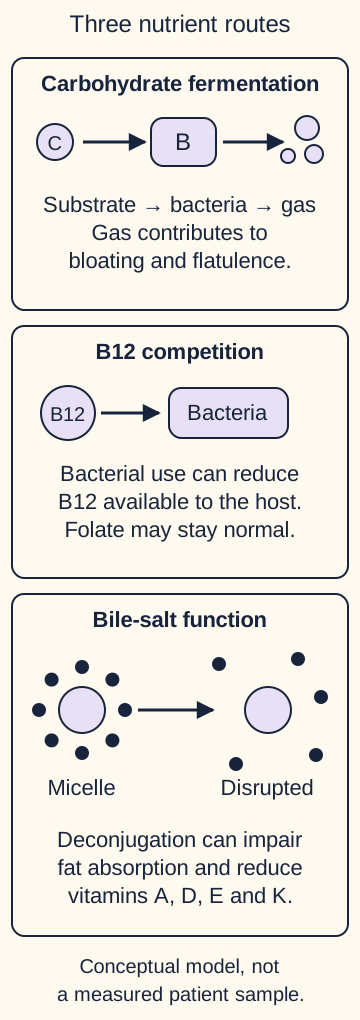
Does an oily stool necessarily mean the pancreas has failed? No. Digestion requires pancreatic enzymes, usable bile salts and an absorptive mucosa. Bacterial bile-salt deconjugation can impair micelle formation even when pancreatic secretion is adequate. Micelles keep fat-digestion products available for absorption; disruption can produce steatorrhea and deficiencies of vitamins A, D, E and K. More severe overgrowth can also injure the mucosa. [1][5]
Excess bacteria ferment carbohydrate, generating gas, and compete for nutrients. Bacterial consumption of vitamin B12 can contribute to deficiency, while bacterial folate synthesis may leave folate normal or high. This is a useful pattern in a patient with a stagnant intestinal segment, not a required diagnostic signature. Many patients have no measurable deficiency. Normal folate does not exclude SIBO, and high folate does not prove it. [2]
Read the nutrient diagram as three separate routes. Trace carbohydrate to gas, B12 to bacterial use, and bile salts to impaired fat absorption. Before looking at the worked result, predict which route can cause oily stools without low pancreatic enzyme output.
Follow three separate consequences of bacterial activity. B12 and folate patterns are variable; the micelle drawing is a model, not a clinical specimen. [1][2][5]Check the predicted route
Bile-salt deconjugation disrupts micelle formation. The fat-absorption problem is downstream of bile-salt function, not necessarily pancreatic enzyme secretion.
The visible consequence is that an intact pancreas does not protect against every cause of steatorrhea. In a new patient with a postsurgical blind segment, low B12 and adequate dietary intake, bacterial competition is a coherent explanation; in a patient with pancreatic calcifications and severe enzyme deficiency, another explanation may dominate.
B12 deficiency can cause paresthesias, impaired vibration sense and gait difficulty. A normal mean corpuscular volume does not exclude it. Mixed deficiencies may obscure the blood-count pattern. An indeterminate total B12 result may need methylmalonic acid testing and clinical interpretation. Complete terminal ileal resection removes the usual absorption site and can require lifelong intramuscular replacement independently of overgrowth. Iron deficiency can occur in malabsorption, but isolated iron deficiency is not specific for SIBO and requires assessment for bleeding and other causes. Investigate and replace documented deficiencies rather than inferring nutritional health from one normal blood-count value. [1][8]
Ask why the small bowel stopped clearing organisms
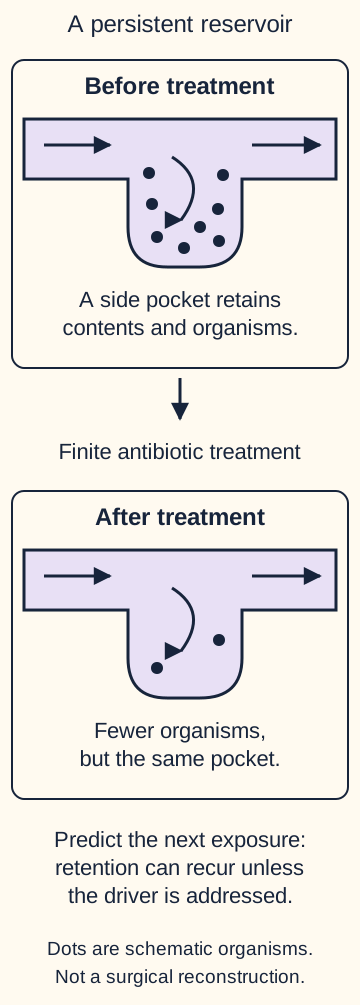
Would lowering the bacterial burden repair a blind loop? Antibiotics act on organisms, not on the reservoir that permitted their accumulation. The small bowel is not sterile. Its relatively low proximal bacterial density depends on propulsion, gastric acidity, pancreatic and biliary secretions, mucosal immunity and protection against retrograde colonic contents. [1]
The fasting migrating motor complex helps clear residual material and bacteria toward the colon. Systemic sclerosis can impair intestinal smooth-muscle function; diabetic autonomic neuropathy can impair neural control. Enteric neuromuscular disease and chronic intestinal pseudo-obstruction also impair clearance. Opioids and anticholinergic drugs can slow transit. These are different routes to a shared physiological problem, not proof of overgrowth in every exposed patient.
Blind loops, diverticula and some surgically altered segments can retain contents. Strictures or partial obstruction promote upstream stasis; fistulas can alter the normal route of contents. Loss of the ileocecal barrier can facilitate reflux of colonic organisms. Hypochlorhydria and immune impairment can weaken other defenses. Review acid suppression when appropriate, but a proton-pump inhibitor prescription alone is not an indication to screen an asymptomatic patient. [1]
In the reservoir diagram, follow the main lumen and then the side pocket. Mentally reduce the organisms in both spaces while leaving the pocket unchanged. Predict whether the next meal still encounters a site of retention.
Antibiotics can reduce organisms without correcting retained anatomy. Dot counts are conceptual and are not measured bacterial burdens. [1][2]Check the recurrence prediction
The pocket still retains contents. Reducing organisms can improve symptoms without correcting the structural reason they accumulated.
The consequence is a two-part treatment target: current overgrowth and the underlying driver. Transfer that reasoning to systemic sclerosis: there may be no surgically correctable pocket, but persistent dysmotility can still explain recurrence. Structural disease and dysmotility require different long-term plans. New vomiting, severe distension or obstipation should raise concern for obstruction rather than trigger routine outpatient antibiotics. [1][2]
Symptoms acquire meaning from the context
Is bloating after meals enough to establish SIBO? Bloating, abdominal discomfort, flatulence and diarrhea are common across many disorders. A patient with a blind segment, progressive weight loss and nutritional deficiency has a different pretest probability from a patient with stable weight, normal nutrition and isolated bloating. Neither the symptom nor the risk factor should substitute for the whole assessment. [1][2]
Compare the site of dysfunction, not just the stool description
Possibility
Useful discriminator
PossibilitySIBO
Useful discriminatorCompatible symptoms with stasis, altered anatomy or substantial dysmotility; malabsorption supports severe disease.
PossibilityPancreatic exocrine insufficiency
Useful discriminatorPancreatic disease plus low fecal elastase on a solid or semisolid specimen; below 100 micrograms/g provides good evidence.
PossibilityCeliac disease
Useful discriminatorCompatible serology and duodenal histology; test while consuming gluten and account for IgA deficiency.
PossibilityLactose maldigestion
Useful discriminatorSymptoms linked to lactose exposure; isolated carbohydrate intolerance is less explanatory for broad nutritional loss.
PossibilityDisorder of gut-brain interaction
Useful discriminatorA compatible symptom pattern with appropriate evaluation; a gas result does not automatically replace this diagnosis.
Pancreatic disease, celiac disease and SIBO can coexist. A watery stool can make fecal elastase difficult to interpret, so specimen quality matters. Celiac testing generally starts with tTG-IgA and assessment of total IgA; IgG-based tests are useful when IgA is deficient. Gluten avoidance before testing creates a separate cause of falsely reassuring serology; coordinate any diagnostic dietary changes with the evaluating clinician. Low B12 alone also has nonintestinal causes, including autoimmune gastritis and dietary deficiency. [6][7][8]
Compare two patients with the same degree of bloating: one has stable weight and no predisposing disease; the other has systemic sclerosis, diarrhea and weight loss. Identify which patient has both a plausible clearance failure and a consequence beyond gas.
Check the comparison
The second patient has a plausible motility disorder plus objective concern for malabsorption. This supports a targeted evaluation; it does not establish that every symptom is caused by bacteria.
The result of the comparison is a stronger reason to investigate, not permission to ignore alternatives. Transfer it to iron deficiency with weight loss: evaluate bleeding, celiac disease and other pathology even if a breath test is positive. Severe dehydration, substantial malnutrition, gastrointestinal bleeding, fever or signs of obstruction require prompt broader assessment rather than a routine test-and-treat pathway.
Trace the substrate before interpreting the gas
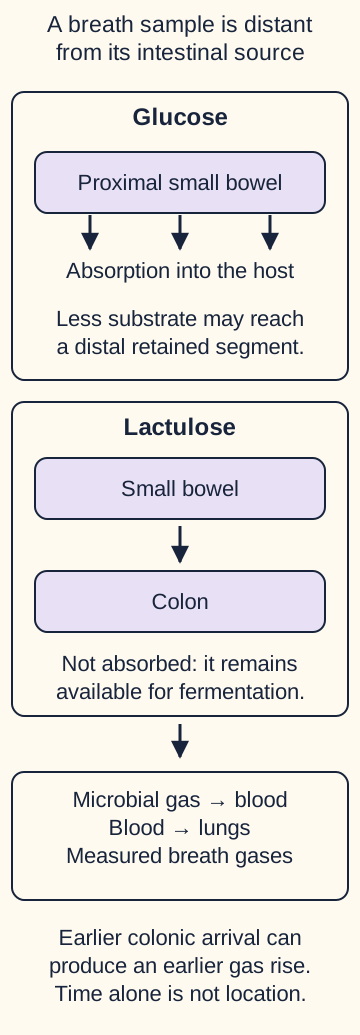
Can a breath curve tell you exactly where fermentation occurred? No. Gut microbes produce hydrogen and methane; these gases enter the circulation and reach the lungs. The breath sample is a downstream measurement, not an image or culture of the jejunum. Substrate handling changes which parts of the bowel can contribute. [3]
Glucose is absorbed mainly in the proximal small bowel. This can limit exposure of distal bacteria and produce a negative result despite distal disease. Lactulose is not absorbed and reaches the colon, where fermentation is expected. If transit is rapid, colonic fermentation may occur within the interval used to call a test positive. Glucose is not immune to transit-related false positives, especially with altered anatomy. Slow delivery, recent antibiotics and gas-production patterns can also reduce or delay the measured response. [1][4]
A substrate-tracing exercise
Use the sampling diagram and the three rows below. For each row, trace where substrate remains available, then predict whether an early rise must mean small-bowel fermentation. The times are constructed examples, not normal transit limits.
Trace substrate availability before interpreting a gas rise. This simplified model does not make either breath substrate a reliable anatomical locator. [1][3][4]
Change location while keeping an early gas signal possible
Situation
Substrate location
Visible consequence
SituationGlucose absorbed before a distal stagnant segment
Substrate locationLittle glucose reaches that segment.
Visible consequenceThe sampled signal may be negative despite disease there.
SituationLactulose reaches the cecum at 45 minutes
Visible consequenceA rise at 60 minutes can reflect colonic fermentation.
SituationLactulose remains in the small bowel at 60 minutes
Substrate locationSmall-bowel organisms still have substrate available.
Visible consequenceAn early rise has a different possible location, but does not quantify bacterial burden.
Why can the same time suggest different locations?
Time since ingestion is not a fixed anatomical coordinate. Changing transit changes which organisms encounter the substrate before the breath sample.
Transfer the exercise to a negative glucose test in a patient with distal diverticula and weight loss: reassess the clinical probability and the sampled region rather than declaring all bacterial disease excluded. Conversely, rapid transit weakens the inference from an early lactulose rise in a patient with otherwise uncomplicated diarrhea.
Duodenal or jejunal aspirate culture samples luminal contents directly, but requires endoscopy, can acquire oral contamination, may miss distal disease and depends on collection and culture methods. ACG uses at least 103 colony-forming units/mL as a suggested duodenal threshold; older literature often used 105. Site, organisms and technique matter, and there is no universally validated perfect reference standard. Stool microbiome profiles do not substitute for a small-bowel sample. [1][3][4]
A numerical criterion is not a diagnosis by itself
Does hydrogen at 25 parts per million, or ppm, make a test positive? You need the baseline and time. Under the North American consensus convention, hydrogen must rise at least 20 ppm above baseline by 90 minutes after glucose or lactulose. Methane uses an absolute level of at least 10 ppm at any point, including baseline, not a 20-ppm rise. A second hydrogen peak is not required. These are commonly used conventions with imperfect validation, not anatomical proof. [3]
For a worked example, hydrogen starts at 6 ppm and reaches 28 at 75 minutes: 28 minus 6 equals 22 ppm, meeting the hydrogen criterion. Starting at 14 and reaching 28 gives only 14 ppm, which does not meet it. Predict how the interpretation changes if methane is already 12 ppm at baseline.
Check the methane interpretation
Methane is positive by the absolute threshold even without an additional rise. In a constipated symptomatic patient, this supports an intestinal methanogen overgrowth phenotype.
Methanogens are archaea, not bacteria, and may be present in the small bowel or colon. Therefore the term intestinal methanogen overgrowth, or IMO, is preferable to calling it a bacterial subtype. Methane is associated with constipation. Methanogens use hydrogen to produce methane, so a small hydrogen rise does not negate a positive methane result. Neither gas localizes organisms on its own. [1][3]
Preparation matters: avoid antibiotics for four weeks when clinically appropriate; stop laxatives and promotility drugs for one week if tolerated and directed by the testing clinician. Avoid fermentable foods the preceding day, fast for 8 to 12 hours, avoid smoking on the test day and limit exercise during testing. The consensus does not require stopping proton-pump inhibitors. Use the laboratory's protocol, document necessary deviations and do not interrupt needed therapy merely to obtain a test. High baseline hydrogen warrants review of preparation; a flat trace does not by itself identify a particular unmeasured gas. [3]
Recommendations differ. ACG 2020 conditionally suggests breath testing in symptomatic patients with prior luminal surgery or suspected motility disorders, and also in IBS, with very low-quality evidence for these indications. The 2024 ESNM/ANMS appraisal strongly challenges routine breath-test attribution of IBS and nonspecific bloating to SIBO. Distinguish that debate from classical stasis-associated malabsorption. Transfer the numerical exercise to practice by asking whether the test was indicated, prepared correctly and capable of answering the clinical question before prescribing. [1][4]
Treat the current problem and its reason for returning
If a patient improves after an antibiotic, has the cause been proven and cured? Not necessarily. Antibiotics can alter colonic fermentation and symptoms in conditions other than SIBO. Clinical response is useful follow-up information, not a unique diagnostic test. Seek objective support where feasible before treatment, especially when the only symptom is bloating. [1][2][4]
For symptomatic, confirmed or strongly supported SIBO, clinicians commonly use a finite oral antibiotic course, often about 10 to 14 days, individualized to the situation. Rifaximin is commonly used; systemic alternatives such as amoxicillin-clavulanate or metronidazole may be selected according to allergies, prior exposure, availability and stewardship. There is no single universally established regimen or assured response. Constipation with IMO needs a phenotype-specific plan; combination antimicrobial approaches have limited evidence and should not be prescribed from a gas number alone. [1][2][5]
Correct fluid, calorie, B12 and fat-soluble vitamin deficits in parallel. Neurologic B12 deficiency needs prompt replacement, not a wait to see whether antibiotics restore nutrition. Follow symptoms, weight and the deficiencies actually documented. Improvement in gas does not establish nutritional recovery. [2][8]
Compare two follow-up plans for a patient whose blind segment remains: repeated antibiotics alone, or a reassessment of anatomy and nutrition alongside treatment of symptoms. Predict which plan addresses the persistent site of retention.
Check the durable treatment target
The second plan addresses the reservoir and the consequences. Antibiotics alone cannot correct the anatomy that repeatedly permits retention.
The practical consequence is to evaluate correction of a stricture or blind segment when feasible, address the disease causing dysmotility, and review drugs that slow transit. A specialist may consider a motility-directed strategy after excluding obstruction. Recurrent disease can sometimes justify further antibiotic courses, but maintenance is not automatic chronic therapy. Reassess the diagnosis, the driver and treatment harms, including resistance, adverse reactions and Clostridioides difficile infection. [1][2]
New unexplained frequent watery stools after antibiotics, particularly with fever, require assessment for antibiotic-associated infection such as Clostridioides difficile rather than automatic SIBO retreatment. [9]
Dietary changes may reduce fermentation symptoms but do not prove eradication. Avoid turning an already malnourished patient's diet into a progressively restrictive regimen; use individualized nutritional support. Evidence does not support one standard probiotic product or fecal microbiota transplantation as routine SIBO treatment. In a new patient with persistent symptoms despite appropriate treatment, reconsider pancreatic disease, celiac disease and other causes instead of assuming that every recurrence requires a stronger antibiotic. [1][6][7]
Apply the lesson
Case 1
Show answer and explanations for case 1
A. Reduced pancreatic lipase delivery (Why this does not fit)
Pancreatic exocrine insufficiency can cause steatorrhea. Normal formed-stool fecal elastase makes substantial pancreatic exocrine insufficiency less likely; the retained segment and B12-folate pattern instead support bacterial bile-salt disruption.
Insufficient pancreatic enzymes can impair fat digestion and cause steatorrhea.
How does elastase 420 micrograms/g on formed stool affect that explanation?
It makes substantial pancreatic exocrine insufficiency less likely; the retained jejunal segment and low B12 with high folate instead favor bacterial bile-salt disruption.
B. Bacterial bile-salt deconjugation (Best answer)
Excess luminal bacteria can deconjugate bile salts and impair micelles. Retained jejunal anatomy with B12-folate changes supports microbial activity, while normal fecal elastase makes substantial pancreatic exocrine insufficiency less likely.
Reasoning steps for option B
How could bacteria in the bypassed jejunal segment cause steatorrhea?
They can deconjugate bile salts, impairing micelle formation and fat absorption.
Which findings favor this over a pancreatic enzyme deficit?
A retained segment with B12 132 pg/mL and folate 22 ng/mL supports microbial activity, whereas formed-stool elastase 420 micrograms/g makes substantial pancreatic insufficiency less likely.
C. Selective loss of brush-border lactase (Why this does not fit)
Lactase deficiency causes lactose-related osmotic symptoms. It does not adequately explain fat malabsorption with this nutritional pattern and stagnant segment.
Reasoning steps for option C
What symptom pattern would selective brush-border lactase loss predict?
Lactose exposure would cause carbohydrate-related osmotic symptoms, such as gas and diarrhea.
Why does isolated lactase loss fall short in this woman?
It does not account well for oily stools and weight loss with low B12, high folate, and a stagnant jejunal segment.
D. Autoimmune loss of intrinsic factor (Why this does not fit)
Intrinsic-factor deficiency can explain low B12. It does not explain the associated fat malabsorption as directly as bacterial bile-salt disruption in the retained segment.
Reasoning steps for option D
Which finding could autoimmune intrinsic-factor loss explain?
Loss of intrinsic factor can impair B12 absorption and explain the low B12 value.
Why is intrinsic-factor loss not the best explanation for her oily stool?
It does not itself disrupt fat micelles; bacterial bile-salt deconjugation in the bypassed segment better unifies steatorrhea and the nutrient pattern.
Takeaway: Fat malabsorption can reflect impaired bile-salt function despite adequate pancreatic secretion.
A. Repeat the B12 level after intestinal symptoms resolve (Why this does not fit)
Treating malabsorption can improve nutrient availability. The functional marker and neurologic findings support current deficiency, so waiting for intestinal improvement risks ongoing injury.
Reasoning steps for option A
Why might one wait for intestinal treatment before repeating B12?
Improving malabsorption might eventually improve vitamin availability.
What makes waiting unsafe with B12 240 pg/mL in this patient?
Methylmalonic acid 0.72 micromol/L with preserved kidney function and impaired vibration and gait supports current functional B12 deficiency with neurologic risk.
B. Use folate replacement while arranging nerve-conduction testing (Why this does not fit)
Folate deficiency and other neuropathies can enter a nutritional evaluation. Folate is normal, whereas the indeterminate B12 plus abnormal functional marker points to B12 deficiency.
Reasoning steps for option B
Why might folate and nerve-conduction testing be considered?
Folate deficiency or another neuropathy can be part of an evaluation for neurologic symptoms.
Which laboratory findings undermine folate replacement as the immediate response?
Folate is normal, while indeterminate B12 and elevated methylmalonic acid with normal renal function point toward B12 deficiency needing replacement.
C. Investigate the neuropathy without starting vitamin replacement (Why this does not fit)
A normal MCV and a laboratory-range B12 value may initially seem reassuring. Neither excludes functional B12 deficiency; the abnormal methylmalonic acid with normal renal function resolves that uncertainty.
Reasoning steps for option C
Why could MCV 89 fL and B12 240 pg/mL mislead an examiner?
Normal cell size and a B12 value within the laboratory range may appear reassuring.
What evidence argues against investigating without replacing B12?
Elevated methylmalonic acid despite eGFR 96 and compatible sensory and gait changes support functional deficiency even without macrocytosis.
D. Begin B12 replacement while treating the intestinal disorder (Best answer)
An indeterminate B12 result needs clinical and functional interpretation. Abnormal methylmalonic acid, preserved renal function and compatible neurologic signs support prompt replacement despite normal MCV.
Reasoning steps for option D
What clarifies the indeterminate total B12 level here?
Methylmalonic acid is elevated at 0.72 micromol/L, and normal renal function reduces concern that reduced clearance alone explains it.
Why start B12 while treating the intestinal disorder?
Reduced vibration sense and unsteady walking indicate potential neurologic injury; normal MCV does not justify delaying replacement while overgrowth is addressed.
Takeaway: Interpret an indeterminate B12 value before deciding whether neurologic treatment can wait.
A. Persistent impairment of small-bowel propulsion (Best answer)
Systemic sclerosis can impair intestinal muscle function and clearance. Diffuse dilation without a focal transition point supports persistent dysmotility that antibiotics do not correct.
Reasoning steps for option A
How can systemic sclerosis predispose to recurrent overgrowth?
Impaired intestinal smooth-muscle propulsion reduces small-bowel clearance and promotes stasis.
What links the imaging and temporary antibiotic benefit to this option?
Diffuse dilation without a focal transition suggests ongoing dysmotility; antibiotics reduce organisms transiently but do not repair propulsion.
B. Selection of organisms resistant to the prior antibiotic (Why this does not fit)
Resistance can contribute to a poor or recurrent treatment response. No susceptibility evidence is supplied; diffuse dilation with systemic sclerosis supports a persistent clearance disorder as the better-established driver.
Reasoning steps for option B
Why might antibiotic resistance be proposed after symptoms return?
Selection of resistant organisms could contribute to failure or recurrence after treatment.
Why is resistance less established than impaired propulsion in this case?
She improved substantially during treatment, no susceptibility results show resistance, and sclerosis with diffuse dilation supplies a persistent stasis mechanism.
C. New pancreatic exocrine insufficiency (Why this does not fit)
Pancreatic disease can produce diarrhea and nutrient loss. No pancreatic abnormality is given, while the motility disease and nonfocal bowel dilation support ongoing stasis.
Reasoning steps for option C
How could new pancreatic exocrine insufficiency resemble her illness?
Impaired pancreatic enzyme delivery can produce diarrhea and malabsorption.
What evidence instead supports a recurrent clearance problem?
There is no pancreatic finding, but systemic sclerosis and diffuse nonfocal dilation indicate continuing small-bowel dysmotility after antibiotics.
D. A newly fixed focal small-bowel obstruction (Why this does not fit)
A focal obstruction can cause stasis and recurrence. Imaging specifically lacks a focal transition point and supports a diffuse motility process.
Reasoning steps for option D
Why could a focal obstruction cause repeated symptoms?
A fixed narrowing can retain upstream contents and promote stasis.
Which enterography finding argues against a newly fixed focal obstruction?
Dilation is diffuse with no focal transition point, fitting systemic-sclerosis-related dysmotility rather than a localized mechanical blockage.
Takeaway: Persistent dysmotility can sustain recurrence after a temporary antibiotic response.
A. Breath hydrogen stays low; distal aspirate count is raised (Best answer)
Glucose is commonly absorbed before reaching a distal retained segment. Little glucose may reach the proposed bacterial reservoir, while a carefully obtained local sample can recover its organisms.
Reasoning steps for option A
Why might the glucose breath signal stay low despite bacteria in distal diverticula?
Glucose is usually absorbed proximally, leaving little fermentable substrate at a distal jejunal reservoir.
Why could the carefully collected distal aspirate still have a raised count?
It samples the proposed site of retained organisms directly, rather than depending on glucose reaching them and producing a breath signal.
B. Breath hydrogen rises early; distal aspirate count is low (Why this does not fit)
An early gas rise is possible when accessible microbes ferment substrate. Concentrated distal organisms would be less exposed to glucose, whereas direct local sampling may reveal them.
Reasoning steps for option B
What would an early hydrogen rise imply about glucose exposure?
Some organisms accessible to glucose fermented it sufficiently to generate detectable hydrogen.
Why does pairing that rise with a low distal count poorly illustrate this vignette?
The hypothesis places concentrated bacteria in retained distal diverticula, where glucose exposure may be limited but a local aspirate could detect a raised burden.
C. Breath hydrogen stays low; distal aspirate count is low (Why this does not fit)
Proximal glucose absorption can leave little substrate for distal fermentation. Low breath gas need not imply low local burden when the second measurement directly targets the proposed reservoir.
Reasoning steps for option C
Why is a low glucose breath signal plausible here?
Most glucose may be absorbed before reaching the distal stagnant diverticula.
Why does a low distal aspirate count not show the proposed sampling mismatch?
If burden truly concentrates in the sampled distal reservoir, site-directed sampling could be raised despite the low breath signal; a low count on both misses that contrast.
D. Breath hydrogen rises early; distal aspirate count is raised (Why this does not fit)
A site-directed sample can show a raised count at an affected distal segment. An early glucose gas rise is less expected if most organisms lie beyond substantial proximal glucose absorption.
Reasoning steps for option D
Why could the distal aspirate have a raised count?
A carefully obtained sample at the retained diverticular segment may recover local organisms.
Why is an early glucose hydrogen rise less expected alongside that finding?
Concentrated organisms beyond substantial proximal glucose absorption may receive too little substrate to produce an early breath rise.
Takeaway: Substrate-dependent and site-directed measurements can disagree when disease is distal.
A. Proximal fermentation is needed to explain the early rise (Why this does not fit)
An early hydrogen rise can occur with small-bowel fermentation. Documented cecal arrival before the rise supplies a colonic explanation, so proximal fermentation is not required.
Reasoning steps for option A
Does the increase from 4 to 29 ppm at 60 minutes meet the hydrogen convention?
Yes, the 25-ppm rise occurs within 90 minutes.
Does that numerical result require proximal small-bowel fermentation?
No. Imaging shows lactulose in the cecum by 40 minutes, before the gas rise, allowing colonic fermentation.
B. Early colonic fermentation can explain the positive criterion (Best answer)
Colonic bacteria normally ferment lactulose after it arrives. Cecal arrival at 40 minutes precedes the 25-ppm rise, so rapid transit can produce the numerical result without establishing small-bowel overgrowth.
Reasoning steps for option B
What is the numerical hydrogen change in this lactulose study?
Hydrogen increases by 25 ppm from baseline at 60 minutes, meeting the conventional 20-ppm rise by 90 minutes.
Why can colonic fermentation account for it without proving SIBO?
The substrate reached the cecum at 40 minutes; colonic bacteria could ferment it before the 60-minute sample, particularly with rapid transit and few structural or nutritional risk clues.
C. Delayed gastric delivery is the best explanation for the early rise (Why this does not fit)
Delayed delivery changes the time at which substrate encounters microbes. The substrate had already reached the cecum at 40 minutes, contradicting delayed delivery as the explanation for the 60-minute rise.
Reasoning steps for option C
What might delayed gastric delivery do to a breath curve?
It could postpone substrate exposure to fermenting organisms and shift a gas rise later.
Why does measured cecal arrival contradict that explanation here?
Lactulose was already in the cecum at 40 minutes, so delayed delivery does not best explain the rise recorded at 60 minutes.
D. The timing argues against fermentation outside the small bowel (Why this does not fit)
Many protocols apply a 90-minute boundary to hydrogen interpretation. The measured transit contradicts using that boundary as an anatomical border; colonic fermentation was already possible.
Reasoning steps for option D
Why might the 60-minute rise seem restricted to the small bowel?
A commonly used 90-minute threshold can be mistakenly treated as an anatomical boundary.
What observation defeats that localization claim?
Imaging documented cecal substrate by 40 minutes, so fermentation outside the small bowel was possible before the 60-minute rise.
Takeaway: A positive time threshold cannot establish location when substrate has already reached the colon.
A. Hydrogen-positive; early colonic fermentation remains a possible source (Best answer)
The hydrogen increment is 20 ppm by 90 minutes, meeting the convention. Substrate reached the cecum before that measurement, so the positive criterion does not establish small-bowel localization.
Reasoning steps for option A
Does hydrogen 7 to 27 ppm by 90 minutes qualify as positive?
Yes. The rise is exactly 20 ppm, meeting the inclusive at-least-20-ppm convention.
What does cecal glucose detection at 70 minutes prevent us from concluding?
Because glucose reached the colon before the qualifying 90-minute sample, a colonic contribution remains possible; the curve alone does not localize fermentation.
B. Hydrogen-positive; proximal small-bowel fermentation is the supported location (Why this does not fit)
A qualifying hydrogen rise is sometimes attributed to small-bowel organisms. Observed cecal glucose before the qualifying rise leaves a colonic source possible and undermines confident proximal localization.
Reasoning steps for option B
Which part of this option correctly classifies the hydrogen result?
The 20-ppm increase from baseline to 90 minutes meets the numerical positive threshold.
Why is proximal small-bowel localization overconfident?
Glucose was detected in the cecum at 70 minutes, so the subsequent qualifying gas measurement could include early colonic fermentation.
C. Hydrogen-negative; the rise must exceed 20 ppm to qualify (Why this does not fit)
Boundary interpretation matters when the increment is exactly 20 ppm. The consensus uses at least 20, not greater than 20, so this rise meets the numerical criterion.
Reasoning steps for option C
How large is the baseline-to-90-minute hydrogen change?
It is 27 minus 7, or exactly 20 ppm.
Does the criterion require a rise greater than 20 ppm?
No. At least 20 ppm by 90 minutes includes the boundary value, so labeling this hydrogen-negative is incorrect.
D. Hydrogen-negative; glucose cannot support gas production after cecal arrival (Why this does not fit)
Glucose is usually absorbed proximally, which influences test behavior. The research measurement demonstrates colonic exposure here; delivered glucose can be fermented rather than ignored in interpreting the curve.
Reasoning steps for option D
Why is proximal glucose absorption relevant to this test?
It often limits how much glucose reaches distal microbes.
What case-specific observation refutes the claim that cecal glucose cannot generate gas?
A simultaneous measurement detected glucose in the cecum at 70 minutes; microbes there could ferment delivered substrate before the 90-minute hydrogen sample.
Takeaway: Even a glucose result at the positive boundary needs interpretation against actual transit.
A. Both gas criteria are met, favoring combined hydrogen SIBO and IMO (Why this does not fit)
The hydrogen rise eventually exceeds 20 ppm and methane exceeds 10 ppm. The hydrogen threshold is not reached by 90 minutes, so counting the late rise misclassifies that part of the study.
Reasoning steps for option A
Why might both gases appear positive if timing is ignored?
Hydrogen eventually rises from 4 to 30 ppm and methane is at least 11 ppm.
Which timing detail rules out a qualifying hydrogen result?
Hydrogen rises only 8 ppm by 90 minutes; its 26-ppm rise at 120 minutes is too late, while methane already qualifies at baseline.
B. Neither gas criterion is met, favoring a nonmethane constipation pattern (Why this does not fit)
A hydrogen increase below threshold by 90 minutes does not meet that criterion. Methane uses an absolute threshold, which is already met at baseline despite the small later change.
Reasoning steps for option B
Why is the hydrogen criterion not met on this glucose study?
At 90 minutes hydrogen is 12 versus baseline 4 ppm, only an 8-ppm rise.
Why does a small methane change not make both gases negative?
Methane is 11 ppm at baseline, above the absolute 10-ppm threshold regardless of its later increment.
C. Only hydrogen is positive, favoring hydrogen-associated bacterial overgrowth (Why this does not fit)
A late hydrogen rise may be conspicuous on the graph. It occurs outside the specified interval, while the absolute methane value actually meets the methane convention.
Reasoning steps for option C
What makes the 120-minute hydrogen value tempting to count?
Hydrogen reaches 30 ppm from baseline 4, a conspicuous 26-ppm increase.
Why is a hydrogen-only classification wrong?
That rise occurs after 90 minutes, whereas methane meets its absolute criterion from baseline at 11 ppm.
D. Only methane is positive, supporting a constipation-associated IMO phenotype (Best answer)
Methane at least 10 ppm at any point meets its absolute criterion. The late hydrogen rise does not qualify by 90 minutes, while baseline methane and constipation support IMO without locating the organisms.
Reasoning steps for option D
How do the two gas thresholds classify this curve?
Hydrogen rises only 8 ppm by 90 minutes and does not qualify; methane at baseline is 11 ppm and qualifies by its absolute threshold.
How does constipation affect interpretation of positive methane?
It supports a constipation-associated intestinal methanogen overgrowth phenotype, without proving whether the methanogens are in the small bowel or colon.
Takeaway: Evaluate hydrogen timing and absolute methane independently before assigning a phenotype.
A. The low hydrogen favors a nonmicrobial cause of constipation (Why this does not fit)
A low hydrogen signal can initially seem reassuring. Methane itself meets a microbial gas criterion; methanogens can consume hydrogen, so low hydrogen does not negate the methane-associated phenotype.
Reasoning steps for option A
Why might hydrogen of only 2 to 6 ppm seem reassuring?
There is no substantial measured hydrogen rise.
Why does low hydrogen not exclude a microbial constipation phenotype here?
Methane is already 12 ppm before substrate, meeting its absolute criterion, and methanogens can consume hydrogen.
B. The small methane increment favors a negative gas classification (Why this does not fit)
Some breath-test criteria depend on change from baseline. Methane uses an absolute level rather than the hydrogen increment rule, and the baseline already exceeds it.
Reasoning steps for option B
How much does methane change from its 12-ppm baseline?
It increases only 2 to 6 ppm across the later samples.
Why does that small increment not make methane negative?
Methane is classified by an absolute level of at least 10 ppm at any point, including the baseline of 12 ppm, not by the hydrogen rise rule.
C. The pattern supports intestinal methanogen overgrowth without localizing it (Best answer)
Methane positivity is associated with constipation, and methanogens can inhabit both small bowel and colon. Baseline methane exceeds 10 ppm while low hydrogen can coexist with hydrogen consumption by methanogens.
Reasoning steps for option C
What does baseline methane of 12 ppm establish?
It meets the absolute methane positivity threshold even before substrate, consistent with an IMO phenotype in a patient with constipation.
What can the low hydrogen and breath methane not establish?
Methanogens may consume hydrogen, and their gas can arise from small bowel or colon; this trace does not localize them.
D. The methane result favors overgrowth limited to the small bowel (Why this does not fit)
A methane-positive test can support an overgrowth phenotype in constipation. Methanogens may reside in the small bowel or colon, so their location cannot be restricted from this trace.
Reasoning steps for option D
Why could methane positivity invite a small-bowel overgrowth label?
Methane-associated constipation is a recognized intestinal overgrowth phenotype.
Why is a small-bowel-only location unwarranted?
Methanogens can reside in the colon as well as the small bowel, and a breath gas measurement does not specify their site.
Takeaway: Methane uses an absolute threshold and does not prove small-bowel localization.
A. Reschedule testing after an appropriate antibiotic-free interval (Best answer)
Recent antibiotics can suppress or alter gas production. An initial diagnostic test five days after treatment does not meet the usual four-week antibiotic-free preparation interval; nutritional evaluation can continue.
Reasoning steps for option A
What effect might amoxicillin-clavulanate have on an initial breath study?
Recent systemic antibiotics can suppress or alter intestinal microbes and measured gas production.
When should this stable patient instead have the prepared test?
Five days is short of the usual four-week antibiotic-free interval; reschedule after an appropriate interval while continuing nutritional evaluation.
B. Test now, documenting that the antibiotic treated a lung infection (Why this does not fit)
Documenting medication exposure is important to interpretation. Systemic antibiotic effects on gut microbes do not depend on why it was prescribed; documentation alone does not restore a reliable initial study.
Reasoning steps for option B
Why document that the antibiotic was prescribed for pneumonia?
The indication and recent exposure are relevant to interpreting a test.
Why does a lung-infection indication not make testing five days later reliable?
Systemic amoxicillin-clavulanate can affect gut organisms regardless of its indication, and documentation does not undo the preparation deviation.
C. Test next week using lactulose instead of glucose (Why this does not fit)
Substrate selection changes which regions receive fermentable material. It does not remove recent antimicrobial suppression, and next week remains short of the recommended four-week interval.
Reasoning steps for option C
What changes when lactulose replaces glucose?
Lactulose remains available farther along the gut, unlike glucose, which is usually absorbed proximally.
Why would testing next week still not fix this preparation problem?
Changing substrate cannot reverse recent antimicrobial effects, and next week remains short of the usual four-week antibiotic-free interval.
D. Obtain an aspirate now to avoid the breath-test preparation interval (Why this does not fit)
Aspirate culture is a direct alternative in selected patients. Recent antibiotics can also affect cultured organisms, so immediate invasive sampling is not a simple solution to this preparation problem.
Reasoning steps for option D
What advantage might an intestinal aspirate have over a breath test?
Directly collected luminal contents can be cultured at a selected site.
Why is obtaining one immediately not a simple workaround?
Antibiotics finished only five days ago can also alter cultured organism burden, and invasive sampling does not erase this timing concern.
Takeaway: Preparation affects interpretability even when antibiotic exposure was for another organ.
A. Treat A from the positive result; reassess B after adequate preparation (Why this does not fit)
A qualifying gas rise can support a diagnosis in a compatible syndrome. A lacks the symptomatic syndrome that would justify screening or treatment, so the numerical result alone should not determine care.
Reasoning steps for option A
Does A's 23-ppm glucose hydrogen rise meet the numerical convention?
Yes, a rise of at least 20 ppm by 90 minutes meets the hydrogen convention.
Does that justify treating A despite no bowel or nutritional symptoms?
No. A positive number in an asymptomatic proton-pump inhibitor user does not establish a treatment-worthy syndrome.
B. Avoid labeling A; end B’s evaluation because the result was negative (Why this does not fit)
Avoiding a disease label in an asymptomatic screened patient is appropriate. B has a high-risk malabsorptive presentation and a recently suppressed microbial signal, so a negative test should not end evaluation.
Reasoning steps for option B
Why is withholding a SIBO label from A reasonable?
A has no bowel symptoms or nutritional abnormality despite the qualifying gas rise.
Can B's negative glucose test three days after antibiotics end evaluation?
No. Recent antibiotics can suppress the measured signal, while systemic sclerosis, diarrhea and weight loss sustain concern.
C. Treat A from the positive result; accept B’s negative result as exclusion (Why this does not fit)
Using laboratory classifications alone produces a simple treatment rule. That rule ignores both A’s absent syndrome and B’s high clinical probability with antibiotic-compromised testing.
Reasoning steps for option C
What is lost by treating A solely from the breath report?
The decision ignores that A was asymptomatic; numerical positivity alone is not an indication to treat.
Why is B's negative report not an exclusion test here?
Antibiotics ended only three days earlier, potentially suppressing gas production in a high-risk symptomatic patient.
D. Avoid labeling A; reassess B with attention to the antibiotic interval (Best answer)
Testing value depends on indication and whether the result can answer the clinical question. A has no symptomatic target for treatment, while B has a compatible high-risk syndrome and an unreliable recent-antibiotic negative result.
Reasoning steps for option D
Should A's qualifying rise override the absence of a clinical syndrome?
No. Do not label or treat an asymptomatic proton-pump inhibitor user based on this screening result.
What should the antibiotic timing change for B?
Reassess the high-risk presentation and testing after an appropriate antibiotic-free interval when clinically feasible, rather than accepting this negative result.
Takeaway: A technically positive low-indication test and a compromised negative high-risk test require different responses.
A. Arrange screening while continuing the indicated acid suppressant (Why this does not fit)
Acid suppression is associated with reduced gastric antimicrobial defense. That association does not establish a benefit from screening this asymptomatic patient.
Reasoning steps for option A
Does proton-pump inhibitor exposure alone create a reason for breath screening?
No. Reduced gastric antimicrobial defense is a risk association, not evidence of SIBO in this man.
What does his absence of discomfort, stool change and nutritional loss imply for screening?
There is no compatible symptomatic target, so screening while continuing therapy offers no established benefit.
B. Do not screen solely for proton-pump inhibitor exposure (Best answer)
ACG suggests against SIBO breath testing in asymptomatic patients taking proton-pump inhibitors. This patient has no compatible syndrome; review the medication indication separately without treating a theoretical risk as disease.
Reasoning steps for option B
What does guidance say about breath testing asymptomatic proton-pump inhibitor users?
ACG suggests against screening solely for this exposure.
How does the documented acid indication affect this recommendation?
Continue to review the drug on its own merits, but do not infer SIBO or order screening without a compatible syndrome.
C. Stop acid suppression and screen after a medication-free interval (Why this does not fit)
Medication indication should be reviewed when considering adverse effects. This patient has a documented indication and no symptomatic syndrome; stopping treatment to pursue screening is not supported.
Reasoning steps for option C
Would stopping the indicated acid suppressant create a SIBO testing indication?
No. A medication-free interval cannot supply symptoms or nutritional consequences that he does not have.
What argues against interrupting this man's treatment to screen?
His acid-related indication is documented and he is asymptomatic; stopping therapy for speculative screening is unsupported.
D. Switch acid suppressants and use bloating prevention as the goal (Why this does not fit)
Different acid-suppressing treatments may be selected for the underlying acid disorder. He has no bloating, and changing drugs solely to prevent unproven SIBO does not follow from the exposure alone.
Reasoning steps for option D
Is bloating prevention a treatment target in this patient?
No. He reports no bloating or other bowel symptoms.
Would changing to another acid suppressant establish or prevent SIBO?
No. A switch may be considered for the acid disorder, but exposure alone does not justify changing drugs to prevent unproven SIBO.
Takeaway: A risk association is not an indication for screening an asymptomatic patient.
A. Below the relevant cutoff, because duodenal sampling requires 100,000 CFU/mL (Why this does not fit)
Historical studies often used the higher threshold. ACG discusses at least 1,000 CFU/mL for duodenal aspirates; the older cutoff alone should not classify this result.
Reasoning steps for option A
Which duodenal aspirate count is suggested in ACG guidance?
At least 1,000 CFU/mL, rather than the historical 100,000 CFU/mL cutoff.
Where does this woman's 8,000 CFU/mL fall relative to that threshold?
It exceeds the suggested duodenal cutoff, so the laboratory's older threshold should not classify it as negative.
B. Above the relevant cutoff, but enteric organisms make contamination the leading explanation (Why this does not fit)
Collection contamination can undermine an aspirate result. Careful duodenal collection of enteric organisms in a compatible postoperative syndrome does not make contamination the leading explanation from the supplied facts.
Reasoning steps for option B
Can contamination invalidate an aspirate count above 1,000 CFU/mL?
Yes, specimen provenance matters even when the numerical cutoff is exceeded.
Do the supplied organism and collection details make contamination the leading explanation?
No. Careful duodenal sampling yielded enteric organisms in a postoperative patient with diarrhea and weight loss.
C. Above the suggested cutoff, supporting SIBO in this clinical setting (Best answer)
The suggested ACG duodenal threshold is at least 1,000 CFU/mL. Eight thousand exceeds it, and surgical risk plus malabsorptive symptoms provide a compatible setting while culture limitations remain.
Reasoning steps for option C
How does 8,000 CFU/mL compare with the suggested duodenal threshold?
It exceeds the ACG-suggested 1,000 CFU/mL threshold, despite falling below the older 100,000 cutoff.
How much does the culture establish in this postoperative patient?
It supports SIBO alongside diarrhea and weight loss, but sampling and culture limitations prevent treating the count as perfect proof.
D. Below the relevant cutoff, because postoperative patients require a separate threshold (Why this does not fit)
Anatomy changes pretest probability and can complicate interpretation. The supplied guidance does not establish a separate higher culture threshold simply because a patient had surgery.
Reasoning steps for option D
Does intestinal surgery itself raise the duodenal culture cutoff?
No separate higher postoperative threshold is supplied; surgery changes clinical risk, not the stated cutoff.
How should her surgery and 8,000-CFU/mL result be integrated?
Postoperative anatomy raises suspicion, and the count exceeds the suggested duodenal threshold rather than falling below it.
Takeaway: Interpret aspirate counts with the collection site, method and clinical presentation.
A. The proximal collection site may miss a more distal reservoir (Why this does not fit)
A proximal aspirate may miss distal disease. That limitation would mainly concern an uninformative negative sample, not explain this oral-predominant positive count collected through a used channel.
Reasoning steps for option A
What limitation would proximal duodenal sampling pose for distal disease?
A proximal sample may miss organisms confined to a more distal reservoir.
Does that explain this positive, oral-predominant 3,000-CFU/mL sample?
No. Missing distal growth mainly affects negative sampling; prior suction through the same channel threatens this positive specimen with contamination.
B. Culture conditions may fail to recover organisms present in vivo (Why this does not fit)
Not every organism grows under a given culture method. Failure to grow organisms would underestimate burden; it is less relevant than introduced flora for the reported positive sample.
Reasoning steps for option B
How can limited culture recovery affect an aspirate?
Organisms present in vivo may fail to grow, causing underestimation.
Is under-recovery the main concern when oral flora grow after shared-channel suction?
No. Introduced upstream flora is a more direct explanation for this reported positive count.
C. Recent antibiotics may have reduced recovery of enteric organisms (Why this does not fit)
Antibiotics can alter both culture recovery and gas testing. No recent antibiotic exposure is supplied, whereas the sampling pathway has a documented contamination opportunity.
Reasoning steps for option C
Would recent antibiotics affect an aspirate's microbial recovery?
Yes. They can reduce or alter organism recovery if taken before sampling.
What evidence in this man favors another limitation?
No antibiotic exposure is reported, while oral and gastric secretions were suctioned through the collection channel.
D. The used collection channel may have introduced upstream organisms (Best answer)
Endoscopic collection can introduce oral or gastric organisms into an aspirate. Prior suction through the same pathway plus predominantly oral growth makes specimen provenance the primary concern here.
Reasoning steps for option D
What route could oral organisms take into the duodenal sample?
The same endoscope channel first carried suctioned oral and gastric secretions and then the aspirate.
Why does 3,000 CFU/mL not settle whether antibiotics are indicated?
Predominantly oral flora and a collection pathway at risk of contamination undermine provenance despite a count above the suggested cutoff.
Takeaway: A count cannot compensate for a compromised sampling pathway.
A. Pancreatic enzyme replacement during meals (Best answer)
A fecal elastase below 100 micrograms/g on an appropriate specimen strongly supports exocrine pancreatic insufficiency. Structural pancreatic disease plus a markedly low valid value links the steatorrhea to deficient enzyme delivery, which replacement directly addresses.
Reasoning steps for option A
How should fecal elastase 54 micrograms/g on semisolid stool be read?
A valid value below 100 micrograms/g strongly supports exocrine pancreatic insufficiency.
Why give enzymes with meals in this patient?
Pancreatic atrophy and calcifications plus steatorrhea identify inadequate digestive enzyme delivery, which meal-time replacement addresses.
B. A finite rifaximin course as the primary treatment (Why this does not fit)
Bacterial overgrowth can coexist with pancreatic disease and cause similar symptoms. The objective defect demonstrated here is severe pancreatic enzyme insufficiency, which antibiotics do not replace.
Reasoning steps for option B
Why might rifaximin seem relevant to oily stools and bloating?
SIBO can coexist with pancreatic disease and can impair fat absorption.
What documented deficit would rifaximin leave untreated here?
Severe exocrine insufficiency shown by elastase 54 on an appropriate specimen; antibiotics cannot supply pancreatic enzymes.
C. Lactose restriction as the primary treatment (Why this does not fit)
Lactose maldigestion can cause bloating and diarrhea. It does not address the documented pancreatic enzyme deficit or broad fat maldigestion.
Reasoning steps for option C
Which complaint might lactose restriction improve?
Lactose maldigestion can contribute to gas, bloating or diarrhea after lactose exposure.
Why is restriction not the primary response to this man's oily stools?
Pancreatic calcifications, atrophy and valid elastase 54 indicate a broad enzyme deficit and fat maldigestion, not merely lactose intolerance.
D. Fat-soluble vitamin replacement without pancreatic enzymes (Why this does not fit)
Fat-soluble vitamin replacement may be needed when malabsorption causes deficiency. It does not correct the demonstrated enzyme deficit; pancreatic enzyme replacement addresses digestion as well as nutritional consequences.
Reasoning steps for option D
What downstream consequence might fat-soluble vitamin replacement address?
It can replenish vitamins lost through fat malabsorption if deficiency is documented.
Why is vitamin replacement without enzymes insufficient?
It does not restore pancreatic enzyme delivery responsible for his steatorrhea and very low fecal elastase.
Takeaway: Shared symptoms do not outweigh a directly demonstrated pancreatic defect.
A. Repeat lactulose testing after another antibiotic course (Why this does not fit)
Repeat gas testing can be considered in selected unresolved cases. It would not evaluate the strong celiac serology and nutritional abnormalities already present.
Reasoning steps for option A
What would repeating lactulose testing after another antibiotic course measure?
It would reassess gas production, not establish the cause of iron deficiency and weight loss.
What stronger unresolved evidence should redirect this woman's evaluation?
While eating gluten, her tTG-IgA is eight times the upper limit with normal total IgA; celiac disease needs assessment.
B. Obtain isolated tTG-IgG testing instead of further mucosal evaluation (Why this does not fit)
IgG-based celiac tests are useful in IgA deficiency. Normal total IgA and strongly positive tTG-IgA make isolated IgG testing a less appropriate next step.
Reasoning steps for option B
When does IgG-based celiac serology chiefly help?
It is useful when total IgA is deficient and IgA-based assays may be falsely reassuring.
Does this woman's normal IgA justify substituting isolated tTG-IgG for biopsy?
No. Her strongly positive tTG-IgA while consuming gluten warrants duodenal mucosal evaluation.
C. Arrange upper endoscopy with duodenal biopsies (Best answer)
Compatible positive celiac serology generally leads to duodenal biopsy confirmation in adults. Weight loss and iron deficiency with strong tTG-IgA positivity require evaluation of mucosal disease rather than attribution to a breath result alone.
Reasoning steps for option C
Why is the tTG-IgA result interpretable in this woman?
She still consumes gluten and total IgA is normal; the tTG-IgA is eightfold above the laboratory limit.
What step evaluates the competing cause of diarrhea, iron deficiency and weight loss?
Upper endoscopy with duodenal biopsies can confirm celiac mucosal disease in an adult, rather than attributing everything to lactulose gas.
D. Begin a gluten-free diet and reassess serology after symptoms improve (Why this does not fit)
Gluten avoidance treats confirmed celiac disease. Starting before the diagnostic evaluation is completed can reduce the sensitivity of serology and histology; confirmation should be arranged while gluten exposure is maintained when feasible.
Reasoning steps for option D
Could a gluten-free diet improve celiac symptoms?
Yes, but improvement would not replace confirmation of the diagnosis.
Why not start gluten avoidance before her planned biopsies?
Removing gluten can reduce serologic and histologic sensitivity; arrange confirmation while she remains on gluten when feasible.
Takeaway: Positive gas testing does not displace evidence of a competing mucosal disorder.
A. Repeat tTG-IgA after clinician-supervised restoration of gluten exposure (Why this does not fit)
Restoring gluten exposure can improve the sensitivity of celiac testing. It does not correct the absence of IgA, so the same assay class remains unsuitable.
Reasoning steps for option A
Which limitation would restoring gluten address?
Six weeks of gluten avoidance can lower celiac antibody sensitivity, so supervised re-exposure addresses substrate exposure.
Why is repeating tTG-IgA still inadequate in this man?
Total IgA is undetectable; the IgA-based assay remains unreliable even after gluten is restored.
B. Use IgG-based testing after a clinician-supervised gluten-exposure plan (Best answer)
IgA deficiency calls for an interpretable IgG-based assay, and celiac serology depends on gluten exposure. This plan addresses both independent limitations; persistent high suspicion can still require duodenal evaluation even if subsequent serology is negative.
Reasoning steps for option B
Which assay class fits undetectable total IgA?
An IgG-based celiac assay is interpretable when IgA-based tTG testing is not.
How must the six-week gluten-free interval also be handled?
Arrange a clinician-supervised gluten-exposure plan before repeat serology; persistent high suspicion may still warrant duodenal evaluation.
C. Use IgG-based testing while maintaining strict gluten avoidance (Why this does not fit)
IgG-based testing addresses the absence of IgA. Continuing gluten avoidance preserves the separate dietary reason for falsely reassuring serology.
Reasoning steps for option C
What problem does switching from tTG-IgA to IgG-based serology fix?
It addresses the patient's undetectable IgA and the assay-class failure.
Why not test while he remains strictly gluten-free?
Six weeks without gluten can suppress celiac antibody responses, so an IgG assay alone may still be falsely reassuring.
D. Repeat tTG-IgA while maintaining the diet and tracking symptom response (Why this does not fit)
Tracking symptoms can document dietary benefit. It does not repair either the absent antibody class or suppressed gluten exposure, and symptoms alone do not confirm celiac disease.
Reasoning steps for option D
Would symptom tracking after gluten avoidance confirm celiac disease?
No. Persistent or improving symptoms do not establish the cause of malabsorption.
Which two defects remain if tTG-IgA is simply repeated now?
He has undetectable IgA and has avoided gluten for six weeks, making the same assay and exposure state unreliable.
Takeaway: Repair both the assay-class and exposure limitations before trusting negative celiac serology.
A. Secondary lactase loss is the only plausible source of an early rise (Why this does not fit)
Small-bowel mucosal injury can reduce brush-border lactase. The blind segment also permits premature microbial fermentation, so enzyme loss is not the only available explanation.
Reasoning steps for option A
Can small-bowel mucosal injury reduce brush-border lactase?
Yes, secondary lactase loss can contribute to lactose maldigestion.
Why is it not the only plausible source of her early hydrogen rise?
Her jejunal blind segment can retain bacteria that ferment lactose prematurely, alongside weight loss and low B12.
B. Rapid colonic arrival explains the positive lactose test without small-bowel fermentation (Why this does not fit)
Undigested lactose can be fermented after reaching the colon. No transit measurement is supplied; the blind reservoir and nutritional findings create a distinct possibility of premature small-bowel fermentation.
Reasoning steps for option B
Where can undigested lactose normally generate breath hydrogen?
Colonic microbes can ferment lactose after it reaches the colon.
What prevents attributing this early rise solely to rapid colonic arrival?
Transit was not measured, whereas a jejunal reservoir and B12 deficiency provide a plausible small-bowel fermentation route.
C. Premature bacterial fermentation can confound carbohydrate-malabsorption testing (Best answer)
Excess small-bowel microbes may ferment lactose before the usual distal site. The blind segment, broad meal-related symptoms and nutritional deficiency warrant assessing overgrowth rather than assuming isolated primary lactase deficiency.
Reasoning steps for option C
How can a jejunal blind segment alter the lactose breath curve?
Retained excess microbes may ferment the lactose before it reaches the colon, creating an early hydrogen signal.
Why does the clinical pattern argue against isolated lactase deficiency?
Symptoms after dairy-free meals, weight loss and low B12 point beyond lactose exposure and warrant assessing overgrowth.
D. The positive lactose trace makes primary lactase deficiency the leading explanation (Why this does not fit)
Primary lactase deficiency can produce a positive lactose breath test. The positive trace alone cannot separate this from premature bacterial fermentation in the retained segment.
Reasoning steps for option D
Could primary lactase deficiency cause a positive lactose breath test?
Yes, unabsorbed lactose may reach microbes and produce hydrogen.
Why does this trace not make primary lactase deficiency the leading sole explanation?
The blind segment allows premature fermentation, and dairy-free symptoms plus B12 deficiency are not explained by isolated primary lactase loss.
Takeaway: Carbohydrate breath testing can be confounded by premature substrate fermentation.
A. Gas may decrease while substantial fat maldigestion persists (Best answer)
Antibiotics can reduce fermentation and bacterial bile-salt effects. They do not replace the missing pancreatic enzyme secretion, so a second documented defect can sustain steatorrhea even if gas improves.
Reasoning steps for option A
What does antibiotic suppression change in her blind segment?
It can reduce bacterial fermentation and gas, as well as bile-salt deconjugation.
Why might steatorrhea remain despite less gas?
Formed-stool elastase of 48 after pancreatic resection documents an untreated enzyme deficit.
B. Fat maldigestion should resolve while bacterial gas production persists (Why this does not fit)
Bile-salt deconjugation can contribute to fat malabsorption. The antibiotic is assumed to reduce bacterial activity, while the severe pancreatic deficit remains untreated; this reverses the expected targets.
Reasoning steps for option B
Could suppressing blind-segment bacteria help fat absorption?
Yes, less bile-salt deconjugation may improve micelle function.
Why is complete fat recovery with persistent bacterial gas the wrong prediction?
Antibiotics reduce bacterial activity, while severe pancreatic insufficiency remains untreated.
C. Both gas and fat maldigestion should resolve from the same treatment (Why this does not fit)
Overgrowth alone can cause both gas and steatorrhea. This patient also has independently demonstrated pancreatic insufficiency, which microbial suppression does not correct.
Reasoning steps for option C
Can overgrowth alone produce gas and oily stools?
Yes, fermentation produces gas and bile-salt disruption can impair fat absorption.
What prevents antibiotics alone from resolving both problems here?
Her independent pancreatic enzyme deficit persists until replacement begins.
D. Neither symptom can improve until pancreatic enzymes are started (Why this does not fit)
Enzymes are important for the documented pancreatic digestive defect. Fermentation from the separately supported overgrowth can decrease before pancreatic replacement, so lack of enzymes does not prevent every benefit.
Reasoning steps for option D
Which defect requires pancreatic enzyme replacement?
The severe pancreatic insufficiency indicated by valid elastase of 48.
Must gas wait for enzyme replacement to improve?
No, antibiotics may reduce fermentation in the separately documented blind-segment overgrowth.
Takeaway: Different digestive defects can respond differently to the same treatment.
A. Use repeat finite antibiotic courses as the sole recurrence strategy (Why this does not fit)
Selected recurrent SIBO can justify additional finite courses. This can suppress episodes but does not address the demonstrated retained contents above the stricture.
Reasoning steps for option A
What do two temporary antibiotic responses suggest about his recurrent diarrhea?
Bacterial suppression may relieve symptoms temporarily without correcting the underlying stricture.
Why are repeat courses alone insufficient?
The stricture still retains contents proximally, allowing renewed accumulation.
B. Prioritize motility-directed medication without structural consultation (Why this does not fit)
Motility therapy may help nonmechanical clearance failure. A defined narrowing with proximal retention requires structural assessment rather than assuming diffuse dysmotility is the main problem.
Reasoning steps for option B
Would a nonmechanical propulsion defect support motility-directed medication rather than stricture assessment?
Motility-directed medication may help nonmechanical clearance failure, but imaging here documents a focal structural narrowing.
What makes it an incomplete first priority here?
Imaging identifies a focal stricture and upstream retention needing structural assessment.
C. Treat nutritional deficits without reassessing the narrowing (Why this does not fit)
Nutritional replacement treats the consequences of malabsorption. It leaves the recurring reservoir unchanged and does not substitute for evaluating the known structural driver.
Reasoning steps for option C
What can nutritional replacement accomplish during evaluation?
It can correct documented consequences of malabsorption.
Why can it not prevent this patient's repeated episodes alone?
It cannot remove retention above the small-bowel narrowing.
D. Assess endoscopic or surgical correction while treating active disease (Best answer)
A correctable narrowing can sustain stasis despite reduction of bacteria. The repeated temporary responses and persistent proximal retention favor addressing the structural driver alongside current care.
Reasoning steps for option D
Which persistent finding explains relapse after antibiotics?
A short stricture continues to trap contents proximally.
Why consider endoscopic or surgical correction alongside active care?
Assessing a potentially correctable reservoir targets recurrence; absence of complete obstruction allows planned assessment rather than dismissing it.
Takeaway: Repeated symptom suppression is not correction of a persistent anatomical reservoir.
A. Arrange outpatient breath testing before changing treatment (Why this does not fit)
Breath testing can aid evaluation of stable compatible symptoms. The new vomiting and obstipation suggest an acute mechanical problem for which delaying assessment is unsafe.
Reasoning steps for option A
What clinical setting would permit outpatient breath testing?
Stable symptoms compatible with overgrowth, without acute obstructive features.
Which new findings make waiting for a test unsafe?
Bilious vomiting, distension and obstipation with known narrowing suggest obstruction.
B. Arrange urgent evaluation for intestinal obstruction (Best answer)
Pain, bilious vomiting, distension and obstipation in a patient with a narrowing raise concern for obstruction. The acute pattern takes priority over the previous diagnosis and requires urgent assessment rather than a routine outpatient antibiotic course.
Reasoning steps for option B
What does failure to pass stool or flatus add to vomiting and distension?
Obstipation strengthens concern for intestinal obstruction rather than simple recurrent bloating.
What action takes precedence over her old SIBO diagnosis?
Urgent assessment of the acute obstructive pattern.
C. Repeat the prior antibiotic because it previously relieved bloating (Why this does not fit)
A prior response can support treatment of recurrent compatible symptoms. The current acute obstructive pattern differs materially from uncomplicated recurrent bloating or diarrhea.
Reasoning steps for option C
Why might another antibiotic initially seem attractive?
Treatment previously improved her overgrowth-related symptoms.
What distinguishes the current episode from that presentation?
Abrupt pain, repeated bilious vomiting and obstipation suggest an acute mechanical complication.
D. Add a promotility drug while monitoring symptoms at home (Why this does not fit)
Motility-directed treatment may help selected nonmechanical clearance disorders. A known narrowing with new obstructive features requires urgent evaluation before attempting to stimulate propulsion.
Reasoning steps for option D
When could a promotility approach be considered?
For selected functional clearance failure after excluding a mechanical obstruction.
Why not start it at home in this woman?
Her known narrowing and new obstructive symptoms require urgent evaluation first.
Takeaway: An established SIBO history must not obscure a new obstructive emergency.
A. Reduce acid-suppressing therapy to restore the principal impaired defense (Why this does not fit)
Gastric acidity is one defense against bacterial accumulation. Acid production is preserved and no acid suppressant is supplied, whereas fasting propulsion is abnormal.
Reasoning steps for option A
Does his study identify loss of gastric acidity as the failed defense?
No, gastric acid production is preserved and no acid suppressant is reported.
Which measured abnormality better explains bacterial retention?
Poor propagation of fasting small-bowel contractions impairs clearance.
B. Review opioid reduction and a specialist-directed motility strategy (Best answer)
Fasting propulsion helps clear residual contents and organisms. Abnormal propagated activity identifies a clearance defect; autonomic disease and increased opioid exposure make medication review and motility-directed care relevant.
Reasoning steps for option B
What is the role of fasting propagated contractions?
They move residual contents and organisms toward the colon.
Which two findings make opioid review and specialist motility care relevant?
Diabetic autonomic neuropathy and increased oxycodone accompany the documented propagation defect.
C. Seek endoscopic dilation of the region causing retained contents (Why this does not fit)
Dilation may address an appropriate focal structural narrowing. Imaging identifies no focal narrowing, so this plan does not match the demonstrated diffuse functional clearance problem.
Reasoning steps for option C
What lesion would make endoscopic dilation relevant?
A focal narrowing retaining small-bowel contents.
Does imaging supply that target here?
No focal narrowing is present; manometry instead shows a functional propulsion defect.
D. Add pancreatic enzyme replacement to restore luminal digestion (Why this does not fit)
Pancreatic secretion supports digestion and contributes to intestinal defenses. No pancreatic defect is demonstrated; the supplied physiological abnormality is propagation rather than enzyme delivery.
Reasoning steps for option D
What would justify pancreatic enzyme replacement?
Evidence of pancreatic digestive insufficiency or deficient enzyme delivery.
What does the supplied testing show instead?
Abnormal fasting contraction propagation, not a pancreatic secretion defect.
Takeaway: Identify the failed defense before choosing an intervention beyond antibiotics.
A. Pancreatic enzyme failure is the leading mechanism because the first value was below 100 (Why this does not fit)
A value below 100 supports pancreatic insufficiency when obtained from an appropriate specimen. The first specimen was liquid and the untreated semisolid repeat is normal, so the initial concentration is not strong evidence of severe enzyme failure.
Reasoning steps for option A
How should an elastase of 86 from liquid stool be interpreted?
Watery dilution can falsely lower its concentration, even below 100.
What does the untreated semisolid result of 360 imply?
A normal valid repeat weakens the claim of severe pancreatic enzyme failure.
B. Primary lactase deficiency is the leading mechanism because diarrhea diluted the first sample (Why this does not fit)
Lactose maldigestion can cause diarrhea and watery sampling. It does not explain a retained reservoir, oily stool and B12 depletion as coherently as a broader luminal malabsorptive process.
Reasoning steps for option B
Can primary lactase deficiency account for diarrhea?
Yes, lactose maldigestion may produce diarrhea after lactose exposure.
Which findings remain unexplained by isolated lactose intolerance?
The retained blind segment, oily stool and low B12 with adequate intake.
C. Loss of intrinsic factor is the leading mechanism because B12 is low (Why this does not fit)
Autoimmune gastritis can cause B12 malabsorption. It would not account for the retained segment and fat malabsorption; the B12 result alone does not localize the defect to the stomach.
Reasoning steps for option C
What would loss of intrinsic factor explain?
It could impair B12 absorption independently of overgrowth.
Why does it not integrate this entire case?
It does not explain blind-segment retention and oily stool, and B12 alone does not identify a gastric cause.
D. Bacterial nutrient use and bile-salt disruption are a coherent combined mechanism (Best answer)
A retained segment can promote bacterial consumption of B12 and deconjugation of bile salts. After discounting the liquid-stool pancreatic result, this mechanism explains both nutrient findings; targeted evaluation is still needed to confirm clinical attribution.
Reasoning steps for option D
What can bacteria in a retained blind segment do to B12 and bile salts?
They can consume B12 and deconjugate bile salts, impairing fat absorption.
Why favor this combined mechanism after the elastase repeat?
The valid semisolid value is normal without treatment, leaving bacterial nutrient use and bile-salt disruption a coherent explanation requiring targeted evaluation.
Takeaway: Correct an invalid pancreatic inference before localizing the residual malabsorptive pattern.
A. Test unformed stool for Clostridioides difficile using the local diagnostic algorithm (Best answer)
New unexplained frequent unformed stools after antibiotics raise concern for antibiotic-associated infection. The acute febrile change despite improvement in baseline bloating is a different syndrome and should be evaluated before attributing it to recurrent SIBO.
Reasoning steps for option A
Which new findings warrant an antibiotic-associated infection workup?
Six unexplained watery stools daily, cramps and fever after amoxicillin-clavulanate, without laxatives.
Why test unformed stool before calling this a SIBO relapse?
Her original bloating improved; the acute febrile diarrhea suggests a new syndrome such as C. difficile infection.
B. Repeat a glucose breath test now to measure persistent bacterial fermentation (Why this does not fit)
Breath testing can help selected stable evaluations of overgrowth. Current antibiotics compromise interpretation and a gas measurement does not evaluate the new febrile diarrheal syndrome.
Reasoning steps for option B
What can a glucose breath test evaluate under suitable conditions?
It can provide indirect gas evidence during a selected stable overgrowth evaluation.
Why would it not settle this new illness now?
Ongoing antibiotics compromise gas testing, and it cannot diagnose the acute febrile diarrhea.
C. Obtain fecal elastase now to determine whether pancreatic treatment is needed (Why this does not fit)
Pancreatic insufficiency can cause chronic maldigestion and diarrhea. An abrupt febrile illness after antibiotic exposure is a stronger reason to investigate infection, and watery stool is unsuitable for a definitive elastase interpretation.
Reasoning steps for option C
What digestive disorder could fecal elastase investigate if chronic maldigestion were suspected?
It can assess suspected chronic pancreatic maldigestion on an appropriate specimen.
Why is it a poor priority during six watery stools and fever?
Watery stool can distort elastase, while recent antibiotics raise concern for infection.
D. Repeat small-bowel aspirate culture to direct another overgrowth regimen (Why this does not fit)
Culture may inform selected difficult overgrowth assessments. It would pursue the old diagnosis while missing a more urgent antibiotic-associated cause of the new symptoms; current therapy also affects recovery.
Reasoning steps for option D
Would a repeat small-bowel aspirate investigate overgrowth or the new febrile diarrheal syndrome?
It could inform a difficult overgrowth evaluation, but it would not address the new antibiotic-associated febrile diarrhea.
Why not pursue it before investigating this changed presentation?
It targets the old condition, may be affected by current antibiotics and misses possible antibiotic-associated infection.
Takeaway: A changed syndrome after antibiotics needs a new diagnostic hypothesis, not automatic retreatment.
A. Continue lifelong intramuscular replacement for A; reassess B after correcting the reversible cause (Best answer)
Complete terminal ileal resection permanently removes the normal absorption site. NICE recommends lifelong intramuscular replacement for A, while B’s corrected cause permits response-based reassessment rather than an automatic identical lifetime plan.
Reasoning steps for option A
What permanent change affects A's B12 absorption?
Complete terminal ileal resection removes the normal absorption site despite improved bloating.
How does B differ after blind-segment correction?
B retains her terminal ileum; NICE calls for lifelong intramuscular replacement for A, while B can undergo response-based reassessment.
B. Reassess stopping replacement for A; give B lifelong intramuscular replacement (Why this does not fit)
Anatomical corrections can remove a cause of nutrient deficiency. Only B’s blind segment was corrected; A still lacks the entire terminal ileal absorption site.
Reasoning steps for option B
Whose anatomical cause was potentially reversed?
B's bypassed blind segment was corrected, not A's complete ileal resection.
Why is the proposed lifelong injection assignment backwards?
A still lacks the absorption site and needs lifelong intramuscular B12; B can be reassessed after correction.
C. Continue lifelong intramuscular replacement for both patients (Why this does not fit)
Persistent malabsorption can require continuing replacement. B’s suspected reversible cause has been corrected; unlike complete ileal resection, it does not by itself establish a lifelong injection requirement.
Reasoning steps for option C
Why must A remain on intramuscular B12 for life?
The entire terminal ileal absorption site has been removed.
Does B's corrected blind segment mandate the same schedule?
No, her retained ileum and corrected potentially reversible cause support reassessment of need and response.
D. Reassess stopping replacement for both patients when bloating resolves (Why this does not fit)
Symptom and biochemical improvement can prompt cause-based reassessment. Resolution of A’s bloating does not restore the resected terminal ileum, so her replacement remains lifelong.
Reasoning steps for option D
Can resolved bloating prove restored B12 absorption in A?
No, antibiotics do not restore her surgically absent terminal ileum.
For whom is cause-based reassessment after symptom and nutritional recovery reasonable?
For B, whose ileum remains and whose blind-segment cause was corrected, not automatically for A.
Takeaway: Long-term replacement follows reversibility of the cause, not gas symptoms alone.
A. Pursue inflammatory evaluation; the gas rise cannot establish a small-bowel bacterial source (Best answer)
The calprotectin value and weight loss warrant independent evaluation for inflammatory or mucosal disease. Cecal arrival before the rise allows colonic fermentation, so the positive numerical gas criterion does not establish small-bowel attribution.
Reasoning steps for option A
What independent signal merits investigation beyond the breath result?
Weight loss with fecal calprotectin 560, well above the reference below 50, warrants inflammatory or mucosal evaluation.
What limits attribution of the 5-to-31 ppm rise at 60 minutes?
Lactulose reached the cecum by 35 minutes, allowing colonic fermentation before the gas rise.
B. Pursue inflammatory evaluation; the gas rise confirms concurrent small-bowel overgrowth (Why this does not fit)
The inflammatory signal still merits investigation despite a positive gas result. A qualifying rise after independently documented cecal arrival cannot confirm the additional small-bowel diagnosis.
Reasoning steps for option B
Does hydrogen rise enough by 90 minutes to meet the numerical convention?
Yes, 31 minus 5 equals 26 ppm at 60 minutes, exceeding the 20 ppm threshold.
Why does that not confirm concurrent small-bowel overgrowth?
Imaged cecal arrival at 35 minutes allows a colonic source; inflammatory evaluation remains necessary.
C. Pursue inflammatory evaluation; a high calprotectin value invalidates the breath gas measurement (Why this does not fit)
A markedly raised inflammatory marker creates an important competing clinical concern. It does not erase the measured gas; transit evidence, not calprotectin, limits the gas result’s localization.
Reasoning steps for option C
What does calprotectin 560 change clinically?
It increases concern for inflammatory or mucosal pathology requiring separate assessment.
Does that marker invalidate the recorded breath gas?
No, the gas rise remains measured; documented rapid cecal transit limits localization.
D. Pursue inflammatory evaluation; the timing excludes any possible small-bowel bacterial contribution (Why this does not fit)
Early colonic exposure provides a plausible source for the measured gas. It does not prove that all fermentation was colonic or exclude coexisting small-bowel overgrowth.
Reasoning steps for option D
What does cecal arrival before the hydrogen rise establish?
Colonic fermentation is a plausible source of the 60-minute signal.
Does it rule out any small-bowel bacterial contribution?
No, it prevents confident small-bowel attribution but does not exclude coexisting overgrowth.
Takeaway: Maintain an inflammatory investigation while interpreting rather than dismissing a transit-confounded gas signal.