Connect benzene exposure to marrow injury, interpret serial CBCs, distinguish competing diagnoses, and apply surveillance rules without overcalling causation.
A worker's blood counts can fall while every result still lies inside the laboratory reference interval. Should you wait for a red flag on the report? This lesson connects exposure history, marrow production and serial CBCs so you can decide what to confirm, when to protect the worker and when a hematologic diagnosis takes priority.
Does a job title tell you the dose? A refinery employee who opens a transfer vessel and an office employee at the same site do not have the same exposure. Benzene is a volatile aromatic hydrocarbon in crude oil, gasoline and tobacco smoke. Relevant work includes petroleum refining, chemical manufacture, rubber production, coke operations, printing, laboratories and fuel or solvent handling. These are possible exposure settings, not proof of exposure or automatic inclusion under one regulation. [3][4]
Ask for the task, product and safety data sheet; duration and frequency; ventilation and process enclosure; protective equipment; liquid contact; spills and confined-space events. Obtain prior jobs, other marrow-toxic chemicals or radiation, medications, smoking history and coworker patterns. A cluster warrants exposure investigation but does not establish the cause of each person's abnormality.
Opening a solvent vessel: breathing-zone vapor exposure can rise briefly even when a shift average is modest.
Handling a soaked glove: liquid contact adds dermal absorption; respiratory protection does not protect the skin.
Smoking outside work: tobacco contributes benzene exposure and can also increase WBC counts, complicating comparisons with previous results.
Inhalation is the principal occupational route. Skin absorption also matters, particularly with prolonged liquid contact or damaged skin. Odor and lack of irritation are unreliable safety checks. Representative personal air sampling describes airborne exposure; a CBC describes blood cells, not parts per million. [1][2]
Compare two technicians doing the same task with equivalent breathing-zone measurements. One repeatedly wets an unprotected sleeve with solvent. Identify the exposure route that the air result misses.
Compare the route assessment
Skin contact provides an additional route of systemic absorption. Similar air results therefore need not mean similar total uptake.
The practical consequence is to assess liquid-handling controls as well as ventilation. In a new setting, ask whether a normal CBC after a spill makes entry safe. It does not: a sudden high exposure can cause dizziness, confusion, arrhythmia or unconsciousness before a hematologic abnormality appears. Rescue requires trained, protected personnel; acute stabilization must not await surveillance tests. [4]
Follow metabolism to the shared source of blood cells
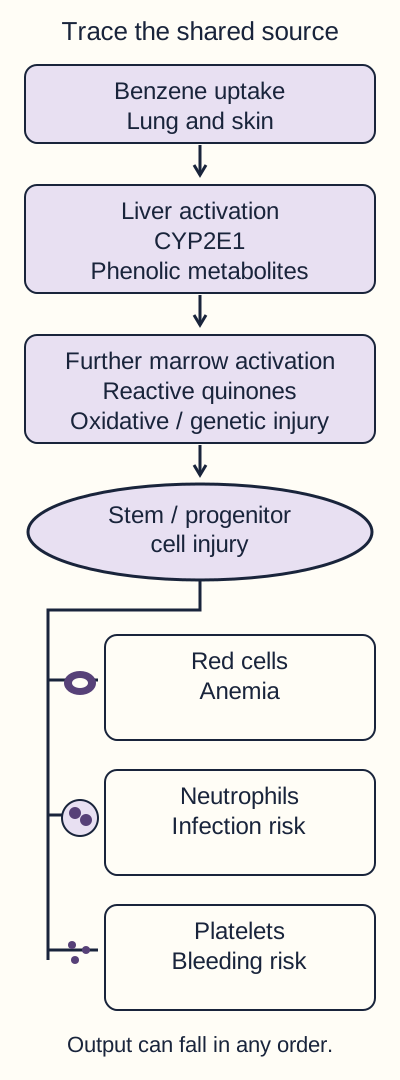
Why can a solvent lower several blood-cell types? The important target is upstream of mature circulating cells. Hepatic metabolism, prominently involving CYP2E1, produces benzene oxide and phenolic intermediates. Further activation, including myeloperoxidase reactions in marrow, produces reactive quinones. Oxidative and genotoxic injury can affect hematopoietic stem and progenitor cells and their supporting environment. No single metabolite accounts for every effect. [3]
The accompanying production diagram separates entry, metabolic activation and the three downstream outputs. Damage can impair differentiation, promote apoptosis and produce chromosomal abnormalities. Red-cell production can fall, neutrophil supply can fall, and platelet production can fall. The resulting fatigue, infection risk and bleeding arise from different consequences of a shared production problem. The timing and degree of each decline vary; pancytopenia is not required before concern is justified. [2][7]
Trace one upstream compartment to several blood-cell outputs. The drawing is a simplified causal model, not anatomy, a tissue image or a complete metabolic pathway. [3][7][8]
Trace the production diagram from the stem/progenitor compartment to platelets. Now trace the same starting point to red cells. Predict whether a treatment aimed only at circulating platelets would correct both shortages.
Check the production prediction
No. A shared upstream injury can reduce both outputs. Treating peripheral platelet destruction alone would not correct impaired red-cell production.
Reticulocytes are newly released red cells. In anemia, the marrow should increase their supply. A low absolute reticulocyte count, or a count inadequate for the severity of anemia, supports underproduction. A raw percentage within the reference interval can still be inadequate because there are fewer mature red cells in the denominator. Interpret the absolute count or an appropriately corrected response with the hemoglobin and clinical setting. [6]
In a worker with falling hemoglobin, platelets and neutrophils plus low reticulocytes, the shared production model fits better than isolated red-cell loss. Transfer that reasoning to another patient with anemia, brisk reticulocytosis and otherwise preserved counts: peripheral loss or destruction becomes more plausible. Mixed processes can occur, so a reticulocyte result localizes the problem more readily than it identifies the cause.
Compare a trajectory, not just a reference interval
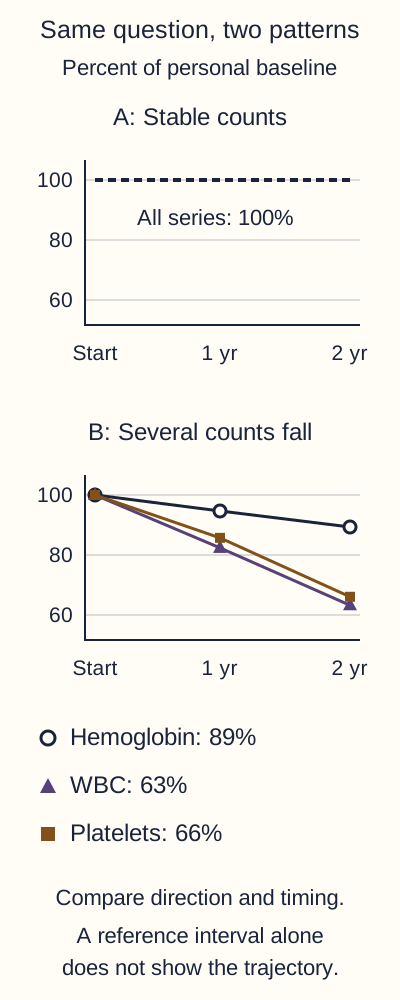
Which deserves attention first: one low value or several falling values? Review both the personal baseline and the population interval. Stable isolated mild leukopenia predating the job differs from a new decline in multiple lineages. Conversely, severe thrombocytopenia or blasts can demand action on the first sample; a trend is not a prerequisite for urgency. [2]
CBC trends for a worker over two years
Measurement
Baseline
Year 1
Year 2
MeasurementHemoglobin, g/dL
Baseline15.0
Year 114.2
Year 213.4
MeasurementWBC, x10^9/L
Baseline6.8
Year 15.6
Year 24.3
MeasurementPlatelets, x10^9/L
Baseline280
Year 1240
Year 2185
The trend diagram plots each series relative to its own baseline, not against a shared physical unit. With the stated laboratory intervals of hemoglobin 13.0 to 17.0 g/dL, WBC 4.0 to 11.0 x10^9/L and platelets 150 to 400 x10^9/L, none of the last results is flagged. Yet all three are falling. The platelet decrease since the most recent result is (240 - 185) / 240 x 100 = 22.9%, which also meets a specific surveillance repeat-testing trigger. [1]
Compare the stable and falling panels. Percentages are relative to each baseline, not laboratory reference cutoffs or probabilities of toxicity. [1][2]
Use the two trajectories in the diagram as a comparison exercise. First trace the stable panel, where each series stays at its own baseline. Then trace the three falling series. Which added information changes your concern about production?
Compare the added information
The synchronized decline in other lineages makes a shared production disorder more concerning than an isolated stable WBC value. It warrants prompt confirmation and investigation, not automatic attribution to benzene.
Confirm unexpected results with a repeat CBC, differential, smear and reticulocytes as indicated. Check for specimen problems such as platelet clumping. Macrocytosis, persistent thrombocytopenia, an abnormal differential, immature cells or reported dysplasia strengthen the need for further evaluation. Interpret blasts promptly with specialist input. [2][6]
Keep the ordinary differential diagnosis active: infection, medications, alcohol, liver disease, B12 or folate deficiency, iron deficiency or blood loss, immune destruction, hypersplenism and unrelated marrow disease. Baseline variation and relevant inherited traits should be assessed from evidence, not presumed from race or ancestry alone. In a new patient, low B12 plus macrocytosis and sensory symptoms directs treatment toward deficiency; it does not cancel appropriate occupational surveillance.
Use the surveillance program without mistaking it for a diagnosis
Does being below a legal limit mean no surveillance is needed? No. For workplaces covered by the U.S. federal benzene standard, the action level is lower than the permissible exposure limit. Scope exceptions exist, including specified fuel operations, oil and gas drilling and coke oven batteries; consult occupational medicine and the applicable standard rather than applying these rules to every benzene-related job. [1]
Separate the three airborne benchmarks
Benchmark
Value
Meaning
BenchmarkAction level
Value0.5 ppm, 8-hour TWA
MeaningTriggers program duties under specified conditions
BenchmarkTWA PEL
Value1 ppm, 8-hour TWA
MeaningFull-shift permissible limit
BenchmarkSTEL
Value5 ppm, 15-minute average
MeaningShort-duration permissible limit
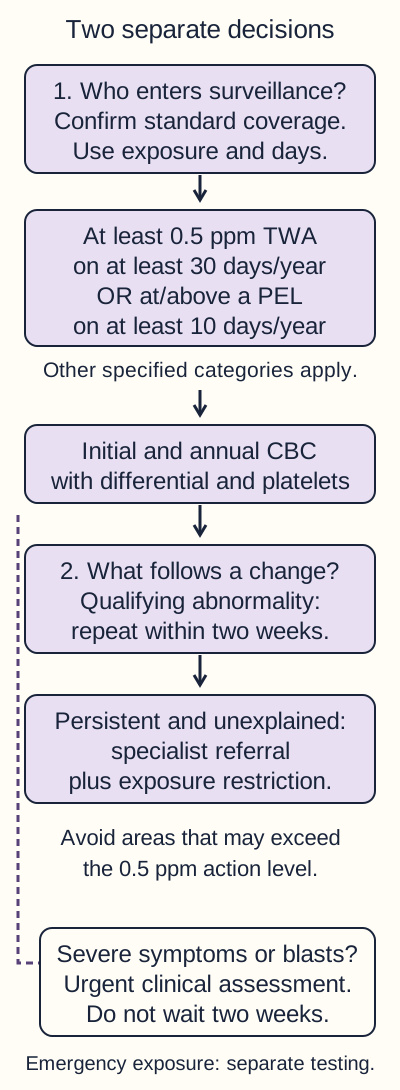
Medical surveillance is required for employees exposed or potentially exposed at or above the action level on at least 30 days per year, or at or above the PELs on at least 10 days per year. The rule also includes specified historical exposure and tire-building categories. Employee exposure is assessed without credit for respirator use. A brief task can count as part of an exposure day; annual averaging must not erase peak events. [1]
Initial assessment includes occupational and medical history, examination and CBC with differential, quantitative platelets, hemoglobin, hematocrit, red-cell count and red-cell indices. Periodic medical examinations are annual, with interim evaluation when symptoms or abnormalities arise. The standard specifies red-cell indices, not a mandatory set of platelet indices. Respirator users have additional cardiopulmonary provisions. [1]
The surveillance decision diagram separates eligibility from abnormal-result follow-up. Repeat the CBC within two weeks for unexplained low hemoglobin/hematocrit or a persistent downward trend, a platelet count more than 20% below the most recent value or outside the laboratory interval, WBC below 4,000/mm3, or an abnormal differential. A persistent abnormality prompts referral to a hematologist or internist unless the physician has good reason that referral is unnecessary. Serious symptoms justify faster care. [1]
Trace eligibility separately from abnormal-result follow-up. The diagram applies only within the standard's scope and does not replace its historical categories, emergency pathway or physician judgment. [1]
A covered employee has 0.6 ppm full-shift exposure on 40 days this year, a normal CBC and no symptoms. Compare the measured concentration and number of days with the two routine eligibility routes.
Check the program decision
The action-level route qualifies: at least 0.5 ppm on at least 30 days. A normal CBC and exposure below the 1 ppm TWA PEL do not negate eligibility.
Emergency exposure has a separate pathway: obtain an end-of-shift urine sample and perform urinary phenol testing within 72 hours, with specific gravity corrected to 1.024. At 75 mg/L or above, the rule requires CBCs monthly for three months. Below 75 mg/L, that provision does not require further testing, but symptoms or abnormal blood counts still need clinical care. Urinary phenol is a regulatory emergency test, not a specific measure of chronic marrow injury. [1][3]
Apply the distinction to a new situation: a normal CBC after a large spill cannot substitute for emergency assessment, and a low full-shift average cannot exclude a high 15-minute exposure.
Name the marrow disorder before assigning its cause
Does benzene exposure make every cytopenia toxic aplasia? No. Benzene is a recognized hematotoxicant and human carcinogen. Aplastic anemia, MDS and AML are important associated outcomes, but they are not compulsory stages that every exposed person passes through. Counts can decline before overt disease, and illness may appear after exposure ends. [2][3]
Production failure with a markedly hypocellular marrow: supports an aplastic-anemia phenotype after appropriate exclusion of alternatives.
Persistent cytopenias with significant dysplasia and clonal abnormalities: supports MDS. A cellular marrow can still produce too few functional circulating cells.
Circulating blasts or a concerning marrow blast population: prompts urgent evaluation for acute leukemia or another hematologic neoplasm. Current classification integrates morphology, genetics and blast burden, rather than occupational history alone.
Marrow cellularity does not by itself distinguish all disorders. MDS is often hypercellular but can be hypocellular; nutritional deficiencies can mimic dysplasia. A hematologist integrates the clinical course, morphology, flow cytometry, cytogenetics and molecular testing as indicated. Do not diagnose MDS from macrocytosis alone or diagnose AML solely from a few immature circulating cells. [5][6][7]
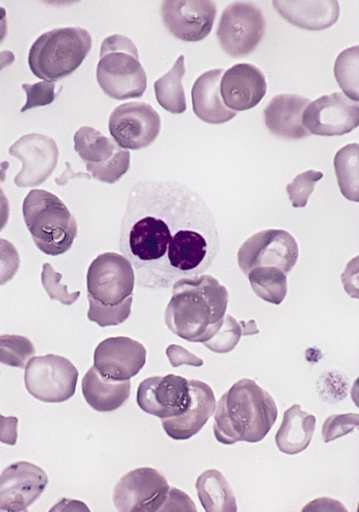
The clinical smear image shows a hypogranular neutrophil with a bilobed nucleus. Compare its sparse granules and limited nuclear segmentation with the reported dysplasia above. The source patient had therapy-related MDS after treatment for Hodgkin disease, not documented benzene toxicity. This is an example of morphology, not proof of exposure or a stand-alone diagnostic test. [9]
A hypogranular neutrophil with a pseudo-Pelger-Huet nucleus, Wright-Giemsa stain. Source case: therapy-related MDS after radiotherapy and chemotherapy for Hodgkin disease, not documented benzene exposure. The source also notes postsplenectomy red-cell changes. This image illustrates morphology, not exposure attribution. Image: Armed Forces Institute of Pathology (AFIP); original source; Public domain, U.S. federal government work; Commons PD-USGov attribution. [5][9].
Compare two reports with the same low hemoglobin and platelets. One describes a markedly depleted marrow without increased blasts; the other describes abundant precursors, significant dysplasia and an acquired clone. Predict whether the second report represents effective cell production.
Check the marrow comparison
No. Numerous precursors can coexist with ineffective hematopoiesis and low peripheral counts. Cell quantity in marrow is not equivalent to successful cell output.
The clinical consequence is to treat the diagnosed disorder, while separately assessing the credibility, timing and intensity of exposure and competing causes. In Lan and colleagues' cross-sectional study, exposed workers had lower WBC and platelet counts than controls even below 1 ppm. That supports concern about biological effects below the TWA PEL; it neither proves causation in one worker nor predicts which individual will develop leukemia. [8]
For transfer, consider a former worker with cytopenias years after leaving the plant. Past exposure remains relevant, but present-day air measurements cannot reconstruct the old dose, and a normal urine result now cannot exclude a remote contribution.
Protect the worker while establishing the diagnosis
Must a biopsy prove causation before exposure is restricted? No. A concerning persistent decline merits prompt clinical evaluation and protection from further suspected exposure. Under the federal standard, referral for a persistent surveillance abnormality requires exclusion from areas where benzene exposure may exceed the action level. The physician, in consultation with the specialist, determines subsequent restrictions and return. This is different from requiring permanent exclusion for every isolated result. [1]
Compare two situations. An asymptomatic isolated platelet decrease should be confirmed, including a smear for clumping. Active bleeding with severe thrombocytopenia requires immediate clinical assessment and supportive treatment, not simply scheduling the statutory two-week repeat. Likewise, fever with profound neutropenia or circulating blasts requires urgent evaluation. The regulatory interval is not a reason to delay care.
An employee referred for persistent bicytopenia is offered a task with expected exposure of 0.8 ppm. Decide whether being below the 1 ppm TWA PEL alone satisfies the referral-related restriction.
Check the work restriction
No. The referral-related restriction concerns areas where exposure may exceed 0.5 ppm. An expected 0.8 ppm is below the TWA PEL but above that action level.
Obtain repeat counts, smear, reticulocytes and targeted tests for competing causes while arranging specialist assessment. Persistent abnormalities after cessation do not justify renewed exposure; established aplasia or clonal disease may not rapidly reverse. Marrow examination is selected according to the phenotype, not performed automatically for every mild isolated abnormality. [2][6]
For acute intoxication, end exposure safely, decontaminate liquid-contaminated skin and clothing, support airway and breathing, and obtain emergency care. There is no specific benzene antidote. Chelation does not reverse benzene marrow injury; iron chelation for transfusional iron overload is a different indication. Aplastic anemia may require transfusion support, immunosuppressive treatment or transplantation; MDS and AML require disease-specific hematology care. [4][5][7]
Coordinate occupational medicine, industrial hygiene and hematology. Engineering controls and safer work practices prevent exposure before counts fall; appropriate respiratory and skin protection supplement them. The employer-facing medical opinion should include occupationally relevant findings and restrictions, not unrelated diagnoses. Apply this to a worker whose counts improve: recovery is encouraging, but return depends on the physician's assessment and controlled exposure, not one normal CBC. [1]
Apply exposure and blood-count reasoning
Case 1
Show answer and explanations for case 1
A. Splenic sequestration of otherwise normally produced cells (Why this does not fit)
Splenic sequestration can lower several circulating counts, but the low reticulocyte response during anemia favors impaired production over sequestration alone. These findings do not exclude a coexisting splenic process.
Reasoning steps for option A
How could splenic pooling account for several low circulating cell counts?
Sequestration can retain red cells, leukocytes and platelets in the spleen even when their marrow production is maintained.
Why do reticulocytes of 18 x10^9/L during anemia argue against sequestration as the complete explanation?
With hemoglobin at 10.8 g/dL, reticulocytes below the 25 to 100 x10^9/L interval indicate inadequate red-cell output. This favors impaired production over sequestration alone, without excluding a coexisting splenic process.
B. Impaired output from hematopoietic progenitor cells (Best answer)
Progenitor injury can impair red-cell, leukocyte and platelet production together. The confirmed multilineage decline and inadequate reticulocyte response fit a shared production problem; they do not alone establish its cause.
Reasoning steps for option B
Where can one production defect affect the falling hemoglobin, WBC and platelets together?
Hematopoietic stem and progenitor compartments supply all three lineages, so injury there can reduce several outputs together.
How does the low reticulocyte count strengthen production localization without proving benzene causation?
Reticulocytes of 18 x10^9/L are inadequate for hemoglobin of 10.8 g/dL, reinforcing the confirmed multilineage production deficit. The feedstock history makes exposure relevant but does not identify the cause by itself.
C. Antibody-mediated destruction of circulating erythrocytes (Why this does not fit)
Immune hemolysis can cause anemia and usually stimulates reticulocyte production. It does not adequately explain this low reticulocyte response together with progressive leukopenia and thrombocytopenia.
Reasoning steps for option C
What reticulocyte response would immune destruction of erythrocytes usually produce during this anemia?
A functioning marrow usually increases reticulocyte release to replace destroyed red cells; the measured count of 18 x10^9/L instead shows an inadequate response.
Which additional falling counts are not explained by isolated antibody-mediated red-cell destruction?
WBC has fallen to 3.1 x10^9/L and platelets to 92 x10^9/L. Isolated erythrocyte destruction does not account for these declines together with low reticulocytes.
D. Chronic blood loss with depleted iron stores (Why this does not fit)
Chronic bleeding can produce anemia with an inadequate reticulocyte response. The concurrent progressive leukopenia and thrombocytopenia require a broader explanation than blood loss alone.
Reasoning steps for option D
Can depleted iron stores make the reticulocyte response inadequate during chronic bleeding?
Yes. Chronic blood loss can deplete iron and limit replacement red-cell production, so low reticulocytes alone do not distinguish iron deficiency from other production problems.
What makes chronic blood loss alone insufficient for the confirmed 18-month trajectory?
The anemia accompanies progressive leukopenia and thrombocytopenia. A shared production disorder better accounts for all three declining lineages than blood loss alone.
Takeaway: Localize a confirmed multilineage decline with inadequate reticulocytes to a production problem before assigning etiology. [2] [6]
A. Give oxygen and observe without assessing assisted ventilation (Why this does not fit)
Supplemental oxygen can improve oxygenation but does not by itself correct inadequate ventilation. Drowsiness and shallow breathing require airway assessment and readiness to assist ventilation, not observation alone.
Reasoning steps for option A
What part of the worker's respiratory problem could supplemental oxygen improve?
Oxygen can improve the saturation of 88%, but increasing inspired oxygen does not itself correct inadequate ventilation.
Which findings make oxygen followed by observation alone unsafe after this collapse?
Drowsiness and shallow respirations indicate a need to assess the airway and ability to ventilate, with assistance as needed rather than observation alone.
B. Give intravenous fluids before assessing respiratory support (Why this does not fit)
Intravenous fluid may be useful when circulation is impaired. The supplied immediate threats are hypoxemia and shallow breathing; fluids do not replace their assessment and support.
Reasoning steps for option B
What physiologic problem would intravenous fluids primarily address after a collapse?
Fluids can support circulation when perfusion is impaired; they do not directly correct shallow breathing or hypoxemia.
Why should fluids not precede assessment of respiratory support in this worker?
The documented immediate threats are shallow respirations and saturation of 88%. Airway, oxygenation and ventilation support must not be delayed to prioritize fluids.
C. Complete exposure-specific testing before respiratory support (Why this does not fit)
Exposure-specific testing may guide subsequent monitoring. It must not delay treatment of inadequate breathing and hypoxemia, even when the initial CBC is normal.
Reasoning steps for option C
What would exposure-specific testing contribute after the worker is stabilized?
It can help characterize the release and guide subsequent exposure follow-up, but it does not support breathing during the current instability.
Why does a normal initial CBC not justify finishing those tests before respiratory support?
The normal CBC does not negate drowsiness, shallow respirations or hypoxemia. Acute respiratory compromise can precede detectable marrow effects and requires immediate support.
D. Support oxygenation and ventilation after airway assessment (Best answer)
High-concentration benzene exposure can depress consciousness and breathing. The immediate threat is inadequate oxygenation and ventilation, regardless of the normal initial CBC.
Reasoning steps for option D
Which findings identify the immediate threat after rescue and decontamination are complete?
Drowsiness, shallow breathing and oxygen saturation of 88% identify inadequate oxygenation with concern for inadequate ventilation.
How does airway assessment guide the next support despite the normal CBC?
Assess airway patency and protection, provide oxygen and assist ventilation as required by the breathing assessment. A normal blood count does not change these respiratory priorities.
Takeaway: Acute physiologic instability takes priority over exposure biomarkers or marrow surveillance. [2] [4]
A. Repeat within two weeks; use the baseline to guide referral judgment (Best answer)
A WBC below 4.0 x10^9/L meets the federal repeat criterion even if it predates the current job. If the finding persists, the physician considers the documented baseline when deciding whether there is good reason that specialist referral is unnecessary.
Reasoning steps for option A
Does the first surveillance WBC of 3.7 x10^9/L meet a repeat-testing trigger despite the preemployment baseline?
Yes. It is below 4.0 x10^9/L, so the covered program requires a repeat CBC within two weeks even though earlier counts were similar.
How should an unchanged repeat influence the physician's subsequent referral judgment?
The documented stable baseline, normal other lineages and normal differential can inform whether there is good reason that referral is unnecessary. Persistence does not automatically establish a new disorder.
B. Use the preemployment baseline to waive the interim repeat (Why this does not fit)
The longstanding baseline is relevant to whether persistent leukopenia needs specialist referral. It does not waive the required initial repeat within two weeks for a WBC below 4.0 x10^9/L.
Reasoning steps for option B
Which part of follow-up can the stable preemployment leukopenia help the physician interpret?
It helps assess whether a persistent low WBC represents a new process and whether specialist referral is needed after confirmation.
Why can that baseline not waive the interim CBC for a WBC of 3.7 x10^9/L?
The repeat criterion is WBC below 4.0 x10^9/L and is already met. Baseline-informed referral judgment does not remove the required repeat within two weeks.
C. Refer without a repeat because the result indicates a new disorder (Why this does not fit)
Persistent unexplained abnormalities may require specialist referral. The stable preemployment values do not establish a new disorder, and the standard first calls for the qualifying result to be repeated.
Reasoning steps for option C
What evidence challenges the claim that this year's WBC of 3.7 represents a newly developed disorder?
Several measurements before the job showed the same WBC, and hemoglobin, platelets, differential and smear remain normal.
What sequence does the covered surveillance rule specify for this stable, asymptomatic qualifying result?
Repeat the CBC within two weeks, then evaluate a persistent abnormality for referral unless the physician has good reason referral is unnecessary. The supplied history does not establish a new disorder requiring this proposed shortcut.
D. Repeat within two weeks; diagnose toxic injury if the count is unchanged (Why this does not fit)
The repeat interval is appropriate for the low WBC. Persistence at a documented preemployment baseline does not establish toxic marrow injury or occupational causation.
Reasoning steps for option D
Is the proposed two-week repeat interval appropriate for this worker's leukopenia?
Yes. A WBC of 3.7 x10^9/L is below the 4.0 x10^9/L repeat threshold.
Why would persistence at 3.7 not establish toxic injury from the current job?
The count was already at that level before employment, without a new multilineage decline. An unchanged repeat confirms the low count, not its toxic or occupational cause.
Takeaway: Clinical reassurance from an old baseline does not nullify a specified surveillance repeat-test trigger. [1] [2]
A. Continue annual testing because the absolute count is within range (Why this does not fit)
A platelet count of 190 x10^9/L is within this laboratory interval. The federal criterion also covers a fall of more than 20% from the most recent value, so the interval alone is insufficient.
Reasoning steps for option A
What does comparing platelets of 190 x10^9/L with the 150 to 400 interval establish?
The current absolute platelet count is within the laboratory interval; that comparison says nothing about its decrease from the most recent value.
Which separate platelet criterion defeats annual-only follow-up despite that in-range result?
The drop from 250 to 190 is 24%, exceeding the more-than-20% relative-decline threshold. A repeat is required within two weeks, not at the next annual examination.
B. Repeat within three months because the decline is less than 30% (Why this does not fit)
The decline is 60 divided by 250, or 24%. The applicable relative threshold is more than 20%, not 30%, and the required repeat is within two weeks.
Reasoning steps for option B
Using the most recent count of 250 as the denominator, what percentage has the platelet count fallen?
The decrease is (250 - 190) / 250 x 100 = 24%.
Does being below a 30% decrease permit a three-month wait in this surveillance program?
No. The applicable threshold is a decrease of more than 20%, which 24% exceeds. The specified repeat interval is within two weeks.
C. Repeat within two weeks because the relative-decline criterion is met (Best answer)
The platelet decrease is 60 divided by 250, or 24%, despite the current result being within range. A decrease of more than 20% from the most recent value meets the federal repeat criterion.
Reasoning steps for option C
Why must the platelet change be measured from 250 rather than judged only against the lower reference limit?
The surveillance rule includes a relative decline from the most recent count. The decrease of 60 from 250 equals 24%, even though 190 remains within range.
Which repeat interval follows once that 24% decline meets the relative criterion?
Repeat the CBC within two weeks because the decline is more than 20%. Symptoms and the other cell lines being stable do not cancel that trigger.
D. Arrange specialist referral without first repeating the count (Why this does not fit)
Persistent qualifying abnormalities can lead to specialist referral. For this well worker with a newly qualifying result, the specified next step is confirmation within two weeks, not bypassing the repeat.
Reasoning steps for option D
Has this newly low relative platelet value yet demonstrated persistence that would support the routine referral pathway?
No. This is the newly qualifying count, and the worker is well; the case does not describe a confirmatory repeat showing persistence.
What confirmation should precede referral under the stated platelet criterion?
Repeat the CBC within two weeks because the decline from 250 to 190 is 24%. Persistent qualifying abnormalities can then prompt referral according to the physician's assessment.
Takeaway: A relative platelet decline can trigger repeat testing before absolute thrombocytopenia appears. [1]
A. Eligibility depends on demonstrating a decline from his CBC baseline (Why this does not fit)
Serial CBC change is important once hematologic surveillance is performed. Program entry here is determined by exposure concentration and days, not by first demonstrating injury.
Reasoning steps for option A
Would a normal preassignment CBC prevent this employee from meeting exposure-based eligibility?
No. Routine surveillance entry is based on qualifying exposure concentration and annual days, not proof that a blood count has already declined.
Which supplied exposure facts establish eligibility without a CBC change?
The 0.6 ppm 8-hour TWA exceeds the 0.5 ppm action level, and 35 days exceeds the requirement of at least 30 days per year.
B. He qualifies through the action-level exposure pathway (Best answer)
The action level is 0.5 ppm as an 8-hour TWA. Exposure at or above that level on at least 30 days per year qualifies, so 0.6 ppm on 35 days meets the rule.
Reasoning steps for option B
Which 8-hour benchmark does the employee's 0.6 ppm exposure exceed?
It exceeds the 0.5 ppm action level while remaining below the 1 ppm TWA PEL.
How do 35 exposure days complete the action-level surveillance criterion?
At least 30 days at or above the action level qualifies. The worker has 35 such days, so symptoms or an abnormal baseline CBC are not required.
C. He qualifies only if the TWA reaches 1 ppm on ten days (Why this does not fit)
At or above the PELs on at least ten days is another eligibility route. It does not replace the action-level route that this worker already meets.
Reasoning steps for option C
Is exposure at the 1 ppm TWA PEL on at least ten days the only routine eligibility route?
No. Exposure at or above the PELs on at least ten days is an alternative to the action-level pathway, not a prerequisite for that pathway.
Which already-met pathway makes waiting for 1 ppm exposure unnecessary here?
An 8-hour TWA of 0.6 ppm on 35 days meets the 0.5 ppm action level on at least 30 days, independently qualifying this worker.
D. He does not qualify because action-level exposure occurs on fewer than 60 days (Why this does not fit)
The action-level route requires exposure on at least 30 days per year, not 60. With 35 qualifying days at 0.6 ppm, this worker meets both parts of that route.
Reasoning steps for option D
What annual-day requirement applies to this worker's exposure above the action level?
The action-level pathway requires at least 30 days per year, not 60 days.
How does correcting the proposed 60-day cutoff change the decision for 35 days at 0.6 ppm?
Both criteria are satisfied: 35 is at least 30 days, and 0.6 ppm is above 0.5 ppm. The employee therefore qualifies for surveillance.
Takeaway: Exposure above the action level can require surveillance even below the full-shift PEL. [1]
A. Surveillance is required through the short-term PEL route (Best answer)
The 15-minute PEL is 5 ppm, and the medical-surveillance criterion refers to the PELs. Twelve days at 6 ppm satisfy that route even with a lower full-shift average and respirator use.
Reasoning steps for option A
Which exposure limit is exceeded by 6 ppm averaged over the 15-minute line-opening task?
The task exceeds the 5 ppm short-term PEL, even though the 8-hour TWA of 0.3 ppm is below the action level.
Do the 12 task days qualify when the worker uses an appropriate respirator?
Yes. At least ten days at or above the PELs qualifies, and exposure is assessed without credit for respiratory protection. Twelve days at 6 ppm outside the respirator meets that route.
B. He does not qualify because the full-shift TWA is below 0.5 ppm (Why this does not fit)
The full-shift action-level route depends on the 8-hour TWA. It is not the only route; these repeated short-term PEL exposures also count.
Reasoning steps for option B
What does the 0.3 ppm full-shift TWA establish about the action-level pathway?
It is below the 0.5 ppm 8-hour action level, so that full-shift measurement does not satisfy the concentration part of the action-level route.
Why does the below-action-level TWA not settle this worker's surveillance eligibility?
The separate 15-minute exposure is 6 ppm, above the 5 ppm short-term PEL, on 12 days. That meets the PEL-based route of at least ten days.
C. He does not qualify because each exposed task lasted only 15 minutes (Why this does not fit)
Task duration affects the relevant sampling interval. For this standard, a day includes any part of a calendar day; the short task does not erase an exposure day.
Reasoning steps for option C
Does a 15-minute exposed task count as an exposure day under the standard?
Yes. A day includes any part of a calendar day, so a short task is not excluded merely because it occupies only part of the shift.
How do 12 qualifying task days compare with the PEL-based annual-day criterion?
The relevant count is 12 qualifying days. Each measured 15-minute exposure exceeds the 5 ppm short-term PEL, and 12 days meets the at-least-ten-day surveillance criterion.
D. He qualifies only if the concentration inside the respirator exceeds 5 ppm (Why this does not fit)
Respirators reduce inhaled exposure when properly selected and used. The standard defines employee exposure for these determinations without credit for respiratory protection.
Reasoning steps for option D
Which concentration does the standard use for eligibility when respiratory protection is worn?
It uses the exposure that would occur without respiratory protection, represented here by the breathing-zone measurement outside the respirator.
What conclusion follows from the outside-respirator measurement of 6 ppm on 12 days?
The 15-minute value exceeds 5 ppm on at least ten days, so surveillance is required. An inside-respirator concentration above 5 ppm is not needed to qualify.
Takeaway: A low full-shift average and respirator use do not erase qualifying short-term exposures. [1]
A. Retain current controls and repeat only the full-shift measurement annually (Why this does not fit)
The 8-hour measurement is below the 1 ppm TWA PEL. The separate 15-minute result exceeds the 5 ppm STEL and requires attention to that task; another full-shift result alone will not evaluate its peak.
Reasoning steps for option A
What can the 0.8 ppm 8-hour result establish without describing the vessel-opening peak?
It is below the 1 ppm TWA PEL, but a full-shift average does not establish compliance with the separate 15-minute limit.
Why would repeating only a full-shift sample leave the measured control problem unresolved?
Vessel opening produced 8 ppm over 15 minutes, above the 5 ppm STEL. The opening task needs control action and representative short-term reassessment.
B. Reduce the number of exposed days while retaining the opening procedure (Why this does not fit)
Annual exposure days affect medical surveillance eligibility. They do not waive a STEL exceedance during the task, which requires appropriate exposure controls.
Reasoning steps for option B
What program decision is affected by the annual number of benzene-exposed days?
Annual exposure days help determine routine medical surveillance eligibility; they do not determine whether a particular 15-minute exposure exceeds its limit.
Would performing the same 8 ppm vessel-opening procedure on fewer days correct its measured exceedance?
No. The task would still exceed the 5 ppm STEL whenever that exposure occurs. Reducing the number of days does not replace controls for the opening procedure.
C. Repeat CBCs first and modify controls only if counts decline (Why this does not fit)
CBC follow-up assesses the worker rather than the air-control performance. The measured STEL exceedance calls for control action without waiting for detectable hematologic harm.
Reasoning steps for option C
Do unchanged annual CBCs demonstrate that the revised vessel-opening controls are adequate?
No. CBCs measure circulating cells, not airborne exposure or the effectiveness of task controls.
Which finding requires control action before any blood-count decline appears?
The measured 15-minute concentration is 8 ppm, above the 5 ppm STEL. That exceedance warrants action without waiting for hematologic injury.
D. Address the opening-task exceedance and repeat task-specific monitoring (Best answer)
The 8 ppm 15-minute result exceeds the 5 ppm STEL although the TWA is below 1 ppm. Appropriate engineering and work-practice controls, supplemented by respiratory protection when required, should address the task; representative monitoring evaluates their performance.
Reasoning steps for option D
Which of the two measured averaging intervals identifies the exposure-control problem?
The 15-minute measurement of 8 ppm exceeds the 5 ppm STEL. The 8-hour result of 0.8 ppm being below 1 ppm does not cancel it.
How should control changes and follow-up monitoring target the identified problem?
Address vessel opening with appropriate engineering and work-practice controls, supplemented by respiratory protection when required. Repeat representative task-specific monitoring to evaluate the short-term exposure.
Takeaway: Judge each air measurement against its own averaging interval. [1]
A. Obtain the third-month CBC without an earlier repeat (Why this does not fit)
The phenol result of at least 75 mg/L establishes a three-month monthly CBC schedule. The new WBC below 4.0 x10^9/L additionally meets the within-two-week repeat criterion; waiting only for the next monthly count is insufficient.
Reasoning steps for option A
What emergency schedule was triggered by corrected urinary phenol of 82 mg/L?
The result is at least 75 mg/L, requiring monthly CBCs for three months after the emergency exposure.
Why is waiting only for month three inadequate after the month-two WBC falls to 3.4 x10^9/L?
The WBC is now below 4.0 x10^9/L, independently triggering a repeat within two weeks. The scheduled monthly count does not replace that earlier repeat.
B. Repeat within two weeks and cancel the third-month CBC if normal (Why this does not fit)
Repeating the WBC within two weeks addresses the qualifying abnormality. A normal repeat would not cancel the emergency provision's scheduled third-month CBC after the qualifying phenol result.
Reasoning steps for option B
Which part of repeating within two weeks addresses the newly abnormal second-month CBC?
A WBC of 3.4 x10^9/L meets the below-4.0 threshold, so the proposed two-week repeat correctly addresses the new abnormality.
Would normalization on that repeat erase the separate reason for the third-month CBC?
No. The original corrected phenol of 82 mg/L established the three-month monthly schedule. A normal interim repeat does not cancel its remaining scheduled count.
C. Repeat within two weeks and retain the third-month CBC (Best answer)
The corrected phenol result exceeds the 75 mg/L threshold for monthly CBCs for three months. The new WBC below 4.0 x10^9/L also requires a repeat within two weeks, with further evaluation if the abnormality persists.
Reasoning steps for option C
Which original result still requires the third monthly CBC after the emergency?
The properly collected and corrected urinary phenol of 82 mg/L exceeded the 75 mg/L threshold for three months of monthly CBC follow-up.
What extra action does the new WBC of 3.4 x10^9/L add to that schedule?
Repeat the CBC within two weeks because WBC is below 4.0 x10^9/L, and assess a persistent abnormality further. Keep the third-month CBC as well.
D. Replace the remaining schedule with three weekly urine tests (Why this does not fit)
Urinary phenol supports the initial emergency follow-up decision. Repeating urine testing does not substitute for the required monthly CBC schedule or the qualifying abnormal-CBC repeat.
Reasoning steps for option D
What role did the original urinary phenol measurement play in selecting follow-up?
It determined emergency CBC scheduling: the corrected 82 mg/L result met the threshold for monthly counts for three months.
Which two obligations would three weekly urine tests fail to replace?
They would replace neither the scheduled third-month CBC nor the within-two-week repeat required by WBC of 3.4 x10^9/L. Urine testing does not confirm the new blood-count abnormality.
Takeaway: Emergency CBC scheduling and abnormal-result follow-up can both apply; one does not replace the other. [1]
A. Wait for the two-week repeat before arranging specialist assessment (Why this does not fit)
A within-two-week repeat is part of the regulatory abnormal-result process. It is not a waiting period for a patient with confirmed marked thrombocytopenia and active bleeding.
Reasoning steps for option A
What current findings make waiting for a routine two-week repeat unsafe?
The worker already has recurrent gum bleeding with platelets of 24 x10^9/L and WBC of 2.8 x10^9/L, confirmed on a fresh sample.
How should the surveillance repeat interval be interpreted in the presence of that bleeding?
It is not a required waiting period before care. Confirmed marked thrombocytopenia with active bleeding needs prompt clinical assessment rather than delayed specialist assessment.
B. Assess the symptomatic cytopenias promptly (Best answer)
A phenol result below 75 mg/L does not negate confirmed blood-count abnormalities; the emergency provision also directs abnormal-result follow-up when the specified CBC conditions are present. Bleeding with marked thrombocytopenia requires prompt clinical assessment rather than waiting for a routine surveillance interval.
Reasoning steps for option B
Which evidence should determine the urgency of care rather than the phenol value of 60 mg/L?
Recurrent gum bleeding and confirmed platelets of 24 x10^9/L identify current clinically important thrombocytopenia; WBC is also low at 2.8 x10^9/L.
Why does being below the 75 mg/L emergency phenol threshold not dismiss these cytopenias?
That threshold governs an emergency testing schedule, not whether blood disease exists. Qualifying CBC abnormalities still need follow-up, and symptomatic bleeding requires prompt care.
C. Repeat urinary phenol before deciding whether referral is needed (Why this does not fit)
The urine result concerns recent uptake and the emergency testing threshold. It cannot resolve or dismiss confirmed cytopenias with bleeding, so another urine test must not delay clinical evaluation.
Reasoning steps for option C
What time window and decision does urinary phenol testing address after the release?
It concerns recent uptake and the emergency follow-up threshold, not the severity or cause of the already confirmed bleeding disorder.
Why must another urine result not determine whether this worker receives prompt assessment?
The fresh sample already confirms platelets of 24 x10^9/L and WBC of 2.8 x10^9/L in a worker with gum bleeding. Repeating phenol cannot resolve or dismiss those findings.
D. Restrict exposure and observe the bleeding without further assessment (Why this does not fit)
Preventing further exposure may be appropriate while the cause is evaluated. Exposure restriction alone does not assess or treat the current bleeding risk and cannot substitute for prompt clinical care.
Reasoning steps for option D
What could restricting exposure accomplish while this worker's cytopenias are investigated?
It can prevent further suspected exposure, but it does not establish the cause of the current cytopenias or assess their immediate consequences.
Why is exposure restriction plus observation inadequate for the gum bleeding?
The bleeding occurs with confirmed marked thrombocytopenia of 24 x10^9/L. Its current clinical risk requires prompt assessment; preventing additional exposure is not a substitute.
Takeaway: A regulatory testing threshold must not override symptomatic blood disease. [1] [2]
A. She may work there because exposure is below the 1 ppm TWA PEL (Why this does not fit)
The offered concentration is below the full-shift permissible limit. Referral-related exclusion uses the action level, not the TWA PEL.
Reasoning steps for option A
Where does the proposed 0.7 ppm TWA lie relative to the two relevant 8-hour benchmarks?
It is below the 1 ppm TWA PEL but above the 0.5 ppm action level.
Which benchmark controls the interim work restriction after this hematology referral?
The action level controls referral-related removal. An area with expected exposure of 0.7 ppm exceeds that level, so being below the TWA PEL does not permit the proposed work.
B. Permit the proposed assignment if a respirator is provided (Why this does not fit)
Respiratory protection has a role in exposure control. The referral-related restriction concerns areas where benzene exposure may exceed the action level; a respirator does not replace the required restriction.
Reasoning steps for option B
Can a respirator substitute for the area restriction triggered by persistent cytopenias and referral?
No. Respiratory protection is an exposure-control measure, while this referral separately requires removal from areas where exposure may exceed the action level.
Why does providing a respirator not make the offered 0.7 ppm assignment acceptable pending review?
The area remains above the 0.5 ppm action level. The required restriction applies until the physician makes the determination in consultation with the specialist.
C. Return her after one normal CBC without specialist-informed review (Why this does not fit)
A later normal CBC can contribute to the medical assessment. Return under this provision follows the physician's determination in consultation with the specialist, not an employer decision based on one count.
Reasoning steps for option C
What would a single normal CBC add to the assessment after persistent thrombocytopenia and leukopenia?
It would be relevant follow-up information, but one count alone would not resolve the physician-led decision about return to higher-exposure areas.
Who must determine return under the referral-related removal provision?
The physician makes that determination in consultation with the hematologist or internist. The employer cannot replace this review with a single normal CBC.
D. Restrict to areas at or below the action level pending medical review (Best answer)
The proposed 0.7 ppm TWA exceeds the 0.5 ppm action level although it is below the 1 ppm TWA PEL. On referral, she must be excluded from areas where exposure may exceed the action level until the physician makes the specialist-informed determination.
Reasoning steps for option D
Why does referral make the action level decisive for the offered 0.7 ppm work area?
The persistent unexplained cytopenias prompted referral under the standard, triggering exclusion from areas where exposure may exceed 0.5 ppm. The offered 0.7 ppm exceeds that level.
What must occur before the employee can return to areas above that action level?
The physician must make a determination in consultation with the specialist. Until then, the referral-related restriction remains in place rather than permitting the proposed assignment.
Takeaway: Use the action level, not the TWA PEL, for the referral-related work restriction. [1]
A. Stop exposure first and give B12 only if the counts remain low (Why this does not fit)
Reducing exposure may be necessary during the occupational evaluation. The low B12, neurologic findings and megaloblastic morphology provide a treatable explanation that should be addressed promptly rather than waiting for cessation alone.
Reasoning steps for option A
Which findings show that treatment cannot be limited to removing benzene exposure first?
B12 is 95 pg/mL with MCV of 116 fL, oval macrocytes, hypersegmented neutrophils and sensory dysfunction. Together they support a demonstrated, symptomatic B12 deficiency.
Why should B12 replacement not wait to see whether exposure cessation restores the counts?
Cessation does not correct the documented deficiency or address its neurologic effects. Treat B12 deficiency promptly while continuing the occupational evaluation.
B. Treat B12 deficiency and end occupational follow-up if counts normalize (Why this does not fit)
Treating the demonstrated B12 deficiency is appropriate. Recovery would support its contribution but would not erase separate exposure-based surveillance eligibility or necessary workplace assessment.
Reasoning steps for option B
What would blood-count improvement after B12 treatment support in this worker?
It would support B12 deficiency as a contributor to the macrocytic anemia and other cytopenias.
Why would that improvement not justify ending occupational follow-up?
A response to B12 does not erase documented exposure or any separately indicated surveillance. Workplace assessment and exposure-based follow-up remain distinct from treating the deficiency.
C. Treat B12 deficiency and continue occupational follow-up (Best answer)
B12 deficiency can cause ineffective hematopoiesis, macrocytosis and neurologic dysfunction. The laboratory and clinical pattern agree, so treat the deficiency and reassess counts without abandoning exposure evaluation.
Reasoning steps for option C
How do the B12 value, smear and sensory findings identify a treatable explanation for the cytopenias?
B12 of 95 pg/mL, megaloblastic morphology and reduced vibration sensation fit B12 deficiency with ineffective hematopoiesis and neurologic dysfunction.
How should the plan address both the demonstrated deficiency and documented benzene exposure?
Treat B12 deficiency and reassess the counts, while continuing occupational follow-up. The supported nutritional explanation does not exclude a concurrent exposure contribution.
D. Give folate alone and reassess neurologic symptoms after count recovery (Why this does not fit)
Folate can improve some hematologic manifestations of a megaloblastic process. It does not correct B12 deficiency or adequately address the associated neurologic injury; documented B12 deficiency must be treated.
Reasoning steps for option D
Could folate alone improve the blood count without correcting the demonstrated deficiency?
Folate can improve some hematologic manifestations of a megaloblastic process, but it does not replace the deficient B12.
Which clinical findings make deferring B12 treatment especially inappropriate?
Numb feet and reduced vibration sensation accompany a clearly low B12 level. Folate alone does not adequately address B12-related neurologic injury, so count improvement would not make that plan sufficient.
Takeaway: A credible exposure history must not displace a demonstrated treatable cause of cytopenias. [2] [6]
A. Treat iron deficiency and investigate bleeding; continue indicated surveillance (Best answer)
Low ferritin, microcytosis and heavy menstrual bleeding support iron deficiency from chronic blood loss. Treating the deficiency and investigating bleeding address this illness, while exposure-based surveillance remains a separate obligation.
Reasoning steps for option A
What common mechanism connects ferritin of 6 ng/mL, MCV of 72 fL and prolonged heavy menstruation?
Chronic blood loss can deplete iron stores, producing the low ferritin and microcytic anemia shown here.
Which parts of the plan address the anemia without using its explanation to abandon surveillance?
Replace iron and investigate the ongoing bleeding. Continue separately indicated benzene surveillance rather than treating iron deficiency as proof that occupational follow-up is unnecessary.
B. Treat iron deficiency and end surveillance because the other lines are stable (Why this does not fit)
The anemia has a coherent iron-deficiency explanation. Stable other lineages do not exclude an occupational contribution or end exposure-based surveillance eligibility.
Reasoning steps for option B
Why is iron replacement supported even though the worker is enrolled in benzene surveillance?
Ferritin of 6 ng/mL, microcytosis and heavy menstrual bleeding provide a coherent iron-deficiency explanation for hemoglobin of 9.8 g/dL.
What can stable WBC and platelets not establish about future occupational follow-up?
They do not eliminate exposure-based eligibility or categorically exclude an occupational contribution. Treating the iron deficiency does not itself justify ending surveillance.
C. Defer iron treatment until marrow examination excludes occupational disease (Why this does not fit)
Marrow examination can be useful when cytopenias remain unexplained or a marrow disorder is suspected. The supplied iron studies and bleeding history already support a treatable deficiency; treatment need not await proof about occupational causation.
Reasoning steps for option C
Which supplied results make the anemia treatable without first requiring a marrow examination?
The low ferritin and MCV, together with heavy menstrual bleeding, support iron depletion from blood loss rather than leaving the anemia unexplained.
When would marrow evaluation be more relevant than withholding iron while awaiting proof about occupational disease?
Marrow evaluation can address persistent unexplained cytopenias or suspected marrow disease. It is not a prerequisite to treating this demonstrated iron deficiency and investigating its bleeding source.
D. Restrict exposure alone and reassess iron stores at the annual examination (Why this does not fit)
Exposure restriction may be appropriate in some occupational evaluations. It neither replaces iron repletion nor investigates ongoing blood loss, so it is not an adequate plan for the demonstrated anemia.
Reasoning steps for option D
Would removing benzene exposure replace the iron being lost through heavy menstruation?
No. Exposure restriction does not replenish the depleted iron stores or evaluate the ongoing blood loss.
Why is waiting until the annual examination inadequate for ferritin of 6 ng/mL and hemoglobin of 9.8 g/dL?
The worker already has supported iron-deficiency anemia with a bleeding history. Iron treatment and investigation of bleeding are needed rather than exposure restriction and delayed reassessment alone.
Takeaway: Identify the phenotype and a supported competing cause before attributing anemia to benzene. [2] [6]
A. Impaired red-cell production; obtain a direct antiglobulin test (Why this does not fit)
An inadequate reticulocyte response would support impaired production. Here reticulocytosis, indirect hyperbilirubinemia and low haptoglobin favor hemolysis; a direct antiglobulin test assesses an immune contribution to that destruction, not production capacity.
Reasoning steps for option A
Does an absolute reticulocyte count of 220 x10^9/L fit primary red-cell underproduction in this anemia?
No. It is above the 25 to 100 x10^9/L reference interval and indicates a brisk marrow response rather than inadequate replacement production.
How do the bilirubin and haptoglobin findings change the reason for ordering a direct antiglobulin test?
Indirect bilirubin of 3.0 mg/dL and low haptoglobin support hemolysis. The test evaluates an immune contribution to destruction, so pairing it with impaired production misidentifies the process.
B. Peripheral red-cell destruction; obtain a direct antiglobulin test (Best answer)
Reticulocytosis, increased indirect bilirubin and low haptoglobin support hemolysis with a marrow response. A direct antiglobulin test helps assess an immune mechanism in this context; a positive result alone would not explain every cause of anemia.
Reasoning steps for option B
Which combination localizes this worker's anemia to peripheral red-cell destruction?
Reticulocytes of 220 x10^9/L, increased indirect bilirubin and low haptoglobin support hemolysis with a marrow response; WBC and platelets remain stable.
What unanswered mechanism question does a direct antiglobulin test help address?
It helps assess whether an immune mechanism contributes to the hemolysis. The hemolytic pattern alone does not establish that cause, and a positive test still needs clinical interpretation.
C. Peripheral red-cell destruction; assess marrow cellularity first (Why this does not fit)
The hemolytic laboratory pattern supports peripheral destruction. With a brisk reticulocyte response and stable other lineages, marrow cellularity is not the most direct first test of an immune mechanism.
Reasoning steps for option C
Which part of the destruction-plus-marrow-examination option agrees with the laboratory pattern?
Peripheral destruction fits the reticulocytosis, indirect hyperbilirubinemia and low haptoglobin.
Why is marrow cellularity not the most direct first assessment of an immune cause here?
The marrow is already releasing many reticulocytes, and other cell lines are stable. Direct antiglobulin testing addresses an immune mechanism of destruction more directly than measuring marrow cellularity.
D. Impaired red-cell production; assess marrow cellularity first (Why this does not fit)
Marrow assessment can investigate unexplained underproduction. The strong reticulocyte response and biochemical evidence of hemolysis instead favor peripheral destruction as the immediate process to evaluate.
Reasoning steps for option D
What reticulocyte pattern would make underproduction and marrow assessment a more coherent pairing?
An inadequate reticulocyte response during anemia would support impaired output and could help justify evaluation of marrow production.
Which actual findings argue against that pairing in this refinery worker?
Reticulocytes are briskly elevated at 220 x10^9/L, indirect bilirubin is high and haptoglobin is low. This combination favors hemolysis rather than primary underproduction as the immediate process to investigate.
Takeaway: Interpret the hemolytic pattern before choosing a test of its mechanism; exposure history does not make every anemia a production disorder. [6]
A. An aplastic-anemia phenotype; exposure history establishes the cause (Why this does not fit)
The pancytopenia, low reticulocytes and markedly depleted marrow fit an aplastic-anemia phenotype. Exposure history is relevant but does not by itself establish benzene causation; alternatives and the exposure evidence require assessment.
Reasoning steps for option A
Which blood and marrow findings support the aplastic-anemia half of this option?
Severe multilineage cytopenias, markedly reduced reticulocytes and a depleted fatty marrow fit an aplastic-anemia phenotype.
Does years of intermittent benzene exposure establish the cause of that phenotype?
No. Exposure history is relevant, but causal attribution also requires assessment of the exposure evidence and competing causes. The phenotype does not prove benzene causation.
B. A sequestration phenotype; exposure causation requires separate assessment (Why this does not fit)
Splenic sequestration can reduce several peripheral cell counts. It does not adequately explain this markedly hypocellular marrow and inadequate reticulocyte response, although causal assessment is indeed separate.
Reasoning steps for option B
Why could sequestration seem plausible when red cells, neutrophils and platelets are all low?
Splenic pooling can reduce several circulating cell counts, so the peripheral cytopenias alone do not uniquely identify their mechanism.
What makes sequestration an inadequate explanation for this worker's marrow and reticulocytes?
The marrow is markedly hypocellular with extensive fat, and reticulocytes are markedly reduced. Those findings indicate impaired production rather than sequestration alone, even though causal assessment remains separate.
C. A nutritional maturation defect; exposure causation requires separate assessment (Why this does not fit)
Nutritional deficiency can cause multilineage cytopenias. The described markedly depleted fatty marrow rather than a megaloblastic pattern favors an aplastic phenotype; this does not remove the need to evaluate mimics.
Reasoning steps for option C
What feature of the peripheral counts could initially suggest a nutritional maturation defect?
Nutritional deficiency can cause ineffective production affecting several lineages, so anemia with neutropenia and thrombocytopenia can prompt consideration of deficiency.
Which described marrow feature favors aplasia over that nutritional explanation?
Marked depletion of marrow cells with extensive fat favors an aplastic phenotype rather than a megaloblastic maturation pattern. Nutritional and other mimics still require appropriate evaluation.
D. An aplastic-anemia phenotype; exposure causation requires separate assessment (Best answer)
Severe cytopenias, reduced reticulocytes and marked hypocellularity support an aplastic-anemia phenotype. Determining its cause requires separate evaluation; absence of significant dysplasia or increased blasts does not categorically exclude every hypocellular clonal disorder.
Reasoning steps for option D
How do low reticulocytes and markedly hypocellular fatty marrow classify the severe cytopenias?
They support an aplastic-anemia phenotype with poor production across multiple lineages rather than a peripheral cell-loss process alone.
What uncertainty remains after recognizing that phenotype in a benzene-exposed worker?
Its cause still needs separate evaluation. The exposure history is not proof, and the absence of significant dysplasia or increased blasts does not categorically exclude every hypocellular clonal disorder.
Takeaway: Diagnosing an aplastic phenotype does not by itself identify the cause. [2] [6] [7]
A. Ineffective hematopoiesis with an inadequate reticulocyte response (Best answer)
Dysplasia and an acquired clone support abnormal maturation rather than effective compensatory production. Despite abundant marrow precursors, inadequate delivery of mature red cells predicts a reticulocyte response insufficient for the anemia.
Reasoning steps for option A
Why does a hypercellular marrow not indicate successful compensation when this worker remains cytopenic?
Significant multilineage dysplasia and an acquired clone indicate abnormal maturation. Many precursors can be present without effective delivery of mature cells to the blood.
What reticulocyte response follows from ineffective mature red-cell output despite abundant precursors?
The response is expected to be inadequate for the anemia, because increased precursor numbers do not overcome the maturation and output defect.
B. Effective compensatory hematopoiesis with a brisk reticulocyte response (Why this does not fit)
Effective compensation for peripheral loss commonly increases reticulocyte output. The prolonged multilineage cytopenias with dysplasia and a clone instead support ineffective hematopoiesis.
Reasoning steps for option B
What blood response would effective compensation for peripheral red-cell loss usually produce?
A functioning compensatory response increases reticulocyte output, making a brisk response compatible with effective replacement of lost cells.
Which findings prevent interpreting this worker's hypercellularity as that effective response?
Six months of multilineage cytopenias, significant dysplasia and an acquired clone support ineffective hematopoiesis rather than effective compensation for peripheral loss.
C. Ineffective hematopoiesis with a fully compensatory reticulocyte response (Why this does not fit)
Ineffective hematopoiesis fits the marrow description. A fully compensatory reticulocyte response would contradict the proposed failure of adequate mature red-cell output.
Reasoning steps for option C
Which marrow findings support the ineffective-hematopoiesis component of this option?
Significant dysplasia and an acquired cytogenetic clone coexist with persistent cytopenias despite a hypercellular marrow, supporting failed maturation and output.
Why is a fully compensatory reticulocyte response inconsistent with that output defect?
A fully compensatory response would provide adequate new red cells for the anemia. Ineffective red-cell production instead predicts an insufficient reticulocyte response.
D. Effective compensatory hematopoiesis with an inadequate reticulocyte response (Why this does not fit)
A low reticulocyte response would fit poor mature red-cell output. Calling this effective compensatory hematopoiesis is inconsistent with that response and with the dysplastic clonal marrow.
Reasoning steps for option D
Would an inadequate reticulocyte response fit the persistent anemia in this dysplastic marrow?
Yes. It would indicate poor delivery of new red cells despite the abundance of precursors.
Why is labeling that same process effective compensatory hematopoiesis internally inconsistent?
Effective compensation should increase useful red-cell output. An inadequate reticulocyte response, persistent cytopenias and dysplastic clonal maturation instead support ineffective hematopoiesis.
Takeaway: A cellular marrow can have ineffective output: use the maturation findings to predict the reticulocyte response, not the cell density alone. [5] [6]
A. Authorize return to solvent work because the WBC is no longer low (Why this does not fit)
Recovery from suppression can include rising cell counts. A blast-rich leukocytosis with bleeding and falling other lineages is not evidence of healthy recovery.
Reasoning steps for option A
Why can a WBC of 17 x10^9/L look reassuring if only the previous low count is considered?
The total count has increased, which can accompany recovery, but the number alone does not show whether the circulating cells are healthy mature leukocytes.
Which findings make return to solvent work inappropriate as evidence of recovery?
The smear contains numerous blasts, hemoglobin and platelets are falling, and gingival bleeding is present. That pattern requires urgent investigation rather than being labeled recovered marrow output.
B. Repeat the CBC within two weeks before arranging specialist assessment (Why this does not fit)
Two-week repeat testing applies to specified surveillance abnormalities. It should not delay assessment of circulating blasts, active bleeding and falling other cell lines.
Reasoning steps for option B
What surveillance practice makes a repeat within two weeks sound familiar for abnormal counts?
The standard specifies that repeat interval for qualifying CBC abnormalities, but it is not a requirement to delay care until repeat testing.
Which findings require escalation before waiting for that routine repeat?
Numerous circulating blasts with gingival bleeding and falling hemoglobin and platelets raise concern for an acute hematologic disorder and need urgent specialist assessment.
C. Arrange urgent hematology assessment for possible acute leukemia (Best answer)
An increased total WBC containing numerous blasts is not evidence of normal marrow recovery. The combined blasts, bleeding and declining hemoglobin and platelets require urgent evaluation, including lineage and disease classification.
Reasoning steps for option C
How does the reported cell type change the interpretation of the rising WBC?
Numerous blasts mean that the increased total WBC can reflect abnormal proliferation rather than restoration of normal mature-cell output.
What should urgent hematology assessment establish without assuming a leukemia subtype from the exposure history?
It should investigate possible acute leukemia and determine lineage and disease classification. The blasts, bleeding and other falling counts establish urgency, not a specific subtype by themselves.
D. Complete exposure reconstruction before investigating the blood disorder (Why this does not fit)
Exposure history is important to later etiologic assessment. Determining past dose must not delay evaluation of a potentially acute hematologic malignancy.
Reasoning steps for option D
What question would reconstructing the worker's historical benzene dose help answer?
It would inform later assessment of whether occupational exposure contributed to the blood disorder.
Why must that reconstruction not precede investigation of the blast-containing CBC?
Numerous blasts, gingival bleeding and declining other lineages indicate a potentially acute hematologic malignancy. Assessing the current disorder is more urgent than determining its exposure attribution.
Takeaway: A higher total WBC can reflect abnormal proliferation rather than recovered marrow function. [2] [5]
A. Favor toxic marrow suppression and refer for evaluation of aplasia (Why this does not fit)
A falling WBC can matter when supported by other evidence of marrow disease. An isolated count that stabilizes within range after smoking cessation, with unchanged other lineages, is not persuasive evidence of aplasia.
Reasoning steps for option A
What would make a declining WBC more concerning for a shared marrow production problem?
An ongoing decline accompanied by abnormalities in other lineages or the differential would provide stronger evidence of marrow disease than an isolated count change.
How do the actual repeat and other counts weaken the proposed aplasia interpretation?
WBC stabilized from 6.3 to 6.4 x10^9/L after smoking cessation, with unchanged hemoglobin, platelets and differential. This does not persuasively establish toxic aplasia.
B. Use the WBC decrease to revise the estimated airborne concentration (Why this does not fit)
Exposure history and air measurements belong in the assessment. A WBC trajectory is affected by many factors and cannot be converted into an airborne benzene concentration.
Reasoning steps for option B
Why can the change from WBC 8.8 to about 6.4 not be converted into a benzene air concentration?
WBC is influenced by factors such as smoking and is not a calibrated measure of airborne benzene. A change in blood cells does not quantify ppm.
Which supplied evidence should describe exposure rather than a WBC-based dose estimate?
Representative breathing-zone measurements show a TWA of 0.6 ppm on 36 days per year, assessed without respirator credit. Those measurements, not the WBC decrease, characterize the exposure.
C. Use the stable repeat count to discontinue medical surveillance (Why this does not fit)
The stable repeat is reassuring about this isolated count change. The worker still meets exposure-based eligibility, so the result does not end the surveillance program.
Reasoning steps for option C
What does the stable repeat WBC of 6.4 establish about this isolated change?
It is reassuring that the count has stabilized within range while the other lineages and differential remain unchanged.
Which concentration and annual-day criteria still require surveillance despite that reassurance?
The measured 0.6 ppm exceeds the 0.5 ppm action level on 36 days, meeting the requirement of at least 30 days. A stable CBC does not end that exposure-based eligibility.
D. Consider the smoking change and continue surveillance (Best answer)
Smoking cessation is a plausible contributor to an isolated WBC decrease that stabilizes within range without changes in other lineages. The 0.6 ppm TWA on 36 days still meets the action-level concentration and annual-day criteria, so exposure-based surveillance continues.
Reasoning steps for option D
Which temporal and blood-count pattern makes smoking cessation a plausible contributor to the WBC decrease?
The decline followed smoking cessation and then stabilized at 6.3 to 6.4 x10^9/L without changes in other lineages. This supports considering the smoking change without proving it is the sole cause.
Why should occupational surveillance continue even while considering that explanation?
The worker remains exposed at 0.6 ppm on 36 days, meeting both the action-level concentration and annual-day criteria. Interpreting the isolated WBC change does not remove those eligibility facts.
Takeaway: Account for changes in smoking when comparing counts, without using that explanation to abandon surveillance. [1] [2]
A. Repeat the automated count from the same EDTA tube without smear review (Why this does not fit)
Repeating an automated measurement can sometimes detect an analytic problem. The specimen already contains aggregates, so the same clumped tube can reproduce a falsely low result rather than establish the circulating count.
Reasoning steps for option A
What interference would still be present if the analyzer reran the same EDTA tube?
The specimen already contains numerous platelet aggregates, which can keep the automated platelet count spuriously low.
Why would reproducing a count near 58 x10^9/L in that same tube not confirm true thrombocytopenia?
A repeated measurement of the same clumped specimen can repeat the same artifact. Confirmation requires a validated collection and counting approach that avoids the clumping.
B. Repeat the count with a validated method that avoids clumping (Best answer)
Platelet aggregates can create a spuriously low automated count. A laboratory-approved collection and counting method that avoids clumping helps establish the genuine value; aggregates alone do not exclude coexisting thrombocytopenia.
Reasoning steps for option B
How can the reported platelet aggregates produce an apparent count of 58 x10^9/L?
Clumping can prevent accurate automated counting of individual platelets, creating a falsely low numerical result.
What must a laboratory-approved repeat establish before the count is assigned to disease?
It must establish the genuine platelet count using a method that avoids clumping. Aggregates suggest interference but do not exclude coexisting true thrombocytopenia.
C. Order platelet-antibody testing before confirming the numerical count (Why this does not fit)
An immune evaluation may be considered for confirmed thrombocytopenia in an appropriate clinical setting. First establish whether the low count is genuine, because the reported aggregates provide a direct reason to question it.
Reasoning steps for option C
What assumption would ordering platelet-antibody testing make before confirming this count?
It would proceed toward explaining a platelet disorder before establishing whether the apparent thrombocytopenia is genuine.
Which specimen finding should be resolved before pursuing an immune explanation?
Numerous aggregates in the EDTA sample directly challenge the count of 58 x10^9/L. Confirm the count with a validated method that avoids clumping before selecting disease-specific tests.
D. Accept the count as genuine because the analyzer reported a number (Why this does not fit)
An automated analyzer supplies a numerical result even when specimen interference is present. The observed aggregates make confirmation necessary before assigning disease or exposure causation.
Reasoning steps for option D
Does an analyzer-generated numerical platelet result guarantee that specimen interference is absent?
No. An analyzer can report a number despite platelet aggregates that make the numerical count unreliable.
What prevents accepting 58 x10^9/L as a genuine circulating count in this asymptomatic worker?
The laboratory has directly observed numerous aggregates. Those require confirmation before assigning thrombocytopenia or benzene causation; absence of bleeding alone does not settle the count either.
Takeaway: Confirm the measurement before constructing a disease explanation. [1] [6]
A. Full-shift breathing-zone samples plus 15-minute samples during open sampling (Best answer)
The changed process may create new or additional exposure that prior measurements do not represent. Full-shift and task-specific 15-minute personal sampling evaluate the different TWA and STEL questions; unchanged CBCs do not replace this assessment.
Reasoning steps for option A
Which process changes make previous closed-transfer measurements potentially unrepresentative?
Opening the system introduces brief releases near breathing zones, and employees now spend more time near the transfer point. Both can change personal exposure.
Why does assessing the revised work require both full-shift and 15-minute personal samples?
Full-shift samples address average exposure, while task-specific 15-minute samples assess brief open-sampling releases against the STEL. Unchanged CBCs cannot replace either exposure assessment.
B. One fixed-area sample collected away from the transfer point (Why this does not fit)
Area sampling can contribute to an industrial-hygiene investigation. A remote stationary sample alone does not adequately characterize personal breathing-zone exposure during the newly introduced task.
Reasoning steps for option B
Whose air would a fixed sample away from the transfer point actually characterize?
It would characterize air at that stationary location, not necessarily the breathing zone of an employee performing open sampling.
Which feature of the revised task makes that location an inadequate substitute for personal sampling?
Brief releases occur near workers' breathing zones at the transfer point. A remote area sample alone may not represent that task-related personal exposure.
C. Repeat full-shift sampling without evaluating the open-sampling interval (Why this does not fit)
A full-shift sample assesses the TWA. It can dilute a brief high exposure, so the reported short releases also require representative short-term assessment.
Reasoning steps for option C
What exposure question can a full-shift sample answer after the process change?
It can characterize the worker's full-shift average for comparison with the TWA benchmark.
Why can that average fail to evaluate the brief releases during open sampling?
A short high exposure can be diluted within a full-shift average. Representative 15-minute sampling during the release-prone task is needed to assess the separate short-term exposure question.
D. Reuse the personal measurements from the former closed-transfer process (Why this does not fit)
Past personal measurements describe the former process. Opening the system and changing worker proximity can alter exposure, requiring representative assessment of the revised work.
Reasoning steps for option D
What work conditions were represented by the former personal exposure measurements?
They represented the closed-transfer process and the worker proximity and controls present at that time.
Why should those old results not be reused as proof of adequate control for open sampling?
The process now releases vapor near breathing zones and keeps employees near the transfer point longer. These changed conditions require representative assessment of the revised task.
Takeaway: Process changes require renewed exposure assessment, not reassurance from normal biological surveillance. [1]
A. Increase annual CBC frequency without changing liquid-handling practices (Why this does not fit)
Additional CBCs may detect biological effects over time. They do not prevent the ongoing dermal contact distinguishing these workers.
Reasoning steps for option A
What could increasing CBC frequency detect after repeated liquid contact?
It could help detect changes in circulating blood cells over time, but it would remain biological surveillance rather than prevention of contact.
Which ongoing exposure route would be left unchanged by more CBCs alone?
Benzene-containing liquid would still reach skin through damaged gloves and a soaked cuff. The contact itself must be prevented rather than only looking for later blood effects.
B. Shorten the air-sampling interval while leaving skin protection unchanged (Why this does not fit)
More frequent air sampling may refine assessment of inhalational exposure. It does not prevent recurrent liquid contact with the worker's skin, which is the additional route described here.
Reasoning steps for option B
Which exposure route would shorter air-sampling intervals characterize more closely?
They could refine assessment of airborne exposure relevant to inhalation, which is already comparable between these workers.
Why would that sampling change not address the worker with irritated skin beneath a soaked cuff?
His additional route is direct liquid contact with skin. Air sampling does not stop that contact or replace suitable skin protection and liquid-handling controls.
C. Correct liquid-handling controls and provide suitable skin protection (Best answer)
Dermal absorption can add systemic uptake, particularly with prolonged contact or damaged skin. Preventing liquid contact directly addresses the difference despite comparable inhalational measurements.
Reasoning steps for option C
What difference between the two workers can add uptake despite comparable air measurements?
One has prolonged liquid contact through damaged gloves and a soaked cuff, with irritated skin. Dermal absorption can add systemic uptake beyond the inhalational route.
What preventive change targets that route now that decontamination is complete?
Correct the liquid-handling process and provide suitable skin protection to prevent renewed contact. Comparable air measurements and respiratory protection do not address contaminated skin.
D. Upgrade respiratory protection while retaining the current gloves and cuffs (Why this does not fit)
Respiratory protection addresses inhaled exposure. It does not correct the additional liquid skin contact through damaged gloves and a soaked cuff; liquid-handling controls and suitable skin protection are needed.
Reasoning steps for option D
Which route would upgrading respiratory protection principally address in these workers?
It would address inhaled exposure, for which their existing personal air measurements and respiratory protection are comparable.
Why would retaining the damaged gloves and soaked cuffs leave the additional uptake problem unresolved?
Liquid benzene could still contact and be absorbed through the skin. Respiratory protection does not substitute for correcting liquid-handling controls and skin protection.
Takeaway: Air monitoring does not account for systemic absorption through contaminated skin. [1] [2] [3]
A. More reactive quinone formation and greater progenitor injury (Why this does not fit)
Reactive quinones can injure marrow progenitors. Reducing myeloperoxidase activity in this matched system predicts less activation of hydroquinone, not greater quinone formation.
Reasoning steps for option A
How should reducing myeloperoxidase affect hydroquinone activation when both cultures receive the same substrate amount?
With the other pathways unchanged, reduced myeloperoxidase predicts less conversion of hydroquinone into reactive quinones, not more.
Why does predicting greater progenitor injury reverse the proposed effect of that change?
The proposed toxic pathway links quinone formation to injury. Less activation therefore predicts less quinone-mediated injury under these matched conditions rather than greater injury.
B. Less reactive quinone formation and less progenitor injury (Best answer)
Myeloperoxidase participates in conversion of hydroquinone to reactive quinones. With other pathways held constant, reduced activity predicts less quinone generation and less injury; this experimental prediction is not a validated patient treatment.
Reasoning steps for option B
Which metabolic step changes when myeloperoxidase activity is reduced in the hydroquinone-supplied culture?
Myeloperoxidase participates in converting hydroquinone to reactive quinones. Lower activity predicts less quinone generation when the other pathways are held constant.
What downstream injury prediction follows, and what clinical conclusion does it not establish?
Less formation of the reactive products predicts less progenitor injury in the culture. This experimental prediction does not establish a validated treatment for exposed patients.
C. Less reactive quinone formation but unchanged progenitor injury (Why this does not fit)
Reduced myeloperoxidase activity predicts less quinone generation. Under the stated pathway and matched conditions, reduced generation of the injurious products also predicts less progenitor injury, not necessarily an unchanged effect.
Reasoning steps for option C
Which half of predicting less quinone formation but unchanged injury follows the enzyme perturbation?
Less quinone formation follows reduced myeloperoxidase activity with equal hydroquinone supply and otherwise matched pathways.
Why is unchanged injury not the predicted direction under the stated toxic pathway?
The quinones are the injurious products in that pathway. Reducing their generation predicts less associated progenitor injury, rather than assuming the injury remains unchanged.
D. Unchanged reactive quinone formation but less progenitor injury (Why this does not fit)
Less progenitor injury is consistent with reduced toxic activation. The proposed mechanism links that protection to reduced quinone formation, rather than unchanged production of those reactive metabolites.
Reasoning steps for option D
What part of the proposed pathway would have to change to explain less injury from reduced myeloperoxidase?
The reduced enzyme activity decreases toxic activation of hydroquinone to reactive quinones, linking the intervention to less injury.
Why does pairing that protection with unchanged quinone formation fail to trace the stated mechanism?
It omits the predicted upstream reduction in quinone generation. Under the matched conditions, lower myeloperoxidase activity predicts both less formation of reactive quinones and less progenitor injury.
Takeaway: Locate a metabolic perturbation before predicting its effect; an experimental pathway is not a prescribing recommendation. [3] [8]
A. Maintain restrictions and expedite the hematology assessment (Best answer)
Persistent multilineage abnormalities with new abnormal maturation findings need specialist evaluation for an underlying marrow disorder. Nonrecovery does not disprove a past toxic contribution or justify renewed exposure; the new findings warrant advancing the assessment rather than waiting.
Reasoning steps for option A
What new evidence adds concern beyond six weeks of persistent low counts after exposure cessation?
Hypogranular neutrophils and immature myeloid cells add abnormal maturation findings to the persistent macrocytic anemia, thrombocytopenia and neutropenia.
How should those findings change the existing referral plan without treating nonrecovery as proof against exposure?
Expedite hematology assessment and maintain restrictions. Persistent disease may need marrow-disorder evaluation, and lack of recovery does not disprove a prior toxic contribution or justify renewed exposure.
B. Maintain restrictions and repeat only the CBC after another six weeks (Why this does not fit)
Continued restriction is appropriate during evaluation. The new smear abnormalities add diagnostic concern, so another observation interval alone does not adequately address the progression.
Reasoning steps for option B
Which component of continued restriction and another CBC in six weeks remains appropriate?
Maintaining exposure restrictions is appropriate while the persistent unexplained blood abnormalities are evaluated.
Why is another CBC-only observation interval inadequate after the new smear report?
New hypogranulation and immature myeloid cells indicate abnormal maturation in addition to the persistent multilineage cytopenias. They warrant advancing specialist evaluation rather than waiting another six weeks.
C. Repeat normal nutritional studies before advancing the referral (Why this does not fit)
Nutritional disorders can mimic marrow disease and deserve evaluation. Those studies are already normal here, and repeating them should not postpone assessment of persistent cytopenias with new abnormal maturation.
Reasoning steps for option C
Why were nutritional studies relevant to the original macrocytic multilineage cytopenias?
Nutritional deficiencies can cause cytopenias and mimic some marrow maturation abnormalities, so evaluating them helps assess competing explanations.
Why should repeating those already normal studies not delay the hematology appointment now?
Counts remain abnormal after exposure cessation, and the smear has new hypogranular and immature myeloid cells. Those developments need specialist assessment despite the previously normal nutritional results.
D. Arrange updated air monitoring before advancing the appointment (Why this does not fit)
Air monitoring can support workplace control and exposure assessment. It does not explain the new smear findings or replace timely specialist assessment of the worker's persistent blood disorder.
Reasoning steps for option D
What would updated air monitoring contribute after the worker has left exposed tasks?
It could inform workplace exposure assessment and control, but it would not characterize the worker's marrow maturation disorder.
Why must obtaining those air results not precede advancing the hematology assessment?
Persistent cytopenias with new abnormal myeloid maturation require timely clinical investigation. Workplace measurements cannot substitute for evaluating those evolving blood findings.
Takeaway: Exposure cessation is a preventive action, not a complete diagnostic evaluation. [1] [2] [5] [6]
A. Include unrelated diagnoses; provide the employee copy by day 15 (Why this does not fit)
Providing the employee copy by day 15 satisfies the timing requirement. The unrelated dermatologic diagnosis has no bearing on benzene work and must not be included in the employer-facing opinion.
Reasoning steps for option A
Would providing the employee's copy by day 15 meet the timing requirement from the day-12 decision point?
Yes. The copy must be provided within 15 days of the examination, so delivery by day 15 addresses the deadline.
Why would including the unrelated dermatologic diagnosis still make this plan noncompliant?
The condition has no bearing on benzene work or work ability. Such unrelated findings must not be disclosed in the employer-facing opinion even when the copy is delivered on time.
B. Exclude unrelated diagnoses; provide the employee copy on day 30 (Why this does not fit)
Excluding unrelated diagnoses respects the disclosure limit. The employer must give the employee a copy within 15 days of the examination; day-30 payroll delivery is too late.
Reasoning steps for option B
Which disclosure limit is met by leaving the unrelated skin condition out of the employer's opinion?
The opinion must not reveal diagnoses with no bearing on the employee's ability to work in a benzene-exposed workplace, as stated for this skin condition.
Why does waiting for day-30 payroll fail despite keeping the unrelated diagnosis private?
The employee's copy is due within 15 days of the examination. Day 30 exceeds that deadline; appropriate privacy handling does not extend it.
C. Include unrelated diagnoses; provide the employee copy on day 30 (Why this does not fit)
The employer and employee need the required occupational opinion, not every unrelated medical finding. This plan both discloses an unrelated diagnosis and exceeds the 15-day employee-copy deadline.
Reasoning steps for option C
Does including the skin diagnosis add occupationally relevant information to the otherwise complete opinion?
No. The diagnosis is expressly unrelated to benzene work and work ability, so adding it violates the disclosure limit.
What separate defect remains if the employee receives that opinion on day 30?
The copy also misses the requirement to provide it within 15 days of the examination. This option fails both confidentiality and timing.
D. Exclude unrelated diagnoses; provide the employee copy by day 15 (Best answer)
The unrelated dermatologic diagnosis has no bearing on benzene work and must not be disclosed in the employer-facing opinion. The employer must give the employee the opinion within 15 days of the examination, so the planned day-30 delivery is too late.
Reasoning steps for option D
Which finding should be excluded while retaining the pertinent results and recommended temporary restriction?
Exclude the unrelated dermatologic condition because it has no bearing on benzene work or work ability; retain the required occupational opinion information.
By what deadline must the employer provide the employee's copy rather than waiting for payroll?
Within 15 days of the examination. At day 12, delivery must be arranged by day 15 rather than postponed to day 30.
Takeaway: Apply both the occupational disclosure limit and the employee-copy deadline: unrelated findings stay private, and the employee receives the opinion within 15 days of examination. [1]
A. A repeat urine test after several more weeks away from work (Why this does not fit)
Urine biomarkers can document recent exposure under appropriate timing conditions. Repeating them now cannot reconstruct an exposure that ended years ago.
Reasoning steps for option A
What exposure period would another urine test assess after several additional weeks of retirement?
It would still concern recent uptake around that later collection, not the period of benzene-related work that ended eight years ago.
Why would repeating a current negative urine test not answer whether past work contributed to MDS?
A recent biomarker cannot reconstruct a remote occupational dose. Attribution to past work requires evidence from the historical exposure period, not another test after exposure has ended.
B. Current measurements without records of intervening process changes (Why this does not fit)
Current measurements characterize present-day conditions. Without information about how tasks and controls changed, they cannot be assumed to represent exposures eight or more years earlier.
Reasoning steps for option B
What conditions are described by air measurements made at the plant today?
They describe current tasks, equipment and controls rather than automatically describing the conditions when this worker was employed.
What missing information prevents applying those current measurements to work that ended eight years ago?
Records of intervening process and control changes are absent. Without that historical link, present measurements cannot be assumed representative of the earlier exposure.
C. Historical task histories and representative exposure measurements (Best answer)
These records address the time window in which the worker may have been exposed. They inform exposure plausibility but do not by themselves establish that benzene caused the MDS; a current negative urine result addresses a different time window.
Reasoning steps for option C
Which evidence best matches the period in which this retired worker could have received an occupational benzene dose?
Historical task histories linked to representative exposure measurements address the work and conditions during the relevant employment period.
What can those records establish without turning exposure plausibility into proof that benzene caused the MDS?
They can support the credibility and extent of past exposure. Individual causal attribution still requires evaluation of the disease and competing causes; today's negative urine test addresses a different time window.
D. Employment dates and job titles without task or exposure records (Why this does not fit)
Dates and titles can identify potentially relevant employment. They are less informative about actual benzene exposure than task histories linked to representative measurements and control conditions.
Reasoning steps for option D
What useful starting information do employment dates and job titles provide?
They identify when and where potentially relevant work occurred, helping locate the occupational history that needs investigation.
Why are those labels less informative than task histories linked to historical measurements?
Dates and titles alone do not describe actual benzene-handling tasks, exposure concentrations or control conditions. Representative task-specific evidence better characterizes the possible historical dose.
Takeaway: Use historical exposure evidence for a latency question rather than a test of recent uptake. [2] [3] [5]
A. Investigate both exposure and other causes of the platelet decline (Best answer)
The study found lower average WBC and platelet counts among workers in the below-1-ppm subgroup, supporting concern about hematotoxicity below the TWA PEL. The cross-sectional comparison does not establish the cause of this worker's thrombocytopenia, so clinical evaluation must also assess other causes.
Reasoning steps for option A
Why is the below-1-ppm study subgroup relevant to a worker currently measured at 0.7 ppm?
Lower average WBC and platelet counts in that exposure subgroup support considering hematotoxic effects below the 1 ppm TWA PEL rather than treating the limit as proof of no effect.
Why should the worker's new thrombocytopenia still be evaluated for nonoccupational causes as well?
A cross-sectional group association does not establish the cause of one worker's platelet decline. Exposure and competing clinical explanations both need individual assessment.
B. Use the normal WBC to limit evaluation to nonoccupational causes (Why this does not fit)
The WBC is within the laboratory interval, but the platelet count has newly decreased. A normal value in one lineage does not negate another abnormality or eliminate exposure from the differential.
Reasoning steps for option B
What abnormality remains even though this worker's WBC is within the laboratory interval?
The worker has new mild thrombocytopenia. A normal result in one lineage does not negate a new abnormality in another.
Why does the normal WBC not justify excluding occupational exposure from that evaluation?
The study makes blood-count effects below 1 ppm relevant, and this worker has a measured TWA of 0.7 ppm. The normal WBC does not establish that exposure played no role in the platelet decline.
C. Use concentration similarity to attribute the platelet decline to benzene (Why this does not fit)
Concentration similarity makes the group association relevant to this worker. It is insufficient to attribute the worker's thrombocytopenia to benzene without individual evaluation of the disease and competing causes.
Reasoning steps for option C
What does sharing the study's below-1-ppm exposure range add to the assessment of this worker?
It makes the observed group-level blood-count association relevant to considering exposure as a possible contributor.
What inference cannot be made from concentration similarity alone?
It cannot establish that benzene caused this individual's thrombocytopenia. The worker's disease pattern and competing causes still require evaluation.
D. Use the group platelet difference to forecast the worker's AML risk (Why this does not fit)
The study reports group-level blood-count associations. It does not supply a validated individual AML prediction based on this worker's platelet count.
Reasoning steps for option D
What outcome did the cited comparison describe in the exposed and control groups?
It described group-level differences in blood counts, including WBC and platelets, in a cross-sectional exposure comparison.
Why can the group platelet difference not be used to forecast this worker's AML risk?
The comparison does not provide a validated individual AML prediction from a platelet count. A group association in blood counts is not a personal leukemia-risk forecast.
Takeaway: Population evidence can inform concern without converting a CBC into an individual causal or cancer-risk test. [1] [8]