Connect systemic coagulation to bleeding and ischemia, read changing laboratory patterns, distinguish urgent mimics, and match treatment to the clinical threat.
How can a patient bleed from an intravenous site while small vessels in the kidney are obstructed? Disseminated intravascular coagulation, or DIC, turns normally localized hemostasis into a systemic process. The useful decision is not simply whether the patient is bleeding or clotting. It is what is driving the process, what the laboratory trajectory means, and which immediate threat needs support.
By the end, you should be able to connect thrombin generation to both clinical outcomes, interpret a changing coagulation panel, distinguish urgent mimics, and select cause-directed treatment with appropriate blood products or anticoagulation. These are educational examples, not patient records.
One systemic process can obstruct vessels and impair hemostasis
DIC is an acquired syndrome secondary to another disorder, not an isolated inherited factor deficiency. Sepsis, major trauma, obstetric catastrophe, acute promyelocytic leukemia, other cancers, severe tissue injury and selected vascular disorders can initiate it. The 2025 ISTH description includes systemic coagulation activation, dysregulated fibrinolysis and endothelial injury leading to microthrombosis. An early phase may precede overt hemorrhage or organ dysfunction. [1]
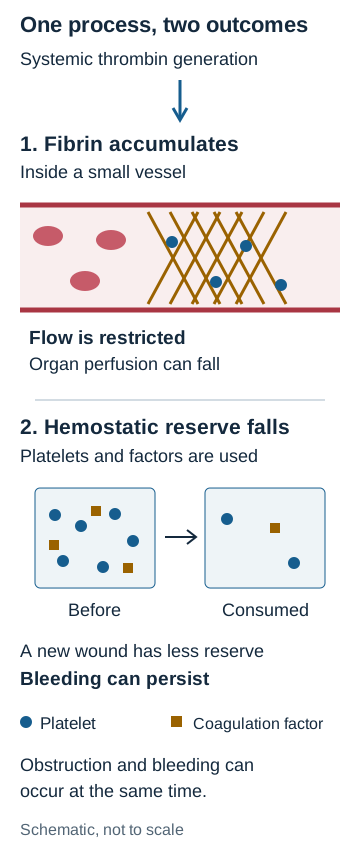
Tissue factor exposure and expression promote thrombin generation. Thrombin converts fibrinogen to fibrin and activates platelets. Fibrin deposited throughout the microcirculation can impede perfusion. Meanwhile, platelets and coagulation factors are consumed faster than they can be replaced. Endothelial injury and diminished natural anticoagulant activity, including antithrombin and the protein C pathway, help sustain coagulation. A prolonged clotting time measured in a tube therefore does not mean that the circulation cannot form thrombi. [3]
Trace the two branches of the vessel diagram: deposited fibrin reduces usable vascular space, while consumption reduces the reserve available at a fresh wound. Predict which branch explains a cool fingertip and which explains persistent puncture-site bleeding.
Trace the intravascular obstruction and the loss of hemostatic reserve separately. The diagram explains how ischemia and bleeding can coexist. [1][3]
The fingertip may lack perfusion; the puncture site may lack adequate hemostatic reserve. These are concurrent outcomes, not obligatory sequential stages. Bleeding need not wait until all platelets have been consumed.
Fibrinolysis means plasmin-mediated breakdown of fibrin. It is not uniformly increased in every form of DIC. Sepsis often increases plasminogen activator inhibitor-1 (PAI-1), reducing effective fibrin clearance and favoring organ injury. APL and some obstetric presentations may have prominent fibrinolysis and hemorrhage. D-dimer can be high even when overall fibrinolytic capacity is suppressed, because much more fibrin is being formed. [3][5]
If fibrin clearance decreases while thrombin production continues, what changes?
More fibrin can persist in small vessels. Reduced clearance can worsen ischemia without improving hemostatic reserve.
Apply that relationship to a septic patient with worsening kidney function but no visible bleeding: absence of hemorrhage does not exclude clinically important DIC.
Read related measurements over time
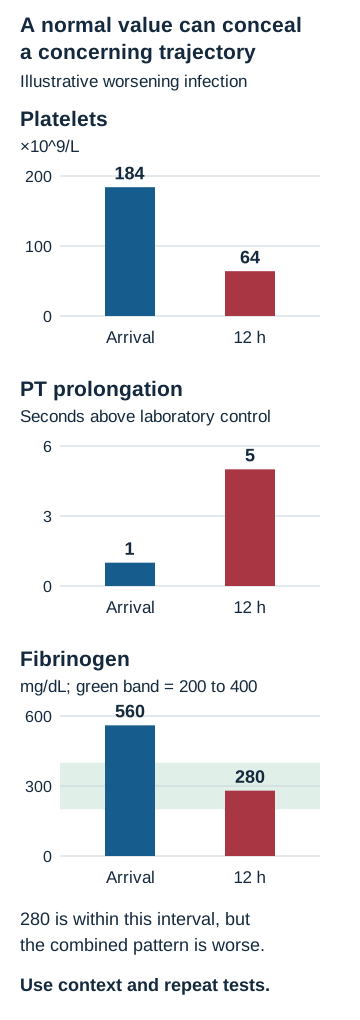
Does a fibrinogen concentration inside the reference interval rule out consumption? No. A measured concentration is the balance of production, consumption, loss and replacement. Inflammation can increase hepatic fibrinogen production enough to mask consumption. A falling value is concerning in context, but is not independently diagnostic. [2][3]
Compare platelet, fibrinogen and clotting trends during worsening infection
Measurement
Arrival
12 hours
MeasurementPlatelets, ×10^9/L
Arrival184
12 hours64
MeasurementPT, seconds above laboratory control
Arrival1
12 hours5
MeasurementD-dimer, mg/L FEU
Arrival1.0
12 hours8.0
MeasurementFibrinogen, mg/dL
Arrival560
12 hours280
Example reference intervals are platelets 150 to 400 ×10^9/L, fibrinogen 200 to 400 mg/dL and D-dimer below 0.5 mg/L FEU; local assays vary. FEU denotes fibrinogen-equivalent units. Do not interchange FEU and D-dimer units or transfer a numeric cutoff between assays without checking the laboratory.
Compare production with consumption
Use the trend diagram and table as a two-state comparison. First, compare only the two fibrinogen values. Then add the platelet and PT trajectories. State whether the second value is reassuring before reading the result below.
Compare arrival with 12 hours using each labeled scale. The final fibrinogen is inside the example interval, but the combined trajectory is concerning. Interpret the trajectory with the clinical findings, not a single value. [2][3]
Visible result: fibrinogen has halved despite remaining within this example's reference interval. Together with falling platelets, longer PT, increased fibrin turnover and worsening infection, the pattern supports evolving systemic consumption. A return toward baseline after infection control is a different trajectory even if D-dimer remains high.
Would the same fibrinogen decline be as concerning during recovery with rising platelets?
No. Resolving inflammation can lower acute-phase fibrinogen production. Interpret direction across related tests and the clinical course.
PT often lengthens as multiple factors are depleted. aPTT may lengthen, but a normal aPTT does not exclude DIC; early activation and acute-phase changes can obscure the expected prolongation. D-dimer reflects degradation of cross-linked fibrin, not its location or cause. Surgery, venous thrombosis and other illnesses can also increase it. A smear may show schistocytes from red-cell fragmentation, but their presence is neither necessary nor specific. [3]
The conventional ISTH overt-DIC score combines platelet count, fibrin-related markers, PT prolongation and fibrinogen. It standardizes a pattern in a patient with a compatible underlying disorder; it is not a screening diagnosis for every abnormal coagulation panel. The 2025 ISTH communication proposes updated late-phase criteria and disease-tailored early detection. Document the scoring version and local assay interpretation rather than mixing criteria. A low overt score does not justify withholding cause-directed care from a deteriorating patient. [1][2]
For transfer, compare a postoperative patient with an isolated high D-dimer and stable platelets against the four-variable trajectory above. Only the latter provides the coordinated evidence of consumption; neither a score nor one result substitutes for examination and repeat testing.
A positive D-dimer alone does not diagnose a DVT. Postoperative and hospitalized patients often have positive results; clinical probability and appropriate ultrasound assessment provide different information from a systemic consumption panel. [13]
Identify what the competing diagnosis does not explain
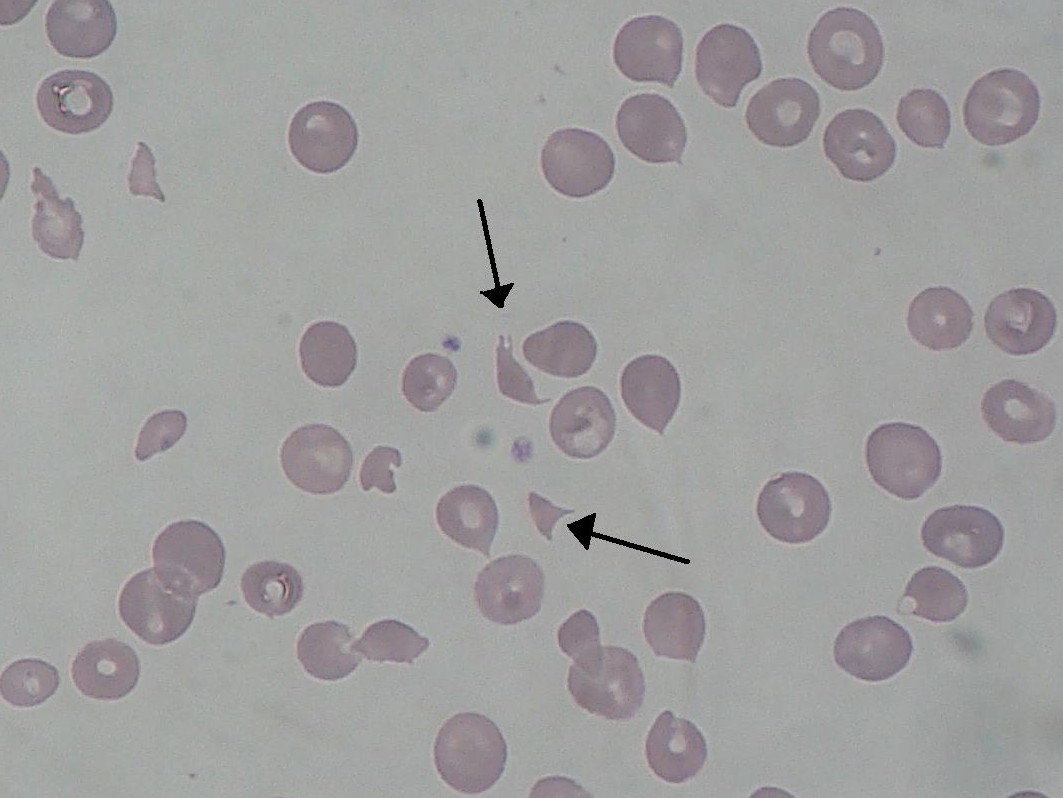
Schistocytes and thrombocytopenia invite a diagnosis of thrombotic microangiopathy, but do they explain the entire panel? The accompanying real smear demonstrates fragmented red cells in a source case of hemolytic-uremic syndrome, not DIC. Find the angular fragments indicated by the source's arrows, then ask what clinical and coagulation information is still missing.
Find the two arrowed fragments, then ask what the platelet count, coagulation tests and clinical course would add. The smear is from a case of hemolytic-uremic syndrome; fragmented cells alone cannot distinguish the cause. Photograph by Paulo Henrique Orlandi Mourao, with source crop and arrows by Doc James. Image: Paulo Henrique Orlandi Mourao; source crop and arrows by Doc James; original source; CC BY-SA 3.0 Unported.
Compare the pattern, not one abnormal result
Possibility
Useful discriminator and limitation
PossibilityDIC
Useful discriminator and limitationA compatible trigger plus changing platelets, fibrin markers and coagulation tests; early tests may be incomplete.
PossibilityTTP
Useful discriminator and limitationThrombocytopenia and microangiopathic hemolysis with usually preserved PT and aPTT. Severe ADAMTS13 deficiency supports TTP.
PossibilityLiver disease
Useful discriminator and limitationChronic synthetic dysfunction and portal hypertension can reproduce several DIC results. Infection can add DIC to liver disease.
PossibilityDilution and blood loss
Useful discriminator and limitationLarge-volume hemorrhage and replacement can reduce platelets and factors. Trauma-related consumption may coexist.
PossibilityPrimary fibrinolysis
Useful discriminator and limitationPredominant plasmin activity can deplete fibrinogen without equivalent systemic cross-linked fibrin deposition. Routine tests may overlap.
Microangiopathic hemolysis is supported by schistocytes, increased LDH, reduced haptoglobin and anemia. When severe thrombocytopenia and this hemolysis occur with relatively preserved coagulation tests, assess TTP urgently rather than requiring its historical five-feature presentation. Obtain plasma for ADAMTS13 activity and inhibitor testing before plasma treatment when feasible. With high clinical suspicion of immune TTP, begin the specialist plasma-exchange and corticosteroid pathway without waiting for the assay. This is an initial urgent sequence, not the complete specialist regimen; additional therapies require hematology assessment. Sampling must not materially delay treatment. Normal PT does not identify TTP by itself, and other thrombotic microangiopathies remain possible. [4]
A high factor VIII concentration is not a reliable way to exclude DIC in cirrhosis. A retrospective study found that factor VIII and the conventional ISTH score did not reliably distinguish DIC from liver-related coagulopathy. Compare baseline results, infection, shock, bleeding and serial change; avoid replacing one oversimplification with a new single-test rule. [6]
In a paired comparison, patient A has schistocytic hemolysis, platelets 18 ×10^9/L and normal PT; patient B has shock, platelets 46 ×10^9/L, rising PT and falling fibrinogen. Name the urgent pathway each pattern favors.
Consequence: A needs urgent TTP assessment, while B needs assessment for systemic consumption and its trigger. Giving both the same diagnostic label because both have fragments risks delaying different treatments.
What if patient B also has longstanding cirrhosis?
The acute deterioration still requires investigation. A chronic coagulopathy does not protect against superimposed DIC.
Transfer the comparison to massive hemorrhage: determine whether dilution, tissue injury and consumption are contributing together instead of forcing a single explanation.
Look for bleeding and organ dysfunction in parallel
Is visible bleeding a measure of the entire syndrome? A line site can stop oozing after component replacement while microvascular injury continues. Examine perfusion, urine output, oxygenation, neurologic status, skin and liver function as well as external blood loss. Kidney, lung, brain, liver, skin and distal-extremity injury can accompany DIC. These findings are not specific: shock, infection and treatment effects can contribute independently. [1][3]
Consider a patient whose urine output falls and fingertips become dusky despite palpable proximal pulses. Locate the potential obstruction below the large arteries, rather than assuming a normal pulse proves normal tissue perfusion. At the same time, assess vasopressors, emboli and systemic hypoperfusion before attributing all injury to DIC.
Consequence: small-vessel thrombosis can impair distal tissue perfusion while larger arteries remain patent. Severe purpura with skin infarction and acral ischemia can represent purpura fulminans and warrants urgent specialist assessment. It is not a reason to start anticoagulation without evaluating concurrent hemorrhage. [2]
Inspect puncture sites, mucosa, wounds, gastrointestinal output and the postpartum uterus. New focal neurologic findings or sudden respiratory deterioration also require urgent assessment for intracranial or pulmonary hemorrhage and competing causes. APL and obstetric DIC may be dramatically hemorrhagic; some solid-cancer or vascular presentations evolve more slowly and may be predominantly thrombotic. Neither pattern is exclusive. [3][5]
If a transfusion shortens PT but confusion worsens, is the syndrome controlled?
No. Laboratory replacement and organ recovery are different outcomes. New neurologic deterioration requires immediate reassessment.
Apply this to follow-up: document both the bleeding response and the trajectory of organ function, rather than declaring recovery from one corrected number.
Interrupt the cause while supporting the patient
Should source treatment wait until coagulation tests normalize? In urgent illness, resuscitation, hemostatic support and treatment of the trigger proceed together. Blood products can replace depleted material; they cannot reliably stop continued procoagulant input. [2]
Sepsis: give prompt appropriate antimicrobials, restore perfusion and identify a controllable source. An infected obstructed urinary system needs drainage assessment, not plasma alone. [7]
Obstetric emergency: stabilize the mother and control hemorrhage. Abruption with maternal or fetal compromise requires urgent obstetric delivery management alongside resuscitation. [10] Retained placental tissue requires appropriate obstetric treatment. [9] Amniotic-fluid embolism requires immediate cardiopulmonary support and hemorrhage management. [11]
Suspected APL: contact hematology immediately and start all-trans retinoic acid, or ATRA, on strong clinical and smear suspicion while genetic confirmation is arranged. Support the coagulopathy proactively and avoid unnecessary invasive procedures. The immediate ATRA recommendation does not extend to every eventual drug: arsenic trioxide is reserved for genetically confirmed PML-RARA-positive disease. [5]
Trauma: control hemorrhage and use the major-hemorrhage pathway, with blood-component or factor-directed resuscitation as appropriate. Prevent hypothermia, correct hypocalcemia and restore perfusion to address acidosis. Dilution and trauma-associated coagulopathy can accompany DIC. [8]
Compare two interventions for an undrained infected collection: plasma shortens PT; drainage plus antibiotics reduces the infectious stimulus. Predict which can change ongoing consumption rather than only the sampled factor concentration.
Consequence: source treatment can reduce continuing activation. Improvement may not be immediate, and persistent deterioration requires reassessment for inadequate control or another complication.
Does a temporarily improved PT permit postponing urgent source control?
No. Replacement can transiently improve a test while the cause persists. Treat the cause and the immediate physiologic threat together.
Transfer this reasoning to suspected APL: do not await a final molecular report before initiating the emergency treatment pathway when the clinical and smear findings strongly support it.
Match support to the current deficit and clinical threat
Does an abnormal panel itself require transfusion? Usually not. In DIC, decisions depend on active bleeding, procedural risk, degree of deficiency and trajectory. A patient without bleeding, without an urgent procedure and with moderate thrombocytopenia usually needs monitoring and cause treatment rather than automatic platelets or plasma. Profound thrombocytopenia and special settings such as APL require separate protocols. [2][5]
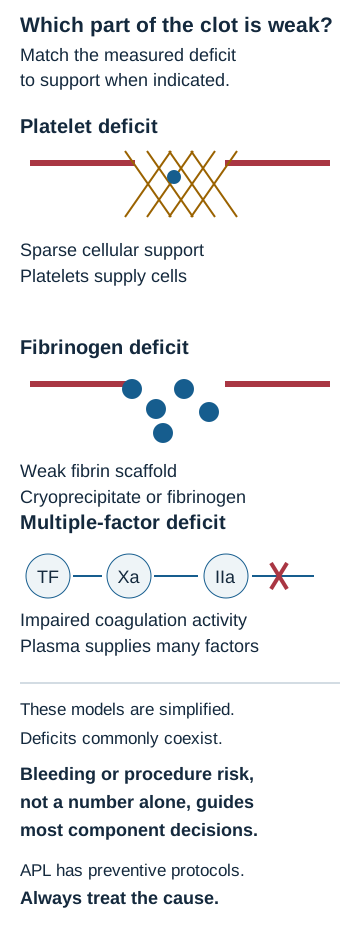
Use the support diagram to sort three states: clinically important bleeding, no bleeding or procedure, and documented thrombosis. For each, identify what an intervention is intended to accomplish before naming a product. These states can overlap, so a patient with both bleeding and thrombosis needs individualized assessment rather than assignment to an exclusive category.
Identify the demonstrated deficit before choosing support. Blue circles represent platelets; gold lines represent fibrin. The bottom pathway is deliberately abbreviated: TF is tissue factor, Xa is activated factor X and IIa is thrombin. Multiple deficits can coexist. This figure does not supply universal transfusion thresholds. [2][5][8]
Platelets: consider replacement when DIC is accompanied by bleeding or substantial procedural bleeding risk and platelets are below 50 ×10^9/L. Site, urgency and local protocol modify the target.
Fresh frozen plasma: supplies multiple factors when bleeding or an indicated procedure accompanies clinically important factor deficiency and prolonged clotting tests. It is not simply an INR-normalization treatment.
Cryoprecipitate or fibrinogen concentrate: supplies fibrinogen when depletion contributes to significant bleeding. Do not use D-dimer as the replacement target. Thresholds differ: trauma guidance supports replacement with major bleeding and fibrinogen at or below 1.5 g/L, while obstetric protocols may aim higher.
Paired viscoelastic channels can help localize a remaining clot deficit. A channel that inhibits platelet contribution assesses fibrin-based firmness. Weakness there during major bleeding can support fibrinogen replacement; preserved fibrin-based firmness with weak overall firmness and severe thrombocytopenia points toward platelet support. Use the locally validated method and the clinical context, not an unqualified universal cutoff. [8]
Reassess bleeding, platelet count and coagulation results after replacement. APL guidance uses preventive support to maintain platelets above 30 to 50 ×10^9/L and fibrinogen above 100 to 150 mg/dL, with INR below 1.5; it is not the same as observing a stable nonbleeding septic patient. One g/L equals 100 mg/dL. [2][5][8][9]
Therapeutic anticoagulation is not routine treatment for rapidly hemorrhagic DIC. It may be appropriate when documented venous or arterial thrombosis predominates and the balance of risks supports it, including selected chronic cancer-associated cases or severe ischemic presentations. Specialist selection, dose and monitoring matter. This is distinct from prophylactic anticoagulation for a nonbleeding critically ill patient without a contraindication. A prolonged PT does not confer protection from venous thrombosis. In hospitalized patients with cancer, distinguish prevention in an at-risk patient from treatment of an established VTE. [2][12]
Routine antifibrinolytic treatment is not a general DIC strategy. It can impair clearance of intravascular fibrin. Do not extrapolate that caution into withholding indicated early tranexamic acid in traumatic hemorrhage or postpartum hemorrhage; those are separate cause-specific pathways. It is not routine APL coagulopathy therapy. [2][5][8][9]
Visible result of the sort: bleeding may require substrate replacement; a stable nonbleeding state may require observation; a documented thrombus may require anticoagulation. Every branch still requires treatment of the underlying cause.
What changes if a previously stable patient now needs an urgent high-risk procedure?
The indication has changed even if the laboratory values have not. Reassess hemostatic support for the new procedural risk.
For transfer, compare a nonbleeding septic patient with platelets 70 ×10^9/L to a nonbleeding patient with suspected APL, platelets 20 ×10^9/L and fibrinogen 80 mg/dL. The same visible absence of bleeding does not justify the same support plan.
Apply the relationships to new patients
Case 1
Show answer and explanations for case 1
A. Evolving consumption; impaired clearance favors fibrin persistence (Best answer)
The coordinated platelet/PT/turnover changes support consumption even though an initially high fibrinogen remains in range. PAI-1 inhibits plasminogen activation; with continuing thrombin-driven formation, impaired clearance favors fibrin persistence.
The coordinated platelet/PT/turnover changes support consumption even though an initially high fibrinogen remains in range.
For dic-01, which finding, threshold, mechanism, or discriminator in the stem makes the option Evolving consumption; impaired clearance favors fibrin persistence fit or fail?
For this option, the case specific reasoning is: PAI-1 inhibits plasminogen activation; with continuing thrombin-driven formation, impaired clearance favors fibrin persistence.
B. Evolving consumption; increased clearance favors fibrin disappearance (Why this does not fit)
The consumptive interpretation fits the combined clinical trajectory. However, rising PAI-1 inhibits rather than accelerates effective fibrin clearance, so the model prediction is reversed.
The consumptive interpretation fits the combined clinical trajectory.
For dic-01, which finding, threshold, mechanism, or discriminator in the stem makes the option Evolving consumption; increased clearance favors fibrin disappearance fit or fail?
For this option, the case specific reasoning is: However, rising PAI-1 inhibits rather than accelerates effective fibrin clearance, so the model prediction is reversed.
C. Resolving inflammation without consumption; impaired clearance favors fibrin persistence (Why this does not fit)
Resolving inflammation can lower fibrinogen, but does not fit simultaneous platelet loss, PT prolongation and rising turnover during shock. The prediction of impaired clearance is correct for rising PAI-1, but cannot repair the wrong clinical interpretation.
Reasoning steps for option C
What clinical premise supports considering Resolving inflammation without consumption; impaired clearance favors fibrin persistence?
Resolving inflammation can lower fibrinogen, but does not fit simultaneous platelet loss, PT prolongation and rising turnover during shock.
For dic-01, which finding, threshold, mechanism, or discriminator in the stem makes the option Resolving inflammation without consumption; impaired clearance favors fibrin persistence fit or fail?
For this option, the case specific reasoning is: The prediction of impaired clearance is correct for rising PAI-1, but cannot repair the wrong clinical interpretation.
D. Resolving inflammation without consumption; increased clearance favors fibrin disappearance (Why this does not fit)
The clinical pattern is not explained by resolving inflammation alone. Rising PAI-1 also opposes effective clearance rather than predicting fibrin disappearance while thrombin generation remains high.
Reasoning steps for option D
What clinical premise supports considering Resolving inflammation without consumption; increased clearance favors fibrin disappearance?
The clinical pattern is not explained by resolving inflammation alone.
For dic-01, which finding, threshold, mechanism, or discriminator in the stem makes the option Resolving inflammation without consumption; increased clearance favors fibrin disappearance fit or fail?
For this option, the case specific reasoning is: Rising PAI-1 also opposes effective clearance rather than predicting fibrin disappearance while thrombin generation remains high.
Takeaway: Interpret consumption and net fibrin clearance as separate judgments.
A. Dilutional factor depletion; replace components while observing the collection (Why this does not fit)
No substantial replacement is described, and an untreated collection remains a continuing infectious trigger.
Reasoning steps for option A
What clinical principle is relevant to Dilutional factor depletion; replace components while observing the collection?
Substantial blood loss and replacement without hemostatic components can cause dilutional coagulopathy.
For dic-02, which finding, threshold, mechanism, or discriminator in the stem makes the option Dilutional factor depletion; replace components while observing the collection fit or fail?
For this option, the case specific reasoning is: No substantial replacement is described, and an untreated collection remains a continuing infectious trigger.
B. Systemic consumption; source control with bleeding support (Best answer)
The coordinated decline supports consumption and may contribute to renal microvascular injury, although other renal causes remain possible. Source treatment reduces continuing activation while bleeding support addresses depleted reserve.
Reasoning steps for option B
What clinical principle is relevant to Systemic consumption; source control with bleeding support?
Systemic coagulation activation can impair small-vessel perfusion while consuming platelets and factors.
For dic-02, which finding, threshold, mechanism, or discriminator in the stem makes the option Systemic consumption; source control with bleeding support fit or fail?
For this option, the case specific reasoning is: The coordinated decline supports consumption and may contribute to renal microvascular injury, although other renal causes remain possible. Source treatment reduces continuing activation while bleeding support addresses depleted reserve.
C. Primary renal microangiopathy; obtain ADAMTS13 testing before source intervention (Why this does not fit)
Hemolysis is not supplied; changing PT and fibrinogen favor systemic consumption, and source assessment cannot wait.
Reasoning steps for option C
What clinical principle is relevant to Primary renal microangiopathy; obtain ADAMTS13 testing before source intervention?
A primary thrombotic microangiopathy is supported by thrombocytopenia and microangiopathic hemolysis, often with preserved routine clotting tests.
For dic-02, which finding, threshold, mechanism, or discriminator in the stem makes the option Primary renal microangiopathy; obtain ADAMTS13 testing before source intervention fit or fail?
For this option, the case specific reasoning is: Hemolysis is not supplied; changing PT and fibrinogen favor systemic consumption, and source assessment cannot wait.
D. Localized renal thrombosis with incidental coagulopathy; anticoagulate and monitor bleeding (Why this does not fit)
Oliguria alone does not establish renal thrombosis, while the coordinated panel and active bleeding require assessment before anticoagulation.
Reasoning steps for option D
What clinical principle is relevant to Localized renal thrombosis with incidental coagulopathy; anticoagulate and monitor bleeding?
Therapeutic anticoagulation requires an appropriate thrombotic indication and assessment of concurrent hemorrhage risk.
For dic-02, which finding, threshold, mechanism, or discriminator in the stem makes the option Localized renal thrombosis with incidental coagulopathy; anticoagulate and monitor bleeding fit or fail?
For this option, the case specific reasoning is: Oliguria alone does not establish renal thrombosis, while the coordinated panel and active bleeding require assessment before anticoagulation.
Takeaway: A consumptive trajectory can connect bleeding and organ injury; treating a continuing trigger and the immediate bleeding threat are parallel tasks.
A. Greater fibrin persistence in A; improving consumption in B (Best answer)
Persistent thrombin activity creates fibrin while PAI-1 inhibits effective clearance. A therefore risks continued fibrin accumulation; B's platelet and PT recovery supports improvement despite persistent D-dimer.
Reasoning steps for option A
What clinical premise supports considering Greater fibrin persistence in A; improving consumption in B?
Persistent thrombin activity creates fibrin while PAI-1 inhibits effective clearance.
For dic-03, which finding, threshold, mechanism, or discriminator in the stem makes the option Greater fibrin persistence in A; improving consumption in B fit or fail?
For this option, the case specific reasoning is: A therefore risks continued fibrin accumulation; B's platelet and PT recovery supports improvement despite persistent D-dimer.
B. Similar fibrin persistence in A and B; continuing consumption in both (Why this does not fit)
D-dimer measures degradation of cross-linked fibrin rather than the balance of formation and clearance. Similar concentrations do not cancel A's ongoing formation and impaired clearance or B's coordinated recovery.
Reasoning steps for option B
What clinical premise supports considering Similar fibrin persistence in A and B; continuing consumption in both?
D-dimer measures degradation of cross-linked fibrin rather than the balance of formation and clearance.
For dic-03, which finding, threshold, mechanism, or discriminator in the stem makes the option Similar fibrin persistence in A and B; continuing consumption in both fit or fail?
For this option, the case specific reasoning is: Similar concentrations do not cancel A's ongoing formation and impaired clearance or B's coordinated recovery.
C. Lower fibrin persistence in A; increasing consumption in B (Why this does not fit)
Lower fibrin persistence would require formation to fall or clearance to improve. A has the opposite balance, while B's rising platelets and shorter PT do not favor increasing consumption.
Reasoning steps for option C
What clinical premise supports considering Lower fibrin persistence in A; increasing consumption in B?
Lower fibrin persistence would require formation to fall or clearance to improve.
For dic-03, which finding, threshold, mechanism, or discriminator in the stem makes the option Lower fibrin persistence in A; increasing consumption in B fit or fail?
For this option, the case specific reasoning is: A has the opposite balance, while B's rising platelets and shorter PT do not favor increasing consumption.
D. Greater fibrin persistence in B; improving consumption in A (Why this does not fit)
Greater fibrin persistence in B would require evidence of continuing formation or inadequate clearance there. Those findings are supplied for A, while B has a recovering systemic pattern.
Reasoning steps for option D
What clinical premise supports considering Greater fibrin persistence in B; improving consumption in A?
Greater fibrin persistence in B would require evidence of continuing formation or inadequate clearance there.
For dic-03, which finding, threshold, mechanism, or discriminator in the stem makes the option Greater fibrin persistence in B; improving consumption in A fit or fail?
For this option, the case specific reasoning is: Those findings are supplied for A, while B has a recovering systemic pattern.
Takeaway: Interpret fibrin formation and clearance separately, then reconcile them with the serial systemic measurements.
A. A: isolated vitamin K deficiency; B: prioritize TTP assessment (Why this does not fit)
A vitamin K deficit can prolong PT but does not explain A's concurrent rapid platelet and fibrinogen decline during shock. B's hemolysis and neurologic/thrombocytopenic pattern do justify urgent TTP assessment, so only the second judgment fits.
Reasoning steps for option A
What clinical premise supports considering A: isolated vitamin K deficiency; B: prioritize TTP assessment?
A vitamin K deficit can prolong PT but does not explain A's concurrent rapid platelet and fibrinogen decline during shock.
For dic-04, which finding, threshold, mechanism, or discriminator in the stem makes the option A: isolated vitamin K deficiency; B: prioritize TTP assessment fit or fail?
For this option, the case specific reasoning is: B's hemolysis and neurologic/thrombocytopenic pattern do justify urgent TTP assessment, so only the second judgment fits.
A's combined platelet and factor trajectory supports consumption despite the normal aPTT. B's microangiopathic hemolysis, severe thrombocytopenia and neurologic findings with preserved coagulation tests require urgent TTP-oriented assessment and treatment planning.
A's combined platelet and factor trajectory supports consumption despite the normal aPTT.
For dic-04, which finding, threshold, mechanism, or discriminator in the stem makes the option A: evolving systemic consumption; B: prioritize TTP assessment fit or fail?
For this option, the case specific reasoning is: B's microangiopathic hemolysis, severe thrombocytopenia and neurologic findings with preserved coagulation tests require urgent TTP-oriented assessment and treatment planning.
C. A: evolving systemic consumption; B: isolated immune platelet destruction (Why this does not fit)
A's working consumptive interpretation fits the linked abnormalities. Isolated immune platelet destruction does not account for B's schistocytes, biochemical hemolysis and anemia; the second patient needs a microangiopathy assessment.
A's working consumptive interpretation fits the linked abnormalities.
For dic-04, which finding, threshold, mechanism, or discriminator in the stem makes the option A: evolving systemic consumption; B: isolated immune platelet destruction fit or fail?
For this option, the case specific reasoning is: Isolated immune platelet destruction does not account for B's schistocytes, biochemical hemolysis and anemia; the second patient needs a microangiopathy assessment.
D. A: isolated vitamin K deficiency; B: isolated immune platelet destruction (Why this does not fit)
A's broad serial changes are not an isolated vitamin K pattern. B's evidence of red-cell fragmentation and hemolysis also exceeds an isolated platelet-destruction explanation.
Reasoning steps for option D
What clinical premise supports considering A: isolated vitamin K deficiency; B: isolated immune platelet destruction?
A's broad serial changes are not an isolated vitamin K pattern.
For dic-04, which finding, threshold, mechanism, or discriminator in the stem makes the option A: isolated vitamin K deficiency; B: isolated immune platelet destruction fit or fail?
For this option, the case specific reasoning is: B's evidence of red-cell fragmentation and hemolysis also exceeds an isolated platelet-destruction explanation.
Takeaway: Apply the whole pattern independently in each patient; a normal aPTT does not make their syndromes equivalent.
A. Proximal DVT supported; a systemic consumptive pattern is demonstrated (Why this does not fit)
The noncompressible proximal deep vein supports DVT. The stable platelet/factor pattern does not demonstrate systemic consumption; a positive postoperative D-dimer cannot supply that second diagnosis.
Reasoning steps for option A
What clinical premise supports considering Proximal DVT supported; a systemic consumptive pattern is demonstrated?
The noncompressible proximal deep vein supports DVT.
For dic-05, which finding, threshold, mechanism, or discriminator in the stem makes the option Proximal DVT supported; a systemic consumptive pattern is demonstrated fit or fail?
For this option, the case specific reasoning is: The stable platelet/factor pattern does not demonstrate systemic consumption; a positive postoperative D-dimer cannot supply that second diagnosis.
B. Proximal DVT not supported; a systemic consumptive pattern is not demonstrated (Why this does not fit)
The serial panel does not demonstrate a coordinated consumptive pattern. That does not negate the separate localized ultrasound evidence of DVT.
Reasoning steps for option B
What clinical premise supports considering Proximal DVT not supported; a systemic consumptive pattern is not demonstrated?
The serial panel does not demonstrate a coordinated consumptive pattern.
For dic-05, which finding, threshold, mechanism, or discriminator in the stem makes the option Proximal DVT not supported; a systemic consumptive pattern is not demonstrated fit or fail?
For this option, the case specific reasoning is: That does not negate the separate localized ultrasound evidence of DVT.
C. Proximal DVT supported; a systemic consumptive pattern is not demonstrated (Best answer)
The symptomatic noncompressible proximal deep vein supports localized DVT. Stable platelets, PT and fibrinogen without a systemic clinical syndrome do not demonstrate DIC; this is not a claim that all coagulation activation is absent.
Reasoning steps for option C
What clinical premise supports considering Proximal DVT supported; a systemic consumptive pattern is not demonstrated?
The symptomatic noncompressible proximal deep vein supports localized DVT.
For dic-05, which finding, threshold, mechanism, or discriminator in the stem makes the option Proximal DVT supported; a systemic consumptive pattern is not demonstrated fit or fail?
For this option, the case specific reasoning is: Stable platelets, PT and fibrinogen without a systemic clinical syndrome do not demonstrate DIC; this is not a claim that all coagulation activation is absent.
D. Proximal DVT not supported; a systemic consumptive pattern is demonstrated (Why this does not fit)
The ultrasound finding is positive evidence for a proximal DVT. Meanwhile, D-dimer alone cannot establish systemic consumption when the linked systemic findings are absent.
Reasoning steps for option D
What clinical premise supports considering Proximal DVT not supported; a systemic consumptive pattern is demonstrated?
The ultrasound finding is positive evidence for a proximal DVT.
For dic-05, which finding, threshold, mechanism, or discriminator in the stem makes the option Proximal DVT not supported; a systemic consumptive pattern is demonstrated fit or fail?
For this option, the case specific reasoning is: Meanwhile, D-dimer alone cannot establish systemic consumption when the linked systemic findings are absent.
Takeaway: Local thrombosis and systemic consumption require different evidentiary judgments.
A. Sample ADAMTS13 and await its result before exchange (Why this does not fit)
The diagnostic inference is reasonable, but deferring urgent treatment for a confirmatory result is inappropriate in this high-suspicion presentation.
Reasoning steps for option A
What clinical principle is relevant to Sample ADAMTS13 and await its result before exchange?
Waiting for ADAMTS13 may be appropriate only within a lower-probability pathway selected by the specialist, not as routine management of a high-probability presentation.
For dic-06, which finding, threshold, mechanism, or discriminator in the stem makes the option Sample ADAMTS13 and await its result before exchange fit or fail?
For this option, the case specific reasoning is: The diagnostic inference is reasonable, but deferring urgent treatment for a confirmatory result is inappropriate in this high-suspicion presentation.
B. Give hemostatic components while repeating the smear (Why this does not fit)
Fragments and thrombocytopenia are not specific to DIC; the preserved PT, aPTT and fibrinogen plus clear hemolysis require urgent TTP assessment rather than a component-first assumption.
Reasoning steps for option B
What clinical principle is relevant to Give hemostatic components while repeating the smear?
Components can support selected bleeding deficits but do not treat the underlying process in immune TTP.
For dic-06, which finding, threshold, mechanism, or discriminator in the stem makes the option Give hemostatic components while repeating the smear fit or fail?
For this option, the case specific reasoning is: Fragments and thrombocytopenia are not specific to DIC; the preserved PT, aPTT and fibrinogen plus clear hemolysis require urgent TTP assessment rather than a component-first assumption.
C. Sample ADAMTS13 now and begin exchange with corticosteroids (Best answer)
Severe thrombocytopenia with microangiopathic hemolysis, preserved coagulation tests and few supplied competing contexts raises urgent TTP concern. Prompt pretreatment sampling preserves interpretation, but the assay result must not delay treatment at high clinical suspicion.
Reasoning steps for option C
What clinical principle is relevant to Sample ADAMTS13 now and begin exchange with corticosteroids?
High-probability immune TTP needs a promptly obtained pretreatment sample and urgent treatment without waiting for the assay result.
For dic-06, which finding, threshold, mechanism, or discriminator in the stem makes the option Sample ADAMTS13 now and begin exchange with corticosteroids fit or fail?
For this option, the case specific reasoning is: Severe thrombocytopenia with microangiopathic hemolysis, preserved coagulation tests and few supplied competing contexts raises urgent TTP concern. Prompt pretreatment sampling preserves interpretation, but the assay result must not delay treatment at high clinical suspicion.
D. Begin exchange before obtaining the available pretreatment sample (Why this does not fit)
Treatment should not be delayed if sampling is difficult, but the stem makes immediate pretreatment collection feasible; collecting after plasma therapy can compromise baseline assay interpretation.
Reasoning steps for option D
What clinical principle is relevant to Begin exchange before obtaining the available pretreatment sample?
Plasma treatment can alter the interpretation of the first ADAMTS13 sample.
For dic-06, which finding, threshold, mechanism, or discriminator in the stem makes the option Begin exchange before obtaining the available pretreatment sample fit or fail?
For this option, the case specific reasoning is: Treatment should not be delayed if sampling is difficult, but the stem makes immediate pretreatment collection feasible; collecting after plasma therapy can compromise baseline assay interpretation.
Takeaway: Infer the high-risk thrombotic microangiopathy from the pattern, then sample promptly without waiting for confirmation to treat.
A. Higher concern in A; factor VIII reliably separates DIC from hepatic coagulopathy (Why this does not fit)
Chronic liver disease can produce abnormal platelets and coagulation tests without acute DIC. A is stable while B deteriorates during infection, and high factor VIII cannot reliably distinguish the two processes.
Reasoning steps for option A
What clinical premise supports considering Higher concern in A; factor VIII reliably separates DIC from hepatic coagulopathy?
Chronic liver disease can produce abnormal platelets and coagulation tests without acute DIC.
For dic-07, which finding, threshold, mechanism, or discriminator in the stem makes the option Higher concern in A; factor VIII reliably separates DIC from hepatic coagulopathy fit or fail?
For this option, the case specific reasoning is: A is stable while B deteriorates during infection, and high factor VIII cannot reliably distinguish the two processes.
B. Higher concern in A; factor VIII is not a reliable separator (Why this does not fit)
Factor VIII is not a reliable separator in liver-related coagulopathy. That correct limitation does not make A more concerning; the new trigger and coordinated departure from baseline occur in B.
Reasoning steps for option B
What clinical premise supports considering Higher concern in A; factor VIII is not a reliable separator?
Factor VIII is not a reliable separator in liver-related coagulopathy.
For dic-07, which finding, threshold, mechanism, or discriminator in the stem makes the option Higher concern in A; factor VIII is not a reliable separator fit or fail?
For this option, the case specific reasoning is: That correct limitation does not make A more concerning; the new trigger and coordinated departure from baseline occur in B.
C. Higher concern in B; factor VIII is not a reliable separator (Best answer)
An acute trigger with coordinated change from baseline raises concern for added consumption. B has that pattern, and high factor VIII does not exclude it or reliably separate it from acute hepatic deterioration.
Reasoning steps for option C
What clinical premise supports considering Higher concern in B; factor VIII is not a reliable separator?
An acute trigger with coordinated change from baseline raises concern for added consumption.
For dic-07, which finding, threshold, mechanism, or discriminator in the stem makes the option Higher concern in B; factor VIII is not a reliable separator fit or fail?
For this option, the case specific reasoning is: B has that pattern, and high factor VIII does not exclude it or reliably separate it from acute hepatic deterioration.
D. Higher concern in B; factor VIII reliably separates DIC from hepatic coagulopathy (Why this does not fit)
The acute infectious change makes B more concerning than stable A. However, factor VIII cannot reliably determine whether the added abnormality is DIC rather than liver-related coagulopathy; serial clinical assessment remains necessary.
Reasoning steps for option D
What clinical premise supports considering Higher concern in B; factor VIII reliably separates DIC from hepatic coagulopathy?
The acute infectious change makes B more concerning than stable A.
For dic-07, which finding, threshold, mechanism, or discriminator in the stem makes the option Higher concern in B; factor VIII reliably separates DIC from hepatic coagulopathy fit or fail?
For this option, the case specific reasoning is: However, factor VIII cannot reliably determine whether the added abnormality is DIC rather than liver-related coagulopathy; serial clinical assessment remains necessary.
Takeaway: Compare with baseline, then reject the single-test factor VIII shortcut.
A. Dilution has stronger support in A; persistent activation has stronger support in B (Best answer)
The replacement sequence and response support a major dilutional contribution in A. Continued platelet/fibrinogen loss with rising PT and fibrin turnover after bleeding and large-volume infusion stop gives relatively greater support for persistent activation in B, without proving either process is exclusive.
Reasoning steps for option A
What clinical premise supports considering Dilution has stronger support in A; persistent activation has stronger support in B?
The replacement sequence and response support a major dilutional contribution in A.
For dic-08, which finding, threshold, mechanism, or discriminator in the stem makes the option Dilution has stronger support in A; persistent activation has stronger support in B fit or fail?
For this option, the case specific reasoning is: Continued platelet/fibrinogen loss with rising PT and fibrin turnover after bleeding and large-volume infusion stop gives relatively greater support for persistent activation in B, without proving either process is exclusive.
B. Continuing dilution has similar support in both; persistent activation has little support (Why this does not fit)
Continuing dilution can sustain low substrate concentrations if large-volume replacement continues. It is no longer occurring in B, so it is not an equally strong explanation for B's ongoing coordinated deterioration.
Reasoning steps for option B
What clinical premise supports considering Continuing dilution has similar support in both; persistent activation has little support?
Continuing dilution can sustain low substrate concentrations if large-volume replacement continues.
For dic-08, which finding, threshold, mechanism, or discriminator in the stem makes the option Continuing dilution has similar support in both; persistent activation has little support fit or fail?
For this option, the case specific reasoning is: It is no longer occurring in B, so it is not an equally strong explanation for B's ongoing coordinated deterioration.
C. Persistent activation has similar support in both; dilution has little support (Why this does not fit)
Trauma-related activation may contribute to either patient. The substantial red-cell/crystalloid exposure and subsequent response in A provide positive evidence for dilution that this alternative discounts.
Reasoning steps for option C
What clinical premise supports considering Persistent activation has similar support in both; dilution has little support?
Trauma-related activation may contribute to either patient.
For dic-08, which finding, threshold, mechanism, or discriminator in the stem makes the option Persistent activation has similar support in both; dilution has little support fit or fail?
For this option, the case specific reasoning is: The substantial red-cell/crystalloid exposure and subsequent response in A provide positive evidence for dilution that this alternative discounts.
D. Dilution has stronger support in B; persistent activation has stronger support in A (Why this does not fit)
Dilution is supported by loss followed by replacement lacking hemostatic components. That sequence is demonstrated in A, whereas B continues to deteriorate after large-volume replacement has stopped.
Reasoning steps for option D
What clinical premise supports considering Dilution has stronger support in B; persistent activation has stronger support in A?
Dilution is supported by loss followed by replacement lacking hemostatic components.
For dic-08, which finding, threshold, mechanism, or discriminator in the stem makes the option Dilution has stronger support in B; persistent activation has stronger support in A fit or fail?
For this option, the case specific reasoning is: That sequence is demonstrated in A, whereas B continues to deteriorate after large-volume replacement has stopped.
Takeaway: The timing of loss, replacement and recovery helps weigh contributors that can coexist.
A. Cross-linked fibrin in A; B's tests establish primary fibrinolysis (Why this does not fit)
Cross-linked fibrin is the correct precursor for D-dimer. Preserved platelets and PT in B do not prove primary fibrinolysis; production, loss and breakdown still require investigation.
Reasoning steps for option A
What clinical premise supports considering Cross-linked fibrin in A; B's tests establish primary fibrinolysis?
Cross-linked fibrin is the correct precursor for D-dimer.
For dic-09, which finding, threshold, mechanism, or discriminator in the stem makes the option Cross-linked fibrin in A; B's tests establish primary fibrinolysis fit or fail?
For this option, the case specific reasoning is: Preserved platelets and PT in B do not prove primary fibrinolysis; production, loss and breakdown still require investigation.
B. Cross-linked fibrin in A; B's cause remains unresolved (Best answer)
D-dimer requires prior formation and breakdown of cross-linked fibrin. A's turnover signal with platelet/PT deterioration supports greater consumption concern; B's low fibrinogen and relative preservation do not establish a unique cause.
Reasoning steps for option B
What clinical premise supports considering Cross-linked fibrin in A; B's cause remains unresolved?
D-dimer requires prior formation and breakdown of cross-linked fibrin.
For dic-09, which finding, threshold, mechanism, or discriminator in the stem makes the option Cross-linked fibrin in A; B's cause remains unresolved fit or fail?
For this option, the case specific reasoning is: A's turnover signal with platelet/PT deterioration supports greater consumption concern; B's low fibrinogen and relative preservation do not establish a unique cause.
C. Uncross-linked fibrinogen in A; B's cause remains unresolved (Why this does not fit)
Total degradation products can include fibrinogen breakdown products. D-dimer specifically requires cross-linked fibrin, so the first clause is wrong even though B remains diagnostically unresolved.
Reasoning steps for option C
What clinical premise supports considering Uncross-linked fibrinogen in A; B's cause remains unresolved?
Total degradation products can include fibrinogen breakdown products.
For dic-09, which finding, threshold, mechanism, or discriminator in the stem makes the option Uncross-linked fibrinogen in A; B's cause remains unresolved fit or fail?
For this option, the case specific reasoning is: D-dimer specifically requires cross-linked fibrin, so the first clause is wrong even though B remains diagnostically unresolved.
D. Uncross-linked fibrinogen in A; B's tests establish primary fibrinolysis (Why this does not fit)
Fibrinogen degradation can contribute to total degradation products. It does not directly generate D-dimer without cross-linked fibrin formation, and B's limited pattern also cannot establish primary fibrinolysis.
Reasoning steps for option D
What clinical premise supports considering Uncross-linked fibrinogen in A; B's tests establish primary fibrinolysis?
Fibrinogen degradation can contribute to total degradation products.
For dic-09, which finding, threshold, mechanism, or discriminator in the stem makes the option Uncross-linked fibrinogen in A; B's tests establish primary fibrinolysis fit or fail?
For this option, the case specific reasoning is: It does not directly generate D-dimer without cross-linked fibrin formation, and B's limited pattern also cannot establish primary fibrinolysis.
Takeaway: Know what each degradation assay measures, then avoid diagnosing a second patient by exclusion.
A. Prioritize arterial imaging for proximal obstruction; reassess the panel afterward (Why this does not fit)
Proximal arterial obstruction remains a consideration, but palpable pulses and documented large-artery patency weaken it; the changing panel is relevant now.
Reasoning steps for option A
What clinical principle is relevant to Prioritize arterial imaging for proximal obstruction; reassess the panel afterward?
Proximal arterial occlusion can produce distal ischemia and requires urgent vascular evaluation when suspected.
For dic-10, which finding, threshold, mechanism, or discriminator in the stem makes the option Prioritize arterial imaging for proximal obstruction; reassess the panel afterward fit or fail?
For this option, the case specific reasoning is: Proximal arterial obstruction remains a consideration, but palpable pulses and documented large-artery patency weaken it; the changing panel is relevant now.
B. Review vasopressor exposure and perfusion; defer the coagulation assessment (Why this does not fit)
Vasopressors may contribute, but progressive ischemia with a consumptive trajectory also needs contemporaneous hemostatic and skin assessment.
Reasoning steps for option B
What clinical principle is relevant to Review vasopressor exposure and perfusion; defer the coagulation assessment?
Vasopressor-related vasoconstriction can contribute to distal ischemia during shock.
For dic-10, which finding, threshold, mechanism, or discriminator in the stem makes the option Review vasopressor exposure and perfusion; defer the coagulation assessment fit or fail?
For this option, the case specific reasoning is: Vasopressors may contribute, but progressive ischemia with a consumptive trajectory also needs contemporaneous hemostatic and skin assessment.
C. Assess thrombotic skin injury and begin therapeutic anticoagulation for the toes (Why this does not fit)
Even if microvascular injury contributes, distal changes alone do not mandate therapeutic anticoagulation in marked substrate depletion; assess bleeding and other causes.
Reasoning steps for option C
What clinical principle is relevant to Assess thrombotic skin injury and begin therapeutic anticoagulation for the toes?
Therapeutic anticoagulation may be considered in selected thrombosis-predominant DIC after individualized risk assessment.
For dic-10, which finding, threshold, mechanism, or discriminator in the stem makes the option Assess thrombotic skin injury and begin therapeutic anticoagulation for the toes fit or fail?
For this option, the case specific reasoning is: Even if microvascular injury contributes, distal changes alone do not mandate therapeutic anticoagulation in marked substrate depletion; assess bleeding and other causes.
D. Assess distal microvascular injury and bleeding risk; review competing ischemic causes (Best answer)
Patent large vessels do not ensure distal perfusion. A coordinated consumptive trajectory raises concern for DIC-associated small-vessel injury but cannot prove it; hemorrhage risk and competing causes matter before treatment selection.
Reasoning steps for option D
What clinical principle is relevant to Assess distal microvascular injury and bleeding risk; review competing ischemic causes?
Normal conduit-artery flow does not establish adequate tissue-level perfusion, and a consumptive panel identifies a separate hemostatic risk.
For dic-10, which finding, threshold, mechanism, or discriminator in the stem makes the option Assess distal microvascular injury and bleeding risk; review competing ischemic causes fit or fail?
For this option, the case specific reasoning is: Patent large vessels do not ensure distal perfusion. A coordinated consumptive trajectory raises concern for DIC-associated small-vessel injury but cannot prove it; hemorrhage risk and competing causes matter before treatment selection.
Takeaway: Combine vascular localization with the systemic trajectory, then assess progressing ischemia without assuming either a sole mechanism or automatic anticoagulation.
A. Functional hemostatic reserve improved; cessation of systemic injury is established (Why this does not fit)
Stopped oozing and a shorter PT support a functional hemostatic response. They do not establish that systemic injury has ceased, particularly when renal and neurologic endpoints are worsening.
Reasoning steps for option A
What clinical premise supports considering Functional hemostatic reserve improved; cessation of systemic injury is established?
Stopped oozing and a shorter PT support a functional hemostatic response.
For dic-11, which finding, threshold, mechanism, or discriminator in the stem makes the option Functional hemostatic reserve improved; cessation of systemic injury is established fit or fail?
For this option, the case specific reasoning is: They do not establish that systemic injury has ceased, particularly when renal and neurologic endpoints are worsening.
B. Functional hemostatic reserve did not improve; cessation of systemic injury is established (Why this does not fit)
The observed bleeding and PT response supports improvement in functional hemostatic reserve, so its denial is incorrect. Neither replacement response nor better blood pressure establishes cessation of the organ-injury process.
Reasoning steps for option B
What clinical premise supports considering Functional hemostatic reserve did not improve; cessation of systemic injury is established?
The observed bleeding and PT response supports improvement in functional hemostatic reserve, so its denial is incorrect.
For dic-11, which finding, threshold, mechanism, or discriminator in the stem makes the option Functional hemostatic reserve did not improve; cessation of systemic injury is established fit or fail?
For this option, the case specific reasoning is: Neither replacement response nor better blood pressure establishes cessation of the organ-injury process.
C. Functional hemostatic reserve did not improve; cessation of systemic injury is not established (Why this does not fit)
The worsening organ trajectory correctly prevents a conclusion that systemic injury has stopped. However, that does not erase the separate improvement in bleeding and measured factor-dependent clotting.
Reasoning steps for option C
What clinical premise supports considering Functional hemostatic reserve did not improve; cessation of systemic injury is not established?
The worsening organ trajectory correctly prevents a conclusion that systemic injury has stopped.
For dic-11, which finding, threshold, mechanism, or discriminator in the stem makes the option Functional hemostatic reserve did not improve; cessation of systemic injury is not established fit or fail?
For this option, the case specific reasoning is: However, that does not erase the separate improvement in bleeding and measured factor-dependent clotting.
D. Functional hemostatic reserve improved; cessation of systemic injury is not established (Best answer)
The bleeding response and shorter PT show that replacement improved functional hemostatic reserve. Worsening organ endpoints mean cessation of systemic injury is not established; hypoperfusion, microvascular injury and other causes still require the ongoing assessment.
Reasoning steps for option D
What clinical premise supports considering Functional hemostatic reserve improved; cessation of systemic injury is not established?
The bleeding response and shorter PT show that replacement improved functional hemostatic reserve.
For dic-11, which finding, threshold, mechanism, or discriminator in the stem makes the option Functional hemostatic reserve improved; cessation of systemic injury is not established fit or fail?
For this option, the case specific reasoning is: Worsening organ endpoints mean cessation of systemic injury is not established; hypoperfusion, microvascular injury and other causes still require the ongoing assessment.
Takeaway: A treatment can improve one endpoint without establishing recovery of a different physiologic system.
A. Placenta previa; defer delivery decisions until coagulation tests normalize (Why this does not fit)
Previa can cause major antepartum hemorrhage, but this clinical pattern more strongly favors abruption. Waiting for coagulation normalization also fails to address persistent maternal and fetal compromise.
Reasoning steps for option A
What clinical premise supports considering Placenta previa; defer delivery decisions until coagulation tests normalize?
Previa can cause major antepartum hemorrhage, but this clinical pattern more strongly favors abruption.
For dic-12, which finding, threshold, mechanism, or discriminator in the stem makes the option Placenta previa; defer delivery decisions until coagulation tests normalize fit or fail?
For this option, the case specific reasoning is: Waiting for coagulation normalization also fails to address persistent maternal and fetal compromise.
B. Placental abruption; defer delivery decisions until coagulation tests normalize (Why this does not fit)
The likely placental driver is correctly identified from pain and uterine findings. However, transient component response does not control the ongoing emergency, and a normalization requirement can cause harmful delay.
Reasoning steps for option B
What clinical premise supports considering Placental abruption; defer delivery decisions until coagulation tests normalize?
The likely placental driver is correctly identified from pain and uterine findings.
For dic-12, which finding, threshold, mechanism, or discriminator in the stem makes the option Placental abruption; defer delivery decisions until coagulation tests normalize fit or fail?
For this option, the case specific reasoning is: However, transient component response does not control the ongoing emergency, and a normalization requirement can cause harmful delay.
C. Placenta previa; urgent delivery planning with concurrent hemostatic resuscitation (Why this does not fit)
Urgent parallel resuscitation and delivery planning fit the persistent compromise. The painful rigid-uterus pattern favors abruption, not previa, so the first conclusion does not fit the supplied findings.
Reasoning steps for option C
What clinical premise supports considering Placenta previa; urgent delivery planning with concurrent hemostatic resuscitation?
Urgent parallel resuscitation and delivery planning fit the persistent compromise.
For dic-12, which finding, threshold, mechanism, or discriminator in the stem makes the option Placenta previa; urgent delivery planning with concurrent hemostatic resuscitation fit or fail?
For this option, the case specific reasoning is: The painful rigid-uterus pattern favors abruption, not previa, so the first conclusion does not fit the supplied findings.
D. Placental abruption; urgent delivery planning with concurrent hemostatic resuscitation (Best answer)
Painful bleeding with a rigid tender uterus favors abruption over the usually painless previa pattern. Persistent maternal and fetal compromise requires urgent obstetric delivery planning alongside resuscitation, not waiting for normal coagulation tests; route and stabilization remain obstetric decisions.
Reasoning steps for option D
What clinical premise supports considering Placental abruption; urgent delivery planning with concurrent hemostatic resuscitation?
Painful bleeding with a rigid tender uterus favors abruption over the usually painless previa pattern.
For dic-12, which finding, threshold, mechanism, or discriminator in the stem makes the option Placental abruption; urgent delivery planning with concurrent hemostatic resuscitation fit or fail?
For this option, the case specific reasoning is: Persistent maternal and fetal compromise requires urgent obstetric delivery planning alongside resuscitation, not waiting for normal coagulation tests; route and stabilization remain obstetric decisions.
Takeaway: Identify the likely obstetric source separately from the need for urgent concurrent care.
A. Start retinoic acid now; reserve arsenic trioxide for confirmed disease (Best answer)
ATRA should begin immediately when APL is strongly suspected, while arsenic requires genetic confirmation. The smear and consumptive hemorrhagic pattern support suspected APL, and WBC 3.2 does not create the high-WBC need for immediate cytoreduction while confirmation is pending.
Reasoning steps for option A
What clinical premise supports considering Start retinoic acid now; reserve arsenic trioxide for confirmed disease?
ATRA should begin immediately when APL is strongly suspected, while arsenic requires genetic confirmation.
For dic-13, which finding, threshold, mechanism, or discriminator in the stem makes the option Start retinoic acid now; reserve arsenic trioxide for confirmed disease fit or fail?
For this option, the case specific reasoning is: The smear and consumptive hemorrhagic pattern support suspected APL, and WBC 3.2 does not create the high-WBC need for immediate cytoreduction while confirmation is pending.
B. Start retinoic acid and arsenic trioxide now, before genetic confirmation (Why this does not fit)
ATRA plus arsenic is an important regimen for appropriately selected confirmed APL. The diagnosis is still unconfirmed, and WBC is low; the immediate empiric step is ATRA, not automatic initiation of every component of the eventual regimen.
Reasoning steps for option B
What clinical premise supports considering Start retinoic acid and arsenic trioxide now, before genetic confirmation?
ATRA plus arsenic is an important regimen for appropriately selected confirmed APL.
For dic-13, which finding, threshold, mechanism, or discriminator in the stem makes the option Start retinoic acid and arsenic trioxide now, before genetic confirmation fit or fail?
For this option, the case specific reasoning is: The diagnosis is still unconfirmed, and WBC is low; the immediate empiric step is ATRA, not automatic initiation of every component of the eventual regimen.
C. Defer retinoic acid and arsenic trioxide until genetic confirmation (Why this does not fit)
Genetic confirmation establishes the subtype and guides the full treatment plan. The characteristic smear and dangerous coagulopathy require immediate ATRA rather than postponing both agents.
Reasoning steps for option C
What clinical premise supports considering Defer retinoic acid and arsenic trioxide until genetic confirmation?
Genetic confirmation establishes the subtype and guides the full treatment plan.
For dic-13, which finding, threshold, mechanism, or discriminator in the stem makes the option Defer retinoic acid and arsenic trioxide until genetic confirmation fit or fail?
For this option, the case specific reasoning is: The characteristic smear and dangerous coagulopathy require immediate ATRA rather than postponing both agents.
D. Start arsenic trioxide now; defer retinoic acid until genetic confirmation (Why this does not fit)
Arsenic trioxide is used in treatment of genetically confirmed APL. This reverses the emergency sequence: ATRA should begin on strong suspicion, while arsenic is restricted to confirmed PML-RARA-positive disease.
Reasoning steps for option D
What clinical premise supports considering Start arsenic trioxide now; defer retinoic acid until genetic confirmation?
Arsenic trioxide is used in treatment of genetically confirmed APL.
For dic-13, which finding, threshold, mechanism, or discriminator in the stem makes the option Start arsenic trioxide now; defer retinoic acid until genetic confirmation fit or fail?
For this option, the case specific reasoning is: This reverses the emergency sequence: ATRA should begin on strong suspicion, while arsenic is restricted to confirmed PML-RARA-positive disease.
Takeaway: An emergency empiric ATRA indication is not permission to start every eventual APL drug before confirmation.
A. Observe without components until an active bleeding site appears (Why this does not fit)
Observation may be appropriate in some stable nonbleeding consumptive states. The morphology suggests APL, which has high early hemorrhagic risk, and the platelet and fibrinogen values are below preventive targets despite absence of current bleeding.
Reasoning steps for option A
What clinical premise supports considering Observe without components until an active bleeding site appears?
Observation may be appropriate in some stable nonbleeding consumptive states.
For dic-14, which finding, threshold, mechanism, or discriminator in the stem makes the option Observe without components until an active bleeding site appears fit or fail?
For this option, the case specific reasoning is: The morphology suggests APL, which has high early hemorrhagic risk, and the platelet and fibrinogen values are below preventive targets despite absence of current bleeding.
B. Give plasma alone; reassess platelets after confirmation (Why this does not fit)
Plasma provides broad factors and some fibrinogen. It does not adequately address the severe platelet deficit or substitute for targeted fibrinogen support when indicated by the APL protocol.
Reasoning steps for option B
What clinical premise supports considering Give plasma alone; reassess platelets after confirmation?
Plasma provides broad factors and some fibrinogen.
For dic-14, which finding, threshold, mechanism, or discriminator in the stem makes the option Give plasma alone; reassess platelets after confirmation fit or fail?
For this option, the case specific reasoning is: It does not adequately address the severe platelet deficit or substitute for targeted fibrinogen support when indicated by the APL protocol.
C. Give platelets alone; reassess fibrinogen after confirmation (Why this does not fit)
Platelets address one important deficit at a count of 21 ×10^9/L. Fibrinogen 80 mg/dL and INR 1.8 also need protocol-directed support in suspected APL; waiting for confirmation leaves major deficits untreated.
Reasoning steps for option C
What clinical premise supports considering Give platelets alone; reassess fibrinogen after confirmation?
Platelets address one important deficit at a count of 21 ×10^9/L.
For dic-14, which finding, threshold, mechanism, or discriminator in the stem makes the option Give platelets alone; reassess fibrinogen after confirmation fit or fail?
For this option, the case specific reasoning is: Fibrinogen 80 mg/dL and INR 1.8 also need protocol-directed support in suspected APL; waiting for confirmation leaves major deficits untreated.
D. Give preventive components with frequent reassessment (Best answer)
Suspected APL requires proactive correction of clinically important platelet, fibrinogen and factor deficits. The smear supplies the high-risk disease context, and all three measured abnormalities support preventive component treatment before molecular confirmation.
Reasoning steps for option D
What clinical premise supports considering Give preventive components with frequent reassessment?
Suspected APL requires proactive correction of clinically important platelet, fibrinogen and factor deficits.
For dic-14, which finding, threshold, mechanism, or discriminator in the stem makes the option Give preventive components with frequent reassessment fit or fail?
For this option, the case specific reasoning is: The smear supplies the high-risk disease context, and all three measured abnormalities support preventive component treatment before molecular confirmation.
Takeaway: Recognize the high-risk disease context before applying a nonbleeding-observation rule.
A. Repeat plasma until PT normalizes, then arrange drainage (Why this does not fit)
Plasma can support clinically relevant factor deficits in a bleeding or procedural context. Requiring a normal PT before source management can delay treatment of infected obstruction; the new platelet deficit also needs procedural assessment.
Reasoning steps for option A
What clinical premise supports considering Repeat plasma until PT normalizes, then arrange drainage?
Plasma can support clinically relevant factor deficits in a bleeding or procedural context.
For dic-15, which finding, threshold, mechanism, or discriminator in the stem makes the option Repeat plasma until PT normalizes, then arrange drainage fit or fail?
For this option, the case specific reasoning is: Requiring a normal PT before source management can delay treatment of infected obstruction; the new platelet deficit also needs procedural assessment.
B. Give platelets and continue antibiotics without draining the obstruction (Why this does not fit)
Platelet replacement can address the procedural hemostatic deficit. It does not clear the obstructed infected system, and antibiotics alone have not controlled the worsening illness.
Reasoning steps for option B
What clinical premise supports considering Give platelets and continue antibiotics without draining the obstruction?
Platelet replacement can address the procedural hemostatic deficit.
For dic-15, which finding, threshold, mechanism, or discriminator in the stem makes the option Give platelets and continue antibiotics without draining the obstruction fit or fail?
For this option, the case specific reasoning is: It does not clear the obstructed infected system, and antibiotics alone have not controlled the worsening illness.
C. Arrange urgent drainage without platelet support because oozing stopped (Why this does not fit)
Urgent drainage addresses the persistent infectious source. Stopped spontaneous oozing does not remove the new procedural risk at a platelet count of 32, so omitting platelet support on that basis is inappropriate.
Reasoning steps for option C
What clinical premise supports considering Arrange urgent drainage without platelet support because oozing stopped?
Urgent drainage addresses the persistent infectious source.
For dic-15, which finding, threshold, mechanism, or discriminator in the stem makes the option Arrange urgent drainage without platelet support because oozing stopped fit or fail?
For this option, the case specific reasoning is: Stopped spontaneous oozing does not remove the new procedural risk at a platelet count of 32, so omitting platelet support on that basis is inappropriate.
D. Arrange urgent drainage with procedure-directed platelet support (Best answer)
Bacteremia, shock and an obstructed collecting system identify an ongoing source requiring drainage assessment. Platelets 32 with a substantial-bleeding-risk procedure create a support indication even though prior oozing has stopped; source treatment and hemostatic preparation proceed together.
Reasoning steps for option D
What clinical premise supports considering Arrange urgent drainage with procedure-directed platelet support?
Bacteremia, shock and an obstructed collecting system identify an ongoing source requiring drainage assessment.
For dic-15, which finding, threshold, mechanism, or discriminator in the stem makes the option Arrange urgent drainage with procedure-directed platelet support fit or fail?
For this option, the case specific reasoning is: Platelets 32 with a substantial-bleeding-risk procedure create a support indication even though prior oozing has stopped; source treatment and hemostatic preparation proceed together.
Takeaway: A changing procedural indication can require support even after spontaneous bleeding improves.
Plasma supplies multiple coagulation factors. The major supplied deficit is platelets at 27 ×10^9/L, with fibrinogen preserved and only modest PT prolongation.
Reasoning steps for option A
What clinical premise would support this option: Fresh frozen plasma?
Plasma supplies multiple coagulation factors.
For dic-16, which finding, threshold, mechanism, or discriminator in the stem makes the option Fresh frozen plasma fit or fail?
For this option, the case specific reasoning is: The major supplied deficit is platelets at 27 ×10^9/L, with fibrinogen preserved and only modest PT prolongation.
B. Platelet concentrate (Best answer)
Platelet replacement supports primary hemostasis when thrombocytopenia accompanies clinically important bleeding. Active bleeding with platelets below 50 ×10^9/L makes this the best matched component among the options.
Reasoning steps for option B
What clinical premise would support this option: Platelet concentrate?
Platelet replacement supports primary hemostasis when thrombocytopenia accompanies clinically important bleeding.
For dic-16, which finding, threshold, mechanism, or discriminator in the stem makes the option Platelet concentrate fit or fail?
For this option, the case specific reasoning is: Active bleeding with platelets below 50 ×10^9/L makes this the best matched component among the options.
C. Fibrinogen concentrate (Why this does not fit)
Fibrinogen concentrate treats low or functionally deficient fibrinogen. The measured fibrinogen is 240 mg/dL, while marked thrombocytopenia accompanies active bleeding.
Reasoning steps for option C
What clinical premise would support this option: Fibrinogen concentrate?
Fibrinogen concentrate treats low or functionally deficient fibrinogen.
For dic-16, which finding, threshold, mechanism, or discriminator in the stem makes the option Fibrinogen concentrate fit or fail?
For this option, the case specific reasoning is: The measured fibrinogen is 240 mg/dL, while marked thrombocytopenia accompanies active bleeding.
D. Additional packed red cells (Why this does not fit)
Red cells restore oxygen-carrying capacity during anemia or blood loss. Hemoglobin and perfusion are stabilized, and red cells do not replace the deficient platelets.
Reasoning steps for option D
What clinical premise would support this option: Additional packed red cells?
Red cells restore oxygen-carrying capacity during anemia or blood loss.
For dic-16, which finding, threshold, mechanism, or discriminator in the stem makes the option Additional packed red cells fit or fail?
For this option, the case specific reasoning is: Hemoglobin and perfusion are stabilized, and red cells do not replace the deficient platelets.
Takeaway: Choose the component that supplies the demonstrated deficit in a bleeding patient.
A. Cryoprecipitate for A; no automatic component transfusion for B (Why this does not fit)
B has no supplied clinical indication for automatic component correction. In A, fibrinogen has responded while PT/aPTT and bleeding persist; cryoprecipitate is not broad replacement of the residual soluble-factor deficit.
Reasoning steps for option A
What clinical premise supports considering Cryoprecipitate for A; no automatic component transfusion for B?
B has no supplied clinical indication for automatic component correction.
For dic-17, which finding, threshold, mechanism, or discriminator in the stem makes the option Cryoprecipitate for A; no automatic component transfusion for B fit or fail?
For this option, the case specific reasoning is: In A, fibrinogen has responded while PT/aPTT and bleeding persist; cryoprecipitate is not broad replacement of the residual soluble-factor deficit.
B. Plasma for A; no automatic component transfusion for B (Best answer)
A's ongoing bleeding with persistent clotting-time abnormalities after platelet/fibrinogen correction favors broad soluble-factor support with plasma. B's similar test abnormalities lack a bleeding or procedural indication for automatic transfusion, so clinical and serial reassessment are appropriate.
Reasoning steps for option B
What clinical premise supports considering Plasma for A; no automatic component transfusion for B?
A's ongoing bleeding with persistent clotting-time abnormalities after platelet/fibrinogen correction favors broad soluble-factor support with plasma.
For dic-17, which finding, threshold, mechanism, or discriminator in the stem makes the option Plasma for A; no automatic component transfusion for B fit or fail?
For this option, the case specific reasoning is: B's similar test abnormalities lack a bleeding or procedural indication for automatic transfusion, so clinical and serial reassessment are appropriate.
C. Plasma for A; plasma for B to correct the prolonged tests (Why this does not fit)
Plasma addresses the relevant residual factor deficit in bleeding patient A. The same abnormal tests do not independently justify plasma in stable nonbleeding B without a procedure.
Reasoning steps for option C
What clinical premise supports considering Plasma for A; plasma for B to correct the prolonged tests?
Plasma addresses the relevant residual factor deficit in bleeding patient A.
For dic-17, which finding, threshold, mechanism, or discriminator in the stem makes the option Plasma for A; plasma for B to correct the prolonged tests fit or fail?
For this option, the case specific reasoning is: The same abnormal tests do not independently justify plasma in stable nonbleeding B without a procedure.
D. Cryoprecipitate for A; plasma for B to correct the prolonged tests (Why this does not fit)
A's residual broad factor pattern is not best addressed by repeating concentrated fibrinogen. B also lacks the clinical indication that would justify plasma purely to normalize the tests.
Reasoning steps for option D
What clinical premise supports considering Cryoprecipitate for A; plasma for B to correct the prolonged tests?
A's residual broad factor pattern is not best addressed by repeating concentrated fibrinogen.
For dic-17, which finding, threshold, mechanism, or discriminator in the stem makes the option Cryoprecipitate for A; plasma for B to correct the prolonged tests fit or fail?
For this option, the case specific reasoning is: B also lacks the clinical indication that would justify plasma purely to normalize the tests.
Takeaway: Choose the remaining substrate and the clinical indication independently; matching tests do not mandate matching transfusions.
A. Platelet concentrate for A; fibrinogen replacement for B (Why this does not fit)
Weakness that persists when platelet contribution is inhibited points toward the fibrin-based compartment in A, not a primarily platelet-count deficit. B has preserved fibrin-based firmness but severe thrombocytopenia, so the proposed products reverse the better-supported targets.
Reasoning steps for option A
What clinical premise supports considering Platelet concentrate for A; fibrinogen replacement for B?
Weakness that persists when platelet contribution is inhibited points toward the fibrin-based compartment in A, not a primarily platelet-count deficit.
For dic-18, which finding, threshold, mechanism, or discriminator in the stem makes the option Platelet concentrate for A; fibrinogen replacement for B fit or fail?
For this option, the case specific reasoning is: B has preserved fibrin-based firmness but severe thrombocytopenia, so the proposed products reverse the better-supported targets.
B. Fibrinogen replacement for both A and B (Why this does not fit)
A's weak fibrin-based channel during major bleeding supports targeted fibrinogen replacement, using cryoprecipitate or concentrate as available. B's adequate fibrin-based channel and count of 28 instead make cellular platelet support the clearer targeted addition.
Reasoning steps for option B
What clinical premise supports considering Fibrinogen replacement for both A and B?
A's weak fibrin-based channel during major bleeding supports targeted fibrinogen replacement, using cryoprecipitate or concentrate as available.
For dic-18, which finding, threshold, mechanism, or discriminator in the stem makes the option Fibrinogen replacement for both A and B fit or fail?
For this option, the case specific reasoning is: B's adequate fibrin-based channel and count of 28 instead make cellular platelet support the clearer targeted addition.
C. Fibrinogen replacement for A; platelet concentrate for B (Best answer)
A remains weak even without platelet contribution, supporting fibrinogen-directed therapy during major bleeding. B's preserved fibrin-based firmness with weak overall firmness and severe thrombocytopenia identifies a different, platelet-directed support priority.
Reasoning steps for option C
What clinical premise supports considering Fibrinogen replacement for A; platelet concentrate for B?
A remains weak even without platelet contribution, supporting fibrinogen-directed therapy during major bleeding.
For dic-18, which finding, threshold, mechanism, or discriminator in the stem makes the option Fibrinogen replacement for A; platelet concentrate for B fit or fail?
For this option, the case specific reasoning is: B's preserved fibrin-based firmness with weak overall firmness and severe thrombocytopenia identifies a different, platelet-directed support priority.
D. Platelet concentrate for both A and B (Why this does not fit)
B's count and differential firmness support platelet replacement. A's count is adequate and its fibrin-based channel remains weak, so platelet replacement alone does not target the demonstrated residual compartment.
Reasoning steps for option D
What clinical premise supports considering Platelet concentrate for both A and B?
B's count and differential firmness support platelet replacement.
For dic-18, which finding, threshold, mechanism, or discriminator in the stem makes the option Platelet concentrate for both A and B fit or fail?
For this option, the case specific reasoning is: A's count is adequate and its fibrin-based channel remains weak, so platelet replacement alone does not target the demonstrated residual compartment.
Takeaway: Use the contrast between overall and platelet-inhibited clot firmness with the platelet count; continue surgical control and reassessment.
A. Give platelets to restore the count above 100 ×10^9/L (Why this does not fit)
Platelets may be indicated for active bleeding, procedures or selected high-risk states. Stable platelets of 42 without those features do not by themselves justify targeting a normal count.
Reasoning steps for option A
What clinical premise would support this option: Give platelets to restore the count above 100 ×10^9/L?
Platelets may be indicated for active bleeding, procedures or selected high-risk states.
For dic-19, which finding, threshold, mechanism, or discriminator in the stem makes the option Give platelets to restore the count above 100 ×10^9/L fit or fail?
For this option, the case specific reasoning is: Stable platelets of 42 without those features do not by themselves justify targeting a normal count.
B. Continue monitoring without immediate component transfusion (Best answer)
Component decisions depend on clinical risk, not an abnormal panel alone. Stable measurements, absence of bleeding and no planned procedure support continued observation and cause treatment.
Reasoning steps for option B
What clinical premise would support this option: Continue monitoring without immediate component transfusion?
Component decisions depend on clinical risk, not an abnormal panel alone.
For dic-19, which finding, threshold, mechanism, or discriminator in the stem makes the option Continue monitoring without immediate component transfusion fit or fail?
For this option, the case specific reasoning is: Stable measurements, absence of bleeding and no planned procedure support continued observation and cause treatment.
C. Give plasma to restore PT to the reference interval (Why this does not fit)
Plasma is useful for relevant factor deficiency in bleeding or procedural contexts. An abnormal PT alone in this stable nonbleeding patient is not an indication for normalization by transfusion.
Reasoning steps for option C
What clinical premise would support this option: Give plasma to restore PT to the reference interval?
Plasma is useful for relevant factor deficiency in bleeding or procedural contexts.
For dic-19, which finding, threshold, mechanism, or discriminator in the stem makes the option Give plasma to restore PT to the reference interval fit or fail?
For this option, the case specific reasoning is: An abnormal PT alone in this stable nonbleeding patient is not an indication for normalization by transfusion.
D. Give cryoprecipitate because the fibrinogen is near the lower limit (Why this does not fit)
Cryoprecipitate supplies fibrinogen when depletion warrants replacement. Fibrinogen is 210 mg/dL and there is no bleeding or other supplied indication for immediate replacement.
Reasoning steps for option D
What clinical premise would support this option: Give cryoprecipitate because the fibrinogen is near the lower limit?
Cryoprecipitate supplies fibrinogen when depletion warrants replacement.
For dic-19, which finding, threshold, mechanism, or discriminator in the stem makes the option Give cryoprecipitate because the fibrinogen is near the lower limit fit or fail?
For this option, the case specific reasoning is: Fibrinogen is 210 mg/dL and there is no bleeding or other supplied indication for immediate replacement.
Takeaway: Do not transfuse a stable nonbleeding patient simply to normalize the panel.
A. Prophylactic intensity for both A and B (Why this does not fit)
B's hospitalization and immobility support prophylaxis when bleeding risk is acceptable. A already has imaging evidence of a proximal DVT, for which prophylactic intensity would not meet the treatment indication.
Reasoning steps for option A
What clinical premise supports considering Prophylactic intensity for both A and B?
B's hospitalization and immobility support prophylaxis when bleeding risk is acceptable.
For dic-20, which finding, threshold, mechanism, or discriminator in the stem makes the option Prophylactic intensity for both A and B fit or fail?
For this option, the case specific reasoning is: A already has imaging evidence of a proximal DVT, for which prophylactic intensity would not meet the treatment indication.
B. Therapeutic intensity for A; prophylactic intensity for B (Best answer)
A's symptomatic noncompressible proximal vein supplies a therapeutic indication. B has risk without an established event and therefore a prevention indication; mild PT prolongation is not protection against VTE.
Reasoning steps for option B
What clinical premise supports considering Therapeutic intensity for A; prophylactic intensity for B?
A's symptomatic noncompressible proximal vein supplies a therapeutic indication.
For dic-20, which finding, threshold, mechanism, or discriminator in the stem makes the option Therapeutic intensity for A; prophylactic intensity for B fit or fail?
For this option, the case specific reasoning is: B has risk without an established event and therefore a prevention indication; mild PT prolongation is not protection against VTE.
C. Therapeutic intensity for both A and B (Why this does not fit)
Therapeutic anticoagulation fits A's demonstrated proximal DVT. Cancer and immobility alone do not establish a treatment-level thrombotic event in B, so therapeutic intensity is not justified by the supplied facts.
Reasoning steps for option C
What clinical premise supports considering Therapeutic intensity for both A and B?
For dic-20, which finding, threshold, mechanism, or discriminator in the stem makes the option Therapeutic intensity for both A and B fit or fail?
For this option, the case specific reasoning is: Cancer and immobility alone do not establish a treatment-level thrombotic event in B, so therapeutic intensity is not justified by the supplied facts.
D. Prophylactic intensity for A; therapeutic intensity for B (Why this does not fit)
Prophylactic intensity undertreats A's demonstrated proximal DVT. Therapeutic intensity simultaneously overinterprets B's risk as an established event; the two indications are reversed.
Reasoning steps for option D
What clinical premise supports considering Prophylactic intensity for A; therapeutic intensity for B?
For dic-20, which finding, threshold, mechanism, or discriminator in the stem makes the option Prophylactic intensity for A; therapeutic intensity for B fit or fail?
For this option, the case specific reasoning is: Therapeutic intensity simultaneously overinterprets B's risk as an established event; the two indications are reversed.
Takeaway: Distinguish treatment of an established event from prevention in a second at-risk patient.
A. Use therapeutic heparin because coagulation activation has occurred (Why this does not fit)
Therapeutic heparin treats established or selected high-risk thrombotic disease. The stem supplies no therapeutic indication; prior coagulation activation alone does not establish one.
Reasoning steps for option A
What clinical premise would support this option: Use therapeutic heparin because coagulation activation has occurred?
Therapeutic heparin treats established or selected high-risk thrombotic disease.
For dic-21, which finding, threshold, mechanism, or discriminator in the stem makes the option Use therapeutic heparin because coagulation activation has occurred fit or fail?
For this option, the case specific reasoning is: The stem supplies no therapeutic indication; prior coagulation activation alone does not establish one.
B. Give plasma before assessing venous thromboembolism prevention (Why this does not fit)
Plasma may support bleeding or an indicated procedure. A mild PT abnormality in a nonbleeding patient does not require correction before an otherwise appropriate prophylaxis plan.
Reasoning steps for option B
What clinical premise would support this option: Give plasma before assessing venous thromboembolism prevention?
Plasma may support bleeding or an indicated procedure.
For dic-21, which finding, threshold, mechanism, or discriminator in the stem makes the option Give plasma before assessing venous thromboembolism prevention fit or fail?
For this option, the case specific reasoning is: A mild PT abnormality in a nonbleeding patient does not require correction before an otherwise appropriate prophylaxis plan.
C. Use standard pharmacologic VTE prophylaxis under the ICU protocol (Best answer)
Prophylactic anticoagulation addresses immobility-associated VTE risk in suitable nonbleeding ICU patients. The platelet recovery and absence of contraindications support prophylaxis, not therapeutic anticoagulation.
Reasoning steps for option C
What clinical premise would support this option: Use standard pharmacologic VTE prophylaxis under the ICU protocol?
For dic-21, which finding, threshold, mechanism, or discriminator in the stem makes the option Use standard pharmacologic VTE prophylaxis under the ICU protocol fit or fail?
For this option, the case specific reasoning is: The platelet recovery and absence of contraindications support prophylaxis, not therapeutic anticoagulation.
D. Withhold pharmacologic prevention because prolonged PT provides protection (Why this does not fit)
A prolonged PT measures a coagulation-test abnormality. It does not confer protection from venous thrombosis in an immobile critically ill patient.
Reasoning steps for option D
What clinical premise would support this option: Withhold pharmacologic prevention because prolonged PT provides protection?
A prolonged PT measures a coagulation-test abnormality.
For dic-21, which finding, threshold, mechanism, or discriminator in the stem makes the option Withhold pharmacologic prevention because prolonged PT provides protection fit or fail?
For this option, the case specific reasoning is: It does not confer protection from venous thrombosis in an immobile critically ill patient.
Takeaway: A prolonged PT is not endogenous VTE prophylaxis.
A. Withhold treatment from A; use it routinely for B (Why this does not fit)
APL can have prominent fibrinolysis, which can make antifibrinolytic treatment appear attractive. Routine APL use is not supported, while withholding indicated early therapy from A would ignore the postpartum evidence.
Reasoning steps for option A
What clinical premise supports considering Withhold treatment from A; use it routinely for B?
APL can have prominent fibrinolysis, which can make antifibrinolytic treatment appear attractive.
For dic-22, which finding, threshold, mechanism, or discriminator in the stem makes the option Withhold treatment from A; use it routinely for B fit or fail?
For this option, the case specific reasoning is: Routine APL use is not supported, while withholding indicated early therapy from A would ignore the postpartum evidence.
B. Give early treatment to both A and B for low hemostatic reserve (Why this does not fit)
Tranexamic acid reduces fibrinolysis and benefits selected hemorrhage settings. Bleeding or low reserve alone does not establish benefit in every DIC phenotype; routine use in APL is not supported.
Reasoning steps for option B
What clinical premise supports considering Give early treatment to both A and B for low hemostatic reserve?
Tranexamic acid reduces fibrinolysis and benefits selected hemorrhage settings.
For dic-22, which finding, threshold, mechanism, or discriminator in the stem makes the option Give early treatment to both A and B for low hemostatic reserve fit or fail?
For this option, the case specific reasoning is: Bleeding or low reserve alone does not establish benefit in every DIC phenotype; routine use in APL is not supported.
C. Give early treatment to A; do not use it routinely for B (Best answer)
Postpartum hemorrhage has a supported early tranexamic acid indication, whereas suspected APL coagulopathy does not have a routine indication. A is within three hours of birth; B's morphology identifies the APL context. Both still require treatment of the cause and hemostatic support.
Reasoning steps for option C
What clinical premise supports considering Give early treatment to A; do not use it routinely for B?
Postpartum hemorrhage has a supported early tranexamic acid indication, whereas suspected APL coagulopathy does not have a routine indication.
For dic-22, which finding, threshold, mechanism, or discriminator in the stem makes the option Give early treatment to A; do not use it routinely for B fit or fail?
For this option, the case specific reasoning is: A is within three hours of birth; B's morphology identifies the APL context. Both still require treatment of the cause and hemostatic support.
D. Withhold treatment from both while fibrinogen is being replaced (Why this does not fit)
Fibrinogen replacement may be necessary during severe hemorrhage. It does not replace the independent early tranexamic acid indication in A; avoiding routine use in B does not justify withholding it from both.
Reasoning steps for option D
What clinical premise supports considering Withhold treatment from both while fibrinogen is being replaced?
Fibrinogen replacement may be necessary during severe hemorrhage.
For dic-22, which finding, threshold, mechanism, or discriminator in the stem makes the option Withhold treatment from both while fibrinogen is being replaced fit or fail?
For this option, the case specific reasoning is: It does not replace the independent early tranexamic acid indication in A; avoiding routine use in B does not justify withholding it from both.
Takeaway: The cause and timing of hemorrhage determine whether an antifibrinolytic recommendation applies.
A. Warm patient and products, and correct ionized calcium (Best answer)
Cooling and hypocalcemia emerged during transfusion despite improved substrate measures; both impair effective hemostasis and require correction alongside ongoing surgery and components.
Reasoning steps for option A
What clinical principle is relevant to Warm patient and products, and correct ionized calcium?
Adequate temperature and ionized calcium are required for effective function of the supplied hemostatic components.
For dic-23, which finding, threshold, mechanism, or discriminator in the stem makes the option Warm patient and products, and correct ionized calcium fit or fail?
For this option, the case specific reasoning is: Cooling and hypocalcemia emerged during transfusion despite improved substrate measures; both impair effective hemostasis and require correction alongside ongoing surgery and components.
B. Warm patient and products, and repeat fibrinogen replacement (Why this does not fit)
Warming addresses one documented impediment, but fibrinogen already improved while ionized calcium fell; repeating fibrinogen omits the other measured problem.
Reasoning steps for option B
What clinical principle is relevant to Warm patient and products, and repeat fibrinogen replacement?
Warming addresses hypothermia, while fibrinogen replacement supplies a deficient clot substrate.
For dic-23, which finding, threshold, mechanism, or discriminator in the stem makes the option Warm patient and products, and repeat fibrinogen replacement fit or fail?
For this option, the case specific reasoning is: Warming addresses one documented impediment, but fibrinogen already improved while ionized calcium fell; repeating fibrinogen omits the other measured problem.
C. Correct ionized calcium and give more plasma (Why this does not fit)
Calcium replacement is indicated, but plasma does not address cooling, and clotting tests improved after components.
Reasoning steps for option C
What clinical principle is relevant to Correct ionized calcium and give more plasma?
For dic-23, which finding, threshold, mechanism, or discriminator in the stem makes the option Correct ionized calcium and give more plasma fit or fail?
For this option, the case specific reasoning is: Calcium replacement is indicated, but plasma does not address cooling, and clotting tests improved after components.
D. More balanced components and bicarbonate for presumed acidosis (Why this does not fit)
Acidosis can impair coagulation, but no acid-base result is supplied; the documented cooling and hypocalcemia require specific correction despite improving substrate measurements.
Reasoning steps for option D
What clinical principle is relevant to More balanced components and bicarbonate for presumed acidosis?
Acidosis can impair hemostasis, and ongoing hemorrhage may still require balanced components.
For dic-23, which finding, threshold, mechanism, or discriminator in the stem makes the option More balanced components and bicarbonate for presumed acidosis fit or fail?
For this option, the case specific reasoning is: Acidosis can impair coagulation, but no acid-base result is supplied; the documented cooling and hypocalcemia require specific correction despite improving substrate measurements.
Takeaway: When measured substrates improve but bleeding persists, compare the physiologic trajectory with the treatment response rather than automatically escalating the same products.
A. Overt DIC is excluded for this illness; continue infection treatment without repeat coagulation assessment (Why this does not fit)
A score describes a time-specific overt pattern; the coordinated changes can precede overt classification and merit reassessment.
Reasoning steps for option A
What clinical principle is relevant to Overt DIC is excluded for this illness; continue infection treatment without repeat coagulation assessment?
An overt-DIC score classifies a time-specific pattern rather than excluding all evolving disease.
For dic-24, which finding, threshold, mechanism, or discriminator in the stem makes the option Overt DIC is excluded for this illness; continue infection treatment without repeat coagulation assessment fit or fail?
For this option, the case specific reasoning is: A score describes a time-specific overt pattern; the coordinated changes can precede overt classification and merit reassessment.
B. Rising fibrin turnover establishes a thrombotic indication; begin therapeutic anticoagulation and repeat the score (Why this does not fit)
D-dimer does not identify a thrombus, and a score does not supply an anticoagulation indication.
Reasoning steps for option B
What clinical principle is relevant to Rising fibrin turnover establishes a thrombotic indication; begin therapeutic anticoagulation and repeat the score?
D-dimer measures cross-linked fibrin turnover and does not independently establish a localized thrombosis.
For dic-24, which finding, threshold, mechanism, or discriminator in the stem makes the option Rising fibrin turnover establishes a thrombotic indication; begin therapeutic anticoagulation and repeat the score fit or fail?
For this option, the case specific reasoning is: D-dimer does not identify a thrombus, and a score does not supply an anticoagulation indication.
C. An overt diagnosis is established by the falling fibrinogen alone; give cryoprecipitate before the next assessment (Why this does not fit)
A falling normal-range fibrinogen is concerning in context but neither independently establishes overt DIC nor justifies replacement without a relevant clinical indication.
Reasoning steps for option C
What clinical principle is relevant to An overt diagnosis is established by the falling fibrinogen alone; give cryoprecipitate before the next assessment?
Fibrinogen concentration reflects production, consumption, loss and replacement rather than one exclusive mechanism.
For dic-24, which finding, threshold, mechanism, or discriminator in the stem makes the option An overt diagnosis is established by the falling fibrinogen alone; give cryoprecipitate before the next assessment fit or fail?
For this option, the case specific reasoning is: A falling normal-range fibrinogen is concerning in context but neither independently establishes overt DIC nor justifies replacement without a relevant clinical indication.
D. Evolving consumption remains possible; repeat clinical and laboratory assessment without automatic component transfusion (Best answer)
A high inflammatory fibrinogen can fall substantially while remaining normal-range. The platelet, PT and D-dimer changes merit serial assessment; absent bleeding or procedure, abnormal tests alone do not indicate transfusion.
Reasoning steps for option D
What clinical principle is relevant to Evolving consumption remains possible; repeat clinical and laboratory assessment without automatic component transfusion?
Early consumption can produce coordinated change before reaching an overt threshold, and transfusion has a separate clinical indication.
For dic-24, which finding, threshold, mechanism, or discriminator in the stem makes the option Evolving consumption remains possible; repeat clinical and laboratory assessment without automatic component transfusion fit or fail?
For this option, the case specific reasoning is: A high inflammatory fibrinogen can fall substantially while remaining normal-range. The platelet, PT and D-dimer changes merit serial assessment; absent bleeding or procedure, abnormal tests alone do not indicate transfusion.
Takeaway: An overt score is a time-specific classification, not a rule-out for evolving consumption or a transfusion trigger; combine serial trends with clinical indications.
A. A: resolving acute-phase production can contribute; B: ongoing consumption is concerning (Best answer)
A's coordinated clinical and platelet/PT recovery makes reduced inflammatory acute-phase production a plausible contributor to its fibrinogen decline. B's opposite trajectory raises concern for continuing consumption despite a final fibrinogen still within range; neither mechanism is proved by fibrinogen alone.
Reasoning steps for option A
What clinical premise supports considering A: resolving acute-phase production can contribute; B: ongoing consumption is concerning?
A's coordinated clinical and platelet/PT recovery makes reduced inflammatory acute-phase production a plausible contributor to its fibrinogen decline.
For dic-25, which finding, threshold, mechanism, or discriminator in the stem makes the option A: resolving acute-phase production can contribute; B: ongoing consumption is concerning fit or fail?
For this option, the case specific reasoning is: B's opposite trajectory raises concern for continuing consumption despite a final fibrinogen still within range; neither mechanism is proved by fibrinogen alone.
B. A: resolving acute-phase production can contribute; B: normal-range fibrinogen establishes preserved reserve (Why this does not fit)
The interpretation of A appropriately accounts for recovery from inflammation. B's normal-range final fibrinogen does not establish preserved reserve when platelets, PT and perfusion deteriorate together.
Reasoning steps for option B
What clinical premise supports considering A: resolving acute-phase production can contribute; B: normal-range fibrinogen establishes preserved reserve?
The interpretation of A appropriately accounts for recovery from inflammation.
For dic-25, which finding, threshold, mechanism, or discriminator in the stem makes the option A: resolving acute-phase production can contribute; B: normal-range fibrinogen establishes preserved reserve fit or fail?
For this option, the case specific reasoning is: B's normal-range final fibrinogen does not establish preserved reserve when platelets, PT and perfusion deteriorate together.
C. A: escalating consumption is the leading explanation; B: ongoing consumption is concerning (Why this does not fit)
B's coordinated deterioration supports concern for continuing consumption. A's improving platelet/PT and perfusion pattern makes escalating consumption a poorer explanation for its fall than resolving inflammatory production.
Reasoning steps for option C
What clinical premise supports considering A: escalating consumption is the leading explanation; B: ongoing consumption is concerning?
B's coordinated deterioration supports concern for continuing consumption.
For dic-25, which finding, threshold, mechanism, or discriminator in the stem makes the option A: escalating consumption is the leading explanation; B: ongoing consumption is concerning fit or fail?
For this option, the case specific reasoning is: A's improving platelet/PT and perfusion pattern makes escalating consumption a poorer explanation for its fall than resolving inflammatory production.
D. A: escalating consumption is the leading explanation; B: normal-range fibrinogen establishes preserved reserve (Why this does not fit)
The size of A's fibrinogen decline does not outweigh its coordinated recovery pattern. B's preserved absolute range likewise does not outweigh its coordinated deterioration, so both proposed interpretations misuse the isolated fibrinogen values.
Reasoning steps for option D
What clinical premise supports considering A: escalating consumption is the leading explanation; B: normal-range fibrinogen establishes preserved reserve?
The size of A's fibrinogen decline does not outweigh its coordinated recovery pattern.
For dic-25, which finding, threshold, mechanism, or discriminator in the stem makes the option A: escalating consumption is the leading explanation; B: normal-range fibrinogen establishes preserved reserve fit or fail?
For this option, the case specific reasoning is: B's preserved absolute range likewise does not outweigh its coordinated deterioration, so both proposed interpretations misuse the isolated fibrinogen values.
Takeaway: Explain each trajectory, not merely which final number lies inside a reference interval.
A. Platelet count rising; D-dimer declining (Best answer)
A rising platelet count without further replacement is compatible with less ongoing consumption. A declining D-dimer supports less cross-linked fibrin turnover; together with clinical improvement the pair favors recovery, without proving resolution from these two tests alone.
Reasoning steps for option A
What clinical premise supports considering Platelet count rising; D-dimer declining?
A rising platelet count without further replacement is compatible with less ongoing consumption.
For dic-26, which finding, threshold, mechanism, or discriminator in the stem makes the option Platelet count rising; D-dimer declining fit or fail?
For this option, the case specific reasoning is: A declining D-dimer supports less cross-linked fibrin turnover; together with clinical improvement the pair favors recovery, without proving resolution from these two tests alone.
B. Platelet count rising; D-dimer increasing (Why this does not fit)
The rising platelet count supports improvement in the platelet balance. Increasing D-dimer does not directly support reduced turnover; it can have several explanations, including clearance of existing fibrin, and requires the rest of the clinical and laboratory trajectory.
Reasoning steps for option B
What clinical premise supports considering Platelet count rising; D-dimer increasing?
The rising platelet count supports improvement in the platelet balance.
For dic-26, which finding, threshold, mechanism, or discriminator in the stem makes the option Platelet count rising; D-dimer increasing fit or fail?
For this option, the case specific reasoning is: Increasing D-dimer does not directly support reduced turnover; it can have several explanations, including clearance of existing fibrin, and requires the rest of the clinical and laboratory trajectory.
C. Platelet count falling; D-dimer declining (Why this does not fit)
Declining D-dimer is compatible with less cross-linked fibrin turnover. The continuing platelet decline does not supply parallel evidence that platelet consumption has eased, so the pair is less supportive of coordinated recovery.
Reasoning steps for option C
What clinical premise supports considering Platelet count falling; D-dimer declining?
Declining D-dimer is compatible with less cross-linked fibrin turnover.
For dic-26, which finding, threshold, mechanism, or discriminator in the stem makes the option Platelet count falling; D-dimer declining fit or fail?
For this option, the case specific reasoning is: The continuing platelet decline does not supply parallel evidence that platelet consumption has eased, so the pair is less supportive of coordinated recovery.
D. Platelet count falling; D-dimer increasing (Why this does not fit)
A falling platelet count does not support recovery of the platelet balance. Increasing D-dimer also does not directly support reduced fibrin turnover; this pair warrants reassessment rather than a conclusion of coordinated recovery.
Reasoning steps for option D
What clinical premise supports considering Platelet count falling; D-dimer increasing?
A falling platelet count does not support recovery of the platelet balance.
For dic-26, which finding, threshold, mechanism, or discriminator in the stem makes the option Platelet count falling; D-dimer increasing fit or fail?
For this option, the case specific reasoning is: Increasing D-dimer also does not directly support reduced fibrin turnover; this pair warrants reassessment rather than a conclusion of coordinated recovery.
Takeaway: Follow the clinical and multicomponent trajectory after cause-directed care; no pair of tests independently proves DIC resolution.