Viscerosomatic reflexes: pathways, patterns and limits
Trace visceral sensory pathways, interpret spinal and Chapman associations, and separate useful anatomical reasoning from unsupported diagnostic claims.
Tender thoracic muscles can accompany myocardial ischemia, but they cannot identify or exclude it. Viscerosomatic reasoning explains how an organ can produce a body-wall finding; clinical evidence determines what that finding means.
How can an organ produce pain and muscle tension elsewhere?
A patient has chest pressure, sweating, left arm discomfort and tender T1-T5 paraspinals. Is the tenderness evidence of a muscle disorder instead of a cardiac disorder? No. Visceral and somatic sensory traffic can enter overlapping spinal circuits. Their convergence helps explain why an internal stimulus is perceived in a somatic territory. It does not make every painful territory a reliable organ locator. Acute chest symptoms require cardiac assessment regardless of the palpatory findings. [1][7]
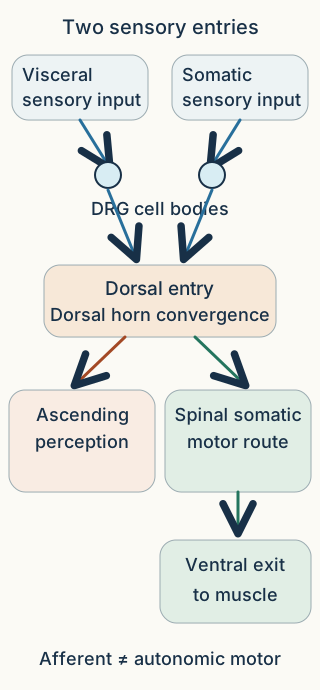
Many thoracoabdominal nociceptive afferents travel alongside sympathetic pathways toward sensory cell bodies in dorsal root ganglia, then enter through dorsal roots. Traveling with sympathetic nerves does not turn a sensory fiber into a sympathetic motor fiber. Interneuronal connections can influence somatic motor output to paraspinal muscles. Ascending sensory processing produces referred pain; spinal motor output produces altered muscle activity. These are related consequences, not the same event. [1][2]
Shared dorsal horn processing can support referred perception and a segmental somatic motor response. The sympathetic-associated visceral sensory path is not an autonomic motor fiber. [1][2]
Trace two destinations: Start at the visceral sensory input in the diagram. Follow one route toward perception and another toward skeletal muscle. At which point does the sensory input become an outgoing motor command?
The sensory fiber itself never becomes a motor fiber. Processing within spinal circuits links sensory input to a separate motor neuron whose axon exits through a ventral root. The ascending route instead contributes to conscious pain localization. Experimental recordings demonstrate visceral-somatic convergence in rat spinal neurons; they do not validate a human bedside organ diagnosis from a tender vertebral level. [2]
Apply the distinction to flank pain with paraspinal guarding: renal sensory input could contribute to both perception and muscle activity, but a muscle strain can also generate guarding. History, urinalysis and other indicated investigations distinguish causes. Palpation adds context rather than replacing those data.
What does a spinal level actually localize?
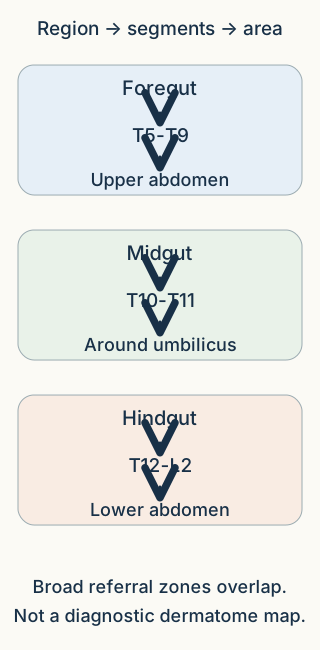
A segmental association narrows an anatomical hypothesis, not a diagnosis. Several organs share a spinal region, and normal variation and overlapping innervation prevent one-to-one mapping. The ranges below are conventional osteopathic sympathetic associations. They are not exact pain boundaries, vertebral lesions that must be present, or validated diagnostic cutoffs. [1]
The connections show conventional sympathetic segment associations and broad pain referral patterns, not an exact dermatome diagnosis. Adjacent zones overlap. [1][8]
Conventional associations to interpret with the clinical presentation
Region or organ
Common association
Important distinction
Region or organHeart
Common associationT1-T5
Important distinctionOften taught with left-sided findings; neither side rules cardiac disease in or out.
Region or organLungs; esophagus
Common associationT1-T6; T2-T8
Important distinctionOverlapping thoracic levels cannot distinguish these organs alone.
Region or organForegut region and spleen
Common associationT5-T9
Important distinctionStomach, liver, gallbladder, pancreas and proximal duodenum share a broad region. The spleen shares this association but is not an endodermal foregut derivative.
Region or organMidgut
Common associationT10-T11
Important distinctionDistal duodenum through proximal two thirds of transverse colon; early appendiceal pain often refers near the umbilicus, associated with T10.
Region or organHindgut region
Common associationT12-L2
Important distinctionA conventional thoracolumbar association, not the entire sensory supply of every hindgut structure. Hindgut derivatives extend from distal transverse colon through rectum and upper anal canal.
Region or organKidney; ureter
Common associationT10-T11; T10-L1
Important distinctionRelated but not identical conventional ranges; symptoms and urinary findings carry diagnostic weight.
Region or organBladder
Common associationT11-L2
Important distinctionSympathetic pathway only; pelvic and pudendal pathways also matter.
Region or organGonads; uterus/cervix; prostate
Common associationT10-T11; T10-L2; T12-L2
Important distinctionBroad associations, not tests for infection, obstruction or reproductive disease.
Foregut pain is often epigastric, midgut pain periumbilical and hindgut pain lower abdominal. Embryological origin helps explain these broad patterns. In appendicitis, early visceral pain may be poorly localized near the umbilicus; later irritation of parietal peritoneum produces sharper localized pain. This is a change in the tissue supplying sensory input, not proof that the appendix changed its spinal innervation. Position and presentation vary. [8][14]
Compare the routes: Would shoulder pain during subdiaphragmatic irritation belong in the T5-T9 foregut row?
No. The phrenic nerve contains C3-C5 fibers and carries sensation from central diaphragmatic regions. Irritation there can refer to the shoulder. This is distinct from sympathetic visceral referral and from cervical radiculopathy. Gallbladder inflammation can coexist with diaphragmatic irritation, but shoulder pain alone does not establish a biliary cause. [9]
Now consider bladder filling versus emptying. T11-L2 sympathetic pathways support storage; S2-S4 pelvic parasympathetic pathways support detrusor contraction during voiding. S2-S4 pudendal motor fibers supply the striated external sphincter and are somatic, not parasympathetic. Bladder afferents travel through more than one pathway. A sacral tender area therefore cannot specify which component is abnormal or establish bladder disease. [10]
For bowel parasympathetic pathways, vagal supply serves the foregut and midgut, while pelvic splanchnic supply from S2-S4 serves the hindgut. This autonomic motor distinction is separate from the sympathetic-associated sensory ranges above. Altering extrinsic autonomic input does not abolish all intestinal activity because enteric circuits also contribute. [13]
Try it here · Checkpoint 1 of 3
Make your prediction before reading the choices. A first attempt is just a starting point.
Case 6
Show answer and explanations for case 6
A. Relocated proximal segment acquires hindgut referral; distal segment retains hindgut referral (Why this does not fit)
The new quadrant can suggest a different source of local somatic pain. Preserved visceral nerves still carry the proximal midgut route.
Reasoning steps for option A
In vsr-06 choice A, how should 'Proximal transverse segment relocated' change the plausibility of this option?
vsr-06 A: this finding alone can make the distractor tempting, but it is not sufficient to overcome the competing evidence.
For vsr-06 choice A, what independent decision does 'Original nerves retained' force after the first clue is interpreted?
vsr-06 A: the second clue conflicts with this option, so the apparent fit from the first clue should be rejected.
B. Relocated proximal segment retains midgut referral; distal segment acquires midgut referral (Why this does not fit)
The proximal prediction respects retained innervation. Distal transverse colon remains on the hindgut side of the transition.
Reasoning steps for option B
In vsr-06 choice B, how should 'Proximal transverse segment relocated' change the plausibility of this option?
vsr-06 B: this finding alone can make the distractor tempting, but it is not sufficient to overcome the competing evidence.
For vsr-06 choice B, what independent decision does 'Original nerves retained' force after the first clue is interpreted?
vsr-06 B: the second clue conflicts with this option, so the apparent fit from the first clue should be rejected.
Embryologic territory determines the broad neural route of each segment. Moving tissue physically does not instantly reassign intact visceral afferent connections.
Reasoning steps for option C
In vsr-06 choice C, how should 'Proximal transverse segment relocated' change the plausibility of this option?
vsr-06 C: this finding supports the keyed pathway only when it is combined with the remaining stem evidence.
For vsr-06 choice C, what independent decision does 'Original nerves retained' force after the first clue is interpreted?
vsr-06 C: the second clue resolves the overlap and makes this option the single choice that fits both findings.
D. Both segments acquire left lower quadrant somatic referral because they are now nearby (Why this does not fit)
Spatial proximity can affect examination findings after surgery. It does not erase the stipulated intact segment-specific visceral routes.
Reasoning steps for option D
In vsr-06 choice D, how should 'Proximal transverse segment relocated' change the plausibility of this option?
vsr-06 D: this finding alone can make the distractor tempting, but it is not sufficient to overcome the competing evidence.
For vsr-06 choice D, what independent decision does 'Original nerves retained' force after the first clue is interpreted?
vsr-06 D: the second clue conflicts with this option, so the apparent fit from the first clue should be rejected.
Takeaway: Postoperative relocation changes position, not the embryologic territory carried by preserved visceral nerves.
Does reversing the direction prove a treatment effect?
A patient with a gastric ulcer has epigastric pain and thoracic muscle tenderness. Organ-related sensory input influencing skeletal muscle is a viscerosomatic pattern: viscera to soma. Somatic sensory input influencing autonomic output is a somatovisceral pattern: soma to viscera. The direction is named by the initiating input and responding tissue, not by where the clinician places a hand. [1]
Somatovisceral hypothesis: somatic sensory stimulation alters autonomic activity directed toward a visceral target. A plausible pathway does not establish a useful clinical effect.
Test the inference: Thoracic tenderness improves after manual treatment. Which observation is missing before concluding that the ulcer healed?
The missing evidence concerns the ulcer itself. Local comfort or muscle tone is not a measure of mucosal healing. Helicobacter pylori infection and NSAID exposure are the common causes of peptic ulcers and require appropriate evaluation and treatment. A simplistic claim that sympathetic facilitation necessarily increases gastric acid and creates an ulcer is not an adequate causal account. Sympathetic activity generally inhibits gastrointestinal motility and secretion, with context-dependent effects. [11][13]
After H. pylori treatment, confirm eradication with a validated test, such as stool antigen or urea breath testing, at least four weeks after antibiotics and after at least two weeks without proton pump inhibitors or potassium-competitive acid blockers. Coordinate any medication pause with the treating clinician. A negative result obtained too early or during suppressive therapy is not equivalent to confirmed eradication. [17][20]
A controlled experiment can test whether a somatic intervention changes an autonomic measure, but that measure is not interchangeable with organ recovery. Heart-rate variability is affected by breathing and other conditions. A change after treatment without an adequate comparison cannot isolate a specific mechanism. A systematic review of spinal manipulation found low-quality evidence and no overall autonomic effect versus sham or control, with uncertainty around subgroup findings. This evidence concerns the interventions studied, not every manual technique. [6]
Transfer this reasoning to urinary symptoms: an improvement in back comfort does not establish correction of bladder autonomic control, and manipulation is not a substitute for evaluation of retention, infection or other disease. When appropriate, manual care may address a coexisting musculoskeletal problem while medical care addresses the visceral disorder.
Can the same input produce a larger response?
After repeated nociceptive input, some spinal circuits may respond more readily. Osteopathic teaching describes a facilitated segment as a region with lowered response thresholds. Central sensitization is the broader neurophysiological concept of enhanced responsiveness within central nociceptive pathways. These concepts overlap, but a palpatory segment is not a direct measurement of central sensitization. [1][3]
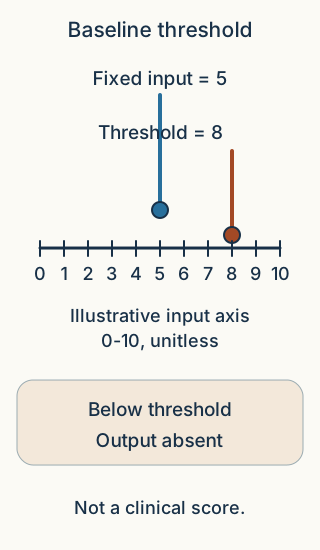
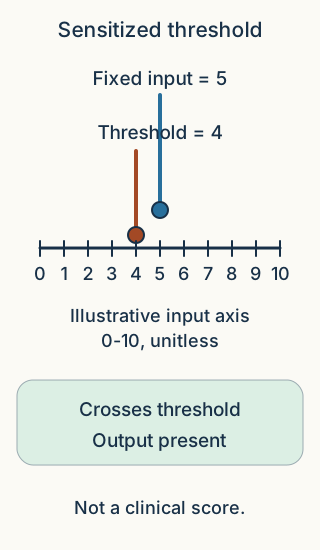
The following comparison holds input at five arbitrary units. Only the response threshold changes. These numbers illustrate a relationship; they are not physiological measurements, a diagnostic score or a treatment prediction.
The signal stays at 5. At threshold 8 the output is absent. This comparator is not a clinical severity score. [3]
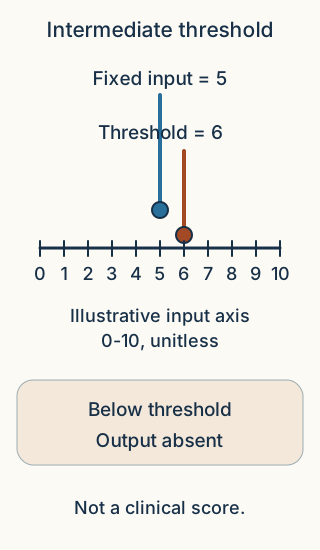
Keep the input fixed: Predict the output when the threshold falls from eight to six, then from six to four. Compare each optional answer with the baseline diagram.
Does a threshold of six produce output?
The signal stays at 5. At threshold 6 the output is absent. This comparator is not a clinical severity score. [3]
No. Five remains below six. Increased responsiveness does not mean every input produces an output.
Does a threshold of four produce output?
The signal stays at 5. At threshold 4 the output is present. This comparator is not a clinical severity score. [3]
Yes, in this simplified comparison. The same input now exceeds the threshold; no stronger peripheral stimulus was required.
The visible rule is response depends on both input and circuit responsiveness. A threshold reduction can help explain tenderness or amplified responses without a larger new injury. Real neurons integrate excitation, inhibition and time rather than behaving as this single-threshold drawing. Close either answer to compare again; neither answer is required to read onward.
TART organizes the palpatory description: tissue texture abnormality, asymmetry, restricted motion and tenderness. Acute findings are often described as warmer and more boggy; chronic findings as firmer or more fibrotic. These are nonspecific tendencies, not reliable clocks or proof of an organ source. Repeated somatic input, visceral input and other pain processes can coexist. [1]
Persistent sensitivity does not mean that a segment is permanently abnormal, that a visceral lesion remains active, or that manipulation is the only way to change it. Central sensitization can outlast an initiating stimulus yet remain reversible; multiple mechanisms and treatments affect it. Persistent pain still requires appropriate clinical reassessment rather than an automatic explanation of facilitation. [3]
Apply this to recurrent thoracic discomfort after temporary improvement. Recurrence alone cannot distinguish muscle strain from a visceral contribution. New fever, weight loss, exertional symptoms or urinary complaints change the evaluation because of their clinical meaning, not because a manual treatment failed.
Try it here · Checkpoint 2 of 3
Make your prediction before reading the choices. A first attempt is just a starting point.
Case 12
Show answer and explanations for case 12
A. Increased peripheral stimulus intensity is required; pain and receptive-field expansion should remain (Why this does not fit)
A larger input could recruit pain in another experiment. Here input strength is fixed and reduced central gain changes the relevant processing.
Reasoning steps for option A
In vsr-12 choice A, how should 'Previously innocuous input now painful' change the plausibility of this option?
vsr-12 A: this finding alone can make the distractor tempting, but it is not sufficient to overcome the competing evidence.
For vsr-12 choice A, what independent decision does 'Expanded receptive field' force after the first clue is interpreted?
vsr-12 A: the second clue conflicts with this option, so the apparent fit from the first clue should be rejected.
B. Increased central responsiveness; reducing central gain decreases amplification at fixed input (Best answer)
The unchanged stimulus rules out a stronger peripheral drive as the sole explanation. Reduced central gain should weaken the amplified response, without proving permanent segmental change.
Reasoning steps for option B
In vsr-12 choice B, how should 'Previously innocuous input now painful' change the plausibility of this option?
vsr-12 B: this finding supports the keyed pathway only when it is combined with the remaining stem evidence.
For vsr-12 choice B, what independent decision does 'Expanded receptive field' force after the first clue is interpreted?
vsr-12 B: the second clue resolves the overlap and makes this option the single choice that fits both findings.
C. Loss of descending inhibition is confirmed; peripheral nociceptor discharge must increase (Why this does not fit)
Disinhibition could contribute to central amplification. These data do not isolate that mechanism or require increased peripheral discharge.
Reasoning steps for option C
In vsr-12 choice C, how should 'Previously innocuous input now painful' change the plausibility of this option?
vsr-12 C: this finding alone can make the distractor tempting, but it is not sufficient to overcome the competing evidence.
For vsr-12 choice C, what independent decision does 'Expanded receptive field' force after the first clue is interpreted?
vsr-12 C: the second clue conflicts with this option, so the apparent fit from the first clue should be rejected.
D. Permanent fixed facilitation is established; central gain reduction cannot change pain (Why this does not fit)
Persistence after inflammation can raise a sensitization hypothesis. Reversibility and permanence cannot be established from the observation alone.
Reasoning steps for option D
In vsr-12 choice D, how should 'Previously innocuous input now painful' change the plausibility of this option?
vsr-12 D: this finding alone can make the distractor tempting, but it is not sufficient to overcome the competing evidence.
For vsr-12 choice D, what independent decision does 'Expanded receptive field' force after the first clue is interpreted?
vsr-12 D: the second clue conflicts with this option, so the apparent fit from the first clue should be rejected.
Takeaway: Amplified pain at unchanged peripheral input points toward altered central processing rather than a stronger peripheral stimulus.
A tender nodule on the thigh is not a picture of the colon. Chapman points are traditionally described as small, discrete, tender fascial findings associated with visceral regions. Their proposed reflex and lymphatic explanations are not established diagnostic mechanisms. Supporting clinical research is limited; a small pneumonia association study does not validate every point or establish sensitivity and specificity for colon disease. [4][5]
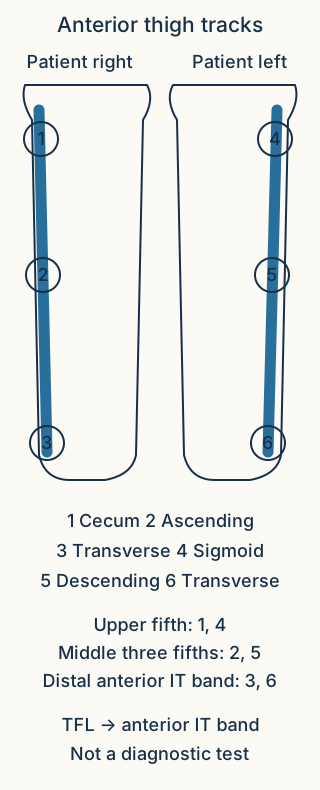
Traditional Chapman fact map on bilateral anterolateral thigh tracks, proximal tensor fasciae latae toward distal anterior iliotibial band. These are not anatomical colon positions or a validated diagnostic test. [4]
The traditional colon map uses both anterolateral thighs, not a circle around one thigh. On the patient's right, the proximal fifth near the tensor fasciae latae corresponds to cecum, and the middle three fifths of the anterior iliotibial region to ascending colon. Distal regions just above both knees correspond to transverse colon. On the left, the middle three fifths correspond to descending colon and the proximal fifth to sigmoid. These are conventional associations, not colon anatomy projected onto skin. [4]
The separately taught appendix point is at the tip of the right twelfth rib. Do not substitute the proximal right thigh cecal association for this appendix association merely because the organs are adjacent. Neither location confirms appendicitis. [4]
Locate before interpreting: A finding is halfway down the left anterolateral track. Which traditional association fits, and what conclusion would exceed the evidence?
The traditional association is descending colon. Diagnosing diverticulitis from that finding would exceed the evidence. The sigmoid association belongs proximally on the left, not on a posterior thigh track. The medial proximal thigh association sometimes taught for rectum is separate and does not justify placing descending colon on the medial thigh. [4]
Distinguish the palpatory descriptions. A Chapman point is described as a small fascial nodule with localized tenderness. A myofascial trigger point is associated with a taut muscle band and may reproduce a referred pain pattern. A counterstrain tender point is identified by its tenderness and positional response within that treatment system. These labels are not interchangeable diagnoses of visceral disease. [4][15][16]
An anterior finding and a corresponding posterior finding are not two validated independent confirmations of the same organ disorder. Neither a negative map nor temporary relief excludes disease. If abdominal access is limited, examining a thigh may add a musculoskeletal observation, but it cannot substitute for an appropriate abdominal assessment, imaging or urgent referral. Transfer the map to a patient with fever and focal lower abdominal pain: the medical presentation determines urgency whether or not a thigh point is present. [8]
Which new information should change the decision?
A patient has right upper abdominal pain and right T7-T9 tenderness. The segment lies within a common foregut region, but stomach, pancreatic and biliary processes can overlap there. Right-sided tenderness, pain during inspiration or a referred shoulder symptom does not independently eliminate competing causes. Begin with the clinical presentation, not a forced organ match. [1]
Add duration and systemic findings: Persistent pain beyond several hours with fever raises concern for inflammation rather than an uncomplicated brief pain episode.
Add a focused examination and imaging: Inspiratory arrest during right upper quadrant palpation supports a Murphy sign. Ultrasound showing a gallstone, gallbladder wall thickening and pericholecystic fluid strengthens a diagnosis of acute cholecystitis in the appropriate setting.
Add cholestatic laboratory abnormalities: Marked bilirubin or alkaline phosphatase abnormalities and jaundice warrant attention to common bile duct obstruction or another biliary process. They do not merely confirm isolated gallbladder inflammation.
Rank the evidence: Which changes the diagnostic assessment more: the shared thoracic range or concordant clinical and ultrasound findings?
The concordant clinical and ultrasound findings carry more diagnostic weight. The segmental observation is compatible but nonspecific. A shoulder symptom could reflect diaphragmatic irritation, yet it cannot settle the cause. Severe illness, hypotension, peritoneal signs or rapidly worsening pain require urgent assessment rather than further point mapping. [8][12]
Fever combined with cholestasis and duct dilation raises concern for acute cholangitis, not just a duct stone without infection. This requires urgent assessment and prompt treatment, including antibiotics and biliary drainage evaluation when indicated. Do not wait for a palpatory pattern to become more specific. [21]
Transfer the same method to fever, flank pain and urinary symptoms: assess a urinary source with appropriate examination and testing, rather than diagnosing renal disease from T10-L1 findings alone. With chest pressure and sweating, obtain urgent cardiac evaluation even if palpation reproduces discomfort. A nondiagnostic initial ECG is not a safe rule-out strategy; structured assessment and serial testing may be required. [7]
Use the map to explain a possible pathway. Use the history, examination and appropriate investigations to decide what to do. Neither symptom relief after manual care nor a matching palpatory level proves that a visceral disorder has resolved.
Try it here · Checkpoint 3 of 3
Make your prediction before reading the choices. A first attempt is just a starting point.
Case 16
Show answer and explanations for case 16
A. Uncomplicated biliary colic (Why this does not fit)
Persistent pain, fever, and gallbladder wall thickening argue against uncomplicated biliary colic, while duct dilation and cholestasis add concern for obstruction.
Reasoning steps for option A
In vsr-16 choice A, how should 'Persistent right upper quadrant pain and fever' change the plausibility of this option?
vsr-16 A: this finding alone can make the distractor tempting, but it is not sufficient to overcome the competing evidence.
For vsr-16 choice A, what independent decision does 'Gallbladder inflammatory ultrasound findings' force after the first clue is interpreted?
vsr-16 A: the second clue conflicts with this option, so the apparent fit from the first clue should be rejected.
B. Acute cholecystitis without common bile duct obstruction or cholangitis (Why this does not fit)
The gallbladder findings support cholecystitis, but an 8-mm common bile duct with marked direct hyperbilirubinemia and alkaline phosphatase elevation cannot be dismissed as isolated gallbladder inflammation.
Reasoning steps for option B
In vsr-16 choice B, how should 'Persistent right upper quadrant pain and fever' change the plausibility of this option?
vsr-16 B: this finding alone can make the distractor tempting, but it is not sufficient to overcome the competing evidence.
For vsr-16 choice B, what independent decision does 'Gallbladder inflammatory ultrasound findings' force after the first clue is interpreted?
vsr-16 B: the second clue conflicts with this option, so the apparent fit from the first clue should be rejected.
C. Acute cholecystitis with common bile duct obstruction and possible cholangitis (Best answer)
The gallbladder findings support acute cholecystitis, while duct dilation and a cholestatic laboratory pattern indicate common bile duct obstruction. Fever makes cholangitis a time-sensitive concern requiring urgent biliary assessment.
Reasoning steps for option C
In vsr-16 choice C, how should 'Persistent right upper quadrant pain and fever' change the plausibility of this option?
vsr-16 C: this finding supports the keyed pathway only when it is combined with the remaining stem evidence.
For vsr-16 choice C, what independent decision does 'Gallbladder inflammatory ultrasound findings' force after the first clue is interpreted?
vsr-16 C: the second clue resolves the overlap and makes this option the single choice that fits both findings.
D. Gallstone pancreatitis (Why this does not fit)
A normal lipase argues against pancreatitis. The data instead point to gallbladder inflammation plus a duct process.
Reasoning steps for option D
In vsr-16 choice D, how should 'Persistent right upper quadrant pain and fever' change the plausibility of this option?
vsr-16 D: this finding alone can make the distractor tempting, but it is not sufficient to overcome the competing evidence.
For vsr-16 choice D, what independent decision does 'Gallbladder inflammatory ultrasound findings' force after the first clue is interpreted?
vsr-16 D: the second clue conflicts with this option, so the apparent fit from the first clue should be rejected.
Takeaway: Inflammatory gallbladder findings do not account for every duct abnormality; fever with obstruction warrants urgent consideration of cholangitis.
A matching level is only the beginning. For each case, identify the relevant sensory or motor pathway, compare the strongest competing explanation and choose the interpretation or action supported by the clinical evidence.
Case 1
Show answer and explanations for case 1
A. Discharge with delayed outpatient stress testing (Why this does not fit)
Reproducible tenderness can coexist with ischemia. Exertional pressure and diaphoresis plus testing only 25 minutes after onset require continued acute assessment rather than discharge.
Reasoning steps for option A
In vsr-01 choice A, how should 'Exertional pressure with diaphoresis' change the plausibility of this option?
vsr-01 A: this finding alone can make the distractor tempting, but it is not sufficient to overcome the competing evidence.
For vsr-01 choice A, what independent decision does 'Reproduced smaller pain component' force after the first clue is interpreted?
vsr-01 A: the second clue conflicts with this option, so the apparent fit from the first clue should be rejected.
B. Repeat the electrocardiogram but obtain no additional troponin measurements (Why this does not fit)
A repeat tracing can be appropriate, but one very early negative troponin result cannot exclude evolving myocardial injury. Serial biomarker assessment is still needed.
Reasoning steps for option B
In vsr-01 choice B, how should 'Exertional pressure with diaphoresis' change the plausibility of this option?
vsr-01 B: this finding alone can make the distractor tempting, but it is not sufficient to overcome the competing evidence.
For vsr-01 choice B, what independent decision does 'Reproduced smaller pain component' force after the first clue is interpreted?
vsr-01 B: the second clue conflicts with this option, so the apparent fit from the first clue should be rejected.
C. Repeat the electrocardiogram and serial troponin testing during acute evaluation (Best answer)
The ischemic symptom pattern remains concerning despite a reproducible chest-wall component. A nondiagnostic early electrocardiogram and very early negative troponin require continued acute assessment with serial testing.
Reasoning steps for option C
In vsr-01 choice C, how should 'Exertional pressure with diaphoresis' change the plausibility of this option?
vsr-01 C: this finding supports the keyed pathway only when it is combined with the remaining stem evidence.
For vsr-01 choice C, what independent decision does 'Reproduced smaller pain component' force after the first clue is interpreted?
vsr-01 C: the second clue resolves the overlap and makes this option the single choice that fits both findings.
D. Obtain coronary CT angiography after the single early troponin result (Why this does not fit)
Anatomic testing can be useful in selected pathways, but it does not justify accepting one biomarker sample obtained 25 minutes after symptom onset.
Reasoning steps for option D
In vsr-01 choice D, how should 'Exertional pressure with diaphoresis' change the plausibility of this option?
vsr-01 D: this finding alone can make the distractor tempting, but it is not sufficient to overcome the competing evidence.
For vsr-01 choice D, what independent decision does 'Reproduced smaller pain component' force after the first clue is interpreted?
vsr-01 D: the second clue conflicts with this option, so the apparent fit from the first clue should be rejected.
Takeaway: A reproducible component can coexist with ischemia; an early sample misses evolving injury.
A. Gastric response persists; distal motor pathway fails (Why this does not fit)
The direct motor pathway was stipulated to remain intact, so a failed distal motor response would contradict the bypass test. Blocking relevant gastric afferent input should reduce the gastric-evoked component.
Reasoning steps for option A
In vsr-03 choice A, how should 'Gastric stimulation evokes T7 muscle activity' change the plausibility of this option?
vsr-03 A: this finding alone can make the distractor tempting, but it is not sufficient to overcome the competing evidence.
For vsr-03 choice A, what independent decision does 'Gastric afferents interrupted' force after the first clue is interpreted?
vsr-03 A: the second clue conflicts with this option, so the apparent fit from the first clue should be rejected.
B. Gastric response falls; distal motor pathway fails (Why this does not fit)
Reduced gastric-evoked activity fits loss of the sensory trigger, but failure of the distal motor pathway does not. Direct motor stimulation should still produce contraction.
Reasoning steps for option B
In vsr-03 choice B, how should 'Gastric stimulation evokes T7 muscle activity' change the plausibility of this option?
vsr-03 B: this finding alone can make the distractor tempting, but it is not sufficient to overcome the competing evidence.
For vsr-03 choice B, what independent decision does 'Gastric afferents interrupted' force after the first clue is interpreted?
vsr-03 B: the second clue conflicts with this option, so the apparent fit from the first clue should be rejected.
C. Gastric response persists; distal motor pathway remains intact (Why this does not fit)
The preserved distal motor response fits the setup, but persistent gastric-evoked activity does not fit selective interruption of the relevant incoming visceral drive.
Reasoning steps for option C
In vsr-03 choice C, how should 'Gastric stimulation evokes T7 muscle activity' change the plausibility of this option?
vsr-03 C: this finding alone can make the distractor tempting, but it is not sufficient to overcome the competing evidence.
For vsr-03 choice C, what independent decision does 'Gastric afferents interrupted' force after the first clue is interpreted?
vsr-03 C: the second clue conflicts with this option, so the apparent fit from the first clue should be rejected.
D. Gastric response falls; distal motor pathway remains intact (Best answer)
Interrupting the relevant visceral afferent limb reduces the gastric-evoked reflex response. Preserved contraction with direct distal motor stimulation shows that the output pathway itself remains responsive.
Reasoning steps for option D
In vsr-03 choice D, how should 'Gastric stimulation evokes T7 muscle activity' change the plausibility of this option?
vsr-03 D: this finding supports the keyed pathway only when it is combined with the remaining stem evidence.
For vsr-03 choice D, what independent decision does 'Gastric afferents interrupted' force after the first clue is interpreted?
vsr-03 D: the second clue resolves the overlap and makes this option the single choice that fits both findings.
Takeaway: Blocking incoming visceral drive removes the reflex trigger, not an intact motor output pathway.
A. Arrange colonoscopy for presumed colonic disease (Why this does not fit)
Shared T11-L1 tenderness does not outweigh the urinary pattern. Colicky flank-to-groin pain with microscopic hematuria supports a ureteral source, and no bowel findings make colonoscopy a poor next test.
Reasoning steps for option A
In vsr-04 choice A, how should 'Colicky flank-to-groin pain with microscopic hematuria' change the plausibility of this option?
vsr-04 A: this finding alone can make the distractor tempting, but it is not sufficient to overcome the competing evidence.
For vsr-04 choice A, what independent decision does 'Nondiagnostic ultrasonography' force after the first clue is interpreted?
vsr-04 A: the second clue conflicts with this option, so the apparent fit from the first clue should be rejected.
B. Obtain noncontrast CT of the abdomen and pelvis (Best answer)
The symptom pattern strongly supports ureteral stone disease, but the initial ultrasonography is nondiagnostic. Persistent symptoms therefore require a more discriminating study rather than interpreting the paraspinal level as organ-specific.
Reasoning steps for option B
In vsr-04 choice B, how should 'Colicky flank-to-groin pain with microscopic hematuria' change the plausibility of this option?
vsr-04 B: this finding supports the keyed pathway only when it is combined with the remaining stem evidence.
For vsr-04 choice B, what independent decision does 'Nondiagnostic ultrasonography' force after the first clue is interpreted?
vsr-04 B: the second clue resolves the overlap and makes this option the single choice that fits both findings.
C. Treat pyelonephritis with empiric antibiotics (Why this does not fit)
Pyelonephritis is less likely without fever or pyuria. Hematuria and colicky radiation favor a stone, so infection treatment would not address the unresolved obstructive question.
Reasoning steps for option C
In vsr-04 choice C, how should 'Colicky flank-to-groin pain with microscopic hematuria' change the plausibility of this option?
vsr-04 C: this finding alone can make the distractor tempting, but it is not sufficient to overcome the competing evidence.
For vsr-04 choice C, what independent decision does 'Nondiagnostic ultrasonography' force after the first clue is interpreted?
vsr-04 C: the second clue conflicts with this option, so the apparent fit from the first clue should be rejected.
D. Stop evaluation because ultrasonography is negative (Why this does not fit)
A study that neither visualizes the ureter nor shows hydronephrosis does not exclude a ureteral calculus. Persistent high-suspicion symptoms warrant further evaluation.
Reasoning steps for option D
In vsr-04 choice D, how should 'Colicky flank-to-groin pain with microscopic hematuria' change the plausibility of this option?
vsr-04 D: this finding alone can make the distractor tempting, but it is not sufficient to overcome the competing evidence.
For vsr-04 choice D, what independent decision does 'Nondiagnostic ultrasonography' force after the first clue is interpreted?
vsr-04 D: the second clue conflicts with this option, so the apparent fit from the first clue should be rejected.
Takeaway: When a likely ureteral source remains unresolved after nondiagnostic ultrasonography, choose the next discriminating test; segmental tenderness is not organ-specific.
A. Focal right lower quadrant guarding without initial periumbilical pain (Why this does not fit)
Focal guarding accompanies the later localized stage. Preventing the local parietal component is expected to reduce that component, while appendiceal distension still supplies visceral input.
Reasoning steps for option A
In vsr-05 choice A, how should 'Early periumbilical pain' change the plausibility of this option?
vsr-05 A: this finding alone can make the distractor tempting, but it is not sufficient to overcome the competing evidence.
For vsr-05 choice A, what independent decision does 'Later localized pain with involuntary guarding' force after the first clue is interpreted?
vsr-05 A: the second clue conflicts with this option, so the apparent fit from the first clue should be rejected.
B. Both stages unchanged because both depend on T10 visceral convergence (Why this does not fit)
Early periumbilical discomfort can arise from midgut convergence. The distinct late peritoneal stage would be altered.
Reasoning steps for option B
In vsr-05 choice B, how should 'Early periumbilical pain' change the plausibility of this option?
vsr-05 B: this finding alone can make the distractor tempting, but it is not sufficient to overcome the competing evidence.
For vsr-05 choice B, what independent decision does 'Later localized pain with involuntary guarding' force after the first clue is interpreted?
vsr-05 B: the second clue conflicts with this option, so the apparent fit from the first clue should be rejected.
C. Neither pain stage because peritoneum carries all appendiceal sensation (Why this does not fit)
The focal late stage does depend on the adjacent peritoneum. Appendiceal visceral input does not require parietal peritoneum.
Reasoning steps for option C
In vsr-05 choice C, how should 'Early periumbilical pain' change the plausibility of this option?
vsr-05 C: this finding alone can make the distractor tempting, but it is not sufficient to overcome the competing evidence.
For vsr-05 choice C, what independent decision does 'Later localized pain with involuntary guarding' force after the first clue is interpreted?
vsr-05 C: the second clue conflicts with this option, so the apparent fit from the first clue should be rejected.
D. Poorly localized periumbilical visceral pain without the later focal guarding (Best answer)
Early diffuse pain is compatible with persistent appendiceal distension. Midgut visceral afference persists; focal somatic peritoneal irritation is removed.
Reasoning steps for option D
In vsr-05 choice D, how should 'Early periumbilical pain' change the plausibility of this option?
vsr-05 D: this finding supports the keyed pathway only when it is combined with the remaining stem evidence.
For vsr-05 choice D, what independent decision does 'Later localized pain with involuntary guarding' force after the first clue is interpreted?
vsr-05 D: the second clue resolves the overlap and makes this option the single choice that fits both findings.
Wave-like flank-to-groin pain, hematuria, and a CT-demonstrated distal calculus with upstream dilation converge on ureteral obstruction. The small simple ovarian cyst and shared T10-L1 tenderness do not outweigh those organ-specific findings.
Reasoning steps for option A
In vsr-07 choice A, how should 'Simple ovarian cyst' change the plausibility of this option?
vsr-07 A: this finding supports the keyed pathway only when it is combined with the remaining stem evidence.
For vsr-07 choice A, what independent decision does 'Flank-to-groin colic and hematuria' force after the first clue is interpreted?
vsr-07 A: the second clue resolves the overlap and makes this option the single choice that fits both findings.
B. Symptomatic simple ovarian cyst (Why this does not fit)
A small simple cyst can be incidental. It does not explain the urinary colic pattern, hematuria, and CT-demonstrated obstructing calculus.
Reasoning steps for option B
In vsr-07 choice B, how should 'Simple ovarian cyst' change the plausibility of this option?
vsr-07 B: this finding alone can make the distractor tempting, but it is not sufficient to overcome the competing evidence.
For vsr-07 choice B, what independent decision does 'Flank-to-groin colic and hematuria' force after the first clue is interpreted?
vsr-07 B: the second clue conflicts with this option, so the apparent fit from the first clue should be rejected.
C. Ovarian torsion (Why this does not fit)
Torsion can cause acute unilateral pelvic pain, but the stem supplies direct evidence of ureteral obstruction and no ovarian features that outweigh it.
Reasoning steps for option C
In vsr-07 choice C, how should 'Simple ovarian cyst' change the plausibility of this option?
vsr-07 C: this finding alone can make the distractor tempting, but it is not sufficient to overcome the competing evidence.
For vsr-07 choice C, what independent decision does 'Flank-to-groin colic and hematuria' force after the first clue is interpreted?
vsr-07 C: the second clue conflicts with this option, so the apparent fit from the first clue should be rejected.
D. Uncomplicated urinary tract infection (Why this does not fit)
An uncomplicated infection would not explain a distal calculus with upstream dilation, and the absence of pyuria argues against this choice.
Reasoning steps for option D
In vsr-07 choice D, how should 'Simple ovarian cyst' change the plausibility of this option?
vsr-07 D: this finding alone can make the distractor tempting, but it is not sufficient to overcome the competing evidence.
For vsr-07 choice D, what independent decision does 'Flank-to-groin colic and hematuria' force after the first clue is interpreted?
vsr-07 D: the second clue conflicts with this option, so the apparent fit from the first clue should be rejected.
Takeaway: When organ-specific findings identify an obstructing ureteral lesion, shared segmental tenderness should not override them.
A. Pudendal S2-S4 motor output (Why this does not fit)
Pudendal motor fibers control the external sphincter. The sphincter relaxes appropriately, so this pathway does not explain the weak detrusor contraction.
Reasoning steps for option A
In vsr-08 choice A, how should 'Preserved filling awareness' change the plausibility of this option?
vsr-08 A: this finding alone can make the distractor tempting, but it is not sufficient to overcome the competing evidence.
For vsr-08 choice A, what independent decision does 'Weak detrusor contraction' force after the first clue is interpreted?
vsr-08 A: the second clue conflicts with this option, so the apparent fit from the first clue should be rejected.
B. Pelvic S2-S4 parasympathetic output (Best answer)
Filling awareness is preserved and the sphincter relaxes, but detrusor contraction is weak. That pattern best localizes the impaired output to the pelvic parasympathetic pathway that drives bladder contraction.
Reasoning steps for option B
In vsr-08 choice B, how should 'Preserved filling awareness' change the plausibility of this option?
vsr-08 B: this finding supports the keyed pathway only when it is combined with the remaining stem evidence.
For vsr-08 choice B, what independent decision does 'Weak detrusor contraction' force after the first clue is interpreted?
vsr-08 B: the second clue resolves the overlap and makes this option the single choice that fits both findings.
C. Thoracolumbar sympathetic storage output (Why this does not fit)
Thoracolumbar sympathetic pathways support storage. The key abnormality is failure of emptying despite appropriate sphincter relaxation.
Reasoning steps for option C
In vsr-08 choice C, how should 'Preserved filling awareness' change the plausibility of this option?
vsr-08 C: this finding alone can make the distractor tempting, but it is not sufficient to overcome the competing evidence.
For vsr-08 choice C, what independent decision does 'Weak detrusor contraction' force after the first clue is interpreted?
vsr-08 C: the second clue conflicts with this option, so the apparent fit from the first clue should be rejected.
D. Bladder sensory afferent traffic (Why this does not fit)
The patient still senses bladder filling, so a primary sensory afferent deficit does not explain the pattern.
Reasoning steps for option D
In vsr-08 choice D, how should 'Preserved filling awareness' change the plausibility of this option?
vsr-08 D: this finding alone can make the distractor tempting, but it is not sufficient to overcome the competing evidence.
For vsr-08 choice D, what independent decision does 'Weak detrusor contraction' force after the first clue is interpreted?
vsr-08 D: the second clue conflicts with this option, so the apparent fit from the first clue should be rejected.
Takeaway: Weak detrusor with preserved urge points to motor emptying deficit rather than sensation or sphincter obstruction.
A. Preserved filling afference with absent S2-S4 detrusor efference (Why this does not fit)
High residual urine can accompany impaired detrusor output. Absent motor output conflicts with observed contraction; preserved sensation conflicts with absent urge.
Reasoning steps for option A
In vsr-09 choice A, how should 'No urge at650mL' change the plausibility of this option?
vsr-09 A: this finding alone can make the distractor tempting, but it is not sufficient to overcome the competing evidence.
For vsr-09 choice A, what independent decision does 'Measurable commanded detrusor contraction' force after the first clue is interpreted?
vsr-09 A: the second clue conflicts with this option, so the apparent fit from the first clue should be rejected.
B. Preserved filling afference with impaired pudendal sensory traffic alone (Why this does not fit)
Pudendal sensory fibers participate in pelvic sensation. Pudendal sensation alone does not explain missing bladder filling awareness.
Reasoning steps for option B
In vsr-09 choice B, how should 'No urge at650mL' change the plausibility of this option?
vsr-09 B: this finding alone can make the distractor tempting, but it is not sufficient to overcome the competing evidence.
For vsr-09 choice B, what independent decision does 'Measurable commanded detrusor contraction' force after the first clue is interpreted?
vsr-09 B: the second clue conflicts with this option, so the apparent fit from the first clue should be rejected.
C. Absent detrusor efference with increased filling afference (Why this does not fit)
Poor emptying can suggest deficient detrusor function. Both predictions conflict with measured sensation and contraction.
Reasoning steps for option C
In vsr-09 choice C, how should 'No urge at650mL' change the plausibility of this option?
vsr-09 C: this finding alone can make the distractor tempting, but it is not sufficient to overcome the competing evidence.
For vsr-09 choice C, what independent decision does 'Measurable commanded detrusor contraction' force after the first clue is interpreted?
vsr-09 C: the second clue conflicts with this option, so the apparent fit from the first clue should be rejected.
D. Filling afference impaired; some S2-S4 detrusor efference preserved (Best answer)
Absent urge favors impaired filling sensation. Measurable contraction is compatible with partly preserved detrusor motor function, but does not prove normal strength or exclude additional causes of residual urine.
Reasoning steps for option D
In vsr-09 choice D, how should 'No urge at650mL' change the plausibility of this option?
vsr-09 D: this finding supports the keyed pathway only when it is combined with the remaining stem evidence.
For vsr-09 choice D, what independent decision does 'Measurable commanded detrusor contraction' force after the first clue is interpreted?
vsr-09 D: the second clue resolves the overlap and makes this option the single choice that fits both findings.
Takeaway: Separate evidence of reduced sensation from evidence of some preserved contraction; neither finding fully explains the high residual alone.
A. Motor recruitment fails proximally; dorsal horn still receives visceral input (Best answer)
Preserved dorsal horn firing shows arrival of the tested sensory input. Contraction after distal motor stimulation places the failure upstream of that stimulation site, within spinal motor recruitment or proximal motor conduction; ascending transmission remains possible but is not proven intact.
Reasoning steps for option A
In vsr-10 choice A, how should 'Visceral stimulation still evokes dorsal horn firing' change the plausibility of this option?
vsr-10 A: this finding supports the keyed pathway only when it is combined with the remaining stem evidence.
For vsr-10 choice A, what independent decision does 'Paraspinal response disappears' force after the first clue is interpreted?
vsr-10 A: the second clue resolves the overlap and makes this option the single choice that fits both findings.
B. Interrupted peripheral visceral input; ascending sensory signaling should be lost (Why this does not fit)
Blocking the input could prevent the reflex contraction. It would not explain the preserved stimulus-evoked dorsal horn firing, which demonstrates arrival of that input.
Reasoning steps for option B
In vsr-10 choice B, how should 'Visceral stimulation still evokes dorsal horn firing' change the plausibility of this option?
vsr-10 B: this finding alone can make the distractor tempting, but it is not sufficient to overcome the competing evidence.
For vsr-10 choice B, what independent decision does 'Paraspinal response disappears' force after the first clue is interpreted?
vsr-10 B: the second clue conflicts with this option, so the apparent fit from the first clue should be rejected.
C. Failed neuromuscular transmission; ascending sensory signaling can still occur (Why this does not fit)
A neuromuscular defect could leave dorsal horn activity intact while preventing contraction. The preserved contraction after distal axon stimulation contradicts failure of the tested neuromuscular output.
Reasoning steps for option C
In vsr-10 choice C, how should 'Visceral stimulation still evokes dorsal horn firing' change the plausibility of this option?
vsr-10 C: this finding alone can make the distractor tempting, but it is not sufficient to overcome the competing evidence.
For vsr-10 choice C, what independent decision does 'Paraspinal response disappears' force after the first clue is interpreted?
vsr-10 C: the second clue conflicts with this option, so the apparent fit from the first clue should be rejected.
D. Interrupted ascending sensory signaling; spinal motor recruitment remains intact (Why this does not fit)
Ascending and motor routes can diverge after spinal processing. An isolated ascending interruption would not explain loss of the evoked paraspinal response when motor recruitment is claimed to remain intact.
Reasoning steps for option D
In vsr-10 choice D, how should 'Visceral stimulation still evokes dorsal horn firing' change the plausibility of this option?
vsr-10 D: this finding alone can make the distractor tempting, but it is not sufficient to overcome the competing evidence.
For vsr-10 choice D, what independent decision does 'Paraspinal response disappears' force after the first clue is interpreted?
vsr-10 D: the second clue conflicts with this option, so the apparent fit from the first clue should be rejected.
Takeaway: Use an upstream recording and a downstream bypass response to localize a reflex failure; sensory processing and muscle output need not fail together.
A. Continue routine follow-up because the pain has improved (Why this does not fit)
Pain relief does not establish ulcer healing or hemostasis. Melena with orthostatic symptoms can indicate ongoing clinically important bleeding.
Reasoning steps for option A
In vsr-11 choice A, how should 'Ulcer pain improves' change the plausibility of this option?
vsr-11 A: this finding alone can make the distractor tempting, but it is not sufficient to overcome the competing evidence.
For vsr-11 choice A, what independent decision does 'Melena persists' force after the first clue is interpreted?
vsr-11 A: the second clue conflicts with this option, so the apparent fit from the first clue should be rejected.
B. Repeat manual treatment and reassess the stool color later (Why this does not fit)
A musculoskeletal intervention should not delay assessment of possible gastrointestinal bleeding. The hemodynamic symptom and melena require medical evaluation now.
Reasoning steps for option B
In vsr-11 choice B, how should 'Ulcer pain improves' change the plausibility of this option?
vsr-11 B: this finding alone can make the distractor tempting, but it is not sufficient to overcome the competing evidence.
For vsr-11 choice B, what independent decision does 'Melena persists' force after the first clue is interpreted?
vsr-11 B: the second clue conflicts with this option, so the apparent fit from the first clue should be rejected.
C. Arrange emergency evaluation for ongoing upper gastrointestinal bleeding (Best answer)
Melena plus orthostatic lightheadedness raises concern for active upper gastrointestinal bleeding and possible volume loss. Improvement in pain is a separate outcome and does not make this safe for routine follow-up.
Reasoning steps for option C
In vsr-11 choice C, how should 'Ulcer pain improves' change the plausibility of this option?
vsr-11 C: this finding supports the keyed pathway only when it is combined with the remaining stem evidence.
For vsr-11 choice C, what independent decision does 'Melena persists' force after the first clue is interpreted?
vsr-11 C: the second clue resolves the overlap and makes this option the single choice that fits both findings.
D. Order outpatient testing for a lower gastrointestinal source (Why this does not fit)
Melena is more consistent with an upper gastrointestinal source in this context, and orthostatic symptoms make outpatient deferral inappropriate.
Reasoning steps for option D
In vsr-11 choice D, how should 'Ulcer pain improves' change the plausibility of this option?
vsr-11 D: this finding alone can make the distractor tempting, but it is not sufficient to overcome the competing evidence.
For vsr-11 choice D, what independent decision does 'Melena persists' force after the first clue is interpreted?
vsr-11 D: the second clue conflicts with this option, so the apparent fit from the first clue should be rejected.
Takeaway: Pain response does not measure hemostasis; melena plus orthostasis raises concern for ongoing bleeding.
A. Somatic afferent input is required; distal autonomic motor output remains responsive (Best answer)
Loss of the response after sensory block locates an essential initiating limb. Preserved direct motor response shows the distal output pathway is functional, not that treatment improves disease.
Reasoning steps for option A
In vsr-13 choice A, how should 'Somatic stimulation changes visceral recording' change the plausibility of this option?
vsr-13 A: this finding supports the keyed pathway only when it is combined with the remaining stem evidence.
For vsr-13 choice A, what independent decision does 'Somatic sensory block prevents the change' force after the first clue is interpreted?
vsr-13 A: the second clue resolves the overlap and makes this option the single choice that fits both findings.
B. Somatic motor output initiates the visceral response; the autonomic motor pathway has failed (Why this does not fit)
Paraspinal stimulation could activate local motor tissue. Yet sensory blockade eliminates the effect while direct autonomic motor activation still works.
Reasoning steps for option B
In vsr-13 choice B, how should 'Somatic stimulation changes visceral recording' change the plausibility of this option?
vsr-13 B: this finding alone can make the distractor tempting, but it is not sufficient to overcome the competing evidence.
For vsr-13 choice B, what independent decision does 'Somatic sensory block prevents the change' force after the first clue is interpreted?
vsr-13 B: the second clue conflicts with this option, so the apparent fit from the first clue should be rejected.
C. Visceral afferent input initiates the response; the somatic sensory pathway is dispensable (Why this does not fit)
A visceral reflex could alter autonomic activity. Dependence on sensory traffic from the stimulated paraspinal site argues against dispensing with that limb.
Reasoning steps for option C
In vsr-13 choice C, how should 'Somatic stimulation changes visceral recording' change the plausibility of this option?
vsr-13 C: this finding alone can make the distractor tempting, but it is not sufficient to overcome the competing evidence.
For vsr-13 choice C, what independent decision does 'Somatic sensory block prevents the change' force after the first clue is interpreted?
vsr-13 C: the second clue conflicts with this option, so the apparent fit from the first clue should be rejected.
D. Somatic sensory input initiates the response; distal autonomic motor output is irreversibly blocked (Why this does not fit)
The block effect implicates somatic afference. Direct motor stimulation nevertheless produces a visceral response, contradicting distal output failure.
Reasoning steps for option D
In vsr-13 choice D, how should 'Somatic stimulation changes visceral recording' change the plausibility of this option?
vsr-13 D: this finding alone can make the distractor tempting, but it is not sufficient to overcome the competing evidence.
For vsr-13 choice D, what independent decision does 'Somatic sensory block prevents the change' force after the first clue is interpreted?
vsr-13 D: the second clue conflicts with this option, so the apparent fit from the first clue should be rejected.
Takeaway: A selective sensory block localizes the initiating limb; a separate bypass test shows whether distal output still responds.
A. Repeat the stool antigen test now after two days off the proton pump inhibitor (Why this does not fit)
Two days off acid suppression is too short, and the test is still much too close to completion of antibiotics.
Reasoning steps for option A
In vsr-14 choice A, how should 'Negative stool antigen10days after antibiotics' change the plausibility of this option?
vsr-14 A: this finding alone can make the distractor tempting, but it is not sufficient to overcome the competing evidence.
For vsr-14 choice A, what independent decision does 'Ongoing proton pump inhibitor' force after the first clue is interpreted?
vsr-14 A: the second clue conflicts with this option, so the apparent fit from the first clue should be rejected.
B. Repeat the stool antigen test four weeks after antibiotics while continuing daily proton pump inhibitor therapy (Why this does not fit)
Waiting at least four weeks after antibiotics is appropriate, but ongoing proton pump inhibitor therapy can reduce test sensitivity.
Reasoning steps for option B
In vsr-14 choice B, how should 'Negative stool antigen10days after antibiotics' change the plausibility of this option?
vsr-14 B: this finding alone can make the distractor tempting, but it is not sufficient to overcome the competing evidence.
For vsr-14 choice B, what independent decision does 'Ongoing proton pump inhibitor' force after the first clue is interpreted?
vsr-14 B: the second clue conflicts with this option, so the apparent fit from the first clue should be rejected.
C. Repeat testing at least four weeks after antibiotics and after two weeks off the proton pump inhibitor (Best answer)
A valid test of cure should be delayed until at least four weeks after antibiotics and performed after an adequate pause in proton pump inhibitor therapy when that pause is clinically safe.
Reasoning steps for option C
In vsr-14 choice C, how should 'Negative stool antigen10days after antibiotics' change the plausibility of this option?
vsr-14 C: this finding supports the keyed pathway only when it is combined with the remaining stem evidence.
For vsr-14 choice C, what independent decision does 'Ongoing proton pump inhibitor' force after the first clue is interpreted?
vsr-14 C: the second clue resolves the overlap and makes this option the single choice that fits both findings.
D. Accept the current negative result and perform no further eradication testing (Why this does not fit)
The result was obtained too early and during proton pump inhibitor therapy, so it should not be accepted as confirmation of eradication.
Reasoning steps for option D
In vsr-14 choice D, how should 'Negative stool antigen10days after antibiotics' change the plausibility of this option?
vsr-14 D: this finding alone can make the distractor tempting, but it is not sufficient to overcome the competing evidence.
For vsr-14 choice D, what independent decision does 'Ongoing proton pump inhibitor' force after the first clue is interpreted?
vsr-14 D: the second clue conflicts with this option, so the apparent fit from the first clue should be rejected.
Takeaway: Interpret the timing and medication conditions before accepting a negative test of cure; symptom relief is a separate outcome.
A. Tenderness may improve because the intervention improves pneumonia resolution (Why this does not fit)
Tenderness resolved in fourteen treated patients versus six controls. Tenderness is not a validated surrogate for infection resolution.
Reasoning steps for option A
In vsr-15 choice A, how should 'Hypothetical treated and sham groups' change the plausibility of this option?
vsr-15 A: this finding alone can make the distractor tempting, but it is not sufficient to overcome the competing evidence.
For vsr-15 choice A, what independent decision does 'Somatic tenderness outcomes differ' force after the first clue is interpreted?
vsr-15 A: the second clue conflicts with this option, so the apparent fit from the first clue should be rejected.
B. Tenderness may change; pneumonia resolution is not established by these endpoints (Best answer)
The tenderness endpoint differs noticeably between treated and sham groups. Somatic and disease endpoints diverge, and the small fever difference does not establish clinical benefit.
Reasoning steps for option B
In vsr-15 choice B, how should 'Hypothetical treated and sham groups' change the plausibility of this option?
vsr-15 B: this finding supports the keyed pathway only when it is combined with the remaining stem evidence.
For vsr-15 choice B, what independent decision does 'Somatic tenderness outcomes differ' force after the first clue is interpreted?
vsr-15 B: the second clue resolves the overlap and makes this option the single choice that fits both findings.
C. Somatic benefit may be absent because similar fever resolution rules out a local effect (Why this does not fit)
Fever resolution rates are similar between arms. A larger somatic difference is compatible with a local effect despite similar fever outcomes.
Reasoning steps for option C
In vsr-15 choice C, how should 'Hypothetical treated and sham groups' change the plausibility of this option?
vsr-15 C: this finding alone can make the distractor tempting, but it is not sufficient to overcome the competing evidence.
For vsr-15 choice C, what independent decision does 'Somatic tenderness outcomes differ' force after the first clue is interpreted?
vsr-15 C: the second clue conflicts with this option, so the apparent fit from the first clue should be rejected.
D. Pneumonia recurrence may be prevented because tenderness resolves more often (Why this does not fit)
A lasting effect could be hypothesized from improved local tenderness. No recurrence outcome was observed.
Reasoning steps for option D
In vsr-15 choice D, how should 'Hypothetical treated and sham groups' change the plausibility of this option?
vsr-15 D: this finding alone can make the distractor tempting, but it is not sufficient to overcome the competing evidence.
For vsr-15 choice D, what independent decision does 'Somatic tenderness outcomes differ' force after the first clue is interpreted?
vsr-15 D: the second clue conflicts with this option, so the apparent fit from the first clue should be rejected.
Takeaway: Somatic and disease endpoints diverge, and the small fever difference does not establish clinical benefit.
A. Begin antimicrobials and obtain urgent urologic drainage evaluation (Best answer)
Fever and pyuria indicate infection, while hydronephrosis indicates obstruction. Infection behind an obstructed collecting system is a source-control emergency, so treatment requires antimicrobials plus urgent drainage assessment.
Reasoning steps for option A
In vsr-17 choice A, how should 'Fever with pyuria and flank pain' change the plausibility of this option?
vsr-17 A: this finding supports the keyed pathway only when it is combined with the remaining stem evidence.
For vsr-17 choice A, what independent decision does 'Hydronephrosis' force after the first clue is interpreted?
vsr-17 A: the second clue resolves the overlap and makes this option the single choice that fits both findings.
B. Treat as uncomplicated cystitis with oral antibiotics (Why this does not fit)
Flank pain, fever, and hydronephrosis are not an uncomplicated lower urinary tract infection. Obstruction changes the urgency and management.
Reasoning steps for option B
In vsr-17 choice B, how should 'Fever with pyuria and flank pain' change the plausibility of this option?
vsr-17 B: this finding alone can make the distractor tempting, but it is not sufficient to overcome the competing evidence.
For vsr-17 choice B, what independent decision does 'Hydronephrosis' force after the first clue is interpreted?
vsr-17 B: the second clue conflicts with this option, so the apparent fit from the first clue should be rejected.
C. Give analgesia for sterile obstruction and withhold antimicrobial therapy (Why this does not fit)
Pyuria and fever make a sterile obstruction unlikely. Infection must be treated while the obstructed system is urgently evaluated for drainage.
Reasoning steps for option C
In vsr-17 choice C, how should 'Fever with pyuria and flank pain' change the plausibility of this option?
vsr-17 C: this finding alone can make the distractor tempting, but it is not sufficient to overcome the competing evidence.
For vsr-17 choice C, what independent decision does 'Hydronephrosis' force after the first clue is interpreted?
vsr-17 C: the second clue conflicts with this option, so the apparent fit from the first clue should be rejected.
D. Observe until fever resolves before addressing hydronephrosis (Why this does not fit)
Waiting risks progression of infection behind an obstruction. Fever does not need to resolve before source-control evaluation.
Reasoning steps for option D
In vsr-17 choice D, how should 'Fever with pyuria and flank pain' change the plausibility of this option?
vsr-17 D: this finding alone can make the distractor tempting, but it is not sufficient to overcome the competing evidence.
For vsr-17 choice D, what independent decision does 'Hydronephrosis' force after the first clue is interpreted?
vsr-17 D: the second clue conflicts with this option, so the apparent fit from the first clue should be rejected.
Takeaway: Infection evidence plus obstructed collecting system raises a time-sensitive source-control concern.
A. The obstruction may resolve as referred pain and paraspinal responses diminish (Why this does not fit)
Interrupting visceral sensory traffic can diminish referred symptoms. Blocking sensation is not surgical correction of the CT transition point.
Reasoning steps for option A
In vsr-18 choice A, how should 'Distal ileal obstruction' change the plausibility of this option?
vsr-18 A: this finding alone can make the distractor tempting, but it is not sufficient to overcome the competing evidence.
For vsr-18 choice A, what independent decision does 'Periumbilical pain with T10-T11 sensitivity' force after the first clue is interpreted?
vsr-18 A: the second clue conflicts with this option, so the apparent fit from the first clue should be rejected.
B. The paraspinal response may persist while pain disappears because it is wholly motor-driven (Why this does not fit)
Muscle activity is an output of the reflex pathway. Somatic reflex recruitment still needs relevant sensory input.
Reasoning steps for option B
In vsr-18 choice B, how should 'Distal ileal obstruction' change the plausibility of this option?
vsr-18 B: this finding alone can make the distractor tempting, but it is not sufficient to overcome the competing evidence.
For vsr-18 choice B, what independent decision does 'Periumbilical pain with T10-T11 sensitivity' force after the first clue is interpreted?
vsr-18 B: the second clue conflicts with this option, so the apparent fit from the first clue should be rejected.
C. Pain may persist while the paraspinal response disappears because referral bypasses the cord (Why this does not fit)
Pain and muscle responses could in principle diverge after selective interventions. Visceral referral and paraspinal reflex both involve central sensory processing.
Reasoning steps for option C
In vsr-18 choice C, how should 'Distal ileal obstruction' change the plausibility of this option?
vsr-18 C: this finding alone can make the distractor tempting, but it is not sufficient to overcome the competing evidence.
For vsr-18 choice C, what independent decision does 'Periumbilical pain with T10-T11 sensitivity' force after the first clue is interpreted?
vsr-18 C: the second clue conflicts with this option, so the apparent fit from the first clue should be rejected.
D. Referred pain and paraspinal response may diminish while the obstruction remains (Best answer)
The CT transition point establishes a mechanical obstruction. Sensory input supports referral and reflex activation but does not mechanically correct a blockage.
Reasoning steps for option D
In vsr-18 choice D, how should 'Distal ileal obstruction' change the plausibility of this option?
vsr-18 D: this finding supports the keyed pathway only when it is combined with the remaining stem evidence.
For vsr-18 choice D, what independent decision does 'Periumbilical pain with T10-T11 sensitivity' force after the first clue is interpreted?
vsr-18 D: the second clue resolves the overlap and makes this option the single choice that fits both findings.
Takeaway: Sensory input supports referral and reflex activation but does not mechanically correct a blockage.
A. Vagal efferent drive is impaired; local sigmoid motor capacity remains responsive (Why this does not fit)
The vagus supplies much of the bowel and is a plausible extrinsic route to consider. Preserved ascending-colon response and the sigmoid location instead point toward pelvic parasympathetic supply.
Reasoning steps for option A
In vsr-19 choice A, how should 'Ascending-colon response to vagal stimulation persists' change the plausibility of this option?
vsr-19 A: this finding alone can make the distractor tempting, but it is not sufficient to overcome the competing evidence.
For vsr-19 choice A, what independent decision does 'Sigmoid extrinsic response is lost' force after the first clue is interpreted?
vsr-19 A: the second clue conflicts with this option, so the apparent fit from the first clue should be rejected.
B. S2-S4 pelvic parasympathetic drive is impaired; local sigmoid motor capacity remains responsive (Best answer)
The sigmoid belongs to the hindgut region supplied by pelvic rather than vagal parasympathetic efferents. The local-stimulation response demonstrates some retained motor capacity, so loss of extrinsic drive does not imply complete bowel paralysis.
Reasoning steps for option B
In vsr-19 choice B, how should 'Ascending-colon response to vagal stimulation persists' change the plausibility of this option?
vsr-19 B: this finding supports the keyed pathway only when it is combined with the remaining stem evidence.
For vsr-19 choice B, what independent decision does 'Sigmoid extrinsic response is lost' force after the first clue is interpreted?
vsr-19 B: the second clue resolves the overlap and makes this option the single choice that fits both findings.
C. S2-S4 pelvic parasympathetic drive is impaired; local sigmoid contractile capacity is abolished (Why this does not fit)
The pelvic pathway fits the extrinsic supply to sigmoid colon. A contraction after local wall stimulation directly contradicts abolished local contractile capacity.
Reasoning steps for option C
In vsr-19 choice C, how should 'Ascending-colon response to vagal stimulation persists' change the plausibility of this option?
vsr-19 C: this finding alone can make the distractor tempting, but it is not sufficient to overcome the competing evidence.
For vsr-19 choice C, what independent decision does 'Sigmoid extrinsic response is lost' force after the first clue is interpreted?
vsr-19 C: the second clue conflicts with this option, so the apparent fit from the first clue should be rejected.
D. Local sigmoid motor capacity is impaired; pelvic parasympathetic drive remains responsive (Why this does not fit)
A local bowel-wall defect could reduce activity after extrinsic stimulation. Here local contraction persists while the interrupted extrinsic pathway fails, supporting the opposite localization.
Reasoning steps for option D
In vsr-19 choice D, how should 'Ascending-colon response to vagal stimulation persists' change the plausibility of this option?
vsr-19 D: this finding alone can make the distractor tempting, but it is not sufficient to overcome the competing evidence.
For vsr-19 choice D, what independent decision does 'Sigmoid extrinsic response is lost' force after the first clue is interpreted?
vsr-19 D: the second clue conflicts with this option, so the apparent fit from the first clue should be rejected.
Takeaway: Combine anatomical territory with a local-response control before attributing reduced bowel activity to extrinsic denervation or complete motor failure.
A. Chapman-type referral from pectoralis explaining both the shoulder pain and pneumonia (Why this does not fit)
A Chapman-type finding is described as a small fascial nodule, not a taut muscle band with a twitch response. A local palpatory label also does not establish or resolve pneumonia.
Reasoning steps for option A
In vsr-20 choice A, how should 'Taut pectoralis band with local twitch and familiar referred pain' change the plausibility of this option?
vsr-20 A: this finding alone can make the distractor tempting, but it is not sufficient to overcome the competing evidence.
For vsr-20 choice A, what independent decision does 'Radiographically confirmed pneumonia' force after the first clue is interpreted?
vsr-20 A: the second clue conflicts with this option, so the apparent fit from the first clue should be rejected.
B. Myofascial trigger-point referral coexisting with independently confirmed pneumonia (Best answer)
The taut band, local twitch, and reproduced familiar shoulder pain identify a myofascial trigger-point pattern. Loss of that referred pain after local treatment does not erase the separately established pneumonia, as shown by persistent fever, crackles, and radiography.
Reasoning steps for option B
In vsr-20 choice B, how should 'Taut pectoralis band with local twitch and familiar referred pain' change the plausibility of this option?
vsr-20 B: this finding supports the keyed pathway only when it is combined with the remaining stem evidence.
For vsr-20 choice B, what independent decision does 'Radiographically confirmed pneumonia' force after the first clue is interpreted?
vsr-20 B: the second clue resolves the overlap and makes this option the single choice that fits both findings.
C. Intercostal trigger-point referral causing the shoulder pain and persistent fever (Why this does not fit)
The intercostal nodule lacks the taut-band, twitch, and referred-pain features expected for a myofascial pain generator. This local finding also cannot explain persistent infectious signs.
Reasoning steps for option C
In vsr-20 choice C, how should 'Taut pectoralis band with local twitch and familiar referred pain' change the plausibility of this option?
vsr-20 C: this finding alone can make the distractor tempting, but it is not sufficient to overcome the competing evidence.
For vsr-20 choice C, what independent decision does 'Radiographically confirmed pneumonia' force after the first clue is interpreted?
vsr-20 C: the second clue conflicts with this option, so the apparent fit from the first clue should be rejected.
D. Pleural referral alone producing the taut band and local twitch without a myofascial component (Why this does not fit)
Pleural irritation can contribute to pain, but a taut muscle band with a local twitch and reproducible familiar referral is direct evidence of a separate myofascial pain generator.
Reasoning steps for option D
In vsr-20 choice D, how should 'Taut pectoralis band with local twitch and familiar referred pain' change the plausibility of this option?
vsr-20 D: this finding alone can make the distractor tempting, but it is not sufficient to overcome the competing evidence.
For vsr-20 choice D, what independent decision does 'Radiographically confirmed pneumonia' force after the first clue is interpreted?
vsr-20 D: the second clue conflicts with this option, so the apparent fit from the first clue should be rejected.
Takeaway: A local trigger point can explain a reproducible referred-pain component while a separately established visceral disease remains active.
A. Less tenderness at site 1 while site 2 still reproduces referred pain (Best answer)
Site 1 behaves like a counterstrain tender point because it improves markedly in a position of ease. Site 2 has trigger-point features, so treating site 1 alone should not automatically abolish the separate taut-band referral.
Reasoning steps for option A
In vsr-21 choice A, how should 'Site 1 tenderness falls 75% in passive flexion' change the plausibility of this option?
vsr-21 A: this finding supports the keyed pathway only when it is combined with the remaining stem evidence.
For vsr-21 choice A, what independent decision does 'Site 2 is a taut band with referred pain and local twitch' force after the first clue is interpreted?
vsr-21 A: the second clue resolves the overlap and makes this option the single choice that fits both findings.
B. No change at site 1 while the local twitch at site 2 disappears (Why this does not fit)
The position-of-ease response predicts improvement at site 1, while no intervention was directed at the trigger-point-like site 2.
Reasoning steps for option B
In vsr-21 choice B, how should 'Site 1 tenderness falls 75% in passive flexion' change the plausibility of this option?
vsr-21 B: this finding alone can make the distractor tempting, but it is not sufficient to overcome the competing evidence.
For vsr-21 choice B, what independent decision does 'Site 2 is a taut band with referred pain and local twitch' force after the first clue is interpreted?
vsr-21 B: the second clue conflicts with this option, so the apparent fit from the first clue should be rejected.
C. Immediate loss of tenderness and twitch responses at both sites (Why this does not fit)
The two sites have different defining features and only site 1 was treated. A response at one site does not establish simultaneous change at the other.
Reasoning steps for option C
In vsr-21 choice C, how should 'Site 1 tenderness falls 75% in passive flexion' change the plausibility of this option?
vsr-21 C: this finding alone can make the distractor tempting, but it is not sufficient to overcome the competing evidence.
For vsr-21 choice C, what independent decision does 'Site 2 is a taut band with referred pain and local twitch' force after the first clue is interpreted?
vsr-21 C: the second clue conflicts with this option, so the apparent fit from the first clue should be rejected.
D. A new twitch at site 1 with loss of positional relief at site 2 (Why this does not fit)
A local twitch is a trigger-point feature, not an expected consequence of positioning a counterstrain tender point. Site 2 was not treated by the maneuver described.
Reasoning steps for option D
In vsr-21 choice D, how should 'Site 1 tenderness falls 75% in passive flexion' change the plausibility of this option?
vsr-21 D: this finding alone can make the distractor tempting, but it is not sufficient to overcome the competing evidence.
For vsr-21 choice D, what independent decision does 'Site 2 is a taut band with referred pain and local twitch' force after the first clue is interpreted?
vsr-21 D: the second clue conflicts with this option, so the apparent fit from the first clue should be rejected.
Takeaway: Position-of-ease response and taut-band referral identify different somatic findings; treating one does not prove the other changed.
A. Sensitivity 55%, specificity 50%; the point weakly distinguishes pneumonia in this hypothetical sample (Why this does not fit)
The two percentages look similar and diagnostic performance is weak. However sensitivity uses affected patients (20/40), while specificity uses unaffected controls (22/40).
Reasoning steps for option A
In vsr-22 choice A, how should '20of40 cases point-positive' change the plausibility of this option?
vsr-22 A: this finding alone can make the distractor tempting, but it is not sufficient to overcome the competing evidence.
For vsr-22 choice A, what independent decision does '18of40 controls point-positive' force after the first clue is interpreted?
vsr-22 A: the second clue conflicts with this option, so the apparent fit from the first clue should be rejected.
B. Sensitivity 50%, specificity 45%; the point moderately distinguishes pneumonia in this hypothetical sample (Why this does not fit)
The 18 positive controls yield a 45% false-positive rate. Specificity uses the 22 negative controls instead, and performance remains weak.
Reasoning steps for option B
In vsr-22 choice B, how should '20of40 cases point-positive' change the plausibility of this option?
vsr-22 B: this finding alone can make the distractor tempting, but it is not sufficient to overcome the competing evidence.
For vsr-22 choice B, what independent decision does '18of40 controls point-positive' force after the first clue is interpreted?
vsr-22 B: the second clue conflicts with this option, so the apparent fit from the first clue should be rejected.
C. Sensitivity 50%, specificity 55%; the point reliably confirms pneumonia despite examiner disagreement (Why this does not fit)
The arithmetic is correct, and positive cases slightly exceed positive controls. Yet a 45% false-positive rate and examiner disagreement preclude reliable confirmation.
Reasoning steps for option C
In vsr-22 choice C, how should '20of40 cases point-positive' change the plausibility of this option?
vsr-22 C: this finding alone can make the distractor tempting, but it is not sufficient to overcome the competing evidence.
For vsr-22 choice C, what independent decision does '18of40 controls point-positive' force after the first clue is interpreted?
vsr-22 C: the second clue conflicts with this option, so the apparent fit from the first clue should be rejected.
D. Sensitivity 50%, specificity 55%; the point weakly distinguishes pneumonia in this hypothetical sample (Best answer)
Twenty of forty affected patients test positive, giving 50% sensitivity. Twenty-two of forty controls test negative, giving 55% specificity; neither is strong.
Reasoning steps for option D
In vsr-22 choice D, how should '20of40 cases point-positive' change the plausibility of this option?
vsr-22 D: this finding supports the keyed pathway only when it is combined with the remaining stem evidence.
For vsr-22 choice D, what independent decision does '18of40 controls point-positive' force after the first clue is interpreted?
vsr-22 D: the second clue resolves the overlap and makes this option the single choice that fits both findings.
Takeaway: Calculate sensitivity from affected patients and specificity from unaffected patients before judging whether a point separates groups.
A. The thigh finding can persist without proving ongoing appendiceal disease (Best answer)
The traditional appendix association is at the right 12th-rib tip, while the proximal right anterolateral thigh is associated with cecum. More importantly, neither point is a validated confirmation test, so objective clinical recovery outweighs a persistent thigh finding.
Reasoning steps for option A
In vsr-23 choice A, how should 'Right 12th-rib tip and proximal right anterolateral thigh findings' change the plausibility of this option?
vsr-23 A: this finding supports the keyed pathway only when it is combined with the remaining stem evidence.
For vsr-23 choice A, what independent decision does 'Appendectomy with resolving fever and leukocytosis' force after the first clue is interpreted?
vsr-23 A: the second clue resolves the overlap and makes this option the single choice that fits both findings.
B. The thigh finding is the appendix point and proves residual inflammation (Why this does not fit)
The proximal right thigh is traditionally associated with cecum rather than appendix, and palpation alone cannot prove residual appendiceal disease.
Reasoning steps for option B
In vsr-23 choice B, how should 'Right 12th-rib tip and proximal right anterolateral thigh findings' change the plausibility of this option?
vsr-23 B: this finding alone can make the distractor tempting, but it is not sufficient to overcome the competing evidence.
For vsr-23 choice B, what independent decision does 'Appendectomy with resolving fever and leukocytosis' force after the first clue is interpreted?
vsr-23 B: the second clue conflicts with this option, so the apparent fit from the first clue should be rejected.
C. The rib-tip finding is the cecal point and its resolution proves cure (Why this does not fit)
The right 12th-rib tip is the traditional appendix association, not cecum. Resolution of a tender point also does not prove cure.
Reasoning steps for option C
In vsr-23 choice C, how should 'Right 12th-rib tip and proximal right anterolateral thigh findings' change the plausibility of this option?
vsr-23 C: this finding alone can make the distractor tempting, but it is not sufficient to overcome the competing evidence.
For vsr-23 choice C, what independent decision does 'Appendectomy with resolving fever and leukocytosis' force after the first clue is interpreted?
vsr-23 C: the second clue conflicts with this option, so the apparent fit from the first clue should be rejected.
D. Either finding independently confirms recurrent appendicitis after surgery (Why this does not fit)
Traditional point correspondence is not an independent diagnostic test. Recurrent disease would require clinical evidence rather than point mapping.
Reasoning steps for option D
In vsr-23 choice D, how should 'Right 12th-rib tip and proximal right anterolateral thigh findings' change the plausibility of this option?
vsr-23 D: this finding alone can make the distractor tempting, but it is not sufficient to overcome the competing evidence.
For vsr-23 choice D, what independent decision does 'Appendectomy with resolving fever and leukocytosis' force after the first clue is interpreted?
vsr-23 D: the second clue conflicts with this option, so the apparent fit from the first clue should be rejected.
Takeaway: Traditional point location and current disease status are separate inferences; objective recovery outweighs a persistent nonspecific palpatory finding.
A. Output follows peripheral firing alone regardless of central excitability (Why this does not fit)
Identical peripheral firing produced different outputs before and after changes in central excitability, so peripheral drive alone cannot explain the observations.
Reasoning steps for option A
In vsr-24 choice A, how should 'Peripheral firing stays at 5 while output changes from absent to present' change the plausibility of this option?
vsr-24 A: this finding alone can make the distractor tempting, but it is not sufficient to overcome the competing evidence.
For vsr-24 choice A, what independent decision does 'Reduced dorsal horn excitability removes output while firing remains 5' force after the first clue is interpreted?
vsr-24 A: the second clue conflicts with this option, so the apparent fit from the first clue should be rejected.
B. Output stays absent because sensitization permanently fixes the circuit (Why this does not fit)
The output already disappeared when central excitability was reduced, showing that the sensitized state is not permanently fixed.
Reasoning steps for option B
In vsr-24 choice B, how should 'Peripheral firing stays at 5 while output changes from absent to present' change the plausibility of this option?
vsr-24 B: this finding alone can make the distractor tempting, but it is not sufficient to overcome the competing evidence.
For vsr-24 choice B, what independent decision does 'Reduced dorsal horn excitability removes output while firing remains 5' force after the first clue is interpreted?
vsr-24 B: the second clue conflicts with this option, so the apparent fit from the first clue should be rejected.
C. Output changes only after peripheral firing falls below its earlier value (Why this does not fit)
The experiment already changed output while peripheral firing remained fixed at 5, demonstrating that central responsiveness can alter the response independently of peripheral firing.
Reasoning steps for option C
In vsr-24 choice C, how should 'Peripheral firing stays at 5 while output changes from absent to present' change the plausibility of this option?
vsr-24 C: this finding alone can make the distractor tempting, but it is not sufficient to overcome the competing evidence.
For vsr-24 choice C, what independent decision does 'Reduced dorsal horn excitability removes output while firing remains 5' force after the first clue is interpreted?
vsr-24 C: the second clue conflicts with this option, so the apparent fit from the first clue should be rejected.
D. Output returns if the stronger input crosses the higher central threshold (Best answer)
The first change occurred with peripheral firing fixed at 5, so altered central responsiveness is required. Reducing central excitability then removed output at the same input; a later stronger input can restore output if it again exceeds the circuit threshold.
Reasoning steps for option D
In vsr-24 choice D, how should 'Peripheral firing stays at 5 while output changes from absent to present' change the plausibility of this option?
vsr-24 D: this finding supports the keyed pathway only when it is combined with the remaining stem evidence.
For vsr-24 choice D, what independent decision does 'Reduced dorsal horn excitability removes output while firing remains 5' force after the first clue is interpreted?
vsr-24 D: the second clue resolves the overlap and makes this option the single choice that fits both findings.
Takeaway: Unchanged peripheral input with changing output points to central responsiveness; a stronger later input can still cross the revised threshold.
A. Painful distension signaling may diminish, while filling awareness and detrusor contraction can remain (Best answer)
Thoracolumbar nociceptive traffic is selectively interrupted. Preserved pelvic afferents and efferents can still support filling information and contraction, though real pathways overlap.
Reasoning steps for option A
In vsr-25 choice A, how should 'Thoracolumbar bladder sensory route interrupted' change the plausibility of this option?
vsr-25 A: this finding supports the keyed pathway only when it is combined with the remaining stem evidence.
For vsr-25 choice A, what independent decision does 'Pelvic afferents and all efferents preserved' force after the first clue is interpreted?
vsr-25 A: the second clue resolves the overlap and makes this option the single choice that fits both findings.
B. Filling awareness may disappear, while painful distension and detrusor contraction can remain (Why this does not fit)
Pelvic afferents remain available for filling awareness. The targeted thoracolumbar nociceptive limb is more likely to alter painful distension.
Reasoning steps for option B
In vsr-25 choice B, how should 'Thoracolumbar bladder sensory route interrupted' change the plausibility of this option?
vsr-25 B: this finding alone can make the distractor tempting, but it is not sufficient to overcome the competing evidence.
For vsr-25 choice B, what independent decision does 'Pelvic afferents and all efferents preserved' force after the first clue is interpreted?
vsr-25 B: the second clue conflicts with this option, so the apparent fit from the first clue should be rejected.
C. Detrusor contraction may disappear, while painful distension and filling awareness can remain (Why this does not fit)
Voiding contraction depends on pelvic parasympathetic efferents. Those efferents are explicitly preserved in this model.
Reasoning steps for option C
In vsr-25 choice C, how should 'Thoracolumbar bladder sensory route interrupted' change the plausibility of this option?
vsr-25 C: this finding alone can make the distractor tempting, but it is not sufficient to overcome the competing evidence.
For vsr-25 choice C, what independent decision does 'Pelvic afferents and all efferents preserved' force after the first clue is interpreted?
vsr-25 C: the second clue conflicts with this option, so the apparent fit from the first clue should be rejected.
D. All bladder sensation may disappear, while detrusor contraction can remain (Why this does not fit)
Afferent traffic is not uniformly blocked. Pelvic sensory pathways remain intact, making total sensory loss unsupported.
Reasoning steps for option D
In vsr-25 choice D, how should 'Thoracolumbar bladder sensory route interrupted' change the plausibility of this option?
vsr-25 D: this finding alone can make the distractor tempting, but it is not sufficient to overcome the competing evidence.
For vsr-25 choice D, what independent decision does 'Pelvic afferents and all efferents preserved' force after the first clue is interpreted?
vsr-25 D: the second clue conflicts with this option, so the apparent fit from the first clue should be rejected.
Takeaway: Selective pathway experiments support only the functions of pathways left intact; overlapping bladder innervation prevents all-or-none claims.