Connect microtubule transport to nerve and bowel toxicity, interpret function and exposure, and distinguish vinca adverse effects without unsafe dose shortcuts.
Follow one shared target from the tumor spindle to axonal transport, then decide whether the patient has peripheral nerve toxicity, a different neurologic problem or an urgent bowel complication. The central decision is whether the next exposure is tolerable, not whether a cumulative dose has crossed a magic number.
Why can a mitotic drug injure a neuron that is not dividing?
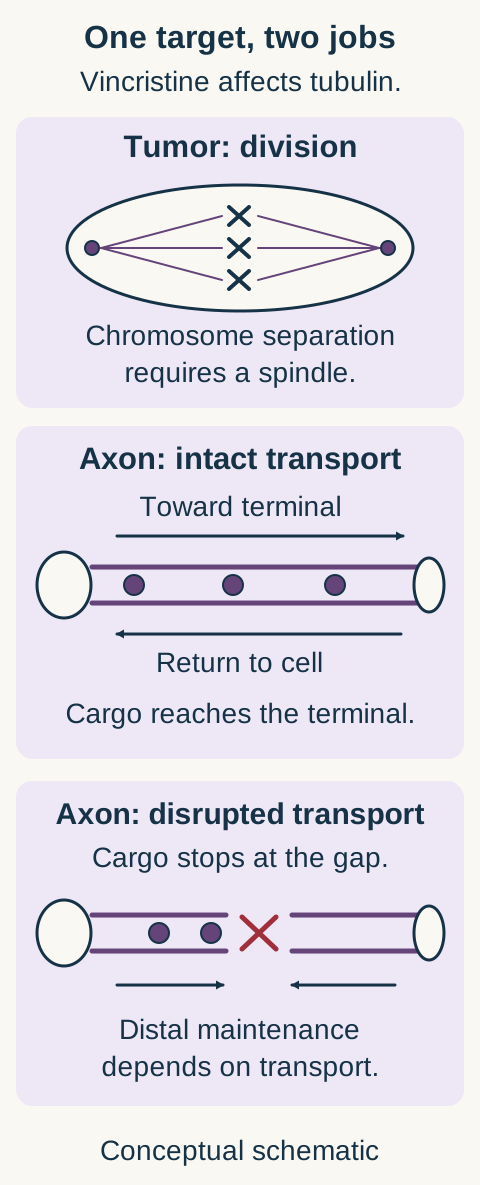
A shrinking tumor and worsening hand function can come from the same molecular target. Vincristine binds tubulin at the vinca-binding domain and interferes with microtubule assembly and dynamics. A dividing tumor cell needs a functional spindle to separate chromosomes. Disrupted spindle function arrests mitosis around metaphase and can lead to cell death. A mature peripheral neuron has a different dependency: it needs microtubules for transport along its axon. The neuron does not have to enter mitosis to be injured. [1][6]
The transport diagram separates these two jobs. In the axon, kinesin generally carries cargo toward the terminal, while dynein returns cargo and signals toward the cell body. Mitochondria, vesicles and signaling material require this transport system. Disrupting the tracks compromises distal axon maintenance. Long peripheral axons are particularly vulnerable, producing a length-dependent, predominantly axonal neuropathy. This is not a rule that every large fiber fails first, nor proof that every symptom must start in the feet. [1][3][6]
Compare the cellular job, not whether the cell is dividing. The transport drawing is conceptual and does not imply that every clinical exposure completely eliminates microtubules. [1][6]
Choose the compartment, then predict the consequence
Imagine a laboratory chamber with a cell-body compartment separated from growing axonal tips. The diagram shows an intact transport route and an interrupted route. Trace the outbound arrow with your finger, then trace the return arrow. Decide whether injury must begin in the cell body before opening either comparison.
Expose only the growing axonal tips: what should happen?
At the tested concentration in a compartmented rat-neuron experiment, the exposed axons shortened while unexposed sister axons were spared. Direct axonal exposure was sufficient for local injury in that model. The experiment does not establish a human dose threshold or recovery schedule. [6]
Expose only the cell-body compartment: is the result identical?
No. At that experimental concentration, cell-body exposure did not impair axonal growth. This challenges the claim that vincristine neuropathy must begin with death of the neuronal cell body. It does not exclude additional injury pathways in patients. [6]
The visible result is a shared target with different cellular consequences: impaired chromosome separation in tumor cells, impaired cargo delivery and maintenance in axons. Direct axonal toxicity is experimentally supported, but human neurotoxicity is not explained by one exclusive site of injury. [1][6]
Apply this to a patient who has both numb toes and reduced ankle reflexes during tumor response. Antitumor activity and nerve injury are compatible. Neither finding proves that the drug has started attacking only dividing nerve cells. [1][3]
Does this pattern actually localize to peripheral nerves?
Start with the distribution, not the chemotherapy list. Bilateral distal tingling, numbness, reduced vibration or position sense, and depressed reflexes support a peripheral polyneuropathy. Feet are often affected prominently, and hands may also be involved. Distal weakness can cause tripping, foot drop, trouble opening jars or loss of dexterity. Sensory, motor and autonomic findings can overlap; motor symptoms do not require a previously completed sensory stage. [1][3][10]
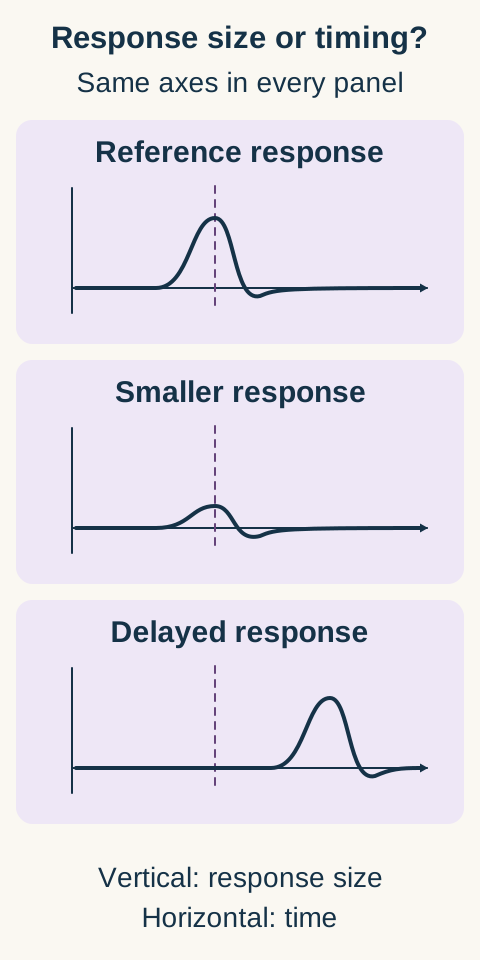
The nerve-response diagram distinguishes response size from timing. A reduced sensory nerve action potential or compound muscle action potential amplitude supports loss or dysfunction of participating axons. Marked slowing, prolonged distal latency or conduction block instead raises concern for a predominantly demyelinating process or a focal lesion, depending on the distribution. Mild slowing does not exclude axonal injury, and one measurement does not diagnose a drug toxicity. Interpret technically adequate studies against laboratory reference values and the examination. [3]
Low amplitude supports reduced functional axonal contribution; substantial slowing or block requires interpretation of the distribution and full study. [3]
Compare two examinations
Localize before attributing
Finding
What it should make you consider
FindingSymmetric distal sensory loss with reduced ankle reflexes
What it should make you considerA length-dependent peripheral process; review timing, exposure and competing causes.
FindingOne foot drops after prolonged pressure near the fibular head
What it should make you considerA focal common fibular nerve lesion; distribution and focal conduction changes matter.
FindingProximal weakness with preserved sensation during glucocorticoid treatment
What it should make you considerA myopathic pattern rather than automatically assigning every weakness to vincristine.
FindingA sensory level, brisk leg reflexes or new sphincter dysfunction with back pain
What it should make you considerA spinal or other urgent neurologic process, not routine distal toxic neuropathy.
Compare a low-amplitude response with nearly preserved timing to a delayed response with preserved amplitude. Predict which better fits the bilateral distal examination before opening the comparison.
Check the amplitude-versus-timing prediction
The low-amplitude pattern fits axonal dysfunction better. A predominantly delayed or blocked response needs a different explanation. If the abnormality occurs only across one short nerve segment, a focal lesion is more plausible than diffuse drug toxicity. The recording pattern narrows localization; it does not establish the cause by itself. [3]
The consequence of correct localization is a different evaluation. Foot drop identifies weak ankle dorsiflexion, not a guaranteed common fibular lesion and not a particular toxicity grade. An absent ankle reflex is an objective change, but functional sensory disability can be severe even when manual strength remains 5/5. Document both the sensory and motor domains. [3][8]
For transfer, replace bilateral toe numbness with unilateral dorsal-foot numbness and focal slowing at the fibular head. The exposure history is unchanged, but the new distribution argues against attributing that entire deficit to systemic vincristine toxicity. New rapid progression, asymmetry or central findings warrants prompt clinical reassessment. [3][10]
How can the same prescribed dose become less tolerable?
A dose on the prescription is not the same as tissue exposure. Vincristine undergoes hepatic CYP3A metabolism and predominantly biliary elimination. Liver dysfunction or an interacting medicine can increase exposure without any increase in the prescribed dose. Normal creatinine does not establish normal vincristine clearance. Assess the actual formulation, protocol, hepatic tests and complete medication list. [1]
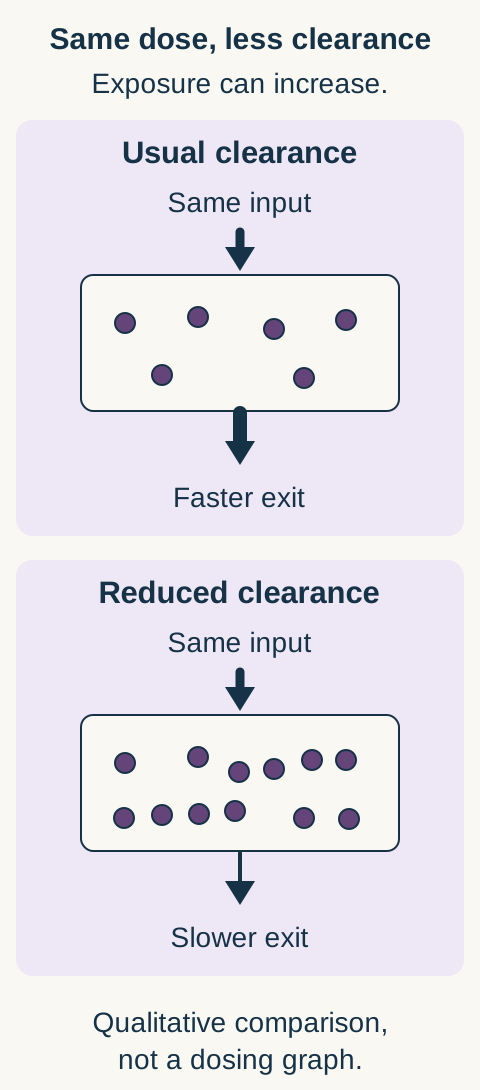
The clearance diagram holds the incoming dose constant and changes the exit pathway. With reduced clearance, more drug remains over time in the conceptual model. Strong CYP3A inhibitors such as itraconazole can cause earlier or more severe neurotoxicity and should be avoided with vincristine according to the label. Fluconazole also requires monitoring for increased adverse effects; it is not a guarantee of a safe combination. Antifungal changes require the treating oncology and infectious-disease teams. Strong CYP3A inducers can reduce exposure and also require review. [1]
The symbols represent a qualitative comparison, not measured concentrations or a dosing calculator. Hepatic dysfunction and CYP3A inhibition can alter vincristine exposure. [1]Keep the dose constant, then inhibit CYP3A: predict the result
Reduced metabolism can increase exposure. New constipation and weakness soon after itraconazole is added should prompt an interaction assessment, even if the patient previously tolerated that vincristine dose. A normal blood count does not measure nerve exposure. [1]
Worked consequence: a patient may tolerate two doses, develop an interaction, and have substantial toxicity after the next unchanged dose. Cumulative exposure remains relevant, but there is no universal total of 6 mg or 8 mg below which nerves are safe or above which disability is inevitable. Dose, schedule, susceptibility, symptoms and function must be considered together. [1][3][10]
For a specific example, eviQ R-CHOP21 lists conventional vincristine 1.4 mg/m2 with a 2 mg single-dose cap. A body surface area of 2.1 m2 gives 2.94 mg before that cap and 2 mg after it. This is a protocol example, not a universal dose for every disease or formulation. A cap limits exposure; it does not prevent neuropathy. Hepatic adjustments must follow the applicable product information and protocol rather than an improvised rule based on renal function. [1][5]
Pre-existing diabetic or alcohol-related neuropathy, other neurotoxic treatment and a hereditary neuropathy history are important assessment findings. They do not provide a validated numerical ranking of individual patients. Demyelinating Charcot-Marie-Tooth disease is a labeled contraindication to vincristine, not merely an instruction to monitor more often. A history of high arches and longstanding distal weakness in relatives deserves clarification before treatment. [1][10]
Apply the model to a patient with new cholestatic hepatic dysfunction but unchanged creatinine. The next decision is to reassess hepatic clearance and protocol eligibility, not to rely on the previous tolerated dose. [1][5]
When is constipation a warning about more than stool?
Vincristine can disrupt autonomic and enteric nerve function, reducing coordinated intestinal propulsion. Constipation may occur early, before obvious limb neuropathy. The bowel is not a nerve, and its vulnerability is not explained by having the body's longest axons. Opioids, anticholinergic medicines, some antiemetics, dehydration and electrolyte disorders can contribute to the same clinical problem. [1][5]
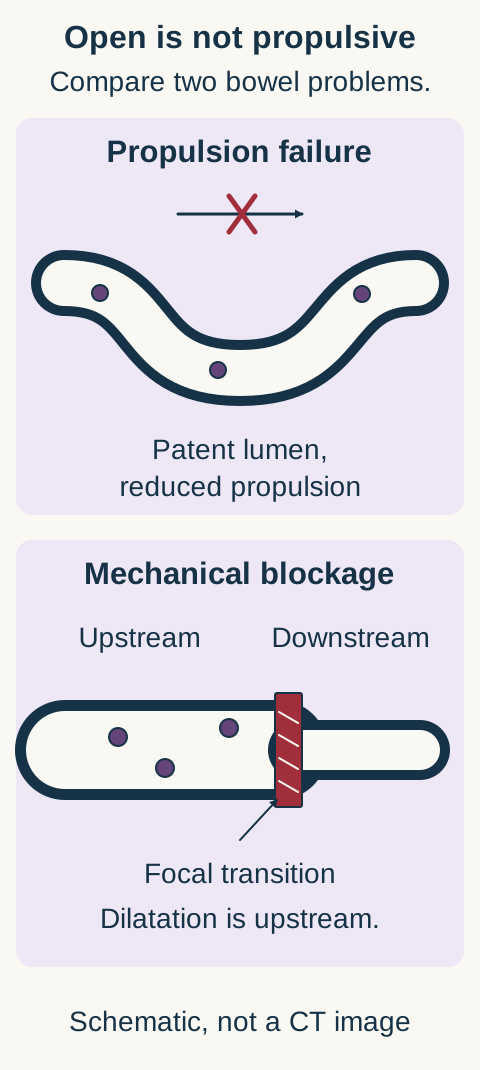
The bowel diagram compares a widely patent but poorly propulsive intestine with a focal mechanical blockage. Both can produce distension and vomiting. A temporal association with vincristine makes autonomic dysfunction plausible, but does not exclude obstruction, fecal impaction or another abdominal emergency. Passing flatus does not rule out partial obstruction or evolving ileus. Fever, focal pain, peritoneal signs or substantial neutropenia require assessment for additional causes rather than a routine constipation plan. [1]
Predict from the combination of symptoms and anatomy. Diffuse dysmotility and a focal obstruction require different evaluation; chemotherapy exposure does not erase a demonstrated transition point. [1]
Predict from the pattern, not from one symptom
A patient has progressive distension, vomiting and no flatus. Imaging shows diffuse dilatation without a transition point, and major electrolyte disturbances have been excluded. Trace the patent route on the diagram and decide what failed.
Compare the patent route with the blocked route
Diffuse dilatation without a focal transition supports impaired propulsion rather than a discrete mechanical blockage. In the stated clinical setting, vincristine-related autonomic toxicity is a strong explanation. A focal transition point would instead redirect evaluation toward mechanical obstruction. Neither pattern should be managed by simply increasing laxatives without clinical assessment. [1]
The visible clinical consequence is urgent assessment and withholding further vincristine during suspected significant ileus. Provide supportive care appropriate to the patient's severity: bowel rest, fluid and electrolyte correction, and gastric decompression when indicated. Evaluate competing causes. Resumption, reduction, omission or a different regimen is an oncology decision after recovery; there is no universal restart percentage or guaranteed safe substitute. [1][4][5]
Plan constipation prevention before treatment. The vincristine label recommends routine prophylaxis, and R-CHOP21 includes prophylactic laxatives. A clinician-tailored plan may use a stimulant such as senna or bisacodyl and/or an osmotic laxative; a stool softener alone may not address hypomotility. Review other constipating medicines and explain when to report worsening symptoms. A failed single laxative dose, by itself, does not establish ileus or mandate one identical chemotherapy decision for everyone. [1][5]
Autonomic toxicity can also cause bladder atony and urinary retention. New retention needs evaluation, particularly with back pain, a sensory level or weakness that could indicate a spinal emergency. A rare additional complication is the syndrome of inappropriate antidiuretic hormone secretion: hypotonic hyponatremia with urine that remains inappropriately concentrated after volume status, renal function, endocrine causes and other medicines are assessed. Severe symptomatic hyponatremia is an emergency, not a reason to prescribe a bowel regimen. [1]
For transfer, change diffuse dilatation to a focal transition point or add fever and focal abdominal pain. Those changes alter the differential even though the vincristine history remains the same. [1]
What stays shared across vincas, and what changes?
Vinca alkaloids share tubulin-directed action, but their adverse-effect profiles and cancer regimens are not interchangeable. Vincristine is especially important for sensory, motor and autonomic neurotoxicity. Major marrow suppression is less characteristic as its dose-limiting effect, but leukopenia, anemia and thrombocytopenia can still occur, particularly during combination treatment. A normal blood count cannot establish neurologic safety. [1]
Compare the monitoring priority, not an absolute guarantee
Agent
Typical limiting concern and clinical context
AgentVincristine
Typical limiting concern and clinical contextNerve and autonomic toxicity. Used in acute leukemia and combination regimens for lymphomas, Wilms tumor, neuroblastoma and rhabdomyosarcoma. [1]
AgentVinblastine
Typical limiting concern and clinical contextLeukopenia, especially granulocytopenia. Uses include Hodgkin lymphoma, testicular cancer and Kaposi sarcoma. Neurologic toxicity is possible rather than prohibited by the drug's profile. [2]
AgentVinorelbine
Typical limiting concern and clinical contextNeutropenia is a major dose-limiting concern. The cited US injection label covers non-small cell lung cancer. It is also used in breast cancer regimens, which is a clinical-use statement rather than an added US labeled indication. Peripheral and autonomic neuropathy, constipation and injection-site injury can occur. [7][9]
Vindesine, included in older vinca comparison studies, also has neurologic and marrow toxicity. The vinorelbine label reports combination-study data involving vindesine, but those results do not establish an invariant neurotoxicity ranking across every drug, dose and regimen. Do not explain the family contrast by claiming a proven exclusive affinity for marrow versus nerve tubulin isoforms. [2][7]
Keep the tubulin target, change vincristine to vinblastine: what should monitoring emphasize?
Blood counts become especially important because leukopenia commonly limits vinblastine dosing. Neurologic and bowel assessment remain relevant. The shared target does not predict equal toxicity, and a different toxicity profile does not prove equal cancer efficacy in the original regimen. [1][2][4]
Apply the contrast to treatment planning: a patient with disabling vincristine neuropathy needs a disease-specific oncology review, not an automatic substitution with vinblastine or vinorelbine. In fact, the cited vinorelbine label directs discontinuation for grade 2 or greater neuropathy. An alternative drug is not a nerve-protection treatment. [4][7]
Which change should alter the next treatment decision?
Record a baseline before treatment: neuropathy history, diabetes and alcohol exposure, prior neurotoxic therapy, hereditary symptoms, distal sensation with monofilament or vibration testing, position sense, ankle and patellar reflexes, dorsiflexion, hand strength, gait and bowel function. Repeat focused assessment before each treatment and compare with that baseline. Ask what the patient can no longer do, not only whether tingling is present. [1][5][10]
Use the toxicity term and version required by the protocol. The following adult examples use CTCAE version 6.0 peripheral sensory neuropathy, published in 2025. Grade 1 is mild symptoms; grades 2 and 3 distinguish moderate from severe symptoms and instrumental from self-care limitations. Preserved motor strength does not cap sensory toxicity at grade 2. Grade the sensory and motor problems separately when applicable. [8]
Adult sensory neuropathy: function matters
Grade
Meaning and example
Grade1
Meaning and exampleMild symptoms, such as intermittent tingling without activity limitation.
Grade2
Meaning and exampleModerate symptoms or limitation of instrumental activities, such as shopping or preparing meals. Self-care may remain independent.
Grade3
Meaning and exampleSevere symptoms or limitation of self-care, such as needing help dressing or bathing because of sensory loss, even with full manual strength.
Grade4
Meaning and exampleLife-threatening consequences requiring urgent intervention.
The semicolon-separated criteria in CTCAE represent alternatives, not requirements that must all coexist. Pediatric grading uses impact on age-appropriate daily activities. Older protocols may still specify version 5; do not silently mix definitions. Isolated reflex loss should be documented and assigned the appropriate term rather than treated as proof of a particular functional grade. A toxicity grade describes severity; the cancer protocol determines the dose decision. [8]
Keep strength at 5/5 but change shopping difficulty to needing help bathing: does the sensory grade stay the same?
No. The new self-care limitation supports grade 3 sensory toxicity. The strength examination describes motor function, not the independence lost through impaired sensation. This is why a seemingly reassuring strength result cannot replace a functional history. [8]
The treatment consequence depends on the whole assessment. Mild stable symptoms may permit continued therapy with documented reassessment when the protocol allows. New foot drop, unsafe gait, intolerable pain, substantial sensory disability or significant autonomic toxicity warrants timely oncology review before further exposure. R-CHOP21 specifically advises considering vincristine omission for grade 2 peripheral neuropathy. Do not replace this with a universal 25% or 50% reduction rule, and do not promise that every dose change leaves cancer outcomes unchanged. [4][5]
No medication has established benefit for preventing chemotherapy-induced peripheral neuropathy. For established painful neuropathy in adults, ASCO identifies duloxetine as having supporting evidence, with limited average benefit. This is guidance across chemotherapy-induced neuropathy, not proof of vincristine-specific axonal repair. Pain treatment does not restore lost sensation, cure foot drop or justify continued injurious exposure. Rehabilitation, an ankle-foot orthosis when appropriate, occupational support and fall prevention address function. [4][10]
Recovery is variable. Symptoms may improve after treatment, but persistent neuropathy can affect daily life long afterward. Delayed worsening after cessation has been reported, sometimes called coasting, but it is not an inevitable vincristine course. A prospective adult study found peak symptoms at treatment completion with subsequent improvement in its followed group, while persistent symptoms remained in other participants. New or rapidly worsening deficits still require reassessment rather than automatic reassurance about coasting. Drug clearance and axonal recovery are different processes. [1][3]
Keep route and infusion safety separate from cumulative neuropathy. Vincristine is for intravenous administration only; intrathecal administration is fatal. Poor penetration into cerebrospinal fluid is a reason for separately specified CNS-directed leukemia therapy, never a reason to put vincristine into the CSF. New burning, swelling or leakage at an infusion site requires the infusion to be stopped immediately and the oncology extravasation protocol activated. It is not the usual distal neuropathy pattern. [1]
For transfer, imagine that numbness is unchanged but the patient has fallen twice, needs help dressing or has stopped passing flatus. Each is new functional or safety information that a symptom count alone would miss. [1][8][10]
Practice with new clinical situations
Case 1
Show answer and explanations for case 1
A. Suppressed DNA synthesis in tumor cells and dividing neurons (Why this does not fit)
A mature peripheral neuron maintains an axon without entering mitosis. Axonal microtubule transport, rather than DNA replication in dividing neurons, is the relevant shared-target consequence. [1] [3] [6]
Reasoning steps for option A
Does the peripheral neuron need to divide to maintain its axon?
A mature peripheral neuron maintains an axon without entering mitosis.
Which cellular dependency explains its vulnerability here?
Axonal microtubule transport, rather than DNA replication in dividing neurons, is the relevant shared-target consequence.
B. Immune-mediated myelin injury accompanying tumor antigen release (Why this does not fit)
Marked conduction slowing or block would provide evidence for a predominantly demyelinating process. The evolving distal and autonomic syndrome during vincristine exposure is better explained by tubulin-related axonal injury than by an unestablished immune reaction. [1] [3] [6]
Reasoning steps for option B
What pattern would strengthen a primary myelin explanation?
Marked conduction slowing or block would provide evidence for a predominantly demyelinating process.
Why is that not the best shared explanation here?
The evolving distal and autonomic syndrome during vincristine exposure is better explained by tubulin-related axonal injury than by an unestablished immune reaction.
C. Disrupted spindle function and impaired axonal transport (Best answer)
Sensory, motor and autonomic nerve dysfunction can coexist during vincristine treatment. The shared tubulin target supports mitosis in tumor cells and cargo transport in mature axons. [1] [3] [6]
Reasoning steps for option C
What links the distal findings and constipation?
Sensory, motor and autonomic nerve dysfunction can coexist during vincristine treatment.
Why can tumor response coexist with this toxicity?
The shared tubulin target supports mitosis in tumor cells and cargo transport in mature axons.
D. Selective ganglion-cell death from a separate cytotoxic target (Why this does not fit)
Compartmented neuronal experiments support local axonal injury from vincristine exposure. No separate target is needed to connect tumor spindle disruption with axonal transport dysfunction. [1] [3] [6]
Reasoning steps for option D
Can direct axonal exposure cause injury without initial cell-body exposure?
Compartmented neuronal experiments support local axonal injury from vincristine exposure.
Does the clinical pattern require a second molecular target?
No separate target is needed to connect tumor spindle disruption with axonal transport dysfunction.
Takeaway: The shared tubulin target supports mitosis in tumor cells and cargo transport in mature axons. [1] [3] [6]
A. Axonal dysfunction affecting sensory and motor fibers (Best answer)
Fewer functional axons contribute to both the sensory and motor responses. Low amplitudes without marked slowing or block fit a predominantly axonal sensorimotor process. [3]
Reasoning steps for option A
What does reduced response amplitude suggest?
Fewer functional axons contribute to both the sensory and motor responses.
How does preserved timing refine that interpretation?
Low amplitudes without marked slowing or block fit a predominantly axonal sensorimotor process.
B. Primary demyelination with preserved axon participation (Why this does not fit)
Disproportionate slowing, prolonged latency or conduction block would strengthen that explanation. Response size is substantially reduced while conduction velocity is within the stated reference range, favoring axonal dysfunction. [3]
Reasoning steps for option B
Which recording feature would more strongly support predominant demyelination?
Disproportionate slowing, prolonged latency or conduction block would strengthen that explanation.
How do the actual results differ?
Response size is substantially reduced while conduction velocity is within the stated reference range, favoring axonal dysfunction.
C. A spinal cord lesion with intact peripheral responses (Why this does not fit)
The sensory and motor studies directly demonstrate abnormal peripheral nerve responses. A central lesion alone does not explain the low peripheral sensory amplitude and bilateral distal peripheral pattern. [3]
Reasoning steps for option C
Where are the reduced responses being recorded?
The sensory and motor studies directly demonstrate abnormal peripheral nerve responses.
Why is a cord lesion alone insufficient?
A central lesion alone does not explain the low peripheral sensory amplitude and bilateral distal peripheral pattern.
D. An isolated muscle disorder with intact sensory fibers (Why this does not fit)
A primary muscle disorder does not by itself account for loss of a peripheral sensory response. Both the reduced sural amplitude and distal numbness require a peripheral sensory explanation. [3]
Reasoning steps for option D
Would a muscle-only disorder reduce the sural sensory response?
A primary muscle disorder does not by itself account for loss of a peripheral sensory response.
Which findings require sensory nerve involvement?
Both the reduced sural amplitude and distal numbness require a peripheral sensory explanation.
Takeaway: Low amplitudes without marked slowing or block fit a predominantly axonal sensorimotor process. [3]
A. Progression of a diffuse vincristine axonopathy in both legs (Why this does not fit)
The patient already has distal symptoms during neurotoxic treatment. A sudden unilateral deficit with focal block across one short segment indicates an additional localized lesion. [3] [10]
Reasoning steps for option A
Why is vincristine toxicity a plausible initial concern?
The patient already has distal symptoms during neurotoxic treatment.
Which new feature argues against diffuse toxicity as the whole explanation?
A sudden unilateral deficit with focal block across one short segment indicates an additional localized lesion.
B. An L5 radiculopathy producing a distal motor deficit (Why this does not fit)
L5 dysfunction can impair ankle dorsiflexion. Preserved inversion and hip abduction plus block across the fibular head support a common fibular localization. [3] [10]
Reasoning steps for option B
Which part of the weakness could resemble an L5 lesion?
L5 dysfunction can impair ankle dorsiflexion.
What favors a nerve lesion over a root lesion here?
Preserved inversion and hip abduction plus block across the fibular head support a common fibular localization.
C. A corticospinal lesion producing unilateral ankle weakness (Why this does not fit)
Central motor lesions can cause weakness on one side. Focal peripheral conduction block identifies a nerve-segment abnormality rather than a corticospinal explanation. [3] [10]
Reasoning steps for option C
Why might unilateral weakness prompt central localization?
Central motor lesions can cause weakness on one side.
Which study result places this new lesion outside the central pathway?
Focal peripheral conduction block identifies a nerve-segment abnormality rather than a corticospinal explanation.
D. A focal common fibular neuropathy superimposed on baseline symptoms (Best answer)
The new weakness follows common fibular nerve function more closely than a complete L5 root pattern. New conduction block across the fibular head localizes the additional deficit to that nerve segment. [3] [10]
Reasoning steps for option D
What do weak dorsiflexion and eversion with preserved inversion suggest?
The new weakness follows common fibular nerve function more closely than a complete L5 root pattern.
What establishes a focal peripheral site?
New conduction block across the fibular head localizes the additional deficit to that nerve segment.
Takeaway: New conduction block across the fibular head localizes the additional deficit to that nerve segment. [3] [10]
A. A distal axonopathy caused by impaired axonal transport (Why this does not fit)
The regimen includes a drug that can injure peripheral axons. The proximal pattern, preserved distal sensory and reflex findings, and myopathic motor units do not support a distal axonopathy as the main deficit. [3] [8] [10]
Reasoning steps for option A
Why is vincristine initially relevant to the differential?
The regimen includes a drug that can injure peripheral axons.
What makes it a poor explanation for this particular examination?
The proximal pattern, preserved distal sensory and reflex findings, and myopathic motor units do not support a distal axonopathy as the main deficit.
B. A proximal myopathic process rather than distal nerve injury (Best answer)
The distribution raises a muscle process rather than the usual distal sensorimotor toxic neuropathy. Small, short-duration units with early recruitment support a myopathic process; a normal creatine kinase does not negate that localization. [3] [8] [10]
Reasoning steps for option B
What does preserved sensation with predominantly proximal weakness suggest?
The distribution raises a muscle process rather than the usual distal sensorimotor toxic neuropathy.
How does the needle examination refine localization?
Small, short-duration units with early recruitment support a myopathic process; a normal creatine kinase does not negate that localization.
C. A sensory neuropathy causing loss of position feedback (Why this does not fit)
Impaired position sense can reduce coordination and safety even with preserved power. Sensation is preserved and the proximal weakness is accompanied by a myopathic needle pattern. [3] [8] [10]
Reasoning steps for option C
How could sensory loss interfere with daily activity?
Impaired position sense can reduce coordination and safety even with preserved power.
Which findings instead establish a motor muscle problem?
Sensation is preserved and the proximal weakness is accompanied by a myopathic needle pattern.
D. A spinal motor pathway lesion with increased reflex activity (Why this does not fit)
Brisk reflexes or other upper motor neuron findings would strengthen central localization. The reported muscle-unit pattern and preserved peripheral sensory findings favor a proximal myopathy. [3] [8] [10]
Reasoning steps for option D
What examination change would support a central motor process?
Brisk reflexes or other upper motor neuron findings would strengthen central localization.
What is the more direct localization in this case?
The reported muscle-unit pattern and preserved peripheral sensory findings favor a proximal myopathy.
Takeaway: Small, short-duration units with early recruitment support a myopathic process; a normal creatine kinase does not negate that localization. [3] [8] [10]
A. Track the distal sensory deficit until the next routine cycle (Why this does not fit)
Stable mild toe tingling can be followed within the oncology protocol when function is preserved. New weakness, retention and central examination findings represent a different and potentially urgent neurologic problem. [1] [3] [10]
Reasoning steps for option A
Why could routine monitoring have fit the earlier symptoms?
Stable mild toe tingling can be followed within the oncology protocol when function is preserved.
What makes that approach insufficient now?
New weakness, retention and central examination findings represent a different and potentially urgent neurologic problem.
B. Arrange urgent assessment for a spinal cord process (Best answer)
These new findings localize more strongly to the spinal cord than to a distal peripheral axonopathy. The new spinal pattern requires urgent evaluation rather than routine attribution to chemotherapy neuropathy. [1] [3] [10]
Reasoning steps for option B
How do brisk reflexes and a sensory boundary change localization?
These new findings localize more strongly to the spinal cord than to a distal peripheral axonopathy.
What consequence follows from the associated back pain and retention?
The new spinal pattern requires urgent evaluation rather than routine attribution to chemotherapy neuropathy.
C. Use the cumulative vincristine dose to set the urgency (Why this does not fit)
Repeated exposure can contribute to peripheral neurotoxicity. The sensory boundary and brisk reflexes require localization-based urgent evaluation regardless of the cumulative dose. [1] [3] [10]
Reasoning steps for option C
Why is the cumulative exposure relevant to treatment review?
Repeated exposure can contribute to peripheral neurotoxicity.
Why is it not the decisive variable in this presentation?
The sensory boundary and brisk reflexes require localization-based urgent evaluation regardless of the cumulative dose.
D. Treat the retention as an isolated autonomic adverse effect (Why this does not fit)
Vincristine can cause bladder atony and urinary retention. Back pain with a sensory boundary and brisk leg reflexes suggests a spinal process rather than bladder toxicity alone. [1] [3] [10]
Reasoning steps for option D
Why is autonomic toxicity a plausible competing explanation?
Vincristine can cause bladder atony and urinary retention.
Which associated findings defeat an isolated autonomic explanation?
Back pain with a sensory boundary and brisk leg reflexes suggests a spinal process rather than bladder toxicity alone.
Takeaway: The new spinal pattern requires urgent evaluation rather than routine attribution to chemotherapy neuropathy. [1] [3] [10]
A. Keep vincristine and add more frequent blood-count checks (Why this does not fit)
Blood counts assess marrow effects and treatment-related cytopenias. They do not change the contraindication associated with the established hereditary demyelinating neuropathy. [1] [10]
Reasoning steps for option A
What safety question does a blood count address?
Blood counts assess marrow effects and treatment-related cytopenias.
Why do additional counts not resolve this patient's eligibility?
They do not change the contraindication associated with the established hereditary demyelinating neuropathy.
B. Begin vincristine at the cap and grade symptoms afterward (Why this does not fit)
Serial grading documents changes from the neurologic baseline during treatment. The pre-existing demyelinating hereditary diagnosis is a labeled contraindication before any new toxicity appears. [1] [10]
Reasoning steps for option B
Why can prospective symptom grading be useful in other patients?
Serial grading documents changes from the neurologic baseline during treatment.
What prevents relying on monitoring alone here?
The pre-existing demyelinating hereditary diagnosis is a labeled contraindication before any new toxicity appears.
C. Reduce vincristine empirically and retain the original regimen (Why this does not fit)
Some treatment toxicities can be managed with protocol-directed reductions. A smaller empirical dose does not establish safety in a condition for which vincristine administration is contraindicated. [1] [10]
Reasoning steps for option C
Why might dose reduction otherwise be considered?
Some treatment toxicities can be managed with protocol-directed reductions.
Why is an improvised reduction not a sufficient solution here?
A smaller empirical dose does not establish safety in a condition for which vincristine administration is contraindicated.
D. Avoid vincristine and obtain a disease-specific regimen review (Best answer)
The history and testing support a demyelinating form of Charcot-Marie-Tooth disease. Demyelinating Charcot-Marie-Tooth disease is a vincristine contraindication, requiring a different disease-specific treatment plan. [1] [10]
Reasoning steps for option D
What condition is supported by the inherited phenotype and nerve studies?
The history and testing support a demyelinating form of Charcot-Marie-Tooth disease.
Does normal hepatic function or a dose cap remove the labeled concern?
Demyelinating Charcot-Marie-Tooth disease is a vincristine contraindication, requiring a different disease-specific treatment plan.
Takeaway: Demyelinating Charcot-Marie-Tooth disease is a vincristine contraindication, requiring a different disease-specific treatment plan. [1] [10]
A. Reduced CYP3A-mediated clearance increased vincristine exposure (Best answer)
Itraconazole strongly inhibits CYP3A, a pathway involved in vincristine metabolism. Reduced clearance can increase exposure; the combination requires prompt oncology and anti-infective medication review. [1]
Reasoning steps for option A
What pharmacologic property of itraconazole is relevant here?
Itraconazole strongly inhibits CYP3A, a pathway involved in vincristine metabolism.
How can toxicity increase without changing the infusion order?
Reduced clearance can increase exposure; the combination requires prompt oncology and anti-infective medication review.
B. Reduced glomerular filtration increased vincristine exposure (Why this does not fit)
Impaired drug elimination can increase toxicity without changing a prescribed dose. Vincristine depends importantly on hepatic metabolism and biliary elimination; stable creatinine does not address CYP3A inhibition. [1]
Reasoning steps for option B
Why could a clearance interaction initially seem plausible?
Impaired drug elimination can increase toxicity without changing a prescribed dose.
Which elimination pathway and laboratory findings distinguish this interaction?
Vincristine depends importantly on hepatic metabolism and biliary elimination; stable creatinine does not address CYP3A inhibition.
C. Suppressed marrow recovery caused the new distal weakness (Why this does not fit)
Clinically important cytopenias would support a marrow-related complication. Blood counts are near baseline, while distal weakness and constipation fit increased neurotoxic exposure. [1]
Reasoning steps for option C
What would a marrow-driven explanation require?
Clinically important cytopenias would support a marrow-related complication.
Why do the current findings favor another target?
Blood counts are near baseline, while distal weakness and constipation fit increased neurotoxic exposure.
D. Induced hepatic metabolism increased formation of active vincristine (Why this does not fit)
An added medicine can change the exposure to an anticancer drug. Itraconazole inhibits rather than induces the CYP3A pathway; increased vincristine exposure does not require enhanced metabolic activation. [1]
Reasoning steps for option D
Why might altered metabolism be considered after a new drug?
An added medicine can change the exposure to an anticancer drug.
What is the direction of this specific interaction?
Itraconazole inhibits rather than induces the CYP3A pathway; increased vincristine exposure does not require enhanced metabolic activation.
Takeaway: Reduced clearance can increase exposure; the combination requires prompt oncology and anti-infective medication review. [1]
A. Maintain the previous dose because glomerular function is preserved (Why this does not fit)
It helps assess drugs and complications that depend on renal elimination. Normal creatinine does not establish normal vincristine clearance in a patient with marked new hepatic dysfunction. [1] [5]
Reasoning steps for option A
Why is preserved renal function clinically useful information?
It helps assess drugs and complications that depend on renal elimination.
Why is that insufficient for this particular drug?
Normal creatinine does not establish normal vincristine clearance in a patient with marked new hepatic dysfunction.
B. Base the next dose on a repeat sensory examination alone (Why this does not fit)
It documents whether peripheral toxicity has already appeared or progressed. Clearance may be impaired before the patient develops detectable neurotoxicity. [1] [5]
Reasoning steps for option B
Why should a sensory examination still be performed?
It documents whether peripheral toxicity has already appeared or progressed.
What important risk would an examination-only decision miss?
Clearance may be impaired before the patient develops detectable neurotoxicity.
C. Reassess hepatic dose eligibility using the product label and regimen (Best answer)
The new hepatic dysfunction is relevant to its hepatic metabolism and predominantly biliary elimination. The next dose must be checked against hepatic adjustment instructions before further exposure, not after toxicity develops. [1] [5]
Reasoning steps for option C
Which change can affect the elimination of vincristine?
The new hepatic dysfunction is relevant to its hepatic metabolism and predominantly biliary elimination.
What should happen despite the absence of new neurologic symptoms?
The next dose must be checked against hepatic adjustment instructions before further exposure, not after toxicity develops.
D. Use the blood-count nadir as the principal dose-adjustment measure (Why this does not fit)
They can identify marrow toxicity from the regimen or the underlying malignancy. A marrow measure does not determine the clearance consequences of the newly elevated direct bilirubin. [1] [5]
Reasoning steps for option D
Why do blood counts belong in chemotherapy assessment?
They can identify marrow toxicity from the regimen or the underlying malignancy.
Why do they not replace the hepatic review here?
A marrow measure does not determine the clearance consequences of the newly elevated direct bilirubin.
Takeaway: The next dose must be checked against hepatic adjustment instructions before further exposure, not after toxicity develops. [1] [5]
It is the amount per square meter rather than the total administration amount. Multiply by body surface area and then apply the stated 2 mg cap. [5]
Reasoning steps for option A
What does 1.4 represent in the prescription?
It is the amount per square meter rather than the total administration amount.
What patient-specific quantity must be included?
Multiply by body surface area and then apply the stated 2 mg cap.
B. 2.1 mg (Why this does not fit)
It describes body surface area in square meters, not the prescribed amount of drug. The 1.4 mg/m2 factor and the 2 mg maximum must both be applied. [5]
Reasoning steps for option B
What does the number 2.1 describe?
It describes body surface area in square meters, not the prescribed amount of drug.
What is missing from that proposed dose?
The 1.4 mg/m2 factor and the 2 mg maximum must both be applied.
C. 2.94 mg (Why this does not fit)
The uncapped body-surface-area calculation gives 2.94 mg. It exceeds the explicitly stated 2 mg maximum for this protocol. [5]
Reasoning steps for option C
Which calculation produces this proposed amount?
The uncapped body-surface-area calculation gives 2.94 mg.
Why is it not the amount administered under this order?
It exceeds the explicitly stated 2 mg maximum for this protocol.
D. 2.0 mg (Best answer)
Multiplying 1.4 mg/m2 by 2.1 m2 gives 2.94 mg. The calculated amount exceeds 2 mg, so this particular order yields 2.0 mg. [5]
Reasoning steps for option D
What does the body-surface-area calculation give before the cap?
Multiplying 1.4 mg/m2 by 2.1 m2 gives 2.94 mg.
How does the stated administration cap change that result?
The calculated amount exceeds 2 mg, so this particular order yields 2.0 mg.
Takeaway: The calculated amount exceeds 2 mg, so this particular order yields 2.0 mg. [5]
A. Patient B: the higher cumulative dose outweighs preserved daily function (Why this does not fit)
Repeated exposure can increase the opportunity for neurotoxicity. Patient A already has disabling motor findings; cumulative dose alone cannot replace the functional assessment. [1] [3] [4] [5]
Reasoning steps for option A
Why is the larger cumulative exposure relevant?
Repeated exposure can increase the opportunity for neurotoxicity.
Why does that number not establish the greater immediate problem here?
Patient A already has disabling motor findings; cumulative dose alone cannot replace the functional assessment.
B. Patient A: new motor disability outweighs the lower cumulative exposure (Best answer)
Patient A has objective motor weakness and falls, whereas patient B remains functionally independent. Clinically important toxicity has no universal cumulative threshold; current function must guide the pre-dose review. [1] [3] [4] [5]
Reasoning steps for option B
Which patient has a new functional safety problem?
Patient A has objective motor weakness and falls, whereas patient B remains functionally independent.
Why does the lower cumulative dose not provide reassurance?
Clinically important toxicity has no universal cumulative threshold; current function must guide the pre-dose review.
C. Both patients: normal hepatic tests make the next doses equally tolerable (Why this does not fit)
It reduces concern about a newly identified hepatic clearance impairment. No. Normal hepatic tests do not make new motor weakness and falls tolerable. [1] [3] [4] [5]
Reasoning steps for option C
What does normal hepatic testing contribute?
It reduces concern about a newly identified hepatic clearance impairment.
Does it negate the neurologic findings already present?
No. Normal hepatic tests do not make new motor weakness and falls tolerable.
D. Neither patient: neuropathy becomes actionable only after a dose-cap error (Why this does not fit)
A protocol cap limits the amount administered in that regimen. Yes. A correctly capped dose can still cause toxicity that requires treatment review. [1] [3] [4] [5]
Reasoning steps for option D
Why can a dose cap reduce unnecessary exposure?
A protocol cap limits the amount administered in that regimen.
Can clinically important neurotoxicity occur within that cap?
Yes. A correctly capped dose can still cause toxicity that requires treatment review.
Takeaway: Clinically important toxicity has no universal cumulative threshold; current function must guide the pre-dose review. [1] [3] [4] [5]
A. Grade 1 peripheral sensory neuropathy (Why this does not fit)
Mild symptoms without the described moderate or instrumental-activity impairment would fit that category. Moderate symptoms prevent shopping and meal preparation, which are instrumental daily activities. [8]
Reasoning steps for option A
What would support a mild grade 1 presentation?
Mild symptoms without the described moderate or instrumental-activity impairment would fit that category.
What makes this case more than that?
Moderate symptoms prevent shopping and meal preparation, which are instrumental daily activities.
B. Grade 3 peripheral motor neuropathy (Why this does not fit)
The impairment must belong to the motor domain rather than be inferred from any difficulty with daily tasks. Strength is preserved and the limitations arise from sensation; no grade 3 motor problem is demonstrated. [8]
Reasoning steps for option B
What must be established before assigning a motor toxicity grade?
The impairment must belong to the motor domain rather than be inferred from any difficulty with daily tasks.
What do the supplied findings actually show?
Strength is preserved and the limitations arise from sensation; no grade 3 motor problem is demonstrated.
C. Grade 2 peripheral sensory neuropathy (Best answer)
The functional problem is sensory loss, not measured motor weakness. Instrumental activities are limited while self-care is preserved, supporting grade 2 peripheral sensory neuropathy. [8]
Reasoning steps for option C
Which neurologic domain is producing the activity limitation?
The functional problem is sensory loss, not measured motor weakness.
Which functional level is limited?
Instrumental activities are limited while self-care is preserved, supporting grade 2 peripheral sensory neuropathy.
D. Grade 3 peripheral sensory neuropathy (Why this does not fit)
Self-care limitation or severe sensory symptoms would support grade 3 under version 6.0. Symptoms are described as moderate and self-care remains independent; the documented limitation is instrumental. [8]
Reasoning steps for option D
What functional change would support grade 3 sensory toxicity?
Self-care limitation or severe sensory symptoms would support grade 3 under version 6.0.
Which part of that boundary is not reached here?
Symptoms are described as moderate and self-care remains independent; the documented limitation is instrumental.
Takeaway: Instrumental activities are limited while self-care is preserved, supporting grade 2 peripheral sensory neuropathy. [8]
A. Grade 3 peripheral sensory neuropathy (Best answer)
The reported disability comes from sensory loss despite preserved manual motor strength. Self-care limitation supports grade 3 sensory neuropathy; normal strength does not impose a lower sensory grade. [8]
Reasoning steps for option A
Does preserved strength identify the impaired neurologic domain?
The reported disability comes from sensory loss despite preserved manual motor strength.
How does the need for dressing and bathing assistance affect severity?
Self-care limitation supports grade 3 sensory neuropathy; normal strength does not impose a lower sensory grade.
B. Grade 1 peripheral sensory neuropathy (Why this does not fit)
Yes. Sensory and motor domains can be affected differently. The patient has severe symptoms and needs help with self-care, which exceed a mild sensory presentation. [8]
Reasoning steps for option B
Could sensory symptoms occur without loss of strength?
Yes. Sensory and motor domains can be affected differently.
Why is that distinction not a reason to assign a mild grade?
The patient has severe symptoms and needs help with self-care, which exceed a mild sensory presentation.
C. Grade 2 peripheral sensory neuropathy (Why this does not fit)
Grade 2 includes limitation of instrumental daily activities. Dressing and bathing are self-care activities; their loss of independence supports grade 3. [8]
Reasoning steps for option C
Which activity level is central to a grade 2 functional example?
Grade 2 includes limitation of instrumental daily activities.
What makes this case a higher functional category?
Dressing and bathing are self-care activities; their loss of independence supports grade 3.
D. Grade 3 peripheral motor neuropathy (Why this does not fit)
Difficulty using the hands can result from weakness or from impaired sensory feedback. Motor strength is preserved and severe sensory loss explains the self-care difficulty. [8]
Reasoning steps for option D
Why might dropping objects be mistaken for a motor deficit?
Difficulty using the hands can result from weakness or from impaired sensory feedback.
Which supplied findings distinguish those possibilities here?
Motor strength is preserved and severe sensory loss explains the self-care difficulty.
Takeaway: Self-care limitation supports grade 3 sensory neuropathy; normal strength does not impose a lower sensory grade. [8]
A. Halve the next dose and retain that reduction throughout treatment (Why this does not fit)
Dose modification can address intolerable or functionally important toxicity within a particular protocol. The protocol permits treatment after assessment of stable mild symptoms, so a permanent empirical 50% reduction is not established. [4] [5] [8] [10]
Reasoning steps for option A
When can a dose reduction be appropriate?
Dose modification can address intolerable or functionally important toxicity within a particular protocol.
What does this stem establish instead?
The protocol permits treatment after assessment of stable mild symptoms, so a permanent empirical 50% reduction is not established.
B. Replace vincristine with vinblastine at the next treatment visit (Why this does not fit)
A disease-specific alternative can sometimes be selected when the original regimen becomes intolerable. Mild nonlimiting symptoms do not establish that a different vinca is needed or equivalent within this regimen. [4] [5] [8] [10]
Reasoning steps for option B
Why might changing drugs be considered for substantial toxicity?
A disease-specific alternative can sometimes be selected when the original regimen becomes intolerable.
Why is direct substitution not supported here?
Mild nonlimiting symptoms do not establish that a different vinca is needed or equivalent within this regimen.
C. Document toxicity and reassess before protocol-permitted treatment (Best answer)
The current report describes mild sensory symptoms without functional impairment or a new exposure risk. Treatment may continue with documented grading and close reassessment; neither automatic continuation without review nor an automatic regimen change follows. [4] [5] [8] [10]
Reasoning steps for option C
What severity is demonstrated by the present symptoms and function?
The current report describes mild sensory symptoms without functional impairment or a new exposure risk.
What does the stated protocol allow after assessment?
Treatment may continue with documented grading and close reassessment; neither automatic continuation without review nor an automatic regimen change follows.
D. Prescribe a neuropathic analgesic and defer further functional grading (Why this does not fit)
A neuropathic analgesic targets pain rather than documenting nerve function or preventing axonal injury. Pain is absent, while repeat assessment is needed to establish whether the mild symptoms remain tolerable. [4] [5] [8] [10]
Reasoning steps for option D
What problem does an analgesic address?
A neuropathic analgesic targets pain rather than documenting nerve function or preventing axonal injury.
Which supplied findings make that the wrong priority?
Pain is absent, while repeat assessment is needed to establish whether the mild symptoms remain tolerable.
Takeaway: Treatment may continue with documented grading and close reassessment; neither automatic continuation without review nor an automatic regimen change follows. [4] [5] [8] [10]
A. The baseline reflex loss explains the entire current disability (Why this does not fit)
It prevents longstanding abnormalities from being misclassified as new toxic effects. The patient previously had normal walking and dressing function; new dorsiflexion weakness and dexterity loss need separate assessment. [1] [4] [8] [10]
Reasoning steps for option A
Why is the pretreatment examination important?
It prevents longstanding abnormalities from being misclassified as new toxic effects.
Why does it not explain away the current deterioration?
The patient previously had normal walking and dressing function; new dorsiflexion weakness and dexterity loss need separate assessment.
B. The unchanged vibration finding indicates stable overall nerve function (Why this does not fit)
That particular tested sensory finding has not worsened from baseline. A stable sensory test cannot exclude newly impaired motor function or loss of independence. [1] [4] [8] [10]
Reasoning steps for option B
What does the unchanged sensory measurement establish?
That particular tested sensory finding has not worsened from baseline.
What does it fail to measure?
A stable sensory test cannot exclude newly impaired motor function or loss of independence.
C. The acceptable blood count supports keeping the neurologic plan unchanged (Why this does not fit)
Blood counts help assess marrow tolerance of the regimen. Distal motor function and daily activities have worsened, requiring their own pre-dose oncology review. [1] [4] [8] [10]
Reasoning steps for option C
Which component of treatment safety do counts help evaluate?
Blood counts help assess marrow tolerance of the regimen.
Which independent component has deteriorated?
Distal motor function and daily activities have worsened, requiring their own pre-dose oncology review.
D. New motor and functional deficits require review beyond the baseline neuropathy (Best answer)
Reduced toe vibration and absent ankle reflexes were already present and have not changed. New distal weakness and loss of dressing independence are clinically important changes; acceptable counts do not establish neurologic tolerability. [1] [4] [8] [10]
Reasoning steps for option D
Which abnormalities were documented before treatment?
Reduced toe vibration and absent ankle reflexes were already present and have not changed.
Which new findings change the treatment assessment?
New distal weakness and loss of dressing independence are clinically important changes; acceptable counts do not establish neurologic tolerability.
Takeaway: New distal weakness and loss of dressing independence are clinically important changes; acceptable counts do not establish neurologic tolerability. [1] [4] [8] [10]
A. Continue vincristine and replace the stool softener with a stronger laxative (Why this does not fit)
Uncomplicated constipation without major warning symptoms can be managed with an individualized bowel plan. Vomiting, absent flatus and diffuse dilatation indicate a significant motility complication rather than routine constipation. [1] [4] [5]
Reasoning steps for option A
When might modifying a bowel regimen be sufficient?
Uncomplicated constipation without major warning symptoms can be managed with an individualized bowel plan.
Why is this presentation different?
Vomiting, absent flatus and diffuse dilatation indicate a significant motility complication rather than routine constipation.
B. Withhold further vincristine and initiate assessed supportive care for ileus (Best answer)
In this setting it supports impaired propulsion rather than a discrete mechanical obstruction. Further vincristine should be withheld while supportive care and evaluation are provided, including decompression when indicated. [1] [4] [5]
Reasoning steps for option B
What does diffuse dilatation without a focal transition support?
In this setting it supports impaired propulsion rather than a discrete mechanical obstruction.
What treatment consequence follows from symptomatic suspected drug-related ileus?
Further vincristine should be withheld while supportive care and evaluation are provided, including decompression when indicated.
C. Proceed directly to surgery for a focal bowel obstruction (Why this does not fit)
A focal transition with an obstructing lesion would strengthen a mechanical-obstruction explanation. Diffuse dilatation without a focal transition supports ileus and does not itself establish a surgical obstructing lesion. [1] [4] [5]
Reasoning steps for option C
What imaging finding would support a discrete mechanical target?
A focal transition with an obstructing lesion would strengthen a mechanical-obstruction explanation.
What does the actual study show?
Diffuse dilatation without a focal transition supports ileus and does not itself establish a surgical obstructing lesion.
D. Give a reduced vincristine dose while awaiting spontaneous bowel recovery (Why this does not fit)
After recovery, oncology may consider protocol-directed modification based on benefit and recurrence risk. Active significant ileus requires withholding further vincristine and treating the current complication, not dosing through it. [1] [4] [5]
Reasoning steps for option D
Why might a later reduced dose be considered in selected regimens?
After recovery, oncology may consider protocol-directed modification based on benefit and recurrence risk.
Why is that not the immediate decision here?
Active significant ileus requires withholding further vincristine and treating the current complication, not dosing through it.
Takeaway: Further vincristine should be withheld while supportive care and evaluation are provided, including decompression when indicated. [1] [4] [5]
A. A mechanical obstruction needs assessment despite the neurotoxic exposure (Best answer)
It supports a localized barrier to passage rather than uniform loss of propulsion. It remains relevant, but it must not replace evaluation of the demonstrated mechanical-obstruction pattern. [1]
Reasoning steps for option A
What does the proximal-to-distal change at a transition point indicate?
It supports a localized barrier to passage rather than uniform loss of propulsion.
How should the vincristine history be used?
It remains relevant, but it must not replace evaluation of the demonstrated mechanical-obstruction pattern.
B. Autonomic ileus explains the scan because vincristine commonly causes constipation (Why this does not fit)
Vincristine can impair bowel propulsion and cause distension or vomiting. A discrete transition with proximal dilatation and distal decompression identifies a focal obstructive pattern. [1]
Reasoning steps for option B
Why is autonomic ileus a reasonable initial differential?
Vincristine can impair bowel propulsion and cause distension or vomiting.
What makes mechanical obstruction the stronger explanation here?
A discrete transition with proximal dilatation and distal decompression identifies a focal obstructive pattern.
C. Simple stool dehydration explains the proximal bowel dilatation (Why this does not fit)
Reduced intake and constipating medicines can make stool passage difficult. The discrete transition near an adhesion requires assessment for a mechanical obstruction. [1]
Reasoning steps for option C
Why might ordinary constipation be considered during treatment?
Reduced intake and constipating medicines can make stool passage difficult.
What additional finding exceeds that simple explanation?
The discrete transition near an adhesion requires assessment for a mechanical obstruction.
D. A prophylactic laxative failure establishes the need for a routine bowel-plan adjustment (Why this does not fit)
It can address uncomplicated constipation after warning findings are excluded. The imaging demonstrates a focal obstruction pattern that needs its own evaluation before routine constipation treatment. [1]
Reasoning steps for option D
When is a routine bowel-plan adjustment appropriate?
It can address uncomplicated constipation after warning findings are excluded.
Which supplied finding prevents that assumption now?
The imaging demonstrates a focal obstruction pattern that needs its own evaluation before routine constipation treatment.
Takeaway: It remains relevant, but it must not replace evaluation of the demonstrated mechanical-obstruction pattern. [1]
A. Continue the next dose because passage of flatus excludes important bowel disease (Why this does not fit)
It shows that some gas is passing through the bowel. Partial obstruction or evolving ileus can remain possible when flatus persists, especially with progressive symptoms. [1] [5]
Reasoning steps for option A
Why can passage of flatus appear reassuring?
It shows that some gas is passing through the bowel.
Why is that observation insufficient here?
Partial obstruction or evolving ileus can remain possible when flatus persists, especially with progressive symptoms.
B. Arrange prompt abdominal and medication assessment before the next dose (Best answer)
No. Passage of some gas does not resolve the cause of progressive distension and discomfort. The treating team should assess severity, competing causes and treatment eligibility before additional vincristine rather than assume routine constipation. [1] [5]
Reasoning steps for option B
Does continued flatus exclude evolving ileus or partial obstruction?
No. Passage of some gas does not resolve the cause of progressive distension and discomfort.
What does the upcoming dose require?
The treating team should assess severity, competing causes and treatment eligibility before additional vincristine rather than assume routine constipation.
C. Assign established paralytic ileus from failure of the prescribed senna alone (Why this does not fit)
Vincristine exposure and worsening constipation make autonomic toxicity a plausible concern. Failure of one bowel regimen does not establish the cause or exclude other pathology; clinical assessment is still needed. [1] [5]
Reasoning steps for option C
Why does the treatment history raise suspicion of dysmotility?
Vincristine exposure and worsening constipation make autonomic toxicity a plausible concern.
Why is that not enough for a definitive ileus diagnosis?
Failure of one bowel regimen does not establish the cause or exclude other pathology; clinical assessment is still needed.
D. Replace senna with docusate alone and defer reassessment until after chemotherapy (Why this does not fit)
It can change stool consistency rather than directly resolve impaired propulsion or obstruction. Progressive abdominal symptoms before another neurotoxic dose need evaluation rather than a symptom-only medication substitution. [1] [5]
Reasoning steps for option D
What does a stool softener mainly address?
It can change stool consistency rather than directly resolve impaired propulsion or obstruction.
What makes deferring assessment inappropriate?
Progressive abdominal symptoms before another neurotoxic dose need evaluation rather than a symptom-only medication substitution.
Takeaway: The treating team should assess severity, competing causes and treatment eligibility before additional vincristine rather than assume routine constipation. [1] [5]
A. Excess water intake with appropriately suppressed antidiuresis (Why this does not fit)
Suppressed vasopressin activity should allow relatively dilute urine. Urine osmolality of 520 mOsm/kg shows continued concentration rather than the expected dilute response. [1]
Reasoning steps for option A
What urine response is expected when healthy kidneys respond to excess water?
Suppressed vasopressin activity should allow relatively dilute urine.
Which measurement conflicts with that explanation?
Urine osmolality of 520 mOsm/kg shows continued concentration rather than the expected dilute response.
B. Extrarenal salt loss with an appropriate low-volume vasopressin response (Why this does not fit)
Low effective circulating volume can stimulate vasopressin despite a low serum sodium. The patient is assessed as euvolemic, and the high urine sodium without diuretic use does not fit simple extrarenal salt loss. [1]
Reasoning steps for option B
Why can volume depletion produce concentrated urine?
Low effective circulating volume can stimulate vasopressin despite a low serum sodium.
Which supplied findings weaken that account?
The patient is assessed as euvolemic, and the high urine sodium without diuretic use does not fit simple extrarenal salt loss.
C. Inappropriate antidiuresis retaining water despite hypotonic plasma (Best answer)
The hyponatremia is hypotonic rather than a consequence of hyperglycemic water redistribution. Urine remains concentrated despite hypotonic plasma and euvolemia, supporting inappropriate antidiuresis after the stated mimics are assessed. [1]
Reasoning steps for option C
What does the low serum osmolality establish?
The hyponatremia is hypotonic rather than a consequence of hyperglycemic water redistribution.
How does the concentrated urine refine the explanation?
Urine remains concentrated despite hypotonic plasma and euvolemia, supporting inappropriate antidiuresis after the stated mimics are assessed.
D. Glucose-mediated water redistribution producing hypertonic hyponatremia (Why this does not fit)
Extracellular glucose can draw water out of cells and produce hypertonic hyponatremia. Serum osmolality is low and glucose does not explain the abnormality, supporting a hypotonic water-balance disorder instead. [1]
Reasoning steps for option D
How can severe hyperglycemia lower measured serum sodium?
Extracellular glucose can draw water out of cells and produce hypertonic hyponatremia.
Which data rule against that mechanism here?
Serum osmolality is low and glucose does not explain the abnormality, supporting a hypotonic water-balance disorder instead.
Takeaway: Urine remains concentrated despite hypotonic plasma and euvolemia, supporting inappropriate antidiuresis after the stated mimics are assessed. [1]
A. Autonomic dysfunction impairing bowel propulsion and bladder emptying (Best answer)
It supports impaired bladder emptying from a functional rather than demonstrated mechanical outlet problem. Autonomic toxicity can impair both intestinal motility and detrusor function; the bladder problem still requires clinical management. [1]
Reasoning steps for option A
What does a large residual without outlet obstruction indicate?
It supports impaired bladder emptying from a functional rather than demonstrated mechanical outlet problem.
What connects that finding with constipation after vincristine?
Autonomic toxicity can impair both intestinal motility and detrusor function; the bladder problem still requires clinical management.
B. Somatic sensory loss reducing perception of stool and bladder filling (Why this does not fit)
Reduced sensation can alter perception of fullness or the need to void. The combination of impaired emptying without obstruction and constipation fits autonomic motor dysfunction more directly than isolated somatic sensory loss. [1]
Reasoning steps for option B
Why might sensory dysfunction affect awareness of visceral symptoms?
Reduced sensation can alter perception of fullness or the need to void.
Why is it not the best shared explanation of the supplied functional abnormalities?
The combination of impaired emptying without obstruction and constipation fits autonomic motor dysfunction more directly than isolated somatic sensory loss.
C. A fixed mechanical obstruction affecting the urinary and intestinal outlets (Why this does not fit)
An obstructing outlet lesion would provide a direct cause of retained urine. Urologic assessment finds no outlet obstruction, while the treatment timing supports a drug-related functional disturbance. [1]
Reasoning steps for option C
What would support a mechanical explanation for urinary retention?
An obstructing outlet lesion would provide a direct cause of retained urine.
What makes that shared account unsupported in this case?
Urologic assessment finds no outlet obstruction, while the treatment timing supports a drug-related functional disturbance.
D. Inappropriate antidiuresis producing both reduced urinary volume and constipation (Why this does not fit)
It promotes water retention and can cause hypotonic hyponatremia. A large postvoid residual indicates urine remaining in the bladder, not simply reduced urine production by the kidneys. [1]
Reasoning steps for option D
What problem does inappropriate antidiuresis primarily create?
It promotes water retention and can cause hypotonic hyponatremia.
Why does it not explain the measured urinary abnormality?
A large postvoid residual indicates urine remaining in the bladder, not simply reduced urine production by the kidneys.
Takeaway: Autonomic toxicity can impair both intestinal motility and detrusor function; the bladder problem still requires clinical management. [1]
A. Vinblastine-associated axonal neuropathy with secondary marrow suppression (Why this does not fit)
Neurologic toxicity can occur even when it is not the dominant treatment limit. The examination and bowel function are normal, while the measured treatment-limiting abnormality is neutropenia. [2]
Reasoning steps for option A
Why are neurologic symptoms still worth monitoring with vinblastine?
Neurologic toxicity can occur even when it is not the dominant treatment limit.
Why is neuropathy not the demonstrated primary problem here?
The examination and bowel function are normal, while the measured treatment-limiting abnormality is neutropenia.
B. Vinblastine-associated autonomic dysfunction causing intestinal sepsis (Why this does not fit)
A serious abdominal complication can contribute to infection and systemic illness. Bowel function is normal and the defined dose-limiting abnormality is profound granulocytopenia, without an established intestinal source. [2]
Reasoning steps for option B
How could substantial bowel disease complicate chemotherapy?
A serious abdominal complication can contribute to infection and systemic illness.
What does this stem identify instead?
Bowel function is normal and the defined dose-limiting abnormality is profound granulocytopenia, without an established intestinal source.
C. Vinblastine-associated hypersensitivity causing selective neutrophil destruction (Why this does not fit)
Specific clinical or laboratory evidence would be needed to establish an immune mechanism rather than ordinary marrow toxicity. No. The observed count suppression fits the known marrow toxicity without proving hypersensitivity. [2]
Reasoning steps for option C
What would be needed to identify an immune drug reaction?
Specific clinical or laboratory evidence would be needed to establish an immune mechanism rather than ordinary marrow toxicity.
Does neutropenia by itself establish that mechanism?
No. The observed count suppression fits the known marrow toxicity without proving hypersensitivity.
D. Vinblastine-associated myelosuppression, especially granulocytopenia (Best answer)
The patient has profound neutropenia with fever and delayed count recovery. Leukopenia, especially granulocytopenia, is a characteristic dose-limiting effect of vinblastine; a normal neurologic examination does not contradict it. [2]
Reasoning steps for option D
Which treatment-limiting abnormality is actually demonstrated?
The patient has profound neutropenia with fever and delayed count recovery.
How does that match the drug's known profile?
Leukopenia, especially granulocytopenia, is a characteristic dose-limiting effect of vinblastine; a normal neurologic examination does not contradict it.
Takeaway: Leukopenia, especially granulocytopenia, is a characteristic dose-limiting effect of vinblastine; a normal neurologic examination does not contradict it. [2]
The 50% marrow adjustment gives 15 mg/m2. The hepatic instruction gives the lower amount of 7.5 mg/m2 and must also be considered. [7]
Reasoning steps for option A
Which of the supplied instructions yields 15 mg/m2?
The 50% marrow adjustment gives 15 mg/m2.
Which applicable constraint remains unaddressed?
The hepatic instruction gives the lower amount of 7.5 mg/m2 and must also be considered.
B. 3.75 mg/m2 (Why this does not fit)
Multiplying the starting dose by both 0.50 and 0.25 gives 3.75 mg/m2. The supplied label directs use of the lower separately calculated amount, not sequential multiplication. [7]
Reasoning steps for option B
Which operation would yield 3.75 mg/m2?
Multiplying the starting dose by both 0.50 and 0.25 gives 3.75 mg/m2.
Why is that not the operation specified in the stem?
The supplied label directs use of the lower separately calculated amount, not sequential multiplication.
C. 30 mg/m2 (Why this does not fit)
It would apply only when the applicable assessment permits the full starting dose. Both the ANC and bilirubin enter dose-adjustment categories in the supplied instructions. [7]
Reasoning steps for option C
When would the unadjusted starting amount apply?
It would apply only when the applicable assessment permits the full starting dose.
Which measurements prevent that here?
Both the ANC and bilirubin enter dose-adjustment categories in the supplied instructions.
D. 7.5 mg/m2 (Best answer)
The ANC rule gives 15 mg/m2, while the bilirubin rule gives 7.5 mg/m2. Use the lower corresponding amount, 7.5 mg/m2, rather than multiplying the percentages. [7]
Reasoning steps for option D
What amounts result from the separate marrow and hepatic adjustments?
The ANC rule gives 15 mg/m2, while the bilirubin rule gives 7.5 mg/m2.
How does the label combine the two adjustments?
Use the lower corresponding amount, 7.5 mg/m2, rather than multiplying the percentages.
Takeaway: Use the lower corresponding amount, 7.5 mg/m2, rather than multiplying the percentages. [7]
A. Disease-specific efficacy and the patient's tolerance of greater marrow toxicity (Best answer)
It identifies a different monitoring concern, not equivalent antitumor efficacy in the current regimen. The team must evaluate disease-specific treatment evidence and marrow tolerance rather than assume another vinca is an equivalent nerve-safe substitute. [1] [2] [4]
Reasoning steps for option A
What does a different typical toxicity profile establish?
It identifies a different monitoring concern, not equivalent antitumor efficacy in the current regimen.
How does the existing marrow problem change the proposed substitution?
The team must evaluate disease-specific treatment evidence and marrow tolerance rather than assume another vinca is an equivalent nerve-safe substitute.
B. Matching the vinblastine amount to the previous vincristine milligram dose (Why this does not fit)
A shared drug family can make equal milligram amounts seem superficially comparable. Different agents have distinct dosing and evidence; equal mass does not establish equivalent efficacy or safety. [1] [2] [4]
Reasoning steps for option B
Why can equal drug amounts appear to offer a simple substitution?
A shared drug family can make equal milligram amounts seem superficially comparable.
Why is that comparison insufficient?
Different agents have distinct dosing and evidence; equal mass does not establish equivalent efficacy or safety.
C. Repeating sensory testing while leaving the marrow history out of the decision (Why this does not fit)
It characterizes the current neuropathy and its functional consequences. The patient's existing marrow vulnerability matters because vinblastine commonly causes dose-limiting leukopenia. [1] [2] [4]
Reasoning steps for option C
Why is sensory reassessment useful?
It characterizes the current neuropathy and its functional consequences.
What major competing constraint would be missed?
The patient's existing marrow vulnerability matters because vinblastine commonly causes dose-limiting leukopenia.
D. Confirming the shared tubulin target as evidence of equivalent lymphoma activity (Why this does not fit)
Both agents act on microtubules and can interfere with cell division. A common target does not demonstrate equal effectiveness when one drug is substituted into a specific cancer regimen. [1] [2] [4]
Reasoning steps for option D
What information does the shared target provide?
Both agents act on microtubules and can interfere with cell division.
What treatment conclusion does it not establish?
A common target does not demonstrate equal effectiveness when one drug is substituted into a specific cancer regimen.
Takeaway: The team must evaluate disease-specific treatment evidence and marrow tolerance rather than assume another vinca is an equivalent nerve-safe substitute. [1] [2] [4]
A. Slow the infusion and complete the remaining dose through the same cannula (Why this does not fit)
Some infusion symptoms can require evaluating the rate and local tolerance. Swelling, blanching and visible leakage suggest extravasation, so continued administration through that site could worsen tissue injury. [1]
Reasoning steps for option A
When might simple infusion discomfort prompt rate reassessment?
Some infusion symptoms can require evaluating the rate and local tolerance.
Why is slowing alone unsafe in this situation?
Swelling, blanching and visible leakage suggest extravasation, so continued administration through that site could worsen tissue injury.
B. Continue the infusion and document a new sensory neuropathy grade (Why this does not fit)
An evolving distal sensory, motor or autonomic syndrome suggests systemic neurotoxicity. The abrupt localized infusion-site findings identify a delivery-site complication requiring immediate action. [1]
Reasoning steps for option B
What pattern ordinarily suggests peripheral vincristine neurotoxicity?
An evolving distal sensory, motor or autonomic syndrome suggests systemic neurotoxicity.
What makes this presentation a different problem?
The abrupt localized infusion-site findings identify a delivery-site complication requiring immediate action.
C. Stop the infusion and activate the oncology extravasation protocol (Best answer)
Acute burning, swelling and leakage at the cannula suggest drug entering tissue outside the intended vein. Suspected vincristine extravasation requires stopping the infusion and following the oncology protocol rather than treating it as cumulative neuropathy. [1]
Reasoning steps for option C
What does the local timing and distribution suggest?
Acute burning, swelling and leakage at the cannula suggest drug entering tissue outside the intended vein.
Why is an immediate local safety response needed?
Suspected vincristine extravasation requires stopping the infusion and following the oncology protocol rather than treating it as cumulative neuropathy.
D. Treat a systemic hypersensitivity reaction while leaving the infusion running (Why this does not fit)
Generalized skin, airway or circulatory manifestations would increase that concern. The localized swelling and leakage point to extravasation; leaving the implicated infusion running does not address that hazard. [1]
Reasoning steps for option D
What findings would support a generalized allergic infusion reaction?
Generalized skin, airway or circulatory manifestations would increase that concern.
What is the immediate problem identified here?
The localized swelling and leakage point to extravasation; leaving the implicated infusion running does not address that hazard.
Takeaway: Suspected vincristine extravasation requires stopping the infusion and following the oncology protocol rather than treating it as cumulative neuropathy. [1]
A. Increase intravenous vincristine above the protocol dose to replace CNS-directed therapy (Why this does not fit)
A higher systemic dose can seem like a way to increase delivery to a protected compartment. It does not replace an evidence-based CNS regimen and increases systemic toxicity without establishing adequate safe CNS treatment. [1] [2]
Reasoning steps for option A
Why might increasing a dose seem to address poor tissue exposure?
A higher systemic dose can seem like a way to increase delivery to a protected compartment.
Why does that not establish an acceptable plan here?
It does not replace an evidence-based CNS regimen and increases systemic toxicity without establishing adequate safe CNS treatment.
B. Keep vincristine intravenous and use separately specified CNS-directed therapy (Best answer)
Its cerebrospinal-fluid exposure is inadequate for that purpose. Vincristine remains intravenous only; separately specified CNS-directed therapy must address the CNS indication. [1] [2]
Reasoning steps for option B
Why does systemic vincristine not settle the CNS treatment requirement?
Its cerebrospinal-fluid exposure is inadequate for that purpose.
What does the route restriction require?
Vincristine remains intravenous only; separately specified CNS-directed therapy must address the CNS indication.
C. Administer the planned vincristine dose intrathecally instead of intravenously (Why this does not fit)
It would attempt to bypass limited delivery from blood into cerebrospinal fluid. Intrathecal vincristine administration is fatal; inadequate CNS penetration is never permission to change its route. [1] [2]
Reasoning steps for option C
What would this proposed route attempt to bypass?
It would attempt to bypass limited delivery from blood into cerebrospinal fluid.
Why must that route never be used for vincristine?
Intrathecal vincristine administration is fatal; inadequate CNS penetration is never permission to change its route.
D. Replace the CNS-directed component with systemic vinblastine on the basis of class similarity (Why this does not fit)
Vinblastine and vincristine share tubulin-directed activity. Class similarity does not establish that systemic vinblastine replaces the required disease-specific CNS-directed treatment. [1] [2]
Reasoning steps for option D
What makes the proposed drug seem related?
Vinblastine and vincristine share tubulin-directed activity.
What is missing from the proposed CNS plan?
Class similarity does not establish that systemic vinblastine replaces the required disease-specific CNS-directed treatment.
Takeaway: Vincristine remains intravenous only; separately specified CNS-directed therapy must address the CNS indication. [1] [2]
A. Pain reduction is the medication goal; restoration of ankle strength is not established (Best answer)
The guideline supports duloxetine for established painful chemotherapy-induced neuropathy, with limited average benefit. No. Pain relief is distinct from restoration of axonal motor function; orthotic and rehabilitation support still address disability. [4] [10]
Reasoning steps for option A
What symptom does the cited duloxetine evidence address?
The guideline supports duloxetine for established painful chemotherapy-induced neuropathy, with limited average benefit.
Does that evidence establish repair of this patient's motor injury?
No. Pain relief is distinct from restoration of axonal motor function; orthotic and rehabilitation support still address disability.
B. Axonal regeneration is the medication goal; pain relief indicates restored motor function (Why this does not fit)
Reduced pain can improve comfort and sleep. An analgesic response does not demonstrate axonal regeneration or recovery of ankle dorsiflexion strength. [4] [10]
Reasoning steps for option B
Why might improving pain be encouraging to a patient?
Reduced pain can improve comfort and sleep.
What conclusion cannot be inferred from that response?
An analgesic response does not demonstrate axonal regeneration or recovery of ankle dorsiflexion strength.
C. Prevention of additional nerve injury is the goal; the next vincristine dose can be based on pain alone (Why this does not fit)
Symptom-directed treatment does not establish prevention of chemotherapy-related nerve injury. The oncology protocol and functional neurologic assessment remain necessary even if pain improves. [4] [10]
Reasoning steps for option C
Why does reducing symptoms not resolve future treatment risk?
Symptom-directed treatment does not establish prevention of chemotherapy-related nerve injury.
What must still guide the next exposure decision?
The oncology protocol and functional neurologic assessment remain necessary even if pain improves.
D. Correction of autonomic toxicity is the goal; bowel recovery should precede any pain response (Why this does not fit)
Constipation, ileus and bladder atony can reflect autonomic toxicity. No. The guideline evidence concerns established painful neuropathy, not proven reversal of vincristine autonomic injury. [4] [10]
Reasoning steps for option D
Which vincristine complications involve autonomic function?
Constipation, ileus and bladder atony can reflect autonomic toxicity.
Is reversal of those complications what the cited duloxetine evidence establishes?
No. The guideline evidence concerns established painful neuropathy, not proven reversal of vincristine autonomic injury.
Takeaway: No. Pain relief is distinct from restoration of axonal motor function; orthotic and rehabilitation support still address disability. [4] [10]
A. Start duloxetine before treatment as a nerve-protective medicine (Why this does not fit)
Its supporting evidence concerns established painful neuropathy in adults. Evidence for treating established pain does not demonstrate prevention of nerve injury in an asymptomatic patient. [4] [10]
Reasoning steps for option A
What clinical use supports duloxetine in the guideline?
Its supporting evidence concerns established painful neuropathy in adults.
Does that establish a preventive indication here?
Evidence for treating established pain does not demonstrate prevention of nerve injury in an asymptomatic patient.
B. Use baseline and serial assessment without a proven preventive neuropathy drug (Best answer)
No medication has established evidence supporting routine prevention of chemotherapy-induced peripheral neuropathy. Document baseline function, reassess during treatment and use protocol-guided action when toxicity develops. [4] [10]
Reasoning steps for option B
What does the guideline conclude about preventive medicines?
No medication has established evidence supporting routine prevention of chemotherapy-induced peripheral neuropathy.
What remains useful when a preventive drug is unavailable?
Document baseline function, reassess during treatment and use protocol-guided action when toxicity develops.
C. Start acetyl-L-carnitine before treatment to preserve peripheral axons (Why this does not fit)
A supplement can be presented as supporting nerve metabolism without evidence of clinical protection. ASCO discourages acetyl-L-carnitine for prevention of chemotherapy-induced peripheral neuropathy. [4] [10]
Reasoning steps for option C
Why might a supplement be proposed for prevention?
A supplement can be presented as supporting nerve metabolism without evidence of clinical protection.
What does the cited guideline say about this specific approach?
ASCO discourages acetyl-L-carnitine for prevention of chemotherapy-induced peripheral neuropathy.
D. Start gabapentin before treatment to prevent sensory and motor toxicity (Why this does not fit)
Painful neuropathic symptoms may lead to consideration of symptom-directed treatment. The guideline does not establish gabapentin as a preventive treatment for sensory or motor nerve injury. [4] [10]
Reasoning steps for option D
What symptom can prompt use of a neuropathic symptom medicine?
Painful neuropathic symptoms may lead to consideration of symptom-directed treatment.
What is missing for the proposed pretreatment use?
The guideline does not establish gabapentin as a preventive treatment for sensory or motor nerve injury.
Takeaway: Document baseline function, reassess during treatment and use protocol-guided action when toxicity develops. [4] [10]
A. Persistent symptoms establish that pharmacologically active drug is still circulating (Why this does not fit)
Symptoms began during exposure, so persistence can appear to imply continued circulating drug. Structural and functional nerve consequences may remain after exposure; symptoms alone do not establish an active plasma concentration. [1] [3] [10]
Reasoning steps for option A
Why might the patient connect symptoms to continued drug presence?
Symptoms began during exposure, so persistence can appear to imply continued circulating drug.
What does that reasoning overlook?
Structural and functional nerve consequences may remain after exposure; symptoms alone do not establish an active plasma concentration.
B. Improved strength establishes that the residual sensory complaint has another cause (Why this does not fit)
It indicates improvement in a motor component of function. No. Sensory and motor recovery can differ, so partial motor improvement does not by itself exclude persistent treatment-related sensory dysfunction. [1] [3] [10]
Reasoning steps for option B
What does improved manual strength measure?
It indicates improvement in a motor component of function.
Does it prove complete recovery of sensory fibers?
No. Sensory and motor recovery can differ, so partial motor improvement does not by itself exclude persistent treatment-related sensory dysfunction.
C. Residual numbness establishes continuing coasting with inevitable further progression (Why this does not fit)
It refers to delayed worsening after treatment cessation, not merely persistence of a symptom. Symptoms are stable and function has improved; that does not establish ongoing deterioration or inevitable progression. [1] [3] [10]
Reasoning steps for option C
What does coasting refer to when it occurs?
It refers to delayed worsening after treatment cessation, not merely persistence of a symptom.
How does the supplied trajectory differ?
Symptoms are stable and function has improved; that does not establish ongoing deterioration or inevitable progression.
D. Persistent nerve dysfunction can outlast exposure despite partial functional recovery (Best answer)
The patient has some functional recovery rather than a uniformly worsening neurologic syndrome. Drug elimination and recovery from axonal injury occur on different time courses; residual symptoms can persist after treatment ends. [1] [3] [10]
Reasoning steps for option D
What does improved walking and strength suggest about the course?
The patient has some functional recovery rather than a uniformly worsening neurologic syndrome.
Why can numbness still remain without additional dosing?
Drug elimination and recovery from axonal injury occur on different time courses; residual symptoms can persist after treatment ends.
Takeaway: Drug elimination and recovery from axonal injury occur on different time courses; residual symptoms can persist after treatment ends. [1] [3] [10]
A. The new findings establish the expected course of delayed vincristine axonal injury (Why this does not fit)
Vincristine-related symptoms can persist after treatment, and delayed worsening has been reported. A newly demyelinating study pattern with rapid proximal progression is atypical for simply extending the previous distal axonopathy. [3] [10]
Reasoning steps for option A
Why does the treatment history make persistent toxicity worth considering?
Vincristine-related symptoms can persist after treatment, and delayed worsening has been reported.
What prevents treating that explanation as established here?
A newly demyelinating study pattern with rapid proximal progression is atypical for simply extending the previous distal axonopathy.
B. The conduction blocks identify repeated focal pressure lesions as the whole explanation (Why this does not fit)
Abnormalities centered on vulnerable compression sites would make that possibility more persuasive. The blocks involve multiple non-entrapment segments with more generalized weakness, requiring evaluation of a broader process. [3] [10]
Reasoning steps for option B
What study distribution would support multiple entrapment lesions?
Abnormalities centered on vulnerable compression sites would make that possibility more persuasive.
What does the actual distribution show?
The blocks involve multiple non-entrapment segments with more generalized weakness, requiring evaluation of a broader process.
C. A new predominantly demyelinating pattern needs prompt evaluation beyond routine toxic axonopathy (Best answer)
Marked slowing and block across multiple non-entrapment segments differ from the prior predominantly axonal pattern. The new pattern and rapid proximal involvement require prompt evaluation for an additional neurologic process rather than automatic reassurance about vincristine coasting. [3] [10]
Reasoning steps for option C
What change in the nerve studies is clinically important?
Marked slowing and block across multiple non-entrapment segments differ from the prior predominantly axonal pattern.
How should that affect attribution of the new progression?
The new pattern and rapid proximal involvement require prompt evaluation for an additional neurologic process rather than automatic reassurance about vincristine coasting.
D. The worsening strength reflects a primary myopathy with secondary sensory complaints (Why this does not fit)
Proximal weakness can raise concern for a muscle process. Marked distal latency prolongation and conduction block on nerve testing are not explained by a primary muscle disorder alone. [3] [10]
Reasoning steps for option D
What examination distribution can make a myopathy a consideration?
Proximal weakness can raise concern for a muscle process.
Which objective findings require a peripheral nerve explanation?
Marked distal latency prolongation and conduction block on nerve testing are not explained by a primary muscle disorder alone.
Takeaway: The new pattern and rapid proximal involvement require prompt evaluation for an additional neurologic process rather than automatic reassurance about vincristine coasting. [3] [10]