Connect trazodone alpha-1 blockade to trapped corporal blood, urgent ischemic-priapism care, medication interactions, and recurrence prevention.
A prolonged erection is not simply extra arterial blood entering the penis. It can be blood that cannot leave. Follow cavernosal muscle tone, venous drainage and the oxygen in the trapped blood to understand trazodone-associated priapism.
An erection persisting for 4 hours needs emergency assessment, even without pain. Severe pain or a persistent rigid erection warrants urgent attention sooner. Do not wait for a clock threshold when ischemia is suspected. This is medical education, not a home treatment protocol. [1][2][8]
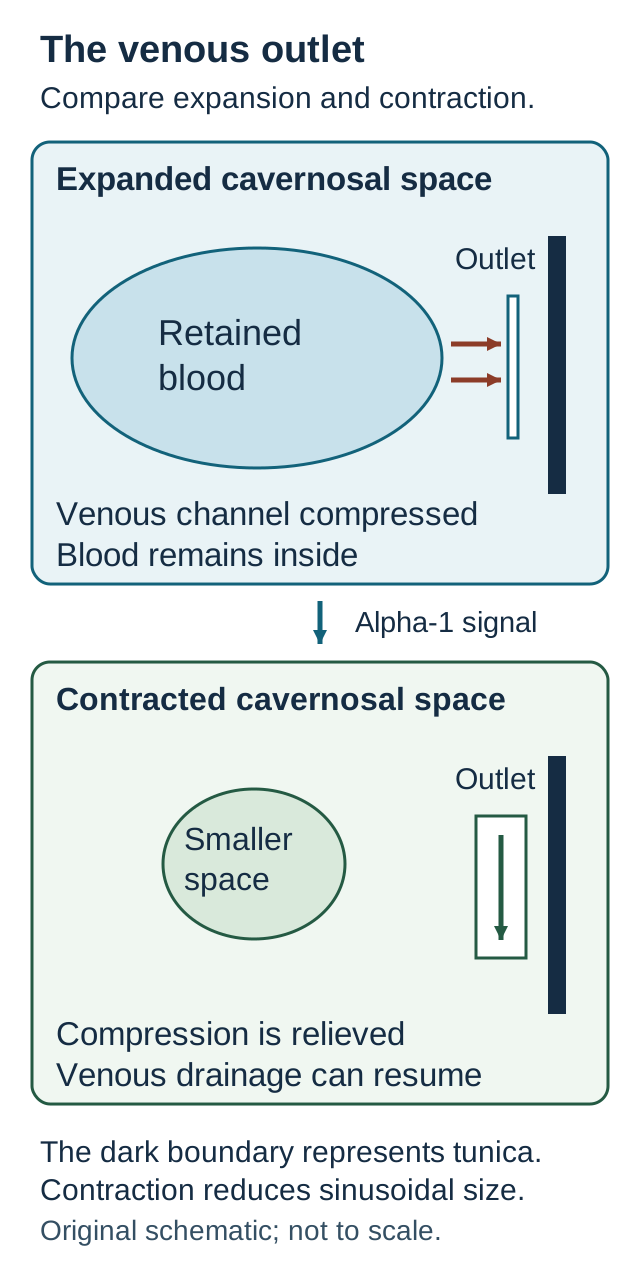
Imagine the cavernous spaces as expandable chambers inside a firm tunica albuginea. During erection, nitric oxide increases cGMP signaling and cavernosal smooth muscle relaxes. The spaces fill and expand. Their expansion compresses subtunical venules against the surrounding tunica, restricting venous drainage. Muscle relaxation and external rigidity therefore occur together. [2][5]
To end the erection, sympathetic norepinephrine activates alpha-1 receptors and promotes cavernosal smooth-muscle contraction. The spaces become smaller, their pressure on the venous outlets is relieved, and drainage returns. Expansion closes the venous outlets; contraction helps reopen them. This is not a claim that contraction squeezes the veins shut to drain blood. [2][3]
Trazodone inhibits serotonin reuptake and antagonizes serotonergic receptors; its sedating pharmacology also includes histamine antagonism. The important additional action here is alpha-1 antagonism by trazodone itself. Experimental tissue work found inhibition of norepinephrine-induced cavernosal contraction. Impaired detumescence can maintain venous trapping, after which arterial perfusion becomes inadequate. [1][3][7]
CYP3A4 forms the active metabolite m-chlorophenylpiperazine, or mCPP. That metabolic fact does not establish that mCPP is a stronger alpha-1 blocker or the sole cause of priapism. Keep metabolism separate from the established parent-drug receptor effect. Serotonergic and other influences may contribute; the useful receptor explanation is not an assertion that every nonadrenergic pathway is irrelevant. [1][3]
Try the outlet model. In the section diagram, trace the narrow drainage channel beside the expanded cavernous space. Predict what happens to the channel if the space shrinks, then explain what trazodone interrupts.
Follow the size of the cavernous space before following the outlet. Expansion compresses the subtunical venous channel; contraction reduces that compression. [2][3]Check the drainage prediction
The venous channel becomes less compressed when the cavernous space shrinks. Trazodone can inhibit the alpha-1-mediated contraction that helps produce this change. Relaxed cavernous muscle does not guarantee that venous drainage is open.
Visible consequence: blood retained in a poorly perfused cavernous compartment loses oxygen and accumulates carbon dioxide and acid. Persistent ischemia injures smooth muscle and can lead to fibrosis and erectile dysfunction. Receptor antagonism begins the problem; prolonged low flow explains the injury. [2][8]
Apply it elsewhere: an alpha-1-blocking antipsychotic can interfere with the same detumescence response without being metabolized to mCPP. Ask which receptor response is impaired, not whether the drugs share an antidepressant label. [4]
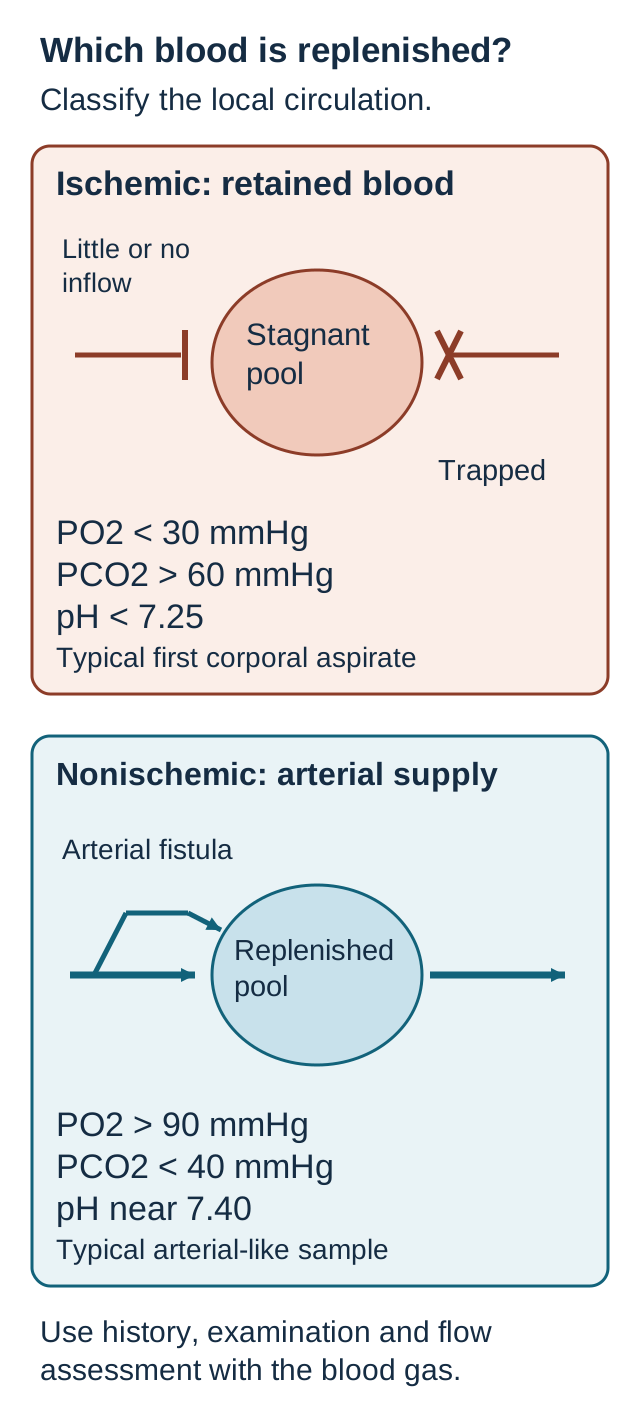
Is the blood trapped or continuously replenished?
Compare two patients with erections lasting 5 hours. One has rigid, tender corpora and a relatively soft glans. His first corporal aspirate has pH 7.08, PO2 22 mmHg and PCO2 76 mmHg. The other has a partly firm, minimally painful erection after a straddle injury, with corporal pH 7.40, PO2 96 mmHg and PCO2 37 mmHg. These samples describe different local circulations, not merely different pain tolerances. [2]
Typical untreated corporal findings, interpreted with history and examination
Finding
Ischemic, low flow
Nonischemic, high flow
FindingPerfusion
Ischemic, low flowLittle or no effective cavernous inflow; retained blood
Nonischemic, high flowContinuing arterial inflow, often through a traumatic fistula
Nonischemic, high flowArterial-like: PO2 above 90 mmHg, PCO2 below 40 mmHg, pH near 7.40
FindingResponse needed
Ischemic, low flowEmergency restoration of drainage and perfusion
Nonischemic, high flowUrologic assessment and a fistula-directed plan
The relatively soft glans reflects different erectile compartments: the paired corpora cavernosa are principally affected, whereas the corpus spongiosum and glans are often less rigid. It is a supportive pattern, not an independent diagnostic test. Early disease or previous treatment can give less typical gases. A systemic arterial sample cannot establish oxygenation inside a stagnant corporal compartment. [2][8]
Sort the samples: without using the trauma history, assign each patient's gas to either stagnant blood or oxygenated arterial supply. Then use the examination and, when needed, penile duplex Doppler to check the assignment. Imaging that is needed for uncertainty should be obtained rapidly; a clear ischemic emergency should not wait for nonessential imaging. [2][8]
The arrows describe effective local perfusion, not a measured Doppler tracing. Gas values are typical first-aspirate patterns, not mandatory criteria that override the examination or early disease. [2][8]Check which sample requires decompression
The first sample is locally hypoxic, hypercarbic and acidotic, supporting ischemic priapism. The second resembles arterial blood and supports high flow. Trauma alone does not overrule an ischemic gas or a concerning examination.
Visible consequence: the first patient's continuing rigidity threatens tissue oxygenation. In the second, an injured arterial branch may feed a fistula into cavernous spaces. Once nonischemic priapism is established, observation or site-directed compression with close follow-up can be appropriate; persistent cases may require selective arterial embolization. High flow is not the same emergency as ischemia, but it is not an invitation to neglect follow-up or erectile-function risk. [2]
Apply it elsewhere: sildenafil exposure or anticoagulant use does not determine the flow subtype. Neither a drug name nor an absence of pain can replace assessment of corporal perfusion. [2][5]
What determines treatment: the clock or the response?
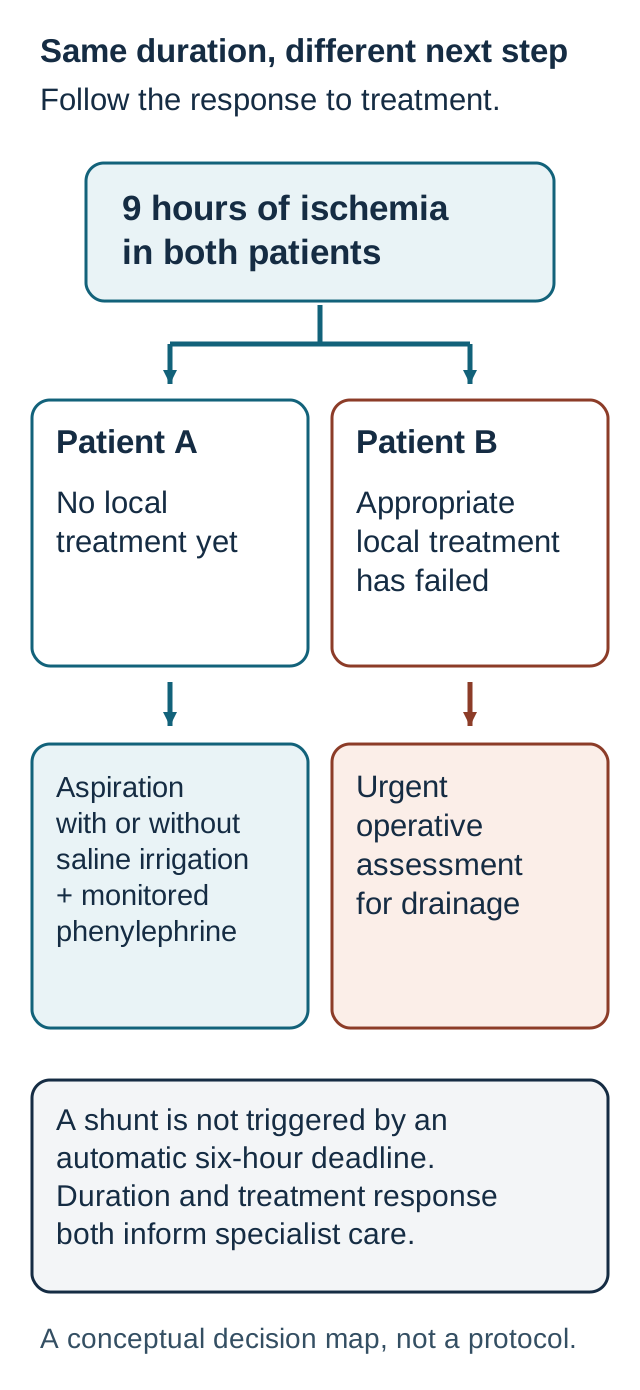
A patient arrives at 7 a.m. with an erection that began at midnight. Treatment decisions use the full 7-hour duration, not time spent in the emergency department. Duration matters because ischemic injury progresses, but there is no automatic rule that a 6-hour erection must receive a shunt or that an erection under 4 hours is safe to observe despite concerning findings. [2][8]
For established acute ischemic priapism, obtain prompt urologic involvement, provide analgesia and local anesthesia as appropriate, and restore drainage with corporal aspiration, with or without saline irrigation, combined with intracavernosal phenylephrine when appropriate. Investigation of a possible cause occurs in parallel. Stopping the suspected drug is important but does not evacuate blood already trapped in the corpora. Ice, exercise, oral terbutaline and nonessential imaging must not postpone definitive treatment of ischemia. [1][2][8]
Work through the response diagram: two patients have ischemic priapism at 9 hours. One has not received treatment; the other remains rigid after appropriate aspiration and repeated monitored phenylephrine. Assign each to an initial-treatment or escalation branch before reading the consequence.
This conceptual decision comparison rejects an automatic six-hour surgical cutoff. Specialist care accounts for the circulation, duration, prior treatment and actual response. It is not a stand-alone procedural protocol. [2][8]Check the two treatment branches
The untreated patient still needs prompt initial therapy. The patient with persistent ischemia after appropriate treatment needs urgent operative assessment, commonly for a distal corporoglanular shunt with or without tunneling. Identical duration does not mean identical next treatment.
Visible consequence: aspiration reduces retained blood and pressure, while successful alpha-1 stimulation restores contractile tone. If this fails, a shunt creates an alternative route for drainage. Distal techniques include Winter, Ebbehoj and T-shunts; the choice depends on anatomy, prior treatment and specialist expertise, not a memorized hourly schedule. [2][8]
After a shunt, edema or partial tumescence can resemble persistent priapism. Reassess the examination and, when persistence is uncertain, corporal gases or Doppler before another invasive procedure. Prolonged untreated ischemia, particularly presentations beyond 48 hours, warrants candid discussion of poor erectile recovery and selected penile-prosthesis options. This does not mean every patient has irreversible injury at 24 hours, or that treatment becomes pointless. Relief of ischemia and pain still matters. [2][8]
Apply it to sickle cell disease: recurrent episodes can progress to a sustained ischemic emergency. Sickling, vascular dysfunction and abnormal erection regulation contribute; this is not simply an alpha-1 drug effect. Arrange hematology support, analgesia and appropriate supportive care while urgent penile treatment proceeds. Exchange transfusion is not routine primary therapy for terminating priapism and must not delay decompression. [2]
How can an alpha-1 agonist restore drainage?
After aspiration, what drug action should assist detumescence? Phenylephrine stimulates alpha-1 receptors on cavernosal smooth muscle, promoting contraction and reducing the expansion that maintains venous compression. It supports restoration of drainage; it does not work by further compressing the venous outlets. Its usefulness in ischemic priapism is not restricted to trazodone exposure. [2][3]
Compare this with phentolamine, an alpha antagonist, and with nitric-oxide/cGMP-promoting erectile therapies. Those actions favor relaxation rather than the desired acute contractile response. Phenylephrine is preferred among adrenergic agents because of alpha-1 selectivity without the additional beta-mediated cardiac stimulation of less selective agents. This preference does not make it free of cardiovascular toxicity. [2][5]
Clinician dosing example, explicitly from the EAU protocol: intracavernosal phenylephrine 200 micrograms every 3 to 5 minutes, with a maximum of 1 milligram within 1 hour. The preparation is diluted and checked before use. Institutions may use a different specialist protocol; do not combine the starting dose from one guideline with a total-dose limit from another. This adult teaching example is not a self-injection prescription or a pediatric regimen. [2]
Monitor blood pressure and pulse during administration and after treatment; use cardiac monitoring appropriate to the patient's risk and local protocol. Hypertension, reflex bradycardia, tachycardia, headache or other cardiovascular symptoms require reassessment rather than automatic redosing. The EAU cautions against sympathomimetics in poorly controlled or malignant hypertension and with monoamine oxidase inhibitors. Urgent drainage and specialist care remain necessary when an injection is unsafe. [2]
Predict the next observation: if phenylephrine contracts viable cavernosal muscle, what happens to sinusoidal size and the venous outlet? If blood pressure rises markedly instead, should a remaining dose allowance decide what happens next?
Check the local and systemic predictions
Smaller cavernous spaces relieve venous compression and favor detumescence. A marked blood-pressure rise requires stopping further automatic dosing and urgent reassessment. A numeric dose limit is a ceiling, not a target.
Visible consequence and transfer: a successful response is sustained reduction in rigidity with relief of ischemia, not simply a completed injection series. Prolonged ischemia and acidosis can impair responsiveness. Lack of a response requires escalation, not a promise that another dose will work within 5 to 10 minutes. The same response-based reasoning applies to non-drug causes of ischemic priapism. [2][8]
Which medication explanation actually fits?
A medication history should include sleep aids, mood treatments, prostate drugs, erectile therapies, supplements and recreational substances. Ask about the time each was taken and about recent dose changes or additions. Trazodone may be described as a sleep medicine rather than an antidepressant. Its use for insomnia does not eliminate its alpha-1 effects. [1][7]
Alpha-1-blocking antipsychotics, including risperidone, quetiapine and chlorpromazine, can produce a similar adverse effect. Olanzapine and other psychotropics also have reported associations. Tamsulosin and other alpha-blockers are relevant even when prescribed for urinary symptoms. However, receptor affinity and spontaneous adverse-event reports do not establish a precise ordering of patient-level incidence or prove equal rates across drugs. There is no defensible four-bar risk score for these classes in the evidence used here. [2][4][6]
Strong CYP3A4 inhibitors can increase exposure to the parent drug trazodone. Do not infer that inhibiting the enzyme necessarily increases formation of mCPP and therefore proves an mCPP-driven event. Review the actual interaction and coordinate medication changes with the treating clinicians. [1]
Sildenafil inhibits PDE5 and slows cGMP breakdown; it is not an alpha-1 antagonist. A PDE5-associated prolonged erection can still become ischemic. With an alpha-blocker, an established interaction concern is additive hypotension. The combination should not be taught as a proven, uniquely highest-risk cause of priapism, nor should dose spacing be offered as a guarantee of safety. [2][5][6]
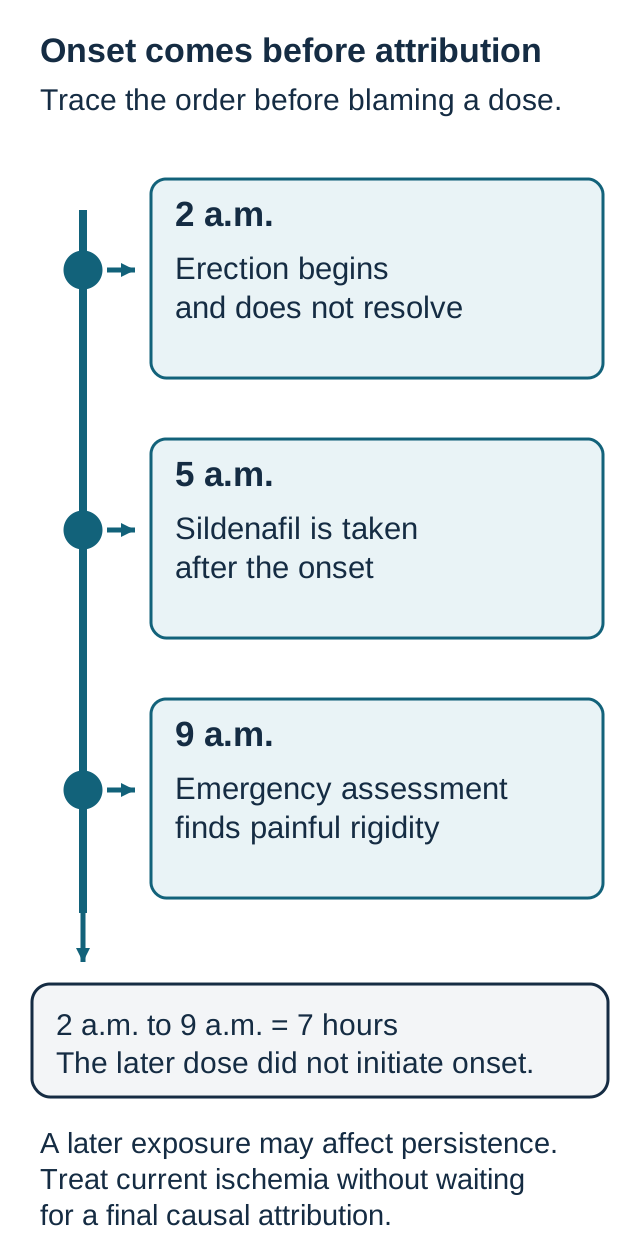
Reconstruct this timeline: an erection starts at 2 a.m.; sildenafil is taken at 5 a.m.; emergency presentation is at 9 a.m. Decide whether sildenafil can explain the onset, then decide whether treatment should wait for a final attribution.
Read onset before exposure. The later dose may affect persistence, but it cannot initiate the earlier onset. Treat the present ischemic state without waiting for definitive causal attribution. [1][2][5][6]Check the timeline interpretation
The 5 a.m. dose cannot initiate an erection already present at 2 a.m., although it might affect its subsequent course. The duration is 7 hours. Assess and treat the current perfusion problem without waiting to prove which exposure contributed.
Visible consequence and transfer: the history can change causal confidence without changing the need to treat ischemia. Anticoagulants are among reported associations, but anticoagulant exposure does not prove a traumatic arterial fistula. Sickle cell disease, leukemia, myeloma and penile structural disease also belong in a targeted evaluation. A plausible medication is not permission to ignore another cause. [1][2]
What should the patient do next time?
Before prescribing trazodone, ask about previous prolonged erections, priapism and relevant hematologic or penile conditions. Give the warning in plain language and ask the patient to explain the action back. A survey of trazodone users found that counseling and reporting of prolonged erections were incomplete; embarrassment and lack of awareness were reported barriers. It does not establish that a fixed percentage of all priapism patients wait more than 12 hours. [1][7]
The action plan: seek emergency care for an erection persisting for 4 hours, even without pain, and seek urgent help sooner for a painful persistent erection. The trazodone label directs immediate discontinuation and emergency attention for a prolonged erection beyond 4 hours. Do not sleep on it, wait for intercourse to resolve it, or attempt an unprescribed rescue medication. [1][2]
Practice the conversation: after successful treatment, a patient asks to restart half the trazodone dose because it helps sleep. Decide what to stop, what to document and which clinicians should help select the next treatment. Do not confuse a flaccid penis today with proof that another exposure is safe.
Check the post-treatment plan
Keep the suspected offending trazodone stopped, document the serious adverse reaction and coordinate an alternative with the prescriber and urology. A lower dose does not establish a safe rechallenge. Arrange follow-up for recurrence and erectile function based on the episode and clinical assessment.
Visible consequence: removing a suspected trigger addresses recurrence risk, while follow-up evaluates effects that may persist after detumescence. SSRIs and bupropion also have reported associations; do not promise that a particular alternative antidepressant is risk-free or assign every patient a mandatory 4-to-6-week fibrosis visit. An episode that already lasted beyond 4 hours still needs prompt assessment even if it resolves before evaluation; a fully flaccid patient does not automatically need aspiration. [1][2]
Apply it to recurrent episodes: stuttering priapism consists of repeated, often self-limited ischemic episodes, but a new episode may not resolve. Specialist prevention is distinct from acute rescue. Selected patients may receive preventive PDE5-inhibitor therapy initiated while flaccid, with limited and evolving evidence; this is not an instruction to take sildenafil during a painful persistent erection. Persistent ischemia always returns the patient to the emergency pathway. [2]
Apply the lesson
Classify the circulation, identify the decisive evidence and choose the action appropriate to the current response. These are original educational questions, not validated predictors of examination performance.
Case 1
Show answer and explanations for case 1
A. Inhibition of PDE5 prolonging local cGMP signaling (Why this does not fit)
Persistent cGMP signaling favors cavernosal relaxation. PDE5 inhibition is sildenafil pharmacology, not the established trazodone action in this case. Identify the exposure before assigning its molecular target.
PDE5 inhibition is sildenafil pharmacology, not the established trazodone action in this case.
B. Antagonism of alpha-1 receptors reducing cavernosal contraction (Best answer)
The low oxygen, high carbon dioxide and acidotic pH indicate stagnant ischemic blood. Parent-drug alpha-1 antagonism inhibits adrenergic cavernosal contraction and can maintain venous trapping. Impaired detumescence can progress to local ischemia.
Reasoning steps for option B
What do the corporal gases indicate?
The low oxygen, high carbon dioxide and acidotic pH indicate stagnant ischemic blood.
Which trazodone action impairs the normal ending of an erection?
Parent-drug alpha-1 antagonism inhibits adrenergic cavernosal contraction and can maintain venous trapping.
C. Activation of nitric oxide synthase increasing cGMP production (Why this does not fit)
Nitric oxide promotes the cGMP-dependent response involved in erection. The supplied exposure is linked to alpha-1 antagonism, not direct activation of nitric oxide synthase. A downstream erectile signal is not automatically the drug target.
Reasoning steps for option C
Why could nitric oxide sustain relaxation?
Nitric oxide promotes the cGMP-dependent response involved in erection.
Is direct synthase activation the identified trazodone target?
The supplied exposure is linked to alpha-1 antagonism, not direct activation of nitric oxide synthase.
D. Inhibition of serotonin uptake increasing central serotonergic tone (Why this does not fit)
Trazodone does inhibit serotonin reuptake. Its alpha-1 antagonism accounts for reduced cavernosal contraction; the drug class alone does not establish a central serotonergic cause. Match the adverse effect to the relevant receptor action.
Reasoning steps for option D
Why might a serotonergic answer attract attention?
Trazodone does inhibit serotonin reuptake.
Which additional action explains impaired peripheral detumescence more directly?
Its alpha-1 antagonism accounts for reduced cavernosal contraction; the drug class alone does not establish a central serotonergic cause.
Takeaway: Trazodone itself can impair alpha-1-mediated detumescence; the ischemic gases describe the consequence. [1][2][3]
A. Greater compression of subtunical veins by expanded spaces (Why this does not fit)
Expanded cavernous spaces compress subtunical venules during erection. They become smaller, so continuing expansion would oppose the observed return of drainage. Separate erectile retention from detumescence.
Reasoning steps for option A
When are these veins compressed?
Expanded cavernous spaces compress subtunical venules during erection.
Do the spaces expand after the described treatment?
They become smaller, so continuing expansion would oppose the observed return of drainage.
B. Greater arterial inflow through a new arteriolacunar fistula (Why this does not fit)
An arteriolacunar fistula can maintain arterial inflow in high-flow priapism. The described change is contraction and falling rigidity, not a new abnormal arterial connection. Do not replace a demonstrated tone response with an unobserved injury.
Reasoning steps for option B
What does a fistula supply?
An arteriolacunar fistula can maintain arterial inflow in high-flow priapism.
Does a new fistula explain the treatment response?
The described change is contraction and falling rigidity, not a new abnormal arterial connection.
C. Greater cGMP persistence within relaxed cavernosal muscle (Why this does not fit)
Persistent cGMP favors smooth-muscle relaxation and sinusoidal expansion. The model shows contraction and smaller spaces, the opposite local response. Predict direction before selecting a signaling explanation.
Reasoning steps for option C
What does persistent cGMP favor?
Persistent cGMP favors smooth-muscle relaxation and sinusoidal expansion.
How does that compare with the model?
The model shows contraction and smaller spaces, the opposite local response.
D. Less compression of subtunical veins by shrinking spaces (Best answer)
Expanded sinusoids compressed venous channels against the tunica. The venous channels are less compressed, allowing drainage and reduced rigidity. Contraction favors drainage by reducing sinusoidal expansion.
Reasoning steps for option D
What was limiting venous outflow during expansion?
Expanded sinusoids compressed venous channels against the tunica.
What changes when those spaces shrink?
The venous channels are less compressed, allowing drainage and reduced rigidity.
Takeaway: Detumescence relieves, rather than increases, the venous compression produced by expanded cavernous spaces. [2][3]
A. Local blood stasis despite preserved systemic oxygenation (Best answer)
The circulating arterial blood is adequately oxygenated. A poorly perfused cavernous compartment can retain blood until oxygen is depleted and carbon dioxide accumulates. Normal systemic saturation does not exclude local ischemia.
Reasoning steps for option A
What does the radial sample establish?
The circulating arterial blood is adequately oxygenated.
Why can the corporal sample differ so much?
A poorly perfused cavernous compartment can retain blood until oxygen is depleted and carbon dioxide accumulates.
B. Systemic hypoventilation with a delayed peripheral response (Why this does not fit)
Systemic hypoventilation raises arterial carbon dioxide. The radial PCO2 is normal while the corporal PCO2 is markedly high, localizing the problem. Use the actual sampling compartment to interpret a gas.
Reasoning steps for option B
What pattern does hypoventilation usually produce?
The radial PCO2 is normal while the corporal PCO2 is markedly high, localizing the problem.
C. Continuous arterial shunting into oxygenated cavernous spaces (Why this does not fit)
High-flow priapism generally has arterial-like corporal gases. It is markedly hypoxic and acidotic instead, supporting retained ischemic blood. An oxygenated radial sample cannot substitute for corporal blood.
Reasoning steps for option C
What gases are expected with sustained arterial supply?
High-flow priapism generally has arterial-like corporal gases.
Does the corporal aspirate resemble the radial sample?
It is markedly hypoxic and acidotic instead, supporting retained ischemic blood.
D. A normal venous sample from an adequately perfused erection (Why this does not fit)
Normal venous blood has lower oxygen and somewhat higher carbon dioxide. The severe acidosis and hypoxia with persistent painful rigidity are not explained by normal venous sampling. Interpret the degree of abnormality together with the examination.
Reasoning steps for option D
Can venous blood have less oxygen than arterial blood?
Normal venous blood has lower oxygen and somewhat higher carbon dioxide.
Are these corporal values ordinary venous values?
The severe acidosis and hypoxia with persistent painful rigidity are not explained by normal venous sampling.
Takeaway: The sampling site matters: corporal ischemia can coexist with normal arterial oxygenation. [2][8]
A. Repeated corporal aspiration with monitored phenylephrine injections (Why this does not fit)
They address retained ischemic blood and impaired detumescence. The arterial-like gases and fistula support high flow, for which repeated drainage does not correct the persistent arterial connection. Match emergency drainage to ischemia, not duration alone.
Reasoning steps for option A
Which physiology makes aspiration and phenylephrine useful?
They address retained ischemic blood and impaired detumescence.
Is ischemic blood demonstrated here?
The arterial-like gases and fistula support high flow, for which repeated drainage does not correct the persistent arterial connection.
B. Immediate distal corporoglanular shunting with possible tunneling (Why this does not fit)
Persistent ischemia despite appropriate initial treatment may require an alternative drainage route. He has oxygenated high flow and no failed ischemic treatment, so a shunt is not the initial approach. A fistula and an ischemic drainage failure require different interventions.
Reasoning steps for option B
When does a distal shunt become a consideration?
Persistent ischemia despite appropriate initial treatment may require an alternative drainage route.
Does this patient have that problem?
He has oxygenated high flow and no failed ischemic treatment, so a shunt is not the initial approach.
C. Urologic conservative care with scheduled clinical and Doppler reassessment (Best answer)
They support nonischemic priapism from a traumatic arterial fistula. Supervised observation or site-directed compression with follow-up fits his stable state and preference; persistence may warrant embolization. Nonischemic does not mean no follow-up.
Reasoning steps for option C
What circulation do the gas and ultrasound establish?
They support nonischemic priapism from a traumatic arterial fistula.
How does that affect urgency and initial choice?
Supervised observation or site-directed compression with follow-up fits his stable state and preference; persistence may warrant embolization.
D. Immediate selective arterial embolization without a conservative trial (Why this does not fit)
It can close a fistula in persistent or otherwise selected nonischemic priapism. He has preserved oxygenation and an acceptable initial conservative option that matches his preference. Reserve a procedural choice for the clinical course and shared decision, not a four-hour rule alone.
Reasoning steps for option D
What can embolization treat?
It can close a fistula in persistent or otherwise selected nonischemic priapism.
Why is it not required as the first step in this patient?
He has preserved oxygenation and an acceptable initial conservative option that matches his preference.
Takeaway: A confirmed high-flow fistula permits a different initial plan, but still needs follow-up and a discussion of persistence. [2]
A. Site-directed perineal compression followed by outpatient reassessment (Why this does not fit)
Perineal injury can produce a high-flow fistula that is sometimes managed with site-directed compression. The severe corporal hypoxia, acidosis and minimal inflow establish an ischemic problem. Classify the current circulation rather than assuming the usual trauma pattern.
Reasoning steps for option A
Why might the injury suggest compression?
Perineal injury can produce a high-flow fistula that is sometimes managed with site-directed compression.
What contradicts that physiology here?
The severe corporal hypoxia, acidosis and minimal inflow establish an ischemic problem.
B. Corporal aspiration and monitored intracavernosal phenylephrine treatment (Best answer)
Rigid painful corpora with hypoxic acidotic blood indicate ischemia. Aspiration with appropriate irrigation and monitored phenylephrine is the initial local treatment, regardless of the traumatic context. A trauma history does not cancel an ischemic emergency.
Reasoning steps for option B
Which findings identify the immediate threat?
Rigid painful corpora with hypoxic acidotic blood indicate ischemia.
What restores drainage in this setting?
Aspiration with appropriate irrigation and monitored phenylephrine is the initial local treatment, regardless of the traumatic context.
C. Selective arterial embolization of a presumed traumatic fistula (Why this does not fit)
A demonstrated arterial fistula supplying nonischemic priapism could support embolization. Minimal inflow and ischemic gases are the opposite pattern, and no fistula has been demonstrated. Do not treat an assumed vessel lesion instead of measured perfusion failure.
Reasoning steps for option C
What would support embolization?
A demonstrated arterial fistula supplying nonischemic priapism could support embolization.
Has that circulation been shown?
Minimal inflow and ischemic gases are the opposite pattern, and no fistula has been demonstrated.
D. Penile magnetic resonance imaging before any local intervention (Why this does not fit)
It may help assess viability in selected prolonged or refractory cases. The current ischemia is already established and needs prompt decompression; an additional scan would postpone that care. Use imaging to answer a necessary question, not to delay a clear emergency.
Reasoning steps for option D
When can magnetic resonance imaging contribute?
It may help assess viability in selected prolonged or refractory cases.
Why should it not precede treatment here?
The current ischemia is already established and needs prompt decompression; an additional scan would postpone that care.
Takeaway: Trauma can suggest a fistula, but the examination and corporal blood determine whether ischemia needs treatment. [2][8]
A. Urgent urologic assessment and treatment for suspected evolving ischemia (Best answer)
No; early values can be less typical, while the examination and negligible inflow strongly support evolving ischemia. It does not justify withholding urgent assessment or treatment when the clinical circulation is already concerning. The four-hour warning is not a requirement to wait.
Reasoning steps for option A
Do all the gas values have to cross textbook thresholds?
No; early values can be less typical, while the examination and negligible inflow strongly support evolving ischemia.
What does the three-hour history change?
It does not justify withholding urgent assessment or treatment when the clinical circulation is already concerning.
B. Repeat corporal testing once the erection reaches four hours (Why this does not fit)
It is an important emergency warning for a persistent erection. Increasing pain, full rigidity and negligible inflow already indicate a threatened compartment. A time definition does not supersede evidence of ischemia.
Reasoning steps for option B
Why might the four-hour threshold seem decisive?
It is an important emergency warning for a persistent erection.
What makes waiting inappropriate here?
Increasing pain, full rigidity and negligible inflow already indicate a threatened compartment.
C. Treat lithium-related volume depletion before local intervention (Why this does not fit)
Lithium can be associated with renal concentrating problems and dehydration. Normal assessment and strong local ischemic findings give no basis to postpone local treatment for this explanation. Investigate contributors in parallel with emergency care.
Reasoning steps for option C
Why might lithium prompt a volume assessment?
Lithium can be associated with renal concentrating problems and dehydration.
Is volume depletion demonstrated or sufficient to explain away the penile findings?
Normal assessment and strong local ischemic findings give no basis to postpone local treatment for this explanation.
D. Use a conservative high-flow plan because PO2 exceeds 30 mmHg (Why this does not fit)
It resembles arterial blood rather than showing substantial local acidosis. No; an isolated near-threshold oxygen value does not override the acidotic sample and absent-flow pattern. Interpret the whole pattern rather than a single cutoff.
Reasoning steps for option D
What usually characterizes high-flow blood?
It resembles arterial blood rather than showing substantial local acidosis.
Do PO2 32 and negligible inflow fit an arterial fistula?
No; an isolated near-threshold oxygen value does not override the acidotic sample and absent-flow pattern.
Takeaway: Early suspected ischemia requires action; textbook gas thresholds are typical findings, not a checklist that must all be positive. [2][8]
A. Initial aspiration and phenylephrine for both patients (Why this does not fit)
He has confirmed ischemia and has not yet received treatment directed at drainage and tone. His appropriate initial therapy has already failed, making urgent operative assessment necessary rather than restarting an unbounded initial-treatment cycle. Prior response changes the next step.
Reasoning steps for option A
Why is initial local therapy reasonable for Patient A?
He has confirmed ischemia and has not yet received treatment directed at drainage and tone.
Why is the same label insufficient for Patient B?
His appropriate initial therapy has already failed, making urgent operative assessment necessary rather than restarting an unbounded initial-treatment cycle.
B. Immediate distal corporoglanular shunt for both patients (Why this does not fit)
He has persistent ischemia despite appropriate local treatment. Patient A still has an indicated trial of prompt initial drainage and adrenergic treatment unless other circumstances alter the specialist plan. Do not substitute an hourly cutoff for treatment response.
Reasoning steps for option B
Why is a shunt relevant to Patient B?
He has persistent ischemia despite appropriate local treatment.
Why does nine hours alone not mandate a shunt for Patient A?
Patient A still has an indicated trial of prompt initial drainage and adrenergic treatment unless other circumstances alter the specialist plan.
C. Initial shunt for Patient A; conservative observation for Patient B (Why this does not fit)
Both duration and failure of treatment heighten concern in ischemic priapism. It bypasses initial treatment in A and neglects ongoing ischemia in B. Persistent ischemia after treatment is escalation evidence, not reassurance.
Reasoning steps for option C
Can duration and prior treatment affect urgency?
Both duration and failure of treatment heighten concern in ischemic priapism.
Does this pairing address either patient appropriately?
It bypasses initial treatment in A and neglects ongoing ischemia in B.
D. Initial local therapy for Patient A; operative assessment for Patient B (Best answer)
Patient A is untreated, whereas Patient B has already failed appropriate bedside care. A needs initial aspiration and monitored phenylephrine; B needs urgent assessment for a shunt or other specialist decompression. Treat the current response state, not just elapsed hours.
Reasoning steps for option D
What distinguishes the two otherwise similar emergencies?
Patient A is untreated, whereas Patient B has already failed appropriate bedside care.
How should that alter their next intervention?
A needs initial aspiration and monitored phenylephrine; B needs urgent assessment for a shunt or other specialist decompression.
Takeaway: There is no automatic six-hour surgical cutoff: initial treatment and treatment failure are different clinical states. [2][8]
A. Proceed directly to a proximal shunt based on residual firmness (Why this does not fit)
Persistent ischemia after the first intervention could require further specialist treatment. No; edema and post-treatment tumescence can resemble it, so another procedure should not be based on firmness alone. Confirm the current circulation before escalating an ambiguous examination.
Reasoning steps for option A
What would justify further operative drainage?
Persistent ischemia after the first intervention could require further specialist treatment.
Does postoperative partial firmness establish persistent ischemia?
No; edema and post-treatment tumescence can resemble it, so another procedure should not be based on firmness alone.
B. Discharge after analgesia because pain improvement proves reperfusion (Why this does not fit)
It may accompany successful relief of ischemia. No; the team still has an unresolved physical finding, and pain alone cannot establish treatment success. Symptom improvement supports but does not replace reassessment.
Reasoning steps for option B
Why is improving pain encouraging?
It may accompany successful relief of ischemia.
Does it prove adequate corporal perfusion?
No; the team still has an unresolved physical finding, and pain alone cannot establish treatment success.
C. Assess corporal gases or penile Doppler to establish current perfusion (Best answer)
Edema and residual tumescence after a shunt can mimic persistent priapism. Corporal blood gas or Doppler can determine whether ischemia persists and guide further care. Treat demonstrated persistent ischemia, not postoperative appearance alone.
Reasoning steps for option C
Why is the current examination hard to interpret?
Edema and residual tumescence after a shunt can mimic persistent priapism.
What information should precede another invasive procedure?
Corporal blood gas or Doppler can determine whether ischemia persists and guide further care.
D. Give additional phenylephrine until every area of swelling disappears (Why this does not fit)
It promotes detumescence through cavernosal contraction in ischemic priapism. No; edema is not the same as persistent cavernosal ischemia, and automatic extra dosing adds risk. Assess perfusion and rigidity rather than treating edema with repeated agonist doses.
Reasoning steps for option D
What is phenylephrine intended to restore?
It promotes detumescence through cavernosal contraction in ischemic priapism.
Is disappearance of all postoperative swelling its treatment endpoint?
No; edema is not the same as persistent cavernosal ischemia, and automatic extra dosing adds risk.
Takeaway: Post-shunt edema or tumescence requires interpretation; uncertain persistent ischemia should be assessed before repeat intervention. [2][8]
A. Continue acute care and discuss options for poor erectile recovery (Best answer)
It greatly increases the likelihood of irreversible cavernosal injury and later erectile dysfunction. No; ongoing ischemia and pain still require treatment, with specialist discussion of decompression and selected prosthesis options. Separate ending the acute episode from restoring future erectile function.
Reasoning steps for option A
How does prolonged untreated ischemia affect prognosis?
It greatly increases the likelihood of irreversible cavernosal injury and later erectile dysfunction.
Does a poor functional prognosis eliminate the need for care?
No; ongoing ischemia and pain still require treatment, with specialist discussion of decompression and selected prosthesis options.
B. Continue aspiration alone and expect recovery once drainage returns (Why this does not fit)
It can reduce retained blood and pressure. Not reliably; the prolonged ischemic duration makes a guarantee of normal future function inappropriate. Anatomical drainage and tissue recovery are different outcomes.
Reasoning steps for option B
What can aspiration accomplish acutely?
It can reduce retained blood and pressure.
Can it undo established smooth-muscle injury?
Not reliably; the prolonged ischemic duration makes a guarantee of normal future function inappropriate.
C. Switch to analgesia alone because further penile treatment offers no benefit (Why this does not fit)
He recognizes that long ischemic duration can cause permanent injury. No; symptom relief and safe management remain important even when erectile recovery is poor. Poor prognosis is not a reason to abandon acute care.
Reasoning steps for option C
Why might the patient believe treatment has no value?
He recognizes that long ischemic duration can cause permanent injury.
Does permanent injury mean ongoing ischemia and pain need no treatment?
No; symptom relief and safe management remain important even when erectile recovery is poor.
D. Limit later follow-up to patients with persistent postoperative rigidity (Why this does not fit)
It would show resolution of the sustained erection at that time. No; late detumescence does not rule out fibrosis or erectile dysfunction, so follow-up remains necessary. A successful immediate endpoint does not erase prior ischemic exposure.
Reasoning steps for option D
What would successful detumescence establish?
It would show resolution of the sustained erection at that time.
Would that prove that the tissue remained uninjured?
No; late detumescence does not rule out fibrosis or erectile dysfunction, so follow-up remains necessary.
Takeaway: Prolonged ischemia worsens recovery prospects but does not make ongoing treatment or follow-up unnecessary. [2][8]
A. Continue the same dose until the hourly maximum has been administered (Why this does not fit)
It sets an upper allowance for dosing under appropriate clinical conditions. The marked blood-pressure rise, bradycardia and headache require immediate reassessment, not automatic completion of that allowance. A dose ceiling is not a treatment target.
Reasoning steps for option A
What does a protocol maximum describe?
It sets an upper allowance for dosing under appropriate clinical conditions.
Do these conditions remain appropriate?
The marked blood-pressure rise, bradycardia and headache require immediate reassessment, not automatic completion of that allowance.
B. Stop further injections and urgently assess the cardiovascular reaction (Best answer)
Systemic absorption can cause hypertension with reflex bradycardia and significant symptoms. Stop further automatic dosing, assess and manage the reaction, and coordinate an alternative urgent urologic plan. Treat toxicity while continuing specialist management of the ischemia.
Reasoning steps for option B
How can a local alpha-1 agonist produce these findings?
Systemic absorption can cause hypertension with reflex bradycardia and significant symptoms.
What takes priority before another dose?
Stop further automatic dosing, assess and manage the reaction, and coordinate an alternative urgent urologic plan.
C. Substitute intracavernosal epinephrine to avoid the alpha-mediated reaction (Why this does not fit)
It stimulates alpha and beta receptors and can add cardiac effects. No; it does not eliminate alpha-mediated hypertension and is not an appropriate response to the current reaction. A less selective agonist is not a safer automatic substitute.
Reasoning steps for option C
Does epinephrine avoid adrenergic cardiovascular effects?
It stimulates alpha and beta receptors and can add cardiac effects.
Would changing to epinephrine solve this safety problem?
No; it does not eliminate alpha-mediated hypertension and is not an appropriate response to the current reaction.
D. Shorten the redosing interval because local rigidity has not resolved (Why this does not fit)
It indicates that the acute penile problem still needs attention. No; the reaction requires stopping and reassessing this drug approach while urology addresses persistent ischemia. A local nonresponse does not overrule systemic toxicity.
Reasoning steps for option D
Why might persistent rigidity prompt another treatment step?
It indicates that the acute penile problem still needs attention.
Does it justify more frequent phenylephrine after these systemic changes?
No; the reaction requires stopping and reassessing this drug approach while urology addresses persistent ischemia.
Takeaway: Cardiovascular changes override a remaining dose allowance; urgent care must address both toxicity and persistent ischemia. [2]
A. 0.2 mL; a cumulative dose of 0.1 milligram (Why this does not fit)
At 100 micrograms/mL, 0.2 mL contains 20 micrograms rather than 200. No; five doses of 200 micrograms total 1,000 micrograms, or 1 milligram. Check concentration and cumulative units independently.
Reasoning steps for option A
What amount is present in 0.2 mL of this preparation?
At 100 micrograms/mL, 0.2 mL contains 20 micrograms rather than 200.
Does 0.1 milligram describe five ordered doses?
No; five doses of 200 micrograms total 1,000 micrograms, or 1 milligram.
B. 0.2 mL; a cumulative dose of 1 milligram (Why this does not fit)
Five ordered doses would total 1 milligram. No; it delivers only 20 micrograms at the supplied concentration. A correct total does not validate an incorrect syringe volume.
Reasoning steps for option B
Which part of this pairing is correctly calculated?
Five ordered doses would total 1 milligram.
Would 0.2 mL deliver the ordered fifth dose?
No; it delivers only 20 micrograms at the supplied concentration.
C. 2 mL; a cumulative dose of 1 milligram (Best answer)
Dividing the dose by concentration gives 2 mL. Five times 200 is 1,000 micrograms, equal to 1 milligram and the EAU hourly maximum in this example. Verify both dose volume and cumulative exposure before administration.
Reasoning steps for option C
What volume contains 200 micrograms at 100 micrograms/mL?
Dividing the dose by concentration gives 2 mL.
What is the total after five such doses?
Five times 200 is 1,000 micrograms, equal to 1 milligram and the EAU hourly maximum in this example.
D. 2 mL; a cumulative dose of 0.1 milligram (Why this does not fit)
Yes; 2 mL at 100 micrograms/mL contains 200 micrograms. The cumulative 1,000 micrograms equals 1 milligram, not 0.1 milligram. Avoid a tenfold error when converting the running total.
Reasoning steps for option D
Does 2 mL deliver the ordered dose?
Yes; 2 mL at 100 micrograms/mL contains 200 micrograms.
Where is the remaining error?
The cumulative 1,000 micrograms equals 1 milligram, not 0.1 milligram.
Takeaway: The example yields 2 mL and 1 milligram total; the ceiling does not authorize redosing without clinical reassessment. [2]
A. Both episodes required reversal of circulating mCPP accumulation (Why this does not fit)
It is an active metabolite formed from trazodone. No; the treatment can act on cavernosal tone without any trazodone or mCPP exposure. A response to treatment does not identify a unique offending drug.
Reasoning steps for option A
Why might mCPP be considered in the first patient?
It is an active metabolite formed from trazodone.
Does response to phenylephrine establish its presence in the second patient?
No; the treatment can act on cavernosal tone without any trazodone or mCPP exposure.
B. Both episodes ended through phenylephrine-induced dissolution of sickled cells (Why this does not fit)
Sickling and vascular dysregulation can contribute to impaired corporal circulation. No; it is an alpha-1 agonist acting on smooth muscle, not a treatment that dissolves cells. Separate the underlying disease from the local contractile target.
Reasoning steps for option B
What contributes to priapism in sickle cell disease?
Sickling and vascular dysregulation can contribute to impaired corporal circulation.
Does phenylephrine directly dissolve sickled erythrocytes?
No; it is an alpha-1 agonist acting on smooth muscle, not a treatment that dissolves cells.
C. Both episodes ended through direct beta-2-mediated cavernosal relaxation (Why this does not fit)
It tends to maintain sinusoidal expansion and venous compression. It selectively stimulates alpha-1 receptors and promotes contraction, not beta-2-mediated relaxation. Use the direction of tone change to evaluate the explanation.
Reasoning steps for option C
What would sustained relaxation tend to preserve?
It tends to maintain sinusoidal expansion and venous compression.
What receptor effect does phenylephrine supply instead?
It selectively stimulates alpha-1 receptors and promotes contraction, not beta-2-mediated relaxation.
D. Both episodes benefited from restoration of cavernosal contractile tone (Best answer)
Both have ischemic blood retained within a persistently erect cavernous compartment. Alpha-1 stimulation promotes cavernosal contraction and drainage regardless of whether a drug initiated the episode. Phenylephrine response is not proof of trazodone exposure.
Reasoning steps for option D
What physiologic endpoint do the two causes share?
Both have ischemic blood retained within a persistently erect cavernous compartment.
How can phenylephrine help despite the different causes?
Alpha-1 stimulation promotes cavernosal contraction and drainage regardless of whether a drug initiated the episode.
Takeaway: A shared treatment target does not prove a shared initiating cause; phenylephrine is not a trazodone-specific antidote. [1][2]
A. Increased venous pressure from persistent cavernosal outflow obstruction (Why this does not fit)
It can sustain a rigid erection and lead to local ischemia. His erection resolved normally; the measured abnormality is a systemic postural blood-pressure fall. Use the actual adverse effect rather than assuming every interaction causes priapism.
Reasoning steps for option A
What would persistent cavernosal outflow obstruction usually produce?
It can sustain a rigid erection and lead to local ischemia.
Is that the current observed problem?
His erection resolved normally; the measured abnormality is a systemic postural blood-pressure fall.
B. Additive systemic vasodilation from alpha blockade and PDE5 inhibition (Best answer)
Tamsulosin blocks alpha receptors and sildenafil potentiates cGMP signaling; both can lower blood pressure. Their additive effects can produce symptomatic hypotension, matching the postural drop. Hypotension is an established combination warning, not evidence of a proven priapism risk hierarchy.
Reasoning steps for option B
How do the two drugs affect smooth muscle?
Tamsulosin blocks alpha receptors and sildenafil potentiates cGMP signaling; both can lower blood pressure.
How does that explain the clinical findings?
Their additive effects can produce symptomatic hypotension, matching the postural drop.
C. Increased arterial resistance from combined alpha-1 receptor stimulation (Why this does not fit)
It tends to increase vascular smooth-muscle contraction and resistance. Tamsulosin is an antagonist and the observed pressure falls rather than rises. Match both the receptor direction and the physiologic result.
Reasoning steps for option C
What would systemic alpha-1 stimulation generally do?
It tends to increase vascular smooth-muscle contraction and resistance.
Do these drugs and this blood pressure fit that effect?
Tamsulosin is an antagonist and the observed pressure falls rather than rises.
D. Reduced vascular cGMP signaling from direct PDE5 enzyme activation (Why this does not fit)
It degrades cGMP and limits its signaling. No; inhibition preserves cGMP and favors relaxation, explaining the hypotensive direction with an alpha-blocker. Do not reverse the direction of an enzyme inhibitor.
Reasoning steps for option D
What does PDE5 normally do to cGMP?
It degrades cGMP and limits its signaling.
Does sildenafil activate PDE5?
No; inhibition preserves cGMP and favors relaxation, explaining the hypotensive direction with an alpha-blocker.
Takeaway: Sildenafil and alpha-blockers have an established additive-hypotension warning; this does not establish a numerical priapism risk ranking. [5][6]
A. Onset predates sildenafil; the present ischemia still requires treatment (Best answer)
No; the chronology excludes that dose as the initiating exposure, although it could affect persistence. Seven hours of rigidity with ischemic corporal blood requires urgent local treatment and medication review. Uncertain attribution must not delay treatment of established ischemia.
Reasoning steps for option A
Can the 5 a.m. dose initiate an event that began at 2 a.m.?
No; the chronology excludes that dose as the initiating exposure, although it could affect persistence.
What do the current findings require despite causal uncertainty?
Seven hours of rigidity with ischemic corporal blood requires urgent local treatment and medication review.
B. Sildenafil initiated the episode; observe while the dose is eliminated (Why this does not fit)
PDE5 inhibitors carry a prolonged-erection warning and may influence persistence. The erection preceded the dose, and an ischemic compartment cannot safely be observed merely while the drug clears. Check chronology and current physiology separately.
Reasoning steps for option B
Why does sildenafil deserve review?
PDE5 inhibitors carry a prolonged-erection warning and may influence persistence.
Why is this onset and management claim unsound?
The erection preceded the dose, and an ischemic compartment cannot safely be observed merely while the drug clears.
C. Tamsulosin proves a high-flow episode; arrange elective fistula imaging (Why this does not fit)
It is an alpha antagonist associated with rare priapism. No; the current gas is ischemic and there is no demonstrated fistula, so elective high-flow care is inappropriate. A medication name does not define the perfusion subtype.
Reasoning steps for option C
Why is tamsulosin relevant?
It is an alpha antagonist associated with rare priapism.
Does its presence imply an arterial fistula?
No; the current gas is ischemic and there is no demonstrated fistula, so elective high-flow care is inappropriate.
D. Trazodone confirms the sole cause; defer care pending metabolite testing (Why this does not fit)
Its alpha-1 antagonism can impair detumescence and it preceded the event. No; other contributors remain possible and urgent ischemic treatment does not depend on a metabolite assay. A plausible cause is not a prerequisite laboratory diagnosis.
Reasoning steps for option D
Why is trazodone a plausible contributor?
Its alpha-1 antagonism can impair detumescence and it preceded the event.
Does that establish exclusive causality or justify metabolite testing first?
No; other contributors remain possible and urgent ischemic treatment does not depend on a metabolite assay.
Takeaway: A dose taken after onset cannot explain the onset; causal uncertainty does not alter the need to treat ischemia. [1][2][5][6]
A. Accelerated CYP3A4 conversion producing an increased mCPP formation rate (Why this does not fit)
CYP3A4 contributes to formation of this active trazodone metabolite. It inhibits CYP3A4 rather than accelerating the conversion; the label-supported concern is increased parent-drug exposure. Do not infer greater metabolite production from enzyme inhibition.
Reasoning steps for option A
Which enzyme participates in mCPP formation?
CYP3A4 contributes to formation of this active trazodone metabolite.
What does itraconazole do to that pathway?
It inhibits CYP3A4 rather than accelerating the conversion; the label-supported concern is increased parent-drug exposure.
B. Accelerated renal elimination lowering exposure to circulating trazodone (Why this does not fit)
Yes; greater elimination would generally reduce drug exposure. No; itraconazole inhibits an important metabolic route and can increase trazodone exposure. Predict the direction of the pharmacokinetic interaction.
Reasoning steps for option B
Could a change in elimination alter exposure?
Yes; greater elimination would generally reduce drug exposure.
Does that match the known interaction and new adverse effects?
No; itraconazole inhibits an important metabolic route and can increase trazodone exposure.
C. Reduced CYP3A4 metabolism increasing exposure to parent trazodone (Best answer)
It is a strong CYP3A4 inhibitor. Exposure to the parent drug can increase, adding concern for its adverse effects without proving mCPP as the cause. An unchanged prescribed dose does not guarantee unchanged exposure.
Reasoning steps for option C
What relevant enzyme effect does itraconazole have?
It is a strong CYP3A4 inhibitor.
What happens to trazodone exposure when this route is inhibited?
Exposure to the parent drug can increase, adding concern for its adverse effects without proving mCPP as the cause.
D. Induced CYP3A4 metabolism accelerating clearance of parent trazodone (Why this does not fit)
It can increase metabolic clearance and reduce trazodone exposure. No; it is an inhibitor, so the proposed direction is reversed. Separate enzyme inhibition from induction before attributing adverse effects.
Reasoning steps for option D
What would CYP3A4 induction tend to do?
It can increase metabolic clearance and reduce trazodone exposure.
Is itraconazole an inducer in this interaction?
No; it is an inhibitor, so the proposed direction is reversed.
Takeaway: Strong CYP3A4 inhibition can increase parent-trazodone exposure; it does not prove increased mCPP formation. [1]
A. Candidate A, with continued counseling about prolonged erections (Why this does not fit)
The lower Ki of Candidate A indicates stronger affinity. No; stronger alpha-1 interaction is less desirable when other treatment factors are comparable and this adverse effect is the concern. Interpret the direction of binding affinity before selecting a candidate.
Reasoning steps for option A
Which candidate has the stronger alpha-1 binding affinity?
The lower Ki of Candidate A indicates stronger affinity.
Does that best address the proposed adverse-effect pathway?
No; stronger alpha-1 interaction is less desirable when other treatment factors are comparable and this adverse effect is the concern.
B. Candidate A, without a specific warning about recurrent priapism (Why this does not fit)
No; it indicates stronger binding affinity. Neither would; the prior episode strengthens the need for a clear recurrence warning. A prior serious reaction and receptor profile should both inform prescribing.
Reasoning steps for option B
Does a low Ki indicate weak receptor binding?
No; it indicates stronger binding affinity.
Would either the affinity or prior history justify omitting counseling?
Neither would; the prior episode strengthens the need for a clear recurrence warning.
C. Candidate B, without a specific warning about recurrent priapism (Why this does not fit)
Its higher Ki indicates lower alpha-1 affinity. No; receptor affinity is not a zero-risk guarantee, particularly in a patient with a previous episode. Risk reduction does not eliminate the need for counseling.
Reasoning steps for option C
Why is Candidate B more favorable for this receptor concern?
Its higher Ki indicates lower alpha-1 affinity.
Does lower affinity demonstrate absence of clinical risk?
No; receptor affinity is not a zero-risk guarantee, particularly in a patient with a previous episode.
D. Candidate B, with continued counseling about prolonged erections (Best answer)
Candidate B has the higher Ki and therefore the lower binding affinity. Clinical risk is not determined by affinity alone, so the prior history still requires explicit counseling and monitoring. Use receptor data to inform, not replace, individualized safety planning.
Reasoning steps for option D
Which agent has lower alpha-1 affinity?
Candidate B has the higher Ki and therefore the lower binding affinity.
What limitation remains when choosing it?
Clinical risk is not determined by affinity alone, so the prior history still requires explicit counseling and monitoring.
Takeaway: A higher Ki indicates lower affinity; a lower-alpha-1-affinity option is not a guarantee against recurrence. [4]
A. Begin exchange transfusion and reassess the erection before local treatment (Why this does not fit)
It can address selected serious systemic complications and may be needed in specific circumstances. No; it is not routine first-line treatment for ending priapism and would delay treatment of established local ischemia. Treat the ischemic compartment while systemic care is coordinated.
Reasoning steps for option A
Why might exchange transfusion be considered in sickle cell disease?
It can address selected serious systemic complications and may be needed in specific circumstances.
Is it the primary treatment that should precede penile care here?
No; it is not routine first-line treatment for ending priapism and would delay treatment of established local ischemia.
B. Begin aspiration and monitored phenylephrine while providing supportive care (Best answer)
It is sustained, painful and accompanied by markedly ischemic corporal blood. Coordinate appropriate support with hematology, but proceed with urgent local ischemic-priapism treatment. A disease-specific cause does not postpone decompression.
Reasoning steps for option B
What distinguishes this event from the prior short episodes?
It is sustained, painful and accompanied by markedly ischemic corporal blood.
How should the underlying hematologic disease affect immediate care?
Coordinate appropriate support with hematology, but proceed with urgent local ischemic-priapism treatment.
C. Increase preventive hydroxyurea and observe for spontaneous detumescence (Why this does not fit)
It may be part of the patient's disease and recurrence management. No; a preventive regimen does not promptly restore drainage from the current trapped compartment. Distinguish future prevention from acute rescue.
Reasoning steps for option C
What is the role of longer-term sickle cell treatment?
It may be part of the patient's disease and recurrence management.
Can that replace emergency care for the current eight-hour ischemia?
No; a preventive regimen does not promptly restore drainage from the current trapped compartment.
D. Start a preventive PDE5-inhibitor regimen during the ongoing erection (Why this does not fit)
Specialists sometimes use them preventively in selected patients, initiated while flaccid. No; he has a sustained ischemic emergency requiring local treatment, not initiation of preventive sildenafil. The same drug class can have different roles depending on timing.
Reasoning steps for option D
Why might PDE5 inhibitors appear in recurrent-priapism care?
Specialists sometimes use them preventively in selected patients, initiated while flaccid.
Is this patient in that preventive starting state?
No; he has a sustained ischemic emergency requiring local treatment, not initiation of preventive sildenafil.
Takeaway: Sickle cell disease requires parallel hematologic support, not a delay in treatment of sustained ischemic priapism. [2]
A. Penile arteriography to identify a fistula presumed from warfarin exposure (Why this does not fit)
Yes; they are among reported associations and affect procedural risk assessment. No; the corporal blood is ischemic, while marked leukocytosis with blasts requires hematologic evaluation. Anticoagulation does not define the flow subtype.
Reasoning steps for option A
Can anticoagulants appear in a priapism medication history?
Yes; they are among reported associations and affect procedural risk assessment.
Do they establish high-flow physiology or explain this blood count?
No; the corporal blood is ischemic, while marked leukocytosis with blasts requires hematologic evaluation.
B. A plasma mCPP assay to establish trazodone as the exclusive cause (Why this does not fit)
It is a plausible contributor through its adverse-effect profile. No; the marked leukocytosis and blasts suggest an important additional hematologic process, and a metabolite assay will not resolve it. A plausible medication trigger should not close the differential.
Reasoning steps for option B
Why is the recent trazodone prescription relevant?
It is a plausible contributor through its adverse-effect profile.
Can that justify ignoring the abnormal blood count?
No; the marked leukocytosis and blasts suggest an important additional hematologic process, and a metabolite assay will not resolve it.
C. Urgent hematologic evaluation for a leukemic contribution to priapism (Best answer)
It raises concern for leukemia or another serious marrow process rather than an isolated drug adverse effect. Obtain urgent hematologic assessment while local treatment of the ischemic compartment proceeds. Investigate a major competing cause without postponing emergency care.
Reasoning steps for option C
What does the combination of leukocytosis, blasts and cytopenias suggest?
It raises concern for leukemia or another serious marrow process rather than an isolated drug adverse effect.
How should that be addressed during this episode?
Obtain urgent hematologic assessment while local treatment of the ischemic compartment proceeds.
D. Outpatient sleep evaluation before reconsidering his trazodone prescription (Why this does not fit)
The prescriber should reconsider the indication and alternatives after a serious adverse event. No; the blood count and systemic symptoms raise a major hematologic concern that needs prompt attention. Prioritize newly demonstrated disease over routine medication-indication follow-up.
Reasoning steps for option D
Why might the reason for trazodone use need later review?
The prescriber should reconsider the indication and alternatives after a serious adverse event.
Is that the most urgent additional evaluation here?
No; the blood count and systemic symptoms raise a major hematologic concern that needs prompt attention.
Takeaway: Medication-associated priapism remains a diagnosis requiring context; major hematologic abnormalities demand parallel evaluation. [1][2]
A. Treat the current ischemia urgently and reassess prevention after detumescence (Best answer)
This episode is sustained and has demonstrated ischemic corporal blood. It requires urgent acute treatment now; recurrence prevention can be addressed after the compartment is no longer ischemic. A history of spontaneous resolution does not guarantee the next episode will resolve.
Reasoning steps for option A
What has changed compared with his earlier episodes?
This episode is sustained and has demonstrated ischemic corporal blood.
How does that change management?
It requires urgent acute treatment now; recurrence prevention can be addressed after the compartment is no longer ischemic.
B. Continue observation because the previous pattern predicts spontaneous resolution (Why this does not fit)
His previous erections ended without an intervention. No; a recurrent condition can progress to sustained ischemia with a different treatment requirement. Use the current episode rather than extrapolating from past duration.
Reasoning steps for option B
Why might the earlier history be reassuring to the patient?
His previous erections ended without an intervention.
Does that history overrule the present five-hour ischemic episode?
No; a recurrent condition can progress to sustained ischemia with a different treatment requirement.
C. Begin long-term preventive therapy and postpone local treatment until its effect (Why this does not fit)
It aims to reduce future recurrent episodes. Not reliably; the present persistent erection needs immediate local care rather than waiting for a preventive effect. Prevention and rescue have different time horizons.
Reasoning steps for option C
What problem does preventive therapy aim to reduce?
It aims to reduce future recurrent episodes.
Does it promptly correct the current ischemic compartment?
Not reliably; the present persistent erection needs immediate local care rather than waiting for a preventive effect.
D. Use a nonischemic fistula pathway because the erections began during sleep (Why this does not fit)
Yes; nocturnal onset is common in recurrent priapism. No; the corporal gas is ischemic and the examination is concerning, so a high-flow plan is not supported. Timing of onset does not replace perfusion assessment.
Reasoning steps for option D
Can recurrent ischemic episodes occur during sleep?
Yes; nocturnal onset is common in recurrent priapism.
Does sleep onset establish arterial high flow?
No; the corporal gas is ischemic and the examination is concerning, so a high-flow plan is not supported.
Takeaway: Stuttering priapism can become sustained ischemia; the current duration and perfusion determine acute care. [2]
A. Restart half the dose and omit the warning if the first night is uneventful (Why this does not fit)
He hopes to preserve benefit while reducing adverse effects. No; the prior serious event remains relevant and a lower dose does not establish safety. Do not use a single uneventful exposure as proof against recurrence.
Reasoning steps for option A
Why might a smaller dose appeal to the patient?
He hopes to preserve benefit while reducing adverse effects.
Does one uneventful dose establish safe rechallenge after priapism?
No; the prior serious event remains relevant and a lower dose does not establish safety.
B. Continue the same prescription while tapering over several weeks before reviewing alternatives (Why this does not fit)
Discontinuation symptoms can occur, so gradual reduction is often preferred when feasible. The priapism warning directs immediate discontinuation and emergency attention; a prolonged routine taper would continue the suspected exposure. A serious acute adverse reaction can override routine tapering preferences.
Reasoning steps for option B
Why is tapering ordinarily discussed with trazodone?
Discontinuation symptoms can occur, so gradual reduction is often preferred when feasible.
What makes this situation different?
The priapism warning directs immediate discontinuation and emergency attention; a prolonged routine taper would continue the suspected exposure.
C. Replace it with another antidepressant and document that priapism cannot recur (Why this does not fit)
The underlying insomnia or psychiatric indication still requires an appropriate treatment plan. No; other contributors and drug-associated risks must be considered, so counseling and follow-up remain necessary. An alternative plan should not make an unsupported zero-risk promise.
Reasoning steps for option C
Why might an alternative medication be needed?
The underlying insomnia or psychiatric indication still requires an appropriate treatment plan.
Can a replacement justify a guarantee that recurrence is impossible?
No; other contributors and drug-associated risks must be considered, so counseling and follow-up remain necessary.
D. Keep trazodone stopped and coordinate an alternative with recurrence follow-up (Best answer)
No; it resolves the acute episode without excluding another drug-associated episode. Document the reaction, keep the suspected drug stopped, coordinate an alternative with the prescriber and arrange urologic follow-up and return precautions. Acute recovery and prevention of recurrence are separate decisions.
Reasoning steps for option D
Does successful detumescence demonstrate safe future exposure?
No; it resolves the acute episode without excluding another drug-associated episode.
What should the discharge plan address?
Document the reaction, keep the suspected drug stopped, coordinate an alternative with the prescriber and arrange urologic follow-up and return precautions.
Takeaway: Successful treatment is not permission for an unsupervised lower-dose rechallenge with the suspected offending drug. [1][2]
A. Perform immediate corporal aspiration because the earlier duration exceeded four hours (Why this does not fit)
A persistent erection beyond four hours requires urgent assessment because of possible ischemia. No; without an ongoing rigid ischemic compartment, aspiration is not automatically indicated. Assess current findings as well as the completed episode.
Reasoning steps for option A
Why was seeking emergency care appropriate?
A persistent erection beyond four hours requires urgent assessment because of possible ischemia.
Does the elapsed duration alone require aspiration after full resolution?
No; without an ongoing rigid ischemic compartment, aspiration is not automatically indicated.
B. Provide reassurance and continue trazodone because spontaneous resolution excludes injury (Why this does not fit)
The sustained erection has ended at the time of examination. No; the duration and exposure still need evaluation and a medication plan. Resolution does not erase a prolonged adverse event.
Reasoning steps for option B
What does spontaneous detumescence establish?
The sustained erection has ended at the time of examination.
Does that exclude prior ischemia, recurrence risk or a drug association?
No; the duration and exposure still need evaluation and a medication plan.
C. Assess the episode, keep trazodone stopped and arrange an individualized follow-up plan (Best answer)
The prolonged episode may represent a significant medication-associated event with recurrence or functional implications. Assess the history and current state, keep the suspected trazodone stopped and coordinate follow-up and return precautions. A resolved episode still deserves care, but treatment should match the current state.
Reasoning steps for option C
What remains important despite the now-normal examination?
The prolonged episode may represent a significant medication-associated event with recurrence or functional implications.
What should be done without automatically repeating an acute procedure?
Assess the history and current state, keep the suspected trazodone stopped and coordinate follow-up and return precautions.
D. Start preventive sildenafil immediately before the next expected nocturnal erection (Why this does not fit)
A specialist may select it for particular recurrent ischemic-priapism cases, initiated while flaccid. No; it first requires evaluation and removal of the suspected trigger rather than an automatic preventive prescription. A specialist preventive strategy is not a universal response to any prolonged erection.
Reasoning steps for option D
When might a PDE5 inhibitor be considered for prevention?
A specialist may select it for particular recurrent ischemic-priapism cases, initiated while flaccid.
Does this single resolved drug-associated episode establish that indication?
No; it first requires evaluation and removal of the suspected trigger rather than an automatic preventive prescription.
Takeaway: A resolved prolonged erection still requires assessment and medication review; a drainage procedure is not automatic when the penis is fully flaccid. [1][2]
A. Begin a smaller trazodone dose and treat the past episode as unrelated (Why this does not fit)
Lower dosing may reduce some dose-related adverse effects. No; the history and possible shared alpha-1 effects still require evaluation before a treatment decision. Dose reduction is not a substitute for adverse-event history.
Reasoning steps for option A
Why might a lower dose appear reassuring?
Lower dosing may reduce some dose-related adverse effects.
Does it establish that a prior prolonged erection is irrelevant?
No; the history and possible shared alpha-1 effects still require evaluation before a treatment decision.
B. Review the prior episode and discuss alternatives and counseling (Best answer)
A prior prolonged erection may signal susceptibility, and different psychotropics can share alpha-1-blocking effects. Clarify the history, consider the indication and alternatives, and give a clear prolonged-erection action plan. A low insomnia dose does not eliminate the need for risk assessment.
Reasoning steps for option B
Why is the previous chlorpromazine-associated episode relevant?
A prior prolonged erection may signal susceptibility, and different psychotropics can share alpha-1-blocking effects.
What should precede a new prescription?
Clarify the history, consider the indication and alternatives, and give a clear prolonged-erection action plan.
C. Start trazodone now and defer the prior-episode assessment until follow-up (Why this does not fit)
It excludes a current sustained erection, not susceptibility to a future episode. It could change the choice of drug and counseling, so it should not be postponed until after another exposure. Separate absence of an emergency today from prescribing safety.
Reasoning steps for option C
Does a currently flaccid examination exclude future risk?
It excludes a current sustained erection, not susceptibility to a future episode.
Why should the past event be assessed before prescribing?
It could change the choice of drug and counseling, so it should not be postponed until after another exposure.
D. Choose quetiapine solely because it is not classified as an antidepressant (Why this does not fit)
Yes; it is an antipsychotic rather than an antidepressant. No; alpha-1 affinity and priapism reports also occur with antipsychotics, including quetiapine. Do not choose a replacement by class label alone.
Reasoning steps for option D
Does quetiapine belong to a different therapeutic class?
Yes; it is an antipsychotic rather than an antidepressant.
Does that classification eliminate the relevant adverse-effect pathway?
No; alpha-1 affinity and priapism reports also occur with antipsychotics, including quetiapine.
Takeaway: A previous prolonged erection should inform a new prescription; neither a low dose nor a different class proves safety. [1][4][7]
A. Conversion to high flow because pain has diminished (Why this does not fit)
Nonischemic priapism is often less painful than ischemic priapism. No; marked hypoxia, hypercarbia and acidosis indicate continuing ischemia despite the symptom change. Pain intensity does not define the flow subtype.
Reasoning steps for option A
Why might less pain suggest improvement?
Nonischemic priapism is often less painful than ischemic priapism.
Does the current blood support high flow?
No; marked hypoxia, hypercarbia and acidosis indicate continuing ischemia despite the symptom change.
B. Completed detumescence because the glans is less firm (Why this does not fit)
Yes; it is part of a different erectile compartment and may remain less rigid. No; the corpora remain rigid with ischemic blood, so a soft glans does not establish detumescence. Examine the involved compartment rather than a single external feature.
Reasoning steps for option B
Can the glans be softer during ischemic priapism?
Yes; it is part of a different erectile compartment and may remain less rigid.
Has the defining corporal rigidity resolved?
No; the corpora remain rigid with ischemic blood, so a soft glans does not establish detumescence.
C. Preserved cavernosal viability because spontaneous pain relief occurred (Why this does not fit)
Pain improvement alone does not measure smooth-muscle viability. They raise concern for substantial injury, but do not prove either full recovery or a universal irreversible-injury cutoff. Discuss prognosis without treating pain as a viability test.
Reasoning steps for option C
Can a symptom change establish tissue viability?
Pain improvement alone does not measure smooth-muscle viability.
What do duration and the ongoing gas abnormality imply?
They raise concern for substantial injury, but do not prove either full recovery or a universal irreversible-injury cutoff.
D. Continuing ischemia despite a reduction in perceived pain (Best answer)
It remains profoundly hypoxic, hypercarbic and acidotic. It does not demonstrate restored perfusion or resolution and must not delay urgent treatment. Confirm detumescence and perfusion rather than relying on pain alone.
Reasoning steps for option D
What does the current corporal sample establish?
It remains profoundly hypoxic, hypercarbic and acidotic.
How should the reduced pain be interpreted?
It does not demonstrate restored perfusion or resolution and must not delay urgent treatment.
Takeaway: Less pain does not prove that perfusion has returned or that prolonged ischemia has spared cavernosal tissue. [2][8]
A. Surmountable adrenergic antagonism with preserved contractile capacity (Best answer)
More agonist is needed to achieve the same response, consistent with surmountable receptor antagonism. It argues against global loss of the tissue contractile machinery in this preparation. A receptor-level failure can occur in otherwise contractile tissue.
Reasoning steps for option A
What does a rightward shift with unchanged maximum suggest?
More agonist is needed to achieve the same response, consistent with surmountable receptor antagonism.
What does preserved potassium-induced contraction add?
It argues against global loss of the tissue contractile machinery in this preparation.
B. Irreversible loss of contractile tissue caused by sustained ischemic necrosis (Why this does not fit)
It would impair the ability of the preparation to generate contraction. No; maximal norepinephrine and potassium-induced responses remain, so necrosis is not the best explanation of the shift. Do not equate inhibited signaling with dead tissue.
Reasoning steps for option B
What would extensive loss of viable contractile tissue tend to impair?
It would impair the ability of the preparation to generate contraction.
Does this preparation show that loss?
No; maximal norepinephrine and potassium-induced responses remain, so necrosis is not the best explanation of the shift.
C. Enhanced adrenergic sensitivity from increased agonist-receptor coupling (Why this does not fit)
A lower agonist concentration would achieve a given response, producing a leftward shift. The curve shifts right, indicating a need for more agonist rather than increased sensitivity. Interpret the direction of a concentration-response shift.
Reasoning steps for option C
What change would increased agonist sensitivity tend to produce?
A lower agonist concentration would achieve a given response, producing a leftward shift.
What direction is actually shown?
The curve shifts right, indicating a need for more agonist rather than increased sensitivity.
D. Nonselective failure of smooth-muscle contraction downstream of every stimulus (Why this does not fit)
It would compromise contractile responses across stimuli, including depolarization. The potassium response and maximum norepinephrine response are preserved. Use an independent stimulus to test whether the response machinery remains functional.
Reasoning steps for option D
What would a global downstream failure affect?
It would compromise contractile responses across stimuli, including depolarization.
What observation argues against it here?
The potassium response and maximum norepinephrine response are preserved.
Takeaway: This experiment distinguishes receptor antagonism from loss of contractile capacity; it does not predict a clinical rescue dose. [3]
A. The higher-affinity group produces approximately three times the patient-level incidence (Why this does not fit)
The higher-affinity group has a substantially larger reporting signal. No; spontaneous-reporting odds do not supply the treated-person denominators or ascertainment needed for that interpretation. Do not convert a reporting signal into an incidence ratio.
Reasoning steps for option A
Why might dividing 9.9 by 3.6 seem informative?
The higher-affinity group has a substantially larger reporting signal.
Does that quotient equal the ratio of clinical incidence among exposed patients?
No; spontaneous-reporting odds do not supply the treated-person denominators or ascertainment needed for that interpretation.
B. The findings support an affinity-related signal, not a comparative incidence estimate (Best answer)
The higher-alpha-1-affinity group has the stronger reporting association. The analysis does not establish patient-level incidence or a precise probability of recurrence for an individual. Use pharmacovigilance to inform concern without inventing a numerical risk ranking.
Reasoning steps for option B
What relationship appears in the reported data?
The higher-alpha-1-affinity group has the stronger reporting association.
What cannot be inferred from this design?
The analysis does not establish patient-level incidence or a precise probability of recurrence for an individual.
C. The lower-affinity group has no priapism risk because its reporting ratio is smaller (Why this does not fit)
No; it is smaller but still represents a reporting signal. No; reporting limitations and individual factors would still prevent a zero-risk guarantee. Lower reporting concern is not equivalent to no risk.
Reasoning steps for option C
Is the lower-affinity reporting ratio zero?
No; it is smaller but still represents a reporting signal.
Could even an absent signal prove zero individual risk?
No; reporting limitations and individual factors would still prevent a zero-risk guarantee.
D. The two affinity groups have equal clinical risk because both include reported cases (Why this does not fit)
Cases have been reported with drugs in each group. No; neither the presence of reports nor the two reporting odds ratios supplies a direct incidence comparison. Avoid both an invented risk ratio and an invented claim of equality.
Reasoning steps for option D
What does the presence of reports in both groups establish?
Cases have been reported with drugs in each group.
Does this establish equal clinical incidence?
No; neither the presence of reports nor the two reporting odds ratios supplies a direct incidence comparison.
Takeaway: A reporting odds ratio describes a safety signal, not the incidence among treated patients or a personal recurrence probability. [4]
A. Begin selected prevention while flaccid; seek urgent care for a sustained episode (Best answer)
In selected recurrent cases it is initiated while the penis is flaccid, with discussion of limited evidence and risks. It requires urgent assessment and acute ischemic treatment when indicated, not an extra preventive dose as a substitute. Preventive timing and emergency rescue are different uses.
Reasoning steps for option A
When may a specialist initiate a preventive PDE5 strategy?
In selected recurrent cases it is initiated while the penis is flaccid, with discussion of limited evidence and risks.
What should happen during a sustained painful recurrence?
It requires urgent assessment and acute ischemic treatment when indicated, not an extra preventive dose as a substitute.
B. Begin prevention during the next sustained erection; defer acute care until it works (Why this does not fit)
Its purpose is to reduce recurrent episodes over time. No; the EAU specifies flaccid-state initiation, and an ongoing ischemic episode needs prompt emergency treatment. Do not transfer a preventive regimen into an acute indication.
Reasoning steps for option B
Why might the patient connect the prescription to the next episode?
Its purpose is to reduce recurrent episodes over time.
Does that mean it should be initiated as acute rescue during ischemia?
No; the EAU specifies flaccid-state initiation, and an ongoing ischemic episode needs prompt emergency treatment.
C. Reject every preventive PDE5 strategy because the drug class is used for erections (Why this does not fit)
PDE5 inhibitors are commonly used to support erectile responses. No; selected use is described, although evidence is limited and does not justify routine or unsupervised treatment. A drug class can have different indications with different timing.
Reasoning steps for option C
Why does this use initially seem paradoxical?
PDE5 inhibitors are commonly used to support erectile responses.
Does that exclude all specialist preventive use in recurrent priapism?
No; selected use is described, although evidence is limited and does not justify routine or unsupervised treatment.
D. Take an extra preventive dose for recurrence; reserve assessment for loss of pain (Why this does not fit)
No; pain intensity does not define whether the corpora are ischemic. An additional preventive dose does not replace urgent assessment of a sustained erection and may delay necessary local treatment. Persistent erection and suspected ischemia, not loss of pain, guide urgency.
Reasoning steps for option D
Is loss of pain a reliable sign that assessment has become necessary?
No; pain intensity does not define whether the corpora are ischemic.
Why is the proposed rescue plan inappropriate?
An additional preventive dose does not replace urgent assessment of a sustained erection and may delay necessary local treatment.
Takeaway: Selected specialist prevention begins while flaccid; a sustained painful episode returns the patient to the emergency pathway. [2][5]