Distinguish substance toxicity from withdrawal using breathing, attention and timing. Anticipate deterioration, choose treatment and avoid antidote errors.
A low drug level does not always mean a safer patient. Intoxication can suppress breathing; a falling level after repeated exposure can expose dangerous withdrawal. Start with the threatened function, then use timing, attention and physiology to choose treatment. By the end, you should be able to distinguish toxicity from withdrawal, anticipate deterioration and explain why an antidote may help one patient but harm another.
Which function is failing now?
A person who barely responds and a person who cannot stop pacing may both have a substance-related emergency. Naming the substance is useful only if it helps protect breathing, temperature control, circulation or the brain. Assess airway and ventilation, pulse, oxygenation, temperature and bedside glucose while obtaining the exposure history. Consider trauma, infection, stroke and metabolic illness alongside intoxication. A substance history does not exclude a second diagnosis.
Compare two patients: one has small pupils, shallow respirations at 5/min and a pulse of 62/min. Another has large pupils, sweating, a pulse of 138/min and a temperature of 39.4°C. Before naming a drug, identify which physiological failure needs treatment first.
The first needs ventilation support and naloxone for suspected opioid toxicity. Do not wait for an assay. The second needs an acute-care assessment for sympathetic toxicity, with de-escalation, sedation when indicated and temperature management. Pupil size supports a pattern; it does not determine treatment by itself. [2][5][6]
Opioid effect
Depressed consciousness plus slow or shallow breathing is more important than miosis. Constipation supports exposure but is not an emergency discriminator. Co-ingestants and hypoxia can alter the expected pupil pattern.
Sedative effect
Alcohol, benzodiazepines and barbiturates can produce slurred speech, ataxia, nystagmus and drowsiness. Severe toxicity, especially combinations, can impair ventilation. Support breathing and reassess rather than assuming that sleep is safe.
Sympathetic effect
Cocaine and amphetamines can produce mydriasis, diaphoresis, tachycardia, hypertension, hyperthermia, paranoia and tactile hallucinations such as formication. Temperature, chest pain, seizures or altered attention determine urgency.
A negative routine opiate screen does not exclude fentanyl or other opioids that require separate assays. A positive result demonstrates exposure, not the timing, dose or cause of current impairment. Treat ventilation, not a screening result.[5][13]
For a transfer test, imagine that naloxone improves breathing but the patient remains sleepy. Residual sedation may reflect another substance or illness. Continue monitoring and supportive care. Do not automatically give flumazenil: chronic benzodiazepine dependence, seizure susceptibility and mixed ingestion can make reversal hazardous. Its narrow role includes selected isolated procedural oversedation when the history is known, with continued observation for resedation. [6][7]
Try it here · Checkpoint 1 of 3
Make your prediction before reading the choices. A first attempt is just a starting point.
Case 4
Show answer and explanations for case 4
A. Give flumazenil to restore alertness (Why this does not fit)
Flumazenil can reverse benzodiazepine sedation, but chronic use creates dependence-related seizure risk. It also does not eliminate the need to watch for resedation.
Reasoning steps for option A
Which detail makes flumazenil seizure-provoking here?
Clonazepam has been taken daily for years, implying physical dependence.
Is complete alertness needed when breathing and airway protection are adequate?
No; adequate airway and ventilation, not complete alertness, is the immediate goal.
When does residual drowsiness become an airway intervention problem?
Escalate if airway protection or ventilation fails, not solely because alertness is incomplete.
B. Continue monitored supportive care and reassess for recurrent respiratory depression (Best answer)
The breathing response suggests reversal of an opioid component. Adequate ventilation and airway protection allow continued monitoring, while chronic benzodiazepine exposure argues against routine flumazenil.
Reasoning steps for option B
What bedside measurements show adequate current ventilation?
Effective cough, secretion handling, oxygenation and end-tidal CO2 are adequate.
What must still be monitored after an opioid reversal?
Recurrent opioid-induced hypoventilation and airway safety.
When does residual drowsiness become an airway intervention problem?
Escalate if airway protection or ventilation fails, not solely because alertness is incomplete.
C. Proceed to endotracheal intubation for the residual drowsiness (Why this does not fit)
Intubation may become necessary if airway protection or ventilation deteriorates. Those functions are presently adequate, so drowsiness alone does not establish its need.
Reasoning steps for option C
Which findings would justify escalation of airway support?
Inability to protect airway or maintain ventilation would prompt escalation.
Are those findings present despite residual drowsiness?
No; effective cough and adequate CO2 are documented.
When does residual drowsiness become an airway intervention problem?
Escalate if airway protection or ventilation fails, not solely because alertness is incomplete.
D. Titrate further naloxone to complete alertness before observation (Why this does not fit)
Naloxone targets opioid respiratory depression, not every cause of drowsiness. More reversal can provoke withdrawal without correcting the residual benzodiazepine effect.
Reasoning steps for option D
What physiologic target should guide further naloxone?
Adequate respiratory drive.
Is sleepiness alone evidence of recurrent respiratory suppression?
No; respirations are 15/min with adequate end-tidal CO2.
When does residual drowsiness become an airway intervention problem?
Escalate if airway protection or ventilation fails, not solely because alertness is incomplete.
Takeaway: Treat respiratory physiology and reassess; persistent sedation after naloxone does not automatically justify another antagonist.
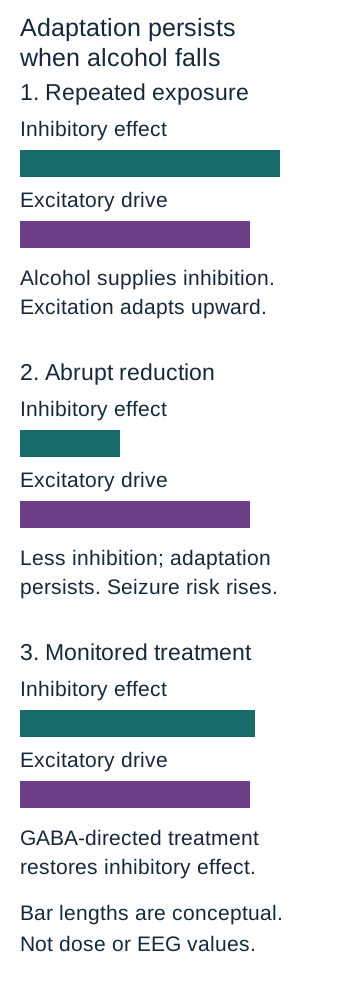
Does a falling drug level always mean a falling danger? Repeated alcohol exposure produces compensatory changes in inhibitory and excitatory signaling. When the alcohol effect falls, those adaptations do not instantly disappear. Reduced GABA-related inhibition and persistent excitatory drive explain tremor, autonomic activation and seizure risk. This is a useful framework, not proof that all intoxication and withdrawal signs are exact opposites. Opioids act primarily at opioid receptors, not through the same GABA process. [1][4]
Compare the green inhibitory bar with the purple excitatory bar in each state. Bar lengths are qualitative, not measured drug levels, EEG values or treatment targets.
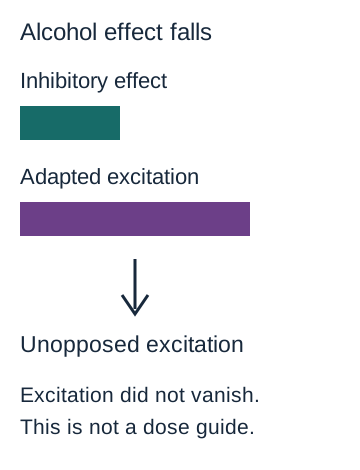
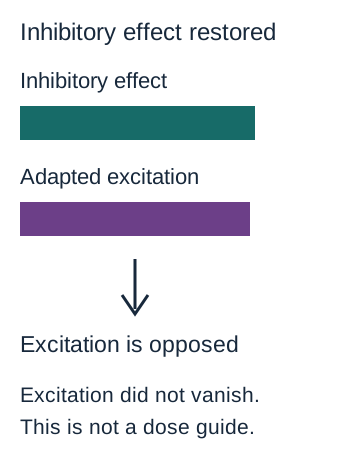
Try the perturbation: keep the adapted excitation fixed. Predict what happens when the alcohol effect falls. Then predict what a monitored GABA-directed treatment changes. The optional answers below redraw the same relationship; they do not select a dose.
Apply a fall in alcohol effect: show the predicted stateThe inhibitory bar shortens; the excitatory bar does not. Abrupt reduction exposes excitation rather than returning the brain immediately to its prior baseline.
Less drug can mean greater withdrawal risk. Close this answer to reset this comparison.
Apply monitored inhibitory treatment: show the predicted stateInhibitory effect increases while the adapted excitation remains. Treatment provides protection while the underlying adaptation resolves; excessive sedation still threatens breathing.
Restore safe inhibitory control with monitoring, not sedation without limits. Close this answer to reset this comparison.
The complete comparison is already visible in the first diagram: reduced inhibition leaves persistent excitation relatively unopposed; appropriate treatment counters that imbalance. No answer is required to continue reading.
Transfer the relationship to someone taking alprazolam every day who abruptly loses access. Anxiety, tremor and seizures can represent withdrawal, not simply recurrence of anxiety. Severe withdrawal needs monitored stabilization followed by an individualized taper. Physical dependence can occur with prescribed use and does not by itself establish a substance use disorder. Taper pace depends on symptoms, duration, dose and comorbidity; an abrupt stop is not a safety strategy. Barbiturate withdrawal can also cause seizures and delirium and warrants specialist, often inpatient management. [3][13]
Use the alcohol timeline without letting it decide the diagnosis
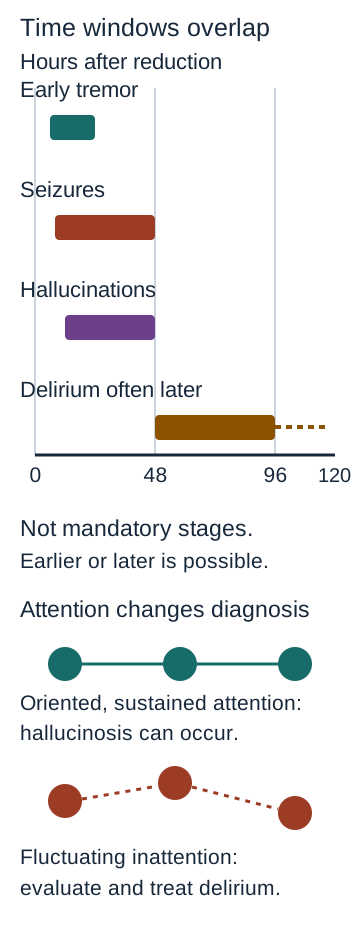
At 18 hours after markedly reducing alcohol, one patient reports insects on the wall but remains oriented and follows a conversation. At 72 hours, another cannot sustain attention and fluctuates between agitation and somnolence. Which distinction matters more than the shared hallucination? Attention and awareness. Clear-sensorium hallucinosis differs from delirium, although both require evaluation and withdrawal treatment when indicated.
Approximate windows after cessation or substantial reduction. Early symptoms often start within 6 to 24 hours; seizures usually occur within 8 to 48 hours. Hallucinations may appear early. Delirium often appears over days 2 to 4, sometimes later. These are not mandatory stages.
Early tremor, anxiety and sweating can precede severe complications. Use the bands to predict whether a seizure can precede delirium. It can: a patient need not pass through hallucinosis first. Withdrawal can begin while blood alcohol remains detectable if intake has fallen substantially from the usual level. Prior withdrawal seizures or delirium, repeated withdrawals and major medical illness increase concern. [1]
Benzodiazepines are first-line treatment for significant alcohol withdrawal and for preventing recurrent withdrawal seizures. Severe withdrawal or delirium needs a closely monitored setting, repeated assessment and readiness to support respiration. With significant liver disease, agents with less hepatic oxidative metabolism, such as lorazepam, are often preferred. Phenobarbital is an option or adjunct in selected settings with experienced clinicians and appropriate monitoring, not a casual add-on.
CIWA-Ar describes severity in an appropriate, communicative patient; it is not a diagnostic test. Delirium makes subjective reporting unreliable. Use an objective institutional monitoring approach, such as RASS or MINDS with delirium assessment, rather than escalating treatment from an invalid score. A quieter pulse after clonidine or a beta blocker does not demonstrate seizure protection. Antipsychotics may be adjuncts for selected symptoms, but they do not replace adequate withdrawal treatment. [1]
Now change the example: a first seizure is focal, or confusion persists with fever and a new neurological deficit. Do not explain it away using the calendar. Investigate another cause, including intracranial injury or infection, while stabilizing the patient.
Not every confused patient with alcohol exposure has withdrawal. Poor nutrition plus confusion, gait ataxia or ocular abnormalities raises concern for Wernicke encephalopathy. The complete classic triad is not required. Give prompt parenteral thiamine when suspected, with nutritional and electrolyte care. If glucose is dangerously low, give glucose immediately; thiamine can be administered concurrently or as soon as available. Do not delay emergency glucose to enforce an order. [1][14]
Predict what can remain after the eye findings improve: memory injury may persist. Korsakoff syndrome includes severe difficulty forming new memories and sometimes confabulation. Recovery is variable; neither guaranteed recovery nor universal irreversibility is an accurate promise. Withdrawal control and nutritional brain protection address different problems. [14][15]
Try it here · Checkpoint 2 of 3
Make your prediction before reading the choices. A first attempt is just a starting point.
Case 7
Show answer and explanations for case 7
A. Benzodiazepine treatment assessed with patient-reported CIWA-Ar responses (Why this does not fit)
Benzodiazepines address withdrawal physiology, but CIWA-Ar is unreliable when delirium prevents dependable symptom reporting. The correct drug does not make an invalid assessment valid.
Reasoning steps for option A
Which component of this pairing treats the withdrawal physiology?
The benzodiazepine.
Which component becomes unreliable when attention fluctuates?
Patient-reported CIWA responses.
What should replace self-reported scoring when attention fluctuates?
Use an objective institutional assessment that also monitors delirium and breathing.
B. Antipsychotic treatment assessed with an objective agitation scale (Why this does not fit)
An objective scale is useful, but antipsychotics alone do not provide adequate treatment or seizure protection for severe alcohol withdrawal. They may have an adjunctive role after appropriate withdrawal treatment.
Reasoning steps for option B
Can an objective scale measure agitation despite delirium?
Yes.
Do antipsychotics alone protect against withdrawal seizures?
No; they may be adjuncts but do not replace GABA-directed therapy.
What should replace self-reported scoring when attention fluctuates?
Use an objective institutional assessment that also monitors delirium and breathing.
C. Benzodiazepine treatment assessed with objective withdrawal, delirium and respiratory monitoring (Best answer)
Timing, impaired attention and autonomic activation support withdrawal delirium. Benzodiazepines address withdrawal, while objective monitoring avoids relying on unreliable subjective answers and tracks sedation safety.
Reasoning steps for option C
What drug class addresses excitatory alcohol withdrawal?
Benzodiazepines.
Why must assessment also measure respiration and delirium objectively?
Delirium compromises symptom reporting and sedation can compromise ventilation.
What should replace self-reported scoring when attention fluctuates?
Use an objective institutional assessment that also monitors delirium and breathing.
D. Antipsychotic treatment assessed with patient-reported CIWA-Ar responses (Why this does not fit)
This pairing both fails to adequately treat the withdrawal physiology and relies on a scale the delirious patient cannot validly complete. Antipsychotics are not a substitute for GABA-directed withdrawal treatment.
Reasoning steps for option D
Would patient-reported CIWA become valid with an antipsychotic?
No; impaired attention still precludes reliable answers.
Would that drug substitute for withdrawal treatment?
No; seizure protection and underlying withdrawal therapy remain needed.
What should replace self-reported scoring when attention fluctuates?
Use an objective institutional assessment that also monitors delirium and breathing.
Takeaway: In withdrawal delirium, select both appropriate treatment and an assessment method that remains valid.
When sympathetic activation starts injuring organs
After cocaine use, chest pain is not merely an anxiety symptom. Catecholamine effects increase oxygen demand, while vasoconstriction and other vascular effects can compromise supply. A patient with a pulse of 142/min, hypertension and persistent chest pressure needs an acute coronary syndrome evaluation, not reassurance based on age.
Predict the consequence of reducing agitation: oxygen demand and sympathetic activation may fall, but an infarction is not thereby excluded. Benzodiazepines are generally first-line for stimulant-related agitation and hyperadrenergic symptoms. Obtain ECGs and troponins when indicated, and provide syndrome-appropriate acute coronary care, including aspirin or nitrates when appropriate. Persistent pain still needs evaluation even if the pulse improves. [2]
The old universal prohibition on beta blockers is too broad. During acute stimulant toxicity, pure beta blockade is not the preferred initial approach. Vasodilators or calcium-channel blockers are generally preferred for ischemia; when sympathetic signs persist despite GABA-directed treatment, a combined alpha/beta agent may be considered with appropriate expertise. This acute-care nuance is not a reason to stop an indicated chronic medicine without assessment.
Read the measurements: a temperature of 40.2°C, rising creatine kinase and dark urine after prolonged agitation imply heat-related muscle injury, not simply a positive drug test. Rapid sedation when necessary, active cooling, fluid and electrolyte assessment, and renal monitoring address the injury. A widened QRS after cocaine suggests sodium-channel toxicity; sodium bicarbonate may be indicated. After MDMA, a seizure with marked hyponatremia demands urgent treatment of the sodium disorder rather than indiscriminate free water. [2]
Transfer the same vigilance to the following day. Stimulant withdrawal often brings fatigue, increased sleep and appetite, dysphoria, vivid dreams and craving. It is not the usual sedative-withdrawal seizure syndrome, but suicidality can emerge as intoxication resolves. Assess safety directly, arrange psychiatric care when needed and connect the patient to continuing treatment. Contingency management has the strongest established behavioral treatment role for stimulant use disorder. [2]
At an opioid receptor, direction matters as much as binding
Is the patient losing respiratory drive or losing opioid effect? Slow, shallow breathing with depressed consciousness suggests toxicity. Yawning, lacrimation, rhinorrhea, mydriasis, gooseflesh, abdominal cramps and diarrhea after cessation suggest withdrawal. Naloxone treats the first problem and can abruptly intensify the second. [4][6]
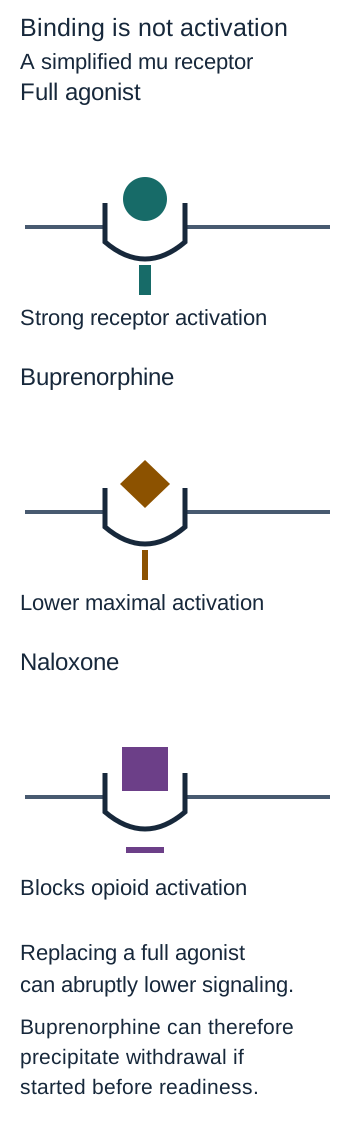
Binding and activation are different properties. Methadone is a full agonist. Buprenorphine is a high-affinity partial agonist. Naloxone is an antagonist. Shapes and signal widths illustrate concepts, not receptor occupancy percentages or relative clinical doses.
Trace the signal beneath each receptor. Predict what happens if an antagonist replaces a full agonist: opioid activation falls, allowing respiratory drive to recover but potentially producing withdrawal. In overdose, support ventilation and give naloxone promptly, targeting adequate breathing rather than insisting on complete alertness. Its effect can end before the opioid effect does. Recurrent respiratory depression calls for reassessment, repeated reversal or an infusion when appropriate, and continued observation. The first response is not a discharge test. [6]
Now substitute buprenorphine while substantial full-agonist effect remains. Strong binding with lower intrinsic activation can abruptly reduce the net opioid effect: precipitated withdrawal. For a conventional start, confirm clinically evident withdrawal and consider the opioid used and the individual course; a single elapsed-hour rule is unreliable. Alternative initiation approaches require an appropriate protocol and expertise. [4]
Methadone and buprenorphine can relieve withdrawal and provide ongoing treatment for opioid use disorder. Buprenorphine has a ceiling on some respiratory effects, not immunity to overdose, particularly with other sedatives. Methadone can prolong the QT interval; a markedly prolonged QTc requires risk assessment and may favor an alternative such as buprenorphine. Clonidine can reduce autonomic symptoms but can cause hypotension and does not substitute for ongoing opioid use disorder treatment. Naltrexone is an antagonist for selected patients after an adequate opioid-free interval and clinical assessment; giving it during dependence can precipitate withdrawal. [4]
For transfer, compare an otherwise stable adult with diarrhea to a pregnant patient with persistent vomiting and opioid use disorder. Withdrawal is not usually the primary seizure-delirium emergency seen with alcohol, but dehydration, comorbidity and pregnancy change the risk. Pregnancy generally favors ongoing treatment with methadone or buprenorphine under appropriate care rather than a withdrawal-only plan. After abstinence, reduced tolerance makes return to a previously tolerated dose dangerous. Offer naloxone, overdose prevention and continuing treatment; surviving withdrawal is not the endpoint of care. [4]
Try it here · Checkpoint 3 of 3
Make your prediction before reading the choices. A first attempt is just a starting point.
Case 17
Show answer and explanations for case 17
A. A can develop abrupt withdrawal; B can experience withdrawal relief (Best answer)
In A, displacement can reduce net activation and precipitate withdrawal. In B, partial-agonist activity can increase signaling relative to the withdrawing baseline and relieve symptoms. The same drug produces different changes from different starting states.
Reasoning steps for option A
What opioid activation is present in A before dosing?
Substantial full-agonist activation.
How does the same partial agonist alter signaling in B?
It can restore some activation in B, who starts in withdrawal.
Why can one partial-agonist dose improve one patient and worsen another?
The direction of net signaling change depends on the full-agonist effect present before dosing.
B. A and B should both develop respiratory depression comparable to a full agonist (Why this does not fit)
Partial agonism is not identical to full-agonist activation, and the question supplies different starting states. Sedative combinations can still be dangerous, but equal full-agonist respiratory depression does not follow from these conditions.
Reasoning steps for option B
Does partial agonism equal full-agonist activation at both baselines?
No; its intrinsic activity is lower.
Why would paired identical respiratory depression be a poor prediction?
Different starting receptor states yield different net changes.
Why can one partial-agonist dose improve one patient and worsen another?
The direction of net signaling change depends on the full-agonist effect present before dosing.
C. A should improve because displacement increases signaling; B should worsen because receptors are unoccupied (Why this does not fit)
Displacing a full agonist with a partial agonist need not increase signaling. With little remaining agonist effect, buprenorphine can provide activation rather than worsening withdrawal.
Reasoning steps for option C
Does replacing a full agonist with lower intrinsic activation increase signaling?
No; it lowers net activation in A.
What happens to B when partially active receptors replace low signaling?
Partial activation can relieve low signaling.
Why can one partial-agonist dose improve one patient and worsen another?
The direction of net signaling change depends on the full-agonist effect present before dosing.
D. A and B should both improve because high affinity increases net signaling in both starting states (Why this does not fit)
Affinity determines binding competition, not the direction of the change in activation. Displacing a full agonist can reduce signaling, whereas adding partial-agonist activity to a low-activation withdrawal baseline can increase it.
Reasoning steps for option D
Does high receptor affinity always increase net activation?
No; affinity and intrinsic activation differ.
What happens when a lower-activity partial agonist replaces substantial full agonist in A?
Net opioid signaling can drop and precipitate withdrawal.
Why can one partial-agonist dose improve one patient and worsen another?
The direction of net signaling change depends on the full-agonist effect present before dosing.
Takeaway: The clinical effect depends on the change from baseline receptor activation, not affinity alone.
When the pattern does not fit, preserve the uncertainty
Not every agitated patient has stimulant toxicity. Compare agitation with multidirectional nystagmus and diminished pain perception to visual distortions in a person who remains attentive and can be reassured. Which patient may have an injury without reporting pain?
PCP and ketamine are dissociatives associated with NMDA-receptor antagonism. Nystagmus, hypertension, altered perception and analgesia support consideration of this group but do not identify one drug uniquely. Examine for trauma even when pain is absent. A low-stimulation setting and benzodiazepines may help significant agitation; assess temperature, seizures and muscle injury. Aggression is not inevitable and should not be presumed from a substance label. [12]
LSD and related serotonergic hallucinogens alter perception, can dilate pupils and can cause panic. Insight varies. A quiet setting, reassurance and observation are often sufficient; severe anxiety may require a benzodiazepine. There is no characteristic physical withdrawal syndrome requiring a sedative taper. For transfer, add high fever or impaired attention to the same presentation: reassess for complicated toxicity, another substance or another illness rather than assuming an uncomplicated distressing experience. [10]
Rapid-onset clonus and hyperreflexia with sweating and hyperthermia after serotonergic exposure suggest serotonin toxicity rather than an uncomplicated perceptual experience. Stop serotonergic drugs and provide monitored supportive treatment, including benzodiazepines and cooling. Persistent symptoms may prompt consideration of cyproheptadine with toxicology input; evidence for this adjunct is limited. [16]
Cannabis can cause conjunctival injection, dry mouth, increased appetite, tachycardia, altered time perception and impaired attention or coordination. Panic can occur. Withdrawal commonly includes irritability, insomnia and reduced appetite and deserves supportive care rather than dismissal. Recurrent vomiting with prolonged frequent use and temporary relief from hot bathing suggests cannabinoid hyperemesis, after assessment for other causes. Hydration and symptom care address the episode; sustained cessation addresses recurrence. [11]
A final comparison: a patient may look relatively well after acetaminophen ingestion yet face hepatic injury, whereas an apparent alcohol exposure with acidosis and visual symptoms may involve toxic metabolites. Appearance alone cannot choose the antidote.
Acetaminophen: N-acetylcysteine prevents or limits hepatic injury. For a known single acute ingestion, interpret a concentration obtained at least 4 hours afterward using the treatment nomogram. An earlier reassuring level or normal initial aminotransferases does not rule out later toxicity. Unknown timing, repeated supratherapeutic ingestion or delayed presentation requires a different assessment, often empiric treatment and toxicology advice; do not force those histories onto the nomogram. [9]
Methanol or ethylene glycol: fomepizole inhibits alcohol dehydrogenase and limits further formation of toxic metabolites. Methanol can cause visual injury; ethylene glycol can injure kidneys. Exposure history plus anion-gap acidosis, an increased osmolar gap or characteristic organ findings may justify treatment before a confirmatory level returns. Severe acidosis or organ injury warrants urgent expert assessment for dialysis. [8]
Predict the consequence of waiting for certainty in either example: preventable injury may progress. Stabilize first, use the right timing and laboratory interpretation, and contact a poison center or toxicologist for an individualized treatment plan. This lesson supplies a reasoning framework, not a substitute for emergency protocols.
Apply the distinctions to new patients
Choose the best response using the whole presentation. Reconsider competing explanations when a finding does not fit.
Case 1
Show answer and explanations for case 1
A. Prepare immediate endotracheal intubation as the initial intervention (Why this does not fit)
Definitive airway may be necessary if support fails; immediate bag-mask ventilation and naloxone can rapidly reverse this pattern.
Reasoning steps for option A
Can bag-mask support begin before deciding whether an endotracheal tube is needed?
Which feature would make escalation to a definitive airway necessary?
Escalate if ventilation or airway protection cannot be maintained.
If pupils are not pinpoint but ventilation remains inadequate, what remains the priority?
Support ventilation while assessing and treating the cause; pupil size alone never substitutes for breathing.
B. Apply high-flow oxygen and assess for spontaneous respiratory improvement (Why this does not fit)
Supplemental oxygen may improve oxygenation but does not restore adequate ventilation. At a respiratory rate of 5/min, provide assisted ventilation rather than waiting.
Reasoning steps for option B
Does higher inspired oxygen supply missing breaths at a rate of 5/min?
No; it changes oxygen concentration, not respiratory drive or minute ventilation.
What remains threatened if oxygenation transiently improves?
Carbon dioxide accumulation and apnea remain threats.
If pupils are not pinpoint but ventilation remains inadequate, what remains the priority?
Support ventilation while assessing and treating the cause; pupil size alone never substitutes for breathing.
C. Assist ventilation and give titrated naloxone (Best answer)
Correct: profound hypoventilation requires assisted breathing and opioid reversal without awaiting tests.
Reasoning steps for option C
Which vital sign demands immediate intervention?
Five respirations per minute with saturation 78% is the immediate danger.
What can be done while naloxone takes effect?
Assist ventilation while giving titrated naloxone.
If pupils are not pinpoint but ventilation remains inadequate, what remains the priority?
Support ventilation while assessing and treating the cause; pupil size alone never substitutes for breathing.
D. Give intranasal naloxone and reassess breathing after its onset (Why this does not fit)
Naloxone is indicated, but ventilation should begin immediately at 5/min rather than waiting for naloxone effect before assisting breathing.
Reasoning steps for option D
Should respiratory support wait for intranasal naloxone onset?
No; support breathing at once.
What harm follows if the patient continues taking only five breaths per minute?
Hypoventilation can cause hypoxic injury before reversal acts.
If pupils are not pinpoint but ventilation remains inadequate, what remains the priority?
Support ventilation while assessing and treating the cause; pupil size alone never substitutes for breathing.
Takeaway: Correct: profound hypoventilation requires assisted breathing and opioid reversal without awaiting tests.
A. Titrate a naloxone infusion to adequate ventilation with continued monitoring (Best answer)
Repeated response followed by recurrent respiratory depression indicates opioid activity outlasting reversal. A titrated infusion, with rescue doses as needed while arranging it, can sustain adequate ventilation.
Reasoning steps for option A
What does a second recurrence after two reversals imply?
The opioid effect repeatedly outlasts naloxone.
What sustained intervention can address that time-course?
Titrate an infusion with continued respiratory monitoring.
What should the team do after each apparent rescue response?
Continue observation for recurrent hypoventilation when the opioid may outlast naloxone.
B. Give fixed naloxone boluses every four hours with continuous monitoring (Why this does not fit)
Intermittent reversal can have a role, but this fixed four-hour interval does not match documented recurrences within 20 to 40 minutes. A longer gap risks recurrent hypoventilation despite monitoring.
Reasoning steps for option B
Would fixed four-hour boluses match recurrences after 20 to 40 minutes?
No; deterioration occurs much sooner.
What dosing approach can respond to repeated early decline?
A titrated infusion with continuous monitoring.
What should the team do after each apparent rescue response?
Continue observation for recurrent hypoventilation when the opioid may outlast naloxone.
C. Titrate intermittent naloxone to complete alertness at each reassessment (Why this does not fit)
Intermittent naloxone may be necessary during rescue, but the endpoint is adequate ventilation, not forced complete alertness. Repeated recurrence also favors a sustained titrated strategy.
Reasoning steps for option C
Is complete alertness the endpoint of opioid reversal?
No; the goal is adequate breathing.
Which physiologic endpoint needs titration instead?
Ventilation, with repeat assessment for recurrent depression.
What should the team do after each apparent rescue response?
Continue observation for recurrent hypoventilation when the opioid may outlast naloxone.
D. Proceed to intubation and sedative infusion as the ongoing strategy (Why this does not fit)
Intubation is appropriate if ventilation or airway protection cannot be maintained. Repeated reliable response and restored airway protection support sustained antagonist treatment before choosing invasive support solely for recurrence.
Reasoning steps for option D
Is endotracheal intubation never indicated in opioid toxicity?
It may be needed if ventilation cannot be sustained.
Does this patient require a sedative infusion as preferred ongoing care despite repeated naloxone responses?
No; titrated reversal can address ongoing opioid suppression while monitoring continues.
What should the team do after each apparent rescue response?
Continue observation for recurrent hypoventilation when the opioid may outlast naloxone.
Takeaway: Recurrent hypoventilation after repeated naloxone responses indicates a duration mismatch, not completed treatment.
A. The negative routine screen excludes opioid effect; redirect care to a nonopioid cause (Why this does not fit)
A routine opiate assay may not detect fentanyl. The reversal response and specific result support an opioid component, although other causes can coexist.
Reasoning steps for option A
Can the negative routine screen exclude fentanyl-associated hypoventilation?
No; routine panels may miss fentanyl.
What observed response contradicts redirecting care solely away from opioids?
Breathing improved after ventilation and naloxone.
What can a positive fentanyl-specific urine result not determine?
It cannot quantify the timing, dose or current severity of impairment.
B. The discordance indicates laboratory error; repeat the routine screen before setting a monitoring plan (Why this does not fit)
Normal urine concentration argues against marked dilution, not against differences in assay coverage. Monitoring should follow the clinical course rather than wait for a repeated limited panel.
Reasoning steps for option B
Can different target coverage explain a routine-negative, fentanyl-specific-positive result?
Yes; discordance does not itself mean laboratory error.
What should guide monitoring rather than repeating the routine assay?
Current and recurrent respiratory findings.
What can a positive fentanyl-specific urine result not determine?
It cannot quantify the timing, dose or current severity of impairment.
C. The routine panel may miss fentanyl; begin a naloxone infusion based on the positive result (Why this does not fit)
The positive result establishes exposure, not a present need for additional reversal. An infusion can be appropriate with recurrent hypoventilation, but that indication is not established by a positive urine result in a currently ventilating patient.
Reasoning steps for option C
Does a positive fentanyl result alone establish recurrent hypoventilation?
No; exposure is not current severity.
When is an infusion justified after naloxone rescue?
When respiratory depression recurs or sustained reversal is otherwise clinically needed.
What can a positive fentanyl-specific urine result not determine?
It cannot quantify the timing, dose or current severity of impairment.
D. The routine panel may miss fentanyl; base further naloxone on current and recurrent respiratory findings (Best answer)
Assay coverage explains the initial negative result. The later positive establishes exposure but not current impairment; adequate present ventilation favors observation and reassessment rather than automatic additional naloxone.
Reasoning steps for option D
Can the positive test quantify current respiratory depression?
No; it documents exposure.
What bedside findings argue against automatic additional naloxone now?
Alertness, respirations 17/min and adequate ventilation.
What can a positive fentanyl-specific urine result not determine?
It cannot quantify the timing, dose or current severity of impairment.
Takeaway: Interpret assay scope separately from current physiology; a positive exposure result is not an automatic indication for more antagonist.
A. Observation for depressant intoxication while the alcohol concentration remains positive (Why this does not fit)
A substantial relative decline can expose withdrawal before alcohol reaches zero. New tremor and autonomic activation do not fit uncomplicated depressant intoxication.
Reasoning steps for option A
Does detectable alcohol exclude withdrawal during a 140 mg/dL fall?
No.
Which new signs argue against simple depressant intoxication?
Tremor, diaphoresis and pulse 122/min.
What matters more than an alcohol concentration of 120 mg/dL?
A marked fall from the patient’s adapted level with tremor and autonomic activation can signal withdrawal.
B. Chlordiazepoxide-based treatment for alcohol withdrawal (Why this does not fit)
Withdrawal treatment is appropriate, but chlordiazepoxide relies on hepatic oxidative metabolism and has active metabolites. Significant hepatic dysfunction favors a less accumulation-prone choice among these options.
Reasoning steps for option B
Does this presentation warrant withdrawal medication?
Yes.
What property of chlordiazepoxide conflicts with advanced cirrhosis?
Hepatic oxidative metabolism and active metabolites create accumulation risk.
What matters more than an alcohol concentration of 120 mg/dL?
A marked fall from the patient’s adapted level with tremor and autonomic activation can signal withdrawal.
C. Lactulose-based treatment for hepatic encephalopathy (Why this does not fit)
Cirrhosis makes hepatic encephalopathy an important consideration, but preserved attention and orientation with new autonomic activation during a marked alcohol decline better supports withdrawal. Do not let the chronic diagnosis replace assessment of the current pattern.
Reasoning steps for option C
Which supplied mental-status features weigh against current encephalopathy?
Attention and orientation are preserved.
What time-linked physiology better explains tremor and diaphoresis?
Withdrawal unmasked by rapid alcohol decline.
What matters more than an alcohol concentration of 120 mg/dL?
A marked fall from the patient’s adapted level with tremor and autonomic activation can signal withdrawal.
D. Lorazepam-based treatment for alcohol withdrawal (Best answer)
The time course and examination support withdrawal despite measurable alcohol. Lorazepam is less dependent on hepatic oxidative metabolism than chlordiazepoxide; monitored titration and respiratory reassessment are still necessary.
Reasoning steps for option D
Which drug addresses excitatory withdrawal?
A benzodiazepine.
Why does hepatic impairment favor lorazepam here?
It depends less on hepatic oxidative metabolism than chlordiazepoxide.
What matters more than an alcohol concentration of 120 mg/dL?
A marked fall from the patient’s adapted level with tremor and autonomic activation can signal withdrawal.
Takeaway: Identify the current syndrome first, then adapt withdrawal medication selection to hepatic function.
Correct: perceptual disturbance after cessation with preserved attention and orientation fits alcoholic hallucinosis, although progression remains possible.
Reasoning steps for option A
Can alcohol-related hallucinations occur while attention stays intact?
Yes, withdrawal hallucinosis can occur with clear sensorium.
Which exam finding identifies the preserved sensorium?
Orientation and sustained serial subtraction.
Which bedside function distinguishes hallucinosis from delirium in another patient?
Assess ability to sustain attention and awareness, not merely the presence of hallucinations.
B. Alcohol withdrawal delirium (Why this does not fit)
Alcohol withdrawal can produce hallucinations; intact attention and orientation without autonomic storm argue against delirium tremens.
Reasoning steps for option B
What cognitive disturbance defines delirium beyond seeing or hearing things?
Disturbed, often fluctuating attention or awareness.
Does this patient show it on serial subtraction?
No; attention is sustained.
Which bedside function distinguishes hallucinosis from delirium in another patient?
Assess ability to sustain attention and awareness, not merely the presence of hallucinations.
C. A primary psychotic disorder (Why this does not fit)
Primary psychosis can include voices with preserved attention. The new onset tightly related to alcohol cessation and absence of prior hallucinations favors withdrawal-associated hallucinosis, while follow-up remains important if symptoms persist.
Reasoning steps for option C
Can a primary psychotic disorder cause auditory hallucinations?
Yes, but hallucinations alone are not specific.
Which timing and sustained attention favor withdrawal hallucinosis here?
Voices arise 30 hours after cessation with intact orientation and serial subtraction.
Which bedside function distinguishes hallucinosis from delirium in another patient?
Assess ability to sustain attention and awareness, not merely the presence of hallucinations.
D. Wernicke encephalopathy (Why this does not fit)
Alcohol exposure can accompany nutritional deficiency, and the full classic triad is not required. Here, preserved attention and orientation with isolated hallucinations after cessation better support clear-sensorium hallucinosis; reassess for additional neurological or nutritional findings.
Reasoning steps for option D
What accompanying ocular, gait or nutritional evidence would favor Wernicke encephalopathy?
Confusion with ocular or gait abnormalities and nutritional risk would raise concern.
Is isolated hallucination with intact attention enough?
No; hallucinations alone are not Wernicke evidence.
Which bedside function distinguishes hallucinosis from delirium in another patient?
Assess ability to sustain attention and awareness, not merely the presence of hallucinations.
Takeaway: Correct: perceptual disturbance after cessation with preserved attention and orientation fits alcoholic hallucinosis, although progression remains possible.
A. Presume postictal paresis and observe for resolution before intracranial evaluation (Why this does not fit)
Postictal weakness is a plausible explanation, but persistent unilateral weakness after a focal-onset seizure also requires urgent assessment for structural or vascular disease. Presuming spontaneous resolution can delay cause-specific care.
Reasoning steps for option A
Can a postictal state cause transient unilateral weakness?
Yes, transient Todd paresis is possible.
May presumed postictal paresis postpone investigation of this focal-onset seizure?
No; persistent lateralized deficit still demands urgent intracranial evaluation.
What feature prevents a plausible withdrawal calendar from closing the differential?
Focal onset or persistent focal deficit requires another-cause investigation.
B. Stabilize and treat possible withdrawal while urgently evaluating a focal intracranial cause (Best answer)
Timing makes withdrawal plausible, but focal onset and persistent lateralizing signs require investigation for another cause. Normal glucose and sodium do not resolve that concern.
Reasoning steps for option B
What must be stabilized or treated while the focal cause is investigated?
Stabilize the seizure and treat possible alcohol withdrawal.
Which two focal features justify urgent neurologic assessment?
Right-arm focal onset and persistent right-sided weakness.
What feature prevents a plausible withdrawal calendar from closing the differential?
Focal onset or persistent focal deficit requires another-cause investigation.
C. Use the elapsed 20 hours to classify this as a typical withdrawal seizure without imaging (Why this does not fit)
Typical timing does not erase atypical neurological features. A withdrawal diagnosis cannot serve as a reason to omit urgent intracranial evaluation.
Reasoning steps for option C
Does a 20-hour interval establish that all seizure features are typical?
No; chronology alone cannot determine etiology.
Which feature of the witnessed onset contradicts that shortcut?
What feature prevents a plausible withdrawal calendar from closing the differential?
Focal onset or persistent focal deficit requires another-cause investigation.
D. Begin chronic antiseizure treatment as the definitive response to the alcohol history (Why this does not fit)
Antiseizure therapy may be indicated depending on findings, but it does not replace urgent cause-finding or monitored treatment of concurrent withdrawal risk.
Reasoning steps for option D
Would chronic antiseizure medication reveal the cause of new hemiparesis?
No; it does not establish why weakness persists.
Which evaluation remains urgent despite the alcohol history?
Urgent focal neurologic assessment and imaging as indicated.
What feature prevents a plausible withdrawal calendar from closing the differential?
Focal onset or persistent focal deficit requires another-cause investigation.
Takeaway: A compatible withdrawal time window does not explain focal onset or a persistent unilateral deficit.
A. Wait for thiamine, administer it first, then correct the glucose (Why this does not fit)
Thiamine is important in suspected deficiency, but postponing treatment of documented hypoglycemia prolongs brain injury. Emergency glucose must not wait for thiamine.
Reasoning steps for option A
How low is this glucose and how long would waiting leave it untreated?
Glucose 43 mg/dL is dangerously low; delay is 20 minutes.
Must thiamine be administered before emergency dextrose at all costs?
No; treat hypoglycemia immediately and give thiamine promptly.
How should an unavailable thiamine dose affect treatment of severe hypoglycemia?
Do not delay emergency glucose; give parenteral thiamine as soon as possible.
B. Correct the glucose and reserve thiamine for persistent neurological abnormalities (Why this does not fit)
Hypoglycemia explains some confusion, but poor nutrition and an ocular abnormality raise an additional concern for Wernicke encephalopathy. Improvement after glucose should not cancel thiamine treatment.
Reasoning steps for option B
Which two features suggest Wernicke risk before response to glucose is known?
Malnutrition and impaired eye abduction with confusion.
Would improvement in glucose eliminate need for parenteral thiamine?
No; parenteral thiamine is still indicated when Wernicke is suspected.
How should an unavailable thiamine dose affect treatment of severe hypoglycemia?
Do not delay emergency glucose; give parenteral thiamine as soon as possible.
C. Give dextrose now and use oral thiamine once swallowing is safe (Why this does not fit)
Glucose should be given now, but suspected Wernicke encephalopathy warrants prompt parenteral thiamine. Oral replacement is not an adequate substitute for initial treatment of this acute neurological presentation.
Reasoning steps for option C
What route is appropriate when Wernicke encephalopathy is suspected?
Prompt parenteral administration.
Can oral replacement substitute for prompt parenteral treatment?
No; oral therapy is insufficient initially.
How should an unavailable thiamine dose affect treatment of severe hypoglycemia?
Do not delay emergency glucose; give parenteral thiamine as soon as possible.
D. Give dextrose now and administer parenteral thiamine promptly when available (Best answer)
Correct the immediately available reversible threat now and treat suspected thiamine deficiency promptly. Both diagnoses can coexist; the complete Wernicke triad is not required.
Reasoning steps for option D
Which immediate threat can be corrected with the available medication?
Hypoglycemia with immediate IV dextrose.
How should thiamine be given when it arrives?
Parenterally, as soon as available.
How should an unavailable thiamine dose affect treatment of severe hypoglycemia?
Do not delay emergency glucose; give parenteral thiamine as soon as possible.
Takeaway: Never delay emergency glucose for thiamine; correct hypoglycemia and promptly treat suspected thiamine deficiency.
A. Monitored lorazepam coverage followed by an individualized taper (Best answer)
Abrupt interruption with autonomic activation supports benzodiazepine withdrawal rather than a new chronic seizure diagnosis. Lorazepam is less dependent on hepatic oxidative metabolism than diazepam, making it preferable here for monitored coverage before an individualized taper.
Reasoning steps for option A
Which interruption preceded the seizure by 36 hours?
Daily alprazolam was omitted.
What makes lorazepam preferable in advanced cirrhosis?
Less reliance on hepatic oxidative metabolism and no long-lived active metabolites.
What governs agent choice after stabilization in severe hepatic disease?
Favor an appropriate less oxidatively metabolized benzodiazepine with close monitoring and a personalized taper.
B. Monitored diazepam coverage followed by an individualized taper (Why this does not fit)
Diazepam can treat benzodiazepine withdrawal, but its hepatic oxidative metabolism and active metabolites create accumulation concerns in advanced cirrhosis. Drug selection must follow organ function rather than long duration alone.
Reasoning steps for option B
Would diazepam cover benzodiazepine withdrawal?
Yes.
Which supplied organ disease makes its active metabolites problematic?
Advanced cirrhosis with impaired synthetic function.
What governs agent choice after stabilization in severe hepatic disease?
Favor an appropriate less oxidatively metabolized benzodiazepine with close monitoring and a personalized taper.
C. Lactulose-based treatment for presumed hepatic encephalopathy (Why this does not fit)
Cirrhosis is relevant, but the medication interruption and accompanying tremor and tachycardia favor withdrawal. Hepatic encephalopathy does not adequately explain away that temporal relationship and withdrawal risk.
Reasoning steps for option C
Does cirrhosis alone prove hepatic encephalopathy here?
No; she is attentive after stabilization.
Which autonomic findings follow abruptly withheld alprazolam?
Tremor and tachycardia.
What governs agent choice after stabilization in severe hepatic disease?
Favor an appropriate less oxidatively metabolized benzodiazepine with close monitoring and a personalized taper.
D. Levetiracetam maintenance as treatment for a newly established seizure disorder (Why this does not fit)
An acutely provoked seizure does not by itself establish a chronic seizure disorder. Antiseizure maintenance alone would also leave the dependence-related withdrawal process untreated.
Reasoning steps for option D
Does a seizure after abrupt drug omission establish chronic epilepsy?
No; this is plausibly an acutely provoked withdrawal event.
Would levetiracetam alone replace dependence-related coverage?
No; the withdrawal process needs monitored benzodiazepine treatment.
What governs agent choice after stabilization in severe hepatic disease?
Favor an appropriate less oxidatively metabolized benzodiazepine with close monitoring and a personalized taper.
Takeaway: Recognize an acutely provoked withdrawal seizure, then select monitored coverage suited to organ function.
A. Support ventilation and use flumazenil for the detected benzodiazepine exposure (Why this does not fit)
A positive screen does not prove isolated benzodiazepine poisoning. QRS widening and hypotension suggest additional cardiotoxic exposure, and flumazenil can provoke seizures with proconvulsant co-ingestion.
Reasoning steps for option A
Does a positive urine benzodiazepine screen authorize flumazenil?
No; exposure is not isolated causation.
Which ECG and blood-pressure features imply hazardous mixed toxicity?
QRS 146 ms with terminal aVR R and BP 88/54.
How should a positive screening result be weighed against an alarming ECG?
The ECG and physiology determine urgent care; screening exposure does not prove isolated causation.
B. Support ventilation, address suspected sodium-channel toxicity and avoid empiric flumazenil (Best answer)
The conduction pattern and shock suggest a sodium-channel-blocking co-ingestant, such as a tricyclic antidepressant. Airway support and toxicology-directed treatment, including bicarbonate when indicated, take priority over hazardous empiric reversal.
Reasoning steps for option B
What does a QRS of 146 ms with terminal aVR R suggest?
Sodium-channel blockade.
Which two immediate threats require treatment or monitoring?
Ventilatory compromise and hemodynamically important conduction toxicity.
How should a positive screening result be weighed against an alarming ECG?
The ECG and physiology determine urgent care; screening exposure does not prove isolated causation.
C. Support circulation and give magnesium for presumed repolarization-mediated toxicity (Why this does not fit)
Magnesium is appropriate for torsades in the right setting. The supplied wide QRS and terminal aVR finding instead point toward sodium-channel conduction toxicity; a benzodiazepine result does not explain that pattern.
Reasoning steps for option C
Does magnesium target a wide QRS from sodium-channel blockade?
Which ECG feature rather than repolarization dominates?
Marked QRS widening with terminal aVR R.
How should a positive screening result be weighed against an alarming ECG?
The ECG and physiology determine urgent care; screening exposure does not prove isolated causation.
D. Support circulation and use a small flumazenil dose as a diagnostic trial (Why this does not fit)
Improving pressure does not eliminate seizure risk from an unknown proconvulsant or dependence. A diagnostic reversal trial is not justified by somnolence alone.
Reasoning steps for option D
Does a smaller flumazenil test dose remove proconvulsant co-ingestion risk?
No; unknown mixed ingestion remains.
What safer strategy addresses the cardiotoxic pattern?
Support circulation and ventilation and address sodium-channel toxicity.
How should a positive screening result be weighed against an alarming ECG?
The ECG and physiology determine urgent care; screening exposure does not prove isolated causation.
Takeaway: An exposure result is not a complete diagnosis; cardiotoxic findings can make sedative reversal dangerous.
A. Manage as isolated vasospasm and conclude acute coronary assessment when pain resolves (Why this does not fit)
Vasospasm can contribute to the presentation, but improved pain does not exclude myocardial injury. Persistent ECG abnormalities and dynamic troponin change require continued assessment.
Reasoning steps for option A
Can cocaine provoke transient coronary vasospasm?
Yes, but it can also accompany myocardial injury.
What persists after pain improves that precludes ending ACS assessment?
Persistent ST depression and rising troponin.
What should prevent discharge after a stimulant-related chest-pain episode improves?
Persistent ischemic ECG findings or a troponin rise warrant continued acute coronary evaluation.
B. Observe as chronic myocardial injury and arrange nonurgent coronary assessment (Why this does not fit)
Chronic injury does not adequately explain a rise from below the reference limit to substantially above it during this event. The serial pattern supports an acute process.
Reasoning steps for option B
Is a troponin rise from 8 to 86 plausibly dismissed as stable chronic injury?
No; this is a dynamic increase.
How does the upper reference limit affect interpretation?
Eighty-six exceeds the stated upper limit of 19 ng/L.
What should prevent discharge after a stimulant-related chest-pain episode improves?
Persistent ischemic ECG findings or a troponin rise warrant continued acute coronary evaluation.
C. Continue inpatient acute coronary assessment and indicated syndrome-directed therapy (Best answer)
The sympathetic response has improved, but serial ECG and troponin findings still support acute myocardial injury. Continue acute coronary evaluation and appropriate therapy without assuming one specific coronary mechanism.
Reasoning steps for option C
Which two findings remain after symptom relief?
Lateral ST depression and troponin rising to 86 ng/L.
What must continue even though pulse falls?
Inpatient acute coronary assessment and indicated treatment.
What should prevent discharge after a stimulant-related chest-pain episode improves?
Persistent ischemic ECG findings or a troponin rise warrant continued acute coronary evaluation.
D. Classify the ECG changes as rate-related and repeat testing if chest pain returns (Why this does not fit)
The ECG remains abnormal after the rate normalizes, and troponin is rising. Those supplied facts argue against dismissing the changes as an isolated transient rate effect.
Reasoning steps for option D
Can a fast pulse influence ST segments?
It can, but that does not settle this case.
Which biomarker change prevents attributing all findings to rate?
Troponin rises from 8 to 86 ng/L.
What should prevent discharge after a stimulant-related chest-pain episode improves?
Persistent ischemic ECG findings or a troponin rise warrant continued acute coronary evaluation.
Takeaway: Symptom relief after treatment of cocaine toxicity does not negate dynamic evidence of myocardial injury.
Correct: cocaine blocks fast sodium channels, producing QRS widening and terminal aVR R; bicarbonate is targeted therapy in this stable patient.
Reasoning steps for option A
Which conduction finding suggests sodium-channel blockade?
QRS 162 ms with terminal R in aVR.
What targeted intervention addresses that mechanism?
IV sodium bicarbonate.
Which ECG finding redirects care from ordinary tachycardia treatment?
Marked QRS widening with terminal aVR R suggests sodium-channel toxicity.
B. IV magnesium sulfate (Why this does not fit)
Magnesium treats polymorphic ventricular tachycardia with prolonged repolarization; sinus rhythm and QTc 440 ms with wide QRS instead localize to conduction blockade.
Reasoning steps for option B
Is QTc 440 with broad QRS the characteristic torsades target?
No; the QTc is 440 ms and the dominant finding is QRS widening.
Which specific ECG abnormality needs correction first?
Marked intraventricular conduction delay.
Which ECG finding redirects care from ordinary tachycardia treatment?
Marked QRS widening with terminal aVR R suggests sodium-channel toxicity.
C. IV calcium gluconate (Why this does not fit)
Calcium stabilizes hyperkalemic myocardium; potassium 4.1 mmol/L and absent peaked T waves favor cocaine sodium-channel blockade.
Reasoning steps for option C
What potassium value and T-wave appearance are supplied?
Potassium 4.1 mmol/L and no peaked T waves.
Do those findings support hyperkalemia-directed calcium?
No.
Which ECG finding redirects care from ordinary tachycardia treatment?
Marked QRS widening with terminal aVR R suggests sodium-channel toxicity.
D. IV lidocaine (Why this does not fit)
Lidocaine can have a role in selected refractory sodium-channel toxic arrhythmias with expert input, but sodium bicarbonate is the initial targeted treatment for the described cocaine-related QRS widening. The ECG shows sinus conduction delay, not isolated ventricular ectopy.
Reasoning steps for option D
Is lidocaine the first targeted response to this ECG toxicity pattern?
No.
Which treatment addresses the implicated sodium-channel block more directly?
IV sodium bicarbonate.
Which ECG finding redirects care from ordinary tachycardia treatment?
Marked QRS widening with terminal aVR R suggests sodium-channel toxicity.
Takeaway: Correct: cocaine blocks fast sodium channels, producing QRS widening and terminal aVR R; bicarbonate is targeted therapy in this stable patient.
A. Restrict fluids and give a loop diuretic to increase urine output (Why this does not fit)
Diuresis may be appropriate for fluid overload, but the supplied examination suggests volume depletion rather than congestion. Reducing circulating volume can worsen renal perfusion in muscle injury.
Reasoning steps for option A
Does loop diuresis treat myoglobin-driven kidney injury by itself?
No; urine output alone is not the treatment target.
Why is restricting fluids risky with rising creatinine?
It can worsen renal perfusion amid rhabdomyolysis.
What persists after temperature normalization in a heat-injured patient?
Rhabdomyolysis can continue to threaten potassium balance and renal function.
B. Begin hemodialysis based on the creatine kinase concentration (Why this does not fit)
Dialysis may be required for complications such as refractory electrolyte, acid-base or volume problems. A high CK value alone is not a sufficient indication; the present findings favor fluids, close monitoring and treatment of evolving complications.
Reasoning steps for option B
Does CK 9200 U/L by itself establish a dialysis indication?
No; CK is a marker of muscle injury, not an isolated dialysis threshold.
Which organ and electrolyte measurements should guide escalation?
Potassium, acid-base status, renal function and clinical complications.
What persists after temperature normalization in a heat-injured patient?
Rhabdomyolysis can continue to threaten potassium balance and renal function.
C. Prioritize a glomerulonephritis evaluation for the heme-positive urine (Why this does not fit)
Glomerular disease can cause kidney dysfunction and blood on urine testing, but marked CK increase with very few urine red cells favors muscle pigment rather than a primarily glomerular bleeding pattern.
Reasoning steps for option C
What does heme-positive urine with 0 to 1 RBC suggest?
Myoglobin pigment after muscle injury.
Does that result chiefly implicate glomerular bleeding here?
No; few RBC and CK 9200 favor rhabdomyolysis.
What persists after temperature normalization in a heat-injured patient?
Rhabdomyolysis can continue to threaten potassium balance and renal function.
D. Give volume-guided IV crystalloid with serial ECG, electrolyte and renal assessment (Best answer)
The urine and CK pattern supports rhabdomyolysis. Volume depletion, rising creatinine and potassium release require individualized fluids and monitoring even after temperature improves.
Reasoning steps for option D
Which renal injury markers remain after temperature falls?
Creatinine 1.9 from 0.8 and potassium 5.6.
What assessments accompany volume-guided crystalloid?
Serial ECG, electrolytes and kidney function.
What persists after temperature normalization in a heat-injured patient?
Rhabdomyolysis can continue to threaten potassium balance and renal function.
Takeaway: Cooling ends one source of injury; rhabdomyolysis can continue to threaten kidneys and cardiac conduction.
A. Give isotonic saline alone as the initial seizure-directed intervention (Why this does not fit)
Isotonic fluid can be appropriate for some volume-depleted hyponatremia; seizure with sodium 116 needs hypertonic saline bolus.
Reasoning steps for option A
Does isotonic saline alone rapidly address a seizure with sodium 116?
No; the seizure requires urgent sodium-directed therapy.
Which salt concentration is indicated for severe neurologic symptoms?
Controlled 3% saline.
When does hyponatremia require urgent hypertonic saline rather than observation?
Seizure with profound hyponatremia is a severe neurologic presentation requiring controlled hypertonic therapy.
B. Give a controlled 3% saline bolus and monitor sodium closely (Best answer)
Correct: acute seizure with sodium 116 after MDMA and excessive water intake calls for prompt hypertonic saline.
Reasoning steps for option B
Which measurement identifies the immediate cause of cerebral symptoms?
Sodium 116 mmol/L with seizure.
Why must sodium be monitored after a controlled bolus?
To treat safely while limiting overcorrection.
When does hyponatremia require urgent hypertonic saline rather than observation?
Seizure with profound hyponatremia is a severe neurologic presentation requiring controlled hypertonic therapy.
C. Give a benzodiazepine as the targeted treatment for the current neurological syndrome (Why this does not fit)
A benzodiazepine may be needed for active seizure control, but severe symptomatic hyponatremia requires urgent sodium-directed therapy as well. Seizure suppression alone does not correct the associated cerebral edema.
Reasoning steps for option C
Can benzodiazepines terminate an active convulsion?
Yes, if seizure control is needed.
Do they correct the sodium 116 underlying this neurologic syndrome?
No; controlled hypertonic saline is the targeted cause-directed therapy.
When does hyponatremia require urgent hypertonic saline rather than observation?
Seizure with profound hyponatremia is a severe neurologic presentation requiring controlled hypertonic therapy.
D. Restrict water and observe sodium correction without hypertonic saline (Why this does not fit)
Water restriction addresses ongoing intake; it is inadequate as sole initial treatment for hyponatremic seizure.
Reasoning steps for option D
Is water restriction alone rapid enough during a seizure?
No; symptoms are immediately dangerous.
Which intervention more urgently raises extracellular sodium?
A controlled hypertonic saline bolus.
When does hyponatremia require urgent hypertonic saline rather than observation?
Seizure with profound hyponatremia is a severe neurologic presentation requiring controlled hypertonic therapy.
Takeaway: Correct: acute seizure with sodium 116 after MDMA and excessive water intake calls for prompt hypertonic saline.
Methadone is effective ongoing treatment, but a known QTc above 500 ms raises a significant arrhythmia concern. The persistent prolongation despite normal electrolytes favors an alternative after appropriate evaluation.
Reasoning steps for option A
What cardiac measurement complicates methadone initiation?
QTc 526 ms on current and prior ECG.
Were potassium and magnesium abnormalities offered as reversible explanations?
No; both electrolytes are normal.
Which two independent questions guide medication choice here?
Is the patient in objective withdrawal for a conventional start, and which agent fits the persistent QT risk?
B. Extended-release naltrexone (Why this does not fit)
Active withdrawal after recent opioid use does not establish the opioid-free interval required for naltrexone. Immediate antagonist treatment could precipitate more severe withdrawal.
Reasoning steps for option B
Does active withdrawal 20 hours after heroin prove antagonist readiness?
No.
What happens if naltrexone displaces residual opioid effect?
It can precipitate or intensify withdrawal.
Which two independent questions guide medication choice here?
Is the patient in objective withdrawal for a conventional start, and which agent fits the persistent QT risk?
C. Clonidine as the ongoing treatment (Why this does not fit)
Clonidine can reduce autonomic symptoms but is not an equivalent ongoing medication treatment for opioid use disorder. It does not answer this patient's request for sustained treatment.
Reasoning steps for option C
What can clonidine do for pulse and autonomic symptoms?
It can reduce autonomic symptoms.
Does it provide ongoing opioid-use-disorder medication treatment?
No.
Which two independent questions guide medication choice here?
Is the patient in objective withdrawal for a conventional start, and which agent fits the persistent QT risk?
D. Buprenorphine (Best answer)
Objective withdrawal without sedation supports consideration of a conventional buprenorphine start. The markedly prolonged QTc makes methadone less attractive, while naltrexone readiness has not been established.
Reasoning steps for option D
Which objective signs establish current withdrawal rather than isolated anxiety?
Lacrimation, yawning, piloerection, diarrhea, mydriasis and pulse 110/min.
What alternative concern does QTc 526 ms create for methadone?
Significant proarrhythmic concern.
Which two independent questions guide medication choice here?
Is the patient in objective withdrawal for a conventional start, and which agent fits the persistent QT risk?
Takeaway: Use clinical withdrawal to assess initiation readiness, then use patient-specific cardiac risk to choose among appropriate medications.
A. Administer naltrexone once a routine urine opiate screen is negative (Why this does not fit)
A limited urine assay may miss some opioids and does not by itself establish an adequate opioid-free interval. Active withdrawal and the recent exposure still require clinical readiness assessment.
Reasoning steps for option A
Does a routine urine opiate screen cover every opioid and prove receptor readiness?
No; a negative screen cannot establish adequate opioid clearance.
Which requirement matters before extended-release naltrexone?
An adequate opioid-free interval and clinical assessment.
What must precede long-acting opioid antagonist treatment?
Verify an adequate opioid-free interval and clinical readiness to avoid precipitated withdrawal.
B. Delay naltrexone until an adequate opioid-free interval and clinical readiness assessment (Best answer)
Active withdrawal one day after oxycodone does not establish an adequate opioid-free interval. Address symptoms and offer appropriate ongoing treatment while planning safe antagonist initiation if preferred.
Reasoning steps for option B
Does yawning and diarrhea prove the opioid-free interval is adequate?
No; they indicate current withdrawal, not proven clearance.
What readiness step is needed before long-acting antagonist injection?
An adequate opioid-free interval and clinical assessment.
What must precede long-acting opioid antagonist treatment?
Verify an adequate opioid-free interval and clinical readiness to avoid precipitated withdrawal.
C. Schedule injection as soon as yawning and diarrhea stop (Why this does not fit)
Symptom resolution alone does not establish antagonist readiness, particularly if symptoms are suppressed by other medication. The exposure history, sufficient opioid-free interval and clinical assessment remain necessary.
Reasoning steps for option C
Does cessation of yawning and diarrhea prove opioid-free readiness?
No; symptoms can fluctuate or be masked.
What clinical criterion remains necessary before antagonist injection?
Adequate opioid-free interval and readiness assessment.
What must precede long-acting opioid antagonist treatment?
Verify an adequate opioid-free interval and clinical readiness to avoid precipitated withdrawal.
D. Use improvement after clonidine as the criterion for immediate naltrexone injection (Why this does not fit)
Clonidine can suppress autonomic manifestations without demonstrating absence of opioid dependence. Symptom relief alone does not establish antagonist safety.
Reasoning steps for option D
Can clonidine eliminate opioid dependence by controlling autonomic signs?
No; it only mitigates selected autonomic symptoms.
Would symptomatic improvement prove antagonist readiness?
No; opioid-free readiness requires separate assessment.
What must precede long-acting opioid antagonist treatment?
Verify an adequate opioid-free interval and clinical readiness to avoid precipitated withdrawal.
Takeaway: Withdrawal symptoms indicate falling opioid effect, not proof of readiness for a long-acting antagonist.
A. Use a fixed rapid methadone taper this week before changing to buprenorphine (Why this does not fit)
A taper and transition may be considered in selected circumstances, but a fixed rapid change in a stable pregnant patient is not justified by a generalized neonatal advantage. Discuss individualized maternal and fetal risks rather than destabilizing effective treatment.
Reasoning steps for option A
Is a fixed rapid taper required for stable methadone treatment in pregnancy?
No; current treatment is effective.
What risk does an unsupervised rapid switch introduce?
Maternal withdrawal and loss of treatment stability.
What is the safer default when pregnancy treatment is already effective?
Continue established agonist care and plan any transition with specialist supervision.
B. Give a conventional buprenorphine dose now while continuing methadone unchanged (Why this does not fit)
Conventional buprenorphine administration while substantial methadone effect remains can precipitate withdrawal. A same-day substitution is not made safe by pregnancy or by partial agonism.
Reasoning steps for option B
What opioid agonist was taken this morning?
Methadone.
How could high-affinity buprenorphine change net signaling now?
It can displace methadone and lower net receptor activation.
What is the safer default when pregnancy treatment is already effective?
Continue established agonist care and plan any transition with specialist supervision.
C. Continue effective methadone treatment and discuss any change through a specialist-supervised plan (Best answer)
Existing stable treatment is clinically important. Avoid an abrupt conventional switch that may destabilize the patient; discuss neonatal and maternal considerations and any proposed change with the treating team.
Reasoning steps for option C
What evidence supports continuing the present regimen?
No nonprescribed use or withdrawal and reliable prenatal follow-up.
Who should supervise any desired transition?
A clinician experienced in pregnancy and opioid use disorder.
What is the safer default when pregnancy treatment is already effective?
Continue established agonist care and plan any transition with specialist supervision.
D. Stop agonist treatment and begin naltrexone when maternal withdrawal first appears (Why this does not fit)
Withdrawal symptoms do not establish antagonist readiness. This strategy abandons effective ongoing care and introduces precipitation risk rather than solving the stated concern.
Reasoning steps for option D
Is newly appearing maternal withdrawal a safe naltrexone readiness marker?
No; withdrawal indicates dependence physiology.
What would antagonist treatment risk during dependence?
Precipitated withdrawal.
What is the safer default when pregnancy treatment is already effective?
Continue established agonist care and plan any transition with specialist supervision.
Takeaway: Preserve effective treatment in pregnancy; theoretical advantages of another medicine do not justify an abrupt unsafe conversion.
A dopamine agonist is associated with selected neuroleptic malignant syndrome management. The rapid serotonergic exposure history and clonus with hyperreflexia favor serotonin toxicity rather than a dopamine-blockade syndrome.
Reasoning steps for option A
What receptor action does bromocriptine primarily provide?
Dopamine agonism.
Does it antagonize serotonin signaling causing clonus?
No.
What distinguishes this from an uncomplicated perceptual disturbance?
Fever plus clonus and hyperreflexia signals serotonin toxicity needing monitored treatment.
B. Physostigmine (Why this does not fit)
An acetylcholinesterase inhibitor may be considered in selected anticholinergic poisoning, but diaphoresis and clonus with hyperreflexia are not the typical dry anticholinergic pattern.
Reasoning steps for option B
What enzyme does physostigmine inhibit?
Acetylcholinesterase.
Does it address clonus and hyperreflexia from serotonin toxicity?
No; it is not serotonin receptor blockade.
What distinguishes this from an uncomplicated perceptual disturbance?
Fever plus clonus and hyperreflexia signals serotonin toxicity needing monitored treatment.
C. Cyproheptadine (Best answer)
The exposure and neuromuscular findings support serotonin toxicity. Cyproheptadine has serotonin-antagonist activity and may be considered for persistent symptoms, although evidence is limited and supportive care remains central.
Reasoning steps for option C
What receptor action does cyproheptadine provide?
Serotonin receptor antagonism.
What caveat accompanies considering this adjunct?
Evidence is limited; consider with toxicology input alongside supportive care.
What distinguishes this from an uncomplicated perceptual disturbance?
Fever plus clonus and hyperreflexia signals serotonin toxicity needing monitored treatment.
D. Haloperidol (Why this does not fit)
Dopamine antagonism does not target the supported toxic mechanism. Agitation should not automatically be treated as primary psychosis when clonus, hyperreflexia and hyperthermia indicate a medical toxidrome.
Reasoning steps for option D
What receptor action does haloperidol primarily provide?
Dopamine antagonism.
Does dopamine antagonism specifically treat serotonin excess?
No; it is not the receptor-directed serotonin adjunct.
What distinguishes this from an uncomplicated perceptual disturbance?
Fever plus clonus and hyperreflexia signals serotonin toxicity needing monitored treatment.
Takeaway: When symptoms persist, adjunct selection must follow the discriminating toxidrome, not agitation alone.
A. Sustained cannabis cessation with follow-up and support (Best answer)
Frequent long-term exposure and the recurrent vomiting pattern support cannabinoid hyperemesis. Acute symptom relief does not eliminate the trigger; sustained cessation is the key preventive intervention.
Reasoning steps for option A
What recurring exposure precedes the vomiting episodes?
Near-daily cannabis use for several years.
Which behavior addresses the underlying recurrence risk?
Sustained cessation with support.
What intervention changes the risk of another vomiting episode rather than merely the current symptoms?
Sustained cessation of the implicated cannabis exposure.
B. Daily antiemetic prophylaxis while maintaining usual cannabis intake (Why this does not fit)
Antiemetics can address an episode but do not reliably prevent recurrence while the associated exposure continues.
Reasoning steps for option B
Does resolution after antiemetics prove future episodes are prevented?
No; it addresses the current episode.
What happens if near-daily exposure continues?
The exposure-associated vomiting can recur.
What intervention changes the risk of another vomiting episode rather than merely the current symptoms?
Sustained cessation of the implicated cannabis exposure.
C. Substitution of lower-potency cannabis products for current products (Why this does not fit)
Changing potency does not establish elimination of the exposure associated with this syndrome. It is not a substitute for sustained cessation.
Reasoning steps for option C
Is lower-potency exposure the same as cessation?
No.
Which established exposure-linked cycle may persist?
Cannabis-associated recurrent vomiting.
What intervention changes the risk of another vomiting episode rather than merely the current symptoms?
Sustained cessation of the implicated cannabis exposure.
D. Regular hot showers at the first sign of nausea (Why this does not fit)
Hot showers can give transient relief, which supports the history, but they do not prevent the underlying recurrence.
Reasoning steps for option D
How durable is relief from hot showers?
Temporary.
What longer-term change reduces recurrence?
Sustained cessation.
What intervention changes the risk of another vomiting episode rather than merely the current symptoms?
Sustained cessation of the implicated cannabis exposure.
Takeaway: For suspected cannabinoid hyperemesis, acute relief and prevention are different decisions.
A. Use the declining osmolar gap as the criterion for stopping antidotal treatment (Why this does not fit)
The gap can decline as parent alcohol is metabolized while metabolite-associated acidosis and injury increase. New visual symptoms and severe acidemia make it an unsafe stopping criterion.
Reasoning steps for option A
Does falling parent-alcohol osmolar gap guarantee resolution of toxic metabolites?
No.
Which concurrent findings contradict stopping therapy?
Bicarbonate 8, pH 7.14 and visual blurring.
What does a lower osmolar gap mean when vision and acidosis worsen before antidote treatment?
Parent alcohol may have generated harmful metabolites; do not mistake conversion for recovery.
B. Continue antidotal care and urgently assess for hemodialysis (Best answer)
The anion gap is 140 minus 101 minus 8, or 31 mmol/L. The falling parent-compound gap with worsening acidosis and visual injury reflects metabolite toxicity rather than recovery. Newly initiated enzyme blockade limits further formation but does not clear the existing toxic burden.
Reasoning steps for option B
What is the anion gap with sodium 140, chloride 101 and bicarbonate 8?
Thirty-one mmol/L.
Why is dialysis assessment urgent even though fomepizole was just started?
Severe acidemia and new visual injury are already present.
What does a lower osmolar gap mean when vision and acidosis worsen before antidote treatment?
Parent alcohol may have generated harmful metabolites; do not mistake conversion for recovery.
C. Use bicarbonate correction of the pH as the criterion for deferring dialysis assessment (Why this does not fit)
Bicarbonate may be needed for severe acidemia, but a temporary pH response does not establish clearance of toxic burden or address visual injury. Dialysis assessment should not depend only on that response.
Reasoning steps for option C
Can bicarbonate improve measured pH while severe methanol injury persists?
Yes; pH correction alone does not eliminate toxin or injury.
What organ finding still prompts dialysis assessment?
New blurred vision with severe anion-gap acidosis.
What does a lower osmolar gap mean when vision and acidosis worsen before antidote treatment?
Parent alcohol may have generated harmful metabolites; do not mistake conversion for recovery.
D. Continue fomepizole and determine dialysis need when the methanol level returns (Why this does not fit)
A concentration can inform care, but severe acidosis and visual injury already warrant urgent assessment for dialysis. The current organ injury is clinically meaningful before the send-out result is available.
Reasoning steps for option D
Should a pending methanol level delay dialysis assessment with pH 7.14?
No.
What concrete abnormalities already justify urgency?
Bicarbonate 8, anion gap 31 and visual injury.
What does a lower osmolar gap mean when vision and acidosis worsen before antidote treatment?
Parent alcohol may have generated harmful metabolites; do not mistake conversion for recovery.
Takeaway: A declining osmolar gap is not a recovery marker when acidosis and organ injury are worsening.
A. Continue enzyme blockade and reassess kidney function after the acidosis resolves (Why this does not fit)
Enzyme blockade limits further formation, but severe current acidosis and acute kidney injury require escalation now. Waiting for acidosis to resolve may defer treatment of an existing toxic burden.
Reasoning steps for option A
Can continued enzyme blockade alone reverse established renal injury?
No; it limits additional metabolites.
Which new measurements require urgent escalation rather than delayed reassessment?
Creatinine 2.7, bicarbonate 8 and pH 7.12.
What can newly initiated fomepizole not accomplish by itself?
It cannot remove established acid metabolites or reverse severe renal injury immediately.
B. Use bicarbonate and fluids as the definitive treatment while awaiting drug clearance (Why this does not fit)
Bicarbonate and fluids may have supportive roles, but severe acidosis and kidney dysfunction warrant assessment for extracorporeal treatment rather than assuming support alone is definitive.
Reasoning steps for option B
Is bicarbonate plus fluids sufficient for bicarbonate 8 and creatinine 2.7?
No; severe acidemia and renal injury are present.
What clearance strategy needs urgent expert evaluation?
Hemodialysis assessment.
What can newly initiated fomepizole not accomplish by itself?
It cannot remove established acid metabolites or reverse severe renal injury immediately.
C. Continue antidotal treatment and urgently arrange expert assessment for hemodialysis (Best answer)
Severe acidosis and the creatinine rise show complicated poisoning already present when blockade begins. Continue appropriate antidotal care and urgently evaluate for dialysis without waiting for the specific concentration.
Reasoning steps for option C
What was the kidney and acid-base trajectory before newly started fomepizole?
Creatinine rose 0.9 to 2.7 with bicarbonate 8 and pH 7.12.
Which consultation addresses existing severe injury?
Urgent expert assessment for hemodialysis.
What can newly initiated fomepizole not accomplish by itself?
It cannot remove established acid metabolites or reverse severe renal injury immediately.
D. Use the urine crystal burden to decide when fomepizole can be stopped (Why this does not fit)
Crystals indicate metabolite effects but do not quantify remaining parent toxin or establish that antidotal therapy is no longer needed. Clinical and laboratory reassessment must be broader.
Reasoning steps for option D
Can urine crystal burden measure remaining circulating ethylene glycol?
No; crystals reflect metabolite injury, not parent clearance.
What is the risk of stopping fomepizole based on crystals alone?
Unmetabolized parent toxin may generate more harmful metabolites.
What can newly initiated fomepizole not accomplish by itself?
It cannot remove established acid metabolites or reverse severe renal injury immediately.
Takeaway: Blocking further metabolism is not the same as clearing existing toxic burden or treating organ failure.
A. Plot the level at 6 hours and use that result to decide whether treatment is needed (Why this does not fit)
Choosing the earliest possible time can underestimate risk. The nomogram requires a sufficiently reliable single-ingestion time, which this history does not provide.
Reasoning steps for option A
What exact ingestion time is required for nomogram plotting?
A reliable known time after a single acute ingestion.
Is an uncertain 6-versus-20-hour history adequate?
No; 6 and 20 hours imply different treatment lines.
When should an uncertain-time ingestion be kept off the acute nomogram?
Without a reliable time, use clinical and laboratory evidence and start NAC when injury risk is present.
B. Withhold N-acetylcysteine while trending INR for evidence of hepatic synthetic failure (Why this does not fit)
Synthetic failure is a later and more severe manifestation, not a prerequisite for treatment. Detectable acetaminophen with abnormal AST and uncertain timing already supports prompt antidotal care.
Reasoning steps for option B
Is INR already abnormal at 1.4?
Yes, and AST is elevated to 210.
Why not wait for more synthetic failure before NAC?
Further injury could progress while effective antidotal treatment is delayed.
When should an uncertain-time ingestion be kept off the acute nomogram?
Without a reliable time, use clinical and laboratory evidence and start NAC when injury risk is present.
C. Obtain a second concentration to reconstruct the exact ingestion time before treatment (Why this does not fit)
Serial levels can inform care but cannot reliably reconstruct a precise ingestion time under these conditions. They should not delay indicated treatment.
Reasoning steps for option C
Can another serum concentration uniquely distinguish ingestion at 6 versus 20 hours?
No.
Which therapy should begin before that uncertainty is resolved?
N-acetylcysteine.
When should an uncertain-time ingestion be kept off the acute nomogram?
Without a reliable time, use clinical and laboratory evidence and start NAC when injury risk is present.
D. Start N-acetylcysteine now and follow hepatic and acetaminophen measurements (Best answer)
Uncertain timing prevents nomogram-based exclusion. Detectable acetaminophen and biochemical injury support prompt treatment with continued monitoring and toxicology guidance.
Reasoning steps for option D
How much acetaminophen was reportedly taken in milligrams?
About 12,500 mg.
What do AST 210 and INR 1.4 add to the decision?
They show current hepatic injury/coagulopathy concern.
When should an uncertain-time ingestion be kept off the acute nomogram?
Without a reliable time, use clinical and laboratory evidence and start NAC when injury risk is present.
Takeaway: An uncertain ingestion time cannot be repaired by selecting a convenient point on the nomogram.
A. Start N-acetylcysteine now and continue laboratory monitoring (Best answer)
The concentration fell, but the treatment threshold also falls with time. The 8-hour level of 90 exceeds 75. Extended-release ingestion can have delayed absorption, so the initially below-line result did not complete assessment.
Reasoning steps for option A
Which level crosses its time-specific line?
The eight-hour 90 mcg/mL exceeds its 75 mcg/mL threshold.
What treatment and follow-up follow the comparison?
Start NAC now and continue laboratory monitoring.
Which time-specific comparison determines treatment after the second sample?
The eight-hour level of 90 mcg/mL exceeds its supplied 75 mcg/mL line.
B. Withhold N-acetylcysteine because both concentrations are below 150 mcg/mL (Why this does not fit)
The 150 mcg/mL threshold applies at 4 hours, not every sampling time. Applying it to 8 hours incorrectly excludes treatment.
Reasoning steps for option B
Can the four-hour 150 mcg/mL threshold be reused at eight hours?
No; the line declines with time.
What is the consequence of comparing 90 only with 150?
It falsely treats 90 as safe despite exceeding the eight-hour line.
Which time-specific comparison determines treatment after the second sample?
The eight-hour level of 90 mcg/mL exceeds its supplied 75 mcg/mL line.
C. Continue observation because the concentration is falling and AST remains normal (Why this does not fit)
A falling concentration and normal early AST do not negate a level above the time-specific treatment line. Hepatic injury can appear later.
Reasoning steps for option C
Does a fall from 110 to 90 establish safety against a declining treatment line?
No; 90 exceeds the 75 mcg/mL eight-hour line.
Can AST 24 rule out later hepatic injury now?
No; aminotransferases may remain normal early.
Which time-specific comparison determines treatment after the second sample?
The eight-hour level of 90 mcg/mL exceeds its supplied 75 mcg/mL line.
D. Exclude nomogram-based treatment because the preparation is extended release (Why this does not fit)
Extended-release ingestion can require additional timed sampling; it does not make the supplied later above-line concentration reassuring or eliminate the indication for treatment.
Reasoning steps for option D
Does extended-release formulation invalidate time-specific comparison for a known single ingestion?
No; repeat levels may be especially important.
What does the eight-hour repeat show?
Ninety exceeds the supplied eight-hour treatment line of 75 mcg/mL.
Which time-specific comparison determines treatment after the second sample?
The eight-hour level of 90 mcg/mL exceeds its supplied 75 mcg/mL line.
Takeaway: Interpret each acetaminophen concentration at its sampling time; a falling value can still cross the treatment line.