Trauma and PTSD Disorders: Criteria, Context and Care
Distinguish trauma-related syndromes using exposure, symptom patterns and duration, then choose patient-centered treatment, safety assessment and follow-up.
Trauma-related diagnoses depend on exposure, symptom pattern, duration and consequences together. A date alone cannot turn distress into a disorder. Learn to separate these decisions before choosing care. This lesson uses original educational cases, not a diagnostic calculator.
Start with the event, not the label
A distressing experience and a qualifying PTSD exposure are not interchangeable. First ask what happened and how the person encountered it. The diagnostic exposure requirement concerns death or threatened death, serious injury or its threat, or sexual violence. It is a boundary for this particular diagnosis, not a ranking of whose suffering deserves care. Ask permission before exploring the history; a detailed retelling is not needed merely to establish the exposure route. VA diagnostic overviewNICE assessment guidance
Direct experience qualifies, as can witnessing the event in person. Learning about a qualifying event involving a close family member or close friend is another route; when the learned event involves actual or threatened death, it must be violent or accidental. Learning of an expected natural death does not satisfy that route. Repeated or extreme exposure to aversive details can qualify, such as a responder repeatedly handling human remains. Ordinary nonprofessional viewing of news, movies or online images does not qualify through that indirect-details route. Work-related exposure still needs clinical assessment, not an automatic diagnosis. VA/DoD exposure criteria
Compare a recovery worker and a distant viewer of the same disaster. Both may be distressed, but their exposure routes differ. Even when the worker meets the exposure requirement, symptoms, duration, consequences and exclusions must still be assessed. Conversely, a person distressed by job loss may need substantial help without having PTSD.
Predict: If the only change is from watching broadcasts at home to repeatedly reviewing graphic death-scene evidence as an occupational duty, what changes? The exposure assessment changes; the rest of the diagnostic assessment remains necessary. This is a teaching comparison, not a diagnostic calculator.
Use two timelines and two symptom rules
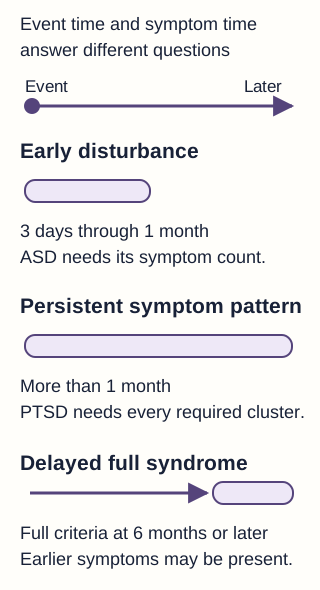
Event date is not symptom duration. Follow the illustrated intervals, then check the symptom requirements. Use the interval labels to apply duration criteria. Source relationship. Enlarge this diagram
Record the exposure date separately from when symptoms began, how long they persisted, and when the complete syndrome was first present. An accident eight months ago does not make ten days of symptoms eight months long. A calendar can establish a duration boundary, but it cannot supply missing symptoms. VA duration and specification summary
Acute stress disorder (ASD) requires at least nine symptoms selected from five categories: intrusion, negative mood, dissociation, avoidance and arousal. They need not satisfy a separate quota in every category. The disturbance lasts from three days to one month after the exposure, causes clinically significant distress or functional impairment, and must pass substance and medical exclusions, and is not better explained by brief psychotic disorder. Feeling detached from oneself can contribute, but dissociation is not mandatory. ASD is not simply PTSD diagnosed early. Its fourteen-item inventory includes four intrusion items, one negative-mood item, two dissociation items, two avoidance items and five arousal items. Negative beliefs and social detachment are adult PTSD findings, not extra ASD inventory items. Count marked distress or bodily reactions to reminders as one ASD item, not two. VA/DoD ASD diagnostic table
PTSD instead uses specific minimums in four clusters, with the disturbance persisting more than one month. Persistent ASD symptoms trigger reassessment, not automatic conversion. Someone may retain insomnia and intrusive memories but no avoidance; that is not enough for adult PTSD. Likewise, a person may develop PTSD without ever having met ASD criteria. Early symptoms have limited power to predict an individual's later course. VA acute stress assessment
Delayed expression means full PTSD criteria are not met until at least six months after the trauma. Some symptoms may have been present immediately. Contrast early nightmares followed by a complete, sufficiently long syndrome at month eight with ten newly symptomatic days at month eight. Only the first example establishes the full duration requirement. Acute symptoms refer to recent symptom activity, not automatically to an ASD diagnosis after a remote trauma.
Predict: At day 12, a patient has seven verified ASD symptoms and major distress. The time window fits, but the symptom count does not. Assess needs and alternatives now rather than waiting for a date to supply a diagnosis.
Apply this idea to a patient
Case 4
Show answer and explanations for case 4
A. PTSD without delayed expression (Why this does not fit)
Did January nightmares establish a complete syndrome?
The early interviews documented only occasional nightmares.
When did the sufficient cluster pattern begin?
The other required clusters first appeared on July 10.
Which date matters for delayed expression?
Early isolated symptoms do not exclude delayed expression when full PTSD criteria first become satisfied at least six months after exposure.
Read this explanation together
The early interviews documented only occasional nightmares. The other required clusters first appeared on July 10. Early isolated symptoms do not exclude delayed expression when full PTSD criteria first become satisfied at least six months after exposure.
B. Acute stress disorder (Why this does not fit)
What interval limits ASD?
ASD belongs to the first month after trauma.
How long has the later pattern persisted?
The July 10 pattern has persisted more than one month by August 20.
Which assessment is appropriate now?
Assess the established PTSD pattern rather than calling late symptom onset ASD.
Read this explanation together
ASD belongs to the first month after trauma. The July 10 pattern has persisted more than one month by August 20. Assess the established PTSD pattern rather than calling late symptom onset ASD.
C. Adjustment disorder (Why this does not fit)
Which observations establish the cluster pattern?
Nightmares, location avoidance, blame, reduced interest, threat monitoring and insomnia supply the adult minimums.
What does the subsequent course add?
The impairing disturbance has continued for more than one month.
Which diagnostic precedence applies?
A supported PTSD syndrome takes precedence over adjustment disorder for the same response.
Read this explanation together
Nightmares, location avoidance, blame, reduced interest, threat monitoring and insomnia supply the adult minimums. The impairing disturbance has continued for more than one month. A supported PTSD syndrome takes precedence over adjustment disorder for the same response.
D. PTSD with delayed expression (Best answer)
What pattern must be reconstructed?
The July observations supply intrusion, avoidance, two negative and two arousal symptoms.
Is its duration sufficient at this visit?
July 10 through August 20 exceeds one month.
Why does delayed expression apply?
Even the complete symptom pattern began after six months; full criteria therefore were not met earlier.
Which timing distinction should be retained?
Date full-criteria attainment separately from the first isolated symptom.
Read this explanation together
The July observations supply intrusion, avoidance, two negative and two arousal symptoms. July 10 through August 20 exceeds one month. Even the complete symptom pattern began after six months; full criteria therefore were not met earlier. Date full-criteria attainment separately from the first isolated symptom.
Takeaway: Delayed expression concerns first attainment of full criteria, not first occurrence of any symptom.
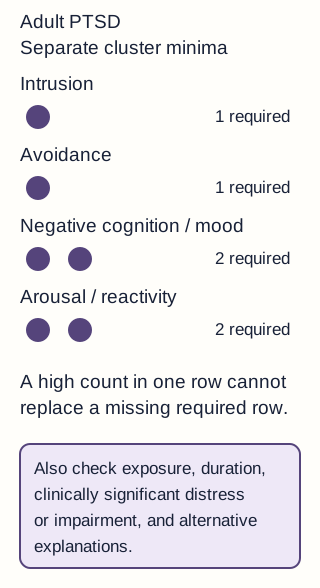
A required cluster cannot be replaced. Count within each adult PTSD cluster rather than pooling every symptom. Exposure, duration, clinically significant distress or impairment, and exclusions remain necessary. Source relationship. Enlarge this diagram
For adult PTSD, organize the interview as one intrusion, one avoidance, two negative cognition/mood and two arousal/reactivity symptoms. The symptoms must relate appropriately to the trauma, the disturbance must last more than one month, and there must be clinically significant distress or impairment. Check that substances, medication or another illness do not account for the presentation. The VA reports that DSM-5-TR did not change these adult criteria. Preschool assessment has separate criteria; do not apply this adult counting exercise to young children. VA adult PTSD criteria
Intrusion: unwanted recollections, trauma-related dreams, reliving episodes, or marked emotional or bodily reactions to reminders.
Avoidance: attempts to evade trauma-related thoughts and feelings or external reminders. A patient need not avoid both kinds.
Negative cognition and mood: persistent harmful beliefs or distorted blame, negative emotions, reduced interests, detachment, difficulty feeling positive emotions, or trauma-related memory gaps not explained by intoxication or injury.
Arousal and reactivity: excessive threat monitoring, exaggerated startle, irritability, risky behavior, poor concentration or disturbed sleep.
Do not double-count one observation to fill a missing cluster. A nightmare concerns intrusion; separate difficulty initiating sleep can contribute to arousal. Social detachment differs from intentionally avoiding a reminder. Absence of avoidance blocks the adult diagnosis even when the total symptom count is high.
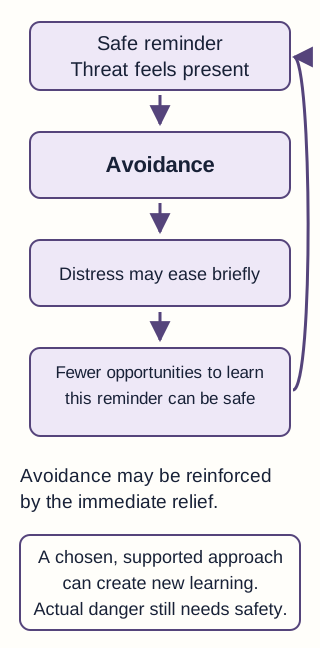
Avoidance can be understandable and self-reinforcing. Skipping a safe bus ride may reduce fear immediately. That relief can make skipping more likely next time, while limiting opportunities to learn that a reminder is not the original danger. In consent-based therapy, approaching a genuinely safe reminder can create new learning. A patient may complete a safe trip without the predicted catastrophe while still feeling anxious. That offers new information even without immediate calm. This is a conceptual maintenance pathway, not proof of a single cause in every patient. Exposure-learning review Avoiding a current assailant is protection, not a behavior to extinguish. VA exposure-based treatment
Predict: Keeping every other finding fixed, add sustained avoidance of trauma-related thoughts to a case lacking that cluster. The cluster requirement may now be met, but duration, consequences and exclusions still need to pass.
Distinguish distress, overlapping illness and development
Adjustment disorder requires a stressor-linked emotional or behavioral response beginning within three months, with disproportionate distress in context or significant functional impairment, and without another disorder better explaining it. Symptoms do not continue beyond six months after the stressor and its consequences end. Continuing housing insecurity can prolong the relevant stressor. Ordinary sadness with preserved functioning and proportionate distress should not automatically become an illness. APA adjustment overview
The stressor need not meet the PTSD exposure requirement. Equally, a qualifying trauma can precede adjustment disorder when PTSD, ASD and other better explanations are not met. Do not use adjustment disorder as a default for every subthreshold symptom report. Assess the positive criteria and cultural context. A sustained major depressive episode after a stressor is not downgraded to adjustment solely because it has a trigger. APA depressive syndrome overview
Check depression, panic symptoms, substance use or withdrawal, traumatic brain injury, pain and sleep disorders. Concentration problems alone cannot distinguish PTSD from concussion. Persistent depersonalization or derealization can specify PTSD when the full syndrome is present; these experiences do not establish psychosis or replace the base criteria. VA specificationsNICE comprehensive assessment
Reactive attachment disorder (RAD) involves markedly limited comfort seeking and response to comfort from caregivers, with social/emotional disturbance after severely insufficient care. The pattern must be evident before age five, with developmental age at least nine months; autism must be considered and excluded under the diagnostic criteria. Disinhibited social engagement disorder (DSED) instead concerns developmentally inappropriate familiarity with unfamiliar adults, such as leaving without checking back. It also requires severe insufficient care and developmental age at least nine months. There is no blanket DSED requirement that presentation be before age five; the pattern can persist later. Mere friendliness, adoption or foster-care status does not diagnose either disorder. APA developmental overviewAACAP assessment parameterRADA criteria comparison
Assess caregiving history and observe behavior with familiar and unfamiliar adults. Withdrawal from an unfamiliar examiner does not establish a familiar-caregiver comfort deficit. Restricted repetitive behavior and social-communication differences require developmental assessment, including consideration of autism. Stable, responsive care and specialist caregiver-child work matter more than labeling a child from one clinic interaction. A seven-year-old who seeks comfort from an adoptive parent can still have DSED after early deprivation if persistent stranger-related disinhibition is established.
Apply this idea to a patient
Case 14
Show answer and explanations for case 14
A. RAD remains supported by persistent stranger-related disinhibition (Why this does not fit)
What pattern would support RAD?
RAD concerns inhibited comfort seeking and response toward familiar caregivers.
What has improved here?
The child now seeks and accepts comfort from the adoptive caregiver.
Which relationship distinguishes DSED?
Persistent inappropriate behavior toward unfamiliar adults is not the RAD comfort phenotype.
Read this explanation together
RAD concerns inhibited comfort seeking and response toward familiar caregivers. The child now seeks and accepts comfort from the adoptive caregiver. Persistent inappropriate behavior toward unfamiliar adults is not the RAD comfort phenotype.
B. DSED remains supported despite improved selective attachment (Best answer)
Which behaviors support ongoing DSED assessment?
Overfamiliar approach, reduced checking back and willingness to leave with strangers form the disinhibited pattern.
What does improved comfort seeking show?
Selective attachment has improved without resolving the stranger-related behavior.
What developmental distinction matters?
DSED may persist after selective attachment improves and is not restricted to presentation before age five.
Read this explanation together
Overfamiliar approach, reduced checking back and willingness to leave with strangers form the disinhibited pattern. Selective attachment has improved without resolving the stranger-related behavior. DSED may persist after selective attachment improves and is not restricted to presentation before age five.
C. Neither disorder remains possible after selective attachment develops (Why this does not fit)
Which relationship improved?
The relationship with the familiar caregiver improved.
Which behavior remains abnormal?
Developmentally inappropriate engagement with unfamiliar adults persists across settings.
Can one improvement establish recovery of the other behavior?
Improved selective attachment does not by itself establish resolution of DSED.
Read this explanation together
The relationship with the familiar caregiver improved. Developmentally inappropriate engagement with unfamiliar adults persists across settings. Improved selective attachment does not by itself establish resolution of DSED.
D. DSED is excluded because the child is now older than five (Why this does not fit)
What does the age of seven change?
It does not itself exclude persistent DSED.
What is the relevant early history?
Severely insufficient care preceded the disinhibited behavior.
Which age rule should not be transferred?
Do not apply RAD’s before-five onset requirement as a blanket DSED upper-age limit.
Read this explanation together
It does not itself exclude persistent DSED. Severely insufficient care preceded the disinhibited behavior. Do not apply RAD’s before-five onset requirement as a blanket DSED upper-age limit.
Takeaway: Improvement in selective attachment does not necessarily resolve stranger-related disinhibition.
For established adult PTSD, discuss evidence-supported individual trauma-focused psychotherapy: prolonged exposure (PE), cognitive processing therapy (CPT), and eye movement desensitization and reprocessing (EMDR). PE includes work with trauma memories and safely approaching avoided reminders. CPT addresses trauma-related beliefs such as pervasive blame; its cognitive-only format does not require a written trauma narrative. EMDR is a structured trauma-focused treatment using bilateral stimulation while processing memories. No symptom word proves that one therapy is universally superior. Preferences, availability, consent and clinical needs guide selection. Do not force detailed retelling at an initial encounter. VA psychotherapy overview
When medication is preferred or psychotherapy is unavailable or not feasible, sertraline, paroxetine and venlafaxine have the strongest guideline support. Sertraline and paroxetine have US PTSD approval; venlafaxine is evidence-supported off-label use. Review prior response, adverse effects, interactions and bipolar history rather than treating all antidepressants as interchangeable. Adding a drug to successful therapy is not automatically better than either appropriate treatment alone. VA medication guide
Prazosin is a possible nightmare-targeted option, not global PTSD therapy. The 2023 VA/DoD recommendation is conditional with low-quality evidence for PTSD-associated nightmares. Benefit is not assured. In a 304-veteran trial, the nightmare comparison did not demonstrate superiority over placebo even though blood pressure fell. A physiological effect is not proof of benefit at the intended symptom target, and a nonsignificant comparison does not establish equivalence. Published prazosin trial Discuss preferences and assess sleep apnea, orthostatic blood pressure, falls, other alpha blockers and other blood-pressure-lowering drugs. Alpha-1 blockade can reduce vascular tone and cause postural dizziness or syncope. Existing orthostasis can outweigh a potential nightmare benefit. If selected, use cautious clinician-supervised initiation and reassess benefit and tolerability. VA prazosin recommendationMinipress warningsVA sleep assessment
Chronic benzodiazepines are not recommended for core PTSD because benefit is lacking and harms include dependence, cognitive effects and falls. This is not a prohibition for every unrelated medical indication. Established dependence also means abrupt discontinuation can be unsafe. Within the first month, NICE recommends individual trauma-focused CBT for adults with ASD or clinically important PTSD symptoms. Falling below nine ASD symptoms does not itself make monitoring the only appropriate care. Do not prescribe universal preventive medication or require single-session psychological debriefing for everyone exposed. VA early careNICE prevention recommendations
Apply this idea to a patient
Case 18
Show answer and explanations for case 18
A. Begin prazosin now; prioritize review of doxazosin (Why this does not fit)
What immediate problem do the measurements demonstrate?
A 30/16 mmHg standing pressure fall reproduces the dizziness.
Why is starting prazosin now unfavorable?
Prazosin can add further blood-pressure lowering before the symptomatic problem is evaluated.
What should happen before the nightmare trial?
Review the active orthostatic problem and current medicines before adding another alpha blocker.
Read this explanation together
A 30/16 mmHg standing pressure fall reproduces the dizziness. Prazosin can add further blood-pressure lowering before the symptomatic problem is evaluated. Review the active orthostatic problem and current medicines before adding another alpha blocker.
B. Defer prazosin now; prioritize review of doxazosin (Best answer)
How should the paired readings be interpreted?
They demonstrate a clinically important symptomatic postural fall.
Which medicine is the priority for review?
Newly added doxazosin has a temporally associated alpha-blocking hypotensive effect.
Which sequence follows?
Defer prazosin while evaluating orthostasis and reviewing doxazosin; reassess the conditional nightmare option after the risk is addressed.
Read this explanation together
They demonstrate a clinically important symptomatic postural fall. Newly added doxazosin has a temporally associated alpha-blocking hypotensive effect. Defer prazosin while evaluating orthostasis and reviewing doxazosin; reassess the conditional nightmare option after the risk is addressed.
C. Defer prazosin now; prioritize review of sertraline (Why this does not fit)
What is correct about deferring prazosin?
Active symptomatic orthostasis warrants evaluation before another blood-pressure-lowering drug.
What evidence favors reviewing doxazosin first?
Dizziness began after its recent addition, and its alpha blockade shares the proposed drug’s hypotensive mechanism.
How should medication review be prioritized?
Review the temporally and pharmacologically implicated medicine while considering the whole regimen, rather than automatically changing a long-stable effective SSRI.
Read this explanation together
Active symptomatic orthostasis warrants evaluation before another blood-pressure-lowering drug. Dizziness began after its recent addition, and its alpha blockade shares the proposed drug’s hypotensive mechanism. Review the temporally and pharmacologically implicated medicine while considering the whole regimen, rather than automatically changing a long-stable effective SSRI.
D. Begin prazosin now; prioritize review of sertraline (Why this does not fit)
Which measured finding argues against immediate initiation?
The symptomatic standing-pressure fall is already present before prazosin.
Which current drug deserves priority review?
The recent doxazosin addition better matches the onset and relevant hypotensive mechanism than six-month stable sertraline.
What should guide the paired decision?
Use both the observed adverse physiology and the medication timeline before altering treatment.
Read this explanation together
The symptomatic standing-pressure fall is already present before prazosin. The recent doxazosin addition better matches the onset and relevant hypotensive mechanism than six-month stable sertraline. Use both the observed adverse physiology and the medication timeline before altering treatment.
Takeaway: Interpret postural measurements, then connect the adverse effect to the medication timeline before adding nightmare therapy.
Follow safety, function and the patient’s priorities
Short relief can reinforce avoidance. The return arrow shows why immediate relief can maintain avoidance of safe reminders. This is a learning model, not a complete explanation for every patient. Source relationship. Enlarge this diagram
Begin with current safety: ongoing violence, self-harm or suicide risk, medical injury and urgent housing or basic needs. Agree on a safety plan and escalate to emergency assessment when imminent risk requires it. Offer practical support without demanding a trauma narrative. A person can deserve care before meeting a diagnostic threshold. NICE risk assessment and engagement
For mild subthreshold symptoms in the first month, active monitoring means arranging follow-up, not simply saying that time will fix everything. NICE advises contact within one month; review sooner for worsening symptoms or safety concerns. Reassess symptom counts, duration and functioning rather than carrying an early label forward unchanged. For ongoing treatment, ask about sleep, work, relationships, treatment attendance, adverse effects and the outcomes the patient values.
Depression and alcohol or drug problems can coexist with PTSD. Substance misuse alone should not exclude someone from PTSD care; coordinate treatment and assess intoxication or withdrawal risk. Usually treat PTSD first when depression coexists, but address depression first when its severity prevents meaningful trauma-focused engagement or creates a more urgent safety risk. Loud snoring, witnessed breathing pauses and daytime sleepiness warrant sleep-apnea evaluation rather than reflexively adding nightmare medication. A single negative, inconclusive or technically inadequate home apnea study warrants polysomnography when investigating suspected adult sleep apnea; do not use it to close an unresolved respiratory assessment. AASM diagnostic testing guideline Persistent insomnia may benefit from cognitive behavioral therapy for insomnia. NICE complex needsVA sleep comorbidity
Use validated measures to follow change alongside an interview, not as stand-alone diagnostic verdicts. No brain scan or biological signature establishes PTSD in this lesson. Recovery can include improved functioning despite residual symptoms. If treatment is not helping, revisit the diagnosis, exposure history, access barriers, adequate treatment delivery, comorbidities and preferences before declaring the condition untreatable.
Transfer: A patient reports fewer nightmares but repeated near-fainting after a new prescription. Improvement in one target does not make the regimen safe. Reassess blood pressure and medications promptly while preserving the broader PTSD care plan.
Practice integrated clinical decisions
Use the necessary findings, consider alternatives and predict what would change the decision. All cases are educational.
Case 1
Show answer and explanations for case 1
A. Acute stress disorder (Best answer)
How many ASD symptoms are described?
The inventory contains nine distinct ASD symptoms.
Does the disturbance fit the acute interval?
Eleven symptomatic days fall within the first month after the robbery.
How does absent dissociation affect this formulation?
ASD uses a total of at least nine symptoms, not a required dissociation quota.
Read this explanation together
The inventory contains nine distinct ASD symptoms. Eleven symptomatic days fall within the first month after the robbery. ASD uses a total of at least nine symptoms, not a required dissociation quota.
B. Posttraumatic stress disorder (Why this does not fit)
Which PTSD timing requirement fails?
The disturbance has lasted eleven days, not more than one month.
What does the larger symptom inventory establish instead?
Nine qualifying acute symptoms support ASD in this interval.
Which timing rule applies?
A broad post-trauma pattern cannot substitute for PTSD duration.
Read this explanation together
The disturbance has lasted eleven days, not more than one month. Nine qualifying acute symptoms support ASD in this interval. A broad post-trauma pattern cannot substitute for PTSD duration.
C. Adjustment disorder (Why this does not fit)
Why is adjustment disorder initially plausible?
The distress began after an identifiable stressor and disrupts work.
Which more specific pattern takes precedence?
Nine distinct symptoms during the acute post-trauma interval support ASD.
When should adjustment disorder be used?
Use adjustment disorder only when its positive criteria fit and another disorder does not better explain the response.
Read this explanation together
The distress began after an identifiable stressor and disrupts work. Nine distinct symptoms during the acute post-trauma interval support ASD. Use adjustment disorder only when its positive criteria fit and another disorder does not better explain the response.
D. Specific phobia of the store (Why this does not fit)
What makes a store phobia an incomplete explanation?
Dreams, intrusive memories and generalized threat monitoring occur beyond entering the store.
What does the whole inventory support?
The nine-symptom acute syndrome explains more than the store avoidance.
Which scope should guide formulation?
Interpret situational avoidance within the entire post-trauma presentation.
Read this explanation together
Dreams, intrusive memories and generalized threat monitoring occur beyond entering the store. The nine-symptom acute syndrome explains more than the store avoidance. Interpret situational avoidance within the entire post-trauma presentation.
Takeaway: Count the ASD inventory independently, then apply its acute interval; dissociation need not be present.
A. ASD threshold reached; offer individual trauma-focused CBT (Why this does not fit)
What is the actual acute symptom count?
Seven distinct ASD symptoms are supplied.
Why is the treatment component reasonable?
Worsening clinically important trauma symptoms support offering early individual trauma-focused CBT.
Which diagnostic boundary still applies?
A treatment indication does not turn seven symptoms into the nine required for ASD.
Read this explanation together
Seven distinct ASD symptoms are supplied. Worsening clinically important trauma symptoms support offering early individual trauma-focused CBT. A treatment indication does not turn seven symptoms into the nine required for ASD.
B. Below ASD threshold; offer individual trauma-focused CBT (Best answer)
Does the inventory establish ASD?
Seven symptoms fall below the nine-symptom ASD threshold.
Why offer treatment before a full diagnosis?
Increasing symptoms are already preventing her from teaching.
Which early-care rule applies?
NICE supports individual trauma-focused CBT within one month for clinically important PTSD symptoms as well as ASD.
Read this explanation together
Seven symptoms fall below the nine-symptom ASD threshold. Increasing symptoms are already preventing her from teaching. NICE supports individual trauma-focused CBT within one month for clinically important PTSD symptoms as well as ASD.
C. Below ASD threshold; use active monitoring as sole care (Why this does not fit)
When is monitoring alone more suitable?
Monitoring is a reasonable early approach to mild subthreshold symptoms.
What distinguishes this course?
Symptoms are worsening enough to prevent teaching despite resolved immediate practical needs.
What should determine the offer of early therapy?
Clinical importance, not the ASD count alone, determines whether to offer trauma-focused CBT.
Read this explanation together
Monitoring is a reasonable early approach to mild subthreshold symptoms. Symptoms are worsening enough to prevent teaching despite resolved immediate practical needs. Clinical importance, not the ASD count alone, determines whether to offer trauma-focused CBT.
D. ASD threshold reached; use active monitoring as sole care (Why this does not fit)
Which count was overlooked?
The inventory contains seven symptoms rather than nine.
Which trajectory was overlooked?
Increasing disability is not a mild improving early response.
Which two decisions must remain separate?
Assess the ASD threshold separately from the need for early active treatment.
Read this explanation together
The inventory contains seven symptoms rather than nine. Increasing disability is not a mild improving early response. Assess the ASD threshold separately from the need for early active treatment.
Takeaway: A subthreshold ASD count does not rule out clinically important symptoms warranting early trauma-focused CBT.
A. He also reacts with an exaggerated startle to traffic noise. (Why this does not fit)
Which cluster contains exaggerated startle?
Exaggerated startle is an arousal/reactivity symptom.
Is that cluster already sufficiently represented?
Threat monitoring and sleep-initiation difficulty already provide two arousal symptoms.
What does an additional arousal symptom fail to supply?
A third arousal symptom cannot replace an unestablished avoidance symptom.
Read this explanation together
Exaggerated startle is an arousal/reactivity symptom. Threat monitoring and sleep-initiation difficulty already provide two arousal symptoms. A third arousal symptom cannot replace an unestablished avoidance symptom.
B. He routinely pushes away thoughts and feelings about the crash. (Best answer)
Which adult cluster remains unestablished?
The history has not established avoidance.
What does deliberate thought suppression represent?
Pushing away trauma-related thoughts and feelings is internal avoidance.
Does travel on the route exclude avoidance?
Continued contact with an external reminder does not exclude avoidance of internal reminders.
Read this explanation together
The history has not established avoidance. Pushing away trauma-related thoughts and feelings is internal avoidance. Continued contact with an external reminder does not exclude avoidance of internal reminders.
C. He also feels persistently detached from his close friends. (Why this does not fit)
Where does detachment belong?
Detachment belongs to negative cognition and mood.
What already represents that cluster?
Distorted blame and loss of interest already provide two negative cognition/mood symptoms.
How are cluster minimums applied?
Extra negative symptoms cannot compensate for missing evidence of avoidance.
Read this explanation together
Detachment belongs to negative cognition and mood. Distorted blame and loss of interest already provide two negative cognition/mood symptoms. Extra negative symptoms cannot compensate for missing evidence of avoidance.
D. He has vivid crash-related dreams several nights each week. (Why this does not fit)
Where do crash dreams belong?
Trauma-related dreams are intrusion symptoms.
What already represents intrusion?
Unwanted crash memories already satisfy the minimum intrusion count.
What should the next interview target?
When other cluster minimums are represented, seek evidence in the unestablished cluster rather than accumulating redundant symptoms.
Read this explanation together
Trauma-related dreams are intrusion symptoms. Unwanted crash memories already satisfy the minimum intrusion count. When other cluster minimums are represented, seek evidence in the unestablished cluster rather than accumulating redundant symptoms.
Takeaway: External contact with reminders can coexist with internal avoidance; map the entire inventory before choosing the next question.
A. PTSD duration sufficient; ASD post-exposure interval open (Why this does not fit)
What does nine months measure?
Nine months measures time since the collapse, not symptom duration.
Where does the new disturbance lie relative to ASD?
It began well outside the first month after exposure.
Which two clocks must be kept separate?
Neither a remote event nor recent symptoms can substitute for the disorder-specific timing rule.
Read this explanation together
Nine months measures time since the collapse, not symptom duration. It began well outside the first month after exposure. Neither a remote event nor recent symptoms can substitute for the disorder-specific timing rule.
B. PTSD duration sufficient; ASD post-exposure interval closed (Why this does not fit)
How long has the disturbance lasted?
The disturbance has lasted only ten days.
Can delayed onset waive duration?
Delayed expression does not waive the requirement for a disturbance lasting more than one month.
How should PTSD timing be recorded?
Count symptomatic time separately from time since exposure.
Read this explanation together
The disturbance has lasted only ten days. Delayed expression does not waive the requirement for a disturbance lasting more than one month. Count symptomatic time separately from time since exposure.
C. PTSD duration insufficient; ASD post-exposure interval closed (Best answer)
Does the ten-day disturbance meet PTSD duration?
Ten days does not exceed one month.
Does its recent onset put it in the ASD interval?
No; the trauma occurred nine months earlier.
What follows from these separate failures?
Continue assessment and needed care without using either timing shortcut to establish ASD or PTSD.
Read this explanation together
Ten days does not exceed one month. No; the trauma occurred nine months earlier. Continue assessment and needed care without using either timing shortcut to establish ASD or PTSD.
D. PTSD duration insufficient; ASD post-exposure interval open (Why this does not fit)
Which interval is this choice measuring for ASD?
It measures ten days since symptom onset.
What anchors the ASD window instead?
The ASD window is anchored to the traumatic exposure.
Which conclusion follows here?
New symptoms after remote trauma do not reopen the first-month ASD window.
Read this explanation together
It measures ten days since symptom onset. The ASD window is anchored to the traumatic exposure. New symptoms after remote trauma do not reopen the first-month ASD window.
Takeaway: PTSD disturbance duration and the ASD post-exposure interval are separate requirements.
A. PTSD anchored to the earlier assault (Best answer)
Which event supplies a qualifying exposure?
Her own assault supplies a direct qualifying exposure.
What does the seven-week pattern establish?
The impairing pattern supplies the adult cluster minimums for more than one month.
How should a later reminder be interpreted?
A nonqualifying media reminder can reactivate symptoms of a qualifying earlier trauma.
Read this explanation together
Her own assault supplies a direct qualifying exposure. The impairing pattern supplies the adult cluster minimums for more than one month. A nonqualifying media reminder can reactivate symptoms of a qualifying earlier trauma.
B. PTSD anchored to the televised attack (Why this does not fit)
Does viewing this report establish a new exposure route?
Ordinary nonprofessional viewing of an unrelated attack does not establish that route.
Which experience do the intrusive memories concern?
They concern her own earlier assault.
What anchors the formulation?
Anchor PTSD to the qualifying trauma rather than automatically to its recent reminder.
Read this explanation together
Ordinary nonprofessional viewing of an unrelated attack does not establish that route. They concern her own earlier assault. Anchor PTSD to the qualifying trauma rather than automatically to its recent reminder.
C. ASD anchored to the televised attack (Why this does not fit)
What problem precedes the ASD timing question?
The televised report does not supply a new qualifying exposure.
What does the observed course support instead?
Seven weeks of the described assault-related pattern support PTSD assessment anchored to the assault.
Which clock should not be reset?
A media reminder does not start a new ASD post-exposure window.
Read this explanation together
The televised report does not supply a new qualifying exposure. Seven weeks of the described assault-related pattern support PTSD assessment anchored to the assault. A media reminder does not start a new ASD post-exposure window.
D. Adjustment disorder anchored to the news report (Why this does not fit)
Why might adjustment disorder appear plausible?
Distress intensified after a recent stressful news report.
What more specific relationship was overlooked?
The sustained cluster pattern concerns a qualifying personal assault.
How should a trigger affect diagnostic precedence?
A recent trigger does not reduce a supported PTSD syndrome to adjustment disorder.
Read this explanation together
Distress intensified after a recent stressful news report. The sustained cluster pattern concerns a qualifying personal assault. A recent trigger does not reduce a supported PTSD syndrome to adjustment disorder.
Takeaway: A reminder and the index trauma need not be the same event.
A. Retain an adjustment formulation because exposure is through recordings (Why this does not fit)
How is this viewing different from ordinary news viewing?
Repeated aversive-details exposure is part of his work.
What does the symptom course add?
The impairing ten-week pattern supplies the adult PTSD cluster minimums.
Which media boundary applies?
The exclusion for ordinary media viewing does not erase the work-related exposure route.
Read this explanation together
Repeated aversive-details exposure is part of his work. The impairing ten-week pattern supplies the adult PTSD cluster minimums. The exclusion for ordinary media viewing does not erase the work-related exposure route.
B. Restart the ASD interval because another recording was assigned (Why this does not fit)
Did yesterday begin the disturbance?
The same disturbance has already persisted for ten weeks.
What would require a separate acute assessment?
A genuinely new symptom presentation after a new exposure could require its own assessment.
How is this continuing course classified?
Repeated exposures do not repeatedly reset the duration of an established disturbance.
Read this explanation together
The same disturbance has already persisted for ten weeks. A genuinely new symptom presentation after a new exposure could require its own assessment. Repeated exposures do not repeatedly reset the duration of an established disturbance.
C. Retain PTSD formulation; the same disturbance already exceeds one month (Best answer)
Does assigned review provide a possible qualifying route?
Repeated occupational exposure to graphic aversive details can qualify.
What does ten-week persistence establish?
The supplied cluster pattern has persisted beyond the PTSD duration threshold.
What does yesterday change about that duration?
A similar new assignment does not make a continuing ten-week disturbance one day old.
Read this explanation together
Repeated occupational exposure to graphic aversive details can qualify. The supplied cluster pattern has persisted beyond the PTSD duration threshold. A similar new assignment does not make a continuing ten-week disturbance one day old.
D. Defer PTSD formulation until exposure has stopped for one month (Why this does not fit)
What does PTSD duration measure?
It measures the disturbance, not time since the last exposure.
Has the described disturbance persisted long enough?
Ten weeks exceeds one month.
Is exposure cessation a required waiting period?
Do not add a post-exposure waiting period to the actual symptom-duration requirement.
Read this explanation together
It measures the disturbance, not time since the last exposure. Ten weeks exceeds one month. Do not add a post-exposure waiting period to the actual symptom-duration requirement.
Takeaway: Occupational exposure can qualify, and repeated assignments do not reset an established symptom duration.
A. Death was accidental; she also has persistent emotional detachment (Why this does not fit)
What does accidental death change?
Learning of an accidental death of a close relative can satisfy the exposure route.
Which cluster would detachment supplement?
Detachment would add to the negative cognition/mood symptoms already present.
What is still needed?
An added negative symptom cannot replace absent avoidance.
Read this explanation together
Learning of an accidental death of a close relative can satisfy the exposure route. Detachment would add to the negative cognition/mood symptoms already present. An added negative symptom cannot replace absent avoidance.
B. Death was expected and natural; she persistently suppresses related thoughts (Why this does not fit)
What does deliberate suppression change?
It supplies internal avoidance.
What does the death description leave unchanged?
An expected natural death learned by telephone still fails this exposure route.
How do the requirements interact?
A sufficient symptom pattern cannot repair a nonqualifying exposure.
Read this explanation together
It supplies internal avoidance. An expected natural death learned by telephone still fails this exposure route. A sufficient symptom pattern cannot repair a nonqualifying exposure.
C. Death was accidental; she persistently suppresses related thoughts (Best answer)
What does the accidental-death report repair?
It repairs the learned-death exposure requirement.
What does deliberate thought suppression repair?
It supplies the absent avoidance cluster.
How should a counterfactual be judged?
Change each failed requirement explicitly rather than treating one repaired criterion as a complete diagnosis.
Read this explanation together
It repairs the learned-death exposure requirement. It supplies the absent avoidance cluster. Change each failed requirement explicitly rather than treating one repaired criterion as a complete diagnosis.
D. Death was expected and natural; she also has persistent emotional detachment (Why this does not fit)
Does this death description repair the route?
The learned expected natural death remains nonqualifying for this route.
Does detachment repair the cluster gap?
Detachment adds a negative symptom rather than avoidance.
Which requirements remain independent?
Exposure eligibility and the specific cluster minimums must each be satisfied.
Read this explanation together
The learned expected natural death remains nonqualifying for this route. Detachment adds a negative symptom rather than avoidance. Exposure eligibility and the specific cluster minimums must each be satisfied.
Takeaway: For learned death, violent or accidental circumstances and a sufficient symptom pattern are separate questions.
A. Adjustment disorder remains possible because stressor consequences continue (Best answer)
What does the symptom pattern support?
The impairing stressor-linked response began within three months without a sustained depressive syndrome.
Which consequences are still active?
Unemployment and eviction proceedings continue.
When is the six-month resolution boundary anchored?
For adjustment disorder, count from the end of the stressor or its consequences, not automatically from the initial event.
Read this explanation together
The impairing stressor-linked response began within three months without a sustained depressive syndrome. Unemployment and eviction proceedings continue. For adjustment disorder, count from the end of the stressor or its consequences, not automatically from the initial event.
B. Adjustment disorder has expired because the dismissal was nine months ago (Why this does not fit)
What date is this option using?
It uses the date of dismissal.
Why is that endpoint inappropriate here?
The resulting unemployment and housing threat have not ended.
Which timing rule should be applied?
Persistent stressor consequences can sustain adjustment symptoms beyond six months after the initiating event.
Read this explanation together
It uses the date of dismissal. The resulting unemployment and housing threat have not ended. Persistent stressor consequences can sustain adjustment symptoms beyond six months after the initiating event.
C. Major depression is favored because symptoms have lasted nine months (Why this does not fit)
Does duration supply the missing depressive pattern?
Nine months of symptoms does not supply sustained depressed mood or loss of interest and the required associated findings.
What does preserved enjoyment contribute?
Enjoyment with his daughter argues against pervasive anhedonia in the supplied history.
What should govern the depression differential?
Diagnose a depressive syndrome from its pattern, not chronic distress alone.
Read this explanation together
Nine months of symptoms does not supply sustained depressed mood or loss of interest and the required associated findings. Enjoyment with his daughter argues against pervasive anhedonia in the supplied history. Diagnose a depressive syndrome from its pattern, not chronic distress alone.
D. PTSD is favored because housing insecurity remains threatening (Why this does not fit)
Does eviction risk supply the specified PTSD exposure?
Housing insecurity alone is not the described death, serious injury or sexual-violence exposure.
What is the worry linked to?
It is linked to ongoing unemployment and housing consequences.
Which distinction matters?
A severe stressor can warrant care without qualifying as a PTSD exposure.
Read this explanation together
Housing insecurity alone is not the described death, serious injury or sexual-violence exposure. It is linked to ongoing unemployment and housing consequences. A severe stressor can warrant care without qualifying as a PTSD exposure.
Takeaway: For adjustment disorder, ongoing consequences matter; chronic distress alone does not establish major depression.
A. ASD initially; PTSD at the later visit (Why this does not fit)
Was the initial acute inventory sufficient for ASD?
Only three ASD symptoms were established at day 20.
What supports PTSD later?
The later sustained pattern supplies intrusion, avoidance, two negative and two arousal symptoms.
Which initial boundary remains important?
A qualifying event and an early date do not substitute for the ASD nine-symptom threshold.
Read this explanation together
Only three ASD symptoms were established at day 20. The later sustained pattern supplies intrusion, avoidance, two negative and two arousal symptoms. A qualifying event and an early date do not substitute for the ASD nine-symptom threshold.
B. Adjustment disorder initially; PTSD at the later visit (Best answer)
What supports the initial adjustment formulation?
The impairing disproportionate response began promptly but only three acute symptoms were present.
What changes the later formulation?
Added blame, reduced interest and startle complete a PTSD cluster pattern that has persisted for six weeks.
What does this trajectory show?
PTSD can emerge without prior ASD; reassess the actual inventory instead of carrying the first label forward.
Read this explanation together
The impairing disproportionate response began promptly but only three acute symptoms were present. Added blame, reduced interest and startle complete a PTSD cluster pattern that has persisted for six weeks. PTSD can emerge without prior ASD; reassess the actual inventory instead of carrying the first label forward.
C. Adjustment disorder initially; adjustment disorder at the later visit (Why this does not fit)
Why was adjustment initially reasonable?
The early impairing stressor response did not meet the ASD symptom count.
Why should that label not be carried forward unchanged?
The later observations establish a sufficiently persistent PTSD pattern.
Which follow-up rule applies?
A more specific disorder takes precedence when its criteria become supported.
Read this explanation together
The early impairing stressor response did not meet the ASD symptom count. The later observations establish a sufficiently persistent PTSD pattern. A more specific disorder takes precedence when its criteria become supported.
D. ASD initially; adjustment disorder at the later visit (Why this does not fit)
What is wrong with the initial classification?
Three acute symptoms are insufficient for ASD.
What is wrong with the later classification?
The later sufficient PTSD pattern is more specific than adjustment disorder.
Which reassessment is needed?
Use each visit’s symptom inventory rather than treating either calendar position as a diagnosis.
Read this explanation together
Three acute symptoms are insufficient for ASD. The later sufficient PTSD pattern is more specific than adjustment disorder. Use each visit’s symptom inventory rather than treating either calendar position as a diagnosis.
Takeaway: A qualifying trauma can precede adjustment disorder, and subsequent PTSD does not require an earlier ASD diagnosis.
A. Adjustment-related low mood; begin trauma-focused treatment first (Why this does not fit)
What exceeds an adjustment-related low-mood response?
Five weeks of pervasive depressed mood, anhedonia and multiple associated symptoms support a major depressive episode.
What currently limits trauma work?
She cannot sustain even a brief treatment discussion or basic daily tasks.
Which sequencing principle applies?
When severe depression makes trauma-focused participation difficult, address it before beginning that work.
Read this explanation together
Five weeks of pervasive depressed mood, anhedonia and multiple associated symptoms support a major depressive episode. She cannot sustain even a brief treatment discussion or basic daily tasks. When severe depression makes trauma-focused participation difficult, address it before beginning that work.
B. Major depressive episode; begin trauma-focused treatment first (Why this does not fit)
What does the depressive inventory establish?
The sustained pervasive pattern supports a major depressive episode.
When is treating PTSD first usually reasonable?
PTSD-first care is usually reasonable when coexisting depression does not prevent engagement or create a more urgent risk.
Which supplied modifier changes the sequence?
Here the severe depressive state makes meaningful participation impracticable, favoring depression treatment first.
Read this explanation together
The sustained pervasive pattern supports a major depressive episode. PTSD-first care is usually reasonable when coexisting depression does not prevent engagement or create a more urgent risk. Here the severe depressive state makes meaningful participation impracticable, favoring depression treatment first.
C. Major depressive episode; address severe depression first (Best answer)
Which mood formulation is supported?
The sustained pervasive depressive inventory supports a major depressive episode despite the divorce trigger.
Which observation changes treatment order?
Severe impairment makes meaningful trauma-focused participation impracticable.
Which care rule follows?
Address severe interfering depression first, then return to the trauma-focused treatment plan as engagement becomes feasible.
Read this explanation together
The sustained pervasive depressive inventory supports a major depressive episode despite the divorce trigger. Severe impairment makes meaningful trauma-focused participation impracticable. Address severe interfering depression first, then return to the trauma-focused treatment plan as engagement becomes feasible.
D. Adjustment-related low mood; address that mood response first (Why this does not fit)
What is appropriate about prioritizing the mood problem?
The current severe mood-related impairment interferes with treatment engagement.
What is wrong with calling it adjustment-related low mood?
The supplied symptoms form a sustained major depressive episode.
Which diagnostic rule remains important?
A clear stressor does not justify downgrading a full depressive syndrome to adjustment disorder.
Read this explanation together
The current severe mood-related impairment interferes with treatment engagement. The supplied symptoms form a sustained major depressive episode. A clear stressor does not justify downgrading a full depressive syndrome to adjustment disorder.
Takeaway: A stressor does not downgrade major depression; severe interference with engagement can change the usual PTSD-first sequence.
A. PTSD with intrusion episodes alone (Why this does not fit)
Are these episodes descriptions of reliving?
She describes altered self and surroundings rather than the assault happening again.
Which specification does that support?
Recurrent depersonalization and derealization support the dissociative specification when PTSD is established.
What distinction matters?
Do not equate every dissociative experience with a trauma flashback.
Read this explanation together
She describes altered self and surroundings rather than the assault happening again. Recurrent depersonalization and derealization support the dissociative specification when PTSD is established. Do not equate every dissociative experience with a trauma flashback.
B. PTSD with the dissociative specification (Best answer)
What base syndrome is supported?
The persistent impairing history supplies the adult PTSD cluster minimums and duration.
How are the separate episodes classified?
Outside-body feelings and an unreal environment describe depersonalization and derealization.
When does the specification apply?
Add the dissociative specification to established PTSD when recurrent depersonalization or derealization is not better explained by substances or another condition.
Read this explanation together
The persistent impairing history supplies the adult PTSD cluster minimums and duration. Outside-body feelings and an unreal environment describe depersonalization and derealization. Add the dissociative specification to established PTSD when recurrent depersonalization or derealization is not better explained by substances or another condition.
C. Primary depersonalization/derealization disorder instead of PTSD (Why this does not fit)
Why could the episode description suggest this disorder?
Depersonalization and derealization are the experiences being described.
What makes an instead-of-PTSD formulation incomplete?
The independent persistent trauma-linked cluster pattern supports PTSD.
How should the wider presentation be used?
Do not discard the base trauma syndrome when its associated dissociative specification explains the episodes.
Read this explanation together
Depersonalization and derealization are the experiences being described. The independent persistent trauma-linked cluster pattern supports PTSD. Do not discard the base trauma syndrome when its associated dissociative specification explains the episodes.
D. Brief psychotic disorder instead of PTSD (Why this does not fit)
What does preserved awareness show?
She recognizes the unreality as a subjective experience rather than a literal external change.
What symptom account fits better?
Recurrent depersonalization and derealization fit the described episodes.
What should not be inferred from unreality alone?
A subjective sense of unreality does not by itself establish a psychotic disorder.
Read this explanation together
She recognizes the unreality as a subjective experience rather than a literal external change. Recurrent depersonalization and derealization fit the described episodes. A subjective sense of unreality does not by itself establish a psychotic disorder.
Takeaway: Establish PTSD independently, then distinguish depersonalization or derealization from a flashback.
A. Observe unfamiliar-adult approach; assess a depressive syndrome (Why this does not fit)
Does unfamiliar-adult avoidance establish the RAD comfort pattern?
No; RAD requires assessment of seeking and responding to comfort from familiar caregivers.
What alternative pattern needs attention?
Cross-setting restricted repetitive play and limited shared attention warrant autism assessment.
Which evidence should drive the next assessment?
Target the unobserved caregiver relationship and the demonstrated developmental pattern rather than selecting tests from neglect history alone.
Read this explanation together
No; RAD requires assessment of seeking and responding to comfort from familiar caregivers. Cross-setting restricted repetitive play and limited shared attention warrant autism assessment. Target the unobserved caregiver relationship and the demonstrated developmental pattern rather than selecting tests from neglect history alone.
B. Observe familiar-caregiver comfort; assess a depressive syndrome (Why this does not fit)
Which part of this plan addresses a genuine gap?
Observing comfort with a familiar caregiver addresses the missing RAD relationship evidence.
Why is depression not the leading second assessment here?
The supplied cross-setting developmental pattern is not a new sustained depressive change.
Which alternative must be assessed before attributing withdrawal to RAD?
Restricted repetitive behavior with social-communication differences warrants assessment for autism.
Read this explanation together
Observing comfort with a familiar caregiver addresses the missing RAD relationship evidence. The supplied cross-setting developmental pattern is not a new sustained depressive change. Restricted repetitive behavior with social-communication differences warrants assessment for autism.
C. Observe unfamiliar-adult approach; assess autism spectrum features (Why this does not fit)
Why assess autism?
Persistent restricted repetitive play and limited shared attention raise that alternative.
Which observation is missing for RAD?
Seeking and responding to comfort from a familiar caregiver remain unknown.
Can a stranger interaction replace that observation?
Unfamiliar-adult behavior cannot establish the familiar-caregiver comfort pattern required for RAD.
Read this explanation together
Persistent restricted repetitive play and limited shared attention raise that alternative. Seeking and responding to comfort from a familiar caregiver remain unknown. Unfamiliar-adult behavior cannot establish the familiar-caregiver comfort pattern required for RAD.
D. Observe familiar-caregiver comfort; assess autism spectrum features (Best answer)
What does the clinic interaction fail to establish?
Withdrawal from an unfamiliar examiner does not establish how the child uses a familiar caregiver for comfort.
What independent differential is suggested?
Persistent restricted repetitive play and limited shared attention warrant autism assessment.
Which assessment rule follows?
Evaluate the caregiver relationship directly and consider autism before attributing social withdrawal to neglect-related RAD.
Read this explanation together
Withdrawal from an unfamiliar examiner does not establish how the child uses a familiar caregiver for comfort. Persistent restricted repetitive play and limited shared attention warrant autism assessment. Evaluate the caregiver relationship directly and consider autism before attributing social withdrawal to neglect-related RAD.
Takeaway: Neglect is a risk history, not a diagnosis; observe familiar-caregiver comfort and assess developmental alternatives.
A. Record RAD provisionally from the absent selective preference (Why this does not fit)
Which developmental threshold is not met?
The documented developmental age is below nine months.
Why is limited preference insufficient here?
Selective attachment behavior cannot be judged using the same expectations as in a developmentally older child.
What should proceed despite diagnostic deferral?
Provide safe responsive care while reassessing development rather than forcing a RAD classification.
Read this explanation together
The documented developmental age is below nine months. Selective attachment behavior cannot be judged using the same expectations as in a developmentally older child. Provide safe responsive care while reassessing development rather than forcing a RAD classification.
B. Record DSED provisionally from the absent selective preference (Why this does not fit)
Does limited selective preference establish DSED?
It does not establish developmentally inappropriate active disinhibition toward strangers.
Which age threshold also matters?
DSED requires developmental age of at least nine months.
How should risk history be used?
Neglect warrants intervention, not a DSED label without the developmental and behavioral criteria.
Read this explanation together
It does not establish developmentally inappropriate active disinhibition toward strangers. DSED requires developmental age of at least nine months. Neglect warrants intervention, not a DSED label without the developmental and behavioral criteria.
C. Defer RAD and DSED classification while developmental assessment continues (Best answer)
What limits attachment-disorder classification?
The child’s developmental age is six months, below the minimum for RAD and DSED.
Does this limit the need for intervention?
Safe responsive care and developmental assessment remain necessary.
Which rule applies?
Use developmental readiness for attachment-disorder classification without delaying protection or support.
Read this explanation together
The child’s developmental age is six months, below the minimum for RAD and DSED. Safe responsive care and developmental assessment remain necessary. Use developmental readiness for attachment-disorder classification without delaying protection or support.
D. Use chronological age to choose between RAD and DSED (Why this does not fit)
Which age is relevant to the minimum threshold?
Developmental age, not chronological age alone, is relevant.
What does chronological age fail to establish?
Being two years old does not establish the needed social developmental capacity.
How should attachment behavior be judged?
Interpret social behavior against developmental level rather than calendar age alone.
Read this explanation together
Developmental age, not chronological age alone, is relevant. Being two years old does not establish the needed social developmental capacity. Interpret social behavior against developmental level rather than calendar age alone.
Takeaway: Both RAD and DSED require developmental age of at least nine months; support is not contingent on a label.
A. Prolonged exposure including repeated imaginal trauma recounting (Why this does not fit)
Which component conflicts with her preference?
Repeated detailed oral recounting is part of the imaginal work she declines.
Does declining PE mean declining all trauma-focused care?
She remains willing to examine trauma-related beliefs.
How should therapy be selected?
Match the specific treatment tasks to informed preferences rather than treating trauma-focused therapies as interchangeable experiences.
Read this explanation together
Repeated detailed oral recounting is part of the imaginal work she declines. She remains willing to examine trauma-related beliefs. Match the specific treatment tasks to informed preferences rather than treating trauma-focused therapies as interchangeable experiences.
B. Cognitive-only CPT without a written narrative (Best answer)
What work does she want to do?
She wants to examine entrenched trauma-related self-blame.
Does CPT require a written trauma narrative?
Current CPT can use a cognitive-only format without a written narrative.
What does this match establish?
CPT fits this preference; it does not establish superiority over every other evidence-supported therapy.
Read this explanation together
She wants to examine entrenched trauma-related self-blame. Current CPT can use a cognitive-only format without a written narrative. CPT fits this preference; it does not establish superiority over every other evidence-supported therapy.
C. Present-centered therapy without trauma-focused cognitive work (Why this does not fit)
What makes present-centered therapy a useful option elsewhere?
It offers a manualized non-trauma-focused alternative.
What stated goal makes it less aligned here?
She specifically wants trauma-focused work on self-blame.
How should non-trauma-focused alternatives be used?
Offer them when appropriate without assuming refusal of one trauma task means refusal of all trauma-focused treatment.
Read this explanation together
It offers a manualized non-trauma-focused alternative. She specifically wants trauma-focused work on self-blame. Offer them when appropriate without assuming refusal of one trauma task means refusal of all trauma-focused treatment.
D. EMDR using structured processing of trauma memories (Why this does not fit)
Is EMDR an evidence-supported PTSD therapy?
EMDR is an evidence-supported trauma-focused treatment.
What more directly matches her expressed focus?
CPT explicitly centers work on the trauma-related beliefs she wants to examine.
How should this preference be interpreted?
A preference-matched selection is not a claim that one therapy is generally most effective.
Read this explanation together
EMDR is an evidence-supported trauma-focused treatment. CPT explicitly centers work on the trauma-related beliefs she wants to examine. A preference-matched selection is not a claim that one therapy is generally most effective.
Takeaway: CPT can omit a written narrative; treatment choice should match the patient’s preferred work, not a universal ranking.
A. Retry paroxetine with a tolerability plan (Why this does not fit)
Does paroxetine have PTSD evidence?
Paroxetine has guideline support for the overall PTSD syndrome.
What individual observation weighs against this choice?
His earlier paroxetine trial produced intolerable sedation.
What should distinguish among supported medicines?
Use documented response and tolerability rather than treating equally supported options as equally suitable for a particular patient.
Read this explanation together
Paroxetine has guideline support for the overall PTSD syndrome. His earlier paroxetine trial produced intolerable sedation. Use documented response and tolerability rather than treating equally supported options as equally suitable for a particular patient.
B. Discuss a monitored sertraline retrial (Best answer)
Which treatment target is being selected?
He seeks help for a persistent daytime PTSD syndrome rather than frequent nightmares.
Which prior result favors sertraline?
Sertraline previously helped without troublesome adverse effects.
Which prescribing principle follows?
Discuss a monitored retrial of a supported medicine with a favorable individual history rather than promising the past response will recur.
Read this explanation together
He seeks help for a persistent daytime PTSD syndrome rather than frequent nightmares. Sertraline previously helped without troublesome adverse effects. Discuss a monitored retrial of a supported medicine with a favorable individual history rather than promising the past response will recur.
C. Discuss prazosin as the primary medication (Why this does not fit)
What target supports a prazosin discussion?
Prazosin has a conditional role for PTSD-associated nightmares.
What target dominates here?
Daytime symptoms and work impairment dominate while nightmares are uncommon.
Which endpoint distinction matters?
A nightmare-targeted option does not replace a medicine supported for overall PTSD symptoms.
Read this explanation together
Prazosin has a conditional role for PTSD-associated nightmares. Daytime symptoms and work impairment dominate while nightmares are uncommon. A nightmare-targeted option does not replace a medicine supported for overall PTSD symptoms.
D. Retry venlafaxine with a tolerability plan (Why this does not fit)
Does venlafaxine have PTSD evidence?
Venlafaxine is guideline-supported for the overall syndrome.
What prior experience makes it less attractive here?
Persistent nausea limited an adequate supervised trial.
What should guide a repeat trial?
Prefer the supported option with better documented individual tolerability when no new reason favors the poorly tolerated one.
Read this explanation together
Venlafaxine is guideline-supported for the overall syndrome. Persistent nausea limited an adequate supervised trial. Prefer the supported option with better documented individual tolerability when no new reason favors the poorly tolerated one.
Takeaway: Match the treatment endpoint first, then use prior response and tolerability among supported medicines.
A. Nightmare equivalence established; lower pressure is a physiological effect, not proof of sleep benefit (Why this does not fit)
What does the nightmare confidence interval permit?
The interval includes no between-group difference.
Does that establish equivalence?
A nonsignificant superiority result does not establish equivalence.
How should the result be stated?
Describe the absence of demonstrated nightmare superiority rather than proof that the treatments are equivalent.
Read this explanation together
The interval includes no between-group difference. A nonsignificant superiority result does not establish equivalence. Describe the absence of demonstrated nightmare superiority rather than proof that the treatments are equivalent.
B. Nightmare superiority not demonstrated; lower pressure is evidence of useful sleep improvement (Why this does not fit)
What did the nightmare comparison demonstrate?
It did not demonstrate prazosin superiority on that nightmare endpoint.
Does lower blood pressure repair that result?
A physiological blood-pressure effect is not the measured clinical sleep benefit.
Which endpoint rule applies?
Do not substitute a drug mechanism or another outcome for the patient-important target being tested.
Read this explanation together
It did not demonstrate prazosin superiority on that nightmare endpoint. A physiological blood-pressure effect is not the measured clinical sleep benefit. Do not substitute a drug mechanism or another outcome for the patient-important target being tested.
C. Nightmare equivalence established; lower pressure is evidence of useful sleep improvement (Why this does not fit)
What statistical claim is too strong?
The nonsignificant nightmare result does not prove equivalence.
What clinical substitution is also unsupported?
Lower pressure does not establish nightmare relief.
Which conclusions must stay separate?
Interpret the target comparison separately from the drug’s physiological blood-pressure effect.
Read this explanation together
The nonsignificant nightmare result does not prove equivalence. Lower pressure does not establish nightmare relief. Interpret the target comparison separately from the drug’s physiological blood-pressure effect.
D. Nightmare superiority not demonstrated; lower pressure is a physiological effect, not proof of sleep benefit (Best answer)
How should the nightmare estimate be read?
The interval crossing zero and P = 0.38 do not demonstrate nightmare superiority.
What does the pressure result establish?
It shows a blood-pressure effect, not proof of nightmare efficacy.
How does this fit current counseling?
The 2023 VA/DoD nightmare suggestion remains conditional and low-evidence; neither a negative trial nor a physiological response predicts every individual outcome.
Read this explanation together
The interval crossing zero and P = 0.38 do not demonstrate nightmare superiority. It shows a blood-pressure effect, not proof of nightmare efficacy. The 2023 VA/DoD nightmare suggestion remains conditional and low-evidence; neither a negative trial nor a physiological response predicts every individual outcome.
Takeaway: Interpret the target endpoint directly; a physiological drug effect is not proof of clinical benefit.
What does the guideline recommend after one negative home study?
AASM recommends polysomnography after a negative, inconclusive or technically inadequate home test.
Which sequence fits these findings?
Use the indicated laboratory study rather than routinely repeating the same home test.
Read this explanation together
Witnessed breathing pauses, gasping and daytime sleepiness persist despite fewer trauma dreams. AASM recommends polysomnography after a negative, inconclusive or technically inadequate home test. Use the indicated laboratory study rather than routinely repeating the same home test.
B. Arrange in-laboratory polysomnography after the negative home study (Best answer)
What diagnosis still requires evaluation?
The respiratory awakenings and daytime sleepiness keep obstructive sleep apnea in the differential.
Does the negative home result close that assessment?
No; a negative home study does not settle the diagnosis when clinical concern remains.
Which next test is recommended?
Proceed to polysomnography after the negative home study rather than relabeling the awakenings as nightmares.
Read this explanation together
The respiratory awakenings and daytime sleepiness keep obstructive sleep apnea in the differential. No; a negative home study does not settle the diagnosis when clinical concern remains. Proceed to polysomnography after the negative home study rather than relabeling the awakenings as nightmares.
C. Increase nightmare-targeted medication before further respiratory testing (Why this does not fit)
What distinguishes these awakenings from the prior complaint?
Gasping and witnessed pauses continue while trauma dreams are uncommon.
What did the home test leave unresolved?
The negative result has not resolved the clinical suspicion for sleep apnea.
Which symptom rule applies?
Do not use nightmare treatment as a substitute for evaluating persistent respiratory awakenings.
Read this explanation together
Gasping and witnessed pauses continue while trauma dreams are uncommon. The negative result has not resolved the clinical suspicion for sleep apnea. Do not use nightmare treatment as a substitute for evaluating persistent respiratory awakenings.
D. Begin insomnia-focused CBT and reconsider respiratory testing if it fails (Why this does not fit)
Could insomnia treatment be useful in PTSD?
CBT-I can help coexisting persistent insomnia.
Why should it not postpone this assessment?
The supplied breathing observations raise a separate unresolved respiratory concern.
Which problem should be investigated directly?
Evaluate suspected sleep apnea rather than making respiratory testing contingent on failure of insomnia therapy.
Read this explanation together
CBT-I can help coexisting persistent insomnia. The supplied breathing observations raise a separate unresolved respiratory concern. Evaluate suspected sleep apnea rather than making respiratory testing contingent on failure of insomnia therapy.
Takeaway: Persistent respiratory symptoms can outweigh reassurance from a negative home study; obtain the appropriate follow-up diagnostic test.
A. Habituation during escape maintains cancellation; useful learning requires distress to fall during the trip (Why this does not fit)
What immediately followed cancellation?
Escape from the reminder was followed by relief.
What relationship does increasing cancellation suggest?
Relief is reinforcing the avoidance response, rather than demonstrating habituation while remaining with the reminder.
Does the trip need to produce immediate calm to matter?
A safe completed approach can test a threat prediction even if distress remains high.
Read this explanation together
Escape from the reminder was followed by relief. Relief is reinforcing the avoidance response, rather than demonstrating habituation while remaining with the reminder. A safe completed approach can test a threat prediction even if distress remains high.
B. Relief reinforces cancellation; useful learning requires distress to fall during the trip (Why this does not fit)
What correctly explains more frequent cancellation?
Relief following avoidance can make avoidance more likely.
What new observation occurred during the trip?
The patient remained on board without the predicted fainting.
What positive learning goal does that support?
Learn that the selected safe reminder can be approached without the predicted catastrophe, rather than requiring immediate distress reduction.
Read this explanation together
Relief following avoidance can make avoidance more likely. The patient remained on board without the predicted fainting. Learn that the selected safe reminder can be approached without the predicted catastrophe, rather than requiring immediate distress reduction.
C. Relief reinforces cancellation; completing the trip can test the predicted catastrophe (Best answer)
How does relief affect the cancellation behavior?
Removing distress after cancellation can negatively reinforce that response.
What happened to the prediction on the completed trip?
The expected fainting did not occur despite remaining on board.
What is the realistic learning goal?
Use consensual practice with a genuinely safe reminder to test threat expectations; immediate calm is not the only meaningful outcome.
Read this explanation together
Removing distress after cancellation can negatively reinforce that response. The expected fainting did not occur despite remaining on board. Use consensual practice with a genuinely safe reminder to test threat expectations; immediate calm is not the only meaningful outcome.
D. Habituation during escape maintains cancellation; completing the trip can test the predicted catastrophe (Why this does not fit)
Why is habituation the wrong account of cancellation?
Distress fell after escape, not during sustained contact with the reminder.
What did the later completed trip allow?
It allowed comparison of a threat prediction with an observed safe outcome.
Which processes should be separated?
Distinguish reinforcement of escape from learning during a chosen safe approach.
Read this explanation together
Distress fell after escape, not during sustained contact with the reminder. It allowed comparison of a threat prediction with an observed safe outcome. Distinguish reinforcement of escape from learning during a chosen safe approach.
Takeaway: Cancellation can be reinforced by relief; safe supported practice can test a prediction without immediate distress reduction.
A. Complete a written safety plan and arrange an appointment tomorrow (Why this does not fit)
What makes next-day follow-up insufficient?
The patient reports current intent and cannot remain safe until an outpatient appointment.
What role can a safety plan still have?
It can support care but does not replace urgent assessment of imminent risk.
Which disposition principle applies?
Use immediate emergency assessment when safety cannot be maintained through an outpatient interval.
Read this explanation together
The patient reports current intent and cannot remain safe until an outpatient appointment. It can support care but does not replace urgent assessment of imminent risk. Use immediate emergency assessment when safety cannot be maintained through an outpatient interval.
B. Arrange a support-person check tonight and clinician contact tomorrow (Why this does not fit)
What does a later support-person check leave uncovered?
It leaves the period of immediate intent and access to means insufficiently protected.
Is support-person involvement irrelevant?
Support can be valuable as part of an immediate safety response.
What must it not replace?
A later informal check must not replace emergency assessment of imminent risk.
Read this explanation together
It leaves the period of immediate intent and access to means insufficiently protected. Support can be valuable as part of an immediate safety response. A later informal check must not replace emergency assessment of imminent risk.
C. Start a same-day trauma-therapy session with a safety plan afterward (Why this does not fit)
Which need precedes routine trauma treatment?
Immediate protection from self-harm takes priority.
Why is a trauma session not the first intervention?
It does not resolve the stated inability to remain safe.
How should treatment be sequenced?
Stabilize imminent risk before proceeding with routine trauma-focused work.
Read this explanation together
Immediate protection from self-harm takes priority. It does not resolve the stated inability to remain safe. Stabilize imminent risk before proceeding with routine trauma-focused work.
D. Arrange immediate emergency assessment while maintaining safety (Best answer)
Which findings establish urgency?
Current intent, available means and inability to remain safe establish immediate concern.
What should happen during the encounter?
Maintain safety while arranging emergency assessment.
Which rule should govern the next action?
Imminent self-harm risk takes precedence over diagnostic completion or the routine treatment schedule.
Read this explanation together
Current intent, available means and inability to remain safe establish immediate concern. Maintain safety while arranging emergency assessment. Imminent self-harm risk takes precedence over diagnostic completion or the routine treatment schedule.
Takeaway: Imminent self-harm risk requires an immediate safety response, not an intensified routine follow-up schedule.
A. Offer support and monitoring, with follow-up within one month (Best answer)
What trajectory is described?
Mild symptoms are improving while ordinary activities resume.
What does active monitoring require?
It includes planned follow-up rather than leaving care entirely to chance.
Which interval and contingency fit?
Arrange contact within one month and review earlier for worsening symptoms or new safety concerns.
Read this explanation together
Mild symptoms are improving while ordinary activities resume. It includes planned follow-up rather than leaving care entirely to chance. Arrange contact within one month and review earlier for worsening symptoms or new safety concerns.
B. Begin a full course of trauma-focused CBT this week (Why this does not fit)
When is early trauma-focused CBT particularly indicated?
It is offered for ASD or clinically important PTSD symptoms within the first month.
How does this presentation differ?
Symptoms are mild, improving and not disrupting current activities.
Which initial intensity fits?
Use support and active monitoring rather than routinely prescribing a full trauma-treatment course for every early response.
Read this explanation together
It is offered for ASD or clinically important PTSD symptoms within the first month. Symptoms are mild, improving and not disrupting current activities. Use support and active monitoring rather than routinely prescribing a full trauma-treatment course for every early response.
C. Start an SSRI trial for the early trauma symptoms (Why this does not fit)
What established disorder is being targeted here?
The supplied mild improving early response does not establish an indication for a PTSD medication trial.
What does prevention guidance advise?
NICE advises against drug treatment to prevent PTSD in adults.
Which early-care decision follows?
Do not start an SSRI solely to medicate a mild improving post-trauma response.
Read this explanation together
The supplied mild improving early response does not establish an indication for a PTSD medication trial. NICE advises against drug treatment to prevent PTSD in adults. Do not start an SSRI solely to medicate a mild improving post-trauma response.
D. Schedule daily symptom interviews until the memories cease (Why this does not fit)
What would justify more frequent assessment?
Worsening symptoms, deteriorating function or a safety concern could justify earlier review.
Are those changes described?
The reported course is improving with support and restored activity.
How should monitoring intensity be chosen?
Match follow-up intensity to clinical need rather than requiring daily interviews for a stable improving response.
Read this explanation together
Worsening symptoms, deteriorating function or a safety concern could justify earlier review. The reported course is improving with support and restored activity. Match follow-up intensity to clinical need rather than requiring daily interviews for a stable improving response.
Takeaway: Active monitoring is planned follow-up for mild early symptoms, with earlier review if the course worsens.
A. Increase the nightly dose while beginning CBT-I (Why this does not fit)
What does waning benefit suggest about escalation?
Escalation risks adding sedation to a regimen with declining sustained benefit.
What patient harms are already present?
Daytime sedation and falls are already occurring.
Which response fits tolerance with harm?
Reassess the medicine rather than automatically increasing it to recover an earlier sleep effect.
Read this explanation together
Escalation risks adding sedation to a regimen with declining sustained benefit. Daytime sedation and falls are already occurring. Reassess the medicine rather than automatically increasing it to recover an earlier sleep effect.
B. Continue the same nightly dose while beginning CBT-I (Why this does not fit)
Why might an unchanged dose seem safer initially?
Long use and missed-dose symptoms raise concern about withdrawal.
Why is indefinite continuation not the best plan?
The regimen is already associated with sedation and falls.
How should both risks be addressed?
Plan a supervised gradual reduction instead of treating withdrawal risk as a reason to preserve a harmful regimen indefinitely.
Read this explanation together
Long use and missed-dose symptoms raise concern about withdrawal. The regimen is already associated with sedation and falls. Plan a supervised gradual reduction instead of treating withdrawal risk as a reason to preserve a harmful regimen indefinitely.
C. Plan a supervised gradual taper while beginning CBT-I (Best answer)
What makes continued reliance unfavorable?
Benefit has waned while sedation and falls have appeared.
What makes abrupt cessation unfavorable?
Two years of use and missed-dose symptoms indicate physical-dependence risk.
Which plan addresses both concerns?
Use an individualized supervised gradual taper with an evidence-supported insomnia alternative such as CBT-I.
Read this explanation together
Benefit has waned while sedation and falls have appeared. Two years of use and missed-dose symptoms indicate physical-dependence risk. Use an individualized supervised gradual taper with an evidence-supported insomnia alternative such as CBT-I.
D. Stop the nightly medicine today while beginning CBT-I (Why this does not fit)
Why is stopping appealing?
Sedation and falls give a clear reason to reassess continued use.
What makes immediate cessation hazardous?
Long use with missed-dose symptoms creates withdrawal risk.
Which distinction matters?
A reason to discontinue a medicine is not automatically a reason to discontinue it abruptly.
Read this explanation together
Sedation and falls give a clear reason to reassess continued use. Long use with missed-dose symptoms creates withdrawal risk. A reason to discontinue a medicine is not automatically a reason to discontinue it abruptly.
Takeaway: Address both ongoing benzodiazepine harm and withdrawal risk; discontinuation should not be reflexively abrupt.
A. Treat alcohol use first and postpone trauma-focused care until sustained abstinence (Why this does not fit)
What would justify delaying trauma work for stabilization?
Acute intoxication, withdrawal or an immediate safety problem could require stabilization first.
What is the present state?
He is sober, stable and able to engage without current withdrawal signs.
Which eligibility rule applies?
Substance misuse alone should not exclude an otherwise appropriate patient from PTSD treatment.
Read this explanation together
Acute intoxication, withdrawal or an immediate safety problem could require stabilization first. He is sober, stable and able to engage without current withdrawal signs. Substance misuse alone should not exclude an otherwise appropriate patient from PTSD treatment.
B. Coordinate evidence-supported trauma-focused and alcohol-use treatment now (Best answer)
What suggests an independently treatable trauma syndrome?
The persistent impairing cluster pattern occurs on sober days and predates resumed heavy drinking.
What does the current assessment establish about sequencing?
It identifies no acute intoxication, withdrawal or immediate safety reason to defer outpatient engagement.
Which treatment approach follows?
Coordinate treatment of PTSD and alcohol use rather than requiring abstinence as an automatic prerequisite.
Read this explanation together
The persistent impairing cluster pattern occurs on sober days and predates resumed heavy drinking. It identifies no acute intoxication, withdrawal or immediate safety reason to defer outpatient engagement. Coordinate treatment of PTSD and alcohol use rather than requiring abstinence as an automatic prerequisite.
C. Treat the trauma presentation first and defer the alcohol-use intervention (Why this does not fit)
Does the trauma syndrome explain away the alcohol problem?
The addiction assessment establishes a current alcohol use disorder needing attention.
Does current stability remove that treatment need?
Stability permits engagement but does not mean the alcohol disorder has resolved.
Which comorbidity principle applies?
Coordinate care for both established problems rather than assuming treatment of one replaces treatment of the other.
Read this explanation together
The addiction assessment establishes a current alcohol use disorder needing attention. Stability permits engagement but does not mean the alcohol disorder has resolved. Coordinate care for both established problems rather than assuming treatment of one replaces treatment of the other.
D. Use a medical withdrawal pathway before considering either outpatient treatment (Why this does not fit)
What would make medical withdrawal care the immediate priority?
Current withdrawal or a withdrawal-risk assessment requiring medical management would make stabilization the priority.
What is supplied at this visit?
The current assessment describes a sober, physiologically stable patient without withdrawal signs.
How should stabilization decisions be made?
Base acute medical sequencing on current findings and assessed risk, not the alcohol-use label alone.
Read this explanation together
Current withdrawal or a withdrawal-risk assessment requiring medical management would make stabilization the priority. The current assessment describes a sober, physiologically stable patient without withdrawal signs. Base acute medical sequencing on current findings and assessed risk, not the alcohol-use label alone.
Takeaway: Assess the independent trauma syndrome and current stability, then coordinate PTSD and substance-use care.