
GI
Gilbert and Crigler-Najjar Syndromes
Use residual UGT1A1 function to distinguish Gilbert and Crigler-Najjar syndromes, recognize dangerous bilirubin exposure, and avoid misleading shortcuts.
The shared problem is reduced bilirubin conjugation. The amount of useful enzyme that remains helps explain why one patient needs reassurance and another needs urgent protection from brain injury.
Locate the chemical step before comparing severity
Bilirubin is produced during heme breakdown. Before hepatic processing, most circulating unconjugated bilirubin is bound to albumin. It dissolves poorly in water and is not freely filtered into urine in that bound form. A negative urine bilirubin test therefore fits an isolated unconjugated increase, but it does not identify the cause of that increase. [1] [4]
 Enlarge the whole image
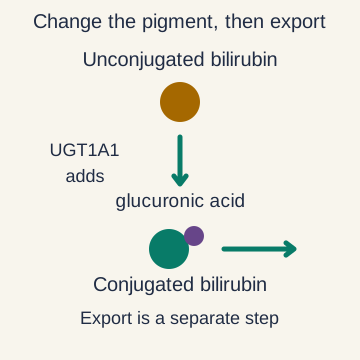
Conjugation changes the molecule. Crossing into bile is a later transport problem, not the same event.
Bone Wizardry. Original educational schematic. Source and provenance
Inside hepatocytes, UGT1A1 attaches glucuronic acid to bilirubin. This process, glucuronidation, produces more water-soluble conjugated pigment for subsequent transport into bile. Gilbert syndrome and Crigler-Najjar syndromes reduce this chemical processing capacity. The accumulation is principally upstream of the reaction, so the blood pattern is predominantly unconjugated. [1] [4]
Dubin-Johnson and Rotor syndromes are different. They affect export or reuptake of bilirubin that has already been conjugated. A measured direct-predominant pattern should therefore redirect the comparison toward transport, hepatocyte injury, or impaired bile flow rather than being forced into the Gilbert versus Crigler-Najjar group. [4] [6]
A laboratory fraction is a starting point rather than a diagnosis. Increased production from hemolysis, impaired uptake, a drug effect, and impaired conjugation can all increase indirect bilirubin. First establish that the proposed inherited explanation fits the full clinical picture. Only then does the comparison of residual UGT1A1 function become useful. [3] [4]
- Before conjugation Albumin carries poorly water-soluble unconjugated pigment. [4]
- Chemical processing UGT1A1 adds glucuronic acid. [1]
- After conjugation Separate transporters move the processed pigment toward bile or recover it from blood. [4] [6]
Compare the functional spectrum without rigid numerical boxes
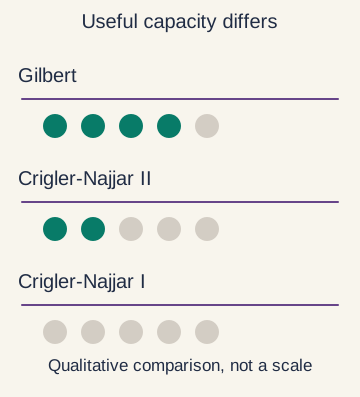
Gilbert syndrome generally leaves enough conjugating capacity for a mild, intermittent adult phenotype. A patient may notice yellow eyes during fasting, intercurrent illness, dehydration, or heavy exertion and have little or no jaundice at other times. Other liver chemistries and tests for hemolysis are usually normal. The typical established adult condition does not require bilirubin-lowering treatment. [1] [3]
 Enlarge the whole image
Compare useful residual function. Tokens are illustrative only: they are not percentages, diagnostic cutoffs or predicted bilirubin levels.
Bone Wizardry. Original educational schematic. Source and provenance
Crigler-Najjar type I has absent or nearly absent effective UGT1A1 function. Severe, persistent unconjugated hyperbilirubinemia often begins in early life. Without protection, bilirubin exposure can cause neurologic injury. A well-appearing interval or absence of injury so far is not evidence that this risk has disappeared. The disorder requires a specialist long-term plan. [1] [2]
Crigler-Najjar type II retains some enzyme activity, but substantially less than the usual Gilbert phenotype. Its bilirubin burden is often greater and may increase during illness or other stress. Phenobarbital can increase residual activity in appropriate patients. Neurologic injury is less common than in type I, but the phrase no kernicterus does not exclude type II. [1] [4]
These are useful clinical categories along a functional spectrum. Bilirubin concentrations vary with production, illness, treatment, and genotype, and intermediate phenotypes occur. Do not diagnose a type from one memorized concentration alone. Use onset, persistence, degree of elevation, other causes, molecular findings when appropriate, and the documented treatment response together. [2] [4] [6]
Make reassurance the conclusion of a fitting assessment
A typical Gilbert evaluation shows an isolated indirect increase with normal aminotransferases and alkaline phosphatase. A normal blood count, reticulocyte count, lactate dehydrogenase, and smear support the absence of hemolysis. Haptoglobin and other tests may be useful when the history or pattern raises a specific hemolytic concern. Previous stable results can be more informative than repeating an extensive workup every time the patient is ill. [3]
 Enlarge the whole image
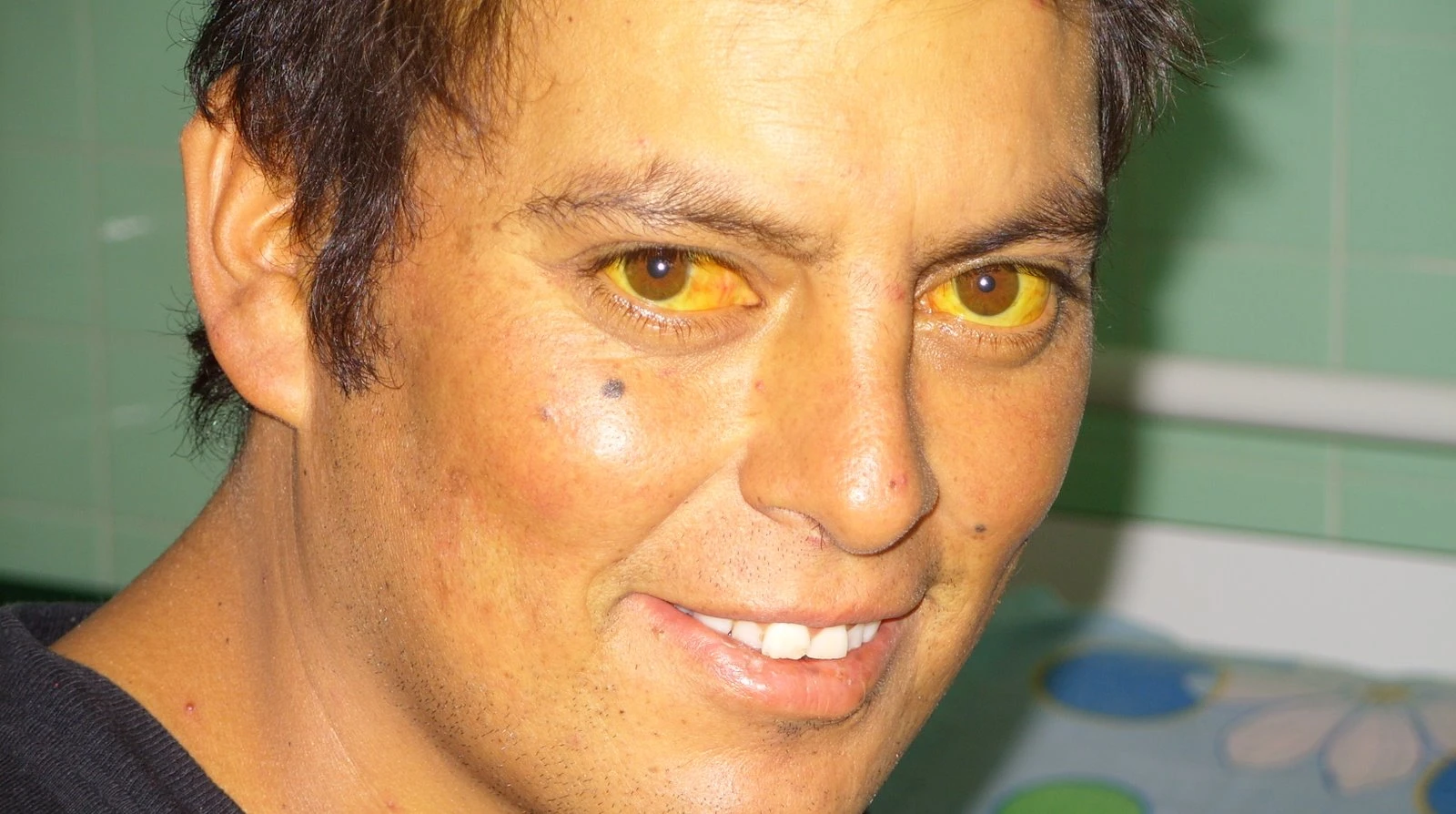
Published scleral-icterus example, originally documented in acute hepatitis. This is not a photograph of Gilbert syndrome. Yellow sclera does not establish the cause or bilirubin fraction. Whole image retained; WebP optimization only.
Sheila J. Toro (2011). CC BY 4.0. Source and provenance

The history should include prescribed drugs, nonprescription products, alcohol exposure, family findings, and symptoms of another illness. Atazanavir and some other medicines can inhibit UGT1A1 and produce indirect hyperbilirubinemia. A drug-associated pattern does not automatically prove inherited Gilbert syndrome. Conversely, a known Gilbert genotype may contribute to how conspicuous a drug effect becomes. [3]
A clear adult Gilbert phenotype generally does not need liver biopsy or routine imaging. Genetic testing may be useful for genuine diagnostic uncertainty, selected medication decisions, or counseling, rather than being mandatory for everyone. Deliberately fasting a patient or administering a drug challenge is not routinely recommended to prove the diagnosis. [3]
Explain the benign diagnosis in practical terms. Jaundice can fluctuate without progressive liver injury, and unnecessary treatment is not the goal. New anemia, dark urine with confirmed bilirubin, pale stools, pain, fever, itching, elevated liver enzymes, or a changed synthetic-function result should reopen the assessment. The earlier diagnosis is a baseline to compare with, not permission to ignore a new pattern. [3] [6]
- Confirm the pattern Indirect bilirubin is isolated rather than accompanied by evidence of injury or hemolysis. [3]
- Check alternatives Medication effects and new disease can mimic or accompany the inherited condition. [3]
- Avoid provocation Do not make fasting or a phenobarbital challenge a routine requirement. [3]
Distinguish yellow skin from dangerous brain exposure
Unbound unconjugated bilirubin is the neurotoxic fraction. Albumin binding limits its free concentration, but the binding system is not unlimited or identical in every patient. Severe bilirubin accumulation and conditions that alter binding or vulnerability can increase brain exposure. The presence of jaundice alone does not measure that exposure, and the absence of obvious neurologic signs does not prove it is safe. [2] [5]
For newborns within its scope, the 2022 AAP guideline bases treatment on total serum bilirubin, gestational age, postnatal age in hours, and neurotoxicity risk factors. It applies to infants born at 35 or more weeks of gestation. Sepsis, hemolysis, low albumin, and recent significant clinical instability can change the relevant assessment. More premature infants require their neonatal team protocol rather than extrapolation from these curves. [5]
Do not subtract the direct fraction from total serum bilirubin to decide whether a neonatal treatment threshold has been reached. Nor should a remembered single value be used as a universal threshold for kernicterus across ages and clinical settings. The primary CN1 longitudinal study illustrates variation in binding and risk; its cohort observations are not a replacement neonatal treatment calculator. [2] [5]
Acute bilirubin encephalopathy can progress from poor feeding or altered alertness to abnormal tone, arching, a high-pitched cry, or more advanced neurologic dysfunction. Concerning neurologic findings in a severely jaundiced infant require emergency neonatal assessment and treatment. Protect the child while investigating the cause; waiting for UGT1A1 sequencing is not a safe treatment plan. [2] [5]
Circulating total
A measurable concentration that must be interpreted in the applicable clinical framework. [5]
Unbound fraction
The bilirubin available for neurotoxic tissue exposure. [2]
Clinical danger
Neurologic signs or treatment-level results demand action before genetic confirmation. [5]