Irritable bowel syndrome: understand the pattern, choose the target
Understand gut-brain symptoms, distinguish diagnostic criteria and warning findings, interpret stool patterns, and choose safer symptom-directed care.
When does a recurrent pain-and-stool pattern support irritable bowel syndrome, and when does it demand another explanation? Start with the relationship between sensation and defecation, then ask whether the history contains evidence that the relationship cannot explain.
A patient can have disruptive abdominal symptoms without destructive inflammation. The practical goal is not to prove that every test is normal. It is to recognize a coherent disorder of gut-brain interaction, investigate credible alternatives, and choose treatment for the symptoms that still limit daily life. This lesson addresses adults; medication decisions require an individual assessment. [2][3]
Why can a normal-looking bowel still hurt?
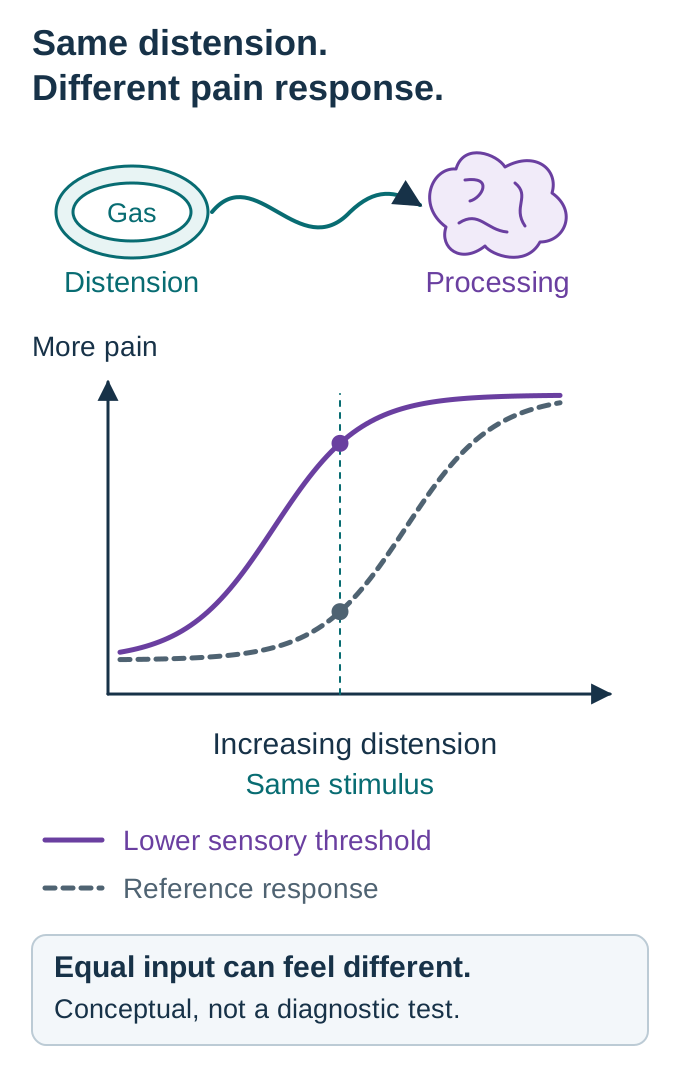
Imagine two intestines containing the same ordinary amount of gas. Their stretch-sensitive nerves and central processing need not produce the same experience. A lower sensory threshold can make normal distension painful. Altered transit can change stool consistency at the same time. These are interacting processes, not proof of an ulcer and not evidence that the pain is invented. [3]
The gut-brain diagram separates three locations: the intestinal contents, sensory communication, and the brain's processing of that information. Diet can alter the contents; transit changes how long those contents remain; attention and prior experiences can influence the resulting sensation. Microbial and immune influences are under investigation and vary between people. IBS does not have one established microbial signature or one routinely diagnostic biopsy. [2][3]
The controlled stimulus isolates sensory response from the amount of distension. These are conceptual curves, not measurements or a diagnostic assay. [3]
Compare two observations. In the first patient, ordinary distension produces substantial pain but there is no bleeding, anemia, weight loss, or inflammatory signal. In the second, abdominal pain accompanies bloody diarrhea and iron deficiency. Predict which observation requires a separate explanation beyond heightened sensitivity.
Explain the difference between these observations
Heightened sensitivity can explain why the first patient's pain exceeds what the visible distension suggests. It does not explain blood loss in the second patient. Blood loss requires evaluation for another process even when the person has previously been diagnosed with IBS. [2][3]
The important distinction is symptom intensity versus evidence of tissue injury. IBS itself does not cause fistulas, ulceration, progressive intestinal destruction, or gastrointestinal bleeding. Another disease can coexist with IBS, so a previous diagnosis does not make a new abnormality harmless. [2][3]
For a new situation, consider someone whose diarrhea began after an intestinal infection and continued after the infection resolved. Persistent symptoms can reflect postinfectious gut-brain dysfunction, but continuing fever, bleeding, dehydration, or relevant exposure still warrants targeted evaluation. The history determines whether an infectious test is useful; repeated broad testing is not a substitute for that history. [2][13]
What pattern are you diagnosing?
Do not let a stool label substitute for a symptom history. Ask when abdominal symptoms started, how often they occur, whether defecation changes them, and whether stool frequency or form changed with them. Bloating is common but not sufficient by itself. Pain that becomes worse after defecation can still be related to defecation. [2]
Keep the named criteria version visible
Rome V, introduced in 2026, includes discomfort as well as pain and uses a threshold of three days per month. It also distinguishes standardized research criteria from clinical assessment, which considers individual context and how bothersome symptoms are. Do not apply the older weekly pain rule as a universal barrier to clinical care. [1]
Rome IV remains important for interpreting older publications and questions that explicitly name it. Its pain threshold is an average of at least one day each week over the preceding three months. Symptoms must have begun at least six months earlier. At least two associations are needed: defecation, changed stool frequency, and changed stool form. Relief after defecation is not mandatory. These are separate requirements, not three interchangeable ways to meet a single duration rule. [2]
Picture two timelines. Patient A has pain twice weekly for nine months, with more frequent loose stools during episodes. Patient B has the same frequency and stool associations, but onset was four months ago. Both deserve assessment and symptom care. Only A satisfies the older six-month onset requirement. Neither timeline cancels alarm findings or establishes a diagnosis without clinical assessment. [1][2]
Try a narrower distinction: A person has nine months of weekly pain that worsens after defecation and accompanies harder stools, without changed stool frequency. Count the relevant associations before deciding whether the Rome IV association requirement is met.
Check the association count
There are two: relation to defecation and changed stool form. Worsening still counts as a relationship. Unchanged frequency does not invalidate the other two associations. The remaining frequency, duration, and clinical-assessment requirements must also be satisfied. [2]
Apply this to a patient with recurrent loose stools but no abdominal pain or discomfort. That history does not establish IBS merely because inflammatory tests are reassuring. Consider a different bowel disorder and the differential diagnosis of chronic diarrhea. Conversely, a patient falling outside a research timing threshold should not be told to wait untreated for a calendar date. [1][2][13]
Which stool pattern should treatment target?
A patient saying they have both constipation and diarrhea is not yet a reliable subtype assessment. Loose stools after a laxative and hard stools after an antidiarrheal can describe treatment effects rather than the untreated pattern. First establish the IBS syndrome; then use a prospective diary to describe stool form and reassess it over time. [2]
For the Rome IV diary method described by the ACG, assess consistency on days when stools are abnormal, ideally over two weeks and without therapies that distort the pattern when clinically feasible. Bristol types 1 and 2 are hard or lumpy; types 6 and 7 are loose or watery. Types 3 through 5 do not belong to either of those two abnormal-form groups. [2]
Rome IV stool-form subtypes after IBS is established [2]
Subtype
Hard or lumpy
Loose or watery
IBS-C
More than 25%
Less than 25%
IBS-D
Less than 25%
More than 25%
IBS-M
More than 25%
More than 25%
IBS-U
The established syndrome does not fit the other patterns.
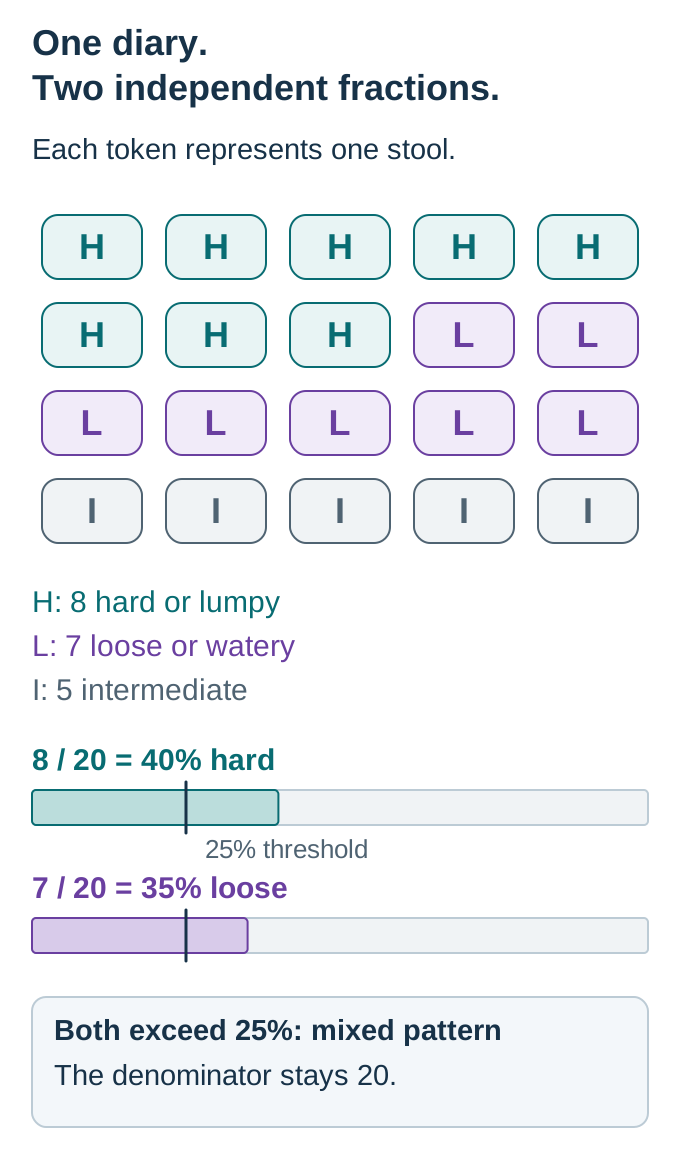
Sort before you name. A diary contains 20 stools on the assessed days: eight hard, seven loose, and five intermediate. Calculate each abnormal-form fraction using the stated 20-stool sample. Do not discard the five intermediate observations and silently change the denominator. The diagram displays the same sample as 20 labeled tokens so that the arithmetic is inspectable.
Use the stated 20-stool sample for both fractions after establishing IBS. Original labeled counts replace any need to reproduce stool-scale artwork. [2]Compare your two percentages
Eight divided by 20 is 40%; seven divided by 20 is 35%. Both exceed 25%, so this sample supports IBS-M once the IBS syndrome is established. Choosing IBS-C merely because eight exceeds seven misses the independent loose-stool threshold. [2]
The consequence is therapeutic: treating every day as constipation-predominant could worsen the loose-stool periods, while treating every day as diarrhea-predominant could worsen hard stools. Use the current symptom pattern and the person's priorities, not an old label alone. Percentages near a boundary warrant a better diary rather than false precision. [2]
For transfer, change the sample to two hard, twelve loose, and six intermediate stools. The hard fraction is 10% and the loose fraction is 60%, supporting IBS-D by the stated method. A later medication-free diary can justify a different subtype; that does not by itself disprove IBS. The diagnosis and the treatment target answer different questions. [2]
When are a few tests enough, and when are they not?
Compare a 29-year-old with a stable nine-month pain-and-diarrhea pattern, normal examination, and no warning features with a 58-year-old whose new diarrhea wakes them from sleep and accompanies weight loss and iron deficiency. Similar stool descriptions do not justify the same testing strategy. Start with risk, not the familiar symptom label. [2]
Ask about bleeding, unintentional weight loss, iron-deficiency anemia, persistent fever, nocturnal diarrhea, a palpable mass, new onset at an older age, and relevant family history of colorectal cancer, inflammatory bowel disease, or celiac disease. Review drugs, supplements, recent infection, travel or water exposures, diet, operations, and the timing of each symptom. An alarm finding is not a diagnosis of cancer or IBD; it is a reason to investigate beyond a routine IBS pathway. [2][13]
In a low-risk adult with diarrhea symptoms, targeted testing commonly includes celiac serology and a fecal inflammatory marker such as calprotectin. The ACG pathway also uses C-reactive protein alongside a fecal inflammatory assessment. A low fecal marker reduces concern for active intestinal inflammation in this setting, but neither it nor a normal CRP proves IBS or excludes every alternative. Use local assay ranges and clinical context, particularly for borderline results. [2][13]
Celiac testing requires attention to what was measured. Tissue-transglutaminase IgA is interpreted with total IgA while the patient is consuming gluten. IgA deficiency can make an IgA-based screen falsely reassuring; IgG-based tests are then useful. Modestly positive serology warrants gastroenterology assessment and usually duodenal biopsies, rather than simply continuing an IBS label or starting dietary restriction before the diagnostic plan is settled. [11]
Choose the evidence that should change the plan. Two people have fecal calprotectin within their laboratory's reference range. One has stable symptoms and a reassuring targeted assessment. The other has hemoglobin 9.6 g/dL and documented iron deficiency. Does the shared stool-marker result place both people on the low-risk pathway?
Explain why the plans differ
No. The stool marker addresses a particular question about intestinal inflammation. It does not explain iron deficiency or assess every bleeding source. The second patient needs investigation of the anemia despite that result; the first can receive a positive diagnosis when the symptom pattern and overall assessment support it. [2]
Colonoscopy is not routinely required solely to diagnose IBS in patients younger than 45 without warning signs. That is distinct from age- or risk-appropriate colorectal cancer screening. Persistent watery diarrhea with an apparently normal colon can still require biopsies for microscopic colitis. A relevant exposure history can support targeted testing for an intestinal infection. Tests should answer these specific alternatives rather than become an indiscriminate panel. [2][12][13]
Apply the distinction to follow-up: a reassuring assessment last year does not explain new bleeding this year. Reassess new findings. Conversely, repeating negative investigations without a new indication may postpone useful treatment. A positive IBS diagnosis should include an explanation, a plan, and clear reasons to seek reassessment. [2]
What would count as useful improvement?
Before changing treatment, agree on the target. Fewer urgent bathroom trips, less pain, easier defecation, and a less restricted daily routine are related but distinct outcomes. A stool diary can show a genuine benefit while also showing why the patient still needs help. [2][4][5]
Begin with a clear explanation and practical habits: regular meals, tolerable physical activity, sleep support, and review of dietary triggers. Soluble fiber such as psyllium is generally preferable to an abrupt increase in insoluble wheat bran, which can worsen gas and bloating. Introduce changes gradually and assess the response rather than treating every type of fiber as interchangeable. [2]
A dietitian-supported low-FODMAP trial reduces selected fermentable carbohydrates for a limited period, often two to six weeks. Improvement is followed by structured challenges and a personalized diet with the widest tolerated variety. A successful trial is not a reason to maintain maximal restriction indefinitely. Food-related symptoms do not automatically establish an allergy or celiac disease. [6][11]
Compare two dietary experiments. One person changes six food groups at once and continues restricting them after improvement. Another reintroduces individual groups while keeping the background diet stable. Predict which experiment can identify tolerable foods rather than merely show that a different diet feels better.
Explain what the controlled challenge adds
The second approach makes the tested food group the main changing variable. A tolerated challenge supports restoring that food, while recurrent symptoms help personalize the next trial. The first approach cannot identify which restriction mattered or which foods could safely return. [6]
Gut-directed cognitive behavioral therapy and hypnotherapy can address symptom-related fear, attention, and gut-brain processing. Offering them does not mean that symptoms are fabricated or that a psychiatric diagnosis is required. These therapies can be combined with dietary and bowel-directed treatment. [2][3]
Low-dose tricyclic treatment is another gut-brain option when symptoms persist after first-line care. The ATLANTIS randomized trial supports titrated low-dose amitriptyline as a second-line approach, not a guaranteed cure. Discuss sedation, anticholinergic effects, interactions, and relevant cardiac or overdose risks before use. Constipation may make this choice less attractive; diarrhea and pain may make it more useful. [2][14]
For transfer, imagine that loperamide reduces a person's stool frequency from five daily to two, but pain still disrupts meals. The treatment has addressed one target. The next discussion should address persistent pain rather than assume that progressively slowing the bowel will resolve every symptom. [2][5]
Match the treatment to both the target and the risk
Two treatments can increase stool frequency through different epithelial targets. Two others can reduce diarrhea while having different evidence for abdominal pain. The useful comparison includes the symptom left untreated and the harm the patient is particularly likely to experience. [4][5]
Constipation with persistent pain
Polyethylene glycol can soften stools and improve frequency, but that response does not establish relief of global IBS symptoms. Linaclotide, plecanatide, lubiprostone, and tenapanor are options for appropriate patients with IBS-C. Choose among them using efficacy, tolerability, labeled indication, and individual risks; they are not identical drugs. Persistent straining, a blockage sensation, or difficulty expelling even soft stools may instead justify anorectal testing for a defecatory disorder. [2][4]
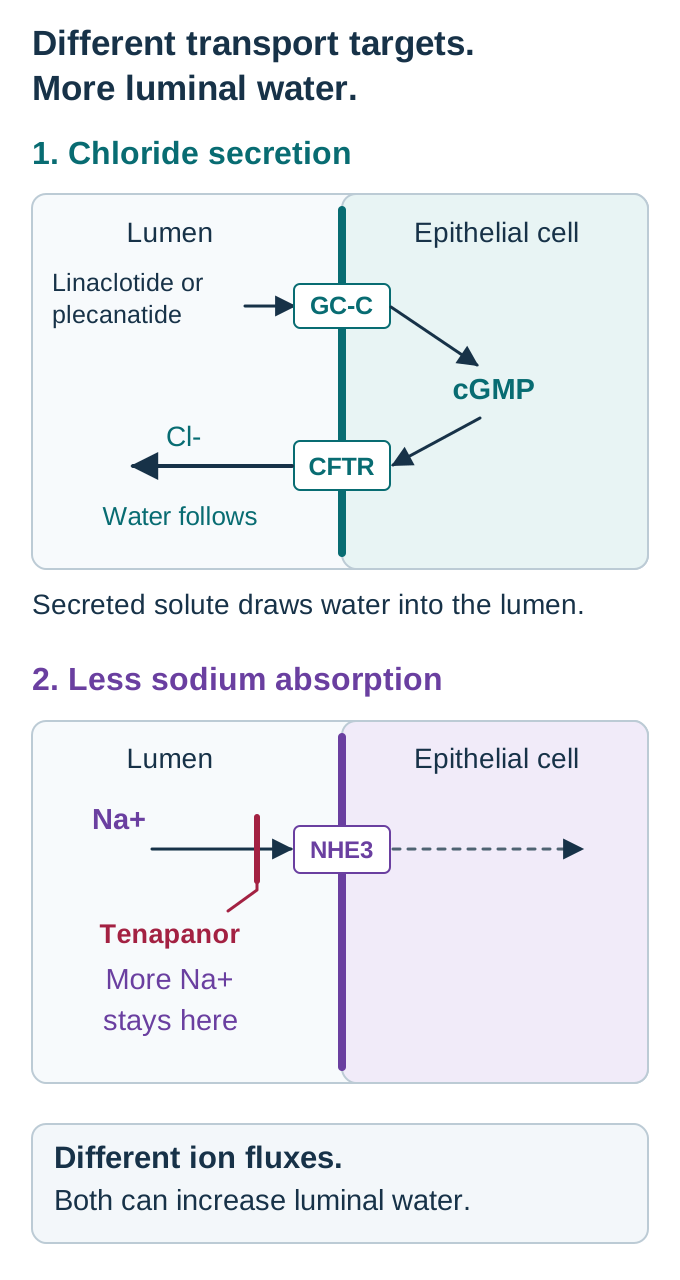
The epithelial diagram contrasts two routes to more luminal water. Linaclotide and plecanatide activate guanylate cyclase-C; cGMP signaling promotes chloride and bicarbonate secretion. Lubiprostone promotes chloride-rich intestinal secretion through a different target. Tenapanor inhibits the intestinal sodium-hydrogen exchanger NHE3, reducing sodium absorption. Retained luminal solute supports water retention. Clinical improvement in pain must still be assessed separately from this simplified transport model. [2][9][10]
Selected ion fluxes are shown. Chloride secretion and reduced sodium absorption are different routes to more luminal water; the diagram does not assert an identical mechanism or guaranteed pain response. [9][10]
Trace the sodium route. With NHE3 inhibited, predict whether more sodium enters the epithelial cell from the lumen or remains in the lumen. Then predict the direction of the associated water change.
Check the transport prediction
Less sodium is absorbed through NHE3, leaving more in the lumen. Luminal water increases, helping soften stool. This differs from stimulating chloride secretion, even though both routes can produce a wetter stool. [9][10]
Now transfer that prediction to safety: new profuse diarrhea with dizziness after an IBS-C drug is not evidence that the dose is working especially well. For severe diarrhea with linaclotide or tenapanor, suspend treatment, assess the patient, and restore fluid and electrolyte balance. Suspected mechanical obstruction is a contraindication to these agents, not a reason to escalate them. [9][10]
Diarrhea with persistent pain
Loperamide is useful for stool control but has limited evidence for global IBS pain. Rifaximin is a finite-course IBS-D option; its labeled adult regimen is 550 mg three times daily for 14 days. Recurrence can justify up to two repeat courses after reassessment, particularly after an initial response. That is not an instruction for continuous antibiotic therapy or proof that a specific infection caused the symptoms. Check rifamycin hypersensitivity and other patient-specific risks. [5][15]
Eluxadoline requires an explicit safety screen. Do not use it without a gallbladder, with known or suspected biliary obstruction or sphincter of Oddi disease, previous pancreatitis or relevant pancreatic obstruction, alcohol misuse or more than three alcoholic drinks daily, severe hepatic impairment, chronic or severe constipation, or suspected mechanical gastrointestinal obstruction. Prior serious hypersensitivity also precludes use. A lower dose does not erase a contraindication. Acute severe upper abdominal pain, particularly with vomiting or radiation to the back, requires stopping the drug and urgent assessment for pancreatitis. [7]
Alosetron is reserved for selected women with severe IBS-D that has not responded adequately to conventional treatment after appropriate evaluation. Its major safety concerns are serious constipation complications and ischemic colitis. New constipation or possible ischemic symptoms, such as bloody stool or new significant abdominal pain, require stopping treatment and prompt medical contact. Confirmed ischemic colitis precludes restarting it. Do not treat new bleeding as a routine fluctuation of IBS. [8]
Compare what changes the prescription. One adult still has pain after stool frequency improves; another has the same residual pain but also new anemia. The first may need an additional pain-directed strategy. The second needs investigation of the new finding before simply escalating IBS therapy. A treatment target never overrides evidence that the working diagnosis needs reassessment. [2]
Apply the safety screen to a different history
An adult with persistent IBS-D symptoms and an intact gallbladder still cannot receive eluxadoline safely when there is a history of pancreatitis. Checking one contraindication is not the same as completing the screen. Select a different approach after considering the full profile. [7]
Name the syndrome, describe the current stool pattern, investigate the findings it does not explain, and measure whether treatment improves the patient's actual priorities. Reassess new warning signs even after a previously sound diagnosis. [2]
Clinical application
Case 1
Show answer and explanations for case 1
A. The association requirement fails because frequency is unchanged (Why this does not fit)
Changed stool frequency is one qualifying association. It is not needed when the other two associations are supplied. Count the required associations rather than demand every possible association. [2]
Reasoning steps for option A
Does unchanged stool frequency prevent meeting Rome IV's association count?
No. Frequency change is one possible association, but two others can satisfy the required count.
Which two associations appear despite unchanged frequency?
Pain worsens with defecation and stool form has become hard and lumpy.
How many associations must be present, rather than all three?
Rome IV calls for at least two; unchanged frequency does not defeat this presentation.
B. The duration requirement fails because onset is under twelve months (Why this does not fit)
The research framework includes a minimum onset duration. Nine months exceeds its six-month onset requirement. Apply the duration of the named framework. [2]
Reasoning steps for option B
What onset interval does this Rome IV research protocol require?
Symptoms must have begun at least six months before assessment.
How does the patient's nine-month history compare with that interval?
Nine months exceeds the six-month onset minimum, not a supposed twelve-month minimum.
Should an invented twelve-month cutoff exclude this participant?
No. Apply the named protocol's six-month onset rule.
C. The association requirement fails because defecation worsens pain (Why this does not fit)
Relief with defecation is a familiar presentation. The named criteria ask for a relationship, and worsening is a relationship. Separate a common presentation from a mandatory criterion. [2]
Reasoning steps for option C
Is relief after a bowel movement the only acceptable defecation relationship?
No. Relief is common, but the criterion describes pain related to defecation.
What does worsening after defecation show here?
The patient's pain has a clear relationship to defecation even though it gets worse.
Why does the worsening not invalidate this association?
Direction of change is not restricted to improvement under this criterion.
D. The frequency requirement fails because pain is not daily (Why this does not fit)
Very frequent pain can occur in IBS. Two days each week exceeds the Rome IV weekly threshold. High symptom burden is not required to satisfy a lower frequency threshold. [2]
Reasoning steps for option D
Does Rome IV require abdominal pain every day?
No. Its frequency threshold is at least one day per week recently.
Where do two painful days each week fall relative to that cutoff?
Two days per week meet the weekly minimum without daily pain.
What error would a daily-pain requirement introduce?
It would exclude a patient who already meets the stated frequency threshold.
E. The stated pain and association requirements are met (Best answer)
Rome IV requires recurring pain with at least two specified associations. Defecation-related worsening and harder stool form supply two associations, while frequency and duration meet the thresholds. Relation to defecation need not mean relief after defecation. [2]
Reasoning steps for option E
What pain frequency and onset duration are documented?
Pain occurs twice weekly and began nine months ago, meeting the relevant Rome IV thresholds.
Which two qualifying stool or defecation associations coexist?
Defecation-related worsening and a shift to hard, lumpy stool provide two associations.
Why can the stated requirements be met without changed stool frequency or pain relief?
Only two associations are needed, and a defecation relationship may involve worsening.
Takeaway: Relation to defecation need not mean relief after defecation. [2]
A. Defer enrollment while offering clinical symptom care (Best answer)
Research eligibility and clinical care answer different questions. Four months falls short of this protocol onset rule but does not justify withholding care. Do not turn a research timeline into a waiting period for treatment. [1] [2]
Reasoning steps for option A
Why are research enrollment and symptom care separate choices?
Rome IV study eligibility follows a duration rule; clinical care need not wait for enrollment.
What does four months of symptoms mean for each choice?
Four months is short of the study's six-month onset requirement, but warrants present clinical assessment and symptom care.
How should the protocol be applied without withholding treatment?
Defer enrollment until eligible while offering appropriate care now.
B. Enroll after a colonoscopy shows normal mucosa (Why this does not fit)
Endoscopy can investigate structural alternatives. A normal examination would not change the documented onset date. A negative test cannot satisfy a duration criterion. [1] [2]
Reasoning steps for option B
Could normal colonic mucosa establish six months of symptom onset?
No. Colonoscopy assesses structural or mucosal disease, not elapsed symptom duration.
What remains unchanged after a normal colonoscopy in this patient?
The documented onset is still four months ago, short of the trial threshold.
Why not use an unnecessary normal scope as an enrollment substitute?
A negative structural test cannot supply a missing temporal criterion.
C. Defer enrollment and symptom care until month six (Why this does not fit)
Observation can establish persistence. The research threshold does not prohibit clinical care during observation. Treat the person while applying enrollment rules separately. [1] [2]
Reasoning steps for option C
What useful information might waiting until month six provide?
It could establish persistence long enough for study eligibility.
Must symptom treatment also be withheld during the remaining two months?
No. Reassuring evaluation and no warning features allow clinical care while the protocol clock continues.
How should care and enrollment be scheduled independently?
Treat symptoms now and revisit trial eligibility when the six-month onset requirement is met.
D. Enroll in the study while extending the pain diary (Why this does not fit)
A diary can improve symptom measurement. It cannot retrospectively extend a four-month onset to six months. Better measurement does not replace a missing temporal requirement. [1] [2]
Reasoning steps for option D
What can a longer pain diary measure in this study candidate?
It can record frequency and symptom associations more accurately.
Can additional entries turn a four-month onset into six months today?
No. Prospective recording does not retroactively lengthen the history.
Why does better documentation not justify immediate enrollment?
The protocol's onset threshold is still unmet regardless of diary precision.
E. Offer study enrollment after repeating celiac serology (Why this does not fit)
Celiac testing addresses an important diarrhea alternative. The obstacle here is duration despite a reassuring existing evaluation. Use testing to answer clinical questions, not to bypass eligibility rules. [1] [2]
Reasoning steps for option E
What alternative diagnosis can celiac serology help evaluate in loose stools?
It helps assess celiac disease as a possible diarrhea cause.
What issue prevents trial enrollment despite reassuring celiac testing?
The onset is four months rather than the required six, and prior testing is already reassuring.
Would repeating serology change this enrollment decision?
No. Retesting cannot replace the study's duration requirement.
Takeaway: Do not turn a research timeline into a waiting period for treatment. [1] [2]
A. Retain weekly pain and waive assessment after a qualifying diary (Why this does not fit)
Weekly pain appears in the older research framework. That retains the outdated intake restriction and gives a diary excessive diagnostic authority. Name the criteria version and preserve clinical context. [1] [3]
Reasoning steps for option A
Which older symptom rule does this proposed intake policy preserve?
It keeps the weekly-pain requirement from the older Rome IV framework.
Why is a qualifying diary not enough to waive assessment here?
The patient's monthly discomfort needs clinical context, and a diary does not exclude alternatives.
Why is retaining weekly pain and waiving assessment after a diary a double error?
It retains an outdated weekly-pain gate and treats recorded symptoms as a complete diagnosis.
B. Include monthly discomfort and retain clinical assessment (Best answer)
The announced Rome V framework includes discomfort and a three-day-per-month threshold. Four days of discomfort should not be excluded solely by the older weekly pain rule. A revised threshold changes who is assessed; it does not replace assessment. [1] [3]
Reasoning steps for option B
What announced Rome V symptom and frequency changes matter here?
The framework includes discomfort and a threshold of three days per month.
How do four discomfort days per month affect this patient's screening?
They exceed the announced monthly threshold despite absence of weekly pain.
What still follows after removing the obsolete exclusion?
Maintain a clinical assessment rather than declare a diagnosis from frequency alone.
C. Require mucosal inflammation before accepting discomfort as relevant (Why this does not fit)
Tissue evaluation can help investigate suspected structural disease. Mucosal inflammation is not required to recognize a gut-brain disorder. Lack of destructive inflammation does not make discomfort irrelevant. [1] [3]
Reasoning steps for option C
When might mucosal evaluation have a role in bowel symptoms?
It can investigate a suspected structural or inflammatory alternative when indicated.
Does this patient's discomfort require visible mucosal inflammation to count?
No. A disorder of gut-brain interaction does not require destructive inflammation.
Why is inflammation the wrong gate for this intake update?
It substitutes a tissue finding for the announced symptom-based change.
D. Require daily discomfort before accepting the symptom history (Why this does not fit)
Greater frequency can indicate greater burden. Daily symptoms are not the monthly threshold announced for Rome V. Do not invent a stricter threshold while updating an older one. [1] [3]
Reasoning steps for option D
How does daily discomfort compare with the announced Rome V threshold?
Daily discomfort is more frequent than the three-day-per-month threshold.
Does four days per month fall below that actual threshold?
No. Four exceeds three, so a daily rule would wrongly reject this history.
What threshold should replace the older weekly-pain screen?
Use the announced monthly threshold including discomfort while retaining assessment.
Takeaway: A revised threshold changes who is assessed; it does not replace assessment. [1] [3]
A. Unclassified pattern; count intermediate stools as the denominator (Why this does not fit)
Intermediate stools belong to the diary sample. Using only those nine stools as the denominator changes the method. Keep the denominator fixed while comparing categories. [2]
Reasoning steps for option A
What is the denominator for the assessed stool-form fractions?
All 30 recorded stools on assessed days, including nine intermediate forms.
What happens if only the nine intermediate stools become the denominator?
The calculation no longer reflects hard and loose fractions of the full assessed sample.
Do these data support an unclassified pattern after correct calculation?
No. Both hard and loose categories exceed one quarter of the same 30-stool sample.
B. Diarrhea pattern; compare loose stools with intermediate stools (Why this does not fit)
Loose stools can be frequent and disruptive. Their count relative to intermediate stools does not assess the hard-stool threshold. Use the stated denominator for both abnormal-form categories. [2]
Reasoning steps for option B
How many of the 30 assessed stools are loose?
Ten are Bristol types 6 or 7, approximately 33 percent.
Why is comparing those ten with nine intermediate stools insufficient?
That comparison omits the 11 hard stools and ignores their independent threshold.
What subtype follows when hard and loose categories are each above 25 percent?
A mixed pattern, not diarrhea-predominant merely because loose stools exceed intermediate stools.
C. Mixed pattern; account for both hard and loose periods (Best answer)
Both abnormal-form fractions must be assessed independently. Approximately 37% are hard and 33% are loose, so both exceed 25%. The larger count does not erase the other qualifying pattern. [2]
Reasoning steps for option C
What fractions do 11 hard and 10 loose stools represent?
Eleven of 30 are about 37 percent hard; ten of 30 are about 33 percent loose.
How do both fractions compare with the subtype cutoff?
Each independently exceeds 25 percent of the assessed stools.
Why should the plan address both stool patterns?
Qualifying hard and loose fractions indicate a mixed subtype despite a one-stool difference.
D. Constipation pattern; use the larger abnormal-form count (Why this does not fit)
Hard stools slightly outnumber loose stools. A one-stool difference does not override a loose fraction above 25%. Subtype thresholds are not a contest between counts. [2]
Reasoning steps for option D
How do the hard and loose stool counts compare in this 30-stool diary?
Hard stools lead loose stools by just one, 11 versus 10.
Does that one-stool lead make the loose fraction nonqualifying?
No. Ten of 30 loose stools still exceed the 25 percent cutoff.
How should subtype be decided instead of choosing the largest count?
Test each hard and loose fraction independently against the cutoff; both qualify.
Takeaway: The larger count does not erase the other qualifying pattern. [2]
A. Use the current IBS-D pattern to revise the treatment target (Best answer)
Subtypes can change with the stool pattern. The new hard fraction is 10% and loose fraction is 65%, favoring a diarrhea-directed target. Use the current untreated pattern rather than an obsolete subtype. [2]
Reasoning steps for option A
What are the hard and loose fractions in the new untreated diary?
Two of 20 stools are hard, or 10 percent; 13 of 20 are loose, or 65 percent.
Which current subtype do those fractions favor?
Loose stools exceed 25 percent while hard stools do not, supporting an IBS-D pattern.
What should guide treatment after the previous IBS-C period?
The current medication-free stool pattern should redirect the treatment target.
B. The previous IBS-C label determines the current treatment target (Why this does not fit)
An established diagnosis provides longitudinal context. The earlier subtype does not match this medication-free diary. An earlier subtype is not a permanent prescription. [2]
Reasoning steps for option B
Why does an earlier IBS-C label remain useful at all?
It describes prior symptoms and provides longitudinal context.
What contradicts using that old label as today's treatment target?
The untreated current diary records 65 percent loose stools and only 10 percent hard stools.
Can a historical subtype stand in for the present one?
No. Reassess subtype as stool form changes rather than prescribe indefinitely for constipation.
C. The new stool pattern rules out the previous IBS diagnosis (Why this does not fit)
Change warrants reassessment for another explanation. A changing subtype with a coherent symptom relationship does not itself disprove IBS. Investigate concerning change without treating variability as diagnostic disproof. [2]
Reasoning steps for option C
Does a shift from constipation to diarrhea require reassessment?
Yes. A new pattern should be considered in context for other causes.
What findings keep the earlier IBS diagnosis coherent here?
Pain remains linked to defecation and reassessment identifies no new warning features.
Does changing subtype alone rule out IBS?
No. Subtype variability changes the current target without itself negating the syndrome.
D. The two histories establish IBS-M for the current diary (Why this does not fit)
Mixed IBS requires qualifying hard and loose fractions. The current hard fraction is below 25%; adding a remote period changes the sample. Do not combine separate assessment periods to manufacture a mixed subtype. [2]
Reasoning steps for option D
What would the current diary need for a mixed subtype?
Both hard and loose fractions would need to exceed 25 percent in the relevant assessment period.
How does the present hard fraction compare with that cutoff?
Only two of 20 stools, 10 percent, are hard, below the mixed-pattern threshold.
Can past constipation be pooled with today's loose stools to claim IBS-M?
No. A remote period cannot be added to the current untreated diary to manufacture a qualifying fraction.
Takeaway: Use the current untreated pattern rather than an obsolete subtype. [2]
A. Investigate the anemia and changed gastrointestinal symptoms (Best answer)
Iron deficiency and weight loss require an explanation beyond the established IBS label. A low fecal inflammatory marker does not account for blood loss or exclude all other disease. Interpret each test within the question it can answer. [2]
Reasoning steps for option A
Which new findings call for investigation despite prior stable IBS?
Nocturnal watery stools, 6-kg unintentional weight loss, and iron-deficiency anemia are warning findings.
What do hemoglobin 9.4 g/dL and ferritin 7 ng/mL add?
They document a substantial iron deficit requiring an explanation beyond functional symptoms.
Why does calprotectin 32 micrograms/g not settle this case?
A value below 50 is reassuring about some inflammation, but does not explain anemia or exclude other disease.
B. Start a tricyclic for a recurrence of visceral hypersensitivity (Why this does not fit)
Gut-directed neuromodulation can help persistent IBS pain. It does not account for new iron deficiency, weight loss, and nocturnal diarrhea. New objective abnormalities require a fresh diagnostic assessment. [2]
Reasoning steps for option B
What symptom might a tricyclic address in established IBS?
It can help persistent visceral pain or hypersensitivity.
Which new features make a simple IBS recurrence inadequate here?
Weight loss, nocturnal diarrhea, and iron deficiency are not accounted for by pain neuromodulation.
What should precede a recurrence-focused drug plan?
Investigate these new objective abnormalities and changed symptoms.
C. Repeat fecal calprotectin before deciding whether to investigate (Why this does not fit)
Repeat testing can clarify uncertain inflammatory measurements. The current need for investigation is established by independent warning findings, not a borderline result. A reassuring test should not delay evaluation of another abnormality. [2]
Reasoning steps for option C
When can repeating fecal calprotectin be useful?
It may clarify an uncertain or borderline intestinal inflammatory result.
Is the measured 32 micrograms/g the reason investigation is needed?
Why should repeat stool-marker testing not postpone workup?
Even another low value could not account for the patient's iron deficiency and weight loss.
D. Increase antidiarrheal treatment and review the diary in three months (Why this does not fit)
Antidiarrheal treatment can reduce stool frequency. It would not explain the new anemia and weight loss, making delayed investigation inappropriate. Symptom suppression is not an assessment of warning findings. [2]
Reasoning steps for option D
What can escalating antidiarrheal treatment improve in nocturnal watery diarrhea?
It may decrease the frequency of watery stools.
Would antidiarrheal escalation explain hemoglobin 9.4 g/dL and a 6-kg weight loss?
New iron-deficiency anemia and unintentional 6-kg weight loss would still need investigation.
Why is a three-month diary review alone inappropriate?
It delays evaluation of warning findings while treating only the bowel symptom.
E. Begin a strict dietary trial before ordering further investigation (Why this does not fit)
Diet can affect bowel symptoms. An unsupervised restrictive trial could delay identification of the cause of iron deficiency. Investigate unexplained deficits before attributing them to dietary sensitivity. [2]
Reasoning steps for option E
Can diet influence stool consistency in established IBS?
Yes. Dietary modification can change bowel symptoms.
Why is a strict diet trial a poor first response to ferritin 7 ng/mL?
Restriction could delay identifying the cause of the documented iron deficiency.
Which priority follows from the nocturnal diarrhea and weight loss?
Investigate the changed illness and objective deficits before attributing them to food sensitivity.
Takeaway: Interpret each test within the question it can answer. [2]
A. Start gluten exclusion and use symptomatic response as confirmation (Why this does not fit)
Dietary change can alter symptoms. Response would not establish celiac disease and could complicate subsequent testing. Complete the diagnostic plan before using restriction as proof. [11]
Reasoning steps for option A
Why might removing gluten change the loose stools?
Dietary restriction can alter symptoms irrespective of their cause.
Would improvement establish celiac disease in this IgA-deficient patient?
No. Symptom response is nonspecific and gluten withdrawal may impair subsequent testing.
What should happen while gluten intake still makes testing informative?
Use an appropriate celiac diagnostic pathway before interpreting a diet trial as proof.
B. Repeat fecal calprotectin during a worse diarrhea episode (Why this does not fit)
A fecal marker can help assess intestinal inflammation. It does not replace celiac testing made unreliable by IgA deficiency. Normal inflammatory testing does not validate an unrelated antibody test. [11]
Reasoning steps for option B
What does fecal calprotectin chiefly assess in this context?
It is a marker useful for evaluating intestinal inflammation.
Why does another stool inflammatory result not solve the negative tTG-IgA puzzle?
Undetectable total IgA undermines the IgA-based celiac screen, independent of calprotectin.
What test category addresses the unresolved celiac concern?
Use IgG-based celiac serology while the patient continues eating gluten.
C. Obtain a food-specific IgE panel to assess wheat sensitivity (Why this does not fit)
IgE testing addresses selected immediate allergic reactions. The supplied concern is possible celiac disease with an inadequate antibody screen, not an immediate allergic phenotype. Match the test to the immune process under consideration. [11]
Reasoning steps for option C
What kind of reaction does food-specific IgE testing evaluate?
It investigates selected immediate allergic reactions to foods.
What features instead point to an incomplete celiac assessment?
Daily gluten intake, first-degree family history, and undetectable total IgA accompany a negative tTG-IgA.
Why would a wheat IgE panel answer the wrong question?
Immediate allergy testing does not repair an unreliable IgA-based celiac screen.
D. Repeat the same tTG-IgA assay after a symptom diary (Why this does not fit)
A second measurement can address transient or technical uncertainty. Persistently absent IgA would still undermine an IgA-based screen. Repetition does not fix an assay that depends on a deficient antibody class. [11]
Reasoning steps for option D
Why might a clinician repeat a negative tTG-IgA result under ordinary circumstances?
Repetition sometimes checks a transient laboratory or measurement concern.
What persistent feature limits repeating tTG-IgA here?
Total IgA is below detection, so the same IgA-dependent assay remains poorly reassuring.
Which substitution addresses the assay limitation?
Choose an IgG-based celiac test instead of simply reordering tTG-IgA.
E. Obtain IgG-based celiac serology while gluten intake continues (Best answer)
IgG-based testing is useful when IgA deficiency limits an IgA-based screen. Undetectable total IgA makes the negative tTG-IgA result insufficiently reassuring in this setting. Check the validity of the test before interpreting its negative result. [11]
Reasoning steps for option E
Why is the negative tTG-IgA not sufficiently reassuring?
The patient has undetectable total IgA, so an IgA-dependent assay can miss celiac disease.
Which testing route fits ongoing gluten exposure and this antibody deficiency?
Obtain IgG-based celiac serology while gluten remains in the diet.
What makes this route preferable to assuming IBS from normal other tests?
It directly addresses the invalidly reassuring celiac screen in a patient with a family history.
Takeaway: Check the validity of the test before interpreting its negative result. [11]
A. Arrange upper endoscopy with duodenal biopsies (Best answer)
Duodenal sampling can establish the tissue pattern supporting celiac disease. The valid positive serology and iron deficiency warrant confirmation rather than another IBS drug. A credible alternative diagnosis should redirect evaluation. [11]
Reasoning steps for option A
What makes celiac disease a credible alternative to presumed IBS-D?
tTG-IgA is three times the upper limit while gluten is eaten and total IgA is normal, with iron deficiency.
What celiac confirmation remains missing after the positive tTG-IgA result?
There has been no upper endoscopic duodenal tissue assessment to clarify the modest positive serology.
Why arrange duodenal biopsies instead of another IBS treatment?
They can establish the relevant small-intestinal tissue pattern in this adult with positive serology.
B. Confirm IBS-D by increasing the dose of loperamide (Why this does not fit)
Loperamide may improve stool frequency in several settings. A response would not explain the positive celiac serology or iron deficiency. Symptom response does not settle the underlying diagnosis. [11]
Reasoning steps for option B
Could loperamide reduce this patient's loose stools?
Yes. Transit slowing may lessen diarrhea across several different causes.
Would a response account for iron deficiency and positive tTG-IgA?
No. Neither the iron deficit nor the valid celiac serology is explained by symptom relief.
Why should a dose increase not confirm IBS-D?
Treatment response is nonspecific and cannot replace celiac evaluation.
C. Obtain colon biopsies as the primary celiac assessment (Why this does not fit)
Colon biopsies are important for disorders such as microscopic colitis. Celiac tissue assessment targets the small intestine rather than the colon. Sample the compartment implicated by the disease mechanism. [11]
Reasoning steps for option C
For what other chronic-diarrhea diagnosis can colon biopsies matter?
They can assess microscopic colitis when that possibility is suspected.
Which site is implicated by positive celiac serology?
Celiac disease involves small-intestinal mucosa, typically assessed by duodenal biopsies.
Why not use colon tissue as the primary celiac confirmation?
It samples the wrong anatomic compartment for the suspected celiac process.
D. Measure a breath hydrogen response as the confirmatory test (Why this does not fit)
Breath testing can address selected carbohydrate or bacterial questions. It does not confirm the antibody-associated small-intestinal process suggested here. Do not replace a disease-specific diagnostic pathway with a symptom-associated test. [11]
Reasoning steps for option D
What questions might hydrogen breath testing address?
It can investigate selected carbohydrate malabsorption or bacterial overgrowth questions.
What does it fail to verify in this patient?
A breath response cannot establish the celiac tissue process suggested by valid tTG-IgA and iron deficiency.
Which investigation follows the disease-specific clue?
Upper endoscopy with duodenal biopsies, rather than a nonspecific breath test.
E. Repeat fecal calprotectin as the confirmatory test (Why this does not fit)
Calprotectin can help screen for intestinal inflammation in diarrhea. It cannot confirm or refute the specific celiac serologic finding. A useful screening test is not a universal confirmatory test. [11]
Reasoning steps for option E
What role can calprotectin play in evaluating diarrhea?
It may screen for intestinal inflammatory activity.
Can a repeat fecal marker confirm the threefold-positive tTG-IgA?
No. It cannot confirm or refute celiac serology or explain the iron deficit.
What confirms the competing small-intestinal diagnosis more directly?
Duodenal biopsy assessment in the setting of ongoing gluten intake.
Takeaway: A credible alternative diagnosis should redirect evaluation. [11]
A. Treat a bacterial infection based on fecal calprotectin alone (Why this does not fit)
Infection can increase fecal calprotectin. Neither the marker nor the supplied history establishes a bacterial cause. Avoid selecting cause-specific treatment from a nonspecific inflammatory result. [2]
Reasoning steps for option A
Why might infection be considered with elevated fecal calprotectin?
An intestinal infection can raise a nonspecific fecal inflammatory marker.
Do values of 480 and 510 identify a bacterial pathogen?
No. Persistent elevation shows an inflammatory signal, not a specific infectious cause.
What is needed before antibiotic treatment based on elevated calprotectin?
Further evaluation for the source rather than treating a bacterium inferred solely from calprotectin.
B. Treat IBS-D because the normal CRP excludes active disease (Why this does not fit)
CRP can contribute to a reassuring low-risk assessment. It cannot exclude all intestinal inflammation in the face of repeated abnormal fecal results. Interpret discordant tests together rather than selecting the reassuring one. [2]
Reasoning steps for option B
What reassurance can a normal CRP provide in some diarrhea assessments?
It can reduce concern for systemic inflammatory activity in the right context.
What discordant finding prevents CRP from excluding disease here?
Fecal calprotectin is markedly high twice, at 480 then 510 micrograms/g.
Why not settle on uncomplicated IBS-D based on CRP alone?
A normal systemic marker does not negate a sustained intestinal inflammatory signal.
C. Diagnose ulcerative colitis from the repeated fecal results (Why this does not fit)
Ulcerative colitis can increase fecal inflammatory markers. These measurements do not establish the distribution or histology of the process. Localize and characterize inflammation before assigning a specific disease. [2]
Reasoning steps for option C
Can ulcerative colitis raise fecal calprotectin?
Yes. It is one possible source of an intestinal inflammatory signal.
What is absent from the two fecal results for that diagnosis?
They do not establish colonic distribution, tissue features, or a specific cause.
What should occur before labeling ulcerative colitis?
Investigate and characterize the inflammation instead of diagnosing it from marker values.
D. Diagnose Crohn disease from the repeated fecal results (Why this does not fit)
Crohn disease can produce increased fecal calprotectin. The marker does not specify which inflammatory or other organic condition is present. A screening signal guides investigation rather than replacing diagnosis. [2]
Reasoning steps for option D
Could Crohn disease explain markedly elevated fecal calprotectin?
Yes. Crohn disease can produce high intestinal inflammatory marker values.
Do repeated values of 480 and 510 distinguish Crohn from other causes?
No. Reproducibility strengthens concern for inflammation but does not identify its etiology.
What role should this marker have in the next decision?
Trigger appropriate diagnostic evaluation rather than serve as a stand-alone Crohn diagnosis.
E. Investigate intestinal inflammation despite the normal CRP (Best answer)
Systemic and fecal markers assess overlapping but different aspects of inflammation. Repeated substantially increased fecal values require assessment even when CRP is normal. A normal systemic marker does not cancel a sustained intestinal signal. [2]
Reasoning steps for option E
What does persistently elevated fecal calprotectin indicate here?
Values of 480 and 510 micrograms/g suggest a sustained intestinal inflammatory or other organic signal.
Does a normal CRP cancel those repeated fecal findings?
No. Systemic CRP and fecal calprotectin measure different, overlapping aspects of inflammation.
What conclusion is supported without naming a specific disease?
Investigate intestinal inflammation or another organic cause rather than attributing the diarrhea to IBS alone.
Takeaway: A normal systemic marker does not cancel a sustained intestinal signal. [2]
A. Use symptom improvement after loperamide to confirm IBS (Why this does not fit)
Many causes of diarrhea respond partly to slowed transit. That response would not assess the missing histology. A nonspecific treatment response does not identify the disease. [12]
Reasoning steps for option A
Can loperamide improve watery stool frequency without identifying its cause?
Yes. Slowing transit can provide relief in multiple diarrheal disorders.
What did the normal-looking but unbiopsied colonoscopy leave unresolved?
Microscopic colitis remains possible because tissue was never sampled.
Why would symptomatic response not confirm IBS in this older patient?
Nocturnal watery diarrhea and the missing histology warrant evaluation regardless of loperamide response.
B. Repeat the same celiac serology as the next isolated test (Why this does not fit)
Celiac disease can cause chronic diarrhea. A valid negative screen does not address the unbiopsied colon and nocturnal watery pattern. Choose the next test for the unresolved diagnostic gap. [12]
Reasoning steps for option B
Why was celiac disease a reasonable diarrhea differential?
It can present with chronic loose or watery stools.
What makes repeating the same celiac screen less informative now?
Serology was already negative with normal total IgA, while the normal-appearing colon remains unbiopsied.
Which diagnostic gap is more direct to address?
Take colon biopsies to evaluate a potential microscopic colitis pattern.
C. Obtain colon biopsies for microscopic evaluation (Best answer)
Microscopic colitis is diagnosed by tissue examination and can have normal endoscopic appearance. The earlier procedure did not sample the tissue needed to assess that possibility. A normal-looking organ is not equivalent to a normal histologic assessment. [12]
Reasoning steps for option C
Why might microscopic colitis be missed on visual colonoscopy?
The colonic mucosa can look normal despite diagnostic microscopic changes.
What specifically was omitted at the recent procedure?
No colon tissue was obtained for histologic examination.
Which investigation addresses this omission and the nocturnal watery diarrhea?
Obtain colonic biopsies for microscopic evaluation rather than accept appearance alone.
D. Repeat colonoscopy with visual inspection but without biopsies (Why this does not fit)
Repeat inspection can detect visible lesions missed earlier. The key unresolved possibility may not be visible on gross inspection. Change the sampling method when the limitation is microscopic disease. [12]
Reasoning steps for option D
What might a second visual colonoscopy detect?
It could reveal a gross lesion not noticed on the first examination.
Why is another inspection without biopsies insufficient here?
Microscopic colitis may remain invisible on both visual examinations.
How must the next procedure differ to test this explanation?
Include colonic tissue sampling for histology.
E. Obtain a routine CT scan to look for microscopic colitis (Why this does not fit)
Imaging can assess some structural causes of bowel symptoms. Microscopic colitis requires biopsy rather than cross-sectional visibility. Match the diagnostic method to the scale of the suspected abnormality. [12]
Reasoning steps for option E
What kinds of bowel abnormalities can routine CT depict?
It may show some macroscopic structural abnormalities.
Can routine CT demonstrate microscopic colitis reliably?
No. The suspected condition is defined on colonic histology, not gross cross-sectional appearance.
Which modality actually tests the remaining microscopic explanation?
Colonic biopsies, because the earlier visually normal colon was not sampled.
Takeaway: A normal-looking organ is not equivalent to a normal histologic assessment. [12]
A. Repeat a broad stool pathogen panel monthly until symptoms stop (Why this does not fit)
Pathogen testing is useful when an infectious explanation is plausible. The stable long-term pattern supplies no reason for repeated broad screening. Reassess new exposure or illness rather than schedule indiscriminate testing. [2]
Reasoning steps for option A
When would repeated stool pathogen testing have a diagnostic target?
A new infectious exposure or acute illness could justify testing, rather than the existing ten-month pattern.
Does this stable loose-stool history support monthly broad panels?
No. There is no new exposure, fever, or acute change to explain with serial pathogen screens.
What new event would justify stool pathogen testing after this stable ten-month bowel pattern?
Reassess if a new exposure or illness changes the clinical picture instead of scheduling panels until symptoms stop.
B. Schedule colonoscopy before discussing any treatment (Why this does not fit)
Colonoscopy is appropriate for warning findings and relevant screening indications. Neither is supplied for this 29-year-old, and a routine procedure is not required to begin care. Distinguish an indicated investigation from an exhaustive exclusion strategy. [2]
Reasoning steps for option B
What would make colonoscopy a priority in this 29-year-old?
Bleeding, weight loss, relevant family risk, or another screening indication could support it.
Which features argue against requiring colonoscopy before care?
Stable weight, no bleeding or nocturnal diarrhea, normal blood count, and negative family history provide no such indication.
Can IBS treatment start in this 29-year-old without routine colonoscopy?
Yes. A coherent symptom pattern and reassuring targeted assessment support a positive diagnosis and treatment.
C. Order CT enterography as the next routine assessment (Why this does not fit)
Small-intestinal imaging can investigate suspected disease. The supplied assessment does not establish an imaging indication. Select an investigation for a specific remaining clinical question. [2]
Reasoning steps for option C
Is a specific small-intestinal imaging indication supplied for CT enterography in this case?
No. The coherent symptom pattern, absent warning findings, and reassuring targeted assessment do not identify a reason for routine CT enterography.
What does calprotectin of 24 micrograms/g contribute to this decision?
Alongside absent alarms and a normal blood count, this low result does not suggest active intestinal inflammation needing routine imaging.
Should CT enterography complete this low-risk IBS evaluation without a specific imaging question?
No. Imaging should answer a remaining clinical question, and none is identified here.
D. Explain the IBS diagnosis and begin a symptom-directed plan (Best answer)
A positive diagnostic strategy uses the symptom pattern and proportionate assessment. This young adult has a coherent pattern, no warning findings, and reassuring targeted tests. A positive diagnosis includes explanation, treatment, and reasons for reassessment. [2]
Reasoning steps for option D
How does ten-month abdominal pain associated with more frequent loose stools support IBS?
Ten months of recurrent abdominal pain associated with more frequent loose stools supplies a coherent bowel-related pattern.
How do valid negative celiac serology, calprotectin 24, and absent warning findings affect the IBS assessment?
Normal blood count, valid negative celiac serology during gluten intake, low calprotectin, stable weight, and no bleeding or family risk are reassuring.
What should the clinician offer this low-risk 29-year-old instead of routine exclusion testing?
Explain the positive IBS diagnosis, begin symptom-directed care, and specify findings that would warrant reassessment.
E. Arrange upper endoscopy despite the valid negative celiac screen (Why this does not fit)
Upper endoscopy can clarify suspected upper intestinal pathology. No additional finding here creates a routine need for it before treating the established pattern. Do not equate diagnostic confidence with the number of procedures performed. [2]
Reasoning steps for option E
What role can upper endoscopy have when an upper-intestinal disorder remains suspected?
It can clarify a specific suspected upper intestinal or celiac-related disorder.
Does this patient's celiac testing leave a routine endoscopic question?
No. Serology was negative with normal total IgA while eating gluten, and no additional upper-tract concern is given.
Would routine upper endoscopy increase confidence after valid negative celiac serology and no upper-tract concern?
Not without a new indication; diagnostic confidence follows the clinical pattern and proportionate testing, not procedure count.
Takeaway: A positive diagnosis includes explanation, treatment, and reasons for reassessment. [2]
A. Classify IBS-C and increase the scheduled laxative dose (Why this does not fit)
Hard stools can justify a constipation-directed approach. The current schedule already produces watery stools and counter-treatment. Dose escalation may amplify an adverse treatment cycle. [2]
Reasoning steps for option A
Why might hard stools initially suggest constipation-directed treatment?
Hard stools can motivate a laxative when they represent the underlying bowel pattern.
What happens after the stimulant laxative in this diary?
It produces watery stools that trigger loperamide, so escalating it could worsen the induced alternation.
What must precede increasing the stimulant laxative for presumed IBS-C?
Review the medication cycle and determine whether constipation persists apart from its effects.
B. Classify IBS-M and continue both drugs on a fixed schedule (Why this does not fit)
A mixed subtype includes both hard and loose stools. This diary cannot separate that pattern from the effects of alternating medications. A recorded pattern needs interpretation before it becomes a subtype. [2]
Reasoning steps for option B
Do hard and watery entries alone establish IBS-M?
No. Mixed-subtype classification requires interpreting stool forms rather than counting medication-induced entries.
When do the watery stools occur in this diary?
Only during a cycle in which a stimulant laxative is followed by loperamide, confounding the apparent mixture.
Why not schedule both stimulant laxative and loperamide for presumed IBS-M?
That could perpetuate the drug-driven alternation before the untreated subtype is known.
C. Review the drug cycle and reassess the underlying stool pattern (Best answer)
Opposing stool-altering drugs can produce apparent mixed symptoms. The documented alternation follows treatment rather than a stable untreated pattern. Establish what the bowel is doing apart from treatment effects. [2]
Reasoning steps for option C
How can stimulant laxative followed by loperamide create an apparent mixed stool pattern?
The hard-to-watery transition follows stimulant laxative use, then loperamide counteracts the loose stools.
What does the absence of impaction or warning findings permit?
It allows a careful medication review and reassessment rather than an urgent alternate intervention.
How should a long-term IBS subtype drug be selected after the laxative-loperamide cycle?
First establish the bowel pattern with less pharmacologic distortion, then match treatment to that pattern.
D. Classify IBS-D and increase the scheduled loperamide dose (Why this does not fit)
Loose stools can justify antidiarrheal treatment in the right setting. Here they follow laxative doses and are followed by hard stools. Do not intensify one side of a medication-driven cycle without reassessment. [2]
Reasoning steps for option D
When would loperamide escalation fit a diarrhea-predominant pattern?
It could target persistent spontaneous loose stools rather than those provoked by a laxative.
Why are the watery entries poor evidence for IBS-D here?
They occur after stimulant laxative doses and are followed by loperamide and hard stools.
What risk follows scheduled loperamide escalation now?
It may reinforce constipation and the opposing-drug cycle without clarifying the underlying subtype.
Takeaway: Establish what the bowel is doing apart from treatment effects. [2]
A. A mood disorder is required to explain the pain-response difference (Why this does not fit)
Mood and attention can influence symptom processing. The observation does not require a mood disorder to be physiologically meaningful. Gut-brain signaling is not limited to people with psychiatric diagnoses. [3]
Reasoning steps for option A
Can mood or attention affect the response to intestinal distension?
Yes. They can modulate symptom processing, but this experiment does not establish a mood disorder.
Does a lower pain threshold under equal distension require psychiatric disease?
No. A sensory-response difference is physiologically meaningful without a psychiatric diagnosis.
Does the lower pain threshold in the IBS participant require a psychiatric diagnosis?
No. Altered gut-brain sensory processing can occur without a diagnosed mood disorder.
B. A lower sensory threshold explains the pain-response difference (Best answer)
Perceived pain depends on processing as well as stimulus intensity. The measured stimulus is the same while the pain threshold differs. Equal physical input need not produce equal symptom intensity. [3]
Reasoning steps for option B
Which distension variable is held equal between the IBS and asymptomatic participants?
Both receive the same measured intestinal distension.
What pain response under equal intestinal distension points to altered sensation?
The participant with IBS reports pain at a lower stimulus level despite equal measured distension.
What does a lower pain threshold under equal distension explain without proving one cause?
A lower sensory threshold can explain greater pain from equal input, but the study does not identify one specific mechanism or diagnostic test.
C. A greater gas volume explains the pain-response difference (Why this does not fit)
More distension can increase sensory input. The experiment explicitly holds measured distension equal. Do not invoke a changed input when the comparison controls that input. [3]
Reasoning steps for option C
How could greater gas volume generally affect pain if distension were not controlled?
Yes, greater physical distension could raise sensory input in another comparison.
Does imaging show more distension in the participant with IBS?
No. The study explicitly measures the same distension in both participants.
Why is greater gas volume unsupported as the cause of the IBS participant’s lower pain threshold?
The proposed input difference is controlled, leaving a difference in pain response as the supported observation.
D. Ulcerative mucosal injury explains the pain-response difference (Why this does not fit)
Ulcerative disease can cause pain. Pain sensitivity does not demonstrate ulceration, and no tissue injury is supplied. A symptom response cannot replace evidence of destructive disease. [3]
Reasoning steps for option D
Can ulcerative mucosal injury cause abdominal pain in general?
Yes, tissue injury can cause pain, but that possibility is not demonstrated by this experiment.
What evidence of ulceration is supplied for the IBS participant?
None. The case reports a lower pain threshold, normal blood count, and no bleeding or weight loss, not mucosal injury.
Can pain at lower controlled distension diagnose ulcerative mucosal injury?
No. A sensory response cannot substitute for evidence of ulceration.
Takeaway: Equal physical input need not produce equal symptom intensity. [3]
A. Discuss an IBS-C therapy with evidence for global symptom benefit (Best answer)
IBS-C options such as linaclotide can address more than stool frequency. Stool passage has improved while pain remains the unmet treatment target. Measure pain and function separately from stool frequency. [4] [8]
Reasoning steps for option A
What outcome remains untreated despite polyethylene glycol?
Stools rise from one to four complete spontaneous passages weekly and straining resolves, but pain still limits meals four days weekly.
Why discuss a therapy such as linaclotide rather than only more laxative?
An IBS-C therapy with global symptom evidence can address persistent pain as well as bowel symptoms.
How should response to an IBS-C therapy for persistent meal-limiting pain be measured?
Track pain and meal-related function separately from stool frequency and straining.
B. Begin alosetron to reduce pain while maintaining the laxative (Why this does not fit)
Alosetron is used in a selected severe IBS-D population. Constipation-predominant symptoms do not fit that role and create relevant safety concerns. Use phenotype and contraindications together when choosing a drug. [4] [8]
Reasoning steps for option B
For which phenotype is alosetron reserved?
It is used in a selected severe IBS-D population, not for constipation-predominant symptoms.
What in this case makes alosetron a poor pain strategy?
This patient has IBS-C, and adding a drug associated with constipation-related safety concerns is not appropriate.
Which IBS-C phenotype and alosetron safety constraints govern this drug change?
This patient has IBS-C, whereas alosetron is reserved for selected severe IBS-D; its constipation-related safety concerns make it inappropriate here.
C. Double polyethylene glycol because the current dose has failed completely (Why this does not fit)
A larger osmotic effect can increase stool output. The current drug already improved frequency and straining; complete failure misreads the outcome. A partial benefit identifies what remains to be treated. [4] [8]
Reasoning steps for option C
Has polyethylene glycol failed on its stool-related targets?
No. Complete spontaneous stools increased from one to four weekly and straining resolved.
What would doubling its osmotic effect chiefly target?
It could further increase stool output, while the key unmet outcome is persistent meal-limiting pain.
What does improved PEG stool frequency despite persistent pain indicate?
Preserve the distinction between partial stool benefit and lack of global symptom relief.
D. Stop further therapy because normal stool frequency defines remission (Why this does not fit)
Stool frequency is an important outcome. Pain still limits eating, so a normal stool count does not represent the full patient goal. Clinical benefit includes symptoms and function, not one diary number. [4] [8]
Reasoning steps for option D
Which stool-frequency and straining endpoints improved with polyethylene glycol?
Complete spontaneous stool frequency is now four weekly, with resolved straining.
What persistent meal-limiting symptom prevents declaring IBS-C remission?
Abdominal pain continues on four days each week and limits meals.
Why discuss further IBS-C treatment despite four complete spontaneous stools weekly?
Global clinical benefit includes pain and function, not stool frequency alone.
E. Replace the laxative with scheduled loperamide for the persistent pain (Why this does not fit)
Loperamide can help diarrhea-related stool control. The patient has neither loose stools nor excess frequency and already has a constipation history. Do not choose a transit-slowing strategy solely because pain persists. [4] [8]
Reasoning steps for option E
What diarrhea-related endpoint does loperamide target rather than this IBS-C pain?
It can reduce loose stools and urgency by slowing transit in diarrhea-predominant disease.
Is excess stool output driving this patient's residual problem?
No. This patient has IBS-C, improved bowel frequency, and persistent pain without diarrhea.
What could scheduled loperamide do to this patient’s constipation-predominant bowel pattern?
It could worsen constipation rather than treat the remaining pain.
Takeaway: Measure pain and function separately from stool frequency. [4] [8]
A. Drug B should increase sodium absorption when the chloride channel is blocked (Why this does not fit)
Sodium uptake is a distinct epithelial flux. Inhibiting its NHE3 transporter predicts less uptake, not a reversal to greater uptake. Track the direction of the specific transport process affected. [9] [10]
Reasoning steps for option A
Which NHE3-mediated epithelial flux does drug B directly alter?
Drug B inhibits NHE3-mediated epithelial sodium absorption, a separate process from chloride secretion.
Would chloride-channel blockade reverse NHE3 inhibition?
No. Blocking drug A's apical chloride effector does not turn reduced sodium uptake into increased uptake.
What direction of sodium uptake does drug B’s NHE3 inhibition predict under chloride blockade?
Less sodium absorption, regardless of whether drug A can still secrete chloride.
B. Drug A secretion should persist because cGMP remains increased (Why this does not fit)
cGMP normally promotes the downstream secretory response. The experiment shows that an intact downstream channel is still required for that response. An upstream signal cannot bypass a disabled downstream effector. [9] [10]
Reasoning steps for option B
Where does cGMP lie relative to drug A's secretory effector?
The cGMP rise is upstream of the apical chloride channel needed for secretion.
What happens when the channel is blocked despite elevated cGMP?
Chloride secretion disappears while intracellular cGMP still rises.
Can persistent drug A-induced cGMP guarantee chloride secretion after apical channel blockade?
No. The downstream effector must remain functional.
C. Drug B reduces sodium uptake through the separate NHE3 target (Best answer)
NHE3 inhibition targets sodium uptake rather than the tested chloride channel. Blocking the downstream chloride step does not itself block the separate NHE3 target. Different epithelial targets can increase luminal water through different ion fluxes. [9] [10]
Reasoning steps for option C
What observation localizes drug A's failed secretion?
Channel blockade abolishes chloride secretion without suppressing the cGMP rise, placing the block downstream of cGMP.
Which different transport step does drug B inhibit?
NHE3-mediated sodium uptake, rather than the apical chloride channel tested with drug A.
What limited prediction follows for drug B under chloride blockade?
Its separate target still predicts reduced sodium absorption and retained luminal solute; the experiment does not prove clinical rescue.
D. Drug A and drug B directly activate the same epithelial channel (Why this does not fit)
Both interventions can increase luminal water. The supplied ion and signaling measurements identify different direct targets. A shared final effect does not establish an identical mechanism. [9] [10]
Reasoning steps for option D
How can drug A chloride secretion and drug B reduced sodium uptake each affect luminal water?
Reduced sodium uptake or increased chloride secretion can each favor water in the lumen.
Do drug A’s cGMP-dependent chloride pathway and drug B’s NHE3 target coincide?
No. Drug A acts through a cGMP-dependent chloride-secretory pathway, while drug B inhibits NHE3 sodium absorption.
Why does a shared water effect not imply shared direct channel activation?
Similar downstream fluid effects can arise from distinct epithelial ion fluxes.
Takeaway: Different epithelial targets can increase luminal water through different ion fluxes. [9] [10]
A. Continue the current dose until a routine four-week review (Why this does not fit)
Some mild early adverse effects can be monitored. Frequent watery stools with orthostatic symptoms and rising creatinine are not a mild tolerability issue. Match the urgency of reassessment to the severity of the adverse response. [10]
Reasoning steps for option A
When could early tenapanor-related loose stool be observed rather than treated as dehydration?
Mild tolerable symptoms could be followed without urgent intervention.
Which diarrhea and volume-loss findings rule out waiting four weeks on tenapanor?
Nine watery stools daily, standing lightheadedness, dry mucosa, and creatinine rising from 0.8 to 1.4 mg/dL signal volume loss.
How urgent is reassessment of nine watery stools with orthostasis and rising creatinine after tenapanor?
Prompt reassessment is needed rather than waiting for the scheduled review.
B. Increase tenapanor because watery stool indicates incomplete absorption (Why this does not fit)
Tenapanor reduces intestinal sodium absorption. That intended action can contribute to the excessive diarrhea already causing harm. More of an intended effect is not always a therapeutic benefit. [10]
Reasoning steps for option B
What transporter effect is expected from tenapanor?
It inhibits intestinal NHE3 and reduces sodium absorption.
How should nine watery stools and renal-function worsening be interpreted?
They indicate excessive fluid loss from treatment, not incomplete drug absorption that needs escalation.
Would increasing tenapanor improve nine watery stools daily with renal-function worsening?
No. It could intensify the harmful diarrhea and dehydration.
C. Add polyethylene glycol to address the underlying constipation label (Why this does not fit)
An osmotic laxative can help persistent constipation. The current physiology is severe diarrhea and volume loss, not unresolved hard stools. Treat the current state rather than an earlier subtype label. [10]
Reasoning steps for option C
When would polyethylene glycol fit this patient's IBS-C?
An osmotic laxative could help if hard stools or constipation remained the active problem.
What active problem supersedes the constipation label four days after tenapanor?
Profuse watery diarrhea with orthostatic symptoms and an increased creatinine.
Why avoid adding polyethylene glycol during profuse diarrhea and volume depletion?
It could worsen fluid loss while failing to address the adverse drug effect.
D. Continue tenapanor and add scheduled loperamide immediately (Why this does not fit)
Antidiarrheals can reduce stool frequency in suitable settings. They do not replace stopping the suspected cause and assessing the demonstrated fluid deficit. Address the causative treatment and physiologic harm before adding an opposing drug. [10]
Reasoning steps for option D
Could loperamide reduce tenapanor-associated watery-stool frequency without correcting dehydration?
It can reduce stool output in selected diarrhea settings.
What would continuing tenapanor plus loperamide leave unresolved?
The suspected drug cause and evidence of dehydration with renal dysfunction would remain unaddressed.
Which actions take priority over adding loperamide to continuing tenapanor?
Suspend the suspected agent and assess fluid status and electrolytes promptly.
E. Suspend tenapanor and assess fluid and electrolyte replacement (Best answer)
Severe drug-associated diarrhea can cause clinically important dehydration. Orthostatic symptoms and renal-function change show harm rather than a desirable increase in stool output. A mechanistic treatment effect can become an adverse effect requiring action. [10]
Reasoning steps for option E
What links tenapanor initiation to this presentation?
Profuse diarrhea began four days after starting a drug that decreases intestinal sodium absorption.
Which orthostatic, mucosal, and renal findings show harm from excessive laxation?
Lightheadedness on standing, dry mucosa, and creatinine rising from 0.8 to 1.4 mg/dL suggest volume depletion.
What immediate response addresses tenapanor exposure and dehydration with rising creatinine?
Suspend tenapanor and assess hydration, electrolytes, and needed fluid replacement.
Takeaway: A mechanistic treatment effect can become an adverse effect requiring action. [10]
A. Stool-specific benefit; use a lower eluxadoline dose (Why this does not fit)
The remaining pain makes another strategy worth discussing. Reducing the dose does not resolve the absent-gallbladder contraindication. Dose adjustment is not a substitute for respecting a contraindication. [5] [7]
Reasoning steps for option A
Which loperamide endpoint improved in this man?
Stools fell from five to two daily and urgency resolved, while pain remained unchanged.
Does lowering eluxadoline's dose remove its surgical contraindication?
No. Prior cholecystectomy means he has no gallbladder, a contraindication regardless of a proposed lower dose.
What must govern a strategy for residual IBS-D pain after loperamide in a patient without a gallbladder?
Maintain the stool-specific outcome assessment while excluding contraindicated drugs.
B. Global remission; avoid eluxadoline in this patient (Why this does not fit)
Avoiding eluxadoline is appropriate without a gallbladder. Unchanged pain prevents the stool response from establishing global remission. Assess safety and efficacy endpoints as separate questions. [5] [7]
Reasoning steps for option B
Why is avoiding eluxadoline correct for this surgical history?
It is contraindicated in a patient without a gallbladder.
Why is the paired claim of global remission incorrect?
Pain has not improved despite better stool frequency and urgency.
Which loperamide outcomes should be separated when stool urgency improves but IBS-D pain persists?
Stool control and abdominal pain must be assessed independently.
C. Global remission; add eluxadoline to consolidate the response (Why this does not fit)
A second therapy can be considered for a documented unmet target. Pain persists, and the proposed drug is contraindicated by the surgical history. Use the actual response and the full risk profile before adding treatment. [5] [7]
Reasoning steps for option C
What unmet endpoint might otherwise prompt another IBS-D treatment?
His abdominal pain is unchanged after loperamide controls stools and urgency.
Which pain outcome and surgical history refute global remission plus eluxadoline?
Unchanged pain refutes global remission, and cholecystectomy contraindicates eluxadoline.
Should improved stool frequency after loperamide justify eluxadoline after cholecystectomy?
No. Assess actual symptom response and safety before adding therapy.
D. Stool-specific benefit; avoid eluxadoline in this patient (Best answer)
Improved stool control does not establish pain relief. Residual pain remains relevant, but absence of a gallbladder contraindicates eluxadoline. An unmet symptom target does not erase a drug contraindication. [5] [7]
Reasoning steps for option D
How should the reduction from five to two daily stools be characterized?
It is a stool-specific benefit, not complete relief, because abdominal pain is unchanged.
What surgical fact governs the eluxadoline decision?
He underwent cholecystectomy and therefore lacks a gallbladder, making eluxadoline contraindicated.
What can be pursued for persistent IBS-D pain when eluxadoline is contraindicated after cholecystectomy?
Discuss other appropriate strategies without overriding the contraindication merely because pain remains.
Takeaway: An unmet symptom target does not erase a drug contraindication. [5] [7]
A. Continue alosetron unless hypotension or anemia develops (Why this does not fit)
Hemodynamic measurements help determine severity. Their present stability does not negate the early warning pattern. Do not wait for advanced physiologic compromise before evaluating a serious adverse effect. [8]
Reasoning steps for option A
What does hemodynamic stability mean after new bloody stool on alosetron?
It describes present circulatory status but does not exclude an evolving serious intestinal adverse effect.
Which new features require action before hypotension or anemia?
Significant lower abdominal pain and bloody stool appeared after alosetron initiation.
Why is waiting for hypotension unsafe when alosetron-associated ischemic colitis is possible?
Possible ischemic colitis needs prompt assessment before advanced physiologic compromise.
B. Reduce alosetron and reassess after the next routine visit (Why this does not fit)
Dose adjustments can address some tolerability concerns. Possible ischemic colitis requires stopping treatment and prompt evaluation, not a delayed lower-dose trial. Distinguish a serious adverse-event signal from a minor side effect. [8]
Reasoning steps for option B
Would reducing alosetron be suitable for new abdominal pain and bloody stool, or only minor intolerance?
Dose reduction may address a minor tolerability problem, not suspected intestinal ischemia.
What makes the new alosetron symptoms more than routine intolerance?
New significant pain plus bloody stool is a warning pattern for ischemic colitis.
Can suspected alosetron-associated ischemic colitis wait for a routine visit on a lower dose?
No. Stop alosetron and arrange prompt evaluation rather than delay assessment.
C. Add loperamide and continue alosetron until bleeding resolves (Why this does not fit)
Loperamide can improve diarrhea-related stool control. Additional symptom suppression does not address possible drug-associated intestinal injury. Control of stool frequency is not the first priority when injury is suspected. [8]
Reasoning steps for option C
What benefit could loperamide offer in uncomplicated IBS-D?
It can control diarrhea-related stool frequency or urgency.
Would loperamide explain new pain and bloody stool after alosetron?
No. Those symptoms raise concern for drug-associated intestinal injury, not inadequate stool suppression.
What must come before adding loperamide for bloody stool and pain during alosetron therapy?
Stop the implicated alosetron and urgently assess possible ischemic colitis.
D. Stop alosetron and arrange urgent assessment for ischemic colitis (Best answer)
Alosetron can cause serious ischemic colitis. New significant abdominal pain with bloody stool matches a warning pattern even before shock develops. An initial treatment benefit does not justify continuing through a serious warning sign. [8]
Reasoning steps for option D
Which serious adverse effect is associated with alosetron?
Ischemic colitis is a recognized serious risk.
How do new significant pain and bloody stool after alosetron suggest ischemic colitis?
New significant lower abdominal pain and bloody stool after starting alosetron are concerning even while she is stable.
Should initial urgency improvement alter management of new bleeding and pain on alosetron?
Nothing about the safety response: stop alosetron and arrange urgent assessment.
E. Continue alosetron and increase the dietary fiber intake (Why this does not fit)
Fiber may help selected bowel symptoms. It does not explain or safely address new pain and bleeding during this treatment. Treat bleeding as a diagnostic event rather than a routine diet adjustment. [8]
Reasoning steps for option E
Could dietary fiber address new bleeding after alosetron rather than only routine bowel symptoms?
It may help some routine bowel symptoms but is not a response to new bleeding.
Why would increasing fiber fail to address new pain and bleeding on alosetron?
Pain and bloody stool newly developed during alosetron therapy, raising concern for ischemic injury.
How should bloody stool after alosetron be handled instead of increasing fiber?
Treat it as a warning event requiring drug cessation and prompt evaluation, not a diet adjustment.
Takeaway: An initial treatment benefit does not justify continuing through a serious warning sign. [8]
A. Withhold repeat treatment because recurrence disproves the IBS diagnosis (Why this does not fit)
New symptoms or exposures can justify diagnostic reconsideration. The same pattern after a period of benefit is not itself evidence against IBS. Reassess recurrence without treating it as automatic diagnostic failure. [5] [15]
Reasoning steps for option A
When should a returning IBS-D pattern trigger diagnostic reconsideration?
New alarms, exposures, or a changed symptom pattern would warrant another diagnostic assessment.
Does recurrence after three months of rifaximin benefit disprove IBS?
No. The same symptoms returned without fever, bleeding, weight loss, or new exposure.
What role does reassessment play before rifaximin retreatment for recurrent IBS-D?
Confirm there is no new concern, rather than treating recurrence itself as diagnostic failure.
B. Discuss another 14-day course within the two-retreatment limit (Best answer)
The IBS-D label permits limited repeat courses when symptoms recur. This is a first recurrence after initial benefit without new warning findings. A finite retreatment plan is different from indefinite antibiotic suppression. [5] [15]
Reasoning steps for option B
What prior treatment response supports considering rifaximin again?
A first 14-day course produced marked improvement for three months before symptoms recurred.
Which features of this first recurrence support labeled rifaximin retreatment for IBS-D?
The same pattern returned after initial benefit, with no new warning findings or prior repeat courses.
What 14-day rifaximin schedule and retreatment limit apply to this first IBS-D recurrence?
A further 14-day course may be considered within the label's limit of two retreatments, not indefinite use.
C. Use a three-day traveler-diarrhea regimen for the recurrence (Why this does not fit)
A short rifaximin regimen exists for selected traveler diarrhea. The supplied pattern is recurrent established IBS-D without a new infectious exposure. Do not transfer a regimen from another indication because both involve diarrhea. [5] [15]
Reasoning steps for option C
For which illness is a three-day rifaximin regimen intended?
A short regimen is used for selected traveler diarrhea, a distinct indication.
What makes this case different from traveler diarrhea?
Established IBS-D has recurred without a new infectious exposure or changed clinical pattern.
Which rifaximin course length belongs to IBS-D retreatment rather than traveler diarrhea?
Discuss a finite 14-day course rather than importing a three-day infectious-diarrhea regimen.
D. Repeat fourteen-day courses monthly regardless of symptom response (Why this does not fit)
Repeat treatment can be appropriate after recurrence. A fixed indefinite schedule disregards response, reassessment, and the labeled retreatment limit. Antibiotic planning should remain indication-specific and bounded. [5] [15]
Reasoning steps for option D
Can rifaximin be repeated after three months of initial IBS-D improvement and recurrence?
Yes, limited repeat treatment may be considered after an initial response and recurrence.
Why not give 14-day rifaximin courses monthly regardless of recurrent symptoms?
That ignores whether symptoms recur, whether reassessment finds new concerns, and the two-retreatment label limit.
What distinguishes labeled rifaximin retreatment from fixed monthly 14-day courses?
It is finite, response-guided, indication-specific, and within the permitted number of repeat courses.
E. Use continuous twice-daily treatment to prevent further recurrence (Why this does not fit)
Twice-daily rifaximin has a role in a different indication. This IBS-D history does not supply that indication or justify indefinite suppression. Keep treatment schedule tied to the disease being treated. [5] [15]
Reasoning steps for option E
Does a twice-daily rifaximin schedule used for another indication justify continuous treatment for this IBS-D recurrence?
No. This case supports consideration of finite IBS-D retreatment within the labeled limit, not continuous suppression.
Why does uncomplicated IBS-D recurrence not justify continuous rifaximin suppression?
There was an initial response followed by uncomplicated recurrence, with no separate indication for continuous antibiotics.
How should rifaximin be bounded for uncomplicated IBS-D recurrence after a first 14-day course?
Tie a possible 14-day repeat course to IBS-D recurrence and the labeled retreatment limit.
Takeaway: A finite retreatment plan is different from indefinite antibiotic suppression. [5] [15]
A. B has established superiority for every patient because its pain score falls (Why this does not fit)
The average pain improvement favors B numerically. A group mean without uncertainty or individual response data cannot establish universal benefit. Do not turn an average observed response into an individual guarantee. [4]
Reasoning steps for option A
How does B change mean pain from the starting score of 6?
B’s mean pain falls from 6 to 3, a numerical improvement.
Why does a mean of 3 not prove B benefits every patient?
A group mean does not show each individual response, and uncertainty is unreported.
What distinction separates B’s observed mean pain drop from universal superiority?
Observed average improvement is not proof of benefit for every patient or established superiority.
B. A has established overall superiority because its stool count is higher (Why this does not fit)
A produces the larger recorded increase in stool frequency. That single endpoint neither captures the pain difference nor establishes statistical superiority. A better value on one outcome is not proof of overall superiority. [4]
Reasoning steps for option B
How many complete spontaneous stools per week does A gain?
A rises from 1 to 4 weekly complete spontaneous stools, a gain of 3.
Why does A’s stool count of 4 not settle overall efficacy against B?
B has less stool gain but pain improves, whereas pain with A remains 6.
What evidence is missing to claim A is statistically superior overall?
No comparative uncertainty or head-to-head significance test is reported for overall superiority.
C. Both treatments have equivalent overall efficacy because stool counts rise (Why this does not fit)
Both groups show a numerical stool response. Different pain trajectories and absent equivalence testing do not establish equivalent overall efficacy. Shared improvement does not establish equivalence. [4]
Reasoning steps for option C
What stool-frequency improvement is shared by A and B?
Both treatments raise weekly complete spontaneous stool frequency from baseline.
Why do A’s unchanged pain and B’s pain drop undermine equivalence?
A leaves pain at 6, but B lowers mean pain from 6 to 3; their domain responses differ.
What would be needed before calling these treatments equivalent?
Equivalence testing and information about uncertainty are missing; shared stool improvement is insufficient to establish equivalent overall efficacy.
D. B shows improvement in both recorded domains; superiority remains unproven (Best answer)
Stool and pain outcomes describe different parts of the treatment response. B improves both numerically, but missing uncertainty prevents a definitive superiority claim. Describe observed benefits without inventing comparative certainty. [4]
Reasoning steps for option D
Which two measured domains improve under B?
B increases weekly complete spontaneous stools from 1 to 3 and reduces mean pain from 6 to 3.
Why does the absence of uncertainty limit comparison with A?
Neither uncertainty nor a head-to-head significance test is supplied, so superiority over A is unproven.
How should the 1-to-3 stool and 6-to-3 pain changes be described?
Report B’s numerical improvements in both domains without inferring statistically established superiority.
Takeaway: Describe observed benefits without inventing comparative certainty. [4]
A. Try soluble psyllium with gradual dose adjustment (Best answer)
Soluble fiber can help IBS symptoms and differs from insoluble bran. The adverse response to a large bran intake does not establish intolerance to a carefully titrated soluble-fiber trial. Evaluate fiber type and dose rather than treat all fiber as interchangeable. [2]
Reasoning steps for option A
How does soluble psyllium differ from the large insoluble bran serving?
Psyllium is soluble fiber, unlike the large serving of insoluble wheat bran that worsened bloating.
Does bloating on high-dose bran rule out a gradually titrated psyllium trial?
Intolerance to that bran serving does not establish intolerance to slowly titrated psyllium.
How should fiber type and dose be adjusted when bran worsens bloating?
Try soluble psyllium gradually, monitoring both stool response and bloating rather than equating all fibers.
B. Use scheduled loperamide to offset the bran-associated bloating (Why this does not fit)
Loperamide can slow diarrhea-related transit. The patient has constipation and bloating rather than a new diarrhea problem. Select a treatment for the demonstrated adverse effect, not an unrelated bowel symptom. [2]
Reasoning steps for option B
Which bowel pattern is loperamide designed to slow?
Loperamide slows transit for diarrhea, not constipation.
Why is loperamide mismatched to this patient’s constipation and bran-related bloating?
This patient has IBS-C and troublesome bloating after bran, with no diarrhea to treat.
Which current symptom, rather than diarrhea, should guide the adjustment?
Adjust the poorly tolerated fiber strategy rather than add an antidiarrheal to constipation.
C. Restart the same bran dose and add more if bloating persists (Why this does not fit)
Additional insoluble bulk can alter stool frequency. The same strategy already worsened the limiting symptom. More of a poorly tolerated intervention may worsen the tradeoff. [2]
Reasoning steps for option C
Why might more insoluble bran appear attractive after stool frequency improves?
More insoluble bulk might modestly improve the stool count.
What happened to bloating on the original large bran dose?
The large bran serving already made bloating severe enough that the patient stopped it.
What is the likely tradeoff from increasing a bran dose already stopped for bloating?
Increasing that same dose risks worsening the limiting bloating despite any stool-frequency gain.
D. Avoid all fiber because the bran trial established a class allergy (Why this does not fit)
Stopping an intolerable supplement is reasonable. Bloating after bran is not evidence of an allergy to every dietary fiber. Distinguish dose-related tolerability from an allergic mechanism. [2]
Reasoning steps for option D
Why was stopping the bran supplement reasonable?
Stopping bran that caused severe bloating was a reasonable tolerability decision.
Does bloating after wheat bran demonstrate allergy to every fiber?
Bloating after bran alone does not establish an allergic reaction or allergy to every fiber.
What distinguishes intolerance to a large bran dose from a class allergy?
Bloating after a large bran serving shows poor tolerability of that intervention, not an allergic mechanism or intolerance to every fiber type.
Takeaway: Evaluate fiber type and dose rather than treat all fiber as interchangeable. [2]
A. Continue maximum FODMAP restriction indefinitely without further adjustment (Why this does not fit)
Restriction can reduce symptoms during the initial trial. Long-term maximal restriction discards the demonstrated tolerance and personalization goal. An effective short trial is not a permanent maximal-restriction prescription. [6]
Reasoning steps for option A
Why might the initial low-FODMAP improvement favor continued restriction?
Initial restriction improved IBS symptoms, so a short elimination phase had value.
What did the symptom-free lactose reintroduction reveal about maximal restriction?
A symptom-free lactose challenge shows some excluded foods can be tolerated.
Why should the successful short elimination phase not continue unchanged indefinitely?
Use reintroduction to liberalize the diet instead of maintaining maximal restriction indefinitely.
B. Restore tolerated lactose foods and personalize fructan intake (Best answer)
Separate challenges can identify tolerable and symptom-provoking exposures. Lactose was tolerated while the fructan challenge repeatedly produced symptoms. Use challenge results to expand variety as well as identify triggers. [6]
Reasoning steps for option B
What did the separate lactose and fructan challenges establish?
The separate challenges found lactose tolerated and fructans repeatedly symptom provoking.
Which foods can be restored and which exposure should be individualized?
Restore lactose-containing foods while tailoring fructan quantity or exposure to symptoms.
How can reintroduction preserve variety while reducing recurrent fructan symptoms?
Personalize fructan intake while preserving tolerated lactose foods and dietary variety.
C. Diagnose an IgE-mediated fructan allergy and prescribe emergency avoidance (Why this does not fit)
Immediate allergic reactions can justify an allergy-specific plan. This delayed bowel symptom pattern supplies no immediate allergic phenotype. Food-associated gastrointestinal symptoms do not by themselves establish IgE-mediated allergy. [6]
Reasoning steps for option C
What type of reaction would support an IgE-mediated food allergy?
Immediate allergic manifestations would support an IgE-mediated mechanism.
What symptoms followed fructans, and were immediate allergic features present?
The fructan challenges reproduced bloating and pain without immediate allergic symptoms.
Why does repeated fructan-related bloating not justify emergency allergy avoidance?
A reproducible bowel response to fructans alone does not establish IgE allergy or emergency avoidance.
D. Exclude both lactose and fructans because the initial diet helped (Why this does not fit)
The initial broad dietary change establishes that a changed diet may help. The later controlled results distinguish a tolerated group from a problematic one. Do not ignore specific challenge information in favor of broader restriction. [6]
Reasoning steps for option D
What did the initial broad low-FODMAP response show?
The broad initial restriction showed that diet changes could improve symptoms.
How did controlled lactose and fructan challenges refine that initial observation?
Controlled reintroduction distinguished tolerated lactose from symptom-provoking fructans.
Why is excluding tolerated lactose alongside fructans overly restrictive?
Excluding lactose despite its negative challenge discards useful personalization evidence.
Takeaway: Use challenge results to expand variety as well as identify triggers. [6]
A. Increase amitriptyline because improved pain confirms the best dose direction (Why this does not fit)
Pain improvement is evidence of a useful effect. Escalation may worsen the new adverse-effect pattern rather than improve overall function. Dose decisions require tolerability as well as efficacy. [2] [14]
Reasoning steps for option A
What therapeutic benefit has appeared after low-dose amitriptyline?
Pain improved with low-dose amitriptyline, showing a treatment benefit.
Which new effects could become worse with an amitriptyline dose increase?
New constipation, dry mouth, and trouble initiating urination fit dose-sensitive anticholinergic harm.
Why must pain relief be balanced against constipation, dry mouth, and urinary difficulty?
A higher dose could magnify adverse effects; pain efficacy alone does not justify escalation.
B. Review amitriptyline because anticholinergic harm is limiting its benefit (Best answer)
Tricyclics can reduce IBS pain while producing anticholinergic adverse effects. Constipation, dry mouth, and urinary difficulty after initiation fit that pattern. Benefit in one domain does not cancel treatment-related harm in another. [2] [14]
Reasoning steps for option B
How can a tricyclic improve IBS pain yet impair bowel and urinary function?
Tricyclic pain relief can coexist with anticholinergic slowing and dryness.
Which three new findings after amitriptyline suggest anticholinergic effects?
Hard infrequent stools, dry mouth, and urinary difficulty began after amitriptyline.
What should be reviewed when the pain benefit is accompanied by these adverse effects?
Review the medication and tolerability because pain relief does not negate these adverse effects.
C. Attribute the dry mouth and urinary symptoms to IBS itself (Why this does not fit)
IBS can coexist with symptoms outside the bowel. Their onset with a tricyclic and the accompanying constipation provide a more direct medication explanation. Look for a common treatment-related cause of new linked symptoms. [2] [14]
Reasoning steps for option C
Why might existing IBS distract from another explanation for new symptoms?
IBS can coexist with symptoms outside the bowel, but need not explain new ones.
How does the timing after amitriptyline link dry mouth and urinary hesitancy to constipation?
The linked onset of dry mouth, urinary difficulty, and constipation after a tricyclic favors a drug effect.
What single medication effect better unifies these symptoms than IBS alone?
Amitriptyline’s anticholinergic effects better unify the new bowel and urinary symptoms.
D. Add loperamide because reduced bowel frequency indicates IBS-D progression (Why this does not fit)
Loperamide is used to slow diarrhea-related stool passage. Hard infrequent stools and urinary symptoms do not fit progression of diarrhea. Interpret current symptoms before applying a prior subtype label. [2] [14]
Reasoning steps for option D
For which stool pattern is loperamide ordinarily used?
Loperamide slows diarrhea-related passage.
Do hard infrequent stools after amitriptyline indicate diarrhea progression?
The current stools are hard and infrequent, not diarrheal; urinary hesitancy also appeared.
Why would slowing transit further fail to address this anticholinergic pattern?
Slowing transit further would not address probable amitriptyline-related anticholinergic harm.
Takeaway: Benefit in one domain does not cancel treatment-related harm in another. [2] [14]
A. Promise sustained pain remission because the first-line options failed (Why this does not fit)
A next-line trial may help persistent symptoms. Previous treatment failure does not guarantee response to a tricyclic. A supported option remains a trial whose benefit and harms need reassessment. [14]
Reasoning steps for option A
Why could another therapy be discussed after dietary and stool-directed care?
Persistent pain after initial care makes a next-line trial reasonable to discuss.
Does failure of first-line IBS-D care guarantee remission on a tricyclic?
Failure of education, diet, and stool-directed treatment cannot guarantee tricyclic remission.
How should response and adverse effects be checked during a low-dose trial?
Discuss a monitored trial and reassess both pain response and adverse effects, not promised remission.
B. Discuss a monitored low-dose trial for persistent gut pain (Best answer)
Low-dose amitriptyline has trial evidence as second-line IBS treatment. A psychiatric diagnosis is not required for the gut-pain target, and the supplied risk assessment supports discussion rather than automatic exclusion. Choose treatment by its relevant indication and patient-specific risks. [14]
Reasoning steps for option B
What evidence supports low-dose amitriptyline for persistent IBS pain?
Low-dose amitriptyline has second-line trial evidence for IBS symptoms.
Why does normal mood screening not exclude a gut-pain indication here?
The target is persistent gut pain despite normal mood screening, and major specified risks are absent.
How do the negative constipation, conduction, interaction, and overdose-risk findings inform a monitored discussion?
Discuss cautious titration and monitoring after reviewing constipation, conduction, interactions, and overdose risks.
C. Defer the drug until depressive symptoms satisfy a psychiatric diagnosis (Why this does not fit)
Tricyclics also have psychiatric uses. That separate indication is not a prerequisite to considering low-dose IBS treatment. A medicine can have more than one valid therapeutic target. [14]
Reasoning steps for option C
Why might amitriptyline’s psychiatric use cause confusion about eligibility?
Tricyclics also treat depression, but that is a different indication.
Is a depressive diagnosis required for a low-dose IBS pain trial?
A psychiatric diagnosis is not required when the treatment target is IBS-related gut pain.
Which indication in this patient justifies discussing a tricyclic despite normal mood screening?
Persistent pain after initial IBS-D care, not depressive symptoms, motivates the discussion.
D. Use a full antidepressant dose because gut pain is a central symptom (Why this does not fit)
Central processing can influence gut pain. The IBS evidence cited here concerns low-dose titrated treatment, not an automatic full-dose psychiatric regimen. Do not infer the appropriate dose from the organ system alone. [14]
Reasoning steps for option D
How can central pain processing make a tricyclic relevant to IBS?
A tricyclic can modulate centrally influenced gut pain.
What dose strategy, rather than a full antidepressant dose, was studied for IBS?
IBS evidence supports low-dose titrated therapy rather than automatic full antidepressant dosing.
Why does the gut-pain target not mandate a full psychiatric dose?
The pain mechanism alone does not establish a need for a full psychiatric dose.
Takeaway: Choose treatment by its relevant indication and patient-specific risks. [14]
A. CT enterography as the next routine assessment (Why this does not fit)
Cross-sectional imaging can assess selected small-bowel diseases. The supplied findings localize to evacuation rather than a small-intestinal structural process. Choose testing for the physiological compartment implicated by the history. [2]
Do soft stools with straining and poor pelvic relaxation point to the small bowel?
Soft stool with persistent outlet blockage and inadequate relaxation implicates evacuation rather than the small bowel.
Which anatomical compartment needs testing instead of routine small-bowel imaging?
Assess anorectal coordination, the compartment suggested by prolonged straining despite adequate laxation.
B. Hydrogen breath testing as the first test of the outlet symptoms (Why this does not fit)
Breath tests can address selected fermentation or malabsorption questions. They do not evaluate the observed failure of relaxation during defecation. Match the measurement to the mechanism that remains unresolved. [2]
Reasoning steps for option B
What mechanism might hydrogen breath testing investigate?
Hydrogen breath testing addresses selected fermentation or malabsorption questions.
Can breath hydrogen measure pelvic floor relaxation during attempted defecation?
It cannot measure the pelvic floor’s inadequate relaxation on attempted defecation.
What test domain matches the persistent outlet blockage despite soft stool?
Anorectal physiologic testing, not breath hydrogen, addresses the unresolved outlet mechanism.
C. Anorectal manometry with balloon expulsion testing (Best answer)
These tests assess pressure coordination and evacuation function. Persistent outlet symptoms despite soft stools and the examination finding support that target. When stool consistency improves but evacuation does not, assess the outlet mechanism. [2]
Reasoning steps for option C
What do anorectal manometry and balloon expulsion measure?
How do soft stool, prolonged straining, and poor relaxation direct testing?
Persistent straining despite soft stool plus poor relaxation on examination points to outlet dysfunction.
Why test evacuation coordination rather than further stool softening?
Test pelvic floor coordination when softening stool has not restored effective evacuation.
D. Repeat celiac serology as the sole next investigation (Why this does not fit)
Celiac testing can help in an appropriate malabsorptive presentation. The dominant unresolved findings concern emptying soft stool through the outlet. Select the next investigation from the current functional deficit. [2]
Reasoning steps for option D
When might celiac serology be diagnostically relevant?
Celiac serology can help investigate appropriate malabsorptive presentations.
What does difficulty expelling already soft stool suggest instead of malabsorption?
Prolonged straining to pass soft stool and an outlet blockage sensation implicate defecation mechanics.
Why does repeating serology alone leave pelvic outlet function unassessed?
E. Fecal calprotectin as the main test of pelvic floor function (Why this does not fit)
Calprotectin can help assess intestinal inflammation. It cannot measure anorectal pressure coordination or expulsion. A useful stool test does not assess every cause of difficult defecation. [2]
Reasoning steps for option E
What inflammatory question can fecal calprotectin address?
Calprotectin helps screen for intestinal inflammation in suitable presentations.
Can calprotectin test anorectal pressure or balloon expulsion?
It cannot measure pelvic floor coordination or the ability to expel a balloon.
Why does an inflammatory stool marker miss the suspected defecatory disorder?
A normal or abnormal inflammatory marker would not directly test this patient’s outlet dysfunction.
Takeaway: When stool consistency improves but evacuation does not, assess the outlet mechanism. [2]
A. Classify IBS-M because normal stools sometimes occur (Why this does not fit)
Subtyping describes an already established IBS syndrome. The syndrome is not established, and occasional normal stool does not demonstrate a mixed hard-and-loose pattern. Establish the syndrome before assigning its stool subtype. [1] [2] [13]
Reasoning steps for option A
When can an IBS stool subtype be assigned?
Stool subtypes apply after the IBS syndrome has been established.
Do occasional normal stools plus absent abdominal pain establish IBS-M?
Neither occasional normal stools nor absent abdominal pain establishes mixed hard-and-loose IBS.
What must be established before categorizing a mixed stool subtype?
First establish the required abdominal symptom pattern before assigning IBS-M.
B. Confirm IBS-D because the inflammatory marker is normal (Why this does not fit)
A normal marker can reduce concern about active intestinal inflammation. It does not establish the abdominal symptom pattern required for IBS. An exclusion test is not a complete positive diagnostic criterion. [1] [2] [13]
Reasoning steps for option B
What does a reassuring fecal inflammatory marker reduce concern about?
A normal fecal inflammatory marker makes active intestinal inflammation less likely.
Can a normal fecal inflammatory marker supply the abdominal pain or discomfort missing from this history?
It does not supply the abdominal pain or discomfort absent from this history.
Why cannot a negative inflammation screen confirm IBS-D by itself?
Negative inflammatory screening narrows a differential but does not positively establish IBS-D.
C. Confirm IBS-D because symptom duration exceeds six months (Why this does not fit)
Duration matters within named research criteria. A long duration does not replace absent abdominal symptoms. Separate duration from the symptom requirements it qualifies. [1] [2] [13]
Reasoning steps for option C
What role does duration play in IBS symptom criteria?
A qualifying symptom duration is one element of named IBS criteria.
Does eight months of loose stool compensate for absent abdominal pain?
Eight months of diarrhea does not replace absent abdominal pain or discomfort.
Which required symptom remains missing despite duration exceeding six months?
The defining abdominal symptom pattern remains missing despite chronic duration.
D. Reassess the IBS-D label and the chronic-diarrhea differential (Best answer)
IBS requires a relevant abdominal symptom pattern, not simply loose stools with negative tests. Pain and discomfort are both absent, so the current label is not established by the supplied history. Normal screening results narrow alternatives but do not create missing syndrome features. [1] [2] [13]
Reasoning steps for option D
What abdominal symptom pattern distinguishes IBS from loose stool alone?
A recurrent bowel-related pattern of abdominal pain or discomfort, not loose stools alone, is needed; this patient reports neither.
Why does denial of both pain and discomfort undermine the IBS-D chart label?
The patient explicitly denies pain and discomfort, so the chart label based on loose stool and normal tests is unsupported.
How should normal celiac and inflammatory tests affect the chronic-diarrhea differential?
Reconsider other chronic-diarrhea causes proportionately; reassuring tests do not create missing IBS features.
Takeaway: Normal screening results narrow alternatives but do not create missing syndrome features. [1] [2] [13]
A. Add a large fiber supplement and encourage continued oral intake (Why this does not fit)
Fiber can help selected stable constipation symptoms. Acute vomiting and obstructive features require urgent assessment before adding bulk. Distinguish routine constipation management from an acute abdominal presentation. [9]
Reasoning steps for option A
When could added fiber help a patient with stable IBS-C?
Fiber may aid stable constipation without suspected obstruction.
Why do vomiting, distension, and absent flatus make bulk and oral intake unsafe as a routine response?
Rapid distension, repeated vomiting, and no stool or flatus require urgent assessment before bulk or oral intake.
What acute possibility takes priority over increasing constipation fiber?
Possible mechanical obstruction supersedes routine fiber-based IBS-C care.
B. Add a stimulant laxative and continue the same linaclotide dose (Why this does not fit)
A stimulant may be used in selected constipation regimens. The supplied findings raise a mechanical concern rather than insufficient routine laxation. Investigate a suspected obstruction before intensifying bowel-directed drugs. [9]
Reasoning steps for option B
When might a stimulant laxative supplement a constipation regimen?
Stimulants can be used in selected uncomplicated constipation regimens.
Why do colicky pain, vomiting, and absent flatus suggest more than inadequate laxation?
Colicky pain with vomiting and absent flatus raises obstruction, not just inadequate laxation.
What must be evaluated before adding a stimulant while continuing linaclotide?
Urgently assess possible obstruction rather than add a stimulant and continue routine linaclotide.
C. Increase linaclotide and reassess after the next scheduled visit (Why this does not fit)
A higher secretory effect can increase stool output in suitable patients. It is not appropriate when the current pattern suggests mechanical obstruction. A treatment target does not override a contraindication. [9]
Reasoning steps for option C
What usual therapeutic effect motivates a higher linaclotide dose?
Linaclotide increases intestinal secretion to relieve suitable constipation.
Which acute findings raise a contraindication to linaclotide escalation?
Vomiting, distension, and absent flatus suggest mechanical obstruction, a contraindication.
Why is waiting until a scheduled visit inappropriate with possible obstruction?
Do not escalate linaclotide or delay evaluation when acute obstruction is suspected.
D. Add amitriptyline for pain and defer abdominal evaluation (Why this does not fit)
Neuromodulation can help chronic IBS pain. New vomiting and absent flatus are not explained by a routine pain recurrence. New acute physiology takes precedence over a chronic symptom label. [9]
Reasoning steps for option D
When could amitriptyline be useful for IBS-related pain?
Amitriptyline can target chronic IBS-related pain.
Why are new vomiting and inability to pass flatus not a routine IBS pain flare?
Vomiting and absent flatus with rapidly worsening distension signal an acute obstructive pattern.
What assessment takes precedence over chronic-pain neuromodulation?
E. Withhold linaclotide and arrange urgent evaluation for obstruction (Best answer)
Mechanical obstruction is a contraindication to linaclotide. The acute combination of vomiting, distension, and absent flatus suggests an obstruction requiring urgent assessment. An established IBS diagnosis does not explain every later episode of constipation. [9]
Reasoning steps for option E
What suspected condition contraindicates linaclotide?
A. Repeat rifaximin immediately using the IBS-D recurrence regimen (Why this does not fit)
Limited retreatment can be appropriate for uncomplicated recurrence. This presentation adds fever and leukocytosis, which require a different diagnostic assessment. Confirm that recurrence resembles the treated syndrome before repeating its therapy. [15]
Reasoning steps for option A
When could rifaximin retreatment be considered for IBS-D?
Rifaximin retreatment may be considered for uncomplicated return of IBS-D symptoms.
Which new fever and leukocytosis findings make this unlike uncomplicated recurrence?
New fever and leukocytosis after antibiotics make this a different, potentially infectious episode.
What must be excluded before another rifaximin course for watery diarrhea?
Evaluate possible antibiotic-associated infection before repeating IBS-D therapy.
B. Begin a low-FODMAP trial as the next diagnostic test (Why this does not fit)
Dietary adjustment can help selected IBS symptoms. It does not explain a new febrile leukocytosis after antibiotics. Dietary response is not the first diagnostic question in a new inflammatory illness. [15]
Reasoning steps for option B
What symptom pattern can low-FODMAP changes target?
Low-FODMAP adjustment can address selected chronic IBS symptoms.
Can dietary response explain fever and a leukocyte count of 17,000 after antibiotics?
A diet trial does not explain fever and a white count of 17,000/microliter after rifaximin.
What new illness requires evaluation before a dietary trial?
Investigate possible post-antibiotic inflammatory diarrhea before testing dietary response.
C. Assess severity and test for C. difficile infection (Best answer)
Antibiotic-associated diarrhea can include C. difficile disease. New fever, leukocytosis, and a changed pattern warrant evaluation rather than routine IBS retreatment. A familiar diagnosis should not obscure a new post-treatment illness. [15]
Reasoning steps for option C
What antibiotic-associated infection can cause new watery diarrhea?
Post-antibiotic watery diarrhea can reflect C. difficile infection.
How do fever, leukocytosis, and a different stool pattern change the plan?
Fever, leukocytosis, and a changed watery diarrhea pattern justify severity assessment and testing.
Why assess severity and test for C. difficile before routine IBS retreatment?
Do not attribute a new febrile illness to IBS recurrence without assessing C. difficile.
D. Attribute the leukocytosis to visceral hypersensitivity (Why this does not fit)
Visceral hypersensitivity can increase pain perception. It does not provide an adequate explanation for the new systemic inflammatory findings. Separate altered sensation from evidence of a new inflammatory process. [15]
Reasoning steps for option D
What does visceral hypersensitivity explain in IBS-D?
Visceral hypersensitivity can heighten pain perception in IBS.
Can increased pain sensitivity account for fever and leukocytosis of 17,000?
It cannot account for objective fever and a white count of 17,000/microliter.
Which findings point beyond sensory amplification toward inflammation?
Systemic inflammatory signs warrant evaluation for a new process, not a sensory explanation alone.
E. Increase loperamide and postpone infection assessment (Why this does not fit)
Antidiarrheal treatment can reduce stool frequency in suitable contexts. Suppressing stool output does not address a possible antibiotic-associated colitis. Assess inflammatory illness before using stool control as the main response. [15]
Reasoning steps for option E
When might loperamide reduce diarrhea frequency?
Loperamide can slow stool frequency in appropriate noninflammatory diarrhea contexts.
Why does suppressing watery stool not resolve possible post-rifaximin colitis?
Stool suppression does not address possible antibiotic-associated colitis with fever and leukocytosis.
What infectious assessment should precede stool-control escalation?
Assess severity and possible C. difficile infection before relying on antidiarrheal escalation.
Takeaway: A familiar diagnosis should not obscure a new post-treatment illness. [15]