
GI
Neonatal Hyperbilirubinemia
Combine bilirubin measurement with gestational age, age in hours, and clinical risk to choose monitoring, phototherapy, escalation, and safe follow-up.
The useful question is not simply whether a newborn is yellow. It is how much bilirubin is present, how rapidly it is changing, and what that exposure means for this particular infant.
Start with the infant and the correct guideline
Newborn bilirubin production is relatively high, while hepatic conjugation and elimination are still developing. Reduced milk intake can also decrease stooling and increase return of intestinal bilirubin to the circulation. These mechanisms explain why jaundice is common, but common does not mean every pattern is physiologic or harmless. [1]
 Enlarge the whole image
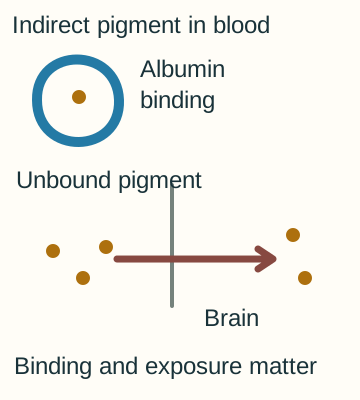
Albumin binding and pigment exposure affect neurotoxicity risk. This abstract comparison does not measure free bilirubin or predict injury in an infant.
Bone Wizardry. Original educational schematic. Source and provenance
The framework in this lesson is the 2022 American Academy of Pediatrics guideline for infants born at 35 or more weeks of gestation in a setting with the necessary measurement, treatment, and follow-up resources. Gestational age means maturity at birth. Postnatal age means time since birth and must be recorded in hours for threshold selection. These two ages are not interchangeable. [1]
Infants born before 35 weeks require their neonatal service protocol rather than an extrapolated AAP curve. An ill newborn, jaundice in the first 24 hours, rapidly rising bilirubin, pale stools, or neurologic abnormalities also requires active assessment rather than a label of ordinary newborn jaundice. Visual inspection cannot safely estimate the serum concentration. [1] [3]
Record the actual bilirubin result with its collection time, birth time, gestation, and clinical risk factors. A statement such as bilirubin is 14 lacks the units and context needed for a decision. This lesson uses verified relationships and case-specific threshold comparisons; it does not create a replacement treatment curve or calculator. [1]
Maturity at birth
Gestational age selects the appropriate maturity group. [1]
Time since birth
Postnatal hours locate the result within that group. [1]
Use a screening measurement without confusing it with the definitive test
Transcutaneous bilirubin, or TcB, estimates bilirubin through the skin. Total serum bilirubin, or TSB, is measured in blood and is the definitive test for phototherapy and escalation decisions. The AAP recommends a TcB or TSB between 24 and 48 hours after birth, or before discharge when discharge occurs earlier. Jaundice in the first 24 hours warrants measurement without waiting for the routine screening time. [1]
 Enlarge the whole image
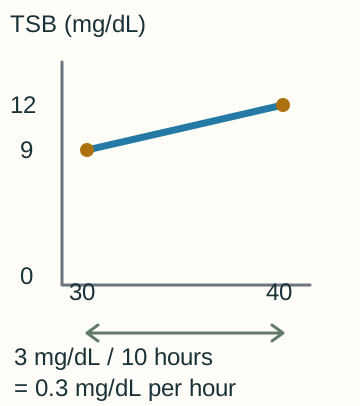
The supplied results rise 3 mg/dL in 10 hours: 0.3 mg/dL per hour. This is a measurement example, not a treatment-threshold graph.
Bone Wizardry. Original educational schematic. Source and provenance
A serum result is required when TcB is at least 15 mg/dL or when it exceeds or is within 3 mg/dL of the applicable phototherapy threshold. TcB uncertainty varies with the device and measurement conditions. During phototherapy, exposed-skin TcB can underestimate the serum concentration, so it must not casually replace the required serum monitoring. [1]
Serial results also show the rate of rise. Divide the bilirubin change by the number of hours between samples. In AAP key action statement 7, a rise of at least 0.3 mg/dL per hour in the first 24 hours, or at least 0.2 mg/dL per hour afterward, is unusual and suggests hemolysis. It is a reason to investigate, not a stand-alone identification of the exact red-cell disorder. [1]
For a worked example, a rise from 9.0 to 12.0 mg/dL between 30 and 40 hours of age is 3.0 divided by 10, or 0.3 mg/dL per hour. Because the interval occurs after the first day, it exceeds the later rapid-rise criterion. The next decision combines that trajectory with the current threshold, examination, and cause assessment. [1]
- Screen TcB can identify infants needing a serum measurement. [1]
- Confirm TSB guides treatment and escalation. [1]
- Trend Change divided by elapsed hours helps identify unexpectedly rapid production or impaired clearance. [1]
Separate risk of developing jaundice from risk of neurotoxicity
Some findings predict that bilirubin may rise. Examples include significant bruising, a scalp hematoma, suboptimal milk intake, or a sibling who needed treatment. Other findings increase the risk of neurologic injury at a given exposure. The categories overlap, but they are not identical. A bruised but otherwise stable infant needs appropriate monitoring without automatically being assigned every additional neurotoxicity risk factor. [1]
 Enlarge the whole image
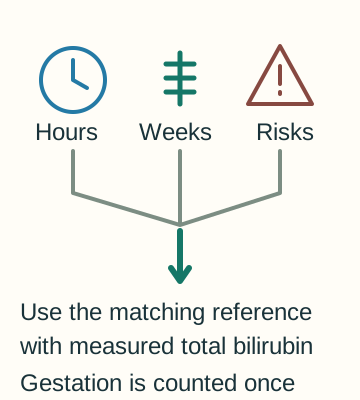
Age in hours, gestation, and additional risks belong to one interpretation. The map does not supply a treatment threshold; gestation must not be counted twice.
Bone Wizardry. Original educational schematic. Source and provenance
The AAP neurotoxicity assessment includes gestational age, albumin below 3.0 g/dL, isoimmune or other hemolytic disease including G6PD deficiency, sepsis, and significant clinical instability in the previous 24 hours. Gestation is already represented in the gestational-age-specific curves. For a 35- to 37-week infant without an additional neurotoxicity factor, use the no-additional-risk curve rather than counting prematurity twice. [1] [2]
The direct antiglobulin test, or DAT, detects antibody attached to red cells and helps assess immune hemolysis. Obtain it promptly when the maternal antibody screen is positive or unknown. A specific exception is an infant DAT positive only for anti-D from maternal Rh immune globulin, when the mother had no anti-D before prophylaxis; that infant can be managed as DAT negative for this purpose. Other positive antibodies require their own interpretation. [1]
G6PD deficiency may cause an abrupt severe bilirubin rise, sometimes without striking laboratory evidence of hemolysis. A normal enzyme result during or soon after hemolysis, or after exchange transfusion, can be misleading. When suspicion remains strong, reassessment includes a repeat activity measurement at least 3 months later. Family history and genetic ancestry can inform risk, but broad racial labels must not replace individual assessment or justify less monitoring. [1] [2]
Predict a rising level
Bruising, poor intake, and family history influence monitoring. [1]
Assess vulnerability
Hemolysis, sepsis, low albumin, instability, and gestation affect neurotoxicity assessment. [1]
Distinguish inadequate intake from a different jaundice pathway
Suboptimal intake hyperbilirubinemia often becomes apparent around days 3 to 5, with ineffective feeding, fewer stools, or excessive weight loss. Less intake means less intestinal elimination and more enterohepatic recycling. Assess latch and milk transfer, feeding frequency, urine and stool output, hydration, and the weight trajectory. Support effective feeding while separately deciding whether bilirubin treatment is required. [1]
Breast milk jaundice describes a different pattern, with prolonged predominantly unconjugated jaundice despite adequate intake and weight gain. It can persist for weeks. This is not a reason to stop breastfeeding routinely, and neither pattern should be blamed on breastfeeding without assessing the infant. Water or dextrose water is not a treatment for neonatal hyperbilirubinemia. Temporary supplementation, when indicated, requires an individualized feeding discussion. [1]
Prolonged jaundice also needs fractionation to avoid missing cholestasis. The 2022 AAP guideline recommends total and direct or conjugated bilirubin in a breastfed infant still jaundiced at 3 to 4 weeks, and in a formula-fed infant still jaundiced at 2 weeks. These screening times are not permission to wait when pale stools, dark urine, poor health, or an earlier abnormal direct result is already present. [1] [3] [4]
A direct bilirubin above 1.0 mg/dL is abnormal in the joint pediatric cholestasis guideline; the direct fraction does not have to exceed 20 percent of total. Direct and conjugated assays are not identical, and an isolated result does not prove biliary atresia. Persistent or rising direct bilirubin and concerning stool findings need timely evaluation for obstruction and treatable medical causes. [1] [3] [4]
Inadequate intake
Poor transfer and reduced stooling increase bilirubin recycling. [1]
Adequate growth with prolonged indirect jaundice
Consider breast milk jaundice after an appropriate assessment. [1]