
Choose an answer, then open any option to work its reasoning.
RHEUMATOLOGY / VASCULITIS
PMR and Giant Cell Arteritis: The Age Gate and the Vision Clock
One disease pair, one age gate: stiffness in the girdles, a headache that can take your sight. Learn the 45-minute clock, the ESR, and why steroids come before the biopsy every time.
What this page makes you able to do
- Apply the age gate and the 45-minute morning-stiffness clock to polymyalgia rheumatica
- Recognize the PMR fingerprint: normal strength, normal CK, no synovitis, and a dramatic steroid response
- Run the GCA vision clock: headache, jaw claudication, scalp tenderness, and amaurosis fugax, with steroids before the biopsy
- Screen every PMR visit for the overlap and build the bone-protected steroid taper
- Dr. Fatima Ali, DOPsychiatry residentPrimary reviewer
Last reviewed
The pearl
Girdle stiffness over 45 minutes in a patient over 50 with a high ESR is PMR, and 15 to 20 mg of prednisone melts it in 48 hours. Any new headache, jaw claudication, or vision change in that same patient is GCA: 40 to 60 mg of prednisone today, biopsy within 1 to 2 weeks, never the reverse.
Prove it
Opening question
Answer before you read anything, then hold the age gate and the vision clock through every section.
A 71-year-old man comes to the office because of 3 months of pain and stiffness in both shoulders and both hips that is worst in the morning. He has trouble combing his hair, rising from a chair, and getting out of bed. He denies headache, pain with chewing, visual change, rash, and weakness. Temperature is 37.0 C. Examination shows pain with active shoulder and hip movement, no joint swelling, no synovitis, and full strength throughout. Serum ESR is 84 mm/hr, CRP is 62 mg/L, and creatine kinase is normal.Which of the following is the most likely diagnosis?
- Why this is rightHe clears the age gate at 71 and carries the PMR fingerprint: bilateral girdle stiffness over 45 minutes, no synovitis, full strength, and an ESR of 84. The dramatic response to 15 to 20 mg of prednisone within 24 to 48 hours confirms it in practice. Rule: over 50 plus girdle stiffness over 45 minutes plus an ESR through the roof is PMR.
- Why this failsGCA announces itself with cranial and visual symptoms: new headache, jaw claudication, scalp tenderness, or vision loss. This man has none. GCA is the overlap partner of PMR, not the isolated girdle story. Rule: no cranial symptoms, no GCA diagnosis yet.
- Why this failsMyositis is weakness with a leaky muscle: proximal symmetric weakness and a high CK. His strength is full and his CK is normal. PMR is stiff; myositis is weak. Rule: the strength exam splits PMR from every myopathy.
- Why this failsRA is a symmetric small-joint synovitis of the hands and wrists with RF or anti-CCP. This exam shows no swelling and no synovitis anywhere. Rule: no swollen joints, no rheumatoid arthritis.
- Why this failsFibromyalgia is widespread pain with normal inflammatory markers in a younger patient. An ESR of 84 at age 71 is the opposite of that picture. Rule: an ESR of 84 breaks the fibromyalgia reflex.
Work the reasoning
PMR lives almost exclusively after age 50 and peaks near 70. A girdle story before 50 is almost never PMR, which is why age is the first gate.
Stiffness lasting over 45 minutes after waking separates inflammatory disease from mechanical wear; PMR is the girdle version of that clock.
Within 24 to 48 hours of 15 to 20 mg of prednisone the girdle stiffness melts. That dramatic response is itself diagnostic in practice, and it is the fastest test in rheumatology.
The answer is A: polymyalgia rheumatica. Over 50, girdles, 45 minutes, ESR 84, strength intact. The steroid melts it in 48 hours.
OVER 50 AND STIFF
The Age Gate: Over 50 and Stiff in the Girdles
Polymyalgia rheumatica is the age-gated disease: bilateral shoulder and hip girdle stiffness that outlasts 45 minutes of morning, an ESR that runs high, and a strength exam that stays normal.
Polymyalgia rheumatica is the most common inflammatory rheumatic disease of older adults, and its gate is age. It is virtually never diagnosed before 50 and peaks around age 70. A girdle story in a 40-year-old is not PMR.
The complaint is stiffness, not weakness: bilateral shoulder and hip girdle pain worse after rest, with morning stiffness lasting over 45 minutes. Patients describe trouble combing their hair, reaching overhead, rising from a chair, and rolling over in bed.
The labs light up. ESR usually runs above 50, often 80 to 120, CRP is elevated, and a mild anemia of chronic disease with thrombocytosis rides along. Creatine kinase stays normal because the muscle is not the target.
One side alone is not PMR. The disease is bilateral by definition, and the response to 15 to 20 mg of prednisone within 24 to 48 hours is the fastest confirmation in rheumatology.
Hold the PMR gate with the GIRDLE hook.
GIRDLE
GGate: age over 50, virtually never younger
IImmobility: morning stiffness over 45 minutes
RRise and Reach: hip girdle and shoulder girdle
DDouble: bilateral shoulders and hips
LLabs: ESR and CRP up, CK normal
EEffortless response: stiffness melts within 24 to 48 hours of low-dose prednisone
STIFF, NOT WEAK
The PMR Fingerprint: Stiff, Not Weak
Strength normal, CK normal, no synovitis, and a steroid response you can time in hours. Hold the fingerprint and every mimic sorts itself.
The fingerprint has five features. Strength is full and CK is normal, which separates PMR from every myopathy: polymyositis and statin myopathy are weak and leak CK, while PMR is stiff and does not.
There is no synovitis on exam. Swelling and tenderness of the hands and wrists point to elderly-onset RA, which carries RF and anti-CCP and demands DMARDs rather than steroids alone.
Anemia of chronic disease and thrombocytosis confirm systemic inflammation, and the dramatic steroid response within 24 to 48 hours closes the case. If the girdle does not melt, the diagnosis was wrong, and the mimic ladder is next.
Palpate the temporal arteries in the same visit. The PMR patient can be carrying GCA without a single cranial complaint yet, and the overlap is why.
Flip between the two girdle diseases and hold the difference.
HEADACHE IS AN EMERGENCY
GCA: The Vision Clock
A new headache after 50 is not a tension headache until the artery is ruled out. Jaw claudication, scalp tenderness, a tender beaded temporal artery, and vision loss are the clock hands.
Giant cell arteritis is a granulomatous vasculitis of medium and large arteries, and its favorite target is the temporal artery. The classic patient is over 50 with a new headache, scalp tenderness, and an artery that is tender, nodular, or pulseless.
Jaw claudication is the most specific symptom: pain or fatigue in the masseter with chewing, ischemia of the muscle. Amaurosis fugax, transient monocular vision loss, and diplopia are the warning hands of the clock.
The clock ends in anterior ischemic optic neuropathy: occlusion of the posterior ciliary arteries infarcts the optic nerve head, and the loss is permanent within hours to days. ESR is often above 100, but 5 to 10 percent of GCA runs a normal ESR.
Rule: headache plus jaw claudication plus vision change in a patient over 50 is GCA until proven otherwise. The clock does not wait for the biopsy.
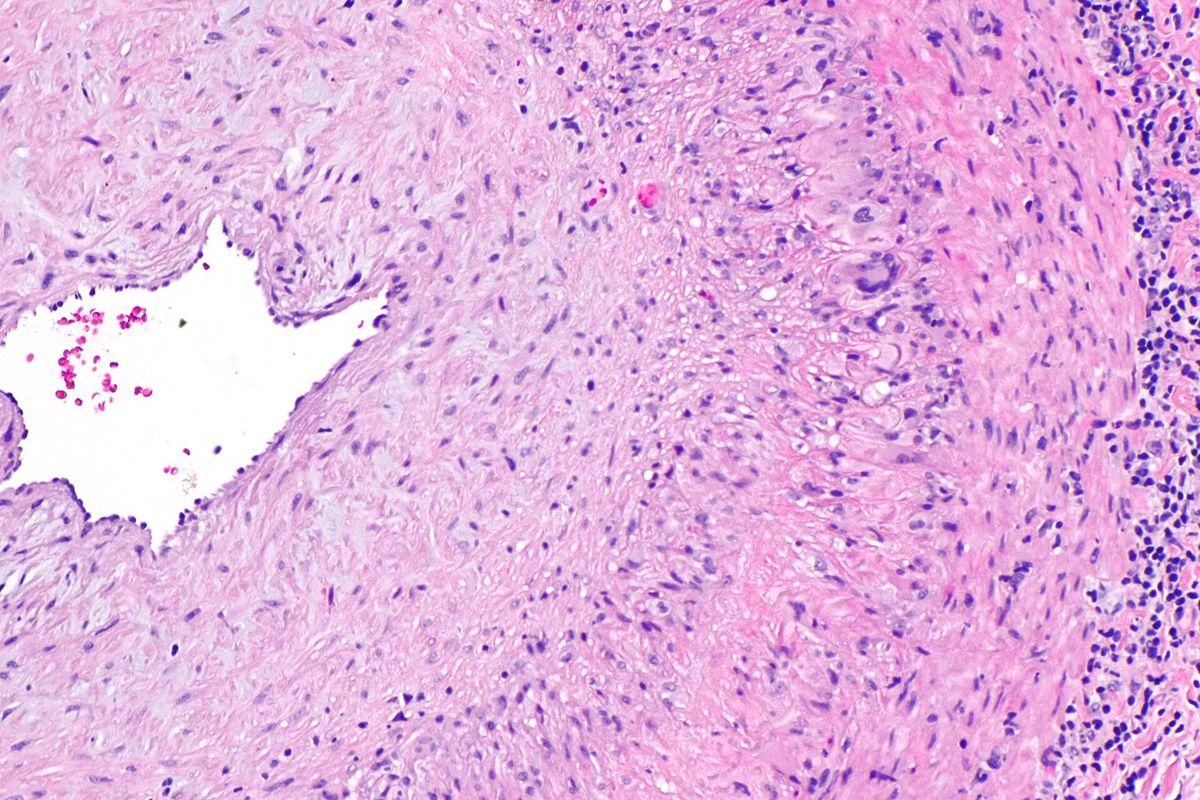
From the Attending
GCA questions are clock questions. The stem hands you the age, the new headache, and one cranial symptom, and the answer is always the same: high-dose steroids today, biopsy within 1 to 2 weeks. The vision symptom is never a distractor, it is the punchline. Know your clock. Every time.
Run the red-flag triage: which door does each presentation open?
A patient over 50 comes in. Which door fits which presentation?
ONE THIRD SHARE THE ROAD
The Overlap: One Third Share the Road
15 to 20 percent of PMR carries GCA, and 40 to 50 percent of GCA carries PMR symptoms. The overlap is why every PMR visit ends with three questions.
The two diseases share an immune road. Roughly 15 to 20 percent of PMR patients have GCA, and 40 to 50 percent of GCA patients have PMR symptoms. Alkaline phosphatase can rise in PMR from subclinical hepatic inflammation, a lab clue the boards recycle.
The clinical rule: a PMR patient with any new headache, jaw, or visual symptom is GCA until proven otherwise. Every PMR visit includes the cranial screen: headache? jaw with chewing? vision change?
The vignette below runs the whole clock: Margaret's PMR, the new headache on a taper, and the vision that almost left.
The Vision Clock
MARGARET OKAFOR
68. Morning girdle stiffness. ESR 88.
The age gate opens: over 50, both shoulders and both hips stiff for over 45 minutes, ESR 88. Low-dose prednisone melts it in 48 hours. PMR.
FOUR MONTHS LATER
12.5 mg of prednisone. A new temporal headache.
A new headache on a taper is the artery talking. Pain with chewing follows, the scalp hurts to comb, and the artery feels beaded. GCA until proven otherwise.
THE VISION CLOCK
Amaurosis fugax. Then the clock stops.
RouteGirdle stiffness, then a new headache on taper, then jaw claudication, then amaurosis fugax, then anterior ischemic optic neuropathy. Steroids 40 to 60 mg at the first cranial symptom; biopsy within 1 to 2 weeks.
PatternPMR plus any new headache, jaw, or visual symptom equals GCA until proven otherwise, on any dose of the taper.
PearlThe eye runs on a clock. Transient vision loss is the last warning; permanent loss follows in days. Steroids come before the biopsy, every time.
Transient vision loss is the last warning. Anterior ischemic optic neuropathy makes it permanent in days. Steroids 40 to 60 mg now; biopsy within 2 weeks.
Work the overlap case one hint at a time.
TREAT FIRST, PROVE LATER
Steroids Before Biopsy: Treat First, Prove Later
The eye does not wait for pathology. High-dose prednisone 40 to 60 mg starts the day GCA is suspected, and the biopsy follows within 1 to 2 weeks.
When GCA is suspected, start prednisone 40 to 60 mg immediately. Vision loss can strike at any point; the steroid protects the unaffected eye even when the first one is already gone.
The biopsy is proof, not permission: temporal artery biopsy within 1 to 2 weeks of starting steroids. Beyond about 2 weeks, steroids can suppress the inflammation and produce false negatives.
The artery is skipped. GCA is segmental, so the surgeon takes 3 to 5 cm, and a negative unilateral biopsy does not exclude the disease. Bilateral biopsy or ultrasound showing the halo sign raises the yield.
Never delay steroids for the biopsy, and never withhold them because the ESR is normal. The 2022 ACR/EULAR criteria codify what the exam already says: clinical pattern plus imaging or biopsy.
On rounds, your attending stops at the next bed, a 74-year-old with a new headache and an ESR of 104.
Attending
The biopsy is scheduled for Thursday. Do we start steroids now or wait for pathology?
You
Start prednisone 40 to 60 mg now. The biopsy stays accurate for 1 to 2 weeks, but the optic nerve does not have that long.
Attending
Then today is the day. The eye does not wait for pathology.
Steroids come first. The biopsy proves what you already treat.
Put the GCA management order together.
NOT EVERY GIRDLE IS PMR
The Mimic Ladder: Not Every Girdle Is PMR
Hypothyroidism, statin myopathy, polymyositis, malignancy, RS3PE, and fibromyalgia all borrow the aching-girdle costume. The labs and the strength exam cast the roles.
Hypothyroidism brings diffuse aches, fatigue, weight gain, delayed reflexes, a high TSH, and a normal ESR. One TSH draw removes it from the differential.
Statin myopathy and polymyositis are weak, not stiff: proximal weakness with an elevated CK. Myositis also shows inflammation on EMG and MRI, and neither melts with prednisone the way PMR does.
Malignancy and paraneoplastic syndromes can masquerade as PMR, so constitutional symptoms, weight loss, and night sweats redirect the workup. A patient who fails steroids gets a malignancy screen.
RS3PE, remitting seronegative symmetrical synovitis with pitting edema, shows pitting edema of the hands and feet with synovitis in an older adult. Fibromyalgia is young, widespread, and normal on every lab, and steroids do nothing.
Which mimic wears which costume?
A 66-year-old woman comes to the office because of 4 months of bilateral shoulder and hip aching with fatigue and a 4 kg weight gain. Morning stiffness lasts about 20 minutes. She denies weakness, rash, and joint swelling. Examination shows full strength, no synovitis, and delayed deep tendon reflexes. Serum ESR is 12 mm/hr, CRP is 4 mg/L, CK is 88 U/L, and TSH is 34 mIU/L. Which of the following is the most likely diagnosis?
Hypothyroidism. A TSH of 34 with diffuse aches, fatigue, weight gain, and delayed reflexes is the endocrine mimic of PMR, and the ESR of 12 says this is not inflammation. Polymyalgia rheumatica. PMR needs the age gate plus girdle stiffness over 45 minutes and a high ESR; 20 minutes of stiffness and an ESR of 12 are the opposite. Statin myopathy. There is no statin in the stem and the CK is normal; myopathy leaks CK. Polymyositis. Myositis is proximal weakness with an elevated CK, and her strength is full. Rule: TSH first, always, and an ESR of 12 breaks the PMR reflex.
TAPER, THEN WATCH
Treatment and Follow-Up: Taper, Then Watch
PMR starts at 15 to 20 mg of prednisone, GCA at 40 to 60 mg. The taper follows symptoms and ESR, relapse is common, and every long course protects bone.
Dose by disease: PMR 15 to 20 mg daily; GCA 40 to 60 mg daily. The response to the right dose is dramatic; the response to the wrong dose is a clue that the diagnosis needs rethinking.
Taper over months, guided by symptoms and ESR, not the calendar alone. Relapse is common on the way down, and a flare is treated by returning to the lowest effective dose rather than starting over.
Tocilizumab, an IL-6 receptor blocker, is approved for GCA: it controls disease and spares steroids in refractory or relapsing patients. Methotrexate is the older steroid-sparing adjunct.
Every prolonged course gets bone protection: calcium, vitamin D, and a bisphosphonate once steroids run 3 months or longer, plus glucose and blood pressure monitoring. The taper is a plan, not a hope.
Build the steroid plan and its bone protection.
Checked 0
TWO DOORS, ONE AGE GATE
The One-Screen Discriminator: Two Doors, One Age Gate
Girdle stiffness only is PMR. Any headache, jaw, or visual symptom in a patient over 50 is GCA first. One screen, three questions, zero delays.
Run the screen in order. Age over 50? Girdle stiffness over 45 minutes? ESR and CRP up? Then ask the three questions: headache? jaw claudication? vision change?
Girdle-only answers PMR and 15 to 20 mg of prednisone. Any cranial yes answers GCA: 40 to 60 mg of prednisone today, biopsy within 1 to 2 weeks, and ophthalmology and rheumatology on the phone.
The exam does not stop. Palpate the temporal arteries at every visit, because the overlap can announce itself at any point in the taper, and the vision clock does not rewind.
From the Attending
On boards, the discriminator is a yes or no question hiding inside the stem: any cranial symptom in a patient over 50 flips the door from PMR to GCA, and the dose jumps from 20 to 60. Read the stem for the three words: headache, jaw, vision. One of them ends the argument. Always.
Match each presentation to its door.
Tick the GCA red flags in every patient over 50 with any of them.
Prove it
Walkthrough: PMR and giant cell arteritis in seven cases
Original practice scenarios, one at a time. Choose an answer, then open any option to work its reasoning.
Clinical walkthrough
Reviewed by

Dr. Fatima Ali, DO
Psychiatry resident, PGY-1 · University Hospitals, Columbia
Resident physician whose osteopathic training feeds a whole-system, mechanism-first approach to the subjects students struggle most to reason through alone. Co-founder of Bone Wizardry. Reviews the psychiatry, osteopathic medicine and OMM, clinical-reasoning, and licensing-readiness material, and verifies each page for clinical accuracy.
References
- 1
- 2
- 3
- 4
- 5
Published
Content updated
Medically reviewed
Bone Wizardry is a study resource for medical students. It is not medical advice, and nothing here substitutes for the judgement of a licensed clinician or for the guidelines your program follows.