Choose an answer, then open any option to work its reasoning.
MSK · Spine
Scoliosis: Description and Naming
Convexity, C vs S curves, kyphoscoliosis, Adams test, and Cobb angle staging. One common error, naming the curve by the wrong side, ends the confusion permanently.
What this page makes you able to do
- Name any scoliosis by convexity, apex, and arc count
- Stage a curve with the Cobb angle and the Risser grade
- Distinguish pure scoliosis from kyphoscoliosis on the lateral film
- Flag the red flags that make a curve non-idiopathic
- Dr. Fatima Ali, DOPsychiatry residentPrimary reviewer
Last reviewed
The pearl
A scoliosis is named by its convexity, and the rib hump always marks the convexity. One arc is C-shaped, two arcs are S-shaped, and a normal lateral view means pure scoliosis, never kyphoscoliosis.
Prove it
Opening question
Answer before you read anything, then keep the mechanism in mind through every section.
A 15-year-old girl is flagged at school screening for spinal asymmetry. On the Adams forward-bend test you see a posterior rib prominence on the right at T4-T10. The standing PA radiograph shows a single rightward arc, and the lateral view is normal.Which is the correct description of this curve?
- Why this is rightRight convex: the rib hump marks the convexity, and the single arc makes it C-shaped. A normal lateral view rules out kyphoscoliosis. Rib hump side = convexity side; one arc = C-shaped; normal lateral = pure scoliosis.
- Why this failsThe hump is on the RIGHT. Vertebrae rotate toward the convexity, so the right ribs swing posteriorly. A right hump means the curve bows right, not left. The hump names the convexity: right hump, right convex.
- Why this failsScoliosis is named by the convexity, never the concavity. The concavity is the hollow side, the opposite side from where the curve bows. Never name a curve by its concavity.
- Why this failsOnly one arc is present. An S-shaped scoliosis needs a second, compensatory curve curving back the other way to keep the head centered over the pelvis. One arc = C; two arcs = S.
- Why this failsKyphoscoliosis requires an abnormal sagittal curve: thoracic kyphosis >45 degrees, a flat back, or exaggerated lordosis. The lateral view is normal, so this is pure scoliosis. A normal lateral radiograph rules kyphoscoliosis out.
Work the reasoning
Vertebral bodies rotate toward the convexity. The transverse processes on that side swing posteriorly and drag the attached ribs with them, producing the hump; the spinous processes rotate the other way, toward the concavity.
The one with the larger Cobb angle. The compensatory curve is smaller, more flexible, and develops to keep the head centered over the pelvis.
It rules out kyphoscoliosis, which needs an abnormal sagittal curve, kyphosis greater than 45 degrees, a flat back, or exaggerated lordosis, on top of the coronal curve.
Right rib hump + single arc + normal lateral = right convex, C-shaped, pure scoliosis. The hump was never a hint. It was the answer.
THE THREE RULES
Three rules. No exceptions.
Every board question about scoliosis description reduces to these three statements. Learn the mechanism, not the memorized list.
A scoliosis is named by the side to which the curve bows outward. If the spine arches to the right, call it right convex (right thoracic scoliosis). Never name it by the concavity. Name the curve by the side it bows toward, never the concavity.
Vertebrae rotate toward the convexity. The transverse processes on the convex side swing posteriorly, dragging the attached ribs with them: that posterior protrusion is the rib hump. The spinous processes rotate the opposite way, toward the concavity. Right rib hump = right convexity, every single time.
A single structural arc makes the spine look like the letter C. A primary structural curve plus a compensatory curve curving back the other way makes an S. 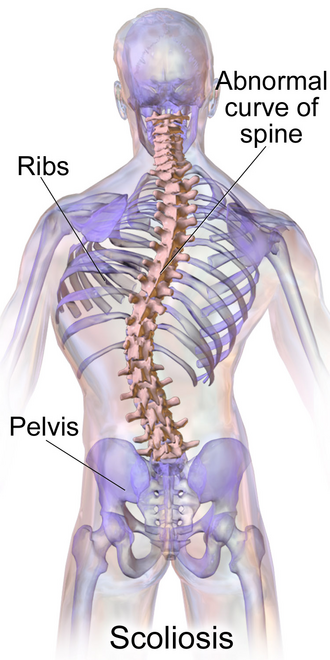
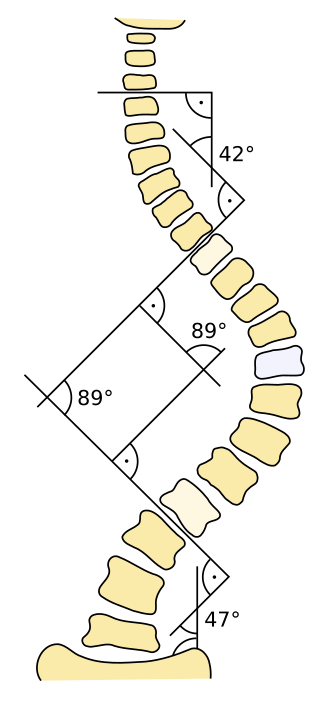 Count the arcs: one = C, two = S.
Count the arcs: one = C, two = S.When two curves coexist, the primary curve is the structural one with the larger Cobb angle; the compensatory curve is smaller and more flexible on bending films. Boards ask you to name the primary curve: the one with the bigger number. Larger Cobb angle = primary curve.
Match each curve to its name.
01Match: curve to name
Tap a curve, then its name.
Flip through the four naming cards.
02Flashcards: the naming rules
PATTERN LOCK
Curve architecture and AIS essentials
Cover the right column, say the answer out loud, then reveal. These are the exact facts the stems reuse.
Adolescent idiopathic scoliosis is the workhorse: about 80% of all scoliosis, most common in girls, and more likely to progress in girls. The classic architecture is a right thoracic curve with a left lumbar compensation, the double curve that makes an S. Screening is the Adams forward bend test, and a positive screen earns a standing PA radiograph.
Natural history follows magnitude. A curve under 30 degrees at skeletal maturity rarely progresses. A thoracic curve above 50 degrees tends to progress lifelong, at roughly a degree a year, which is why it is the curve that gets fused. Between those numbers, the Risser grade decides: the iliac apophysis ossifies from lateral to medial over grades 0 to 5, so a low Risser means growth remaining and a higher risk of progression.
Which curve keeps growing after maturity?
03Recall: the curve that keeps progressing
Which curve is most likely to keep progressing after skeletal maturity?
A thoracic curve greater than 50 degrees. Large thoracic curves tend to progress about a degree per year after maturity, so they are the ones that reach surgical discussion. A lumbar curve of 20 degrees. Small curves at maturity are stable. Any curve under 30 degrees. Under 30 degrees at maturity, progression is unlikely. A curve that corrected on side-bending films. Flexibility marks a compensatory or nonstructural curve, which does not progress.
Score the progression risk for a curve in a growing spine.
04Quantify: the progression-risk score
Checked 0
ADAMS & COBB
Adams test and Cobb angle staging
The clinical test reveals the hump; the radiograph quantifies it. Two questions lock the naming rule and the management ladder.
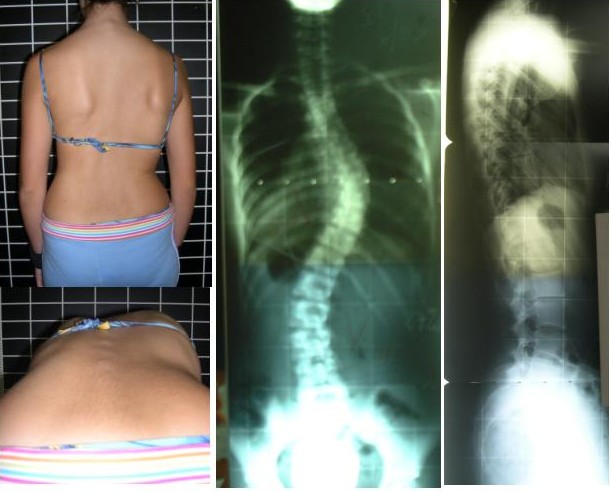
The Adams test looks for rotation. With the patient bending forward at the waist, the examiner sights down the spine for a rib hump or a paravertebral prominence, and a scoliometer measures the angle of trunk rotation. A positive test is a referral for a standing PA radiograph. The Cobb angle then quantifies the curve: pick the most tilted end vertebrae, draw lines along their endplates, and measure the angle between the perpendiculars.
Staging follows magnitude. Under 10 degrees is asymmetry, not scoliosis. 10-25 degrees is mild: observe. 25-45 degrees in a growing patient is the bracing window, where a thoracolumbosacral orthosis (TLSO) is offered. Above 45-50 degrees, especially thoracic and progressive, is the surgical range.
Name the curve from the hump side.
05Recall: the hump names the curve
A 14-year-old boy has a left rib hump on Adams test. The standing PA radiograph shows one leftward thoracic arc; the lateral view is normal. Which description is correct?
A. The left rib hump marks the left convexity; a single arc is C-shaped; the normal lateral view excludes kyphoscoliosis. A right hump would mean right convexity, a second arc would make it S-shaped, and an abnormal sagittal curve would add the "kypho-" prefix. The hump side names the curve: left hump, left convex.
Drag through the Cobb staging ladder.
06Explore: the Cobb staging ladder
Cobb angle
Apply the ladder to a growing patient.
07Recall: the bracing window
A 13-year-old premenarchal girl has a right thoracic curve measuring 32 degrees on standing PA. Risser stage is 1. What is the best management?
B. A 32-degree curve with Risser 0-2 (growth remaining) sits in the 25-45 degree bracing window. The BrAIST trial showed bracing significantly reduces progression to surgical threshold. Observation fits 10-25 degrees, fusion is for >45-50 degree progressive curves, and <10 degrees needs nothing. 25-45 degrees + immature skeleton = brace (TLSO).
THE SAGITTAL GATE
Kyphoscoliosis or pure scoliosis?
The lateral radiograph is the decision gate. Toggle the two states: this is the exact discrimination the board question asks.
Scoliosis lives in the coronal plane; kyphosis lives in the sagittal plane. A scoliotic curve with a normal lateral view is pure scoliosis, and the sagittal plane never enters the name. Add an abnormal sagittal curve, and the name grows the "kypho-" prefix: thoracic kyphosis greater than 45-50 degrees, a flat back, or exaggerated lumbar lordosis.
The classic sagittal culprit in a teenager is Scheuermann kyphosis: thoracic kyphosis greater than 45-50 degrees with anterior wedging of at least 5 degrees in three or more adjacent vertebrae, usually painful, with hamstring tightness. Postural kyphosis, by contrast, is painless and corrects with hyperextension. The film settles it: wedging is structural, no wedging is postural.
08Compare: pure scoliosis vs kyphoscoliosis
Wedged vertebrae in a teenager with a big kyphosis?
09Recall: the wedged vertebrae
A 15-year-old boy has back pain, hamstring tightness, and thoracic kyphosis of 55 degrees with anterior wedging of three consecutive vertebrae. What is the most likely diagnosis?
Scheuermann kyphosis. Kyphosis greater than 45-50 degrees with anterior wedging of at least 5 degrees in 3+ adjacent vertebrae is the definition, and pain with hamstring tightness fits. Postural kyphosis. Painless and non-wedged, and it corrects on hyperextension. Adolescent idiopathic scoliosis. A coronal-plane curve; it does not wedge vertebrae. Spondylolisthesis. A pars defect with anterior vertebral slip, not a kyphotic wedging pattern.
THE HIDDEN THIRD DIMENSION
Rotation: the hidden third dimension
Scoliosis is a 3D deformity. The rotation is what you see on Adams test and what you grade on the film.
Look down the spine and the curve is not flat: the vertebral bodies rotate toward the convexity, and the spinous processes rotate the opposite way, toward the concavity. That rotation is why the ribs on the convex side swing posteriorly and make the hump on Adams test. The hump is not the curve itself; it is the rotation of the rib cage riding on the curve.
On the PA radiograph, rotation shows up in the pedicles. In a normal vertebra the pedicles sit symmetrically; as rotation increases, the pedicle on the convex side migrates toward the midline and eventually disappears behind the vertebral body. That is the Nash-Moe grading system, grade 0 to 4, and it tells you how much of the deformity is rotational rather than purely lateral.
10Sequence: read the film
Tap the steps in order.
Which way do the bodies turn?
11Recall: the direction of rotation
In a structural scoliosis, which way do the vertebral bodies rotate?
Toward the convexity of the curve. The bodies rotate toward the side the curve bows, the spinous processes swing toward the concavity, and the convex-side ribs are dragged posteriorly into the hump. Toward the concavity. That is where the spinous processes point, not the bodies. They do not rotate in structural curves. Rotation is the defining third dimension of a structural curve. Randomly. Rotation is coupled to the curve direction, never random.
THE RED FLAGS
When scoliosis is not idiopathic
AIS is painless and right thoracic. Anything that breaks that pattern is a workup, not a brace.
Adolescent idiopathic scoliosis is a diagnosis you earn by excluding its impostors. The red flags: a left thoracic curve, which raises the risk of an intrathecal lesion such as a syrinx or Chiari malformation, and of neurofibromatosis; onset before 10 years; rapid progression, more than about a degree a month; back pain, since AIS is classically painless (night pain relieved by NSAIDs is the signature of an osteoid osteoma); neurologic symptoms, from subtle gait asymmetry to bowel or bladder dysfunction; skin stigmata, cafe-au-lait spots pointing to neurofibromatosis and a hairy patch or dimple pointing to occult spinal dysraphism; and foot deformities such as cavovarus, which pull the diagnosis toward Friedreich ataxia, Charcot-Marie-Tooth, or a syrinx.
A leg length discrepancy makes the spine look curved without any structural curve at all: the pelvis tilts and the spine bends to compensate, and the curve disappears when the discrepancy is corrected. That is a nonstructural scoliosis, and it does not need a brace, an MRI, or a Cobb angle.
12Branch: red-flag triage
Tap a presentation.
Screen every curve for the impostors.
13Checklist: the red-flag screen
Night pain that answers to NSAIDs?
14Recall: the painful curve
A 14-year-old with a mild thoracic curve has back pain that wakes him at night and is consistently relieved by NSAIDs. What is the most likely cause?
Osteoid osteoma. Night pain that reliably responds to NSAIDs is the classic presentation of this benign bone tumor, and the pain pattern is the clue. Typical adolescent idiopathic scoliosis. AIS is classically painless. Scheuermann kyphosis. Painful, yes, but it is a kyphosis with wedging, not a scoliotic curve question. Psychogenic pain. A diagnosis of exclusion; the NSAID response points to a real lesion.
Clinical walkthrough