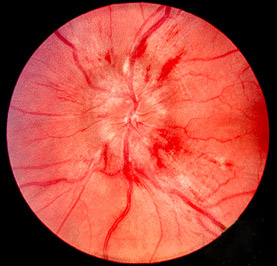
CSF pressure climbs, the optic discs swell, vision flickers out for seconds at a time. No tumor on imaging. The body is doing it to itself, and the patient is almost always an obese woman of reproductive age.
Headache differential · Cranial nerves · Acetazolamide
The clue stack: obese reproductive-age woman, vitamin A derivative (Accutane), positional headache, transient visual obscurations, pulsatile tinnitus, and bilateral papilledema with a clean MRI. That is the textbook IIH fingerprint.
The chain: something (vitamin A excess in this case) jams up CSF absorption at the arachnoid granulations. CSF keeps being made at the same rate but it cannot drain. Pressure builds. The optic nerve sheaths swell from behind, the discs balloon forward into the retina (papilledema), and brief drops in optic nerve perfusion show up as seconds-long vision blackouts.
Confirm it with a lumbar puncture. Opening pressure will be high; the CSF itself will look completely normal. That normal CSF is the "idiopathic" part.
Five fingerprints. See three in one stem, IIH is on the board. See all five, it is the answer.
Tap a card to see why it pushes ICP up. Vitamin A and the tetracyclines are the two the clinical medicine will hand you.
You cannot diagnose IIH on the clue stack alone. The board wants imaging first, tap second. Skip the imaging and you miss a venous sinus thrombosis dressed up as IIH.
The number on the manometer plus a clean CSF panel locks the diagnosis.
Left: actual fundus photo. Right: schematic so you can see what the textbook is pointing at. Tap the photo to enlarge.
Climb in order. Weight loss is the cure; everything else buys time or saves vision.
IIH does not kill her, but it can blind her. Untreated chronic papilledema leads to optic atrophy and permanent vision loss. These three signs together change the conversation from clinic management to urgent ophthalmology.
Worsening papilledema on serial fundoscopy + shrinking visual fields on perimetry + MRI showing optic nerve sheath distension or flattened posterior globe.
This is urgent ophthalmology and discussion of ONSF. Acetazolamide alone is not enough once the nerve is on the clock. Chronic papilledema leads to optic atrophy. Optic atrophy is permanent.
Five clinical vignettes. Every wrong answer comes with a discriminator rule so you do not pick it twice.