Fryette's Principles: From Examination to Direction
Level 1 explains orientation and coupling; Level 2 turns findings into diagnosis and direction; Level 3 follows response and safety.
Level 1 and Level 2: orient the vertebral body, choose the regional coupling model, then separate position of ease from the tested restriction. Level 3 and Beyond: reassess function and symptoms, recognize findings that require medical escalation, and communicate the limits of palpation and static biomechanical models.
By the end, you should be able to translate a thoracolumbar examination into clear notation, distinguish ease from restriction, and recognize when a regional rule or a safety concern changes the interpretation. These are educational models for supervised examination, not instructions for performing a thrust.
First orient the vertebra
Level 1 builds the mechanical vocabulary. Name body rotation from the vertebral body, distinguish transverse-process position from the spinous tip, and apply coupling only after identifying the region. Level 2 converts observations into a diagnosis. Compare neutral, flexion and extension, then record only the motion preferences that were actually tested.
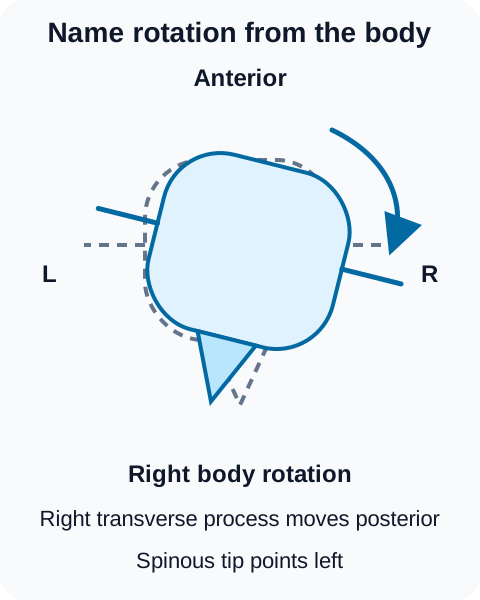
Which part actually names rotation? The vertebral body does. A transverse process that is more posterior suggests rotation toward that side in the usual examination model. The spinous process projects in the opposite direction. A crooked spinous tip or unequal tissue bulk alone is not a complete diagnosis. [4]
Follow the solid vertebra against the dashed starting outline. Patient right is on the right of this drawing. The posterior right transverse process accompanies right body rotation; the spinous tip points left. Shapes and angles are exaggerated.
The anterior body carries load through the vertebral bodies and discs. Pedicles and laminae form the posterior arch around the vertebral foramen. Transverse processes project laterally; the spinous process projects posteriorly. Joint surfaces on articular processes constrain motion without reducing the spine to a rigid hinge. [4]
Regional anatomy matters. The thoracic spine has a kyphotic curve and rib attachments. Lumbar bodies are larger and the lumbar curve is lordotic. Typical cervical facets are oblique, thoracic superior facets face mainly posteriorly, and lumbar superior facets face mainly medially. The familiar cervical B/U/M, thoracic B/U/L and lumbar B/M mnemonics are coarse orientation aids, not exact angles for every level. Transitional regions, including L5-S1, need their own examination. [4]
The spinal canal contains different structures at different heights. In adults, the conus commonly lies near L1 or L2, but its level varies. Nerve roots of the cauda equina and the filum terminale continue below it. An imaginary line at L1 cannot establish that every lower lesion involves only roots. [6]
In the drawing, cover the caption and name the rotation from the right process.
Right body rotation. Now look at the spinous tip: it points left, so naming rotation from the spinous tip would reverse the finding.
Transfer: a left posterior transverse process suggests left body rotation. If the spinous tip points left as well, do not average the two observations into a diagnosis. Check the landmarks, anatomy and actual motion before deciding. [4]
Use coupling as a model, not a verdict
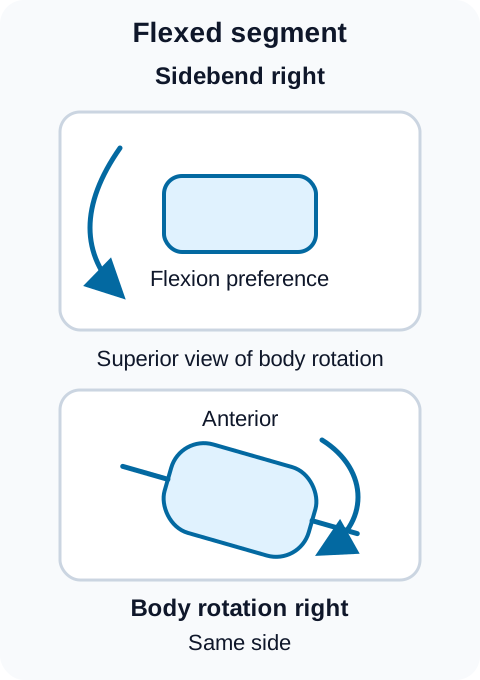
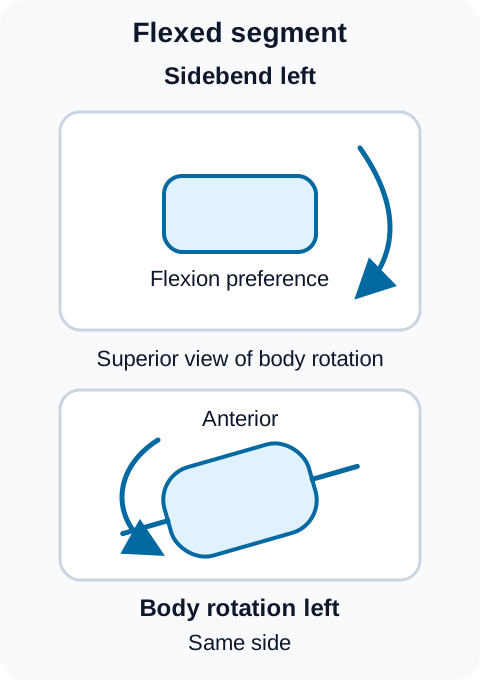
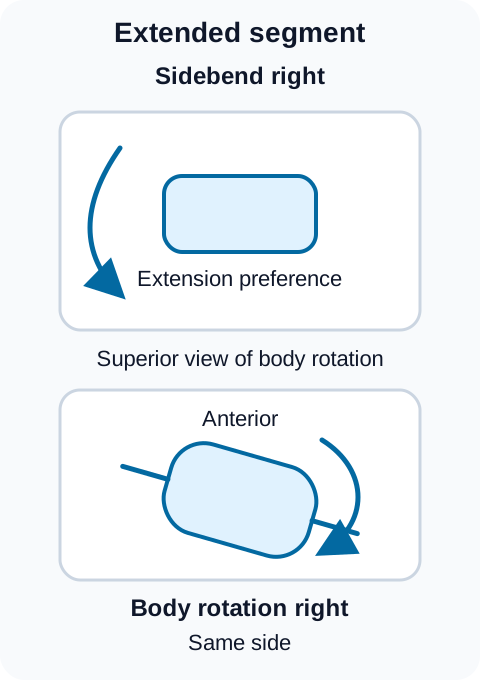
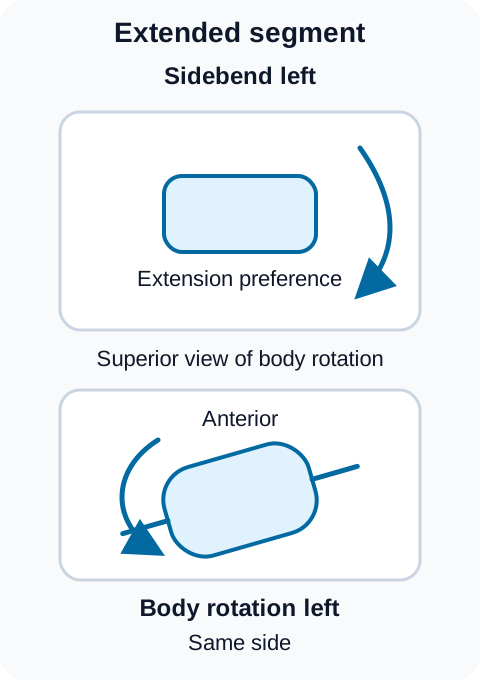
Does a change in position change the predicted coupling? In the conventional thoracolumbar model, yes. Type I is a neutral group pattern with opposite sidebending and rotation. Type II is a non-neutral segmental pattern with same-side coupling. Neutral means neither flexion nor extension dominates the named pattern; it does not mean a spine without curvature. [1]
A neutral group commonly spans several vertebrae. A Type II diagnosis names a vertebra relative to the one below, not a vertebra floating independently. Several Type II findings can coexist, and a focal finding can sit within a regional group pattern. Number of levels helps describe the pattern but cannot replace motion testing. [1][7][8]
Six conventional thoracolumbar combinations
Position
Sidebending
Body rotation
Notation
PositionNeutral
SidebendingRight
Body rotationLeft
NotationN S-right R-left
PositionNeutral
SidebendingLeft
Body rotationRight
NotationN S-left R-right
PositionFlexed
SidebendingRight
Body rotationRight
NotationF R-right S-right
PositionFlexed
SidebendingLeft
Body rotationLeft
NotationF R-left S-left
PositionExtended
SidebendingRight
Body rotationRight
NotationE R-right S-right
PositionExtended
SidebendingLeft
Body rotationLeft
NotationE R-left S-left
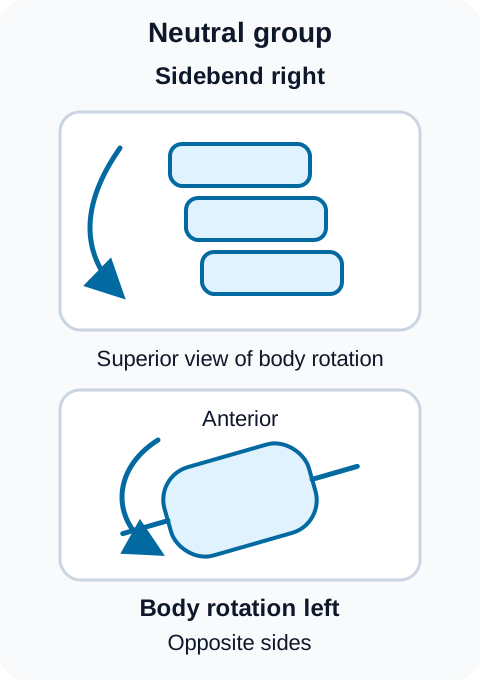
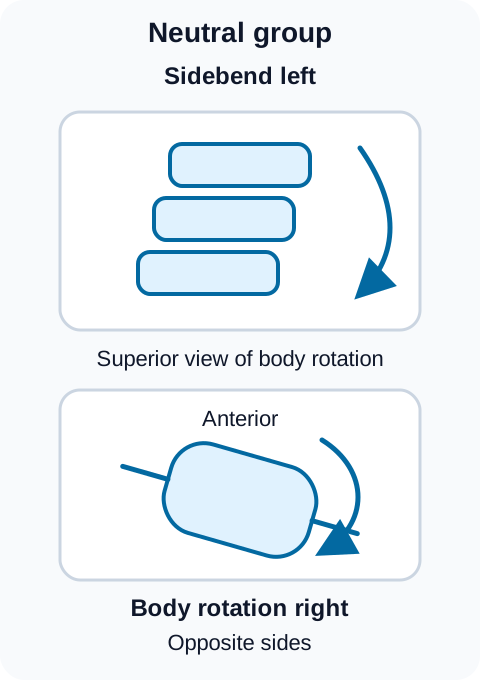
Try the comparison below. Keep sidebending right, then select neutral, flexed and extended positions. Predict whether the rotation should change before opening each view. The coronal and axial drawings stay separate so that a sidebend is not mistaken for rotation in a top-down image.
Neutral; sidebend right
Upper view: the sidebending pattern. Lower view: body rotation, with anterior up and patient right at image right. Neutral group coupling is opposite. This is the conventional teaching model, not a measured range of motion.Neutral; sidebend left
Upper view: the sidebending pattern. Lower view: body rotation, with anterior up and patient right at image right. Neutral group coupling is opposite. This is the conventional teaching model, not a measured range of motion.Flexed; sidebend right
Upper view: the sidebending pattern. Lower view: body rotation, with anterior up and patient right at image right. Non-neutral segmental coupling is to the same side. This is the conventional teaching model, not a measured range of motion.Flexed; sidebend left
Upper view: the sidebending pattern. Lower view: body rotation, with anterior up and patient right at image right. Non-neutral segmental coupling is to the same side. This is the conventional teaching model, not a measured range of motion.Extended; sidebend right
Upper view: the sidebending pattern. Lower view: body rotation, with anterior up and patient right at image right. Non-neutral segmental coupling is to the same side. This is the conventional teaching model, not a measured range of motion.Extended; sidebend left
Upper view: the sidebending pattern. Lower view: body rotation, with anterior up and patient right at image right. Non-neutral segmental coupling is to the same side. This is the conventional teaching model, not a measured range of motion.
Switching neutral to flexed while keeping right sidebending changes the predicted rotation from left to right. Switching flexed to extended does not reverse the same-side relationship. To repeat, select the neutral-right view again. The table above provides every result without operating the comparison. [1]
Historical descriptions sometimes introduce sidebending first for Type I and rotation first for Type II. Do not use that teaching sequence to infer which motion a patient performed first. Likewise, a pattern outside the six conventional combinations is a reason to check the region, position and measurements, not proof that the observation is physically impossible. [1][10]
The third principle concerns interdependence. Introducing motion in one plane modifies motion available in the other planes. For example, compare comfortable rotation near neutral with rotation after substantial sidebending: the available range can differ. This does not mean that every limited rotation proves disease in three planes, or that all restrictions disappear after one treatment. [1]
Keep the same sidebend but change flexion to extension. Must the predicted rotation reverse?
No. Both positions use the conventional same-side relationship. Changing to neutral is the comparison that reverses this prediction in the thoracolumbar teaching model.
These principles organize an examination; they are not universal measurements of spinal kinematics. A 2024 CT study found that only part of the analyzed static vertebral orientations matched the conventional patterns. A static scan cannot establish the sequence or coupling of actual motion, and it cannot validate a treatment response. [10]
Build the diagnosis from separate observations
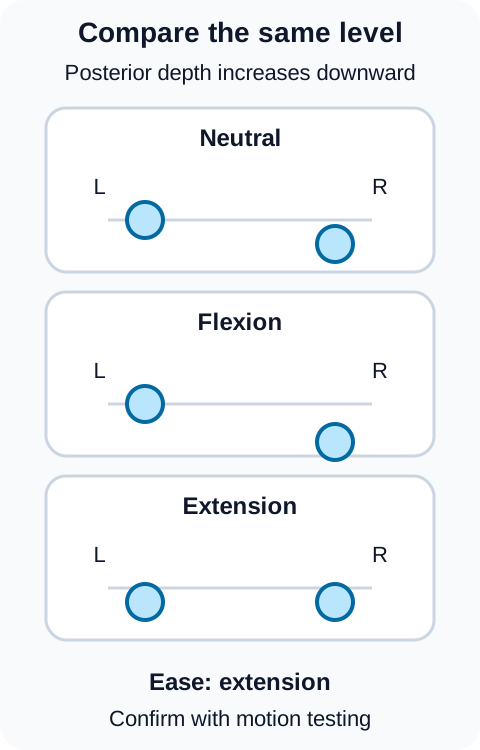
Which finding supplies the missing F or E? Compare the same segment in flexion and extension. First identify comparable bony landmarks and assess neighboring levels. Keep the patient and examiner position consistent, then compare asymmetry with the motion findings rather than treating a single prominent process as a diagnosis. [1][7]
Dots represent relative posterior process position, not tissue size or a measured distance. Extension reduces the asymmetry in this worked example. That supports an extended preference when confirmed by segmental motion testing.
In the example, the right process is posterior in neutral, the difference increases in flexion, and it decreases in extension. Extension is the easier sagittal position. Confirmed right rotation and right sidebending then support T6 E R-right S-right. The label describes ease, not the direction to force the patient. [1][7]
Reverse the sagittal response: if flexion reduces the asymmetry and extension accentuates it, the preference is flexed. A left posterior process with confirmed left rotation and sidebending supports F R-left S-left. Small differences may diminish rather than vanish completely; the whole examination should agree. [7]
If a comparable asymmetry persists across several levels through flexion and extension, assess whether a neutral group pattern is present. Unchanged asymmetry at one isolated level is insufficient. Check adjacent levels, the sidebending and rotation preferences, and whether structural asymmetry or measurement uncertainty could explain the observation. [1][10]
Document tenderness, tissue texture, asymmetry and restriction as findings, not interchangeable labels. Pain duration does not determine Type I versus Type II. Severe pain, neurological findings, trauma or systemic symptoms may require a different diagnostic pathway before a routine structural assessment. [1][15]
A left posterior process becomes less asymmetric in flexion. Which letter comes first?
F, provided the motion examination confirms flexion as the easier position. The left process supplies the rotation hypothesis; flexion testing supplies the sagittal preference.
Transfer: if a note gives only right rotation, you cannot reconstruct F versus E. Record the missing information or repeat that part of the examination instead of inventing it. Use level or group, sagittal preference, rotation and sidebending explicitly so notation order cannot obscure the meaning.
Try it here · Checkpoint 1 of 3
Make your prediction before reading the choices. A first attempt is just a starting point.
Case 4
Show answer and explanations for case 4
A. Record a T7-T9 neutral group and postpone the regional examination (Why this does not fit)
Persistent asymmetry can occur in a neutral group. The neighboring levels and coupled-motion preferences were not examined, so this group label supplies findings that are missing. Do not let an isolated observation stand in for a regional examination.
Reasoning steps for option A
In fryettes-principles-04, why might option A initially seem plausible?
Persistent asymmetry can occur in a neutral group.
In fryettes-principles-04, which supplied finding most strongly tests option A?
The neighboring levels and coupled-motion preferences were not examined, so this group label supplies findings that are missing.
In fryettes-principles-04, which transferable rule settles option A?
Do not let an isolated observation stand in for a regional examination.
B. Assign an extended T8 diagnosis because right rotation is suggested (Why this does not fit)
A right-posterior process suggests right body rotation. It does not identify extension as the easier position; the reported sagittal observations do not distinguish E from F. Rotation and sagittal preference require separate evidence.
Reasoning steps for option B
In fryettes-principles-04, why might option B initially seem plausible?
A right-posterior process suggests right body rotation.
In fryettes-principles-04, which supplied finding most strongly tests option B?
It does not identify extension as the easier position; the reported sagittal observations do not distinguish E from F.
In fryettes-principles-04, which transferable rule settles option B?
Rotation and sagittal preference require separate evidence.
C. Compare adjacent levels and test the segmental rotation and sidebending preferences (Best answer)
A regional diagnosis requires regional and directional evidence. Those missing observations can distinguish a group pattern from focal or structural asymmetry. Unchanged asymmetry at one level is a reason to complete the examination, not a complete diagnosis.
Reasoning steps for option C
In fryettes-principles-04, why might option C initially seem plausible?
A regional diagnosis requires regional and directional evidence.
In fryettes-principles-04, which supplied finding most strongly tests option C?
Those missing observations can distinguish a group pattern from focal or structural asymmetry.
In fryettes-principles-04, which transferable rule settles option C?
Recognize missing diagnostic evidence. Applied here, that sequence preserves the measured findings without adding an untested component.
D. Use the spinous-tip direction to select either F or E (Why this does not fit)
The spinous tip may add a rotation-related observation. Its direction cannot provide the unmeasured sagittal preference or show a neighboring group pattern. A second rotation observation cannot replace the missing motion assessment.
Reasoning steps for option D
In fryettes-principles-04, why might option D initially seem plausible?
The spinous tip may add a rotation-related observation.
In fryettes-principles-04, which supplied finding most strongly tests option D?
Its direction cannot provide the unmeasured sagittal preference or show a neighboring group pattern.
In fryettes-principles-04, which transferable rule settles option D?
A second rotation observation cannot replace the missing motion assessment.
Takeaway: Unchanged asymmetry at one level is a reason to complete the examination, not a complete diagnosis.
Keep preference, restriction and treatment distinct
Does E R-right S-right prescribe extension for every technique? No. Ease describes the preference; the restrictive barrier lies in the less available direction. For this pattern, the opposite directional components are flexion, left rotation and left sidebending. Name the intended method before choosing between them. [1][2]
One finding, different therapeutic directions
Finding: T6 E R-right S-right.
Direct approach: assess and engage the relevant restriction, rather than following the extended right-sided preference.
Indirect approach: position toward the easier directions and reduced tissue tension.
Direct myofascial release engages tissue bind. Indirect myofascial release follows ease. A commonly taught direct muscle-energy setup also engages the relevant restrictive barrier; its setup is not the same question as the direction of the subsequent patient effort. A neutral group diagnosis gives sidebending and rotation information without automatically supplying an additional flexion or extension restriction. [1][2]
Keep translations separate from sidebending. If fascia binds cephalad but prefers clockwise rotation, the easier directions are caudad and clockwise. If right translation is also restricted, a direct fascial setup addresses right translation, not a sidebending direction invented from it. Clockwise requires a stated viewing orientation. [1][2]
Fascia prefers cephalad and counterclockwise, with right translation restricted. Select the direct directions before reading the answer.
Caudad, clockwise and right translation. Reverse each stated preference but retain a direction already described as restricted. Translation remains translation.
HVLA is a short-range, high-velocity technique within the anatomic range; its definition permits barrier engagement in one or more planes. A diagnostic label is not a universal three-axis thrust recipe. Contact, patient position, force vector and permitted range are technique-specific. Do not equate the restrictive barrier with maximum pain or the anatomic limit. [1]
Choice of method requires assessment, informed consent, training and contraindication screening. A normal radiograph after a collision does not establish vascular or ligamentous safety. New unusual neck pain with neurological or vascular features warrants medical assessment rather than an attempt to correct a presumed segmental finding. A negative provocative positional test does not clear that risk. [15]
Transfer: a note that alternates between preference and restriction must be translated one component at a time. For F R-left S-left, a direct directional analysis concerns extension, right rotation and right sidebending; an indirect analysis concerns the stated easier directions. Neither sentence instructs an unsupervised thrust. [1][2]
Change the interpretation when the region changes
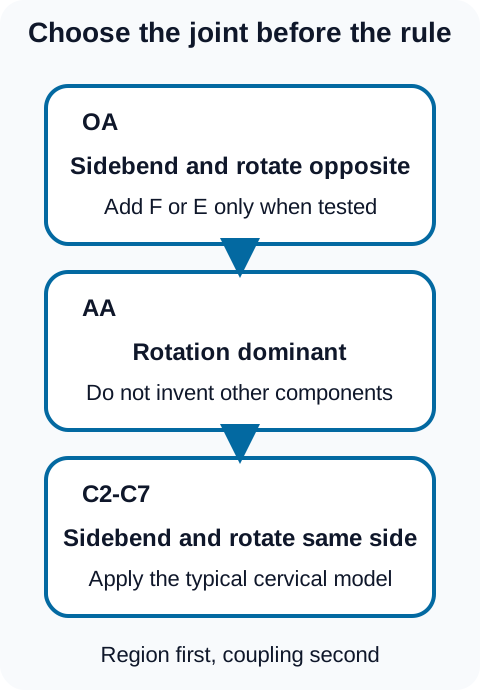
Can the thoracolumbar switch be applied to every joint? Identify the region first. Conventional OA mechanics pair sidebending and rotation in opposite directions. Typical C2-C7 mechanics pair them to the same side in neutral, flexion or extension. AA testing emphasizes rotation. These are separate regional descriptions, not reasons to call every cervical finding Type I or Type II. [8][9]
The OA articulations favor nodding with small coupled sidebending and rotation; the AA complex is rotation-dominant around the dens. Typical cervical facets have different geometry again. This is not a procedural or imaging guide.
At the OA, extended, sidebent right and rotated left is a conventional combination. At C5, a flexed right-sided preference pairs with right rotation. The AA complex permits other small motions, but its rotation-dominant anatomy makes rotation the principal named component in a usual AA diagnosis. The atlas lacks a body and typical spinous process; the axis supplies the dens. [4][8][9]
Compare OA sidebending right with C5 sidebending right. Should the conventional rotation predictions match?
No. OA pairs with left rotation; C5 pairs with right rotation. The joint identity changes the interpretation before flexion or extension is considered.
Regional findings can coexist. A focal non-neutral segment may contribute to a nearby group pattern, but Type II does not automatically mean primary and Type I does not automatically mean compensatory. Address a clinically supported priority when appropriate, then reassess symptoms and the regional examination. Persistence does not, by itself, prove fibrosis or a failed treatment. [1][10]
The sacrum and L5 should be examined together. Traditional torsion descriptions relate sacral rotation to opposite L5 rotation; teaching often associates L5 sidebending with the sacral oblique-axis side. These are consistency checks within a specified model and position, not a way to diagnose a torsion from L5 alone. Sacral landmarks and independent motion tests remain necessary. [1][2]
A second regional connection is the iliopsoas. Hip-extension limitation can coexist with lumbar symptoms and an upper-lumbar non-neutral finding. The psoas arises from the lumbar region and joins iliacus to attach to the lesser trochanter, not a point medial to the ASIS. An anterior pelvic tender location is not an insertion map. [3][14]
A positive modified Thomas test needs pelvic control to be interpreted as a hip-extension deficit. It does not identify the psoas alone or supply a mandatory L1/L2 notation. A contralateral pelvic shift and discomfort on rising are contextual observations, not a diagnostic rule. Assess hip, lumbar and neurological contributors instead of assigning every such presentation to one muscle. [3][13][14]
Transfer: after addressing a focal segment, repeat the group examination. If the group finding improves, record the observed response without claiming a universal causal rule. If it persists, assess it on its own evidence rather than assuming the same intervention must be repeated.
Try it here · Checkpoint 2 of 3
Make your prediction before reading the choices. A first attempt is just a starting point.
Case 16
Show answer and explanations for case 16
A. Left sidebending; restricted flexion (Best answer)
Typical C2-C7 coupling is to the same side, while sagittal preference is assessed separately. Left rotation predicts left sidebending, and improvement in extension supports flexion as the opposite sagittal restriction. Use the cervical regional rule without losing the independent flexion-extension finding.
Reasoning steps for option A
In fryettes-principles-16, why might option A initially seem plausible?
Typical C2-C7 coupling is to the same side, while sagittal preference is assessed separately.
In fryettes-principles-16, which supplied finding most strongly tests option A?
Left rotation predicts left sidebending, and improvement in extension supports flexion as the opposite sagittal restriction.
In fryettes-principles-16, which transferable rule settles option A?
Infer the missing cervical component and distinguish it from sagittal restriction. Applied here, that sequence preserves the measured findings without adding an untested component.
B. Right sidebending; restricted flexion (Why this does not fit)
Opposite coupling is a useful conventional relationship at the OA. C5 belongs to the typical cervical region, so applying the OA relationship reverses the predicted sidebend. Do not transfer the OA rule to a typical cervical segment.
Reasoning steps for option B
In fryettes-principles-16, why might option B initially seem plausible?
Opposite coupling is a useful conventional relationship at the OA.
In fryettes-principles-16, which supplied finding most strongly tests option B?
C5 belongs to the typical cervical region, so applying the OA relationship reverses the predicted sidebend.
In fryettes-principles-16, which transferable rule settles option B?
Do not transfer the OA rule to a typical cervical segment.
C. Left sidebending; restricted extension (Why this does not fit)
Same-side coupling correctly predicts the left-sidebending preference. Extension reduces the asymmetry, so it is the easier rather than the restricted sagittal direction. Coupling and sagittal preference answer different questions.
Reasoning steps for option C
In fryettes-principles-16, why might option C initially seem plausible?
Same-side coupling correctly predicts the left-sidebending preference.
In fryettes-principles-16, which supplied finding most strongly tests option C?
Extension reduces the asymmetry, so it is the easier rather than the restricted sagittal direction.
In fryettes-principles-16, which transferable rule settles option C?
Coupling and sagittal preference answer different questions.
D. Right sidebending; restricted extension (Why this does not fit)
A neutral thoracolumbar group can have opposite sidebending and rotation. The region is C5 and the observed sagittal response favors extension, making both proposed components unsupported. Identify both the region and the direction of improvement before choosing a prediction.
Reasoning steps for option D
In fryettes-principles-16, why might option D initially seem plausible?
A neutral thoracolumbar group can have opposite sidebending and rotation.
In fryettes-principles-16, which supplied finding most strongly tests option D?
The region is C5 and the observed sagittal response favors extension, making both proposed components unsupported.
In fryettes-principles-16, which transferable rule settles option D?
Identify both the region and the direction of improvement before choosing a prediction.
Takeaway: Use the cervical regional rule without losing the independent flexion-extension finding.
How sure are you that the process you palpated belongs to the named level? Surface landmarks estimate a region; they do not certify an exact segment. The customary cervical prominence near C7, scapular spine near T3 and resting inferior scapular angle near T7 are starting conventions. Body position, scapular position and individual anatomy alter the relationship. [4][12]
Other customary estimates are the jugular notch near T2/T3, sternal angle near T4/T5, xiphisternal junction near T9, iliac-crest line near L4 or L4/L5, and PSIS near S2. Distinguish the xiphisternal junction from the variable xiphoid tip. The sternal angle is useful for identifying the second rib, not for guaranteeing the location of a posterior process. [4][5][12]
Traditional thoracic rule of threes, retained as a convention
Vertebra
Its spinous tip relative to its transverse processes
VertebraT1-T3 and T12
Its spinous tip relative to its transverse processesApproximately the same horizontal level
VertebraT4-T6 and T11
Its spinous tip relative to its transverse processesApproximately half a segment inferior
VertebraT7-T10
Its spinous tip relative to its transverse processesApproximately one segment inferior
The direction matters: in the traditional T8 example, the spinous tip is below its own transverse processes, so those processes are sought superior to the tip. However, a study of 528 thoracic levels in 44 cadavers found only 26.7% overall agreement with the traditional rule. Retain the convention for a question that explicitly invokes it; do not use it as precise procedural localization. [11]
Under the traditional rule only, where are T8 transverse processes relative to the T8 spinous tip?
Approximately one segment superior. The rule describes the inferior projection of the spinous tip; it does not put the transverse processes below it. Actual clinical localization requires confirmation.
Ribs add another localization check. In a typical thoracic articulation, the rib head contacts vertebral-body facets, while the tubercle contacts a transverse-process facet. Ribs 11 and 12 lack the usual costotransverse joint. The thoracic sympathetic trunks run beside the vertebral column near the rib heads through much of the chest. Preganglionic sympathetic outflow arises from the thoracic and upper lumbar cord (T1-L2). This provides anatomical context for the regional relationship, not evidence that palpation identifies an organ disorder or that a local intervention changes autonomic output. [16][4][5]
Transfer: if the inferior scapular angle appears at a different level after the arm position changes, the vertebrae have not been renumbered. Reconfirm the level rather than calling the difference a new dysfunction. Match clinical decisions to the precision the examination can actually support. [12]
Follow response, function and safety over time
Level 3 starts with a reproducible baseline. Record the region, the tested directions, relevant symptoms, neurological findings and a functional task before an intervention. Recheck the same measures afterward. A changed local motion finding is not the same outcome as less pain, better gait or restored activity.
Reassessment tests the working explanation. If the expected motion changes but familiar symptoms and function do not, reconsider the main contributor instead of repeating the same intervention automatically. If symptoms improve but a small asymmetry remains, do not treat the asymmetry as a mandatory endpoint.
Escalate when the presentation leaves a mechanical pattern. New neurological findings, unusual severe head or neck pain, trauma concerns, constitutional illness, progressive weakness or loss of bowel or bladder control require medical evaluation rather than a more forceful manual setup. A prior normal radiograph does not clear a new vascular, neurological or ligamentous concern. [15]
Beyond boards: communicate uncertainty, consent and referral
Biomechanical notation is a clinical description, not a causal verdict. Explain that regional rules are teaching models and that palpatory localization has known limits. Static imaging can compare orientations but cannot establish the sequence of movement or prove that a manual intervention will change symptoms. [10][11]
Consent should match the proposed method and the uncertainty. Discuss the goal, alternatives, expected reassessment and reasons to stop. Technique choice depends on training, patient preference, tissue response and contraindication screening; the F, E or N label alone does not prescribe force, contact or thrust direction.
No medication dose belongs to Fryette mechanics itself. When medication is used for an underlying condition, verify the dose against current labeling, renal and hepatic function, interactions, pregnancy status and the actual diagnosis rather than importing a drug protocol into a motion finding.
Referral becomes the management decision when risk exceeds the manual question. Arrange urgent evaluation for new vascular or neurological features, and obtain appropriate specialty input for progressive deficit, unresolved post-traumatic symptoms, systemic disease or persistent functional loss that is not explained by the structural examination. Use the most current local safety pathway; the cited framework illustrates the reasoning but does not replace later institutional updates. [15]
Try it here · Checkpoint 3 of 3
Make your prediction before reading the choices. A first attempt is just a starting point.
Case 14
Show answer and explanations for case 14
A. Proceed with a reduced-force direct technique because the radiographs were normal (Why this does not fit)
Radiographs can address some structural concerns after trauma. They do not exclude a vascular or neurological cause of the new symptoms. Normal initial imaging does not clear a new neurological presentation for manual treatment.
Reasoning steps for option A
In fryettes-principles-14, why might option A initially seem plausible?
Radiographs can address some structural concerns after trauma.
In fryettes-principles-14, which supplied finding most strongly tests option A?
They do not exclude a vascular or neurological cause of the new symptoms.
In fryettes-principles-14, which transferable rule settles option A?
Normal initial imaging does not clear a new neurological presentation for manual treatment.
B. Use an indirect technique first and judge the symptoms afterward (Why this does not fit)
Indirect methods use different directional principles from direct techniques. Changing the manual technique does not resolve concern raised by new neurological symptoms. A possible serious cause must be assessed before selecting a different manual method.
Reasoning steps for option B
In fryettes-principles-14, why might option B initially seem plausible?
Indirect methods use different directional principles from direct techniques.
In fryettes-principles-14, which supplied finding most strongly tests option B?
Changing the manual technique does not resolve concern raised by new neurological symptoms.
In fryettes-principles-14, which transferable rule settles option B?
A possible serious cause must be assessed before selecting a different manual method.
C. Arrange urgent medical assessment before manual treatment (Best answer)
Vascular and neurological disorders can resemble musculoskeletal neck pain. The new unusual pain with double vision and unsteadiness outweighs reassurance from the prior radiographs or local tenderness. New neurological features change the diagnostic priority before any manual intervention.
Reasoning steps for option C
In fryettes-principles-14, why might option C initially seem plausible?
Vascular and neurological disorders can resemble musculoskeletal neck pain.
In fryettes-principles-14, which supplied finding most strongly tests option C?
The new unusual pain with double vision and unsteadiness outweighs reassurance from the prior radiographs or local tenderness.
In fryettes-principles-14, which transferable rule settles option C?
Prioritize assessment when neurological features accompany new neck pain. Applied here, that sequence preserves the measured findings without adding an untested component.
D. Use a provocative positional test to decide whether treatment can proceed (Why this does not fit)
A positional response may once have been used as a vascular screening shortcut. A negative result does not establish safety and should not override these symptoms. A single negative provocative test cannot clear a concerning cervical presentation.
Reasoning steps for option D
In fryettes-principles-14, why might option D initially seem plausible?
A positional response may once have been used as a vascular screening shortcut.
In fryettes-principles-14, which supplied finding most strongly tests option D?
A negative result does not establish safety and should not override these symptoms.
In fryettes-principles-14, which transferable rule settles option D?
A single negative provocative test cannot clear a concerning cervical presentation.
Takeaway: New neurological features change the diagnostic priority before any manual intervention.
These original educational cases are separate from the guided activities. State your answer before examining the options. Use the explanation to compare the alternatives, then retry without a timer or score target.
Case 1
Show answer and explanations for case 1
A. E, R-right, S-right (Why this does not fit)
A positional diagnosis names the easier directions. These are the observed preferences, not the restrictions requested for a direct approach. Separate the diagnostic label from the treatment direction.
Reasoning steps for option A
In fryettes-principles-01, why might option A initially seem plausible?
A positional diagnosis names the easier directions.
In fryettes-principles-01, which supplied finding most strongly tests option A?
These are the observed preferences, not the restrictions requested for a direct approach.
In fryettes-principles-01, which transferable rule settles option A?
Separate the diagnostic label from the treatment direction.
B. F, R-left, S-left (Best answer)
A direct directional analysis concerns the less available motions. Extension reduces the asymmetry and right rotation and sidebending are easier, making the opposite directions the relevant restrictions. Determine the preference first, then identify each corresponding restriction.
Reasoning steps for option B
In fryettes-principles-01, why might option B initially seem plausible?
A direct directional analysis concerns the less available motions.
In fryettes-principles-01, which supplied finding most strongly tests option B?
Extension reduces the asymmetry and right rotation and sidebending are easier, making the opposite directions the relevant restrictions.
In fryettes-principles-01, which transferable rule settles option B?
Translate positional testing into a complete direct directional analysis. Applied here, that sequence preserves the measured findings without adding an untested component.
C. F, R-right, S-left (Why this does not fit)
Flexion and left sidebending oppose two of the recorded preferences. Right rotation remains an easier direction and does not address the recorded rotational restriction. Check every named plane rather than reversing only part of a diagnosis.
Reasoning steps for option C
In fryettes-principles-01, why might option C initially seem plausible?
Flexion and left sidebending oppose two of the recorded preferences.
In fryettes-principles-01, which supplied finding most strongly tests option C?
Right rotation remains an easier direction and does not address the recorded rotational restriction.
In fryettes-principles-01, which transferable rule settles option C?
Check every named plane rather than reversing only part of a diagnosis.
D. E, R-left, S-left (Why this does not fit)
Left rotation and left sidebending oppose the right-sided preferences. Extension is the position that reduced the asymmetry, so it is not the sagittal restriction. The flexion-extension comparison determines which sagittal direction is easier.
Reasoning steps for option D
In fryettes-principles-01, why might option D initially seem plausible?
Left rotation and left sidebending oppose the right-sided preferences.
In fryettes-principles-01, which supplied finding most strongly tests option D?
Extension is the position that reduced the asymmetry, so it is not the sagittal restriction.
In fryettes-principles-01, which transferable rule settles option D?
The flexion-extension comparison determines which sagittal direction is easier.
Takeaway: Determine the preference first, then identify each corresponding restriction.
A. L3 E R-left S-left; restricted in flexion (Why this does not fit)
An extended diagnosis would have flexion as the opposing sagittal restriction. Flexion actually reduces the asymmetry in this examination, so the initial E reverses the observed preference. Name the position that reduces the segmental asymmetry.
Reasoning steps for option A
In fryettes-principles-02, why might option A initially seem plausible?
An extended diagnosis would have flexion as the opposing sagittal restriction.
In fryettes-principles-02, which supplied finding most strongly tests option A?
Flexion actually reduces the asymmetry in this examination, so the initial E reverses the observed preference.
In fryettes-principles-02, which transferable rule settles option A?
Name the position that reduces the segmental asymmetry.
B. L3 F R-right S-right; restricted in extension (Why this does not fit)
A rightward spinous tip can tempt an examiner to name right rotation. Rotation is named for the body; the left posterior transverse process and left-sided ease support left rotation. Do not name body rotation from the direction of the spinous tip.
Reasoning steps for option B
In fryettes-principles-02, why might option B initially seem plausible?
A rightward spinous tip can tempt an examiner to name right rotation.
In fryettes-principles-02, which supplied finding most strongly tests option B?
Rotation is named for the body; the left posterior transverse process and left-sided ease support left rotation.
In fryettes-principles-02, which transferable rule settles option B?
Do not name body rotation from the direction of the spinous tip.
C. L3 F R-left S-left; restricted in flexion (Why this does not fit)
The positional label matches the left-sided flexed preference. Its accompanying restriction repeats the easier sagittal direction rather than opposing it. A correct label does not make every treatment-direction statement correct.
Reasoning steps for option C
In fryettes-principles-02, why might option C initially seem plausible?
The positional label matches the left-sided flexed preference.
In fryettes-principles-02, which supplied finding most strongly tests option C?
Its accompanying restriction repeats the easier sagittal direction rather than opposing it.
In fryettes-principles-02, which transferable rule settles option C?
A correct label does not make every treatment-direction statement correct.
D. L3 F R-left S-left; restricted in extension (Best answer)
Flexion improvement supports a flexed preference, and body rotation follows the posterior transverse-process side. The left-sided testing and rightward spinous tip agree with that interpretation; extension is less available. Use the transverse processes and sagittal response as separate pieces of the diagnosis.
Reasoning steps for option D
In fryettes-principles-02, why might option D initially seem plausible?
Flexion improvement supports a flexed preference, and body rotation follows the posterior transverse-process side.
In fryettes-principles-02, which supplied finding most strongly tests option D?
The left-sided testing and rightward spinous tip agree with that interpretation; extension is less available.
In fryettes-principles-02, which transferable rule settles option D?
Integrate process orientation and sagittal response without reversing the body rotation. Applied here, that sequence preserves the measured findings without adding an untested component.
Takeaway: Use the transverse processes and sagittal response as separate pieces of the diagnosis.
A neutral group pattern can pair opposite sidebending and rotation. The multilevel examination supplies neutral behavior, right sidebending and left rotation. Use a group label only when the regional findings support it.
Reasoning steps for option A
In fryettes-principles-03, why might option A initially seem plausible?
A neutral group pattern can pair opposite sidebending and rotation.
In fryettes-principles-03, which supplied finding most strongly tests option A?
The multilevel examination supplies neutral behavior, right sidebending and left rotation.
In fryettes-principles-03, which transferable rule settles option A?
Document a tested neutral group rather than guessing a focal segment. Applied here, that sequence preserves the measured findings without adding an untested component.
B. T4-T8 N S-left R-right (Why this does not fit)
The neutral group format fits the scale of the examination. Both directional components reverse the supplied motion preferences. The form of the notation and its directions must both fit.
Reasoning steps for option B
In fryettes-principles-03, why might option B initially seem plausible?
The neutral group format fits the scale of the examination.
In fryettes-principles-03, which supplied finding most strongly tests option B?
Both directional components reverse the supplied motion preferences.
In fryettes-principles-03, which transferable rule settles option B?
The form of the notation and its directions must both fit.
C. T4 F R-left S-left (Why this does not fit)
A focal flexed left-sided diagnosis can produce a left-posterior process. No flexion preference or isolated T4 finding is established, and regional sidebending is right. Do not convert a supplied regional pattern into an unsupported focal one.
Reasoning steps for option C
In fryettes-principles-03, why might option C initially seem plausible?
A focal flexed left-sided diagnosis can produce a left-posterior process.
In fryettes-principles-03, which supplied finding most strongly tests option C?
No flexion preference or isolated T4 finding is established, and regional sidebending is right.
In fryettes-principles-03, which transferable rule settles option C?
Do not convert a supplied regional pattern into an unsupported focal one.
D. T8 E R-left S-left (Why this does not fit)
An extended segment can also present with a left-posterior process. The examination supplies no extension preference or isolated T8 finding. A posterior process alone does not choose F versus E.
Reasoning steps for option D
In fryettes-principles-03, why might option D initially seem plausible?
An extended segment can also present with a left-posterior process.
In fryettes-principles-03, which supplied finding most strongly tests option D?
The examination supplies no extension preference or isolated T8 finding.
In fryettes-principles-03, which transferable rule settles option D?
A posterior process alone does not choose F versus E.
Takeaway: Use a group label only when the regional findings support it.
A. Left rotation, right sidebending and a required extension component (Why this does not fit)
Extension may be relevant when a flexion preference has been established. This examination explicitly finds no consistent sagittal preference, so the added extension restriction is unsupported. Do not add an F or E component that was not found.
Reasoning steps for option A
In fryettes-principles-05, why might option A initially seem plausible?
Extension may be relevant when a flexion preference has been established.
In fryettes-principles-05, which supplied finding most strongly tests option A?
This examination explicitly finds no consistent sagittal preference, so the added extension restriction is unsupported.
In fryettes-principles-05, which transferable rule settles option A?
Do not add an F or E component that was not found.
B. Right rotation and left sidebending without a sagittal component (Why this does not fit)
The absence of an added sagittal component fits the supplied examination. The two named directions reproduce the ease directions instead of the restrictions. Separate neutral notation from the opposite restricted directions.
Reasoning steps for option B
In fryettes-principles-05, why might option B initially seem plausible?
The absence of an added sagittal component fits the supplied examination.
In fryettes-principles-05, which supplied finding most strongly tests option B?
The two named directions reproduce the ease directions instead of the restrictions.
In fryettes-principles-05, which transferable rule settles option B?
Separate neutral notation from the opposite restricted directions.
C. Left rotation and left sidebending without a sagittal component (Why this does not fit)
Left rotation correctly opposes the right-rotation preference. Left sidebending is still the easier direction and does not match the tested sidebending restriction. Translate each component independently.
Reasoning steps for option C
In fryettes-principles-05, why might option C initially seem plausible?
Left rotation correctly opposes the right-rotation preference.
In fryettes-principles-05, which supplied finding most strongly tests option C?
Left sidebending is still the easier direction and does not match the tested sidebending restriction.
In fryettes-principles-05, which transferable rule settles option C?
Translate each component independently.
D. Left rotation and right sidebending without an assumed sagittal component (Best answer)
The relevant direct directions oppose the documented regional preferences. The reassessment confirms these two restrictions and supplies no additional sagittal preference. A neutral group label does not automatically require an invented third directional restriction.
Reasoning steps for option D
In fryettes-principles-05, why might option D initially seem plausible?
The relevant direct directions oppose the documented regional preferences.
In fryettes-principles-05, which supplied finding most strongly tests option D?
The reassessment confirms these two restrictions and supplies no additional sagittal preference.
In fryettes-principles-05, which transferable rule settles option D?
Avoid inventing a sagittal restriction when interpreting a neutral group. Applied here, that sequence preserves the measured findings without adding an untested component.
Takeaway: A neutral group label does not automatically require an invented third directional restriction.
The position that reduces asymmetry identifies the easier sagittal direction in this model. A improves in flexion, while B improves in extension; their opposing restrictions therefore differ. Similar neutral asymmetry can hide different sagittal preferences.
Reasoning steps for option A
In fryettes-principles-06, why might option A initially seem plausible?
The position that reduces asymmetry identifies the easier sagittal direction in this model.
In fryettes-principles-06, which supplied finding most strongly tests option A?
A improves in flexion, while B improves in extension; their opposing restrictions therefore differ.
In fryettes-principles-06, which transferable rule settles option A?
Compare sagittal responses while controlling rotation direction. Applied here, that sequence preserves the measured findings without adding an untested component.
B. A: flexion; B: extension (Why this does not fit)
The flexion-extension responses differ between the patients. This option labels each position of improvement as the restriction rather than the ease. Identify what improved before naming the opposite restriction.
Reasoning steps for option B
In fryettes-principles-06, why might option B initially seem plausible?
The flexion-extension responses differ between the patients.
In fryettes-principles-06, which supplied finding most strongly tests option B?
This option labels each position of improvement as the restriction rather than the ease.
In fryettes-principles-06, which transferable rule settles option B?
Identify what improved before naming the opposite restriction.
C. A: extension; B: extension (Why this does not fit)
An initial left-posterior process may occur in a flexed pattern. Patient B improves in extension, so a shared extension restriction is not supported. Do not infer the sagittal diagnosis from the rotation side alone.
Reasoning steps for option C
In fryettes-principles-06, why might option C initially seem plausible?
An initial left-posterior process may occur in a flexed pattern.
In fryettes-principles-06, which supplied finding most strongly tests option C?
Patient B improves in extension, so a shared extension restriction is not supported.
In fryettes-principles-06, which transferable rule settles option C?
Do not infer the sagittal diagnosis from the rotation side alone.
D. A: flexion; B: flexion (Why this does not fit)
An initial left-posterior process may also occur in an extended pattern. Patient A improves in flexion, which contradicts assigning flexion as its restriction. Compare both positions for each patient rather than copying the first pattern.
Reasoning steps for option D
In fryettes-principles-06, why might option D initially seem plausible?
An initial left-posterior process may also occur in an extended pattern.
In fryettes-principles-06, which supplied finding most strongly tests option D?
Patient A improves in flexion, which contradicts assigning flexion as its restriction.
In fryettes-principles-06, which transferable rule settles option D?
Compare both positions for each patient rather than copying the first pattern.
Takeaway: Similar neutral asymmetry can hide different sagittal preferences.
A. Relabel the segment E R-right S-right; keep the setup (Why this does not fit)
An extended preference would have flexion as an opposing restriction. The supervisor confirmed that flexion reduced the asymmetry, so changing the diagnosis would discard valid examination evidence. Correct the inconsistent interpretation rather than rewriting the observed finding.
Reasoning steps for option A
In fryettes-principles-07, why might option A initially seem plausible?
An extended preference would have flexion as an opposing restriction.
In fryettes-principles-07, which supplied finding most strongly tests option A?
The supervisor confirmed that flexion reduced the asymmetry, so changing the diagnosis would discard valid examination evidence.
In fryettes-principles-07, which transferable rule settles option A?
Correct the inconsistent interpretation rather than rewriting the observed finding.
B. Keep the diagnosis; use extension with left rotation plus left sidebending (Best answer)
A direct setup addresses the restriction rather than the flexed preference. The two left-sided components already oppose the recorded right-sided ease; the sagittal component alone is reversed. Keep the tested diagnosis fixed while correcting the mismatched directional component.
Reasoning steps for option B
In fryettes-principles-07, why might option B initially seem plausible?
A direct setup addresses the restriction rather than the flexed preference.
In fryettes-principles-07, which supplied finding most strongly tests option B?
The two left-sided components already oppose the recorded right-sided ease; the sagittal component alone is reversed.
In fryettes-principles-07, which transferable rule settles option B?
Audit a direct setup against a confirmed positional diagnosis. Applied here, that sequence preserves the measured findings without adding an untested component.
C. Keep the diagnosis; use flexion with right rotation plus right sidebending (Why this does not fit)
These three directions consistently describe the easier position. They would describe an indirect directional approach rather than the planned direct setup. Consistency with ease is not the same as consistency with a direct method.
Reasoning steps for option C
In fryettes-principles-07, why might option C initially seem plausible?
These three directions consistently describe the easier position.
In fryettes-principles-07, which supplied finding most strongly tests option C?
They would describe an indirect directional approach rather than the planned direct setup.
In fryettes-principles-07, which transferable rule settles option C?
Consistency with ease is not the same as consistency with a direct method.
D. Keep the diagnosis; remove the sagittal component (Why this does not fit)
Neutral notation is useful when no consistent sagittal preference is found. A reproducible flexion-related improvement is already supplied, so removing it loses relevant information. Do not erase a demonstrated preference to make the documentation simpler.
Reasoning steps for option D
In fryettes-principles-07, why might option D initially seem plausible?
Neutral notation is useful when no consistent sagittal preference is found.
In fryettes-principles-07, which supplied finding most strongly tests option D?
A reproducible flexion-related improvement is already supplied, so removing it loses relevant information.
In fryettes-principles-07, which transferable rule settles option D?
Do not erase a demonstrated preference to make the documentation simpler.
Takeaway: Keep the tested diagnosis fixed while correcting the mismatched directional component.
A. A fixed rotational contracture has been established at the tested level (Why this does not fit)
A fixed contracture can reduce range. The immediate return of the original range after changing position does not establish a fixed restriction. Distinguish position-dependent motion from persistent loss of motion.
Reasoning steps for option A
In fryettes-principles-08, why might option A initially seem plausible?
A fixed contracture can reduce range.
In fryettes-principles-08, which supplied finding most strongly tests option A?
The immediate return of the original range after changing position does not establish a fixed restriction.
In fryettes-principles-08, which transferable rule settles option A?
Distinguish position-dependent motion from persistent loss of motion.
B. A new Type II diagnosis can be assigned from the reduced range alone (Why this does not fit)
Non-neutral positioning changes the mechanical context of testing. No directional preference or focal segmental pattern has been established, and the range returns near neutral. Positioning the spine non-neutrally is not itself a somatic diagnosis.
Reasoning steps for option B
In fryettes-principles-08, why might option B initially seem plausible?
Non-neutral positioning changes the mechanical context of testing.
In fryettes-principles-08, which supplied finding most strongly tests option B?
No directional preference or focal segmental pattern has been established, and the range returns near neutral.
In fryettes-principles-08, which transferable rule settles option B?
Positioning the spine non-neutrally is not itself a somatic diagnosis.
C. Available motion in one plane depends on position in another plane (Best answer)
Spinal motions are mechanically interdependent. Rotation changes with sidebending and returns when that condition is removed, fitting a positional effect. A change in available range need not imply a newly acquired lesion.
Reasoning steps for option C
In fryettes-principles-08, why might option C initially seem plausible?
Spinal motions are mechanically interdependent.
In fryettes-principles-08, which supplied finding most strongly tests option C?
Rotation changes with sidebending and returns when that condition is removed, fitting a positional effect.
In fryettes-principles-08, which transferable rule settles option C?
Apply the third principle without converting a reversible range change into pathology. Applied here, that sequence preserves the measured findings without adding an untested component.
D. The initial neutral range was invalid and should be discarded (Why this does not fit)
Inconsistent technique can affect repeated range measurements. Here the same original range returns after a controlled positional reversal, supporting a real positional effect rather than an isolated invalid baseline. Use reproducibility across conditions when interpreting a changed examination.
Reasoning steps for option D
In fryettes-principles-08, why might option D initially seem plausible?
Inconsistent technique can affect repeated range measurements.
In fryettes-principles-08, which supplied finding most strongly tests option D?
Here the same original range returns after a controlled positional reversal, supporting a real positional effect rather than an isolated invalid baseline.
In fryettes-principles-08, which transferable rule settles option D?
Use reproducibility across conditions when interpreting a changed examination.
Takeaway: A change in available range need not imply a newly acquired lesion.
A. A static orientation comparison does not record the temporal sequence of motion (Best answer)
An image records a configuration rather than a time-resolved movement sequence. Agreement between a final position and a predicted pattern cannot establish which component occurred first. Match a biomechanical conclusion to what the study actually measured.
Reasoning steps for option A
In fryettes-principles-09, why might option A initially seem plausible?
An image records a configuration rather than a time-resolved movement sequence.
In fryettes-principles-09, which supplied finding most strongly tests option A?
Agreement between a final position and a predicted pattern cannot establish which component occurred first.
In fryettes-principles-09, which transferable rule settles option A?
Distinguish static orientation from dynamic causal evidence. Applied here, that sequence preserves the measured findings without adding an untested component.
B. The use of CT means that vertebral orientation cannot be assessed at all (Why this does not fit)
Imaging orientation measurements have technical limits. The study can compare static orientation; the missing information is the sequence of motion rather than every aspect of anatomy. A method can answer one question while leaving a different one unresolved.
Reasoning steps for option B
In fryettes-principles-09, why might option B initially seem plausible?
Imaging orientation measurements have technical limits.
In fryettes-principles-09, which supplied finding most strongly tests option B?
The study can compare static orientation; the missing information is the sequence of motion rather than every aspect of anatomy.
In fryettes-principles-09, which transferable rule settles option B?
A method can answer one question while leaving a different one unresolved.
C. Any nonmatching orientation proves that the matching measurements are erroneous (Why this does not fit)
Mixed results warrant attention to methods and eligibility. Disagreement in part of a sample does not establish that all compatible observations are measurement errors. Variation limits a universal claim without invalidating every observation.
Reasoning steps for option C
In fryettes-principles-09, why might option C initially seem plausible?
Mixed results warrant attention to methods and eligibility.
In fryettes-principles-09, which supplied finding most strongly tests option C?
Disagreement in part of a sample does not establish that all compatible observations are measurement errors.
In fryettes-principles-09, which transferable rule settles option C?
Variation limits a universal claim without invalidating every observation.
D. The study must show clinical improvement before any anatomical observation is interpretable (Why this does not fit)
Clinical benefit requires outcomes beyond an anatomical measurement. The colleague made a temporal-motion claim, so a treatment outcome is not the specific missing variable. Identify the information needed for the actual inference being proposed.
Reasoning steps for option D
In fryettes-principles-09, why might option D initially seem plausible?
Clinical benefit requires outcomes beyond an anatomical measurement.
In fryettes-principles-09, which supplied finding most strongly tests option D?
The colleague made a temporal-motion claim, so a treatment outcome is not the specific missing variable.
In fryettes-principles-09, which transferable rule settles option D?
Identify the information needed for the actual inference being proposed.
Takeaway: Match a biomechanical conclusion to what the study actually measured.
A. The response establishes that Type I findings are secondary in other patients (Why this does not fit)
A group pattern may sometimes accompany a focal contributor. One observed response does not establish a universal relationship between the diagnostic categories. Use reassessment to describe this response, not to assign causality to every Type I finding.
Reasoning steps for option A
In fryettes-principles-10, why might option A initially seem plausible?
A group pattern may sometimes accompany a focal contributor.
In fryettes-principles-10, which supplied finding most strongly tests option A?
One observed response does not establish a universal relationship between the diagnostic categories.
In fryettes-principles-10, which transferable rule settles option A?
Use reassessment to describe this response, not to assign causality to every Type I finding.
B. The group finding requires another identical treatment before its response can be recorded (Why this does not fit)
Repeated assessment can help determine whether a response persists. The examination has already changed, so recording that change does not require repeating an intervention first. Document the current findings before deciding whether further treatment is appropriate.
Reasoning steps for option B
In fryettes-principles-10, why might option B initially seem plausible?
Repeated assessment can help determine whether a response persists.
In fryettes-principles-10, which supplied finding most strongly tests option B?
The examination has already changed, so recording that change does not require repeating an intervention first.
In fryettes-principles-10, which transferable rule settles option B?
Document the current findings before deciding whether further treatment is appropriate.
C. The observed regional response supports reassessment of what still requires attention (Best answer)
A regional finding can change after a focal intervention. The local and group findings both improved in this patient, but persistence and remaining needs must still be assessed. Treat a supported priority and reassess rather than applying a category-based sequence automatically.
Reasoning steps for option C
In fryettes-principles-10, why might option C initially seem plausible?
A regional finding can change after a focal intervention.
In fryettes-principles-10, which supplied finding most strongly tests option C?
The local and group findings both improved in this patient, but persistence and remaining needs must still be assessed.
In fryettes-principles-10, which transferable rule settles option C?
Interpret a regional response without a universal primary-secondary rule. Applied here, that sequence preserves the measured findings without adding an untested component.
D. The response shows that the original group finding could not have coexisted with T6 dysfunction (Why this does not fit)
A focal segment and a regional group are different scales of description. Their coexistence before treatment and change afterward do not make the original observations mutually exclusive. A regional pattern can coexist with a focal finding.
Reasoning steps for option D
In fryettes-principles-10, why might option D initially seem plausible?
A focal segment and a regional group are different scales of description.
In fryettes-principles-10, which supplied finding most strongly tests option D?
Their coexistence before treatment and change afterward do not make the original observations mutually exclusive.
In fryettes-principles-10, which transferable rule settles option D?
A regional pattern can coexist with a focal finding.
Takeaway: Treat a supported priority and reassess rather than applying a category-based sequence automatically.
A. Classify the remaining group pattern as irreversible fibrosis (Why this does not fit)
Chronic soft-tissue changes can contribute to persistent restrictions. Persistence after one intervention does not establish fibrosis, irreversibility or its relationship to the symptoms. A time course and a treatment response do not substitute for a tissue diagnosis.
Reasoning steps for option A
In fryettes-principles-11, why might option A initially seem plausible?
Chronic soft-tissue changes can contribute to persistent restrictions.
In fryettes-principles-11, which supplied finding most strongly tests option A?
Persistence after one intervention does not establish fibrosis, irreversibility or its relationship to the symptoms.
In fryettes-principles-11, which transferable rule settles option A?
A time course and a treatment response do not substitute for a tissue diagnosis.
B. Repeat the same focal intervention until the group changes (Why this does not fit)
A focal finding may be a relevant treatment target in some presentations. It changed without improving the group finding or symptoms, so its role as the main remaining contributor is uncertain. Reassess a working explanation when the predicted clinical response is absent.
Reasoning steps for option B
In fryettes-principles-11, why might option B initially seem plausible?
A focal finding may be a relevant treatment target in some presentations.
In fryettes-principles-11, which supplied finding most strongly tests option B?
It changed without improving the group finding or symptoms, so its role as the main remaining contributor is uncertain.
In fryettes-principles-11, which transferable rule settles option B?
Reassess a working explanation when the predicted clinical response is absent.
C. Disregard the group because the focal examination improved (Why this does not fit)
A local improvement is an observable result. The familiar symptoms and regional finding persist, so the overall clinical goal has not been established by that local result. Keep patient symptoms and regional findings distinct from a single segmental change.
Reasoning steps for option C
In fryettes-principles-11, why might option C initially seem plausible?
A local improvement is an observable result.
In fryettes-principles-11, which supplied finding most strongly tests option C?
The familiar symptoms and regional finding persist, so the overall clinical goal has not been established by that local result.
In fryettes-principles-11, which transferable rule settles option C?
Keep patient symptoms and regional findings distinct from a single segmental change.
D. Reassess the residual regional finding and other plausible symptom contributors (Best answer)
A lack of the expected regional or symptomatic response can alter the working assessment. The focal change did not resolve the remaining findings, supporting a renewed evaluation rather than a presumed tissue cause. Use reassessment to reconsider what the findings mean, not just whether a local label changed.
Reasoning steps for option D
In fryettes-principles-11, why might option D initially seem plausible?
A lack of the expected regional or symptomatic response can alter the working assessment.
In fryettes-principles-11, which supplied finding most strongly tests option D?
The focal change did not resolve the remaining findings, supporting a renewed evaluation rather than a presumed tissue cause.
In fryettes-principles-11, which transferable rule settles option D?
Distinguish a local examination response from evidence about the remaining symptom source. Applied here, that sequence preserves the measured findings without adding an untested component.
Takeaway: Use reassessment to reconsider what the findings mean, not just whether a local label changed.
A. Caudad translation, clockwise rotation and rightward translation (Best answer)
A direct fascial approach addresses the less available directions. Cephalad and counterclockwise are preferences to reverse; rightward translation is already described as restricted. Reverse ease descriptions but retain a direction already identified as bind.
Reasoning steps for option A
In fryettes-principles-12, why might option A initially seem plausible?
A direct fascial approach addresses the less available directions.
In fryettes-principles-12, which supplied finding most strongly tests option A?
Cephalad and counterclockwise are preferences to reverse; rightward translation is already described as restricted.
In fryettes-principles-12, which transferable rule settles option A?
Interpret mixed preference and restriction wording for a direct fascial approach. Applied here, that sequence preserves the measured findings without adding an untested component.
B. Cephalad translation, counterclockwise rotation and leftward translation (Why this does not fit)
These directions follow the reported easier tissue responses. They describe an indirect directional approach rather than the selected direct one. Choose direction according to the stated method, not merely the familiar pattern.
Reasoning steps for option B
In fryettes-principles-12, why might option B initially seem plausible?
These directions follow the reported easier tissue responses.
In fryettes-principles-12, which supplied finding most strongly tests option B?
They describe an indirect directional approach rather than the selected direct one.
In fryettes-principles-12, which transferable rule settles option B?
Choose direction according to the stated method, not merely the familiar pattern.
C. Caudad translation, counterclockwise rotation and rightward translation (Why this does not fit)
The caudad and rightward components address the two translational restrictions. Counterclockwise rotation remains a stated preference rather than the rotational bind. Check the rotational component separately from translation.
Reasoning steps for option C
In fryettes-principles-12, why might option C initially seem plausible?
The caudad and rightward components address the two translational restrictions.
In fryettes-principles-12, which supplied finding most strongly tests option C?
Counterclockwise rotation remains a stated preference rather than the rotational bind.
In fryettes-principles-12, which transferable rule settles option C?
Check the rotational component separately from translation.
D. Caudad translation, clockwise rotation and leftward translation (Why this does not fit)
The cephalad and counterclockwise preferences are correctly reversed. Rightward translation was explicitly restricted, so substituting leftward translation abandons that part of the bind. Do not reverse a restriction a second time.
Reasoning steps for option D
In fryettes-principles-12, why might option D initially seem plausible?
The cephalad and counterclockwise preferences are correctly reversed.
In fryettes-principles-12, which supplied finding most strongly tests option D?
Rightward translation was explicitly restricted, so substituting leftward translation abandons that part of the bind.
In fryettes-principles-12, which transferable rule settles option D?
Do not reverse a restriction a second time.
Takeaway: Reverse ease descriptions but retain a direction already identified as bind.
A. Extension, left rotation and left translation (Why this does not fit)
These directions oppose the three inferred preferences. They describe the bind rather than the ease requested for the indirect approach. The same examination supports different directional descriptions for direct and indirect methods.
Reasoning steps for option A
In fryettes-principles-13, why might option A initially seem plausible?
These directions oppose the three inferred preferences.
In fryettes-principles-13, which supplied finding most strongly tests option A?
They describe the bind rather than the ease requested for the indirect approach.
In fryettes-principles-13, which transferable rule settles option A?
The same examination supports different directional descriptions for direct and indirect methods.
B. Flexion, right rotation and right translation (Best answer)
An indirect approach follows the easier tissue directions. Flexion opposes the extension bind, right rotation opposes the left-rotation bind, and right translation is already easier. Treat rotation and translation as separate reported dimensions.
Reasoning steps for option B
In fryettes-principles-13, why might option B initially seem plausible?
An indirect approach follows the easier tissue directions.
In fryettes-principles-13, which supplied finding most strongly tests option B?
Flexion opposes the extension bind, right rotation opposes the left-rotation bind, and right translation is already easier.
In fryettes-principles-13, which transferable rule settles option B?
Select indirect directions from mixed fascial findings while preserving translation terminology. Applied here, that sequence preserves the measured findings without adding an untested component.
C. Flexion, right rotation and left translation (Why this does not fit)
The sagittal and rotational components correctly oppose the stated restrictions. Left translation reverses a direction that was already easier. A stated preference should not be reversed when selecting indirect directions.
Reasoning steps for option C
In fryettes-principles-13, why might option C initially seem plausible?
The sagittal and rotational components correctly oppose the stated restrictions.
In fryettes-principles-13, which supplied finding most strongly tests option C?
Left translation reverses a direction that was already easier.
In fryettes-principles-13, which transferable rule settles option C?
A stated preference should not be reversed when selecting indirect directions.
D. Flexion, left rotation and right translation (Why this does not fit)
Flexion and right translation follow the inferred or stated ease. Left rotation remains the reported restricted direction. A partly correct directional combination can still mix bind with ease.
Reasoning steps for option D
In fryettes-principles-13, why might option D initially seem plausible?
Flexion and right translation follow the inferred or stated ease.
In fryettes-principles-13, which supplied finding most strongly tests option D?
Left rotation remains the reported restricted direction.
In fryettes-principles-13, which transferable rule settles option D?
A partly correct directional combination can still mix bind with ease.
Takeaway: Treat rotation and translation as separate reported dimensions.
A. Predict R-right; assess flexion with left rotation plus left sidebending (Why this does not fit)
Typical C2-C7 same-side coupling can suggest right rotation with right sidebending. The supplied joint is OA, whose conventional coupling is opposite rather than the typical cervical pattern. Select the regional coupling model before identifying the restricted directions.
Reasoning steps for option A
In fryettes-principles-15, why might option A initially seem plausible?
Typical C2-C7 same-side coupling can suggest right rotation with right sidebending.
In fryettes-principles-15, which supplied finding most strongly tests option A?
The supplied joint is OA, whose conventional coupling is opposite rather than the typical cervical pattern.
In fryettes-principles-15, which transferable rule settles option A?
Select the regional coupling model before identifying the restricted directions.
B. Predict R-left; assess extension with left rotation plus right sidebending (Why this does not fit)
Opposite OA coupling predicts left rotation from right sidebending. The proposed directional assessment then repeats all of the easier components rather than addressing the direct restrictions. Correct regional coupling still needs a separate ease-versus-restriction decision.
Reasoning steps for option B
In fryettes-principles-15, why might option B initially seem plausible?
Opposite OA coupling predicts left rotation from right sidebending.
In fryettes-principles-15, which supplied finding most strongly tests option B?
The proposed directional assessment then repeats all of the easier components rather than addressing the direct restrictions.
In fryettes-principles-15, which transferable rule settles option B?
Correct regional coupling still needs a separate ease-versus-restriction decision.
C. Predict R-right; assess extension with right rotation plus left sidebending (Why this does not fit)
The left-sidebending component opposes the stated right-sidebending preference. Right rotation uses the wrong regional coupling and extension repeats the sagittal ease. Check the region and each directional component independently.
Reasoning steps for option C
In fryettes-principles-15, why might option C initially seem plausible?
The left-sidebending component opposes the stated right-sidebending preference.
In fryettes-principles-15, which supplied finding most strongly tests option C?
Right rotation uses the wrong regional coupling and extension repeats the sagittal ease.
In fryettes-principles-15, which transferable rule settles option C?
Check the region and each directional component independently.
D. Predict R-left; assess flexion with right rotation plus left sidebending (Best answer)
Conventional OA sidebending and rotation are opposite. Right sidebending predicts left rotation; opposing the extended left-rotated right-sidebent preference gives the stated direct directions. Combine the regional rule with the method only after the preference is clear.
Reasoning steps for option D
In fryettes-principles-15, why might option D initially seem plausible?
Conventional OA sidebending and rotation are opposite.
In fryettes-principles-15, which supplied finding most strongly tests option D?
Right sidebending predicts left rotation; opposing the extended left-rotated right-sidebent preference gives the stated direct directions.
In fryettes-principles-15, which transferable rule settles option D?
Combine OA coupling with a direct directional analysis. Applied here, that sequence preserves the measured findings without adding an untested component.
Takeaway: Combine the regional rule with the method only after the preference is clear.
A. OA rotated left; restricted right rotation (Why this does not fit)
An opposite relationship between preference and restriction still applies to a directional description. The asymmetry was localized to C1-C2, while the OA examination was relatively normal. Localize the finding before naming its direction.
Reasoning steps for option A
In fryettes-principles-17, why might option A initially seem plausible?
An opposite relationship between preference and restriction still applies to a directional description.
In fryettes-principles-17, which supplied finding most strongly tests option A?
The asymmetry was localized to C1-C2, while the OA examination was relatively normal.
In fryettes-principles-17, which transferable rule settles option A?
Localize the finding before naming its direction.
B. AA rotated left; restricted right rotation (Best answer)
The AA complex is rotation-dominant, and the positional label describes the easier direction. Left rotation is more available at C1-C2, making right rotation the reported restriction. Name the supported regional component rather than adding untested F or E findings.
Reasoning steps for option B
In fryettes-principles-17, why might option B initially seem plausible?
The AA complex is rotation-dominant, and the positional label describes the easier direction.
In fryettes-principles-17, which supplied finding most strongly tests option B?
Left rotation is more available at C1-C2, making right rotation the reported restriction.
In fryettes-principles-17, which transferable rule settles option B?
Localize an AA finding and name ease rather than restriction. Applied here, that sequence preserves the measured findings without adding an untested component.
C. AA rotated right; restricted left rotation (Why this does not fit)
A right-rotation limitation might be mistakenly used as the positional label. The label ordinarily names ease; the given easier direction is left, not right. Do not use the direction of restriction as the direction of the positional diagnosis.
Reasoning steps for option C
In fryettes-principles-17, why might option C initially seem plausible?
A right-rotation limitation might be mistakenly used as the positional label.
In fryettes-principles-17, which supplied finding most strongly tests option C?
The label ordinarily names ease; the given easier direction is left, not right.
In fryettes-principles-17, which transferable rule settles option C?
Do not use the direction of restriction as the direction of the positional diagnosis.
D. C5 rotated left; restricted right rotation (Why this does not fit)
A typical cervical segment can also have unequal rotation. No focal C3-C7 finding was established and the asymmetry was localized to C1-C2. Regional rotation asymmetry should not be assigned to an untested lower segment.
Reasoning steps for option D
In fryettes-principles-17, why might option D initially seem plausible?
A typical cervical segment can also have unequal rotation.
In fryettes-principles-17, which supplied finding most strongly tests option D?
No focal C3-C7 finding was established and the asymmetry was localized to C1-C2.
In fryettes-principles-17, which transferable rule settles option D?
Regional rotation asymmetry should not be assigned to an untested lower segment.
Takeaway: Name the supported regional component rather than adding untested F or E findings.
A. C5 left then right; thoracic model left then right (Why this does not fit)
The thoracolumbar teaching model changes from opposite to same-side coupling with the stated position change. Applying that same switch to C5 ignores the typical cervical same-side relationship in neutral. The region can matter even when the imposed positions are identical.
Reasoning steps for option A
In fryettes-principles-18, why might option A initially seem plausible?
The thoracolumbar teaching model changes from opposite to same-side coupling with the stated position change.
In fryettes-principles-18, which supplied finding most strongly tests option A?
Applying that same switch to C5 ignores the typical cervical same-side relationship in neutral.
In fryettes-principles-18, which transferable rule settles option A?
The region can matter even when the imposed positions are identical.
B. C5 right then left; thoracic model right then left (Why this does not fit)
The two positions could be confused with a universal reversal of rotation. Neither region uses this proposed right-to-left sequence for maintained right sidebending in the conventional model. A sagittal position change does not create a universal direction reversal.
Reasoning steps for option B
In fryettes-principles-18, why might option B initially seem plausible?
The two positions could be confused with a universal reversal of rotation.
In fryettes-principles-18, which supplied finding most strongly tests option B?
Neither region uses this proposed right-to-left sequence for maintained right sidebending in the conventional model.
In fryettes-principles-18, which transferable rule settles option B?
A sagittal position change does not create a universal direction reversal.
C. C5 right then right; thoracic model left then right (Best answer)
Typical cervical coupling stays to the same side, while the thoracolumbar model changes with sagittal position. Holding right sidebending gives right rotation at C5 in both positions but left then right in the thoracic model. Compare the region and the sagittal state rather than using one rule everywhere.
Reasoning steps for option C
In fryettes-principles-18, why might option C initially seem plausible?
Typical cervical coupling stays to the same side, while the thoracolumbar model changes with sagittal position.
In fryettes-principles-18, which supplied finding most strongly tests option C?
Holding right sidebending gives right rotation at C5 in both positions but left then right in the thoracic model.
In fryettes-principles-18, which transferable rule settles option C?
Compare two regions under the same positional change. Applied here, that sequence preserves the measured findings without adding an untested component.
D. C5 right then right; thoracic model right then right (Why this does not fit)
The typical cervical prediction is consistent with same-side coupling. The neutral thoracic part incorrectly uses the non-neutral same-side relationship. A correct cervical sequence does not validate the same sequence in the thoracolumbar model.
Reasoning steps for option D
In fryettes-principles-18, why might option D initially seem plausible?
The typical cervical prediction is consistent with same-side coupling.
In fryettes-principles-18, which supplied finding most strongly tests option D?
The neutral thoracic part incorrectly uses the non-neutral same-side relationship.
In fryettes-principles-18, which transferable rule settles option D?
A correct cervical sequence does not validate the same sequence in the thoracolumbar model.
Takeaway: Compare the region and the sagittal state rather than using one rule everywhere.
A. Control pelvic position and reassess hip extension (Best answer)
Pelvic tilt changes the relationship between the trunk, pelvis and thigh during this test. The observed anterior tilt could confound the apparent hip-extension deficit, so the hip assessment needs to be repeated with that variable controlled. Establish a valid joint-motion finding before interpreting its tissue source.
Reasoning steps for option A
In fryettes-principles-19, why might option A initially seem plausible?
Pelvic tilt changes the relationship between the trunk, pelvis and thigh during this test.
In fryettes-principles-19, which supplied finding most strongly tests option A?
The observed anterior tilt could confound the apparent hip-extension deficit, so the hip assessment needs to be repeated with that variable controlled.
In fryettes-principles-19, which transferable rule settles option A?
Identify a pelvic-position confound before inferring tissue restriction. Applied here, that sequence preserves the measured findings without adding an untested component.
B. Diagnose isolated psoas shortening from the elevated thigh (Why this does not fit)
Hip-flexor restriction can contribute to an elevated thigh. Uncontrolled pelvic position prevents the observed thigh position from establishing an isolated muscle-specific explanation. A suggestive test position is not a muscle diagnosis.
Reasoning steps for option B
In fryettes-principles-19, why might option B initially seem plausible?
Hip-flexor restriction can contribute to an elevated thigh.
In fryettes-principles-19, which supplied finding most strongly tests option B?
Uncontrolled pelvic position prevents the observed thigh position from establishing an isolated muscle-specific explanation.
In fryettes-principles-19, which transferable rule settles option B?
A suggestive test position is not a muscle diagnosis.
C. Use the lumbar curve to assign a fixed L1 non-neutral diagnosis (Why this does not fit)
Hip and lumbar mechanics can interact. The lumbar curve cannot supply the missing controlled hip measurement or the segmental findings needed for L1 notation. Do not substitute a regional association for an unperformed examination.
Reasoning steps for option C
In fryettes-principles-19, why might option C initially seem plausible?
Hip and lumbar mechanics can interact.
In fryettes-principles-19, which supplied finding most strongly tests option C?
The lumbar curve cannot supply the missing controlled hip measurement or the segmental findings needed for L1 notation.
In fryettes-principles-19, which transferable rule settles option C?
Do not substitute a regional association for an unperformed examination.
D. Repeat the same test with greater unsupported thigh pressure (Why this does not fit)
Additional pressure might change the visible thigh position. It does not isolate the effect of the uncontrolled pelvis and can obscure rather than resolve the measurement question. Control a confounding position before interpreting greater applied force.
Reasoning steps for option D
In fryettes-principles-19, why might option D initially seem plausible?
Additional pressure might change the visible thigh position.
In fryettes-principles-19, which supplied finding most strongly tests option D?
It does not isolate the effect of the uncontrolled pelvis and can obscure rather than resolve the measurement question.
In fryettes-principles-19, which transferable rule settles option D?
Control a confounding position before interpreting greater applied force.
Takeaway: Establish a valid joint-motion finding before interpreting its tissue source.
A. A right L1 flexed, rotated-right, sidebent-right diagnosis is established (Why this does not fit)
Upper-lumbar findings may coexist with hip-flexor symptoms in conventional teaching patterns. No segmental motion examination was performed, so the specific L1 components remain unknown. An association cannot supply missing segmental measurements.
Reasoning steps for option A
In fryettes-principles-20, why might option A initially seem plausible?
Upper-lumbar findings may coexist with hip-flexor symptoms in conventional teaching patterns.
In fryettes-principles-20, which supplied finding most strongly tests option A?
No segmental motion examination was performed, so the specific L1 components remain unknown.
In fryettes-principles-20, which transferable rule settles option A?
An association cannot supply missing segmental measurements.
B. A right hip-extension deficit is present, with its contributors still to be assessed (Best answer)
The controlled test supplies a hip-motion finding. The lumbar symptoms and pelvic shift provide context but do not identify one muscle or a specific spinal notation. Distinguish a demonstrated motion deficit from an unconfirmed tissue or segmental explanation.
Reasoning steps for option B
In fryettes-principles-20, why might option B initially seem plausible?
The controlled test supplies a hip-motion finding.
In fryettes-principles-20, which supplied finding most strongly tests option B?
The lumbar symptoms and pelvic shift provide context but do not identify one muscle or a specific spinal notation.
In fryettes-principles-20, which transferable rule settles option B?
Separate a valid hip-motion finding from unmeasured lumbar and muscle diagnoses. Applied here, that sequence preserves the measured findings without adding an untested component.
C. An isolated psoas insertion lesion at the anterior iliac spine is established (Why this does not fit)
Anterior pelvic tenderness can be associated with hip-region complaints. The iliopsoas insertion is at the lesser trochanter, and neither symptoms nor the test localize an isolated insertion lesion. Do not convert a tender region into an incorrect attachment site.
Reasoning steps for option C
In fryettes-principles-20, why might option C initially seem plausible?
Anterior pelvic tenderness can be associated with hip-region complaints.
In fryettes-principles-20, which supplied finding most strongly tests option C?
The iliopsoas insertion is at the lesser trochanter, and neither symptoms nor the test localize an isolated insertion lesion.
In fryettes-principles-20, which transferable rule settles option C?
Do not convert a tender region into an incorrect attachment site.
D. A left-sided neutral lumbar group is established from the pelvic shift (Why this does not fit)
A regional spinal pattern can coexist with asymmetric posture. A pelvic shift does not establish the sidebending, rotation or sagittal behavior of a lumbar group. Posture is context for examination, not a substitute for a tested group pattern.
Reasoning steps for option D
In fryettes-principles-20, why might option D initially seem plausible?
A regional spinal pattern can coexist with asymmetric posture.
In fryettes-principles-20, which supplied finding most strongly tests option D?
A pelvic shift does not establish the sidebending, rotation or sagittal behavior of a lumbar group.
In fryettes-principles-20, which transferable rule settles option D?
Posture is context for examination, not a substitute for a tested group pattern.
Takeaway: Distinguish a demonstrated motion deficit from an unconfirmed tissue or segmental explanation.
A. Anterior superior iliac spine (Why this does not fit)
The ASIS is a palpable anterior pelvic landmark. It is not the distal iliopsoas attachment being followed on the proximal femur. A surface tender location should not replace the actual tendon anatomy.
Reasoning steps for option A
In fryettes-principles-21, why might option A initially seem plausible?
The ASIS is a palpable anterior pelvic landmark.
In fryettes-principles-21, which supplied finding most strongly tests option A?
It is not the distal iliopsoas attachment being followed on the proximal femur.
In fryettes-principles-21, which transferable rule settles option A?
A surface tender location should not replace the actual tendon anatomy.
B. Greater trochanter (Why this does not fit)
Several important hip tendons attach around the greater trochanter. The iliopsoas tendon described here attaches to the lesser trochanter. Distinguish the two trochanters when localizing a named tendon.
Reasoning steps for option B
In fryettes-principles-21, why might option B initially seem plausible?
Several important hip tendons attach around the greater trochanter.
In fryettes-principles-21, which supplied finding most strongly tests option B?
The iliopsoas tendon described here attaches to the lesser trochanter.
In fryettes-principles-21, which transferable rule settles option B?
Distinguish the two trochanters when localizing a named tendon.
C. Ischial tuberosity (Why this does not fit)
The ischial tuberosity is a major pelvic tendon attachment region. It does not match the iliopsoas tendon or the proximal-femoral endpoint in this description. Use the traced structure and bone, not just any prominent attachment site.
Reasoning steps for option C
In fryettes-principles-21, why might option C initially seem plausible?
The ischial tuberosity is a major pelvic tendon attachment region.
In fryettes-principles-21, which supplied finding most strongly tests option C?
It does not match the iliopsoas tendon or the proximal-femoral endpoint in this description.
In fryettes-principles-21, which transferable rule settles option C?
Use the traced structure and bone, not just any prominent attachment site.
D. Lesser trochanter (Best answer)
The iliacus and psoas contribute to the iliopsoas attachment at the lesser trochanter. That proximal-femoral endpoint matches the traced tendon and corrects the misplaced anterior pelvic label. The iliopsoas inserts on the lesser trochanter, not medial to the ASIS.
Reasoning steps for option D
In fryettes-principles-21, why might option D initially seem plausible?
The iliacus and psoas contribute to the iliopsoas attachment at the lesser trochanter.
In fryettes-principles-21, which supplied finding most strongly tests option D?
That proximal-femoral endpoint matches the traced tendon and corrects the misplaced anterior pelvic label.
In fryettes-principles-21, which transferable rule settles option D?
Correct the misplaced iliopsoas insertion claim. Applied here, that sequence preserves the measured findings without adding an untested component.
Takeaway: The iliopsoas inserts on the lesser trochanter, not medial to the ASIS.
Traditional torsion descriptions pair sacral rotation with opposite L5 rotation, and a neutral thoracolumbar pattern has opposite coupling. Left sacral rotation predicts right L5 rotation; the neutral model then predicts left sidebending. Use an expected lumbosacral relationship to guide verification, not to replace independent examination.
Reasoning steps for option A
In fryettes-principles-22, why might option A initially seem plausible?
Traditional torsion descriptions pair sacral rotation with opposite L5 rotation, and a neutral thoracolumbar pattern has opposite coupling.
In fryettes-principles-22, which supplied finding most strongly tests option A?
Left sacral rotation predicts right L5 rotation; the neutral model then predicts left sidebending.
In fryettes-principles-22, which transferable rule settles option A?
Combine a conventional sacral relationship with neutral coupling while retaining verification. Applied here, that sequence preserves the measured findings without adding an untested component.
B. L5 R-left with S-right (Why this does not fit)
The two L5 directions form an opposite-coupled neutral pair. The rotational direction is the same as the supplied sacral rotation rather than the opposite relationship being checked. Correct internal coupling does not by itself match the sacral context.
Reasoning steps for option B
In fryettes-principles-22, why might option B initially seem plausible?
The two L5 directions form an opposite-coupled neutral pair.
In fryettes-principles-22, which supplied finding most strongly tests option B?
The rotational direction is the same as the supplied sacral rotation rather than the opposite relationship being checked.
In fryettes-principles-22, which transferable rule settles option B?
Correct internal coupling does not by itself match the sacral context.
C. L5 R-right with S-right (Why this does not fit)
The rotational prediction matches the traditional opposite L5-sacrum relationship. The same-side L5 pair does not match the supplied neutral thoracolumbar model. Check both the sacral relationship and the stated sagittal model.
Reasoning steps for option C
In fryettes-principles-22, why might option C initially seem plausible?
The rotational prediction matches the traditional opposite L5-sacrum relationship.
In fryettes-principles-22, which supplied finding most strongly tests option C?
The same-side L5 pair does not match the supplied neutral thoracolumbar model.
In fryettes-principles-22, which transferable rule settles option C?
Check both the sacral relationship and the stated sagittal model.
D. L5 R-left with S-left (Why this does not fit)
A same-side pair can fit a non-neutral thoracolumbar model. It conflicts with both the supplied neutral L5 context and the opposite L5-sacrum rotation expectation. Do not replace a stated neutral context with a non-neutral one.
Reasoning steps for option D
In fryettes-principles-22, why might option D initially seem plausible?
A same-side pair can fit a non-neutral thoracolumbar model.
In fryettes-principles-22, which supplied finding most strongly tests option D?
It conflicts with both the supplied neutral L5 context and the opposite L5-sacrum rotation expectation.
In fryettes-principles-22, which transferable rule settles option D?
Do not replace a stated neutral context with a non-neutral one.
Takeaway: Use an expected lumbosacral relationship to guide verification, not to replace independent examination.
A. Finalize the torsion diagnosis because the opposite-rotation relationship fits (Why this does not fit)
The L5 label can suggest a conventional lumbosacral consistency prediction. No sacral examination establishes the proposed torsion, so consistency alone is insufficient. A predicted relationship is not an independently demonstrated diagnosis.
Reasoning steps for option A
In fryettes-principles-23, why might option A initially seem plausible?
The L5 label can suggest a conventional lumbosacral consistency prediction.
In fryettes-principles-23, which supplied finding most strongly tests option A?
No sacral examination establishes the proposed torsion, so consistency alone is insufficient.
In fryettes-principles-23, which transferable rule settles option A?
A predicted relationship is not an independently demonstrated diagnosis.
B. Reverse the proposed sacral rotation so it matches L5 rotation (Why this does not fit)
Changing a direction can make a notation look more internally familiar. Matching L5 rotation does not supply the missing sacral evidence and also abandons the conventional opposite relationship. Editing a label cannot replace the missing examination.
Reasoning steps for option B
In fryettes-principles-23, why might option B initially seem plausible?
Changing a direction can make a notation look more internally familiar.
In fryettes-principles-23, which supplied finding most strongly tests option B?
Matching L5 rotation does not supply the missing sacral evidence and also abandons the conventional opposite relationship.
In fryettes-principles-23, which transferable rule settles option B?
Editing a label cannot replace the missing examination.
C. Examine sacral landmarks and motion before assigning the torsion label (Best answer)
A sacral diagnosis requires findings from the sacrum. Only L5 has been described, so the proposed torsion needs an independent sacral assessment. Keep a regional hypothesis separate from the findings needed to confirm it.
Reasoning steps for option C
In fryettes-principles-23, why might option C initially seem plausible?
A sacral diagnosis requires findings from the sacrum.
In fryettes-principles-23, which supplied finding most strongly tests option C?
Only L5 has been described, so the proposed torsion needs an independent sacral assessment.
In fryettes-principles-23, which transferable rule settles option C?
Recognize why an L5 label alone cannot establish sacral torsion. Applied here, that sequence preserves the measured findings without adding an untested component.
D. Change L5 from neutral to extended to complete the sacral diagnosis (Why this does not fit)
A non-neutral L5 finding may coexist with some sacral patterns. No sagittal reassessment supports that change, and changing L5 still does not establish sacral findings. Do not alter a documented segmental finding to make an unsupported regional diagnosis fit.
Reasoning steps for option D
In fryettes-principles-23, why might option D initially seem plausible?
A non-neutral L5 finding may coexist with some sacral patterns.
In fryettes-principles-23, which supplied finding most strongly tests option D?
No sagittal reassessment supports that change, and changing L5 still does not establish sacral findings.
In fryettes-principles-23, which transferable rule settles option D?
Do not alter a documented segmental finding to make an unsupported regional diagnosis fit.
Takeaway: Keep a regional hypothesis separate from the findings needed to confirm it.
The traditional rule includes an approximate one-segment offset at T8. The spinous tip is the structure described as inferior; placing the transverse processes below it reverses the relationship. Keep track of which landmark is above the other.
Reasoning steps for option A
In fryettes-principles-24, why might option A initially seem plausible?
The traditional rule includes an approximate one-segment offset at T8.
In fryettes-principles-24, which supplied finding most strongly tests option A?
The spinous tip is the structure described as inferior; placing the transverse processes below it reverses the relationship.
In fryettes-principles-24, which transferable rule settles option A?
Keep track of which landmark is above the other.
B. One segment superior, followed by clinical confirmation (Best answer)
The conventional T7-T10 description places the spinous tip below its own transverse processes. Reversing that description places the T8 transverse processes approximately one segment superior to the tip, without establishing exact patient anatomy. Use a convention accurately while keeping its anatomical precision limited.
Reasoning steps for option B
In fryettes-principles-24, why might option B initially seem plausible?
The conventional T7-T10 description places the spinous tip below its own transverse processes.
In fryettes-principles-24, which supplied finding most strongly tests option B?
Reversing that description places the T8 transverse processes approximately one segment superior to the tip, without establishing exact patient anatomy.
In fryettes-principles-24, which transferable rule settles option B?
Invert a traditional landmark offset while preserving its clinical limitations. Applied here, that sequence preserves the measured findings without adding an untested component.
C. Half a segment superior (Why this does not fit)
A half-segment offset appears in the traditional T4-T6 and T11 categories. The specified vertebra is T8, which belongs to the traditional one-segment category. Check the assigned level as well as the direction of the offset.
Reasoning steps for option C
In fryettes-principles-24, why might option C initially seem plausible?
A half-segment offset appears in the traditional T4-T6 and T11 categories.
In fryettes-principles-24, which supplied finding most strongly tests option C?
The specified vertebra is T8, which belongs to the traditional one-segment category.
In fryettes-principles-24, which transferable rule settles option C?
Check the assigned level as well as the direction of the offset.
D. At the same level (Why this does not fit)
The same-level convention is used for T1-T3 and T12. T8 is not in that traditional group. A familiar landmark relationship may belong to a different level.
Reasoning steps for option D
In fryettes-principles-24, why might option D initially seem plausible?
The same-level convention is used for T1-T3 and T12.
In fryettes-principles-24, which supplied finding most strongly tests option D?
T8 is not in that traditional group.
In fryettes-principles-24, which transferable rule settles option D?
A familiar landmark relationship may belong to a different level.
Takeaway: Under the traditional T8 convention, the transverse processes are estimated about one segment superior to the spinous tip; patient localization still requires confirmation.
A. The rule is anatomically exact when the examiner knows its categories (Why this does not fit)
Knowledge of the categories can prevent errors in applying the convention. The measured anatomical disagreement remains even when the rule itself is correctly stated. Correct memorization does not eliminate anatomical variation.
Reasoning steps for option A
In fryettes-principles-25, why might option A initially seem plausible?
Knowledge of the categories can prevent errors in applying the convention.
In fryettes-principles-25, which supplied finding most strongly tests option A?
The measured anatomical disagreement remains even when the rule itself is correctly stated.
In fryettes-principles-25, which transferable rule settles option A?
Correct memorization does not eliminate anatomical variation.
B. The result establishes that every alternative landmark rule is accurate (Why this does not fit)
A poor result for one convention may motivate comparison with alternatives. Agreement for other methods must be evaluated separately; this result cannot establish their accuracy. Evidence against one method is not automatic validation of another.
Reasoning steps for option B
In fryettes-principles-25, why might option B initially seem plausible?
A poor result for one convention may motivate comparison with alternatives.
In fryettes-principles-25, which supplied finding most strongly tests option B?
Agreement for other methods must be evaluated separately; this result cannot establish their accuracy.
In fryettes-principles-25, which transferable rule settles option B?
Evidence against one method is not automatic validation of another.
C. The rule can establish the exact level if a second examiner obtains the same estimate (Why this does not fit)
Agreement between examiners addresses reproducibility. Two examiners can repeat the same inaccurate anatomical assumption, so agreement does not by itself establish validity. Reproducibility and anatomical accuracy are separate properties.
Reasoning steps for option C
In fryettes-principles-25, why might option C initially seem plausible?
Agreement between examiners addresses reproducibility.
In fryettes-principles-25, which supplied finding most strongly tests option C?
Two examiners can repeat the same inaccurate anatomical assumption, so agreement does not by itself establish validity.
In fryettes-principles-25, which transferable rule settles option C?
Reproducibility and anatomical accuracy are separate properties.
D. An additional method appropriate to the required localization precision is needed (Best answer)
An approximate landmark convention may be insufficient for a level-specific procedure. The low overall anatomical agreement argues against treating the palpation estimate alone as exact localization. Match the precision of the localization method to the clinical decision.
Reasoning steps for option D
In fryettes-principles-25, why might option D initially seem plausible?
An approximate landmark convention may be insufficient for a level-specific procedure.
In fryettes-principles-25, which supplied finding most strongly tests option D?
The low overall anatomical agreement argues against treating the palpation estimate alone as exact localization.
In fryettes-principles-25, which transferable rule settles option D?
Distinguish memorization, reproducibility and anatomical validity. Applied here, that sequence preserves the measured findings without adding an untested component.
Takeaway: Match the precision of the localization method to the clinical decision.
A. T8 vertebral body; no analogous costotransverse joint at rib 12 (Why this does not fit)
The rib head articulates with vertebral-body facets, and floating ribs lack the usual costotransverse joint. The first structure in the question is the tubercle, not the head, so the T8 body is the wrong articulation. Distinguish the named part of the rib before selecting a vertebral surface.
Reasoning steps for option A
In fryettes-principles-26, why might option A initially seem plausible?
The rib head articulates with vertebral-body facets, and floating ribs lack the usual costotransverse joint.
In fryettes-principles-26, which supplied finding most strongly tests option A?
The first structure in the question is the tubercle, not the head, so the T8 body is the wrong articulation.
In fryettes-principles-26, which transferable rule settles option A?
Distinguish the named part of the rib before selecting a vertebral surface.
B. T8 transverse process; an analogous joint with the T12 transverse process (Why this does not fit)
The eighth rib tubercle normally articulates with a transverse-process facet. The second part wrongly extends the typical costotransverse arrangement to rib 12. A typical rib relationship should not be assumed for a floating rib.
Reasoning steps for option B
In fryettes-principles-26, why might option B initially seem plausible?
The eighth rib tubercle normally articulates with a transverse-process facet.
In fryettes-principles-26, which supplied finding most strongly tests option B?
The second part wrongly extends the typical costotransverse arrangement to rib 12.
In fryettes-principles-26, which transferable rule settles option B?
A typical rib relationship should not be assumed for a floating rib.
C. T8 transverse process; no analogous costotransverse joint at rib 12 (Best answer)
A typical rib tubercle articulates with the corresponding transverse process. Rib 12 lacks the usual tubercle and costotransverse articulation, so the two levels differ as stated. Use the rib part and rib number together when localizing an articulation.
Reasoning steps for option C
In fryettes-principles-26, why might option C initially seem plausible?
A typical rib tubercle articulates with the corresponding transverse process.
In fryettes-principles-26, which supplied finding most strongly tests option C?
Rib 12 lacks the usual tubercle and costotransverse articulation, so the two levels differ as stated.
In fryettes-principles-26, which transferable rule settles option C?
Localize a named rib part and recognize a floating-rib exception. Applied here, that sequence preserves the measured findings without adding an untested component.
D. T7 vertebral body; an analogous joint with the T11 vertebral body (Why this does not fit)
A typical rib head can contact an adjacent superior vertebral-body facet. The question asks about the tubercle and the costotransverse joint, not those head-to-body relationships. Do not substitute a costovertebral head articulation for a costotransverse one.
Reasoning steps for option D
In fryettes-principles-26, why might option D initially seem plausible?
A typical rib head can contact an adjacent superior vertebral-body facet.
In fryettes-principles-26, which supplied finding most strongly tests option D?
The question asks about the tubercle and the costotransverse joint, not those head-to-body relationships.
In fryettes-principles-26, which transferable rule settles option D?
Do not substitute a costovertebral head articulation for a costotransverse one.
Takeaway: Use the rib part and rib number together when localizing an articulation.
A. The L2 conus position alone establishes an abnormal low cord, and the L4 lesion must involve cord (Why this does not fit)
Adult conus position must be interpreted in anatomical and clinical context. An exact L1 endpoint is not universal, and the L4 abnormality lies below the conus shown on this image. Use the observed cord endpoint rather than a memorized exact boundary.
Reasoning steps for option A
In fryettes-principles-27, why might option A initially seem plausible?
Adult conus position must be interpreted in anatomical and clinical context.
In fryettes-principles-27, which supplied finding most strongly tests option A?
An exact L1 endpoint is not universal, and the L4 abnormality lies below the conus shown on this image.
In fryettes-principles-27, which transferable rule settles option A?
Use the observed cord endpoint rather than a memorized exact boundary.
B. The L4 abnormality lies in the cauda-equina and filum region rather than the spinal cord proper (Best answer)
Nerve roots and the filum continue below the adult conus. The image places this abnormality below the cord endpoint, supporting localization to that lower intradural region. Direct anatomical localization is stronger than an assumed universal vertebral cutoff.
Reasoning steps for option B
In fryettes-principles-27, why might option B initially seem plausible?
Nerve roots and the filum continue below the adult conus.
In fryettes-principles-27, which supplied finding most strongly tests option B?
The image places this abnormality below the cord endpoint, supporting localization to that lower intradural region.
In fryettes-principles-27, which transferable rule settles option B?
Use an imaged conus endpoint to localize a lower intradural finding. Applied here, that sequence preserves the measured findings without adding an untested component.
C. The L4 abnormality must involve cord because it is inside the dural sac (Why this does not fit)
The dural sac extends below the conus. Being intradural does not mean that a lesion is inside the spinal cord; the lower sac also contains roots and filum. Distinguish the dural compartment from the cord itself.
Reasoning steps for option C
In fryettes-principles-27, why might option C initially seem plausible?
The dural sac extends below the conus.
In fryettes-principles-27, which supplied finding most strongly tests option C?
Being intradural does not mean that a lesion is inside the spinal cord; the lower sac also contains roots and filum.
In fryettes-principles-27, which transferable rule settles option C?
Distinguish the dural compartment from the cord itself.
D. The L4 abnormality is outside the nervous system because it is below the conus (Why this does not fit)
The spinal cord proper has ended above the L4 finding in this image. Neural roots remain below it, so this location does not exclude nervous-system involvement. Below the conus is not equivalent to absence of neural structures.
Reasoning steps for option D
In fryettes-principles-27, why might option D initially seem plausible?
The spinal cord proper has ended above the L4 finding in this image.
In fryettes-principles-27, which supplied finding most strongly tests option D?
Neural roots remain below it, so this location does not exclude nervous-system involvement.
In fryettes-principles-27, which transferable rule settles option D?
Below the conus is not equivalent to absence of neural structures.
Takeaway: Direct anatomical localization is stronger than an assumed universal vertebral cutoff.
A. Larger vertebral bodies imply more axial rotation regardless of the facets (Why this does not fit)
Lumbar bodies are larger and bear substantial load. Body size alone does not determine rotational freedom; joint orientation and other structures constrain motion. Load-bearing size and available rotation are not interchangeable measurements.
Reasoning steps for option A
In fryettes-principles-28, why might option A initially seem plausible?
Lumbar bodies are larger and bear substantial load.
In fryettes-principles-28, which supplied finding most strongly tests option A?
Body size alone does not determine rotational freedom; joint orientation and other structures constrain motion.
In fryettes-principles-28, which transferable rule settles option A?
Load-bearing size and available rotation are not interchangeable measurements.
B. Lumbar superior facets predominantly face posteriorly in the same arrangement as typical thoracic facets (Why this does not fit)
Predominantly posterior-facing superior facets are characteristic of the thoracic region. Typical lumbar superior facets face more medially, so the proposed regional equivalence is inaccurate. Use the actual regional facet orientation rather than a generalized spinal pattern.
Reasoning steps for option B
In fryettes-principles-28, why might option B initially seem plausible?
Predominantly posterior-facing superior facets are characteristic of the thoracic region.
In fryettes-principles-28, which supplied finding most strongly tests option B?
Typical lumbar superior facets face more medially, so the proposed regional equivalence is inaccurate.
In fryettes-principles-28, which transferable rule settles option B?
Use the actual regional facet orientation rather than a generalized spinal pattern.
C. The absence of lumbar rib attachments removes the main limits on lumbar rotation (Why this does not fit)
Rib attachments influence thoracic mechanics. Their absence does not eliminate lumbar constraints imposed by facets, discs and other tissues. Absence of one constraint does not mean unrestricted motion.
Reasoning steps for option C
In fryettes-principles-28, why might option C initially seem plausible?
Rib attachments influence thoracic mechanics.
In fryettes-principles-28, which supplied finding most strongly tests option C?
Their absence does not eliminate lumbar constraints imposed by facets, discs and other tissues.
In fryettes-principles-28, which transferable rule settles option C?
Absence of one constraint does not mean unrestricted motion.
D. The more sagittal lumbar facet arrangement favors flexion-extension while constraining axial rotation (Best answer)
Facet orientation helps determine the directions a spinal region accommodates. The observed pattern fits the typical lumbar arrangement better than an inference from body size alone. Interpret available motion using joint geometry and other constraints, not body size in isolation.
Reasoning steps for option D
In fryettes-principles-28, why might option D initially seem plausible?
Facet orientation helps determine the directions a spinal region accommodates.
In fryettes-principles-28, which supplied finding most strongly tests option D?
The observed pattern fits the typical lumbar arrangement better than an inference from body size alone.
In fryettes-principles-28, which transferable rule settles option D?
Relate regional anatomy to a reported difference in available motion. Applied here, that sequence preserves the measured findings without adding an untested component.
Takeaway: Interpret available motion using joint geometry and other constraints, not body size in isolation.