Innominate Rotations: Position, Direction, and Clinical Judgment
Read pelvic landmarks in context, distinguish rotation from shear, choose muscle-energy directions, and reassess symptoms without overstating the examination.
Innominate rotations are easier to reason through when the side, positional pattern, corrective direction, and patient response stay separate. Build that distinction with paired landmarks, a native visual control, and clinical cases.
Two landmarks, one named position
A patient has a high left anterior superior iliac spine and a low left posterior superior iliac spine. Does that mean the left pelvis needs to be pushed backward? Not necessarily. First identify the side and the positional pattern; then identify the direction that is restricted. The name describes the preferred position, not the corrective direction.
An innominate, or hip bone, contains the fused ilium, ischium, and pubis. It meets the sacrum posteriorly, the opposite pubis anteriorly, and the femur at the acetabulum. An innominate rotation describes one hip bone relative to the sacrum. It is not the same diagnosis as a whole-pelvis tilt over the femoral heads or a sacral torsion between the ilia. The traditional OMM model uses a proposed inferior transverse axis through the lower sacroiliac articulations. It is a reasoning model, not a demonstrated fixed hinge in every patient. [1]
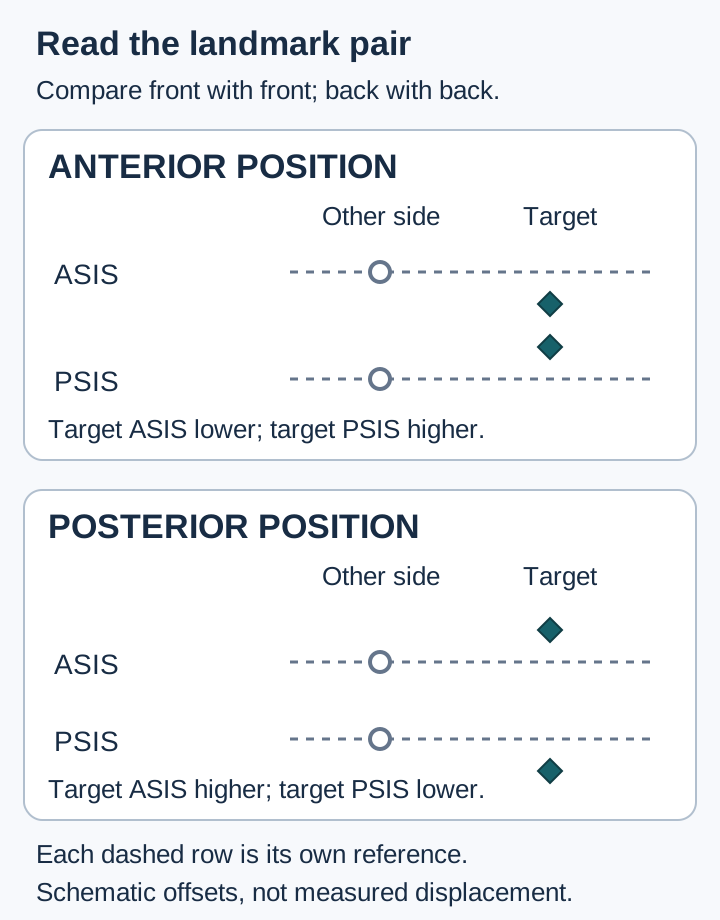
Compare matching landmarks across sides. ASIS means anterior superior iliac spine; PSIS means posterior superior iliac spine. A low left ASIS means lower than the right ASIS, not lower than the left PSIS. Do not assume that the front and back landmarks naturally share one horizontal level. The drawings exaggerate offsets to make the pattern visible.
Read the front and back as a pair. Each dashed reference belongs to that same landmark on the opposite side. This is a schematic of relative heights, not a scale drawing or a diagnostic measurement.
Anterior position
The affected ASIS is inferior and the PSIS is superior relative to their opposite-side partners. The pattern is freer anteriorly and restricted posteriorly.
Posterior position
The affected ASIS is superior and the PSIS is inferior. The pattern is freer posteriorly and restricted anteriorly.
Try the geometry: sketch a front dot and a back dot on a small card. Lower the front while raising the back. You have represented anterior rotation. Reverse the tilt to represent posterior rotation. A rigid translation would shift both dots in the same direction instead.
Apply it: if a confirmed left posterior pattern approaches its neutral reference, the left ASIS descends while the left PSIS ascends. That prediction does not imply that treatment should create a left anterior dysfunction. The intended endpoint is improved comfortable function, not the opposite label. [1]
Find the side before naming the pattern
Could a description of the right landmark actually tell you something about the left side? Yes. If the right ASIS is lower than the left, the left ASIS is higher than the right. Relative wording identifies a relationship, not automatically the dysfunctional side.
In the conventional standing flexion examination, the clinician compares superior excursion of the PSIS landmarks during forward bending, with thumb contact just beneath each PSIS. Earlier or greater excursion on one side is called positive on that side. This is used as a localization screen and must be interpreted with the remaining structural examination. It does not distinguish anterior from posterior rotation by itself. The seated version reduces lower-extremity influence and traditionally informs assessment of the sacrum relative to the ilia; it does not isolate the sacrum perfectly. [1]
Consider a patient whose repeated examination supports right-sided restriction. The note says, "Left ASIS higher than right; left PSIS lower than right." Translate both statements onto the right: right ASIS lower, right PSIS higher. That supports the right anterior pattern within the traditional model. Naming left posterior solely because the note starts with "left" would ignore the localization evidence.
What the tests cannot promise
A small study of healthy volunteers found poor agreement between examiners for both flexion tests, even though standing flexion performed better within the same examiner. That is not validation of a pain diagnosis in symptomatic patients. A separate diagnostic study also found that the examined history and physical tests did not reliably identify sacroiliac joint pain against its injection reference. A positional label and the source of pain are different questions. [3][4]
Landmark laboratory
Predict the two landmark heights before selecting a different pattern. The diamond identifies the chosen side. Compare the resulting diagram with the corrective direction and treatment sequence below it. Use arrow keys within the radio group, then Tab to read the result. This is a reasoning model, not a pelvic examination or a self-treatment guide.
The paired reference cards and all core explanations remain readable without scripting. Without the optional stylesheet, all five illustrated reference states are shown together.
Apply it: when standing and seated flexion are both positive, keep innominate and sacral assessment open. Do not infer a named sacral torsion or a compulsory "sacrum first" sequence. If the examiner, landmark pair, and restriction disagree, repeat a standardized examination before assigning a confident label. [1][3][4]
Try it here · Checkpoint 1 of 3
Make your prediction before reading the choices. A first attempt is just a starting point.
Case 5
Show answer and explanations for case 5
A. End the pelvic assessment because seated excursion is symmetric (Why this does not fit)
A seated screen changes the contribution from the lower limbs and may inform sacral assessment. Its symmetry does not explain away the standing finding or the presenting symptoms. A test performed in a different position cannot automatically cancel the first clinical question.
Reasoning steps for option A
What principle applies to this proposal?
A seated screen changes the contribution from the lower limbs and may inform sacral assessment.
How does that principle compare with the supplied findings?
Its symmetry does not explain away the standing finding or the presenting symptoms.
What should guide the next similar assessment?
A test performed in a different position cannot automatically cancel the first clinical question.
B. Assign right posterior rotation and select an extension barrier (Why this does not fit)
Posterior rotation likewise requires a compatible pair and restriction. The same standing excursion finding could occur without the supplied evidence needed for that label. A negative seated screen does not determine the direction of an innominate rotation.
Reasoning steps for option B
What principle applies to this proposal?
Posterior rotation likewise requires a compatible pair and restriction.
How does that principle compare with the supplied findings?
The same standing excursion finding could occur without the supplied evidence needed for that label.
What should guide the next similar assessment?
A negative seated screen does not determine the direction of an innominate rotation.
C. Continue right-sided innominate assessment before assigning a rotation (Best answer)
Standing flexion is conventionally used as a localization screen; it does not distinguish anterior from posterior rotation. A right-positive standing screen with symmetric seated findings does not supply the missing landmark pair or direction. Use a screening result to guide the next examination rather than substitute for it.
Reasoning steps for option C
What principle applies to this proposal?
Standing flexion is conventionally used as a localization screen; it does not distinguish anterior from posterior rotation.
How does that principle compare with the supplied findings?
A right-positive standing screen with symmetric seated findings does not supply the missing landmark pair or direction.
What should guide the next similar assessment?
Use a screening result to guide the next examination rather than substitute for it.
D. Assign right anterior rotation and select a flexion barrier (Why this does not fit)
Anterior rotation requires a compatible positional and mobility pattern. The excursion finding supplies neither the static anterior pair nor the restricted direction. A positive side alone cannot select the anterior treatment sequence.
Reasoning steps for option D
What principle applies to this proposal?
Anterior rotation requires a compatible positional and mobility pattern.
How does that principle compare with the supplied findings?
The excursion finding supplies neither the static anterior pair nor the restricted direction.
What should guide the next similar assessment?
A positive side alone cannot select the anterior treatment sequence.
Takeaway: Use a screening result to guide the next examination rather than substitute for it.
A low ASIS does not automatically mean anterior rotation. Ask what happened to the PSIS and whether the abnormality concerns height, medial-lateral position, or a single pubic landmark. The rest of the examination determines which description remains coherent.
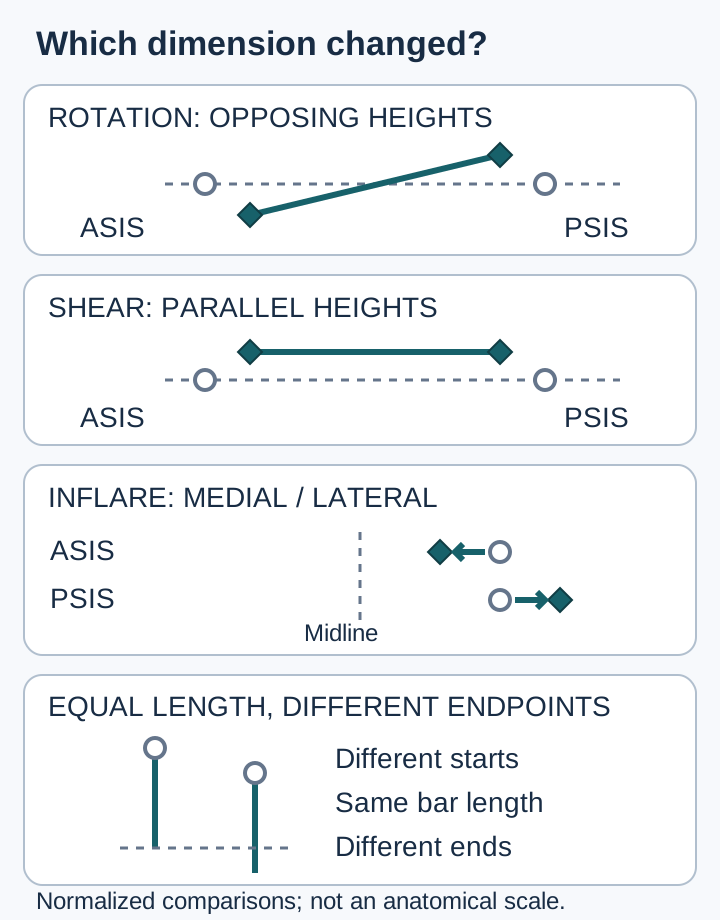
In an idealized superior innominate shear, the ASIS, PSIS, and pubic landmark are all superior on the affected side; an inferior shear has the opposite parallel pattern. Rotation instead gives opposing ASIS and PSIS height findings. An inflare places the ASIS relatively medial and the PSIS relatively lateral; an outflare reverses that relationship. These are transverse-plane descriptions, unlike sagittal rotation about a transverse axis. A pubic shear describes a relationship at the symphysis rather than translation of the entire innominate. [1]
Use the measured dimension. Vertical opposition, parallel vertical change, and medial-lateral change answer different structural questions. The lower model keeps both leg segments equal in length while changing their starting heights.
Pubic tubercle and ischial tuberosity findings can supplement an examination. In the simple rotation model, anterior rotation tends to bring the anterior pubic region inferiorly and the posterior ischial region superiorly; posterior rotation reverses those tendencies. They are not independent proof of a fixed displacement. Pubic examination requires explanation, consent, appropriate draping, and trained technique. A declined examination is not permission to substitute an assumed finding.
Try a different hypothesis: draw the right ASIS and PSIS both higher than their left partners. A right posterior label fits the ASIS but fails to explain the PSIS. A superior translation pattern is a better candidate if the remaining landmarks and mobility examination agree. With equal heights but a medial ASIS and lateral PSIS, reconsider a flare rather than inventing an invisible sagittal rotation.
The ankle comparison adds a separate measurement problem. Traditional teaching associates anterior innominate rotation with an apparently longer limb and posterior rotation with an apparently shorter limb. The position of the socket and the configuration of the hip and knee can alter the distal endpoint without changing femoral or tibial length. A malleolar comparison is therefore not a measurement of bone length, and it can be affected by positioning or contracture. [1][8]
Apply it: if an apparent short limb becomes equal after careful repositioning but the patient still has pain, neither bone growth nor a cure has been demonstrated. If a persistent structural discrepancy is suspected from the history and examination, investigate that specific question rather than prescribing a lift from one supine ankle comparison. Imaging should answer a clinical question, not decorate a rotation diagnosis. [7][8]
Separate positioning from patient effort
Why can treatment of an anterior innominate involve both flexion and extension? They occur at different stages. In the direct muscle-energy examples here, the clinician positions toward the restricted pelvic direction using the hip as a lever. The patient then contracts gently against an equal counterforce, without joint excursion. After relaxation, the clinician reassesses and takes up available comfortable range.
These descriptions teach supervised clinical reasoning, not unsupervised self-manipulation. They assume an appropriate patient, consent, a reproducible examination, and no contraindication. Stabilization matters: if the trunk or whole pelvis substitutes for the intended motion, a larger hip angle does not prove that the sacroiliac restriction changed. [1][2][9]
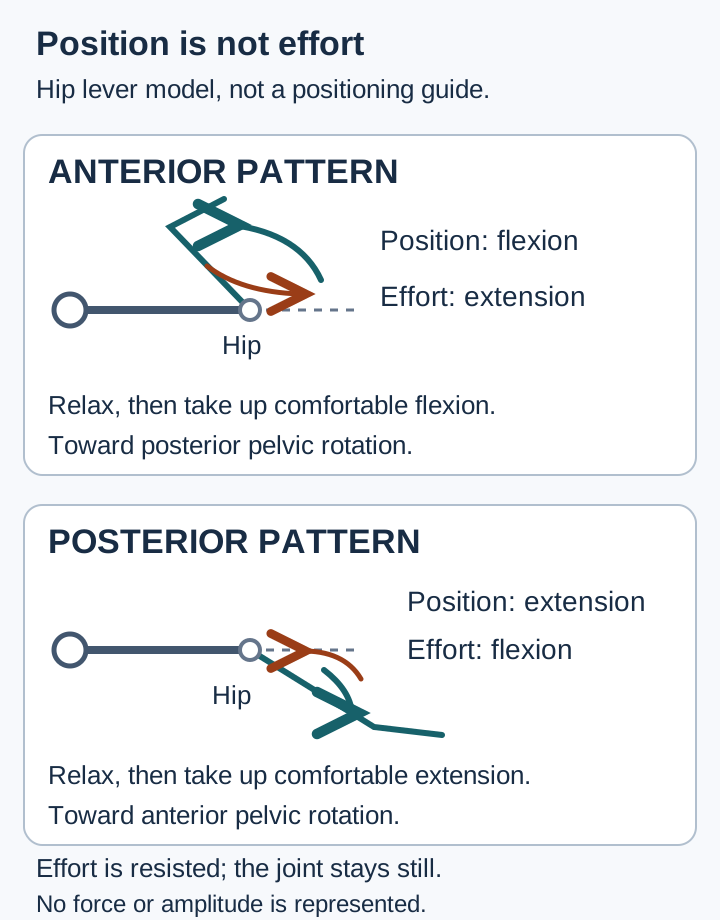
The solid arrow is clinician positioning; the opposing arrow is the patient effort. During the isometric effort, the joint position remains still. These are direction diagrams, not instructions to force an end range.
Anterior innominate pattern
Posterior pelvic rotation is restricted. With suitable support and stabilization, hip flexion engages that barrier. The patient gently attempts hip extension against the clinician's counterforce. Once the effort stops and relaxation occurs, the clinician may take up additional comfortable hip flexion to the next barrier, then reassess.
Posterior innominate pattern
Anterior pelvic rotation is restricted. Supported hip extension engages that barrier. The patient gently attempts hip flexion against equal resistance. After relaxation, the clinician may take up additional comfortable extension to the next barrier. Prone, supine, or side-lying variants require their own stabilization and patient-specific suitability; the directional logic is more important than memorizing a photograph. [2][9]
Rehearse without applying force: write three columns for a right posterior pattern: clinician positioning, patient effort, then position after relaxation. The entries are right hip extension, resisted right hip flexion, and further comfortable right hip extension. All three entries are needed; a question that asks only for "the direction" is incomplete.
Short, gentle contractions with full relaxation are used in many protocols, but published hold times and repetitions differ. There is no universal number of seconds at which a single receptor switches the pelvis back into place. Post-isometric relaxation describes a technique and observed response; it is not proof that one reflex fully explains clinical improvement. Increasing contraction force or repeating a fixed number of cycles is not the goal. [2][6][9]
Apply it: for a left anterior pattern, a correctly resisted extension effort is not a reason to position the hip farther into extension afterward. The next position follows the original corrective barrier: additional comfortable flexion after relaxation. Check symptoms, stabilization, and the structural findings again rather than assuming the sequence always works.
Try it here · Checkpoint 2 of 3
Make your prediction before reading the choices. A first attempt is just a starting point.
Case 19
Show answer and explanations for case 19
A. Switch immediately to hip-extension positioning and keep the same effort (Why this does not fit)
Hip-extension positioning belongs to a different corrective setup in the described techniques. The identified pattern remains anterior, and the actual error is inadequate counterforce during contraction. Correct the demonstrated technical problem without changing the diagnosis to suit it.
Reasoning steps for option A
What principle applies to this proposal?
Hip-extension positioning belongs to a different corrective setup in the described techniques.
How does that principle compare with the supplied findings?
The identified pattern remains anterior, and the actual error is inadequate counterforce during contraction.
What should guide the next similar assessment?
Correct the demonstrated technical problem without changing the diagnosis to suit it.
B. Ask for a stronger extension effort to complete the contraction (Why this does not fit)
A stronger effort could increase force but is not required for the intended gentle isometric task. The existing effort already exceeds the available counterforce. Correct a force mismatch by improving control, not automatically increasing patient effort.
Reasoning steps for option B
What principle applies to this proposal?
A stronger effort could increase force but is not required for the intended gentle isometric task.
How does that principle compare with the supplied findings?
The existing effort already exceeds the available counterforce.
What should guide the next similar assessment?
Correct a force mismatch by improving control, not automatically increasing patient effort.
C. Reestablish the supported barrier and match a gentler effort so the joint remains still (Best answer)
An isometric contraction produces force without the joint excursion intended in a dynamic contraction. Visible extension shows that the patient's force exceeded the opposing counterforce. Match gentle effort and resistance instead of using limb travel as the goal of muscle energy.
Reasoning steps for option C
What principle applies to this proposal?
An isometric contraction produces force without the joint excursion intended in a dynamic contraction.
How does that principle compare with the supplied findings?
Visible extension shows that the patient's force exceeded the opposing counterforce.
What should guide the next similar assessment?
Match gentle effort and resistance instead of using limb travel as the goal of muscle energy.
D. Allow the same excursion because it demonstrates posterior pelvic correction (Why this does not fit)
The selected posterior corrective direction is engaged through hip-flexion positioning in this example. The visible hip extension occurred during an intended isometric phase and does not demonstrate isolated posterior pelvic correction. Separate limb excursion from the target pelvic direction and from the contraction phase.
Reasoning steps for option D
What principle applies to this proposal?
The selected posterior corrective direction is engaged through hip-flexion positioning in this example.
How does that principle compare with the supplied findings?
The visible hip extension occurred during an intended isometric phase and does not demonstrate isolated posterior pelvic correction.
What should guide the next similar assessment?
Separate limb excursion from the target pelvic direction and from the contraction phase.
Takeaway: Match gentle effort and resistance instead of using limb travel as the goal of muscle energy.
What should happen when the landmarks seem more symmetric but walking is still painful? Reassess the patient's problem. A positional examination is one observation, not the outcome that defines successful care.
Before considering muscle energy, review the history, neurological findings, trauma, systemic symptoms, tissue tolerance, and ability to participate. Suspected fracture, an unstable injury, or an acutely concerning presentation requires appropriate assessment rather than a trial of stronger treatment. New bladder difficulty with saddle sensory loss, bilateral neurological symptoms, or serious trauma warrants emergency evaluation. Fever or systemic illness with worsening back pain requires urgent medical assessment. [7]
Picture a patient whose initial complaint is pain when rising from a chair. After a gentle, consented intervention, compare that same task, symptom intensity, comfortable range, and relevant neurological findings when indicated. Repeat the structural examination using the same setup. Improved function with small residual asymmetry is different from worsening pain despite prettier landmark alignment.
Stop for a concerning response
Sharp, radiating, or otherwise unexpected pain during a contraction calls for stopping the effort, supporting the limb comfortably, and reassessing. Do not prescribe pain as evidence that a joint is correcting. A patient who cannot understand or safely perform an isometric effort is not a candidate for that active technique in its current form.
Make a decision: a patient has no useful improvement after repeated correctly attempted muscle energy. Before another cycle, ask whether the side, pattern, contraindications, stabilization, and presumed pain source were right. Nonresponse does not by itself establish an indication for high-velocity low-amplitude manipulation. Research using changes in palpatory test results cannot establish that escalating force is the best response for this individual. [2][3][4]
Apply it: a new sensory change after treatment matters more than a now-negative standing flexion test. Document the response, reassess promptly, and use the appropriate medical pathway. Conversely, a residual positive screen in a comfortable patient is not proof of untreated disease that must be corrected indefinitely.
Use the model without overextending it
Can sport, prolonged sitting, or pregnancy tell you which innominate is rotated? They can inform the history, but they cannot replace the examination. Two patients with the same activity exposure may have different findings and different reasons for pain.
Hip flexors, including iliopsoas and rectus femoris, and hip extensors, including gluteus maximus and the hamstrings, can influence pelvic loading. A muscle's anatomical action is not proof that it is shortened, overactive, or the source of pain in a particular person. Assess muscle length, strength, hip motion, and tolerance separately. Hip flexion can be used as a lever toward posterior pelvic rotation, and hip extension toward anterior rotation in the supervised techniques described here; neither hip angle is a direct measurement of isolated sacroiliac motion. [2][9]
Walking coordinates the pelvis, spine, hips, knees, and feet. Do not convert one instant of heel contact or toe-off into a fixed innominate diagnosis. Likewise, a true limb-length discrepancy may contribute to altered loading without forcing one inevitable rotation on the short side. Evaluate recurrent symptoms through the actual task and reproducible findings rather than a universal posture prescription. [8]
Pregnancy changes the loading and clinical context. Relaxin participates in pregnancy physiology, but a case-control study did not find higher circulating relaxin in women with pelvic pain than matched controls. Serum relaxin cannot identify an innominate rotation or establish the cause of that patient's pain. A randomized crossover study found no clear immediate advantage of its muscle-energy intervention over its comparison interventions in pregnancy-related pelvic girdle pain. Neither observation means that pain is unreal or that individualized physiotherapy should be withheld. [5][6]
Compare two explanations: a pregnant patient reports pelvic pain, while the right and left landmark examinations are inconsistent. "Hormones caused a right anterior rotation" assigns a side without evidence. "Pregnancy-related pelvic pain needs an individualized assessment" preserves the clinical problem without inventing a mechanical diagnosis. Select comfortable supported positioning with the treating clinician; do not apply a generic end-range setup to every stage of pregnancy.
Transfer to a fresh case: first decide whether immediate medical evaluation takes priority. If an OMM pattern is the question, localize the side, translate both landmark relationships, and check whether the restriction agrees. If treatment is asked, name the corrective pelvic direction, the hip position, the patient's effort, and the reassessment. Distinguish what the examination supports from what remains uncertain. The cases below require those decisions without copying the worked examples.
Try it here · Checkpoint 3 of 3
Make your prediction before reading the choices. A first attempt is just a starting point.
Case 16
Show answer and explanations for case 16
A. The normal concentration excludes pregnancy-related pelvic girdle pain (Why this does not fit)
A normal group concentration does not provide a validated rule-out test for an individual pain syndrome. Women with pelvic pain were present in the study despite concentrations comparable to controls. A laboratory value can be nondiagnostic even when the physiological system is relevant.
Reasoning steps for option A
What principle applies to this proposal?
A normal group concentration does not provide a validated rule-out test for an individual pain syndrome.
How does that principle compare with the supplied findings?
Women with pelvic pain were present in the study despite concentrations comparable to controls.
What should guide the next similar assessment?
A laboratory value can be nondiagnostic even when the physiological system is relevant.
B. Relaxin concentration cannot establish the cause or side of this patient's pelvic findings (Best answer)
A group comparison of circulating hormone concentration is not a side-specific mechanical diagnostic test. The study did not support higher concentrations in the pain group, and no reproducible individual pattern has been established. Assess the patient's pain and function without assigning a rotation from pregnancy or a hormone result.
Reasoning steps for option B
What principle applies to this proposal?
A group comparison of circulating hormone concentration is not a side-specific mechanical diagnostic test.
How does that principle compare with the supplied findings?
The study did not support higher concentrations in the pain group, and no reproducible individual pattern has been established.
What should guide the next similar assessment?
Assess the patient's pain and function without assigning a rotation from pregnancy or a hormone result.
C. The matched-control finding proves that pregnancy physiology cannot contribute to pain (Why this does not fit)
Lack of a difference in one circulating measurement does not exclude all local, temporal, or mechanical effects of pregnancy. The study addresses measured relaxin concentrations, not every pathway contributing to pelvic pain. Reject an unsupported causal claim without replacing it with an equally broad exclusion.
Reasoning steps for option C
What principle applies to this proposal?
Lack of a difference in one circulating measurement does not exclude all local, temporal, or mechanical effects of pregnancy.
How does that principle compare with the supplied findings?
The study addresses measured relaxin concentrations, not every pathway contributing to pelvic pain.
What should guide the next similar assessment?
Reject an unsupported causal claim without replacing it with an equally broad exclusion.
D. The unilateral symptom identifies the side of a relaxin-induced anterior rotation (Why this does not fit)
Unilateral symptoms can help focus an examination but do not establish a positional diagnosis. Neither the hormone study nor the symptom location supplies a coherent anterior landmark and mobility pattern. Do not infer a mechanical side and direction from a systemic exposure.
Reasoning steps for option D
What principle applies to this proposal?
Unilateral symptoms can help focus an examination but do not establish a positional diagnosis.
How does that principle compare with the supplied findings?
Neither the hormone study nor the symptom location supplies a coherent anterior landmark and mobility pattern.
What should guide the next similar assessment?
Do not infer a mechanical side and direction from a systemic exposure.
Takeaway: Assess the patient's pain and function without assigning a rotation from pregnancy or a hormone result.
Use the complete findings in each case. A positional model, a pain diagnosis, and a treatment decision are related but different questions.
Case 1
Show answer and explanations for case 1
A. Right anterior innominate; posterior rotation restricted (Why this does not fit)
The opposite side of a relative posterior pattern can look anterior by comparison. The repeated restriction localizes to the left, not the right. Use the localization evidence before choosing which side of a bilateral comparison to name.
Reasoning steps for option A
What principle applies to this proposal?
The opposite side of a relative posterior pattern can look anterior by comparison.
How does that principle compare with the supplied findings?
The repeated restriction localizes to the left, not the right.
What should guide the next similar assessment?
Use the localization evidence before choosing which side of a bilateral comparison to name.
B. Left anterior innominate; posterior rotation restricted (Why this does not fit)
An anterior pattern pairs an inferior ASIS with a superior PSIS. Both supplied left landmarks have the reverse relationship. A symptom on the correct side does not rescue an incompatible landmark pattern.
Reasoning steps for option B
What principle applies to this proposal?
An anterior pattern pairs an inferior ASIS with a superior PSIS.
How does that principle compare with the supplied findings?
Both supplied left landmarks have the reverse relationship.
What should guide the next similar assessment?
A symptom on the correct side does not rescue an incompatible landmark pattern.
C. Left posterior innominate; anterior rotation restricted (Best answer)
A posterior positional pattern pairs a superior ASIS with an inferior PSIS on the localized side. The reproducible left landmark pair fits that pattern; the variable ankle endpoint does not establish a bony discrepancy. Name the position from the localized landmark pair, then identify the opposite restricted direction.
Reasoning steps for option C
What principle applies to this proposal?
A posterior positional pattern pairs a superior ASIS with an inferior PSIS on the localized side.
How does that principle compare with the supplied findings?
The reproducible left landmark pair fits that pattern; the variable ankle endpoint does not establish a bony discrepancy.
What should guide the next similar assessment?
Name the position from the localized landmark pair, then identify the opposite restricted direction.
D. Left superior innominate shear; inferior translation restricted (Why this does not fit)
A superior translation pattern shifts corresponding anterior and posterior landmarks upward together. The left PSIS is lower, not higher, than its partner. An opposing height pair and a parallel height pair represent different models.
Reasoning steps for option D
What principle applies to this proposal?
A superior translation pattern shifts corresponding anterior and posterior landmarks upward together.
How does that principle compare with the supplied findings?
The left PSIS is lower, not higher, than its partner.
What should guide the next similar assessment?
An opposing height pair and a parallel height pair represent different models.
Takeaway: Name the position from the localized landmark pair, then identify the opposite restricted direction.
A. Right anterior innominate rotation (Best answer)
Relative heights can be translated onto either side of the comparison. The right ASIS is therefore lower and the right PSIS higher, on the independently localized side. Translate both observations before attaching a side to the positional name.
Reasoning steps for option A
What principle applies to this proposal?
Relative heights can be translated onto either side of the comparison.
How does that principle compare with the supplied findings?
The right ASIS is therefore lower and the right PSIS higher, on the independently localized side.
What should guide the next similar assessment?
Translate both observations before attaching a side to the positional name.
B. Left posterior innominate rotation (Why this does not fit)
A high left ASIS with a low left PSIS resembles a left posterior positional relationship. The examination instead localizes the restriction to the right. The first side named in a note is not necessarily the side requiring a diagnosis.
Reasoning steps for option B
What principle applies to this proposal?
A high left ASIS with a low left PSIS resembles a left posterior positional relationship.
How does that principle compare with the supplied findings?
The examination instead localizes the restriction to the right.
What should guide the next similar assessment?
The first side named in a note is not necessarily the side requiring a diagnosis.
C. Right superior innominate shear (Why this does not fit)
A superior shear would produce concordant upward landmark offsets. The right ASIS is lower even though the right PSIS is higher. Compare the directions of both height offsets before choosing rotation or shear.
Reasoning steps for option C
What principle applies to this proposal?
A superior shear would produce concordant upward landmark offsets.
How does that principle compare with the supplied findings?
The right ASIS is lower even though the right PSIS is higher.
What should guide the next similar assessment?
Compare the directions of both height offsets before choosing rotation or shear.
D. Right posterior innominate rotation (Why this does not fit)
Right posterior rotation would place the right ASIS above and the right PSIS below their partners. Translating the note produces the opposite right-sided relationships. Reverse relative statements consistently rather than reversing only one landmark.
Reasoning steps for option D
What principle applies to this proposal?
Right posterior rotation would place the right ASIS above and the right PSIS below their partners.
How does that principle compare with the supplied findings?
Translating the note produces the opposite right-sided relationships.
What should guide the next similar assessment?
Reverse relative statements consistently rather than reversing only one landmark.
Takeaway: Translate both observations before attaching a side to the positional name.
A. Resisted left hip flexion, then further right hip extension after relaxation (Why this does not fit)
The active contraction in this unilateral example is directed through the affected limb. The selected dysfunction and supported lever are on the right, not the left. Do not substitute a contralateral effort without a separately justified technique.
Reasoning steps for option A
What principle applies to this proposal?
The active contraction in this unilateral example is directed through the affected limb.
How does that principle compare with the supplied findings?
The selected dysfunction and supported lever are on the right, not the left.
What should guide the next similar assessment?
Do not substitute a contralateral effort without a separately justified technique.
B. Resisted right hip flexion, then hip flexion after relaxation (Why this does not fit)
A hip-flexion effort can match this initial extended-hip setup. Returning into flexion afterward gives up the selected anterior pelvic corrective barrier instead of taking up available extension. The post-relaxation position follows the corrective barrier, not the direction of the effort.
Reasoning steps for option B
What principle applies to this proposal?
A hip-flexion effort can match this initial extended-hip setup.
How does that principle compare with the supplied findings?
Returning into flexion afterward gives up the selected anterior pelvic corrective barrier instead of taking up available extension.
What should guide the next similar assessment?
The post-relaxation position follows the corrective barrier, not the direction of the effort.
C. Resisted right hip flexion, then further comfortable extension after relaxation (Best answer)
Direct muscle energy distinguishes the initial barrier position from the opposing isometric effort. Hip extension engages the anterior pelvic restriction; the patient attempts flexion before the clinician takes up available extension. Specify position, effort, and post-relaxation position as separate parts of the technique.
Reasoning steps for option C
What principle applies to this proposal?
Direct muscle energy distinguishes the initial barrier position from the opposing isometric effort.
How does that principle compare with the supplied findings?
Hip extension engages the anterior pelvic restriction; the patient attempts flexion before the clinician takes up available extension.
What should guide the next similar assessment?
Specify position, effort, and post-relaxation position as separate parts of the technique.
D. Resisted right hip extension, then further comfortable extension after relaxation (Why this does not fit)
An opposing isometric contraction requires resistance to the effort away from the positioned barrier. An extension effort continues toward the already engaged hip-extension barrier rather than providing the specified opposing effort. Correct post-relaxation positioning cannot compensate for an incorrectly selected contraction.
Reasoning steps for option D
What principle applies to this proposal?
An opposing isometric contraction requires resistance to the effort away from the positioned barrier.
How does that principle compare with the supplied findings?
An extension effort continues toward the already engaged hip-extension barrier rather than providing the specified opposing effort.
What should guide the next similar assessment?
Correct post-relaxation positioning cannot compensate for an incorrectly selected contraction.
Takeaway: Specify position, effort, and post-relaxation position as separate parts of the technique.
A. Left hip extension positioning with resisted left hip flexion (Why this does not fit)
Extension positioning with a flexion effort is used for a posterior innominate pattern in the described direct technique. The left low-ASIS and high-PSIS pair is anterior rather than posterior. A valid technique sequence can still target the wrong positional pattern.
Reasoning steps for option A
What principle applies to this proposal?
Extension positioning with a flexion effort is used for a posterior innominate pattern in the described direct technique.
How does that principle compare with the supplied findings?
The left low-ASIS and high-PSIS pair is anterior rather than posterior.
What should guide the next similar assessment?
A valid technique sequence can still target the wrong positional pattern.
B. Left hip flexion positioning with resisted left hip flexion (Why this does not fit)
The selected hip position can engage the posterior pelvic corrective direction. The isometric effort should oppose that positioning rather than continue in the same flexion direction. Do not equate the clinician positioning with the requested patient effort.
Reasoning steps for option B
What principle applies to this proposal?
The selected hip position can engage the posterior pelvic corrective direction.
How does that principle compare with the supplied findings?
The isometric effort should oppose that positioning rather than continue in the same flexion direction.
What should guide the next similar assessment?
Do not equate the clinician positioning with the requested patient effort.
C. Left hip flexion positioning with resisted left hip extension (Best answer)
A left anterior positional pattern is restricted toward posterior pelvic rotation. Hip flexion is the corrective lever in this example, while the patient attempts extension against equal resistance. Derive the corrective direction from the pattern before selecting the opposing effort.
Reasoning steps for option C
What principle applies to this proposal?
A left anterior positional pattern is restricted toward posterior pelvic rotation.
How does that principle compare with the supplied findings?
Hip flexion is the corrective lever in this example, while the patient attempts extension against equal resistance.
What should guide the next similar assessment?
Derive the corrective direction from the pattern before selecting the opposing effort.
D. Right hip flexion positioning with resisted right hip extension (Why this does not fit)
Flexion positioning and an extension effort can address an anterior pattern on the selected side. The supplied restriction and landmark pair are left-sided. Keep the side of the lever tied to the side supported by examination.
Reasoning steps for option D
What principle applies to this proposal?
Flexion positioning and an extension effort can address an anterior pattern on the selected side.
How does that principle compare with the supplied findings?
The supplied restriction and landmark pair are left-sided.
What should guide the next similar assessment?
Keep the side of the lever tied to the side supported by examination.
Takeaway: Derive the corrective direction from the pattern before selecting the opposing effort.
A. Treat the left innominate first because its static landmarks are asymmetric (Why this does not fit)
A coherent innominate pattern can contribute to treatment selection after the whole assessment. Static asymmetry alone does not resolve the additional seated finding or dictate priority. Choose an appropriate target from the complete clinical picture, not a fixed region-first rule.
Reasoning steps for option A
What principle applies to this proposal?
A coherent innominate pattern can contribute to treatment selection after the whole assessment.
How does that principle compare with the supplied findings?
Static asymmetry alone does not resolve the additional seated finding or dictate priority.
What should guide the next similar assessment?
Choose an appropriate target from the complete clinical picture, not a fixed region-first rule.
B. Treat a right-on-right sacral torsion before reassessing the innominate (Why this does not fit)
Right-on-right is a specific sacral pattern, not a synonym for pelvic compensation. The available left-sided screening and innominate findings do not establish that sacral pattern. A proposed compensatory association cannot replace a sacral examination.
Reasoning steps for option B
What principle applies to this proposal?
Right-on-right is a specific sacral pattern, not a synonym for pelvic compensation.
How does that principle compare with the supplied findings?
The available left-sided screening and innominate findings do not establish that sacral pattern.
What should guide the next similar assessment?
A proposed compensatory association cannot replace a sacral examination.
C. Treat a left-on-left sacral torsion before reassessing the innominate (Why this does not fit)
A named sacral torsion requires appropriate sacral positional and mobility findings. Neither sacral sulcus nor inferior lateral angle information is supplied. Do not infer a torsion name solely from the side of a positive flexion screen.
Reasoning steps for option C
What principle applies to this proposal?
A named sacral torsion requires appropriate sacral positional and mobility findings.
How does that principle compare with the supplied findings?
Neither sacral sulcus nor inferior lateral angle information is supplied.
What should guide the next similar assessment?
Do not infer a torsion name solely from the side of a positive flexion screen.
D. Complete innominate and sacral assessment before choosing the treatment target (Best answer)
The two screens do not uniquely name a sacral torsion or establish which region must be treated first. The left posterior positional pair can be recorded while the sacral findings remain incomplete. Assess coexisting findings instead of deriving a compulsory sequence from two screening results.
Reasoning steps for option D
What principle applies to this proposal?
The two screens do not uniquely name a sacral torsion or establish which region must be treated first.
How does that principle compare with the supplied findings?
The left posterior positional pair can be recorded while the sacral findings remain incomplete.
What should guide the next similar assessment?
Assess coexisting findings instead of deriving a compulsory sequence from two screening results.
Takeaway: Assess coexisting findings instead of deriving a compulsory sequence from two screening results.
A. The left ASIS and left PSIS both ascend (Why this does not fit)
A parallel upward change can represent translation of the entire model. Whole-bone translation is excluded, and upward PSIS correction would be accompanied by downward ASIS correction. Opposing rotations and parallel translations produce different paired predictions.
Reasoning steps for option A
What principle applies to this proposal?
A parallel upward change can represent translation of the entire model.
How does that principle compare with the supplied findings?
Whole-bone translation is excluded, and upward PSIS correction would be accompanied by downward ASIS correction.
What should guide the next similar assessment?
Opposing rotations and parallel translations produce different paired predictions.
B. The left ASIS ascends and the left PSIS descends (Why this does not fit)
Those changes accentuate a posterior positional relationship. The frame is supposed to reduce, not increase, the supplied posterior offsets. Check whether the proposed trend approaches or exaggerates the original pattern.
Reasoning steps for option B
What principle applies to this proposal?
Those changes accentuate a posterior positional relationship.
How does that principle compare with the supplied findings?
The frame is supposed to reduce, not increase, the supplied posterior offsets.
What should guide the next similar assessment?
Check whether the proposed trend approaches or exaggerates the original pattern.
C. The left ASIS and left PSIS both descend (Why this does not fit)
A parallel downward change is a translation rather than the specified corrective rotation. It would lower the already inferior PSIS farther from its reference. A single landmark getting closer to reference does not validate the proposed whole-bone change.
Reasoning steps for option C
What principle applies to this proposal?
A parallel downward change is a translation rather than the specified corrective rotation.
How does that principle compare with the supplied findings?
It would lower the already inferior PSIS farther from its reference.
What should guide the next similar assessment?
A single landmark getting closer to reference does not validate the proposed whole-bone change.
D. The left ASIS descends and the left PSIS ascends (Best answer)
A posterior positional pattern approaches its reference through anterior rotation. That reduces the superior ASIS offset and the inferior PSIS offset in opposite directions. Predict both landmarks from the same rotation rather than treating them as independent translations.
Reasoning steps for option D
What principle applies to this proposal?
A posterior positional pattern approaches its reference through anterior rotation.
How does that principle compare with the supplied findings?
That reduces the superior ASIS offset and the inferior PSIS offset in opposite directions.
What should guide the next similar assessment?
Predict both landmarks from the same rotation rather than treating them as independent translations.
Takeaway: Predict both landmarks from the same rotation rather than treating them as independent translations.
A. Right anterior innominate rotation (Why this does not fit)
An anterior rotation can include a superior PSIS. It predicts an inferior ASIS, whereas the right ASIS and pubic landmark are superior. Test a candidate against the anterior as well as the posterior findings.
Reasoning steps for option A
What principle applies to this proposal?
An anterior rotation can include a superior PSIS.
How does that principle compare with the supplied findings?
It predicts an inferior ASIS, whereas the right ASIS and pubic landmark are superior.
What should guide the next similar assessment?
Test a candidate against the anterior as well as the posterior findings.
B. Right superior innominate shear (Best answer)
A superior shear is a parallel superior relationship of the innominate landmarks. All three corresponding right landmarks are higher; the distal endpoint does not change that paired pattern. Use the full landmark distribution before treating an apparent short limb as a posterior rotation.
Reasoning steps for option B
What principle applies to this proposal?
A superior shear is a parallel superior relationship of the innominate landmarks.
How does that principle compare with the supplied findings?
All three corresponding right landmarks are higher; the distal endpoint does not change that paired pattern.
What should guide the next similar assessment?
Use the full landmark distribution before treating an apparent short limb as a posterior rotation.
C. Right posterior innominate rotation (Why this does not fit)
A posterior rotation can include a superior ASIS and an apparently shorter limb. It predicts an inferior rather than superior PSIS in the simple model. A distal endpoint and one compatible landmark cannot override the discordant posterior landmark.
Reasoning steps for option C
What principle applies to this proposal?
A posterior rotation can include a superior ASIS and an apparently shorter limb.
How does that principle compare with the supplied findings?
It predicts an inferior rather than superior PSIS in the simple model.
What should guide the next similar assessment?
A distal endpoint and one compatible landmark cannot override the discordant posterior landmark.
D. Isolated right superior pubic shear (Why this does not fit)
An isolated pubic shear describes asymmetry focused at the symphysis. The ASIS and PSIS are also superior in this examination. A local symphyseal label does not explain a parallel pattern across the entire innominate.
Reasoning steps for option D
What principle applies to this proposal?
An isolated pubic shear describes asymmetry focused at the symphysis.
How does that principle compare with the supplied findings?
The ASIS and PSIS are also superior in this examination.
What should guide the next similar assessment?
A local symphyseal label does not explain a parallel pattern across the entire innominate.
Takeaway: Use the full landmark distribution before treating an apparent short limb as a posterior rotation.
An inflare combines a relatively medial ASIS with a relatively lateral PSIS. The supplied right-sided offsets are medial-lateral, not an opposing vertical pair. Match the name to the plane of the reproducible findings.
Reasoning steps for option A
What principle applies to this proposal?
An inflare combines a relatively medial ASIS with a relatively lateral PSIS.
How does that principle compare with the supplied findings?
The supplied right-sided offsets are medial-lateral, not an opposing vertical pair.
What should guide the next similar assessment?
Match the name to the plane of the reproducible findings.
B. Right superior innominate shear (Why this does not fit)
A superior shear gives parallel superior landmark offsets. The examination explicitly finds equal corresponding heights. A translation label needs evidence in the direction being named.
Reasoning steps for option B
What principle applies to this proposal?
A superior shear gives parallel superior landmark offsets.
How does that principle compare with the supplied findings?
The examination explicitly finds equal corresponding heights.
What should guide the next similar assessment?
A translation label needs evidence in the direction being named.
C. Right anterior innominate rotation (Why this does not fit)
An anterior rotation is conventionally described by a low ASIS and high PSIS. The corresponding landmark heights are level; the reported asymmetry is transverse. A positive side does not turn every pelvic asymmetry into a sagittal rotation.
Reasoning steps for option C
What principle applies to this proposal?
An anterior rotation is conventionally described by a low ASIS and high PSIS.
How does that principle compare with the supplied findings?
The corresponding landmark heights are level; the reported asymmetry is transverse.
What should guide the next similar assessment?
A positive side does not turn every pelvic asymmetry into a sagittal rotation.
D. Right innominate outflare (Why this does not fit)
An outflare combines a relatively lateral ASIS with a relatively medial PSIS. Both transverse-plane observations have the opposite relationship. Check the anterior and posterior transverse offsets together.
Reasoning steps for option D
What principle applies to this proposal?
An outflare combines a relatively lateral ASIS with a relatively medial PSIS.
How does that principle compare with the supplied findings?
Both transverse-plane observations have the opposite relationship.
What should guide the next similar assessment?
Check the anterior and posterior transverse offsets together.
Takeaway: Match the name to the plane of the reproducible findings.
A. A left inferior innominate shear (Why this does not fit)
An inferior shear should produce parallel inferior relationships at multiple innominate landmarks. The ASIS and PSIS heights are symmetric rather than inferior on the left. Reserve a whole-innominate translation label for a coherent multi-landmark pattern.
Reasoning steps for option A
What principle applies to this proposal?
An inferior shear should produce parallel inferior relationships at multiple innominate landmarks.
How does that principle compare with the supplied findings?
The ASIS and PSIS heights are symmetric rather than inferior on the left.
What should guide the next similar assessment?
Reserve a whole-innominate translation label for a coherent multi-landmark pattern.
B. A left anterior innominate rotation (Why this does not fit)
An anterior model can include an inferior anterior pubic projection. Its accompanying ASIS and PSIS pair and rotational restriction are not present. One supplemental landmark cannot replace the principal positional and mobility examination.
Reasoning steps for option B
What principle applies to this proposal?
An anterior model can include an inferior anterior pubic projection.
How does that principle compare with the supplied findings?
Its accompanying ASIS and PSIS pair and rotational restriction are not present.
What should guide the next similar assessment?
One supplemental landmark cannot replace the principal positional and mobility examination.
C. A left inferior pubic relationship requiring focused assessment (Best answer)
A pubic shear describes a local relationship at the symphysis. The isolated inferior pubic finding is not accompanied by a coherent whole-innominate rotation or translation. Document the observed local finding without enlarging it into an unsupported whole-bone diagnosis.
Reasoning steps for option C
What principle applies to this proposal?
A pubic shear describes a local relationship at the symphysis.
How does that principle compare with the supplied findings?
The isolated inferior pubic finding is not accompanied by a coherent whole-innominate rotation or translation.
What should guide the next similar assessment?
Document the observed local finding without enlarging it into an unsupported whole-bone diagnosis.
D. A right posterior innominate rotation (Why this does not fit)
A right posterior model could include a relatively superior right pubic projection. The right ASIS and PSIS relationships and rotational restriction do not support that wider diagnosis. Relative pubic height alone cannot identify a contralateral rotational dysfunction.
Reasoning steps for option D
What principle applies to this proposal?
A right posterior model could include a relatively superior right pubic projection.
How does that principle compare with the supplied findings?
The right ASIS and PSIS relationships and rotational restriction do not support that wider diagnosis.
What should guide the next similar assessment?
Relative pubic height alone cannot identify a contralateral rotational dysfunction.
Takeaway: Document the observed local finding without enlarging it into an unsupported whole-bone diagnosis.
A. The measured femoral discrepancy needs individualized orthopedic assessment (Best answer)
True limb-length discrepancy concerns the lengths of the limb bones rather than only their resting endpoints. Imaging demonstrates a shorter right femur, and the standing block result is compatible with that finding. A variable palpatory pattern does not erase a demonstrated structural discrepancy.
Reasoning steps for option A
What principle applies to this proposal?
True limb-length discrepancy concerns the lengths of the limb bones rather than only their resting endpoints.
How does that principle compare with the supplied findings?
Imaging demonstrates a shorter right femur, and the standing block result is compatible with that finding.
What should guide the next similar assessment?
A variable palpatory pattern does not erase a demonstrated structural discrepancy.
B. The block response proves that pelvic restriction is the sole cause (Why this does not fit)
Standing blocks can help assess the functional effect of a limb-length discrepancy. The response is consistent with compensation for a shorter femur and does not isolate pelvic restriction as the cause. Interpret a leveling response alongside the independent length measurement.
Reasoning steps for option B
What principle applies to this proposal?
Standing blocks can help assess the functional effect of a limb-length discrepancy.
How does that principle compare with the supplied findings?
The response is consistent with compensation for a shorter femur and does not isolate pelvic restriction as the cause.
What should guide the next similar assessment?
Interpret a leveling response alongside the independent length measurement.
C. The shorter right ankle endpoint establishes a right posterior rotation (Why this does not fit)
A posterior innominate model can be associated with apparent shortening. This patient has a measured femoral length difference that cannot be explained solely by pelvic position. Separate the evidence for bony length from the evidence for a positional pattern.
Reasoning steps for option C
What principle applies to this proposal?
A posterior innominate model can be associated with apparent shortening.
How does that principle compare with the supplied findings?
This patient has a measured femoral length difference that cannot be explained solely by pelvic position.
What should guide the next similar assessment?
Separate the evidence for bony length from the evidence for a positional pattern.
D. Defer discrepancy-focused follow-up until after treating the variable pelvic pattern (Why this does not fit)
Care for a reproducible positional impairment can sometimes accompany assessment of a functional contribution. Here the femoral shortening is independently measured and the pelvic pattern is inconsistent; treating that pattern first should not postpone discrepancy-focused assessment. Coordinate symptom care with structural follow-up rather than make one depend on correction of an inconsistent positional label.
Reasoning steps for option D
What principle applies to this proposal?
Care for a reproducible positional impairment can sometimes accompany assessment of a functional contribution.
How does that principle compare with the supplied findings?
Here the femoral shortening is independently measured and the pelvic pattern is inconsistent; treating that pattern first should not postpone discrepancy-focused assessment.
What should guide the next similar assessment?
Coordinate symptom care with structural follow-up rather than make one depend on correction of an inconsistent positional label.
Takeaway: A variable palpatory pattern does not erase a demonstrated structural discrepancy.
A. The unchanged pain proves that no somatic dysfunction was present initially (Why this does not fit)
A lack of immediate symptomatic improvement does not retrospectively invalidate every initial finding. The observations show a different structural examination but unchanged symptoms, not proof that the first examination was impossible. Nonresponse warrants reconsideration rather than an unsupported all-or-none conclusion.
Reasoning steps for option A
What principle applies to this proposal?
A lack of immediate symptomatic improvement does not retrospectively invalidate every initial finding.
How does that principle compare with the supplied findings?
The observations show a different structural examination but unchanged symptoms, not proof that the first examination was impossible.
What should guide the next similar assessment?
Nonresponse warrants reconsideration rather than an unsupported all-or-none conclusion.
B. The pain-generating lesion was corrected despite unchanged symptoms (Why this does not fit)
Identifying a pain source requires more than a positive or negative positional screen. The unchanged symptomatic task provides no evidence that a pain-generating lesion was corrected. Do not promote a test change into proof of cause or cure.
Reasoning steps for option B
What principle applies to this proposal?
Identifying a pain source requires more than a positive or negative positional screen.
How does that principle compare with the supplied findings?
The unchanged symptomatic task provides no evidence that a pain-generating lesion was corrected.
What should guide the next similar assessment?
Do not promote a test change into proof of cause or cure.
C. The structural screen changed without demonstrated improvement in the presenting task (Best answer)
A change in a positional examination is not identical to improvement in symptoms or function. The same task remains equally painful despite different palpatory findings. Record patient-centered outcomes separately from changes in structural tests.
Reasoning steps for option C
What principle applies to this proposal?
A change in a positional examination is not identical to improvement in symptoms or function.
How does that principle compare with the supplied findings?
The same task remains equally painful despite different palpatory findings.
What should guide the next similar assessment?
Record patient-centered outcomes separately from changes in structural tests.
D. A different sacral torsion must now be treated to explain the residual pain (Why this does not fit)
A new sacral diagnosis needs its own examination evidence. No sacral positional or mobility findings are supplied, only persistent pain during the original task. Do not invent a second positional label to explain every incomplete response.
Reasoning steps for option D
What principle applies to this proposal?
A new sacral diagnosis needs its own examination evidence.
How does that principle compare with the supplied findings?
No sacral positional or mobility findings are supplied, only persistent pain during the original task.
What should guide the next similar assessment?
Do not invent a second positional label to explain every incomplete response.
Takeaway: Record patient-centered outcomes separately from changes in structural tests.
A. Within-examiner agreement does not establish agreement between clinicians or identify a pain source (Best answer)
Reliability within one examiner, reliability across examiners, and diagnostic validity are separate properties. The between-examiner value is near zero, and healthy volunteers do not establish identification of painful lesions. Check which property and population a study actually evaluated before transferring its conclusions.
Reasoning steps for option A
What principle applies to this proposal?
Reliability within one examiner, reliability across examiners, and diagnostic validity are separate properties.
How does that principle compare with the supplied findings?
The between-examiner value is near zero, and healthy volunteers do not establish identification of painful lesions.
What should guide the next similar assessment?
Check which property and population a study actually evaluated before transferring its conclusions.
B. The study shows that a same-examiner positive test confirms painful dysfunction (Why this does not fit)
Reproducibility can support consistent documentation but does not prove that a sign identifies the pain source. The participants were healthy, and the stated result measures agreement rather than confirmation of pain-generating pathology. A reproducible sign still requires valid interpretation in the clinical population.
Reasoning steps for option B
What principle applies to this proposal?
Reproducibility can support consistent documentation but does not prove that a sign identifies the pain source.
How does that principle compare with the supplied findings?
The participants were healthy, and the stated result measures agreement rather than confirmation of pain-generating pathology.
What should guide the next similar assessment?
A reproducible sign still requires valid interpretation in the clinical population.
C. The within-examiner value establishes useful agreement between clinicians (Why this does not fit)
Repeated assessment by the same examiner can address one source of repeatability. The separate between-examiner estimate is near zero rather than similar to 0.43. Do not substitute one reliability estimate for another.
Reasoning steps for option C
What principle applies to this proposal?
Repeated assessment by the same examiner can address one source of repeatability.
How does that principle compare with the supplied findings?
The separate between-examiner estimate is near zero rather than similar to 0.43.
What should guide the next similar assessment?
Do not substitute one reliability estimate for another.
D. The between-examiner value is a negative likelihood ratio for sacroiliac pain (Why this does not fit)
A likelihood ratio concerns the performance of a diagnostic result against a reference diagnosis. The reported quantity is kappa for agreement, not a likelihood ratio, in healthy volunteers. Identify a statistic before using it to update disease probability.
Reasoning steps for option D
What principle applies to this proposal?
A likelihood ratio concerns the performance of a diagnostic result against a reference diagnosis.
How does that principle compare with the supplied findings?
The reported quantity is kappa for agreement, not a likelihood ratio, in healthy volunteers.
What should guide the next similar assessment?
Identify a statistic before using it to update disease probability.
Takeaway: Check which property and population a study actually evaluated before transferring its conclusions.
A. Use the anterior landmark pair as confirmation and stop the differential assessment (Why this does not fit)
A coherent landmark pair can support a conventional positional description. It does not establish that the sacroiliac joint generated this pain or explain the symptomatic hip examination. A useful structural description is not automatically a diagnostic reference for pain.
Reasoning steps for option A
What principle applies to this proposal?
A coherent landmark pair can support a conventional positional description.
How does that principle compare with the supplied findings?
It does not establish that the sacroiliac joint generated this pain or explain the symptomatic hip examination.
What should guide the next similar assessment?
A useful structural description is not automatically a diagnostic reference for pain.
B. Complete the relevant hip and lumbar assessment while retaining the provisional positional findings (Best answer)
A positional label and an anatomic source of pain are distinct conclusions. The reproduced pain during hip testing creates a meaningful competing explanation that the flexion screen does not resolve. Use the full clinical assessment to investigate pain rather than treat a positional pattern as confirmation.
Reasoning steps for option B
What principle applies to this proposal?
A positional label and an anatomic source of pain are distinct conclusions.
How does that principle compare with the supplied findings?
The reproduced pain during hip testing creates a meaningful competing explanation that the flexion screen does not resolve.
What should guide the next similar assessment?
Use the full clinical assessment to investigate pain rather than treat a positional pattern as confirmation.
C. Discard all pelvic findings because hip rotation provokes pain (Why this does not fit)
Provoked familiar pain can direct further investigation of the hip. It does not by itself prove a single hip cause or establish that every pelvic observation is false. A competing explanation deserves evaluation, not automatic replacement of one unproven conclusion with another.
Reasoning steps for option C
What principle applies to this proposal?
Provoked familiar pain can direct further investigation of the hip.
How does that principle compare with the supplied findings?
It does not by itself prove a single hip cause or establish that every pelvic observation is false.
What should guide the next similar assessment?
A competing explanation deserves evaluation, not automatic replacement of one unproven conclusion with another.
D. Repeat standing flexion until two positive trials confirm the pain source (Why this does not fit)
Repeating a test can assess its within-examiner consistency. Repeated positivity does not provide the missing validity for pain localization or resolve the hip findings. More repetitions of one screen cannot answer a different diagnostic question.
Reasoning steps for option D
What principle applies to this proposal?
Repeating a test can assess its within-examiner consistency.
How does that principle compare with the supplied findings?
Repeated positivity does not provide the missing validity for pain localization or resolve the hip findings.
What should guide the next similar assessment?
More repetitions of one screen cannot answer a different diagnostic question.
Takeaway: Use the full clinical assessment to investigate pain rather than treat a positional pattern as confirmation.
A. The comparison establishes that physiotherapy should be withheld for pelvic girdle pain (Why this does not fit)
A trial can constrain claims about one intervention and time window. The findings do not establish that individualized physiotherapy care has no value. Limit a negative comparative result to the treatment claim actually tested.
Reasoning steps for option A
What principle applies to this proposal?
A trial can constrain claims about one intervention and time window.
How does that principle compare with the supplied findings?
The findings do not establish that individualized physiotherapy care has no value.
What should guide the next similar assessment?
Limit a negative comparative result to the treatment claim actually tested.
B. The pain reduction establishes that muscle energy corrected innominate position (Why this does not fit)
Clinical improvement can follow care for several reasons. The study did not demonstrate a specific muscle-energy advantage or establish bony positional correction as the cause. An outcome improvement does not by itself verify a proposed mechanical explanation.
Reasoning steps for option B
What principle applies to this proposal?
Clinical improvement can follow care for several reasons.
How does that principle compare with the supplied findings?
The study did not demonstrate a specific muscle-energy advantage or establish bony positional correction as the cause.
What should guide the next similar assessment?
An outcome improvement does not by itself verify a proposed mechanical explanation.
C. The session improved measured outcomes without demonstrating a specific immediate advantage for muscle energy (Best answer)
Within-session improvement and a between-intervention treatment advantage are different claims. The comparison did not show a distinct immediate benefit of muscle energy over the other interventions. Describe both the observed improvement and the unestablished treatment-specific effect.
Reasoning steps for option C
What principle applies to this proposal?
Within-session improvement and a between-intervention treatment advantage are different claims.
How does that principle compare with the supplied findings?
The comparison did not show a distinct immediate benefit of muscle energy over the other interventions.
What should guide the next similar assessment?
Describe both the observed improvement and the unestablished treatment-specific effect.
D. The nonsignificant comparison proves that the interventions are equivalent (Why this does not fit)
Equivalence requires an appropriate design and prespecified margin rather than merely a nonsignificant difference. The supplied comparison does not provide an equivalence margin or equivalence analysis. Failure to demonstrate superiority is not proof of equal effects.
Reasoning steps for option D
What principle applies to this proposal?
Equivalence requires an appropriate design and prespecified margin rather than merely a nonsignificant difference.
How does that principle compare with the supplied findings?
The supplied comparison does not provide an equivalence margin or equivalence analysis.
What should guide the next similar assessment?
Failure to demonstrate superiority is not proof of equal effects.
Takeaway: Describe both the observed improvement and the unestablished treatment-specific effect.
A. Complete muscle energy first and refer if the bladder symptoms persist (Why this does not fit)
A treatment trial can be considered only after the immediate clinical risks have been addressed. New bladder and saddle sensory symptoms should not wait for a response to pelvic treatment. Do not use manual treatment response as a triage test for neurological emergencies.
Reasoning steps for option A
What principle applies to this proposal?
A treatment trial can be considered only after the immediate clinical risks have been addressed.
How does that principle compare with the supplied findings?
New bladder and saddle sensory symptoms should not wait for a response to pelvic treatment.
What should guide the next similar assessment?
Do not use manual treatment response as a triage test for neurological emergencies.
B. Treat the apparent posterior pattern and reassess standing flexion (Why this does not fit)
A standing flexion screen can document one aspect of a structural examination. Its result cannot resolve the new bladder dysfunction or perineal sensory loss. Select the next assessment for the highest-risk unresolved clinical question.
Reasoning steps for option B
What principle applies to this proposal?
A standing flexion screen can document one aspect of a structural examination.
How does that principle compare with the supplied findings?
Its result cannot resolve the new bladder dysfunction or perineal sensory loss.
What should guide the next similar assessment?
Select the next assessment for the highest-risk unresolved clinical question.
C. Book routine musculoskeletal follow-up after a trial of home stretching (Why this does not fit)
Routine follow-up can suit uncomplicated back pain without concerning neurological features. The new bladder, perineal, and bilateral symptoms place this patient outside that uncomplicated group. The neurological history determines urgency even when the pain followed an ordinary lift.
Reasoning steps for option C
What principle applies to this proposal?
Routine follow-up can suit uncomplicated back pain without concerning neurological features.
How does that principle compare with the supplied findings?
The new bladder, perineal, and bilateral symptoms place this patient outside that uncomplicated group.
What should guide the next similar assessment?
The neurological history determines urgency even when the pain followed an ordinary lift.
D. Arrange immediate emergency assessment for a possible compressive neurological syndrome (Best answer)
Back pain with new bladder dysfunction, perineal sensory loss, and bilateral leg symptoms is an emergency presentation. These findings are not explained safely by the incidental positional examination. Time-critical neurological features take priority over routine structural treatment.
Reasoning steps for option D
What principle applies to this proposal?
Back pain with new bladder dysfunction, perineal sensory loss, and bilateral leg symptoms is an emergency presentation.
How does that principle compare with the supplied findings?
These findings are not explained safely by the incidental positional examination.
What should guide the next similar assessment?
Time-critical neurological features take priority over routine structural treatment.
Takeaway: Time-critical neurological features take priority over routine structural treatment.
A. Finish the remaining contraction before changing the setup (Why this does not fit)
A planned hold duration is a protocol parameter, not a reason to defer a safety response. The new radiating pain calls for stopping now rather than completing the timer. Clinical response overrides a preset repetition or duration target.
Reasoning steps for option A
What principle applies to this proposal?
A planned hold duration is a protocol parameter, not a reason to defer a safety response.
How does that principle compare with the supplied findings?
The new radiating pain calls for stopping now rather than completing the timer.
What should guide the next similar assessment?
Clinical response overrides a preset repetition or duration target.
B. Increase counterforce to maintain the intended isometric position (Why this does not fit)
Equal counterforce is used to prevent excursion during a comfortable isometric effort. Maintaining the technical setup does not take priority over newly provoked radiating pain. Technique fidelity cannot justify continuing through a concerning response.
Reasoning steps for option B
What principle applies to this proposal?
Equal counterforce is used to prevent excursion during a comfortable isometric effort.
How does that principle compare with the supplied findings?
Maintaining the technical setup does not take priority over newly provoked radiating pain.
What should guide the next similar assessment?
Technique fidelity cannot justify continuing through a concerning response.
C. Stop the effort, support the limb comfortably, and reassess the new symptoms (Best answer)
An unexpected radiating pain response requires reassessment rather than additional force. The current symptoms differ from the presenting localized discomfort and developed during the contraction. A correctly planned technique must still be stopped when the patient's response changes its safety.
Reasoning steps for option C
What principle applies to this proposal?
An unexpected radiating pain response requires reassessment rather than additional force.
How does that principle compare with the supplied findings?
The current symptoms differ from the presenting localized discomfort and developed during the contraction.
What should guide the next similar assessment?
A correctly planned technique must still be stopped when the patient's response changes its safety.
D. Advance farther into extension after the patient briefly relaxes (Why this does not fit)
Further comfortable extension may follow an uncomplicated contraction in this setup. The contraction was not uncomplicated; the new symptoms have not been evaluated. Reassess an adverse response before deciding whether any additional positioning is suitable.
Reasoning steps for option D
What principle applies to this proposal?
Further comfortable extension may follow an uncomplicated contraction in this setup.
How does that principle compare with the supplied findings?
The contraction was not uncomplicated; the new symptoms have not been evaluated.
What should guide the next similar assessment?
Reassess an adverse response before deciding whether any additional positioning is suitable.
Takeaway: A correctly planned technique must still be stopped when the patient's response changes its safety.
A. The extra range demonstrates a newly created anterior innominate dysfunction (Why this does not fit)
An opposite dysfunction requires a new coherent positional and mobility examination. Gross pelvic tilt with lumbar extension does not supply such an examination. Neither improvement nor overcorrection is established by substituted range alone.
Reasoning steps for option A
What principle applies to this proposal?
An opposite dysfunction requires a new coherent positional and mobility examination.
How does that principle compare with the supplied findings?
Gross pelvic tilt with lumbar extension does not supply such an examination.
What should guide the next similar assessment?
Neither improvement nor overcorrection is established by substituted range alone.
B. The extra range proves that the posterior innominate pattern has resolved (Why this does not fit)
A successful outcome requires reassessment rather than an inference from gross limb travel alone. The visible lumbar and pelvic substitution prevents that travel from isolating the original target. Confirm relevant symptoms, function, and examination rather than infer success from excursion.
Reasoning steps for option B
What principle applies to this proposal?
A successful outcome requires reassessment rather than an inference from gross limb travel alone.
How does that principle compare with the supplied findings?
The visible lumbar and pelvic substitution prevents that travel from isolating the original target.
What should guide the next similar assessment?
Confirm relevant symptoms, function, and examination rather than infer success from excursion.
C. The added range may reflect substitution; improve stabilization and reassess the barrier (Best answer)
A larger hip or limb angle does not by itself measure isolated motion at the sacroiliac region. The observed lumbar extension and whole-pelvis tilt provide an alternative source of the apparent extra range. Control substitution before attributing a range change to the intended restriction.
Reasoning steps for option C
What principle applies to this proposal?
A larger hip or limb angle does not by itself measure isolated motion at the sacroiliac region.
How does that principle compare with the supplied findings?
The observed lumbar extension and whole-pelvis tilt provide an alternative source of the apparent extra range.
What should guide the next similar assessment?
Control substitution before attributing a range change to the intended restriction.
D. The appropriate adjustment is more extension force to reach a firmer endpoint (Why this does not fit)
A comfortable restrictive barrier should be assessed with the intended region controlled. Additional force would not resolve the loss of stabilization and could add strain. Improve the quality of the setup before considering further comfortable range.
Reasoning steps for option D
What principle applies to this proposal?
A comfortable restrictive barrier should be assessed with the intended region controlled.
How does that principle compare with the supplied findings?
Additional force would not resolve the loss of stabilization and could add strain.
What should guide the next similar assessment?
Improve the quality of the setup before considering further comfortable range.
Takeaway: Control substitution before attributing a range change to the intended restriction.
A. Assign a contralateral rotation because the initial treatment was ineffective (Why this does not fit)
A contralateral diagnosis requires examination findings on that side. Nonresponse to treatment is not itself a localization test. Change a positional label only when the new evidence supports it.
Reasoning steps for option A
What principle applies to this proposal?
A contralateral diagnosis requires examination findings on that side.
How does that principle compare with the supplied findings?
Nonresponse to treatment is not itself a localization test.
What should guide the next similar assessment?
Change a positional label only when the new evidence supports it.
B. Reassess the working diagnosis, reproducibility, stabilization, and competing pain sources (Best answer)
Nonresponse can reflect an incorrect target, technical limitations, or a pain mechanism not explained by the positional model. The inconsistent findings and unchanged task do not establish a reason to escalate force. Reassess an unhelpful treatment strategy before selecting another intervention.
Reasoning steps for option B
What principle applies to this proposal?
Nonresponse can reflect an incorrect target, technical limitations, or a pain mechanism not explained by the positional model.
How does that principle compare with the supplied findings?
The inconsistent findings and unchanged task do not establish a reason to escalate force.
What should guide the next similar assessment?
Reassess an unhelpful treatment strategy before selecting another intervention.
C. Repeat the same cycles until the flexion screen becomes negative (Why this does not fit)
Repeating a suitable maneuver may be part of some protocols when clinically justified. An inconsistent screen and unchanged functional complaint do not justify an unlimited test-normalization endpoint. Do not replace the patient's functional problem with an indefinite effort to normalize a screen.
Reasoning steps for option C
What principle applies to this proposal?
Repeating a suitable maneuver may be part of some protocols when clinically justified.
How does that principle compare with the supplied findings?
An inconsistent screen and unchanged functional complaint do not justify an unlimited test-normalization endpoint.
What should guide the next similar assessment?
Do not replace the patient's functional problem with an indefinite effort to normalize a screen.
D. Escalate to high-velocity manipulation solely because muscle energy failed (Why this does not fit)
A different technique may be considered after an appropriate assessment of indications and risks. Failure of the preceding technique alone does not establish those indications or risks. A sequence of increasing force is not a substitute for a revised clinical assessment.
Reasoning steps for option D
What principle applies to this proposal?
A different technique may be considered after an appropriate assessment of indications and risks.
How does that principle compare with the supplied findings?
Failure of the preceding technique alone does not establish those indications or risks.
What should guide the next similar assessment?
A sequence of increasing force is not a substitute for a revised clinical assessment.
Takeaway: Reassess an unhelpful treatment strategy before selecting another intervention.
A. The aligned ankles confirm that the pain-generating pelvic lesion was corrected (Why this does not fit)
Endpoint alignment can occur after changing posture without identifying the source of pain. The presenting discomfort remains and the observation does not isolate a pain-generating structure. Anatomical-looking symmetry is not equivalent to clinical recovery.
Reasoning steps for option A
What principle applies to this proposal?
Endpoint alignment can occur after changing posture without identifying the source of pain.
How does that principle compare with the supplied findings?
The presenting discomfort remains and the observation does not isolate a pain-generating structure.
What should guide the next similar assessment?
Anatomical-looking symmetry is not equivalent to clinical recovery.
B. The first position establishes a left posterior rotation despite the variable repeat (Why this does not fit)
A posterior positional diagnosis needs a coherent landmark and restriction pattern. No ASIS and PSIS pair or rotational restriction is supplied, and knee position changed the distal comparison. Do not name a rotation from apparent limb length alone.
Reasoning steps for option B
What principle applies to this proposal?
A posterior positional diagnosis needs a coherent landmark and restriction pattern.
How does that principle compare with the supplied findings?
No ASIS and PSIS pair or rotational restriction is supplied, and knee position changed the distal comparison.
What should guide the next similar assessment?
Do not name a rotation from apparent limb length alone.
C. Position contributed to the apparent endpoint difference; neither bony length nor pain resolution is established (Best answer)
Distal endpoint comparison can be altered by limb and pelvic configuration. The difference disappeared with positioning, while symptoms did not change. Describe an apparent length finding separately from true bone length and treatment outcome.
Reasoning steps for option C
What principle applies to this proposal?
Distal endpoint comparison can be altered by limb and pelvic configuration.
How does that principle compare with the supplied findings?
The difference disappeared with positioning, while symptoms did not change.
What should guide the next similar assessment?
Describe an apparent length finding separately from true bone length and treatment outcome.
D. The initial ankle comparison confirms a structural left limb-length discrepancy (Why this does not fit)
A structural discrepancy concerns actual femoral or tibial length. The supplied finding changes with position and includes no independent measurement of those bones. A variable endpoint cannot substitute for a structural length assessment.
Reasoning steps for option D
What principle applies to this proposal?
A structural discrepancy concerns actual femoral or tibial length.
How does that principle compare with the supplied findings?
The supplied finding changes with position and includes no independent measurement of those bones.
What should guide the next similar assessment?
A variable endpoint cannot substitute for a structural length assessment.
Takeaway: Describe an apparent length finding separately from true bone length and treatment outcome.
A. A hypothetical inferior transverse axis through the lower sacroiliac articulations (Best answer)
Sagittal-plane rotation is represented about a transverse axis in the conventional innominate model. The requested axis relates the innominate to the sacrum rather than describing hip-joint rotation or a sacral torsion. Keep a functional teaching axis distinct from a proven fixed hinge.
Reasoning steps for option A
What principle applies to this proposal?
Sagittal-plane rotation is represented about a transverse axis in the conventional innominate model.
How does that principle compare with the supplied findings?
The requested axis relates the innominate to the sacrum rather than describing hip-joint rotation or a sacral torsion.
What should guide the next similar assessment?
Keep a functional teaching axis distinct from a proven fixed hinge.
B. A left oblique sacral axis for anterior innominate rotation (Why this does not fit)
Oblique axes are used in conventional descriptions of certain sacral torsions. The requested motion is sagittal innominate rotation, not a named torsional sacral pattern. Do not attach a sacral torsion axis to an innominate diagnosis by association.
Reasoning steps for option B
What principle applies to this proposal?
Oblique axes are used in conventional descriptions of certain sacral torsions.
How does that principle compare with the supplied findings?
The requested motion is sagittal innominate rotation, not a named torsional sacral pattern.
What should guide the next similar assessment?
Do not attach a sacral torsion axis to an innominate diagnosis by association.
C. A fixed transverse axis through both femoral heads (Why this does not fit)
Rotation of the pelvis over the femora is a different reference relationship. The exercise concerns one innominate relative to the sacrum and explicitly rejects a literal fixed-hinge claim. Identify the bodies whose relative motion is being described before choosing an axis.
Reasoning steps for option C
What principle applies to this proposal?
Rotation of the pelvis over the femora is a different reference relationship.
How does that principle compare with the supplied findings?
The exercise concerns one innominate relative to the sacrum and explicitly rejects a literal fixed-hinge claim.
What should guide the next similar assessment?
Identify the bodies whose relative motion is being described before choosing an axis.
D. A vertical axis through the pubic symphysis (Why this does not fit)
A vertical-axis model would describe a transverse-plane rotation rather than the sagittal pattern asked about. The exercise concerns anterior and posterior rotation with opposing height relationships. Match the axis orientation to the plane before considering a named anatomical landmark.
Reasoning steps for option D
What principle applies to this proposal?
A vertical-axis model would describe a transverse-plane rotation rather than the sagittal pattern asked about.
How does that principle compare with the supplied findings?
The exercise concerns anterior and posterior rotation with opposing height relationships.
What should guide the next similar assessment?
Match the axis orientation to the plane before considering a named anatomical landmark.
Takeaway: Keep a functional teaching axis distinct from a proven fixed hinge.
A. Use the anterior landmark pair as the sole test of iliopsoas shortening (Why this does not fit)
A landmark pair describes a positional relationship in the conventional model. It is not a direct measurement of iliopsoas length or the cause of either runner's symptoms. Test the proposed muscular impairment separately from pelvic position.
Reasoning steps for option A
What principle applies to this proposal?
A landmark pair describes a positional relationship in the conventional model.
How does that principle compare with the supplied findings?
It is not a direct measurement of iliopsoas length or the cause of either runner's symptoms.
What should guide the next similar assessment?
Test the proposed muscular impairment separately from pelvic position.
B. Use heel-strike appearance to assign a fixed rotation before prescribing exercise (Why this does not fit)
Gait observation can help assess a dynamic task and symptom-related loading. One phase of a coordinated gait cycle does not establish a persistent innominate dysfunction or a specific shortened muscle. Use gait as a functional assessment rather than a fixed-phase diagnostic shortcut.
Reasoning steps for option B
What principle applies to this proposal?
Gait observation can help assess a dynamic task and symptom-related loading.
How does that principle compare with the supplied findings?
One phase of a coordinated gait cycle does not establish a persistent innominate dysfunction or a specific shortened muscle.
What should guide the next similar assessment?
Use gait as a functional assessment rather than a fixed-phase diagnostic shortcut.
C. Use the same program because the common sport determines the muscle deficit (Why this does not fit)
Activity exposure can influence loading and guide history-taking. The same exposure has not produced the same examination, and no shared muscle deficit is established. A common sport does not determine an individual impairment.
Reasoning steps for option C
What principle applies to this proposal?
Activity exposure can influence loading and guide history-taking.
How does that principle compare with the supplied findings?
The same exposure has not produced the same examination, and no shared muscle deficit is established.
What should guide the next similar assessment?
A common sport does not determine an individual impairment.
D. Assess individual hip motion, muscle length and strength, and the symptomatic running task (Best answer)
An anatomical muscle action or shared activity does not establish that the muscle is shortened or causing symptoms in either individual. The examinations differ, and no direct muscle-length or functional deficit has been reported. Choose rehabilitation from demonstrated impairments and task tolerance rather than a positional label alone.
Reasoning steps for option D
What principle applies to this proposal?
An anatomical muscle action or shared activity does not establish that the muscle is shortened or causing symptoms in either individual.
How does that principle compare with the supplied findings?
The examinations differ, and no direct muscle-length or functional deficit has been reported.
What should guide the next similar assessment?
Choose rehabilitation from demonstrated impairments and task tolerance rather than a positional label alone.
Takeaway: Choose rehabilitation from demonstrated impairments and task tolerance rather than a positional label alone.
A. The added range proves the innominate reached an anatomically neutral position (Why this does not fit)
Range can change for reasons that do not establish a specific bony position. Neither an isolated displacement measurement nor a complete repeat structural assessment is supplied. Confirm the relevant outcome rather than assume that greater range means anatomical correction.
Reasoning steps for option A
What principle applies to this proposal?
Range can change for reasons that do not establish a specific bony position.
How does that principle compare with the supplied findings?
Neither an isolated displacement measurement nor a complete repeat structural assessment is supplied.
What should guide the next similar assessment?
Confirm the relevant outcome rather than assume that greater range means anatomical correction.
B. The response establishes that longer contractions would produce proportionally greater benefit (Why this does not fit)
A larger dose-response effect requires comparative evidence across contraction durations. One brief contraction and one range observation do not provide that comparison. Do not infer a linear treatment-dose effect from a single immediate response.
Reasoning steps for option B
What principle applies to this proposal?
A larger dose-response effect requires comparative evidence across contraction durations.
How does that principle compare with the supplied findings?
One brief contraction and one range observation do not provide that comparison.
What should guide the next similar assessment?
Do not infer a linear treatment-dose effect from a single immediate response.
C. The added range proves that a seven-second receptor threshold was crossed (Why this does not fit)
Protocols can specify contraction durations for practical treatment delivery. A chosen duration and subsequent response do not establish a universal physiological threshold. Do not convert a protocol parameter into proof of a biological switch.
Reasoning steps for option C
What principle applies to this proposal?
Protocols can specify contraction durations for practical treatment delivery.
How does that principle compare with the supplied findings?
A chosen duration and subsequent response do not establish a universal physiological threshold.
What should guide the next similar assessment?
Do not convert a protocol parameter into proof of a biological switch.
D. The observed range change does not establish a timed receptor mechanism or positional correction (Best answer)
A temporal association after a contraction is not a direct measurement of the physiological mechanism producing the response. The observation is increased comfortable range, without receptor measurements or isolated pelvic displacement data. Describe the response that was measured and keep the proposed explanation separate.
Reasoning steps for option D
What principle applies to this proposal?
A temporal association after a contraction is not a direct measurement of the physiological mechanism producing the response.
How does that principle compare with the supplied findings?
The observation is increased comfortable range, without receptor measurements or isolated pelvic displacement data.
What should guide the next similar assessment?
Describe the response that was measured and keep the proposed explanation separate.
Takeaway: Describe the response that was measured and keep the proposed explanation separate.
A. Record an inferior shear as confirmed and treat it without repeating the examination (Why this does not fit)
Parallel inferior landmarks could suggest an inferior shear if the broader findings are coherent. The PSIS relationship changed on repeat and the restriction could not be reproduced. Even a plausible alternative pattern requires reliable supporting observations.
Reasoning steps for option A
What principle applies to this proposal?
Parallel inferior landmarks could suggest an inferior shear if the broader findings are coherent.
How does that principle compare with the supplied findings?
The PSIS relationship changed on repeat and the restriction could not be reproduced.
What should guide the next similar assessment?
Even a plausible alternative pattern requires reliable supporting observations.
B. Repeat a standardized structural assessment before committing to a directional treatment (Best answer)
A coherent rotation diagnosis needs compatible positional and mobility findings rather than one positive screening side. The initial parallel inferior pair and the inconsistent repeat do not establish the proposed anterior pattern. Treat conflicting findings as uncertainty to resolve, not as permission to select a familiar sequence.
Reasoning steps for option B
What principle applies to this proposal?
A coherent rotation diagnosis needs compatible positional and mobility findings rather than one positive screening side.
How does that principle compare with the supplied findings?
The initial parallel inferior pair and the inconsistent repeat do not establish the proposed anterior pattern.
What should guide the next similar assessment?
Treat conflicting findings as uncertainty to resolve, not as permission to select a familiar sequence.
C. Select the anterior sequence because the left ASIS was initially inferior (Why this does not fit)
An inferior ASIS can fit anterior rotation when paired with a superior PSIS on the localized side. The initially inferior PSIS and inconsistent repeat do not supply that matching pattern. One compatible landmark does not outweigh a discordant second landmark.
Reasoning steps for option C
What principle applies to this proposal?
An inferior ASIS can fit anterior rotation when paired with a superior PSIS on the localized side.
How does that principle compare with the supplied findings?
The initially inferior PSIS and inconsistent repeat do not supply that matching pattern.
What should guide the next similar assessment?
One compatible landmark does not outweigh a discordant second landmark.
D. Select the posterior sequence because the left PSIS was initially inferior (Why this does not fit)
An inferior PSIS can fit posterior rotation when accompanied by a superior ASIS. The initial ASIS was also inferior, and the mobility finding was not reproducible. Do not choose between competing diagnoses by selecting only the landmark that fits.
Reasoning steps for option D
What principle applies to this proposal?
An inferior PSIS can fit posterior rotation when accompanied by a superior ASIS.
How does that principle compare with the supplied findings?
The initial ASIS was also inferior, and the mobility finding was not reproducible.
What should guide the next similar assessment?
Do not choose between competing diagnoses by selecting only the landmark that fits.
Takeaway: Treat conflicting findings as uncertainty to resolve, not as permission to select a familiar sequence.
A. Continue with firmer restraint so the patient's effort becomes isometric (Why this does not fit)
Counterforce helps oppose a controlled effort but does not establish understanding or safe participation. The patient is still alternating relaxation with abrupt pushing. Physical restraint is not a substitute for a comprehensible, controlled task.
Reasoning steps for option A
What principle applies to this proposal?
Counterforce helps oppose a controlled effort but does not establish understanding or safe participation.
How does that principle compare with the supplied findings?
The patient is still alternating relaxation with abrupt pushing.
What should guide the next similar assessment?
Physical restraint is not a substitute for a comprehensible, controlled task.
B. Pause, simplify and demonstrate the task, and confirm a comfortable controlled effort before proceeding (Best answer)
Active muscle energy requires the patient to understand and safely perform the intended contraction. The abrupt and inconsistent practice efforts show that this requirement is not yet met. Adapt communication and reassess participation; do not proceed with an active technique that remains unsuitable.
Reasoning steps for option B
What principle applies to this proposal?
Active muscle energy requires the patient to understand and safely perform the intended contraction.
How does that principle compare with the supplied findings?
The abrupt and inconsistent practice efforts show that this requirement is not yet met.
What should guide the next similar assessment?
Adapt communication and reassess participation; do not proceed with an active technique that remains unsuitable.
C. Increase the requested effort so the contraction is easier to recognize (Why this does not fit)
A stronger contraction can increase force without improving control or understanding. The present limitation is inconsistent participation, not insufficient measured strength. Address the actual barrier to participation before adjusting effort.
Reasoning steps for option C
What principle applies to this proposal?
A stronger contraction can increase force without improving control or understanding.
How does that principle compare with the supplied findings?
The present limitation is inconsistent participation, not insufficient measured strength.
What should guide the next similar assessment?
Address the actual barrier to participation before adjusting effort.
D. Count the practice attempts as a completed treatment and document correction (Why this does not fit)
Completion and response should be documented from what was actually achieved and reassessed. A steady comfortable intended contraction and a repeat outcome assessment have not occurred. Do not document a therapeutic sequence or correction that was not demonstrated.
Reasoning steps for option D
What principle applies to this proposal?
Completion and response should be documented from what was actually achieved and reassessed.
How does that principle compare with the supplied findings?
A steady comfortable intended contraction and a repeat outcome assessment have not occurred.
What should guide the next similar assessment?
Do not document a therapeutic sequence or correction that was not demonstrated.
Takeaway: Adapt communication and reassess participation; do not proceed with an active technique that remains unsuitable.
A. Assign a compensatory sacral torsion to explain the residual asymmetry (Why this does not fit)
A sacral diagnosis requires a coherent sacral examination. The supplied findings concern improved function and a variable remaining screen, not a sacral torsion pattern. Do not add an unexamined diagnosis to account for imperfect symmetry.
Reasoning steps for option A
What principle applies to this proposal?
A sacral diagnosis requires a coherent sacral examination.
How does that principle compare with the supplied findings?
The supplied findings concern improved function and a variable remaining screen, not a sacral torsion pattern.
What should guide the next similar assessment?
Do not add an unexamined diagnosis to account for imperfect symmetry.
B. Prescribe a permanent shoe lift based on the residual static asymmetry (Why this does not fit)
Shoe-lift decisions require an appropriate assessment of limb-length discrepancy and its functional relevance. No persistent structural discrepancy has been measured, and the patient's walking symptoms are improving. Do not infer a long-term orthotic indication from a residual pelvic landmark difference alone.
Reasoning steps for option B
What principle applies to this proposal?
Shoe-lift decisions require an appropriate assessment of limb-length discrepancy and its functional relevance.
How does that principle compare with the supplied findings?
No persistent structural discrepancy has been measured, and the patient's walking symptoms are improving.
What should guide the next similar assessment?
Do not infer a long-term orthotic indication from a residual pelvic landmark difference alone.
C. Repeat manual treatment until every flexion screen is negative (Why this does not fit)
A repeat screen can contribute to reassessment when interpreted with the clinical picture. Its variable residual positivity does not outweigh improvement in the presenting functional complaint. A single test-normalization endpoint should not replace the patient's goals and symptoms.
Reasoning steps for option C
What principle applies to this proposal?
A repeat screen can contribute to reassessment when interpreted with the clinical picture.
How does that principle compare with the supplied findings?
Its variable residual positivity does not outweigh improvement in the presenting functional complaint.
What should guide the next similar assessment?
A single test-normalization endpoint should not replace the patient's goals and symptoms.
D. Track the improved function and symptoms while reassessing persistent or recurrent concerns (Best answer)
Patient-centered outcomes and the reproducibility of residual findings both matter when deciding further care. The original task improved substantially, whereas the remaining screen is variable and does not independently prove ongoing painful disease. Do not continue treatment solely to eliminate every residual palpatory asymmetry.
Reasoning steps for option D
What principle applies to this proposal?
Patient-centered outcomes and the reproducibility of residual findings both matter when deciding further care.
How does that principle compare with the supplied findings?
The original task improved substantially, whereas the remaining screen is variable and does not independently prove ongoing painful disease.
What should guide the next similar assessment?
Do not continue treatment solely to eliminate every residual palpatory asymmetry.
Takeaway: Do not continue treatment solely to eliminate every residual palpatory asymmetry.