HVLA principles: judge the tissue before the thrust
Explain HVLA barrier mechanics, recognize contraindications and emergencies, then apply consent, reassessment, referral and documentation beyond the boards.
A stiff segment is not automatically a safe segment to thrust. Before choosing high-velocity, low-amplitude treatment, ask what limits motion, whether the tissues can tolerate loading, and whether the symptoms need another diagnosis first. The goal is useful function, not a sound.
A short thrust is not a small safety decision
The central decision is whether a restricted joint can safely tolerate a thrust. At Level 1, explain how a direct, passive, low-amplitude force relates to restrictive, physiologic and anatomic barriers. At Levels 2 and 3, screen for fracture, instability, infection, vascular disease and neurologic emergencies before selecting regional care. Beyond the boards, document the indication, consent, baseline findings, response and referral plan. The goal is useful function, not a sound.
Does low amplitude mean low risk? Amplitude describes distance, not tissue strength. HVLA uses a rapid, brief clinician-applied force over a short distance, engaging a restrictive barrier in one or more planes while remaining within the anatomic range. It is direct because it engages resistance, and passive because the patient does not supply the activating contraction. These principles do not substitute for supervised hands-on training. [1][16]
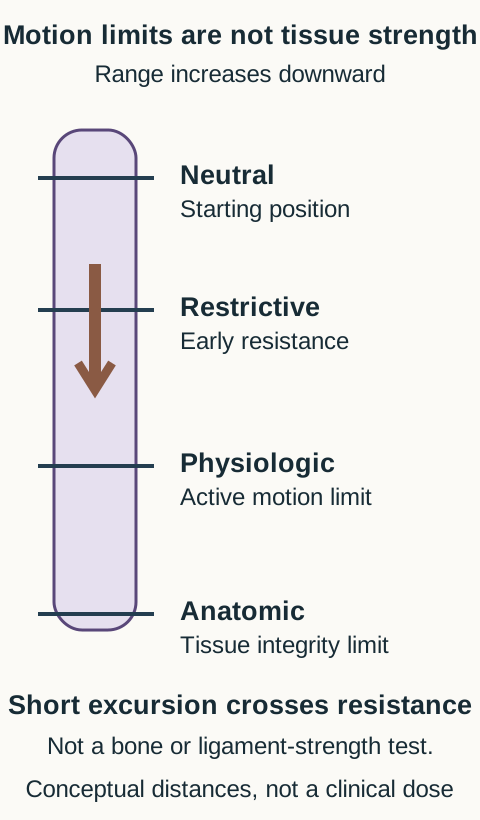
A restrictive barrier is an earlier-than-expected resistance associated with dysfunction. The physiologic barrier is the limit of active motion. The anatomic barrier is the terminal tissue limit. Normal passive range may extend beyond the active limit, so crossing the physiologic limit is not synonymous with injury. Exceeding anatomic integrity is not a treatment goal. [2]
The three motion limits answer different questions. Trace the arrow through early resistance. Its distance does not establish bone or ligament tolerance. [1][2]Open full-size diagram.
Cover the labels and identify the early resistance, the active limit, and the tissue limit. Then ask which of those tells you whether an osteoporotic vertebra will tolerate force.
None of these motion labels measures bone strength. A short excursion can still load a fracture, tumor-weakened vertebra or unstable ligament. Taking up slack and localizing a restriction do not cancel those risks. Transfer this distinction to a patient whose limited motion is protective guarding around an injury: the first task is evaluating the injury, not overcoming the resistance. [2]
The sound is not the outcome
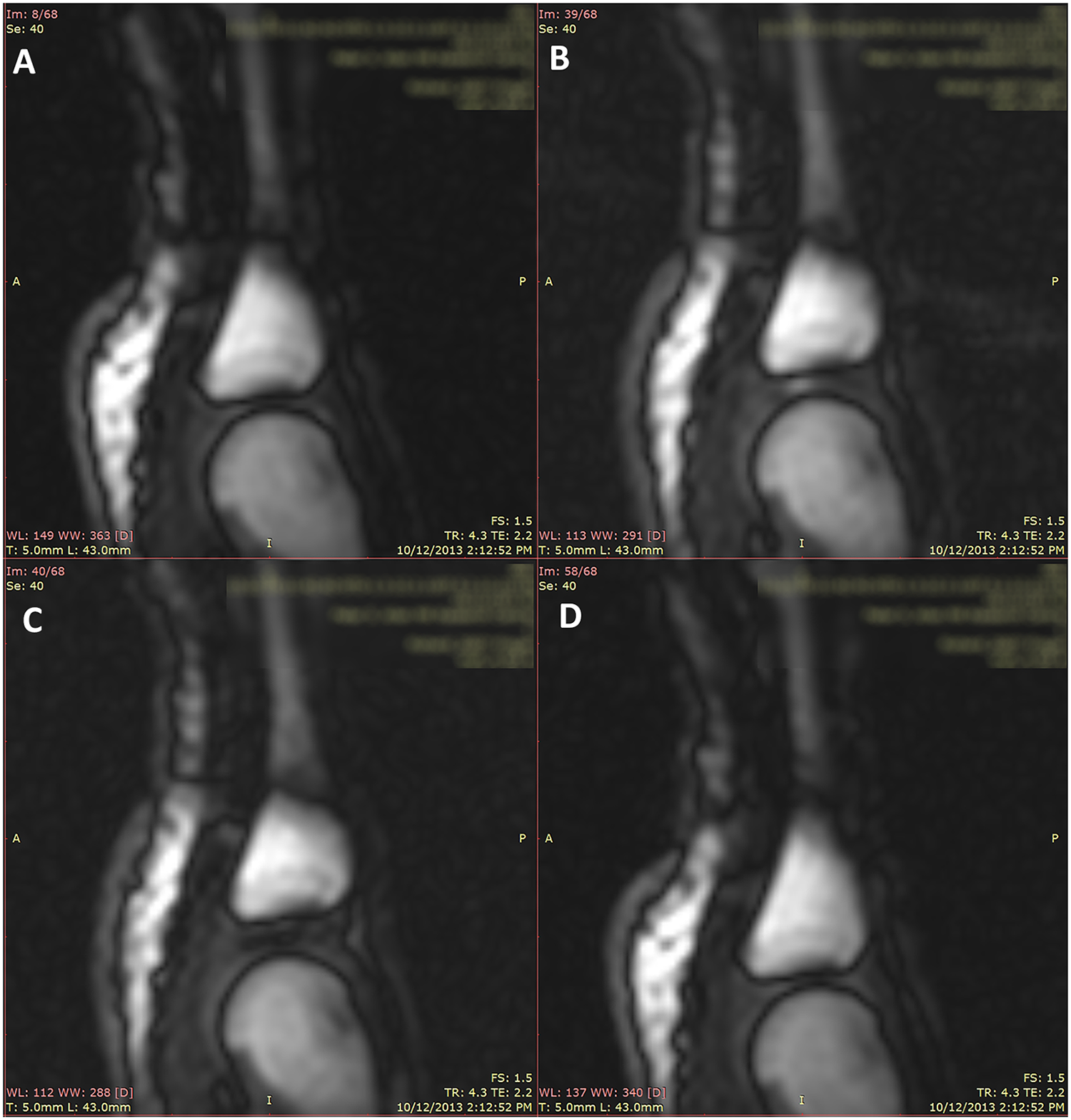
Joint separation can accompany cavitation. In a cine-MRI study of ten finger joints in one participant, a cavity appeared during rapid separation and remained visible while distraction continued after the sound. This supports cavity formation in that model, not the claim that every spinal sound is a collapsing nitrogen bubble or proof that a particular vertebra was corrected. [5]
Actual finger-joint research MRI, not a spinal image. Compare B with C to identify the new dark cavity. D is after distraction has been released and the joint surfaces have reapproximated; it does not demonstrate cavity persistence. The study observed persistence after the sound while distraction continued. No clinical correction is shown. Kawchuk and colleagues, 2015, Figure 3, unchanged. Source [5] [5]; CC BY 4.0. Open full-size image.
Mechanical changes and altered sensory input are proposed contributors to a treatment response. No single reflex explanation proves why every patient improves. In a secondary analysis of 70 people treated for low back pain, the presence of an audible pop did not identify a group with better measured outcomes. That is not proof of exact equivalence in every population. [6][16]
Compare two observations: quiet treatment followed by easier motion, versus a loud sound followed by unchanged symptoms. The examination documents improvement in the first example; the sound alone establishes neither benefit nor harm in the second. Reassess rather than pursuing noise.
Try it here · Checkpoint 1 of 3
Make your prediction before reading the choices. A first attempt is just a starting point.
Case 22
Show answer and explanations for case 22
A. Collapse of a previously visible cavity produced the sound and proves a spinal reflex mechanism (Why this does not fit)
Cavity collapse had been proposed as an explanation for joint cracking. The supplied observations instead show cavity appearance at separation and persistence after the sound, without testing a spinal reflex mechanism. A proposed mechanism must agree with the time sequence actually observed.
Reasoning steps for option A
Why can the proposal "Collapse of a previously visible cavity produced the sound and proves a spinal reflex mechanism" initially seem plausible in hvla-22?
Cavity collapse had been proposed as an explanation for joint cracking..
Which case detail defeats option 1 in hvla-22?
The supplied observations instead show cavity appearance at separation and persistence after the sound, without.
B. The observed event supports cavity formation during separation but does not establish spinal treatment benefit (Best answer)
The cavity appears with rapid separation and remains after the sound in the observed finger-joint sequence. That supports a formation-related interpretation in this experiment, while the absence of spinal outcomes prevents a claim about clinical spinal benefit. Respect both the measured event and the scope of the study.
Reasoning steps for option B
Which supplied findings support option 2 in hvla-22?
Cavity appearance during separation and persistence after sound.
What decision rule makes option 2 the best response in hvla-22?
Recognize the repeated-joint single-person design.
C. The ten joints provide ten independent participants demonstrating a population-level clinical benefit (Why this does not fit)
Several joints can supply repeated observations of a physical event. Ten joints from one person are not ten independent participants, and no clinical outcome was measured. Distinguish the number of observations from the number of people and from evidence of benefit.
Reasoning steps for option C
Why can the proposal "The ten joints provide ten independent participants demonstrating a population-level clinical benefit" initially seem plausible in hvla-22?
Several joints can supply repeated observations of a physical event..
Which case detail defeats option 3 in hvla-22?
Ten joints from one person are not ten independent participants, and no clinical outcome was.
D. Persistence of the cavity proves that ligament integrity and treatment safety are unchanged (Why this does not fit)
MRI can visualize aspects of joint separation and cavity appearance. These observations do not establish unchanged ligament integrity or the safety of another intervention in another region. Imaging of one physical event is not a comprehensive safety test.
Reasoning steps for option D
Why can the proposal "Persistence of the cavity proves that ligament integrity and treatment safety are unchanged" initially seem plausible in hvla-22?
MRI can visualize aspects of joint separation and cavity appearance..
Which case detail defeats option 4 in hvla-22?
These observations do not establish unchanged ligament integrity or the safety of another intervention in.
E. Appearance of the cavity establishes that every spinal thrust needs an audible pop to succeed (Why this does not fit)
Cavitation may accompany some joint interventions. The experiment did not test whether a sound is necessary for improvement after spinal treatment. Do not convert a physical observation into an unsupported clinical endpoint.
Reasoning steps for option E
Why can the proposal "Appearance of the cavity establishes that every spinal thrust needs an audible pop to succeed" initially seem plausible in hvla-22?
Cavitation may accompany some joint interventions..
Which case detail defeats option 5 in hvla-22?
The experiment did not test whether a sound is necessary for improvement after spinal treatment..
Takeaway: A finger-joint cavitation experiment informs a physical mechanism, not a requirement for spinal treatment success.
Name the restriction before selecting the technique
If a note says a lumbar segment is extended, rotated right and sidebent right, which directions are easy? In conventional type II notation, ERS right names the position of ease: extension, right rotation and right sidebending. Flexion and the corresponding leftward components are restricted. FRS right instead names a flexed segment. An internally contradictory label must be clarified, not silently used for treatment. [19]
To derive the sagittal preference from an examination, compare the palpated rotational asymmetry during flexion and extension. Greater symmetry in extension supports an extension preference; greater symmetry in flexion supports a flexion preference. A more posterior right transverse process supports right rotation. These findings describe the examination pattern, not proof of a destructive structural lesion. [27]
Write two headings: position of ease and restricted directions. Place each component of ERS right under the first heading, then write its opposite under the second. Now repeat for FRS left without copying the first answer.
The second example prefers flexion, left rotation and left sidebending; its opposite components are restricted. This is diagnostic reasoning, not an instruction to deliver a neck or lumbar thrust in a prescribed vector. Region-specific anatomy, the actual examination and safety assessment determine the method. [1]
The indication is a reproducible articular restriction that fits the examination. Pain alone, muscle tension alone, edema, or an already hypermobile target does not create an HVLA indication. Confirm that the expected functional benefit is plausible, that the region can tolerate the proposed load, and that a different diagnosis does not better explain the finding. [1][2][16]
Five linked choices matter: localization identifies the intended restriction; position controls the setup; direction follows the selected method; velocity describes how rapidly force is applied; and amplitude describes the short excursion. Poor localization is not corrected by simply adding speed or travel. No universal force or distance threshold makes these choices safe in every patient. [1][2]
A long lever uses a body region such as the pelvis or a limb at a distance from the target. A short-lever contact is nearer the intended articulation. Neither confines all force to one joint. Cervical methods may use supine or seated positions; thoracic methods include supine, prone or seated approaches, with the Kirksville crunch belonging to the supine group; lumbar methods commonly use side-lying setups. These categories explain why a different contact or position does not isolate a nearby fracture from transmitted load. [26][1][2][16]
Regional setup follows the same safety logic
Region
What the principles page establishes
What still requires region-specific training
RegionCervical
What the principles page establishesLocalize the diagnosis and clear instability, vascular warning and neural compromise.
What still requires region-specific trainingContact, coupled positioning and a supervised thrust vector.
RegionThoracic
What the principles page establishesChoose seated, supine or prone access only after tissue tolerance is established.
What still requires region-specific trainingSegmental contact and control of the lever.
RegionLumbar
What the principles page establishesDerive ease and restriction from the examination rather than memorizing a label.
What still requires region-specific trainingSide-lying or other setup, localization and force direction.
RegionRib, pelvis or extremity
What the principles page establishesConfirm the involved articulation and exclude fracture or instability.
What still requires region-specific trainingJoint-specific mechanics, contact and supervised execution.
Separate who supplies the effort from where the tissues are positioned
Approach
Patient contribution
Barrier relationship
ApproachHVLA
Patient contributionPassive
Barrier relationshipDirect
ApproachTypical muscle energy
Patient contributionActive, directed contraction against counterforce
Barrier relationshipDirect
ApproachCounterstrain
Patient contributionPassive positioning
Barrier relationshipIndirect, toward ease
ApproachMyofascial release
Patient contributionPassive in these examples; active variants exist
Barrier relationshipDirect or indirect, depending on the method
In post-isometric muscle energy, the patient contracts, relaxes, and is reassessed before a new barrier is engaged. A particular number or duration of contractions is protocol-specific. Counterstrain monitors a tender point in a position of ease, conventionally for about 90 seconds before a slow passive return and reassessment. A low-force method still requires appropriate tissue safety; its name is not clearance to load an unstable lesion. [17][18][2]
After treatment, compare the original restriction, symptoms and relevant neurologic findings. Persistent restriction calls for reassessment of diagnosis, technique choice and patient tolerance. There is no universal evidence-based rule requiring exactly two thrust attempts, and there is no requirement to repeat a quiet treatment. Stop for new concerning symptoms, withdrawn consent or a changed safety assessment. [6][16]
Find the reason a tissue may fail
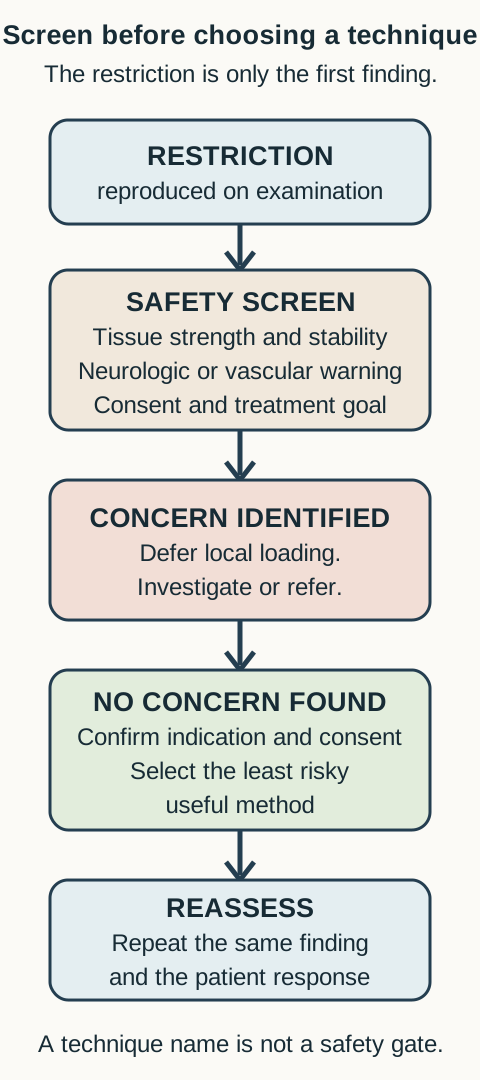
Can an intact neurologic examination make a painful vertebra safe to thrust? It tells you about current detectable neural function, not the strength of the bone or its supporting ligaments. An absolute contraindication rules out the proposed intervention at the affected region. A relative contraindication requires an individualized risk-benefit decision, not automatic permission to proceed. Lists differ by technique and profession; the clinical hazard should remain clear even when labels differ. [2]
A restriction enters a safety screen before it enters a setup. Use the sequence to explain why a different technique is not automatic clearance when the tissue itself may be unstable. [2][3][16]Open full-size diagram.
Trauma changes the order of operations. New focal bony pain, deformity, painful loss of function, a fragility history, or a rigid ankylosed spine should trigger appropriate fracture assessment before passive end-range testing or regional thrust treatment. A normal early neurologic examination does not establish structural stability. [2][7][12]
Consider a 68-year-old with a prior low-trauma vertebral fracture, new focal pain after lifting a grocery bag, and a femoral-neck T-score of -1.9. Before looking at the answer, identify whether the number or the fracture history should dominate the immediate loading decision.
The new focal pain and fragility history warrant assessment for another fracture before regional manipulation. A T-score above -2.5 does not establish safe bone. In postmenopausal women and men aged at least 50, a qualifying T-score of -2.5 or lower supports a densitometric diagnosis of osteoporosis; it does not, by itself, define every aspect of fracture risk or make every such patient identical. Prior fragility fractures, glucocorticoid exposure and the current presentation matter. Alendronate use alone neither establishes a contraindication nor proves that strength has been restored. [7][2]
Change one fact: the fracture has healed, stability is documented, and there is no new focal pain. The reason for immediate fracture investigation changes. That does not replace a fresh assessment of bone quality and whether any proposed loading is appropriate.
Do not treat the examination finding while overlooking the lesion
A suspected, acute or unhealed fracture must not receive thrust treatment. A tumor-destructed vertebral body can fail under transmitted loading even when strength and reflexes remain normal. Breast, prostate, lung, renal and thyroid cancers can involve bone; the radiographic appearance varies. Cancer history, progressive night pain, unexplained weight loss or a destructive lesion should interrupt a routine manipulation plan. A destructive lesion with cancer-associated night pain needs timely oncologic and spinal-stability assessment, not muscle energy over the lesion while waiting for a biopsy. New neurologic signs in this setting make suspected metastatic cord compression an emergency. [2][8]
Persistent focal back pain after bacteremia, with fever or increased inflammatory markers, raises concern for vertebral infection. Fever can be absent. Recent bloodstream infection, injection drug use, immunosuppression or a recent spinal procedure increases concern. Epidural infection can also threaten neural structures. Native vertebral osteomyelitis or disc infection requires diagnostic evaluation, commonly including MRI and blood cultures; neurologic deterioration or systemic instability demands urgent care. A normal early radiograph does not exclude infection. The concern is damaged tissues and delayed diagnosis, not an unsupported claim that a thrust necessarily spreads infection through the blood. [9]
High-grade spondylolisthesis, a progressing slip, or demonstrated dynamic instability also changes the loading decision. On a lateral radiograph, Meyerding grade III describes more than 50% through 75% forward slip; grade IV describes more than 75% through 100%. These displacement categories are not measurements of dynamic stability, and a lower grade is not a safety certificate. [25] Symptoms, serial imaging and neural involvement matter. Do not attempt to correct structural instability by forcing a restricted segment. [2]
Avoiding manipulation is not withholding care. Analgesia, protection from unsafe loading, appropriate investigation and referral are active treatment decisions. A gentler manual method is an alternative only after its own safety has been assessed.
Two different dangers can hide behind neck stiffness
Does a negative artery-position test clear a neck with unstable ligaments? No. Structural stability and vascular safety are different questions, and the position test does not reliably establish vascular safety either. Start with the history and the relevant examination rather than a provocative maneuver. [2][3]
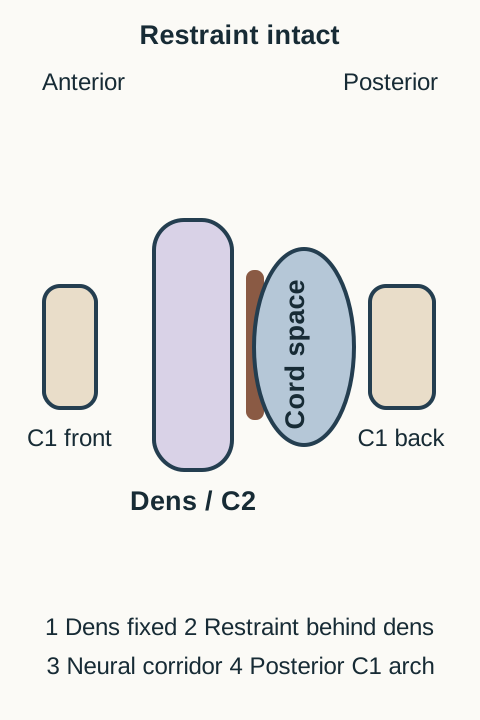
At C1-C2, the transverse ligament helps restrain the dens against the anterior atlas. Rheumatoid disease can damage the joint and its supporting structures, including through erosive disease and pannus. [24] Down syndrome can be associated with ligamentous laxity. Neither diagnostic label alone proves instability, but neck symptoms or neurologic changes require careful assessment. Established atlantoaxial instability precludes loading the unstable region with HVLA and is not automatically safe for muscle energy or end-range positioning. [2]
Restraint intact Establish the reference relationship before changing restraint or position. [2][24]Open full-size diagram.
Use the two optional comparisons below to predict what a lost restraint changes. Each opens independently; close it to restore the initial comparison. No physical neck maneuver is part of this activity.
What changes when the transverse restraint fails? Open the altered-restraint model.
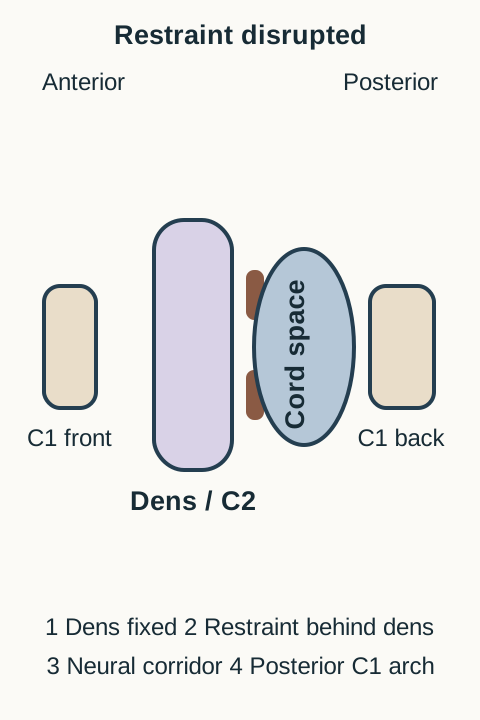
Restraint disrupted Loss of restraint and an existing neurologic deficit are different observations. [2][24]Open full-size diagram.
A normal examination can coexist with a hazardous loss of restraint. Waiting for weakness before respecting proven instability would miss the opportunity to prevent injury.
What happens if C1 then translates anteriorly? Open the resulting cord-space comparison.
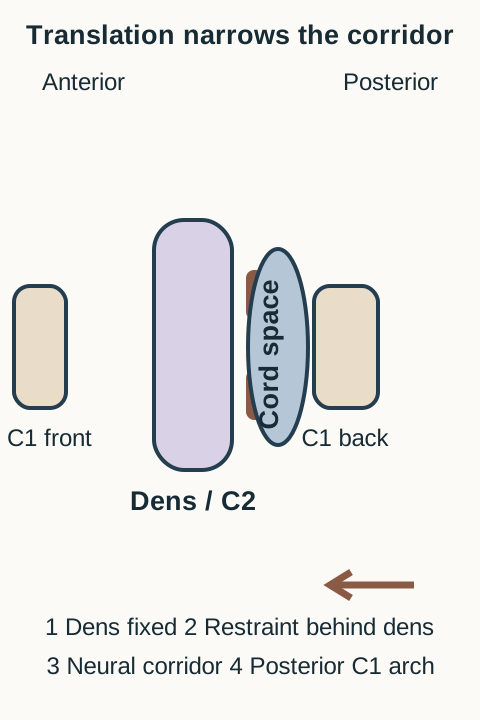
Translation narrows the corridor Follow the posterior arch rather than assuming that normal strength restores stability. [2][24]Open full-size diagram.
The clinical consequence depends on stability and neural compromise, not on whether the proposed treatment is seated, slower, or performed by a different profession.
The complete comparison: loss of restraint permits abnormal translation; anterior translation of C1 can narrow the space behind the dens and threaten the cord. An intact examination does not restore the missing restraint. Suspected or documented instability needs appropriate evaluation rather than trial manipulation. [2]
A vascular warning is not another tender point
New unusual neck or occipital pain with diplopia, dysarthria, ataxia, a focal neurologic deficit, or a partial Horner pattern raises concern for cervical vascular pathology. Arrange urgent medical assessment rather than switching to gentle neck treatment. Dissection can cause pain before focal deficits and can be present before a patient seeks manual care. [3][4]
IFOMPT does not recommend provocative positional vascular testing because its predictive ability is inadequate. A symptom-free extension-rotation or Hautant-type test cannot exclude vascular disease. History, appropriate neurologic assessment and referral decisions cannot be replaced by a single negative test. [3]
For a patient without an identified contraindication, consent still includes expected benefits, alternatives, uncertainty and possible serious harms. The AHA/ASA statement recommends discussing the reported association between cervical manipulation and cervical arterial dissection. An association does not establish causation in each event, and a precise personal risk cannot be promised. [4][16]
Try it here · Checkpoint 2 of 3
Make your prediction before reading the choices. A first attempt is just a starting point.
Case 1
Show answer and explanations for case 1
A. The posterior arch of C1 approaches the dens, reducing the space available for the cord (Best answer)
The transverse ligament normally helps restrain atlas translation relative to the dens. With C1 translating anteriorly around a fixed dens, its posterior arch approaches the dens and the intervening cord space narrows. Presently intact motor function does not establish a safe load-bearing restraint.
Reasoning steps for option A
Which supplied findings support option 1 in hvla-01?
Failed restraint behind the dens with anterior C1 translation.
What decision rule makes option 1 the best response in hvla-01?
Track the posterior arch relative to the fixed dens.
B. The anterior arch of C1 approaches the dens, increasing posterior cord space (Why this does not fit)
Approximation of the anterior arch to the dens can describe the opposite translational direction. The supplied imaging instead shows anterior atlas translation, which increases the anterior interval and reduces posterior space. Track both arches of the atlas rather than reversing anterior and posterior.
Reasoning steps for option B
Why can the proposal "The anterior arch of C1 approaches the dens, increasing posterior cord space" initially seem plausible in hvla-01?
Approximation of the anterior arch to the dens can describe the opposite translational direction..
Which case detail defeats option 2 in hvla-01?
The supplied imaging instead shows anterior atlas translation, which increases the anterior interval and reduces.
C. The dens translates with C1, preserving the original canal dimensions (Why this does not fit)
Structures retain their relative spacing when they translate together. Here C2 is fixed and C1 translates relative to it, so assuming that the dens follows C1 removes the actual instability. Relative displacement, not a common shift of the entire image, threatens canal space.
Reasoning steps for option C
Why can the proposal "The dens translates with C1, preserving the original canal dimensions" initially seem plausible in hvla-01?
Structures retain their relative spacing when they translate together..
Which case detail defeats option 3 in hvla-01?
Here C2 is fixed and C1 translates relative to it, so assuming that the dens.
D. The vertebral body of C2 compresses vertically, narrowing a lower cervical foramen (Why this does not fit)
Vertebral collapse or foraminal narrowing can endanger neural structures in other disorders. This case localizes the abnormality to the C1-C2 restraint, not a lower cervical body or foramen. Match the proposed hazard to the structure shown to be abnormal.
Reasoning steps for option D
Why can the proposal "The vertebral body of C2 compresses vertically, narrowing a lower cervical foramen" initially seem plausible in hvla-01?
Vertebral collapse or foraminal narrowing can endanger neural structures in other disorders..
Which case detail defeats option 4 in hvla-01?
This case localizes the abnormality to the C1-C2 restraint, not a lower cervical body or.
E. The remaining alar ligaments preserve the original posterior interval despite the anterior atlas translation (Why this does not fit)
The alar ligaments contribute to upper-cervical restraint, especially control of rotation. Their presence does not cancel the supplied abnormal anterior translation or preserve the posterior interval in this model. Use the demonstrated relative displacement rather than assuming that another restraint compensates completely.
Reasoning steps for option E
Why can the proposal "The remaining alar ligaments preserve the original posterior interval despite the anterior atlas translation" initially seem plausible in hvla-01?
The alar ligaments contribute to upper-cervical restraint, especially control of rotation..
Which case detail defeats option 5 in hvla-01?
Their presence does not cancel the supplied abnormal anterior translation or preserve the posterior interval.
Takeaway: Known upper-cervical instability is unsafe to load even before a deficit appears.
Localize the neurologic pattern, then check its trajectory
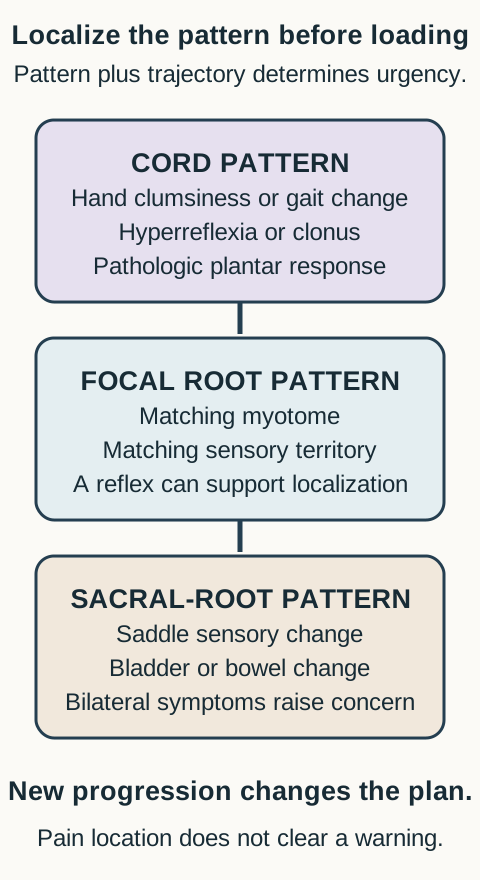
Does unilateral leg pain exclude an emergency? Laterality alone is insufficient. First distinguish a focal root pattern from spinal cord dysfunction or sacral-root dysfunction. Then compare the examination with the earlier baseline. New progression changes urgency even when the anatomic pattern is familiar. [10][13][15]
Cord, root and sacral-root patterns are not interchangeable. Use the pattern and its trajectory to decide whether treatment, urgent assessment or emergency imaging is appropriate. [10][13][15]Open full-size diagram.
Place three findings beside the picture: brisk leg reflexes with hand clumsiness; weak great-toe extension with dorsal-foot sensory loss; and new loss of bladder sensation. Do they all belong at the same location?
The first pattern raises concern for cervical cord dysfunction, the second fits an L5-predominant root pattern, and the third requires assessment for sacral-root dysfunction in the appropriate context. A painful segment does not explain away these findings. [10][13][15]
Useful lower-limb localization, interpreted with the whole examination
Pattern
Motor finding
Supporting findings
PatternL5-predominant
Motor findingWeak great-toe extension; impaired heel walking
Supporting findingsDorsal-foot sensory change; ankle inversion may also be weak
PatternS1-predominant
Motor findingWeak plantar flexion; difficulty with repeated single-leg heel rises or toe walking
Supporting findingsReduced Achilles reflex and lateral-foot sensory change
A straight-leg raise can support nerve-root irritation but does not alone establish severity, a single level, or suitability for HVLA. Stable radicular pain without major or progressive motor loss, cauda equina features or another serious cause often permits conservative care. That is not the same as a recommendation for a thrust over an acute symptomatic disc. [10][14]
Now change only the time course: plantar-flexion strength declines markedly over two days. Progressive motor loss warrants urgent specialist assessment even with normal saddle sensation and no bladder complaint. Do not reserve urgent referral for bilateral deficits. [10][14]
New altered urinary sensation, difficulty voiding, saddle sensory change or other sacral dysfunction may represent incomplete cauda equina syndrome. Not every patient has the full combination of retention, bilateral sciatica and saddle anesthesia. Continued voiding or a post-void residual below 200 mL does not exclude incomplete cauda equina syndrome when new sacral symptoms are present. Suspected cauda equina syndrome requires urgent MRI and specialist assessment, not a trial of manual care or waiting for complete retention. [13]
Cervical myelopathy can produce hand clumsiness, gait imbalance, hyperreflexia, clonus or a pathologic plantar response. Degenerative narrowing and ligamentous thickening can be chronic, while the patient's neurologic function deteriorates. Recognize the cord pattern rather than treating neck stiffness as isolated somatic dysfunction; progressive deficits require prompt specialist evaluation. [15][2]
Try it here · Checkpoint 3 of 3
Make your prediction before reading the choices. A first attempt is just a starting point.
Case 6
Show answer and explanations for case 6
A. A stable S1 sensory radiculopathy supports a trial of routine manual treatment (Why this does not fit)
S1 dysfunction often affects plantar flexion and the Achilles reflex. Great-toe extension, dorsal-foot symptoms and inversion weakness instead support an L5 pattern, and the deficit is worsening. Both the distribution and the trajectory matter.
Reasoning steps for option A
Why can the proposal "A stable S1 sensory radiculopathy supports a trial of routine manual treatment" initially seem plausible in hvla-06?
S1 dysfunction often affects plantar flexion and the Achilles reflex..
Which case detail defeats option 1 in hvla-06?
Great-toe extension, dorsal-foot symptoms and inversion weakness instead support an L5 pattern, and the deficit.
B. A common fibular neuropathy explains the weakness sufficiently to defer spinal assessment (Why this does not fit)
Common fibular neuropathy can weaken dorsiflexion and toe extension. Weak inversion involves a muscle supplied through the tibial nerve and, with back-to-foot pain, favors a root-level explanation over an isolated common fibular lesion. Use a muscle outside the suspected peripheral nerve to refine localization.
Reasoning steps for option B
Why can the proposal "A common fibular neuropathy explains the weakness sufficiently to defer spinal assessment" initially seem plausible in hvla-06?
Common fibular neuropathy can weaken dorsiflexion and toe extension..
Which case detail defeats option 2 in hvla-06?
Weak inversion involves a muscle supplied through the tibial nerve and, with back-to-foot pain, favors.
C. Urgent assessment for a progressive L5 motor deficit (Best answer)
Great-toe extension and inversion weakness with dorsal-foot symptoms support L5 involvement. The decline from 4/5 to 2/5 over two days is progressive motor dysfunction requiring urgent assessment, not elective thrust treatment. Bladder symptoms are not required for a worsening root deficit to be important.
Reasoning steps for option C
Which supplied findings support option 3 in hvla-06?
Great-toe extension declining from 4/5 to 2/5.
What decision rule makes option 3 the best response in hvla-06?
Compare serial strength measurements.
D. A normal plantar-flexion examination excludes an important lumbar root problem (Why this does not fit)
Preserved plantar flexion is reassuring about a function predominantly associated with S1. It does not exclude the distinct L5-pattern deficit documented here. One preserved myotome does not clear the neighboring roots.
Reasoning steps for option D
Why can the proposal "A normal plantar-flexion examination excludes an important lumbar root problem" initially seem plausible in hvla-06?
Preserved plantar flexion is reassuring about a function predominantly associated with S1..
Which case detail defeats option 4 in hvla-06?
It does not exclude the distinct L5-pattern deficit documented here..
E. Absent bladder symptoms make progression of limb weakness a nonurgent finding (Why this does not fit)
New bladder or saddle symptoms would raise concern for cauda equina involvement. Their absence does not turn a rapidly worsening focal motor deficit into a stable pain-only syndrome. Escalate for progressive weakness even when sacral symptoms are absent.
Reasoning steps for option E
Why can the proposal "Absent bladder symptoms make progression of limb weakness a nonurgent finding" initially seem plausible in hvla-06?
New bladder or saddle symptoms would raise concern for cauda equina involvement..
Which case detail defeats option 5 in hvla-06?
Their absence does not turn a rapidly worsening focal motor deficit into a stable pain-only.
Takeaway: Localize the motor deficit, then use its progression to judge urgency.
A precaution should change the plan, not just the label
Would the same INR mean the same decision?
Anticoagulation increases concern about bleeding. This includes warfarin, heparin and direct oral anticoagulants. Hemophilia, von Willebrand disease and significant thrombocytopenia also require an individualized bleeding-risk assessment; these conditions are not interchangeable merely because each can cause bleeding. Some teaching lists classify it as an absolute HVLA contraindication, whereas WHO lists anticoagulant therapy under relative contraindications to manipulation.
Do not turn that disagreement into a question with an arbitrary universal label. A therapeutic INR does not eliminate bleeding risk; assess the procedure, region, indication and patient factors. Do not stop prescribed anticoagulation simply to permit an elective thrust. In a patient with a mechanical valve, medication interruption can create a separate thrombotic hazard and requires the prescribing team's assessment. [2][22]
Compare stable localized back discomfort in an anticoagulated patient with sudden severe spinal pain followed by rapidly worsening weakness. Predict whether both patients belong on the same elective treatment pathway.
The second presentation requires urgent assessment for a compressive lesion, including spinal hematoma, rather than a lower-force technique. The first requires individualized planning and may favor deferring thrust treatment; a medication list by itself neither diagnoses a hematoma nor justifies an emergency scan. [2][21]
Is restricted motion the same as insufficient mobility?
A hypermobile person can have painful protective guarding. Generalized laxity, recurrent subluxations or an unstable target should prompt a stability-focused assessment rather than an attempt to increase end-range motion. A high Beighton score does not alone diagnose a specific Ehlers-Danlos subtype. Muscle energy does not repair a deficient ligament merely because the patient contracts a muscle. Transfer this distinction to a sore joint that already has excessive translation: the objective is tolerable function and control, not more range. Individualized strengthening and motor-control work may support stability; it does not promise ligament repair. [2][20][23]
During an active inflammatory spinal flare, address disease activity and tissue tolerance instead of forcing motion. An actively inflamed target, including a joint affected by psoriatic arthritis or gout, should not be treated as ordinary stiffness. A disease label alone does not specify current tissue integrity. In advanced ankylosing disease, a rigid fused spine is vulnerable to fracture after relatively minor trauma.
New focal pain after a fall warrants assessment for fracture even if plain radiographs appear unrevealing; appropriate CT, and MRI when indicated, may be necessary. A fused segment is not a reversible restrictive barrier to thrust through. [12][2]
Degeneration without neural impairment is different from stenosis with progressive myelopathy. Likewise, a postoperative spine with incomplete healing or an internal-fixation construct is different from a remote, healed operation with documented stability. Surgical timing, hardware, restrictions and the proposed loading region must be reviewed. Neither all degeneration nor all past surgery is a universal lifelong prohibition on every form of manual care. [2][15]
Does evidence for OMT establish evidence for every technique?
Pregnancy requires attention to obstetric symptoms, comfort, positioning and the specific intervention. In PROMOTE, a pregnancy OMT trial, the studied protocol used non-thrust methods. Its findings cannot establish that pregnancy HVLA has the same benefits or risks. A patient with new bleeding or other obstetric warning symptoms needs assessment of that problem before musculoskeletal treatment. A healthy pregnancy, in contrast, is not itself proof that every manual technique is forbidden. [11]
A patient accepts an explanation of HVLA but changes their mind during positioning. Does the earlier consent settle the decision? It does not: stop, allow a comfortable position, and discuss an acceptable alternative only after confirming its safety. Consent is ongoing, and it never neutralizes a contraindication. [16]
Beyond the boards: make the plan reviewable
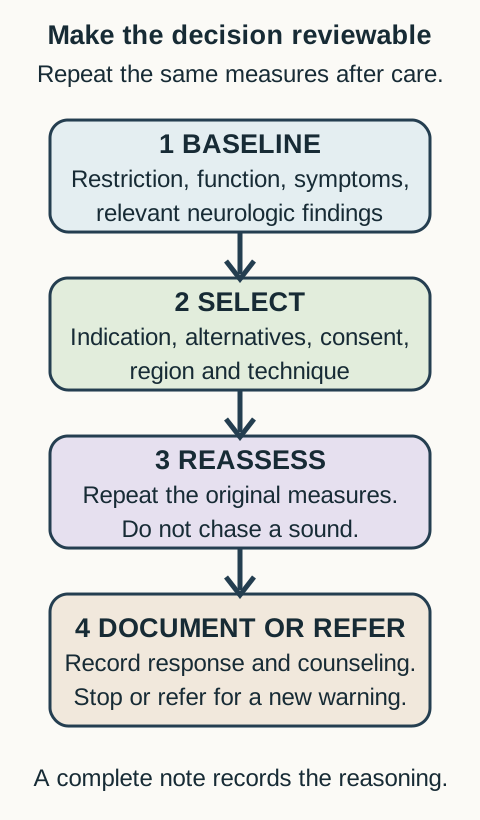
Record why HVLA was chosen. Document the reproducible restriction, target region, baseline function, relevant neurologic findings, material imaging or clearance, alternatives, consent, technique and immediate response. A note that only names a procedure cannot show the safety reasoning or the measured result. [3][16]
Use referral thresholds that match the hazard. Acute focal deficits, suspected cauda equina syndrome, vascular warning symptoms, suspected fracture, infection or metastatic instability require urgent or emergency pathways. Stable localized stiffness without red flags belongs to a different timeline. [3][8][9][13][15]
No medication dose belongs to the thrust itself. Analgesics, anticoagulants and disease-modifying therapy follow their own indication, current labeling, organ-function limits and prescribing team. Do not stop anticoagulation or substitute an unverified product simply to make an elective thrust possible. [22]
Counsel around function and uncertainty. Explain that a pop is not the target, short-lived soreness can occur, and new weakness, gait change, saddle symptoms, bladder change, severe unusual headache or focal neurologic symptoms require prompt evaluation. Avoid promises of structural realignment or guaranteed prevention. [4][6][16]
Baseline, selection, reassessment and documentation form one sequence. The same clinical measure should anchor the pre-treatment decision and the post-treatment response. [3][6][16]Open full-size diagram.
Before a thrust, connect the intended functional benefit to the actual tissue and neurologic findings. After any treatment, compare the same findings again. Better motion without an alarming change is useful information; a sound, a technique name or a negative positional test cannot replace that assessment.
Apply the principles
Case 2
Show answer and explanations for case 2
A. The T-score makes an acute vertebral injury sufficiently unlikely to begin thrust treatment (Why this does not fit)
A T-score of -1.8 is above the densitometric osteoporosis threshold used for postmenopausal adults. It does not erase a prior fragility fracture or explain new focal pain after light loading. Bone-density classification alone does not clear a patient for thrust loading.
Reasoning steps for option A
Why can the proposal "The T-score makes an acute vertebral injury sufficiently unlikely to begin thrust treatment" initially seem plausible in hvla-02?
A T-score of -1.8 is above the densitometric osteoporosis threshold used for postmenopausal adults..
Which case detail defeats option 1 in hvla-02?
It does not erase a prior fragility fracture or explain new focal pain after light.
B. Normal leg strength excludes a clinically important vertebral compression injury (Why this does not fit)
Motor testing assesses an important consequence of neural compromise. A vertebral fracture can be painful and mechanically important without producing leg weakness. Evaluate skeletal integrity separately from the neurologic examination.
Reasoning steps for option B
Why can the proposal "Normal leg strength excludes a clinically important vertebral compression injury" initially seem plausible in hvla-02?
Motor testing assesses an important consequence of neural compromise..
Which case detail defeats option 2 in hvla-02?
A vertebral fracture can be painful and mechanically important without producing leg weakness..
C. The pain and fragility history warrant fracture assessment before regional manipulation (Best answer)
New focal spinal pain after light loading is concerning in someone with a prior fragility fracture. The history raises the need for clinical assessment and appropriate imaging despite the less abnormal T-score. Defer regional manipulation while an acute fracture remains a reasonable possibility.
Reasoning steps for option C
Which supplied findings support option 3 in hvla-02?
Prior low-trauma vertebral fracture.
What decision rule makes option 3 the best response in hvla-02?
Identify the new focal pain as a possible acute injury.
D. The T-score establishes severe osteoporosis and eliminates the need to investigate the new pain (Why this does not fit)
A T-score at or below -2.5 can establish densitometric osteoporosis in this age group. The supplied score is -1.8, and even an established diagnosis would not explain away a new pain episode. Do not substitute an inaccurate severity label for assessment of the current injury.
Reasoning steps for option D
Why can the proposal "The T-score establishes severe osteoporosis and eliminates the need to investigate the new pain" initially seem plausible in hvla-02?
A T-score at or below -2.5 can establish densitometric osteoporosis in this age group..
Which case detail defeats option 4 in hvla-02?
The supplied score is -1.8, and even an established diagnosis would not explain away a.
E. The low-energy mechanism favors muscle strain strongly enough to defer reassessment (Why this does not fit)
A minor load often produces benign muscular pain in otherwise low-risk patients. The prior low-trauma vertebral fracture changes the meaning of the same mechanism here. Interpret the mechanism together with the patient's tissue vulnerability.
Reasoning steps for option E
Why can the proposal "The low-energy mechanism favors muscle strain strongly enough to defer reassessment" initially seem plausible in hvla-02?
A minor load often produces benign muscular pain in otherwise low-risk patients..
Which case detail defeats option 5 in hvla-02?
The prior low-trauma vertebral fracture changes the meaning of the same mechanism here..
Takeaway: A T-score above -2.5 does not rule out fragility or a new fracture.
A. Treat the paraspinal guarding with muscle energy before evaluating vertebral stability (Why this does not fit)
Muscle energy can address selected muscular restrictions in appropriately assessed patients. Active contraction and positioning can still load a tumor-weakened vertebra, so its name does not bypass the stability problem. An alternative manual technique requires its own safety assessment.
Reasoning steps for option A
Why can the proposal "Treat the paraspinal guarding with muscle energy before evaluating vertebral stability" initially seem plausible in hvla-03?
Muscle energy can address selected muscular restrictions in appropriately assessed patients..
Which case detail defeats option 1 in hvla-03?
Active contraction and positioning can still load a tumor-weakened vertebra, so its name does not.
B. Begin thoracic HVLA because the examination does not show cord compression (Why this does not fit)
Normal strength and sensation reduce evidence for a current detectable cord deficit. The destructive vertebral lesion and load-related pain still raise a mechanical hazard. Absence of cord compression findings is not permission to load compromised bone.
Reasoning steps for option B
Why can the proposal "Begin thoracic HVLA because the examination does not show cord compression" initially seem plausible in hvla-03?
Normal strength and sensation reduce evidence for a current detectable cord deficit..
Which case detail defeats option 2 in hvla-03?
The destructive vertebral lesion and load-related pain still raise a mechanical hazard..
C. Arrange routine reassessment in one month because the lesion has not caused weakness (Why this does not fit)
Routine follow-up is appropriate for some stable, established musculoskeletal problems. Progressive pain with a destructive spinal lesion in a patient with cancer requires prompt specialist coordination rather than a month-long delay. Cancer-related pain without deficits still merits timely assessment.
Reasoning steps for option C
Why can the proposal "Arrange routine reassessment in one month because the lesion has not caused weakness" initially seem plausible in hvla-03?
Routine follow-up is appropriate for some stable, established musculoskeletal problems..
Which case detail defeats option 3 in hvla-03?
Progressive pain with a destructive spinal lesion in a patient with cancer requires prompt specialist.
D. Defer regional loading and obtain prompt oncology and spinal-stability assessment (Best answer)
A destructive vertebral lesion can compromise load-bearing strength before neurologic abnormalities develop. Progressive night and mechanical pain justify prompt oncology coordination and assessment of stability before regional manual loading. New neurologic or sphincter changes would increase urgency further to an emergency cord-compression pathway.
Reasoning steps for option D
Which supplied findings support option 4 in hvla-03?
Known cancer and destructive T8 lesion.
What decision rule makes option 4 the best response in hvla-03?
Interpret mechanical pain despite a normal neurologic examination.
E. Perform low-amplitude mobilization to determine whether the lesion is mechanically stable (Why this does not fit)
Symptoms during ordinary activity can help characterize mechanical pain. Provocative manual loading is not an appropriate test of the stability of a destructive vertebral lesion. Use clinical assessment and appropriate imaging, not treatment as a diagnostic stress test.
Reasoning steps for option E
Why can the proposal "Perform low-amplitude mobilization to determine whether the lesion is mechanically stable" initially seem plausible in hvla-03?
Symptoms during ordinary activity can help characterize mechanical pain..
Which case detail defeats option 5 in hvla-03?
Provocative manual loading is not an appropriate test of the stability of a destructive vertebral.
Takeaway: Tumor-weakened bone needs assessment of stability, not substitution of another loading technique.
A. Repeat plain radiographs in six weeks without further testing now (Why this does not fit)
Serial radiographs can document later structural change in some spinal disorders. Early vertebral infection may not be visible, while recent bacteremia, focal pain and raised inflammatory markers already justify further evaluation. A nondiagnostic early radiograph should not delay the appropriate infection workup.
Reasoning steps for option A
Why can the proposal "Repeat plain radiographs in six weeks without further testing now" initially seem plausible in hvla-04?
Serial radiographs can document later structural change in some spinal disorders..
Which case detail defeats option 1 in hvla-04?
Early vertebral infection may not be visible, while recent bacteremia, focal pain and raised inflammatory.
B. Obtain spine MRI and two sets of bacterial blood cultures (Best answer)
Recent bloodstream infection plus new focal spinal pain and raised inflammatory markers raises concern for vertebral infection. MRI assesses the spinal focus, and two sets of blood cultures assess a microbiologic source in suspected native vertebral osteomyelitis. Absence of fever does not cancel this combination of findings.
Reasoning steps for option B
Which supplied findings support option 2 in hvla-04?
Recent Staphylococcus aureus bacteremia.
What decision rule makes option 2 the best response in hvla-04?
Avoid treating fever and radiographic destruction as prerequisites.
C. Use the normal temperature to exclude spinal infection and assess segmental motion (Why this does not fit)
Fever supports infection when present. Vertebral infection can occur without fever, so 36.8 C cannot outweigh the bacteremia history and inflammatory results. Use the pattern rather than a single missing sign.
Reasoning steps for option C
Why can the proposal "Use the normal temperature to exclude spinal infection and assess segmental motion" initially seem plausible in hvla-04?
Fever supports infection when present..
Which case detail defeats option 3 in hvla-04?
Vertebral infection can occur without fever, so 36.8 C cannot outweigh the bacteremia history and.
D. Obtain electromyography first to exclude an occult peripheral neuropathy (Why this does not fit)
Electromyography can clarify selected nerve-root or peripheral-nerve disorders. The dominant concern here is an infectious spinal focus, not an unexplained peripheral motor syndrome. Choose a test that addresses the suspected tissue and disease process.
Reasoning steps for option D
Why can the proposal "Obtain electromyography first to exclude an occult peripheral neuropathy" initially seem plausible in hvla-04?
Electromyography can clarify selected nerve-root or peripheral-nerve disorders..
Which case detail defeats option 4 in hvla-04?
The dominant concern here is an infectious spinal focus, not an unexplained peripheral motor syndrome..
E. Use a trial of anti-inflammatory medication as the diagnostic test before imaging (Why this does not fit)
Analgesia can be provided while a diagnostic evaluation proceeds. A response to an anti-inflammatory drug cannot exclude infection and should not replace imaging and cultures in this setting. Symptom relief and etiologic diagnosis are different outcomes.
Reasoning steps for option E
Why can the proposal "Use a trial of anti-inflammatory medication as the diagnostic test before imaging" initially seem plausible in hvla-04?
Analgesia can be provided while a diagnostic evaluation proceeds..
Which case detail defeats option 5 in hvla-04?
A response to an anti-inflammatory drug cannot exclude infection and should not replace imaging and.
Takeaway: Afebrile focal spinal pain after bacteremia can still require urgent investigation for infection.
A. The earlier negative test sufficiently lowers vascular concern to permit non-thrust cervical treatment (Why this does not fit)
A symptom-free examination documents what occurred at that particular assessment. Provocative positional tests cannot reliably exclude vascular pathology, especially when new focal symptoms have developed since the test. A prior negative test is not clearance for either thrust or non-thrust neck loading.
Reasoning steps for option A
Why can the proposal "The earlier negative test sufficiently lowers vascular concern to permit non-thrust cervical treatment" initially seem plausible in hvla-05?
A symptom-free examination documents what occurred at that particular assessment..
Which case detail defeats option 1 in hvla-05?
Provocative positional tests cannot reliably exclude vascular pathology, especially when new focal symptoms have developed.
B. Resolved neurologic symptoms favor muscle spasm, so treatment can proceed with reassessment afterward (Why this does not fit)
Muscular neck pain is common and symptoms can fluctuate. Transient diplopia and dysarthria accompanying an unusual headache are not adequately explained by ordinary muscle spasm. Resolution of focal symptoms does not eliminate the need for emergency vascular assessment.
Reasoning steps for option B
Why can the proposal "Resolved neurologic symptoms favor muscle spasm, so treatment can proceed with reassessment afterward" initially seem plausible in hvla-05?
Muscular neck pain is common and symptoms can fluctuate..
Which case detail defeats option 2 in hvla-05?
Transient diplopia and dysarthria accompanying an unusual headache are not adequately explained by ordinary muscle.
C. The symptom pattern suggests a single cervical root lesion suitable for routine outpatient imaging (Why this does not fit)
A cervical root lesion can produce a limb sensory or motor distribution. Diplopia and dysarthria are not a single cervical root pattern. Localize the symptoms before assuming that pain arising near the spine is musculoskeletal.
Reasoning steps for option C
Why can the proposal "The symptom pattern suggests a single cervical root lesion suitable for routine outpatient imaging" initially seem plausible in hvla-05?
A cervical root lesion can produce a limb sensory or motor distribution..
Which case detail defeats option 3 in hvla-05?
Diplopia and dysarthria are not a single cervical root pattern..
D. A repeat positional test is needed before deciding whether referral is warranted (Why this does not fit)
Repeated testing can help only when the test provides valid information and is appropriate to the situation. The supplied vascular warning pattern already warrants escalation, and provocative positional screening is not recommended for clearance. Do not delay referral to reproduce potentially ischemic symptoms.
Reasoning steps for option D
Why can the proposal "A repeat positional test is needed before deciding whether referral is warranted" initially seem plausible in hvla-05?
Repeated testing can help only when the test provides valid information and is appropriate.
Which case detail defeats option 4 in hvla-05?
The supplied vascular warning pattern already warrants escalation, and provocative positional screening is not recommended.
E. The new pattern warrants emergency assessment for a vascular neurologic disorder without provocative testing (Best answer)
An unusual head or neck pain pattern with transient focal neurologic symptoms raises concern for a vascular neurologic disorder. The earlier positional result neither rules out that disorder nor supersedes the new findings. Arrange emergency assessment rather than another provocative examination or manual treatment.
Reasoning steps for option E
Which supplied findings support option 5 in hvla-05?
New unusual unilateral occipital pain.
What decision rule makes option 5 the best response in hvla-05?
Reject the earlier positional result as a vascular rule-out.
Takeaway: Transient focal neurologic symptoms with unusual head or neck pain outweigh an old negative positional test.
A. Begin conservative care with planned neurologic follow-up (Best answer)
An improving S1-pattern radicular syndrome without motor or sacral dysfunction can be managed initially with individualized conservative care. The stable examination supports follow-up rather than emergency decompression, while new weakness or sacral symptoms would change the plan. A conservative-care recommendation is not automatic clearance for any particular manual technique.
Reasoning steps for option A
Which supplied findings support option 1 in hvla-07?
Improving lateral-foot symptoms and concordant S1 contact.
What decision rule makes option 1 the best response in hvla-07?
Identify the improving rather than progressive course.
B. Arrange emergency decompression based on the disc image alone (Why this does not fit)
Emergency surgical assessment is appropriate for threatening neurologic syndromes. The supplied findings are improving and do not establish cauda equina syndrome or a progressive motor deficit. Interpret imaging together with function and clinical trajectory.
Reasoning steps for option B
Why can the proposal "Arrange emergency decompression based on the disc image alone" initially seem plausible in hvla-07?
Emergency surgical assessment is appropriate for threatening neurologic syndromes..
Which case detail defeats option 2 in hvla-07?
The supplied findings are improving and do not establish cauda equina syndrome or a progressive.
C. Use the normal motor examination as proof that lumbar HVLA is safe for this patient (Why this does not fit)
Preserved strength is one important part of the assessment. It does not independently establish the safety or benefit of a specific thrust technique in a patient with a disc-related syndrome. Select the intervention only after a separate risk-benefit assessment.
Reasoning steps for option C
Why can the proposal "Use the normal motor examination as proof that lumbar HVLA is safe for this patient" initially seem plausible in hvla-07?
Preserved strength is one important part of the assessment..
Which case detail defeats option 3 in hvla-07?
It does not independently establish the safety or benefit of a specific thrust technique in.
D. Treat the stable reflex change as evidence of a cervical spinal cord disorder (Why this does not fit)
Cord disorders can alter reflexes and gait below the lesion. An isolated reduced Achilles reflex with a matching S1 distribution and concordant lumbar image is a root pattern, not evidence of cervical myelopathy. Distinguish a reduced root reflex from widespread upper motor neuron findings.
Reasoning steps for option D
Why can the proposal "Treat the stable reflex change as evidence of a cervical spinal cord disorder" initially seem plausible in hvla-07?
Cord disorders can alter reflexes and gait below the lesion..
Which case detail defeats option 4 in hvla-07?
An isolated reduced Achilles reflex with a matching S1 distribution and concordant lumbar image is.
E. Delay all activity and rehabilitation until the disc abnormality disappears on MRI (Why this does not fit)
Symptoms and function may improve while an imaging abnormality remains visible. Requiring complete radiographic disappearance before any rehabilitation would substitute the image for the improving clinical course. Guide activity and follow-up by the patient's presentation, not an isolated scan target.
Reasoning steps for option E
Why can the proposal "Delay all activity and rehabilitation until the disc abnormality disappears on MRI" initially seem plausible in hvla-07?
Symptoms and function may improve while an imaging abnormality remains visible..
Which case detail defeats option 5 in hvla-07?
Requiring complete radiographic disappearance before any rehabilitation would substitute the image for the improving clinical.
Takeaway: Stable or improving radicular symptoms are not the same decision as progressive motor or sacral dysfunction.
A. Preserved voluntary urination excludes cauda equina syndrome (Why this does not fit)
Loss of voluntary bladder control can occur in advanced cauda equina dysfunction. Altered urinary sensation can occur earlier while the patient still voids. Do not require complete retention to recognize an evolving sacral-root syndrome.
Reasoning steps for option A
Why can the proposal "Preserved voluntary urination excludes cauda equina syndrome" initially seem plausible in hvla-08?
Loss of voluntary bladder control can occur in advanced cauda equina dysfunction..
Which case detail defeats option 1 in hvla-08?
Altered urinary sensation can occur earlier while the patient still voids..
B. A residual below 200 mL supports waiting for complete retention before imaging (Why this does not fit)
A larger postvoid residual increases concern for impaired emptying. A value below 200 mL does not exclude clinically important incomplete cauda equina syndrome in the presence of new sacral symptoms. The bladder measurement supplements rather than replaces the clinical assessment.
Reasoning steps for option B
Why can the proposal "A residual below 200 mL supports waiting for complete retention before imaging" initially seem plausible in hvla-08?
A larger postvoid residual increases concern for impaired emptying..
Which case detail defeats option 2 in hvla-08?
A value below 200 mL does not exclude clinically important incomplete cauda equina syndrome in.
C. Normal leg strength localizes the problem outside the spinal canal (Why this does not fit)
A normal limb motor examination documents preserved tested strength. It does not exclude dysfunction affecting sacral sensation and bladder pathways. Examine the threatened functions separately rather than using leg strength as a universal screen.
Reasoning steps for option C
Why can the proposal "Normal leg strength localizes the problem outside the spinal canal" initially seem plausible in hvla-08?
A normal limb motor examination documents preserved tested strength..
Which case detail defeats option 3 in hvla-08?
It does not exclude dysfunction affecting sacral sensation and bladder pathways..
D. The combination warrants urgent MRI assessment for possible incomplete cauda equina syndrome (Best answer)
New perineal sensory change and altered bladder sensation in a lumbar bilateral-leg presentation raise concern for sacral-root compromise. Continued voiding and an 85 mL residual do not reliably exclude an incomplete syndrome. Urgent MRI assessment is needed rather than waiting for the full late presentation.
Reasoning steps for option D
Which supplied findings support option 4 in hvla-08?
New perineal numbness and altered bladder-filling awareness.
What decision rule makes option 4 the best response in hvla-08?
Avoid treating the low residual as a decisive rule-out.
E. The bladder scan establishes a benign urinary cause independent of the neurologic symptoms (Why this does not fit)
Urinary symptoms have several possible non-neurologic causes. The simultaneous new perineal numbness and bilateral leg symptoms prevent the residual measurement from establishing a benign isolated urinary explanation. Investigate the combined neurologic pattern before attributing one symptom to an unrelated process.
Reasoning steps for option E
Why can the proposal "The bladder scan establishes a benign urinary cause independent of the neurologic symptoms" initially seem plausible in hvla-08?
Urinary symptoms have several possible non-neurologic causes..
Which case detail defeats option 5 in hvla-08?
The simultaneous new perineal numbness and bilateral leg symptoms prevent the residual measurement from establishing.
Takeaway: A low postvoid residual or preserved leg strength cannot independently rule out incomplete cauda equina syndrome.
A. A single cervical root lesion; routine treatment of local muscle tenderness (Why this does not fit)
A cervical root disorder can impair a corresponding arm muscle or reflex. It does not explain bilateral leg upper motor neuron findings and worsening gait together with hand dysfunction. Findings beyond one root distribution require a broader localization.
Reasoning steps for option A
Why can the proposal "A single cervical root lesion; routine treatment of local muscle tenderness" initially seem plausible in hvla-09?
A cervical root disorder can impair a corresponding arm muscle or reflex..
Which case detail defeats option 1 in hvla-09?
It does not explain bilateral leg upper motor neuron findings and worsening gait together with.
B. Prompt specialist assessment for cervical cord dysfunction (Best answer)
Hand dexterity loss together with gait change and leg upper motor neuron signs supports cervical cord dysfunction. The known canal narrowing is now accompanied by progressive clinical findings, warranting prompt specialist assessment and avoidance of cervical manipulation. New or rapid deterioration increases urgency further.
Reasoning steps for option B
Which supplied findings support option 2 in hvla-09?
Progressive hand dexterity and gait impairment.
What decision rule makes option 2 the best response in hvla-09?
Localize to the cervical cord rather than one root or peripheral nerve.
C. Median neuropathy at both wrists; wrist splints without further neurologic evaluation (Why this does not fit)
Median neuropathy can interfere with hand use. It does not account for bilateral extensor plantar responses, brisk knees and gait dysfunction. Do not let a common hand diagnosis distract from long-tract signs.
Reasoning steps for option C
Why can the proposal "Median neuropathy at both wrists; wrist splints without further neurologic evaluation" initially seem plausible in hvla-09?
Median neuropathy can interfere with hand use..
Which case detail defeats option 3 in hvla-09?
It does not account for bilateral extensor plantar responses, brisk knees and gait dysfunction..
D. Pain-related guarding; reassessment only after cervical HVLA improves range (Why this does not fit)
Guarding can limit range and produce tenderness. It does not adequately explain the supplied upper motor neuron examination or progressive dexterity and gait changes. Treat a neurologic change as a diagnostic issue before treating associated stiffness.
Reasoning steps for option D
Why can the proposal "Pain-related guarding; reassessment only after cervical HVLA improves range" initially seem plausible in hvla-09?
Guarding can limit range and produce tenderness..
Which case detail defeats option 4 in hvla-09?
It does not adequately explain the supplied upper motor neuron examination or progressive dexterity and.
E. Age-related canal narrowing without clinical myelopathy; routine observation (Why this does not fit)
Some people have canal narrowing on imaging without clinical myelopathy. This patient has both a compatible examination and worsening function, so the prior image is no longer an incidental finding in the same sense. Separate asymptomatic imaging from clinically expressed cord dysfunction.
Reasoning steps for option E
Why can the proposal "Age-related canal narrowing without clinical myelopathy; routine observation" initially seem plausible in hvla-09?
Some people have canal narrowing on imaging without clinical myelopathy..
Which case detail defeats option 5 in hvla-09?
This patient has both a compatible examination and worsening function, so the prior image is.
Takeaway: Hand dysfunction plus gait change and long-tract signs points beyond a local neck restriction.
A. The prescribed INR target makes tissue bleeding risk equivalent to that of an untreated patient (Why this does not fit)
An INR within the prescribed target indicates that anticoagulation is at the intended treatment intensity. It does not eliminate the bleeding hazard relevant to a proposed tissue-loading procedure. Therapeutic monitoring is not procedural clearance.
Reasoning steps for option A
Why can the proposal "The prescribed INR target makes tissue bleeding risk equivalent to that of an untreated patient" initially seem plausible in hvla-10?
An INR within the prescribed target indicates that anticoagulation is at the intended treatment.
Which case detail defeats option 1 in hvla-10?
It does not eliminate the bleeding hazard relevant to a proposed tissue-loading procedure..
B. Temporary interruption is justified because the musculoskeletal procedure is elective (Why this does not fit)
Some procedures require coordinated management of anticoagulation. Stopping medication prescribed for a mechanical valve simply to enable an elective thrust introduces a separate thrombotic hazard and is not justified by the supplied plan. Do not change important medication to force a discretionary manual treatment choice.
Reasoning steps for option B
Why can the proposal "Temporary interruption is justified because the musculoskeletal procedure is elective" initially seem plausible in hvla-10?
Some procedures require coordinated management of anticoagulation..
Which case detail defeats option 2 in hvla-10?
Stopping medication prescribed for a mechanical valve simply to enable an elective thrust introduces a.
C. Warfarin use alone requires emergency spinal imaging even without a new concerning presentation (Why this does not fit)
Anticoagulation is relevant when a patient develops sudden severe spinal pain or new neurologic dysfunction. The stable presentation supplied here does not itself establish an acute compressive bleed requiring emergency imaging. The medication changes risk assessment, while the clinical presentation determines urgency.
Reasoning steps for option C
Why can the proposal "Warfarin use alone requires emergency spinal imaging even without a new concerning presentation" initially seem plausible in hvla-10?
Anticoagulation is relevant when a patient develops sudden severe spinal pain or new neurologic.
Which case detail defeats option 3 in hvla-10?
The stable presentation supplied here does not itself establish an acute compressive bleed requiring emergency.
D. An indirect technique is automatically safe regardless of the medication or tissue findings (Why this does not fit)
Indirect approaches may impose different loading demands from a thrust. A technique label does not guarantee safety in an anticoagulated patient or replace assessment of the target tissue. Evaluate alternatives individually rather than declaring an entire category harmless.
Reasoning steps for option D
Why can the proposal "An indirect technique is automatically safe regardless of the medication or tissue findings" initially seem plausible in hvla-10?
Indirect approaches may impose different loading demands from a thrust..
Which case detail defeats option 4 in hvla-10?
A technique label does not guarantee safety in an anticoagulated patient or replace assessment of.
E. Continue anticoagulation; select care through an individualized risk assessment (Best answer)
Elective manual care should be selected around the patient's clinical needs and existing risk profile. A therapeutic INR does not erase bleeding risk, and the anticoagulant should not be interrupted merely to enable a lumbar thrust. Consider appropriate non-thrust or nonmanual care after assessment and coordinate medication questions with the prescribing team.
Reasoning steps for option E
Which supplied findings support option 5 in hvla-10?
Mechanical-valve anticoagulation at the prescribed target.
What decision rule makes option 5 the best response in hvla-10?
Avoid creating thrombotic risk for an optional treatment.
Takeaway: A therapeutic INR is not a safety guarantee, and anticoagulation should not be stopped to enable an elective thrust.
A. Evaluate urgently for spinal canal compression, including a possible epidural hematoma (Best answer)
Sudden severe spinal pain followed by rapidly developing weakness is concerning for an acute compressive spinal process. Anticoagulation increases concern for hemorrhage, making urgent emergency assessment and appropriate spinal imaging a priority. The presentation warrants investigation, not a definitive diagnosis from medication history alone.
Reasoning steps for option A
Which supplied findings support option 1 in hvla-11?
Abrupt thoracic pain at rest.
What decision rule makes option 1 the best response in hvla-11?
Include spontaneous intraspinal hemorrhage in the differential.
B. Attribute the weakness to pain inhibition until a routine outpatient visit (Why this does not fit)
Pain can inhibit effort during strength testing. Rapid bilateral functional decline after abrupt severe spinal pain cannot safely be assumed to be effort-related. Objective or evolving neurologic dysfunction requires timely assessment.
Reasoning steps for option B
Why can the proposal "Attribute the weakness to pain inhibition until a routine outpatient visit" initially seem plausible in hvla-11?
Pain can inhibit effort during strength testing..
Which case detail defeats option 2 in hvla-11?
Rapid bilateral functional decline after abrupt severe spinal pain cannot safely be assumed to be.
C. Exclude a compressive hemorrhage because there was no trauma or manipulation (Why this does not fit)
Trauma and procedures can precede spinal bleeding. Spinal hematomas can also occur spontaneously, including in patients taking anticoagulants. An absent mechanical trigger does not exclude an acute spinal emergency.
Reasoning steps for option C
Why can the proposal "Exclude a compressive hemorrhage because there was no trauma or manipulation" initially seem plausible in hvla-11?
Trauma and procedures can precede spinal bleeding..
Which case detail defeats option 3 in hvla-11?
Spinal hematomas can also occur spontaneously, including in patients taking anticoagulants..
D. Use the presence of anticoagulation to establish an uncomplicated muscle bruise (Why this does not fit)
Anticoagulants can contribute to soft-tissue bleeding. The combination of severe spinal pain and progressive bilateral weakness requires exclusion of a threatening intraspinal process rather than presuming a superficial bruise. Localize the functional deficit before deciding that bleeding is uncomplicated.
Reasoning steps for option D
Why can the proposal "Use the presence of anticoagulation to establish an uncomplicated muscle bruise" initially seem plausible in hvla-11?
Anticoagulants can contribute to soft-tissue bleeding..
Which case detail defeats option 4 in hvla-11?
The combination of severe spinal pain and progressive bilateral weakness requires exclusion of a threatening.
E. Begin a trial of gentle thoracic mobilization to distinguish guarding from weakness (Why this does not fit)
Reassessment of comfortable motion is part of some musculoskeletal evaluations. Potential acute spinal compression is not a situation for using manual loading as a diagnostic trial. Defer manual treatment and escalate the neurologic presentation.
Reasoning steps for option E
Why can the proposal "Begin a trial of gentle thoracic mobilization to distinguish guarding from weakness" initially seem plausible in hvla-11?
Reassessment of comfortable motion is part of some musculoskeletal evaluations..
Which case detail defeats option 5 in hvla-11?
Potential acute spinal compression is not a situation for using manual loading as a diagnostic.
Takeaway: Abrupt spinal pain followed by weakness requires urgent assessment even without trauma or prior manipulation.
A. Apply the trial findings to every osteopathic technique because her obstetric assessment is reassuring (Why this does not fit)
A reassuring obstetric assessment is relevant to planning care for the individual patient. It does not change which interventions the trial actually tested. Patient eligibility and intervention applicability are separate evidence questions.
Reasoning steps for option A
Why can the proposal "Apply the trial findings to every osteopathic technique because her obstetric assessment is reassuring" initially seem plausible in hvla-12?
A reassuring obstetric assessment is relevant to planning care for the individual patient..
Which case detail defeats option 1 in hvla-12?
It does not change which interventions the trial actually tested..
B. Treat the multimodal protocol as evidence for every omitted technique (Why this does not fit)
A multimodal trial can estimate the effect of the package tested under its study conditions. It cannot directly estimate the benefit or harm of a technique that was not included. Do not transfer a package-level finding to an unstudied component.
Reasoning steps for option B
Why can the proposal "Treat the multimodal protocol as evidence for every omitted technique" initially seem plausible in hvla-12?
A multimodal trial can estimate the effect of the package tested under its study.
Which case detail defeats option 2 in hvla-12?
It cannot directly estimate the benefit or harm of a technique that was not included..
C. Explain that the non-thrust trial cannot establish effects of pregnancy HVLA (Best answer)
The PROMOTE trial investigated a specific non-thrust OMT protocol in pregnancy. Because HVLA was not part of that protocol, its results cannot establish that lumbar HVLA has the same benefit or safety profile. Individual care still requires obstetric and musculoskeletal assessment of the proposed intervention.
Reasoning steps for option C
Which supplied findings support option 3 in hvla-12?
A non-thrust trial protocol.
What decision rule makes option 3 the best response in hvla-12?
Recognize the mismatch with the proposed technique.
D. Tell her that omission of HVLA proves fetal harm (Why this does not fit)
A protocol can exclude an intervention for several methodological or safety-related reasons. Exclusion alone is not a comparative finding demonstrating that the omitted intervention caused harm. Distinguish lack of direct evidence from evidence of harm.
Reasoning steps for option D
Why can the proposal "Tell her that omission of HVLA proves fetal harm" initially seem plausible in hvla-12?
A protocol can exclude an intervention for several methodological or safety-related reasons..
Which case detail defeats option 4 in hvla-12?
Exclusion alone is not a comparative finding demonstrating that the omitted intervention caused harm..
E. Avoid all musculoskeletal care during pregnancy because the trial did not study HVLA (Why this does not fit)
Evidence limitations restrict the conclusions that can be drawn from a study. They do not prohibit all appropriately selected musculoskeletal care during pregnancy. Identify what was studied without turning an evidence gap into a blanket clinical rule.
Reasoning steps for option E
Why can the proposal "Avoid all musculoskeletal care during pregnancy because the trial did not study HVLA" initially seem plausible in hvla-12?
Evidence limitations restrict the conclusions that can be drawn from a study..
Which case detail defeats option 5 in hvla-12?
They do not prohibit all appropriately selected musculoskeletal care during pregnancy..
Takeaway: Evidence for a non-thrust pregnancy protocol cannot be relabeled as evidence for HVLA.
A. The Beighton score establishes hypermobile Ehlers-Danlos syndrome and identifies the exact ligament defect (Why this does not fit)
The Beighton score is a measure used to assess generalized joint hypermobility. A high score alone does not satisfy all diagnostic criteria for hypermobile Ehlers-Danlos syndrome or specify a molecular defect. Separate a hypermobility finding from a complete syndromic diagnosis.
Reasoning steps for option A
Why can the proposal "The Beighton score establishes hypermobile Ehlers-Danlos syndrome and identifies the exact ligament defect" initially seem plausible in hvla-13?
The Beighton score is a measure used to assess generalized joint hypermobility..
Which case detail defeats option 1 in hvla-13?
A high score alone does not satisfy all diagnostic criteria for hypermobile Ehlers-Danlos syndrome or.
B. The muscular tightness proves that the painful region is hypomobile despite the translation finding (Why this does not fit)
A patient can experience muscular tightness around a painful region. That symptom does not negate observed excessive translation or prove a mobility deficit needing further loading. Interpret local tissue behavior rather than equating every sensation of stiffness with hypomobility.
Reasoning steps for option B
Why can the proposal "The muscular tightness proves that the painful region is hypomobile despite the translation finding" initially seem plausible in hvla-13?
A patient can experience muscular tightness around a painful region..
Which case detail defeats option 2 in hvla-13?
That symptom does not negate observed excessive translation or prove a mobility deficit needing further.
C. Muscle energy contractions will permanently shorten the lax ligaments if repeated often enough (Why this does not fit)
Muscle energy involves active contraction and may be used for selected muscular problems. It is not evidence that lax ligaments will be permanently repaired by repeated contraction. Do not promise structural ligament correction from a technique label.
Reasoning steps for option C
Why can the proposal "Muscle energy contractions will permanently shorten the lax ligaments if repeated often enough" initially seem plausible in hvla-13?
Muscle energy involves active contraction and may be used for selected muscular problems..
Which case detail defeats option 3 in hvla-13?
It is not evidence that lax ligaments will be permanently repaired by repeated contraction..
D. Generalized hypermobility can coexist with protective tightness; assessment should prioritize stability and control (Best answer)
A hypermobile region can be painful and guarded without lacking motion. Recurrent subluxations and excessive translation shift the priority toward individualized stability and motor-control assessment rather than pursuing more range. The high Beighton score supports hypermobility but does not independently establish a complete hEDS diagnosis.
Reasoning steps for option D
Which supplied findings support option 4 in hvla-13?
Beighton score 8/9 with recurrent subluxations.
What decision rule makes option 4 the best response in hvla-13?
Avoid using the Beighton score as the entire hEDS diagnosis.
E. The absence of a genetic test result makes clinically important joint instability unlikely (Why this does not fit)
Genetic testing is useful for several heritable connective-tissue disorders. Hypermobile Ehlers-Danlos syndrome is assessed clinically, and instability is not excluded by lacking a genetic result. Base the immediate loading decision on the actual stability findings.
Reasoning steps for option E
Why can the proposal "The absence of a genetic test result makes clinically important joint instability unlikely" initially seem plausible in hvla-13?
Genetic testing is useful for several heritable connective-tissue disorders..
Which case detail defeats option 5 in hvla-13?
Hypermobile Ehlers-Danlos syndrome is assessed clinically, and instability is not excluded by lacking a genetic.
Takeaway: Tightness over a hypermobile region is not an automatic indication to increase its range.
A. Begin cervical HVLA because the radiographs exclude an unstable injury (Why this does not fit)
Plain radiographs can reveal some traumatic injuries. Fractures in an ankylosed spine can be missed on conventional films, so a negative report does not clear this new post-traumatic pain. Do not use an insensitive initial study as permission for thrust loading.
Reasoning steps for option A
Why can the proposal "Begin cervical HVLA because the radiographs exclude an unstable injury" initially seem plausible in hvla-14?
Plain radiographs can reveal some traumatic injuries..
Which case detail defeats option 1 in hvla-14?
Fractures in an ankylosed spine can be missed on conventional films, so a negative report.
B. Maintain appropriate spinal precautions and obtain CT assessment for an occult fracture (Best answer)
An ankylosed spine behaves as a rigid lever and can sustain important injury after minor trauma. New focal pain despite nondiagnostic radiographs warrants CT evaluation with appropriate spinal precautions; neurologic involvement or persistent uncertainty may also require MRI. Respect the patient's preexisting alignment while avoiding further displacement.
Reasoning steps for option B
Which supplied findings support option 2 in hvla-14?
Rigid kyphotic ankylosed spine.
What decision rule makes option 2 the best response in hvla-14?
Treat plain radiographs as insufficient to exclude the suspected injury.
C. Force the neck into a standard neutral position to determine whether the kyphosis is flexible (Why this does not fit)
Standard positioning can assist examination in an uninjured flexible spine. Forcing a rigid kyphotic neck toward an assumed normal posture could displace an occult injury. A patient's established alignment matters when planning precautions and imaging.
Reasoning steps for option C
Why can the proposal "Force the neck into a standard neutral position to determine whether the kyphosis is flexible" initially seem plausible in hvla-14?
Standard positioning can assist examination in an uninjured flexible spine..
Which case detail defeats option 3 in hvla-14?
Forcing a rigid kyphotic neck toward an assumed normal posture could displace an occult injury..
D. Treat the pain as an inflammatory flare because the impact was minor (Why this does not fit)
Inflammatory disease can cause neck pain without trauma. The new focal pain began after an impact in a structurally ankylosed spine, so fracture must be considered despite the minor mechanism. Do not attribute every symptom in inflammatory disease to a flare.
Reasoning steps for option D
Why can the proposal "Treat the pain as an inflammatory flare because the impact was minor" initially seem plausible in hvla-14?
Inflammatory disease can cause neck pain without trauma..
Which case detail defeats option 4 in hvla-14?
The new focal pain began after an impact in a structurally ankylosed spine, so fracture.
E. Use normal limb strength to end the traumatic-injury evaluation (Why this does not fit)
A normal motor examination is valuable baseline information. It does not exclude a mechanically unstable fracture that has not yet damaged the cord. Preserve neural function by evaluating the structural hazard before additional loading.
Reasoning steps for option E
Why can the proposal "Use normal limb strength to end the traumatic-injury evaluation" initially seem plausible in hvla-14?
A normal motor examination is valuable baseline information..
Which case detail defeats option 5 in hvla-14?
It does not exclude a mechanically unstable fracture that has not yet damaged the cord..
Takeaway: Minor trauma and negative plain films do not clear a painful ankylosed spine.
A. Choose care only by whether the technique is labeled direct or indirect (Why this does not fit)
Technique classification describes part of how an intervention is applied. It does not establish whether a healing fusion or its adjacent structures can tolerate the resulting load. Assess anatomy and recovery before relying on a treatment category.
Reasoning steps for option A
Why can the proposal "Choose care only by whether the technique is labeled direct or indirect" initially seem plausible in hvla-15?
Technique classification describes part of how an intervention is applied..
Which case detail defeats option 1 in hvla-15?
It does not establish whether a healing fusion or its adjacent structures can tolerate the.
B. Use skin closure as the sole clearance criterion (Why this does not fit)
A healed skin incision is one sign of superficial recovery. It does not demonstrate bony fusion, implant stability or permission for rotational spinal loading. Different tissues heal on different schedules.
Reasoning steps for option B
Why can the proposal "Use skin closure as the sole clearance criterion" initially seem plausible in hvla-15?
A healed skin incision is one sign of superficial recovery..
Which case detail defeats option 2 in hvla-15?
It does not demonstrate bony fusion, implant stability or permission for rotational spinal loading..
C. Test whether an adjacent level can cavitate (Why this does not fit)
A sound may occur from an articulating structure during some interventions. It neither identifies all loaded tissues nor establishes that an adjacent-level technique spares the healing construct. Do not use sound or nominal targeting as evidence of postoperative safety.
Reasoning steps for option C
Why can the proposal "Test whether an adjacent level can cavitate" initially seem plausible in hvla-15?
A sound may occur from an articulating structure during some interventions..
Which case detail defeats option 3 in hvla-15?
It neither identifies all loaded tissues nor establishes that an adjacent-level technique spares the healing.
D. Rely on her preoperative tolerance of manipulation (Why this does not fit)
Past tolerance provides historical information about a different clinical state. Surgery has changed the anatomy and recovery requirements, so preoperative tolerance does not clear the current presentation. Reassess after a major change in tissue state.
Reasoning steps for option D
Why can the proposal "Rely on her preoperative tolerance of manipulation" initially seem plausible in hvla-15?
Past tolerance provides historical information about a different clinical state..
Which case detail defeats option 4 in hvla-15?
Surgery has changed the anatomy and recovery requirements, so preoperative tolerance does not clear the.
E. Review the construct, healing status, hardware, and surgical restrictions (Best answer)
Postoperative safety depends on the actual construct, stage of healing and restrictions. Those missing details are more informative than a closed skin incision or normal neurologic examination when deciding about regional loading. This is not a universal prohibition on every form of manual care after every past surgery.
Reasoning steps for option E
Which supplied findings support option 5 in hvla-15?
Recent instrumented multilevel fusion.
What decision rule makes option 5 the best response in hvla-15?
Recognize that regional loading can involve the construct.
Takeaway: A healed incision and normal neurologic examination do not establish fusion maturity or loading permission.
A. Weak great-toe extension with preserved plantar flexion (Why this does not fit)
Great-toe extension is a useful function when assessing L5 involvement. It does not provide the best additional support for the S1 pattern supplied by the lateral-foot symptoms and traversing-root description. Do not equate every distal foot deficit with the same root.
Reasoning steps for option A
Why can the proposal "Weak great-toe extension with preserved plantar flexion" initially seem plausible in hvla-16?
Great-toe extension is a useful function when assessing L5 involvement..
Which case detail defeats option 1 in hvla-16?
It does not provide the best additional support for the S1 pattern supplied by the.
B. Weak ankle inversion with numbness centered on the dorsum of the foot (Why this does not fit)
Inversion weakness and dorsal-foot sensory symptoms can support L5 involvement. The case instead points to S1 through the posterior-calf and lateral-foot distribution and matching image. Use agreement among sensory, motor and imaging findings.
Reasoning steps for option B
Why can the proposal "Weak ankle inversion with numbness centered on the dorsum of the foot" initially seem plausible in hvla-16?
Inversion weakness and dorsal-foot sensory symptoms can support L5 involvement..
Which case detail defeats option 2 in hvla-16?
The case instead points to S1 through the posterior-calf and lateral-foot distribution and matching image..
C. Weak single-leg heel rise with a reduced Achilles reflex (Best answer)
S1 contributes importantly to plantar flexion and the Achilles reflex. Difficulty with a single-leg heel rise plus a reduced Achilles response would reinforce the supplied S1 localization. Toe-standing difficulty is different from heel-walking difficulty.
Reasoning steps for option C
Which supplied findings support option 3 in hvla-16?
Posterior-calf and lateral-foot symptoms.
What decision rule makes option 3 the best response in hvla-16?
Match S1 to plantar-flexion function.
D. Weak knee extension with a reduced patellar reflex (Why this does not fit)
Knee extension and the patellar reflex assess a more proximal lumbar pattern, commonly involving L3-L4. They do not match the posterior-calf and lateral-foot distribution described here. Choose the reflex and muscle group that fit the suspected root.
Reasoning steps for option D
Why can the proposal "Weak knee extension with a reduced patellar reflex" initially seem plausible in hvla-16?
Knee extension and the patellar reflex assess a more proximal lumbar pattern, commonly involving.
Which case detail defeats option 4 in hvla-16?
They do not match the posterior-calf and lateral-foot distribution described here..
E. Bilateral extensor plantar responses with impaired hand dexterity (Why this does not fit)
Bilateral extensor plantar responses and hand dysfunction suggest a central long-tract process. They would require a broader explanation rather than confirm a single lumbar S1 root lesion. A new discordant finding should prompt reconsideration rather than forced agreement with the MRI.
Reasoning steps for option E
Why can the proposal "Bilateral extensor plantar responses with impaired hand dexterity" initially seem plausible in hvla-16?
Bilateral extensor plantar responses and hand dysfunction suggest a central long-tract process..
Which case detail defeats option 5 in hvla-16?
They would require a broader explanation rather than confirm a single lumbar S1 root lesion..
Takeaway: S1 weakness affects plantar flexion and heel rise; L5 weakness often affects dorsiflexion and great-toe extension.
A. Patient A improved clinically; the sound alone does not show benefit in Patient B (Best answer)
Pain, function and examination changes provide direct information about the clinical response. Patient A improved on those measures, whereas the sound in patient B did not accompany the same measured benefit. Reassess the treatment goal rather than pursuing an audible endpoint.
Reasoning steps for option A
Which supplied findings support option 1 in hvla-17?
Improved function and range without a pop in patient A.
What decision rule makes option 1 the best response in hvla-17?
Compare the actual pre-post functional changes.
B. Patient B has a better outcome because sound confirms correction of the treated restriction (Why this does not fit)
A pop may accompany an intervention involving joint cavitation. It does not establish improved pain, function or restriction when those measures are unchanged. A procedural event and a clinical outcome are not interchangeable.
Reasoning steps for option B
Why can the proposal "Patient B has a better outcome because sound confirms correction of the treated restriction" initially seem plausible in hvla-17?
A pop may accompany an intervention involving joint cavitation..
Which case detail defeats option 2 in hvla-17?
It does not establish improved pain, function or restriction when those measures are unchanged..
C. Patient A requires a second thrust before the response can be assessed (Why this does not fit)
A further intervention can be considered only after a fresh assessment of indication, response and safety. The absence of a pop alone does not justify another thrust in a patient already showing improvement. There is no universal two-thrust completion rule.
Reasoning steps for option C
Why can the proposal "Patient A requires a second thrust before the response can be assessed" initially seem plausible in hvla-17?
A further intervention can be considered only after a fresh assessment of indication, response.
Which case detail defeats option 3 in hvla-17?
The absence of a pop alone does not justify another thrust in a patient already.
D. Patient B needs no further assessment because cavitation supplies the treatment endpoint (Why this does not fit)
Cavitation is one observable event in some manual interventions. It does not replace assessment of unchanged symptoms or function. Use the same clinical measures before and after treatment.
Reasoning steps for option D
Why can the proposal "Patient B needs no further assessment because cavitation supplies the treatment endpoint" initially seem plausible in hvla-17?
Cavitation is one observable event in some manual interventions..
Which case detail defeats option 4 in hvla-17?
It does not replace assessment of unchanged symptoms or function..
E. The two patients necessarily have identical outcomes because sound is unrelated to every possible effect (Why this does not fit)
One outcome study did not find better results in the audible-pop group. That does not prove universal equivalence of every intervention or erase the different outcomes explicitly reported in these two patients. Avoid turning a limited negative association into an absolute biological claim.
Reasoning steps for option E
Why can the proposal "The two patients necessarily have identical outcomes because sound is unrelated to every possible effect" initially seem plausible in hvla-17?
One outcome study did not find better results in the audible-pop group..
Which case detail defeats option 5 in hvla-17?
That does not prove universal equivalence of every intervention or erase the different outcomes explicitly.
Takeaway: Clinical improvement can be present without a pop, and a pop can occur without measured improvement.
Indirect treatment is directed away from a restrictive barrier toward ease, and active treatment uses patient effort. The described procedure instead engages resistance and does not request a patient contraction. Classify barrier direction and patient participation separately.
Reasoning steps for option A
Why can the proposal "Indirect and active" initially seem plausible in hvla-18?
Indirect treatment is directed away from a restrictive barrier toward ease, and active treatment.
Which case detail defeats option 1 in hvla-18?
The described procedure instead engages resistance and does not request a patient contraction..
B. Direct and active (Why this does not fit)
Engaging a restrictive barrier supports the direct classification. The activating effort is supplied by the clinician rather than an active patient contraction. Direct treatment does not necessarily mean active treatment.
Reasoning steps for option B
Why can the proposal "Direct and active" initially seem plausible in hvla-18?
Engaging a restrictive barrier supports the direct classification..
Which case detail defeats option 2 in hvla-18?
The activating effort is supplied by the clinician rather than an active patient contraction..
C. Indirect and passive (Why this does not fit)
A relaxed patient supports the passive classification. The clinician engages the restrictive barrier rather than positioning away from it, so the strategy is not indirect. Passive and indirect are not synonyms.
Reasoning steps for option C
Why can the proposal "Indirect and passive" initially seem plausible in hvla-18?
A relaxed patient supports the passive classification..
Which case detail defeats option 3 in hvla-18?
The clinician engages the restrictive barrier rather than positioning away from it, so the strategy.
D. Direct and passive (Best answer)
Direct describes engagement of the restrictive barrier, while passive describes the absence of a patient-supplied activating contraction. Both features are stated in the procedure, consistent with HVLA classification. Technique classification does not by itself establish a patient's suitability for the procedure.
Reasoning steps for option D
Which supplied findings support option 4 in hvla-18?
Restrictive barrier is engaged.
What decision rule makes option 4 the best response in hvla-18?
Classify the stated intervention as direct and passive.
Takeaway: HVLA is direct and passive: resistance is engaged, and the patient does not provide the activating contraction.
A. FRS left, with extension and right rotation representing the restricted directions (Why this does not fit)
FRS left denotes a flexed, left-rotated and left-sidebent positional pattern. Both the right posterior transverse process and improvement with extension contradict the recorded flexed, left-sided pattern. Do not preserve a label that contradicts the documented examination.
Reasoning steps for option A
Why can the proposal "FRS left, with extension and right rotation representing the restricted directions" initially seem plausible in hvla-19?
FRS left denotes a flexed, left-rotated and left-sidebent positional pattern..
Which case detail defeats option 1 in hvla-19?
Both the right posterior transverse process and improvement with extension contradict the recorded flexed, left-sided.
B. ERS right, with flexion and left rotation/sidebending representing the opposite directions (Best answer)
ERS right denotes extension with right rotation and right sidebending. The posterior right transverse process supports right rotation, while improved symmetry in extension supports an extended preference; the opposite components are flexion and left rotation/sidebending. A notation exercise identifies a pattern, not a complete clinical thrust prescription.
Reasoning steps for option B
Which supplied findings support option 2 in hvla-19?
Right transverse process is posterior in neutral.
What decision rule makes option 2 the best response in hvla-19?
Infer extension preference from the positional change in asymmetry.
C. ERS left, with flexion and right rotation/sidebending representing the opposite directions (Why this does not fit)
ERS correctly identifies the extended component. Improvement in extension supports the extended component, but the posterior right transverse process and rightward sidebending ease oppose the left-sided label. Check all components rather than stopping after the first matching letter.
Reasoning steps for option C
Why can the proposal "ERS left, with flexion and right rotation/sidebending representing the opposite directions" initially seem plausible in hvla-19?
ERS correctly identifies the extended component..
Which case detail defeats option 3 in hvla-19?
Improvement in extension supports the extended component, but the posterior right transverse process and rightward.
D. FRS right, with extension and left rotation/sidebending representing the opposite directions (Why this does not fit)
The right-sided notation matches rotation and sidebending. The right-sided components fit, but improvement in extension rather than flexion supports an extended positional preference. Verify flexion or extension independently from the side labels.
Reasoning steps for option D
Why can the proposal "FRS right, with extension and left rotation/sidebending representing the opposite directions" initially seem plausible in hvla-19?
The right-sided notation matches rotation and sidebending..
Which case detail defeats option 4 in hvla-19?
The right-sided components fit, but improvement in extension rather than flexion supports an extended positional.
Takeaway: Resolve disagreement between notation and examination before selecting a treatment target.
A. Muscle energy, direct and active (Why this does not fit)
Muscle energy uses a requested patient contraction against a counterforce. No active contraction is used here, and the clinician maintains a position of comfort around a tender point. Patient effort is a defining discriminator when comparing these techniques.
Reasoning steps for option A
Why can the proposal "Muscle energy, direct and active" initially seem plausible in hvla-20?
Muscle energy uses a requested patient contraction against a counterforce..
Which case detail defeats option 1 in hvla-20?
No active contraction is used here, and the clinician maintains a position of comfort around.
B. HVLA, direct and passive (Why this does not fit)
HVLA is a passive, direct technique involving a brief thrust at a restrictive barrier. This description uses sustained positioning toward comfort rather than a thrust into resistance. A passive procedure is not automatically HVLA.
Reasoning steps for option B
Why can the proposal "HVLA, direct and passive" initially seem plausible in hvla-20?
HVLA is a passive, direct technique involving a brief thrust at a restrictive barrier..
Which case detail defeats option 2 in hvla-20?
This description uses sustained positioning toward comfort rather than a thrust into resistance..
C. Direct myofascial release, passive and barrier-engaging (Why this does not fit)
Direct myofascial release uses sustained engagement of fascial resistance. The tender-point-centered position of comfort describes counterstrain rather than direct loading of a fascial barrier. A sustained duration alone does not identify the technique.
Reasoning steps for option C
Why can the proposal "Direct myofascial release, passive and barrier-engaging" initially seem plausible in hvla-20?
Direct myofascial release uses sustained engagement of fascial resistance..
Which case detail defeats option 3 in hvla-20?
The tender-point-centered position of comfort describes counterstrain rather than direct loading of a fascial barrier..
D. Counterstrain, indirect and passive (Best answer)
Counterstrain uses passive positioning toward comfort while monitoring a tender point. The patient's lack of active contraction and the sustained ease position match an indirect, passive approach. The technique still requires assessment of whether the proposed positioning is safe for that patient.
Reasoning steps for option D
Which supplied findings support option 4 in hvla-20?
Tenderness decreases in a maintained position of comfort.
What decision rule makes option 4 the best response in hvla-20?
Match the described intervention to counterstrain and its classification.
Takeaway: Counterstrain is passive positioning toward ease, not an active contraction or a thrust into resistance.
A. Both approaches are direct because neither requires an active contraction (Why this does not fit)
Patient participation determines whether an application is active or passive. It does not determine whether the tissues are positioned toward resistance or ease. Keep the two classification axes independent.
Reasoning steps for option A
Why can the proposal "Both approaches are direct because neither requires an active contraction" initially seem plausible in hvla-21?
Patient participation determines whether an application is active or passive..
Which case detail defeats option 1 in hvla-21?
It does not determine whether the tissues are positioned toward resistance or ease..
B. A is indirect and B is direct because sustained contact reverses the barrier terminology (Why this does not fit)
The duration of contact can be sustained in either direct or indirect myofascial release. Engagement of resistance defines the direct approach in A, not the indirect approach. Duration does not reverse the direction-based terminology.
Reasoning steps for option B
Why can the proposal "A is indirect and B is direct because sustained contact reverses the barrier terminology" initially seem plausible in hvla-21?
The duration of contact can be sustained in either direct or indirect myofascial release..
Which case detail defeats option 2 in hvla-21?
Engagement of resistance defines the direct approach in A, not the indirect approach..
C. A is direct and B is indirect; both described applications are passive (Best answer)
Session A engages resistance and session B positions away from it toward ease. Those are direct and indirect applications respectively, while relaxation without an activating contraction makes both described applications passive. Myofascial release is not restricted to one barrier strategy.
Reasoning steps for option C
Which supplied findings support option 3 in hvla-21?
Resistance engaged in session A and disengaged in session B.
What decision rule makes option 3 the best response in hvla-21?
Apply the technique-classification axes to the two descriptions.
D. Both approaches are indirect because no thrust occurs (Why this does not fit)
A thrust distinguishes HVLA from many sustained techniques. Its absence does not make a treatment indirect when the restrictive barrier is still engaged. Direct techniques include more than HVLA.
Reasoning steps for option D
Why can the proposal "Both approaches are indirect because no thrust occurs" initially seem plausible in hvla-21?
A thrust distinguishes HVLA from many sustained techniques..
Which case detail defeats option 4 in hvla-21?
Its absence does not make a treatment indirect when the restrictive barrier is still engaged..
Takeaway: Myofascial release can be direct or indirect; the barrier relationship is separate from active participation.
A. Proceed because consent was obtained before positioning (Why this does not fit)
Consent obtained before treatment is necessary but does not remove the patient's ongoing choice. The patient has explicitly withdrawn agreement before the thrust. Earlier permission is not irrevocable authorization.
Reasoning steps for option A
Why can the proposal "Proceed because consent was obtained before positioning" initially seem plausible in hvla-23?
Consent obtained before treatment is necessary but does not remove the patient's ongoing choice..
Which case detail defeats option 1 in hvla-23?
The patient has explicitly withdrawn agreement before the thrust..
B. Complete one thrust and then offer a different technique (Why this does not fit)
Completing a procedure may seem more efficient after positioning has begun. Efficiency does not justify continuing an elective intervention after the patient asks to stop. The patient's current decision governs continuation.
Reasoning steps for option B
Why can the proposal "Complete one thrust and then offer a different technique" initially seem plausible in hvla-23?
Completing a procedure may seem more efficient after positioning has begun..
Which case detail defeats option 2 in hvla-23?
Efficiency does not justify continuing an elective intervention after the patient asks to stop..
C. Continue if the procedure is expected to take only a moment (Why this does not fit)
A brief intervention can still have meaningful risks and requires permission. Expected duration does not override the explicit request to stop. Consent does not depend on how quickly the clinician believes the procedure can be completed.
Reasoning steps for option C
Why can the proposal "Continue if the procedure is expected to take only a moment" initially seem plausible in hvla-23?
A brief intervention can still have meaningful risks and requires permission..
Which case detail defeats option 3 in hvla-23?
Expected duration does not override the explicit request to stop..
D. Ask the patient to sign a waiver before proceeding with the same plan (Why this does not fit)
Documentation can record the discussion and the patient's decision. A waiver is not a substitute for agreement to undergo the intervention. Forms cannot replace the ongoing consent process.
Reasoning steps for option D
Why can the proposal "Ask the patient to sign a waiver before proceeding with the same plan" initially seem plausible in hvla-23?
Documentation can record the discussion and the patient's decision..
Which case detail defeats option 4 in hvla-23?
A waiver is not a substitute for agreement to undergo the intervention..
E. Stop and discuss alternatives only after renewed consent (Best answer)
The patient has withdrawn consent while retaining decision-making capacity. The clinician should stop rather than perform the thrust, then discuss another acceptable plan only after respecting that choice. Absence of a physical contraindication does not override the patient's refusal.
Reasoning steps for option E
Which supplied findings support option 5 in hvla-23?
Prior informed agreement.
What decision rule makes option 5 the best response in hvla-23?
Honor the patient's current decision by stopping the elective procedure.
Takeaway: Consent is ongoing; a patient may withdraw it before treatment proceeds.
A. The absence of ankylosis makes active inflammation irrelevant to loading decisions (Why this does not fit)
Ankylosis creates a particular structural and fracture-risk problem. Its absence does not make a currently inflamed painful region equivalent to an inactive, stable one. Assess present tissue state as well as permanent structural changes.
Reasoning steps for option A
Why can the proposal "The absence of ankylosis makes active inflammation irrelevant to loading decisions" initially seem plausible in hvla-24?
Ankylosis creates a particular structural and fracture-risk problem..
Which case detail defeats option 1 in hvla-24?
Its absence does not make a currently inflamed painful region equivalent to an inactive, stable.
B. The diagnosis permanently prohibits every form of manual care at every site (Why this does not fit)
Inflammatory disorders can create contraindications or precautions that depend on the joint and disease state. An active flare does not establish a universal lifelong prohibition on all manual care everywhere. Use the relevant region and current disease activity rather than an unlimited diagnosis-based rule.
Reasoning steps for option B
Why can the proposal "The diagnosis permanently prohibits every form of manual care at every site" initially seem plausible in hvla-24?
Inflammatory disorders can create contraindications or precautions that depend on the joint and disease.
Which case detail defeats option 2 in hvla-24?
An active flare does not establish a universal lifelong prohibition on all manual care everywhere..
C. The flare changes current tissue tolerance and warrants disease-focused care before elective regional thrust treatment (Best answer)
Active inflammation alters the current clinical context even when no unstable lesion or ankylosis is identified. The documented flare favors addressing the inflammatory disease and reassessing the regional musculoskeletal plan rather than proceeding with an elective thrust today. The decision can differ when disease activity and local tissue findings change.
Reasoning steps for option C
Which supplied findings support option 3 in hvla-24?
Documented inflammatory flare with raised CRP.
What decision rule makes option 3 the best response in hvla-24?
Avoid treating CRP as proof of infection or the diagnosis as a universal ban.
D. The elevated CRP independently proves a vertebral bacterial infection (Why this does not fit)
CRP can rise in infection and in noninfectious inflammation. It does not independently establish bacterial vertebral infection in a case with a documented inflammatory flare. Interpret an inflammatory marker in its clinical context.
Reasoning steps for option D
Why can the proposal "The elevated CRP independently proves a vertebral bacterial infection" initially seem plausible in hvla-24?
CRP can rise in infection and in noninfectious inflammation..
Which case detail defeats option 4 in hvla-24?
It does not independently establish bacterial vertebral infection in a case with a documented inflammatory.
E. A non-thrust technique can be selected without considering the inflamed region (Why this does not fit)
Non-thrust care can sometimes be appropriate after individualized assessment. Its label does not remove the need to consider pain, inflammation, positioning and tissue tolerance. Alternatives are selected because they fit the patient, not because their category guarantees safety.
Reasoning steps for option E
Why can the proposal "A non-thrust technique can be selected without considering the inflamed region" initially seem plausible in hvla-24?
Non-thrust care can sometimes be appropriate after individualized assessment..
Which case detail defeats option 5 in hvla-24?
Its label does not remove the need to consider pain, inflammation, positioning and tissue tolerance..
Takeaway: Active inflammation and structural ankylosis are different reasons to reconsider loading; neither should be ignored or generalized indiscriminately.
A. Dynamic instability and progressive weakness increase Patient B's risk (Best answer)
A static slip grade describes one aspect of alignment, not the entire behavior of the segment or its neural consequences. Progression, abnormal dynamic translation and worsening motor function in B require prompt assessment and avoidance of thrust loading, while A still needs an individualized indication and risk assessment. Do not use a grade label as either universal clearance or a complete clinical decision.
Reasoning steps for option A
Which supplied findings support option 1 in hvla-25?
The same low-grade category on static radiographs.
What decision rule makes option 1 the best response in hvla-25?
Identify progressive motor dysfunction as an additional warning.
B. The low-grade label establishes adequate stability in both patients despite the additional findings (Why this does not fit)
Some low-grade slips remain stable over time. B has direct evidence of progression and dynamic instability that contradicts an assumption of stability from grade alone. Use observed behavior rather than the category's usual course.
Reasoning steps for option B
Why can the proposal "The low-grade label establishes adequate stability in both patients despite the additional findings" initially seem plausible in hvla-25?
Some low-grade slips remain stable over time..
Which case detail defeats option 2 in hvla-25?
B has direct evidence of progression and dynamic instability that contradicts an assumption of stability.
C. Preserved strength in A establishes that a lumbar thrust is necessarily indicated (Why this does not fit)
Preserved strength and stable findings are reassuring parts of A's assessment. They do not by themselves establish that HVLA is indicated, preferable or safe for that individual. Absence of one contraindication does not create an indication.
Reasoning steps for option C
Why can the proposal "Preserved strength in A establishes that a lumbar thrust is necessarily indicated" initially seem plausible in hvla-25?
Preserved strength and stable findings are reassuring parts of A's assessment..
Which case detail defeats option 3 in hvla-25?
They do not by themselves establish that HVLA is indicated, preferable or safe for that.
D. A lack of bladder symptoms would make B's progressive weakness unimportant (Why this does not fit)
Bladder or saddle symptoms would raise an additional concern for sacral-root dysfunction. Progressive ankle weakness and documented instability remain important without those symptoms. Different neurologic warning patterns can independently require escalation.
Reasoning steps for option D
Why can the proposal "A lack of bladder symptoms would make B's progressive weakness unimportant" initially seem plausible in hvla-25?
Bladder or saddle symptoms would raise an additional concern for sacral-root dysfunction..
Which case detail defeats option 4 in hvla-25?
Progressive ankle weakness and documented instability remain important without those symptoms..
E. The radiographic grade is the only relevant measure because symptoms cannot reflect mechanical instability (Why this does not fit)
Slip grade is useful for describing the extent of displacement on an image. It cannot replace serial imaging, dynamic assessment or the evolving neurologic examination supplied here. Integrate structure, stability and function rather than selecting one measurement in isolation.
Reasoning steps for option E
Why can the proposal "The radiographic grade is the only relevant measure because symptoms cannot reflect mechanical instability" initially seem plausible in hvla-25?
Slip grade is useful for describing the extent of displacement on an image..
Which case detail defeats option 5 in hvla-25?
It cannot replace serial imaging, dynamic assessment or the evolving neurologic examination supplied here..
Takeaway: Slip grade does not substitute for stability, progression or neurologic assessment.