Trace the stretch reflex, distinguish direct from indirect myofascial release, and interpret treatment responses without overlooking injury or overclaiming a mechanism.
A tendon tap produces a brief contraction. A slow fascial contact may be followed by less guarding or easier motion. Are these observations evidence of the same process? No. The first probes a defined neural circuit; the second is a clinical response that needs interpretation. Learn to trace that circuit, identify treatment direction and patient participation, and decide when medical evaluation matters more than another technique. [1][3][6]
This lesson teaches clinical reasoning, not unsupervised manipulation. Hands-on care requires appropriate training, consent, examination, and a patient-specific plan. These examples do not supply a universal pressure, duration, or treatment prescription. [6][9]
Why does stretching a muscle make it contract?
Imagine a relaxed knee with the lower leg hanging freely. A patellar tendon tap briefly lengthens the quadriceps. The relevant receptor is a muscle spindle within the muscle, not a receptor selected simply because the hammer touched a tendon. Intrafusal fibers in the spindle lie in parallel with ordinary, force-producing extrafusal fibers. Stretch changes sensory discharge, especially the fast group Ia input. Ia fibers convey both length and rate information; group II spindle afferents emphasize sustained length. [1][2]
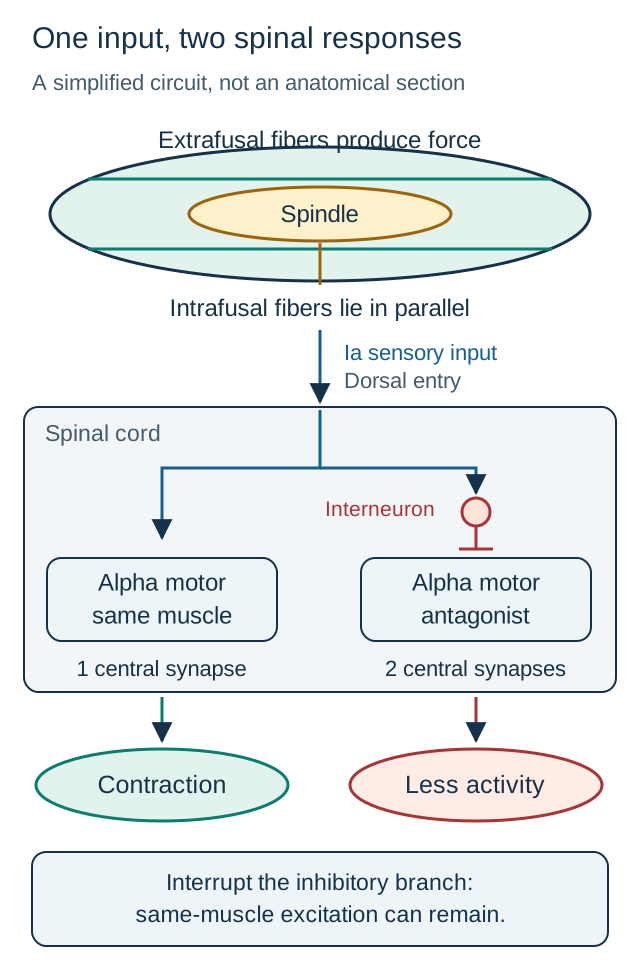
Use the reflex diagram to follow two branches. The sensory signal enters the spinal cord through a dorsal root. One branch directly excites an alpha motor neuron supplying the same muscle. Its axon exits through a ventral root and activates extrafusal fibers. That contraction opposes imposed lengthening. A second branch recruits an inhibitory interneuron that reduces alpha motor activity to the antagonist. This is reciprocal inhibition. The excitatory limb has one central synapse; the antagonist branch includes an additional neuron. Calling the stretch reflex monosynaptic does not make every associated branch monosynaptic. [1]
Follow the blue sensory path to both branches. The direct limb has one central synapse; the antagonist limb has two. Imagine loss of the red interneuron output and predict which response remains. Motor outputs leave through ventral roots, not through the sensory entry. Diagram proportions are schematic. [1]
Alpha motor neurons produce ordinary muscle force. Gamma motor neurons adjust the contractile ends of intrafusal fibers and thereby influence spindle sensitivity. During voluntary shortening, coordinated alpha and gamma activity helps keep the spindle responsive. A Golgi tendon organ instead lies in series with force transmission and signals tension through group Ib afferents. These are different sensors and pathways, not interchangeable explanations for every decrease in resistance. [1][2]
Trace and predict: In the diagram, imagine that Ia input still reaches the cord but the local inhibitory interneuron cannot signal. Predict the response in the stretched muscle and its antagonist before checking your answer.
Compare the two branches
Direct excitation of the stretched muscle can remain. The usual reduction in antagonist activity is impaired. Losing one local branch does not require losing the intact direct connection. This is a simplified circuit prediction, not a diagnostic test for a person. [1]
Now transfer the reasoning: if the sensory limb is interrupted before entering the cord, neither branch receives that stretch signal. Direct electrical stimulation of an intact downstream motor nerve could still produce contraction. A missing tendon response therefore does not, by itself, prove that muscle fibers cannot contract. Palpable stiffness alone cannot locate a defect in a dorsal root, motor axon, or fascial layer. [1][2]
Which direction is being loaded, and who supplies the effort?
For a patient whose tissue glides more freely rightward than leftward, leftward resistance identifies the restrictive direction. The word barrier means the assessed restriction, not permission to force a joint beyond its safe range. Myofascial release uses ongoing palpatory feedback while loading fascia and related musculature. Its direct and indirect forms differ in their relationship to that restriction. [3]
Two observations are needed to identify the described method
Method
Direction or task
Patient participation
MethodDirect myofascial release
Direction or taskLoad toward the assessed restrictive barrier
Patient participationRelaxed during the passive approach described here
MethodIndirect myofascial release
Direction or taskGuide loaded tissues toward greatest ease
Patient participationRelaxed during the passive approach described here
MethodMuscle energy
Direction or taskUse a precisely directed contraction against clinician counterforce
Patient participationIntentional muscular effort is part of treatment
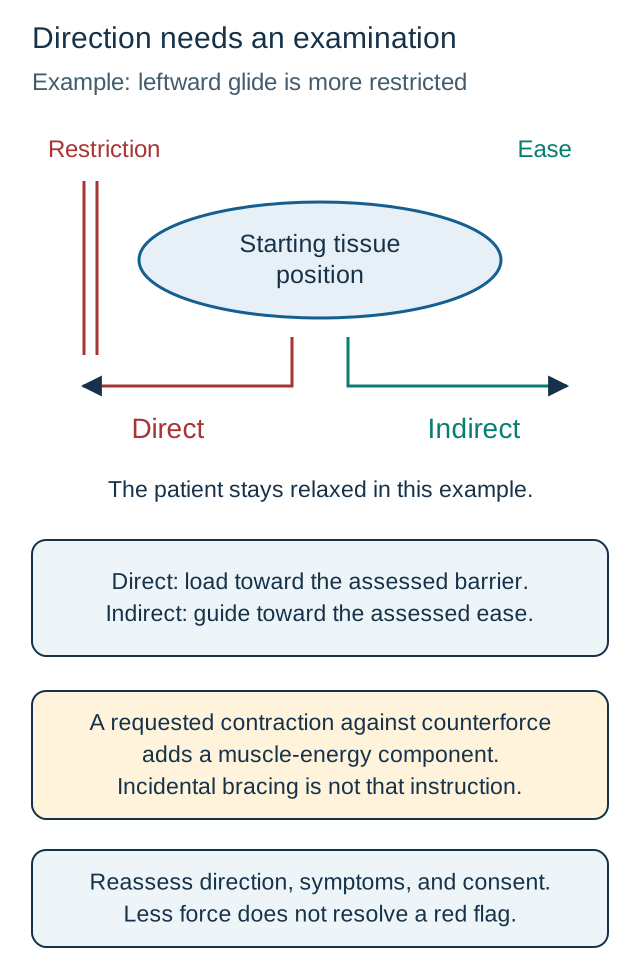
The direction diagram keeps the starting position between ease and restriction. For the same examination, a passive leftward load is direct and a passive rightward placement is indirect. Neither the side of the body nor the direction of the clinician's hands in the room is enough without knowing the patient's restriction. Deliberate contraction against resistance adds a different treatment component. Incidental bracing from discomfort is not a requested muscle-energy contraction. [3]
Read the restriction first, then classify the arrow. Reverse the examination findings and the same external direction receives a different label. These arrows describe relative direction, not a force prescription or permission to exceed a safe range. [3]
Compare two plans: The right forearm tolerates loading toward its restriction. The left becomes uncomfortable there but is comfortable toward ease. Screening shows no injury or neurological warning signs. Keep the patient relaxed and choose a direction for each side.
Explain the different choices
A tolerated direct approach on the right and a tolerated indirect approach on the left fit the described findings. This does not establish that one method is universally better, or that every uncomfortable area should be treated. Reassess each region separately. [3][6]
For transfer, suppose the clinician asks the patient to contract against a matched counterforce, followed by relaxation and reassessment. Describe that added muscle-energy component explicitly. Do not label the entire session from the last passive position, or use pain relief to decide which technique was performed. The treatment description comes from what happened; its benefit is a separate question. [3]
What are the hands actually sampling?
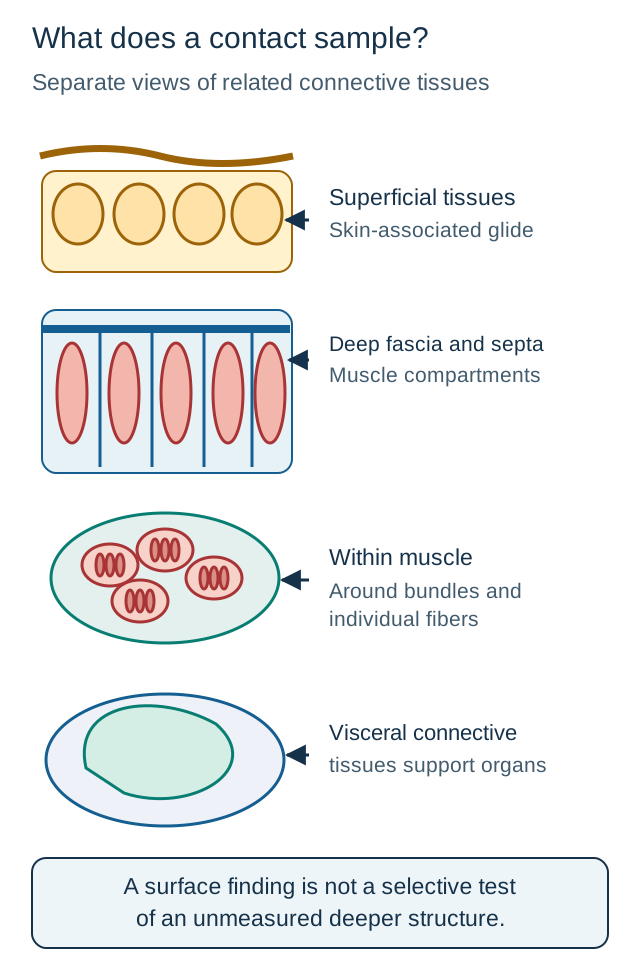
Fascia is not one identical sheet beneath every contact. The layer diagram distinguishes superficial tissue associated with skin glide, deeper sheets and septa related to muscle compartments, and connective tissues supporting viscera. Intramuscular connective tissues surround bundles and individual fibers. These tissues support, separate, connect, and transmit forces between structures. The broader term fascial system groups many connected tissues; an anatomical description should still identify the particular structure being discussed. [4]
Compare the structure actually examined with the structure named in a proposed explanation. These are separate representative views, not one literal cross-section through all body regions. Connectivity does not establish that a superficial restriction proves deep fibrosis. [4]
Connectivity does not establish that every symptom has a remote fascial cause. Force transmission between neighboring tissues has experimental support, but its magnitude and clinical relevance depend on the preparation and loading conditions. A superficial contact is not a selective assay of deep collagen, organ mobility, or spindle firing. Tissue hydration, connective-tissue organization, active muscle tension, joint position, pain, and protective guarding can all affect the mechanical situation. Some are tissue properties; others change how the patient responds during examination. [1][4]
Consider two observations at the same forearm: with the elbow unsupported, the patient braces and the wrist feels resistant; with support, visible bracing decreases and motion is easier. The useful conclusion is that the examination is sensitive to support and muscular participation. That comparison does not prove that collagen reorganized within seconds, nor does it rule out a connective-tissue contribution.
Separate observation from explanation: Describe the two forearm assessments without naming an unmeasured microscopic event. Then identify one condition you would keep the same on the next comparison.
Check a defensible description
For example: wrist excursion increased when the forearm was supported and visible guarding decreased. Repeat with the same joint position, support, test direction, and approximate applied load. A consistent comparison is more informative than changing several conditions and crediting one tissue. This is an inference from the supplied observations, not proof of a treatment mechanism.
Apply this to a new region: abdominal or chest-wall discomfort should not be assigned to visceral fascia merely because the region contains it. History, examination, and serious alternative diagnoses come first. Anatomical continuity supports careful investigation; it does not replace localization or medical assessment. [4][6][9]
Why does loading rate matter without proving a reset?
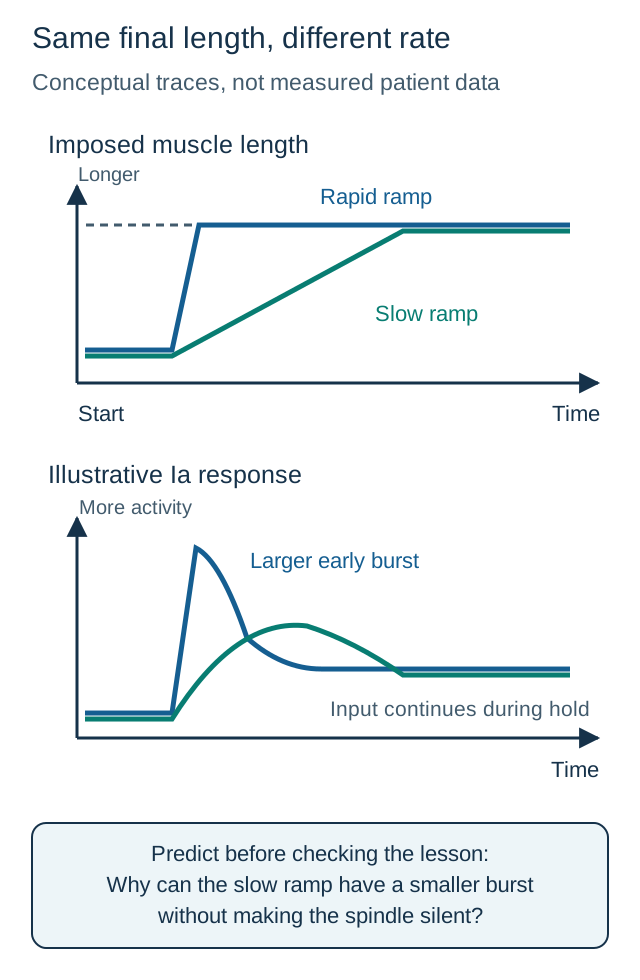
Compare two idealized length changes in the rate diagram. Both end at the same length, but one arrives abruptly while the other takes longer. During lengthening, the faster ramp provides a greater rate-related stimulus to dynamic spindle signaling under otherwise matched conditions. A slower ramp is not the same as no spindle input: maintained length can still be represented. The diagram predicts the role of rate, not a measured firing rate or a required treatment duration. [1][2]
Compare the slope during lengthening before comparing the held response. Colors are also labeled by ramp name. Trace separation at the final level is for visibility, not a difference in final length. These qualitative curves have no physiological scale, treatment dose, or diagnostic threshold. [1][2]
Slow, graded fascial loading avoids deliberately reproducing the abrupt muscle-length change of a tendon tap. It also gives the clinician time to monitor symptoms, tissue response, and consent. Applying that reasoning to myofascial release is a physiological rationale, not evidence that the intervention permanently lowers gamma activity or that every palpable response is a stretch-reflex change. Connective-tissue mechanics and the patient's pain-related response can contribute as well. [1][3][4]
Force, direction, time, and tolerance are separate variables. A low force in a poorly tolerated direction can still be inappropriate. Longer contact is not automatically more effective. A useful treatment description states the region, assessed restriction, direction, approximate duration, patient participation, and response rather than invoking a universal dose or waiting for a dramatic sensation. [3][9]
Predict from matched inputs: In a spindle recording, an abrupt ramp produces a larger initial burst than a slow ramp, while both retain activity at their shared final length. Which part of the response reflects rate, and which observation argues against complete sensory silence?
Interpret the recording
The larger early burst is consistent with a dynamic, rate-sensitive response. Continuing discharge after both ramps shows that the ending position still supplies sensory information. This does not measure gamma activity or establish how a clinical treatment changed symptoms. [1][2]
Transfer this to patient care: if increased pressure produces stronger guarding, reduce or stop the load and reassess the contact, direction, and underlying diagnosis. Sharp pain, new tingling, weakness, unexpected instability, or systemic distress require stopping rather than merely slowing the same maneuver. A failure to improve should prompt reconsideration of suitability and the care plan, not automatic pressure escalation. [6][7][9]
What does an improvement actually establish?
A response can matter without proving its mechanism. In a reassessment using the same forearm position, active wrist extension increases from 45 to 55 degrees and discomfort during that task decreases from 5/10 to 3/10. Those are observations at that assessment. They do not alone establish durable benefit, a clinically important change for every patient, or a particular neural or collagen event. Without a comparison condition, they also cannot isolate the treatment from repeated testing, expectation, natural variation, or other care.
Actual trial evidence needs the same discipline. In a sham-controlled trial of 54 people with nonspecific chronic low back pain, the group receiving myofascial release had improvements on the Short Form McGill Pain Questionnaire, disability, and fear-avoidance measures relative to sham, but not a between-group difference on the visual analog pain scale. The authors explicitly noted uncertainty about whether the improvements were clinically important. A positive result on one measure is not a positive result on every measure, and this trial did not demonstrate a permanent spindle or collagen reset. [5]
NICE guidance for low back pain places manual therapy, when considered, within a treatment package that includes exercise. That recommendation concerns a broader management plan, not proof that a specific myofascial technique works for every diagnosis or should replace active rehabilitation. Define a meaningful task with the patient and reassess whether the plan helps it. [6]
Choose the stronger note: Compare a claim that fascia permanently normalized with a note recording treatment direction, tolerance, and the same before-and-after wrist task. Identify what a later visit would need to assess before calling the benefit sustained.
Keep the conclusion proportional
The second note allows someone else to understand what was done and what changed. A later comparison should repeat the relevant task and ask about function between visits. Persistence would strengthen a claim of sustained clinical response, but still would not identify a molecular mechanism. The numbers above are teaching examples, not published trial results.
A concise clinical record could read: Passive direct loading of the assessed left forearm restriction was tolerated without paresthesia. In the same test position, active wrist extension was 45 degrees before and 55 degrees after; task discomfort was 5/10 and 3/10. Reassess function and tolerance at follow-up. There is no need to invent gamma measurements to document useful care. [3][9]
When is the right decision not to treat the restriction?
First ask whether loading the region is appropriate. After a fall, focal midline spinal tenderness or new neurological findings raise concern for injury even when surrounding muscles feel tight. Manual treatment should not be used as a diagnostic trial to see whether a possible fracture is just guarding. Follow an appropriate injury assessment pathway and avoid provocative loading while that concern is unresolved. [7]
Local infection, an open wound or fresh incision, suspected malignancy at the painful site, or an unstable injury changes the plan. Defer local loading and obtain relevant assessment or treating-team guidance. A history of cancer is not an automatic lifetime prohibition on all supportive touch, but a new concerning lesion or unexplained pain must not be dismissed as fascia. The concern is unsafe tissue loading or delayed diagnosis; this lesson does not claim that gentle contact mechanically spreads cancer. [6][9]
Match the response to the clinical problem
Current finding
Priority
Current findingTolerable restriction after appropriate assessment
PrioritySelect a consensual, monitored approach and a reassessment target
Current findingIncreasing local discomfort or guarding
PriorityReduce or stop loading and reassess before deciding whether to continue
Current findingSharp pain, new paresthesia or weakness, or unexpected instability
PriorityStop the maneuver and evaluate the new finding; escalate urgently when indicated
Current findingSevere radiating back pain with new urinary dysfunction or perineal numbness
PriorityImmediate assessment for possible cauda equina syndrome
Do not substitute an indirect technique for an unresolved red flag. Less force may change tolerability, but it does not exclude a fracture, infection, or neural compression. New pallor, sweating, faintness, or other systemic distress also calls for stopping, safe positioning, and clinical assessment rather than interpretation as evidence of tissue release. Consent can be withdrawn at any time. [7][8][9]
Choose the first action: A patient with recurrent low back tightness now reports difficulty initiating urination and new numbness around the perineum. The muscles are tender and an earlier manual session helped. Decide whether the previous response makes another session appropriate.
Explain what changes the plan
The new neurological and urinary symptoms take priority over familiar muscle findings or earlier benefit. Stop the manual-treatment plan and arrange immediate assessment for possible cauda equina syndrome using the local emergency pathway. Relief in a prior episode cannot exclude a new serious condition. [8]
For a different patient with no warning signs and mild, position-dependent discomfort, a gentler contact or ease-directed approach may be reasonable after reassessment and renewed agreement. The distinction is not that direct is dangerous and indirect is safe. It is whether the current diagnosis, tissue condition, patient preference, and response support this particular intervention. [3][6][9]
Apply the physiology and clinical decisions
For each case, determine what changed, identify which finding separates the closest alternatives, and choose the conclusion that the evidence supports. Use the examination findings to compare mechanisms; they do not validate test performance.
Case 1
Show answer and explanations for case 1
A. Preserved quadriceps excitation and hamstring inhibition (Why this does not fit)
Both responses were present before interruption because the stretch signal reached the spinal circuit. Electrical stimulation bypasses the missing sensory input; it does not restore either stretch-triggered spinal response.
Reasoning steps for option A
Could these two responses occur with intact sensory entry?
Both responses were present before interruption because the stretch signal reached the spinal circuit.
Why does distal motor stimulation not preserve the reflex?
Electrical stimulation bypasses the missing sensory input; it does not restore either stretch-triggered spinal response.
B. Preserved quadriceps excitation with loss of hamstring inhibition (Why this does not fit)
An isolated defect in the inhibitory interneuron could preserve quadriceps excitation. No. The interruption precedes both branches, so the quadriceps loses its stretch-triggered excitation as well.
Reasoning steps for option B
Which selective lesion could spare the direct branch?
An isolated defect in the inhibitory interneuron could preserve quadriceps excitation.
Is that the location interrupted here?
No. The interruption precedes both branches, so the quadriceps loses its stretch-triggered excitation as well.
C. Loss of quadriceps excitation and hamstring inhibition (Best answer)
The sensory volley normally supplies both the direct excitatory branch and the inhibitory interneuron branch. The downstream motor pathway can still contract the quadriceps, but neither spinal branch receives the new stretch signal.
Reasoning steps for option C
Which shared input has been interrupted?
The sensory volley normally supplies both the direct excitatory branch and the inhibitory interneuron branch.
What does preserved distal motor stimulation establish?
The downstream motor pathway can still contract the quadriceps, but neither spinal branch receives the new stretch signal.
D. Loss of quadriceps excitation with preserved hamstring inhibition (Why this does not fit)
The interneuron would need to receive a stretch signal through an intact sensory input. No. The same interrupted volley normally supplies both branches, even though the distal motor nerve remains functional.
Reasoning steps for option D
What would preserve antagonist inhibition?
The interneuron would need to receive a stretch signal through an intact sensory input.
Does this preparation supply that input?
No. The same interrupted volley normally supplies both branches, even though the distal motor nerve remains functional.
Takeaway: An absent reflex and an inability to contract are different findings.
A. Stretched-muscle excitation persists; antagonist suppression decreases (Best answer)
Ia input still directly excites the motor neurons supplying the stretched muscle. Antagonist suppression depends on the blocked inhibitory interneuron, so it decreases despite retained direct excitation.
Reasoning steps for option A
Which branch remains connected?
Ia input still directly excites the motor neurons supplying the stretched muscle.
Which output depends on the interrupted connection?
Antagonist suppression depends on the blocked inhibitory interneuron, so it decreases despite retained direct excitation.
B. Stretched-muscle excitation decreases; antagonist suppression persists (Why this does not fit)
A selective defect in the homonymous motor pathway could reduce stretched-muscle excitation. It leaves the direct pathway intact and instead interrupts the connection required for antagonist suppression.
Reasoning steps for option B
What could reduce only the direct response?
A selective defect in the homonymous motor pathway could reduce stretched-muscle excitation.
Does the supplied intervention affect that pathway?
It leaves the direct pathway intact and instead interrupts the connection required for antagonist suppression.
C. Both stretched-muscle excitation and antagonist suppression decrease (Why this does not fit)
A shared sensory-input interruption could deprive both branches of the stretch signal. Ia impulses still enter the cord and excite the homonymous motor neurons, so a loss of both effects is not predicted.
Reasoning steps for option C
When could both branches lose their response?
A shared sensory-input interruption could deprive both branches of the stretch signal.
Is shared sensory input absent here?
Ia impulses still enter the cord and excite the homonymous motor neurons, so a loss of both effects is not predicted.
D. Both stretched-muscle excitation and antagonist suppression persist (Why this does not fit)
The direct pathway and the antagonist inhibitory connection would both need to function. The inhibitory interneuron cannot communicate with antagonist motor neurons; intact Ia entry cannot replace that connection.
Reasoning steps for option D
What would be needed for both responses to persist?
The direct pathway and the antagonist inhibitory connection would both need to function.
Which necessary connection is unavailable?
The inhibitory interneuron cannot communicate with antagonist motor neurons; intact Ia entry cannot replace that connection.
Takeaway: Reciprocal inhibition requires an interneuron that the direct excitatory limb does not require.
A. Reduced muscle shortening despite preserved spindle tension (Why this does not fit)
Alpha output activates the extrafusal fibers responsible for ordinary muscle force. No. Alpha-driven shortening is preserved, while the reported loss of tension is in the spindle.
Reasoning steps for option A
Which motor output chiefly produces the observed shortening?
Alpha output activates the extrafusal fibers responsible for ordinary muscle force.
Does the intervention remove that output?
No. Alpha-driven shortening is preserved, while the reported loss of tension is in the spindle.
B. Increased spindle responsiveness with reduced muscle shortening (Why this does not fit)
Maintained intrafusal tension supports sensory responsiveness during shortening. The stem supplies the opposite pattern: less spindle tension with preserved alpha-driven shortening.
Reasoning steps for option B
Could greater spindle tension increase responsiveness?
Maintained intrafusal tension supports sensory responsiveness during shortening.
Are increased tension and reduced shortening reported?
The stem supplies the opposite pattern: less spindle tension with preserved alpha-driven shortening.
C. Preserved spindle tension with unchanged sensory responsiveness (Why this does not fit)
Coordinated gamma activation can prevent the spindle from becoming mechanically unloaded. Gamma activation is reduced and the sensory region becomes less taut, so unchanged tension is inconsistent with the observation.
Reasoning steps for option C
How can responsiveness be maintained during shortening?
Coordinated gamma activation can prevent the spindle from becoming mechanically unloaded.
Is that compensation intact in the experiment?
Gamma activation is reduced and the sensory region becomes less taut, so unchanged tension is inconsistent with the observation.
D. Less spindle responsiveness during intact shortening (Best answer)
Gamma motor neurons activate intrafusal ends that help maintain tension around the sensory region. The spindle becomes less taut and less responsive even though extrafusal shortening remains possible.
Reasoning steps for option D
Which fibers does gamma output influence?
Gamma motor neurons activate intrafusal ends that help maintain tension around the sensory region.
What follows when this support falls during intact alpha activation?
The spindle becomes less taut and less responsive even though extrafusal shortening remains possible.
A. Golgi tendon organ; group Ib force information (Why this does not fit)
The stimulus is applied to a tendon, and Golgi tendon organs signal force through group Ib fibers. The recorded endings surround intrafusal fibers arranged in parallel, identifying a spindle rather than an in-series tendon organ.
Reasoning steps for option A
Why is a tendon organ a tempting choice?
The stimulus is applied to a tendon, and Golgi tendon organs signal force through group Ib fibers.
Which supplied anatomical feature separates the receptors?
The recorded endings surround intrafusal fibers arranged in parallel, identifying a spindle rather than an in-series tendon organ.
B. Muscle spindle; group Ia length and rate information (Best answer)
The muscle spindle lies alongside extrafusal fibers and senses their associated length changes. Group Ia spindle afferents convey length and rate information, explaining the initial burst.
Reasoning steps for option B
Which receptor contains parallel intrafusal fibers?
The muscle spindle lies alongside extrafusal fibers and senses their associated length changes.
Which signal fits the early response to rapid lengthening?
Group Ia spindle afferents convey length and rate information, explaining the initial burst.
C. Muscle spindle; gamma motor length information (Why this does not fit)
Gamma motor neurons adjust intrafusal tension and influence its sensitivity. No. Gamma fibers are motor output to the spindle; the afferent burst described here travels in sensory fibers.
Reasoning steps for option C
What does gamma activity contribute to a spindle?
Gamma motor neurons adjust intrafusal tension and influence its sensitivity.
Is gamma output the recorded sensory burst?
No. Gamma fibers are motor output to the spindle; the afferent burst described here travels in sensory fibers.
D. Golgi tendon organ; alpha motor force information (Why this does not fit)
Alpha motor neurons activate force-producing extrafusal fibers. No. Alpha output is not tendon-organ sensory input, and the stated parallel intrafusal arrangement identifies a spindle.
Reasoning steps for option D
Why might alpha output be associated with force?
Alpha motor neurons activate force-producing extrafusal fibers.
Does that identify the afferent receptor in this recording?
No. Alpha output is not tendon-organ sensory input, and the stated parallel intrafusal arrangement identifies a spindle.
Takeaway: Identify the sensory structure rather than naming a receptor from the site of the hammer tap.
A. Both limbs have one central synapse because they share sensory input (Why this does not fit)
Both branches begin with the same sensory fiber from the stretched muscle. No. The antagonist route still passes through an additional neuron before reaching its motor output.
Reasoning steps for option A
Why might shared input suggest a common count?
Both branches begin with the same sensory fiber from the stretched muscle.
Does shared origin eliminate the interneuron connection?
No. The antagonist route still passes through an additional neuron before reaching its motor output.
B. Both limbs have two central synapses because motor axons reach muscle (Why this does not fit)
The motor axon communicates with muscle at a peripheral neuromuscular junction. No. The question concerns spinal connections; the homonymous central limb remains monosynaptic.
Reasoning steps for option B
What additional connection does a motor axon make?
The motor axon communicates with muscle at a peripheral neuromuscular junction.
Is that junction a second central synapse?
No. The question concerns spinal connections; the homonymous central limb remains monosynaptic.
C. The excitatory limb has one central synapse; the antagonist limb has two (Best answer)
The sensory neuron contacts the homonymous alpha motor neuron without an intervening neuron. It includes sensory-to-interneuron and interneuron-to-motor-neuron connections, so reciprocal inhibition adds a central synapse.
Reasoning steps for option C
Where is the direct connection?
The sensory neuron contacts the homonymous alpha motor neuron without an intervening neuron.
How does the antagonist branch differ?
It includes sensory-to-interneuron and interneuron-to-motor-neuron connections, so reciprocal inhibition adds a central synapse.
D. The excitatory limb has two central synapses; the antagonist limb has one (Why this does not fit)
An intervening neuron adds a connection between sensory input and motor output. The supplied diagram places it in the antagonist branch, not the direct homonymous branch.
Reasoning steps for option D
Where could an extra central synapse occur?
An intervening neuron adds a connection between sensory input and motor output.
Which branch actually contains that neuron?
The supplied diagram places it in the antagonist branch, not the direct homonymous branch.
Takeaway: The monosynaptic label applies to the direct excitatory limb, not every associated response.
A. Sensory conduction between the spindle and spinal cord (Why this does not fit)
The spinal circuit would not receive its initiating stretch signal. A normal sensory volley enters the cord and activates the alpha motor neurons, demonstrating preserved upstream signaling.
Reasoning steps for option A
How could sensory conduction failure abolish a reflex?
The spinal circuit would not receive its initiating stretch signal.
Which finding contradicts that location here?
A normal sensory volley enters the cord and activates the alpha motor neurons, demonstrating preserved upstream signaling.
B. Motor conduction between the activated neuron and distal nerve (Best answer)
It shows that the sensory volley and central excitation have reached the alpha motor neuron. The distal nerve and muscle can respond, placing the demonstrated failure in the intervening motor-conduction segment.
Reasoning steps for option B
What does normal spinal motor activation preserve?
It shows that the sensory volley and central excitation have reached the alpha motor neuron.
What does distal stimulation add?
The distal nerve and muscle can respond, placing the demonstrated failure in the intervening motor-conduction segment.
C. Transmission from the distal motor nerve to muscle fibers (Why this does not fit)
Stimulating the affected distal motor pathway would fail to produce the expected contraction. No. It produces contraction, so the stated focal interruption is proximal to that responsive distal pathway.
Reasoning steps for option C
What would a distal motor or neuromuscular failure predict?
Stimulating the affected distal motor pathway would fail to produce the expected contraction.
Does the supplied distal stimulation behave that way?
No. It produces contraction, so the stated focal interruption is proximal to that responsive distal pathway.
D. Spinal excitation between the afferent and motor neuron (Why this does not fit)
Failure of sensory-to-motor excitation could prevent motor neurons from responding to an incoming volley. The appropriate alpha motor neurons activate normally; their output then encounters the stated conduction block.
Reasoning steps for option D
Why might a spinal connection explain a missing reflex?
Failure of sensory-to-motor excitation could prevent motor neurons from responding to an incoming volley.
Which measurement excludes that explanation for this preparation?
The appropriate alpha motor neurons activate normally; their output then encounters the stated conduction block.
Takeaway: Follow preserved signals to locate an interruption before attributing an absent response to muscle stiffness.
A. A neural contribution is supported; assess tissue factors (Best answer)
They support an increased reflex-related contribution to passive resistance in this neurological setting. The examination does not isolate fascia or exclude coexisting tissue restriction, and it does not justify simply adding force.
Reasoning steps for option A
What do brisk reflexes and rate dependence suggest together?
They support an increased reflex-related contribution to passive resistance in this neurological setting.
What conclusion about fascia is justified?
The examination does not isolate fascia or exclude coexisting tissue restriction, and it does not justify simply adding force.
B. A fixed fascial restriction is established; greater force is indicated (Why this does not fit)
It could limit excursion even during a slowly performed passive assessment. Substantially greater excursion at slow speed, with brisk reflexes, supports a neural rate-dependent contribution rather than proof of fixed fascia alone.
Reasoning steps for option B
What could fixed tissue shortening do?
It could limit excursion even during a slowly performed passive assessment.
Which supplied comparison makes that explanation insufficient?
Substantially greater excursion at slow speed, with brisk reflexes, supports a neural rate-dependent contribution rather than proof of fixed fascia alone.
C. Loss of sensory reflex input is supported; strengthening is the priority (Why this does not fit)
It would reduce the stretch-triggered signal entering the spinal reflex circuit. Brisk reflexes and greater rapid-stretch resistance do not fit an absent sensory reflex input as the main explanation.
Reasoning steps for option C
What would loss of stretch sensory input tend to impair?
It would reduce the stretch-triggered signal entering the spinal reflex circuit.
How do the findings compare with that prediction?
Brisk reflexes and greater rapid-stretch resistance do not fit an absent sensory reflex input as the main explanation.
D. The muscle is voluntarily resisting; reflex findings are unrelated (Why this does not fit)
Guarding or intentional contraction can affect a passive examination. The documented central injury, brisk reflexes, and reproducible speed dependence supply evidence for a neural reflex contribution that should not be dismissed.
Reasoning steps for option D
Could voluntary effort contribute to resistance?
Guarding or intentional contraction can affect a passive examination.
Why is it insufficient as the sole interpretation here?
The documented central injury, brisk reflexes, and reproducible speed dependence supply evidence for a neural reflex contribution that should not be dismissed.
Takeaway: Rate-dependent resistance with neurological findings warrants a neural interpretation, not automatic force escalation.
A. Indirect myofascial release with guarding that requires reassessment (Why this does not fit)
The clinician would guide the loaded tissue toward its assessed position of greater ease. No. The leftward load engages the restrictive direction, so the appropriate concern about guarding does not make the approach indirect.
Reasoning steps for option A
What direction would make the approach indirect?
The clinician would guide the loaded tissue toward its assessed position of greater ease.
Is that the direction used in this case?
No. The leftward load engages the restrictive direction, so the appropriate concern about guarding does not make the approach indirect.
B. Muscle energy with contraction that demonstrates correct participation (Why this does not fit)
The patient deliberately contracts in a specified direction against clinician counterforce. No. The contraction appeared with discomfort during a relaxation instruction, so treating it as successful participation misidentifies the intervention.
Reasoning steps for option B
What participation defines muscle energy?
The patient deliberately contracts in a specified direction against clinician counterforce.
Was that task requested?
No. The contraction appeared with discomfort during a relaxation instruction, so treating it as successful participation misidentifies the intervention.
C. Direct myofascial release with bracing that confirms treatment benefit (Why this does not fit)
The passive load is directed toward the assessed restriction. It follows rising discomfort and does not establish benefit; increased guarding calls for reassessment rather than confirmation of success.
Reasoning steps for option C
Why is the direct label appropriate?
The passive load is directed toward the assessed restriction.
What does the new bracing actually establish?
It follows rising discomfort and does not establish benefit; increased guarding calls for reassessment rather than confirmation of success.
D. Direct myofascial release with guarding that requires reassessment (Best answer)
Loading leftward engages the assessed leftward restriction, making the attempted passive approach direct. No directed contraction was requested; bracing instead signals a need to reduce or stop loading and reassess tolerance.
Reasoning steps for option D
Which direction defines the attempted approach?
Loading leftward engages the assessed leftward restriction, making the attempted passive approach direct.
Does discomfort-related bracing establish muscle energy?
No directed contraction was requested; bracing instead signals a need to reduce or stop loading and reassess tolerance.
Takeaway: Incidental guarding does not turn a passive technique into muscle energy.
A. Indirect at the first; direct at the second (Why this does not fit)
It is the direction of ease rather than the side or compass direction alone. Inferior loading is restricted at the first shoulder and easier at the second, so the first is direct and the second indirect.
Reasoning steps for option A
What defines the indirect direction?
It is the direction of ease rather than the side or compass direction alone.
Which findings reverse this proposed pair?
Inferior loading is restricted at the first shoulder and easier at the second, so the first is direct and the second indirect.
B. Direct at the first; indirect at the second (Best answer)
It approaches the first shoulder restriction and is therefore direct. It follows the second shoulder toward ease and is therefore indirect while participation remains passive.
Reasoning steps for option B
How does inferior loading relate to the first examination?
It approaches the first shoulder restriction and is therefore direct.
How does the same direction relate to the second examination?
It follows the second shoulder toward ease and is therefore indirect while participation remains passive.
C. Direct at both shoulders (Why this does not fit)
Both examinations would need to identify restriction in that direction. No. It is the direction of ease at the second shoulder, so that component is indirect.
Reasoning steps for option C
When would the same direction be direct at both sites?
Both examinations would need to identify restriction in that direction.
Is inferior glide restricted on both sides here?
No. It is the direction of ease at the second shoulder, so that component is indirect.
D. Indirect at both shoulders (Why this does not fit)
Inferior placement would have to guide both regions toward ease. The first shoulder is restricted inferiorly, so inferior loading there is direct.
Reasoning steps for option D
When would both approaches be indirect?
Inferior placement would have to guide both regions toward ease.
Which region does not meet that condition?
The first shoulder is restricted inferiorly, so inferior loading there is direct.
Takeaway: The same direction can be direct in one region and indirect in another.
A. Indirect myofascial release followed by muscle energy (Why this does not fit)
It asks for a directed voluntary contraction against clinician resistance. The first passive contact is toward the restriction, not toward ease, so it is direct rather than indirect.
Reasoning steps for option A
Why does the later component fit muscle energy?
It asks for a directed voluntary contraction against clinician resistance.
Why is the first label incorrect?
The first passive contact is toward the restriction, not toward ease, so it is direct rather than indirect.
B. Direct myofascial release followed by indirect release (Why this does not fit)
The relaxed tissues would be guided toward their assessed position of ease. The patient performs a requested contraction against counterforce, so passive direction alone does not describe that component.
Reasoning steps for option B
What would identify an indirect second component?
The relaxed tissues would be guided toward their assessed position of ease.
What is actually added in the second phase?
The patient performs a requested contraction against counterforce, so passive direction alone does not describe that component.
C. Direct myofascial release followed by muscle energy (Best answer)
Passive loading toward the restriction is consistent with direct myofascial release. A precisely directed voluntary contraction against counterforce is the defining participation in muscle energy.
Reasoning steps for option C
What identifies the first component?
Passive loading toward the restriction is consistent with direct myofascial release.
Which later instruction adds a different component?
A precisely directed voluntary contraction against counterforce is the defining participation in muscle energy.
D. Muscle energy followed by direct myofascial release (Why this does not fit)
It would need a requested, precisely directed muscular effort. It is added in the second phase; the initial contact is passive and barrier-directed.
Reasoning steps for option D
What must the first phase include to qualify as muscle energy?
It would need a requested, precisely directed muscular effort.
Where does that effort occur in the described sequence?
It is added in the second phase; the initial contact is passive and barrier-directed.
Takeaway: Record a combined session by its actual components rather than giving every phase one label.
A. Maintain barrier-directed loading at the same force for longer (Why this does not fit)
Sustained loading is part of some direct myofascial techniques. The current load is increasingly uncomfortable and exceeds the stated preference; duration does not override tolerance or consent.
Reasoning steps for option A
Why might a clinician consider maintaining a load?
Sustained loading is part of some direct myofascial techniques.
Why is that not the best plan under these conditions?
The current load is increasingly uncomfortable and exceeds the stated preference; duration does not override tolerance or consent.
B. Add repeated contractions against the uncomfortable barrier (Why this does not fit)
Precisely directed contractions against counterforce would introduce muscle energy. The patient has agreed only to the comfortable approach; adding effort at the uncomfortable barrier does not address the limiting conditions.
Reasoning steps for option B
What treatment component would requested contractions add?
Precisely directed contractions against counterforce would introduce muscle energy.
Why does that not follow from the supplied assessment?
The patient has agreed only to the comfortable approach; adding effort at the uncomfortable barrier does not address the limiting conditions.
C. Begin a resisted exercise set before reassessing the contact (Why this does not fit)
Exercise may belong in an individualized rehabilitation plan. The current issue is an uncomfortable contact and consent limited to a comfortable approach; adding effort without reassessment does not address those constraints.
Reasoning steps for option C
Could exercise belong in an appropriate rehabilitation plan?
Yes. Exercise may be selected according to the diagnosis, goals, and patient preference.
Why is a new resisted set not the immediate answer here?
It does not address the uncomfortable contact or the stated consent; reassess first and choose within the agreed comfortable approach.
D. Use tolerated ease-directed loading with ongoing reassessment (Best answer)
The position of ease is comfortable, whereas the barrier-directed contact increases discomfort. A monitored indirect approach is consistent with the findings and preference; stop again if tolerance or consent changes.
Reasoning steps for option D
Which direction is better tolerated in the supplied assessment?
The position of ease is comfortable, whereas the barrier-directed contact increases discomfort.
What does the limited consent permit?
A monitored indirect approach is consistent with the findings and preference; stop again if tolerance or consent changes.
Takeaway: A tolerable indirect option may be reasonable after assessment, but is not a substitute for screening.
A. Direct initially; indirect at the later assessment (Best answer)
It engages the leftward restriction and is direct. Leftward is now the direction of ease, making the same passive direction indirect at that assessment.
Reasoning steps for option A
How does the first load relate to the initial restriction?
It engages the leftward restriction and is direct.
What does the later examination change?
Leftward is now the direction of ease, making the same passive direction indirect at that assessment.
B. Indirect initially; direct at the later assessment (Why this does not fit)
The load would guide the tissue toward the assessed ease. Only the later visit has leftward ease, so the proposed sequence is reversed.
Reasoning steps for option B
What finding would make a load indirect?
The load would guide the tissue toward the assessed ease.
Which visit actually has leftward ease?
Only the later visit has leftward ease, so the proposed sequence is reversed.
C. Direct at both visits because loading remains leftward (Why this does not fit)
The clinician uses the same external direction on both occasions. The relationship of leftward loading to the assessed barrier changes, so a fixed external direction does not preserve the classification.
Reasoning steps for option C
Why can repeating a direction seem like repeating a method?
The clinician uses the same external direction on both occasions.
What makes that label unreliable here?
The relationship of leftward loading to the assessed barrier changes, so a fixed external direction does not preserve the classification.
D. Indirect at both visits because the patient remains relaxed (Why this does not fit)
It supports a passive approach in the described treatment. No. Both forms can be passive; the direction relative to restriction distinguishes them.
Reasoning steps for option D
What does a relaxed patient identify?
It supports a passive approach in the described treatment.
Does passive participation determine direct versus indirect?
No. Both forms can be passive; the direction relative to restriction distinguishes them.
Takeaway: Technique direction is defined by the current examination, not yesterday's barrier.
A. Record the added excursion as proof of reduced gamma activation (Why this does not fit)
Gamma and alpha activity can influence spindle behavior and muscle response. No. Changed support and bracing make the mechanical comparison non-equivalent and do not supply a gamma measurement.
Reasoning steps for option A
Could neural activity influence resistance?
Gamma and alpha activity can influence spindle behavior and muscle response.
Was either activity measured in this comparison?
No. Changed support and bracing make the mechanical comparison non-equivalent and do not supply a gamma measurement.
B. Repeat the after-test using more force to confirm tissue lengthening (Why this does not fit)
A mechanical assessment depends partly on the load applied to the region. No. It would add another differing condition instead of matching the examinations.
Reasoning steps for option B
Why could increased test force produce more excursion?
A mechanical assessment depends partly on the load applied to the region.
Would changing force resolve the existing comparison problem?
No. It would add another differing condition instead of matching the examinations.
C. Repeat the task with the same support, position, and test direction (Best answer)
Forearm support changed, along with visible muscular bracing. Matching support, position, and direction reduces those examination differences before assigning the observed excursion change to treatment.
Reasoning steps for option C
Which condition changed besides treatment exposure?
Forearm support changed, along with visible muscular bracing.
How can the next assessment improve interpretation?
Matching support, position, and direction reduces those examination differences before assigning the observed excursion change to treatment.
D. Use the after-test alone because the baseline included guarding (Why this does not fit)
Bracing may have contributed to resistance during the initial unsupported assessment. No. The after-test describes current performance but cannot establish what changed because of treatment without a comparable assessment.
Reasoning steps for option D
Why is the guarded baseline difficult to interpret?
Bracing may have contributed to resistance during the initial unsupported assessment.
Does discarding comparison establish a treatment effect?
No. The after-test describes current performance but cannot establish what changed because of treatment without a comparable assessment.
Takeaway: A before-and-after comparison is strongest when the test conditions remain comparable.
A. Superficial glide is reduced; deeper status is undetermined (Best answer)
The observation concerns skin-associated superficial glide. No. It supports an anatomical relationship but does not determine the mechanical state or histology of deeper fascia.
Reasoning steps for option A
Which layer was directly assessed?
The observation concerns skin-associated superficial glide.
Does connectivity establish fibrosis in an unmeasured layer?
No. It supports an anatomical relationship but does not determine the mechanical state or histology of deeper fascia.
B. Deep fascial fibrosis is established by the superficial restriction (Why this does not fit)
Superficial and deeper connective tissues participate in a connected fascial system. No deeper measurement or histological evidence is supplied, so superficial restriction alone cannot establish deep fibrosis.
Reasoning steps for option B
Why might the deeper tissues be considered?
Superficial and deeper connective tissues participate in a connected fascial system.
What evidence is missing for the proposed diagnosis?
No deeper measurement or histological evidence is supplied, so superficial restriction alone cannot establish deep fibrosis.
C. The deeper fascia is normal because no deep finding is recorded (Why this does not fit)
An appropriate assessment would need to provide evidence about that structure. No. The stem leaves deeper status undetermined rather than documenting a normal assessment.
Reasoning steps for option C
What would support describing a deeper structure as normal?
An appropriate assessment would need to provide evidence about that structure.
Is lack of a recorded deeper examination equivalent to normality?
No. The stem leaves deeper status undetermined rather than documenting a normal assessment.
D. Reduced spindle sensitivity is established by the glide finding (Why this does not fit)
Muscle activity can affect resistance during a clinical examination. No. It supplies a surface mechanical observation, not a recording of spindle or gamma activity.
Reasoning steps for option D
Why could a neural mechanism enter the discussion?
Muscle activity can affect resistance during a clinical examination.
Does the supplied superficial glide assessment measure spindle sensitivity?
No. It supplies a surface mechanical observation, not a recording of spindle or gamma activity.
Takeaway: Fascial continuity does not make a superficial finding a selective test of every deeper structure.
A. Deep collagen lengthening explains the lower surface muscle activity (Why this does not fit)
Connective tissues contribute to the mechanical setting in which muscles act. No. No structural measurement was performed, so the explanation goes beyond the observed change in task activity.
Reasoning steps for option A
Could structural properties influence a clinical task?
Connective tissues contribute to the mechanical setting in which muscles act.
Does the surface recording identify a structural change?
No. No structural measurement was performed, so the explanation goes beyond the observed change in task activity.
B. Task response changed; structural causation is undetermined (Best answer)
It supports lower measured muscle activity during the reassessed task. It does not measure collagen structure or spindle-specific signaling, so those mechanisms remain untested.
Reasoning steps for option B
What does the surface recording add to the report?
It supports lower measured muscle activity during the reassessed task.
What does it not directly establish?
It does not measure collagen structure or spindle-specific signaling, so those mechanisms remain untested.
C. Lower gamma activity is established by the surface recording (Why this does not fit)
It can alter intrafusal tension and spindle sensitivity. No. The measurement does not identify gamma motor discharge or isolate a spindle mechanism.
Reasoning steps for option C
Why might gamma output be proposed?
It can alter intrafusal tension and spindle sensitivity.
Does a surface muscle recording selectively measure gamma output?
No. The measurement does not identify gamma motor discharge or isolate a spindle mechanism.
D. The response is uninterpretable because no biopsy was obtained (Why this does not fit)
It could provide information about sampled tissue structure rather than the task alone. No. Easier motion and lower recorded task activity are meaningful observations even though they do not specify a structural mechanism.
Reasoning steps for option D
What would tissue sampling add?
It could provide information about sampled tissue structure rather than the task alone.
Is a biopsy required to describe a clinical response?
No. Easier motion and lower recorded task activity are meaningful observations even though they do not specify a structural mechanism.
Takeaway: Measured muscle activity can change without proving collagen remodeling or a specific spindle mechanism.
A. Compare the same rate while changing force and direction together (Why this does not fit)
It could examine a different loading variable while holding rate constant. No. Rate does not vary, and two other inputs change together, so this does not test its independent contribution.
Reasoning steps for option A
What could a fixed-rate comparison help investigate?
It could examine a different loading variable while holding rate constant.
Does changing force and direction together isolate rate?
No. Rate does not vary, and two other inputs change together, so this does not test its independent contribution.
B. Repeat both contacts and compare only final pain scores (Why this does not fit)
They could show whether the observed symptom difference is reproducible. No. Repeating faster-firmer versus slower-lighter contacts still changes both variables together.
Reasoning steps for option B
Why might repeated pain measurements be useful?
They could show whether the observed symptom difference is reproducible.
Would that remove the original input confounding?
No. Repeating faster-firmer versus slower-lighter contacts still changes both variables together.
C. Keep the first contact and extend its duration before retesting (Why this does not fit)
Time under load is another treatment variable that can influence the response. No. It introduces a further variable instead of comparing rate under matched conditions.
Reasoning steps for option C
How could duration affect a contact?
Time under load is another treatment variable that can influence the response.
Does changing duration distinguish force from rate?
No. It introduces a further variable instead of comparing rate under matched conditions.
D. Vary rate while matching force, position, direction, and excursion (Best answer)
The second contact was both slower and lighter, so their contributions cannot be separated. A comparison that matches the other relevant inputs and varies rate addresses that specific explanation.
Reasoning steps for option D
Which two inputs changed in the initial comparison?
The second contact was both slower and lighter, so their contributions cannot be separated.
Which follow-up targets rate rather than another combined change?
A comparison that matches the other relevant inputs and varies rate addresses that specific explanation.
Takeaway: Changing force and rate together does not isolate the effect of either variable.
A. Rate alters the early burst; held-length input persists (Best answer)
The fast length change has the larger early sensory burst under matched background conditions. Both retain sensory activity at the final length, supporting sustained input rather than complete spindle silencing.
Reasoning steps for option A
What differs during the two ramps?
The fast length change has the larger early sensory burst under matched background conditions.
What does the shared held discharge establish?
Both retain sensory activity at the final length, supporting sustained input rather than complete spindle silencing.
B. Final length explains the early difference; rate has no contribution (Why this does not fit)
Spindles carry information about maintained length as well as dynamic changes. No. Final length is matched, whereas ramp rate differs, making the dynamic component the relevant contrast.
Reasoning steps for option B
Why does final length matter to spindle signaling?
Spindles carry information about maintained length as well as dynamic changes.
Does differing final length explain these early bursts?
No. Final length is matched, whereas ramp rate differs, making the dynamic component the relevant contrast.
C. Reduced motor drive explains the slow ramp; maintained input is absent (Why this does not fit)
Gamma activity can alter intrafusal tension and sensory responsiveness. Background motor drive is fixed and the held discharge remains nonzero, so both parts of this explanation conflict with the experiment.
Reasoning steps for option C
Could changed motor drive affect spindle behavior?
Gamma activity can alter intrafusal tension and sensory responsiveness.
Are those changes supplied here?
Background motor drive is fixed and the held discharge remains nonzero, so both parts of this explanation conflict with the experiment.
D. The early burst measures tissue force; the held rate measures fibrosis (Why this does not fit)
The mechanical input to a spindle changes with the length imposed on its intrafusal fibers. No. They are sensory discharge rates during controlled length changes, not a force measurement or a test for fibrosis.
A. Increase pressure until the examiner detects a tissue release (Why this does not fit)
Palpatory feedback can guide an ongoing myofascial technique. No. Seeking a particular sensation cannot substitute for reassessing the unchanged target and the intervention's suitability.
Reasoning steps for option A
Why might an examiner attend to tissue feedback?
Palpatory feedback can guide an ongoing myofascial technique.
Does an unchanged task establish that more pressure is needed?
No. Seeking a particular sensation cannot substitute for reassessing the unchanged target and the intervention's suitability.
B. Continue the same contact for a fixed extended duration (Why this does not fit)
Time under load is part of a treatment description and may be adjusted in context. No. Tolerance without benefit does not supply a universal time requirement or a reason to continue unchanged.
Reasoning steps for option B
Why might duration be considered?
Time under load is part of a treatment description and may be adjusted in context.
Does this assessment establish an effective additional duration?
No. Tolerance without benefit does not supply a universal time requirement or a reason to continue unchanged.
C. Record success because the patient experienced no adverse symptoms (Why this does not fit)
It supports that this contact was tolerated during the observed assessment. No. The targeted task was unchanged, so the note should distinguish tolerance from measured improvement.
Reasoning steps for option C
Why is the absence of new symptoms useful?
It supports that this contact was tolerated during the observed assessment.
Does tolerability establish the selected benefit?
No. The targeted task was unchanged, so the note should distinguish tolerance from measured improvement.
D. Reassess the target and plan before altering treatment (Best answer)
It has not shown improvement in the selected functional target despite acceptable tolerance. The finding does not identify insufficient force as the cause, so suitability, goals, and the broader plan should be reconsidered.
Reasoning steps for option D
What has the repeated task assessment shown?
It has not shown improvement in the selected functional target despite acceptable tolerance.
Why is reassessment preferable to pressure escalation?
The finding does not identify insufficient force as the cause, so suitability, goals, and the broader plan should be reconsidered.
Takeaway: A tolerated contact is not automatically a beneficial one, and no response does not prescribe more force.
A. Pain outcomes consistently favor treatment; the interval concerns precision alone (Why this does not fit)
A confidence interval describes uncertainty around an estimated effect. It also includes effects too small to meet that threshold, while one pain measure shows no between-group difference, contradicting consistent benefit.
Reasoning steps for option A
Why is interval width relevant?
A confidence interval describes uncertainty around an estimated effect.
Why does its location relative to the importance threshold matter?
It also includes effects too small to meet that threshold, while one pain measure shows no between-group difference, contradicting consistent benefit.
B. The visual analog result establishes that treatment has no pain effect (Why this does not fit)
It is a pain outcome that did not show a between-group difference in this trial. No. Another pain measure favored treatment; a null result on one measure does not establish no effect on every pain outcome.
Reasoning steps for option B
Why should the visual analog finding be reported?
It is a pain outcome that did not show a between-group difference in this trial.
Does that null finding erase all other information?
No. Another pain measure favored treatment; a null result on one measure does not establish no effect on every pain outcome.
C. Some outcomes favor treatment; clinical importance remains uncertain (Best answer)
The reported benefit is outcome-specific rather than a positive result on every pain measure. Because it includes effects smaller than the importance threshold, clinically important benefit is not established by the statistical difference alone.
Reasoning steps for option C
What does disagreement between the pain measures establish?
The reported benefit is outcome-specific rather than a positive result on every pain measure.
What does the confidence interval add?
Because it includes effects smaller than the importance threshold, clinically important benefit is not established by the statistical difference alone.
D. The questionnaire difference establishes clinically important individual benefit (Why this does not fit)
It estimates an average between-group outcome under the studied protocol. The interval includes smaller effects, and an average trial difference does not determine the response of a particular patient.
Reasoning steps for option D
What population does the group comparison describe?
It estimates an average between-group outcome under the studied protocol.
Why can it not certify an individual clinically important benefit?
The interval includes smaller effects, and an average trial difference does not determine the response of a particular patient.
Takeaway: Outcome-specific improvement does not establish consistent or clinically important benefit on every measure.
A. Estimated added improvement is 3 points; zero benefit is not excluded (Why this does not fit)
It is the full improvement within the manual-treatment group. The sham group improves by 2 points, leaving an estimated added change of 1 point rather than 3.
Reasoning steps for option A
What does the 3-point change represent?
It is the full improvement within the manual-treatment group.
What must be subtracted to estimate added improvement?
The sham group improves by 2 points, leaving an estimated added change of 1 point rather than 3.
B. Estimated added improvement is 1 point; zero benefit is not excluded (Best answer)
The manual group improves by 3 points and the sham group by 2 points, giving a 1-point difference. It crosses zero, so the estimate does not establish a positive added effect at that confidence level.
Reasoning steps for option B
What are the two average improvements?
The manual group improves by 3 points and the sham group by 2 points, giving a 1-point difference.
What does the interval from -0.2 to 2.2 imply?
It crosses zero, so the estimate does not establish a positive added effect at that confidence level.
C. Estimated added improvement is 1 point; zero benefit is excluded (Why this does not fit)
It is the manual group's 3-point improvement minus the sham group's 2-point improvement. No. Zero lies between -0.2 and 2.2, so the certainty statement is incorrect.
Reasoning steps for option C
Why is 1 point the relevant estimate?
It is the manual group's 3-point improvement minus the sham group's 2-point improvement.
Does the reported interval exclude no added effect?
No. Zero lies between -0.2 and 2.2, so the certainty statement is incorrect.
D. Estimated added improvement is 2 points; the groups have equivalent effects (Why this does not fit)
It is the within-group improvement in the sham group, not the between-group difference. No. Failure to exclude zero is not an equivalence finding; the stated added estimate is 1 point.
Reasoning steps for option D
What does the 2-point value describe?
It is the within-group improvement in the sham group, not the between-group difference.
Does an interval crossing zero establish equivalence?
No. Failure to exclude zero is not an equivalence finding; the stated added estimate is 1 point.
Takeaway: Within-group improvement is not the same quantity as improvement beyond a comparison group.
A. Indirect passive contact tolerated; extension increased 10 degrees and task discomfort fell 2 points (Why this does not fit)
Yes. The measured differences are 10 degrees of extension and 2 discomfort points. Loading toward the restriction is direct, whereas an indirect approach would follow the assessed ease.
Reasoning steps for option A
Are the numerical changes recorded correctly?
Yes. The measured differences are 10 degrees of extension and 2 discomfort points.
Which part of the procedure description is incorrect?
Loading toward the restriction is direct, whereas an indirect approach would follow the assessed ease.
B. Direct passive contact tolerated; spindle sensitivity decreased and task discomfort fell 2 points (Why this does not fit)
The passive loading was directed toward the assessed restriction. No spindle recording was obtained; the measured changes concern task excursion and discomfort rather than a specific sensory mechanism.
Reasoning steps for option B
Why is the direct technique label appropriate?
The passive loading was directed toward the assessed restriction.
Was decreased spindle sensitivity demonstrated?
No spindle recording was obtained; the measured changes concern task excursion and discomfort rather than a specific sensory mechanism.
C. Direct passive contact tolerated; deep fascial length increased 10 degrees and discomfort fell 2 points (Why this does not fit)
Active wrist extension increased by that amount in a joint-task assessment. No. Joint excursion in degrees does not isolate the length or structural change of one fascial tissue.
Reasoning steps for option C
Which measurement increased by 10 degrees?
Active wrist extension increased by that amount in a joint-task assessment.
Is that a measurement of deep fascial length?
No. Joint excursion in degrees does not isolate the length or structural change of one fascial tissue.
D. Direct passive contact tolerated; extension increased 10 degrees and task discomfort fell 2 points (Best answer)
The patient was relaxed while tissue was loaded toward the restriction, fitting direct myofascial release. Extension increased from 45 to 55 degrees and discomfort fell from 5 to 3 at this assessment; a lasting or microscopic mechanism was not measured.
Reasoning steps for option D
What identifies the procedure?
The patient was relaxed while tissue was loaded toward the restriction, fitting direct myofascial release.
Which result is supported by the measurements?
Extension increased from 45 to 55 degrees and discomfort fell from 5 to 3 at this assessment; a lasting or microscopic mechanism was not measured.
Takeaway: A useful note identifies what was done and what changed, not a mechanism that was never measured.
A. The plan produced no benefit because the discomfort rating was unchanged (Why this does not fit)
It shows that discomfort intensity at the stopping point did not fall. The patient tolerated twice the task duration under the stated conditions, so function and endpoint intensity should be considered separately.
Reasoning steps for option A
Why should the unchanged rating be recorded?
It shows that discomfort intensity at the stopping point did not fall.
Which separate observation prevents a no-benefit conclusion?
The patient tolerated twice the task duration under the stated conditions, so function and endpoint intensity should be considered separately.
B. Task tolerance improved; track its persistence alongside discomfort (Best answer)
The patient continued for 20 rather than 10 minutes before reaching the stopping point. It does not erase the longer task tolerance or demonstrate pain elimination; reassess both outcomes and their persistence.
Reasoning steps for option B
What changed in the repeated task?
The patient continued for 20 rather than 10 minutes before reaching the stopping point.
What does the unchanged endpoint rating mean?
It does not erase the longer task tolerance or demonstrate pain elimination; reassess both outcomes and their persistence.
C. Pain improved by half because the tolerated task duration doubled (Why this does not fit)
Task duration increased from 10 to 20 minutes, a twofold change in that variable. No. The actual pain rating remains 4/10; task duration and pain intensity are different measures.
Reasoning steps for option C
Why might a proportional comparison seem attractive?
Task duration increased from 10 to 20 minutes, a twofold change in that variable.
Can that ratio be assigned to pain intensity?
No. The actual pain rating remains 4/10; task duration and pain intensity are different measures.
D. Spindle sensitivity decreased because task performance improved at follow-up (Why this does not fit)
Neural and muscular factors can influence performance and symptoms. No. The supplied measurements describe tolerance and discomfort, not spindle discharge or gamma activity.
Reasoning steps for option D
Could altered neural activity affect a task?
Neural and muscular factors can influence performance and symptoms.
Does this task comparison identify spindle sensitivity?
No. The supplied measurements describe tolerance and discomfort, not spindle discharge or gamma activity.
Takeaway: Different outcomes can change in different directions; record the task as well as the symptom rating.
A. Defer local loading and arrange assessment for spinal injury (Best answer)
The fall, older age, and new focal midline pain require an injury assessment. No. The focal pain persists, and a soft-tissue response cannot exclude structural injury.
Reasoning steps for option A
Which findings raise concern beyond a muscle restriction?
The fall, older age, and new focal midline pain require an injury assessment.
Does reduced surrounding tension resolve that concern?
No. The focal pain persists, and a soft-tissue response cannot exclude structural injury.
B. Continue indirect local treatment because superficial contact helped (Why this does not fit)
It may be more comfortable than loading toward resistance in a suitable patient. Possible traumatic spinal injury remains unassessed; lower force or temporary comfort does not establish safety.
Reasoning steps for option B
Why might an ease-directed approach seem attractive?
It may be more comfortable than loading toward resistance in a suitable patient.
What unresolved condition prevents that response here?
Possible traumatic spinal injury remains unassessed; lower force or temporary comfort does not establish safety.
C. Test the painful spinal range more forcefully to identify the barrier (Why this does not fit)
It can help characterize a restriction after the region is appropriate to examine. The trauma and focal midline tenderness raise an unresolved injury concern that should be assessed before stronger loading.
Reasoning steps for option C
What information can a range assessment provide in routine care?
It can help characterize a restriction after the region is appropriate to examine.
Why is provocative testing not the priority here?
The trauma and focal midline tenderness raise an unresolved injury concern that should be assessed before stronger loading.
D. Repeat superficial treatment and refer only if it stops reducing guarding (Why this does not fit)
It documents a local change in the surrounding soft tissue. Guarding can improve while an underlying injury persists; the current focal traumatic findings already warrant assessment.
Reasoning steps for option D
Why is the muscular response worth recording?
It documents a local change in the surrounding soft tissue.
Why should injury assessment not depend on losing that response?
Guarding can improve while an underlying injury persists; the current focal traumatic findings already warrant assessment.
Takeaway: Reduced guarding does not exclude a fracture or make an unassessed traumatic region suitable for loading.
A. Use comfortable indirect treatment before deciding whether to refer (Why this does not fit)
It helps describe earlier episodes and the patient's previous response. The new bladder and perineal findings create a time-critical neurological concern that should not wait for another treatment trial.
Reasoning steps for option A
Why might prior treatment benefit seem relevant?
It helps describe earlier episodes and the patient's previous response.
Why is it insufficient for this episode?
The new bladder and perineal findings create a time-critical neurological concern that should not wait for another treatment trial.
B. Arrange a routine outpatient spine review after a brief exercise trial (Why this does not fit)
Stable back symptoms without urgent neurological findings may follow an outpatient care pathway. New urinary dysfunction and perineal numbness require immediate rather than routine assessment in this presentation.
Reasoning steps for option B
When might routine reassessment be reasonable?
Stable back symptoms without urgent neurological findings may follow an outpatient care pathway.
Which supplied symptoms make that timing inappropriate?
New urinary dysfunction and perineal numbness require immediate rather than routine assessment in this presentation.
C. Stop the manual-care plan and arrange immediate emergency assessment (Best answer)
New urinary dysfunction and perineal sensory loss accompany severe radiating back pain. Possible cauda equina syndrome requires immediate assessment through the local emergency pathway, not a trial of symptom relief.
Reasoning steps for option C
Which findings change the risk compared with prior episodes?
New urinary dysfunction and perineal sensory loss accompany severe radiating back pain.
What follows from that combination?
Possible cauda equina syndrome requires immediate assessment through the local emergency pathway, not a trial of symptom relief.
D. Treat the muscle guarding and reassess urinary function at the next visit (Why this does not fit)
It may occur as a protective response in painful spinal conditions. No. It does not assess the possible neural compression indicated by new bladder and perineal symptoms, and waiting would delay urgent evaluation.
Reasoning steps for option D
Why can guarding accompany back pain?
It may occur as a protective response in painful spinal conditions.
Does treating guarding address the current priority?
No. It does not assess the possible neural compression indicated by new bladder and perineal symptoms, and waiting would delay urgent evaluation.
Takeaway: New bladder or perineal symptoms with severe radiating back pain override a familiar musculoskeletal history.
A. Use indirect loading across the incision because there is no drainage (Why this does not fit)
It follows ease rather than deliberately engaging the restrictive direction. No. Recent sutures, pain with tension, and unknown surgical restrictions remain relevant even without drainage.
Reasoning steps for option A
Why might an indirect approach be considered gentler?
It follows ease rather than deliberately engaging the restrictive direction.
Does that establish safety across this incision?
No. Recent sutures, pain with tension, and unknown surgical restrictions remain relevant even without drainage.
B. Defer loading across the incision and clarify the surgical restrictions (Best answer)
The sutured incision is recent and painful under gentle tension. Obtain treating-team guidance and an appropriate healing assessment before local loading rather than inferring permission from absent drainage.
Reasoning steps for option B
What local finding remains relevant despite no fever?
The sutured incision is recent and painful under gentle tension.
What does the missing postoperative plan require?
Obtain treating-team guidance and an appropriate healing assessment before local loading rather than inferring permission from absent drainage.
C. Apply direct loading to prevent restriction before the sutures are removed (Why this does not fit)
Healing tissues can become a focus of rehabilitation when appropriate to assess and load. No. It does not override pain at a fresh sutured incision or substitute for postoperative guidance.
Reasoning steps for option C
Why might later scar mobility matter?
Healing tissues can become a focus of rehabilitation when appropriate to assess and load.
Does that long-term concern justify current loading?
No. It does not override pain at a fresh sutured incision or substitute for postoperative guidance.
D. Ask for repeated contractions to test the incision before seeking guidance (Why this does not fit)
It can increase load on tissues connected to the operated region. No. An active challenge is not a substitute for clarifying restrictions and assessing whether the healing site is ready.
Reasoning steps for option D
What could a contraction add mechanically?
It can increase load on tissues connected to the operated region.
Does adding load resolve the missing safety information?
No. An active challenge is not a substitute for clarifying restrictions and assessing whether the healing site is ready.
Takeaway: An uninfected incision can still be unsuitable for manual loading while it heals.
A. Defer local treatment and obtain prompt assessment for infection (Best answer)
Spreading redness and warmth around an open wound occur with reported fever. No. Those infection findings warrant medical assessment and avoidance of local loading despite retained strength.
Reasoning steps for option A
Which findings suggest a process beyond uncomplicated tightness?
Spreading redness and warmth around an open wound occur with reported fever.
Does preserved strength make manual treatment the priority?
No. Those infection findings warrant medical assessment and avoidance of local loading despite retained strength.
B. Begin indirect contact around the wound and reassess after the session (Why this does not fit)
It reduces direct contact with the visibly affected skin. Spreading local findings and fever raise an infection concern that should be assessed rather than delaying evaluation for a manual session.
Reasoning steps for option B
Why might avoiding the wound itself seem cautious?
It reduces direct contact with the visibly affected skin.
What remains unresolved with adjacent treatment first?
Spreading local findings and fever raise an infection concern that should be assessed rather than delaying evaluation for a manual session.
C. Use muscle energy because active strength is preserved (Why this does not fit)
The patient can generate muscular effort during the examination. No. Preserved strength does not remove the suspected infection or make active loading a substitute for assessment.
Reasoning steps for option C
What does preserved strength establish?
The patient can generate muscular effort during the examination.
Does that establish suitability for a contraction-based treatment here?
No. Preserved strength does not remove the suspected infection or make active loading a substitute for assessment.
D. Treat the restriction and refer only if the range fails to improve (Why this does not fit)
It can provide a functional reassessment target. Improved range would not exclude an infection indicated by the wound, spreading inflammation, and fever.
Reasoning steps for option D
Why might range be followed in uncomplicated musculoskeletal care?
It can provide a functional reassessment target.
Why should referral not depend on a range response here?
Improved range would not exclude an infection indicated by the wound, spreading inflammation, and fever.
Takeaway: Preserved strength does not negate local and systemic signs of infection.
A. Resume the same contact with lower force because tightness improved (Why this does not fit)
Mild local discomfort without new concerning findings may allow reassessment and a gentler approach. Persistent tingling and reduced strength are new neurological findings, not merely a poorly tolerated pressure level.
Reasoning steps for option A
When could a lower-force contact be considered?
Mild local discomfort without new concerning findings may allow reassessment and a gentler approach.
Why does this presentation require a different response?
Persistent tingling and reduced strength are new neurological findings, not merely a poorly tolerated pressure level.
B. Change to an ease-directed contact and test grip after completion (Why this does not fit)
It may avoid the region's restrictive direction in an otherwise suitable patient. No. Persistent weakness and paresthesia need assessment now; another technique would delay that evaluation.
It may avoid the region's restrictive direction in an otherwise suitable patient.
Does changing direction resolve the persistent deficit?
No. Persistent weakness and paresthesia need assessment now; another technique would delay that evaluation.
C. Stop and obtain urgent assessment of the new deficit (Best answer)
New paresthesia and objective weakness accompany radiating pain and persist after unloading. They do not remove the neurological concern; discontinue treatment and arrange urgent assessment rather than repeating the contact.
Reasoning steps for option C
What changes the significance of the discomfort?
New paresthesia and objective weakness accompany radiating pain and persist after unloading.
How should earlier benefit and the request to continue affect the next step?
They do not remove the neurological concern; discontinue treatment and arrange urgent assessment rather than repeating the contact.
D. Continue only the painless portions and arrange routine follow-up (Why this does not fit)
It can avoid provoking a familiar stable musculoskeletal symptom. A persistent new neurological deficit requires prompt urgent assessment, even when some parts of the session do not reproduce pain.
A. Continue passive sessions alone until every symptom has resolved (Why this does not fit)
The short course was associated with more comfortable walking. The response does not establish indefinite stand-alone benefit, and guidance places manual therapy within an exercise-inclusive treatment package.
Reasoning steps for option A
Why might a patient value further manual sessions?
The short course was associated with more comfortable walking.
Why does that not justify replacing exercise until symptom resolution?
The response does not establish indefinite stand-alone benefit, and guidance places manual therapy within an exercise-inclusive treatment package.
B. Obtain routine spine imaging before any activity progression (Why this does not fit)
It can be appropriate when a specific concern is present and results are likely to change management. No new warning signs are described; a useful response without an exercise plan calls for a broader management plan, not routine imaging by default.
Reasoning steps for option B
When can imaging be relevant to back-pain care?
It can be appropriate when a specific concern is present and results are likely to change management.
Do these supplied findings require routine imaging before activity?
No new warning signs are described; a useful response without an exercise plan calls for a broader management plan, not routine imaging by default.
C. Stop all manual care because it did not identify the pain mechanism (Why this does not fit)
A symptomatic response does not establish a specific tissue or neural cause. No. Manual care can be considered within an exercise-inclusive plan while its clinical response and limitations are recorded honestly.
Reasoning steps for option C
Why should mechanism claims remain cautious?
A symptomatic response does not establish a specific tissue or neural cause.
Does missing mechanistic proof erase the possible adjunctive role?
No. Manual care can be considered within an exercise-inclusive plan while its clinical response and limitations are recorded honestly.
D. Integrate the response into an exercise-inclusive plan (Best answer)
Walking is more comfortable after the short manual-care course. Use it alongside an individualized plan including exercise and reassessment rather than replacing activity progression with indefinite passive care.
Reasoning steps for option D
What useful response has been reported?
Walking is more comfortable after the short manual-care course.
How should that inform the next phase?
Use it alongside an individualized plan including exercise and reassessment rather than replacing activity progression with indefinite passive care.
Takeaway: Manual therapy, when used for low back pain, belongs within a plan that includes exercise.
A. Defer loading at the painful rib and arrange medical assessment (Best answer)
Prior cancer, focal bony tenderness, and persistent night pain require evaluation of the local site. It does not exclude a bone lesion or another important cause, so the painful region should not receive further loading before assessment.
Reasoning steps for option A
Which features make the new pain concerning?
Prior cancer, focal bony tenderness, and persistent night pain require evaluation of the local site.
What does reduced surrounding tension fail to establish?
It does not exclude a bone lesion or another important cause, so the painful region should not receive further loading before assessment.
B. Continue indirect local treatment because it reduced muscle tension (Why this does not fit)
It indicates a change in the surrounding muscle tension during contact. The focal bony pain remains and has concerning historical features; symptom change in adjacent tissue does not exclude local pathology.
Reasoning steps for option B
Why is the initial soft-tissue response worth noting?
It indicates a change in the surrounding muscle tension during contact.
Why does it not establish local treatment suitability?
The focal bony pain remains and has concerning historical features; symptom change in adjacent tissue does not exclude local pathology.
C. Schedule routine manual sessions and reassess the rib pain after several visits (Why this does not fit)
A stable, appropriately assessed musculoskeletal complaint may be followed through a time-limited treatment plan. The new focal nocturnal bony pain with prior cancer needs medical assessment rather than delaying it for repeated manual sessions.
Reasoning steps for option C
When might a planned trial with follow-up be reasonable?
A stable, appropriately assessed musculoskeletal complaint may be followed through a time-limited treatment plan.
Why is that sequence inappropriate for the supplied new presentation?
The new focal nocturnal bony pain with prior cancer needs medical assessment rather than delaying it for repeated manual sessions.
D. Avoid every future rehabilitation intervention because of the cancer history (Why this does not fit)
It increases concern when new unexplained focal bony pain develops. No. The immediate issue is the unassessed painful site; future supportive care depends on diagnosis, tissue condition, and the treating team's plan.
Reasoning steps for option D
Why does the cancer history affect the current decision?
It increases concern when new unexplained focal bony pain develops.
Does it prohibit all future rehabilitation regardless of assessment?
No. The immediate issue is the unassessed painful site; future supportive care depends on diagnosis, tissue condition, and the treating team's plan.
Takeaway: A new concerning painful site needs evaluation; a change in surrounding muscle tension cannot exclude local pathology.
A. Complete the shoulder contact while monitoring the blood pressure (Why this does not fit)
Repeat measurements can help determine the trajectory of the systemic event. The symptomatic pressure fall has already made continuation inappropriate; assessment should follow stopping and safe positioning.
Reasoning steps for option A
Why is continued monitoring useful?
Repeat measurements can help determine the trajectory of the systemic event.
Why is monitoring during continued treatment insufficient?
The symptomatic pressure fall has already made continuation inappropriate; assessment should follow stopping and safe positioning.
B. Stop, position safely, and assess the persistent hypotension promptly (Best answer)
The patient has systemic symptoms and a substantial measured fall in blood pressure. No. Stop treatment, prevent a fall, assess the persistent symptoms and hypotension, and obtain urgent assistance when instability persists.
Reasoning steps for option B
What makes this more than a local tissue response?
The patient has systemic symptoms and a substantial measured fall in blood pressure.
Does lower local resistance justify continuing?
No. Stop treatment, prevent a fall, assess the persistent symptoms and hypotension, and obtain urgent assistance when instability persists.
C. Continue at lower pressure because the local resistance has decreased (Why this does not fit)
A gentler contact may reduce a mechanically provoked local symptom in a suitable patient. Persistent lightheadedness and hypotension require systemic assessment, not merely a local force adjustment.
Reasoning steps for option C
Why could lowering pressure help ordinary local discomfort?
A gentler contact may reduce a mechanically provoked local symptom in a suitable patient.
Why does that not address the current event?
Persistent lightheadedness and hypotension require systemic assessment, not merely a local force adjustment.
D. End the session and allow immediate unassisted walking if the shoulder feels better (Why this does not fit)
Removing the provoking contact is an appropriate first step. Symptoms and hypotension persist, creating a fall risk that should be addressed with safe positioning and prompt assessment.
Reasoning steps for option D
Why might ending the contact seem sufficient?
Removing the provoking contact is an appropriate first step.
What makes unassisted walking unsafe at this moment?
Symptoms and hypotension persist, creating a fall risk that should be addressed with safe positioning and prompt assessment.
Takeaway: Systemic distress is a patient-safety event, not confirmation of a beneficial local release.