Explore active muscle length, sarcomere sliding, ATP cycling, joint moments, and muscle energy technique through visual comparisons and applied reasoning.
A muscle can work while a weight goes down
A cup is descending, but the biceps is still pulling. Is the muscle resting, or is it acting as a brake?
Contraction means active force, not necessarily shortening. With the shoulder held fixed, the biceps bends the elbow. When it brakes a descending cup as the elbow opens, it lengthens under tension: an eccentric action. The triceps straightens the elbow. It can shorten during elbow extension: a concentric action. Classify the named muscle, not the joint-direction word. [3][13]
Isometric means the specified length is held approximately constant. For a limb task, say which scale is fixed: the joint or muscle-tendon unit. Do not infer that every internal fiber is motionless. [14]
Know the working muscle first. Gastrocnemius produces ankle plantarflexion and crosses both the knee and ankle. Hamstrings flex the knee; hold hip position constant when the named muscles cross both hip and knee. Quadriceps extends the knee; control hip position when its two-joint component is relevant. These controls prevent motion at another joint from confusing the comparison. [12]
Transfer: the triceps resists while the elbow bends. Which length pattern fits?
The triceps normally extends the elbow. Bending the elbow lengthens that extensor. Because it is still producing force, this is eccentric triceps activity, not concentric biceps activity.
Shorter unit, same-length filaments
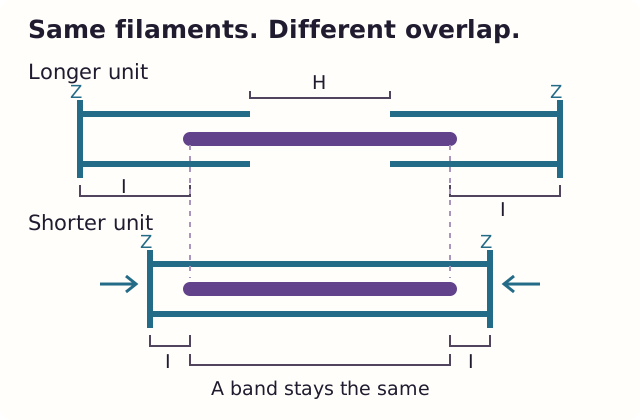
A sarcomere is one repeating contractile unit, from one Z-disc to the next. Thin actin filaments attach to the Z-discs. Thick myosin filaments lie near the center. They slide past one another rather than shrinking. [1][2]
A band: the full length of the thick filament. I band: thin filament without thick overlap. H zone: the central thick filament without thin overlap. During shortening, I and H become smaller; A stays constant. [2]
The same filaments can occupy a shorter unit. Open full-size diagram. Original Bone Wizardry schematic; factual references [1] and [2].Enlarge this diagram
A joint stays fixed, but ultrasound shows fiber shortening. What stretched?
The task can still be externally isometric. Compliant structures in series, including tendon, can lengthen while fibers shorten. Human calf ultrasound has documented changing internal architecture during fixed-joint contraction. That finding does not imply the same measured change in every muscle. [14]
ATP lets myosin release its grip
Myosin is a molecular motor. Before it can grip actin, calcium binds troponin. This changes the position of tropomyosin, the protein covering the myosin-binding sites on actin. The exposed sites permit attachment. [2]
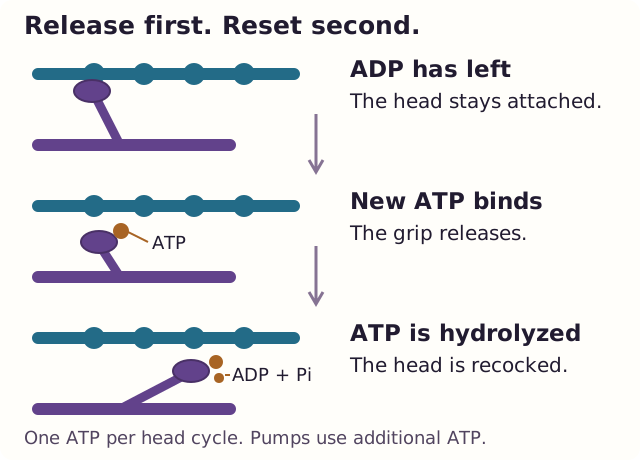
One ATP per complete myosin-head cycle. The ATP that binds to detach the head is then hydrolyzed to reset it. These are two events involving the same ATP molecule, not two ATP molecules. Calcium pumps and other transport systems have additional energy requirements. [2][4]
Separate detachment from resetting. Open full-size diagram. Original Bone Wizardry schematic; references [2] and [4].Enlarge this diagram
Predict: ATP can bind, but this preparation cannot hydrolyze it. Which event can still happen first?
Detachment. ATP binding releases the grip. Hydrolysis is needed for the subsequent reset, so repeated normal cycling cannot continue.
Predict: stimulation ends, but calcium remains high because its return pump is blocked. What can persist while ATP remains available?
Troponin can remain calcium-bound, keeping actin sites accessible. Continued cross-bridge cycling can delay relaxation. Stopping the electrical stimulus does not itself remove calcium. [2]
Speed, length, and force answer different questions
Isokinetic means constant speed of the measured motion. A dynamometer can regulate joint speed while a muscle either shortens or lengthens. The speed label does not cancel the length label. Real devices have acceleration and deceleration portions; classify the specified constant-speed interval. [10]
A machine bends the knee at fixed speed while the quadriceps resists. Can both eccentric and isokinetic apply?
First identify the working muscle: the quadriceps extends the knee. Knee flexion lengthens it. Active lengthening is eccentric. The independently regulated speed is isokinetic. The complete description includes both.
Torque, or moment, is a turning effect. Multiply force by its perpendicular moment arm. A fixed joint needs balanced moments, not necessarily equal numerical muscle and external forces. [15]
Doubling the external moment arm doubles the required opposing moment. With an unchanged muscle moment arm, required muscle force doubles too. A muscle can therefore exert more force than the external weight even while the joint is stationary.
Under comparable activation and length, a larger opposing load generally slows concentric shortening. Do not turn that relationship into a universal statement that any descending weight must exert more force than its active muscle. Direction, moment arms, and acceleration matter. [9][15]
Isotonic literally describes constant tension. It is often used broadly for length-changing exercise, but a moving limb is not proof of exactly constant muscle tension. Isolytic is historical osteopathic terminology for clinician-imposed lengthening during active contraction. It overlaps mechanically with eccentric activity; the word alone proves neither scar disruption nor a treatment indication. [3][7]
Separate where the clinician positions from where the patient pushes
Muscle energy technique, or MET, uses directed patient effort against clinician-defined resistance. In a direct setup, the clinician approaches the assessed restrictive barrier. The named position of ease describes the freer direction, not the direction of correction. [6][7][23]
For the described post-isometric relaxation setup, patient effort is directed toward the named ease while the clinician maintains the position with matching resistance. The patient then relaxes. Reassess before selecting a new barrier. Neither a guaranteed gain nor a fixed number of successful repetitions follows from the technique name. Effort and timing depend on the technique, region, and patient; maximal force is not a universal default. [7][20]
For a neutral thoracic group that rotates right and sidebends left more freely, write N Sl Rr: N is neutral, Sl is sidebent left, and Rr is rotated right. A direct barrier comparison reverses rotation and sidebending while preserving the stated neutral condition. The findings, not a memorized abbreviation alone, determine the setup. [18]
Use anatomy to choose the effort. Psoas contributes hip flexion; a shortened hip-flexor pattern can restrict hip extension. Gluteus medius abducts the hip, so a target-muscle effort is abduction, not adduction. A left sternocleidomastoid contributes right head rotation and left sidebending. [11][12]
Transfer: a hip-flexor restriction limits extension. For a target-muscle isometric effort, does the patient try to flex or extend?
The target is a hip flexor. The controlled effort is therefore hip flexion, while the clinician maintains the assessed position. An extension effort recruits the opposing action and is not the same target-muscle instruction.
Which muscle contracts, and what does the evidence actually show?
Post-isometric relaxation uses a contraction of the target muscle before relaxation and reassessment. A reciprocal-inhibition approach instead uses the antagonist, the muscle producing the opposing action. Neither label guarantees that the target becomes silent. [7][17]
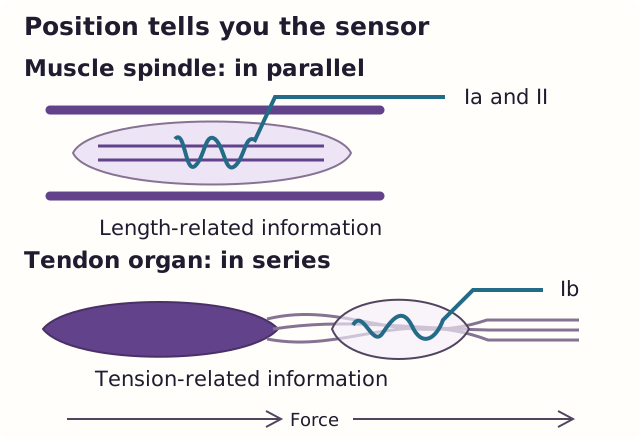
Muscle spindles report length-related information using group Ia and II sensory fibers. Golgi tendon organs report tension-related information through group Ib fibers. In classical spinal circuits, spindle input can support a stretch response and inhibition of an antagonist; tendon-organ pathways can influence the motor output to the same muscle. [8][16][22]
Separate length sensing from tension sensing. Open full-size diagram. Original Bone Wizardry schematic; receptor anatomy from [8].Enlarge this diagram
Real motor control depends on the task. Human experiments found less reciprocal inhibition during joint-stabilizing co-contraction. That allows opposing muscles to remain active together. A diagram of an inhibitory connection is therefore not an automatic on/off rule for every voluntary effort. [17]
In a randomized study of 40 asymptomatic volunteers, immediate tolerated knee-extension range increased after MET, but range at an equal applied torque did not significantly improve. The authors proposed altered stretch tolerance. This does not establish permanent tissue lengthening, a single GTO mechanism, or benefit in an injured patient. [5]
Does an immediate increase in tolerated range prove that a tendon became permanently longer?
No. The measured endpoint depended on tolerance and applied torque. A structural or durable-change claim would require additional measurements and follow-up.
Respiratory assistance coordinates breathing with an assessed setup; the respiratory motion can itself supply the active contribution. It is not defined by adding a separate isometric hold to every technique. [21]Eye-head assistance concerns the relationship between gaze and neck muscle activity. A physiological association is not proof that gaze alone corrects a cervical dysfunction. [19]
Apply the mechanism to a new problem
Unless a case directly measures fibers, contraction labels describe the joint and muscle-tendon task, not individual fascicles. Use the stated values to reason through the model; published findings are identified separately.
Work through the evidence before opening an explanation. Identify the active muscle or molecular event, determine what the observation actually establishes, then test the proposed next consequence. Every option has its own reasoning; return to any case without losing access to the lesson.
Case 1
Work through your selected option, then compare alternatives
A. Eccentric triceps activity with variable angular speedWhat supports the variable-speed description?
The elbow covers unequal angles in equal times.
Which elbow action does triceps produce?
Extension.
What happens to triceps length during the described movement?
It decreases.
Read the complete explanation
The unequal angular displacements support variable speed. Eccentric activity would fit an active triceps resisting elbow flexion, but this elbow extends with the shoulder fixed.
This option does not fit the supplied findings.
B. Concentric triceps activity with variable angular speedWhich elbow action does triceps produce?
Extension.
What happens to the active triceps during this extension?
It shortens.
How do the angular displacements compare across equal time intervals?
The second displacement is larger.
Which combined classification follows?
Concentric activity with variable angular speed.
Read the complete explanation
At a fixed shoulder position, elbow extension shortens the active triceps. The second half-second covers twice the angle of the first, so angular speed cannot have remained constant throughout both intervals.
Best answer.
C. Concentric triceps activity with constant angular speedWhich part correctly classifies triceps length change?
Concentric activity.
What displacement pattern would constant angular speed produce?
Equal angular displacements in equal times.
What supplied measurement excludes that pattern?
The successive displacements are 10 and 20 degrees.
Read the complete explanation
The shortening classification fits the active extensor. Constant cable resistance does not establish constant speed, and the recorded angular displacements contradict that speed description.
This option does not fit the supplied findings.
D. Isometric triceps activity with variable angular speedWhich joint is held fixed?
The shoulder.
Which joint changes angle?
The elbow.
What length behavior does the active elbow extensor exhibit here?
Shortening.
Read the complete explanation
The changing speed is correctly recognized. Muscle activation can occur during an isometric hold, but the fixed shoulder does not make this a fixed-elbow task: the active triceps shortens as the elbow extends.
This option does not fit the supplied findings.
Takeaway: Determine the named muscle's length change separately from the joint's speed.
Work through your selected option, then compare alternatives
A. Concentric during lowering; tendon-organ Ib signaling decreases in B.Which ankle action does gastrocnemius normally produce?
Plantarflexion.
What does dorsiflexion do to its length with the knee fixed?
It increases its length.
What happens to the required opposing moment from A to B?
It increases.
What happens to required tendon tension with the muscle arm unchanged?
It increases.
Read the complete explanation
A descending heel can be mistaken for a shortening calf, and a stationary ankle can be mistaken for an unloaded calf. Here dorsiflexion lengthens the active gastrocnemius, while the longer external arm increases the force required during the second hold.
This option does not fit the supplied findings.
B. Eccentric during lowering; tendon-organ Ib signaling decreases in B.What external moment acts in A?
3.6 N m.
What external moment acts in B?
5.4 N m.
How must muscle tension change with its arm fixed?
It must increase.
Which sensory prediction does that exclude in the stated range?
Decreased Ib signaling.
Read the complete explanation
The lowering classification is correct. Lower signaling might fit a reduced tendon load, but moving the unchanged external force farther from the ankle increases its moment and therefore the required tendon tension.
This option does not fit the supplied findings.
C. Concentric during lowering; tendon-organ Ib signaling increases in B.Which ankle action shortens gastrocnemius with the knee fixed?
Plantarflexion.
Which ankle movement occurs during lowering?
Dorsiflexion.
How should its active lengthening be classified?
Eccentric.
Read the complete explanation
The sensory prediction fits the greater load moment. The length classification confuses downward heel motion with muscle shortening: dorsiflexion moves opposite gastrocnemius plantarflexion while its knee attachment is controlled.
This option does not fit the supplied findings.
D. Eccentric during lowering; tendon-organ Ib signaling increases in B.How does dorsiflexion affect active gastrocnemius length with the knee fixed?
It lengthens the muscle-tendon unit.
What muscle tension balances hold A?
90 N.
What muscle tension balances hold B?
135 N.
What happens to the sampled tendon-organ signal at the higher tension?
Ib signaling increases.
Which paired conclusion follows?
Eccentric lowering followed by greater Ib signaling in B.
Read the complete explanation
Dorsiflexion lengthens the active gastrocnemius with the knee fixed, so it brakes eccentrically. The stationary holds require 30 x 0.12 / 0.04 = 90 N and 30 x 0.18 / 0.04 = 135 N. Greater tension predicts greater Ib signaling within the stated receptor range. Both holds remain externally isometric; unchanged joint angle does not mean unchanged force. Tendon-organ placement and Ib tension signaling are supported by [source 8](https://www.ncbi.nlm.nih.gov/books/NBK10812/); the numerical model is hypothetical.
Best answer.
Takeaway: Active calf braking can precede an externally isometric hold in which altered leverage changes tension and tendon-organ signaling.
Work through your selected option, then compare alternatives
A. 120 N; tendon lengthens 1 mm and contractile segment shortens 1 mm.What muscle tension balances state A?
80 N.
What muscle tension balances state B?
120 N.
What tendon-length change follows from the 40 N tension increase?
Lengthening by 1 mm.
What contractile change preserves total series length?
Shortening by 1 mm.
Which complete prediction follows?
120 N, with tendon lengthening and contractile shortening of 1 mm each.
Read the complete explanation
Moment balance gives 80 N in A and 120 N in B. The 40 N increase stretches the modeled tendon by 1 mm. Because total series length is fixed, the contractile segment must shorten by 1 mm. The external task remains isometric even though its internal segments change length; the numerical elastic response is a declared model assumption.
Best answer.
B. 120 N; tendon shortens 1 mm and contractile segment lengthens 1 mm.How does tension change from A to B?
It increases by 40 N.
What does the elastic rule predict for added tension?
Tendon lengthening.
What must the contractile segment do within the fixed total length?
Shorten.
Read the complete explanation
The force calculation is correct, and the opposite segment changes preserve total length. Their directions fit unloading, however. The model specifies tendon extension with added tension, and state B requires more tension.
This option does not fit the supplied findings.
C. 40 N; tendon lengthens 1 mm and contractile segment shortens 1 mm.What external moment acts in B?
3.6 N m.
What muscle tension balances that moment through 0.03 m?
120 N.
What does the calculated 40 N represent?
The increase above the initial 80 N.
Read the complete explanation
The length changes correctly use the 40 N increase. The option mistakes that increase for the final tension. Forty newtons through the muscle arm cannot balance the external moment in B.
This option does not fit the supplied findings.
D. 40 N; tendon shortens 1 mm and contractile segment lengthens 1 mm.What tendon response would a fall from 80 N to 40 N produce?
Shortening by 1 mm.
How does the external moment actually change from A to B?
It increases from 2.4 to 3.6 N m.
What final muscle tension does that require?
120 N.
Which premise of this option therefore fails?
The assumed fall in tension.
Read the complete explanation
If tension actually fell from 80 N to 40 N, these length changes would fit the elastic rule. That unloading premise fails the joint mechanics: the external moment increases when its arm becomes longer.
This option does not fit the supplied findings.
Takeaway: Calculate tension from joint moments before applying tendon elasticity and the fixed total length of series elements.
Work through your selected option, then compare alternatives
A. Concentric hamstring activity during an isokinetic intervalWhat motion does decreasing knee flexion angle represent?
Knee extension.
Which knee action do the hamstrings produce?
Flexion.
What length change occurs when they resist extension at a fixed hip?
Lengthening.
Read the complete explanation
The continuous speed record supports isokinetic testing. The decreasing flexion angle indicates extension, which lengthens the resisting hamstrings when the hip is fixed.
This option does not fit the supplied findings.
B. Isometric hamstring activity during an isokinetic intervalWhich variable does the machine hold constant?
Angular speed.
Which variable changes throughout the interval?
Knee angle.
What happens to the active hamstrings as that angle changes?
They lengthen.
Read the complete explanation
The machine holds speed constant, not knee position. The changing knee angle lengthens the active hamstrings despite the controlled velocity.
This option does not fit the supplied findings.
C. Eccentric hamstring activity during an isokinetic intervalWhat motion is encoded by the falling flexion angle?
Knee extension.
What action do the resisting hamstrings normally produce?
Knee flexion.
What active length behavior follows at the fixed hip?
Eccentric lengthening.
What does the continuous speed record establish?
An isokinetic interval.
Read the complete explanation
The angle sequence represents knee extension. With the hip fixed, the active knee flexors lengthen while resisting that motion. Independently, continuous velocity measurement establishes the isokinetic condition.
Best answer.
D. Eccentric hamstring activity during a variable-speed intervalWhich part correctly describes the hamstrings?
Eccentric activity.
What uncertainty would isolated angle samples leave?
Speed could fluctuate between samples.
Which supplied evidence removes that uncertainty?
The continuous constant-speed record.
Read the complete explanation
The hamstring classification fits. Equal-angle samples alone would not exclude speed fluctuations between samples, but the supplied continuous record explicitly verifies constant speed throughout this interval.
This option does not fit the supplied findings.
Takeaway: Verified constant speed can coexist with active lengthening; control the other joint of a multiarticular muscle.
Work through your selected option, then compare alternatives
A. Both intervals are isokinetic; required quadriceps force rises during BWhat does interval A's displacement pattern imply?
Its angular speed changes.
Which loading quantity remains constant in A?
Cable tension.
Does constant tension establish constant speed?
No.
Read the complete explanation
The increasing cable moment arm raises the opposing moment during B. Constant cable tension, however, does not make A isokinetic: its timed angular displacements show changing speed.
This option does not fit the supplied findings.
B. Only interval B is isokinetic; required quadriceps force rises during BWhat does the displacement pattern establish about A?
Its speed is variable.
What does continuous monitoring establish about B?
Its speed is constant.
What happens to cable moment as its arm doubles at constant tension?
It doubles.
What happens to the balancing muscle force with its arm unchanged?
It doubles.
Read the complete explanation
A has changing speed, whereas B has continuously verified constant speed. During B, doubling the cable moment arm doubles its opposing moment. With the quadriceps moment arm unchanged, the required muscle force increases.
Best answer.
C. Only interval B is isokinetic; required quadriceps force stays constant during BWhich cable quantity stays constant?
Tension.
Which cable quantity increases?
Its perpendicular moment arm.
What must increase to balance the resulting moment?
Quadriceps force.
Read the complete explanation
The speed comparison is correct. The force prediction confuses constant cable tension with constant joint moment; the changing cable leverage requires a changing opposing quadriceps moment.
This option does not fit the supplied findings.
D. Both intervals are isokinetic; required quadriceps force stays constant during BWhat observation contradicts constant speed in A?
Increasing angular displacements over equal times.
What observation changes external moment during B?
The cable moment arm doubles.
What unchanged muscle property prevents that moment change from being absorbed by leverage?
The quadriceps moment arm.
Read the complete explanation
This applies constant tension to two quantities it does not determine. A's measured speed changes, and B's changing cable leverage changes the required muscle force.
This option does not fit the supplied findings.
Takeaway: Constant cable tension establishes neither constant joint speed nor constant muscle force when leverage changes.
Work through your selected option, then compare alternatives
A. A–B isolates activation during lengthening; A–C compares eccentric with concentric activityWhat length behavior occurs in the active hamstrings during A?
Lengthening.
What distinguishes B from A at the same imposed motion?
The hamstrings are relaxed.
What length behavior occurs in the active hamstrings during C?
Shortening.
Which comparison therefore tests activation during lengthening?
A–B.
Which comparison contrasts active lengthening with active shortening?
A–C.
Read the complete explanation
A and B share the imposed lengthening motion but differ in hamstring activity. A and C both involve active hamstrings, but extension lengthens them whereas flexion shortens them. Matching speed does not erase these distinctions.
Best answer.
B. A–C isolates activation during lengthening; A–B compares eccentric with concentric activityIs hamstring activity absent in C?
No.
What changes between A and C?
The direction of knee motion.
What prevents B from being concentric hamstring activity?
The hamstrings are relaxed.
Read the complete explanation
A–C is a useful active-muscle comparison, but both trials contain activation and their motion directions differ. B cannot supply the concentric member of A–B because its hamstrings are relaxed during extension.
This option does not fit the supplied findings.
C. A–B isolates activation during shortening; A–C compares eccentric with concentric activityWhich knee motion is shared by A and B?
Extension.
Which knee action do the hamstrings produce?
Flexion.
What length direction therefore occurs in A and B?
Lengthening.
Read the complete explanation
The second comparison is correct. The first misreads the common movement: imposed extension lengthens the hamstrings at a fixed hip in both A and B.
This option does not fit the supplied findings.
D. A–B isolates activation during lengthening; B–C compares eccentric with concentric activityWhat makes A–B a controlled activation comparison?
Their imposed motion is matched.
Which required feature of eccentric activity is absent in B?
Active muscle force.
What is B's length change therefore classified as?
Passive lengthening.
Read the complete explanation
A–B correctly isolates the presence of activity. B–C contrasts passive lengthening with active shortening; B's changing length does not make it an eccentric contraction without active force.
This option does not fit the supplied findings.
Takeaway: Historical isolytic work includes active lengthening; matching movement alone does not reproduce that active task.
Work through your selected option, then compare alternatives
A. The H zone is wider; the tracked heads detach.What does a wider H zone represent?
A larger region containing thick filament without thin overlap.
What happens to overlap when these Z-discs approach?
It increases.
What H-zone change follows here?
Narrowing.
Read the complete explanation
ATP restoration can detach the tracked heads. A wider H zone, however, would require less overlap. Bringing the Z-discs closer without shortening either filament increases overlap and narrows the remaining thick-only region.
This option does not fit the supplied findings.
B. The H zone is wider; the tracked heads remain attached.What happens to overlap at the smaller Z-disc separation?
It increases.
What happens to the remaining H zone?
It narrows.
What permits a post-stroke head to detach?
New ATP binding.
Does maintained calcium prevent that ATP-dependent release?
No.
Read the complete explanation
This combines two tempting errors: treating the central gap as opening during shortening and treating persistent calcium as a lock on attached heads. The fixed-length filaments overlap more, and ATP binding permits release even while calcium remains high.
This option does not fit the supplied findings.
C. The H zone is narrower; the tracked heads remain attached.Why can the tracked heads remain attached after ADP leaves during depletion?
No new ATP is available to bind.
What changes when ATP is restored?
ATP can bind the heads.
What immediate event does that binding permit?
Detachment.
Read the complete explanation
The geometric prediction is correct. Persistent attachment fits the ATP-depleted interval, but not the first response to restored ATP. High calcium maintains access to actin; it does not prevent ATP from releasing a bound head.
This option does not fit the supplied findings.
D. The H zone is narrower; the tracked heads detach.What happens to overlap between the two images?
It increases.
What happens to the remaining H zone?
It narrows.
What prevents release of the tracked post-stroke heads during depletion?
The absence of new ATP.
What is their first response when ATP binds after restoration?
Detachment.
Which paired prediction follows?
A narrower H zone and initial detachment of the tracked heads.
Read the complete explanation
The closer Z-discs increase overlap between unchanged filaments, narrowing the residual H zone. Thick-filament length is unchanged, so the A band also remains unchanged. After ADP release, ATP depletion leaves the tracked heads attached; restoring ATP permits detachment before hydrolysis resets them. High calcium permits renewed attachment later, but does not prevent this initial release. The length clamp prevents detachment from being mistaken for an imposed change in sarcomere length.
Best answer.
Takeaway: Filament geometry determines overlap; nucleotide availability independently determines whether an attached myosin head can release.
Work through your selected option, then compare alternatives
A. Eccentric psoas activity; mean angular speed increases.What motion takes the hip from 8 to 1 degrees of extension?
Hip flexion.
Which hip action does psoas contribute?
Flexion.
What happens to active psoas length during this controlled motion?
It decreases.
Read the complete explanation
Dividing displacement by elapsed time correctly gives an increase in speed. The length label is reversed: the hip moves toward flexion as its extension angle decreases, so the active psoas shortens with the pelvis and lumbar spine fixed.
This option does not fit the supplied findings.
B. Concentric psoas activity; mean angular speed decreases.What is the first interval's mean angular speed?
2 degrees per second.
What is the second interval's mean angular speed?
3 degrees per second.
Why does the smaller second displacement not establish slower motion?
Its elapsed time is shorter.
Read the complete explanation
The target-muscle classification is correct. The later displacement is smaller, which can tempt a slower-speed answer, but it occurs in half the time. Four degrees over two seconds is slower than three degrees over one second.
This option does not fit the supplied findings.
C. Concentric psoas activity; mean angular speed increases.Which hip motion is shown by the decreasing extension angles?
Flexion.
How does that motion affect the active psoas with its proximal attachments controlled?
It shortens the psoas.
What is the first interval's mean angular speed?
2 degrees per second.
What is the second interval's mean angular speed?
3 degrees per second.
Which combined interpretation follows?
Concentric psoas activity with increasing mean angular speed.
Read the complete explanation
Decreasing extension angles indicate motion toward hip flexion. With the pelvis and lumbar spine controlled, this shortens the active psoas. Mean angular speed rises from 4/2 = 2 to 3/1 = 3 degrees per second. Thus the intended fixed-position effort was not maintained, and the motion was not constant-speed. Moving toward flexion does not demonstrate a gain in the assessed extension barrier; that would require relaxation and a matched reassessment.
Best answer.
D. Eccentric psoas activity; mean angular speed decreases.Which motion is represented by decreasing hip extension?
Flexion.
What happens to active psoas length during that motion here?
It shortens.
What is the first interval's mean angular speed?
2 degrees per second.
What is the second interval's mean angular speed?
3 degrees per second.
Read the complete explanation
A progressively smaller extension angle can be mistaken for lengthening of the target, and the smaller second displacement can be mistaken for slower motion. Psoas anatomy determines the length direction, while displacement divided by time determines speed.
This option does not fit the supplied findings.
Takeaway: Use the target's anatomy to interpret actual motion, and divide displacement by time before deciding whether a maintained-position effort or constant-speed movement occurred.
Work through your selected option, then compare alternatives
A. Only Y; hydrolysis has prepared ADP-plus-phosphate heads for attachment when sites reopenWhich event has the analogue been shown to support in X?
Detachment.
Which subsequent motor event is unavailable in X?
Hydrolysis-dependent resetting.
What nucleotide state can hydrolysis produce in Y?
A cocked head carrying ADP and phosphate.
What does restoring calcium change?
Actin-site accessibility.
Which preparation can therefore begin the next normal sequence?
Y.
Read the complete explanation
The experiment establishes detachment in X but supplies no hydrolysis-dependent reset. Y can reset while actin sites are covered. Restoring calcium then permits the prepared Y heads to attach, whereas calcium cannot replace the missing reset in X.
Best answer.
B. Only X; retaining an unhydrolyzed nucleotide preserves the cocked state needed for attachmentWhich nucleotide products remain on a normally cocked head?
ADP and phosphate.
Which reaction produces that state?
ATP hydrolysis.
Which preparation can perform that reaction?
Y.
Read the complete explanation
This treats the cocked head as ATP-loaded. In the taught cycle, hydrolysis produces the prepared ADP-plus-phosphate state; analogue binding alone establishes release, not that reset.
This option does not fit the supplied findings.
C. Both X and Y; reopening actin sites supplies the reset needed for another attachmentWhat does calcium regulate here?
Access to actin-binding sites.
What event resets the myosin head?
ATP hydrolysis.
Which required event remains blocked in X after calcium returns?
Hydrolysis-dependent resetting.
Read the complete explanation
Calcium restores regulatory permission in both preparations. That permission does not perform the motor's nucleotide-dependent reset, which remains unavailable in X despite its demonstrated detachment.
This option does not fit the supplied findings.
D. Neither X nor Y; the low-calcium interval leaves both heads uncocked after sites reopenWhich process is blocked by covered actin sites?
Attachment to actin.
Which nucleotide reaction occurs normally in Y during the waiting period?
ATP hydrolysis.
What barrier to Y attachment is removed by restoring calcium?
The regulatory covering of actin sites.
Read the complete explanation
Low calcium prevents normal thin-filament access, which can make both preparations appear inactive during the waiting period. It does not prevent the stipulated ATP hydrolysis and motor resetting in Y.
This option does not fit the supplied findings.
Takeaway: A demonstrated binding-induced release does not establish resetting; calcium controls access to the next attachment.
Work through your selected option, then compare alternatives
A. Record N Sr Rl; retain the original neutral right-sidebending/left-rotation barrierWhich sidebending direction was freer in neutral?
Left.
Which rotation direction was freer in neutral?
Right.
Which notation represents that ease?
N Sl Rr.
Read the complete explanation
The repeat neutral measurement supports retaining the original barrier. The notation reverses the examined ease: right sidebending and left rotation describe the restricted comparison, not the named freer position.
This option does not fit the supplied findings.
B. Record N Sl Rr; retain the original neutral right-sidebending/left-rotation barrierWhich notation follows from the documented neutral ease?
N Sl Rr.
Which condition changed during the 30-degree measurement?
The group was flexed.
What did the matched neutral retest show?
The original 20-degree limit.
Which neutral barrier remains supported for the next direct comparison?
The original right-sidebending/left-rotation barrier.
Read the complete explanation
The notation follows the examined neutral ease. The apparent additional rotation was measured under a different flexion-extension condition, and the matched neutral retest shows no gain on which to base a farther neutral barrier.
Best answer.
C. Record N Sl Rr; advance the neutral left-rotation barrier using the 30-degree resultWhat makes the 30-degree result initially tempting?
It exceeds the original rotation measurement.
Which examination condition was different?
Flexion replaced neutral.
What measurement should govern the specified neutral comparison?
The repeated 20-degree neutral limit.
Read the complete explanation
The notation is correct. The larger measurement cannot establish a new neutral barrier because it was obtained in flexion and was not reproduced when neutral was restored.
This option does not fit the supplied findings.
D. Record N Sr Rl; advance the neutral left-rotation barrier using the 30-degree resultWhat does N Sr Rl describe relative to the original findings?
The restricted directional comparison.
In which condition was 30 degrees measured?
Flexion.
What happened when the required neutral condition was restored?
The limit returned to 20 degrees.
Read the complete explanation
This names the restricted directions as ease and transfers a flexed measurement to neutral. Both the original directional examination and the matched neutral retest oppose that record.
This option does not fit the supplied findings.
Takeaway: Name the examined ease, then require comparable positioning before accepting a new neutral barrier.
Work through your selected option, then compare alternatives
A. P resumes repeated cycling; Q resumes repeated cyclingWhich obstruction does the intervention remove in P?
Covered actin sites.
Were Q's actin sites obstructed before the intervention?
No.
Which required process remains unavailable in Q?
ATP-dependent resetting through hydrolysis.
Read the complete explanation
Opening actin sites removes P's demonstrated obstruction. Q's sites were already open, so the intervention does not repair the hydrolysis defect needed to reset its detached heads.
This option does not fit the supplied findings.
B. P remains unable to attach; Q resumes repeated cyclingWhich motor process is intact in P?
ATP hydrolysis.
What missing condition does P gain?
Accessible actin sites.
What does the intervention leave unchanged in Q?
Its hydrolysis defect.
Read the complete explanation
This assigns recovery to the preparation whose defect the intervention does not address. P retains motor hydrolysis and gains site access; Q gains no missing nucleotide reaction.
This option does not fit the supplied findings.
C. P remains unable to attach; Q remains unable to resetWhat originally prevented P from attaching?
Tropomyosin covered the sites.
What happens to that obstruction after the intervention?
It is removed.
What intact process prepares P's heads for another attachment?
ATP hydrolysis.
Read the complete explanation
The prediction for Q fits its persistent motor defect. P's continuing failure to attach does not follow once its measured regulatory obstruction is removed and its motor reactions remain intact.
This option does not fit the supplied findings.
D. P resumes repeated cycling; Q remains unable to resetWhich requirement is missing in P before the intervention?
Actin-site access.
Which requirement is missing in Q?
ATP hydrolysis.
Which missing requirement does moving tropomyosin restore?
Actin-site access.
Which preparation consequently has both access and an intact reset?
P.
Read the complete explanation
P has an intact motor cycle but lacks actin access, so moving tropomyosin addresses its limiting defect. Q already has access; its inability to hydrolyze ATP persists and prevents the normal reset after detachment.
Best answer.
Takeaway: A rescue must address the failed step: restoring site access cannot substitute for restoring motor resetting.
Work through your selected option, then compare alternatives
A. Earlier actin-site closure with faster mechanical relaxationWhat normally permits actin sites to become covered after stimulation?
Removal of regulatory calcium.
Which calcium process is inhibited?
Return to the sarcoplasmic reticulum.
What direction of relaxation change follows?
Relaxation is delayed.
Read the complete explanation
Faster removal of regulatory calcium could produce this pattern. The intervention blocks its return to the sarcoplasmic reticulum, so it prolongs rather than abbreviates calcium-dependent site availability.
This option does not fit the supplied findings.
B. Prolonged actin-site availability with delayed mechanical relaxationWhat signal persists when calcium return is blocked?
Elevated cytosolic calcium.
What regulatory state can that signal maintain?
Calcium-bound troponin.
What happens to actin-site accessibility?
It remains prolonged.
What can the intact ATP-supported motor cycle consequently do?
Continue after the stimulus ends.
Read the complete explanation
Inhibited calcium return can maintain troponin activation after the electrical stimulus ends. With ATP and motor reactions intact, accessible sites can support continued cycling and delay relaxation.
Best answer.
C. Prolonged actin-site availability with ATP-depletion attachmentWhich part fits the blocked calcium return?
Prolonged site availability.
What nucleotide condition would cause ATP-depletion attachment?
Unavailable ATP.
What nucleotide condition is explicitly supplied here?
ATP remains available.
Read the complete explanation
Persistent calcium makes prolonged site availability plausible. ATP-depletion attachment describes a different cause of failed relaxation; the stem preserves ATP availability and normal nucleotide reactions.
This option does not fit the supplied findings.
D. Earlier actin-site closure with persistent cycling at covered sitesWhat does the inhibited pump delay?
Calcium removal.
What calcium-dependent condition permits normal attachment?
Accessible actin sites.
Would earlier site covering support the proposed persistent normal attachment?
No.
Read the complete explanation
This separates the motor from the regulatory permission it needs. The inhibited pump does not accelerate site closure, and covered sites would not support the proposed continued normal attachment sequence.
This option does not fit the supplied findings.
Takeaway: Ending the electrical stimulus does not end contraction until regulatory calcium is removed.
Work through your selected option, then compare alternatives
A. Both setups produce concentric activity; L shortens more slowlyWhat muscle force balances setup S?
10 N.
What muscle force balances setup L?
20 N.
What length direction occurs at both calibrated forces?
Shortening.
Which setup matches the slower calibrated condition?
L.
Read the complete explanation
The lever requires 10 N of muscle force in S and 20 N in L. Both calibrated loads permit shortening, but the 20-N condition shortens more slowly. The same external load therefore produces different muscle behavior through different leverage.
Best answer.
B. Both setups produce concentric activity; S shortens more slowlyWhich setup has the larger external moment?
L.
Which setup therefore requires more muscle force?
L.
Which calibrated force corresponds to slower shortening?
20 N.
Read the complete explanation
Both setups map to measured shortening conditions. The speed ranking is reversed: the longer external arm increases the opposing muscle-force requirement, placing L at the slower calibration point.
This option does not fit the supplied findings.
C. S produces concentric activity; L produces eccentric activityWhat muscle force does L require?
20 N.
What measured length direction occurs at 20 N?
Shortening.
What observation would instead establish eccentric activity?
Active lengthening.
Read the complete explanation
The longer arm makes L more demanding, but its required force maps to a supplied condition that still shortens. Increased effective load alone does not establish reversal into active lengthening.
This option does not fit the supplied findings.
D. S produces concentric activity; L produces isometric activityWhich calibration point applies to L?
The 20-N point.
What is its measured shortening speed?
3 length units per second.
What speed would a fixed-length muscle condition require?
Zero.
Read the complete explanation
L's higher effective load slows shortening in the calibration. It does not stop shortening: the reported 20-N velocity remains nonzero.
This option does not fit the supplied findings.
Takeaway: Translate external leverage into the muscle's opposing load before applying a measured load–velocity relationship.
Work through your selected option, then compare alternatives
A. 45 NWhich quantity must balance at the stationary joint?
Moment.
Are the muscle and external moment arms equal?
No.
What external moment must the muscle balance?
9 N·m.
Read the complete explanation
This matches the new external force but ignores leverage. The muscle acts through a shorter moment arm and must provide the same opposing moment, not the same numerical force.
This option does not fit the supplied findings.
B. 150 NWhat was the original required muscle force?
225 N.
Which change alone would reduce it to 150 N?
Reducing the external arm from 0.30 to 0.20 m.
Which simultaneous change must also be included?
Increasing external force from 30 to 45 N.
Read the complete explanation
This follows from applying only the external moment-arm reduction to the original muscle force. The simultaneous increase in external force offsets that reduction.
This option does not fit the supplied findings.
C. 225 NWhat was the original external moment?
9 N·m.
What is the new external moment?
9 N·m.
What muscle force produces that moment through 0.04 m?
225 N.
What explains the unchanged required muscle force?
The external force–arm product is unchanged.
Read the complete explanation
The new external moment is 45 × 0.20 = 9 N·m. The required muscle force is 9 ÷ 0.04 = 225 N. The larger external force and shorter external arm leave their product unchanged.
Best answer.
D. 337.5 NBy what factor does external force increase?
1.5.
Which omitted quantity decreases at the same time?
The external moment arm.
What is the resulting external moment after both changes?
9 N·m.
Read the complete explanation
This applies the external-force increase to the original muscle force while retaining the old leverage. The external moment arm also decreases, offsetting the force increase.
This option does not fit the supplied findings.
Takeaway: Combine simultaneous changes in force and perpendicular leverage before calculating the balancing muscle force.
Work through your selected option, then compare alternatives
A. Extension, left rotation, right sidebending; request right rotation against the maintained positionWhich sidebending direction was examined as ease?
Right sidebending.
Which sidebending direction should the direct setup approach?
Left sidebending.
Which part of this option already matches the intended effort?
Right rotation.
Read the complete explanation
The requested effort correctly returns toward rotational ease. The setup still leaves sidebending in its freer direction, so it does not address the full C4 restriction.
This option does not fit the supplied findings.
B. Extension, left rotation, left sidebending; request right rotation against the maintained positionWhich flexion-extension component belongs in the direct setup?
Extension.
Which rotational component belongs in the direct setup?
Left rotation.
Which sidebending component corrects the trainee's omission?
Left sidebending.
Which rotational effort returns toward the examined ease?
Right rotation.
What must happen to the position during the isometric effort?
It must remain maintained.
Read the complete explanation
The full direct setup approaches the opposite of the examined ease in all three planes. The subsequent rotational effort has a different purpose: the patient tries to rotate toward rightward ease while the clinician prevents movement.
Best answer.
C. Extension, left rotation, left sidebending; request left rotation against the maintained positionWhich direction is used for rotational positioning?
Left rotation.
Which direction was examined as rotational ease?
Right rotation.
Which direction does the intended effort therefore require?
Right rotation.
Read the complete explanation
All three positioning components address the restriction. The requested left-rotation effort repeats the barrier direction rather than following the specified effort toward right-rotation ease.
This option does not fit the supplied findings.
D. Extension, left rotation, right sidebending; request left rotation against the maintained positionWhich positioning plane remains uncorrected?
Sidebending.
Which sidebending direction should replace it?
Left sidebending.
Which rotational effort should replace left rotation?
Right rotation.
Read the complete explanation
This retains both trainee errors. Right sidebending leaves one plane in ease, while left-rotation effort follows the barrier rather than the requested rotational ease.
This option does not fit the supplied findings.
Takeaway: A complete C4 setup accounts for every plane, then distinguishes maintained positioning from the subsequent effort.
Work through your selected option, then compare alternatives
A. Isometric then concentric; rightward shortening is slower under the larger load.Which rotation does unilateral left SCM contribute?
Right rotation.
How does controlled left rotation affect its length?
It increases its length.
What classification fits that active length change?
Eccentric.
Read the complete explanation
The slower-speed prediction follows the shortening force-velocity relationship. The leftward phase is misclassified: left SCM contributes right rotation, so controlled left rotation lengthens it while it remains active.
This option does not fit the supplied findings.
B. Isometric then eccentric; rightward shortening is faster under the larger load.Which variable is matched rather than increased between the load trials?
Muscle activation.
Which mechanical variable is increased?
The opposing load.
What speed change is expected during shortening under these controls?
Slower shortening.
Read the complete explanation
The stationary and leftward phases are classified correctly. Greater resistance does not imply greater speed when activation and starting length are matched. In the specified shortening range, a larger opposing load generally reduces shortening velocity.
This option does not fit the supplied findings.
C. Isometric then eccentric; rightward shortening is slower under the larger load.Which rotation does left SCM contribute?
Right rotation.
What does the controller's leftward motion do to that active muscle?
It lengthens it.
What length change accompanies the separate rightward trials?
Shortening.
How does the larger opposing load affect shortening speed under the matched conditions?
It decreases the speed.
Which full prediction follows?
Isometric then eccentric activity, with slower rightward shortening under the larger load.
Read the complete explanation
Left SCM contributes right rotation and left sidebending. With sidebending and the other planes controlled, imposed left rotation lengthens the active muscle after its external isometric hold. The separate rightward trials involve shortening. At matched activation and length, the larger opposing load generally slows that shortening; no speed controller is present to enforce equal velocities. The stationary label alone does not determine either later result.
Best answer.
D. Isometric then concentric; rightward shortening is faster under the larger load.Which rotation is produced by left SCM?
Right rotation.
What length change follows imposed left rotation?
Lengthening.
Does the second shortening trial include increased activation?
No.
What does the increased opposing load predict at matched activation?
Slower shortening.
Read the complete explanation
This treats the controller's movement as if it followed the active muscle's action and treats a heavier load as if activation had also increased. Left SCM is lengthened by the leftward motion, and the separate load comparison holds activation constant.
This option does not fit the supplied findings.
Takeaway: For left SCM, controlled rotation determines active length change; a separate matched load comparison determines the expected shortening-speed change.
Work through your selected option, then compare alternatives
A. Use the 25-degree knee-flexion position at the standardized hip; request knee extensionAt what hip angle was the 25-degree result obtained?
70 degrees of flexion.
What limit returned at the standardized hip angle?
40 degrees of remaining knee flexion.
Which measurement supports the planned standardized barrier?
The 40-degree result.
Read the complete explanation
Knee extension recruits the antagonist action to the hamstring target. The proposed position imports a measurement obtained at a different hip angle and exceeds the barrier reproduced under the required standardized conditions.
This option does not fit the supplied findings.
B. Use the 40-degree knee-flexion position at the standardized hip; request knee flexionWhich knee action do the hamstrings produce?
Flexion.
Which role did the clinician select for the next effort?
The antagonist.
Which knee effort serves that role?
Extension.
Read the complete explanation
The positioning uses the comparable retest. Knee flexion, however, requests the hamstring target's own action rather than the newly selected antagonist effort.
This option does not fit the supplied findings.
C. Use the 25-degree knee-flexion position at the standardized hip; request knee flexionWhat happened to the apparent gain when hip position was restored?
It disappeared.
Which muscle role does knee flexion recruit here?
The hamstring target.
Which role is requested for the new trial?
The antagonist.
Read the complete explanation
The larger apparent extension range came from a changed hip condition, and flexion effort repeats the target-muscle approach. Neither component follows the matched retest and newly selected antagonist plan.
This option does not fit the supplied findings.
D. Use the 40-degree knee-flexion position at the standardized hip; request knee extensionWhich retest preserves the original examination conditions?
The hip-at-90-degrees retest.
What knee limit does that retest support?
40 degrees of remaining flexion.
Which knee action belongs to the hamstring target?
Flexion.
Which effort therefore recruits the antagonist action?
Extension.
Read the complete explanation
The matched retest supports the original barrier rather than a gain measured at another hip angle. Because the target hamstrings flex the knee, a maintained knee-extension effort supplies the selected antagonist action.
Best answer.
Takeaway: Use matched reassessment conditions to locate the barrier, then select effort according to the intended muscle role.
Work through your selected option, then compare alternatives
A. Q raises firing; the final replay produces 1 N m of extension moment.Which variable changes in Q?
Tendon force.
Which input to the sampled receptor is unchanged in Q?
Specialized-fiber length.
Which perturbation instead increases its stretch?
P.
Read the complete explanation
The moment prediction correctly removes the hamstring inhibitory effect. Q, however, changes tendon force without stretching the sampled specialized fibers. The parallel-fiber anatomy identifies a spindle rather than a tendon organ.
This option does not fit the supplied findings.
B. P raises firing; the final replay produces 1 N m of extension moment.Which perturbation stretches the structurally identified spindle?
P.
What quadriceps moment remains with its pathway intact?
3 N m of extension moment.
What hamstring moment remains without the inhibitory effect?
Its baseline 2 N m of flexion moment.
What net muscle moment follows from those opposing moments?
1 N m of extension moment.
Which paired prediction follows?
P raises firing, and the final replay produces 1 N m of extension moment.
Read the complete explanation
The parallel fibers identify a spindle with Ia/II afferents, so P tests its stretch input. Disabling the inhibitory branch leaves the hamstring flexion moment at its 2 N m baseline. The unaffected quadriceps response still supplies 3 N m of extension moment, leaving 1 N m of net extension. This applies [source 8's receptor anatomy](https://www.ncbi.nlm.nih.gov/books/NBK10812/) and [source 16's circuit connections](https://www.ncbi.nlm.nih.gov/books/NBK10809/) to hypothetical moment measurements.
Best answer.
C. P raises firing; the final replay produces 2 N m of extension moment.Which hamstring moment occurred with the intact circuit?
1 N m of flexion moment.
What hamstring moment applies after its inhibitory relay is disabled?
2 N m of flexion moment.
What net moment remains against 3 N m from quadriceps?
1 N m of extension moment.
Read the complete explanation
P is the correct stimulus. The 2 N m answer carries the intact-circuit hamstring response into the altered trial. Once its inhibitory relay is disabled, the hamstring moment stays at baseline rather than falling to 1 N m.
This option does not fit the supplied findings.
D. Q raises firing; the final replay produces 2 N m of extension moment.Which perturbation increases specialized-fiber length?
P.
What hamstring moment remains after removing its inhibitory input?
2 N m of flexion moment.
What quadriceps moment remains through the unaffected pathway?
3 N m of extension moment.
What net moment follows?
1 N m of extension moment.
Read the complete explanation
This selects the tendon-loading stimulus and retains the intact-circuit subtraction. The sampled receptor is stretched by P, and the altered circuit no longer reduces the opposing hamstring moment.
This option does not fit the supplied findings.
Takeaway: Identify the receptor's mechanical input, then account for each surviving muscle response before predicting the joint moment.
Work through your selected option, then compare alternatives
A. Elbow extension begins; the biceps lengthens actively.What extension moment does triceps produce?
0.30 N m.
What flexion moment does biceps produce?
0.48 N m.
Which moment dominates after support removal?
The flexion moment.
What motion therefore begins?
Elbow flexion.
Read the complete explanation
Continued biceps activation is recognized correctly. Extension is tempting because the triceps force is numerically larger, but its shorter arm produces the smaller moment. Joint motion follows the net moment rather than the larger force alone.
This option does not fit the supplied findings.
B. Elbow flexion begins; the biceps shortens passively.Does reduced biceps activation mean its signal disappeared here?
No.
What kind of biceps tension does the model retain after support removal?
Active tension.
How should shortening with that tension be classified?
Concentric activity.
Read the complete explanation
The predicted motion follows the larger biceps moment. Calling its shortening passive mistakes reduced activation during an antagonist effort for complete target silence. The recordings and maintained active-tension assumption show that biceps still generates force.
This option does not fit the supplied findings.
C. Elbow flexion begins; the biceps shortens actively.What flexion moment does biceps produce?
0.48 N m.
What extension moment does triceps produce?
0.30 N m.
Which direction does the unsupported net moment accelerate the elbow?
Flexion.
What does flexion do to the still-active biceps with the shoulder fixed?
It shortens it.
Which combined prediction follows?
Elbow flexion with concentric biceps activity.
Read the complete explanation
Biceps supplies 12 x 0.04 = 0.48 N m of flexion moment, exceeding triceps' 15 x 0.02 = 0.30 N m of extension moment. Removing the balancing support leaves a 0.18 N m flexion moment. Biceps therefore shortens while still active, so its action is concentric. The active triceps, although recruited as the antagonist, is lengthened and acts eccentrically. The initial hold was externally isometric; an antagonist effort did not guarantee target silence or determine the subsequent movement direction.
Best answer.
D. Elbow extension begins; the biceps lengthens passively.Which muscle produces the larger joint moment despite its smaller force?
Biceps.
Which motion follows support removal?
Elbow flexion.
What observation excludes a passive-only biceps response?
Its activation continues.
How does the active biceps behave during that motion?
It shortens concentrically.
Read the complete explanation
This assumes both that the larger triceps force controls motion and that antagonist recruitment silences the target. The different moment arms reverse the force-only ranking, and the biceps remains active in the supplied recordings and model assumptions.
This option does not fit the supplied findings.
Takeaway: An antagonist effort can coexist with target activation; after support changes, net joint moments determine which active muscle shortens and which lengthens.
Work through your selected option, then compare alternatives
A. Request an outward abduction effort; halve the clinician's resisting forceWhich hip action does gluteus medius produce?
Abduction.
Which effort corrects the trainee's inward instruction?
An outward effort.
What happens to the clinician's perpendicular moment arm?
It doubles.
What force change preserves the same resisting moment?
The force is halved.
Read the complete explanation
Gluteus medius is the selected abductor, so outward effort recruits the target while the position is maintained. Doubling the clinician's moment arm requires half the force to preserve the same resisting hip moment.
Best answer.
B. Request an outward abduction effort; double the clinician's resisting forceWhich part correctly recruits gluteus medius?
The abduction effort.
What happens to moment if force stays constant while its arm doubles?
Moment doubles.
What force adjustment instead preserves moment?
Halving force.
Read the complete explanation
The effort recruits the correct target. Moving the contact farther from the hip increases leverage, so doubling force would raise rather than preserve the intended resisting moment.
This option does not fit the supplied findings.
C. Request an inward adduction effort; halve the clinician's resisting forceWhich direction defines the current barrier?
Adduction.
Which action belongs to the selected target muscle?
Abduction.
What does an inward effort request?
Adduction.
Read the complete explanation
The force adjustment correctly accounts for the longer moment arm. The inward effort repeats the barrier direction but recruits an opposing action rather than the selected gluteus medius target.
This option does not fit the supplied findings.
D. Request an inward adduction effort; double the clinician's resisting forceWhich effort would recruit the gluteus medius target?
Abduction.
What happens to the resistance moment arm?
It doubles.
What force change is needed for an unchanged resisting moment?
A reduction to one half.
Read the complete explanation
The inward effort confuses positioning with target-muscle action. The increased force also compounds the increased leverage instead of preserving the intended hip moment.
This option does not fit the supplied findings.
Takeaway: Select gluteus medius effort from its abduction action, and adjust clinician force when contact leverage changes.
Work through your selected option, then compare alternatives
A. Group Ia/II signaling should increase because the required tendon tension risesWhich receptor matches the supplied structure?
A Golgi tendon organ.
Which afferent class serves that receptor?
Group Ib.
Which part of the proposed mechanical prediction is correct?
Required tendon tension rises.
Read the complete explanation
The moment change does require more muscle and tendon force. Ia/II identifies spindle signaling, however, whereas the supplied collagen-in-series structure identifies a tendon organ.
This option does not fit the supplied findings.
B. Group Ib signaling should remain unchanged because the joint angle is fixedWhat happens to external moment when its arm doubles?
It doubles.
What happens to required muscle force with its arm unchanged?
It doubles.
Which changing variable is relevant to the tendon organ?
Tension.
Read the complete explanation
The afferent identification is correct. A fixed joint does not fix muscle force when external leverage changes; the tendon organ's tension-related input can rise without joint movement.
This option does not fit the supplied findings.
C. Group Ia/II signaling should remain unchanged because the joint angle is fixedWhich supplied measurement might suggest unchanged length-related input?
Fixed fascicle length.
Which structural feature identifies the actual sampled receptor?
Its position among tendon collagen in series.
What happens to required tension despite the fixed length?
It increases.
Read the complete explanation
The unchanged fascicle length may make a length-sensor interpretation tempting. The sampled structure is a tendon organ, and its force-transmitting pathway experiences increased required tension.
This option does not fit the supplied findings.
D. Group Ib signaling should increase because the required tendon tension risesWhich receptor is identified by the tendon-collagen series arrangement?
A Golgi tendon organ.
Which afferent class carries its signal?
Group Ib.
What happens to the required opposing moment?
It doubles.
What happens to muscle force with its moment arm unchanged?
It doubles.
What qualitative tendon-organ signaling change follows?
An increase related to greater tension.
Read the complete explanation
The structure identifies a Golgi tendon organ and its Ib afferent. The doubled external moment requires doubled opposing muscle force with unchanged muscle leverage, so the tension-related signal is expected to increase despite fixed position. No proportional doubling of discharge is implied.
Best answer.
Takeaway: A stationary joint can generate changing tendon-organ input when leverage changes the required force.
Work through your selected option, then compare alternatives
A. The relaxed knee reaches 50 degrees at 8 N·m with the original hip position maintainedWhat torque was used at the original 40-degree endpoint?
6 N·m.
What differs at this proposed 50-degree measurement?
Applied torque is higher.
Which explanation remains compatible with that difference?
Increased stretch tolerance.
Read the complete explanation
This reproduces the larger tolerated endpoint under the larger torque. It shows persistence of that endpoint but does not demonstrate a changed passive angle response to the original loading condition.
This option does not fit the supplied findings.
B. The relaxed knee reaches 50 degrees at 6 N·m with the original hip position maintainedDid the immediate range increase at the original torque?
No.
Which immediate change allowed the larger endpoint?
The participant tolerated a higher torque.
What does the proposed one-week test hold constant?
The original passive loading condition.
What new result would weaken the tolerance-only explanation?
More relaxed range at the same torque.
What does the one-week timing add?
Evidence that the changed response persists to that measurement.
Read the complete explanation
The immediate findings showed a larger tolerated endpoint without a range gain at the original torque. A later gain at that original torque, with relaxation and geometry matched, would supply evidence of a changed passive mechanical response. It would not by itself identify a particular structural tissue change.
Best answer.
C. The relaxed knee reaches 50 degrees at 6 N·m with the hip held less flexed than originallyWhich loading variable is appropriately matched?
Applied torque.
Which relevant geometric variable changes?
Hip flexion.
What comparison is needed to interpret the extra range mechanically?
A retest at the original hip position.
Read the complete explanation
Matching torque is useful, but changing hip position alters the hamstring examination geometry. The extra knee extension could reflect that changed condition rather than an altered passive response in the original setup.
This option does not fit the supplied findings.
D. The knee reaches 50 degrees at 6 N·m with the original hip position and ongoing quadriceps activityWhich muscle activity is present during the proposed test?
Quadriceps activity.
Which knee action can that activity contribute?
Extension.
Which condition is therefore missing from the passive comparison?
Full muscle relaxation.
Read the complete explanation
Torque and hip position are matched, but active knee extension can contribute to the measured motion. The result would not isolate the relaxed passive response needed to distinguish mechanics from tolerance.
This option does not fit the supplied findings.
Takeaway: A maintained tolerated endpoint and a maintained change in matched-load passive motion are different findings.
Work through your selected option, then compare alternatives
A. A provides respiratory muscle activity; the matched passive barrier has advancedWhat changed during the larger active excursion?
Breath depth.
Which assessment preserved the original measurement conditions?
The passive end-expiratory reassessment.
What happened to the limit in that matched assessment?
It remained unchanged.
Read the complete explanation
A correctly identifies the patient-generated contribution. The larger excursion occurred during a deeper active breath, while the matched passive examination did not show an advanced barrier.
This option does not fit the supplied findings.
B. B provides respiratory muscle activity; the matched passive barrier is unchangedWho generates the excursion in B?
The clinician.
Who generates the excursion in A?
The patient.
Which trial therefore contains the specified respiratory contribution?
A.
Read the complete explanation
The passive-barrier conclusion fits the repeat examination. In B, however, the clinician supplies the excursion; observing rib movement does not identify a patient-generated respiratory contribution.
This option does not fit the supplied findings.
C. A provides respiratory muscle activity; the matched passive barrier is unchangedWho supplies the motion in A?
The patient.
Which active process supplies it?
Respiratory muscle activity.
What condition differs during the later larger excursion?
Breath depth.
What does the matched passive reassessment establish?
The original passive limit remains.
Read the complete explanation
A coordinates patient-generated breathing with the assessed setup, providing the active contribution. The larger subsequent breath changes the active task, but the matched passive reassessment supplies no measured barrier gain.
Best answer.
D. B provides respiratory muscle activity; the matched passive barrier has advancedWhat is the source of B's rib excursion?
Passive clinician movement.
Under what changed task was the larger later excursion observed?
A deeper active breath.
Which finding directly measures the matched passive response?
The unchanged end-expiratory limit.
Read the complete explanation
This treats clinician-produced movement as the active respiratory contribution and treats a deeper active breath as passive improvement. The supplied motion source and controlled reassessment distinguish both interpretations.
This option does not fit the supplied findings.
Takeaway: Identify who produces the motion, then compare outcomes under the same respiratory and loading conditions.
Work through your selected option, then compare alternatives
A. The gaze effect reverses with head direction; compare gaze directions within each matched head-motion taskWhat happens with right rather than left gaze during right head rotation?
EMG increases.
What happens with right rather than left gaze during left head rotation?
EMG decreases.
What pattern relates gaze effect to head-motion direction?
The direction of the gaze effect reverses.
Which variable must remain matched within each gaze comparison?
Head-motion direction.
Read the complete explanation
Right gaze increases EMG during right rotation but decreases it during left rotation. Replication therefore needs gaze contrasts within each head-motion task; a diagonal comparison would change gaze and head direction together.
Best answer.
B. Right gaze raises EMG in both head directions; compare gaze directions within each matched head-motion taskWhich row supports an increase with right gaze?
Right head rotation.
What happens from left to right gaze during left head rotation?
EMG falls from 18 to 10 units.
What does that second row exclude?
An increase with right gaze in both tasks.
Read the complete explanation
The proposed comparison is appropriate. The prediction generalizes from the right-rotation row while overlooking the opposite gaze effect in the left-rotation row.
This option does not fit the supplied findings.
C. The gaze effect reverses with head direction; compare right-rotation/right-gaze with left-rotation/left-gazeWhich gaze condition changes in the proposed comparison?
Right gaze changes to left gaze.
Which movement condition also changes?
Head-rotation direction.
What comparison isolates gaze more directly?
Different gaze directions during the same head-motion task.
Read the complete explanation
The pattern is correctly recognized. The proposed diagonal comparison changes both gaze and head-motion direction, preventing the gaze contribution from being isolated.
This option does not fit the supplied findings.
D. Right gaze raises EMG in both head directions; compare right-rotation/right-gaze with left-rotation/left-gazeWhich supplied condition has 10 EMG units?
Left head rotation with right gaze.
How does that compare with left gaze during the same movement?
It is lower.
What confounds the proposed diagonal comparison?
Head-motion direction changes with gaze.
Read the complete explanation
This misses the decrease with right gaze during left rotation and proposes a comparison that changes two task variables. Neither the complete pattern nor a controlled gaze contrast supports it.
This option does not fit the supplied findings.
Takeaway: Interpret the complete task-dependent EMG pattern and hold head motion constant when testing gaze effects.
Work through your selected option, then compare alternatives
A. Proceed with gentle MET because current left- and right-hand strength scores are equal.What was right-hand strength before the fall?
5/5.
What is right-hand strength now?
3/5.
What explains the new symmetry?
A decline in right-hand strength.
Read the complete explanation
Current symmetry can seem reassuring if the baseline is ignored. Here symmetry arose because right-hand strength declined to the longstanding left-sided level after trauma.
This option does not fit the supplied findings.
B. Proceed with gentle MET because the neck-pain score has improved since the fall.Which symptom has improved?
Neck pain.
Which objective finding has worsened from baseline?
Right-hand strength.
Which finding prevents pain improvement from settling treatment eligibility?
The new post-traumatic weakness.
Read the complete explanation
The pain trajectory is favorable, but it does not account for the new reproducible strength deficit. The post-traumatic objective change requires evaluation before selecting a manual technique.
This option does not fit the supplied findings.
C. Defer MET for urgent emergency assessment because the longstanding left-hand weakness remains present.Which hand had weakness documented before the fall?
The left hand.
Has that hand's recorded strength changed?
No.
Which hand demonstrates the new deficit?
The right hand.
Read the complete explanation
Deferring treatment is appropriate, but this identifies the wrong change. The left deficit was assessed previously and remains stable; the new finding is the right-sided decline.
This option does not fit the supplied findings.
D. Defer MET for urgent emergency assessment because right-hand strength has newly declined.Which strength finding was already present before trauma?
Left-hand strength of 3/5.
Which side has declined from its documented baseline?
The right side.
What does painless supported repetition establish about the right-sided finding?
It is reproducible.
What takes priority before cervical MET?
Urgent emergency assessment takes priority over manual treatment.
Read the complete explanation
Comparing each side with its own baseline identifies new right-hand weakness despite current symmetry. Its reproducibility after trauma outweighs reassurance from improving pain when deciding whether manual treatment should begin. Urgent emergency assessment is required before manual treatment.
Best answer.
Takeaway: Compare objective findings with baseline; improving pain and current symmetry do not erase a new post-traumatic deficit.